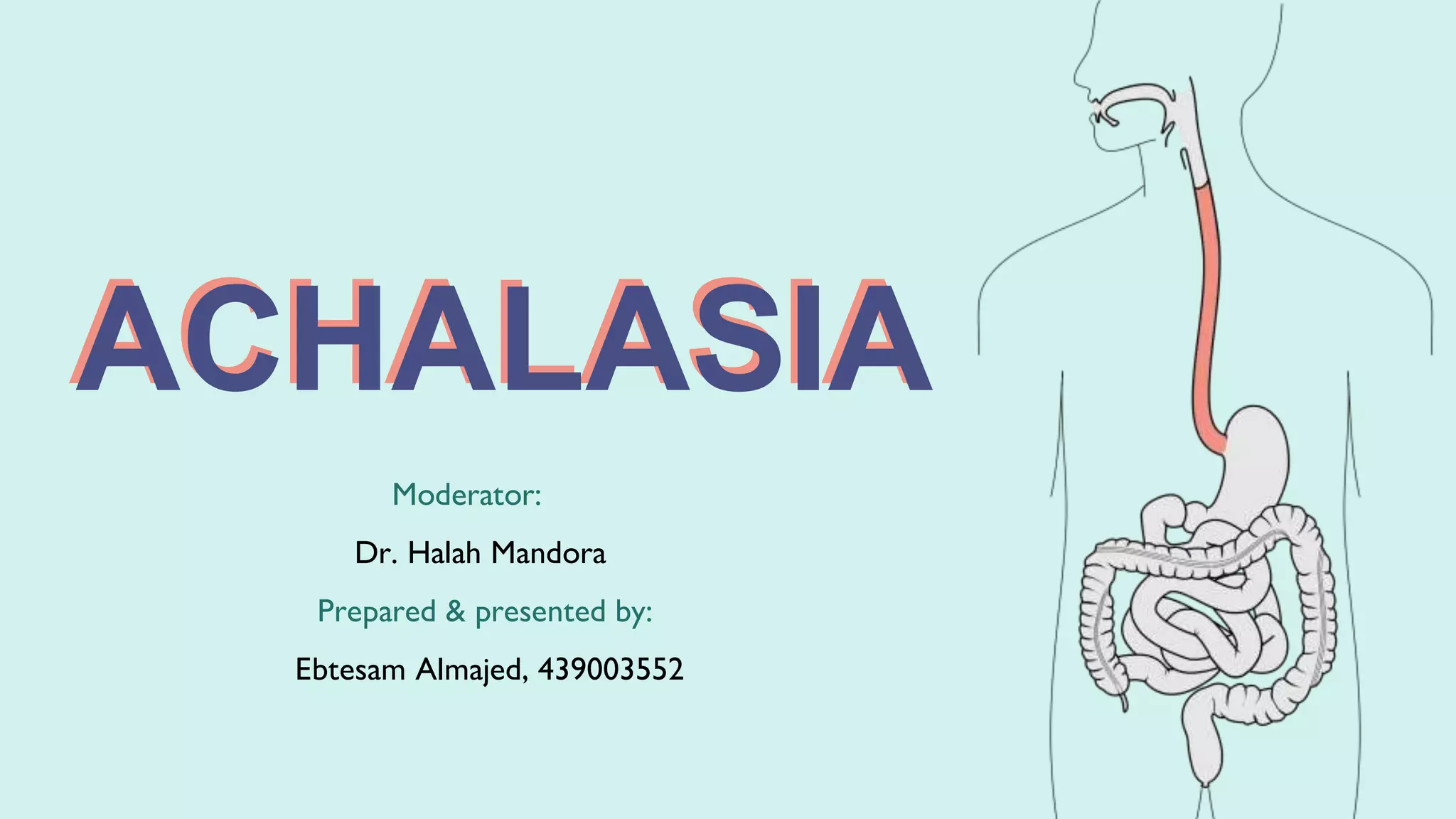
ACHALASIA
ACHALASIA
Moderator:
Dr. Halah Mandora
Prepared & presented by:
Ebtesam Almajed, 439003552
TABLE OF CONTENTS
01
TERMINOLOGY
02
ANATOMY &
PHYSIOLOY
03
PATHOPHYSIOLOGY
04
CLINICAL
MANIFESTATIONS
05
DIAGNOSTIC APPROACH &
INVESTIGATIONS
06
MANAGEMENT
TERMINOLOGY
01
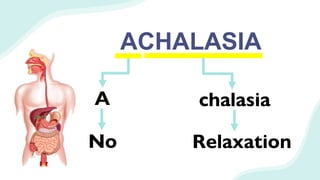
ACHALASIA
A chalasia
No Relaxation
ANATOMY &
PHYSIOLOGY
02
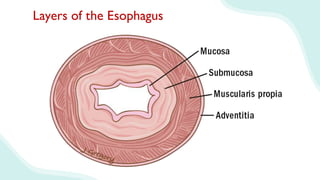
Layers of the Esophagus
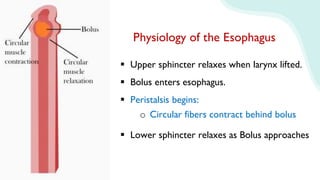
Physiology of the Esophagus
 Upper sphincter relaxes when larynx lifted.
 Bolus enters esophagus.
 Peristalsis begins:
 Lower sphincter relaxes as Bolus approaches
o Circular fibers contract behind bolus
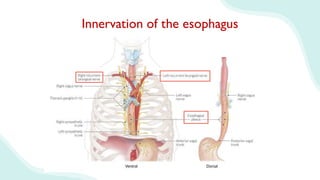
Innervation of the esophagus
ACHALASIA
ACHALASIA
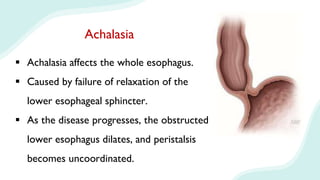
Achalasia
 Achalasia affects the whole esophagus.
 Caused by failure of relaxation of the
lower esophageal sphincter.
 As the disease progresses, the obstructed
lower esophagus dilates, and peristalsis
becomes uncoordinated.
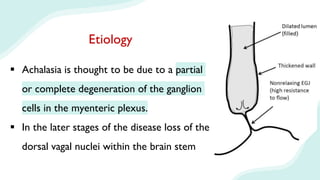
Etiology
 Achalasia is thought to be due to a partial
or complete degeneration of the ganglion
cells in the myenteric plexus.
 In the later stages of the disease loss of the
dorsal vagal nuclei within the brain stem
CLINCAL
MANIFESTATIONS
04
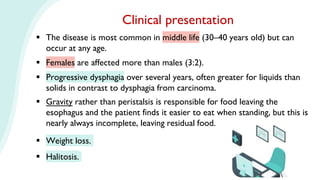
 The disease is most common in middle life (30–40 years old) but can
occur at any age.
 Females are affected more than males (3:2).
 Progressive dysphagia over several years, often greater for liquids than
solids in contrast to dysphagia from carcinoma.
 Gravity rather than peristalsis is responsible for food leaving the
esophagus and the patient finds it easier to eat when standing, but this is
nearly always incomplete, leaving residual food.
 Weight loss.
 Halitosis.
Clinical presentation
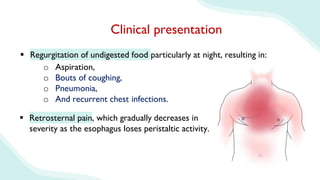
 Regurgitation of undigested food particularly at night, resulting in:
Clinical presentation
o Aspiration,
o Bouts of coughing,
o Pneumonia,
o And recurrent chest infections.
 Retrosternal pain, which gradually decreases in
severity as the esophagus loses peristaltic activity.
DIAGNOSTIC
APPROACH &
INVESTIGATIONS
05
Diagnostic approach & investigations
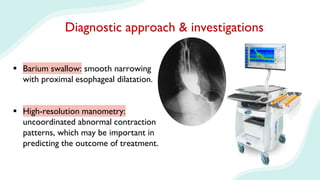
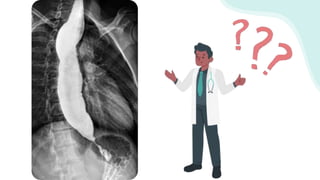
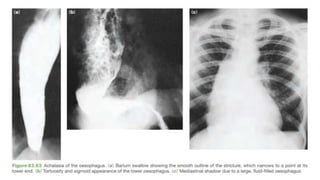
 Barium swallow: smooth narrowing
with proximal esophageal dilatation.
 High-resolution manometry:
uncoordinated abnormal contraction
patterns, which may be important in
predicting the outcome of treatment.
Diagnostic approach &
investigations
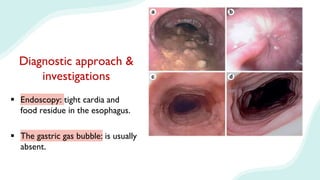
 Endoscopy: tight cardia and
food residue in the esophagus.
 The gastric gas bubble: is usually
absent.
Bird Beak Sign
TREATMENT
04
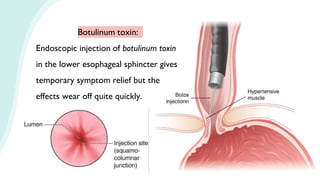
Botulinum toxin:
Endoscopic injection of botulinum toxin
in the lower esophageal sphincter gives
temporary symptom relief but the
effects wear off quite quickly.
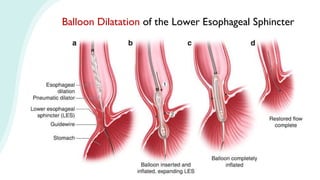
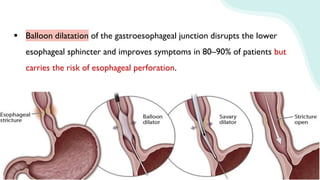
Balloon Dilatation of the Lower Esophageal Sphincter
 Balloon dilatation of the gastroesophageal junction disrupts the lower
esophageal sphincter and improves symptoms in 80–90% of patients but
carries the risk of esophageal perforation.
● Bailey & Love`s Short Practice of Surgery, 27th Edition
● Principles and Practice of Surgery, 7th Edition
● radiopaedia.org/articles/achalasia
REFERENCES

ACHALASIA - Ebtesam.pptx

  • 1.
    ACHALASIA ACHALASIA Moderator: Dr. Halah Mandora Prepared& presented by: Ebtesam Almajed, 439003552
  • 2.
    TABLE OF CONTENTS 01 TERMINOLOGY 02 ANATOMY& PHYSIOLOY 03 PATHOPHYSIOLOGY 04 CLINICAL MANIFESTATIONS 05 DIAGNOSTIC APPROACH & INVESTIGATIONS 06 MANAGEMENT
  • 3.
  • 4.
  • 5.
  • 7.
    Layers of theEsophagus
  • 8.
    Physiology of theEsophagus  Upper sphincter relaxes when larynx lifted.  Bolus enters esophagus.  Peristalsis begins:  Lower sphincter relaxes as Bolus approaches o Circular fibers contract behind bolus
  • 9.
  • 10.
  • 11.
    Achalasia  Achalasia affectsthe whole esophagus.  Caused by failure of relaxation of the lower esophageal sphincter.  As the disease progresses, the obstructed lower esophagus dilates, and peristalsis becomes uncoordinated.
  • 12.
    Etiology  Achalasia isthought to be due to a partial or complete degeneration of the ganglion cells in the myenteric plexus.  In the later stages of the disease loss of the dorsal vagal nuclei within the brain stem
  • 13.
  • 14.
     The diseaseis most common in middle life (30–40 years old) but can occur at any age.  Females are affected more than males (3:2).  Progressive dysphagia over several years, often greater for liquids than solids in contrast to dysphagia from carcinoma.  Gravity rather than peristalsis is responsible for food leaving the esophagus and the patient finds it easier to eat when standing, but this is nearly always incomplete, leaving residual food.  Weight loss.  Halitosis. Clinical presentation
  • 15.
     Regurgitation ofundigested food particularly at night, resulting in: Clinical presentation o Aspiration, o Bouts of coughing, o Pneumonia, o And recurrent chest infections.  Retrosternal pain, which gradually decreases in severity as the esophagus loses peristaltic activity.
  • 16.
  • 17.
    Diagnostic approach &investigations  Barium swallow: smooth narrowing with proximal esophageal dilatation.  High-resolution manometry: uncoordinated abnormal contraction patterns, which may be important in predicting the outcome of treatment.
  • 18.
    Diagnostic approach & investigations Endoscopy: tight cardia and food residue in the esophagus.  The gastric gas bubble: is usually absent.
  • 20.
  • 22.
  • 23.
    Botulinum toxin: Endoscopic injectionof botulinum toxin in the lower esophageal sphincter gives temporary symptom relief but the effects wear off quite quickly.
  • 24.
    Balloon Dilatation ofthe Lower Esophageal Sphincter
  • 25.
     Balloon dilatationof the gastroesophageal junction disrupts the lower esophageal sphincter and improves symptoms in 80–90% of patients but carries the risk of esophageal perforation.
  • 27.
    ● Bailey &Love`s Short Practice of Surgery, 27th Edition ● Principles and Practice of Surgery, 7th Edition ● radiopaedia.org/articles/achalasia REFERENCES

Editor's Notes

  • #5 the word achalasia composed of two part A which means NO and CHALASIA which means relaxation, so now you can guess that in achalasia there's loss of relaxation but where and how dose it happen this is what are we going to learn today
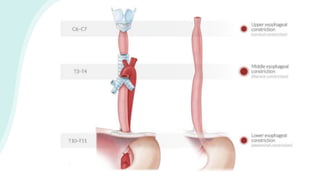
  • #6 But before going through this condition let us have a quick revision of the anatomy & physiology of the esophagus
  • #8 itself consist of only 2 layers circular & longitudinal
  • #9 series of involuntary muscular contractions that move the bolus through the esophagus
  • #10 recurrent laryngeal nerve (a branch of the vagus nerve
  • #12 The main feature is failure of relaxation of the lower esophageal sphincter;
  • #13 Achalasia is thought to be due to a partial or complete degeneration of the ganglion cells in the myenteric plexus. Which result in failure of LES to relax
  • #18 Barium swallow shows a smooth narrowing (inverted bird beak appearance) with evidence of proximal oesophageal dilatation High-resolution manometry recognizes uncoordinated abnormal contraction patterns, which may be important in predicting the outcome of treatment. The gastric gas bubble is usually absent. endoscopy by fnding a tight cardia and food residue in the esophagus.
  • #19 Barium swallow shows a smooth narrowing (inverted bird beak appearance) with evidence of proximal oesophageal dilatation High-resolution manometry recognizes uncoordinated abnormal contraction patterns, which may be important in predicting the outcome of treatment. The gastric gas bubble is usually absent. endoscopy by fnding a tight cardia and food residue in the esophagus.
  • #25 Operative treatment involves:
  • #27 We also have the peroral endoscopic myotomy which nowadays considered as a cornerstone with High success rate https://www.youtube.com/watch?v=oSzdOLWj3Uw&t=6s