P a g e 1 | 3
Course Syllabus
Course Code Course Title ECTS Credits
ACCT-110 Accounting I 6
Prerequisites Department Semester
None Accounting, Economics and Finance Fall/Spring
Type of Course Field Language of Instruction
Required Accounting English
Level of Course Lecturer(s) Year of Study
1st
Cycle Prof. Petros Lois 1st
Mode of Delivery Work Placement Corequisites
Face to face N/A None
Course Objectives:
The main objectives of the course are to:
• Explain the main principles of accounting, including the accounting equation and the
double entry system.
• Expose students to financial statements (i.e. Statement of profit or loss, Statement of
Financial Position).
• Expose students to post Trial Balance adjustments (depreciation of non-current assets,
accruals, prepayments, and allowance for doubtful debts).
• Enable students to prepare Cash Book and Bank Reconciliation Statements.
Learning Outcomes:
After completion of the course students are expected to be able to:
1. Explain what accounting is about.
2. Understand and list the main users of accounting information.
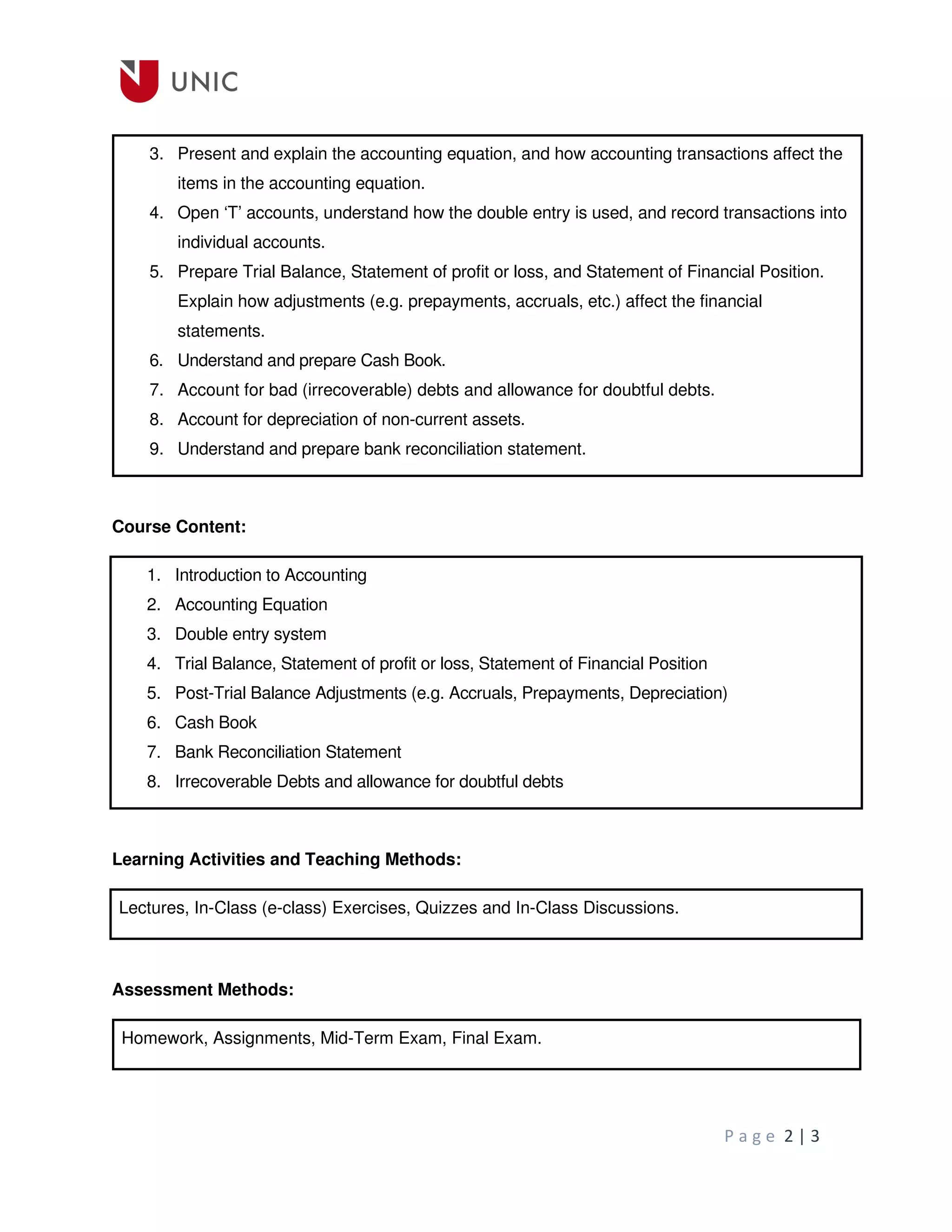
P a g e 2 | 3
3. Present and explain the accounting equation, and how accounting transactions affect the
items in the accounting equation.
4. Open ‘T’ accounts, understand how the double entry is used, and record transactions into
individual accounts.
5. Prepare Trial Balance, Statement of profit or loss, and Statement of Financial Position.
Explain how adjustments (e.g. prepayments, accruals, etc.) affect the financial
statements.
6. Understand and prepare Cash Book.
7. Account for bad (irrecoverable) debts and allowance for doubtful debts.
8. Account for depreciation of non-current assets.
9. Understand and prepare bank reconciliation statement.
Course Content:
1. Introduction to Accounting
2. Accounting Equation
3. Double entry system
4. Trial Balance, Statement of profit or loss, Statement of Financial Position
5. Post-Trial Balance Adjustments (e.g. Accruals, Prepayments, Depreciation)
6. Cash Book
7. Bank Reconciliation Statement
8. Irrecoverable Debts and allowance for doubtful debts
Learning Activities and Teaching Methods:
Lectures, In-Class (e-class) Exercises, Quizzes and In-Class Discussions.
Assessment Methods:
Homework, Assignments, Mid-Term Exam, Final Exam.
P a g e 3 | 3
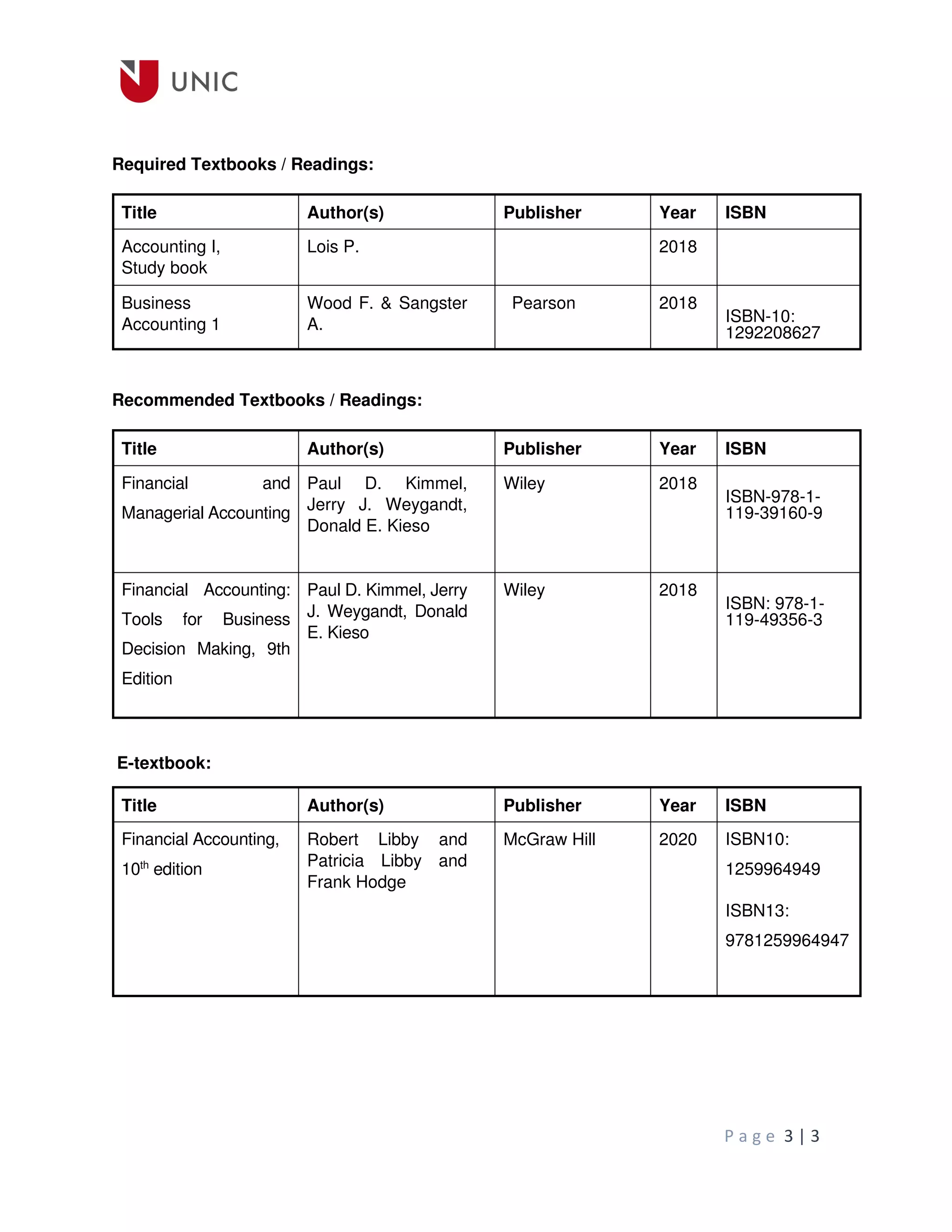
Required Textbooks / Readings:
Title Author(s) Publisher Year ISBN
Accounting I,
Study book
Lois P. 2018
Business
Accounting 1
Wood F. & Sangster
A.
Pearson 2018
ISBN-10:
1292208627
Recommended Textbooks / Readings:
Title Author(s) Publisher Year ISBN
Financial and
Managerial Accounting
Paul D. Kimmel,
Jerry J. Weygandt,
Donald E. Kieso
Wiley 2018
ISBN-978-1-
119-39160-9
Financial Accounting:
Tools for Business
Decision Making, 9th
Edition
Paul D. Kimmel, Jerry
J. Weygandt, Donald
E. Kieso
Wiley 2018
ISBN: 978-1-
119-49356-3
E-textbook:
Title Author(s) Publisher Year ISBN
Financial Accounting,
10th
edition
Robert Libby and
Patricia Libby and
Frank Hodge
McGraw Hill 2020 ISBN10:
1259964949
ISBN13:
9781259964947

ACCT-110.pdf

  • 1.
    P a ge 1 | 3 Course Syllabus Course Code Course Title ECTS Credits ACCT-110 Accounting I 6 Prerequisites Department Semester None Accounting, Economics and Finance Fall/Spring Type of Course Field Language of Instruction Required Accounting English Level of Course Lecturer(s) Year of Study 1st Cycle Prof. Petros Lois 1st Mode of Delivery Work Placement Corequisites Face to face N/A None Course Objectives: The main objectives of the course are to: • Explain the main principles of accounting, including the accounting equation and the double entry system. • Expose students to financial statements (i.e. Statement of profit or loss, Statement of Financial Position). • Expose students to post Trial Balance adjustments (depreciation of non-current assets, accruals, prepayments, and allowance for doubtful debts). • Enable students to prepare Cash Book and Bank Reconciliation Statements. Learning Outcomes: After completion of the course students are expected to be able to: 1. Explain what accounting is about. 2. Understand and list the main users of accounting information.
  • 2.
    P a ge 2 | 3 3. Present and explain the accounting equation, and how accounting transactions affect the items in the accounting equation. 4. Open ‘T’ accounts, understand how the double entry is used, and record transactions into individual accounts. 5. Prepare Trial Balance, Statement of profit or loss, and Statement of Financial Position. Explain how adjustments (e.g. prepayments, accruals, etc.) affect the financial statements. 6. Understand and prepare Cash Book. 7. Account for bad (irrecoverable) debts and allowance for doubtful debts. 8. Account for depreciation of non-current assets. 9. Understand and prepare bank reconciliation statement. Course Content: 1. Introduction to Accounting 2. Accounting Equation 3. Double entry system 4. Trial Balance, Statement of profit or loss, Statement of Financial Position 5. Post-Trial Balance Adjustments (e.g. Accruals, Prepayments, Depreciation) 6. Cash Book 7. Bank Reconciliation Statement 8. Irrecoverable Debts and allowance for doubtful debts Learning Activities and Teaching Methods: Lectures, In-Class (e-class) Exercises, Quizzes and In-Class Discussions. Assessment Methods: Homework, Assignments, Mid-Term Exam, Final Exam.
  • 3.
    P a ge 3 | 3 Required Textbooks / Readings: Title Author(s) Publisher Year ISBN Accounting I, Study book Lois P. 2018 Business Accounting 1 Wood F. & Sangster A. Pearson 2018 ISBN-10: 1292208627 Recommended Textbooks / Readings: Title Author(s) Publisher Year ISBN Financial and Managerial Accounting Paul D. Kimmel, Jerry J. Weygandt, Donald E. Kieso Wiley 2018 ISBN-978-1- 119-39160-9 Financial Accounting: Tools for Business Decision Making, 9th Edition Paul D. Kimmel, Jerry J. Weygandt, Donald E. Kieso Wiley 2018 ISBN: 978-1- 119-49356-3 E-textbook: Title Author(s) Publisher Year ISBN Financial Accounting, 10th edition Robert Libby and Patricia Libby and Frank Hodge McGraw Hill 2020 ISBN10: 1259964949 ISBN13: 9781259964947