ACCT 504 Midterm Exam (4 Sets, 2017)
To Purchase This Material Click below Link
http://www.acct504nerd.com/ACCT-504/product-44-
ACCT-504-Midterm-Exam-(4-Sets,-2017)
FOR MORE CLASSES VISIT
www.acct504nerd.com
This Tutorial contains 4 Set of Midterm Exam
1. Question : (TCOs A and E) Your friend, Ellen, has hired you to
evaluate the following internal control procedures.
Explain to your friend whether each of the numbered items below is
an internal control strength or weakness. You must also state which
internal control procedure relates to each of the internal controls.
For the weaknesses, you also need to state a recommendation for
improvement.
(1) The cashier counts the total receipts and reconciles the receipts
with the cash register total.
(2) Electronic documents are password-protected.
(3) The accountant is completely independent of the sales department.
(4) Invoices are not numbered.
(5) Large purchase orders must be approved by a manager.
TCOs A and E) Your friend, Ellen, has hired you to evaluate the
following internal control procedures.
Explain to your friend whether each of the numbered items below is
an internal control strength or weakness. You must also state which
internal control procedure relates to each of the internal controls.
For the weaknesses, you also need to state a recommendation for
improvement.
(1) The cashier counts the total receipts and reconciles the receipts
with the cash register total.
(2) Electronic documents are password-protected.
(3) The accountant is completely independent of the sales department.
(4) Invoices are not numbered.
(5) Large purchase orders must be approved by a manager. (Points :
30)
Set 2
1: Invoices are pre-numbered.
2: The controller approves of the purchases and makes the payment
since he or she is familiar with the purchases.
3: The office manager is in charge of the petty cash fund.
4: Blank checks are stored in the safe.
5: At the end of the day, the total receipts are counted by the cashier
on duty and reconciled to the cash register total. (Points : 30)
Set 3
Invoices are pre-numbered.
The controller approves of the purchases and makes the payment
since he
or she is familiar with the purchases.
The office manager is in charge of the petty cash fund.
Blank checks are stored in the safe.
At the end of the day, the total receipts are counted by the cashier on
duty
and reconciled to the cash register total
Set 4
Question 14. Question : (TCO D) Your friend Dean has hired you to
evaluate the following internal control procedures.
a: Explain to your friend whether each of the numbered items below
is an internal control strength or weakness. You must also state which
principle relates to each of the internal controls.
b: For the weaknesses, you also need to state a recommendation for
improvement.
1: Bonding of the cashiers is not required because all of the cashiers
have significant experience.
2: The treasurer is the only one allowed to sign checks.
3: All employees may operate cash registers.
4: Blank checks are stored in the safe.
5: Supervisors count cash receipts daily.
12. (TCOs E and F) Please prepare the following journal entries.
Indicate which account should be debited and which account should
be credited, along with the dollar amount of the debit and credit.
(1) Investors invest $500,000 in exchange for 50,000 shares of
common stock.
(2) Company purchased equipment for $25,000 on account.
(3) Company paid Rent for $4,000.
(4) Company received $15,000 for services not yet performed.
(5) Employees work Monday through Friday and are paid on Friday.
Salary expense is $10,000 per day and this year, December 31 falls on
a Wednesday. (Points : 30)
Set 2
Question
Please prepare the following journal entries. Indicate which account
should be debited and which account should be credited, along with
the dollar amount of the debit and credit.
(1) Investors invest $300,000 in exchange for 30,000 shares of
common stock.
(2) Company made payment on account for $500.
(3) Employees work Monday through Friday and are paid on Friday.
Salary expense is $20,000 per day, and December 31 falls on a
Tuesday.
(4) Company purchased Supplies for $2,000.
(5) The company needs to record Supplies used for $500.
Set 3
13. Question : (TCOs D and E) Please prepare the following journal
entries. Indicate
which account should be debited and which account should be
credited,
along with the dollar amount of the debit and credit.
Investors invest $50,000 in exchange for 1,000 shares of common
stock.
Company purchased equipment for $10,000 on credit.
Company received $5,000 for services performed.
Company made payment on account for $2,000.
Set 4
Question 13. Question : (TCO D and TCO E) Please prepare the
following journal entries. Indicate which account should be debited
and which account should be credited, along with the dollar amount
of the debit and credit.
a: Investors invest $100,000 in exchange for 10,000 shares of
common stock.
b: Company paid a utility bill for $600.
c: Company received cash of $15,000 for services performed.
d: Company made payment on account for $1,000.
e: Company received $12,000 for services not yet performed.
Set 5
Question 12. Question : (TCOs B and D) Please prepare the following
journal entries. Indicate which account should be debited and which
account should be credited, along with the dollar amount of the debit
and credit.
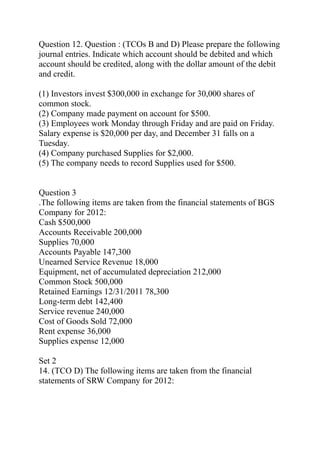
(1) Investors invest $300,000 in exchange for 30,000 shares of
common stock.
(2) Company made payment on account for $500.
(3) Employees work Monday through Friday and are paid on Friday.
Salary expense is $20,000 per day, and December 31 falls on a
Tuesday.
(4) Company purchased Supplies for $2,000.
(5) The company needs to record Supplies used for $500.
Question 3
.The following items are taken from the financial statements of BGS
Company for 2012:
Cash $500,000
Accounts Receivable 200,000
Supplies 70,000
Accounts Payable 147,300
Unearned Service Revenue 18,000
Equipment, net of accumulated depreciation 212,000
Common Stock 500,000
Retained Earnings 12/31/2011 78,300
Long-term debt 142,400
Service revenue 240,000
Cost of Goods Sold 72,000
Rent expense 36,000
Supplies expense 12,000
Set 2
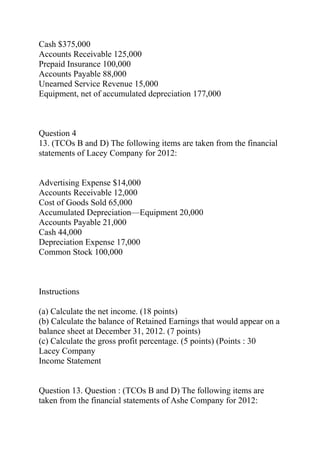
14. (TCO D) The following items are taken from the financial
statements of SRW Company for 2012:
Cash $375,000
Accounts Receivable 125,000
Prepaid Insurance 100,000
Accounts Payable 88,000
Unearned Service Revenue 15,000
Equipment, net of accumulated depreciation 177,000
Question 4
13. (TCOs B and D) The following items are taken from the financial
statements of Lacey Company for 2012:
Advertising Expense $14,000
Accounts Receivable 12,000
Cost of Goods Sold 65,000
Accumulated Depreciation—Equipment 20,000
Accounts Payable 21,000
Cash 44,000
Depreciation Expense 17,000
Common Stock 100,000
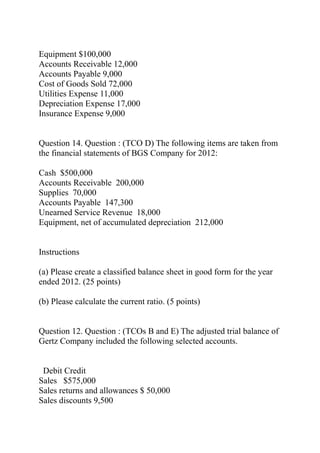
Instructions
(a) Calculate the net income. (18 points)
(b) Calculate the balance of Retained Earnings that would appear on a
balance sheet at December 31, 2012. (7 points)
(c) Calculate the gross profit percentage. (5 points) (Points : 30
Lacey Company
Income Statement
Question 13. Question : (TCOs B and D) The following items are
taken from the financial statements of Ashe Company for 2012:
Equipment $100,000
Accounts Receivable 12,000
Accounts Payable 9,000
Cost of Goods Sold 72,000
Utilities Expense 11,000
Depreciation Expense 17,000
Insurance Expense 9,000
Question 14. Question : (TCO D) The following items are taken from
the financial statements of BGS Company for 2012:
Cash $500,000
Accounts Receivable 200,000
Supplies 70,000
Accounts Payable 147,300
Unearned Service Revenue 18,000
Equipment, net of accumulated depreciation 212,000
Instructions
(a) Please create a classified balance sheet in good form for the year
ended 2012. (25 points)
(b) Please calculate the current ratio. (5 points)
Question 12. Question : (TCOs B and E) The adjusted trial balance of
Gertz Company included the following selected accounts.
Debit Credit
Sales $575,000
Sales returns and allowances $ 50,000
Sales discounts 9,500
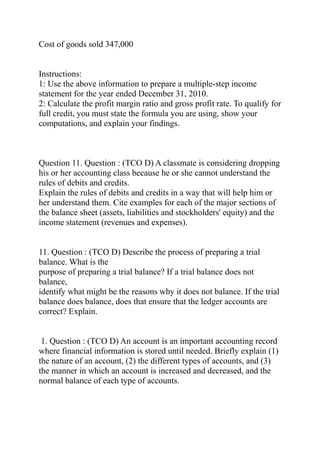
Cost of goods sold 347,000
Instructions:
1: Use the above information to prepare a multiple-step income
statement for the year ended December 31, 2010.
2: Calculate the profit margin ratio and gross profit rate. To qualify for
full credit, you must state the formula you are using, show your
computations, and explain your findings.
Question 11. Question : (TCO D) A classmate is considering dropping
his or her accounting class because he or she cannot understand the
rules of debits and credits.
Explain the rules of debits and credits in a way that will help him or
her understand them. Cite examples for each of the major sections of
the balance sheet (assets, liabilities and stockholders' equity) and the
income statement (revenues and expenses).
11. Question : (TCO D) Describe the process of preparing a trial
balance. What is the
purpose of preparing a trial balance? If a trial balance does not
balance,
identify what might be the reasons why it does not balance. If the trial
balance does balance, does that ensure that the ledger accounts are
correct? Explain.
1. Question : (TCO D) An account is an important accounting record
where financial information is stored until needed. Briefly explain (1)
the nature of an account, (2) the different types of accounts, and (3)
the manner in which an account is increased and decreased, and the
normal balance of each type of accounts.
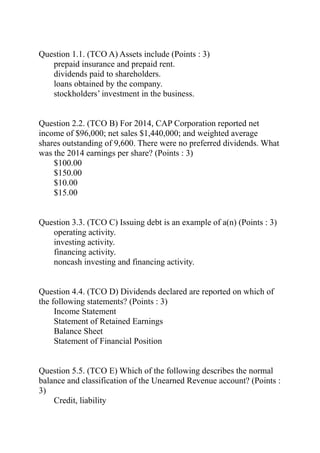
Question 1.1. (TCO A) Assets include (Points : 3)
prepaid insurance and prepaid rent.
dividends paid to shareholders.
loans obtained by the company.
stockholders’ investment in the business.
Question 2.2. (TCO B) For 2014, CAP Corporation reported net
income of $96,000; net sales $1,440,000; and weighted average
shares outstanding of 9,600. There were no preferred dividends. What
was the 2014 earnings per share? (Points : 3)
$100.00
$150.00
$10.00
$15.00
Question 3.3. (TCO C) Issuing debt is an example of a(n) (Points : 3)
operating activity.
investing activity.
financing activity.
noncash investing and financing activity.
Question 4.4. (TCO D) Dividends declared are reported on which of
the following statements? (Points : 3)
Income Statement
Statement of Retained Earnings
Balance Sheet
Statement of Financial Position
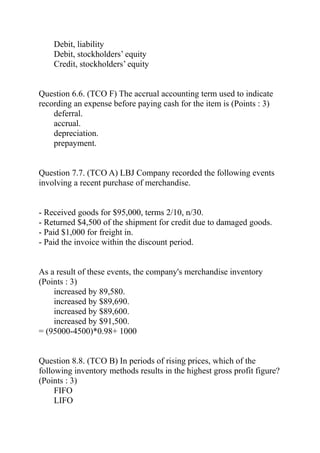
Question 5.5. (TCO E) Which of the following describes the normal
balance and classification of the Unearned Revenue account? (Points :
3)
Credit, liability
Debit, liability
Debit, stockholders’ equity
Credit, stockholders’ equity
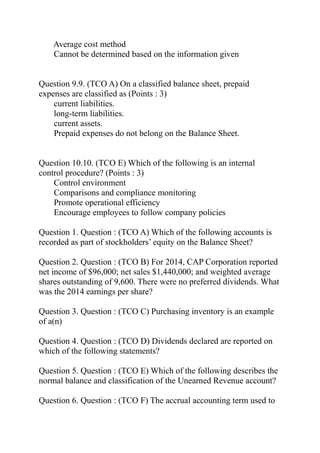
Question 6.6. (TCO F) The accrual accounting term used to indicate
recording an expense before paying cash for the item is (Points : 3)
deferral.
accrual.
depreciation.
prepayment.
Question 7.7. (TCO A) LBJ Company recorded the following events
involving a recent purchase of merchandise.
- Received goods for $95,000, terms 2/10, n/30.
- Returned $4,500 of the shipment for credit due to damaged goods.
- Paid $1,000 for freight in.
- Paid the invoice within the discount period.
As a result of these events, the company's merchandise inventory
(Points : 3)
increased by 89,580.
increased by $89,690.
increased by $89,600.
increased by $91,500.
= (95000-4500)*0.98+ 1000
Question 8.8. (TCO B) In periods of rising prices, which of the
following inventory methods results in the highest gross profit figure?
(Points : 3)
FIFO
LIFO
Average cost method
Cannot be determined based on the information given
Question 9.9. (TCO A) On a classified balance sheet, prepaid
expenses are classified as (Points : 3)
current liabilities.
long-term liabilities.
current assets.
Prepaid expenses do not belong on the Balance Sheet.
Question 10.10. (TCO E) Which of the following is an internal
control procedure? (Points : 3)
Control environment
Comparisons and compliance monitoring
Promote operational efficiency
Encourage employees to follow company policies
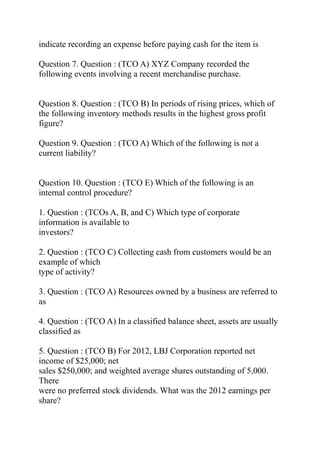
Question 1. Question : (TCO A) Which of the following accounts is
recorded as part of stockholders’ equity on the Balance Sheet?
Question 2. Question : (TCO B) For 2014, CAP Corporation reported
net income of $96,000; net sales $1,440,000; and weighted average
shares outstanding of 9,600. There were no preferred dividends. What
was the 2014 earnings per share?
Question 3. Question : (TCO C) Purchasing inventory is an example
of a(n)
Question 4. Question : (TCO D) Dividends declared are reported on
which of the following statements?
Question 5. Question : (TCO E) Which of the following describes the
normal balance and classification of the Unearned Revenue account?
Question 6. Question : (TCO F) The accrual accounting term used to
indicate recording an expense before paying cash for the item is
Question 7. Question : (TCO A) XYZ Company recorded the
following events involving a recent merchandise purchase.
Question 8. Question : (TCO B) In periods of rising prices, which of
the following inventory methods results in the highest gross profit
figure?
Question 9. Question : (TCO A) Which of the following is not a
current liability?
Question 10. Question : (TCO E) Which of the following is an
internal control procedure?
1. Question : (TCOs A, B, and C) Which type of corporate
information is available to
investors?
2. Question : (TCO C) Collecting cash from customers would be an
example of which
type of activity?
3. Question : (TCO A) Resources owned by a business are referred to
as
4. Question : (TCO A) In a classified balance sheet, assets are usually
classified as
5. Question : (TCO B) For 2012, LBJ Corporation reported net
income of $25,000; net
sales $250,000; and weighted average shares outstanding of 5,000.
There
were no preferred stock dividends. What was the 2012 earnings per
share?
6. Question : (TCO D) Which of the following accounts has a normal
balance of a credit?
7. Question : (TCO E) The accrual accounting term used to indicate
recording an
expense before paying cash for the item is _____
:
8. Question : (TCOs A and B) A periodic inventory system would
most likely be used by
a(n) _____
9. Question : (TCOs A and B) LBJ Company recorded the following
events involving a
recent purchase of merchandise.
Comments:
10. Question : (TCO A) In a period of declining prices, which of the
following inventory
methods generally results in the lowest gross profit figure?
Question : (TCOs A, B, and C) Shareholders want answers to all of
the following questions except:
Question 2. Question : (TCO C) Paying cash dividends is an example
of a(n)
Question 3. Question : (TCO C) Buying a new plant would be an
example of which type of activity?
Question 4. Question : (TCO A) Which of the following should not be
classified as a current liability?
Question 5. Question : (TCO B) For 2012, LBJ Corporation reported
net income of $75,000; net sales $750,000; and weighted average
shares outstanding of 7,500. There were no preferred stock dividends.
What was the 2012 earnings per share?
Question 6. Question : (TCO D) Which of the following describes the
normal balance and classification of the Unearned Revenue account?
Question 7. Question : (TCO E) Which of the following statements is
correct?
Question 8. Question : (TCOs A and B) A periodic inventory system
would most likely be used by a(n)
Question 9. Question : (TCOs A and B) LBJ Company recorded the
following events involving a recent merchandise purchase.
- Received goods for $40,000, terms 2/10, n/30
- Returned $1,200 of the shipment for credit due to damaged goods
- Paid $1,000 for freight in
- Paid the invoice within the discount period
Question 10. Question : (TCO A) In a period of declining prices,
which of the following inventory methods generally results in the
lowest gross profit figure?
Question 1. Question : (TCOs A, B, and C) Which of the following
statements concerning users of accounting information is incorrect?
Question 2. Question : (TCO C) Paying cash dividends is an example
of a(n)
Question 3. Question : (TCO C) Buying a new plant would be an
example of which type of activity?
Question 4. Question : (TCO A) On a classified balance sheet, prepaid
expenses are classified as
Question 5. Question : (TCO B) For 2012, LBJ Corporation reported
net income of $75,000; net sales $750,000; and weighted average
shares outstanding of 7,500. There were no preferred stock dividends.
What was the 2012 earnings per share?
Question 6. Question : (TCO D) Which of the following accounts has
a normal balance of a credit?
Question 7. Question : (TCO E) The accrual accounting term used to
indicate recording an expense before paying cash for the item is
Question 8. Question : (TCOs A and B) A periodic inventory system
would most likely be used by a(n)
Question 9. Question : (TCOs A and B) LBJ Company recorded the
following events involving a recent merchandise purchase.
Question 10. Question : (TCO A) In a period of increasing prices,
which of the following inventory methods generally results in the
highest gross profit?
Question 11. Question : (TCO D) A classmate is considering dropping
his or her accounting class because he or she cannot understand the
rules of debits and credits.
Explain the rules of debits and credits in a way that will help him or
her understand them. Cite examples for each of the major sections of
the balance sheet (assets, liabilities and stockholders' equity) and the
income statement (revenues and expenses).
Question 12. Question : (TCOs B and E) The Caltor Company
gathered the following condensed data for the Year Ended December
31, 2010.
Cost of goods sold $ 710,000
Net sales 1,279,000
Administrative expenses 239,000
Interest expense 68,000
Dividends paid 38,000
Selling expenses 45,000
Instructions:
1: Prepare a multiple-step income statement for the year ended
December 31, 2010.
2: Compute the profit margin ratio and gross profit rate. Caltor
Company’s assets at the beginning of the year were $770,000 and
were $830,000 at the end of the year. To qualify for full credit, you
must state the formula you are using, show your computations, and
explain your findings.
Question 13. Question : (TCO D and E) Please prepare the following
journal entries. Indicate which account should be debited and which
account should be credited, along with the dollar amount of the debit
and credit.
a: Investors invest $50,000 in exchange for 1,000 shares of common
stock.
b: Company purchased equipment for $10,000 on credit.
c: Company received $5,000 for services performed.
d: Company made payment on account for $2,000.
e: Company received $7,000 for services not yet performed.

ACCT 504 Midterm Exam (4 Sets, 2017)

  • 1.
    ACCT 504 MidtermExam (4 Sets, 2017) To Purchase This Material Click below Link http://www.acct504nerd.com/ACCT-504/product-44- ACCT-504-Midterm-Exam-(4-Sets,-2017) FOR MORE CLASSES VISIT www.acct504nerd.com This Tutorial contains 4 Set of Midterm Exam 1. Question : (TCOs A and E) Your friend, Ellen, has hired you to evaluate the following internal control procedures. Explain to your friend whether each of the numbered items below is an internal control strength or weakness. You must also state which internal control procedure relates to each of the internal controls. For the weaknesses, you also need to state a recommendation for improvement. (1) The cashier counts the total receipts and reconciles the receipts with the cash register total. (2) Electronic documents are password-protected. (3) The accountant is completely independent of the sales department. (4) Invoices are not numbered. (5) Large purchase orders must be approved by a manager. TCOs A and E) Your friend, Ellen, has hired you to evaluate the following internal control procedures. Explain to your friend whether each of the numbered items below is an internal control strength or weakness. You must also state which
  • 2.
    internal control procedurerelates to each of the internal controls. For the weaknesses, you also need to state a recommendation for improvement. (1) The cashier counts the total receipts and reconciles the receipts with the cash register total. (2) Electronic documents are password-protected. (3) The accountant is completely independent of the sales department. (4) Invoices are not numbered. (5) Large purchase orders must be approved by a manager. (Points : 30) Set 2 1: Invoices are pre-numbered. 2: The controller approves of the purchases and makes the payment since he or she is familiar with the purchases. 3: The office manager is in charge of the petty cash fund. 4: Blank checks are stored in the safe. 5: At the end of the day, the total receipts are counted by the cashier on duty and reconciled to the cash register total. (Points : 30) Set 3 Invoices are pre-numbered. The controller approves of the purchases and makes the payment since he or she is familiar with the purchases. The office manager is in charge of the petty cash fund. Blank checks are stored in the safe. At the end of the day, the total receipts are counted by the cashier on duty and reconciled to the cash register total Set 4 Question 14. Question : (TCO D) Your friend Dean has hired you to
  • 3.
    evaluate the followinginternal control procedures. a: Explain to your friend whether each of the numbered items below is an internal control strength or weakness. You must also state which principle relates to each of the internal controls. b: For the weaknesses, you also need to state a recommendation for improvement. 1: Bonding of the cashiers is not required because all of the cashiers have significant experience. 2: The treasurer is the only one allowed to sign checks. 3: All employees may operate cash registers. 4: Blank checks are stored in the safe. 5: Supervisors count cash receipts daily. 12. (TCOs E and F) Please prepare the following journal entries. Indicate which account should be debited and which account should be credited, along with the dollar amount of the debit and credit. (1) Investors invest $500,000 in exchange for 50,000 shares of common stock. (2) Company purchased equipment for $25,000 on account. (3) Company paid Rent for $4,000. (4) Company received $15,000 for services not yet performed. (5) Employees work Monday through Friday and are paid on Friday. Salary expense is $10,000 per day and this year, December 31 falls on a Wednesday. (Points : 30) Set 2 Question Please prepare the following journal entries. Indicate which account should be debited and which account should be credited, along with the dollar amount of the debit and credit. (1) Investors invest $300,000 in exchange for 30,000 shares of
  • 4.
    common stock. (2) Companymade payment on account for $500. (3) Employees work Monday through Friday and are paid on Friday. Salary expense is $20,000 per day, and December 31 falls on a Tuesday. (4) Company purchased Supplies for $2,000. (5) The company needs to record Supplies used for $500. Set 3 13. Question : (TCOs D and E) Please prepare the following journal entries. Indicate which account should be debited and which account should be credited, along with the dollar amount of the debit and credit. Investors invest $50,000 in exchange for 1,000 shares of common stock. Company purchased equipment for $10,000 on credit. Company received $5,000 for services performed. Company made payment on account for $2,000. Set 4 Question 13. Question : (TCO D and TCO E) Please prepare the following journal entries. Indicate which account should be debited and which account should be credited, along with the dollar amount of the debit and credit. a: Investors invest $100,000 in exchange for 10,000 shares of common stock. b: Company paid a utility bill for $600. c: Company received cash of $15,000 for services performed. d: Company made payment on account for $1,000. e: Company received $12,000 for services not yet performed. Set 5
  • 5.
    Question 12. Question: (TCOs B and D) Please prepare the following journal entries. Indicate which account should be debited and which account should be credited, along with the dollar amount of the debit and credit. (1) Investors invest $300,000 in exchange for 30,000 shares of common stock. (2) Company made payment on account for $500. (3) Employees work Monday through Friday and are paid on Friday. Salary expense is $20,000 per day, and December 31 falls on a Tuesday. (4) Company purchased Supplies for $2,000. (5) The company needs to record Supplies used for $500. Question 3 .The following items are taken from the financial statements of BGS Company for 2012: Cash $500,000 Accounts Receivable 200,000 Supplies 70,000 Accounts Payable 147,300 Unearned Service Revenue 18,000 Equipment, net of accumulated depreciation 212,000 Common Stock 500,000 Retained Earnings 12/31/2011 78,300 Long-term debt 142,400 Service revenue 240,000 Cost of Goods Sold 72,000 Rent expense 36,000 Supplies expense 12,000 Set 2 14. (TCO D) The following items are taken from the financial statements of SRW Company for 2012:
  • 6.
    Cash $375,000 Accounts Receivable125,000 Prepaid Insurance 100,000 Accounts Payable 88,000 Unearned Service Revenue 15,000 Equipment, net of accumulated depreciation 177,000 Question 4 13. (TCOs B and D) The following items are taken from the financial statements of Lacey Company for 2012: Advertising Expense $14,000 Accounts Receivable 12,000 Cost of Goods Sold 65,000 Accumulated Depreciation—Equipment 20,000 Accounts Payable 21,000 Cash 44,000 Depreciation Expense 17,000 Common Stock 100,000 Instructions (a) Calculate the net income. (18 points) (b) Calculate the balance of Retained Earnings that would appear on a balance sheet at December 31, 2012. (7 points) (c) Calculate the gross profit percentage. (5 points) (Points : 30 Lacey Company Income Statement Question 13. Question : (TCOs B and D) The following items are taken from the financial statements of Ashe Company for 2012:
  • 7.
    Equipment $100,000 Accounts Receivable12,000 Accounts Payable 9,000 Cost of Goods Sold 72,000 Utilities Expense 11,000 Depreciation Expense 17,000 Insurance Expense 9,000 Question 14. Question : (TCO D) The following items are taken from the financial statements of BGS Company for 2012: Cash $500,000 Accounts Receivable 200,000 Supplies 70,000 Accounts Payable 147,300 Unearned Service Revenue 18,000 Equipment, net of accumulated depreciation 212,000 Instructions (a) Please create a classified balance sheet in good form for the year ended 2012. (25 points) (b) Please calculate the current ratio. (5 points) Question 12. Question : (TCOs B and E) The adjusted trial balance of Gertz Company included the following selected accounts. Debit Credit Sales $575,000 Sales returns and allowances $ 50,000 Sales discounts 9,500
  • 8.
    Cost of goodssold 347,000 Instructions: 1: Use the above information to prepare a multiple-step income statement for the year ended December 31, 2010. 2: Calculate the profit margin ratio and gross profit rate. To qualify for full credit, you must state the formula you are using, show your computations, and explain your findings. Question 11. Question : (TCO D) A classmate is considering dropping his or her accounting class because he or she cannot understand the rules of debits and credits. Explain the rules of debits and credits in a way that will help him or her understand them. Cite examples for each of the major sections of the balance sheet (assets, liabilities and stockholders' equity) and the income statement (revenues and expenses). 11. Question : (TCO D) Describe the process of preparing a trial balance. What is the purpose of preparing a trial balance? If a trial balance does not balance, identify what might be the reasons why it does not balance. If the trial balance does balance, does that ensure that the ledger accounts are correct? Explain. 1. Question : (TCO D) An account is an important accounting record where financial information is stored until needed. Briefly explain (1) the nature of an account, (2) the different types of accounts, and (3) the manner in which an account is increased and decreased, and the normal balance of each type of accounts.
  • 9.
    Question 1.1. (TCOA) Assets include (Points : 3) prepaid insurance and prepaid rent. dividends paid to shareholders. loans obtained by the company. stockholders’ investment in the business. Question 2.2. (TCO B) For 2014, CAP Corporation reported net income of $96,000; net sales $1,440,000; and weighted average shares outstanding of 9,600. There were no preferred dividends. What was the 2014 earnings per share? (Points : 3) $100.00 $150.00 $10.00 $15.00 Question 3.3. (TCO C) Issuing debt is an example of a(n) (Points : 3) operating activity. investing activity. financing activity. noncash investing and financing activity. Question 4.4. (TCO D) Dividends declared are reported on which of the following statements? (Points : 3) Income Statement Statement of Retained Earnings Balance Sheet Statement of Financial Position Question 5.5. (TCO E) Which of the following describes the normal balance and classification of the Unearned Revenue account? (Points : 3) Credit, liability
  • 10.
    Debit, liability Debit, stockholders’equity Credit, stockholders’ equity Question 6.6. (TCO F) The accrual accounting term used to indicate recording an expense before paying cash for the item is (Points : 3) deferral. accrual. depreciation. prepayment. Question 7.7. (TCO A) LBJ Company recorded the following events involving a recent purchase of merchandise. - Received goods for $95,000, terms 2/10, n/30. - Returned $4,500 of the shipment for credit due to damaged goods. - Paid $1,000 for freight in. - Paid the invoice within the discount period. As a result of these events, the company's merchandise inventory (Points : 3) increased by 89,580. increased by $89,690. increased by $89,600. increased by $91,500. = (95000-4500)*0.98+ 1000 Question 8.8. (TCO B) In periods of rising prices, which of the following inventory methods results in the highest gross profit figure? (Points : 3) FIFO LIFO
  • 11.
    Average cost method Cannotbe determined based on the information given Question 9.9. (TCO A) On a classified balance sheet, prepaid expenses are classified as (Points : 3) current liabilities. long-term liabilities. current assets. Prepaid expenses do not belong on the Balance Sheet. Question 10.10. (TCO E) Which of the following is an internal control procedure? (Points : 3) Control environment Comparisons and compliance monitoring Promote operational efficiency Encourage employees to follow company policies Question 1. Question : (TCO A) Which of the following accounts is recorded as part of stockholders’ equity on the Balance Sheet? Question 2. Question : (TCO B) For 2014, CAP Corporation reported net income of $96,000; net sales $1,440,000; and weighted average shares outstanding of 9,600. There were no preferred dividends. What was the 2014 earnings per share? Question 3. Question : (TCO C) Purchasing inventory is an example of a(n) Question 4. Question : (TCO D) Dividends declared are reported on which of the following statements? Question 5. Question : (TCO E) Which of the following describes the normal balance and classification of the Unearned Revenue account? Question 6. Question : (TCO F) The accrual accounting term used to
  • 12.
    indicate recording anexpense before paying cash for the item is Question 7. Question : (TCO A) XYZ Company recorded the following events involving a recent merchandise purchase. Question 8. Question : (TCO B) In periods of rising prices, which of the following inventory methods results in the highest gross profit figure? Question 9. Question : (TCO A) Which of the following is not a current liability? Question 10. Question : (TCO E) Which of the following is an internal control procedure? 1. Question : (TCOs A, B, and C) Which type of corporate information is available to investors? 2. Question : (TCO C) Collecting cash from customers would be an example of which type of activity? 3. Question : (TCO A) Resources owned by a business are referred to as 4. Question : (TCO A) In a classified balance sheet, assets are usually classified as 5. Question : (TCO B) For 2012, LBJ Corporation reported net income of $25,000; net sales $250,000; and weighted average shares outstanding of 5,000. There were no preferred stock dividends. What was the 2012 earnings per share?
  • 13.
    6. Question :(TCO D) Which of the following accounts has a normal balance of a credit? 7. Question : (TCO E) The accrual accounting term used to indicate recording an expense before paying cash for the item is _____ : 8. Question : (TCOs A and B) A periodic inventory system would most likely be used by a(n) _____ 9. Question : (TCOs A and B) LBJ Company recorded the following events involving a recent purchase of merchandise. Comments: 10. Question : (TCO A) In a period of declining prices, which of the following inventory methods generally results in the lowest gross profit figure? Question : (TCOs A, B, and C) Shareholders want answers to all of the following questions except: Question 2. Question : (TCO C) Paying cash dividends is an example of a(n) Question 3. Question : (TCO C) Buying a new plant would be an example of which type of activity? Question 4. Question : (TCO A) Which of the following should not be classified as a current liability? Question 5. Question : (TCO B) For 2012, LBJ Corporation reported net income of $75,000; net sales $750,000; and weighted average shares outstanding of 7,500. There were no preferred stock dividends.
  • 14.
    What was the2012 earnings per share? Question 6. Question : (TCO D) Which of the following describes the normal balance and classification of the Unearned Revenue account? Question 7. Question : (TCO E) Which of the following statements is correct? Question 8. Question : (TCOs A and B) A periodic inventory system would most likely be used by a(n) Question 9. Question : (TCOs A and B) LBJ Company recorded the following events involving a recent merchandise purchase. - Received goods for $40,000, terms 2/10, n/30 - Returned $1,200 of the shipment for credit due to damaged goods - Paid $1,000 for freight in - Paid the invoice within the discount period Question 10. Question : (TCO A) In a period of declining prices, which of the following inventory methods generally results in the lowest gross profit figure? Question 1. Question : (TCOs A, B, and C) Which of the following statements concerning users of accounting information is incorrect? Question 2. Question : (TCO C) Paying cash dividends is an example of a(n) Question 3. Question : (TCO C) Buying a new plant would be an example of which type of activity? Question 4. Question : (TCO A) On a classified balance sheet, prepaid expenses are classified as Question 5. Question : (TCO B) For 2012, LBJ Corporation reported net income of $75,000; net sales $750,000; and weighted average
  • 15.
    shares outstanding of7,500. There were no preferred stock dividends. What was the 2012 earnings per share? Question 6. Question : (TCO D) Which of the following accounts has a normal balance of a credit? Question 7. Question : (TCO E) The accrual accounting term used to indicate recording an expense before paying cash for the item is Question 8. Question : (TCOs A and B) A periodic inventory system would most likely be used by a(n) Question 9. Question : (TCOs A and B) LBJ Company recorded the following events involving a recent merchandise purchase. Question 10. Question : (TCO A) In a period of increasing prices, which of the following inventory methods generally results in the highest gross profit? Question 11. Question : (TCO D) A classmate is considering dropping his or her accounting class because he or she cannot understand the rules of debits and credits. Explain the rules of debits and credits in a way that will help him or her understand them. Cite examples for each of the major sections of the balance sheet (assets, liabilities and stockholders' equity) and the income statement (revenues and expenses). Question 12. Question : (TCOs B and E) The Caltor Company gathered the following condensed data for the Year Ended December 31, 2010. Cost of goods sold $ 710,000 Net sales 1,279,000
  • 16.
    Administrative expenses 239,000 Interestexpense 68,000 Dividends paid 38,000 Selling expenses 45,000 Instructions: 1: Prepare a multiple-step income statement for the year ended December 31, 2010. 2: Compute the profit margin ratio and gross profit rate. Caltor Company’s assets at the beginning of the year were $770,000 and were $830,000 at the end of the year. To qualify for full credit, you must state the formula you are using, show your computations, and explain your findings. Question 13. Question : (TCO D and E) Please prepare the following journal entries. Indicate which account should be debited and which account should be credited, along with the dollar amount of the debit and credit. a: Investors invest $50,000 in exchange for 1,000 shares of common stock. b: Company purchased equipment for $10,000 on credit. c: Company received $5,000 for services performed. d: Company made payment on account for $2,000. e: Company received $7,000 for services not yet performed.