Accounts Payable
BY – Pankaj Aggarwal
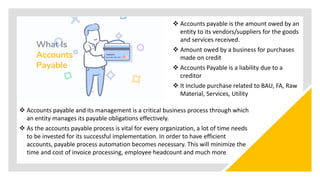
❖ Accounts payable is the amount owed by an
entity to its vendors/suppliers for the goods
and services received.
❖ Amount owed by a business for purchases
made on credit
❖ Accounts Payable is a liability due to a
creditor
❖ It Include purchase related to BAU, FA, Raw
Material, Services, Utility
❖ Accounts payable and its management is a critical business process through which
an entity manages its payable obligations effectively.
❖ As the accounts payable process is vital for every organization, a lot of time needs
to be invested for its successful implementation. In order to have efficient
accounts, payable process automation becomes necessary. This will minimize the
time and cost of invoice processing, employee headcount and much more
Characteristic of AP
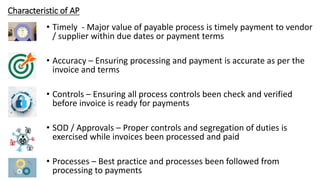
• Timely - Major value of payable process is timely payment to vendor
/ supplier within due dates or payment terms
• Accuracy – Ensuring processing and payment is accurate as per the
invoice and terms
• Controls – Ensuring all process controls been check and verified
before invoice is ready for payments
• SOD / Approvals – Proper controls and segregation of duties is
exercised while invoices been processed and paid
• Processes – Best practice and processes been followed from
processing to payments
Inclusion In AP
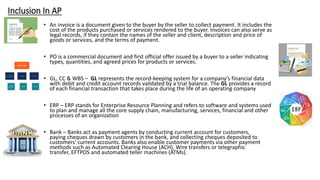
• An invoice is a document given to the buyer by the seller to collect payment. It includes the
cost of the products purchased or services rendered to the buyer. Invoices can also serve as
legal records, if they contain the names of the seller and client, description and price of
goods or services, and the terms of payment.
• PO is a commercial document and first official offer issued by a buyer to a seller indicating
types, quantities, and agreed prices for products or services.
• GL, CC & WBS – GL represents the record-keeping system for a company's financial data
with debit and credit account records validated by a trial balance. The GL provides a record
of each financial transaction that takes place during the life of an operating company
• ERP – ERP stands for Enterprise Resource Planning and refers to software and systems used
to plan and manage all the core supply chain, manufacturing, services, financial and other
processes of an organization
• Bank – Banks act as payment agents by conducting current account for customers,
paying cheques drawn by customers in the bank, and collecting cheques deposited to
customers' current accounts. Banks also enable customer payments via other payment
methods such as Automated Clearing House (ACH), Wire transfers or telegraphic
transfer, EFTPOS and automated teller machines (ATMs).
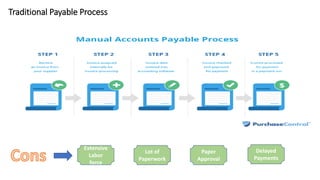
Traditional Payable Process
Extensive
Labor
force
Lot of
Paperwork
Paper
Approval
Delayed
Payments
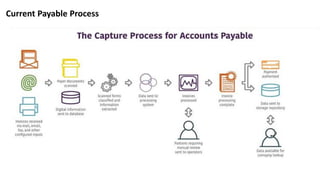
Current Payable Process
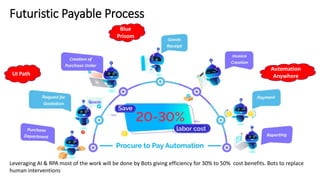
Futuristic Payable Process
Leveraging AI & RPA most of the work will be done by Bots giving efficiency for 30% to 50% cost benefits. Bots to replace
human interventions
UI Path
Automation
Anywhere
Blue
Prisom
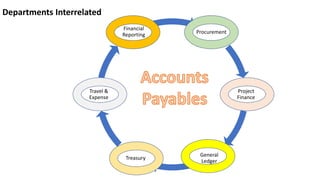
Procurement
Project
Finance
General
Ledger
Treasury
Travel &
Expense
Financial
Reporting
Departments Interrelated
Purchase Order
Types of Purchase Order
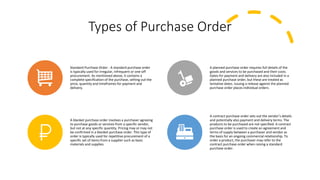
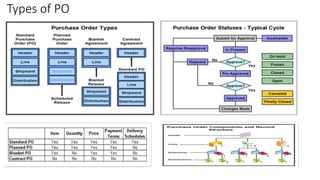
Standard Purchase Order - A standard purchase order
is typically used for irregular, infrequent or one-off
procurement. As mentioned above, it contains a
complete specification of the purchase, setting out the
price, quantity and timeframes for payment and
delivery.
A planned purchase order requires full details of the
goods and services to be purchased and their costs.
Dates for payment and delivery are also included in a
planned purchase order, but these are treated as
tentative dates. Issuing a release against the planned
purchase order places individual orders.
A blanket purchase order involves a purchaser agreeing
to purchase goods or services from a specific vendor,
but not at any specific quantity. Pricing may or may not
be confirmed in a blanket purchase order. This type of
order is typically used for repetitive procurement of a
specific set of items from a supplier such as basic
materials and supplies.
A contract purchase order sets out the vendor’s details
and potentially also payment and delivery terms. The
products to be purchased are not specified. A contract
purchase order is used to create an agreement and
terms of supply between a purchaser and vendor as
the basis for an ongoing commercial relationship. To
order a product, the purchaser may refer to the
contract purchase order when raising a standard
purchase order.
❖ 2-way matching verifies that invoice information matches the corresponding purchase order
❖ 3-way matching verifies that invoice information matches both the purchase order and the goods receipt
❖ 4-way matching adds another criterion to verify that the invoice details also match the acceptance or
inspection document in the case this step is part of the purchasing process
Types of Different PO / Invoice Match
The definition of invoice matching is the process of comparing information on the invoice with supporting
documents such as a purchase order, goods receipt, and contract. The invoice matching process aims to
ensure accurate vendor payments, correct accounting of costs and compliance to purchasing contracts as well
as to detect potential fraudulent invoices.
Invoice matching is used when a vendor invoice is preceded by a purchase order (PO) from the buying
organization. This means the buyer has created a purchase requisition stating the goods or services needed,
quantity, vendor and contracted price. Once the appropriate approvers within the organization have approved
the purchase requisition, a purchase order is generated and sent to the vendor. Upon delivery of the goods or
services, the buyer often needs to register a goods receipt in the ERP or procurement system.
Types of PO
Invoices
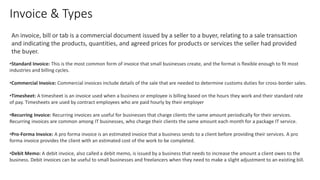
Invoice & Types
•Standard Invoice: This is the most common form of invoice that small businesses create, and the format is flexible enough to fit most
industries and billing cycles.
•Commercial Invoice: Commercial invoices include details of the sale that are needed to determine customs duties for cross-border sales.
•Timesheet: A timesheet is an invoice used when a business or employee is billing based on the hours they work and their standard rate
of pay. Timesheets are used by contract employees who are paid hourly by their employer
•Recurring Invoice: Recurring invoices are useful for businesses that charge clients the same amount periodically for their services.
Recurring invoices are common among IT businesses, who charge their clients the same amount each month for a package IT service.
•Pro-Forma Invoice: A pro forma invoice is an estimated invoice that a business sends to a client before providing their services. A pro
forma invoice provides the client with an estimated cost of the work to be completed.
•Debit Memo: A debit invoice, also called a debit memo, is issued by a business that needs to increase the amount a client owes to the
business. Debit invoices can be useful to small businesses and freelancers when they need to make a slight adjustment to an existing bill.
An invoice, bill or tab is a commercial document issued by a seller to a buyer, relating to a sale transaction
and indicating the products, quantities, and agreed prices for products or services the seller had provided
the buyer.
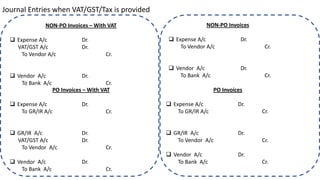
Journal Entries when VAT/GST/Tax is provided
NON-PO Invoices – With VAT
❑ Expense A/c Dr.
VAT/GST A/c Dr.
To Vendor A/c Cr.
❑ Vendor A/c Dr.
To Bank A/c Cr.
PO Invoices – With VAT
❑ Expense A/c Dr.
To GR/IR A/c Cr.
❑ GR/IR A/c Dr.
VAT/GST A/c Dr.
To Vendor A/c Cr.
❑ Vendor A/c Dr.
To Bank A/c Cr.
NON-PO Invoices
❑ Expense A/c Dr.
To Vendor A/c Cr.
❑ Vendor A/c Dr.
To Bank A/c Cr.
PO Invoices
❑ Expense A/c Dr.
To GR/IR A/c Cr.
❑ GR/IR A/c Dr.
To Vendor A/c Cr.
❑ Vendor A/c Dr.
To Bank A/c Cr.
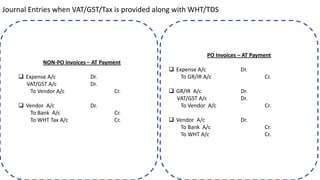
Journal Entries when VAT/GST/Tax is provided along with WHT/TDS
NON-PO Invoices – AT Payment
❑ Expense A/c Dr.
VAT/GST A/c Dr.
To Vendor A/c Cr.
❑ Vendor A/c Dr.
To Bank A/c Cr.
To WHT Tax A/c Cr.
PO Invoices – AT Payment
❑ Expense A/c Dr.
To GR/IR A/c Cr.
❑ GR/IR A/c Dr.
VAT/GST A/c Dr.
To Vendor A/c Cr.
❑ Vendor A/c Dr.
To Bank A/c Cr.
To WHT A/c Cr.
Reasons –
Unable to
Process PO
Invoices
• Goods receipt Note not completed in PO
• Purchase Order Not Approved / Released
• Price Variance
• Quantity Variance
• Incorrect Vendor & Vendor not approved
• Incorrect Currency
• Bank Details Mismatch
• Final Invoice not ticket for milestone invoices
• GR Based not checked in purchase order
• Vendor blocked for invoice posting
Reasons –
Unable to
Process Non
PO Invoices
• Incorrect Vendor & Vendor not approved
• Incorrect Currency
• Bank Details Mismatch
• Vendor blocked for invoice posting
• GL/CC/ WBS/Project are closed or block for AP posting
• GL/CC/WBS/Project not open for manual posting
• GL/CC/WBS/Project are not relevant for Tax/VAT/GST
• GL/CC/WBS/Project are incorrect combination
• Approver not authorized for approving value of invoice
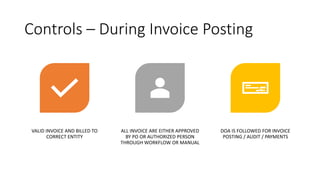
Controls – During Invoice Posting
VALID INVOICE AND BILLED TO
CORRECT ENTITY
ALL INVOICE ARE EITHER APPROVED
BY PO OR AUTHORIZED PERSON
THROUGH WORKFLOW OR MANUAL
DOA IS FOLLOWED FOR INVOICE
POSTING / AUDIT / PAYMENTS
Payments
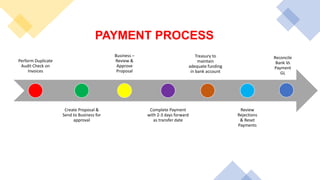
PAYMENT PROCESS
Perform Duplicate
Audit Check on
Invoices
Create Proposal &
Send to Business for
approval
Business –
Review &
Approve
Proposal
Complete Payment
with 2-3 days forward
as transfer date
Treasury to
maintain
adequate funding
in bank account
Review
Rejections
& Reset
Payments
Reconcile
Bank Vs
Payment
GL
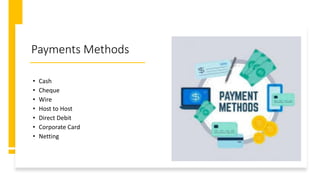
Payments Methods
• Cash
• Cheque
• Wire
• Host to Host
• Direct Debit
• Corporate Card
• Netting
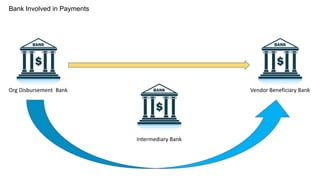
Bank Involved in Payments
Org Disbursement Bank Vendor Beneficiary Bank
Intermediary Bank
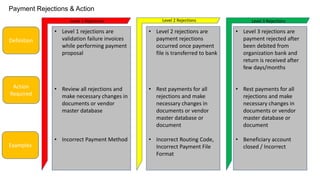
Payment Rejections & Action
• Level 1 rejections are
validation failure invoices
while performing payment
proposal
• Review all rejections and
make necessary changes in
documents or vendor
master database
• Incorrect Payment Method
• Level 3 rejections are
payment rejected after
been debited from
organization bank and
return is received after
few days/months
• Rest payments for all
rejections and make
necessary changes in
documents or vendor
master database or
document
• Beneficiary account
closed / Incorrect
• Level 2 rejections are
payment rejections
occurred once payment
file is transferred to bank
• Rest payments for all
rejections and make
necessary changes in
documents or vendor
master database or
document
• Incorrect Routing Code,
Incorrect Payment File
Format
Definition
Action
Required
Examples
Level 1 Rejections Level 2 Rejections Level 3 Rejections
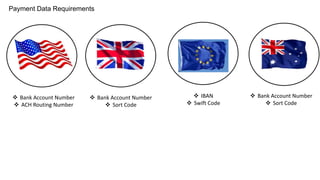
Payment Data Requirements
❖ Bank Account Number
❖ ACH Routing Number
❖ Bank Account Number
❖ Sort Code
❖ IBAN
❖ Swift Code
❖ Bank Account Number
❖ Sort Code
Month End Close
Activities
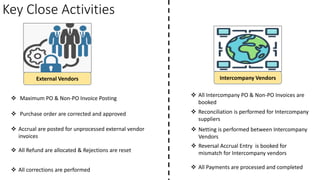
Key Close Activities
❖ Maximum PO & Non-PO Invoice Posting
❖ All Payments are processed and completed
❖ All corrections are performed
❖ All Intercompany PO & Non-PO Invoices are
booked
❖ Accrual are posted for unprocessed external vendor
invoices
❖ Reconciliation is performed for Intercompany
suppliers
❖ Reversal Accrual Entry is booked for
mismatch for Intercompany vendors
❖ Netting is performed between Intercompany
Vendors
❖ All Refund are allocated & Rejections are reset
External Vendors Intercompany Vendors
❖ Purchase order are corrected and approved
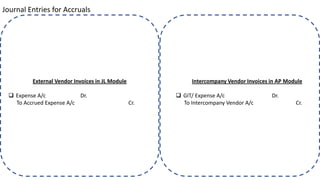
Journal Entries for Accruals
External Vendor Invoices in JL Module
❑ Expense A/c Dr.
To Accrued Expense A/c Cr.
Intercompany Vendor Invoices in AP Module
❑ GIT/ Expense A/c Dr.
To Intercompany Vendor A/c Cr.
MIS Reports
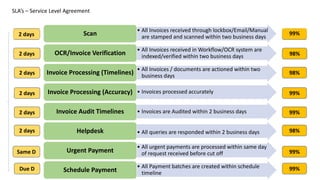
• All Invoices received through lockbox/Email/Manual
are stamped and scanned within two business days
Scan
• All Invoices received in Workflow/OCR system are
indexed/verified within two business days
OCR/Invoice Verification
• All Invoices / documents are actioned within two
business days
Invoice Processing (Timelines)
• Invoices processed accurately
Invoice Processing (Accuracy)
• Invoices are Audited within 2 business days
Invoice Audit Timelines
• All queries are responded within 2 business days
Helpdesk
• All urgent payments are processed within same day
of request received before cut off
Urgent Payment
• All Payment batches are created within schedule
timeline
Schedule Payment
SLA’s – Service Level Agreement
2 days
2 days
2 days
2 days
2 days
Same D
Due D
2 days
98%
98%
99%
99%
98%
99%
99%
99%
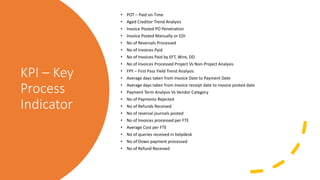
KPI – Key
Process
Indicator
• POT – Paid on Time
• Aged Creditor Trend Analysis
• Invoice Posted PO Penetration
• Invoice Posted Manually or EDI
• No of Reversals Processed
• No of Invoices Paid
• No of Invoices Paid by EFT, Wire, DD
• No of Invoices Processed Project Vs Non-Project Analysis
• FPY – First Pass Yield Trend Analysis
• Average days taken from Invoice Date to Payment Date
• Average days taken from Invoice receipt date to invoice posted date
• Payment Term Analysis Vs Vendor Category
• No of Payments Rejected
• No of Refunds Received
• No of reversal journals posted
• No of Invoices processed per FTE
• Average Cost per FTE
• No of queries received in helpdesk
• No of Down payment processed
• No of Refund Received
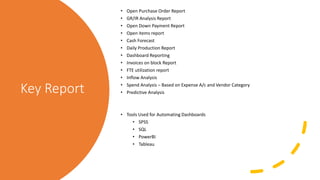
Key Report
• Open Purchase Order Report
• GR/IR Analysis Report
• Open Down Payment Report
• Open items report
• Cash Forecast
• Daily Production Report
• Dashboard Reporting
• Invoices on block Report
• FTE utilization report
• Inflow Analysis
• Spend Analysis – Based on Expense A/c and Vendor Category
• Predictive Analysis
• Tools Used for Automating Dashboards
• SPSS
• SQL
• PowerBI
• Tableau
Ratio Analysis
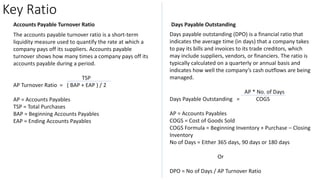
Key Ratio
Accounts Payable Turnover Ratio
The accounts payable turnover ratio is a short-term
liquidity measure used to quantify the rate at which a
company pays off its suppliers. Accounts payable
turnover shows how many times a company pays off its
accounts payable during a period.
TSP
AP Turnover Ratio = ( BAP + EAP ) / 2
AP = Accounts Payables
TSP = Total Purchases
BAP = Beginning Accounts Payables
EAP = Ending Accounts Payables
Days Payable Outstanding
Days payable outstanding (DPO) is a financial ratio that
indicates the average time (in days) that a company takes
to pay its bills and invoices to its trade creditors, which
may include suppliers, vendors, or financiers. The ratio is
typically calculated on a quarterly or annual basis and
indicates how well the company’s cash outflows are being
managed.
AP * No. of Days
Days Payable Outstanding = COGS
AP = Accounts Payables
COGS = Cost of Goods Sold
COGS Formula = Beginning Inventory + Purchase – Closing
Inventory
No of Days = Either 365 days, 90 days or 180 days
Or
DPO = No of Days / AP Turnover Ratio
Thank You

Accounts Payable Solution Overview and detail

  • 1.
    Accounts Payable BY –Pankaj Aggarwal
  • 2.
    ❖ Accounts payableis the amount owed by an entity to its vendors/suppliers for the goods and services received. ❖ Amount owed by a business for purchases made on credit ❖ Accounts Payable is a liability due to a creditor ❖ It Include purchase related to BAU, FA, Raw Material, Services, Utility ❖ Accounts payable and its management is a critical business process through which an entity manages its payable obligations effectively. ❖ As the accounts payable process is vital for every organization, a lot of time needs to be invested for its successful implementation. In order to have efficient accounts, payable process automation becomes necessary. This will minimize the time and cost of invoice processing, employee headcount and much more
  • 3.
    Characteristic of AP •Timely - Major value of payable process is timely payment to vendor / supplier within due dates or payment terms • Accuracy – Ensuring processing and payment is accurate as per the invoice and terms • Controls – Ensuring all process controls been check and verified before invoice is ready for payments • SOD / Approvals – Proper controls and segregation of duties is exercised while invoices been processed and paid • Processes – Best practice and processes been followed from processing to payments
  • 4.
    Inclusion In AP •An invoice is a document given to the buyer by the seller to collect payment. It includes the cost of the products purchased or services rendered to the buyer. Invoices can also serve as legal records, if they contain the names of the seller and client, description and price of goods or services, and the terms of payment. • PO is a commercial document and first official offer issued by a buyer to a seller indicating types, quantities, and agreed prices for products or services. • GL, CC & WBS – GL represents the record-keeping system for a company's financial data with debit and credit account records validated by a trial balance. The GL provides a record of each financial transaction that takes place during the life of an operating company • ERP – ERP stands for Enterprise Resource Planning and refers to software and systems used to plan and manage all the core supply chain, manufacturing, services, financial and other processes of an organization • Bank – Banks act as payment agents by conducting current account for customers, paying cheques drawn by customers in the bank, and collecting cheques deposited to customers' current accounts. Banks also enable customer payments via other payment methods such as Automated Clearing House (ACH), Wire transfers or telegraphic transfer, EFTPOS and automated teller machines (ATMs).
  • 6.
    Traditional Payable Process Extensive Labor force Lotof Paperwork Paper Approval Delayed Payments
  • 7.
  • 8.
    Futuristic Payable Process LeveragingAI & RPA most of the work will be done by Bots giving efficiency for 30% to 50% cost benefits. Bots to replace human interventions UI Path Automation Anywhere Blue Prisom
  • 9.
  • 10.
  • 11.
    Types of PurchaseOrder Standard Purchase Order - A standard purchase order is typically used for irregular, infrequent or one-off procurement. As mentioned above, it contains a complete specification of the purchase, setting out the price, quantity and timeframes for payment and delivery. A planned purchase order requires full details of the goods and services to be purchased and their costs. Dates for payment and delivery are also included in a planned purchase order, but these are treated as tentative dates. Issuing a release against the planned purchase order places individual orders. A blanket purchase order involves a purchaser agreeing to purchase goods or services from a specific vendor, but not at any specific quantity. Pricing may or may not be confirmed in a blanket purchase order. This type of order is typically used for repetitive procurement of a specific set of items from a supplier such as basic materials and supplies. A contract purchase order sets out the vendor’s details and potentially also payment and delivery terms. The products to be purchased are not specified. A contract purchase order is used to create an agreement and terms of supply between a purchaser and vendor as the basis for an ongoing commercial relationship. To order a product, the purchaser may refer to the contract purchase order when raising a standard purchase order.
  • 12.
    ❖ 2-way matchingverifies that invoice information matches the corresponding purchase order ❖ 3-way matching verifies that invoice information matches both the purchase order and the goods receipt ❖ 4-way matching adds another criterion to verify that the invoice details also match the acceptance or inspection document in the case this step is part of the purchasing process Types of Different PO / Invoice Match The definition of invoice matching is the process of comparing information on the invoice with supporting documents such as a purchase order, goods receipt, and contract. The invoice matching process aims to ensure accurate vendor payments, correct accounting of costs and compliance to purchasing contracts as well as to detect potential fraudulent invoices. Invoice matching is used when a vendor invoice is preceded by a purchase order (PO) from the buying organization. This means the buyer has created a purchase requisition stating the goods or services needed, quantity, vendor and contracted price. Once the appropriate approvers within the organization have approved the purchase requisition, a purchase order is generated and sent to the vendor. Upon delivery of the goods or services, the buyer often needs to register a goods receipt in the ERP or procurement system.
  • 13.
  • 14.
  • 15.
    Invoice & Types •StandardInvoice: This is the most common form of invoice that small businesses create, and the format is flexible enough to fit most industries and billing cycles. •Commercial Invoice: Commercial invoices include details of the sale that are needed to determine customs duties for cross-border sales. •Timesheet: A timesheet is an invoice used when a business or employee is billing based on the hours they work and their standard rate of pay. Timesheets are used by contract employees who are paid hourly by their employer •Recurring Invoice: Recurring invoices are useful for businesses that charge clients the same amount periodically for their services. Recurring invoices are common among IT businesses, who charge their clients the same amount each month for a package IT service. •Pro-Forma Invoice: A pro forma invoice is an estimated invoice that a business sends to a client before providing their services. A pro forma invoice provides the client with an estimated cost of the work to be completed. •Debit Memo: A debit invoice, also called a debit memo, is issued by a business that needs to increase the amount a client owes to the business. Debit invoices can be useful to small businesses and freelancers when they need to make a slight adjustment to an existing bill. An invoice, bill or tab is a commercial document issued by a seller to a buyer, relating to a sale transaction and indicating the products, quantities, and agreed prices for products or services the seller had provided the buyer.
  • 16.
    Journal Entries whenVAT/GST/Tax is provided NON-PO Invoices – With VAT ❑ Expense A/c Dr. VAT/GST A/c Dr. To Vendor A/c Cr. ❑ Vendor A/c Dr. To Bank A/c Cr. PO Invoices – With VAT ❑ Expense A/c Dr. To GR/IR A/c Cr. ❑ GR/IR A/c Dr. VAT/GST A/c Dr. To Vendor A/c Cr. ❑ Vendor A/c Dr. To Bank A/c Cr. NON-PO Invoices ❑ Expense A/c Dr. To Vendor A/c Cr. ❑ Vendor A/c Dr. To Bank A/c Cr. PO Invoices ❑ Expense A/c Dr. To GR/IR A/c Cr. ❑ GR/IR A/c Dr. To Vendor A/c Cr. ❑ Vendor A/c Dr. To Bank A/c Cr.
  • 17.
    Journal Entries whenVAT/GST/Tax is provided along with WHT/TDS NON-PO Invoices – AT Payment ❑ Expense A/c Dr. VAT/GST A/c Dr. To Vendor A/c Cr. ❑ Vendor A/c Dr. To Bank A/c Cr. To WHT Tax A/c Cr. PO Invoices – AT Payment ❑ Expense A/c Dr. To GR/IR A/c Cr. ❑ GR/IR A/c Dr. VAT/GST A/c Dr. To Vendor A/c Cr. ❑ Vendor A/c Dr. To Bank A/c Cr. To WHT A/c Cr.
  • 18.
    Reasons – Unable to ProcessPO Invoices • Goods receipt Note not completed in PO • Purchase Order Not Approved / Released • Price Variance • Quantity Variance • Incorrect Vendor & Vendor not approved • Incorrect Currency • Bank Details Mismatch • Final Invoice not ticket for milestone invoices • GR Based not checked in purchase order • Vendor blocked for invoice posting
  • 19.
    Reasons – Unable to ProcessNon PO Invoices • Incorrect Vendor & Vendor not approved • Incorrect Currency • Bank Details Mismatch • Vendor blocked for invoice posting • GL/CC/ WBS/Project are closed or block for AP posting • GL/CC/WBS/Project not open for manual posting • GL/CC/WBS/Project are not relevant for Tax/VAT/GST • GL/CC/WBS/Project are incorrect combination • Approver not authorized for approving value of invoice
  • 20.
    Controls – DuringInvoice Posting VALID INVOICE AND BILLED TO CORRECT ENTITY ALL INVOICE ARE EITHER APPROVED BY PO OR AUTHORIZED PERSON THROUGH WORKFLOW OR MANUAL DOA IS FOLLOWED FOR INVOICE POSTING / AUDIT / PAYMENTS
  • 21.
  • 22.
    PAYMENT PROCESS Perform Duplicate AuditCheck on Invoices Create Proposal & Send to Business for approval Business – Review & Approve Proposal Complete Payment with 2-3 days forward as transfer date Treasury to maintain adequate funding in bank account Review Rejections & Reset Payments Reconcile Bank Vs Payment GL
  • 23.
    Payments Methods • Cash •Cheque • Wire • Host to Host • Direct Debit • Corporate Card • Netting
  • 24.
    Bank Involved inPayments Org Disbursement Bank Vendor Beneficiary Bank Intermediary Bank
  • 25.
    Payment Rejections &Action • Level 1 rejections are validation failure invoices while performing payment proposal • Review all rejections and make necessary changes in documents or vendor master database • Incorrect Payment Method • Level 3 rejections are payment rejected after been debited from organization bank and return is received after few days/months • Rest payments for all rejections and make necessary changes in documents or vendor master database or document • Beneficiary account closed / Incorrect • Level 2 rejections are payment rejections occurred once payment file is transferred to bank • Rest payments for all rejections and make necessary changes in documents or vendor master database or document • Incorrect Routing Code, Incorrect Payment File Format Definition Action Required Examples Level 1 Rejections Level 2 Rejections Level 3 Rejections
  • 26.
    Payment Data Requirements ❖Bank Account Number ❖ ACH Routing Number ❖ Bank Account Number ❖ Sort Code ❖ IBAN ❖ Swift Code ❖ Bank Account Number ❖ Sort Code
  • 27.
  • 28.
    Key Close Activities ❖Maximum PO & Non-PO Invoice Posting ❖ All Payments are processed and completed ❖ All corrections are performed ❖ All Intercompany PO & Non-PO Invoices are booked ❖ Accrual are posted for unprocessed external vendor invoices ❖ Reconciliation is performed for Intercompany suppliers ❖ Reversal Accrual Entry is booked for mismatch for Intercompany vendors ❖ Netting is performed between Intercompany Vendors ❖ All Refund are allocated & Rejections are reset External Vendors Intercompany Vendors ❖ Purchase order are corrected and approved
  • 29.
    Journal Entries forAccruals External Vendor Invoices in JL Module ❑ Expense A/c Dr. To Accrued Expense A/c Cr. Intercompany Vendor Invoices in AP Module ❑ GIT/ Expense A/c Dr. To Intercompany Vendor A/c Cr.
  • 30.
  • 31.
    • All Invoicesreceived through lockbox/Email/Manual are stamped and scanned within two business days Scan • All Invoices received in Workflow/OCR system are indexed/verified within two business days OCR/Invoice Verification • All Invoices / documents are actioned within two business days Invoice Processing (Timelines) • Invoices processed accurately Invoice Processing (Accuracy) • Invoices are Audited within 2 business days Invoice Audit Timelines • All queries are responded within 2 business days Helpdesk • All urgent payments are processed within same day of request received before cut off Urgent Payment • All Payment batches are created within schedule timeline Schedule Payment SLA’s – Service Level Agreement 2 days 2 days 2 days 2 days 2 days Same D Due D 2 days 98% 98% 99% 99% 98% 99% 99% 99%
  • 32.
    KPI – Key Process Indicator •POT – Paid on Time • Aged Creditor Trend Analysis • Invoice Posted PO Penetration • Invoice Posted Manually or EDI • No of Reversals Processed • No of Invoices Paid • No of Invoices Paid by EFT, Wire, DD • No of Invoices Processed Project Vs Non-Project Analysis • FPY – First Pass Yield Trend Analysis • Average days taken from Invoice Date to Payment Date • Average days taken from Invoice receipt date to invoice posted date • Payment Term Analysis Vs Vendor Category • No of Payments Rejected • No of Refunds Received • No of reversal journals posted • No of Invoices processed per FTE • Average Cost per FTE • No of queries received in helpdesk • No of Down payment processed • No of Refund Received
  • 33.
    Key Report • OpenPurchase Order Report • GR/IR Analysis Report • Open Down Payment Report • Open items report • Cash Forecast • Daily Production Report • Dashboard Reporting • Invoices on block Report • FTE utilization report • Inflow Analysis • Spend Analysis – Based on Expense A/c and Vendor Category • Predictive Analysis • Tools Used for Automating Dashboards • SPSS • SQL • PowerBI • Tableau
  • 34.
  • 35.
    Key Ratio Accounts PayableTurnover Ratio The accounts payable turnover ratio is a short-term liquidity measure used to quantify the rate at which a company pays off its suppliers. Accounts payable turnover shows how many times a company pays off its accounts payable during a period. TSP AP Turnover Ratio = ( BAP + EAP ) / 2 AP = Accounts Payables TSP = Total Purchases BAP = Beginning Accounts Payables EAP = Ending Accounts Payables Days Payable Outstanding Days payable outstanding (DPO) is a financial ratio that indicates the average time (in days) that a company takes to pay its bills and invoices to its trade creditors, which may include suppliers, vendors, or financiers. The ratio is typically calculated on a quarterly or annual basis and indicates how well the company’s cash outflows are being managed. AP * No. of Days Days Payable Outstanding = COGS AP = Accounts Payables COGS = Cost of Goods Sold COGS Formula = Beginning Inventory + Purchase – Closing Inventory No of Days = Either 365 days, 90 days or 180 days Or DPO = No of Days / AP Turnover Ratio
  • 36.