Basic Accounting  
ACC30205 
 
NAME​ : ​NGIENG TIEN YUNG                  (0320221) 
   
              TERENCE TAN PENG ONG         (0320275) 
   
              TAN MING HOWE                        (0320199) 
 
ASSIGNMENT​ : FINANCIAL RATIO ANALYSIS 
COMPANY NAME​ : NIKE  
LECTURER​ : MR. CHANG JAU HO 
 
Table of content   
 
1. History of NIKE 
2. Recent development 
3. Profitability ratio 
4. Stability ratio 
5. Price earning ratio  
6. Investment recommendation  
7. Appendix 
8. References 


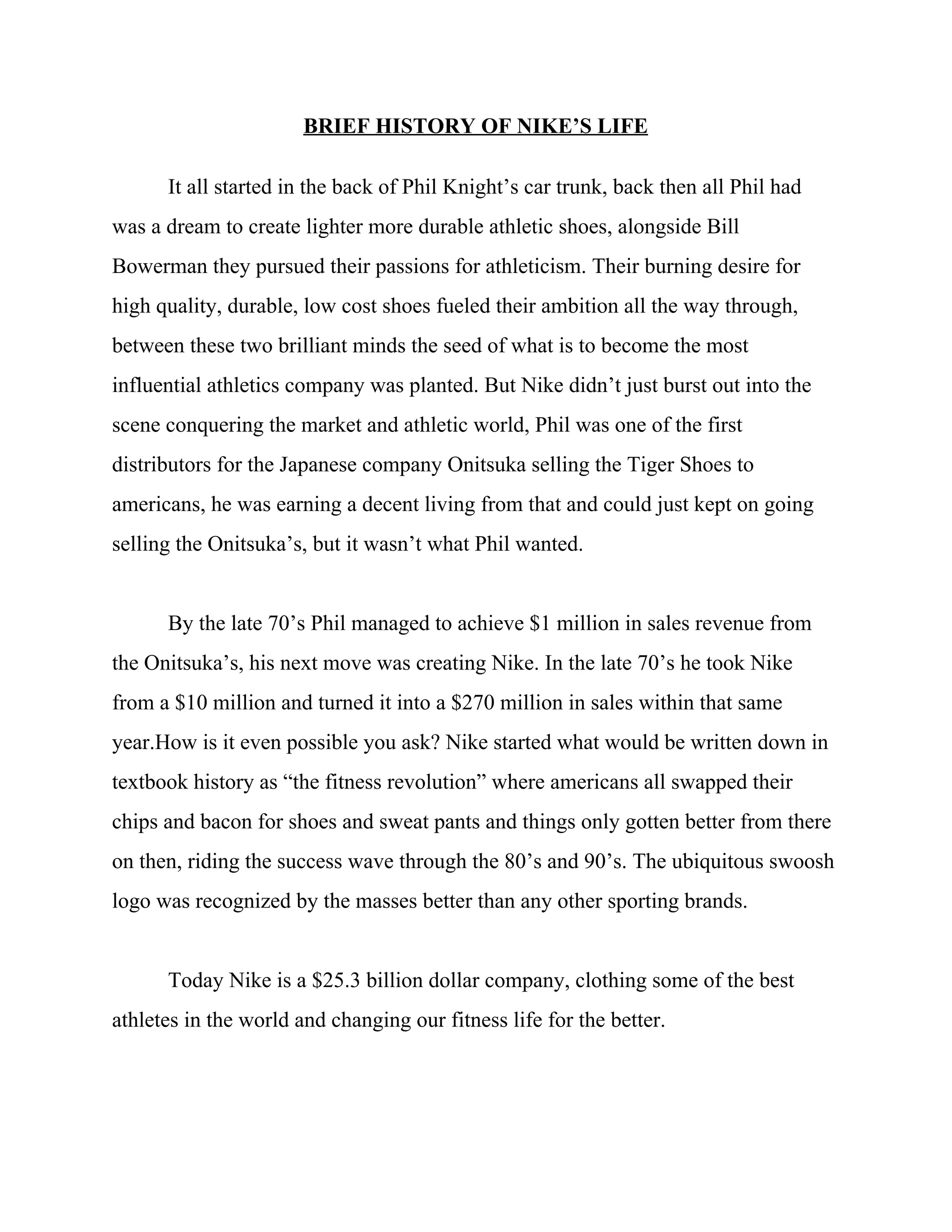
BRIEF HISTORY OF NIKE’S LIFE 
 
It all started in the back of Phil Knight’s car trunk, back then all Phil had 
was a dream to create lighter more durable athletic shoes, alongside Bill 
Bowerman they pursued their passions for athleticism. Their burning desire for 
high quality, durable, low cost shoes fueled their ambition all the way through, 
between these two brilliant minds the seed of what is to become the most 
influential athletics company was planted. But Nike didn’t just burst out into the 
scene conquering the market and athletic world, Phil was one of the first 
distributors for the Japanese company Onitsuka selling the Tiger Shoes to 
americans, he was earning a decent living from that and could just kept on going 
selling the Onitsuka’s, but it wasn’t what Phil wanted.  
 
By the late 70’s Phil managed to achieve $1 million in sales revenue from 
the Onitsuka’s, his next move was creating Nike. In the late 70’s he took Nike 
from a $10 million and turned it into a $270 million in sales within that same 
year.How is it even possible you ask? Nike started what would be written down in 
textbook history as “the fitness revolution” where americans all swapped their 
chips and bacon for shoes and sweat pants and things only gotten better from there 
on then, riding the success wave through the 80’s and 90’s. The ubiquitous swoosh 
logo was recognized by the masses better than any other sporting brands. 
 
Today Nike is a $25.3 billion dollar company, clothing some of the best 
athletes in the world and changing our fitness life for the better.  
 
 
NIKE’S RECENT DEVELOPMENT  
 
Since the 1970’s, Nike has come a long way from being a domestic                         
American brand transforming into an international powerhouse for athletic apparel.                   
With the all the crazy advancements in technology, it would sure to have spilled                           
some over into the world of athleticism. Currently Nike features research facilities                       
such as motion capture labs where athletes will perform an action and be recorded                           
on high speed cameras whereby it will be analysed by nurses and coaches advising                           
at which moment in time the weight is located in which internal joint, by gathering                             
these insight Nike is able to develop a better understanding and is able to develop                             
better future products allowing athletes to outperform their predecessors by adding                     
science into the designs of the products, ever improving the material, quality and                         
weight of their apparel, reducing the drag on clothings and incorporating                     
technology as a training companion, such as the newly released fitband a device                         
which encourages the average joe to take the stairs instead of the escalator in a fun                               
and competitive way. 


Profitability 
The following table shows the calculation and interpretation of NIKE from 
the year 2013 to 2014 ( US dollars in millions)   
 Profitability Ratios  2013   2014  Interpretation 
Return on Equity 
( ROE )  
 2472 
10952.5 
  
 
 ​= ​22.​6% 
 2693 
10952.5 
 
 
= 24.​5​% 
During the year 2013 to 2014, 
the ROE has increased from 
22.6% to 24.5%. This means 
NIKE is getting more return from 
the capital than last year.   
Net Profit Margin 
( NPM ) 
2472 
2​5313 


 ​= 9.8% 
 2693 
27799 


 ​= 9.7% 
During the year 2013 to 2014, 
the NPM has decreased from 
9.8% to 9.7%. This means the 
ability of NIKE to control its 
expenses is worse than last year.   
Gross Profit Margin 
( GPM )  
11034 
2​5313 


 ​= 43.6% 
12446 
27799 


 ​= 44.8% 
During the year 2013 to 2014, 
the GPM has increased from 
43.6% to 44.8%. This means the 
ability of NIKE to control its cost 
of goods sold (COGS) expense is 
better than last year.  
Selling Exp. Ratio 
( SER ) 
7796 
2​5313 


 ​= 30.8% 
8766 
27799 


 ​= 3​1.5​% 
During the year 2013 to 2014, 
the SER has increased from 
30.8% to 31.5%. This means the 
ability of NIKE to control its 
selling expenses is getting worse.   
General Exp. Ratio 
( GER ) 
0   
2​5313 
 
 
 ​= 0 % 
 
103 
27799 


= 0.4% 
During the year 2013 to 2014, 
the GER of Nike had increased 
from 0% to 0.4%. The ability of 
the business to control its general 
expenses is getting worse. 
Financial Exp. Ratio 
( FER ) 
0 
2​5313 
 
 ​= 0 % 
 
33 
27799 
 
 
 ​=0.1% 
Over the period, the FER of Nike 
has increased from 0% to 0.1%. 
This means that the ability of the 
business to control its financial 
expenses is getting worse.  
 
* The method we used to obtain credit sales is by dividing the revenue in half.  


Stability 
The following table shows the calculation and interpretation of NIKE from 
the year 2013 to 2014 ( US dollars in millions)   
 
Financial Stability Ratio   2013  2014  Interpretation 
Working Capital Ratio  
(WCR)  
13630  
 3962 
= 3.44 : 1  
13696 
 5027 
= 2.72 : 1 
During the year 2013 to 2014, the 
WCR has increased from 3.44:1 to 
2.72:1. This means the ability of 
business to pay current liabilities 
with current assets is getting 
worse than last year. 
However,addition, it satisfy the 
minimum requirement of 2:1.  
Total debt ratio 
(TDR) 
 ​6464  
17545  
= 36.8% 
 ​7770 
18594 
= 41.8%  
During the year 2013­2014, the 
TDR has increased from 36.8% to 
41.8%. This means the total debt 
of business has increased. In 
addition, it satisfy the maximum 
limit by 50%. 
Inventory Turnover Ratio 
( ITR ) 
365÷ ​14279 
  3353 
= 85.7 days     
   
 
365÷  ​15353  
          3715.5 
= 88.3 days  
   
During the year 2013 to 2014, the 
ITR has increased from 85.7 days 
to 88.3 days. This means the 
business sell their goods is getting 
slower.  
Debtor Turnover Ratio  
( DTR ) 
365÷ ​12656.5 
           3117 
= 89.9 days  
365÷ ​13899.5 
           3434 
= 90.2 days  
During the year 2013 to 2014, the 
DTR has increased from 89.9 days 
to 90.2 days. This means the 
business is taking longer times to 
collect the debt.  
Interest Coverage Ratio  
( ICR ) 
0+2693 
    0 
= 0 time 
33+2693 
    33 
= 82.6 times  
During the year 2013 to 2014, the 
ICR has increased from 0 time to 
82.6 times. This means the ability 
of the business to pay the interest 
is getting better. In addition, it 
satisfy the minimum requirement 
of 5 times.  
 
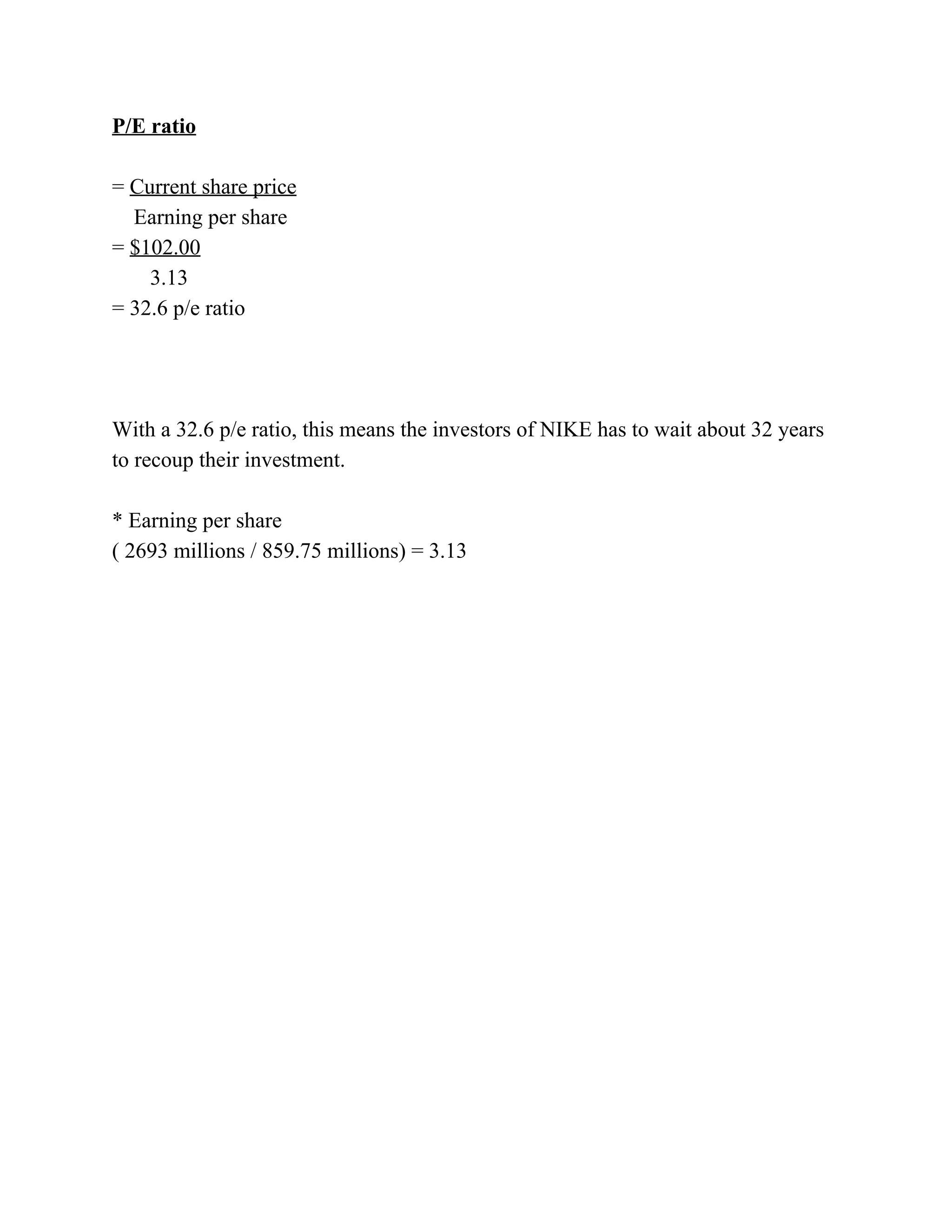
P/E ratio 
 
= ​Current share price 
    Earning per share  
= ​$102.00  
       3.13  
= 32.6 p/e ratio  


With a 32.6 p/e ratio, this means the investors of NIKE has to wait about 32 years 
to recoup their investment.   
 
* Earning per share  
( 2693 millions / 859.75 millions) = 3.13  


Investment Recommendation 
 
 
Based on profitability ratio, we obtained the total Net profit margin figure                       
(NPM). The Selling expenses (SER) and general expenses (GER) ratio for nike                       
showed their method of handling the business had worsen even though the gross                         
profit margin (GPM) and return on equity (ROE) had increased. Nike’s ability to                         
pay off their current liabilities is also worsening but still satisfies the 2:1 ratio of                             
staying within the borderline of borrowing. Nike’s total debt has also increased and                         
it satisfies the 50% maximum limit. Their stock turnover has also slowed down and                           
they are taking a longer time to reclaim old debts. On the flip side their ability for                                 
paying interest is getting better. 
 
In conclusion nike earned more profit in 2014 compared to 2013. The                         
company has shown good promise in terms of revenue growth in the future as it                             
has always managed to stay ahead of the pack not only financially but also product                             
wise. Nike also has received AAA ratings from several different stock analysts                       
since and has proven itself to be a very stable company. Although Nike is a great                               
company but we do not recommend purchasing any shares from this company as it                           
would take over a calculated 30 years to earn back a profit on your investment.  


Appendix  
 
 
INCOME STATEMENT 


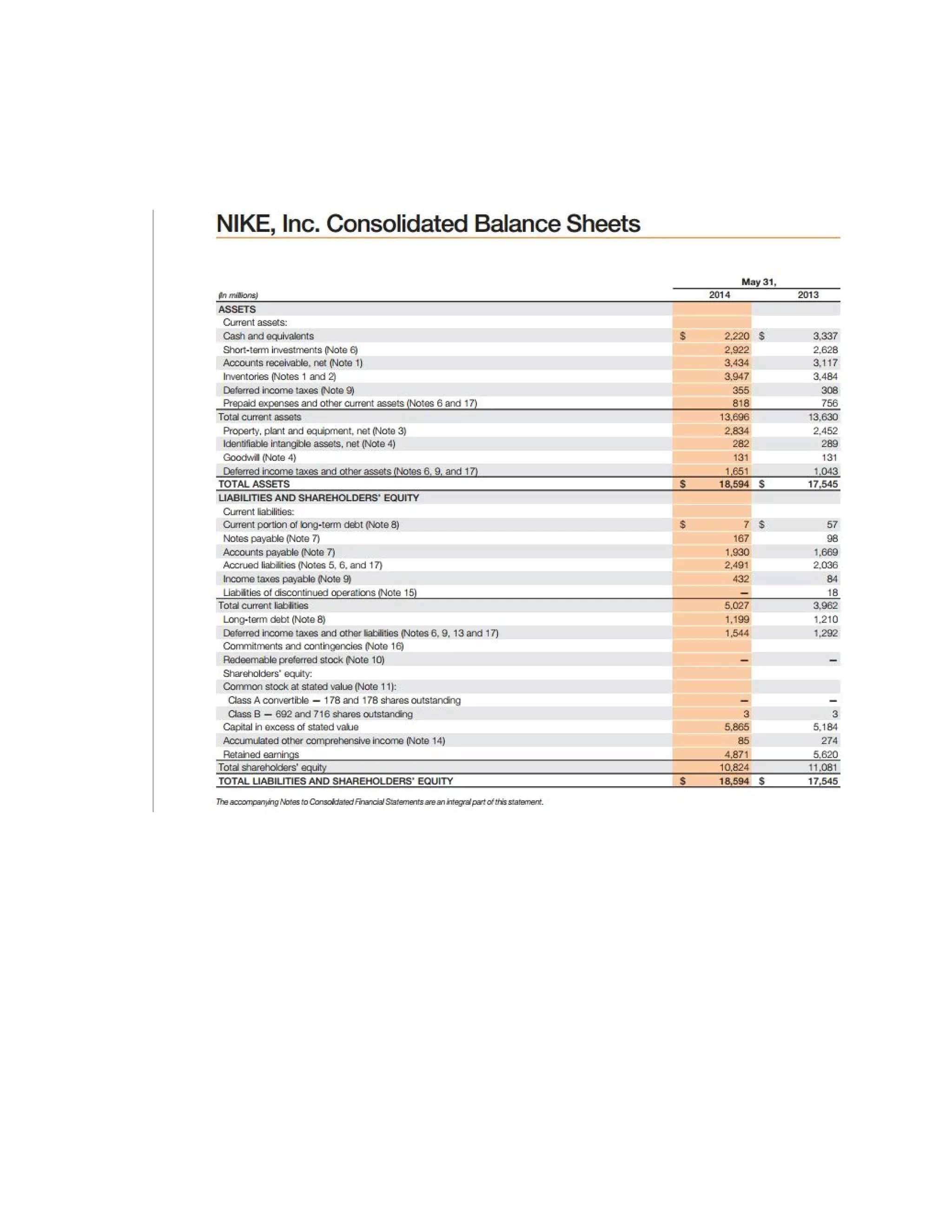
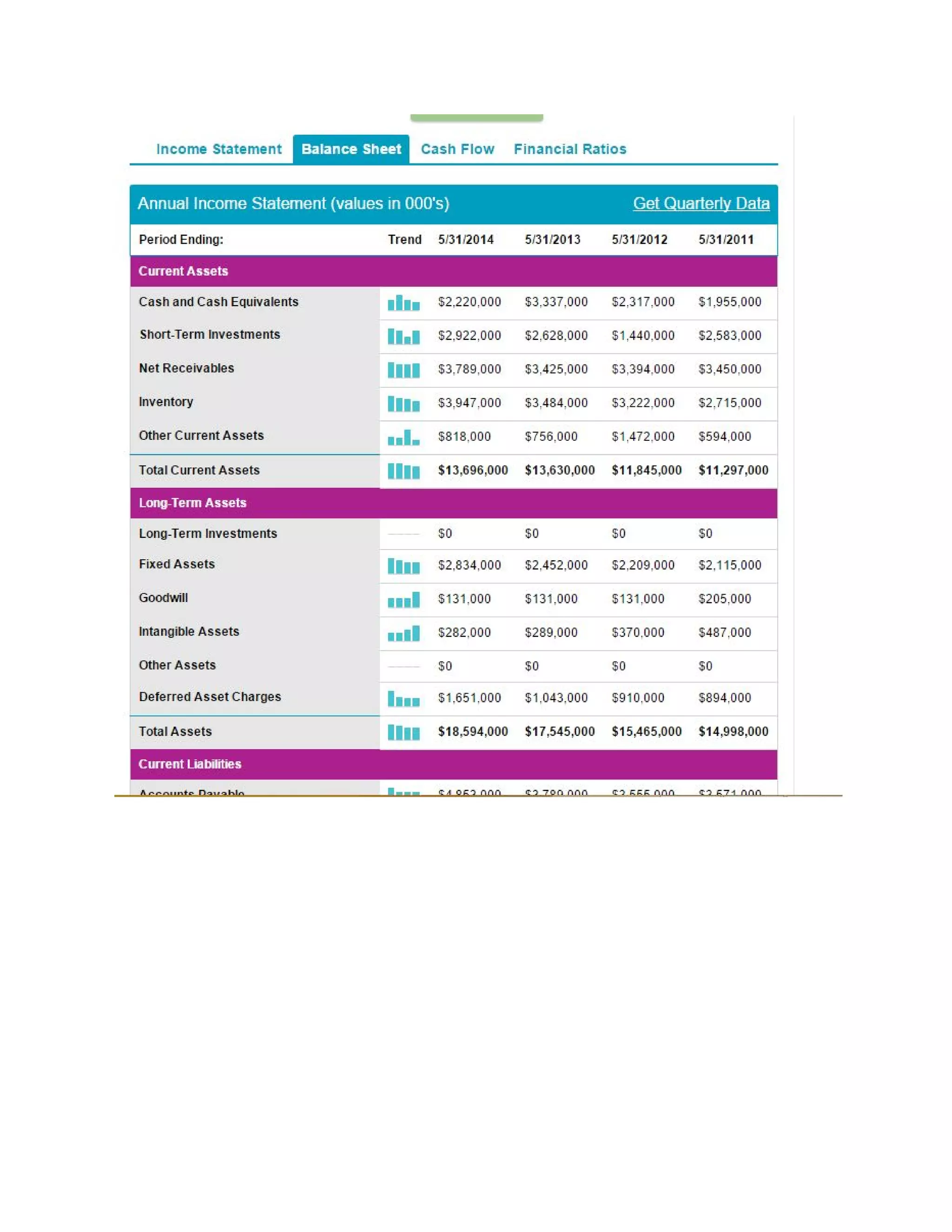
Balanced sheet 


STOCK ANALYSIS 


REFERENCE 
 
1.  NKE Key Financial Ratios. (2015, June 1). Retrieved June 2, 2015, from 
http://www.nasdaq.com/symbol/nke/financials?query=ratios   
2.  Jones, D. (2015, May 26). The footwear and apparel giant is set to report an 
upside fiscal fourth quarter in late June. Nike Shares Could Run Up to $120, 
p. 1. Retrieved June 2, 2015, from 
http://online.barrons.com/articles/nike­shares­could­run­up­to­120­1432663
122   
3.  Schaefer, S. (2015, May 11). The World's Most Valuable Brands. Forbes, 
7­7.   
4.  Gibson, C., & Gibson, C. (2001). Financial reporting and analysis: Using 
financial accounting information (8th ed., p. 307). Cincinnati, Ohio, 
Hamilton City: South­Western College Pub.   
5. Anon, (2015). [online] Available at: 
http://investors.nike.com/files/doc_financials/2014/docs/nike­2014­form­10
K.pdf​ [Accessed 1 Jun. 2015]. 


Accountreport