1
Principles
Accounting
Lecturer: Mr. Sajid Ali
Lecturer: Mr. Sajid Ali 2
CHAPTER 1
Introduction to
Principles of Accounting:
Lecturer: Mr. Sajid Ali 3
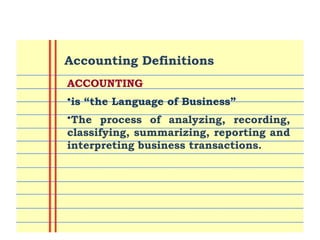
ACCOUNTING
•is “the Language of Business”
•The process of analyzing, recording,
classifying, summarizing, reporting and
interpreting business transactions.
Accounting Definitions
Lecturer: Mr. Sajid Ali 4
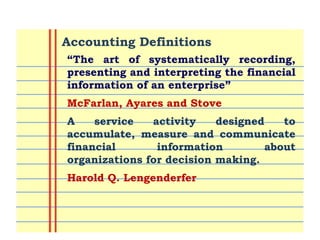
“The art of systematically recording,
presenting and interpreting the financial
information of an enterprise”
McFarlan, Ayares and Stove
A service activity designed to
accumulate, measure and communicate
financial information about
organizations for decision making.
Harold Q. Lengenderfer
Accounting Definitions
Lecturer: Mr. Sajid Ali 5
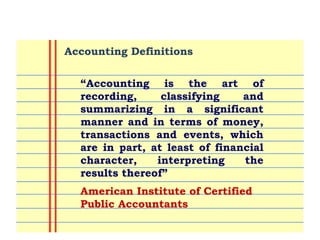
“Accounting is the art of
recording, classifying and
summarizing in a significant
manner and in terms of money,
transactions and events, which
are in part, at least of financial
character, interpreting the
results thereof”
American Institute of Certified
Public Accountants
Accounting Definitions
Lecturer: Mr. Sajid Ali 6
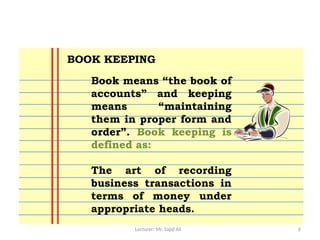
Book means “the book of
accounts” and keeping
means “maintaining
them in proper form and
order”. Book keeping is
defined as:
The art of recording
business transactions in
terms of money under
appropriate heads.
BOOK KEEPING
Lecturer: Mr. Sajid Ali 7
Difference between Accounting and Book keeping
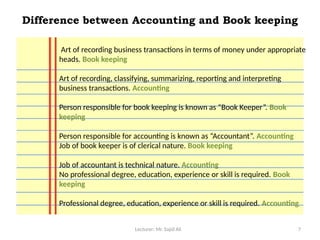
Art of recording business transactions in terms of money under appropriate
heads. Book keeping
Art of recording, classifying, summarizing, reporting and interpreting
business transactions. Accounting
Person responsible for book keeping is known as “Book Keeper”. Book
keeping
Person responsible for accounting is known as “Accountant”. Accounting
Job of book keeper is of clerical nature. Book keeping
Job of accountant is technical nature. Accounting
No professional degree, education, experience or skill is required. Book
keeping
Professional degree, education, experience or skill is required. Accounting
Lecturer: Mr. Sajid Ali 8
Difference between Accounting and Book keeping
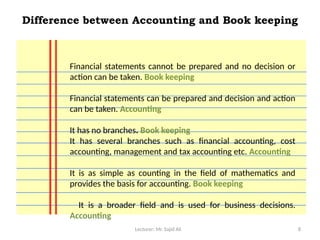
Financial statements cannot be prepared and no decision or
action can be taken. Book keeping
Financial statements can be prepared and decision and action
can be taken. Accounting
It has no branches. Book keeping
It has several branches such as financial accounting, cost
accounting, management and tax accounting etc. Accounting
It is as simple as counting in the field of mathematics and
provides the basis for accounting. Book keeping
It is a broader field and is used for business decisions.
Accounting
Lecturer: Mr. Sajid Ali 9
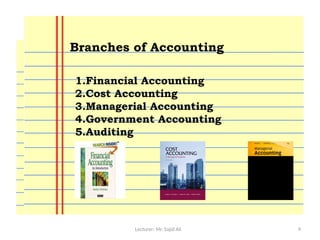
1.Financial Accounting
2.Cost Accounting
3.Managerial Accounting
4.Government Accounting
5.Auditing
Branches of Accounting
Lecturer: Mr. Sajid Ali 10
Single-Entry System Vs Double-Entry System
A. Single-Entry System
An accounting system in which for most
business transactions only one side of
the transaction is recorded is called
single entry system.
B. Double-Entry System
An accounting system in which for all
business transactions both the two sides
of the transaction are recorded is called
double entry system.
Lecturer: Mr. Sajid Ali 11
Basic Accounting Terminologies
1.Business
Any activity undertaken for the purpose of
earning profit such as buying and selling
goods, rendering services and
manufacturing goods.
Business may b:
a. Manufacturing
b. Merchandising
c. Service
Lecturer: Mr. Sajid Ali 12
A person who invests the money or
things in the business is called as owner
or proprietor. It refers to the owner of
the business whose owner is single (sole-
proprietorship business).
3. Transaction
Any dealing between two persons or
business enterprises is called transaction.
Or an activity of an organization in which
the exchange of value is taken place is
called transaction.
2. Proprietor
Lecturer: Mr. Sajid Ali 13
Transaction is of two types.
A. Cash transaction,
B. Credit transaction.
Cash transaction
Transaction on cash.
Credit transaction
Transaction on account.
Types of Transaction
Lecturer: Mr. Sajid Ali 14
Any documentary evidence of a
transaction is called voucher. Voucher
may be:
a. Cash memo
A documentary evidence of cash
transaction.
b. Invoice
A documentary evidence of credit
transaction.
4. Voucher
Lecturer: Mr. Sajid Ali 15
A record of a particular item e.g. cash,
land, building, salary etc. is called
account.
Heads of accounts
1. Assets
2. Liabilities
3. Owner’s Equity
4. Expense
5. Revenue
5. Account
Lecturer: Mr. Sajid Ali 16
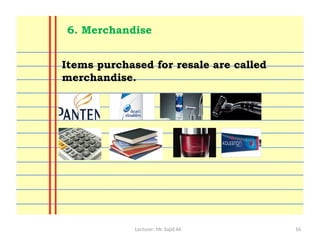
Items purchased for resale are called
merchandise.
6. Merchandise
Lecturer: Mr. Sajid Ali 17
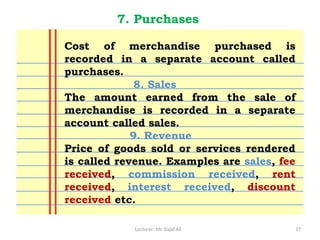
7. Purchases
Cost of merchandise purchased is
recorded in a separate account called
purchases.
8. Sales
The amount earned from the sale of
merchandise is recorded in a separate
account called sales.
9. Revenue
Price of goods sold or services rendered
is called revenue. Examples are sales, fee
received, commission received, rent
received, interest received, discount
received etc.
Lecturer: Mr. Sajid Ali 18
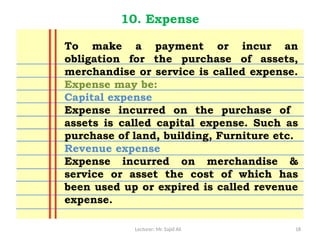
10. Expense
To make a payment or incur an
obligation for the purchase of assets,
merchandise or service is called expense.
Expense may be:
Capital expense
Expense incurred on the purchase of
assets is called capital expense. Such as
purchase of land, building, Furniture etc.
Revenue expense
Expense incurred on merchandise &
service or asset the cost of which has
been used up or expired is called revenue
expense.
Lecturer: Mr. Sajid Ali 19
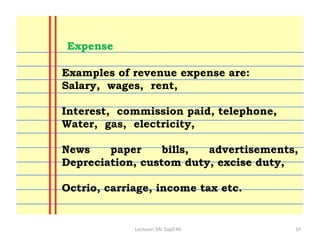
Examples of revenue expense are:
Salary, wages, rent,
Interest, commission paid, telephone,
Water, gas, electricity,
News paper bills, advertisements,
Depreciation, custom duty, excise duty,
Octrio, carriage, income tax etc.
Expense
Lecturer: Mr. Sajid Ali 20
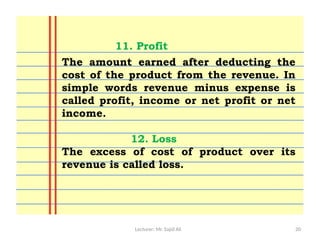
The amount earned after deducting the
cost of the product from the revenue. In
simple words revenue minus expense is
called profit, income or net profit or net
income.
12. Loss
The excess of cost of product over its
revenue is called loss.
11. Profit
Lecturer: Mr. Sajid Ali 21
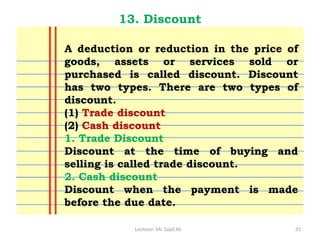
13. Discount
A deduction or reduction in the price of
goods, assets or services sold or
purchased is called discount. Discount
has two types. There are two types of
discount.
(1) Trade discount
(2) Cash discount
1. Trade Discount
Discount at the time of buying and
selling is called trade discount.
2. Cash discount
Discount when the payment is made
before the due date.
Lecturer: Mr. Sajid Ali 22
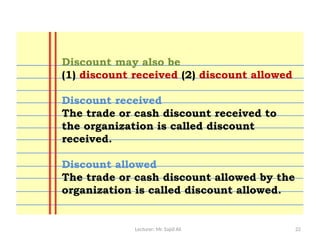
Discount may also be
(1) discount received (2) discount allowed
Discount received
The trade or cash discount received to
the organization is called discount
received.
Discount allowed
The trade or cash discount allowed by the
organization is called discount allowed.
Lecturer: Mr. Sajid Ali 23
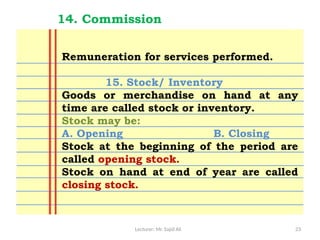
14. Commission
Remuneration for services performed.
15. Stock/ Inventory
Goods or merchandise on hand at any
time are called stock or inventory.
Stock may be:
A. Opening B. Closing
Stock at the beginning of the period are
called opening stock.
Stock on hand at end of year are called
closing stock.
Lecturer: Mr. Sajid Ali 24
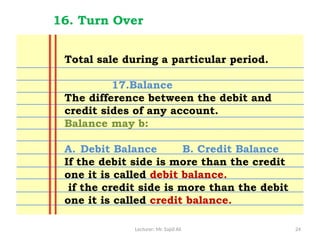
16. Turn Over
Total sale during a particular period.
17.Balance
The difference between the debit and
credit sides of any account.
Balance may b:
A. Debit Balance B. Credit Balance
If the debit side is more than the credit
one it is called debit balance.
if the credit side is more than the debit
one it is called credit balance.
Lecturer: Mr. Sajid Ali 25
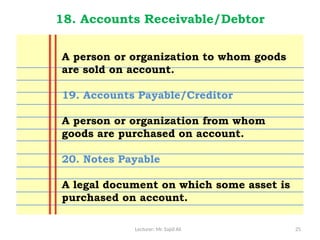
18. Accounts Receivable/Debtor
A person or organization to whom goods
are sold on account.
19. Accounts Payable/Creditor
A person or organization from whom
goods are purchased on account.
20. Notes Payable
A legal document on which some asset is
purchased on account.
Lecturer: Mr. Sajid Ali 26
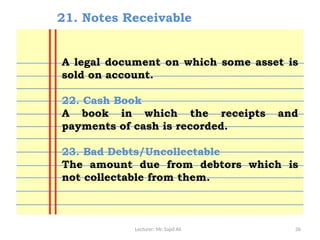
21. Notes Receivable
A legal document on which some asset is
sold on account.
22. Cash Book
A book in which the receipts and
payments of cash is recorded.
23. Bad Debts/Uncollectable
The amount due from debtors which is
not collectable from them.
Lecturer: Mr. Sajid Ali 27
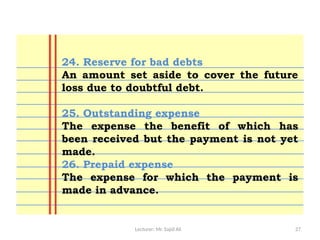
24. Reserve for bad debts
An amount set aside to cover the future
loss due to doubtful debt.
25. Outstanding expense
The expense the benefit of which has
been received but the payment is not yet
made.
26. Prepaid expense
The expense for which the payment is
made in advance.
Lecturer: Mr. Sajid Ali 28
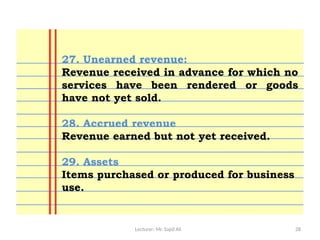
27. Unearned revenue:
Revenue received in advance for which no
services have been rendered or goods
have not yet sold.
28. Accrued revenue
Revenue earned but not yet received.
29. Assets
Items purchased or produced for business
use.
Lecturer: Mr. Sajid Ali 29
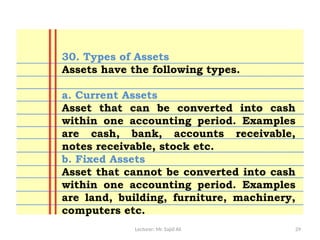
30. Types of Assets
Assets have the following types.
a. Current Assets
Asset that can be converted into cash
within one accounting period. Examples
are cash, bank, accounts receivable,
notes receivable, stock etc.
b. Fixed Assets
Asset that cannot be converted into cash
within one accounting period. Examples
are land, building, furniture, machinery,
computers etc.
Lecturer: Mr. Sajid Ali 30
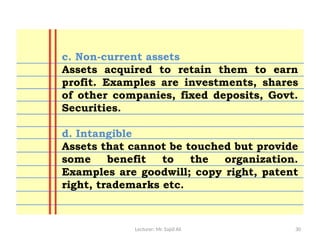
c. Non-current assets
Assets acquired to retain them to earn
profit. Examples are investments, shares
of other companies, fixed deposits, Govt.
Securities.
d. Intangible
Assets that cannot be touched but provide
some benefit to the organization.
Examples are goodwill; copy right, patent
right, trademarks etc.
Lecturer: Mr. Sajid Ali 31
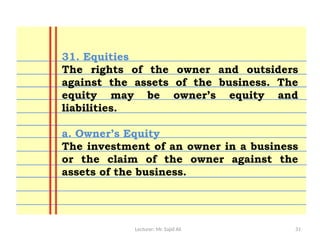
31. Equities
The rights of the owner and outsiders
against the assets of the business. The
equity may be owner’s equity and
liabilities.
a. Owner’s Equity
The investment of an owner in a business
or the claim of the owner against the
assets of the business.
Lecturer: Mr. Sajid Ali 32
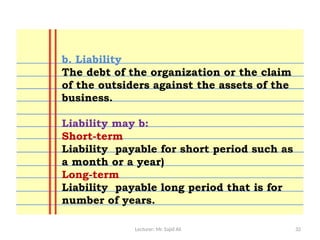
b. Liability
The debt of the organization or the claim
of the outsiders against the assets of the
business.
Liability may b:
Short-term
Liability payable for short period such as
a month or a year)
Long-term
Liability payable long period that is for
number of years.
Lecturer: Mr. Sajid Ali 33
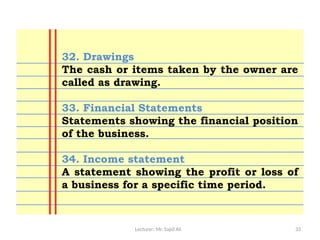
32. Drawings
The cash or items taken by the owner are
called as drawing.
33. Financial Statements
Statements showing the financial position
of the business.
34. Income statement
A statement showing the profit or loss of
a business for a specific time period.
Lecturer: Mr. Sajid Ali 34
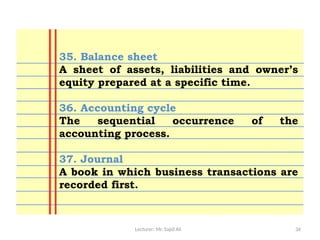
35. Balance sheet
A sheet of assets, liabilities and owner’s
equity prepared at a specific time.
36. Accounting cycle
The sequential occurrence of the
accounting process.
37. Journal
A book in which business transactions are
recorded first.
Lecturer: Mr. Sajid Ali 35
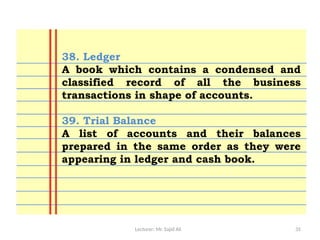
38. Ledger
A book which contains a condensed and
classified record of all the business
transactions in shape of accounts.
39. Trial Balance
A list of accounts and their balances
prepared in the same order as they were
appearing in ledger and cash book.
Lecturer: Mr. Sajid Ali 36
40. Adjustments
The process of up-to-dating the record at
the end of the period.
41. Closing entries
The journal entries to close all expense
and revenue accounts.
42. Post-Closing Trial Balance
A trial balance prepared after the closing
entries.
Lecturer: Mr. Sajid Ali 37
Accounting Equation:
Lecturer: Mr. Sajid Ali 38
The Accounting
Cycle
Lecturer: Mr. Sajid Ali 39
Accounting Equation
Assets = Owner’s Equity + Liabilities
components of accounting equation
a. Assets
b. Owner’s equity
c. Liabilities
Lecturer: Mr. Sajid Ali 40
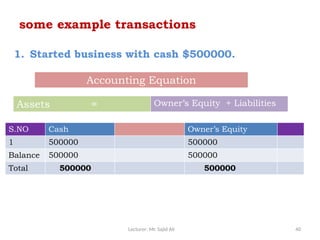
some example transactions
1. Started business with cash $500000.
Accounting Equation
Assets = Owner’s Equity + Liabilities
S.NO Cash Owner’s Equity
1 500000 500000
Balance 500000 500000
Total 500000 500000
Lecturer: Mr. Sajid Ali 41
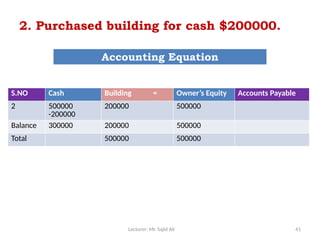
2. Purchased building for cash $200000.
S.NO Cash Building = Owner’s Equity Accounts Payable
2 500000
-200000
200000 500000
Balance 300000 200000 500000
Total 500000 500000
Accounting Equation
Lecturer: Mr. Sajid Ali 42
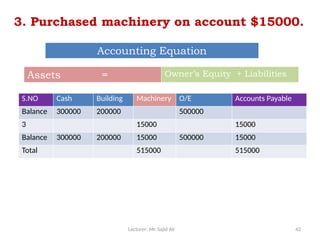
3. Purchased machinery on account $15000.
S.NO Cash Building Machinery O/E Accounts Payable
Balance 300000 200000 500000
3 15000 15000
Balance 300000 200000 15000 500000 15000
Total 515000 515000
Accounting Equation
Assets = Owner’s Equity + Liabilities
Lecturer: Mr. Sajid Ali 43
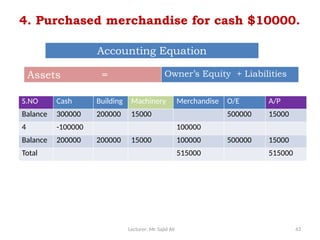
4. Purchased merchandise for cash $10000.
S.NO Cash Building Machinery Merchandise O/E A/P
Balance 300000 200000 15000 500000 15000
4 -100000 100000
Balance 200000 200000 15000 100000 500000 15000
Total 515000 515000
Accounting Equation
Assets = Owner’s Equity + Liabilities
Lecturer: Mr. Sajid Ali 44
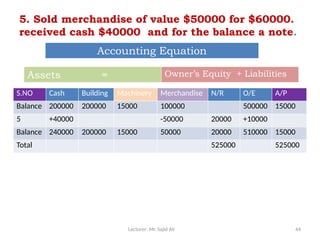
5. Sold merchandise of value $50000 for $60000.
received cash $40000 and for the balance a note.
S.NO Cash Building Machinery Merchandise N/R O/E A/P
Balance 200000 200000 15000 100000 500000 15000
5 +40000 -50000 20000 +10000
Balance 240000 200000 15000 50000 20000 510000 15000
Total 525000 525000
Accounting Equation
Assets = Owner’s Equity + Liabilities
Lecturer: Mr. Sajid Ali 45
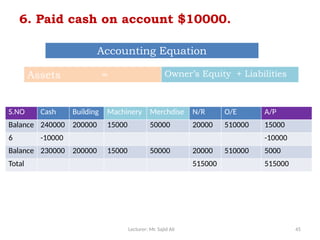
6. Paid cash on account $10000.
S.NO Cash Building Machinery Merchdise N/R O/E A/P
Balance 240000 200000 15000 50000 20000 510000 15000
6 -10000 -10000
Balance 230000 200000 15000 50000 20000 510000 5000
Total 515000 515000
Accounting Equation
Assets = Owner’s Equity + Liabilities
Lecturer: Mr. Sajid Ali 46
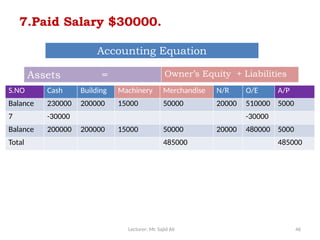
7.Paid Salary $30000.
S.NO Cash Building Machinery Merchandise N/R O/E A/P
Balance 230000 200000 15000 50000 20000 510000 5000
7 -30000 -30000
Balance 200000 200000 15000 50000 20000 480000 5000
Total 485000 485000
Accounting Equation
Assets = Owner’s Equity + Liabilities
Lecturer: Mr. Sajid Ali 47
Analysis and Classifying
Accounts
Lecturer: Mr. Sajid Ali 48
The Accounting
Cycle
Lecturer: Mr. Sajid Ali 49
Account
A place where the
record of a particular
item is kept.
A brief record of a
transaction.
Lecturer: Mr. Sajid Ali 50
Classes/Heads of Accounts
Assets
Liabilities
Owner’s equity
Expenses & losses
Revenues
Lecturer: Mr. Sajid Ali 51
Rules of debit and credit
For Assets:
Increase in assets is debited.
Decrease in assets is credited.
For expenses:
Increase in expense is debited.
Decrease in expense is credited.
Lecturer: Mr. Sajid Ali 52
For liabilities
Increase in liabilities is credited.
Decrease in liabilities is debited.
For owner’s equity
Increase in owner’s equity is credited.
Decrease in owner’s equity is debited.
For revenues
Increase in revenues is credited.
Decrease in revenues is debited.
Lecturer: Mr. Sajid Ali 53
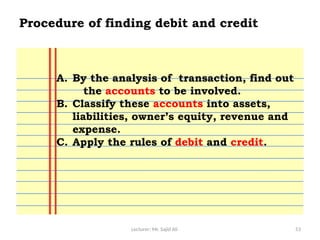
Procedure of finding debit and credit
A. By the analysis of transaction, find out
the accounts to be involved.
B. Classify these accounts into assets,
liabilities, owner’s equity, revenue and
expense.
C. Apply the rules of debit and credit.
Lecturer: Mr. Sajid Ali 54
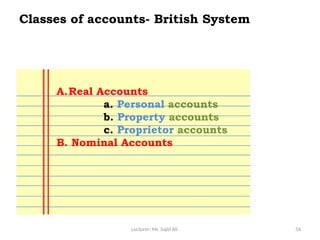
Classes of accounts- British System
A.Real Accounts
a. Personal accounts
b. Property accounts
c. Proprietor accounts
B. Nominal Accounts
Lecturer: Mr. Sajid Ali 55
Some transactions analysis
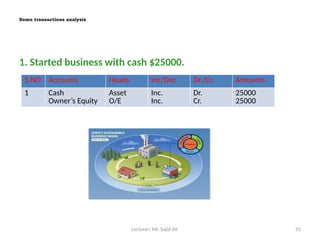
1. Started business with cash $25000.
S.NO Accounts Heads Inc/Dec Dr./Cr. Amounts
1 Cash
Owner’s Equity
Asset
O/E
Inc.
Inc.
Dr.
Cr.
25000
25000
Lecturer: Mr. Sajid Ali 56
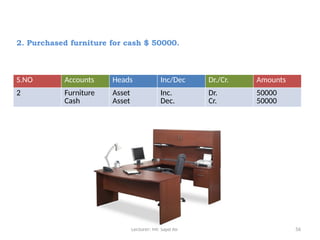
2. Purchased furniture for cash $ 50000.
S.NO Accounts Heads Inc/Dec Dr./Cr. Amounts
2 Furniture
Cash
Asset
Asset
Inc.
Dec.
Dr.
Cr.
50000
50000
Lecturer: Mr. Sajid Ali 57
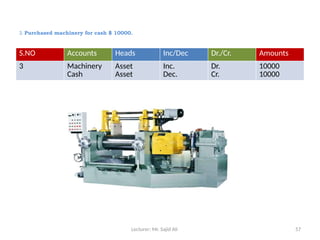
3. Purchased machinery for cash $ 10000.
S.NO Accounts Heads Inc/Dec Dr./Cr. Amounts
3 Machinery
Cash
Asset
Asset
Inc.
Dec.
Dr.
Cr.
10000
10000
Lecturer: Mr. Sajid Ali 58
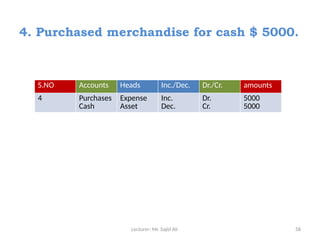
4. Purchased merchandise for cash $ 5000.
S.NO Accounts Heads Inc./Dec. Dr./Cr. amounts
4 Purchases
Cash
Expense
Asset
Inc.
Dec.
Dr.
Cr.
5000
5000
Lecturer: Mr. Sajid Ali 59
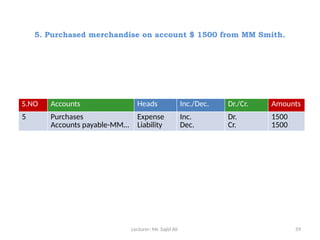
5. Purchased merchandise on account $ 1500 from MM Smith.
S.NO Accounts Heads Inc./Dec. Dr./Cr. Amounts
5 Purchases
Accounts payable-MM…
Expense
Liability
Inc.
Dec.
Dr.
Cr.
1500
1500
Lecturer: Mr. Sajid Ali 60
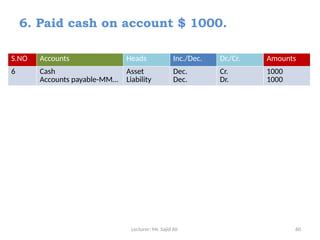
6. Paid cash on account $ 1000.
S.NO Accounts Heads Inc./Dec. Dr./Cr. Amounts
6 Cash
Accounts payable-MM…
Asset
Liability
Dec.
Dec.
Cr.
Dr.
1000
1000
Lecturer: Mr. Sajid Ali 61
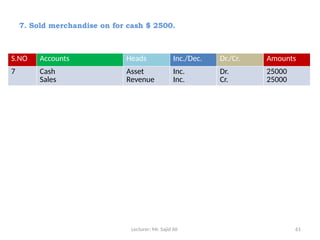
7. Sold merchandise on for cash $ 2500.
S.NO Accounts Heads Inc./Dec. Dr./Cr. Amounts
7 Cash
Sales
Asset
Revenue
Inc.
Inc.
Dr.
Cr.
25000
25000
Lecturer: Mr. Sajid Ali 62
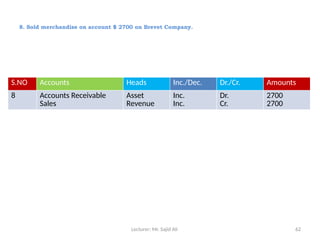
8. Sold merchandise on account $ 2700 on Brevet Company.
S.NO Accounts Heads Inc./Dec. Dr./Cr. Amounts
8 Accounts Receivable
Sales
Asset
Revenue
Inc.
Inc.
Dr.
Cr.
2700
2700
Lecturer: Mr. Sajid Ali 63
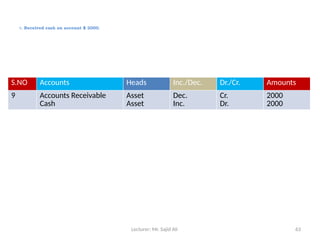
9. Received cash on account $ 2000.
S.NO Accounts Heads Inc./Dec. Dr./Cr. Amounts
9 Accounts Receivable
Cash
Asset
Asset
Dec.
Inc.
Cr.
Dr.
2000
2000
Lecturer: Mr. Sajid Ali 64
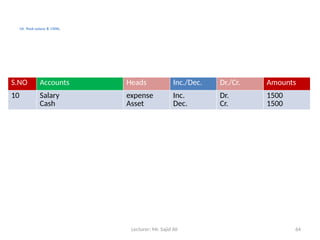
10. Paid salary $ 1500.
S.NO Accounts Heads Inc./Dec. Dr./Cr. Amounts
10 Salary
Cash
expense
Asset
Inc.
Dec.
Dr.
Cr.
1500
1500
Lecturer: Mr. Sajid Ali 65
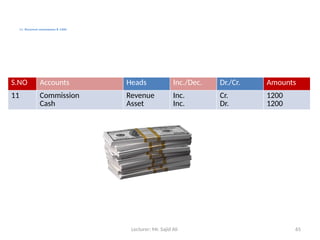
11. Received commission $ 1200.
S.NO Accounts Heads Inc./Dec. Dr./Cr. Amounts
11 Commission
Cash
Revenue
Asset
Inc.
Inc.
Cr.
Dr.
1200
1200
Lecturer: Mr. Sajid Ali 66
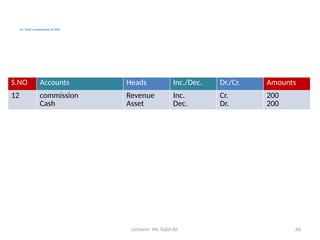
12. Paid commission $ 200.
S.NO Accounts Heads Inc./Dec. Dr./Cr. Amounts
12 commission
Cash
Revenue
Asset
Inc.
Dec.
Cr.
Dr.
200
200
Lecturer: Mr. Sajid Ali 67
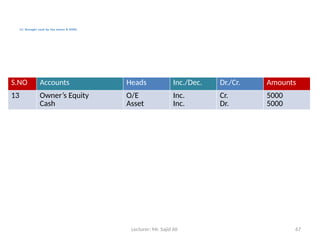
13. Brought cash by the owner $ 5000.
S.NO Accounts Heads Inc./Dec. Dr./Cr. Amounts
13 Owner’s Equity
Cash
O/E
Asset
Inc.
Inc.
Cr.
Dr.
5000
5000
Lecturer: Mr. Sajid Ali 68
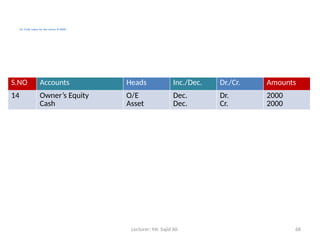
14. Cash taken by the owner $ 2000.
S.NO Accounts Heads Inc./Dec. Dr./Cr. Amounts
14 Owner’s Equity
Cash
O/E
Asset
Dec.
Dec.
Dr.
Cr.
2000
2000
Lecturer: Mr. Sajid Ali 69
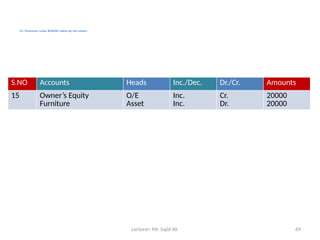
15. Furniture value $20000 taken by the owner.
S.NO Accounts Heads Inc./Dec. Dr./Cr. Amounts
15 Owner’s Equity
Furniture
O/E
Asset
Inc.
Inc.
Cr.
Dr.
20000
20000
Lecturer: Mr. Sajid Ali 70
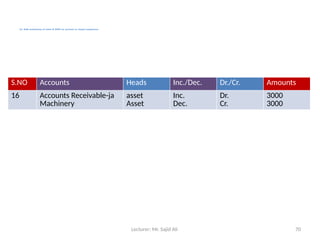
16. Sold machinery of value $ 3000 on account to Jamal computers.
S.NO Accounts Heads Inc./Dec. Dr./Cr. Amounts
16 Accounts Receivable-ja
Machinery
asset
Asset
Inc.
Dec.
Dr.
Cr.
3000
3000
Lecturer: Mr. Sajid Ali 71
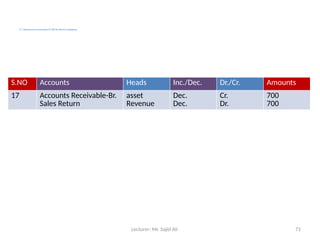
17. Returned merchandise $ 700 by Brevet Company.
S.NO Accounts Heads Inc./Dec. Dr./Cr. Amounts
17 Accounts Receivable-Br.
Sales Return
asset
Revenue
Dec.
Dec.
Cr.
Dr.
700
700
Lecturer: Mr. Sajid Ali 72
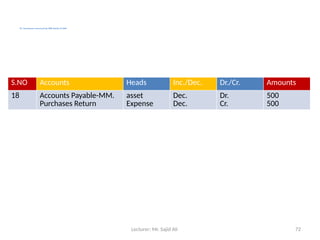
18. Purchases returned by MM Smith $ 500.
S.NO Accounts Heads Inc./Dec. Dr./Cr. Amounts
18 Accounts Payable-MM.
Purchases Return
asset
Expense
Dec.
Dec.
Dr.
Cr.
500
500

Accounting types, process and procedures.pptx

  • 1.
  • 2.
    Lecturer: Mr. SajidAli 2 CHAPTER 1 Introduction to Principles of Accounting:
  • 3.
    Lecturer: Mr. SajidAli 3 ACCOUNTING •is “the Language of Business” •The process of analyzing, recording, classifying, summarizing, reporting and interpreting business transactions. Accounting Definitions
  • 4.
    Lecturer: Mr. SajidAli 4 “The art of systematically recording, presenting and interpreting the financial information of an enterprise” McFarlan, Ayares and Stove A service activity designed to accumulate, measure and communicate financial information about organizations for decision making. Harold Q. Lengenderfer Accounting Definitions
  • 5.
    Lecturer: Mr. SajidAli 5 “Accounting is the art of recording, classifying and summarizing in a significant manner and in terms of money, transactions and events, which are in part, at least of financial character, interpreting the results thereof” American Institute of Certified Public Accountants Accounting Definitions
  • 6.
    Lecturer: Mr. SajidAli 6 Book means “the book of accounts” and keeping means “maintaining them in proper form and order”. Book keeping is defined as: The art of recording business transactions in terms of money under appropriate heads. BOOK KEEPING
  • 7.
    Lecturer: Mr. SajidAli 7 Difference between Accounting and Book keeping Art of recording business transactions in terms of money under appropriate heads. Book keeping Art of recording, classifying, summarizing, reporting and interpreting business transactions. Accounting Person responsible for book keeping is known as “Book Keeper”. Book keeping Person responsible for accounting is known as “Accountant”. Accounting Job of book keeper is of clerical nature. Book keeping Job of accountant is technical nature. Accounting No professional degree, education, experience or skill is required. Book keeping Professional degree, education, experience or skill is required. Accounting
  • 8.
    Lecturer: Mr. SajidAli 8 Difference between Accounting and Book keeping Financial statements cannot be prepared and no decision or action can be taken. Book keeping Financial statements can be prepared and decision and action can be taken. Accounting It has no branches. Book keeping It has several branches such as financial accounting, cost accounting, management and tax accounting etc. Accounting It is as simple as counting in the field of mathematics and provides the basis for accounting. Book keeping It is a broader field and is used for business decisions. Accounting
  • 9.
    Lecturer: Mr. SajidAli 9 1.Financial Accounting 2.Cost Accounting 3.Managerial Accounting 4.Government Accounting 5.Auditing Branches of Accounting
  • 10.
    Lecturer: Mr. SajidAli 10 Single-Entry System Vs Double-Entry System A. Single-Entry System An accounting system in which for most business transactions only one side of the transaction is recorded is called single entry system. B. Double-Entry System An accounting system in which for all business transactions both the two sides of the transaction are recorded is called double entry system.
  • 11.
    Lecturer: Mr. SajidAli 11 Basic Accounting Terminologies 1.Business Any activity undertaken for the purpose of earning profit such as buying and selling goods, rendering services and manufacturing goods. Business may b: a. Manufacturing b. Merchandising c. Service
  • 12.
    Lecturer: Mr. SajidAli 12 A person who invests the money or things in the business is called as owner or proprietor. It refers to the owner of the business whose owner is single (sole- proprietorship business). 3. Transaction Any dealing between two persons or business enterprises is called transaction. Or an activity of an organization in which the exchange of value is taken place is called transaction. 2. Proprietor
  • 13.
    Lecturer: Mr. SajidAli 13 Transaction is of two types. A. Cash transaction, B. Credit transaction. Cash transaction Transaction on cash. Credit transaction Transaction on account. Types of Transaction
  • 14.
    Lecturer: Mr. SajidAli 14 Any documentary evidence of a transaction is called voucher. Voucher may be: a. Cash memo A documentary evidence of cash transaction. b. Invoice A documentary evidence of credit transaction. 4. Voucher
  • 15.
    Lecturer: Mr. SajidAli 15 A record of a particular item e.g. cash, land, building, salary etc. is called account. Heads of accounts 1. Assets 2. Liabilities 3. Owner’s Equity 4. Expense 5. Revenue 5. Account
  • 16.
    Lecturer: Mr. SajidAli 16 Items purchased for resale are called merchandise. 6. Merchandise
  • 17.
    Lecturer: Mr. SajidAli 17 7. Purchases Cost of merchandise purchased is recorded in a separate account called purchases. 8. Sales The amount earned from the sale of merchandise is recorded in a separate account called sales. 9. Revenue Price of goods sold or services rendered is called revenue. Examples are sales, fee received, commission received, rent received, interest received, discount received etc.
  • 18.
    Lecturer: Mr. SajidAli 18 10. Expense To make a payment or incur an obligation for the purchase of assets, merchandise or service is called expense. Expense may be: Capital expense Expense incurred on the purchase of assets is called capital expense. Such as purchase of land, building, Furniture etc. Revenue expense Expense incurred on merchandise & service or asset the cost of which has been used up or expired is called revenue expense.
  • 19.
    Lecturer: Mr. SajidAli 19 Examples of revenue expense are: Salary, wages, rent, Interest, commission paid, telephone, Water, gas, electricity, News paper bills, advertisements, Depreciation, custom duty, excise duty, Octrio, carriage, income tax etc. Expense
  • 20.
    Lecturer: Mr. SajidAli 20 The amount earned after deducting the cost of the product from the revenue. In simple words revenue minus expense is called profit, income or net profit or net income. 12. Loss The excess of cost of product over its revenue is called loss. 11. Profit
  • 21.
    Lecturer: Mr. SajidAli 21 13. Discount A deduction or reduction in the price of goods, assets or services sold or purchased is called discount. Discount has two types. There are two types of discount. (1) Trade discount (2) Cash discount 1. Trade Discount Discount at the time of buying and selling is called trade discount. 2. Cash discount Discount when the payment is made before the due date.
  • 22.
    Lecturer: Mr. SajidAli 22 Discount may also be (1) discount received (2) discount allowed Discount received The trade or cash discount received to the organization is called discount received. Discount allowed The trade or cash discount allowed by the organization is called discount allowed.
  • 23.
    Lecturer: Mr. SajidAli 23 14. Commission Remuneration for services performed. 15. Stock/ Inventory Goods or merchandise on hand at any time are called stock or inventory. Stock may be: A. Opening B. Closing Stock at the beginning of the period are called opening stock. Stock on hand at end of year are called closing stock.
  • 24.
    Lecturer: Mr. SajidAli 24 16. Turn Over Total sale during a particular period. 17.Balance The difference between the debit and credit sides of any account. Balance may b: A. Debit Balance B. Credit Balance If the debit side is more than the credit one it is called debit balance. if the credit side is more than the debit one it is called credit balance.
  • 25.
    Lecturer: Mr. SajidAli 25 18. Accounts Receivable/Debtor A person or organization to whom goods are sold on account. 19. Accounts Payable/Creditor A person or organization from whom goods are purchased on account. 20. Notes Payable A legal document on which some asset is purchased on account.
  • 26.
    Lecturer: Mr. SajidAli 26 21. Notes Receivable A legal document on which some asset is sold on account. 22. Cash Book A book in which the receipts and payments of cash is recorded. 23. Bad Debts/Uncollectable The amount due from debtors which is not collectable from them.
  • 27.
    Lecturer: Mr. SajidAli 27 24. Reserve for bad debts An amount set aside to cover the future loss due to doubtful debt. 25. Outstanding expense The expense the benefit of which has been received but the payment is not yet made. 26. Prepaid expense The expense for which the payment is made in advance.
  • 28.
    Lecturer: Mr. SajidAli 28 27. Unearned revenue: Revenue received in advance for which no services have been rendered or goods have not yet sold. 28. Accrued revenue Revenue earned but not yet received. 29. Assets Items purchased or produced for business use.
  • 29.
    Lecturer: Mr. SajidAli 29 30. Types of Assets Assets have the following types. a. Current Assets Asset that can be converted into cash within one accounting period. Examples are cash, bank, accounts receivable, notes receivable, stock etc. b. Fixed Assets Asset that cannot be converted into cash within one accounting period. Examples are land, building, furniture, machinery, computers etc.
  • 30.
    Lecturer: Mr. SajidAli 30 c. Non-current assets Assets acquired to retain them to earn profit. Examples are investments, shares of other companies, fixed deposits, Govt. Securities. d. Intangible Assets that cannot be touched but provide some benefit to the organization. Examples are goodwill; copy right, patent right, trademarks etc.
  • 31.
    Lecturer: Mr. SajidAli 31 31. Equities The rights of the owner and outsiders against the assets of the business. The equity may be owner’s equity and liabilities. a. Owner’s Equity The investment of an owner in a business or the claim of the owner against the assets of the business.
  • 32.
    Lecturer: Mr. SajidAli 32 b. Liability The debt of the organization or the claim of the outsiders against the assets of the business. Liability may b: Short-term Liability payable for short period such as a month or a year) Long-term Liability payable long period that is for number of years.
  • 33.
    Lecturer: Mr. SajidAli 33 32. Drawings The cash or items taken by the owner are called as drawing. 33. Financial Statements Statements showing the financial position of the business. 34. Income statement A statement showing the profit or loss of a business for a specific time period.
  • 34.
    Lecturer: Mr. SajidAli 34 35. Balance sheet A sheet of assets, liabilities and owner’s equity prepared at a specific time. 36. Accounting cycle The sequential occurrence of the accounting process. 37. Journal A book in which business transactions are recorded first.
  • 35.
    Lecturer: Mr. SajidAli 35 38. Ledger A book which contains a condensed and classified record of all the business transactions in shape of accounts. 39. Trial Balance A list of accounts and their balances prepared in the same order as they were appearing in ledger and cash book.
  • 36.
    Lecturer: Mr. SajidAli 36 40. Adjustments The process of up-to-dating the record at the end of the period. 41. Closing entries The journal entries to close all expense and revenue accounts. 42. Post-Closing Trial Balance A trial balance prepared after the closing entries.
  • 37.
    Lecturer: Mr. SajidAli 37 Accounting Equation:
  • 38.
    Lecturer: Mr. SajidAli 38 The Accounting Cycle
  • 39.
    Lecturer: Mr. SajidAli 39 Accounting Equation Assets = Owner’s Equity + Liabilities components of accounting equation a. Assets b. Owner’s equity c. Liabilities
  • 40.
    Lecturer: Mr. SajidAli 40 some example transactions 1. Started business with cash $500000. Accounting Equation Assets = Owner’s Equity + Liabilities S.NO Cash Owner’s Equity 1 500000 500000 Balance 500000 500000 Total 500000 500000
  • 41.
    Lecturer: Mr. SajidAli 41 2. Purchased building for cash $200000. S.NO Cash Building = Owner’s Equity Accounts Payable 2 500000 -200000 200000 500000 Balance 300000 200000 500000 Total 500000 500000 Accounting Equation
  • 42.
    Lecturer: Mr. SajidAli 42 3. Purchased machinery on account $15000. S.NO Cash Building Machinery O/E Accounts Payable Balance 300000 200000 500000 3 15000 15000 Balance 300000 200000 15000 500000 15000 Total 515000 515000 Accounting Equation Assets = Owner’s Equity + Liabilities
  • 43.
    Lecturer: Mr. SajidAli 43 4. Purchased merchandise for cash $10000. S.NO Cash Building Machinery Merchandise O/E A/P Balance 300000 200000 15000 500000 15000 4 -100000 100000 Balance 200000 200000 15000 100000 500000 15000 Total 515000 515000 Accounting Equation Assets = Owner’s Equity + Liabilities
  • 44.
    Lecturer: Mr. SajidAli 44 5. Sold merchandise of value $50000 for $60000. received cash $40000 and for the balance a note. S.NO Cash Building Machinery Merchandise N/R O/E A/P Balance 200000 200000 15000 100000 500000 15000 5 +40000 -50000 20000 +10000 Balance 240000 200000 15000 50000 20000 510000 15000 Total 525000 525000 Accounting Equation Assets = Owner’s Equity + Liabilities
  • 45.
    Lecturer: Mr. SajidAli 45 6. Paid cash on account $10000. S.NO Cash Building Machinery Merchdise N/R O/E A/P Balance 240000 200000 15000 50000 20000 510000 15000 6 -10000 -10000 Balance 230000 200000 15000 50000 20000 510000 5000 Total 515000 515000 Accounting Equation Assets = Owner’s Equity + Liabilities
  • 46.
    Lecturer: Mr. SajidAli 46 7.Paid Salary $30000. S.NO Cash Building Machinery Merchandise N/R O/E A/P Balance 230000 200000 15000 50000 20000 510000 5000 7 -30000 -30000 Balance 200000 200000 15000 50000 20000 480000 5000 Total 485000 485000 Accounting Equation Assets = Owner’s Equity + Liabilities
  • 47.
    Lecturer: Mr. SajidAli 47 Analysis and Classifying Accounts
  • 48.
    Lecturer: Mr. SajidAli 48 The Accounting Cycle
  • 49.
    Lecturer: Mr. SajidAli 49 Account A place where the record of a particular item is kept. A brief record of a transaction.
  • 50.
    Lecturer: Mr. SajidAli 50 Classes/Heads of Accounts Assets Liabilities Owner’s equity Expenses & losses Revenues
  • 51.
    Lecturer: Mr. SajidAli 51 Rules of debit and credit For Assets: Increase in assets is debited. Decrease in assets is credited. For expenses: Increase in expense is debited. Decrease in expense is credited.
  • 52.
    Lecturer: Mr. SajidAli 52 For liabilities Increase in liabilities is credited. Decrease in liabilities is debited. For owner’s equity Increase in owner’s equity is credited. Decrease in owner’s equity is debited. For revenues Increase in revenues is credited. Decrease in revenues is debited.
  • 53.
    Lecturer: Mr. SajidAli 53 Procedure of finding debit and credit A. By the analysis of transaction, find out the accounts to be involved. B. Classify these accounts into assets, liabilities, owner’s equity, revenue and expense. C. Apply the rules of debit and credit.
  • 54.
    Lecturer: Mr. SajidAli 54 Classes of accounts- British System A.Real Accounts a. Personal accounts b. Property accounts c. Proprietor accounts B. Nominal Accounts
  • 55.
    Lecturer: Mr. SajidAli 55 Some transactions analysis 1. Started business with cash $25000. S.NO Accounts Heads Inc/Dec Dr./Cr. Amounts 1 Cash Owner’s Equity Asset O/E Inc. Inc. Dr. Cr. 25000 25000
  • 56.
    Lecturer: Mr. SajidAli 56 2. Purchased furniture for cash $ 50000. S.NO Accounts Heads Inc/Dec Dr./Cr. Amounts 2 Furniture Cash Asset Asset Inc. Dec. Dr. Cr. 50000 50000
  • 57.
    Lecturer: Mr. SajidAli 57 3. Purchased machinery for cash $ 10000. S.NO Accounts Heads Inc/Dec Dr./Cr. Amounts 3 Machinery Cash Asset Asset Inc. Dec. Dr. Cr. 10000 10000
  • 58.
    Lecturer: Mr. SajidAli 58 4. Purchased merchandise for cash $ 5000. S.NO Accounts Heads Inc./Dec. Dr./Cr. amounts 4 Purchases Cash Expense Asset Inc. Dec. Dr. Cr. 5000 5000
  • 59.
    Lecturer: Mr. SajidAli 59 5. Purchased merchandise on account $ 1500 from MM Smith. S.NO Accounts Heads Inc./Dec. Dr./Cr. Amounts 5 Purchases Accounts payable-MM… Expense Liability Inc. Dec. Dr. Cr. 1500 1500
  • 60.
    Lecturer: Mr. SajidAli 60 6. Paid cash on account $ 1000. S.NO Accounts Heads Inc./Dec. Dr./Cr. Amounts 6 Cash Accounts payable-MM… Asset Liability Dec. Dec. Cr. Dr. 1000 1000
  • 61.
    Lecturer: Mr. SajidAli 61 7. Sold merchandise on for cash $ 2500. S.NO Accounts Heads Inc./Dec. Dr./Cr. Amounts 7 Cash Sales Asset Revenue Inc. Inc. Dr. Cr. 25000 25000
  • 62.
    Lecturer: Mr. SajidAli 62 8. Sold merchandise on account $ 2700 on Brevet Company. S.NO Accounts Heads Inc./Dec. Dr./Cr. Amounts 8 Accounts Receivable Sales Asset Revenue Inc. Inc. Dr. Cr. 2700 2700
  • 63.
    Lecturer: Mr. SajidAli 63 9. Received cash on account $ 2000. S.NO Accounts Heads Inc./Dec. Dr./Cr. Amounts 9 Accounts Receivable Cash Asset Asset Dec. Inc. Cr. Dr. 2000 2000
  • 64.
    Lecturer: Mr. SajidAli 64 10. Paid salary $ 1500. S.NO Accounts Heads Inc./Dec. Dr./Cr. Amounts 10 Salary Cash expense Asset Inc. Dec. Dr. Cr. 1500 1500
  • 65.
    Lecturer: Mr. SajidAli 65 11. Received commission $ 1200. S.NO Accounts Heads Inc./Dec. Dr./Cr. Amounts 11 Commission Cash Revenue Asset Inc. Inc. Cr. Dr. 1200 1200
  • 66.
    Lecturer: Mr. SajidAli 66 12. Paid commission $ 200. S.NO Accounts Heads Inc./Dec. Dr./Cr. Amounts 12 commission Cash Revenue Asset Inc. Dec. Cr. Dr. 200 200
  • 67.
    Lecturer: Mr. SajidAli 67 13. Brought cash by the owner $ 5000. S.NO Accounts Heads Inc./Dec. Dr./Cr. Amounts 13 Owner’s Equity Cash O/E Asset Inc. Inc. Cr. Dr. 5000 5000
  • 68.
    Lecturer: Mr. SajidAli 68 14. Cash taken by the owner $ 2000. S.NO Accounts Heads Inc./Dec. Dr./Cr. Amounts 14 Owner’s Equity Cash O/E Asset Dec. Dec. Dr. Cr. 2000 2000
  • 69.
    Lecturer: Mr. SajidAli 69 15. Furniture value $20000 taken by the owner. S.NO Accounts Heads Inc./Dec. Dr./Cr. Amounts 15 Owner’s Equity Furniture O/E Asset Inc. Inc. Cr. Dr. 20000 20000
  • 70.
    Lecturer: Mr. SajidAli 70 16. Sold machinery of value $ 3000 on account to Jamal computers. S.NO Accounts Heads Inc./Dec. Dr./Cr. Amounts 16 Accounts Receivable-ja Machinery asset Asset Inc. Dec. Dr. Cr. 3000 3000
  • 71.
    Lecturer: Mr. SajidAli 71 17. Returned merchandise $ 700 by Brevet Company. S.NO Accounts Heads Inc./Dec. Dr./Cr. Amounts 17 Accounts Receivable-Br. Sales Return asset Revenue Dec. Dec. Cr. Dr. 700 700
  • 72.
    Lecturer: Mr. SajidAli 72 18. Purchases returned by MM Smith $ 500. S.NO Accounts Heads Inc./Dec. Dr./Cr. Amounts 18 Accounts Payable-MM. Purchases Return asset Expense Dec. Dec. Dr. Cr. 500 500

Editor's Notes

  • #38 IN UNIT ONE, YOU WILL LEARN TO SET UP T ACCOUNTS FOR ASSETS, LIABILITIES, OWNER’S EQUITY, REVENUE, AND EXPENSES ACCOUNTS
  • #48 IN UNIT ONE, YOU WILL LEARN TO SET UP T ACCOUNTS FOR ASSETS, LIABILITIES, OWNER’S EQUITY, REVENUE, AND EXPENSES ACCOUNTS