As-salamu Alaykum
Welcome to my todays topic:
TRANSACTION
Submitted by –
NAME: OASEKAAFROZ
ROLL: 05, CLASS: IX
SECTION: ELECTRON
GROUP: Business Studies
Submitted to –
Mrs. RUKHSANAAKTER
Senior Teacher
NAVY ANCHORAGE SCHOOL & COLLEGE
Subject: Accounting
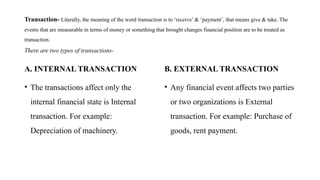
Transaction- Literally, the meaning of the word transaction is to ‘receive’ & ‘payment’, that means give & take. The
events that are measurable in terms of money or something that brought changes financial position are to be treated as
transaction.
There are two types of transactions-
A. INTERNAL TRANSACTION
• The transactions affect only the
internal financial state is Internal
transaction. For example:
Depreciation of machinery.
B. EXTERNAL TRANSACTION
• Any financial event affects two parties
or two organizations is External
transaction. For example: Purchase of
goods, rent payment.
Features/Nature of Transaction:
• Measurable in terms of money
• Changes of financial condition
• Dual entity
• Complete & independent
• Visibility
• Historical event
• Impact over accounting equation
Accounting Equation:
Extended equation:
Assets = Liabilities + Capital + Revenues – Expenses – Drawings
Asset – Asset means the economic resources that belong to a business that is
invested for making profit. For example: Furniture, Buildings, Machineries of
business.
Liability – Liability means the financial responsibility that has to be paid up after
a certain period of time. i.e. it is the claim of the third party over the total assets of
the business.
Equity – If the claim of the third party is deducted from the total assets of the
business the rest will be known as equity. Four elements affect equity –
1. Investment of owner
2. Revenues
3. Drawings
4. Expenses
Impact of Transactions Over Accounting Equation
If an event is to be a transaction, it has to make any one of the following changes-
1. If total asset increases, total liabilities or owner’s equity will also increase.
2. If total asset decreases, total liabilities or owner’s equity will also decrease.
3. If one asset increases, the other asset will decrease.
4. If owner’s equity increases, total liabilities will decrease.
5. If owner’s equity decreases, total liabilities will increase.
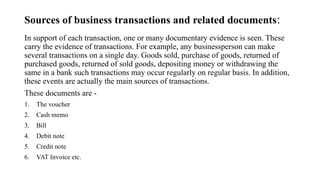
Sources of business transactions and related documents:
In support of each transaction, one or many documentary evidence is seen. These
carry the evidence of transactions. For example, any businessperson can make
several transactions on a single day. Goods sold, purchase of goods, returned of
purchased goods, returned of sold goods, depositing money or withdrawing the
same in a bank such transactions may occur regularly on regular basis. In addition,
these events are actually the main sources of transactions.
These documents are -
1. The voucher
2. Cash memo
3. Bill
4. Debit note
5. Credit note
6. VAT Invoice etc.

Accounting Transaction slideshow PowerPoint

  • 1.
    As-salamu Alaykum Welcome tomy todays topic: TRANSACTION
  • 2.
    Submitted by – NAME:OASEKAAFROZ ROLL: 05, CLASS: IX SECTION: ELECTRON GROUP: Business Studies Submitted to – Mrs. RUKHSANAAKTER Senior Teacher NAVY ANCHORAGE SCHOOL & COLLEGE Subject: Accounting
  • 3.
    Transaction- Literally, themeaning of the word transaction is to ‘receive’ & ‘payment’, that means give & take. The events that are measurable in terms of money or something that brought changes financial position are to be treated as transaction. There are two types of transactions- A. INTERNAL TRANSACTION • The transactions affect only the internal financial state is Internal transaction. For example: Depreciation of machinery. B. EXTERNAL TRANSACTION • Any financial event affects two parties or two organizations is External transaction. For example: Purchase of goods, rent payment.
  • 4.
    Features/Nature of Transaction: •Measurable in terms of money • Changes of financial condition • Dual entity • Complete & independent • Visibility • Historical event • Impact over accounting equation
  • 5.
    Accounting Equation: Extended equation: Assets= Liabilities + Capital + Revenues – Expenses – Drawings
  • 6.
    Asset – Assetmeans the economic resources that belong to a business that is invested for making profit. For example: Furniture, Buildings, Machineries of business. Liability – Liability means the financial responsibility that has to be paid up after a certain period of time. i.e. it is the claim of the third party over the total assets of the business. Equity – If the claim of the third party is deducted from the total assets of the business the rest will be known as equity. Four elements affect equity – 1. Investment of owner 2. Revenues 3. Drawings 4. Expenses
  • 7.
    Impact of TransactionsOver Accounting Equation If an event is to be a transaction, it has to make any one of the following changes- 1. If total asset increases, total liabilities or owner’s equity will also increase. 2. If total asset decreases, total liabilities or owner’s equity will also decrease. 3. If one asset increases, the other asset will decrease. 4. If owner’s equity increases, total liabilities will decrease. 5. If owner’s equity decreases, total liabilities will increase.
  • 8.
    Sources of businesstransactions and related documents: In support of each transaction, one or many documentary evidence is seen. These carry the evidence of transactions. For example, any businessperson can make several transactions on a single day. Goods sold, purchase of goods, returned of purchased goods, returned of sold goods, depositing money or withdrawing the same in a bank such transactions may occur regularly on regular basis. In addition, these events are actually the main sources of transactions. These documents are - 1. The voucher 2. Cash memo 3. Bill 4. Debit note 5. Credit note 6. VAT Invoice etc.