

ACCOUNTING AND
BUSINESS DECISIONS
Introduction
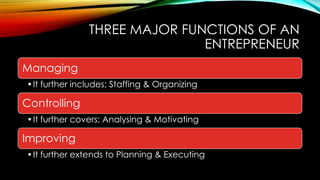
THREE MAJOR FUNCTIONS OF AN
ENTREPRENEUR
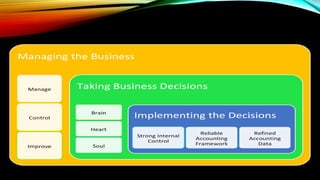
Managing
•It further includes; Staffing & Organizing

Controlling
•It further covers; Analysing & Motivating

Improving
•It further extends to Planning & Executing
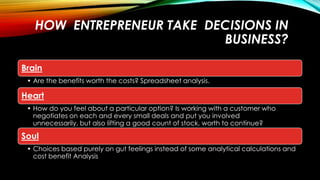
HOW ENTREPRENEUR TAKE DECISIONS IN
BUSINESS?
Brain
• Are the benefits worth the costs? Spreadsheet analysis.

Heart
• How do you feel about a particular option? Is working with a customer who
negotiates on each and every small deals and put you involved
unnecessarily, but also lifting a good count of stock, worth to continue?

Soul
• Choices based purely on gut feelings instead of some analytical calculations and
cost benefit Analysis
INTERNAL CONTROL
• whatever basis to take business decisions, they must be
followed up by strong internal controls.
• number of business owners; that what system they have
devised to take care to follow-up the decisions they are
taking. No doubt everyone has developed their own
systems over a period of time, but unluckily most of them
had some lacunas or lack comprehensiveness
INTERNAL CONTROL
• Who takes care of your system for billing to a new client?
• How the POs & Actual bills are compared for terms of POs?
• Who takes care of billed quantity & Store receipt matching?
• Who takes care of matching counts of inter departmental transfers?

• Who takes care of matching electricity bill units & produced quantity?
• And a hundreds more questions like this…
INTERNAL CONTROL
Frighteningly, the majority of business owners don’t know
exactly that how their system, deal with such deviations. As
long as there is certain misappropriation detected, they
don’t bother themselves with much of their system &
accounting lapses. So if an employee finds a way of
defrauding, they would have no way of detecting it
immediately.
NEED OF ACCOUNTING SYSTEM
Lack of accounting and financial control systems is a big problem
among SMEs. They cannot measure their success, growth and
efficiency. With no budgets and cash flow management systems,
business decisions are made in the dark and on an ad-hoc basis. A
strong accounting system helps in managing a strong internal control &
decision follow-up system; which in turn improves your financial
management, maximising returns on investments and refining the
competitiveness of businesses
WHY ACCOUNTING IS CALLED THE
"LANGUAGE OF BUSINESS"
Because it deals with the interpretation of a company’s
operations and finances & each transaction being carried
out by the business. Next presentations shall support you in
understanding that how to use accounting to form a centre
of continuous flow of business information, that business
actually needs.
STRONG ACCOUNTING SYSTEM WILL ANSWER THE
FOLLOWING QUESTIONS
• How to use your accounting Information for your business
decisions?
• How to improve your Internal Controls with existing accounting
Setup?
• How to forecast the future scenarios & make budgets/ targets?
• How to improve business performance & efficiency?
'QUALITATIVE’ VS.
'QUANTITATIVE' DECISION
• 'qualitative' decision, e.g. in deciding which of two personnel should be
promoted to a managerial position
• A 'quantitative' decision, on the other hand, is possible when the various
factors, and relationships between them, are measurable
ACCOUNTING SETUP
• accounting setup as a base towards developing a managerial control
system and decision support system.
• Furthermore you can develop such an accounting setup, when you actually
need the brain exercise on a particular problem
Accounting & Business Decisions

Accounting & Business Decisions

  • 1.
  • 2.
    THREE MAJOR FUNCTIONSOF AN ENTREPRENEUR Managing •It further includes; Staffing & Organizing Controlling •It further covers; Analysing & Motivating Improving •It further extends to Planning & Executing
  • 3.
    HOW ENTREPRENEUR TAKEDECISIONS IN BUSINESS? Brain • Are the benefits worth the costs? Spreadsheet analysis. Heart • How do you feel about a particular option? Is working with a customer who negotiates on each and every small deals and put you involved unnecessarily, but also lifting a good count of stock, worth to continue? Soul • Choices based purely on gut feelings instead of some analytical calculations and cost benefit Analysis
  • 4.
    INTERNAL CONTROL • whateverbasis to take business decisions, they must be followed up by strong internal controls. • number of business owners; that what system they have devised to take care to follow-up the decisions they are taking. No doubt everyone has developed their own systems over a period of time, but unluckily most of them had some lacunas or lack comprehensiveness
  • 5.
    INTERNAL CONTROL • Whotakes care of your system for billing to a new client? • How the POs & Actual bills are compared for terms of POs? • Who takes care of billed quantity & Store receipt matching? • Who takes care of matching counts of inter departmental transfers? • Who takes care of matching electricity bill units & produced quantity? • And a hundreds more questions like this…
  • 6.
    INTERNAL CONTROL Frighteningly, themajority of business owners don’t know exactly that how their system, deal with such deviations. As long as there is certain misappropriation detected, they don’t bother themselves with much of their system & accounting lapses. So if an employee finds a way of defrauding, they would have no way of detecting it immediately.
  • 7.
    NEED OF ACCOUNTINGSYSTEM Lack of accounting and financial control systems is a big problem among SMEs. They cannot measure their success, growth and efficiency. With no budgets and cash flow management systems, business decisions are made in the dark and on an ad-hoc basis. A strong accounting system helps in managing a strong internal control & decision follow-up system; which in turn improves your financial management, maximising returns on investments and refining the competitiveness of businesses
  • 8.
    WHY ACCOUNTING ISCALLED THE "LANGUAGE OF BUSINESS" Because it deals with the interpretation of a company’s operations and finances & each transaction being carried out by the business. Next presentations shall support you in understanding that how to use accounting to form a centre of continuous flow of business information, that business actually needs.
  • 9.
    STRONG ACCOUNTING SYSTEMWILL ANSWER THE FOLLOWING QUESTIONS • How to use your accounting Information for your business decisions? • How to improve your Internal Controls with existing accounting Setup? • How to forecast the future scenarios & make budgets/ targets? • How to improve business performance & efficiency?
  • 10.
    'QUALITATIVE’ VS. 'QUANTITATIVE' DECISION •'qualitative' decision, e.g. in deciding which of two personnel should be promoted to a managerial position • A 'quantitative' decision, on the other hand, is possible when the various factors, and relationships between them, are measurable
  • 11.
    ACCOUNTING SETUP • accountingsetup as a base towards developing a managerial control system and decision support system. • Furthermore you can develop such an accounting setup, when you actually need the brain exercise on a particular problem