Accessible Housing Program  &  „ Darzybor” Settlement (suburban area of Poznan)
Background: The housing situation in Poland is especially   critical, because the country moved overnight   from a state-controlled economy with an all - e m bracing social safety net to a democracy with   a market-oriented economy. Officially, Poland   counts 300,000 homeless . H owever, estimates   reach up to three times that number . HOUSING SITUATION IN POLAND
HOUSING SITUATION IN POLAND Barka has been engaged in the renovation of abandoned and neglected  houses since its beginning in 1989. The Foundation provides social, legal,  administrative and executive support.  The houses acquired by Barka are mostly in raw conditions, typically lack  floors, sewerage, electric installations, and have leaking roofs. The self-help groups formed by Barka largely renovate the houses  themselves. Once they have a home, they take up one of several income- generating activities proposed by Barka.  In total, Barka has established 30  centers with self-help groups covering 750 people throughout Poland.  Once the initial investments have been covered, these centers operate self- sufficiently. The beneficiaries work on ecological farming or in vocational  workshops to cover their living costs.
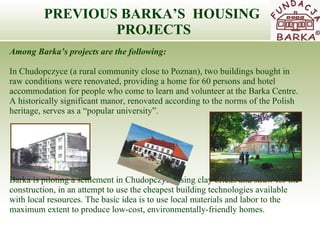
PREVIOUS BARKA’S  HOUSING  PROJECTS Among Barka’s projects are the following: In Chudopczyce (a rural community close to Poznan), two buildings bought in raw  c onditions   were renovated, providing a home for 60 persons and hotel accommodation for people who come to learn and volunteer at the Barka Cent re .  A  historically significant manor ,  renovated according to the norms of the Polish heritage ,  serves as a “popular university” .   Barka is piloting a settlement in Chudopczyce using clay bricks and straw for the  construction,   in an attempt to use the cheapest building technologies available with local resources. The basic   idea is to use local materials and labor to the maximum extent to produce low-cost, environmentally-friendly homes.
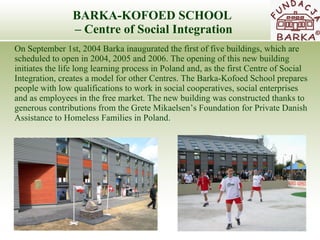
BARKA-KOFOED SCHOOL  –  Centre of Social Integration On September 1st, 2004 Barka inaugurated the first of  five buildings ,  which ar e  scheduled to open in 2004, 2005 and 2006. The opening of this new building  initiates the life long learning process in Poland and, as the first Centre of Social  Integration, creates a model for other Centres. The Barka-Kofoed School prepare s  people with low qualifications to work in social cooperatives, social enterprises  and as employees in the free market. The new building was constructed thanks to generous   contributions from the Grete Mikaelsen’s Foundation for Private Danish Assistance to   Homeless Families in Poland.
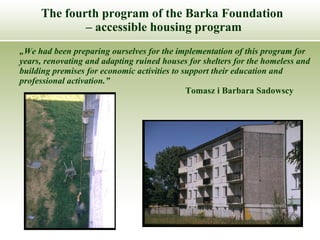
The fourth program of the Barka Foundation  –  accessible housing program „ We had been preparing ourselves for the implementation of this program for years, renovating and adapting ruined houses for shelters for the homeless and building premises for economic activities to support their education and professional activation.” Tomasz i Barbara Sadowscy
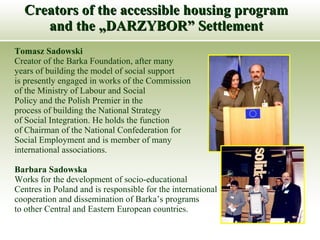
Creators of the accessible housing program and the „DARZYBOR” Settlement Tomasz Sadowski  Creator of the Barka Foundation, after many years of building the model of social support is presently engaged in works of the Commission of the Ministry of Labour and Social  Policy and the Polish Premier in the  process of building the National Strategy  of Social Integration. He holds the function  of Chairman of the National Confederation for  Social Employment and is member of many  international associations. Barbara Sadowska Works for the development of socio-educational Centres in Poland and is responsible for the international  cooperation and dissemination of Barka’s programs  to other Central and Eastern European countries.
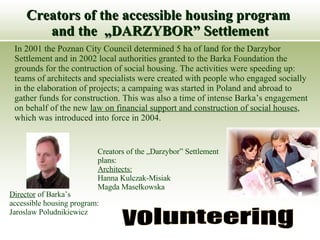
Creators of the accessible housing program  and the  „DARZYBOR” Settlement In 2001 the Poznan City Council determined 5 ha of land for the Darzybor Settlement and in 2002 local authorities granted to the Barka Foundation the grounds for the contruction of social housing. The activities were speeding up: teams of architects and specialists were created with people who engaged socially in the elaboration of projects; a campaing was started in Poland and abroad to gather funds for construction. This was also a time of intense Barka’s engagement on behalf of the new  law on financial support and construction of social houses , which was introduced into force in 2004.  volunteering Creators of the „Darzybor” Settlement plans:  Architects:   Hanna Kulczak-Misiak Magda Masełkowska Director   of Barka’s  accessible housing program: Jaroslaw Poludnikiewicz
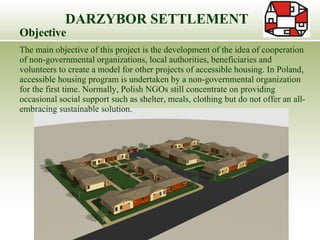
DARZYBOR SETTLEMENT Objective The main objective of this project is the development of the idea of cooperation of non-governmental organizations, local authorities, beneficiaries and volunteers to create a model for other projects of accessible housing. In Poland, accessible housing program is undertaken by a non-governmental organization for the first time. Normally, Polish NGOs still concentrate on providing occasional social support such as shelter, meals, clothing but do not offer an all-embracing sustainable solution.
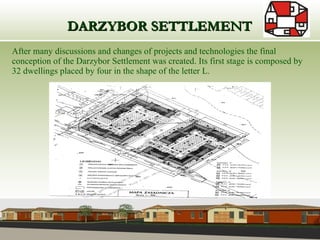
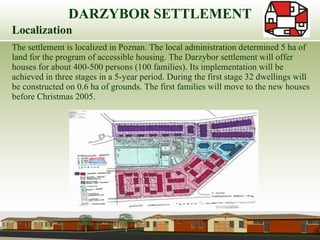
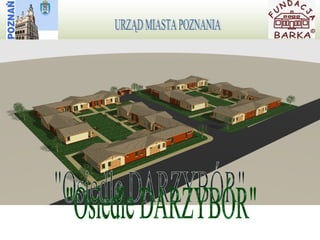
  DARZYBOR SETTLEMENT After many discussions and changes of projects and technologies the final conception of the Darzybor Settlement was created. Its first stage is composed by 32 dwellings placed by four in the shape of the letter L.
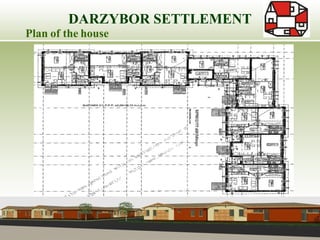
DARZYBOR SETTLEMENT Plan of the house
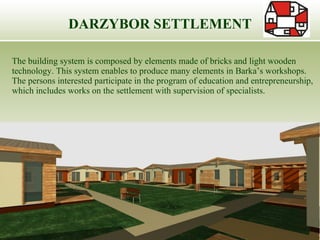
DARZYBOR SETTLEMENT The building system is composed by elements made of bricks and light wooden technology. This system enables to produce many elements in Barka’s workshops. The persons interested participate in the program of education and entrepreneurship, which includes works on the settlement with supervision of specialists.
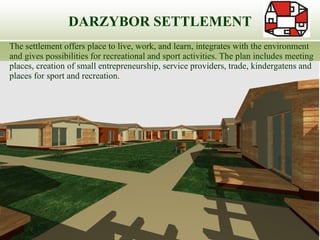
DARZYBOR SETTLEMENT The settlement offers place to live, work, and learn, integrates with the environment and gives possibilities for recreational and sport activities. The plan includes meeting places, creation of small entrepreneurship, service providers, trade, kindergatens and places for sport and recreation.
Localization The settlement is localized in Poznan. The local administration determined 5 ha of land for the program of accessible housing. The Darzybor settlement will offer houses for about 400-500 persons (100 families). Its implementation will be  achieved in three stages in a 5-year period. During the first stage 32 dwellings will be constructed on 0.6 ha of grounds. The first families will move to the new houses before Christmas 2005. DARZYBOR SETTLEMENT
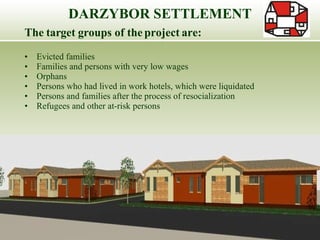
The target groups of the project are: Evicted families Families and persons with very low wages Orphans Persons who had lived in work hotels, which were liquidated Persons and families after the process of resocialization Refugees and other at-risk persons DARZYBOR SETTLEMENT
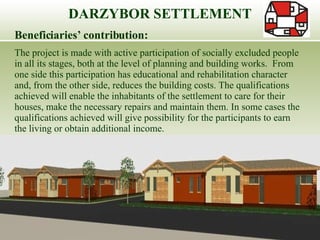
Beneficiaries’ contribution:  The project is made with active participation of socially excluded people in all its stages, both at the level of planning and building works.  From one side this participation has educational and rehabilitation character and, from the other side, reduces the building costs. The qualifications achieved will enable the inhabitants of the settlement to care for their houses, make the necessary repairs and maintain them. In some cases the qualifications achieved will give possibility for the participants to earn the living or obtain additional income. DARZYBOR SETTLEMENT
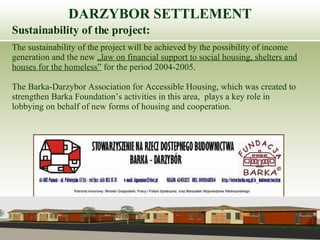
Sustainability of the project: The sustainability of the project will be achieved by the possibility of income generation and the new  „law on financial support to social housing, shelters and houses for the homeless”  for the period 2004-2005.  The Barka-Darzybor Association for Accessible Housing, which was created to strengthen Barka Foundation’s activities in this area,  plays a key role in lobbying on behalf of new forms of housing and cooperation. DARZYBOR SETTLEMENT
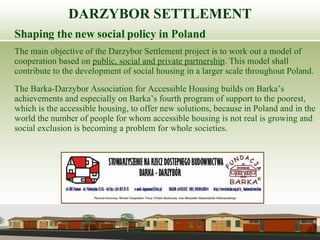
Shaping the new social policy in Poland The main objective of the Darzybor Settlement project is to work out a model of cooperation based on  public, social and private partnership . This model shall contribute to the development of social housing in a larger scale throughout Poland.  The Barka-Darzybor Association for Accessible Housing builds on Barka’s achievements and especially on Barka’s fourth program of support to the poorest, which is the accessible housing, to offer new solutions, because in Poland and in the world the number of people for whom accessible housing is not real is growing and social exclusion is becoming a problem for whole societies. DARZYBOR SETTLEMENT
Barka-Darzybor Association  for Accessible Housing Association’s statutory objectives: Social and professional reintegration of socially excluded people aiming at their return to the society and to offer them adequate housing conditions; Participation of people experienced by poverty in programs of communities’ creation, socio-educational programs, programs of social employment and accessible housing program; Cooperation with diverse institutions of social support in Poland and abroad, the  public administration, representatives of the business area and religious institutions in programs of social and vocational reintegration of socially excluded groups; Activities for the development of citizens’ society.
The housing policy in Poland - background „ public authorities carry on a policy to improve the fulfillment of citizens’ housing needs, especially as refers to overcoming homelessness and provide support to citizens’ activities aimed at achievement of own housing” art. 75  of the Constitution of the Republic of Poland
The housing policy in Poland - background 1989  – beginning of the transformation times in Poland 14.05.1990  –  Ministers’ Council meeting:  during the meeting the determinations  for the place and the future development of housing in Poland were accepted Spring 1991  – Conference in the Polish Parliament to make the development of  housing a concrete possibility in the new situation of system transformation and in the conditions of a „ social market economy ” 06.07.1995  – The document „ Principles of State housing policy ” was accepted by  the Polish Parliament 26.10.1995  – Acceptance by the Polish Parliament of the „law on some forms of  support to housing”
The housing policy in Poland Present law regarding housing: 26.10.1995   - acceptance by the Polish Parliament of the  „ law on some forms of support to housing” 29.04.2004   - acceptance by the Polish Parliament of the  „ law on financial support for creation of social housing, shelters and dwellings for the homeless”
"Osiedle DARZYBÓR" URZĄD MIASTA POZNANIA "Osiedle DARZYBÓR" URZĄD MIASTA POZNANIA
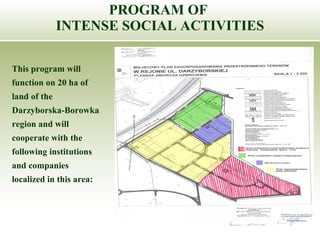
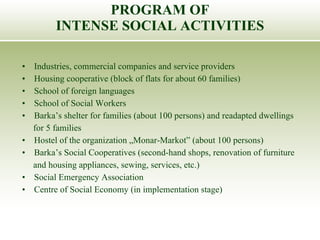
PROGRAM OF  INTENSE SOCIAL ACTIVITIES This program will function on 20 ha of land of the Darzyborska-Borowka region and will cooperate with the following institutions and companies localized in this area:
Industries, commercial companies and service providers Housing cooperative (block of flats for about 60 families) School of foreign languages School of Social Workers Barka’s shelter for families (about 100 persons) and readapted dwellings  for 5 families Hostel of the organization „Monar-Markot” (about 100 persons) Barka’s Social Cooperatives (second-hand shops, renovation of furniture  and housing appliances, sewing, services, etc.) Social Emergency Association Centre of Social Economy (in implementation stage) PROGRAM OF INTENSE SOCIAL ACTIVITIES
WE WARMLY INVITE YOU TO VISIT OUR WEBSITE www.barka.org.pl

Accessible Housing Program

  • 1.
    Accessible Housing Program & „ Darzybor” Settlement (suburban area of Poznan)
  • 2.
    Background: The housingsituation in Poland is especially critical, because the country moved overnight from a state-controlled economy with an all - e m bracing social safety net to a democracy with a market-oriented economy. Officially, Poland counts 300,000 homeless . H owever, estimates reach up to three times that number . HOUSING SITUATION IN POLAND
  • 3.
    HOUSING SITUATION INPOLAND Barka has been engaged in the renovation of abandoned and neglected houses since its beginning in 1989. The Foundation provides social, legal, administrative and executive support. The houses acquired by Barka are mostly in raw conditions, typically lack floors, sewerage, electric installations, and have leaking roofs. The self-help groups formed by Barka largely renovate the houses themselves. Once they have a home, they take up one of several income- generating activities proposed by Barka. In total, Barka has established 30 centers with self-help groups covering 750 people throughout Poland. Once the initial investments have been covered, these centers operate self- sufficiently. The beneficiaries work on ecological farming or in vocational workshops to cover their living costs.
  • 4.
    PREVIOUS BARKA’S HOUSING PROJECTS Among Barka’s projects are the following: In Chudopczyce (a rural community close to Poznan), two buildings bought in raw c onditions were renovated, providing a home for 60 persons and hotel accommodation for people who come to learn and volunteer at the Barka Cent re . A historically significant manor , renovated according to the norms of the Polish heritage , serves as a “popular university” . Barka is piloting a settlement in Chudopczyce using clay bricks and straw for the construction, in an attempt to use the cheapest building technologies available with local resources. The basic idea is to use local materials and labor to the maximum extent to produce low-cost, environmentally-friendly homes.
  • 5.
    BARKA-KOFOED SCHOOL – Centre of Social Integration On September 1st, 2004 Barka inaugurated the first of five buildings , which ar e scheduled to open in 2004, 2005 and 2006. The opening of this new building initiates the life long learning process in Poland and, as the first Centre of Social Integration, creates a model for other Centres. The Barka-Kofoed School prepare s people with low qualifications to work in social cooperatives, social enterprises and as employees in the free market. The new building was constructed thanks to generous contributions from the Grete Mikaelsen’s Foundation for Private Danish Assistance to Homeless Families in Poland.
  • 6.
    The fourth programof the Barka Foundation – accessible housing program „ We had been preparing ourselves for the implementation of this program for years, renovating and adapting ruined houses for shelters for the homeless and building premises for economic activities to support their education and professional activation.” Tomasz i Barbara Sadowscy
  • 7.
    Creators of theaccessible housing program and the „DARZYBOR” Settlement Tomasz Sadowski Creator of the Barka Foundation, after many years of building the model of social support is presently engaged in works of the Commission of the Ministry of Labour and Social Policy and the Polish Premier in the process of building the National Strategy of Social Integration. He holds the function of Chairman of the National Confederation for Social Employment and is member of many international associations. Barbara Sadowska Works for the development of socio-educational Centres in Poland and is responsible for the international cooperation and dissemination of Barka’s programs to other Central and Eastern European countries.
  • 8.
    Creators of theaccessible housing program and the „DARZYBOR” Settlement In 2001 the Poznan City Council determined 5 ha of land for the Darzybor Settlement and in 2002 local authorities granted to the Barka Foundation the grounds for the contruction of social housing. The activities were speeding up: teams of architects and specialists were created with people who engaged socially in the elaboration of projects; a campaing was started in Poland and abroad to gather funds for construction. This was also a time of intense Barka’s engagement on behalf of the new law on financial support and construction of social houses , which was introduced into force in 2004. volunteering Creators of the „Darzybor” Settlement plans: Architects: Hanna Kulczak-Misiak Magda Masełkowska Director of Barka’s accessible housing program: Jaroslaw Poludnikiewicz
  • 9.
    DARZYBOR SETTLEMENT ObjectiveThe main objective of this project is the development of the idea of cooperation of non-governmental organizations, local authorities, beneficiaries and volunteers to create a model for other projects of accessible housing. In Poland, accessible housing program is undertaken by a non-governmental organization for the first time. Normally, Polish NGOs still concentrate on providing occasional social support such as shelter, meals, clothing but do not offer an all-embracing sustainable solution.
  • 10.
    DARZYBORSETTLEMENT After many discussions and changes of projects and technologies the final conception of the Darzybor Settlement was created. Its first stage is composed by 32 dwellings placed by four in the shape of the letter L.
  • 11.
  • 12.
    DARZYBOR SETTLEMENT Thebuilding system is composed by elements made of bricks and light wooden technology. This system enables to produce many elements in Barka’s workshops. The persons interested participate in the program of education and entrepreneurship, which includes works on the settlement with supervision of specialists.
  • 13.
    DARZYBOR SETTLEMENT Thesettlement offers place to live, work, and learn, integrates with the environment and gives possibilities for recreational and sport activities. The plan includes meeting places, creation of small entrepreneurship, service providers, trade, kindergatens and places for sport and recreation.
  • 14.
    Localization The settlementis localized in Poznan. The local administration determined 5 ha of land for the program of accessible housing. The Darzybor settlement will offer houses for about 400-500 persons (100 families). Its implementation will be achieved in three stages in a 5-year period. During the first stage 32 dwellings will be constructed on 0.6 ha of grounds. The first families will move to the new houses before Christmas 2005. DARZYBOR SETTLEMENT
  • 15.
    The target groupsof the project are: Evicted families Families and persons with very low wages Orphans Persons who had lived in work hotels, which were liquidated Persons and families after the process of resocialization Refugees and other at-risk persons DARZYBOR SETTLEMENT
  • 16.
    Beneficiaries’ contribution: The project is made with active participation of socially excluded people in all its stages, both at the level of planning and building works. From one side this participation has educational and rehabilitation character and, from the other side, reduces the building costs. The qualifications achieved will enable the inhabitants of the settlement to care for their houses, make the necessary repairs and maintain them. In some cases the qualifications achieved will give possibility for the participants to earn the living or obtain additional income. DARZYBOR SETTLEMENT
  • 17.
    Sustainability of theproject: The sustainability of the project will be achieved by the possibility of income generation and the new „law on financial support to social housing, shelters and houses for the homeless” for the period 2004-2005. The Barka-Darzybor Association for Accessible Housing, which was created to strengthen Barka Foundation’s activities in this area, plays a key role in lobbying on behalf of new forms of housing and cooperation. DARZYBOR SETTLEMENT
  • 18.
    Shaping the newsocial policy in Poland The main objective of the Darzybor Settlement project is to work out a model of cooperation based on public, social and private partnership . This model shall contribute to the development of social housing in a larger scale throughout Poland. The Barka-Darzybor Association for Accessible Housing builds on Barka’s achievements and especially on Barka’s fourth program of support to the poorest, which is the accessible housing, to offer new solutions, because in Poland and in the world the number of people for whom accessible housing is not real is growing and social exclusion is becoming a problem for whole societies. DARZYBOR SETTLEMENT
  • 19.
    Barka-Darzybor Association for Accessible Housing Association’s statutory objectives: Social and professional reintegration of socially excluded people aiming at their return to the society and to offer them adequate housing conditions; Participation of people experienced by poverty in programs of communities’ creation, socio-educational programs, programs of social employment and accessible housing program; Cooperation with diverse institutions of social support in Poland and abroad, the public administration, representatives of the business area and religious institutions in programs of social and vocational reintegration of socially excluded groups; Activities for the development of citizens’ society.
  • 20.
    The housing policyin Poland - background „ public authorities carry on a policy to improve the fulfillment of citizens’ housing needs, especially as refers to overcoming homelessness and provide support to citizens’ activities aimed at achievement of own housing” art. 75 of the Constitution of the Republic of Poland
  • 21.
    The housing policyin Poland - background 1989 – beginning of the transformation times in Poland 14.05.1990 – Ministers’ Council meeting: during the meeting the determinations for the place and the future development of housing in Poland were accepted Spring 1991 – Conference in the Polish Parliament to make the development of housing a concrete possibility in the new situation of system transformation and in the conditions of a „ social market economy ” 06.07.1995 – The document „ Principles of State housing policy ” was accepted by the Polish Parliament 26.10.1995 – Acceptance by the Polish Parliament of the „law on some forms of support to housing”
  • 22.
    The housing policyin Poland Present law regarding housing: 26.10.1995 - acceptance by the Polish Parliament of the „ law on some forms of support to housing” 29.04.2004 - acceptance by the Polish Parliament of the „ law on financial support for creation of social housing, shelters and dwellings for the homeless”
  • 23.
    "Osiedle DARZYBÓR" URZĄDMIASTA POZNANIA "Osiedle DARZYBÓR" URZĄD MIASTA POZNANIA
  • 24.
    PROGRAM OF INTENSE SOCIAL ACTIVITIES This program will function on 20 ha of land of the Darzyborska-Borowka region and will cooperate with the following institutions and companies localized in this area:
  • 25.
    Industries, commercial companiesand service providers Housing cooperative (block of flats for about 60 families) School of foreign languages School of Social Workers Barka’s shelter for families (about 100 persons) and readapted dwellings for 5 families Hostel of the organization „Monar-Markot” (about 100 persons) Barka’s Social Cooperatives (second-hand shops, renovation of furniture and housing appliances, sewing, services, etc.) Social Emergency Association Centre of Social Economy (in implementation stage) PROGRAM OF INTENSE SOCIAL ACTIVITIES
  • 26.
    WE WARMLY INVITEYOU TO VISIT OUR WEBSITE www.barka.org.pl