Barka Foundation for Mutual Help Św.Wincentego 6/9 61-003 Poznań POLAND e-mail:  [email_address] http://www.barka.org.pl
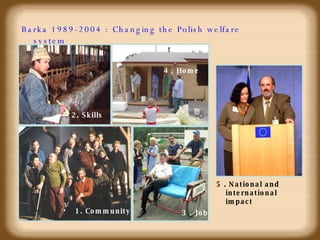
Barka 1989-2004 : Changing the Polish welfare system 1. Community 2. Skills 3 . Job 4 . Home 5 . National and international impact
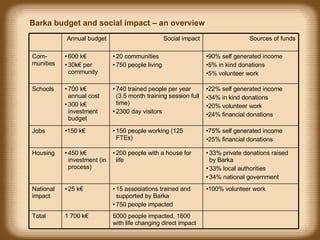
Barka budget and social impact – an overview 33% private donations raised by Barka 33% local authorities 34% national government 200 people with a house for life 450 k€ investment (in process) Housing 100% volunteer work 15 associations trained and supported by Barka 750 people impacted 25 k€ National impact 5000 people impacted, 1800 with life changing direct impact 1 700 k€ Total 75% self generated income 25% financial donations 150 people working (125 FTEs) 150 k€ Jobs 22% self generated income 34% in kind donations 20% volunteer work 24% financial donations 740 trained people per year (3.5 month training session full time) 2300 day visitors 700 k€ annual cost 300 k€ investment budget Schools 90% self generated income 5% in kind donations 5% volunteer work 20 communities 750 people living 600 k€ 30k€ per community Com-munities Sources of funds Social impact Annual budget
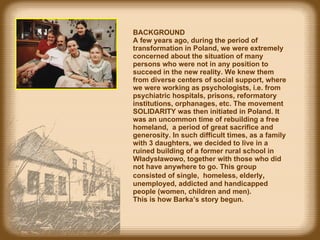
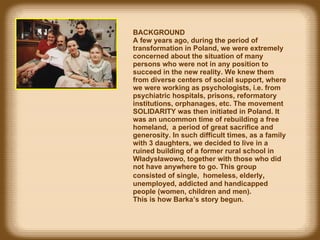
BACKGROUND  A f ew years ago, during the period of transformation in Poland, we were extremely concerned about the situation of many persons who were not in  any  position to succeed in the new reality. We knew them from diverse centers of social support, where we were working as psychologists, i.e. from psychiatric hospitals, prisons, reformatory institutions, orphanages, etc. The movement SOLIDARITY was then initiated in Poland.  It was  an uncommon time of rebuilding a free homeland,  a period  of  great  sacrifice and generosity. In such difficult times, as a family with 3 daughters, we decided to live in a ruined building of a former rural school in Władysławowo, together with those who did not have  any where to go. This group   co nsisted of   single ,  homeless,  elderly ,   unemployed, addicted  and handicapped   people  (women, children and men).  This  is how  Barka’s story  begun .
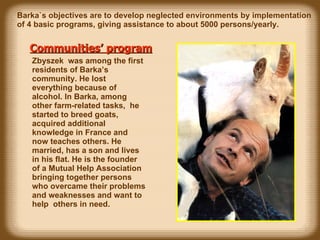
Communities’ program   Zbyszek  was among the first  residents  of Barka’s community. He lost everything because of alcohol. In Barka, among other farm-related tasks,  he started to breed goats , acquired additional knowledge in France and now teaches others.  He married, has a son and lives in his flat. He is the founder of a Mutual Help Association  bringing  together persons who overcame their problems and weaknesses and want to help  others  in need. Barka`s objectives are to develop neglected environments by implementation  of 4 basic programs, giving assistance to about 5000 persons/yearly.
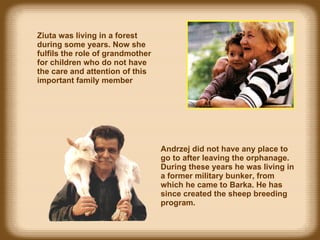
Andrzej did not have any place to go to after leaving the orphanage. During  these  years he was living in a former military bunker, from wh ich  he came to Barka.  H e  has since   created  the sheep breeding  program . Ziuta was living in a forest during some years.  Now she fulfils the role of grandmother for children who do not have the care and attention of this important family member
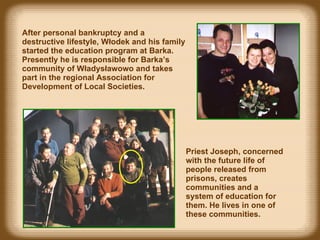
After personal ban k rup t cy and  a destructive lifestyle , Włodek a n d his family started  the  education  program at  Barka.  Presently he is responsible for Barka’s community of Władysławowo and takes part in the regional Association  for  Development of Local Societies . Priest Joseph, concerned with the future life of people released from prisons, creates communities and a system of education for them. He lives in one of these communities.
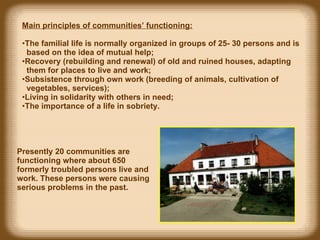
Main principles of communities’ functioning: The familial life is normally organized in groups of 25-   30 persons and is  based on the idea of mutual help; Recovery (rebuilding and renewal) of old and ruined houses ,  adapting  them for places to live and work; Subsistence through own work (breeding of animals, cultivation of  vegetables, services); Living in s olidar ity with others in  need; T he importance of a life in sobriety. Presently 20 communities are functioning where about 650  formerly troubled  persons live and work. These persons were causing serious problems in the past.
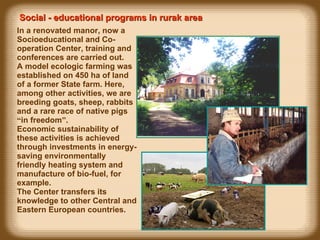
In a renovated manor, now a Socioeducational and Co-operation Center, training and conferences are carried out. A model ecologic farming was established on 450 ha of land of a former State farm. Here, among other activities, we are breeding goats, sheep, rabbits and a rare race of native pigs  “ in freedom ” . Economic sustainability of these activities is achieved through investments in energy-saving environmentally friendly heating system and manufacture of bio-fuel, for example.  The Center transfers its knowledge to other Central and Eastern European countries. Social - educational programs in rurak area
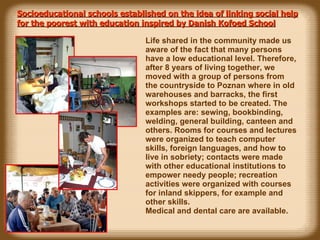
Socioeducational schools established on the idea of linking social help for the poorest with education inspired by Danish Kofoed School Life shared in the community made us aware of the fact that many persons have a low educational level. Therefore, after 8 years of living together, we moved with a group of persons from the countryside to Poznan where in old warehouses and barracks, the first workshops started to be created. The examples are: sewing, bookbinding, welding, general building, canteen and others. Rooms for courses and lectures were organized to teach computer skills, foreign languages, and how to live in sobriety; contacts were made with other educational institutions to empower needy people; recreation activities were organized with courses for inland skippers, for example and other skills. Medical and dental care are available.
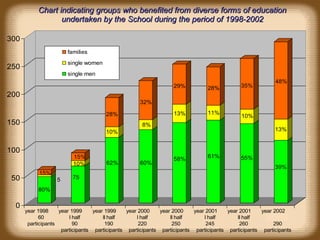
Chart indicating groups who benefited from diverse forms of education undertaken by the School during the period of 1998-2002
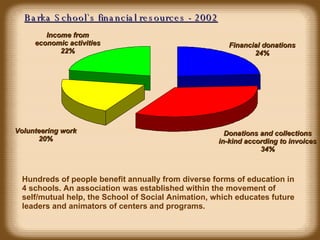
Barka School`s financial resources - 2002 Income from economic activities 22% Financial donations 24% Volunteering work 20% Donations and collections in-kind according to invoices 34% Hundreds of people benefit annually from diverse forms of education in 4 schools. An association was established within the movement of self/mutual help, the School of Social Animation, which educates future leader s  and animators of centers and programs.
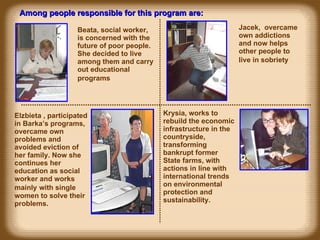
Beata,  social worker,  is concerned with the f uture of poor people . She decided to live among them and carry out educational programs   Among people responsible for this program are: Jacek,  overcame own addictions and now helps  other  people to live in sobriety   Elzbieta , participated in Barka’s programs, overcame own problems and avoided eviction of her family. Now she continues her education as social worker and works mainly   with  single  women to solve their problems. Krysia, works to rebuild the economic infrastructure in the countryside, transforming ban k rupt former State farms, with actions in line with international trends on environmental protection and sustainability.
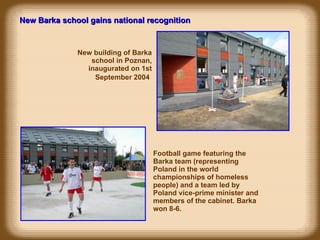
New building of Barka school in Poznan, inaugurated on 1st September 2004   New Barka school gains national recognition Football game featuring the Barka team (representing Poland in the world championships of homeless people) and a team led by Poland vice-prime minister and members of the cabinet. Barka won 8-6.
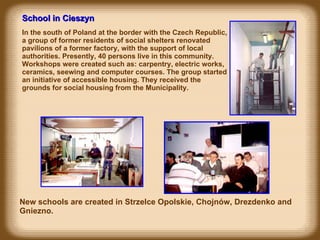
School in Cieszyn In the south of Poland at the border with the Czech Republic, a group of former residents of social shelters renovated pavilions of a former factory, with the support of local authorities. Presently, 40 persons live in this community. Workshops were created such as: carpentry, electric works, ceramics, seewing and computer courses. The group started an initiative of accessible housing. They received the grounds for social housing from the Municipality. New schools are created in Strzelce Opolskie, Chojnów, Drezdenko and Gniezno.
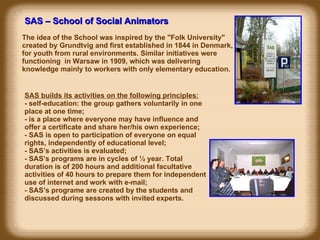
SAS – School of Social Animators The idea of the School was inspired by the "Folk University" created by Grundtvig and first established in 1844 in Denmark, for youth from rural environments. Similar initiatives were functioning  in Warsaw in 1909, which was delivering knowledge mainly to workers with only elementary education.  SAS builds its activities on the following principles: -  self-education: the group gathers voluntarily in one place at one time; -  is a place where everyone may have influence and offer a certificate and share her/his own experience; -  SAS is open to participation of everyone on equal rights, independently of educational level; -  SAS’s activities is evaluated;  -  SAS’s programs are in cycles of ½ year. Total duration is of 200 hours and additional facultative activities of 40 hours to prepare them for independent use of internet and work with e-mail; -  SAS’s programe are created by the students and discussed during sessons with invited experts.
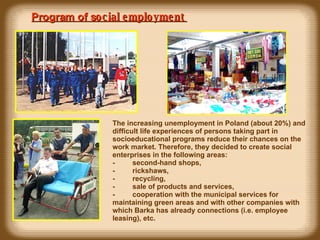
Program of s ocial employment  The increasing unemployment in Poland (about 20%) and difficult life experiences of persons taking part in soc i oeducational programs reduce their chances on the work market. Therefore, they decided to create social enterprises in the following areas: -            second-hand shops, -            rickshaws, -            recycling,  -            sale of products and services, -            cooperation with the municipal services for maintaining green areas and  with  other companies  with  which  Barka has already connections (i.e. employee  leasing ) , etc.
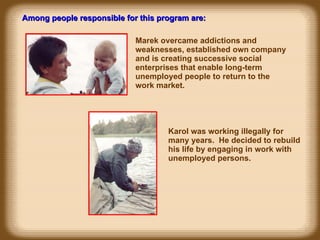
Marek overcame addictions and weaknesses, established own company and is creating successive social enterprises t hat  enable long-term unemployed  people to  return to the work market. Among people responsible for this program are: Karol was  working il legal ly  for many years.  He decided to rebuild his life  by  engag ing  in work with unemployed persons .
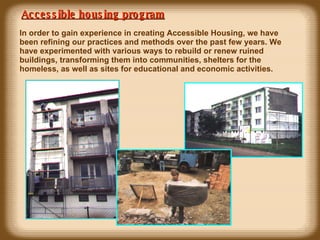
Accessible housing program   In order to gain experience in creating Accessible Housing, we have been refining our practices and methods over the past few years. We have experimented with various ways to rebuild or renew ruined buildings, transforming them into communities, shelters for the homeless, as well as sites for educational and economic activities.
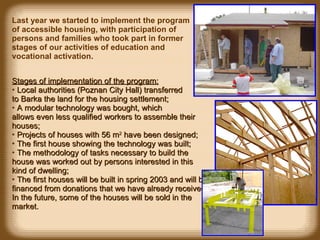
Stages of implementation of the program: Local authorities  ( Poznan City  Hall)  transferred to Barka the land for the housing settlement ; A modular technology was bought ,  which  allows even less qualified workers to assemble their houses ; Projects of houses with 56 m 2  have been designed ; The first house showing the technology was built ; The methodology of tasks necessary to build the house was worked out by persons interested in this kind of dwelling ; The first houses will be built  in  spring 2003 and will be financed from donations  that we have already received . In the future,  some of the  houses will be sold in the market. Last year we started to implement the program of accessible housing, with participation of persons and families who took part in former stages of our activities of education and vocational activation.
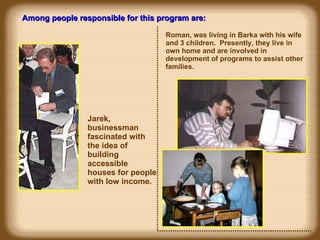
Jarek, businessman fascinated with the idea of  building  accessible hous es  for people with low income.   Among people responsible for this program are: Roman, was living in Barka with his wife and 3 children.  Presently, they  live in own home  and are involved in development of programs to assist other families.
Mechanism for program development Barka’s mechanism for social development  relies on : The School of Social Animation based on the idea of the so called “Popular Universities” or “Folk Universities”. This system benefits, among others,  from the experience and knowledge of people who faced poverty and serious life problems, and today can transfer the knowledge regarding creation and development of programs  to  fight against social exclusion to other groups from diverse regions in Poland and other countries. New laws regarding social employment and social entrepreneurship, which emerged  from  Barka’s experiences . They  have the support of the Ministry of Labor and Social Poli cy ,  which  will enable  further  financial support for development of social programs in Poland. Building of national and transnational structures: Barka creates Poland-wide confederations and unions of associations and foundations interested in implementing anti-poverty programs and disseminating education on how to build mechanisms of social integration. Participation in programs of exchange of experiences with large European unions such as: EAPN (European Anti-Poverty Network), FEANTSA (European Federation of National Associations Working with the Homeless), European Social Platform, ISSAN (Instituto Studi Sviluppo Aziende Non Profit-Universita degli Studi di Trento, Italy), Schwab Foundation for Social Entrepreneurs, Ashoka (Social Innovation Entrepreneurs),  the Animal Welfare Institute -USA, Kofoed Skole – Denmark,  etc.
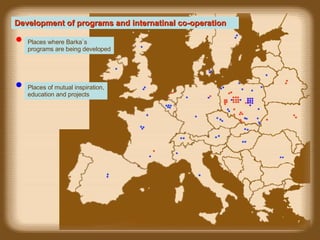
Development of programs and internatinal co-operation Places where Barka`s programs are being developed Places of mutual inspiration, education and projects
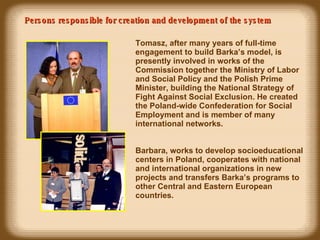
Persons responsible for creation and development of the system Tomasz, after many years of full-time engagement to build Barka’s model, is presently involved in works of the Commission together the Ministry of Labor and Social Polic y  and the Polish Prime Minister, building the National Strategy of Fight Against Social Exclusion. He created the Poland-wide Confederation  for  Social Employment and is member of many international net work s. Barbara, works to develop socioeducational centers in Poland, cooperates with national and international organizations in new projects and transfers Barka’s programs to other Central and Eastern European countries.
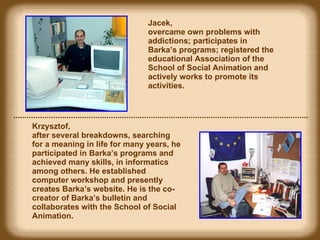
Jacek,  overcame own problems with addictions; participates in Barka’s programs; registered the educational Association of the School of Social Animation and actively works to promote its activities.  Krzysztof,  after several  breakdowns , searching for a meaning in life for many years, he participated in Barka’s programs and achieved many skills, in informatics among others. He  established  computer workshop and presently creates Barka’s website. He is the co-creator of Barka’s bulletin and co llabora tes with the School of Social Animation.
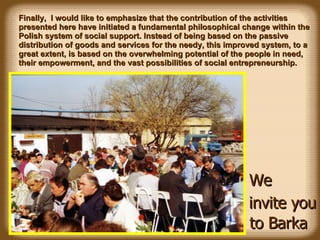
Finally,  I would like to emphasize that the  contribution of the  activities presented here  have   initiated a fundamental philosophical change within the  Polish system of social support . Instead of being based on the p assive distribution of goods and services  for the needy, this improved system, to a great extent, is based on the overwhelming potential of the people in need, their empowerment, and the vast possibilities of social entrepreneurship. We invite you to Barka
www.barka.org.pl ©  Barka design studio 2003

Barka Englisch

  • 1.
    Barka Foundation forMutual Help Św.Wincentego 6/9 61-003 Poznań POLAND e-mail: [email_address] http://www.barka.org.pl
  • 2.
    Barka 1989-2004 :Changing the Polish welfare system 1. Community 2. Skills 3 . Job 4 . Home 5 . National and international impact
  • 3.
    Barka budget andsocial impact – an overview 33% private donations raised by Barka 33% local authorities 34% national government 200 people with a house for life 450 k€ investment (in process) Housing 100% volunteer work 15 associations trained and supported by Barka 750 people impacted 25 k€ National impact 5000 people impacted, 1800 with life changing direct impact 1 700 k€ Total 75% self generated income 25% financial donations 150 people working (125 FTEs) 150 k€ Jobs 22% self generated income 34% in kind donations 20% volunteer work 24% financial donations 740 trained people per year (3.5 month training session full time) 2300 day visitors 700 k€ annual cost 300 k€ investment budget Schools 90% self generated income 5% in kind donations 5% volunteer work 20 communities 750 people living 600 k€ 30k€ per community Com-munities Sources of funds Social impact Annual budget
  • 4.
    BACKGROUND Af ew years ago, during the period of transformation in Poland, we were extremely concerned about the situation of many persons who were not in any position to succeed in the new reality. We knew them from diverse centers of social support, where we were working as psychologists, i.e. from psychiatric hospitals, prisons, reformatory institutions, orphanages, etc. The movement SOLIDARITY was then initiated in Poland. It was an uncommon time of rebuilding a free homeland, a period of great sacrifice and generosity. In such difficult times, as a family with 3 daughters, we decided to live in a ruined building of a former rural school in Władysławowo, together with those who did not have any where to go. This group co nsisted of single , homeless, elderly , unemployed, addicted and handicapped people (women, children and men). This is how Barka’s story begun .
  • 5.
    BACKGROUND Af ew years ago, during the period of transformation in Poland, we were extremely concerned about the situation of many persons who were not in any position to succeed in the new reality. We knew them from diverse centers of social support, where we were working as psychologists, i.e. from psychiatric hospitals, prisons, reformatory institutions, orphanages, etc. The movement SOLIDARITY was then initiated in Poland. It was an uncommon time of rebuilding a free homeland, a period of great sacrifice and generosity. In such difficult times, as a family with 3 daughters, we decided to live in a ruined building of a former rural school in Władysławowo, together with those who did not have any where to go. This group co nsisted of single , homeless, elderly , unemployed, addicted and handicapped people (women, children and men). This is how Barka’s story begun .
  • 6.
    Communities’ program Zbyszek was among the first residents of Barka’s community. He lost everything because of alcohol. In Barka, among other farm-related tasks, he started to breed goats , acquired additional knowledge in France and now teaches others. He married, has a son and lives in his flat. He is the founder of a Mutual Help Association bringing together persons who overcame their problems and weaknesses and want to help others in need. Barka`s objectives are to develop neglected environments by implementation of 4 basic programs, giving assistance to about 5000 persons/yearly.
  • 7.
    Andrzej did nothave any place to go to after leaving the orphanage. During these years he was living in a former military bunker, from wh ich he came to Barka. H e has since created the sheep breeding program . Ziuta was living in a forest during some years. Now she fulfils the role of grandmother for children who do not have the care and attention of this important family member
  • 8.
    After personal bank rup t cy and a destructive lifestyle , Włodek a n d his family started the education program at Barka. Presently he is responsible for Barka’s community of Władysławowo and takes part in the regional Association for Development of Local Societies . Priest Joseph, concerned with the future life of people released from prisons, creates communities and a system of education for them. He lives in one of these communities.
  • 9.
    Main principles ofcommunities’ functioning: The familial life is normally organized in groups of 25- 30 persons and is based on the idea of mutual help; Recovery (rebuilding and renewal) of old and ruined houses , adapting them for places to live and work; Subsistence through own work (breeding of animals, cultivation of vegetables, services); Living in s olidar ity with others in need; T he importance of a life in sobriety. Presently 20 communities are functioning where about 650 formerly troubled persons live and work. These persons were causing serious problems in the past.
  • 10.
    In a renovatedmanor, now a Socioeducational and Co-operation Center, training and conferences are carried out. A model ecologic farming was established on 450 ha of land of a former State farm. Here, among other activities, we are breeding goats, sheep, rabbits and a rare race of native pigs “ in freedom ” . Economic sustainability of these activities is achieved through investments in energy-saving environmentally friendly heating system and manufacture of bio-fuel, for example. The Center transfers its knowledge to other Central and Eastern European countries. Social - educational programs in rurak area
  • 11.
    Socioeducational schools establishedon the idea of linking social help for the poorest with education inspired by Danish Kofoed School Life shared in the community made us aware of the fact that many persons have a low educational level. Therefore, after 8 years of living together, we moved with a group of persons from the countryside to Poznan where in old warehouses and barracks, the first workshops started to be created. The examples are: sewing, bookbinding, welding, general building, canteen and others. Rooms for courses and lectures were organized to teach computer skills, foreign languages, and how to live in sobriety; contacts were made with other educational institutions to empower needy people; recreation activities were organized with courses for inland skippers, for example and other skills. Medical and dental care are available.
  • 12.
    Chart indicating groupswho benefited from diverse forms of education undertaken by the School during the period of 1998-2002
  • 13.
    Barka School`s financialresources - 2002 Income from economic activities 22% Financial donations 24% Volunteering work 20% Donations and collections in-kind according to invoices 34% Hundreds of people benefit annually from diverse forms of education in 4 schools. An association was established within the movement of self/mutual help, the School of Social Animation, which educates future leader s and animators of centers and programs.
  • 14.
    Beata, socialworker, is concerned with the f uture of poor people . She decided to live among them and carry out educational programs Among people responsible for this program are: Jacek, overcame own addictions and now helps other people to live in sobriety Elzbieta , participated in Barka’s programs, overcame own problems and avoided eviction of her family. Now she continues her education as social worker and works mainly with single women to solve their problems. Krysia, works to rebuild the economic infrastructure in the countryside, transforming ban k rupt former State farms, with actions in line with international trends on environmental protection and sustainability.
  • 15.
    New building ofBarka school in Poznan, inaugurated on 1st September 2004 New Barka school gains national recognition Football game featuring the Barka team (representing Poland in the world championships of homeless people) and a team led by Poland vice-prime minister and members of the cabinet. Barka won 8-6.
  • 16.
    School in CieszynIn the south of Poland at the border with the Czech Republic, a group of former residents of social shelters renovated pavilions of a former factory, with the support of local authorities. Presently, 40 persons live in this community. Workshops were created such as: carpentry, electric works, ceramics, seewing and computer courses. The group started an initiative of accessible housing. They received the grounds for social housing from the Municipality. New schools are created in Strzelce Opolskie, Chojnów, Drezdenko and Gniezno.
  • 17.
    SAS – Schoolof Social Animators The idea of the School was inspired by the "Folk University" created by Grundtvig and first established in 1844 in Denmark, for youth from rural environments. Similar initiatives were functioning in Warsaw in 1909, which was delivering knowledge mainly to workers with only elementary education. SAS builds its activities on the following principles: - self-education: the group gathers voluntarily in one place at one time; - is a place where everyone may have influence and offer a certificate and share her/his own experience; - SAS is open to participation of everyone on equal rights, independently of educational level; - SAS’s activities is evaluated; - SAS’s programs are in cycles of ½ year. Total duration is of 200 hours and additional facultative activities of 40 hours to prepare them for independent use of internet and work with e-mail; - SAS’s programe are created by the students and discussed during sessons with invited experts.
  • 18.
    Program of social employment The increasing unemployment in Poland (about 20%) and difficult life experiences of persons taking part in soc i oeducational programs reduce their chances on the work market. Therefore, they decided to create social enterprises in the following areas: -           second-hand shops, -           rickshaws, -           recycling, -           sale of products and services, -           cooperation with the municipal services for maintaining green areas and with other companies with which Barka has already connections (i.e. employee leasing ) , etc.
  • 19.
    Marek overcame addictionsand weaknesses, established own company and is creating successive social enterprises t hat enable long-term unemployed people to return to the work market. Among people responsible for this program are: Karol was working il legal ly for many years. He decided to rebuild his life by engag ing in work with unemployed persons .
  • 20.
    Accessible housing program In order to gain experience in creating Accessible Housing, we have been refining our practices and methods over the past few years. We have experimented with various ways to rebuild or renew ruined buildings, transforming them into communities, shelters for the homeless, as well as sites for educational and economic activities.
  • 21.
    Stages of implementationof the program: Local authorities ( Poznan City Hall) transferred to Barka the land for the housing settlement ; A modular technology was bought , which allows even less qualified workers to assemble their houses ; Projects of houses with 56 m 2 have been designed ; The first house showing the technology was built ; The methodology of tasks necessary to build the house was worked out by persons interested in this kind of dwelling ; The first houses will be built in spring 2003 and will be financed from donations that we have already received . In the future, some of the houses will be sold in the market. Last year we started to implement the program of accessible housing, with participation of persons and families who took part in former stages of our activities of education and vocational activation.
  • 22.
    Jarek, businessman fascinatedwith the idea of building accessible hous es for people with low income. Among people responsible for this program are: Roman, was living in Barka with his wife and 3 children. Presently, they live in own home and are involved in development of programs to assist other families.
  • 23.
    Mechanism for programdevelopment Barka’s mechanism for social development relies on : The School of Social Animation based on the idea of the so called “Popular Universities” or “Folk Universities”. This system benefits, among others, from the experience and knowledge of people who faced poverty and serious life problems, and today can transfer the knowledge regarding creation and development of programs to fight against social exclusion to other groups from diverse regions in Poland and other countries. New laws regarding social employment and social entrepreneurship, which emerged from Barka’s experiences . They have the support of the Ministry of Labor and Social Poli cy , which will enable further financial support for development of social programs in Poland. Building of national and transnational structures: Barka creates Poland-wide confederations and unions of associations and foundations interested in implementing anti-poverty programs and disseminating education on how to build mechanisms of social integration. Participation in programs of exchange of experiences with large European unions such as: EAPN (European Anti-Poverty Network), FEANTSA (European Federation of National Associations Working with the Homeless), European Social Platform, ISSAN (Instituto Studi Sviluppo Aziende Non Profit-Universita degli Studi di Trento, Italy), Schwab Foundation for Social Entrepreneurs, Ashoka (Social Innovation Entrepreneurs), the Animal Welfare Institute -USA, Kofoed Skole – Denmark, etc.
  • 24.
    Development of programsand internatinal co-operation Places where Barka`s programs are being developed Places of mutual inspiration, education and projects
  • 25.
    Persons responsible forcreation and development of the system Tomasz, after many years of full-time engagement to build Barka’s model, is presently involved in works of the Commission together the Ministry of Labor and Social Polic y and the Polish Prime Minister, building the National Strategy of Fight Against Social Exclusion. He created the Poland-wide Confederation for Social Employment and is member of many international net work s. Barbara, works to develop socioeducational centers in Poland, cooperates with national and international organizations in new projects and transfers Barka’s programs to other Central and Eastern European countries.
  • 26.
    Jacek, overcameown problems with addictions; participates in Barka’s programs; registered the educational Association of the School of Social Animation and actively works to promote its activities. Krzysztof, after several breakdowns , searching for a meaning in life for many years, he participated in Barka’s programs and achieved many skills, in informatics among others. He established computer workshop and presently creates Barka’s website. He is the co-creator of Barka’s bulletin and co llabora tes with the School of Social Animation.
  • 27.
    Finally, Iwould like to emphasize that the contribution of the activities presented here have initiated a fundamental philosophical change within the Polish system of social support . Instead of being based on the p assive distribution of goods and services for the needy, this improved system, to a great extent, is based on the overwhelming potential of the people in need, their empowerment, and the vast possibilities of social entrepreneurship. We invite you to Barka
  • 28.
    www.barka.org.pl © Barka design studio 2003