Modifiers in Java
•There are two types of Modifiers in Java
• Non-access Modifiers
• There are many non-access modifiers, such as static, abstract, etc..
• Access Modifiers
• These specifies the accessibility or scope of a field, method, constructor, or class.
• We can change the access level of fields, constructors, methods, and class by applying
the access modifier on it.
3.
Types Access Modifiers
•There are four types of Java access modifiers:
• Private
• Default
• Protected
• Public
4.
Types Access Modifiers
•Private: The access level of a private modifier is only within the class. It
cannot be accessed from outside the class.
• Default: The access level of a default modifier is only within the package. It
cannot be accessed from outside the package. If you do not specify any
access level, it will be the default.
• Protected: The access level of a protected modifier is within the package
and outside the package through child class. If you do not make the child
class, it cannot be accessed from outside the package.
• Public: The access level of a public modifier is everywhere. It can be
accessed from within the class, outside the class, within the package and
outside the package.
5.
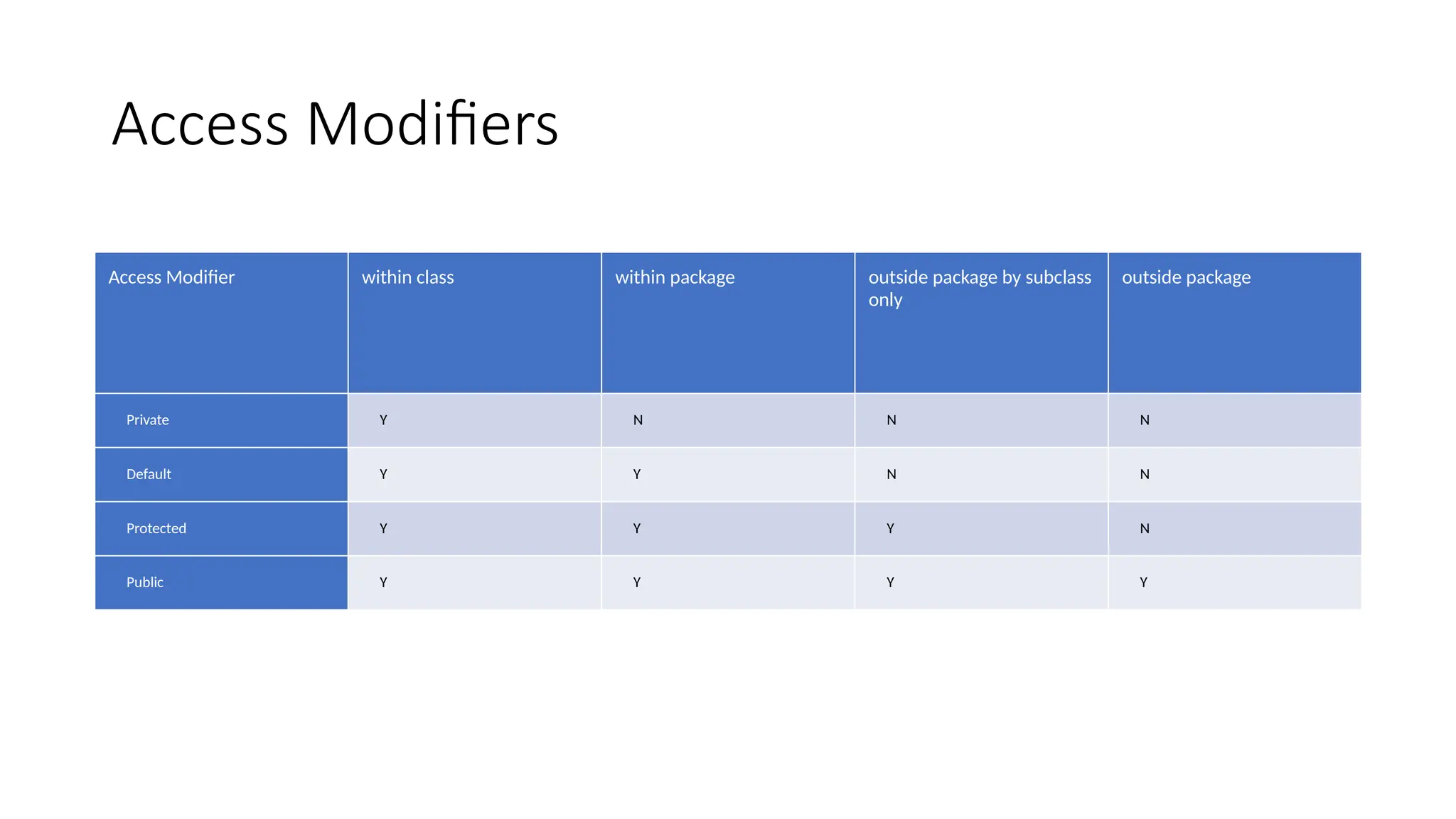
Access Modifiers
Access Modifierwithin class within package outside package by subclass
only
outside package
Private Y N N N
Default Y Y N N
Protected Y Y Y N
Public Y Y Y Y
6.
“Private” – AccessModifier Example
class A{
private int data=40;
private void msg(){
System.out.println("Hello java");
}
}
public class Simple{
public static void main(String args[]){
A obj=new A();
System.out.println(obj.data);//Compile Time Error
obj.msg();//Compile Time Error
}
}
7.
“Private” – AccessModifier Example
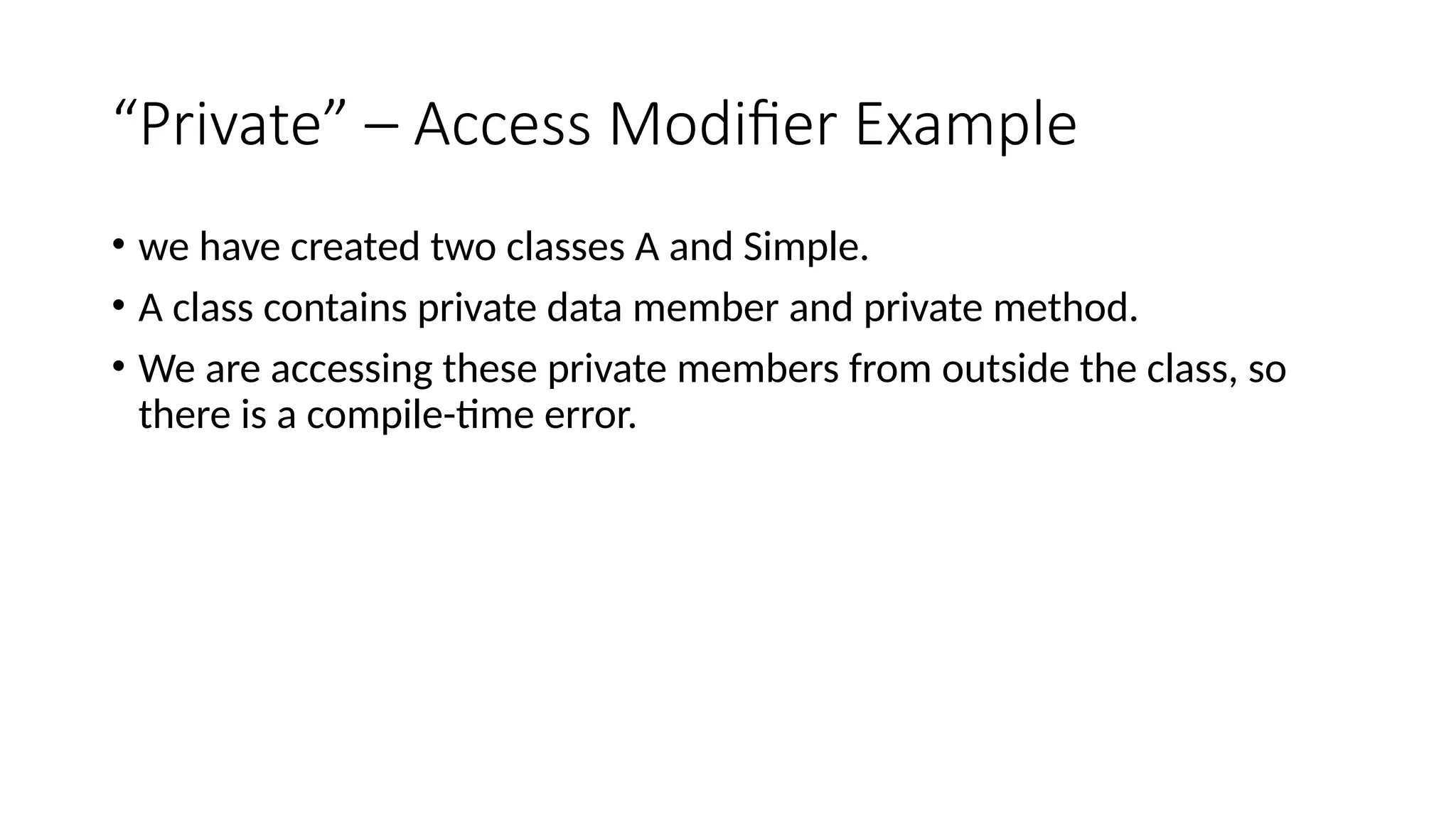
• we have created two classes A and Simple.
• A class contains private data member and private method.
• We are accessing these private members from outside the class, so
there is a compile-time error.
8.
Private Constructor
• Ifyou make any class constructor private, you cannot create the instance of that class from outside the class.
• For example:
class A{
private A(){}//private constructor
void msg(){
System.out.println("Hello java");
}
}
public class Simple{
public static void main(String args[]){
A obj=new A();//Compile Time Error
}
}
9.
“Default” – AccessModifier Example
• Two packages pack and mypack are created
package pack;
class A{
void msg(){System.out.println("Hello");}
}
package mypack;
import pack.*;
class B{
public static void main(String args[]){
A obj = new A();//Compile Time Error
obj.msg();//Compile Time Error
}
}
• In the above example, the scope of class A and its method msg() is default so it cannot be accessed from outside the
package.
10.
“Protected” – AccessModifier Example
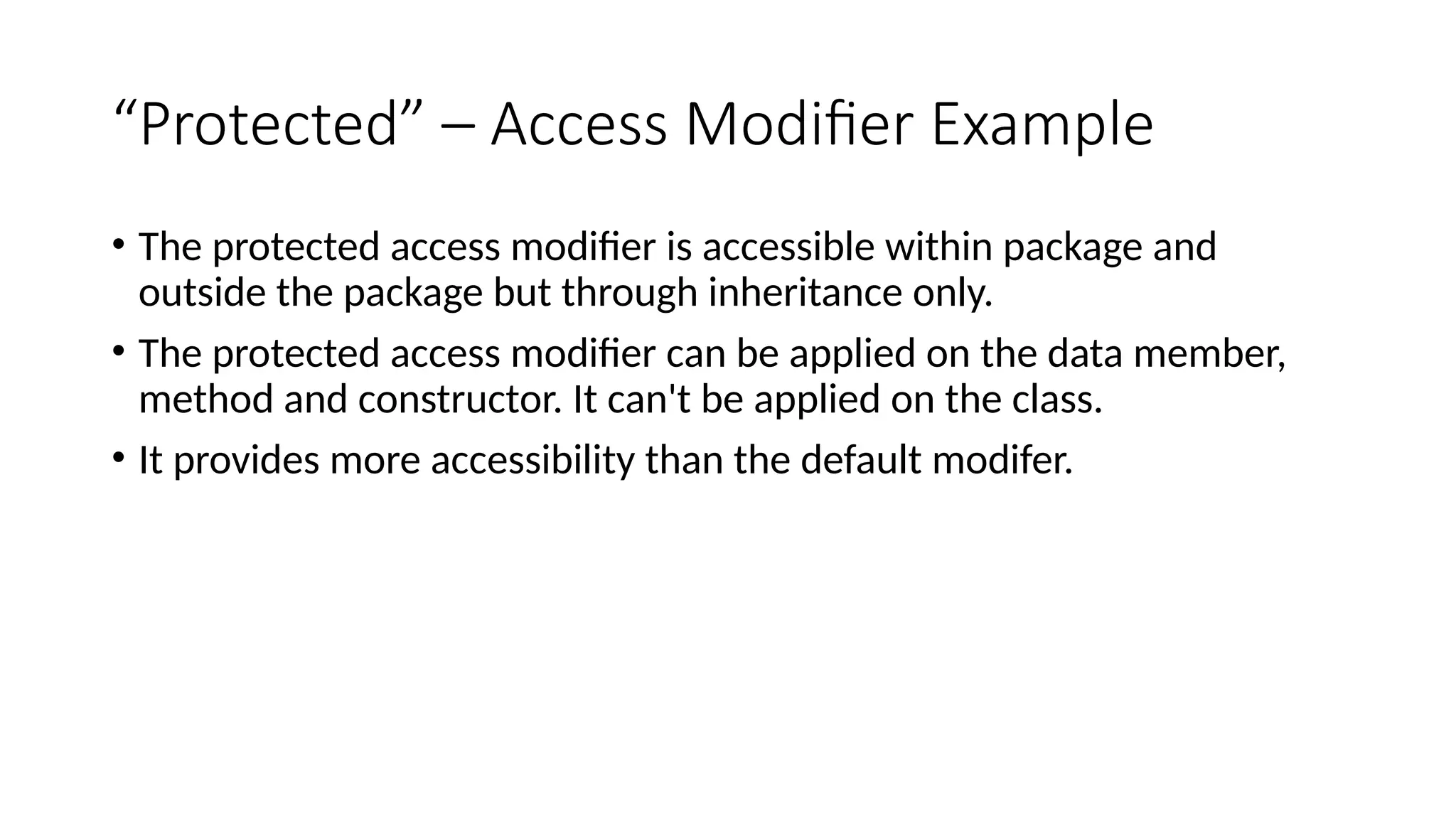
• The protected access modifier is accessible within package and
outside the package but through inheritance only.
• The protected access modifier can be applied on the data member,
method and constructor. It can't be applied on the class.
• It provides more accessibility than the default modifer.
11.
“Protected” – AccessModifier Example
• The two packages pack and mypack are created.
• The A class of pack package is public, so can be accessed from outside the package.
• But msg method of this package is declared as protected, so it can be accessed from outside the class only through inheritance.
package pack;
public class A{
protected void msg(){System.out.println("Hello");}
}
package mypack;
import pack.*;
class B extends A{
public static void main(String args[]){
B obj = new B();
obj.msg();
}
}
• Output:Hello
12.
“Public” – AccessModifier Example
• The public access modifier is accessible everywhere. It has the widest scope among all other modifiers.
package pack;
public class A{
public void msg(){
System.out.println("Hello");
}
}
package mypack;
import pack.*;
class B{
public static void main(String args[]){
A obj = new A();
obj.msg();
}
}
• Output:Hello
![“Private” – Access Modifier Example
class A{
private int data=40;
private void msg(){
System.out.println("Hello java");
}
}
public class Simple{
public static void main(String args[]){
A obj=new A();
System.out.println(obj.data);//Compile Time Error
obj.msg();//Compile Time Error
}
}](https://image.slidesharecdn.com/accessmodifiers-250526160038-ba0d7ee0/75/Access-Modifiers-of-oop-classes-concept-pptx-6-2048.jpg)
![Private Constructor
• If you make any class constructor private, you cannot create the instance of that class from outside the class.
• For example:
class A{
private A(){}//private constructor
void msg(){
System.out.println("Hello java");
}
}
public class Simple{
public static void main(String args[]){
A obj=new A();//Compile Time Error
}
}](https://image.slidesharecdn.com/accessmodifiers-250526160038-ba0d7ee0/75/Access-Modifiers-of-oop-classes-concept-pptx-8-2048.jpg)
![“Default” – Access Modifier Example
• Two packages pack and mypack are created
package pack;
class A{
void msg(){System.out.println("Hello");}
}
package mypack;
import pack.*;
class B{
public static void main(String args[]){
A obj = new A();//Compile Time Error
obj.msg();//Compile Time Error
}
}
• In the above example, the scope of class A and its method msg() is default so it cannot be accessed from outside the
package.](https://image.slidesharecdn.com/accessmodifiers-250526160038-ba0d7ee0/75/Access-Modifiers-of-oop-classes-concept-pptx-9-2048.jpg)
![“Protected” – Access Modifier Example
• The two packages pack and mypack are created.
• The A class of pack package is public, so can be accessed from outside the package.
• But msg method of this package is declared as protected, so it can be accessed from outside the class only through inheritance.
package pack;
public class A{
protected void msg(){System.out.println("Hello");}
}
package mypack;
import pack.*;
class B extends A{
public static void main(String args[]){
B obj = new B();
obj.msg();
}
}
• Output:Hello](https://image.slidesharecdn.com/accessmodifiers-250526160038-ba0d7ee0/75/Access-Modifiers-of-oop-classes-concept-pptx-11-2048.jpg)
![“Public” – Access Modifier Example
• The public access modifier is accessible everywhere. It has the widest scope among all other modifiers.
package pack;
public class A{
public void msg(){
System.out.println("Hello");
}
}
package mypack;
import pack.*;
class B{
public static void main(String args[]){
A obj = new A();
obj.msg();
}
}
• Output:Hello](https://image.slidesharecdn.com/accessmodifiers-250526160038-ba0d7ee0/75/Access-Modifiers-of-oop-classes-concept-pptx-12-2048.jpg)


