Accelerating Mission Critical TransformationPauline NistTwitter: @panistMission Critical General Manager Data Center Group
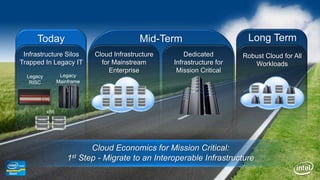
Long TermTodayMid-TermInfrastructure SilosTrapped In Legacy ITCloud Infrastructure for Mainstream EnterpriseDedicated Infrastructure for Mission CriticalRobust Cloud for AllWorkloadsLegacyMainframeLegacyRISCx86Cloud Economics for Mission Critical: 1st Step - Migrate to an Interoperable Infrastructure
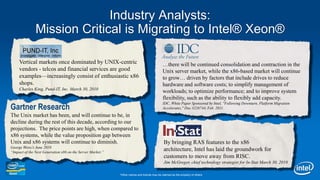
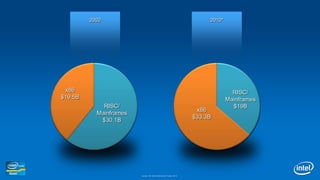
Industry Analysts:  Mission Critical is Migrating to Intel® Xeon®Vertical markets once dominated by UNIX-centric vendors - telcos and financial services are good examples—increasingly consist of enthusiastic x86 shops.Charles King, Pund-IT, Inc. March 30, 2010…there will be continued consolidation and contraction in the Unix server market, while the x86-based market will continue to grow… driven by factors that include drives to reduce hardware and software costs; to simplify management of workloads; to optimize performance; and to improve system flexibility, such as the ability to flexibly add capacity.IDC, White Paper Sponsored by Intel, "Following Downturn, Platform Migration Accelerates," Doc.#226744, Feb. 2011. Gartner ResearchThe Unix market has been, and will continue to be, in decline during the rest of this decade, according to our projections.  The price points are high, when compared to x86 systems, while the value proposition gap between Unix and x86 systems will continue to diminish.George Weiss’s June 2010 “Impact of the Next Generation x86 on the Server Market.”By bringing RAS features to the x86 architecture, Intel has laid the groundwork for customers to move away from RISC. Jim McGregor, chief technology strategist for In-Stat March 30, 2010*Other names and brands may be claimed as the property of others
20022010*RISC/Mainframes$19Bx86$19.5BRISC/Mainframes$30.1Bx86$33.3BSource:  IDC World Wide Server Tracker, Q4’10
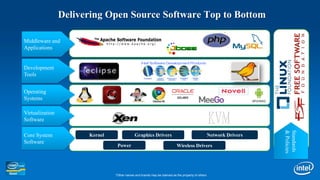
Delivering Open Source Software Top to BottomMiddleware and ApplicationsDevelopment ToolsOperatingSystemsVirtualizationSoftwareKVMStandards & PoliciesCore SystemSoftwareGraphics DriversKernelNetwork DriversPowerWireless Drivers5*Other names and brands may be claimed as the property of others
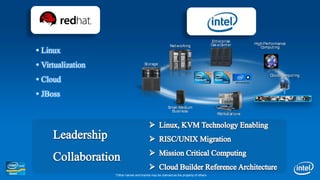
Linux
Virtualization
Cloud
JBoss
Linux, KVM Technology Enabling
RISC/UNIX Migration
Mission Critical Computing
Cloud Builder Reference ArchitectureLeadership Collaboration*Other names and brands may be claimed as the property of others
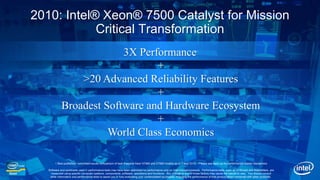
2010: Intel® Xeon® 7500 Catalyst for Mission Critical Transformation3X Performance1+>20 Advanced Reliability Features+Broadest Software and Hardware Ecosystem+World Class Economics1 Best published / submitted results comparison of best 4-socket Xeon X7460 and X7560 models as of 7 May 2010.   Please see back-up for performance related disclaimersSoftware and workloads used in performance tests may have been optimized for performance only on Intel microprocessors.  Performance tests, such as SYSmark and MobileMark, are measured using specific computer systems, components, software, operations and functions.  Any change to any of those factors may cause the results to vary.  You should consult other information and performance tests to assist you in fully evaluating your contemplated purchases, including the performance of that product when combined with other products. 
Broadest Hardware Support60 Designs on Xeon® E7 with 2S, 4S, 8S; Up to 256S Systems*Other names and brands may be claimed as the property of others
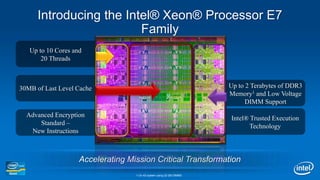
Introducing the Intel® Xeon® Processor E7 FamilyUp to 10 Cores and 20 ThreadsUp to 2 Terabytes of DDR3 Memory1 and Low Voltage DIMM Support30MB of Last Level CacheAdvanced EncryptionStandard –New InstructionsIntel® Trusted Execution TechnologyAccelerating Mission Critical Transformation1 On 4S system using 32 GB DIMMSAll dates, product features and plans are subject to change without notice.
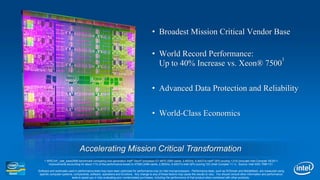
Broadest Mission Critical Vendor BaseWorld Record Performance: Up to 40% Increase vs. Xeon® 75001Advanced Data Protection and ReliabilityWorld-Class EconomicsAccelerating Mission Critical Transformation1SPECint*_rate_base2006 benchmark comparing next generation Intel® Xeon® processor E7-4870 (30M cache, 2.40GHz, 6.40GT/s Intel® QPI) scoring 1,010 (includes Intel Compiler XE2011 improvements accounting for about 11% of the performance boost) to X7560 (24M cache, 2.26GHz, 6.40GT/s Intel QPI) scoring 723 (Intel Compiler 11.1).  Source: Intel SSG TR#1131. Software and workloads used in performance tests may have been optimized for performance only on Intel microprocessors.  Performance tests, such as SYSmark and MobileMark, are measured using specific computer systems, components, software, operations and functions.  Any change to any of those factors may cause the results to vary.  You should consult other information and performance tests to assist you in fully evaluating your contemplated purchases, including the performance of that product when combined with other products.  All dates, product features and plans are subject to change without notice.
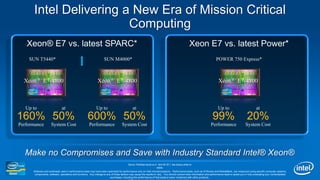
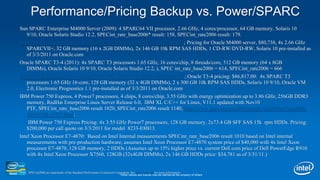
Intel Delivering a New Era of Mission Critical ComputingXeon® E7 vs. latest SPARC*Xeon E7 vs. latest Power*SUN T5440*SUN M4000*POWER 750 Express*Xeon ®  E7-4800Xeon ®  E7-4800Xeon ®  E7-4800Up to160%PerformanceUp to99%Performanceat20%System Cost Up to600%Performanceat50%System Cost at50%System Cost Make no Compromises and Save with Industry Standard Intel® Xeon®Source: Published results as of   April 5th 2011  See backup slides for details.Software and workloads used in performance tests may have been optimized for performance only on Intel microprocessors.  Performance tests, such as SYSmark and MobileMark, are measured using specific computer systems, components, software, operations and functions.  Any change to any of those factors may cause the results to vary.  You should consult other information and performance tests to assist you in fully evaluating your contemplated purchases, including the performance of that product when combined with other products.   * Other names and brands may be claimed as the property of others.
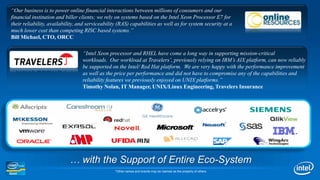
“Our business is to power online financial interactions between millions of consumers and our financial institution and biller clients; we rely on systems based on the Intel Xeon Processor E7 for their reliability, availability, and serviceability (RAS) capabilities as well as for system security at a much lower cost than competing RISC based systems.”  Bill Michael, CTO, ORCC“Intel Xeon processor and RHEL have come a long way in supporting mission-critical workloads.  Our workload at Travelers’, previously relying on IBM’s AIX platform, can now reliably be supported on the Intel/ Red Hat platform.  We are very happy with the performance improvement as well as the price per performance and did not have to compromise any of the capabilities and reliability features we previously enjoyed on UNIX platforms.”  Timothy Nolan, IT Manager, UNIX/Linux Engineering, Travelers Insurance… with the Support of Entire Eco-System*Other names and brands may be claimed as the property of others

Accelerating Mission Critical Transformation at Red Hat Summit 2011

  • 1.
    Accelerating Mission CriticalTransformationPauline NistTwitter: @panistMission Critical General Manager Data Center Group
  • 2.
    Long TermTodayMid-TermInfrastructure SilosTrappedIn Legacy ITCloud Infrastructure for Mainstream EnterpriseDedicated Infrastructure for Mission CriticalRobust Cloud for AllWorkloadsLegacyMainframeLegacyRISCx86Cloud Economics for Mission Critical: 1st Step - Migrate to an Interoperable Infrastructure
  • 3.
    Industry Analysts: Mission Critical is Migrating to Intel® Xeon®Vertical markets once dominated by UNIX-centric vendors - telcos and financial services are good examples—increasingly consist of enthusiastic x86 shops.Charles King, Pund-IT, Inc. March 30, 2010…there will be continued consolidation and contraction in the Unix server market, while the x86-based market will continue to grow… driven by factors that include drives to reduce hardware and software costs; to simplify management of workloads; to optimize performance; and to improve system flexibility, such as the ability to flexibly add capacity.IDC, White Paper Sponsored by Intel, "Following Downturn, Platform Migration Accelerates," Doc.#226744, Feb. 2011. Gartner ResearchThe Unix market has been, and will continue to be, in decline during the rest of this decade, according to our projections. The price points are high, when compared to x86 systems, while the value proposition gap between Unix and x86 systems will continue to diminish.George Weiss’s June 2010 “Impact of the Next Generation x86 on the Server Market.”By bringing RAS features to the x86 architecture, Intel has laid the groundwork for customers to move away from RISC. Jim McGregor, chief technology strategist for In-Stat March 30, 2010*Other names and brands may be claimed as the property of others
  • 4.
  • 5.
    Delivering Open SourceSoftware Top to BottomMiddleware and ApplicationsDevelopment ToolsOperatingSystemsVirtualizationSoftwareKVMStandards & PoliciesCore SystemSoftwareGraphics DriversKernelNetwork DriversPowerWireless Drivers5*Other names and brands may be claimed as the property of others
  • 6.
  • 7.
  • 8.
  • 9.
  • 10.
  • 11.
  • 12.
  • 13.
    Cloud Builder ReferenceArchitectureLeadership Collaboration*Other names and brands may be claimed as the property of others
  • 14.
    2010: Intel® Xeon®7500 Catalyst for Mission Critical Transformation3X Performance1+>20 Advanced Reliability Features+Broadest Software and Hardware Ecosystem+World Class Economics1 Best published / submitted results comparison of best 4-socket Xeon X7460 and X7560 models as of 7 May 2010. Please see back-up for performance related disclaimersSoftware and workloads used in performance tests may have been optimized for performance only on Intel microprocessors.  Performance tests, such as SYSmark and MobileMark, are measured using specific computer systems, components, software, operations and functions.  Any change to any of those factors may cause the results to vary.  You should consult other information and performance tests to assist you in fully evaluating your contemplated purchases, including the performance of that product when combined with other products. 
  • 15.
    Broadest Hardware Support60Designs on Xeon® E7 with 2S, 4S, 8S; Up to 256S Systems*Other names and brands may be claimed as the property of others
  • 16.
    Introducing the Intel®Xeon® Processor E7 FamilyUp to 10 Cores and 20 ThreadsUp to 2 Terabytes of DDR3 Memory1 and Low Voltage DIMM Support30MB of Last Level CacheAdvanced EncryptionStandard –New InstructionsIntel® Trusted Execution TechnologyAccelerating Mission Critical Transformation1 On 4S system using 32 GB DIMMSAll dates, product features and plans are subject to change without notice.
  • 17.
    Broadest Mission CriticalVendor BaseWorld Record Performance: Up to 40% Increase vs. Xeon® 75001Advanced Data Protection and ReliabilityWorld-Class EconomicsAccelerating Mission Critical Transformation1SPECint*_rate_base2006 benchmark comparing next generation Intel® Xeon® processor E7-4870 (30M cache, 2.40GHz, 6.40GT/s Intel® QPI) scoring 1,010 (includes Intel Compiler XE2011 improvements accounting for about 11% of the performance boost) to X7560 (24M cache, 2.26GHz, 6.40GT/s Intel QPI) scoring 723 (Intel Compiler 11.1). Source: Intel SSG TR#1131. Software and workloads used in performance tests may have been optimized for performance only on Intel microprocessors.  Performance tests, such as SYSmark and MobileMark, are measured using specific computer systems, components, software, operations and functions.  Any change to any of those factors may cause the results to vary.  You should consult other information and performance tests to assist you in fully evaluating your contemplated purchases, including the performance of that product when combined with other products.  All dates, product features and plans are subject to change without notice.
  • 18.
    Intel Delivering aNew Era of Mission Critical ComputingXeon® E7 vs. latest SPARC*Xeon E7 vs. latest Power*SUN T5440*SUN M4000*POWER 750 Express*Xeon ® E7-4800Xeon ® E7-4800Xeon ® E7-4800Up to160%PerformanceUp to99%Performanceat20%System Cost Up to600%Performanceat50%System Cost at50%System Cost Make no Compromises and Save with Industry Standard Intel® Xeon®Source: Published results as of April 5th 2011 See backup slides for details.Software and workloads used in performance tests may have been optimized for performance only on Intel microprocessors.  Performance tests, such as SYSmark and MobileMark, are measured using specific computer systems, components, software, operations and functions.  Any change to any of those factors may cause the results to vary.  You should consult other information and performance tests to assist you in fully evaluating your contemplated purchases, including the performance of that product when combined with other products.  * Other names and brands may be claimed as the property of others.
  • 19.
    “Our business isto power online financial interactions between millions of consumers and our financial institution and biller clients; we rely on systems based on the Intel Xeon Processor E7 for their reliability, availability, and serviceability (RAS) capabilities as well as for system security at a much lower cost than competing RISC based systems.”  Bill Michael, CTO, ORCC“Intel Xeon processor and RHEL have come a long way in supporting mission-critical workloads.  Our workload at Travelers’, previously relying on IBM’s AIX platform, can now reliably be supported on the Intel/ Red Hat platform.  We are very happy with the performance improvement as well as the price per performance and did not have to compromise any of the capabilities and reliability features we previously enjoyed on UNIX platforms.”  Timothy Nolan, IT Manager, UNIX/Linux Engineering, Travelers Insurance… with the Support of Entire Eco-System*Other names and brands may be claimed as the property of others

Editor's Notes

  • #2 Theme: Accelerating Mission Critical TransformationGoal: Build on Xeon 7500 “Transforming Mission Critical” theme from 2010 to support MC Campaign and increase refresh/migration to E7 4800.
  • #3 Goal: Frame move to cloud benefits as requiring move to x86 – move MC apps now to IA and then as cloud becomes more robust & secure add most demanding apps to cloud to merge as many “islands” of resources as possibleWe’ve spoken a lot over the past few years about the evolution of data centers to take advantage of virtualization and the cloud. Currently we still see many end users with applications and data trapped on aging legacy RISC/mainframe systems which can not easily take advantage of the benefits of the cloud; which is founded on open, industry standard solutions and Xeon. We don’t expect that users will leap straight from a proprietary UNIX based solution straight to the cloud, and the cloud itself needs to mature to handle the most data demanding workloads, but one step that IT managers can take to day to be ready for the future is to move to an interoperable infrastructure based on Xeon. This not only positions their infrastructure for the future evolution to the open data center, but will give immediate benefits in cost of ownership and access to the broadest base of hardware and software vendors, without compromising reliability or performance. Key Cloud talking points:What can we/the industry achieve by making clouds more simple, efficiency, secure and open? Save 45 GW (1 billion watts) power/ by driving Intel power efficiency trend across the cloud for next 5 years Cut $25B in annual “excess” spending by 2015 making deployment of clouds simpler Avoid >$100B in lost services revenue by making clouds more secure and easier to adopt/deploy Sources: Saves 45 GW power which equals 45 coal plants avoidedPower savings calculated based on projected performance improvements from Intel roadmap while keeping power / system flat.  Moore’s Law drives ~2x perf / 18 months.  At 5 years, that equals 10X.   We assume that compared to 2010, we’re saving 9X (i.e, the 10x less the 1X for what you’ll need).  It assumes we keep power per system constant at 200W.   We assume we’ll need 16M servers in 2015 (based on market model) – that means we save 16M x 9X x 200W (average system power) x 1.6 PUE = ~45GW.    The estimated power/coal plant is 1Gw 45GW = ~ 45 coal plants needed which equates to approximately 30 million homes according to the EPA website:  http://www.epa.gov/RDEE/energy-resources/refs.html#coalplant Cut $25B in annual “excess” by 2015 making deployment of clouds simplerProjects out $142B in annual Bain spending estimates on infrastructure and assumes we can reduce by 15% by 2015.  Extrapolating on 2013 yearly estimate of $142B, assumes 15% reduction.2013: $142B spend in infrastructure / support that doesn’t add value but is “overhead” of deployment (source: Bain) Open:  Industry could miss out on $95B of cloud services revenue due to customers on sidelines for cloud due to concerns over lock-in now thru 2015Takes IDCs services forecast of $40B and calculates over the ’10-’15 horizon and cuts growth rate by half – Intel projection.  $40B IDC projects by 2014 (grossed up to 2015) from July, ‘10 report.
  • #4 Show alignment of opinion on the trend away from RISC to industry standards on XeonThe driver behind this long range shift is exploding data volumes, expanding requirements to service customer’s needs, the ability to manage a continuous stream of social interactions and mobile transactions, and rising line of business expectations to turn data into knowledge and wisdom – all inside tight IT budgets. To handle these demands IT managers need to improve the efficiency & capability of infrastructure with interoperable solutions that avoid data being trapped in proprietary silos and enable easy integration of new innovative technology. Simply put, IT needs open, industry standard solutions.It’s not just Intel that sees these emerging trends, but some of the most respected observers of the IT industry have been calling out that moving off of proprietary UNIX to open data center solutions is an effective way to optimize performance while reducing costs. Call out UNIX/RISC is moving to Intel Xeon and Linux platforms.
  • #8 Slide goal: restate claims from 2010 which will get supported in follow-on slidesA big part of the reason for that trend in 2010 was not only the long-term technology trends we’ve discussed, but we launched a really great product with the Xeon 7500!The Xeon 7500 brought to market the capabilities to transform mission critical computing. With up to 20X the performance of single-core Xeon multi-processor systems and more than 20 new, advanced reliability features, Xeon 7500 offered the head room and availability to meet the needs of the most data demanding workloads. In addition to setting over 20 new world records, the Xeon 7500 was offered double the designs of the Xeon 7400 platform. Building off of this base we’ve seen a significant shift in the mission critical market in 2010 with growth in the depth of the ecosystem built on Xeon with support from the most trusted names in the mission critical market.The performance and reliability of the Xeon 7500 has allowed many IT shops to upgrade from legacy, proprietary systems to open standard environments, realized tremendous economic benefits and also seeing improved performance allowing IT mangers to focus more on innovation to maximize the value of IT. Historical Data:3X performance and >20 RAS features are vs prior generation 7400 based system. Each bar represents the score or estimated score of best published / estimated results on a geometric mean of industry-standard enterprise benchmarks. All internal measurements are marked as estimates until published.2005….Xeon 3.33/8M (Potomac) – 1 core, 3.33 Ghz, 8MB LLCache, 667Mhz FSB, 16DIMMs – Score 1.02006….Xeon 7100 – 2 core, 3.40 Ghz, 16MB LLCache, 800Mhz FSB, 16DIMMs – Score 2.6x 1 core2007….Xeon 7300 – 4 core, 2.93 Ghz, 8MB LLCache, 1066Mhz FSB, 32DIMMs – Score 4.3x 1 core2008… Xeon 7400 – 6 core, 2.66 Ghz, 16MB LLCache, 1066Mhz FSB, 32 DIMMs – Score 6.8x 1 core2010...Xeon 7500 – 8 cores, 2.27GHz, 24MB LLCache, 6.4GT/s QPI, 64DIMMs – Score 20x 1 core
  • #9 Goal: Show HW breadth of supportMission critical solutions on open, interoperable industry standard hardware give IT managers the flexibility to select the best solution for their unique needs and we are proud to announce that 60 platforms based on the Intel Xeon processor E7-8800/4800/2800 product families will be available this year and include innovative solutions which range from 2S blades and racks for memory intensive consolidation workloads up to 256S systems for the most data demanding workloads. NOTE: Press Release will include this statement: Starting today, system manufacturers from around the world are expected to announce more than 35Xeon processor E7 family-based platforms. These manufacturers include Bull*, Cisco*, Cray*, Dawning*, Dell*, Fujitsu*, Hitachi*, HP*, Huawei*, IBM*, Inspur*, Lenovo*, NEC*, Oracle*, PowerLeader*, Quanta*, SGI*, Supermicro*, and Unisys*.(Dawning, Huawei, Fujitsu, Hitachi, NEC are expected to announce in late April/early May) 
  • #10 Goal: Intro new product and set up features to be disucssedThe Intel Xeon processor E7-8800/4800/2800 product families build on the momentum of the Xeon 7500 processor by bring the “Nehalem” microarchitecture to the latest Intel 32nm logic technology, which uses Intel's second-generation high-k metal gate transistors to increase speed and decrease energy consumption. The combination of the leading process technology with the highest performing x86 microarchitecture gives IT managers the power they need to address the growing explosion of data as we grow to 15B internet users by 2015. With up to 10 cores and 30MB of last level cache and up to 2TB of memory in a 4S system up to 40% generation performance improvement to execute tasks faster.The Xeon E7 offers the additional performance at the same power level as the prior generation processors, and adds improved energy efficiency with Intel Intelligent Power Technology which reduces the power draw of unused portions of the chip as well as support for LV DIMMs which can reduce power by ~1W per DIMM – which really adds up given the massive memory supported by E7!
  • #11 Goal: Summary of key featuresThese processors include all of the reliability features of the Xeon 7500 processor, such as machine check architecture-recovery, and also supports additional memory error correction features and security features like Intel® Advanced Encryption Standard New Instructions (Intel® AES-NI) and Intel® Trusted Execution Technology (Intel® TXT) which enable faster encryption and decryption performance for more secure transactions and virtualized environments. These advanced reliability features work to maintain data integrity, accelerate encrypted transactions, and maximize the availability of mission-critical services. Offering world class TCO and with the industries broadest base of supporting system vendor available with up to 256S scalability, the Intel Xeon processor E7-8800/4800/2800 product families will accelerate the transformation in mission critical computing started by the Xeon 7500.
  • #12 Slide Purpose: Comparison vs latest RISC offeringssee back up slide for detailsEven compared to the latest RISC designs the Xeon E7 offers compelling performance at significantly reduced system costs. Based on the latest performance publications and on-line quotes, a system based on Xeon will outperform a SPARC based system and will on average cost half as much. The Power 7 processor has on average a slight performance lead on average, although this will vary based on the exact work load, but comes at a significant cost premium vs the top of the line Xeon E7.Notes:The 750 Express is the majority of IBM’s 4S shipments and the system we typically compete against with Xeon E7.  Sun SPARC Enterprise M4000 Server (2009): 4 SPARC64 VII processor, 2.66 GHz, 4 cores/processor, 64 GB memory, Solaris 10 9/10, Oracle Solaris Studio 12.2, SPECint_rate_base2006* result: 158, SPECint_rate2006 result: 179.https://shop.sun.com/store/product/ba987151-d0cc-11db-9135-080020a9ed93; Pricing for Oracle M4000 server, $80,738, 4x 2.66 GHz SPARCVII+, 32 GB memory (16 x 2GB DIMMs), 2x 146 GB 10k RPM SAS HDDs, 1 CD-RW/DVD-RW, Solaris 10 pre-installed as of 3/3/2011 on Oracle.comOracle SPARC T3-4 (2011): 4x SPARC T3 processors 1.65 GHz, 16 cores/chip, 8 threads/core, 512 GB memory (64 x 8GB DIMMs), Oracle Solaris 10 9/10, Oracle Solaris Studio 12.2, ), SPEC int_rate_base2006 = 614, SPECint_rate2006 = 666https://shop.sun.com/store/product/578414b2-d884-11de-9869-080020a9ed93; Oracle T3-4 pricing: $86,817.00: 4x SPARC T3 processors 1.65 GHz 16-core, 128 GB memory (32 x 4GB DIMMs), 2 x 300 GB 10k RPM SAS HDDs, Solaris 10 9/10, Oracle VM 2.0, Electronic Prognostics 1.1 pre-installed as of 3/3/2011 on Oracle.comIBM Power 750 Express, 4 Power7 processors, 4 chips, 8 cores/chip, 3.55 GHz with energy optimization up to 3.86 GHz, 256GB DDR3 memory, RedHat Enterprise Linux Server Release 6.0, IBM XL C/C++ for Linux, V11.1 updated with Nov10 PTF, SPECint_rate_base2006 result 1020, SPECint_rate2006 result 1140, http://www.spec.org/cpu2006/results/res2010q4/cpu2006-20101108-13737.html; IBM Power 750 Express Pricing: 4x 3.55 GHz Power7 processors, 128 GB memory, 2x73.4 GB SFF SAS 15k rpm HDDs. Pricing: $200,000 per call quote on 3/3/2011 for model 8233-E8B13.Intel Xeon Processor E7-4870: Based on Intel Internal measurements SPECint_rate_base2006 result 1010 based on Intel internal measurements with pre-production hardware; assumes Intel Xeon Processor E7-4870 system price of $40,000 with 4x Intel Xeon processor E7-4870, 128 GB memory, 2 HDDs (Assumes up to 15% higher price vs. current Dell.com price of Dell PowerEdge R910 with 4x Intel Xeon Processor X7560, 128GB (32x4GB DIMMs), 2x 146 GB HDDs price: $34,781 as of 3/31/11.)SPEC, SPECint2006,are trademarks of the Standard Performance Evaluation Corporation. See www.spec.org for more information.
  • #13 Slide goal: Show that Xeon has broad SW vendor support and customer recognitionNo matter what the mission critical task is, top developers from around the globe are basing their most demanding applications on open, industry standard solutions founded on Xeon. Customers are seeing greater value running their mission critical applications on E7 and RHEL platforms (see customer quotes on slide for details).
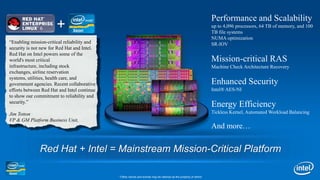
  • #14 Goal: Show Red Hat on Intel supports mission-critical todayRed Hat and Intel have been supporting world’s most demanding workload and that is not new news. As Jim Totton says it, RHEL on Intel have been the infrastructure for stock exchanges, airline reservation systems, utilities, healthcare, and government agencies. Our recent collaboration between RHEL 6 and Intel Xeon processor E7 family only makes it better. RHEL 6, utilizes rich attributes Intel Xeon processor E7-based servers provide. OEMs are shipping systems as big as 256 processor servers and RHEL 6 supports such servers with up to 4096 processors with 64TB of memory and with disk subsystem of 100 TB. RHEL 6 is optimized with NUMA so that such large compute resources are not wasted. For virtualization, SR-IOV performance optimization keeps virtual machines from compromising I/O performance. As your workload and data set handled on a large scale server grows bigger, as well as the number of virtual machines you host on such a server grows, your server becomes mission-critical and one can not afford to have the system go down. Among many RAS capabilities introduced into Intel Xeon processor E7, RHEL6 supports many features which enables the platform to effectively be positioned in place of RISC-based servers. Machine Check Architecture Recovery is a feature that protects the server from memory errors. Very effective for servers with large amount of memory as well as those requiring minimum down time. AES based encryption is now accelerated at the processor level without compromising crypto- performance and RHEL 6 fully supports the feature. Improved energy efficiency features designed into the processor is now utilized by RHEL 6, effectively assists reduction in datacenter TCO. Red Hat and Intel are mission-critical and will only get better going forward.