“
5
Introduction:
Air Conditioner:
a systemfor controlling the humidity,
ventilation, and temperature in a building
or vehicle, typically to maintain a cool
atmosphere in warm conditions.
6.
6
Introduction:
Air Conditioning:
is theprocess of removing heat and moisture from the
interior of an occupied space, to improve the comfort of
occupants. Air conditioning can be used in both domestic
and commercial environments.
7.
7
Introduction:
Types:
1. CENTRAL AIRCONDITIONING
2. DUCTLESS, MINI-SPLIT AIR CONDITIONER
3. WINDOW AIR CONDITIONER
4. PORTABLE AIR CONDITIONER
5. HYBRID AIR CONDITIONERS
6. GEOTHERMAL HEATING & COOLING
8.
8
Introduction:
PORTABLE AIR CONDITIONER:
areconsidered as the next generator of window units. This type of air
conditioning unit takes in air from the room and cools it, then directs it
back into the room. The unit then vents any warm air outside by means of
an exhaust hose that is installed in a window.
Like window air conditioning units, portable air conditioners are designed to cool
only one room. They’re easy to install, versatile, and an affordable option. You’ll
find that the portability of your air conditioner makes staying cooling on a hot
summer day that much easier.
9.
9
Objectives:
1. To knowhow to make a portable air conditioner
2. To know how to make a easy & simple air
conditioner using a small amount of money
3. To know how to make a environment friendly
cooling system at home
4. To know how to calculate temperature difference,
power input-output and efficiency and COP of a
cooling system
11
Methodology:
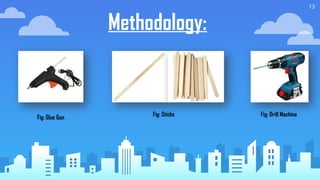
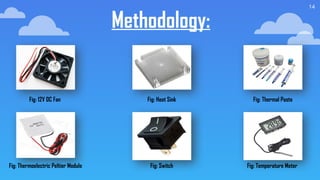
For this projectwe need some components which
are given below:
1. Hardboard
2. Scale
3. Cutter
4. Glue gun
5. Sticks
6. Drill Machine
7. 12V DC Fan
8. Heatsink
9. Thermal Paste
10. Thermoelectric Peltier Module
11. Switch
12. Temperature Meter
13. Connecting Wire
14. Power Supply (12V)
16
Methodology:
At first, wecollected the components and watch the video, then we assembled the box using
the hardboard according to the size.
Then we added the fan and the heat sinker, where we used some thermal paste and then added
the thermoelectric peltier module.
After that, we connected the wires and added a temperature meter and a switch. Then we
locked the full box of this portable a/c and added a power supply.
Thus, we completed our work and found an output temperature which was lower than the
room temperature.
19
Result & Discussion:
Aftercompleting our work, we found:
Room(initial) Temperature: 25 degree Celsius
Lowest(using a/c) Temperature: 20 degree Celsius
C.O.P:
Current rating, I = A
Voltage rating, V = V
Power Input: P = V*I
= ( * )
= W
Time: minutes
20.
20
Result & Discussion:
Discussion:
Atfirst we thought about two fans and two heat sinkers, but considering our economical
status we used one fan and one heat sinker.
Using one fan and one heat sinker, we didn’t get satisfactory result, and we couldn’t find out
what’s the problem.
We changed the components and also the power supply but the result was same,
temperature decrease level was bad and slow.
Having these problems, we finally complete our project and submit it in due time.
21.
21
Conclusion:
At the endof this project-
1. We have a good connect on air conditioning & we are able to explain about it.
2. Now, we can calculate C.O.P for an air conditioner using the temperatures.
3. We can know the working principle of a refrigerator and an air conditioner
and basic difference between them.
4. We know about various types of air conditioners and their uses.
5. Using these knowledge we can build real air conditioners and also make
some changes on their performances.