Abusive supervision and knowledge
hiding: the mediating role of psychological
contract violation and supervisor
directed aggression
Sajeet Pradhan, Aman Srivastava and Dharmesh K. Mishra
Abstract
Purpose – The purpose of this study is to test the relationship between abusive supervision and
employee’s knowledge hiding behaviour among Indian information technology (IT) employees. The
paper also strives to theoretically discuss and then seek empirical evidence to the two mediational paths
(namely, psychological contract violation and supervisor directed aggression) that explain the focal
relationship between abusive supervision and knowledge hiding.
Design/methodology/approach – To test the proposed hypotheses, the study draws cross-sectional
data from Indian IT employees working in various IT firms in India. Data were collected at two time points
(T1 and T2) separated by one month to counter the priming effect and neutralize any threat of common
method bias. The final sample of 270 valid and complete responses was analysed using SmartPLS 3 to
test the hypotheses.
Findings – Results showed that abusive supervision is positively related to employee’s knowledge
hiding behaviours. Also, both psychological contract violation and supervisor directed aggression
partially mediates the abusive supervision-knowledge hiding behaviour linkage.
Originality/value – First, the current study has tested the positive relationship between abusive supervision
and knowledge hiding behaviours unlike most of the previous investigations that have focussed on
knowledge sharing behaviour (the two are different constructs having different antecedents). Second, the
study also empirically investigated the two parallel mediational routes, namely, psychological contract
violation and supervisor directed aggression that explains the blame attributed by the beleaguered
employee that led to covert retaliatory behaviour, such as knowledge hiding.
Keywords Abusive supervision, Knowledge hiding, Psychological contract violation,
Supervisor directed aggression, India
Paper type Research paper
1. Introduction
Knowledge is an important and critical organizational resource that gives organizations a
sustainable competitive edge in today’s volatility, uncertainty, complexity, ambiguity world
(Davenport and Prusak, 1998). Studies have stated that organizational performance and its
innovativeness can be dramatically improved by sharing of knowledge among the
employees (Arthur and Huntley, 2005; Lin, 2007). Employees are expected and even
motivated to share their knowledge (both tacit and explicit) with their fellow workers
(Cabrera and Cabrera, 2002; Gagné, 2009), and firms expend huge cost and effort in
developing elaborate knowledge management systems and by creating conducive
environment of trust and goodwill to facilitate this smooth transfer of knowledge (Wang and
Noe, 2010).
Sajeet Pradhan is based at
the Department of
Organisational Behavior
and Human Resource
Management, International
Management Institute New
Delhi, New Delhi, India.
Aman Srivastava is based
at International
Management Institute New
Delhi, New Delhi, India.
Dharmesh K. Mishra is
based at the Symbiosis
International University
Symbiosis Institute of
International Business,
Pune, India.
Received 27 May 2019
Revised 18 September 2019
23 October 2019
Accepted 27 October 2019
PAGE 216 jJOURNAL OF KNOWLEDGE MANAGEMENT jVOL. 24 NO. 2 2020, pp. 216-234, © Emerald Publishing Limited, ISSN 1367-3270 DOI 10.1108/JKM-05-2019-0248
Several organizations have introduced varied measures to facilitate knowledge transfer
among employees, such as developing reward systems (Bock et al., 2005) improving social
networks and strengthening interpersonal relationships at workplace (Kuvaas et al., 2012)
and by creating an organizational culture that promote knowledge sharing (Connelly and
Kelloway, 2003). Despite these constructive efforts by organization, employees are still
unwilling to share their knowledge with their coworkers. This reluctance to share their
knowledge with other members of the organization is a conscious choice on the part of the
employee and is triggered by various factors at work. Although, the extant literature in
knowledge management research is replete with knowledge sharing studies, there is a
clear and conspicuous dearth of counterproductive knowledge hiding behavior that
explains why employee’s hoard or hide knowledge.
Knowledge hiding is highly prevalent in today’s competitive work settings. A study reported
an approximate loss of $31.5bn a year by Fortune 500 firms owing to failure in sharing of
knowledge (Babcock, 2004). The rampant nature of knowledge hiding can be judged from
another survey statistics in the USA, which reported a staggering 76 per cent of participants
admitting they once hid knowledge in some form or other (Connelly et al., 2012). In a similar
survey conducted in China, 46 per cent of the respondents have confessed that they have
at least once indulged in knowledge hiding behaviour at the workplace (Peng, 2012). This
suggests that knowledge hiding is a universal and widely pervasive phenomenon, which is
highly detrimental to organizational success irrespective of national culture and industry.
According to Connelly et al. (2012), knowledge hiding depends on various situational
factors, such as organizational policies, reward system, leadership, structure and culture,
etc. One important reason that influences one’s decision to share knowledge with others at
work is the interpersonal relationship and the way one is treated at work. The existing
literature is almost silent on how leadership especially dysfunctional leadership affects an
employee’s decision to hide knowledge from others (Srivastava et al., 2006). Consistent with
this view, we propose that one of the contextual factors that may influence knowledge
hiding among employees is abusive supervision. This supervisory mistreatment, which is
defined as “subordinates’ perceptions of the extent to which their supervisors engage in the
sustained display of hostile verbal and nonverbal behaviors, excluding physical contact”
(Tepper, 2000, p. 178) may antagonize the abused employee so much that he/she thinks of
getting even with the supervisor by hiding critical knowledge at workplace. To bolster our
assumption, we invoke social exchange theory (SET) as the theoretical underpinning to
examine the predictive influence of abusive supervision on employee’s knowledge hiding
behavior. One of the important tenets of SET is that the relationship between individuals
depends on healthy and functional transactions and exchanges. These exchanges are
guided by certain norms or rules, which form the guidelines of any exchange processes.
So, when an employee perceives his/her supervisor to be abusive, feels the norms of
exchange has been violated, and thus, is compelled to act in a retributive manner
(Cropanzano and Mitchell, 2005). In this case, the aggrieved employee resorts to hiding
critical information from the members of the organization to get even with the abusive
supervisor.
Although there is a logical association between abusive supervision and subordinate’s
knowledge hiding behavior, the mechanism, which explains this relationship is far from
being investigated. Thus, the study also strives to explore the possible mediators that may
explain the relationship between these two dysfunctional workplace behaviours, i.e. abusive
supervision and knowledge hiding behaviours of subordinates. We propose that when an
employee perceives his/her supervisor to be abusive, the individual employee blames
either the supervisor or the organization or both the parties for the mistreatment and as the
desire to retaliate is very high, he/she searches for a safe target at work to get even. In this
case, as an overt and direct action against the perpetrator (abusive supervisor) is not
possible owing to uneven power distribution, so the abused employee resort to covert and
VOL. 24 NO. 2 2020 jJOURNAL OF KNOWLEDGE MANAGEMENT j PAGE 217
safer ways to punish the supervisor by engaging in counterproductive work behaviour such
as knowledge hiding. In this study, we suggest that the beleaguered employee blame both
the supervisor and the organization for the ill treatment, and thus, decides to hide
knowledge from other members of the organization. In this regard, we propose
psychological contract violation and supervisor directed aggression as two possible
mediational routes that explain the association between the two focal constructs of this
study.
Our research makes two important contributions to the field of abusive supervision and
knowledge management. One, it empirically tests the positive association between abusive
supervision and subordinate’s knowledge hiding behaviours. Most of the previous studies,
have investigated the relationship between supervisory abuse and knowledge sharing
behaviours (Kim et al., 2016; Wu and Lee, 2016; Lee et al., 2017), which is clearly different
from knowledge hiding behaviour (Connelly et al., 2012) in terms of intention and motivation
of the employee. In this study, knowledge hiding behaviour has been conceptualized as a
beleaguered employee’s covert retaliation in response to supervisory abuse. Homans
(1961) also suggested that when the aggrieved individual has less (positional) power than
the source of abuse (either organization or supervisor) he/she will resort to covert and subtle
retaliatory tactics than overt and direct retaliation. Thus, instead of focussing on direct and
violent retaliation, which is just the tip of iceberg, the study investigates knowledge hiding
behaviours of the employees, which generally goes undetected but adversely affects the
effective functioning of the organization.
Second, the study investigates whom the individual employee blames for the supervisory
abuse, which leads to employee’s knowledge hiding behaviour. The study considers the
assertion that the victim will either blame the organization for not doing enough to safeguard
his/her interest or blame the supervisor who is actually the real source of abuse. To explain
the indirect effect between abusive supervision and knowledge hiding behaviour, the study
identified two mediators from extant literature that explains whether the abused employee
blames the organization (namely, psychological contract violation) or blames the supervisor
(namely, supervisor directed aggression) for the abuse at work.
2. Theory and hypotheses development
2.1 Abusive supervision and knowledge hiding
Since Tepper’s (2000) seminal work, abusive supervision has been investigated as an
antecedent to several negative workplace outcomes (Martinko et al., 2013; Pradhan and
Jena, 2017). One such job outcome that is detrimental to organizational goals is
subordinate’s knowledge hiding behaviour. There is a common misperception among
scholars and practitioners that knowledge hiding and knowledge sharing are the two
opposite ends of the same continuum. However, in reality, the two are distinct constructs
having different antecedents and having different underlying motivations and mechanisms
(Connelly et al., 2012; Ford and Staples, 2010). Although, the extant literature has ample
studies discussing the why, how and when people share their knowledge but it is almost
silent on why, how and when people hide their knowledge.
Knowledge hiding is defined as “an intentional attempt by an individual to withhold or
conceal task information, ideas, and know-how that has been requested by another person”
(Connelly et al., 2012, p. 65). While, knowledge sharing is defined as an “act of making
knowledge available to others within the organization” and “involves some conscious action
on the part of the individual who possesses the knowledge” (Ipe, 2003, p. 341). As it is
beyond the scope of the current study to further differentiate and elaborate between
knowledge sharing and knowledge hiding, which clearly have different genesis, the present
study focusses on the relationship between abusive leadership and dysfunctional
PAGE 218 jJOURNAL OF KNOWLEDGE MANAGEMENT jVOL. 24 NO. 2 2020
knowledge hiding intentions at work (refer to Wang and Noe, 2010; Gagne et al., 2019 for
detailed discussion on Knowledge sharing and knowledge hiding).
Connelly et al. (2012) has identified several individual and situational antecedents of
knowledge hiding such as perception of distrust and injustice, knowledge complexity,
knowledge sharing culture and leadership style, etc. Previous studies discusses the role
leadership plays in motivating and facilitating employees’ knowledge sharing behaviours at
workplace. Transformational leaders are known to encourage their followers to continuously
learn from others and to share their knowledge with others for the purpose of mutual
improvement (Han et al., 2016). Similarly, Xue et al. (2011) in their empirical study of US
student samples reported empowering leadership to positively influence team members’
knowledge sharing behaviours. In addition, Srivastava et al. (2006) also reported
empowering leadership to be positively related to employee’s knowledge sharing
behaviours. Although, previous studies clearly suggest positive relationship between
functional leadership style and follower’s knowledge sharing behaviours, but studies fail
short in explaining how dysfunctional and toxic leadership can also elicit negative and
destructive work behaviours, such as knowledge hiding or knowledge hoarding behaviours
(Khalid et al., 2018).
Employees share critical resources with other members of the organization for
organizational success when they perceive their supervisor or managers to be authentic
and transformational, whereas when employees perceive their immediate authorities to be
toxic and destructive they are reluctant to share their knowledge and demonstrate
knowledge hiding behaviours (Khalid et al., 2018). Abusive supervision is one such
negative leadership construct, which leads to several harmful and deleterious work
outcomes at both individual and organizational level (Martinko et al., 2013; Tepper, 2007).
Previous studies have reported that employees who perceive their supervisors to be
abusive retaliate to such ill-treatment in different ways and to varying degrees. Employee
retaliation in response to sustained supervisory abuse is inspired by a need to restore
fairness by targeting the accused i.e. their abusive supervisor. As this retaliation happens in
response to perceived abuse, the beleaguered employee considers this tit for tat behaviour
to be fair and just (Bies and Tripp, 2005; Tripp and Bies, 1997). Generally, the intention
behind retaliation is to punish the guilty or penalize the one whom the employee perceives
to be the source of abuse. However, an overt and direct retaliation may not be in the best
interest of the employee considering restraining factors, such as organizational hierarchy
and positional power difference. Thus, the aggrieved employee resorts to covert retaliation,
which serves the purpose of restoring fairness without being identified and punished
(Arnold et al., 2011; Bies and Tripp, 1998).
We find theoretical support to our assertion, from SET (Blau, 1964), which suggests that
abusive supervision predicts knowledge hiding. SET refers to those individual actions that
are inspired by a certain return that the individual seeks. For example, an employee going
beyond the line of duty expects the organization to acknowledge the contribution and
reward, which it deems fit (Gouldner, 1960). The social exchange is guided by the
reciprocity norm that determines the appropriate way the involved parties should behave.
The reciprocity norm can be both positive and negative. Positive reciprocity involves
positive response to positive treatment, whereas, negative reciprocity involves the tendency
to respond negatively to negative treatment (Cropanzano and Mitchell, 2005). So, when the
individual employee perceives he/she is treated in an unfavourable way, then the individual
will behave in an unfavourable way as a form of reciprocity.
Knowledge hiding behaviours are such subtle reciprocative behaviours that may be
concealed in the form of ignorance and may not attract punitive actions from the supervisor.
When an employee perceives the supervisor to be abusive and understands that overt and
direct form of retaliation or paying back is not wise will resort to such covert ways. Covert
retaliatory behaviors are easy to conceal, and their intent can go undetected, as a result,
VOL. 24 NO. 2 2020 jJOURNAL OF KNOWLEDGE MANAGEMENT j PAGE 219
subtle and clandestine form of retaliation provides an unique opportunity for a lower power
employee to get even with the wrongdoer (Tepper et al., 2012).
Thus, we propose:
H1. Abusive supervision will be positively related with employee’s knowledge hiding
behaviour.
The second objective of this study is to explore two possible reasons that may explain the
positive relationship between abusive supervision and employee’s knowledge hiding
behaviours. To seek answer to that we propose two mediational routes that may offer
explanations to the focal relationship. Our assertion is that an employee when perceives
supervisory abuse will blame either or both the supervisor and the organization for the
mistreatment and thereby will resort to retaliation with a hope to restore a sense of justice.
To understand the process of blame (whom the employee blames) and the subsequent
retaliation, we draw insights from the justice theory to test the mediational role of
psychological contract violation and supervisory directed aggression in explaining the
association between abusive supervision and knowledge hiding behaviours.
2.2 The mediating role of psychological contract violation
A psychological contract is an individual employee’s belief regarding the obligations formally or
informally, explicitly or implicitly made by his/her organization. When an employee perceives that
the organization has not honored its share of commitments or promises, the employee feels
betrayed and considers this as a psychological contract breach (Robinson and Morrison, 2000).
One such expectation is fair and proper treatment at work, so when an aggrieved employee
perceives being abused by the immediate supervisor, he/she will treat it as a serious breach of
faith and unjust treatment. An employee considers the immediate supervisor as a representative
of the organization and when perceives him/her to be abusive, feels that the organization has
violated the contract of fair, just and respectful treatment. Therefore, the employee considers the
organization as the main culprit and the supervisor as the representative who carries out the
abuse on the organization behalf. In addition, the aggrieved employee also might blame his/her
coworkers for not doing enough to help and support him/her during the ordeal. Pradhan and
Jena (2018) in their empirical study have also stated that perceived coworker support (resource
gain) may compensate for the resource loss (conservation of resources theory) due to
supervisory abuse. When the employee perceives that he/she is not getting any support from
the coworkers, will consider the coworkers equally guilty and to maintain a sense of justice will
intentionally hide knowledge from them. A similar rationale is also proposed by advocates of
justice theory (Greenberg, 1987) that provides vital theoretical underpinning in explaining the
positive association between abusive supervision and knowledge hiding. According to
procedural justice theory, an individual who perceives consistent humiliation and abuse in the
hands of his/her supervisor believes that the organization has not done enough to develop or
enforce procedures to either discipline the rogue supervisors or protect the victim employee
from their tormentor. In this case, we propose that an employee who perceives supervisory
abuse will intentionally hide knowledge from other members of the organization with a sense of
getting even with the organization, which according to him/her has tacitly or explicitly supported
the wrongdoer or has not done enough to stop the mistreatment.
Thus, we propose:
H2. Perceived contract violation will mediate the positive relationship between abusive
supervision and knowledge hiding.
2.3 The mediating role of supervisor directed aggression
According to SET individuals who are wronged and harmed are more likely to display
negative reactions (Blau, 1964). So, when an employee perceives supervisory abuse at
PAGE 220 jJOURNAL OF KNOWLEDGE MANAGEMENT jVOL. 24 NO. 2 2020
work, he/she is very much aware of the primary source of abuse and discomfort, but
because of lower positional power and the ability of the supervisor to retaliate back
discourages him/her to engage in any overt revenge. Thus, the employee will turn towards
less powerful individuals who may not retaliate like the supervisor. To support our logical
point of view, we invoke theory of displaced aggression, which refers to “redirection of a
person’s harmdoing behavior from a primary to a secondary target or victim” (Tedeschi and
Norman, 1985, p. 30). Current studies in the area of displaced aggression (Miller et al.,
2003; Twenge and Campbell, 2003) have reported that strain in the dyadic relationship of
supervisor-subordinate leads to displaced aggression. As, the victim (perceived) employee
is not able to confront the primary source of workplace abuse, will look for those individuals
on whom they can vent out their frustrations without the fear of retaliation and repercussions.
Similar logic is also stated in fairness heuristic theory (Tyler and Lind, 1992), which
suggests that employees form fairness judgements to decide their action, i.e. if they
consider their supervisor to be fair and just, they will display positive attitude and behavior,
but if they perceive their supervisor to be unfair then they will either engage in anti-
organizational activities or will quit the organization (Pradhan and Jena, 2016). Tepper
(2000) is his seminal work has also reported that when an individual employee experiences
interactional injustice owing to abuse from an organizational representative (in this case the
immediate supervisor) will act deviantly against the organization and the members of the
organization.
Thus, we propose that:
H3. Supervisor directed aggression will mediate the positive relationship between
abusive supervision and knowledge hiding.
3. Methods
3.1 Sample
The participants of the study were knowledge workers employed in various information
technology (IT) organizations in India. India is one of the biggest global outsourcing
destinations in the world with a market share of 55 per cent. Indian IT industry contributes a
whopping 7.7 per cent to India’s gross domestic product. In recent years it has become
world’s digital capabilities hub, contributing approximately 757 per cent of global digital
talent. The Indian IT industry is expected to add another one million jobs in 2019 making it
one of the most sought after and fast-growing industries in India. Considering its
significance to Indian economy and importance in terms of job creation, Indian IT industry
plays a pivotal role. Thus, we consider the current study investigating the Indian IT workers’
knowledge hiding behaviours as pertinent and timely. A final sample of 270 usable
responses was obtained from several IT firms in Delhi National Capital Region of India.
Women represented 72 (26.77 per cent) and men 198 (73.37 per cent) of the sample. The
age range of the respondents was 21 to 64years. The mean organizational tenure was
3.8 years. All the respondents had a minimum qualification of graduation. The sample
includes diverse position, such as software engineer, database administrator, web
developer, information security analyst, applications architect, business intelligence
developer, user interface designer, etc.
3.2 Procedure
Data were collected at two time points (T1 and T2) with a gap of one month. This is in line
with the suggestions recommended by Podsakoff et al. (2003) to counter common method
bias (CMB) and to reduce priming effect in cross-sectional studies. In this two-wave study,
first we contacted the respective Human Resource managers of the IT firms and conveyed
the purpose of the data collection and objectives of the study. The interested participants
VOL. 24 NO. 2 2020 jJOURNAL OF KNOWLEDGE MANAGEMENT j PAGE 221
were given a kit having information related to filling of the survey instrument and an
assurance letter that the information will be kept confidential and will be strictly used for
academic purpose. The questionnaire used to elicit responses from the participants was in
English as this is the preferred language of communication in the Indian IT industry. At T1,
the respondents filled basic demographic information about self and also rated the
predictor variable i.e. perceived abusive supervision and the two mediator variables i.e.
psychological contract violation and supervisor directed aggression on a Likert scale of
five. We received 321 filled surveys at time Point 1. The survey instrument was coded to
help us get the response of the same respondent after one month on outcome variable. We
contacted the same set of respondents and collected their responses on their knowledge
hiding behaviours. After, removing the unfilled and unengaged responses the final sample
was 270.
3.3 Measures
The variables used in the hypothesized model were based on valid and reliable measures i.
e. having sound psychometric properties and already used by other researchers in
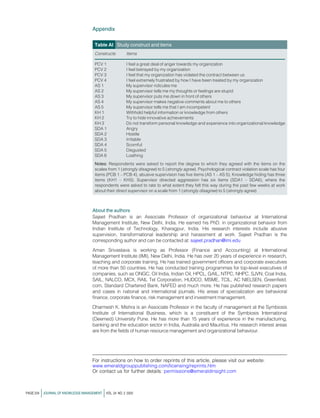
previous studies. The Appendix (Table AI) lists the survey items used to measure each
study construct.
Abusive supervision: Subordinate’s perceived abusive supervision was measured using a
five-item abusive supervision scale (Tepper, 2000; Mitchell and Ambrose, 2007). The items,
such as “my supervisor ridicules me” and “my supervisor tells me my thoughts and feelings
are stupid” were measured using a Likert scale.
Knowledge hiding: Knowledge hiding was captured by adapting three items from a
knowledge-withholding scale (Peng, 2012). The sample items used in this study were, such
as “withhold helpful information or knowledge from others” and “try to hide innovative
achievements”.
Psychological contract violation: Psychological contract violation was measured using four-
item scale of Robinson and Morrison, 2000. The sample questions were, such as “I feel a
great deal of anger towards my organization” and “I feel that my organization has violated
the contract between us”.
Supervisor directed Aggression: To measure employee’s hostility and aggression towards
their supervisor, we have used the hostility component of positive affect and negative affect
scale (Watson and Clark, 1994). Participants were instructed to rate the adjectives, such as
anger, scornful, disgusted on a scale of five. This way we were able to specifically capture
the employee’s hostile emotions towards their supervisor in the past three weeks instead of
their trait hostility.
Respondents were asked to report the degree to which they agreed with the items on each
scale from one (strongly disagree) to five (strongly agree).
Control variables: Shamir (2011) suggested that the dyadic relationship between a
supervisor and subordinate may get affected by certain demographic variables, such as
age, gender, experience, etc. Consistent with previous studies (Tepper et al., 2004; Zellars
et al., 2002; Zhao et al., 2013), subordinates’ age, gender and experience were controlled
in this study. Age and experience were measured in years, whereas gender was measured
as a dichotomous variable (one for male and zero for female).
4. Data analysis and results
In this study, we used partial least squares (PLS-SEM) to analyse the data. We first checked
for common factor method bias using SPSS and AMOS, and then used SmartPLS 3.0 to
analyse the measurement model and the structural model.
PAGE 222 jJOURNAL OF KNOWLEDGE MANAGEMENT jVOL. 24 NO. 2 2020
The decision to choose variance-based structural equation modeling (SEM) over
covariance-based SEM (CB-SEM) was based on several reasons (Bolander et al., 2015;
Hair et al., 2014). First, PLS-SEM focusses on prediction (exploration), which is in line with
the research objectives of this study. Second, PLS-SEM is considered more appropriate
than CB-SEM to evaluate complex models, which include multiple intervening variables,
such as mediators and moderators (Bolander et al., 2015; Hair et al., 2014). Third, PLS-SEM
unlike its covariance-based counterpart is not bounded by normality assumptions. Finally,
small sample size (like in this study) also favours PLS-SEM over CB based SEM. Moreover,
previous studies have claimed that both the SEM techniques (variance-based and
covariance-based SEM) yield similar results.
4.1 Common method bias
CMB is a potential threat in most cross-sectional studies where data has been collected
from a single source using same method (Podsakoff et al., 2003). We addressed this issue
at both the data collection stage (by using two wave data collection technique) and also
during analysis of data. To check whether CMB influences the findings of the study, we
used multiple methods. First, we used Harman’s (1976) single factor test using SPSS
software, where all the items were forced into one single factor. The single factor explained
variance less than 507 per cent (43.707 per cent), indicating that common method variance
(CMV) is not a major threat. Second, we followed Bagozzi’s method (Bagozzi et al., 1991),
which suggests that any correlation between the focal study variables if more than 0.9,
mean presence of CMV. As shown in Table I, the highest correlation between any two
constructs is 0.57. Third, we carried out collinearity test by measuring variance inflation
factor (VIF) and found that none of the four-factor level VIF is equal to or more than 3.3,
which indicates that our model is free of CMB (Kock, 2015). Fourth, we also used common
latent factor (CLF) technique to check whether standardized regression weights of the
measurement model with the CLF and without the CLF are very different and found that the
difference is very minuscule. This finally confirms that CMB is not a concern in our study.
4.2 Measurement model
In the measurement model, we assessed the reliability, convergent validity, and
discriminant validity of all the four first-order latent variables. The reliability of all the study
variables was assessed at both items and construct level. The composite reliability (CR)
and Cronbach’s alpha (CA) values of all the four variables were above the threshold of 0.70
(Table I), suggesting acceptable construct reliability (Nunnally, 1978). We examined item-
to-construct loadings to assess the indicator reliability and found all the values were above
the threshold of 0.70.
Table I Convergent and discriminant validity of reflective constructs
Construct
No.
of
items CR
Cronbach’s
alpha AVE Mean SD AC KH PCV SDA
AS 5 0.93 0.90 0.72 9.53 5.14 (0.85)
KH 3 0.88 0.79 0.71 9.14 3.43 0.47
(0.84)
PCV 4 0.93 0.90 0.78 8.84 4.55 0.51
0.50
(0.88)
SDA 6 0.89 0.85 0.58 16.11 5.72 0.49
0.56
0.57
(0.76)
Notes: 
p  0.001; AS: abusive supervision; KH: knowledge hiding; PCV: psychological contract
violation; SDA: supervisor directed aggression. CR: composite reliability; SD: standard deviation;
AVE: average variance extracted; and the values in parenthesis (diagonal) is the square root of AVE
VOL. 24 NO. 2 2020 jJOURNAL OF KNOWLEDGE MANAGEMENT j PAGE 223
To assess the convergent validity of the study variables, we calculated average variance
extracted (AVE) values for all the four reflective constructs and found the values to be above
0.5 (Table I), which suggests that all the four reflective constructs have high level of
convergent validity (MacKenzie et al., 2011). Discriminant validity was checked using three
methods. First, we used the Fornell–Larcker test to check whether each construct’s AVE
square root value was greater than its largest correlation with any other study constructs or
not (Table I). Second, we checked whether each indicator outer loadings on its designated
construct were greater than its cross-loadings with other constructs (Table II). In both cases
our findings support the suitability of the first-order reflective measures and validate the fact
that all items were good indicators for their respective latent variables (Ruiz et al., 2008).
Third, we checked for the heterotrait-monotrait ratio of correlations (HTMT) in identifying
discriminant validity. According to Henseler et al. (2015) this approach is superior to the
Fornell–Larcker criterion and the assessment of (partial) cross-loadings. HTMT values
presented in Table III are all less than the stringent cut-off of 0.85, which indicates that
discriminant validity is achieved in the current study (Henseler et al., 2015).
To test whether the hypothesized four-factor model fits the data better than any other nested
competing models, we carried out x2
difference test and found that the four-factor model
has better goodness-of-fit values than the lesser factors model. The x2
difference was
significant, which confirms that the four-factor model is superior to the other parsimonious
competing models (i.e. three factors, two factors and single-factor model). The mean,
Table II Outer model loadings and cross loadings
Construct items AS KH PCV SDA
AS1 0.728 0.345 0.372 0.399
AS2 0.855 0.354 0.442 0.392
AS3 0.892 0.404 0.450 0.437
AS4 0.886 0.471 0.487 0.433
AS5 0.856 0.402 0.407 0.417
KH1 0.394 0.825 0.422 0.445
KH2 0.364 0.868 0.430 0.491
KH3 0.427 0.829 0.418 0.485
PCV1 0.463 0.460 0.844 0.517
PCV2 0.394 0.422 0.909 0.507
PCV3 0.448 0.430 0.889 0.482
PCV4 0.490 0.457 0.880 0.501
SDA1 0.380 0.490 0.410 0.819
SDA2 0.415 0.556 0.512 0.805
SDA3 0.313 0.364 0.460 0.743
SDA4 0.359 0.374 0.488 0.792
SDA5 0.224 0.307 0.227 0.613
SDA6 0.492 0.423 0.456 0.775
Table III HTMT ratio
Construct AS KH PCV SDA
AS
KH 0.554
PCV 0.565 0.593
SDA 0.547 0.670 0.637
Notes: AS: abusive supervision; KH: knowledge hiding; PCV: psychological contract violation; and
SDA: supervisor directed aggression
PAGE 224 jJOURNAL OF KNOWLEDGE MANAGEMENT jVOL. 24 NO. 2 2020
standard deviation and inter-correlation of all the four constructs were calculated using
SPSS and is presented in Table I.
4.3 Structural model
The structural model depicting the direct and indirect effect of abusive supervision on
knowledge hiding namely, psychological contract violation and supervisor directed
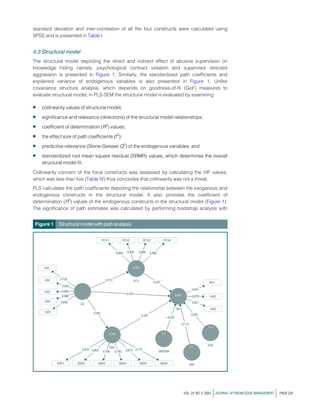
aggression is presented in Figure 1. Similarly, the standardized path coefficients and
explained variance of endogenous variables is also presented in Figure 1. Unlike
covariance structure analysis, which depends on goodness-of-fit (GoF) measures to
evaluate structural model, in PLS-SEM the structural model is evaluated by examining:
䊏 collinearity values of structural model;
䊏 significance and relevance (directions) of the structural model relationships;
䊏 coefficient of determination (R2
) values;
䊏 the effect size of path coefficients (f2
);
䊏 predictive relevance (Stone-Geisser Q2
) of the endogenous variables; and
䊏 standardized root mean square residual (SRMR) values, which determines the overall
structural model fit.
Collinearity concern of the focal constructs was assessed by calculating the VIF values,
which was less than five (Table IV) thus concludes that collinearity was not a threat.
PLS calculates the path coefficients depicting the relationship between the exogenous and
endogenous constructs in the structural model. It also provides the coefficient of
determination (R2
) values of the endogenous constructs in the structural model (Figure 1).
The significance of path estimates was calculated by performing bootstrap analysis with
Figure 1 Structural model with path analysis
VOL. 24 NO. 2 2020 jJOURNAL OF KNOWLEDGE MANAGEMENT j PAGE 225
5,000 resamples. As shown in Figure 1, abusive supervision is positively related with
knowledge hiding (b = 0.48, t = 11.35, p  0.001) and the R2
value is 0.405 (40.57 per cent
explained variance). The coefficient of determination (R2
value) explains the structural
model’s predictive accuracy and provides the combined effects of all the exogenous
variables on the endogenous variable i.e. the total amount of variance in the endogenous
constructs explained by all the exogenous constructs linked to it (Hair et al., 2014). This
lends support to our first hypothesis (H1).
In this study, age, gender and experience of the respondent were included as control
variables to analyse their impact on the endogenous variable (knowledge hiding). The
findings suggest that neither of the three control variables (age: b = 0.004, t = 0.075, p =
0.940; gender: b = 0.025, t = 0.551, p = 0.582; experience: b = 0.115, t = 1.741, p =
0.057) have any significant influence on knowledge hiding.
To test the parallel mediation, the bootstrapping technique was used, which is a non-
parametric resampling procedure with replacement that attaches no importance on
normality of data distribution (Preacher and Hayes, 2008). In Table V, in the presence of
mediators the direct effect between abusive supervision and knowledge hiding although is
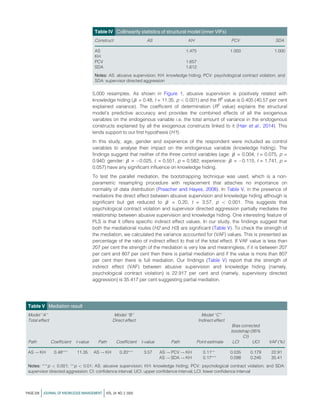
significant but get reduced to b = 0.20, t = 3.57, p  0.001. This suggests that
psychological contract violation and supervisor directed aggression partially mediates the
relationship between abusive supervision and knowledge hiding. One interesting feature of
PLS is that it offers specific indirect effect values. In our study, the findings suggest that
both the mediational routes (H2 and H3) are significant (Table V). To check the strength of
the mediation, we calculated the variance accounted for (VAF) values. This is presented as
percentage of the ratio of indirect effect to that of the total effect. If VAF value is less than
207 per cent the strength of the mediation is very low and meaningless, if it is between 207
per cent and 807 per cent then there is partial mediation and if the value is more than 807
per cent then there is full mediation. Our findings (Table V) report that the strength of
indirect effect (VAF) between abusive supervision and knowledge hiding (namely,
psychological contract violation) is 22.917 per cent and (namely, supervisory directed
aggression) is 35.417 per cent suggesting partial mediation.
Table V Mediation result
Model ‘‘A’’ Model ‘‘B’’ Model ‘‘C’’
Total effect Direct effect Indirect effect
Bias corrected
bootstrap (95%
CI)
Path Coefficient t-value Path Coefficient t-value Path Point estimate LCI UCI VAF (%)
AS ! KH 0.48
11.35 AS ! KH 0.20
3.57 AS ! PCV ! KH 0.11
0.035 0.179 22.91
AS ! SDA ! KH 0.17
0.098 0.245 35.41
Notes: 
p  0.001; 
p  0.01; AS: abusive supervision; KH: knowledge hiding; PCV: psychological contract violation; and SDA:
supervisor directed aggression; CI: confidence interval; UCI: upper confidence interval; LCI: lower confidence interval
Table IV Collinearity statistics of structural model (inner VIFs)
Construct AS KH PCV SDA
AS 1.475 1.000 1.000
KH
PCV 1.657
SDA 1.612
Notes: AS: abusive supervision; KH: knowledge hiding; PCV: psychological contract violation; and
SDA: supervisor directed aggression
PAGE 226 jJOURNAL OF KNOWLEDGE MANAGEMENT jVOL. 24 NO. 2 2020
The effect size (f2
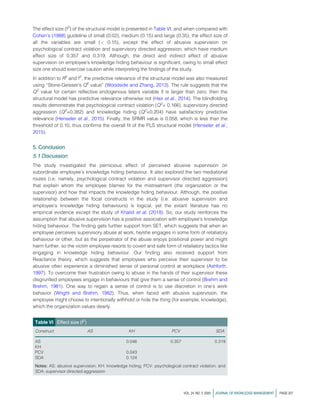
) of the structural model is presented in Table VI, and when compared with
Cohen’s (1988) guideline of small (0.02), medium (0.15) and large (0.35), the effect size of
all the variables are small ( 0.15), except the effect of abusive supervision on
psychological contract violation and supervisory directed aggression, which have medium
effect size of 0.357 and 0.319. Although, the direct and indirect effect of abusive
supervision on employee’s knowledge hiding behaviour is significant, owing to small effect
size one should exercise caution while interpreting the findings of the study.
In addition to R2
and f2
, the predictive relevance of the structural model was also measured
using “Stone-Geisser’s Q2
value” (Woodside and Zhang, 2013). The rule suggests that the
Q2
value for certain reflective endogenous latent variable if is larger than zero, then the
structural model has predictive relevance otherwise not (Hair et al., 2014). The blindfolding
results demonstrate that psychological contract violation (Q2
= 0.166), supervisory directed
aggression (Q2
=0.382) and knowledge hiding (Q2
=0.204) have satisfactory predictive
relevance (Henseler et al., 2015). Finally, the SRMR value is 0.058, which is less than the
threshold of 0.10, thus confirms the overall fit of the PLS structural model (Henseler et al.,
2015).
5. Conclusion
5.1 Discussion
The study investigated the pernicious effect of perceived abusive supervision on
subordinate employee’s knowledge hiding behaviour. It also explored the two mediational
routes (i.e. namely, psychological contract violation and supervisor directed aggression)
that explain whom the employee blames for the mistreatment (the organization or the
supervisor) and how that impacts the knowledge hiding behaviour. Although, the positive
relationship between the focal constructs in the study (i.e. abusive supervision and
employee’s knowledge hiding behaviours) is logical, yet the extant literature has no
empirical evidence except the study of Khalid et al. (2018). So, our study reinforces the
assumption that abusive supervision has a positive association with employee’s knowledge
hiding behaviour. The finding gets further support from SET, which suggests that when an
employee perceives supervisory abuse at work, he/she engages in some form of retaliatory
behaviour or other, but as the perpetrator of the abuse enjoys positional power and might
harm further, so the victim employee resorts to covert and safe form of retaliatory tactics like
engaging in knowledge hiding behaviour. Our finding also received support from
Reactance theory, which suggests that employees who perceive their supervisor to be
abusive often experience a diminished sense of personal control at workplace (Ashforth,
1997). To overcome their frustration owing to abuse in the hands of their supervisor these
disgruntled employees engage in behaviours that give them a sense of control (Brehm and
Brehm, 1981). One way to regain a sense of control is to use discretion in one’s work
behavior (Wright and Brehm, 1982). Thus, when faced with abusive supervision, the
employee might choose to intentionally withhold or hide the thing (for example, knowledge),
which the organization values dearly.
Table VI Effect size (f2
)
Construct AS KH PCV SDA
AS 0.046 0.357 0.319
KH
PCV 0.043
SDA 0.124
Notes: AS: abusive supervision; KH: knowledge hiding; PCV: psychological contract violation; and
SDA: supervisor directed aggression
VOL. 24 NO. 2 2020 jJOURNAL OF KNOWLEDGE MANAGEMENT j PAGE 227
The second objective of the study was to explore the two mediational routes that will explain
the indirect effect between abusive supervision and employee’s knowledge hiding
behaviour. The findings of the study suggest that both the mediators i.e. psychological
contract violation and supervisor directed aggression partially mediates the positive
relationship between abusive supervision and employee’s knowledge hiding behaviour. The
mediational paths investigate and find evidence to the blame the individual employee label
against the parties involved in the mistreatment. In that light, we tested the role of perceived
contract violation, which suggest that an employee when perceives supervisory abuse will
consider the supervisor as an agent or representative of the organization, and so should
equally be held responsible for the bad treatment. In addition to that the employee also
resents the fact that the organization has not done enough to stop the supervisory abuse,
and thus, looks for an opportunity to get even with the organization by hiding critical
information or knowledge from other members of the organization. The result get theoretical
support from fairness heuristic theory, which bolsters our assertion of the role of
psychological contract violation in partially explaining the relationship between the main
constructs of the study.
The result also reports that supervisor targeted aggression partially mediated the
relationship between abusive supervision and employee’s knowledge hiding behaviour. To
reinforce our empirical finding, we invoke the displacement aggression theory, which
suggests that when an employee perceives ill-treatment in the hands of the supervisor and
is unable to take revenge owing to the fear of further retaliation will try to get even with any
other target at work that is less powerful. In this case, the victim employee will resort to
covert retaliatory behaviour like hiding knowledge from the colleagues and coworkers to get
even with the supervisor via the coworker(s) without any fear of repercussion.
Finally, The study result reports that the mediational strength of the second route that is
namely, supervisor directed aggression explains more variance than the first route that
is namely, psychological contract violation, which suggests that employee who perceives
supervisory abuse will blame his/her supervisor more than the organization. This is
supported by previous studies, which suggest that employees who perceived being
harmed or wronged generally blame the actual wrongdoer or source of abuse, which in this
case is the immediate supervisor of the employee (Tepper, 2000). Thus, although the
beleaguered employee might blame the organization for the misbehavior or abuse by the
supervisor but will definitely consider the supervisor as the main source of abuse.
5.2 Implications and contributions
The study findings have several managerial and theoretical implications. First, abusive
supervision is a universal workplace menace and has pernicious effect on work outcomes at
all the three levels and most importantly it adversely impacts the profitability of the
organization (Rafferty and Restubog, 2011). All industries and especially knowledge-
intensive industries are seriously at risk if they have a toxic culture of intentional knowledge
hiding by the employees because of the interpersonal animosity between supervisor and
the subordinate. Industries like IT extensively depend on critical decisions based on real-
time data or information and if for certain reason the decision-makers across the
organizational hierarchy do not have the right information or if individuals do not share
critical information the consequence can be catastrophic. Organizations may even lose
their competitive edge because of internal discord, which results in knowledge hiding or
hoarding.
Knowledge hiding as a response to perceived supervisory abuse will impact creativity and
innovation at workplace and might foster a culture of secrecy and hoarding, which is
atypically against what organizations and the various stakeholders expect. It is quite difficult
to eradicate this interpersonal nuisance completely from the workplace (Pradhan and Jena,
2018). However, organizations can always have a zero-tolerance policy towards it, which
PAGE 228 jJOURNAL OF KNOWLEDGE MANAGEMENT jVOL. 24 NO. 2 2020
will assure the employees that adequate checks and balances have been introduced by the
organization to ensure that they are treated fairly and respectfully at work. Second,
organizations may consider sensitizing and training the supervisors to refrain from
displaying typical abusive behaviours such as yelling at the subordinate, criticizing bitterly
in front of others and intentionally giving difficult task, etc. Third, organizations may also
consider offering counselling and support services to its members who are under any kind
of duress owing to supervisory abuse.
The current study offers several valuable theoretical implications by testing the relationship
between abusive supervision and employee’s covert retaliation in the form of knowledge
hiding at work. Firstly, this study empirically explores and explains why an aggrieved
employee will resort to knowledge hiding behaviour when faced with supervisory abuse at
work. Knowledge hiding behaviours are clandestine in nature, which would not get easily
detected by the supervisor, and thus, would not attract any additional penalty. Also, the
discretionary nature of knowledge sharing also makes it convenient for the aggrieved
employee to resort to knowledge hiding without invoking the wrath of the supervisor.
Secondly, the study also investigates whom the beleaguered employee blames for the
abuse at workplace: the supervisor and/or; the organization and coworkers. So, knowledge
hiding behaviour offers perfect retribution against all who are perceived to be directly
(supervisor- the source of abuse or anguish) or indirectly (organization and coworkers for
not doing enough to stop the abuse) involved in the act of abuse.
5.3 Limitations and further study
The study although contributes significantly towards our understanding of direct and
indirect effect of abusive supervision on employee’s knowledge hiding behaviours yet it
suffers from certain limitations. First, the study has used single method and single source to
collect the data, which offers a threat of CMB. Although, the current study has taken
precautionary measures at the time of data collection and during the data analysis (as
prescribed by Podsakoff et al., 2012) to counter the CMB threat but future studies may
incorporate multi-source and objective data to further strengthen our understanding of this
association. Second, the sample size is quite small and the data is cross-sectional in nature,
which restricts us to suggest any causal association between the focal constructs. Also, we
have used variance-based SEM to analyse the data, which is fit for model exploration. In
future, the scholars may carry out a replicated study to confirm the model using CB-SEM by
using larger sample. We also urge future researchers to identify the role of coworker, which
has not been considered in this model to have better understanding of why the
beleaguered employee intentionally hides knowledge from the coworkers when he/she
perceives abusive supervisor at work. Boundary conditions like perceived coworker support
or coworker’s apathy that may influence (reduce or intensify) the displaced aggressive
behaviours against the coworkers should also be explored in future. Other individual and
organizational factors, such as psychological ownership, reward expectation, job
interdependence, hierarchy, type of knowledge management systems and team dynamics
may also be investigated in future. Future researchers may also investigate the type of
knowledge (i.e. explicit or tacit knowledge) generally hid by the aggrieved employee. For
example, it is logical to assume that if the knowledge is intrinsic and discretionary in nature
then the abused individual will more frequently resort to knowledge hiding behaviour than
when it is explicit and extrinsic in nature without the fear of being apprehended.
5.4 Conclusion
The current study is among the few empirical investigations that tested the positive
association between abusive supervision and employee’s knowledge hiding behaviours.
Most of the studies in the past have focussed on knowledge sharing rather than knowledge
hiding. Contrary to the common belief, the two constructs are not the two ends of the same
VOL. 24 NO. 2 2020 jJOURNAL OF KNOWLEDGE MANAGEMENT j PAGE 229
continuum, but are two different constructs having different antecedents and different
underlying motivation. In addition, this study investigated the indirect effect of mediators,
such as psychological contract violation and supervisor directed aggression in explaining
the relationship between the focal constructs. The two mediational routes explain the blame
labeled by the subordinate on the supervisor and the organization for the supervisory abuse
at work that explains the dysfunctional behaviour of knowledge hiding.
References
Arnold, K., Dupré, K., Hershcovis, M. and Turner, N. (2011), “Interpersonal targets and types of
workplace aggression as a function of perpetrator sex”, Employee Responsibilities  Rights Journal,
Vol. 23 No. 3, pp. 163-170.
Arthur, J.B. and Huntley, C.L. (2005), “Ramping up the organizational learning curve: assessing the
impact of deliberate learning on organizational performance under gain sharing”, Academy of
Management Journal, Vol. 48 No. 6, pp. 1159-1170.
Ashforth, B. (1997), “Petty tyranny in organizations: a preliminary examination of antecedents and
consequences”, Canadian Journal of Administrative Sciences/Revue Canadienne Des Sciences de
L’administration, Vol. 14 No. 2, pp. 126-140.
Babcock, P. (2004), “Shedding light on knowledge management”, HR Magazine, Vol. 49 No. 5,
pp. 46-50.
Bagozzi, R., Yi, Y. and Phillips, L.W. (1991), “Assessing construct validity in organization research”,
Administrative Science Quarterly, Vol. 36 No. 3, pp. 421-458.
Bies, R.J. and Tripp, T.M. (1998), “Two faces of the powerless: coping with tyranny in organizations”, in
Kramer, R.M. (Ed.), Power and Influence in Organizations, Sage, Thousand Oaks, CA, pp. 203-219.
Bies, R.J. and Tripp, T.M. (2005), “The study of revenge in the workplace: Conceptual, ideological, and
empirical issues”, in Fox S. and Spector P.E. (Eds), Counterproductive Work Behavior: Investigations of
Actors and Targets, American Psychological Association, Washington, DC, pp. 65-81.
Blau, P.M. (1964), Exchange and Power in Social Life, Transaction Publishers, New Brunswick, NJ.
Bock, G.W., Zmud, R.W., Kim, Y.G. and Lee, J.N. (2005), “Behavioral intention formation in knowledge
sharing: examining the roles of extrinsic motivators, social-psychological forces, and organizational
climate”, MIS Quarterly, Vol. 29 No. 1, pp. 87-111.
Bolander, W., Satornino, C.B., Hughes, D.E. and Ferris, G.R. (2015), “Social networks within sales
organizations: their development and importance for salesperson performance”, Journal of Marketing,
Vol. 79 No. 6, pp. 1-16.
Brehm, S.S. and Brehm, J.W. (1981), Psychological Reactance: A Theory of Freedom and Control,
Academic Press, New York, NY.
Cabrera, A. and Cabrera, E.F. (2002), “Knowledge-sharing dilemmas”, Organization Studies, Vol. 23
No. 5, pp. 687-710.
Cohen, J. (1988), Statistical Power Analysis for the Behavioral Sciences, Lawrence Erlbaum, Mahwah, NJ.
Connelly, C.E. and Kelloway, E.K. (2003), “Predictors of employees’ perceptions of knowledge sharing
culture”, Leadership  Organization Development Journal, Vol. 24 No. 5, pp. 294-301.
Connelly, C.E., Zweig, D., Webster, J. and Trougakos, J.P. (2012), “Knowledge hiding in organizations”,
Journal of Organizational Behavior, Vol. 33 No. 1, pp. 64-88.
Cropanzano, R. and Mitchell, M.S. (2005), “Social exchange theory: an interdisciplinary review”, Journal
of Management, Vol. 31 No. 6, pp. 874-900.
Davenport, T.H. and Prusak, L. (1998), “Working knowledge: How organizations manage what they
know”, Harvard Business School Press, Boston.
Ford, D.P. and Staples, D.S. (2010), “Are full and partial knowledge sharing the same?”, Journal of
Knowledge Management, Vol. 14 No. 3, pp. 394-409.
Gagné, M. (2009), “A model of knowledge sharing motivation”, Human Resource Management, Vol. 48
No. 4, pp. 571-589.
PAGE 230 jJOURNAL OF KNOWLEDGE MANAGEMENT jVOL. 24 NO. 2 2020
Gagne, M., Tian, A.W., Soo, C., Zhang, B., Ho, K.S.B. and Hosszu, K. (2019), “Different motivations for
knowledge sharing and hiding: the role of motivating work design”, Journal of Organizational Behavior,
Vol. 40 No. 7, pp. 783-799.
Gouldner, A.W. (1960), “The norm of reciprocity”, American Sociological Review, Vol. 25 No. 2,
pp. 161-178.
Greenberg, J. (1987), “A taxonomy of organizational justice theories”, The Academy of Management
Review, Vol. 12 No. 1, pp. 9-22.
Hair, J.F., Ringle, C.M. and Sarstedt, M. (2014), “PLS-SEM: looking back and moving forward”, Long
Range Planning, Vol. 47 No. 3, pp. 132-127.
Han, S., Seo, G., Yoon, S. and Yoon, D. (2016), “Transformational leadership and knowledge sharing”,
Journal of Workplace Learning, Vol. 28 No. 3, pp. 130-149.
Harman, H.H. (1976), Modern Factor Analysis, 3rd ed., The University of Chicago Press, Chicago, IL.
Henseler, J., Ringle, C.M. and Sarstedt, M. (2015), “A new criterion for assessing discriminant validity in
variance-based structural equation modeling”, Journal of the Academy of Marketing Science, Vol. 43
No. 1, pp. 115-135.
Homans, G.C. (1961), Social Behavior, Harcourt Brace, New York, NY.
Ipe, M. (2003), “Knowledge sharing in organizations: a conceptual framework”, Human Resource
Development Review, Vol. 2 No. 4, pp. 337-359.
Khalid, M., Bashir, S., Khan, A.K. and Abbas, N. (2018), “When and how abusive supervision leads to
knowledge hiding behaviors: an islamic work ethics perspective”, Leadership  Organization
Development Journal, Vol. 39 No. 6, pp. 794-806.
Kim, S.L., Lee, S. and Yun, S. (2016), “Abusive supervision, knowledge sharing, and individual factors: a
conservation-of-resources perspective”, Journal of Managerial Psychology, Vol. 31 No. 6,
pp. 1106-1120.
Kock, N. (2015), “Common method bias in PLS-SEM: a full collinearity assessment approach”,
International Journal of e-Collaboration, Vol. 11 No. 4, pp. 1-10.
Kuvaas, B., Buch, R. and Dysvik, A. (2012), “Perceived training intensity and knowledge sharing: sharing
for intrinsic and prosocial reasons”, Human Resource Management, Vol. 51 No. 2, pp. 167-187.
Lee, S., Kim, S.L. and Yun, S. (2017), “A moderated mediation model of the relationship between abusive
supervision and knowledge sharing”, The Leadership Quarterly, Vol. 29 No. 3, pp. 403-413.
Lin, H.F. (2007), “Knowledge sharing and firm innovation capability: an empirical study”, International
Journal of Manpower, Vol. 28 Nos 3/4, pp. 315-332.
MacKenzie, S.B., Podsakoff, P.M. and Podsakoff, N.P. (2011), “Construct measurement and validation
procedures in MIS and behavioral research: integrating new and existing techniques”, MIS Quarterly,
Vol. 35 No. 2, pp. 293-334.
Martinko, M.J., Harvey, P., Brees, J.R. and Mackey, J. (2013), “A review of abusive supervision research”,
Journal of Organizational Behavior, Vol. 34 No. S1, pp. 120-137.
Miller, N., Pedersen, W.C., Earlywine, M. and Pollock, V.E. (2003), “A theoretical model of triggered
displaced aggression”, Personality and Social Psychology Review, Vol. 7 No. 1, pp. 75-97.
Mitchell, M.S. and Ambrose, M.L. (2007), “Abusive supervision and workplace deviance and the
moderating effects of negative reciprocity beliefs”, Journal of Applied Psychology, Vol. 92 No. 4,
pp. 1159-1168.
Nunnally, J.C. (1978), Psychometric Theory, 2nd ed., McGraw-Hill, New York, NY.
Peng, H. (2012), “Counterproductive work behavior among Chinese knowledge workers”, International
Journal of Selection and Assessment, Vol. 20 No. 2, pp. 119-138.
Podsakoff, P.M., MacKenzie, S.B., Podsakoff, N.P. and Lee, J.Y. (2003), “Common method biases in
behavioral research: a critical review of the literature and recommended remedies”, Journal of Applied
Psychology, Vol. 88 No. 5, pp. 879-903.
Podsakoff, P.M., MacKenzie, S.B. and Podsakoff, N.P. (2012), “Sources of method bias in social science
research and recommendations on how to control it”, Annual Review of Psychology, Vol. 63 No. 1,
pp. 539-569.
VOL. 24 NO. 2 2020 jJOURNAL OF KNOWLEDGE MANAGEMENT j PAGE 231
Pradhan, S. and Jena, L.K. (2016), “The moderating role of neutralizers on the relationship between abusive
supervision and intention to quit: a proposed model”, Journal of Human Values, Vol. 22 No. 3, pp. 238-248.
Pradhan, S. and Jena, L.K. (2017), “Effect of abusive supervision on employee’s intention to quit and the
neutralizing role of meaningful work on the relationship”, International Journal of Organizational Analysis,
Vol. 25 No. 5, pp. 825-838.
Pradhan, S. and Jena, L.K. (2018), “Abusive supervision: a framework of developmental solutions to this
workplace menace”, Development and Learning in Organizations: An International Journal, Vol. 32 No. 2,
pp. 20-23.
Preacher, K.J. and Hayes, A.F. (2008), “Asymptotic and resampling strategies for assessing and
comparing indirect effects in multiple mediator models”, Behavior Research Methods, Vol. 40 No. 3,
pp. 879-891.
Rafferty, A.E. and Restubog, S.L.D. (2011), “The influence of abusive supervisors on followers’
organizational citizenship behaviors: the hidden costs of abusive supervision”, British Journal of
Management, Vol. 22 No. 2, pp. 270-285.
Robinson, S.L. and Morrison, E.W. (2000), “The development of psychological contract breach and
violation: a longitudinal study”, Journal of Organizational Behavior, Vol. 21 No. 5, pp. 525-546.
Ruiz, D.M., Gremler, D.D., Washburn, J.H. and Carri
on, G.C. (2008), “Service value revisited:
specifying a higher-order, formative measure”, Journal of Business Research, Vol. 61 No. 12,
pp. 1278-1291.
Shamir, B. (2011), “Leadership takes time: some implications of (not) taking time seriously in leadership
research”, The Leadership Quarterly, Vol. 22 No. 2, pp. 307-315.
Srivastava, A., Bartol, K.M. and Locke, E.A. (2006), “Empowering leadership in management teams:
effects on knowledge sharing, efficacy, and performance”, Academy of Management Journal, Vol. 49
No. 6, pp. 1239-1251.
Tedeschi, J.T. and Norman, N.M. (1985), “A social psychological interpretation of displaced aggression”,
Advances in Group Processes, Vol. 2, pp. 29-56.
Tepper, B.J. (2000), “Consequences of abusive supervision”, Academy of Management Journal, Vol. 43
No. 2, pp. 178-190.
Tepper, B.J., Duffy, M.K. and Breaux-Siognet, D.M. (2012), “Abusive supervision as political activity:
Distinguishing impulsive and strategic expressions of downward hostility”, in Ferris G.R. and Treadway,
D.C. (Eds), Politics in Organizations: Theory and Research Considerations, Routledge/Taylor  Francis
Group, New York, NY, pp. 191-212.
Tepper, B.J., Duffy, M.K., Hoobler, J. and Ensley, M.D. (2004), “Moderators of the relationship between
coworkers’ organizational citizenship behavior and fellow employees’ attitudes”, Journal of Applied
Psychology, Vol. 89 No. 3, pp. 455-465. No
Tepper, B.J. (2007), “Abusive supervision in work organizations: review, synthesis, and research
agenda”, Journal of Management, Vol. 3 No. 3, pp. 261-289.
Tripp, T.M. and Bies, R.J. (1997), “What’s good about revenge? the avenger’s perspective”, in Lewicki,
R.J., Bies, R.J. and Sheppard, B.H. (Eds), Research on Negotiation in Organizations, Elsevier Science/
JAI Press, , Vol. 6, pp. 145-160.
Twenge, J.M. and Campbell, W.K. (2003), “Isn’t it fun to get the respect that we’re going to deserve?,
Narcissism, social rejection, and aggression”, Personality and Social Psychology Bulletin, Vol. 29 No. 2,
pp. 261-272.
Tyler, T.R. and Lind, E.A. (1992), “A relational model of authority in groups”, in Zanna, M. (Ed.), Advances
in Experimental Social Psychology, Academic Press, San Diego, CA, Vol. 25, pp. 115-191.
Wang, S. and Noe, R.A. (2010), “Knowledge sharing: a review and directions for future research”, Human
Resource Management Review, Vol. 20 No. 2, pp. 115-131.
Watson, D. and Clark, L.A. (1994), The PANAS-X: Manual for the Positive and Negative Affect Schedule,
Expanded Form, University of IA Press, IA City.
Woodside, A.G. and Zhang, M. (2013), “Cultural diversity and marketing transactions: are market
integration, large community size, and world religions necessary for fairness in ephemeral exchanges?”,
Psychology  Marketing, Vol. 30 No. 3, pp. 263-276.
PAGE 232 jJOURNAL OF KNOWLEDGE MANAGEMENT jVOL. 24 NO. 2 2020
Wright, R.A. and Brehm, S.S. (1982), “Reactance as impression management: a critical review”, Journal
of Personality and Social Psychology, Vol. 42 No. 4, pp. 608-618.
Wu, W.L. and Lee, Y.C. (2016), “Do employees share knowledge when encountering abusive
supervision?”, Journal of Managerial Psychology, Vol. 31 No. 1, pp. 154-168.
Xue, Y., Bradley, J. and Liang, H. (2011), “Team climate, empowering leadership, and knowledge
sharing”, Journal of Knowledge Management, Vol. 15 No. 2, pp. 299-312.
Zellars, K.L., Tepper, B.J. and Duffy, M.K. (2002), “Abusive supervision and subordinates’ organizational
citizenship behavior”, Journal of Applied Psychology, Vol. 87 No. 6, pp. 1068 -1076.
Zhao, H., Peng, Z., Han, Y., Sheard, G. and Hudson, A. (2013), “Psychological mechanism linking
abusive supervision and compulsory citizenship behavior: a moderated mediation study”, The Journal of
Psychology, Vol. 147 No. 2, pp. 177-195.
Further reading
Cabrera, E.F. and Cabrera, A. (2005), “Fostering knowledge sharing through people management
practices”, The International Journal of Human Resource Management, Vol. 16 No. 5, pp. 720-735.
Lewicki, R.J., Bies, R.J. and Sheppard, B.H. (Eds), Research on Negotiation in Organizations, Elsevier
Science/JAI Press, , Vol. 6, pp. 145-160.
Mackey, J.D., Frieder, R.E., Brees, J.R. and Martinko, M.J. (2017), “Abusive supervision: a meta-analysis
and empirical review”, Journal of Management, Vol. 43 No. 6, pp. 1940-1965.
VOL. 24 NO. 2 2020 jJOURNAL OF KNOWLEDGE MANAGEMENT j PAGE 233
Appendix
About the authors
Sajeet Pradhan is an Associate Professor of organizational behaviour at International
Management Institute, New Delhi, India. He earned his PhD. in organizational behavior from
Indian Institute of Technology, Kharagpur, India. His research interests include abusive
supervision, transformational leadership and harassment at work. Sajeet Pradhan is the
corresponding author and can be contacted at: sajeet.pradhan@imi.edu
Aman Srivastava is working as Professor (Finance and Accounting) at International
Management Institute (IMI), New Delhi, India. He has over 20 years of experience in research,
teaching and corporate training. He has trained government officers and corporate executives
of more than 50 countries. He has conducted training programmes for top-level executives of
companies, such as ONGC, Oil India, Indian Oil, HPCL, GAIL, NTPC, NHPC, SJVN, Coal India,
SAIL, NALCO, MCX, RAIL Tel Corporation, HUDCO, MSME, TCIL, AC NIELSEN, Greenfield.
com, Standard Chartered Bank, NAFED and much more. He has published research papers
and cases in national and international journals. His areas of specialization are behavioral
finance, corporate finance, risk management and investment management.
Dharmesh K. Mishra is an Associate Professor in the faculty of management at the Symbiosis
Institute of International Business, which is a constituent of the Symbiosis International
(Deemed) University Pune. He has more than 15 years of experience in the manufacturing,
banking and the education sector in India, Australia and Mauritius. His research interest areas
are from the fields of human resource management and organizational behaviour.
For instructions on how to order reprints of this article, please visit our website:
www.emeraldgrouppublishing.com/licensing/reprints.htm
Or contact us for further details: permissions@emeraldinsight.com
Table AI Study construct and items
Constructs Items
PCV 1 I feel a great deal of anger towards my organization
PCV 2 I feel betrayed by my organization
PCV 3 I feel that my organization has violated the contract between us
PCV 4 I feel extremely frustrated by how I have been treated by my organization
AS 1 My supervisor ridicules me
AS 2 My supervisor tells me my thoughts or feelings are stupid
AS 3 My supervisor puts me down in front of others
AS 4 My supervisor makes negative comments about me to others
AS 5 My supervisor tells me that I am incompetent
KH 1 Withhold helpful information or knowledge from others
KH 2 Try to hide innovative achievements
KH 3 Do not transform personal knowledge and experience into organizational knowledge
SDA 1 Angry
SDA 2 Hostile
SDA 3 Irritable
SDA 4 Scornful
SDA 5 Disgusted
SDA 6 Loathing
Notes: Respondents were asked to report the degree to which they agreed with the items on the
scales from 1 (strongly disagree) to 5 (strongly agree). Psychological contract violation scale has four
items (PCB 1 – PCB 4), abusive supervision has five items (AS 1 – AS 5), Knowledge hiding has three
items (KH1 – KH3). Supervisor directed aggression has six items (SDA1 – SDA6), where the
respondents were asked to rate to what extent they felt this way during the past few weeks at work
about their direct supervisor on a scale from 1 (strongly disagree) to 5 (strongly agree)
PAGE 234 jJOURNAL OF KNOWLEDGE MANAGEMENT jVOL. 24 NO. 2 2020

Abusive_supervision_and_knowledge_hiding items 5 and 3.pdf

  • 1.
    Abusive supervision andknowledge hiding: the mediating role of psychological contract violation and supervisor directed aggression Sajeet Pradhan, Aman Srivastava and Dharmesh K. Mishra Abstract Purpose – The purpose of this study is to test the relationship between abusive supervision and employee’s knowledge hiding behaviour among Indian information technology (IT) employees. The paper also strives to theoretically discuss and then seek empirical evidence to the two mediational paths (namely, psychological contract violation and supervisor directed aggression) that explain the focal relationship between abusive supervision and knowledge hiding. Design/methodology/approach – To test the proposed hypotheses, the study draws cross-sectional data from Indian IT employees working in various IT firms in India. Data were collected at two time points (T1 and T2) separated by one month to counter the priming effect and neutralize any threat of common method bias. The final sample of 270 valid and complete responses was analysed using SmartPLS 3 to test the hypotheses. Findings – Results showed that abusive supervision is positively related to employee’s knowledge hiding behaviours. Also, both psychological contract violation and supervisor directed aggression partially mediates the abusive supervision-knowledge hiding behaviour linkage. Originality/value – First, the current study has tested the positive relationship between abusive supervision and knowledge hiding behaviours unlike most of the previous investigations that have focussed on knowledge sharing behaviour (the two are different constructs having different antecedents). Second, the study also empirically investigated the two parallel mediational routes, namely, psychological contract violation and supervisor directed aggression that explains the blame attributed by the beleaguered employee that led to covert retaliatory behaviour, such as knowledge hiding. Keywords Abusive supervision, Knowledge hiding, Psychological contract violation, Supervisor directed aggression, India Paper type Research paper 1. Introduction Knowledge is an important and critical organizational resource that gives organizations a sustainable competitive edge in today’s volatility, uncertainty, complexity, ambiguity world (Davenport and Prusak, 1998). Studies have stated that organizational performance and its innovativeness can be dramatically improved by sharing of knowledge among the employees (Arthur and Huntley, 2005; Lin, 2007). Employees are expected and even motivated to share their knowledge (both tacit and explicit) with their fellow workers (Cabrera and Cabrera, 2002; Gagné, 2009), and firms expend huge cost and effort in developing elaborate knowledge management systems and by creating conducive environment of trust and goodwill to facilitate this smooth transfer of knowledge (Wang and Noe, 2010). Sajeet Pradhan is based at the Department of Organisational Behavior and Human Resource Management, International Management Institute New Delhi, New Delhi, India. Aman Srivastava is based at International Management Institute New Delhi, New Delhi, India. Dharmesh K. Mishra is based at the Symbiosis International University Symbiosis Institute of International Business, Pune, India. Received 27 May 2019 Revised 18 September 2019 23 October 2019 Accepted 27 October 2019 PAGE 216 jJOURNAL OF KNOWLEDGE MANAGEMENT jVOL. 24 NO. 2 2020, pp. 216-234, © Emerald Publishing Limited, ISSN 1367-3270 DOI 10.1108/JKM-05-2019-0248
  • 2.
    Several organizations haveintroduced varied measures to facilitate knowledge transfer among employees, such as developing reward systems (Bock et al., 2005) improving social networks and strengthening interpersonal relationships at workplace (Kuvaas et al., 2012) and by creating an organizational culture that promote knowledge sharing (Connelly and Kelloway, 2003). Despite these constructive efforts by organization, employees are still unwilling to share their knowledge with their coworkers. This reluctance to share their knowledge with other members of the organization is a conscious choice on the part of the employee and is triggered by various factors at work. Although, the extant literature in knowledge management research is replete with knowledge sharing studies, there is a clear and conspicuous dearth of counterproductive knowledge hiding behavior that explains why employee’s hoard or hide knowledge. Knowledge hiding is highly prevalent in today’s competitive work settings. A study reported an approximate loss of $31.5bn a year by Fortune 500 firms owing to failure in sharing of knowledge (Babcock, 2004). The rampant nature of knowledge hiding can be judged from another survey statistics in the USA, which reported a staggering 76 per cent of participants admitting they once hid knowledge in some form or other (Connelly et al., 2012). In a similar survey conducted in China, 46 per cent of the respondents have confessed that they have at least once indulged in knowledge hiding behaviour at the workplace (Peng, 2012). This suggests that knowledge hiding is a universal and widely pervasive phenomenon, which is highly detrimental to organizational success irrespective of national culture and industry. According to Connelly et al. (2012), knowledge hiding depends on various situational factors, such as organizational policies, reward system, leadership, structure and culture, etc. One important reason that influences one’s decision to share knowledge with others at work is the interpersonal relationship and the way one is treated at work. The existing literature is almost silent on how leadership especially dysfunctional leadership affects an employee’s decision to hide knowledge from others (Srivastava et al., 2006). Consistent with this view, we propose that one of the contextual factors that may influence knowledge hiding among employees is abusive supervision. This supervisory mistreatment, which is defined as “subordinates’ perceptions of the extent to which their supervisors engage in the sustained display of hostile verbal and nonverbal behaviors, excluding physical contact” (Tepper, 2000, p. 178) may antagonize the abused employee so much that he/she thinks of getting even with the supervisor by hiding critical knowledge at workplace. To bolster our assumption, we invoke social exchange theory (SET) as the theoretical underpinning to examine the predictive influence of abusive supervision on employee’s knowledge hiding behavior. One of the important tenets of SET is that the relationship between individuals depends on healthy and functional transactions and exchanges. These exchanges are guided by certain norms or rules, which form the guidelines of any exchange processes. So, when an employee perceives his/her supervisor to be abusive, feels the norms of exchange has been violated, and thus, is compelled to act in a retributive manner (Cropanzano and Mitchell, 2005). In this case, the aggrieved employee resorts to hiding critical information from the members of the organization to get even with the abusive supervisor. Although there is a logical association between abusive supervision and subordinate’s knowledge hiding behavior, the mechanism, which explains this relationship is far from being investigated. Thus, the study also strives to explore the possible mediators that may explain the relationship between these two dysfunctional workplace behaviours, i.e. abusive supervision and knowledge hiding behaviours of subordinates. We propose that when an employee perceives his/her supervisor to be abusive, the individual employee blames either the supervisor or the organization or both the parties for the mistreatment and as the desire to retaliate is very high, he/she searches for a safe target at work to get even. In this case, as an overt and direct action against the perpetrator (abusive supervisor) is not possible owing to uneven power distribution, so the abused employee resort to covert and VOL. 24 NO. 2 2020 jJOURNAL OF KNOWLEDGE MANAGEMENT j PAGE 217
  • 3.
    safer ways topunish the supervisor by engaging in counterproductive work behaviour such as knowledge hiding. In this study, we suggest that the beleaguered employee blame both the supervisor and the organization for the ill treatment, and thus, decides to hide knowledge from other members of the organization. In this regard, we propose psychological contract violation and supervisor directed aggression as two possible mediational routes that explain the association between the two focal constructs of this study. Our research makes two important contributions to the field of abusive supervision and knowledge management. One, it empirically tests the positive association between abusive supervision and subordinate’s knowledge hiding behaviours. Most of the previous studies, have investigated the relationship between supervisory abuse and knowledge sharing behaviours (Kim et al., 2016; Wu and Lee, 2016; Lee et al., 2017), which is clearly different from knowledge hiding behaviour (Connelly et al., 2012) in terms of intention and motivation of the employee. In this study, knowledge hiding behaviour has been conceptualized as a beleaguered employee’s covert retaliation in response to supervisory abuse. Homans (1961) also suggested that when the aggrieved individual has less (positional) power than the source of abuse (either organization or supervisor) he/she will resort to covert and subtle retaliatory tactics than overt and direct retaliation. Thus, instead of focussing on direct and violent retaliation, which is just the tip of iceberg, the study investigates knowledge hiding behaviours of the employees, which generally goes undetected but adversely affects the effective functioning of the organization. Second, the study investigates whom the individual employee blames for the supervisory abuse, which leads to employee’s knowledge hiding behaviour. The study considers the assertion that the victim will either blame the organization for not doing enough to safeguard his/her interest or blame the supervisor who is actually the real source of abuse. To explain the indirect effect between abusive supervision and knowledge hiding behaviour, the study identified two mediators from extant literature that explains whether the abused employee blames the organization (namely, psychological contract violation) or blames the supervisor (namely, supervisor directed aggression) for the abuse at work. 2. Theory and hypotheses development 2.1 Abusive supervision and knowledge hiding Since Tepper’s (2000) seminal work, abusive supervision has been investigated as an antecedent to several negative workplace outcomes (Martinko et al., 2013; Pradhan and Jena, 2017). One such job outcome that is detrimental to organizational goals is subordinate’s knowledge hiding behaviour. There is a common misperception among scholars and practitioners that knowledge hiding and knowledge sharing are the two opposite ends of the same continuum. However, in reality, the two are distinct constructs having different antecedents and having different underlying motivations and mechanisms (Connelly et al., 2012; Ford and Staples, 2010). Although, the extant literature has ample studies discussing the why, how and when people share their knowledge but it is almost silent on why, how and when people hide their knowledge. Knowledge hiding is defined as “an intentional attempt by an individual to withhold or conceal task information, ideas, and know-how that has been requested by another person” (Connelly et al., 2012, p. 65). While, knowledge sharing is defined as an “act of making knowledge available to others within the organization” and “involves some conscious action on the part of the individual who possesses the knowledge” (Ipe, 2003, p. 341). As it is beyond the scope of the current study to further differentiate and elaborate between knowledge sharing and knowledge hiding, which clearly have different genesis, the present study focusses on the relationship between abusive leadership and dysfunctional PAGE 218 jJOURNAL OF KNOWLEDGE MANAGEMENT jVOL. 24 NO. 2 2020
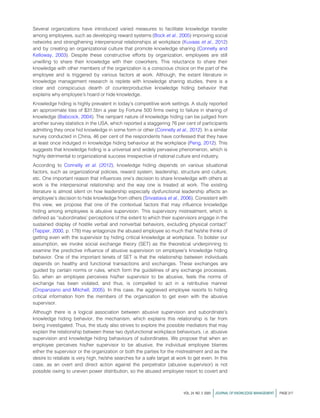
  • 4.
    knowledge hiding intentionsat work (refer to Wang and Noe, 2010; Gagne et al., 2019 for detailed discussion on Knowledge sharing and knowledge hiding). Connelly et al. (2012) has identified several individual and situational antecedents of knowledge hiding such as perception of distrust and injustice, knowledge complexity, knowledge sharing culture and leadership style, etc. Previous studies discusses the role leadership plays in motivating and facilitating employees’ knowledge sharing behaviours at workplace. Transformational leaders are known to encourage their followers to continuously learn from others and to share their knowledge with others for the purpose of mutual improvement (Han et al., 2016). Similarly, Xue et al. (2011) in their empirical study of US student samples reported empowering leadership to positively influence team members’ knowledge sharing behaviours. In addition, Srivastava et al. (2006) also reported empowering leadership to be positively related to employee’s knowledge sharing behaviours. Although, previous studies clearly suggest positive relationship between functional leadership style and follower’s knowledge sharing behaviours, but studies fail short in explaining how dysfunctional and toxic leadership can also elicit negative and destructive work behaviours, such as knowledge hiding or knowledge hoarding behaviours (Khalid et al., 2018). Employees share critical resources with other members of the organization for organizational success when they perceive their supervisor or managers to be authentic and transformational, whereas when employees perceive their immediate authorities to be toxic and destructive they are reluctant to share their knowledge and demonstrate knowledge hiding behaviours (Khalid et al., 2018). Abusive supervision is one such negative leadership construct, which leads to several harmful and deleterious work outcomes at both individual and organizational level (Martinko et al., 2013; Tepper, 2007). Previous studies have reported that employees who perceive their supervisors to be abusive retaliate to such ill-treatment in different ways and to varying degrees. Employee retaliation in response to sustained supervisory abuse is inspired by a need to restore fairness by targeting the accused i.e. their abusive supervisor. As this retaliation happens in response to perceived abuse, the beleaguered employee considers this tit for tat behaviour to be fair and just (Bies and Tripp, 2005; Tripp and Bies, 1997). Generally, the intention behind retaliation is to punish the guilty or penalize the one whom the employee perceives to be the source of abuse. However, an overt and direct retaliation may not be in the best interest of the employee considering restraining factors, such as organizational hierarchy and positional power difference. Thus, the aggrieved employee resorts to covert retaliation, which serves the purpose of restoring fairness without being identified and punished (Arnold et al., 2011; Bies and Tripp, 1998). We find theoretical support to our assertion, from SET (Blau, 1964), which suggests that abusive supervision predicts knowledge hiding. SET refers to those individual actions that are inspired by a certain return that the individual seeks. For example, an employee going beyond the line of duty expects the organization to acknowledge the contribution and reward, which it deems fit (Gouldner, 1960). The social exchange is guided by the reciprocity norm that determines the appropriate way the involved parties should behave. The reciprocity norm can be both positive and negative. Positive reciprocity involves positive response to positive treatment, whereas, negative reciprocity involves the tendency to respond negatively to negative treatment (Cropanzano and Mitchell, 2005). So, when the individual employee perceives he/she is treated in an unfavourable way, then the individual will behave in an unfavourable way as a form of reciprocity. Knowledge hiding behaviours are such subtle reciprocative behaviours that may be concealed in the form of ignorance and may not attract punitive actions from the supervisor. When an employee perceives the supervisor to be abusive and understands that overt and direct form of retaliation or paying back is not wise will resort to such covert ways. Covert retaliatory behaviors are easy to conceal, and their intent can go undetected, as a result, VOL. 24 NO. 2 2020 jJOURNAL OF KNOWLEDGE MANAGEMENT j PAGE 219
  • 5.
    subtle and clandestineform of retaliation provides an unique opportunity for a lower power employee to get even with the wrongdoer (Tepper et al., 2012). Thus, we propose: H1. Abusive supervision will be positively related with employee’s knowledge hiding behaviour. The second objective of this study is to explore two possible reasons that may explain the positive relationship between abusive supervision and employee’s knowledge hiding behaviours. To seek answer to that we propose two mediational routes that may offer explanations to the focal relationship. Our assertion is that an employee when perceives supervisory abuse will blame either or both the supervisor and the organization for the mistreatment and thereby will resort to retaliation with a hope to restore a sense of justice. To understand the process of blame (whom the employee blames) and the subsequent retaliation, we draw insights from the justice theory to test the mediational role of psychological contract violation and supervisory directed aggression in explaining the association between abusive supervision and knowledge hiding behaviours. 2.2 The mediating role of psychological contract violation A psychological contract is an individual employee’s belief regarding the obligations formally or informally, explicitly or implicitly made by his/her organization. When an employee perceives that the organization has not honored its share of commitments or promises, the employee feels betrayed and considers this as a psychological contract breach (Robinson and Morrison, 2000). One such expectation is fair and proper treatment at work, so when an aggrieved employee perceives being abused by the immediate supervisor, he/she will treat it as a serious breach of faith and unjust treatment. An employee considers the immediate supervisor as a representative of the organization and when perceives him/her to be abusive, feels that the organization has violated the contract of fair, just and respectful treatment. Therefore, the employee considers the organization as the main culprit and the supervisor as the representative who carries out the abuse on the organization behalf. In addition, the aggrieved employee also might blame his/her coworkers for not doing enough to help and support him/her during the ordeal. Pradhan and Jena (2018) in their empirical study have also stated that perceived coworker support (resource gain) may compensate for the resource loss (conservation of resources theory) due to supervisory abuse. When the employee perceives that he/she is not getting any support from the coworkers, will consider the coworkers equally guilty and to maintain a sense of justice will intentionally hide knowledge from them. A similar rationale is also proposed by advocates of justice theory (Greenberg, 1987) that provides vital theoretical underpinning in explaining the positive association between abusive supervision and knowledge hiding. According to procedural justice theory, an individual who perceives consistent humiliation and abuse in the hands of his/her supervisor believes that the organization has not done enough to develop or enforce procedures to either discipline the rogue supervisors or protect the victim employee from their tormentor. In this case, we propose that an employee who perceives supervisory abuse will intentionally hide knowledge from other members of the organization with a sense of getting even with the organization, which according to him/her has tacitly or explicitly supported the wrongdoer or has not done enough to stop the mistreatment. Thus, we propose: H2. Perceived contract violation will mediate the positive relationship between abusive supervision and knowledge hiding. 2.3 The mediating role of supervisor directed aggression According to SET individuals who are wronged and harmed are more likely to display negative reactions (Blau, 1964). So, when an employee perceives supervisory abuse at PAGE 220 jJOURNAL OF KNOWLEDGE MANAGEMENT jVOL. 24 NO. 2 2020
  • 6.
    work, he/she isvery much aware of the primary source of abuse and discomfort, but because of lower positional power and the ability of the supervisor to retaliate back discourages him/her to engage in any overt revenge. Thus, the employee will turn towards less powerful individuals who may not retaliate like the supervisor. To support our logical point of view, we invoke theory of displaced aggression, which refers to “redirection of a person’s harmdoing behavior from a primary to a secondary target or victim” (Tedeschi and Norman, 1985, p. 30). Current studies in the area of displaced aggression (Miller et al., 2003; Twenge and Campbell, 2003) have reported that strain in the dyadic relationship of supervisor-subordinate leads to displaced aggression. As, the victim (perceived) employee is not able to confront the primary source of workplace abuse, will look for those individuals on whom they can vent out their frustrations without the fear of retaliation and repercussions. Similar logic is also stated in fairness heuristic theory (Tyler and Lind, 1992), which suggests that employees form fairness judgements to decide their action, i.e. if they consider their supervisor to be fair and just, they will display positive attitude and behavior, but if they perceive their supervisor to be unfair then they will either engage in anti- organizational activities or will quit the organization (Pradhan and Jena, 2016). Tepper (2000) is his seminal work has also reported that when an individual employee experiences interactional injustice owing to abuse from an organizational representative (in this case the immediate supervisor) will act deviantly against the organization and the members of the organization. Thus, we propose that: H3. Supervisor directed aggression will mediate the positive relationship between abusive supervision and knowledge hiding. 3. Methods 3.1 Sample The participants of the study were knowledge workers employed in various information technology (IT) organizations in India. India is one of the biggest global outsourcing destinations in the world with a market share of 55 per cent. Indian IT industry contributes a whopping 7.7 per cent to India’s gross domestic product. In recent years it has become world’s digital capabilities hub, contributing approximately 757 per cent of global digital talent. The Indian IT industry is expected to add another one million jobs in 2019 making it one of the most sought after and fast-growing industries in India. Considering its significance to Indian economy and importance in terms of job creation, Indian IT industry plays a pivotal role. Thus, we consider the current study investigating the Indian IT workers’ knowledge hiding behaviours as pertinent and timely. A final sample of 270 usable responses was obtained from several IT firms in Delhi National Capital Region of India. Women represented 72 (26.77 per cent) and men 198 (73.37 per cent) of the sample. The age range of the respondents was 21 to 64years. The mean organizational tenure was 3.8 years. All the respondents had a minimum qualification of graduation. The sample includes diverse position, such as software engineer, database administrator, web developer, information security analyst, applications architect, business intelligence developer, user interface designer, etc. 3.2 Procedure Data were collected at two time points (T1 and T2) with a gap of one month. This is in line with the suggestions recommended by Podsakoff et al. (2003) to counter common method bias (CMB) and to reduce priming effect in cross-sectional studies. In this two-wave study, first we contacted the respective Human Resource managers of the IT firms and conveyed the purpose of the data collection and objectives of the study. The interested participants VOL. 24 NO. 2 2020 jJOURNAL OF KNOWLEDGE MANAGEMENT j PAGE 221
  • 7.
    were given akit having information related to filling of the survey instrument and an assurance letter that the information will be kept confidential and will be strictly used for academic purpose. The questionnaire used to elicit responses from the participants was in English as this is the preferred language of communication in the Indian IT industry. At T1, the respondents filled basic demographic information about self and also rated the predictor variable i.e. perceived abusive supervision and the two mediator variables i.e. psychological contract violation and supervisor directed aggression on a Likert scale of five. We received 321 filled surveys at time Point 1. The survey instrument was coded to help us get the response of the same respondent after one month on outcome variable. We contacted the same set of respondents and collected their responses on their knowledge hiding behaviours. After, removing the unfilled and unengaged responses the final sample was 270. 3.3 Measures The variables used in the hypothesized model were based on valid and reliable measures i. e. having sound psychometric properties and already used by other researchers in previous studies. The Appendix (Table AI) lists the survey items used to measure each study construct. Abusive supervision: Subordinate’s perceived abusive supervision was measured using a five-item abusive supervision scale (Tepper, 2000; Mitchell and Ambrose, 2007). The items, such as “my supervisor ridicules me” and “my supervisor tells me my thoughts and feelings are stupid” were measured using a Likert scale. Knowledge hiding: Knowledge hiding was captured by adapting three items from a knowledge-withholding scale (Peng, 2012). The sample items used in this study were, such as “withhold helpful information or knowledge from others” and “try to hide innovative achievements”. Psychological contract violation: Psychological contract violation was measured using four- item scale of Robinson and Morrison, 2000. The sample questions were, such as “I feel a great deal of anger towards my organization” and “I feel that my organization has violated the contract between us”. Supervisor directed Aggression: To measure employee’s hostility and aggression towards their supervisor, we have used the hostility component of positive affect and negative affect scale (Watson and Clark, 1994). Participants were instructed to rate the adjectives, such as anger, scornful, disgusted on a scale of five. This way we were able to specifically capture the employee’s hostile emotions towards their supervisor in the past three weeks instead of their trait hostility. Respondents were asked to report the degree to which they agreed with the items on each scale from one (strongly disagree) to five (strongly agree). Control variables: Shamir (2011) suggested that the dyadic relationship between a supervisor and subordinate may get affected by certain demographic variables, such as age, gender, experience, etc. Consistent with previous studies (Tepper et al., 2004; Zellars et al., 2002; Zhao et al., 2013), subordinates’ age, gender and experience were controlled in this study. Age and experience were measured in years, whereas gender was measured as a dichotomous variable (one for male and zero for female). 4. Data analysis and results In this study, we used partial least squares (PLS-SEM) to analyse the data. We first checked for common factor method bias using SPSS and AMOS, and then used SmartPLS 3.0 to analyse the measurement model and the structural model. PAGE 222 jJOURNAL OF KNOWLEDGE MANAGEMENT jVOL. 24 NO. 2 2020
  • 8.
    The decision tochoose variance-based structural equation modeling (SEM) over covariance-based SEM (CB-SEM) was based on several reasons (Bolander et al., 2015; Hair et al., 2014). First, PLS-SEM focusses on prediction (exploration), which is in line with the research objectives of this study. Second, PLS-SEM is considered more appropriate than CB-SEM to evaluate complex models, which include multiple intervening variables, such as mediators and moderators (Bolander et al., 2015; Hair et al., 2014). Third, PLS-SEM unlike its covariance-based counterpart is not bounded by normality assumptions. Finally, small sample size (like in this study) also favours PLS-SEM over CB based SEM. Moreover, previous studies have claimed that both the SEM techniques (variance-based and covariance-based SEM) yield similar results. 4.1 Common method bias CMB is a potential threat in most cross-sectional studies where data has been collected from a single source using same method (Podsakoff et al., 2003). We addressed this issue at both the data collection stage (by using two wave data collection technique) and also during analysis of data. To check whether CMB influences the findings of the study, we used multiple methods. First, we used Harman’s (1976) single factor test using SPSS software, where all the items were forced into one single factor. The single factor explained variance less than 507 per cent (43.707 per cent), indicating that common method variance (CMV) is not a major threat. Second, we followed Bagozzi’s method (Bagozzi et al., 1991), which suggests that any correlation between the focal study variables if more than 0.9, mean presence of CMV. As shown in Table I, the highest correlation between any two constructs is 0.57. Third, we carried out collinearity test by measuring variance inflation factor (VIF) and found that none of the four-factor level VIF is equal to or more than 3.3, which indicates that our model is free of CMB (Kock, 2015). Fourth, we also used common latent factor (CLF) technique to check whether standardized regression weights of the measurement model with the CLF and without the CLF are very different and found that the difference is very minuscule. This finally confirms that CMB is not a concern in our study. 4.2 Measurement model In the measurement model, we assessed the reliability, convergent validity, and discriminant validity of all the four first-order latent variables. The reliability of all the study variables was assessed at both items and construct level. The composite reliability (CR) and Cronbach’s alpha (CA) values of all the four variables were above the threshold of 0.70 (Table I), suggesting acceptable construct reliability (Nunnally, 1978). We examined item- to-construct loadings to assess the indicator reliability and found all the values were above the threshold of 0.70. Table I Convergent and discriminant validity of reflective constructs Construct No. of items CR Cronbach’s alpha AVE Mean SD AC KH PCV SDA AS 5 0.93 0.90 0.72 9.53 5.14 (0.85) KH 3 0.88 0.79 0.71 9.14 3.43 0.47 (0.84) PCV 4 0.93 0.90 0.78 8.84 4.55 0.51 0.50 (0.88) SDA 6 0.89 0.85 0.58 16.11 5.72 0.49 0.56 0.57 (0.76) Notes: p 0.001; AS: abusive supervision; KH: knowledge hiding; PCV: psychological contract violation; SDA: supervisor directed aggression. CR: composite reliability; SD: standard deviation; AVE: average variance extracted; and the values in parenthesis (diagonal) is the square root of AVE VOL. 24 NO. 2 2020 jJOURNAL OF KNOWLEDGE MANAGEMENT j PAGE 223
  • 9.
    To assess theconvergent validity of the study variables, we calculated average variance extracted (AVE) values for all the four reflective constructs and found the values to be above 0.5 (Table I), which suggests that all the four reflective constructs have high level of convergent validity (MacKenzie et al., 2011). Discriminant validity was checked using three methods. First, we used the Fornell–Larcker test to check whether each construct’s AVE square root value was greater than its largest correlation with any other study constructs or not (Table I). Second, we checked whether each indicator outer loadings on its designated construct were greater than its cross-loadings with other constructs (Table II). In both cases our findings support the suitability of the first-order reflective measures and validate the fact that all items were good indicators for their respective latent variables (Ruiz et al., 2008). Third, we checked for the heterotrait-monotrait ratio of correlations (HTMT) in identifying discriminant validity. According to Henseler et al. (2015) this approach is superior to the Fornell–Larcker criterion and the assessment of (partial) cross-loadings. HTMT values presented in Table III are all less than the stringent cut-off of 0.85, which indicates that discriminant validity is achieved in the current study (Henseler et al., 2015). To test whether the hypothesized four-factor model fits the data better than any other nested competing models, we carried out x2 difference test and found that the four-factor model has better goodness-of-fit values than the lesser factors model. The x2 difference was significant, which confirms that the four-factor model is superior to the other parsimonious competing models (i.e. three factors, two factors and single-factor model). The mean, Table II Outer model loadings and cross loadings Construct items AS KH PCV SDA AS1 0.728 0.345 0.372 0.399 AS2 0.855 0.354 0.442 0.392 AS3 0.892 0.404 0.450 0.437 AS4 0.886 0.471 0.487 0.433 AS5 0.856 0.402 0.407 0.417 KH1 0.394 0.825 0.422 0.445 KH2 0.364 0.868 0.430 0.491 KH3 0.427 0.829 0.418 0.485 PCV1 0.463 0.460 0.844 0.517 PCV2 0.394 0.422 0.909 0.507 PCV3 0.448 0.430 0.889 0.482 PCV4 0.490 0.457 0.880 0.501 SDA1 0.380 0.490 0.410 0.819 SDA2 0.415 0.556 0.512 0.805 SDA3 0.313 0.364 0.460 0.743 SDA4 0.359 0.374 0.488 0.792 SDA5 0.224 0.307 0.227 0.613 SDA6 0.492 0.423 0.456 0.775 Table III HTMT ratio Construct AS KH PCV SDA AS KH 0.554 PCV 0.565 0.593 SDA 0.547 0.670 0.637 Notes: AS: abusive supervision; KH: knowledge hiding; PCV: psychological contract violation; and SDA: supervisor directed aggression PAGE 224 jJOURNAL OF KNOWLEDGE MANAGEMENT jVOL. 24 NO. 2 2020
  • 10.
    standard deviation andinter-correlation of all the four constructs were calculated using SPSS and is presented in Table I. 4.3 Structural model The structural model depicting the direct and indirect effect of abusive supervision on knowledge hiding namely, psychological contract violation and supervisor directed aggression is presented in Figure 1. Similarly, the standardized path coefficients and explained variance of endogenous variables is also presented in Figure 1. Unlike covariance structure analysis, which depends on goodness-of-fit (GoF) measures to evaluate structural model, in PLS-SEM the structural model is evaluated by examining: 䊏 collinearity values of structural model; 䊏 significance and relevance (directions) of the structural model relationships; 䊏 coefficient of determination (R2 ) values; 䊏 the effect size of path coefficients (f2 ); 䊏 predictive relevance (Stone-Geisser Q2 ) of the endogenous variables; and 䊏 standardized root mean square residual (SRMR) values, which determines the overall structural model fit. Collinearity concern of the focal constructs was assessed by calculating the VIF values, which was less than five (Table IV) thus concludes that collinearity was not a threat. PLS calculates the path coefficients depicting the relationship between the exogenous and endogenous constructs in the structural model. It also provides the coefficient of determination (R2 ) values of the endogenous constructs in the structural model (Figure 1). The significance of path estimates was calculated by performing bootstrap analysis with Figure 1 Structural model with path analysis VOL. 24 NO. 2 2020 jJOURNAL OF KNOWLEDGE MANAGEMENT j PAGE 225
  • 11.
    5,000 resamples. Asshown in Figure 1, abusive supervision is positively related with knowledge hiding (b = 0.48, t = 11.35, p 0.001) and the R2 value is 0.405 (40.57 per cent explained variance). The coefficient of determination (R2 value) explains the structural model’s predictive accuracy and provides the combined effects of all the exogenous variables on the endogenous variable i.e. the total amount of variance in the endogenous constructs explained by all the exogenous constructs linked to it (Hair et al., 2014). This lends support to our first hypothesis (H1). In this study, age, gender and experience of the respondent were included as control variables to analyse their impact on the endogenous variable (knowledge hiding). The findings suggest that neither of the three control variables (age: b = 0.004, t = 0.075, p = 0.940; gender: b = 0.025, t = 0.551, p = 0.582; experience: b = 0.115, t = 1.741, p = 0.057) have any significant influence on knowledge hiding. To test the parallel mediation, the bootstrapping technique was used, which is a non- parametric resampling procedure with replacement that attaches no importance on normality of data distribution (Preacher and Hayes, 2008). In Table V, in the presence of mediators the direct effect between abusive supervision and knowledge hiding although is significant but get reduced to b = 0.20, t = 3.57, p 0.001. This suggests that psychological contract violation and supervisor directed aggression partially mediates the relationship between abusive supervision and knowledge hiding. One interesting feature of PLS is that it offers specific indirect effect values. In our study, the findings suggest that both the mediational routes (H2 and H3) are significant (Table V). To check the strength of the mediation, we calculated the variance accounted for (VAF) values. This is presented as percentage of the ratio of indirect effect to that of the total effect. If VAF value is less than 207 per cent the strength of the mediation is very low and meaningless, if it is between 207 per cent and 807 per cent then there is partial mediation and if the value is more than 807 per cent then there is full mediation. Our findings (Table V) report that the strength of indirect effect (VAF) between abusive supervision and knowledge hiding (namely, psychological contract violation) is 22.917 per cent and (namely, supervisory directed aggression) is 35.417 per cent suggesting partial mediation. Table V Mediation result Model ‘‘A’’ Model ‘‘B’’ Model ‘‘C’’ Total effect Direct effect Indirect effect Bias corrected bootstrap (95% CI) Path Coefficient t-value Path Coefficient t-value Path Point estimate LCI UCI VAF (%) AS ! KH 0.48 11.35 AS ! KH 0.20 3.57 AS ! PCV ! KH 0.11 0.035 0.179 22.91 AS ! SDA ! KH 0.17 0.098 0.245 35.41 Notes: p 0.001; p 0.01; AS: abusive supervision; KH: knowledge hiding; PCV: psychological contract violation; and SDA: supervisor directed aggression; CI: confidence interval; UCI: upper confidence interval; LCI: lower confidence interval Table IV Collinearity statistics of structural model (inner VIFs) Construct AS KH PCV SDA AS 1.475 1.000 1.000 KH PCV 1.657 SDA 1.612 Notes: AS: abusive supervision; KH: knowledge hiding; PCV: psychological contract violation; and SDA: supervisor directed aggression PAGE 226 jJOURNAL OF KNOWLEDGE MANAGEMENT jVOL. 24 NO. 2 2020
  • 12.
    The effect size(f2 ) of the structural model is presented in Table VI, and when compared with Cohen’s (1988) guideline of small (0.02), medium (0.15) and large (0.35), the effect size of all the variables are small ( 0.15), except the effect of abusive supervision on psychological contract violation and supervisory directed aggression, which have medium effect size of 0.357 and 0.319. Although, the direct and indirect effect of abusive supervision on employee’s knowledge hiding behaviour is significant, owing to small effect size one should exercise caution while interpreting the findings of the study. In addition to R2 and f2 , the predictive relevance of the structural model was also measured using “Stone-Geisser’s Q2 value” (Woodside and Zhang, 2013). The rule suggests that the Q2 value for certain reflective endogenous latent variable if is larger than zero, then the structural model has predictive relevance otherwise not (Hair et al., 2014). The blindfolding results demonstrate that psychological contract violation (Q2 = 0.166), supervisory directed aggression (Q2 =0.382) and knowledge hiding (Q2 =0.204) have satisfactory predictive relevance (Henseler et al., 2015). Finally, the SRMR value is 0.058, which is less than the threshold of 0.10, thus confirms the overall fit of the PLS structural model (Henseler et al., 2015). 5. Conclusion 5.1 Discussion The study investigated the pernicious effect of perceived abusive supervision on subordinate employee’s knowledge hiding behaviour. It also explored the two mediational routes (i.e. namely, psychological contract violation and supervisor directed aggression) that explain whom the employee blames for the mistreatment (the organization or the supervisor) and how that impacts the knowledge hiding behaviour. Although, the positive relationship between the focal constructs in the study (i.e. abusive supervision and employee’s knowledge hiding behaviours) is logical, yet the extant literature has no empirical evidence except the study of Khalid et al. (2018). So, our study reinforces the assumption that abusive supervision has a positive association with employee’s knowledge hiding behaviour. The finding gets further support from SET, which suggests that when an employee perceives supervisory abuse at work, he/she engages in some form of retaliatory behaviour or other, but as the perpetrator of the abuse enjoys positional power and might harm further, so the victim employee resorts to covert and safe form of retaliatory tactics like engaging in knowledge hiding behaviour. Our finding also received support from Reactance theory, which suggests that employees who perceive their supervisor to be abusive often experience a diminished sense of personal control at workplace (Ashforth, 1997). To overcome their frustration owing to abuse in the hands of their supervisor these disgruntled employees engage in behaviours that give them a sense of control (Brehm and Brehm, 1981). One way to regain a sense of control is to use discretion in one’s work behavior (Wright and Brehm, 1982). Thus, when faced with abusive supervision, the employee might choose to intentionally withhold or hide the thing (for example, knowledge), which the organization values dearly. Table VI Effect size (f2 ) Construct AS KH PCV SDA AS 0.046 0.357 0.319 KH PCV 0.043 SDA 0.124 Notes: AS: abusive supervision; KH: knowledge hiding; PCV: psychological contract violation; and SDA: supervisor directed aggression VOL. 24 NO. 2 2020 jJOURNAL OF KNOWLEDGE MANAGEMENT j PAGE 227
  • 13.
    The second objectiveof the study was to explore the two mediational routes that will explain the indirect effect between abusive supervision and employee’s knowledge hiding behaviour. The findings of the study suggest that both the mediators i.e. psychological contract violation and supervisor directed aggression partially mediates the positive relationship between abusive supervision and employee’s knowledge hiding behaviour. The mediational paths investigate and find evidence to the blame the individual employee label against the parties involved in the mistreatment. In that light, we tested the role of perceived contract violation, which suggest that an employee when perceives supervisory abuse will consider the supervisor as an agent or representative of the organization, and so should equally be held responsible for the bad treatment. In addition to that the employee also resents the fact that the organization has not done enough to stop the supervisory abuse, and thus, looks for an opportunity to get even with the organization by hiding critical information or knowledge from other members of the organization. The result get theoretical support from fairness heuristic theory, which bolsters our assertion of the role of psychological contract violation in partially explaining the relationship between the main constructs of the study. The result also reports that supervisor targeted aggression partially mediated the relationship between abusive supervision and employee’s knowledge hiding behaviour. To reinforce our empirical finding, we invoke the displacement aggression theory, which suggests that when an employee perceives ill-treatment in the hands of the supervisor and is unable to take revenge owing to the fear of further retaliation will try to get even with any other target at work that is less powerful. In this case, the victim employee will resort to covert retaliatory behaviour like hiding knowledge from the colleagues and coworkers to get even with the supervisor via the coworker(s) without any fear of repercussion. Finally, The study result reports that the mediational strength of the second route that is namely, supervisor directed aggression explains more variance than the first route that is namely, psychological contract violation, which suggests that employee who perceives supervisory abuse will blame his/her supervisor more than the organization. This is supported by previous studies, which suggest that employees who perceived being harmed or wronged generally blame the actual wrongdoer or source of abuse, which in this case is the immediate supervisor of the employee (Tepper, 2000). Thus, although the beleaguered employee might blame the organization for the misbehavior or abuse by the supervisor but will definitely consider the supervisor as the main source of abuse. 5.2 Implications and contributions The study findings have several managerial and theoretical implications. First, abusive supervision is a universal workplace menace and has pernicious effect on work outcomes at all the three levels and most importantly it adversely impacts the profitability of the organization (Rafferty and Restubog, 2011). All industries and especially knowledge- intensive industries are seriously at risk if they have a toxic culture of intentional knowledge hiding by the employees because of the interpersonal animosity between supervisor and the subordinate. Industries like IT extensively depend on critical decisions based on real- time data or information and if for certain reason the decision-makers across the organizational hierarchy do not have the right information or if individuals do not share critical information the consequence can be catastrophic. Organizations may even lose their competitive edge because of internal discord, which results in knowledge hiding or hoarding. Knowledge hiding as a response to perceived supervisory abuse will impact creativity and innovation at workplace and might foster a culture of secrecy and hoarding, which is atypically against what organizations and the various stakeholders expect. It is quite difficult to eradicate this interpersonal nuisance completely from the workplace (Pradhan and Jena, 2018). However, organizations can always have a zero-tolerance policy towards it, which PAGE 228 jJOURNAL OF KNOWLEDGE MANAGEMENT jVOL. 24 NO. 2 2020
  • 14.
    will assure theemployees that adequate checks and balances have been introduced by the organization to ensure that they are treated fairly and respectfully at work. Second, organizations may consider sensitizing and training the supervisors to refrain from displaying typical abusive behaviours such as yelling at the subordinate, criticizing bitterly in front of others and intentionally giving difficult task, etc. Third, organizations may also consider offering counselling and support services to its members who are under any kind of duress owing to supervisory abuse. The current study offers several valuable theoretical implications by testing the relationship between abusive supervision and employee’s covert retaliation in the form of knowledge hiding at work. Firstly, this study empirically explores and explains why an aggrieved employee will resort to knowledge hiding behaviour when faced with supervisory abuse at work. Knowledge hiding behaviours are clandestine in nature, which would not get easily detected by the supervisor, and thus, would not attract any additional penalty. Also, the discretionary nature of knowledge sharing also makes it convenient for the aggrieved employee to resort to knowledge hiding without invoking the wrath of the supervisor. Secondly, the study also investigates whom the beleaguered employee blames for the abuse at workplace: the supervisor and/or; the organization and coworkers. So, knowledge hiding behaviour offers perfect retribution against all who are perceived to be directly (supervisor- the source of abuse or anguish) or indirectly (organization and coworkers for not doing enough to stop the abuse) involved in the act of abuse. 5.3 Limitations and further study The study although contributes significantly towards our understanding of direct and indirect effect of abusive supervision on employee’s knowledge hiding behaviours yet it suffers from certain limitations. First, the study has used single method and single source to collect the data, which offers a threat of CMB. Although, the current study has taken precautionary measures at the time of data collection and during the data analysis (as prescribed by Podsakoff et al., 2012) to counter the CMB threat but future studies may incorporate multi-source and objective data to further strengthen our understanding of this association. Second, the sample size is quite small and the data is cross-sectional in nature, which restricts us to suggest any causal association between the focal constructs. Also, we have used variance-based SEM to analyse the data, which is fit for model exploration. In future, the scholars may carry out a replicated study to confirm the model using CB-SEM by using larger sample. We also urge future researchers to identify the role of coworker, which has not been considered in this model to have better understanding of why the beleaguered employee intentionally hides knowledge from the coworkers when he/she perceives abusive supervisor at work. Boundary conditions like perceived coworker support or coworker’s apathy that may influence (reduce or intensify) the displaced aggressive behaviours against the coworkers should also be explored in future. Other individual and organizational factors, such as psychological ownership, reward expectation, job interdependence, hierarchy, type of knowledge management systems and team dynamics may also be investigated in future. Future researchers may also investigate the type of knowledge (i.e. explicit or tacit knowledge) generally hid by the aggrieved employee. For example, it is logical to assume that if the knowledge is intrinsic and discretionary in nature then the abused individual will more frequently resort to knowledge hiding behaviour than when it is explicit and extrinsic in nature without the fear of being apprehended. 5.4 Conclusion The current study is among the few empirical investigations that tested the positive association between abusive supervision and employee’s knowledge hiding behaviours. Most of the studies in the past have focussed on knowledge sharing rather than knowledge hiding. Contrary to the common belief, the two constructs are not the two ends of the same VOL. 24 NO. 2 2020 jJOURNAL OF KNOWLEDGE MANAGEMENT j PAGE 229
  • 15.
    continuum, but aretwo different constructs having different antecedents and different underlying motivation. In addition, this study investigated the indirect effect of mediators, such as psychological contract violation and supervisor directed aggression in explaining the relationship between the focal constructs. The two mediational routes explain the blame labeled by the subordinate on the supervisor and the organization for the supervisory abuse at work that explains the dysfunctional behaviour of knowledge hiding. References Arnold, K., Dupré, K., Hershcovis, M. and Turner, N. (2011), “Interpersonal targets and types of workplace aggression as a function of perpetrator sex”, Employee Responsibilities Rights Journal, Vol. 23 No. 3, pp. 163-170. Arthur, J.B. and Huntley, C.L. (2005), “Ramping up the organizational learning curve: assessing the impact of deliberate learning on organizational performance under gain sharing”, Academy of Management Journal, Vol. 48 No. 6, pp. 1159-1170. Ashforth, B. (1997), “Petty tyranny in organizations: a preliminary examination of antecedents and consequences”, Canadian Journal of Administrative Sciences/Revue Canadienne Des Sciences de L’administration, Vol. 14 No. 2, pp. 126-140. Babcock, P. (2004), “Shedding light on knowledge management”, HR Magazine, Vol. 49 No. 5, pp. 46-50. Bagozzi, R., Yi, Y. and Phillips, L.W. (1991), “Assessing construct validity in organization research”, Administrative Science Quarterly, Vol. 36 No. 3, pp. 421-458. Bies, R.J. and Tripp, T.M. (1998), “Two faces of the powerless: coping with tyranny in organizations”, in Kramer, R.M. (Ed.), Power and Influence in Organizations, Sage, Thousand Oaks, CA, pp. 203-219. Bies, R.J. and Tripp, T.M. (2005), “The study of revenge in the workplace: Conceptual, ideological, and empirical issues”, in Fox S. and Spector P.E. (Eds), Counterproductive Work Behavior: Investigations of Actors and Targets, American Psychological Association, Washington, DC, pp. 65-81. Blau, P.M. (1964), Exchange and Power in Social Life, Transaction Publishers, New Brunswick, NJ. Bock, G.W., Zmud, R.W., Kim, Y.G. and Lee, J.N. (2005), “Behavioral intention formation in knowledge sharing: examining the roles of extrinsic motivators, social-psychological forces, and organizational climate”, MIS Quarterly, Vol. 29 No. 1, pp. 87-111. Bolander, W., Satornino, C.B., Hughes, D.E. and Ferris, G.R. (2015), “Social networks within sales organizations: their development and importance for salesperson performance”, Journal of Marketing, Vol. 79 No. 6, pp. 1-16. Brehm, S.S. and Brehm, J.W. (1981), Psychological Reactance: A Theory of Freedom and Control, Academic Press, New York, NY. Cabrera, A. and Cabrera, E.F. (2002), “Knowledge-sharing dilemmas”, Organization Studies, Vol. 23 No. 5, pp. 687-710. Cohen, J. (1988), Statistical Power Analysis for the Behavioral Sciences, Lawrence Erlbaum, Mahwah, NJ. Connelly, C.E. and Kelloway, E.K. (2003), “Predictors of employees’ perceptions of knowledge sharing culture”, Leadership Organization Development Journal, Vol. 24 No. 5, pp. 294-301. Connelly, C.E., Zweig, D., Webster, J. and Trougakos, J.P. (2012), “Knowledge hiding in organizations”, Journal of Organizational Behavior, Vol. 33 No. 1, pp. 64-88. Cropanzano, R. and Mitchell, M.S. (2005), “Social exchange theory: an interdisciplinary review”, Journal of Management, Vol. 31 No. 6, pp. 874-900. Davenport, T.H. and Prusak, L. (1998), “Working knowledge: How organizations manage what they know”, Harvard Business School Press, Boston. Ford, D.P. and Staples, D.S. (2010), “Are full and partial knowledge sharing the same?”, Journal of Knowledge Management, Vol. 14 No. 3, pp. 394-409. Gagné, M. (2009), “A model of knowledge sharing motivation”, Human Resource Management, Vol. 48 No. 4, pp. 571-589. PAGE 230 jJOURNAL OF KNOWLEDGE MANAGEMENT jVOL. 24 NO. 2 2020
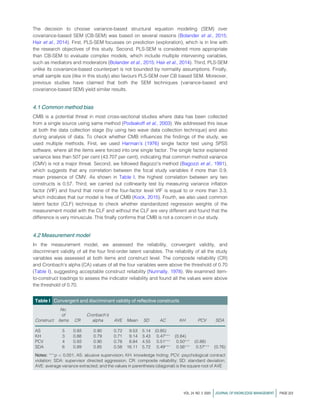
  • 16.
    Gagne, M., Tian,A.W., Soo, C., Zhang, B., Ho, K.S.B. and Hosszu, K. (2019), “Different motivations for knowledge sharing and hiding: the role of motivating work design”, Journal of Organizational Behavior, Vol. 40 No. 7, pp. 783-799. Gouldner, A.W. (1960), “The norm of reciprocity”, American Sociological Review, Vol. 25 No. 2, pp. 161-178. Greenberg, J. (1987), “A taxonomy of organizational justice theories”, The Academy of Management Review, Vol. 12 No. 1, pp. 9-22. Hair, J.F., Ringle, C.M. and Sarstedt, M. (2014), “PLS-SEM: looking back and moving forward”, Long Range Planning, Vol. 47 No. 3, pp. 132-127. Han, S., Seo, G., Yoon, S. and Yoon, D. (2016), “Transformational leadership and knowledge sharing”, Journal of Workplace Learning, Vol. 28 No. 3, pp. 130-149. Harman, H.H. (1976), Modern Factor Analysis, 3rd ed., The University of Chicago Press, Chicago, IL. Henseler, J., Ringle, C.M. and Sarstedt, M. (2015), “A new criterion for assessing discriminant validity in variance-based structural equation modeling”, Journal of the Academy of Marketing Science, Vol. 43 No. 1, pp. 115-135. Homans, G.C. (1961), Social Behavior, Harcourt Brace, New York, NY. Ipe, M. (2003), “Knowledge sharing in organizations: a conceptual framework”, Human Resource Development Review, Vol. 2 No. 4, pp. 337-359. Khalid, M., Bashir, S., Khan, A.K. and Abbas, N. (2018), “When and how abusive supervision leads to knowledge hiding behaviors: an islamic work ethics perspective”, Leadership Organization Development Journal, Vol. 39 No. 6, pp. 794-806. Kim, S.L., Lee, S. and Yun, S. (2016), “Abusive supervision, knowledge sharing, and individual factors: a conservation-of-resources perspective”, Journal of Managerial Psychology, Vol. 31 No. 6, pp. 1106-1120. Kock, N. (2015), “Common method bias in PLS-SEM: a full collinearity assessment approach”, International Journal of e-Collaboration, Vol. 11 No. 4, pp. 1-10. Kuvaas, B., Buch, R. and Dysvik, A. (2012), “Perceived training intensity and knowledge sharing: sharing for intrinsic and prosocial reasons”, Human Resource Management, Vol. 51 No. 2, pp. 167-187. Lee, S., Kim, S.L. and Yun, S. (2017), “A moderated mediation model of the relationship between abusive supervision and knowledge sharing”, The Leadership Quarterly, Vol. 29 No. 3, pp. 403-413. Lin, H.F. (2007), “Knowledge sharing and firm innovation capability: an empirical study”, International Journal of Manpower, Vol. 28 Nos 3/4, pp. 315-332. MacKenzie, S.B., Podsakoff, P.M. and Podsakoff, N.P. (2011), “Construct measurement and validation procedures in MIS and behavioral research: integrating new and existing techniques”, MIS Quarterly, Vol. 35 No. 2, pp. 293-334. Martinko, M.J., Harvey, P., Brees, J.R. and Mackey, J. (2013), “A review of abusive supervision research”, Journal of Organizational Behavior, Vol. 34 No. S1, pp. 120-137. Miller, N., Pedersen, W.C., Earlywine, M. and Pollock, V.E. (2003), “A theoretical model of triggered displaced aggression”, Personality and Social Psychology Review, Vol. 7 No. 1, pp. 75-97. Mitchell, M.S. and Ambrose, M.L. (2007), “Abusive supervision and workplace deviance and the moderating effects of negative reciprocity beliefs”, Journal of Applied Psychology, Vol. 92 No. 4, pp. 1159-1168. Nunnally, J.C. (1978), Psychometric Theory, 2nd ed., McGraw-Hill, New York, NY. Peng, H. (2012), “Counterproductive work behavior among Chinese knowledge workers”, International Journal of Selection and Assessment, Vol. 20 No. 2, pp. 119-138. Podsakoff, P.M., MacKenzie, S.B., Podsakoff, N.P. and Lee, J.Y. (2003), “Common method biases in behavioral research: a critical review of the literature and recommended remedies”, Journal of Applied Psychology, Vol. 88 No. 5, pp. 879-903. Podsakoff, P.M., MacKenzie, S.B. and Podsakoff, N.P. (2012), “Sources of method bias in social science research and recommendations on how to control it”, Annual Review of Psychology, Vol. 63 No. 1, pp. 539-569. VOL. 24 NO. 2 2020 jJOURNAL OF KNOWLEDGE MANAGEMENT j PAGE 231
  • 17.
    Pradhan, S. andJena, L.K. (2016), “The moderating role of neutralizers on the relationship between abusive supervision and intention to quit: a proposed model”, Journal of Human Values, Vol. 22 No. 3, pp. 238-248. Pradhan, S. and Jena, L.K. (2017), “Effect of abusive supervision on employee’s intention to quit and the neutralizing role of meaningful work on the relationship”, International Journal of Organizational Analysis, Vol. 25 No. 5, pp. 825-838. Pradhan, S. and Jena, L.K. (2018), “Abusive supervision: a framework of developmental solutions to this workplace menace”, Development and Learning in Organizations: An International Journal, Vol. 32 No. 2, pp. 20-23. Preacher, K.J. and Hayes, A.F. (2008), “Asymptotic and resampling strategies for assessing and comparing indirect effects in multiple mediator models”, Behavior Research Methods, Vol. 40 No. 3, pp. 879-891. Rafferty, A.E. and Restubog, S.L.D. (2011), “The influence of abusive supervisors on followers’ organizational citizenship behaviors: the hidden costs of abusive supervision”, British Journal of Management, Vol. 22 No. 2, pp. 270-285. Robinson, S.L. and Morrison, E.W. (2000), “The development of psychological contract breach and violation: a longitudinal study”, Journal of Organizational Behavior, Vol. 21 No. 5, pp. 525-546. Ruiz, D.M., Gremler, D.D., Washburn, J.H. and Carri on, G.C. (2008), “Service value revisited: specifying a higher-order, formative measure”, Journal of Business Research, Vol. 61 No. 12, pp. 1278-1291. Shamir, B. (2011), “Leadership takes time: some implications of (not) taking time seriously in leadership research”, The Leadership Quarterly, Vol. 22 No. 2, pp. 307-315. Srivastava, A., Bartol, K.M. and Locke, E.A. (2006), “Empowering leadership in management teams: effects on knowledge sharing, efficacy, and performance”, Academy of Management Journal, Vol. 49 No. 6, pp. 1239-1251. Tedeschi, J.T. and Norman, N.M. (1985), “A social psychological interpretation of displaced aggression”, Advances in Group Processes, Vol. 2, pp. 29-56. Tepper, B.J. (2000), “Consequences of abusive supervision”, Academy of Management Journal, Vol. 43 No. 2, pp. 178-190. Tepper, B.J., Duffy, M.K. and Breaux-Siognet, D.M. (2012), “Abusive supervision as political activity: Distinguishing impulsive and strategic expressions of downward hostility”, in Ferris G.R. and Treadway, D.C. (Eds), Politics in Organizations: Theory and Research Considerations, Routledge/Taylor Francis Group, New York, NY, pp. 191-212. Tepper, B.J., Duffy, M.K., Hoobler, J. and Ensley, M.D. (2004), “Moderators of the relationship between coworkers’ organizational citizenship behavior and fellow employees’ attitudes”, Journal of Applied Psychology, Vol. 89 No. 3, pp. 455-465. No Tepper, B.J. (2007), “Abusive supervision in work organizations: review, synthesis, and research agenda”, Journal of Management, Vol. 3 No. 3, pp. 261-289. Tripp, T.M. and Bies, R.J. (1997), “What’s good about revenge? the avenger’s perspective”, in Lewicki, R.J., Bies, R.J. and Sheppard, B.H. (Eds), Research on Negotiation in Organizations, Elsevier Science/ JAI Press, , Vol. 6, pp. 145-160. Twenge, J.M. and Campbell, W.K. (2003), “Isn’t it fun to get the respect that we’re going to deserve?, Narcissism, social rejection, and aggression”, Personality and Social Psychology Bulletin, Vol. 29 No. 2, pp. 261-272. Tyler, T.R. and Lind, E.A. (1992), “A relational model of authority in groups”, in Zanna, M. (Ed.), Advances in Experimental Social Psychology, Academic Press, San Diego, CA, Vol. 25, pp. 115-191. Wang, S. and Noe, R.A. (2010), “Knowledge sharing: a review and directions for future research”, Human Resource Management Review, Vol. 20 No. 2, pp. 115-131. Watson, D. and Clark, L.A. (1994), The PANAS-X: Manual for the Positive and Negative Affect Schedule, Expanded Form, University of IA Press, IA City. Woodside, A.G. and Zhang, M. (2013), “Cultural diversity and marketing transactions: are market integration, large community size, and world religions necessary for fairness in ephemeral exchanges?”, Psychology Marketing, Vol. 30 No. 3, pp. 263-276. PAGE 232 jJOURNAL OF KNOWLEDGE MANAGEMENT jVOL. 24 NO. 2 2020
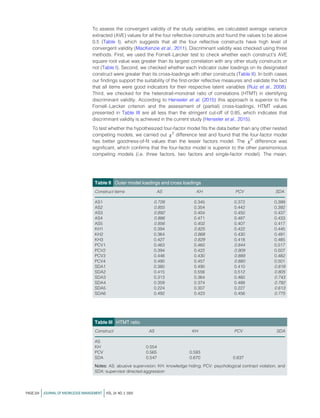
  • 18.
    Wright, R.A. andBrehm, S.S. (1982), “Reactance as impression management: a critical review”, Journal of Personality and Social Psychology, Vol. 42 No. 4, pp. 608-618. Wu, W.L. and Lee, Y.C. (2016), “Do employees share knowledge when encountering abusive supervision?”, Journal of Managerial Psychology, Vol. 31 No. 1, pp. 154-168. Xue, Y., Bradley, J. and Liang, H. (2011), “Team climate, empowering leadership, and knowledge sharing”, Journal of Knowledge Management, Vol. 15 No. 2, pp. 299-312. Zellars, K.L., Tepper, B.J. and Duffy, M.K. (2002), “Abusive supervision and subordinates’ organizational citizenship behavior”, Journal of Applied Psychology, Vol. 87 No. 6, pp. 1068 -1076. Zhao, H., Peng, Z., Han, Y., Sheard, G. and Hudson, A. (2013), “Psychological mechanism linking abusive supervision and compulsory citizenship behavior: a moderated mediation study”, The Journal of Psychology, Vol. 147 No. 2, pp. 177-195. Further reading Cabrera, E.F. and Cabrera, A. (2005), “Fostering knowledge sharing through people management practices”, The International Journal of Human Resource Management, Vol. 16 No. 5, pp. 720-735. Lewicki, R.J., Bies, R.J. and Sheppard, B.H. (Eds), Research on Negotiation in Organizations, Elsevier Science/JAI Press, , Vol. 6, pp. 145-160. Mackey, J.D., Frieder, R.E., Brees, J.R. and Martinko, M.J. (2017), “Abusive supervision: a meta-analysis and empirical review”, Journal of Management, Vol. 43 No. 6, pp. 1940-1965. VOL. 24 NO. 2 2020 jJOURNAL OF KNOWLEDGE MANAGEMENT j PAGE 233
  • 19.
    Appendix About the authors SajeetPradhan is an Associate Professor of organizational behaviour at International Management Institute, New Delhi, India. He earned his PhD. in organizational behavior from Indian Institute of Technology, Kharagpur, India. His research interests include abusive supervision, transformational leadership and harassment at work. Sajeet Pradhan is the corresponding author and can be contacted at: sajeet.pradhan@imi.edu Aman Srivastava is working as Professor (Finance and Accounting) at International Management Institute (IMI), New Delhi, India. He has over 20 years of experience in research, teaching and corporate training. He has trained government officers and corporate executives of more than 50 countries. He has conducted training programmes for top-level executives of companies, such as ONGC, Oil India, Indian Oil, HPCL, GAIL, NTPC, NHPC, SJVN, Coal India, SAIL, NALCO, MCX, RAIL Tel Corporation, HUDCO, MSME, TCIL, AC NIELSEN, Greenfield. com, Standard Chartered Bank, NAFED and much more. He has published research papers and cases in national and international journals. His areas of specialization are behavioral finance, corporate finance, risk management and investment management. Dharmesh K. Mishra is an Associate Professor in the faculty of management at the Symbiosis Institute of International Business, which is a constituent of the Symbiosis International (Deemed) University Pune. He has more than 15 years of experience in the manufacturing, banking and the education sector in India, Australia and Mauritius. His research interest areas are from the fields of human resource management and organizational behaviour. For instructions on how to order reprints of this article, please visit our website: www.emeraldgrouppublishing.com/licensing/reprints.htm Or contact us for further details: permissions@emeraldinsight.com Table AI Study construct and items Constructs Items PCV 1 I feel a great deal of anger towards my organization PCV 2 I feel betrayed by my organization PCV 3 I feel that my organization has violated the contract between us PCV 4 I feel extremely frustrated by how I have been treated by my organization AS 1 My supervisor ridicules me AS 2 My supervisor tells me my thoughts or feelings are stupid AS 3 My supervisor puts me down in front of others AS 4 My supervisor makes negative comments about me to others AS 5 My supervisor tells me that I am incompetent KH 1 Withhold helpful information or knowledge from others KH 2 Try to hide innovative achievements KH 3 Do not transform personal knowledge and experience into organizational knowledge SDA 1 Angry SDA 2 Hostile SDA 3 Irritable SDA 4 Scornful SDA 5 Disgusted SDA 6 Loathing Notes: Respondents were asked to report the degree to which they agreed with the items on the scales from 1 (strongly disagree) to 5 (strongly agree). Psychological contract violation scale has four items (PCB 1 – PCB 4), abusive supervision has five items (AS 1 – AS 5), Knowledge hiding has three items (KH1 – KH3). Supervisor directed aggression has six items (SDA1 – SDA6), where the respondents were asked to rate to what extent they felt this way during the past few weeks at work about their direct supervisor on a scale from 1 (strongly disagree) to 5 (strongly agree) PAGE 234 jJOURNAL OF KNOWLEDGE MANAGEMENT jVOL. 24 NO. 2 2020