See discussions, stats,and author profiles for this publication at: https://www.researchgate.net/publication/326845521
When and how abusive supervision leads to knowledge hiding behaviors: An
Islamic work ethics perspective
Article in Leadership & Organization Development Journal · July 2018
DOI: 10.1108/LODJ-05-2017-0140
CITATIONS
284
READS
4,891
4 authors:
Maria Khalid
Foundation University Islamabad
13 PUBLICATIONS 453 CITATIONS
SEE PROFILE
Sajid Bashir
Ghazali University of Technology GU Tech
45 PUBLICATIONS 2,011 CITATIONS
SEE PROFILE
Abdul Karim Khan
United Arab Emirates University
79 PUBLICATIONS 3,000 CITATIONS
SEE PROFILE
Nida Abbas
Foundation University Islamabad
11 PUBLICATIONS 365 CITATIONS
SEE PROFILE
All content following this page was uploaded by Abdul Karim Khan on 16 November 2018.
The user has requested enhancement of the downloaded file.
2.
Leadership & OrganizationDevelopment Journal
When and how abusive supervision leads to knowledge hiding behaviors: An
Islamic work ethics perspective
Maria Khalid, Sajid Bashir, Abdul Karim Khan, Nida Abbas,
Article information:
To cite this document:
Maria Khalid, Sajid Bashir, Abdul Karim Khan, Nida Abbas, (2018) "When and how abusive
supervision leads to knowledge hiding behaviors: An Islamic work ethics perspective", Leadership
& Organization Development Journal, Vol. 39 Issue: 6, pp.794-806, https://doi.org/10.1108/
LODJ-05-2017-0140
Permanent link to this document:
https://doi.org/10.1108/LODJ-05-2017-0140
Downloaded on: 15 November 2018, At: 23:15 (PT)
References: this document contains references to 56 other documents.
To copy this document: permissions@emeraldinsight.com
The fulltext of this document has been downloaded 262 times since 2018*
Users who downloaded this article also downloaded:
(2018),"Are you a cistern or a channel? Exploring factors triggering knowledge-hiding behavior
at the workplace: evidence from the Indian R&D professionals", Journal of Knowledge
Management, Vol. 22 Iss 4 pp. 824-849 <a href="https://doi.org/10.1108/JKM-02-2017-0048">https://
doi.org/10.1108/JKM-02-2017-0048</a>
(2018),"Knowledge hiding and team creativity: the contingent role of task interdependence",
Management Decision, Vol. 56 Iss 2 pp. 329-343 <a href="https://doi.org/10.1108/
MD-11-2016-0778">https://doi.org/10.1108/MD-11-2016-0778</a>
Access to this document was granted through an Emerald subscription provided by emerald-
srm:232579 []
For Authors
If you would like to write for this, or any other Emerald publication, then please use our Emerald
for Authors service information about how to choose which publication to write for and submission
guidelines are available for all. Please visit www.emeraldinsight.com/authors for more information.
About Emerald www.emeraldinsight.com
Emerald is a global publisher linking research and practice to the benefit of society. The company
manages a portfolio of more than 290 journals and over 2,350 books and book series volumes, as
well as providing an extensive range of online products and additional customer resources and
services.
Downloaded
by
United
Arab
Emirates
University
At
23:15
15
November
2018
(PT)
3.
Emerald is bothCOUNTER 4 and TRANSFER compliant. The organization is a partner of the
Committee on Publication Ethics (COPE) and also works with Portico and the LOCKSS initiative for
digital archive preservation.
*Related content and download information correct at time of download.
Downloaded
by
United
Arab
Emirates
University
At
23:15
15
November
2018
(PT)
on opposite sidesof a continuum (Peng, 2013). Recent findings suggest rather that they are
related but distinct constructs with different underlying mechanisms and outcomes in
response to even homogeneous antecedents (Connelly and Zweig, 2015; Peng, 2013).
Previous research has demonstrated how interpersonal and knowledge-related factors
contribute to knowledge hiding behaviors. Specifically, distrust, knowledge complexity, the
task-relatedness of the knowledge, lack of psychological ownership and a knowledge-sharing
climate have been found to be associated with knowledge hiding behaviors (Connelly et al.,
2012; Peng, 2013). However, the dysfunctional behaviors of supervisors which contribute to
knowledge hiding behaviors have not yet been explored. This seems a serious omission, since
supervisors are organizational representatives and major decision makers; consequently, their
actions could be an important factor in influencing subordinates’discretionary behaviors, such
as knowledge hiding (Srivastava et al., 2006). Given the untapped nature of this research
inquiry, our primary motivation for this study comes from the need to explore the underlying
mechanisms and boundary conditions associated with abusive supervision- dysfunctional
supervisory behavior, and knowledge hiding behaviors.
Abusive supervision refers to the employees’ perceptions about the extent to which their
supervisors engage in rude and hostile behaviors (Tepper, 2000). Although abusive
supervision (dysfunctional supervisory behavior) aligns well with dysfunctional
subordinates’ behaviors (knowledge hiding), it is still not clear how abusive supervision
is related to knowledge hiding behaviors, and why some subordinates, unlike others, would
engage in more knowledge hiding behaviors in response to abusive supervision.
To answer these research questions, we drew on the literature about displaced
aggression theory, social exchange theory and Islamic work ethics (IWE). We posited that
leaders’ abusive behaviors, such as publicly ridiculing, criticizing and intimidating
subordinates, undermine their subordinates’ perceptions of interpersonal justice (Rafferty
and Restubog, 2011). Low perceptions of interpersonal justice are associated with
knowledge hiding behaviors. We also examined IWE (an orientation which views work as a
virtue (Ragab Rizk, 2008)), as a boundary condition for the association between abusive
supervision and knowledge hiding behaviors. We argue that individuals who are high on
IWE tend to engage less in knowledge hiding behaviors in response to abusive supervision.
Hence, IWE may mitigate the positive effect of abusive supervision on knowledge hiding
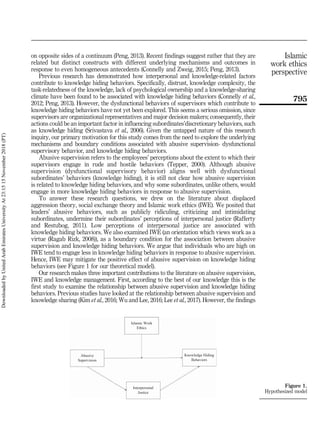
behaviors (see Figure 1 for our theoretical model).
Our research makes three important contributions to the literature on abusive supervision,
IWE and knowledge management. First, according to the best of our knowledge this is the
first study to examine the relationship between abusive supervision and knowledge hiding
behaviors. Previous studies have looked at the relationship between abusive supervision and
knowledge sharing (Kim et al., 2016; Wu and Lee, 2016; Lee et al., 2017). However, the findings
Islamic Work
Ethics
Knowledge Hiding
Behaviors
Abusive
Supervision
Interpersonal
Justice
Figure 1.
Hypothesized model
795
Islamic
work ethics
perspective
Downloaded
by
United
Arab
Emirates
University
At
23:15
15
November
2018
(PT)
6.
of these studiescannot be applied to knowledge hiding since this is a distinct construct
(Connelly et al. 2012). Our findings contribute to knowledge on both the antecedents of
knowledge hiding behaviors, and the outcomes of abusive supervision. Second, we integrate
the literature on displaced aggression theory and social exchange theory with that on IWE to
offer new insights into the mechanisms and boundary conditions associated with the
relationship between abusive supervision and knowledge hiding behaviors. Taking an
interactionist perspective, this research aims to build our understanding about the link(s)
between abusive supervision and knowledge hiding behaviors. Third, our research context,
Pakistani organizations, is highly suitable for the study of abusive supervision and IWE. As a
comparatively high-power distance culture, Pakistani society is often described as supporting
great inequalities of power and wealth (Hofstede, 2001). The deference to authority associated
with such cultures may make people less sensitive to supervisory abuse. Similarly, Pakistan
as a Muslim majority country (97 percent Muslims) is highly suitable for the study of IWE.
Theory and hypotheses development
Abusive supervision and knowledge hiding behaviors
Knowledge hiding may be defined as a deliberate decision to withhold knowledge and
information that is requested by others (Connelly et al., 2012). In such behaviors,
employees purposely hide information from their coworkers when they request it.
Knowledge hiding behaviors may be minor in nature, for example, overlooking a small
request, or major, such as hiding crucial or strategic information (Serenko and Bontis,
2016). Though rationalized knowledge hiding may sometimes have a purpose, such as
keeping secrets or hiding confidential information (Connelly et al., 2012), it is unlikely that
employees engage in rationalized knowledge hiding behaviors in response to abusive
supervision. Knowledge hiding is not necessarily intended to directly harm other
organizational members; usually it is a passive reaction to a given situation such as
abusive supervision.
We argue that the relationship between abusive supervision and knowledge hiding
behaviors can be explained by displaced aggression theory (Dollard et al., 1939). Displaced
aggression theory posits that employees victimized by supervisory mistreatment do not show
aggression toward the stimulus of aggression (i.e. the supervisor) instead they re-direct their
reaction toward convenient victims or targets (i.e. coworkers). When employees perceive that
they are not treated well by their supervisor, they may seek revenge by withholding
knowledge from safe and easy targets (coworkers) (Mitchell and Ambrose, 2007; Skarlicki and
Folger, 1997). Employees do not direct their reaction toward supervisors because of the degree
of authority and control they exercise over rewards and promotions (Wang and Noe, 2010).
We hypothesize as follows:
H1. Abusive supervision is positively related to knowledge hiding behaviors.
Interpersonal justice as a mediator between abusive supervision and knowledge hiding
behaviors
Interpersonal justice entails the perceptions of dignity and respect given to the employees
by higher authorities when procedures are being implemented (Bies and Moag, 1986;
Colquitt, 2001). Generally, supervisors or leaders are considered a vital source when it comes
to interpersonal justice. Empirical evidence suggests that employees who work with an
abusive supervisor report lowered levels of interpersonal justice (Aryee et al., 2007). Abusive
supervisors having characteristics of humiliating, criticizing and giving silent treatment to
employees (Keashly, 1997; Tepper, 2000) weaken the interpersonal bonding with their
subordinates. When employees perceive that they are being treated rudely and
796
LODJ
39,6
Downloaded
by
United
Arab
Emirates
University
At
23:15
15
November
2018
(PT)
7.
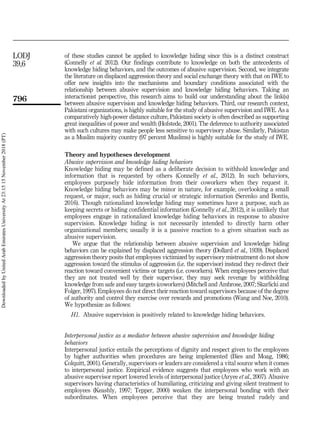
disrespectfully by theirsupervisor they will indulge in knowledge hiding as a retaliatory or
aggressive reaction (Dupré et al., 2006; Sitkin and Stickel, 1996). Similarly, a decline in
interpersonal fairness will be associated with employees’ knowledge withholding behaviors
in an effort to “even the score” with their supervisor (Dyne et al., 2003). This relationship can
be explained on the basis of social exchange theory (Blau, 1964), which posits that
employees are involved in a give and take process in organizations. Employees have a
tendency to withhold discretionary positive behaviors (i.e. knowledge exchange) when their
organization or supervisor does not treat them fairly.
Rafferty and Restubog (2011) found that interpersonal justice mediate the relationship
between abusive supervision and pro-social silence, a construct similar to knowledge hiding.
Based on the above theoretical and empirical evidence, we hypothesize as follows:
H2. Interpersonal justice mediates the relationship between abusive supervision and
knowledge hiding behaviors.
Moderating role of IWE. IWE has its roots in the sayings of the Holy Prophet Muhammad
(peace be upon him) and the guidance provided in the Holy Quran (Yousef, 2000). The Quran
clearly forbids dishonesty and deceitfulness in business dealings. The Quran says “Give a full
measure when you measure out and weigh with a fair balance” (Quran 27:9). An IWE also
emphasize the acquisition and dissemination of knowledge. The Holy Prophet Muhammad
(peace be upon him) said “the most generous people after me will be those who will acquire
knowledge and then share/distribute it. They will come on the Day of Judgment singly, like a
ruler (Al-Tirmidhi, [Hadith, 93]” (cited in Nawawi 1983). Furthermore, the Holy Prophet (SAW)
said: “the best testament and legacies which a man leaves behind him are an obedient son,
incessant charity, knowledge, and wisdom which are benefited by the people after him”
(Hamid, 2011). This clearly conveys that Islam strictly prohibits the withholding of knowledge
and encourages knowledge dissemination and sharing.
Abusive supervisors tend to dismantle the fairness perceptions of employees by their
rude, arrogant and disrespectful behaviors (Folger and Cropanzano, 2001) but the
employees who are high on IWE will be buffered against the negative cues given by
supervisors. According to IWE, work goals and objectives are moral duties which are to be
fulfilled even in negative situations from which fair procedures are absent (Khan et al., 2015).
Islam clearly emphasizes knowledge sharing and collaboration among the people at the
workplace. Allah clearly says “verily those who hide that which we have sent down of
evidence and the guidance, after we have expounded it unto mankind in the Book, these!
They are the ones cursed by Allah and cursed by curser” (Quran, 2:159). Though Islam
encourages keeping the secrets of others, knowledge hiding behaviors are counter-
productive in nature because they involve the intention to conceal knowledge that has been
specifically requested by fellow employees (Serenko and Bontis, 2016; Connelly and Zweig,
2015). This action of denying a request may be due to personal dislike or a revengeful
reaction the unfair procedures or encounters faced in organization (Serenko and Bontis,
2016). The Quran discourages evil deeds and revengeful reactions; as it states “Good and
evil deeds are not equal. Repel evil with what is better; then you will see that one who was
once your enemy has become your dearest friend” (Quran 41:34). This demonstrates that
Islam prohibits counter-productive behaviors even if they are retaliatory reactions to some
unfair stimulus. Thus, employees who are high on IWE may not indulge in knowledge
hiding behaviors in response to abusive supervision, as this contradicts their belief systems.
We hypothesize as follows:
H3. IWE moderates the positive relationship between abusive supervision and knowledge
hiding behaviors such that the relationship between abusive supervision and
knowledge hiding behaviors is weakened when IWE is high.
797
Islamic
work ethics
perspective
Downloaded
by
United
Arab
Emirates
University
At
23:15
15
November
2018
(PT)
8.
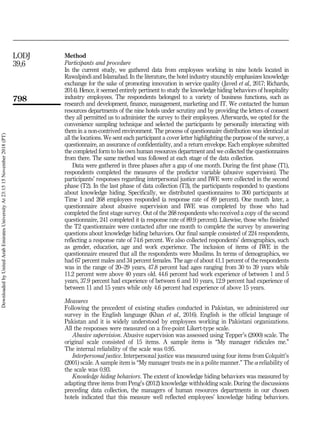
Method
Participants and procedure
Inthe current study, we gathered data from employees working in nine hotels located in
Rawalpindi and Islamabad. In the literature, the hotel industry staunchly emphasizes knowledge
exchange for the sake of promoting innovation in service quality (Javed et al., 2017; Richards,
2014). Hence, it seemed entirely pertinent to study the knowledge hiding behaviors of hospitality
industry employees. The respondents belonged to a variety of business functions, such as
research and development, finance, management, marketing and IT. We contacted the human
resources departments of the nine hotels under scrutiny and by providing the letters of consent
they all permitted us to administer the survey to their employees. Afterwards, we opted for the
convenience sampling technique and selected the participants by personally interacting with
them in a non-contrived environment. The process of questionnaire distribution was identical at
all the locations. We sent each participant a cover letter highlighting the purpose of the survey, a
questionnaire, an assurance of confidentiality, and a return envelope. Each employee submitted
the completed form to his own human resources department and we collected the questionnaires
from there. The same method was followed at each stage of the data collection.
Data were gathered in three phases after a gap of one month. During the first phase (T1),
respondents completed the measures of the predictor variable (abusive supervision). The
participants’ responses regarding interpersonal justice and IWE were collected in the second
phase (T2). In the last phase of data collection (T3), the participants responded to questions
about knowledge hiding. Specifically, we distributed questionnaires to 300 participants at
Time 1 and 268 employees responded (a response rate of 89 percent). One month later, a
questionnaire about abusive supervision and IWE was completed by those who had
completed the first stage survey. Out of the 268 respondents who received a copy of the second
questionnaire, 241 completed it (a response rate of 89.9 percent). Likewise, those who finished
the T2 questionnaire were contacted after one month to complete the survey by answering
questions about knowledge hiding behaviors. Our final sample consisted of 224 respondents,
reflecting a response rate of 74.6 percent. We also collected respondents’ demographics, such
as gender, education, age and work experience. The inclusion of items of IWE in the
questionnaire ensured that all the respondents were Muslims. In terms of demographics, we
had 67 percent males and 34 percent females. The age of about 41.1 percent of the respondents
was in the range of 20–29 years, 47.8 percent had ages ranging from 30 to 39 years while
11.2 percent were above 40 years old. 44.6 percent had work experience of between 1 and 5
years, 37.9 percent had experience of between 6 and 10 years, 12.9 percent had experience of
between 11 and 15 years while only 4.6 percent had experience of above 15 years.
Measures
Following the precedent of existing studies conducted in Pakistan, we administered our
survey in the English language (Khan et al., 2016). English is the official language of
Pakistan and it is widely understood by employees working in Pakistani organizations.
All the responses were measured on a five-point Likert-type scale.
Abusive supervision. Abusive supervision was assessed using Tepper’s (2000) scale. The
original scale consisted of 15 items. A sample items is “My manager ridicules me.”
The internal reliability of the scale was 0.95.
Interpersonal justice. Interpersonal justice was measured using four items from Colquitt’s
(2001) scale. A sample item is “My manager treats me in a polite manner.” The α reliability of
the scale was 0.93.
Knowledge hiding behaviors. The extent of knowledge hiding behaviors was measured by
adapting three items from Peng’s (2012) knowledge withholding scale. During the discussions
preceding data collection, the managers of human resources departments in our chosen
hotels indicated that this measure well reflected employees’ knowledge hiding behaviors.
798
LODJ
39,6
Downloaded
by
United
Arab
Emirates
University
At
23:15
15
November
2018
(PT)
9.
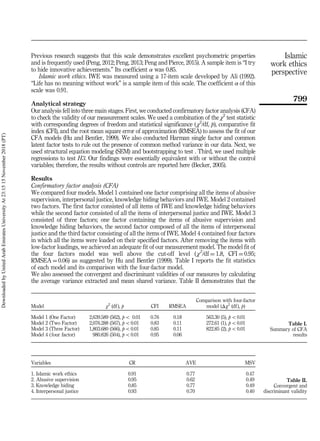
Previous research suggeststhat this scale demonstrates excellent psychometric properties
and is frequently used (Peng, 2012; Peng, 2013; Peng and Pierce, 2015). A sample item is “I try
to hide innovative achievements.” Its coefficient α was 0.85.
Islamic work ethics. IWE was measured using a 17-item scale developed by Ali (1992).
“Life has no meaning without work” is a sample item of this scale. The coefficient α of this
scale was 0.91.
Analytical strategy
Our analysis fell into three main stages. First, we conducted confirmatory factor analysis (CFA)
to check the validity of our measurement scales. We used a combination of the χ2
test statistic
with corresponding degrees of freedom and statistical significance ( χ2
/df, p), comparative fit
index (CFI), and the root mean square error of approximation (RMSEA) to assess the fit of our
CFA models (Hu and Bentler, 1999). We also conducted Harman single factor and common
latent factor tests to rule out the presence of common method variance in our data. Next, we
used structural equation modeling (SEM) and bootstrapping to test . Third, we used multiple
regressions to test H3. Our findings were essentially equivalent with or without the control
variables; therefore, the results without controls are reported here (Becker, 2005).
Results
Confirmatory factor analysis (CFA)
We compared four models. Model 1 contained one factor comprising all the items of abusive
supervision, interpersonal justice, knowledge hiding behaviors and IWE. Model 2 contained
two factors. The first factor consisted of all items of IWE and knowledge hiding behaviors
while the second factor consisted of all the items of interpersonal justice and IWE. Model 3
consisted of three factors; one factor containing the items of abusive supervision and
knowledge hiding behaviors, the second factor composed of all the items of interpersonal
justice and the third factor consisting of all the items of IWE. Model 4 contained four factors
in which all the items were loaded on their specified factors. After removing the items with
low-factor loadings, we achieved an adequate fit of our measurement model. The model fit of
the four factors model was well above the cut-off level ( χ2
/df ¼ 1.8, CFI ¼ 0.95;
RMSEA ¼ 0.06) as suggested by Hu and Bentler (1999). Table I reports the fit statistics
of each model and its comparison with the four-factor model.
We also assessed the convergent and discriminant validities of our measures by calculating
the average variance extracted and mean shared variance. Table II demonstrates that the
Model χ2
(df), p CFI RMSEA
Comparison with four-factor
model (Δχ2
(df), p)
Model 1 (One Factor) 2,639.589 (562), po 0.01 0.76 0.18 563.30 (5), po0.01
Model 2 (Two Factor) 2,076.288 (567), po0.01 0.83 0.11 272.61 (1), po0.01
Model 3 (Three Factor) 1,803.680 (566), po0.01 0.85 0.11 822.85 (2), po0.01
Model 4 (four factor) 980.826 (504), po0.01 0.95 0.06
Table I.
Summary of CFA
results
Variables CR AVE MSV
1. Islamic work ethics 0.91 0.77 0.47
2. Abusive supervision 0.95 0.62 0.49
3. Knowledge hiding 0.85 0.77 0.49
4. Interpersonal justice 0.93 0.70 0.40
Table II.
Convergent and
discriminant validity
799
Islamic
work ethics
perspective
Downloaded
by
United
Arab
Emirates
University
At
23:15
15
November
2018
(PT)
10.
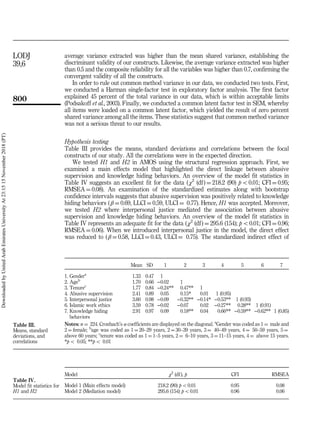
average variance extractedwas higher than the mean shared variance, establishing the
discriminant validity of our constructs. Likewise, the average variance extracted was higher
than 0.5 and the composite reliability for all the variables was higher than 0.7, confirming the
convergent validity of all the constructs.
In order to rule out common method variance in our data, we conducted two tests. First,
we conducted a Harman single-factor test in exploratory factor analysis. The first factor
explained 45 percent of the total variance in our data, which is within acceptable limits
(Podsakoff et al., 2003). Finally, we conducted a common latent factor test in SEM, whereby
all items were loaded on a common latent factor, which yielded the result of zero percent
shared variance among all the items. These statistics suggest that common method variance
was not a serious threat to our results.
Hypothesis testing
Table III provides the means, standard deviations and correlations between the focal
constructs of our study. All the correlations were in the expected direction.
We tested H1 and H2 in AMOS using the structural regression approach. First, we
examined a main effects model that highlighted the direct linkage between abusive
supervision and knowledge hiding behaviors. An overview of the model fit statistics in
Table IV suggests an excellent fit for the data ( χ2
(df) ¼ 218.2 (90) po0.01; CFI ¼ 0.95;
RMSEA ¼ 0.08). An examination of the standardized estimates along with bootstrap
confidence intervals suggests that abusive supervision was positively related to knowledge
hiding behaviors ( β ¼ 0.69, LLCI ¼ 0.59, ULCI ¼ 0.77). Hence, H1 was accepted. Moreover,
we tested H2 where interpersonal justice mediated the association between abusive
supervision and knowledge hiding behaviors. An overview of the model fit statistics in
Table IV represents an adequate fit for the data ( χ2
(df) ¼ 295.6 (154); po0.01; CFI ¼ 0.96;
RMSEA ¼ 0.06). When we introduced interpersonal justice in the model, the direct effect
was reduced to ( β ¼ 0.58, LLCI ¼ 0.43, ULCI ¼ 0.75). The standardized indirect effect of
Model χ2
(df), p CFI RMSEA
Model 1 (Main effects model) 218.2 (90) po0.01 0.95 0.08
Model 2 (Mediation model) 295.6 (154) po0.01 0.96 0.06
Table IV.
Model fit statistics for
H1 and H2
Mean SD 1 2 3 4 5 6 7
1. Gendera
1.33 0.47 1
2. Ageb
1.70 0.66 −0.02 1
3. Tenurec
1.77 0.84 −0.24** 0.47** 1
4. Abusive supervision 2.41 0.89 0.05 0.15* 0.01 1 (0.95)
5. Interpersonal justice 3.60 0.98 −0.09 −0.32** −0.14* −0.53** 1 (0.93)
6. Islamic work ethics 3.59 0.78 −0.02 −0.07 0.02 −0.27** 0.28** 1 (0.91)
7. Knowledge hiding
behaviors
2.91 0.97 0.09 0.18** 0.04 0.66** −0.59** −0.62** 1 (0.85)
Notes: n ¼ 224. Cronbach’s α coefficients are displayed on the diagonal. a
Gender was coded as 1 ¼ male and
2 ¼ female; b
age was coded as 1 ¼ 20–29 years, 2 ¼ 30–39 years, 3 ¼ 40–49 years, 4 ¼ 50–59 years, 5 ¼
above 60 years; c
tenure was coded as 1 ¼ 1–5 years, 2 ¼ 6–10 years, 3 ¼ 11–15 years, 4 ¼ above 15 years.
*po 0.05; **po 0.01
Table III.
Means, standard
deviations, and
correlations
800
LODJ
39,6
Downloaded
by
United
Arab
Emirates
University
At
23:15
15
November
2018
(PT)
11.
abusive supervision onknowledge hiding behaviors was significant ( β ¼ 0.19, LLCI ¼ 0.13,
ULCI ¼ 0.29). This shows that H2 could also be accepted establishing partial mediation. In
order to further examine the mediation hypothesis, we conducted a Sobel test (Sobel, 1982).
The results of the Sobel test were statistically significant (z ¼ 3.58, po0.001).
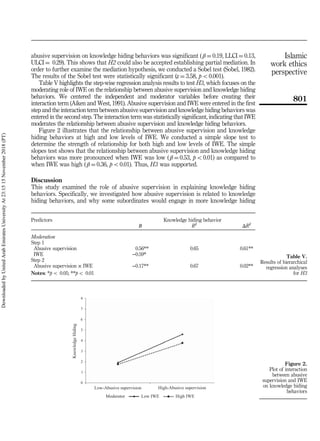
Table V highlights the step-wise regression analysis results to test H3, which focuses on the
moderating role of IWE on the relationship between abusive supervision and knowledge hiding
behaviors. We centered the independent and moderator variables before creating their
interaction term (Aiken and West, 1991). Abusive supervision and IWE were entered in the first
step and the interaction term between abusive supervision and knowledge hiding behaviors was
entered in the second step. The interaction term was statistically significant, indicating that IWE
moderates the relationship between abusive supervision and knowledge hiding behaviors.
Figure 2 illustrates that the relationship between abusive supervision and knowledge
hiding behaviors at high and low levels of IWE. We conducted a simple slope test to
determine the strength of relationship for both high and low levels of IWE. The simple
slopes test shows that the relationship between abusive supervision and knowledge hiding
behaviors was more pronounced when IWE was low ( β ¼ 0.53, po0.01) as compared to
when IWE was high ( β ¼ 0.36, po0.01). Thus, H3 was supported.
Discussion
This study examined the role of abusive supervision in explaining knowledge hiding
behaviors. Specifically, we investigated how abusive supervision is related to knowledge
hiding behaviors, and why some subordinates would engage in more knowledge hiding
Predictors Knowledge hiding behavior
Β R2
ΔR2
Moderation
Step 1
Abusive supervision 0.56** 0.65 0.61**
IWE −0.59*
Step 2
Abusive supervision × IWE −0.17** 0.67 0.02**
Notes: *po 0.05; **po 0.01
Table V.
Results of hierarchical
regression analyses
for H3
8
7
6
5
4
3
2
1
0
Low-Abusive supervision High-Abusive supervision
Knowledge
Hiding
High IWE
Low IWE
Moderator
Figure 2.
Plot of interaction
between abusive
supervision and IWE
on knowledge hiding
behaviors
801
Islamic
work ethics
perspective
Downloaded
by
United
Arab
Emirates
University
At
23:15
15
November
2018
(PT)
12.
behaviors than othersin response to abusive supervision. In order to answer our research
questions, we drew on displaced aggression theory and social exchange theory to
hypothesize the intervening mechanism of interpersonal justice and moderating influence of
IWE on the relationship between abusive supervision and knowledge hiding behaviors. By
and large, we found support for our hypothesized relationships.
Our results suggest that abusive supervision is positively related to employees’ knowledge
hiding behaviors. The positive relationship shows that abusive leadership behaviors toward
subordinates incline the latter to engage in retaliatory behaviors such as knowledge hiding.
These behaviors are not restricted to a specific work group or sample; rather, wherever
employees experience belittling attitudes, abusive language or disrespectful treatment, they
will respond in the form of some retaliation or negativity. Employees perceive their knowledge
base to be valuable and the feeling of being mistreated or not given due respect will incline
them toward knowledge hiding behaviors (Kim et al., 2016). Aligned with displaced
aggression theory, this negativity is projected on to coworkers because they have less power
and authority than supervisors (Dollard et al., 1939).
Our study also suggests the mediating impact of interpersonal justice between abusive
supervision and knowledge hiding behaviors, supporting H2. In the case of abusive
supervision, subordinates blame their supervisors for the aggressive and undesirable
treatment that they receive. Thus, the amalgamation of negative instances and blame forces
employees to restore a balance by at least withholding what is in their control or domain,
namely, their knowledge, which they tend to hide from others. The results are also aligned
with the uncertainty management theory (Lind and Van den Bos, 2002), which posits that
the perception of injustice results in forms of deviant, retaliatory or aggressive reactions
aimed to regain the lost control. Hence, when interpersonal injustice is felt by abused
employees they tend to engage in knowledge hiding behaviors as an act of revenge.
IWE was found to moderate the relationship between abusive supervision and knowledge
hiding behaviors such that it dampens the positive relationship between abusive supervision
and knowledge hiding behaviors. IWE sees work-related objectives as moral obligations
which are to be obeyed even in the absence of fairness (Khan et al., 2015). A study by Yousef
(2001) suggests that the presence of IWE leads to commitment and fairness in the workplace.
Likewise, recent studies in similar contexts suggest that employees who follow IWE strongly
are less likely to engage in undesirable behaviors because they overcome the resentment
against injustice perceived in workplace (Khan et al., 2015). Consequently, the presence of an
IWE in employees buffers them against the positive impact of rude and discourteous
supervision on the knowledge hiding behavior of employees.
Post hoc analyses
While not hypothesized, we conducted two post hoc analyses to address additional questions
which arose after we had tested our main hypotheses. The two questions we tested were
whether IWE plays a moderating role in the relationship between abusive leadership and
interpersonal justice or in the relationship between interpersonal justice and knowledge
hiding behaviors. Our results revealed that when IWE was tested as a moderator between
abusive supervision and interpersonal justice, it was found to significantly diminish the
negative relationship between abusive supervision and interpersonal justice ( β ¼ 0.27,
po0.001). However, the moderating impact of IWE on the relationship between
interpersonal justice and knowledge hiding was found to be insignificant ( β ¼ 0.10,
pW0.05). Future studies may hypothesize the nature of these relationships.
Managerial implications
The findings of this study have several implications for managers. First, abusive supervision
is a costly phenomenon, which has detrimental effects on organizational profitability
802
LODJ
39,6
Downloaded
by
United
Arab
Emirates
University
At
23:15
15
November
2018
(PT)
13.
(Tepper, 2000; Raffertyand Restubog, 2011). Because knowledge hiding behaviors interfere
with the ability of organizations to bring innovation, so such behaviors may become a threat
to organizations’ strategic objectives. These behaviors may be controlled by reducing abusive
supervision in organizations. This can be achieved by eliminating the contextual and
dispositional triggers of abuse (Tepper et al., 2006; Tepper et al., 2011).
Second, organizations generally cannot fully-eliminate abuse because supervision abuse
is sometimes due to strategic reasons (Khan et al., 2016). However, the impact of abuse on
employees’ behaviors may be minimized. As our findings suggest, employees’ values and
beliefs can serve as safeguards against reactions to abusive supervision and organizations
can work on building ethical values in their workforce. There is ample evidence in the
literature that ethics can be taught to managers (Jones, 2009; Lau, 2010). Organizations can
design training programs for managers around broader Islamic principles, for Islam is
considered the only religion that guides us in every sphere of life (Rice, 1999). The training
programs may enhance the levels of IWE among employees.
Third, organizations should focus on understanding the causes of knowledge hiding
behaviors among employees. Knowledge dissemination and exchange can be made possible
only when employees are subjected to just treatment; indeed, this will make them feel
indebted and respond by sharing their knowledge instead of withholding it. The just
distribution of organizational rewards, impartial policies and just interpersonal dealings can
promote the process of knowledge exchange (Cabrera and Cabrera, 2005). In addition,
organizations must focus on monetary and nonmonetary rewards to promote knowledge-
sharing behavior among employees.
Fourth, our findings are mostly applicable to the Muslim world. However, these findings
may in various ways be applicable to a non-Muslim population. The principles that underlie
doing legitimate business, the quality of work, wages, transparency and generosity can
be equally beneficial for non-Muslim managers (Ali and Al-Owaihan, 2008). Many negative
outcomes can be mitigated if the ethical, psychological and social rules along with the
economic principles mentioned by Islam are incorporated in today’s business organizations.
Limitations and future directions
Our findings should be interpreted in the light of several limitations. First, we collected data
from the hospitality sector in two cities of Pakistan and this may limit the generalizability of our
results. Second, we focused on a negative leadership behavior, i.e. abusive supervision, to gain
deeper insights, future studies may examine the role of other forms of leadership (i.e. autocratic,
transactional, benevolent and transformational) on the knowledge hiding behaviors of
employees. Third, given the cross-sectional nature of our study, we cannot rule out reverse
causality. Future studies may implement longitudinal or experimental designs to address this
shortcoming. Last, we conceptualized and operationalized knowledge hiding behaviors as a
unidimensional construct. Future studies may examine the impact of abusive supervision and
IWE on the three dimensions of knowledge hiding behaviors (Connelly et al., 2012).
References
Aiken, L.S. and West, S.G. (1991), Multiple Regression: Testing and Interpreting Interactions, Sage,
Newbury Park, California.
Ali, A.J. (1992), “The Islamic work ethic in Arabia”, The Journal of Psychology, Vol. 126 No. 5, pp. 507-519.
Ali, A.J. and Al-Owaihan, A. (2008), “Islamic work ethic: a critical review”, Cross Cultural Management:
An International Journal, Vol. 15 No. 1, pp. 5-19.
Aryee, S., Chen, Z.X., Sun, L.Y. and Debrah, Y.A. (2007), “Antecedents and outcomes of
abusive supervision: test of a trickle-down model”, Journal of Applied Psychology, Vol. 92
No. 1, pp. 191-201.
803
Islamic
work ethics
perspective
Downloaded
by
United
Arab
Emirates
University
At
23:15
15
November
2018
(PT)
14.
Bartol, K.M. andSrivastava, A. (2002), “Encouraging knowledge sharing: the role of organizational
reward systems”, Journal of Leadership & Organizational Studies, Vol. 9 No. 1, pp. 64-76.
Becker, T.E. (2005), “Potential problems in the statistical control of variables in organizational research:
a qualitative analysis with recommendations”, Organizational Research Methods, Vol. 8 No. 3,
pp. 274-289.
Bies, R. and Moag, R. (1986), “Interactional justice: communication criteria of fairness”, in Lewicki, R.J.,
Sheppard, B.H. and Bazerman, M.H. (Eds), Research on Negotiations in Organizations, pp. 43-55.
Blau, P.M. (1964), Exchange and Power in Social Life, Transaction Publishers, New Brunswick, New Jersey.
Bouty, I. (2002), “Interpersonal and interaction influences on informal resource exchanges between
R&D researchers across organizational boundaries”, Academy of Management Journal, Vol. 43
No. 1, pp. 50-65.
Cabrera, E.F. and Cabrera, A. (2005), “Fostering knowledge sharing through people management
practices”, The International Journal of Human Resource Management, Vol. 16 No. 5, pp. 720-735.
Colquitt, J.A. (2001), “On the dimensionality of organizational justice: a construct validation of a
measure”, Journal of Applied Psychology, Vol. 86 No. 3, pp. 386-400.
Connelly, C.E. and Zweig, D. (2015), “How perpetrators and targets construe knowledge hiding in
organizations”, European Journal of Work and Organizational Psychology, Vol. 24 No. 3, pp. 479-489.
Connelly, C.E., Zweig, D., Webster, J. and Trougakos, J.P. (2012), “Knowledge hiding in organizations”,
Journal of Organizational Behavior, Vol. 33 No. 1, pp. 64-88.
Dollard, J., Doob, L., Miller, N.E., Mowrer, O.H. and Sears, R.R. (1939), Frustration and Aggression, Yale
University Press, New Haven, CT.
Dupré, K.E., Inness, M., Connelly, C.E., Barling, J. and Hoption, C. (2006), “Workplace aggression in
teenage part-time employees”, Journal of Applied Psychology, Vol. 91 No. 5, pp. 987-996.
Dyne, L.V., Ang, S. and Botero, I.C. (2003), “Conceptualizing employee silence and employee voice as
multidimensional constructs”, Journal of Management Studies, Vol. 40 No. 6, pp. 1359-1392.
Folger, R. and Cropanzano, R. (2001), “Fairness theory: justice as accountability”, in Greenberg, J.
and Cropanzano, R. (Eds), Advances in Organizational Justice, Stanford University Press,
Stanford, CA, Vol. 1, pp. 1-55.
Hamid, Z.A. (2011), “Knowledge sharing in Islam: Implications for practice in organizations”,
Spirituality in Management from Islamic Perspectives, IIUM Press, Kuala Lumpur, pp. 155-190.
Hofstede, G. (2001), “Cultural consequences”, Sage Publications, Thousand Oaks, CA.
Hu, L.T. and Bentler, P.M. (1999), “Cutoff criteria for fit indexes in covariance structure analysis:
conventional criteria versus new alternatives”, Structural Equation Modeling: A
Multidisciplinary Journal, Vol. 6 No. 1, pp. 1-55.
Javed, B., Bashir, S., Rawwas, M.Y. and Arjoon, S. (2017), “Islamic work ethic, innovative work
behaviour, and adaptive performance: the mediating mechanism and an interacting effect”,
Current Issues in Tourism, Vol. 20 No. 6, pp. 647-663.
Jones, D.A. (2009), “A novel approach to business ethics training: improving moral reasoning in just a
few weeks”, Journal of Business Ethics, Vol. 88 No. 2, pp. 367-379.
Keashly, L. (1997), “Emotional abuse in the workplace: conceptual and empirical issues”, Journal of
Emotional Abuse, Vol. 1 No. 1, pp. 85-117.
Khan, A.K., Moss, S., Quratulain, S. and Hameed, I. (2016), “When and how subordinate performance
leads to abusive supervision: a social dominance perspective”, Journal of Management,
doi: 10.1177/0149206316653930.
Khan, K., Abbas, M., Gul, A. and Raja, U. (2015), “Organizational justice and job outcomes: Moderating
role of Islamic work ethic”, Journal of Business Ethics, Vol. 126 No. 2, pp. 235-246.
Kim, S.L., Lee, S. and Yun, S. (2016), “Abusive supervision, knowledge sharing, and individual factors:
a conservation-of-resources perspective”, Journal of Managerial Psychology, Vol. 31 No. 6,
pp. 1106-1120.
804
LODJ
39,6
Downloaded
by
United
Arab
Emirates
University
At
23:15
15
November
2018
(PT)
15.
Lau, C.L. (2010),“A step forward: ethics education matters!”, Journal of Business Ethics, Vol. 92 No. 4,
pp. 565-584.
Lee, S., Kim, S.L. and Yun, S. (2017), “A moderated mediation model of the relationship between abusive
supervision and knowledge sharing”, The Leadership Quarterly, Vol. 29 No. 3, pp. 403-413.
Lind, E.A. and Van den Bos, K. (2002), “When fairness works: toward a general theory of uncertainty
management”, Research in Organizational Behavior, Vol. 24 No. 2, pp. 181-223.
Mitchell, M.S. and Ambrose, M.L. (2007), “Abusive supervision and workplace deviance and the
moderating effects of negative reciprocity beliefs”, Journal of Applied Psychology, Vol. 92 No. 4,
pp. 1159-1168.
Nawawi, I.A.Z.S. (1983), Hadith Al-Tirmidhi, International Islamic Publishers, Karachi.
Nonaka, I. and Takeuchi, H. (1995), The Knowledge-Creating Company: How Japanese Companies
Create the Dynamics of Innovation, Oxford University Press, Oxford.
Peng, H. (2012), “Counterproductive work behavior among Chinese knowledge workers”, International
Journal of Selection and Assessment, Vol. 20 No. 2, pp. 119-138.
Peng, H. (2013), “Why and when do people hide knowledge?”, Journal of Knowledge Management,
Vol. 17 No. 3, pp. 398-415.
Peng, H. and Pierce, J. (2015), “Job-and organization-based psychological ownership: relationship and
outcomes”, Journal of Managerial Psychology, Vol. 30 No. 2, pp. 151-168.
Podsakoff, P.M., MacKenzie, S.B., Lee, J.Y. and Podsakoff, N.P. (2003), “Common method biases in
behavioral research: a critical review of the literature and recommended remedies”, Journal of
Applied Psychology, Vol. 88 No. 5, pp. 879-903.
Rafferty, A.E. and Restubog, S.L.D. (2011), “The influence of abusive supervisors on followers’
organizational citizenship behaviors: the hidden costs of abusive supervision”, British Journal of
Management, Vol. 22 No. 2, pp. 270-285.
Ragab Rizk, R. (2008), “Back to basics: an Islamic perspective on business and work ethics”, Social
Responsibility Journal, Vol. 4 Nos 1/2, pp. 246-254.
Rice, G. (1999), “Islamic ethics and the implications for business”, Journal of Business Ethics, Vol. 18
No. 4, pp. 345-358.
Richards, G. (2014), “Creativity and tourism in the city”, Current Issues in Tourism, Vol. 17 No. 2,
pp. 119-144.
Scarborough, H. and Carter, C. (2000), Investigating Knowledge Management, CIPD, London.
Serenko, A. and Bontis, N. (2016), “Understanding counterproductive knowledge behavior: antecedents
and consequences of intra-organizational knowledge hiding”, Journal of Knowledge
Management, Vol. 20 No. 6, pp. 1199-1224.
Sitkin, S.B. and Stickel, D. (1996), “The road to hell: the dynamics of distrust in an era of quality”,
in Kramer, R.M. and Tyler, T.R. (Eds), Trust in Organizations: Frontiers of Theory and Research,
Sage, London, pp. 196-216.
Skarlicki, D.P. and Folger, R. (1997), “Retaliation in the workplace: the roles of distributive, procedural,
and interactional justice”, Journal of Applied Psychology, Vol. 82 No. 3, pp. 434-443.
Sobel, M.E. (1982), “Asymptotic confidence intervals for indirect effects in structural equation models”,
Sociological Methodology, Jossey-Bass, San Francisco, Vol. 13, pp. 290-312.
Srivastava, A., Bartol, K.M. and Locke, E.A. (2006), “Empowering leadership in management teams:
effects on knowledge sharing, efficacy, and performance”, Academy of Management Journal,
Vol. 49 No. 6, pp. 1239-1251.
Tepper, B.J. (2000), “Consequences of abusive supervision”, Academy of Management Journal, Vol. 43
No. 2, pp. 178-190.
Tepper, B.J., Duffy, M.K., Henle, C.A. and Lambert, L.S. (2006), “Procedural injustice, victim
precipitation, and abusive supervision”, Personnel Psychology, Vol. 59 No. 1, pp. 101-123.
805
Islamic
work ethics
perspective
Downloaded
by
United
Arab
Emirates
University
At
23:15
15
November
2018
(PT)
16.
Tepper, B.J., Moss,S.E. and Duffy, M.K. (2011), “Predictors of abusive supervision: supervisor
perceptions of deep-level dissimilarity, relationship conflict, and subordinate performance”,
Academy of Management Journal, Vol. 54 No. 2, pp. 279-294.
Wang, S. and Noe, R.A. (2010), “Knowledge sharing: a review and directions for future research”,
Human Resource Management Review, Vol. 20 No. 2, pp. 115-131.
Wu, W.L. and Lee, Y.C. (2016), “Do employees share knowledge when encountering abusive
supervision?”, Journal of Managerial Psychology, Vol. 31 No. 1, pp. 154-168.
Yousef, D.A. (2000), “Organizational commitment as a mediator of the relationship between Islamic work
ethic and attitudes toward organizational change”, Human Relations, Vol. 53 No. 4, pp. 513-537.
Yousef, D.A. (2001), “Islamic work ethic–A moderator between organizational commitment and job
satisfaction in a cross-cultural context”, Personnel review, Vol. 30 No. 2, pp. 152-169.
Further reading
Holy, Quran (1989), “English translation of the meanings and commentary, Al-Madinah Al-munawarah
king fahd holy quran printing complex”, p. 774.
Harris, K.J., Kacmar, K.M. and Zivnuska, S. (2007), “An investigation of abusive supervision as a
predictor of performance and the meaning of work as a moderator of the relationship”, The
Leadership Quarterly, Vol. 18 No. 3, pp. 252-263.
Murtaza, G., Abbas, M., Raja, U., Roques, O., Khalid, A. and Mushtaq, R. (2016), “Impact of Islamic work
ethics on organizational citizenship behaviors and knowledge-sharing behaviors”, Journal of
Business Ethics, Vol. 133 No. 2, pp. 325-333.
Corresponding author
Maria Khalid can be contacted at: mariakhalid327@yahoo.com
For instructions on how to order reprints of this article, please visit our website:
www.emeraldgrouppublishing.com/licensing/reprints.htm
Or contact us for further details: permissions@emeraldinsight.com
806
LODJ
39,6
Downloaded
by
United
Arab
Emirates
University
At
23:15
15
November
2018
(PT)
17.
This article hasbeen cited by:
1. ArshadRasidah, Rasidah Arshad, IsmailIda RosnitaI, Ida RosnitaI Ismail. 2018. Workplace incivility
and knowledge hiding behavior: does personality matter?. Journal of Organizational Effectiveness:
People and Performance 5:3, 278-288. [Abstract] [Full Text] [PDF]
Downloaded
by
United
Arab
Emirates
University
At
23:15
15
November
2018
(PT)
View publication stats

![Leadership & Organization Development Journal
When and how abusive supervision leads to knowledge hiding behaviors: An
Islamic work ethics perspective
Maria Khalid, Sajid Bashir, Abdul Karim Khan, Nida Abbas,
Article information:
To cite this document:
Maria Khalid, Sajid Bashir, Abdul Karim Khan, Nida Abbas, (2018) "When and how abusive
supervision leads to knowledge hiding behaviors: An Islamic work ethics perspective", Leadership
& Organization Development Journal, Vol. 39 Issue: 6, pp.794-806, https://doi.org/10.1108/
LODJ-05-2017-0140
Permanent link to this document:
https://doi.org/10.1108/LODJ-05-2017-0140
Downloaded on: 15 November 2018, At: 23:15 (PT)
References: this document contains references to 56 other documents.
To copy this document: permissions@emeraldinsight.com
The fulltext of this document has been downloaded 262 times since 2018*
Users who downloaded this article also downloaded:
(2018),"Are you a cistern or a channel? Exploring factors triggering knowledge-hiding behavior
at the workplace: evidence from the Indian R&D professionals", Journal of Knowledge
Management, Vol. 22 Iss 4 pp. 824-849 <a href="https://doi.org/10.1108/JKM-02-2017-0048">https://
doi.org/10.1108/JKM-02-2017-0048</a>
(2018),"Knowledge hiding and team creativity: the contingent role of task interdependence",
Management Decision, Vol. 56 Iss 2 pp. 329-343 <a href="https://doi.org/10.1108/
MD-11-2016-0778">https://doi.org/10.1108/MD-11-2016-0778</a>
Access to this document was granted through an Emerald subscription provided by emerald-
srm:232579 []
For Authors
If you would like to write for this, or any other Emerald publication, then please use our Emerald
for Authors service information about how to choose which publication to write for and submission
guidelines are available for all. Please visit www.emeraldinsight.com/authors for more information.
About Emerald www.emeraldinsight.com
Emerald is a global publisher linking research and practice to the benefit of society. The company
manages a portfolio of more than 290 journals and over 2,350 books and book series volumes, as
well as providing an extensive range of online products and additional customer resources and
services.
Downloaded
by
United
Arab
Emirates
University
At
23:15
15
November
2018
(PT)](https://image.slidesharecdn.com/whenandhowasleadstokh-251122200205-c27acea4/85/WhenandhowASleafxzdzdzffffffffffffdstoKH-pdf-2-320.jpg)
![disrespectfully by their supervisor they will indulge in knowledge hiding as a retaliatory or
aggressive reaction (Dupré et al., 2006; Sitkin and Stickel, 1996). Similarly, a decline in
interpersonal fairness will be associated with employees’ knowledge withholding behaviors
in an effort to “even the score” with their supervisor (Dyne et al., 2003). This relationship can
be explained on the basis of social exchange theory (Blau, 1964), which posits that
employees are involved in a give and take process in organizations. Employees have a
tendency to withhold discretionary positive behaviors (i.e. knowledge exchange) when their
organization or supervisor does not treat them fairly.
Rafferty and Restubog (2011) found that interpersonal justice mediate the relationship
between abusive supervision and pro-social silence, a construct similar to knowledge hiding.
Based on the above theoretical and empirical evidence, we hypothesize as follows:
H2. Interpersonal justice mediates the relationship between abusive supervision and
knowledge hiding behaviors.
Moderating role of IWE. IWE has its roots in the sayings of the Holy Prophet Muhammad
(peace be upon him) and the guidance provided in the Holy Quran (Yousef, 2000). The Quran
clearly forbids dishonesty and deceitfulness in business dealings. The Quran says “Give a full
measure when you measure out and weigh with a fair balance” (Quran 27:9). An IWE also
emphasize the acquisition and dissemination of knowledge. The Holy Prophet Muhammad
(peace be upon him) said “the most generous people after me will be those who will acquire
knowledge and then share/distribute it. They will come on the Day of Judgment singly, like a
ruler (Al-Tirmidhi, [Hadith, 93]” (cited in Nawawi 1983). Furthermore, the Holy Prophet (SAW)
said: “the best testament and legacies which a man leaves behind him are an obedient son,
incessant charity, knowledge, and wisdom which are benefited by the people after him”
(Hamid, 2011). This clearly conveys that Islam strictly prohibits the withholding of knowledge
and encourages knowledge dissemination and sharing.
Abusive supervisors tend to dismantle the fairness perceptions of employees by their
rude, arrogant and disrespectful behaviors (Folger and Cropanzano, 2001) but the
employees who are high on IWE will be buffered against the negative cues given by
supervisors. According to IWE, work goals and objectives are moral duties which are to be
fulfilled even in negative situations from which fair procedures are absent (Khan et al., 2015).
Islam clearly emphasizes knowledge sharing and collaboration among the people at the
workplace. Allah clearly says “verily those who hide that which we have sent down of
evidence and the guidance, after we have expounded it unto mankind in the Book, these!
They are the ones cursed by Allah and cursed by curser” (Quran, 2:159). Though Islam
encourages keeping the secrets of others, knowledge hiding behaviors are counter-
productive in nature because they involve the intention to conceal knowledge that has been
specifically requested by fellow employees (Serenko and Bontis, 2016; Connelly and Zweig,
2015). This action of denying a request may be due to personal dislike or a revengeful
reaction the unfair procedures or encounters faced in organization (Serenko and Bontis,
2016). The Quran discourages evil deeds and revengeful reactions; as it states “Good and
evil deeds are not equal. Repel evil with what is better; then you will see that one who was
once your enemy has become your dearest friend” (Quran 41:34). This demonstrates that
Islam prohibits counter-productive behaviors even if they are retaliatory reactions to some
unfair stimulus. Thus, employees who are high on IWE may not indulge in knowledge
hiding behaviors in response to abusive supervision, as this contradicts their belief systems.
We hypothesize as follows:
H3. IWE moderates the positive relationship between abusive supervision and knowledge
hiding behaviors such that the relationship between abusive supervision and
knowledge hiding behaviors is weakened when IWE is high.
797
Islamic
work ethics
perspective
Downloaded
by
United
Arab
Emirates
University
At
23:15
15
November
2018
(PT)](https://image.slidesharecdn.com/whenandhowasleadstokh-251122200205-c27acea4/85/WhenandhowASleafxzdzdzffffffffffffdstoKH-pdf-7-320.jpg)
![This article has been cited by:
1. ArshadRasidah, Rasidah Arshad, IsmailIda RosnitaI, Ida RosnitaI Ismail. 2018. Workplace incivility
and knowledge hiding behavior: does personality matter?. Journal of Organizational Effectiveness:
People and Performance 5:3, 278-288. [Abstract] [Full Text] [PDF]
Downloaded
by
United
Arab
Emirates
University
At
23:15
15
November
2018
(PT)
View publication stats](https://image.slidesharecdn.com/whenandhowasleadstokh-251122200205-c27acea4/85/WhenandhowASleafxzdzdzffffffffffffdstoKH-pdf-17-320.jpg)


