Página1
Inglés II PNF en Administración 2015
TÉCNICA PARA RESUMIR TEXTOS
Resumir consiste en expresar con las propias palabras las ideas principales,
relevantes, del texto que queremos reducir.
Las ideas principales son aquellas que recogen la información relevante; su misión
es explicar de qué trata el texto. Elaborar un párrafo que contenga la información
relevante es una habilidad ligada a la capacidad de expresión escrita y
comprensión lectora de la persona.
Cómo hacer un buen resumen
El primer paso para hacer un buen resumen consiste en leer cuidadosamente y
subrayar la información más significativa. Debemos comprender el texto, buscar
un enunciado con la idea principal. Hay que prestar especial atención en la
introducción y conclusión del texto ya que normalmente, en estas dos partes,
aparecen las principales ideas.
El segundo paso consiste en realizar un esquema que reúna las ideas más
destacadas del texto. No debemos distraernos con ejemplos o detalles ya que el
esquema debe servirnos para redactar brevemente el contenido importante del
texto utilizando nuestro propio vocabulario. Debemos ser objetivos cuando
realizamos un resumen.
Observa antes de leer. Observa con detenimiento, de principio a fin, la estructura
del texto. ¿Hay títulos? ¿Hay subtítulos? ¿Cuántos párrafos tiene el texto? En
títulos y subtítulos, ¿hay alguna referencia a numeración de información? ¿Qué
relación hay entre ese número y la cantidad subsiguiente de párrafos? o ¿Cuál es
la organización de la información?:
o ¿descripción?, (atención a los verbos there is, there are, has, have)
¿enumeración? (atención a los marcadores de enumeración, como: first,
second, third, then, finally…),
o ¿causa efecto? (atención a los marcadores de causa-efecto, como: because,
since, owing to, therefore, consequently, as a consequence …),
o ¿contraste de ideas? (¡atención a los marcadores de oposición, como: although,
on the one hand, … on the other (hand), however, whereas, …).
No puede “escaparse” información relevante si ya tenemos en mente el “plano” o
“esqueleto” del texto.
Página2
Inglés II PNF en Administración 2015
El tercer paso es redactar con nuestras propias palabras las ideas destacadas
del texto. Debemos recordar que hay que evitar utilizar enunciados que digan que
estamos ante un resumen, encabezados, ejemplos, ilustraciones o tablas, así
como información no incluida en el texto original.
Un resumen debe ser claro y breve, contener las ideas principales. Tiene que
servir para comprender mejor un texto con una sola lectura.
1
Practicing Ethical Practices
In 2002, a series of business scandals came to dominate the news. Senior
managers at Arthur Andersen, WorldCom, Adelphia Communications, and Imclone
Systems faced criminal charges brought by the U.S. Justice Department.
Executives at AOL, Computer Associates, Enron, Global Crossing, and Qwest
were under criminal investigation. The charges involved securities fraud, insider
trading and other illegal transactions, and obstruction of justice as well as improper
accounting procedures.
As a result of these and other cases, investors came to distrust the sales and profit
figures that many companies were issuing because of so-called aggressive
accounting practices.
Today’s competitiveness and the drive for profits have been blamed for an upswing
in bad behavior in business. However, dishonesty and greed have been around as
long as business itself—longer, in fact. Although the vast majority of
businesspeople are honest, managers in particular must engage in and tolerate
only completely ethical practices.
This is true for three reasons: First, managers, especially senior managers, hold a
position of trust as stewards of the company for the stockholders, employees,
customers, and community. Second, managers have the most opportunity to enrich
themselves at the expense of the stockholders, employees, customers, and
community. Third, managers set the standard for the entire company. If they are
fudging their numbers, how can they expect honest numbers from their
subordinates?
Summary
In 2002, a series of business scandals came to dominate the news. The
charges involved securities fraud, insider trading and other illegal
transactions, and obstruction of justice as well as improper accounting
procedures. As a result, investors came to distrust the sales and profit
figures that many companies were issuing. Today’s competitiveness and the
drive for profits have been blamed for an upswing in bad behavior in business.
Consequently, managers in particular must engage in and tolerate only
completely ethical practices. This is true for three reasons: First, managers,
hold a position of trust. Second, managers have the most opportunity to enrich
themselves. Third and last, managers set the standard for the entire company.
Página3
Inglés II PNF en Administración 2015
2
There are several different leadership styles that can be identified within each of the
following Management techniques. Each technique has its own set of good and not-so-
good characteristics, and each uses leadership in a different way.
The Autocrat
The autocratic leader dominates team-members, using unilateralism to achieve a singular
objective. This approach to leadership generally results in passive resistance from team-
members and requires continual pressure and direction from the leader in order to get
things done. Generally, an authoritarian approach is not a good way to get the best
performance from a team.
There are, however, some instances where an autocratic style of leadership may not be
inappropriate. Some situations may call for urgent action, and in these cases an autocratic
style of leadership may be best. In addition, most people are familiar with autocratic
leadership and therefore have less trouble adopting that style. Furthermore, in some
situations, sub-ordinates may actually prefer an autocratic style.
The Laissez-Faire Manager
The Laissez-Faire manager exercises little control over his group, leaving them to sort out
their roles and tackle their work, without participating in this process himself. In general,
this approach leaves the team floundering with little direction or motivation.
Again, there are situations where the Laissez-Faire approach can be effective. The Laissez-
Faire technique is usually only appropriate when leading a team of highly motivated and
skilled people, who have produced excellent work in the past. Once a leader has
established that his team is confident, capable and motivated, it is often best to step back
and let them get on with the task, since interfering can generate resentment and detract
from their effectiveness. By handing over ownership, a leader can empower his group to
achieve their goals.
The Democrat
The democratic leader makes decisions by consulting his team, whilst still maintaining
control of the group. The democratic leader allows his team to decide how the task will be
tackled and who will perform which task.
The democratic leader can be seen in two lights:
A good democratic leader encourages participation and delegates wisely, but never loses
sight of the fact that he bears the crucial responsibility of leadership. He values group
discussion and input from his team and can be seen as drawing from a pool of his team
members' strong points in order to obtain the best performance from his team. He
motivates his team by empowering them to direct themselves, and guides them with a
loose reign.
However, the democrat can also be seen as being so unsure of himself and his relationship
with his sub-ordinates that everything is a matter for group discussion and decision.
Clearly, this type of "leader" is not really leading at all.
Página4
Inglés II PNF en Administración 2015
_________________________________________________________________________
_________________________________________________________________________
_________________________________________________________________________
_________________________________________________________________________
_________________________________________________________________________
_________________________________________________________________________
_________________________________________________________________________
_________________________________________________________________________
_________________________________________________________________________
AAABBBSSSTTTRRRAAACCCTTT
Escribir un buen abstract siempre ha sido muy importante. Sin embargo, ahora
cobra mayor trascendencia, debido al crecimiento de las publicaciones en línea,
sabiendo que muchos de ellos contienen solamente abstracts. Los abstracts
tienen como función principal, “vender” el trabajo realizado. Ahora, además de
convencer al lector para leer la totalidad del escrito, el abstract debe convencer al
lector para que con precisión, logre ampliar la información del escrito, con vínculos
relacionados en la red para ganar información correlacionada. Con el diluvio de
información actual, muchos ejecutivos e intelectuales, no tiene tiempo sino para
abordar los abstracts de las publicaciones.
Un abstract es un breve, apropiado y comprensivo resumen de un artículo,
contenido académico o científico. Si bien, el abstract se ubica al inicio del artículo,
debería ser la última sección que se escribe. El abstract debe guardar la misma
estructura del artículo.
El abstract debe ser tan conciso y concreto que le permita al lector leer o no, el
contenido completo del artículo o de la investigación propuesta. El abstract cobra
vigencia en las universidades e instituciones educativas, figurando en cada una de
las asignaturas o cursos realizados para certificar a quien solicita los contenidos
atendidos en la institución.
Como escribir un abstract informativo
alabras claves, estadísticas y
datos importantes que usted necesita incluir.
parecerá ...”
inadecuados.
publicación final.
Página5
Inglés II PNF en Administración 2015
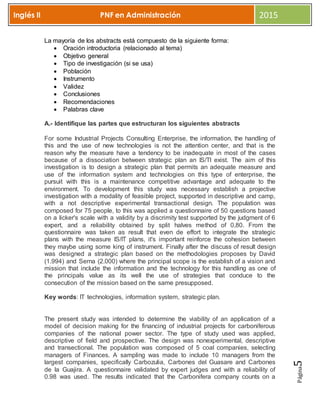
La mayoría de los abstracts está compuesto de la siguiente forma:
 Oración introductoria (relacionado al tema)
 Objetivo general
 Tipo de investigación (si se usa)
 Población
 Instrumento
 Validez
 Conclusiones
 Recomendaciones
 Palabras clave
A.- Identifique las partes que estructuran los siguientes abstracts
For some Industrial Projects Consulting Enterprise, the information, the handling of
this and the use of new technologies is not the attention center, and that is the
reason why the measure have a tendency to be inadequate in most of the cases
because of a dissociation between strategic plan an IS/TI exist. The aim of this
investigation is to design a strategic plan that permits an adequate measure and
use of the information system and technologies on this type of enterprise, the
pursuit with this is a maintenance competitive advantage and adequate to the
environment. To development this study was necessary establish a projective
investigation with a modality of feasible project, supported in descriptive and camp,
with a not descriptive experimental transactional design. The population was
composed for 75 people, to this was applied a questionnaire of 50 questions based
on a licker's scale with a validity by a discrimity test supported by the judgment of 6
expert, and a reliability obtained by split halves method of 0,80. From the
questionnaire was taken as result that even de effort to integrate the strategic
plans with the measure IS/IT plans, it's important reinforce the cohesion between
they maybe using some king of instrument. Finally after the discuss of result design
was designed a strategic plan based on the methodologies proposes by David
(1.994) and Serna (2.000) where the principal scope is the establish of a vision and
mission that include the information and the technology for this handling as one of
the principals value as its well the use of strategies that conduce to the
consecution of the mission based on the same presupposed.
Key words: IT technologies, information system, strategic plan.
The present study was intended to determine the viability of an application of a
model of decision making for the financing of industrial projects for carboniferous
companies of the national power sector. The type of study used was applied,
descriptive of field and prospective. The design was nonexperimental, descriptive
and transectional. The population was composed of 5 coal companies, selecting
managers of Finances. A sampling was made to include 10 managers from the
largest companies, specifically Carbozulia, Carbones del Guasare and Carbones
de la Guajira. A questionnaire validated by expert judges and with a reliability of
0.98 was used. The results indicated that the Carbonifera company counts on a
Página6
Inglés II PNF en Administración 2015
favorable balance between costs and benefits, that technology and personel are
specialized in this area and are able to implement the decision model. Technology
and psycho-social parameters determine that the application of the model has
economic viability. Also, certain administrative and legal procedures are required to
accomplish the results.
Key words: decision making, industrial projects, carboniferous companies.
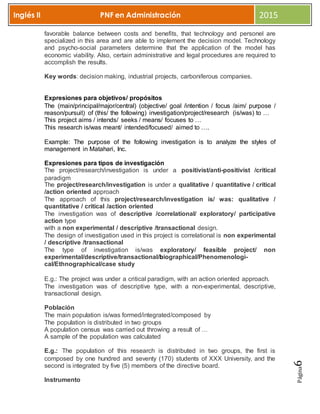
Expresiones para objetivos/ propósitos
The (main/principal/major/central) (objective/ goal /intention / focus /aim/ purpose /
reason/pursuit) of (this/ the following) investigation/project/research (is/was) to …
This project aims / intends/ seeks / means/ focuses to …
This research is/was meant/ intended/focused/ aimed to ….
Example: The purpose of the following investigation is to analyze the styles of
management in Matahari, Inc.
Expresiones para tipos de investigación
The project/research/investigation is under a positivist/anti-positivist /critical
paradigm
The project/research/investigation is under a qualitative / quantitative / critical
/action oriented approach
The approach of this project/research/investigation is/ was: qualitative /
quantitative / critical /action oriented
The investigation was of descriptive /correlational/ exploratory/ participative
action type
with a non experimental / descriptive /transactional design.
The design of investigation used in this project is correlational is non experimental
/ descriptive /transactional
The type of investigation is/was exploratory/ feasible project/ non
experimental/descriptive/transactional/biographical/Phenomenologi-
cal/Ethnographical/case study
E.g.: The project was under a critical paradigm, with an action oriented approach.
The investigation was of descriptive type, with a non-experimental, descriptive,
transactional design.
Población
The main population is/was formed/integrated/composed by
The population is distributed in two groups
A population census was carried out throwing a result of …
A sample of the population was calculated
E.g.: The population of this research is distributed in two groups, the first is
composed by one hundred and seventy (170) students of XXX University, and the
second is integrated by five (5) members of the directive board.
Instrumento
Página7
Inglés II PNF en Administración 2015
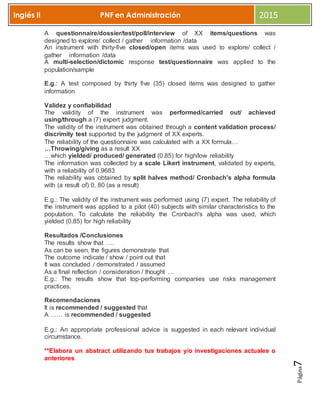
A questionnaire/dossier/test/poll/interview of XX items/questions was
designed to explore/ collect / gather information /data
An instrument with thirty-five closed/open items was used to explore/ collect /
gather information /data
A multi-selection/dictomic response test/questionnaire was applied to the
population/sample
E.g.: A test composed by thirty five (35) closed items was designed to gather
information
Validez y confiabilidad
The validity of the instrument was performed/carried out/ achieved
using/through a (7) expert judgment.
The validity of the instrument was obtained through a content validation process/
discrimity test supported by the judgment of XX experts.
The reliability of the questionnaire was calculated with a XX formula…
…Throwing/giving as a result XX
…which yielded/ produced/ generated (0.85) for high/low reliability
The information was collected by a scale Likert instrument, validated by experts,
with a reliability of 0.9683
The reliability was obtained by split halves method/ Cronbach's alpha formula
with (a result of) 0, 80 (as a result)
E.g.: The validity of the instrument was performed using (7) expert. The reliability of
the instrument was applied to a pilot (40) subjects with similar characteristics to the
population. To calculate the reliability the Cronbach's alpha was used, which
yielded (0.85) for high reliability
Resultados /Conclusiones
The results show that ….
As can be seen, the figures demonstrate that
The outcome indicate / show / point out that
It was concluded / demonstrated / assumed
As a final reflection / consideration / thought …
E.g.: The results show that top-performing companies use risks management
practices.
Recomendaciones
It is recommended / suggested that
A …… is recommended / suggested
E.g.: An appropriate professional advice is suggested in each relevant individual
circumstance.
**Elabora un abstract utilizando tus trabajos y/o investigaciones actuales o
anteriores

Abstract pnfa idiomas ii 2015

  • 1.
    Página1 Inglés II PNFen Administración 2015 TÉCNICA PARA RESUMIR TEXTOS Resumir consiste en expresar con las propias palabras las ideas principales, relevantes, del texto que queremos reducir. Las ideas principales son aquellas que recogen la información relevante; su misión es explicar de qué trata el texto. Elaborar un párrafo que contenga la información relevante es una habilidad ligada a la capacidad de expresión escrita y comprensión lectora de la persona. Cómo hacer un buen resumen El primer paso para hacer un buen resumen consiste en leer cuidadosamente y subrayar la información más significativa. Debemos comprender el texto, buscar un enunciado con la idea principal. Hay que prestar especial atención en la introducción y conclusión del texto ya que normalmente, en estas dos partes, aparecen las principales ideas. El segundo paso consiste en realizar un esquema que reúna las ideas más destacadas del texto. No debemos distraernos con ejemplos o detalles ya que el esquema debe servirnos para redactar brevemente el contenido importante del texto utilizando nuestro propio vocabulario. Debemos ser objetivos cuando realizamos un resumen. Observa antes de leer. Observa con detenimiento, de principio a fin, la estructura del texto. ¿Hay títulos? ¿Hay subtítulos? ¿Cuántos párrafos tiene el texto? En títulos y subtítulos, ¿hay alguna referencia a numeración de información? ¿Qué relación hay entre ese número y la cantidad subsiguiente de párrafos? o ¿Cuál es la organización de la información?: o ¿descripción?, (atención a los verbos there is, there are, has, have) ¿enumeración? (atención a los marcadores de enumeración, como: first, second, third, then, finally…), o ¿causa efecto? (atención a los marcadores de causa-efecto, como: because, since, owing to, therefore, consequently, as a consequence …), o ¿contraste de ideas? (¡atención a los marcadores de oposición, como: although, on the one hand, … on the other (hand), however, whereas, …). No puede “escaparse” información relevante si ya tenemos en mente el “plano” o “esqueleto” del texto.
  • 2.
    Página2 Inglés II PNFen Administración 2015 El tercer paso es redactar con nuestras propias palabras las ideas destacadas del texto. Debemos recordar que hay que evitar utilizar enunciados que digan que estamos ante un resumen, encabezados, ejemplos, ilustraciones o tablas, así como información no incluida en el texto original. Un resumen debe ser claro y breve, contener las ideas principales. Tiene que servir para comprender mejor un texto con una sola lectura. 1 Practicing Ethical Practices In 2002, a series of business scandals came to dominate the news. Senior managers at Arthur Andersen, WorldCom, Adelphia Communications, and Imclone Systems faced criminal charges brought by the U.S. Justice Department. Executives at AOL, Computer Associates, Enron, Global Crossing, and Qwest were under criminal investigation. The charges involved securities fraud, insider trading and other illegal transactions, and obstruction of justice as well as improper accounting procedures. As a result of these and other cases, investors came to distrust the sales and profit figures that many companies were issuing because of so-called aggressive accounting practices. Today’s competitiveness and the drive for profits have been blamed for an upswing in bad behavior in business. However, dishonesty and greed have been around as long as business itself—longer, in fact. Although the vast majority of businesspeople are honest, managers in particular must engage in and tolerate only completely ethical practices. This is true for three reasons: First, managers, especially senior managers, hold a position of trust as stewards of the company for the stockholders, employees, customers, and community. Second, managers have the most opportunity to enrich themselves at the expense of the stockholders, employees, customers, and community. Third, managers set the standard for the entire company. If they are fudging their numbers, how can they expect honest numbers from their subordinates? Summary In 2002, a series of business scandals came to dominate the news. The charges involved securities fraud, insider trading and other illegal transactions, and obstruction of justice as well as improper accounting procedures. As a result, investors came to distrust the sales and profit figures that many companies were issuing. Today’s competitiveness and the drive for profits have been blamed for an upswing in bad behavior in business. Consequently, managers in particular must engage in and tolerate only completely ethical practices. This is true for three reasons: First, managers, hold a position of trust. Second, managers have the most opportunity to enrich themselves. Third and last, managers set the standard for the entire company.
  • 3.
    Página3 Inglés II PNFen Administración 2015 2 There are several different leadership styles that can be identified within each of the following Management techniques. Each technique has its own set of good and not-so- good characteristics, and each uses leadership in a different way. The Autocrat The autocratic leader dominates team-members, using unilateralism to achieve a singular objective. This approach to leadership generally results in passive resistance from team- members and requires continual pressure and direction from the leader in order to get things done. Generally, an authoritarian approach is not a good way to get the best performance from a team. There are, however, some instances where an autocratic style of leadership may not be inappropriate. Some situations may call for urgent action, and in these cases an autocratic style of leadership may be best. In addition, most people are familiar with autocratic leadership and therefore have less trouble adopting that style. Furthermore, in some situations, sub-ordinates may actually prefer an autocratic style. The Laissez-Faire Manager The Laissez-Faire manager exercises little control over his group, leaving them to sort out their roles and tackle their work, without participating in this process himself. In general, this approach leaves the team floundering with little direction or motivation. Again, there are situations where the Laissez-Faire approach can be effective. The Laissez- Faire technique is usually only appropriate when leading a team of highly motivated and skilled people, who have produced excellent work in the past. Once a leader has established that his team is confident, capable and motivated, it is often best to step back and let them get on with the task, since interfering can generate resentment and detract from their effectiveness. By handing over ownership, a leader can empower his group to achieve their goals. The Democrat The democratic leader makes decisions by consulting his team, whilst still maintaining control of the group. The democratic leader allows his team to decide how the task will be tackled and who will perform which task. The democratic leader can be seen in two lights: A good democratic leader encourages participation and delegates wisely, but never loses sight of the fact that he bears the crucial responsibility of leadership. He values group discussion and input from his team and can be seen as drawing from a pool of his team members' strong points in order to obtain the best performance from his team. He motivates his team by empowering them to direct themselves, and guides them with a loose reign. However, the democrat can also be seen as being so unsure of himself and his relationship with his sub-ordinates that everything is a matter for group discussion and decision. Clearly, this type of "leader" is not really leading at all.
  • 4.
    Página4 Inglés II PNFen Administración 2015 _________________________________________________________________________ _________________________________________________________________________ _________________________________________________________________________ _________________________________________________________________________ _________________________________________________________________________ _________________________________________________________________________ _________________________________________________________________________ _________________________________________________________________________ _________________________________________________________________________ AAABBBSSSTTTRRRAAACCCTTT Escribir un buen abstract siempre ha sido muy importante. Sin embargo, ahora cobra mayor trascendencia, debido al crecimiento de las publicaciones en línea, sabiendo que muchos de ellos contienen solamente abstracts. Los abstracts tienen como función principal, “vender” el trabajo realizado. Ahora, además de convencer al lector para leer la totalidad del escrito, el abstract debe convencer al lector para que con precisión, logre ampliar la información del escrito, con vínculos relacionados en la red para ganar información correlacionada. Con el diluvio de información actual, muchos ejecutivos e intelectuales, no tiene tiempo sino para abordar los abstracts de las publicaciones. Un abstract es un breve, apropiado y comprensivo resumen de un artículo, contenido académico o científico. Si bien, el abstract se ubica al inicio del artículo, debería ser la última sección que se escribe. El abstract debe guardar la misma estructura del artículo. El abstract debe ser tan conciso y concreto que le permita al lector leer o no, el contenido completo del artículo o de la investigación propuesta. El abstract cobra vigencia en las universidades e instituciones educativas, figurando en cada una de las asignaturas o cursos realizados para certificar a quien solicita los contenidos atendidos en la institución. Como escribir un abstract informativo alabras claves, estadísticas y datos importantes que usted necesita incluir. parecerá ...” inadecuados. publicación final.
  • 5.
    Página5 Inglés II PNFen Administración 2015 La mayoría de los abstracts está compuesto de la siguiente forma:  Oración introductoria (relacionado al tema)  Objetivo general  Tipo de investigación (si se usa)  Población  Instrumento  Validez  Conclusiones  Recomendaciones  Palabras clave A.- Identifique las partes que estructuran los siguientes abstracts For some Industrial Projects Consulting Enterprise, the information, the handling of this and the use of new technologies is not the attention center, and that is the reason why the measure have a tendency to be inadequate in most of the cases because of a dissociation between strategic plan an IS/TI exist. The aim of this investigation is to design a strategic plan that permits an adequate measure and use of the information system and technologies on this type of enterprise, the pursuit with this is a maintenance competitive advantage and adequate to the environment. To development this study was necessary establish a projective investigation with a modality of feasible project, supported in descriptive and camp, with a not descriptive experimental transactional design. The population was composed for 75 people, to this was applied a questionnaire of 50 questions based on a licker's scale with a validity by a discrimity test supported by the judgment of 6 expert, and a reliability obtained by split halves method of 0,80. From the questionnaire was taken as result that even de effort to integrate the strategic plans with the measure IS/IT plans, it's important reinforce the cohesion between they maybe using some king of instrument. Finally after the discuss of result design was designed a strategic plan based on the methodologies proposes by David (1.994) and Serna (2.000) where the principal scope is the establish of a vision and mission that include the information and the technology for this handling as one of the principals value as its well the use of strategies that conduce to the consecution of the mission based on the same presupposed. Key words: IT technologies, information system, strategic plan. The present study was intended to determine the viability of an application of a model of decision making for the financing of industrial projects for carboniferous companies of the national power sector. The type of study used was applied, descriptive of field and prospective. The design was nonexperimental, descriptive and transectional. The population was composed of 5 coal companies, selecting managers of Finances. A sampling was made to include 10 managers from the largest companies, specifically Carbozulia, Carbones del Guasare and Carbones de la Guajira. A questionnaire validated by expert judges and with a reliability of 0.98 was used. The results indicated that the Carbonifera company counts on a
  • 6.
    Página6 Inglés II PNFen Administración 2015 favorable balance between costs and benefits, that technology and personel are specialized in this area and are able to implement the decision model. Technology and psycho-social parameters determine that the application of the model has economic viability. Also, certain administrative and legal procedures are required to accomplish the results. Key words: decision making, industrial projects, carboniferous companies. Expresiones para objetivos/ propósitos The (main/principal/major/central) (objective/ goal /intention / focus /aim/ purpose / reason/pursuit) of (this/ the following) investigation/project/research (is/was) to … This project aims / intends/ seeks / means/ focuses to … This research is/was meant/ intended/focused/ aimed to …. Example: The purpose of the following investigation is to analyze the styles of management in Matahari, Inc. Expresiones para tipos de investigación The project/research/investigation is under a positivist/anti-positivist /critical paradigm The project/research/investigation is under a qualitative / quantitative / critical /action oriented approach The approach of this project/research/investigation is/ was: qualitative / quantitative / critical /action oriented The investigation was of descriptive /correlational/ exploratory/ participative action type with a non experimental / descriptive /transactional design. The design of investigation used in this project is correlational is non experimental / descriptive /transactional The type of investigation is/was exploratory/ feasible project/ non experimental/descriptive/transactional/biographical/Phenomenologi- cal/Ethnographical/case study E.g.: The project was under a critical paradigm, with an action oriented approach. The investigation was of descriptive type, with a non-experimental, descriptive, transactional design. Población The main population is/was formed/integrated/composed by The population is distributed in two groups A population census was carried out throwing a result of … A sample of the population was calculated E.g.: The population of this research is distributed in two groups, the first is composed by one hundred and seventy (170) students of XXX University, and the second is integrated by five (5) members of the directive board. Instrumento
  • 7.
    Página7 Inglés II PNFen Administración 2015 A questionnaire/dossier/test/poll/interview of XX items/questions was designed to explore/ collect / gather information /data An instrument with thirty-five closed/open items was used to explore/ collect / gather information /data A multi-selection/dictomic response test/questionnaire was applied to the population/sample E.g.: A test composed by thirty five (35) closed items was designed to gather information Validez y confiabilidad The validity of the instrument was performed/carried out/ achieved using/through a (7) expert judgment. The validity of the instrument was obtained through a content validation process/ discrimity test supported by the judgment of XX experts. The reliability of the questionnaire was calculated with a XX formula… …Throwing/giving as a result XX …which yielded/ produced/ generated (0.85) for high/low reliability The information was collected by a scale Likert instrument, validated by experts, with a reliability of 0.9683 The reliability was obtained by split halves method/ Cronbach's alpha formula with (a result of) 0, 80 (as a result) E.g.: The validity of the instrument was performed using (7) expert. The reliability of the instrument was applied to a pilot (40) subjects with similar characteristics to the population. To calculate the reliability the Cronbach's alpha was used, which yielded (0.85) for high reliability Resultados /Conclusiones The results show that …. As can be seen, the figures demonstrate that The outcome indicate / show / point out that It was concluded / demonstrated / assumed As a final reflection / consideration / thought … E.g.: The results show that top-performing companies use risks management practices. Recomendaciones It is recommended / suggested that A …… is recommended / suggested E.g.: An appropriate professional advice is suggested in each relevant individual circumstance. **Elabora un abstract utilizando tus trabajos y/o investigaciones actuales o anteriores