Program and Abstract Book
The 2nd International Conference on
Industrial Electrical andElectronics
(ICIEE)
Virtual Conference
20 – 21 October 2020
Organizer:
Department of Electrical Engineering
Universitas Sultan Ageng Tirtayasa
Technical Co-Sponsor
Supported by:
October 2020
1
Foreword from General Chair
Assalamualaykum warohmatullahi wabarakatuh and Good Day, Ladies and Gentlemen,
In the name of Allah, the Most-Merciful, the All-Compassionate, Praise be to Allah, we seek
His help and His forgiveness. May He send peace and blessings on Prophet Muhammad, his family,
his companions, and his followers until end of the day.
We would like to welcome all participants from academicians, government, and industry to
attend the Second International Conference on Industrial, Electrical and Electronics (ICIEE 2020)
virtually. The health and safety of the ICIEE participants is of paramount importance to the
Committee. Hopefully the pandemic pass soon.
ICIEE 2020 is organized by Department of Electrical Engineering, the Universitas Sultan Ageng
Tirtayasa, supported by FORTEI (Electrical Engineering Higher Education Forum of Indonesia), and
technical sponsored by IEEE Indonesia Section.
This conference is a great event in the field of Industrial, Electrical and Electronics. World
Class Speakers are scheduled to deliver speech on hot topics in data science so as it can be beneficial
to all delegates.
On behalf of the organizing committee, I would like to express my sincere gratitude and
appreciation to all participants for joining this virtual conference to share and present your research
findings. We are also indebted to all the international reviewers for helping us in reviewing all the
papers for ensuring high quality of all the accepted papers. I would like to thanks all sponsorships for
their valuable supports. We believe that the conference will be a key stage to improve our research
and show great development to the world in the field of industrial, electrical, electronics and
information technology
I would also like to extend my thanks to all the organizing committee for working very hard
to make this conference as today and record my personal apology for any shortcomings. Any
recommendations and suggestions for improvement are very much appreciated and most welcome.
I believe this international event can encourage our spirit to move on a better condition as well as
expand our collaboration and networking.
Thank you.
Wassalamualaykum warohmatullahi wabarakatuh
Associate Professor Dr. Supriyanto, M.Sc., IPM.
General Chair ICIEE 2020
October 2020
2
Foreword from Rector Universitas Sultan Ageng Tirtayasa
It is our great pleasure to join and to welcome all participants of the Second
International Conference on Industrial, Electrical and Electronics (ICIEE 2020) virtually. I
am happy to see this great work of the Department of Electrical Engineering on organizing
this international event.
On this occasion, I would like to congratulate all participants for their scientific
involvement and willingness to share their findings in this conference. I believe that this
conference can play an important role to encourage and embrace cooperative, collaborative,
and interdisciplinary research among the engineers and scientists especially on the theme of
data science.
I do expect that this kind of similar event will be held in the future by other
department within UNTIRTA as part of activities in education research and social
responsibilities of universities, research institutions, and industries internationally. My
heartful gratitude is dedicated to Organizing Committee members and the students of
Department of Electrical Engineering for their generous effort and contribution toward the
success of ICIEE 2020.
Thank you.
Wassalamualaykum warohmatullahi wabarakatuh
Prof. Dr. H. Fatah Sulaiman, ST., MT.
Rector of Universitas Sultan Ageng Tirtayasa.
Indonesia.
October 2020
3
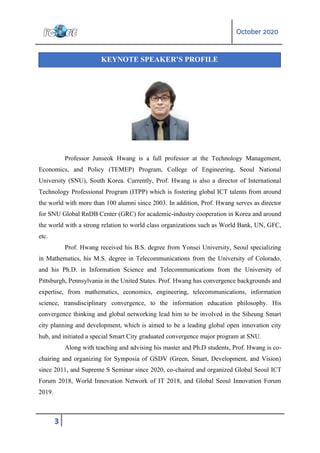
Professor Junseok Hwang is a full professor at the Technology Management,
Economics, and Policy (TEMEP) Program, College of Engineering, Seoul National
University (SNU), South Korea. Currently, Prof. Hwang is also a director of International
Technology Professional Program (ITPP) which is fostering global ICT talents from around
the world with more than 100 alumni since 2003. In addition, Prof. Hwang serves as director
for SNU Global RnDB Center (GRC) for academic-industry cooperation in Korea and around
the world with a strong relation to world class organizations such as World Bank, UN, GFC,
etc.
Prof. Hwang received his B.S. degree from Yonsei University, Seoul specializing
in Mathematics, his M.S. degree in Telecommunications from the University of Colorado,
and his Ph.D. in Information Science and Telecommunications from the University of
Pittsburgh, Pennsylvania in the United States. Prof. Hwang has convergence backgrounds and
expertise, from mathematics, economics, engineering, telecommunications, information
science, transdisciplinary convergence, to the information education philosophy. His
convergence thinking and global networking lead him to be involved in the Siheung Smart
city planning and development, which is aimed to be a leading global open innovation city
hub, and initiated a special Smart City graduated convergence major program at SNU.
Along with teaching and advising his master and Ph.D students, Prof. Hwang is co-
chairing and organizing for Symposia of GSDV (Green, Smart, Development, and Vision)
since 2011, and Supreme S Seminar since 2020, co-chaired and organized Global Seoul ICT
Forum 2018, World Innovation Network of IT 2018, and Global Seoul Innovation Forum
2019.
KEYNOTE SPEAKER’S PROFILE
October 2020
4
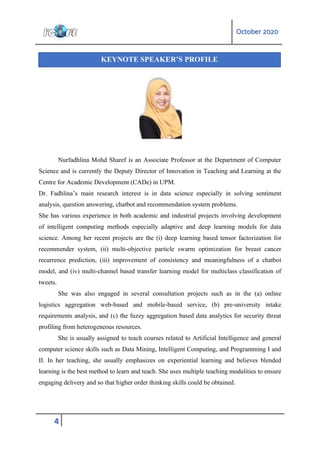
Nurfadhlina Mohd Sharef is an Associate Professor at the Department of Computer
Science and is currently the Deputy Director of Innovation in Teaching and Learning at the
Centre for Academic Development (CADe) in UPM.
Dr. Fadhlina’s main research interest is in data science especially in solving sentiment
analysis, question answering, chatbot and recommendation system problems.
She has various experience in both academic and industrial projects involving development
of intelligent computing methods especially adaptive and deep learning models for data
science. Among her recent projects are the (i) deep learning based tensor factorization for
recommender system, (ii) multi-objective particle swarm optimization for breast cancer
recurrence prediction, (iii) improvement of consistency and meaningfulness of a chatbot
model, and (iv) multi-channel based transfer learning model for multiclass classification of
tweets.
She was also engaged in several consultation projects such as in the (a) online
logistics aggregation web-based and mobile-based service, (b) pre-university intake
requirements analysis, and (c) the fuzzy aggregation based data analytics for security threat
profiling from heterogeneous resources.
She is usually assigned to teach courses related to Artificial Intelligence and general
computer science skills such as Data Mining, Intelligent Computing, and Programming I and
II. In her teaching, she usually emphasizes on experiential learning and believes blended
learning is the best method to learn and teach. She uses multiple teaching modalities to ensure
engaging delivery and so that higher order thinking skills could be obtained.
KEYNOTE SPEAKER’S PROFILE
October 2020
5
Prof. Richardus Eko Indrajit was born in Jakarta, Indonesia, January, 24th 1969. Graduated from
Surabaya Institute of Technology as Computer Engineer in 1992 and received full scholarship from Pertamina
Oil Company to finish his study as Master of Applied Computer Science at Harvard University, Massachusetts,
USA. He is also a holder of Master of Business Administration from Leicester University, United Kingdom,
Master of Communication from London School of Public Relations – Jakarta, and Master of Philosophy from
Masstricht School of Management, the Netherlands.
His Doctor of Business Administration degree was from Pamantasan ng Lungsod ng Maynila
(University of the City of Manila), the Philippines. He started his business, management, and information
technology practices in Price Waterhouse Indonesia as Senior Consultant before joining several prominent
corporations such as: Prosys Bangun Nusantara – Cap Gemini Consulting, Renaissance Indonesia, the Jakarta
Consulting Group, Soedarpo Informatika Enterprise, and IndoConsult Utama. As an academician, he has been
appointed as Chairman of Perbanas School of Information System and Technology, Research Director of Swiss-
German University, and participated as active faculty members in several universities, which are: University of
Indonesia, Atma Jaya Catholic University, Bina Nusantara University – Curtin University of Technology,
Trisakti University – Edith Cowan University, and IPMI – Monash University. Currently he is the President of
the Association of Higher Learning Institution in Computing and Information Technology Studies. Leading more
than 700 universities and 1,500 program of studies all over the nation. He is also known as a President of
International Association of Software Architect – Indonesian Chapter.
In government sector, he has been asssigned as a special staff and advisor to various institutions, such
as: Secretary General of National Auditing Board, Ministry of Communication and Information Technology,
National Defense Board (Lemhannas), National Narcotics Body, and Central Bank of Indonesia – before finally
appointed as the first Chairman of ID-SIRTII (Indonesia Security Incidents Response Team on Internet
Infrastructure). He is also assigned by the government of Indonesia to become the member of the Board of
National Educational Standard (BSNP-Ministry of Education), the Board of Indonesian Professional
Certification Authority (BNSPMinistry of Labour and Transmigration), and the Board of National Research
Council (DRN-Ministry of Research and Technology).
He has been actively publishing more than 30 books and hundreds of national journals in the area of
business, management, and information technology – most are coming from his experiences of practicing his
knowledge and skills in different fields: banking and finance, telecommunication, manufacture, retail and
distribution, aviation, oil and gas, transportation, education, healthcare, and other service-based industries.
KEYNOTE SPEAKER’S PROFILE
October 2020
6
Program Committee
1. Prof. Dr. Bernd Noche (Universitat Duisburg Essen, Germany)
2. Prof. Manuchehr Soleimani (University of Bath, United Kingdom)
3. Prof. Elhadj Dogheche (Université Polytechnique Hauts-de-France, France)
4. Dr Ali Abdulrazzaq (University of Mosul, Iraq)
5. Assoc. Prof. Tofael Ahamed (Tsukuba University, Japan)
6. Prof. Rosni Abdullah (Universiti Sains Malaysia, Malaysia)
7. Dr. Raja Kumar Murugesan (Taylor's University, Malaysia)
8. Shafiq Ul Rehman Ph.D (Singapore University of Technology and Design, Singapore)
9. Dr. Leau Yu Beng (Universiti Malaysia Sabah, Malaysia)
10. Prof. Dr.-Ing Hendro Wicaksono (Jacobs University, Germany)
11. Prof. Dr.-Ing. Mudrik Alaydrus (Universitas Mercu Buana, Indonesia)
12. Azlan Osman (Universiti Sains Malaysia, Malaysia)
13. Prof. Dr. Eng. Wisnu Jatmiko S.T., M.Kom. (Universitas Indonesia, Indonesia)
14. Prof. Dr. Rer.Pol.Ir.H.Didik Notosudjono Msc. (Universitas Pakuan, Indonesia)
15. Dr. Arbai Yusuf (C-Tech Labs Edwar Technology, Indonesia)
16. Prof. Dr. Wahyu Widada (Indonesian National Institute of Aeronautics and Space, Indonesia)
17. Prof. Dr. Tumiran (Gadjah Mada University, Indonesia)
18. Prof. Dr. Samsir Abduh (Universitas Trisakti, Indonesia)
19. Ikhwana Elfitri, Ph.D. (Universitas Andalas, Indonesia)
20. Prof. Ir. Sunarno, M.Eng., Ph.D. (Universitas Gadjah Mada, Indonesia)
21. Ir. Gunawan Wibisono, M.Sc., Ph.D. (Universitas Indonesia, Indonesia)
22. Iznan H. Hasbullah (Universiti Sains Malaysia, Malaysia)
23. Muhammad Reza, Ph.D. (Telkom University, Indonesia)
24. Dr. Ir. Yuyu Wahyu, MT. (Indonesian Institute of Science, Indonesia)
25. Dr. Eng. Muhammad Ilhamdi Rusydi (Universitas Andalas, Indonesia)
26. Dr. Marlin Baidillah (Chiba University, Japan)
27. Dr. Ir. Sholeh Hadi Pramono (Universitas Brawijaya, Indonesia)
28. Dr. Ali Hanafiah Rambe, S.T., M.T. (Universitas Sumatera Utara, Indonesia)
29. Dr. Hermawan, DEA. (Universitas Diponegoro, Indonesia)
30. Dr. Ir. Yuli Kurnia Ningsih, MT. (Universitas Trisakti, Indonesia)
October 2020
7
Organizing Committee
Honorary Chair
Prof. Dr. H. Fatah Sulaiman, ST, MT.
Rector – Universitas Sultan Ageng Tirtayasa
General Chair
Dr. Ir. Supriyanto, M.Sc., IPM
General Co-Chair
Anggoro Suryo Pramudyo, M.Kom.
Finance Chair and Treasure
Ceri Ahendyarti, M.Eng.
Publication Chair
1. Dr. Romi Wiryadinata, M.Eng.
2. Fadil Muhammad, M.T.
3. Cakra Adipura Wicaksana, M.T.
Program Chair
Dr. Ir. Wahyuni Martiningsih, M.T.
Technical Program Chair
1. Dr.-Ing. M. Iman Santoso, M.Sc.
2. Dr. Irma Saraswati, M.T.
3. Dr. Alimuddin, M.T.
Registration Chair
Masjudin, M.Eng.
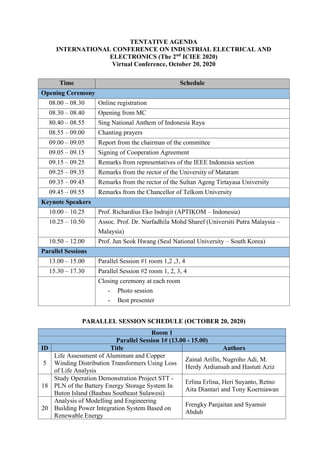
TENTATIVE AGENDA
INTERNATIONAL CONFERENCE ON INDUSTRIAL ELECTRICAL AND
ELECTRONICS (The 2nd
ICIEE 2020)
Virtual Conference, October 20, 2020
Time Schedule
Opening Ceremony
08.00 – 08.30 Online registration
08.30 – 08.40 Opening from MC
80.40 – 08.55 Sing National Anthem of Indonesia Raya
08.55 – 09.00 Chanting prayers
09.00 – 09.05 Report from the chairman of the committee
09.05 – 09.15 Signing of Cooperation Agreement
09.15 – 09.25 Remarks from representatives of the IEEE Indonesia section
09.25 – 09.35 Remarks from the rector of the University of Mataram
09.35 – 09.45 Remarks from the rector of the Sultan Ageng Tirtayasa University
09.45 – 09.55 Remarks from the Chancellor of Telkom University
Keynote Speakers
10.00 – 10.25 Prof. Richardius Eko Indrajit (APTIKOM – Indonesia)
10.25 – 10.50 Assoc. Prof. Dr. Nurfadhila Mohd Sharef (Universiti Putra Malaysia –
Malaysia)
10.50 – 12.00 Prof. Jun Seok Hwang (Seul National University – South Korea)
Parallel Sessions
13.00 – 15.00 Parallel Session #1 room 1,2 ,3, 4
15.30 – 17.30 Parallel Session #2 room 1, 2, 3, 4
Closing ceremony at each room
- Photo session
- Best presenter
PARALLEL SESSION SCHEDULE (OCTOBER 20, 2020)
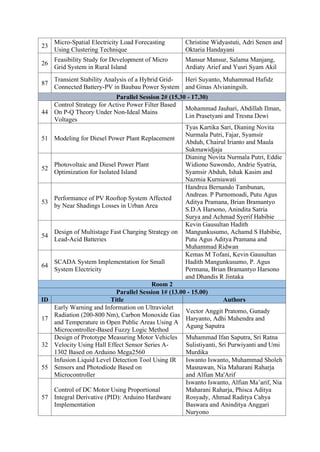
Room 1
Parallel Session 1# (13.00 - 15.00)
ID Title Authors
5
Life Assessment of Aluminum and Copper
Winding Distribution Transformers Using Loss
of Life Analysis
Zainal Arifin, Nugroho Adi, M.
Herdy Ardiansah and Hastuti Aziz
18
Study Operation Demonstration Project STT -
PLN of the Battery Energy Storage System In
Buton Island (Baubau Southeast Sulawesi)
Erlina Erlina, Heri Suyanto, Retno
Aita Diantari and Tony Koerniawan
20
Analysis of Modelling and Engineering
Building Power Integration System Based on
Renewable Energy
Frengky Panjaitan and Syamsir
Abduh
23
Micro-Spatial Electricity Load Forecasting
Using Clustering Technique
Christine Widyastuti, Adri Senen and
Oktaria Handayani
26
Feasibility Study for Development of Micro
Grid System in Rural Island
Mansur Mansur, Salama Manjang,
Ardiaty Arief and Yusri Syam Akil
87
Transient Stability Analysis of a Hybrid Grid-
Connected Battery-PV in Baubau Power System
Heri Suyanto, Muhammad Hafidz
and Ginas Alvianingsih.
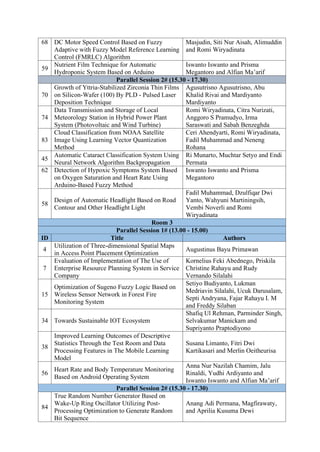
Parallel Session 2# (15.30 - 17.30)
44
Control Strategy for Active Power Filter Based
On P-Q Theory Under Non-Ideal Mains
Voltages
Mohammad Jauhari, Abdillah Ilman,
Lin Prasetyani and Tresna Dewi
51 Modeling for Diesel Power Plant Replacement
Tyas Kartika Sari, Dianing Novita
Nurmala Putri, Fajar, Syamsir
Abduh, Chairul Irianto and Maula
Sukmawidjaja
52
Photovoltaic and Diesel Power Plant
Optimization for Isolated Island
Dianing Novita Nurmala Putri, Eddie
Widiono Suwondo, Andrie Syatria,
Syamsir Abduh, Ishak Kasim and
Nazmia Kurniawati
53
Performance of PV Rooftop System Affected
by Near Shadings Losses in Urban Area
Handrea Bernando Tambunan,
Andreas. P Purnomoadi, Putu Agus
Aditya Pramana, Brian Bramantyo
S.D.A Harsono, Anindita Satria
Surya and Achmad Syerif Habibie
54
Design of Multistage Fast Charging Strategy on
Lead-Acid Batteries
Kevin Gausultan Hadith
Mangunkusumo, Achamd S Habibie,
Putu Agus Aditya Pramana and
Muhammad Ridwan
64
SCADA System Implementation for Small
System Electricity
Kemas M Tofani, Kevin Gausultan
Hadith Mangunkusumo, P. Agus
Permana, Brian Bramantyo Harsono
and Dhandis R Jintaka
Room 2
Parallel Session 1# (13.00 - 15.00)
ID Title Authors
17
Early Warning and Information on Ultraviolet
Radiation (200-800 Nm), Carbon Monoxide Gas
and Temperature in Open Public Areas Using A
Microcontroller-Based Fuzzy Logic Method
Vector Anggit Pratomo, Gunady
Haryanto, Adhi Mahendra and
Agung Saputra
32
Design of Prototype Measuring Motor Vehicles
Velocity Using Hall Effect Sensor Series A-
1302 Based on Arduino Mega2560
Muhammad Ifan Saputra, Sri Ratna
Sulistiyanti, Sri Purwiyanti and Umi
Murdika
55
Infusion Liquid Level Detection Tool Using IR
Sensors and Photodiode Based on
Microcontroller
Iswanto Iswanto, Muhammad Sholeh
Masnawan, Nia Maharani Raharja
and Alfian Ma'Arif
57
Control of DC Motor Using Proportional
Integral Derivative (PID): Arduino Hardware
Implementation
Iswanto Iswanto, Alfian Ma’arif, Nia
Maharani Raharja, Phisca Aditya
Rosyady, Ahmad Raditya Cahya
Baswara and Aninditya Anggari
Nuryono
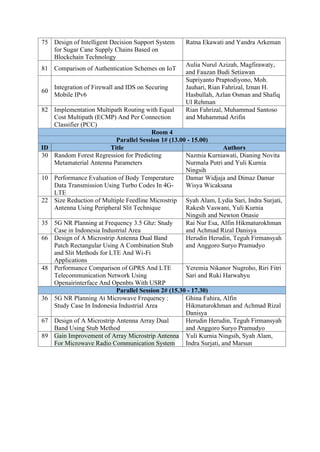
68 DC Motor Speed Control Based on Fuzzy
Adaptive with Fuzzy Model Reference Learning
Control (FMRLC) Algorithm
Masjudin, Siti Nur Aisah, Alimuddin
and Romi Wiryadinata
59
Nutrient Film Technique for Automatic
Hydroponic System Based on Arduino
Iswanto Iswanto and Prisma
Megantoro and Alfian Ma’arif
Parallel Session 2# (15.30 - 17.30)
70
Growth of Yttria-Stabilized Zirconia Thin Films
on Silicon-Wafer (100) By PLD - Pulsed Laser
Deposition Technique
Agusutrisno Agusutrisno, Abu
Khalid Rivai and Mardiyanto
Mardiyanto
74
Data Transmission and Storage of Local
Meteorology Station in Hybrid Power Plant
System (Photovoltaic and Wind Turbine)
Romi Wiryadinata, Citra Nurizati,
Anggoro S Pramudyo, Irma
Saraswati and Sabah Benzeghda
83
Cloud Classification from NOAA Satellite
Image Using Learning Vector Quantization
Method
Ceri Ahendyarti, Romi Wiryadinata,
Fadil Muhammad and Neneng
Rohana
45
Automatic Cataract Classification System Using
Neural Network Algorithm Backpropagation
Ri Munarto, Muchtar Setyo and Endi
Permata
62 Detection of Hypoxic Symptoms System Based
on Oxygen Saturation and Heart Rate Using
Arduino-Based Fuzzy Method
Iswanto Iswanto and Prisma
Megantoro
58
Design of Automatic Headlight Based on Road
Contour and Other Headlight Light
Fadil Muhammad, Dzulfiqar Dwi
Yanto, Wahyuni Martiningsih,
Vembi Noverli and Romi
Wiryadinata
Room 3
Parallel Session 1# (13.00 - 15.00)
ID Title Authors
4
Utilization of Three-dimensional Spatial Maps
in Access Point Placement Optimization
Augustinus Bayu Primawan
7
Evaluation of Implementation of The Use of
Enterprise Resource Planning System in Service
Company
Kornelius Feki Abednego, Priskila
Christine Rahayu and Rudy
Vernando Silalahi
15
Optimization of Sugeno Fuzzy Logic Based on
Wireless Sensor Network in Forest Fire
Monitoring System
Setiyo Budiyanto, Lukman
Medriavin Silalahi, Ucuk Darusalam,
Septi Andryana, Fajar Rahayu I. M
and Freddy Silaban
34 Towards Sustainable IOT Ecosystem
Shafiq Ul Rehman, Parminder Singh,
Selvakumar Manickam and
Supriyanto Praptodiyono
38
Improved Learning Outcomes of Descriptive
Statistics Through the Test Room and Data
Processing Features in The Mobile Learning
Model
Susana Limanto, Fitri Dwi
Kartikasari and Merlin Oeitheurisa
56
Heart Rate and Body Temperature Monitoring
Based on Android Operating System
Anna Nur Nazilah Chamim, Jalu
Rinaldi, Yudhi Ardiyanto and
Iswanto Iswanto and Alfian Ma’arif
Parallel Session 2# (15.30 - 17.30)
84
True Random Number Generator Based on
Wake-Up Ring Oscillator Utilizing Post-
Processing Optimization to Generate Random
Bit Sequence
Anang Adi Permana, Magfirawaty,
and Aprilia Kusuma Dewi
75 Design of Intelligent Decision Support System
for Sugar Cane Supply Chains Based on
Blockchain Technology
Ratna Ekawati and Yandra Arkeman
81 Comparison of Authentication Schemes on IoT
Aulia Nurul Azizah, Magfirawaty,
and Fauzan Budi Setiawan
60
Integration of Firewall and IDS on Securing
Mobile IPv6
Supriyanto Praptodiyono, Moh.
Jauhari, Rian Fahrizal, Iznan H.
Hasbullah, Azlan Osman and Shafiq
Ul Rehman
82 Implementation Multipath Routing with Equal
Cost Multipath (ECMP) And Per Connection
Classifier (PCC)
Rian Fahrizal, Muhammad Santoso
and Muhammad Arifin
Room 4
Parallel Session 1# (13.00 - 15.00)
ID Title Authors
30 Random Forest Regression for Predicting
Metamaterial Antenna Parameters
Nazmia Kurniawati, Dianing Novita
Nurmala Putri and Yuli Kurnia
Ningsih
10 Performance Evaluation of Body Temperature
Data Transmission Using Turbo Codes In 4G-
LTE
Damar Widjaja and Dimaz Damar
Wisya Wicaksana
22 Size Reduction of Multiple Feedline Microstrip
Antenna Using Peripheral Slit Technique
Syah Alam, Lydia Sari, Indra Surjati,
Rakesh Vaswani, Yuli Kurnia
Ningsih and Newton Onasie
35 5G NR Planning at Frequency 3.5 Ghz: Study
Case in Indonesia Industrial Area
Rai Nur Esa, Alfin Hikmaturokhman
and Achmad Rizal Danisya
66 Design of A Microstrip Antenna Dual Band
Patch Rectangular Using A Combination Stub
and Slit Methods for LTE And Wi-Fi
Applications
Herudin Herudin, Teguh Firmansyah
and Anggoro Suryo Pramudyo
48 Performance Comparison of GPRS And LTE
Telecommunication Network Using
Openairinterface And Openbts With USRP
Yeremia Nikanor Nugroho, Riri Fitri
Sari and Ruki Harwahyu
Parallel Session 2# (15.30 - 17.30)
36 5G NR Planning At Microwave Frequency :
Study Case In Indonesia Industrial Area
Ghina Fahira, Alfin
Hikmaturokhman and Achmad Rizal
Danisya
67 Design of A Microstrip Antenna Array Dual
Band Using Stub Method
Herudin Herudin, Teguh Firmansyah
and Anggoro Suryo Pramudyo
89 Gain Improvement of Array Microstrip Antenna
For Microwave Radio Communication System
Yuli Kurnia Ningsih, Syah Alam,
Indra Surjati, and Marsun
October 2020
12
Abstracts book
UTILIZATION OF THREE-DIMENSIONAL SPATIAL MAPS IN ACCESS POINT
PLACEMENT OPTIMIZATION
Augustinus Bayu Primawan (Universitas Sanata Dharma Yogyakarta).
Abstract
The placement of access point locations is now a necessity in planning computer networks in
particular wireless networks. In the study of wireless networks, at present, the design and
adjustment approach has replaced the experience-based approach. In some wireless network
planning tools the location map is only used for visualization only, so it needs to be developed for
the calculation of location optimization as well. The use of spatial data has already been applied in
location optimization. Application of optimization techniques in network planning will reduce
costs and time compared to trial and error techniques. Spatial location data still uses two-
dimensional data, namely latitude and longitude data. However, spatial location data in three
dimensions have not been widely used in this optimization method. This research implements
three-dimensional spatial data in the location optimization method. In this case, the spatial analysis
of GIS (Geographic Information Systems) will be useful for predicting coverage and signal
strength. Integrating spatial data analysis and programming techniques can lead to improvements
in wireless network design. The use of evolutionary algorithms will provide solutions for optimal
access point locations. This approach provides the right solution in design and evaluation. The
results of the optimization of 3-dimensional maps provide better design values compared to 2-
dimensional optimization. This can be seen from the reduction in the number of access points and
the average distance, although this also results in a reduction in the area of coverage.
LIFE ASSESMENT OF ALUMINIUM AND COPPER WINDING DISTRIBUTION
TRANSFORMERS USING LOSS OF LIFE ANALYSIS
Zainal Arifin (PLN / Institut Teknologi PLN Indonesia), Nugroho Adi (PLN Indonesia),
M. Herdy Ardiansah (PLN / Institut Teknologi PLN Indonesia)
Hastuti Aziz (Institut Teknologi PLN Indonesia).
Abstract
In general, the life of distribution transformers is very dependent on the conditions of oil insulation
and winding. Some disturbance conditions and the transformer overloading capacity can cause a
high-temperature rise and accelerate the decrease in insulation level so that the loss of life of the
transformer can be even greater. While the recent population of distribution transformers mostly
consist of Copper(Cu) and Aluminum (Al) winding. Based on that fact, this study determine the
life time of distribution transformers for both technologies. Life assessment is executed using loss
of life analysis due to the disturbance phenomenon called cold load pick up (CLPU) and loading
conditions. Using 79 Cu-Cu and 105 Al-Al distribution transformers installed at PLN UP3
Cengkareng Jakarta, the loss of life is conducted using CLPU algorithm and IEC 60354 and
60076-7 calculation. The result of study found that the life time of copper winding is longer than
aluminium winding transformers. In addition the total owning cost of transformer aluminum is
higher 9% than the copper one.
October 2020
13
EVALUATION OF IMPLEMENTATION OF THE USE OF ENTERPRISE RESOURCE
PLANNING SYSTEM IN SERVICE COMPANY
Kornelius Feki Abednego (Universitas Pelita Harapan), Priskila Christine Rahayu (Universitas Pelita
Harapan) and Rudy Vernando Silalahi (Universitas Pelita Harapan).
Abstract
Periodic evaluations are useful for maintaining and providing feedback for the good of the
company. In this study an evaluation of the enterprise resource planning (ERP) system will be
used for service companies to determine whether the ERP system has been running well as
desired. Therefore, an interview was conducted with IT Development and a questionnaire was
distributed to users. The results of the questionnaire were processed using the importance
performance analysis method and the problematic indicators were language and security. These
dimensions are processed by the fault tree analysis method to find the cause of the problem that
can occur. The results of the analysis were discussed with IT Development and the results of the
discussion obtained suggestions for improvement in the security section by shortening the
automatic logout time on the system, providing initial passwords at random and imposing
sanctions for users who give passwords to others which ultimately harm the company. Whereas for
the language section, suggestions are given in the form of a portal that is connected to the system
where the language used in the portal is more easily understood by users and improves
communication with users so that all information that is given is conveyed well to the user.
PERFORMANCE EVALUATION OF BODY TEMPERATURE DATA TRANSMISSION
USING TURBO CODES IN 4G-LTE
Damar Widjaja (Sanata Dharma University)
Dimaz Damar Wisya Wicaksana (Sanata Dharma University).
Abstract
The main problem in the telecommunication system, such as 4G-LTE, is transmission error that is
occurred due to channel noise and interference. The solution of this problem is using error control
coding. Error control coding needs good channel coding in order to have good performance of data
transmission. Turbo code is channel coding that has the best error detection and correction
capability in 4G-LTE technology. One of the potential applications using 4G-LTE communication
system and beyond (5G) is telemedicine systems. This study will evaluate simple data
transmission for telemedicine applications in 4G-LTE system, which is body temperature data
pattern of blood dengue patient. The result of this study is a recommended minimum SNR value
for body temperature data pattern and individual body temperature data transmission.
OPTIMIZATION OF SUGENO FUZZY LOGIC BASED ON WIRELESS SENSOR
NETWORK IN FOREST FIRE MONITORING SYSTEM
Setiyo Budiyanto (Universitas Mercu Buana), Lukman Medriavin Silalahi (Universitas Mercu Buana), Ucuk
Darusalam (Universitas Nasional), Septi Andryana (Universitas Nasional), Fajar Rahayu I. M (Universitas
Pembangunan Nasional "Veteran") and Freddy Silaban (Universitas Mercu Buana).
Abstract
The problem in this research is to find ways to reduce forest fires that often occur today.
Therefore, a fire detection system with dual sensor based wireless sensor network based with
Sugeno FIS algorithm is designed that can be accessed through the internet network. The purpose
of this research is to create a forest fire monitoring system for a wide area of fire-prone areas using
WSN (Wireless Sensor Network). In this study also used the FIS method as a method of decision
making with mathematical calculations that can improve accuracy in the fire detection system so
that the output of this method is the level of fire status. Internet of things technology is also used
so that information can be received by users in real-time through the internet network. Based on
the test results on the system that has been designed, Sugeno FIS calculations on SN1 and SN2
have 100% accuracy when compared to manual calculations. The average speed of sending data
on SN1 is 1.67 seconds and on SN2 is 1.52 seconds. Testing the detection status of the fire sensor
with a distance of 10 to 100 cm has results that correspond to a predetermined threshold.
October 2020
14
STUDY OF DC VOLTAGE BREAKDOWN CHARACTERISTICS OF NEGATIVE
POLARITY IN N2, O2, AND SF6 GASES AS HIGH VOLTAGE INSULATION
Salama Manjang (Hasanuddin University), Ikhlas Kitta (Hasanuddin University)
and Evander Ponganan (Hasanuddin University).
Abstract
The gas that is spread so much in the air has certain characteristics that can be utilized according to
its function. These gases are classified as electric and dielectric so they are widely used in the field
of electric power. One of the properties of a gas that is classified as a dielectric is functioned as a
high-voltage isolation medium to separate two or more conductors so that between the conductors
there is no electric jump or sparks. The breakdown voltage that occurs can damage the insulation
resistance of a material. Therefore, it is necessary to know the ability of insulation by testing the
breakdown voltage in the gas so that the gas insulation characteristics can be obtained. The
research was conducted at the High Voltage Laboratory of the Electrical Engineering Building of
Hasanuddin University. Where carried out testing the gas voltage by applying a high voltage
negative DC polarity. The tested material is nitrogen gas (N2), oxygen gas (O) and sulfur
hexafluoride gas (SF) using the shape of spherical electrodes and needle-electrode electrodes,
which are influenced by changes in electrode intervals and gas pressure in order to obtain
breakdown voltage characteristics or the ability to isolate each gas. From the results of tests that
have been done, the breakdown stress characteristics of each gas are obtained, where the
breakdown stress tends to increase when the distance between the gaps increases and the
breakdown voltage gets higher when the gas pressure is increased. Translucent stress is also
greater for spherical electrodes than when using needle-plate electrodes. This is influenced by the
shape and surface of the electrode where the larger and uniform the electrode, the greater the
breakdown voltage, conversely the less uniform the shape of the electrodes and the smaller or
tapered the surface of the electrode the younger breakdown voltage occurs.
EARLY WARNING AND INFORMATION ON ULTRAVIOLET RADIATION (200-800 NM),
CARBON MONOXIDE GAS AND TEMPERATURE IN OPEN PUBLIC AREAS USING A
MICROCONTROLLER-BASED FUZZY LOGIC METHOD
Vector Anggit Pratomo (Department of Electrical Engineering, Universitas Pancasila),
Gunady Haryanto (Department of Electrical Engineering, Universitas Pancasila),
Adhi Mahendra (Department of Electrical Engineering, Universitas Pancasila) and
Agung Saputra (Department of Electrical Engineering, Universitas Pancasila).
Abstract
One of the most important gases that make up the ozone layer is carbon monoxide (CO) and to
clean CO, Hydroxyl (OH) gas is required, if the CO content in the air has exceeded the limit it will
cause the depletion of the ozone layer, the function of the ozone layer is as a barrier to ultraviolet
radiation, Ultraviolet with a wavelength between 200-800 nanometer (nm) known as UVC to the
surface of the earth will cause health problems in humans such as respiratory disorders, damage to
the elastic fibers of the skin, skin cancer and eye disorders. In this research an early warning
device will be made which is equipped with information on UVC, CO and CO, where the CO gas
and temperature as parameters cause the depletion of the ozone layer so that UVC rays are
exposed to the surface of the earth, this measuring instrument will be placed in an open public area
where people activity can protect from UVC rays, the accuracy of a measuring instrument is
determined by the method in data processing, this tool will use the Fuzzy Logic Method to impose
limits on the error of input data errors that are non-linear in nature, as for a limit of 0.025 for UVC
rays, CO and temperature, the data will be processed using a microcontroller with a bit divider for
UVC, CO and Temperature of 1023 bits so that the measurement value can be a decimal number,
to give a warning to people in open areas will use green LEDs as a safe indication, yellow LEDs as
an indication alert and red LEDs as dangerous indications y The sound is accompanied by a buzzer
while for the measurement values of UVC, CO and temperature will be displayed on the liquid
crystal display (LCD). On the results of measurements of UVC, CO radiation and Temperature
October 2020
15
carried out from 10: 30-18.00 West Indonesian Time (WIB) for seven days, the level of UVC
radiation at 10:30 - 13:30 WIB on average of 175.14 nm, measurement for CO is carried out
periodically every 10 minutes with an average concentration of 24.16 ppm and for the highest
temperature of 31.810C at 11:30 - 13:40 WIB.
STUDY OPERATION DEMOSTRATION PROJECT STT - PLN OF THE BATTERY
ENERGY STRORAGE SYSTEM IN BUTON ISLAND (BAUBAU SOUTHEAST SULAWESI)
Erlina Erlina (STT PLN), Heri Suyanto (STT PLN), Retno Aita Diantari (STT PLN)
and Tony Koerniawan (STT PLN).
Abstract
BESS (Battery Energy Storage System) is an essential element of future power system to improve
a stability and frequency response in power system. In addition, through the development of
technology and the decline in the price, the use of ESS is gradually increasing. In particular, the
recent use of lithium-ion battery has been increasing in power grid. This paper presents the
architecture and operation strategy of the battery energy storage system (BESS) demonstration
project located in Island Buton, Baubau Southeast Sulawesi, Indonesia. This project has a capacity
of 4MW/8MWh that uses Lithium-ion batteries (LiB). The BESS uses eight (8) LiBs with an
energy capacity of 1-MWh each. Two batteries are connected to one PCS (ES-PCS connection),
each with a 1-MW power output capacity. The ES-PCS configuration being controlled by the PMS
is connected to the grid thru a step up transformer (380V/20 kV). As of this writing, the BESS has
two fully functional applications as controlled by the PMS, load leveling, Frequency Regulation
and wind power smoothing
ANALISYS OF MODELLING AND ENGINEERING BUILDING POWER INTEGRATION
SYSTEM BASED ON RENEWABLE ENERGY
Frengky Panjaitan (Department of Electrical Engineering, Trisakti University) and Syamsir Abduh
(Department of Electrical Engineering, Trisakti University).
Abstract
The intensity of energy consumption for commercial buildings in Jakarta is quite high. It is around
240 kWH/m2/year by USAID-ASEAN, IFC and JICA. In Tokyo, the intensity of energy
consumption is around 140 kWH/m2/year. The Ministry of Energy and Mineral Resources
releases about the usage of energy in Indonesia, it is said that the usage coal is 62.7%, gas 21.2%,
oil 4.0% and renewable energy 11.4%. The government has made an electricity supply business
plan for 2019-2028, it is stated that renewable energy 23%, oil 0.4%, gas 22.2% and coal 54.4%.
The data from Emporis.GmBH state that the total number of buildings in Jakarta is 962 high-rise
buildings and 244 skyscraper buildings. This research aim is to overcome the energy needs and
reduce the cost of energy in a building, by utilizing the potential of renewable energy produced by
the building. This research uses the literature study or library research method. This study found a
source of renewable energy electricity, namely GTP with a capacity of 18.52 kW and generating
an RPV of 126.9 kW with a total PEBT of 145.42 kW. An efficiency generating of 4,72% between
PEFK and PEBT, 17.50% between PLAMP/STK with PEBT and 25.63% between PPUMP and
PGTP. Based on the building power efficiency integration system, it shows that the renewable
energy.
SIZE REDUCTION OF MULTIPLE FEEDLINE MICROSTRIP ANTENNA USING
PERIPHERAL SLIT TECHNIQUE
Syah Alam (Universitas Trisakti), Lydia Sari (Trisakti University), Indra Surjati (Fakultas Teknologi
Industri Universitas Trisakti), Rakesh Vaswani (Universitas 17 Agustus 1945 Jakarta), Yuli Kurnia Ningsih
(Trisakti University) and Newton Onasie (Universitas Trisakti).
Abstract
Minaturization and size reduction of multiple feedline microstrip antenna has been investigated
and described in this paper. The dimension of proposed antenna reduced using 3 pair of slit while
October 2020
16
the resonant frequency of antenna is 1800 MHz. Based on simulation and optimization result using
EM Simulation , the dimension of proposed antenna can reduced until 94.81 % compared with
conventional multiple feed line microstrip antenna. This result shows that peripheral slit technique
succeeded in reducing the dimension of proposed antenna without change the working frequency
of antenna
MICRO-SPATIAL ELECTRICITY LOAD FORECASTING USING CLUSTERING
TECHNIQUE
Christine Widyastuti (STT PLN), Adri Senen (STT PLN) and Oktaria Handayani (STT PLN).
Abstract
Low growth of electricity load forecast eliminates cost opportunity of electricity sale due to
unserviceable load demands. Meanwhile, if it is exorbitant, it will cause over-investment and
incriminate investment cost. Existing method of sector load is simplified and easy to implement.
However, the accuracy tends to bias over one area of which data is limited and dynamic service
area. Besides, the results of its forecast is macro-based, which means it is unable to show load
centers in micro grids and failed to locate the distribution station. Therefore, we need micro-spatial
load forecasting. By using micro-spatial load forecast, the extrapolated areas are grouped into
grids. Clustering analysis is used for grouping the grids. It generates similarity matrix of similar
data group. Clustering involves factors causing load growth at each grid; geography, demography,
socio-economic, and electricity load per sector. Results of every cluster consist of different
regional characteristics, which later the load growth is projected as to obtain more accurate
forecast.
FEASIBILITY STUDY FOR DEVELOPMENT OF MICRO GRID SYSTEM IN RURAL
ISLAND
Mansur Mansur (Hasanuddin university), Salama Manjang (Hasanuddin university), Ardiaty Arief
(hasanuddin university) and Yusri Syam Akil (hasanuddin university).
Abstract
Abstract—Currently, the utilization of renewable energy is increasing for remote islands around
the world including in Indonesia. In this paper, feasibility study regarding renewable energy
resources to develop a micro grid system for Tangkeno, in Kabaena Island, southeast Sulawesi is
done. Observed energy resources in this study include solar energy, wind energy, and micro-
hydro. The capacity of the system is calculated to meet local electricity load until the next 10
years(the year 2028) which is around 120.150 kVA. From data and measurement, the potential of
renewable energy for electricity production in Tangkeno is relatively good which can fulfill load
demand under the studied period. It is promising to use renewable energy sources for developing a
micro grid system as an alternative to meet local electricity needs
RANDOM FOREST REGRESSION FOR PREDICTING METAMATERIAL ANTENNA
PARAMETERS
Nazmia Kurniawati (Universitas Trisakti), Dianing Novita Nurmala Putri (Universitas Trisakti) and Yuli
Kurnia Ningsih (Universitas Trisakti).
Abstract
Metamaterial is an artificial substance that has unique properties such as negative refractive index
and negative permittivity that do not exist naturally in the universe. Metamaterial has been
extensively used in antenna applications because of its numerous advantages. In antenna
applications, the Split Ring Resonator (SRR) structure in the metamaterial antenna can improve
antenna performance. In this paper, we use random forest regression which is part of machine
learning algorithm to predict antenna parameters, such as gain, Voltage Standing Wave Ratio
(VSWR), bandwidth, and return loss. Based on the prediction result, when the number of estimator
is 8, Mean Absolute Error (MAE) and Mean Square Error (MSE) for VSWR and bandwidth
reaches the lowest value. The lowest MAE for gain is reached when the number of estimator is 3
October 2020
17
while for MSE is 2. For return loss, the lowest MAE and MSE is reached when the number of
estimator is 24.
DESIGN OF PROTOTYPE MEASURING MOTOR VEHICLES VELOCITY USING HALL
EFFECT SENSOR SERIES A-1302 BASED ON ARDUINO MEGA2560
Muhammad Ifan Saputra (Universitas Lampung), Sri Ratna Sulistiyanti (Universitas Lampung), Sri
Purwiyanti (Universitas Lampung) and Umi Murdika (Universitas Lampung).
Abstract
This system is designed to get vehicle speed information on the highway. Because the speed of a
vehicle on the highway is very influential on other road users. Even based on data taken by the
National Police Traffic Corps, speed on vehicles is one of the five violations that are often
committed by vehicle users. From this, the authors tried to develop a speed measurement system
with the Hall Effect Sensor. The method used in this system is to place two Hall Effect sensors
with a certain distance connected to the Arduino Mega2560. When the vehicle passes the first
sensor, the timer will start and when the vehicle passes the second sensor, the timer will stop. The
results of the construction between the travel time of the vehicle and the distance from the two
sensors are what states the speed of a vehicle and will be displayed on the Liquid Crystal Display
(LCD) and stored automatically on the SD Card.
TOWARDS SUSTAINABLE IOT ECOSYSTEM
Shafiq Ul Rehman (Singapore University of Technology and Design (SUTD)), Parminder Singh (Universiti
Sains Malaysia), Selvakumar Manickam (Universiti Sains Malaysia) and Supriyanto Praptodiyono
(Universitas Sultan Ageng Tirtayasa, Indonesia).
Abstract
As the world is moving towards industry 4.0, it is estimated that in the near future billions of IoT
devices will be interconnected over the Internet. The open and heterogeneous nature of IoT
environment makes it vulnerable to adversarial attacks. To maintain sustainability in the IoT
ecosystem, this paper evaluates some of the recent IoT schemes based on security principles.
These schemes are classified according to three-layer IoT architecture. Based on our findings,
some IoT solutions are applicable to the physical layer while others are at network and application
layers. None of these schemes can provide end-to-end solutions for the IoT environment.
Therefore, our work provides a road-map for future research directions in IoT domain to design
robust security schemes for IoT environment, thus can achieve sustainability in IoT ecosystem.
5G NR PLANNING AT FREQUENCY 3.5 GHZ: STUDY CASE IN INDONESIA
INDUSTRIAL AREA
Rai Nur Esa (Telecommunication Engineering, Institut Teknologi Telkom Purwokerto, Indonesia),
Alfin Hikmaturokhman (Telecommunication Engineering, Institut Teknologi Telkom Purwokerto,
Indonesia) and Achmad Rizal Danisya (Telecommunication Engineering, Institut Teknologi Telkom
Purwokerto, Indonesia).
Abstract
Based on the International Telecommunication Union (ITU) timeline, 5G NR technology will be
officially commercialized in 2020. Before conducting 5G NR network planning is needed to
determine the number of gNodeB needed. This research uses a frequency of 3.5 GHz then tested
using the Mentum Planet 7.2.1 software. The planning method in terms of coverage area with a
case study in the Pulogadung Industrial area of 5 km2. The propagation model used in this
research is the UMa (Urban Macro - street canyon) model, and the calculation of the link budget
obtains a cell radius as far as 751.5 m and requires as many as 3 gNodeB to support the
development of 5G technology in this area. Assuming an outdoor-to-outdoor scenario, it gets a
pathloss value of 112.1 dB. And from the simulation results, SS-RSRP parameters generate a
minimum value of -115.58 dBm; maximum value of -63.84 dBm; and an average value of -99.11
dBm.
October 2020
18
5G NR PLANNING AT MMWAVE FREQUENCY: STUDY CASE IN INDONESIA
INDUSTRIAL AREA
Ghina Fahira (Telecommunication Engineering from Institut Teknologi Telkom Purwokerto), Alfin
Hikmaturokhman (Telecommunication Engineering from Institut Teknologi Telkom Purwokerto) and
Achmad Rizal Danisya (Telecommunication Engineering from Institut Teknologi Telkom Purwokerto).
Abstract
This research is expected to be the initial planning of 5G New Radio (NR) technology
implementation in Indonesia, it discusses about 5G NR network planning based on the coverage
area at 28 GHz frequency in 5 km2 Pulogadung industrial area. The link budget is calculated using
outdoor-to-outdoor (O2O) with Line of Sight (LOS) scenario and Urban Micro (UMi) is used as
the propagation model that has been standardized by 3GPP TR 38.901. The planning result is
simulated using Mentum Planet ver.7.2.1 and produce a pathloss value of 108,2 dB; cell radius as
far as 182,68 m and require as many as 58 sites to provide good network services. The simulation
used Automatic Site Planning (ASP) to determine the position of the sites without regarding the
existing data. From the simulation result, it shows SS-RSRP parameter with a minimum value of -
95,43 dBm; maximum value of -67,54 dBm; and an average value of -84,70 dBm.
IMPROVED LEARNING OUTCOMES OF DESCRIPTIVE STATISTICS THROUGH THE
TEST ROOM AND DATA PROCESSING FEATURES IN THE MOBILE LEARNING
MODEL
Susana Limanto (University of Surabaya), Fitri Dwi Kartikasari (University of Surabaya) and Merlin
Oeitheurisa (University of Surabaya).
Abstract
Descriptive statistics plays an important role in processing and presenting data. Therefore
descriptive statistics is one of the topics that must be mastered by all students, including
Informatics Engineering students. Unfortunately, the high mathematical content in this topic is
often considered as a threat to students. It makes them get bored and distracted their attention to
other things, mostly to their smart phones. This study conducted to develop a mobile-based
descriptive statistical learning media that facilitates student work feedback. The feedback was
given through the Test Room and Data Processing Features. The media was developed using the
prototyping method. The analysis is done by conducting interviews, distributing questionnaires,
and trying similar applications. Verification is done using the black box testing method, which
provides input and see the output. Validation is done by analyzing the results of examinations from
two groups of students, the treated group and the control group. The validation results show that
the learning outcome from the treated group was improved. The percentage of students who
experienced an increase in exam scores from the treated group was 144% greater than the control
group.
CONTROL STRATEGY FOR ACTIVE POWER FILTER BASED ON P-Q THEORY
UNDER NON-IDEAL MAINS VOLTAGES
Mohammad Jauhari (Politeknik Negeri Madura), Abdillah Ilman (Politeknik Negeri Madura), Lin Prasetyani
(Politeknik Manufaktur ASTRA) and Tresna Dewi (Politeknik Negeri Sriwijaya).
Abstract
Harmonics on the electrical system is a disturbance that causes the waveform of currents and or
voltages are distorted. Mitigation of harmonics needed to reduce the negative impacts. Active
power filter (APF) is one method to reduce harmonic waves, which injects the opposite waveform
with harmonic wave. P-Q Theory is used to calculate the reference current to compensate
harmonics. But, P-Q Theory has weakness if applied under non-ideal mains voltage. Phase Lock
Loop (PLL) is used to normalization the non-ideal main voltage before calculate the reference
current. Based on the results of simulation and analysis show the effectiveness of the control
strategy being used.
October 2020
19
AUTOMATIC CATARACT CLASSIFICATION SYSTEM USING NEURAL NETWORK
ALGORITHM BACKPROPAGATION
Ri Munarto (University of Sultan Ageng Tirtayasa), Muchtar Setyo (University of Sultan Ageng Tirtayasa)
and Endi Permata (University of Sultan Ageng Tirtayasa).
Abstract
Based on data from the World Health Organization in 2001 Indonesia is one of countries with the
highest blindness rates in the world with the addition of new sufferers reaching 210,000 people per
year. Of the 250 million population, there are only 1160 opthalmologist with uneven distribution.
Cataract is one of disease such as macula degeneration, diabetes retinopatty. In this paper,
classification of cataracts is divided into 4 normal retina, mild cataract, medium and severe. the
classifier-making procedure includes four parts: pre-processing, segmentation, feature extraction,
and classification. pre-processing using HSV to search for the highest level of light intensity,
GLCM is used on feature extraction to obtain features that will be used to classify using Network
Backpropagation that has great potential to improve the diagnostic efficiency diagnostic accuracy.
In this research use image processing in detecting cataract characteristic in fundus image based on
opacity level of optic disc. The data used were 60 retinal fundus images consisting of 15 normal
retinal images, 15 light cataract images, 15 medium cataract images and 15 severe cataract images
taken from Sultan Agung Semarang Islamic Hospital. The result of simulation test using
MATLAB R2014a software obtained the normal retinal grade accuracy value of 95,71% with
95,7% sensitivity and 96,15% specificity, mild cataract 69,97% with sensitivity 69,97% and
specificity 89,47 %. Accuracy of medium cataract class is 75,69% with sensitivity 75,69% and
specificity 92,75%. The accuracy of severe cataract class is 87,13% with sensitivity 87,13% and
specificity 98,56%. The average accuracy value of the cataract classification system was 82.14%.
PERFORMANCE COMPARISON OF GPRS AND LTE TELECOMMUNICATION
NETWORK USING OPENAIRINTERFACE AND OPENBTS WITH USRP
Yeremia Nikanor Nugroho (Universitas Indonesia), Riri Fitri Sari (Universitas Indonesia) and Ruki
Harwahyu (Universitas Indonesia).
Abstract
OpenBTS and OpenAirInterface (OAI) are alternatives to building cellular networks on a portable
basis using a computer. They can be useful for providing telecommunication access in emergency
situations. GPRS and LTE cellular networks can be formed using OpenBTS and OAI with the help
of software defined radio (SDR), such as USRP B210. Providing both GPRS and LTE in
emergency situation may better serve the telecommunication requirements. This work focuses on
comparative performance evaluations of GPRS and LTE. Our evaluation includes throughput,
delay, jitter, and percentage of packet loss. OpenBTS yields throughput, delay, jitter and packet
loss of 62.34 KBps, 1.03 s, 433.47 ms, and 5.20%, respectively. On the other hand, OAI yields
2.17 MBps, 54.44 ms, 12.48 ms, and 3.12%, respectively. The use of OpenBTS do not support
current services such as video access and search. The percentage results of LTE quality for
browsing were 69.96% and streaming was 83.80%. LTE optimizes the QoS compared to former
use of GPRS up to 34.92 times better for throughput, 19.04 times for smaller delays, 34.73 times
for smaller jitters, and 1.66 times for lower packet loss.
MODELING FOR DIESEL POWER PLANT REPLACEMENT
Tyas Kartika Sari (Universitas Trisakti), Dianing Novita Nurmala Putri (Universitas Trisakti), Fajar
(Universitas Indonesia), Syamsir Abduh (Universitas Trisakti), Chairul Irianto (Universitas Trisakti) and
Maula Sukmawidjaja (Universitas Trisakti).
Abstract
Several problems occur in an old diesel power plant such as derating, low efficiency, high
emission and noise decrease the performances of the systems. Besides, most of the old diesel
power plants in Indonesia is still use High-Speed Diesel (HSD). In order to decide if the old diesel
power plant is still feasible from the technical and economical point of view, a detailed analysis
should be done. This paper proposes a model management tools to determine its techno-economic
October 2020
20
feasibility analysis from some factor such as cost, reliability, availability and economic life. This
paper also propose the modeling calculation of Cost of Electricity (COE), Life Cycle Cost (LCC)
and Equivalent Uniform Annual Cost (EUAC) methods to determine in techno-economic. A
simple Study case is discussed. The result recommends for asset retirement without abandonment
for the old diesel power plant and replacement with the new Power Plant using a dual fuel engine
(Gas Fuel and Marine Fuel Oil (MFO). Finally, model management tools can be used to facilitate
decision making in similar cases in the diesel power plant
PHOTOVOLTIC AND DIESEL POWER PLANT OPTIMIZATION FOR ISOLATED
ISLAND
Dianing Novita Nurmala Putri (Universitas Trisakti), Eddie Widiono Suwondo (Prakarsa Jaringan Cerdas
Indonesia), Andrie Syatria (ESDM), Syamsir Abduh (Universitas Trisakti), Ishak Kasim (Universitas
Trisakti) and Nazmia Kurniawati (Universitas Trisakti).
Abstract
Photovoltaic (PV) and Diesel Generator (DG) hybrid power plant system could be one of the
solutions to increase the renewable energy share and to reduce the fuel consumption in isolated
Island where most of the island is supplied by DG. The goal of this study is to have the optimize
solution of the PV Diesel system without battery in Nusa Penida Island. It is assumed that new PV
without battery will be installed to work with six existing DG with capacity of 1600 kW each to
cover average of 112 MWh/day load. By having the irradiance, load, diesel and PV specification,
the optimization can be done in HOMER Pro software. The sensitivity analysis is focus on the
minimum load ratio where in this study it ranges from 25% to 80%. The result shows that the
optimize PV size for the system is 6150 kW and it could cover 21% of the load while the DG
cover 79% of the total load. The sensitivity analysis shows that different minimum load ratio
affects the overall system performance. In the simple case shown, different number of DG
minimum load ratio can reduce the fuel consumption for about 5%.
PERFORMANCE OF PV ROOFTOP SYSTEM AFFECTED BY NEAR SHADINGS LOSSES
IN URBAN AREA
Handrea Bernando Tambunan (PLN Research Institute), Andreas. P Purnomoadi (PLN Research Institute),
Putu Agus Aditya Pramana (PLN Research Institute), Brian Bramantyo S.D.A Harsono (PLN Research
Institute), Anindita Satria Surya (PLN Research Institute) and Achmad Syerif Habibie (PLN Research
Institute).
Abstract
The number of photovoltaic (PV) installations is growing fast in recent years as triggered by the
decreasing installation price and the government's support. The use of PV technology is not only
limited to ground mounted with utility scale but also PV rooftop for resident especially in urban
areas. However, factors like near shadings could reduce the performance of this system by
producing irradiance loss. Dense buildings like in many urban areas may trigger this kind of loss.
This paper evaluates the performance of a PV rooftop system due to such shading with a case
study 1.5 kWp installed in Jakarta, Indonesia. System simulation theoretically calculates the
energy variation produced in a year. As a result, The energy loss is about 2.3% - 2.6% caused by
near shadings at STC.
DESIGN OF MULTISTAGE FAST CHARGING STRATEGY ON LEAD-ACID BATTERIES
Kevin Gausultan Hadith Mangunkusumo (PLN Research Institute), Achamd S Habibie (PLN Research Institute),
Putu Agus Aditya Pramana (PLN Research Institute), Muhammad Ridwan (PLN research Institute).
Abstract
Battery management system is very important for maintaining optimum battery performance and
lifetime. One of the most important part of battery management system is the battery charging
strategy. The conventional fast charging method combines the advantages and eliminates the
disadvantage of constant current charging and constant voltage charging. In this experimental
study, multistage fast charging strategy based on development of two-step charging strategy are
proposed. Experimental result shows that multistage and two-step charging current followed the
October 2020
21
acceptable current curve and multistage charging strategy is 138s or 11.73% faster than faster than
two-step charging strategy.
INFUSION LIQUID LEVEL DETECTION TOOL USING IR SENSORS AND PHOTODIODE
BASED ON MICROCONTROLLER
Iswanto Iswanto (Universitas Muhammadiyah Yogyakarta), Muhammad Sholeh Masnawan (Universitas
Muhammadiyah Yogyakarta), Nia Maharani Raharja (Universitas Islam Negeri Sunan Kalijaga,
Yogyakarta) and Alfian Ma'Arif (Universitas Ahmad Dahlan).
Abstract
Infusion device is a means for injecting certain chemical fluids, nutritional fluids, blood
transfusions and chemotherapy to patients. The fluid enters the body through veins. The use of
infusion is actually not so problematic if the patient can be controlled and monitored periodically
for a short time by the nurse. Some problems present when there is lack of human resources in the
hospital or nurse’s negligence. One of the problems is the administration of intravenous fluids.
When the fluid runs out, there is no sign or warning directly sent to the nurse. Therefore, a system
to control and monitor the level of infusion fluid is necessary to design. The system is designed to
detect the level of infusion fluid using a level sensor and a microcontroller as the data processor
and hardware regulator. This system sends messages to nurses by short message text application.
The result of the research showed that when the infusion fluid is about to finish, the system
notifies the nurse by sending an SMS.
HEART RATE AND BODY TEMPERATURE MONITORING BASED ON ANDROID
OPERATING SYSTEM
Anna Nur Nazilah Chamim (Universitas Muhammadiyah Yogyakarta), Jalu Rinaldi (Universitas
Muhammadiyah Yogyakarta), Yudhi Ardiyanto (Universitas Muhammadiyah Yogyakarta), Iswanto Iswanto
(Universitas Muhammadiyah Yogyakarta) and Alfian Ma'Arif (Universitas Ahmad Dahlan).
Abstract
The heart is a vital human organ. Heart monitoring is needed to maintain health. At present, the
device used to measure heart rate is a stethoscope. The body's health can also be indicated by body
temperature. The instrument for measuring body temperature is a thermometer. However, it is
manual and involves humans in the measurement that may lead to measurement errors. To reduce
measurement errors the result of the heart rate and body temperature monitoring was displayed on
android and the web using Bluetooth HC-06 communication. This device also used the
MLX90614 pulse sensor and infrared sensor connected to Arduino Pro Mini and Android Studio.
Pulse sensor will detect heart rate, and infrared signal will detect body temperature. The sensor
readings are sent to Arduino to be processed with fuzzy decision tree algorithm and it produces an
output according to the conditions measured. The results of measurements are displayed on the
Android interface via Bluetooth communication. The data are stored in a database and displayed
on the application in a graphical form.
CONTROL OF DC MOTOR USING PROPORTIONAL INTEGRAL DERIVATIVE (PID):
ARDUINO HARDWARE IMPLEMENTATION
Iswanto Iswanto (Universitas Muhammadiyah Yogyakarta), Alfian Ma’arif (Universitas Ahmad Dahlan),
Phisca Aditya Rosyady (Universitas Ahmad Dahlan), Nia Maharani Raharja (Universitas Islam Negeri
Sunan Kalijaga), Aninditya Anggari Nuryono (Universitas Ahmad Dahlan) and Ahmad Raditya Cahya
Baswara (Universitas Ahmad Dahlan).
Abstract
The research proposes controlling DC motor angular speed using the Proportional Integral
Derivative (PID) controller and hardware implementation using a microcontroller. The
microcontroller device is Arduino Uno as data processing, the encoder sensor is to calculate the
angular speed, and the motor driver is L298. Based on the hardware implementation, the
proportional controller affects the rise time, overshoot, and steady-state error. The integral
controller affects overshoot and undershoot. The derivative controller affects overshoot
insignificantly. The best parameter PID is Kp=1, Ki=0.3, and Kd=0.1 with system response
October 2020
22
characteristic without overshoot and undershoot. Using various setpoint values, the controller can
make the DC motor reach the reference signal. Thus, the PID controller can control, handle, and
stabilize the DC motor system.
DESIGN OF AUTOMATIC HEADLIGHT SYSTEM BASED ON ROAD CONTOUR AND
BEAM FROM OTHER HEADLIGHTS
Fadil Muhammad (Universitas Sultan Ageng Tirtayasa), Dzulfiqar Dwi Yanto (Universitas Sultan Ageng
Tirtayasa), Wahyuni Martiningsih (Universitas Sultan Ageng Tirtayasa), Vembi Noverli (Universitat
Duisburg-Essen) and Romi Wiryadinata (Universitas Sultan Ageng Tirtayasa).
Abstract
Accidents often occur at night due to a lack of light. With the low-light conditions, a lot of drivers
who use high beam headlight forgot to switch to low beam headlight. That action can cause
temporary blindness to the driver in front of him because of the glare. Automatic Headlight can
change the mode of lights and reflector lights when passing move uphill or downhill roads using
the accelerometer sensor MPU6050. The automatic headlight can also change the mode of light
based on the light in front of him using the BH1750 lux meter sensor so that the path illuminated
by the headlight to be quite and do not endanger other drivers. Laboratory testing has a success
rate of 97%, with 260 trials in 13 conditions. And on real testing, the automatic headlight can
switch modes automatically when going uphill and downhill. The headlight can change modes
automatically when passing through roads with adequate lighting or when passing other vehicles
NUTRIENT FILM TECHNIQUE FOR AUTOMATIC HYDROPONIC SYSTEM BASED ON
ARDUINO
Iswanto Iswanto (Universitas Muhammadiyah Yogyakarta), Prisma Megantoro (Universitas Airlangga) and
Alfian Ma'Arif (Universitas Ahmad Dahlan).
Abstract
Hydroponic Nutrient Film Technique (NFT) system is a method of cultivating plants with plant
roots growing in shallow and circulating hydroponic nutrient layers so that plants can get enough
water, nutrients, and oxygen. Plants grow in layers of polyethylene with plant roots submerged in
water containing nutrient solutions that are circulated continuously with a pump. Arduino is used
as a microcontroller that regulates the composition of solutions containing nutrients to be
circulated with a pump by the NFT system Hydroponics. A tool that can regulate the circulation of
nutrients for the NFT system automatically.
INTEGRATION OF FIREWALL AND IDS ON SECURING MOBILE IPV6
Supriyanto Praptodiyono (Department of Electrical Engineering Universitas Sultan Ageng Tirtayasa), Moh.
Jauhari (Department of Electrical Engineering Universitas Sultan Ageng Tirtayasa), Rian Fahrizal
(Department of Electrical Engineering Universitas Sultan Ageng Tirtayasa), Iznan H. Hasbullah (National
Advanced IPv6 Center Universiti Sains Malaysia), Azlan Osman (School of Computer Sciences Universiti
Sains Malaysia) and Shafiq Ul Rehman (Singapore University of Technology and Design).
Abstract
The number of Mobile device users in the word has evolved rapidly. Many internet users currently
want to connect the internet for all utilities automatically. One of the technologies in the IPv6
network, which supports data access from moving users, is IPv6 Mobile protocol. In its mobility,
the users on a range of networks can move the range to another network. High demand for this
technology will interest to a hacker or a cracker to carry out an attack. One of them is a DoS attack
that compromises a target to denial its services. A firewall is usually used to protect networks from
external attacks. However, since the firewall based on the attacker database, the unknown may not
be detected. In order to address the obstacle, a detection tool could be used. In this research, IDS
as an intrusion detection tool was integrated with a firewall to be implemented in IPv6 Mobile to
stop the DoS attack. The results of some experiments showed that the integration system could
block the attack at 0.9 s in Correspondent Node and 1.2 s in Home Agent. The blocked attack can
decrease the network throughput up to 27.44% when a Mobile Node in Home Agent, 28,87%
October 2020
23
when the Mobile Node in a Foreign Network. The final result of the blocked attack is reducing the
average CPU utilization up to 30.99%.
DETECTION OF HYPOXIC SYMPTOMS SYSTEM BASED ON OXYGEN SATURATION
AND HEART RATE USING ARDUINO-BASED FUZZY METHOD
Iswanto Iswanto (Universitas Muhammadiyah Yogyakarta)
and Prisma Megantoro (Universitas Airlangga).
Abstract
In the medical field, a device is needed to monitor the patient's condition in a noninvasive manner
that is, without injuring the patient. If ignored continues to lead to hypoxia can disrupt the function
of the brain, liver, and other organs quickly. So that in this study a hypoxia early symptom
detection tool that uses a noninvasive method by using a Max30100 sensor that is pinned to the
fingertips can affect the results of the initial symptoms of hypoxia. To detect the initial symptoms
of hypoxia in this tool the Sugeno fuzzy method is used so that the output is obtained according to
the existing rules. The Sugeno fuzzy method will process data taken from the Max30100 sensor. 3
devices are in this device, the Arduino as the controller, the Max30100 sensor to get the input and
Bluetooth for sending data to the smartphone. The software uses an APP inventor to program the
Android application to display data. In this study, the test results obtained error in 2.96% for
oxygen saturation and 2.86% for heart rate obtained. From the fuzzy method in 12 trials, the data
obtained 100% accuracy and the Sugeno fuzzy method can process the input data.
SCADA SYSTEM IMPLEMENTATION FOR SMALL SYSTEM ELECTRICITY
Kemas M Tofani (PLN), Kevin Gausultan Hadith Mangunkusumo (PLN Research Institute), P. Agus
Permana (PLN), Brian Bramantyo Harsono (PLN)
and Dhandis R Jintaka (PLN Research Institute).
Abstract
Current technological developments lead to the integration of conventional and renewable
generation. Automation and optimization systems in the electrical system using the SCADA
(Supervisory Control and Data Acquisition) system will increase the reliability and flexibility of
the controlling system. The research aims to build a SCADA system that can communicate across
protocols between devices. The SCADA system covers the Remote Terminal Unit (RTU) and
Master station along with their human machine interfaces (HMI). The RTU prototype was created
by using a Raspberry Pi and communicating to the master station with the IEC 60870-5-104
protocol. The master station including HMI and front-end communication will be made in C #
language which can communicate with the Modbus protocol and IEC 60870-5-104 protocol. With
this system, it is expected that it can be used for microgrid systems or for training for laboratory
scale
DESIGN OF A MICROSTRIP ANTENNA DUAL BAND PATCH RECTANGULAR USING A
COMBINATION STUB AND SLIT METHODS FOR LTE AND WI-FI APPLICATIONS
Herudin Herudin (Universitas Sultan Ageng Tirtayasa), Teguh Firmansyah (Universitas Sultan Ageng
Tirtayasa) and Anggoro Suryo Pramudyo (Universitas Sultan Ageng Tirtayasa).
Abstract
Microstrip antenna is an antenna that is currently popular because it has advantages that are
compatible, and easily integrated. With the existence of LTE and Wi-Fi technology, human needs
are not only limited to voice communication, but humans demand more practical communication.
This paper discusses patch rectangular microstrip antennas that work at frequencies of 1.8 GHz
and 2.4 GHz. The antennas have return loss and VSWR values at a frequency of 1.8 GHz
respectively 1.07 and 1.145. Whereas at the 2.4 GHz frequency, the value of VSWR and return
loss was -38.9 dB and -24.3 dB.
DESIGN OF A MICROSTRIP ANTENNA ARRAY DUAL BAND USING STUB METHOD
Herudin Herudin (Universitas Sultan Ageng Tirtayasa), Teguh Firmansyah (Universitas Sultan Ageng
Tirtayasa) and Anggoro Suryo Pramudyo (Universitas Sultan Ageng Tirtayasa).
October 2020
24
Abstract
Microstrip antennas have several advantages, including compact form, small dimensions, easy to
be fabricated, easily connected and integrated with other electronic devices. One of the microstrip
antenna applications is for data communication. In this research, a dual-band microstrip antenna is
designed that works at a frequency of 1.8 GHz and 2.25 GHz. After iteration and simulation, the
antenna parameters obtained are return loss at 1.8 GHz frequency of -25.1 dB, and at 2.25 GHz
frequency of -36.85 dB. while the VSWR value at a frequency of 1.8 GHz was 1.116, and at a
frequency of 2.25 GHz it was 1.029
DC MOTOR SPEED CONTROL BASED ON FUZZY ADAPTIVE WITH FUZZY MODEL
REFERENCE LEARNING CONTROL (FMRLC) ALGORITHM
Masjudin (Universitas Sultan Ageng Tirtayasa), Siti Nur Aisah (Universitas Sultan Ageng Tirtayasa),
Alimuddin (Universitas Sultan Ageng Tirtayasa)
and Romi Wiryadinata (Universitas Sultan Ageng Tirtayasa).
Abstract
Fuzzy Model Reference Learning Control (FMRLC) is a control technique developed by
extending several self-organizing linguistic control concepts and by utilizing ideas from the
conventional Model Reference Adaptive Control (MRAC) method. FMRLC in this study is used
to control the speed of a DC motor. FMRLC testing is performed on the step response, set point
that has a constant value, tracking set point and torque load. The test results show the adaptive
fuzzy control system with the FMRLC algorithm to control the rotation speed of a DC motor can
be well designed, proven by simulating the FMRLC control system using MATLAB. The
performance of the FMRLC control system that has been designed to control the rotation speed of
a DC motor at a set point of 3000 rpm without load includes: delay time = 0.0681 seconds, rise
time = 0.2279 seconds, setting time = 0.3863 seconds. For DC motors at 3000 rpm set point load
½ torque raises a steady state error of 0.0207%, with a max torque load resulting in a steady state
error of 0.0413% and when given a load of 2x maximum torque produces a steady state error of
0.0818%, with each of the following sequential recovery times 0.6457 seconds 0.7939 seconds and
0.7532 seconds.
GROWTH OF YTTRIA-STABILIZED ZIRCONIA THIN FILMS ON SILICON-WAFER
(100) BY PLD - PULSED LASER DEPOSITION TECHNIQUE
Agusutrisno Agusutrisno (UNTIRTA), Abu Khalid Rivai (Center for Science and Technology of Advanced
Materials National Nuclear Energy Agency of Indonesia BATAN) and Mardiyanto Mardiyanto (Center for
Science and Technology of Advanced Materials National Nuclear Energy Agency of Indonesia BATAN).
Abstract
Studies of thin film are one of the major research in the material of electronics. A thin film of
Yttria-Stabilized Zirconia has been deposited on a Silicon Wafer (100) by Pulsed Laser Deposition
(PLD) at laboratory facilities of Center for Science and Technology of Advanced Materials-
Indonesian National Nuclear Energy Agency (BATAN). The thin film was deposited for 50
minutes with a frequency 10 Hz, the chamber pressure range of 200-225 mTorr, treatment of the
substrate temperature 8000C. Furthermore, samples were characterized using Scanning Electron
Microscope – Energy Dispersive Spectroscope (SEM-EDS), X-Ray Diffractometer (XRD), and
Atomic Force Microscope (AFM). The results show that the thin film formed contains of Zr4+ and
Y3+ with the cubic and tetragonal phase crystal structure. The characterization of the roughness of
thin film was very smoothly formed with the range has 28 nm.
October 2020
25
DATA TRANSMISSION AND STORAGE OF LOCAL METEOROLOGY STATION IN
HYBRID POWER PLANT SYSTEM (PHOTOVOLTAIC AND WIND TURBINE)
Romi Wiryadinata (Electrical Engineering Dept., University of Sultan Ageng Tirtayasa), Citra Nurizati
(Electrical Engineering Dept., University of Sultan Ageng Tirtayasa), Anggoro S Pramudyo (Electrical
Engineering Dept., University of Sultan Ageng Tirtayasa), Irma Saraswati (Universitas Sultan Ageng
Tirtyasa) and Sabah Benzeghda (Microsystems and Instrumentation Lab., Dept. of Electronics, University
Mentouri Constantine).
Abstract
Sensor data monitoring system requires a fast data storage system with a high level of availability.
In this research, a hybrid and power generation system (photovoltaic and wind turbine) and a
weather condition monitoring station are designed to determine the power generated by the plant
and data on several parameters of local weather conditions using 3 different types of sending and
storage media to enable data backup. There are 12 sensors used in the design, namely the voltage
and current sensors which are placed on the hybrid generating system and the weather sensor
namely the tipping bucket, AM2320, BMP 180, cup type anemometer, and wind direction. Uses
the IoT (Internet of Things) network that can be accessed online and in real-time wherever and
whenever you are connected to the internet. Plus wireless system using radio frequency emissions
consisting of a transmitter and receiver with a wide range. Minimize loss of monitoring data, then
added using MMC (Multi Media Card) storage media that can record measurement data directly.
Tests that have been carried out in sending and storing data have a success rate of 94.35 percent.
DESIGN OF INTELLIGENT DECISION SUPPORT SYSTEM FOR SUGAR CANE SUPPLY
CHAINS BASED ON BLOCKCHAIN TECHNOLOGY
Ratna Ekawati (Sultan Ageng Tirtayasa University) and Yandra Arkeman (Ipb University).
Abstract
The supply chain may involve hundreds of stages, various kind of parties and numerous different
geographical locations. These make the supply chain long and centralized activity which is
difficult to track events that occur and look into incidents specifically. Because there are data
losses and hurdles in each stage of the supply chain, the further the incidents get in the chain the
more difficult to get any information about it. The issue with the current condition is the
complexity of the sugar cane production system which demands managers to recognize the
interrelationships of various factors on the sustainability of the sugar cane supply chain with a
decision support system (DSS), which is still centralized. Because of the length of the sugar supply
chain, decentralized technology that could track and trace the causes of problems in the supply
chain is needed so that all parties can transparently provide information that occurs in each chain.
The design of the intelligent decision support system (IDSS) proposed is to utilize blockchain
technology which has several advantages such as minimizing errors, distinguishing problems
immediately, and rising confidence of consumers and all parties involved in the supply chain
COMPARISON OF AUTHENTICATION SCHEMES ON IOT
Aulia Nurul Azizah (Sekolah Tinggi Sandi Negara), Magfirawaty . (Sekolah Tinggi Sandi Negara) and
Fauzan Budi Setiawan (Sekolah Tinggi Sandi Negara).
Abstract
The smart home environment provides various devices that can analyze and create decisions
without human interaction by utilizing IoT technology. Limited resources and requirements in a
smart home environment present a number of challenges, such as the connectivity of devices to
communicate with each other. Some researchers have compared smart home environment
schemes, which are authentication solutions using specific methods. This paper presents a
literature review of several smart home schemes which are proposed by some researchers utilize
multi-criteria classification. From the literature review obtained, the khan et al. scheme is the most
applicable scheme to apply to an IoT-based smart home. This scheme requires a smaller energy
package during the transmission and reception process by a node, which is 284 bits.
October 2020
26
IMPLEMENTATION MULTIPATH ROUTING WITH EQUAL COST MULTIPATH
(ECMP) AND PER CONNECTION CLASSIFIER (PCC)
Rian Fahrizal (Universitas Sultan Ageng Tirtayasa), Muhammad Santoso (Universitas Sultan Ageng
Tirtayasa) and Muhammad Arifin (Universitas Sultan Ageng Tirtayasa).
Abstract
The demand for internet access has become a necessity in our daily activity. The stable internet
network quality with good performance is essential. The good performance build from robust
network that connect with two or more Internet Service Provider (ISP). So that the stability of the
connection is maintained on a network that implements more from one ISP. The multipath routing
technology was needed by networks that implement dual ISPs as connection lines, so that the
balance connection was maintained. Several methods will be applied to load testing multipath
route in this study were PCC (Per Connection Classifier) and also ECMP (Equal Cost Multi Path).
The results obtained in the study traffic bandwidth with the ECMP method, the
telecommunications network with ISP-1 is 23.3 Mb / s and at the ISP-2 network is 47.5 Mb / s,
whereas in the PCC method, the ISP-2 network 60.4 Mb / s and ISP-1 21.0 Mb / s.
CLOUD CLASSIFICATION FROM NOAA SATELLITE IMAGE USING LEARNING VECTOR
QUANTIZATION METHOD
Ceri Ahendyarti (Departement of Electrical engineering Universitas Sultan Ageng Tirtayasa), Romi
Wiryadinata (Departement of Electrical engineering Universitas Sultan Ageng Tirtayasa), Fadil Muhammad
(Departement of Electrical engineering Universitas Sultan Ageng Tirtayasa) and Neneng Rohana
(Departement of Electrical engineering Universitas Sultan Ageng Tirtayasa).
Abstract
Cloud images from NOAA satellites 18 and 19 are important information for weather forecasting
and climate analysis. Imagery from satellites in the form of cloud can be distinguished based on
the height of the cloud (low, middle and high). In this paper, the multilevel thresholding
segmentation method is compared with the FCM method (fuzzy c-mean clustering). The
segmented data with the two methods are classified using the LVQ method. The results of this
study obtained the accuracy of the cloud data recognition segmented using multilevel thresholding
of 72.22% and cloud data segmented using FCM of 83.33%.
TRUE RANDOM NUMBER GENERATOR BASED ON WAKE-UP RING OSCILLATOR
UTILIZING POST-PROCESSING OPTIMIZATION TO GENERATE RANDOM BIT
SEQUENCE
Anang Adi Permana (Sekolah Tinggi Sandi Negara), Magfirawaty . (Sekolah Tinggi Sandi Negara) and
Aprilia Kusuma Dewi (Sekolah Tinggi Sandi Negara).
Abstract
The problem of cryptographic application is the difficulty to produce a secure and random key,
which is an important role in the encryption and decryption process. ways that can be used to get
safe and random keys is to use TRNG (True Random Number Generator). The source that can be
used to produce TRNG is the Wake-up ring oscillator which is a modification of the conventional
ring oscillator. Post processing that is used can also affect the output of TRNG obtained. One of
the post processing that is often used is Von Neumann corrector. Von neumann functions to
prevent the occurrence of bias in the obtained bit sequence. This research proposes a TRNG design
that uses the entropy source is the wake-up ring oscillator and the post processing is von neumann
corrector. This design is implemented on Zedboard FPGA devices from the Zynq-7000 family.
The random bits generated were declared to have passed the five basic randomness test with alpha
0.05.
October 2020
27
TRANSIENT STABILITY ANALYSIS OF A HYBRID GRID-CONNECTED BATTERY-PV
IN BAUBAU POWER SYSTEM
Heri Suyanto (Jakarta), Muhammad Hafidz (Jakarta) and Ginas Alvianingsih (Jakarta).
Abstract
The electrical energy produced by fossil fuel has two disadvantages: the environment pollution,
and nonrenewable nature. To overcome these problems, Photovoltaic (PV) technology has been
developed. But, the characteristics of the PV output power depending on the intensity of the
existing sunlight, so it can cause instability in the system. This instability can be minimized by
combining a PV system with a battery. This study aims to conduct transient stability analysis on
the Baubau power system when a 10 MWac hybrid PV-battery power plant is added. In this study,
the power flow and stability analysis of the Baubau system was simulated using ETAP software
and the energy mix from power plants was simulated using Homer Pro software. From the
simulation result can be concluded that installation of 10 MWac PV + 4 MWh batteries in the
Baubau System did not harm the overall system stability. The hybrid system can increase the
power capacity and installed power of the system
GAIN IMPROVEMENT OF ARRAY MICROSTRIP ANTENNA FOR MICROWAVE
RADIO COMMUNICATION SYSTEM
Yuli Kurnia Ningsih (Universitas Trisakti), Syah Alam (Universitas Trisakti), Indra Surjati (Fakultas
Teknologi Industri Universitas Trisakti) and Marsun Marsun (Universitas Trisakti).
Abstract
This paper proposes the design of array microstrip antenna for microwave radio communication
system applications at frequency of 10700 MHz. To increase the gain an array with 4x4 elements
is used for optimize the performance of proposed antenna. From the simulation results obtained
return loss of -26.57 dB and VSWR of 1.098 at a frequency of 10700 MHz. The bandwidth
obtained from the 4x4 element antenna array is 1559 MHz with frequency range of 9682 MHz -
11241 MHz. The gain of proposed antenna is 14.50 dB at a frequency of 10700 MHz .
Optimization using the 4x4 element array method has succeeded in increasing the gain up to 35.3
% compared to the 4x2 element array method. The proposed antenna is suitable as a candidate for
application in microwave radio communication systems.

Abstract book iciee 2020 (1)

  • 2.
    Program and AbstractBook The 2nd International Conference on Industrial Electrical andElectronics (ICIEE) Virtual Conference 20 – 21 October 2020 Organizer: Department of Electrical Engineering Universitas Sultan Ageng Tirtayasa Technical Co-Sponsor Supported by:
  • 3.
    October 2020 1 Foreword fromGeneral Chair Assalamualaykum warohmatullahi wabarakatuh and Good Day, Ladies and Gentlemen, In the name of Allah, the Most-Merciful, the All-Compassionate, Praise be to Allah, we seek His help and His forgiveness. May He send peace and blessings on Prophet Muhammad, his family, his companions, and his followers until end of the day. We would like to welcome all participants from academicians, government, and industry to attend the Second International Conference on Industrial, Electrical and Electronics (ICIEE 2020) virtually. The health and safety of the ICIEE participants is of paramount importance to the Committee. Hopefully the pandemic pass soon. ICIEE 2020 is organized by Department of Electrical Engineering, the Universitas Sultan Ageng Tirtayasa, supported by FORTEI (Electrical Engineering Higher Education Forum of Indonesia), and technical sponsored by IEEE Indonesia Section. This conference is a great event in the field of Industrial, Electrical and Electronics. World Class Speakers are scheduled to deliver speech on hot topics in data science so as it can be beneficial to all delegates. On behalf of the organizing committee, I would like to express my sincere gratitude and appreciation to all participants for joining this virtual conference to share and present your research findings. We are also indebted to all the international reviewers for helping us in reviewing all the papers for ensuring high quality of all the accepted papers. I would like to thanks all sponsorships for their valuable supports. We believe that the conference will be a key stage to improve our research and show great development to the world in the field of industrial, electrical, electronics and information technology I would also like to extend my thanks to all the organizing committee for working very hard to make this conference as today and record my personal apology for any shortcomings. Any recommendations and suggestions for improvement are very much appreciated and most welcome. I believe this international event can encourage our spirit to move on a better condition as well as expand our collaboration and networking. Thank you. Wassalamualaykum warohmatullahi wabarakatuh Associate Professor Dr. Supriyanto, M.Sc., IPM. General Chair ICIEE 2020
  • 4.
    October 2020 2 Foreword fromRector Universitas Sultan Ageng Tirtayasa It is our great pleasure to join and to welcome all participants of the Second International Conference on Industrial, Electrical and Electronics (ICIEE 2020) virtually. I am happy to see this great work of the Department of Electrical Engineering on organizing this international event. On this occasion, I would like to congratulate all participants for their scientific involvement and willingness to share their findings in this conference. I believe that this conference can play an important role to encourage and embrace cooperative, collaborative, and interdisciplinary research among the engineers and scientists especially on the theme of data science. I do expect that this kind of similar event will be held in the future by other department within UNTIRTA as part of activities in education research and social responsibilities of universities, research institutions, and industries internationally. My heartful gratitude is dedicated to Organizing Committee members and the students of Department of Electrical Engineering for their generous effort and contribution toward the success of ICIEE 2020. Thank you. Wassalamualaykum warohmatullahi wabarakatuh Prof. Dr. H. Fatah Sulaiman, ST., MT. Rector of Universitas Sultan Ageng Tirtayasa. Indonesia.
  • 5.
    October 2020 3 Professor JunseokHwang is a full professor at the Technology Management, Economics, and Policy (TEMEP) Program, College of Engineering, Seoul National University (SNU), South Korea. Currently, Prof. Hwang is also a director of International Technology Professional Program (ITPP) which is fostering global ICT talents from around the world with more than 100 alumni since 2003. In addition, Prof. Hwang serves as director for SNU Global RnDB Center (GRC) for academic-industry cooperation in Korea and around the world with a strong relation to world class organizations such as World Bank, UN, GFC, etc. Prof. Hwang received his B.S. degree from Yonsei University, Seoul specializing in Mathematics, his M.S. degree in Telecommunications from the University of Colorado, and his Ph.D. in Information Science and Telecommunications from the University of Pittsburgh, Pennsylvania in the United States. Prof. Hwang has convergence backgrounds and expertise, from mathematics, economics, engineering, telecommunications, information science, transdisciplinary convergence, to the information education philosophy. His convergence thinking and global networking lead him to be involved in the Siheung Smart city planning and development, which is aimed to be a leading global open innovation city hub, and initiated a special Smart City graduated convergence major program at SNU. Along with teaching and advising his master and Ph.D students, Prof. Hwang is co- chairing and organizing for Symposia of GSDV (Green, Smart, Development, and Vision) since 2011, and Supreme S Seminar since 2020, co-chaired and organized Global Seoul ICT Forum 2018, World Innovation Network of IT 2018, and Global Seoul Innovation Forum 2019. KEYNOTE SPEAKER’S PROFILE
  • 6.
    October 2020 4 Nurfadhlina MohdSharef is an Associate Professor at the Department of Computer Science and is currently the Deputy Director of Innovation in Teaching and Learning at the Centre for Academic Development (CADe) in UPM. Dr. Fadhlina’s main research interest is in data science especially in solving sentiment analysis, question answering, chatbot and recommendation system problems. She has various experience in both academic and industrial projects involving development of intelligent computing methods especially adaptive and deep learning models for data science. Among her recent projects are the (i) deep learning based tensor factorization for recommender system, (ii) multi-objective particle swarm optimization for breast cancer recurrence prediction, (iii) improvement of consistency and meaningfulness of a chatbot model, and (iv) multi-channel based transfer learning model for multiclass classification of tweets. She was also engaged in several consultation projects such as in the (a) online logistics aggregation web-based and mobile-based service, (b) pre-university intake requirements analysis, and (c) the fuzzy aggregation based data analytics for security threat profiling from heterogeneous resources. She is usually assigned to teach courses related to Artificial Intelligence and general computer science skills such as Data Mining, Intelligent Computing, and Programming I and II. In her teaching, she usually emphasizes on experiential learning and believes blended learning is the best method to learn and teach. She uses multiple teaching modalities to ensure engaging delivery and so that higher order thinking skills could be obtained. KEYNOTE SPEAKER’S PROFILE
  • 7.
    October 2020 5 Prof. RichardusEko Indrajit was born in Jakarta, Indonesia, January, 24th 1969. Graduated from Surabaya Institute of Technology as Computer Engineer in 1992 and received full scholarship from Pertamina Oil Company to finish his study as Master of Applied Computer Science at Harvard University, Massachusetts, USA. He is also a holder of Master of Business Administration from Leicester University, United Kingdom, Master of Communication from London School of Public Relations – Jakarta, and Master of Philosophy from Masstricht School of Management, the Netherlands. His Doctor of Business Administration degree was from Pamantasan ng Lungsod ng Maynila (University of the City of Manila), the Philippines. He started his business, management, and information technology practices in Price Waterhouse Indonesia as Senior Consultant before joining several prominent corporations such as: Prosys Bangun Nusantara – Cap Gemini Consulting, Renaissance Indonesia, the Jakarta Consulting Group, Soedarpo Informatika Enterprise, and IndoConsult Utama. As an academician, he has been appointed as Chairman of Perbanas School of Information System and Technology, Research Director of Swiss- German University, and participated as active faculty members in several universities, which are: University of Indonesia, Atma Jaya Catholic University, Bina Nusantara University – Curtin University of Technology, Trisakti University – Edith Cowan University, and IPMI – Monash University. Currently he is the President of the Association of Higher Learning Institution in Computing and Information Technology Studies. Leading more than 700 universities and 1,500 program of studies all over the nation. He is also known as a President of International Association of Software Architect – Indonesian Chapter. In government sector, he has been asssigned as a special staff and advisor to various institutions, such as: Secretary General of National Auditing Board, Ministry of Communication and Information Technology, National Defense Board (Lemhannas), National Narcotics Body, and Central Bank of Indonesia – before finally appointed as the first Chairman of ID-SIRTII (Indonesia Security Incidents Response Team on Internet Infrastructure). He is also assigned by the government of Indonesia to become the member of the Board of National Educational Standard (BSNP-Ministry of Education), the Board of Indonesian Professional Certification Authority (BNSPMinistry of Labour and Transmigration), and the Board of National Research Council (DRN-Ministry of Research and Technology). He has been actively publishing more than 30 books and hundreds of national journals in the area of business, management, and information technology – most are coming from his experiences of practicing his knowledge and skills in different fields: banking and finance, telecommunication, manufacture, retail and distribution, aviation, oil and gas, transportation, education, healthcare, and other service-based industries. KEYNOTE SPEAKER’S PROFILE
  • 8.
    October 2020 6 Program Committee 1.Prof. Dr. Bernd Noche (Universitat Duisburg Essen, Germany) 2. Prof. Manuchehr Soleimani (University of Bath, United Kingdom) 3. Prof. Elhadj Dogheche (Université Polytechnique Hauts-de-France, France) 4. Dr Ali Abdulrazzaq (University of Mosul, Iraq) 5. Assoc. Prof. Tofael Ahamed (Tsukuba University, Japan) 6. Prof. Rosni Abdullah (Universiti Sains Malaysia, Malaysia) 7. Dr. Raja Kumar Murugesan (Taylor's University, Malaysia) 8. Shafiq Ul Rehman Ph.D (Singapore University of Technology and Design, Singapore) 9. Dr. Leau Yu Beng (Universiti Malaysia Sabah, Malaysia) 10. Prof. Dr.-Ing Hendro Wicaksono (Jacobs University, Germany) 11. Prof. Dr.-Ing. Mudrik Alaydrus (Universitas Mercu Buana, Indonesia) 12. Azlan Osman (Universiti Sains Malaysia, Malaysia) 13. Prof. Dr. Eng. Wisnu Jatmiko S.T., M.Kom. (Universitas Indonesia, Indonesia) 14. Prof. Dr. Rer.Pol.Ir.H.Didik Notosudjono Msc. (Universitas Pakuan, Indonesia) 15. Dr. Arbai Yusuf (C-Tech Labs Edwar Technology, Indonesia) 16. Prof. Dr. Wahyu Widada (Indonesian National Institute of Aeronautics and Space, Indonesia) 17. Prof. Dr. Tumiran (Gadjah Mada University, Indonesia) 18. Prof. Dr. Samsir Abduh (Universitas Trisakti, Indonesia) 19. Ikhwana Elfitri, Ph.D. (Universitas Andalas, Indonesia) 20. Prof. Ir. Sunarno, M.Eng., Ph.D. (Universitas Gadjah Mada, Indonesia) 21. Ir. Gunawan Wibisono, M.Sc., Ph.D. (Universitas Indonesia, Indonesia) 22. Iznan H. Hasbullah (Universiti Sains Malaysia, Malaysia) 23. Muhammad Reza, Ph.D. (Telkom University, Indonesia) 24. Dr. Ir. Yuyu Wahyu, MT. (Indonesian Institute of Science, Indonesia) 25. Dr. Eng. Muhammad Ilhamdi Rusydi (Universitas Andalas, Indonesia) 26. Dr. Marlin Baidillah (Chiba University, Japan) 27. Dr. Ir. Sholeh Hadi Pramono (Universitas Brawijaya, Indonesia) 28. Dr. Ali Hanafiah Rambe, S.T., M.T. (Universitas Sumatera Utara, Indonesia) 29. Dr. Hermawan, DEA. (Universitas Diponegoro, Indonesia) 30. Dr. Ir. Yuli Kurnia Ningsih, MT. (Universitas Trisakti, Indonesia)
  • 9.
    October 2020 7 Organizing Committee HonoraryChair Prof. Dr. H. Fatah Sulaiman, ST, MT. Rector – Universitas Sultan Ageng Tirtayasa General Chair Dr. Ir. Supriyanto, M.Sc., IPM General Co-Chair Anggoro Suryo Pramudyo, M.Kom. Finance Chair and Treasure Ceri Ahendyarti, M.Eng. Publication Chair 1. Dr. Romi Wiryadinata, M.Eng. 2. Fadil Muhammad, M.T. 3. Cakra Adipura Wicaksana, M.T. Program Chair Dr. Ir. Wahyuni Martiningsih, M.T. Technical Program Chair 1. Dr.-Ing. M. Iman Santoso, M.Sc. 2. Dr. Irma Saraswati, M.T. 3. Dr. Alimuddin, M.T. Registration Chair Masjudin, M.Eng.
  • 10.
    TENTATIVE AGENDA INTERNATIONAL CONFERENCEON INDUSTRIAL ELECTRICAL AND ELECTRONICS (The 2nd ICIEE 2020) Virtual Conference, October 20, 2020 Time Schedule Opening Ceremony 08.00 – 08.30 Online registration 08.30 – 08.40 Opening from MC 80.40 – 08.55 Sing National Anthem of Indonesia Raya 08.55 – 09.00 Chanting prayers 09.00 – 09.05 Report from the chairman of the committee 09.05 – 09.15 Signing of Cooperation Agreement 09.15 – 09.25 Remarks from representatives of the IEEE Indonesia section 09.25 – 09.35 Remarks from the rector of the University of Mataram 09.35 – 09.45 Remarks from the rector of the Sultan Ageng Tirtayasa University 09.45 – 09.55 Remarks from the Chancellor of Telkom University Keynote Speakers 10.00 – 10.25 Prof. Richardius Eko Indrajit (APTIKOM – Indonesia) 10.25 – 10.50 Assoc. Prof. Dr. Nurfadhila Mohd Sharef (Universiti Putra Malaysia – Malaysia) 10.50 – 12.00 Prof. Jun Seok Hwang (Seul National University – South Korea) Parallel Sessions 13.00 – 15.00 Parallel Session #1 room 1,2 ,3, 4 15.30 – 17.30 Parallel Session #2 room 1, 2, 3, 4 Closing ceremony at each room - Photo session - Best presenter PARALLEL SESSION SCHEDULE (OCTOBER 20, 2020) Room 1 Parallel Session 1# (13.00 - 15.00) ID Title Authors 5 Life Assessment of Aluminum and Copper Winding Distribution Transformers Using Loss of Life Analysis Zainal Arifin, Nugroho Adi, M. Herdy Ardiansah and Hastuti Aziz 18 Study Operation Demonstration Project STT - PLN of the Battery Energy Storage System In Buton Island (Baubau Southeast Sulawesi) Erlina Erlina, Heri Suyanto, Retno Aita Diantari and Tony Koerniawan 20 Analysis of Modelling and Engineering Building Power Integration System Based on Renewable Energy Frengky Panjaitan and Syamsir Abduh
  • 11.
    23 Micro-Spatial Electricity LoadForecasting Using Clustering Technique Christine Widyastuti, Adri Senen and Oktaria Handayani 26 Feasibility Study for Development of Micro Grid System in Rural Island Mansur Mansur, Salama Manjang, Ardiaty Arief and Yusri Syam Akil 87 Transient Stability Analysis of a Hybrid Grid- Connected Battery-PV in Baubau Power System Heri Suyanto, Muhammad Hafidz and Ginas Alvianingsih. Parallel Session 2# (15.30 - 17.30) 44 Control Strategy for Active Power Filter Based On P-Q Theory Under Non-Ideal Mains Voltages Mohammad Jauhari, Abdillah Ilman, Lin Prasetyani and Tresna Dewi 51 Modeling for Diesel Power Plant Replacement Tyas Kartika Sari, Dianing Novita Nurmala Putri, Fajar, Syamsir Abduh, Chairul Irianto and Maula Sukmawidjaja 52 Photovoltaic and Diesel Power Plant Optimization for Isolated Island Dianing Novita Nurmala Putri, Eddie Widiono Suwondo, Andrie Syatria, Syamsir Abduh, Ishak Kasim and Nazmia Kurniawati 53 Performance of PV Rooftop System Affected by Near Shadings Losses in Urban Area Handrea Bernando Tambunan, Andreas. P Purnomoadi, Putu Agus Aditya Pramana, Brian Bramantyo S.D.A Harsono, Anindita Satria Surya and Achmad Syerif Habibie 54 Design of Multistage Fast Charging Strategy on Lead-Acid Batteries Kevin Gausultan Hadith Mangunkusumo, Achamd S Habibie, Putu Agus Aditya Pramana and Muhammad Ridwan 64 SCADA System Implementation for Small System Electricity Kemas M Tofani, Kevin Gausultan Hadith Mangunkusumo, P. Agus Permana, Brian Bramantyo Harsono and Dhandis R Jintaka Room 2 Parallel Session 1# (13.00 - 15.00) ID Title Authors 17 Early Warning and Information on Ultraviolet Radiation (200-800 Nm), Carbon Monoxide Gas and Temperature in Open Public Areas Using A Microcontroller-Based Fuzzy Logic Method Vector Anggit Pratomo, Gunady Haryanto, Adhi Mahendra and Agung Saputra 32 Design of Prototype Measuring Motor Vehicles Velocity Using Hall Effect Sensor Series A- 1302 Based on Arduino Mega2560 Muhammad Ifan Saputra, Sri Ratna Sulistiyanti, Sri Purwiyanti and Umi Murdika 55 Infusion Liquid Level Detection Tool Using IR Sensors and Photodiode Based on Microcontroller Iswanto Iswanto, Muhammad Sholeh Masnawan, Nia Maharani Raharja and Alfian Ma'Arif 57 Control of DC Motor Using Proportional Integral Derivative (PID): Arduino Hardware Implementation Iswanto Iswanto, Alfian Ma’arif, Nia Maharani Raharja, Phisca Aditya Rosyady, Ahmad Raditya Cahya Baswara and Aninditya Anggari Nuryono
  • 12.
    68 DC MotorSpeed Control Based on Fuzzy Adaptive with Fuzzy Model Reference Learning Control (FMRLC) Algorithm Masjudin, Siti Nur Aisah, Alimuddin and Romi Wiryadinata 59 Nutrient Film Technique for Automatic Hydroponic System Based on Arduino Iswanto Iswanto and Prisma Megantoro and Alfian Ma’arif Parallel Session 2# (15.30 - 17.30) 70 Growth of Yttria-Stabilized Zirconia Thin Films on Silicon-Wafer (100) By PLD - Pulsed Laser Deposition Technique Agusutrisno Agusutrisno, Abu Khalid Rivai and Mardiyanto Mardiyanto 74 Data Transmission and Storage of Local Meteorology Station in Hybrid Power Plant System (Photovoltaic and Wind Turbine) Romi Wiryadinata, Citra Nurizati, Anggoro S Pramudyo, Irma Saraswati and Sabah Benzeghda 83 Cloud Classification from NOAA Satellite Image Using Learning Vector Quantization Method Ceri Ahendyarti, Romi Wiryadinata, Fadil Muhammad and Neneng Rohana 45 Automatic Cataract Classification System Using Neural Network Algorithm Backpropagation Ri Munarto, Muchtar Setyo and Endi Permata 62 Detection of Hypoxic Symptoms System Based on Oxygen Saturation and Heart Rate Using Arduino-Based Fuzzy Method Iswanto Iswanto and Prisma Megantoro 58 Design of Automatic Headlight Based on Road Contour and Other Headlight Light Fadil Muhammad, Dzulfiqar Dwi Yanto, Wahyuni Martiningsih, Vembi Noverli and Romi Wiryadinata Room 3 Parallel Session 1# (13.00 - 15.00) ID Title Authors 4 Utilization of Three-dimensional Spatial Maps in Access Point Placement Optimization Augustinus Bayu Primawan 7 Evaluation of Implementation of The Use of Enterprise Resource Planning System in Service Company Kornelius Feki Abednego, Priskila Christine Rahayu and Rudy Vernando Silalahi 15 Optimization of Sugeno Fuzzy Logic Based on Wireless Sensor Network in Forest Fire Monitoring System Setiyo Budiyanto, Lukman Medriavin Silalahi, Ucuk Darusalam, Septi Andryana, Fajar Rahayu I. M and Freddy Silaban 34 Towards Sustainable IOT Ecosystem Shafiq Ul Rehman, Parminder Singh, Selvakumar Manickam and Supriyanto Praptodiyono 38 Improved Learning Outcomes of Descriptive Statistics Through the Test Room and Data Processing Features in The Mobile Learning Model Susana Limanto, Fitri Dwi Kartikasari and Merlin Oeitheurisa 56 Heart Rate and Body Temperature Monitoring Based on Android Operating System Anna Nur Nazilah Chamim, Jalu Rinaldi, Yudhi Ardiyanto and Iswanto Iswanto and Alfian Ma’arif Parallel Session 2# (15.30 - 17.30) 84 True Random Number Generator Based on Wake-Up Ring Oscillator Utilizing Post- Processing Optimization to Generate Random Bit Sequence Anang Adi Permana, Magfirawaty, and Aprilia Kusuma Dewi
  • 13.
    75 Design ofIntelligent Decision Support System for Sugar Cane Supply Chains Based on Blockchain Technology Ratna Ekawati and Yandra Arkeman 81 Comparison of Authentication Schemes on IoT Aulia Nurul Azizah, Magfirawaty, and Fauzan Budi Setiawan 60 Integration of Firewall and IDS on Securing Mobile IPv6 Supriyanto Praptodiyono, Moh. Jauhari, Rian Fahrizal, Iznan H. Hasbullah, Azlan Osman and Shafiq Ul Rehman 82 Implementation Multipath Routing with Equal Cost Multipath (ECMP) And Per Connection Classifier (PCC) Rian Fahrizal, Muhammad Santoso and Muhammad Arifin Room 4 Parallel Session 1# (13.00 - 15.00) ID Title Authors 30 Random Forest Regression for Predicting Metamaterial Antenna Parameters Nazmia Kurniawati, Dianing Novita Nurmala Putri and Yuli Kurnia Ningsih 10 Performance Evaluation of Body Temperature Data Transmission Using Turbo Codes In 4G- LTE Damar Widjaja and Dimaz Damar Wisya Wicaksana 22 Size Reduction of Multiple Feedline Microstrip Antenna Using Peripheral Slit Technique Syah Alam, Lydia Sari, Indra Surjati, Rakesh Vaswani, Yuli Kurnia Ningsih and Newton Onasie 35 5G NR Planning at Frequency 3.5 Ghz: Study Case in Indonesia Industrial Area Rai Nur Esa, Alfin Hikmaturokhman and Achmad Rizal Danisya 66 Design of A Microstrip Antenna Dual Band Patch Rectangular Using A Combination Stub and Slit Methods for LTE And Wi-Fi Applications Herudin Herudin, Teguh Firmansyah and Anggoro Suryo Pramudyo 48 Performance Comparison of GPRS And LTE Telecommunication Network Using Openairinterface And Openbts With USRP Yeremia Nikanor Nugroho, Riri Fitri Sari and Ruki Harwahyu Parallel Session 2# (15.30 - 17.30) 36 5G NR Planning At Microwave Frequency : Study Case In Indonesia Industrial Area Ghina Fahira, Alfin Hikmaturokhman and Achmad Rizal Danisya 67 Design of A Microstrip Antenna Array Dual Band Using Stub Method Herudin Herudin, Teguh Firmansyah and Anggoro Suryo Pramudyo 89 Gain Improvement of Array Microstrip Antenna For Microwave Radio Communication System Yuli Kurnia Ningsih, Syah Alam, Indra Surjati, and Marsun
  • 14.
    October 2020 12 Abstracts book UTILIZATIONOF THREE-DIMENSIONAL SPATIAL MAPS IN ACCESS POINT PLACEMENT OPTIMIZATION Augustinus Bayu Primawan (Universitas Sanata Dharma Yogyakarta). Abstract The placement of access point locations is now a necessity in planning computer networks in particular wireless networks. In the study of wireless networks, at present, the design and adjustment approach has replaced the experience-based approach. In some wireless network planning tools the location map is only used for visualization only, so it needs to be developed for the calculation of location optimization as well. The use of spatial data has already been applied in location optimization. Application of optimization techniques in network planning will reduce costs and time compared to trial and error techniques. Spatial location data still uses two- dimensional data, namely latitude and longitude data. However, spatial location data in three dimensions have not been widely used in this optimization method. This research implements three-dimensional spatial data in the location optimization method. In this case, the spatial analysis of GIS (Geographic Information Systems) will be useful for predicting coverage and signal strength. Integrating spatial data analysis and programming techniques can lead to improvements in wireless network design. The use of evolutionary algorithms will provide solutions for optimal access point locations. This approach provides the right solution in design and evaluation. The results of the optimization of 3-dimensional maps provide better design values compared to 2- dimensional optimization. This can be seen from the reduction in the number of access points and the average distance, although this also results in a reduction in the area of coverage. LIFE ASSESMENT OF ALUMINIUM AND COPPER WINDING DISTRIBUTION TRANSFORMERS USING LOSS OF LIFE ANALYSIS Zainal Arifin (PLN / Institut Teknologi PLN Indonesia), Nugroho Adi (PLN Indonesia), M. Herdy Ardiansah (PLN / Institut Teknologi PLN Indonesia) Hastuti Aziz (Institut Teknologi PLN Indonesia). Abstract In general, the life of distribution transformers is very dependent on the conditions of oil insulation and winding. Some disturbance conditions and the transformer overloading capacity can cause a high-temperature rise and accelerate the decrease in insulation level so that the loss of life of the transformer can be even greater. While the recent population of distribution transformers mostly consist of Copper(Cu) and Aluminum (Al) winding. Based on that fact, this study determine the life time of distribution transformers for both technologies. Life assessment is executed using loss of life analysis due to the disturbance phenomenon called cold load pick up (CLPU) and loading conditions. Using 79 Cu-Cu and 105 Al-Al distribution transformers installed at PLN UP3 Cengkareng Jakarta, the loss of life is conducted using CLPU algorithm and IEC 60354 and 60076-7 calculation. The result of study found that the life time of copper winding is longer than aluminium winding transformers. In addition the total owning cost of transformer aluminum is higher 9% than the copper one.
  • 15.
    October 2020 13 EVALUATION OFIMPLEMENTATION OF THE USE OF ENTERPRISE RESOURCE PLANNING SYSTEM IN SERVICE COMPANY Kornelius Feki Abednego (Universitas Pelita Harapan), Priskila Christine Rahayu (Universitas Pelita Harapan) and Rudy Vernando Silalahi (Universitas Pelita Harapan). Abstract Periodic evaluations are useful for maintaining and providing feedback for the good of the company. In this study an evaluation of the enterprise resource planning (ERP) system will be used for service companies to determine whether the ERP system has been running well as desired. Therefore, an interview was conducted with IT Development and a questionnaire was distributed to users. The results of the questionnaire were processed using the importance performance analysis method and the problematic indicators were language and security. These dimensions are processed by the fault tree analysis method to find the cause of the problem that can occur. The results of the analysis were discussed with IT Development and the results of the discussion obtained suggestions for improvement in the security section by shortening the automatic logout time on the system, providing initial passwords at random and imposing sanctions for users who give passwords to others which ultimately harm the company. Whereas for the language section, suggestions are given in the form of a portal that is connected to the system where the language used in the portal is more easily understood by users and improves communication with users so that all information that is given is conveyed well to the user. PERFORMANCE EVALUATION OF BODY TEMPERATURE DATA TRANSMISSION USING TURBO CODES IN 4G-LTE Damar Widjaja (Sanata Dharma University) Dimaz Damar Wisya Wicaksana (Sanata Dharma University). Abstract The main problem in the telecommunication system, such as 4G-LTE, is transmission error that is occurred due to channel noise and interference. The solution of this problem is using error control coding. Error control coding needs good channel coding in order to have good performance of data transmission. Turbo code is channel coding that has the best error detection and correction capability in 4G-LTE technology. One of the potential applications using 4G-LTE communication system and beyond (5G) is telemedicine systems. This study will evaluate simple data transmission for telemedicine applications in 4G-LTE system, which is body temperature data pattern of blood dengue patient. The result of this study is a recommended minimum SNR value for body temperature data pattern and individual body temperature data transmission. OPTIMIZATION OF SUGENO FUZZY LOGIC BASED ON WIRELESS SENSOR NETWORK IN FOREST FIRE MONITORING SYSTEM Setiyo Budiyanto (Universitas Mercu Buana), Lukman Medriavin Silalahi (Universitas Mercu Buana), Ucuk Darusalam (Universitas Nasional), Septi Andryana (Universitas Nasional), Fajar Rahayu I. M (Universitas Pembangunan Nasional "Veteran") and Freddy Silaban (Universitas Mercu Buana). Abstract The problem in this research is to find ways to reduce forest fires that often occur today. Therefore, a fire detection system with dual sensor based wireless sensor network based with Sugeno FIS algorithm is designed that can be accessed through the internet network. The purpose of this research is to create a forest fire monitoring system for a wide area of fire-prone areas using WSN (Wireless Sensor Network). In this study also used the FIS method as a method of decision making with mathematical calculations that can improve accuracy in the fire detection system so that the output of this method is the level of fire status. Internet of things technology is also used so that information can be received by users in real-time through the internet network. Based on the test results on the system that has been designed, Sugeno FIS calculations on SN1 and SN2 have 100% accuracy when compared to manual calculations. The average speed of sending data on SN1 is 1.67 seconds and on SN2 is 1.52 seconds. Testing the detection status of the fire sensor with a distance of 10 to 100 cm has results that correspond to a predetermined threshold.
  • 16.
    October 2020 14 STUDY OFDC VOLTAGE BREAKDOWN CHARACTERISTICS OF NEGATIVE POLARITY IN N2, O2, AND SF6 GASES AS HIGH VOLTAGE INSULATION Salama Manjang (Hasanuddin University), Ikhlas Kitta (Hasanuddin University) and Evander Ponganan (Hasanuddin University). Abstract The gas that is spread so much in the air has certain characteristics that can be utilized according to its function. These gases are classified as electric and dielectric so they are widely used in the field of electric power. One of the properties of a gas that is classified as a dielectric is functioned as a high-voltage isolation medium to separate two or more conductors so that between the conductors there is no electric jump or sparks. The breakdown voltage that occurs can damage the insulation resistance of a material. Therefore, it is necessary to know the ability of insulation by testing the breakdown voltage in the gas so that the gas insulation characteristics can be obtained. The research was conducted at the High Voltage Laboratory of the Electrical Engineering Building of Hasanuddin University. Where carried out testing the gas voltage by applying a high voltage negative DC polarity. The tested material is nitrogen gas (N2), oxygen gas (O) and sulfur hexafluoride gas (SF) using the shape of spherical electrodes and needle-electrode electrodes, which are influenced by changes in electrode intervals and gas pressure in order to obtain breakdown voltage characteristics or the ability to isolate each gas. From the results of tests that have been done, the breakdown stress characteristics of each gas are obtained, where the breakdown stress tends to increase when the distance between the gaps increases and the breakdown voltage gets higher when the gas pressure is increased. Translucent stress is also greater for spherical electrodes than when using needle-plate electrodes. This is influenced by the shape and surface of the electrode where the larger and uniform the electrode, the greater the breakdown voltage, conversely the less uniform the shape of the electrodes and the smaller or tapered the surface of the electrode the younger breakdown voltage occurs. EARLY WARNING AND INFORMATION ON ULTRAVIOLET RADIATION (200-800 NM), CARBON MONOXIDE GAS AND TEMPERATURE IN OPEN PUBLIC AREAS USING A MICROCONTROLLER-BASED FUZZY LOGIC METHOD Vector Anggit Pratomo (Department of Electrical Engineering, Universitas Pancasila), Gunady Haryanto (Department of Electrical Engineering, Universitas Pancasila), Adhi Mahendra (Department of Electrical Engineering, Universitas Pancasila) and Agung Saputra (Department of Electrical Engineering, Universitas Pancasila). Abstract One of the most important gases that make up the ozone layer is carbon monoxide (CO) and to clean CO, Hydroxyl (OH) gas is required, if the CO content in the air has exceeded the limit it will cause the depletion of the ozone layer, the function of the ozone layer is as a barrier to ultraviolet radiation, Ultraviolet with a wavelength between 200-800 nanometer (nm) known as UVC to the surface of the earth will cause health problems in humans such as respiratory disorders, damage to the elastic fibers of the skin, skin cancer and eye disorders. In this research an early warning device will be made which is equipped with information on UVC, CO and CO, where the CO gas and temperature as parameters cause the depletion of the ozone layer so that UVC rays are exposed to the surface of the earth, this measuring instrument will be placed in an open public area where people activity can protect from UVC rays, the accuracy of a measuring instrument is determined by the method in data processing, this tool will use the Fuzzy Logic Method to impose limits on the error of input data errors that are non-linear in nature, as for a limit of 0.025 for UVC rays, CO and temperature, the data will be processed using a microcontroller with a bit divider for UVC, CO and Temperature of 1023 bits so that the measurement value can be a decimal number, to give a warning to people in open areas will use green LEDs as a safe indication, yellow LEDs as an indication alert and red LEDs as dangerous indications y The sound is accompanied by a buzzer while for the measurement values of UVC, CO and temperature will be displayed on the liquid crystal display (LCD). On the results of measurements of UVC, CO radiation and Temperature
  • 17.
    October 2020 15 carried outfrom 10: 30-18.00 West Indonesian Time (WIB) for seven days, the level of UVC radiation at 10:30 - 13:30 WIB on average of 175.14 nm, measurement for CO is carried out periodically every 10 minutes with an average concentration of 24.16 ppm and for the highest temperature of 31.810C at 11:30 - 13:40 WIB. STUDY OPERATION DEMOSTRATION PROJECT STT - PLN OF THE BATTERY ENERGY STRORAGE SYSTEM IN BUTON ISLAND (BAUBAU SOUTHEAST SULAWESI) Erlina Erlina (STT PLN), Heri Suyanto (STT PLN), Retno Aita Diantari (STT PLN) and Tony Koerniawan (STT PLN). Abstract BESS (Battery Energy Storage System) is an essential element of future power system to improve a stability and frequency response in power system. In addition, through the development of technology and the decline in the price, the use of ESS is gradually increasing. In particular, the recent use of lithium-ion battery has been increasing in power grid. This paper presents the architecture and operation strategy of the battery energy storage system (BESS) demonstration project located in Island Buton, Baubau Southeast Sulawesi, Indonesia. This project has a capacity of 4MW/8MWh that uses Lithium-ion batteries (LiB). The BESS uses eight (8) LiBs with an energy capacity of 1-MWh each. Two batteries are connected to one PCS (ES-PCS connection), each with a 1-MW power output capacity. The ES-PCS configuration being controlled by the PMS is connected to the grid thru a step up transformer (380V/20 kV). As of this writing, the BESS has two fully functional applications as controlled by the PMS, load leveling, Frequency Regulation and wind power smoothing ANALISYS OF MODELLING AND ENGINEERING BUILDING POWER INTEGRATION SYSTEM BASED ON RENEWABLE ENERGY Frengky Panjaitan (Department of Electrical Engineering, Trisakti University) and Syamsir Abduh (Department of Electrical Engineering, Trisakti University). Abstract The intensity of energy consumption for commercial buildings in Jakarta is quite high. It is around 240 kWH/m2/year by USAID-ASEAN, IFC and JICA. In Tokyo, the intensity of energy consumption is around 140 kWH/m2/year. The Ministry of Energy and Mineral Resources releases about the usage of energy in Indonesia, it is said that the usage coal is 62.7%, gas 21.2%, oil 4.0% and renewable energy 11.4%. The government has made an electricity supply business plan for 2019-2028, it is stated that renewable energy 23%, oil 0.4%, gas 22.2% and coal 54.4%. The data from Emporis.GmBH state that the total number of buildings in Jakarta is 962 high-rise buildings and 244 skyscraper buildings. This research aim is to overcome the energy needs and reduce the cost of energy in a building, by utilizing the potential of renewable energy produced by the building. This research uses the literature study or library research method. This study found a source of renewable energy electricity, namely GTP with a capacity of 18.52 kW and generating an RPV of 126.9 kW with a total PEBT of 145.42 kW. An efficiency generating of 4,72% between PEFK and PEBT, 17.50% between PLAMP/STK with PEBT and 25.63% between PPUMP and PGTP. Based on the building power efficiency integration system, it shows that the renewable energy. SIZE REDUCTION OF MULTIPLE FEEDLINE MICROSTRIP ANTENNA USING PERIPHERAL SLIT TECHNIQUE Syah Alam (Universitas Trisakti), Lydia Sari (Trisakti University), Indra Surjati (Fakultas Teknologi Industri Universitas Trisakti), Rakesh Vaswani (Universitas 17 Agustus 1945 Jakarta), Yuli Kurnia Ningsih (Trisakti University) and Newton Onasie (Universitas Trisakti). Abstract Minaturization and size reduction of multiple feedline microstrip antenna has been investigated and described in this paper. The dimension of proposed antenna reduced using 3 pair of slit while
  • 18.
    October 2020 16 the resonantfrequency of antenna is 1800 MHz. Based on simulation and optimization result using EM Simulation , the dimension of proposed antenna can reduced until 94.81 % compared with conventional multiple feed line microstrip antenna. This result shows that peripheral slit technique succeeded in reducing the dimension of proposed antenna without change the working frequency of antenna MICRO-SPATIAL ELECTRICITY LOAD FORECASTING USING CLUSTERING TECHNIQUE Christine Widyastuti (STT PLN), Adri Senen (STT PLN) and Oktaria Handayani (STT PLN). Abstract Low growth of electricity load forecast eliminates cost opportunity of electricity sale due to unserviceable load demands. Meanwhile, if it is exorbitant, it will cause over-investment and incriminate investment cost. Existing method of sector load is simplified and easy to implement. However, the accuracy tends to bias over one area of which data is limited and dynamic service area. Besides, the results of its forecast is macro-based, which means it is unable to show load centers in micro grids and failed to locate the distribution station. Therefore, we need micro-spatial load forecasting. By using micro-spatial load forecast, the extrapolated areas are grouped into grids. Clustering analysis is used for grouping the grids. It generates similarity matrix of similar data group. Clustering involves factors causing load growth at each grid; geography, demography, socio-economic, and electricity load per sector. Results of every cluster consist of different regional characteristics, which later the load growth is projected as to obtain more accurate forecast. FEASIBILITY STUDY FOR DEVELOPMENT OF MICRO GRID SYSTEM IN RURAL ISLAND Mansur Mansur (Hasanuddin university), Salama Manjang (Hasanuddin university), Ardiaty Arief (hasanuddin university) and Yusri Syam Akil (hasanuddin university). Abstract Abstract—Currently, the utilization of renewable energy is increasing for remote islands around the world including in Indonesia. In this paper, feasibility study regarding renewable energy resources to develop a micro grid system for Tangkeno, in Kabaena Island, southeast Sulawesi is done. Observed energy resources in this study include solar energy, wind energy, and micro- hydro. The capacity of the system is calculated to meet local electricity load until the next 10 years(the year 2028) which is around 120.150 kVA. From data and measurement, the potential of renewable energy for electricity production in Tangkeno is relatively good which can fulfill load demand under the studied period. It is promising to use renewable energy sources for developing a micro grid system as an alternative to meet local electricity needs RANDOM FOREST REGRESSION FOR PREDICTING METAMATERIAL ANTENNA PARAMETERS Nazmia Kurniawati (Universitas Trisakti), Dianing Novita Nurmala Putri (Universitas Trisakti) and Yuli Kurnia Ningsih (Universitas Trisakti). Abstract Metamaterial is an artificial substance that has unique properties such as negative refractive index and negative permittivity that do not exist naturally in the universe. Metamaterial has been extensively used in antenna applications because of its numerous advantages. In antenna applications, the Split Ring Resonator (SRR) structure in the metamaterial antenna can improve antenna performance. In this paper, we use random forest regression which is part of machine learning algorithm to predict antenna parameters, such as gain, Voltage Standing Wave Ratio (VSWR), bandwidth, and return loss. Based on the prediction result, when the number of estimator is 8, Mean Absolute Error (MAE) and Mean Square Error (MSE) for VSWR and bandwidth reaches the lowest value. The lowest MAE for gain is reached when the number of estimator is 3
  • 19.
    October 2020 17 while forMSE is 2. For return loss, the lowest MAE and MSE is reached when the number of estimator is 24. DESIGN OF PROTOTYPE MEASURING MOTOR VEHICLES VELOCITY USING HALL EFFECT SENSOR SERIES A-1302 BASED ON ARDUINO MEGA2560 Muhammad Ifan Saputra (Universitas Lampung), Sri Ratna Sulistiyanti (Universitas Lampung), Sri Purwiyanti (Universitas Lampung) and Umi Murdika (Universitas Lampung). Abstract This system is designed to get vehicle speed information on the highway. Because the speed of a vehicle on the highway is very influential on other road users. Even based on data taken by the National Police Traffic Corps, speed on vehicles is one of the five violations that are often committed by vehicle users. From this, the authors tried to develop a speed measurement system with the Hall Effect Sensor. The method used in this system is to place two Hall Effect sensors with a certain distance connected to the Arduino Mega2560. When the vehicle passes the first sensor, the timer will start and when the vehicle passes the second sensor, the timer will stop. The results of the construction between the travel time of the vehicle and the distance from the two sensors are what states the speed of a vehicle and will be displayed on the Liquid Crystal Display (LCD) and stored automatically on the SD Card. TOWARDS SUSTAINABLE IOT ECOSYSTEM Shafiq Ul Rehman (Singapore University of Technology and Design (SUTD)), Parminder Singh (Universiti Sains Malaysia), Selvakumar Manickam (Universiti Sains Malaysia) and Supriyanto Praptodiyono (Universitas Sultan Ageng Tirtayasa, Indonesia). Abstract As the world is moving towards industry 4.0, it is estimated that in the near future billions of IoT devices will be interconnected over the Internet. The open and heterogeneous nature of IoT environment makes it vulnerable to adversarial attacks. To maintain sustainability in the IoT ecosystem, this paper evaluates some of the recent IoT schemes based on security principles. These schemes are classified according to three-layer IoT architecture. Based on our findings, some IoT solutions are applicable to the physical layer while others are at network and application layers. None of these schemes can provide end-to-end solutions for the IoT environment. Therefore, our work provides a road-map for future research directions in IoT domain to design robust security schemes for IoT environment, thus can achieve sustainability in IoT ecosystem. 5G NR PLANNING AT FREQUENCY 3.5 GHZ: STUDY CASE IN INDONESIA INDUSTRIAL AREA Rai Nur Esa (Telecommunication Engineering, Institut Teknologi Telkom Purwokerto, Indonesia), Alfin Hikmaturokhman (Telecommunication Engineering, Institut Teknologi Telkom Purwokerto, Indonesia) and Achmad Rizal Danisya (Telecommunication Engineering, Institut Teknologi Telkom Purwokerto, Indonesia). Abstract Based on the International Telecommunication Union (ITU) timeline, 5G NR technology will be officially commercialized in 2020. Before conducting 5G NR network planning is needed to determine the number of gNodeB needed. This research uses a frequency of 3.5 GHz then tested using the Mentum Planet 7.2.1 software. The planning method in terms of coverage area with a case study in the Pulogadung Industrial area of 5 km2. The propagation model used in this research is the UMa (Urban Macro - street canyon) model, and the calculation of the link budget obtains a cell radius as far as 751.5 m and requires as many as 3 gNodeB to support the development of 5G technology in this area. Assuming an outdoor-to-outdoor scenario, it gets a pathloss value of 112.1 dB. And from the simulation results, SS-RSRP parameters generate a minimum value of -115.58 dBm; maximum value of -63.84 dBm; and an average value of -99.11 dBm.
  • 20.
    October 2020 18 5G NRPLANNING AT MMWAVE FREQUENCY: STUDY CASE IN INDONESIA INDUSTRIAL AREA Ghina Fahira (Telecommunication Engineering from Institut Teknologi Telkom Purwokerto), Alfin Hikmaturokhman (Telecommunication Engineering from Institut Teknologi Telkom Purwokerto) and Achmad Rizal Danisya (Telecommunication Engineering from Institut Teknologi Telkom Purwokerto). Abstract This research is expected to be the initial planning of 5G New Radio (NR) technology implementation in Indonesia, it discusses about 5G NR network planning based on the coverage area at 28 GHz frequency in 5 km2 Pulogadung industrial area. The link budget is calculated using outdoor-to-outdoor (O2O) with Line of Sight (LOS) scenario and Urban Micro (UMi) is used as the propagation model that has been standardized by 3GPP TR 38.901. The planning result is simulated using Mentum Planet ver.7.2.1 and produce a pathloss value of 108,2 dB; cell radius as far as 182,68 m and require as many as 58 sites to provide good network services. The simulation used Automatic Site Planning (ASP) to determine the position of the sites without regarding the existing data. From the simulation result, it shows SS-RSRP parameter with a minimum value of - 95,43 dBm; maximum value of -67,54 dBm; and an average value of -84,70 dBm. IMPROVED LEARNING OUTCOMES OF DESCRIPTIVE STATISTICS THROUGH THE TEST ROOM AND DATA PROCESSING FEATURES IN THE MOBILE LEARNING MODEL Susana Limanto (University of Surabaya), Fitri Dwi Kartikasari (University of Surabaya) and Merlin Oeitheurisa (University of Surabaya). Abstract Descriptive statistics plays an important role in processing and presenting data. Therefore descriptive statistics is one of the topics that must be mastered by all students, including Informatics Engineering students. Unfortunately, the high mathematical content in this topic is often considered as a threat to students. It makes them get bored and distracted their attention to other things, mostly to their smart phones. This study conducted to develop a mobile-based descriptive statistical learning media that facilitates student work feedback. The feedback was given through the Test Room and Data Processing Features. The media was developed using the prototyping method. The analysis is done by conducting interviews, distributing questionnaires, and trying similar applications. Verification is done using the black box testing method, which provides input and see the output. Validation is done by analyzing the results of examinations from two groups of students, the treated group and the control group. The validation results show that the learning outcome from the treated group was improved. The percentage of students who experienced an increase in exam scores from the treated group was 144% greater than the control group. CONTROL STRATEGY FOR ACTIVE POWER FILTER BASED ON P-Q THEORY UNDER NON-IDEAL MAINS VOLTAGES Mohammad Jauhari (Politeknik Negeri Madura), Abdillah Ilman (Politeknik Negeri Madura), Lin Prasetyani (Politeknik Manufaktur ASTRA) and Tresna Dewi (Politeknik Negeri Sriwijaya). Abstract Harmonics on the electrical system is a disturbance that causes the waveform of currents and or voltages are distorted. Mitigation of harmonics needed to reduce the negative impacts. Active power filter (APF) is one method to reduce harmonic waves, which injects the opposite waveform with harmonic wave. P-Q Theory is used to calculate the reference current to compensate harmonics. But, P-Q Theory has weakness if applied under non-ideal mains voltage. Phase Lock Loop (PLL) is used to normalization the non-ideal main voltage before calculate the reference current. Based on the results of simulation and analysis show the effectiveness of the control strategy being used.
  • 21.
    October 2020 19 AUTOMATIC CATARACTCLASSIFICATION SYSTEM USING NEURAL NETWORK ALGORITHM BACKPROPAGATION Ri Munarto (University of Sultan Ageng Tirtayasa), Muchtar Setyo (University of Sultan Ageng Tirtayasa) and Endi Permata (University of Sultan Ageng Tirtayasa). Abstract Based on data from the World Health Organization in 2001 Indonesia is one of countries with the highest blindness rates in the world with the addition of new sufferers reaching 210,000 people per year. Of the 250 million population, there are only 1160 opthalmologist with uneven distribution. Cataract is one of disease such as macula degeneration, diabetes retinopatty. In this paper, classification of cataracts is divided into 4 normal retina, mild cataract, medium and severe. the classifier-making procedure includes four parts: pre-processing, segmentation, feature extraction, and classification. pre-processing using HSV to search for the highest level of light intensity, GLCM is used on feature extraction to obtain features that will be used to classify using Network Backpropagation that has great potential to improve the diagnostic efficiency diagnostic accuracy. In this research use image processing in detecting cataract characteristic in fundus image based on opacity level of optic disc. The data used were 60 retinal fundus images consisting of 15 normal retinal images, 15 light cataract images, 15 medium cataract images and 15 severe cataract images taken from Sultan Agung Semarang Islamic Hospital. The result of simulation test using MATLAB R2014a software obtained the normal retinal grade accuracy value of 95,71% with 95,7% sensitivity and 96,15% specificity, mild cataract 69,97% with sensitivity 69,97% and specificity 89,47 %. Accuracy of medium cataract class is 75,69% with sensitivity 75,69% and specificity 92,75%. The accuracy of severe cataract class is 87,13% with sensitivity 87,13% and specificity 98,56%. The average accuracy value of the cataract classification system was 82.14%. PERFORMANCE COMPARISON OF GPRS AND LTE TELECOMMUNICATION NETWORK USING OPENAIRINTERFACE AND OPENBTS WITH USRP Yeremia Nikanor Nugroho (Universitas Indonesia), Riri Fitri Sari (Universitas Indonesia) and Ruki Harwahyu (Universitas Indonesia). Abstract OpenBTS and OpenAirInterface (OAI) are alternatives to building cellular networks on a portable basis using a computer. They can be useful for providing telecommunication access in emergency situations. GPRS and LTE cellular networks can be formed using OpenBTS and OAI with the help of software defined radio (SDR), such as USRP B210. Providing both GPRS and LTE in emergency situation may better serve the telecommunication requirements. This work focuses on comparative performance evaluations of GPRS and LTE. Our evaluation includes throughput, delay, jitter, and percentage of packet loss. OpenBTS yields throughput, delay, jitter and packet loss of 62.34 KBps, 1.03 s, 433.47 ms, and 5.20%, respectively. On the other hand, OAI yields 2.17 MBps, 54.44 ms, 12.48 ms, and 3.12%, respectively. The use of OpenBTS do not support current services such as video access and search. The percentage results of LTE quality for browsing were 69.96% and streaming was 83.80%. LTE optimizes the QoS compared to former use of GPRS up to 34.92 times better for throughput, 19.04 times for smaller delays, 34.73 times for smaller jitters, and 1.66 times for lower packet loss. MODELING FOR DIESEL POWER PLANT REPLACEMENT Tyas Kartika Sari (Universitas Trisakti), Dianing Novita Nurmala Putri (Universitas Trisakti), Fajar (Universitas Indonesia), Syamsir Abduh (Universitas Trisakti), Chairul Irianto (Universitas Trisakti) and Maula Sukmawidjaja (Universitas Trisakti). Abstract Several problems occur in an old diesel power plant such as derating, low efficiency, high emission and noise decrease the performances of the systems. Besides, most of the old diesel power plants in Indonesia is still use High-Speed Diesel (HSD). In order to decide if the old diesel power plant is still feasible from the technical and economical point of view, a detailed analysis should be done. This paper proposes a model management tools to determine its techno-economic
  • 22.
    October 2020 20 feasibility analysisfrom some factor such as cost, reliability, availability and economic life. This paper also propose the modeling calculation of Cost of Electricity (COE), Life Cycle Cost (LCC) and Equivalent Uniform Annual Cost (EUAC) methods to determine in techno-economic. A simple Study case is discussed. The result recommends for asset retirement without abandonment for the old diesel power plant and replacement with the new Power Plant using a dual fuel engine (Gas Fuel and Marine Fuel Oil (MFO). Finally, model management tools can be used to facilitate decision making in similar cases in the diesel power plant PHOTOVOLTIC AND DIESEL POWER PLANT OPTIMIZATION FOR ISOLATED ISLAND Dianing Novita Nurmala Putri (Universitas Trisakti), Eddie Widiono Suwondo (Prakarsa Jaringan Cerdas Indonesia), Andrie Syatria (ESDM), Syamsir Abduh (Universitas Trisakti), Ishak Kasim (Universitas Trisakti) and Nazmia Kurniawati (Universitas Trisakti). Abstract Photovoltaic (PV) and Diesel Generator (DG) hybrid power plant system could be one of the solutions to increase the renewable energy share and to reduce the fuel consumption in isolated Island where most of the island is supplied by DG. The goal of this study is to have the optimize solution of the PV Diesel system without battery in Nusa Penida Island. It is assumed that new PV without battery will be installed to work with six existing DG with capacity of 1600 kW each to cover average of 112 MWh/day load. By having the irradiance, load, diesel and PV specification, the optimization can be done in HOMER Pro software. The sensitivity analysis is focus on the minimum load ratio where in this study it ranges from 25% to 80%. The result shows that the optimize PV size for the system is 6150 kW and it could cover 21% of the load while the DG cover 79% of the total load. The sensitivity analysis shows that different minimum load ratio affects the overall system performance. In the simple case shown, different number of DG minimum load ratio can reduce the fuel consumption for about 5%. PERFORMANCE OF PV ROOFTOP SYSTEM AFFECTED BY NEAR SHADINGS LOSSES IN URBAN AREA Handrea Bernando Tambunan (PLN Research Institute), Andreas. P Purnomoadi (PLN Research Institute), Putu Agus Aditya Pramana (PLN Research Institute), Brian Bramantyo S.D.A Harsono (PLN Research Institute), Anindita Satria Surya (PLN Research Institute) and Achmad Syerif Habibie (PLN Research Institute). Abstract The number of photovoltaic (PV) installations is growing fast in recent years as triggered by the decreasing installation price and the government's support. The use of PV technology is not only limited to ground mounted with utility scale but also PV rooftop for resident especially in urban areas. However, factors like near shadings could reduce the performance of this system by producing irradiance loss. Dense buildings like in many urban areas may trigger this kind of loss. This paper evaluates the performance of a PV rooftop system due to such shading with a case study 1.5 kWp installed in Jakarta, Indonesia. System simulation theoretically calculates the energy variation produced in a year. As a result, The energy loss is about 2.3% - 2.6% caused by near shadings at STC. DESIGN OF MULTISTAGE FAST CHARGING STRATEGY ON LEAD-ACID BATTERIES Kevin Gausultan Hadith Mangunkusumo (PLN Research Institute), Achamd S Habibie (PLN Research Institute), Putu Agus Aditya Pramana (PLN Research Institute), Muhammad Ridwan (PLN research Institute). Abstract Battery management system is very important for maintaining optimum battery performance and lifetime. One of the most important part of battery management system is the battery charging strategy. The conventional fast charging method combines the advantages and eliminates the disadvantage of constant current charging and constant voltage charging. In this experimental study, multistage fast charging strategy based on development of two-step charging strategy are proposed. Experimental result shows that multistage and two-step charging current followed the
  • 23.
    October 2020 21 acceptable currentcurve and multistage charging strategy is 138s or 11.73% faster than faster than two-step charging strategy. INFUSION LIQUID LEVEL DETECTION TOOL USING IR SENSORS AND PHOTODIODE BASED ON MICROCONTROLLER Iswanto Iswanto (Universitas Muhammadiyah Yogyakarta), Muhammad Sholeh Masnawan (Universitas Muhammadiyah Yogyakarta), Nia Maharani Raharja (Universitas Islam Negeri Sunan Kalijaga, Yogyakarta) and Alfian Ma'Arif (Universitas Ahmad Dahlan). Abstract Infusion device is a means for injecting certain chemical fluids, nutritional fluids, blood transfusions and chemotherapy to patients. The fluid enters the body through veins. The use of infusion is actually not so problematic if the patient can be controlled and monitored periodically for a short time by the nurse. Some problems present when there is lack of human resources in the hospital or nurse’s negligence. One of the problems is the administration of intravenous fluids. When the fluid runs out, there is no sign or warning directly sent to the nurse. Therefore, a system to control and monitor the level of infusion fluid is necessary to design. The system is designed to detect the level of infusion fluid using a level sensor and a microcontroller as the data processor and hardware regulator. This system sends messages to nurses by short message text application. The result of the research showed that when the infusion fluid is about to finish, the system notifies the nurse by sending an SMS. HEART RATE AND BODY TEMPERATURE MONITORING BASED ON ANDROID OPERATING SYSTEM Anna Nur Nazilah Chamim (Universitas Muhammadiyah Yogyakarta), Jalu Rinaldi (Universitas Muhammadiyah Yogyakarta), Yudhi Ardiyanto (Universitas Muhammadiyah Yogyakarta), Iswanto Iswanto (Universitas Muhammadiyah Yogyakarta) and Alfian Ma'Arif (Universitas Ahmad Dahlan). Abstract The heart is a vital human organ. Heart monitoring is needed to maintain health. At present, the device used to measure heart rate is a stethoscope. The body's health can also be indicated by body temperature. The instrument for measuring body temperature is a thermometer. However, it is manual and involves humans in the measurement that may lead to measurement errors. To reduce measurement errors the result of the heart rate and body temperature monitoring was displayed on android and the web using Bluetooth HC-06 communication. This device also used the MLX90614 pulse sensor and infrared sensor connected to Arduino Pro Mini and Android Studio. Pulse sensor will detect heart rate, and infrared signal will detect body temperature. The sensor readings are sent to Arduino to be processed with fuzzy decision tree algorithm and it produces an output according to the conditions measured. The results of measurements are displayed on the Android interface via Bluetooth communication. The data are stored in a database and displayed on the application in a graphical form. CONTROL OF DC MOTOR USING PROPORTIONAL INTEGRAL DERIVATIVE (PID): ARDUINO HARDWARE IMPLEMENTATION Iswanto Iswanto (Universitas Muhammadiyah Yogyakarta), Alfian Ma’arif (Universitas Ahmad Dahlan), Phisca Aditya Rosyady (Universitas Ahmad Dahlan), Nia Maharani Raharja (Universitas Islam Negeri Sunan Kalijaga), Aninditya Anggari Nuryono (Universitas Ahmad Dahlan) and Ahmad Raditya Cahya Baswara (Universitas Ahmad Dahlan). Abstract The research proposes controlling DC motor angular speed using the Proportional Integral Derivative (PID) controller and hardware implementation using a microcontroller. The microcontroller device is Arduino Uno as data processing, the encoder sensor is to calculate the angular speed, and the motor driver is L298. Based on the hardware implementation, the proportional controller affects the rise time, overshoot, and steady-state error. The integral controller affects overshoot and undershoot. The derivative controller affects overshoot insignificantly. The best parameter PID is Kp=1, Ki=0.3, and Kd=0.1 with system response
  • 24.
    October 2020 22 characteristic withoutovershoot and undershoot. Using various setpoint values, the controller can make the DC motor reach the reference signal. Thus, the PID controller can control, handle, and stabilize the DC motor system. DESIGN OF AUTOMATIC HEADLIGHT SYSTEM BASED ON ROAD CONTOUR AND BEAM FROM OTHER HEADLIGHTS Fadil Muhammad (Universitas Sultan Ageng Tirtayasa), Dzulfiqar Dwi Yanto (Universitas Sultan Ageng Tirtayasa), Wahyuni Martiningsih (Universitas Sultan Ageng Tirtayasa), Vembi Noverli (Universitat Duisburg-Essen) and Romi Wiryadinata (Universitas Sultan Ageng Tirtayasa). Abstract Accidents often occur at night due to a lack of light. With the low-light conditions, a lot of drivers who use high beam headlight forgot to switch to low beam headlight. That action can cause temporary blindness to the driver in front of him because of the glare. Automatic Headlight can change the mode of lights and reflector lights when passing move uphill or downhill roads using the accelerometer sensor MPU6050. The automatic headlight can also change the mode of light based on the light in front of him using the BH1750 lux meter sensor so that the path illuminated by the headlight to be quite and do not endanger other drivers. Laboratory testing has a success rate of 97%, with 260 trials in 13 conditions. And on real testing, the automatic headlight can switch modes automatically when going uphill and downhill. The headlight can change modes automatically when passing through roads with adequate lighting or when passing other vehicles NUTRIENT FILM TECHNIQUE FOR AUTOMATIC HYDROPONIC SYSTEM BASED ON ARDUINO Iswanto Iswanto (Universitas Muhammadiyah Yogyakarta), Prisma Megantoro (Universitas Airlangga) and Alfian Ma'Arif (Universitas Ahmad Dahlan). Abstract Hydroponic Nutrient Film Technique (NFT) system is a method of cultivating plants with plant roots growing in shallow and circulating hydroponic nutrient layers so that plants can get enough water, nutrients, and oxygen. Plants grow in layers of polyethylene with plant roots submerged in water containing nutrient solutions that are circulated continuously with a pump. Arduino is used as a microcontroller that regulates the composition of solutions containing nutrients to be circulated with a pump by the NFT system Hydroponics. A tool that can regulate the circulation of nutrients for the NFT system automatically. INTEGRATION OF FIREWALL AND IDS ON SECURING MOBILE IPV6 Supriyanto Praptodiyono (Department of Electrical Engineering Universitas Sultan Ageng Tirtayasa), Moh. Jauhari (Department of Electrical Engineering Universitas Sultan Ageng Tirtayasa), Rian Fahrizal (Department of Electrical Engineering Universitas Sultan Ageng Tirtayasa), Iznan H. Hasbullah (National Advanced IPv6 Center Universiti Sains Malaysia), Azlan Osman (School of Computer Sciences Universiti Sains Malaysia) and Shafiq Ul Rehman (Singapore University of Technology and Design). Abstract The number of Mobile device users in the word has evolved rapidly. Many internet users currently want to connect the internet for all utilities automatically. One of the technologies in the IPv6 network, which supports data access from moving users, is IPv6 Mobile protocol. In its mobility, the users on a range of networks can move the range to another network. High demand for this technology will interest to a hacker or a cracker to carry out an attack. One of them is a DoS attack that compromises a target to denial its services. A firewall is usually used to protect networks from external attacks. However, since the firewall based on the attacker database, the unknown may not be detected. In order to address the obstacle, a detection tool could be used. In this research, IDS as an intrusion detection tool was integrated with a firewall to be implemented in IPv6 Mobile to stop the DoS attack. The results of some experiments showed that the integration system could block the attack at 0.9 s in Correspondent Node and 1.2 s in Home Agent. The blocked attack can decrease the network throughput up to 27.44% when a Mobile Node in Home Agent, 28,87%
  • 25.
    October 2020 23 when theMobile Node in a Foreign Network. The final result of the blocked attack is reducing the average CPU utilization up to 30.99%. DETECTION OF HYPOXIC SYMPTOMS SYSTEM BASED ON OXYGEN SATURATION AND HEART RATE USING ARDUINO-BASED FUZZY METHOD Iswanto Iswanto (Universitas Muhammadiyah Yogyakarta) and Prisma Megantoro (Universitas Airlangga). Abstract In the medical field, a device is needed to monitor the patient's condition in a noninvasive manner that is, without injuring the patient. If ignored continues to lead to hypoxia can disrupt the function of the brain, liver, and other organs quickly. So that in this study a hypoxia early symptom detection tool that uses a noninvasive method by using a Max30100 sensor that is pinned to the fingertips can affect the results of the initial symptoms of hypoxia. To detect the initial symptoms of hypoxia in this tool the Sugeno fuzzy method is used so that the output is obtained according to the existing rules. The Sugeno fuzzy method will process data taken from the Max30100 sensor. 3 devices are in this device, the Arduino as the controller, the Max30100 sensor to get the input and Bluetooth for sending data to the smartphone. The software uses an APP inventor to program the Android application to display data. In this study, the test results obtained error in 2.96% for oxygen saturation and 2.86% for heart rate obtained. From the fuzzy method in 12 trials, the data obtained 100% accuracy and the Sugeno fuzzy method can process the input data. SCADA SYSTEM IMPLEMENTATION FOR SMALL SYSTEM ELECTRICITY Kemas M Tofani (PLN), Kevin Gausultan Hadith Mangunkusumo (PLN Research Institute), P. Agus Permana (PLN), Brian Bramantyo Harsono (PLN) and Dhandis R Jintaka (PLN Research Institute). Abstract Current technological developments lead to the integration of conventional and renewable generation. Automation and optimization systems in the electrical system using the SCADA (Supervisory Control and Data Acquisition) system will increase the reliability and flexibility of the controlling system. The research aims to build a SCADA system that can communicate across protocols between devices. The SCADA system covers the Remote Terminal Unit (RTU) and Master station along with their human machine interfaces (HMI). The RTU prototype was created by using a Raspberry Pi and communicating to the master station with the IEC 60870-5-104 protocol. The master station including HMI and front-end communication will be made in C # language which can communicate with the Modbus protocol and IEC 60870-5-104 protocol. With this system, it is expected that it can be used for microgrid systems or for training for laboratory scale DESIGN OF A MICROSTRIP ANTENNA DUAL BAND PATCH RECTANGULAR USING A COMBINATION STUB AND SLIT METHODS FOR LTE AND WI-FI APPLICATIONS Herudin Herudin (Universitas Sultan Ageng Tirtayasa), Teguh Firmansyah (Universitas Sultan Ageng Tirtayasa) and Anggoro Suryo Pramudyo (Universitas Sultan Ageng Tirtayasa). Abstract Microstrip antenna is an antenna that is currently popular because it has advantages that are compatible, and easily integrated. With the existence of LTE and Wi-Fi technology, human needs are not only limited to voice communication, but humans demand more practical communication. This paper discusses patch rectangular microstrip antennas that work at frequencies of 1.8 GHz and 2.4 GHz. The antennas have return loss and VSWR values at a frequency of 1.8 GHz respectively 1.07 and 1.145. Whereas at the 2.4 GHz frequency, the value of VSWR and return loss was -38.9 dB and -24.3 dB. DESIGN OF A MICROSTRIP ANTENNA ARRAY DUAL BAND USING STUB METHOD Herudin Herudin (Universitas Sultan Ageng Tirtayasa), Teguh Firmansyah (Universitas Sultan Ageng Tirtayasa) and Anggoro Suryo Pramudyo (Universitas Sultan Ageng Tirtayasa).
  • 26.
    October 2020 24 Abstract Microstrip antennashave several advantages, including compact form, small dimensions, easy to be fabricated, easily connected and integrated with other electronic devices. One of the microstrip antenna applications is for data communication. In this research, a dual-band microstrip antenna is designed that works at a frequency of 1.8 GHz and 2.25 GHz. After iteration and simulation, the antenna parameters obtained are return loss at 1.8 GHz frequency of -25.1 dB, and at 2.25 GHz frequency of -36.85 dB. while the VSWR value at a frequency of 1.8 GHz was 1.116, and at a frequency of 2.25 GHz it was 1.029 DC MOTOR SPEED CONTROL BASED ON FUZZY ADAPTIVE WITH FUZZY MODEL REFERENCE LEARNING CONTROL (FMRLC) ALGORITHM Masjudin (Universitas Sultan Ageng Tirtayasa), Siti Nur Aisah (Universitas Sultan Ageng Tirtayasa), Alimuddin (Universitas Sultan Ageng Tirtayasa) and Romi Wiryadinata (Universitas Sultan Ageng Tirtayasa). Abstract Fuzzy Model Reference Learning Control (FMRLC) is a control technique developed by extending several self-organizing linguistic control concepts and by utilizing ideas from the conventional Model Reference Adaptive Control (MRAC) method. FMRLC in this study is used to control the speed of a DC motor. FMRLC testing is performed on the step response, set point that has a constant value, tracking set point and torque load. The test results show the adaptive fuzzy control system with the FMRLC algorithm to control the rotation speed of a DC motor can be well designed, proven by simulating the FMRLC control system using MATLAB. The performance of the FMRLC control system that has been designed to control the rotation speed of a DC motor at a set point of 3000 rpm without load includes: delay time = 0.0681 seconds, rise time = 0.2279 seconds, setting time = 0.3863 seconds. For DC motors at 3000 rpm set point load ½ torque raises a steady state error of 0.0207%, with a max torque load resulting in a steady state error of 0.0413% and when given a load of 2x maximum torque produces a steady state error of 0.0818%, with each of the following sequential recovery times 0.6457 seconds 0.7939 seconds and 0.7532 seconds. GROWTH OF YTTRIA-STABILIZED ZIRCONIA THIN FILMS ON SILICON-WAFER (100) BY PLD - PULSED LASER DEPOSITION TECHNIQUE Agusutrisno Agusutrisno (UNTIRTA), Abu Khalid Rivai (Center for Science and Technology of Advanced Materials National Nuclear Energy Agency of Indonesia BATAN) and Mardiyanto Mardiyanto (Center for Science and Technology of Advanced Materials National Nuclear Energy Agency of Indonesia BATAN). Abstract Studies of thin film are one of the major research in the material of electronics. A thin film of Yttria-Stabilized Zirconia has been deposited on a Silicon Wafer (100) by Pulsed Laser Deposition (PLD) at laboratory facilities of Center for Science and Technology of Advanced Materials- Indonesian National Nuclear Energy Agency (BATAN). The thin film was deposited for 50 minutes with a frequency 10 Hz, the chamber pressure range of 200-225 mTorr, treatment of the substrate temperature 8000C. Furthermore, samples were characterized using Scanning Electron Microscope – Energy Dispersive Spectroscope (SEM-EDS), X-Ray Diffractometer (XRD), and Atomic Force Microscope (AFM). The results show that the thin film formed contains of Zr4+ and Y3+ with the cubic and tetragonal phase crystal structure. The characterization of the roughness of thin film was very smoothly formed with the range has 28 nm.
  • 27.
    October 2020 25 DATA TRANSMISSIONAND STORAGE OF LOCAL METEOROLOGY STATION IN HYBRID POWER PLANT SYSTEM (PHOTOVOLTAIC AND WIND TURBINE) Romi Wiryadinata (Electrical Engineering Dept., University of Sultan Ageng Tirtayasa), Citra Nurizati (Electrical Engineering Dept., University of Sultan Ageng Tirtayasa), Anggoro S Pramudyo (Electrical Engineering Dept., University of Sultan Ageng Tirtayasa), Irma Saraswati (Universitas Sultan Ageng Tirtyasa) and Sabah Benzeghda (Microsystems and Instrumentation Lab., Dept. of Electronics, University Mentouri Constantine). Abstract Sensor data monitoring system requires a fast data storage system with a high level of availability. In this research, a hybrid and power generation system (photovoltaic and wind turbine) and a weather condition monitoring station are designed to determine the power generated by the plant and data on several parameters of local weather conditions using 3 different types of sending and storage media to enable data backup. There are 12 sensors used in the design, namely the voltage and current sensors which are placed on the hybrid generating system and the weather sensor namely the tipping bucket, AM2320, BMP 180, cup type anemometer, and wind direction. Uses the IoT (Internet of Things) network that can be accessed online and in real-time wherever and whenever you are connected to the internet. Plus wireless system using radio frequency emissions consisting of a transmitter and receiver with a wide range. Minimize loss of monitoring data, then added using MMC (Multi Media Card) storage media that can record measurement data directly. Tests that have been carried out in sending and storing data have a success rate of 94.35 percent. DESIGN OF INTELLIGENT DECISION SUPPORT SYSTEM FOR SUGAR CANE SUPPLY CHAINS BASED ON BLOCKCHAIN TECHNOLOGY Ratna Ekawati (Sultan Ageng Tirtayasa University) and Yandra Arkeman (Ipb University). Abstract The supply chain may involve hundreds of stages, various kind of parties and numerous different geographical locations. These make the supply chain long and centralized activity which is difficult to track events that occur and look into incidents specifically. Because there are data losses and hurdles in each stage of the supply chain, the further the incidents get in the chain the more difficult to get any information about it. The issue with the current condition is the complexity of the sugar cane production system which demands managers to recognize the interrelationships of various factors on the sustainability of the sugar cane supply chain with a decision support system (DSS), which is still centralized. Because of the length of the sugar supply chain, decentralized technology that could track and trace the causes of problems in the supply chain is needed so that all parties can transparently provide information that occurs in each chain. The design of the intelligent decision support system (IDSS) proposed is to utilize blockchain technology which has several advantages such as minimizing errors, distinguishing problems immediately, and rising confidence of consumers and all parties involved in the supply chain COMPARISON OF AUTHENTICATION SCHEMES ON IOT Aulia Nurul Azizah (Sekolah Tinggi Sandi Negara), Magfirawaty . (Sekolah Tinggi Sandi Negara) and Fauzan Budi Setiawan (Sekolah Tinggi Sandi Negara). Abstract The smart home environment provides various devices that can analyze and create decisions without human interaction by utilizing IoT technology. Limited resources and requirements in a smart home environment present a number of challenges, such as the connectivity of devices to communicate with each other. Some researchers have compared smart home environment schemes, which are authentication solutions using specific methods. This paper presents a literature review of several smart home schemes which are proposed by some researchers utilize multi-criteria classification. From the literature review obtained, the khan et al. scheme is the most applicable scheme to apply to an IoT-based smart home. This scheme requires a smaller energy package during the transmission and reception process by a node, which is 284 bits.
  • 28.
    October 2020 26 IMPLEMENTATION MULTIPATHROUTING WITH EQUAL COST MULTIPATH (ECMP) AND PER CONNECTION CLASSIFIER (PCC) Rian Fahrizal (Universitas Sultan Ageng Tirtayasa), Muhammad Santoso (Universitas Sultan Ageng Tirtayasa) and Muhammad Arifin (Universitas Sultan Ageng Tirtayasa). Abstract The demand for internet access has become a necessity in our daily activity. The stable internet network quality with good performance is essential. The good performance build from robust network that connect with two or more Internet Service Provider (ISP). So that the stability of the connection is maintained on a network that implements more from one ISP. The multipath routing technology was needed by networks that implement dual ISPs as connection lines, so that the balance connection was maintained. Several methods will be applied to load testing multipath route in this study were PCC (Per Connection Classifier) and also ECMP (Equal Cost Multi Path). The results obtained in the study traffic bandwidth with the ECMP method, the telecommunications network with ISP-1 is 23.3 Mb / s and at the ISP-2 network is 47.5 Mb / s, whereas in the PCC method, the ISP-2 network 60.4 Mb / s and ISP-1 21.0 Mb / s. CLOUD CLASSIFICATION FROM NOAA SATELLITE IMAGE USING LEARNING VECTOR QUANTIZATION METHOD Ceri Ahendyarti (Departement of Electrical engineering Universitas Sultan Ageng Tirtayasa), Romi Wiryadinata (Departement of Electrical engineering Universitas Sultan Ageng Tirtayasa), Fadil Muhammad (Departement of Electrical engineering Universitas Sultan Ageng Tirtayasa) and Neneng Rohana (Departement of Electrical engineering Universitas Sultan Ageng Tirtayasa). Abstract Cloud images from NOAA satellites 18 and 19 are important information for weather forecasting and climate analysis. Imagery from satellites in the form of cloud can be distinguished based on the height of the cloud (low, middle and high). In this paper, the multilevel thresholding segmentation method is compared with the FCM method (fuzzy c-mean clustering). The segmented data with the two methods are classified using the LVQ method. The results of this study obtained the accuracy of the cloud data recognition segmented using multilevel thresholding of 72.22% and cloud data segmented using FCM of 83.33%. TRUE RANDOM NUMBER GENERATOR BASED ON WAKE-UP RING OSCILLATOR UTILIZING POST-PROCESSING OPTIMIZATION TO GENERATE RANDOM BIT SEQUENCE Anang Adi Permana (Sekolah Tinggi Sandi Negara), Magfirawaty . (Sekolah Tinggi Sandi Negara) and Aprilia Kusuma Dewi (Sekolah Tinggi Sandi Negara). Abstract The problem of cryptographic application is the difficulty to produce a secure and random key, which is an important role in the encryption and decryption process. ways that can be used to get safe and random keys is to use TRNG (True Random Number Generator). The source that can be used to produce TRNG is the Wake-up ring oscillator which is a modification of the conventional ring oscillator. Post processing that is used can also affect the output of TRNG obtained. One of the post processing that is often used is Von Neumann corrector. Von neumann functions to prevent the occurrence of bias in the obtained bit sequence. This research proposes a TRNG design that uses the entropy source is the wake-up ring oscillator and the post processing is von neumann corrector. This design is implemented on Zedboard FPGA devices from the Zynq-7000 family. The random bits generated were declared to have passed the five basic randomness test with alpha 0.05.
  • 29.
    October 2020 27 TRANSIENT STABILITYANALYSIS OF A HYBRID GRID-CONNECTED BATTERY-PV IN BAUBAU POWER SYSTEM Heri Suyanto (Jakarta), Muhammad Hafidz (Jakarta) and Ginas Alvianingsih (Jakarta). Abstract The electrical energy produced by fossil fuel has two disadvantages: the environment pollution, and nonrenewable nature. To overcome these problems, Photovoltaic (PV) technology has been developed. But, the characteristics of the PV output power depending on the intensity of the existing sunlight, so it can cause instability in the system. This instability can be minimized by combining a PV system with a battery. This study aims to conduct transient stability analysis on the Baubau power system when a 10 MWac hybrid PV-battery power plant is added. In this study, the power flow and stability analysis of the Baubau system was simulated using ETAP software and the energy mix from power plants was simulated using Homer Pro software. From the simulation result can be concluded that installation of 10 MWac PV + 4 MWh batteries in the Baubau System did not harm the overall system stability. The hybrid system can increase the power capacity and installed power of the system GAIN IMPROVEMENT OF ARRAY MICROSTRIP ANTENNA FOR MICROWAVE RADIO COMMUNICATION SYSTEM Yuli Kurnia Ningsih (Universitas Trisakti), Syah Alam (Universitas Trisakti), Indra Surjati (Fakultas Teknologi Industri Universitas Trisakti) and Marsun Marsun (Universitas Trisakti). Abstract This paper proposes the design of array microstrip antenna for microwave radio communication system applications at frequency of 10700 MHz. To increase the gain an array with 4x4 elements is used for optimize the performance of proposed antenna. From the simulation results obtained return loss of -26.57 dB and VSWR of 1.098 at a frequency of 10700 MHz. The bandwidth obtained from the 4x4 element antenna array is 1559 MHz with frequency range of 9682 MHz - 11241 MHz. The gain of proposed antenna is 14.50 dB at a frequency of 10700 MHz . Optimization using the 4x4 element array method has succeeded in increasing the gain up to 35.3 % compared to the 4x2 element array method. The proposed antenna is suitable as a candidate for application in microwave radio communication systems.