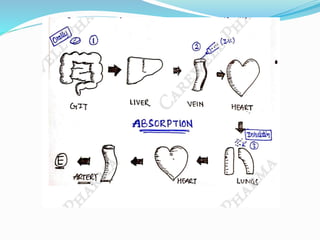
Pharmacokinetics describes what the body does to drugs. It has four main processes: absorption, distribution, metabolism, and excretion. Absorption refers to how drugs enter systemic circulation after administration. It is affected by physiochemical drug properties like size, solubility, and concentration as well as biological factors like surface area, membrane transport, gastric emptying time, blood flow, and food intake. Drugs are mainly absorbed through passive diffusion down a concentration gradient or facilitated transport with carrier proteins. Route of administration also influences absorption and bioavailability, with intravenous having nearly 100% and oral often having lower bioavailability due to first-pass metabolism in the liver.
![Pharmacokinetics
Pharmaco-drug
Kinetics-movement
It is the branch of pharmacologyconcerned with the
movement of drug in the bodyor study about [ADME]
Basicallyit is what drug does to the body.
It involve four process;
a] Absorption
b] Distribution
c] Metabolism
d] Excretion](https://image.slidesharecdn.com/absorptionandfactorsaffectingabsorption1-240214114605-27efc2f8/85/Absorption-and-Factors-Affecting-Absorption-1-pdf-2-320.jpg)
![Membrane
❖ It is a biological membrane which is made up with
phospholipids and cholesterol and other groups
❖ It act as a semi permeable membrane..
❑Now, drug reaches into systematic circulation through
membrane transport
Which are following
1] Passive Transport
2] Active Transport
3] Facilitated Transport
4] Endocytosis
Concentration gradient: when any drug/substance move
from high concentration to lower concentration.](https://image.slidesharecdn.com/absorptionandfactorsaffectingabsorption1-240214114605-27efc2f8/85/Absorption-and-Factors-Affecting-Absorption-1-pdf-4-320.jpg)
![1] passive transport
Also known as passive diffusion
In this transport ,drug/substance move across the cocentration
[high to low]
Most of the drug are absorb by active diffusion](https://image.slidesharecdn.com/absorptionandfactorsaffectingabsorption1-240214114605-27efc2f8/85/Absorption-and-Factors-Affecting-Absorption-1-pdf-5-320.jpg)
![2] facilitated transport
In this transport drug molecules move across the
concentration gradient ,but with the help of any carrier
bodies.
Some large molecules or poorly diffusible substance
does not pass through passive transport , so they
required help of any carrier body to cross the
membrane
Carrier such as SLS[solute carrier transporter]](https://image.slidesharecdn.com/absorptionandfactorsaffectingabsorption1-240214114605-27efc2f8/85/Absorption-and-Factors-Affecting-Absorption-1-pdf-6-320.jpg)
![3] active transport
In this transport , drug molecules move against the
concentration gradient[low to high]
It required energy due to movement of drugs against
the concentration gradient
ATP is used.](https://image.slidesharecdn.com/absorptionandfactorsaffectingabsorption1-240214114605-27efc2f8/85/Absorption-and-Factors-Affecting-Absorption-1-pdf-7-320.jpg)
![4] Endocytosis
In this transport , drugs of very large size get transport
via engulfment by cell membrane
Due to large size ,they do not cross membrane and also
not fit in any channel](https://image.slidesharecdn.com/absorptionandfactorsaffectingabsorption1-240214114605-27efc2f8/85/Absorption-and-Factors-Affecting-Absorption-1-pdf-8-320.jpg)
![Factors affecting absorption
Physiochemical properties
1] ParticleSize [Drug Molecules]
2] Formulation[dosageForm]
3] ionisation
4] Ph
5] Lipid SolubilityAnd Concentration
biologicalfactor
1]surface Area
2]membrane Transport
3]gastric Emptying Time
4]blood Flow[circulation]
5]food
Routeof administration [ bioavailabilityand first pass metabolism]](https://image.slidesharecdn.com/absorptionandfactorsaffectingabsorption1-240214114605-27efc2f8/85/Absorption-and-Factors-Affecting-Absorption-1-pdf-9-320.jpg)
![1]physiochemical Properties
1] particle size: it is inverslly proportional tothe absorption.
particlesize
Thesmallerthe particlesize ,thegreaterwill be itsabsorptionbecause
small size drug particles dissolveeasily.
2] formulation: in solid,liquid,parental[injection]
Parental.>liquiddosageform ……..>solid
3] ionisation : we all know that ,both form [ionised+unionised]are
importantfor pharmacological responseof drugs ,but for absorption
drug must be in unionizedform.
4] ph: it tell about natureof drug[acidic/basic]
Acidic drug must absorbed in stomach EG.ASPIRIN
Basic drug must absorbed in intestineEG. MORPHINE
5] lipid solubility : lipophilicnature’sdrug has slightlyhigher
absorptionthan hydrophilic, because in membrane transportlipid
solubledrug cross membraneeasily
6] concentration : we know thatpassivediffusion follow concentration
gradient,so highertheconcentrationof drugs thegreaterwill its
absorption.](https://image.slidesharecdn.com/absorptionandfactorsaffectingabsorption1-240214114605-27efc2f8/85/Absorption-and-Factors-Affecting-Absorption-1-pdf-10-320.jpg)
![3] Route Of Administration
This affect drug absorption,because each route has its own
characteristics.
Route of absorption affect bioavailibility of drug
Bioavailibility:it is the actual amount of drug ,which
reach into the systematic circulation.
Parental route has max.bioavaibility [drug absorb maximum]
In intravenous ,drug directly release into blood ,so their absorption
and bioavalibily is 100 %.
in subcutaneous /intramuscular ,drug injected near the capillaries
also have great absorption and bioavailibility.
Enternal [oral] has less bioavailibility and absorption ,because it
follow first past metabolism drug passes through liver which
decrease the absorotion](https://image.slidesharecdn.com/absorptionandfactorsaffectingabsorption1-240214114605-27efc2f8/85/Absorption-and-Factors-Affecting-Absorption-1-pdf-11-320.jpg)
![2] BIOLOGICAL FACTORS
1] surface area : area of absorbing surface .itsis directlyproportional
to the absorption.so, thelargerthe surface area for absorbing drug,the
greaterwill be itsabsorption.
2]membrane transport:mostof thedrug absorb throughpassive
diffusion because it does not requireenergyor anything .and also
followconcentrationgradient.
3]Gastric emtying time : thosedrug whosegastricemptying time is
more[fast] theirrateof absorptionis high .but time is nottoo fast
,otherwisedrug is excrete withoutabsorption . So it isat optimum time.
4] blood flow circulation: directlyproportional the more blood flow
in body ,thegreaterwill be absorptionof drug.
5]food : it will also affect theabsorptionof drug . If the food is present
insidethestomach ,then it dilutethedrug and absorption will be
decreases .so, take medicineaftersome timeof meal.](https://image.slidesharecdn.com/absorptionandfactorsaffectingabsorption1-240214114605-27efc2f8/85/Absorption-and-Factors-Affecting-Absorption-1-pdf-13-320.jpg)




![Pharmacology - Pharmacokinetics 1 [Autosaved].pptx](https://cdn.slidesharecdn.com/ss_thumbnails/pharmacology-pharmacokinetics1autosaved-241109192045-c128b252-thumbnail.jpg?width=640&height=640&fit=bounds)


