Absolute C++ 6th Edition Savitch Solutions
Manual download
https://testbankfan.com/product/absolute-c-6th-edition-savitch-
solutions-manual/
Find test banks or solution manuals at testbankfan.com today!
We have selected some products that you may be interested in
Click the link to download now or visit testbankfan.com
for more options!.
Absolute C++ 6th Edition Savitch Test Bank
https://testbankfan.com/product/absolute-c-6th-edition-savitch-test-
bank/
Absolute C++ 5th Edition Savitch Solutions Manual
https://testbankfan.com/product/absolute-c-5th-edition-savitch-
solutions-manual/
Absolute C++ 5th Edition Savitch Test Bank
https://testbankfan.com/product/absolute-c-5th-edition-savitch-test-
bank/
Biology Of Humans Concepts Applications And Issues 4th
Edition Goodenough Test Bank
https://testbankfan.com/product/biology-of-humans-concepts-
applications-and-issues-4th-edition-goodenough-test-bank/
Managing Organizational Change A Multiple Perspectives
Approach 3rd Edition Palmer Solutions Manual
https://testbankfan.com/product/managing-organizational-change-a-
multiple-perspectives-approach-3rd-edition-palmer-solutions-manual/
Contemporary Accounting A Strategic Approach for Users 9th
Edition Hancock Test Bank
https://testbankfan.com/product/contemporary-accounting-a-strategic-
approach-for-users-9th-edition-hancock-test-bank/
Foundations of College Chemistry 14th Edition Hein
Solutions Manual
https://testbankfan.com/product/foundations-of-college-chemistry-14th-
edition-hein-solutions-manual/
Business and Professional Ethics for Directors Executives
Accountants 8th Edition Brooks Test Bank
https://testbankfan.com/product/business-and-professional-ethics-for-
directors-executives-accountants-8th-edition-brooks-test-bank/
Principles of Economics 5th Edition Mankiw Test Bank
https://testbankfan.com/product/principles-of-economics-5th-edition-
mankiw-test-bank/
Medical Terminology Systems A Body Systems Approach 8th
Edition Gylys Test Bank
https://testbankfan.com/product/medical-terminology-systems-a-body-
systems-approach-8th-edition-gylys-test-bank/
Savitch, Absolute C++ 6/e: Chapter 6, Instructor’s Manual
Copyright © 2016 Pearson Education Addison-Wesley. All rights reserved.
Chapter 6
Structures and Classes
Key Terms
structure
struct
structure tag
member name
where to place a structure definition
structure value
member value
member variable
reusing member names
structure variables in assignment statements
structure arguments
functions can return structures
class
object
member function
calling member functions
defining member functions
scope resolution operator
type qualifier
member variables in function definitions
data types and abstract types
encapsulation
private:
private member variable
public:
public member variable
accessor function
mutator function
interface
API
implementation
Brief Outline
6.1 Structures
Structure Types
Structures as Function Arguments
Initializing Structures
6.2 Classes
Defining Classes and Member Functions
Encapsulation
Public and Private Members
Savitch, Absolute C++ 6/e: Chapter 6, Instructor’s Manual
Copyright © 2016 Pearson Education Addison-Wesley. All rights reserved.
Accessor and Mutator Functions
Structures versus Classes
1. Introduction and Teaching Suggestions
In earlier chapters, we saw the array, the first of the C++ tools for creating data structures. The
other tools are the struct and the class. We saw that the array provides a homogeneous,
random access data structure. This chapter introduces tools to create heterogenous data
structures, namely the struct and class. While the struct and class are identical except for default
access, the text takes the didactic approach of first ignoring struct function members. This
chapter deals with the struct as C treats it. The text then develops the simpler ideas involved in
declaration and access for the struct. Then the machinery of class creation, protection
mechanisms and some ideas of encapsulation of functions with data are treated. Constructors are
left to Chapter 7.
2. Key Points
Structures and Structure Types. Historical note: The name struct in C++ is provided
primarily for backward compatibility with ANSI C. Suppose we declare a struct, as in:
struct B
{
int x;
int y;
};
The text points out that the identifier B is called the structure tag. The structure tag B carries full
type information. The tag B can be used as you would use any built-in type. The identifiers x and
y declared in the definition of struct B are called member names. The members are variables are
associated with any variable of struct type. You can declare a variable of type B by writing1
B u;
You can access member variables (as l-values) by writing
u.x = 1;
u.y = 2;
or (as r-values)
int p, q;
p = u.x;
q = u.y;
We said in the previous paragraph that the tag B can be used as you would use any built-in type.
You can pass a struct to a function as a parameter, use a struct as a function return type, and
declare arrays of variables of type struct.
1
Contrast this with the C usage, struct B u;, where the keyword struct must be used in the definition of a
structure variable. This use is permitted in C++ for backward compatibility with C.
Savitch, Absolute C++ 6/e: Chapter 6, Instructor’s Manual
Copyright © 2016 Pearson Education Addison-Wesley. All rights reserved.
Our author points out that two identifiers that are declared to be of the same structure type may be
assigned, with member-wise assignment occurring.2
The critical issue here is that for assignment
compatibility the two structure variables must be declared with the same structure tag. In the
example that follows, the types are indistinguishable from the member structure within the struct.
However, C++ uses name equivalence for types, so the compiler looks at the tags in the
declarations rather than the structure to determine whether one struct variable may be assigned to
another. Example:
struct A
{
int x;
int y;
};
struct B
{
int x;
int y;
};
A u;
B v;
u = v; //type error: u and v are of different types
The error message from g++ 2.9.5 is:
// no match for 'A& = B&'
// candidates are: struct A& A::operator=(const A&)
Structures as Function Arguments. Since a structure tag is a type, the tag can be used as any other
type would be used. You can have arrays of structure objects, or function parameters that are call-by-value
or call-by-reference, and you can use a structure a type for the return type of a function.
Defining Classes and Member Functions. These remarks elaborate the ideas in the text on
class and the scope resolution operator, ::. A class definition (and a struct definition as well),
with the {}; define a scope within which variables and functions are defined. They are not
accessible outside without qualification by the object name and a dot operator . Member
functions are defined within a particular class, to be used by any object declared to be of that
class, again, only with qualification by being preceded by the object name and the dot operator.
To define a function whose prototype is given in a class we have to specify the scope of that
class within which the function is being defined. This is done with the class tag and scope
resolution operator.
To say:
returnTypeName class_tag::funcMemberName(argumentList)
{
//memberFunctionBody...
}
is to say "Within the scope of the class class_tag, define the function named funcMemberName
that has return type returnTypeName."
2
Member-wise assignment is the default for classes and structs. A former student of mine, John Gibson coined the
phrase, “Member UNWISE copy”. We will see that for classes with pointer members, member (un)wise copy is
almost never what you want.
Savitch, Absolute C++ 6/e: Chapter 6, Instructor’s Manual
Copyright © 2016 Pearson Education Addison-Wesley. All rights reserved.
The data members belong to a particular object, and function members must be called on behalf
of that particular object. The object must be specified. The object is specified by using the dot
operator used after the object name, before the member name or function call. Sometimes we
may speak of the calling object.
Encapsulation. The notion of encapsulation means, “to collect together, as if to place in a
capsule”, from which we may infer the purpose, “to hide the details”. The text says a data type
has a set of values to be manipulated, and sets of operations to manipulate the values, but the
details are available to the user or client. A data type becomes an abstract data type if the client
does not have access to the implementation details.
Abstract Data Types. The notion of Abstract Data Type (ADT) has two players: the author of
the ADT and the client of the ADT. The client knows only what the ADT will do, not how the
ADT carries out its tasks. The author of the ADT knows only what the ADT will do for the
client, but nothing about the context within which the ADT is used by the client. Information
hiding is a two way hiding. The separation of implementation (known only to the class author)
and the interface (the contract between ADT author and client) is vital. The other side of the
coin, namely the concealment from the ADT author of the context within which the ADT will be
used, is equally vital. This prevents either author from writing code that would depend on the
internals written by the other programmer.
Separate compilation is necessary to a) concealing implementation details and b) assigning tasks
to several programmers in a team. The reason for leaving the interface and the implementation of
the ADTs in the client in the text is that we do not yet know anything about separate compilation.
Observe that the text almost always places declarations (prototypes) prior to use, then uses the
functions in the main function, then tucks the definitions away after the main function. This has
the effect of emphasizing separation of definition and declaration well before separate
compilation is seen by the student. This is worth mentioning to the student.
Public and Private Members. The data members of a class are part of the implementation, not
part of the interface. The function members intended for use by the client are the interface. There
may be helping functions for the implementation that would be inappropriate for the client to
use, and so are not part of the interface. Normally the interface is made available to the client and
the implementation is hidden.
A struct, by default, allows access to its members by any function. A class, by default, allows
access to its members only to those functions declared within the class. This default access in a
struct is called public, and the default access in a class is called private.
The keywords private and public help manage hiding the implementation and making the
interface available to the client. These keywords are used to modify the default access to
members of a class or struct. The keyword private is used to hide members. The effect of the
keyword private: extends from the keyword private: to the next instance of the keyword public:.
The effect of the keyword public: extends from the keyword public: up to the next instance of the
keyword private:.
Savitch, Absolute C++ 6/e: Chapter 6, Instructor’s Manual
Copyright © 2016 Pearson Education Addison-Wesley. All rights reserved.
Accessor and Mutator Functions. It is the class author who writes the accessor and mutator
functions, so it is she who controls the access to the class data. If the data members were public,
any function has access in any way the client wishes. Data integrity will be compromised.
Structures versus Classes. This is the text’s “truth in advertising” section. Since this document
is for the instructor, little distinction between structs and classes is made here.
3. Tips
Hierarchical Structures. It is worth pointing out that the name spaces for hierarchical (or
nested) structures are separate. The same names can be used in the containing struct as are used
in the structure member. The same names can be used in two structures members at the same
level.
Example: Name space and hierarchical structure initialization
// file: ch6test2.cc
// purpose: test namespace in hierarchical structures
#include <iostream>
using namespace std;
struct A
{
int a;
int b;
};
struct B
{
A c;
int a;
int b;
};
int main()
{
A u = {1,2};
B v = {{3,4},4,5};
cout << "u.a = " << u.a << " u.b = " << u.b << endl;
cout << "v.c.a = " << v.c.a << " v.c.b = " << v.c.b
<< " v.a = " << v.a << " v.b = " << v.b << endl;
return 0;
}
This code compiles and runs as expected. The output is:
u.a = 1 u.b = 2
v.c.a = 3 v.c.b = 4 v.a = 4 v.b = 5
This is, of course, a "horrible example", designed to show a worst case. One would almost never
use the same identifiers in two structures while using a struct object as a member of another as
we do here. However, this does serve to illustrate the idea that the name spaces for two structures
are separate. (This is also true for classes as well.) In short, duplicating a member name where
needed won't break a program.
Initializing Structures. The previous example also illustrates that structure variables can be
assigned initial values using the curly brace notation.
Savitch, Absolute C++ 6/e: Chapter 6, Instructor’s Manual
Copyright © 2016 Pearson Education Addison-Wesley. All rights reserved.
Separate Interface and Implementation. The interface provides the API and helps abstract the
implementation details from a user of the class. This allows a programmer to change the
implementation without having to change other parts of the program.
A Test for Encapsulation. If you can change the implementation of a class without requiring a
change to the client code, you have the implementation adequately encapsulated.
Thinking Objects. When programming with classes, data rather than algorithms takes center
stage. The difference is in the point of view compared to students that have never programmed
with objects before.
4. Pitfalls
Omitting the semicolon at the end of a struct or class definition. The text points out that a
structure definition is required to have a semicolon following the closing curly brace. The reason
is that it is possible to define a variable of the struct type by putting the identifier between the
closed curly brace, }, and the semicolon.
struct A
{
int a;
int b;
} c;
The variable c is of struct type A. With some compilers, this pitfall generates particularly
uninformative error messages. It will be quite helpful for the student to write several examples in
which the closing semicolon in a structure definition is deliberately omitted.
5. Programming Projects Answers
1. Class grading program
//ch6Prg1.cpp
#include <iostream>
using namespace std;
const int CLASS_SIZE = 5;
// Problem says this is for a class, rather than one student.
// Strategy: Attack for a single student, then do for an array of N
// students.
//Grading Program
//Policies:
//
// Two quizzes, 10 points each
// midterm and final exam, 100 points each
// Of grade, final counts 50%, midterm 25%, quizes25%
//
// Letter Grade is assigned:
Savitch, Absolute C++ 6/e: Chapter 6, Instructor’s Manual
Copyright © 2016 Pearson Education Addison-Wesley. All rights reserved.
// 90 or more A
// 80 or more B
// 70 or more C
// 60 or more D
// less than 60, F
//
// Read a student's scores,
// output record: scores + numeric average + assigned letter grade
//
// Use a struct to contain student record.
struct StudentRecord
{
int studentNumber;
double quiz1;
double quiz2;
double midterm;
double final;
double average;
char grade;
};
//prompts for input for one student, sets the
//structure variable members.
void input(StudentRecord& student);
//calculates the numeric average and letter grade.
void computeGrade(StudentRecord& student);
//outputs the student record.
void output(const StudentRecord student);
int main()
{
StudentRecord student[CLASS_SIZE];
for(int i = 0; i < CLASS_SIZE; i++)
input(student[i]);
// Enclosing block fixes VC++ "for" loop control defined outside loop
{ for(int i = 0; i < CLASS_SIZE; i++)
{
computeGrade(student[i]);
output(student[i]);
cout << endl;
}
}
return 0;
}
void input(StudentRecord &student)
{
cout << "enter the student number: ";
cin >> student.studentNumber;
cout << student.studentNumber << endl;
cout << "enter two 10 point quizes" << endl;
cin >> student.quiz1 >> student.quiz2;
Savitch, Absolute C++ 6/e: Chapter 6, Instructor’s Manual
Copyright © 2016 Pearson Education Addison-Wesley. All rights reserved.
cout << student.quiz1 << " " << student.quiz2 << endl;
cout << "enter the midterm and final exam grades."
<< "These are 100 point testsn";
cin >> student.midterm >> student.final;
cout << student.midterm << " " << student.final
<< endl << endl;
}
void computeGrade(StudentRecord& student)
{
// Of grade, final counts 50%, midterm 25%, quizes25%
double quizAvg= (student.quiz1 + student.quiz2)/2.0;
double quizAvgNormalized = quizAvg * 10;
student.average = student.final * 0.5 +
student.midterm * 0.25 +
quizAvgNormalized * 0.25;
char letterGrade[]= "FFFFFFDCBAA";
int index = static_cast<int>(student.average/10);
if(index < 0 || 10 <= index)
{
cout << "Bad numeric grade encountered: "
<< student.average << endl
<< " Aborting.n";
abort();
}
student.grade = letterGrade[index];
}
void output(const StudentRecord student)
{
cout << "The record for student number: "
<< student.studentNumber << endl
<< "The quiz grades are: "
<< student.quiz1 << " " << student.quiz2
<< endl
<< "The midterm and exam grades are: "
<< student.midterm << " " << student.final
<< endl
<< "The numeric average is: " << student.average
<< endl
<< "and the letter grade assigned is "
<< student.grade
<< endl;
}
Data for the test run:
1 7 10 90 95
2 9 8 90 80
3 7 8 70 80
4 5 8 50 70
5 4 0 40 35
Command line command to execute the text run:
Savitch, Absolute C++ 6/e: Chapter 6, Instructor’s Manual
Copyright © 2016 Pearson Education Addison-Wesley. All rights reserved.
ch6prg1 < data
Output:
enter the student number: 1
enter two 10 point quizes
7 10
enter the midterm and final exam grades. These are 100 point tests
90 95
enter the student number: 2
enter two 10 point quizes
9 8
enter the midterm and final exam grades. These are 100 point tests
90 80
enter the student number: 3
enter two 10 point quizes
7 8
enter the midterm and final exam grades. These are 100 point tests
70 80
enter the student number: 4
enter two 10 point quizes
5 8
enter the midterm and final exam grades. These are 100 point tests
50 70
enter the student number: 5
enter two 10 point quizes
4 0
enter the midterm and final exam grades. These are 100 point tests
40 35
The record for student number: 1
The quiz grades are: 7 10
The midterm and exam grades are: 90 95
The numeric average is: 91.25
and the letter grade assigned is A
The record for student number: 2
The quiz grades are: 9 8
The midterm and exam grades are: 90 80
The numeric average is: 83.75
and the letter grade assigned is B
The record for student number: 3
The quiz grades are: 7 8
The midterm and exam grades are: 70 80
The numeric average is: 76.25
and the letter grade assigned is C
The record for student number: 4
The quiz grades are: 5 8
The midterm and exam grades are: 50 70
The numeric average is: 63.75
and the letter grade assigned is D
Savitch, Absolute C++ 6/e: Chapter 6, Instructor’s Manual
Copyright © 2016 Pearson Education Addison-Wesley. All rights reserved.
The record for student number: 5
The quiz grades are: 4 0
The midterm and exam grades are: 40 35
The numeric average is: 32.5
and the letter grade assigned is F
*/
2. CounterType
An object of CounterType is used to count things, so it records a count that is a nonnegative
integer number. It has mutators to increment by 1 and decrement by 1, but no member allows the
counter value to go negative.
There is an accessor that returns the count value, and a display function that displays the count
value on the screen.
Apropos of confusing error messages, this one is worth comment. In compiling the code for this
problem, the following warning message was generated from VC++6.0 on the last line of the
following code fragment:
warning: integral size mismatch in argument; conversion supplied
cout << "starting at counter value "
<< localCounter.currentCount
<< "and decrementing "
<< MAX << " times only decrements to zero.nn";
If the error message had been on the offending line, it would have been trivial to see the missing
parentheses on the second line of this code fragment. Warn the students that the error message
may be given several lines after the offending bit of code.
//Ch6prg2.cpp
//CounterType
//
// The class keeps a non-negative integer value.
// It has 2 mutators one increments by 1 and
// the other decrements by 1.
// No member function is allowed to drive the value of the counter
// to become negative. (How to do this is not specified.)
// It has an accessor that returns the count value,
// and a display member that write the current count value
// to the screen.
#include <iostream>
using namespace std;
const int MAX = 20;
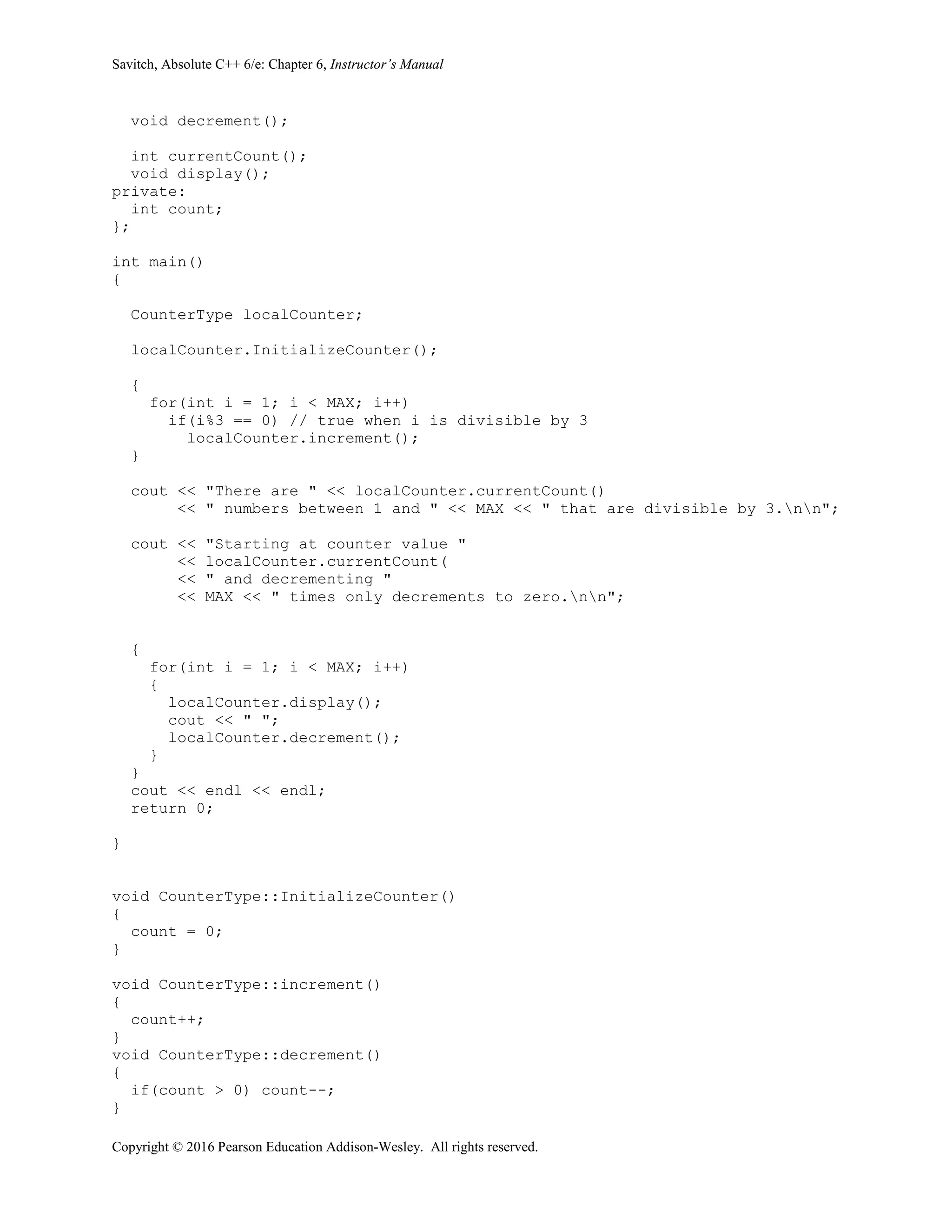
class CounterType
{
public:
void InitializeCounter();
void increment();
//ignore request to decrement if count is zero
Savitch, Absolute C++ 6/e: Chapter 6, Instructor’s Manual
Copyright © 2016 Pearson Education Addison-Wesley. All rights reserved.
void decrement();
int currentCount();
void display();
private:
int count;
};
int main()
{
CounterType localCounter;
localCounter.InitializeCounter();
{
for(int i = 1; i < MAX; i++)
if(i%3 == 0) // true when i is divisible by 3
localCounter.increment();
}
cout << "There are " << localCounter.currentCount()
<< " numbers between 1 and " << MAX << " that are divisible by 3.nn";
cout << "Starting at counter value "
<< localCounter.currentCount(
<< " and decrementing "
<< MAX << " times only decrements to zero.nn";
{
for(int i = 1; i < MAX; i++)
{
localCounter.display();
cout << " ";
localCounter.decrement();
}
}
cout << endl << endl;
return 0;
}
void CounterType::InitializeCounter()
{
count = 0;
}
void CounterType::increment()
{
count++;
}
void CounterType::decrement()
{
if(count > 0) count--;
}
Savitch, Absolute C++ 6/e: Chapter 6, Instructor’s Manual
Copyright © 2016 Pearson Education Addison-Wesley. All rights reserved.
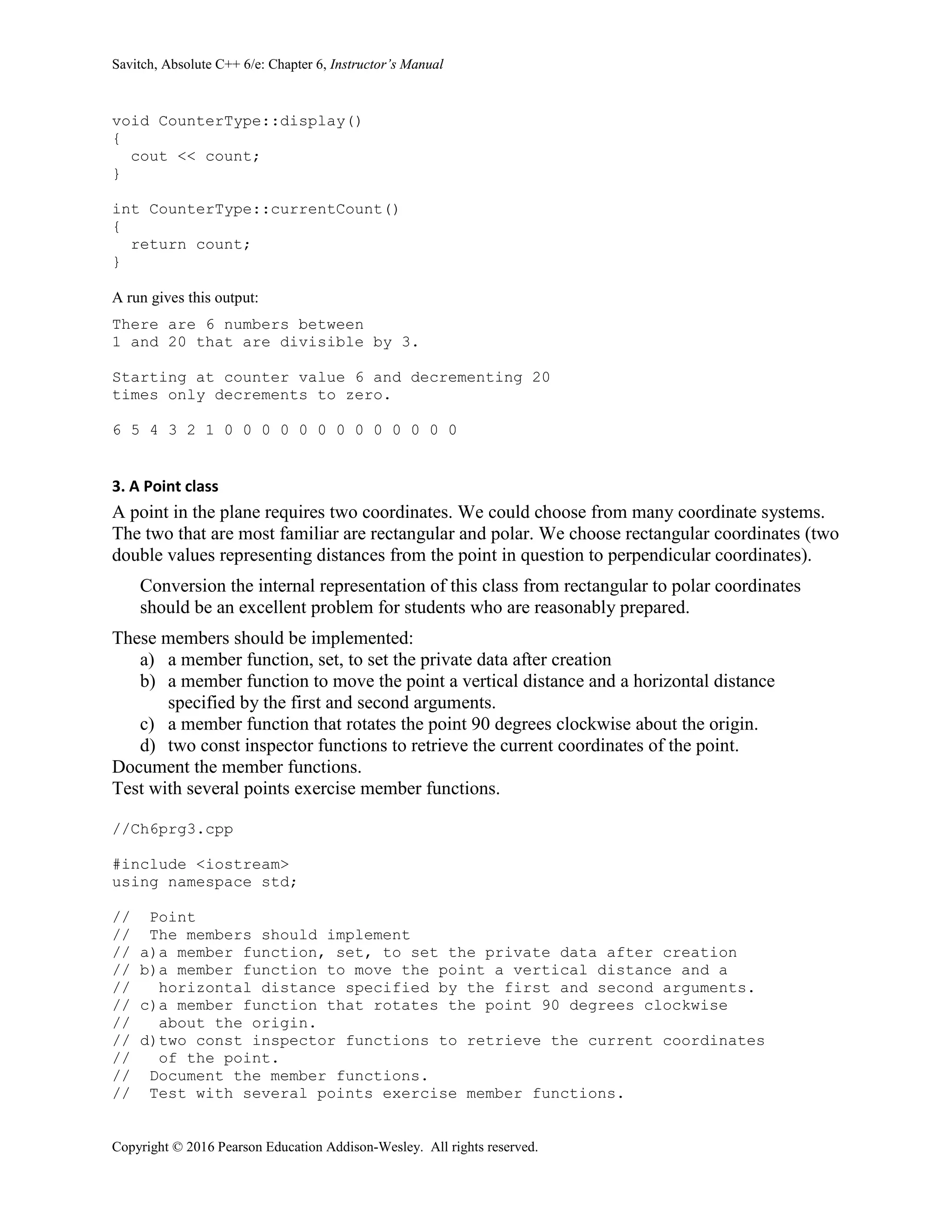
void CounterType::display()
{
cout << count;
}
int CounterType::currentCount()
{
return count;
}
A run gives this output:
There are 6 numbers between
1 and 20 that are divisible by 3.
Starting at counter value 6 and decrementing 20
times only decrements to zero.
6 5 4 3 2 1 0 0 0 0 0 0 0 0 0 0 0 0 0
3. A Point class
A point in the plane requires two coordinates. We could choose from many coordinate systems.
The two that are most familiar are rectangular and polar. We choose rectangular coordinates (two
double values representing distances from the point in question to perpendicular coordinates).
Conversion the internal representation of this class from rectangular to polar coordinates
should be an excellent problem for students who are reasonably prepared.
These members should be implemented:
a) a member function, set, to set the private data after creation
b) a member function to move the point a vertical distance and a horizontal distance
specified by the first and second arguments.
c) a member function that rotates the point 90 degrees clockwise about the origin.
d) two const inspector functions to retrieve the current coordinates of the point.
Document the member functions.
Test with several points exercise member functions.
//Ch6prg3.cpp
#include <iostream>
using namespace std;
// Point
// The members should implement
// a)a member function, set, to set the private data after creation
// b)a member function to move the point a vertical distance and a
// horizontal distance specified by the first and second arguments.
// c)a member function that rotates the point 90 degrees clockwise
// about the origin.
// d)two const inspector functions to retrieve the current coordinates
// of the point.
// Document the member functions.
// Test with several points exercise member functions.
Savitch, Absolute C++ 6/e: Chapter 6, Instructor’s Manual
Copyright © 2016 Pearson Education Addison-Wesley. All rights reserved.
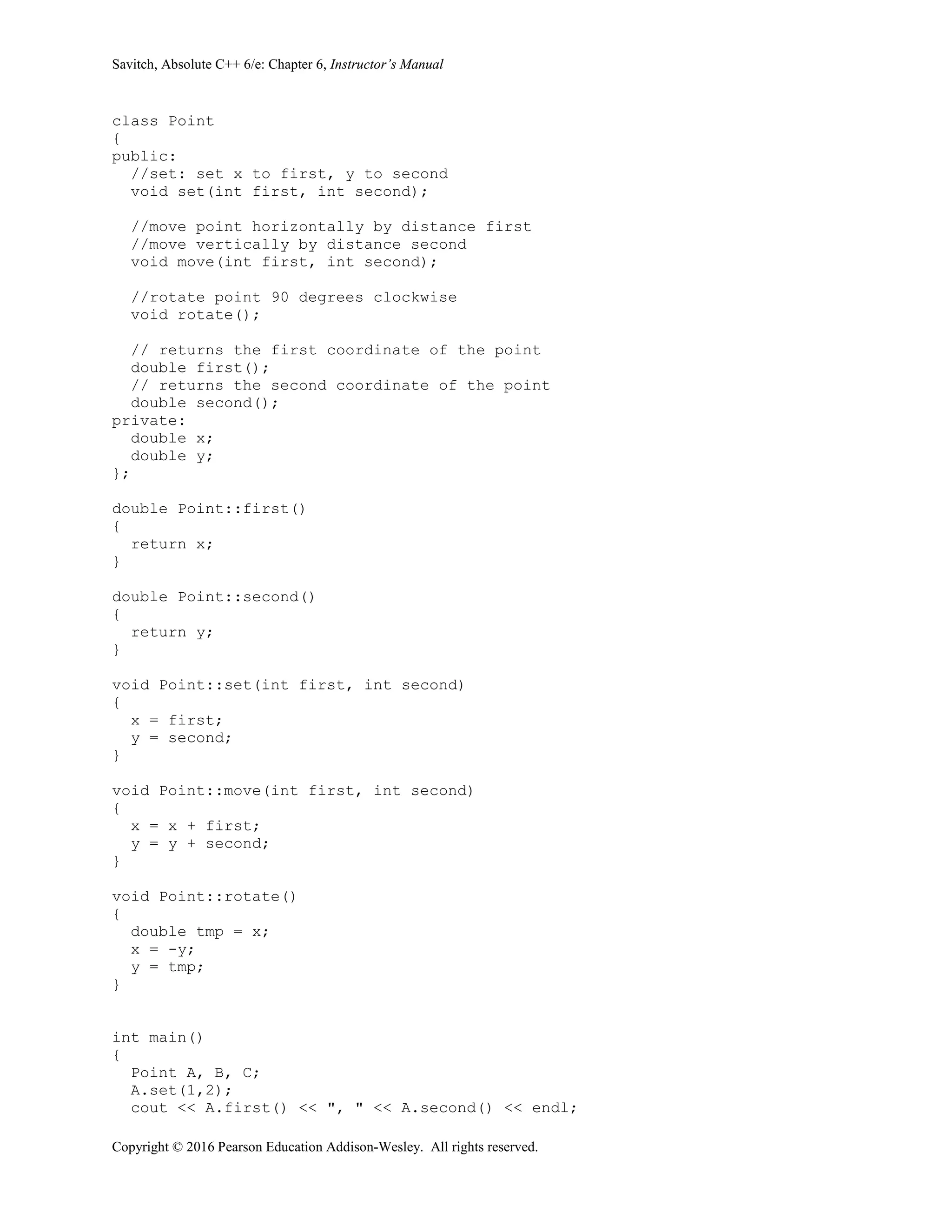
class Point
{
public:
//set: set x to first, y to second
void set(int first, int second);
//move point horizontally by distance first
//move vertically by distance second
void move(int first, int second);
//rotate point 90 degrees clockwise
void rotate();
// returns the first coordinate of the point
double first();
// returns the second coordinate of the point
double second();
private:
double x;
double y;
};
double Point::first()
{
return x;
}
double Point::second()
{
return y;
}
void Point::set(int first, int second)
{
x = first;
y = second;
}
void Point::move(int first, int second)
{
x = x + first;
y = y + second;
}
void Point::rotate()
{
double tmp = x;
x = -y;
y = tmp;
}
int main()
{
Point A, B, C;
A.set(1,2);
cout << A.first() << ", " << A.second() << endl;
Savitch, Absolute C++ 6/e: Chapter 6, Instructor’s Manual
Copyright © 2016 Pearson Education Addison-Wesley. All rights reserved.
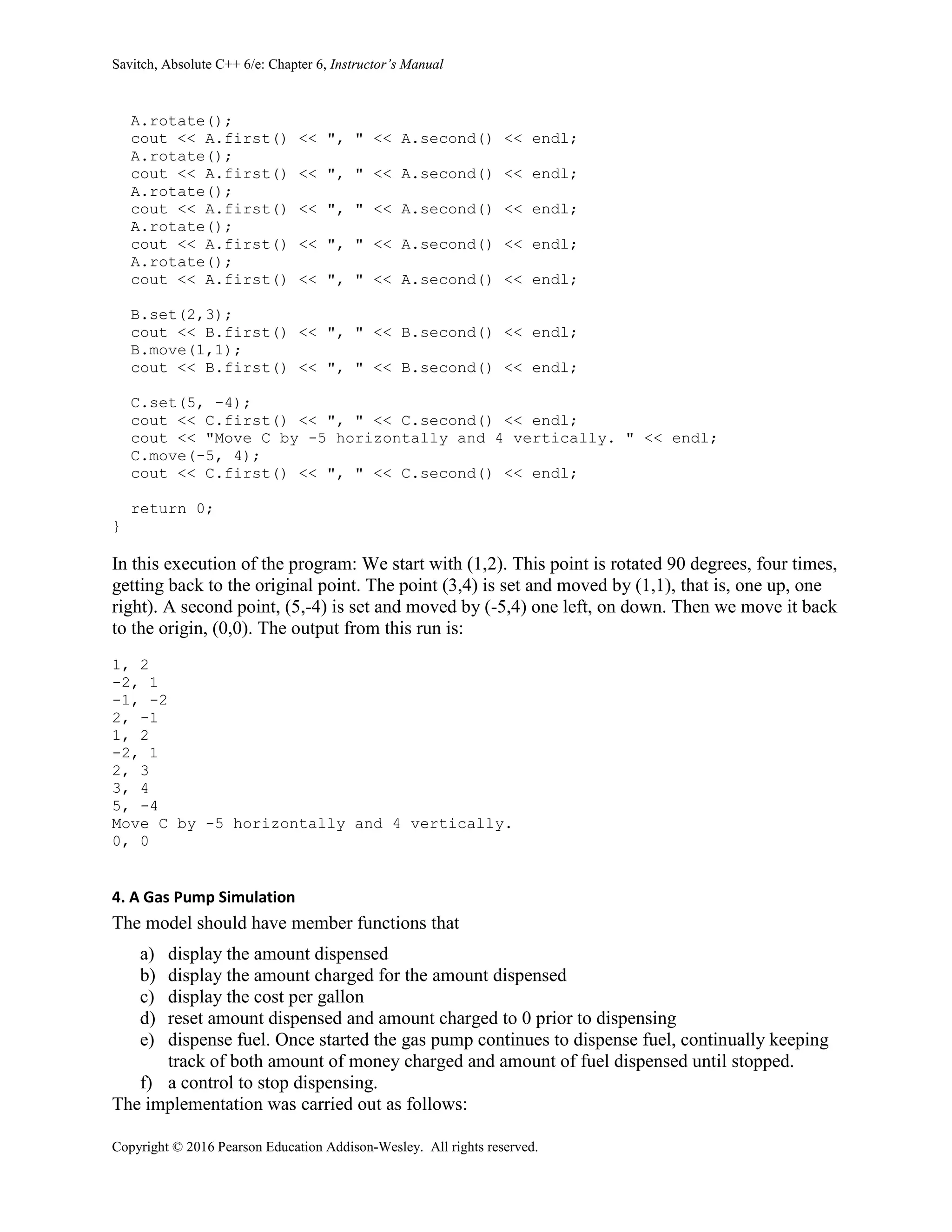
A.rotate();
cout << A.first() << ", " << A.second() << endl;
A.rotate();
cout << A.first() << ", " << A.second() << endl;
A.rotate();
cout << A.first() << ", " << A.second() << endl;
A.rotate();
cout << A.first() << ", " << A.second() << endl;
A.rotate();
cout << A.first() << ", " << A.second() << endl;
B.set(2,3);
cout << B.first() << ", " << B.second() << endl;
B.move(1,1);
cout << B.first() << ", " << B.second() << endl;
C.set(5, -4);
cout << C.first() << ", " << C.second() << endl;
cout << "Move C by -5 horizontally and 4 vertically. " << endl;
C.move(-5, 4);
cout << C.first() << ", " << C.second() << endl;
return 0;
}
In this execution of the program: We start with (1,2). This point is rotated 90 degrees, four times,
getting back to the original point. The point (3,4) is set and moved by (1,1), that is, one up, one
right). A second point, (5,-4) is set and moved by (-5,4) one left, on down. Then we move it back
to the origin, (0,0). The output from this run is:
1, 2
-2, 1
-1, -2
2, -1
1, 2
-2, 1
2, 3
3, 4
5, -4
Move C by -5 horizontally and 4 vertically.
0, 0
4. A Gas Pump Simulation
The model should have member functions that
a) display the amount dispensed
b) display the amount charged for the amount dispensed
c) display the cost per gallon
d) reset amount dispensed and amount charged to 0 prior to dispensing
e) dispense fuel. Once started the gas pump continues to dispense fuel, continually keeping
track of both amount of money charged and amount of fuel dispensed until stopped.
f) a control to stop dispensing.
The implementation was carried out as follows:
Savitch, Absolute C++ 6/e: Chapter 6, Instructor’s Manual
Copyright © 2016 Pearson Education Addison-Wesley. All rights reserved.
1) Implement a class definition that models of the behavior of the gas pump.
2) Write implementations of the member functions.
3) Decide whether there are other data the pump must keep track of that the user should not
have access to.
Parts a) b) c) d) are straightforward to implement. Part e), the pumping operation is a little tricky.
Once I realized that the valve on the nozzle must be held to continue to dispense gas, I decided to
model that behavior by repeatedly pressing <CR> is an easy step. Tweaking the appearance and
behavior detail is all that was left. The tweaking was not trivial.
There are notes in the GasPump class definition that are addressed to the instructor. These
concern members that should be declared static or should have been members of a manager class
that is a friend of this class. The student is not likely to understand these notes. I suggest that you
delete these remarks if you give this solution to the student.
#include <iostream>
using namespace std;
class GasPump
{
public:
void initialize(); // set charges, amount dispensed, and
//gasInMainTank to 0.
void reset(); // set charges and amount dispensed to 0;
void displayCostPerGallon();
//If there is only one grade, of gasoline, this should be a static
//member of GasPump, since it would then apply to all instances of
//GasPump. If there are several grades, then this and costPerGallon
//should be ordinary members.
void displayGasNCharges();
// Dispense member continually updates display of new amount and
// new charges
void dispense();
void stop(); // If called, stops dispensing operation.
// My implementation never used this.
private:
double gasDispensed;
double charge;
public:
//Perhaps these functions should be static members of this class.
//See the earlier comment about this.
void setPricePerGallon(double newPrice);
void buyFromJobber(double quantity);
void displayAmountInMainTank();
private:
//These variables should be static members, since
//they are associated with all class instances.
Random documents with unrelated
content Scribd suggests to you:
The Project Gutenberg eBook of Black
Priestess of Varda
This ebook is for the use of anyone anywhere in the United States
and most other parts of the world at no cost and with almost no
restrictions whatsoever. You may copy it, give it away or re-use it
under the terms of the Project Gutenberg License included with this
ebook or online at www.gutenberg.org. If you are not located in the
United States, you will have to check the laws of the country where
you are located before using this eBook.
Title: Black Priestess of Varda
Author: Erik Fennel
Illustrator: Al McWilliams
Release date: February 9, 2021 [eBook #64511]
Most recently updated: October 18, 2024
Language: English
Credits: Greg Weeks, Mary Meehan and the Online Distributed
Proofreading Team at http://www.pgdp.net
*** START OF THE PROJECT GUTENBERG EBOOK BLACK
PRIESTESS OF VARDA ***
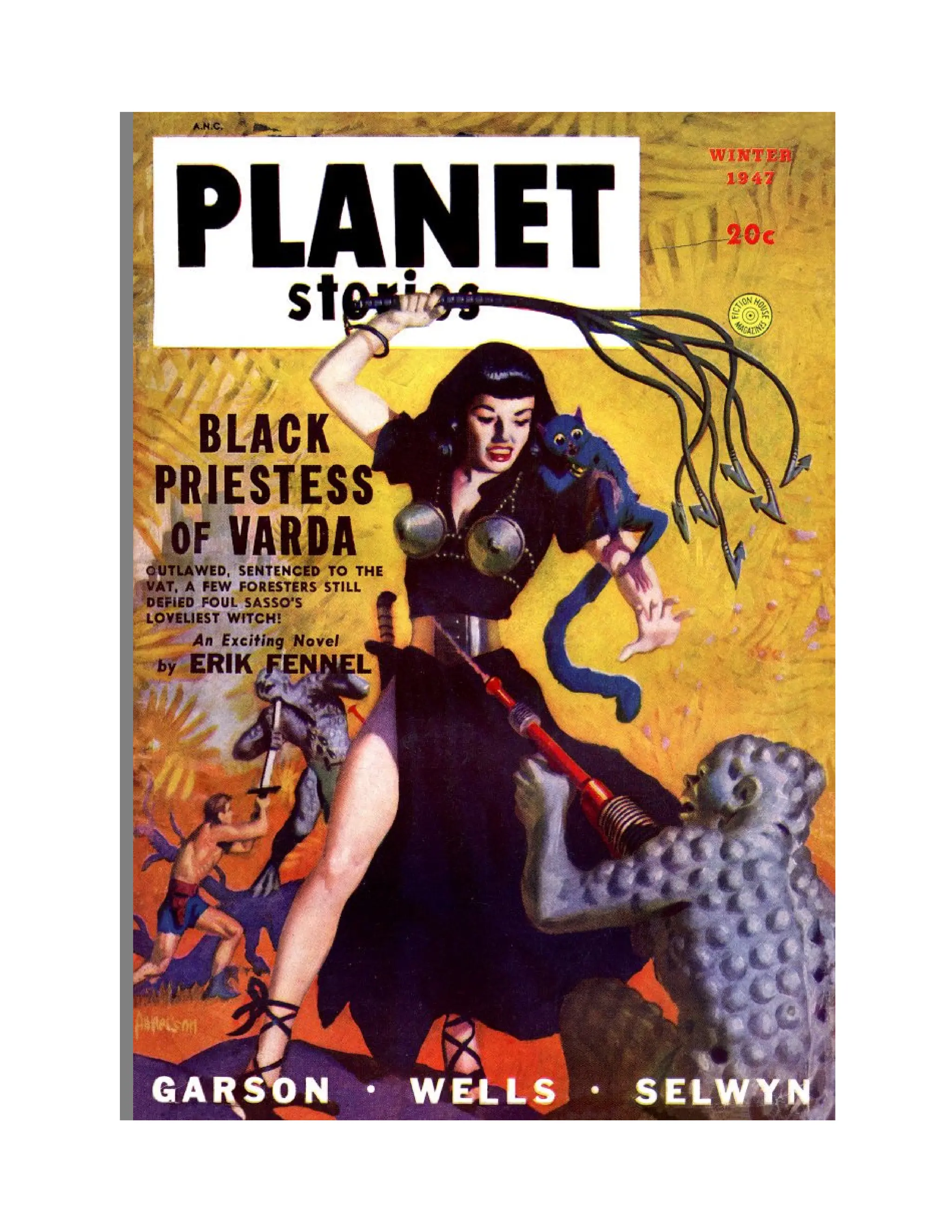
BLACK PRIESTESS OF VARDA
By ERIK FENNEL
She was well-named—Sin, foul witch and raving
beauty, Beloved of Sasso, the Dark Power striving
to capture, with her help, a lovely little world.
Their only fear was a whispered legend—Elvedon,
the Savior.... But this crippled idiot blundering
through a shower of sparks into their time
and space—he could not be Elvedon!
[Transcriber's Note: This etext was produced from
Planet Stories Winter 1947.
Extensive research did not uncover any evidence that
the U.S. copyright on this publication was renewed.]
The pen moved clumsily in Eldon Carmichael's right hand. He had
been left-handed, and the note itself was not easy to write.
Dear Margaret, he scratched. I understand ...
When after a while the proper words still would not come he crossed
the shadowed laboratory and took another long swig from the flat
bottle in his topcoat pocket. He understood—he remembered his
first one-eyed look in a mirror after the bandages were removed—
but still he felt resentful and deeply sorry for himself.
He went back and tried to continue the letter but his thoughts
veered erratically. The injury had been psychological as well as
physical, involving loss of ability to face up to unpleasant facts, but
still he could not force aside those memories.
There had been only a glimpse as the wrench slipped from Victor
Schenley's hand and fell between the sprocket and drive chain of the
big new compressor in the Institute's basement. He wondered. That
look on Schenley's darkly saturnine face could have been merely
imagination. Or horror. But there was something about the man....
Still Eldon discounted his suspicions as the unworthy inventions of a
disturbed mind.
Only the quick reflexes that had once made him a better than
average halfback had saved him from instant death as the jagged
end of the heavy sprocket chain lashed out with the speed of an
enraged cobra. And often during the pain-wracked weeks that
followed he had almost wished he had been a little slower.
The ring sparkled tauntingly under his desk lamp. Margaret had
returned it by mail, and though the wording of her note had been
restrained its tone had been final.
He picked up the pen again and moved the stub of his left arm,
amputated just above the elbow, to hold the paper in place. But he
had forgotten again how light and unmanageable the stump was.
The paper skidded and the pen left a long black streak and a blot.
Eldon made a choked sound that was partly a shout of anger and
partly a whimper of frustration. He crumpled the note, hurled the
pen clumsily toward the far wall, and buried his disfigured face in
the curve of his single arm. His body shook with sobs of self-pity.
There was only an inch or so left in the bottle. He finished it in a
single gulp and for a moment stood hesitantly. Then he switched on
the brilliant overhead lights. Liquor could not banish his tormenting
thoughts, but perhaps work might. His letter to Margaret would have
to wait.
His equipment was just as he had left it that night so many months
ago when Victor Schenley had called him to see the new compressor.
The setup was almost complete for another experiment with the
resonance of bound charges. Bound charges were queer things, he
reflected, a neglected field of investigation. They were classed as
electrical phenomena more for convenience than accuracy. Eldon's
completed experiments indicated they might be—something else.
They disobeyed too many of the generally accepted electrical and
physical laws. Occasionally individual charges behaved as though
they were actually alive and responding to external stimuli, but the
stimuli were non-existent or at least undetectable. And two or more
bound charges placed in even imperfect resonance produced strange
and inexplicable effects.
Working clumsily, he made the few remaining connections and set
the special charge concentrators whining. The vacuum pumps
clucked. A strain developed in the space around which the triplet
charges were forming, something he could sense without seeing or
hearing it. Now if only he could match the three charges for perfect
resonance....
The lacquer on Margaret Mason's fingernails was finally dry. She
slipped out of her robe and, without disturbing her carefully
arranged pale gold hair, dropped the white evening gown over her
shoulders and gently tugged it into place around slender hips. This
should be the evening when Victor stopped his sly suggestions and
made an outright proposal of marriage. Mrs. Victor Schenley.
Margaret savored the name. She knew what she wanted.
Eldon had seemed a good idea at the time, the best she could do.
Despite his youth he was already Associate Director of the Institute,
seemed headed for bigger things, and a couple of patents brought
him modest but steady royalties. And, best of all, his ridiculously
straightforward mind made him easy to handle.
It had seemed a good idea until the afternoon Victor Schenley had
sauntered into her office in the administrative wing of the Institute
and she had seen that look come into his eyes. She had recognized
him instantly from the pictures the newspapers had carried when he
inherited the great Schenley fortune, and had handled that first
meeting with subtle care.
After that he had begun to come around more and more frequently,
sitting on her desk and talking, turning on his charm. She had soon
seen where his questions about the Institute's affairs were leading.
He was determined to recover several million dollars which the elder
Schenley had intended for the research organization he had founded
and endowed, the Institute of which Victor had inherited titular
leadership. Victor did not need the money. He just could not bear to
see it escape his direct control. He still did not suspect how much
Margaret had guessed of his plans—she knew when to hide her
financial acumen behind her beauty—and she was holding that
information in reserve.
He had begun to take her out, at first only on the evenings Eldon
was busy, but then growing steadily bolder and more insistent. She
had been deliberately provocative and yet aloof, rejecting his
repeated propositions. She was playing for bigger stakes, the
Schenley fortune itself. But she had remained engaged to Eldon. She
disliked burning bridges behind herself unless absolutely necessary
and Eldon was still a sure thing.
Then one day had come Eldon's casual remark that as Associate
Director he was considering calling in the auditors for a routine
check of the books. That had started everything. Victor had
appeared startled, just as she expected, when she repeated Eldon's
statement, and the very next night Eldon had met with his
disfiguring "accident."
Victor parked his sleekly expensive car in front of the Institute's main
building. "You wait here, dearest," he said. "I'll only be a few
minutes."
He kissed her, but seemed preoccupied. She watched him, slender
and nattily dressed, as he crossed the empty lobby and pressed the
button for the automatic elevator. The cage came down, he closed
the door behind himself, and then Margaret was out of the car and
hurrying up the walk. It was the intelligent thing to know as much as
possible about Victor's movements.
The indicator stopped at three. Margaret lifted her evening gown
above her knees and took the stairway at a run.
From Eldon's laboratory, the only room on the floor to show a light,
she could hear voices.
"I don't like leaving loose ends, Carmichael. And it's your own gun."
"So it was deliberate. But why?" Eldon sounded incredulous.
Victor spoke again, his words indistinguishable but his tone assured
and boastful.
There was a muffled splatting sound, a grunt of pain.
"Why, damn your soul!" Victor's voice again, raised in angry surprise.
But no pistol shot.
Margaret peered around the door. Victor held the pistol, but Eldon
had his wrist in a firm grasp and was twisting. Victor's nose was
bleeding copiously and, although his free hand clawed at Eldon's one
good eye, the physicist was forcing him back. Margaret felt a stab of
fear. If anything happened to Victor it would cost her—millions.
She paused only to snatch up a heavy, foot-long bar of copper alloy
as she crossed the room. She raised it and crashed it against the
side of Eldon's skull. Sheer tenacity of purpose maintained his hold
on Victor's gun hand as he staggered back, dazed, and Margaret
could not step aside in time. The edge of an equipment-laden table
bit into her spine as Eldon's body collided with hers, and the bar was
knocked from her hand.
Eldon got one sidelong glimpse of the girl and felt a sudden thrill
that she had come to help him. He did not see what she had done.
And then hell broke loose. Leaping flames in his body. The
unmistakable spitting crackle of bound charges breaking loose. The
sensation of hurtling immeasurable distances through alternate
layers of darkness and blinding light. Grey cotton wool filling his
nose and mouth and ears. Blackness.
II
A shriveled blood-red moon cast slanting beams through gigantic,
weirdly distorted trees. The air was dead still where he lay, but
overhead a howling wind tossed the top branches into eerie life. He
was lying on moss. Moss that writhed resentfully under his weight.
His stomach was heaving queasily and his head was one throbbing
ache. His right leg refused to move. It seemed to be stuck in
something.
He was not alone. Something was prowling nearby among the
unbelievably tall trees. He sat up weakly, automatically, but
somehow he did not care very deeply what happened to him. Not at
first.
The prowling creature circled, trying to outline him against the
slanting shafts of crimson moonlight. He heard it move, then saw its
eyes blue-green and luminous in the shadows, only a foot or two
from the ground.
Then his scalp gave a sudden tingle, for the eyes rose upward.
Abruptly they were five feet above ground level. He held his breath,
but still more wondering than afraid. A vagrant gust brought a spicy
odor to his nostrils, something strongly reminiscent of sandalwood.
Not an animal smell.
He moved slightly. The moss beneath him squeaked a protest and
writhed unpleasantly.
The thing with the glowing eyes moved closer. Squeak-squeak,
squeak-squeak, the strange moss complained. And then a human
figure appeared momentarily in a slender shaft of red light.
Margaret! But even as it vanished again in the shadows he knew it
wasn't. A woman, yes, but not Margaret. Too short. Too fully curved
for Margaret's graceful slenderness. And the hair had glinted darkly
under the crimson moon while Margaret's was pale and golden. He
wanted to call out, but a sense of lurking danger restrained him.
Suddenly the stranger was at his side.
"Lackt," she whispered.
The palms of her hands glowed suddenly with a cold white fire as
she cupped them together to form a reflector. She bent over, leaving
herself in darkness and directing the light upon Eldon as he sat in
amazed disbelief.
Although the light from her hands dazzled his single eye he caught
an impression of youth, of well-tanned skin glittering with an oily
lotion that smelled of sandalwood, of scanty clothing—the night was
stiflingly hot—and of hair the same color as the unnatural moonlight,
clinging in ringlets around a piquant but troubled face.
"El-ve-don?" she asked softly. Her throaty voice betrayed passionate
excitement.
He wet his dry lips.
"Eldon," he said hoarsely, wondering how she knew his name and
why she had mispronounced it by inserting an extra syllable. "Eldon
Carmichael."
His answer seemed to puzzle her. Her strange eyes gleamed more
brightly.
"Who are you? And how in the name of sin do you do that trick with
your hands?" It was the first question to enter his confused mind.
"Sin?" She repeated the one word and drew back with a suddenly
hostile air. For a moment she seemed about to turn and run. But
then she looked once more at his mangled, disfigured face and gave
a soft exclamation of disappointment and pity.
Eldon became irrationally furious and reached his single arm to grab
her. She eluded him with a startled yet gracefully fluid motion and
spat some unintelligible words that were obviously heartfelt curses.
Her hand moved ominously to a pocket in her wide belt.
Then all at once she crouched again, moving her head from side to
side. He opened his mouth, but she clamped one glowing hand over
it while the other went up in a gesture commanding silence. Her
hand was soft and cool despite its glow.
For a full minute she listened, hearing something Eldon could not.
Then she placed her lips close to his ear and whispered. Her words
were utterly unintelligible but her urgency communicated itself to
him.
He tried to rise and discovered that his leg was deeply embedded in
the dirt and moss. He wondered how it had gotten that way. The girl
grasped his knee and pulled, and as soon as he saw what she
wanted he put his muscles to work too. With an agonized shriek
from the strange moss his leg came free and he tried to rise. The
sudden movement made him dizzy.
Unhesitatingly the girl threw herself upon him, bearing him down
while all the while she whispered admonitions he could not
understand. She was strong in a lithe, whipcord way, and neither
mentally nor physically was he in condition to resist. He allowed
himself to be pushed to a reclining position.
The light from her hands went out abruptly, leaving the forest floor
darker than ever. She reached into her belt, extracted a small object
he could not see, touched it to his head. Eldon went rigid.
One of her hands grasped his belt. She gave a slight tug. His body
rose easily into the air as though completely weightless, and when
she released him he floated.
Her fingers found a firm hold on his collar. She moved, broke into a
steady run, and his body, floating effortlessly at the height of her
waist, followed. She ran quietly, sure-footed in the darkness, with
only the sound of her breathing and the thin protests of the moss
under her feet. Sometimes his collar jerked as she changed course
to avoid some obstacle.
"I have no weight, but I still have mass and therefore inertia," he
found himself thinking, and knew he should be afraid instead of
indulging in such random observations.
He discovered he could turn his head, although the rest of his body
remained locked in weightless rigidity, and gradually he became
aware of something following them. From the glimpses he caught in
the slanting red moonbeams it resembled a lemur. He watched it
glide from tree to tree like a flying squirrel, catch the rough bark and
scramble upward, glide again.
A whistle, overhead, a sound entirely distinct from that of the wind-
whipped branches, brought the girl to a sudden stop. She jerked
Eldon to a halt in mid-air beside her and pulled him into the deeper
shadow beneath a gnarled tree just as a great torpedo-shaped thing
passed above the treetops, glistening like freshly spilled blood in the
moonglow. Some sort of wingless aircraft.
They waited, the girl fearful and alert. The red moon dropped below
the horizon and a few stars—they were of a normal color—did little
to relieve the blackness. The flying craft returned, invisible this time
but still making a devilish whistle that grated on Eldon's nerves like
fingernails scraped down a blackboard as it zigzagged slowly back
and forth. Then gradually the noise died away in the distance.
The girl sighed with relief, made a chirruping sound, and the lemur-
thing came skittering down the tree beneath which they were hiding.
She spoke to it, and it gave a sailing leap that ended on Eldon's
chest. Its handlike paws grasped the fabric of his shirt. He sank a
few inches toward the ground, but immediately floated upward again
with nightmarish buoyancy.
The girl reached to her belt again, and then she was floating in the
air beside him. She grasped his collar and they were slanting upward
among the branches. The lemur-thing rose confidently, perched on
his chest. They moved slowly up to treetop level, where the girl
paused for a searching look around. Then she rose above the trees,
put on speed, and the hot wind whistled around Eldon's face as she
towed him along.
It was a dream-scene where time had no meaning. It might have
been minutes or hours. The throbbing of his headache diminished,
leaving him drowsy.
The lemur-thing broke the spell by chattering excitedly. In the very
dim starlight he could just discern that it was pointing upward with
one paw, an uncannily human gesture.
The girl uttered a sharp word and dove toward the treetops, and
Eldon looked up in time to see a huge leathery-winged shape
swooping silently upon them. He felt the foetid breath and glimpsed
hooked talons and a beak armed with incurving teeth as the thing
swept by and flapped heavily upward again.
The girl released him abruptly, leaving his heart pounding in sudden
terrible awareness of his utter helplessness. He felt himself brush
against a branch that stood out above the others and start to drift
away. But the lemur hooked its hind claws into his shirt and grasped
the branch with its forepaws, anchoring him against the wind.
A long knife flashed in the girl's hand and she was shooting upward
to meet the monster. She had not deserted him after all. She closed
in, tiny beside the huge shape, as the monster beat its batlike wings
in a furious attempt to turn and rend her. There was a brief flurry, a
high-pitched cry of agony, and the ungainly body crashed downward
through a nearby treetop, threshing in its death agonies.
Eldon felt the trembling reaction of relief as the girl glided
downward, still breathing hard from her exertion, and it left him
feeling even more helpless and useless than ever. Once more she
took him in tow and the nightmare flight continued.
Over one area a ring of faintly luminous fog was rolling, spreading
among the trees, contracting like a gaseous noose.
"Kauva ne Sin," the girl spat, bitter anger in her voice, and fear and
unhappiness too. She made a long high detour around the fog ring
and looked back uneasily even after they were past.
All at once they were diving again, down below the treetops that to
Eldon looked no different from any of the others. But to the girl it
was journey's end. She twisted upright and her feet touched gently
as she reached to her belt and regained normal weight. Eldon still
floated.
The girl pushed him through the air and into a black hole between
the spreading roots of a huge tree. The hole slanted downward,
twisting and turning, and became a tunnel. The lemur-thing jumped
down and scampered ahead.
It was utterly dark until she made her hands glow again, after they
had passed a bend. Finally the tunnel widened into a room.
She left him floating, touched one wall, and it glowed with a soft,
silvery light that showed him he was in living quarters of some kind.
The walls were transparent plastic, and through their glow he could
see the dirt and stones and tangled tree roots behind them. Water
trickled in through a hole in one wall, passed through an oval pool of
brightly colored tiles recessed into the floor, and vanished through a
channel in the opposite wall. There were furnishings of strange
design, simple yet adequate, and archways that seemed to lead to
other rooms.
The girl returned to him, pushed him over to a broad, low couch,
shoving him downward. She touched him with an egg-shaped object
from her belt and he sank into the soft cushions as abruptly his body
went limp and recovered its normal heaviness. He stared up at her.
She was beautiful in a vital, different way. Natural and healthily
normal looking, but with an indescribable trace of the exotic. Her
hair, he saw—now that the light was no longer morbidly ruddy—was
a lovely dark red with glints of fire. She was young and self-assured,
yet oddly thoughtful, and there was about her an aura of vibrant
attraction that seemed to call to all his forgotten dreams of
loveliness. But Eldon Carmichael was very sick and very tired.
She looked at him speculatively, a troubled frown narrowing her
strangely luminous grey-green eyes, and asked a question. He shook
his head to show lack of understanding, wondering who she was and
where he was.
She turned away, her shoulders sagging with disappointment. Then
she noticed that she was smeared with a gooey reddish-black
substance, evidently from the huge bat-thing she had fought and
killed. She gave a shiver of truly feminine repugnance.
Quickly she discarded her close fitting jacket, brief skirt and the wide
belt from which her sheathed dagger hung, displaying no trace of
embarrassment at Eldon's presence even when she stood completely
nude.
Her body was fully curved but smoothly muscular, an active body. It
was a symphony of perfection—except that across the curve of one
high, firm breast ran a narrow crescent-shaped scar, red as though
from a wound not completely healed. Once she glanced down at it
and her face took on a hunted, fearful look.
She tested the temperature of the pool with one outstretched bare
toe and then plunged in, and as she bathed herself she hummed a
strangely haunting tune that was full of minor harmonies and
unfamiliar melodic progressions. Yet it was not entirely a sad tune,
and she seemed to be enjoying her bath. Occasionally she glanced
over at him, questioning and thoughtful.
Eldon tried to stay awake, but before she left the pool his one eye
had closed.
Pain in the stump of his arm brought a vague remembrance of
having used it to strike at someone or something. For a while he lay
half awake, trying to recall that dream about a girl flying with him
through a forest that certainly existed nowhere on Earth. But the
sound of trickling water kept intruding.
He opened his eye and came face to face with the lemur-thing from
his nightmare. Its big round eyes assumed an astounded, quizzical
expression as he blinked, and then it was gone. He heard it scuttling
across the floor.
He sat up and made a quick survey of his surroundings. Then the
girl of the—no, it hadn't been a dream—emerged from an archway
with the lemur on her shoulder. It made him think of stories he had
read about witches of unearthly beauty and the uncannily intelligent
animals, familiars, that served them.
"Hey, where am I?" he demanded.
She said something in her unfamiliar language.
"Who are you?" he asked, this time with gestures.
She pointed to herself. "Krasna," she said.
He pointed to himself. "Eldon. Eldon Carmichael."
"El-ve-don?" she asked just as eagerly as when she had found him,
half as though correcting him.
He shook his head. "Just Eldon." Her eyes clouded and she frowned.
After a moment she spoke again, and again he shook his head.
"Sorry, no savvy," he declared.
She snapped her fingers as though remembering something and
hurried from the room, returning with a small globe of cloudy
crystal. She motioned him to lie back, and for a minute or two
rubbed the ball vigorously against the soft, smooth skin of her
forearm. Then she held it a few inches above his eye and gestured
that he was to look at it.
The crystal glowed, but not homogeneously. Some parts became
brighter than others, and of different colors. Patterns formed and
changed, and watching them made him feel drawn out of himself,
into the crystal.
The strange girl started talking—talking—talking in an unhurried
monotone. Gradually scattered words began to form images in his
mind. Pictures, some of them crystal clear but with their significance
still obscure, others foggy and amorphous. There were people and—
things—and something so completely and utterly vile that even the
thought made his brain cells cringe in fear of uncleansable
defilement.
It must have been hours she talked to him, for when he came out of
the globe and back into himself her voice was tired and there were
wrinkles of strain across her forehead. She was watching him
intently and he suspected he had been subjected to some form of
hypnosis.
"Where am I? How did I get here?" he asked, and realized only
when the words were out that he was speaking something other
than English.
Krasna did not answer at once. Instead a look of unutterable
sadness stole over her face. And then she was weeping bitterly and
uncontrollably.
Eldon was startled and embarrassed, not understanding but wishing
he could do something, anything, to help her. Crying females had
always disturbed him, and she looked so completely sad and—and
defeated. The lemur-thing glowered at him resentfully.
"What is it?" he asked.
"You are not El-ve-don," she sobbed.
With his new command of her language, perhaps aided by some
measure of telepathy, he received an impression of El-ve-don as a
shining, unconquerable champion of unspecified powers, one who
was fated to bring about the downfall of—of something obscenely
evil and imminently threatening. He could not recall what it was, and
Krasna's wracking sobs did not help him think clearly.
"Of course I'm not El-ve-don," he declared, and felt deeply sorry for
himself that he was not. "I'm just plain Eldon Carmichael, and I am
—or was—a biophysicist." Once, before Victor Schenley had tried to
kill him, he had been a competent and reasonably happy
biophysicist.
At last she wiped her eyes.
"Well, if you don't remember, you just don't, I guess," she sighed.
"You are in the world of Varda. Somehow you must have formed a
Gateway and come through. I found you just by chance and thought
—hoped—that you were El-ve-don."
She went on with a long explanation, only parts of which Eldon
understood.
He was quite familiar with the theory of alternate worlds—his work
with bound charges had given him an inkling of the actuality of other
dimensions, and the fantastic idea that bound charges existed
simultaneously in two or more "worlds" at once, carrying their
characteristic reactions across a dimensional gap had occurred to
him frequently as his experiments had progressed. He had even
entertained the notion that bound charges were the basic secret of
life itself—but the proof still seemed unbelievable. Varda was a world
adjoining his own, separated from it by some vagary of space or
time-spiral warping or some obscure phase of the Law of Alternate
Probabilities. But here he was, in Varda.
He distinctly remembered hearing one of the resonant system
components in his laboratory let go, not flow but break, and guessed
that the sudden strain might have been sufficient to warp the very
nature of matter in its vicinity.
"Your world is one of the Closed Worlds," Krasna explained. "Things
from it do not come through easily. Unfortunately the one from
which the Luvans came is open much of the time."
Eldon tried to think what a Luvan was, but recalled only a vaguely
disquieting impression of something disgusting—and deadly.
"I hoped so much." Tears gathered in Krasna's strange eyes. "I
thought perhaps when I found you that the old prophecy—the one
to defeat Sasso—but perhaps I have been a fool to believe in the old
prophecy at all. And Sasso—" Her expressive mouth contorted with
loathing.
"How do I get back to my own world?" Eldon demanded.
Krasna stared at him until he began to fidget.
"There is but one Gateway in all Varda, the Gateway of Sasso," she
declared in the tone of a person stating an obvious if unpleasant
fact. "And only El-ve-don can defeat the Faith."
"Oh!" He laughed in mirthless near-hysteria at the thought of himself
as the unconquerable El-ve-don. Her words left him bleakly
despondent.
"What happened to the others who were near me when—this—
happened?" he asked. "The man and the woman?"
Krasna straightened in surprise. "There were others? Oh! Perhaps
one of them is El-ve-don!"
"I doubt it," Eldon said wryly.
But Krasna's excitement was not to be quelled. She spoke to the
lemur-thing as if to another human, and the creature scuttled up the
tunnel leading to the surface. Eldon thought once more of the witch-
familiars of Earth legends. If he had come through to Varda, perhaps
Vardans had visited Earth.
"We shall find out about them soon," she said.
"What happens to me?" Eldon wanted to know.
He had to repeat his question, for Krasna had suddenly become
deeply preoccupied. At last she looked at him. There was pity in her
glance, not pity for his situation but pity for a disfigured, frightened
and querulous cripple. She did not understand the overwhelming
longing for Earth which was mounting within him every second. Her
pity grated upon his nerves. He could pity himself all he chose—and
he had reason enough—but he rejected the pity of others.
"Well?" he demanded.
"Oh, you can stay with me, I guess. That is, if you dare associate
with me." There was bitterness in her voice.
None of it made sense. She had saved him from the forest, brought
him to her home. Why should he be afraid to associate with her? But
all he wanted was to find Margaret, if she were in this strange world,
and escape back to Earth. There, though he was a cripple, he was
not so abysmally ignorant. He knew he should feel grateful to this
red-haired girl, but deep in his brain an irrational resentment
gnawed. He tried to fight it down, knowing he had to learn much
more about his new environment before he could survive alone. The
last shreds of his crumbling self-confidence had been stripped away.
Suddenly he realized he was ravenously hungry.
"All right," the girl said. "We will eat now."
He stared at her in discomfiture. He had not mentioned food. She
laughed.
"Really," she said, "you seem to know nothing about closing your
mind."
Resentment flared higher. She was a telepath, and he was not proud
of his thoughts.
The passageway into which he followed her was dark, but after a
few steps her hands began to light the way as they had in the
forest.
"How do you do it?" he asked. To him the production of cold light in
living tissues was even more astounding than her control of gravity.
That still seemed too much like a familiar dream he had had many
times on Earth, and it probably had some mechanical basis.
She smiled at him as though at a curious child. "That is old
knowledge in the Open Worlds. Your Closed Worlds must be very
strange."
"But how do you control it?"
She shrugged her lovely shoulders. "You may be fit to learn—later."
But she spoke doubtfully.
The food was unfamiliar but satisfying, warmed in a matter of
seconds in an oven-like box to which he could see no power
connections or controls. In reply to his questions she pointed to a
hexagonal red crystal set in the back of the box and looked at him
as though he should understand.
One of the foods was a sort of meat, and with only one arm Eldon
found himself in difficulty. Krasna noticed, took his eating utensils
and cut it into bite-sized bits. She said nothing, but he finished the
meal in sullen silence, resentful that he needed a woman's help even
to eat.
Afterwards Krasna buckled on her heavy belt with the dagger
swinging at her hip.
"I must go out now," she said. "The not-quite-men of the Faith are
prowling tonight, and Luvans are with them."
"But—?"
"You could not help."
The reminder of his uselessness rankled, but still he felt a pang at
the thought of a girl like her going into danger.
"But you?" he asked.
"I can take care of myself. And if not, what matter? I am Krasna."
Once more she read his thoughts.
"No. Stay here." It was not a request but an order. "If you were to
fall into the hands of—her—it would add to my troubles. And my
own people would kill you on sight, because you have been with
me."
III
After she left he prowled restlessly around the underground rooms,
looking, touching, exploring. He tried to find the controls for the
illuminated walls, and there were none. Every square inch of the
smooth plastic seemed exactly like every other. The other devices—
even the uses of some he could not determine—were the same.
There were no switches or other controls. It was all very puzzling.
He spent most of his time in the main room where Krasna had left
the walls lighted, for the unfamiliar darkness of the others gave him
the eerie feeling that something was watching him from behind.
Some of the fittings seemed unaccountably familiar, although
operating on principles he was unable to understand. The sense of
familiarity amid strangeness gave him a schizophrenic sensation, as
though two personalities struggled for control, two personalities with
different life-patterns and experiences. A most unsettling feeling.
He thought of Margaret, longingly, and then of Victor. His fist
clenched and his lips tightened. If Schenley were still alive, some
day there would be a reckoning. Schenley had been sure of himself
and had boasted. And now, he was sure, Margaret knew just what
sort of rat Victor really was.
His thoughts turned to his anomalous position with the red-haired
girl. Krasna had brought him out of the perilous forest purely
because she thought he was this wonderful El-ve-don. And now he
was living in her home, entirely dependent upon her sense of pity. It
was galling.
He found a large rack containing scrolls mounted on cleverly
designed double rollers, and after the first few minutes of puzzling
out the writing letter by letter he found himself reading with growing
fluency. Part of the same hypnotic and telepathic process, he
reflected, through which Krasna had taught him her spoken
language. At first he read mainly to escape his own unpleasant
thoughts and keep occupied, but then he grew interested. Brief,
undetailed references began to make pictures—the Gateway—the
Fortress of Sin—the Forest People, evidently the clan to which
Krasna belonged—the Luvans—Sasso. His mind squirmed away from
that last impression. Gradually the disconnected pictures began to
form a sequence.
He was still reading hours later when Krasna emerged from the
tunnel. She gave a little sigh of fatigue, dropped her heavy weapon
belt, and started to undress. But the lemur-thing interrupted. It
raced down the tunnel, a furry streak that chattered for attention.
"Later, Tikta," Krasna told it, continuing to disrobe. "I'm too tired to
understand."
The sight of her loveliness as she stepped into the warm pool gave
Eldon no pleasure. If everything had been different.... Instead it
brought rankling resentment, of her, of his condition, of everything.
She looked at him just as impersonally as she did at her lemur. It
was evident she did not consider him a man, a person. He was just
something she had picked up by mistake and was too kind-hearted
to dispose of. Under the circumstances it would have been ridiculous
for him to turn away.
"Now, Tikta," she said after her bath, sinking down on one of the
couches.
The little creature ran to her, leaped to her shoulder and placed its
tiny handlike front paws on opposite sides of her head. Krasna
closed her eyes.
To Eldon, observing closely, it was like watching someone who was
seeing an emotional movie. Hate, anger, hope, surprise, puzzlement,
all followed each other across her mobile, expressive features,
ending in disappointment and disgust. At last Tikta removed its paws
and Krasna opened her eyes.
"Your—friends—" she hesitated over the word. "They are in Varda.
Both."
"Is the girl all right? Where are they? How do you know? Did you
see them?" The questions tumbled from Eldon's lips.
Krasna smiled faintly. "No, I have not seen them. But Tikta can catch
the thoughts of all wild things that can not guard their minds, and
tell me. The wild things saw your—friends." Again she hesitated, and
this time made a grimace of angry distaste.
"Where is the girl? Can you take me to her?" he demanded excitedly.
"No. They are both beyond the Mountains that Move."
"So?"
"In the land of the Faith," she snapped.
"But couldn't you—?"
Pity was almost smothered in stern contempt as she looked at him.
"We do not go among the Faith except for a purpose. And that
purpose is not returning you to your—friends."
"But your people?"
"They would not help you if they could. For I am Krasna."
He did not grasp the significance of her words but the firmness of
her tone indicated there was no use arguing with this self-willed,
red-haired person. Nevertheless he resolved to try to find Margaret,
and as soon as possible.
Krasna's eyes widened with apprehension at his thought.
"You are a fool. And if you must try you had better read all the
scrolls first. Only El-ve-don could survive, and the death of the Faith
is not easy."
Eldon cursed silently. This damnable girl, although beautiful in her
own odd way, not only insulted him with her pity but invaded his
mind.
"Well, shut your mind if you don't like it," she snapped angrily.
"You're odd, too, and far from beautiful."
Margaret Matson opened her eyes. A strange man stood over her,
and what a man! He was huge and hard looking, with dark, wind-
toughened skin. He was dressed in some sort of barbaric military
uniform, colorful and heavily decorated. And he was playing with a
needle pointed dagger.
Her mouth opened. "Victor!" she screamed.
Her voice reverberated hollowly from the curved walls and roof of a
small metal room. The big man screwed up his face at the shrill
noise.
"Victor! Help me!" she shouted again.
Victor failed to answer.
"Eldon!" she yelled.
The big warrior spun his dagger casually, the way a boy would play
with a stick. His lips curled back in a wolfish grin, emphasizing two
of his strong white teeth that projected beyond the others like fangs.
His whole appearance was brutal.
"Where am I? What do you want with me?" she gasped. Then her
glance followed the man's eyes. Her form-fitting evening gown was
torn and disarrayed. She snatched it down with a show of indignant
modesty, and the man grinned widely. One corner of his mouth
twitched.
Margaret would have been even more frightened except that the big
soldier's reaction struck a familiar note that lent her confidence. He
spoke, but his words were gibberish.
Then from a wall locker he produced two helmet-like devices, metal
frames with pieces of some translucent material set to touch the
wearer's temples.
She started to draw away as he stooped to push one over her hair,
but submitted when he frowned and fingered the point of his knife.
He donned the other helmet.
"My name is Wor, merta of the Forces and torna to Great Sasso
Himself." She understood him now.
"You and I might be good friends—if Sin allows," he continued. "You
bear a great resemblance to Highness Sin, even though your color is
faded."
Despite her position Margaret bridled angrily. Wor laughed
uproariously. "Your temper is like Highness Sin's too," he declared
appreciatively.
"Who—who is this Sin?"
"You will find out," Wor replied evenly. Then his face sobered and
softened. "If you want a chance to be with me, take my advice and
be careful what you say and even what you think. Sin is all-powerful
—and jealous. She knew when you appeared in our world."
"Where is Victor?" Margaret asked. "Is he—?"
"The one-armed one, or the other?"
Margaret's face showed scorn. "Would I be interested in cripples?"
"Oh, the slender one. He too will be taken before Highness Sin."
"And Eldon?"
Wor looked annoyed. "Gone. Came through on the seaward side of
the Mountains."
"But why didn't you get him, too?"
Wor was distinctly irked. "We looked. Either he came through below
ground level, in which case he is dead, or the Rebels found him, in
which case he is dead, too. Write him off."
Margaret let a couple of tears roll down her cheeks, but not from
grief over Eldon. She knew that in this strange situation into which
she had been flung she would need a friend and protector.
"What is going to happen to poor helpless me? Oh, won't you help
me?" she asked plaintively. Her eyes expressed open admiration for
the corded muscles rippling beneath Wor's military tunic.
It was an ancient appeal and Margaret realized it had been most
obviously applied. But it worked. Men were so easily handled, even
this Wor. Carefully she hid her satisfaction as he sat down beside
her.
She moved a little closer to him as he talked, telling her about his
land and what she could expect. After a while he sheathed his
dagger.
Someone tapped on the bulkhead. Wor bellowed and the door
opened. The man who entered raised his hand in a respectful salute,
and Margaret would have given much to understand what he said.
But Wor stretched out one enormous hand and snatched the helmet
from her head. The words became meaningless but she could still
see the deference with which Wor was treated.
After the man had gone and Wor had crammed the helmet back on
her head she was careful by word and look to let him see she
understood his importance. She could almost see his great chest
swell. Men were so simple, when handled properly.
A whistle emitted a warning screech.
"We land in a few minutes," Wor told her. "Do nothing that might
anger Highness Sin. Your life depends upon it."
He rose, snatched her to him in an embrace that was without
tenderness and left her lips bruised. Before she could decide
whether to resist or respond he was gone. A few minutes later the
flying machine struck with a cushioned thump and the sibilant hiss of
its engines died.
The two soldiers who escorted her out looked suspiciously at the
helmet Wor had allowed her to retain, but made no attempt to
remove it. The ship had landed in the courtyard of a tremendous
castle. Massive, weather-streaked grey walls soared upward to end
high above in incongruously stream-lined turrets from which
projected the ribbed and finned snouts of strange weapons.
Windows were few and small, and the whole structure looked
incredibly ancient.
The two guards hustled her through a circular doorway into a large
hall that formed a startling contrast to the bleak exterior. It was
richly appointed, and the walls were hung with heavy tapestries that
glowed softly in patterns that changed and shifted even as she
watched them.
There were many people in the room, soldiers and richly gowned
women with olive skins and dark hair. But again there was contrast,
for standing stiffly against one wall was a rank of perhaps thirty men
and women, all stark naked and all staring straight ahead with blank
unseeing eyes. They did not move a muscle as Margaret was led in,
though other heads turned and the low hum of conversation ceased
abruptly.
Margaret's attention centered almost instantly on the woman
occupying a dais at the far end of the hall, and after that she could
not tear her eyes away. This was Highness Sin, of whom even Wor
stood in awe. Margaret stared and Sin stared back. Except for the
difference in coloring this woman could have been Margaret's twin.
She was beautiful, the white skin of her face and shoulders setting
off her revealingly cut jet gown and ebony hair, and her haughty
face wore an expression of ruthless power. Margaret knew that
under similar circumstances she would have worn the same
expression.
The woman raised one exquisitely groomed hand and the guards
pushed Margaret forward, her feet sinking deep into springy
carpeting at each step. Every eye except those of the stiff, unseeing
people against the wall turned to follow her, and Margaret was
uncomfortably aware of her torn and soiled gown and her tangled,
uncombed hair.
Welcome to our website – the perfect destination for book lovers and
knowledge seekers. We believe that every book holds a new world,
offering opportunities for learning, discovery, and personal growth.
That’s why we are dedicated to bringing you a diverse collection of
books, ranging from classic literature and specialized publications to
self-development guides and children's books.
More than just a book-buying platform, we strive to be a bridge
connecting you with timeless cultural and intellectual values. With an
elegant, user-friendly interface and a smart search system, you can
quickly find the books that best suit your interests. Additionally,
our special promotions and home delivery services help you save time
and fully enjoy the joy of reading.
Join us on a journey of knowledge exploration, passion nurturing, and
personal growth every day!
testbankfan.com


Absolute C++ 6th Edition Savitch Solutions Manual

  • 1.
    Absolute C++ 6thEdition Savitch Solutions Manual download https://testbankfan.com/product/absolute-c-6th-edition-savitch- solutions-manual/ Find test banks or solution manuals at testbankfan.com today!
  • 2.
    We have selectedsome products that you may be interested in Click the link to download now or visit testbankfan.com for more options!. Absolute C++ 6th Edition Savitch Test Bank https://testbankfan.com/product/absolute-c-6th-edition-savitch-test- bank/ Absolute C++ 5th Edition Savitch Solutions Manual https://testbankfan.com/product/absolute-c-5th-edition-savitch- solutions-manual/ Absolute C++ 5th Edition Savitch Test Bank https://testbankfan.com/product/absolute-c-5th-edition-savitch-test- bank/ Biology Of Humans Concepts Applications And Issues 4th Edition Goodenough Test Bank https://testbankfan.com/product/biology-of-humans-concepts- applications-and-issues-4th-edition-goodenough-test-bank/
  • 3.
    Managing Organizational ChangeA Multiple Perspectives Approach 3rd Edition Palmer Solutions Manual https://testbankfan.com/product/managing-organizational-change-a- multiple-perspectives-approach-3rd-edition-palmer-solutions-manual/ Contemporary Accounting A Strategic Approach for Users 9th Edition Hancock Test Bank https://testbankfan.com/product/contemporary-accounting-a-strategic- approach-for-users-9th-edition-hancock-test-bank/ Foundations of College Chemistry 14th Edition Hein Solutions Manual https://testbankfan.com/product/foundations-of-college-chemistry-14th- edition-hein-solutions-manual/ Business and Professional Ethics for Directors Executives Accountants 8th Edition Brooks Test Bank https://testbankfan.com/product/business-and-professional-ethics-for- directors-executives-accountants-8th-edition-brooks-test-bank/ Principles of Economics 5th Edition Mankiw Test Bank https://testbankfan.com/product/principles-of-economics-5th-edition- mankiw-test-bank/
  • 4.
    Medical Terminology SystemsA Body Systems Approach 8th Edition Gylys Test Bank https://testbankfan.com/product/medical-terminology-systems-a-body- systems-approach-8th-edition-gylys-test-bank/
  • 5.
    Savitch, Absolute C++6/e: Chapter 6, Instructor’s Manual Copyright © 2016 Pearson Education Addison-Wesley. All rights reserved. Chapter 6 Structures and Classes Key Terms structure struct structure tag member name where to place a structure definition structure value member value member variable reusing member names structure variables in assignment statements structure arguments functions can return structures class object member function calling member functions defining member functions scope resolution operator type qualifier member variables in function definitions data types and abstract types encapsulation private: private member variable public: public member variable accessor function mutator function interface API implementation Brief Outline 6.1 Structures Structure Types Structures as Function Arguments Initializing Structures 6.2 Classes Defining Classes and Member Functions Encapsulation Public and Private Members
  • 6.
    Savitch, Absolute C++6/e: Chapter 6, Instructor’s Manual Copyright © 2016 Pearson Education Addison-Wesley. All rights reserved. Accessor and Mutator Functions Structures versus Classes 1. Introduction and Teaching Suggestions In earlier chapters, we saw the array, the first of the C++ tools for creating data structures. The other tools are the struct and the class. We saw that the array provides a homogeneous, random access data structure. This chapter introduces tools to create heterogenous data structures, namely the struct and class. While the struct and class are identical except for default access, the text takes the didactic approach of first ignoring struct function members. This chapter deals with the struct as C treats it. The text then develops the simpler ideas involved in declaration and access for the struct. Then the machinery of class creation, protection mechanisms and some ideas of encapsulation of functions with data are treated. Constructors are left to Chapter 7. 2. Key Points Structures and Structure Types. Historical note: The name struct in C++ is provided primarily for backward compatibility with ANSI C. Suppose we declare a struct, as in: struct B { int x; int y; }; The text points out that the identifier B is called the structure tag. The structure tag B carries full type information. The tag B can be used as you would use any built-in type. The identifiers x and y declared in the definition of struct B are called member names. The members are variables are associated with any variable of struct type. You can declare a variable of type B by writing1 B u; You can access member variables (as l-values) by writing u.x = 1; u.y = 2; or (as r-values) int p, q; p = u.x; q = u.y; We said in the previous paragraph that the tag B can be used as you would use any built-in type. You can pass a struct to a function as a parameter, use a struct as a function return type, and declare arrays of variables of type struct. 1 Contrast this with the C usage, struct B u;, where the keyword struct must be used in the definition of a structure variable. This use is permitted in C++ for backward compatibility with C.
  • 7.
    Savitch, Absolute C++6/e: Chapter 6, Instructor’s Manual Copyright © 2016 Pearson Education Addison-Wesley. All rights reserved. Our author points out that two identifiers that are declared to be of the same structure type may be assigned, with member-wise assignment occurring.2 The critical issue here is that for assignment compatibility the two structure variables must be declared with the same structure tag. In the example that follows, the types are indistinguishable from the member structure within the struct. However, C++ uses name equivalence for types, so the compiler looks at the tags in the declarations rather than the structure to determine whether one struct variable may be assigned to another. Example: struct A { int x; int y; }; struct B { int x; int y; }; A u; B v; u = v; //type error: u and v are of different types The error message from g++ 2.9.5 is: // no match for 'A& = B&' // candidates are: struct A& A::operator=(const A&) Structures as Function Arguments. Since a structure tag is a type, the tag can be used as any other type would be used. You can have arrays of structure objects, or function parameters that are call-by-value or call-by-reference, and you can use a structure a type for the return type of a function. Defining Classes and Member Functions. These remarks elaborate the ideas in the text on class and the scope resolution operator, ::. A class definition (and a struct definition as well), with the {}; define a scope within which variables and functions are defined. They are not accessible outside without qualification by the object name and a dot operator . Member functions are defined within a particular class, to be used by any object declared to be of that class, again, only with qualification by being preceded by the object name and the dot operator. To define a function whose prototype is given in a class we have to specify the scope of that class within which the function is being defined. This is done with the class tag and scope resolution operator. To say: returnTypeName class_tag::funcMemberName(argumentList) { //memberFunctionBody... } is to say "Within the scope of the class class_tag, define the function named funcMemberName that has return type returnTypeName." 2 Member-wise assignment is the default for classes and structs. A former student of mine, John Gibson coined the phrase, “Member UNWISE copy”. We will see that for classes with pointer members, member (un)wise copy is almost never what you want.
  • 8.
    Savitch, Absolute C++6/e: Chapter 6, Instructor’s Manual Copyright © 2016 Pearson Education Addison-Wesley. All rights reserved. The data members belong to a particular object, and function members must be called on behalf of that particular object. The object must be specified. The object is specified by using the dot operator used after the object name, before the member name or function call. Sometimes we may speak of the calling object. Encapsulation. The notion of encapsulation means, “to collect together, as if to place in a capsule”, from which we may infer the purpose, “to hide the details”. The text says a data type has a set of values to be manipulated, and sets of operations to manipulate the values, but the details are available to the user or client. A data type becomes an abstract data type if the client does not have access to the implementation details. Abstract Data Types. The notion of Abstract Data Type (ADT) has two players: the author of the ADT and the client of the ADT. The client knows only what the ADT will do, not how the ADT carries out its tasks. The author of the ADT knows only what the ADT will do for the client, but nothing about the context within which the ADT is used by the client. Information hiding is a two way hiding. The separation of implementation (known only to the class author) and the interface (the contract between ADT author and client) is vital. The other side of the coin, namely the concealment from the ADT author of the context within which the ADT will be used, is equally vital. This prevents either author from writing code that would depend on the internals written by the other programmer. Separate compilation is necessary to a) concealing implementation details and b) assigning tasks to several programmers in a team. The reason for leaving the interface and the implementation of the ADTs in the client in the text is that we do not yet know anything about separate compilation. Observe that the text almost always places declarations (prototypes) prior to use, then uses the functions in the main function, then tucks the definitions away after the main function. This has the effect of emphasizing separation of definition and declaration well before separate compilation is seen by the student. This is worth mentioning to the student. Public and Private Members. The data members of a class are part of the implementation, not part of the interface. The function members intended for use by the client are the interface. There may be helping functions for the implementation that would be inappropriate for the client to use, and so are not part of the interface. Normally the interface is made available to the client and the implementation is hidden. A struct, by default, allows access to its members by any function. A class, by default, allows access to its members only to those functions declared within the class. This default access in a struct is called public, and the default access in a class is called private. The keywords private and public help manage hiding the implementation and making the interface available to the client. These keywords are used to modify the default access to members of a class or struct. The keyword private is used to hide members. The effect of the keyword private: extends from the keyword private: to the next instance of the keyword public:. The effect of the keyword public: extends from the keyword public: up to the next instance of the keyword private:.
  • 9.
    Savitch, Absolute C++6/e: Chapter 6, Instructor’s Manual Copyright © 2016 Pearson Education Addison-Wesley. All rights reserved. Accessor and Mutator Functions. It is the class author who writes the accessor and mutator functions, so it is she who controls the access to the class data. If the data members were public, any function has access in any way the client wishes. Data integrity will be compromised. Structures versus Classes. This is the text’s “truth in advertising” section. Since this document is for the instructor, little distinction between structs and classes is made here. 3. Tips Hierarchical Structures. It is worth pointing out that the name spaces for hierarchical (or nested) structures are separate. The same names can be used in the containing struct as are used in the structure member. The same names can be used in two structures members at the same level. Example: Name space and hierarchical structure initialization // file: ch6test2.cc // purpose: test namespace in hierarchical structures #include <iostream> using namespace std; struct A { int a; int b; }; struct B { A c; int a; int b; }; int main() { A u = {1,2}; B v = {{3,4},4,5}; cout << "u.a = " << u.a << " u.b = " << u.b << endl; cout << "v.c.a = " << v.c.a << " v.c.b = " << v.c.b << " v.a = " << v.a << " v.b = " << v.b << endl; return 0; } This code compiles and runs as expected. The output is: u.a = 1 u.b = 2 v.c.a = 3 v.c.b = 4 v.a = 4 v.b = 5 This is, of course, a "horrible example", designed to show a worst case. One would almost never use the same identifiers in two structures while using a struct object as a member of another as we do here. However, this does serve to illustrate the idea that the name spaces for two structures are separate. (This is also true for classes as well.) In short, duplicating a member name where needed won't break a program. Initializing Structures. The previous example also illustrates that structure variables can be assigned initial values using the curly brace notation.
  • 10.
    Savitch, Absolute C++6/e: Chapter 6, Instructor’s Manual Copyright © 2016 Pearson Education Addison-Wesley. All rights reserved. Separate Interface and Implementation. The interface provides the API and helps abstract the implementation details from a user of the class. This allows a programmer to change the implementation without having to change other parts of the program. A Test for Encapsulation. If you can change the implementation of a class without requiring a change to the client code, you have the implementation adequately encapsulated. Thinking Objects. When programming with classes, data rather than algorithms takes center stage. The difference is in the point of view compared to students that have never programmed with objects before. 4. Pitfalls Omitting the semicolon at the end of a struct or class definition. The text points out that a structure definition is required to have a semicolon following the closing curly brace. The reason is that it is possible to define a variable of the struct type by putting the identifier between the closed curly brace, }, and the semicolon. struct A { int a; int b; } c; The variable c is of struct type A. With some compilers, this pitfall generates particularly uninformative error messages. It will be quite helpful for the student to write several examples in which the closing semicolon in a structure definition is deliberately omitted. 5. Programming Projects Answers 1. Class grading program //ch6Prg1.cpp #include <iostream> using namespace std; const int CLASS_SIZE = 5; // Problem says this is for a class, rather than one student. // Strategy: Attack for a single student, then do for an array of N // students. //Grading Program //Policies: // // Two quizzes, 10 points each // midterm and final exam, 100 points each // Of grade, final counts 50%, midterm 25%, quizes25% // // Letter Grade is assigned:
  • 11.
    Savitch, Absolute C++6/e: Chapter 6, Instructor’s Manual Copyright © 2016 Pearson Education Addison-Wesley. All rights reserved. // 90 or more A // 80 or more B // 70 or more C // 60 or more D // less than 60, F // // Read a student's scores, // output record: scores + numeric average + assigned letter grade // // Use a struct to contain student record. struct StudentRecord { int studentNumber; double quiz1; double quiz2; double midterm; double final; double average; char grade; }; //prompts for input for one student, sets the //structure variable members. void input(StudentRecord& student); //calculates the numeric average and letter grade. void computeGrade(StudentRecord& student); //outputs the student record. void output(const StudentRecord student); int main() { StudentRecord student[CLASS_SIZE]; for(int i = 0; i < CLASS_SIZE; i++) input(student[i]); // Enclosing block fixes VC++ "for" loop control defined outside loop { for(int i = 0; i < CLASS_SIZE; i++) { computeGrade(student[i]); output(student[i]); cout << endl; } } return 0; } void input(StudentRecord &student) { cout << "enter the student number: "; cin >> student.studentNumber; cout << student.studentNumber << endl; cout << "enter two 10 point quizes" << endl; cin >> student.quiz1 >> student.quiz2;
  • 12.
    Savitch, Absolute C++6/e: Chapter 6, Instructor’s Manual Copyright © 2016 Pearson Education Addison-Wesley. All rights reserved. cout << student.quiz1 << " " << student.quiz2 << endl; cout << "enter the midterm and final exam grades." << "These are 100 point testsn"; cin >> student.midterm >> student.final; cout << student.midterm << " " << student.final << endl << endl; } void computeGrade(StudentRecord& student) { // Of grade, final counts 50%, midterm 25%, quizes25% double quizAvg= (student.quiz1 + student.quiz2)/2.0; double quizAvgNormalized = quizAvg * 10; student.average = student.final * 0.5 + student.midterm * 0.25 + quizAvgNormalized * 0.25; char letterGrade[]= "FFFFFFDCBAA"; int index = static_cast<int>(student.average/10); if(index < 0 || 10 <= index) { cout << "Bad numeric grade encountered: " << student.average << endl << " Aborting.n"; abort(); } student.grade = letterGrade[index]; } void output(const StudentRecord student) { cout << "The record for student number: " << student.studentNumber << endl << "The quiz grades are: " << student.quiz1 << " " << student.quiz2 << endl << "The midterm and exam grades are: " << student.midterm << " " << student.final << endl << "The numeric average is: " << student.average << endl << "and the letter grade assigned is " << student.grade << endl; } Data for the test run: 1 7 10 90 95 2 9 8 90 80 3 7 8 70 80 4 5 8 50 70 5 4 0 40 35 Command line command to execute the text run:
  • 13.
    Savitch, Absolute C++6/e: Chapter 6, Instructor’s Manual Copyright © 2016 Pearson Education Addison-Wesley. All rights reserved. ch6prg1 < data Output: enter the student number: 1 enter two 10 point quizes 7 10 enter the midterm and final exam grades. These are 100 point tests 90 95 enter the student number: 2 enter two 10 point quizes 9 8 enter the midterm and final exam grades. These are 100 point tests 90 80 enter the student number: 3 enter two 10 point quizes 7 8 enter the midterm and final exam grades. These are 100 point tests 70 80 enter the student number: 4 enter two 10 point quizes 5 8 enter the midterm and final exam grades. These are 100 point tests 50 70 enter the student number: 5 enter two 10 point quizes 4 0 enter the midterm and final exam grades. These are 100 point tests 40 35 The record for student number: 1 The quiz grades are: 7 10 The midterm and exam grades are: 90 95 The numeric average is: 91.25 and the letter grade assigned is A The record for student number: 2 The quiz grades are: 9 8 The midterm and exam grades are: 90 80 The numeric average is: 83.75 and the letter grade assigned is B The record for student number: 3 The quiz grades are: 7 8 The midterm and exam grades are: 70 80 The numeric average is: 76.25 and the letter grade assigned is C The record for student number: 4 The quiz grades are: 5 8 The midterm and exam grades are: 50 70 The numeric average is: 63.75 and the letter grade assigned is D
  • 14.
    Savitch, Absolute C++6/e: Chapter 6, Instructor’s Manual Copyright © 2016 Pearson Education Addison-Wesley. All rights reserved. The record for student number: 5 The quiz grades are: 4 0 The midterm and exam grades are: 40 35 The numeric average is: 32.5 and the letter grade assigned is F */ 2. CounterType An object of CounterType is used to count things, so it records a count that is a nonnegative integer number. It has mutators to increment by 1 and decrement by 1, but no member allows the counter value to go negative. There is an accessor that returns the count value, and a display function that displays the count value on the screen. Apropos of confusing error messages, this one is worth comment. In compiling the code for this problem, the following warning message was generated from VC++6.0 on the last line of the following code fragment: warning: integral size mismatch in argument; conversion supplied cout << "starting at counter value " << localCounter.currentCount << "and decrementing " << MAX << " times only decrements to zero.nn"; If the error message had been on the offending line, it would have been trivial to see the missing parentheses on the second line of this code fragment. Warn the students that the error message may be given several lines after the offending bit of code. //Ch6prg2.cpp //CounterType // // The class keeps a non-negative integer value. // It has 2 mutators one increments by 1 and // the other decrements by 1. // No member function is allowed to drive the value of the counter // to become negative. (How to do this is not specified.) // It has an accessor that returns the count value, // and a display member that write the current count value // to the screen. #include <iostream> using namespace std; const int MAX = 20; class CounterType { public: void InitializeCounter(); void increment(); //ignore request to decrement if count is zero
  • 15.
    Savitch, Absolute C++6/e: Chapter 6, Instructor’s Manual Copyright © 2016 Pearson Education Addison-Wesley. All rights reserved. void decrement(); int currentCount(); void display(); private: int count; }; int main() { CounterType localCounter; localCounter.InitializeCounter(); { for(int i = 1; i < MAX; i++) if(i%3 == 0) // true when i is divisible by 3 localCounter.increment(); } cout << "There are " << localCounter.currentCount() << " numbers between 1 and " << MAX << " that are divisible by 3.nn"; cout << "Starting at counter value " << localCounter.currentCount( << " and decrementing " << MAX << " times only decrements to zero.nn"; { for(int i = 1; i < MAX; i++) { localCounter.display(); cout << " "; localCounter.decrement(); } } cout << endl << endl; return 0; } void CounterType::InitializeCounter() { count = 0; } void CounterType::increment() { count++; } void CounterType::decrement() { if(count > 0) count--; }
  • 16.
    Savitch, Absolute C++6/e: Chapter 6, Instructor’s Manual Copyright © 2016 Pearson Education Addison-Wesley. All rights reserved. void CounterType::display() { cout << count; } int CounterType::currentCount() { return count; } A run gives this output: There are 6 numbers between 1 and 20 that are divisible by 3. Starting at counter value 6 and decrementing 20 times only decrements to zero. 6 5 4 3 2 1 0 0 0 0 0 0 0 0 0 0 0 0 0 3. A Point class A point in the plane requires two coordinates. We could choose from many coordinate systems. The two that are most familiar are rectangular and polar. We choose rectangular coordinates (two double values representing distances from the point in question to perpendicular coordinates). Conversion the internal representation of this class from rectangular to polar coordinates should be an excellent problem for students who are reasonably prepared. These members should be implemented: a) a member function, set, to set the private data after creation b) a member function to move the point a vertical distance and a horizontal distance specified by the first and second arguments. c) a member function that rotates the point 90 degrees clockwise about the origin. d) two const inspector functions to retrieve the current coordinates of the point. Document the member functions. Test with several points exercise member functions. //Ch6prg3.cpp #include <iostream> using namespace std; // Point // The members should implement // a)a member function, set, to set the private data after creation // b)a member function to move the point a vertical distance and a // horizontal distance specified by the first and second arguments. // c)a member function that rotates the point 90 degrees clockwise // about the origin. // d)two const inspector functions to retrieve the current coordinates // of the point. // Document the member functions. // Test with several points exercise member functions.
  • 17.
    Savitch, Absolute C++6/e: Chapter 6, Instructor’s Manual Copyright © 2016 Pearson Education Addison-Wesley. All rights reserved. class Point { public: //set: set x to first, y to second void set(int first, int second); //move point horizontally by distance first //move vertically by distance second void move(int first, int second); //rotate point 90 degrees clockwise void rotate(); // returns the first coordinate of the point double first(); // returns the second coordinate of the point double second(); private: double x; double y; }; double Point::first() { return x; } double Point::second() { return y; } void Point::set(int first, int second) { x = first; y = second; } void Point::move(int first, int second) { x = x + first; y = y + second; } void Point::rotate() { double tmp = x; x = -y; y = tmp; } int main() { Point A, B, C; A.set(1,2); cout << A.first() << ", " << A.second() << endl;
  • 18.
    Savitch, Absolute C++6/e: Chapter 6, Instructor’s Manual Copyright © 2016 Pearson Education Addison-Wesley. All rights reserved. A.rotate(); cout << A.first() << ", " << A.second() << endl; A.rotate(); cout << A.first() << ", " << A.second() << endl; A.rotate(); cout << A.first() << ", " << A.second() << endl; A.rotate(); cout << A.first() << ", " << A.second() << endl; A.rotate(); cout << A.first() << ", " << A.second() << endl; B.set(2,3); cout << B.first() << ", " << B.second() << endl; B.move(1,1); cout << B.first() << ", " << B.second() << endl; C.set(5, -4); cout << C.first() << ", " << C.second() << endl; cout << "Move C by -5 horizontally and 4 vertically. " << endl; C.move(-5, 4); cout << C.first() << ", " << C.second() << endl; return 0; } In this execution of the program: We start with (1,2). This point is rotated 90 degrees, four times, getting back to the original point. The point (3,4) is set and moved by (1,1), that is, one up, one right). A second point, (5,-4) is set and moved by (-5,4) one left, on down. Then we move it back to the origin, (0,0). The output from this run is: 1, 2 -2, 1 -1, -2 2, -1 1, 2 -2, 1 2, 3 3, 4 5, -4 Move C by -5 horizontally and 4 vertically. 0, 0 4. A Gas Pump Simulation The model should have member functions that a) display the amount dispensed b) display the amount charged for the amount dispensed c) display the cost per gallon d) reset amount dispensed and amount charged to 0 prior to dispensing e) dispense fuel. Once started the gas pump continues to dispense fuel, continually keeping track of both amount of money charged and amount of fuel dispensed until stopped. f) a control to stop dispensing. The implementation was carried out as follows:
  • 19.
    Savitch, Absolute C++6/e: Chapter 6, Instructor’s Manual Copyright © 2016 Pearson Education Addison-Wesley. All rights reserved. 1) Implement a class definition that models of the behavior of the gas pump. 2) Write implementations of the member functions. 3) Decide whether there are other data the pump must keep track of that the user should not have access to. Parts a) b) c) d) are straightforward to implement. Part e), the pumping operation is a little tricky. Once I realized that the valve on the nozzle must be held to continue to dispense gas, I decided to model that behavior by repeatedly pressing <CR> is an easy step. Tweaking the appearance and behavior detail is all that was left. The tweaking was not trivial. There are notes in the GasPump class definition that are addressed to the instructor. These concern members that should be declared static or should have been members of a manager class that is a friend of this class. The student is not likely to understand these notes. I suggest that you delete these remarks if you give this solution to the student. #include <iostream> using namespace std; class GasPump { public: void initialize(); // set charges, amount dispensed, and //gasInMainTank to 0. void reset(); // set charges and amount dispensed to 0; void displayCostPerGallon(); //If there is only one grade, of gasoline, this should be a static //member of GasPump, since it would then apply to all instances of //GasPump. If there are several grades, then this and costPerGallon //should be ordinary members. void displayGasNCharges(); // Dispense member continually updates display of new amount and // new charges void dispense(); void stop(); // If called, stops dispensing operation. // My implementation never used this. private: double gasDispensed; double charge; public: //Perhaps these functions should be static members of this class. //See the earlier comment about this. void setPricePerGallon(double newPrice); void buyFromJobber(double quantity); void displayAmountInMainTank(); private: //These variables should be static members, since //they are associated with all class instances.
  • 20.
    Random documents withunrelated content Scribd suggests to you:
  • 24.
    The Project GutenbergeBook of Black Priestess of Varda
  • 25.
    This ebook isfor the use of anyone anywhere in the United States and most other parts of the world at no cost and with almost no restrictions whatsoever. You may copy it, give it away or re-use it under the terms of the Project Gutenberg License included with this ebook or online at www.gutenberg.org. If you are not located in the United States, you will have to check the laws of the country where you are located before using this eBook. Title: Black Priestess of Varda Author: Erik Fennel Illustrator: Al McWilliams Release date: February 9, 2021 [eBook #64511] Most recently updated: October 18, 2024 Language: English Credits: Greg Weeks, Mary Meehan and the Online Distributed Proofreading Team at http://www.pgdp.net *** START OF THE PROJECT GUTENBERG EBOOK BLACK PRIESTESS OF VARDA ***
  • 27.
  • 28.
    By ERIK FENNEL Shewas well-named—Sin, foul witch and raving beauty, Beloved of Sasso, the Dark Power striving to capture, with her help, a lovely little world. Their only fear was a whispered legend—Elvedon, the Savior.... But this crippled idiot blundering through a shower of sparks into their time and space—he could not be Elvedon! [Transcriber's Note: This etext was produced from Planet Stories Winter 1947. Extensive research did not uncover any evidence that the U.S. copyright on this publication was renewed.]
  • 29.
    The pen movedclumsily in Eldon Carmichael's right hand. He had been left-handed, and the note itself was not easy to write. Dear Margaret, he scratched. I understand ... When after a while the proper words still would not come he crossed the shadowed laboratory and took another long swig from the flat bottle in his topcoat pocket. He understood—he remembered his first one-eyed look in a mirror after the bandages were removed— but still he felt resentful and deeply sorry for himself. He went back and tried to continue the letter but his thoughts veered erratically. The injury had been psychological as well as physical, involving loss of ability to face up to unpleasant facts, but still he could not force aside those memories. There had been only a glimpse as the wrench slipped from Victor Schenley's hand and fell between the sprocket and drive chain of the big new compressor in the Institute's basement. He wondered. That look on Schenley's darkly saturnine face could have been merely imagination. Or horror. But there was something about the man.... Still Eldon discounted his suspicions as the unworthy inventions of a disturbed mind. Only the quick reflexes that had once made him a better than average halfback had saved him from instant death as the jagged end of the heavy sprocket chain lashed out with the speed of an enraged cobra. And often during the pain-wracked weeks that followed he had almost wished he had been a little slower. The ring sparkled tauntingly under his desk lamp. Margaret had returned it by mail, and though the wording of her note had been restrained its tone had been final. He picked up the pen again and moved the stub of his left arm, amputated just above the elbow, to hold the paper in place. But he had forgotten again how light and unmanageable the stump was. The paper skidded and the pen left a long black streak and a blot.
  • 30.
    Eldon made achoked sound that was partly a shout of anger and partly a whimper of frustration. He crumpled the note, hurled the pen clumsily toward the far wall, and buried his disfigured face in the curve of his single arm. His body shook with sobs of self-pity. There was only an inch or so left in the bottle. He finished it in a single gulp and for a moment stood hesitantly. Then he switched on the brilliant overhead lights. Liquor could not banish his tormenting thoughts, but perhaps work might. His letter to Margaret would have to wait. His equipment was just as he had left it that night so many months ago when Victor Schenley had called him to see the new compressor. The setup was almost complete for another experiment with the resonance of bound charges. Bound charges were queer things, he reflected, a neglected field of investigation. They were classed as electrical phenomena more for convenience than accuracy. Eldon's completed experiments indicated they might be—something else. They disobeyed too many of the generally accepted electrical and physical laws. Occasionally individual charges behaved as though they were actually alive and responding to external stimuli, but the stimuli were non-existent or at least undetectable. And two or more bound charges placed in even imperfect resonance produced strange and inexplicable effects. Working clumsily, he made the few remaining connections and set the special charge concentrators whining. The vacuum pumps clucked. A strain developed in the space around which the triplet charges were forming, something he could sense without seeing or hearing it. Now if only he could match the three charges for perfect resonance.... The lacquer on Margaret Mason's fingernails was finally dry. She slipped out of her robe and, without disturbing her carefully arranged pale gold hair, dropped the white evening gown over her
  • 31.
    shoulders and gentlytugged it into place around slender hips. This should be the evening when Victor stopped his sly suggestions and made an outright proposal of marriage. Mrs. Victor Schenley. Margaret savored the name. She knew what she wanted. Eldon had seemed a good idea at the time, the best she could do. Despite his youth he was already Associate Director of the Institute, seemed headed for bigger things, and a couple of patents brought him modest but steady royalties. And, best of all, his ridiculously straightforward mind made him easy to handle. It had seemed a good idea until the afternoon Victor Schenley had sauntered into her office in the administrative wing of the Institute and she had seen that look come into his eyes. She had recognized him instantly from the pictures the newspapers had carried when he inherited the great Schenley fortune, and had handled that first meeting with subtle care. After that he had begun to come around more and more frequently, sitting on her desk and talking, turning on his charm. She had soon seen where his questions about the Institute's affairs were leading. He was determined to recover several million dollars which the elder Schenley had intended for the research organization he had founded and endowed, the Institute of which Victor had inherited titular leadership. Victor did not need the money. He just could not bear to see it escape his direct control. He still did not suspect how much Margaret had guessed of his plans—she knew when to hide her financial acumen behind her beauty—and she was holding that information in reserve. He had begun to take her out, at first only on the evenings Eldon was busy, but then growing steadily bolder and more insistent. She had been deliberately provocative and yet aloof, rejecting his repeated propositions. She was playing for bigger stakes, the Schenley fortune itself. But she had remained engaged to Eldon. She disliked burning bridges behind herself unless absolutely necessary and Eldon was still a sure thing.
  • 32.
    Then one dayhad come Eldon's casual remark that as Associate Director he was considering calling in the auditors for a routine check of the books. That had started everything. Victor had appeared startled, just as she expected, when she repeated Eldon's statement, and the very next night Eldon had met with his disfiguring "accident." Victor parked his sleekly expensive car in front of the Institute's main building. "You wait here, dearest," he said. "I'll only be a few minutes." He kissed her, but seemed preoccupied. She watched him, slender and nattily dressed, as he crossed the empty lobby and pressed the button for the automatic elevator. The cage came down, he closed the door behind himself, and then Margaret was out of the car and hurrying up the walk. It was the intelligent thing to know as much as possible about Victor's movements. The indicator stopped at three. Margaret lifted her evening gown above her knees and took the stairway at a run. From Eldon's laboratory, the only room on the floor to show a light, she could hear voices. "I don't like leaving loose ends, Carmichael. And it's your own gun." "So it was deliberate. But why?" Eldon sounded incredulous. Victor spoke again, his words indistinguishable but his tone assured and boastful. There was a muffled splatting sound, a grunt of pain. "Why, damn your soul!" Victor's voice again, raised in angry surprise. But no pistol shot. Margaret peered around the door. Victor held the pistol, but Eldon had his wrist in a firm grasp and was twisting. Victor's nose was
  • 33.
    bleeding copiously and,although his free hand clawed at Eldon's one good eye, the physicist was forcing him back. Margaret felt a stab of fear. If anything happened to Victor it would cost her—millions. She paused only to snatch up a heavy, foot-long bar of copper alloy as she crossed the room. She raised it and crashed it against the side of Eldon's skull. Sheer tenacity of purpose maintained his hold on Victor's gun hand as he staggered back, dazed, and Margaret could not step aside in time. The edge of an equipment-laden table bit into her spine as Eldon's body collided with hers, and the bar was knocked from her hand. Eldon got one sidelong glimpse of the girl and felt a sudden thrill that she had come to help him. He did not see what she had done. And then hell broke loose. Leaping flames in his body. The unmistakable spitting crackle of bound charges breaking loose. The sensation of hurtling immeasurable distances through alternate layers of darkness and blinding light. Grey cotton wool filling his nose and mouth and ears. Blackness. II A shriveled blood-red moon cast slanting beams through gigantic, weirdly distorted trees. The air was dead still where he lay, but overhead a howling wind tossed the top branches into eerie life. He was lying on moss. Moss that writhed resentfully under his weight. His stomach was heaving queasily and his head was one throbbing ache. His right leg refused to move. It seemed to be stuck in something. He was not alone. Something was prowling nearby among the unbelievably tall trees. He sat up weakly, automatically, but somehow he did not care very deeply what happened to him. Not at first.
  • 34.
    The prowling creaturecircled, trying to outline him against the slanting shafts of crimson moonlight. He heard it move, then saw its eyes blue-green and luminous in the shadows, only a foot or two from the ground. Then his scalp gave a sudden tingle, for the eyes rose upward. Abruptly they were five feet above ground level. He held his breath, but still more wondering than afraid. A vagrant gust brought a spicy odor to his nostrils, something strongly reminiscent of sandalwood. Not an animal smell. He moved slightly. The moss beneath him squeaked a protest and writhed unpleasantly. The thing with the glowing eyes moved closer. Squeak-squeak, squeak-squeak, the strange moss complained. And then a human figure appeared momentarily in a slender shaft of red light. Margaret! But even as it vanished again in the shadows he knew it wasn't. A woman, yes, but not Margaret. Too short. Too fully curved for Margaret's graceful slenderness. And the hair had glinted darkly under the crimson moon while Margaret's was pale and golden. He wanted to call out, but a sense of lurking danger restrained him. Suddenly the stranger was at his side. "Lackt," she whispered. The palms of her hands glowed suddenly with a cold white fire as she cupped them together to form a reflector. She bent over, leaving herself in darkness and directing the light upon Eldon as he sat in amazed disbelief. Although the light from her hands dazzled his single eye he caught an impression of youth, of well-tanned skin glittering with an oily lotion that smelled of sandalwood, of scanty clothing—the night was stiflingly hot—and of hair the same color as the unnatural moonlight, clinging in ringlets around a piquant but troubled face. "El-ve-don?" she asked softly. Her throaty voice betrayed passionate excitement.
  • 35.
    He wet hisdry lips. "Eldon," he said hoarsely, wondering how she knew his name and why she had mispronounced it by inserting an extra syllable. "Eldon Carmichael." His answer seemed to puzzle her. Her strange eyes gleamed more brightly. "Who are you? And how in the name of sin do you do that trick with your hands?" It was the first question to enter his confused mind. "Sin?" She repeated the one word and drew back with a suddenly hostile air. For a moment she seemed about to turn and run. But then she looked once more at his mangled, disfigured face and gave a soft exclamation of disappointment and pity. Eldon became irrationally furious and reached his single arm to grab her. She eluded him with a startled yet gracefully fluid motion and spat some unintelligible words that were obviously heartfelt curses. Her hand moved ominously to a pocket in her wide belt. Then all at once she crouched again, moving her head from side to side. He opened his mouth, but she clamped one glowing hand over it while the other went up in a gesture commanding silence. Her hand was soft and cool despite its glow. For a full minute she listened, hearing something Eldon could not. Then she placed her lips close to his ear and whispered. Her words were utterly unintelligible but her urgency communicated itself to him. He tried to rise and discovered that his leg was deeply embedded in the dirt and moss. He wondered how it had gotten that way. The girl grasped his knee and pulled, and as soon as he saw what she wanted he put his muscles to work too. With an agonized shriek from the strange moss his leg came free and he tried to rise. The sudden movement made him dizzy. Unhesitatingly the girl threw herself upon him, bearing him down while all the while she whispered admonitions he could not
  • 36.
    understand. She wasstrong in a lithe, whipcord way, and neither mentally nor physically was he in condition to resist. He allowed himself to be pushed to a reclining position. The light from her hands went out abruptly, leaving the forest floor darker than ever. She reached into her belt, extracted a small object he could not see, touched it to his head. Eldon went rigid. One of her hands grasped his belt. She gave a slight tug. His body rose easily into the air as though completely weightless, and when she released him he floated. Her fingers found a firm hold on his collar. She moved, broke into a steady run, and his body, floating effortlessly at the height of her waist, followed. She ran quietly, sure-footed in the darkness, with only the sound of her breathing and the thin protests of the moss under her feet. Sometimes his collar jerked as she changed course to avoid some obstacle. "I have no weight, but I still have mass and therefore inertia," he found himself thinking, and knew he should be afraid instead of indulging in such random observations. He discovered he could turn his head, although the rest of his body remained locked in weightless rigidity, and gradually he became aware of something following them. From the glimpses he caught in the slanting red moonbeams it resembled a lemur. He watched it glide from tree to tree like a flying squirrel, catch the rough bark and scramble upward, glide again. A whistle, overhead, a sound entirely distinct from that of the wind- whipped branches, brought the girl to a sudden stop. She jerked Eldon to a halt in mid-air beside her and pulled him into the deeper shadow beneath a gnarled tree just as a great torpedo-shaped thing passed above the treetops, glistening like freshly spilled blood in the moonglow. Some sort of wingless aircraft.
  • 37.
    They waited, thegirl fearful and alert. The red moon dropped below the horizon and a few stars—they were of a normal color—did little to relieve the blackness. The flying craft returned, invisible this time but still making a devilish whistle that grated on Eldon's nerves like fingernails scraped down a blackboard as it zigzagged slowly back and forth. Then gradually the noise died away in the distance. The girl sighed with relief, made a chirruping sound, and the lemur- thing came skittering down the tree beneath which they were hiding. She spoke to it, and it gave a sailing leap that ended on Eldon's chest. Its handlike paws grasped the fabric of his shirt. He sank a few inches toward the ground, but immediately floated upward again with nightmarish buoyancy. The girl reached to her belt again, and then she was floating in the air beside him. She grasped his collar and they were slanting upward among the branches. The lemur-thing rose confidently, perched on his chest. They moved slowly up to treetop level, where the girl paused for a searching look around. Then she rose above the trees, put on speed, and the hot wind whistled around Eldon's face as she towed him along. It was a dream-scene where time had no meaning. It might have been minutes or hours. The throbbing of his headache diminished, leaving him drowsy. The lemur-thing broke the spell by chattering excitedly. In the very dim starlight he could just discern that it was pointing upward with one paw, an uncannily human gesture. The girl uttered a sharp word and dove toward the treetops, and Eldon looked up in time to see a huge leathery-winged shape swooping silently upon them. He felt the foetid breath and glimpsed hooked talons and a beak armed with incurving teeth as the thing swept by and flapped heavily upward again.
  • 38.
    The girl releasedhim abruptly, leaving his heart pounding in sudden terrible awareness of his utter helplessness. He felt himself brush against a branch that stood out above the others and start to drift away. But the lemur hooked its hind claws into his shirt and grasped the branch with its forepaws, anchoring him against the wind. A long knife flashed in the girl's hand and she was shooting upward to meet the monster. She had not deserted him after all. She closed in, tiny beside the huge shape, as the monster beat its batlike wings in a furious attempt to turn and rend her. There was a brief flurry, a high-pitched cry of agony, and the ungainly body crashed downward through a nearby treetop, threshing in its death agonies. Eldon felt the trembling reaction of relief as the girl glided downward, still breathing hard from her exertion, and it left him feeling even more helpless and useless than ever. Once more she took him in tow and the nightmare flight continued. Over one area a ring of faintly luminous fog was rolling, spreading among the trees, contracting like a gaseous noose. "Kauva ne Sin," the girl spat, bitter anger in her voice, and fear and unhappiness too. She made a long high detour around the fog ring and looked back uneasily even after they were past. All at once they were diving again, down below the treetops that to Eldon looked no different from any of the others. But to the girl it was journey's end. She twisted upright and her feet touched gently as she reached to her belt and regained normal weight. Eldon still floated. The girl pushed him through the air and into a black hole between the spreading roots of a huge tree. The hole slanted downward, twisting and turning, and became a tunnel. The lemur-thing jumped down and scampered ahead.
  • 39.
    It was utterlydark until she made her hands glow again, after they had passed a bend. Finally the tunnel widened into a room. She left him floating, touched one wall, and it glowed with a soft, silvery light that showed him he was in living quarters of some kind. The walls were transparent plastic, and through their glow he could see the dirt and stones and tangled tree roots behind them. Water trickled in through a hole in one wall, passed through an oval pool of brightly colored tiles recessed into the floor, and vanished through a channel in the opposite wall. There were furnishings of strange design, simple yet adequate, and archways that seemed to lead to other rooms. The girl returned to him, pushed him over to a broad, low couch, shoving him downward. She touched him with an egg-shaped object from her belt and he sank into the soft cushions as abruptly his body went limp and recovered its normal heaviness. He stared up at her. She was beautiful in a vital, different way. Natural and healthily normal looking, but with an indescribable trace of the exotic. Her hair, he saw—now that the light was no longer morbidly ruddy—was a lovely dark red with glints of fire. She was young and self-assured, yet oddly thoughtful, and there was about her an aura of vibrant attraction that seemed to call to all his forgotten dreams of loveliness. But Eldon Carmichael was very sick and very tired. She looked at him speculatively, a troubled frown narrowing her strangely luminous grey-green eyes, and asked a question. He shook his head to show lack of understanding, wondering who she was and where he was. She turned away, her shoulders sagging with disappointment. Then she noticed that she was smeared with a gooey reddish-black substance, evidently from the huge bat-thing she had fought and killed. She gave a shiver of truly feminine repugnance. Quickly she discarded her close fitting jacket, brief skirt and the wide belt from which her sheathed dagger hung, displaying no trace of
  • 40.
    embarrassment at Eldon'spresence even when she stood completely nude. Her body was fully curved but smoothly muscular, an active body. It was a symphony of perfection—except that across the curve of one high, firm breast ran a narrow crescent-shaped scar, red as though from a wound not completely healed. Once she glanced down at it and her face took on a hunted, fearful look. She tested the temperature of the pool with one outstretched bare toe and then plunged in, and as she bathed herself she hummed a strangely haunting tune that was full of minor harmonies and unfamiliar melodic progressions. Yet it was not entirely a sad tune, and she seemed to be enjoying her bath. Occasionally she glanced over at him, questioning and thoughtful. Eldon tried to stay awake, but before she left the pool his one eye had closed. Pain in the stump of his arm brought a vague remembrance of having used it to strike at someone or something. For a while he lay half awake, trying to recall that dream about a girl flying with him through a forest that certainly existed nowhere on Earth. But the sound of trickling water kept intruding. He opened his eye and came face to face with the lemur-thing from his nightmare. Its big round eyes assumed an astounded, quizzical expression as he blinked, and then it was gone. He heard it scuttling across the floor. He sat up and made a quick survey of his surroundings. Then the girl of the—no, it hadn't been a dream—emerged from an archway with the lemur on her shoulder. It made him think of stories he had read about witches of unearthly beauty and the uncannily intelligent animals, familiars, that served them.
  • 41.
    "Hey, where amI?" he demanded. She said something in her unfamiliar language. "Who are you?" he asked, this time with gestures. She pointed to herself. "Krasna," she said. He pointed to himself. "Eldon. Eldon Carmichael." "El-ve-don?" she asked just as eagerly as when she had found him, half as though correcting him. He shook his head. "Just Eldon." Her eyes clouded and she frowned. After a moment she spoke again, and again he shook his head. "Sorry, no savvy," he declared. She snapped her fingers as though remembering something and hurried from the room, returning with a small globe of cloudy crystal. She motioned him to lie back, and for a minute or two rubbed the ball vigorously against the soft, smooth skin of her forearm. Then she held it a few inches above his eye and gestured that he was to look at it. The crystal glowed, but not homogeneously. Some parts became brighter than others, and of different colors. Patterns formed and changed, and watching them made him feel drawn out of himself, into the crystal. The strange girl started talking—talking—talking in an unhurried monotone. Gradually scattered words began to form images in his mind. Pictures, some of them crystal clear but with their significance still obscure, others foggy and amorphous. There were people and— things—and something so completely and utterly vile that even the thought made his brain cells cringe in fear of uncleansable defilement. It must have been hours she talked to him, for when he came out of the globe and back into himself her voice was tired and there were wrinkles of strain across her forehead. She was watching him
  • 42.
    intently and hesuspected he had been subjected to some form of hypnosis. "Where am I? How did I get here?" he asked, and realized only when the words were out that he was speaking something other than English. Krasna did not answer at once. Instead a look of unutterable sadness stole over her face. And then she was weeping bitterly and uncontrollably. Eldon was startled and embarrassed, not understanding but wishing he could do something, anything, to help her. Crying females had always disturbed him, and she looked so completely sad and—and defeated. The lemur-thing glowered at him resentfully. "What is it?" he asked. "You are not El-ve-don," she sobbed. With his new command of her language, perhaps aided by some measure of telepathy, he received an impression of El-ve-don as a shining, unconquerable champion of unspecified powers, one who was fated to bring about the downfall of—of something obscenely evil and imminently threatening. He could not recall what it was, and Krasna's wracking sobs did not help him think clearly. "Of course I'm not El-ve-don," he declared, and felt deeply sorry for himself that he was not. "I'm just plain Eldon Carmichael, and I am —or was—a biophysicist." Once, before Victor Schenley had tried to kill him, he had been a competent and reasonably happy biophysicist. At last she wiped her eyes. "Well, if you don't remember, you just don't, I guess," she sighed. "You are in the world of Varda. Somehow you must have formed a Gateway and come through. I found you just by chance and thought —hoped—that you were El-ve-don."
  • 43.
    She went onwith a long explanation, only parts of which Eldon understood. He was quite familiar with the theory of alternate worlds—his work with bound charges had given him an inkling of the actuality of other dimensions, and the fantastic idea that bound charges existed simultaneously in two or more "worlds" at once, carrying their characteristic reactions across a dimensional gap had occurred to him frequently as his experiments had progressed. He had even entertained the notion that bound charges were the basic secret of life itself—but the proof still seemed unbelievable. Varda was a world adjoining his own, separated from it by some vagary of space or time-spiral warping or some obscure phase of the Law of Alternate Probabilities. But here he was, in Varda. He distinctly remembered hearing one of the resonant system components in his laboratory let go, not flow but break, and guessed that the sudden strain might have been sufficient to warp the very nature of matter in its vicinity. "Your world is one of the Closed Worlds," Krasna explained. "Things from it do not come through easily. Unfortunately the one from which the Luvans came is open much of the time." Eldon tried to think what a Luvan was, but recalled only a vaguely disquieting impression of something disgusting—and deadly. "I hoped so much." Tears gathered in Krasna's strange eyes. "I thought perhaps when I found you that the old prophecy—the one to defeat Sasso—but perhaps I have been a fool to believe in the old prophecy at all. And Sasso—" Her expressive mouth contorted with loathing. "How do I get back to my own world?" Eldon demanded. Krasna stared at him until he began to fidget.
  • 44.
    "There is butone Gateway in all Varda, the Gateway of Sasso," she declared in the tone of a person stating an obvious if unpleasant fact. "And only El-ve-don can defeat the Faith." "Oh!" He laughed in mirthless near-hysteria at the thought of himself as the unconquerable El-ve-don. Her words left him bleakly despondent. "What happened to the others who were near me when—this— happened?" he asked. "The man and the woman?" Krasna straightened in surprise. "There were others? Oh! Perhaps one of them is El-ve-don!" "I doubt it," Eldon said wryly. But Krasna's excitement was not to be quelled. She spoke to the lemur-thing as if to another human, and the creature scuttled up the tunnel leading to the surface. Eldon thought once more of the witch- familiars of Earth legends. If he had come through to Varda, perhaps Vardans had visited Earth. "We shall find out about them soon," she said. "What happens to me?" Eldon wanted to know. He had to repeat his question, for Krasna had suddenly become deeply preoccupied. At last she looked at him. There was pity in her glance, not pity for his situation but pity for a disfigured, frightened and querulous cripple. She did not understand the overwhelming longing for Earth which was mounting within him every second. Her pity grated upon his nerves. He could pity himself all he chose—and he had reason enough—but he rejected the pity of others. "Well?" he demanded. "Oh, you can stay with me, I guess. That is, if you dare associate with me." There was bitterness in her voice.
  • 45.
    None of itmade sense. She had saved him from the forest, brought him to her home. Why should he be afraid to associate with her? But all he wanted was to find Margaret, if she were in this strange world, and escape back to Earth. There, though he was a cripple, he was not so abysmally ignorant. He knew he should feel grateful to this red-haired girl, but deep in his brain an irrational resentment gnawed. He tried to fight it down, knowing he had to learn much more about his new environment before he could survive alone. The last shreds of his crumbling self-confidence had been stripped away. Suddenly he realized he was ravenously hungry. "All right," the girl said. "We will eat now." He stared at her in discomfiture. He had not mentioned food. She laughed. "Really," she said, "you seem to know nothing about closing your mind." Resentment flared higher. She was a telepath, and he was not proud of his thoughts. The passageway into which he followed her was dark, but after a few steps her hands began to light the way as they had in the forest. "How do you do it?" he asked. To him the production of cold light in living tissues was even more astounding than her control of gravity. That still seemed too much like a familiar dream he had had many times on Earth, and it probably had some mechanical basis. She smiled at him as though at a curious child. "That is old knowledge in the Open Worlds. Your Closed Worlds must be very strange." "But how do you control it?" She shrugged her lovely shoulders. "You may be fit to learn—later." But she spoke doubtfully.
  • 46.
    The food wasunfamiliar but satisfying, warmed in a matter of seconds in an oven-like box to which he could see no power connections or controls. In reply to his questions she pointed to a hexagonal red crystal set in the back of the box and looked at him as though he should understand. One of the foods was a sort of meat, and with only one arm Eldon found himself in difficulty. Krasna noticed, took his eating utensils and cut it into bite-sized bits. She said nothing, but he finished the meal in sullen silence, resentful that he needed a woman's help even to eat. Afterwards Krasna buckled on her heavy belt with the dagger swinging at her hip. "I must go out now," she said. "The not-quite-men of the Faith are prowling tonight, and Luvans are with them." "But—?" "You could not help." The reminder of his uselessness rankled, but still he felt a pang at the thought of a girl like her going into danger. "But you?" he asked. "I can take care of myself. And if not, what matter? I am Krasna." Once more she read his thoughts. "No. Stay here." It was not a request but an order. "If you were to fall into the hands of—her—it would add to my troubles. And my own people would kill you on sight, because you have been with me." III
  • 47.
    After she lefthe prowled restlessly around the underground rooms, looking, touching, exploring. He tried to find the controls for the illuminated walls, and there were none. Every square inch of the smooth plastic seemed exactly like every other. The other devices— even the uses of some he could not determine—were the same. There were no switches or other controls. It was all very puzzling. He spent most of his time in the main room where Krasna had left the walls lighted, for the unfamiliar darkness of the others gave him the eerie feeling that something was watching him from behind. Some of the fittings seemed unaccountably familiar, although operating on principles he was unable to understand. The sense of familiarity amid strangeness gave him a schizophrenic sensation, as though two personalities struggled for control, two personalities with different life-patterns and experiences. A most unsettling feeling. He thought of Margaret, longingly, and then of Victor. His fist clenched and his lips tightened. If Schenley were still alive, some day there would be a reckoning. Schenley had been sure of himself and had boasted. And now, he was sure, Margaret knew just what sort of rat Victor really was. His thoughts turned to his anomalous position with the red-haired girl. Krasna had brought him out of the perilous forest purely because she thought he was this wonderful El-ve-don. And now he was living in her home, entirely dependent upon her sense of pity. It was galling. He found a large rack containing scrolls mounted on cleverly designed double rollers, and after the first few minutes of puzzling out the writing letter by letter he found himself reading with growing fluency. Part of the same hypnotic and telepathic process, he reflected, through which Krasna had taught him her spoken language. At first he read mainly to escape his own unpleasant thoughts and keep occupied, but then he grew interested. Brief, undetailed references began to make pictures—the Gateway—the Fortress of Sin—the Forest People, evidently the clan to which Krasna belonged—the Luvans—Sasso. His mind squirmed away from
  • 48.
    that last impression.Gradually the disconnected pictures began to form a sequence. He was still reading hours later when Krasna emerged from the tunnel. She gave a little sigh of fatigue, dropped her heavy weapon belt, and started to undress. But the lemur-thing interrupted. It raced down the tunnel, a furry streak that chattered for attention. "Later, Tikta," Krasna told it, continuing to disrobe. "I'm too tired to understand." The sight of her loveliness as she stepped into the warm pool gave Eldon no pleasure. If everything had been different.... Instead it brought rankling resentment, of her, of his condition, of everything. She looked at him just as impersonally as she did at her lemur. It was evident she did not consider him a man, a person. He was just something she had picked up by mistake and was too kind-hearted to dispose of. Under the circumstances it would have been ridiculous for him to turn away. "Now, Tikta," she said after her bath, sinking down on one of the couches. The little creature ran to her, leaped to her shoulder and placed its tiny handlike front paws on opposite sides of her head. Krasna closed her eyes. To Eldon, observing closely, it was like watching someone who was seeing an emotional movie. Hate, anger, hope, surprise, puzzlement, all followed each other across her mobile, expressive features, ending in disappointment and disgust. At last Tikta removed its paws and Krasna opened her eyes. "Your—friends—" she hesitated over the word. "They are in Varda. Both." "Is the girl all right? Where are they? How do you know? Did you see them?" The questions tumbled from Eldon's lips. Krasna smiled faintly. "No, I have not seen them. But Tikta can catch the thoughts of all wild things that can not guard their minds, and
  • 49.
    tell me. Thewild things saw your—friends." Again she hesitated, and this time made a grimace of angry distaste. "Where is the girl? Can you take me to her?" he demanded excitedly. "No. They are both beyond the Mountains that Move." "So?" "In the land of the Faith," she snapped. "But couldn't you—?" Pity was almost smothered in stern contempt as she looked at him. "We do not go among the Faith except for a purpose. And that purpose is not returning you to your—friends." "But your people?" "They would not help you if they could. For I am Krasna." He did not grasp the significance of her words but the firmness of her tone indicated there was no use arguing with this self-willed, red-haired person. Nevertheless he resolved to try to find Margaret, and as soon as possible. Krasna's eyes widened with apprehension at his thought. "You are a fool. And if you must try you had better read all the scrolls first. Only El-ve-don could survive, and the death of the Faith is not easy." Eldon cursed silently. This damnable girl, although beautiful in her own odd way, not only insulted him with her pity but invaded his mind. "Well, shut your mind if you don't like it," she snapped angrily. "You're odd, too, and far from beautiful."
  • 50.
    Margaret Matson openedher eyes. A strange man stood over her, and what a man! He was huge and hard looking, with dark, wind- toughened skin. He was dressed in some sort of barbaric military uniform, colorful and heavily decorated. And he was playing with a needle pointed dagger. Her mouth opened. "Victor!" she screamed. Her voice reverberated hollowly from the curved walls and roof of a small metal room. The big man screwed up his face at the shrill noise. "Victor! Help me!" she shouted again. Victor failed to answer. "Eldon!" she yelled. The big warrior spun his dagger casually, the way a boy would play with a stick. His lips curled back in a wolfish grin, emphasizing two of his strong white teeth that projected beyond the others like fangs. His whole appearance was brutal. "Where am I? What do you want with me?" she gasped. Then her glance followed the man's eyes. Her form-fitting evening gown was torn and disarrayed. She snatched it down with a show of indignant modesty, and the man grinned widely. One corner of his mouth twitched. Margaret would have been even more frightened except that the big soldier's reaction struck a familiar note that lent her confidence. He spoke, but his words were gibberish. Then from a wall locker he produced two helmet-like devices, metal frames with pieces of some translucent material set to touch the wearer's temples. She started to draw away as he stooped to push one over her hair, but submitted when he frowned and fingered the point of his knife. He donned the other helmet.
  • 51.
    "My name isWor, merta of the Forces and torna to Great Sasso Himself." She understood him now. "You and I might be good friends—if Sin allows," he continued. "You bear a great resemblance to Highness Sin, even though your color is faded." Despite her position Margaret bridled angrily. Wor laughed uproariously. "Your temper is like Highness Sin's too," he declared appreciatively. "Who—who is this Sin?" "You will find out," Wor replied evenly. Then his face sobered and softened. "If you want a chance to be with me, take my advice and be careful what you say and even what you think. Sin is all-powerful —and jealous. She knew when you appeared in our world." "Where is Victor?" Margaret asked. "Is he—?" "The one-armed one, or the other?" Margaret's face showed scorn. "Would I be interested in cripples?" "Oh, the slender one. He too will be taken before Highness Sin." "And Eldon?" Wor looked annoyed. "Gone. Came through on the seaward side of the Mountains." "But why didn't you get him, too?" Wor was distinctly irked. "We looked. Either he came through below ground level, in which case he is dead, or the Rebels found him, in which case he is dead, too. Write him off." Margaret let a couple of tears roll down her cheeks, but not from grief over Eldon. She knew that in this strange situation into which she had been flung she would need a friend and protector. "What is going to happen to poor helpless me? Oh, won't you help me?" she asked plaintively. Her eyes expressed open admiration for the corded muscles rippling beneath Wor's military tunic.
  • 52.
    It was anancient appeal and Margaret realized it had been most obviously applied. But it worked. Men were so easily handled, even this Wor. Carefully she hid her satisfaction as he sat down beside her. She moved a little closer to him as he talked, telling her about his land and what she could expect. After a while he sheathed his dagger. Someone tapped on the bulkhead. Wor bellowed and the door opened. The man who entered raised his hand in a respectful salute, and Margaret would have given much to understand what he said. But Wor stretched out one enormous hand and snatched the helmet from her head. The words became meaningless but she could still see the deference with which Wor was treated. After the man had gone and Wor had crammed the helmet back on her head she was careful by word and look to let him see she understood his importance. She could almost see his great chest swell. Men were so simple, when handled properly. A whistle emitted a warning screech. "We land in a few minutes," Wor told her. "Do nothing that might anger Highness Sin. Your life depends upon it." He rose, snatched her to him in an embrace that was without tenderness and left her lips bruised. Before she could decide whether to resist or respond he was gone. A few minutes later the flying machine struck with a cushioned thump and the sibilant hiss of its engines died. The two soldiers who escorted her out looked suspiciously at the helmet Wor had allowed her to retain, but made no attempt to remove it. The ship had landed in the courtyard of a tremendous castle. Massive, weather-streaked grey walls soared upward to end
  • 53.
    high above inincongruously stream-lined turrets from which projected the ribbed and finned snouts of strange weapons. Windows were few and small, and the whole structure looked incredibly ancient. The two guards hustled her through a circular doorway into a large hall that formed a startling contrast to the bleak exterior. It was richly appointed, and the walls were hung with heavy tapestries that glowed softly in patterns that changed and shifted even as she watched them. There were many people in the room, soldiers and richly gowned women with olive skins and dark hair. But again there was contrast, for standing stiffly against one wall was a rank of perhaps thirty men and women, all stark naked and all staring straight ahead with blank unseeing eyes. They did not move a muscle as Margaret was led in, though other heads turned and the low hum of conversation ceased abruptly. Margaret's attention centered almost instantly on the woman occupying a dais at the far end of the hall, and after that she could not tear her eyes away. This was Highness Sin, of whom even Wor stood in awe. Margaret stared and Sin stared back. Except for the difference in coloring this woman could have been Margaret's twin. She was beautiful, the white skin of her face and shoulders setting off her revealingly cut jet gown and ebony hair, and her haughty face wore an expression of ruthless power. Margaret knew that under similar circumstances she would have worn the same expression. The woman raised one exquisitely groomed hand and the guards pushed Margaret forward, her feet sinking deep into springy carpeting at each step. Every eye except those of the stiff, unseeing people against the wall turned to follow her, and Margaret was uncomfortably aware of her torn and soiled gown and her tangled, uncombed hair.
  • 54.
    Welcome to ourwebsite – the perfect destination for book lovers and knowledge seekers. We believe that every book holds a new world, offering opportunities for learning, discovery, and personal growth. That’s why we are dedicated to bringing you a diverse collection of books, ranging from classic literature and specialized publications to self-development guides and children's books. More than just a book-buying platform, we strive to be a bridge connecting you with timeless cultural and intellectual values. With an elegant, user-friendly interface and a smart search system, you can quickly find the books that best suit your interests. Additionally, our special promotions and home delivery services help you save time and fully enjoy the joy of reading. Join us on a journey of knowledge exploration, passion nurturing, and personal growth every day! testbankfan.com