Visit https://testbankdeal.com to download the full version and
explore more testbank or solutions manual
Absolute C++ 6th Edition Savitch Solutions Manual
_____ Click the link below to download _____
https://testbankdeal.com/product/absolute-c-6th-edition-
savitch-solutions-manual/
Explore and download more testbank or solutions manual at testbankdeal.com
Here are some recommended products that we believe you will be
interested in. You can click the link to download.
Absolute C++ 6th Edition Savitch Test Bank
https://testbankdeal.com/product/absolute-c-6th-edition-savitch-test-
bank/
Absolute C++ 5th Edition Savitch Solutions Manual
https://testbankdeal.com/product/absolute-c-5th-edition-savitch-
solutions-manual/
Absolute C++ 5th Edition Savitch Test Bank
https://testbankdeal.com/product/absolute-c-5th-edition-savitch-test-
bank/
Medical Instrumentation Application and Design 4th Edition
Webster Solutions Manual
https://testbankdeal.com/product/medical-instrumentation-application-
and-design-4th-edition-webster-solutions-manual/
Microeconomics Australia in the Global Environment
Australian 1st Edition Parkin Solutions Manual
https://testbankdeal.com/product/microeconomics-australia-in-the-
global-environment-australian-1st-edition-parkin-solutions-manual/
Basic Marketing Research Using Microsoft Excel Data
Analysis 3rd Edition Burns Solutions Manual
https://testbankdeal.com/product/basic-marketing-research-using-
microsoft-excel-data-analysis-3rd-edition-burns-solutions-manual/
Calculus Several Variables Canadian 9th Edition Adams
Solutions Manual
https://testbankdeal.com/product/calculus-several-variables-
canadian-9th-edition-adams-solutions-manual/
Marketing Research Essentials 8th Edition McDaniel
Solutions Manual
https://testbankdeal.com/product/marketing-research-essentials-8th-
edition-mcdaniel-solutions-manual/
Understanding Management 9th Edition Daft Solutions Manual
https://testbankdeal.com/product/understanding-management-9th-edition-
daft-solutions-manual/
Natural Hazards and Disasters 4th Edition Hyndman
Solutions Manual
https://testbankdeal.com/product/natural-hazards-and-disasters-4th-
edition-hyndman-solutions-manual/
Savitch, Absolute C++ 6/e: Chapter 6, Instructor’s Manual
Copyright © 2016 Pearson Education Addison-Wesley. All rights reserved.
Chapter 6
Structures and Classes
Key Terms
structure
struct
structure tag
member name
where to place a structure definition
structure value
member value
member variable
reusing member names
structure variables in assignment statements
structure arguments
functions can return structures
class
object
member function
calling member functions
defining member functions
scope resolution operator
type qualifier
member variables in function definitions
data types and abstract types
encapsulation
private:
private member variable
public:
public member variable
accessor function
mutator function
interface
API
implementation
Brief Outline
6.1 Structures
Structure Types
Structures as Function Arguments
Initializing Structures
6.2 Classes
Defining Classes and Member Functions
Encapsulation
Public and Private Members
Savitch, Absolute C++ 6/e: Chapter 6, Instructor’s Manual
Copyright © 2016 Pearson Education Addison-Wesley. All rights reserved.
Accessor and Mutator Functions
Structures versus Classes
1. Introduction and Teaching Suggestions
In earlier chapters, we saw the array, the first of the C++ tools for creating data structures. The
other tools are the struct and the class. We saw that the array provides a homogeneous,
random access data structure. This chapter introduces tools to create heterogenous data
structures, namely the struct and class. While the struct and class are identical except for default
access, the text takes the didactic approach of first ignoring struct function members. This
chapter deals with the struct as C treats it. The text then develops the simpler ideas involved in
declaration and access for the struct. Then the machinery of class creation, protection
mechanisms and some ideas of encapsulation of functions with data are treated. Constructors are
left to Chapter 7.
2. Key Points
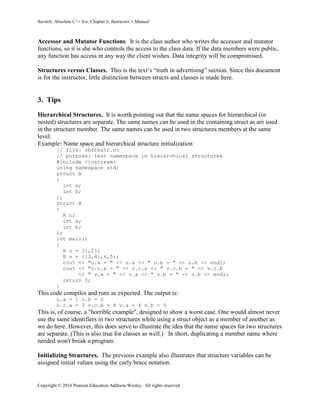
Structures and Structure Types. Historical note: The name struct in C++ is provided
primarily for backward compatibility with ANSI C. Suppose we declare a struct, as in:
struct B
{
int x;
int y;
};
The text points out that the identifier B is called the structure tag. The structure tag B carries full
type information. The tag B can be used as you would use any built-in type. The identifiers x and
y declared in the definition of struct B are called member names. The members are variables are
associated with any variable of struct type. You can declare a variable of type B by writing1
B u;
You can access member variables (as l-values) by writing
u.x = 1;
u.y = 2;
or (as r-values)
int p, q;
p = u.x;
q = u.y;
We said in the previous paragraph that the tag B can be used as you would use any built-in type.
You can pass a struct to a function as a parameter, use a struct as a function return type, and
declare arrays of variables of type struct.
1
Contrast this with the C usage, struct B u;, where the keyword struct must be used in the definition of a
structure variable. This use is permitted in C++ for backward compatibility with C.
Savitch, Absolute C++ 6/e: Chapter 6, Instructor’s Manual
Copyright © 2016 Pearson Education Addison-Wesley. All rights reserved.
Our author points out that two identifiers that are declared to be of the same structure type may be
assigned, with member-wise assignment occurring.2
The critical issue here is that for assignment
compatibility the two structure variables must be declared with the same structure tag. In the
example that follows, the types are indistinguishable from the member structure within the struct.
However, C++ uses name equivalence for types, so the compiler looks at the tags in the
declarations rather than the structure to determine whether one struct variable may be assigned to
another. Example:
struct A
{
int x;
int y;
};
struct B
{
int x;
int y;
};
A u;
B v;
u = v; //type error: u and v are of different types
The error message from g++ 2.9.5 is:
// no match for 'A& = B&'
// candidates are: struct A& A::operator=(const A&)
Structures as Function Arguments. Since a structure tag is a type, the tag can be used as any other
type would be used. You can have arrays of structure objects, or function parameters that are call-by-value
or call-by-reference, and you can use a structure a type for the return type of a function.
Defining Classes and Member Functions. These remarks elaborate the ideas in the text on
class and the scope resolution operator, ::. A class definition (and a struct definition as well),
with the {}; define a scope within which variables and functions are defined. They are not
accessible outside without qualification by the object name and a dot operator . Member
functions are defined within a particular class, to be used by any object declared to be of that
class, again, only with qualification by being preceded by the object name and the dot operator.
To define a function whose prototype is given in a class we have to specify the scope of that
class within which the function is being defined. This is done with the class tag and scope
resolution operator.
To say:
returnTypeName class_tag::funcMemberName(argumentList)
{
//memberFunctionBody...
}
is to say "Within the scope of the class class_tag, define the function named funcMemberName
that has return type returnTypeName."
2
Member-wise assignment is the default for classes and structs. A former student of mine, John Gibson coined the
phrase, “Member UNWISE copy”. We will see that for classes with pointer members, member (un)wise copy is
almost never what you want.
Savitch, Absolute C++ 6/e: Chapter 6, Instructor’s Manual
Copyright © 2016 Pearson Education Addison-Wesley. All rights reserved.
The data members belong to a particular object, and function members must be called on behalf
of that particular object. The object must be specified. The object is specified by using the dot
operator used after the object name, before the member name or function call. Sometimes we
may speak of the calling object.
Encapsulation. The notion of encapsulation means, “to collect together, as if to place in a
capsule”, from which we may infer the purpose, “to hide the details”. The text says a data type
has a set of values to be manipulated, and sets of operations to manipulate the values, but the
details are available to the user or client. A data type becomes an abstract data type if the client
does not have access to the implementation details.
Abstract Data Types. The notion of Abstract Data Type (ADT) has two players: the author of
the ADT and the client of the ADT. The client knows only what the ADT will do, not how the
ADT carries out its tasks. The author of the ADT knows only what the ADT will do for the
client, but nothing about the context within which the ADT is used by the client. Information
hiding is a two way hiding. The separation of implementation (known only to the class author)
and the interface (the contract between ADT author and client) is vital. The other side of the
coin, namely the concealment from the ADT author of the context within which the ADT will be
used, is equally vital. This prevents either author from writing code that would depend on the
internals written by the other programmer.
Separate compilation is necessary to a) concealing implementation details and b) assigning tasks
to several programmers in a team. The reason for leaving the interface and the implementation of
the ADTs in the client in the text is that we do not yet know anything about separate compilation.
Observe that the text almost always places declarations (prototypes) prior to use, then uses the
functions in the main function, then tucks the definitions away after the main function. This has
the effect of emphasizing separation of definition and declaration well before separate
compilation is seen by the student. This is worth mentioning to the student.
Public and Private Members. The data members of a class are part of the implementation, not
part of the interface. The function members intended for use by the client are the interface. There
may be helping functions for the implementation that would be inappropriate for the client to
use, and so are not part of the interface. Normally the interface is made available to the client and
the implementation is hidden.
A struct, by default, allows access to its members by any function. A class, by default, allows
access to its members only to those functions declared within the class. This default access in a
struct is called public, and the default access in a class is called private.
The keywords private and public help manage hiding the implementation and making the
interface available to the client. These keywords are used to modify the default access to
members of a class or struct. The keyword private is used to hide members. The effect of the
keyword private: extends from the keyword private: to the next instance of the keyword public:.
The effect of the keyword public: extends from the keyword public: up to the next instance of the
keyword private:.
Savitch, Absolute C++ 6/e: Chapter 6, Instructor’s Manual
Copyright © 2016 Pearson Education Addison-Wesley. All rights reserved.
Accessor and Mutator Functions. It is the class author who writes the accessor and mutator
functions, so it is she who controls the access to the class data. If the data members were public,
any function has access in any way the client wishes. Data integrity will be compromised.
Structures versus Classes. This is the text’s “truth in advertising” section. Since this document
is for the instructor, little distinction between structs and classes is made here.
3. Tips
Hierarchical Structures. It is worth pointing out that the name spaces for hierarchical (or
nested) structures are separate. The same names can be used in the containing struct as are used
in the structure member. The same names can be used in two structures members at the same
level.
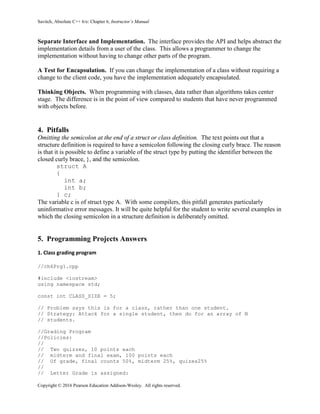
Example: Name space and hierarchical structure initialization
// file: ch6test2.cc
// purpose: test namespace in hierarchical structures
#include <iostream>
using namespace std;
struct A
{
int a;
int b;
};
struct B
{
A c;
int a;
int b;
};
int main()
{
A u = {1,2};
B v = {{3,4},4,5};
cout << "u.a = " << u.a << " u.b = " << u.b << endl;
cout << "v.c.a = " << v.c.a << " v.c.b = " << v.c.b
<< " v.a = " << v.a << " v.b = " << v.b << endl;
return 0;
}
This code compiles and runs as expected. The output is:
u.a = 1 u.b = 2
v.c.a = 3 v.c.b = 4 v.a = 4 v.b = 5
This is, of course, a "horrible example", designed to show a worst case. One would almost never
use the same identifiers in two structures while using a struct object as a member of another as
we do here. However, this does serve to illustrate the idea that the name spaces for two structures
are separate. (This is also true for classes as well.) In short, duplicating a member name where
needed won't break a program.
Initializing Structures. The previous example also illustrates that structure variables can be
assigned initial values using the curly brace notation.
Savitch, Absolute C++ 6/e: Chapter 6, Instructor’s Manual
Copyright © 2016 Pearson Education Addison-Wesley. All rights reserved.
Separate Interface and Implementation. The interface provides the API and helps abstract the
implementation details from a user of the class. This allows a programmer to change the
implementation without having to change other parts of the program.
A Test for Encapsulation. If you can change the implementation of a class without requiring a
change to the client code, you have the implementation adequately encapsulated.
Thinking Objects. When programming with classes, data rather than algorithms takes center
stage. The difference is in the point of view compared to students that have never programmed
with objects before.
4. Pitfalls
Omitting the semicolon at the end of a struct or class definition. The text points out that a
structure definition is required to have a semicolon following the closing curly brace. The reason
is that it is possible to define a variable of the struct type by putting the identifier between the
closed curly brace, }, and the semicolon.
struct A
{
int a;
int b;
} c;
The variable c is of struct type A. With some compilers, this pitfall generates particularly
uninformative error messages. It will be quite helpful for the student to write several examples in
which the closing semicolon in a structure definition is deliberately omitted.
5. Programming Projects Answers
1. Class grading program
//ch6Prg1.cpp
#include <iostream>
using namespace std;
const int CLASS_SIZE = 5;
// Problem says this is for a class, rather than one student.
// Strategy: Attack for a single student, then do for an array of N
// students.
//Grading Program
//Policies:
//
// Two quizzes, 10 points each
// midterm and final exam, 100 points each
// Of grade, final counts 50%, midterm 25%, quizes25%
//
// Letter Grade is assigned:
Savitch, Absolute C++ 6/e: Chapter 6, Instructor’s Manual
Copyright © 2016 Pearson Education Addison-Wesley. All rights reserved.
// 90 or more A
// 80 or more B
// 70 or more C
// 60 or more D
// less than 60, F
//
// Read a student's scores,
// output record: scores + numeric average + assigned letter grade
//
// Use a struct to contain student record.
struct StudentRecord
{
int studentNumber;
double quiz1;
double quiz2;
double midterm;
double final;
double average;
char grade;
};
//prompts for input for one student, sets the
//structure variable members.
void input(StudentRecord& student);
//calculates the numeric average and letter grade.
void computeGrade(StudentRecord& student);
//outputs the student record.
void output(const StudentRecord student);
int main()
{
StudentRecord student[CLASS_SIZE];
for(int i = 0; i < CLASS_SIZE; i++)
input(student[i]);
// Enclosing block fixes VC++ "for" loop control defined outside loop
{ for(int i = 0; i < CLASS_SIZE; i++)
{
computeGrade(student[i]);
output(student[i]);
cout << endl;
}
}
return 0;
}
void input(StudentRecord &student)
{
cout << "enter the student number: ";
cin >> student.studentNumber;
cout << student.studentNumber << endl;
cout << "enter two 10 point quizes" << endl;
cin >> student.quiz1 >> student.quiz2;
Savitch, Absolute C++ 6/e: Chapter 6, Instructor’s Manual
Copyright © 2016 Pearson Education Addison-Wesley. All rights reserved.
cout << student.quiz1 << " " << student.quiz2 << endl;
cout << "enter the midterm and final exam grades."
<< "These are 100 point testsn";
cin >> student.midterm >> student.final;
cout << student.midterm << " " << student.final
<< endl << endl;
}
void computeGrade(StudentRecord& student)
{
// Of grade, final counts 50%, midterm 25%, quizes25%
double quizAvg= (student.quiz1 + student.quiz2)/2.0;
double quizAvgNormalized = quizAvg * 10;
student.average = student.final * 0.5 +
student.midterm * 0.25 +
quizAvgNormalized * 0.25;
char letterGrade[]= "FFFFFFDCBAA";
int index = static_cast<int>(student.average/10);
if(index < 0 || 10 <= index)
{
cout << "Bad numeric grade encountered: "
<< student.average << endl
<< " Aborting.n";
abort();
}
student.grade = letterGrade[index];
}
void output(const StudentRecord student)
{
cout << "The record for student number: "
<< student.studentNumber << endl
<< "The quiz grades are: "
<< student.quiz1 << " " << student.quiz2
<< endl
<< "The midterm and exam grades are: "
<< student.midterm << " " << student.final
<< endl
<< "The numeric average is: " << student.average
<< endl
<< "and the letter grade assigned is "
<< student.grade
<< endl;
}
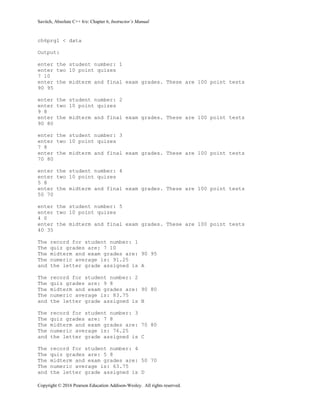
Data for the test run:
1 7 10 90 95
2 9 8 90 80
3 7 8 70 80
4 5 8 50 70
5 4 0 40 35
Command line command to execute the text run:
Savitch, Absolute C++ 6/e: Chapter 6, Instructor’s Manual
Copyright © 2016 Pearson Education Addison-Wesley. All rights reserved.
ch6prg1 < data
Output:
enter the student number: 1
enter two 10 point quizes
7 10
enter the midterm and final exam grades. These are 100 point tests
90 95
enter the student number: 2
enter two 10 point quizes
9 8
enter the midterm and final exam grades. These are 100 point tests
90 80
enter the student number: 3
enter two 10 point quizes
7 8
enter the midterm and final exam grades. These are 100 point tests
70 80
enter the student number: 4
enter two 10 point quizes
5 8
enter the midterm and final exam grades. These are 100 point tests
50 70
enter the student number: 5
enter two 10 point quizes
4 0
enter the midterm and final exam grades. These are 100 point tests
40 35
The record for student number: 1
The quiz grades are: 7 10
The midterm and exam grades are: 90 95
The numeric average is: 91.25
and the letter grade assigned is A
The record for student number: 2
The quiz grades are: 9 8
The midterm and exam grades are: 90 80
The numeric average is: 83.75
and the letter grade assigned is B
The record for student number: 3
The quiz grades are: 7 8
The midterm and exam grades are: 70 80
The numeric average is: 76.25
and the letter grade assigned is C
The record for student number: 4
The quiz grades are: 5 8
The midterm and exam grades are: 50 70
The numeric average is: 63.75
and the letter grade assigned is D
Savitch, Absolute C++ 6/e: Chapter 6, Instructor’s Manual
Copyright © 2016 Pearson Education Addison-Wesley. All rights reserved.
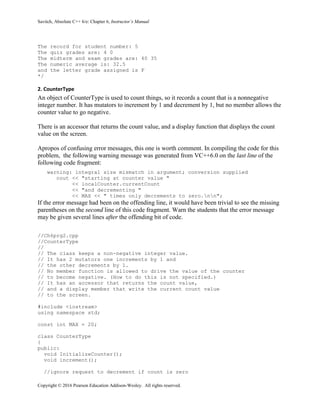
The record for student number: 5
The quiz grades are: 4 0
The midterm and exam grades are: 40 35
The numeric average is: 32.5
and the letter grade assigned is F
*/
2. CounterType
An object of CounterType is used to count things, so it records a count that is a nonnegative
integer number. It has mutators to increment by 1 and decrement by 1, but no member allows the
counter value to go negative.
There is an accessor that returns the count value, and a display function that displays the count
value on the screen.
Apropos of confusing error messages, this one is worth comment. In compiling the code for this
problem, the following warning message was generated from VC++6.0 on the last line of the
following code fragment:
warning: integral size mismatch in argument; conversion supplied
cout << "starting at counter value "
<< localCounter.currentCount
<< "and decrementing "
<< MAX << " times only decrements to zero.nn";
If the error message had been on the offending line, it would have been trivial to see the missing
parentheses on the second line of this code fragment. Warn the students that the error message
may be given several lines after the offending bit of code.
//Ch6prg2.cpp
//CounterType
//
// The class keeps a non-negative integer value.
// It has 2 mutators one increments by 1 and
// the other decrements by 1.
// No member function is allowed to drive the value of the counter
// to become negative. (How to do this is not specified.)
// It has an accessor that returns the count value,
// and a display member that write the current count value
// to the screen.
#include <iostream>
using namespace std;
const int MAX = 20;
class CounterType
{
public:
void InitializeCounter();
void increment();
//ignore request to decrement if count is zero
Savitch, Absolute C++ 6/e: Chapter 6, Instructor’s Manual
Copyright © 2016 Pearson Education Addison-Wesley. All rights reserved.
void decrement();
int currentCount();
void display();
private:
int count;
};
int main()
{
CounterType localCounter;
localCounter.InitializeCounter();
{
for(int i = 1; i < MAX; i++)
if(i%3 == 0) // true when i is divisible by 3
localCounter.increment();
}
cout << "There are " << localCounter.currentCount()
<< " numbers between 1 and " << MAX << " that are divisible by 3.nn";
cout << "Starting at counter value "
<< localCounter.currentCount(
<< " and decrementing "
<< MAX << " times only decrements to zero.nn";
{
for(int i = 1; i < MAX; i++)
{
localCounter.display();
cout << " ";
localCounter.decrement();
}
}
cout << endl << endl;
return 0;
}
void CounterType::InitializeCounter()
{
count = 0;
}
void CounterType::increment()
{
count++;
}
void CounterType::decrement()
{
if(count > 0) count--;
}
Savitch, Absolute C++ 6/e: Chapter 6, Instructor’s Manual
Copyright © 2016 Pearson Education Addison-Wesley. All rights reserved.
void CounterType::display()
{
cout << count;
}
int CounterType::currentCount()
{
return count;
}
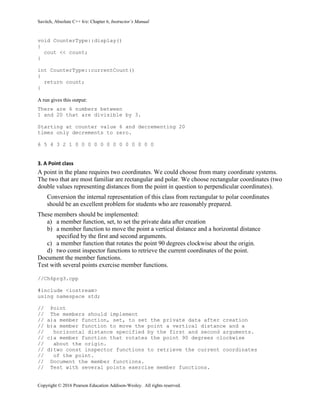
A run gives this output:
There are 6 numbers between
1 and 20 that are divisible by 3.
Starting at counter value 6 and decrementing 20
times only decrements to zero.
6 5 4 3 2 1 0 0 0 0 0 0 0 0 0 0 0 0 0
3. A Point class
A point in the plane requires two coordinates. We could choose from many coordinate systems.
The two that are most familiar are rectangular and polar. We choose rectangular coordinates (two
double values representing distances from the point in question to perpendicular coordinates).
Conversion the internal representation of this class from rectangular to polar coordinates
should be an excellent problem for students who are reasonably prepared.
These members should be implemented:
a) a member function, set, to set the private data after creation
b) a member function to move the point a vertical distance and a horizontal distance
specified by the first and second arguments.
c) a member function that rotates the point 90 degrees clockwise about the origin.
d) two const inspector functions to retrieve the current coordinates of the point.
Document the member functions.
Test with several points exercise member functions.
//Ch6prg3.cpp
#include <iostream>
using namespace std;
// Point
// The members should implement
// a)a member function, set, to set the private data after creation
// b)a member function to move the point a vertical distance and a
// horizontal distance specified by the first and second arguments.
// c)a member function that rotates the point 90 degrees clockwise
// about the origin.
// d)two const inspector functions to retrieve the current coordinates
// of the point.
// Document the member functions.
// Test with several points exercise member functions.
Savitch, Absolute C++ 6/e: Chapter 6, Instructor’s Manual
Copyright © 2016 Pearson Education Addison-Wesley. All rights reserved.
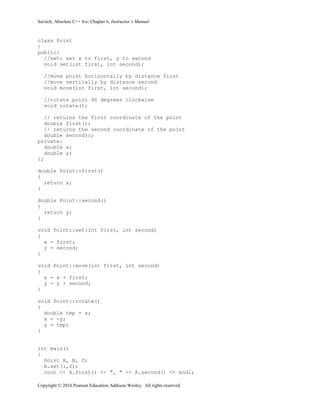
class Point
{
public:
//set: set x to first, y to second
void set(int first, int second);
//move point horizontally by distance first
//move vertically by distance second
void move(int first, int second);
//rotate point 90 degrees clockwise
void rotate();
// returns the first coordinate of the point
double first();
// returns the second coordinate of the point
double second();
private:
double x;
double y;
};
double Point::first()
{
return x;
}
double Point::second()
{
return y;
}
void Point::set(int first, int second)
{
x = first;
y = second;
}
void Point::move(int first, int second)
{
x = x + first;
y = y + second;
}
void Point::rotate()
{
double tmp = x;
x = -y;
y = tmp;
}
int main()
{
Point A, B, C;
A.set(1,2);
cout << A.first() << ", " << A.second() << endl;
Savitch, Absolute C++ 6/e: Chapter 6, Instructor’s Manual
Copyright © 2016 Pearson Education Addison-Wesley. All rights reserved.
A.rotate();
cout << A.first() << ", " << A.second() << endl;
A.rotate();
cout << A.first() << ", " << A.second() << endl;
A.rotate();
cout << A.first() << ", " << A.second() << endl;
A.rotate();
cout << A.first() << ", " << A.second() << endl;
A.rotate();
cout << A.first() << ", " << A.second() << endl;
B.set(2,3);
cout << B.first() << ", " << B.second() << endl;
B.move(1,1);
cout << B.first() << ", " << B.second() << endl;
C.set(5, -4);
cout << C.first() << ", " << C.second() << endl;
cout << "Move C by -5 horizontally and 4 vertically. " << endl;
C.move(-5, 4);
cout << C.first() << ", " << C.second() << endl;
return 0;
}
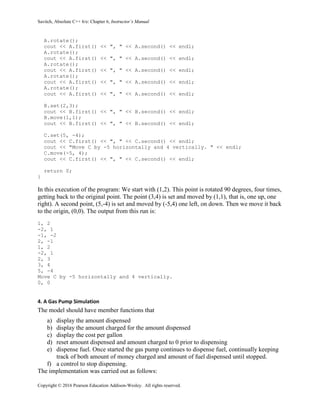
In this execution of the program: We start with (1,2). This point is rotated 90 degrees, four times,
getting back to the original point. The point (3,4) is set and moved by (1,1), that is, one up, one
right). A second point, (5,-4) is set and moved by (-5,4) one left, on down. Then we move it back
to the origin, (0,0). The output from this run is:
1, 2
-2, 1
-1, -2
2, -1
1, 2
-2, 1
2, 3
3, 4
5, -4
Move C by -5 horizontally and 4 vertically.
0, 0
4. A Gas Pump Simulation
The model should have member functions that
a) display the amount dispensed
b) display the amount charged for the amount dispensed
c) display the cost per gallon
d) reset amount dispensed and amount charged to 0 prior to dispensing
e) dispense fuel. Once started the gas pump continues to dispense fuel, continually keeping
track of both amount of money charged and amount of fuel dispensed until stopped.
f) a control to stop dispensing.
The implementation was carried out as follows:
Savitch, Absolute C++ 6/e: Chapter 6, Instructor’s Manual
Copyright © 2016 Pearson Education Addison-Wesley. All rights reserved.
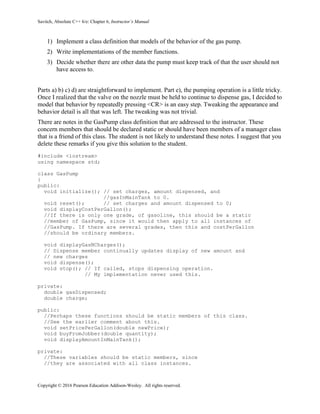
1) Implement a class definition that models of the behavior of the gas pump.
2) Write implementations of the member functions.
3) Decide whether there are other data the pump must keep track of that the user should not
have access to.
Parts a) b) c) d) are straightforward to implement. Part e), the pumping operation is a little tricky.
Once I realized that the valve on the nozzle must be held to continue to dispense gas, I decided to
model that behavior by repeatedly pressing <CR> is an easy step. Tweaking the appearance and
behavior detail is all that was left. The tweaking was not trivial.
There are notes in the GasPump class definition that are addressed to the instructor. These
concern members that should be declared static or should have been members of a manager class
that is a friend of this class. The student is not likely to understand these notes. I suggest that you
delete these remarks if you give this solution to the student.
#include <iostream>
using namespace std;
class GasPump
{
public:
void initialize(); // set charges, amount dispensed, and
//gasInMainTank to 0.
void reset(); // set charges and amount dispensed to 0;
void displayCostPerGallon();
//If there is only one grade, of gasoline, this should be a static
//member of GasPump, since it would then apply to all instances of
//GasPump. If there are several grades, then this and costPerGallon
//should be ordinary members.
void displayGasNCharges();
// Dispense member continually updates display of new amount and
// new charges
void dispense();
void stop(); // If called, stops dispensing operation.
// My implementation never used this.
private:
double gasDispensed;
double charge;
public:
//Perhaps these functions should be static members of this class.
//See the earlier comment about this.
void setPricePerGallon(double newPrice);
void buyFromJobber(double quantity);
void displayAmountInMainTank();
private:
//These variables should be static members, since
//they are associated with all class instances.
Savitch, Absolute C++ 6/e: Chapter 6, Instructor’s Manual
Copyright © 2016 Pearson Education Addison-Wesley. All rights reserved.
double gasInMainTank;
double costPerGallon;
};
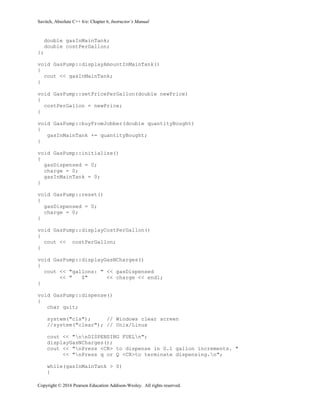
void GasPump::displayAmountInMainTank()
{
cout << gasInMainTank;
}
void GasPump::setPricePerGallon(double newPrice)
{
costPerGallon = newPrice;
}
void GasPump::buyFromJobber(double quantityBought)
{
gasInMainTank += quantityBought;
}
void GasPump::initialize()
{
gasDispensed = 0;
charge = 0;
gasInMainTank = 0;
}
void GasPump::reset()
{
gasDispensed = 0;
charge = 0;
}
void GasPump::displayCostPerGallon()
{
cout << costPerGallon;
}
void GasPump::displayGasNCharges()
{
cout << "gallons: " << gasDispensed
<< " $" << charge << endl;
}
void GasPump::dispense()
{
char quit;
system("cls"); // Windows clear screen
//system("clear"); // Unix/Linux
cout << "nnDISPENSING FUELn";
displayGasNCharges();
cout << "nPress <CR> to dispense in 0.1 gallon increments. "
<< "nPress q or Q <CR>to terminate dispensing.n";
while(gasInMainTank > 0)
{
Savitch, Absolute C++ 6/e: Chapter 6, Instructor’s Manual
Copyright © 2016 Pearson Education Addison-Wesley. All rights reserved.
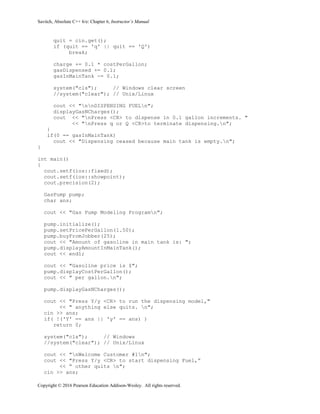
quit = cin.get();
if (quit == 'q' || quit == 'Q')
break;
charge += 0.1 * costPerGallon;
gasDispensed += 0.1;
gasInMainTank -= 0.1;
system("cls"); // Windows clear screen
//system("clear"); // Unix/Linux
cout << "nnDISPENSING FUELn";
displayGasNCharges();
cout << "nPress <CR> to dispense in 0.1 gallon increments. "
<< "nPress q or Q <CR>to terminate dispensing.n";
}
if(0 == gasInMainTank)
cout << "Dispensing ceased because main tank is empty.n";
}
int main()
{
cout.setf(ios::fixed);
cout.setf(ios::showpoint);
cout.precision(2);
GasPump pump;
char ans;
cout << "Gas Pump Modeling Programn";
pump.initialize();
pump.setPricePerGallon(1.50);
pump.buyFromJobber(25);
cout << "Amount of gasoline in main tank is: ";
pump.displayAmountInMainTank();
cout << endl;
cout << "Gasoline price is $";
pump.displayCostPerGallon();
cout << " per gallon.n";
pump.displayGasNCharges();
cout << "Press Y/y <CR> to run the dispensing model,"
<< " anything else quits. n";
cin >> ans;
if( !('Y' == ans || 'y' == ans) )
return 0;
system("cls"); // Windows
//system("clear"); // Unix/Linux
cout << "nWelcome Customer #1n";
cout << "Press Y/y <CR> to start dispensing Fuel,”
<< “ other quits n";
cin >> ans;
Savitch, Absolute C++ 6/e: Chapter 6, Instructor’s Manual
Copyright © 2016 Pearson Education Addison-Wesley. All rights reserved.
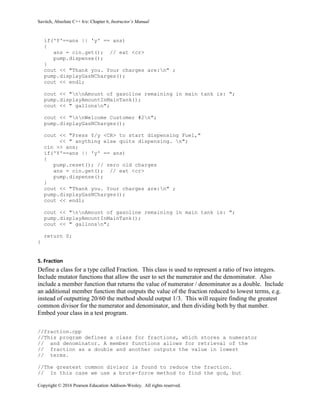
if('Y'==ans || 'y' == ans)
{
ans = cin.get(); // eat <cr>
pump.dispense();
}
cout << "Thank you. Your charges are:n" ;
pump.displayGasNCharges();
cout << endl;
cout << "nnAmount of gasoline remaining in main tank is: ";
pump.displayAmountInMainTank();
cout << " gallonsn";
cout << "nnWelcome Customer #2n";
pump.displayGasNCharges();
cout << "Press Y/y <CR> to start dispensing Fuel,"
<< " anything else quits dispensing. n";
cin >> ans;
if('Y'==ans || 'y' == ans)
{
pump.reset(); // zero old charges
ans = cin.get(); // eat <cr>
pump.dispense();
}
cout << "Thank you. Your charges are:n" ;
pump.displayGasNCharges();
cout << endl;
cout << "nnAmount of gasoline remaining in main tank is: ";
pump.displayAmountInMainTank();
cout << " gallonsn";
return 0;
}
5. Fraction
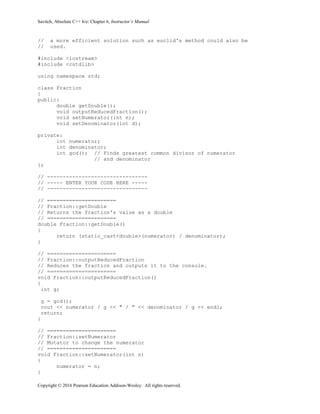
Define a class for a type called Fraction. This class is used to represent a ratio of two integers.
Include mutator functions that allow the user to set the numerator and the denominator. Also
include a member function that returns the value of numerator / denominator as a double. Include
an additional member function that outputs the value of the fraction reduced to lowest terms, e.g.
instead of outputting 20/60 the method should output 1/3. This will require finding the greatest
common divisor for the numerator and denominator, and then dividing both by that number.
Embed your class in a test program.
//fraction.cpp
//This program defines a class for fractions, which stores a numerator
// and denominator. A member functions allows for retrieval of the
// fraction as a double and another outputs the value in lowest
// terms.
//The greatest common divisor is found to reduce the fraction.
// In this case we use a brute-force method to find the gcd, but
Savitch, Absolute C++ 6/e: Chapter 6, Instructor’s Manual
Copyright © 2016 Pearson Education Addison-Wesley. All rights reserved.
// a more efficient solution such as euclid's method could also be
// used.
#include <iostream>
#include <cstdlib>
using namespace std;
class Fraction
{
public:
double getDouble();
void outputReducedFraction();
void setNumerator(int n);
void setDenominator(int d);
private:
int numerator;
int denominator;
int gcd(); // Finds greatest common divisor of numerator
// and denominator
};
// --------------------------------
// ----- ENTER YOUR CODE HERE -----
// --------------------------------
// ======================
// Fraction::getDouble
// Returns the fraction's value as a double
// ======================
double Fraction::getDouble()
{
return (static_cast<double>(numerator) / denominator);
}
// ======================
// Fraction::outputReducedFraction
// Reduces the fraction and outputs it to the console.
// ======================
void Fraction::outputReducedFraction()
{
int g;
g = gcd();
cout << numerator / g << " / " << denominator / g << endl;
return;
}
// ======================
// Fraction::setNumerator
// Mutator to change the numerator
// ======================
void Fraction::setNumerator(int n)
{
numerator = n;
}
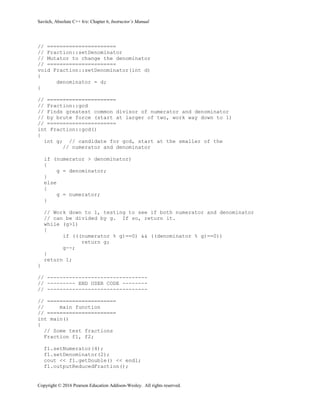
Savitch, Absolute C++ 6/e: Chapter 6, Instructor’s Manual
Copyright © 2016 Pearson Education Addison-Wesley. All rights reserved.
// ======================
// Fraction::setDenominator
// Mutator to change the denominator
// ======================
void Fraction::setDenominator(int d)
{
denominator = d;
}
// ======================
// Fraction::gcd
// Finds greatest common divisor of numerator and denominator
// by brute force (start at larger of two, work way down to 1)
// ======================
int Fraction::gcd()
{
int g; // candidate for gcd, start at the smaller of the
// numerator and denominator
if (numerator > denominator)
{
g = denominator;
}
else
{
g = numerator;
}
// Work down to 1, testing to see if both numerator and denominator
// can be divided by g. If so, return it.
while (g>1)
{
if (((numerator % g)==0) && ((denominator % g)==0))
return g;
g--;
}
return 1;
}
// --------------------------------
// --------- END USER CODE --------
// --------------------------------
// ======================
// main function
// ======================
int main()
{
// Some test fractions
Fraction f1, f2;
f1.setNumerator(4);
f1.setDenominator(2);
cout << f1.getDouble() << endl;
f1.outputReducedFraction();
Another Random Scribd Document
with Unrelated Content
next following, wholie bewraieth himselfe, saieng that the confederat
kings of Scots and Picts, vpon ciuill warres betwéene the Britons
(which then followed) hoped shortlie to inioie all the land of great
Britaine, from beyond Humber vnto the fresh sea, which hope had
bene vaine, and not lesse than void, if it had béene their owne by
anie conquest before.
Constantine of Britaine, descended from Conan king thereof, cousine
of Brutes bloud to this Maximian, and his neerest heire was next
king of Britaine; he immediatlie pursued the Scots with wars, and
shortlie in battell slue their king Dongard, in the first yeare of his
reigne, whereby he recouered Scotland out of their hands, and tooke
all the holdes thereof into his owne possessions. Vortiger shortlie
after obteined the crowne of Britaine, against whom the Scots
newlie rebelled: for the repressing whereof (mistrusting the Britons
to hate him for sundrie causes, as one that to auoid the smoke
dooth oft fall into the fire) receiued Hengest a Saxon, and a great
number of his countriemen, with whom and a few Britons he entred
Scotland & ouercame them, wherevpon they tooke the Iles, which
are their common refuge. He gaue also much of Scotland, as
Gallowaie, Pentland, Mers and Annandale, with sundrie other lands
to this Hengest and his people to inhabit, which they did accordinglie
inioie. But when this Hengest in processe of time thirsted after the
whole kingdome of the south, he was banished, and yet afterward
being restored, he conspired with the Scots against Aurilambrose the
sonne of Constantine, the iust inheritor of this whole dominion. But
his vntruth and theirs were both recompensed togither, for Some thinke
the Seimors to come from this man by lineall descent and I suppose no lesse. he was
taken prisoner by Eldulph de Samor a noble man of Britaine, and his
head for his traitorie striken off at the commandement of
Aurilambrose. In the field the Scots were vanquished: but Octa the
sonne of Hengest was receiued to mercie, to whome and his people
this Aurilambrose gaue the countrie of Gallowaie in Scotland, for
which they became his subiects. And hereby appeareth that Scotland
was then againe reduced into his hands.
Vter called also Pendragon, brother to Aurilambrose was next king of
the Britons, against whome, these sworne Saxons now foresworne
subiects (confederate with the Scots) newlie rebelled: but by his
power assembled against them in Gallowaie in Scotland, they were
discomfited, & Albania againe recouered vnto his subiection. Arthur
the sonne of this Vter, begotten before the mariage, but lawfullie
borne in matrimonie, succéeded next to the crowne of great
Britaine; whose noble acts, though manie vulgar fables haue rather
stained than commended: yet all the Scotish writers confesse, that
he subdued great Britaine, and made it tributarie to him, and
ouercame the Saxons then scattered as far as Cathnesse in
Scotland: and in all these wars against them, he had the seruice and
obeisance of Scots and Picts. But at the last setting their féet in the
guilefull paths of their predecessors, they rebelled and besieged the
citie of Yorke, Howell king of the lesse Britaine cousine to king Arthur
being therein. But he with an host came thither and discomfited the
Scots, chased them into a marsh, and besieged them there so long,
that they were almost famished: vntill the bishops, abbats, and men
of religion (for as much as they were christened people) besought
him to take them to his mercie and grace, and to grant them a
portion of the same countrie to dwell in vnder euerlasting subiection.
Vpon this he tooke them to his grace, homage and fealtie: and when
they were sworne his subiects and liegemen, he ordeined his
kinsman Anguisan to be their king and gouernour, Vrian king of
Iland, and Murefrence king of Orkeneie. He made an archbishop of
Yorke also, whose authoritie extended through all Scotland.
Finallie, the said Arthur holding his roiall feast at Cairleon, had there
all the kings that were subiects vnto him, among which, Angusian
the said king of Scots did his due seruice and homage, so long as he
was with him for the realme of Scotland, & bare king Arthurs sword
afore him. Malgo shortlie after succéeded in the whole kingdome of
great Britaine, who vpon new resistance made, subdued Ireland,
Iland, the Orchads, Norwaie and Denmarke, and made Ethelfred a
Saxon king of Bernicia, that is, Northumberland, Louthian, and much
other land of Scotland, which Ethelfred by the sword obteined at the
hands of the wilfull inhabitants, and continued true subiect to this
Malgo.
Cadwan succéeded in the kingdome of great Britaine, who in
defense of his subiects the Scots, made warre vpon this Ethelfred,
but at the last they agréed, and Cadwan vpon their rebellion gaue all
Scotland vnto this Ethelfred, which he therevpon subdued and
inioied: but afterward in the reigne of Cadwallo that next succeeded
in great Britaine, he rebelled. Whervpon the same Cadwallo came
into Scotland, and vpon his treason reseised the countrie into his
owne hands, and hauing with him all the vicerois of the Saxons,
which then inhabited here as his subiects, in singular battell he slue
the same Ethelfred with his owne hands.
Oswald was shortlie after by Cadwallos gift made king of Bernicia,
and he as subiect to Cadwallo, and by his commandement
discomfited the Scots and Picts, and subdued all Scotland. Oswie the
brother of this Oswald, was by the like gift of Cadwallo, made next
king of Bernicia, and he by like commandement newlie subdued the
Scots and Picts, and held them in that obeisance to this Cadwallow,
during eight and twentie yeares. Thus Cadwallo reigned in the whole
monarchie of great Britaine, hauing all the seuen kings thereof, as
well Saxons as others his subiects: for albeit the number of Saxons
from time to time greatlie increased, yet were they alwaies either at
the first expelled, or else made tributarie to the onelie kings of
Britons for the time being, as all their owne writers doo confesse.
Cadwallader was next king of the whole great Britaine, he reigned
twelue yeares ouer all the kings thereof, in great peace and
tranquillitie: and then vpon the lamentable death of his subiects,
which died of sundrie diseases innumerablie, he departed into little
Britaine. His sonne and cousine Iuor and Iue, being expelled out of
England also by the Saxons, went into Wales, where among the
Britons they and their posteritie remained princes. Vpon this great
alteration, and warres being through the whole dominion betwéene
the Britons and Saxons, the Scots thought time to slip the collar of
obedience, and therevpon entred in league with Charles then king of
France, establishing it in this wise.
1 "The iniurie of Englishmen doone to anie of these people, shall
be perpetuallie holden common to them both.
2 "When Frenchmen be inuaded by Englishmen, the Scots shall
send their armie in defense of France, so that they be supported
with monie and vittels by the French.
3 "When Scots be inuaded by Englishmen, the Frenchmen shall
come vpon their owne expenses, to their support and succour.
4 "None of the people shall take peace or truce with Englishmen,
without the aduise of other, &c."
Nicholas Adams. Manie disputable opinions may be had of warre without
the praising of it, as onelie admittable by inforced necessitie, and to
be vsed for peace sake onelie, where here the Scots sought warre
for the loue of warre onelie. For their league giueth no benefit to
themselues, either in frée traffike of their owne commodities, or
benefit of the French, or other priuilege to the people of both. What
discommoditie riseth by loosing the intercourse and exchange of our
commodities (being in necessaries more aboundant than France) the
Scots féele, and we perfectlie know. What ruine of their townes,
destruction of countries, slaughter of both peoples, haue by reason
of this bloudie league chanced, the histories be lamentable to read,
and horrible among Christian men to be remembred: but God gaue
the increase according to their séed, for as they did hereby sowe
dissention, so did they shortlie after reape a bloudie slaughter and
confusion. For Alpine their king, possessing a light mind that would
be lost with a little wind, hoped by this league shortlie to subdue all
great Britaine, and to that end not onelie rebelled in his owne
kingdome, but also vsurped vpon the kingdome of Picts. Whervpon
Edwine king of England, made one Brudeus king of Picts, whom he
sent into Scotland with a great power, where in battell he tooke this
Alpine king of Scots prisoner, and discomfited his people. And this
Alpine being their king found subiect and rebell, his head was striken
off at a place in Scotland, which thereof is to this daie called
Pasalpine, that is to saie, the head of Alpine. And this was the first
effect of their French league.
Osbright king of England, with Ella his subiect, and a great number
of Britons and Saxons shortlie after, for that the Scots had of
themselues elected a new king, entered Scotland, and ceassed not
his war against them, vntill their king and people fled into the Iles,
with whome at the last vpon their submission, peace was made in
this wise.
The water of Frith shall be march betwéene Scots and Englishmen in
the east parts, and shall be named the Scotish sea.
The water of Cluide to Dunbriton, shall be march in the west parts
betwéene the Scots and Britons. This castell was before called
Alcluide, but now Dunbriton, that is to say, the castle of Britons, and
sometimes it was destroied by the Danes. So the Britons had all the
lands from Sterling to the Ireland seas, and from the water of Frith
& Cluide to Cumber, with all the strengths and commodities thereof:
and the Englishmen had the lands betwéene Sterling and
Northumberland. Thus was Cluide march betwéene the Scots and
the Britons on the one side, and the water of Frith named the
Scotish sea, march betwéene them and Englishmen on the other
side, and Sterling common march to thrée people, Britons,
Englishmen, and Scots, howbeit king Osbright had the castle of
Stirling, where first he caused to be coined Sterling monie. The
Englishmen also builded a bridge of stone, for passage ouer the
water of Frith, in the middest whereof they made a crosse, vnder
which were written these verses:
I am free march, as passengers may
ken,
To Scots, to Britons, and Englishmen.
Not manie yeares after this, Hinguar and Hubba, two Danes, with a
great number of people, arriued in Scotland, and slue Constantine,
whom Osbright had before made king: wherevpon Edulfe or
Ethelwulfe, then king of England, assembled his power against
Hinguar and Hubba, and in one battell slue them both; but such of
their people as would remaine and become christians, he suffered to
tarie: the rest he banished or put to death, &c.
This Ethelwulfe granted the Peter pence, of which albeit Peter &
Paule had little need and lesse right: yet the paiment thereof
continued in this realme euer after vntill now of late yeares. But the
Scots euer since vnto this daie haue, and yet doo paie it, by reason
of that grant, which prooueth them to be then vnder his obeisance.
Alured or Alfred succéeded in the kingdome of England, and reigned
noblie ouer the whole monarchie of great Britaine: he made lawes,
that persons excommunicated should be disabled to sue or claime
anie propertie; which law Gregour, whome this Alured had made
king of Scots, obeied; and the same law as well in Scotland as in
England is holden to this daie, which also prooueth him to be high
lord of Scotland.
This Alured constreined Gregour king of Scots also to breake the
league with France, for generallie he concluded with him, and serued
him in all his warres, as well against Danes as others, not reseruing
or making anie exception of the former league with France.
The said Alured, after the death of Gregour, had the like seruice and
obeisance of Donald king of Scots with fiue thousand horssemen,
against one Gurmond a Dane that then infested the realme, and this
Donald died in this faith and obeisance with Alured.
Edward the first of that name called Chifod sonne of this Alured
succéeded his father, and was the next king of England: against
whome Sithrijc a Dane and the Scots conspired; but they were
subdued, and Constantine their king brought to obeisance. He held
the realme of Scotland also of king Edward, and this dooth Marian
their owne countrieman a Scot confesse: beside Roger Houeden,
and William of Malmesberie.
In the yeare of our Lord 923, the same king Edward was president
and gouernour of all the people of England, Cumberland, Scots,
Danes, and Britons.
King Athelstane in like sort conquered Scotland, and as he laie in his
tents beside Yorke, whilest the warres lasted, the king of Scots
feined himselfe to be a minstrell, and harped before him onelie to
espie his ordinance and his people. But being (as their writers
confesse) corrupted with monie, he sold his faith and false heart
together to the Danes, and aided them against king Athelstane at
sundrie times. Howbeit he met with all their vntruthes at
Broningfield in the west countrie, as is mentioned in the ninth
chapter of the first booke of this description, where he discomfited
the Danes, and slue Malcolme deputie in that behalfe to the king of
Scots: in which battell the Scots confesse themselues to haue lost
more people than were remembred in anie age before. Then
Athelstane following his good lucke, went throughout all Scotland
and wholie subdued it, and being in possession thereof, gaue land
there lieng in Annandale by his deed, the copie wherof dooth follow:
"I king Athelstane, giues vnto Paulam, Oddam and Roddam, als
good and als faire, as euer they mine were, and thereto witnesse
Mauld my wife."
By which course words, not onelie appeareth the plaine simplicitie of
mens dooings in those daies: but also a full proofe that he was then
seized of Scotland. At the last also he receiued homage of Malcolme
king of Scots: but for that he could not be restored to his whole
kingdome, he entered into religion, and there shortlie after died.
Then Athelstane, for his better assurance of that countrie there after,
thought it best to haue two stringes to the bowe of their obedience,
and therefore not onelie constituted one Malcolme to be their king,
but also appointed one Indulph sonne of Constantine the third, to be
called prince of Scotland, to whome he gaue much of Scotland: and
for this Malcolme did homage to Athelstane.
Edmund brother of Athelstane succéeded next king of England, to
whome this Indulph then king of Scots not onelie did homage, but
also serued him with ten thousand Scots, for the expulsion of the
Danes out of the realme of England.
Some referre this to an Edward. Edred or Eldred brother to this Edmund
succéeded next king of England: he not onelie receiued the homage
of Irise then king of Scots, but also the homage of all the barons of
Scotland.
Edgar the sonne of Edmund, brother of Athelstane, being now of full
age, was next king of England: he reigned onelie ouer the whole
monarchie of Britaine, and receiued homage of Keneth king of Scots
for the kingdome of Scotland, and made Malcolme prince thereof.
This Edgar gaue vnto the same Keneth the countrie of Louthian in
Scotland, which was before seized into the hands of Osbright king of
England for their rebellion, as is before declared. He inioined Keneth
their said king also once in euerie yéere at certeine principall feasts
(whereat the king did vse to weare his crowne) to repaire vnto him
into England for the making of lawes: which in those daies was
doone by the noble men or péeres according to the order of France
at this daie. He allowed also sundrie lodgings in England, to him and
his successours, whereat to lie, and refresh themselues in their
iourneies, whensoeuer they should come vp to doo their homages:
and finallie a péece of ground lieng beside the new palace of
Westminster, vpon which this Keneth builded a house, that by him
and his posteritie was inioied vntill the reigne of king Henrie the
second. In whose time, vpon the rebellion of William king of Scots, it
was resumed into the king of Englands hand. The house is decaied,
but the ground where it stood is called Scotland to this daie.
Lawfull age and wardship of heires. Moreouer, Edgar made this law, that no
man should succéed to his patrimonie or inheritance holden by
knights seruice, vntill he accomplished the age of one and twentie
yéeres: because by intendment vnder that age, he should not be
able in person to serue his king and countrie according to the tenor
of his deed, and the condition of his purchase. This law was receiued
by the same Keneth in Scotland; and as well there as in England is
obserued to this daie: which prooueth also that Scotland was then
vnder his obeisance.
In the yeere of our Lord 974, Kinald king of Scots, and Malcolme
king of Cumberland, Macon king of Man and the Iles, Duuenall king
of Southwales, Siferth and Howell kings of the rest of Wales, Jacob
or James of Gallowaie, & Jukill of Westmerland did homage to king
Edgar at Chester. And on the morrow going by water to the
monasterie of saint Iohns to seruice, and returning home againe:
the said Edgar sitting in a barge, and stirring the same vpon the
water of Dée, made the said kings to row the barge, saieng that his
successors might well be ioifull to haue the prerogatiue of so great
honour, and the superioritie of so manie mightie princes to be
subiect vnto their monarchie.
Edward, the sonne of this Edgar, was next king of England, in whose
time this Keneth king of Scots caused Malcolme king of Scotland to
be poisoned. Wherevpon king Edward made warre against him,
which ceased not vntill this Keneth submitted himselfe, and offered
to receiue him for prince of Scotland, whome king Edward would
appoint. Herevpon king Edward proclamed one Malcolme to be
prince of Scotland, who immediatlie came into England, and there
did homage vnto the same king Edward.
Etheldred, brother of this Edward succeeded next ouer England,
against whome Swaine king of Denmarke conspired with this last
Malcolme then king of Scots. But shortlie after, this Malcolme
sorrowfullie submitted himselfe into the defense of Etheldred: who
considering how that which could not be amended, must onelie be
repented, benignlie receiued him. By helpe of whose seruice at last
Etheldred recouered his realme againe out of the hands of Swaine,
and reigned ouer the whole monarchie eight and thirtie yéeres.
Edmund surnamed Ironside, sonne of this Etheldred, was next king
of England, in whose time Canutus a Dane inuaded the realme with
much crueltie. But at the last he married with Emme sometime wife
vnto Etheldred and mother of this Edmund. Which Emme, as
arbitratrix betweene hir naturall loue to the one, and matrimoniall
dutie to the other, procured such amitie betwéene them in the end,
that Edmund was contented to diuide the realme with Canutus: and
keeping to himselfe all England on this side Humber, gaue all the
rest beyond Humber, with the seigniorie of Scotland to this Canutus.
Wherevpon Malcolme then king of Scots (after a little accustomable
resistance) did homage to the same Canutus for the kingdome of
Scotland. Thus the said Canutus held the same ouer of this Edmund
king of England by the like seruices, so long as they liued togither.
This Canutus in memorie of this victorie, and glorie of his seigniorie
ouer the Scots, commanded Malcolme their king to build a church in
Buchquhan in Scotland, (where a field betweene him and them was
fought) to be dedicated to Olauus patrone of Norwaie and
Denmarke, which church was by the same Malcolme accordinglie
performed.
Edward called the Confessour, sonne of Etheldred, and brother to
Edmund Ironside, was afterward king of England: he tooke from
Malcolme king of Scots his life and his kingdome, and made
Malcolme sonne to the king of Cumberland and Northumberland king
of Scots, who did him homage and fealtie.
This Edward perused the old lawes of the realme, and somewhat
added to some of them: as to the law of Edgar for the wardship of
the lands vntill the heire should accomplish the age of one and
twentie yeeres. He added, that the marriage of such heire should
also belong to the lord of To whome the marriage of the ward perteineth. whom
the same land was holden. Also, that euerie woman marrieng a
freeman, should (notwithstanding she had no children by that
husband) enioie the third part of his inheritance during hir life: with
manie other lawes which the same Malcolme king of Scots obeied,
and which as well by them in Scotland, as by vs in England be
obserued to this day, and directlie prooueth the whole to be then
vnder his obeisance.
By reason of this law, Malcolme the sonne of Duncane next inheritor
to the crowne of Scotland, being within age, was by the nobles of
Scotland deliuered as ward to the custodie also of king Edward.
During whose minoritie, one Makebeth a Scot traitorouslie vsurped
the crowne of Scotland. Against whome the said Edward made
warre, in which the said Mackbeth was ouercome and slaine.
Wherevpon the said Malcolme was crowned king of Scots at Scone,
in the eight yeere of the reigne of king Edward aforesaid. This
Malcolme also by tenor of the said new law of wardship, was married
vnto Margaret the daughter of Edward sonne of Edmund Ironside
and Agatha, by the disposition of the same king Edward, and at his
full age did homage to this king Edward the Confessour for the
kingdome of Scotland.
Edward the Confessour. Moreouer, Edward of England, hauing no issue of
his bodie, and mistrusting that Harald the son of Goodwine,
descended of the daughter of Harald Harefoot the Dane, would
vsurpe the crowne, if he should leaue it to his cousine Edgar Eatling
(being then within age) and partlie by the petition of his subiects,
who before had sworne neuer to receiue anie kings ouer them of the
Danish nation, did by his substantiall will in writing (as all our clergie
writers affirme) demise the crowne of great Britaine vnto William
Bastard, then duke of Normandie, and to his heires, constituting him
his heire testamentarie. Also there was proximitie in bloud betwéene
them: for Emme daughter of Richard duke of Normandie was wife
vnto Etheldred, on whom he begat Alured and this Edward: and this
William was son of Robert sonne of Richard, brother of the whole
bloud to the same Emme. Whereby appeareth that this William was
heire by title, and not by conquest, albeit that partlie to extinguish
the mistrust of other titles, and partlie for the glorie of his victorie,
he chalenged in the end, the name of a conquerour, and hath béene
so written euer since the time of his arriuall.
William Bastard. Furthermore, this William, called the Bastard and the
Conquerour, supposed not his conquest perfect till he had likewise
subdued the Scots. Wherfore to bring the Scots to iust obeisance
after his coronation, as heire testamentarie to Edward the
Confessour; he entred Scotland, where after a little resistance made
by the inhabitants, the said Malcolme then their king did homage to
him at Abirnethie in Scotland for the kingdome of Scotland, as to his
superiour also by meane of his late conquest.
William Rufus. William surnamed Rufus, sonne to this William called the
Conquerour, succéeded next in the throne of England, to whome the
said Malcolme king of Scots did like homage for the whole kingdome
of Scotland. But afterward he rebelled, and was by this William
Rufus slaine in plaine field. Wherevpon the Scotishmen did choose
one Donald or Dunwall to be their king. But this William Rufus
deposed him, and created Dunkane sonne of Malcolme to be their
king, who did like homage to him. Finallie, this Dunkane was slaine
by the Scots, and Dunwall restored, who once againe by this William
Rufus was deposed; and Edgar son of Malcolme, and brother to the
last Malcolme, was by him made their king, who did like homage for
Scotland to this William Rufus.
Henrie I. Henrie called Beauclerke the sonne of William called the
Conquerour, after the death of his brother William Rufus, succéeded
to the crowne of England, to whome the same Edgar king of Scots
did homage for Scotland: this Henrie Beauclerke maried Mawd the
daughter of Malcolme K. of Scots, and by hir had issue Mawd
afterward empresse.
Alexander the sonne of Malcolme brother to this Mawd was next
king of Scots, he did like homage for the kingdome of Scotland to
this Henrie the first, as Edgar had doone before him.
Mawd. Mawd called the empresse, daughter and heire to Henrie
Beauclerke and Mawd his wife, receiued homage of Dauid, brother
to hir and to this Alexander next king of Scots, before all the
temporall men of England for the kingdome of Scotland. This Mawd
the empresse gaue vnto Dauid in the marriage, Mawd the daughter
and heire of Voldosius earle of Huntingdon & Northumberland. And
herein their euasion appeareth, by which they allege that their kings
homages were made for the earledome of Huntingdon. For this
Dauid was the first that of their kings was earle of Huntingdon,
which was since all the homages of their kings before recited, and at
the time of this mariage, & long after the said Alexander his brother
was king of Scots, doing the homage aforesaid to Henrie Beauclerke
son to the aforesaid ladie, of whome I find this epitaph worthie to be
remembred:
Ortu magna, viro maior, sed maxima partu,
Hîc iacet Henrici filia, sponsa, parens.
In the yéere of our Lord 1136, and first yéere of the reigne of king
Stephan, the said Dauid king of Scots being required to doo his
homage, refused it: for so much as he had doone homage to Mawd
the empresse before time; notwithstanding the sonne of the said
Dauid did homage to king Stephan.
Henrie 2. Henrie called Fitz empresse, the sonne of Mawd the
empresse daughter of Mawd, daughter of Malcolme king of Scots,
was next king of England. He receiued homage for Scotland of
Malcolme sonne of Henrie, sonne of the said Dauid their last king.
Which Malcolme after this homage attended vpon the same king
Henrie in his warres against Lewis then king of France. Whereby
appeareth that their French league was neuer renewed after the last
diuision of their countrie by Osbright king of England. But after these
warres finished with the French king, this Malcolme being againe in
Scotland rebelled: wherevpon king Henrie immediatlie seized
Huntingdon and Northumberland into his owne hands by
confiscation, and made warres vpon him in Scotland: during which
the same Malcolme died without issue of his bodie.
William brother of this Malcolme was next king of Scots, he with all
the Because they were taken from him before. nobles of Scotland (which could
not be now for anie earledome) did homage to the sonne of Henrie
the second, his father. Also the earledome of Huntingdon was (as ye
haue heard) before this forfeited by Malcolme his brother, and neuer
after restored to the crowne of Scotland.
This William did afterward attend vpon the same Henrie the second,
in his warres in Normandie against the French king (notwithstanding
their French league) and then being licenced to depart home in the
tenth of this prince, and vpon the fifteenth of Februarie he returned,
and vpon the sixtéenth of October did homage to him for the realme
of Scotland. In token also of his perpetuall subjection to the crowne
of England, he offered vp his cloake, his saddle, and his speare at
the high altar in Yorke: wherevpon he was permitted to depart home
into Scotland, where immediatlie he mooued cruell warre in
Northumberland against the same king Henrie, being as yet in
Normandie. But God tooke the defense of king Henries part, and
deliuered the same William king of Scots into the hands of a few
Englishmen, who brought him prisoner to king Henrie into
Normandie in the twentith yeere of his reigne. But at the last, at the
sute of Dauid his brother, Richard bishop of saint Andrews, and other
bishops and lords, he was put to this fine for the amendment of his
trespasse; to wit, to paie ten thousand pounds sterling, and to
surrender all his title to the earldome of Huntingdon, Cumberland, &
Northumberland into the hands of king Henrie, which he did in all
things accordinglie, sealing his charters thereof with the great scale
of Scotland, and signets of his nobilitie yet to be seene: wherein it
was also comprised, that he and his successours should hold the
realme of Scotland of the king of England and his successours for
euer. And herevpon he once againe did homage to the same king
Henrie, which now could not be for the earledome of Huntingdon,
the right whereof was alreadie by him surrendered. And for the
better assurance of this faith also, the strengths of Berwike,
Edenborough, Roxborough, and Striueling were deliuered into the
hands of our king Henrie of England, which their owne writers
confesse. But Hector Boetius saith, that this trespasse was amended
by fine of twentie thousand pounds sterling, and that the erledome
of Huntingdon, Cumberland, and Northumberland were deliuered as
morgage into the hands of king Henrie, vntill other ten thousand
pounds sterling should be to him paid, which is so farre from truth,
as Hector was (while he liued) from well meaning to our countrie.
But if we grant that it is true, yet prooueth he not that the monie
was paid, nor the land otherwise redéemed, or euer after came to
anie Scotish kings hands. And thus it appeareth that the earledome
of Huntingdon was neuer occasion of the homages of the Scotish
kings to the kings of England, either before this time or after.
This was doone 1175. Moreouer I read this note hereof gathered out
of Robertus Montanus or Montensis that liued in those daies, and
was (as I take it) "confessor to king Henrie. The king of Scots dooth
homage to king Henrie for the kingdome of Scotland, and is sent
home againe, his bishops also did promise to doo the like to the
archbishop of Yorke, and to acknowledge themselues to be of his
prouince and iurisdiction. By vertue also of this composition the said
Robert saith, that Rex Angliæ dabat honores, episcopatus, abbatias,
& alias dignitates in Scotia, vel saltem eius consilio dabantur, that is,
The king of England gaue honors, bishopriks, abbatships, and other
dignities in Scotland, or at the leastwise they were not giuen without
his aduise and counsell."
At this time Alexander bishop of Rome (supposed to haue generall
iurisdiction ecclesiasticall through christendome) established the
whole cleargie of Scotland (according to the old lawes) vnder the
iurisdiction of the archbishop of Yorke.
In the yeare of our Lord 1185, in the moneth of August, at Cairleill,
Rouland Talmant lord of Galwaie, did homage and fealtie to the said
king Henrie with all that held of him.
In the two and twentith yeare of the reigne of king Henrie the
second, Gilbert sonne of Ferguse prince of Galwaie, did homage and
fealtie to the said king Henrie, and left Dunecan his sonne in hostage
for conseruation of his peace.
Richard surnamed Cœur de Lion, because of his stoutnesse, and
sonne of this Henrie was next king of England, to whome the same
William king of Scots did homage at Canturburie for the whole
kingdome of Scotland.
This king Richard was taken prisoner by the duke of Ostrich, for
whose redemption the whole realme was taxed at great summes of
monie vnto the which this William king of Scots (as a subject) was
contributorie, and paied two thousand markes sterling.
In the yeare of our Lord 1199, Iohn king of England sent to William
king of Scots, to come and doo his homage, which William came to
Lincolne in the moneth of December the same yeare, and did his
homage vpon an hill in the presence of Hubert archbishop of
Canturburie, and of all the people there assembled, and therevnto
tooke his oth and was sworne vpon the crosse of the said Hubert:
also he granted by his charter confirmed, that he should haue the
mariage of Alexander his sonne, as his liegeman, alwaies to hold of
the king of England: promising moreouer that he the said king
William and his sonne Alexander, should keepe and hold faith and
allegiance to Henrie sonne of the said king Iohn, as to their chiefe
lord against all maner of men that might liue and die.
Also whereas William king of Scots had put Iohn bishop of saint
Andrew out of his bishoprike, pope Clement wrote to Henrie king of
England, that he should mooue and induce the same William; and if
néed required by his roiall power and prerogatiue ouer that nation,
to compell him to leaue his rancor against the said bishop, and
suffer him to haue and occupie his said bishoprike againe.
In the yeare of our Lord 1216, and fiue & twentith of the reigne of
Henrie, sonne to king Iohn, the same Henrie and the quéene were at
Yorke at the feast of Christmasse, for the solemnization of a
marriage made in the feast of saint Stephan the martyr the same
yeare, betwéene Alexander king of Scots, and Margaret the kings
daughter, and there the said Alexander did homage to Henrie king of
England for all the realme of Scotland.
In buls of diuerse popes were admonitions giuen to the kings of
Scots, as appeareth by that of Gregorie the fift and Clement his
successor, that they should obserue and trulie kéepe all such
appointments, as had béene made betwéene the kings of England
and Scotland. And that the kings of Scotland should still hold the
realme of Scotland of the kings of England, vpon paine of cursse and
interdiction.
After the death of Alexander king of Scots, Alexander his sonne,
being nine yeares of age, was by the lawes of Edgar, in ward to king
Henrie the third, & by the nobles of Scotland brought to Yorke, and
there deliuered vnto him. During whose minoritie king Henrie
gouerned Scotland, and to subdue a commotion in this realme, vsed
the aid of fiue thousand Scotishmen. But king Henrie died during the
nonage of this Alexander, whereby he receiued not his homage,
which by reason and law was respited vntill his full age of one and
twentie yeares.
Edward the first after the conquest, sonne of this Henrie was next
king of England; immediatlie after whose coronation, Alexander king
of Scots, being then of full age, did homage to him for Scotland at
Westminster, swearing (as all the rest did) after this maner.
"I. D. N. king of Scots shall be true and faithfull vnto you lord E. by
the grace of God king of England, the noble and superior lord of the
kingdome of Scotland, and vnto you I make my fidelitie for the same
kingdome, the which I hold and claime to hold of you. And I shall
beare you my faith and fidelitie of life and lim, and worldlie honour
against all men, faithfullie I shall knowlege and shall doo you seruice
due vnto you of the kingdome of Scotland aforesaid, as God me so
helpe and these holie euangelies."
This Alexander king of Scots died, leauing one onelie daughter called
Margaret for his heire, who before had maried Hanigo, sonne to
Magnus king of Norwaie, which daughter also shortlie after died,
leauing one onelie daughter hir heire, of the age of two yeares,
whose custodie and mariage by the lawes of king Edgar, and Edward
the confessor, belonged to Edward the first: whervpon the nobles of
Scotland were commanded by our king Edward to send into
Norwaie, to conueie this yoong queene into England to him, whome
he intended to haue maried to his sonne Edward: and so to haue
made a perfect vnion long wished for betwéene both realmes.
Herevpon their nobles at that time considering the same tranquillitie
that manie of them haue since refused, stood not vpon shifts and
delaies of minoritie nor contempt, but most gladlie consented, and
therevpon sent two noble men of Scotland into Norwaie, for hir to be
brought to this king Edward, but she died before their comming
thither, and therefore they required nothing but to inioie the lawfull
liberties that they had quietlie possessed in the last king Alexanders
time.
After the death of this Margaret, the Scots were destitute of anie
heire to the crowne from this Alexander their last king, at which time
this Edward descended from the bodie of Mawd daughter of
Malcolme sometime king of Scots, being then in the greatest broile
of his warres with France, minded not to take the possession of that
kingdome in his owne right, but was contented to establish Balioll to
be king thereof, the weake title betwéene him, Bruse, & Hastings,
being by the humble petition of all the realme of Scotland cōmitted
to the determination of king Edward, wherein by autentike writing
they confessed the superioritie of the realme to remaine in king
Edward, sealed with the seales of foure bishops, seuen earles, and
twelue barons of Scotland, and which shortlie after was by the whole
assent of the three estates of Scotland, in their solemne parlement
confessed and enacted accordinglie, as most euidentlie dooth
appeare.
The Balioll in this wise made king of Scotland, did immediatlie make
his homage and fealtie at Newcastell vpon saint Stéeuens daie (as
did likewise all the lords of Scotland, each one setting his hand to
the composition in writing) to king Edward of England for the
kingdome of Scotland: but shortlie after defrauding the benigne
goodnesse of his superiour, he rebelled, and did verie much hurt in
England. Herevpon king Edward inuaded Scotland, seized into his
hands the greater part of the countrie, and tooke all the strengths
thereof. Whervpon Balioll king of Scots came vnto him to Mauntrosse
in Scotland with a white wand in his hand, and there resigned the
crowne of Scotland, with all his right, title, and interest to the same,
into the hands of king Edward, and thereof made his charter in
writing, dated and sealed the fourth yeare of his reigne. All the
nobles and gentlemen of Scotland also repaired to Berwike, and did
homage and fealtie to king Edward, there becomming his subiects.
For the better assurance of whose oths also, king Edward kept all
the strengths and holdes of Scotland in his owne hands; and
herevpon all their lawes, processes, all iudgements, gifts of assises
and others, passed vnder the name and authoritie of king Edward.
Leland touching the same rehearsall, writeth thereof in this maner.
"In the yeare of our Lord 1295, the same Iohn king of Scots,
contrarie to his faith and allegiance rebelled against king Edward,
and came into England, and burnt and slue without all modestie and
mercie. Wherevpon king Edward with a great host went to
Newcastell vpon Tine, passed the water of Twéed, besieged Berwike,
and got it. Also he wan the castell of Dunbar, and there were slaine
at this brunt 15700 Scots. Then he proceeded further, and gat the
castell of Rokesborow, and the castell of Edenborow, Striuelin and
Gedworth, and his people harried all the land. In the meane season,
the said king Iohn of Scots, considering that he was not of power to
withstand king Edward, sent his letters and besought him of treatie
and peace, which our prince benignlie granted, and sent to him
againe that he should come to the towre of Brechin, and bring
thither the great lords of Scotland with him. The king of England
sent thither Antonie Becke bishop of Durham, with his roiall power,
to conclude the said treatise. And there it was agreed that the said
Iohn and all the Scots should vtterlie submit themselues to the kings
will. And to the end the submission should be performed
accordinglie, the king of Scots laid his sonne in hostage and pledge
vnto him. There also he made his letters sealed with the common
seale of Scotland, by the which he knowledging his simplenes and
great offense doone to his lord king Edward of England, by his full
power and frée will yeelded vp all the land of Scotland, with all the
people and homage of the same. Then our king went foorth to sée
the mounteins, and vnderstanding that all was in quiet and peace,
he turned to the abbeie of Scone, which was The Scots dreame that this was
the stone whereon Jacob slept when he fled into Mesopotamia. of chanons regular,
where he tooke the stone called the Regall of Scotland, vpon which
the kings of that nation were woont to sit, at the time of their
coronations for a throne, & sent it to the abbeie of Westminster,
commanding to make a chaire therof for the priests that should sing
masse at the high altar: which chaire was made, and standeth yet
there at this daie to be séene."
In the yeare of our Lord 1296, the king held his parlement at
Berwike: and there he tooke homage singularlie of diuerse of the
lords & nobles of Scotland. And for a perpetuall memorie of the
same, they made their letters patents sealed with their seales, and
then the king of England made William Warreine earle of Surrie and
Southsax lord Warden of Scotland, Hugh of Cressingham treasurer,
and William Ormesbie iustice of Scotland, and foorthwith sent king
Iohn to the Tower of London, and Iohn Comin, and the earle
Badenauth, the earle of Bohan and other lords into England to
diuerse places on this side of the Trent.
And after that, in the yeare of our Lord 1297, at the feast of
Christmas, the king called before him the said Iohn king of Scots,
although he had committed him to ward: and said that he would
burne or destroie their castels, townes, and lands, if he were not
recompensed for his costs and damages susteined in the warres; but
king Iohn and the other that were in ward, answered that they had
nothing, sith their liues, their deaths, and goods were in his hands.
The king vpon that answer mooued with pitie, granted them their
liues; so that they would doo their homage, and make their oth
solenmelie at the high altar (in the church of the abbeie of
Westminster) vpon the eucharist, that they and euerie of them
should hold and keepe true faith, obedience, and allegiance to the
said king Edward and his heires kings of England for euer. And
where the said king of Scots saw the kings banner of England
displaied, he and all his power should draw therevnto. And that
neither he or anie of his from thencefoorth should beare armes
against the king of England or anie of his bloud. Finallie, the king
rewarding with great gifts the said king Iohn and his lords, suffered
them to depart. But they went into Scotland alwaie imagining
(notwithstanding this their submission) how they might oppresse
king Edward, and disturbe his realme. The Scots sent also to the
king of France for succour and helpe, who sent them ships to
Berwike furnished with men of armes, the king of England then
being in Flanders.
In the yeare of our Lord 1298, the king went into Scotland with a
great host, and the Scots also assembled in great number, but the
king fought with them at Fawkirke on S. Marie Magdalens daie,
where were slaine thréescore thousand Scots, & William Walleis that
was their capteine fled, who being taken afterward, was hanged,
drawen, & quartered at London, for his trespasses.
After this the Scots rebelled againe, and all the lords of Scotland This
was doone upon the nine & twentith of Ianuarie, 1306. chose Robert Bruse to be
king, except onelie Iohn Commin earle of Carrike, who would not
consent thereto bicause of his oth made to the king of England.
Wherefore Robert Bruse slue him at Dumfrise, and then was
crowned at Schone abbeie. Herevpon the king of England assembled
a great hoast, and rode through all Scotland, discomfited Robert
Bruse, slue eight thousand Scots, & tooke the most part of all the
lords of Scotland, putting the temporall lords to deth bicause they
were forsworne.
Edward borne at Carnaruan sonne of this Edward, was next king of
England, who from the beginning of his reigne enioied Scotland
peaceablie, dooing in all things as is aboue said of king Edward his
father, vntill toward the later end of his reigne, about which time this
Robert Bruse conspired against him, and with the helpe of a few
forsworne Scots, forswore himselfe king of Scots. Herevpon this
Edward with Thomas earle of Lancaster and manie other lords made
warre vpon him, about the feast of Marie Magdalene, the said Bruse
and his partakers being alreadie accurssed by the pope for breaking
the truce that he had established betwixt them. But being
infortunate in his first warres against him, he suffered Edward the
sonne of Balioll to proclame himselfe king of Scots; and
neuerthelesse held foorth his warres against Bruse, before the
ending of which he died, as I read.
Edward borne at Windsore sonne of Edward the second was next
king of England, at the age of fifteene yeares, in whose minoritie the
Scots practised with Isabell mother to this Edward, and with Roger
Mortimer earle of the March to haue their homages released: whose
good will therein they obteined, so that for the same release they
should paie to this king Edward thirtie thousand pounds starling, in
three yeares next following, that is to saie, ten thousand pounds
starling yeerelie. But bicause the nobilitie and commons of this
realme would not by parlement consent vnto it, their king being
within age, the same release procéeded not, albeit the Scots ceased
not their practises with this quéene and earle. But before those thrée
yeares, in which their monie (if the bargaine had taken place) should
haue béene paied, were expired, our king Edward inuaded Scotland,
and ceassed not the warre, vntill Dauid the sonne of Robert le Bruse
(then by their election king of Scotland) absolutelie submitted
himselfe vnto him. But for that the said Dauid Bruse had before by
practise of the quéene and the earle of March, married Iane the
sister of this king Edward: he mooued by naturall zeale to his sister,
was contented to giue the realme of Scotland to this Dauid Bruse,
and to the heires that should be begotten of the bodie of the said
Iane (sauing the reuersion and meane homages to this king Edward
and to his owne children) wherewith the same Dauid Bruse was right
well contented, and therevpon immediatlie made his homage for all
the realme of Scotland to him.
Howbeit, shortlie after causelesse conceiuing cause of displeasure,
this Dauid procured to dissolue this same estate tailée, and
therevpon not onelie rebelled in Scotland, but also inuaded England,
whilest king Edward was occupied about his wars in France. But this
Dauid was not onelie expelled England in the end, but also thinking
no place a sufficient defense to his vntruth, of his owne accord fled
out of Scotland: whereby the countries of Annandale, Gallowaie,
Mars, Teuidale, Twedale, and Ethrike were seized into the king of
Englands hands, and new marches set betwéene England and
Scotland at Cockburnes path & Sowtrie hedge. Which when this
Dauid went about to recouer againe, his power was discomfited, and
himselfe by a few Englishmen taken & brought into England, where
he remained prisoner eleuen yeares after his said apprehension.
During this time, king Edward enioied Scotland peaceablie, and then
at the contemplation and wearie suit of his sorowfull sister, wife of
this Dauid, he was contented once againe to restore him to the
kingdome of Scotland. Wherevpon it was concluded, that for this
rebellion Dauid should paie to king Edward, the summe of one
hundred thousand markes starling, and thereto destroie all his
holdes and fortresses standing against the English borders, and
further assure the crowne of Scotland to the children of this king
Edward for lacke of heire of his owne bodie, all which things he did
accordinglie. And for the better assurance of his obeisance also, he
afterward deliuered into the hands of king Edward sundrie noble
men of Scotland in this behalfe as his pledges. This is the effect of
the historie of Dauid, touching his delings. Now let vs sée what was
doone by Edward Balioll, wherof our chronicles doo report, that in
the yéere of our Lord 1326, Edward the third, king of England, was
crowned at Westminster, and in the fift yeare of his reigne Edward
Balioll right heire to the kingdome of Scotland came in, and claimed
it as due to him. Sundrie lords and gentlemen also, which had title
to diuerse lands there, either by themselues, or by their wiues, did
the like. Wherevpon the said Balioll and they went into Scotland by
sea, and landing at Kinghorne with 3000 Englishmen, discomfited
10000 Scots, and slue 1200, and then went foorth to Dunfermeline,
where the Scots assembled against them with 40000 men, and in
the feast of saint Laurence, at a place called Gastmore (or otherwise
Gladmore) were slaine fiue earls, thirtéene barons, a hundred and
thrée score knights, two thousand men of armes, and manie other;
in all fortie thousand: and there were slaine on the English part but
thirtéene persons onelie, if the number be not corrupted.
In the eight yeare of the reigne of king Edward, he assembled a
great hoast, and came to Berwike vpon Twéed, and laid siege therto.
To him also came Edward Balioll king of Scots, with a great power to
strengthen & aid him against the Scots, who came out of Scotland in
foure batels well armed & araied.
Edward king of England, and Edward king of Scots, apparrelled their
people either of them in foure battels: and vpon Halidon hill, beside
Berwike, met these two hoasts, and there were discomfited of the
Scots fiue and twentie thousand and seauen hundred, whereof were
slaine eight earles, a thousand and thrée hundred knights and
gentlemen. This victorie doone, the king returned to Berwike, & then
the towne with the castell were yéelded vp vnto him. In the eight
yeare of the reigne of king Edward of England, Edward Balioll king of
Scots came to Newcastell vpon Tine, and did homage for all the
realme of Scotland.
In the yeare of our Lord 1346, Dauid Bruse by the prouocation of
the king of France rebelled, and came into England with a great
hoast vnto Neuils crosse: but the archbishop of Yorke, with diuerse
temporall men, fought with him; and the said king of Scots was
taken, and William earle of Duglas with Morrise earle of Strathorne
were brought to London, and manie other lords slaine, which with
Dauid did homage to Edward king of England.
And in the thirtith yeare of the kings reigne, and the yeare of our
Lord 1355, the Scots woone the towne of Berwicke, but not the
castell. Herevpon the king came thither with a great hoast, and anon
the towne was yéelded vp without anie resistance.
Edward Balioll, considering that God did so manie maruellous and
gratious things for king Edward, at his owne will gaue vp the crowne
and the realme of Scotland to king Edward of England at
Rokesborough, by his letters patents. And anon after the king of
England, in presence of all his lords spirituall and temporall, let
crowne himselfe king there of the realme of Scotland, & ordeined all
things to his intent, and so came ouer into England.
Richard the sonne of Edward, called the Blacke prince, sonne of this
king Edward, was next king of England, who for that the said Iane,
the wife of the said king Dauid of Scotland was deceassed without
issue, and being informed how the Scots deuised to their vttermost
power to breake the limitation of this inheritance touching the
crowne of Scotland, made foorthwith war against them, wherein he
burnt Edenbrough, spoiled all their countrie, tooke all their holds, &
held continuallie war against them vntill his death, which was Anno
Dom. 1389.
Henrie the fourth of that name was next king of England, he
continued these warres begun against them by king Richard, and
ceassed not vntill Robert king of Scots (the third of that name)
resigned his crowne by appointment of this king Henrie, and
deliuered his sonne Iames, being then of the age of nine yeares, into
his hands to remaine at his custodie, wardship and disposition, as of
his superiour lord, according to the old lawes of king Edward the
confessor. All this was doone Anno Dom. 1404, which was within fiue
yeares after the death of king Richard. This Henrie the fourth
reigned in this estate ouer them fouretéene yeares.
Henrie the fift of that name, sonne to this king Henrie the fourth,
was next king of England. He made warres against the French king,
in all which this Iames then king of Scots attended vpon him, as
vpon his superiour lord, with a conuenient number of Scots,
notwithstanding their league with France. But this Henrie reigned
but nine yeares, whereby the homage of this Iames their king
(hauing not fullie accomplished the age of one & twentie yeares)
was by reason and law respited. Finallie the said Iames with diuerse
other lords attended vpon the corps of the said Henrie vnto
Westminster, as to his dutie apperteined.
Henrie the sixt, the sonne of this Henrie the fift, was next king of
England, to whome the seigniorie of Scotland & custodie of this
Iames by right, law, and reason descended, married the same Iames
king of Scots to Iane daughter of Iohn earle of Summerset, at saint
Marie ouer Ise in Southwarke, and tooke for the value of this
mariage, the summe of one hundred thousand markes starling.
This Iames king of Scots at his full age, did homage to the same
king Henrie the sixt, for the kingdome of Scotland at Windsore, in
the moneth of Ianuarie.
Since which time, vntill the daies of king Henrie the seuenth,
grandfather to our souereigne ladie that now is, albeit this realme
hath béene molested with diuersitie of titles, in which vnmeet time
neither law nor reason admit prescription to the prejudice of anie
right: yet did king Edward the fourth next king of England, by
preparation of war against the Scots in the latter end of his reigne,
sufficientlie by all lawes induce to the continuance of his claime to
the same superioritie ouer them.
After whose death, vnto the beginning of the reigne of our
souereigne lord king Henrie the eight, excéeded not the number of
seauen and twentie yeares, about which time the impediment of our
claime of the Scots part, chanced by the nonage of Iames their last
king which so continued the space of one and twentie yeares. And
like as his minoritie was by all law and reason an impediment to
himselfe to make homage; so was the same by like reason an
impediment to the king of this realme to demand anie, so that the
whole time of intermission of our claime in the time of the said king
Henrie the eight, is deduced vnto the number of thirteene yeares.
And thus much for this matter.
OF THE WALL SOMETIME BUILDED FOR A PARTITION BETWEENE
ENGLAND AND THE
PICTS AND SCOTS.
CHAP. XXIII.
Hauing hitherto discoursed vpon the title of the kings of England,
vnto the Scotish kingdome: I haue now thought good to adde
herevnto the description of two walles that were (in times past)
limits vnto both the said regions, and therefore to be touched in this
first booke, as generallie appertinent vnto the estate of the whole
Iland; and no lesse famous than that which Anastasius Dicorus made
afterward from the Euxine vnto the Thracian sea, conteining 420
furlongs in length, and twelue foot in bredth, & distant from
Constantinople 280 furlongs, albeit that of Hadrian was made of
turffe and timber. The author therefore of the The first beginner of the Picts
wall. first wall was Hadrian the emperour, who (as Ælius Spartianus
saith) erected the same of foure score miles in length, twelue foot in
heigth, and eight in bredth, to diuide the barbarous Britons from the
more ciuill sort, which then were generallie called by the name of
Romans ouer all.
The finisher of the wall. After his time Seuerus the emperour comming
againe into this Ile (where he had serued before in repression of the
tumults here begun, after the death of Lucius) amongst other things
he made another wall (but of stone) betwéene eightie and a
hundred miles from the first, & of thirtie two miles in length,
reaching on both sides also to the sea, of whome the Britons called
it S. Murseueri, or Gwall Seueri, that is, The wall of Seuerus, or
Seuerus dale, which later indureth vntill these daies in fresh
memorie, by reason of the ruines & square stones there oft found,
whose inscriptions declare the authors of that worke. It is worthie
the noting also, how that in this voiage he lost 50000 men in the
Scotish side, by one occasion and other, which hinderance so
incensed him, that he determined vtterlie to extinguish their
memorie from vnder heauen, and had so doone in déed, if his life
had indured but vntill another The wall goeth not streict by a line, but in and out
in manie places. yeare. Sextus Aurelius writing of Seuerus, addeth, how
that the wall made by this prince conteined two and thirtie miles,
whereby the bredth of this Iland there, and length of the wall
conteineth onelie so manie miles, as may be gathered by his words.
But chéeflie for the length of the wall, Spartianus who touching it
among other things saith of Seuerus as followeth: "Britanniam (quod
maximum eius imperij decus est) muro per transuersam insulam
ducto, vtrinq; ad finem oceani muniuit," that is, He fortified Britaine
(which is one of the chéefe acts recorded of his time) with a wall
made ouerthwart the Ile, that reached on both sides euen to the
verie Ocean.
The stuffe of the wall. That this wall was of stone also, the ruines therof
(which haue ministred much matter to such as dwell néere therevnto
in their buildings) is triall sufficient. Heereby in like sort it commeth
to passe, that where the soile about it is least inhabited, there is
most mention of the said wall, which was wrought of squared stone,
as vntill this daie maie euidentlie be confirmed. Howbeit, these two
walles were not the onelie partitions betwéene these two kingdoms,
sith Iulius Two other wals. Capitolinus in vita Antonini Pij dooth write of
another that Lollius Vrbicus made beyond the same, of turffe, in the
time of the said prince, who (for his victories in Britaine) was also
called Britannicus, which neuerthelesse was often throwne downe by
the Scots, and eftsoones repared againe, vntill it was giuen ouer and
relinquished altogither. It runneth (as I take it) also within the wall
about an arrow shot from that of stone: but how farre it went, as yet
I cannot find. This onlie remaineth certeine, that the walles made by
Hadrian & Seuerus, were A rampire. ditched with notable ditches and
rampires made in such wise, that the Scotish aduersarie had much a
doo to enter and scale the same in his assaults. And yet for all this, I
read that the Scots oftentimes pulled downe great parcels of the
same, to make their accesse more easie into the south parts: but as
it was eftsoons repared againe, so the last time of all it was
amended by the Romane soldiors, which came ouer verie little
before the time of Vortiger, at which season the land was in maner
left void of soldiors and munition. Betwixt Thirlewall and the north
Tine, are also in the waste grounds, manie parcels of that wall of
Seuerus yet standing, whereof the common people doo babble
manie things.
The course of the wall from west to east. Beginning therefore with the course
thereof, from the west sea, I find that it runneth from Bolnesse to
Burgh, about foure miles, and likewise from thence within halfe a
mile of Carleill, and lesse on the north side, and beneath the
confluence of the Peder and the Eden. From hence it goeth to
Terrebie, a village about a mile from Caerleill, then through the
baronie of Linstocke, and Gillesland, on the north side of the riuer
Irding or Arding, and a quarter of a mile from the abbeie of
Leuercost. Thence thrée miles aboue Leuercost, and aboue the
confluence of Arding, and the Pultrose becke (which diuideth
Gillesland in Cumberland, from south Tindale in Northumberland) it
Welcome to our website – the ideal destination for book lovers and
knowledge seekers. With a mission to inspire endlessly, we offer a
vast collection of books, ranging from classic literary works to
specialized publications, self-development books, and children's
literature. Each book is a new journey of discovery, expanding
knowledge and enriching the soul of the reade
Our website is not just a platform for buying books, but a bridge
connecting readers to the timeless values of culture and wisdom. With
an elegant, user-friendly interface and an intelligent search system,
we are committed to providing a quick and convenient shopping
experience. Additionally, our special promotions and home delivery
services ensure that you save time and fully enjoy the joy of reading.
Let us accompany you on the journey of exploring knowledge and
personal growth!
testbankdeal.com


Absolute C++ 6th Edition Savitch Solutions Manual

  • 1.
    Visit https://testbankdeal.com todownload the full version and explore more testbank or solutions manual Absolute C++ 6th Edition Savitch Solutions Manual _____ Click the link below to download _____ https://testbankdeal.com/product/absolute-c-6th-edition- savitch-solutions-manual/ Explore and download more testbank or solutions manual at testbankdeal.com
  • 2.
    Here are somerecommended products that we believe you will be interested in. You can click the link to download. Absolute C++ 6th Edition Savitch Test Bank https://testbankdeal.com/product/absolute-c-6th-edition-savitch-test- bank/ Absolute C++ 5th Edition Savitch Solutions Manual https://testbankdeal.com/product/absolute-c-5th-edition-savitch- solutions-manual/ Absolute C++ 5th Edition Savitch Test Bank https://testbankdeal.com/product/absolute-c-5th-edition-savitch-test- bank/ Medical Instrumentation Application and Design 4th Edition Webster Solutions Manual https://testbankdeal.com/product/medical-instrumentation-application- and-design-4th-edition-webster-solutions-manual/
  • 3.
    Microeconomics Australia inthe Global Environment Australian 1st Edition Parkin Solutions Manual https://testbankdeal.com/product/microeconomics-australia-in-the- global-environment-australian-1st-edition-parkin-solutions-manual/ Basic Marketing Research Using Microsoft Excel Data Analysis 3rd Edition Burns Solutions Manual https://testbankdeal.com/product/basic-marketing-research-using- microsoft-excel-data-analysis-3rd-edition-burns-solutions-manual/ Calculus Several Variables Canadian 9th Edition Adams Solutions Manual https://testbankdeal.com/product/calculus-several-variables- canadian-9th-edition-adams-solutions-manual/ Marketing Research Essentials 8th Edition McDaniel Solutions Manual https://testbankdeal.com/product/marketing-research-essentials-8th- edition-mcdaniel-solutions-manual/ Understanding Management 9th Edition Daft Solutions Manual https://testbankdeal.com/product/understanding-management-9th-edition- daft-solutions-manual/
  • 4.
    Natural Hazards andDisasters 4th Edition Hyndman Solutions Manual https://testbankdeal.com/product/natural-hazards-and-disasters-4th- edition-hyndman-solutions-manual/
  • 5.
    Savitch, Absolute C++6/e: Chapter 6, Instructor’s Manual Copyright © 2016 Pearson Education Addison-Wesley. All rights reserved. Chapter 6 Structures and Classes Key Terms structure struct structure tag member name where to place a structure definition structure value member value member variable reusing member names structure variables in assignment statements structure arguments functions can return structures class object member function calling member functions defining member functions scope resolution operator type qualifier member variables in function definitions data types and abstract types encapsulation private: private member variable public: public member variable accessor function mutator function interface API implementation Brief Outline 6.1 Structures Structure Types Structures as Function Arguments Initializing Structures 6.2 Classes Defining Classes and Member Functions Encapsulation Public and Private Members
  • 6.
    Savitch, Absolute C++6/e: Chapter 6, Instructor’s Manual Copyright © 2016 Pearson Education Addison-Wesley. All rights reserved. Accessor and Mutator Functions Structures versus Classes 1. Introduction and Teaching Suggestions In earlier chapters, we saw the array, the first of the C++ tools for creating data structures. The other tools are the struct and the class. We saw that the array provides a homogeneous, random access data structure. This chapter introduces tools to create heterogenous data structures, namely the struct and class. While the struct and class are identical except for default access, the text takes the didactic approach of first ignoring struct function members. This chapter deals with the struct as C treats it. The text then develops the simpler ideas involved in declaration and access for the struct. Then the machinery of class creation, protection mechanisms and some ideas of encapsulation of functions with data are treated. Constructors are left to Chapter 7. 2. Key Points Structures and Structure Types. Historical note: The name struct in C++ is provided primarily for backward compatibility with ANSI C. Suppose we declare a struct, as in: struct B { int x; int y; }; The text points out that the identifier B is called the structure tag. The structure tag B carries full type information. The tag B can be used as you would use any built-in type. The identifiers x and y declared in the definition of struct B are called member names. The members are variables are associated with any variable of struct type. You can declare a variable of type B by writing1 B u; You can access member variables (as l-values) by writing u.x = 1; u.y = 2; or (as r-values) int p, q; p = u.x; q = u.y; We said in the previous paragraph that the tag B can be used as you would use any built-in type. You can pass a struct to a function as a parameter, use a struct as a function return type, and declare arrays of variables of type struct. 1 Contrast this with the C usage, struct B u;, where the keyword struct must be used in the definition of a structure variable. This use is permitted in C++ for backward compatibility with C.
  • 7.
    Savitch, Absolute C++6/e: Chapter 6, Instructor’s Manual Copyright © 2016 Pearson Education Addison-Wesley. All rights reserved. Our author points out that two identifiers that are declared to be of the same structure type may be assigned, with member-wise assignment occurring.2 The critical issue here is that for assignment compatibility the two structure variables must be declared with the same structure tag. In the example that follows, the types are indistinguishable from the member structure within the struct. However, C++ uses name equivalence for types, so the compiler looks at the tags in the declarations rather than the structure to determine whether one struct variable may be assigned to another. Example: struct A { int x; int y; }; struct B { int x; int y; }; A u; B v; u = v; //type error: u and v are of different types The error message from g++ 2.9.5 is: // no match for 'A& = B&' // candidates are: struct A& A::operator=(const A&) Structures as Function Arguments. Since a structure tag is a type, the tag can be used as any other type would be used. You can have arrays of structure objects, or function parameters that are call-by-value or call-by-reference, and you can use a structure a type for the return type of a function. Defining Classes and Member Functions. These remarks elaborate the ideas in the text on class and the scope resolution operator, ::. A class definition (and a struct definition as well), with the {}; define a scope within which variables and functions are defined. They are not accessible outside without qualification by the object name and a dot operator . Member functions are defined within a particular class, to be used by any object declared to be of that class, again, only with qualification by being preceded by the object name and the dot operator. To define a function whose prototype is given in a class we have to specify the scope of that class within which the function is being defined. This is done with the class tag and scope resolution operator. To say: returnTypeName class_tag::funcMemberName(argumentList) { //memberFunctionBody... } is to say "Within the scope of the class class_tag, define the function named funcMemberName that has return type returnTypeName." 2 Member-wise assignment is the default for classes and structs. A former student of mine, John Gibson coined the phrase, “Member UNWISE copy”. We will see that for classes with pointer members, member (un)wise copy is almost never what you want.
  • 8.
    Savitch, Absolute C++6/e: Chapter 6, Instructor’s Manual Copyright © 2016 Pearson Education Addison-Wesley. All rights reserved. The data members belong to a particular object, and function members must be called on behalf of that particular object. The object must be specified. The object is specified by using the dot operator used after the object name, before the member name or function call. Sometimes we may speak of the calling object. Encapsulation. The notion of encapsulation means, “to collect together, as if to place in a capsule”, from which we may infer the purpose, “to hide the details”. The text says a data type has a set of values to be manipulated, and sets of operations to manipulate the values, but the details are available to the user or client. A data type becomes an abstract data type if the client does not have access to the implementation details. Abstract Data Types. The notion of Abstract Data Type (ADT) has two players: the author of the ADT and the client of the ADT. The client knows only what the ADT will do, not how the ADT carries out its tasks. The author of the ADT knows only what the ADT will do for the client, but nothing about the context within which the ADT is used by the client. Information hiding is a two way hiding. The separation of implementation (known only to the class author) and the interface (the contract between ADT author and client) is vital. The other side of the coin, namely the concealment from the ADT author of the context within which the ADT will be used, is equally vital. This prevents either author from writing code that would depend on the internals written by the other programmer. Separate compilation is necessary to a) concealing implementation details and b) assigning tasks to several programmers in a team. The reason for leaving the interface and the implementation of the ADTs in the client in the text is that we do not yet know anything about separate compilation. Observe that the text almost always places declarations (prototypes) prior to use, then uses the functions in the main function, then tucks the definitions away after the main function. This has the effect of emphasizing separation of definition and declaration well before separate compilation is seen by the student. This is worth mentioning to the student. Public and Private Members. The data members of a class are part of the implementation, not part of the interface. The function members intended for use by the client are the interface. There may be helping functions for the implementation that would be inappropriate for the client to use, and so are not part of the interface. Normally the interface is made available to the client and the implementation is hidden. A struct, by default, allows access to its members by any function. A class, by default, allows access to its members only to those functions declared within the class. This default access in a struct is called public, and the default access in a class is called private. The keywords private and public help manage hiding the implementation and making the interface available to the client. These keywords are used to modify the default access to members of a class or struct. The keyword private is used to hide members. The effect of the keyword private: extends from the keyword private: to the next instance of the keyword public:. The effect of the keyword public: extends from the keyword public: up to the next instance of the keyword private:.
  • 9.
    Savitch, Absolute C++6/e: Chapter 6, Instructor’s Manual Copyright © 2016 Pearson Education Addison-Wesley. All rights reserved. Accessor and Mutator Functions. It is the class author who writes the accessor and mutator functions, so it is she who controls the access to the class data. If the data members were public, any function has access in any way the client wishes. Data integrity will be compromised. Structures versus Classes. This is the text’s “truth in advertising” section. Since this document is for the instructor, little distinction between structs and classes is made here. 3. Tips Hierarchical Structures. It is worth pointing out that the name spaces for hierarchical (or nested) structures are separate. The same names can be used in the containing struct as are used in the structure member. The same names can be used in two structures members at the same level. Example: Name space and hierarchical structure initialization // file: ch6test2.cc // purpose: test namespace in hierarchical structures #include <iostream> using namespace std; struct A { int a; int b; }; struct B { A c; int a; int b; }; int main() { A u = {1,2}; B v = {{3,4},4,5}; cout << "u.a = " << u.a << " u.b = " << u.b << endl; cout << "v.c.a = " << v.c.a << " v.c.b = " << v.c.b << " v.a = " << v.a << " v.b = " << v.b << endl; return 0; } This code compiles and runs as expected. The output is: u.a = 1 u.b = 2 v.c.a = 3 v.c.b = 4 v.a = 4 v.b = 5 This is, of course, a "horrible example", designed to show a worst case. One would almost never use the same identifiers in two structures while using a struct object as a member of another as we do here. However, this does serve to illustrate the idea that the name spaces for two structures are separate. (This is also true for classes as well.) In short, duplicating a member name where needed won't break a program. Initializing Structures. The previous example also illustrates that structure variables can be assigned initial values using the curly brace notation.
  • 10.
    Savitch, Absolute C++6/e: Chapter 6, Instructor’s Manual Copyright © 2016 Pearson Education Addison-Wesley. All rights reserved. Separate Interface and Implementation. The interface provides the API and helps abstract the implementation details from a user of the class. This allows a programmer to change the implementation without having to change other parts of the program. A Test for Encapsulation. If you can change the implementation of a class without requiring a change to the client code, you have the implementation adequately encapsulated. Thinking Objects. When programming with classes, data rather than algorithms takes center stage. The difference is in the point of view compared to students that have never programmed with objects before. 4. Pitfalls Omitting the semicolon at the end of a struct or class definition. The text points out that a structure definition is required to have a semicolon following the closing curly brace. The reason is that it is possible to define a variable of the struct type by putting the identifier between the closed curly brace, }, and the semicolon. struct A { int a; int b; } c; The variable c is of struct type A. With some compilers, this pitfall generates particularly uninformative error messages. It will be quite helpful for the student to write several examples in which the closing semicolon in a structure definition is deliberately omitted. 5. Programming Projects Answers 1. Class grading program //ch6Prg1.cpp #include <iostream> using namespace std; const int CLASS_SIZE = 5; // Problem says this is for a class, rather than one student. // Strategy: Attack for a single student, then do for an array of N // students. //Grading Program //Policies: // // Two quizzes, 10 points each // midterm and final exam, 100 points each // Of grade, final counts 50%, midterm 25%, quizes25% // // Letter Grade is assigned:
  • 11.
    Savitch, Absolute C++6/e: Chapter 6, Instructor’s Manual Copyright © 2016 Pearson Education Addison-Wesley. All rights reserved. // 90 or more A // 80 or more B // 70 or more C // 60 or more D // less than 60, F // // Read a student's scores, // output record: scores + numeric average + assigned letter grade // // Use a struct to contain student record. struct StudentRecord { int studentNumber; double quiz1; double quiz2; double midterm; double final; double average; char grade; }; //prompts for input for one student, sets the //structure variable members. void input(StudentRecord& student); //calculates the numeric average and letter grade. void computeGrade(StudentRecord& student); //outputs the student record. void output(const StudentRecord student); int main() { StudentRecord student[CLASS_SIZE]; for(int i = 0; i < CLASS_SIZE; i++) input(student[i]); // Enclosing block fixes VC++ "for" loop control defined outside loop { for(int i = 0; i < CLASS_SIZE; i++) { computeGrade(student[i]); output(student[i]); cout << endl; } } return 0; } void input(StudentRecord &student) { cout << "enter the student number: "; cin >> student.studentNumber; cout << student.studentNumber << endl; cout << "enter two 10 point quizes" << endl; cin >> student.quiz1 >> student.quiz2;
  • 12.
    Savitch, Absolute C++6/e: Chapter 6, Instructor’s Manual Copyright © 2016 Pearson Education Addison-Wesley. All rights reserved. cout << student.quiz1 << " " << student.quiz2 << endl; cout << "enter the midterm and final exam grades." << "These are 100 point testsn"; cin >> student.midterm >> student.final; cout << student.midterm << " " << student.final << endl << endl; } void computeGrade(StudentRecord& student) { // Of grade, final counts 50%, midterm 25%, quizes25% double quizAvg= (student.quiz1 + student.quiz2)/2.0; double quizAvgNormalized = quizAvg * 10; student.average = student.final * 0.5 + student.midterm * 0.25 + quizAvgNormalized * 0.25; char letterGrade[]= "FFFFFFDCBAA"; int index = static_cast<int>(student.average/10); if(index < 0 || 10 <= index) { cout << "Bad numeric grade encountered: " << student.average << endl << " Aborting.n"; abort(); } student.grade = letterGrade[index]; } void output(const StudentRecord student) { cout << "The record for student number: " << student.studentNumber << endl << "The quiz grades are: " << student.quiz1 << " " << student.quiz2 << endl << "The midterm and exam grades are: " << student.midterm << " " << student.final << endl << "The numeric average is: " << student.average << endl << "and the letter grade assigned is " << student.grade << endl; } Data for the test run: 1 7 10 90 95 2 9 8 90 80 3 7 8 70 80 4 5 8 50 70 5 4 0 40 35 Command line command to execute the text run:
  • 13.
    Savitch, Absolute C++6/e: Chapter 6, Instructor’s Manual Copyright © 2016 Pearson Education Addison-Wesley. All rights reserved. ch6prg1 < data Output: enter the student number: 1 enter two 10 point quizes 7 10 enter the midterm and final exam grades. These are 100 point tests 90 95 enter the student number: 2 enter two 10 point quizes 9 8 enter the midterm and final exam grades. These are 100 point tests 90 80 enter the student number: 3 enter two 10 point quizes 7 8 enter the midterm and final exam grades. These are 100 point tests 70 80 enter the student number: 4 enter two 10 point quizes 5 8 enter the midterm and final exam grades. These are 100 point tests 50 70 enter the student number: 5 enter two 10 point quizes 4 0 enter the midterm and final exam grades. These are 100 point tests 40 35 The record for student number: 1 The quiz grades are: 7 10 The midterm and exam grades are: 90 95 The numeric average is: 91.25 and the letter grade assigned is A The record for student number: 2 The quiz grades are: 9 8 The midterm and exam grades are: 90 80 The numeric average is: 83.75 and the letter grade assigned is B The record for student number: 3 The quiz grades are: 7 8 The midterm and exam grades are: 70 80 The numeric average is: 76.25 and the letter grade assigned is C The record for student number: 4 The quiz grades are: 5 8 The midterm and exam grades are: 50 70 The numeric average is: 63.75 and the letter grade assigned is D
  • 14.
    Savitch, Absolute C++6/e: Chapter 6, Instructor’s Manual Copyright © 2016 Pearson Education Addison-Wesley. All rights reserved. The record for student number: 5 The quiz grades are: 4 0 The midterm and exam grades are: 40 35 The numeric average is: 32.5 and the letter grade assigned is F */ 2. CounterType An object of CounterType is used to count things, so it records a count that is a nonnegative integer number. It has mutators to increment by 1 and decrement by 1, but no member allows the counter value to go negative. There is an accessor that returns the count value, and a display function that displays the count value on the screen. Apropos of confusing error messages, this one is worth comment. In compiling the code for this problem, the following warning message was generated from VC++6.0 on the last line of the following code fragment: warning: integral size mismatch in argument; conversion supplied cout << "starting at counter value " << localCounter.currentCount << "and decrementing " << MAX << " times only decrements to zero.nn"; If the error message had been on the offending line, it would have been trivial to see the missing parentheses on the second line of this code fragment. Warn the students that the error message may be given several lines after the offending bit of code. //Ch6prg2.cpp //CounterType // // The class keeps a non-negative integer value. // It has 2 mutators one increments by 1 and // the other decrements by 1. // No member function is allowed to drive the value of the counter // to become negative. (How to do this is not specified.) // It has an accessor that returns the count value, // and a display member that write the current count value // to the screen. #include <iostream> using namespace std; const int MAX = 20; class CounterType { public: void InitializeCounter(); void increment(); //ignore request to decrement if count is zero
  • 15.
    Savitch, Absolute C++6/e: Chapter 6, Instructor’s Manual Copyright © 2016 Pearson Education Addison-Wesley. All rights reserved. void decrement(); int currentCount(); void display(); private: int count; }; int main() { CounterType localCounter; localCounter.InitializeCounter(); { for(int i = 1; i < MAX; i++) if(i%3 == 0) // true when i is divisible by 3 localCounter.increment(); } cout << "There are " << localCounter.currentCount() << " numbers between 1 and " << MAX << " that are divisible by 3.nn"; cout << "Starting at counter value " << localCounter.currentCount( << " and decrementing " << MAX << " times only decrements to zero.nn"; { for(int i = 1; i < MAX; i++) { localCounter.display(); cout << " "; localCounter.decrement(); } } cout << endl << endl; return 0; } void CounterType::InitializeCounter() { count = 0; } void CounterType::increment() { count++; } void CounterType::decrement() { if(count > 0) count--; }
  • 16.
    Savitch, Absolute C++6/e: Chapter 6, Instructor’s Manual Copyright © 2016 Pearson Education Addison-Wesley. All rights reserved. void CounterType::display() { cout << count; } int CounterType::currentCount() { return count; } A run gives this output: There are 6 numbers between 1 and 20 that are divisible by 3. Starting at counter value 6 and decrementing 20 times only decrements to zero. 6 5 4 3 2 1 0 0 0 0 0 0 0 0 0 0 0 0 0 3. A Point class A point in the plane requires two coordinates. We could choose from many coordinate systems. The two that are most familiar are rectangular and polar. We choose rectangular coordinates (two double values representing distances from the point in question to perpendicular coordinates). Conversion the internal representation of this class from rectangular to polar coordinates should be an excellent problem for students who are reasonably prepared. These members should be implemented: a) a member function, set, to set the private data after creation b) a member function to move the point a vertical distance and a horizontal distance specified by the first and second arguments. c) a member function that rotates the point 90 degrees clockwise about the origin. d) two const inspector functions to retrieve the current coordinates of the point. Document the member functions. Test with several points exercise member functions. //Ch6prg3.cpp #include <iostream> using namespace std; // Point // The members should implement // a)a member function, set, to set the private data after creation // b)a member function to move the point a vertical distance and a // horizontal distance specified by the first and second arguments. // c)a member function that rotates the point 90 degrees clockwise // about the origin. // d)two const inspector functions to retrieve the current coordinates // of the point. // Document the member functions. // Test with several points exercise member functions.
  • 17.
    Savitch, Absolute C++6/e: Chapter 6, Instructor’s Manual Copyright © 2016 Pearson Education Addison-Wesley. All rights reserved. class Point { public: //set: set x to first, y to second void set(int first, int second); //move point horizontally by distance first //move vertically by distance second void move(int first, int second); //rotate point 90 degrees clockwise void rotate(); // returns the first coordinate of the point double first(); // returns the second coordinate of the point double second(); private: double x; double y; }; double Point::first() { return x; } double Point::second() { return y; } void Point::set(int first, int second) { x = first; y = second; } void Point::move(int first, int second) { x = x + first; y = y + second; } void Point::rotate() { double tmp = x; x = -y; y = tmp; } int main() { Point A, B, C; A.set(1,2); cout << A.first() << ", " << A.second() << endl;
  • 18.
    Savitch, Absolute C++6/e: Chapter 6, Instructor’s Manual Copyright © 2016 Pearson Education Addison-Wesley. All rights reserved. A.rotate(); cout << A.first() << ", " << A.second() << endl; A.rotate(); cout << A.first() << ", " << A.second() << endl; A.rotate(); cout << A.first() << ", " << A.second() << endl; A.rotate(); cout << A.first() << ", " << A.second() << endl; A.rotate(); cout << A.first() << ", " << A.second() << endl; B.set(2,3); cout << B.first() << ", " << B.second() << endl; B.move(1,1); cout << B.first() << ", " << B.second() << endl; C.set(5, -4); cout << C.first() << ", " << C.second() << endl; cout << "Move C by -5 horizontally and 4 vertically. " << endl; C.move(-5, 4); cout << C.first() << ", " << C.second() << endl; return 0; } In this execution of the program: We start with (1,2). This point is rotated 90 degrees, four times, getting back to the original point. The point (3,4) is set and moved by (1,1), that is, one up, one right). A second point, (5,-4) is set and moved by (-5,4) one left, on down. Then we move it back to the origin, (0,0). The output from this run is: 1, 2 -2, 1 -1, -2 2, -1 1, 2 -2, 1 2, 3 3, 4 5, -4 Move C by -5 horizontally and 4 vertically. 0, 0 4. A Gas Pump Simulation The model should have member functions that a) display the amount dispensed b) display the amount charged for the amount dispensed c) display the cost per gallon d) reset amount dispensed and amount charged to 0 prior to dispensing e) dispense fuel. Once started the gas pump continues to dispense fuel, continually keeping track of both amount of money charged and amount of fuel dispensed until stopped. f) a control to stop dispensing. The implementation was carried out as follows:
  • 19.
    Savitch, Absolute C++6/e: Chapter 6, Instructor’s Manual Copyright © 2016 Pearson Education Addison-Wesley. All rights reserved. 1) Implement a class definition that models of the behavior of the gas pump. 2) Write implementations of the member functions. 3) Decide whether there are other data the pump must keep track of that the user should not have access to. Parts a) b) c) d) are straightforward to implement. Part e), the pumping operation is a little tricky. Once I realized that the valve on the nozzle must be held to continue to dispense gas, I decided to model that behavior by repeatedly pressing <CR> is an easy step. Tweaking the appearance and behavior detail is all that was left. The tweaking was not trivial. There are notes in the GasPump class definition that are addressed to the instructor. These concern members that should be declared static or should have been members of a manager class that is a friend of this class. The student is not likely to understand these notes. I suggest that you delete these remarks if you give this solution to the student. #include <iostream> using namespace std; class GasPump { public: void initialize(); // set charges, amount dispensed, and //gasInMainTank to 0. void reset(); // set charges and amount dispensed to 0; void displayCostPerGallon(); //If there is only one grade, of gasoline, this should be a static //member of GasPump, since it would then apply to all instances of //GasPump. If there are several grades, then this and costPerGallon //should be ordinary members. void displayGasNCharges(); // Dispense member continually updates display of new amount and // new charges void dispense(); void stop(); // If called, stops dispensing operation. // My implementation never used this. private: double gasDispensed; double charge; public: //Perhaps these functions should be static members of this class. //See the earlier comment about this. void setPricePerGallon(double newPrice); void buyFromJobber(double quantity); void displayAmountInMainTank(); private: //These variables should be static members, since //they are associated with all class instances.
  • 20.
    Savitch, Absolute C++6/e: Chapter 6, Instructor’s Manual Copyright © 2016 Pearson Education Addison-Wesley. All rights reserved. double gasInMainTank; double costPerGallon; }; void GasPump::displayAmountInMainTank() { cout << gasInMainTank; } void GasPump::setPricePerGallon(double newPrice) { costPerGallon = newPrice; } void GasPump::buyFromJobber(double quantityBought) { gasInMainTank += quantityBought; } void GasPump::initialize() { gasDispensed = 0; charge = 0; gasInMainTank = 0; } void GasPump::reset() { gasDispensed = 0; charge = 0; } void GasPump::displayCostPerGallon() { cout << costPerGallon; } void GasPump::displayGasNCharges() { cout << "gallons: " << gasDispensed << " $" << charge << endl; } void GasPump::dispense() { char quit; system("cls"); // Windows clear screen //system("clear"); // Unix/Linux cout << "nnDISPENSING FUELn"; displayGasNCharges(); cout << "nPress <CR> to dispense in 0.1 gallon increments. " << "nPress q or Q <CR>to terminate dispensing.n"; while(gasInMainTank > 0) {
  • 21.
    Savitch, Absolute C++6/e: Chapter 6, Instructor’s Manual Copyright © 2016 Pearson Education Addison-Wesley. All rights reserved. quit = cin.get(); if (quit == 'q' || quit == 'Q') break; charge += 0.1 * costPerGallon; gasDispensed += 0.1; gasInMainTank -= 0.1; system("cls"); // Windows clear screen //system("clear"); // Unix/Linux cout << "nnDISPENSING FUELn"; displayGasNCharges(); cout << "nPress <CR> to dispense in 0.1 gallon increments. " << "nPress q or Q <CR>to terminate dispensing.n"; } if(0 == gasInMainTank) cout << "Dispensing ceased because main tank is empty.n"; } int main() { cout.setf(ios::fixed); cout.setf(ios::showpoint); cout.precision(2); GasPump pump; char ans; cout << "Gas Pump Modeling Programn"; pump.initialize(); pump.setPricePerGallon(1.50); pump.buyFromJobber(25); cout << "Amount of gasoline in main tank is: "; pump.displayAmountInMainTank(); cout << endl; cout << "Gasoline price is $"; pump.displayCostPerGallon(); cout << " per gallon.n"; pump.displayGasNCharges(); cout << "Press Y/y <CR> to run the dispensing model," << " anything else quits. n"; cin >> ans; if( !('Y' == ans || 'y' == ans) ) return 0; system("cls"); // Windows //system("clear"); // Unix/Linux cout << "nWelcome Customer #1n"; cout << "Press Y/y <CR> to start dispensing Fuel,” << “ other quits n"; cin >> ans;
  • 22.
    Savitch, Absolute C++6/e: Chapter 6, Instructor’s Manual Copyright © 2016 Pearson Education Addison-Wesley. All rights reserved. if('Y'==ans || 'y' == ans) { ans = cin.get(); // eat <cr> pump.dispense(); } cout << "Thank you. Your charges are:n" ; pump.displayGasNCharges(); cout << endl; cout << "nnAmount of gasoline remaining in main tank is: "; pump.displayAmountInMainTank(); cout << " gallonsn"; cout << "nnWelcome Customer #2n"; pump.displayGasNCharges(); cout << "Press Y/y <CR> to start dispensing Fuel," << " anything else quits dispensing. n"; cin >> ans; if('Y'==ans || 'y' == ans) { pump.reset(); // zero old charges ans = cin.get(); // eat <cr> pump.dispense(); } cout << "Thank you. Your charges are:n" ; pump.displayGasNCharges(); cout << endl; cout << "nnAmount of gasoline remaining in main tank is: "; pump.displayAmountInMainTank(); cout << " gallonsn"; return 0; } 5. Fraction Define a class for a type called Fraction. This class is used to represent a ratio of two integers. Include mutator functions that allow the user to set the numerator and the denominator. Also include a member function that returns the value of numerator / denominator as a double. Include an additional member function that outputs the value of the fraction reduced to lowest terms, e.g. instead of outputting 20/60 the method should output 1/3. This will require finding the greatest common divisor for the numerator and denominator, and then dividing both by that number. Embed your class in a test program. //fraction.cpp //This program defines a class for fractions, which stores a numerator // and denominator. A member functions allows for retrieval of the // fraction as a double and another outputs the value in lowest // terms. //The greatest common divisor is found to reduce the fraction. // In this case we use a brute-force method to find the gcd, but
  • 23.
    Savitch, Absolute C++6/e: Chapter 6, Instructor’s Manual Copyright © 2016 Pearson Education Addison-Wesley. All rights reserved. // a more efficient solution such as euclid's method could also be // used. #include <iostream> #include <cstdlib> using namespace std; class Fraction { public: double getDouble(); void outputReducedFraction(); void setNumerator(int n); void setDenominator(int d); private: int numerator; int denominator; int gcd(); // Finds greatest common divisor of numerator // and denominator }; // -------------------------------- // ----- ENTER YOUR CODE HERE ----- // -------------------------------- // ====================== // Fraction::getDouble // Returns the fraction's value as a double // ====================== double Fraction::getDouble() { return (static_cast<double>(numerator) / denominator); } // ====================== // Fraction::outputReducedFraction // Reduces the fraction and outputs it to the console. // ====================== void Fraction::outputReducedFraction() { int g; g = gcd(); cout << numerator / g << " / " << denominator / g << endl; return; } // ====================== // Fraction::setNumerator // Mutator to change the numerator // ====================== void Fraction::setNumerator(int n) { numerator = n; }
  • 24.
    Savitch, Absolute C++6/e: Chapter 6, Instructor’s Manual Copyright © 2016 Pearson Education Addison-Wesley. All rights reserved. // ====================== // Fraction::setDenominator // Mutator to change the denominator // ====================== void Fraction::setDenominator(int d) { denominator = d; } // ====================== // Fraction::gcd // Finds greatest common divisor of numerator and denominator // by brute force (start at larger of two, work way down to 1) // ====================== int Fraction::gcd() { int g; // candidate for gcd, start at the smaller of the // numerator and denominator if (numerator > denominator) { g = denominator; } else { g = numerator; } // Work down to 1, testing to see if both numerator and denominator // can be divided by g. If so, return it. while (g>1) { if (((numerator % g)==0) && ((denominator % g)==0)) return g; g--; } return 1; } // -------------------------------- // --------- END USER CODE -------- // -------------------------------- // ====================== // main function // ====================== int main() { // Some test fractions Fraction f1, f2; f1.setNumerator(4); f1.setDenominator(2); cout << f1.getDouble() << endl; f1.outputReducedFraction();
  • 25.
    Another Random ScribdDocument with Unrelated Content
  • 26.
    next following, wholiebewraieth himselfe, saieng that the confederat kings of Scots and Picts, vpon ciuill warres betwéene the Britons (which then followed) hoped shortlie to inioie all the land of great Britaine, from beyond Humber vnto the fresh sea, which hope had bene vaine, and not lesse than void, if it had béene their owne by anie conquest before. Constantine of Britaine, descended from Conan king thereof, cousine of Brutes bloud to this Maximian, and his neerest heire was next king of Britaine; he immediatlie pursued the Scots with wars, and shortlie in battell slue their king Dongard, in the first yeare of his reigne, whereby he recouered Scotland out of their hands, and tooke all the holdes thereof into his owne possessions. Vortiger shortlie after obteined the crowne of Britaine, against whom the Scots newlie rebelled: for the repressing whereof (mistrusting the Britons to hate him for sundrie causes, as one that to auoid the smoke dooth oft fall into the fire) receiued Hengest a Saxon, and a great number of his countriemen, with whom and a few Britons he entred Scotland & ouercame them, wherevpon they tooke the Iles, which are their common refuge. He gaue also much of Scotland, as Gallowaie, Pentland, Mers and Annandale, with sundrie other lands to this Hengest and his people to inhabit, which they did accordinglie inioie. But when this Hengest in processe of time thirsted after the whole kingdome of the south, he was banished, and yet afterward being restored, he conspired with the Scots against Aurilambrose the sonne of Constantine, the iust inheritor of this whole dominion. But his vntruth and theirs were both recompensed togither, for Some thinke the Seimors to come from this man by lineall descent and I suppose no lesse. he was taken prisoner by Eldulph de Samor a noble man of Britaine, and his head for his traitorie striken off at the commandement of Aurilambrose. In the field the Scots were vanquished: but Octa the sonne of Hengest was receiued to mercie, to whome and his people this Aurilambrose gaue the countrie of Gallowaie in Scotland, for which they became his subiects. And hereby appeareth that Scotland was then againe reduced into his hands.
  • 27.
    Vter called alsoPendragon, brother to Aurilambrose was next king of the Britons, against whome, these sworne Saxons now foresworne subiects (confederate with the Scots) newlie rebelled: but by his power assembled against them in Gallowaie in Scotland, they were discomfited, & Albania againe recouered vnto his subiection. Arthur the sonne of this Vter, begotten before the mariage, but lawfullie borne in matrimonie, succéeded next to the crowne of great Britaine; whose noble acts, though manie vulgar fables haue rather stained than commended: yet all the Scotish writers confesse, that he subdued great Britaine, and made it tributarie to him, and ouercame the Saxons then scattered as far as Cathnesse in Scotland: and in all these wars against them, he had the seruice and obeisance of Scots and Picts. But at the last setting their féet in the guilefull paths of their predecessors, they rebelled and besieged the citie of Yorke, Howell king of the lesse Britaine cousine to king Arthur being therein. But he with an host came thither and discomfited the Scots, chased them into a marsh, and besieged them there so long, that they were almost famished: vntill the bishops, abbats, and men of religion (for as much as they were christened people) besought him to take them to his mercie and grace, and to grant them a portion of the same countrie to dwell in vnder euerlasting subiection. Vpon this he tooke them to his grace, homage and fealtie: and when they were sworne his subiects and liegemen, he ordeined his kinsman Anguisan to be their king and gouernour, Vrian king of Iland, and Murefrence king of Orkeneie. He made an archbishop of Yorke also, whose authoritie extended through all Scotland. Finallie, the said Arthur holding his roiall feast at Cairleon, had there all the kings that were subiects vnto him, among which, Angusian the said king of Scots did his due seruice and homage, so long as he was with him for the realme of Scotland, & bare king Arthurs sword afore him. Malgo shortlie after succéeded in the whole kingdome of great Britaine, who vpon new resistance made, subdued Ireland, Iland, the Orchads, Norwaie and Denmarke, and made Ethelfred a Saxon king of Bernicia, that is, Northumberland, Louthian, and much other land of Scotland, which Ethelfred by the sword obteined at the
  • 28.
    hands of thewilfull inhabitants, and continued true subiect to this Malgo. Cadwan succéeded in the kingdome of great Britaine, who in defense of his subiects the Scots, made warre vpon this Ethelfred, but at the last they agréed, and Cadwan vpon their rebellion gaue all Scotland vnto this Ethelfred, which he therevpon subdued and inioied: but afterward in the reigne of Cadwallo that next succeeded in great Britaine, he rebelled. Whervpon the same Cadwallo came into Scotland, and vpon his treason reseised the countrie into his owne hands, and hauing with him all the vicerois of the Saxons, which then inhabited here as his subiects, in singular battell he slue the same Ethelfred with his owne hands. Oswald was shortlie after by Cadwallos gift made king of Bernicia, and he as subiect to Cadwallo, and by his commandement discomfited the Scots and Picts, and subdued all Scotland. Oswie the brother of this Oswald, was by the like gift of Cadwallo, made next king of Bernicia, and he by like commandement newlie subdued the Scots and Picts, and held them in that obeisance to this Cadwallow, during eight and twentie yeares. Thus Cadwallo reigned in the whole monarchie of great Britaine, hauing all the seuen kings thereof, as well Saxons as others his subiects: for albeit the number of Saxons from time to time greatlie increased, yet were they alwaies either at the first expelled, or else made tributarie to the onelie kings of Britons for the time being, as all their owne writers doo confesse. Cadwallader was next king of the whole great Britaine, he reigned twelue yeares ouer all the kings thereof, in great peace and tranquillitie: and then vpon the lamentable death of his subiects, which died of sundrie diseases innumerablie, he departed into little Britaine. His sonne and cousine Iuor and Iue, being expelled out of England also by the Saxons, went into Wales, where among the Britons they and their posteritie remained princes. Vpon this great alteration, and warres being through the whole dominion betwéene the Britons and Saxons, the Scots thought time to slip the collar of
  • 29.
    obedience, and therevponentred in league with Charles then king of France, establishing it in this wise. 1 "The iniurie of Englishmen doone to anie of these people, shall be perpetuallie holden common to them both. 2 "When Frenchmen be inuaded by Englishmen, the Scots shall send their armie in defense of France, so that they be supported with monie and vittels by the French. 3 "When Scots be inuaded by Englishmen, the Frenchmen shall come vpon their owne expenses, to their support and succour. 4 "None of the people shall take peace or truce with Englishmen, without the aduise of other, &c." Nicholas Adams. Manie disputable opinions may be had of warre without the praising of it, as onelie admittable by inforced necessitie, and to be vsed for peace sake onelie, where here the Scots sought warre for the loue of warre onelie. For their league giueth no benefit to themselues, either in frée traffike of their owne commodities, or benefit of the French, or other priuilege to the people of both. What discommoditie riseth by loosing the intercourse and exchange of our commodities (being in necessaries more aboundant than France) the Scots féele, and we perfectlie know. What ruine of their townes, destruction of countries, slaughter of both peoples, haue by reason of this bloudie league chanced, the histories be lamentable to read, and horrible among Christian men to be remembred: but God gaue the increase according to their séed, for as they did hereby sowe dissention, so did they shortlie after reape a bloudie slaughter and confusion. For Alpine their king, possessing a light mind that would be lost with a little wind, hoped by this league shortlie to subdue all great Britaine, and to that end not onelie rebelled in his owne kingdome, but also vsurped vpon the kingdome of Picts. Whervpon Edwine king of England, made one Brudeus king of Picts, whom he sent into Scotland with a great power, where in battell he tooke this
  • 30.
    Alpine king ofScots prisoner, and discomfited his people. And this Alpine being their king found subiect and rebell, his head was striken off at a place in Scotland, which thereof is to this daie called Pasalpine, that is to saie, the head of Alpine. And this was the first effect of their French league. Osbright king of England, with Ella his subiect, and a great number of Britons and Saxons shortlie after, for that the Scots had of themselues elected a new king, entered Scotland, and ceassed not his war against them, vntill their king and people fled into the Iles, with whome at the last vpon their submission, peace was made in this wise. The water of Frith shall be march betwéene Scots and Englishmen in the east parts, and shall be named the Scotish sea. The water of Cluide to Dunbriton, shall be march in the west parts betwéene the Scots and Britons. This castell was before called Alcluide, but now Dunbriton, that is to say, the castle of Britons, and sometimes it was destroied by the Danes. So the Britons had all the lands from Sterling to the Ireland seas, and from the water of Frith & Cluide to Cumber, with all the strengths and commodities thereof: and the Englishmen had the lands betwéene Sterling and Northumberland. Thus was Cluide march betwéene the Scots and the Britons on the one side, and the water of Frith named the Scotish sea, march betwéene them and Englishmen on the other side, and Sterling common march to thrée people, Britons, Englishmen, and Scots, howbeit king Osbright had the castle of Stirling, where first he caused to be coined Sterling monie. The Englishmen also builded a bridge of stone, for passage ouer the water of Frith, in the middest whereof they made a crosse, vnder which were written these verses:
  • 31.
    I am freemarch, as passengers may ken, To Scots, to Britons, and Englishmen. Not manie yeares after this, Hinguar and Hubba, two Danes, with a great number of people, arriued in Scotland, and slue Constantine, whom Osbright had before made king: wherevpon Edulfe or Ethelwulfe, then king of England, assembled his power against Hinguar and Hubba, and in one battell slue them both; but such of their people as would remaine and become christians, he suffered to tarie: the rest he banished or put to death, &c. This Ethelwulfe granted the Peter pence, of which albeit Peter & Paule had little need and lesse right: yet the paiment thereof continued in this realme euer after vntill now of late yeares. But the Scots euer since vnto this daie haue, and yet doo paie it, by reason of that grant, which prooueth them to be then vnder his obeisance. Alured or Alfred succéeded in the kingdome of England, and reigned noblie ouer the whole monarchie of great Britaine: he made lawes, that persons excommunicated should be disabled to sue or claime anie propertie; which law Gregour, whome this Alured had made king of Scots, obeied; and the same law as well in Scotland as in England is holden to this daie, which also prooueth him to be high lord of Scotland. This Alured constreined Gregour king of Scots also to breake the league with France, for generallie he concluded with him, and serued him in all his warres, as well against Danes as others, not reseruing or making anie exception of the former league with France. The said Alured, after the death of Gregour, had the like seruice and obeisance of Donald king of Scots with fiue thousand horssemen, against one Gurmond a Dane that then infested the realme, and this Donald died in this faith and obeisance with Alured.
  • 32.
    Edward the firstof that name called Chifod sonne of this Alured succéeded his father, and was the next king of England: against whome Sithrijc a Dane and the Scots conspired; but they were subdued, and Constantine their king brought to obeisance. He held the realme of Scotland also of king Edward, and this dooth Marian their owne countrieman a Scot confesse: beside Roger Houeden, and William of Malmesberie. In the yeare of our Lord 923, the same king Edward was president and gouernour of all the people of England, Cumberland, Scots, Danes, and Britons. King Athelstane in like sort conquered Scotland, and as he laie in his tents beside Yorke, whilest the warres lasted, the king of Scots feined himselfe to be a minstrell, and harped before him onelie to espie his ordinance and his people. But being (as their writers confesse) corrupted with monie, he sold his faith and false heart together to the Danes, and aided them against king Athelstane at sundrie times. Howbeit he met with all their vntruthes at Broningfield in the west countrie, as is mentioned in the ninth chapter of the first booke of this description, where he discomfited the Danes, and slue Malcolme deputie in that behalfe to the king of Scots: in which battell the Scots confesse themselues to haue lost more people than were remembred in anie age before. Then Athelstane following his good lucke, went throughout all Scotland and wholie subdued it, and being in possession thereof, gaue land there lieng in Annandale by his deed, the copie wherof dooth follow: "I king Athelstane, giues vnto Paulam, Oddam and Roddam, als good and als faire, as euer they mine were, and thereto witnesse Mauld my wife." By which course words, not onelie appeareth the plaine simplicitie of mens dooings in those daies: but also a full proofe that he was then seized of Scotland. At the last also he receiued homage of Malcolme
  • 33.
    king of Scots:but for that he could not be restored to his whole kingdome, he entered into religion, and there shortlie after died. Then Athelstane, for his better assurance of that countrie there after, thought it best to haue two stringes to the bowe of their obedience, and therefore not onelie constituted one Malcolme to be their king, but also appointed one Indulph sonne of Constantine the third, to be called prince of Scotland, to whome he gaue much of Scotland: and for this Malcolme did homage to Athelstane. Edmund brother of Athelstane succéeded next king of England, to whome this Indulph then king of Scots not onelie did homage, but also serued him with ten thousand Scots, for the expulsion of the Danes out of the realme of England. Some referre this to an Edward. Edred or Eldred brother to this Edmund succéeded next king of England: he not onelie receiued the homage of Irise then king of Scots, but also the homage of all the barons of Scotland. Edgar the sonne of Edmund, brother of Athelstane, being now of full age, was next king of England: he reigned onelie ouer the whole monarchie of Britaine, and receiued homage of Keneth king of Scots for the kingdome of Scotland, and made Malcolme prince thereof. This Edgar gaue vnto the same Keneth the countrie of Louthian in Scotland, which was before seized into the hands of Osbright king of England for their rebellion, as is before declared. He inioined Keneth their said king also once in euerie yéere at certeine principall feasts (whereat the king did vse to weare his crowne) to repaire vnto him into England for the making of lawes: which in those daies was doone by the noble men or péeres according to the order of France at this daie. He allowed also sundrie lodgings in England, to him and his successours, whereat to lie, and refresh themselues in their iourneies, whensoeuer they should come vp to doo their homages: and finallie a péece of ground lieng beside the new palace of
  • 34.
    Westminster, vpon whichthis Keneth builded a house, that by him and his posteritie was inioied vntill the reigne of king Henrie the second. In whose time, vpon the rebellion of William king of Scots, it was resumed into the king of Englands hand. The house is decaied, but the ground where it stood is called Scotland to this daie. Lawfull age and wardship of heires. Moreouer, Edgar made this law, that no man should succéed to his patrimonie or inheritance holden by knights seruice, vntill he accomplished the age of one and twentie yéeres: because by intendment vnder that age, he should not be able in person to serue his king and countrie according to the tenor of his deed, and the condition of his purchase. This law was receiued by the same Keneth in Scotland; and as well there as in England is obserued to this daie: which prooueth also that Scotland was then vnder his obeisance. In the yeere of our Lord 974, Kinald king of Scots, and Malcolme king of Cumberland, Macon king of Man and the Iles, Duuenall king of Southwales, Siferth and Howell kings of the rest of Wales, Jacob or James of Gallowaie, & Jukill of Westmerland did homage to king Edgar at Chester. And on the morrow going by water to the monasterie of saint Iohns to seruice, and returning home againe: the said Edgar sitting in a barge, and stirring the same vpon the water of Dée, made the said kings to row the barge, saieng that his successors might well be ioifull to haue the prerogatiue of so great honour, and the superioritie of so manie mightie princes to be subiect vnto their monarchie. Edward, the sonne of this Edgar, was next king of England, in whose time this Keneth king of Scots caused Malcolme king of Scotland to be poisoned. Wherevpon king Edward made warre against him, which ceased not vntill this Keneth submitted himselfe, and offered to receiue him for prince of Scotland, whome king Edward would appoint. Herevpon king Edward proclamed one Malcolme to be prince of Scotland, who immediatlie came into England, and there did homage vnto the same king Edward.
  • 35.
    Etheldred, brother ofthis Edward succeeded next ouer England, against whome Swaine king of Denmarke conspired with this last Malcolme then king of Scots. But shortlie after, this Malcolme sorrowfullie submitted himselfe into the defense of Etheldred: who considering how that which could not be amended, must onelie be repented, benignlie receiued him. By helpe of whose seruice at last Etheldred recouered his realme againe out of the hands of Swaine, and reigned ouer the whole monarchie eight and thirtie yéeres. Edmund surnamed Ironside, sonne of this Etheldred, was next king of England, in whose time Canutus a Dane inuaded the realme with much crueltie. But at the last he married with Emme sometime wife vnto Etheldred and mother of this Edmund. Which Emme, as arbitratrix betweene hir naturall loue to the one, and matrimoniall dutie to the other, procured such amitie betwéene them in the end, that Edmund was contented to diuide the realme with Canutus: and keeping to himselfe all England on this side Humber, gaue all the rest beyond Humber, with the seigniorie of Scotland to this Canutus. Wherevpon Malcolme then king of Scots (after a little accustomable resistance) did homage to the same Canutus for the kingdome of Scotland. Thus the said Canutus held the same ouer of this Edmund king of England by the like seruices, so long as they liued togither. This Canutus in memorie of this victorie, and glorie of his seigniorie ouer the Scots, commanded Malcolme their king to build a church in Buchquhan in Scotland, (where a field betweene him and them was fought) to be dedicated to Olauus patrone of Norwaie and Denmarke, which church was by the same Malcolme accordinglie performed. Edward called the Confessour, sonne of Etheldred, and brother to Edmund Ironside, was afterward king of England: he tooke from Malcolme king of Scots his life and his kingdome, and made Malcolme sonne to the king of Cumberland and Northumberland king of Scots, who did him homage and fealtie.
  • 36.
    This Edward perusedthe old lawes of the realme, and somewhat added to some of them: as to the law of Edgar for the wardship of the lands vntill the heire should accomplish the age of one and twentie yeeres. He added, that the marriage of such heire should also belong to the lord of To whome the marriage of the ward perteineth. whom the same land was holden. Also, that euerie woman marrieng a freeman, should (notwithstanding she had no children by that husband) enioie the third part of his inheritance during hir life: with manie other lawes which the same Malcolme king of Scots obeied, and which as well by them in Scotland, as by vs in England be obserued to this day, and directlie prooueth the whole to be then vnder his obeisance. By reason of this law, Malcolme the sonne of Duncane next inheritor to the crowne of Scotland, being within age, was by the nobles of Scotland deliuered as ward to the custodie also of king Edward. During whose minoritie, one Makebeth a Scot traitorouslie vsurped the crowne of Scotland. Against whome the said Edward made warre, in which the said Mackbeth was ouercome and slaine. Wherevpon the said Malcolme was crowned king of Scots at Scone, in the eight yeere of the reigne of king Edward aforesaid. This Malcolme also by tenor of the said new law of wardship, was married vnto Margaret the daughter of Edward sonne of Edmund Ironside and Agatha, by the disposition of the same king Edward, and at his full age did homage to this king Edward the Confessour for the kingdome of Scotland. Edward the Confessour. Moreouer, Edward of England, hauing no issue of his bodie, and mistrusting that Harald the son of Goodwine, descended of the daughter of Harald Harefoot the Dane, would vsurpe the crowne, if he should leaue it to his cousine Edgar Eatling (being then within age) and partlie by the petition of his subiects, who before had sworne neuer to receiue anie kings ouer them of the Danish nation, did by his substantiall will in writing (as all our clergie writers affirme) demise the crowne of great Britaine vnto William Bastard, then duke of Normandie, and to his heires, constituting him
  • 37.
    his heire testamentarie.Also there was proximitie in bloud betwéene them: for Emme daughter of Richard duke of Normandie was wife vnto Etheldred, on whom he begat Alured and this Edward: and this William was son of Robert sonne of Richard, brother of the whole bloud to the same Emme. Whereby appeareth that this William was heire by title, and not by conquest, albeit that partlie to extinguish the mistrust of other titles, and partlie for the glorie of his victorie, he chalenged in the end, the name of a conquerour, and hath béene so written euer since the time of his arriuall. William Bastard. Furthermore, this William, called the Bastard and the Conquerour, supposed not his conquest perfect till he had likewise subdued the Scots. Wherfore to bring the Scots to iust obeisance after his coronation, as heire testamentarie to Edward the Confessour; he entred Scotland, where after a little resistance made by the inhabitants, the said Malcolme then their king did homage to him at Abirnethie in Scotland for the kingdome of Scotland, as to his superiour also by meane of his late conquest. William Rufus. William surnamed Rufus, sonne to this William called the Conquerour, succéeded next in the throne of England, to whome the said Malcolme king of Scots did like homage for the whole kingdome of Scotland. But afterward he rebelled, and was by this William Rufus slaine in plaine field. Wherevpon the Scotishmen did choose one Donald or Dunwall to be their king. But this William Rufus deposed him, and created Dunkane sonne of Malcolme to be their king, who did like homage to him. Finallie, this Dunkane was slaine by the Scots, and Dunwall restored, who once againe by this William Rufus was deposed; and Edgar son of Malcolme, and brother to the last Malcolme, was by him made their king, who did like homage for Scotland to this William Rufus. Henrie I. Henrie called Beauclerke the sonne of William called the Conquerour, after the death of his brother William Rufus, succéeded to the crowne of England, to whome the same Edgar king of Scots did homage for Scotland: this Henrie Beauclerke maried Mawd the
  • 38.
    daughter of MalcolmeK. of Scots, and by hir had issue Mawd afterward empresse. Alexander the sonne of Malcolme brother to this Mawd was next king of Scots, he did like homage for the kingdome of Scotland to this Henrie the first, as Edgar had doone before him. Mawd. Mawd called the empresse, daughter and heire to Henrie Beauclerke and Mawd his wife, receiued homage of Dauid, brother to hir and to this Alexander next king of Scots, before all the temporall men of England for the kingdome of Scotland. This Mawd the empresse gaue vnto Dauid in the marriage, Mawd the daughter and heire of Voldosius earle of Huntingdon & Northumberland. And herein their euasion appeareth, by which they allege that their kings homages were made for the earledome of Huntingdon. For this Dauid was the first that of their kings was earle of Huntingdon, which was since all the homages of their kings before recited, and at the time of this mariage, & long after the said Alexander his brother was king of Scots, doing the homage aforesaid to Henrie Beauclerke son to the aforesaid ladie, of whome I find this epitaph worthie to be remembred: Ortu magna, viro maior, sed maxima partu, Hîc iacet Henrici filia, sponsa, parens. In the yéere of our Lord 1136, and first yéere of the reigne of king Stephan, the said Dauid king of Scots being required to doo his homage, refused it: for so much as he had doone homage to Mawd the empresse before time; notwithstanding the sonne of the said Dauid did homage to king Stephan. Henrie 2. Henrie called Fitz empresse, the sonne of Mawd the empresse daughter of Mawd, daughter of Malcolme king of Scots, was next king of England. He receiued homage for Scotland of Malcolme sonne of Henrie, sonne of the said Dauid their last king. Which Malcolme after this homage attended vpon the same king
  • 39.
    Henrie in hiswarres against Lewis then king of France. Whereby appeareth that their French league was neuer renewed after the last diuision of their countrie by Osbright king of England. But after these warres finished with the French king, this Malcolme being againe in Scotland rebelled: wherevpon king Henrie immediatlie seized Huntingdon and Northumberland into his owne hands by confiscation, and made warres vpon him in Scotland: during which the same Malcolme died without issue of his bodie. William brother of this Malcolme was next king of Scots, he with all the Because they were taken from him before. nobles of Scotland (which could not be now for anie earledome) did homage to the sonne of Henrie the second, his father. Also the earledome of Huntingdon was (as ye haue heard) before this forfeited by Malcolme his brother, and neuer after restored to the crowne of Scotland. This William did afterward attend vpon the same Henrie the second, in his warres in Normandie against the French king (notwithstanding their French league) and then being licenced to depart home in the tenth of this prince, and vpon the fifteenth of Februarie he returned, and vpon the sixtéenth of October did homage to him for the realme of Scotland. In token also of his perpetuall subjection to the crowne of England, he offered vp his cloake, his saddle, and his speare at the high altar in Yorke: wherevpon he was permitted to depart home into Scotland, where immediatlie he mooued cruell warre in Northumberland against the same king Henrie, being as yet in Normandie. But God tooke the defense of king Henries part, and deliuered the same William king of Scots into the hands of a few Englishmen, who brought him prisoner to king Henrie into Normandie in the twentith yeere of his reigne. But at the last, at the sute of Dauid his brother, Richard bishop of saint Andrews, and other bishops and lords, he was put to this fine for the amendment of his trespasse; to wit, to paie ten thousand pounds sterling, and to surrender all his title to the earldome of Huntingdon, Cumberland, & Northumberland into the hands of king Henrie, which he did in all things accordinglie, sealing his charters thereof with the great scale
  • 40.
    of Scotland, andsignets of his nobilitie yet to be seene: wherein it was also comprised, that he and his successours should hold the realme of Scotland of the king of England and his successours for euer. And herevpon he once againe did homage to the same king Henrie, which now could not be for the earledome of Huntingdon, the right whereof was alreadie by him surrendered. And for the better assurance of this faith also, the strengths of Berwike, Edenborough, Roxborough, and Striueling were deliuered into the hands of our king Henrie of England, which their owne writers confesse. But Hector Boetius saith, that this trespasse was amended by fine of twentie thousand pounds sterling, and that the erledome of Huntingdon, Cumberland, and Northumberland were deliuered as morgage into the hands of king Henrie, vntill other ten thousand pounds sterling should be to him paid, which is so farre from truth, as Hector was (while he liued) from well meaning to our countrie. But if we grant that it is true, yet prooueth he not that the monie was paid, nor the land otherwise redéemed, or euer after came to anie Scotish kings hands. And thus it appeareth that the earledome of Huntingdon was neuer occasion of the homages of the Scotish kings to the kings of England, either before this time or after. This was doone 1175. Moreouer I read this note hereof gathered out of Robertus Montanus or Montensis that liued in those daies, and was (as I take it) "confessor to king Henrie. The king of Scots dooth homage to king Henrie for the kingdome of Scotland, and is sent home againe, his bishops also did promise to doo the like to the archbishop of Yorke, and to acknowledge themselues to be of his prouince and iurisdiction. By vertue also of this composition the said Robert saith, that Rex Angliæ dabat honores, episcopatus, abbatias, & alias dignitates in Scotia, vel saltem eius consilio dabantur, that is, The king of England gaue honors, bishopriks, abbatships, and other dignities in Scotland, or at the leastwise they were not giuen without his aduise and counsell." At this time Alexander bishop of Rome (supposed to haue generall iurisdiction ecclesiasticall through christendome) established the
  • 41.
    whole cleargie ofScotland (according to the old lawes) vnder the iurisdiction of the archbishop of Yorke. In the yeare of our Lord 1185, in the moneth of August, at Cairleill, Rouland Talmant lord of Galwaie, did homage and fealtie to the said king Henrie with all that held of him. In the two and twentith yeare of the reigne of king Henrie the second, Gilbert sonne of Ferguse prince of Galwaie, did homage and fealtie to the said king Henrie, and left Dunecan his sonne in hostage for conseruation of his peace. Richard surnamed Cœur de Lion, because of his stoutnesse, and sonne of this Henrie was next king of England, to whome the same William king of Scots did homage at Canturburie for the whole kingdome of Scotland. This king Richard was taken prisoner by the duke of Ostrich, for whose redemption the whole realme was taxed at great summes of monie vnto the which this William king of Scots (as a subject) was contributorie, and paied two thousand markes sterling. In the yeare of our Lord 1199, Iohn king of England sent to William king of Scots, to come and doo his homage, which William came to Lincolne in the moneth of December the same yeare, and did his homage vpon an hill in the presence of Hubert archbishop of Canturburie, and of all the people there assembled, and therevnto tooke his oth and was sworne vpon the crosse of the said Hubert: also he granted by his charter confirmed, that he should haue the mariage of Alexander his sonne, as his liegeman, alwaies to hold of the king of England: promising moreouer that he the said king William and his sonne Alexander, should keepe and hold faith and allegiance to Henrie sonne of the said king Iohn, as to their chiefe lord against all maner of men that might liue and die. Also whereas William king of Scots had put Iohn bishop of saint Andrew out of his bishoprike, pope Clement wrote to Henrie king of
  • 42.
    England, that heshould mooue and induce the same William; and if néed required by his roiall power and prerogatiue ouer that nation, to compell him to leaue his rancor against the said bishop, and suffer him to haue and occupie his said bishoprike againe. In the yeare of our Lord 1216, and fiue & twentith of the reigne of Henrie, sonne to king Iohn, the same Henrie and the quéene were at Yorke at the feast of Christmasse, for the solemnization of a marriage made in the feast of saint Stephan the martyr the same yeare, betwéene Alexander king of Scots, and Margaret the kings daughter, and there the said Alexander did homage to Henrie king of England for all the realme of Scotland. In buls of diuerse popes were admonitions giuen to the kings of Scots, as appeareth by that of Gregorie the fift and Clement his successor, that they should obserue and trulie kéepe all such appointments, as had béene made betwéene the kings of England and Scotland. And that the kings of Scotland should still hold the realme of Scotland of the kings of England, vpon paine of cursse and interdiction. After the death of Alexander king of Scots, Alexander his sonne, being nine yeares of age, was by the lawes of Edgar, in ward to king Henrie the third, & by the nobles of Scotland brought to Yorke, and there deliuered vnto him. During whose minoritie king Henrie gouerned Scotland, and to subdue a commotion in this realme, vsed the aid of fiue thousand Scotishmen. But king Henrie died during the nonage of this Alexander, whereby he receiued not his homage, which by reason and law was respited vntill his full age of one and twentie yeares. Edward the first after the conquest, sonne of this Henrie was next king of England; immediatlie after whose coronation, Alexander king of Scots, being then of full age, did homage to him for Scotland at Westminster, swearing (as all the rest did) after this maner.
  • 43.
    "I. D. N.king of Scots shall be true and faithfull vnto you lord E. by the grace of God king of England, the noble and superior lord of the kingdome of Scotland, and vnto you I make my fidelitie for the same kingdome, the which I hold and claime to hold of you. And I shall beare you my faith and fidelitie of life and lim, and worldlie honour against all men, faithfullie I shall knowlege and shall doo you seruice due vnto you of the kingdome of Scotland aforesaid, as God me so helpe and these holie euangelies." This Alexander king of Scots died, leauing one onelie daughter called Margaret for his heire, who before had maried Hanigo, sonne to Magnus king of Norwaie, which daughter also shortlie after died, leauing one onelie daughter hir heire, of the age of two yeares, whose custodie and mariage by the lawes of king Edgar, and Edward the confessor, belonged to Edward the first: whervpon the nobles of Scotland were commanded by our king Edward to send into Norwaie, to conueie this yoong queene into England to him, whome he intended to haue maried to his sonne Edward: and so to haue made a perfect vnion long wished for betwéene both realmes. Herevpon their nobles at that time considering the same tranquillitie that manie of them haue since refused, stood not vpon shifts and delaies of minoritie nor contempt, but most gladlie consented, and therevpon sent two noble men of Scotland into Norwaie, for hir to be brought to this king Edward, but she died before their comming thither, and therefore they required nothing but to inioie the lawfull liberties that they had quietlie possessed in the last king Alexanders time. After the death of this Margaret, the Scots were destitute of anie heire to the crowne from this Alexander their last king, at which time this Edward descended from the bodie of Mawd daughter of Malcolme sometime king of Scots, being then in the greatest broile of his warres with France, minded not to take the possession of that kingdome in his owne right, but was contented to establish Balioll to be king thereof, the weake title betwéene him, Bruse, & Hastings, being by the humble petition of all the realme of Scotland cōmitted
  • 44.
    to the determinationof king Edward, wherein by autentike writing they confessed the superioritie of the realme to remaine in king Edward, sealed with the seales of foure bishops, seuen earles, and twelue barons of Scotland, and which shortlie after was by the whole assent of the three estates of Scotland, in their solemne parlement confessed and enacted accordinglie, as most euidentlie dooth appeare. The Balioll in this wise made king of Scotland, did immediatlie make his homage and fealtie at Newcastell vpon saint Stéeuens daie (as did likewise all the lords of Scotland, each one setting his hand to the composition in writing) to king Edward of England for the kingdome of Scotland: but shortlie after defrauding the benigne goodnesse of his superiour, he rebelled, and did verie much hurt in England. Herevpon king Edward inuaded Scotland, seized into his hands the greater part of the countrie, and tooke all the strengths thereof. Whervpon Balioll king of Scots came vnto him to Mauntrosse in Scotland with a white wand in his hand, and there resigned the crowne of Scotland, with all his right, title, and interest to the same, into the hands of king Edward, and thereof made his charter in writing, dated and sealed the fourth yeare of his reigne. All the nobles and gentlemen of Scotland also repaired to Berwike, and did homage and fealtie to king Edward, there becomming his subiects. For the better assurance of whose oths also, king Edward kept all the strengths and holdes of Scotland in his owne hands; and herevpon all their lawes, processes, all iudgements, gifts of assises and others, passed vnder the name and authoritie of king Edward. Leland touching the same rehearsall, writeth thereof in this maner. "In the yeare of our Lord 1295, the same Iohn king of Scots, contrarie to his faith and allegiance rebelled against king Edward, and came into England, and burnt and slue without all modestie and mercie. Wherevpon king Edward with a great host went to Newcastell vpon Tine, passed the water of Twéed, besieged Berwike, and got it. Also he wan the castell of Dunbar, and there were slaine at this brunt 15700 Scots. Then he proceeded further, and gat the
  • 45.
    castell of Rokesborow,and the castell of Edenborow, Striuelin and Gedworth, and his people harried all the land. In the meane season, the said king Iohn of Scots, considering that he was not of power to withstand king Edward, sent his letters and besought him of treatie and peace, which our prince benignlie granted, and sent to him againe that he should come to the towre of Brechin, and bring thither the great lords of Scotland with him. The king of England sent thither Antonie Becke bishop of Durham, with his roiall power, to conclude the said treatise. And there it was agreed that the said Iohn and all the Scots should vtterlie submit themselues to the kings will. And to the end the submission should be performed accordinglie, the king of Scots laid his sonne in hostage and pledge vnto him. There also he made his letters sealed with the common seale of Scotland, by the which he knowledging his simplenes and great offense doone to his lord king Edward of England, by his full power and frée will yeelded vp all the land of Scotland, with all the people and homage of the same. Then our king went foorth to sée the mounteins, and vnderstanding that all was in quiet and peace, he turned to the abbeie of Scone, which was The Scots dreame that this was the stone whereon Jacob slept when he fled into Mesopotamia. of chanons regular, where he tooke the stone called the Regall of Scotland, vpon which the kings of that nation were woont to sit, at the time of their coronations for a throne, & sent it to the abbeie of Westminster, commanding to make a chaire therof for the priests that should sing masse at the high altar: which chaire was made, and standeth yet there at this daie to be séene." In the yeare of our Lord 1296, the king held his parlement at Berwike: and there he tooke homage singularlie of diuerse of the lords & nobles of Scotland. And for a perpetuall memorie of the same, they made their letters patents sealed with their seales, and then the king of England made William Warreine earle of Surrie and Southsax lord Warden of Scotland, Hugh of Cressingham treasurer, and William Ormesbie iustice of Scotland, and foorthwith sent king Iohn to the Tower of London, and Iohn Comin, and the earle
  • 46.
    Badenauth, the earleof Bohan and other lords into England to diuerse places on this side of the Trent. And after that, in the yeare of our Lord 1297, at the feast of Christmas, the king called before him the said Iohn king of Scots, although he had committed him to ward: and said that he would burne or destroie their castels, townes, and lands, if he were not recompensed for his costs and damages susteined in the warres; but king Iohn and the other that were in ward, answered that they had nothing, sith their liues, their deaths, and goods were in his hands. The king vpon that answer mooued with pitie, granted them their liues; so that they would doo their homage, and make their oth solenmelie at the high altar (in the church of the abbeie of Westminster) vpon the eucharist, that they and euerie of them should hold and keepe true faith, obedience, and allegiance to the said king Edward and his heires kings of England for euer. And where the said king of Scots saw the kings banner of England displaied, he and all his power should draw therevnto. And that neither he or anie of his from thencefoorth should beare armes against the king of England or anie of his bloud. Finallie, the king rewarding with great gifts the said king Iohn and his lords, suffered them to depart. But they went into Scotland alwaie imagining (notwithstanding this their submission) how they might oppresse king Edward, and disturbe his realme. The Scots sent also to the king of France for succour and helpe, who sent them ships to Berwike furnished with men of armes, the king of England then being in Flanders. In the yeare of our Lord 1298, the king went into Scotland with a great host, and the Scots also assembled in great number, but the king fought with them at Fawkirke on S. Marie Magdalens daie, where were slaine thréescore thousand Scots, & William Walleis that was their capteine fled, who being taken afterward, was hanged, drawen, & quartered at London, for his trespasses.
  • 47.
    After this theScots rebelled againe, and all the lords of Scotland This was doone upon the nine & twentith of Ianuarie, 1306. chose Robert Bruse to be king, except onelie Iohn Commin earle of Carrike, who would not consent thereto bicause of his oth made to the king of England. Wherefore Robert Bruse slue him at Dumfrise, and then was crowned at Schone abbeie. Herevpon the king of England assembled a great hoast, and rode through all Scotland, discomfited Robert Bruse, slue eight thousand Scots, & tooke the most part of all the lords of Scotland, putting the temporall lords to deth bicause they were forsworne. Edward borne at Carnaruan sonne of this Edward, was next king of England, who from the beginning of his reigne enioied Scotland peaceablie, dooing in all things as is aboue said of king Edward his father, vntill toward the later end of his reigne, about which time this Robert Bruse conspired against him, and with the helpe of a few forsworne Scots, forswore himselfe king of Scots. Herevpon this Edward with Thomas earle of Lancaster and manie other lords made warre vpon him, about the feast of Marie Magdalene, the said Bruse and his partakers being alreadie accurssed by the pope for breaking the truce that he had established betwixt them. But being infortunate in his first warres against him, he suffered Edward the sonne of Balioll to proclame himselfe king of Scots; and neuerthelesse held foorth his warres against Bruse, before the ending of which he died, as I read. Edward borne at Windsore sonne of Edward the second was next king of England, at the age of fifteene yeares, in whose minoritie the Scots practised with Isabell mother to this Edward, and with Roger Mortimer earle of the March to haue their homages released: whose good will therein they obteined, so that for the same release they should paie to this king Edward thirtie thousand pounds starling, in three yeares next following, that is to saie, ten thousand pounds starling yeerelie. But bicause the nobilitie and commons of this realme would not by parlement consent vnto it, their king being within age, the same release procéeded not, albeit the Scots ceased
  • 48.
    not their practiseswith this quéene and earle. But before those thrée yeares, in which their monie (if the bargaine had taken place) should haue béene paied, were expired, our king Edward inuaded Scotland, and ceassed not the warre, vntill Dauid the sonne of Robert le Bruse (then by their election king of Scotland) absolutelie submitted himselfe vnto him. But for that the said Dauid Bruse had before by practise of the quéene and the earle of March, married Iane the sister of this king Edward: he mooued by naturall zeale to his sister, was contented to giue the realme of Scotland to this Dauid Bruse, and to the heires that should be begotten of the bodie of the said Iane (sauing the reuersion and meane homages to this king Edward and to his owne children) wherewith the same Dauid Bruse was right well contented, and therevpon immediatlie made his homage for all the realme of Scotland to him. Howbeit, shortlie after causelesse conceiuing cause of displeasure, this Dauid procured to dissolue this same estate tailée, and therevpon not onelie rebelled in Scotland, but also inuaded England, whilest king Edward was occupied about his wars in France. But this Dauid was not onelie expelled England in the end, but also thinking no place a sufficient defense to his vntruth, of his owne accord fled out of Scotland: whereby the countries of Annandale, Gallowaie, Mars, Teuidale, Twedale, and Ethrike were seized into the king of Englands hands, and new marches set betwéene England and Scotland at Cockburnes path & Sowtrie hedge. Which when this Dauid went about to recouer againe, his power was discomfited, and himselfe by a few Englishmen taken & brought into England, where he remained prisoner eleuen yeares after his said apprehension. During this time, king Edward enioied Scotland peaceablie, and then at the contemplation and wearie suit of his sorowfull sister, wife of this Dauid, he was contented once againe to restore him to the kingdome of Scotland. Wherevpon it was concluded, that for this rebellion Dauid should paie to king Edward, the summe of one hundred thousand markes starling, and thereto destroie all his holdes and fortresses standing against the English borders, and
  • 49.
    further assure thecrowne of Scotland to the children of this king Edward for lacke of heire of his owne bodie, all which things he did accordinglie. And for the better assurance of his obeisance also, he afterward deliuered into the hands of king Edward sundrie noble men of Scotland in this behalfe as his pledges. This is the effect of the historie of Dauid, touching his delings. Now let vs sée what was doone by Edward Balioll, wherof our chronicles doo report, that in the yéere of our Lord 1326, Edward the third, king of England, was crowned at Westminster, and in the fift yeare of his reigne Edward Balioll right heire to the kingdome of Scotland came in, and claimed it as due to him. Sundrie lords and gentlemen also, which had title to diuerse lands there, either by themselues, or by their wiues, did the like. Wherevpon the said Balioll and they went into Scotland by sea, and landing at Kinghorne with 3000 Englishmen, discomfited 10000 Scots, and slue 1200, and then went foorth to Dunfermeline, where the Scots assembled against them with 40000 men, and in the feast of saint Laurence, at a place called Gastmore (or otherwise Gladmore) were slaine fiue earls, thirtéene barons, a hundred and thrée score knights, two thousand men of armes, and manie other; in all fortie thousand: and there were slaine on the English part but thirtéene persons onelie, if the number be not corrupted. In the eight yeare of the reigne of king Edward, he assembled a great hoast, and came to Berwike vpon Twéed, and laid siege therto. To him also came Edward Balioll king of Scots, with a great power to strengthen & aid him against the Scots, who came out of Scotland in foure batels well armed & araied. Edward king of England, and Edward king of Scots, apparrelled their people either of them in foure battels: and vpon Halidon hill, beside Berwike, met these two hoasts, and there were discomfited of the Scots fiue and twentie thousand and seauen hundred, whereof were slaine eight earles, a thousand and thrée hundred knights and gentlemen. This victorie doone, the king returned to Berwike, & then the towne with the castell were yéelded vp vnto him. In the eight yeare of the reigne of king Edward of England, Edward Balioll king of
  • 50.
    Scots came toNewcastell vpon Tine, and did homage for all the realme of Scotland. In the yeare of our Lord 1346, Dauid Bruse by the prouocation of the king of France rebelled, and came into England with a great hoast vnto Neuils crosse: but the archbishop of Yorke, with diuerse temporall men, fought with him; and the said king of Scots was taken, and William earle of Duglas with Morrise earle of Strathorne were brought to London, and manie other lords slaine, which with Dauid did homage to Edward king of England. And in the thirtith yeare of the kings reigne, and the yeare of our Lord 1355, the Scots woone the towne of Berwicke, but not the castell. Herevpon the king came thither with a great hoast, and anon the towne was yéelded vp without anie resistance. Edward Balioll, considering that God did so manie maruellous and gratious things for king Edward, at his owne will gaue vp the crowne and the realme of Scotland to king Edward of England at Rokesborough, by his letters patents. And anon after the king of England, in presence of all his lords spirituall and temporall, let crowne himselfe king there of the realme of Scotland, & ordeined all things to his intent, and so came ouer into England. Richard the sonne of Edward, called the Blacke prince, sonne of this king Edward, was next king of England, who for that the said Iane, the wife of the said king Dauid of Scotland was deceassed without issue, and being informed how the Scots deuised to their vttermost power to breake the limitation of this inheritance touching the crowne of Scotland, made foorthwith war against them, wherein he burnt Edenbrough, spoiled all their countrie, tooke all their holds, & held continuallie war against them vntill his death, which was Anno Dom. 1389. Henrie the fourth of that name was next king of England, he continued these warres begun against them by king Richard, and
  • 51.
    ceassed not vntillRobert king of Scots (the third of that name) resigned his crowne by appointment of this king Henrie, and deliuered his sonne Iames, being then of the age of nine yeares, into his hands to remaine at his custodie, wardship and disposition, as of his superiour lord, according to the old lawes of king Edward the confessor. All this was doone Anno Dom. 1404, which was within fiue yeares after the death of king Richard. This Henrie the fourth reigned in this estate ouer them fouretéene yeares. Henrie the fift of that name, sonne to this king Henrie the fourth, was next king of England. He made warres against the French king, in all which this Iames then king of Scots attended vpon him, as vpon his superiour lord, with a conuenient number of Scots, notwithstanding their league with France. But this Henrie reigned but nine yeares, whereby the homage of this Iames their king (hauing not fullie accomplished the age of one & twentie yeares) was by reason and law respited. Finallie the said Iames with diuerse other lords attended vpon the corps of the said Henrie vnto Westminster, as to his dutie apperteined. Henrie the sixt, the sonne of this Henrie the fift, was next king of England, to whome the seigniorie of Scotland & custodie of this Iames by right, law, and reason descended, married the same Iames king of Scots to Iane daughter of Iohn earle of Summerset, at saint Marie ouer Ise in Southwarke, and tooke for the value of this mariage, the summe of one hundred thousand markes starling. This Iames king of Scots at his full age, did homage to the same king Henrie the sixt, for the kingdome of Scotland at Windsore, in the moneth of Ianuarie. Since which time, vntill the daies of king Henrie the seuenth, grandfather to our souereigne ladie that now is, albeit this realme hath béene molested with diuersitie of titles, in which vnmeet time neither law nor reason admit prescription to the prejudice of anie right: yet did king Edward the fourth next king of England, by
  • 52.
    preparation of waragainst the Scots in the latter end of his reigne, sufficientlie by all lawes induce to the continuance of his claime to the same superioritie ouer them. After whose death, vnto the beginning of the reigne of our souereigne lord king Henrie the eight, excéeded not the number of seauen and twentie yeares, about which time the impediment of our claime of the Scots part, chanced by the nonage of Iames their last king which so continued the space of one and twentie yeares. And like as his minoritie was by all law and reason an impediment to himselfe to make homage; so was the same by like reason an impediment to the king of this realme to demand anie, so that the whole time of intermission of our claime in the time of the said king Henrie the eight, is deduced vnto the number of thirteene yeares. And thus much for this matter. OF THE WALL SOMETIME BUILDED FOR A PARTITION BETWEENE ENGLAND AND THE PICTS AND SCOTS. CHAP. XXIII. Hauing hitherto discoursed vpon the title of the kings of England, vnto the Scotish kingdome: I haue now thought good to adde herevnto the description of two walles that were (in times past) limits vnto both the said regions, and therefore to be touched in this first booke, as generallie appertinent vnto the estate of the whole Iland; and no lesse famous than that which Anastasius Dicorus made afterward from the Euxine vnto the Thracian sea, conteining 420 furlongs in length, and twelue foot in bredth, & distant from Constantinople 280 furlongs, albeit that of Hadrian was made of turffe and timber. The author therefore of the The first beginner of the Picts
  • 53.
    wall. first wallwas Hadrian the emperour, who (as Ælius Spartianus saith) erected the same of foure score miles in length, twelue foot in heigth, and eight in bredth, to diuide the barbarous Britons from the more ciuill sort, which then were generallie called by the name of Romans ouer all. The finisher of the wall. After his time Seuerus the emperour comming againe into this Ile (where he had serued before in repression of the tumults here begun, after the death of Lucius) amongst other things he made another wall (but of stone) betwéene eightie and a hundred miles from the first, & of thirtie two miles in length, reaching on both sides also to the sea, of whome the Britons called it S. Murseueri, or Gwall Seueri, that is, The wall of Seuerus, or Seuerus dale, which later indureth vntill these daies in fresh memorie, by reason of the ruines & square stones there oft found, whose inscriptions declare the authors of that worke. It is worthie the noting also, how that in this voiage he lost 50000 men in the Scotish side, by one occasion and other, which hinderance so incensed him, that he determined vtterlie to extinguish their memorie from vnder heauen, and had so doone in déed, if his life had indured but vntill another The wall goeth not streict by a line, but in and out in manie places. yeare. Sextus Aurelius writing of Seuerus, addeth, how that the wall made by this prince conteined two and thirtie miles, whereby the bredth of this Iland there, and length of the wall conteineth onelie so manie miles, as may be gathered by his words. But chéeflie for the length of the wall, Spartianus who touching it among other things saith of Seuerus as followeth: "Britanniam (quod maximum eius imperij decus est) muro per transuersam insulam ducto, vtrinq; ad finem oceani muniuit," that is, He fortified Britaine (which is one of the chéefe acts recorded of his time) with a wall made ouerthwart the Ile, that reached on both sides euen to the verie Ocean. The stuffe of the wall. That this wall was of stone also, the ruines therof (which haue ministred much matter to such as dwell néere therevnto in their buildings) is triall sufficient. Heereby in like sort it commeth
  • 54.
    to passe, thatwhere the soile about it is least inhabited, there is most mention of the said wall, which was wrought of squared stone, as vntill this daie maie euidentlie be confirmed. Howbeit, these two walles were not the onelie partitions betwéene these two kingdoms, sith Iulius Two other wals. Capitolinus in vita Antonini Pij dooth write of another that Lollius Vrbicus made beyond the same, of turffe, in the time of the said prince, who (for his victories in Britaine) was also called Britannicus, which neuerthelesse was often throwne downe by the Scots, and eftsoones repared againe, vntill it was giuen ouer and relinquished altogither. It runneth (as I take it) also within the wall about an arrow shot from that of stone: but how farre it went, as yet I cannot find. This onlie remaineth certeine, that the walles made by Hadrian & Seuerus, were A rampire. ditched with notable ditches and rampires made in such wise, that the Scotish aduersarie had much a doo to enter and scale the same in his assaults. And yet for all this, I read that the Scots oftentimes pulled downe great parcels of the same, to make their accesse more easie into the south parts: but as it was eftsoons repared againe, so the last time of all it was amended by the Romane soldiors, which came ouer verie little before the time of Vortiger, at which season the land was in maner left void of soldiors and munition. Betwixt Thirlewall and the north Tine, are also in the waste grounds, manie parcels of that wall of Seuerus yet standing, whereof the common people doo babble manie things. The course of the wall from west to east. Beginning therefore with the course thereof, from the west sea, I find that it runneth from Bolnesse to Burgh, about foure miles, and likewise from thence within halfe a mile of Carleill, and lesse on the north side, and beneath the confluence of the Peder and the Eden. From hence it goeth to Terrebie, a village about a mile from Caerleill, then through the baronie of Linstocke, and Gillesland, on the north side of the riuer Irding or Arding, and a quarter of a mile from the abbeie of Leuercost. Thence thrée miles aboue Leuercost, and aboue the confluence of Arding, and the Pultrose becke (which diuideth Gillesland in Cumberland, from south Tindale in Northumberland) it
  • 55.
    Welcome to ourwebsite – the ideal destination for book lovers and knowledge seekers. With a mission to inspire endlessly, we offer a vast collection of books, ranging from classic literary works to specialized publications, self-development books, and children's literature. Each book is a new journey of discovery, expanding knowledge and enriching the soul of the reade Our website is not just a platform for buying books, but a bridge connecting readers to the timeless values of culture and wisdom. With an elegant, user-friendly interface and an intelligent search system, we are committed to providing a quick and convenient shopping experience. Additionally, our special promotions and home delivery services ensure that you save time and fully enjoy the joy of reading. Let us accompany you on the journey of exploring knowledge and personal growth! testbankdeal.com