Adult basic life support


  Adult basic life support

            Hands-Only CPR
        CPR with Rescue Breaths
Use of automated external defibrillators
           Recovery Position


             Chelle, Jaclyn, Jennifer, Hank, James, Kurt
                                           Chelle, Jaclyn, Jennifer, Hank, James, Kurt
Adult basic life support


Adult basic life support
   Hands-Only CPR


       Chelle, Jaclyn, Jennifer, Hank, James, Kurt
                                     Chelle, Jaclyn, Jennifer, Hank, James, Kurt
Adult basic life support


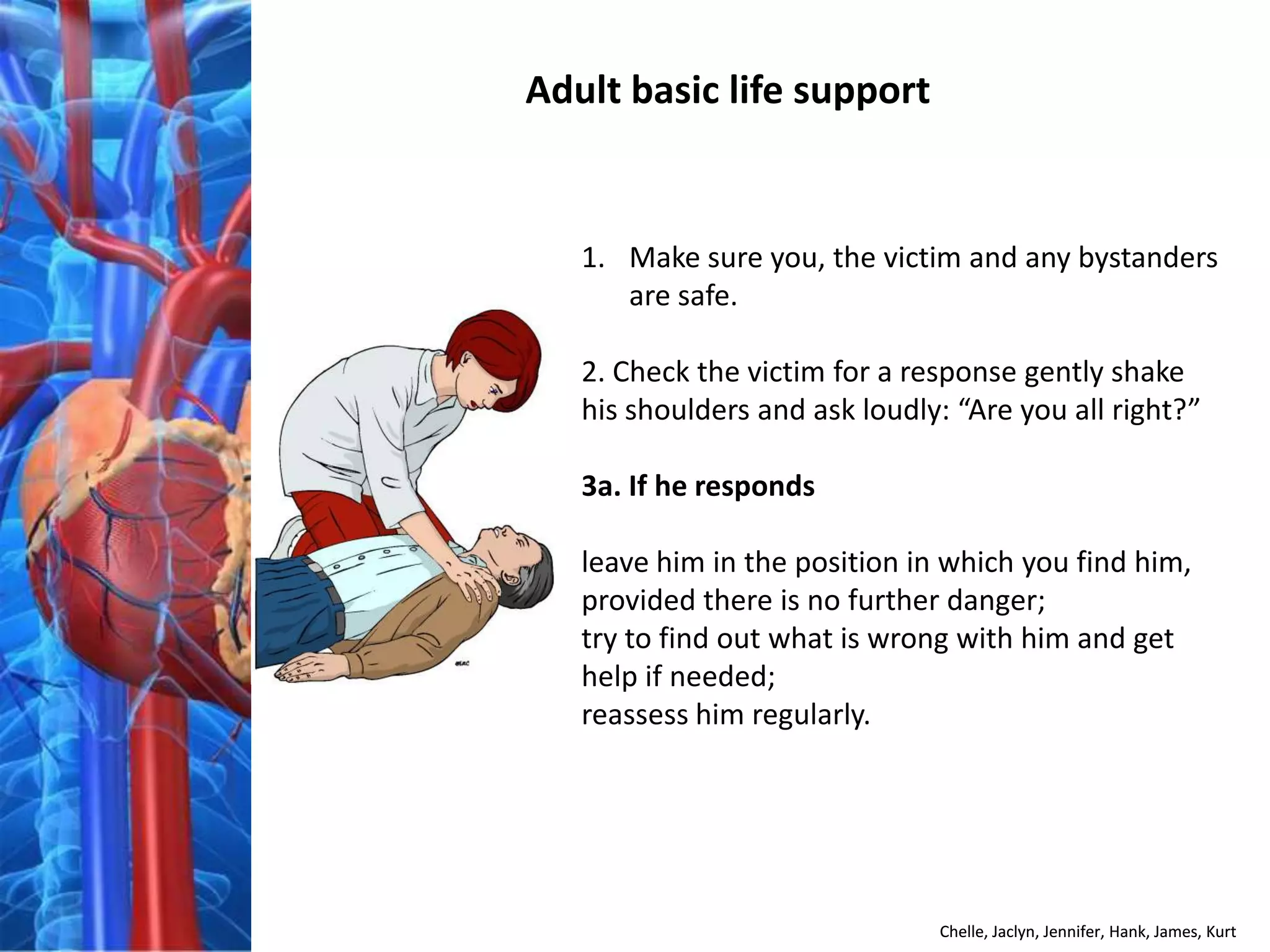
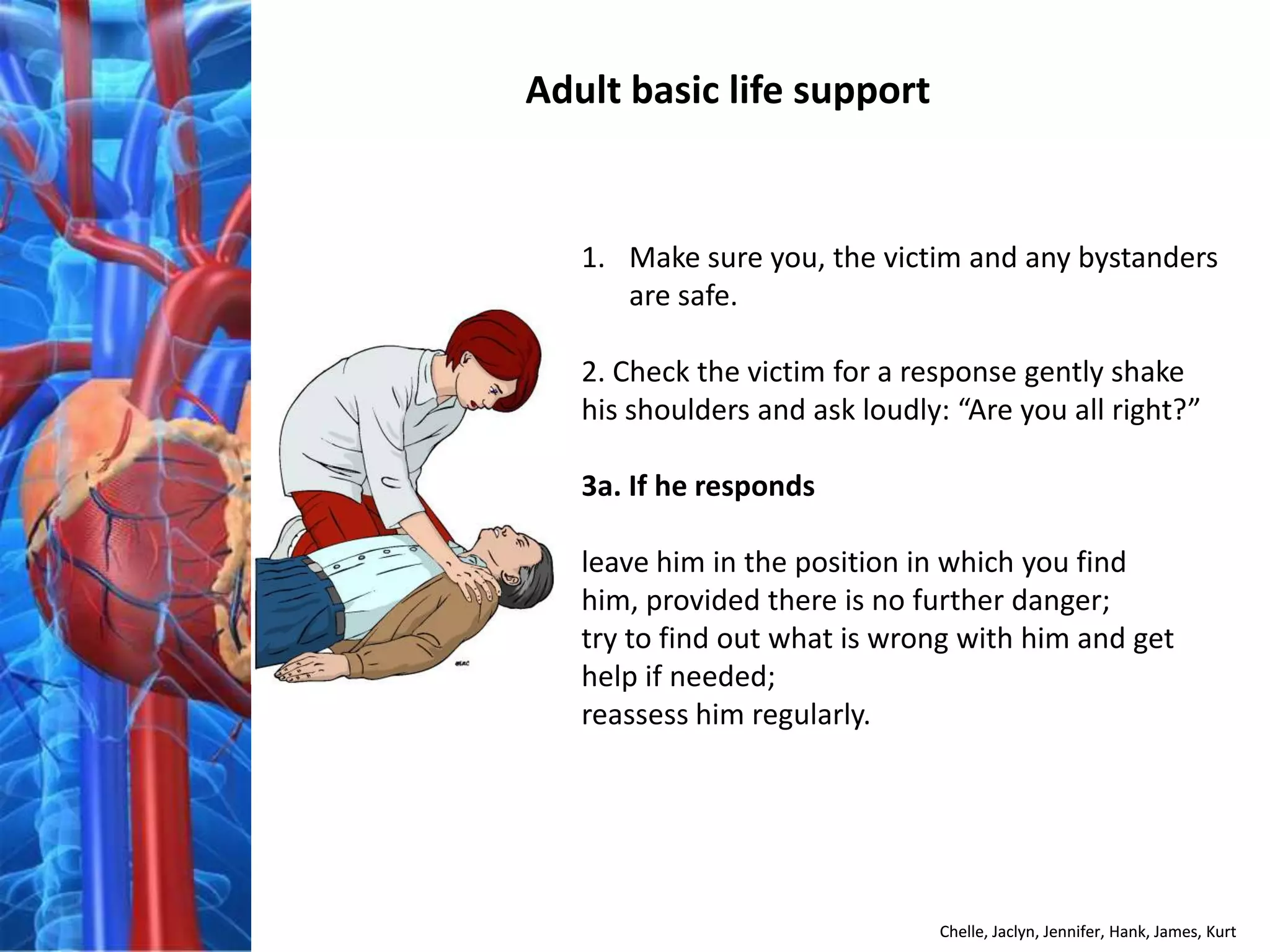
   1. Make sure you, the victim and any bystanders
      are safe.

   2. Check the victim for a response gently shake
   his shoulders and ask loudly: “Are you all right?”

   3a. If he responds

   leave him in the position in which you find him,
   provided there is no further danger;
   try to find out what is wrong with him and get
   help if needed;
   reassess him regularly.


                               Chelle, Jaclyn, Jennifer, Hank, James, Kurt
Adult basic life support


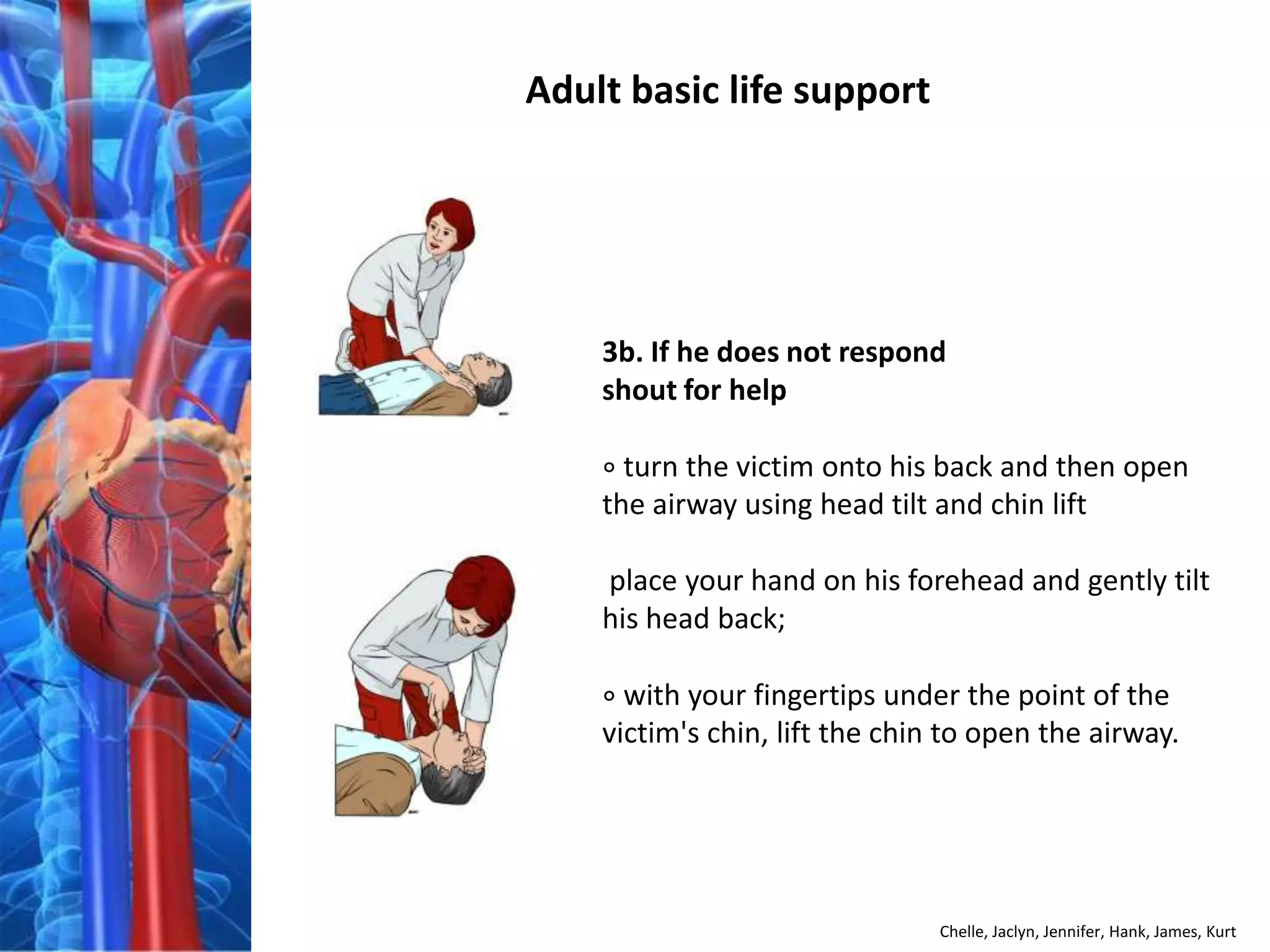
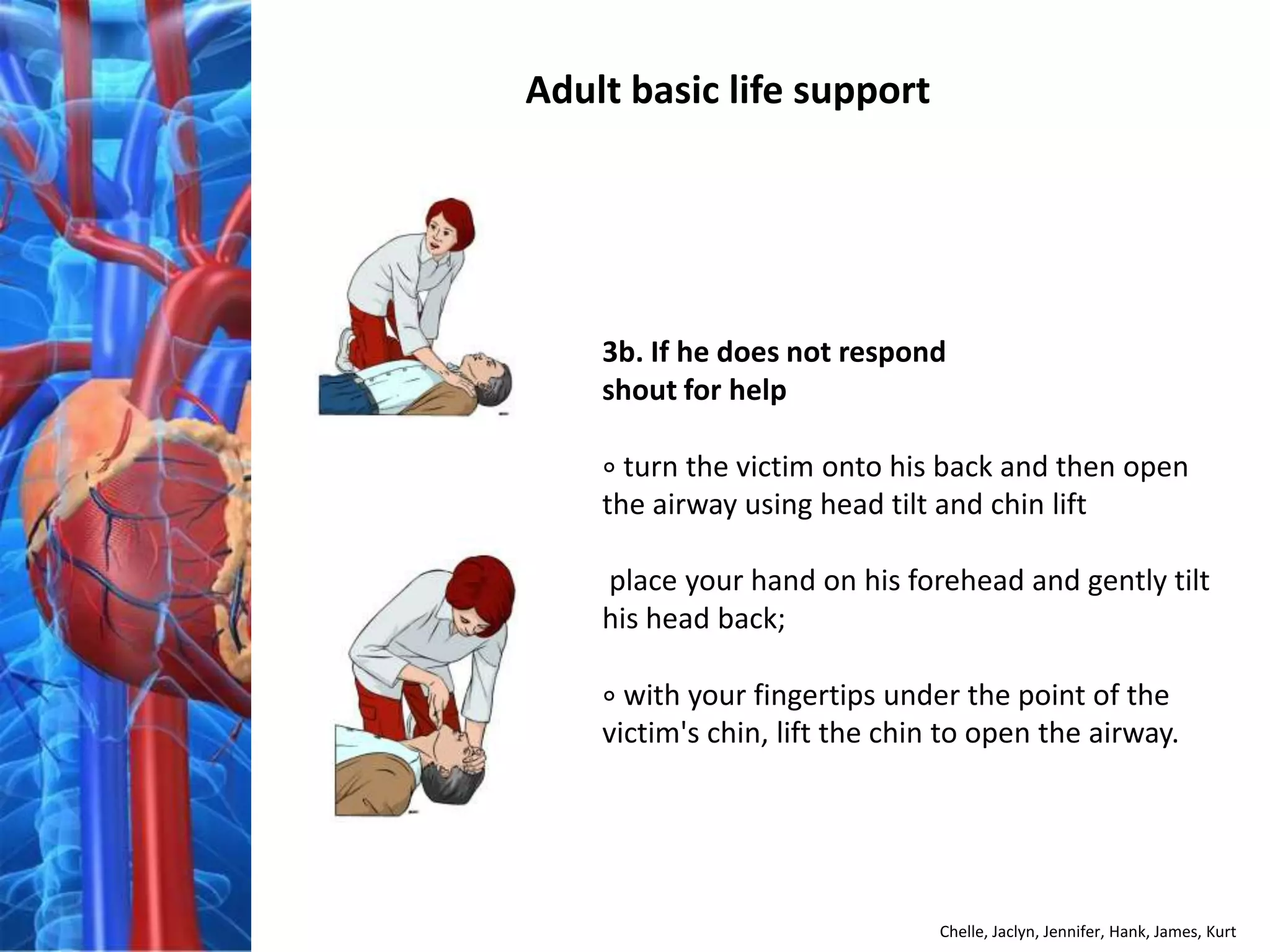
    3b. If he does not respond
    shout for help

    ∘ turn the victim onto his back and then open
    the airway using head tilt and chin lift

    place your hand on his forehead and gently tilt
    his head back;

    ∘ with your fingertips under the point of the
    victim's chin, lift the chin to open the airway.


                                Chelle, Jaclyn, Jennifer, Hank, James, Kurt
Adult basic life support


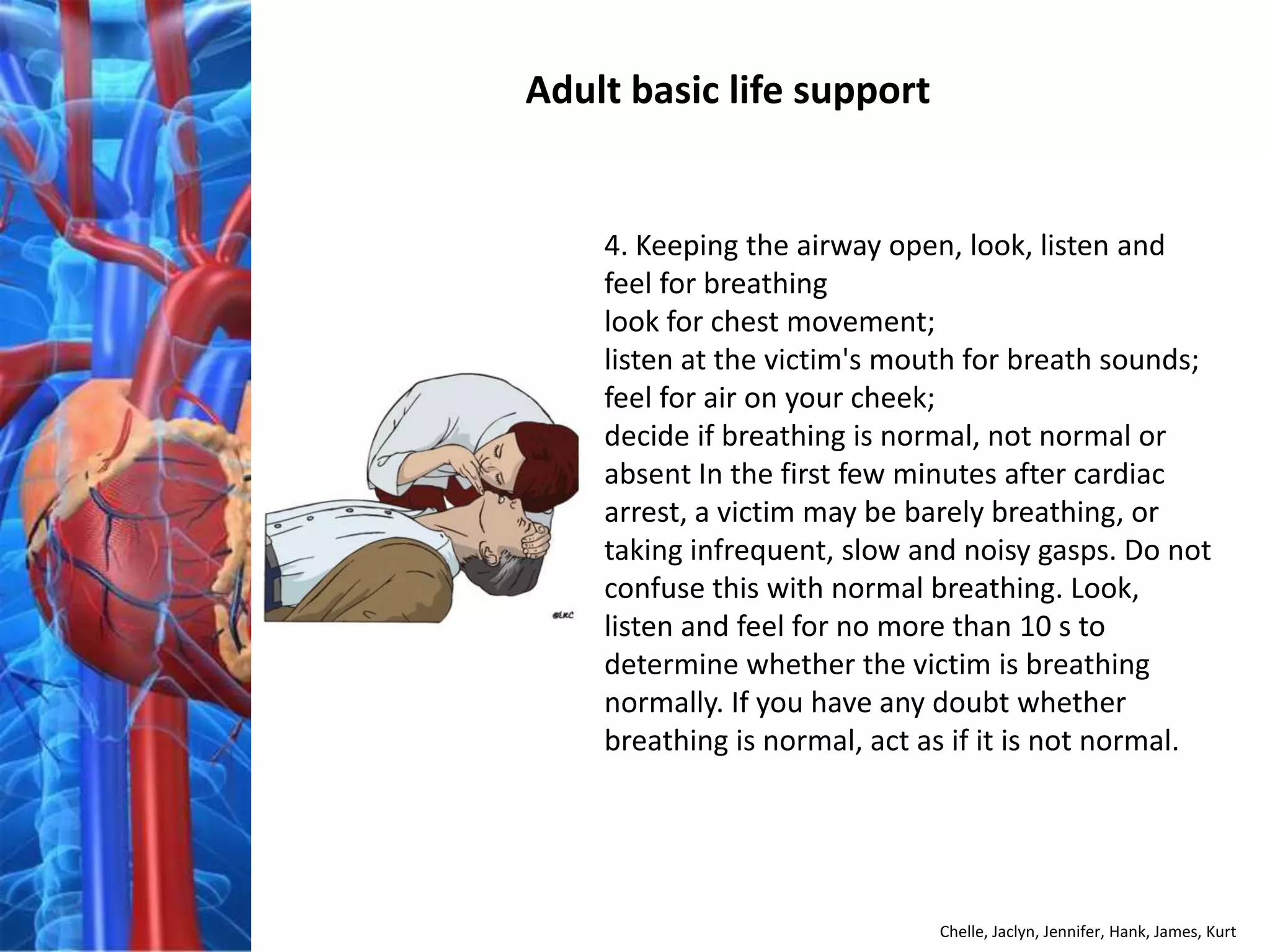
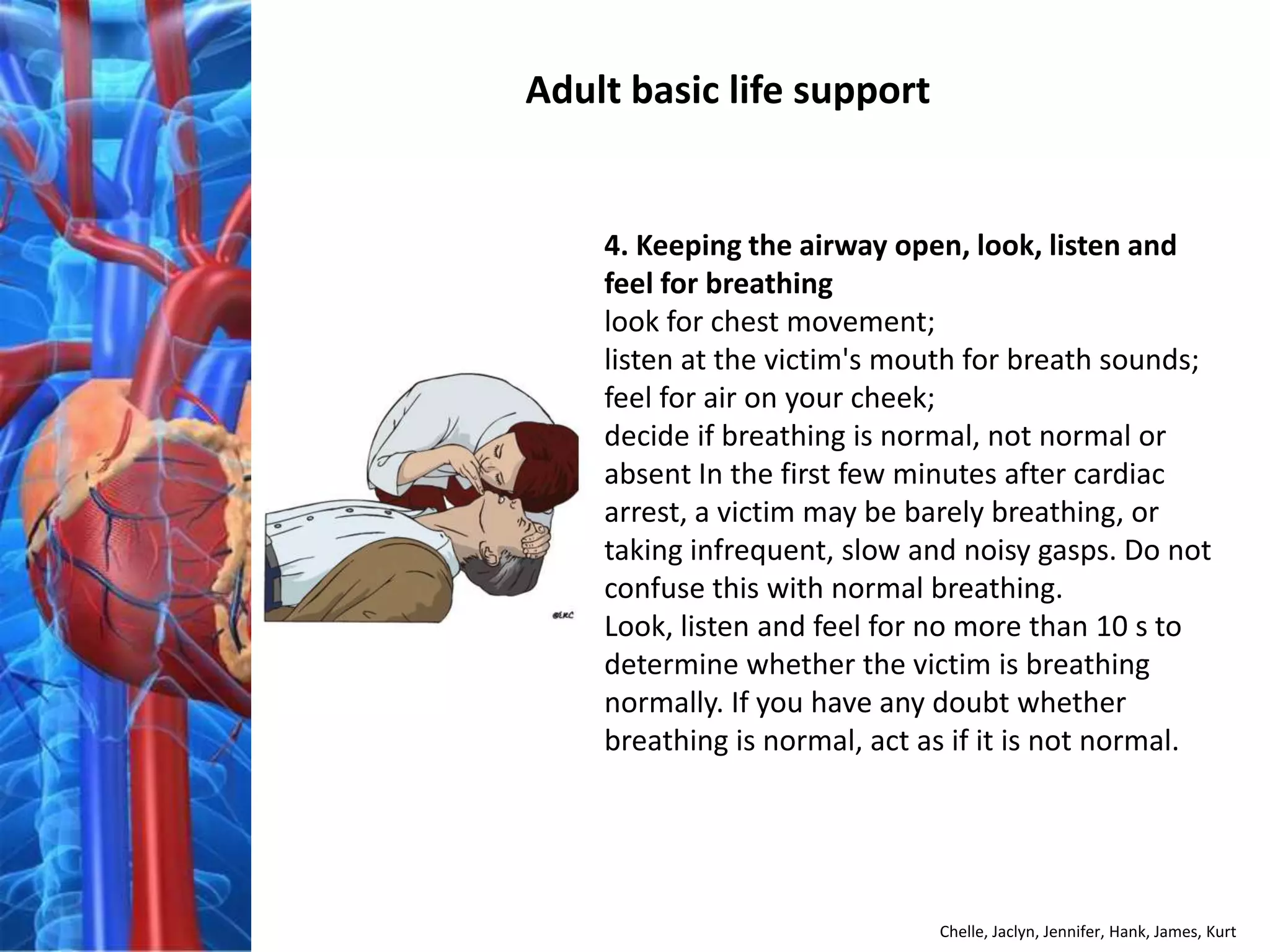
    4. Keeping the airway open, look, listen and
    feel for breathing
    look for chest movement;
    listen at the victim's mouth for breath sounds;
    feel for air on your cheek;
    decide if breathing is normal, not normal or
    absent In the first few minutes after cardiac
    arrest, a victim may be barely breathing, or
    taking infrequent, slow and noisy gasps. Do not
    confuse this with normal breathing. Look,
    listen and feel for no more than 10 s to
    determine whether the victim is breathing
    normally. If you have any doubt whether
    breathing is normal, act as if it is not normal.


                              Chelle, Jaclyn, Jennifer, Hank, James, Kurt
Adult basic life support


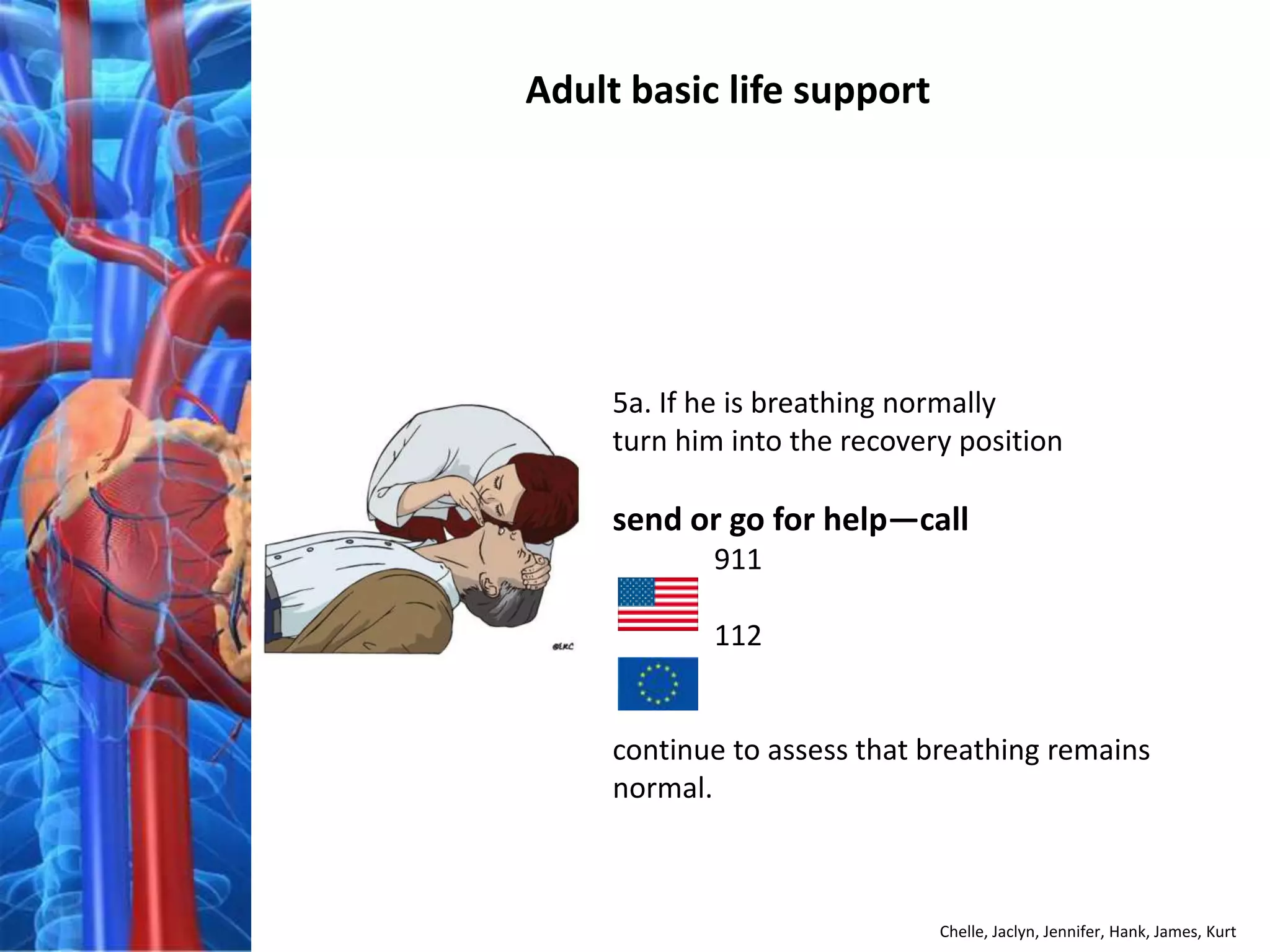
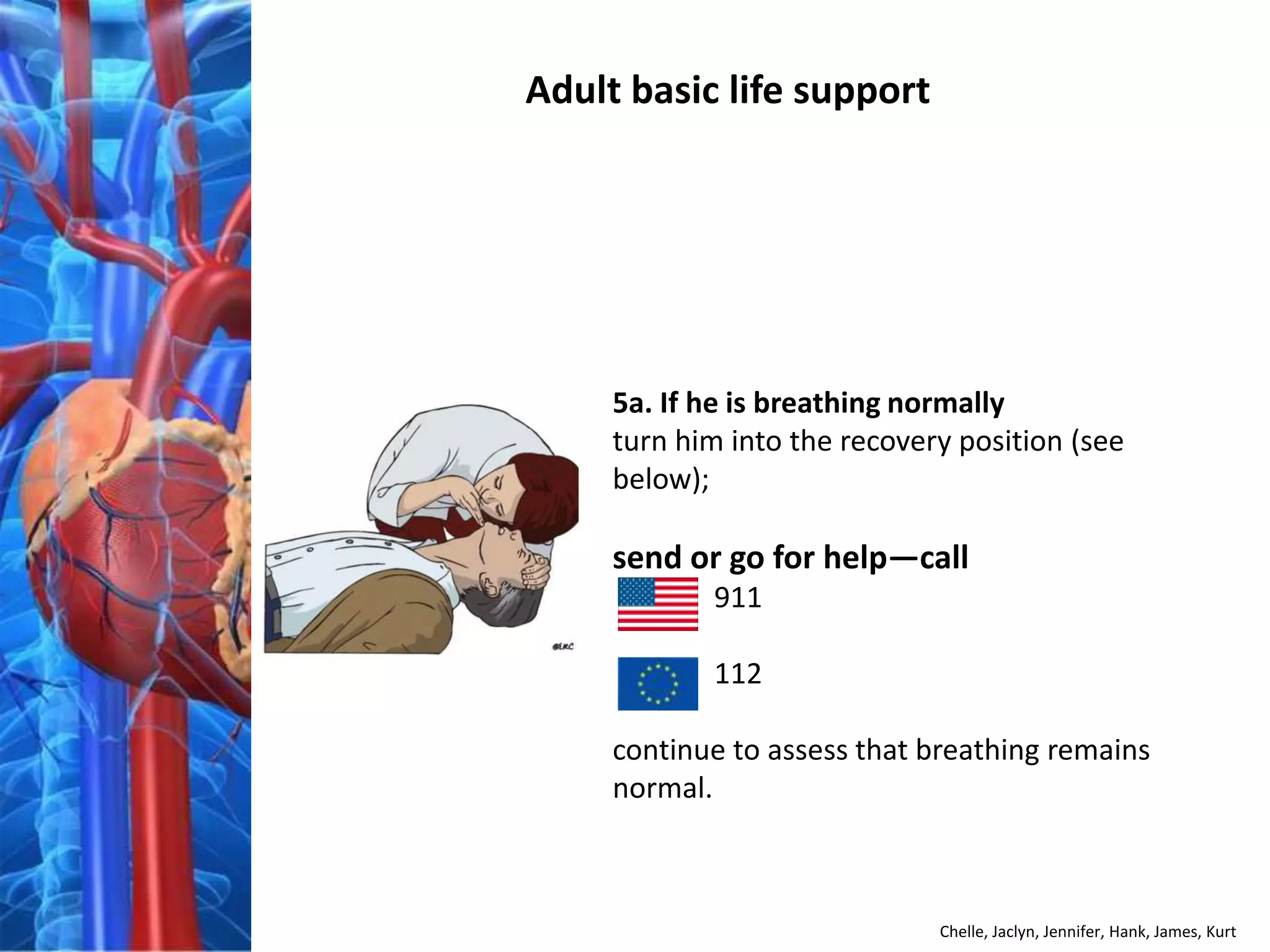
     5a. If he is breathing normally
     turn him into the recovery position

     send or go for help—call
            911

            112


     continue to assess that breathing remains
     normal.


                              Chelle, Jaclyn, Jennifer, Hank, James, Kurt
Adult basic life support


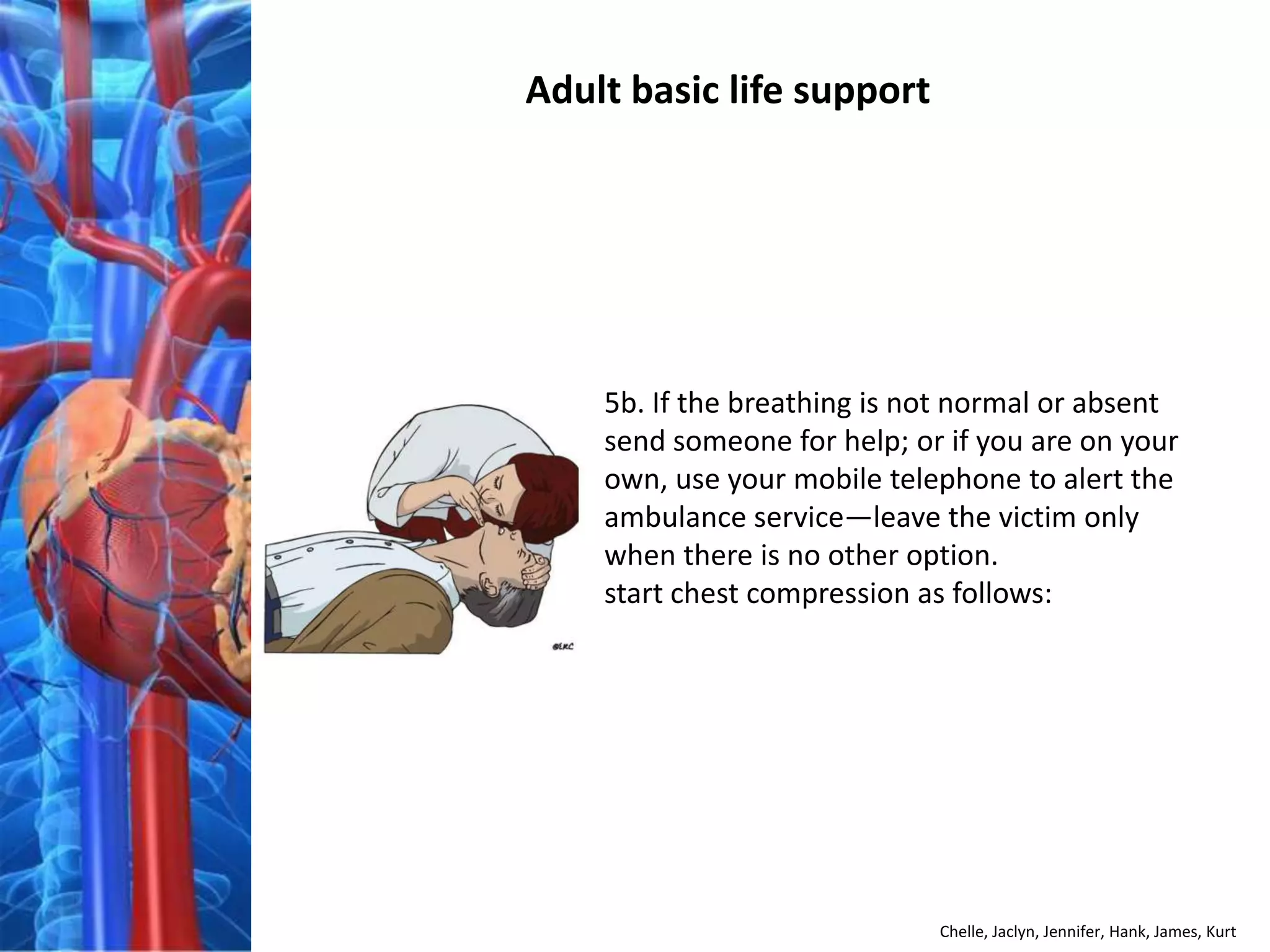
    5b. If the breathing is not normal or absent
    send someone for help; or if you are on your
    own, use your mobile telephone to alert the
    ambulance service—leave the victim only
    when there is no other option.
    start chest compression as follows:


                             Chelle, Jaclyn, Jennifer, Hank, James, Kurt
Adult basic life support


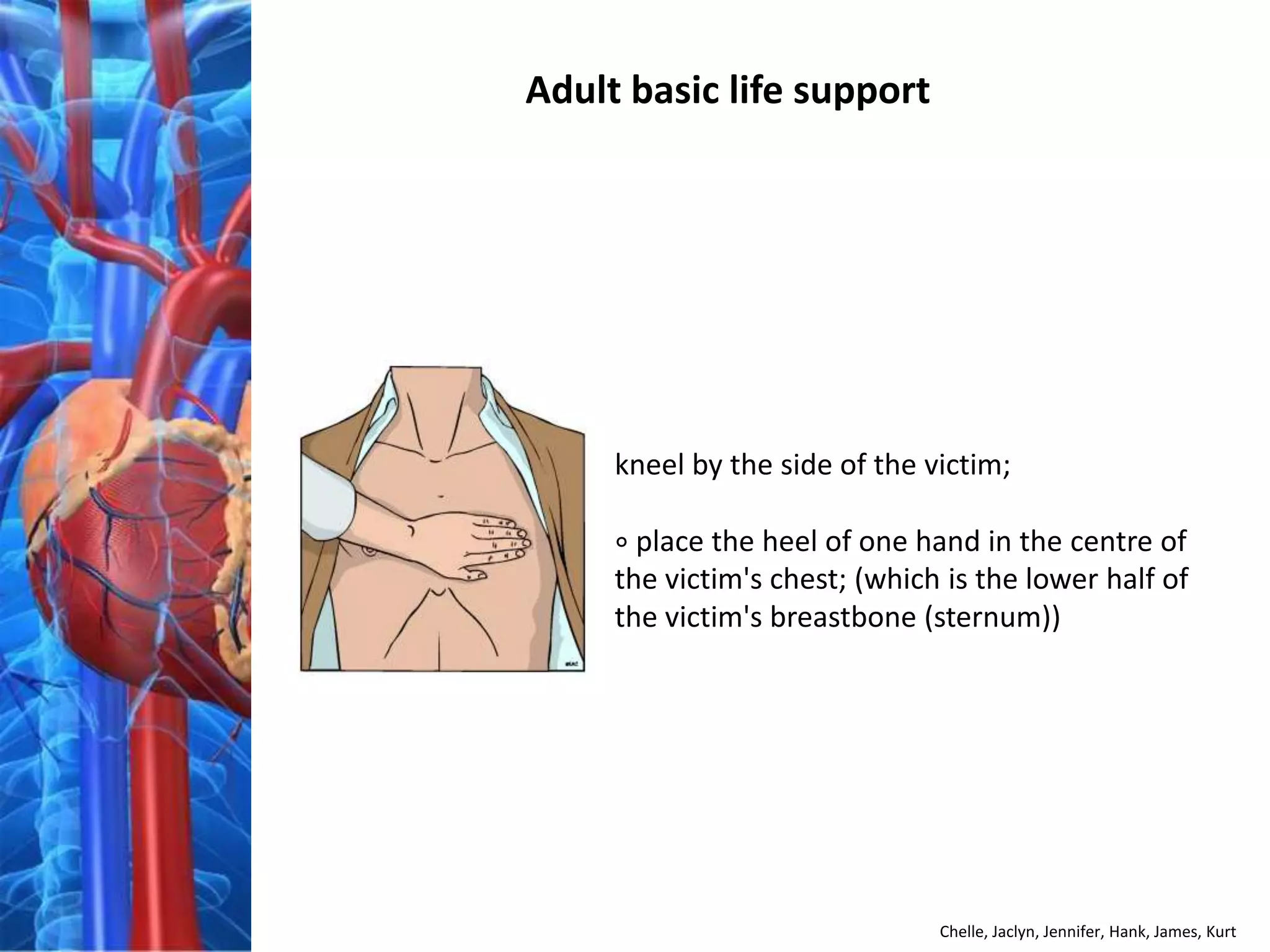
     kneel by the side of the victim;

     ∘ place the heel of one hand in the centre of
     the victim's chest; (which is the lower half of
     the victim's breastbone (sternum))


                               Chelle, Jaclyn, Jennifer, Hank, James, Kurt
Adult basic life support


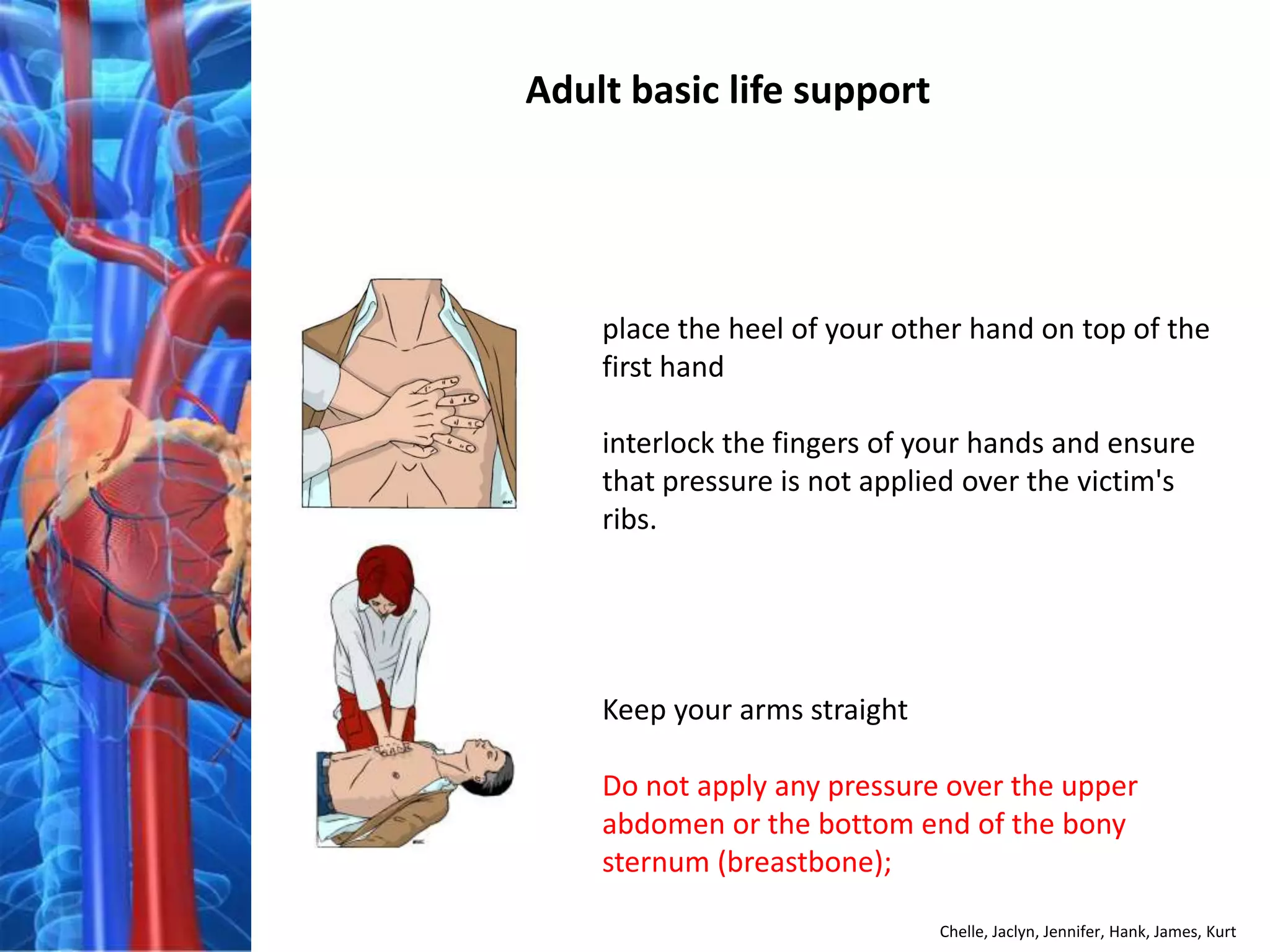
    place the heel of your other hand on top of the
    first hand

    interlock the fingers of your hands and ensure
    that pressure is not applied over the victim's
    ribs.


    Keep your arms straight

    Do not apply any pressure over the upper
    abdomen or the bottom end of the bony
    sternum (breastbone);

                              Chelle, Jaclyn, Jennifer, Hank, James, Kurt
Adult basic life support


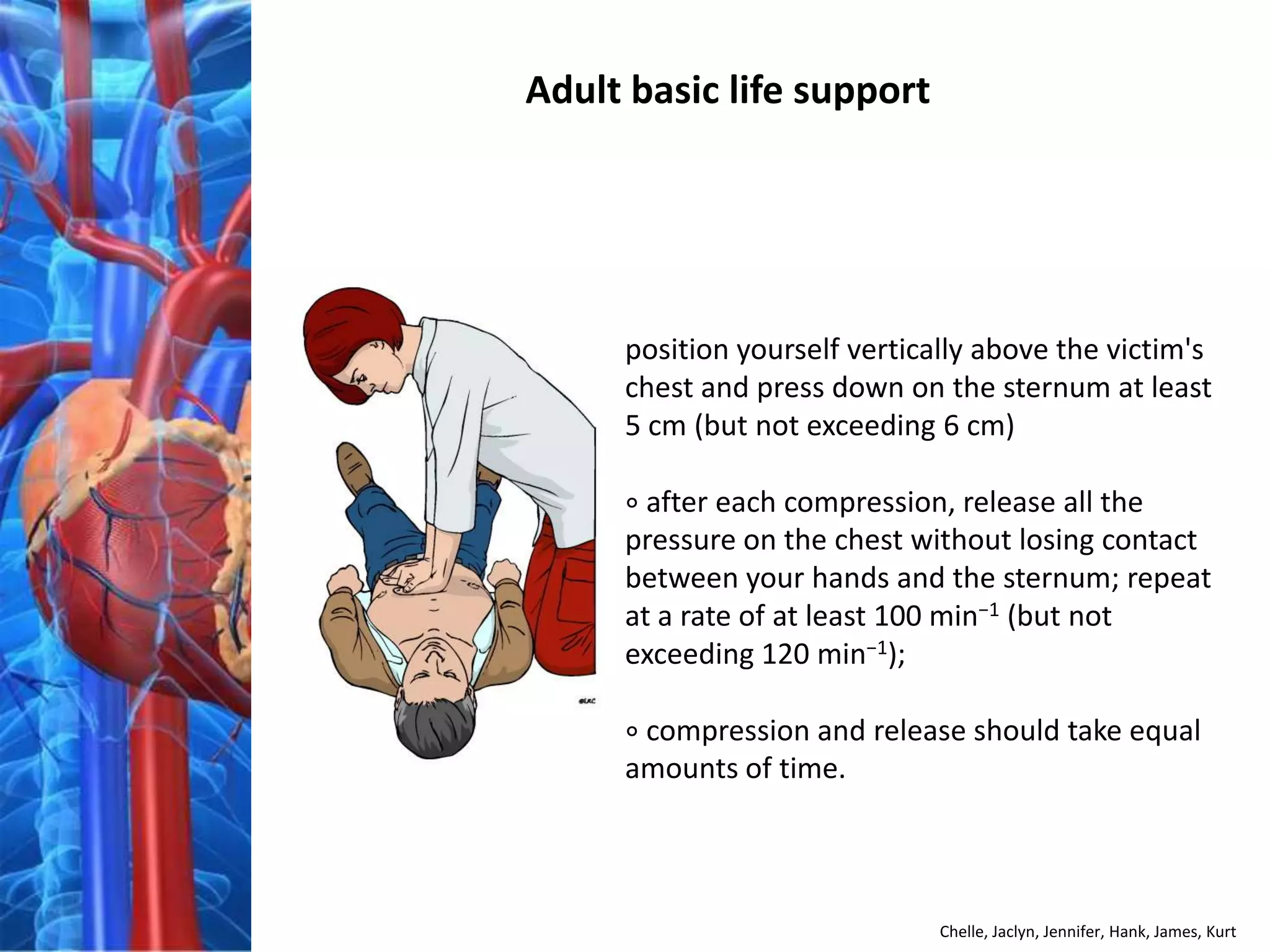
     position yourself vertically above the victim's
     chest and press down on the sternum at least
     5 cm (but not exceeding 6 cm)

     ∘ after each compression, release all the
     pressure on the chest without losing contact
     between your hands and the sternum; repeat
     at a rate of at least 100 min−1 (but not
     exceeding 120 min−1);

     ∘ compression and release should take equal
     amounts of time.


                              Chelle, Jaclyn, Jennifer, Hank, James, Kurt
Adult basic life support


    Do not interrupt resuscitation until:
professional help arrives and takes over; or
the victim starts to wake up: to move, open
      eyes and to breathe normally; or
          you become exhausted.


                                      Chelle, Jaclyn, Jennifer, Hank, James, Kurt
Adult basic life support


 Adult basic life support
CPR with Rescue Breaths


       Chelle, Jaclyn, Jennifer, Hank, James, Kurt
                                     Chelle, Jaclyn, Jennifer, Hank, James, Kurt
Adult basic life support


   1. Make sure you, the victim and any bystanders
      are safe.

   2. Check the victim for a response gently shake
   his shoulders and ask loudly: “Are you all right?”

   3a. If he responds

   leave him in the position in which you find
   him, provided there is no further danger;
   try to find out what is wrong with him and get
   help if needed;
   reassess him regularly.


                               Chelle, Jaclyn, Jennifer, Hank, James, Kurt
Adult basic life support


    3b. If he does not respond
    shout for help

    ∘ turn the victim onto his back and then open
    the airway using head tilt and chin lift

    place your hand on his forehead and gently tilt
    his head back;

    ∘ with your fingertips under the point of the
    victim's chin, lift the chin to open the airway.


                                Chelle, Jaclyn, Jennifer, Hank, James, Kurt
Adult basic life support


    4. Keeping the airway open, look, listen and
    feel for breathing
    look for chest movement;
    listen at the victim's mouth for breath sounds;
    feel for air on your cheek;
    decide if breathing is normal, not normal or
    absent In the first few minutes after cardiac
    arrest, a victim may be barely breathing, or
    taking infrequent, slow and noisy gasps. Do not
    confuse this with normal breathing.
    Look, listen and feel for no more than 10 s to
    determine whether the victim is breathing
    normally. If you have any doubt whether
    breathing is normal, act as if it is not normal.


                              Chelle, Jaclyn, Jennifer, Hank, James, Kurt
Adult basic life support


     5a. If he is breathing normally
     turn him into the recovery position (see
     below);

     send or go for help—call
            911

            112

     continue to assess that breathing remains
     normal.


                              Chelle, Jaclyn, Jennifer, Hank, James, Kurt
Adult basic life support


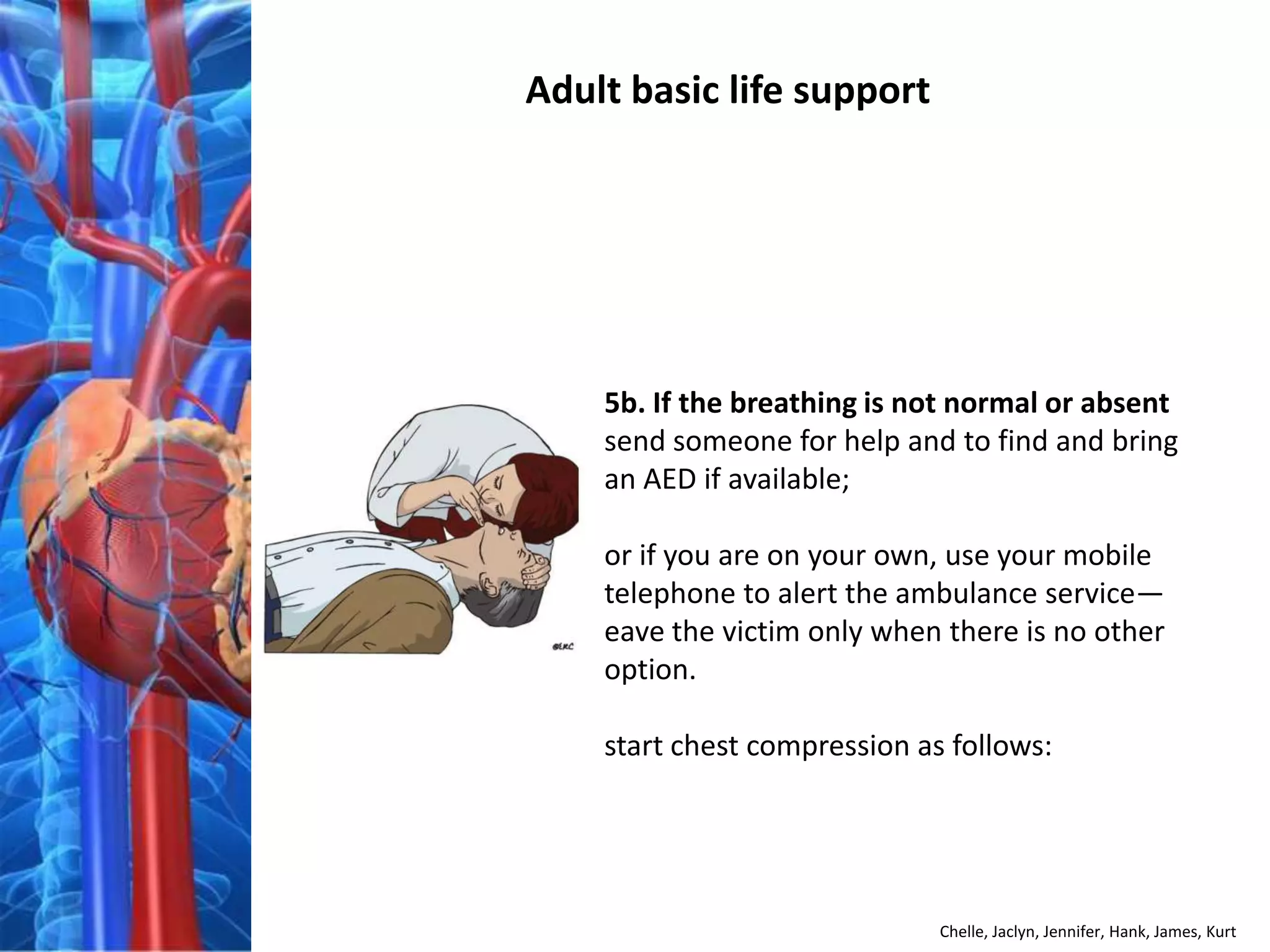
    5b. If the breathing is not normal or absent
    send someone for help and to find and bring
    an AED if available;

    or if you are on your own, use your mobile
    telephone to alert the ambulance service—
    eave the victim only when there is no other
    option.
    start chest compression as follows:


                              Chelle, Jaclyn, Jennifer, Hank, James, Kurt
Adult basic life support


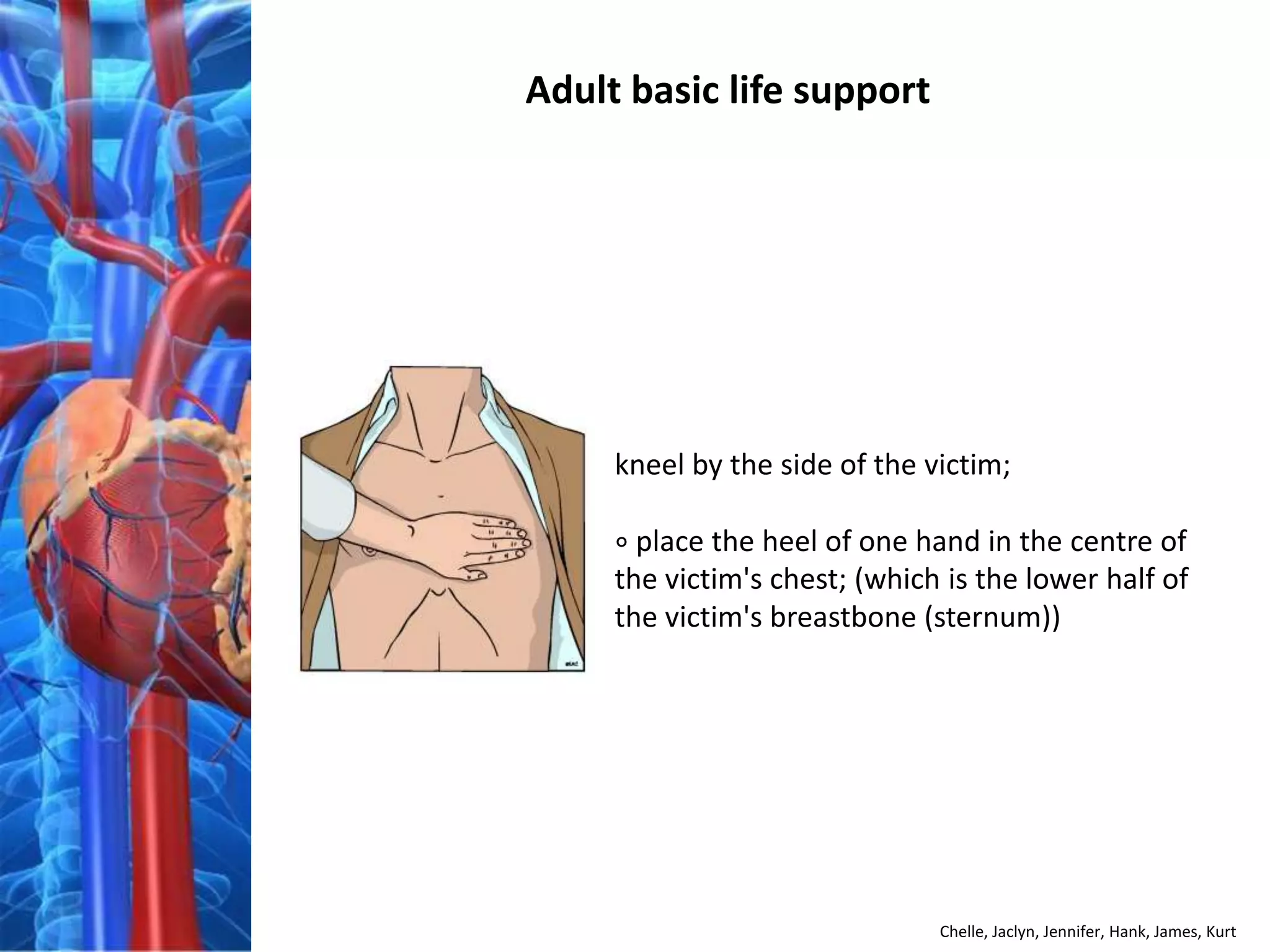
     kneel by the side of the victim;

     ∘ place the heel of one hand in the centre of
     the victim's chest; (which is the lower half of
     the victim's breastbone (sternum))


                               Chelle, Jaclyn, Jennifer, Hank, James, Kurt
Adult basic life support


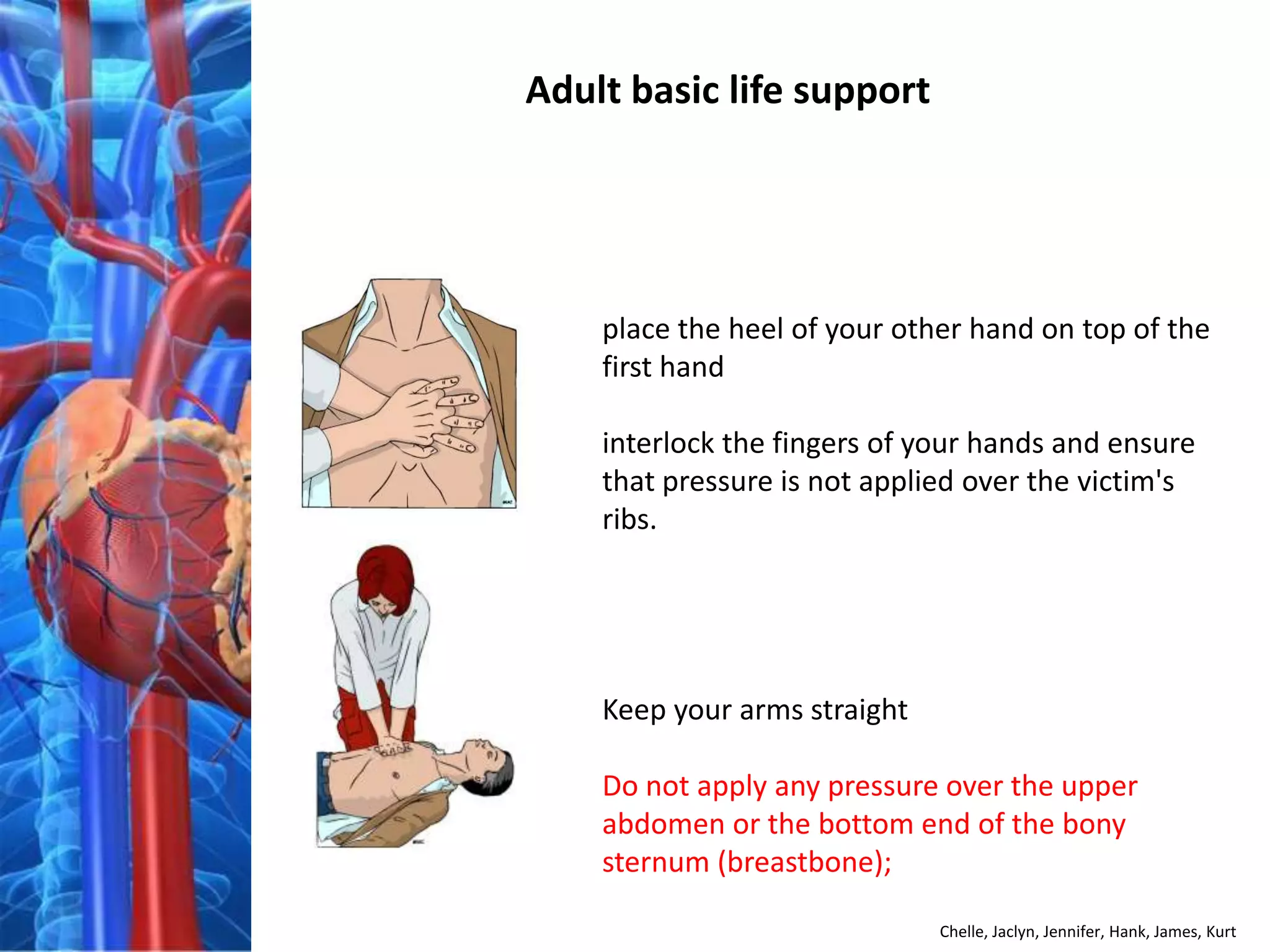
    place the heel of your other hand on top of the
    first hand

    interlock the fingers of your hands and ensure
    that pressure is not applied over the victim's
    ribs.


    Keep your arms straight

    Do not apply any pressure over the upper
    abdomen or the bottom end of the bony
    sternum (breastbone);

                              Chelle, Jaclyn, Jennifer, Hank, James, Kurt
Adult basic life support


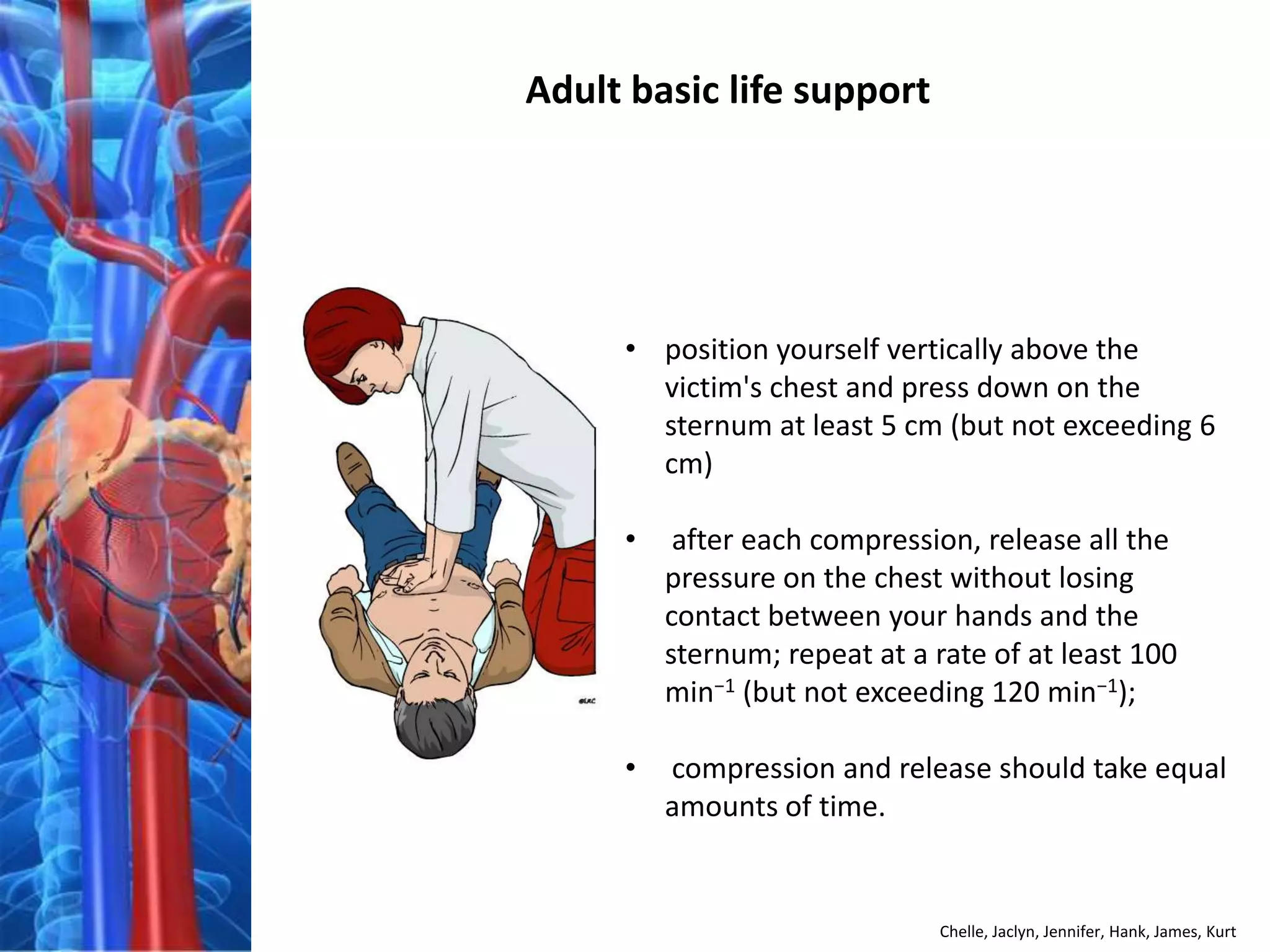
     • position yourself vertically above the
       victim's chest and press down on the
       sternum at least 5 cm (but not exceeding 6
       cm)

     •    after each compression, release all the
         pressure on the chest without losing
         contact between your hands and the
         sternum; repeat at a rate of at least 100
         min−1 (but not exceeding 120 min−1);

     •   compression and release should take equal
         amounts of time.


                               Chelle, Jaclyn, Jennifer, Hank, James, Kurt
Adult basic life support


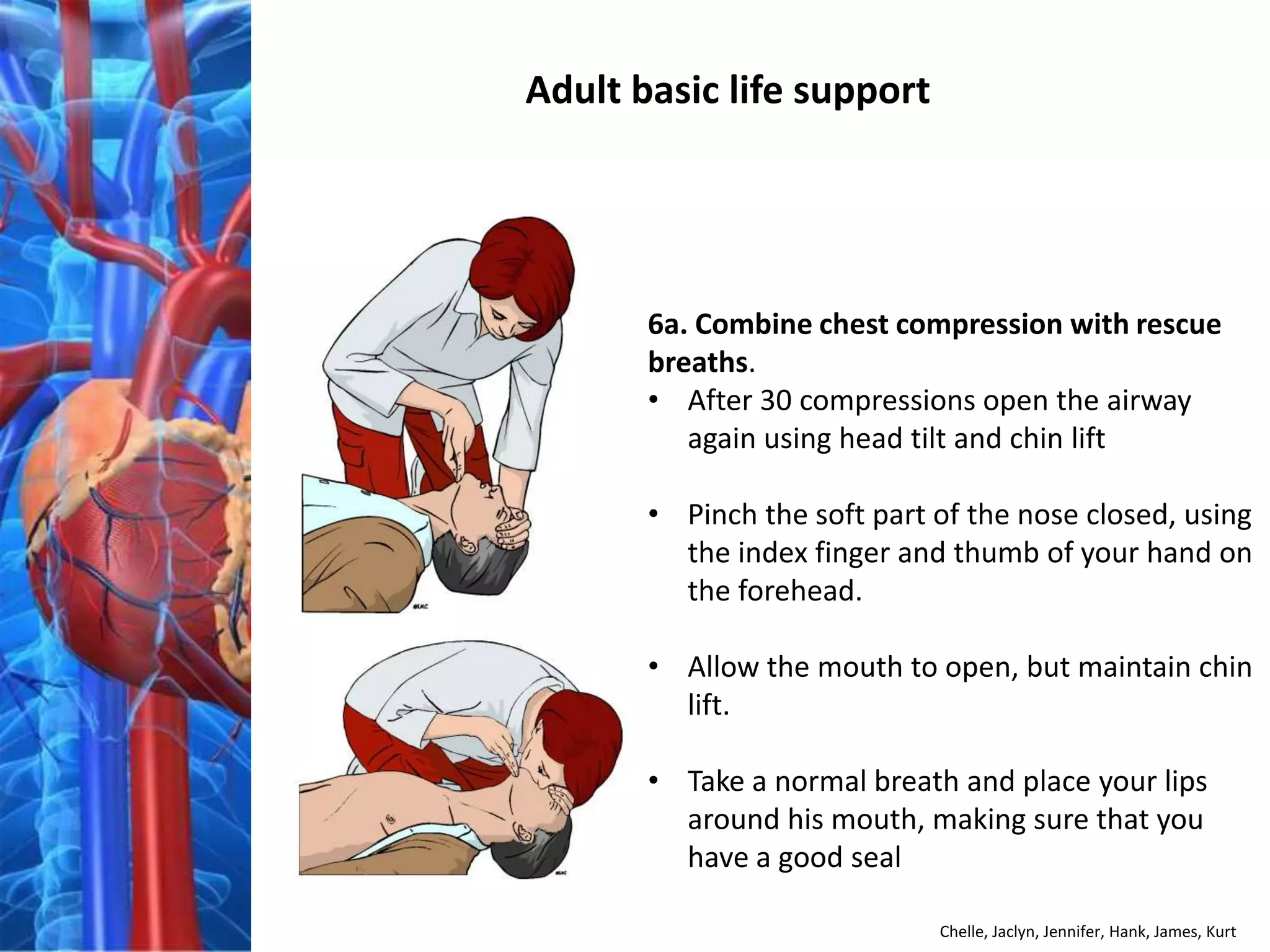
       6a. Combine chest compression with rescue
       breaths.
       • After 30 compressions open the airway
          again using head tilt and chin lift

       • Pinch the soft part of the nose closed, using
         the index finger and thumb of your hand on
         the forehead.

       • Allow the mouth to open, but maintain chin
         lift.

       • Take a normal breath and place your lips
         around his mouth, making sure that you
         have a good seal

                             Chelle, Jaclyn, Jennifer, Hank, James, Kurt
Adult basic life support


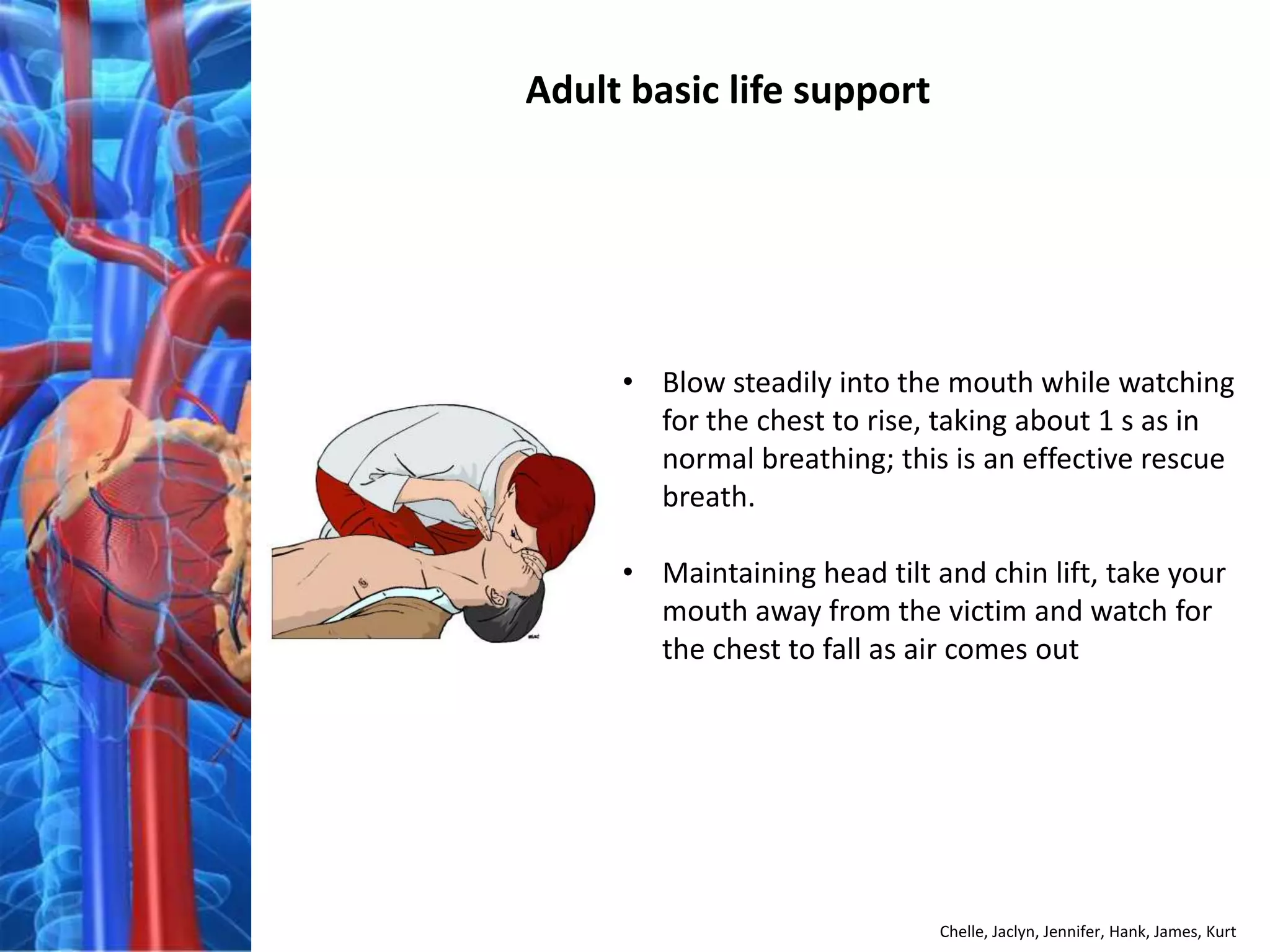
     • Blow steadily into the mouth while watching
       for the chest to rise, taking about 1 s as in
       normal breathing; this is an effective rescue
       breath.

     • Maintaining head tilt and chin lift, take your
       mouth away from the victim and watch for
       the chest to fall as air comes out


                              Chelle, Jaclyn, Jennifer, Hank, James, Kurt
Adult basic life support


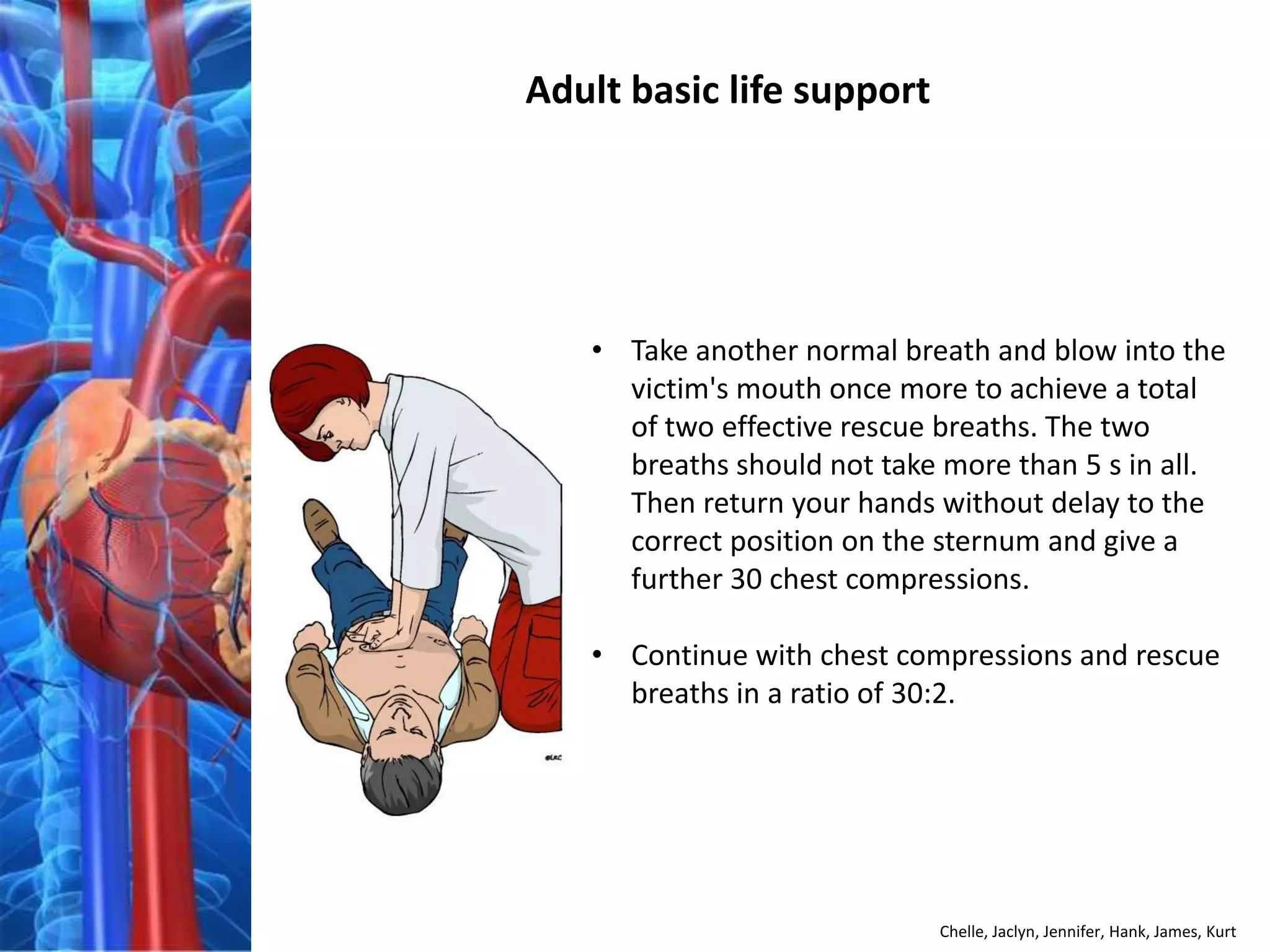
   • Take another normal breath and blow into the
     victim's mouth once more to achieve a total
     of two effective rescue breaths. The two
     breaths should not take more than 5 s in all.
     Then return your hands without delay to the
     correct position on the sternum and give a
     further 30 chest compressions.

   • Continue with chest compressions and rescue
     breaths in a ratio of 30:2.


                            Chelle, Jaclyn, Jennifer, Hank, James, Kurt
Adult basic life support


• Stop to recheck the victim only if he starts to
  wake up: to move, open eyes and to breathe
  normally. Otherwise, do not interrupt
  resuscitation. If your initial rescue breath does
  not make the chest rise as in normal
  breathing, then before your next attempt:

• look into the victim's mouth and remove any
  obstruction;

• recheck that there is adequate head tilt and
  chin lift;


                                         Chelle, Jaclyn, Jennifer, Hank, James, Kurt
Adult basic life support


• do not attempt more than two breaths each time before
  returning to chest compressions. If there is more than one
  rescuer present, another rescuer should take over delivering
  CPR every 2 min to prevent fatigue. Ensure that interruption of
  chest compressions is minimal during the changeover of
  rescuers. For this purpose, and to count 30 compressions at
  the required rate, it may be helpful for the rescuer performing
  chest compressions to count out loud. Experienced rescuers
  could do combined two-rescuer CPR and in that situation they
  should exchange roles/places every 2 min.


                                                Chelle, Jaclyn, Jennifer, Hank, James, Kurt
Adult basic life support


       Do not interrupt resuscitation until:
   professional help arrives and takes over; or
the victim starts to wake up: to move, open eyes
           and to breathe normally; or
             you become exhausted.


                                      Chelle, Jaclyn, Jennifer, Hank, James, Kurt
Adult basic life support


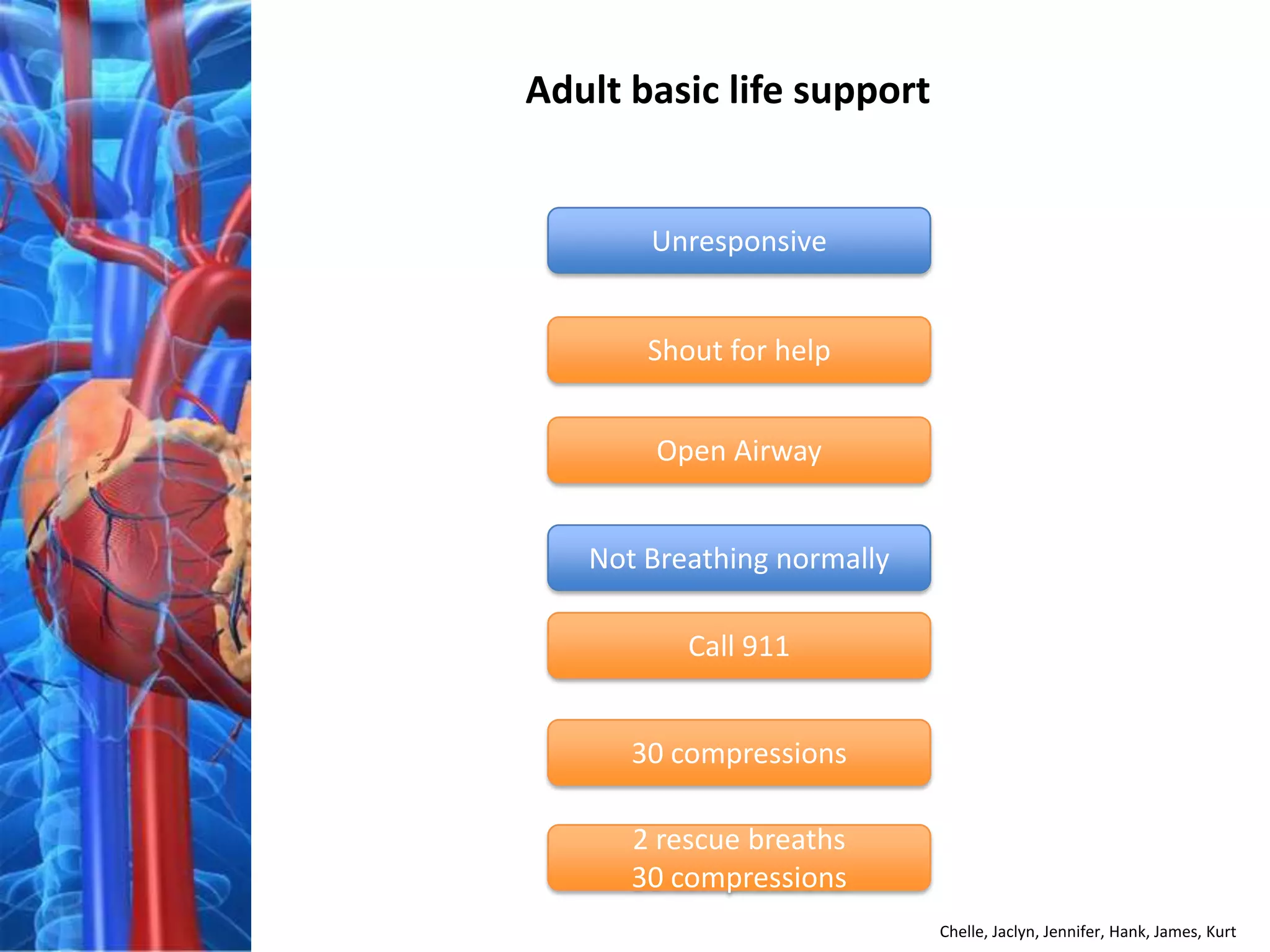
       Unresponsive


       Shout for help


       Open Airway


   Not Breathing normally

          Call 911


      30 compressions

      2 rescue breaths
      30 compressions
                            Chelle, Jaclyn, Jennifer, Hank, James, Kurt
Adult basic life support


Adult basic life support and
use of automated external
       defibrillators


         Chelle, Jaclyn, Jennifer, Hank, James, Kurt
                                       Chelle, Jaclyn, Jennifer, Hank, James, Kurt
Adult basic life support


1. Make sure you, the victim, and any bystanders are safe.

2. Follow the Adult BLS sequence (see other presentation 1 – 5)

if the victim is unresponsive and not breathing normally, send
someone for help and to find and bring an AED if available;
if you are on your own, use your mobile telephone to alert the
ambulance service—leave the victim only when there is no other
option.

3. Start CPR according to the adult BLS sequence. If you are on your
own and the AED is in your immediate vicinity, start by applying the
AED.


                                                Chelle, Jaclyn, Jennifer, Hank, James, Kurt
Adult basic life support


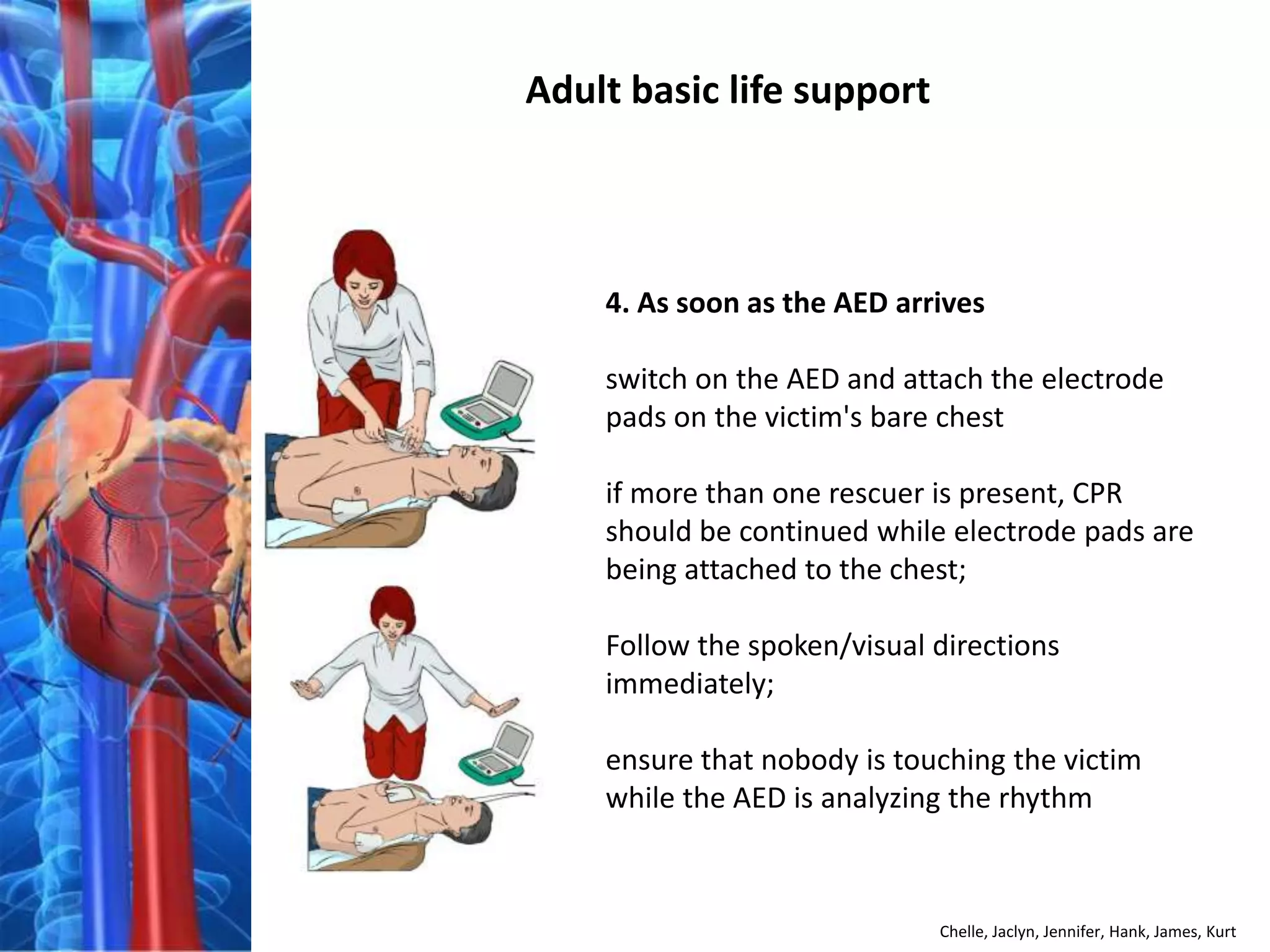
    4. As soon as the AED arrives

    switch on the AED and attach the electrode
    pads on the victim's bare chest

    if more than one rescuer is present, CPR
    should be continued while electrode pads are
    being attached to the chest;

    Follow the spoken/visual directions
    immediately;

    ensure that nobody is touching the victim
    while the AED is analyzing the rhythm


                             Chelle, Jaclyn, Jennifer, Hank, James, Kurt
Adult basic life support


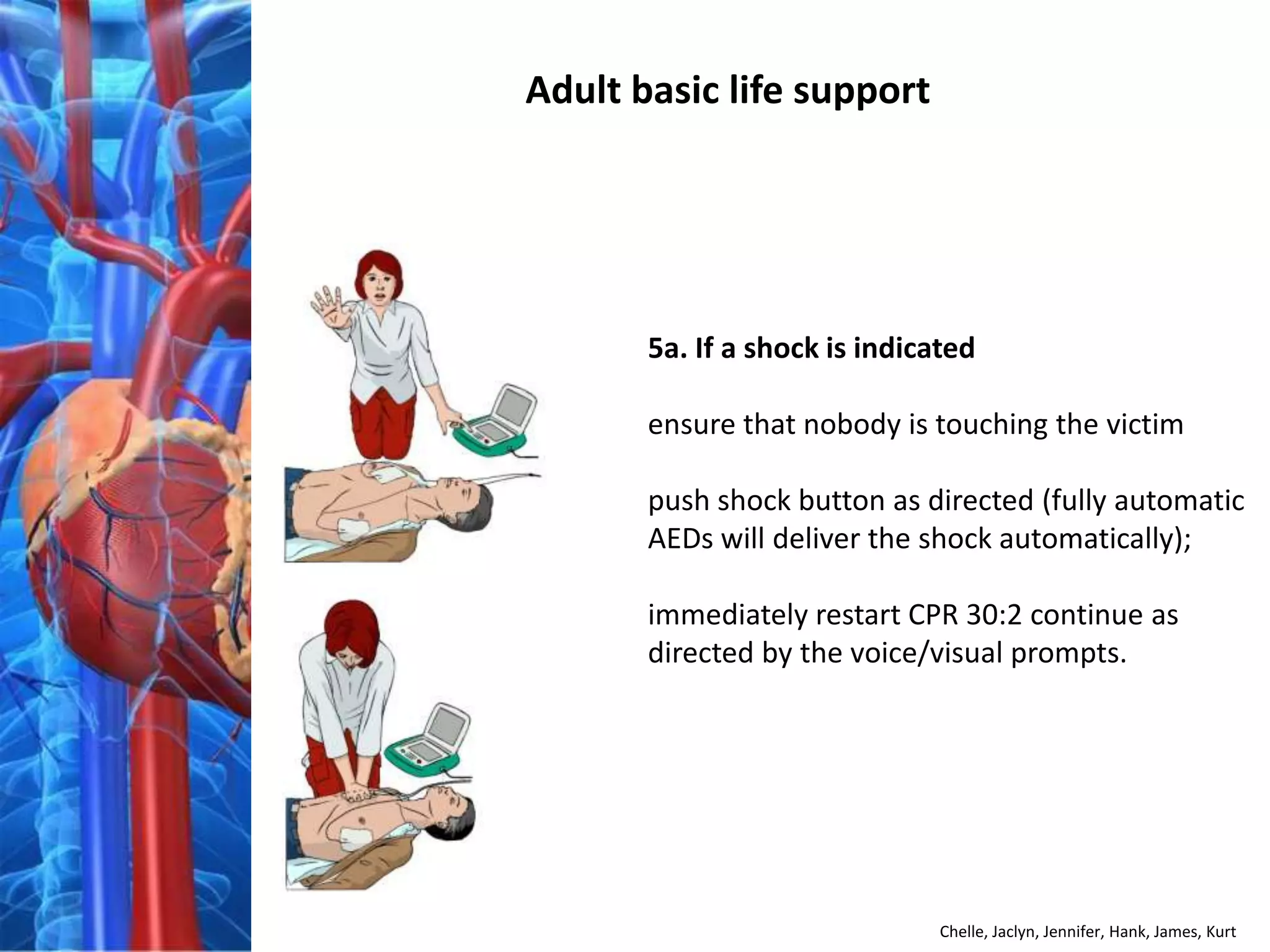
       5a. If a shock is indicated

       ensure that nobody is touching the victim

       push shock button as directed (fully automatic
       AEDs will deliver the shock automatically);

       immediately restart CPR 30:2 continue as
       directed by the voice/visual prompts.


                               Chelle, Jaclyn, Jennifer, Hank, James, Kurt
Adult basic life support


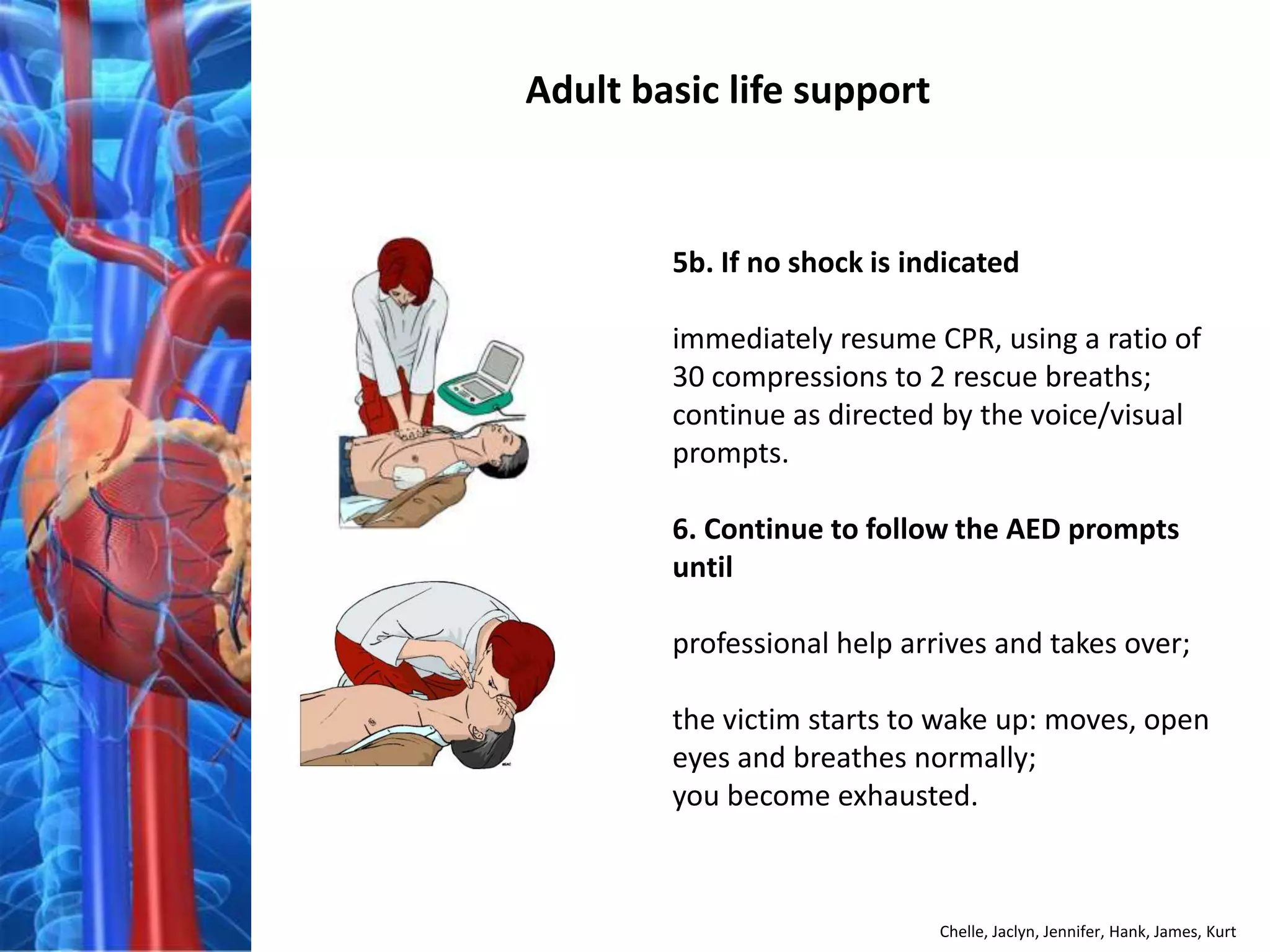
        5b. If no shock is indicated

        immediately resume CPR, using a ratio of
        30 compressions to 2 rescue breaths;
        continue as directed by the voice/visual
        prompts.

        6. Continue to follow the AED prompts
        until

        professional help arrives and takes over;

        the victim starts to wake up: moves, open
        eyes and breathes normally;
        you become exhausted.


                             Chelle, Jaclyn, Jennifer, Hank, James, Kurt
Adult basic life support


Adult basic life support
  Recovery Position


       Chelle, Jaclyn, Jennifer, Hank, James, Kurt
                                     Chelle, Jaclyn, Jennifer, Hank, James, Kurt
Adult basic life support


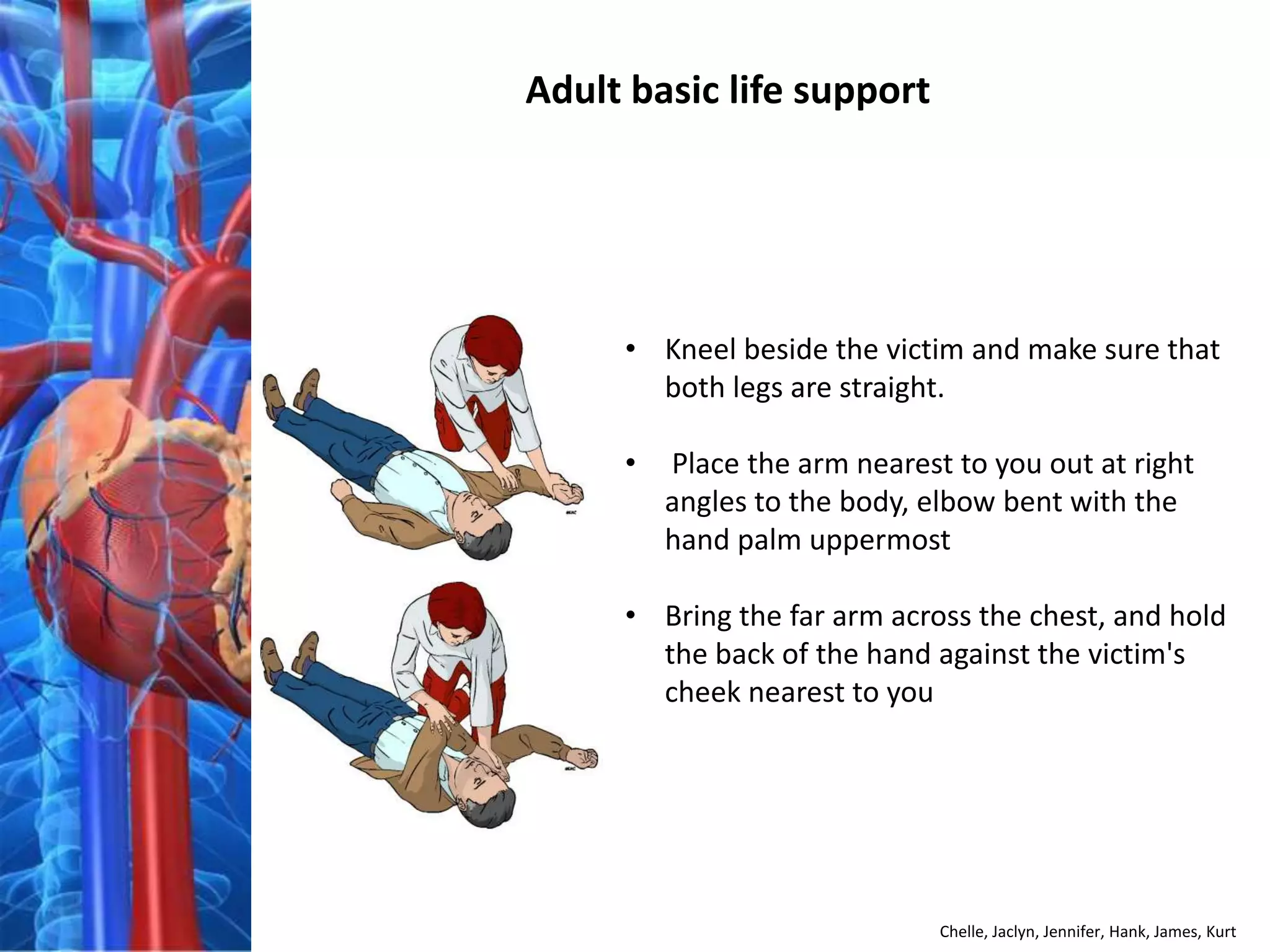
     • Kneel beside the victim and make sure that
       both legs are straight.

     •   Place the arm nearest to you out at right
         angles to the body, elbow bent with the
         hand palm uppermost

     • Bring the far arm across the chest, and hold
       the back of the hand against the victim's
       cheek nearest to you


                              Chelle, Jaclyn, Jennifer, Hank, James, Kurt
Adult basic life support


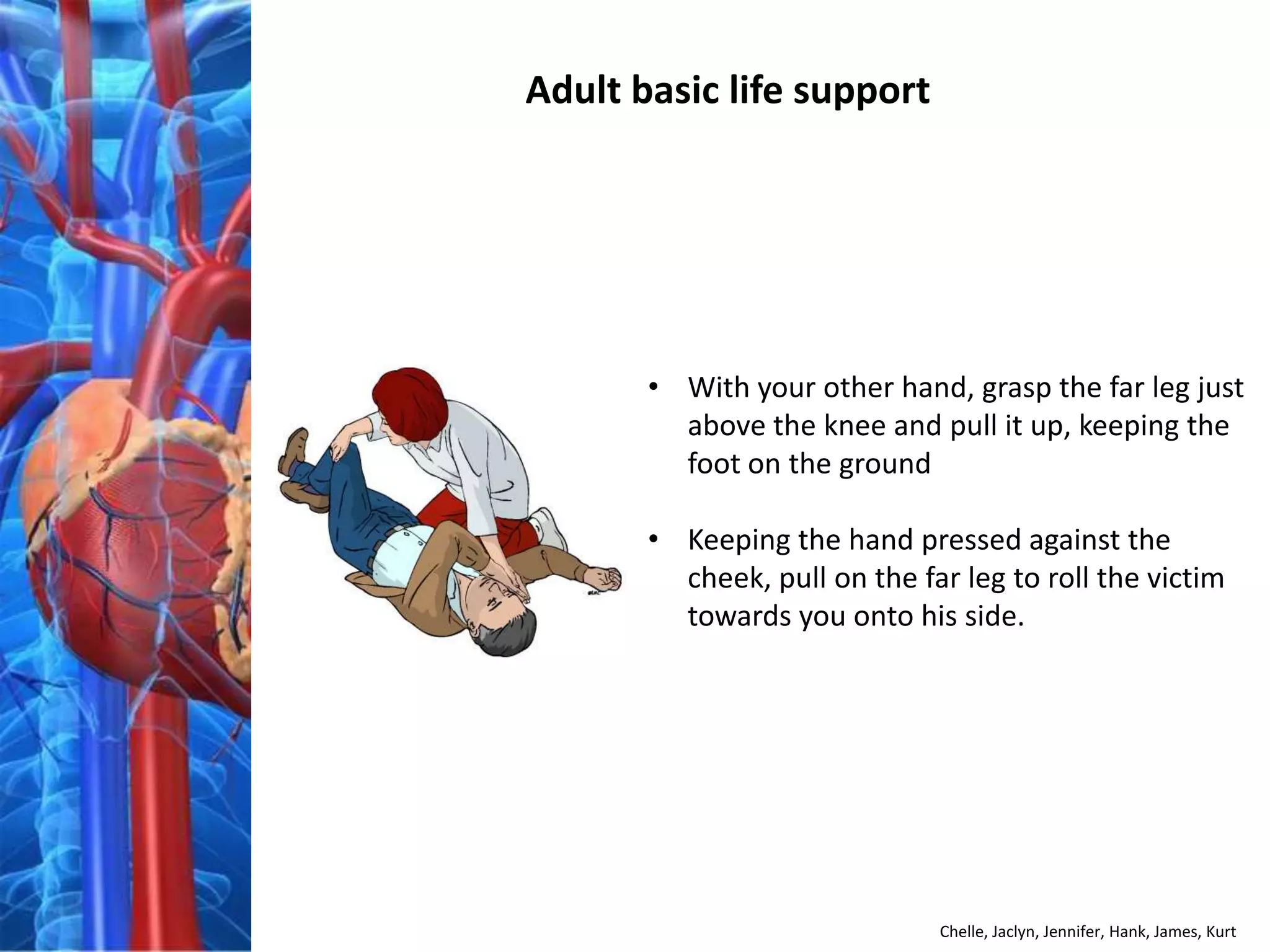
       • With your other hand, grasp the far leg just
         above the knee and pull it up, keeping the
         foot on the ground

       • Keeping the hand pressed against the
         cheek, pull on the far leg to roll the victim
         towards you onto his side.


                              Chelle, Jaclyn, Jennifer, Hank, James, Kurt
Adult basic life support


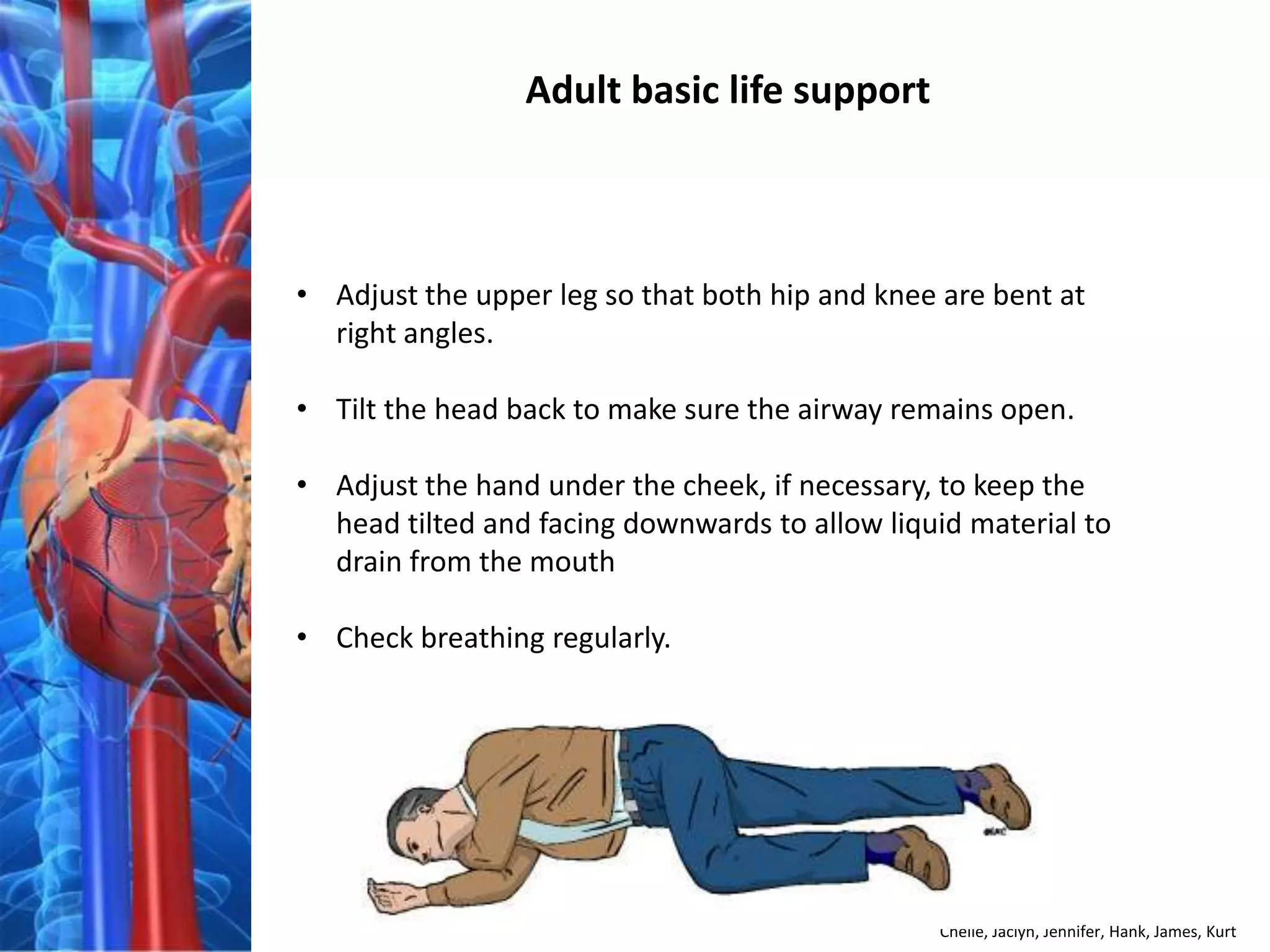
• Adjust the upper leg so that both hip and knee are bent at
  right angles.

• Tilt the head back to make sure the airway remains open.

• Adjust the hand under the cheek, if necessary, to keep the
  head tilted and facing downwards to allow liquid material to
  drain from the mouth

• Check breathing regularly.


                                                Chelle, Jaclyn, Jennifer, Hank, James, Kurt
Adult basic life support


     Congratulation
You may have saved a life.


        Chelle, Jaclyn, Jennifer, Hank, James, Kurt
                                      Chelle, Jaclyn, Jennifer, Hank, James, Kurt

Abls

  • 1.
    Adult basic lifesupport Adult basic life support Hands-Only CPR CPR with Rescue Breaths Use of automated external defibrillators Recovery Position Chelle, Jaclyn, Jennifer, Hank, James, Kurt Chelle, Jaclyn, Jennifer, Hank, James, Kurt
  • 2.
    Adult basic lifesupport Adult basic life support Hands-Only CPR Chelle, Jaclyn, Jennifer, Hank, James, Kurt Chelle, Jaclyn, Jennifer, Hank, James, Kurt
  • 3.
    Adult basic lifesupport 1. Make sure you, the victim and any bystanders are safe. 2. Check the victim for a response gently shake his shoulders and ask loudly: “Are you all right?” 3a. If he responds leave him in the position in which you find him, provided there is no further danger; try to find out what is wrong with him and get help if needed; reassess him regularly. Chelle, Jaclyn, Jennifer, Hank, James, Kurt
  • 4.
    Adult basic lifesupport 3b. If he does not respond shout for help ∘ turn the victim onto his back and then open the airway using head tilt and chin lift place your hand on his forehead and gently tilt his head back; ∘ with your fingertips under the point of the victim's chin, lift the chin to open the airway. Chelle, Jaclyn, Jennifer, Hank, James, Kurt
  • 5.
    Adult basic lifesupport 4. Keeping the airway open, look, listen and feel for breathing look for chest movement; listen at the victim's mouth for breath sounds; feel for air on your cheek; decide if breathing is normal, not normal or absent In the first few minutes after cardiac arrest, a victim may be barely breathing, or taking infrequent, slow and noisy gasps. Do not confuse this with normal breathing. Look, listen and feel for no more than 10 s to determine whether the victim is breathing normally. If you have any doubt whether breathing is normal, act as if it is not normal. Chelle, Jaclyn, Jennifer, Hank, James, Kurt
  • 6.
    Adult basic lifesupport 5a. If he is breathing normally turn him into the recovery position send or go for help—call 911 112 continue to assess that breathing remains normal. Chelle, Jaclyn, Jennifer, Hank, James, Kurt
  • 7.
    Adult basic lifesupport 5b. If the breathing is not normal or absent send someone for help; or if you are on your own, use your mobile telephone to alert the ambulance service—leave the victim only when there is no other option. start chest compression as follows: Chelle, Jaclyn, Jennifer, Hank, James, Kurt
  • 8.
    Adult basic lifesupport kneel by the side of the victim; ∘ place the heel of one hand in the centre of the victim's chest; (which is the lower half of the victim's breastbone (sternum)) Chelle, Jaclyn, Jennifer, Hank, James, Kurt
  • 9.
    Adult basic lifesupport place the heel of your other hand on top of the first hand interlock the fingers of your hands and ensure that pressure is not applied over the victim's ribs. Keep your arms straight Do not apply any pressure over the upper abdomen or the bottom end of the bony sternum (breastbone); Chelle, Jaclyn, Jennifer, Hank, James, Kurt
  • 10.
    Adult basic lifesupport position yourself vertically above the victim's chest and press down on the sternum at least 5 cm (but not exceeding 6 cm) ∘ after each compression, release all the pressure on the chest without losing contact between your hands and the sternum; repeat at a rate of at least 100 min−1 (but not exceeding 120 min−1); ∘ compression and release should take equal amounts of time. Chelle, Jaclyn, Jennifer, Hank, James, Kurt
  • 11.
    Adult basic lifesupport Do not interrupt resuscitation until: professional help arrives and takes over; or the victim starts to wake up: to move, open eyes and to breathe normally; or you become exhausted. Chelle, Jaclyn, Jennifer, Hank, James, Kurt
  • 12.
    Adult basic lifesupport Adult basic life support CPR with Rescue Breaths Chelle, Jaclyn, Jennifer, Hank, James, Kurt Chelle, Jaclyn, Jennifer, Hank, James, Kurt
  • 13.
    Adult basic lifesupport 1. Make sure you, the victim and any bystanders are safe. 2. Check the victim for a response gently shake his shoulders and ask loudly: “Are you all right?” 3a. If he responds leave him in the position in which you find him, provided there is no further danger; try to find out what is wrong with him and get help if needed; reassess him regularly. Chelle, Jaclyn, Jennifer, Hank, James, Kurt
  • 14.
    Adult basic lifesupport 3b. If he does not respond shout for help ∘ turn the victim onto his back and then open the airway using head tilt and chin lift place your hand on his forehead and gently tilt his head back; ∘ with your fingertips under the point of the victim's chin, lift the chin to open the airway. Chelle, Jaclyn, Jennifer, Hank, James, Kurt
  • 15.
    Adult basic lifesupport 4. Keeping the airway open, look, listen and feel for breathing look for chest movement; listen at the victim's mouth for breath sounds; feel for air on your cheek; decide if breathing is normal, not normal or absent In the first few minutes after cardiac arrest, a victim may be barely breathing, or taking infrequent, slow and noisy gasps. Do not confuse this with normal breathing. Look, listen and feel for no more than 10 s to determine whether the victim is breathing normally. If you have any doubt whether breathing is normal, act as if it is not normal. Chelle, Jaclyn, Jennifer, Hank, James, Kurt
  • 16.
    Adult basic lifesupport 5a. If he is breathing normally turn him into the recovery position (see below); send or go for help—call 911 112 continue to assess that breathing remains normal. Chelle, Jaclyn, Jennifer, Hank, James, Kurt
  • 17.
    Adult basic lifesupport 5b. If the breathing is not normal or absent send someone for help and to find and bring an AED if available; or if you are on your own, use your mobile telephone to alert the ambulance service— eave the victim only when there is no other option. start chest compression as follows: Chelle, Jaclyn, Jennifer, Hank, James, Kurt
  • 18.
    Adult basic lifesupport kneel by the side of the victim; ∘ place the heel of one hand in the centre of the victim's chest; (which is the lower half of the victim's breastbone (sternum)) Chelle, Jaclyn, Jennifer, Hank, James, Kurt
  • 19.
    Adult basic lifesupport place the heel of your other hand on top of the first hand interlock the fingers of your hands and ensure that pressure is not applied over the victim's ribs. Keep your arms straight Do not apply any pressure over the upper abdomen or the bottom end of the bony sternum (breastbone); Chelle, Jaclyn, Jennifer, Hank, James, Kurt
  • 20.
    Adult basic lifesupport • position yourself vertically above the victim's chest and press down on the sternum at least 5 cm (but not exceeding 6 cm) • after each compression, release all the pressure on the chest without losing contact between your hands and the sternum; repeat at a rate of at least 100 min−1 (but not exceeding 120 min−1); • compression and release should take equal amounts of time. Chelle, Jaclyn, Jennifer, Hank, James, Kurt
  • 21.
    Adult basic lifesupport 6a. Combine chest compression with rescue breaths. • After 30 compressions open the airway again using head tilt and chin lift • Pinch the soft part of the nose closed, using the index finger and thumb of your hand on the forehead. • Allow the mouth to open, but maintain chin lift. • Take a normal breath and place your lips around his mouth, making sure that you have a good seal Chelle, Jaclyn, Jennifer, Hank, James, Kurt
  • 22.
    Adult basic lifesupport • Blow steadily into the mouth while watching for the chest to rise, taking about 1 s as in normal breathing; this is an effective rescue breath. • Maintaining head tilt and chin lift, take your mouth away from the victim and watch for the chest to fall as air comes out Chelle, Jaclyn, Jennifer, Hank, James, Kurt
  • 23.
    Adult basic lifesupport • Take another normal breath and blow into the victim's mouth once more to achieve a total of two effective rescue breaths. The two breaths should not take more than 5 s in all. Then return your hands without delay to the correct position on the sternum and give a further 30 chest compressions. • Continue with chest compressions and rescue breaths in a ratio of 30:2. Chelle, Jaclyn, Jennifer, Hank, James, Kurt
  • 24.
    Adult basic lifesupport • Stop to recheck the victim only if he starts to wake up: to move, open eyes and to breathe normally. Otherwise, do not interrupt resuscitation. If your initial rescue breath does not make the chest rise as in normal breathing, then before your next attempt: • look into the victim's mouth and remove any obstruction; • recheck that there is adequate head tilt and chin lift; Chelle, Jaclyn, Jennifer, Hank, James, Kurt
  • 25.
    Adult basic lifesupport • do not attempt more than two breaths each time before returning to chest compressions. If there is more than one rescuer present, another rescuer should take over delivering CPR every 2 min to prevent fatigue. Ensure that interruption of chest compressions is minimal during the changeover of rescuers. For this purpose, and to count 30 compressions at the required rate, it may be helpful for the rescuer performing chest compressions to count out loud. Experienced rescuers could do combined two-rescuer CPR and in that situation they should exchange roles/places every 2 min. Chelle, Jaclyn, Jennifer, Hank, James, Kurt
  • 26.
    Adult basic lifesupport Do not interrupt resuscitation until: professional help arrives and takes over; or the victim starts to wake up: to move, open eyes and to breathe normally; or you become exhausted. Chelle, Jaclyn, Jennifer, Hank, James, Kurt
  • 27.
    Adult basic lifesupport Unresponsive Shout for help Open Airway Not Breathing normally Call 911 30 compressions 2 rescue breaths 30 compressions Chelle, Jaclyn, Jennifer, Hank, James, Kurt
  • 28.
    Adult basic lifesupport Adult basic life support and use of automated external defibrillators Chelle, Jaclyn, Jennifer, Hank, James, Kurt Chelle, Jaclyn, Jennifer, Hank, James, Kurt
  • 29.
    Adult basic lifesupport 1. Make sure you, the victim, and any bystanders are safe. 2. Follow the Adult BLS sequence (see other presentation 1 – 5) if the victim is unresponsive and not breathing normally, send someone for help and to find and bring an AED if available; if you are on your own, use your mobile telephone to alert the ambulance service—leave the victim only when there is no other option. 3. Start CPR according to the adult BLS sequence. If you are on your own and the AED is in your immediate vicinity, start by applying the AED. Chelle, Jaclyn, Jennifer, Hank, James, Kurt
  • 30.
    Adult basic lifesupport 4. As soon as the AED arrives switch on the AED and attach the electrode pads on the victim's bare chest if more than one rescuer is present, CPR should be continued while electrode pads are being attached to the chest; Follow the spoken/visual directions immediately; ensure that nobody is touching the victim while the AED is analyzing the rhythm Chelle, Jaclyn, Jennifer, Hank, James, Kurt
  • 31.
    Adult basic lifesupport 5a. If a shock is indicated ensure that nobody is touching the victim push shock button as directed (fully automatic AEDs will deliver the shock automatically); immediately restart CPR 30:2 continue as directed by the voice/visual prompts. Chelle, Jaclyn, Jennifer, Hank, James, Kurt
  • 32.
    Adult basic lifesupport 5b. If no shock is indicated immediately resume CPR, using a ratio of 30 compressions to 2 rescue breaths; continue as directed by the voice/visual prompts. 6. Continue to follow the AED prompts until professional help arrives and takes over; the victim starts to wake up: moves, open eyes and breathes normally; you become exhausted. Chelle, Jaclyn, Jennifer, Hank, James, Kurt
  • 33.
    Adult basic lifesupport Adult basic life support Recovery Position Chelle, Jaclyn, Jennifer, Hank, James, Kurt Chelle, Jaclyn, Jennifer, Hank, James, Kurt
  • 34.
    Adult basic lifesupport • Kneel beside the victim and make sure that both legs are straight. • Place the arm nearest to you out at right angles to the body, elbow bent with the hand palm uppermost • Bring the far arm across the chest, and hold the back of the hand against the victim's cheek nearest to you Chelle, Jaclyn, Jennifer, Hank, James, Kurt
  • 35.
    Adult basic lifesupport • With your other hand, grasp the far leg just above the knee and pull it up, keeping the foot on the ground • Keeping the hand pressed against the cheek, pull on the far leg to roll the victim towards you onto his side. Chelle, Jaclyn, Jennifer, Hank, James, Kurt
  • 36.
    Adult basic lifesupport • Adjust the upper leg so that both hip and knee are bent at right angles. • Tilt the head back to make sure the airway remains open. • Adjust the hand under the cheek, if necessary, to keep the head tilted and facing downwards to allow liquid material to drain from the mouth • Check breathing regularly. Chelle, Jaclyn, Jennifer, Hank, James, Kurt
  • 37.
    Adult basic lifesupport Congratulation You may have saved a life. Chelle, Jaclyn, Jennifer, Hank, James, Kurt Chelle, Jaclyn, Jennifer, Hank, James, Kurt