
ABDOMINAL WALL
DEFECTS
GASTROSCHISIS
Mednotezwww.mednotez.eazzymedicine.co
m
HISTORICAL BACKGROUND
 1733-Calder documented the first case of gastroschisis.
 1878- Fear described the surgical treatment of
gastroschisis.
 19th
/20th
century teratologists used the word
gastroschisis for what we now know as omphalocele.
 1943-Watkins reported successful primary closure of
gastroschisis
 1953 Moore and Stokes classified gastroschisis.
 1966- Izant recommended manual stretching of the
abdominal wall to enlarge the abdominal cavity.
 1967-Schuster initiated the the silo technique by
knitting Teflon to the abdominal fascia.www.mednotez.eazzymedicine.co
m
EMBROLOGY OF THE
ABDOMINAL WALL
 Its important in
understanding the
associated defects of the
chest
wall,diaphragm,heart
and the bladder
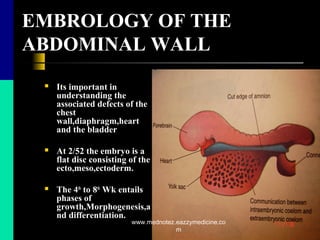
 At 2/52 the embryo is a
flat disc consisting of the
ecto,meso,ectoderm.
 The 4th
to 8th
Wk entails
phases of
growth,Morphogenesis,a
nd differentiation.
www.mednotez.eazzymedicine.co
m
EMBROLOGY OF THE
ABDOMINAL WALL
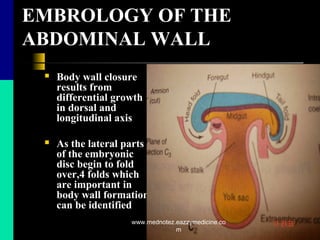
 Body wall closure
results from
differential growth
in dorsal and
longitudinal axis
 As the lateral parts
of the embryonic
disc begin to fold
over,4 folds which
are important in
body wall formation
can be identified
www.mednotez.eazzymedicine.co
m
EMBROLOGY OF THE
ABDOMINAL WALL
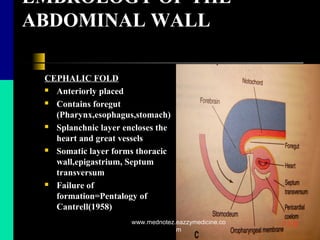
CEPHALIC FOLD
 Anteriorly placed
 Contains foregut
(Pharynx,esophagus,stomach)
 Splanchnic layer encloses the
heart and great vessels
 Somatic layer forms thoracic
wall,epigastrium, Septum
transversum
 Failure of
formation=Pentalogy of
Cantrell(1958)
www.mednotez.eazzymedicine.co
m
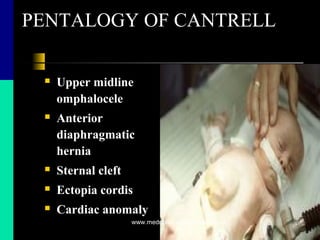
PENTALOGY OF CANTRELL
 Upper midline
omphalocele
 Anterior
diaphragmatic
hernia
 Sternal cleft
 Ectopia cordis
 Cardiac anomaly
www.mednotez.eazzymedicine.co
m
EMBROLOGY OF THE
ABDOMINAL WALL
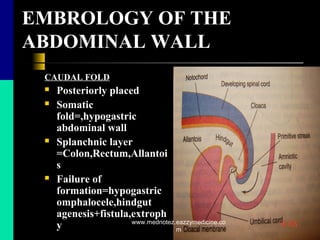
CAUDAL FOLD
 Posteriorly placed
 Somatic
fold=,hypogastric
abdominal wall
 Splanchnic layer
=Colon,Rectum,Allantoi
s
 Failure of
formation=hypogastric
omphalocele,hindgut
agenesis+fistula,extroph
y www.mednotez.eazzymedicine.co
m
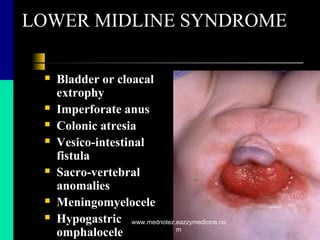
LOWER MIDLINE SYNDROME
 Bladder or cloacal
extrophy
 Imperforate anus
 Colonic atresia
 Vesico-intestinal
fistula
 Sacro-vertebral
anomalies
 Meningomyelocele
 Hypogastric
omphalocele
www.mednotez.eazzymedicine.co
m
EMBROLOGY OF THE
ABDOMINAL WALL
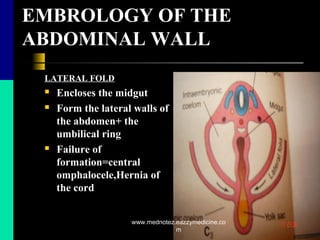
LATERAL FOLD
 Encloses the midgut
 Form the lateral walls of
the abdomen+ the
umbilical ring
 Failure of
formation=central
omphalocele,Hernia of
the cord
www.mednotez.eazzymedicine.co
m
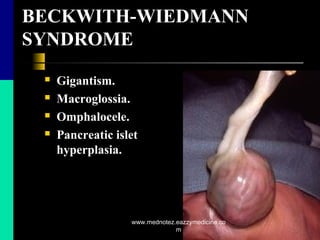
BECKWITH-WIEDMANN
SYNDROME
 Gigantism.
 Macroglossia.
 Omphalocele.
 Pancreatic islet
hyperplasia.
www.mednotez.eazzymedicine.co
m
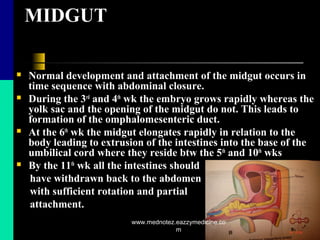
MIDGUT
 Normal development and attachment of the midgut occurs in
time sequence with abdominal closure.
 During the 3rd
and 4th
wk the embryo grows rapidly whereas the
yolk sac and the opening of the midgut do not. This leads to
formation of the omphalomesenteric duct.
 At the 6th
wk the midgut elongates rapidly in relation to the
body leading to extrusion of the intestines into the base of the
umbilical cord where they reside btw the 5th
and 10th
wks
 By the 11th
wk all the intestines should
have withdrawn back to the abdomen
with sufficient rotation and partial
attachment.
www.mednotez.eazzymedicine.co
m
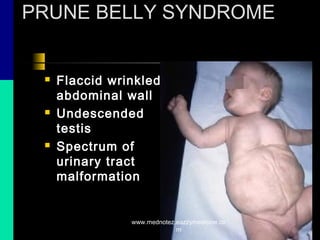
PRUNE BELLY SYNDROME
 Flaccid wrinkled
abdominal wall
 Undescended
testis
 Spectrum of
urinary tract
malformation
www.mednotez.eazzymedicine.co
m
CLINICAL FEATURES OF
GASTROSCHISIS
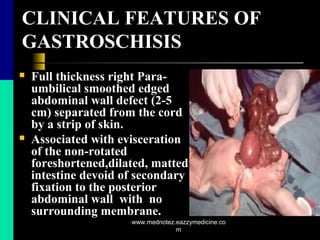
 Full thickness right Para-
umbilical smoothed edged
abdominal wall defect (2-5
cm) separated from the cord
by a strip of skin.
 Associated with evisceration
of the non-rotated
foreshortened,dilated, matted
intestine devoid of secondary
fixation to the posterior
abdominal wall with no
surrounding membrane.
www.mednotez.eazzymedicine.co
m
CLINICAL FEATURES OF
GASTROSCHISIS
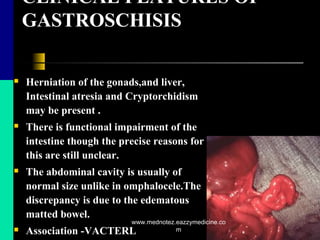
 Herniation of the gonads,and liver,
Intestinal atresia and Cryptorchidism
may be present .
 There is functional impairment of the
intestine though the precise reasons for
this are still unclear.
 The abdominal cavity is usually of
normal size unlike in omphalocele.The
discrepancy is due to the edematous
matted bowel.
 Association -VACTERL
www.mednotez.eazzymedicine.co
m
EPIDEMIOLGY
 Incidence 1.66/10,000, this appears to be
increasing over the last two decades up to
4.6/10,000 in some registers.
 Sex: Male predilection exists.
 A low incidence has been has been shown with
increasing maternal age while a high incidence
has been associated with low gravidity and
Prematurity
 No geographical or racial predilections have
been observed
www.mednotez.eazzymedicine.co
m
ETIOLOGY
 The embrogenesis of gastroschisis remains
controversial
 The most widely cited hypothesis is that a
vascular accident,early in embryogenesis,
results in occlusion of the omphalomesenteric
artery =>failure of normal development of the
mesodermal components of the anterior
abdominal wall.(Hoyme et al)
 Abnormal involution of the right umbilical vein
(De Vries).
 Early rupture of a small omphalocele or herniawww.mednotez.eazzymedicine.co
m
ETIOLOGY
 Failure of the lateral fold to join the cephalic
and the lateral folds slightly lateral to the
umbilical remnants(Bill)
 Early teratogenic action that prevents
differentiation of the somatopleure
mesenchyme with subsequent resorpsoption of
the ectoplastic layer of the lateral
fold(Duhamel)
 Failure of the musculature in the dorsal
myotomes to invade the splanchnopleure of the
anterior abdominal wall(Gray/skandalakis)
 Associations =smoking, alcohol, drugswww.mednotez.eazzymedicine.co
m
ETIOLOGY
 But experimentally these anomalies have been
induced in rats by folic acid deficiency,
administration of salicylates, and hypoxia
 Genetic and hereditary factors =not clear but
10%---38% have been associated with major
chromosomal anomalies like trisomies
13,14,15,18and 21.
www.mednotez.eazzymedicine.co
m
PATHOPHYSIOLOGY:
 Theories to explain the motility disorder that
accompanies some cases of gastroschisis
include;
1. Abnormality in ganglion cells or in the myenteric
nervous system
2. Ischaemia changes.
3. Exposure to allantoic contents.
4. Exposure to urine in amniotic fluid.
5. Exposure to meconium exposure in utero.
6. The fibrous peel
www.mednotez.eazzymedicine.co
m
PATHOPHYSIOLOGY:
 Lack of peristalsis and gastrointestinal
dysfunction may last for 20 to 30days after
which normal oral feeding should resume.
 Transit,absorption,and defecation patterns
normalize by 6th
month after repair.
 Both the large and the small intestine are
considerably short with a mean length of
70cm but this resolves spontaneously post-
operatively
www.mednotez.eazzymedicine.co
m
PATHOPHYSIOLOGY:
 In early pregnancy the thickness and the
diameter of the bowel are normal.A bowel
diameter greater than 17 mm usually
represents significant bowel dilation,
 Later in pregnancy, complications like
obstruction, peritonitis, bowel perforation, and
fetal growth restriction (IUGR) which occurs
in 38-77% of fetuses and is usually secondary
to nutrient loss through exposed bowel.
www.mednotez.eazzymedicine.co
m
PRENATAL MANAGAMENT
 Prenatal diagnosis allows for rational decisions
regarding;
 Timing ,location,and method of delivery
 Risks to the mother
 Termination of pregnancy
 Parental counseling
 Serial prenatal u/s should be done to assess
 The abdominal defect
 Associated anomalies
 IUGR
www.mednotez.eazzymedicine.co
m
PRENATAL MANAGAMENT
 Sonograms
 Fetal echocardiography
 Doppler u/s
 Acetylcholinesterase;pseudocholinesterase
 Ultrasonic detection of bowel dilatation is
associated with atresia or stenosis and hence a
poor clinical out-come
 AFP/MSAFP
 Amniocentesis and chromosomal analysis
www.mednotez.eazzymedicine.co
m
DELIVERY
 Caeserian section may avoid fetal injury
and gross intestinal edema but several
studies have concluded that it does not
confer any survival advantage for infants
with abdominal wall defects
www.mednotez.eazzymedicine.co
m
IMMEDIATE POST-NATAL
MANAGEMENT
 Resuscitation;Airway,Breathing,Circulation.
 The rate of infusion of lactated ringers solution
at 2-3 times the normal maintenance should be
guided by the clinical condition of the patient
determined by the pulse rate,MAP,and urine
output, electrolytes, Hct, and base deficit
 Catheterization to monitor urinary output and
to provide more space for bowel reduction.
 Antibiotics; Vitamin K ;. [Blood glucose]
monitoring www.mednotez.eazzymedicine.co
m
DEFINATIVE MANAGEMENT
 Surgical management takes into account
 Size of the defect
 Gestational age
 birth weight
 Eviscerated mass
 Associated anomalies
 Goals of surgery
 Closure of the defect
 Shorten hospitalization
www.mednotez.eazzymedicine.co
m
DEFINATIVE MANAGEMENT
 Contraindications for surgery
 Severe cardiac lesions
 Prematurity with RDS
 Chromosomal syndromes
www.mednotez.eazzymedicine.co
m
SURGICAL MANAGEMENT
 Depending on the degree of
visceroabdominal proportion this may
be;
1-Primary fascial closure.
2-Staged silo repair.
www.mednotez.eazzymedicine.co
m
PRIMARY CLOSURE
 Should only be considered after resuscitation and the
general condition of the child is good.
 Done under G/A with muscle relaxation.
 Bacterial contamination can be reduced by thorough
cleaning with povidone-iodine and normal saline.
 Rectal saline enemas helps to evacuate the meconium
and reduce the intestinal mass.
 The defect is increased to allow adequate mobilization
and inspection of the gut.
 Ladd's bands should be divided if present to prevent
duodenal obstruction at a later date.
 Prophylactic appendectomy.

www.mednotez.eazzymedicine.co
m
PRIMARY CLOSURE
 The adherent peel should not be removed to avoid
excessive bleeding and perforation
 Decompression can be done by milking out the gut
contents
 Atretic areas may be excised and anastomosed when
the edema and friability has resolved
 Intra-abdominal pressure monitoring should be done
during primary closure and it should not exceed
20mmHg so as to avoid hemodynamic ,metabolic or
respiratory compromise.
www.mednotez.eazzymedicine.co
m
PRIMARY CLOSURE
 Benefits are:
 improved survival
 reduced sepsis
 reduced intestinal dysfunction
 shorter hospitalization
 Use of muscle relaxants and manual abdominal wall
stretching facilitates primary closure.
 Airway pressure should not exceed 25mmHg to avoid
respiratory compromise
 Cardiac output and renal blood flow can be improved
by fluid volume replacements and ionotropic agents.
www.mednotez.eazzymedicine.co
m
STAGED CLOSURE
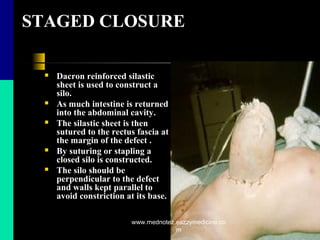
 Dacron reinforced silastic
sheet is used to construct a
silo.
 As much intestine is returned
into the abdominal cavity.
 The silastic sheet is then
sutured to the rectus fascia at
the margin of the defect .
 By suturing or stapling a
closed silo is constructed.
 The silo should be
perpendicular to the defect
and walls kept parallel to
avoid constriction at its base.
www.mednotez.eazzymedicine.co
m
STAGED CLOSURE
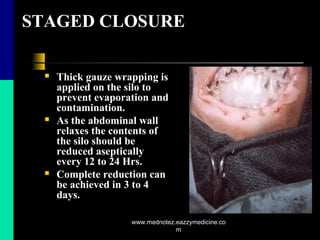
 Thick gauze wrapping is
applied on the silo to
prevent evaporation and
contamination.
 As the abdominal wall
relaxes the contents of
the silo should be
reduced aseptically
every 12 to 24 Hrs.
 Complete reduction can
be achieved in 3 to 4
days.
www.mednotez.eazzymedicine.co
m
ALTERNATIVE METHODS OF
CLOSURE
 Skin flap closure (Gross) when prosthesis is not
available.
 Tissue expanders.
www.mednotez.eazzymedicine.co
m
POSTOPERATIVE MANAGEMENT
 PEEP ventilation until the abdominal wall relaxes and
edema resolves to allow spontaneous respiration.
 Monitoring for sighs of raised intra abdominal
pressure which may entail respiratory,circulatory or
renal comprom
 Fluid requirements may go as high as 220mls/kg/24Hrs
 Daily serum proteins should be done due to increased
losses and plasma infusions given as necessary.
 Antibiotics given as long as the prosthesis is there.
 TPN is started immediately due to intestinal
dysfunction
 Oral feeding with predigested and semi elemental
formulas is started when orogastric aspirates are
negligible and stools are passed
www.mednotez.eazzymedicine.co
m
MORTALITY / MORBIDITY
 Complications related to the gastrointestinal
tract include; Atresia, necrosis, or severe
dilatation or thickening of the bowel
obstruction, peritonitis, bowel perforation,
malrotation, small bowel atresia or stenosis,
bowel infarction, prolonged intestinal motility
dysfunction, necrotizing enterocolitis, chronic
short-gut syndrome,
GERD,Pneumonia,Inguinal hernias.
 Inability to close the abdominal defect
primarily indicates poor prognosis.www.mednotez.eazzymedicine.co
m
MORTALITY / MORBIDITY
 TPN and staged closure have improved
survival rates but the postoperative hospital
stay is often lengthy.
 Mortality rates are 17%, and most deaths
occur as a result of premature delivery, bowel
infarction, or sepsis, multiple congenital
anomalies.
 Survival rates after surgery are 87-100%.
www.mednotez.eazzymedicine.co
m
ERYTHROPOIETIN RESTORES
BOWEL DAMAGE AND
HYPOPERISTALSIS IN
GASTROSCHISIS
www.mednotez.eazzymedicine.co
m
JOURNAL OF PAEDIATRIC SURGERY
(2006) VOL. 41(352-357)
 Aykut Ozdamar, Koray Topcu, Mukaddes
Gumustekin, Duygu Gurel,Ayse Gelal,
Erdener Ozer, Basak Ucan, Gunyuz Temir,
Aytac Karkine,Irfan Karac, Munevver
Hosgor.
 Departments of Pediatric Surgery,
Pharmacology, Pathology in Dr. Behcet Uz
Children’s Hospital and Dokuz Eylul
University.
www.mednotez.eazzymedicine.co
m
OBJECTIVE
 To investigate the effects of rEpo
on intestinal malfunction in the
chick embryos with gastroschisis.
www.mednotez.eazzymedicine.co
m
INTRODUCTION
ERYTHROPOIETIN (EPO)
 Growth factor produced by the kidney in
response to anemia.
 Found in human milk and has functional Epo
receptors in fetal and postnatal small
intestines[7].
 Binds to enterocytes and stimulates small
intestinal growth by increasing length, villous
surface area, villi height, and ileal crypt depth
[8].
 Protects neurons against ischaemia-induced
cell death. Acts as an angiogenic growth factor
for intestinal mesentery microvascular
endothelial cells [9,10].
www.mednotez.eazzymedicine.co
m
MATERIALS AND METHODS
 The study was undertaken using a chick
embryo model to determine if intraamniotic
recombinant human erythropoietin (rEpo)
administration would prevent intestinal
damage and enhance bowel contractility in
gastroschisis.
www.mednotez.eazzymedicine.co
m
MATERIALS AND METHODS
 All experimental procedures were approved by
Ethical Committee of the Dr. Behcet Uz
Children’s Hospital.
 Thirteen-day-old fertilized chick eggs were
incubated at 37.5C in 80% humidity.
 Operative procedures for all groups were
performed on the 13th day of incubation, using
previously published methods [11].
www.mednotez.eazzymedicine.co
m
MATERIALS AND METHODS
The eggs were divided into 5 groups;
1) The amnioallantoic membrane was opened to create
a common cavity through an eggshell window and
thus amnioallantoic fluid (AAF) mixture was
created, which resembled human amniotic
fluid(control)(n=10),
2) A 2.5-mm defect was created with delicate tweezers
in the umbilical stalk near the abdominal wall, and
intestinal loops were exteriorized out of the
abdomen after opening amnioallantoic membrane,
(Gx-only; n = 13),
www.mednotez.eazzymedicine.co
m
MATERIALS AND METHODS
3) A catheter was placed into the amnioallantoic
cavity & AAF exchange was performed with only
0.075% physiological saline only. (n = 12).
4) AAF exchange was performed with 0.075%
physiological saline only containing 10 IU rEpo(n =
11).
5) AAF exchange was performed with 0.075%
physiological saline only containing 20 IU rEpo (n
= 15).
www.mednotez.eazzymedicine.co
m
MATERIALS AND METHODS
 Exchange in these groups was performed once a day
with a volume corresponding to 10% of AAF, 1 mL at
the 15th and 16th days and 0.5 mL at the 17th day
before hatching.
 On the 18th day of hatching, all embryos were killed.
 Tissue specimens were taken from intestine of each
chick embryos and fixed in 10% formalin.
 Three sections from a 1-cm portion of the intestinal
segments of each embryo were selected randomly.
 Intestines were examined macroscopically and
microscopically. www.mednotez.eazzymedicine.co
m
MATERIALS AND METHODS
MICROSCOPIC
 All microscopic examinations were carried out by
the same pathologist (EO) under light microscopy in
a blinded manner.
 The numbers of parasympathetic ganglia were
counted in 10 plexuses of each section (total, 30
plexuses).
 The villi height per 10 villi from each section were
measured using a computer assisted image analyzer
 The number of ganglia was reported as mean value
per 10 plexuses
 Results were evaluated statistically by x2
and Fisher’s
Exact test tests. www.mednotez.eazzymedicine.co
m
MATERIALS AND METHODS
CONTRACTILITY STUDIES
 Contractility studies were performed using in vitro
muscle strip technique during the first 2 hours after
removal.
 Similar bowel segments selected for ganglion cell count
were also selected randomly for contractility studies.
 Full-thickness 10 mm muscle strips were subsequently
mounted in a 20-mL jacketed organ bath filled with
Tyrode solution which was maintained at 37.8C and
bubbled with 95% O2 + 5% CO2
 Isometric tension changes were measured using a
isometric transducers connected a computer-based
data acquisition and analysis software system.
www.mednotez.eazzymedicine.co
m
MATERIALS AND METHODS
CONTRACTILITY STUDIES
 Cumulative carbachol concentration response
curve was constructed for each sample.
 The response was expressed as a percentage of
the maximum Cch-evoked contraction (Emax)
in the control group.[fig.7]
 Maximal response to Cch in the Gx-only group
was compared with the other groups using
Mann-Whitney U test. P <.05 was considered
significant.
www.mednotez.eazzymedicine.co
m
RESULTS
Macroscopic findings
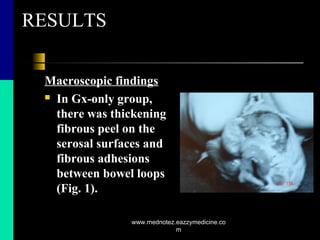
 In Gx-only group,
there was thickening
fibrous peel on the
serosal surfaces and
fibrous adhesions
between bowel loops
(Fig. 1).
www.mednotez.eazzymedicine.co
m
RESULTS
Macroscopic findings
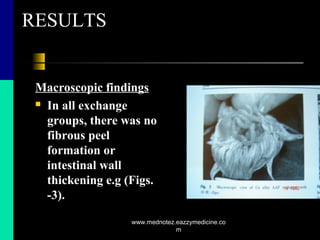
 In all exchange
groups, there was no
fibrous peel
formation or
intestinal wall
thickening e.g (Figs.
-3).
www.mednotez.eazzymedicine.co
m
RESULTS
Microscopic findings
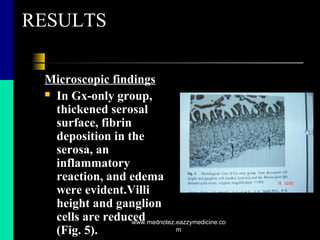
 In Gx-only group,
thickened serosal
surface, fibrin
deposition in the
serosa, an
inflammatory
reaction, and edema
were evident.Villi
height and ganglion
cells are reduced
(Fig. 5).
www.mednotez.eazzymedicine.co
m
RESULTS
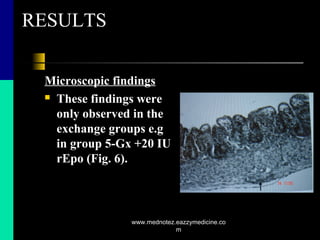
Microscopic findings
 These findings were
only observed in the
exchange groups e.g
in group 5-Gx +20 IU
rEpo (Fig. 6).
www.mednotez.eazzymedicine.co
m
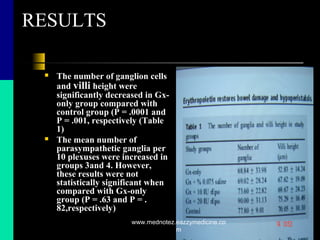
RESULTS
 The number of ganglion cells
and villi height were
significantly decreased in Gx-
only group compared with
control group (P = .0001 and
P = .001, respectively (Table
1)
 The mean number of
parasympathetic ganglia per
10 plexuses were increased in
groups 3and 4. However,
these results were not
statistically significant when
compared with Gx-only
group (P = .63 and P = .
82,respectively)
www.mednotez.eazzymedicine.co
m
RESULTS
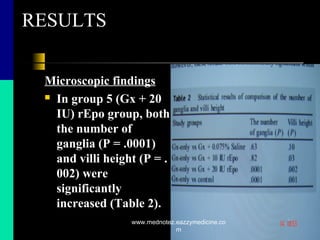
Microscopic findings
 In group 5 (Gx + 20
IU) rEpo group, both
the number of
ganglia (P = .0001)
and villi height (P = .
002) were
significantly
increased (Table 2).
www.mednotez.eazzymedicine.co
m
RESULTS
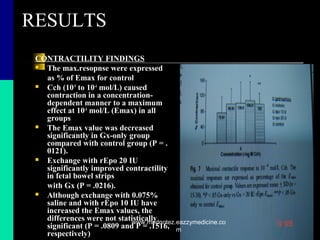
CONTRACTILITY FINDINGS
 The max.resopnse were expressed
as % of Emax for control
 Cch (10-9
to 10-4
mol/L) caused
contraction in a concentration-
dependent manner to a maximum
effect at 10-4
mol/L (Emax) in all
groups
 The Emax value was decreased
significantly in Gx-only group
compared with control group (P = .
0121).
 Exchange with rEpo 20 IU
significantly improved contractility
in fetal bowel strips
with Gx (P = .0216).
 Although exchange with 0.075%
saline and with rEpo 10 IU have
increased the Emax values, the
differences were not statistically
significant (P = .0809 and P = .1516,
respectively)
www.mednotez.eazzymedicine.co
m
DISCUSSION
 Significant postoperative morbidity still occurs as a
consequence of bowel damage in utero despite prenatal
diagnosis and immediate appropriate neonatal
care[12].
 Previous studies [13,14 ] have reported amnioinfusion
to decrease morphological bowel damage in
experimental animal studies as well as in human Gx.
Though controversy still exists on pathogenesis and
treatment of the intestinal malfunction .
 The present study demonstrated that intraamniotic
rEpo administration restores, in a dose dependent
manner, both morphological damage and intestinal
dysfunction associated with Gx.
www.mednotez.eazzymedicine.co
m
DISCUSSION
 Exposure of the intestines to AAF in Gx-only
group resulted in bowel wall thickening,
fibrous peel and adhesions as described in
previous reports [16].
 Amnioinfusion with either only physiological
saline or rEpo+ saline, =>normal appearing
intestines.=> that AAF exchange decreases the
concentration of harmful chemicals responsible
for intestinal morphological damage, as
previously reported in other clinical and
experimental studies [17].
www.mednotez.eazzymedicine.co
m
DISCUSSION
 In the study, ganglia were morphologically normal in
all groups but there was a significant decrease in the
number of ganglia in Gx-only group.
 AAF exchange with physiological saline did not
increased the number of ganglion cells but a dose-
dependent increase in the number of ganglia was found
after AAF exchange with rEpo.
 This could be attributed to the fact that rEpo
decreases apoptotic death of neuronal cells and
enterocytes [21]and also acts like anti-inflammatory
agents[9].
 In the study, bowel contractility and villi height were
significantly lower in Gx-only group than normal.
www.mednotez.eazzymedicine.co
m
DISCUSSION
 Physiological saline exchange had no significant effect
on either bowel contractility or villi height. In contrast,
AAF exchange with rEpo significantly improved
contractility in a dose-dependent manner; in addition,
histological examination of the bowel mucosa showed
longer villi in both rEpo-treated groups.
 This had been shown in previous rat studies, in which
rEpo significantly increased intestinal length and the
absorptive surface of the microvilli, primarily by
increasing the villi length [8]. It is also an angiogenic
growth factor[10].
www.mednotez.eazzymedicine.co
m
DISCUSSION
 The results suggested that intraamniotic rEpo
administration in Gx acts not only as a trophic factor
but also as a prokinetic agent on a variety of
nonhematopoietic cell types, including enterocytes,
endothelial cells, smooth muscle cells, and neuronal
cells; cell types that are present in the developing bowel
[24].
 In conclusion, the data constituted a basis for
examining the effectiveness and appropriate dose of
rEpo in further studies for treatment of all aspects of
intestinal malfunction in human Gx.
www.mednotez.eazzymedicine.co
m

Abdominal wall defects pesantation

  • 1.
  • 2.
    HISTORICAL BACKGROUND  1733-Calderdocumented the first case of gastroschisis.  1878- Fear described the surgical treatment of gastroschisis.  19th /20th century teratologists used the word gastroschisis for what we now know as omphalocele.  1943-Watkins reported successful primary closure of gastroschisis  1953 Moore and Stokes classified gastroschisis.  1966- Izant recommended manual stretching of the abdominal wall to enlarge the abdominal cavity.  1967-Schuster initiated the the silo technique by knitting Teflon to the abdominal fascia.www.mednotez.eazzymedicine.co m
  • 3.
    EMBROLOGY OF THE ABDOMINALWALL  Its important in understanding the associated defects of the chest wall,diaphragm,heart and the bladder  At 2/52 the embryo is a flat disc consisting of the ecto,meso,ectoderm.  The 4th to 8th Wk entails phases of growth,Morphogenesis,a nd differentiation. www.mednotez.eazzymedicine.co m
  • 4.
    EMBROLOGY OF THE ABDOMINALWALL  Body wall closure results from differential growth in dorsal and longitudinal axis  As the lateral parts of the embryonic disc begin to fold over,4 folds which are important in body wall formation can be identified www.mednotez.eazzymedicine.co m
  • 5.
    EMBROLOGY OF THE ABDOMINALWALL CEPHALIC FOLD  Anteriorly placed  Contains foregut (Pharynx,esophagus,stomach)  Splanchnic layer encloses the heart and great vessels  Somatic layer forms thoracic wall,epigastrium, Septum transversum  Failure of formation=Pentalogy of Cantrell(1958) www.mednotez.eazzymedicine.co m
  • 6.
    PENTALOGY OF CANTRELL Upper midline omphalocele  Anterior diaphragmatic hernia  Sternal cleft  Ectopia cordis  Cardiac anomaly www.mednotez.eazzymedicine.co m
  • 7.
    EMBROLOGY OF THE ABDOMINALWALL CAUDAL FOLD  Posteriorly placed  Somatic fold=,hypogastric abdominal wall  Splanchnic layer =Colon,Rectum,Allantoi s  Failure of formation=hypogastric omphalocele,hindgut agenesis+fistula,extroph y www.mednotez.eazzymedicine.co m
  • 8.
    LOWER MIDLINE SYNDROME Bladder or cloacal extrophy  Imperforate anus  Colonic atresia  Vesico-intestinal fistula  Sacro-vertebral anomalies  Meningomyelocele  Hypogastric omphalocele www.mednotez.eazzymedicine.co m
  • 9.
    EMBROLOGY OF THE ABDOMINALWALL LATERAL FOLD  Encloses the midgut  Form the lateral walls of the abdomen+ the umbilical ring  Failure of formation=central omphalocele,Hernia of the cord www.mednotez.eazzymedicine.co m
  • 10.
    BECKWITH-WIEDMANN SYNDROME  Gigantism.  Macroglossia. Omphalocele.  Pancreatic islet hyperplasia. www.mednotez.eazzymedicine.co m
  • 11.
    MIDGUT  Normal developmentand attachment of the midgut occurs in time sequence with abdominal closure.  During the 3rd and 4th wk the embryo grows rapidly whereas the yolk sac and the opening of the midgut do not. This leads to formation of the omphalomesenteric duct.  At the 6th wk the midgut elongates rapidly in relation to the body leading to extrusion of the intestines into the base of the umbilical cord where they reside btw the 5th and 10th wks  By the 11th wk all the intestines should have withdrawn back to the abdomen with sufficient rotation and partial attachment. www.mednotez.eazzymedicine.co m
  • 12.
    PRUNE BELLY SYNDROME Flaccid wrinkled abdominal wall  Undescended testis  Spectrum of urinary tract malformation www.mednotez.eazzymedicine.co m
  • 13.
    CLINICAL FEATURES OF GASTROSCHISIS Full thickness right Para- umbilical smoothed edged abdominal wall defect (2-5 cm) separated from the cord by a strip of skin.  Associated with evisceration of the non-rotated foreshortened,dilated, matted intestine devoid of secondary fixation to the posterior abdominal wall with no surrounding membrane. www.mednotez.eazzymedicine.co m
  • 14.
    CLINICAL FEATURES OF GASTROSCHISIS Herniation of the gonads,and liver, Intestinal atresia and Cryptorchidism may be present .  There is functional impairment of the intestine though the precise reasons for this are still unclear.  The abdominal cavity is usually of normal size unlike in omphalocele.The discrepancy is due to the edematous matted bowel.  Association -VACTERL www.mednotez.eazzymedicine.co m
  • 15.
    EPIDEMIOLGY  Incidence 1.66/10,000,this appears to be increasing over the last two decades up to 4.6/10,000 in some registers.  Sex: Male predilection exists.  A low incidence has been has been shown with increasing maternal age while a high incidence has been associated with low gravidity and Prematurity  No geographical or racial predilections have been observed www.mednotez.eazzymedicine.co m
  • 16.
    ETIOLOGY  The embrogenesisof gastroschisis remains controversial  The most widely cited hypothesis is that a vascular accident,early in embryogenesis, results in occlusion of the omphalomesenteric artery =>failure of normal development of the mesodermal components of the anterior abdominal wall.(Hoyme et al)  Abnormal involution of the right umbilical vein (De Vries).  Early rupture of a small omphalocele or herniawww.mednotez.eazzymedicine.co m
  • 17.
    ETIOLOGY  Failure ofthe lateral fold to join the cephalic and the lateral folds slightly lateral to the umbilical remnants(Bill)  Early teratogenic action that prevents differentiation of the somatopleure mesenchyme with subsequent resorpsoption of the ectoplastic layer of the lateral fold(Duhamel)  Failure of the musculature in the dorsal myotomes to invade the splanchnopleure of the anterior abdominal wall(Gray/skandalakis)  Associations =smoking, alcohol, drugswww.mednotez.eazzymedicine.co m
  • 18.
    ETIOLOGY  But experimentallythese anomalies have been induced in rats by folic acid deficiency, administration of salicylates, and hypoxia  Genetic and hereditary factors =not clear but 10%---38% have been associated with major chromosomal anomalies like trisomies 13,14,15,18and 21. www.mednotez.eazzymedicine.co m
  • 19.
    PATHOPHYSIOLOGY:  Theories toexplain the motility disorder that accompanies some cases of gastroschisis include; 1. Abnormality in ganglion cells or in the myenteric nervous system 2. Ischaemia changes. 3. Exposure to allantoic contents. 4. Exposure to urine in amniotic fluid. 5. Exposure to meconium exposure in utero. 6. The fibrous peel www.mednotez.eazzymedicine.co m
  • 20.
    PATHOPHYSIOLOGY:  Lack ofperistalsis and gastrointestinal dysfunction may last for 20 to 30days after which normal oral feeding should resume.  Transit,absorption,and defecation patterns normalize by 6th month after repair.  Both the large and the small intestine are considerably short with a mean length of 70cm but this resolves spontaneously post- operatively www.mednotez.eazzymedicine.co m
  • 21.
    PATHOPHYSIOLOGY:  In earlypregnancy the thickness and the diameter of the bowel are normal.A bowel diameter greater than 17 mm usually represents significant bowel dilation,  Later in pregnancy, complications like obstruction, peritonitis, bowel perforation, and fetal growth restriction (IUGR) which occurs in 38-77% of fetuses and is usually secondary to nutrient loss through exposed bowel. www.mednotez.eazzymedicine.co m
  • 22.
    PRENATAL MANAGAMENT  Prenataldiagnosis allows for rational decisions regarding;  Timing ,location,and method of delivery  Risks to the mother  Termination of pregnancy  Parental counseling  Serial prenatal u/s should be done to assess  The abdominal defect  Associated anomalies  IUGR www.mednotez.eazzymedicine.co m
  • 23.
    PRENATAL MANAGAMENT  Sonograms Fetal echocardiography  Doppler u/s  Acetylcholinesterase;pseudocholinesterase  Ultrasonic detection of bowel dilatation is associated with atresia or stenosis and hence a poor clinical out-come  AFP/MSAFP  Amniocentesis and chromosomal analysis www.mednotez.eazzymedicine.co m
  • 24.
    DELIVERY  Caeserian sectionmay avoid fetal injury and gross intestinal edema but several studies have concluded that it does not confer any survival advantage for infants with abdominal wall defects www.mednotez.eazzymedicine.co m
  • 25.
    IMMEDIATE POST-NATAL MANAGEMENT  Resuscitation;Airway,Breathing,Circulation. The rate of infusion of lactated ringers solution at 2-3 times the normal maintenance should be guided by the clinical condition of the patient determined by the pulse rate,MAP,and urine output, electrolytes, Hct, and base deficit  Catheterization to monitor urinary output and to provide more space for bowel reduction.  Antibiotics; Vitamin K ;. [Blood glucose] monitoring www.mednotez.eazzymedicine.co m
  • 26.
    DEFINATIVE MANAGEMENT  Surgicalmanagement takes into account  Size of the defect  Gestational age  birth weight  Eviscerated mass  Associated anomalies  Goals of surgery  Closure of the defect  Shorten hospitalization www.mednotez.eazzymedicine.co m
  • 27.
    DEFINATIVE MANAGEMENT  Contraindicationsfor surgery  Severe cardiac lesions  Prematurity with RDS  Chromosomal syndromes www.mednotez.eazzymedicine.co m
  • 28.
    SURGICAL MANAGEMENT  Dependingon the degree of visceroabdominal proportion this may be; 1-Primary fascial closure. 2-Staged silo repair. www.mednotez.eazzymedicine.co m
  • 29.
    PRIMARY CLOSURE  Shouldonly be considered after resuscitation and the general condition of the child is good.  Done under G/A with muscle relaxation.  Bacterial contamination can be reduced by thorough cleaning with povidone-iodine and normal saline.  Rectal saline enemas helps to evacuate the meconium and reduce the intestinal mass.  The defect is increased to allow adequate mobilization and inspection of the gut.  Ladd's bands should be divided if present to prevent duodenal obstruction at a later date.  Prophylactic appendectomy.  www.mednotez.eazzymedicine.co m
  • 30.
    PRIMARY CLOSURE  Theadherent peel should not be removed to avoid excessive bleeding and perforation  Decompression can be done by milking out the gut contents  Atretic areas may be excised and anastomosed when the edema and friability has resolved  Intra-abdominal pressure monitoring should be done during primary closure and it should not exceed 20mmHg so as to avoid hemodynamic ,metabolic or respiratory compromise. www.mednotez.eazzymedicine.co m
  • 31.
    PRIMARY CLOSURE  Benefitsare:  improved survival  reduced sepsis  reduced intestinal dysfunction  shorter hospitalization  Use of muscle relaxants and manual abdominal wall stretching facilitates primary closure.  Airway pressure should not exceed 25mmHg to avoid respiratory compromise  Cardiac output and renal blood flow can be improved by fluid volume replacements and ionotropic agents. www.mednotez.eazzymedicine.co m
  • 32.
    STAGED CLOSURE  Dacronreinforced silastic sheet is used to construct a silo.  As much intestine is returned into the abdominal cavity.  The silastic sheet is then sutured to the rectus fascia at the margin of the defect .  By suturing or stapling a closed silo is constructed.  The silo should be perpendicular to the defect and walls kept parallel to avoid constriction at its base. www.mednotez.eazzymedicine.co m
  • 33.
    STAGED CLOSURE  Thickgauze wrapping is applied on the silo to prevent evaporation and contamination.  As the abdominal wall relaxes the contents of the silo should be reduced aseptically every 12 to 24 Hrs.  Complete reduction can be achieved in 3 to 4 days. www.mednotez.eazzymedicine.co m
  • 34.
    ALTERNATIVE METHODS OF CLOSURE Skin flap closure (Gross) when prosthesis is not available.  Tissue expanders. www.mednotez.eazzymedicine.co m
  • 35.
    POSTOPERATIVE MANAGEMENT  PEEPventilation until the abdominal wall relaxes and edema resolves to allow spontaneous respiration.  Monitoring for sighs of raised intra abdominal pressure which may entail respiratory,circulatory or renal comprom  Fluid requirements may go as high as 220mls/kg/24Hrs  Daily serum proteins should be done due to increased losses and plasma infusions given as necessary.  Antibiotics given as long as the prosthesis is there.  TPN is started immediately due to intestinal dysfunction  Oral feeding with predigested and semi elemental formulas is started when orogastric aspirates are negligible and stools are passed www.mednotez.eazzymedicine.co m
  • 36.
    MORTALITY / MORBIDITY Complications related to the gastrointestinal tract include; Atresia, necrosis, or severe dilatation or thickening of the bowel obstruction, peritonitis, bowel perforation, malrotation, small bowel atresia or stenosis, bowel infarction, prolonged intestinal motility dysfunction, necrotizing enterocolitis, chronic short-gut syndrome, GERD,Pneumonia,Inguinal hernias.  Inability to close the abdominal defect primarily indicates poor prognosis.www.mednotez.eazzymedicine.co m
  • 37.
    MORTALITY / MORBIDITY TPN and staged closure have improved survival rates but the postoperative hospital stay is often lengthy.  Mortality rates are 17%, and most deaths occur as a result of premature delivery, bowel infarction, or sepsis, multiple congenital anomalies.  Survival rates after surgery are 87-100%. www.mednotez.eazzymedicine.co m
  • 38.
    ERYTHROPOIETIN RESTORES BOWEL DAMAGEAND HYPOPERISTALSIS IN GASTROSCHISIS www.mednotez.eazzymedicine.co m
  • 39.
    JOURNAL OF PAEDIATRICSURGERY (2006) VOL. 41(352-357)  Aykut Ozdamar, Koray Topcu, Mukaddes Gumustekin, Duygu Gurel,Ayse Gelal, Erdener Ozer, Basak Ucan, Gunyuz Temir, Aytac Karkine,Irfan Karac, Munevver Hosgor.  Departments of Pediatric Surgery, Pharmacology, Pathology in Dr. Behcet Uz Children’s Hospital and Dokuz Eylul University. www.mednotez.eazzymedicine.co m
  • 40.
    OBJECTIVE  To investigatethe effects of rEpo on intestinal malfunction in the chick embryos with gastroschisis. www.mednotez.eazzymedicine.co m
  • 41.
    INTRODUCTION ERYTHROPOIETIN (EPO)  Growthfactor produced by the kidney in response to anemia.  Found in human milk and has functional Epo receptors in fetal and postnatal small intestines[7].  Binds to enterocytes and stimulates small intestinal growth by increasing length, villous surface area, villi height, and ileal crypt depth [8].  Protects neurons against ischaemia-induced cell death. Acts as an angiogenic growth factor for intestinal mesentery microvascular endothelial cells [9,10]. www.mednotez.eazzymedicine.co m
  • 42.
    MATERIALS AND METHODS The study was undertaken using a chick embryo model to determine if intraamniotic recombinant human erythropoietin (rEpo) administration would prevent intestinal damage and enhance bowel contractility in gastroschisis. www.mednotez.eazzymedicine.co m
  • 43.
    MATERIALS AND METHODS All experimental procedures were approved by Ethical Committee of the Dr. Behcet Uz Children’s Hospital.  Thirteen-day-old fertilized chick eggs were incubated at 37.5C in 80% humidity.  Operative procedures for all groups were performed on the 13th day of incubation, using previously published methods [11]. www.mednotez.eazzymedicine.co m
  • 44.
    MATERIALS AND METHODS Theeggs were divided into 5 groups; 1) The amnioallantoic membrane was opened to create a common cavity through an eggshell window and thus amnioallantoic fluid (AAF) mixture was created, which resembled human amniotic fluid(control)(n=10), 2) A 2.5-mm defect was created with delicate tweezers in the umbilical stalk near the abdominal wall, and intestinal loops were exteriorized out of the abdomen after opening amnioallantoic membrane, (Gx-only; n = 13), www.mednotez.eazzymedicine.co m
  • 45.
    MATERIALS AND METHODS 3)A catheter was placed into the amnioallantoic cavity & AAF exchange was performed with only 0.075% physiological saline only. (n = 12). 4) AAF exchange was performed with 0.075% physiological saline only containing 10 IU rEpo(n = 11). 5) AAF exchange was performed with 0.075% physiological saline only containing 20 IU rEpo (n = 15). www.mednotez.eazzymedicine.co m
  • 46.
    MATERIALS AND METHODS Exchange in these groups was performed once a day with a volume corresponding to 10% of AAF, 1 mL at the 15th and 16th days and 0.5 mL at the 17th day before hatching.  On the 18th day of hatching, all embryos were killed.  Tissue specimens were taken from intestine of each chick embryos and fixed in 10% formalin.  Three sections from a 1-cm portion of the intestinal segments of each embryo were selected randomly.  Intestines were examined macroscopically and microscopically. www.mednotez.eazzymedicine.co m
  • 47.
    MATERIALS AND METHODS MICROSCOPIC All microscopic examinations were carried out by the same pathologist (EO) under light microscopy in a blinded manner.  The numbers of parasympathetic ganglia were counted in 10 plexuses of each section (total, 30 plexuses).  The villi height per 10 villi from each section were measured using a computer assisted image analyzer  The number of ganglia was reported as mean value per 10 plexuses  Results were evaluated statistically by x2 and Fisher’s Exact test tests. www.mednotez.eazzymedicine.co m
  • 48.
    MATERIALS AND METHODS CONTRACTILITYSTUDIES  Contractility studies were performed using in vitro muscle strip technique during the first 2 hours after removal.  Similar bowel segments selected for ganglion cell count were also selected randomly for contractility studies.  Full-thickness 10 mm muscle strips were subsequently mounted in a 20-mL jacketed organ bath filled with Tyrode solution which was maintained at 37.8C and bubbled with 95% O2 + 5% CO2  Isometric tension changes were measured using a isometric transducers connected a computer-based data acquisition and analysis software system. www.mednotez.eazzymedicine.co m
  • 49.
    MATERIALS AND METHODS CONTRACTILITYSTUDIES  Cumulative carbachol concentration response curve was constructed for each sample.  The response was expressed as a percentage of the maximum Cch-evoked contraction (Emax) in the control group.[fig.7]  Maximal response to Cch in the Gx-only group was compared with the other groups using Mann-Whitney U test. P <.05 was considered significant. www.mednotez.eazzymedicine.co m
  • 50.
    RESULTS Macroscopic findings  InGx-only group, there was thickening fibrous peel on the serosal surfaces and fibrous adhesions between bowel loops (Fig. 1). www.mednotez.eazzymedicine.co m
  • 51.
    RESULTS Macroscopic findings  Inall exchange groups, there was no fibrous peel formation or intestinal wall thickening e.g (Figs. -3). www.mednotez.eazzymedicine.co m
  • 52.
    RESULTS Microscopic findings  InGx-only group, thickened serosal surface, fibrin deposition in the serosa, an inflammatory reaction, and edema were evident.Villi height and ganglion cells are reduced (Fig. 5). www.mednotez.eazzymedicine.co m
  • 53.
    RESULTS Microscopic findings  Thesefindings were only observed in the exchange groups e.g in group 5-Gx +20 IU rEpo (Fig. 6). www.mednotez.eazzymedicine.co m
  • 54.
    RESULTS  The numberof ganglion cells and villi height were significantly decreased in Gx- only group compared with control group (P = .0001 and P = .001, respectively (Table 1)  The mean number of parasympathetic ganglia per 10 plexuses were increased in groups 3and 4. However, these results were not statistically significant when compared with Gx-only group (P = .63 and P = . 82,respectively) www.mednotez.eazzymedicine.co m
  • 55.
    RESULTS Microscopic findings  Ingroup 5 (Gx + 20 IU) rEpo group, both the number of ganglia (P = .0001) and villi height (P = . 002) were significantly increased (Table 2). www.mednotez.eazzymedicine.co m
  • 56.
    RESULTS CONTRACTILITY FINDINGS  Themax.resopnse were expressed as % of Emax for control  Cch (10-9 to 10-4 mol/L) caused contraction in a concentration- dependent manner to a maximum effect at 10-4 mol/L (Emax) in all groups  The Emax value was decreased significantly in Gx-only group compared with control group (P = . 0121).  Exchange with rEpo 20 IU significantly improved contractility in fetal bowel strips with Gx (P = .0216).  Although exchange with 0.075% saline and with rEpo 10 IU have increased the Emax values, the differences were not statistically significant (P = .0809 and P = .1516, respectively) www.mednotez.eazzymedicine.co m
  • 57.
    DISCUSSION  Significant postoperativemorbidity still occurs as a consequence of bowel damage in utero despite prenatal diagnosis and immediate appropriate neonatal care[12].  Previous studies [13,14 ] have reported amnioinfusion to decrease morphological bowel damage in experimental animal studies as well as in human Gx. Though controversy still exists on pathogenesis and treatment of the intestinal malfunction .  The present study demonstrated that intraamniotic rEpo administration restores, in a dose dependent manner, both morphological damage and intestinal dysfunction associated with Gx. www.mednotez.eazzymedicine.co m
  • 58.
    DISCUSSION  Exposure ofthe intestines to AAF in Gx-only group resulted in bowel wall thickening, fibrous peel and adhesions as described in previous reports [16].  Amnioinfusion with either only physiological saline or rEpo+ saline, =>normal appearing intestines.=> that AAF exchange decreases the concentration of harmful chemicals responsible for intestinal morphological damage, as previously reported in other clinical and experimental studies [17]. www.mednotez.eazzymedicine.co m
  • 59.
    DISCUSSION  In thestudy, ganglia were morphologically normal in all groups but there was a significant decrease in the number of ganglia in Gx-only group.  AAF exchange with physiological saline did not increased the number of ganglion cells but a dose- dependent increase in the number of ganglia was found after AAF exchange with rEpo.  This could be attributed to the fact that rEpo decreases apoptotic death of neuronal cells and enterocytes [21]and also acts like anti-inflammatory agents[9].  In the study, bowel contractility and villi height were significantly lower in Gx-only group than normal. www.mednotez.eazzymedicine.co m
  • 60.
    DISCUSSION  Physiological salineexchange had no significant effect on either bowel contractility or villi height. In contrast, AAF exchange with rEpo significantly improved contractility in a dose-dependent manner; in addition, histological examination of the bowel mucosa showed longer villi in both rEpo-treated groups.  This had been shown in previous rat studies, in which rEpo significantly increased intestinal length and the absorptive surface of the microvilli, primarily by increasing the villi length [8]. It is also an angiogenic growth factor[10]. www.mednotez.eazzymedicine.co m
  • 61.
    DISCUSSION  The resultssuggested that intraamniotic rEpo administration in Gx acts not only as a trophic factor but also as a prokinetic agent on a variety of nonhematopoietic cell types, including enterocytes, endothelial cells, smooth muscle cells, and neuronal cells; cell types that are present in the developing bowel [24].  In conclusion, the data constituted a basis for examining the effectiveness and appropriate dose of rEpo in further studies for treatment of all aspects of intestinal malfunction in human Gx. www.mednotez.eazzymedicine.co m