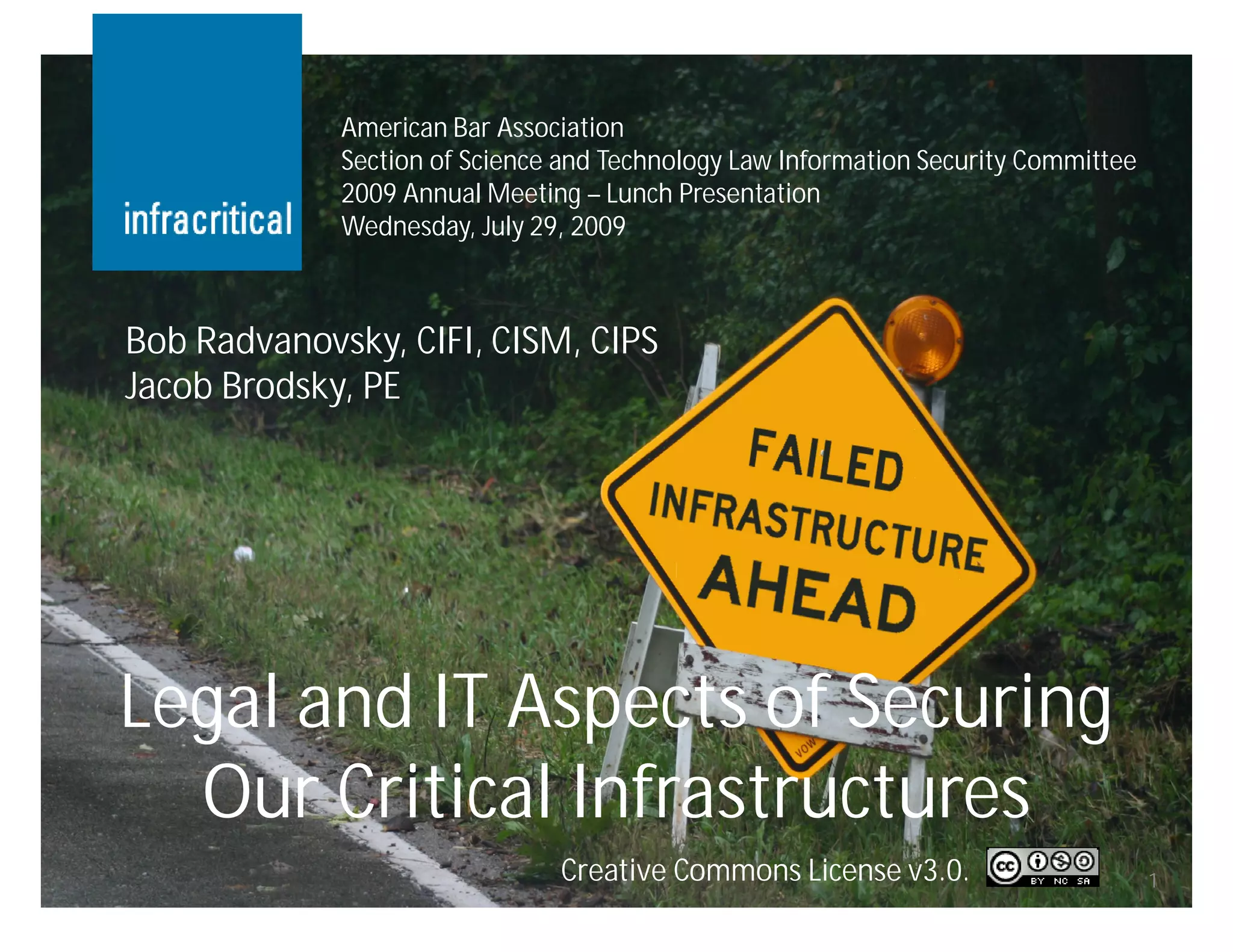
American Bar Association
             Section of Science and Technology Law Information Security Committee
             2009 Annual Meeting – Lunch Presentation
             Wednesday, July 29, 2009


Bob Radvanovsky, CIFI, CISM, CIPS
Jacob Brodsky, PE


Legal and IT Aspects of Securing
  Our Critical Infrastructures
                               Creative Commons License v3.0.                       1
What is a
                           “critical infrastructure”?

• Represents “…assets of physical and computer-based
  systems that are essential to the minimum operations
  of the economy and government.”(1)

• These assets include (but are not limited to):
     –   Telecommunication systems
     –   Energy distribution
     –   Banking & financial systems
     –   Transportation
     –   Water treatment facilities
     –   etc … there are a total of 14 infrastructure sectors.
1. ”Critical Infrastructure: Homeland Security and Emergency Preparedness”, 1st Edition, Radvanovsky, 2006.
                                                                                                              2
Reasons for addressing
                           infrastructure issues

• Critical infrastructures historically regarded physically and logically
  interdependent systems … until 9/11.
• Advances in IT systems and efforts to improve efficiencies of these
  systems, infrastructures have become increasingly automated and
  interlinked.

• Improvements created new vulnerabilities(2)
     •   Equipment failure
     •   Human error
     •   Natural causes (weather, drought, corrosion, locusts…)
     •   Physical and computer-related attacks


2. ”Critical Infrastructure: Homeland Security and Emergency Preparedness”, 1st Edition, Radvanovsky, 2006.
                                                                                                              3
Issues with our critical
                 infrastructures today

• Each infrastructure entity is responsible for protecting its
  own infrastructure; little to no cross cooperation.

• Each infrastructure entity needs to have measures that
  assure information is valid and accurate
  (apply A-I-C principle); most are currently lacking.

• Work should take holistic approach as systems are
  interdependent. (the Domino Principle).

                                                                 4
Assure the systems that
                  support the systems

• The infrastructure assurance process should:

   – Provide a consistent testing and evaluation framework of each
     infrastructure sector.
   – Perform vulnerability assessments regularly against physical
     and computer systems to deter, prevent, detect, and protect.
   – Expedite process to validate holistic systems.

• Assurance processing applies to both public and private sectors.


                                                                     5
Introducing SCADA and
                  control systems …

• Most control systems are computer based.

• Used by several infrastructure sectors (and their industries) to
  monitor and control sensitive processes and physical functions.

• Functions to provide safety controls and security.

• Primary role to ensure operations continuity within a plant.

• Control system abilities vary from simple to complex.

                                                                     6
Introducing SCADA and
                           control systems …

• Two kinds of industrial control systems (ICS):

     – Distributed Control Systems (DCS) are typically used
       within a single process or plant, or used over a
       smaller geographic area, possibly even a single site
       location.

     – SCADA systems are typically used for larger-scale
       environments that may be geographically dispersed
       in an enterprise-wide distribution operation.(3)

3. ”Critical Infrastructure: Homeland Security and Emergency Preparedness”, 1st Edition, Radvanovsky, 2006.
                                                                                                              7
What makes a control
                 system different?

• Conventional data systems (IT) are human oriented.

• Control systems are machine / process oriented:

   – Cannot be easily stopped - once stopped, takes a very long
     time to re-start; stopping an ICS means loss of revenue.

   – However … there is more at stake than financial
     considerations; stopping ICS can introduce safety issues.

   – Availability and reliability are paramount.

                                                                  8
Practical and legal
             considerations

1. Safety ALWAYS

2. Availability of the service

3. Security and access control

4. Regulation and compliance


                                   9
Admiralty Law similarity:
                      ICS practical concerns

•   You CANNOT stop operation of an infrastructure.

•   You CAN refer to federal investigation reports from NTSB, NRC, or CSB.

•   You CAN depose engineers, operators, and technicians once the emergency is no
    longer a threat.

•   You CANNOT confiscate original data without scheduled outage and/or without
    having a duplicate, backup system.

•   Prosecution of any offense should occur AFTER the event has been rendered safe,
    investigations conducted, and results reported by recognized experts.


                                                                                  10
Provenance of data is
                     extremely important

•   Accurate timestamps and source matter are crucial.

•   Logs from ICS must be validated.

•   Instrumentation needs to be validated AFTER an incident, but before …
     – An expert is involved with a control systems background; and,
     – Has knowledge in information security w/certification and registration.

•   Control systems are NOT at all similar to “personal computers”:
     – Real Time Systems (RTS) are operated very differently (see orientation).
     – Process controllers are fundamentally similar to embedded systems.

                                                                                 11
Provenance of data is
                   extremely important

• Cryptographic signatures (if applicable, if possible).

• Management methods must be documented.
  – Explaining ‘what’ and ‘how’.

• Access to each system must be documented:
   – Answers ‘who’, ‘when’ and ‘where.

• Protocols and code must be validated and documented.
   – Validates ‘why’.
                                                           12
Factors to consider
                     with ICS

•   Latency of data events.
     – Timing delay between events.

•   Sequence of events.
     – Order of events.

•   Timing of events.
     – Duration and speed of events.

•   Time of when alarms were reported to plant operators.
     – When alarm is reported, that the event took place at its stated time.

                                                                               13
Public standards for
                             control system security

•    NERC CIP (not considered a complete specification by many).

•    NIST SP800-53:
     “Recommended Security Controls for Federal Information Systems“.(4)

•    NIST SP800-82:
     “Guide to Industrial Control Systems (ICS) Security”.(5)


4.   National Institute of Standards and Technology (NIST) Special Publication 800-53, Revision 2,
     “Recommended Security Control for Federal Information Systems”, December 2007;
     URL: http://csrc.nist.gov/publications/nistpubs/800-53-Rev2/sp800-53-rev2-final.pdf.

5.   National Institute of Standards and Technology (NIST) Special Publication 800-82, Final Draft,
     “Guide to Industrial Control Systems (ICS) Security”, September 2008;
     URL: http://csrc.nist.gov/publications/drafts/800-82/draft_sp800-82-fpd.pdf.                     14
Public standards for
                            control system security

•    ISA-99
      – Currently under complex development.
      – Coordinated with ISA-84 safety specifications.
      – Considered the most complete and extensive contributed input from the industry.
•    Beware of the compliance approach: being compliant is NOT the same as
     being secure.(6)
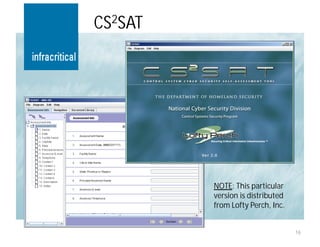
•    DHS’s CS2SAT tool is simply just that - only a tool; CS2SAT is NOT a
     prosecutable document.(7)

6.   “What’s the Difference Between Security and Compliance? - The Long Answers”, Control Global Magazine,
     April 2009; URL: http://www.controlglobal.com/articles/2009/SCADAmoreAnswers0904.html.

7.   U.S. Department of Homeland Security’s Control System Cyber Security Self-Assessment Tool (CS2SAT),
     DHS Control Systems Security Program (CSSP); URL: http://csrp.inl.gov/Self-Assessment_Tool.html.

                                                                                                           15
CS2SAT


         NOTE: This particular
         version is distributed
         from Lofty Perch, Inc.


                                  16
Public regulations for
                            control systems security

• Chemical Facility Anti-Terrorism Standards (CFATS).(8)

• FISMA recommends NIST SP800-53.(9)

• NERC CIP requires additional work before FERC utilizes it.


8.   U.S. Department of Homeland Security, Chemical Facility Anti-Terrorism Standards: Facility Inspections;
     URL: http://www.dhs.gov/files/programs/gc_1177001576714.shtm.

9.   National Institute of Standards and Technology, Computer Security Division, Computer Security Resource
     Center; URL: http://csrc.nist.gov/groups/SMA/fisma/index.html.

                                                                                                               17
A copy of this presentation may be found at our web site:
    http://www.infracritical.com/papers/aba-isc-2009.zip


                        Bob Radvanovsky, (630) 673-7740
                              rsradvan@infracritical.com

                           Jacob Brodsky, (443) 285-3514
                              jbrodsky@infracritical.com

                Creative Commons License v3.0.              18

American Bar Assoc. ISC 2009

  • 1.
    American Bar Association Section of Science and Technology Law Information Security Committee 2009 Annual Meeting – Lunch Presentation Wednesday, July 29, 2009 Bob Radvanovsky, CIFI, CISM, CIPS Jacob Brodsky, PE Legal and IT Aspects of Securing Our Critical Infrastructures Creative Commons License v3.0. 1
  • 2.
    What is a “critical infrastructure”? • Represents “…assets of physical and computer-based systems that are essential to the minimum operations of the economy and government.”(1) • These assets include (but are not limited to): – Telecommunication systems – Energy distribution – Banking & financial systems – Transportation – Water treatment facilities – etc … there are a total of 14 infrastructure sectors. 1. ”Critical Infrastructure: Homeland Security and Emergency Preparedness”, 1st Edition, Radvanovsky, 2006. 2
  • 3.
    Reasons for addressing infrastructure issues • Critical infrastructures historically regarded physically and logically interdependent systems … until 9/11. • Advances in IT systems and efforts to improve efficiencies of these systems, infrastructures have become increasingly automated and interlinked. • Improvements created new vulnerabilities(2) • Equipment failure • Human error • Natural causes (weather, drought, corrosion, locusts…) • Physical and computer-related attacks 2. ”Critical Infrastructure: Homeland Security and Emergency Preparedness”, 1st Edition, Radvanovsky, 2006. 3
  • 4.
    Issues with ourcritical infrastructures today • Each infrastructure entity is responsible for protecting its own infrastructure; little to no cross cooperation. • Each infrastructure entity needs to have measures that assure information is valid and accurate (apply A-I-C principle); most are currently lacking. • Work should take holistic approach as systems are interdependent. (the Domino Principle). 4
  • 5.
    Assure the systemsthat support the systems • The infrastructure assurance process should: – Provide a consistent testing and evaluation framework of each infrastructure sector. – Perform vulnerability assessments regularly against physical and computer systems to deter, prevent, detect, and protect. – Expedite process to validate holistic systems. • Assurance processing applies to both public and private sectors. 5
  • 6.
    Introducing SCADA and control systems … • Most control systems are computer based. • Used by several infrastructure sectors (and their industries) to monitor and control sensitive processes and physical functions. • Functions to provide safety controls and security. • Primary role to ensure operations continuity within a plant. • Control system abilities vary from simple to complex. 6
  • 7.
    Introducing SCADA and control systems … • Two kinds of industrial control systems (ICS): – Distributed Control Systems (DCS) are typically used within a single process or plant, or used over a smaller geographic area, possibly even a single site location. – SCADA systems are typically used for larger-scale environments that may be geographically dispersed in an enterprise-wide distribution operation.(3) 3. ”Critical Infrastructure: Homeland Security and Emergency Preparedness”, 1st Edition, Radvanovsky, 2006. 7
  • 8.
    What makes acontrol system different? • Conventional data systems (IT) are human oriented. • Control systems are machine / process oriented: – Cannot be easily stopped - once stopped, takes a very long time to re-start; stopping an ICS means loss of revenue. – However … there is more at stake than financial considerations; stopping ICS can introduce safety issues. – Availability and reliability are paramount. 8
  • 9.
    Practical and legal considerations 1. Safety ALWAYS 2. Availability of the service 3. Security and access control 4. Regulation and compliance 9
  • 10.
    Admiralty Law similarity: ICS practical concerns • You CANNOT stop operation of an infrastructure. • You CAN refer to federal investigation reports from NTSB, NRC, or CSB. • You CAN depose engineers, operators, and technicians once the emergency is no longer a threat. • You CANNOT confiscate original data without scheduled outage and/or without having a duplicate, backup system. • Prosecution of any offense should occur AFTER the event has been rendered safe, investigations conducted, and results reported by recognized experts. 10
  • 11.
    Provenance of datais extremely important • Accurate timestamps and source matter are crucial. • Logs from ICS must be validated. • Instrumentation needs to be validated AFTER an incident, but before … – An expert is involved with a control systems background; and, – Has knowledge in information security w/certification and registration. • Control systems are NOT at all similar to “personal computers”: – Real Time Systems (RTS) are operated very differently (see orientation). – Process controllers are fundamentally similar to embedded systems. 11
  • 12.
    Provenance of datais extremely important • Cryptographic signatures (if applicable, if possible). • Management methods must be documented. – Explaining ‘what’ and ‘how’. • Access to each system must be documented: – Answers ‘who’, ‘when’ and ‘where. • Protocols and code must be validated and documented. – Validates ‘why’. 12
  • 13.
    Factors to consider with ICS • Latency of data events. – Timing delay between events. • Sequence of events. – Order of events. • Timing of events. – Duration and speed of events. • Time of when alarms were reported to plant operators. – When alarm is reported, that the event took place at its stated time. 13
  • 14.
    Public standards for control system security • NERC CIP (not considered a complete specification by many). • NIST SP800-53: “Recommended Security Controls for Federal Information Systems“.(4) • NIST SP800-82: “Guide to Industrial Control Systems (ICS) Security”.(5) 4. National Institute of Standards and Technology (NIST) Special Publication 800-53, Revision 2, “Recommended Security Control for Federal Information Systems”, December 2007; URL: http://csrc.nist.gov/publications/nistpubs/800-53-Rev2/sp800-53-rev2-final.pdf. 5. National Institute of Standards and Technology (NIST) Special Publication 800-82, Final Draft, “Guide to Industrial Control Systems (ICS) Security”, September 2008; URL: http://csrc.nist.gov/publications/drafts/800-82/draft_sp800-82-fpd.pdf. 14
  • 15.
    Public standards for control system security • ISA-99 – Currently under complex development. – Coordinated with ISA-84 safety specifications. – Considered the most complete and extensive contributed input from the industry. • Beware of the compliance approach: being compliant is NOT the same as being secure.(6) • DHS’s CS2SAT tool is simply just that - only a tool; CS2SAT is NOT a prosecutable document.(7) 6. “What’s the Difference Between Security and Compliance? - The Long Answers”, Control Global Magazine, April 2009; URL: http://www.controlglobal.com/articles/2009/SCADAmoreAnswers0904.html. 7. U.S. Department of Homeland Security’s Control System Cyber Security Self-Assessment Tool (CS2SAT), DHS Control Systems Security Program (CSSP); URL: http://csrp.inl.gov/Self-Assessment_Tool.html. 15
  • 16.
    CS2SAT NOTE: This particular version is distributed from Lofty Perch, Inc. 16
  • 17.
    Public regulations for control systems security • Chemical Facility Anti-Terrorism Standards (CFATS).(8) • FISMA recommends NIST SP800-53.(9) • NERC CIP requires additional work before FERC utilizes it. 8. U.S. Department of Homeland Security, Chemical Facility Anti-Terrorism Standards: Facility Inspections; URL: http://www.dhs.gov/files/programs/gc_1177001576714.shtm. 9. National Institute of Standards and Technology, Computer Security Division, Computer Security Resource Center; URL: http://csrc.nist.gov/groups/SMA/fisma/index.html. 17
  • 18.
    A copy ofthis presentation may be found at our web site: http://www.infracritical.com/papers/aba-isc-2009.zip Bob Radvanovsky, (630) 673-7740 rsradvan@infracritical.com Jacob Brodsky, (443) 285-3514 jbrodsky@infracritical.com Creative Commons License v3.0. 18