Efficacy  of  Group  Visits  in  Outpatient  Management  of Diabetes Nicholas  Urbanczyk,  DO Peter  Farago,  MD, Patricia  West,  PhD Department  of  Family  Medicine St.  John  Hospital Detroit,  MI October 17, 2011
1999 Obesity Trends* Among U.S. Adults BRFSS,   1990, 1999, 2009 (*BMI   30, or about 30 lbs. overweight for 5’4” person) 2009 1990 No Data  <10%  10%–14%   15%–19%  20%–24%  25%–29%  ≥30%
Number and Percentage of U.S. Population with Diagnosed Diabetes, 1958-2008  CDC’s Division of Diabetes Translation.  National Diabetes Surveillance System available at   http://www.cdc.gov/diabetes/statistics
Diabetes:  The  Epidemic Prevalence 20 million Americans diagnosed with DM $174 billion each year Number of DM to double by year 2030 Relevance Health care costs increasing New models of care
There is Hope
Patient  Centered  Medical  Home Structured principles Personal physician Whole-person orientation Enhanced access  Group Visit model for chronically ill patients
Group  Visits Seeing patients in small groups Weekly, monthly, quarterly for 1-2 hours Effectiveness supported by literature DM focused but can be extended to any chronic illness
Group Visits Distinguish from more narrowly defined group education classes which address self-mgmt skills, exercise, and nutrition, but… Education classes do not provide –  Medical evaluation Medication administration Coordination/delivery of preventive health services
DM Group Visit Include an educational session, plus most components of individual clinic visit  Including one-on-one time with physician Not a lecture Lectures provide knowledge, but do not change behavior Curriculum for visit is driven by patient questions and concerns
Literature AIM-HI Bulletin  AAFP  2008 Group medical visits reportedly improved critical health parameters Wheelock et al.  Fam Med  2009 Patients were making life style changes HbgA1c and LDL levels did not differ Sadur et al.  Diabetes Care  1999 Group visits for 6 months Improved patient satisfaction, self-efficacy and blood-glucose control
Literature
The  Study
Purpose  In this pilot study, we evaluate whether Diabetic  patients  who  regularly  attend Group Visits  for  6  months  at  a  Patient Centered  Medical  Home  will show improvement  in  their  metabolic parameters and knowledge  of  their  Diabetes
Methods All adult Type II diabetics established at FMC were eligible Protocol approved by St. John Hospital IRB Recruitment letters  Randomly assigned to 2 small groups 10 patients per group HIPPA disclosure and confidentiality forms Study length 12 months January – June 2010 and July – December 2010 Two 6-month block sessions
Methods Monthly meetings 75min group visit Vitals Labs, HbA1C, lipids Med review Immunizations Monthly diabetic topic  DM Basics Common medications Hyper and hypoglycemic states  Diabetic lab goals Nutritionist Foot care
Methods Main Outcomes HbA1c DM Knowledge Secondary Outcomes Weight  Systolic Blood Pressure (SBP) Patient Satisfaction Completion of knowledge test 23 multiple-choice questions Michigan Diabetes Research and Training Center
Results
 
Medications  at  Baseline
After  6  months…
HbA1c  Pre- and Post-Intervention p = 0.026
Individual  HbA1c  Change  from  Pre- to Post-Intervention Intervention HbA1c  (%)
Diabetes  Knowledge Test Score  Pre- and Post-Intervention p = 0.001 23 Questions
Weight  Pre- and Post-Intervention p = 0.044
Systolic Blood Pressure  Pre- and Post-Intervention p = 0.005
Patient  Satisfaction  Survey Organization: 5 Content: 5 Presenters: 5 Helpfulness: 5 Overall satisfaction: 5
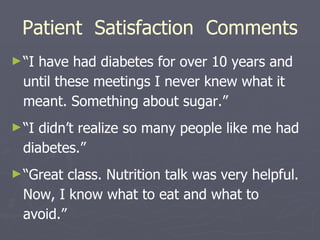
Patient  Satisfaction  Comments “ I have had diabetes for over 10 years and until these meetings I never knew what it meant. Something about sugar.” “ I didn’t realize so many people like me had diabetes.” “ Great class. Nutrition talk was very helpful. Now, I know what to eat and what to avoid.”
Summary Statistically significant improvements in Primary and Secondary outcomes HbA1c and Knowledge of Diabetes Weight, SBP, and Patient Satisfaction Gains were realized in a well established diabetic patient population Gains were realized without the addition or modification of any medications Increased patient satisfaction compared to traditional office visit
Conclusions In a PCMH, Diabetics  not  under  good  glycemic  control  with typical office visits, can  be  empowered  to  make  beneficial  lifestyle  changes  and  to self manage their diabetes when  participating  in  a  group  visit  model facilitated by Family Medicine Residents Future study  Investigate whether positive changes persist in larger study Utility of Group Visits for other medical conditions Community Medicine Rotation for residents
 
Acknowledgements Peter  Farago,  MD  – Family Medicine Patricia West, PhD, RN – Family Medicine Ruth Moore, PhD – Medical Education Karen Hagglund, MS – Medical Education
References Clancy DE, Huang P, Okonofua E, Yeager D, Magruder KM.  Group Visits: Promoting Adherence to Diabetes Guidelines.  J Gen Intern Med   2007; 22: 620-624. Sadur CN, Moline N, Costa M, Michalik D, Mendlowitz D, Roller S, Watson R, Swain BE, Selby JV, Javorski WC.  Diabetes Management in a Health Maintenance Organization: Efficacy of care management using cluster visits.  Diabetes Care  1999; 22: 2011-2017. Theobald M, Masley S.  A Guide to Group Visits for Chronic Conditions Affected by Overweight and Obesity.  Americans In Motion – Healthy Interventions.  AAFP. June 17, 2008 Wheelock C, Savageau J, Silk H, Lee S.  Improving the Health of Diabetic Patients Through Resident-initiated Group Visits.  Fam Med   2009; 41: 116-9.

Aach group visit

  • 1.
    Efficacy of Group Visits in Outpatient Management of Diabetes Nicholas Urbanczyk, DO Peter Farago, MD, Patricia West, PhD Department of Family Medicine St. John Hospital Detroit, MI October 17, 2011
  • 2.
    1999 Obesity Trends*Among U.S. Adults BRFSS, 1990, 1999, 2009 (*BMI  30, or about 30 lbs. overweight for 5’4” person) 2009 1990 No Data <10% 10%–14% 15%–19% 20%–24% 25%–29% ≥30%
  • 3.
    Number and Percentageof U.S. Population with Diagnosed Diabetes, 1958-2008 CDC’s Division of Diabetes Translation. National Diabetes Surveillance System available at http://www.cdc.gov/diabetes/statistics
  • 4.
    Diabetes: The Epidemic Prevalence 20 million Americans diagnosed with DM $174 billion each year Number of DM to double by year 2030 Relevance Health care costs increasing New models of care
  • 5.
  • 6.
    Patient Centered Medical Home Structured principles Personal physician Whole-person orientation Enhanced access Group Visit model for chronically ill patients
  • 7.
    Group VisitsSeeing patients in small groups Weekly, monthly, quarterly for 1-2 hours Effectiveness supported by literature DM focused but can be extended to any chronic illness
  • 8.
    Group Visits Distinguishfrom more narrowly defined group education classes which address self-mgmt skills, exercise, and nutrition, but… Education classes do not provide – Medical evaluation Medication administration Coordination/delivery of preventive health services
  • 9.
    DM Group VisitInclude an educational session, plus most components of individual clinic visit Including one-on-one time with physician Not a lecture Lectures provide knowledge, but do not change behavior Curriculum for visit is driven by patient questions and concerns
  • 10.
    Literature AIM-HI Bulletin AAFP 2008 Group medical visits reportedly improved critical health parameters Wheelock et al. Fam Med 2009 Patients were making life style changes HbgA1c and LDL levels did not differ Sadur et al. Diabetes Care 1999 Group visits for 6 months Improved patient satisfaction, self-efficacy and blood-glucose control
  • 11.
  • 12.
  • 13.
    Purpose Inthis pilot study, we evaluate whether Diabetic patients who regularly attend Group Visits for 6 months at a Patient Centered Medical Home will show improvement in their metabolic parameters and knowledge of their Diabetes
  • 14.
    Methods All adultType II diabetics established at FMC were eligible Protocol approved by St. John Hospital IRB Recruitment letters Randomly assigned to 2 small groups 10 patients per group HIPPA disclosure and confidentiality forms Study length 12 months January – June 2010 and July – December 2010 Two 6-month block sessions
  • 15.
    Methods Monthly meetings75min group visit Vitals Labs, HbA1C, lipids Med review Immunizations Monthly diabetic topic DM Basics Common medications Hyper and hypoglycemic states Diabetic lab goals Nutritionist Foot care
  • 16.
    Methods Main OutcomesHbA1c DM Knowledge Secondary Outcomes Weight Systolic Blood Pressure (SBP) Patient Satisfaction Completion of knowledge test 23 multiple-choice questions Michigan Diabetes Research and Training Center
  • 17.
  • 18.
  • 19.
    Medications at Baseline
  • 20.
    After 6 months…
  • 21.
    HbA1c Pre-and Post-Intervention p = 0.026
  • 22.
    Individual HbA1c Change from Pre- to Post-Intervention Intervention HbA1c (%)
  • 23.
    Diabetes KnowledgeTest Score Pre- and Post-Intervention p = 0.001 23 Questions
  • 24.
    Weight Pre-and Post-Intervention p = 0.044
  • 25.
    Systolic Blood Pressure Pre- and Post-Intervention p = 0.005
  • 26.
    Patient Satisfaction Survey Organization: 5 Content: 5 Presenters: 5 Helpfulness: 5 Overall satisfaction: 5
  • 27.
    Patient Satisfaction Comments “ I have had diabetes for over 10 years and until these meetings I never knew what it meant. Something about sugar.” “ I didn’t realize so many people like me had diabetes.” “ Great class. Nutrition talk was very helpful. Now, I know what to eat and what to avoid.”
  • 28.
    Summary Statistically significantimprovements in Primary and Secondary outcomes HbA1c and Knowledge of Diabetes Weight, SBP, and Patient Satisfaction Gains were realized in a well established diabetic patient population Gains were realized without the addition or modification of any medications Increased patient satisfaction compared to traditional office visit
  • 29.
    Conclusions In aPCMH, Diabetics not under good glycemic control with typical office visits, can be empowered to make beneficial lifestyle changes and to self manage their diabetes when participating in a group visit model facilitated by Family Medicine Residents Future study Investigate whether positive changes persist in larger study Utility of Group Visits for other medical conditions Community Medicine Rotation for residents
  • 30.
  • 31.
    Acknowledgements Peter Farago, MD – Family Medicine Patricia West, PhD, RN – Family Medicine Ruth Moore, PhD – Medical Education Karen Hagglund, MS – Medical Education
  • 32.
    References Clancy DE,Huang P, Okonofua E, Yeager D, Magruder KM. Group Visits: Promoting Adherence to Diabetes Guidelines. J Gen Intern Med 2007; 22: 620-624. Sadur CN, Moline N, Costa M, Michalik D, Mendlowitz D, Roller S, Watson R, Swain BE, Selby JV, Javorski WC. Diabetes Management in a Health Maintenance Organization: Efficacy of care management using cluster visits. Diabetes Care 1999; 22: 2011-2017. Theobald M, Masley S. A Guide to Group Visits for Chronic Conditions Affected by Overweight and Obesity. Americans In Motion – Healthy Interventions. AAFP. June 17, 2008 Wheelock C, Savageau J, Silk H, Lee S. Improving the Health of Diabetic Patients Through Resident-initiated Group Visits. Fam Med 2009; 41: 116-9.

Editor's Notes

  • #2 I have been passionate about the notion of Group Visits, since my residency training. I always felt that a better educated patient, equaled a healthy patient. My resident research project focused on group visits for Pediatric obesity. I wanted to carry the group visit idea into my practice. And then as faculty physician at St. John I had some help from the residents I was teaching. So really this research project is a large collaboration with residents giving lectures during their community medicine rotation. Residents are so eager to get involved and we set up each resident with a topic to facilitate during the DM Group Visit. So I was able to harness that energy to move forward this research pilot study.
  • #3 Behavioral Risk Factor Surveillance System performed by CDC, The data shown in these maps were collected through the CDC&apos;s Behavioral Risk Factor Surveillance System (BRFSS) , on the basis of self-reported weight and height. Each year, state health departments use standard procedures to collect data through a series of monthly telephone interviews with U.S. adults. Prevalence estimates generated for the maps may vary slightly from those generated for the states by the BRFSS as slightly different analytic methods are used
  • #4 Methodology Number and percent of the U.S. population with diagnosed diabetes were obtained from the National Health Interview Survey (NHIS, available at http://www.cdc.gov/nchs/nhis.htm ) of the National Center for Health Statistics (NCHS), Centers for Disease Control and Prevention (CDC) for years. Conducted continuously since 1957, the NHIS is a health survey of the civilian, noninstitutionalized population of the United States. The survey provides information on the health of the United States population, including information on the prevalence and incidence of disease, the extent of disability, and the utilization of health care services. The multistage probability design of the survey has been described elsewhere (1,2). Estimates for years 1958-1979 were obtained from published data (3) and estimates from 1980 forward were derived directly from the NHIS survey data. References 1. Massey JT, Moore TF, Parsons VL, Tadros W. Design and estimation for the National Health Interview Survey, 1985-1994. Hyattsville, MD: National Center for Health Statistics. Vital and Health Statistics 1989;2(110). 2. Botman SL, Moore TF, Moriarity CL, Parsons VL. Design and estimation for the National Health Interview Survey, 1995–2004. National Center for Health Statistics. Vital and Health Statistics 2000;2(130). 3. Harris MI: Prevalence of noninsulin-dependent diabetes and impaired glucose tolerance. Chapter VI in Diabetes in America , Harris MI, Hamman RF, eds. NIH publ. no. 85-1468, 1985.
  • #5 Data from the 2011 National Diabetes Fact Sheet (released Jan. 26, 2011) Total prevalence of diabetes Total: 25.8 million children and adults in the United States—8.3% of the population—have diabetes. Diagnosed: 18.8 million people Undiagnosed: 7.0 million people Prediabetes: 79 million people Cost of Diabetes $174 billion: Total costs of diagnosed diabetes in the United States in 2007 $116 billion for direct medical costs $58 billion for indirect costs (disability, work loss, premature mortality)
  • #6 This article states “The future of family Medicine”, but this article is from 2004, and so the future is already the past. But in this report, the committee supported the PCMH concept. And mentioned Group Visits as 1 tool to provide higher quality and better access at a lower cost to the health care system
  • #7 Quality measures – patient disease registries, establish core performance measures, test result tracking Patient experience – increased access to care, same day appointments, email, support patient self management through motivational interviewing, group visits
  • #12 Dr. Andrew Davis published a Review article in clinical diabetes 2008. There has been much research in Group Visits, starting from late 1990s
  • #16 Group visit setting is a superb time to catch up on preventive health maintenance, immunizations, labs, etc.
  • #23 We did have several patients who made dramatic positive change in HbA1c which may have affected our results