Christophe Bedeaux, BA-Applied Human Sciences , Research
Assistant,
Concordia University, Montreal, QC, Canada
1
Objectives
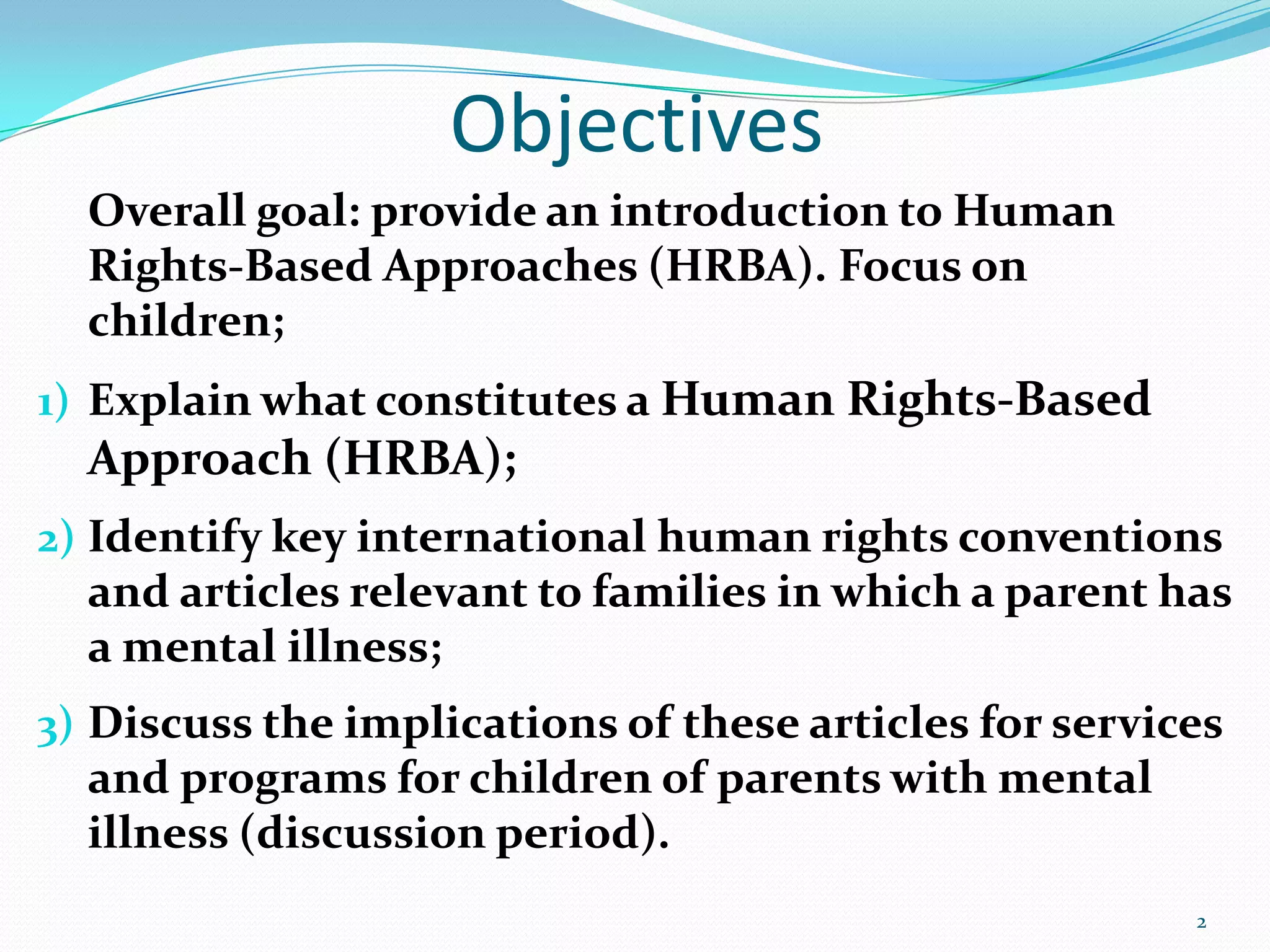
Overall goal: provide an introduction to Human
Rights-Based Approaches (HRBA). Focus on
children;
1) Explain what constitutes a Human Rights-Based
Approach (HRBA);
2) Identify key international human rights conventions
and articles relevant to families in which a parent has
a mental illness;
3) Discuss the implications of these articles for services
and programs for children of parents with mental
illness (discussion period).
2
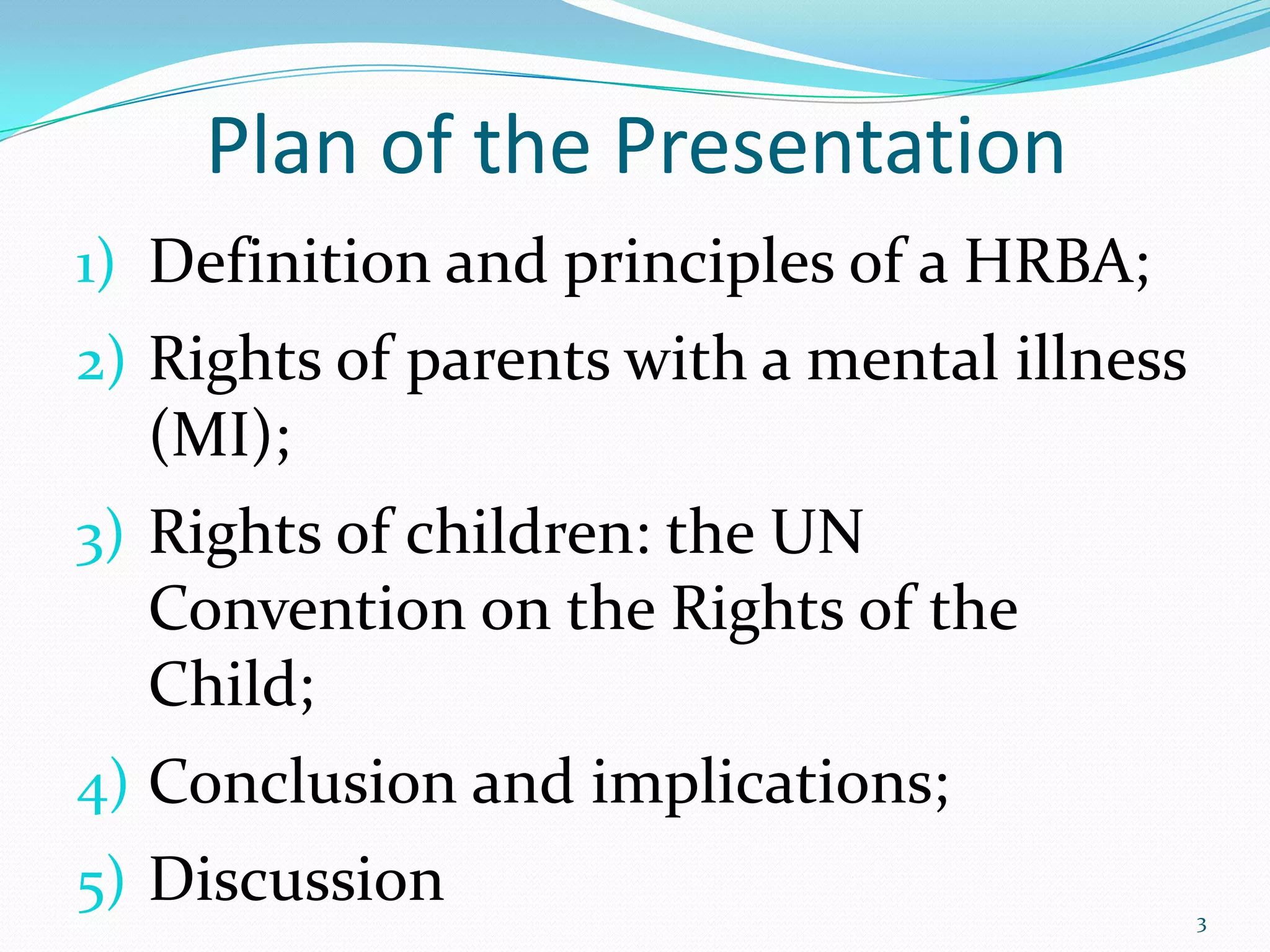
Plan of the Presentation
1) Definition and principles of a HRBA;
2) Rights of parents with a mental illness
(MI);
3) Rights of children: the UN
Convention on the Rights of the
Child;
4) Conclusion and implications;
5) Discussion 3
What is a HRBA?
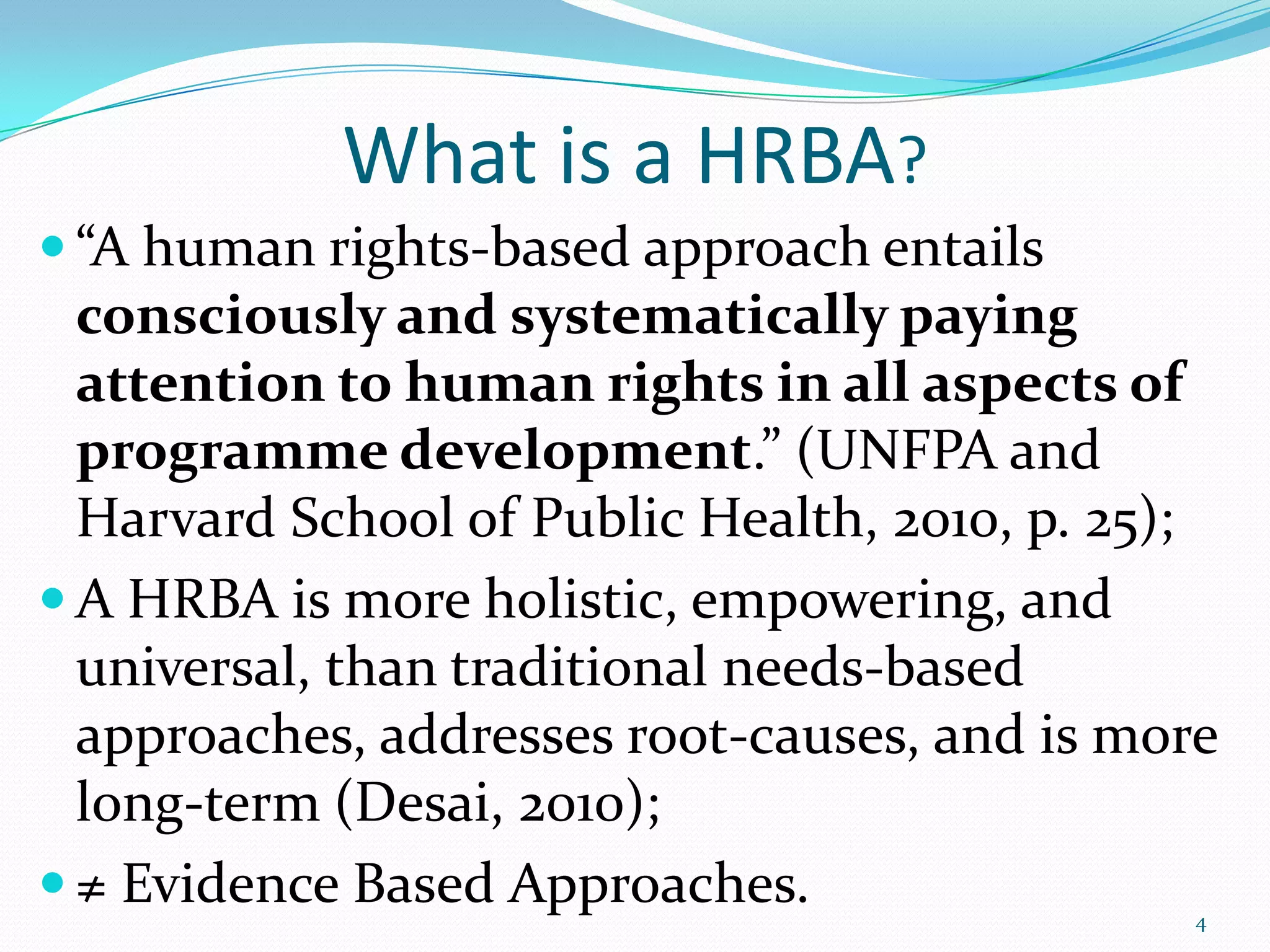
 “A human rights-based approach entails
consciously and systematically paying
attention to human rights in all aspects of
programme development.” (UNFPA and
Harvard School of Public Health, 2010, p. 25);
 A HRBA is more holistic, empowering, and
universal, than traditional needs-based
approaches, addresses root-causes, and is more
long-term (Desai, 2010);
 ≠ Evidence Based Approaches. 4
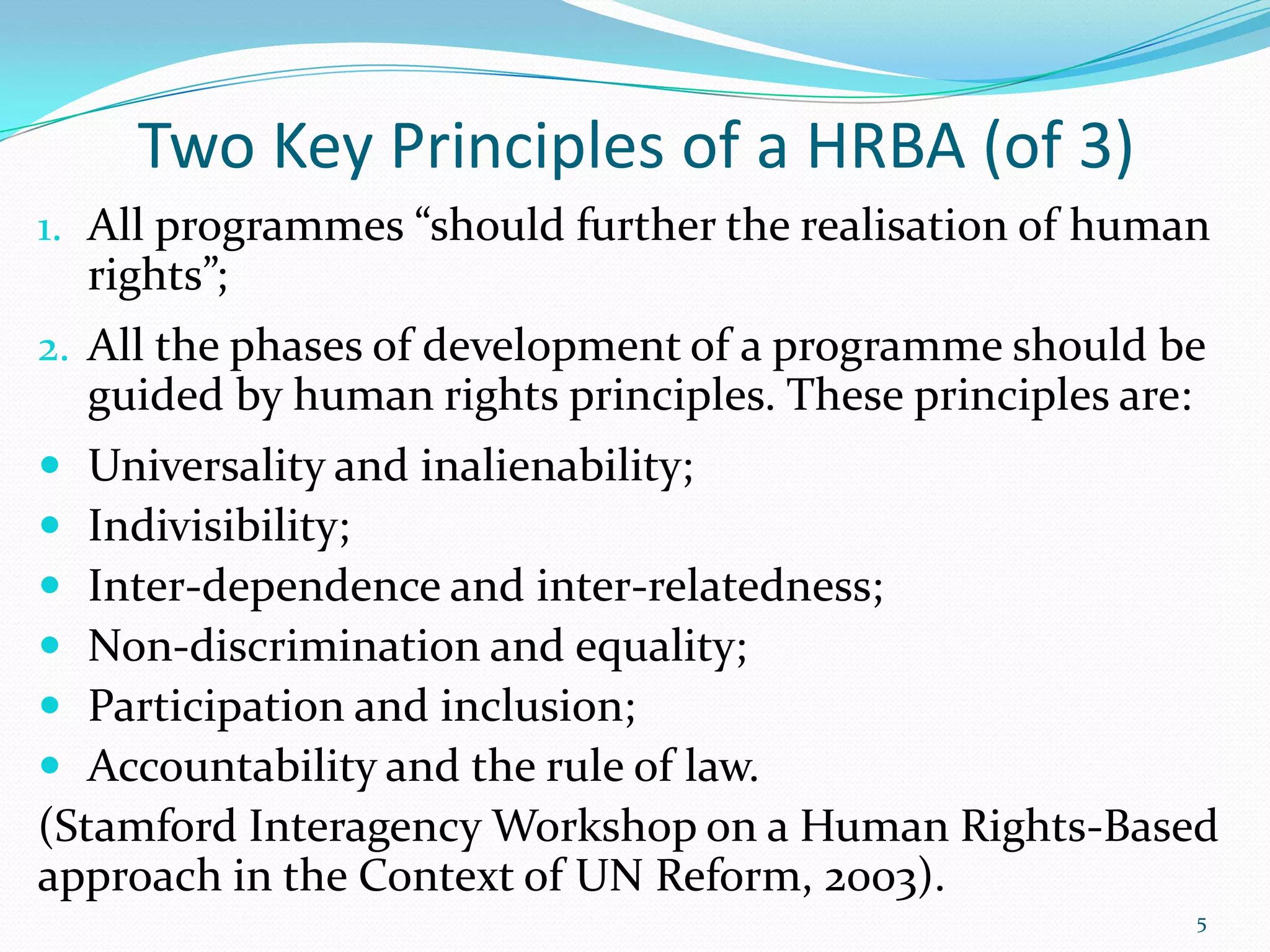
Two Key Principles of a HRBA (of 3)
1. All programmes “should further the realisation of human
rights”;
2. All the phases of development of a programme should be
guided by human rights principles. These principles are:
 Universality and inalienability;
 Indivisibility;
 Inter-dependence and inter-relatedness;
 Non-discrimination and equality;
 Participation and inclusion;
 Accountability and the rule of law.
(Stamford Interagency Workshop on a Human Rights-Based
approach in the Context of UN Reform, 2003).
5
The Rights of Parents
Convention on the Rights of Persons with Disabilities
 Article 1 – Purpose
“Persons with disabilities include those who
have long-term physical, mental, intellectual
or sensory impairments which [...] may hinder
their full and effective participation in
society [...].” (UN General Assembly, 2006).
6
 Article 23 - Respect for home and the family
2. “States Parties shall ensure the rights and
responsibilities of persons with disabilities, with regard
to guardianship, wardship, trusteeship, adoption of
children or similar institutions [...]; in all cases the
best interests of the child shall be paramount.
States Parties shall render appropriate assistance
to persons with disabilities in the performance of
their child-rearing responsibilities.” (UN General
Assembly, 2006).
4. relates to separation of children from parents :
disability in itself not a sufficient basis for separation
of child from parents. 7
 Principle 1 Fundamental freedoms and basic rights
“1. All persons have the right to the best available mental
health care […].
2. All persons with a mental illness, or who are being
treated as such persons, shall be treated with humanity and
respect for the inherent dignity of the human person.
4. There shall be no discrimination on the grounds of
mental illness[...].” (UN General Assembly, 1991).
 Principle 2 Protection of minors : “Special care should
be given [...] to protect the rights of minors [...].”
 Principle 11 Consent to treatment (16 articles).
8
Principles for the Protection of Persons with Mental
Illness and the Improvement of Mental Health Care
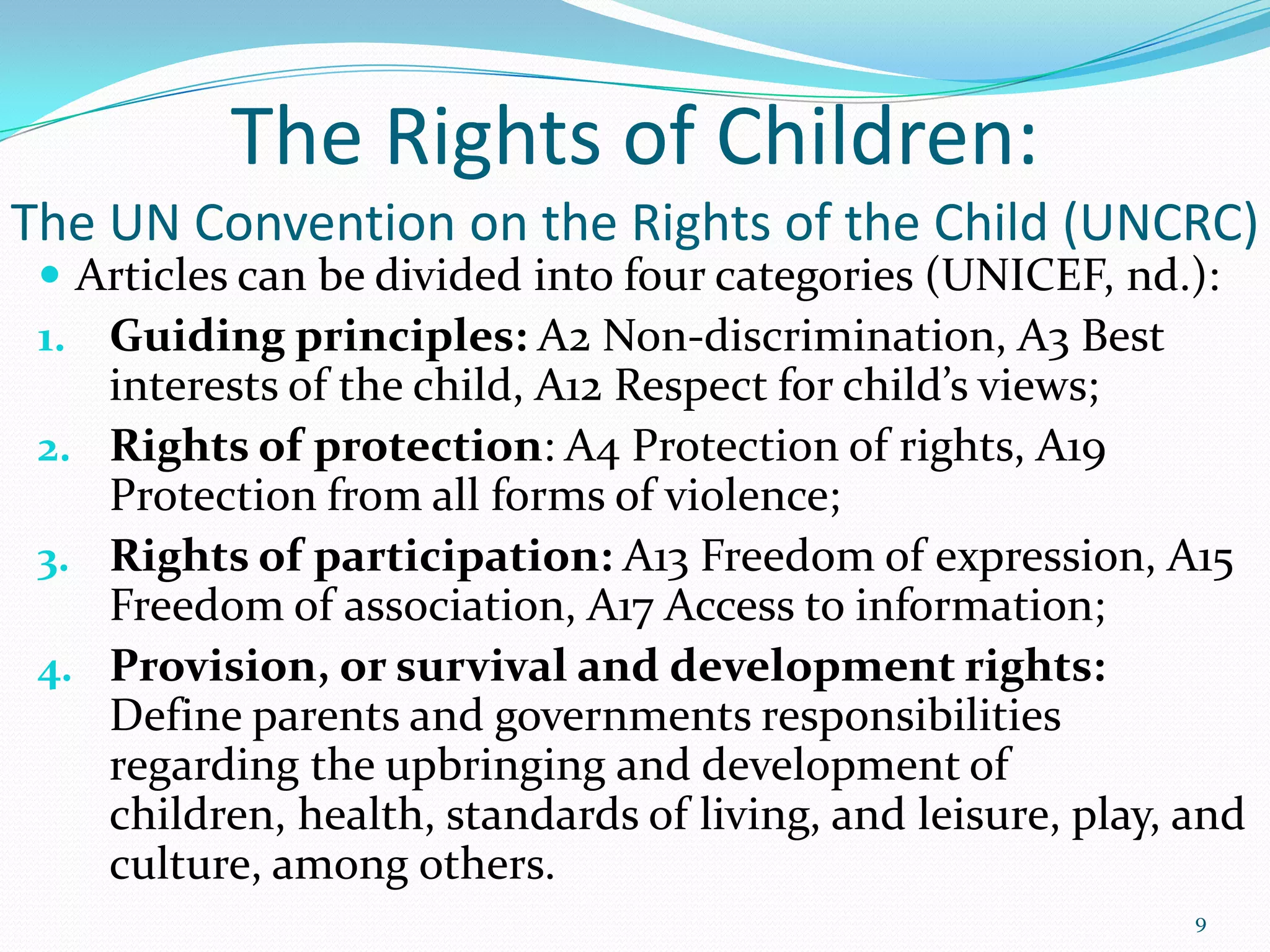
The Rights of Children:
The UN Convention on the Rights of the Child (UNCRC)
 Articles can be divided into four categories (UNICEF, nd.):
1. Guiding principles: A2 Non-discrimination, A3 Best
interests of the child, A12 Respect for child’s views;
2. Rights of protection: A4 Protection of rights, A19
Protection from all forms of violence;
3. Rights of participation: A13 Freedom of expression, A15
Freedom of association, A17 Access to information;
4. Provision, or survival and development rights:
Define parents and governments responsibilities
regarding the upbringing and development of
children, health, standards of living, and leisure, play, and
culture, among others.
9
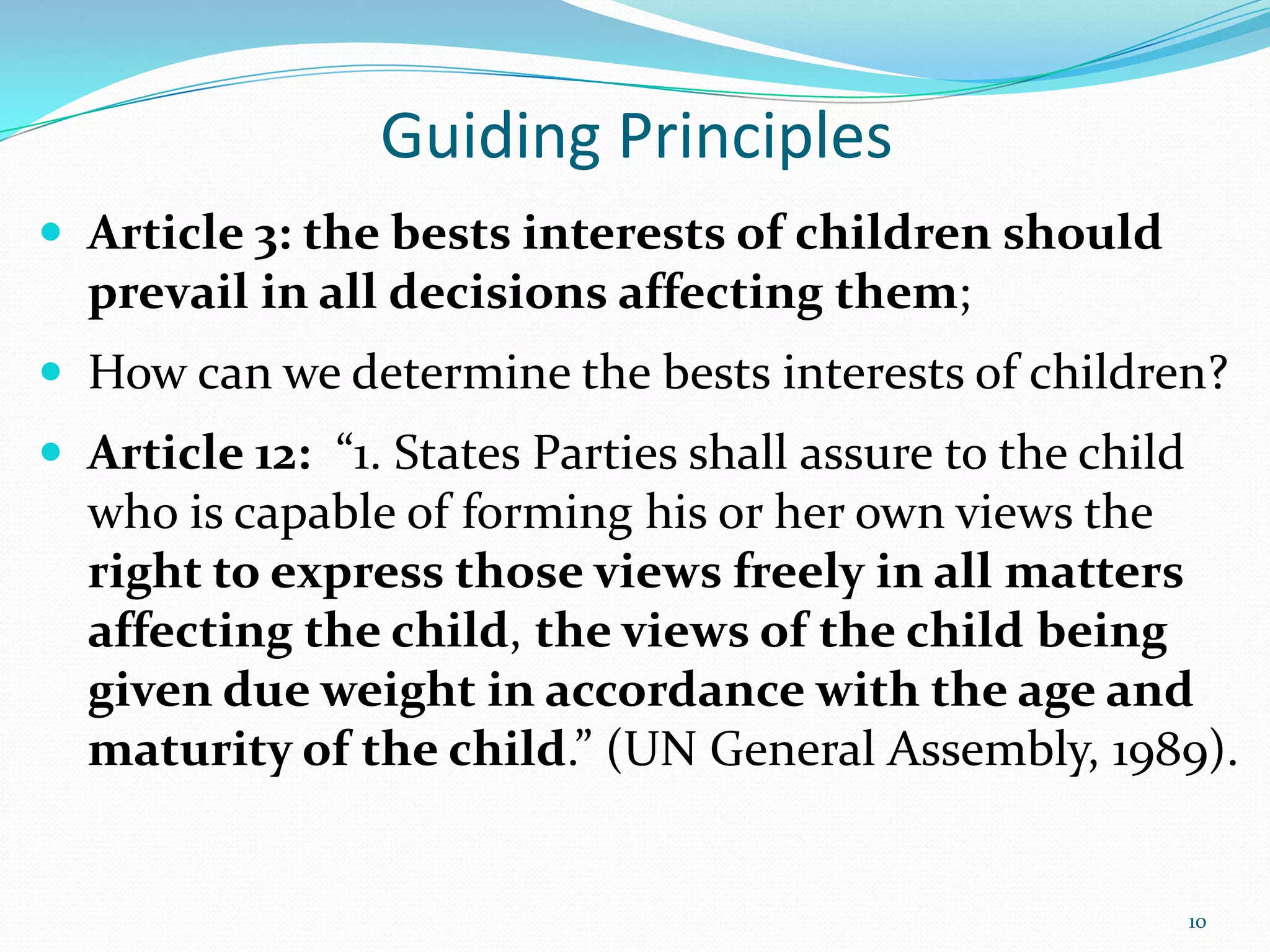
Guiding Principles
 Article 3: the bests interests of children should
prevail in all decisions affecting them;
 How can we determine the bests interests of children?
 Article 12: “1. States Parties shall assure to the child
who is capable of forming his or her own views the
right to express those views freely in all matters
affecting the child, the views of the child being
given due weight in accordance with the age and
maturity of the child.” (UN General Assembly, 1989).
10
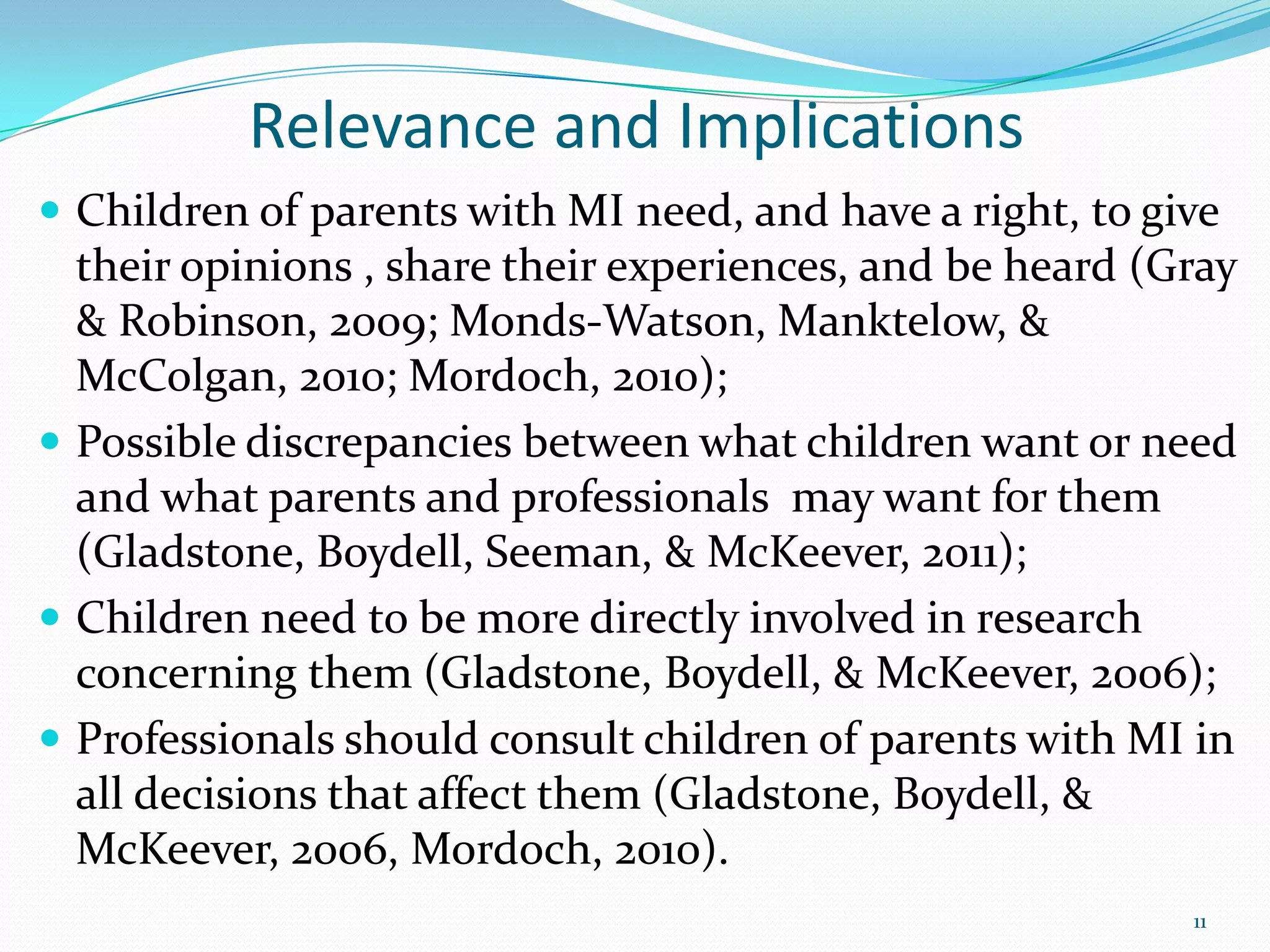
Relevance and Implications
 Children of parents with MI need, and have a right, to give
their opinions , share their experiences, and be heard (Gray
& Robinson, 2009; Monds-Watson, Manktelow, &
McColgan, 2010; Mordoch, 2010);
 Possible discrepancies between what children want or need
and what parents and professionals may want for them
(Gladstone, Boydell, Seeman, & McKeever, 2011);
 Children need to be more directly involved in research
concerning them (Gladstone, Boydell, & McKeever, 2006);
 Professionals should consult children of parents with MI in
all decisions that affect them (Gladstone, Boydell, &
McKeever, 2006, Mordoch, 2010).
11
Rights of Protection
Article 19:
“1. States Parties shall take all appropriate […] measures to
protect the child from all forms of physical or mental
violence, injury or abuse, neglect or negligent
treatment, maltreatment or exploitation […] while in the
care of parent(s), legal guardian(s) or any other person who
has the care of the child.
2. Such protective measures should, as appropriate, include
effective procedures for the establishment of social
programmes to provide necessary support for the child
and for those who have the care of the child, as well as
for other forms of prevention […].” (UN General
Assembly, 1989)
12
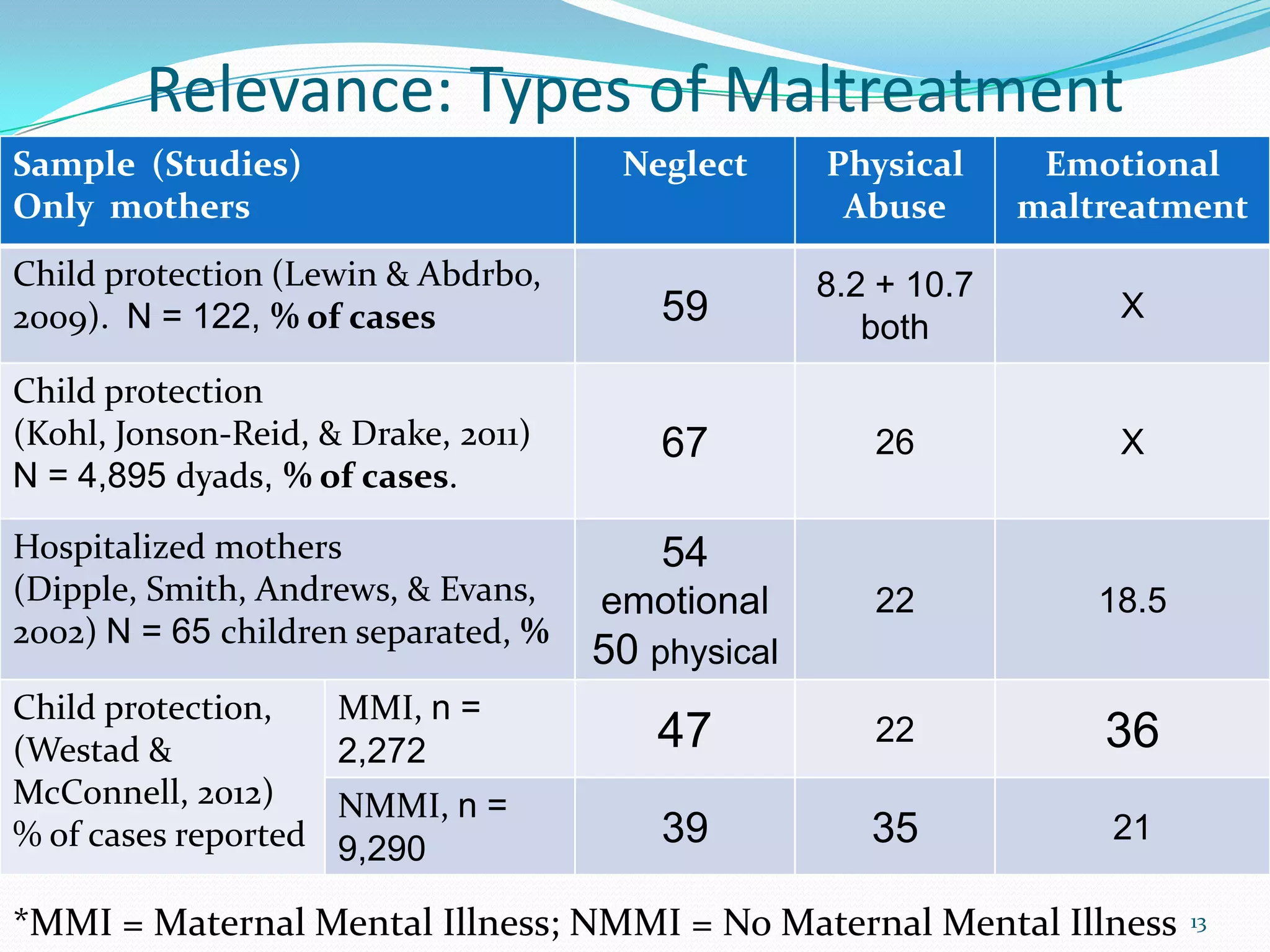
Relevance: Types of Maltreatment
Sample (Studies)
Only mothers
Neglect Physical
Abuse
Emotional
maltreatment
Child protection (Lewin & Abdrbo,
2009). N = 122, % of cases 59
8.2 + 10.7
both
X
Child protection
(Kohl, Jonson-Reid, & Drake, 2011)
N = 4,895 dyads, % of cases.
67 26 X
Hospitalized mothers
(Dipple, Smith, Andrews, & Evans,
2002) N = 65 children separated, %
54
emotional
50 physical
22 18.5
Child protection,
(Westad &
McConnell, 2012)
% of cases reported
MMI, n =
2,272 47 22 36
NMMI, n =
9,290
39 35 21
13*MMI = Maternal Mental Illness; NMMI = No Maternal Mental Illness
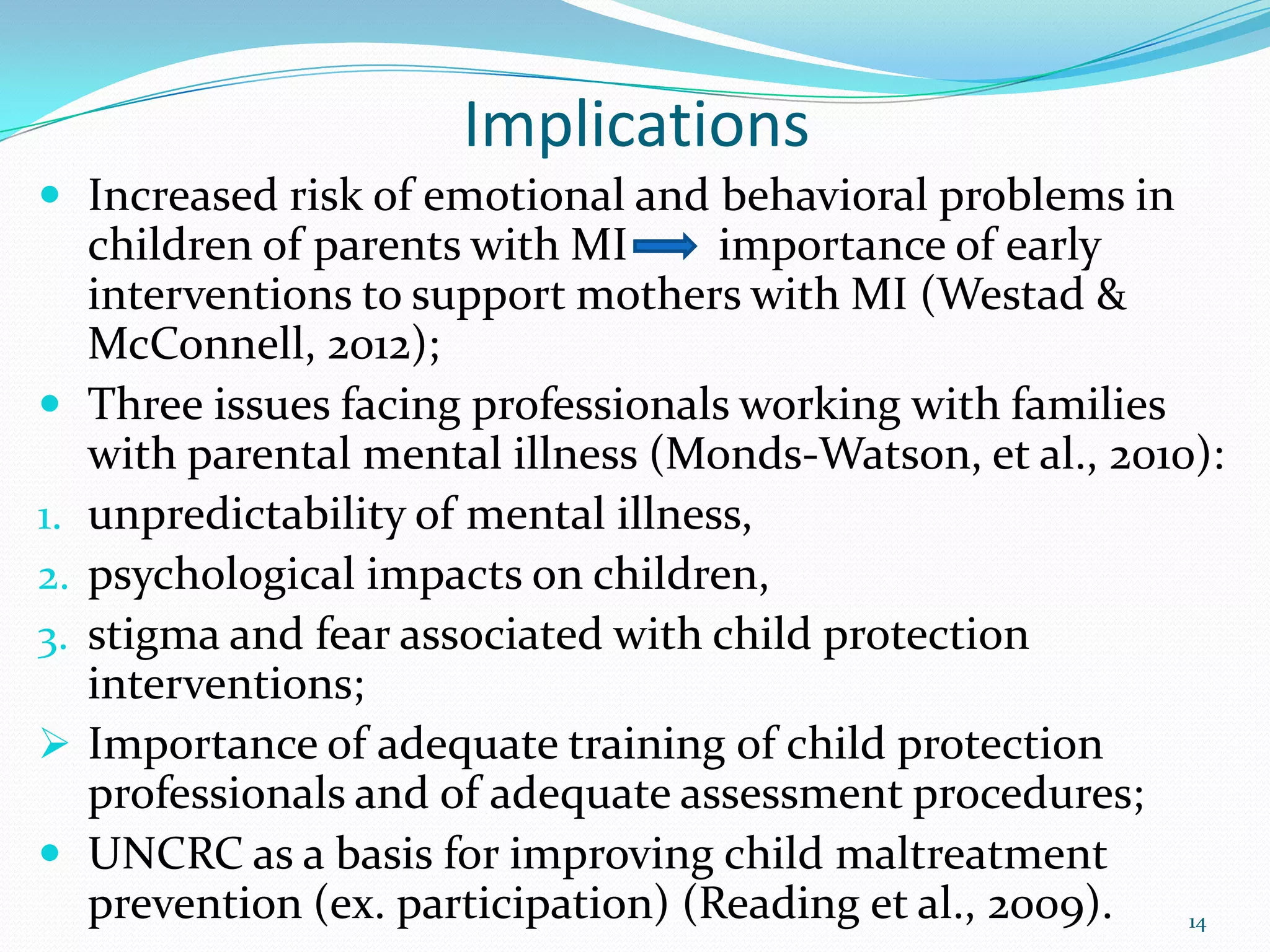
Implications
 Increased risk of emotional and behavioral problems in
children of parents with MI importance of early
interventions to support mothers with MI (Westad &
McConnell, 2012);
 Three issues facing professionals working with families
with parental mental illness (Monds-Watson, et al., 2010):
1. unpredictability of mental illness,
2. psychological impacts on children,
3. stigma and fear associated with child protection
interventions;
 Importance of adequate training of child protection
professionals and of adequate assessment procedures;
 UNCRC as a basis for improving child maltreatment
prevention (ex. participation) (Reading et al., 2009). 14
Rights of participation
 Article 13: “1. The child shall have the right to freedom
of expression; this right shall include freedom to
seek, receive and impart information and ideas of
all kinds, […] .” (UN General Assembly, 1989);
 This freedom can be restricted by the rights or
reputations of others;
 Article 17: Governments “shall ensure that the child
has access to information and material from a
diversity of national and international
sources, especially those aimed at the promotion
of his or her social, spiritual and moral well-being
and physical and mental health.” (UN General
Assembly, 1989). 15
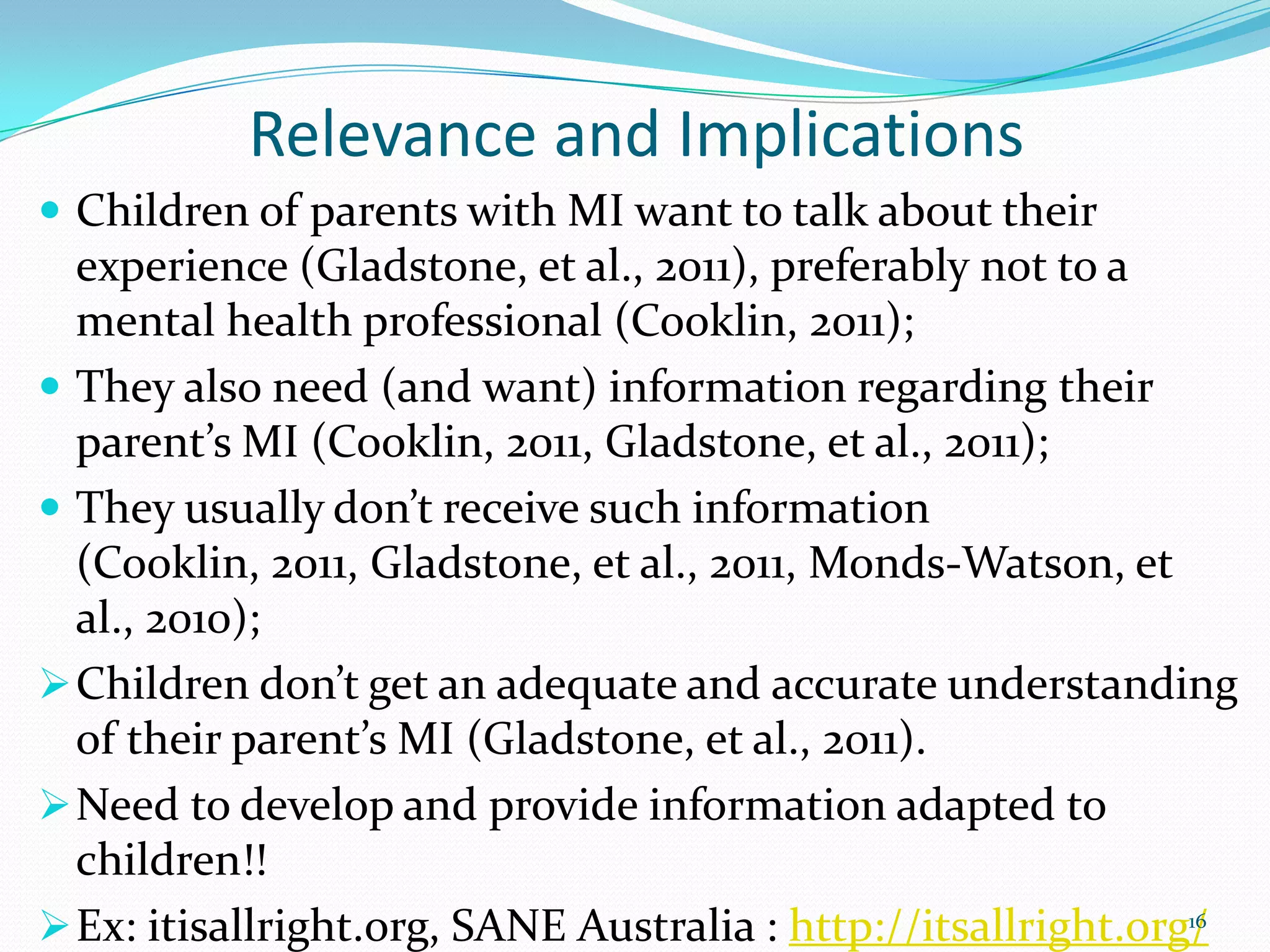
Relevance and Implications
 Children of parents with MI want to talk about their
experience (Gladstone, et al., 2011), preferably not to a
mental health professional (Cooklin, 2011);
 They also need (and want) information regarding their
parent’s MI (Cooklin, 2011, Gladstone, et al., 2011);
 They usually don’t receive such information
(Cooklin, 2011, Gladstone, et al., 2011, Monds-Watson, et
al., 2010);
Children don’t get an adequate and accurate understanding
of their parent’s MI (Gladstone, et al., 2011).
Need to develop and provide information adapted to
children!!
Ex: itisallright.org, SANE Australia : http://itsallright.org/16
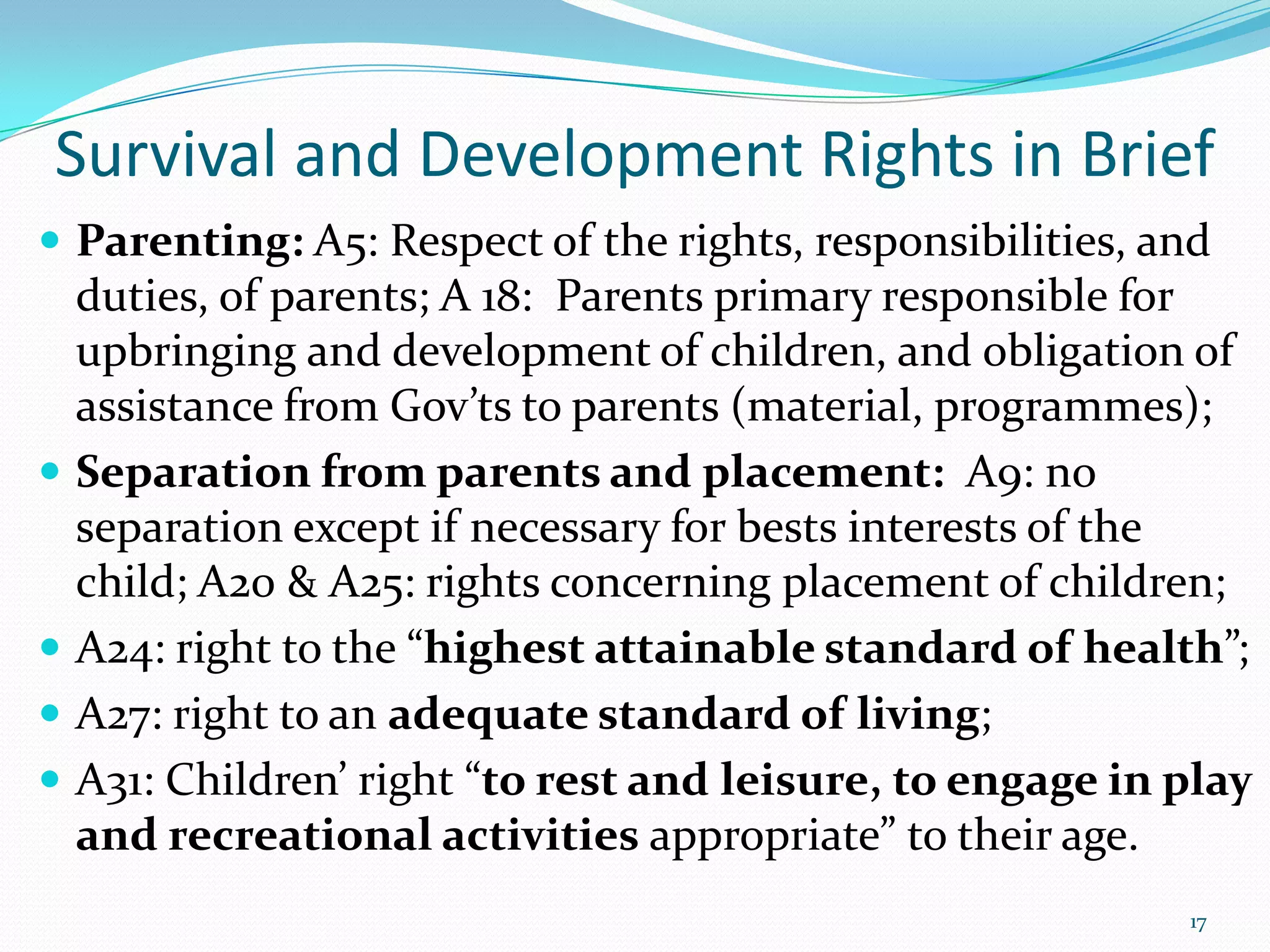
Survival and Development Rights in Brief
 Parenting: A5: Respect of the rights, responsibilities, and
duties, of parents; A 18: Parents primary responsible for
upbringing and development of children, and obligation of
assistance from Gov’ts to parents (material, programmes);
 Separation from parents and placement: A9: no
separation except if necessary for bests interests of the
child; A20 & A25: rights concerning placement of children;
 A24: right to the “highest attainable standard of health”;
 A27: right to an adequate standard of living;
 A31: Children’ right “to rest and leisure, to engage in play
and recreational activities appropriate” to their age.
17
Implications
 Governments’ responsibility to support parents with
mental illness;
 Separation of child from parent: least preferable
option, children and parents fear of family separation;
 Importance of family preservation services and other
tertiary prevention interventions such as: case
management (giving information and advice, teaching
psychosocial skills, natural support systems and self-
help groups), and psycho-educational group work
(Desai, 2010).
 Right to leisure and play: services needed for children
of parents with mental illness who are young carers. 18
Comments on the UNCRC
Dichotomy between children’ and parents’
rights? Not if parents rights include
responsibilities toward their children, or
serve the rights of children
(Reynaert, Bouverne-de Bie, &
Vandevelde, 2009), parenting = process;
Rights of children and parents
complementary.
19
Conclusion and Implications
 HRBA = comprehensive (legal) framework for services
and programmes for families with parental mental
illness;
 UN Human Rights Conventions address many, if not
most, of the challenges, needs, and opportunities, of
families in which a parent has a mental illness;
 Those Rights should to be ensured and protected by all
professionals involved with families in which a parent
has a mental illness, in the different settings where they
can apply (mental health services, family
services, schools), and in the different phases or steps of
programmes and services
(research, consulting, planning, delivery, and 20
Examples of Applications
 One root/basis of the COPMI Initiative in Australia: the
Report of the National Inquiry into the Human rights of
People with Mental Illness (1993). See Findings And
Recommendations (Inquiry chapters 30 and 31) Children of
Parents with Mental Illness (Chapter 16);
 Charter of Children’s and Young People’s Rights in
Healthcare Services in Australia (Children’s Hospitals
Australasia): http://www.awch.org.au/pdfs/Charter-
Children-Young%20People-Healthcare-Au-version-FINAL-
210911b-web.pdf;
 SA Carers Charter (Government of South Australia, 2006):
http://www.sa.gov.au/upload/franchise/Community%20Su
pport/Final%20Carers%20Charter.pdf 21
Suggested Reading
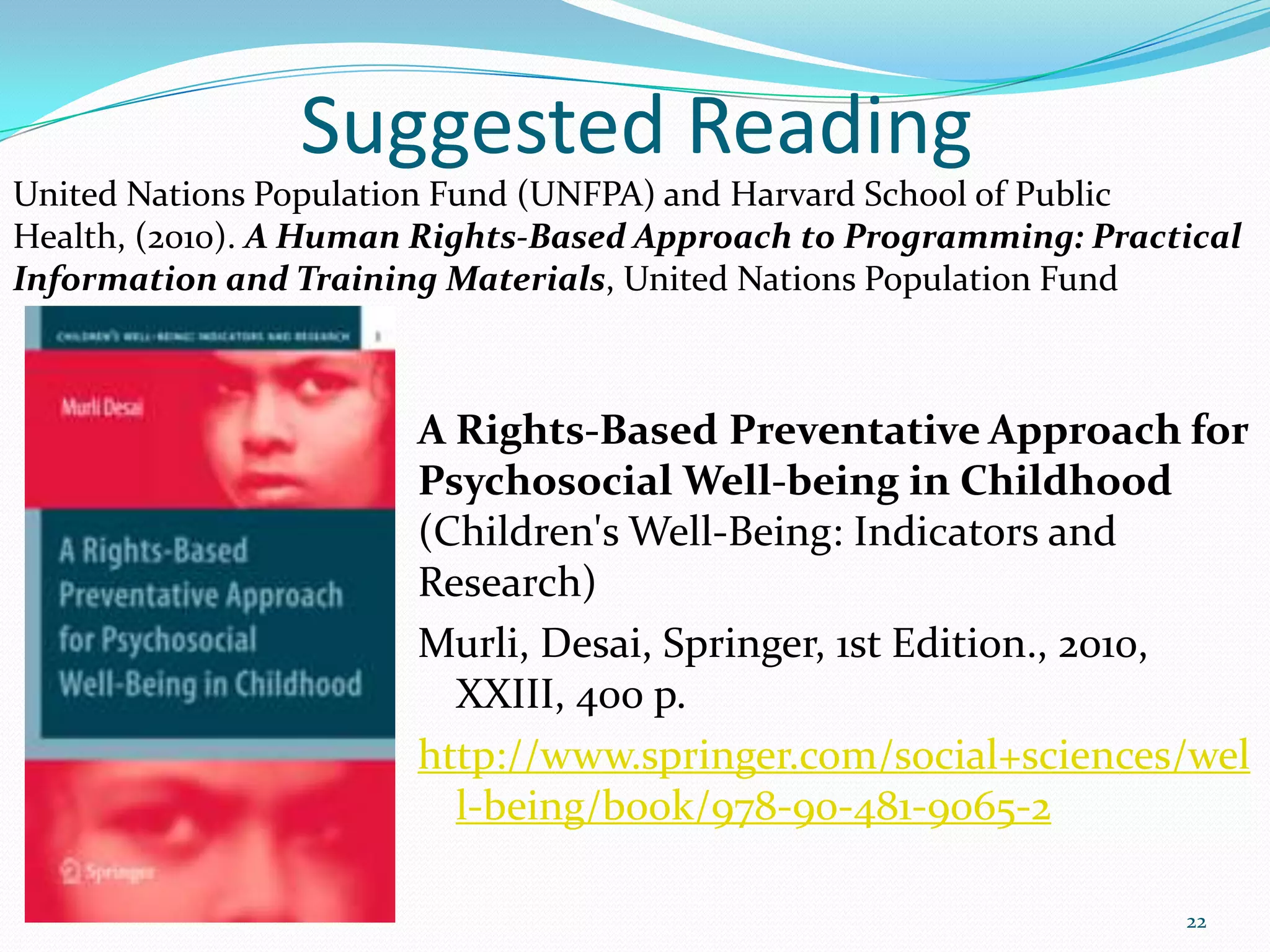
A Rights-Based Preventative Approach for
Psychosocial Well-being in Childhood
(Children's Well-Being: Indicators and
Research)
Murli, Desai, Springer, 1st Edition., 2010,
XXIII, 400 p.
http://www.springer.com/social+sciences/wel
l-being/book/978-90-481-9065-2
22
United Nations Population Fund (UNFPA) and Harvard School of Public
Health, (2010). A Human Rights-Based Approach to Programming: Practical
Information and Training Materials, United Nations Population Fund
Discussion Questions
How could a HRBA be adopted or
implemented in the services and
programmes offered to children of
parents with mental illness and to their
parents?
Are there any rights that are not being
fully implemented in services and
programmes?
What would need to be changed?
Any challenges/benefits? 23
References
Cooklin, A. (2001). The impact of parental mental health on
children. Gresham College, available at:
http://www.gresham.ac.uk/lectures-and-events/the-impact-of-
parental-mental-health-on-children.
Desai, M., & SpringerLink. (2010). A rights-based preventative
approach for psychosocial well -being in childhood. Dordrecht;
New York: Springer.
Dipple, H., Smith, S., Andrews, H., & Evans, B. (2002). The
experience of motherhood in women with severe and enduring
mental illness. Social Psychiatry and Psychiatric
Epidemiology, 37(7), 336-340.
Gladstone, B., Boydell, K., & McKeever, P. (2006). Recasting
research into children's experiences of parental mental illness:
Beyond risk and resilience. Social Science &
Medicine, 62(10), 2540-2550.
24
Gladstone, B. M., Boydell, K. M., Seeman, M. V., & McKeever, P. D.
(2011). Children's experiences of parental mental illness: A
literature review. Early Intervention in Psychiatry, 5(4), 271-289.
Gray, B., & Robinson, C. (2009). Hidden children: Perspectives of
professionals on young carers of people with mental health
problems. Child Care in Practice, 15(2), 95-108.
Human Rights and Equal Opportunity Commission, (1993). Report
of the National Inquiry into the Human rights of People with
Mental Illness. Canberra, Australian Government Publishing
Service, available at:
http://www.hreoc.gov.au/disability_rights/inquiries/mii.htm#c
h16 [accessed 22 April 2012].
Kohl, P. L., Jonson-Reid, M., & Drake, B. (2011). Maternal mental
illness and the safety and stability of maltreated children. Child
Abuse & Neglect, 35(5), 309-318. 25
Lewin, L., & Abdrbo, A. (2009). Mothers with self-reported axis I
diagnoses and child protection. Archives of Psychiatric
Nursing, 23(3), 200-209.
Monds-Watson, A., Manktelow, R., & McColgan, M. (2010). Social
work with children when parents have mental health
difficulties: Acknowledging vulnerability and maintaining the
“Rights of the child”. Child Care in Practice, 16(1), 35-55.
Mordoch, E. (2010). How children understand parental mental
illness: "you don't get life insurance. what's life insurance?:
Journal of the Canadian Academy of Child & Adolescent
Psychiatry, 19(1), 19-25.
Reading, R., Bissell, S., Goldhagen, J., Harwin, J., Masson, J., Moyni
han, S., . . . Webb, E. (2009). Promotion of children's rights and
prevention of child maltreatment. The Lancet, 373(9660), 332-
343.
26
Reynaert, D., Bouverne-de Bie, M., & Vandevelde, S. (2009). A
review of children's rights literature since the adoption of the
united nations convention on the rights of the child. Childhood-
a Global Journal of Child Research, 16(4), 518-534.
Stamford Interagency Workshop on a Human Rights-Based
approach in the Context of UN Reform, (2003). Statement on a
Common Understanding of a Human Rights-Based Approach to
Development Cooperation. United Nations.
UNICEF, (nd.). Convention on the Rights of the Child, Rights under
the Convention on the Rights of the Child, available at:
http://www.unicef.org/crc/index_30177.html [accessed 18 April
2012].
UN General Assembly, (1989). Convention on the Rights of the
Child. General assembly resolution 44/25 of 20 November 1989.
Geneva: Office of the High Commissioner for Human
Rights, available at:
http://www2.ohchr.org/english/law/crc.htm [accessed 18 April27
UN General Assembly, (1991). Principles for the Protection of
Persons With Mental Illness and the Improvement of Mental
Health Care, A/RES/46/119, available at:
http://www2.ohchr.org/english/law/principles.htm [accessed
18 April 2012]
UN General Assembly (2006), Convention on the Rights of Persons
with Disabilities, available at:
http://www.un.org/disabilities/convention/conventionfull.sht
ml [accessed 18 April 2012]
United Nations Population Fund (UNFPA) and Harvard School of
Public Health, (2010). A Human Rights-Based Approach to
Programming: Practical Information and Training
Materials, United Nations Population Fund.
Westad, C., & McConnell, D. (2012). Child welfare involvement of
mothers with mental health issues. Community Mental Health
Journal, 48(1), 29-37.
28

Adopting a Right-Based Approach with Children of Parents with Mental Illness

  • 1.
    Christophe Bedeaux, BA-AppliedHuman Sciences , Research Assistant, Concordia University, Montreal, QC, Canada 1
  • 2.
    Objectives Overall goal: providean introduction to Human Rights-Based Approaches (HRBA). Focus on children; 1) Explain what constitutes a Human Rights-Based Approach (HRBA); 2) Identify key international human rights conventions and articles relevant to families in which a parent has a mental illness; 3) Discuss the implications of these articles for services and programs for children of parents with mental illness (discussion period). 2
  • 3.
    Plan of thePresentation 1) Definition and principles of a HRBA; 2) Rights of parents with a mental illness (MI); 3) Rights of children: the UN Convention on the Rights of the Child; 4) Conclusion and implications; 5) Discussion 3
  • 4.
    What is aHRBA?  “A human rights-based approach entails consciously and systematically paying attention to human rights in all aspects of programme development.” (UNFPA and Harvard School of Public Health, 2010, p. 25);  A HRBA is more holistic, empowering, and universal, than traditional needs-based approaches, addresses root-causes, and is more long-term (Desai, 2010);  ≠ Evidence Based Approaches. 4
  • 5.
    Two Key Principlesof a HRBA (of 3) 1. All programmes “should further the realisation of human rights”; 2. All the phases of development of a programme should be guided by human rights principles. These principles are:  Universality and inalienability;  Indivisibility;  Inter-dependence and inter-relatedness;  Non-discrimination and equality;  Participation and inclusion;  Accountability and the rule of law. (Stamford Interagency Workshop on a Human Rights-Based approach in the Context of UN Reform, 2003). 5
  • 6.
    The Rights ofParents Convention on the Rights of Persons with Disabilities  Article 1 – Purpose “Persons with disabilities include those who have long-term physical, mental, intellectual or sensory impairments which [...] may hinder their full and effective participation in society [...].” (UN General Assembly, 2006). 6
  • 7.
     Article 23- Respect for home and the family 2. “States Parties shall ensure the rights and responsibilities of persons with disabilities, with regard to guardianship, wardship, trusteeship, adoption of children or similar institutions [...]; in all cases the best interests of the child shall be paramount. States Parties shall render appropriate assistance to persons with disabilities in the performance of their child-rearing responsibilities.” (UN General Assembly, 2006). 4. relates to separation of children from parents : disability in itself not a sufficient basis for separation of child from parents. 7
  • 8.
     Principle 1Fundamental freedoms and basic rights “1. All persons have the right to the best available mental health care […]. 2. All persons with a mental illness, or who are being treated as such persons, shall be treated with humanity and respect for the inherent dignity of the human person. 4. There shall be no discrimination on the grounds of mental illness[...].” (UN General Assembly, 1991).  Principle 2 Protection of minors : “Special care should be given [...] to protect the rights of minors [...].”  Principle 11 Consent to treatment (16 articles). 8 Principles for the Protection of Persons with Mental Illness and the Improvement of Mental Health Care
  • 9.
    The Rights ofChildren: The UN Convention on the Rights of the Child (UNCRC)  Articles can be divided into four categories (UNICEF, nd.): 1. Guiding principles: A2 Non-discrimination, A3 Best interests of the child, A12 Respect for child’s views; 2. Rights of protection: A4 Protection of rights, A19 Protection from all forms of violence; 3. Rights of participation: A13 Freedom of expression, A15 Freedom of association, A17 Access to information; 4. Provision, or survival and development rights: Define parents and governments responsibilities regarding the upbringing and development of children, health, standards of living, and leisure, play, and culture, among others. 9
  • 10.
    Guiding Principles  Article3: the bests interests of children should prevail in all decisions affecting them;  How can we determine the bests interests of children?  Article 12: “1. States Parties shall assure to the child who is capable of forming his or her own views the right to express those views freely in all matters affecting the child, the views of the child being given due weight in accordance with the age and maturity of the child.” (UN General Assembly, 1989). 10
  • 11.
    Relevance and Implications Children of parents with MI need, and have a right, to give their opinions , share their experiences, and be heard (Gray & Robinson, 2009; Monds-Watson, Manktelow, & McColgan, 2010; Mordoch, 2010);  Possible discrepancies between what children want or need and what parents and professionals may want for them (Gladstone, Boydell, Seeman, & McKeever, 2011);  Children need to be more directly involved in research concerning them (Gladstone, Boydell, & McKeever, 2006);  Professionals should consult children of parents with MI in all decisions that affect them (Gladstone, Boydell, & McKeever, 2006, Mordoch, 2010). 11
  • 12.
    Rights of Protection Article19: “1. States Parties shall take all appropriate […] measures to protect the child from all forms of physical or mental violence, injury or abuse, neglect or negligent treatment, maltreatment or exploitation […] while in the care of parent(s), legal guardian(s) or any other person who has the care of the child. 2. Such protective measures should, as appropriate, include effective procedures for the establishment of social programmes to provide necessary support for the child and for those who have the care of the child, as well as for other forms of prevention […].” (UN General Assembly, 1989) 12
  • 13.
    Relevance: Types ofMaltreatment Sample (Studies) Only mothers Neglect Physical Abuse Emotional maltreatment Child protection (Lewin & Abdrbo, 2009). N = 122, % of cases 59 8.2 + 10.7 both X Child protection (Kohl, Jonson-Reid, & Drake, 2011) N = 4,895 dyads, % of cases. 67 26 X Hospitalized mothers (Dipple, Smith, Andrews, & Evans, 2002) N = 65 children separated, % 54 emotional 50 physical 22 18.5 Child protection, (Westad & McConnell, 2012) % of cases reported MMI, n = 2,272 47 22 36 NMMI, n = 9,290 39 35 21 13*MMI = Maternal Mental Illness; NMMI = No Maternal Mental Illness
  • 14.
    Implications  Increased riskof emotional and behavioral problems in children of parents with MI importance of early interventions to support mothers with MI (Westad & McConnell, 2012);  Three issues facing professionals working with families with parental mental illness (Monds-Watson, et al., 2010): 1. unpredictability of mental illness, 2. psychological impacts on children, 3. stigma and fear associated with child protection interventions;  Importance of adequate training of child protection professionals and of adequate assessment procedures;  UNCRC as a basis for improving child maltreatment prevention (ex. participation) (Reading et al., 2009). 14
  • 15.
    Rights of participation Article 13: “1. The child shall have the right to freedom of expression; this right shall include freedom to seek, receive and impart information and ideas of all kinds, […] .” (UN General Assembly, 1989);  This freedom can be restricted by the rights or reputations of others;  Article 17: Governments “shall ensure that the child has access to information and material from a diversity of national and international sources, especially those aimed at the promotion of his or her social, spiritual and moral well-being and physical and mental health.” (UN General Assembly, 1989). 15
  • 16.
    Relevance and Implications Children of parents with MI want to talk about their experience (Gladstone, et al., 2011), preferably not to a mental health professional (Cooklin, 2011);  They also need (and want) information regarding their parent’s MI (Cooklin, 2011, Gladstone, et al., 2011);  They usually don’t receive such information (Cooklin, 2011, Gladstone, et al., 2011, Monds-Watson, et al., 2010); Children don’t get an adequate and accurate understanding of their parent’s MI (Gladstone, et al., 2011). Need to develop and provide information adapted to children!! Ex: itisallright.org, SANE Australia : http://itsallright.org/16
  • 17.
    Survival and DevelopmentRights in Brief  Parenting: A5: Respect of the rights, responsibilities, and duties, of parents; A 18: Parents primary responsible for upbringing and development of children, and obligation of assistance from Gov’ts to parents (material, programmes);  Separation from parents and placement: A9: no separation except if necessary for bests interests of the child; A20 & A25: rights concerning placement of children;  A24: right to the “highest attainable standard of health”;  A27: right to an adequate standard of living;  A31: Children’ right “to rest and leisure, to engage in play and recreational activities appropriate” to their age. 17
  • 18.
    Implications  Governments’ responsibilityto support parents with mental illness;  Separation of child from parent: least preferable option, children and parents fear of family separation;  Importance of family preservation services and other tertiary prevention interventions such as: case management (giving information and advice, teaching psychosocial skills, natural support systems and self- help groups), and psycho-educational group work (Desai, 2010).  Right to leisure and play: services needed for children of parents with mental illness who are young carers. 18
  • 19.
    Comments on theUNCRC Dichotomy between children’ and parents’ rights? Not if parents rights include responsibilities toward their children, or serve the rights of children (Reynaert, Bouverne-de Bie, & Vandevelde, 2009), parenting = process; Rights of children and parents complementary. 19
  • 20.
    Conclusion and Implications HRBA = comprehensive (legal) framework for services and programmes for families with parental mental illness;  UN Human Rights Conventions address many, if not most, of the challenges, needs, and opportunities, of families in which a parent has a mental illness;  Those Rights should to be ensured and protected by all professionals involved with families in which a parent has a mental illness, in the different settings where they can apply (mental health services, family services, schools), and in the different phases or steps of programmes and services (research, consulting, planning, delivery, and 20
  • 21.
    Examples of Applications One root/basis of the COPMI Initiative in Australia: the Report of the National Inquiry into the Human rights of People with Mental Illness (1993). See Findings And Recommendations (Inquiry chapters 30 and 31) Children of Parents with Mental Illness (Chapter 16);  Charter of Children’s and Young People’s Rights in Healthcare Services in Australia (Children’s Hospitals Australasia): http://www.awch.org.au/pdfs/Charter- Children-Young%20People-Healthcare-Au-version-FINAL- 210911b-web.pdf;  SA Carers Charter (Government of South Australia, 2006): http://www.sa.gov.au/upload/franchise/Community%20Su pport/Final%20Carers%20Charter.pdf 21
  • 22.
    Suggested Reading A Rights-BasedPreventative Approach for Psychosocial Well-being in Childhood (Children's Well-Being: Indicators and Research) Murli, Desai, Springer, 1st Edition., 2010, XXIII, 400 p. http://www.springer.com/social+sciences/wel l-being/book/978-90-481-9065-2 22 United Nations Population Fund (UNFPA) and Harvard School of Public Health, (2010). A Human Rights-Based Approach to Programming: Practical Information and Training Materials, United Nations Population Fund
  • 23.
    Discussion Questions How coulda HRBA be adopted or implemented in the services and programmes offered to children of parents with mental illness and to their parents? Are there any rights that are not being fully implemented in services and programmes? What would need to be changed? Any challenges/benefits? 23
  • 24.
    References Cooklin, A. (2001).The impact of parental mental health on children. Gresham College, available at: http://www.gresham.ac.uk/lectures-and-events/the-impact-of- parental-mental-health-on-children. Desai, M., & SpringerLink. (2010). A rights-based preventative approach for psychosocial well -being in childhood. Dordrecht; New York: Springer. Dipple, H., Smith, S., Andrews, H., & Evans, B. (2002). The experience of motherhood in women with severe and enduring mental illness. Social Psychiatry and Psychiatric Epidemiology, 37(7), 336-340. Gladstone, B., Boydell, K., & McKeever, P. (2006). Recasting research into children's experiences of parental mental illness: Beyond risk and resilience. Social Science & Medicine, 62(10), 2540-2550. 24
  • 25.
    Gladstone, B. M.,Boydell, K. M., Seeman, M. V., & McKeever, P. D. (2011). Children's experiences of parental mental illness: A literature review. Early Intervention in Psychiatry, 5(4), 271-289. Gray, B., & Robinson, C. (2009). Hidden children: Perspectives of professionals on young carers of people with mental health problems. Child Care in Practice, 15(2), 95-108. Human Rights and Equal Opportunity Commission, (1993). Report of the National Inquiry into the Human rights of People with Mental Illness. Canberra, Australian Government Publishing Service, available at: http://www.hreoc.gov.au/disability_rights/inquiries/mii.htm#c h16 [accessed 22 April 2012]. Kohl, P. L., Jonson-Reid, M., & Drake, B. (2011). Maternal mental illness and the safety and stability of maltreated children. Child Abuse & Neglect, 35(5), 309-318. 25
  • 26.
    Lewin, L., &Abdrbo, A. (2009). Mothers with self-reported axis I diagnoses and child protection. Archives of Psychiatric Nursing, 23(3), 200-209. Monds-Watson, A., Manktelow, R., & McColgan, M. (2010). Social work with children when parents have mental health difficulties: Acknowledging vulnerability and maintaining the “Rights of the child”. Child Care in Practice, 16(1), 35-55. Mordoch, E. (2010). How children understand parental mental illness: "you don't get life insurance. what's life insurance?: Journal of the Canadian Academy of Child & Adolescent Psychiatry, 19(1), 19-25. Reading, R., Bissell, S., Goldhagen, J., Harwin, J., Masson, J., Moyni han, S., . . . Webb, E. (2009). Promotion of children's rights and prevention of child maltreatment. The Lancet, 373(9660), 332- 343. 26
  • 27.
    Reynaert, D., Bouverne-deBie, M., & Vandevelde, S. (2009). A review of children's rights literature since the adoption of the united nations convention on the rights of the child. Childhood- a Global Journal of Child Research, 16(4), 518-534. Stamford Interagency Workshop on a Human Rights-Based approach in the Context of UN Reform, (2003). Statement on a Common Understanding of a Human Rights-Based Approach to Development Cooperation. United Nations. UNICEF, (nd.). Convention on the Rights of the Child, Rights under the Convention on the Rights of the Child, available at: http://www.unicef.org/crc/index_30177.html [accessed 18 April 2012]. UN General Assembly, (1989). Convention on the Rights of the Child. General assembly resolution 44/25 of 20 November 1989. Geneva: Office of the High Commissioner for Human Rights, available at: http://www2.ohchr.org/english/law/crc.htm [accessed 18 April27
  • 28.
    UN General Assembly,(1991). Principles for the Protection of Persons With Mental Illness and the Improvement of Mental Health Care, A/RES/46/119, available at: http://www2.ohchr.org/english/law/principles.htm [accessed 18 April 2012] UN General Assembly (2006), Convention on the Rights of Persons with Disabilities, available at: http://www.un.org/disabilities/convention/conventionfull.sht ml [accessed 18 April 2012] United Nations Population Fund (UNFPA) and Harvard School of Public Health, (2010). A Human Rights-Based Approach to Programming: Practical Information and Training Materials, United Nations Population Fund. Westad, C., & McConnell, D. (2012). Child welfare involvement of mothers with mental health issues. Community Mental Health Journal, 48(1), 29-37. 28