ICS Nederland Presentation  for the  ICCO  Alliance 29 May 2008 Convention of  the Rights of the Child (CRC) May 2008 ICS Child Rights Based Approach
Universal Declaration of Human Rights 1948 A declaration …. Not technically legally binding But…. Broadly accepted as consensus of a global opinion on human rights
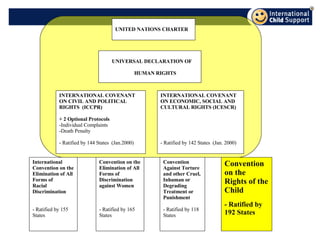
International Convention on the Elimination of All Forms of  Racial Discrimination - Ratified by 155 States  Convention on the Elimination of All Forms of Discrimination against Women - Ratified by 165 States Convention Against Torture and other Cruel, Inhuman or Degrading Treatment or Punishment - Ratified by 118 States Convention on the Rights of the Child - Ratified by 192 States UNITED NATIONS CHARTER UNIVERSAL DECLARATION OF  HUMAN RIGHTS INTERNATIONAL COVENANT  ON CIVIL AND POLITICAL  RIGHTS  (ICCPR) + 2 Optional Protocols Individual Complaints Death Penalty - Ratified by 144 States  (Jan.2000) INTERNATIONAL COVENANT ON ECONOMIC, SOCIAL AND CULTURAL RIGHTS (ICESCR) - Ratified by 142 States  (Jan. 2000)
Why a Convention for Children ? Not always been accepted as holders of rights – sometimes as “possessions” of parents Children have specific needs relating to their childhoods in contrast to adults … the special nature of childhood (and motherhood), recognised in the UDHR Art 26), children’s evolving capacities in UNCRC (art 5)  Often do not have the capacity to protect themselves, from abuse, from exploitation Being “voiceless” Children have been relatively “invisible” compared to others fighting for their rights Children’s Rights “scattered” over other HR instruments Slide No:
The United Nations Convention on the Rights of the Child Drafted over 1979-1989 ..  Wide NGO involvement Came into force 1989/1990 Almost Universal Ratification … 192/194 … the most of any Human Rights Instrument,  highly “legitimising”  (194/194 have signed) A Holistic Framework covering Economic/Social/Cultural, Political/Civil Rights and Humanitarian law …  more “complete” than any other human rights instrument Defines rights that have cut across cultural, religious and other frontiers Slide No:
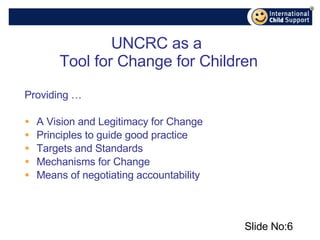
UNCRC as a  Tool for Change for Children Providing …  A Vision and Legitimacy for Change Principles to guide good practice  Targets and Standards Mechanisms for Change Means of negotiating accountability Slide No:
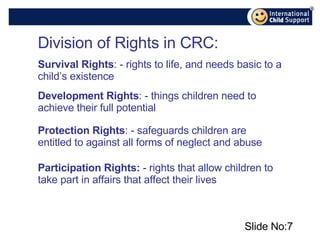
Slide No: Division of Rights in CRC: Survival Rights : - rights to life, and needs basic to a child’s existence Development Rights : - things children need to achieve their full potential Protection Rights : - safeguards children are entitled to against all forms of neglect and abuse Participation Rights:  - rights that allow children to take part in affairs that affect their lives
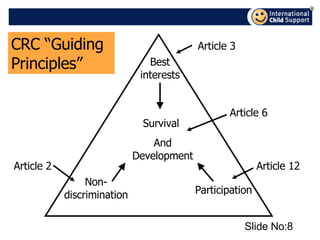
Slide No: CRC “Guiding Principles” Survival  And Development Best interests Non-discrimination Participation Article 3 Article 12 Article 6 Article 2
Slide No: Article 2   1. States Parties shall  respect and ensure  the rights set forth in the present Convention to each child within their jurisdiction  without discrimination of any kind , irrespective of the child's or his or her parent's or legal guardian's race, colour, sex, language, religion, political or other opinion, national, ethnic or social origin, property, disability, birth or other status.  2. States Parties shall  take all appropriate measures to   ensure that the child is  protected  against all forms of discrimination or punishment on the basis of the status, activities, expressed opinions, or beliefs of the child's parents, legal guardians, or family members
Slide No: Article 3 1. In  all  actions concerning children, whether undertaken by public or private social welfare institutions, courts of law, administrative authorities or legislative bodies, the  best interests of the child  shall be  a primary  consideration.
Slide No: Article 6 1. States Parties recognize that every child has the inherent right to life. 2. States Parties shall  ensure to the maximum extent possible  the survival and development of the child.
Article 12 1. “States Parties shall assure to the child who is capable of forming his or her own views  the right to express those views freely in all matters affecting the child ..  The views of the child being given due weight in accordance with the age and maturity of the child” (Art 12.1) Slide No:
Implementation Obligations Government has an Obligation to  “Disseminate and Make Known”  … to mobilise acceptance of children’s rights Government has an Obligation to  seek assistance , from International Aid, from UN special bodies, from the UN CRC Committee Government has an Obligation to  commit “maximum available resources”  to children’s rights Government has an Obligation to create institutions to facilitate change, review legislation, create commissioners / ombudspersons etc Slide No:
State has to provide a report on the realisation of children’s rights within 2 years of ratifying the CRC Every 5 years thereafter it has to update the situation, this goes on in 5 yearly cycles …  Has to involve stakeholders, explicitly including children NGO in most cases develop an alternative report The CRC Reporting Process Slide No:
Slide No: General measures of implementation   (articles 4, 42 & 44.6); Definition of the child   (article 1) General principles   (articles 2, 3, 4, 6 & 12) Civil rights and freedom   (articles 7, 8, 13, 17, 14, 15, 16 & 37) Family environment and alternative care   (articles 5, 9, 10, 11, 18, 19, 20, 21, 25 & 27) Basic health and welfare   (articles 6, 18, 23, 24, 26, & 27) Education, leisure and cultural activities   (articles 28, 29, & 31) Special protection measures   (articles 22 & 37-40) Monitoring and Reporting Categories
International Child Support Working with a  child rights approach
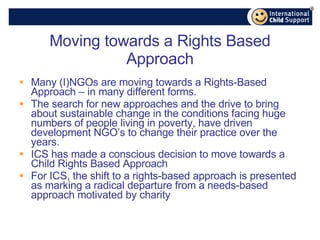
Moving towards a Rights Based Approach Many (I)NGOs are moving towards a Rights-Based Approach – in many different forms. The search for new approaches and the drive to bring about sustainable change in the conditions facing huge numbers of people living in poverty, have driven development NGO’s to change their practice over the years. ICS has made a conscious decision to move towards a Child Rights Based Approach For ICS, the shift to a rights-based approach is presented as marking a radical departure from a needs-based approach motivated by charity
Moving towards a rights-based approach (2) There have been major shifts in thinking and practice on: Participation  (of target group) Accountability  (downwards accountability) Advocacy  (calling on different actors to take up their responsibility to bring about change)
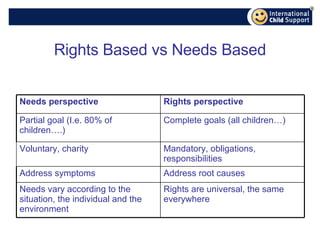
Rights Based vs Needs Based Rights are universal, the same everywhere Needs vary according to the situation, the individual and the environment Address root causes Address symptoms Mandatory, obligations, responsibilities Voluntary, charity Complete goals (all children…) Partial goal (I.e. 80% of children….) Rights perspective Needs perspective
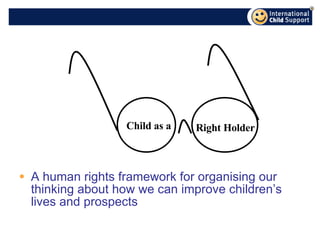
A human rights framework for organising our thinking about how we can improve children’s lives and prospects Child as a Right Holder
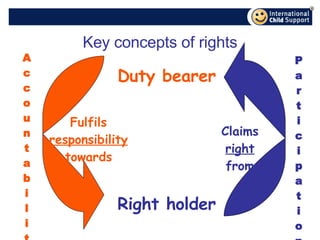
Key concepts of rights Right holder Duty bearer A c c o u n t a b i l i t y P a r t i c i p a t i o n Fulfils responsibility towards Claims right from
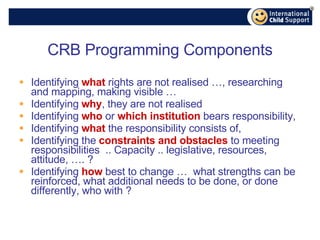
CRB  Programming Components Identifying  what  rights are not realised …, researching and mapping, making visible … Identifying  why , they are not realised Identifying  who  or  which institution   bears responsibility,  Identifying  what  the responsibility consists of,  Identifying the  constraints and obstacles  to meeting responsibilities  .. Capacity .. legislative, resources, attitude, …. ? Identifying  how  best to change …  what strengths can be reinforced, what additional needs to be done, or done differently, who with ?
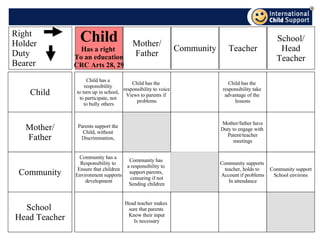
Right  Holder Duty  Bearer Child Has a right  To an education CRC Arts 28, 29 Mother/ Father Community Teacher Child Mother/ Father Community Child has a  responsibility  to turn up in school,  to participate, not  to bully others Parents support the  Child, without  Discrimination,  Community has a  Responsibility to  Ensure that children Environment supports development Child has the  responsibility to voice Views to parents if  problems Community has  a responsibility to  support parents,  censuring if not Sending children Child has the  responsibility take  advantage of the  lessons Mother/father have Duty to engage with  Patent/teacher meetings Community supports  teacher, holds to  Account if problems In attendance Community support School environs Head teacher makes  sure that parents  Know their input Is necessary School  Head Teacher School/ Head Teacher
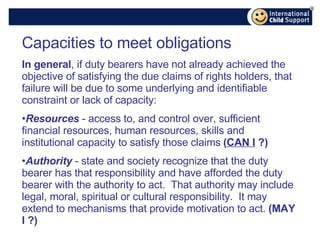
Capacities to meet obligations In general , if duty bearers have not already achieved the objective of satisfying the due claims of rights holders, that failure will be due to some underlying and identifiable constraint or lack of capacity: Resources  - access to, and control over, sufficient financial resources, human resources, skills and institutional capacity to satisfy those claims  ( CAN I  ?) Authority  - state and society recognize that the duty bearer has that responsibility and have afforded the duty bearer with the authority to act.  That authority may include legal, moral, spiritual or cultural responsibility.  It may extend to mechanisms that provide motivation to act.  (MAY I ?)
Responsibility  - the duty bearer has to accept the responsibility for the satisfaction of those claims by rights holders.  (SHOULD I?)
ICS Programme Kenya Realising  the right to quality education for all children
ICS programme Kenya Goal: Realisation of right to quality primary education for all children (in selected programme areas) Objectives: Improve access to and completion of primary education Improve quality of primary education following government plans
ICS programme Kenya (2) Approach  - Incorporate Rights based principles of: Participation Non-discrimination Best interest of the child
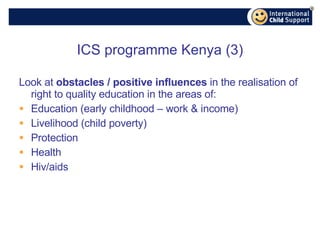
ICS programme Kenya (3) Look at  obstacles / positive influences  in the realisation of right to quality education in the areas of: Education (early childhood – work & income) Livelihood (child poverty) Protection Health Hiv/aids
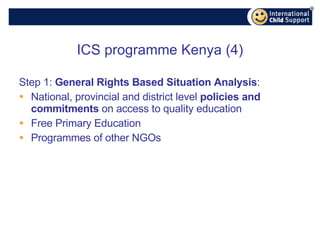
ICS programme Kenya (4) Step 1:  General Rights Based Situation Analysis : National, provincial and district level  policies and commitments  on access to quality education  Free Primary Education Programmes of other NGOs
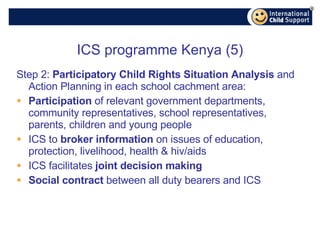
ICS programme Kenya (5) Step 2:  Participatory Child Rights Situation Analysis  and Action Planning in each school cachment area: Participation  of relevant government departments, community representatives, school representatives, parents, children and young people ICS to  broker information  on issues of education, protection, livelihood, health & hiv/aids ICS facilitates  joint decision making Social contract  between all duty bearers and ICS
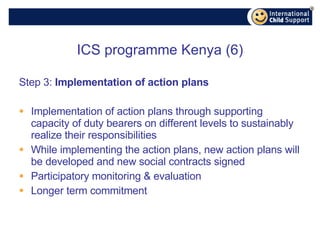
ICS programme Kenya (6) Step 3:  Implementation of action plans Implementation of action plans through supporting capacity of duty bearers on different levels to sustainably realize their responsibilities While implementing the action plans, new action plans will be developed and new social contracts signed Participatory monitoring & evaluation Longer term commitment
ICS – Social Protection in Kenya Obstacle for OVC to attend school – lack of basic income in families caring for OVC leading to: Not being able to afford hidden educational costs Having to work to contribute to household income Care-givers not prioritising OVC in their care to attend school Government of Kenya has committed to the role-out of social protection (social cash transfer scheme) to 300.000 Orphans & Vulnerable Children in 34 Districts by 2011
Kenya - Social Cash Transfers Programme Regular (monthly) cash transfers to poor households that are caring for OVC  Conditions for receiving cash transfers are school attendance of children, attend health facilities for immunisation and growth controle and attendance of awareness sessions Community based identification & monitoring systems Delivery systems through post offices (other mechanisms researched)
Article 26 1. States Parties shall recognize for every child the right to benefit from social security, including social insurance, and shall take the necessary measures to achieve the full realization of this right in accordance with their national law. 2. The benefits should, where appropriate, be granted, taking into account the resources and the circumstances of the child and persons having responsibility for the maintenance of the child, as well as any other consideration relevant to an application for benefits made by or on behalf of the child.
Article 27 1. States Parties recognize the right of every child to a standard of living adequate for the child's physical, mental, spiritual, moral and social development. 2. The parent(s) or others responsible for the child have the primary responsibility to secure, within their abilities and financial capacities, the conditions of living necessary for the child's development. 3. States Parties, in accordance with national conditions and within their means, shall take appropriate measures to assist parents and others responsible for the child to implement this right and shall in case of need provide material assistance and support programmes, particularly with regard to nutrition, clothing and housing. 4. States Parties shall take all appropriate measures to secure the recovery of maintenance for the child from the parents or other persons having financial responsibility for the child, both within the State Party and from abroad. In particular, where the person having financial responsibility for the child lives in a State different from that of the child, States Parties shall promote the accession to international agreements or the conclusion of such agreements, as well as the making of other appropriate arrangements.
Conditions for the realisation of this right of children Political support Understanding financial implications and potential trade-offs for policy decisions Implementation capacity
1. Political will Kenya has incorporated social protection in national action plan for OVC and PRSP Kenya will continue to enjoy technical and financial support from a wide coalition of international development partners as it struggles to fulfill the obligations it entered into when it ratified the United Nations Convention on the Rights of the Child in 1992 ICS in support (here in NL and in Kenya)
2. Understanding financial implications Social protection must be taken seriously as a potential policy option to reduce poverty of the most poor part of the population with key stakeholders such as the Ministry of Finance and the Ministry of Planning, understanding the financial implications of the programme and what the potential trade-offs are with other alternatives. ICS not directly active
3. Implementation capacity The state must have the capacity to at least make a start after which scale-up via improved capacity can take place ICS sees strong role here in: Assist the improvement of government social protection systems Support rights holders to claim their rights
Implementation issues Functioning delivery systems Systems of selection of children and monitoring of conditions on use of funds (community based targeting system) Children and families claiming their rights Birth registration Monitoring & Evaluation
A. Functioning delivery systems ICS can support the capacity of duty bearers on government level and community level on delivery systems (social welfare departments, community child advisors etc, through capacity building and resources support)
B. Targeting systems System works with community based targeting ICS can support their capacity through training and resources in our programme areas Now government is developing computarised data base, ICS can support installation and access in our programme areas
C. Children and families claiming their rights ICS can support information dissemination on social protection programme ICS can support the capacity of rights holders to claim their rights through; set up of systems for people to claim their rights, training and resources
D. Birth registration Many children entitled to social protection are not registered at birth and cannot claim their right ICS can support government offices with their capacity in birth registration ICS can support rights holders with access to birth registration
E. Monitoring & Evaluation ICS can support with participatory monitoring and evaluation of social protection programme with children, their families and the community

Presentatie Kinderrechten Ics

  • 1.
    ICS Nederland Presentation for the ICCO Alliance 29 May 2008 Convention of the Rights of the Child (CRC) May 2008 ICS Child Rights Based Approach
  • 2.
    Universal Declaration ofHuman Rights 1948 A declaration …. Not technically legally binding But…. Broadly accepted as consensus of a global opinion on human rights
  • 3.
    International Convention onthe Elimination of All Forms of Racial Discrimination - Ratified by 155 States Convention on the Elimination of All Forms of Discrimination against Women - Ratified by 165 States Convention Against Torture and other Cruel, Inhuman or Degrading Treatment or Punishment - Ratified by 118 States Convention on the Rights of the Child - Ratified by 192 States UNITED NATIONS CHARTER UNIVERSAL DECLARATION OF HUMAN RIGHTS INTERNATIONAL COVENANT ON CIVIL AND POLITICAL RIGHTS (ICCPR) + 2 Optional Protocols Individual Complaints Death Penalty - Ratified by 144 States (Jan.2000) INTERNATIONAL COVENANT ON ECONOMIC, SOCIAL AND CULTURAL RIGHTS (ICESCR) - Ratified by 142 States (Jan. 2000)
  • 4.
    Why a Conventionfor Children ? Not always been accepted as holders of rights – sometimes as “possessions” of parents Children have specific needs relating to their childhoods in contrast to adults … the special nature of childhood (and motherhood), recognised in the UDHR Art 26), children’s evolving capacities in UNCRC (art 5) Often do not have the capacity to protect themselves, from abuse, from exploitation Being “voiceless” Children have been relatively “invisible” compared to others fighting for their rights Children’s Rights “scattered” over other HR instruments Slide No:
  • 5.
    The United NationsConvention on the Rights of the Child Drafted over 1979-1989 .. Wide NGO involvement Came into force 1989/1990 Almost Universal Ratification … 192/194 … the most of any Human Rights Instrument, highly “legitimising” (194/194 have signed) A Holistic Framework covering Economic/Social/Cultural, Political/Civil Rights and Humanitarian law … more “complete” than any other human rights instrument Defines rights that have cut across cultural, religious and other frontiers Slide No:
  • 6.
    UNCRC as a Tool for Change for Children Providing … A Vision and Legitimacy for Change Principles to guide good practice Targets and Standards Mechanisms for Change Means of negotiating accountability Slide No:
  • 7.
    Slide No: Divisionof Rights in CRC: Survival Rights : - rights to life, and needs basic to a child’s existence Development Rights : - things children need to achieve their full potential Protection Rights : - safeguards children are entitled to against all forms of neglect and abuse Participation Rights: - rights that allow children to take part in affairs that affect their lives
  • 8.
    Slide No: CRC“Guiding Principles” Survival And Development Best interests Non-discrimination Participation Article 3 Article 12 Article 6 Article 2
  • 9.
    Slide No: Article2 1. States Parties shall respect and ensure the rights set forth in the present Convention to each child within their jurisdiction without discrimination of any kind , irrespective of the child's or his or her parent's or legal guardian's race, colour, sex, language, religion, political or other opinion, national, ethnic or social origin, property, disability, birth or other status. 2. States Parties shall take all appropriate measures to ensure that the child is protected against all forms of discrimination or punishment on the basis of the status, activities, expressed opinions, or beliefs of the child's parents, legal guardians, or family members
  • 10.
    Slide No: Article3 1. In all actions concerning children, whether undertaken by public or private social welfare institutions, courts of law, administrative authorities or legislative bodies, the best interests of the child shall be a primary consideration.
  • 11.
    Slide No: Article6 1. States Parties recognize that every child has the inherent right to life. 2. States Parties shall ensure to the maximum extent possible the survival and development of the child.
  • 12.
    Article 12 1.“States Parties shall assure to the child who is capable of forming his or her own views the right to express those views freely in all matters affecting the child .. The views of the child being given due weight in accordance with the age and maturity of the child” (Art 12.1) Slide No:
  • 13.
    Implementation Obligations Governmenthas an Obligation to “Disseminate and Make Known” … to mobilise acceptance of children’s rights Government has an Obligation to seek assistance , from International Aid, from UN special bodies, from the UN CRC Committee Government has an Obligation to commit “maximum available resources” to children’s rights Government has an Obligation to create institutions to facilitate change, review legislation, create commissioners / ombudspersons etc Slide No:
  • 14.
    State has toprovide a report on the realisation of children’s rights within 2 years of ratifying the CRC Every 5 years thereafter it has to update the situation, this goes on in 5 yearly cycles … Has to involve stakeholders, explicitly including children NGO in most cases develop an alternative report The CRC Reporting Process Slide No:
  • 15.
    Slide No: Generalmeasures of implementation (articles 4, 42 & 44.6); Definition of the child (article 1) General principles (articles 2, 3, 4, 6 & 12) Civil rights and freedom (articles 7, 8, 13, 17, 14, 15, 16 & 37) Family environment and alternative care (articles 5, 9, 10, 11, 18, 19, 20, 21, 25 & 27) Basic health and welfare (articles 6, 18, 23, 24, 26, & 27) Education, leisure and cultural activities (articles 28, 29, & 31) Special protection measures (articles 22 & 37-40) Monitoring and Reporting Categories
  • 16.
    International Child SupportWorking with a child rights approach
  • 17.
    Moving towards aRights Based Approach Many (I)NGOs are moving towards a Rights-Based Approach – in many different forms. The search for new approaches and the drive to bring about sustainable change in the conditions facing huge numbers of people living in poverty, have driven development NGO’s to change their practice over the years. ICS has made a conscious decision to move towards a Child Rights Based Approach For ICS, the shift to a rights-based approach is presented as marking a radical departure from a needs-based approach motivated by charity
  • 18.
    Moving towards arights-based approach (2) There have been major shifts in thinking and practice on: Participation (of target group) Accountability (downwards accountability) Advocacy (calling on different actors to take up their responsibility to bring about change)
  • 19.
    Rights Based vsNeeds Based Rights are universal, the same everywhere Needs vary according to the situation, the individual and the environment Address root causes Address symptoms Mandatory, obligations, responsibilities Voluntary, charity Complete goals (all children…) Partial goal (I.e. 80% of children….) Rights perspective Needs perspective
  • 20.
    A human rightsframework for organising our thinking about how we can improve children’s lives and prospects Child as a Right Holder
  • 21.
    Key concepts ofrights Right holder Duty bearer A c c o u n t a b i l i t y P a r t i c i p a t i o n Fulfils responsibility towards Claims right from
  • 22.
    CRB ProgrammingComponents Identifying what rights are not realised …, researching and mapping, making visible … Identifying why , they are not realised Identifying who or which institution bears responsibility, Identifying what the responsibility consists of, Identifying the constraints and obstacles to meeting responsibilities .. Capacity .. legislative, resources, attitude, …. ? Identifying how best to change … what strengths can be reinforced, what additional needs to be done, or done differently, who with ?
  • 23.
    Right HolderDuty Bearer Child Has a right To an education CRC Arts 28, 29 Mother/ Father Community Teacher Child Mother/ Father Community Child has a responsibility to turn up in school, to participate, not to bully others Parents support the Child, without Discrimination, Community has a Responsibility to Ensure that children Environment supports development Child has the responsibility to voice Views to parents if problems Community has a responsibility to support parents, censuring if not Sending children Child has the responsibility take advantage of the lessons Mother/father have Duty to engage with Patent/teacher meetings Community supports teacher, holds to Account if problems In attendance Community support School environs Head teacher makes sure that parents Know their input Is necessary School Head Teacher School/ Head Teacher
  • 24.
    Capacities to meetobligations In general , if duty bearers have not already achieved the objective of satisfying the due claims of rights holders, that failure will be due to some underlying and identifiable constraint or lack of capacity: Resources - access to, and control over, sufficient financial resources, human resources, skills and institutional capacity to satisfy those claims ( CAN I ?) Authority - state and society recognize that the duty bearer has that responsibility and have afforded the duty bearer with the authority to act. That authority may include legal, moral, spiritual or cultural responsibility. It may extend to mechanisms that provide motivation to act. (MAY I ?)
  • 25.
    Responsibility -the duty bearer has to accept the responsibility for the satisfaction of those claims by rights holders. (SHOULD I?)
  • 26.
    ICS Programme KenyaRealising the right to quality education for all children
  • 27.
    ICS programme KenyaGoal: Realisation of right to quality primary education for all children (in selected programme areas) Objectives: Improve access to and completion of primary education Improve quality of primary education following government plans
  • 28.
    ICS programme Kenya(2) Approach - Incorporate Rights based principles of: Participation Non-discrimination Best interest of the child
  • 29.
    ICS programme Kenya(3) Look at obstacles / positive influences in the realisation of right to quality education in the areas of: Education (early childhood – work & income) Livelihood (child poverty) Protection Health Hiv/aids
  • 30.
    ICS programme Kenya(4) Step 1: General Rights Based Situation Analysis : National, provincial and district level policies and commitments on access to quality education Free Primary Education Programmes of other NGOs
  • 31.
    ICS programme Kenya(5) Step 2: Participatory Child Rights Situation Analysis and Action Planning in each school cachment area: Participation of relevant government departments, community representatives, school representatives, parents, children and young people ICS to broker information on issues of education, protection, livelihood, health & hiv/aids ICS facilitates joint decision making Social contract between all duty bearers and ICS
  • 32.
    ICS programme Kenya(6) Step 3: Implementation of action plans Implementation of action plans through supporting capacity of duty bearers on different levels to sustainably realize their responsibilities While implementing the action plans, new action plans will be developed and new social contracts signed Participatory monitoring & evaluation Longer term commitment
  • 33.
    ICS – SocialProtection in Kenya Obstacle for OVC to attend school – lack of basic income in families caring for OVC leading to: Not being able to afford hidden educational costs Having to work to contribute to household income Care-givers not prioritising OVC in their care to attend school Government of Kenya has committed to the role-out of social protection (social cash transfer scheme) to 300.000 Orphans & Vulnerable Children in 34 Districts by 2011
  • 34.
    Kenya - SocialCash Transfers Programme Regular (monthly) cash transfers to poor households that are caring for OVC Conditions for receiving cash transfers are school attendance of children, attend health facilities for immunisation and growth controle and attendance of awareness sessions Community based identification & monitoring systems Delivery systems through post offices (other mechanisms researched)
  • 35.
    Article 26 1.States Parties shall recognize for every child the right to benefit from social security, including social insurance, and shall take the necessary measures to achieve the full realization of this right in accordance with their national law. 2. The benefits should, where appropriate, be granted, taking into account the resources and the circumstances of the child and persons having responsibility for the maintenance of the child, as well as any other consideration relevant to an application for benefits made by or on behalf of the child.
  • 36.
    Article 27 1.States Parties recognize the right of every child to a standard of living adequate for the child's physical, mental, spiritual, moral and social development. 2. The parent(s) or others responsible for the child have the primary responsibility to secure, within their abilities and financial capacities, the conditions of living necessary for the child's development. 3. States Parties, in accordance with national conditions and within their means, shall take appropriate measures to assist parents and others responsible for the child to implement this right and shall in case of need provide material assistance and support programmes, particularly with regard to nutrition, clothing and housing. 4. States Parties shall take all appropriate measures to secure the recovery of maintenance for the child from the parents or other persons having financial responsibility for the child, both within the State Party and from abroad. In particular, where the person having financial responsibility for the child lives in a State different from that of the child, States Parties shall promote the accession to international agreements or the conclusion of such agreements, as well as the making of other appropriate arrangements.
  • 37.
    Conditions for therealisation of this right of children Political support Understanding financial implications and potential trade-offs for policy decisions Implementation capacity
  • 38.
    1. Political willKenya has incorporated social protection in national action plan for OVC and PRSP Kenya will continue to enjoy technical and financial support from a wide coalition of international development partners as it struggles to fulfill the obligations it entered into when it ratified the United Nations Convention on the Rights of the Child in 1992 ICS in support (here in NL and in Kenya)
  • 39.
    2. Understanding financialimplications Social protection must be taken seriously as a potential policy option to reduce poverty of the most poor part of the population with key stakeholders such as the Ministry of Finance and the Ministry of Planning, understanding the financial implications of the programme and what the potential trade-offs are with other alternatives. ICS not directly active
  • 40.
    3. Implementation capacityThe state must have the capacity to at least make a start after which scale-up via improved capacity can take place ICS sees strong role here in: Assist the improvement of government social protection systems Support rights holders to claim their rights
  • 41.
    Implementation issues Functioningdelivery systems Systems of selection of children and monitoring of conditions on use of funds (community based targeting system) Children and families claiming their rights Birth registration Monitoring & Evaluation
  • 42.
    A. Functioning deliverysystems ICS can support the capacity of duty bearers on government level and community level on delivery systems (social welfare departments, community child advisors etc, through capacity building and resources support)
  • 43.
    B. Targeting systemsSystem works with community based targeting ICS can support their capacity through training and resources in our programme areas Now government is developing computarised data base, ICS can support installation and access in our programme areas
  • 44.
    C. Children andfamilies claiming their rights ICS can support information dissemination on social protection programme ICS can support the capacity of rights holders to claim their rights through; set up of systems for people to claim their rights, training and resources
  • 45.
    D. Birth registrationMany children entitled to social protection are not registered at birth and cannot claim their right ICS can support government offices with their capacity in birth registration ICS can support rights holders with access to birth registration
  • 46.
    E. Monitoring &Evaluation ICS can support with participatory monitoring and evaluation of social protection programme with children, their families and the community