A STRATEGY TO CONQUER CBAP®
EXAMINATION
BA Sharing Series
Ryan Thanh Nguyen (CBAP®)
@LinkedIn
AGENDA
2
✓ Stage 1: Application & Preparation Process
✓ Stage 2: 7-Milestone Learning Strategy
✓ Stage 3: Before the exam day
✓ Stage 4: On the exam day
✓ Life After CBAP
WELCOME
3
Hi There,
Thank you for downloading this CBAP Learning Pack. This slide was prepared based on the following
assumptions:
✓ BABOK v3
✓ Personal Learning Experience of the author who maintained working and learning at the same time
✓ Focusing on the learning strategy rather than explanation of key concepts and elements in BABOK
✓ CBAP Exam Online Mode
✓ The same learning path can be applied to ECBA / CCBA / CBAP
I hope you join me on this journey of pursuing CBAP and find something useful from this learning pack.
Enjoy your learning and Good Luck !
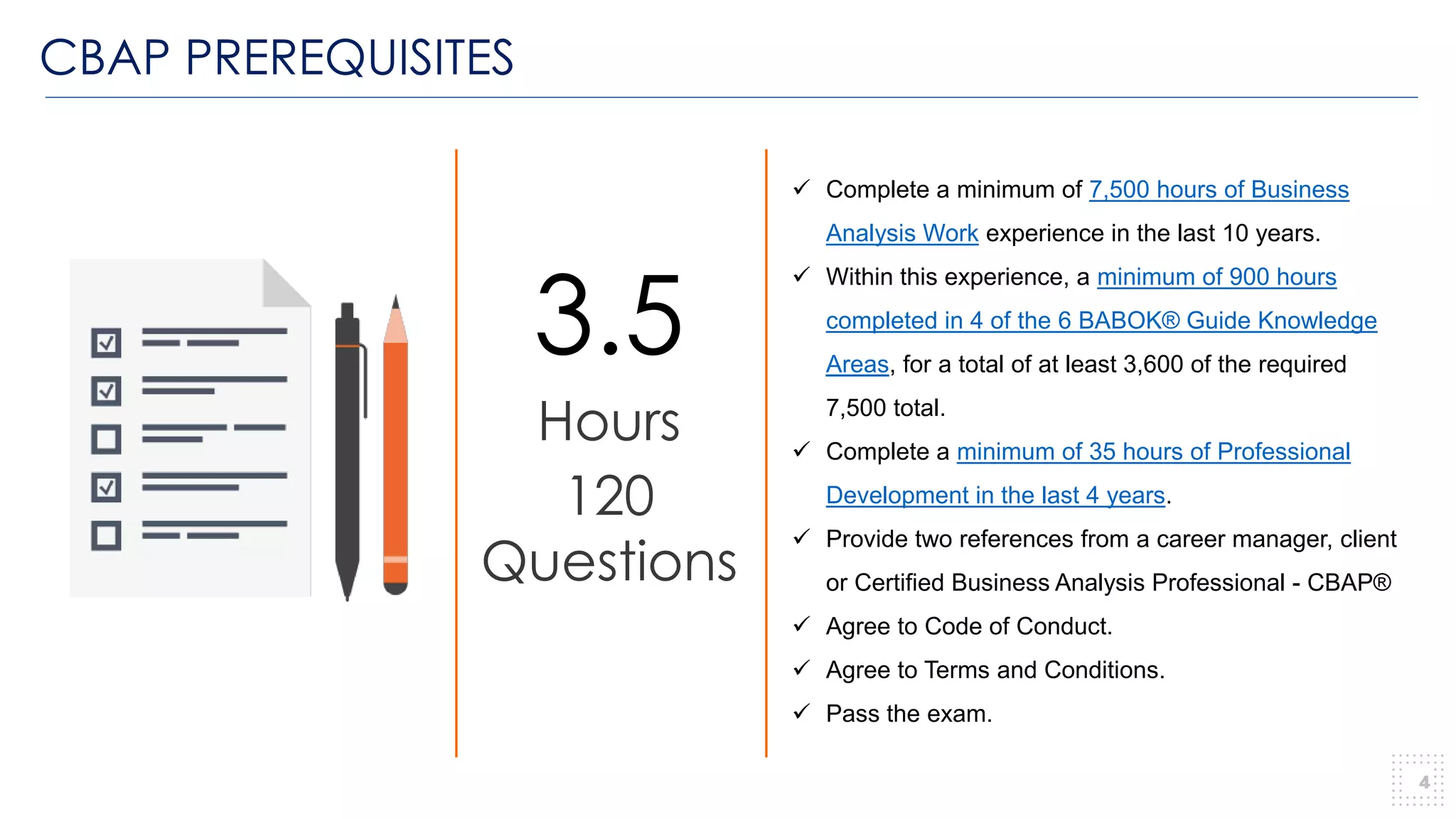
CBAP PREREQUISITES
4
3.5
Hours
120
Questions
✓ Complete a minimum of 7,500 hours of Business
Analysis Work experience in the last 10 years.
✓ Within this experience, a minimum of 900 hours
completed in 4 of the 6 BABOK® Guide Knowledge
Areas, for a total of at least 3,600 of the required
7,500 total.
✓ Complete a minimum of 35 hours of Professional
Development in the last 4 years.
✓ Provide two references from a career manager, client
or Certified Business Analysis Professional - CBAP®
✓ Agree to Code of Conduct.
✓ Agree to Terms and Conditions.
✓ Pass the exam.
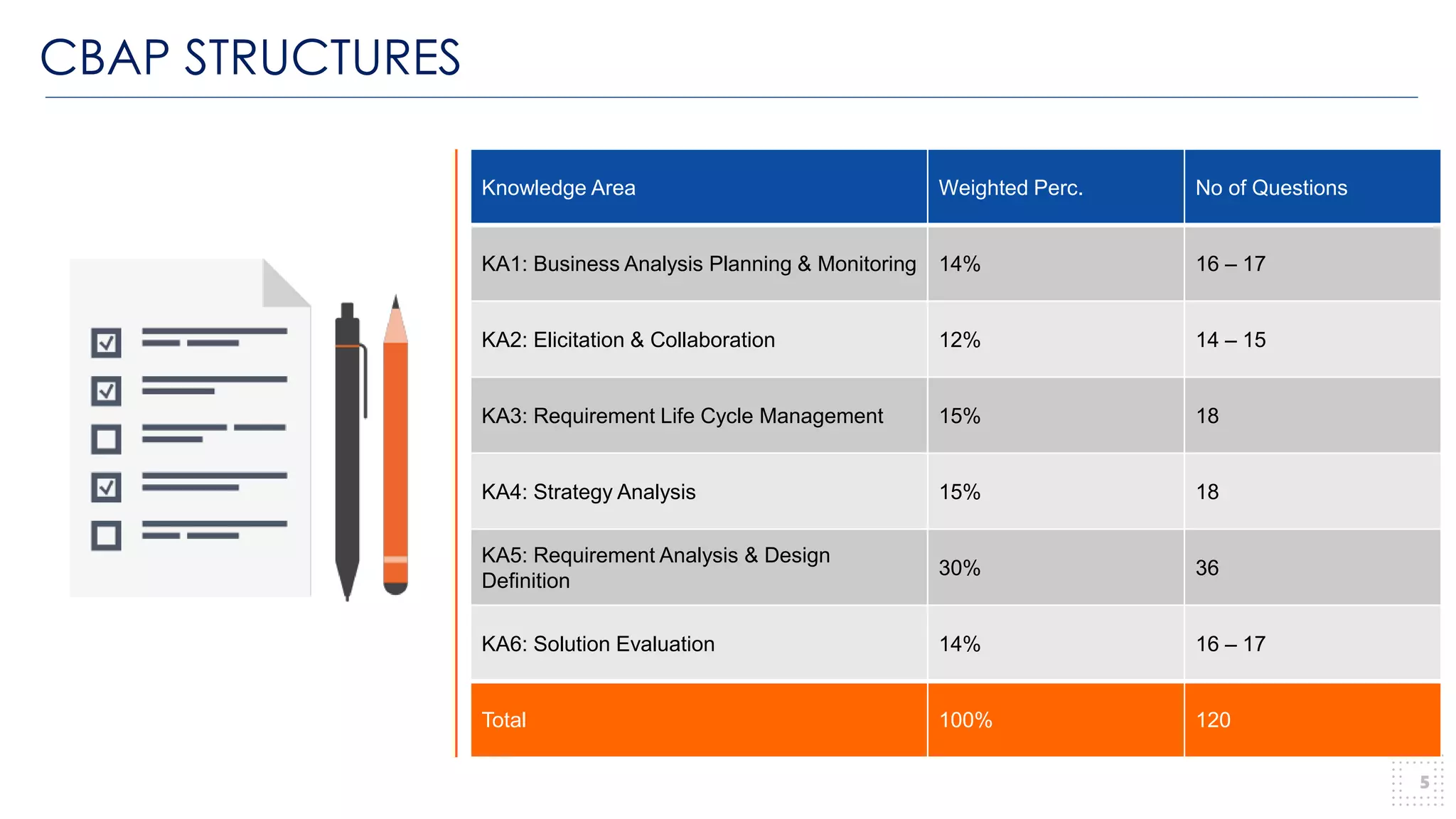
CBAP STRUCTURES
5
Knowledge Area Weighted Perc. No of Questions
KA1: Business Analysis Planning & Monitoring 14% 16 – 17
KA2: Elicitation & Collaboration 12% 14 – 15
KA3: Requirement Life Cycle Management 15% 18
KA4: Strategy Analysis 15% 18
KA5: Requirement Analysis & Design
Definition
30% 36
KA6: Solution Evaluation 14% 16 – 17
Total 100% 120
OVERALL LEARNING MILESTONES
6
Application
Process
Milestone 1
6 Knowledge Areas
Milestone 2
50 Techniques
Simulation Test 1
120 questions in
3.5 hours
Simulation Test 2
120 questions in
3.5 hours
Milestone 4
Competencies
Milestone 3
KA Input Output
Mapping
Milestone 5
KA Stakeholder
Mapping
Simulation Test 3
120 questions in
3.5 hours
Submit Application
• Complete Application
• Pay App. Fee
• Wait for Approval
• Pay Exam Fee
• Select Exam Day
Before Exam Day
1 – 2 weeks before
the exam day
Break
1 – 2 days before
the exam day
Exam Day
Milestone 6
KA Guidelines &
Tools Mapping
Milestone 7
KA Techniques
Mapping &
Perspectives
Simulation Test 4
120 questions in
3.5 hours
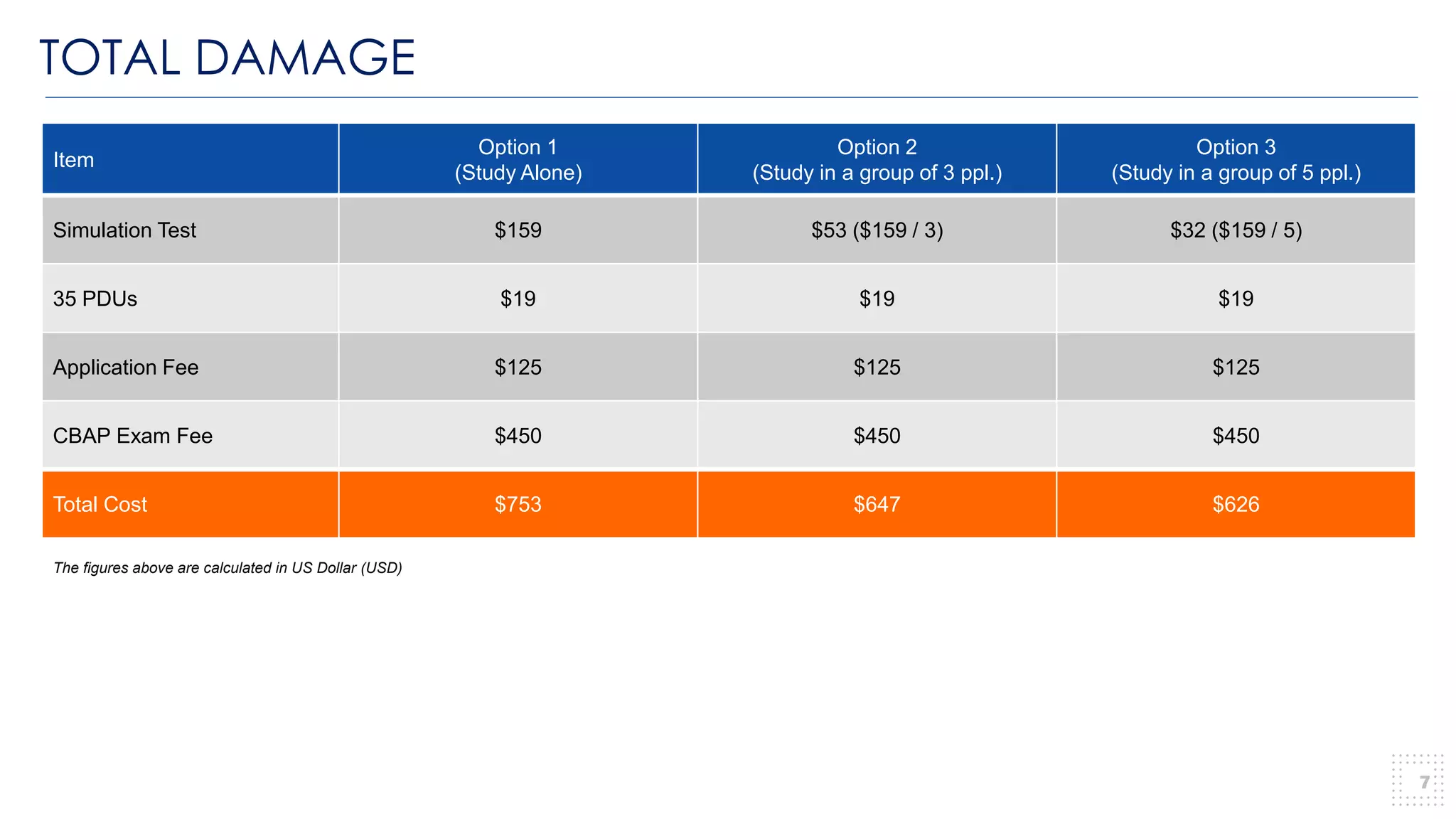
TOTAL DAMAGE
7
Item
Option 1
(Study Alone)
Option 2
(Study in a group of 3 ppl.)
Option 3
(Study in a group of 5 ppl.)
Simulation Test $159 $53 ($159 / 3) $32 ($159 / 5)
35 PDUs $19 $19 $19
Application Fee $125 $125 $125
CBAP Exam Fee $450 $450 $450
Total Cost $753 $647 $626
The figures above are calculated in US Dollar (USD)
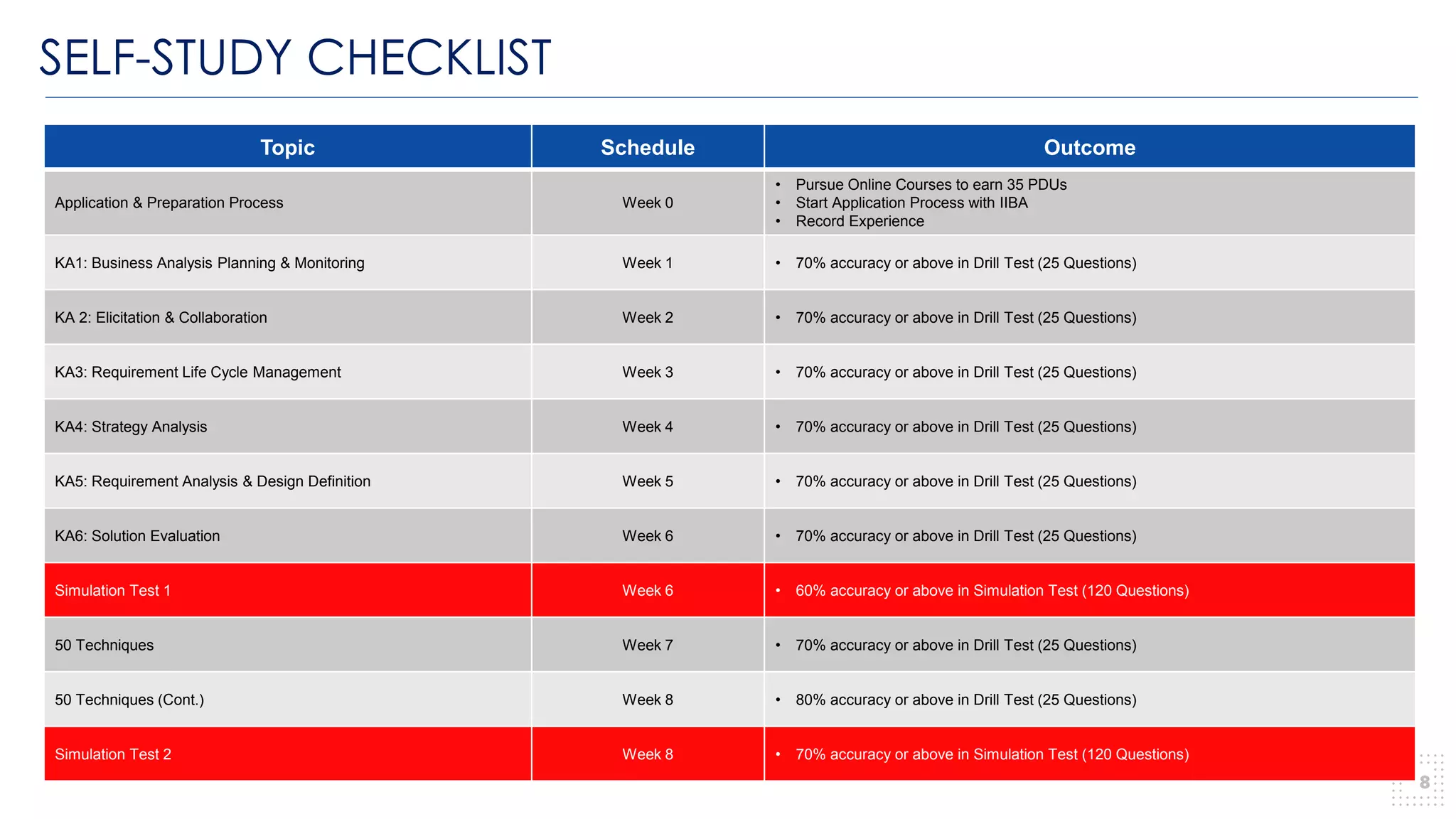
SELF-STUDY CHECKLIST
8
Topic Schedule Outcome
Application & Preparation Process Week 0
• Pursue Online Courses to earn 35 PDUs
• Start Application Process with IIBA
• Record Experience
KA1: Business Analysis Planning & Monitoring Week 1 • 70% accuracy or above in Drill Test (25 Questions)
KA 2: Elicitation & Collaboration Week 2 • 70% accuracy or above in Drill Test (25 Questions)
KA3: Requirement Life Cycle Management Week 3 • 70% accuracy or above in Drill Test (25 Questions)
KA4: Strategy Analysis Week 4 • 70% accuracy or above in Drill Test (25 Questions)
KA5: Requirement Analysis & Design Definition Week 5 • 70% accuracy or above in Drill Test (25 Questions)
KA6: Solution Evaluation Week 6 • 70% accuracy or above in Drill Test (25 Questions)
Simulation Test 1 Week 6 • 60% accuracy or above in Simulation Test (120 Questions)
50 Techniques Week 7 • 70% accuracy or above in Drill Test (25 Questions)
50 Techniques (Cont.) Week 8 • 80% accuracy or above in Drill Test (25 Questions)
Simulation Test 2 Week 8 • 70% accuracy or above in Simulation Test (120 Questions)
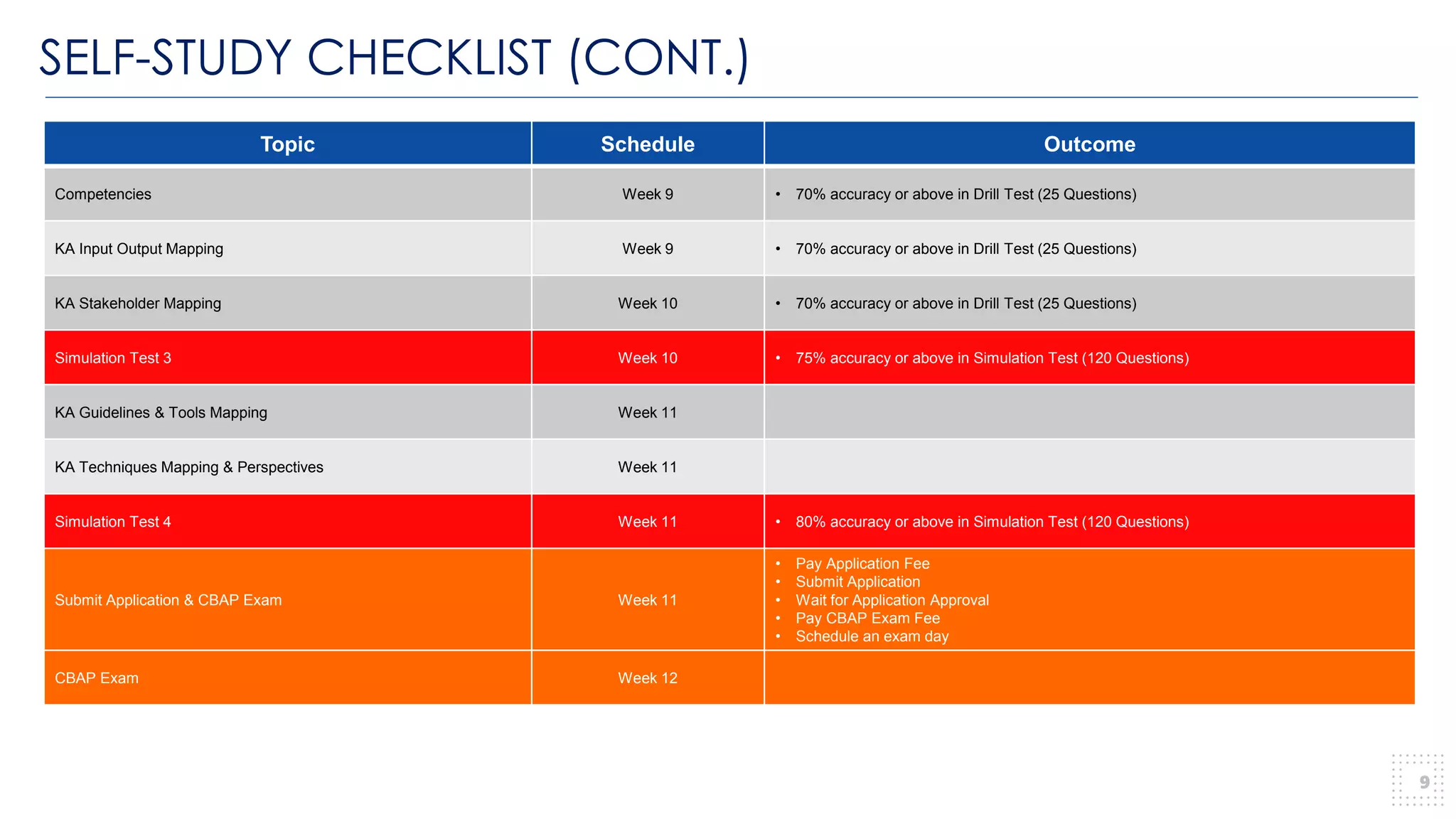
SELF-STUDY CHECKLIST (CONT.)
9
Topic Schedule Outcome
Competencies Week 9 • 70% accuracy or above in Drill Test (25 Questions)
KA Input Output Mapping Week 9 • 70% accuracy or above in Drill Test (25 Questions)
KA Stakeholder Mapping Week 10 • 70% accuracy or above in Drill Test (25 Questions)
Simulation Test 3 Week 10 • 75% accuracy or above in Simulation Test (120 Questions)
KA Guidelines & Tools Mapping Week 11
KA Techniques Mapping & Perspectives Week 11
Simulation Test 4 Week 11 • 80% accuracy or above in Simulation Test (120 Questions)
Submit Application & CBAP Exam Week 11
• Pay Application Fee
• Submit Application
• Wait for Application Approval
• Pay CBAP Exam Fee
• Schedule an exam day
CBAP Exam Week 12
BEFORE YOU GO
10
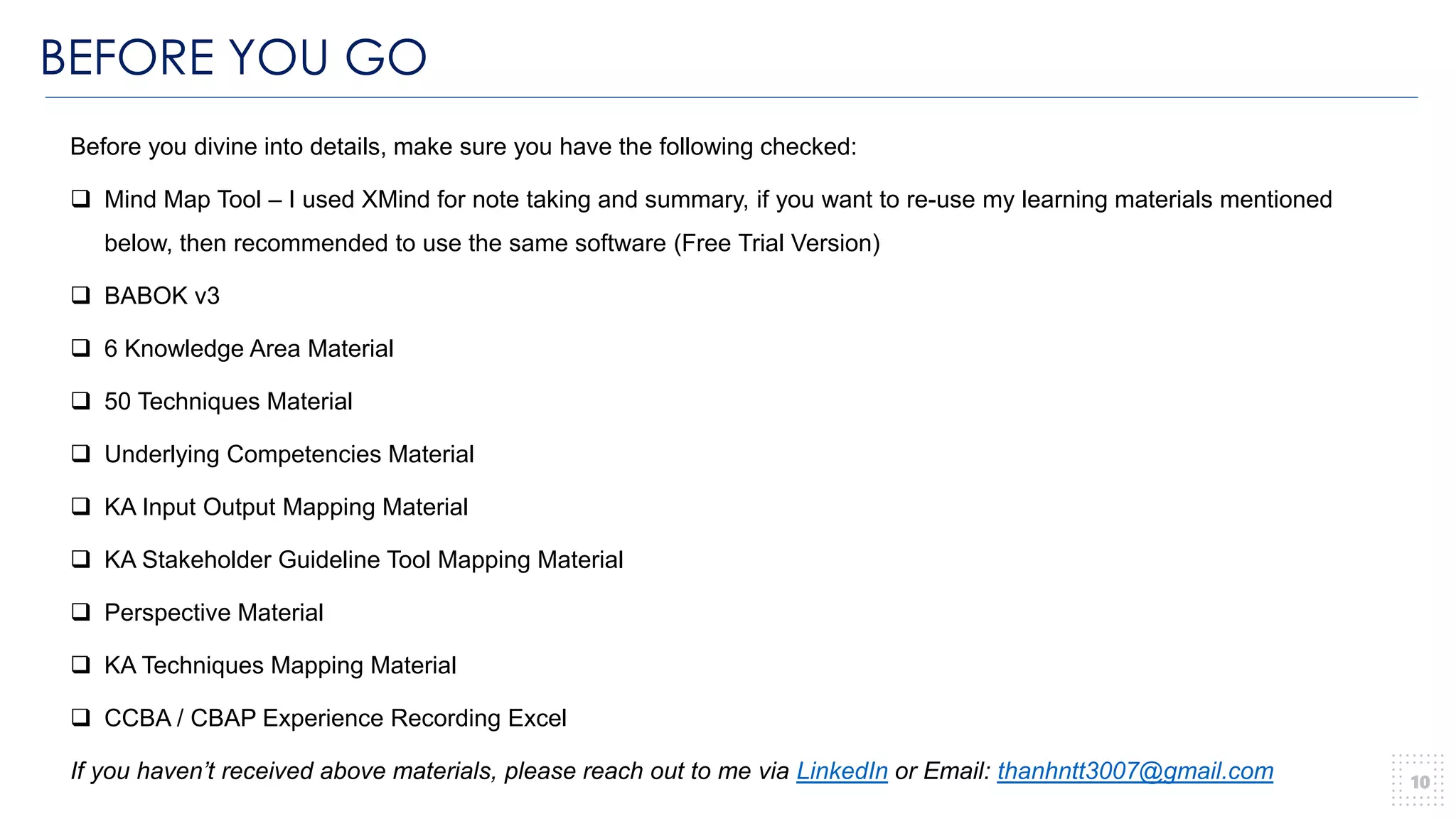
Before you divine into details, make sure you have the following checked:
❑ Mind Map Tool – I used XMind for note taking and summary, if you want to re-use my learning materials mentioned
below, then recommended to use the same software (Free Trial Version)
❑ BABOK v3
❑ 6 Knowledge Area Material
❑ 50 Techniques Material
❑ Underlying Competencies Material
❑ KA Input Output Mapping Material
❑ KA Stakeholder Guideline Tool Mapping Material
❑ Perspective Material
❑ KA Techniques Mapping Material
❑ CCBA / CBAP Experience Recording Excel
If you haven’t received above materials, please reach out to me via LinkedIn or Email: thanhntt3007@gmail.com
STAGE 1:
APPLICATION & PREPARATION PROCESS
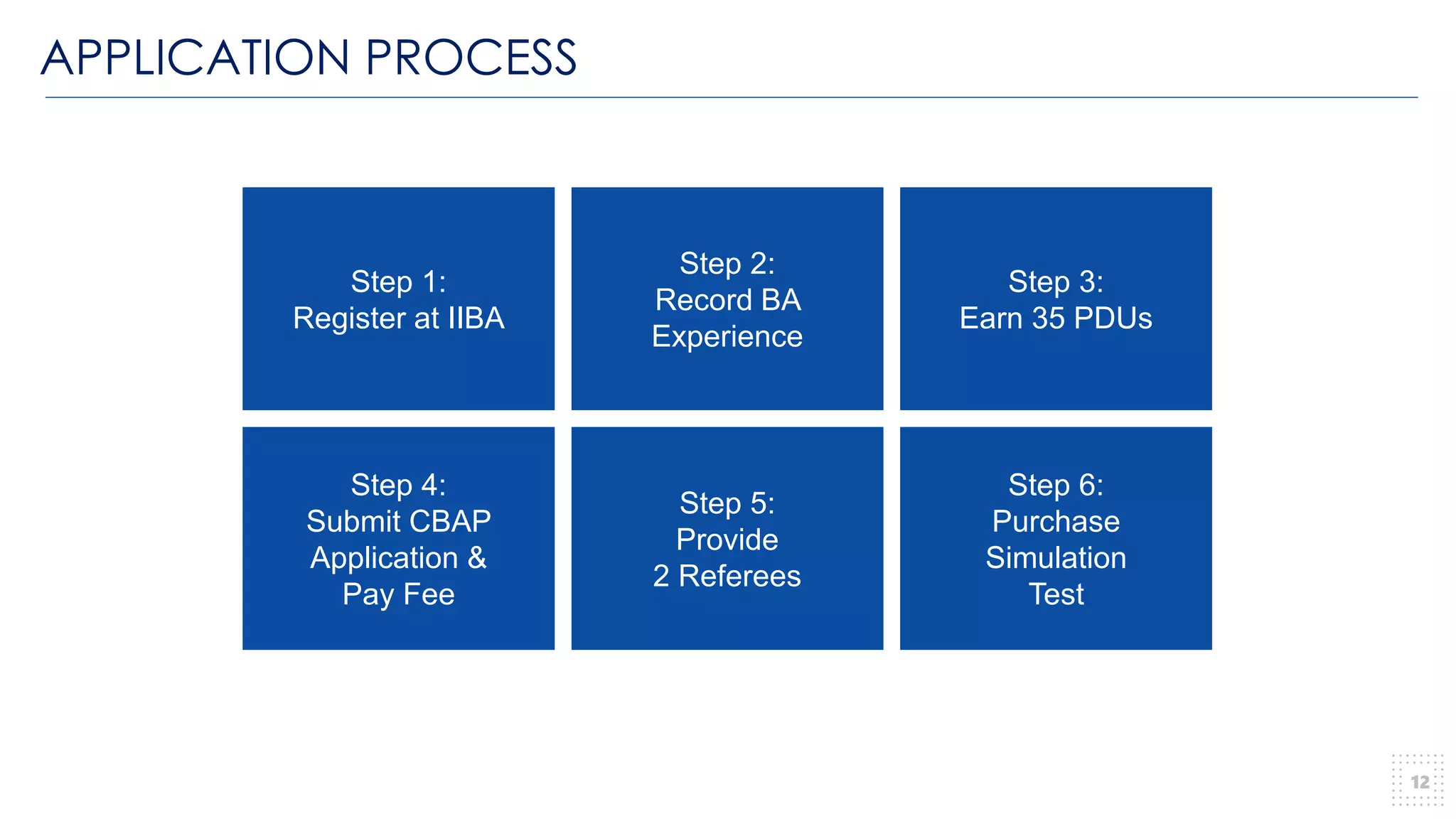
APPLICATION PROCESS
12
Step 1:
Register at IIBA
Step 2:
Record BA
Experience
Step 3:
Earn 35 PDUs
Step 4:
Submit CBAP
Application &
Pay Fee
Step 5:
Provide
2 Referees
Step 6:
Purchase
Simulation
Test
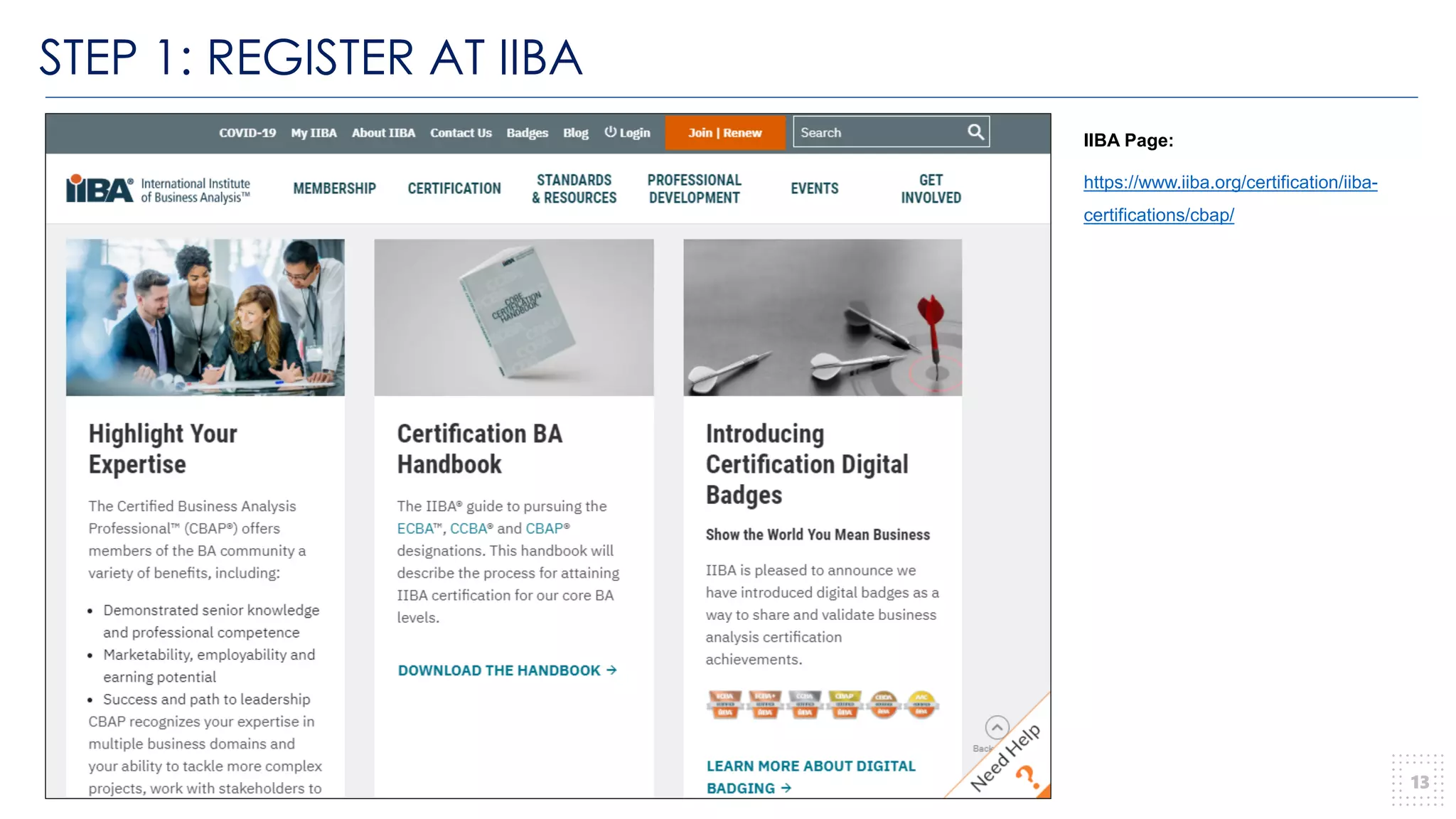
STEP 1: REGISTER AT IIBA
13
IIBA Page:
https://www.iiba.org/certification/iiba-
certifications/cbap/
STEP 1: REGISTER AT IIBA (CONT.)
14
Certification >> My Certifications
STEP 2: RECORD BA EXPERIENCE IN EXCEL
15
You can use the CCBA /
CBAP Experience Recording
Tool (Excel) with built-in
calculation to help you
accurately calculate your
experience, considering
calendar days and holidays
Source: twitter @davidjcmorris, twitter: @thebacoach
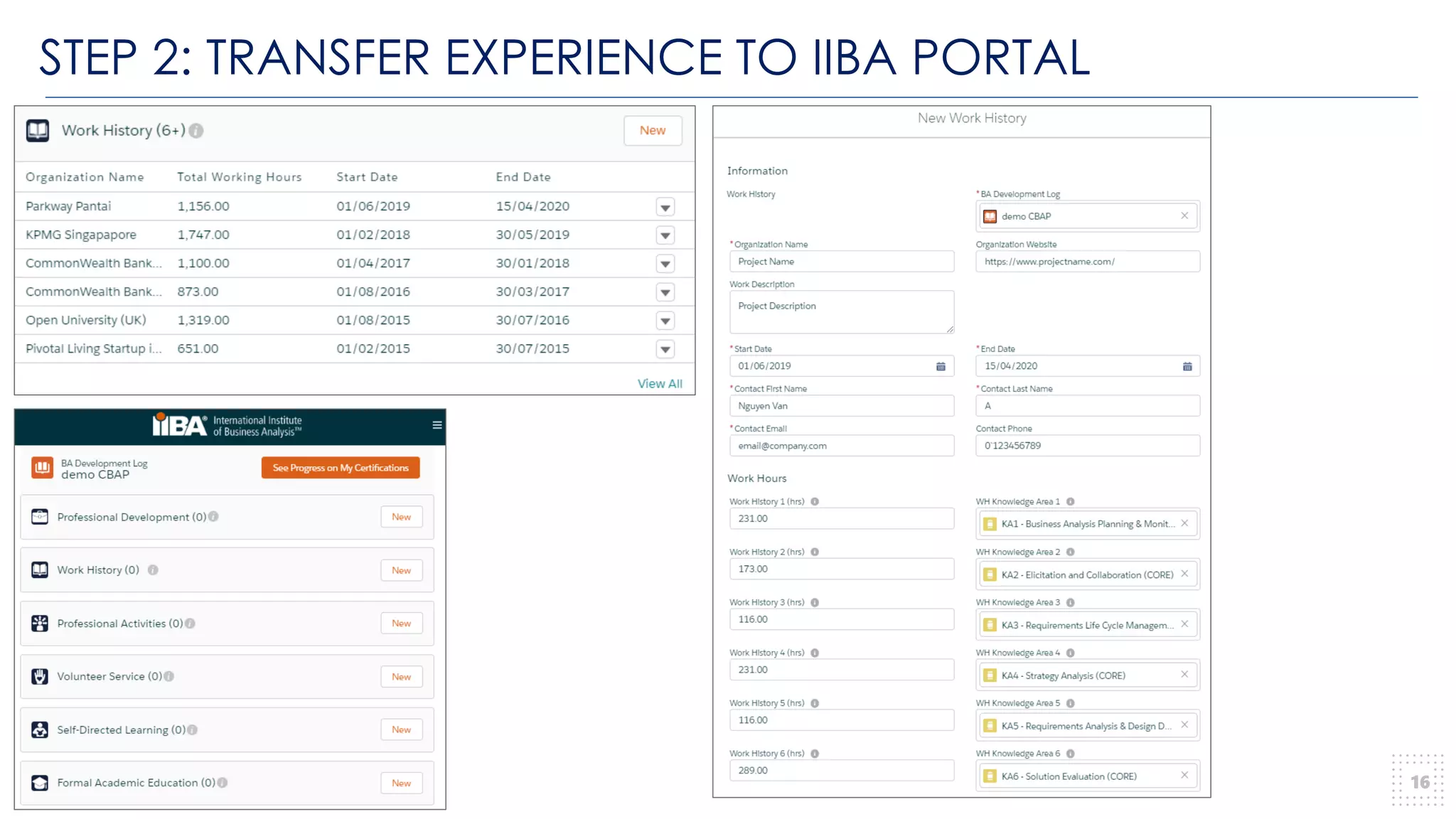
STEP 2: TRANSFER EXPERIENCE TO IIBA PORTAL
16
STEP 3: EARN 35 PDUS – CHECK EEP
17
There are several ways to achieve 35 PDUs either from Online
Courses or Training Centers endorsed by IIBA. Prior to
attempting to earn 35 PDUs, make sure you check out the latest
Endorsed Education Provider (EEP) from IIBA.
https://www.iiba.org/membership/eep/
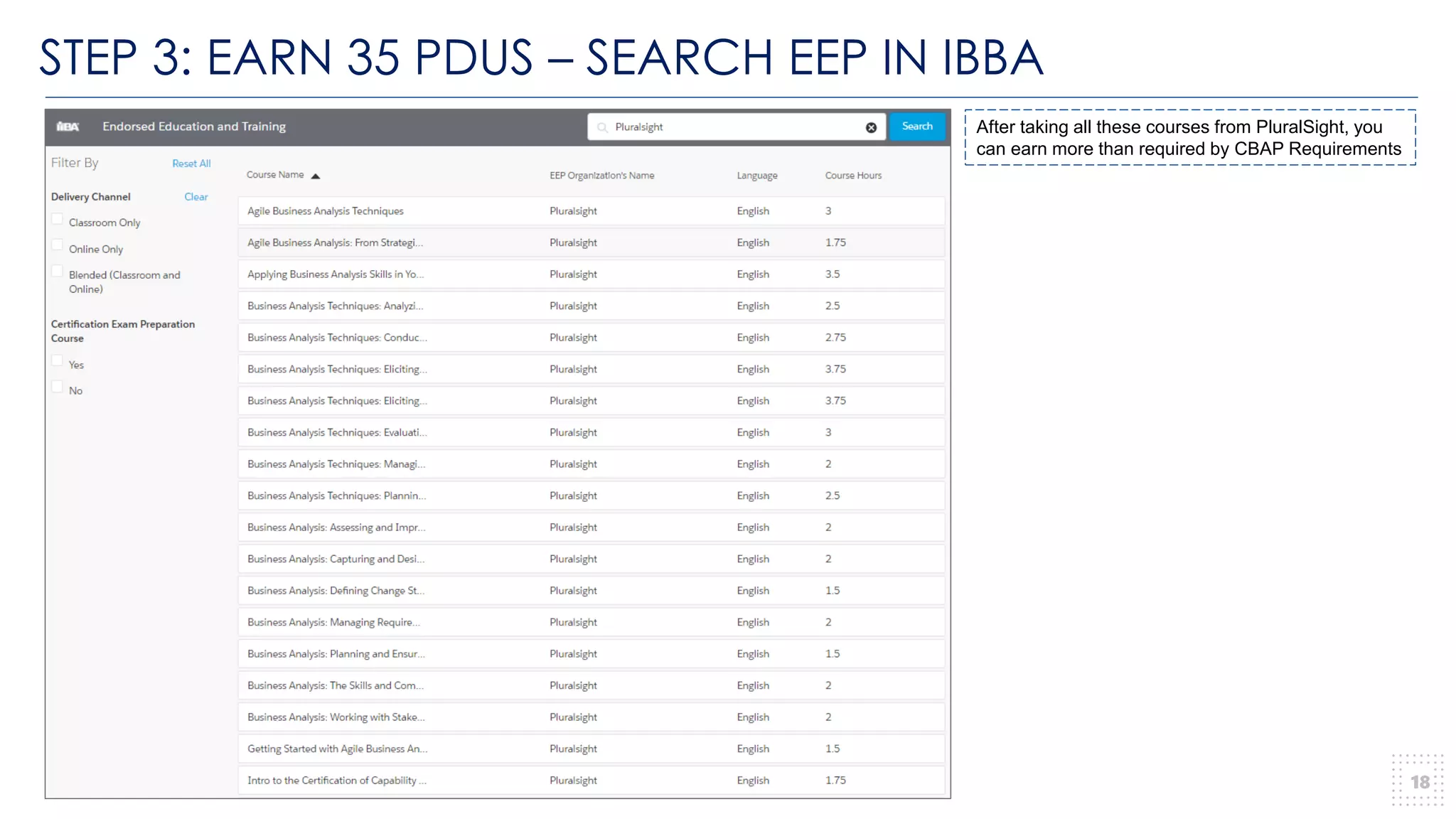
STEP 3: EARN 35 PDUS – SEARCH EEP IN IBBA
18
After taking all these courses from PluralSight, you
can earn more than required by CBAP Requirements
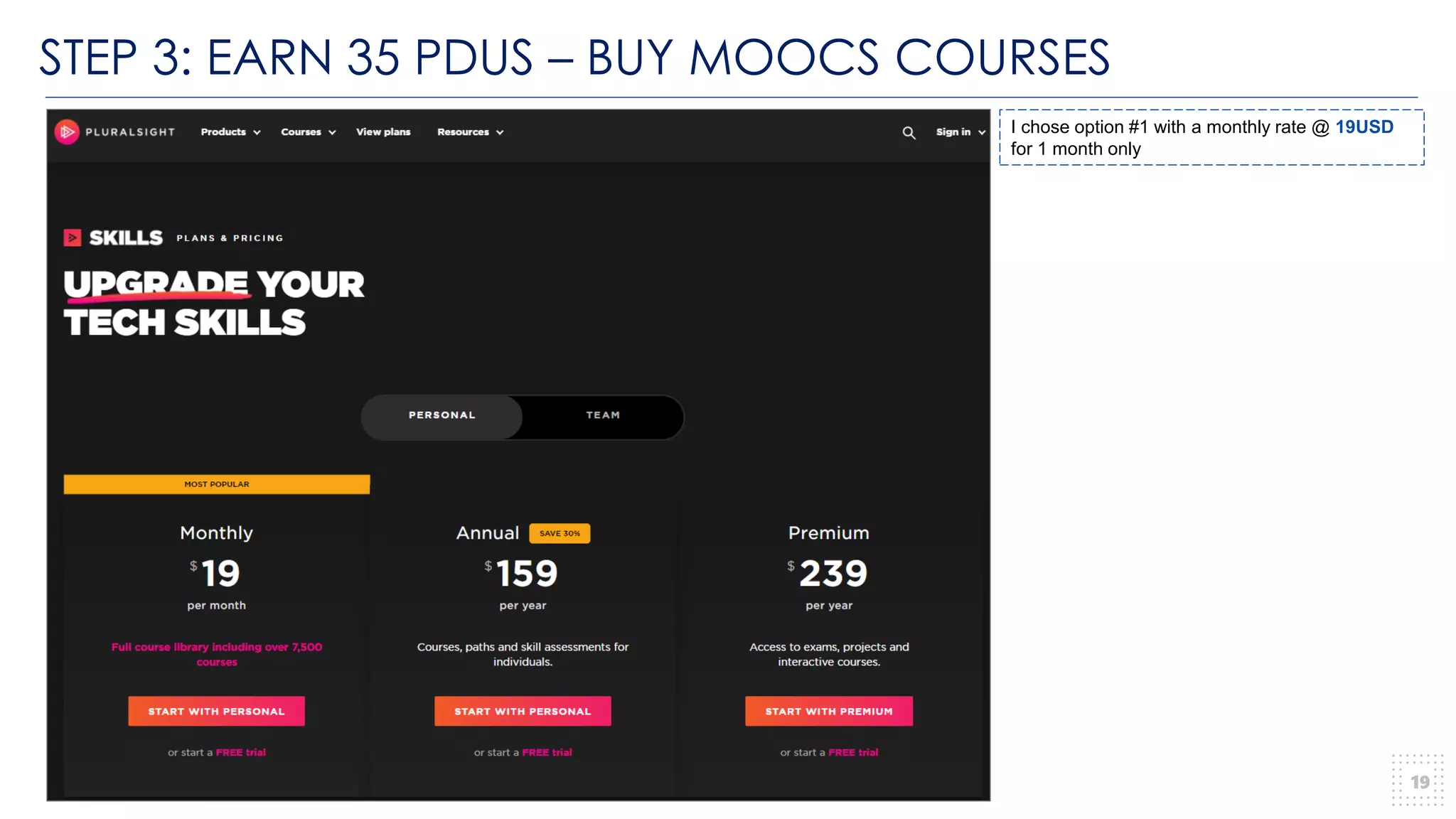
STEP 3: EARN 35 PDUS – BUY MOOCS COURSES
19
I chose option #1 with a monthly rate @ 19USD
for 1 month only
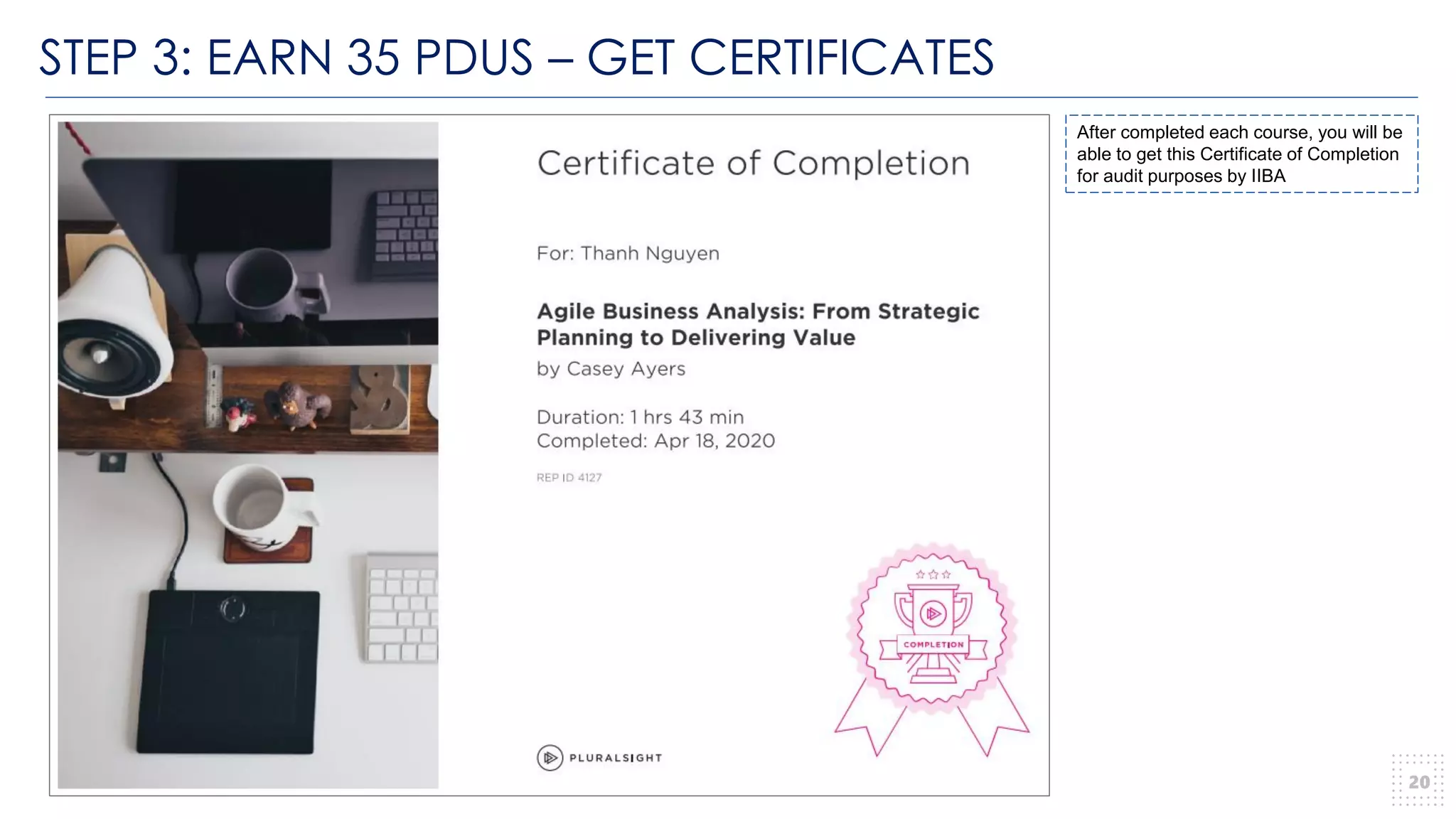
STEP 3: EARN 35 PDUS – GET CERTIFICATES
20
After completed each course, you will be
able to get this Certificate of Completion
for audit purposes by IIBA
STEP 3: EARN 35 PDUS – DECLARE PDU IN IIBA
21
Declare all certificates into IIBA, remember these records become unmodifiable after 7 days commencing
from the point of declaration
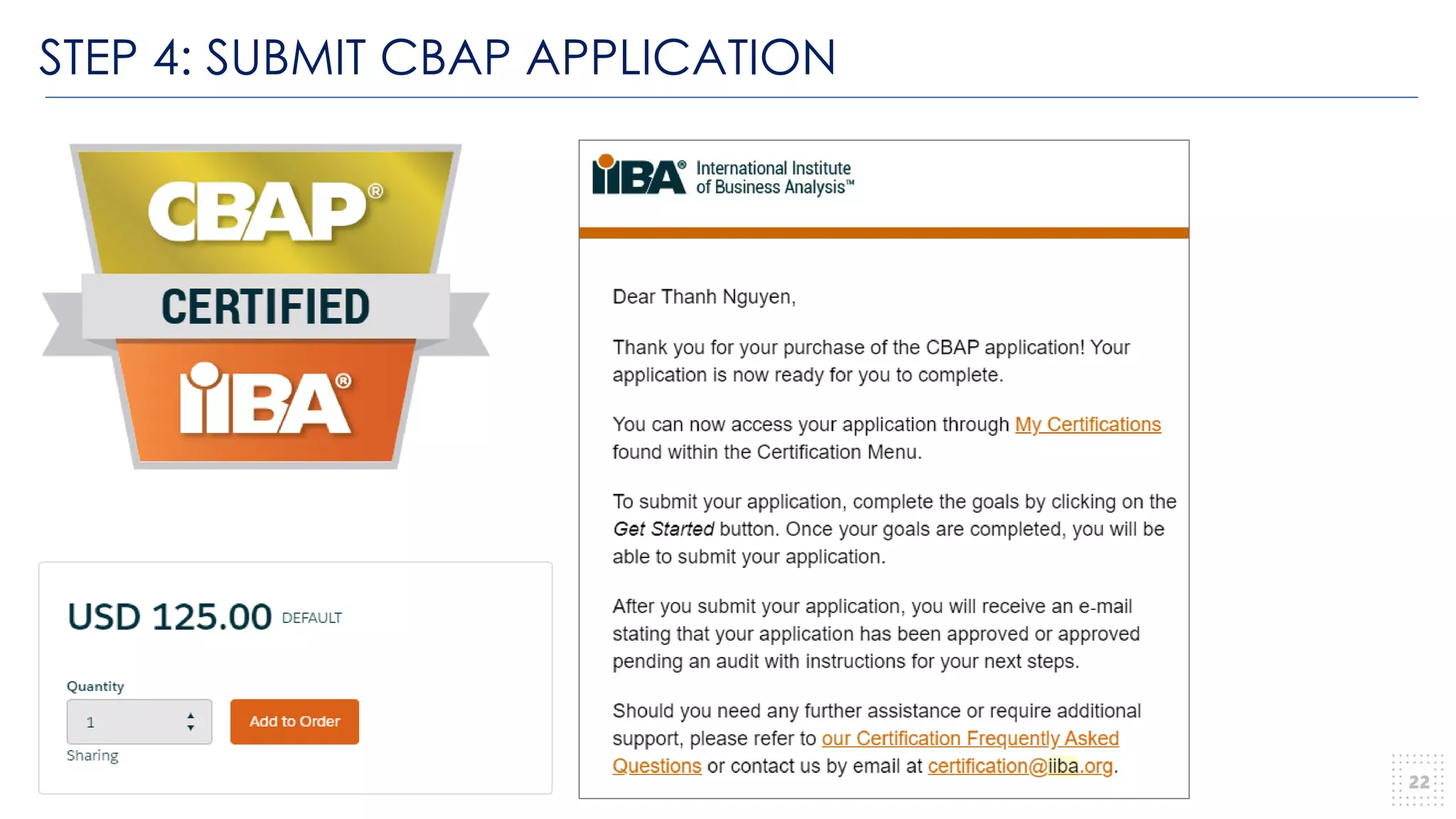
STEP 4: SUBMIT CBAP APPLICATION
22
STEP 5: PROVIDE 2 REFEREES
23
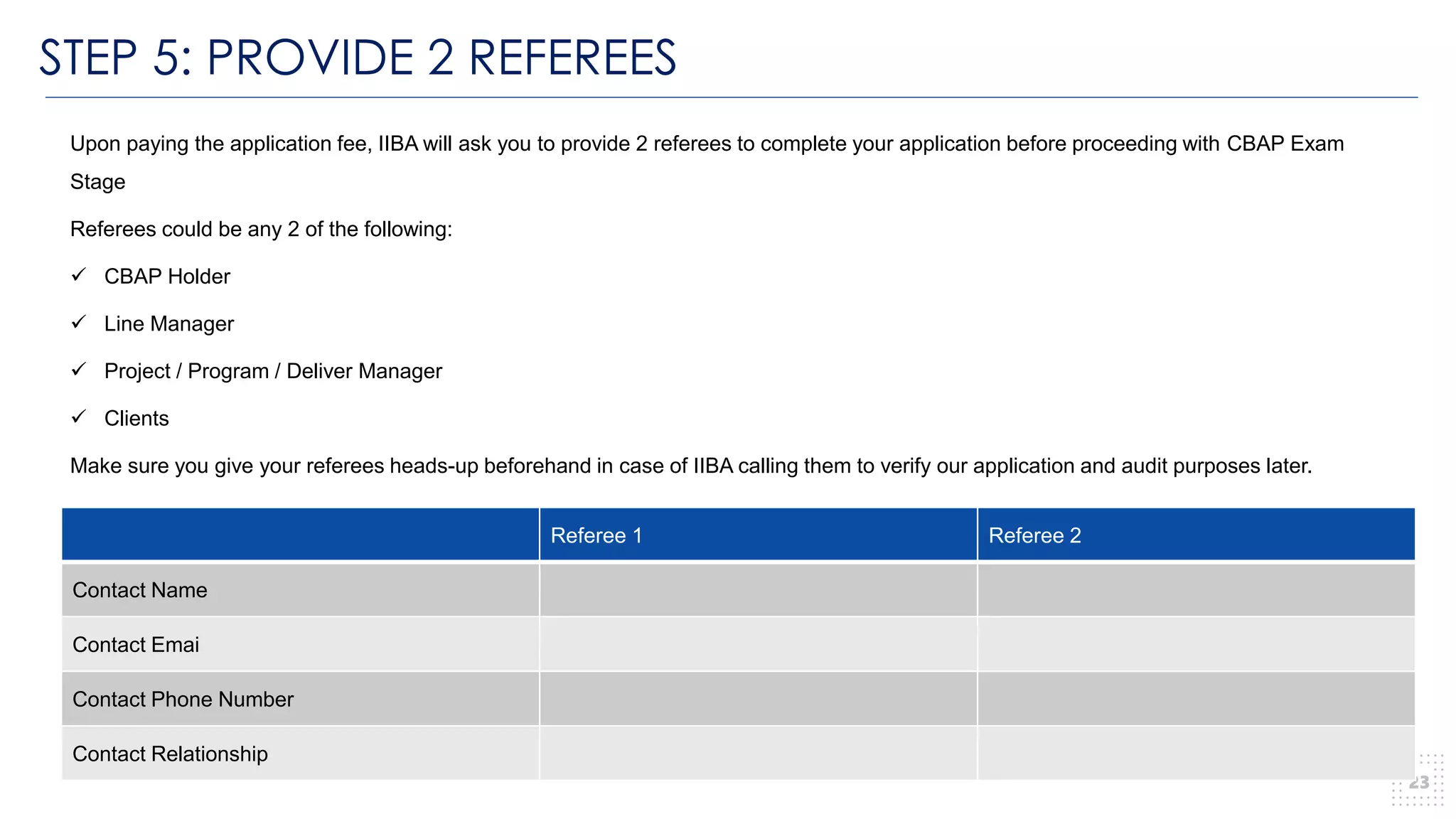
Upon paying the application fee, IIBA will ask you to provide 2 referees to complete your application before proceeding with CBAP Exam
Stage
Referees could be any 2 of the following:
✓ CBAP Holder
✓ Line Manager
✓ Project / Program / Deliver Manager
✓ Clients
Make sure you give your referees heads-up beforehand in case of IIBA calling them to verify our application and audit purposes later.
Referee 1 Referee 2
Contact Name
Contact Emai
Contact Phone Number
Contact Relationship
STEP 6: PURCHASE SIMULATION TEST
24
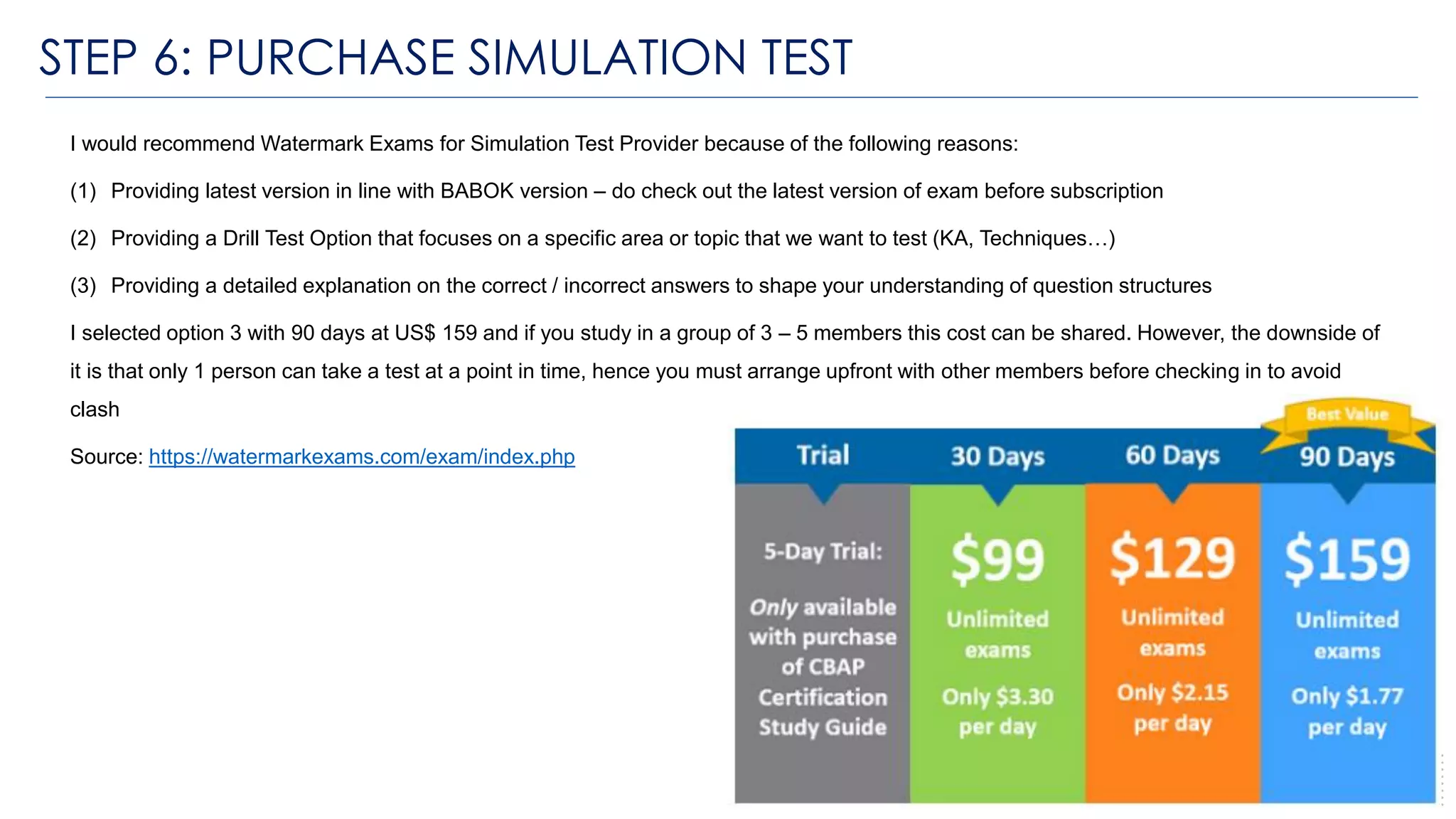
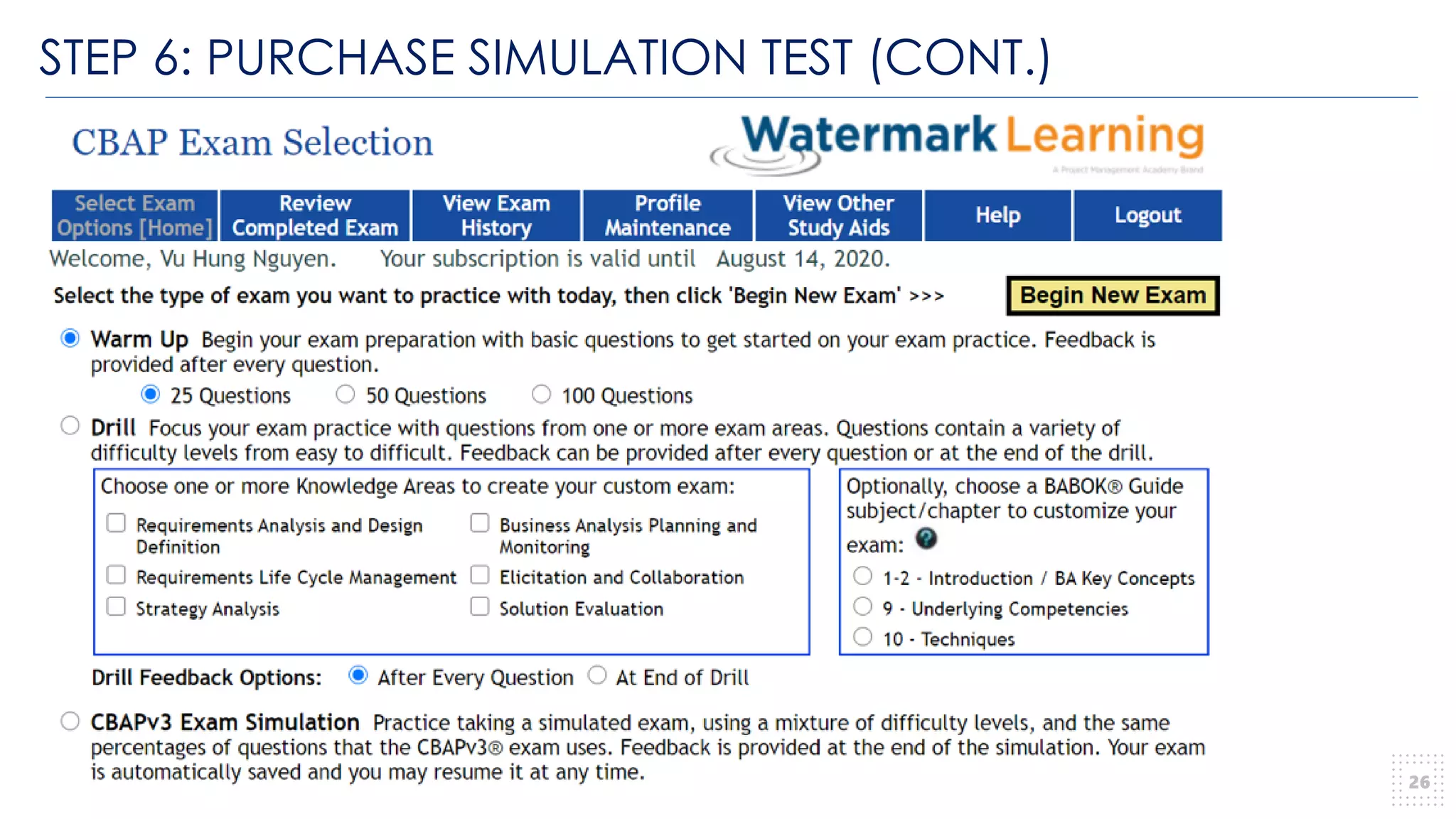
I would recommend Watermark Exams for Simulation Test Provider because of the following reasons:
(1) Providing latest version in line with BABOK version – do check out the latest version of exam before subscription
(2) Providing a Drill Test Option that focuses on a specific area or topic that we want to test (KA, Techniques…)
(3) Providing a detailed explanation on the correct / incorrect answers to shape your understanding of question structures
I selected option 3 with 90 days at US$ 159 and if you study in a group of 3 – 5 members this cost can be shared. However, the downside of
it is that only 1 person can take a test at a point in time, hence you must arrange upfront with other members before checking in to avoid
clash
Source: https://watermarkexams.com/exam/index.php
STEP 6: PURCHASE SIMULATION TEST (CONT.)
25
STEP 6: PURCHASE SIMULATION TEST (CONT.)
26
STAGE 2:
7-MILESTONE LEARNING STRATEGY
28
Milestone 1:
6 KA
Milestone 2:
50 Techniques
Milestone 3:
KA Input Output
Mapping
Milestone 4:
Competencies
Milestone 5:
KA Stakeholder
Mapping
Milestone 6:
KA Guideline Tool
Mapping
Milestone 7:
KA Techniques
Mapping &
Perspectives
Duration
6 Weeks 2 Weeks 1 Week 1 Week 1 Week
Read before the
exam day
Read before the
exam day
LearningTechniques
• Skim & Scan BABOK
• Mind Map Summary
• Telling a story and
mnemonic
• Take a Drill Test
specific to the topic
• Skim & Scan BABOK
• Mind Map Summary
• Telling a story and
mnemonic
• Take a Drill Test
specific to the topic
• Skim & Scan BABOK
• Draw a I/O Diagram
• Take a Drill Test
specific to the topic
• Skim & Scan BABOK
• Mind Map Summary
• Excel Summary
• Telling a story and
mnemonic
• Take a Drill Test
specific to the topic
• Skim & Scan BABOK
• Excel Summary
• Telling a story and
mnemonic
• Take a Drill Test
specific to the topic
• Skim & Scan BABOK
• Excel Summary
• Take a Drill Test
specific to the topic
• Skim & Scan BABOK
• Excel Summary
• Telling a story and
mnemonic
• Take a Drill Test
specific to the topic
MILESTONE 1: 6 KNOWLEDGE AREAS
29
KA1
Business Analysis
Planning &
Monitoring
KA3
Requirement Life
Cycle
Management
KA5
Requirement
Analysis &
Design Definition
KA2
Elicitation &
Collaboration
KA4
Strategy Analysis
KA6
Solution
Evaluation
How to study for each KA?
1. Skim & Scan BABOK for each KA to build Mind Map Skeleton
2. Read BABOK again to summarize KA Description & Elements
3. Make up a story or mnemonic
4. Memorize the story or mnemonic
5. Write down everything on a paper from your memory
6. Take a Drill Test
7. Review Test Results
8. Re-read notes / BABOK on those areas of uncertainty or inaccuracy until
you score 70% or above
Refer to the next slides for a demonstrated example of BAPM
“PLEASE” MNEMONIC FOR 6 KAS
30
PLEASE
P - Business Analysis Planning & Monitoring
L - Requirement Life Cycle Management
E - Elicitation & Collaboration
A - Requirement Analysis & Design Definition
S - Strategy Analysis
E - Solution Evaluation
KA1 BUSINESS ANALYSIS PLANNING & MONITORING
31
KA1
Business Analysis
Planning &
Monitoring
Task in this KA:
• 3.1 Plan BA Approach
• 3.2 Plan Stakeholder Engagement
• 3.3 Plan BA Information Management
• 3.4 Plan BA Governance
• 3.5 Identify BA Performance Improvement
PEAGI
P - Identify BA Performance Improvement
E - Plan Stakeholder Engagement
A - Plan BA Approach
G - Plan BA Governance
I - Plan BA Information Management
STEP 1: SKIM & SCAN BABOK TO BUILD MIND MAP SKELETON
32
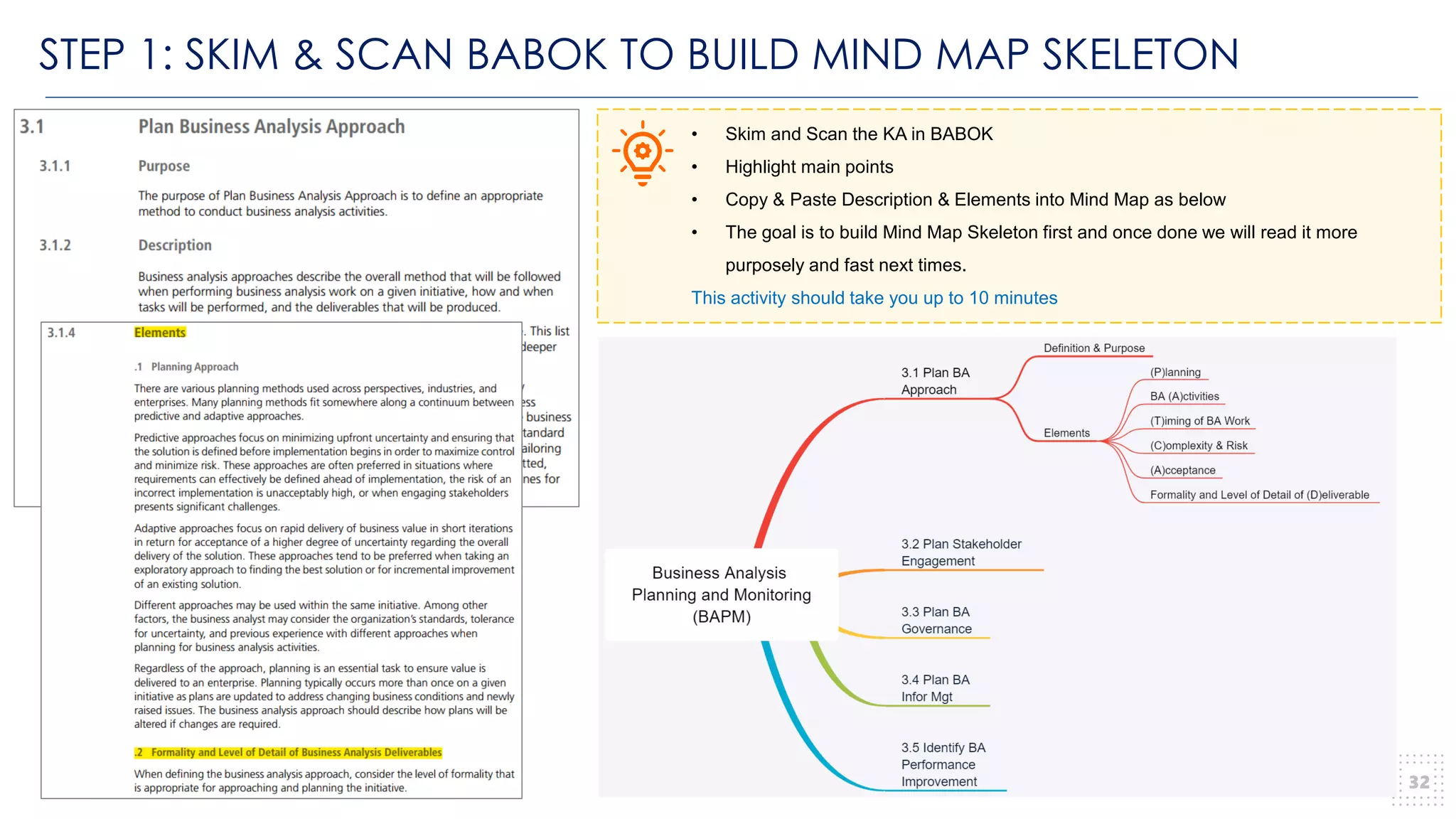
• Skim and Scan the KA in BABOK
• Highlight main points
• Copy & Paste Description & Elements into Mind Map as below
• The goal is to build Mind Map Skeleton first and once done we will read it more
purposely and fast next times.
This activity should take you up to 10 minutes
STEP 2: SUMMARIZE KA DESCRIPTION & ELEMENTS
33
• Read the KA again to flesh out details for the earlier-constructed skeleton
• Highlight keywords in BABOK
• Try to paraphrase and summarize in your own words
• Write into Mind Map as brief as possible but keep the keywords (eg. Minimize
upfront uncertainty / risk or maximize control)
This activity should take you up to 30 minutes
STEP 3: MAKE A STORY & MNEMONIC
34
• Make up your own stories and mnemonic from your notes
• Remember good things take time, lots of people failed at
the step because they are reluctant to brainstorm a story
that relates to their daily lives
• The more related to your daily lives, the fast and longer
you remember
Refer to a sample story below
3.1 Plan BA Approach
[Story: Plan BA Work, Methodologies, Activities & Task & Deliverables using CAT
PAD Elements]
- (C)omplexity & Risk [Story: Scale NoS by GEO & TECH]
- BA (A)ctivities [Predictive, Deliverables >> Activities >> Task, Adaptive, Activities into
Iterations >> Asso. Deliverables >> Task]
- (T)iming of BA Work requires Urgent, Dependent Work to be done in Sequence by
Available Resource
- (P)lanning with Predictive Adaptive
- (A)cceptance
- Level of Detail of (D)eliverables [Story:
High Turnover Rate, Maturity Inhouse Team accept Complexity 7 Risk to sign a
Contract with Highly Regulated Industry to document KB for re-use to Distributed
Stakeholders]
STEP 4: MEMORIZE STORIES & MNEMONIC
35
• Now what you need to do is to learn by heart the following story
3.1 Plan BA Approach
[Story: Plan BA Work, Methodologies, Activities & Task & Deliverables using CAT PAD Elements]
- (C)omplexity & Risk [Story: Scale NoS by GEO & TECH]
- BA (A)ctivities [Predictive, Deliverables >> Activities >> Task, Adaptive, Activities into Iterations >> Asso. Deliverables >> Task]
- (T)iming of BA Work requires Urgent, Dependent Work to be done in Sequence by Available Resource
- (P)lanning with Predictive Adaptive
- (A)cceptance
- Level of Detail of (D)eliverables [Story:
High Turnover Rate, Maturity Inhouse Team accept Complexity 7 Risk to sign a Contract with Highly Regulated Industry to document KB for re-use to
Distributed Stakeholders]
STEP 5: WRITE DOWN ON PAPER WITHOUT LOOKING AT BABOK
36
• Write down as much as you remember on a paper
• It is okay if you can’t remember them all the 1st time
• Keep going until you remember them all
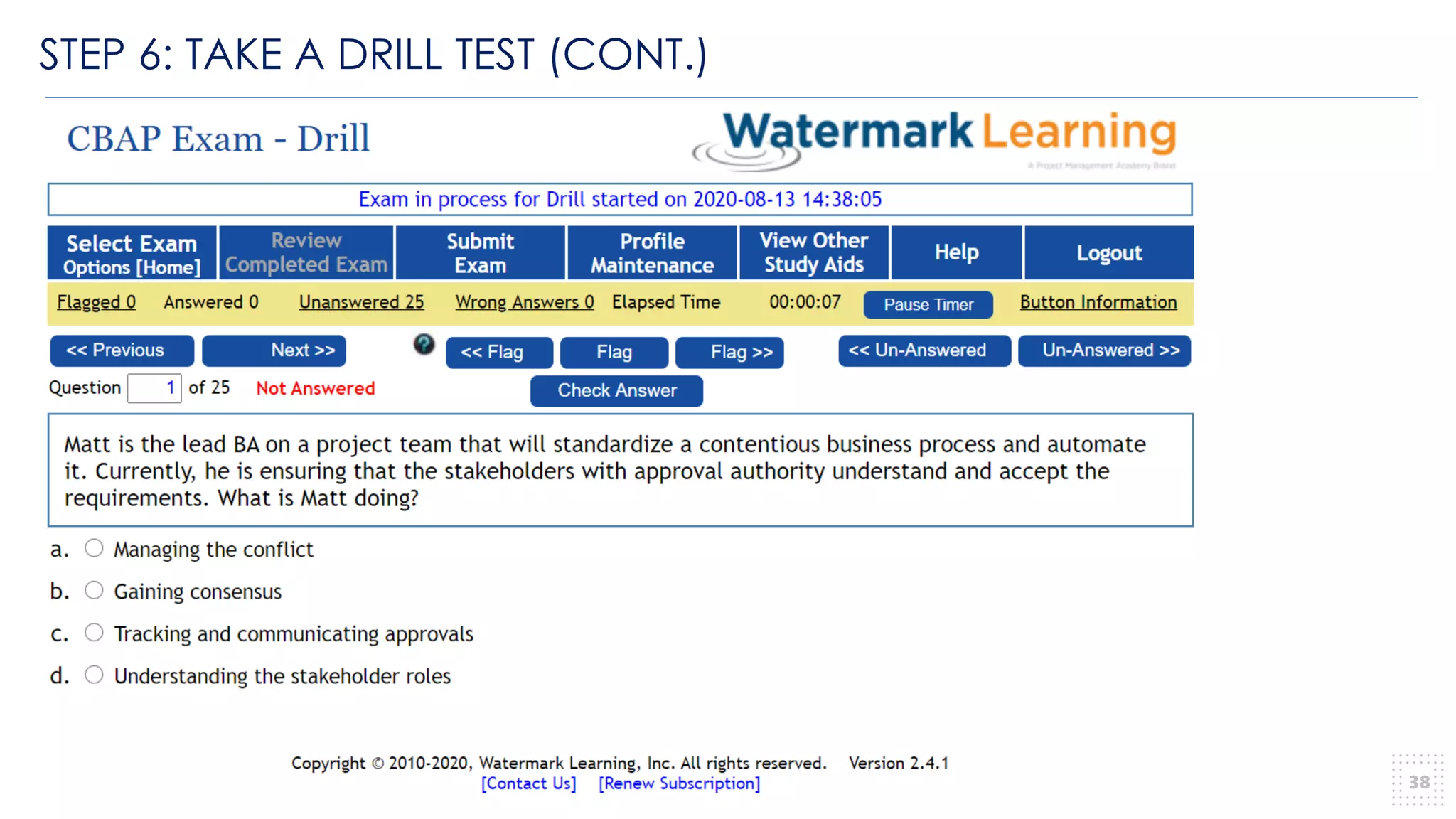
STEP 6: TAKE A DRILL TEST
37
STEP 6: TAKE A DRILL TEST (CONT.)
38
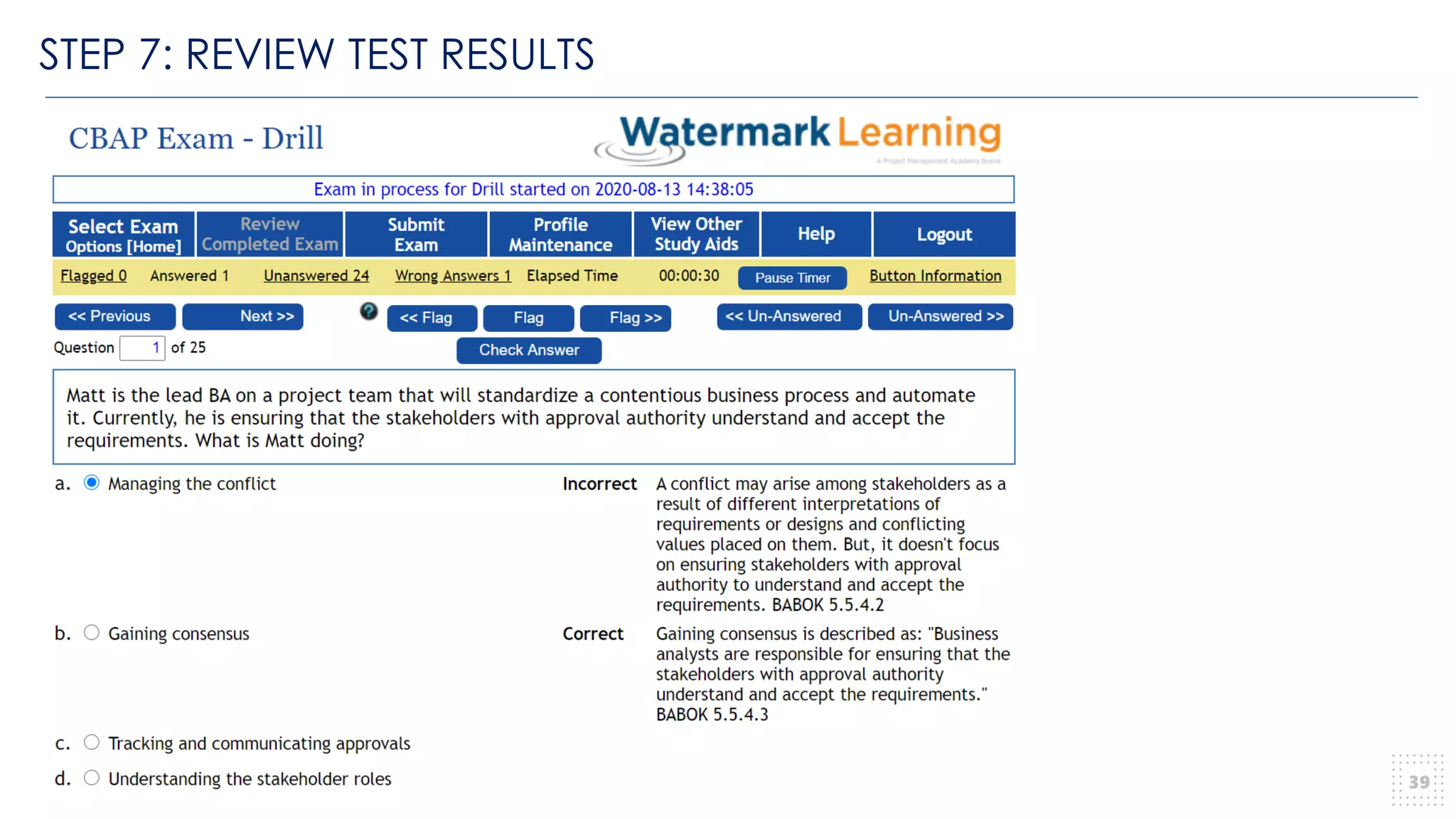
STEP 7: REVIEW TEST RESULTS
39
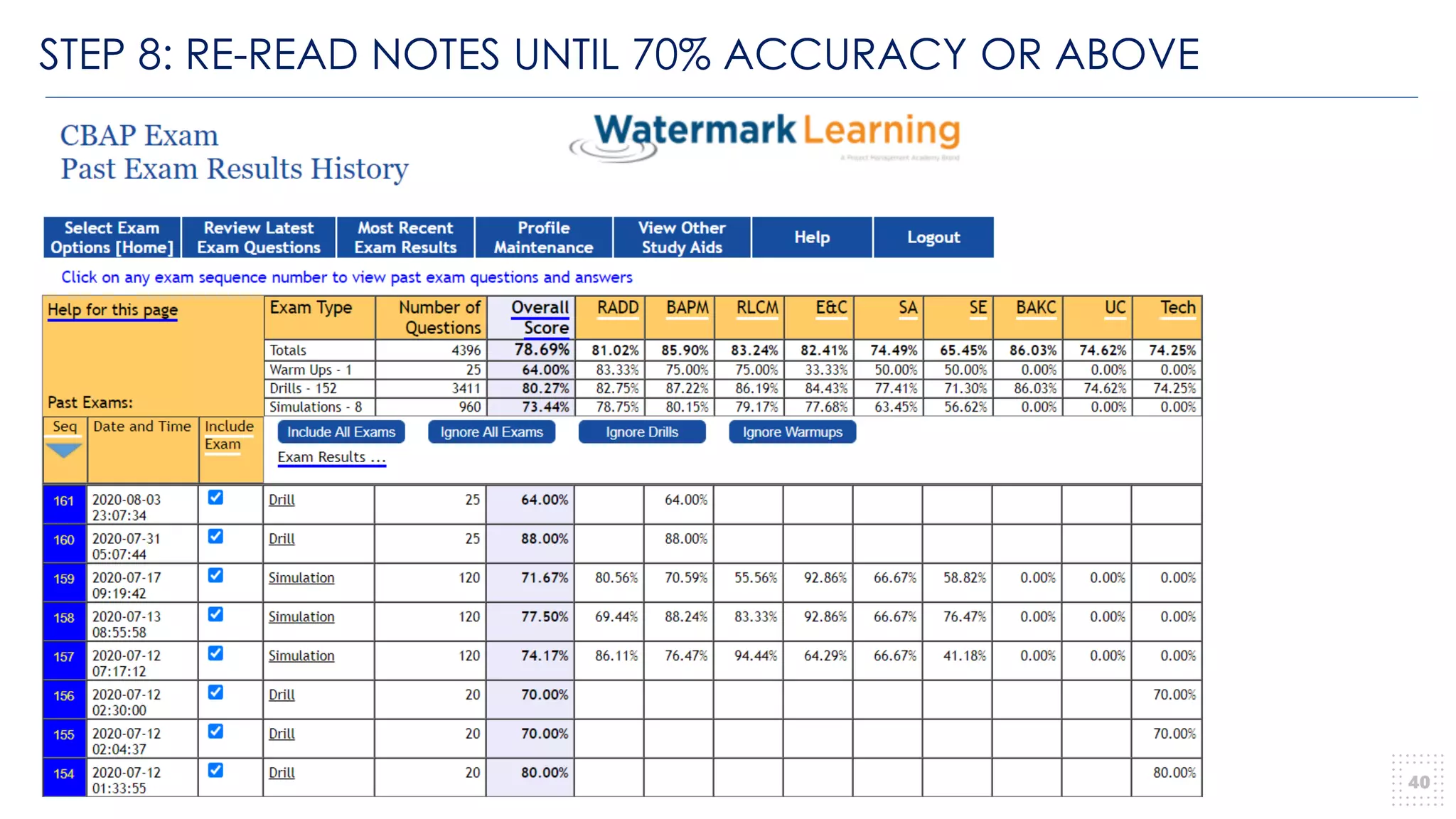
STEP 8: RE-READ NOTES UNTIL 70% ACCURACY OR ABOVE
40
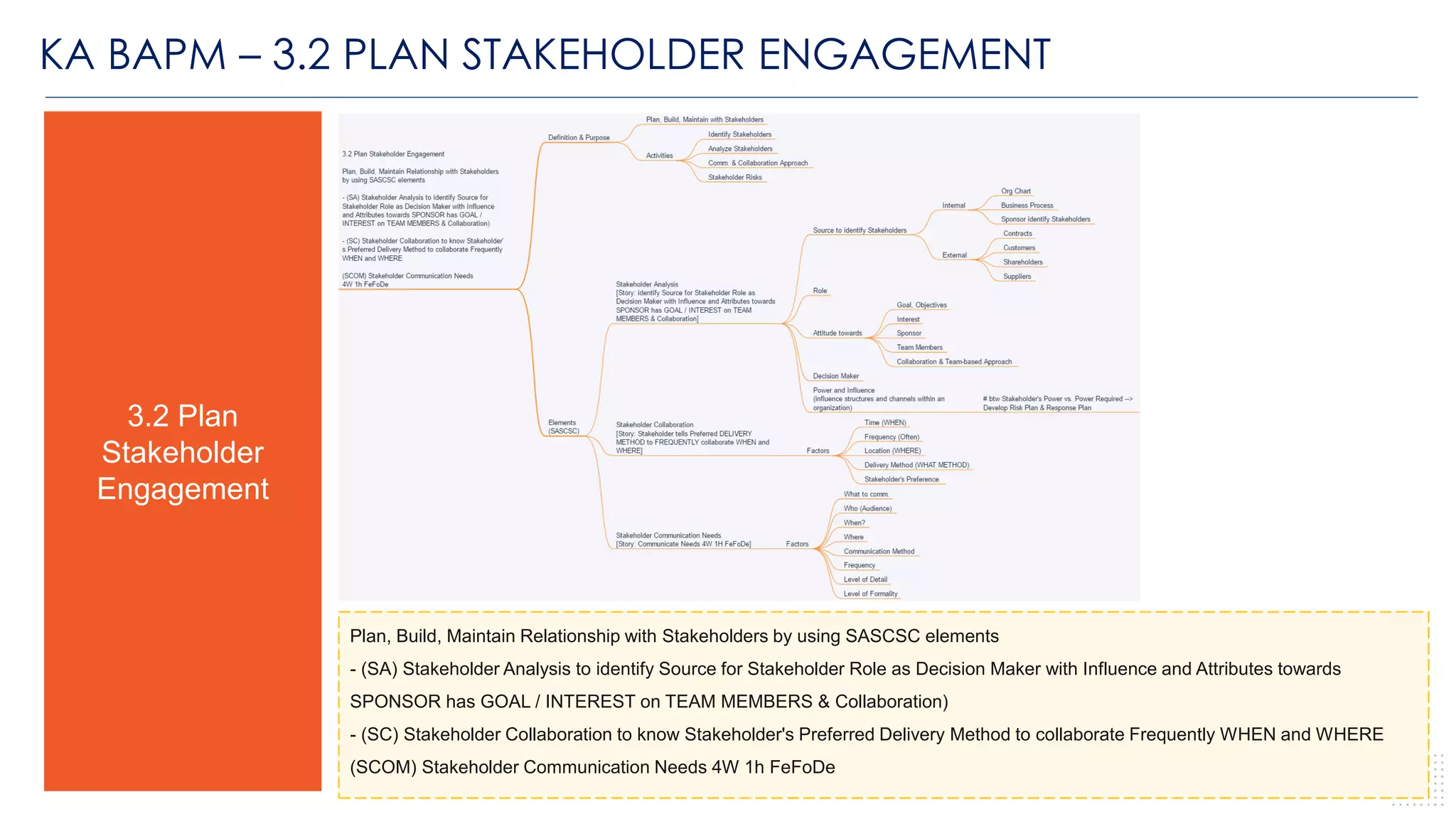
KA BAPM – 3.2 PLAN STAKEHOLDER ENGAGEMENT
41
3.2 Plan
Stakeholder
Engagement
Plan, Build, Maintain Relationship with Stakeholders by using SASCSC elements
- (SA) Stakeholder Analysis to identify Source for Stakeholder Role as Decision Maker with Influence and Attributes towards
SPONSOR has GOAL / INTEREST on TEAM MEMBERS & Collaboration)
- (SC) Stakeholder Collaboration to know Stakeholder's Preferred Delivery Method to collaborate Frequently WHEN and WHERE
(SCOM) Stakeholder Communication Needs 4W 1h FeFoDe
KA BAPM – 3.3 PLAN BA GOVERNANCE
42
Description: Define Reqt Prioritization, Approval, Decision
Making and CR Process
- RACI DM (Reviewed by Reviewer, Approved by Approver,
Consulted by SME and Informed to Participants)
- Prioritization [Story: Participant CRI with TECH and FORMAT
because Resource use Methodologies to deliver values with
risky and dependent timeline]
- Approval Process [Story: BA follows Approval Process to
submit Type of Reqt for x Days to Approvers and Stakeholders
who are available, good attitude and willing to engage]
- CR Process [Story: Stakeholders request CR with CABE
COPR Attributes to BA to prioritized, documented,
communicated and impact analyzed and seek approval from
Approver]
CABE CORP:
(CA) Course of Actions
(BE) Benefit
(CO) Cost
(R) Risk
(P) Priority
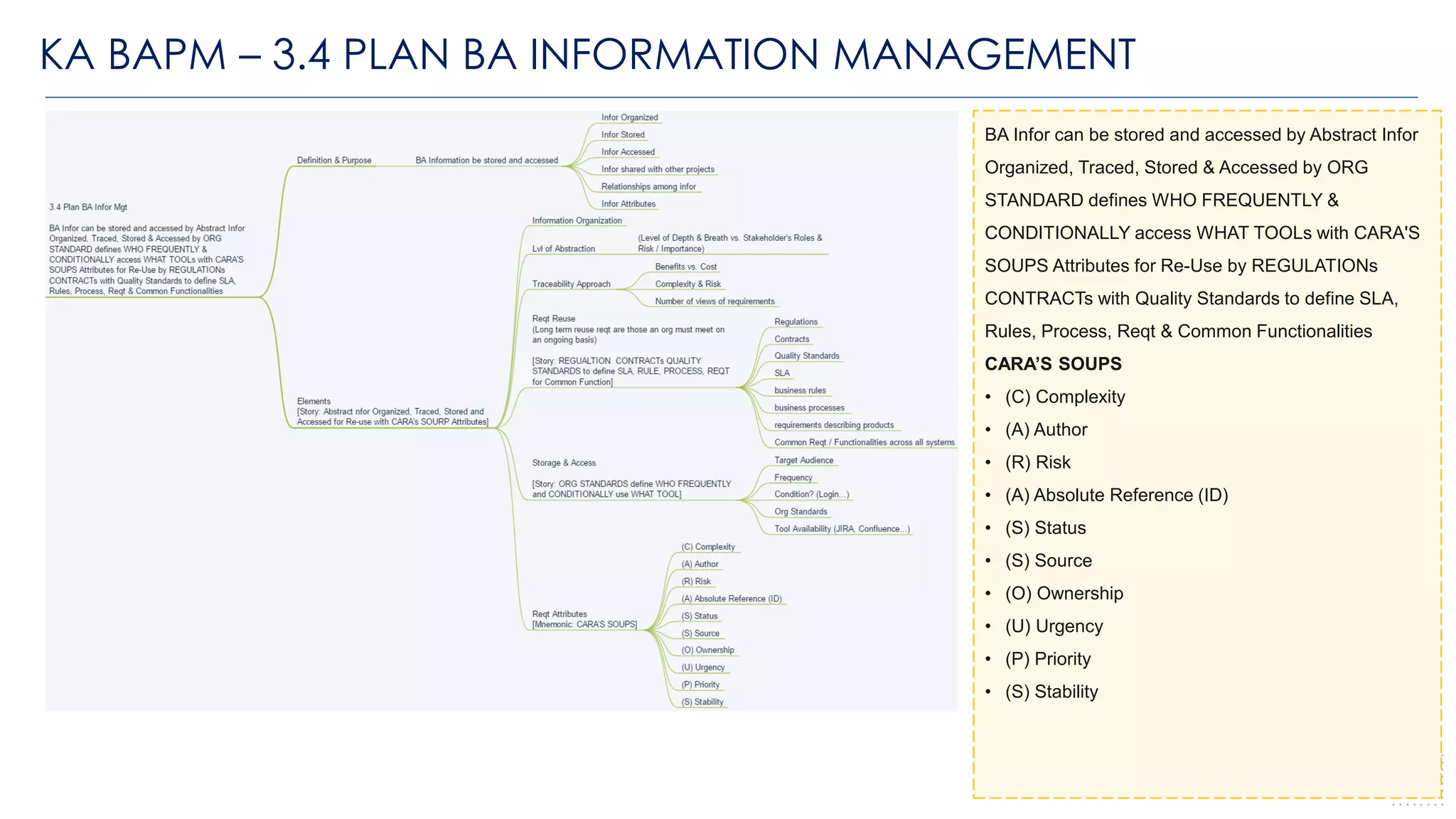
KA BAPM – 3.4 PLAN BA INFORMATION MANAGEMENT
43
BA Infor can be stored and accessed by Abstract Infor
Organized, Traced, Stored & Accessed by ORG
STANDARD defines WHO FREQUENTLY &
CONDITIONALLY access WHAT TOOLs with CARA'S
SOUPS Attributes for Re-Use by REGULATIONs
CONTRACTs with Quality Standards to define SLA,
Rules, Process, Reqt & Common Functionalities
CARA’S SOUPS
• (C) Complexity
• (A) Author
• (R) Risk
• (A) Absolute Reference (ID)
• (S) Status
• (S) Source
• (O) Ownership
• (U) Urgency
• (P) Priority
• (S) Stability
KA BAPM – 3.4 IDENTIFY BA PERFORMANCE IMPROVEMENT
44
To assess BA work and Improvement Plan to identify
improvements as guidelines for next time task
execution by using elements QQ (Qualitative /
Quantitative) SOSAKET Sourced MEASUREs to
ANALYZE PERFORMANCE ANALYSIS with BA
Process, Resource & Deliverables to RECOM PIC
SOSAKET
(S) Significance (Benefits)
(O) Organization Support (Enough resource to support
BA Task)
(S) Strategic (Meet Objectives)
(A) Accuracy & Completeness (BA Work accurate)
(K) Knowledge (BA Skill / Knowledge)
(E) Effectiveness (Easy to use deliverables)
(T) Timeliness (On Time Deliverables)
BA's Work is significant with Organization Support to
meet Strategic goals with accurate knowledge,
effective and timely deliverables
RECAP
45
✓ By now you’ve learnt how to summarize and study each task in the KA
✓ Follow this instruction to complete the remaining tasks of each KA and for all KAs
✓ Remember the Forgetting Curve and have frequent revisions with 1-1-1 rules (1 Day 1 Week 1 Month)
✓ Summarize in your own stories and words, you can copy my ideas but should not be exactly word by word
https://intelalearning.wordpress.com/2018/07/19/learning-myth-1-ebbinghaus-forgetting-curve/
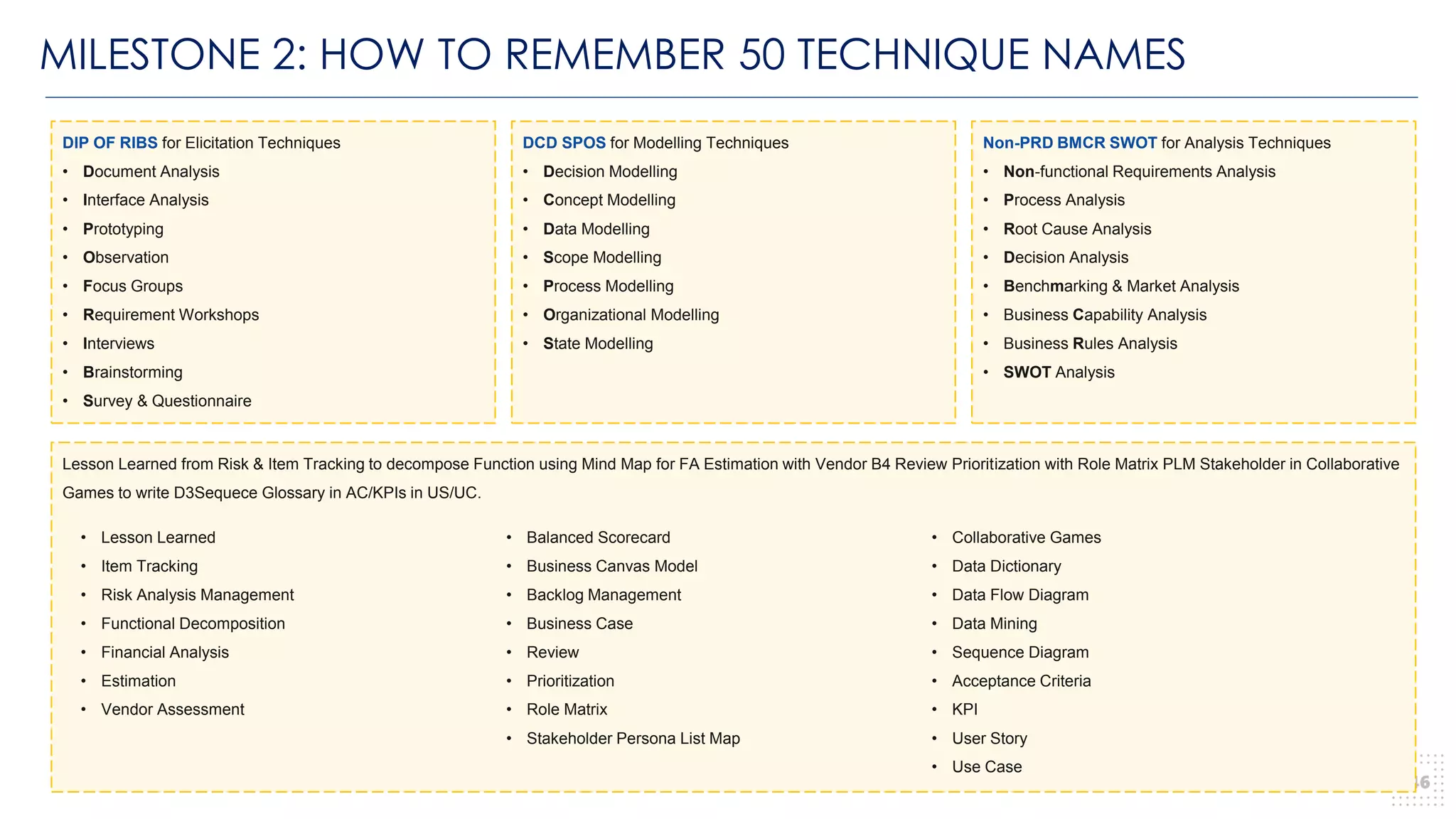
MILESTONE 2: HOW TO REMEMBER 50 TECHNIQUE NAMES
46
DIP OF RIBS for Elicitation Techniques
• Document Analysis
• Interface Analysis
• Prototyping
• Observation
• Focus Groups
• Requirement Workshops
• Interviews
• Brainstorming
• Survey & Questionnaire
DCD SPOS for Modelling Techniques
• Decision Modelling
• Concept Modelling
• Data Modelling
• Scope Modelling
• Process Modelling
• Organizational Modelling
• State Modelling
Non-PRD BMCR SWOT for Analysis Techniques
• Non-functional Requirements Analysis
• Process Analysis
• Root Cause Analysis
• Decision Analysis
• Benchmarking & Market Analysis
• Business Capability Analysis
• Business Rules Analysis
• SWOT Analysis
Lesson Learned from Risk & Item Tracking to decompose Function using Mind Map for FA Estimation with Vendor B4 Review Prioritization with Role Matrix PLM Stakeholder in Collaborative
Games to write D3Sequece Glossary in AC/KPIs in US/UC.
• Lesson Learned
• Item Tracking
• Risk Analysis Management
• Functional Decomposition
• Financial Analysis
• Estimation
• Vendor Assessment
• Balanced Scorecard
• Business Canvas Model
• Backlog Management
• Business Case
• Review
• Prioritization
• Role Matrix
• Stakeholder Persona List Map
• Collaborative Games
• Data Dictionary
• Data Flow Diagram
• Data Mining
• Sequence Diagram
• Acceptance Criteria
• KPI
• User Story
• Use Case
MILESTONE 2: 50 TECHNIQUE SUMMARY
47
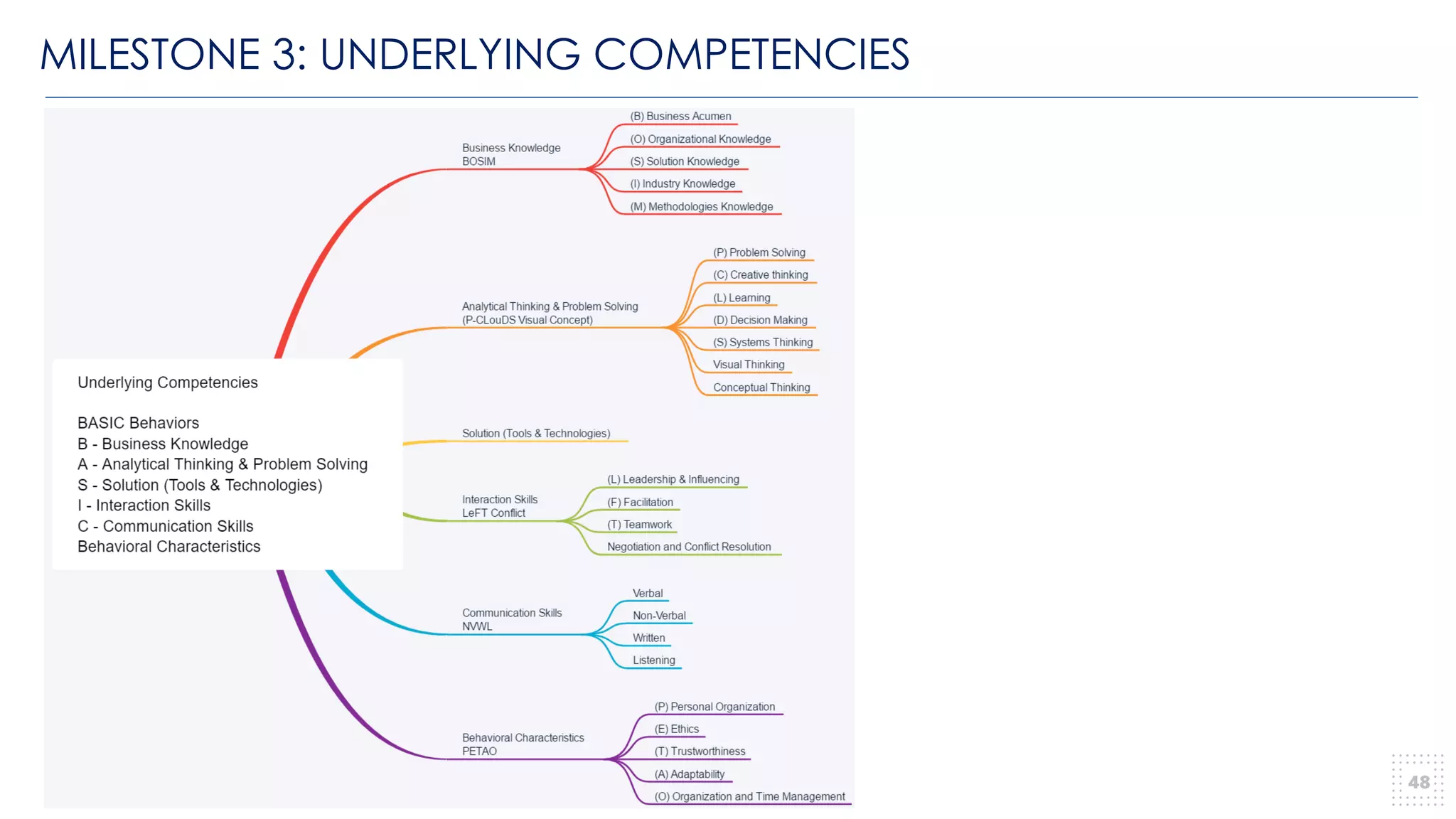
MILESTONE 3: UNDERLYING COMPETENCIES
48
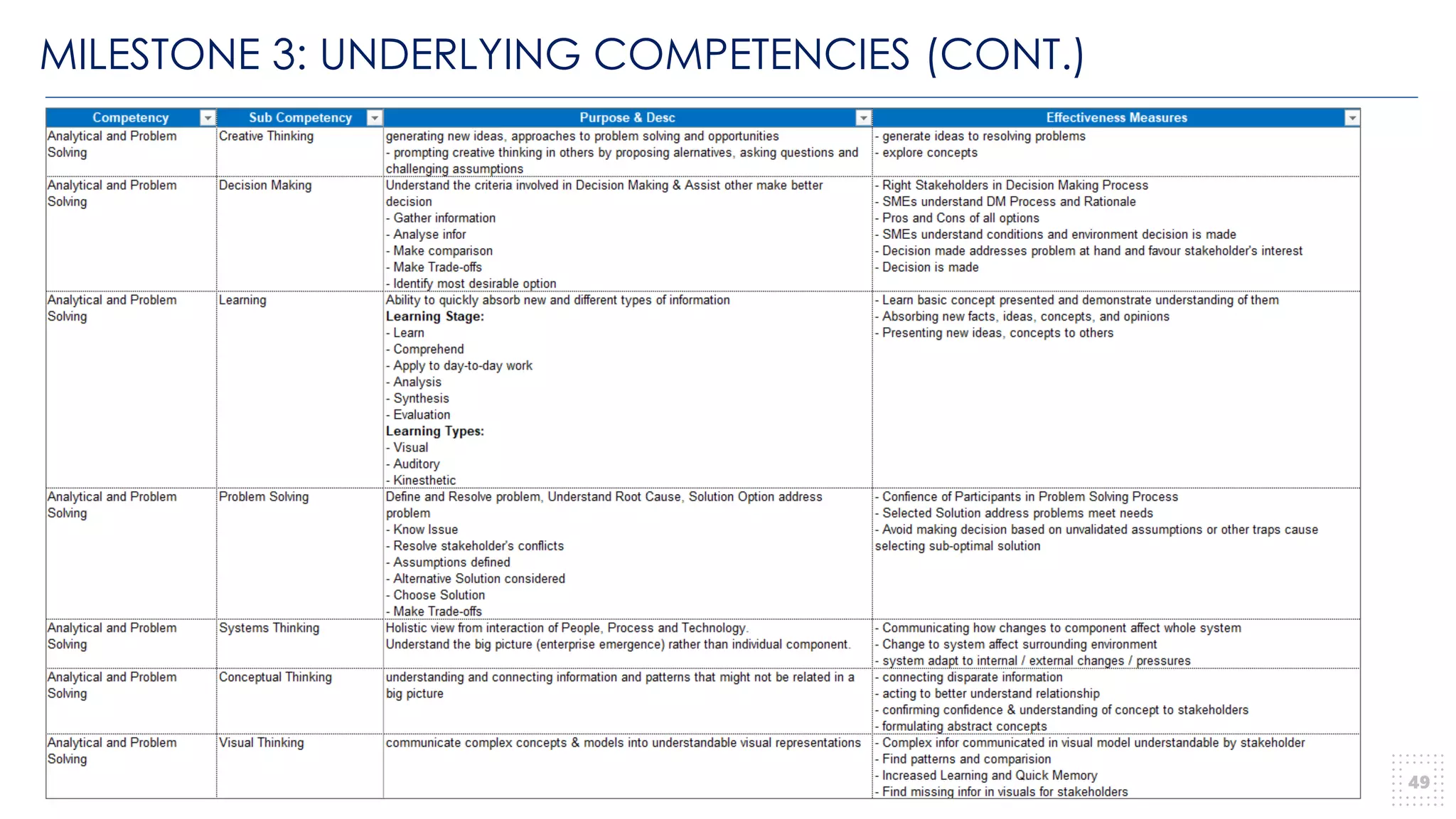
MILESTONE 3: UNDERLYING COMPETENCIES (CONT.)
49
MILESTONE 4: KA INPUT OUTPUT MAPPING – KA1 BAPM
50
Transform input and output within the
KA into this diagram for ease of
remembering
MILESTONE 4: KA INPUT OUTPUT MAPPING – KA2 E&C
51
MILESTONE 4: KA INPUT OUTPUT MAPPING – KA3 RLCM
52
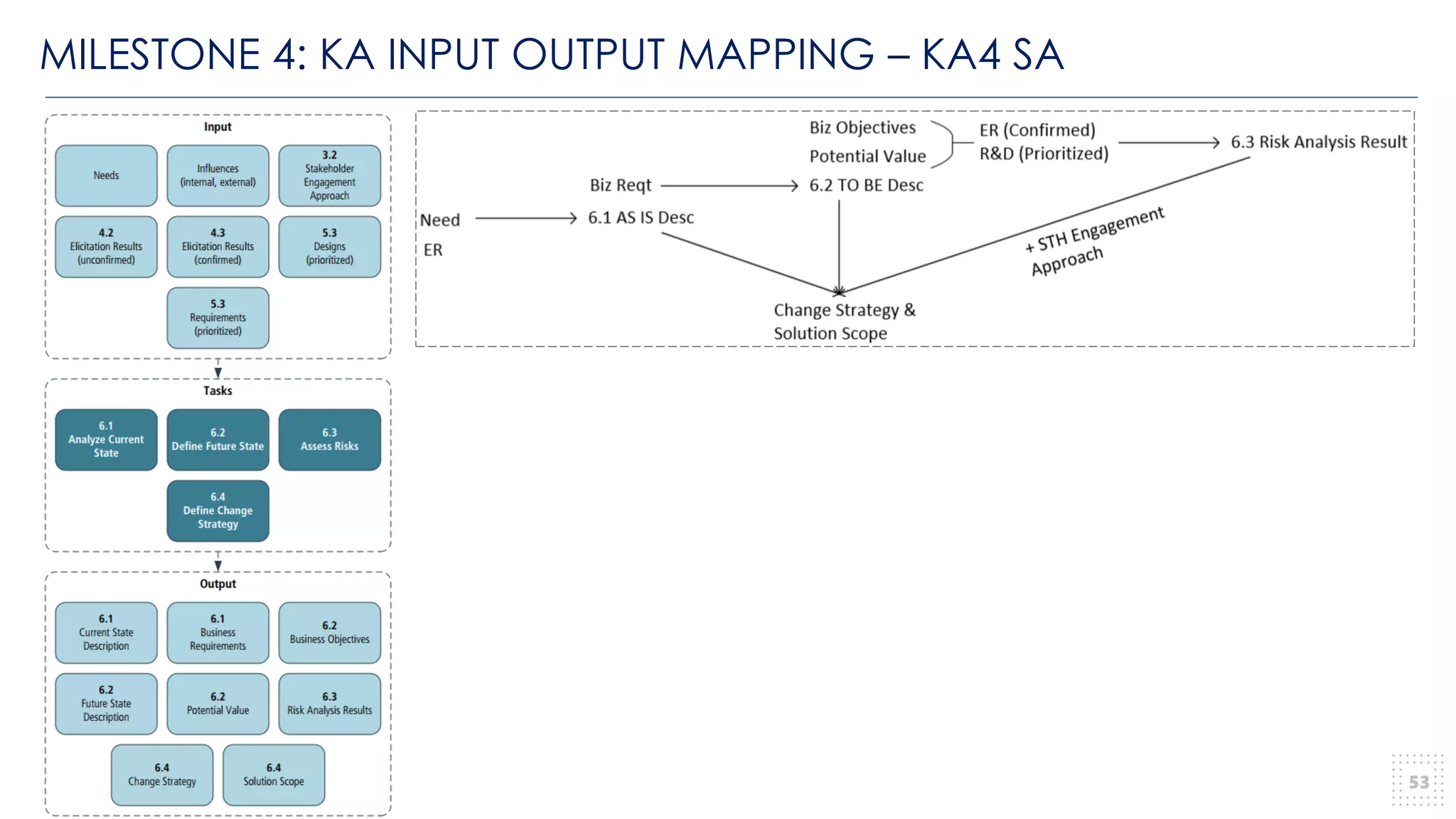
MILESTONE 4: KA INPUT OUTPUT MAPPING – KA4 SA
53
MILESTONE 4: KA INPUT OUTPUT MAPPING – KA4 RADD
54
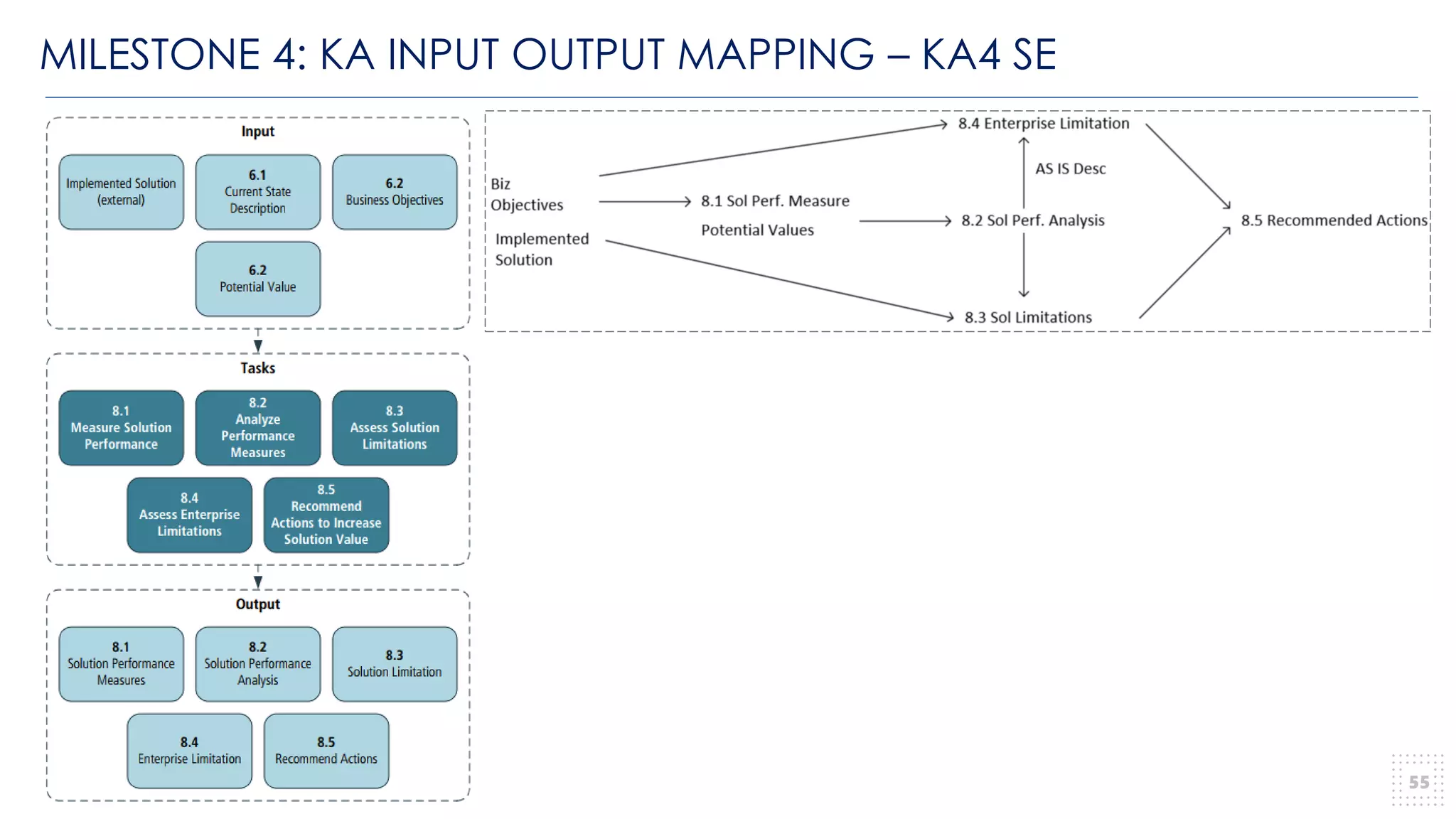
MILESTONE 4: KA INPUT OUTPUT MAPPING – KA4 SE
55
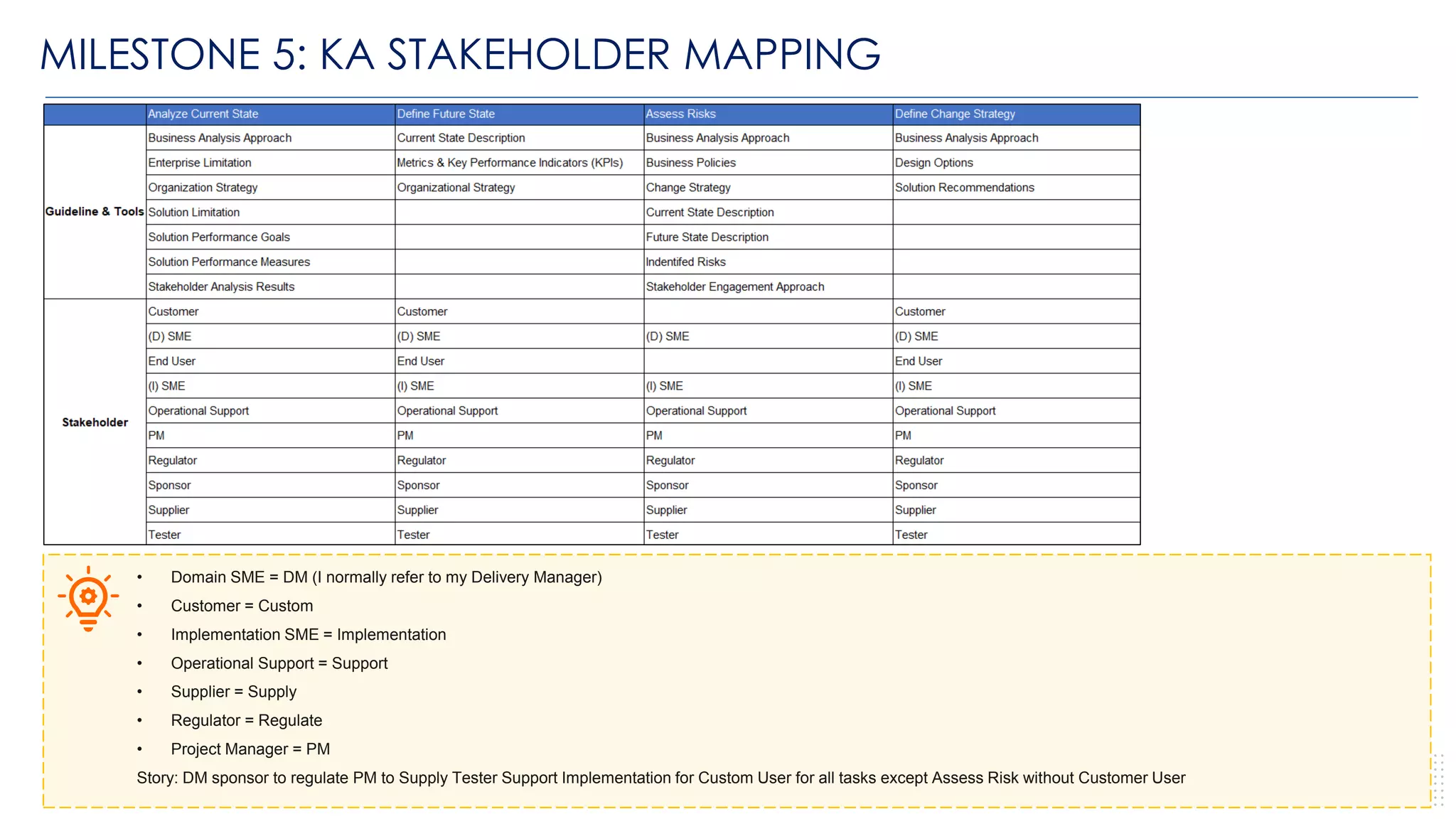
MILESTONE 5: KA STAKEHOLDER MAPPING
56
• Domain SME = DM (I normally refer to my Delivery Manager)
• Customer = Custom
• Implementation SME = Implementation
• Operational Support = Support
• Supplier = Supply
• Regulator = Regulate
• Project Manager = PM
Story: DM sponsor to regulate PM to Supply Tester Support Implementation for Custom User for all tasks except Assess Risk without Customer User
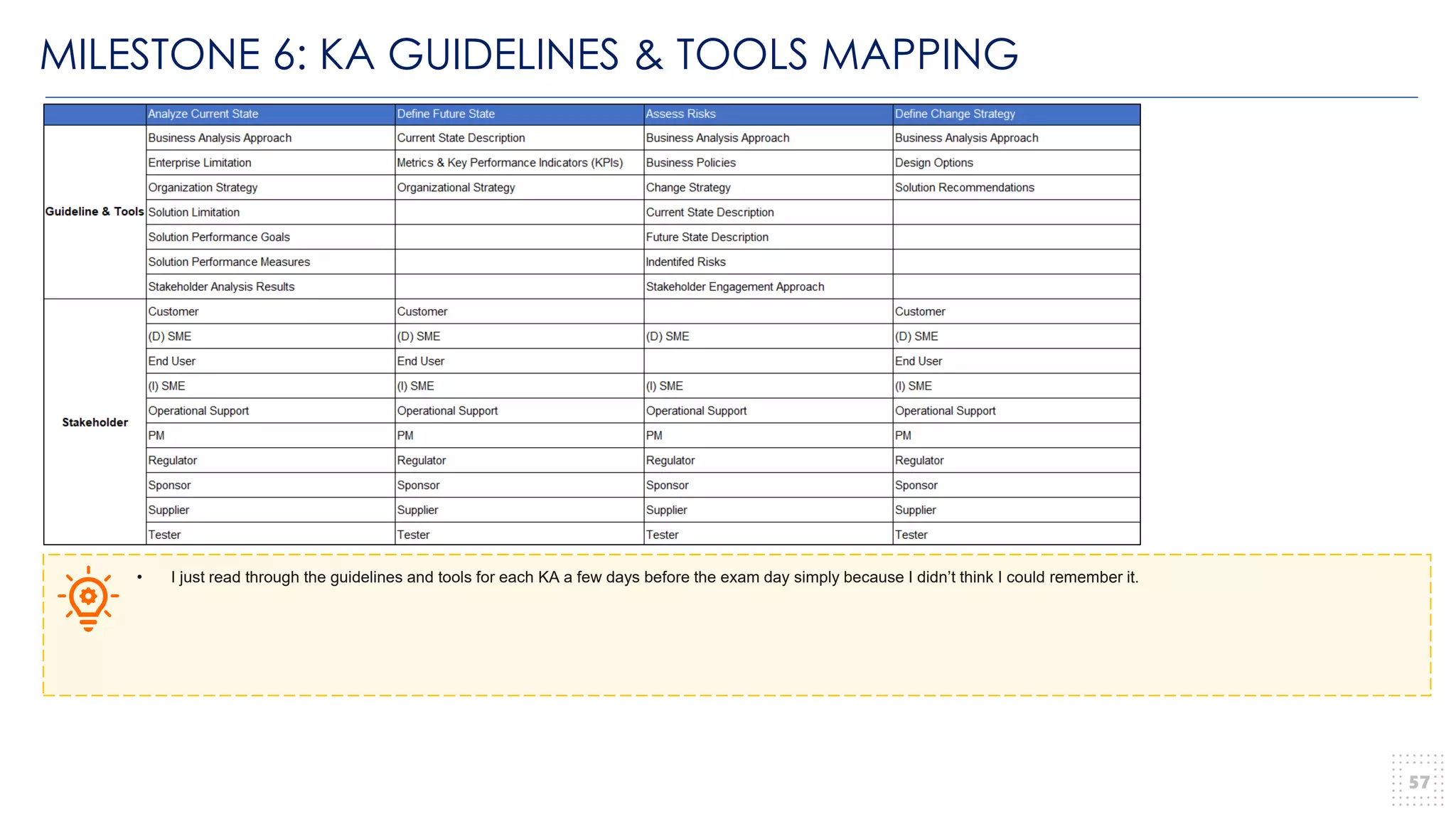
MILESTONE 6: KA GUIDELINES & TOOLS MAPPING
57
• I just read through the guidelines and tools for each KA a few days before the exam day simply because I didn’t think I could remember it.
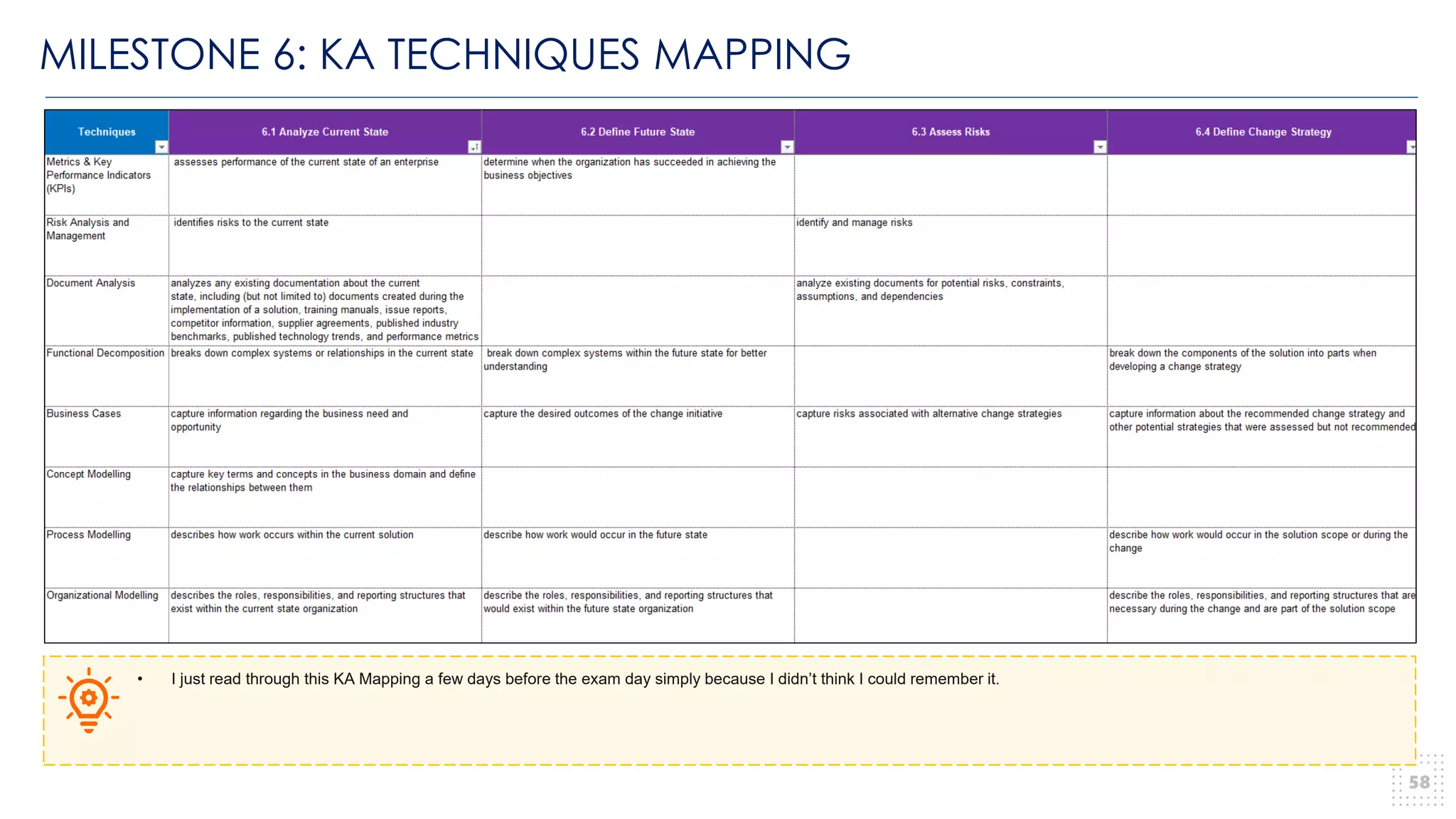
MILESTONE 6: KA TECHNIQUES MAPPING
58
• I just read through this KA Mapping a few days before the exam day simply because I didn’t think I could remember it.
MILESTONE 7: PERSPECTIVES
59
• I just read through these perspectives a few days
before the exam day because IIBA will focus on
your understanding through scenarios and ask
what perspective it is to have for a Business
Analyst.
STAGE 3:
BEFORE THE EXAM DAY
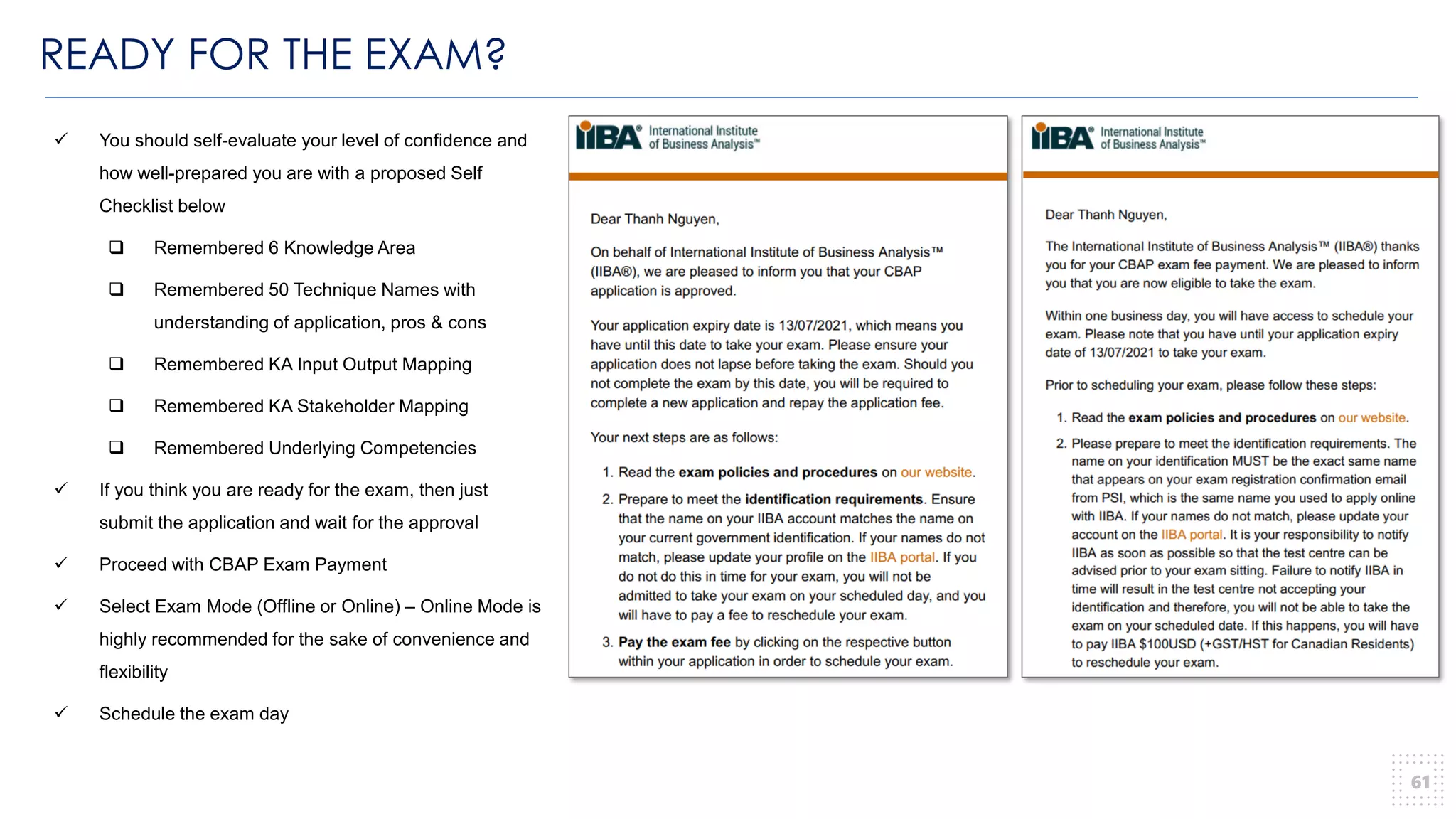
READY FOR THE EXAM?
61
✓ You should self-evaluate your level of confidence and
how well-prepared you are with a proposed Self
Checklist below
❑ Remembered 6 Knowledge Area
❑ Remembered 50 Technique Names with
understanding of application, pros & cons
❑ Remembered KA Input Output Mapping
❑ Remembered KA Stakeholder Mapping
❑ Remembered Underlying Competencies
✓ If you think you are ready for the exam, then just
submit the application and wait for the approval
✓ Proceed with CBAP Exam Payment
✓ Select Exam Mode (Offline or Online) – Online Mode is
highly recommended for the sake of convenience and
flexibility
✓ Schedule the exam day
BEFORE THE EXAM DAY
62
✓ Good night’s rest
✓ Take a break and relax 1 – 2 days before the exam day
✓ Read BABOK once more 2 – 3 days before the exam day by concentrating on those areas that you cannot remember such as KA &
Techniques Mapping, Guidelines & Tools and Perspectives
✓ Write a Brain Dump Sheet – I called it Brain Dump because I usually throw all stuff out of my head days before the exam as one of
revision approaches
✓ Choose a room that you are going to use for your final exam and do the simulation test for 3 hours just to get familiarized with the real
experience
PRACTICE BRAIN DUMP SHEET
63
STAGE 4:
ON THE EXAM DAY
ON THE EXAM DAY – ONLINE MODE RULES FROM PSI ONLINE
65
You must have the following Mandatory Form of Identification to present to the remote proctor prior to exam launch. All information must be demonstrated by a single
form of identification and cannot be handwritten. If there is any doubt surrounding your identity, you will be turned away from the test and will forfeit your exam fees.
Identification:
✓ All Candidates MUST present ONE form of identification. All identification presented must be current or unexpired and contain a photo and signature.
✓ Acceptable forms of identification include: Driver's License, State identity card (non-driver license), Passport, Passport card, Military ID, Green Card, Alien
registration, Permanent resident card, or National identification card.
Day of Exam Expectations:
✓ On the day of your exam, please login up to 15 minutes early.
✓ You will need to log into www.iiba.org to initiate the exam launch process.
✓ You will be prompted to download the secure browser.
✓ You will be required to perform a System Compatibility Check and must ensure that all of your computer system items are satisfactory before being able to proceed.
✓ You will be required to provide one current, valid, Government issued ID with a photo.
✓ Please ensure your testing environment is clear, quiet, and free from distractions.
✓ A Web camera and microphone are required for testing.
Exam Cancellation and Rescheduling Policy:
✓ Exams must be canceled or rescheduled 48 hours before the scheduled appointment time.
✓ Failure to cancel or reschedule within this time will result in forfeiting exam fees.
✓ By not starting your exam within 15 minutes after your scheduled appointment time, you automatically forfeit your examination scheduling fee or exam eligibility. Fees
and exam eligibilities are non-refundable.
Candidates should review the Exam Day webpage for further information and exam day rules.
Source: https://www.psionline.com/en-gb/company/about-us/
ON THE EXAM DAY
66
✓ Eat 1 or 2 hours ahead of scheduled time
✓ Show up 30 minutes before the scheduled time
✓ Bring 1 pen / pencil and a piece of paper for taking notes or writing calculated numbers (this is quite important and time-saving as the
built-in calculator within the Exam Application is tedious. You must click number by number and operators to compute the total,
sometimes you accidentally hit the wrong one, then starting the whole process again which is a waste of time. So, it is recommended to
write down your sub totals and add up the total to avoid rework and frustration)
✓ Find a quite room without distractions from outsiders and noise
✓ Wear a jacket if you plan to sit in a room with an air-condition on
DURING THE EXAM
67
✓ You need to turn on your camera all the time
✓ There is an instruction who will ask you to rotate the camera around the room to do site inspection
✓ A built-in chat box will be provided within the exam application to provide ad-hoc support and inquiries
✓ The real exam will be much harder than the simulated tests. You might be overwhelmed by lengthy case studies and questions with A4
paper each and it takes you more than half of the duration to kill only 1/3 of the questions. No worries, keep moving and doing the best
you can as the rest can be faster and easier
✓ Control your speed not too quickly to get sloppy and miss something simple
✓ Read question twice and apply elimination strategy to eliminate those surely incorrect answers even though you are certain about the
correct answer, you’ll have a better chance of hitting an accurate one.
✓ Flag up any uncertain questions to come back when you have completed 120 questions
SUBMIT THE EXAM
68
✓ Once you’ve completed the exam, don’t submit yet
✓ Spend a few minutes to re-look at your unsure questions
✓ After you’ve checked your answers, then submit the exam
✓ Once you’ve submitted, you will be notified whether you’ve passed or
failed the exam upon completion. This appears first on the computer
screen
✓ You will receive an email from IIBA regarding your result and an
instruction to proceed with Certificate of Achievement
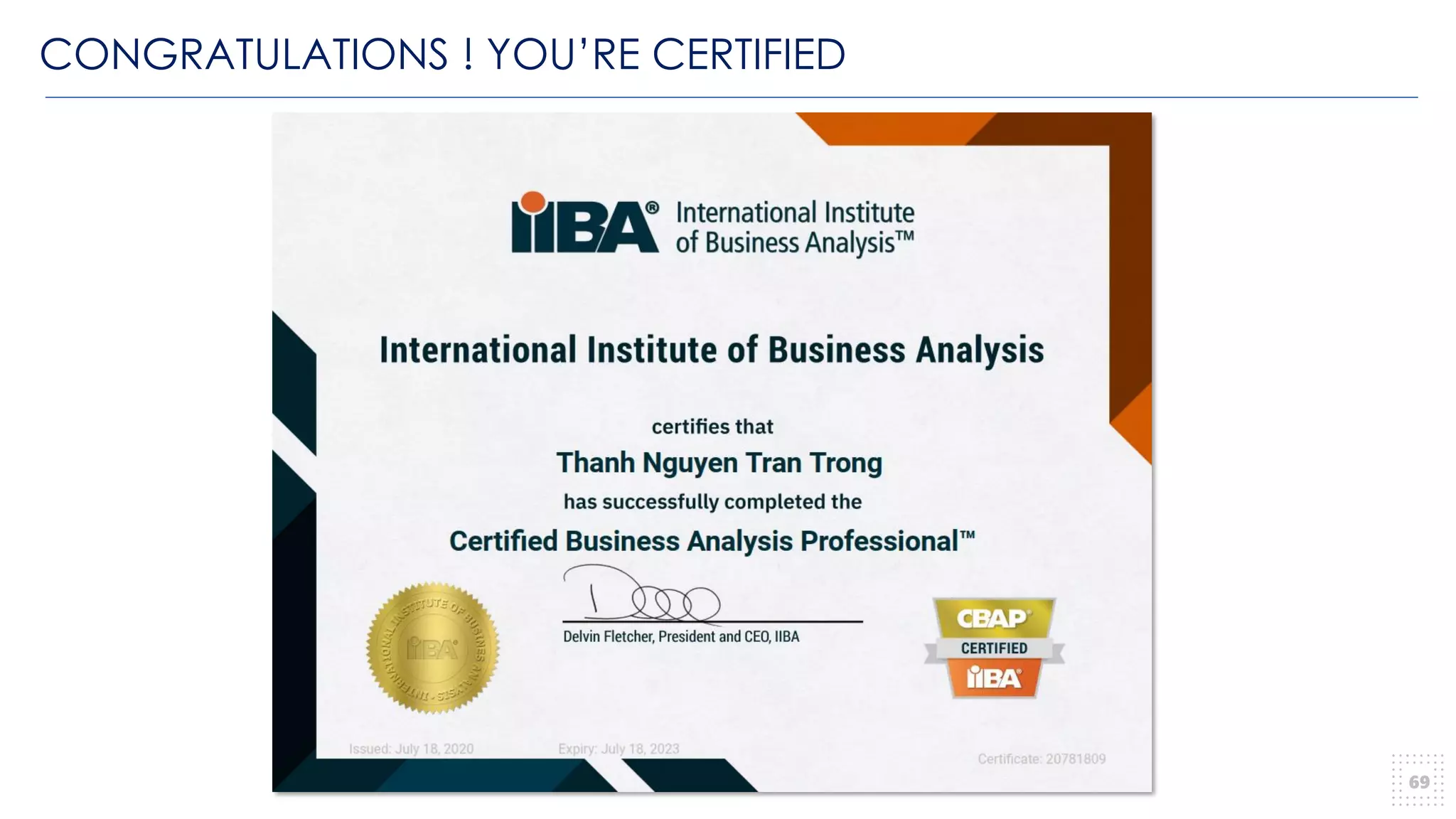
CONGRATULATIONS ! YOU’RE CERTIFIED
69
LIFE AFTER CBAP
RETAINING CBAP REQUIREMENTS
71
3
Years
Validity
✓ Your CBAP Certificate can be valid for 3 years.
You must renew your certificate if you still want
to be continuously certified
✓ 60 PDUs
✓ Recertification Fee US$ 120.00
Thank you and Good Luck !

A Strategy to conquer CBAP examination

  • 1.
    A STRATEGY TOCONQUER CBAP® EXAMINATION BA Sharing Series Ryan Thanh Nguyen (CBAP®) @LinkedIn
  • 2.
    AGENDA 2 ✓ Stage 1:Application & Preparation Process ✓ Stage 2: 7-Milestone Learning Strategy ✓ Stage 3: Before the exam day ✓ Stage 4: On the exam day ✓ Life After CBAP
  • 3.
    WELCOME 3 Hi There, Thank youfor downloading this CBAP Learning Pack. This slide was prepared based on the following assumptions: ✓ BABOK v3 ✓ Personal Learning Experience of the author who maintained working and learning at the same time ✓ Focusing on the learning strategy rather than explanation of key concepts and elements in BABOK ✓ CBAP Exam Online Mode ✓ The same learning path can be applied to ECBA / CCBA / CBAP I hope you join me on this journey of pursuing CBAP and find something useful from this learning pack. Enjoy your learning and Good Luck !
  • 4.
    CBAP PREREQUISITES 4 3.5 Hours 120 Questions ✓ Completea minimum of 7,500 hours of Business Analysis Work experience in the last 10 years. ✓ Within this experience, a minimum of 900 hours completed in 4 of the 6 BABOK® Guide Knowledge Areas, for a total of at least 3,600 of the required 7,500 total. ✓ Complete a minimum of 35 hours of Professional Development in the last 4 years. ✓ Provide two references from a career manager, client or Certified Business Analysis Professional - CBAP® ✓ Agree to Code of Conduct. ✓ Agree to Terms and Conditions. ✓ Pass the exam.
  • 5.
    CBAP STRUCTURES 5 Knowledge AreaWeighted Perc. No of Questions KA1: Business Analysis Planning & Monitoring 14% 16 – 17 KA2: Elicitation & Collaboration 12% 14 – 15 KA3: Requirement Life Cycle Management 15% 18 KA4: Strategy Analysis 15% 18 KA5: Requirement Analysis & Design Definition 30% 36 KA6: Solution Evaluation 14% 16 – 17 Total 100% 120
  • 6.
    OVERALL LEARNING MILESTONES 6 Application Process Milestone1 6 Knowledge Areas Milestone 2 50 Techniques Simulation Test 1 120 questions in 3.5 hours Simulation Test 2 120 questions in 3.5 hours Milestone 4 Competencies Milestone 3 KA Input Output Mapping Milestone 5 KA Stakeholder Mapping Simulation Test 3 120 questions in 3.5 hours Submit Application • Complete Application • Pay App. Fee • Wait for Approval • Pay Exam Fee • Select Exam Day Before Exam Day 1 – 2 weeks before the exam day Break 1 – 2 days before the exam day Exam Day Milestone 6 KA Guidelines & Tools Mapping Milestone 7 KA Techniques Mapping & Perspectives Simulation Test 4 120 questions in 3.5 hours
  • 7.
    TOTAL DAMAGE 7 Item Option 1 (StudyAlone) Option 2 (Study in a group of 3 ppl.) Option 3 (Study in a group of 5 ppl.) Simulation Test $159 $53 ($159 / 3) $32 ($159 / 5) 35 PDUs $19 $19 $19 Application Fee $125 $125 $125 CBAP Exam Fee $450 $450 $450 Total Cost $753 $647 $626 The figures above are calculated in US Dollar (USD)
  • 8.
    SELF-STUDY CHECKLIST 8 Topic ScheduleOutcome Application & Preparation Process Week 0 • Pursue Online Courses to earn 35 PDUs • Start Application Process with IIBA • Record Experience KA1: Business Analysis Planning & Monitoring Week 1 • 70% accuracy or above in Drill Test (25 Questions) KA 2: Elicitation & Collaboration Week 2 • 70% accuracy or above in Drill Test (25 Questions) KA3: Requirement Life Cycle Management Week 3 • 70% accuracy or above in Drill Test (25 Questions) KA4: Strategy Analysis Week 4 • 70% accuracy or above in Drill Test (25 Questions) KA5: Requirement Analysis & Design Definition Week 5 • 70% accuracy or above in Drill Test (25 Questions) KA6: Solution Evaluation Week 6 • 70% accuracy or above in Drill Test (25 Questions) Simulation Test 1 Week 6 • 60% accuracy or above in Simulation Test (120 Questions) 50 Techniques Week 7 • 70% accuracy or above in Drill Test (25 Questions) 50 Techniques (Cont.) Week 8 • 80% accuracy or above in Drill Test (25 Questions) Simulation Test 2 Week 8 • 70% accuracy or above in Simulation Test (120 Questions)
  • 9.
    SELF-STUDY CHECKLIST (CONT.) 9 TopicSchedule Outcome Competencies Week 9 • 70% accuracy or above in Drill Test (25 Questions) KA Input Output Mapping Week 9 • 70% accuracy or above in Drill Test (25 Questions) KA Stakeholder Mapping Week 10 • 70% accuracy or above in Drill Test (25 Questions) Simulation Test 3 Week 10 • 75% accuracy or above in Simulation Test (120 Questions) KA Guidelines & Tools Mapping Week 11 KA Techniques Mapping & Perspectives Week 11 Simulation Test 4 Week 11 • 80% accuracy or above in Simulation Test (120 Questions) Submit Application & CBAP Exam Week 11 • Pay Application Fee • Submit Application • Wait for Application Approval • Pay CBAP Exam Fee • Schedule an exam day CBAP Exam Week 12
  • 10.
    BEFORE YOU GO 10 Beforeyou divine into details, make sure you have the following checked: ❑ Mind Map Tool – I used XMind for note taking and summary, if you want to re-use my learning materials mentioned below, then recommended to use the same software (Free Trial Version) ❑ BABOK v3 ❑ 6 Knowledge Area Material ❑ 50 Techniques Material ❑ Underlying Competencies Material ❑ KA Input Output Mapping Material ❑ KA Stakeholder Guideline Tool Mapping Material ❑ Perspective Material ❑ KA Techniques Mapping Material ❑ CCBA / CBAP Experience Recording Excel If you haven’t received above materials, please reach out to me via LinkedIn or Email: thanhntt3007@gmail.com
  • 11.
    STAGE 1: APPLICATION &PREPARATION PROCESS
  • 12.
    APPLICATION PROCESS 12 Step 1: Registerat IIBA Step 2: Record BA Experience Step 3: Earn 35 PDUs Step 4: Submit CBAP Application & Pay Fee Step 5: Provide 2 Referees Step 6: Purchase Simulation Test
  • 13.
    STEP 1: REGISTERAT IIBA 13 IIBA Page: https://www.iiba.org/certification/iiba- certifications/cbap/
  • 14.
    STEP 1: REGISTERAT IIBA (CONT.) 14 Certification >> My Certifications
  • 15.
    STEP 2: RECORDBA EXPERIENCE IN EXCEL 15 You can use the CCBA / CBAP Experience Recording Tool (Excel) with built-in calculation to help you accurately calculate your experience, considering calendar days and holidays Source: twitter @davidjcmorris, twitter: @thebacoach
  • 16.
    STEP 2: TRANSFEREXPERIENCE TO IIBA PORTAL 16
  • 17.
    STEP 3: EARN35 PDUS – CHECK EEP 17 There are several ways to achieve 35 PDUs either from Online Courses or Training Centers endorsed by IIBA. Prior to attempting to earn 35 PDUs, make sure you check out the latest Endorsed Education Provider (EEP) from IIBA. https://www.iiba.org/membership/eep/
  • 18.
    STEP 3: EARN35 PDUS – SEARCH EEP IN IBBA 18 After taking all these courses from PluralSight, you can earn more than required by CBAP Requirements
  • 19.
    STEP 3: EARN35 PDUS – BUY MOOCS COURSES 19 I chose option #1 with a monthly rate @ 19USD for 1 month only
  • 20.
    STEP 3: EARN35 PDUS – GET CERTIFICATES 20 After completed each course, you will be able to get this Certificate of Completion for audit purposes by IIBA
  • 21.
    STEP 3: EARN35 PDUS – DECLARE PDU IN IIBA 21 Declare all certificates into IIBA, remember these records become unmodifiable after 7 days commencing from the point of declaration
  • 22.
    STEP 4: SUBMITCBAP APPLICATION 22
  • 23.
    STEP 5: PROVIDE2 REFEREES 23 Upon paying the application fee, IIBA will ask you to provide 2 referees to complete your application before proceeding with CBAP Exam Stage Referees could be any 2 of the following: ✓ CBAP Holder ✓ Line Manager ✓ Project / Program / Deliver Manager ✓ Clients Make sure you give your referees heads-up beforehand in case of IIBA calling them to verify our application and audit purposes later. Referee 1 Referee 2 Contact Name Contact Emai Contact Phone Number Contact Relationship
  • 24.
    STEP 6: PURCHASESIMULATION TEST 24 I would recommend Watermark Exams for Simulation Test Provider because of the following reasons: (1) Providing latest version in line with BABOK version – do check out the latest version of exam before subscription (2) Providing a Drill Test Option that focuses on a specific area or topic that we want to test (KA, Techniques…) (3) Providing a detailed explanation on the correct / incorrect answers to shape your understanding of question structures I selected option 3 with 90 days at US$ 159 and if you study in a group of 3 – 5 members this cost can be shared. However, the downside of it is that only 1 person can take a test at a point in time, hence you must arrange upfront with other members before checking in to avoid clash Source: https://watermarkexams.com/exam/index.php
  • 25.
    STEP 6: PURCHASESIMULATION TEST (CONT.) 25
  • 26.
    STEP 6: PURCHASESIMULATION TEST (CONT.) 26
  • 27.
  • 28.
    7-MILESTONE LEARNING STRATEGY 28 Milestone1: 6 KA Milestone 2: 50 Techniques Milestone 3: KA Input Output Mapping Milestone 4: Competencies Milestone 5: KA Stakeholder Mapping Milestone 6: KA Guideline Tool Mapping Milestone 7: KA Techniques Mapping & Perspectives Duration 6 Weeks 2 Weeks 1 Week 1 Week 1 Week Read before the exam day Read before the exam day LearningTechniques • Skim & Scan BABOK • Mind Map Summary • Telling a story and mnemonic • Take a Drill Test specific to the topic • Skim & Scan BABOK • Mind Map Summary • Telling a story and mnemonic • Take a Drill Test specific to the topic • Skim & Scan BABOK • Draw a I/O Diagram • Take a Drill Test specific to the topic • Skim & Scan BABOK • Mind Map Summary • Excel Summary • Telling a story and mnemonic • Take a Drill Test specific to the topic • Skim & Scan BABOK • Excel Summary • Telling a story and mnemonic • Take a Drill Test specific to the topic • Skim & Scan BABOK • Excel Summary • Take a Drill Test specific to the topic • Skim & Scan BABOK • Excel Summary • Telling a story and mnemonic • Take a Drill Test specific to the topic
  • 29.
    MILESTONE 1: 6KNOWLEDGE AREAS 29 KA1 Business Analysis Planning & Monitoring KA3 Requirement Life Cycle Management KA5 Requirement Analysis & Design Definition KA2 Elicitation & Collaboration KA4 Strategy Analysis KA6 Solution Evaluation How to study for each KA? 1. Skim & Scan BABOK for each KA to build Mind Map Skeleton 2. Read BABOK again to summarize KA Description & Elements 3. Make up a story or mnemonic 4. Memorize the story or mnemonic 5. Write down everything on a paper from your memory 6. Take a Drill Test 7. Review Test Results 8. Re-read notes / BABOK on those areas of uncertainty or inaccuracy until you score 70% or above Refer to the next slides for a demonstrated example of BAPM
  • 30.
    “PLEASE” MNEMONIC FOR6 KAS 30 PLEASE P - Business Analysis Planning & Monitoring L - Requirement Life Cycle Management E - Elicitation & Collaboration A - Requirement Analysis & Design Definition S - Strategy Analysis E - Solution Evaluation
  • 31.
    KA1 BUSINESS ANALYSISPLANNING & MONITORING 31 KA1 Business Analysis Planning & Monitoring Task in this KA: • 3.1 Plan BA Approach • 3.2 Plan Stakeholder Engagement • 3.3 Plan BA Information Management • 3.4 Plan BA Governance • 3.5 Identify BA Performance Improvement PEAGI P - Identify BA Performance Improvement E - Plan Stakeholder Engagement A - Plan BA Approach G - Plan BA Governance I - Plan BA Information Management
  • 32.
    STEP 1: SKIM& SCAN BABOK TO BUILD MIND MAP SKELETON 32 • Skim and Scan the KA in BABOK • Highlight main points • Copy & Paste Description & Elements into Mind Map as below • The goal is to build Mind Map Skeleton first and once done we will read it more purposely and fast next times. This activity should take you up to 10 minutes
  • 33.
    STEP 2: SUMMARIZEKA DESCRIPTION & ELEMENTS 33 • Read the KA again to flesh out details for the earlier-constructed skeleton • Highlight keywords in BABOK • Try to paraphrase and summarize in your own words • Write into Mind Map as brief as possible but keep the keywords (eg. Minimize upfront uncertainty / risk or maximize control) This activity should take you up to 30 minutes
  • 34.
    STEP 3: MAKEA STORY & MNEMONIC 34 • Make up your own stories and mnemonic from your notes • Remember good things take time, lots of people failed at the step because they are reluctant to brainstorm a story that relates to their daily lives • The more related to your daily lives, the fast and longer you remember Refer to a sample story below 3.1 Plan BA Approach [Story: Plan BA Work, Methodologies, Activities & Task & Deliverables using CAT PAD Elements] - (C)omplexity & Risk [Story: Scale NoS by GEO & TECH] - BA (A)ctivities [Predictive, Deliverables >> Activities >> Task, Adaptive, Activities into Iterations >> Asso. Deliverables >> Task] - (T)iming of BA Work requires Urgent, Dependent Work to be done in Sequence by Available Resource - (P)lanning with Predictive Adaptive - (A)cceptance - Level of Detail of (D)eliverables [Story: High Turnover Rate, Maturity Inhouse Team accept Complexity 7 Risk to sign a Contract with Highly Regulated Industry to document KB for re-use to Distributed Stakeholders]
  • 35.
    STEP 4: MEMORIZESTORIES & MNEMONIC 35 • Now what you need to do is to learn by heart the following story 3.1 Plan BA Approach [Story: Plan BA Work, Methodologies, Activities & Task & Deliverables using CAT PAD Elements] - (C)omplexity & Risk [Story: Scale NoS by GEO & TECH] - BA (A)ctivities [Predictive, Deliverables >> Activities >> Task, Adaptive, Activities into Iterations >> Asso. Deliverables >> Task] - (T)iming of BA Work requires Urgent, Dependent Work to be done in Sequence by Available Resource - (P)lanning with Predictive Adaptive - (A)cceptance - Level of Detail of (D)eliverables [Story: High Turnover Rate, Maturity Inhouse Team accept Complexity 7 Risk to sign a Contract with Highly Regulated Industry to document KB for re-use to Distributed Stakeholders]
  • 36.
    STEP 5: WRITEDOWN ON PAPER WITHOUT LOOKING AT BABOK 36 • Write down as much as you remember on a paper • It is okay if you can’t remember them all the 1st time • Keep going until you remember them all
  • 37.
    STEP 6: TAKEA DRILL TEST 37
  • 38.
    STEP 6: TAKEA DRILL TEST (CONT.) 38
  • 39.
    STEP 7: REVIEWTEST RESULTS 39
  • 40.
    STEP 8: RE-READNOTES UNTIL 70% ACCURACY OR ABOVE 40
  • 41.
    KA BAPM –3.2 PLAN STAKEHOLDER ENGAGEMENT 41 3.2 Plan Stakeholder Engagement Plan, Build, Maintain Relationship with Stakeholders by using SASCSC elements - (SA) Stakeholder Analysis to identify Source for Stakeholder Role as Decision Maker with Influence and Attributes towards SPONSOR has GOAL / INTEREST on TEAM MEMBERS & Collaboration) - (SC) Stakeholder Collaboration to know Stakeholder's Preferred Delivery Method to collaborate Frequently WHEN and WHERE (SCOM) Stakeholder Communication Needs 4W 1h FeFoDe
  • 42.
    KA BAPM –3.3 PLAN BA GOVERNANCE 42 Description: Define Reqt Prioritization, Approval, Decision Making and CR Process - RACI DM (Reviewed by Reviewer, Approved by Approver, Consulted by SME and Informed to Participants) - Prioritization [Story: Participant CRI with TECH and FORMAT because Resource use Methodologies to deliver values with risky and dependent timeline] - Approval Process [Story: BA follows Approval Process to submit Type of Reqt for x Days to Approvers and Stakeholders who are available, good attitude and willing to engage] - CR Process [Story: Stakeholders request CR with CABE COPR Attributes to BA to prioritized, documented, communicated and impact analyzed and seek approval from Approver] CABE CORP: (CA) Course of Actions (BE) Benefit (CO) Cost (R) Risk (P) Priority
  • 43.
    KA BAPM –3.4 PLAN BA INFORMATION MANAGEMENT 43 BA Infor can be stored and accessed by Abstract Infor Organized, Traced, Stored & Accessed by ORG STANDARD defines WHO FREQUENTLY & CONDITIONALLY access WHAT TOOLs with CARA'S SOUPS Attributes for Re-Use by REGULATIONs CONTRACTs with Quality Standards to define SLA, Rules, Process, Reqt & Common Functionalities CARA’S SOUPS • (C) Complexity • (A) Author • (R) Risk • (A) Absolute Reference (ID) • (S) Status • (S) Source • (O) Ownership • (U) Urgency • (P) Priority • (S) Stability
  • 44.
    KA BAPM –3.4 IDENTIFY BA PERFORMANCE IMPROVEMENT 44 To assess BA work and Improvement Plan to identify improvements as guidelines for next time task execution by using elements QQ (Qualitative / Quantitative) SOSAKET Sourced MEASUREs to ANALYZE PERFORMANCE ANALYSIS with BA Process, Resource & Deliverables to RECOM PIC SOSAKET (S) Significance (Benefits) (O) Organization Support (Enough resource to support BA Task) (S) Strategic (Meet Objectives) (A) Accuracy & Completeness (BA Work accurate) (K) Knowledge (BA Skill / Knowledge) (E) Effectiveness (Easy to use deliverables) (T) Timeliness (On Time Deliverables) BA's Work is significant with Organization Support to meet Strategic goals with accurate knowledge, effective and timely deliverables
  • 45.
    RECAP 45 ✓ By nowyou’ve learnt how to summarize and study each task in the KA ✓ Follow this instruction to complete the remaining tasks of each KA and for all KAs ✓ Remember the Forgetting Curve and have frequent revisions with 1-1-1 rules (1 Day 1 Week 1 Month) ✓ Summarize in your own stories and words, you can copy my ideas but should not be exactly word by word https://intelalearning.wordpress.com/2018/07/19/learning-myth-1-ebbinghaus-forgetting-curve/
  • 46.
    MILESTONE 2: HOWTO REMEMBER 50 TECHNIQUE NAMES 46 DIP OF RIBS for Elicitation Techniques • Document Analysis • Interface Analysis • Prototyping • Observation • Focus Groups • Requirement Workshops • Interviews • Brainstorming • Survey & Questionnaire DCD SPOS for Modelling Techniques • Decision Modelling • Concept Modelling • Data Modelling • Scope Modelling • Process Modelling • Organizational Modelling • State Modelling Non-PRD BMCR SWOT for Analysis Techniques • Non-functional Requirements Analysis • Process Analysis • Root Cause Analysis • Decision Analysis • Benchmarking & Market Analysis • Business Capability Analysis • Business Rules Analysis • SWOT Analysis Lesson Learned from Risk & Item Tracking to decompose Function using Mind Map for FA Estimation with Vendor B4 Review Prioritization with Role Matrix PLM Stakeholder in Collaborative Games to write D3Sequece Glossary in AC/KPIs in US/UC. • Lesson Learned • Item Tracking • Risk Analysis Management • Functional Decomposition • Financial Analysis • Estimation • Vendor Assessment • Balanced Scorecard • Business Canvas Model • Backlog Management • Business Case • Review • Prioritization • Role Matrix • Stakeholder Persona List Map • Collaborative Games • Data Dictionary • Data Flow Diagram • Data Mining • Sequence Diagram • Acceptance Criteria • KPI • User Story • Use Case
  • 47.
    MILESTONE 2: 50TECHNIQUE SUMMARY 47
  • 48.
    MILESTONE 3: UNDERLYINGCOMPETENCIES 48
  • 49.
    MILESTONE 3: UNDERLYINGCOMPETENCIES (CONT.) 49
  • 50.
    MILESTONE 4: KAINPUT OUTPUT MAPPING – KA1 BAPM 50 Transform input and output within the KA into this diagram for ease of remembering
  • 51.
    MILESTONE 4: KAINPUT OUTPUT MAPPING – KA2 E&C 51
  • 52.
    MILESTONE 4: KAINPUT OUTPUT MAPPING – KA3 RLCM 52
  • 53.
    MILESTONE 4: KAINPUT OUTPUT MAPPING – KA4 SA 53
  • 54.
    MILESTONE 4: KAINPUT OUTPUT MAPPING – KA4 RADD 54
  • 55.
    MILESTONE 4: KAINPUT OUTPUT MAPPING – KA4 SE 55
  • 56.
    MILESTONE 5: KASTAKEHOLDER MAPPING 56 • Domain SME = DM (I normally refer to my Delivery Manager) • Customer = Custom • Implementation SME = Implementation • Operational Support = Support • Supplier = Supply • Regulator = Regulate • Project Manager = PM Story: DM sponsor to regulate PM to Supply Tester Support Implementation for Custom User for all tasks except Assess Risk without Customer User
  • 57.
    MILESTONE 6: KAGUIDELINES & TOOLS MAPPING 57 • I just read through the guidelines and tools for each KA a few days before the exam day simply because I didn’t think I could remember it.
  • 58.
    MILESTONE 6: KATECHNIQUES MAPPING 58 • I just read through this KA Mapping a few days before the exam day simply because I didn’t think I could remember it.
  • 59.
    MILESTONE 7: PERSPECTIVES 59 •I just read through these perspectives a few days before the exam day because IIBA will focus on your understanding through scenarios and ask what perspective it is to have for a Business Analyst.
  • 60.
  • 61.
    READY FOR THEEXAM? 61 ✓ You should self-evaluate your level of confidence and how well-prepared you are with a proposed Self Checklist below ❑ Remembered 6 Knowledge Area ❑ Remembered 50 Technique Names with understanding of application, pros & cons ❑ Remembered KA Input Output Mapping ❑ Remembered KA Stakeholder Mapping ❑ Remembered Underlying Competencies ✓ If you think you are ready for the exam, then just submit the application and wait for the approval ✓ Proceed with CBAP Exam Payment ✓ Select Exam Mode (Offline or Online) – Online Mode is highly recommended for the sake of convenience and flexibility ✓ Schedule the exam day
  • 62.
    BEFORE THE EXAMDAY 62 ✓ Good night’s rest ✓ Take a break and relax 1 – 2 days before the exam day ✓ Read BABOK once more 2 – 3 days before the exam day by concentrating on those areas that you cannot remember such as KA & Techniques Mapping, Guidelines & Tools and Perspectives ✓ Write a Brain Dump Sheet – I called it Brain Dump because I usually throw all stuff out of my head days before the exam as one of revision approaches ✓ Choose a room that you are going to use for your final exam and do the simulation test for 3 hours just to get familiarized with the real experience
  • 63.
  • 64.
  • 65.
    ON THE EXAMDAY – ONLINE MODE RULES FROM PSI ONLINE 65 You must have the following Mandatory Form of Identification to present to the remote proctor prior to exam launch. All information must be demonstrated by a single form of identification and cannot be handwritten. If there is any doubt surrounding your identity, you will be turned away from the test and will forfeit your exam fees. Identification: ✓ All Candidates MUST present ONE form of identification. All identification presented must be current or unexpired and contain a photo and signature. ✓ Acceptable forms of identification include: Driver's License, State identity card (non-driver license), Passport, Passport card, Military ID, Green Card, Alien registration, Permanent resident card, or National identification card. Day of Exam Expectations: ✓ On the day of your exam, please login up to 15 minutes early. ✓ You will need to log into www.iiba.org to initiate the exam launch process. ✓ You will be prompted to download the secure browser. ✓ You will be required to perform a System Compatibility Check and must ensure that all of your computer system items are satisfactory before being able to proceed. ✓ You will be required to provide one current, valid, Government issued ID with a photo. ✓ Please ensure your testing environment is clear, quiet, and free from distractions. ✓ A Web camera and microphone are required for testing. Exam Cancellation and Rescheduling Policy: ✓ Exams must be canceled or rescheduled 48 hours before the scheduled appointment time. ✓ Failure to cancel or reschedule within this time will result in forfeiting exam fees. ✓ By not starting your exam within 15 minutes after your scheduled appointment time, you automatically forfeit your examination scheduling fee or exam eligibility. Fees and exam eligibilities are non-refundable. Candidates should review the Exam Day webpage for further information and exam day rules. Source: https://www.psionline.com/en-gb/company/about-us/
  • 66.
    ON THE EXAMDAY 66 ✓ Eat 1 or 2 hours ahead of scheduled time ✓ Show up 30 minutes before the scheduled time ✓ Bring 1 pen / pencil and a piece of paper for taking notes or writing calculated numbers (this is quite important and time-saving as the built-in calculator within the Exam Application is tedious. You must click number by number and operators to compute the total, sometimes you accidentally hit the wrong one, then starting the whole process again which is a waste of time. So, it is recommended to write down your sub totals and add up the total to avoid rework and frustration) ✓ Find a quite room without distractions from outsiders and noise ✓ Wear a jacket if you plan to sit in a room with an air-condition on
  • 67.
    DURING THE EXAM 67 ✓You need to turn on your camera all the time ✓ There is an instruction who will ask you to rotate the camera around the room to do site inspection ✓ A built-in chat box will be provided within the exam application to provide ad-hoc support and inquiries ✓ The real exam will be much harder than the simulated tests. You might be overwhelmed by lengthy case studies and questions with A4 paper each and it takes you more than half of the duration to kill only 1/3 of the questions. No worries, keep moving and doing the best you can as the rest can be faster and easier ✓ Control your speed not too quickly to get sloppy and miss something simple ✓ Read question twice and apply elimination strategy to eliminate those surely incorrect answers even though you are certain about the correct answer, you’ll have a better chance of hitting an accurate one. ✓ Flag up any uncertain questions to come back when you have completed 120 questions
  • 68.
    SUBMIT THE EXAM 68 ✓Once you’ve completed the exam, don’t submit yet ✓ Spend a few minutes to re-look at your unsure questions ✓ After you’ve checked your answers, then submit the exam ✓ Once you’ve submitted, you will be notified whether you’ve passed or failed the exam upon completion. This appears first on the computer screen ✓ You will receive an email from IIBA regarding your result and an instruction to proceed with Certificate of Achievement
  • 69.
  • 70.
  • 71.
    RETAINING CBAP REQUIREMENTS 71 3 Years Validity ✓Your CBAP Certificate can be valid for 3 years. You must renew your certificate if you still want to be continuously certified ✓ 60 PDUs ✓ Recertification Fee US$ 120.00
  • 72.
    Thank you andGood Luck !