A Practical Guideto ECC to
S/4HANA Migration
The ECC to S/4HANA migration isn't just a technical upgrade—it's a shift
in how businesses operate. This guide provides a grounded look at what
the migration really involves.
by Noel Benjamin DCosta
2.
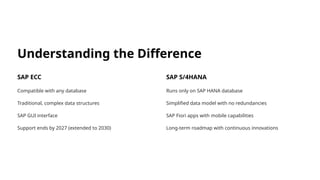
Understanding the Difference
SAPECC
Compatible with any database
Traditional, complex data structures
SAP GUI interface
Support ends by 2027 (extended to 2030)
SAP S/4HANA
Runs only on SAP HANA database
Simplified data model with no redundancies
SAP Fiori apps with mobile capabilities
Long-term roadmap with continuous innovations
3.
Key Business Drivers
Endof ECC Mainstream Support
Support ends in 2027, with costly extended support until 2030.
Real-Time Reporting
S/4HANA offers faster processing with simplified data models.
Integration with Modern Tools
Better fit with cloud environments and real-time APIs.
Process Improvement
Opportunity to streamline workflows and question outdated
practices.
4.
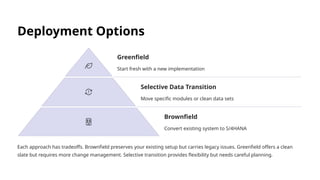
Deployment Options
Greenfield
Start freshwith a new implementation
Selective Data Transition
Move specific modules or clean data sets
Brownfield
Convert existing system to S/4HANA
Each approach has tradeoffs. Brownfield preserves your existing setup but carries legacy issues. Greenfield offers a clean
slate but requires more change management. Selective transition provides flexibility but needs careful planning.
5.
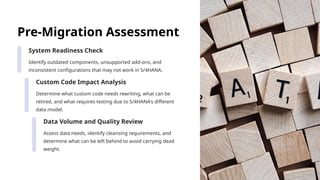
Pre-Migration Assessment
System ReadinessCheck
Identify outdated components, unsupported add-ons, and
inconsistent configurations that may not work in S/4HANA.
Custom Code Impact Analysis
Determine what custom code needs rewriting, what can be
retired, and what requires testing due to S/4HANA's different
data model.
Data Volume and Quality Review
Assess data needs, identify cleansing requirements, and
determine what can be left behind to avoid carrying dead
weight.
6.
Migration Tools and
Accelerators
SAPReadiness
Check
Analyzes system
compatibility,
required add-on
updates, data volume
concerns, and custom
code usage.
SAP
Transformation
Navigator
Helps sketch out
which processes to
replace, new solutions
for your future state,
and roadmap options.
Custom Code
Migration Tools
Scan, analyze, and
semi-automate
remediation of
incompatible custom
code.
7.
Project Phases andChallenges
Planning
Set realistic timelines, budgets, and understand system complexity.
Preparation
Conduct assessments, readiness checks, and initial code reviews.
Realization
Migrate data, adjust custom code, configure new processes.
Testing
Perform end-to-end testing, UAT, and stress testing.
Go-Live and Support
Launch and stabilize the new system.
8.
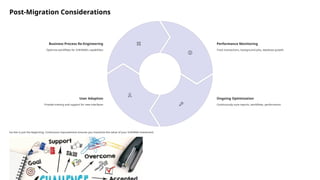
Post-Migration Considerations
Business ProcessRe-Engineering
Optimize workflows for S/4HANA's capabilities
Performance Monitoring
Track transactions, background jobs, database growth
Ongoing Optimization
Continuously tune reports, workflows, performance
User Adoption
Provide training and support for new interfaces
Go-live is just the beginning. Continuous improvement ensures you maximize the value of your S/4HANA investment.