Machine Learning for Big Data
Prof. Dr. Eirini Ntoutsi
FG Intelligent Systems
Faculty of Electrical Engineering and Computer Science
Leibniz University Hannover & L3S Research Center
Introduction to Machine Learning
Overview
 A Machine Learning primer
 Machine Learning in the real world
Prof. Dr. Eirini Ntoutsi - Introduction to Machine Learning
A Machine Learning primer
Prof. Dr. Eirini Ntoutsi - Introduction to Machine Learning
What is Machine Learning?
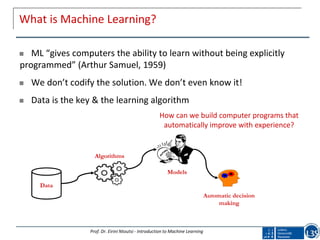
 ML “gives computers the ability to learn without being explicitly
programmed” (Arthur Samuel, 1959)
 We don’t codify the solution. We don’t even know it!
 Data is the key & the learning algorithm
Prof. Dr. Eirini Ntoutsi - Introduction to Machine Learning
Algorithms
Models
Models
Automatic decision
making
Data
How can we build computer programs that
automatically improve with experience?
How do machines learn?
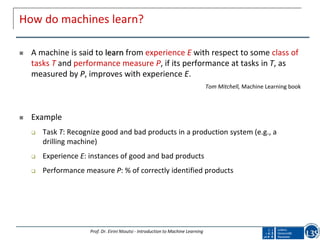
 A machine is said to learn from experience E with respect to some class of
tasks T and performance measure P, if its performance at tasks in T, as
measured by P, improves with experience E.
Tom Mitchell, Machine Learning book
 Example
 Task T: Recognize good and bad products in a production system (e.g., a
drilling machine)
 Experience E: instances of good and bad products
 Performance measure P: % of correctly identified products
Prof. Dr. Eirini Ntoutsi - Introduction to Machine Learning
(Machine) Learning from experience/feedback
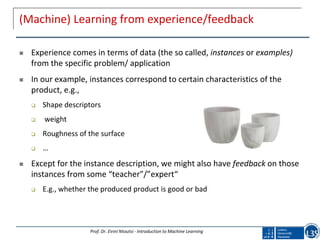
 Experience comes in terms of data (the so called, instances or examples)
from the specific problem/ application
 In our example, instances correspond to certain characteristics of the
product, e.g.,
 Shape descriptors
 weight
 Roughness of the surface
 …
 Except for the instance description, we might also have feedback on those
instances from some “teacher”/”expert“
 E.g., whether the produced product is good or bad
Prof. Dr. Eirini Ntoutsi - Introduction to Machine Learning
(Machine) Learning from experience/feedback
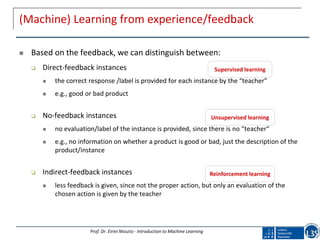
 Based on the feedback, we can distinguish between:
 Direct-feedback instances
 the correct response /label is provided for each instance by the “teacher”
 e.g., good or bad product
 No-feedback instances
 no evaluation/label of the instance is provided, since there is no “teacher“
 e.g., no information on whether a product is good or bad, just the description of the
product/instance
 Indirect-feedback instances
 less feedback is given, since not the proper action, but only an evaluation of the
chosen action is given by the teacher
Prof. Dr. Eirini Ntoutsi - Introduction to Machine Learning
Supervised learning
Reinforcement learning
Unsupervised learning
 Unsupervised learning/ Descriptive:
 Only a description of the instances is available
 No feedback/labels are available
 The goal is to discover groups of similar instances
 Typical examples: clustering, association rules, outlier detection
Prof. Dr. Eirini Ntoutsi - Introduction to Machine Learning
Height[cm]
Width[cm]
Cluster 1Cluster 2
instance width height
1 2,6 4,5
2 3,7 7,3
3 4,1 6,5
4 8,5 8,1
5 9,5 5,5
… … …
nails paper clips
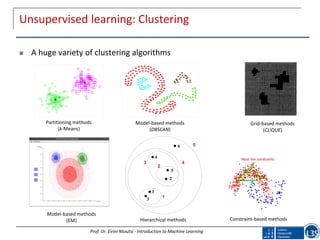
Unsupervised learning: Clustering
 A huge variety of clustering algorithms
Prof. Dr. Eirini Ntoutsi - Introduction to Machine Learning
1
2
3
4
5
6
1
2
3 4
5
Partitioning methods
(k-Means)
Grid-based methods
(CLIQUE)
Model-based methods
(DBSCAN)
Hierarchical methods Constraint-based methods
Model-based methods
(EM)
Supervised learning
 Supervised learning/ Predictive:
 A description of the instances and their class labels is available
(training set)
 The goal is to learn a mapping from the instances to the class labels,
i.e., given a future unseen instance to predict its class label
 Typical examples: classification, regression, outlier detection
Prof. Dr. Eirini Ntoutsi - Introduction to Machine Learning
Screw
Nails
Paper clips
New object
Height[cm]
Width[cm]
New object
instance width height class
1 2,6 4,5 A
2 3,7 7,3 A
3 4,1 6,5 A
4 8,5 8,1 B
5 9,5 5,5 B
… … … …
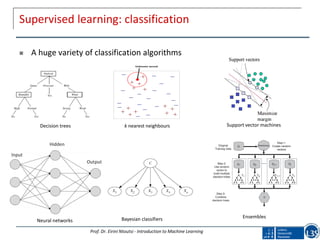
Supervised learning: classification
 A huge variety of classification algorithms
Prof. Dr. Eirini Ntoutsi - Introduction to Machine Learning
Decision trees k nearest neighbours Support vector machines
Neural networks Bayesian classifiers Ensembles
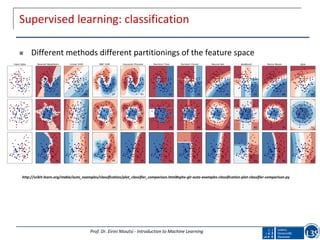
Supervised learning: classification
 Different methods different partitionings of the feature space
Prof. Dr. Eirini Ntoutsi - Introduction to Machine Learning
http://scikit-learn.org/stable/auto_examples/classification/plot_classifier_comparison.html#sphx-glr-auto-examples-classification-plot-classifier-comparison-py
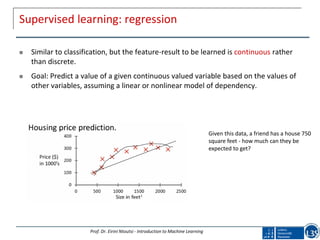
Supervised learning: regression
 Similar to classification, but the feature-result to be learned is continuous rather
than discrete.
 Goal: Predict a value of a given continuous valued variable based on the values of
other variables, assuming a linear or nonlinear model of dependency.
Prof. Dr. Eirini Ntoutsi - Introduction to Machine Learning
Given this data, a friend has a house 750
square feet - how much can they be
expected to get?
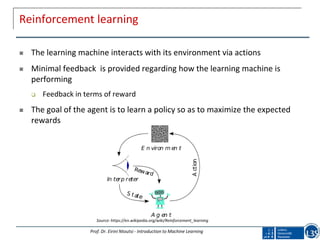
Reinforcement learning
 The learning machine interacts with its environment via actions
 Minimal feedback is provided regarding how the learning machine is
performing
 Feedback in terms of reward
 The goal of the agent is to learn a policy so as to maximize the expected
rewards
Prof. Dr. Eirini Ntoutsi - Introduction to Machine Learning
Source: https://en.wikipedia.org/wiki/Reinforcement_learning
Machine Learning in the Real World
Prof. Dr. Eirini Ntoutsi - Introduction to Machine Learning
ML in the real world
 Traditional ML assumptions
 The datasets are small and fit in memory
 Data is of a single type (e.g., numerical or text or images)
 For supervised learning
 The classes are well represented in the population (class balance)
 Labels are available for all instances (fully supervised learning)
 The quality of data (and labels) is good
 Data is stationary (the whole dataset is known in advance and there are no
changes in the data characteristics with time)
 …
Prof. Dr. Eirini Ntoutsi - Introduction to Machine Learning
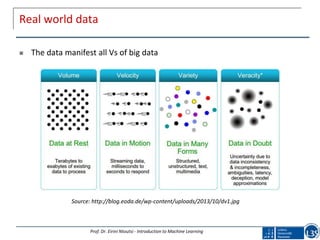
Real world data
 The data manifest all Vs of big data
Prof. Dr. Eirini Ntoutsi - Introduction to Machine Learning
Source: http://blog.eoda.de/wp-content/uploads/2013/10/dv1.jpg
Big Data
Tackling the traditional restrictive ML assumptions
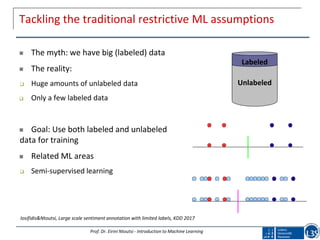
 The myth: we have big (labeled) data
 The reality:
 Huge amounts of unlabeled data
 Only a few labeled data
 Goal: Use both labeled and unlabeled
data for training
 Related ML areas
 Semi-supervised learning
Prof. Dr. Eirini Ntoutsi - Introduction to Machine Learning
Unlabeled
Labeled
Iosifidis&Ntoutsi, Large scale sentiment annotation with limited labels, KDD 2017
Tackling the traditional restrictive ML assumptions
 The myth: data is stationary
 The reality:
 Data are collected over time and their characteristics
might change  data streams
 Goal: maintain valid models of the population
 Related ML areas:
 stream mining, adaptive ML
Prof. Dr. Eirini Ntoutsi - Introduction to Machine Learning
1
0
1
1
1
0
1
0
0
1
1
[Zhang et al, Journal Neurocomputing 2012]
Tackling the traditional restrictive ML assumptions
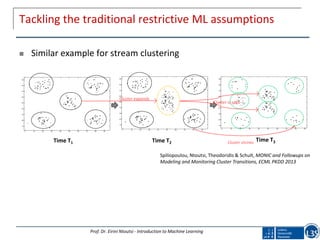
 Similar example for stream clustering
Prof. Dr. Eirini Ntoutsi - Introduction to Machine Learning
Time T1 Time T2
Time T3
Cluster expands
Cluster shrinks
Cluster is split
Spiliopoulou, Ntoutsi, Theodoridis & Schult, MONIC and Followups on
Modeling and Monitoring Cluster Transitions, ECML PKDD 2013
Summary
 Machine learning is an exciting field with a huge variety of learning tasks
and algorithms for each task
 Different methods come with different assumptions, strengths and
limitations.
 The selection of the right method (and correct parameterization) is important
and requires a deep understanding of the methods and of the problem at hand
 A close cooperation with domain experts is required.
 Production systems (industry in general) impose new challenges for ML
due to their data complexity (volume, velocity, veracity, variety, value, …)
 “Factories are AI’s next frontier”, Andrew Ng
 https://www.technologyreview.com/s/609770/andrew-ng-says-factories-are-
ais-next-frontier/
 Landing AI startup to closely work with manufacturers like Foxconn, the
world’s largest contract manufacturer and maker of Apple’s iPhones
Prof. Dr. Eirini Ntoutsi - Introduction to Machine Learning
Thank you for your attention!
Questions/Comments?
Prof. Dr. Eirini Ntoutsi - Introduction to Machine Learning
Prof Dr. Eirini Ntoutsi
FG Intelligent Systems
Faculty of Electrical Engineering and Computer Science
Leibniz University Hannover & L3S Research Center
http://www.kbs.uni-hannover.de/~ntoutsi/
ntoutsi@l3s.de

A Machine Learning Primer,

  • 1.
    Machine Learning forBig Data Prof. Dr. Eirini Ntoutsi FG Intelligent Systems Faculty of Electrical Engineering and Computer Science Leibniz University Hannover & L3S Research Center Introduction to Machine Learning
  • 2.
    Overview  A MachineLearning primer  Machine Learning in the real world Prof. Dr. Eirini Ntoutsi - Introduction to Machine Learning
  • 3.
    A Machine Learningprimer Prof. Dr. Eirini Ntoutsi - Introduction to Machine Learning
  • 4.
    What is MachineLearning?  ML “gives computers the ability to learn without being explicitly programmed” (Arthur Samuel, 1959)  We don’t codify the solution. We don’t even know it!  Data is the key & the learning algorithm Prof. Dr. Eirini Ntoutsi - Introduction to Machine Learning Algorithms Models Models Automatic decision making Data How can we build computer programs that automatically improve with experience?
  • 5.
    How do machineslearn?  A machine is said to learn from experience E with respect to some class of tasks T and performance measure P, if its performance at tasks in T, as measured by P, improves with experience E. Tom Mitchell, Machine Learning book  Example  Task T: Recognize good and bad products in a production system (e.g., a drilling machine)  Experience E: instances of good and bad products  Performance measure P: % of correctly identified products Prof. Dr. Eirini Ntoutsi - Introduction to Machine Learning
  • 6.
    (Machine) Learning fromexperience/feedback  Experience comes in terms of data (the so called, instances or examples) from the specific problem/ application  In our example, instances correspond to certain characteristics of the product, e.g.,  Shape descriptors  weight  Roughness of the surface  …  Except for the instance description, we might also have feedback on those instances from some “teacher”/”expert“  E.g., whether the produced product is good or bad Prof. Dr. Eirini Ntoutsi - Introduction to Machine Learning
  • 7.
    (Machine) Learning fromexperience/feedback  Based on the feedback, we can distinguish between:  Direct-feedback instances  the correct response /label is provided for each instance by the “teacher”  e.g., good or bad product  No-feedback instances  no evaluation/label of the instance is provided, since there is no “teacher“  e.g., no information on whether a product is good or bad, just the description of the product/instance  Indirect-feedback instances  less feedback is given, since not the proper action, but only an evaluation of the chosen action is given by the teacher Prof. Dr. Eirini Ntoutsi - Introduction to Machine Learning Supervised learning Reinforcement learning Unsupervised learning
  • 8.
    Unsupervised learning  Unsupervisedlearning/ Descriptive:  Only a description of the instances is available  No feedback/labels are available  The goal is to discover groups of similar instances  Typical examples: clustering, association rules, outlier detection Prof. Dr. Eirini Ntoutsi - Introduction to Machine Learning Height[cm] Width[cm] Cluster 1Cluster 2 instance width height 1 2,6 4,5 2 3,7 7,3 3 4,1 6,5 4 8,5 8,1 5 9,5 5,5 … … … nails paper clips
  • 9.
    Unsupervised learning: Clustering A huge variety of clustering algorithms Prof. Dr. Eirini Ntoutsi - Introduction to Machine Learning 1 2 3 4 5 6 1 2 3 4 5 Partitioning methods (k-Means) Grid-based methods (CLIQUE) Model-based methods (DBSCAN) Hierarchical methods Constraint-based methods Model-based methods (EM)
  • 10.
    Supervised learning  Supervisedlearning/ Predictive:  A description of the instances and their class labels is available (training set)  The goal is to learn a mapping from the instances to the class labels, i.e., given a future unseen instance to predict its class label  Typical examples: classification, regression, outlier detection Prof. Dr. Eirini Ntoutsi - Introduction to Machine Learning Screw Nails Paper clips New object Height[cm] Width[cm] New object instance width height class 1 2,6 4,5 A 2 3,7 7,3 A 3 4,1 6,5 A 4 8,5 8,1 B 5 9,5 5,5 B … … … …
  • 11.
    Supervised learning: classification A huge variety of classification algorithms Prof. Dr. Eirini Ntoutsi - Introduction to Machine Learning Decision trees k nearest neighbours Support vector machines Neural networks Bayesian classifiers Ensembles
  • 12.
    Supervised learning: classification Different methods different partitionings of the feature space Prof. Dr. Eirini Ntoutsi - Introduction to Machine Learning http://scikit-learn.org/stable/auto_examples/classification/plot_classifier_comparison.html#sphx-glr-auto-examples-classification-plot-classifier-comparison-py
  • 13.
    Supervised learning: regression Similar to classification, but the feature-result to be learned is continuous rather than discrete.  Goal: Predict a value of a given continuous valued variable based on the values of other variables, assuming a linear or nonlinear model of dependency. Prof. Dr. Eirini Ntoutsi - Introduction to Machine Learning Given this data, a friend has a house 750 square feet - how much can they be expected to get?
  • 14.
    Reinforcement learning  Thelearning machine interacts with its environment via actions  Minimal feedback is provided regarding how the learning machine is performing  Feedback in terms of reward  The goal of the agent is to learn a policy so as to maximize the expected rewards Prof. Dr. Eirini Ntoutsi - Introduction to Machine Learning Source: https://en.wikipedia.org/wiki/Reinforcement_learning
  • 15.
    Machine Learning inthe Real World Prof. Dr. Eirini Ntoutsi - Introduction to Machine Learning
  • 16.
    ML in thereal world  Traditional ML assumptions  The datasets are small and fit in memory  Data is of a single type (e.g., numerical or text or images)  For supervised learning  The classes are well represented in the population (class balance)  Labels are available for all instances (fully supervised learning)  The quality of data (and labels) is good  Data is stationary (the whole dataset is known in advance and there are no changes in the data characteristics with time)  … Prof. Dr. Eirini Ntoutsi - Introduction to Machine Learning
  • 17.
    Real world data The data manifest all Vs of big data Prof. Dr. Eirini Ntoutsi - Introduction to Machine Learning Source: http://blog.eoda.de/wp-content/uploads/2013/10/dv1.jpg
  • 18.
    Big Data Tackling thetraditional restrictive ML assumptions  The myth: we have big (labeled) data  The reality:  Huge amounts of unlabeled data  Only a few labeled data  Goal: Use both labeled and unlabeled data for training  Related ML areas  Semi-supervised learning Prof. Dr. Eirini Ntoutsi - Introduction to Machine Learning Unlabeled Labeled Iosifidis&Ntoutsi, Large scale sentiment annotation with limited labels, KDD 2017
  • 19.
    Tackling the traditionalrestrictive ML assumptions  The myth: data is stationary  The reality:  Data are collected over time and their characteristics might change  data streams  Goal: maintain valid models of the population  Related ML areas:  stream mining, adaptive ML Prof. Dr. Eirini Ntoutsi - Introduction to Machine Learning 1 0 1 1 1 0 1 0 0 1 1 [Zhang et al, Journal Neurocomputing 2012]
  • 20.
    Tackling the traditionalrestrictive ML assumptions  Similar example for stream clustering Prof. Dr. Eirini Ntoutsi - Introduction to Machine Learning Time T1 Time T2 Time T3 Cluster expands Cluster shrinks Cluster is split Spiliopoulou, Ntoutsi, Theodoridis & Schult, MONIC and Followups on Modeling and Monitoring Cluster Transitions, ECML PKDD 2013
  • 21.
    Summary  Machine learningis an exciting field with a huge variety of learning tasks and algorithms for each task  Different methods come with different assumptions, strengths and limitations.  The selection of the right method (and correct parameterization) is important and requires a deep understanding of the methods and of the problem at hand  A close cooperation with domain experts is required.  Production systems (industry in general) impose new challenges for ML due to their data complexity (volume, velocity, veracity, variety, value, …)  “Factories are AI’s next frontier”, Andrew Ng  https://www.technologyreview.com/s/609770/andrew-ng-says-factories-are- ais-next-frontier/  Landing AI startup to closely work with manufacturers like Foxconn, the world’s largest contract manufacturer and maker of Apple’s iPhones Prof. Dr. Eirini Ntoutsi - Introduction to Machine Learning
  • 22.
    Thank you foryour attention! Questions/Comments? Prof. Dr. Eirini Ntoutsi - Introduction to Machine Learning Prof Dr. Eirini Ntoutsi FG Intelligent Systems Faculty of Electrical Engineering and Computer Science Leibniz University Hannover & L3S Research Center http://www.kbs.uni-hannover.de/~ntoutsi/ ntoutsi@l3s.de