A LETTER TO THE SHAREHOLDERS OF BRISTOL-MYERS
SQUIBB COMPANY
February 28, 2019
Dear Fellow Shareholders,
Starboard Value LP (together with its affiliates, “Starboard”) is
a shareholder of Bristol-Myers
Squibb Company (“Bristol-Myers” or the “Company”). We are
writing today as we believe that
Bristol-Myers is deeply undervalued and the recent
announcement of the Company’s proposed
acquisition of Celgene Corporation (“Celgene”) is poorly
conceived and ill-advised. We intend to
vote all of our shares against the proposals related to the
proposed acquisition, and, should the
transaction be voted down by shareholders at the Company’s
upcoming Special Meeting of
Shareholders scheduled to be held on April 12, 2019 (the
“Special Meeting”), we have also
nominated a slate of director candidates who we would seek to
elect at the 2019 Annual Meeting
of Shareholders (the “2019 Annual Meeting”) to ensure that the
Board is held accountable and that
the Company focuses on exploring and executing on the best
alternative for value creation at
Bristol-Myers.
Additionally, under separate cover, we will be delivering to
Bristol-Myers a books and records
demand under Delaware law requesting that they provide us
with information that will allow us to
further investigate the facts and circumstances leading up to,
and including, the process and
diligence that led to the proposed acquisition of Celgene.
As you know, Starboard is an investment management firm that
seeks to identify and execute on
opportunities to unlock value in its portfolio companies for the
benefit of all shareholders. We
have a long and successful history as shareholder advocates,
working constructively with
companies to drive long-term value creation through a
combination of strategic refocusing,
improved operational execution, more efficient capital
allocation, and stronger management
discipline.
We have followed both Bristol-Myers and Celgene for a long
time; thus we are well aware of their
respective publicly-stated strategic ambitions and long-term
strategies. Therefore, we, like many
Bristol-Myers shareholders, were extremely surprised when the
Company announced its intention
to acquire Celgene for approximately $91 billion, through a
combination of cash and stock,
representing one of the largest ever pharmaceutical mergers.
This announcement follows years of poor financial and stock
price performance at Bristol-Myers.
As shown in the chart below, the Company has underperformed
its direct peers over almost any
time frame.
2
Source: Company Filings.
(1) Total returns for all periods include dividends; performance
measured as of January 2, 2019 (closing price before
announcement of Celgene merger).
(2) Peers based on Bristol-Myers S-4 selected publicly traded
companies and includes: ABBV, AGN, AMGN, LSE:AZN,
BIIB, LLY, GILD, LSE:GSK, JNJ,
MRK, SWX:NOVN, CPSE:NOVO.B, PFE, SWX:ROG,
ENXTPA:SAN.
These results are not reflective of a management team and
Board of Directors that has earned the
right, in our view, to execute on a “bet the company”
acquisition. We believe the risks inherent in
this acquisition paired with the long-term poor results at
Bristol-Myers make it untenable to
support such a transaction. Accordingly, we will be filing
preliminary proxy materials in the
coming days in order to solicit Bristol-Myers’ shareholders to
vote against the share issuance
proposal in connection with the proposed acquisition at the
upcoming Special Meeting.
The actions we are taking – specifically, our intent to solicit
shareholders to block the proposed
acquisition of Celgene – are not taken lightly. We are doing so
because we strongly believe that
the proposed deal is not in the best interest of shareholders.
This view has been solidified by the
numerous other large, long-term shareholders who appear to
likewise believe this deal is not in the
best interest of shareholders.
We have rigorously studied the proposed transaction since its
announcement in early January in
order to better understand the perspectives of all parties
involved. We have done extensive work,
including independent research as well as numerous meetings
and phone calls with Bristol-Myers
management, in an attempt to understand the strategic and
financial benefits of the proposed
transaction. We have approached our work with an open mind
and a willingness to be convinced
that this proposed transaction actually makes good financial and
strategic sense. Unfortunately,
the more work we do, the more conviction we build that this
transaction is not in the best interest
of shareholders. Therefore, we intend to solicit shareholders to
vote against the transaction.
As we summarize in this letter to shareholders, our conclusion
is based on five primary views:
1) Bristol-Myers is buying a company with a massive patent
cliff – among the largest in
pharmaceutical industry history – which will serve as a major
overhang on the Company’s
shares in the years to come. As demonstrated in our analysis
below, the patent cliff caused
by REVLIMID alone will require Celgene to replace over 60%
of its total revenue in the
next 7 years. This type of accomplishment is mostly
unprecedented.
Total Share holde r Re turn
(1)
1 Ye ar 3 Ye ar 5 Ye ar 10 Ye ar
Caforio Te nure
as CEO
S&P 500 Index (5.1%) 30.6% 51.8% 232.9% 29.6%
iShares NASDAQ Biotechnology Index (IBB) (10.7%) (13.0%)
29.9% 314.0% (12.9%)
S-4 Selected Peer Group
(2)
7.6% 18.6% 55.4% 269.8% 17.5%
Bris tol-Mye rs Squibb (12.2%) (18.1%) 13.3% 208.9%
(11.9%)
Underperformance vs. S&P 500 (7.1%) (48.7%) (38.5%)
(24.0%) (41.5%)
Over/(Underperformance) vs. IBB (1.5%) (5.2%) (16.6%)
(105.1%) 1.0%
Over/(Underperformance) vs. S-4 Selected Peer Group (19.7%)
(36.7%) (42.0%) (60.9%) (29.4%)
Bristol-Myers Share Price Underperformance
3
2) Our belief is that the Celgene pipeline is extremely risky and
will continue to require
significant research & development (“R&D”) funding. Bristol-
Myers management’s
projections contemplate Celgene essentially rebuilding its entire
current revenue base from
its pipeline over the next 8 years, as essentially all of Celgene’s
marketed products lose
patent protection over this timeframe. We believe this is an
aggressive assumption and may
not be realistic based on historical precedents.
3) The process and diligence timelines leading up to the
announcement of the acquisition, as
outlined in the Company’s S-4, lead us to believe that this
transaction was hastily construed
and perhaps done to thwart potential strategic interest in
Bristol-Myers. We believe that if
the Company remains independent, it is quite possible that there
may be strategic interest
in Bristol-Myers at a substantial premium to the current stock
price.
4) We believe Bristol-Myers’ analysis of the financial merits of
the transaction – specifically
its allocation of value between Celgene’s marketed products,
the combined synergies, and
the Celgene pipeline – is potentially misleading based on our
diligence.
5) There is a better path forward for Bristol-Myers, either as a
more profitable standalone
company with a more focused, lower-risk strategy, or in a
potential sale of the whole
Company.
In the following pages, we delve into greater detail on our
primary points. Over the next few weeks,
we intend to share a detailed presentation well in advance of the
shareholder vote on April 12th.
We look forward to engaging with our fellow shareholders and
appreciate your consideration of
our views.
Bristol-Myers is acquiring one of the largest patent cliffs in the
history of the pharmaceutical
industry.
Historically, pharmaceutical companies have made large
acquisitions to fill gaps in their product
portfolio and avoid potential patent cliffs. As biosimilars have
only recently entered the
pharmaceutical markets, historically patent cliffs were caused
exclusively by small molecule
drugs. Typically, genericization of a small molecule drug would
occur rapidly, resulting in
substantial revenue decline for the innovator drug. However,
thus far, large molecule biologics
have proven to be much more durable than small molecule
drugs. As shown in the chart below,
revenue erosion for large molecule drugs post-loss-of-
exclusivity (“LOE”) is significantly slower
than that of small molecule drugs, which are easier to replicate
and often experience dramatic sales
declines within the first year of LOE.
4
Source: Company Filings.
(1) Q0 represents the quarter prior to a product coming off-
patent / losing exclusivity. We have assumed the following as
Q0 for each drug: LIPITOR (Q3
2011), CRESTOR (Q1 2016), PLAVIX (Q1 2012), GLEEVEC
(Q4 2015), EPOGEN (Q1 2015), NEULASTA (Q3 2015),
REMICADE (Q3 2016). Q8
unavailable for PLAVIX as company stopped reporting PLAVIX
as a separate line item.
It is important to note the differences between large and small
molecule drugs in terms of historical
genericization because they make the proposed transaction
extremely puzzling. In short, Bristol-
Myers is knowingly acquiring a massive small-molecule patent
cliff. This is, to our knowledge,
unprecedented, certainly to this scale. Celgene’s key product,
REVLIMID, a small molecule drug
that generated approximately $9.7 billion in worldwide sales in
2018 (>60% of Celgene’s total
revenues), is expected to face generic competition beginning in
2022. In addition, given the rarity
of such a high revenue generating small molecule drug, this
represents a potentially massive
opportunity for generic manufacturers. As such, numerous
manufacturers are attempting to bring
generic REVLIMID to market, which increases the risk that the
drug faces generic competition
before 2022 and/or the revenue decline is more dramatic once
generic competition begins. In fact,
just recently, Alvogen launched generic REVLIMID in certain
European markets and expects a
global launch this year.
Unlike Celgene, we believe that Bristol-Myers possesses a much
more durable product portfolio.
As shown below, with the exception of ELIQUIS, essentially all
of the Company’s other marketed
products are large molecule biologics. As a result, we believe
the revenue decline for Bristol-
Myers’ marketed products in the back-half of the next decade
will be much less pronounced than
peers that have a high proportion of small molecule products.
5
Source: Wall Street Estimates.
(1) Year 0 is defined as the year before we expect the product to
lose exclusivity in the U.S. per the Company’s 2018 10-K
filing. We have assumed the
following as Year 0 for each product: OPDIVO (2027),
ELIQUIS (2026), ORENCIA (2020), SPRYCEL (2019),
YERVOY (2024). In addition we only
display OPDIVO through Year 1 because LOE is expected to be
in 2028, and there are insufficient data points beyond 2028.
We do not believe that the REVLIMID generic risk can be
understated. Based on our discussions
with Bristol-Myers’ management team, we understand that their
base-case scenario is a decline in
REVLIMID revenues of approximately 90% in 2026. We believe
that Celgene management is
desperately trying to settle certain patent disputes with other
generic manufacturers in an effort to
bring more certainty to the near-term REVLIMID revenue
projections. However, this does not
change the fact that Bristol-Myers is knowingly acquiring a
massive patent cliff with significant
deal value concentrated in the net present value of the cash
flows from one product. Acquiring
such a patent cliff is highly unusual and unprecedented. We
believe that, were shareholders to
approve the transaction, this impending patent cliff will
continue to be a massive overhang on
Bristol-Myers shares – much like it has been for Celgene shares
– for the foreseeable future.
Source: Company Filings; CapitalIQ.
Expected Post-Patent Expiration Revenue Slope – Bristol-
Myers(1)
Biologics
Small -
Molecule
0
20
40
60
80
100
120
Year 0 Year 1 Year 2
In
d
e
x
e
d
R
e
v
e
n
u
e
OPDIVO ELIQUIS ORENCIA SPRYCEL YERVOY
Celgene P/E vs. REVLIMID Revenue Concentration
0x
10x
20x
30x
40x
50x
60x
70x
80x
0%
10%
20%
30%
40%
50%
60%
70%
80%
2005 2006 2007 2008 2009 2010 2011 2012 2013 2014 2015
2016 2017 2018
A
v
g
.
N
T
M
P
/
E
M
u
lt
ip
le
%
o
f
T
o
ta
l
C
E
L
G
R
e
v
e
n
u
e
REVLIMID Avg. P/E
6
Furthermore, this may create additional pressure for the
combined company to consummate
another large transaction to fill the impending revenue hole, as
the reality of full REVLIMID
genericization comes into focus.
Source: Company Filings.
(1) Loss of exclusivity and patent expirations shown are for
U.S., with the exception of REVLIMID. Celgene’s settlement
with Natco Pharma will allow
Natco to manufacture and sell a genericized REVLIMID without
volume restrictions beginning in 2026. As a result, we have
shown Celgene losing
REVLIMID revenues in 2026 even though U.S. patent
expiration is in 2027.
With only several weeks of full data room access, it appears
Bristol-Myers estimated that
Celgene will rebuild its entire current revenue base from its
current pipeline despite several
recent development miscues.
Per the Company’s S-4 filing, Bristol-Myers management is
assuming Celgene can generate base-
case, risk-adjusted revenues of nearly $19 billion by 2028.
However, given the known patent cliff
on Celgene’s marketed products, we believe that over 90% of
this revenue, or approximately $17
billion is expected to come from yet un-commercialized pipeline
products. In other words, Bristol-
Myers management is asking its shareholders to believe that
Celgene can essentially rebuild its
entire current revenue base from its current product pipeline.
That puts an immense amount of
pressure on the pipeline to perform at an extraordinarily high
level, one that we believe may be
exceedingly difficult to meet, especially when the task is to
replace one of the top selling global
drugs.
As shown in the chart below, it is common to see blockbuster
drugs representing approximately
15-30% of total company revenue at LOE, but REVLIMID at
63% of revenue at LOE is essentially
unheard of and poses tremendous risk.
Loss of Exclusivity / Patent Expiration for Bristol + Celgene’s
Major Marketed Products(1)
0%
5%
10%
15%
20%
25%
30%
35%
40%
45%
50%
2019 2020 2021 2022 2023 2024 2025 2026 2027 2028
%
o
f
F
Y
2
0
1
8
B
M
Y
+
C
E
L
G
C
o
m
b
in
e
d
R
e
v
e
n
u
e
Bristol-Myers Celgene
7
Source: Company Filings.
(1) % revenues for SINGULAIR, LIPITOR, CRESTOR,
CYMBALTA, PLAVIX, and REVLIMID as of 2011, 2010,
2015, 2013, 2011, and 2018, respectively.
Based on our analysis of the Celgene pipeline, we believe that
Bristol-Myers’ projections are
extremely optimistic, especially given the most recent
developments. Based on our conversations
with Bristol-Myers management, we believe that the Company
is attributing 60% of 2028 pipeline
revenues to five near-term product launch opportunities (i.e.
luspatercept, JCAR017, bb2121,
fedratinib, and ozanimod), with the remainder of revenues
generated by ~20 earlier-stage assets,
of which greater than 60% of indications are still in Phase I
development.
Not surprisingly, sell-side analyst revenue projections for each
of the five near-term products
reveal wildly differing outlooks. In fact, as shown below, there
is a $7.3 billion difference between
the minimum and maximum cumulative 2028 revenue estimates
for these five products.
Source: Wall Street Estimates.
11%
16%
20%
22%
33%
63%
0%
10%
20%
30%
40%
50%
60%
70%
SINGULAIR
(MRK)
LIPITOR
(PFE)
CRESTOR
(AZN)
CYMBALTA
(LLY)
PLAVIX
(BMY)
REVLIMID
(CELG)
%
o
f
T
o
ta
l
C
o
m
p
a
n
y
R
e
v
e
n
u
e
s
P
r
io
r
t
o
P
a
te
n
t
C
li
ff
Select Blockbuster Drugs - % Revenue Contribution Prior to
Loss-of-Exclusivity(1)
8
However, Bristol-Myers management estimates for the five
near-term product launch
opportunities approximate the maximum of Wall Street analyst
estimates.
Source: Wall Street Estimates, Company Investor Relations,
Starboard Estimates.
(1) Estimated based on S-4 disclosure of Bristol-Myers’
Celgene estimates and discussion with Company management.
Based on Celgene’s most recent track record of overpromising
and under-delivering on highly-
touted pipeline products – specifically, the termination of GED-
0301 and the refusal-to-file
(“RTF”) for ozanimod – we question whether management’s
projections are sufficiently
conservative.
Source: Company Filings and Transcripts.
Select Celgene Management Commentary on GED-0301 and
ozanimod
1-month before receiving refusal-to-file notice from FDA on
ozanimod
“Focusing on execution, the NDA for ozanimod in RMS was
submitted on the heels of two positive
global Phase III studies. We are currently building out a strong
neuro-inflammation team to
execute a launch and unlock the value of this important
product.”
Scott Smith, President & COO
January 2018
7-months before termination of GED-0301
“And then you have ozanimod, GED-0301. Both of those – as I
mentioned before, ozanimod is a $4
billion to $6 billion asset. GED-0301 for Crohn’s disease could
be transformational as well. In
our opinion, it’s probably a multi-billion dollar asset as well.”
Patrick Flanigan, Corporate VP – Investor Relations
March 2017
9
For example, Chimeric Antigen Receptor T-cell (“CAR-T”)
therapies, which account for two of
the five near-term product launch opportunities, are prime
examples of a category where sell-side
revenue estimates have massively declined since the drugs have
come to market. The two current
commercialized drugs, Gilead’s YESCARTA and Novartis’
KYMIRAH, have experienced
declining revenue estimates due to issues around safety, cost,
logistics, and insurance
reimbursement.
Source: Wall Street Estimates, Bloomberg.
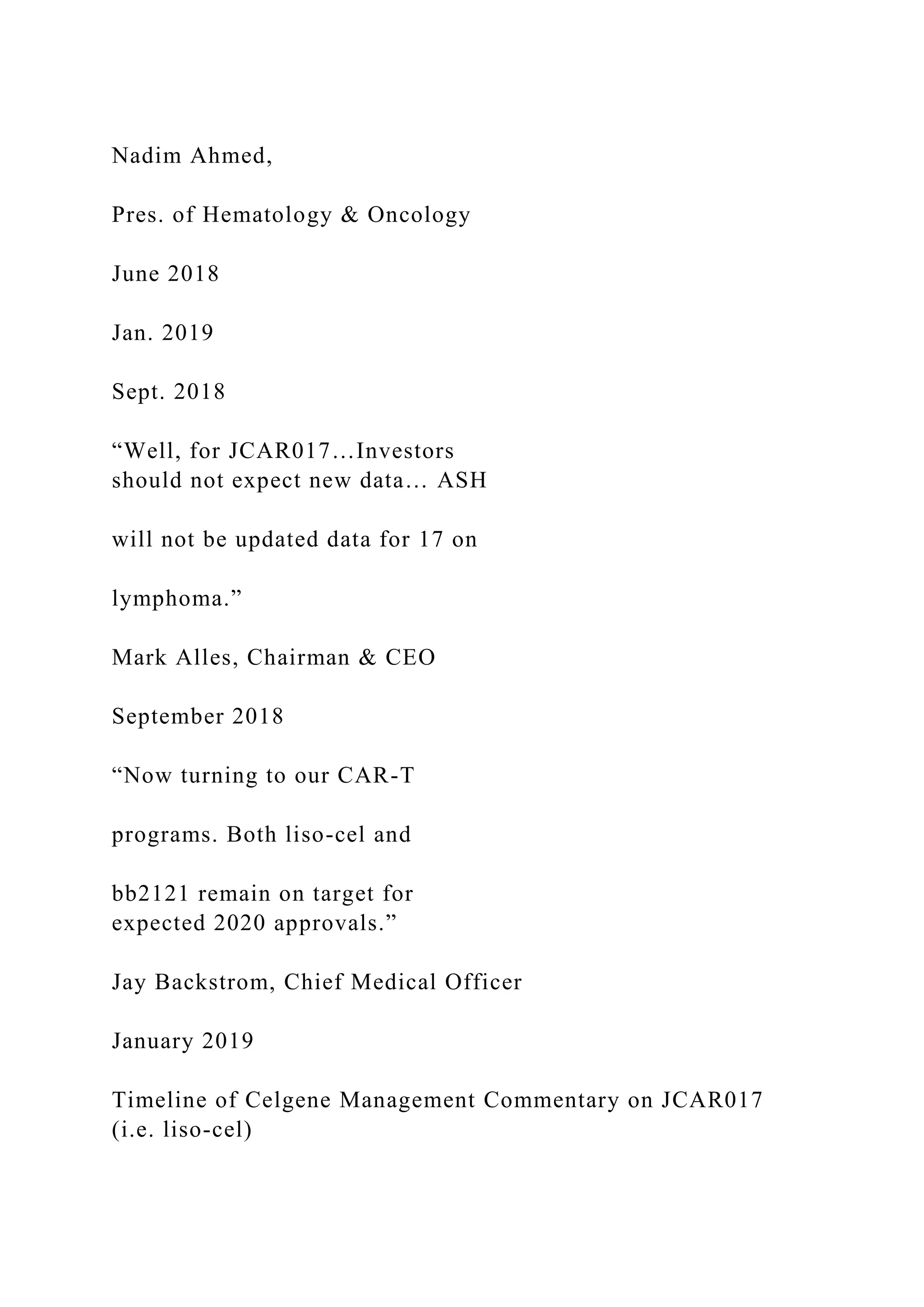
While Celgene management has argued that JCAR017 and
bb2121 have demonstrated a superior
safety profile in early-stage trials, their recent commentary on
timelines for approval has become
more measured.
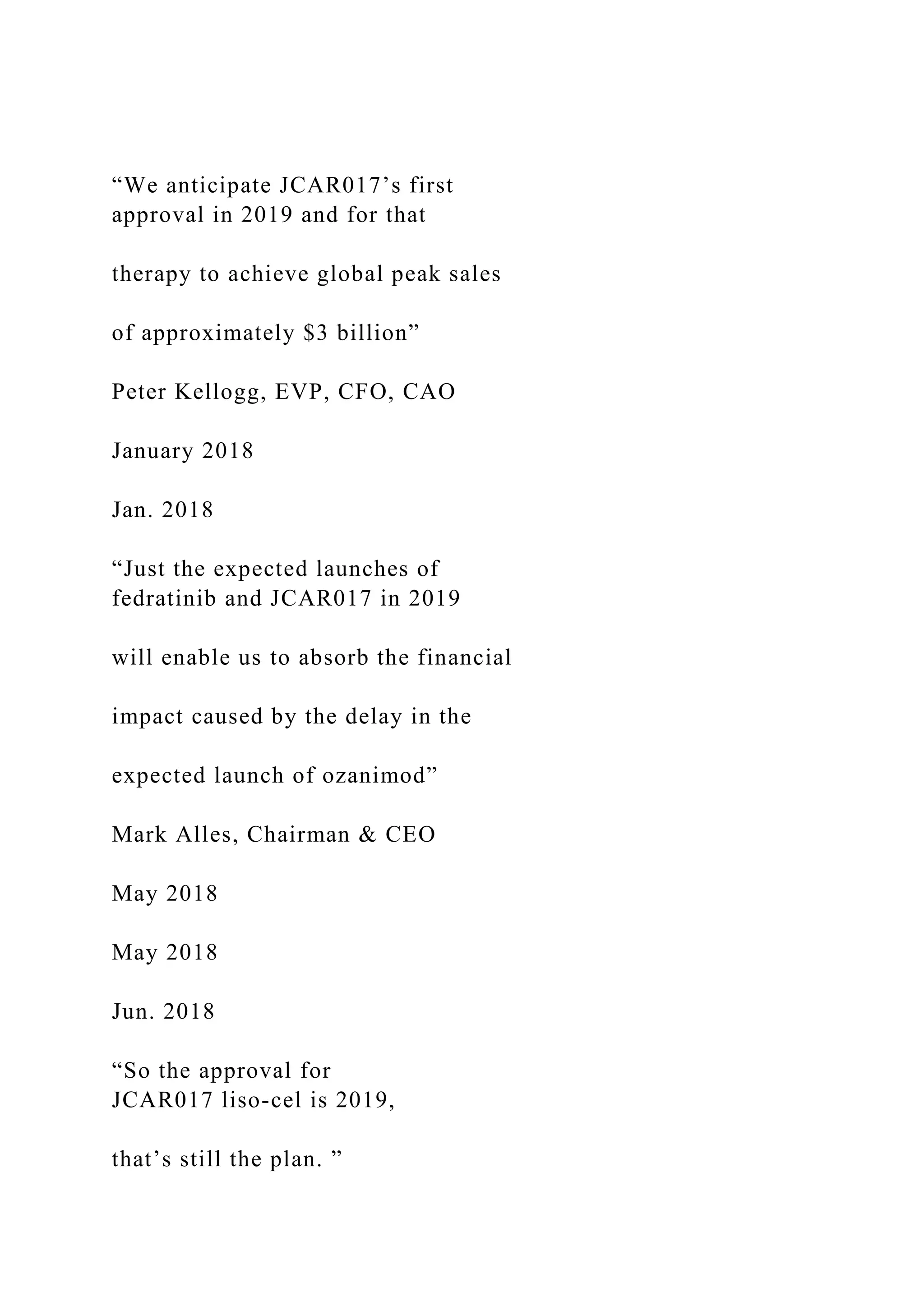
Source: Company Filings and Transcripts.
“We anticipate JCAR017’s first
approval in 2019 and for that
therapy to achieve global peak sales
of approximately $3 billion”
Peter Kellogg, EVP, CFO, CAO
January 2018
Jan. 2018
“Just the expected launches of
fedratinib and JCAR017 in 2019
will enable us to absorb the financial
impact caused by the delay in the
expected launch of ozanimod”
Mark Alles, Chairman & CEO
May 2018
May 2018
Jun. 2018
“So the approval for
JCAR017 liso-cel is 2019,
that’s still the plan. ”
Nadim Ahmed,
Pres. of Hematology & Oncology
June 2018
Jan. 2019
Sept. 2018
“Well, for JCAR017…Investors
should not expect new data… ASH
will not be updated data for 17 on
lymphoma.”
Mark Alles, Chairman & CEO
September 2018
“Now turning to our CAR-T
programs. Both liso-cel and
bb2121 remain on target for
expected 2020 approvals.”
Jay Backstrom, Chief Medical Officer
January 2019
Timeline of Celgene Management Commentary on JCAR017
(i.e. liso-cel)
10
Based on the tepid uptake of current marketed CAR-T therapies,
and the fact that Celgene’s CAR-
T therapies will be much later to market than the current
approved therapies, we believe their
potential to be blockbuster drugs is far from certain.
For the early Celgene pipeline, details are limited. However, it
is important to note that according
to Bristol-Myers 10-K disclosures, 92% of Phase I studies fail
to reach FDA approval. Assuming
similar rates of approval going forward, this means that only 2-
3 of Celgene’s early-stage assets
will receive FDA approval. Given that we believe Bristol-Myers
is assuming that approximately
40% of 2028 Celgene pipeline revenues, or approximately $7
billion, will be generated from
pipelines assets outside of the five near-term product launch
opportunities, it appears that they are
assuming multiple blockbuster assets. Based on historical
precedent, we would have serious
questions on this assumption.
It is imperative to point out that in a downside scenario, we
believe Celgene’s pipeline products
could destroy significant shareholder value. Each product
requires tremendous upfront investment,
and if it does not perform in-line with expectations, the product
can generate a negative net present
value. For example, Celgene has not brought a new major drug
to market since 2014. However,
since that time, the Company has spent a cumulative $22 billion
on R&D. So in approximately the
past five years, Celgene has failed to bring a single new major
drug to market. However, Bristol-
Myers is now assuming that going forward, the Celgene pipeline
will produce a number of new
major drugs at a much faster rate than previously achieved.
Furthermore, the diligence timeline appears extremely
troubling, especially as it relates to Bristol-
Myers’ analysis of the Celgene pipeline. According to the
Company’s S-4, full data room access
was granted on December 16, 2018. Therefore, Bristol-Myers
had only slightly more than two
weeks of full access before announcing the transaction. We find
it difficult to believe that the
Company was able to thoroughly evaluate approximately 30
highly technical products with the
required scrutiny on regulatory, commercial, manufacturing,
intellectual property (“IP”), and legal
considerations, among others, during this extremely tight
timeframe. As a result, we have extreme
doubts that Celgene’s pipeline can and will deliver the required
results to fully rebuild the revenue
base upon the LOE of REVLIMID.
We have serious concerns about the diligence process and
motivations for the acquisition of
Celgene.
Given the transformative nature of this transaction, we would
have expected Bristol-Myers to
undertake an exhaustive due diligence process on Celgene, as
well as a robust analysis of all
available alternatives for Bristol-Myers shareholder value
creation. Unfortunately, based on the
timeline in the S-4, while the Company did exchange some
preliminary diligence materials prior
to December 2018, it appears that the Company only had two
weeks of full data room access prior
to announcing the proposed acquisition and no such exploration
of alternatives was ever
contemplated.
As shown in the annotated stock chart below, it appears that
after a failed clinical trial of a major
drug that resulted in approximately $25 billion of lost market
value, Bristol-Myers became the
subject of not one, but two separate shareholder activists, who
were, among other things, rumored
11
to be pressing for the Company to explore a sale. It seems that
following these challenging times,
Bristol-Myers began exploring a “bet the company” acquisition
which would create such a large
combined entity that any acquisition of the pro forma company
would become exceedingly
difficult. Nowhere in the disclosure related to the Celgene
discussions, is there any mention of the
idea that, before executing an acquisition of this scale, Bristol-
Myers, itself, explored and more
fully evaluated all strategic options to maximize value for
shareholders. It therefore seems
appropriate to conclude that a primary reason this transaction
was pursued by Bristol-Myers was
for defensive purposes.
Source: Company Filings, Press Releases.
In fact, Bristol-Myers has been rumored as a potential
acquisition target for years. As shown below,
many articles were published speculating that the Company was
the subject of takeover interest.
$40
$45
$50
$55
$60
$65
$70
$75
Jun-16 Sep-16 Dec-16 Mar-17 Jun-17 Sep-17 Dec-17 Mar-18
Jun-18 Sep-18 Dec-18
Bristol-Myers: Major Events Leading Up to Celgene
Announcement
August 5, 2016:
CHECKMATE-026
(OPDIVO) fails in
first-line NSCLC
January 5, 2017:
First Activist Shareholder
Involvement
February 21, 2017:
BMY appoints three new
directors to its Board in a deal
with First Activist
Second Activist Shareholder
Takes Stake
April 4, 2017:
BMY & CELG enter into
mutual confidentiality
agreement
September 13, 2018:
Giovanni Caforio
contacts Mark Alles to set
up a meeting
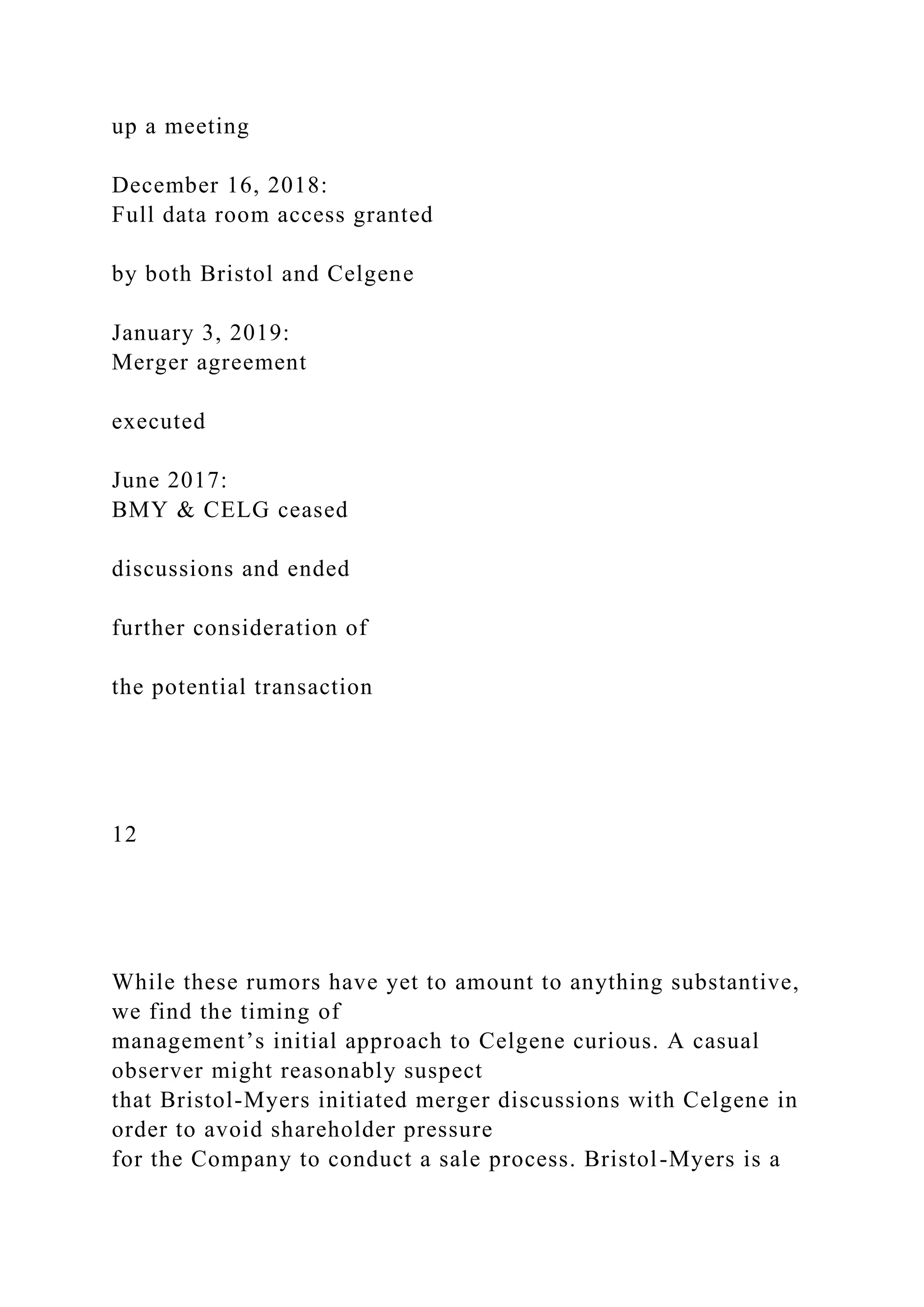
December 16, 2018:
Full data room access granted
by both Bristol and Celgene
January 3, 2019:
Merger agreement
executed
June 2017:
BMY & CELG ceased
discussions and ended
further consideration of
the potential transaction
12
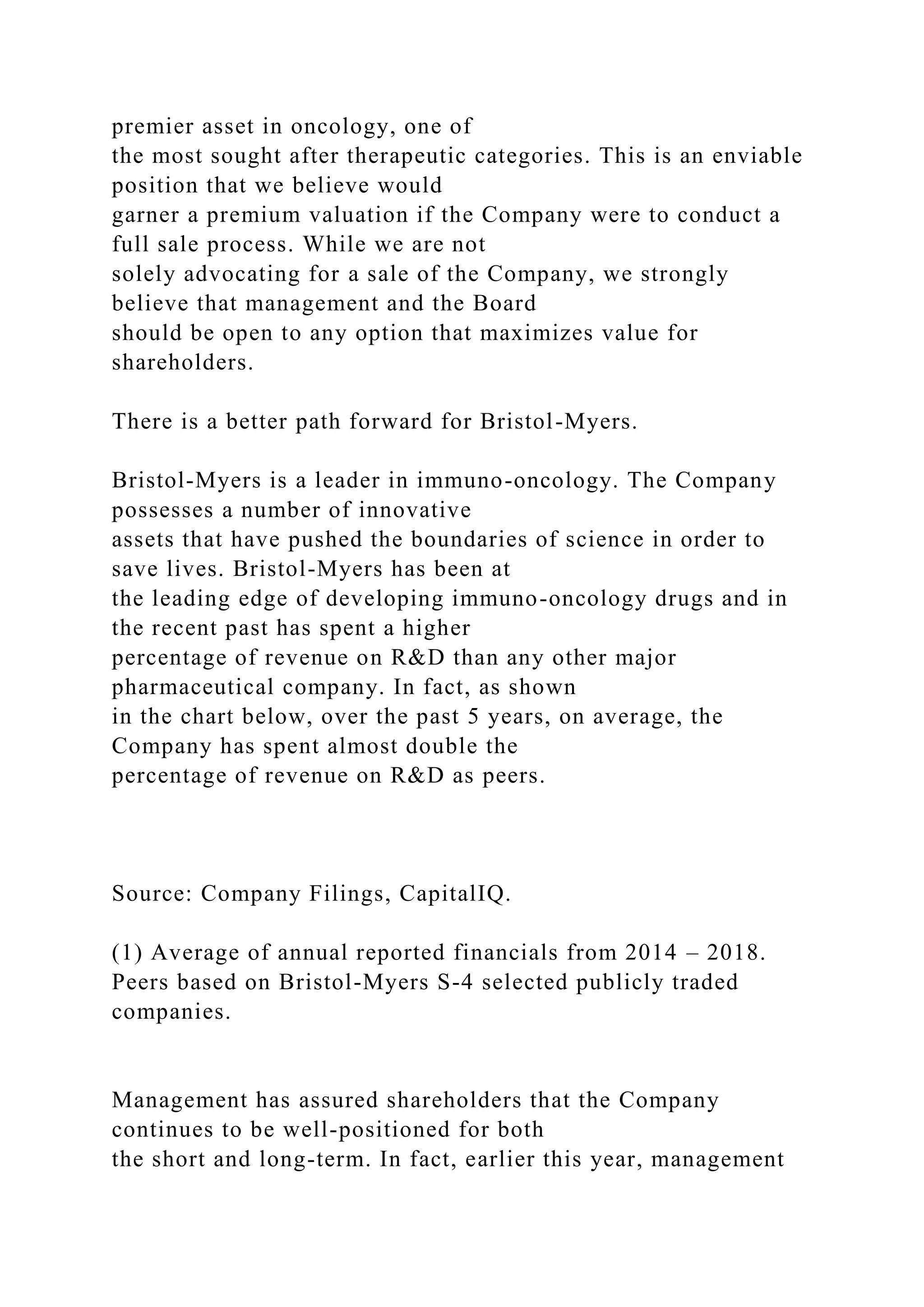
While these rumors have yet to amount to anything substantive,
we find the timing of
management’s initial approach to Celgene curious. A casual
observer might reasonably suspect
that Bristol-Myers initiated merger discussions with Celgene in
order to avoid shareholder pressure
for the Company to conduct a sale process. Bristol-Myers is a
premier asset in oncology, one of
the most sought after therapeutic categories. This is an enviable
position that we believe would
garner a premium valuation if the Company were to conduct a
full sale process. While we are not
solely advocating for a sale of the Company, we strongly
believe that management and the Board
should be open to any option that maximizes value for
shareholders.
There is a better path forward for Bristol-Myers.
Bristol-Myers is a leader in immuno-oncology. The Company
possesses a number of innovative
assets that have pushed the boundaries of science in order to
save lives. Bristol-Myers has been at
the leading edge of developing immuno-oncology drugs and in
the recent past has spent a higher
percentage of revenue on R&D than any other major
pharmaceutical company. In fact, as shown
in the chart below, over the past 5 years, on average, the
Company has spent almost double the
percentage of revenue on R&D as peers.
Source: Company Filings, CapitalIQ.
(1) Average of annual reported financials from 2014 – 2018.
Peers based on Bristol-Myers S-4 selected publicly traded
companies.
Management has assured shareholders that the Company
continues to be well-positioned for both
the short and long-term. In fact, earlier this year, management
referred to the Company’s pipeline
as “one of the most promising in our history” and has frequently
commented on the progress of its
pipeline.
5-Year Average R&D Expense as % of Revenue(1)
Peer Average: 17%
13% 13%
14% 14%
15% 15% 15%
17% 17%
18% 19% 19%
19%
23%
24%
30%
JNJ NOVO GSK GILD AGN PFE SAN
FP
ABBV NOVN
SW
AMGN BIIB ROG
SW
MRK AZN LLY BMY
13
Source: Company Filings and Transcripts.
Unfortunately, R&D failures continue to plague the Company
and have destroyed significant
shareholder value in the process. Over the past five years, the
Company has underperformed peers
and the broader market index by approximately 40%.
Source: CapitalIQ, Press Releases.
(1) Total returns for all periods include dividends; performance
measured from January 2, 2014 to January 2, 2019 (closing
price before announcement
of Celgene merger).
(2) Peers based on Bristol-Myers S-4 selected publicly traded
companies and includes: ABBV, AGN, AMGN, LSE:AZN,
BIIB, LLY, GILD, LSE:GSK, JNJ,
MRK, SWX:NOVN, CPSE:NOVO.B, PFE, SWX:ROG,
ENXTPA:SAN.
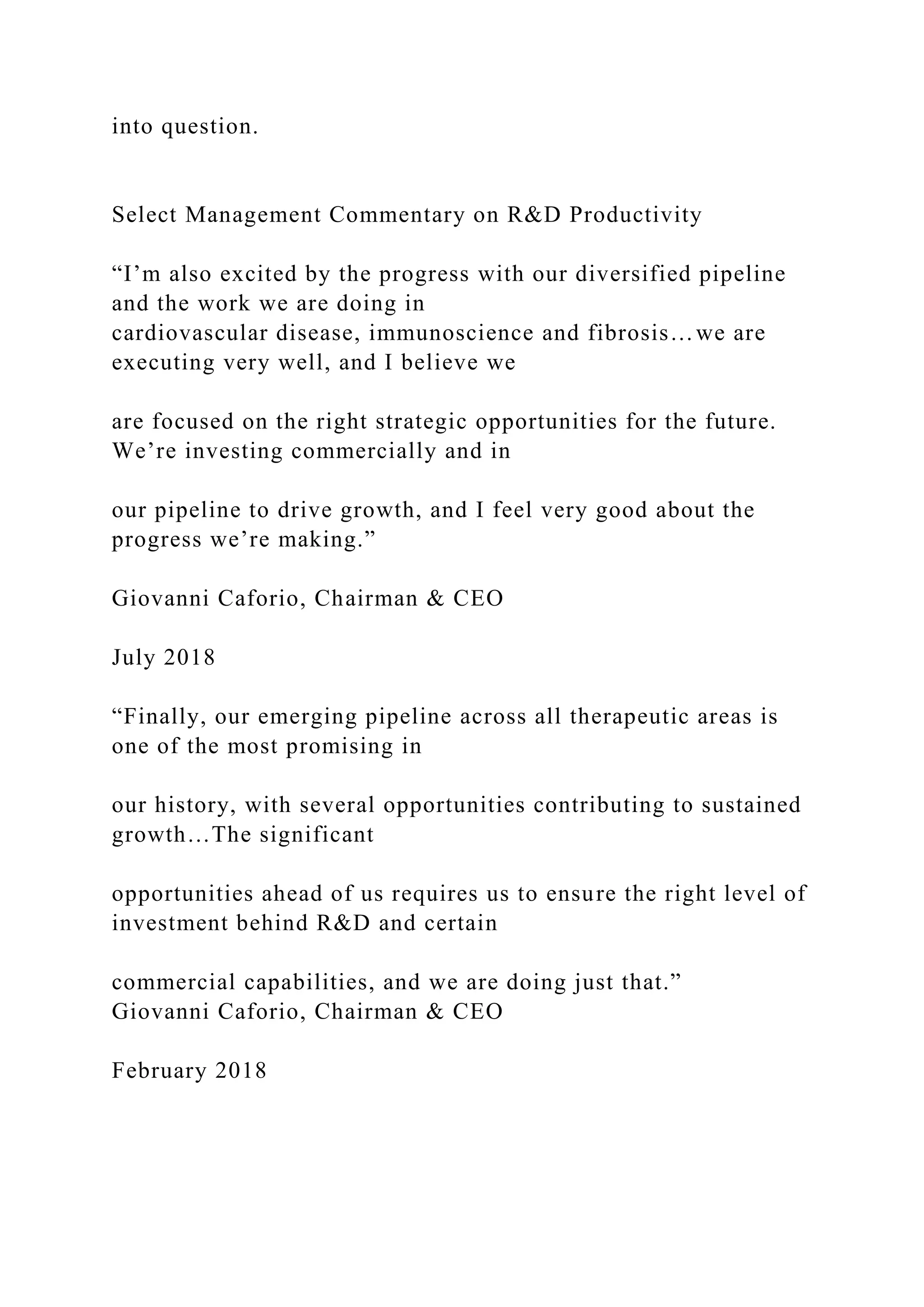
The past year has been particularly painful for Bristol-Myers
shareholders, as key clinical trials
have failed to show the desired results and the Company’s
future growth trajectory has been called
into question.
Select Management Commentary on R&D Productivity
“I’m also excited by the progress with our diversified pipeline
and the work we are doing in
cardiovascular disease, immunoscience and fibrosis…we are
executing very well, and I believe we
are focused on the right strategic opportunities for the future.
We’re investing commercially and in
our pipeline to drive growth, and I feel very good about the
progress we’re making.”
Giovanni Caforio, Chairman & CEO
July 2018
“Finally, our emerging pipeline across all therapeutic areas is
one of the most promising in
our history, with several opportunities contributing to sustained
growth…The significant
opportunities ahead of us requires us to ensure the right level of
investment behind R&D and certain
commercial capabilities, and we are doing just that.”
Giovanni Caforio, Chairman & CEO
February 2018
14
Source: CapitalIQ, Press Releases.
(1) Total returns for all periods include dividends; performance
from January 2, 2018 to December 31, 2018.
(2) Peers based on Bristol-Myers S-4 selected publicly traded
companies and includes: ABBV, AGN, AMGN, LSE:AZN,
BIIB, LLY, GILD, LSE:GSK, JNJ,
MRK, SWX:NOVN, CPSE:NOVO.B, PFE, SWX:ROG,
ENXTPA:SAN.
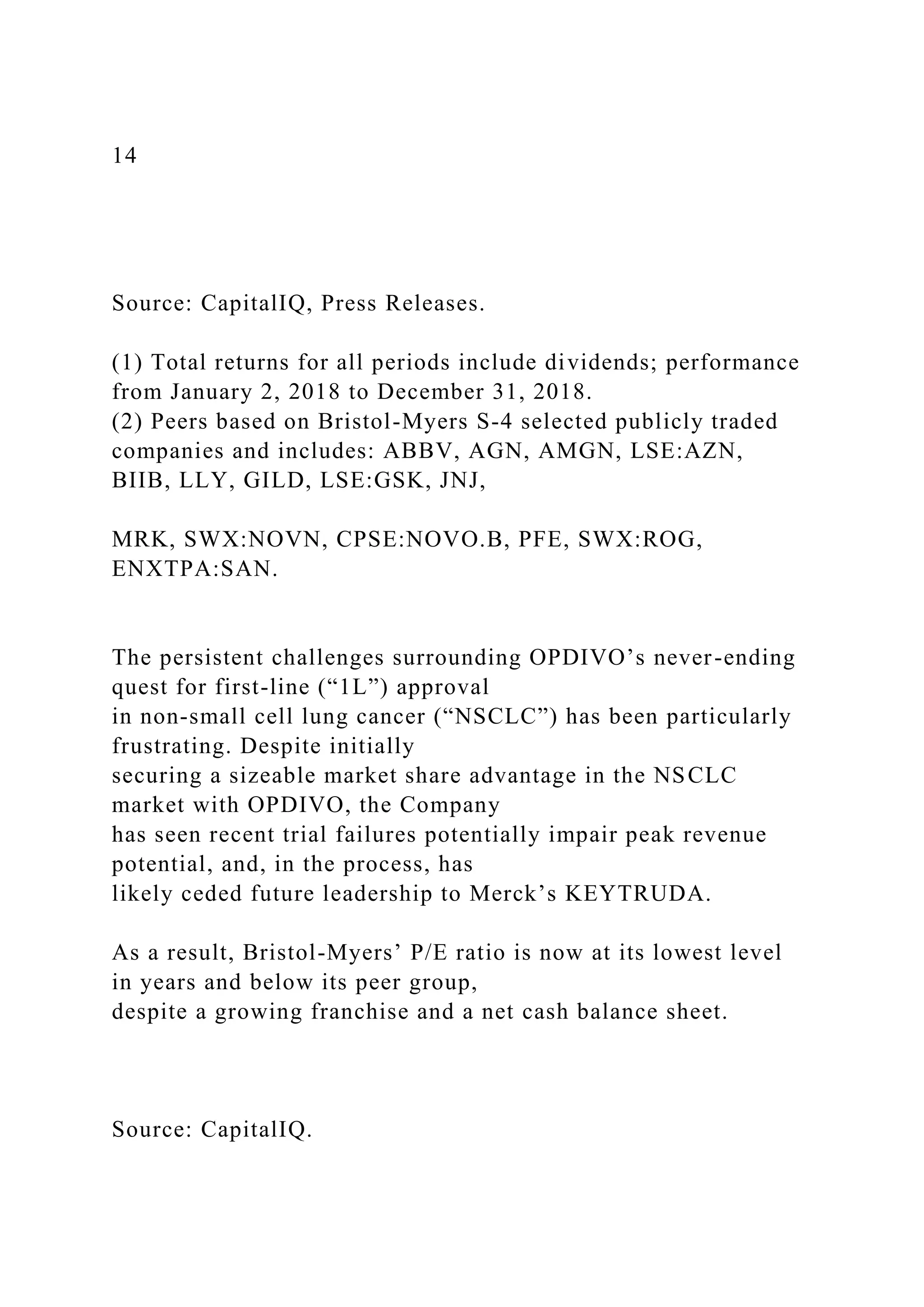
The persistent challenges surrounding OPDIVO’s never-ending
quest for first-line (“1L”) approval
in non-small cell lung cancer (“NSCLC”) has been particularly
frustrating. Despite initially
securing a sizeable market share advantage in the NSCLC
market with OPDIVO, the Company
has seen recent trial failures potentially impair peak revenue
potential, and, in the process, has
likely ceded future leadership to Merck’s KEYTRUDA.
As a result, Bristol-Myers’ P/E ratio is now at its lowest level
in years and below its peer group,
despite a growing franchise and a net cash balance sheet.
Source: CapitalIQ.
(1) Peers based on Bristol-Myers S-4 selected publicly traded
companies and includes: ABBV, AGN, AMGN, LSE:AZN,
BIIB, LLY, GILD, LSE:GSK, JNJ,
MRK, SWX:NOVN, CPSE:NOVO.B, PFE, SWX:ROG,
ENXTPA:SAN.
(2) Current as of 2/27/2019.
15
We believe that there is significant room for improvement in
Bristol-Myers’ margins. As
previously mentioned, the Company’s R&D as a percentage of
revenue is the highest of its peers,
resulting in EBITDA margins well below average. As shown in
the chart below, Bristol-Myers is
currently producing EBITDA margins well below the peer
average.
Source: Company Filings, CapitalIQ.
(1) Peers based on Bristol-Myers S-4 selected publicly traded
companies.
While cost cutting and margin improvement is one alternative
that we believe is readily available
to Bristol-Myers as a standalone entity, the Company’s Board
should be open to evaluating all
alternatives to create shareholder value, including a sale of the
Company. If Bristol-Myers is
focused on a potential revenue cliff in its product portfolio,
those cliffs can be filled with targeted
tuck-in acquisitions, or, alternatively, the Company can become
a target for another company to
further fill out their product portfolio.
We definitively believe the acquisition of Celgene is not in the
best interest of Bristol-Myers
shareholders.
Based on our analysis, we do not believe that the acquisition of
Celgene is in the best interest of
Bristol-Myers shareholders. This letter is focused on
summarizing the key questions and concerns
that have informed our views. We look forward to sharing a
more detailed presentation of our
views in the near future as we approach the shareholder vote.
The first crucial step in this campaign is to vote down this ill-
advised transaction. It is important,
however, for shareholders to also know that as the next step, we
would seek shareholder support
to elect a slate of highly-experienced and respected director
candidates whom we have nominated
for election at the 2019 Annual Meeting. We believe these
steps, taken together, represent an
exciting opportunity for shareholders to have a direct voice in
protecting the value of their
investment in the Company while ensuring that management and
the Board are held accountable
and re-focused on exploring the best alternatives available for
maximizing shareholder value.
We look forward to continuing our dialogue with shareholders.
16
Best Regards,
Jeffrey C. Smith
Managing Member
Starboard Value LP
Introduction
Use information in the attached letter from Starboard Value, a
major shareholder, Bristol Myers Squibb press releases (see the
links below) and additional sources as needed to complete the
assignment.
https://news.bms.com/press-release/corporatefinancial-
news/bristol-myers-squibb-acquire-celgene-create-premier-
innovative
https://news.bms.com/press-release/corporatefinancial-
news/bristol-myers-squibb-issues-statement-response-
starboards-lett
https://news.bms.com/press-release/corporatefinancial-
news/bristol-myers-squibb-board-directors-sends-letter-
shareholders
Presentation Content: The presentation must clearly answer all
of the following questions.
1. Prior to the offer to buy Celgene, what is Bristol Myers
Squibb’s corporate strategy? Explain your answer using facts
about the company.
Presentation Style Requirements
· Use a minimum font size of 24 and no more than five bullets
per slide.
· Include a list of references at the end of the presentation.

A LETTER TO THE SHAREHOLDERS OF BRISTOL-MYERS SQUIBB CO.docx

  • 1.
    A LETTER TOTHE SHAREHOLDERS OF BRISTOL-MYERS SQUIBB COMPANY February 28, 2019 Dear Fellow Shareholders, Starboard Value LP (together with its affiliates, “Starboard”) is a shareholder of Bristol-Myers Squibb Company (“Bristol-Myers” or the “Company”). We are writing today as we believe that Bristol-Myers is deeply undervalued and the recent announcement of the Company’s proposed acquisition of Celgene Corporation (“Celgene”) is poorly conceived and ill-advised. We intend to vote all of our shares against the proposals related to the proposed acquisition, and, should the transaction be voted down by shareholders at the Company’s upcoming Special Meeting of Shareholders scheduled to be held on April 12, 2019 (the “Special Meeting”), we have also nominated a slate of director candidates who we would seek to elect at the 2019 Annual Meeting of Shareholders (the “2019 Annual Meeting”) to ensure that the Board is held accountable and that the Company focuses on exploring and executing on the best alternative for value creation at Bristol-Myers.
  • 2.
    Additionally, under separatecover, we will be delivering to Bristol-Myers a books and records demand under Delaware law requesting that they provide us with information that will allow us to further investigate the facts and circumstances leading up to, and including, the process and diligence that led to the proposed acquisition of Celgene. As you know, Starboard is an investment management firm that seeks to identify and execute on opportunities to unlock value in its portfolio companies for the benefit of all shareholders. We have a long and successful history as shareholder advocates, working constructively with companies to drive long-term value creation through a combination of strategic refocusing, improved operational execution, more efficient capital allocation, and stronger management discipline. We have followed both Bristol-Myers and Celgene for a long time; thus we are well aware of their respective publicly-stated strategic ambitions and long-term strategies. Therefore, we, like many Bristol-Myers shareholders, were extremely surprised when the Company announced its intention to acquire Celgene for approximately $91 billion, through a combination of cash and stock, representing one of the largest ever pharmaceutical mergers. This announcement follows years of poor financial and stock price performance at Bristol-Myers. As shown in the chart below, the Company has underperformed its direct peers over almost any time frame.
  • 3.
    2 Source: Company Filings. (1)Total returns for all periods include dividends; performance measured as of January 2, 2019 (closing price before announcement of Celgene merger). (2) Peers based on Bristol-Myers S-4 selected publicly traded companies and includes: ABBV, AGN, AMGN, LSE:AZN, BIIB, LLY, GILD, LSE:GSK, JNJ, MRK, SWX:NOVN, CPSE:NOVO.B, PFE, SWX:ROG, ENXTPA:SAN. These results are not reflective of a management team and Board of Directors that has earned the right, in our view, to execute on a “bet the company” acquisition. We believe the risks inherent in this acquisition paired with the long-term poor results at Bristol-Myers make it untenable to support such a transaction. Accordingly, we will be filing preliminary proxy materials in the coming days in order to solicit Bristol-Myers’ shareholders to vote against the share issuance proposal in connection with the proposed acquisition at the upcoming Special Meeting.
  • 4.
    The actions weare taking – specifically, our intent to solicit shareholders to block the proposed acquisition of Celgene – are not taken lightly. We are doing so because we strongly believe that the proposed deal is not in the best interest of shareholders. This view has been solidified by the numerous other large, long-term shareholders who appear to likewise believe this deal is not in the best interest of shareholders. We have rigorously studied the proposed transaction since its announcement in early January in order to better understand the perspectives of all parties involved. We have done extensive work, including independent research as well as numerous meetings and phone calls with Bristol-Myers management, in an attempt to understand the strategic and financial benefits of the proposed transaction. We have approached our work with an open mind and a willingness to be convinced that this proposed transaction actually makes good financial and strategic sense. Unfortunately, the more work we do, the more conviction we build that this transaction is not in the best interest of shareholders. Therefore, we intend to solicit shareholders to vote against the transaction. As we summarize in this letter to shareholders, our conclusion is based on five primary views: 1) Bristol-Myers is buying a company with a massive patent cliff – among the largest in pharmaceutical industry history – which will serve as a major overhang on the Company’s shares in the years to come. As demonstrated in our analysis
  • 5.
    below, the patentcliff caused by REVLIMID alone will require Celgene to replace over 60% of its total revenue in the next 7 years. This type of accomplishment is mostly unprecedented. Total Share holde r Re turn (1) 1 Ye ar 3 Ye ar 5 Ye ar 10 Ye ar Caforio Te nure as CEO S&P 500 Index (5.1%) 30.6% 51.8% 232.9% 29.6% iShares NASDAQ Biotechnology Index (IBB) (10.7%) (13.0%) 29.9% 314.0% (12.9%) S-4 Selected Peer Group (2) 7.6% 18.6% 55.4% 269.8% 17.5% Bris tol-Mye rs Squibb (12.2%) (18.1%) 13.3% 208.9% (11.9%) Underperformance vs. S&P 500 (7.1%) (48.7%) (38.5%) (24.0%) (41.5%) Over/(Underperformance) vs. IBB (1.5%) (5.2%) (16.6%) (105.1%) 1.0% Over/(Underperformance) vs. S-4 Selected Peer Group (19.7%)
  • 6.
    (36.7%) (42.0%) (60.9%)(29.4%) Bristol-Myers Share Price Underperformance 3 2) Our belief is that the Celgene pipeline is extremely risky and will continue to require significant research & development (“R&D”) funding. Bristol- Myers management’s projections contemplate Celgene essentially rebuilding its entire current revenue base from its pipeline over the next 8 years, as essentially all of Celgene’s marketed products lose patent protection over this timeframe. We believe this is an aggressive assumption and may not be realistic based on historical precedents. 3) The process and diligence timelines leading up to the announcement of the acquisition, as outlined in the Company’s S-4, lead us to believe that this transaction was hastily construed and perhaps done to thwart potential strategic interest in Bristol-Myers. We believe that if the Company remains independent, it is quite possible that there may be strategic interest in Bristol-Myers at a substantial premium to the current stock price.
  • 7.
    4) We believeBristol-Myers’ analysis of the financial merits of the transaction – specifically its allocation of value between Celgene’s marketed products, the combined synergies, and the Celgene pipeline – is potentially misleading based on our diligence. 5) There is a better path forward for Bristol-Myers, either as a more profitable standalone company with a more focused, lower-risk strategy, or in a potential sale of the whole Company. In the following pages, we delve into greater detail on our primary points. Over the next few weeks, we intend to share a detailed presentation well in advance of the shareholder vote on April 12th. We look forward to engaging with our fellow shareholders and appreciate your consideration of our views. Bristol-Myers is acquiring one of the largest patent cliffs in the history of the pharmaceutical industry. Historically, pharmaceutical companies have made large acquisitions to fill gaps in their product portfolio and avoid potential patent cliffs. As biosimilars have only recently entered the pharmaceutical markets, historically patent cliffs were caused exclusively by small molecule drugs. Typically, genericization of a small molecule drug would occur rapidly, resulting in substantial revenue decline for the innovator drug. However,
  • 8.
    thus far, largemolecule biologics have proven to be much more durable than small molecule drugs. As shown in the chart below, revenue erosion for large molecule drugs post-loss-of- exclusivity (“LOE”) is significantly slower than that of small molecule drugs, which are easier to replicate and often experience dramatic sales declines within the first year of LOE. 4 Source: Company Filings. (1) Q0 represents the quarter prior to a product coming off- patent / losing exclusivity. We have assumed the following as Q0 for each drug: LIPITOR (Q3 2011), CRESTOR (Q1 2016), PLAVIX (Q1 2012), GLEEVEC (Q4 2015), EPOGEN (Q1 2015), NEULASTA (Q3 2015), REMICADE (Q3 2016). Q8 unavailable for PLAVIX as company stopped reporting PLAVIX as a separate line item. It is important to note the differences between large and small molecule drugs in terms of historical genericization because they make the proposed transaction extremely puzzling. In short, Bristol- Myers is knowingly acquiring a massive small-molecule patent
  • 9.
    cliff. This is,to our knowledge, unprecedented, certainly to this scale. Celgene’s key product, REVLIMID, a small molecule drug that generated approximately $9.7 billion in worldwide sales in 2018 (>60% of Celgene’s total revenues), is expected to face generic competition beginning in 2022. In addition, given the rarity of such a high revenue generating small molecule drug, this represents a potentially massive opportunity for generic manufacturers. As such, numerous manufacturers are attempting to bring generic REVLIMID to market, which increases the risk that the drug faces generic competition before 2022 and/or the revenue decline is more dramatic once generic competition begins. In fact, just recently, Alvogen launched generic REVLIMID in certain European markets and expects a global launch this year. Unlike Celgene, we believe that Bristol-Myers possesses a much more durable product portfolio. As shown below, with the exception of ELIQUIS, essentially all of the Company’s other marketed products are large molecule biologics. As a result, we believe the revenue decline for Bristol- Myers’ marketed products in the back-half of the next decade will be much less pronounced than peers that have a high proportion of small molecule products. 5
  • 10.
    Source: Wall StreetEstimates. (1) Year 0 is defined as the year before we expect the product to lose exclusivity in the U.S. per the Company’s 2018 10-K filing. We have assumed the following as Year 0 for each product: OPDIVO (2027), ELIQUIS (2026), ORENCIA (2020), SPRYCEL (2019), YERVOY (2024). In addition we only display OPDIVO through Year 1 because LOE is expected to be in 2028, and there are insufficient data points beyond 2028. We do not believe that the REVLIMID generic risk can be understated. Based on our discussions with Bristol-Myers’ management team, we understand that their base-case scenario is a decline in REVLIMID revenues of approximately 90% in 2026. We believe that Celgene management is desperately trying to settle certain patent disputes with other generic manufacturers in an effort to bring more certainty to the near-term REVLIMID revenue projections. However, this does not change the fact that Bristol-Myers is knowingly acquiring a massive patent cliff with significant deal value concentrated in the net present value of the cash flows from one product. Acquiring such a patent cliff is highly unusual and unprecedented. We believe that, were shareholders to approve the transaction, this impending patent cliff will continue to be a massive overhang on Bristol-Myers shares – much like it has been for Celgene shares – for the foreseeable future.
  • 11.
    Source: Company Filings;CapitalIQ. Expected Post-Patent Expiration Revenue Slope – Bristol- Myers(1) Biologics Small - Molecule 0 20 40 60 80 100 120 Year 0 Year 1 Year 2 In d e x e
  • 12.
    d R e v e n u e OPDIVO ELIQUIS ORENCIASPRYCEL YERVOY Celgene P/E vs. REVLIMID Revenue Concentration 0x 10x 20x 30x 40x 50x 60x 70x 80x 0%
  • 13.
    10% 20% 30% 40% 50% 60% 70% 80% 2005 2006 20072008 2009 2010 2011 2012 2013 2014 2015 2016 2017 2018 A v g . N T M P / E M u lt ip le
  • 14.
    % o f T o ta l C E L G R e v e n u e REVLIMID Avg. P/E 6 Furthermore,this may create additional pressure for the combined company to consummate another large transaction to fill the impending revenue hole, as the reality of full REVLIMID genericization comes into focus.
  • 15.
    Source: Company Filings. (1)Loss of exclusivity and patent expirations shown are for U.S., with the exception of REVLIMID. Celgene’s settlement with Natco Pharma will allow Natco to manufacture and sell a genericized REVLIMID without volume restrictions beginning in 2026. As a result, we have shown Celgene losing REVLIMID revenues in 2026 even though U.S. patent expiration is in 2027. With only several weeks of full data room access, it appears Bristol-Myers estimated that Celgene will rebuild its entire current revenue base from its current pipeline despite several recent development miscues. Per the Company’s S-4 filing, Bristol-Myers management is assuming Celgene can generate base- case, risk-adjusted revenues of nearly $19 billion by 2028. However, given the known patent cliff on Celgene’s marketed products, we believe that over 90% of this revenue, or approximately $17 billion is expected to come from yet un-commercialized pipeline products. In other words, Bristol- Myers management is asking its shareholders to believe that Celgene can essentially rebuild its entire current revenue base from its current product pipeline. That puts an immense amount of pressure on the pipeline to perform at an extraordinarily high level, one that we believe may be exceedingly difficult to meet, especially when the task is to replace one of the top selling global drugs.
  • 16.
    As shown inthe chart below, it is common to see blockbuster drugs representing approximately 15-30% of total company revenue at LOE, but REVLIMID at 63% of revenue at LOE is essentially unheard of and poses tremendous risk. Loss of Exclusivity / Patent Expiration for Bristol + Celgene’s Major Marketed Products(1) 0% 5% 10% 15% 20% 25% 30% 35% 40% 45% 50% 2019 2020 2021 2022 2023 2024 2025 2026 2027 2028 %
  • 17.
  • 18.
    e v e n u e Bristol-Myers Celgene 7 Source: CompanyFilings. (1) % revenues for SINGULAIR, LIPITOR, CRESTOR, CYMBALTA, PLAVIX, and REVLIMID as of 2011, 2010, 2015, 2013, 2011, and 2018, respectively. Based on our analysis of the Celgene pipeline, we believe that Bristol-Myers’ projections are extremely optimistic, especially given the most recent developments. Based on our conversations with Bristol-Myers management, we believe that the Company is attributing 60% of 2028 pipeline revenues to five near-term product launch opportunities (i.e. luspatercept, JCAR017, bb2121, fedratinib, and ozanimod), with the remainder of revenues generated by ~20 earlier-stage assets,
  • 19.
    of which greaterthan 60% of indications are still in Phase I development. Not surprisingly, sell-side analyst revenue projections for each of the five near-term products reveal wildly differing outlooks. In fact, as shown below, there is a $7.3 billion difference between the minimum and maximum cumulative 2028 revenue estimates for these five products. Source: Wall Street Estimates. 11% 16% 20% 22% 33% 63% 0% 10% 20% 30% 40%
  • 20.
  • 21.
  • 22.
    li ff Select Blockbuster Drugs- % Revenue Contribution Prior to Loss-of-Exclusivity(1) 8 However, Bristol-Myers management estimates for the five near-term product launch opportunities approximate the maximum of Wall Street analyst estimates. Source: Wall Street Estimates, Company Investor Relations, Starboard Estimates. (1) Estimated based on S-4 disclosure of Bristol-Myers’ Celgene estimates and discussion with Company management. Based on Celgene’s most recent track record of overpromising and under-delivering on highly- touted pipeline products – specifically, the termination of GED- 0301 and the refusal-to-file (“RTF”) for ozanimod – we question whether management’s projections are sufficiently conservative.
  • 23.
    Source: Company Filingsand Transcripts. Select Celgene Management Commentary on GED-0301 and ozanimod 1-month before receiving refusal-to-file notice from FDA on ozanimod “Focusing on execution, the NDA for ozanimod in RMS was submitted on the heels of two positive global Phase III studies. We are currently building out a strong neuro-inflammation team to execute a launch and unlock the value of this important product.” Scott Smith, President & COO January 2018 7-months before termination of GED-0301 “And then you have ozanimod, GED-0301. Both of those – as I mentioned before, ozanimod is a $4 billion to $6 billion asset. GED-0301 for Crohn’s disease could be transformational as well. In our opinion, it’s probably a multi-billion dollar asset as well.” Patrick Flanigan, Corporate VP – Investor Relations
  • 24.
    March 2017 9 For example,Chimeric Antigen Receptor T-cell (“CAR-T”) therapies, which account for two of the five near-term product launch opportunities, are prime examples of a category where sell-side revenue estimates have massively declined since the drugs have come to market. The two current commercialized drugs, Gilead’s YESCARTA and Novartis’ KYMIRAH, have experienced declining revenue estimates due to issues around safety, cost, logistics, and insurance reimbursement. Source: Wall Street Estimates, Bloomberg. While Celgene management has argued that JCAR017 and bb2121 have demonstrated a superior safety profile in early-stage trials, their recent commentary on timelines for approval has become more measured. Source: Company Filings and Transcripts.
  • 25.
    “We anticipate JCAR017’sfirst approval in 2019 and for that therapy to achieve global peak sales of approximately $3 billion” Peter Kellogg, EVP, CFO, CAO January 2018 Jan. 2018 “Just the expected launches of fedratinib and JCAR017 in 2019 will enable us to absorb the financial impact caused by the delay in the expected launch of ozanimod” Mark Alles, Chairman & CEO May 2018 May 2018 Jun. 2018 “So the approval for JCAR017 liso-cel is 2019, that’s still the plan. ”
  • 26.
    Nadim Ahmed, Pres. ofHematology & Oncology June 2018 Jan. 2019 Sept. 2018 “Well, for JCAR017…Investors should not expect new data… ASH will not be updated data for 17 on lymphoma.” Mark Alles, Chairman & CEO September 2018 “Now turning to our CAR-T programs. Both liso-cel and bb2121 remain on target for expected 2020 approvals.” Jay Backstrom, Chief Medical Officer January 2019 Timeline of Celgene Management Commentary on JCAR017 (i.e. liso-cel)
  • 27.
    10 Based on thetepid uptake of current marketed CAR-T therapies, and the fact that Celgene’s CAR- T therapies will be much later to market than the current approved therapies, we believe their potential to be blockbuster drugs is far from certain. For the early Celgene pipeline, details are limited. However, it is important to note that according to Bristol-Myers 10-K disclosures, 92% of Phase I studies fail to reach FDA approval. Assuming similar rates of approval going forward, this means that only 2- 3 of Celgene’s early-stage assets will receive FDA approval. Given that we believe Bristol-Myers is assuming that approximately 40% of 2028 Celgene pipeline revenues, or approximately $7 billion, will be generated from pipelines assets outside of the five near-term product launch opportunities, it appears that they are assuming multiple blockbuster assets. Based on historical precedent, we would have serious questions on this assumption. It is imperative to point out that in a downside scenario, we believe Celgene’s pipeline products could destroy significant shareholder value. Each product requires tremendous upfront investment, and if it does not perform in-line with expectations, the product can generate a negative net present value. For example, Celgene has not brought a new major drug
  • 28.
    to market since2014. However, since that time, the Company has spent a cumulative $22 billion on R&D. So in approximately the past five years, Celgene has failed to bring a single new major drug to market. However, Bristol- Myers is now assuming that going forward, the Celgene pipeline will produce a number of new major drugs at a much faster rate than previously achieved. Furthermore, the diligence timeline appears extremely troubling, especially as it relates to Bristol- Myers’ analysis of the Celgene pipeline. According to the Company’s S-4, full data room access was granted on December 16, 2018. Therefore, Bristol-Myers had only slightly more than two weeks of full access before announcing the transaction. We find it difficult to believe that the Company was able to thoroughly evaluate approximately 30 highly technical products with the required scrutiny on regulatory, commercial, manufacturing, intellectual property (“IP”), and legal considerations, among others, during this extremely tight timeframe. As a result, we have extreme doubts that Celgene’s pipeline can and will deliver the required results to fully rebuild the revenue base upon the LOE of REVLIMID. We have serious concerns about the diligence process and motivations for the acquisition of Celgene. Given the transformative nature of this transaction, we would have expected Bristol-Myers to undertake an exhaustive due diligence process on Celgene, as well as a robust analysis of all
  • 29.
    available alternatives forBristol-Myers shareholder value creation. Unfortunately, based on the timeline in the S-4, while the Company did exchange some preliminary diligence materials prior to December 2018, it appears that the Company only had two weeks of full data room access prior to announcing the proposed acquisition and no such exploration of alternatives was ever contemplated. As shown in the annotated stock chart below, it appears that after a failed clinical trial of a major drug that resulted in approximately $25 billion of lost market value, Bristol-Myers became the subject of not one, but two separate shareholder activists, who were, among other things, rumored 11 to be pressing for the Company to explore a sale. It seems that following these challenging times, Bristol-Myers began exploring a “bet the company” acquisition which would create such a large combined entity that any acquisition of the pro forma company would become exceedingly difficult. Nowhere in the disclosure related to the Celgene discussions, is there any mention of the idea that, before executing an acquisition of this scale, Bristol- Myers, itself, explored and more fully evaluated all strategic options to maximize value for shareholders. It therefore seems
  • 30.
    appropriate to concludethat a primary reason this transaction was pursued by Bristol-Myers was for defensive purposes. Source: Company Filings, Press Releases. In fact, Bristol-Myers has been rumored as a potential acquisition target for years. As shown below, many articles were published speculating that the Company was the subject of takeover interest. $40 $45 $50 $55 $60 $65 $70 $75 Jun-16 Sep-16 Dec-16 Mar-17 Jun-17 Sep-17 Dec-17 Mar-18 Jun-18 Sep-18 Dec-18 Bristol-Myers: Major Events Leading Up to Celgene Announcement
  • 31.
    August 5, 2016: CHECKMATE-026 (OPDIVO)fails in first-line NSCLC January 5, 2017: First Activist Shareholder Involvement February 21, 2017: BMY appoints three new directors to its Board in a deal with First Activist Second Activist Shareholder Takes Stake April 4, 2017: BMY & CELG enter into mutual confidentiality agreement September 13, 2018: Giovanni Caforio contacts Mark Alles to set
  • 32.
    up a meeting December16, 2018: Full data room access granted by both Bristol and Celgene January 3, 2019: Merger agreement executed June 2017: BMY & CELG ceased discussions and ended further consideration of the potential transaction 12 While these rumors have yet to amount to anything substantive, we find the timing of management’s initial approach to Celgene curious. A casual observer might reasonably suspect that Bristol-Myers initiated merger discussions with Celgene in order to avoid shareholder pressure for the Company to conduct a sale process. Bristol-Myers is a
  • 33.
    premier asset inoncology, one of the most sought after therapeutic categories. This is an enviable position that we believe would garner a premium valuation if the Company were to conduct a full sale process. While we are not solely advocating for a sale of the Company, we strongly believe that management and the Board should be open to any option that maximizes value for shareholders. There is a better path forward for Bristol-Myers. Bristol-Myers is a leader in immuno-oncology. The Company possesses a number of innovative assets that have pushed the boundaries of science in order to save lives. Bristol-Myers has been at the leading edge of developing immuno-oncology drugs and in the recent past has spent a higher percentage of revenue on R&D than any other major pharmaceutical company. In fact, as shown in the chart below, over the past 5 years, on average, the Company has spent almost double the percentage of revenue on R&D as peers. Source: Company Filings, CapitalIQ. (1) Average of annual reported financials from 2014 – 2018. Peers based on Bristol-Myers S-4 selected publicly traded companies. Management has assured shareholders that the Company continues to be well-positioned for both the short and long-term. In fact, earlier this year, management
  • 34.
    referred to theCompany’s pipeline as “one of the most promising in our history” and has frequently commented on the progress of its pipeline. 5-Year Average R&D Expense as % of Revenue(1) Peer Average: 17% 13% 13% 14% 14% 15% 15% 15% 17% 17% 18% 19% 19% 19% 23% 24% 30% JNJ NOVO GSK GILD AGN PFE SAN FP ABBV NOVN SW AMGN BIIB ROG SW MRK AZN LLY BMY
  • 35.
    13 Source: Company Filingsand Transcripts. Unfortunately, R&D failures continue to plague the Company and have destroyed significant shareholder value in the process. Over the past five years, the Company has underperformed peers and the broader market index by approximately 40%. Source: CapitalIQ, Press Releases. (1) Total returns for all periods include dividends; performance measured from January 2, 2014 to January 2, 2019 (closing price before announcement of Celgene merger). (2) Peers based on Bristol-Myers S-4 selected publicly traded companies and includes: ABBV, AGN, AMGN, LSE:AZN, BIIB, LLY, GILD, LSE:GSK, JNJ, MRK, SWX:NOVN, CPSE:NOVO.B, PFE, SWX:ROG, ENXTPA:SAN. The past year has been particularly painful for Bristol-Myers shareholders, as key clinical trials have failed to show the desired results and the Company’s future growth trajectory has been called
  • 36.
    into question. Select ManagementCommentary on R&D Productivity “I’m also excited by the progress with our diversified pipeline and the work we are doing in cardiovascular disease, immunoscience and fibrosis…we are executing very well, and I believe we are focused on the right strategic opportunities for the future. We’re investing commercially and in our pipeline to drive growth, and I feel very good about the progress we’re making.” Giovanni Caforio, Chairman & CEO July 2018 “Finally, our emerging pipeline across all therapeutic areas is one of the most promising in our history, with several opportunities contributing to sustained growth…The significant opportunities ahead of us requires us to ensure the right level of investment behind R&D and certain commercial capabilities, and we are doing just that.” Giovanni Caforio, Chairman & CEO February 2018
  • 37.
    14 Source: CapitalIQ, PressReleases. (1) Total returns for all periods include dividends; performance from January 2, 2018 to December 31, 2018. (2) Peers based on Bristol-Myers S-4 selected publicly traded companies and includes: ABBV, AGN, AMGN, LSE:AZN, BIIB, LLY, GILD, LSE:GSK, JNJ, MRK, SWX:NOVN, CPSE:NOVO.B, PFE, SWX:ROG, ENXTPA:SAN. The persistent challenges surrounding OPDIVO’s never-ending quest for first-line (“1L”) approval in non-small cell lung cancer (“NSCLC”) has been particularly frustrating. Despite initially securing a sizeable market share advantage in the NSCLC market with OPDIVO, the Company has seen recent trial failures potentially impair peak revenue potential, and, in the process, has likely ceded future leadership to Merck’s KEYTRUDA. As a result, Bristol-Myers’ P/E ratio is now at its lowest level in years and below its peer group, despite a growing franchise and a net cash balance sheet. Source: CapitalIQ.
  • 38.
    (1) Peers basedon Bristol-Myers S-4 selected publicly traded companies and includes: ABBV, AGN, AMGN, LSE:AZN, BIIB, LLY, GILD, LSE:GSK, JNJ, MRK, SWX:NOVN, CPSE:NOVO.B, PFE, SWX:ROG, ENXTPA:SAN. (2) Current as of 2/27/2019. 15 We believe that there is significant room for improvement in Bristol-Myers’ margins. As previously mentioned, the Company’s R&D as a percentage of revenue is the highest of its peers, resulting in EBITDA margins well below average. As shown in the chart below, Bristol-Myers is currently producing EBITDA margins well below the peer average. Source: Company Filings, CapitalIQ. (1) Peers based on Bristol-Myers S-4 selected publicly traded companies. While cost cutting and margin improvement is one alternative that we believe is readily available to Bristol-Myers as a standalone entity, the Company’s Board
  • 39.
    should be opento evaluating all alternatives to create shareholder value, including a sale of the Company. If Bristol-Myers is focused on a potential revenue cliff in its product portfolio, those cliffs can be filled with targeted tuck-in acquisitions, or, alternatively, the Company can become a target for another company to further fill out their product portfolio. We definitively believe the acquisition of Celgene is not in the best interest of Bristol-Myers shareholders. Based on our analysis, we do not believe that the acquisition of Celgene is in the best interest of Bristol-Myers shareholders. This letter is focused on summarizing the key questions and concerns that have informed our views. We look forward to sharing a more detailed presentation of our views in the near future as we approach the shareholder vote. The first crucial step in this campaign is to vote down this ill- advised transaction. It is important, however, for shareholders to also know that as the next step, we would seek shareholder support to elect a slate of highly-experienced and respected director candidates whom we have nominated for election at the 2019 Annual Meeting. We believe these steps, taken together, represent an exciting opportunity for shareholders to have a direct voice in protecting the value of their investment in the Company while ensuring that management and the Board are held accountable and re-focused on exploring the best alternatives available for maximizing shareholder value.
  • 40.
    We look forwardto continuing our dialogue with shareholders. 16 Best Regards, Jeffrey C. Smith Managing Member Starboard Value LP Introduction Use information in the attached letter from Starboard Value, a major shareholder, Bristol Myers Squibb press releases (see the links below) and additional sources as needed to complete the assignment. https://news.bms.com/press-release/corporatefinancial- news/bristol-myers-squibb-acquire-celgene-create-premier- innovative https://news.bms.com/press-release/corporatefinancial- news/bristol-myers-squibb-issues-statement-response- starboards-lett https://news.bms.com/press-release/corporatefinancial- news/bristol-myers-squibb-board-directors-sends-letter-
  • 41.
    shareholders Presentation Content: Thepresentation must clearly answer all of the following questions. 1. Prior to the offer to buy Celgene, what is Bristol Myers Squibb’s corporate strategy? Explain your answer using facts about the company. Presentation Style Requirements · Use a minimum font size of 24 and no more than five bullets per slide. · Include a list of references at the end of the presentation.