ISSN2306-1170
FAO STATISTICAL YEARBOOK
2014
Europe and Central Asia
Food and Agriculture
Food and Agriculture Organization of the United Nations
Regional Office for Europe and Central Asia
Budapest, 2014
The designations employed and the presentation of material in this information
product do not imply the expression of any opinion whatsoever on the part of the
Food and Agriculture Organization of the United Nations (FAO) concerning the legal
or development status of any country, territory, city or area or of its authorities, or
concerning the delimitation of its frontiers or boundaries. The mention of specific
companies or products of manufacturers, whether or not these have been patented,
does not imply that these have been endorsed or recommended by FAO in preference
to others of a similar nature that are not mentioned.
The views expressed in this information product are those of the author(s) and do not
necessarily reflect the views or policies of FAO.
ISBN 978-92-5-108167-9 (print)
E-ISBN 978-92-5-108168-6 (PDF)
© FAO, 2014
FAO encourages the use, reproduction and dissemination of material in this information
product. Except where otherwise indicated, material may be copied, downloaded and
printed for private study, research and teaching purposes, or for use in non-commercial
products or services, provided that appropriate acknowledgement of FAO as the source
and copyright holder is given and that FAO’s endorsement of users’ views, products or
services is not implied in any way.
All requests for translation and adaptation rights, and for resale and other commercial
use rights should be made via www.fao.org/contact-us/licence-request or addressed to
copyright@fao.org.
FAO information products are available on the FAO website (www.fao.org/publications)
and can be purchased through publications-sales@fao.org.
Foreword
Timely and reliable statistics are of fundamental importance in economic development and
in the fight against hunger and poverty.
Not only can good data help track the progress of development and the impact of measures
implemented, they can also serve to help design appropriate policies and interventions to
improve past performance and ensure continuing progress.
Employing data from a variety of global statistical sources, including mainly data gathered by
FAO itself, this publication provides a detailed view of the latest trends and factors governing
food and agriculture in Europe and Central Asia - a region whose challenge is to reduce its
continuing wide disparities in farm productivity and incomes.
Being the largest user of natural resources such as land and water, agriculture is one of
the human activities that has a significant impact on the environment. Thus a significant
part of the data contained here relates not only to agriculture, livestock raising, forestry and
fisheries but also to these sectors’ interplay with the natural environment.
The question is of fundamental importance because we have come to recognize that in order
to feed more than 9 billion people in 2050 – and 902 million of them in Europe and Central
Asia – we must not only produce more food, but produce, process, distribute and consume
it more sustainably.
This publication strives to serve as a reference point on the social, economic and environ-
mental dimensions of agriculture for policymakers, donor agencies, researchers and analysts
as well as the general public. Much of the data can be accessed electronically through the
FAOSTAT data platform.
FAO is deeply committed to helping countries strengthen their statistical systems. Together
with international partners, FAO is implementing a Global Strategy to Improve Agricultural
and Rural Statistics to address weaknesses in basic data in developing countries as well as
emerging statistical needs.
This long-term project builds on three pillars: producing a minimum set of core data and
determining national priorities; integrating agricultural statistics into national statistical
systems; and fostering the sustainability of agricultural statistics through governance and
capacity development.
This represents a ground-breaking effort to halt the decline in the content and quality of agri-
cultural production statistics by restoring sustainable systems to produce them and making
use of new methods and technologies. It is also designed to meet emerging data require-
ments, not only to support decisions regarding the linkage of agriculture to poverty and the
environment, but also to monitor how a decision in one area affects the others.
FAO, in Europe and Central Asia, as in the rest of the world, will continue to support the
collection and dissemination of statistical data, and to assist in capacity-building in order
to improve data relating to agriculture, food security and the environment, and, in so doing,
to fight hunger and poverty more effectively.
Vladimir Olegovich Rakhmanin Pietro Gennari
Assistant Director-General FAO Chief Statistician,
and Regional Representative and Director,
for Europe and Central Asia Statistics Division
iii
iv
Acknowledgements
This publication was jointly prepared by Regional Office for Europe and Central Asia (REU)
and the Statistics Division (ESS) of the Food and Agriculture Organization of the United Na-
tions. The work was carried under the guidance of Pietro Gennari (Chief Statistician, FAO,
and Director, ESS), and Vladimir Rakhmanin (Regional Representative and Assistant Director
General, REU). Production was managed by Amy Heyman (ESS) and Salar Tayyib (REU), and
the work was carried out by Filippo Gheri (ESS) and Shira Fano (ESS). Contributors include
Nienke Beintema (the International Food Policy Research Institute – IFPRI), Riccardo Bian-
calani (Climate, Energy and Tenure Division – NRC), Andrea Borlizzi (ESS), Chiara Brunelli
(ESS), Carlo Cafiero (ESS), Cinzia Cerri (ESS), Rocio Condor-Golec (NRC), Piero Conforti (ESS),
Elisenda Estruch (Gender, Equity and Rural Employment Division – ESW), Alessandro Ferrara
(NRC), Karen Frenken (Land and Water Division – NRL), Nandini Gunewardena (FAOLOW) ,
Gary Jones (International Monetary Fund – IMF), Arvydas Lebedys (Forest Economics, Policy
and Products Division – FOE) , Erdgin Mane (ESS), Robert Mayo (ESS), Verena Nowak (Nu-
trition Division – ESN), Michael Rahija (IFPRI), Simone Rossi (NRC), Mirella Salvatore (NRC),
Nadia Scialabba (NRC), Gert-Jan Stads (IFPRI), Nathalie Troubat (ESS), Sachiko Tsuji (Statis-
tics and Information Service – FIPS), Francesco Tubiello (NRC), Stefania Vannuccini (FIPS),
NathanWanner (ESS) and Firas Yassin (ESS). A special thanks goes to Andrea Alcibiade (ESS),
Guido Barbaglia (ESS), Giorgia DeSantis (ESS), James Edge (ESS), Carola Fabi (ESS), Amanda
Gordon (ESS), Nicola Graziani (ESS), Fabio Grita (ESS), Francesca Loiacono, Michelle Kendrick
(ESA), Adam Prakash (ESS), Gordon Ramsay, Nicholas Sakoff (ESS), Nicola Selleri (ESS), Syl-
vaine Thomas (ESS), and Boris Veytsman.
v
vi
How to use this book
The FAO Statistical Yearbook products build on the process that began with the 2012
edition. The book has been created from beginning to end with the statistical software
R and the typesetting language LATEX: from data retrieval, to data processing, indicator
construction, and blueprint-ready pdf file for distribution. This technique has circum-
vented the traditional route of manual production, involving costly software licences,
significant labour costs and inefficiencies associated with a lack of integration.
Using data from global statistical providers, including FAO, the publication presents
a visual synthesis of major trends and factors shaping the global food and agricul-
tural landscape, and their interplay with broader environmental, social and economic
dimensions. In doing so, it serves as a unique reference point of world food and agricul-
ture for policy-makers, donor agencies, researchers, analysts and the general public.
Several page spreads are used to present each thematic issue. Each spread contains
visualizations of the data in maps and charts, along with text providing background
to the salient issues and an assessment of current trends. Tables are provided at the
end of each section. A list of indicators used throughout the book and a section on
concepts and methods can be found in Part 2.
Country definitions and classification
The publication follows the FAO Regional Office for the Europe and Central Asia com-
position (see “Table: List of countries” or http://www.fao.org/europe/en/).
Aggregations
Two types of aggregations are used in the book: sum and weighted mean. Two restric-
tions are imposed when computing the aggregation: i) the sufficiency condition – the
aggregation is computed only when sufficient countries have reported data, and the
current threshold is set at 50 percent of the variable and the weighting variable, if
present; and ii) the comparability condition – as aggregations are usually computed
over time, this condition is designed to ensure that the number of countries is com-
parable over several years; under the current restriction the number of countries may
not vary by more than 15 over time.
Data presentation conventions
The cutoff date for the data is 30 September 2013.
• When country data have not been reported for the reference year, an asterisk (*) on
the year label indicates that the value for the most recent year available is shown.
For example, 2008–2010* means that the most recent value for the period from
2008 to 2010 is shown. When a growth rate is computed, the specified interval
always refers to available data.
vii
• A billion is 1 000 million.
• A trillion is 1 000 billion.
• A blank means that data are not available or that aggregates cannot be calculated
because of missing data for the years shown.
• In tables, 0 or 0.0 means zero or a number that is small enough to round to zero
at the displayed number of decimal places.
• A ~ in the maps refers to the range specified in the class intervals.
viii
CONTENTS
Foreword: iii
Acknowledgements: v
How to use this book: vii
Part 1 Thematic Data and Trends : 1
People and demography 4
Tables 8
Food production 10
Land 12
Tables 14
Crop production 16
Crop production - Wheat 20
Crop production - Coarse grains 22
Crop production - Oil-bearing crops 24
Tables 26
Crop production - Sugar Beet 28
Crop production - Roots and tubers 30
Crop production - Vegetables 32
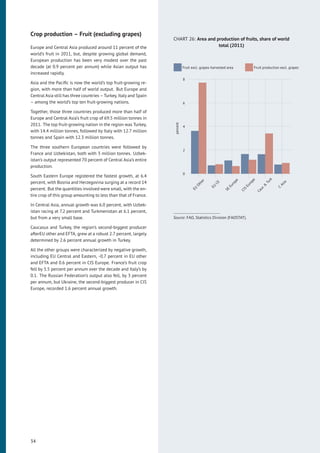
Crop production – Fruit (excluding grapes) 34
Tables 36
Wine production 38
Processed crops 40
Tables 42
Livestock - Cattle 44
Livestock - Pigs 46
Livestock – Sheep and goats 48
Livestock – Poultry 50
Meat production 52
Tables 54
Dairy, eggs and wool 56
Tables 58
Fishery and aquaculture 60
Forestry 62
Tables 64
Food prices and food price volatility 66
Tables 68
Trade in agricultural commodities and food products 70
Tables 80
Water 84
Tables 86
Inputs 88
Greenhouse gas emissions 90
Organic agriculture 92
Tables 94
Part 2 Metadata: 97
Country groups 97
Metadata 99
Bibliography 112
ix
List of Charts
1 Rural and urban population, share of total population (2011) . . . . . . . . . . . . . . . . . . . . . . . . . . . . . . . . . . . . . 4
2 Population ages, share of total (2010) . . . . . . . . . . . . . . . . . . . . . . . . . . . . . . . . . . . . . . . . . . . . . . . . . . . 6
3 Per capita supply of main primary food product groups (2009) . . . . . . . . . . . . . . . . . . . . . . . . . . . . . . . . . . . . 10
4 Food net per capita production index number, 2004-2006 = 100 (1995-2011) . . . . . . . . . . . . . . . . . . . . . . . . . . 11
5 Land area (2011) . . . . . . . . . . . . . . . . . . . . . . . . . . . . . . . . . . . . . . . . . . . . . . . . . . . . . . . . . . . . . . . . 12
6 Agricultural area (2011) . . . . . . . . . . . . . . . . . . . . . . . . . . . . . . . . . . . . . . . . . . . . . . . . . . . . . . . . . . . . 12
7 Agricultural land area (2011) . . . . . . . . . . . . . . . . . . . . . . . . . . . . . . . . . . . . . . . . . . . . . . . . . . . . . . . . . 13
8 Harvested area of the most important crops in Central Asia (2010 and 2011) . . . . . . . . . . . . . . . . . . . . . . . . . . . 16
9 Production quantity of the most important crops in Central Asia (2010 and 2011) . . . . . . . . . . . . . . . . . . . . . . . . 16
10 Harvested area of the most important crops in Caucasus and Turkey (2010 and 2011) . . . . . . . . . . . . . . . . . . . . . 17
11 Production quantity of the most important crops in Caucasus and Turkey (2010 and 2011) . . . . . . . . . . . . . . . . . . 17
12 Harvested area of the most important crops in South Eastern Europe (2010 and 2011) . . . . . . . . . . . . . . . . . . . . . 17
13 Production quantity of the most important crops in South Eastern Europe (2010 and 2011) . . . . . . . . . . . . . . . . . . 17
14 Harvested area of the most important crops in CIS Europe (2010 and 2011) . . . . . . . . . . . . . . . . . . . . . . . . . . . . 18
15 Production quantity of the most important crops in CIS Europe (2010 and 2011) . . . . . . . . . . . . . . . . . . . . . . . . . 18
16 Harvested area of the most important crops in EU Central and Eastern (2010 and 2011) . . . . . . . . . . . . . . . . . . . . 19
17 Production quantity of the most important crops in EU Central & Eastern (2010 and 2011) . . . . . . . . . . . . . . . . . . 19
18 Harvested area of the most important crops in EU Other & EFTA (2010 and 2011) . . . . . . . . . . . . . . . . . . . . . . . . 19
19 Production quantity of the most important crops in EU Other & EFTA (2010 and 2011) . . . . . . . . . . . . . . . . . . . . . 19
20 Area and production of wheat, share of world total (2011) . . . . . . . . . . . . . . . . . . . . . . . . . . . . . . . . . . . . . . 20
21 Area and production of coarse grain, share of world total (2011) . . . . . . . . . . . . . . . . . . . . . . . . . . . . . . . . . . . 22
22 Area and production of oil-bearing crops, share of world total (2011) . . . . . . . . . . . . . . . . . . . . . . . . . . . . . . . . 24
23 Area and production of sugar beet, share of world total (2011) . . . . . . . . . . . . . . . . . . . . . . . . . . . . . . . . . . . . 28
24 Area and production of roots and tubers, share of world total (2011) . . . . . . . . . . . . . . . . . . . . . . . . . . . . . . . . 30
25 Area and production of vegetables, share of world total (2011) . . . . . . . . . . . . . . . . . . . . . . . . . . . . . . . . . . . . 32
26 Area and production of fruits, share of world total (2011) . . . . . . . . . . . . . . . . . . . . . . . . . . . . . . . . . . . . . . . 34
27 Area of vineyards and production of wine, share of world total (2011) . . . . . . . . . . . . . . . . . . . . . . . . . . . . . . . 38
28 Production quantity of the most important processed crops in Central Asia (2010 and 2011) . . . . . . . . . . . . . . . . . 40
29 Production quantity of the most important processed crops in Caucasus & Turkey (2010 and 2011) . . . . . . . . . . . . . 40
30 Production quantity of the most important processed crops in South Eastern Europe (2010 and 2011) . . . . . . . . . . . 41
31 Production quantity of the most important processed crops in CIS Europe (2010 and 2011) . . . . . . . . . . . . . . . . . . 41
32 Production quantity of the most important processed crops in EU Central & Eastern (2010 and 2011) . . . . . . . . . . . 41
33 Production quantity of the most important processed crops in EU Other & EFTA (2010 and 2011) . . . . . . . . . . . . . . 41
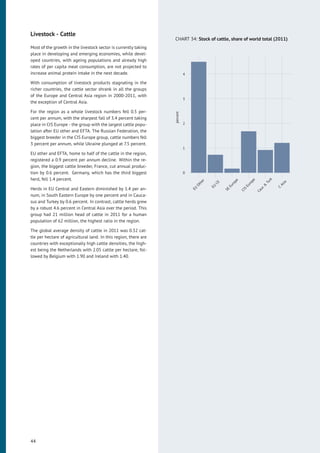
34 Stock of cattle, share of world total (2011) . . . . . . . . . . . . . . . . . . . . . . . . . . . . . . . . . . . . . . . . . . . . . . . . 44
35 Stock of pigs, share of world total (2011) . . . . . . . . . . . . . . . . . . . . . . . . . . . . . . . . . . . . . . . . . . . . . . . . . 46
36 Stock of sheep and goats, share of world total (2011) . . . . . . . . . . . . . . . . . . . . . . . . . . . . . . . . . . . . . . . . . 48
37 Stock of poultry, share of world total (2011) . . . . . . . . . . . . . . . . . . . . . . . . . . . . . . . . . . . . . . . . . . . . . . . 50
38 Meat production (2011) . . . . . . . . . . . . . . . . . . . . . . . . . . . . . . . . . . . . . . . . . . . . . . . . . . . . . . . . . . . . 52
39 Beef and buffalo meat production (2011) . . . . . . . . . . . . . . . . . . . . . . . . . . . . . . . . . . . . . . . . . . . . . . . . . 53
40 Pig meat production (2011) . . . . . . . . . . . . . . . . . . . . . . . . . . . . . . . . . . . . . . . . . . . . . . . . . . . . . . . . . . 53
41 Sheep meat production (2011) . . . . . . . . . . . . . . . . . . . . . . . . . . . . . . . . . . . . . . . . . . . . . . . . . . . . . . . . 53
42 Poultry meat production (2011) . . . . . . . . . . . . . . . . . . . . . . . . . . . . . . . . . . . . . . . . . . . . . . . . . . . . . . . 53
43 Milk production (2011) . . . . . . . . . . . . . . . . . . . . . . . . . . . . . . . . . . . . . . . . . . . . . . . . . . . . . . . . . . . . 56
44 Cheese production (2011) . . . . . . . . . . . . . . . . . . . . . . . . . . . . . . . . . . . . . . . . . . . . . . . . . . . . . . . . . . . 57
45 Production of eggs in shell (2011) . . . . . . . . . . . . . . . . . . . . . . . . . . . . . . . . . . . . . . . . . . . . . . . . . . . . . . 57
46 Butter production (2011) . . . . . . . . . . . . . . . . . . . . . . . . . . . . . . . . . . . . . . . . . . . . . . . . . . . . . . . . . . . 57
47 Wool production (2011) . . . . . . . . . . . . . . . . . . . . . . . . . . . . . . . . . . . . . . . . . . . . . . . . . . . . . . . . . . . . 57
48 Fish production, share of world total (2010) . . . . . . . . . . . . . . . . . . . . . . . . . . . . . . . . . . . . . . . . . . . . . . . 60
49 Forest chatacteristics (2010) . . . . . . . . . . . . . . . . . . . . . . . . . . . . . . . . . . . . . . . . . . . . . . . . . . . . . . . . . 62
50 Cereal Producer Price Index (2010) . . . . . . . . . . . . . . . . . . . . . . . . . . . . . . . . . . . . . . . . . . . . . . . . . . . . . 66
51 Olicrop Producer Price Idex (2010) . . . . . . . . . . . . . . . . . . . . . . . . . . . . . . . . . . . . . . . . . . . . . . . . . . . . . 66
52 Domestic food price volatility (1995-2012) . . . . . . . . . . . . . . . . . . . . . . . . . . . . . . . . . . . . . . . . . . . . . . . . 67
53 Per capita food production variability (1990-2012) . . . . . . . . . . . . . . . . . . . . . . . . . . . . . . . . . . . . . . . . . . . 67
54 Cereal net trade (2000-2011) . . . . . . . . . . . . . . . . . . . . . . . . . . . . . . . . . . . . . . . . . . . . . . . . . . . . . . . . . 70
55 Cereal net trade (2011) . . . . . . . . . . . . . . . . . . . . . . . . . . . . . . . . . . . . . . . . . . . . . . . . . . . . . . . . . . . . 70
56 Europe and Central Asia net trade, selected food components (2000-2011) . . . . . . . . . . . . . . . . . . . . . . . . . . . . 71
57 Fruit and vegetables net trade (2000-2011) . . . . . . . . . . . . . . . . . . . . . . . . . . . . . . . . . . . . . . . . . . . . . . . . 72
58 Fruit and vegetables net trade (2011) . . . . . . . . . . . . . . . . . . . . . . . . . . . . . . . . . . . . . . . . . . . . . . . . . . . 72
59 Major export flows of cheese of whole cow milk from Europe and Central Asia countries (US$, 2011) . . . . . . . . . . . . 73
x
LIST OF CHARTS
60 Animal fats, oilseeds and veg. oils net trade (2000-2011) . . . . . . . . . . . . . . . . . . . . . . . . . . . . . . . . . . . . . . . 74
61 Animal fats, oilseeds and veg. oils net trade (2011) . . . . . . . . . . . . . . . . . . . . . . . . . . . . . . . . . . . . . . . . . . . 74
62 Major export flows of wine from Europe and Central Asia countries (US$, 2011) . . . . . . . . . . . . . . . . . . . . . . . . . 75
63 Sugar and honey net trade (2000-2011) . . . . . . . . . . . . . . . . . . . . . . . . . . . . . . . . . . . . . . . . . . . . . . . . . . 76
64 Sugar and honey net trade (2011) . . . . . . . . . . . . . . . . . . . . . . . . . . . . . . . . . . . . . . . . . . . . . . . . . . . . . . 76
65 Major export flows of alcoholic distilled beverages from Europe and Central Asia countries (US$, 2011) . . . . . . . . . . 77
66 Coffee, tea, cocoa and spices net trade (2000-2011) . . . . . . . . . . . . . . . . . . . . . . . . . . . . . . . . . . . . . . . . . . . 78
67 Meat and meat prep. net trade (2011) . . . . . . . . . . . . . . . . . . . . . . . . . . . . . . . . . . . . . . . . . . . . . . . . . . . 78
68 Beverages net trade (2000-2011) . . . . . . . . . . . . . . . . . . . . . . . . . . . . . . . . . . . . . . . . . . . . . . . . . . . . . . 79
69 Fish net trade (2010) . . . . . . . . . . . . . . . . . . . . . . . . . . . . . . . . . . . . . . . . . . . . . . . . . . . . . . . . . . . . . . 79
70 Livestock products and fish net trade (2000-2011) . . . . . . . . . . . . . . . . . . . . . . . . . . . . . . . . . . . . . . . . . . . 79
71 Dairy products (milk equivalent) net trade (2011) . . . . . . . . . . . . . . . . . . . . . . . . . . . . . . . . . . . . . . . . . . . . 79
72 Irrigation potential (2012) . . . . . . . . . . . . . . . . . . . . . . . . . . . . . . . . . . . . . . . . . . . . . . . . . . . . . . . . . . 84
73 Freshwater withdrawal by agricultural sector, shares of total (2000-2010*) . . . . . . . . . . . . . . . . . . . . . . . . . . . . 84
74 Europe and Central Asia fertilizer consumption in nutrients per ha of arable land and permanent crops (2002-2011) . . 88
75 Fertilizer consumption in nutrients per ha of arable land and permanent crops (2011) . . . . . . . . . . . . . . . . . . . . . 88
76 Europe and Central Asia total agricultural GHG emissions (1995 and 2010) . . . . . . . . . . . . . . . . . . . . . . . . . . . . 90
77 Europe and Central Asia agricultural greenhouse gas emissions by sector (2010) . . . . . . . . . . . . . . . . . . . . . . . . . 91
78 Organic agriculture area, share of total agricultural area (2011) . . . . . . . . . . . . . . . . . . . . . . . . . . . . . . . . . . . 92
xi
List of Maps
1 Population annual growth (percent, 2000-2012) . . . . . . . . . . . . . . . . . . . . . . . . . . . . . . . . . . . . . . . . . . . . . 5
2 Population density (people/km2, 2011) . . . . . . . . . . . . . . . . . . . . . . . . . . . . . . . . . . . . . . . . . . . . . . . . . . 5
3 Employment in agriculture, share of total employment (percent, 2000-2011*) . . . . . . . . . . . . . . . . . . . . . . . . . . 7
4 Female employment in agriculture, share of female employment (percent, 2000-2011*) . . . . . . . . . . . . . . . . . . . . 7
5 Food net per capita production value (I$/cap, 2011) . . . . . . . . . . . . . . . . . . . . . . . . . . . . . . . . . . . . . . . . . . 11
6 Per capita arable land (ha/cap, 2011) . . . . . . . . . . . . . . . . . . . . . . . . . . . . . . . . . . . . . . . . . . . . . . . . . . . . 13
7 Wheat area, share of total agricultural area (percent, 2011) . . . . . . . . . . . . . . . . . . . . . . . . . . . . . . . . . . . . . . 21
8 Wheat production (thousand tonnes, 2011) . . . . . . . . . . . . . . . . . . . . . . . . . . . . . . . . . . . . . . . . . . . . . . . . 21
9 Coarse grain area, share of total agricultural area (percent, 2011) . . . . . . . . . . . . . . . . . . . . . . . . . . . . . . . . . . 23
10 Coarse grain production (thousand tonnes, 2011) . . . . . . . . . . . . . . . . . . . . . . . . . . . . . . . . . . . . . . . . . . . . 23
11 Oil-bearing crop area, share of total agricultural area (percent, 2011) . . . . . . . . . . . . . . . . . . . . . . . . . . . . . . . 25
12 Oil-bearing crop production (thousand tonnes, 2011) . . . . . . . . . . . . . . . . . . . . . . . . . . . . . . . . . . . . . . . . . . 25
13 Sugar beet area, share of total agricultural area (percent, 2011) . . . . . . . . . . . . . . . . . . . . . . . . . . . . . . . . . . . 29
14 Sugar production (thousand tonnes, 2011) . . . . . . . . . . . . . . . . . . . . . . . . . . . . . . . . . . . . . . . . . . . . . . . . 29
15 Root and tuber area, share of total agricultural area (percent, 2011) . . . . . . . . . . . . . . . . . . . . . . . . . . . . . . . . 31
16 Root and tuber production (thousand tonnes, 2011) . . . . . . . . . . . . . . . . . . . . . . . . . . . . . . . . . . . . . . . . . . 31
17 Vegetable area, share of total agricultural area (percent, 2011) . . . . . . . . . . . . . . . . . . . . . . . . . . . . . . . . . . . . 33
18 Vegetable production (thousand tonnes, 2011) . . . . . . . . . . . . . . . . . . . . . . . . . . . . . . . . . . . . . . . . . . . . . . 33
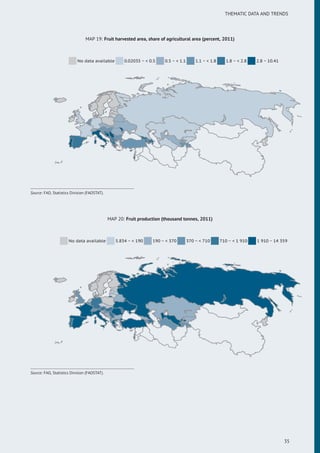
19 Fruit harvested area, share of agricultural area (percent, 2011) . . . . . . . . . . . . . . . . . . . . . . . . . . . . . . . . . . . . 35
20 Fruit production (thousand tonnes, 2011) . . . . . . . . . . . . . . . . . . . . . . . . . . . . . . . . . . . . . . . . . . . . . . . . . 35
21 Area of vineyards, share of total agricultural area (percent, 2011) . . . . . . . . . . . . . . . . . . . . . . . . . . . . . . . . . . 39
22 Wine production (thousand tonnes, 2011) . . . . . . . . . . . . . . . . . . . . . . . . . . . . . . . . . . . . . . . . . . . . . . . . . 39
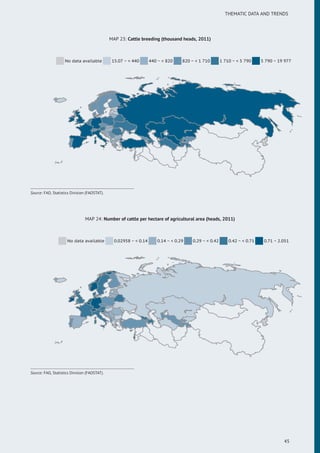
23 Cattle breeding (thousand heads, 2011) . . . . . . . . . . . . . . . . . . . . . . . . . . . . . . . . . . . . . . . . . . . . . . . . . . 45
24 Number of cattle per hectare of agricultural area (heads, 2011) . . . . . . . . . . . . . . . . . . . . . . . . . . . . . . . . . . . 45
25 Pig breeding (thousand heads, 2011) . . . . . . . . . . . . . . . . . . . . . . . . . . . . . . . . . . . . . . . . . . . . . . . . . . . . 47
26 Number of pigs per hectare of agricultural area (heads, 2011) . . . . . . . . . . . . . . . . . . . . . . . . . . . . . . . . . . . . 47
27 Sheep and goat breeding (thousand heads, 2011) . . . . . . . . . . . . . . . . . . . . . . . . . . . . . . . . . . . . . . . . . . . . 49
28 Number of sheep and goats per hectare of agricultural area (heads, 2011) . . . . . . . . . . . . . . . . . . . . . . . . . . . . . 49
29 Poultry (million heads, 2011) . . . . . . . . . . . . . . . . . . . . . . . . . . . . . . . . . . . . . . . . . . . . . . . . . . . . . . . . . 51
30 Number of poultry per hectare of agricultural area (heads, 2011) . . . . . . . . . . . . . . . . . . . . . . . . . . . . . . . . . . 51
31 Capture fish production (thousand tonnes, 2010) . . . . . . . . . . . . . . . . . . . . . . . . . . . . . . . . . . . . . . . . . . . . 61
32 Aquaculture production (thousand tonnes, 2010) . . . . . . . . . . . . . . . . . . . . . . . . . . . . . . . . . . . . . . . . . . . . 61
33 Forest area, share of total land area (percent, 2011) . . . . . . . . . . . . . . . . . . . . . . . . . . . . . . . . . . . . . . . . . . 63
34 Production of roundwood (million m3, 2011) . . . . . . . . . . . . . . . . . . . . . . . . . . . . . . . . . . . . . . . . . . . . . . . 63
35 Cereal net trade (billion constant 2005 US$, 2011) . . . . . . . . . . . . . . . . . . . . . . . . . . . . . . . . . . . . . . . . . . . 71
36 Freshwater resources withdrawn by agriculture (percent, 2000-2010*) . . . . . . . . . . . . . . . . . . . . . . . . . . . . . . . 85
37 Share of equipped area actually irrigated (percent, 2000-2012*) . . . . . . . . . . . . . . . . . . . . . . . . . . . . . . . . . . . 85
38 Nitrogen and phosphate fertilizers consumption per ha of arable land and permanent crops (kg/ha, 2009-2012*) . . . . 89
39 Pesticide use, kilograms per hectare of arable and permanent crops (kg/ha, 2009-2012*) . . . . . . . . . . . . . . . . . . . 89
40 Total agricultural greenhouse gas emissions (gigagrams CO2eq, 2010) . . . . . . . . . . . . . . . . . . . . . . . . . . . . . . . 91
41 Organic agriculture area (thousand ha, 2011) . . . . . . . . . . . . . . . . . . . . . . . . . . . . . . . . . . . . . . . . . . . . . . . 93
42 Organic agriculture area, share of total agricultural area (percent, 2011) . . . . . . . . . . . . . . . . . . . . . . . . . . . . . . 93
xii
List of Tables
1 Population and structure . . . . . . . . . . . . . . . . . . . . . . . . . . . . . . . . . . . . . . . . . . . . . . . . . . . . . . . . . . . 8
2 Rural and urban population, and labour force structure . . . . . . . . . . . . . . . . . . . . . . . . . . . . . . . . . . . . . . . . 9
3 Agriculture-in-aggregate production indicators . . . . . . . . . . . . . . . . . . . . . . . . . . . . . . . . . . . . . . . . . . . . . 14
4 Land . . . . . . . . . . . . . . . . . . . . . . . . . . . . . . . . . . . . . . . . . . . . . . . . . . . . . . . . . . . . . . . . . . . . . . . . 15
5 Cereals and wheat . . . . . . . . . . . . . . . . . . . . . . . . . . . . . . . . . . . . . . . . . . . . . . . . . . . . . . . . . . . . . . . 26
6 Coarse grain and oil-bearing crops . . . . . . . . . . . . . . . . . . . . . . . . . . . . . . . . . . . . . . . . . . . . . . . . . . . . . 27
7 Sugar beet and roots and tubers . . . . . . . . . . . . . . . . . . . . . . . . . . . . . . . . . . . . . . . . . . . . . . . . . . . . . . 36
8 Vegetables and fruit . . . . . . . . . . . . . . . . . . . . . . . . . . . . . . . . . . . . . . . . . . . . . . . . . . . . . . . . . . . . . . 37
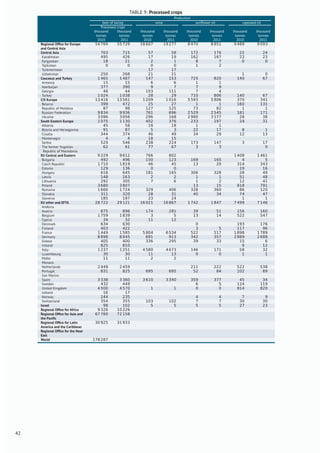
9 Processed crops . . . . . . . . . . . . . . . . . . . . . . . . . . . . . . . . . . . . . . . . . . . . . . . . . . . . . . . . . . . . . . . . . 42
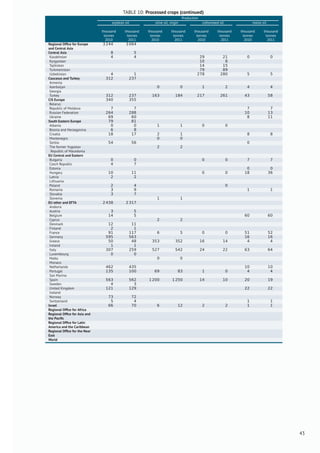
10 Processed crops (continued) . . . . . . . . . . . . . . . . . . . . . . . . . . . . . . . . . . . . . . . . . . . . . . . . . . . . . . . . . 43
11 Livestock . . . . . . . . . . . . . . . . . . . . . . . . . . . . . . . . . . . . . . . . . . . . . . . . . . . . . . . . . . . . . . . . . . . . . 54
12 Meat products . . . . . . . . . . . . . . . . . . . . . . . . . . . . . . . . . . . . . . . . . . . . . . . . . . . . . . . . . . . . . . . . . . 55
13 Dairy products . . . . . . . . . . . . . . . . . . . . . . . . . . . . . . . . . . . . . . . . . . . . . . . . . . . . . . . . . . . . . . . . . . 58
14 Production of eggs and wool . . . . . . . . . . . . . . . . . . . . . . . . . . . . . . . . . . . . . . . . . . . . . . . . . . . . . . . . . 59
15 Fish production . . . . . . . . . . . . . . . . . . . . . . . . . . . . . . . . . . . . . . . . . . . . . . . . . . . . . . . . . . . . . . . . . 64
16 Forest area and forestry production . . . . . . . . . . . . . . . . . . . . . . . . . . . . . . . . . . . . . . . . . . . . . . . . . . . . . 65
17 Producer price index . . . . . . . . . . . . . . . . . . . . . . . . . . . . . . . . . . . . . . . . . . . . . . . . . . . . . . . . . . . . . . 68
18 Producer price index (continued) . . . . . . . . . . . . . . . . . . . . . . . . . . . . . . . . . . . . . . . . . . . . . . . . . . . . . . 69
19 Volume and value of trade in wheat and maize . . . . . . . . . . . . . . . . . . . . . . . . . . . . . . . . . . . . . . . . . . . . . 80
20 Volume and value of trade in cotton lint and potatoes . . . . . . . . . . . . . . . . . . . . . . . . . . . . . . . . . . . . . . . . . 81
21 Volume and value of trade in wine and dairy products . . . . . . . . . . . . . . . . . . . . . . . . . . . . . . . . . . . . . . . . . 82
22 Volume and value of trade in cattle and pigs . . . . . . . . . . . . . . . . . . . . . . . . . . . . . . . . . . . . . . . . . . . . . . . 83
23 Water resources per capita and irrigation . . . . . . . . . . . . . . . . . . . . . . . . . . . . . . . . . . . . . . . . . . . . . . . . . 86
24 Water withdrawal and pressure on renewable water resources . . . . . . . . . . . . . . . . . . . . . . . . . . . . . . . . . . . . 87
25 Inputs . . . . . . . . . . . . . . . . . . . . . . . . . . . . . . . . . . . . . . . . . . . . . . . . . . . . . . . . . . . . . . . . . . . . . . . 94
26 Agricultural emissions . . . . . . . . . . . . . . . . . . . . . . . . . . . . . . . . . . . . . . . . . . . . . . . . . . . . . . . . . . . . . 95
27 Country groups . . . . . . . . . . . . . . . . . . . . . . . . . . . . . . . . . . . . . . . . . . . . . . . . . . . . . . . . . . . . . . . . . 98
xiii
xiv
PART
1
Thematic Data and Trends
This second edition of the FAO Statistical Yearbook: Eu-
rope and Central Asia food and agriculture, like its pre-
decessor in 2012, brings together a rich array of regional
data, in a coherent, systematic and easily accessible way.
Achieving food security and better nutrition for all, lies
at the heart of FAO’s mission, which is to help ensure
that people have sufficient access to enough high-quality
food to lead active, healthy lives. We strive to cooper-
ate with countries in raising levels of nutrition, improving
agricultural productivity, enhancing the lives of rural pop-
ulations and ensuring that agriculture sustains economic
growth.
Much of Europe and Central Asia has experienced a mod-
est economic recovery since 2010 though at varying rates
1
in different areas. Growth slowed down, or turned neg-
ative, in the economies of EU Central and Eastern and
South Eastern Europe in 2012 and was expected to re-
main subdued in 2013. But recovery has been more robust
in the CIS economies, largely thanks to high commodity
prices, although growth remains below pre-crisis levels.
The European CIS countries and Turkey have outper-
formed their counterparts in Central and Southeastern Eu-
rope systematically since 2010, and they were also ex-
pected to do so in 2013.
Renewed investment in the agricultural sector is essen-
tial to continue and accelerate growth, especially against
the background of the general exodus from the land evi-
denced by fast- shrinking agricultural populations. In par-
ticular, there is an urgent need, in this International Year
of Family Farming, to adopt measures to reinforce family
farm systems in Europe and Central Asia, which are one
of the pillars of agriculture in the region. There are 12
million family farms in the European Union alone.
In addition to its essential role in food security, sustain-
able agricultural development is now regarded as pivotal
in enhancing rural well-being and balancing rural-urban
migrations. It has also become evident that agriculture is
key in effectively addressing the many challenging envi-
ronmental issues of our time, including climate change,
water scarcity, atmospheric and marine pollution, as well
as land degradation.
As the chief user of land, agriculture has a clear role in
providing protection for the environment and in preserv-
ing our planet’s natural resource base. As the sector is
now intertwined with almost every aspect of the devel-
2
opment agenda, a major challenge is to capture and to
monitor the multiple roles of agriculture.
Providing reliable and timely information on the status
of food and agricultural sectors in multiple contexts is
at the core of the FAO mandate, and in particular of the
FAO Statistics Division, and the statisticians who work in
the various FAO regional and country offices around the
globe. Concerted efforts are being made by FAO and its
partners to enhance national capacities to provide more,
better quality and timely statistical information for pro-
ducers, scholars, policymakers and analysts.
In response to the demand for a more comprehensive
regionally-focused set of statistics and indicators, we
have attempted to meet the challenge through this statis-
tical yearbook, which is a thematically-driven, statistical
snapshot of the major trends and issues related to food
and agriculture in Europe and Central Asia.
3
People and demography
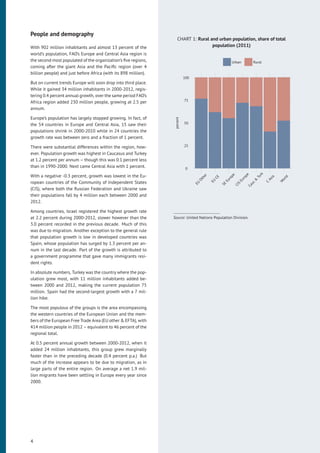
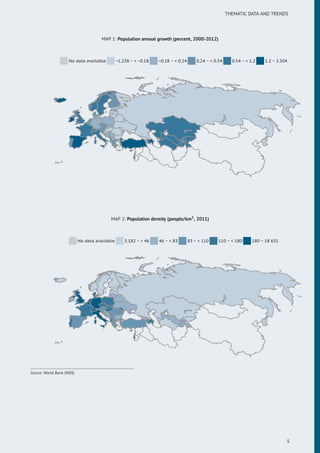
With 902 million inhabitants and almost 13 percent of the
world’s population, FAO’s Europe and Central Asia region is
the second most populated of the organization’s five regions,
coming after the giant Asia and the Pacific region (over 4
billion people) and just before Africa (with its 898 million).
But on current trends Europe will soon drop into third place.
While it gained 34 million inhabitants in 2000-2012, regis-
tering 0.4 percent annual growth, over the same period FAO’s
Africa region added 230 million people, growing at 2.5 per
annum.
Europe’s population has largely stopped growing. In fact, of
the 54 countries in Europe and Central Asia, 15 saw their
populations shrink in 2000-2010 while in 24 countries the
growth rate was between zero and a fraction of 1 percent.
There were substantial differences within the region, how-
ever. Population growth was highest in Caucasus and Turkey
at 1.2 percent per annum – though this was 0.1 percent less
than in 1990-2000. Next came Central Asia with 1 percent.
With a negative -0.3 percent, growth was lowest in the Eu-
ropean countries of the Community of Independent States
(CIS), where both the Russian Federation and Ukraine saw
their populations fall by 4 million each between 2000 and
2012.
Among countries, Israel registered the highest growth rate
at 2.2 percent during 2000-2012, slower however than the
3.0 percent recorded in the previous decade. Much of this
was due to migration. Another exception to the general rule
that population growth is low in developed countries was
Spain, whose population has surged by 1.3 percent per an-
num in the last decade. Part of the growth is attributed to
a government programme that gave many immigrants resi-
dent rights.
In absolute numbers, Turkey was the country where the pop-
ulation grew most, with 11 million inhabitants added be-
tween 2000 and 2012, making the current population 75
million. Spain had the second-largest growth with a 7 mil-
lion hike.
The most populous of the groups is the area encompassing
the western countries of the European Union and the mem-
bers of the European Free Trade Area (EU other & EFTA), with
414 million people in 2012 – equivalent to 46 percent of the
regional total.
At 0.5 percent annual growth between 2000-2012, when it
added 24 million inhabitants, this group grew marginally
faster than in the preceding decade (0.4 percent p.a.) But
much of the increase appears to be due to migration, as in
large parts of the entire region. On average a net 1.9 mil-
lion migrants have been settling in Europe every year since
2000.
CHART 1: Rural and urban population, share of total
population (2011)
0
25
50
75
100
EU
Other
EU
CE
SE
Europe
CIS
Europe
Cauc
&
Turk
C
Asia
W
orld
percent
Urban Rural
Source: United Nations Population Division.
4
THEMATIC DATA AND TRENDS
MAP 1: Population annual growth (percent, 2000-2012)
No data available −1.238 ~ < −0.18 −0.18 ~ < 0.24 0.24 ~ < 0.54 0.54 ~ < 1.2 1.2 ~ 2.504
MAP 2: Population density (people/km2
, 2011)
No data available 3.182 ~ < 46 46 ~ < 83 83 ~ < 110 110 ~ < 180 180 ~ 18 631
Source: World Bank (WDI).
5
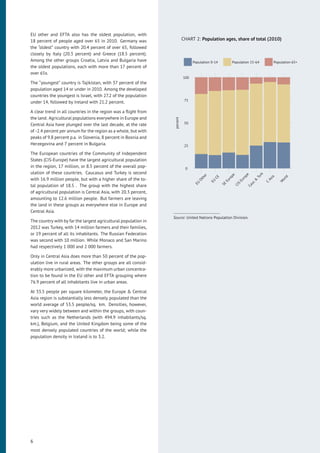
EU other and EFTA also has the oldest population, with
18 percent of people aged over 65 in 2010. Germany was
the “oldest” country with 20.4 percent of over 65, followed
closely by Italy (20.3 percent) and Greece (18.5 percent).
Among the other groups Croatia, Latvia and Bulgaria have
the oldest populations, each with more than 17 percent of
over 65s.
The “youngest” country is Tajikistan, with 37 percent of the
population aged 14 or under in 2010. Among the developed
countries the youngest is Israel, with 27.2 of the population
under 14, followed by Ireland with 21.2 percent.
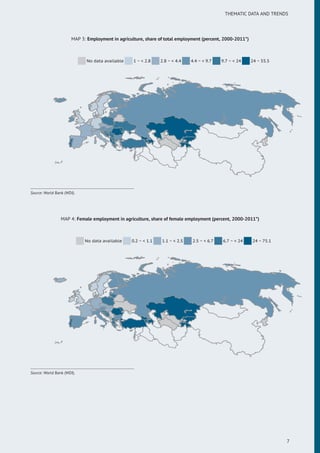
A clear trend in all countries in the region was a flight from
the land. Agricultural populations everywhere in Europe and
Central Asia have plunged over the last decade, at the rate
of -2.4 percent per annum for the region as a whole, but with
peaks of 9.8 percent p.a. in Slovenia, 8 percent in Bosnia and
Herzegovina and 7 percent in Bulgaria.
The European countries of the Community of Independent
States (CIS-Europe) have the largest agricultural population
in the region, 17 million, or 8.5 percent of the overall pop-
ulation of these countries. Caucasus and Turkey is second
with 16.9 million people, but with a higher share of the to-
tal population of 18.5 . The group with the highest share
of agricultural population is Central Asia, with 20.3 percent,
amounting to 12.6 million people. But farmers are leaving
the land in these groups as everywhere else in Europe and
Central Asia.
The country with by far the largest agricultural population in
2012 was Turkey, with 14 million farmers and their families,
or 19 percent of all its inhabitants. The Russian Federation
was second with 10 million. While Monaco and San Marino
had respectively 1 000 and 2 000 farmers.
Only in Central Asia does more than 50 percent of the pop-
ulation live in rural areas. The other groups are all consid-
erably more urbanized, with the maximum urban concentra-
tion to be found in the EU other and EFTA grouping where
76.9 percent of all inhabitants live in urban areas.
At 33.5 people per square kilometer, the Europe & Central
Asia region is substantially less densely populated than the
world average of 53.5 people/sq. km. Densities, however,
vary very widely between and within the groups, with coun-
tries such as the Netherlands (with 494.9 inhabitants/sq.
km.), Belgium, and the United Kingdom being some of the
most densely populated countries of the world; while the
population density in Iceland is to 3.2.
CHART 2: Population ages, share of total (2010)
0
25
50
75
100
EU
Other
EU
CE
SE
Europe
CIS
Europe
Cauc
&
Turk
C
Asia
W
orld
percent
Population 0-14 Population 15-64 Population 65+
Source: United Nations Population Division.
6
THEMATIC DATA AND TRENDS
MAP 3: Employment in agriculture, share of total employment (percent, 2000-2011*)
No data available 1 ~ < 2.8 2.8 ~ < 4.4 4.4 ~ < 9.7 9.7 ~ < 24 24 ~ 55.5
Source: World Bank (WDI).
MAP 4: Female employment in agriculture, share of female employment (percent, 2000-2011*)
No data available 0.2 ~ < 1.1 1.1 ~ < 2.5 2.5 ~ < 6.7 6.7 ~ < 24 24 ~ 75.1
Source: World Bank (WDI).
7
TABLE 1: Population and structure
Population Age composition Agricultural population
total p.a. growth between
0-14
over 65 between
15-64
total share of
total
p.a.
growth
million
people
million
people
percent percent percent percent percent thousand
people
percent percent
2000 2012 1990-2000 2000-12 2010 2010 2010 2012 2012 1992-2012
Regional Office for Europe
and Central Asia
868 902 0.3 0.4 17.4 14.4 68.2 70 447 7.8 −2.4
Central Asia 55 62 1.0 1.0 29.0 4.9 66.1 12 594 20.3 −1.1
Kazakhstan 15 16 −1.1 0.9 24.5 6.8 68.7 2 450 15.0 −2.2
Kyrgyzstan 5 5 1.2 0.9 30.1 4.4 65.6 1 084 19.9 −1.2
Tajikistan 6 7 1.5 1.2 37.0 3.5 59.5 1 858 26.2 −0.8
Turkmenistan 5 5 2.1 1.2 29.2 4.1 66.6 1 498 29.0 0.3
Uzbekistan 25 28 1.9 1.1 29.4 4.3 66.3 5 704 20.3 −1.1
Caucasus and Turkey 80 91 1.3 1.2 25.1 6.6 68.3 16 943 18.5 −1.5
Armenia 3 3 −1.5 0.1 20.2 11.1 68.7 276 8.9 −3.6
Azerbaijan 8 9 1.2 1.3 20.9 6.6 72.6 2 071 22.0 −0.4
Georgia 5 4 −1.5 −0.7 16.6 14.4 69.1 613 14.2 −3.8
Turkey 64 75 1.6 1.3 26.4 6.0 67.7 13 983 18.8 −1.5
CIS Europe 210 201 −0.2 −0.3 14.9 13.4 71.7 17 014 8.5 −3.2
Belarus 10 10 −0.2 −0.5 15.0 13.6 71.4 783 8.2 −4.3
Republic of Moldova 4 4 −0.6 −1.2 16.7 11.1 72.2 481 13.7 −5.0
Russian Federation 147 143 −0.1 −0.2 15.0 12.8 72.2 10 919 7.7 −2.8
Ukraine 49 45 −0.6 −0.7 14.2 15.5 70.3 4 831 10.7 −3.8
South Eastern Europe 24 24 −0.1 −0.0 17.4 13.9 68.6 2 916 12.2 −2.5
Albania 3 3 −0.8 0.4 22.7 9.6 67.7 1 307 40.5 −1.4
Bosnia and Herzegovina 4 4 −1.7 −0.0 15.0 14.1 70.9 75 2.0 −8.0
Croatia 5 4 −0.0 −0.2 15.0 17.2 67.8 167 3.8 −6.6
Montenegro 1 1 0.4 0.1 19.3 12.7 68.1 74 11.7
Serbia 10 10 0.6 −0.2 17.6 14.3 68.0 1 155 11.7
The former Yugoslav
Republic of Macedonia
2 2 0.5 0.2 17.6 11.8 70.6 138 6.7 −4.9
EU Central and Eastern 104 102 −0.2 −0.1 14.7 14.8 70.5 9 643 9.5 −3.3
Bulgaria 8 7 −1.0 −0.6 13.7 17.5 68.7 259 3.5 −7.0
Czech Republic 10 11 −0.1 0.4 14.0 14.8 71.2 617 5.8
Estonia 1 1 −1.4 −0.1 15.4 17.2 67.3 113 8.4 −3.1
Hungary 10 10 −0.2 −0.2 14.7 16.5 68.8 780 7.8 −3.6
Latvia 2 2 −1.2 −0.5 13.9 17.8 68.3 196 8.8 −3.4
Lithuania 4 3 −0.6 −0.5 14.9 16.0 69.0 295 9.0 −4.6
Poland 38 38 0.1 0.0 14.8 13.6 71.6 5 385 14.1 −2.4
Romania 22 21 −0.5 −0.3 15.2 14.9 69.9 1 618 7.6 −5.2
Slovakia 5 5 0.3 0.1 15.1 12.1 72.8 369 6.7
Slovenia 2 2 0.3 0.2 13.9 16.4 69.6 11 0.5 −9.8
EU other and EFTA 390 414 0.4 0.5 15.8 18.0 66.2 11 215 2.7 −3.5
Andorra 0 0 1.9 2.5 5 5.7 −1.7
Austria 8 8 0.4 0.4 14.7 17.6 67.7 260 3.1 −3.7
Belgium 10 11 0.2 0.5 16.9 17.4 65.7 125 1.2
Cyprus 1 1 2.1 1.5 17.8 11.6 70.7 55 4.9 −2.9
Denmark 5 6 0.4 0.4 18.0 16.5 65.5 132 2.4 −3.4
Finland 5 5 0.4 0.4 16.5 17.2 66.2 192 3.6 −3.8
France 59 63 0.4 0.6 18.4 16.8 64.8 1 162 1.8 −4.4
Germany 82 82 0.4 −0.0 13.5 20.4 66.1 1 175 1.4 −4.4
Greece 11 11 0.8 0.3 14.6 18.5 66.9 1 014 8.9 −2.9
Ireland 4 5 0.7 1.6 21.2 11.7 67.1 280 6.1 −2.4
Italy 57 61 0.0 0.6 14.1 20.3 65.6 1 794 2.9 −4.4
Luxembourg 0 1 1.4 1.7 17.6 13.8 68.4 6 1.1
Malta 0 0 0.8 0.4 14.9 14.4 70.7 4 1.0 −4.0
Monaco 0 0 1.3 0.0 1 2.9 0.0
Netherlands 16 17 0.6 0.4 17.7 15.3 67.0 386 2.3 −2.5
Portugal 10 11 0.4 0.3 15.1 17.9 66.9 1 063 9.9 −2.8
San Marino 0 0 1.2 1.3 2 6.2 −2.0
Spain 40 47 0.3 1.3 15.0 17.0 68.1 1 870 4.0 −4.0
Sweden 9 9 0.3 0.7 16.5 18.2 65.2 226 2.4 −2.8
United Kingdom 59 63 0.3 0.6 17.4 16.6 66.0 896 1.4 −1.4
Iceland 0 0 1.0 1.4 20.9 11.9 67.8 19 5.8 −1.7
Norway 4 5 0.6 0.9 18.7 14.7 66.6 175 3.5 −2.3
Switzerland 7 8 0.7 0.7 15.2 16.7 68.0 373 4.8 −1.9
Israel 6 8 3.0 2.2 27.2 10.4 62.4 122 1.6 −1.9
Regional Office for Africa 668 898 2.7 2.5 42.4 3.2 54.4 486 952 54.2 1.8
Regional Office for Asia and
the Pacific
3 641 4 111 1.4 1.0 25.1 7.7 67.1 1 102 289 30.2 0.5
Regional Office for Latin
America and the Caribbean
516 598 1.7 1.2 27.9 6.8 65.2 90 601 15.2 −1.0
Regional Office for the Near
East
338 432 2.2 2.2 31.5 4.3 64.2 98 015 22.7 0.0
World 6 101 7 029 1.5 1.2 28.5 7.5 64.0 1 795 710 31.7 0.6
8
TABLE 2: Rural and urban population, and labour force structure
Population Total Empl in Agricultural employment by gender
rural urban density
employment
agriculture female male
share p.a.
growth
share p.a.
growth
share of
total empl
share of
female
empl
share of
male empl
percent percent percent percent
people/km2
million
people
percent percent percent
2011 2000-11 2011 2000-11 2011 2010 2000-11* 2000-11* 2000-11*
Regional Office for Europe
and Central Asia
29.6 −0.2 70.4 0.6 33.5 391 14.1 12.5 13.4
Central Asia 59.4 1.1 40.6 0.7 16.4 26 28.3 29.2 31.1
Kazakhstan 46.4 1.2 53.6 0.4 6.1 8 28.3 29.2 31.1
Kyrgyzstan 64.7 0.8 35.3 0.8 28.8 2 34.0 35.4 36.9
Tajikistan 73.5 1.1 26.5 1.1 55.8 3 55.5 75.1 41.8
Turkmenistan 51.3 0.7 48.7 1.7 10.9 2
Uzbekistan 63.8 1.2 36.2 0.7 69.0 11
Caucasus and Turkey 31.5 −0.4 68.5 2.0 95.4 31 26.0 39.5 19.0
Armenia 35.9 0.2 64.1 −0.0 104.1 1 44.2 49.1 39.4
Azerbaijan 46.4 0.8 53.6 1.6 111.0 4 38.2 44.5 32.3
Georgia 47.2 −0.9 52.8 −0.8 78.4 2 53.4 56.6 50.5
Turkey 28.5 −0.6 71.5 2.3 94.9 23 23.7 39.3 17.5
CIS Europe 27.7 −0.7 72.3 −0.2 11.8 96 27.5 24.9 31.4
Belarus 25.0 −2.1 75.0 0.2 46.7 4
Republic of Moldova 52.3 −1.8 47.7 −0.7 124.0 1 27.5 24.5 30.5
Russian Federation 26.2 −0.4 73.8 −0.2 8.7 70 9.7 6.7 10.5
Ukraine 31.1 −1.2 68.9 −0.5 78.9 21 15.8
South Eastern Europe 44.6 −0.9 55.4 0.7 84.9 7 19.1 18.7 15.1
Albania 46.6 −1.6 53.4 2.7 115.1 1 44.1
Bosnia and Herzegovina 51.8 −0.7 48.3 1.2 75.3 1 19.7 22.8 17.9
Croatia 42.2 −0.7 57.8 0.1 76.5 2 14.9 16.3 13.7
Montenegro 36.7 −1.1 63.3 0.7 46.1
Serbia 43.6 −0.9 56.4 0.3 92.0 2 21.9
The former Yugoslav
Republic of Macedonia
40.7 0.3 59.3 0.2 83.4 1 19.7 19.8 19.6
EU Central and Eastern 37.9 −0.2 62.1 −0.1 97.1 44 13.4 13.0 13.6
Bulgaria 26.9 −2.0 73.1 −0.1 67.7 3 6.8 5.2 8.2
Czech Republic 26.6 0.5 73.4 0.2 135.9 5 3.1 1.9 4.0
Estonia 30.5 −0.2 69.5 −0.2 31.6 1 4.2 2.8 5.8
Hungary 30.5 −1.6 69.5 0.4 110.1 4 4.5 2.3 6.4
Latvia 32.3 −0.5 67.7 −0.6 33.1 1 8.8 5.8 12.0
Lithuania 32.9 −0.5 67.1 −0.5 48.3 1 9.0 6.8 11.5
Poland 39.1 0.2 60.9 −0.1 126.7 16 12.8 12.5 13.1
Romania 47.2 −0.3 52.8 −0.3 92.9 9 30.1 31.4 29.1
Slovakia 45.3 0.4 54.7 −0.1 112.3 2 3.2 1.8 4.4
Slovenia 50.1 0.4 49.9 0.1 101.9 1 8.8 8.5 9.0
EU other and EFTA 23.1 −0.4 76.9 0.9 116.0 184 3.1 2.2 3.8
Andorra 12.8 7.4 87.2 2.0 165.7
Austria 32.3 −0.1 67.7 0.7 102.2 4 5.2 5.0 5.4
Belgium 2.5 −0.7 97.5 0.5 364.9 4 1.4 0.9 1.7
Cyprus 29.5 1.0 70.5 1.8 120.8 1 3.8 2.6 4.8
Denmark 13.1 −0.8 86.9 0.6 131.3 3 2.4 0.9 3.9
Finland 16.3 −0.4 83.7 0.5 17.7 2 4.4 2.8 6.0
France 14.2 −3.8 85.8 1.6 119.4 27 2.9 1.8 3.9
Germany 26.1 −0.3 73.9 0.1 234.7 39 1.6 1.2 2.0
Greece 38.6 −0.1 61.4 0.6 87.7 5 12.5 12.7 12.4
Ireland 37.8 0.9 62.2 2.1 66.4 2 4.6 1.0 7.7
Italy 31.6 0.3 68.4 0.7 206.4 23 3.8 2.8 4.5
Luxembourg 14.5 0.5 85.5 1.7 200.1 0 1.0 0.7 1.3
Malta 5.3 −2.8 94.7 0.7 1 302.1 0 1.2 0.2 1.8
Monaco 100.0 0.0 18 630.5
Netherlands 16.8 −2.4 83.2 1.2 494.9 8 2.8 1.7 3.7
Portugal 38.9 −1.1 61.1 1.4 115.4 5 10.9 10.7 11.1
San Marino 6.2 0.0 93.8 1.7 517.5
Spain 22.6 0.8 77.4 1.4 92.6 19 4.3 2.5 5.7
Sweden 14.8 −0.1 85.2 0.7 23.0 5 2.1 0.9 3.2
United Kingdom 20.4 0.1 79.6 0.6 259.4 29 1.2 0.6 1.7
Iceland 6.2 −0.4 93.8 1.4 3.2 0 5.5 2.3 8.7
Norway 20.6 −0.5 79.4 1.2 16.3 3 2.5 1.0 3.9
Switzerland 26.3 0.5 73.7 0.7 197.8 4 3.3 2.4 4.0
Israel 8.1 1.4 91.9 2.2 358.9 3 1.7 0.7 2.5
Regional Office for Africa 63.9 1.9 36.1 3.8 37.6 310
Regional Office for Asia and
the Pacific
47.3 0.8 52.7 2.1 81.2 1 896
Regional Office for Latin
America and the Caribbean
21.0 −0.2 79.0 1.7 29.7 259 14.9 9.1 19.7
Regional Office for the Near
East
38.8 1.3 61.2 2.8 29.2 121
World 47.5 0.9 52.6 2.0 53.5 3 023
9
Food production
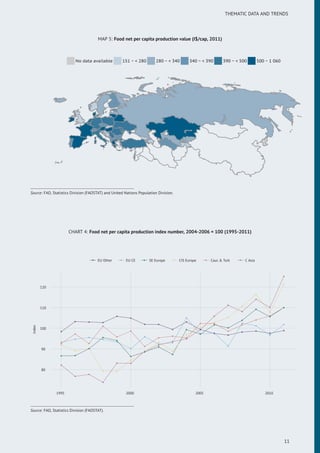
Per capita food production in FAO’s Europe and Central Asia
region rose faster than any other of FAO’s regions in the past
decade. Between 2000 and 2011 annual per capita growth
for all food products was almost 2 percent compared to 1.6
percent in Asia and the Pacific and 1.1 percent in Africa.
The overall regional increase was driven by sharp produc-
tion hikes in the region’s three top-performing groups – CIS
Europe, with 3.5 percent annual growth, Central Asia, with
3.4 and South Eastern Europe, with 2.7 percent. Caucasus
and Turkey ran a close fourth, with 2.5 percent.
In the European Union, a 0.8 percent annual decrease in the
EU other and EFTA group was more than made up for by a
1.2 percent increase in EU Central and Eastern.
At the country level, the biggest per capita increase took
place in Armenia, which registered 5.7 percent annual
growth. Bosnia and Herzegovina, in South Eastern Europe,
was second with 5.1 percent, while Kazakhstan in Central
Asia was third with 4.8 percent.
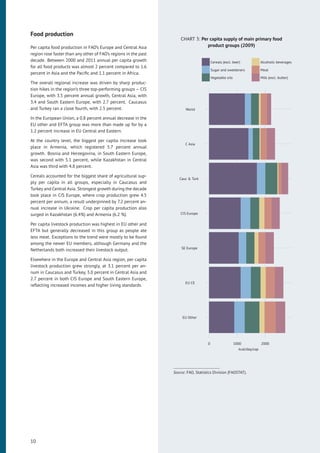
Cereals accounted for the biggest share of agricultural sup-
ply per capita in all groups, especially in Caucasus and
Turkey and Central Asia. Strongest growth during the decade
took place in CIS Europe, where crop production grew 4.5
percent per annum, a result underpinned by 7.2 percent an-
nual increase in Ukraine. Crop per capita production also
surged in Kazakhstan (6.4%) and Armenia (6.2 %).
Per capita livestock production was highest in EU other and
EFTA but generally decreased in this group as people ate
less meat. Exceptions to the trend were mostly to be found
among the newer EU members, although Germany and the
Netherlands both increased their livestock output.
Elsewhere in the Europe and Central Asia region, per capita
livestock production grew strongly, at 3.1 percent per an-
num in Caucasus and Turkey, 3.0 percent in Central Asia and
2.7 percent in both CIS Europe and South Eastern Europe,
reflecting increased incomes and higher living standards.
CHART 3: Per capita supply of main primary food
product groups (2009)
EU Other
EU CE
SE Europe
CIS Europe
Cauc & Turk
C Asia
World
0 1000 2000
kcal/day/cap
Cereals (excl. beer)
Sugar and sweeteners
Vegetable oils
Alcoholic beverages
Meat
Milk (excl. butter)
Source: FAO, Statistics Division (FAOSTAT).
10
THEMATIC DATA AND TRENDS
MAP 5: Food net per capita production value (I$/cap, 2011)
No data available 151 ~ < 280 280 ~ < 340 340 ~ < 390 390 ~ < 500 500 ~ 1 060
Source: FAO, Statistics Division (FAOSTAT) and United Nations Population Division.
CHART 4: Food net per capita production index number, 2004-2006 = 100 (1995-2011)
80
90
100
110
120
1995 2000 2005 2010
index
EU Other EU CE SE Europe CIS Europe Cauc & Turk C Asia
Source: FAO, Statistics Division (FAOSTAT).
11
Land
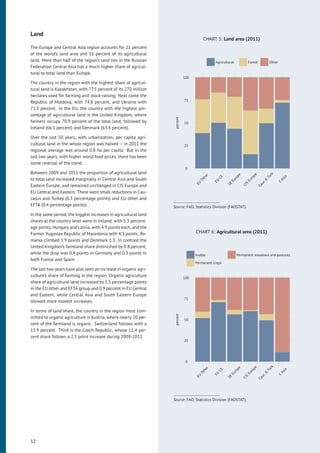
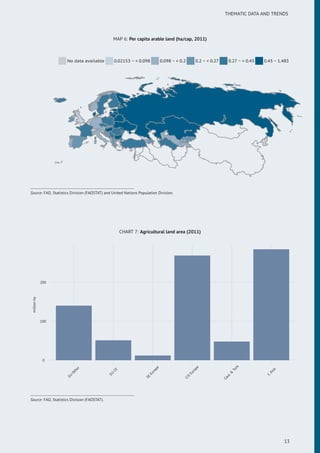
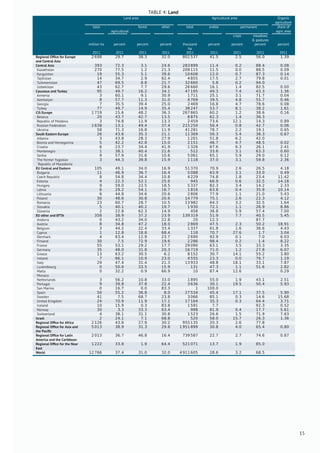
The Europe and Central Asia region accounts for 21 percent
of the world’s land area and 16 percent of its agricultural
land. More than half of the region’s land lies in the Russian
Federation Central Asia has a much higher share of agricul-
tural to total land than Europe.
The country in the region with the highest share of agricul-
tural land is Kazakhstan, with 77.5 percent of its 270 million
hectares used for farming and stock-raising. Next come the
Republic of Moldova, with 74.8 percent, and Ukraine with
71.3 percent. In the EU, the country with the highest per-
centage of agricultural land is the United Kingdom, where
farmers occupy 70.9 percent of the total land, followed by
Ireland (66.1 percent) and Denmark (63.4 percent).
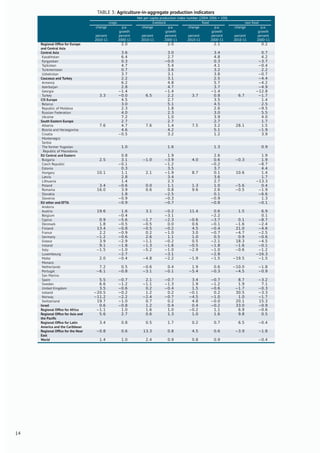
Over the last 50 years, with urbanization, per capita agri-
cultural land in the whole region was halved – in 2011 the
regional average was around 0.8 ha per capita. But in the
last two years, with higher world food prices, there has been
some reversal of the trend.
Between 2009 and 2011 the proportion of agricultural land
to total land increased marginally in Central Asia and South
Eastern Europe, and remained unchanged in CIS Europe and
EU Central and Eastern. There were small reductions in Cau-
casus and Turkey (0.3 percentage points) and EU other and
EFTA (0.4 percentage points).
In the same period, the biggest increases in agricultural land
shares at the country level were in Ireland, with 5.3 percent-
age points, Hungary and Latvia, with 4.9 points each, and the
Former Yugoslav Republic of Macedonia with 4.3 points. Ro-
mania climbed 1.9 points and Denmark 1.3. In contrast the
United Kingdom’s farmland share diminished by 0.8 percent,
while the drop was 0.4 points in Germany and 0.3 points in
both France and Spain.
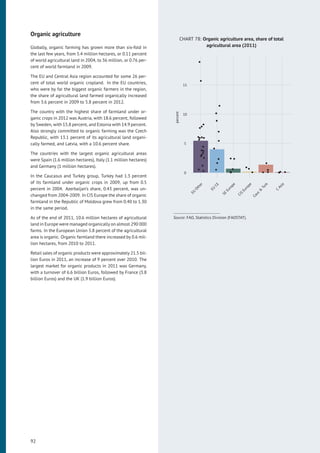
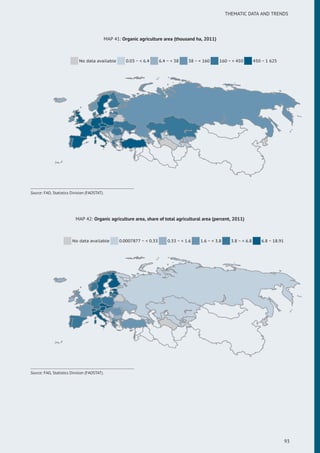
The last two years have also seen an increase in organic agri-
culture’s share of farming in the region. Organic agriculture
share of agricultural land increased by 1.5 percentage points
in the EU other and EFTA group and 0.9 percent in EU Central
and Eastern, while Central Asia and South Eastern Europe
showed more modest increases.
In terms of land share, the country in the region most com-
mitted to organic agriculture is Austria, where nearly 20 per-
cent of the farmland is organic. Switzerland follows with a
15.9 percent. Third is the Czech Republic, whose 11.4 per-
cent share follows a 2.5 point increase during 2009-2011.
CHART 5: Land area (2011)
0
25
50
75
100
EU
Other
EU
CE
SE
Europe
CIS
Europe
Cauc
&
Turk
C
Asia
percent
Agricultural Forest Other
Source: FAO, Statistics Division (FAOSTAT).
CHART 6: Agricultural area (2011)
0
25
50
75
100
EU
Other
EU
CE
SE
Europe
CIS
Europe
Cauc
&
Turk
C
Asia
percent
Arable
Permanent crops
Permanent meadows and pastures
Source: FAO, Statistics Division (FAOSTAT).
12
THEMATIC DATA AND TRENDS
MAP 6: Per capita arable land (ha/cap, 2011)
No data available 0.02153 ~ < 0.098 0.098 ~ < 0.2 0.2 ~ < 0.27 0.27 ~ < 0.43 0.43 ~ 1.483
Source: FAO, Statistics Division (FAOSTAT) and United Nations Population Division.
CHART 7: Agricultural land area (2011)
0
100
200
EU
Other
EU
CE
SE
Europe
CIS
Europe
Cauc
&
Turk
C
Asia
millionha
Source: FAO, Statistics Division (FAOSTAT).
13
TABLE 3: Agriculture-in-aggregate production indicators
Net per capita production index number (2004-2006 = 100)
crops livestock food non food
change p.a.
growth
change p.a.
growth
change p.a.
growth
change p.a.
growth
percent percent percent percent percent percent percent percent
2010-11 2000-11 2010-11 2000-11 2010-11 2000-11 2010-11 2000-11
Regional Office for Europe
and Central Asia
2.0 2.0 2.1 0.2
Central Asia 3.6 3.0 3.4 0.7
Kazakhstan 6.4 2.7 4.8 4.2
Kyrgyzstan 0.3 −0.0 0.3 −3.7
Tajikistan 4.7 5.4 4.1 −0.4
Turkmenistan 0.7 3.6 3.2 2.2
Uzbekistan 3.7 3.1 3.8 −0.7
Caucasus and Turkey 2.2 3.1 2.5 −4.4
Armenia 6.2 4.8 5.7 −4.2
Azerbaijan 2.8 4.7 3.7 −4.9
Georgia −1.4 −1.4 −1.4 −12.8
Turkey 3.3 −0.0 6.5 2.2 3.7 0.8 6.7 −1.7
CIS Europe 4.5 2.7 3.5 1.4
Belarus 3.0 5.1 4.5 2.5
Republic of Moldova 2.3 1.8 2.6 −9.5
Russian Federation 4.0 2.3 3.0 5.5
Ukraine 7.2 1.0 3.9 4.0
South Eastern Europe 2.7 2.7 2.7 1.7
Albania 7.6 4.7 7.6 1.4 7.5 3.2 28.1 1.5
Bosnia and Herzegovina 4.6 4.2 5.1 −1.9
Croatia −0.5 3.2 1.2 3.9
Montenegro
Serbia
The former Yugoslav
Republic of Macedonia
1.0 1.6 1.3 0.9
EU Central and Eastern 0.8 1.9 2.6 1.9
Bulgaria 2.5 3.1 −1.0 −3.9 4.0 0.6 −0.3 1.9
Czech Republic −0.1 −1.2 −0.2 −8.7
Estonia 0.3 3.5 3.7 4.4
Hungary 10.1 1.1 2.1 −1.9 8.7 0.1 10.6 1.4
Latvia 2.8 3.4 3.6 1.7
Lithuania 1.4 2.3 2.7 −13.3
Poland 3.4 −0.6 0.0 1.1 1.3 1.0 −5.6 0.4
Romania 16.0 3.9 0.6 0.8 9.6 2.6 −0.5 −1.9
Slovakia 1.8 −2.5 0.1 −6.6
Slovenia −0.9 −0.3 −0.9 1.3
EU other and EFTA −0.9 −0.7 −0.8 −0.1
Andorra
Austria 19.6 1.6 3.1 −0.2 11.4 0.6 1.5 6.9
Belgium −0.4 −3.1 −2.2 0.1
Cyprus 0.9 −5.6 −1.7 −2.3 −0.6 −3.7 0.1 −8.7
Denmark 1.8 −0.5 −0.5 0.0 0.6 −0.1 −1.6 −2.4
Finland 13.4 −0.8 −0.5 −0.2 4.5 −0.4 21.0 −4.6
France 2.2 −0.9 0.2 −1.0 3.0 −0.7 −4.7 −2.5
Germany −1.2 −0.6 2.6 1.1 1.0 0.5 0.9 −0.6
Greece 3.9 −2.9 −1.1 −0.2 0.5 −2.1 18.3 −4.5
Ireland 9.1 −1.8 −1.3 −1.6 −0.5 −1.8 −1.6 −0.1
Italy −1.5 −1.0 −5.2 −1.0 −2.9 −1.0 −0.6 −1.2
Luxembourg −2.7 −3.1 −2.8 −16.3
Malta 2.0 −0.4 −4.8 −2.2 −1.9 −1.5 −19.5 −1.5
Monaco
Netherlands 7.2 0.5 −0.6 0.4 1.9 0.6 −10.0 −1.8
Portugal −6.1 −0.8 −3.1 −0.1 −5.4 −0.3 −4.5 −0.9
San Marino
Spain 5.5 −0.7 2.1 −0.7 3.4 −0.7 8.7 −3.2
Sweden 6.6 −1.2 −1.1 −1.3 1.9 −1.2 1.9 7.1
United Kingdom 3.5 −0.6 0.2 −0.4 1.5 −0.6 −1.7 −0.3
Iceland −20.5 −0.2 1.2 0.2 −0.1 0.2 30.5 −3.3
Norway −11.2 −2.2 −2.4 −0.7 −4.5 −1.0 1.0 −1.7
Switzerland 19.7 −1.0 0.7 0.2 4.8 −0.0 20.1 15.3
Israel 0.6 −0.8 1.2 0.4 0.4 −0.2 33.0 −0.9
Regional Office for Africa −1.1 1.0 1.6 1.0 −0.2 1.1 6.9 −0.6
Regional Office for Asia and
the Pacific
5.6 2.7 0.6 1.3 1.0 1.6 9.8 0.5
Regional Office for Latin
America and the Caribbean
3.4 0.8 0.5 1.7 0.2 0.7 6.5 −0.4
Regional Office for the Near
East
−0.8 0.6 13.3 0.8 4.5 0.6 −3.9 −1.8
World 1.4 1.0 2.4 0.9 0.8 0.9 −0.4
14
TABLE 4: Land
Land area Agricultural area Organic
agriculture
total
agricultural
forest other total arable permanent share of
agric area
crops meadows
& pastures
million ha percent percent percent thousand
ha
percent percent percent percent
2011 2011 2011 2011 2011 2011 2011 2011 2011
Regional Office for Europe
and Central Asia
2 698 29.7 38.3 32.0 801 537 41.5 2.5 56.0 1.39
Central Asia 393 72.3 3.1 24.6 283 899 11.4 0.2 88.4 0.08
Kazakhstan 270 77.5 1.2 21.3 209 115 11.5 0.0 88.5 0.09
Kyrgyzstan 19 55.3 5.1 39.6 10 608 12.0 0.7 87.3 0.14
Tajikistan 14 34.7 2.9 62.4 4 855 17.5 2.7 79.8 0.01
Turkmenistan 47 69.5 8.8 21.7 32 660 5.8 0.2 94.0
Uzbekistan 43 62.7 7.7 29.6 26 660 16.1 1.4 82.5 0.00
Caucasus and Turkey 95 49.7 16.2 34.1 47 195 49.3 7.4 43.3 1.36
Armenia 3 60.1 9.1 30.9 1 711 25.1 3.1 71.7 0.04
Azerbaijan 8 57.7 11.3 31.0 4 769 39.5 4.8 55.7 0.46
Georgia 7 35.5 39.4 25.0 2 469 16.8 4.7 78.6 0.08
Turkey 77 49.7 14.9 35.4 38 247 53.7 8.1 38.2 1.61
CIS Europe 1 719 15.6 48.2 36.3 267 865 60.2 1.2 38.6 0.16
Belarus 20 43.7 42.7 13.5 8 875 62.3 1.4 36.3
Republic of Moldova 3 74.8 11.9 13.3 2 459 73.6 12.1 14.3 0.89
Russian Federation 1 638 13.1 49.4 37.4 215 250 56.4 0.8 42.7 0.06
Ukraine 58 71.3 16.8 11.9 41 281 78.7 2.2 19.1 0.65
South Eastern Europe 26 43.6 35.3 21.1 11 369 56.3 5.4 38.3 0.67
Albania 3 43.8 28.3 27.9 1 201 51.8 6.2 42.0
Bosnia and Herzegovina 5 42.2 42.8 15.0 2 151 46.7 4.7 48.5 0.02
Croatia 6 23.7 34.4 41.9 1 326 67.6 6.3 26.1 2.41
Montenegro 1 38.1 40.4 21.6 512 33.6 3.1 63.3 0.60
Serbia 9 57.9 31.6 10.6 5 061 65.1 5.9 29.0 0.12
The former Yugoslav
Republic of Macedonia
3 44.3 39.8 15.9 1 118 37.0 3.1 59.8 2.36
EU Central and Eastern 105 49.1 34.0 16.9 51 370 70.9 2.6 26.5 4.18
Bulgaria 11 46.9 36.7 16.4 5 088 63.9 3.1 33.0 0.49
Czech Republic 8 54.8 34.4 10.8 4 229 74.8 1.8 23.4 11.42
Estonia 4 22.3 52.1 25.6 945 66.9 0.6 32.5 14.18
Hungary 9 59.0 22.5 18.5 5 337 82.3 3.4 14.2 2.33
Latvia 6 29.2 54.1 16.7 1 816 63.8 0.4 35.8 10.14
Lithuania 6 44.8 34.6 20.6 2 806 77.9 1.1 21.0 5.43
Poland 30 48.6 30.8 20.6 14 779 75.1 2.6 22.3 4.12
Romania 23 60.7 28.7 10.5 13 982 64.3 3.2 32.5 1.64
Slovakia 5 40.1 40.2 19.7 1 930 72.1 1.1 26.9 8.86
Slovenia 2 22.8 62.3 14.9 458 36.8 5.9 57.4 7.00
EU other and EFTA 358 38.9 37.2 23.9 139 319 51.9 7.7 40.5 5.45
Andorra 0 43.2 34.0 22.8 20 12.3 87.7
Austria 8 34.8 47.2 18.0 2 869 47.5 2.3 50.2 18.91
Belgium 3 44.2 22.4 33.4 1 337 61.8 1.6 36.6 4.43
Cyprus 1 12.8 18.8 68.4 118 70.7 27.6 1.7 3.04
Denmark 4 63.4 12.9 23.7 2 690 92.9 0.1 7.0 6.03
Finland 30 7.5 72.9 19.6 2 286 98.4 0.2 1.4 8.22
France 55 53.1 29.2 17.7 29 090 63.1 3.5 33.3 3.35
Germany 35 48.0 31.8 20.3 16 719 71.0 1.2 27.8 6.07
Greece 13 63.2 30.5 6.2 8 152 30.7 14.1 55.2 3.80
Ireland 7 66.1 10.9 23.0 4 555 23.3 0.0 76.7 1.19
Italy 29 47.4 31.4 21.3 13 933 48.8 18.1 33.1 7.87
Luxembourg 0 50.6 33.5 15.9 131 47.3 1.1 51.6 2.82
Malta 0 32.2 0.9 66.9 10 87.4 12.6 0.29
Monaco
Netherlands 3 56.2 10.8 33.0 1 895 55.0 1.9 43.1 2.51
Portugal 9 39.8 37.8 22.4 3 636 30.1 19.5 50.4 5.93
San Marino 0 16.7 0.0 83.3 1 100.0
Spain 50 55.2 36.8 8.0 27 534 45.4 17.1 37.5 5.90
Sweden 41 7.5 68.7 23.8 3 066 85.1 0.3 14.6 15.68
United Kingdom 24 70.9 11.9 17.1 17 164 35.3 0.3 64.4 3.71
Iceland 10 15.9 0.3 83.8 1 591 7.7 92.3 0.52
Norway 30 3.3 33.3 63.4 998 81.9 0.4 17.7 5.61
Switzerland 4 38.1 31.1 30.8 1 523 26.6 1.5 71.9 7.63
Israel 2 24.1 7.1 68.8 520 58.0 15.7 26.3 1.36
Regional Office for Africa 2 126 43.6 27.9 30.2 955 135 20.3 2.6 77.8
Regional Office for Asia and
the Pacific
5 013 38.9 31.3 29.8 1 951 899 30.8 4.0 65.4 0.80
Regional Office for Latin
America and the Caribbean
2 013 36.7 46.8 16.4 739 587 22.7 2.7 74.6 0.87
Regional Office for the Near
East
1 222 33.8 1.9 64.4 521 071 13.7 1.9 85.0
World 12 766 37.4 31.0 32.0 4 911 605 28.6 3.2 68.5
15
Crop production
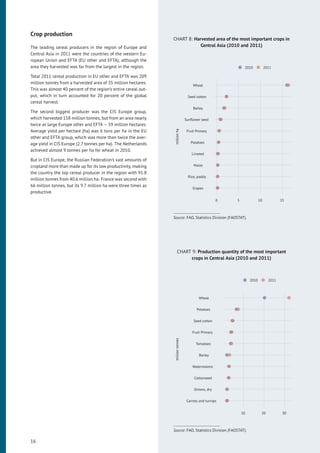
The leading cereal producers in the region of Europe and
Central Asia in 2011 were the countries of the western Eu-
ropean Union and EFTA (EU other and EFTA), although the
area they harvested was far from the largest in the region.
Total 2011 cereal production in EU other and EFTA was 209
million tonnes from a harvested area of 35 million hectares.
This was almost 40 percent of the region’s entire cereal out-
put, which in turn accounted for 20 percent of the global
cereal harvest.
The second biggest producer was the CIS Europe group,
which harvested 158 million tonnes, but from an area nearly
twice as large Europe other and EFTA – 59 million hectares.
Average yield per hectare (ha) was 6 tons per ha in the EU
other and EFTA group, which was more than twice the aver-
age yield in CIS Europe (2.7 tonnes per ha). The Netherlands
achieved almost 9 tonnes per ha for wheat in 2010.
But in CIS Europe, the Russian Federation’s vast amounts of
cropland more than made up for its low productivity, making
the country the top cereal producer in the region with 91.8
million tonnes from 40.6 million ha. France was second with
66 million tonnes, but its 9.7 million ha were three times as
productive.
CHART 8: Harvested area of the most important crops in
Central Asia (2010 and 2011)
Grapes
Rice, paddy
Maize
Linseed
Potatoes
Fruit Primary
Sunflower seed
Barley
Seed cotton
Wheat
0 5 10 15
millionha
2010 2011
Source: FAO, Statistics Division (FAOSTAT).
CHART 9: Production quantity of the most important
crops in Central Asia (2010 and 2011)
Carrots and turnips
Onions, dry
Cottonseed
Watermelons
Barley
Tomatoes
Fruit Primary
Seed cotton
Potatoes
Wheat
10 20 30
milliontonnes
2010 2011
Source: FAO, Statistics Division (FAOSTAT).
16
THEMATIC DATA AND TRENDS
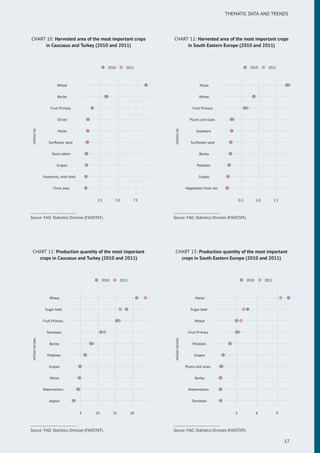
CHART 10: Harvested area of the most important crops
in Caucasus and Turkey (2010 and 2011)
Chick peas
Hazelnuts, with shell
Grapes
Seed cotton
Sunflower seed
Maize
Olives
Fruit Primary
Barley
Wheat
2.5 5.0 7.5
millionha
2010 2011
Source: FAO, Statistics Division (FAOSTAT).
CHART 11: Production quantity of the most important
crops in Caucasus and Turkey (2010 and 2011)
Apples
Watermelons
Maize
Grapes
Potatoes
Barley
Tomatoes
Fruit Primary
Sugar beet
Wheat
5 10 15 20
milliontonnes
2010 2011
Source: FAO, Statistics Division (FAOSTAT).
CHART 12: Harvested area of the most important crops
in South Eastern Europe (2010 and 2011)
Vegetables fresh nes
Grapes
Potatoes
Barley
Sunflower seed
Soybeans
Plums and sloes
Fruit Primary
Wheat
Maize
0.5 1.0 1.5
millionha
2010 2011
Source: FAO, Statistics Division (FAOSTAT).
CHART 13: Production quantity of the most important
crops in South Eastern Europe (2010 and 2011)
Tomatoes
Watermelons
Barley
Plums and sloes
Grapes
Potatoes
Fruit Primary
Wheat
Sugar beet
Maize
3 6 9
milliontonnes
2010 2011
Source: FAO, Statistics Division (FAOSTAT).
17
Third was another CIS Europe country, Ukraine, with 56 mil-
lion tonnes from 15 million ha. Germany was fourth with 42
million tonnes, followed by Turkey with 35 million tonnes.
EU other and EFTA was the only one of the groups where the
2011 cereal production was below that of 2010 – it fell 0.4
percent due to a spring drought in 2011. Elsewhere, year-
on-year increases ranged from 6.7 percent and 5.1 percent
respectively in Central Asia and CIS Europe to 3.5 percent in
EU Central and Eastern, 1.1 percent in Caucasus and Turkey
and 0.7 percent in South Eastern Europe.
At country level, highest growth was achieved in Ukraine
(8.1 percent) followed by Kazakhstan (7.9 percent) and Ar-
menia and Romania (6.4 percent each). Strong growth was
also seen in Tajikistan (6.0 percent) and Uzbekistan (5.9 per-
cent).
Central Asia’s near 7 percent growth was achieved with a
less than 2 percent increase in harvested area, while CIS Eu-
rope grew 5.1 percent more cereals on only 0.4 percent more
land. Helped by good weather, yields also improved in the
Caucasus and Turkey group where Turkey, the biggest local
producer, harvested 0.8 percent more cereals on 1.4 percent
less land.
CHART 14: Harvested area of the most important crops
in CIS Europe (2010 and 2011)
Sugar beet
Rapeseed
Rye
Soybeans
Oats
Potatoes
Maize
Barley
Sunflower seed
Wheat
0 10 20 30
millionha
2010 2011
Source: FAO, Statistics Division (FAOSTAT).
CHART 15: Production quantity of the most important
crops in CIS Europe (2010 and 2011)
Tomatoes
Cabbages and other brassicas
Oats
Fruit Primary
Sunflower seed
Barley
Maize
Potatoes
Sugar beet
Wheat
20 40 60 80
milliontonnes
2010 2011
Source: FAO, Statistics Division (FAOSTAT).
18
THEMATIC DATA AND TRENDS
CHART 16: Harvested area of the most important crops
in EU Central and Eastern (2010 and 2011)
Oats
Fruit Primary
Mixed grain
Rye
Triticale
Sunflower seed
Rapeseed
Barley
Maize
Wheat
2.5 5.0 7.5
millionha
2010 2011
Source: FAO, Statistics Division (FAOSTAT).
CHART 17: Production quantity of the most important
crops in EU Central & Eastern (2010 and 2011)
Apples
Sunflower seed
Triticale
Rapeseed
Fruit Primary
Barley
Potatoes
Sugar beet
Maize
Wheat
10 20 30
milliontonnes
2010 2011
Source: FAO, Statistics Division (FAOSTAT).
CHART 18: Harvested area of the most important crops
in EU Other & EFTA (2010 and 2011)
Sugar beet
Oats
Sunflower seed
Grapes
Maize
Rapeseed
Fruit Primary
Olives
Barley
Wheat
5 10 15
millionha
2010 2011
Source: FAO, Statistics Division (FAOSTAT).
CHART 19: Production quantity of the most important
crops in EU Other & EFTA (2010 and 2011)
Rapeseed
Olives
Tomatoes
Grapes
Maize
Barley
Potatoes
Fruit Primary
Sugar beet
Wheat
30 60 90
milliontonnes
2010 2011
Source: FAO, Statistics Division (FAOSTAT).
19
Crop production - Wheat
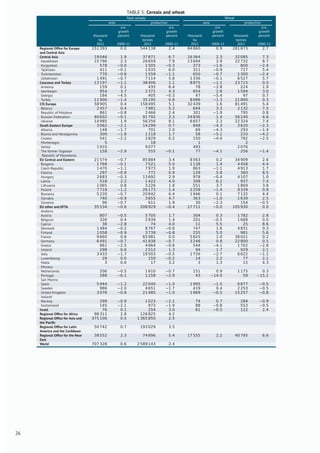
Europe and Central Asia accounted for 40 percent of world
wheat production in 2011. The harvest was 2.4 percent big-
ger than in 2010.
Wheat represented more than half of the regions’ cereal
crop. In turn, the EU produces just over half of this region’s
wheat crop. The two groups in the EU provided 141 mil-
lion tonnes of the region’s 281-million-tonne wheat harvest
despite poor weather in the spring of 2011 in many of its
areas.
Yields of up to 9 tonnes per hectare (in the Netherlands in
2010) stemming from a mix of generally favourable growing
conditions and intensive farming practices explain the EU’s
ability to produce much more wheat from fewer hectares
than the CIS Europe countries.
The Russian Federation, the world’s third biggest wheat-
producing country in 2011 after China and India, harvested
56 million tonnes from 25 million hectares, an area only
marginally larger than the wheat-growing area of EU Central
and Eastern and EU other and EFTA. Although Russian wheat
production increased by 4.6 percent in 2011 over 2010, Rus-
sian yields were still relatively low at 2.3 tonnes per hectare.
France, the EU’s top producer, returned 38 million tonnes
from 5.8 million ha – a yield of 6.5 tonnes per hectare.
Along with CIS Europe, Central Asia also had a substantially
bigger harvest in 2011 than in 2010, with a 7.3 percent in-
crease.
The performance was largely driven by an 8.7 percent hike
in Kazakhstan, which also increased its planted area by 2.9
percent.
Kazakhstan was the region’s fourth-ranking producer with
22.7 million tonnes, just behind Germany’s 22.8 million
tonnes. Ukraine was fifth with 22.3 million tonnes.
But wheat yields were twice as high in Ukraine as in Kaza-
khstan (3.3 tonnes versus 1.7 tonnes) while German wheat
yielded 6.9 tonnes per ha – twice as much again.
Between 2000 and 2011, wheat production in Kazakhstan
increased by 150 percent and in Ukraine by 120 percent,
while in the Russian Federation, the increase was 63 per-
cent.
CHART 20: Area and production of wheat, share of
world total (2011)
0
5
10
EU
Other
EU
CE
SE
Europe
CIS
Europe
Cauc
&
Turk
C
Asia
percent
Wheat harvested area Wheat production
Source: FAO, Statistics Division (FAOSTAT).
20
THEMATIC DATA AND TRENDS
MAP 7: Wheat area, share of total agricultural area (percent, 2011)
No data available 0.1477 ~ < 5.8 5.8 ~ < 8.3 8.3 ~ < 12 12 ~ < 17 17 ~ 27.77
Source: FAO, Statistics Division (FAOSTAT).
MAP 8: Wheat production (thousand tonnes, 2011)
No data available 2.446 ~ < 240 240 ~ < 930 930 ~ < 1 850 1 850 ~ < 6 720 6 720 ~ 56 240
Source: FAO, Statistics Division (FAOSTAT).
21
Crop production - Coarse grains
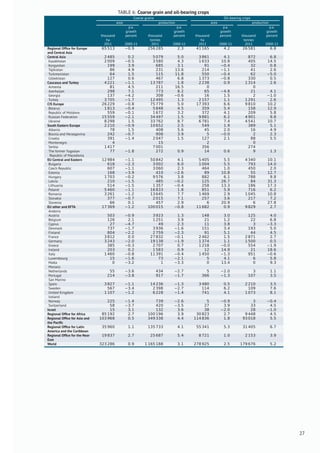
Europe and Central Asia produced 256 million tonnes of
coarse grains in 2011 – 2.3 percent up on 2010, even though
the harvested area was 0.9 percent less than in 2010.
But where the region accounts for 40 percent of world wheat
production, its share of global coarse grains output is half
that figure – 20 percent. The Asia and the Pacific region is
the leading producer of coarse grains among FAO’s regions,
with almost 350 million tonnes in 2011 – 30 percent of the
world harvest.
The two groups of the EU produced nearly 60 percent of Eu-
rope and Central Asia’s coarse grains crop in 2011. CIS Eu-
rope accounted for 30 percent.
The 2011 harvest was up on 2010 levels across all groups
except for EU other and EFTA, which, despite a production
fall of 0.8 percent, nonetheless harvested the biggest crop in
the region – 100 million tonnes or 39 percent of the regional
total.
The second biggest producer among the groups was CIS
Europe, with 75.8 million tonnes – 5 percent more than
in 2010. CIS Europe was home to the region’s top two
coarse grains producing nations in 2011, the Russian Fed-
eration, with 34.5 million tonnes (1.5 percent up on 2010)
and Ukraine with 33.8 million tonnes (+8.7 percent).
France and Germany were third and fourth but production in
the two countries dropped by respectively 0.1 percent and
1.9 percent. Poland, which has the largest area in the region
under coarse grains, was fifth, and Spain was sixth, ahead of
Romania.
Regional production was 18 percent higher in the period
2001-2010 than it was in 1991-2000. The increase prin-
cipally reflected higher demand for fodder as livestock pro-
duction grew in many developing and emerging countries.
Greater demand for biofuels was also a factor, although this
has leveled off recently. Production increases were high-
est inSouth Eastern Europe (243 percent) and Caucasus and
Turkey (117 percent).
CHART 21: Area and production of coarse grain, share
of world total (2011)
0
2
4
6
EU
Other
EU
CE
SE
Europe
CIS
Europe
Cauc
&
Turk
C
Asia
percent
Coarse grain harvested area Coarse grain production
Source: FAO, Statistics Division (FAOSTAT).
22
THEMATIC DATA AND TRENDS
MAP 9: Coarse grain area, share of total agricultural area (percent, 2011)
No data available 0.1975 ~ < 4.2 4.2 ~ < 7.7 7.7 ~ < 14 14 ~ < 21 21 ~ 36.94
Source: FAO, Statistics Division (FAOSTAT).
MAP 10: Coarse grain production (thousand tonnes, 2011)
No data available 1.496 ~ < 370 370 ~ < 800 800 ~ < 2 650 2 650 ~ < 8 030 8 030 ~ 34 497
Source: FAO, Statistics Division (FAOSTAT).
23
Crop production - Oil-bearing crops
Over the last two decades oil-bearing crop production has
increased by 50 percent in the Europe and Central Asia Re-
gion as a result of growing demand, including from the
biofuels industry, and of support policies by the European
Union. Among oil crops, oil-palm and rapeseed are both im-
portant for biodiesel.
The sector’s strong growth continued in 2010-2011, when
production increased by 6.8 percent in the region as a whole.
Growth was highest inCIS Europe with 10.2 percent, includ-
ing 10.7 percent in Ukraine and 10.2 percent in the Russian
Federation.
Oil crop production grew by 10 percent inEU Central and
Eastern, where the top producer, Romania, added 10.8 per-
cent. Bulgaria put on 14 percent and Latvia a record 31 per-
cent, but from a much smaller production base.
Almost 75 percent of the region’s oilseed output of 26.6 mil-
lion tonnes in 2011 came from two groupsCIS Europe andEU
other and EFTA, both with 9.8 million tonnes. But whereCIS
Europe grew more than 10 percent in 2010-2011,EU other
and EFTA only rose 2.7 percent.
The two top producing countries in the region are the Rus-
sian Federation and Ukraine, with respectively 4.9 and 4.5
million tonnes, followed by France (2.9 mt), Spain (2.2 mt)
and Germany (1.5 mt). Turkey, with 1.3 million tonnes in
2011, has emerged as a strong player in the last decade,
with production doubling between 2001 and 2011.
Increases in production have also been significant in CIS Eu-
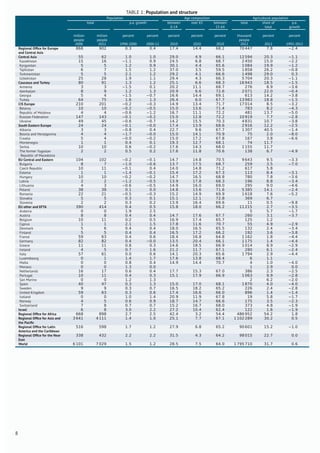
rope and EU Central and Eastern, where the average pro-
duction between 2001 and 2011 was about twice the 1991-
2001 average.
In 2011, Europe and Central Asia accounted for 15 percent
of world production, which is dominated by Asia and the Pa-
cific. ButEurope and Central Asia’s 6.8 percent growth in
2010-2011 topped Asia and the Pacific’s 5.5 percent that
year, as well as the world average of 5.2 percent.
CHART 22: Area and production of oil-bearing crops,
share of world total (2011)
0
2
4
EU
Other
EU
CE
SE
Europe
CIS
Europe
Cauc
&
Turk
C
Asia
percent
Oilcrop harvested area Oilcrop production
Source: FAO, Statistics Division (FAOSTAT).
24
THEMATIC DATA AND TRENDS
MAP 11: Oil-bearing crop area, share of total agricultural area (percent, 2011)
No data available 0 ~ < 0.16 0.16 ~ < 0.61 0.61 ~ < 1.6 1.6 ~ < 4.4 4.4 ~ 8.701
Source: FAO, Statistics Division (FAOSTAT).
MAP 12: Oil-bearing crop production (thousand tonnes, 2011)
No data available 0 ~ < 7.6 7.6 ~ < 46 46 ~ < 190 190 ~ < 790 790 ~ 4 901
Source: FAO, Statistics Division (FAOSTAT).
25
TABLE 5: Cereals and wheat
Total cereals Wheat
area production area production
p.a.
growth
p.a.
growth
p.a.
growth
p.a.
growth
thousand
ha
percent thousand
tonnes
percent thousand
ha
percent thousand
tonnes
percent
2011 2000-11 2011 2000-11 2011 2000-11 2011 2000-11
Regional Office for Europe
and Central Asia
151 393 0.0 544 138 2.4 84 860 0.9 281 873 2.7
Central Asia 19 046 1.9 37 871 6.7 16 364 2.3 32 085 7.3
Kazakhstan 15 796 2.3 26 659 7.9 13 694 2.9 22 732 8.7
Kyrgyzstan 578 −0.0 1 505 −0.3 373 −1.6 800 −2.4
Tajikistan 411 −0.1 1 035 6.0 311 −0.9 727 5.4
Turkmenistan 770 −0.6 1 559 −1.1 650 −0.7 1 300 −2.4
Uzbekistan 1 491 −0.7 7 114 5.6 1 336 −0.1 6 527 5.7
Caucasus and Turkey 13 197 −1.1 38 406 1.1 8 875 −1.1 23 715 0.5
Armenia 159 0.1 435 6.4 78 −2.8 224 1.9
Azerbaijan 954 3.7 2 371 4.3 654 2.6 1 594 3.0
Georgia 184 −4.5 405 −0.3 47 −5.4 97 0.7
Turkey 11 900 −1.4 35 195 0.8 8 096 −1.3 21 800 0.3
CIS Europe 58 905 0.4 158 495 5.1 32 439 1.6 81 491 5.4
Belarus 2 457 0.4 7 981 5.2 644 3.3 2 132 7.5
Republic of Moldova 861 −0.8 2 466 2.4 301 −1.9 795 0.8
Russian Federation 40 602 −0.1 91 792 3.3 24 836 1.4 56 240 4.6
Ukraine 14 985 1.9 56 256 8.1 6 657 2.3 22 324 7.4
South Eastern Europe 3 062 −2.1 14 299 0.7 848 −4.3 3 620 −2.3
Albania 148 −1.7 701 2.0 69 −4.3 293 −1.4
Bosnia and Herzegovina 300 −1.8 1 118 1.7 58 −5.1 210 −4.2
Croatia 541 −2.2 2 829 0.2 150 −4.0 782 −2.5
Montenegro 5 18 1 2
Serbia 1 910 9 077 493 2 076
The former Yugoslav
Republic of Macedonia
158 −2.9 555 −0.1 77 −4.1 256 −1.4
EU Central and Eastern 21 574 −0.7 85 884 3.4 8 563 0.2 34 909 2.6
Bulgaria 1 768 −0.1 7 521 5.0 1 138 1.4 4 458 4.4
Czech Republic 1 470 −1.1 7 973 1.9 863 −1.1 4 913 1.7
Estonia 297 −0.9 771 0.9 129 5.8 360 8.5
Hungary 2 683 −0.3 13 692 2.9 978 −0.4 4 107 1.0
Latvia 518 2.2 1 422 4.0 308 6.2 937 7.4
Lithuania 1 065 0.8 3 226 1.8 551 3.7 1 869 3.8
Poland 7 719 −1.2 26 173 1.4 2 259 −1.4 9 339 0.9
Romania 5 220 −0.7 20 842 6.4 1 946 0.1 7 132 4.4
Slovakia 740 −0.9 3 655 4.7 363 −1.0 1 639 2.5
Slovenia 96 −0.7 611 1.9 30 −2.3 154 −0.5
EU other and EFTA 35 534 −0.6 208 929 −0.4 17 711 −0.0 105 930 0.0
Andorra
Austria 807 −0.5 5 705 1.7 304 0.3 1 782 2.8
Belgium 326 0.4 2 939 1.4 201 −0.5 1 688 0.0
Cyprus 38 −2.8 74 4.0 11 5.5 25 8.6
Denmark 1 484 −0.2 8 767 −0.6 747 1.6 4 831 0.3
Finland 1 058 −0.9 3 739 −0.8 255 5.0 981 5.6
France 9 660 0.6 65 981 0.0 5 825 1.0 38 021 0.2
Germany 6 491 −0.7 41 938 −0.7 3 248 0.8 22 800 0.5
Greece 961 −2.5 4 664 −0.6 544 −4.1 1 702 −2.8
Ireland 298 0.6 2 512 1.3 94 1.7 929 2.1
Italy 3 433 −1.7 19 503 −0.5 1 726 −2.7 6 622 −1.1
Luxembourg 29 0.0 150 −0.2 14 2.2 77 2.1
Malta 3 0.6 17 3.2 3 1.3 15 4.3
Monaco
Netherlands 206 −0.5 1 610 −0.7 151 0.9 1 175 0.3
Portugal 288 −6.1 1 158 −2.9 43 −14.0 59 −15.1
San Marino
Spain 5 944 −1.2 22 040 −1.0 1 995 −1.5 6 877 −0.5
Sweden 986 −2.0 4 651 −1.7 419 0.4 2 253 −0.5
United Kingdom 3 076 −0.8 21 485 −1.0 1 969 −0.5 15 257 −0.8
Iceland
Norway 299 −0.9 1 023 −2.1 74 0.7 284 −0.9
Switzerland 145 −2.1 973 −1.9 88 −0.8 553 −0.5
Israel 76 0.1 254 3.0 61 −0.5 122 2.4
Regional Office for Africa 98 311 2.8 126 825 4.2
Regional Office for Asia and
the Pacific
375 106 0.5 1 365 850 2.5
Regional Office for Latin
America and the Caribbean
50 742 0.7 193 029 3.5
Regional Office for the Near
East
38 552 2.3 74 896 5.4 17 555 2.2 40 795 6.6
World 707 328 0.6 2 589 143 2.4
26
TABLE 6: Coarse grain and oil-bearing crops
Coarse grains Oil-bearing crops
area production area production
p.a.
growth
p.a.
growth
p.a.
growth
p.a.
growth
thousand
ha
percent thousand
tonnes
percent thousand
ha
percent thousand
tonnes
percent
2011 2000-11 2011 2000-11 2011 2000-11 2011 2000-11
Regional Office for Europe
and Central Asia
65 513 −0.9 256 285 2.3 41 165 4.2 26 581 6.8
Central Asia 2 485 0.2 5 079 5.0 3 861 4.1 872 6.8
Kazakhstan 2 009 −0.5 3 580 4.3 1 633 10.8 405 14.5
Kyrgyzstan 199 3.9 685 3.1 91 −0.4 32 0.8
Tajikistan 86 4.9 231 13.6 214 −1.1 41 2.6
Turkmenistan 64 1.5 115 11.8 550 −0.4 62 −5.0
Uzbekistan 127 0.6 467 6.8 1 373 −0.8 330 0.5
Caucasus and Turkey 4 221 −1.1 13 787 1.8 2 238 0.9 1 314 2.6
Armenia 81 4.5 211 16.5 0 0
Azerbaijan 298 7.1 773 8.2 65 −4.8 21 4.1
Georgia 137 −4.2 308 −0.6 16 1.5 2 −1.0
Turkey 3 705 −1.7 12 495 1.3 2 157 1.1 1 291 2.6
CIS Europe 26 229 −0.8 75 779 5.0 17 393 6.6 9 810 10.2
Belarus 1 813 −0.4 5 848 4.5 359 5.4 158 12.9
Republic of Moldova 559 −0.1 1 672 3.2 372 4.1 209 5.8
Russian Federation 15 559 −2.1 34 497 1.5 9 881 6.2 4 901 9.8
Ukraine 8 298 1.5 33 762 8.7 6 781 7.4 4 541 10.7
South Eastern Europe 2 210 −0.9 10 652 2.5 549 1.9 389 5.1
Albania 78 1.5 408 5.6 45 2.0 16 4.9
Bosnia and Herzegovina 242 −0.7 908 3.9 5 −0.0 2 2.3
Croatia 391 −1.4 2 047 1.5 127 2.1 88 5.5
Montenegro 4 15 2 0
Serbia 1 417 7 001 356 274
The former Yugoslav
Republic of Macedonia
77 −1.8 272 0.9 14 0.6 9 1.3
EU Central and Eastern 12 984 −1.1 50 842 4.1 5 405 5.5 4 340 10.1
Bulgaria 618 −2.3 3 002 6.0 1 004 5.5 793 14.0
Czech Republic 607 −1.1 3 060 2.3 464 1.0 450 2.0
Estonia 168 −3.9 410 −2.6 89 10.8 55 12.7
Hungary 1 703 −0.2 9 576 3.8 882 6.1 788 9.8
Latvia 210 −1.5 485 −0.2 125 26.7 84 31.3
Lithuania 514 −1.5 1 357 −0.4 258 13.3 186 17.3
Poland 5 460 −1.1 16 833 1.8 851 5.9 716 6.2
Romania 3 261 −1.2 13 645 7.7 1 469 2.9 1 045 10.8
Slovakia 377 −0.7 2 015 7.1 257 3.6 217 7.2
Slovenia 66 0.1 457 2.9 6 20.9 6 27.8
EU other and EFTA 17 369 −1.2 100 015 −0.8 11 682 0.9 9 829 2.7
Andorra
Austria 503 −0.9 3 923 1.3 148 3.0 125 4.0
Belgium 126 2.1 1 251 3.9 21 1.2 22 6.8
Cyprus 27 −4.7 49 2.3 11 3.8 3 −3.3
Denmark 737 −1.7 3 936 −1.6 151 3.4 193 5.0
Finland 804 −2.2 2 759 −2.3 91 5.1 44 4.5
France 3 812 0.0 27 832 −0.1 2 462 1.5 2 871 2.7
Germany 3 243 −2.0 19 138 −1.9 1 374 1.1 1 500 0.5
Greece 385 −0.3 2 707 0.7 1 218 −0.0 554 −1.9
Ireland 203 0.2 1 583 0.9 12 14.9 21 18.6
Italy 1 460 −0.8 11 391 −0.4 1 450 −1.3 951 −0.6
Luxembourg 15 −1.6 73 −2.1 5 4.1 6 5.8
Malta 0 −3.2 1 −3.3 0 13.4 0 9.3
Monaco
Netherlands 55 −3.6 434 −2.7 5 −2.0 3 1.1
Portugal 214 −3.8 917 −1.7 366 −1.3 107 3.5
San Marino
Spain 3 827 −1.1 14 236 −1.3 3 480 0.5 2 210 3.5
Sweden 567 −3.4 2 398 −2.7 114 6.2 109 7.6
United Kingdom 1 107 −1.2 6 228 −1.4 741 4.1 1 073 8.1
Iceland
Norway 225 −1.4 739 −2.6 5 −0.9 3 −0.4
Switzerland 58 −3.7 420 −3.5 27 3.9 33 4.5
Israel 15 3.1 132 3.6 38 −2.0 28 −1.0
Regional Office for Africa 85 192 2.7 100 196 3.9 30 823 2.7 9 448 4.5
Regional Office for Asia and
the Pacific
103 968 0.5 349 338 4.4 114 836 1.8 93 018 5.5
Regional Office for Latin
America and the Caribbean
35 960 1.1 135 733 4.1 55 341 5.3 31 405 6.7
Regional Office for the Near
East
19 837 2.7 25 687 5.4 8 721 1.0 2 153 3.9
World 323 286 0.9 1 165 188 3.1 278 925 2.5 179 676 5.2
27
Crop production - Sugar Beet
Sugar beet production overtook roots and tubers in 2010-
2011 to become Europe and Central Asia’s second most im-
portant crop in terms of quantity. The region’s 2011 sugar
beet crop of 214 million tonnes represented nearly 80 per-
cent of world production (273.5 million tonnes).
Sugar beet in turn accounts for some 20 percent of global
sugar production, the rest being supplied by sugar cane. The
region thus provides 16 percent of global sugar output.
By far the biggest producer in Europe and Central Asia is
theEU other and EFTA group, which includes all the ini-
tial members of the European Union. This group produced
nearly half of the 2011 crop, with 102 million tonnes.
Currently the leading beet producer in the region is the
Russian Federation, which in 2011 edged France from the
first place it had occupied almost uninterruptedly since the
1980s. The Russian Federation produced 48 million tonnes
from 1.2 million hectares, not much less than the area under
sugar beet in allEU other and EFTA countries combined.
The Russian Federation has made a determined push into
the sugar market. Production there has more than tripled in
the last decade when it grew by almost 12 percent a year.
France on the other hand, is bound by European Union quo-
tas on members’ sugar beet production, and its output has
hovered around 30 million tonnes for the past 10 years.
However, the EU quota system is expected to be dismantled
in 2017, leaving the sector open to competition in which the
most efficient producers will most likely be rewarded.
Germany currently ranks third among the region’s sugar beet
producing countries, but Ukraine has also emerged as a
strong player after its production of this commodity has been
growing at 3.2 percent a year for the last decade. With its 19
million tonnes in 2011, the country accounted for 7 percent
of world sugar beet production.
CHART 23: Area and production of sugar beet, share of
world total (2011)
0
10
20
30
EU
Other
EU
CE
SE
Europe
CIS
Europe
Cauc
&
Turk
C
Asia
percent
Sugar harvested area Sugar production
Source: FAO, Statistics Division (FAOSTAT).
28
THEMATIC DATA AND TRENDS
MAP 13: Sugar beet area, share of total agricultural area (percent, 2011)
No data available 0 ~ < 0.0058 0.0058 ~ < 0.16 0.16 ~ < 0.73 0.73 ~ < 1.3 1.3 ~ 4.652
Source: FAO, Statistics Division (FAOSTAT).
MAP 14: Sugar production (thousand tonnes, 2011)
No data available 0 ~ < 8 8 ~ < 430 430 ~ < 2 230 2 230 ~ < 5 220 5 220 ~ 47 643
Source: FAO, Statistics Division (FAOSTAT).
29
Crop production - Roots and tubers
Europe and Central Asia produced 144 million tonnes of
roots and tubers – mostly potatoes –in 2011, accounting
for 18 percent of world output.
Production dropped by 0.2 percent per annum in 2000-2011
in the region as a whole, but the figure conceals sharp dif-
ferences between the EU countries, where production has
fallen often heavily over the past decade, and the rest of the
region which has seen moderate to strong growth.
With richer consumers eating fewer carbohydrates, produc-
tion has plummeted in almost all countries of the European
Union and inSouth Eastern Europe.
TheEU Central and Eastern group registered a 5.7 percent
annual decrease in production over the period 2000-2011,
with Poland, the largest local producer, reducing its harvests
by 9.4 percent per annum. All other countries in the group
also cut production, with the single exception of Romania,
the second-biggest supplier in this group, which expanded
by 1.5 percent.
In the largerEU other and EFTA group, production fell 0.4
percent per annum over the decade, including in countries
with historic traditions of potato farming like Ireland (-2.2
percent p.a.) and Germany (-1.3 percent p.a.). The Nether-
lands, another major producer, cut output by 1 percent a
year, Italy by 2.5 percent and Spain by 2.2 percent. In both
Portugal and Malta output fell 5.4 percent per annum.
However France and Belgium both increased their produc-
tion, by respectively 1.3 and 3.2 percent per annum, as did
Austria (1.5 percent). Israel grew at 4.4 percent.
In contrastCentral Asia had a 6.5 percent per annum produc-
tion increase over the decade. That included 10.7 percent
per annum in Turkmenistan and 10 percent in Tajikistan.
CIS Europe is the biggest producer in the region with 64 mil-
lion tonnes in 2000-2001, and 0.3 percent annual growth
over 2000-2011. Of that total, more than half – 33 mil-
lion tonnes – was supplied by the Russian Federation where,
however, output dropped by 0.4 percent per annum over the
period. The drop was offset, however, by 1.8 percent annual
growth in Ukraine,CIS Europe’s second-largest producer.
Caucasus and Turkey had the smallest production of any of
this region’s groups, but grew at 0.5 percent a year. A 1.4
percent annual fall in Turkey, the group’s main producer, was
offset by 6.1 percent growth in Armenia and 6.5 percent in
Azerbaijan.
CHART 24: Area and production of roots and tubers,
share of world total (2011)
0
2
4
6
EU
Other
EU
CE
SE
Europe
CIS
Europe
Cauc
&
Turk
C
Asia
percent
Root and tuber harvested area
Root and tuber crops production
Source: FAO, Statistics Division (FAOSTAT).
30
THEMATIC DATA AND TRENDS
MAP 15: Root and tuber area, share of total agricultural area (percent, 2011)
No data available 0.03243 ~ < 0.44 0.44 ~ < 0.8 0.8 ~ < 1.2 1.2 ~ < 1.7 1.7 ~ 8.404
Source: FAO, Statistics Division (FAOSTAT).
MAP 16: Root and tuber production (thousand tonnes, 2011)
No data available 7.222 ~ < 230 230 ~ < 510 510 ~ < 870 870 ~ < 4 090 4 090 ~ 32 681
Source: FAO, Statistics Division (FAOSTAT).
31
Crop production - Vegetables
Europe and Central Asia produced 13.6 percent of the world’s
vegetables in 2011 – just slightly less than the 14 percent
harvested in 2010. Across the region, 2000-2011 increases,
some of which were spectacular, as in the groups of Central
Asia, Caucasus and Turkey, South Eastern Europe andCIS Eu-
rope, have been offset by a stagnation or negative growth in
the European Union countries.
Central Asia registered the fastest growth over the period,
with 8.4 percent per annum. This group’s biggest producer,
Uzbekistan, expanded production at the annual rate of 9.4
percent. The number two producer, Kazakhstan, grew at 7
percent and third-placed Tajikistan at almost 13 percent, but
from a significantly smaller production base.
Growth was more contained in theCaucasus and Turkey-
group, at 1.3 percent per annum, but this group produced
almost twice as much asCentral Asia. Turkey, the biggest pro-
ducer in the region as a whole, harvested 27 million tonnes
of vegetables in 2011 and grew at one percent over the
decade.
In CIS Europe, Ukraine surged ahead at 5.6 percent per an-
num, while the Russian Federation grew at 2.5 percent. The
group itself registered 3.6 percent annual growth. South
Eastern Europe, the smallest vegetable producer in the re-
gion, grew at a sound 2.8 percent.
EU Central and Eastern showed zero production growth over
the decade and reduced its vegetable planting area by 2.4
percent per annum. Production slowed by 0.3 percent in
Poland, this group’s biggest producer, but expanded at the
annual rate of 1.3 percent in Romania.
EU other and EFTA produces more vegetables than any of
the other groups – 54 million tonnes in 2011. But produc-
tion dipped at 0.3 percent per annum over the decade and
planted area shrank by 0.8 percent per annum.
Italy and Spain, the biggest producers in the group, saw their
output cut over the decade, by 1.3 percent and 0.3 percent
per annum respectively. Planted area also receded.
However, in the region as a whole, average production be-
tween 2001 and 2010 was 54 percent higher than in 1991-
2000. Decade-on-decade growth was highest in Central Asia
(72 percent), followed by South Eastern Europe (63 percent),
CIS Europe (31 percent) and Caucasus and Turkey(25 per-
cent). Growth was moderate in EU other and EFTA while,
alone among the groups, it fell in EU Central and Eastern.
CHART 25: Area and production of vegetables, share of
world total (2011)
0
1
2
3
EU
Other
EU
CE
SE
Europe
CIS
Europe
Cauc
&
Turk
C
Asia
percent
Vegetable harvested area Vegetable production
Source: FAO, Statistics Division (FAOSTAT).
32
THEMATIC DATA AND TRENDS
MAP 17: Vegetable area, share of total agricultural area (percent, 2011)
No data available 0.004463 ~ < 0.48 0.48 ~ < 0.81 0.81 ~ < 1.3 1.3 ~ < 2.5 2.5 ~ 51.73
Source: FAO, Statistics Division (FAOSTAT).
MAP 18: Vegetable production (thousand tonnes, 2011)
No data available 0.979 ~ < 220 220 ~ < 460 460 ~ < 1 550 1 550 ~ < 4 140 4 140 ~ 27 407
Source: FAO, Statistics Division (FAOSTAT).
33
Crop production – Fruit (excluding grapes)
Europe and Central Asia produced around 11 percent of the
world’s fruit in 2011, but, despite growing global demand,
European production has been very modest over the past
decade (at 0.9 percent per annum) while Asian output has
increased rapidly.
Asia and the Pacific is now the world’s top fruit-growing re-
gion, with more than half of world output. But Europe and
Central Asia still has three countries – Turkey, Italy and Spain
– among the world’s top ten fruit-growing nations.
Together, those three countries produced more than half of
Europe and Central Asia’s fruit crop of 69.5 million tonnes in
2011. The top fruit-growing nation in the region was Turkey,
with 14.4 million tonnes, followed by Italy with 12.7 million
tonnes and Spain with 12.3 million tonnes.
The three southern European countries were followed by
France and Uzbekistan, both with 3 million tonnes. Uzbek-
istan’s output represented 70 percent of Central Asia’s entire
production.
South Eastern Europe registered the fastest growth, at 6.4
percent, with Bosnia and Herzegovina surging at a record 14
percent. But the quantities involved were small, with the en-
tire crop of this group amounting to less than that of France.
In Central Asia, annual growth was 6.0 percent, with Uzbek-
istan racing at 7.2 percent and Turkmenistan at 6.1 percent,
but from a very small base.
Caucasus and Turkey, the region’s second-biggest producer
afterEU other and EFTA, grew at a robust 2.7 percent, largely
determined by 2.6 percent annual growth in Turkey.
All the other groups were characterized by negative growth,
including EU Central and Eastern, -0.7 percent in EU other
and EFTA and 0.6 percent in CIS Europe. France’s fruit crop
fell by 5.5 percent per annum over the decade and Italy’s by
0.1. The Russian Federation’s output also fell, by 3 percent
per annum, but Ukraine, the second-biggest producer in CIS
Europe, recorded 1.6 percent annual growth.
CHART 26: Area and production of fruits, share of world
total (2011)
0
2
4
6
8
EU
Other
EU
CE
SE
Europe
CIS
Europe
Cauc
&
Turk
C
Asia
percent
Fruit excl. grapes harvested area Fruit production excl. grapes
Source: FAO, Statistics Division (FAOSTAT).
34
THEMATIC DATA AND TRENDS
MAP 19: Fruit harvested area, share of agricultural area (percent, 2011)
No data available 0.02035 ~ < 0.5 0.5 ~ < 1.1 1.1 ~ < 1.8 1.8 ~ < 2.8 2.8 ~ 10.41
Source: FAO, Statistics Division (FAOSTAT).
MAP 20: Fruit production (thousand tonnes, 2011)
No data available 5.834 ~ < 190 190 ~ < 370 370 ~ < 710 710 ~ < 1 910 1 910 ~ 14 359
Source: FAO, Statistics Division (FAOSTAT).
35
TABLE 7: Sugar beet and roots and tubers
Sugar beet Roots and tubers
area production area production
p.a.
growth
p.a.
growth
p.a.
growth
p.a.
growth
thousand
ha
percent thousand
tonnes
percent thousand
ha
percent thousand
tonnes
percent
2011 2000-11 2011 2000-11 2011 2000-11 2011 2000-11
Regional Office for Europe
and Central Asia
3 596 194 626 6 845 −2.6 143 773 −0.2
Central Asia 40 594 422 2.9 7 416 6.5
Kazakhstan 11 −4.6 200 −2.8 184 1.3 3 076 5.6
Kyrgyzstan 8 −9.3 159 −9.0 85 1.9 1 379 2.5
Tajikistan 37 3.4 863 10.0
Turkmenistan 22 −0.2 235 0.2 44 10.2 274 10.7
Uzbekistan 0 0 73 3.1 1 824 8.7
Caucasus and Turkey 308 16 436 258 −1.8 6 384 0.5
Armenia 4 47.5 56 47.3 29 −1.6 557 6.1
Azerbaijan 7 11.4 253 16.6 65 2.0 939 6.5
Georgia 0 0 20 −4.6 274 −0.9
Turkey 297 −2.9 16 126 −1.4 144 −3.2 4 614 −1.4
CIS Europe 1 856 71 459 4 016 −2.8 64 428 0.3
Belarus 99 6.0 4 487 10.7 341 −5.8 7 148 −1.8
Republic of Moldova 25 −8.1 589 −4.2 29 −7.0 351 0.6
Russian Federation 1 216 4.5 47 643 11.7 2 203 −3.4 32 681 −0.4
Ukraine 516 −3.3 18 740 3.2 1 443 −1.1 24 248 1.8
South Eastern Europe 80 4 038 160 −3.3 2 076 0.7
Albania 2 3.3 40 −0.4 10 −1.6 230 3.3
Bosnia and Herzegovina 0 0 37 −1.5 413 3.4
Croatia 22 0.3 1 168 8.4 11 −15.0 168 −10.3
Montenegro 11 180
Serbia 56 2 822 78 892
The former Yugoslav
Republic of Macedonia
0 −15.9 8 −16.3 14 0.2 194 1.5
EU Central and Eastern 804 −6.8 15 488 −5.7
Bulgaria 0 0 16 −10.2 232 −4.8
Czech Republic 58 −0.4 3 899 3.0 26 −8.4 805 −5.4
Estonia 9 −10.4 165 −9.1
Hungary 15 −11.5 856 −7.3 21 −7.0 600 −3.3
Latvia 0 0 30 −4.8 499 −3.6
Lithuania 18 −4.0 878 −0.0 38 −9.2 588 −9.6
Poland 204 −4.4 11 674 −1.1 400 −9.8 8 197 −9.4
Romania 19 −8.2 660 −0.1 248 −1.2 4 077 1.5
Slovakia 18 −5.0 1 161 1.7 10 −8.3 217 −5.8
Slovenia 0 0 4 −6.5 108 −4.8
EU other and EFTA 1 312 102 099 1 164 −1.3 47 341 −0.4
Andorra
Austria 47 0.7 3 456 2.8 23 −0.3 816 1.5
Belgium 62 −3.4 5 409 −1.2 82 2.1 4 129 3.2
Cyprus 5 −3.4 112 −0.6
Denmark 40 −3.5 2 700 −1.9 42 0.7 1 620 −0.1
Finland 14 −7.2 676 −3.9 24 −2.5 673 −1.4
France 393 −0.4 38 106 1.9 159 −0.2 7 440 1.3
Germany 398 −1.1 25 000 −1.0 259 −1.5 11 800 −1.3
Greece 6 −17.9 324 −18.4 29 −4.7 762 −2.6
Ireland 0 0 10 −2.3 356 −2.2
Italy 62 −12.4 3 548 −10.7 63 −2.6 1 557 −2.5
Luxembourg 1 −2.4 20 −1.6
Malta 1 −8.1 19 −5.4
Monaco
Netherlands 73 −3.7 5 858 −1.3 159 −1.1 7 333 −1.0
Portugal 0 −25.3 8 −30.9 29 −6.3 410 −5.4
San Marino
Spain 45 −8.9 4 189 −5.6 81 −3.5 2 482 −2.0
Sweden 40 −3.0 2 493 −0.4 28 −1.6 878 −1.0
United Kingdom 113 −3.8 8 504 −0.6 146 −1.2 6 115 −0.7
Iceland 1 −2.5 7 −2.8
Norway 13 −1.5 296 −0.6
Switzerland 19 0.8 1 828 2.4 11 −2.1 515 −1.4
Israel 0 0 21 5.5 641 4.4
Regional Office for Africa 25 251 2.1 247 366 4.1
Regional Office for Asia and
the Pacific
19 841 −0.2 361 494 1.7
Regional Office for Latin
America and the Caribbean
4 247 0.6 56 775 1.4
Regional Office for the Near
East
808 3.0 18 846 5.7
World 54 933 0.8 810 845 2.1
36
TABLE 8: Vegetables and fruit
Vegetables Fruit
area production area production
p.a.
growth
p.a.
growth
p.a.
growth
p.a.
growth
thousand
ha
percent thousand
tonnes
percent thousand
ha
percent thousand
tonnes
percent
2011 2000-11 2011 2000-11 2011 2000-11 2011 2000-11
Regional Office for Europe
and Central Asia
6 184 −0.1 148 046 1.9 4 326 0.5 69 536 0.9
Central Asia 579 2.6 16 014 8.4 370 1.4 4 189 6.0
Kazakhstan 194 2.2 4 126 7.0 43 −4.2 214 −0.9
Kyrgyzstan 53 −0.3 973 1.6 46 0.6 220 1.6
Tajikistan 62 4.2 1 665 12.9 77 1.0 418 3.8
Turkmenistan 49 4.2 961 4.6 13 2.7 396 6.1
Uzbekistan 221 2.9 8 289 9.4 191 3.0 2 940 7.2
Caucasus and Turkey 1 252 0.7 30 300 1.3 797 2.2 15 922 2.7
Armenia 31 2.9 968 7.7 31 3.3 415 5.1
Azerbaijan 113 0.8 1 697 4.5 113 3.6 896 4.6
Georgia 24 −6.4 229 −5.7 46 −3.8 253 −4.1
Turkey 1 084 0.7 27 407 1.0 606 2.3 14 359 2.6
CIS Europe 1 539 −0.2 29 152 3.6 804 −4.9 5 453 −0.6
Belarus 70 −3.6 1 823 2.5 89 261 −1.0
Republic of Moldova 43 −4.9 446 1.1 89 −3.1 834 −0.1
Russian Federation 838 −0.4 16 275 2.5 416 −5.3 2 220 −3.0
Ukraine 588 0.8 10 608 5.6 210 −4.9 2 137 1.6
South Eastern Europe 383 0.1 4 075 2.8 539 8.9 2 950 6.4
Albania 40 3.0 937 3.8 32 4.0 380 9.9
Bosnia and Herzegovina 127 1.0 740 3.7 123 14.0 328 14.3
Croatia 13 −12.9 225 −4.9 26 −4.0 395 1.1
Montenegro 7 144 10 61
Serbia 151 1 288 323 1 418
The former Yugoslav
Republic of Macedonia
46 −1.1 741 2.9 26 3.3 370 1.6
EU Central and Eastern 617 −2.4 13 058 −0.0 3 673
Bulgaria 29 −12.9 473 −9.6 62 −0.9 297 −5.5
Czech Republic 10 −8.6 219 −6.5 23 −4.1 186 −8.7
Estonia 3 −4.5 88 3.6 6
Hungary 76 −3.0 1 475 −0.2 79 −1.8 807 −4.2
Latvia 9 −4.6 169 4.3 9
Lithuania 14 −3.7 353 0.5 56 −5.9
Poland 184 −2.9 5 778 −0.3
Romania 263 −0.4 4 177 1.9 148 −2.7 1 967 −0.4
Slovakia 24 −2.3 247 −4.7 16 −4.3 107 −5.8
Slovenia 4 1.2 78 −0.2 7 −1.0 236 −0.7
EU other and EFTA 1 754 −0.8 53 782 −0.3 1 762 −0.6 36 159 −0.7
Andorra
Austria 16 1.6 706 3.0 32 2.0 1 076 2.1
Belgium 58 0.3 1 946 1.9 20 1.0 559 −2.9
Cyprus 3 −4.5 99 −2.9 7 −4.0 168 −2.7
Denmark 11 2.1 304 2.7
Finland 9 0.0 277 1.2
France 252 −1.2 5 776 −1.0 121 −3.1 2 978 −5.5
Germany 108 1.0 3 594 −0.7 79 −2.5 1 658 −2.0
Greece 103 −2.8 3 448 −2.0 150 −1.3 2 857 −2.5
Ireland 5 −1.2 226 0.5
Italy 509 −1.4 13 788 −1.6 491 −0.1 12 679 0.1
Luxembourg 0 −9.6 1 −1.6 0 −16.3 7 −9.4
Malta 5 0.1 82 −0.1 1 −1.2 8 7.3
Monaco
Netherlands 87 2.6 5 050 3.0 21 −1.1
Portugal 89 −1.1 2 531 0.8 170 0.0 1 017 −1.0
San Marino
Spain 338 −1.3 12 476 0.2 633 −0.4 12 266 0.2
Sweden 21 0.9 332 1.4
United Kingdom 116 −0.1 2 569 −1.9 29 1.3 422 2.9
Iceland 0 0.9 5 4.4
Norway 6 −1.1 148 0.4
Switzerland 16 5.8 425 2.9 8 −1.5 464 −2.0
Israel 61 1.9 1 665 0.3 54 −1.5 1 189 −0.5
Regional Office for Africa 5 388 2.6 36 846 3.4
Regional Office for Asia and
the Pacific
40 228 2.3 802 500 4.0
Regional Office for Latin
America and the Caribbean
2 644 1.4 43 248 2.3
Regional Office for the Near
East
3 319 2.7 74 755 4.5 3 060 1.5
World 56 734 2.0 1 090 425 3.4
37
Wine production
The world wine market is dominated by just three countries,
France, Italy and Spain, which between them account for
roughly half of total world production. But there are several
other substantial wine growers in the Europe and Central
Asia region, which supplied some 66 percent of the world
market in recent years.
Production volumes can vary greatly between from one har-
vest to the next depending on policies and weather, but the
top producer each year is invariably either Italy or France. In
2011 first place went to France, with 6.5 million tonnes (and
5.3 million tonnes in 2012), while Italy returned 4.7 million
tonnes (and 4.1 million tonnes in 2012) and Spain 3.3 mil-
lion tonnes (and 3.2 million tonnes in 2012).
After the big three producers, the next most important wine
growing countries in the region are Portugal, who produced
0.6 million tonnes in 2012, followed by Germany with 0.5
million tonnes (substantially down from 0.9 million tonnes
in 2011), and the Russian Federation with 0.7 million tonnes.
Europe and Central Asia has four countries among the
world’s top ten wine growers, but 12 countries in the world’s
top 20, including Romania, Greece, Austria, Serbia, Hungary
and Ukraine.
But over the past two decades wine production has de-
creased by almost 20 percent in the region, partly because
of EU policies encouraging quality rather than quantity, and
partly due to much increased competition on the world mar-
ket.
Current production by the big three is over 30 percent down
on the level 30 years ago. But in the last three decades pro-
duction tripled in Australia, doubled in Chile and increased
by more than 50 percent in the United States.
However the fastest growth over the period has taken place
in China, where production rose from 80 000 tonnes in 1980
to 1.6 million tonnes in 2011, a 2000 percent increase which
has made China the world’s fifth largest producer after the
United States.
Within the Europe and Central Asia region, the leading group
is EU other and EFTA, which is home to all leading growers,
followed by CIS Europe.
CHART 27: Area of vineyards and production of wine,
share of world total (2011)
0
20
40
EU
Other
EU
CE
SE
Europe
CIS
Europe
Cauc
&
Turk
C
Asia
percent
Wine production Vineyards area
Source: FAO, Statistics Division (FAOSTAT).
38
THEMATIC DATA AND TRENDS
MAP 21: Area of vineyards, share of total agricultural area (percent, 2011)
No data available 0.0007479 ~ < 0.15 0.15 ~ < 0.75 0.75 ~ < 1.3 1.3 ~ < 2.5 2.5 ~ 15.53
Source: FAO, Statistics Division (FAOSTAT).
MAP 22: Wine production (thousand tonnes, 2011)
No data available 0 ~ < 5.2 5.2 ~ < 18 18 ~ < 59 59 ~ < 270 270 ~ 6 534
Source: FAO, Statistics Division (FAOSTAT).
39
Processed crops
Besides wine (covered in the previous section), processed
crops include products such as flour, beer, sunflower and
olive oil, sugar, cotton seed and cotton lint.
Europe and Central Asia is the world’s second largest beer
brewer after Asia and the Pacific, which produced 72 mil-
lion tonnes of processed barley in 2011. Europe and Central
Asia’s production was 56 million tonnes and third-ranking
North America supplied 24 million tonnes.
The region’s top producer is the Russian Federation, which
produced 9.9 million tonnes of beer from barley in 2011,
while another important producer in the CIS Europe group
is Poland, with 3.8 million tonnes.
However, for beer the leading group is EU other and EFTA
with more than half of the regional total. Germany is the
biggest brewer in this group (and the fifth-biggest in the
world) with a production of 9 million tonnes of beer in
2011, followed by the United Kingdom (4. 6 million tonnes),
Spain (3. 4 million tonnes) and the Netherlands (2.5 million
tonnes).
And while wine production has fallen in the region, beer has
seen a significant growth, particularly in traditionally wine
drinking countries of this region. Beer production has in-
creased more than 20 percent in the last 30 years.
In five out of the six groups that comprise this region, more
wheat is processed (mostly into flour) than any other crop,
with the sole exception of South Eastern Europe, where
maize is in first position. Second in order of importance is
sugar beet.
Cotton seed and cotton lint production is important in Cen-
tral Asia, where 4.4 million tonnes of seed and lint – more
than 80 percent of the regional total – were processed in
2011.
The region also accounts for some 20 percent of total pro-
duction of oil from crops such as sunflower seeds, maize and
rape. It is also the world’s leading producer of virgin olive oil.
The 2.2 million tons of olive oil produced in 2011 represent
more than 70 percent of total world production.
The region’s leading olive oil producers are the Mediter-
ranean EU countries plus Turkey. Spain was the leading pro-
ducer with 1.25 million tonnes – more than half the regional
total. Second was Italy with 0.5 million tonnes and third
Greece with 0.3 million tonnes. Turkey was fourth with 0.2
million tonnes.
CHART 28: Production quantity of the most important
processed crops in Central Asia (2010 and 2011)
Rapeseed oil
Molasses
Wine
Margrine Short
Sugar Raw Centrifugal
Sunflower oil
Cottonseed oil
Beer of Barley
Cotton lint
Cottonseed
0 1 2
milliontonnes
2010 2011
Source: FAO, Statistics Division (FAOSTAT).
CHART 29: Production quantity of the most important
processed crops in Caucasus & Turkey (2010 and 2011)
Olive oil, virgin
Soybean oil
Cottonseed oil
Molasses
Margrine Short
Sunflower oil
Cotton lint
Beer of Barley
Cottonseed
Sugar Raw Centrifugal
0.5 1.0 1.5 2.0 2.5
milliontonnes
2010 2011
Source: FAO, Statistics Division (FAOSTAT).
40
THEMATIC DATA AND TRENDS
CHART 30: Production quantity of the most important
processed crops in South Eastern Europe (2010 and
2011)
Olive oil, virgin
Maize oil
Rapeseed oil
Margrine Short
Soybean oil
Sunflower oil
Molasses
Wine
Sugar Raw Centrifugal
Beer of Barley
0.0 0.3 0.6 0.9
milliontonnes
2010 2011
Source: FAO, Statistics Division (FAOSTAT).
CHART 31: Production quantity of the most important
processed crops in CIS Europe (2010 and 2011)
Linseed oil
Maize oil
Rapeseed oil
Soybean oil
Margrine Short
Wine
Molasses
Sunflower oil
Sugar Raw Centrifugal
Beer of Barley
0 5 10
milliontonnes
2010 2011
Source: FAO, Statistics Division (FAOSTAT).
CHART 32: Production quantity of the most important
processed crops in EU Central & Eastern (2010 and
2011)
Groundnut oil
Soybean oil
Maize oil
Molasses
Margrine Short
Wine
Sunflower oil
Rapeseed oil
Sugar Raw Centrifugal
Beer of Barley
0.0 2.5 5.0 7.5 10.0
milliontonnes
2010 2011
Source: FAO, Statistics Division (FAOSTAT).
CHART 33: Production quantity of the most important
processed crops in EU Other & EFTA (2010 and 2011)
Cottonseed
Sunflower oil
Olive oil, virgin
Soybean oil
Margrine Short
Molasses
Rapeseed oil
Sugar Raw Centrifugal
Wine
Beer of Barley
0 10 20 30
milliontonnes
2010 2011
Source: FAO, Statistics Division (FAOSTAT).
41
TABLE 9: Processed crops
Production
beer of barley wine sunflower oil rapeseed oil
Processed crops
thousand
tonnes
thousand
tonnes
thousand
tonnes
thousand
tonnes
thousand
tonnes
thousand
tonnes
thousand
tonnes
thousand
tonnes
2010 2011 2010 2011 2010 2011 2010 2011
Regional Office for Europe
and Central Asia
54 769 55 729 18 607 19 277 8 470 8 851 9 489 9 093
Central Asia 763 715 57 58 172 176 22 24
Kazakhstan 495 426 17 19 162 167 22 23
Kyrgyzstan 18 21 2 1 8 7 0 0
Tajikistan 0 0 0 0 1 2
Turkmenistan 17 17
Uzbekistan 250 268 21 21 1 0
Caucasus and Turkey 1 465 1 487 147 153 725 820 140 67
Armenia 15 15 6 6 1 1
Azerbaijan 377 390 9 7 7 9
Georgia 48 44 103 111 7 4
Turkey 1 024 1 038 28 29 710 806 140 67
CIS Europe 13 416 13 561 1 209 1 016 5 593 5 806 370 341
Belarus 399 472 25 27 1 1 160 131
Republic of Moldova 87 98 127 125 73 82 1 1
Russian Federation 9 834 9 936 761 696 2 529 2 545 181 171
Ukraine 3 096 3 056 296 168 2 990 3 177 28 38
South Eastern Europe 1 075 1 130 402 376 233 197 24 31
Albania 45 58 18 18 1 1
Bosnia and Herzegovina 91 87 5 3 22 17 8 1
Croatia 344 374 46 49 34 29 12 13
Montenegro 4 4 18 15
Serbia 529 546 238 224 173 147 3 17
The former Yugoslav
Republic of Macedonia
62 61 77 67 3 3 0
EU Central and Eastern 9 229 9 612 766 802 1 408 1 461
Bulgaria 492 496 150 123 169 165 4 5
Czech Republic 1 710 1 819 46 45 13 20 314 343
Estonia 129 136 0 0 19 16
Hungary 616 645 181 165 306 328 28 49
Latvia 148 163 2 2 1 1 51 48
Lithuania 292 305 7 6 1 2 12 41
Poland 3 680 3 807 13 15 818 791
Romania 1 666 1 724 329 406 328 360 86 120
Slovakia 311 320 28 31 40 34 74 47
Slovenia 185 197 23 24 1 1
EU other and EFTA 28 722 29 121 16 021 16 867 1 742 1 847 7 499 7 146
Andorra
Austria 875 896 174 281 39 51 156 160
Belgium 1 759 1 839 3 5 13 14 522 547
Cyprus 34 32 11 12
Denmark 634 630 0 193 176
Finland 403 422 3 5 117 96
France 1 449 1 585 5 804 6 534 522 517 1 898 1 789
Germany 8 898 8 945 691 913 342 357 2 889 2 688
Greece 405 400 336 295 39 33 15 6
Ireland 825 810 9 12
Italy 1 237 1 251 4 580 4 673 146 171 58 32
Luxembourg 30 30 11 13 0 0 1 1
Malta 11 11 2 2
Monaco
Netherlands 2 449 2 459 211 222 522 538
Portugal 831 825 695 695 52 84 102 89
San Marino
Spain 3 338 3 360 3 610 3 340 359 377 45 34
Sweden 432 449 6 5 124 119
United Kingdom 4 500 4 570 1 1 0 0 814 820
Iceland 16 17
Norway 244 235 4 4 7 9
Switzerland 354 355 103 102 7 7 30 30
Israel 98 102 5 5 5 5 27 23
Regional Office for Africa 9 326 10 226
Regional Office for Asia and
the Pacific
67 760 72 158
Regional Office for Latin
America and the Caribbean
30 925 31 933
Regional Office for the Near
East
World 178 287
42
TABLE 10: Processed crops (continued)
Production
soybean oil olive oil, virgin cottonseed oil maize oil
thousand
tonnes
thousand
tonnes
thousand
tonnes
thousand
tonnes
thousand
tonnes
thousand
tonnes
thousand
tonnes
thousand
tonnes
2010 2011 2010 2011 2010 2011 2010 2011
Regional Office for Europe
and Central Asia
3 244 3 064
Central Asia 8 5
Kazakhstan 4 4 29 21 0 0
Kyrgyzstan 10 8
Tajikistan 14 15
Turkmenistan 79 89
Uzbekistan 4 1 278 280 5 5
Caucasus and Turkey 312 237
Armenia
Azerbaijan 0 0 1 2 4 4
Georgia
Turkey 312 237 163 184 217 261 43 58
CIS Europe 340 355
Belarus
Republic of Moldova 7 7 7 7
Russian Federation 264 288 10 13
Ukraine 69 60 8 11
South Eastern Europe 79 81
Albania 0 0 1 1 0 0
Bosnia and Herzegovina 6 8
Croatia 18 17 2 1 8 8
Montenegro 0 0
Serbia 54 56 0
The former Yugoslav
Republic of Macedonia
2 2
EU Central and Eastern
Bulgaria 0 0 0 0 7 7
Czech Republic 4 7
Estonia 0 0
Hungary 10 11 0 0 18 36
Latvia 2 2
Lithuania
Poland 2 4 0
Romania 3 9 1 1
Slovakia 3 7
Slovenia 1 1
EU other and EFTA 2 438 2 317
Andorra
Austria 3 5
Belgium 14 5 60 60
Cyprus 2 2
Denmark 12 11
Finland 2 1
France 91 117 6 5 0 0 51 52
Germany 595 563 16 16
Greece 50 48 353 352 16 14 4 4
Ireland 1 1
Italy 307 259 527 542 24 22 63 64
Luxembourg 0 0
Malta 0 0
Monaco
Netherlands 462 435 10 10
Portugal 135 100 69 83 1 0 4 4
San Marino
Spain 563 562 1 200 1 250 14 10 20 19
Sweden 4 3
United Kingdom 121 129 22 22
Iceland
Norway 73 72
Switzerland 5 4 1 1
Israel 66 70 6 12 2 2 1 1
Regional Office for Africa
Regional Office for Asia and
the Pacific
Regional Office for Latin
America and the Caribbean
Regional Office for the Near
East
World
43
Livestock - Cattle
Most of the growth in the livestock sector is currently taking
place in developing and emerging economies, while devel-
oped countries, with ageing populations and already high
rates of per capita meat consumption, are not projected to
increase animal protein intake in the next decade.
With consumption of livestock products stagnating in the
richer countries, the cattle sector shrank in all the groups
of the Europe and Central Asia region in 2000-2011, with
the exception of Central Asia.
For the region as a whole livestock numbers fell 0.5 per-
cent per annum, with the sharpest fall of 3.4 percent taking
place in CIS Europe - the group with the largest cattle popu-
lation after EU other and EFTA. The Russian Federation, the
biggest breeder in the CIS Europe group, cattle numbers fell
3 percent per annum, while Ukraine plunged at 7.5 percent.
EU other and EFTA, home to half of the cattle in the region,
registered a 0.9 percent per annum decline. Within the re-
gion, the biggest cattle breeder, France, cut annual produc-
tion by 0.6 percent. Germany, which has the third biggest
herd, fell 1.4 percent.
Herds in EU Central and Eastern diminished by 1.4 per an-
num, in South Eastern Europe by one percent and in Cauca-
sus and Turkey by 0.6 percent. In contrast, cattle herds grew
by a robust 4.6 percent in Central Asia over the period. This
group had 21 million head of cattle in 2011 for a human
population of 62 million, the highest ratio in the region.
The global average density of cattle in 2011 was 0.32 cat-
tle per hectare of agricultural land. In this region, there are
countries with exceptionally high cattle densities, the high-
est being the Netherlands with 2.05 cattle per hectare, fol-
lowed by Belgium with 1.90 and Ireland with 1.40.
CHART 34: Stock of cattle, share of world total (2011)
0
1
2
3
4
EU
Other
EU
CE
SE
Europe
CIS
Europe
Cauc
&
Turk
C
Asia
percent
44
THEMATIC DATA AND TRENDS
MAP 23: Cattle breeding (thousand heads, 2011)
No data available 15.07 ~ < 440 440 ~ < 820 820 ~ < 1 710 1 710 ~ < 5 790 5 790 ~ 19 977
Source: FAO, Statistics Division (FAOSTAT).
MAP 24: Number of cattle per hectare of agricultural area (heads, 2011)
No data available 0.02958 ~ < 0.14 0.14 ~ < 0.29 0.29 ~ < 0.42 0.42 ~ < 0.71 0.71 ~ 2.051
Source: FAO, Statistics Division (FAOSTAT).
45
Livestock - Pigs
At global level, pig meat production is projected to decline
from an annual growth rate of 1.8 percent per annum in
2003-2012 to 1.4 percent per annum in 2013-2022, with ob-
vious implications for the size of stocks.
Between 2010 and 2011, pig stocks in Europe and Central
Asia in fact dropped by more than one million heads after
a decade of growth an annual 1.2 percent, when the global
growth rate was 2.6 percent. Pig population in the region
was just below 190 million in 2011.
During the decade as a whole, strong growth in some parts
and countries of the region was offset by stagnation or cut-
backs in numbers in some of the leading pig livestock na-
tions.
EU other and EFTA is the region’s main pig production area,
with two thirds of the animals in Europe and Central Asia.
Production in this group grew by 1.2 percent per annum dur-
ing 2000-2011; and Germany, the top pig farming country,
increased its stocks by 3.2 percent per annum.
Spain, in second place, also increased its numbers, albeit
more slowly, at the annual rate of 1.6 percent, as did Den-
mark at 0.5 percent. But France cuts its production back by
0.4 percent annually and the United Kingdom by 1 percent.
In the other part of the European Union, EU Central and East-
ern, production fell by 0.1 percent annually in Poland, the
group’s leading producer and by 3.1 percent in Hungary. For
this entire group production fell at 1.1 percent per annum
over the decade.
By contrast, pig numbers grew fast, at 4 percent per annum,
in Central Asia, though the total number of heads there re-
mained relatively small. In CIS Europe, the top producer,
the Russian Federation, increased its stocks by four percent
annually. Southeastern Europe also grew rapidly, at 5.8 per-
cent annually, but from a small base. In Caucasus and Turkey,
herds decreased by 5.3 percent annually, for cultural among
other reasons. Again, the numbers involved were small.
Pig population density, pointing to intensive farming sys-
tems, was highest in the original European Union countries,
with 0.8 heads per hectare of agricultural land in 2011. Den-
sity was highest in the Netherlands at 6.6 pigs per hectare,
followed by Denmark at 4.8 and Belgium at 4.75.
CHART 35: Stock of pigs, share of world total (2011)
0.0
2.5
5.0
7.5
EU
Other
EU
CE
SE
Europe
CIS
Europe
Cauc
&
Turk
C
Asia
percent
Source: FAO, Statistics Division (FAOSTAT).
46
THEMATIC DATA AND TRENDS
MAP 25: Pig breeding (thousand heads, 2011)
No data available 0.525 ~ < 110 110 ~ < 540 540 ~ < 1 510 1 510 ~ < 5 650 5 650 ~ 26 758
Source: FAO, Statistics Division (FAOSTAT).
MAP 26: Number of pigs per hectare of agricultural area (heads, 2011)
No data available 0.00004074 ~ < 0.063 0.063 ~ < 0.26 0.26 ~ < 0.48 0.48 ~ < 0.92 0.92 ~ 6.56
Source: FAO, Statistics Division (FAOSTAT).
47
Livestock – Sheep and goats
Sheep and goats can provide income from wool, meat and
milk and are relatively cheap to maintain. Goats in particular
are considered an attractive investment by poor farmers in
many developing countries.
Thus, while the number of sheep in the world has remained
almost unvaried at around one billion in the last 30 years,
the global goat population doubled from 464 million in
1980 to 924 million in 2011. Combined sheep and goat pop-
ulation is just over 2 billion.
With over 244 million animals, Europe and Central Asia had
a 12 percent share of the world ovine population in 2011
after registering 1.2 percent annual growth between 2000
and 2011. Some 40 percent of the animals are kept in the
EU other and EFTA group, which grew at 1.1 percent overall
, but with negative growth in some major rearing countries
like Spain (-5.6 percent), Italy (-2.9 percent) and France (-1
percent).
The United Kingdom, which has the largest ovine population
in the group at 38 million heads, increased its herds by 0.8
percent. Greece, which ranked number three in the region
with 14 million heads, also increased its stocks.
Central Asia, with its vast resources of pasture land, grew at
5.4 percent per annum and has the second largest number of
sheep and goats in the region. In per capita terms, however,
it has the highest human-to-ovine ratio at 1-1 as compared
to 4-1 in EU other and EFTA.
In Caucasus and Turkey, the largest herds of sheep and goats
are to be found in Turkey, but where numbers fell by 1.7 per-
cent in 2000-2011. With 29 million heads, Turkey has the
second largest herds at regional level, after the United King-
dom.
In CIS Europe, the Russian Federation increased its stocks
by 3.5 percent per annum to 22 million heads. The country
ranks third at the regional level.
At one billion, the Asia and Pacific region has the highest
number of sheep and goats of any region – half of the world
total. Africa follows with 545 million.
CHART 36: Stock of sheep and goats, share of world
total (2011)
0
1
2
3
4
EU
Other
EU
CE
SE
Europe
CIS
Europe
Cauc
&
Turk
C
Asia
percent
Source: FAO, Statistics Division (FAOSTAT).
48
THEMATIC DATA AND TRENDS
MAP 27: Sheep and goat breeding (thousand heads, 2011)
No data available 14.77 ~ < 200 200 ~ < 640 640 ~ < 1 730 1 730 ~ < 8 910 8 910 ~ 31 719
Source: FAO, Statistics Division (FAOSTAT).
MAP 28: Number of sheep and goats per hectare of agricultural area (heads, 2011)
No data available 0.01398 ~ < 0.099 0.099 ~ < 0.31 0.31 ~ < 0.5 0.5 ~ < 0.8 0.8 ~ 5.454
Source: FAO, Statistics Division (FAOSTAT).
49
Livestock – Poultry
There are 23 billion poultry birds in the world today – three
times as many as there are humans. That huge number is
the result of the very rapid growth of the poultry sector over
the past three decades, with poultry populations virtually
tripling between 1980 and 1991.
Of the global poultry stock, more than half resides in the
Asia and Pacific region, where the fastest growth continues.
Europe and Central Asia’s share of the world poultry popula-
tion amounts to some 12 percent – 2.7 billion birds in 2011.
Growth in the region in 2000-2011 averaged 5.1 percent per
annum compared to 5.5 percent in Asia and the Pacific and
4.8 percent in Africa.
Poultry, which are highly efficient at converting feed into
meat, have become a cheap and readily available source of
animal protein for millions the world over. Their status as
the fastest-growing meat sector was achieved through high
productivity gains arising from increased technical efficiency
and economies of scale.
But such gains could become increasingly difficult to obtain
in coming years and a slowdown is projected over the next
20 years, when most remaining growth will take place in
developing countries.
Some of this trend is already apparent. Over the last decade,
poultry sector growth has been much faster in the less af-
fluent parts of Europe and Central Asia than in the richer
European Union countries.
Fastest growth took place in South Eastern Europe at 13.5
percent per annum, followed by CIS Europe at 13.4. The Rus-
sian Federation, which keeps more poultry than any other
country in the region – nearly 500 million – grew at 12.8
percent.
Central Asia, where stocks were much smaller, expanded at
10.6 percent per annum, including a 36.2 percent surge in
Tajikistan. Caucasus and Turkey was close behind at 10 per-
cent. But growth was more contained in the EU regions.
EU Central and Eastern grew at 3.3 percent over the last
decade, but with a 3 percent decrease in the Czech Republic
and a 1.6 percent cut in Hungary. EU other and EFTA, which
has 40 percent of the poultry in the region, grew at only one
percent. However, this included a 2.4 percent fall in France,
which at 204 million heads, has more poultry than any other
country in this group. Italy, the second biggest poultry rearer,
registered a 0.7 percent annual growth.
CHART 37: Stock of poultry, share of world total (2011)
0
1
2
3
EU
Other
EU
CE
SE
Europe
CIS
Europe
Cauc
&
Turk
C
Asia
percent
Source: FAO, Statistics Division (FAOSTAT).
50
THEMATIC DATA AND TRENDS
MAP 29: Poultry (million heads, 2011)
No data available 0.102 ~ < 4.6 4.6 ~ < 12 12 ~ < 33 33 ~ < 92 92 ~ 449.3
Source: FAO, Statistics Division (FAOSTAT).
MAP 30: Number of poultry per hectare of agricultural area (heads, 2011)
No data available 0.1568 ~ < 2.1 2.1 ~ < 4 4 ~ < 6 6 ~ < 9.3 9.3 ~ 90.78
Source: FAO, Statistics Division (FAOSTAT).
51
Meat production
Meat production in Europe and Central Asia increased by 2.6
million tonnes, or 4 percent, between 2010 and 2011. But
except for poultry, growth was concentrated outside the EU
countries.
The year-on-year result confirms a decade-old trend that has
seen meat production growing in developing countries with
rising incomes, and stagnating or falling production in rich
countries where consumption has reached a plateau.
Europe and Central Asia production figures also confirm the
finding that, at the global level, the fastest growth is taking
place in the more affordable meat sectors – pig meat and
poultry.
In 2011, the Europe and Central Asia region delivered 64
million tonnes of meat, or just over 20 percent of world out-
put. Of the regional total, the largest share, 44 percent, was
taken by pig meat, followed by poultry (30 percent), beef (21
percent) and sheep and goat meat (3 percent).
The EU other and EFTA group produced over half of the re-
gional total – 39 million tonnes – with second place held
by CIS Europe,whose 11 million tonnes was mostly supplied
by the Russian Federation, the largest meat producer in the
region after Germany.
In 2000-2011, beef production fell in much of the region as
compared with the previous decade, but especially in the
two EU groups. The slowdown affected all of the major pro-
ducers except France, which grew marginally at 0.2 percent
per annum, and the United Kingdom, whose annual growth
rate was 2.6 percent. Growth for the region as a whole was
0.5 percent per annum.
There was also extensive slowing in the other meat sectors
except for poultry, which showed robust growth (5.3 percent
p.a. at regional level), especially in the non-EU countries
(13.6 percent in CIS Europe and 9.9 percent in Central Asia).
For pig meat, despite a widespread downturn, some major
players like Germany, Spain, Denmark, Belgium and Italy dis-
played continued growth, and the region grew at 1.2 percent
per annum over the decade.
With sheep meat, slow growth at the regional level (0.6 per-
cent) masked continuing strong expansion in Central Asia
and, to a lesser extent, in CIS Europe.
CHART 38: Meat production (2011)
0
10
20
30
40
EU
Other
EU
CE
SE
Europe
CIS
Europe
Cauc
&
Turk
C
Asia
milliontonnes
Source: FAO, Statistics Division (FAOSTAT).
52
THEMATIC DATA AND TRENDS
CHART 39: Beef and buffalo meat production (2011)
0
2
4
6
EU
Other
EU
CE
SE
Europe
CIS
Europe
Cauc
&
Turk
C
Asia
milliontonnes
Source: FAO, Statistics Division (FAOSTAT).
CHART 40: Pig meat production (2011)
0
5
10
15
20
EU
Other
EU
CE
SE
Europe
CIS
Europe
Cauc
&
Turk
C
Asia
milliontonnes
Source: FAO, Statistics Division (FAOSTAT).
CHART 41: Sheep meat production (2011)
0.00
0.25
0.50
0.75
EU
Other
EU
CE
SE
Europe
CIS
Europe
Cauc
&
Turk
C
Asia
milliontonnes
Source: FAO, Statistics Division (FAOSTAT).
CHART 42: Poultry meat production (2011)
0.0
2.5
5.0
7.5
10.0
EU
Other
EU
CE
SE
Europe
CIS
Europe
Cauc
&
Turk
C
Asia
milliontonnes
Source: FAO, Statistics Division (FAOSTAT).
53
TABLE 11: Livestock
Cattle Pigs Sheep and goats Poultry
stock p.a.
growth
stock p.a.
growth
stock p.a.
growth
stock p.a.
growth
thousand
heads
percent thousand
heads
percent thousand
heads
percent thousand
heads
percent
2011 2000-11 2011 2000-11 2011 2000-11 2011 2000-11
Regional Office for Europe
and Central Asia
158 639 −0.5 189 958 1.2 244 519 1.2 2 681 632 5.1
Central Asia 20 729 4.6 1 528 4.0 59 411 5.4 95 975 10.6
Kazakhstan 6 185 4.0 1 344 4.4 17 988 4.5 32 780 11.7
Kyrgyzstan 1 339 3.3 59 −3.4 5 288 3.0 4 810 2.3
Tajikistan 1 912 5.6 1 10.9 4 394 12.4 4 655 36.2
Turkmenistan 2 200 4.2 30 −4.5 16 400 6.3 16 000 9.6
Uzbekistan 9 094 5.1 94 4.7 15 340 4.4 37 730 7.3
Caucasus and Turkey 15 775 0.6 233 −5.3 39 129 0.1 273 031 10.0
Armenia 572 1.6 115 0.3 533 2.1 3 463 4.7
Azerbaijan 2 682 2.9 6 −3.1 8 559 7.3 24 074 14.1
Georgia 1 067 −0.7 110 −10.0 654 −6.7 6 521 −0.7
Turkey 11 455 0.2 2 −33.7 29 383 −1.7 238 973 9.9
CIS Europe 28 838 −3.4 29 543 3.2 24 581 3.3 723 443 13.4
Belarus 4 151 −0.4 3 887 3.0 124 −7.4 37 500 13.4
Republic of Moldova 216 −5.9 479 2.3 905 −1.9 34 120 7.7
Russian Federation 19 977 −3.0 17 218 4.0 21 820 3.5 449 296 12.8
Ukraine 4 494 −7.5 7 960 0.4 1 732 2.4 202 527 15.3
South Eastern Europe 2 683 −1.0 5 478 5.8 6 966 1.4 106 216 13.5
Albania 492 −3.5 163 4.8 2 533 1.2 9 658 15.6
Bosnia and Herzegovina 455 −0.1 577 9.2 1 086 7.2 18 700 23.5
Croatia 446 0.4 1 233 5.9 709 −0.3 5 042 0.2
Montenegro 87 21 209 470
Serbia 937 3 287 1 590 70 402
The former Yugoslav
Republic of Macedonia
266 −0.2 197 −1.0 839 0.8 1 944 −10.1
EU Central and Eastern 12 643 −1.4 27 293 −1.1 14 067 0.4 345 428 3.3
Bulgaria 554 −2.0 664 −10.4 1 724 −11.1 15 905 −1.4
Czech Republic 1 344 −1.4 1 749 −3.7 232 7.5 21 249 −3.1
Estonia 236 −1.1 372 4.7 83 8.8 2 047 6.7
Hungary 682 −2.1 3 169 −3.1 1 256 −8.4 42 213 −1.6
Latvia 380 0.0 390 1.6 90 6.4 4 949 9.9
Lithuania 748 −1.6 929 −1.1 74 −3.2 9 466 10.4
Poland 5 762 −0.5 13 509 0.1 363 −1.7 143 303 6.2
Romania 2 001 −3.8 5 428 −0.9 9 658 3.0 90 695 1.4
Slovakia 467 −3.1 687 −7.4 429 −5.5 12 991 0.8
Slovenia 470 −0.0 396 −3.8 156 3.0 2 610 −0.1
EU other and EFTA 77 537 −0.9 125 659 1.2 99 773 −1.1 1 091 886 1.0
Andorra
Austria 2 013 −0.7 3 134 0.7 430 −0.9 16 706 1.9
Belgium 2 535 −1.6 6 521 0.6 150 −7.4 35 836 2.1
Cyprus 57 0.5 439 0.5 646 −7.7 4 128 −2.2
Denmark 1 568 −1.6 12 932 0.5 144 0.3 14 774 −1.2
Finland 914 −1.3 1 335 1.4 134 3.6 5 729 1.8
France 19 086 −0.6 13 985 −0.4 8 999 −1.0 203 725 −2.4
Germany 12 567 −1.4 26 758 3.2 2 248 −1.4 133 038 5.3
Greece 629 0.4 1 109 −3.0 13 747 1.7 34 230 0.2
Ireland 6 493 −0.7 1 549 0.2 4 706 −4.7 16 060 −0.3
Italy 6 198 −1.5 9 321 0.7 8 883 −2.9 162 500 0.7
Luxembourg 193 −0.6 89 −2.0 15 8.6 102 5.3
Malta 15 −2.2 46 −1.9 17 1.2 935 −3.9
Monaco
Netherlands 3 885 −0.4 12 429 −1.7 1 469 −2.9 98 925 1.7
Portugal 1 503 0.5 1 985 1.4 2 583 −2.1 46 400 −0.1
San Marino
Spain 5 923 −0.4 25 635 1.6 19 907 −5.6 138 856 1.8
Sweden 1 512 −1.0 1 483 −0.7 623 2.8 8 338 1.6
United Kingdom 9 933 −1.0 4 441 −1.0 31 719 0.8 157 305 −0.0
Iceland 73 0.1 34 2.2 476 1.1 370 6.7
Norway 864 −1.2 854 2.2 2 368 −0.4 4 473 6.6
Switzerland 1 577 −0.1 1 579 0.9 510 −0.6 9 456 3.9
Israel 432 0.8 224 2.4 593 6.2 45 652 2.5
Regional Office for Africa 265 850 2.2 32 106 5.8 545 148 2.6 1 226 944 4.8
Regional Office for Asia and
the Pacific
698 953 1.1 591 294 3.4 1 002 430 2.3 12 721 354 5.5
Regional Office for Latin
America and the Caribbean
407 895 1.5 86 374 2.9 118 940 1.1 3 130 851 5.6
Regional Office for the Near
East
60 326 −0.4 306 988 0.7 1 937 671 4.8
World 1 621 787 1.1 967 165 2.6 2 017 713 2.1 22 913 270 4.3
54
TABLE 12: Meat products
Meat Beef and buffalo meat Pig meat Sheep and goat meat Poultry meat
production production p.a.
growth
production p.a.
growth
production p.a.
growth
production p.a.
growth
thousand
tonnes
thousand
tonnes
percent thousand
tonnes
percent thousand
tonnes
percent thousand
tonnes
percent
2011 2011 2000-11 2011 2000-11 2011 2000-11 2011 2000-11
Regional Office for Europe
and Central Asia
63 923 13 144 0.5 27 858 1.2 2 201 0.6 19 330 5.3
Central Asia 2 457 1 424 4.7 257 4.0 506 5.1 161 9.9
Kazakhstan 939 393 2.3 214 4.4 150 4.2 102 10.7
Kyrgyzstan 199 99 −0.2 16 −3.4 59 2.9 6 2.5
Tajikistan 78 29 6.4 2 10.9 42 11.4 2 32.4
Turkmenistan 302 140 6.2 0 −4.5 140 6.4 20 11.6
Uzbekistan 938 763 6.3 24 4.7 115 3.4 31 6.1
Caucasus and Turkey 2 954 833 5.3 22 −5.3 381 −0.3 1 715 8.7
Armenia 72 48 4.1 9 0.3 8 0.3 6 15.2
Azerbaijan 264 117 7.0 1 −3.1 74 7.1 72 13.9
Georgia 49 21 −7.2 12 −10.0 4 −7.4 12 −1.2
Turkey 2 570 647 5.5 0 −33.7 295 −2.1 1 626 8.5
CIS Europe 10 848 2 332 −1.6 3 615 3.2 212 2.5 4 278 13.6
Belarus 1 020 298 3.1 419 3.0 1 −6.1 299 13.2
Republic of Moldova 118 10 −5.5 64 2.3 2 −3.6 42 8.9
Russian Federation 7 566 1 625 −1.4 2 428 4.0 189 2.8 2 942 12.9
Ukraine 2 144 399 −5.6 704 0.4 20 1.2 995 16.1
South Eastern Europe 889 190 1.9 433 5.8 57 1.6 206 11.5
Albania 93 41 1.3 13 4.8 22 1.0 17 14.1
Bosnia and Herzegovina 88 22 2.9 17 9.2 2 4.3 46 19.5
Croatia 196 36 2.4 120 5.9 2 −0.4 35 0.5
Montenegro 13 4 4 1 4
Serbia 478 81 271 24 103
The former Yugoslav
Republic of Macedonia
22 5 −1.6 8 −1.0 6 3.2 2 −9.5
EU Central and Eastern 6 957 774 −1.2 3 445 −1.1 95 0.1 2 536 4.1
Bulgaria 220 21 −9.2 73 −10.4 16 −11.2 104 −0.9
Czech Republic 564 72 −3.6 275 −3.7 2 7.2 176 −2.0
Estonia 81 12 −2.1 50 4.7 1 7.0 18 8.3
Hungary 878 26 −8.1 435 −3.1 1 −10.2 402 −1.4
Latvia 80 18 −1.9 38 1.6 1 5.1 23 11.1
Lithuania 199 42 −5.2 75 −1.1 1 −4.2 80 11.1
Poland 3 641 391 1.1 1 936 0.1 1 −1.5 1 285 7.3
Romania 1 007 142 −1.2 454 −0.9 70 2.5 327 2.1
Slovakia 153 13 −11.1 71 −7.4 1 −3.7 64 0.2
Slovenia 135 36 −1.8 39 −3.8 2 4.8 58 0.6
EU other and EFTA 39 092 7 475 −0.1 20 067 1.2 936 −2.1 9 859 1.3
Andorra
Austria 917 222 0.8 544 0.7 7 −1.1 137 1.9
Belgium 1 896 272 −0.1 1 108 0.6 2 −5.5 510 2.1
Cyprus 95 5 0.7 55 0.5 5 −6.7 29 −1.6
Denmark 2 051 134 −1.2 1 720 0.5 2 1.1 191 −0.5
Finland 391 84 −0.8 202 1.4 1 2.2 102 3.4
France 5 832 1 566 0.2 2 218 −0.4 127 −0.9 1 740 −2.2
Germany 8 359 1 170 −1.0 5 616 3.2 40 −1.6 1 423 5.5
Greece 448 74 1.4 101 −3.0 144 1.3 118 0.4
Ireland 951 546 −0.5 235 0.2 48 −4.8 119 −0.3
Italy 4 178 1 011 −1.2 1 602 0.7 49 −3.0 1 216 1.0
Luxembourg 19 9 1.0 10 −2.0 0 8.3 0 4.8
Malta 15 1 −3.2 7 −1.9 0 0.2 4 −3.1
Monaco
Netherlands 2 661 382 −1.9 1 347 −1.7 15 −2.1 915 1.6
Portugal 786 96 −0.4 384 1.4 20 −2.6 282 0.5
San Marino
Spain 5 532 604 −0.7 3 469 1.6 142 −5.0 1 233 2.0
Sweden 529 133 −1.0 256 −0.7 5 2.4 115 2.0
United Kingdom 3 599 936 2.6 806 −1.0 289 −2.5 1 560 0.3
Iceland 30 4 0.6 6 2.2 10 −0.1 7 8.2
Norway 327 82 −1.0 131 2.2 24 −0.0 85 5.9
Switzerland 476 144 1.1 249 0.9 6 −0.3 73 3.6
Israel 726 117 5.6 19 2.4 14 5.5 576 3.1
Regional Office for Africa 12 271 4 532 2.8 1 267 5.8 2 089 2.8 2 804 5.3
Regional Office for Asia and
the Pacific
129 303 19 608 2.0 63 596 3.4 7 754 2.2 35 422 5.3
Regional Office for Latin
America and the Caribbean
47 166 17 021 2.1 6 885 2.9 446 0.9 22 242 5.5
Regional Office for the Near
East
9 809 2 239 2.7 1 823 0.8 5 269 4.9
World 298 871 66 334 1.4 110 270 2.6 13 407 2.0 102 249 4.3
55
Dairy, eggs and wool
The same trend as observed in the meat sector – slower
growth, concentrated in developing countries – will also
characterize dairy products over the next decade, according
to joint FAO-OECD projections.
In 2013-2022, global consumption of dairy products in milk
equivalent in developing countries is expected to slow from
2.3 to 1.8 percent per annum – reflecting growing shortages
of water and suitable land. Nonetheless, developing coun-
tries will account for 74 percent of new demand and will
grow at an estimated annual rate of 2 percent.
With 250 million tons of milk, the Europe and Central Asia
region accounted for over one third of total world production
in 2011. Growth during 2000-2011 averaged 0.6 percent and
was highest in Central Asia (4.9 percent) and Caucasus and
Turkey (3.8 percent). EU other and EFTA, which produces
more than half of the milk in the region, showed zero growth,
while EU Central and Eastern grew at only 0.1 percent yearly.
Cheese production grew faster than milk in the entire region,
at 1.9 percent per annum. Central Asia and CIS Europe were
the top performers, with 6 percent per annum each. Butter
production also surged over the decade in Central Asia (8.2
percent) and Caucasus and Turkey (3.8 percent), but dropped
by 0.2 percent per annum in the region as a whole. The lead-
ing producer for both commodities was again EU other and
EFTA, which registered 1.2 percent annual growth for cheese
while butter slipped 0.6 percent.
Central Asia ranked first for growth in egg production, with
8.8 percent annual increase, albeit from a small base, as with
its other produce. There was also growth in CIS Europe, but
output fell in the two top producers at regional level, France
and Germany, which showed a -1.9 and -1.3 percentage de-
cline respectively.
Wool production grew at five percent between 2010 and
2011 with most of the increase taking place in Caucasus
and Turkey, which rose 35 percent from 49 million tonnes
to 66 million tonnes. Growth was much more contained in
EU other and EFTA and Central Asia, the two top groups.
Among countries, the biggest wool producer was the United
Kingdom, followed by the Russian Federation.
CHART 43: Milk production (2011)
0
50
100
EU
Other
EU
CE
SE
Europe
CIS
Europe
Cauc
&
Turk
C
Asia
milliontonnes
Source: FAO, Statistics Division (FAOSTAT).
56
THEMATIC DATA AND TRENDS
CHART 44: Cheese production (2011)
0
2
4
6
8
EU
Other
EU
CE
SE
Europe
CIS
Europe
Cauc
&
Turk
C
Asia
milliontonnes
Source: FAO, Statistics Division (FAOSTAT).
CHART 45: Production of eggs in shell (2011)
0
2
4
EU
Other
EU
CE
SE
Europe
CIS
Europe
Cauc
&
Turk
C
Asia
milliontonnes
Source: FAO, Statistics Division (FAOSTAT).
CHART 46: Butter production (2011)
0.0
0.5
1.0
1.5
EU
Other
EU
CE
SE
Europe
CIS
Europe
Cauc
&
Turk
C
Asia
milliontonnes
Source: FAO, Statistics Division (FAOSTAT).
CHART 47: Wool production (2011)
0.00
0.05
0.10
0.15
EU
Other
EU
CE
SE
Europe
CIS
Europe
Cauc
&
Turk
C
Asia
milliontonnes
Source: FAO, Statistics Division (FAOSTAT).
57
TABLE 13: Dairy products
Milk Cheese Butter
production p.a.
growth
production p.a.
growth
production p.a.
growth
thousand
tonnes
percent thousand
tonnes
percent thousand
tonnes
percent
2011 2000-11 2011 2000-11 2011 2000-11
Regional Office for Europe
and Central Asia
250 495 0.6 10 650 1.9 2 606 −0.2
Central Asia 16 206 4.9 60 6.0 25 8.2
Kazakhstan 5 232 3.1 20 5.7 15 11.5
Kyrgyzstan 1 362 1.9 5 9.4 2 3.6
Tajikistan 696 7.6 18 9.4 0 −4.4
Turkmenistan 2 150 7.3 2 0.8 4 0.2
Uzbekistan 6 766 5.9 16 2.0 5 6.7
Caucasus and Turkey 17 892 3.8 237 3.2 193 3.8
Armenia 602 2.6 18 12.7 1 59.5
Azerbaijan 1 622 4.2 54 3.0 21 4.6
Georgia 612 −0.1 0 −4.0 0 −6.2
Turkey 15 056 4.0 165 2.3 171 3.4
CIS Europe 49 786 0.1 973 6.0 405 −0.7
Belarus 6 500 3.4 160 10.6 104 4.4
Republic of Moldova 560 −0.2 8 4.9 4 3.9
Russian Federation 31 640 −0.2 602 4.0 220 −1.7
Ukraine 11 086 −1.2 204 8.5 77 −5.0
South Eastern Europe 4 705 2.2 91 4.3 18 4.5
Albania 1 101 1.4 17 4.3 3 13.4
Bosnia and Herzegovina 707 2.1 4 −7.7 1 9.8
Croatia 801 2.4 31 3.1 4 5.2
Montenegro 206 6 1
Serbia 1 473 24 1
The former Yugoslav
Republic of Macedonia
417 4.4 9 14.1 8 0.3
EU Central and Eastern 28 219 0.1 1 245 2.6 263 −0.6
Bulgaria 1 286 −2.5 77 0.1 1 −1.2
Czech Republic 2 747 −0.2 128 −1.0 40 −4.1
Estonia 693 0.9 41 8.8 6 −2.6
Hungary 1 718 −2.0 84 −1.1 4 −9.6
Latvia 845 0.2 30 9.4 4 −4.4
Lithuania 1 786 0.3 82 4.9 9 −7.0
Poland 12 434 0.4 650 2.9 178 0.9
Romania 5 159 1.0 84 6.7 8 2.7
Slovakia 945 −1.3 51 −0.5 6 −6.6
Slovenia 606 −0.7 19 −1.5 6 4.4
EU other and EFTA 132 291 −0.0 7 917 1.2 1 697 −0.6
Andorra
Austria 3 337 −0.1 192 2.5 34 −0.8
Belgium 3 110 −1.5 0 59 −6.6
Cyprus 199 0.2 5 −0.6
Denmark 4 880 0.3 275 −1.0 37 −1.9
Finland 2 301 −0.6 100 0.7 51 −1.8
France 25 290 −0.2 1 931 1.1 424 −0.5
Germany 30 336 0.6 2 046 1.9 425 −0.0
Greece 1 962 −0.2 223 −0.4 2 −4.7
Ireland 5 537 0.6 184 5.5 146 0.1
Italy 11 113 −1.6 1 133 0.5 102 −2.4
Luxembourg 294 1.0 0 −10.9
Malta 44 −1.3 0 −0.0
Monaco
Netherlands 11 818 0.5 746 1.0 125 −0.0
Portugal 2 007 −0.6 72 −0.5 28 1.1
San Marino
Spain 7 509 0.7 223 1.1 42 0.8
Sweden 2 890 −1.3 107 −1.9 25 −6.0
United Kingdom 13 849 −0.4 390 1.3 130 −0.1
Iceland 123 1.5 9 7.2 2 1.6
Norway 1 548 −1.1 82 −0.1 15 −0.1
Switzerland 4 144 0.5 198 1.2 49 2.6
Israel 1 395 1.2 127 2.2 6 −1.9
Regional Office for Africa 29 189 5.0
Regional Office for Asia and
the Pacific
304 667 4.4
Regional Office for Latin
America and the Caribbean
81 784 3.4
Regional Office for the Near
East
30 429 2.8 1 387 2.5 411 2.4
World 739 363 2.8
58
TABLE 14: Production of eggs and wool
Eggs Wool
production p.a.
growth
production
thousand
tonnes
thousand
tonnes
percent thousand
tonnes
thousand
tonnes
2010 2011 2000-11 2010 2011
Regional Office for Europe
and Central Asia
12 029 12 251 1.6 444 449
Central Asia 468 492 8.8 119 122
Kazakhstan 209 208 7.4 38 38
Kyrgyzstan 21 22 6.0 11 11
Tajikistan 13 14 22.6 6 6
Turkmenistan 50 50 8.1 38 38
Uzbekistan 175 197 9.8 27 29
Caucasus and Turkey 875 933 0.7 61 66
Armenia 39 35 4.5 1 1
Azerbaijan 71 61 6.5 16 16
Georgia 25 27 2.7 2 2
Turkey 740 810 0.0 43 47
CIS Europe 3 533 3 641 3.4 60 59
Belarus 200 207 1.0 0 0
Republic of Moldova 40 39 1.9 2 2
Russian Federation 2 274 2 305 1.8 54 53
Ukraine 1 018 1 090 7.2 4 4
South Eastern Europe 186 182 0.2 9 9
Albania 31 32 3.8 3 3
Bosnia and Herzegovina 21 18 0.0 1 1
Croatia 43 42 −1.0 1 1
Montenegro 3 4 0 0
Serbia 69 69 2 2
The former Yugoslav
Republic of Macedonia
19 17 −3.8 1 1
EU Central and Eastern 1 505 1 434 1.0 31 31
Bulgaria 90 74 −1.1 7 7
Czech Republic 122 125 −3.7 0 0
Estonia 11 11 −2.9 0 0
Hungary 156 140 −2.2 4 4
Latvia 45 42 5.0 0 0
Lithuania 51 48 1.2 0 0
Poland 618 577 2.8 1 1
Romania 310 316 0.9 18 18
Slovakia 80 80 2.2 1 1
Slovenia 22 21 −0.5 0 0
EU other and EFTA 5 360 5 447 0.2 163 162
Andorra
Austria 95 103 1.6 0 0
Belgium 158 161 −1.7 0 0
Cyprus 9 8 −2.2 0 0
Denmark 76 79 0.5 0 0
Finland 62 63 0.6 0 0
France 906 840 −1.9 14 14
Germany 662 777 −1.3 13 13
Greece 100 100 −1.4 8 8
Ireland 45 45 3.0 14 14
Italy 737 737 0.7 9 9
Luxembourg 1 2 4.0 0 0
Malta 5 4 −1.7 0 0
Monaco
Netherlands 670 692 0.3 3 3
Portugal 132 123 0.4 6 6
San Marino
Spain 814 821 2.0 23 22
Sweden 111 116 1.2 0 0
United Kingdom 671 669 1.2 67 67
Iceland 3 3 2.5 1 1
Norway 60 60 2.2 4 4
Switzerland 45 46 2.1 0 0
Israel 102 121 2.9 1 1
Regional Office for Africa 1 783 1 844 4.4
Regional Office for Asia and
the Pacific
43 141 43 830 2.7
Regional Office for Latin
America and the Caribbean
7 296 7 495 3.6
Regional Office for the Near
East
2 327 2 384 3.2 288 290
World 69 436 70 616 2.5
59
Fishery and aquaculture
The fisheries industry in the Europe and Central Asia region
is characterized by generally falling capture fishery numbers
alongside a booming aquaculture sector.
Capture fisheries fell 3 percent between 2010 and 2011 to
13.7 million tonnes, representing 14 percent of global pro-
duction, while in the period between 2000 and 2011, the
sector receded on average by 1.3 percent per annum.
Aquaculture on the other hand grew 6 percent in 2010-2011
after a decade of growth averaging 4 percent per annum.
However the region’s 2.8 million tonne production in 2011
amounted to only 3 percent of global output. In the next 10
years the latter is expected to increase by 35 percent over
the 2010-2012 average.
With almost 60 percent of regional capture output, the EU
other and EFTA group produced 8 million tonnes of fish in
2011, which was 9 percent less than in 2000. Production has
been falling at some 2.6 percent per annum in this group
since 2000.
The leading fishing nations in this group are Norway, which
alone supplies over a quarter of EU other and EFTA’s catch,
and Iceland, whose share is 14 percent. With many fish
stocks fully exploited, and some even overexploited, produc-
tion in Norway has been falling by 1.6 percent per annum,
and by almost 5 percent per annum in Iceland.
The top fishing nation in the region is the Russian Feder-
ation, with almost one third of regional production. Rus-
sian catches grew almost five percent in 2010-2011, an im-
provement over the 0.5 percent average annual growth in
the 2000-2011 period.
Other important fishing fleets at regional level are Spain (1
million tonnes in 2011), Denmark (0.7 million tonnes), the
United Kingdom (0.6 million tonnes) and Turkey (0.5 million
tonnes).
In aquaculture production, although Europe and Central Asia
ranks second among FAO’s regions, it is dwarfed by the Asia
and Pacific region whose farmed fish catch is 30 times big-
ger.
More than 80 percent of Europe and Central Asia’s aquacul-
ture catch is from EU other and EFTA with Norway, the top
producer, accounting for almost half. Other significant aqua-
culture producers at the regional level are Spain (0.27 mil-
lion tonnes), France (0.22 million tonnes) and Turkey (0.18
million tonnes).
Fish farming is almost exclusively marine in EU other and
EFTA but predominantly inland in all the other groups.
CHART 48: Fish production, share of world total (2010)
0.0
2.5
5.0
7.5
10.0
EU
Other
EU
CE
SE
Europe
CIS
Europe
Cauc
&
Turk
C
Asia
percent
Capture production Aquaculture production
Source: Fisheries and Aquaculture Department (Fishery and Aqua-
culture statistics).
60
THEMATIC DATA AND TRENDS
MAP 31: Capture fish production (thousand tonnes, 2010)
No data available 0 ~ < 1 1 ~ < 4.2 4.2 ~ < 91 91 ~ < 290 290 ~ 4 076
Source: Fisheries and Aquaculture Department (Fishery and Aquaculture statistics).
MAP 32: Aquaculture production (thousand tonnes, 2010)
No data available 0.017 ~ < 0.77 0.77 ~ < 5 5 ~ < 13 13 ~ < 51 51 ~ 1 008
Source: Fisheries and Aquaculture Department (Fishery and Aquaculture statistics).
61
Forestry
With just over 1 billion hectares of forest in 2011, Europe and
Central Asia was the second most forested of FAO’s global
regions in 2011, after Asia and the Pacific (1.6 billion ha).
Between 2009 and 2011, forest land in Europe and Central
Asia increased slightly from 1.032 billion hectares to 1.036
billion hectares. The region accounted for about a quarter
of all the world’s forests.
Among reporting countries, all increased their forest land
between 1990 and 2011 except for Albania. Spain, with
a massive afforestation programme begun more than half
a century ago, added 4.5 million hectares during the past
decade. Italy added 1.6 million, and France 1.5 mil-
lion. Other top performers include Norway (1 million
hectares), Sweden (0.9 million hectares) and Greece (0.6 mil-
lion hectares).
The country with the most forest land in the region is the
Russian Federation, with its huge forests reserve stretching
over 11 time zones. It had 0.8 billion hectares under forest
cover in 2011, about 80 percent of all the forests in the re-
gion, and around 20 percent of all the forests in the world.
Second, but a long way behind, is Sweden, with 28 million
hectares and third, another Nordic country, Finland, with 22
million hectares.
The Russian Federation also supplied some 30 percent of
the region’s roundwood production. But at the group level
(as the region is divided in this publication), the leading pro-
ducer in 2011 was the EU other and EFTA group with 325
million m3. CIS Europe followed with 248 million m3.
After the Russian Federation, the next-largest logging nation
was Germany, which produced 56 million m3 of roundwood
from 11 million hectares of forest. France followed, with 55
million m3 from 15 million hectares, and Finland, with 51
million m3 from 22 million hectares.
The most wooded country in the region – therefore the
country with the highest share of forest land in total land
area – is Finland with 73 percent, followed by Sweden with
69 percent. The Russian Federation, because of its enormous
land size, had a smaller share of 50 percent.
CHART 49: Forest chatacteristics (2010)
0
25
50
75
100
EU
Other
EU
CE
SE
Europe
CIS
Europe
Cauc
&
Turk
C
Asia
percent
Primary forest
Planted forest
Other naturally regenerated forest
Source: Global Forest Resources Assessment.
62
THEMATIC DATA AND TRENDS
MAP 33: Forest area, share of total land area (percent, 2011)
No data available 0 ~ < 11 11 ~ < 25 25 ~ < 33 33 ~ < 40 40 ~ 72.91
Source: FAO, Statistics Division (FAOSTAT).
MAP 34: Production of roundwood (million m3
, 2011)
No data available 0 ~ < 0.04 0.04 ~ < 1.8 1.8 ~ < 7.6 7.6 ~ < 15 15 ~ 220.2
Source: FAO, Statistics Division (FAOSTAT).
63
TABLE 15: Fish production
Fish production
capture aquaculture
total inland marine p.a.
growth
total inland marine p.a.
growth
thousand
tonnes
thousand
tonnes
thousand
tonnes
thousand
tonnes
percent thousand
tonnes
thousand
tonnes
thousand
tonnes
thousand
tonnes
percent
2010 2011 2011 2011 2000-11 2010 2011 2011 2011 2000-11
Regional Office for Europe
and Central Asia
14 235 13 729 473 −1.3 2 666 2 825 579 4.0
Central Asia 62 62 62 1.6 8 8 8 3.2
Kazakhstan 43 43 43 1.5 0 0 0 −10.2
Kyrgyzstan 0 0 0 −5.8 0 0 0 19.0
Tajikistan 0 0 0 6.7 1 1 1 18.1
Turkmenistan 15 15 15 1.9 0 0 0 −11.8
Uzbekistan 4 4 4 1.7 7 7 7 1.6
Caucasus and Turkey 535 543 39 1.5 174 196 108 8.7
Armenia 1 1 1 −3.2 5 6 6 19.4
Azerbaijan 1 1 1 −23.0 1 1 1 12.6
Georgia 46 26 0 27.8 0 1 1 20.2
Turkey 487 515 37 478 0.2 168 189 100 88 8.2
CIS Europe 4 263 4 443 255 0.2 169 179 168 4.8
Belarus 1 1 1 6.6 16 16 16 8.4
Republic of Moldova 0 0 0 6.5 9 9 9 16.6
Russian Federation 4 076 4 262 249 0.5 121 130 119 4.8
Ukraine 186 180 5 175 −6.8 23 24 23 0 −2.4
South Eastern Europe 12 12 9 4.3 11 10 8 18.7
Albania 6 5 2 3 4.3 3 2 0 2 18.7
Bosnia and Herzegovina 0.0
Croatia 11.7 5.8
Montenegro 1 2 1 1 1 1 0
Serbia 5 5 5 8 8 8
The former Yugoslav
Republic of Macedonia
2.3 1.1
EU Central and Eastern 625 593 41 0.7 87 85 84 0.2
Bulgaria 11 10 1 8 1.0 8 6 5 1 3.8
Czech Republic 4 4 4 −1.7 20 21 21 0.7
Estonia 96 81 3 −3.0 1 0 0 5.1
Hungary 6 7 7 −0.1 14 16 16 1.7
Latvia 165 155 0 1.2 1 1 1 4.8
Lithuania 150 139 1 5.2 3 3 3 4.6
Poland 190 192 19 173 −1.1 31 29 29 −1.9
Romania 3 3 3 1 −7.2 9 8 8 −1.4
Slovakia 2 2 2 3.2 1 1 1 −0.8
Slovenia −6.3 1.5
EU other and EFTA 8 734 8 073 67 −2.6 2 197 2 327 184 3.6
Andorra 0 0 0
Austria 0 0 0 −2.0 2 2 2 −2.5
Belgium 22 22 0 22 −2.5 1 0 0 −28.2
Cyprus 1 1 0 1 −30.8 4 5 0 5 8.8
Denmark 828 716 0 716 −6.7 35 35 23 12 −2.0
Finland 156 154 29 125 −0.2 12 11 2 9 −2.8
France 450 454 2 452 −3.8 225 226 42 184 −1.5
Germany 243 234 16 218 1.2 41 39 18 21 −4.6
Greece 71 71 1 71 −3.0 121 142 3 139 3.7
Ireland 348 243 0 243 −2.2 46 44 1 44 −1.3
Italy 236 218 4 214 −3.0 153 160 45 115 −2.7
Luxembourg 0 0 0
Malta 2 2 0 2 5.4 3 2 2 1.9
Monaco 0 0 0 −9.5
Netherlands 434 370 2 368 −2.6 67 43 6 36 −5.1
Portugal 223 216 0 216 1.1 8 9 5 4 1.8
San Marino 0 0 0
Spain 972 994 6 988 −0.7 252 272 18 254 −1.2
Sweden 212 181 1 180 −5.5 11 13 9 5 9.7
United Kingdom 613 605 2 603 −2.0 201 177 4 174 1.4
Iceland 1 082 1 154 0 1 154 −4.9 5 5 3 2 3.5
Norway 2 839 2 434 1 2 433 −1.6 1 008 1 139 0 1 139 7.9
Switzerland 2 2 2 −0.0 1 1 1 1.3
Israel 3 3 0 2 −6.9 20 20 19 1 0.0
Regional Office for Africa 5 901 6 011 2 441 3 570 2.3 497 541 397 22.8
Regional Office for Asia and
the Pacific
52 193 52 427 7 584 40 831 1.6 71 079 76 070 40 620 7.9
Regional Office for Latin
America and the Caribbean
12 196 16 669 508 16 161 −1.1 1 933 2 397 1 009 10.9
Regional Office for the Near
East
3 096 3 029 453 2 576 2.2 1 208 1 306 1 296 11.9
World 89 957 94 497 11 054 79 034 0.6 78 067 83 705 43 995
64
TABLE 16: Forest area and forestry production
Forest area Production of selected forest products
total % total land industrial
roundwood
woodfuel
roundwood
total total total
thousand
ha
thousand
ha
percent percent thousand
m3
thousand
m3
thousand
m3
1990 2011 1990 2011 2011 2011 2011
Regional Office for Europe
and Central Asia
1 033 556 38.3 562 680 160 783 723 463
Central Asia 12 083 3.1 90 431 521
Kazakhstan 3 303 1.2 73 272 345
Kyrgyzstan 971 5.1 9 37 46
Tajikistan 410 2.9 0 90 90
Turkmenistan 4 127 8.8 0 10 10
Uzbekistan 3 272 7.7 8 22 30
Caucasus and Turkey 15 386 16.2 16 532 7 426 23 959
Armenia 258 9.1 1 2 074 2 075
Azerbaijan 936 11.3 3 3 6
Georgia 2 740 39.4 105 733 838
Turkey 9 680 11 453 12.6 14.9 16 423 4 616 21 039
CIS Europe 827 940 48.2 197 405 51 045 248 450
Belarus 8 669 42.7 8 073 2 292 10 364
Republic of Moldova 391 11.9 43 309 352
Russian Federation 809 150 49.4 181 300 38 924 220 224
Ukraine 9 731 16.8 7 989 9 521 17 510
South Eastern Europe 9 190 35.3 1 649 8 152 9 801
Albania 789 775 28.8 28.3 80 1 100 1 180
Bosnia and Herzegovina 2 185 42.8
Croatia 1 923 34.4
Montenegro 543 40.4 208 707 915
Serbia 2 760 31.6 1 361 6 345 7 706
The former Yugoslav
Republic of Macedonia
1 003 39.8
EU Central and Eastern 35 585 34.0 93 187 22 330 115 517
Bulgaria 3 327 3 982 30.1 36.7 3 364 2 841 6 205
Czech Republic 2 659 34.4 13 467 1 914 15 381
Estonia 2 210 52.1 5 229 1 881 7 110
Hungary 1 801 2 038 20.0 22.5 3 018 3 215 6 232
Latvia 3 365 54.1 11 649 1 184 12 833
Lithuania 2 168 34.6 5 346 1 658 7 004
Poland 8 881 9 364 29.2 30.8 32 200 4 980 37 180
Romania 6 371 6 609 27.8 28.7 10 344 4 014 14 359
Slovakia 1 933 40.2 8 570 643 9 213
Slovenia 1 255 62.3
EU other and EFTA 133 218 37.2 253 791 71 397 325 188
Andorra 16 16 34.0 34.0 0 0 0
Austria 3 776 3 892 45.8 47.2 13 631 5 065 18 696
Belgium 679 22.4 4 235 893 5 128
Cyprus 161 173 17.4 18.8 5 4 8
Denmark 445 546 10.5 12.9 1 468 1 115 2 583
Finland 21 889 22 157 71.9 72.9 45 526 5 241 50 767
France 14 537 16 002 26.5 29.2 28 387 26 653 55 041
Germany 10 741 11 076 30.8 31.8 45 358 10 783 56 142
Greece 3 299 3 933 25.6 30.5 948 795 1 743
Ireland 465 748 6.7 10.9 2 441 195 2 635
Italy 7 590 9 227 25.8 31.4 2 356 5 388 7 744
Luxembourg 87 33.5 244 18 261
Malta 0 0 0.9 0.9 0 0 0
Monaco 0 0 0
Netherlands 345 365 10.2 10.8 688 290 978
Portugal 3 327 3 460 36.4 37.8 10 361 600 10 961
San Marino 0 0 0.0 0.0 0 0 0
Spain 13 818 18 349 27.7 36.8 11 528 3 900 15 428
Sweden 27 281 28 203 66.5 68.7 66 000 5 900 71 900
United Kingdom 2 611 2 888 10.8 11.9 8 787 1 234 10 020
Iceland 9 31 0.1 0.3 0 0 0
Norway 9 130 10 141 30.0 33.3 8 506 1 785 10 291
Switzerland 1 151 1 245 28.8 31.1 3 322 1 539 4 861
Israel 132 154 6.1 7.1 25 2 27
Regional Office for Africa 724 070 592 369 32.1 27.9 69 067 580 182 649 249
Regional Office for Asia and
the Pacific
744 278 1 567 564 24.3 31.3 499 482 798 938 1 298 420
Regional Office for Latin
America and the Caribbean
1 039 686 942 806 51.6 46.8 221 276 287 718 508 994
Regional Office for the Near
East
98 673 22 656 6.8 1.9 4 059 53 494 57 553
World 4 168 399 3 957 571 32.0 31.0 1 620 590 1 882 248 3 502 838
65
Food prices and food price volatility
With the exception of the Caucasus and Turkey group and
some individual countries, food price volatility in Europe and
Central Asia has eased off considerably since 2010.
But the region is characterized by specific factors that make
it fragile in terms of food vulnerability. They include differ-
ent levels of yields and production between countries and
groups, volatile production often due to climatic conditions,
extensive state intervention in some cases, and poverty.
A number of countries in the region, mainly low and lower-
income countries such as Armenia, Georgia, Kyrgyzstan and
Tajikistan are highly vulnerable to international price move-
ments. But the richer, more industrialized countries are
much less at risk given the small share of food in their over-
all household expenditures.
High food-price inflation is more typical of the eastern part
of this region. Figures from the Turkish Statistical Institute in
December 2013 indicate a higher annual food inflation rate
of 9.67 percent, while the overall Turkish Consumer Price
Index in December 2013 stood at 7.4 percent. In Ukraine
cereal prices increased 38 percent between 2011 and 2012,
while in Armenia the price of flour went up 20 percent.
The countries most affected by food price volatility are Tajik-
istan, Ukraine and Serbia, where producers’ cereal prices
leapt between 52 and 136 percent in the 2009-2010 period.
The main concern in this situation is how price increases af-
fect poor and vulnerable populations. If no adequate gov-
ernment social assistance programmes are available, vul-
nerable populations may be pushed into poverty by price
surges.
FAO and OECD forecast that the short-term price spikes that
have been a feature of recent years could occur again in the
event of any substantial production shortfalls or other re-
strictions on commodity flows.
But food price increases are an opportunity as well as a chal-
lenge. Higher commodity prices for producers should lead to
higher production and improved farm incomes in the future,
but only if the right policy measures are in place. New chal-
lenges lie ahead in providing sustainable social safety nets
for vulnerable populations while implementing long-term
policies to support increased production.
CHART 50: Cereal Producer Price Index (2010)
Luxembourg
Turkey
Lithuania
Ireland
Belgium
Netherlands
Sweden
France
Hungary
Latvia
United Kingdom
Turkmenistan
Kazakhstan
Serbia
Belarus
Austria
Republic of Moldova
Azerbaijan
Ukraine
Tajikistan
150 200 250
index
Source: FAO, Statistics Division (FAOSTAT).
CHART 51: Olicrop Producer Price Idex (2010)
United Kingdom
Belgium
Luxembourg
Lithuania
Latvia
Netherlands
Kazakhstan
The former Yugoslav Republic of Macedonia
Hungary
Romania
France
Sweden
Albania
Austria
Russian Federation
Republic of Moldova
Belarus
Tajikistan
Serbia
Ukraine
150
175
200
225
250
275
index
Source: FAO, Statistics Division (FAOSTAT).
66
THEMATIC DATA AND TRENDS
CHART 52: Domestic food price volatility (1995-2012)
0
50
100
150
1995 2000 2005 2010
index
EU Other
EU CE
SE Europe
CIS Europe
Cauc & Turk
C Asia
Source: FAO, Statistics Division.
CHART 53: Per capita food production variability (1990-2012)
10
20
30
40
50
1990 1995 2000 2005 2010
index
EU Other
EU CE
SE Europe
CIS Europe
Cauc & Turk
C Asia
Source: FAO, Statistics Division.
67
TABLE 17: Producer price index
2004-2006 = 100
cereals oilcrops sugar beet
index index index index index index index index index
2008 2009 2010 2008 2009 2010 2008 2009 2010
Regional Office for Europe
and Central Asia
Central Asia
Kazakhstan 196.4 191.5 163.1 147.0 158.1 161.8 192.3 205.8 242.0
Kyrgyzstan 232.0 160.7 131.0 128.4 131.1 140.1 123.0 381.6 195.0
Tajikistan 152.4 149.8 285.1 163.5 177.8 212.6
Turkmenistan 131.4 153.6 162.1 116.5 136.1 143.6 131.4 153.6 162.1
Uzbekistan
Caucasus and Turkey
Armenia 120.2 98.9 125.6 107.0 102.7 113.5
Azerbaijan 185.6 175.2 182.2 121.7 123.6 127.4 179.2 205.6 205.6
Georgia 84.7 103.9 106.4 65.8 81.7 89.2 111.8 114.1 124.7
Turkey 156.2 140.3 143.2 138.2 134.8 149.3 100.5 110.6 115.6
CIS Europe
Belarus 180.5 162.4 173.2 185.1 170.3 210.3 102.5 103.3 133.6
Republic of Moldova 137.7 116.3 182.1 116.4 108.6 205.8 112.8 124.2 153.0
Russian Federation 174.4 147.2 135.4 174.5 151.0 189.3 117.2 125.1 164.9
Ukraine 170.2 170.0 236.3 136.1 184.0 276.1 131.7 246.5 288.0
South Eastern Europe
Albania 134.4 104.8 115.8 185.5 184.2 181.5 97.8 100.1 103.6
Bosnia and Herzegovina 159.9 95.6 112.3 154.4 109.2 131.0 107.3 105.2 104.2
Croatia 122.1 92.8 134.9 153.2 119.0 143.1 92.8 100.3 84.6
Montenegro
Serbia 143.1 115.7 168.4 155.1 122.1 217.0 111.0 108.5 104.7
The former Yugoslav
Republic of Macedonia
134.9 103.2 110.6 145.8 91.6 164.2 104.1 105.6 108.7
EU Central and Eastern
Bulgaria 167.1 114.0 133.7 152.1 109.9 149.9 129.9 129.9 129.9
Czech Republic 152.1 90.0 96.9 160.9 105.6 112.1 70.1 67.1 61.8
Estonia 84.0 84.9 156.6 137.4 119.4 161.7 132.8 103.0 124.6
Hungary 143.4 122.9 157.2 160.6 116.9 165.8 68.9 62.4 54.8
Latvia 150.3 106.3 157.9 173.5 120.4 157.8 79.3 72.4 106.9
Lithuania 163.3 99.3 143.3 178.8 118.6 156.0 109.4 88.7 79.2
Poland 145.4 104.3 131.4 147.6 125.9 148.7 63.5 70.9 69.0
Romania 166.2 115.9 129.1 154.6 121.7 166.3 134.9 159.4 147.2
Slovakia 137.2 88.9 110.7 138.1 88.8 130.4 69.2 77.1 66.9
Slovenia 129.3 98.9 135.5 166.2 111.5 126.2 99.1 84.6 85.2
EU other and EFTA
Andorra
Austria 123.2 94.7 178.3 140.0 120.4 183.1 66.1 61.4 61.4
Belgium 149.8 100.5 145.4 98.3 97.4 155.2 86.0 84.6 81.2
Cyprus 163.7 97.0 98.4 148.4 126.1 139.1
Denmark 180.4 109.6 120.3 172.5 135.7 136.9 88.8 96.5 96.5
Finland 156.5 97.3 118.0 164.6 121.1 150.2 70.1 70.1 62.6
France 135.5 105.1 155.4 152.1 119.1 175.2 78.0 78.5 74.6
Germany 152.2 95.7 126.5 170.7 113.4 116.1 81.8 70.9 65.2
Greece 116.6 127.3 125.5 68.8 68.8 68.8
Ireland 124.6 86.4 143.6 128.1 123.6 120.5 100.6 97.0 94.5
Italy 165.7 115.1 124.0 116.4 122.9 129.6 100.9 97.6 99.0
Luxembourg 122.4 86.1 137.6 152.7 107.7 155.3
Malta 106.5 108.7 110.3 111.1 87.1 80.6
Monaco
Netherlands 144.2 97.0 145.7 167.8 116.9 159.1 74.8 69.3 91.5
Portugal 141.1 112.8 133.6 82.3 67.7 60.0 104.3 104.3 151.9
San Marino
Spain 140.5 105.7 121.3 95.8 81.8 88.0 69.7 69.7 67.3
Sweden 165.2 106.4 154.6 152.8 124.3 181.3 70.4 71.5 63.7
United Kingdom 185.7 138.9 160.2 204.5 160.2 154.1 93.5 93.5 91.9
Iceland
Norway 110.9 119.3 117.6 106.3 112.1 110.0
Switzerland 101.4 87.1 87.1 140.0 101.1 101.6 84.3 64.4 60.7
Israel 109.5 136.6 110.2 101.1 108.7 107.0
Regional Office for Africa
Regional Office for Asia and
the Pacific
Regional Office for Latin
America and the Caribbean
Regional Office for the Near
East
World
68
TABLE 18: Producer price index (continued)
2004-2006 = 100
meat milk
index index index index index index
2008 2009 2010 2008 2009 2010
Regional Office for Europe
and Central Asia
Central Asia
Kazakhstan 150.0 174.5 185.4 167.9 173.8 193.4
Kyrgyzstan 150.8 159.4 169.1 187.1 196.9 185.0
Tajikistan 59.6 80.0 76.8 155.3 238.4 172.7
Turkmenistan 143.5 167.7 176.9 135.9 158.9 167.6
Uzbekistan
Caucasus and Turkey
Armenia 121.9 120.2 157.6 112.0 102.3 110.8
Azerbaijan 138.3 153.1 158.1 159.7 175.2 207.6
Georgia 119.6 135.0 117.6 71.7 89.4 74.6
Turkey 126.2 152.1 194.6 124.2 125.0 143.7
CIS Europe
Belarus 147.4 168.5 216.7 194.7 187.6 250.7
Republic of Moldova 160.0 148.7 147.6 146.9 126.3 142.1
Russian Federation 133.6 149.5 156.1 167.7 158.4 188.3
Ukraine 164.9 166.7 167.8 203.6 186.3 289.8
South Eastern Europe
Albania 97.3 119.7 120.3 92.2 99.9 114.5
Bosnia and Herzegovina 86.8 86.9 84.2 131.0 111.9 104.2
Croatia 100.7 105.5 93.3 121.4 105.0 106.8
Montenegro
Serbia 129.1 139.8 125.7 155.8 136.4 153.1
The former Yugoslav
Republic of Macedonia
131.4 147.1 156.1 129.9 91.9 96.5
EU Central and Eastern
Bulgaria 129.3 128.8 124.0 139.4 113.2 120.4
Czech Republic 94.3 90.8 85.7 109.1 77.3 91.6
Estonia 120.1 112.5 104.5 120.8 85.5 112.9
Hungary 118.8 118.6 115.7 129.5 96.2 112.8
Latvia 138.3 126.0 119.0 128.2 86.3 118.8
Lithuania 120.0 106.2 102.9 131.1 94.1 131.6
Poland 104.9 116.7 105.1 112.3 98.4 117.1
Romania 108.3 123.9 121.3 136.9 163.1 166.8
Slovakia 94.7 89.7 86.0 108.7 65.0 72.1
Slovenia 113.4 109.7 110.1 123.7 98.0 100.1
EU other and EFTA
Andorra
Austria 109.3 103.5 103.7 131.2 98.1 107.2
Belgium 100.6 98.3 98.0 113.2 83.0 106.9
Cyprus 110.6 112.5 114.3 119.0 120.0 120.9
Denmark 108.3 104.5 106.5 123.2 94.3 110.6
Finland 116.4 115.3 112.1 123.6 110.5 111.9
France 110.0 103.6 104.1 120.9 100.7 108.7
Germany 113.1 113.6 114.2 122.3 87.2 111.4
Greece 103.2 103.1 107.8 106.8 103.4 104.1
Ireland 105.3 97.5 102.4 122.9 84.0 108.6
Italy 124.2 127.4 126.2 112.4 100.5 101.5
Luxembourg 108.9 105.5 105.0 121.1 83.9 95.9
Malta 103.6 109.5 109.8 129.1 122.0 112.4
Monaco
Netherlands 101.9 97.0 98.0 115.5 88.3 103.7
Portugal 97.8 98.1 93.8 114.7 96.2 95.3
San Marino
Spain 92.1 94.2 92.9 122.8 98.9 98.2
Sweden 111.3 113.4 108.9 125.6 104.9 121.0
United Kingdom 132.1 144.8 155.3 140.8 128.5 133.5
Iceland 128.1 234.6 244.6 121.5 110.8 115.5
Norway 117.1 121.1 123.7 109.9 119.9 126.3
Switzerland 108.2 98.2 93.2 106.4 88.8 84.8
Israel 124.4 126.1 130.9 127.3 117.6 112.0
Regional Office for Africa
Regional Office for Asia and
the Pacific
Regional Office for Latin
America and the Caribbean
Regional Office for the Near
East
World
69
Trade in agricultural commodities and food
products
Most countries in Europe and Central Asia have experienced
a modest economic recovery since 2010, though at varying
rates in different areas. Growth slowed down, or turned neg-
ative, in the economies of the EU Central and Eastern and
South Eastern Europe groups in 2012. By contrast, recovery
has been more robust in the CIS economies, largely thanks
to high commodity prices, although growth remains below
pre-crisis levels.
CIS Europe countries and Turkey have outperformed their
counterparts in Central and South Eastern Europe system-
atically since 2010, and they were expected to do so again
in 2013. While economies in EU Central and Eastern and
South Eastern Europe groups were expected to grow by only
1.2 percent on average in 2013, growth for Turkey and CIS
economies was projected at 3.5 percent. The recession and
the uncertain environment in the Euro area have had a neg-
ative impact on trade, among other sectors.
In 2011, the groups of Caucasus and Turkey and EU Cen-
tral and Eastern were net food exporters, while many other
countries in the region had negative food trade balances.
The EU other and EFTA group had the largest deficit.
Some countries such as Turkey, Ukraine, Poland, the Nether-
lands and Spain increased their food trade surpluses while
the Russian Federation, Romania, the United Kingdom and
most of Central Asia saw their deficits rising. Import depen-
dency was highest in Belgium and lowest in Serbia in 2010.
The region is a large net wheat exporter. In 2011 it sold
US$23 billion worth of wheat abroad and imported US$15
billion for a US$8 billion surplus. All of the groups except
Southeastern Europe – which is heavily reliant on imports
– had sizeable export surpluses that year.
CHART 54: Cereal net trade (2000-2011)
0
5
10
2000 2002 2004 2006 2008 2010
billionconstant2005US$
EU Other
EU CE
SE Europe
CIS Europe
Cauc & Turk
C Asia
Regional Office for Europe
and Central Asia
Source: FAO, Statistics Division (FAOSTAT) and World Bank.
CHART 55: Cereal net trade (2011)
-2.5
0.0
2.5
5.0
7.5
EU
Other
EU
CE
SE
Europe
CIS
Europe
Cauc
&
Turk
C
Asia
billionconstant2005US$
Source: FAO, Statistics Division (FAOSTAT) and World Bank.
70
THEMATIC DATA AND TRENDS
MAP 35: Cereal net trade (billion constant 2005 US$, 2011)
No data available −2.264 ~ < −0.28 −0.28 ~ < −0.085 −0.085 ~ < −0.002 −0.002 ~ < 0.43 0.43 ~ 9.236
Source: FAO, Statistics Division (FAOSTAT) and World Bank.
CHART 56: Europe and Central Asia net trade, selected food components (2000-2011)
-20
-10
0
10
20
2000 2002 2004 2006 2008 2010
billionconstant2005US$
Cereals and prep.
Meat and meat prep.
Fish imports
Fruit and vegetables
Dairy products (milk equivalent)
Animal fats, oilseeds and veg. oils
Sugar and honey
Coffe, tea, cocoa, and spices
Beverages
Source: FAO, Statistics Division (FAOSTAT) and World Bank and Fisheries and Aquaculture Department (Fishery and Aquaculture statistics).
71
Among the groups, CIS Europe had the biggest wheat trade
surplus at US$5 billion, thanks to the Russian Federation’s
US$3.9 billion worth of exports. The EU Central and Eastern
and EU other and EFTA groups each had surpluses of some
US$2 billion, though the latter group traded much larger
quantities.
Central Asia was in surplus thanks to Kazakhstan’s US$1.2
billion of wheat exports in 2011, but all the other countries
in the group ran deficits.
The top wheat exporter in the region was France, with for-
eign sales of US$7 billion. The Russian Federation ranked
second, and Germany was third with US$2.3 billion.
Between 2000 and 2011, the EU countries increased the vol-
ume of their wheat exports from 32 million tonnes to 43 mil-
lion tonnes, while imports grew from 22 million tonnes to
31 million tonnes. Exports rose in value from US$3.8 billion
to US$13.8 billion over the period, while imports climbed
from US$3 billion to US$10 billion.
On maize trade, the region ran a narrow surplus, exporting
US$9 billion and importing US$8.4 billion in 2011. Four out
of six groups had surpluses: Central Asia, CIS Europe, South
Eastern Europe and EU Central and Eastern. Caucasus and
Turkey was a small net importer, and EU other and EFTA
showed a large deficit, exporting US$3.5 billion of maize and
importing almost twice as much – US$6.7 billion.
Within EU other and EFTA, France ran a surplus of US$2 bil-
lion as the region’s leading maize exporter. However, all the
countries in this group were net importers; some of them
heavily so like Spain, with a deficit of US$1.5 billion in 2011,
and the Netherlands, with a US$1 billion deficit.
The second largest exporter at the regional level was
Ukraine, with US$2 billion, followed by Hungary with US$1.2
billion. Romania was third with 0.8 billion, while Serbia was
fourth with US$0.5 billion.
CHART 57: Fruit and vegetables net trade (2000-2011)
-20
-10
0
2000 2002 2004 2006 2008 2010
billionconstant2005US$
EU Other
EU CE
SE Europe
CIS Europe
Cauc & Turk
C Asia
Regional Office for Europe
and Central Asia
Source: FAO, Statistics Division (FAOSTAT) and World Bank.
CHART 58: Fruit and vegetables net trade (2011)
-15
-10
-5
0
5
10
EU
Other
EU
CE
SE
Europe
CIS
Europe
Cauc
&
Turk
C
Asia
billionconstant2005US$
Source: FAO, Statistics Division (FAOSTAT) and World Bank.
72
THEMATIC DATA AND TRENDS
CHART 59: Major export flows of cheese of whole cow milk from Europe and Central Asia countries (US$, 2011)
Austria
Belarus
Belgium
Czech Republic
Denmark
Finland
France
Germany
Greece
Hungary
Ireland
Italy
Japan
Lithuania
Luxembourg
Netherlands
Poland
Portugal
Romania
Russian Federation
Spain
Sweden
Switzerland
Ukraine
United Kingdom
United States of America
Ten largest export flows of cheese of whole cow milk
Exporting country Importing country Million US$
Netherlands Germany 1373.27
Germany Italy 1137.02
France Germany 933.18
Belarus Russian Federation 549.01
Italy France 480.72
Germany Netherlands 468.45
Ireland United Kingdom 463.98
France Belgium 449.44
Italy Germany 418.52
Netherlands Belgium 395.38
Source: FAO, Statistics Division (FAOSTAT).
The flows cover seventy-five percent of the exports of cheese of whole cow milk from Europe and Central Asia countries.
73
The Europe and Central Asia region is roughly in balance in
its cattle and pig trade, although it registered a very small
export deficit on cattle.
This region exported nearly 5 million cattle in 2011 and im-
ported 4.6 million heads for respectively US$4.55 billion and
US$4.6 billion. In pig trade, its exports were worth US$3.3
billion and its imports US$3.2 billion.
The EU countries had surpluses in cattle trade – EU Cen-
tral and Eastern with a surplus of US$0.8 billion, and EU
other and EFTA with US$0.7 billion, but on a volume of trade
three times larger. France was the biggest exporter in the re-
gion with US$2 billion, and Italy the biggest importer with
US$1.6 billion.
Other major exporters include Germany (US$0.4 billion),
Hungary (US$0.27 billion), the Netherlands (US$0.26 billion)
and Ireland (US$0.18 billion). After Italy, the biggest im-
porter was Turkey, with US$0.9 billion.
For pigs, neither Central Asia nor Caucasus and Turkey
groups were significant actors. CIS Europe was a net im-
porter due to the Russian Federation’s purchase of 660 000
heads in 2011. EU Central and Eastern had a moderate
deficit, while EU other and EFTA a comfortable surplus of
US$0.5 billion.
The biggest exporter in the region was the Netherlands,
which shipped nearly 10 million heads of pigs for more than
US$1 billion. Second was Denmark with US$0.75 billion, fol-
lowed by Germany and Spain. Germany was the biggest im-
porter, with US$1.5 billion, and Poland behind with US$0.25
billion.
The most profitable agricultural trade sector for the region
was dairy products, which showed a surplus of almost US$11
billion in 2011 on exports of US$53.7 billion and imports of
US$43 billion.
The market was dominated by the EU and EFTA countries,
which, between them, accounted for 93 percent of dairy
exports and 85 percent of the imports. The leading ex-
porters were Germany, with US$10.4 billion, France with
US$8 billion and the Netherlands with US$7.8 billion. They
were followed at some distance by Belgium (US$3.9 billion),
Italy (US$2.9 billion), Ireland (US$2.8 billion) and Denmark
(US$2.7 billion).
Outside of the EU countries, the only major dairy country
was Belarus with US$1.7 of exports. The biggest importers
were Germany and Italy.
CHART 60: Animal fats, oilseeds and veg. oils net trade
(2000-2011)
0
5
10
15
20
2000 2002 2004 2006 2008 2010
billionconstant2005US$
EU Other
EU CE
SE Europe
CIS Europe
Cauc & Turk
C Asia
Regional Office for Europe
and Central Asia
Source: FAO, Statistics Division (FAOSTAT) and World Bank.
CHART 61: Animal fats, oilseeds and veg. oils net trade
(2011)
0
5
10
EU
Other
EU
CE
SE
Europe
CIS
Europe
Cauc
&
Turk
C
Asia
billionconstant2005US$
Source: FAO, Statistics Division (FAOSTAT) and World Bank.
74
THEMATIC DATA AND TRENDS
CHART 62: Major export flows of wine from Europe and Central Asia countries (US$, 2011)
Angola
Australia
Austria
Belgium
Canada
China
China, Hong Kong SAR
Denmark
France
Germany
Italy
Japan
Latvia
Lithuania
Netherlands
Norway
Portugal
Russian Federation
Singapore
Spain
Sweden
Switzerland
United Kingdom
United States of America
Ten largest export flows of wine
Exporting country Importing country Million US$
France United Kingdom 1680.21
Italy United States of America 1300.25
Italy Germany 1273.19
France United States of America 1223.42
France Germany 975.03
France China 768.15
France Belgium 718.5
Italy United Kingdom 705.75
France China, Hong Kong SAR 594.58
France Japan 531.41
Source: FAO, Statistics Division (FAOSTAT).
The flows cover seventy-five percent of the exports of wine from Europe and Central Asia countries.
75
The region’s dairy production fetched twice as much export
revenue as wine, but wine was in turn ahead of wheat and
flour as a revenue earner.
The region’s total wine exports totaled US$24 billion in 2011
against imports of US$18.5 billion.
The region’s leading wine exporters were the same as its
top wine producers: France, with almost US$10 billion; Italy
with US$6 billion; and then Spain, Germany and Portugal.
The United Kingdom, a sizeable exporter with US$0.86 bil-
lion, was the leading importer, with a national wine bill of
US$4.8 billion.
France’s wine exports were worth 40 percent more than
Italy’s, although the French shipped almost 40 percent less
than the Italians.
Major wine-importing countries after the United Kingdom
were Germany (US$3 billion), Belgium (US$1.3 billion) and
the Russian Federation (US$1 billion).
Central Asia was the major exporter of cotton lint among the
groups, with some US$1 billion in 2011, or more than half of
the regional total. With all the other groups showing deficits
on the commodity, the region ran a US$1.2 billion deficit on
US$1.7 billion of exports and US$2.9 billion of imports.
One country, Turkey, accounted for more than half of the re-
gion’s entire cotton lint imports. Turkey bought $US1.8 bil-
lion of raw cotton fibre compared with total regional imports
of US$2.9 billion.
EU other and EFTA accounted for two thirds of the re-
gion’s potato exports. The leading exporting nation was the
Netherlands, with just over US$1 billion, followed by France
(US$0.7 billion) and Germany (US$0.4 billion). The top im-
porter was the Russian Federation with US$0.7 billion fol-
lowed at some distance by Belgium with US$0.36 billion.
All the other groups, except for Caucasus and Turkey, ran
deficits on potato trade. Caucasus and Turkey’s small sur-
plus was largely due to Azerbaijan’s nearly US$30 million of
potato exports.
CHART 63: Sugar and honey net trade (2000-2011)
-5
-4
-3
-2
-1
0
2000 2002 2004 2006 2008 2010
billionconstant2005US$
EU Other
EU CE
SE Europe
CIS Europe
Cauc & Turk
C Asia
Regional Office for Europe
and Central Asia
Source: FAO, Statistics Division (FAOSTAT) and World Bank.
CHART 64: Sugar and honey net trade (2011)
-2
-1
0
EU
Other
EU
CE
SE
Europe
CIS
Europe
Cauc
&
Turk
C
Asia
billionconstant2005US$
Source: FAO, Statistics Division (FAOSTAT) and World Bank.
76
THEMATIC DATA AND TRENDS
CHART 65: Major export flows of alcoholic distilled beverages from Europe and Central Asia countries (US$, 2011)
Armenia
Australia
Belgium
Brazil
Canada
China
China, Hong Kong SAR
Estonia
France
Germany
Greece
Ireland
Italy
Japan
Latvia
Mexico
Netherlands
Poland
Republic of Korea
Russian Federation
Singapore
South Africa
Spain
Sweden
United Arab Emirates
United Kingdom
United States of America
Venezuela (Bolivarian Republic of)
Ten largest export flows of alcoholic distilled beverages
Exporting country Importing country Million US$
United Kingdom United States of America 1631.22
France United States of America 1189.35
United Kingdom France 919.8
France Singapore 633.4
United Kingdom Spain 603.89
France China 555.91
United Kingdom Singapore 524.02
United Kingdom China 359.87
United Kingdom Germany 347.97
Sweden United States of America 343.36
Source: FAO, Statistics Division (FAOSTAT).
The flows cover sixty percent of the exports of alcoholic distilled beverages from Europe and Central Asia countries.
77
Exporting a wide range of products leads to greater trade
balance stability and income security. In this sense the “trade
basket” of the EU other and EFTA group is well-balanced be-
cause its exports are made up of meat, cereals, dairy produce
and beverages. By contrast, the CIS Europe and EU Central
and Eastern groups, which mainly export cereals, and the
Caucasus and Turkey group, which exports high volumes of
fruit, are more dependent on seasonal weather patterns for
their food and agricultural exports.
In cereals, the region tripled its net surplus from less than
US$5 billion in 2000 to almost US$15 billion in 2011. CIS
Europe had the largest annual surplus, followed by the two
EU subregions.
In fruit and vegetables, EU other and EFTA ran a US$15 bil-
lion deficit, while Caucasus and Turkey, the leading export-
ing group, had a net surplus of some US$5 billion.
In the dairy sector, the major trade flows were all intra-
regional, with exports from the Netherlands to Germany in
first place, followed by shipments from Germany to Italy and
from France to Germany.
Wine trade flows had greater global reach, however. France’s
wine exports to the United Kingdom ranked first in the re-
gion in 2011 with US$1.7 billion, followed by Italian exports
to the United States, worth US$1.3 billion. Italian shipments
to Germany were third. China was France’s fourth largest
client with US$0.8 billion worth of imports.
Poland and Turkey were the only non-EU and EFTA countries
figuring in the list of top ten agricultural exporters.
The top agricultural commodity importers were Germany,
the United Kingdom and France.
CHART 66: Coffee, tea, cocoa and spices net trade
(2000-2011)
-15
-10
-5
0
2000 2002 2004 2006 2008 2010
billionconstant2005US$
EU Other
EU CE
SE Europe
CIS Europe
Cauc & Turk
C Asia
Regional Office for Europe
and Central Asia
Source: FAO, Statistics Division (FAOSTAT) and World Bank.
CHART 67: Meat and meat prep. net trade (2011)
-5.0
-2.5
0.0
2.5
EU
Other
EU
CE
SE
Europe
CIS
Europe
Cauc
&
Turk
C
Asia
billionconstant2005US$
Source: FAO, Statistics Division (FAOSTAT) and World Bank.
78
THEMATIC DATA AND TRENDS
CHART 68: Beverages net trade (2000-2011)
0
5
10
15
20
2000 2002 2004 2006 2008 2010
billionconstant2005US$
EU Other
EU CE
SE Europe
CIS Europe
Cauc & Turk
C Asia
Regional Office for Europe
and Central Asia
Source: FAO, Statistics Division (FAOSTAT) and World Bank.
CHART 69: Fish net trade (2010)
-8
-4
0
4
EU
Other
EU
CE
SE
Europe
CIS
Europe
Cauc
&
Turk
C
Asia
billionconstant2005US$
Source: Fisheries and Aquaculture Department (Fishery and Aqua-
culture statistics) and World Bank.
CHART 70: Livestock products and fish net trade
(2000-2011)
-5.0
-2.5
0.0
2.5
2000 2002 2004 2006 2008 2010
billionconstant2005US$
EU Other
EU CE
SE Europe
CIS Europe
Cauc & Turk
C Asia
Regional Office for Europe
and Central Asia
Source: FAO, Statistics Division (FAOSTAT) and World Bank and Fish-
eries and Aquaculture Department (Fishery and Aquaculture statis-
tics).
CHART 71: Dairy products (milk equivalent) net trade
(2011)
0.0
2.5
5.0
7.5
EU
Other
EU
CE
SE
Europe
CIS
Europe
Cauc
&
Turk
C
Asia
billionconstant2005US$
Source: FAO, Statistics Division (FAOSTAT) and World Bank.
79
TABLE 19: Volume and value of trade in wheat and maize
Wheat and flour Maize
volume value volume value
Export Import Export Import Export Import Export Import
thousand
tonnes
thousand
tonnes
thousand
US$
thousand
US$
thousand
tonnes
thousand
tonnes
thousand
US$
thousand
US$
2011 2011 2011 2011 2011 2011 2011 2011
Regional Office for Europe
and Central Asia
76 839 48 412 22 926 916 15 476 137 27 038 23 129 8 968 026 8 415 622
Central Asia 5 673 3 794 1 197 475 847 154 12 6 4 563 2 006
Kazakhstan 5 533 30 1 160 629 8 478 11 0 4 353 815
Kyrgyzstan 1 480 191 112 652 1 5 210 1 145
Tajikistan 1 1 003 809 195 050 0 0
Turkmenistan 182 61 950 0 0
Uzbekistan 137 2 099 35 846 469 024 0 0 0 46
Caucasus and Turkey 2 890 7 182 942 395 2 241 009 16 530 28 918 177 845
Armenia 0 373 22 95 792 52 11 026
Azerbaijan 0 1 422 2 335 275 72 18 967
Georgia 20 632 6 257 186 785 2 25 995 11 733
Turkey 2 870 4 755 936 114 1 623 157 14 381 27 923 136 119
CIS Europe 20 408 270 5 028 455 78 628 8 659 235 2 180 932 324 677
Belarus 31 31 6 225 9 379 0 74 118 46 957
Republic of Moldova 81 89 20 301 23 984 131 1 38 817 2 235
Russian Federation 16 026 139 3 888 142 38 918 722 114 159 272 108 497
Ukraine 4 270 12 1 113 787 6 347 7 806 46 1 982 725 166 988
South Eastern Europe 641 1 032 200 388 350 721 1 800 320 513 304 123 727
Albania 3 352 749 121 821 0 48 75 18 257
Bosnia and Herzegovina 8 430 3 932 141 237 3 157 2 930 51 486
Croatia 132 21 43 733 9 745 165 35 54 489 19 182
Montenegro 2 101 691 35 334 0 13 32 4 431
Serbia 493 6 150 718 3 165 1 631 4 455 504 11 326
The former Yugoslav
Republic of Macedonia
2 121 565 39 419 0 63 274 19 045
EU Central and Eastern 9 533 2 603 2 874 106 847 786 8 052 1 657 2 728 287 730 385
Bulgaria 2 182 36 592 440 13 144 939 88 266 782 45 831
Czech Republic 1 443 76 440 888 31 004 336 21 101 266 40 467
Estonia 98 32 31 713 11 245 0 19 11 6 653
Hungary 1 483 178 449 808 59 311 3 644 102 1 216 156 81 509
Latvia 508 121 156 838 37 938 1 10 427 4 708
Lithuania 824 106 264 417 32 036 19 88 6 475 29 786
Poland 931 907 310 011 283 072 306 478 85 883 177 087
Romania 1 576 758 433 243 237 307 2 311 374 805 072 157 533
Slovakia 450 194 179 838 75 063 321 212 192 683 105 871
Slovenia 38 197 14 910 67 666 176 265 53 532 80 940
EU other and EFTA 37 694 31 944 12 683 801 10 601 545 8 462 19 259 3 496 106 6 710 136
Andorra
Austria 757 690 303 253 217 177 361 806 182 817 253 105
Belgium 1 355 3 750 488 520 1 152 141 439 1 242 147 014 415 788
Cyprus 8 115 4 543 41 060 0 187 0 61 879
Denmark 901 485 269 394 179 150 20 47 5 707 55 468
Finland 221 20 72 486 9 771 0 0 0 207
France 21 293 850 7 100 494 320 672 6 247 482 2 539 203 277 687
Germany 7 084 4 593 2 288 673 1 465 443 764 1 902 295 207 851 955
Greece 384 971 147 128 338 679 31 429 12 951 168 165
Ireland 121 362 35 620 140 915 33 316 10 611 101 023
Italy 785 7 352 377 775 2 625 102 133 2 703 76 236 872 535
Luxembourg 68 82 25 178 32 590 3 8 2 532 6 526
Malta 0 38 72 14 532 0 41 0 14 044
Monaco
Netherlands 677 4 626 227 060 1 377 050 248 3 483 123 441 1 114 210
Portugal 76 1 327 26 228 447 577 33 1 602 12 908 517 998
San Marino
Spain 885 4 458 352 066 1 366 560 115 4 824 72 098 1 567 668
Sweden 436 287 142 340 92 650 0 18 632 10 175
United Kingdom 2 636 1 012 816 139 411 186 35 963 14 137 336 815
Iceland 0 42 43 16 579 0 20 0 7 463
Norway 1 412 344 156 872 0 53 48 18 678
Switzerland 8 472 6 445 195 839 0 133 564 58 747
Israel 0 1 586 296 509 294 38 1 122 15 916 346 846
Regional Office for Africa
Regional Office for Asia and
the Pacific
Regional Office for Latin
America and the Caribbean
Regional Office for the Near
East
World
80
TABLE 20: Volume and value of trade in cotton lint and potatoes
Cotton lint Potatoes
volume value volume value
Export Import Export Import Export Import Export Import
thousand
tonnes
thousand
tonnes
thousand
US$
thousand
US$
thousand
tonnes
thousand
tonnes
thousand
US$
thousand
US$
2011 2011 2011 2011 2011 2011 2011 2011
Regional Office for Europe
and Central Asia
649 946 1 717 561 2 916 632 8 607 9 136 3 217 212 3 484 695
Central Asia 375 2 986 987 4 497 92 252 19 101 81 292
Kazakhstan 29 2 69 665 4 033 1 166 557 38 350
Kyrgyzstan 21 0 31 015 249 90 1 18 529 231
Tajikistan 40 112 771 0 13 0 4 900
Turkmenistan 44 127 346 0 64 0 31 500
Uzbekistan 240 0 646 190 215 0 10 15 6 311
Caucasus and Turkey 55 604 151 142 1 850 604 194 155 47 686 45 852
Armenia 0 622 0 9 250 5 078
Azerbaijan 3 0 4 878 6 92 67 29 746 5 259
Georgia 0 0 0 3 1 51 315 13 855
Turkey 53 604 146 264 1 849 973 100 27 17 375 21 660
CIS Europe 2 108 4 943 277 069 126 1 565 30 248 773 818
Belarus 0 14 0 51 639 48 59 13 902 23 794
Republic of Moldova 0 0 841 880 25 17 5 180 5 478
Russian Federation 2 90 4 023 214 343 42 1 466 7 715 728 890
Ukraine 0 3 79 10 207 12 24 3 451 15 656
South Eastern Europe 0 5 528 13 913 27 74 10 530 42 765
Albania 0 0 0 25 1 9 123 5 431
Bosnia and Herzegovina 0 3 441 8 083 5 17 2 510 9 112
Croatia 0 0 0 1 104 6 23 2 183 15 474
Montenegro 0 0 0 0 0 9 7 2 539
Serbia 0 1 87 2 840 9 11 3 230 7 193
The former Yugoslav
Republic of Macedonia
0 1 0 1 861 5 5 2 477 3 016
EU Central and Eastern 2 17 7 689 63 524 206 695 87 240 313 669
Bulgaria 0 2 90 6 353 0 16 198 6 863
Czech Republic 0 6 222 25 064 38 149 20 393 63 759
Estonia 0 0 41 22 7 5 2 846 2 532
Hungary 0 2 2 463 6 162 5 38 2 476 19 154
Latvia 0 0 617 219 11 18 5 809 8 089
Lithuania 0 0 14 3 28 24 15 609 13 584
Poland 0 4 129 14 584 74 247 22 886 103 702
Romania 0 1 1 871 12 90 3 243 32 682
Slovakia 1 1 4 006 4 859 8 71 3 434 41 711
Slovenia 0 1 106 5 387 22 38 10 346 21 593
EU other and EFTA 205 210 531 650 707 023 7 703 6 379 2 916 701 2 205 130
Andorra
Austria 1 7 4 045 23 500 77 109 30 130 38 373
Belgium 9 16 29 010 51 907 897 1 403 183 059 364 821
Cyprus 0 0 0 0 111 8 73 903 5 727
Denmark 0 0 90 565 186 102 87 870 44 471
Finland 0 0 0 16 38 21 18 740 12 209
France 5 22 14 933 66 154 1 988 407 684 868 107 799
Germany 7 56 26 670 177 345 1 596 662 402 628 282 921
Greece 135 5 326 648 16 460 23 174 10 757 107 057
Ireland 0 0 0 1 386 22 61 8 033 38 055
Italy 5 60 15 422 214 641 145 606 87 034 249 473
Luxembourg 0 0 2 18 2 11 4 800 8 586
Malta 0 0 0 20 6 5 4 285 2 631
Monaco
Netherlands 0 5 753 19 276 1 942 1 460 1 007 472 330 262
Portugal 0 28 1 725 92 391 34 281 17 780 119 856
San Marino
Spain 42 5 109 697 18 987 242 662 98 798 261 228
Sweden 0 0 22 667 7 69 4 170 30 845
United Kingdom 0 1 2 267 5 111 385 267 191 871 146 628
Iceland 0 0 0 2 8 1 567
Norway 0 0 0 79 0 41 51 32 136
Switzerland 0 4 366 18 500 1 25 444 20 485
Israel 10 0 34 622 2 260 16 105 706 22 169
Regional Office for Africa
Regional Office for Asia and
the Pacific
Regional Office for Latin
America and the Caribbean
Regional Office for the Near
East
World
81
TABLE 21: Volume and value of trade in wine and dairy products
Wine Diary
volume value volume value
Export Import Export Import Export Import Export Import
thousand
tonnes
thousand
tonnes
thousand
US$
thousand
US$
thousand
tonnes
thousand
tonnes
thousand
US$
thousand
US$
2011 2011 2011 2011 2011 2011 2011 2011
Regional Office for Europe
and Central Asia
7 752 7 173 24 200 950 18 484 822 70 975 54 879 53 754 476 42 942 338
Central Asia 6 18 3 422 43 890 52 541 31 191 409 258
Kazakhstan 0 16 41 38 922 6 476 4 033 357 590
Kyrgyzstan 0 1 154 2 502 46 15 27 115 13 473
Tajikistan 0 0 0 1 421 0 7 0 4 472
Turkmenistan 0 0 10 306 0 6 0 6 739
Uzbekistan 6 0 3 217 739 0 36 43 26 984
Caucasus and Turkey 34 3 71 275 10 540 336 363 199 036 217 216
Armenia 1 1 2 495 1 935 2 53 1 997 32 410
Azerbaijan 5 0 5 920 799 0 132 13 52 479
Georgia 24 0 54 103 727 3 53 1 981 34 365
Turkey 4 2 8 757 7 079 331 125 195 045 97 962
CIS Europe 161 791 175 800 1 159 032 3 407 2 469 2 517 951 2 217 886
Belarus 0 47 1 094 54 191 2 418 40 1 708 364 31 315
Republic of Moldova 120 3 131 624 2 435 6 36 6 441 29 698
Russian Federation 1 678 2 304 996 589 165 2 254 159 320 2 023 514
Ukraine 40 63 40 778 105 817 818 139 643 826 133 359
South Eastern Europe 126 52 121 966 88 664 237 567 202 398 450 356
Albania 0 3 29 7 174 0 30 205 24 122
Bosnia and Herzegovina 3 7 3 901 18 641 70 133 52 022 117 412
Croatia 4 15 14 219 21 977 66 188 67 600 152 212
Montenegro 7 2 25 616 4 762 0 60 79 55 803
Serbia 15 24 16 920 35 681 91 94 75 217 54 250
The former Yugoslav
Republic of Macedonia
97 0 61 281 429 9 60 7 275 46 557
EU Central and Eastern 273 655 531 278 1 079 686 7 715 4 270 4 778 595 3 206 566
Bulgaria 53 7 66 202 14 706 135 421 111 877 203 407
Czech Republic 26 173 40 149 230 194 1 392 664 858 749 622 514
Estonia 5 22 21 344 73 441 345 71 218 514 58 768
Hungary 61 52 88 183 37 950 493 541 284 102 412 566
Latvia 38 43 126 739 134 013 424 158 236 349 140 640
Lithuania 59 86 119 556 170 912 933 426 647 719 236 844
Poland 4 95 10 228 232 602 3 200 948 1 847 540 690 078
Romania 10 91 20 051 69 205 79 424 61 156 301 727
Slovakia 12 76 25 504 104 721 420 429 335 458 363 378
Slovenia 5 10 13 322 11 942 294 188 177 131 176 644
EU other and EFTA 7 148 5 647 23 272 742 16 076 988 59 214 46 569 46 008 789 36 361 715
Andorra
Austria 50 88 177 252 250 644 1 775 884 1 359 926 831 669
Belgium 25 316 162 886 1 290 531 5 231 5 182 3 890 421 3 952 351
Cyprus 2 6 2 948 23 400 45 65 81 037 84 600
Denmark 25 194 117 251 725 122 2 923 1 023 2 649 164 747 040
Finland 2 68 11 975 244 499 860 357 626 646 424 005
France 1 533 684 9 941 495 849 998 11 206 4 843 8 067 537 3 874 764
Germany 413 1 599 1 352 461 3 252 589 15 245 8 913 10 424 281 7 364 574
Greece 34 20 85 275 34 958 291 1 379 424 475 1 064 834
Ireland 1 71 10 497 314 353 3 709 926 2 804 003 588 830
Italy 2 386 232 6 075 404 401 854 2 126 6 647 2 932 407 5 243 688
Luxembourg 2 15 37 392 125 362 446 313 407 361 419 851
Malta 0 6 1 136 15 469 1 42 555 55 141
Monaco
Netherlands 29 383 260 282 1 150 495 9 173 7 448 7 833 713 3 387 984
Portugal 294 134 907 464 109 954 649 656 361 816 663 698
San Marino
Spain 2 275 49 3 029 481 187 181 1 330 2 884 1 107 129 2 401 949
Sweden 4 190 19 006 707 301 582 852 389 297 978 144
United Kingdom 68 1 321 855 714 4 781 924 2 616 3 774 1 780 979 3 650 241
Iceland 0 4 270 17 464 9 0 6 206 1 939
Norway 1 81 7 999 401 732 75 71 105 619 128 242
Switzerland 2 188 216 554 1 192 158 921 310 756 217 498 171
Israel 4 7 24 467 26 022 13 100 16 516 79 341
Regional Office for Africa
Regional Office for Asia and
the Pacific
Regional Office for Latin
America and the Caribbean
Regional Office for the Near
East
World
82
TABLE 22: Volume and value of trade in cattle and pigs
Cattle Pigs
volume value volume value
Export Import Export Import Export Import Export Import
thousand
heads
thousand
heads
thousand
US$
thousand
US$
thousand
heads
thousand
heads
thousand
US$
thousand
US$
2011 2011 2011 2011 2011 2011 2011 2011
Regional Office for Europe
and Central Asia
4 909 4 635 4 546 893 4 594 837 27 402 26 456 3 325 326 3 192 998
Central Asia 7 23 6 103 82 789 0 0 0 480
Kazakhstan 0 15 1 972 63 672 0 0 0 480
Kyrgyzstan 7 0 4 131 0 0 0 0 0
Tajikistan
Turkmenistan 0 0
Uzbekistan 8 19 117
Caucasus and Turkey 98 482 28 213 860 046 0 4 0 1 033
Armenia 1 1 458 0 0 0 171
Azerbaijan 0 11 0 9 593 0 0 0 0
Georgia 98 0 28 213 259 0 4 0 862
Turkey 0 471 0 848 736 0 0
CIS Europe 20 107 17 722 345 605 114 813 29 697 174 883
Belarus 1 1 2 540 4 558 113 5 29 349 4 990
Republic of Moldova 10 0 6 466 899 0 36 0 2 712
Russian Federation 5 102 1 726 333 001 0 660 38 152 466
Ukraine 4 3 6 990 7 147 1 112 310 14 715
South Eastern Europe 83 265 108 159 211 614 70 814 13 326 69 522
Albania 0 33 0 12 908 81 12 126
Bosnia and Herzegovina 2 40 1 970 49 486 0 70 0 10 759
Croatia 29 152 38 677 113 567 49 611 9 691 39 930
Montenegro 37 29 582 34 2 853
Serbia 45 2 65 198 5 215 14 17 2 981 3 729
The former Yugoslav
Republic of Macedonia
8 1 2 314 856 7 0 654 125
EU Central and Eastern 1 330 160 943 674 189 941 1 809 4 865 366 436 489 859
Bulgaria 28 2 10 587 3 712 0 13 1 1 082
Czech Republic 171 1 163 410 2 436 170 540 43 194 60 222
Estonia 39 0 19 803 810 212 0 40 508 190
Hungary 196 68 269 773 86 911 536 639 80 239 75 091
Latvia 55 2 25 154 3 311 250 38 37 834 6 680
Lithuania 130 23 55 248 21 360 261 30 36 346 5 520
Poland 349 23 138 605 26 620 110 2 633 29 444 225 073
Romania 255 12 140 166 15 925 1 688 364 67 236
Slovakia 71 9 69 841 12 876 232 223 91 259 42 720
Slovenia 36 19 51 087 15 980 37 62 7 247 6 045
EU other and EFTA 3 370 3 430 3 443 022 2 796 831 25 409 19 959 2 915 867 2 457 220
Andorra
Austria 157 103 202 839 144 848 117 619 12 038 111 584
Belgium 163 168 148 220 144 803 992 1 280 179 239 143 582
Cyprus 0 0 0 0 1 0 34 438
Denmark 28 0 24 733 0 9 051 0 749 309 61
Finland 1 0 3 976 0 0 0 263 174
France 1 564 96 1 983 630 78 635 638 257 142 263 26 506
Germany 663 109 414 555 120 661 2 748 12 902 315 241 1 488 032
Greece 13 37 12 566 54 531 57 5 8 047 1 365
Ireland 185 1 180 423 1 259 86 0 17 405 27
Italy 44 1 341 15 683 1 624 134 13 1 131 2 194 128 400
Luxembourg 28 5 43 980 5 253 93 98 18 453 9 784
Malta 0 0 0 363 0 0 0 0
Monaco
Netherlands 375 933 262 842 268 428 9 832 1 137 1 127 764 168 198
Portugal 23 4 19 493 8 751 74 1 283 31 102 220 552
San Marino
Spain 124 594 126 875 283 349 1 679 548 298 262 46 401
Sweden 0 0 1 280 0 16 0 4 078 221
United Kingdom 1 35 801 52 826 12 696 9 472 111 264
Iceland 0 0 0
Norway 0 0 34 4 0 0 646 4
Switzerland 0 4 1 092 8 986 0 1 57 627
Israel 0 168 0 108 011 0 1
Regional Office for Africa
Regional Office for Asia and
the Pacific
Regional Office for Latin
America and the Caribbean
Regional Office for the Near
East
World
83
Water
The northern parts of Europe and Central Asia are generally
well-endowed with freshwater resources. Iceland held the
world record for per capita availability with more than half
a million cubic metres per person per year in 2010.
But the picture can vary widely from country to country as
availability diminishes considerably in the southern parts of
the continent. The Russian Federation has very abundant
resources of water, at 31 534 m3 per capita per year, as does
Norway with 78 000 m3, and Finland with 20 503 m3.
However Denmark has a mere 1 081 m3 per capita, and the
United Kingdom has 2 361 m3 – hardly more than Spain (2
420 m3).
Water availability fell moderately in almost all of the EU
countries between 1990 and 2010 – mostly as a result
of population pressure and economic development – with
the exception of Bulgaria, Czech Republic, Hungary, Latvia,
Lithuania and Romania. But CIS Europe countries all in-
creased their available resources. Agriculture was the prin-
cipal user of water in Central Asia and Caucasus and Turkey,
while industry, and to a lesser extent, household consump-
tion, tended to take the biggest share in the EU coun-
tries with the exception of four southern countries, Cyprus,
Greece, Portugal and Spain.
Pressure on available resources also varied considerably,
with the heaviest relative users, Turkmenistan and Uzbek-
istan, each withdrawing over 100 percent of their renew-
able freshwater resources annually. Withdrawals can exceed
100 percent of total renewable resources where extraction
from nonrenewable aquifers or desalination plants is con-
siderable or where there is significant water reuse.
Elsewhere in the region, only Israel reached these levels,
with 102 percent. Malta was stretched at 71.3 percent, fol-
lowed a long way behind by Armenia (36.4 percent), Azerbai-
jan (34.8 percent) and, surprisingly, Belgium (34.0 percent).
Turkey was the most heavily irrigated country in the region,
with more than 4.5 million hectares under irrigation . Uzbek-
istan was next with 3.8 million hectares, followed by the
Russian Federation with 3.4 million hectares. Although Ro-
mania had 3.2 million ha equipped for irrigation, it only irri-
gated 28 percent of that land.
CHART 72: Irrigation potential (2012)
Malta
Cyprus
Lithuania
Armenia
Georgia
Tajikistan
Republic of Moldova
Kyrgyzstan
Turkmenistan
Azerbaijan
Kazakhstan
Uzbekistan
Ukraine
Romania
Turkey
Russian Federation
0 10 20 30
million ha
Source: Land and Water Division (AQUASTAT).
CHART 73: Freshwater withdrawal by agricultural
sector, shares of total (2000-2010*)
Monaco
Slovenia
Croatia
Serbia
Poland
Bulgaria
Romania
Denmark
Cyprus
0 25 50 75
percent
Source: Land and Water Division (AQUASTAT).
84
THEMATIC DATA AND TRENDS
MAP 36: Freshwater resources withdrawn by agriculture (percent, 2000-2010*)
No data available 0 ~ < 0.1 0.1 ~ < 0.3 0.3 ~ < 3.4 3.4 ~ < 19 19 ~ 107.9
Source: Land and Water Division (AQUASTAT).
MAP 37: Share of equipped area actually irrigated (percent, 2000-2012*)
No data available 14 ~ < 37 37 ~ < 58 58 ~ < 69 69 ~ < 87 87 ~ 100
Source: Land and Water Division (AQUASTAT).
85
TABLE 23: Water resources per capita and irrigation
Water resources Irrigation
per capita potential total area
equipped
equipped area actually irrigated
year share
m3
/yr/cap m3
/yr/cap m3
/yr/cap thousand
ha
thousand
ha
year percent
1990 2000 2010 2012 2009 1987-2012 1987-2012*
Regional Office for Europe
and Central Asia
Central Asia
Kazakhstan 6 546 7 328 6 839 3 768 3 556 2 010 61
Kyrgyzstan 11 138 9 879 9 177 2 247 1 018 2 005 100
Tajikistan 3 013 2 589 2 323 755 719 2 009 91
Turkmenistan 6 739 5 492 4 903 2 353 1 800 2 006 100
Uzbekistan 2 457 2 035 1 837 4 915 4 223 2 005 88
Caucasus and Turkey
Armenia 2 192 2 526 2 513 666 274 2 006 64
Azerbaijan 4 276 3 774 3 200 1 433
Georgia 11 599 13 344 14 552 725 433
Turkey 3 946 3 357 2 936 8 500 5 215 2 006 87
CIS Europe
Belarus 5 653 5 767 6 045 131 2 003 27
Republic of Moldova 2 670 2 837 3 261 1 500 228 2 011 14
Russian Federation 30 399 30 717 31 534 29 000 4 300 2 008 79
Ukraine 2 690 2 855 3 072 5 500 2 175
South Eastern Europe
Albania 12 679 13 574 13 015 365
Bosnia and Herzegovina 10 152 9 973 3
Croatia 23 413 23 961 31
Montenegro 2 2 010 100
Serbia 16 457 89
The former Yugoslav
Republic of Macedonia
3 353 3 186 3 105 128
EU Central and Eastern
Bulgaria 2 415 2 661 2 842 102 2 007 69
Czech Republic 1 284 1 253 21 2 007 52
Estonia 8 154 9 344 1 081 435 2 007 58
Hungary 10 023 10 185 10 417 140 2 007 62
Latvia 13 272 14 864 15 742 1 2 007 75
Lithuania 6 690 7 114 7 491 200 1 2 007 75
Poland 1 619 1 608 1 609 116 2 007 62
Romania 9 131 9 548 9 862 5 500 3 157 2 007 28
Slovakia 9 269 9 172 135 2 007 23
Slovenia 16 616 16 055 15 700 10 2 010 46
EU other and EFTA
Andorra 5 955 4 855 3 713
Austria 10 129 9 706 9 257 117 2 007 37
Belgium 1 842 1 798 1 708 23 2 007 24
Cyprus 1 017 827 707 37 46 2 007 68
Denmark 1 167 1 124 1 081 435 2 007 58
Finland 22 062 21 264 20 503 77 2 010 22
France 3 721 3 573 3 361 2 600 2 007 57
Germany 1 947 1 870 1 871 485 2 006 45
Greece 7 307 6 758 6 537 1 555 2 007 82
Ireland 14 727 13 670 11 633 1 998 100
Italy 3 366 3 357 3 159 3 950 2 007 67
Luxembourg 8 117 7 126 6 114
Malta 137 127 121 2 3 2 007 88
Monaco
Netherlands 6 111 5 737 5 478 460 2 007 44
Portugal 6 922 6 647 6 435 584 2 007 72
San Marino
Spain 2 867 2 768 2 420 3 818
Sweden 20 329 19 639 18 550 160 2 007 34
United Kingdom 2 560 2 487 2 361 213 2 007 91
Iceland 666 667 604 982 531 250
Norway 90 073 85 059 78 231 104 2 007 48
Switzerland 8 016 7 464 6 981 25
Israel 396 296 240 225
Regional Office for Africa
Regional Office for Asia and
the Pacific
Regional Office for Latin
America and the Caribbean
Regional Office for the Near
East
World
86
TABLE 24: Water withdrawal and pressure on renewable water resources
Years Water withdrawal by sector Water withdrawal % of renewable freshwater resources
% of total total per capita withdrawn
agricultural
industrial municipal total by
agriculture
years % % % million
m3
/yr
m3
/yr/cap % %
1999-2010 2010* 2010* 2010* 2010* 2010* 2010* 2010*
Regional Office for Europe
and Central Asia
Central Asia
Kazakhstan 2 000 86.6 12.1 1.2 33 047 2 218 28.9 26.1
Kyrgyzstan 2 000 93.8 3.1 3.2 10 080 2 015 20.6 19.3
Tajikistan 2 000 91.6 4.7 3.7 11 960 1 903 74.8 68.6
Turkmenistan 2 000 96.5 1.1 2.4 24 907 5 415 100.8 97.3
Uzbekistan 2 000 91.2 2.7 6.1 59 610 2 358 118.3 107.9
Caucasus and Turkey
Armenia 2 006 65.8 4.4 29.8 2 827 920 36.4 23.9
Azerbaijan 2 005 76.4 19.3 4.3 12 211 1 384 34.8 26.9
Georgia 2 005 58.2 22.1 19.7 1 813 411 2.9 1.7
Turkey 2 003 73.8 10.7 15.5 40 100 573 18.3 13.9
CIS Europe
Belarus 2 000 19.4 53.8 26.9 4 338 435 7.5 1.4
Republic of Moldova 2 000 39.7 51.8 8.6 1 915 483 16.4 6.5
Russian Federation 2 001 19.9 59.8 20.2 66 200 455 1.5 0.3
Ukraine 2 000 51.2 36.4 12.5 38 483 801 27.6 14.1
South Eastern Europe
Albania 2 000 57.7 12.4 29.9 1 838 595 4.4 2.5
Bosnia and Herzegovina 2 008 0.0 12.7 87.3 384 90 0.9
Croatia 2 009 1.7 13.6 84.6 631 143 0.6 0.0
Montenegro 2 008 1.1 39.0 59.9 161 255
Serbia 2 009 1.9 81.6 16.6 4 121 418 2.5 0.0
The former Yugoslav
Republic of Macedonia
2 007 12.3 66.6 21.1 1 028 502 16.1 2.0
EU Central and Eastern
Bulgaria 2 009 16.3 67.7 16.0 6 119 817 28.7 4.7
Czech Republic 2 007 1.8 56.5 41.7 1 699 165 12.9 0.2
Estonia 2 007 0.4 96.5 3 1 796 1 337 14 0.1
Hungary 2 005 5.6 82.5 11.9 5 590 557 5.4 0.3
Latvia 2 000 11.6 49.6 38.7 413 176 1.2 0.1
Lithuania 2 007 3.4 90.0 6.6 2 378 704 9.6 0.3
Poland 2 009 9.7 59.6 30.7 11 959 313 19.4 1.9
Romania 2 009 17.0 61.1 21.9 6 876 320 3.2 0.6
Slovakia 2 007 3.2 50.3 46.5 688 127 1.4 0.0
Slovenia 2 009 0.2 82.3 17.5 942 464 3.0 0.0
EU other and EFTA
Andorra
Austria 2 000 2.7 79.0 18.3 3 657 452 4.7 0.1
Belgium 2 007 0.6 87.7 11.7 6 216 590 34.0 0.2
Cyprus 2 009 86.4 3.3 10.3 184 167 18.4 20.4
Denmark 2 009 36.1 5.5 58.5 660 119 10.8 4.0
Finland 2 005 3.1 72.2 24.7 1 634 309 1.5 0.0
France 2 007 12.4 69.3 18.3 31 618 512 15.0 1.9
Germany 2 007 0.3 83.9 15.9 32 299 391 21.0 0.1
Greece 2 007 89.3 1.8 8.9 9 471 841 12.7 11.4
Ireland 2 000 0.0 0.0 100.0 580 0.0
Italy 2 000 44.1 35.9 20.1 45 411 790 23.7 10.5
Luxembourg 1 999 0.3 36.5 63.1 60 136 1.9 0.0
Malta 2 000 35.3 0.9 63.8 54 134 71.3 37.6
Monaco 2 009 0.0 0.0 100.0 5 143
Netherlands 2 008 0.7 87.5 11.8 10 606 639 11.7 0.1
Portugal 2 002 73.0 19.4 7.6 8 463 812 12.3 9.0
San Marino
Spain 2 008 60.5 21.7 17.8 32 461 705 29.0 17.6
Sweden 2 007 4.1 58.7 37.2 2 616 286 1.5 0.1
United Kingdom 2 003 9.9 33.0 57.1 12 990 213 8.8 0.9
Iceland 2 005 42.4 8.5 49.1 165 539 0.1 0.0
Norway 2 006 28.8 42.9 28.3 2 939 622 0.8 0.2
Switzerland 2 000 1.9 57.5 40.6 2 614 360 4.9 0.1
Israel 2 004 57.8 5.8 36.4 1 954 282 101.9 63.4
Regional Office for Africa
Regional Office for Asia and
the Pacific
Regional Office for Latin
America and the Caribbean
Regional Office for the Near
East
World
87
Inputs
Judicious use of inputs such as fertilizers and pesticides
helps increase yields, safeguard produce and secure ade-
quate income for farmers. But excessive use is damaging
to human health and the environment. Over-use of heavy
machinery can compact soil and make it less productive.
With fertilizers, quite different trajectories can be observed
for the lower- and higher-income countries in the region. For
example, between 2002 and 2010, Central Asia increased its
nitrogen and phosphate fertilizer use nearly 30 times, from
1 kg to 29 kg per ha. The EU countries, on the other hand, cut
their fertilizer usage from 116 to 109 kg per ha. The heaviest
fertilizer user in the region was Ireland, which applied 393
kg per hectare of nitrogen and phosphate in 2009. Second
was Luxembourg, and third the Netherlands. Other heavy
usage of fertilizers was observed in Croatia with 220 kg of
nitrogen/phosphate per hectare, and Uzbekistan with 171
kg per hectare.
Although fast-growing in fertilizer use, Central Asia was still
the group that applied fewest soil nutrients in 2009, with
30.5 kg of nitrogen/phosphate per hectare. EU other and
EFTA used the most, with 108 kg per hectare.
Statistics regarding pesticide use are often lacking or incom-
plete. However it appears that over the last decade a num-
ber of Western European countries have been reducing pes-
ticide use, while countries such as Hungary, Lithuania, Slo-
vakia and Finland – where usage was previously low – are
increasing use.
The heaviest user of pesticides in the region is Israel, at 16
kg per hectare. Next comes Malta, whose 13 kg per hectare,
however, represents a substantial reduction from 20 kg in
2000. France reduced pesticide use from 5 kg per hectare
in 2000 to 3.3 kg in 2010. Similarly the United Kingdom
dropped from 3.5 kg to 2.8 kg over the same period.
CHART 74: Europe and Central Asia fertilizer
consumption in nutrients per ha of arable land and
permanent crops (2002-2011)
0
20
40
60
2002 2011
kg/ha
Nitrogen Phosphate Potash
Source: FAO, Statistics Division (FAOSTAT).
CHART 75: Fertilizer consumption in nutrients per ha of
arable land and permanent crops (2011)
0
50
100
EU
Other
EU
CE
SE
Europe
CIS
Europe
Cauc
&
Turk
C
Asia
kg/ha
Nitrogen Phosphate Potash
Source: FAO, Statistics Division (FAOSTAT).
88
THEMATIC DATA AND TRENDS
MAP 38: Nitrogen and phosphate fertilizers consumption per ha of arable land and permanent crops (kg/ha, 2009-2012*)
No data available 1.688 ~ < 37 37 ~ < 71 71 ~ < 88 88 ~ < 150 150 ~ 410.1
Source: FAO, Statistics Division (FAOSTAT).
MAP 39: Pesticide use, kilograms per hectare of arable and permanent crops (kg/ha, 2009-2012*)
No data available 0.0222 ~ < 0.61 0.61 ~ < 0.94 0.94 ~ < 1.9 1.9 ~ < 3.6 3.6 ~ 16.54
Source: FAO FAO, Statistics Division and FAO, Statistics Division (FAOSTAT).
89
Greenhouse gas emissions
The Europe and Central Asia region contributed 14 percent
of global-warming greenhouse gas emissions from agricul-
ture in 2010. In comparison, Asia and the Pacific accounted
for just over 50 percent.
World agriculture, including crop and livestock production,
forestry and associated land use changes, is responsible for
a significant portion of global GHG emissions caused by hu-
man activities.
In Europe and Central Asia, the leading source of GHG emis-
sions was enteric fermentation from the digestive system of
ruminants, followed, in order of importance, by synthetic fer-
tilizers and by manure management.
The group with the highest volume of agricultural GHG emis-
sions was EU other and EFTA, with 329 million tonnes of
CO2 equivalent in 2010, of which 140 million tonnes from
enteric fermentation, 51 million tonnes from synthetic fer-
tilizers and 58 million tonnes from manure management.
Second among groups was CIS Europe, where the Russian
Federation alone emitted 77 million tonnes of CO2 equiva-
lent in 2010 – more than any other country. Among coun-
tries, the second largest volume of emissions was from
France, with nearly 70 million tonnes. Third was Germany
with 56 million tonnes.
Other large-scale emitters are, in order of importance, the
United Kingdom, Turkey, Spain, Italy, Uzbekistan and Ireland.
Countries with large agricultural land areas and large num-
bers of livestock tend to contribute the highest emissions of
agricultural methane and nitrous oxide from fertilizers.
Other sources of agricultural GHG emissions include rice cul-
tivation, manure applied to soils, manure left on pasture-
land, crop residues, cultivated organic soils and burning crop
residues.
One of the great challenges of the 21st century is how to in-
crease food production without also increasing the negative
impacts that agriculture can have on the environment.
CHART 76: Europe and Central Asia total agricultural
GHG emissions (1995 and 2010)
0
100
200
300
400
EU
Other
EU
CE
SE
Europe
CIS
Europe
Cauc
&
Turk
C
Asia
thousandgigagramsCO2eq
1995 2010
Source: FAO, Statistics Division (FAOSTAT).
• Ireland, a country with a high proportion
of agricultural land and large numbers of
livestock, has significantly high rates of
agricultural methane and nitrous oxide
emissions.
90
THEMATIC DATA AND TRENDS
MAP 40: Total agricultural greenhouse gas emissions (gigagrams CO2eq, 2010)
No data available 0 ~ < 1 370 1 370 ~ < 4 740 4 740 ~ < 6 780 6 780 ~ < 22 500 22 500 ~ 82 820
Source: FAO, Statistics Division (FAOSTAT).
CHART 77: Europe and Central Asia agricultural greenhouse gas emissions by sector (2010)
0
100
200
thousandgigagramsCO2eq
Enteric fermentation
Manure management
Rice cultivation
Synthetic fertilizers
Manure applied to soils
Manure left on pasture
Crop residues
Cultivated organic soils
Burning crop residues
Source: FAO, Statistics Division (FAOSTAT).
91
Organic agriculture
Globally, organic farming has grown more than six-fold in
the last few years, from 5.4 million hectares, or 0.11 percent
of world agricultural land in 2004, to 36 million, or 0.76 per-
cent of world farmland in 2009.
The EU and Central Asia region accounted for some 26 per-
cent of total world organic cropland. In the EU countries,
who were by far the biggest organic farmers in the region,
the share of agricultural land farmed organically increased
from 3.6 percent in 2009 to 5.8 percent in 2012.
The country with the highest share of farmland under or-
ganic crops in 2012 was Austria, with 18.6 percent, followed
by Sweden, with 15.8 percent, and Estonia with 14.9 percent.
Also strongly committed to organic farming was the Czech
Republic, with 13.1 percent of its agricultural land organi-
cally farmed, and Latvia, with a 10.6 percent share.
The countries with the largest organic agricultural areas
were Spain (1.6 million hectares), Italy (1.1 million hectares)
and Germany (1 million hectares).
In the Caucasus and Turkey group, Turkey had 1.3 percent
of its farmland under organic crops in 2009, up from 0.5
percent in 2004. Azerbaijan’s share, 0.43 percent, was un-
changed from 2004-2009. In CIS Europe the share of organic
farmland in the Republic of Moldova grew from 0.40 to 1.30
in the same period.
As of the end of 2011, 10.6 million hectares of agricultural
land in Europe were managed organically on almost 290 000
farms. In the European Union 5.8 percent of the agricultural
area is organic. Organic farmland there increased by 0.6 mil-
lion hectares, from 2010 to 2011.
Retail sales of organic products were approximately 21.5 bil-
lion Euros in 2011, an increase of 9 percent over 2010. The
largest market for organic products in 2011 was Germany,
with a turnover of 6.6 billion Euros, followed by France (3.8
billion Euros) and the UK (1.9 billion Euros).
CHART 78: Organic agriculture area, share of total
agricultural area (2011)
0
5
10
15
EU
Other
EU
CE
SE
Europe
CIS
Europe
Cauc
&
Turk
C
Asia
percent
Source: FAO, Statistics Division (FAOSTAT).
92
THEMATIC DATA AND TRENDS
MAP 41: Organic agriculture area (thousand ha, 2011)
No data available 0.03 ~ < 6.4 6.4 ~ < 38 38 ~ < 160 160 ~ < 450 450 ~ 1 625
Source: FAO, Statistics Division (FAOSTAT).
MAP 42: Organic agriculture area, share of total agricultural area (percent, 2011)
No data available 0.0007877 ~ < 0.33 0.33 ~ < 1.6 1.6 ~ < 3.8 3.8 ~ < 6.8 6.8 ~ 18.91
Source: FAO, Statistics Division (FAOSTAT).
93
TABLE 25: Inputs
Agricul-
tural
tractors
Pesticides
use
Fertilizers consumption
total per ha of
arable
land and
permanent
crops
per ha of arable land and permanent crops
nitrogen phosphate potash nitrogen
and
phosphate
tractors kg/ha kg/ha kg/ha kg/ha kg/ha
2000-09* 2005-09* 2009 2009 2009 2009
Regional Office for Europe
and Central Asia
11 517 691 42.4 11.2 10.1 53.6
Central Asia 101 915 23.4 7.1 1.2 30.5
Kazakhstan 52 084 0.6 1.3 1.1 0.0 2.4
Kyrgyzstan 25 512 0.2 18.4 1.7 0.0 20.1
Tajikistan 24 319 0.3 55.1 0.0 0.0 55.1
Turkmenistan
Uzbekistan 130.7 40.2 7.9 170.9
Caucasus and Turkey 999 208 53.3 21.3 2.5 74.6
Armenia 13 122 0.4 26.5 0.4 0.0 26.9
Azerbaijan 27 052 0.1 9.2 1.3 1.5 10.4
Georgia 17 199 32.6 0.4 0.2 32.9
Turkey 941 835 1.4 58.2 23.9 2.7 82.1
CIS Europe 1 180 656 14.8 4.6 7.1 19.4
Belarus 48 100 97.7 40.9 136.5 138.6
Republic of Moldova 35 984 1.1 6.9 0.8 0.4 7.7
Russian Federation 329 980 10.0 3.2 2.2 13.2
Ukraine 333 529 1.1 19.0 4.0 3.5 23.0
South Eastern Europe 461 311 82.6 22.0 9.2 104.6
Albania 7 438 48.1 29.6 0.5 77.7
Bosnia and Herzegovina 20.6 4.3 4.3 24.9
Croatia 4 242 183.5 36.4 6.5 219.9
Montenegro 0.0 5.8 2.5 2.1 8.2
Serbia 5 844 91.0 24.9 13.7 115.9
The former Yugoslav
Republic of Macedonia
53 606 0.2 38.3 7.6 6.6 45.9
EU Central and Eastern 2 057 590 60.1 16.9 13.7 76.9
Bulgaria 53 100 84.1 14.2 1.2 98.2
Czech Republic 83 813 1.2 69.4 10.8 6.3 80.2
Estonia 33 744 0.6 45.2 9.4 13.9 54.6
Hungary 120 477 1.9 56.4 7.9 8.4 64.4
Latvia 59 562 0.6 45.6 9.5 9.5 55.1
Lithuania 117 580 1.1 23.8 22.6 4.7 46.4
Poland 1 577 290 1.3 79.4 27.3 30.7 106.7
Romania 176 841 0.7 32.0 10.9 3.2 42.9
Slovakia 21 372 1.1 61.8 9.4 5.8 71.1
Slovenia 103 756 5.7 139.4 35.7 35.5 175.1
EU other and EFTA 6 693 511 88.9 19.0 20.1 107.9
Andorra 353
Austria 331 528 2.4 55.4 12.5 11.3 68.0
Belgium 95 010 10.3
Cyprus 14 309 8.5 55.8 41.7 29.2 97.5
Denmark 113 402 1.0 76.7 8.4 17.8 85.1
Finland 175 232 0.7 76.4 27.7 3.7 104.1
France 1 176 425 2.9 98.3 20.6 21.3 118.9
Germany 989 488 2.3 129.2 19.4 29.9 148.6
Greece 259 613 2.5 35.7 12.6 8.0 48.3
Ireland 174 800 2.0 331.9 61.6 82.6 393.4
Italy 1 754 401 7.4 51.2 17.4 16.0 68.6
Luxembourg 6 446 211.3 15.6 11.6 227.0
Malta 1 092 13.0 41.9 10.6 12.6 52.6
Monaco
Netherlands 144 600 8.8 205.6 9.1 15.7 214.7
Portugal 176 394 6.4 51.6 18.4 13.7 69.9
San Marino
Spain 1 038 726 1.9 45.4 15.3 9.6 60.7
Sweden 159 590 0.7 53.9 7.0 8.2 60.9
United Kingdom 3.0 166.8 30.2 41.2 197.0
Iceland 11 432 0.0 96.8 30.6 23.4 127.4
Norway 132 673 0.6 109.1 22.4 46.0 131.5
Switzerland 106 200 4.9 118.7 27.2 34.3 145.9
Israel 23 500 16.4 94.4 16.2 48.9 110.6
Regional Office for Africa 5.7 3.2 1.5 8.9
Regional Office for Asia and
the Pacific
116.6 39.1 17.1 155.7
Regional Office for Latin
America and the Caribbean
34.2 22.3 18.0 56.5
Regional Office for the Near
East
651 197 37.9 11.9 3.5 49.8
World 74.4 25.4 14.5 99.9
94
TABLE 26: Agricultural emissions
Enteric
fermentation
Manure
management
Rice
cultivation
Synthetic
fertilizers
Manure
applied to
soils
Manure
left on
pasture
Crop
residues
Cultivated
organic
soils
Burning
crop
residues
gigagrams
CO2eq
gigagrams
CO2eq
gigagrams
CO2eq
gigagrams
CO2eq
gigagrams
CO2eq
gigagrams
CO2eq
gigagrams
CO2eq
gigagrams
CO2eq
gigagrams
CO2eq
2010 2010 2010 2010 2010 2010 2010 2010 2010
Regional Office for Europe
and Central Asia
274 636 99 766 7 909 100 642 48 603 50 001 27 940 30 344 3 221
Central Asia 31 150 5 566 973 5 374 4 041 8 125 1 975 0 478
Kazakhstan 9 625 1 678 434 145 1 261 2 540 1 079 0 380
Kyrgyzstan 2 264 360 29 163 277 592 109 0 15
Tajikistan 2 837 483 69 294 355 718 84 0 11
Turkmenistan 4 798 798 275 0 631 1 379 221 0 27
Uzbekistan 11 626 2 246 166 4 772 1 517 2 895 482 0 44
Caucasus and Turkey 21 827 4 077 592 8 906 3 265 6 344 2 270 0 299
Armenia 749 149 0 67 116 167 26 0 3
Azerbaijan 4 153 705 10 83 560 1 111 142 0 20
Georgia 1 366 266 0 83 208 270 17 0 8
Turkey 15 560 2 957 582 8 673 2 381 4 796 2 084 0 268
CIS Europe 53 143 19 717 1 354 16 055 8 733 5 491 7 672 14 195 1 086
Belarus 6 490 1 976 0 3 420 897 577 384 5 252 24
Republic of Moldova 595 239 0 106 152 83 144 29 35
Russian Federation 37 147 12 700 1 181 7 698 5 924 3 989 4 490 6 306 682
Ukraine 8 911 4 801 172 4 830 1 760 841 2 654 2 607 344
South Eastern Europe 3 562 1 289 0 1 224 525 485 517 23 96
Albania 1 374 341 0 199 151 225 39 17 5
Bosnia and Herzegovina
Croatia
Montenegro 210 49 0 9 19 23 2 7 0
Serbia 1 978 899 0 1 016 355 237 476 0 90
The former Yugoslav
Republic of Macedonia
EU Central and Eastern 24 213 10 742 153 17 485 4 529 2 668 4 001 8 058 516
Bulgaria 1 294 470 69 1 859 206 179 410 161 63
Czech Republic 2 054 799 0 1 649 376 197 403 40 30
Estonia 396 122 0 185 55 38 44 1 220 3
Hungary 1 462 940 12 1 814 429 184 610 893 95
Latvia 634 214 0 379 96 58 94 1 102 9
Lithuania 1 294 430 0 689 181 113 166 1 349 15
Poland 9 799 4 612 0 8 354 1 933 908 1 183 3 160 87
Romania 6 468 2 768 73 1 974 1 093 903 942 123 193
Slovakia 810 387 0 585 160 88 150 9 21
Slovenia
EU other and EFTA 140 352 58 279 4 838 51 403 27 419 26 340 11 489 8 068 745
Andorra 0 0 0 0 0 0 0 0 0
Austria 3 298 1 325 0 556 627 472 253 26 20
Belgium 3 974 2 024 0 0 921 569 184 33 10
Cyprus 143 66 0 55 61 69 5 0 0
Denmark 3 061 2 673 0 1 153 1 019 403 512 361 22
Finland 1 566 632 0 1 362 282 212 178 1 195 6
France 30 290 10 424 252 13 232 5 436 4 935 3 591 776 252
Germany 21 993 9 723 0 11 531 4 617 3 024 2 412 2 532 122
Greece 3 484 959 360 941 453 1 548 238 159 27
Ireland 10 115 2 325 0 2 405 1 391 1 749 116 100 2
Italy 11 986 6 307 2 622 3 218 2 714 2 182 1 013 96 119
Luxembourg 297 77 0 136 42 42 8 1 0
Malta 32 40 0 2 11 5 1 0 0
Monaco 0 0 0 0 0 0 0 0 0
Netherlands 7 406 4 434 0 1 407 1 906 1 057 143 743 5
Portugal 2 581 1 329 308 817 621 559 59 45 9
San Marino 0 0 0 0 0 0 0 0 0
Spain 12 871 8 047 1 297 6 074 3 013 3 367 1 126 44 78
Sweden 2 457 891 0 1 084 406 372 248 882 11
United Kingdom 19 959 5 474 0 6 642 3 137 4 916 1 281 571 55
Iceland 232 46 0 50 24 59 0 0 0
Norway 1 795 557 0 409 267 403 68 454 2
Switzerland 2 812 927 0 328 471 395 52 51 4
Israel 389 96 0 195 91 549 17 0 2
Regional Office for Africa 228 466 14 842 23 645 8 309 6 520 157 705 7 777 5 177 2 288
Regional Office for Asia and
the Pacific
809 434 169 122 457 990 435 707 127 041 264 047 74 036 56 496 9 150
Regional Office for Latin
America and the Caribbean
526 629 22 670 17 027 47 721 23 512 208 745 19 177 1 605 2 757
Regional Office for the Near
East
57 726 6 346 5 781 17 311 4 986 37 525 4 417 0 635
World 1 960 484 348 079 519 531 682 636 220 255 741 025 152 903 99 048 19 702
95
96
PART
2
Metadata
97
TABLE 27: Country groups
REU geographical aggregates12
Central Asia3
Caucasus & Turkey 4
CIS Europe5
South Eastern Europe6
EU Central & Eastern7
EU other & EFTA8
Kazakhstan Armenia Belarus Albania Bulgaria Austria
Kyrgyzstan Azerbaijan Republic of Moldova Bosnia and Herzegovina Czech Republic Belgium
Tajikistan Georgia Russian Federation Croatia Estonia Cyprus
Turkmenistan Turkey Ukraine Montenegro Hungary Denmark
Uzbekistan Serbia9
Latvia Finland
TFYR Macedonia Lithuania France
Poland Germany
Romania Greece
Slovakia Ireland
Slovenia Italy
Luxembourg
Malta
Netherlands
Portugal
Spain
Sweden
United Kingdom
Iceland
Norway
Switzerland
1
For purposes of comparison, based mainly on geographical criteria, while also taking into consideration, as much as possible, economic and population aspects,
we have sub-divided the region of Europe and Central Asia into six sub-groups, which will be referred to in the book as “sub-regions”.
2
Israel is represented in the maps and in the data tables. However, due to its geographical distance from the other countries in the region, and to its non-EU and
EFTA membership, it has not been included in the following six sub-regions.
3
Group abbreviated as ’C Asia’ in charts.
4
Group abbreviated as ’Cauc & Turk’ in charts.
5
Group abbreviated as ’CIS Europe’ in charts.
6
Group abbreviated as ’SE Europe’ in charts.
7
Group abbreviated as ’EU CE’ in charts.
8
Group abbreviated as ’EU Other’ in charts.
9
Kosovo is not considered to be a part of Serbia in World Bank sourced data.
98
METADATA
Metadata
Aggregation
Two types of aggregation are used in the book, namely sum and
weighted mean. Two restrictions are imposed when computing
the aggregation. Sufficiency condition: the aggregation is com-
puted only when sufficient countries has reported data. The current
threshold is set at 50% of the variable and the weighting variable
if present. Comparability condition: Since aggregation are usually
computed over years, this condition is designed to ensure that the
number of reporting entites are comparable over the years. The cur-
rent restriction is that the number of reporting entities does not vary
above 15 countries in order to account for transition in countries.
Agricultural area (ha)
Agricultural area, this category is the sum of areas under a) arable
land - land under temporary agricultural crops (multiple-cropped
areas are counted only once), temporary meadows for mowing or
pasture, land under market and kitchen gardens and land temporar-
ily fallow (less than five years). The abandoned land resulting from
shifting cultivation is not included in this category. Data for "Arable
land" are not meant to indicate the amount of land that is poten-
tially cultivable; (b) permanent crops - land cultivated with long-
term crops which do not have to be replanted for several years (such
as cocoa and coffee); land under trees and shrubs producing flow-
ers, such as roses and jasmine; and nurseries (except those for forest
trees, which should be classified under "forest"); and (c) permanent
meadows and pastures - land used permanently (five years or more)
to grow herbaceous forage crops, either cultivated or growing wild
(wild prairie or grazing land). Data are expressed in 1000 hectares.
Source: FAO, Statistics Division (FAOSTAT)
Owner: FAO
Agricultural area organic (ha)
Sum of areas under "Agricultural area certified organic" and "Agri-
cultural area in conversion to organic". Agricultural area certified
organic is the land area exclusively dedicated to organic agriculture
and managed by applying organic agriculture methods. It refers to
the land area fully converted to organic agriculture. It is the por-
tion of land area (including arable lands, pastures or wild areas)
managed (cultivated) or wild harvested in accordance with specific
organic standards or technical regulations and that has been in-
spected and approved by a certification body. Agricultural area in
conversion to organic is the land area which is going through the
organic conversion process, usually two years period of conversion
to organic land.
Source: FAO, Statistics Division (FAOSTAT)
Owner: FAO
Agricultural population, total
Agricultural population is defined as all persons depending for their
livelihood on agriculture, hunting, fishing and forestry. It comprises
all persons economically active in agriculture as well as their non-
working dependents. It is not necessary that this referred population
exclusively come from rural population.
Source: FAO, Statistics Division (FAOSTAT)
Owner: FAO
Agricultural production indices
The FAO indices of agricultural production show the relative level
of the aggregate volume of agricultural production for each year in
comparison with the base period 1999-2001. They are based on
the sum of price-weighted quantities of different agricultural com-
modities produced after deductions of quantities used as seed and
feed weighted in a similar manner. The resulting aggregate repre-
sents, therefore, disposable production for any use except as seed
and feed. All the indices at the country, regional and world levels are
calculated by the Laspeyres formula. Production quantities of each
commodity are weighted by 1999-2001 average international com-
modity prices and summed for each year. To obtain the index, the
aggregate for a given year is divided by the average aggregate for
the base period 1999-2001. Since the FAO indices are based on the
concept of agriculture as a single enterprise, amounts of seed and
feed are subtracted from the production data to avoid double count-
ing , once in the production data and once with the crops or livestock
produced from them. Deductions for seed (in the case of eggs, for
hatching) and for livestock and poultry feed apply to both domesti-
cally produced and imported commodities. They cover only primary
agricultural products destined to animal feed (e.g. maize, potatoes,
milk, etc.). Processed and semi-processed feed items such as bran,
oilcakes, meals and molasses have been completely excluded from
the calculations at all stages. It should be noted that when calcu-
lating indices of agricultural, food and nonfood production, all in-
termediate primary inputs of agricultural origin are deducted. How-
ever, for indices of any other commodity group, only inputs origi-
nating from within the same group are deducted; thus, only seed is
removed from the group "crops" and from all crop subgroups, such
as cereals, oil crops, etc.; and both feed and seed originating from
within the livestock sector (e.g. milk feed, hatching eggs) are re-
moved from the group "livestock products". For the main two live-
stock subgroups, namely, meat and milk, only feed originating from
the respective subgroup is removed. Indices which take into ac-
count deductions for feed and seed are referred to as ”net”. Indices
calculated without any deductions for feed and seed are referred
to as ”gross”.The"international commodity prices" are used in order
to avoid the use of exchange rates for obtaining continental and
world aggregates, and also to improve and facilitate international
comparative analysis of productivity at the national level. These"
international prices", expressed in so-called"international dollars",
are derived using a Geary-Khamis formula for the agricultural sec-
tor. This method assigns a single "price" to each commodity. For
example, one metric ton of wheat has the same price regardless
of the country where it was produced. The currency unit in which
the prices are expressed has no influence on the indices published.
The commodities covered in the computation of indices of agricul-
tural production are all crops and livestock products originating in
each country. Practically all products are covered, with the main ex-
ception of fodder crops. The category of food production includes
commodities that are considered edible and that contain nutrients.
Accordingly, coffee and tea are excluded along with inedible com-
modities because, although edible, they have practically no nutri-
tive value. Prices applied to meat in reality represent the prices of
animals for slaughtering in terms of live weight. For example, if the
price of one metric ton (1000 kg) of pigs alive is 825 dollars and the
ratio meat to live weight is 75 to 100, the price applicable to 750 kg
of pig meat will be 825 dollars, corresponding to 1100 dollars per
metric tons. The indices are calculated from production data pre-
sented on a calendar year basis. The FAO indices may differ from
those produced by the countries themselves because of differences
in concepts of production, coverage, weights, time reference of data
and methods of calculation.
Agricultural tractors, total (tractors)
Agricultural tractors generally refer to wheel and crawler or track-
laying type tractors (excluding garden tractors) used in agriculture.
Data are expressed in numbers in use in the agricultural sector.
Source: FAO, Statistics Division (FAOSTAT)
Owner: FAO
Agricultural water withdrawal, share of total water withdrawal (per-
cent)
Agricultural water withdrawal as percentage of total water with-
drawal.
Source: Land and Water Division (AQUASTAT)
Owner: FAO
All GHG agricultural sectors, total emissions in CO2eq (gigagrams)
Agriculture Total contains all the emissions produced in the differ-
ent agricultural emissions sub-domains, providing a picture of the
contribution to the total amount of GHG emissions from agriculture.
GHG Emissions from agriculture consist of non-CO2 gases, namely
methane (CH4) and nitrous oxide (N2O), produced by crop and live-
stock production and management activities.
Source: FAO, Statistics Division (FAOSTAT)
Owner: FAO
99
Aquaculture fish production (tonnes)
Aquaculture is defined as the farming of aquatic organisms. Farm-
ing implies some form of intervention in the rearing process to en-
hance production, such as regular stocking, feeding, protection from
predators, etc. Farming also implies individual or corporate owner-
ship of the stock being cultivated. For statistical purposes, aquatic
organisms which are harvested by an individual or corporate body
which has owned them throughout their rearing period contribute to
aquaculture, while aquatic organisms which are exploitable by the
public as a common property resource, with or without appropriate
licenses, are the harvest of fisheries. In the case of capture-based
aquaculture, only the incremental growth (or weight gain) in captiv-
ity, could and should be reported as the production from aquacul-
ture. Data included here covers an aquaculture production of fish,
molluscs, crustaceans and miscellaneous aquatic animals but ex-
cluding production for marine mammals, crocodiles, corals, pearls,
sponges and aquatic plants.
Source: Fisheries and Aquaculture Department (Fishery and Aqua-
culture statistics)
Owner: FAO
Aquaculture fish production inland (tonnes)
Aquaculture production from inland areas.
Source: Fisheries and Aquaculture Department (Fishery and Aqua-
culture statistics)
Owner: FAO
Aquaculture fish production marine (tonnes)
Aquaculture production from marine areas.
Source: Fisheries and Aquaculture Department (Fishery and Aqua-
culture statistics)
Owner: FAO
Arable land (ha)
Arable land is the land under temporary agricultural crops (multiple-
cropped areas are counted only once), temporary meadows for mow-
ing or pasture, land under market and kitchen gardens and land tem-
porarily fallow (less than five years). The abandoned land resulting
from shifting cultivation is not included in this category. Data for
’Arable land’ are not meant to indicate the amount of land that is
potentially cultivable.
Source: FAO, Statistics Division (FAOSTAT)
Owner: FAO
Arable land and permanent crops (ha)
Arable land and Permanent crops, this category is the sum of areas
under ’Arable land’ and ’Permanent crops’.
Source: FAO, Statistics Division (FAOSTAT)
Owner: FAO
Artificial sweeteners
High-intensity or low-caloric sweetening agents that are produced
chemically.
Beef and buffalo meat (tonnes)
See ’Buffalos’, ’Meat, total’, and ’Production’.
Source: FAO, Statistics Division (FAOSTAT)
Owner: FAO
Beer of barley (tonnes)
See ’Beer of barley’ and ’Crop production’.
Source: FAO, Statistics Division (FAOSTAT)
Owner: FAO
Buffaloes
Indian, Asiatic, pigmy, water buffalo (Bubalus bubalus; B. arnee; B.
depressicornis); African buffalo (genus Syncerus); American bison
(Bison bison); European bison (Bison bonasus); beeffalo (cross be-
tween a bison and a domesticated beef animal). See 866. Excludes
wild bisons and buffaloes.
Burning crop residues, total emissions in CO2eq (gigagrams)
Greenhouse Gas (GHG) emissions from burning crop residues consist
of methane and nitrous oxide gases produced by the combustion of
a percentage of the crop residues burnt on-site.
Source: FAO, Statistics Division (FAOSTAT)
Owner: FAO
Butter and ghee production (tonnes)
See ’Butter, ghee’ and ’Production’.
Source: FAO, Statistics Division (FAOSTAT)
Owner: FAO
Butter, Ghee
Default composition: 886 Butter, cow milk, 887 Ghee, butteroil of
cow milk, 952 Butter, buffalo milk, 953 Ghee, of buffalo milk, 983
Butter and ghee, sheep milk, 1022 Butter of goat mlk
Capture fish production (tonnes)
Capture fishery is defined as the hunting, collecting and gathering
activities directed at removing or collecting live wild aquatic organ-
isms. The capture production statistics here indicates the nominal
catches of aquatic organisms, killed, caught, trapped or collected for
all commercial, industrial, recreational and subsistence purposes in
live weight equivalent. Data included here covers capture produc-
tion of fish, molluscs, crustaceans and miscellaneous aquatic an-
imals but excluding production for marine mammals, crocodiles,
corals, pearls, sponges and aquatic plants.
Source: Fisheries and Aquaculture Department (Fishery and Aqua-
culture statistics)
Owner: FAO
Capture fish production inland (tonnes)
Capture fishery production from inland areas.
Source: Fisheries and Aquaculture Department (Fishery and Aqua-
culture statistics)
Owner: FAO
Capture fish production marine (tonnes)
Capture fishery production from marine areas.
Source: Fisheries and Aquaculture Department (Fishery and Aqua-
culture statistics)
Owner: FAO
Cassava
Manioc, mandioca, yuca (Manihot esculenta, syn. M. utilissima);
yuca dulce (M. palmata, syn. M. dulcis). A semi-permanent crop
grown in tropical and subtropical regions. Sometimes bitter and
sweet cassavas are referred to as separate species, the former being
M. esculenta and the latter M. palmata, but this is incorrect since the
toxicity varies according to location. Cassava is the staple food in
many tropical countries. It is not traded internationally in its fresh
state because tubers deteriorate very rapidly.
Cattle
Common ox (Bos taurus); zebu, humped ox (Bos indicus); Asiatic ox
(subgenus Bibos); Tibetan yak (Poephagus grunniens). Animals of
the genus listed, regardless of age, sex, or purpose raised. Data are
expressed in number of heads.
Cattle and buffaloes (heads)
See ’Cattle’ and ’Buffaloes’.
Source: FAO, Statistics Division (FAOSTAT)
Owner: FAO
Cereals
Cereals include Wheat, Rice Paddy, Barley, Maize, Popcorn, Rye,
Oats, Millets, Sorghum, Buckwheat, Quinoa, Fonio, Triticale, Canary
Seed, Mixed Grain and Cereals Nes.
100
METADATA
Cereals excluding beer in primary equivalent (kcal/cap/day)
Cereals include Wheat, Rice Paddy, Barley, Maize, Popcorn, Rye,
Oats, Millets, Sorghum, Buckwheat, Quinoa, Fonio, Triticale, Canary
Seed, Mixed Grain and Cereals Nes.
Source: FAO, Statistics Division (FAOSTAT)
Owner: FAO
Cereals harvested area (ha)
See ’Cereals’ and ’Crop area’.
Source: FAO, Statistics Division (FAOSTAT)
Owner: FAO
Cereals production (tonnes)
See ’Cereals’ and ’Crop production’.
Source: FAO, Statistics Division (FAOSTAT)
Owner: FAO
Cereals, producer price index 2004-2006=100 (index)
Cereals producer price index, 2004-2006=100.
Source: FAO, Statistics Division (FAOSTAT)
Owner: FAO
Cheese (all kinds) production (tonnes)
All kinds of cheese. See also ’Production’.
Source: FAO, Statistics Division (FAOSTAT)
Owner: FAO
Chickens
Fowl (Gallus domesticus); Guinea fowl (Numida meleagris. Domes-
ticated birds only. Data are expressed in thousands.
Citrus
Including inter alia: bergamot (Citrus bergamia); citron (C. medica
var. cedrata); chinotto (C. myrtifolia); kumquat (Fortunella japonica).
Some minor varieties of citrus are used primarily in the preparation
of perfumes and soft drinks.
Coarse grain
Coarse grains include Barley, Maize, Popcorn, Rye, Oats, Millet,
Sorghum, Buckwheat, Quinoa, Fonio, Triticale, Canary seed, Mixed
grain and Cereals, nes.
Coarse grain harvested area (ha)
See ’Coarse grain’ and ’Crop area’.
Source: FAO, Statistics Division (FAOSTAT)
Owner: FAO
Coarse grain production (tonnes)
See ’Coarse grain’ and ’Crop production’.
Source: FAO, Statistics Division (FAOSTAT)
Owner: FAO
Cocoa, beans
Theobroma cacao. The seeds contained in the fruit of the cacao-
tree, including whole or broken, raw or roasted.
Cocoa, paste
Obtained by grinding roasted cocoa beans. Also called liquor. Not
defatted.
Coconut Oil
Default composition: Oil, coconut (copra)
Coconuts
Cocos nucifera Husked coconut. In shell, covered by the endocarp,
while exocarp (the smooth outer skin) and mesocarp (the fibrous
covering) are removed. Immature nuts contain a milky juice that
is consumed as a refreshing drink. Mature nuts are consumed as
such, or processed for copra or desiccated coconut. The flesh, from
which copra/oil is extracted, constitutes 40-70% of the weight of
the husked coconut. The oil content is about 36% of the flesh.
Cotton lint
Gossypium spp. Fibres from ginning seed cotton that have not been
carded or combed. Trade data also include fibres that have been
cleaned, bleached, dyed or rendered absorbent.
Cottonseed Oil
Default composition: Oil, cottonseed
Cottonseed oil (tonnes)
Default composition: Oil, cottonseed
Source: FAO, Statistics Division (FAOSTAT)
Owner: FAO
Crop area
Crop area is a surface of land on which a crop is grown. In general,
the area measured for cadastral purposes includes, in addition to the
area cultivated, headlands, ditches and other non-cultivated areas.
Such an area can be called gross area as against the net area which
includes only the portion of the gross area actually cultivated. For
various reasons, e.g. natural calamities or economic considerations,
certain areas planted or sown with a given crop are not harvested or
are harvested before the crop reaches maturity. Hence the need for
the concept of area to be sub-divided into sown or planted area and
harvested area. Sown area data are necessary to estimate quantities
used for seeding purposes; harvested area, to provide reliable and
accurate yield and production data. A peculiarity of permanent crops
is that number of trees or plants is reported in addition to or, instead
of, the area planted. This is particularly so as regards plants growing
outside of compact plantations, which are either interplanted with
other crops or are scattered. Both area and number of trees are
also divided into productive or bearing and non-productive or non-
bearing areas or trees. In most cases, non-bearing refers to young
plants that are not yet bearing.
Crop production
Crop production data refer to the actual harvested production from
the field or orchard and gardens, excluding harvesting and thresh-
ing losses and that part of crop not harvested for any reason. Pro-
duction therefore includes the quantities of the commodity sold in
the market (marketed production) and the quantities consumed or
used by the producers (auto-consumption). When the production
data available refers to a production period falling into two succes-
sive calendar years and it is not possible to allocate the relative
production to each of them, it is usual to refer production data to
that year into which the bulk of the production falls. Crop produc-
tion data are recorded in tonnes (t). In many countries, crop pro-
duction data are obtained as a function of the estimated yield and
the total area. If such a compilation method of production statistics
is enforced by the country, it must be ensured that the total area
does not refer to sown or planted area, which would give then the
<U+393C><U+3E31>biological production’, but to the actually har-
vested area during the year.
Crop residues, total emissions in CO2eq (gigagrams)
Greenhouse Gas (GHG) emissions from crop residues consist of ni-
trous oxide gas from decomposition of nitrogen in crop residues left
on managed soils.
Source: FAO, Statistics Division (FAOSTAT)
Owner: FAO
101
Crop yield
Harvested production per unit of harvested area for crop products.
In most of the cases yield data are not recorded but obtained by di-
viding the production data by the data on area harvested. Data on
yields of permanent crops are not as reliable as those for temporary
crops either because most of the area information may correspond
to planted area, as for grapes, or because of the scarcity and unreli-
ability of the area figures reported by the countries, as for example
for cocoa and coffee.
Crops net per capita production index number (2004-2006 = 100)
See ’Agricultural production indices’.
Source: FAO, Statistics Division (FAOSTAT)
Owner: FAO
Cultivated organic soils, total emissions in CO2eq (gigagrams)
Greenhouse gas (GHG) emissions data from cultivated organic soils
are those associated with nitrous oxide gas from drained organic
soils. Computed at Tier 1 and complemented by geo-spatial data,
following the 2006 IPCC Guidelines for National GHG Inventories
(IPCC, 2006). Available by country, with global coverage and relative
to the period 1990-2010 with annual updates.
Source: FAO, Statistics Division (FAOSTAT)
Owner: FAO
Domestic food price volatility (index)
The Domestic Food Price Volatility is a measure of variation of the
Domestic Food Price Level Index. It has been computed as the Stan-
dard Deviation (SD) of the deviations from the trend over the previ-
ous five years.
Source: FAO, Statistics Division
Owner: ILO and World Bank ICP (International Comparison Project)
Egg production
Covers all domestic birds which have contributed to egg produc-
tion during the year, wherever they lay and the corresponding total
production, including eggs intended to be used for hatching but ex-
cluding waste on farms.
Eggs
Default composition: 1062 Eggs, hen, in shell, 1063 Eggs, liquid,
1064 Eggs, dried, 1091 Eggs, other bird, in shell; nutrient data only:
916 Egg albumine
Eggs primary production (tonnes)
See ’Eggs’ and ’Egg production’.
Source: FAO, Statistics Division (FAOSTAT)
Owner: FAO
Emissions
The release of greenhouse gases and/or their precursors into the
atmosphere over a specified area and period of time.
Employees, agriculture, female (share of female employment)
Employees are people who work for a public or private employer
and receive remuneration in wages, salary, commission, tips, piece
rates, or pay in kind.
Source: World Bank (WDI)
Owner: International Labour Organization, Key Indicators of the
Labour Market database.
Employees, agriculture, male (share of male employment)
Employees are people who work for a public or private employer
and receive remuneration in wages, salary, commission, tips, piece
rates, or pay in kind.
Source: World Bank (WDI)
Owner: International Labour Organization, Key Indicators of the
Labour Market database.
Employment in agriculture (share of total employment)
Employees are people who work for a public or private employer
and receive remuneration in wages, salary, commission, tips, piece
rates, or pay in kind.
Source: World Bank (WDI)
Owner: International Labour Organization, Key Indicators of the
Labour Market database.
Employment, total
Employees are people who work for a public or private employer
and receive remuneration in wages, salary, commission, tips, piece
rates, or pay in kind.
Source: World Bank
Owner: International Labour Organization, Key Indicators of the
Labour Market database.
Enteric fermentation, total emissions in CO2eq (gigagrams)
Greenhouse gas (GHG) emissions from enteric fermentation consist
of methane gas produced in digestive systems of ruminants and to
a lesser extent of non-ruminants.
Source: FAO, Statistics Division (FAOSTAT)
Owner: FAO
Exports of animal fats (US$)
Value of exports of animal fats in current US$.
Source: FAO, Statistics Division (FAOSTAT)
Owner: FAO
Exports of beverages (US$)
Value of exports of beverages in current US$.
Source: FAO, Statistics Division (FAOSTAT)
Owner: FAO
Exports of cereals and prep. (US$)
Value of exports of cereals and prep. in current US$.
Source: FAO, Statistics Division (FAOSTAT)
Owner: FAO
Exports of coffe, tea, cocoa, and spices (US$)
Value of exports of coffe, tea, cocoa, and spices in current US$.
Source: FAO, Statistics Division (FAOSTAT)
Owner: FAO
Exports of dairy products (milk equivalent) (US$)
Value of exports of milk equivalent in current US$.
Source: FAO, Statistics Division (FAOSTAT)
Owner: FAO
Exports of fruit and vegetables (US$)
Value of exports of fruit and vegetables in current US$.
Source: FAO, Statistics Division (FAOSTAT)
Owner: FAO
Exports of meat and meat prep. (US$)
Value of exports of meat and meat prep. in current US$.
Source: FAO, Statistics Division (FAOSTAT)
Owner: FAO
Exports of oilseeds (US$)
Value of exports of oilseeds in current US$.
Source: FAO, Statistics Division (FAOSTAT)
Owner: FAO
Exports of sugar and honey (US$)
Value of exports of sugar and honey in current US$.
Source: FAO, Statistics Division (FAOSTAT)
Owner: FAO
102
METADATA
Exports of veg. oils (US$)
Value of exports of veg. oils in current US$.
Source: FAO, Statistics Division (FAOSTAT)
Owner: FAO
Fats, Animals, Raw
Default composition: 869 Fat, cattle, 871 Fat, cattle butcher, 949
Fat, buffaloes, 979 Fat, sheep, 994 Grease incl. lanolin wool, 1019
Fat, goats, 1037 Fat, pigs, 1040 Fat, pig butcher, 1043 Lard, 1065
Fat, poultry, 1066 Fat, poultry, rendered, 1129 Fat, camels, 1160 Fat,
other camelids, 1168 Oils, fats of animal nes, 1221 Lard stearine oil,
1222 Degras, 1225 Tallow, 1243 Fat, nes, prepared
Female employment, total
Employees are people who work for a public or private employer
and receive remuneration in wages, salary, commission, tips, piece
rates, or pay in kind.
Source: World Bank
Owner: International Labour Organization, Key Indicators of the
Labour Market database.
Fertilizers consumption
Mineral fertilizers made their appearance with the Industrial revolu-
tion and had an important role in sustaining the growing population
of earth: half the population of earth are now estimated to be fed
with crops grown using synthetic fertilizers (Erisman et al. 2008).
Fertilizers can have a negative impact on the environment, leading
to eutrophication and poisoning of water, and pollution of soil (e.g.
heavy metals, soil acidification, POP-Persistent Organic Pollutants).
Also, the production of fertilizers is energy intensive and mineable
phosphorus reserves are finite.
Fertilizers Manufactured, nes
Mineral or chemical fertilizers not elsewhere specified.
Fertilizers, Organic
Animal or vegetable fertilizers, whether or not mixed together or
chemically treated; fertilizers produced by the mixing or chemical
treatment of animal or vegetable products.
Fibre crops
Natural fibre crops include Agave Fibres Nes, Cotton lint, Fibre Crops
Nes, Flax fibre and tow, Hemp Tow Waste, Jute, Manila Fibre (Abaca),
Other Bastfibres, Ramie, Seed cotton and Sisal.
Food
Data refer to the total amount of the commodity available as hu-
man food during the reference period. Data include the commodity
in question, as well as any commodity derived therefrom as a result
of further processing. Food from maize, for example, comprises the
amount of maize, maize meal and any other products derived there-
from available for human consumption. Food from milk relates to
the amounts of milk as such, as well as the fresh milk equivalent of
dairy products.
Food net per capita production index number (2004-2006 = 100)
See ’Agricultural production indices’.
Source: FAO, Statistics Division (FAOSTAT)
Owner: FAO
Food net production value (constant 2004-2006 I$)
See ’Agricultural production indices’.
Source: FAO, Statistics Division (FAOSTAT)
Owner: FAO
Food production
For primary commodities, production relates to the total domestic
production whether inside or outside the agricultural sector, i.e. in-
cluding non-commercial production and production in kitchen gar-
dens. Unless otherwise indicated, production is reported at the farm
level for primary crops (i.e. excluding harvesting losses for crops)
and livestock items and in terms of live weight (i.e. the actual ex-
water weight of the catch at the time of capture) for primary fish
items. Production of processed commodities relates to the total out-
put of the commodity at the manufacture level (i.e. it comprises out-
put from domestic and imported raw materials of originating prod-
ucts). Reporting units are chosen accordingly, e.g. cereals are re-
ported in terms of grains and paddy rice. As a general rule, all data
on meat are expressed in terms of carcass weight. Usually the data
on production relate to that which takes place during the reference
period. However, production of certain crops may relate to the har-
vest of the year preceding the utilization period if harvesting takes
place late in the year. In such instances, the production of a given
year largely moves into consumption in the subsequent year. In the
Food Balance Sheets a distinction is made between "output" and
"input". The production of primary as well as of derived products is
reported under "output". For derived commodities, the amounts of
the originating commodity that are required for obtaining the out-
put of the derived product are indicated under "input", and are ex-
pressed in terms of the originating commodity. The various factors
used, i.e. milling rates, extraction rates, conversion or processing
factors, carcass weights, milk yield, egg weights etc., should indi-
cate the average national rate at which these commodities are gen-
erally converted.
Forest area (ha)
Forest area is the land spanning more than 0.5 hectares with trees
higher than 5 metres and a canopy cover of more than 10 percent,
or trees able to reach these thresholds in situ. It does not include
land that is predominantly under agricultural or urban land use. For-
est is determined both by the presence of trees and the absence of
other predominant land uses. The trees should be able to reach a
minimum height of 5 metres (m) in situ. Areas under reforestation
that have not yet reached but are expected to reach a canopy cover
of 10 percent and a tree height of 5 m are included, as are tem-
porarily unstocked areas, resulting from human intervention or nat-
ural causes, which are expected to regenerate. Includes: areas with
bamboo and palms provided that height and canopy cover criteria
are met; forest roads, firebreaks and other small open areas; forest
in national parks, nature reserves and other protected areas such
as those of specific scientific, historical, cultural or spiritual inter-
est; windbreaks, shelterbelts and corridors of trees with an area of
more than 0.5 ha and width of more than 20 m; plantations primar-
ily used for forestry or protective purposes, such as: rubber-wood
plantations and cork, oak stands. Excludes: tree stands in agricul-
tural production systems, for example in fruit plantations and agro-
forestry systems. The term also excludes trees in urban parks and
gardens.
Source: FAO, Statistics Division (FAOSTAT)
Owner: FAO
Freshwater Fish
Default composition: 1501 Frwtr Diad F, 1502 Frwtr Fz Whl, 1503
Frwtr Fillet, 1504 Frwtr Fz Flt, 1505 Frwtr Cured, 1506 Frwtr
Canned, 1507 Frwtr Pr nes, 1508 Frwtr Meals
Fruit, citrus nes
Including inter alia: bergamot (Citrus bergamia); citron (C. medica
var. cedrata); chinotto (C. myrtifolia); kumquat (Fortunella japonica).
Some minor varieties of citrus are used primarily in the preparation
of perfumes and soft drinks.
Fruit, excluding melons
Fruit Crops consist of fruits and berries that, with few exceptions,
are characterized by their sweet taste. Nearly all are permanent
crops, mainly from trees, bushes and shrubs, as well as vines and
palms. Fruits and berries grow on branches, stalks or the trunks of
plants, usually singly, but sometimes grouped in bunches or clusters
103
(e.g. bananas and grapes). Commercial crops are cultivated in plan-
tations, but significant quantities of fruits are also collected from
scattered plants that may or may not be cultivated.
Fruit, fresh nes
Including inter alia: azarole (Crataegus azarolus); babaco (Car-
ica pentagona); elderberry (Sambucus nigra); jujube (Zizyphus ju-
juba); litchi (nephelium litchi); loquat (Eriobotrya japonica); med-
lar (Mespilus germanica); pawpaw (Asimina triloba); pomegranate
(Punica granatum); prickly pear (Opuntia ficus-indica); rose hips
(Rosa spp.); rowanberry (Sorbus aucuparia); service-apple (Sorbus
domestica); tamarind (Tamarindus indica); tree-strawberry (Arbutus
unedo). Other fresh fruit that are not identified separately because
of their minor relevance at the international level. Because of their
limited local importance, some countries report fresh fruit under
this heading that are classified separately by FAO.
Goats
Includes Hircus, Ibex, Nubiana, Pyrenaica, Tibetana, Kashmir and
Angora.
Government expenditure
Data presented on government expenditure refers to Core Areas of
Government Functions Relevant to the Agriculture Sector based on
the Classification of Functions of Government (COFOG) as outlined
in the IMF’s Government Finance Statistics Manual, 2001 (GFSM
2001). COFOG is essential for making international comparisons
of the extent to which governments are involved in economic and
social functions because it avoids problems associated with organi-
zational changes in a single government, and problems of organi-
zational differences among countries. Statistics on expenditures in
agriculture, forestry and fisheries and on environmental protection
can be used to study the effectiveness of government programs that
support an enabling environment for essential public goods with
high economic and social returns. COFOG provides key aggregates
that could be used as indicators or measures of results / outcomes.
Government expenditure allocated to agricultural and rural devel-
opment
Data on government expenditure on agriculture refers to all non-
repayable payments, whether capital or current, requited or not by
government for the agricultural and rural development sector.
Grain, mixed
A mixture of cereal species that are sown and harvested together.
The mixture wheat/rye is known as meslin, but in trade is usually
classified with wheat.
Grapes
Default composition: 560 Grapes, 561 Raisins, 562 Juice, grape, 563
Grapes, must
Groundnut Oil
Default composition: 244 Oil, groundnut
Honey, natural
Honey produced by bees (Apis mellifera) or by other insects.
Industrial roundwood
The wood removed (volume of roundwood under bark) for produc-
tion of goods and services other than energy production (wood-
fuel). It represents the sum of: sawlogs and veneer logs; pulp-
wood, round and split; and other industrial roundwood. See
http://www.fao.org/forestry/62283/en/ for further information.
Industrial roundwood production (m3
)
See ’Industrial roundwood’ and ’Production’.
Source: FAO, Statistics Division (FAOSTAT)
Owner: FAO
Industrial water withdrawal, share of total water withdrawal (per-
cent)
Industrial water withdrawal as percentage of total water with-
drawal.
Source: Land and Water Division (AQUASTAT)
Owner: FAO
Irrigation potential (ha)
Area of land which is potentially irrigable. Country/regional stud-
ies assess this value according to different methods. For example,
some consider only land resources, others consider land resources
plus water availability, others include economical aspects in their
assessments (such as distance and/or difference in elevation be-
tween the suitable land and the available water) or environmental
aspects, etc. If available, this information is given in the individual
country profiles. The figure includes the area already under agricul-
tural water management .
Source: Land and Water Division (AQUASTAT)
Owner: FAO
Jute and jute-like
White jute (Corchorus capsularis); red jute, tossa (C. olitorius). Trade
data cover raw or processed jute (but not spun), tow and waste, yarn
waste and garnetted stock and may include jute-like fibres.
Land area (sq. km)
Land area is a country’s total area, excluding area under inland water
bodies, national claims to continental shelf, and exclusive economic
zones. In most cases the definition of inland water bodies includes
major rivers and lakes.
Source: World Bank (WDI)
Owner: Food and Agriculture Organization, electronic files and web
site.
Livestock
Animals such as cattle and sheep which are kept on the holding or
otherwise for agricultural production.
Livestock net per capita production index number (2004-2006 =
100)
See ’Agricultural production indices’.
Source: FAO, Statistics Division (FAOSTAT)
Owner: FAO
Maize
Zea mays Corn, Indian corn, mealies. A grain with a high germ con-
tent. At the national level, hybrid and ordinary maize should be
reported separately owing to widely different yields and uses. Used
largely for animal feed and commercial starch production.
Maize oil (tonnes)
See ’Oil, maize’ and ’Crop production’.
Source: FAO, Statistics Division (FAOSTAT)
Owner: FAO
Male employment, total
Employees are people who work for a public or private employer
and receive remuneration in wages, salary, commission, tips, piece
rates, or pay in kind.
Source: World Bank
Owner: International Labour Organization, Key Indicators of the
Labour Market database.
104
METADATA
Manufactures Unit Value (MUV) (index)
The MUV is a composite index of prices for manufactured exports
from the fifteen major developed and emerging economies to low-
and middle-income economies, valued in U.S. dollars. For the MUV
(15) index, unit value indexes in local currency for each country
are converted to U.S. dollars using market exchange rates and are
combined using weights determined by the share of each coun-
try’s exports in G15 exports to low- and middle-income countries.
The shares are calculated using SITC revision 3 Manufactures ex-
ports data from UN COMTRADE in 2005, the base year. The pri-
mary manufacturing prices index source is OECD’s Domestic Pro-
ducer Price Index (PPI) for manufacturing. Whenever PPI is not
available, export price indexes or the export unit values are used
as proxies. The countries and relative weights (in parentheses)
are: Brazil (2.95%), Canada (0.93%), China (11.79%), France (5.87%),
Germany (13.29%), India (1.77%), Italy (6.07%), Japan (16.70%),
Mexico (0.93%), South Africa (0.75%), South Korea (10.95%), Spain
(2.30%), Thailand (2.51%), United Kingdom (3.50%), and United
States (19.68%).
Source: World Bank
Owner: World Bank, Development Prospects Group; Historical US
GDP deflator: US Department of Commerce.
Manure applied to soils, total emissions in CO2eq (gigagrams)
Greenhouse gas (GHG) emissions from manure applied to soils con-
sist of nitrous oxide gas from nitrogen additions to managed soils
from treated manure.
Source: FAO, Statistics Division (FAOSTAT)
Owner: FAO
Manure left on pasture, total emissions in CO2eq (gigagrams)
Greenhouse Gases (GHG) emissions data from manure left on pas-
ture consist of nitrous oxide gas from nitrogen additions to managed
soils from grazing livestock.
Source: FAO, Statistics Division (FAOSTAT)
Owner: FAO
Manure management, total emissions in CO2eq (gigagrams)
Greenhouse gas (GHG) emissions from manure management con-
sist of methane and nitrous oxide gases from aerobic and anaerobic
decomposition processes.
Source: FAO, Statistics Division (FAOSTAT)
Owner: FAO
Meat in primary equivalent (kcal/cap/day)
See ’Meat’.
Source: FAO, Statistics Division (FAOSTAT)
Owner: FAO
Meat, ass
Including frog legs, marine mammals, etc. Some countries include-
under this heading meats that are listed above, but which are notre-
ported separately. Fresh, chilled or frozen.
Meat, beef, preparations
Meat and offal (o/t liver) that are boiled, steamed, grilled,
fried,roasted or otherwise cooked. Includes prepared meals that
contain morethan 20% of meat and offal by weight.
Meat, producer price index 2004-2006=100 (index)
Meat producer price index, 2004-2006=100.
Source: FAO, Statistics Division (FAOSTAT)
Owner: FAO
Meat, total
Meat from animals, fresh, chilled or frozen, with bone in. All data
shown relate to total meat production from both commercial and
farm slaughter. Data are given in terms of dressed carcass weight,
i.e. excluding offals and slaughter fats.
Meat, total (tonnes)
See ’Meat, total’ and ’Production’.
Source: FAO, Statistics Division (FAOSTAT)
Owner: FAO
Milk
Whole fresh milk production from Buffalos, Camels, Cows, Goats and
Sheep.
Milk excluding butter
Default composition: 882 Milk, whole fresh cow, 888 Milk, skimmed
cow, 889 Milk, whole condensed, 890 Whey, condensed, 891 Yo-
ghurt, 892 Yoghurt, concentrated or not, 893 Buttermilk, curdled,
acidified milk, 894 Milk, whole evaporated, 895 Milk, skimmed
evaporated, 896 Milk, skimmed condensed, 897 Milk, whole dried,
898 Milk, skimmed dried, 899 Milk, dry buttermilk, 900 Whey, dry,
901 Cheese, whole cow milk, 904 Cheese, skimmed cow milk, 905
Whey, cheese, 907 Cheese, processed, 908 Milk, reconstituted, 917
Casein, 951 Milk, whole fresh buffalo, 954 Milk, skimmed buffalo,
955 Cheese, buffalo milk, 982 Milk, whole fresh sheep, 984 Cheese,
sheep milk, 985 Milk, skimmed sheep, 1020 Milk, whole fresh goat,
1021 Cheese of goat mlk, 1023 Milk, skimmed goat, 1130 Milk,
whole fresh camel; nutrient data only: 903 Whey, fresh, 909 Milk,
products of natural constituents nes, 910 Ice cream and edible ice
Milk excluding butter in primary equivalent (kcal/cap/day)
See ’Milk excluding butter’.
Source: FAO, Statistics Division (FAOSTAT)
Owner: FAO
Milk production (tonnes)
Production data of milk indicates the quantity of milk produced dur-
ing the year from the animals of the species to which the Supply
Utilization Accounts refer. Milk production data is reported accord-
ing to the concept of net milk production: total production of whole
fresh milk, excluding the milk sucked by young animals but includ-
ing amounts fed to livestock.
Source: FAO, Statistics Division (FAOSTAT)
Owner: FAO
Milk, producer price index 2004-2006=100 (index)
Milk producer price index, 2004-2006=100.
Source: FAO, Statistics Division (FAOSTAT)
Owner: FAO
Municipal water withdrawal, share of total water withdrawal (per-
cent)
Municipal water withdrawal as percentage of total water with-
drawal.
Source: Land and Water Division (AQUASTAT)
Owner: FAO
Natural Phosphates
Products obtained by grinding soft mineral phosphates and contain-
ing tricalcium phosphate and calcium carbonate as essential ingre-
dients. The minimum content of nutrients is 25% P2O5 (Phosphorus
expressed as P2O5 soluble in mineral acids, at least 55% of the de-
clared content of P2O5 being soluble in 2% formic acid).
Natural Sodium Nitrate
Chemically obtained product containing sodium nitrate as its essen-
tial ingredient. The minimum content of nutrients is 15% N (Nitro-
gen expressed as nitric nitrogen).
Nitrogen and phosphate fertilizers consumption (tonnes of K20 to-
tal nutrients)
Nitrogen and phosphate fertilizers consumption.
Source: FAO, Statistics Division
Owner: FAO
105
Nitrogen fertilizers consumption (tonnes of N total nutrients)
Nitrogen fertilizers consumption.
Source: FAO, Statistics Division (FAOSTAT)
Owner: FAO
Non food net per capita production index number (2004-2006 =
100)
See ’Agricultural production indices’.
Source: FAO, Statistics Division (FAOSTAT)
Owner: FAO
Official Development Assistance
The concessional (Official Development Assistance, ODA) and non-
Concessional commitments made by bilateral and multilateral
donors to developing countries is referred to as ’External Assistance
to Agriculture’. The term ’Agriculture’ is generally used in the broad
sense to cover agriculture, forestry, fisheries, land and water, agro-
industries, environment, manufacturing of agricultural inputs and
machinery, regional and river development, and rural development.
The narrow concept of agriculture has also been defined to look
at the contribution made to develop agriculture in a strict sense.
This includes assistance provided for the development of agricul-
ture (crop and animal husbandry), forestry, fisheries (including train-
ing, extension and research) and development of land and water
resources.
Oil-bearing crops
Oil-bearing crops or oil crops include both annual (usually called
oilseeds) and perennial plants whose seeds, fruits or mesocarp and
nuts are valued mainly for the edible or industrial oils that are ex-
tracted from them. They include: Castor oil seed, Coconuts, Cot-
tonseed, Groundnuts, with shell, Hempseed, Jojoba Seeds, Karite
Nuts (Sheanuts), Linseed, Melonseed, Mustard seed, Oil palm fruit,
Oilseeds, Nes, Olives, Palm kernels, Palm oil, Poppy seed, Rape-
seed, Safflower seed, Seed cotton, Sesame seed, Soybeans, Sun-
flower seed and Tung Nuts.
Oil-bearing crops harvested area, share of world total
See ’Oil-bearing crops’ and ’Crop area’.
Source: FAO, Statistics Division (FAOSTAT)
Owner: FAO
Oil-bearing crops production (tonnes)
See ’Oil-bearing crops’ and ’Crop production’.
Source: FAO, Statistics Division (FAOSTAT)
Owner: FAO
Oil, maize
Extracted from germ by pressure or by solvents.
Oil, palm
Obtained from the mesocarp of the fruit of the oil palm by pressure,
and also by solvent from the residues of the pressure extraction.
Oilcrops Oil, Other
Default composition: 263 Karite nuts (sheanuts), 265 Castor oil
seed, 275 Tung nuts, 277 Jojoba seed, 280 Safflower seed, 296
Poppy seed, 299 Melonseed, 305 Tallowtree seed, 310 Kapok fruit,
311 Kapokseed in shell, 312 Kapokseed shelled, 333 Linseed, 336
Hempseed, 339 Oilseeds nes, 343 Flour, oilseeds
Oilcrops primary, producer price index 2004-2006=100 (index)
Oilcrops primary producer price index, 2004-2006=100.
Source: FAO, Statistics Division (FAOSTAT)
Owner: FAO
Oilseeds nes
Includes inter alia: beech nut (Fagus sylvatica);(Aleurites
moluccana);(Carapa guineensis);(Croton tiglium);(Bassia
latifolia);(Guizotia abyssinica);(Licania rigida);(Perilla
frutescens);(Jatropha curcas);(Shorea robusta);(Pongamia
glabra);(Astrocaryum spp.). Other oilseeds, oleaginous fruits
and nuts that are not identified separately because of their minor
relevance at the international level. Because of their limited local
importance, some countries report commodities under this heading
that are classified individually by FAO. Also included under this
code are tea seeds, grape pips and tomato seeds from which oil is
extracted.
Olive Oil
Default composition: 261 Oil, olive, virgin, 274 Oil, olive residues
Olive oil, virgin (tonnes)
See ’Olive oil, virgin’ and ’Crop production’.
Source: FAO, Statistics Division (FAOSTAT)
Owner: FAO
Other land (ha)
Other land is the land not classified as Agricultural land and For-
est area. It includes built-up and related land, barren land, other
wooded land, etc.
Source: FAO, Statistics Division (FAOSTAT)
Owner: FAO
Other naturally regenerated forest (ha)
Naturally regenerated forest is forest predominantly composed of
trees established through natural regeneration. Other naturally re-
generated forest is forest where there are clearly visible indications
of human activities.
Source: Global Forest Resources Assessment
Owner: FAO
Palmkernel Oil
Default composition: 258 Oil, palm kernel
Paper and paperboard
The sum of Paper and Paperboard, Newsprint, Paper and Paperboard
other than Newsprint, Printing and Writing Paper, Other Paper and
Paperboard, Household and Sanitary Paper, Wrapping and Packag-
ing Paper and Paperboard and Other Paper and Paperboard Not Else-
where Specified. See http://www.fao.org/forestry/62283/en/ for fur-
ther information.
Part of equipped area actually irrigated (percent)
Percent of area equipped for irrigation that is actually irrigated in
any given year, expressed in percentage. Irrigated land that is cul-
tivated more than once a year is counted only once.
Source: Land and Water Division (AQUASTAT)
Owner: FAO
Pastry
All baked products excluding those listed under bread. Pastry prod-
ucts may contain ingredients other than wheat flour, such as milk,
eggs, sugar, honey, starch, fats, fruit, seeds, etc.
Per Capita food production variability (index)
Per capita food production variability corresponds to the variability
of the net food production value in constant 2004-2006 1000 Inter-
national $ (Net Food PIN) divided by the population number as from
UN 2010 estimates. Variability is based on the trend of the Net Food
PIN per capita over the period 1985 to 2010 and corresponds to the
standard deviation of the deviation from the trend over a period of
5 years. Missing values for Eritrea/Ethiopia, former Yugoslavia and
Caucasus countries for 1985 to 1992 are estimated backward using
the share of the value of food production of each country in the total
value of the region it belonged to prior to 1992.
Source: FAO, Statistics Division
Owner: FAO
106
METADATA
Per capita supply
Estimates of per capita food supplies available for human consump-
tion during the reference period in terms of quantity, caloric value,
protein and fat content. Calorie supplies are reported in kilocalories
(1 calorie = 4.19 kilojoules). Per capita supplies in terms of product
weight are derived from the total supplies available for human con-
sumption (i.e. Food) by dividing the quantities of Food by the total
population actually partaking of the food supplies during the ref-
erence period, i.e. the present in-area (de facto) population within
the present geographical boundaries of the country. In other words,
nationals living abroad during the reference period are excluded,
but foreigners living in the country are included. Adjustments are
made wherever possible for part-time presence or absence, such
as temporary migrants, tourists and refugees supported by special
schemes (if it has not been possible to allow for the amounts pro-
vided by such schemes under imports). In almost all cases, the
population figures used are the mid-year estimates published by
the United Nations Population Division. Per capita supply figures
shown in the commodity balances therefore represent only the av-
erage supply available for the population as a whole and do not
necessarily indicate what is actually consumed by individuals. Even
if they are taken as approximation to per capita consumption, it is
important to note that the amount of food actually consumed may
be lower than the quantity shown here, depending on the degree
of losses of edible food and nutrients in the household, e.g. dur-
ing storage, in preparation and cooking etc. In many cases com-
modities are not consumed in the primary form in which they are
presented in the commodity balance, e.g. cereals enter the house-
hold mainly in processed form like flour, meal, husked or milled
rice. To take this fact into account, the caloric value, the protein and
fat content shown against primary commodities in the commodity
balances have been derived by applying the appropriate food com-
position factors to the quantities of the processed commodities and
not by multiplying the quantities shown in the commodity balance
with the food composition factors relating to primary commodities.
Permanent crops (ha)
Permanent crops is the land cultivated with long-term crops which
do not have to be replanted for several years (such as cocoa and cof-
fee); land under trees and shrubs producing flowers, such as roses
and jasmine; and nurseries (except those for forest trees, which
should be classified under "forest"). Permanent meadows and pas-
tures are excluded from land under permanent crops.
Source: FAO, Statistics Division (FAOSTAT)
Owner: FAO
Permanent meadows and pastures (ha)
Permanent meadows and pastures is the land used permanently
(five years or more) to grow herbaceous forage crops, either cul-
tivated or growing wild (wild prairie or grazing land). Data are ex-
pressed in 1000 hectares.
Source: FAO, Statistics Division (FAOSTAT)
Owner: FAO
Pesticide consumption
Data refer to quantities of pesticides applied to crops and seeds in
the agriculture sector. Figures are generally expressed in terms of
active ingredients. Data are expressed in tonnes (t). However, due to
some country reporting practices, the data may be reported by: con-
sumption in formulated product (including diluents and adjuvants);
sales; distribution or imports for use in the agricultural sector. In
these cases it is specified in the country notes.
Pesticides
Pesticides refer to insecticides, fungicides, herbicides, disinfectants
and any substance or mixture of substances intended for prevent-
ing, destroying or controlling any pest, including vectors of human
or animal disease, unwanted species of plants or animals causing
harm during or otherwise interfering with the production, process-
ing, storage, transport or marketing of food, agricultural commodi-
ties, wood and wood products or animal feedstuffs, or substances
which may be administered to animals for the control of insects,
arachnids or other pests in or on their bodies. The term includes
substances intended for use as a plant growth regulator, defoliant,
desiccant or agent for thinning fruit or preventing the premature
fall of fruit, and substances applied to crops either before or after
harvest to protect the commodity from deterioration during storage
and transport.
Phosphate fertilizers consumption (tonnes of P205 total nutrients)
Phosphate fertilizers consumption.
Source: FAO, Statistics Division (FAOSTAT)
Owner: FAO
Pig meat
Meat, with the bone in, of domestic or wild pigs (e.g. wild
boars),whether fresh, chilled or frozen.
Pig meat per capita (tonne/cap)
See ’Pig meat’ and ’Production’.
Source: FAO, Statistics Division (FAOSTAT)
Owner: FAO
Pigs
Domestic pig (Sus domestica); wild boar (Sus scrofa). See 866. Ex-
cludes non-domesticated wild boars.
Pigs (heads)
Domestic pig (Sus domestica); wild boar (Sus scrofa). See 866. Ex-
cludes non-domesticated wild boars.
Source: FAO, Statistics Division (FAOSTAT)
Owner: FAO
Planted forest (ha)
Planted forest is forest predominantly composed of trees estab-
lished through planting and/or deliberate seeding.
Source: Global Forest Resources Assessment
Owner: FAO
Population ages 0-14, total
Population with age between 0 and 14 years.
Source: United Nations Population Division
Owner: United Nations Population Division, World Population
Prospects.
Population ages 15-64, total
Population with age between 15 and 64 years.
Source: United Nations Population Division
Owner: United Nations Population Division, World Population
Prospects.
Population ages 65 and above, total
Population with age above 65.
Source: United Nations Population Division
Owner: United Nations Population Division, World Population
Prospects.
Population density (people per sq. km of land area)
Population density is midyear population divided by land area in
square kilometers. Population is based on the de facto definition
of population, which counts all residents regardless of legal status
or citizenship–except for refugees not permanently settled in the
country of asylum, who are generally considered part of the popu-
lation of their country of origin. Land area is a country’s total area,
excluding area under inland water bodies, national claims to conti-
nental shelf, and exclusive economic zones. In most cases the defi-
nition of inland water bodies includes major rivers and lakes.
Source: World Bank (WDI)
Owner: Food and Agriculture Organization and World Bank popula-
tion estimates.
107
Population, total
Total population is based on the de facto definition of population,
which counts all residents regardless of legal status or citizenship–
except for refugees not permanently settled in the country of asy-
lum, who are generally considered part of the population of their
country of origin. The values shown are midyear estimates.
Source: United Nations Population Division
Owner: United Nations Population Division, World Population
Prospects.
Potash fertilizers consumption (tonnes of K20 total nutrients)
Potash fertilizers consumption.
Source: FAO, Statistics Division (FAOSTAT)
Owner: FAO
Potassium Sulphate
Is a white crystalline salt and contains 48 to 52 per cent potash
(K20). Potassium sulfate can be extracted from naturally occurring
brines or by the decomposition of potassium chloride with sulfuric
acid.
Poultry birds (heads)
Domesticated birds for commercial use.
Source: FAO, Statistics Division (FAOSTAT)
Owner: FAO
Poultry meat
Poultry birds, fresh, chilled or frozen, with bone in. All data shown
relate to total meat production from both commercial and farm
slaughter. Data are given in terms of dressed carcass weight, i.e. ex-
cluding offals and slaughter fats. Poultry meat includes Bird meat,
nes, Chicken meat, Duck meat, Goose and guinea fowl meat and
Turkey meat.
Poultry meat (tonnes)
See ’Poultry meat’ and ’Production’.
Source: FAO, Statistics Division (FAOSTAT)
Owner: FAO
Primary forest (ha)
Primary forest is naturally regenerated forest of native species,
where there are no clearly visible indications of human activities
and the ecological processes are not significantly disturbed.
Source: Global Forest Resources Assessment
Owner: FAO
Production
Figures relate to the total domestic production whether inside or
outside the agricultural sector, i.e. it includes non-commercial pro-
duction and production from kitchen gardens. Unless otherwise in-
dicated, production is reported at the farm level for crop and live-
stock products (i.e. in the case of crops, excluding harvesting losses)
and in terms of live weight for fish items (i.e. the actual ex-water
weight at the time of the catch). All data shown relate to total
meat production from both commercial and farm slaughter. Data
are expressed in terms of dressed carcass weight, excluding offal
and slaughter fats. Production of beef and buffalo meat includes
veal; mutton and goat meat includes meat from lambs and kids; pig
meat includes bacon and ham in fresh equivalent. Poultry meat in-
cludes meat from all domestic birds and refers, wherever possible,
to ready-to-cook weight.
Production - Livestock primary
Livestock primary products include products from live and slaugh-
tered animals. Products from slaughtered animals include meat, of-
fals, raw fats, fresh hides and skins. Products from live animals in-
clude milk, eggs, honey, beeswax and fibres of animal origin. All
data shown relate to total meat production from both commer-
cial and farm slaughter. Data are given in terms of dressed car-
cass weight, i.e. excluding offals and slaughter fats. Production
of beef and buffalo meat includes veal; mutton and goat meat in-
cludes meat from lambs and kids, respectively; pig meat includes
bacon and ham in fresh equivalent. Poultry meat includes meat
from all domestic birds and refers, wherever possible, to ready-to-
cook weight. Cow milk production relates to total production of
whole fresh milk, excluding the milk sucked by young animals but
including amounts fed to livestock. The concept of production of
buffalo, sheep and goat milk is the same as for cow milk; however,
the coverage is probably less adequate. Egg production covers all
domestic birds which have contributed to egg production during the
year, wherever they lay and the corresponding total production, in-
cluding eggs intended to be used for hatching but excluding waste
on farms.
Pulses
Pulses are annual leguminous crops yielding from one to 12 grains
or seeds of variable size, shape and colour within a pod. They are
used for both food and feed. The term "pulses" is limited to crops
harvested solely for dry grain, thereby excluding crops harvested
green for food (green peas, green beans, etc.) which are classified
as vegetable crops. Also excluded are those crops used mainly for
oil extraction (e.g. soybean and groundnuts) and leguminous crops
(e.g. seeds of clover and alfalfa) that are used exclusively for sowing
purposes. They include Bambara beans, Beans, dry, Broad beans,
horse beans, dry, Chick peas, Cow peas, dry, Lentils, Lupins, Peas,
dry, Pigeon peas, Pulses, nes, and Vetches.
Rape and Mustard Oil
Default composition: Oil, rapeseed, mustard
Rapeseed oil (tonnes)
See ’Rape and Mustard oil’.
Source: FAO, Statistics Division (FAOSTAT)
Owner: FAO
Recovered paper
Waste and scraps of paper or paperboard that have been collected
for re-use as a raw material for the manufacture of paper and pa-
perboard. It includes: paper and paperboard that has been used
for its original purpose and residues from paper and paperboard
production. See http://www.fao.org/forestry/62283/en/ for further
information.
Rice (paddy)
Oryza spp., mainly oryza sativa. Rice grain after threshing and win-
nowing. Also known as rice in the husk and rough rice. Used mainly
for human food.
Rice cultivation, total emissions in CO2eq (gigagrams)
Greenhouse gas (GHG) emissions from rice cultivation consist of
methane gas from the anaerobic decomposition of organic matter
in paddy fields.
Source: FAO, Statistics Division (FAOSTAT)
Owner: FAO
Root and tuber crops
Roots and tubers are plants yielding starchy roots, tubers, rhizomes,
corms and stems. They include Potatoes, Sweet Potatoes, Cassava,
Yautia (Cocoyam), Taro (Cocoyam), Yams, Roots And Tubers Nes.
Root and tuber crops production (tonnes)
See ’Root and tuber crops’ and ’Crop production’.
Source: FAO, Statistics Division (FAOSTAT)
Owner: FAO
Roots and tubers harvested area (ha)
See ’Root and tuber crops’ and ’Crop area’.
Source: FAO, Statistics Division (FAOSTAT)
Owner: FAO
108
METADATA
Roots and tubers, nes
Including inter alia: arracacha (Arracacoa xanthorrhiza); arrow-
root (Maranta arundinacea); chufa (Cyperus esculentus); sago palm
(Metroxylon spp.); oca and ullucu (Oxalis tuberosa and Ullucus
tuberosus); yam bean, jicama (Pachyrxhizus erosus, P. angulatus);
mashua (Tropaeolum tuberosum); Jerusalem artichoke, topinambur
(Helianthus tuberosus). Other tubers, roots or rhizomes, fresh, that
are not identified separately because of their minor relevance at
the international level. Because of their limited local importance,
some countries report roots and tubers under this commodity head-
ing that are classified individually by FAO.
Roundwood
All roundwood felled or otherwise harvested and removed. It com-
prises all wood obtained from removals, i.e. the quantities removed
from forests and from trees outside the forest, including wood re-
covered from natural, felling and logging losses during the period,
calendar year or forest year. It includes: all wood removed with or
without bark, including wood removed in its round form, or split,
roughly squared or in other form (e.g. branches, roots, stumps and
burls (where these are harvested) and wood that is roughly shaped
or pointed. In the production statistics, it represents the sum of:
wood fuel, including wood for charcoal; sawlogs and veneer logs;
pulpwood, round and split; and other industrial roundwood. See
http://www.fao.org/forestry/62283/en/ for further information.
Roundwood production (m3
)
See ’Roundwood’ and ’Production’.
Source: FAO, Statistics Division (FAOSTAT)
Owner: FAO
Rural population, total
Rural population refers to people living in rural areas as defined by
national statistical offices.
Source: United Nations Population Division
Owner: United Nations Population Division, World Urbanization
Prospects.
Safflower seed
Carthamus tinctorius. Valued mainly for its oil. Minor uses include
as a human food and as poultry feed.
Safflower seed
Glycine soja. The most important oil crop. Also widely consumed
as a bean and in the form of various derived products because of its
high protein content, e.g. soya milk, meat, etc.
Sawnwood
Wood that has been produced from both domestic and imported
roundwood, either by sawing lengthways or by a profile-chipping
process and that, with a few exceptions, exceeds 5 mm in thick-
ness. It includes: planks, beams, joists, boards, rafters, scantlings,
laths, boxboards, sleepers and "lumber", etc., in the following forms:
unplaned, planed, grooved, tongued, fingerjointed, chamfered, rab-
beted, V-jointed, beaded, etc. It excludes: wooden flooring. See
http://www.fao.org/forestry/62283/en/ for further information.
Sesameseed Oil
Default composition: Oil, sesame
Share of freshwater resources withdrawn by agriculture (percent)
Water withdrawn for irrigation in a given year, expressed in percent
of the total actual renewable water resources (TRWR_actual). This
parameter is an indication of the pressure on the renewable water
resources caused by irrigation.
Source: Land and Water Division (AQUASTAT)
Owner: FAO
Sheep
Ovis spp.. See ’Cattle’. Includes Uriel, Argali, Bighorn, Karakul and
Astrakhan.
Sheep and goat meat (tonnes)
See ’Sheep’, ’Goats’, ’Meat, total’, and ’Production’.
Source: FAO, Statistics Division (FAOSTAT)
Owner: FAO
Sheep and goats (heads)
See ’Sheep’ and ’Goats’.
Source: FAO, Statistics Division (FAOSTAT)
Owner: FAO
Soyabean Oil
Default composition: Oil, soybean
Soybean oil (tonnes)
See ’Soybean oil’ and ’Crop production’.
Source: FAO, Statistics Division (FAOSTAT)
Owner: FAO
Sugar
Beta vulgaris var. altissima. In some producing countries, marginal
quantities are consumed, either directly as food or in the preparation
of jams.
Sugar (Raw Equivalent)
Default composition: 158 Sugar, cane, raw, centrifugal, 159 Sugar,
beet, raw, centrifugal, 162 Sugar Raw Centrifugal, 164 Sugar refined,
168 Sugar confectionery, 171 Sugar flavoured
Sugar and sweeteners in primary equivalent (kcal/cap/day)
See ’Sugar’ and ’Sweetners’.
Source: FAO, Statistics Division (FAOSTAT)
Owner: FAO
Sugar beet
Beta vulgaris var. altissima. In some producing countries, marginal
quantities are consumed, either directly as food or in the preparation
of jams.
Sugar beet, producer price index 2004-2006=100 (index)
Sugar beet producer price index, 2004-2006=100.
Source: FAO, Statistics Division (FAOSTAT)
Owner: FAO
Sugar cane
Saccharum officinarum. In some producing countries, marginal
quantities of sugar cane are consumed, either directly as food or
in the form of juice.
Sugar harvested area (ha)
See ’Sugar’ and ’Crop area’.
Source: FAO, Statistics Division (FAOSTAT)
Owner: FAO
Sugar production (tonnes)
See ’Sugar’ and ’Crop production’.
Source: FAO, Statistics Division (FAOSTAT)
Owner: FAO
Sunflower oil (tonnes)
See ’Sunflowerseed oil’ and ’Crop production’.
Source: FAO, Statistics Division (FAOSTAT)
Owner: FAO
Sunflower seed
Helianthus annuus. Valued mainly for its oil. Minor uses include as
a human food and as feed for birds.
109
Sunflowerseed Oil
Default composition: Oil, sunflower
Synthetic fertilizers, total emissions in CO2eq (gigagrams)
Greenhouse gas (GHG) emissions from synthetic fertilizers consist
of nitrous oxide gas from synthetic nitrogen additions to managed
soils.
Source: FAO, Statistics Division (FAOSTAT)
Owner: FAO
Total area equipped for irrigation (ha)
Area equipped to provide water (via irrigation) to crops. It includes
areas equipped for full/partial control irrigation, equipped lowland
areas, and areas equipped for spate irrigation.
Source: Land and Water Division (AQUASTAT)
Owner: FAO
Total forest (ha)
Sum of ’Other naturally regenerated forest (ha)’, ’Primary forest (ha)’,
and ’Planted forest (ha)’.
Source: Global Forest Resources Assessment
Owner: FAO
Total land area (ha)
Land area is the total area of the country excluding area under in-
land water bodies. Possible variations in the data may be due to
updating and revisions of the country data and not necessarily to
any change of area. Data are expressed in 1 000 hectares.
Source: FAO, Statistics Division (FAOSTAT)
Owner: FAO
Total pesticides use (tonnes)
Pesticides refer to insecticides, fungicides, herbicides, disinfectants
and any substance or mixture of substances intended for prevent-
ing, destroying or controlling any pest, including vectors of human
or animal disease, unwanted species of plants or animals causing
harm during or otherwise interfering with the production, process-
ing, storage, transport or marketing of food, agricultural commodi-
ties, wood and wood products or animal feedstuffs, or substances
which may be administered to animals for the control of insects,
arachnids or other pests in or on their bodies. The term includes
substances intended for use as a plant growth regulator, defoliant,
desiccant or agent for thinning fruit or preventing the premature
fall of fruit, and substances applied to crops either before or after
harvest to protect the commodity from deterioration during stor-
age and transport. Pesticides use data refers to quantities of pesti-
cides applied to crops and seeds in the agriculture sector. Figures
are expressed in metric tons of active ingredients. However, due to
some country reporting practices, the data may be reported by: use
in formulated product; sales; distribution or imports for use in the
agricultural sector. In these cases it is specified in the country notes.
Source: FAO FAO, Statistics Division
Owner: FAO
Total share of freshwater resources withdrawn (percent)
Total freshwater withdrawn in a given year, expressed in percentage
of the actual total renewable water resources (TRWR_actual). This
parameter is an indication of the pressure on the renewable water
resources.
Source: Land and Water Division (AQUASTAT)
Owner: FAO
Total water withdrawal (m3
/yr)
Annual quantity of water withdrawn for agricultural, industrial and
municipal purposes. It includes renewable freshwater resources
as well as potential over-abstraction of renewable groundwater or
withdrawal of fossil groundwater and potential use of desalinated
water or treated wastewater. It does not include in stream uses,
which are characterized by a very low net consumption rate, such
as recreation, navigation, hydropower, inland capture fisheries, etc.
Source: Land and Water Division (AQUASTAT)
Owner: FAO
Total water withdrawal per capita (m3
/yr/person)
Total annual amount of water withdrawn per capita.
Source: Land and Water Division (AQUASTAT)
Owner: FAO
Urban population, total
Urban population refers to people living in urban areas as defined
by national statistical offices.
Source: United Nations Population Division
Owner: United Nations Population Division, World Urbanization
Prospects.
Value of agricultural exports
Value of agricultural exports should be reported in national cur-
rency, US dollars or other currency. Export values are mostly re-
ported as FOB. In the FAOSTAT database export values are ex-
pressed in thousand US dollars.
Value of agricultural imports
Value of agricultural imports should be reported in national cur-
rency, US dollars or other currency. Import values are mostly re-
ported as CIF. In the FAOSTAT database import values are expressed
in thousand US dollars.
Vegetable oils in primary equivalent (kcal/cap/day)
See ’Oilcrops’.
Source: FAO, Statistics Division (FAOSTAT)
Owner: FAO
Vegetable production (tonnes)
See ’Vegetable, including melons’ and ’Crop production’.
Source: FAO, Statistics Division (FAOSTAT)
Owner: FAO
Vegetable, including melons
Vegetables, as classified in this group, are mainly annual plants cul-
tivated as field and garden crops in the open and under glass, and
used almost exclusively for food. Vegetables grown principally for
animal feed or seed should be excluded. Certain plants, normally
classified as cereals and pulses, belong to this group when har-
vested green, such as green maize, green peas, etc. This grouping
differs from international trade classifications for vegetables in that
it includes melons and watermelons, which are normally considered
to be fruit crops. But, whereas fruit crops are virtually all perma-
nent crops, melons and watermelons are similar to vegetables in
that they are temporary crops. Chillies and green peppers are in-
cluded in this grouping when they are harvested for consumption
as vegetables and not processed into spices. FAO production data
for green peas and green beans refer to the total weight includ-
ing pods, although some countries report on a shelled weight basis.
The weight of the pods ranges from 40 to 50 percent for peas to up
to 70 percent for broad beans. Area data on small vegetable gar-
dens are often omitted in agricultural surveys, although production
estimates may be reported. Trade data for fresh vegetables also in-
clude chilled vegetables, meaning the temperature of the products
has been reduced to around 0C without the products being frozen.
Vegetables harvested area (ha)
See ’Vegetable, including melons’ and ’Crop area’.
Source: FAO, Statistics Division (FAOSTAT)
Owner: FAO
Vegetables, fresh nes
Including inter alia: bamboo shoots (Bambusa spp.); beets, chards
(Beta vulgaris); capers (Capparis spinosa); cardoons (Cynara cardun-
culus); celery (Apium graveolens); chervil (Anthriscus cerefolium);
cress (Lepidium sativum); fennel (Foeniculum vulgare); horseradish
(Cochlearia armoracia); marjoram, sweet (Majorana hortensis); oys-
ter plant (Tragopogon porrifolius); parsley (Petroselinum crispum);
parsnips (Pastinaca sativa); radish (Raphanus sativus); rhubarb
110
METADATA
(Rheum spp.); rutabagas, swedes (Brassica napus); savory (Satureja
hortensis); scorzonera (Scorzonera hispanica); sorrel (Rumex ace-
tosa); soybean sprouts tarragon (Artemisia dracunculus); watercress
(Nasturtium officinale). Other vegetables that are not identified sep-
arately because of their minor relevance at the international level.
Because of their limited local importance, some countries report
vegetables under this heading that are classified individually by
FAO.
Vineyards harvested area (ha)
See ’Grapes’ and ’Crop area’.
Source: FAO, Statistics Division (FAOSTAT)
Owner: FAO
Waste
Amount of the commodity in question lost through wastage (waste)
during the year at all stages between the level at which produc-
tion is recorded and the household, i.e. storage and transportation.
Losses occurring before and during harvest are excluded. Waste
from both edible and inedible parts of the commodity occurring in
the household is also excluded. Quantities lost during the transfor-
mation of primary commodities into processed products are taken
into account in the assessment of respective extraction/conversion
rates. Distribution wastes tend to be considerable in countries with
hot humid climate, difficult transportation and inadequate storage
or processing facilities. This applies to the more perishable food-
stuffs, and especially to those which have to be transported or
stored for a long time in a tropical climate. Waste is often esti-
mated as a fixed percentage of availability, the latter being defined
as production plus imports plus stock withdrawals.
Water resources per capita (m3
/yr/person)
Total annual internal renewable water resources per inhabitant.
Source: Land and Water Division (AQUASTAT)
Owner: FAO
Wheat
Triticum spp.: common (T. aestivum) durum (T. durum) spelt (T.
spelta). Common and durum wheat are the main types. Among com-
mon wheat, the main varieties are spring and winter, hard and soft,
and red and white. At the national level, different varieties should
be reported separately, reflecting their different uses. Used mainly
for human food.
Wheat harvested area (ha)
See ’Wheat’ and ’Crop area’.
Source: FAO, Statistics Division (FAOSTAT)
Owner: FAO
Wheat production (tonnes)
See ’Wheat’ and ’Crop production.
Source: FAO, Statistics Division (FAOSTAT)
Owner: FAO
Wine production (tonnes)
See ’Wine’ and ’Crop production’.
Source: FAO, Statistics Division (FAOSTAT)
Owner: FAO
Wood-based panels
The wood-based panels category is an aggregate category. In
the production and trade statistics, it represents the sum of:
veneer sheets, plywood, particle board, and fibreboard. See
http://www.fao.org/forestry/62283/en/ for further information.
Wood pulp
Wood pulp is a fibrous material prepared from pulpwood, wood
chips, particles, residues or recovered paper by mechanical and/or
chemical process for further manufacture into paper, paperboard,
fibreboard or other cellulose products. In the production and trade
statistics, it represents the sum of: mechanical wood pulp; semi-
chemical wood pulp; chemical wood pulp; and dissolving wood
pulp. See http://www.fao.org/forestry/62283/en/ for further infor-
mation.
Woodfuel
Roundwood that will be used as fuel for purposes such as cook-
ing, heating or power production. It includes: wood harvested from
main stems, branches and other parts of trees (where these are har-
vested for fuel) and wood that will be used for charcoal produc-
tion (e.g. in pit kilns and portable ovens). The volume of round-
wood used in charcoal production, is estimated by using a fac-
tor of 6.0 to convert from the weight (MT) of charcoal produced
to the solid volume (CUM) of roundwood used in production. It
is reported in cubic metres underbark (i.e. excluding bark). See
http://www.fao.org/forestry/62283/en/ for further information.
Woodfuel production (m3
)
See ’Woodfuel’ and ’Production’.
Source: FAO, Statistics Division (FAOSTAT)
Owner: FAO
Wool production (tonnes)
See ’Fats, Animals and Raw’.
Source: FAO, Statistics Division (FAOSTAT)
Owner: FAO
111
Bibliography
African Development Bank 2012. The African Economic Outlook: Promoting Youth Employment, OECD publishing.
2013. The African Economic Outlook: Structural Trasformation and Natural Resources, OECD publishing.
FAO 2010. Global Forest Resources Assessment 2010 - Main Report, FAO, Rome.
2011a. Climate Change, Water and Food Security, FAO, Rome.
2011b. The State of Food and Agriculture 2010-11 - Women in Agriculture: Closing the Gender Gap for Development, FAO, Rome.
2011c. The State of Food Insecurity in the World 2011 - How Does International Price Volatility Affect Domestic Economies and Food Security?, FAO,
Rome.
2011d. The State of the World’s Land and Water Resources for Food and Agriculture - Managing Systems at Risk, FAO, Rome.
2012a. State of the World’s Forests 2012 - The Role of Forests in Human History, FAO, Rome.
2012b. The State of Food and Agriculture 2012 - Investing in Agriculture for a Better Future, FAO, Rome.
2012c. The State of Food Insecurity in the World 2012 - Economic growth is necessary but not suffcient to accelerate reduction of hunger and
malnutrition, FAO, Rome.
2012d. The State of World Fisheries and Aquaculture 2012, FAO, Rome.
2012e. World Agriculture: Towards 2030/2050 - The 2012 Revision, FAO, Rome.
2013. The State of Food Insecurity in the World 2013 - The Multiple Dimensions of Food Security, FAO, Rome.
IEA 2009. World Energy Outlook 2009 Fact Sheet: Why Is Our Current Pathway Unsustainable?, International Energy Agency (IEA), Paris.
2010. World Energy Outlook 2010, IEA, Paris.
2013. World Energy Outlook 2013, IEA, Paris.
Various years a. Energy Balances of Non-OECD Countries, IEA, Paris.
Various years b. Energy Balances of OECD Countries, IEA, Paris.
Various years c. Energy Statistics of Non-OECD Countries, IEA, Paris.
Various years d. Energy Statistics of OECD Countries, IEA, Paris.
IFAD 2011. Rural Poverty Report 2011 - New Realities, New Challenges: New Opportunities for Tomorrow’s Generation, International Fund for Agricultural
Development (IFAD), Rome.
ILO 2009. Guide to the New Millennium Development Goals Employment Indicators, International Labour Organization (ILO), Geneva.
2012. Global Employment Trends 2012. Preventing a deeper job crisis, ILO, Geneva.
2013. Global Employment Trends 2013 - Recovering from a second jobs dip, ILO, Geneva.
Various years a. Key Indicators of the Labour Market (KILM), ILO, Geneva.
Various years b. Yearbook of Labour Statistics, ILO, Geneva.
IMF Various years . International Financial Statistics Yearbook, International Monetary Fund (IMF), Washington, D.C.
OECD Various years a. Development Co-operation Report, Organization for Economic Co-operation and Development (OECD), Paris.
Various years b. Geographical Distribution of Financial Flows to Developing Economies, OECD, Paris.
Partnership on Measuring ICT for Development 2008. The Global Information Society: A Statistical View, United Nations, Santiago.
R Core Team 2012.R: A Language and Environment for Statistical Computing, R Foundation for Statistical Computing, Vienna, Austria. ISBN 3-900051-07-0.
Schmidhuber, J., Bruinsma, J. & Boedeker, G. 2011. Capital Requirements for Agriculture in Dveloping Countries to 2050, in Looking Ahead in World
Food and Agriculture: Perspectives to 2050, ed. by Conforti, P. Food and Agriculture Organization.
112
BIBLIOGRAPHY
UN 2008a. International Standard Industrial Classification of All Economic Activities, 4th Revision. Statistical Papers Series M, No. 4, Rev. 4, United Nations
(UN), New York.
2008b. Kyoto Protocol to the United Nations Framework Convention on Climate Change, United Nations Framework Convention on Climate Change,
New York.
2009a. Copenhagen Accord, United Nations Framework Convention on Climate Change, Copenhagen.
2009b. Fact Sheet: Stepping Up International Action on Climate Change: The Road to Copenhagen, United Nations Framework Convention on
Climate Change, New York.
UNDP 2010. Human Development Report - The Real Wealth of Nations: Pathways to Human Development, United Nations Development Programme (UNDP),
New York.
2011. Human Development Report - Sustainability and Equity: A Better Future for All, UNDP, New York.
UNESCO 2009. World Water Development Report 3: Water in a Changing World, UNESCO, Paris.
2010. UNESCO Science Report 2010, UNESCO, Paris.
2011. International Standard Classification of Education, 2011 revision, United Nations Educational, Scientific, and Cultural Organization (UN-
ESCO), Paris.
Various years a. EFA Global Monitoring Report, UNESCO, Paris.
Various years b. Global Education Digest, UNESCO, Paris.
UNPD 2011. World Population Prospects: The 2010 Revision, UNPD, United Nations, Department of Economic and Social Affairs, New York.
2013. Trends in Total Migrant Stock: 2013 Revision, United Nations Population Division (UNPD), United Nations, Department of Economic and
Social Affairs, New York.
Various years. World Urbanization Prospects, UNPD, United Nations, Department of Economic and Social Affairs, New York.
WHO and UNICEF 2012. Progress on Drinking Water and Sanitation, World Health Organization (WHO) and United Nations Children’s Fund (UNICEF),
New York.
World Bank 2013. World Development Report 2013: Jobs. Oxford University Press, New York.
Various years . World Development Indicators - Various issues, WB, Washington, D.C.
World Bank and IMF 2012. Global Monitoring Report: Food Prices, Nutrition, and the Millennium Development Goals, World Bank and International Monetary
Fund (IMF), Washington, D.C.
113
A i3621e

A i3621e

  • 1.
  • 3.
    FAO STATISTICAL YEARBOOK 2014 Europeand Central Asia Food and Agriculture Food and Agriculture Organization of the United Nations Regional Office for Europe and Central Asia Budapest, 2014
  • 4.
    The designations employedand the presentation of material in this information product do not imply the expression of any opinion whatsoever on the part of the Food and Agriculture Organization of the United Nations (FAO) concerning the legal or development status of any country, territory, city or area or of its authorities, or concerning the delimitation of its frontiers or boundaries. The mention of specific companies or products of manufacturers, whether or not these have been patented, does not imply that these have been endorsed or recommended by FAO in preference to others of a similar nature that are not mentioned. The views expressed in this information product are those of the author(s) and do not necessarily reflect the views or policies of FAO. ISBN 978-92-5-108167-9 (print) E-ISBN 978-92-5-108168-6 (PDF) © FAO, 2014 FAO encourages the use, reproduction and dissemination of material in this information product. Except where otherwise indicated, material may be copied, downloaded and printed for private study, research and teaching purposes, or for use in non-commercial products or services, provided that appropriate acknowledgement of FAO as the source and copyright holder is given and that FAO’s endorsement of users’ views, products or services is not implied in any way. All requests for translation and adaptation rights, and for resale and other commercial use rights should be made via www.fao.org/contact-us/licence-request or addressed to copyright@fao.org. FAO information products are available on the FAO website (www.fao.org/publications) and can be purchased through publications-sales@fao.org.
  • 5.
    Foreword Timely and reliablestatistics are of fundamental importance in economic development and in the fight against hunger and poverty. Not only can good data help track the progress of development and the impact of measures implemented, they can also serve to help design appropriate policies and interventions to improve past performance and ensure continuing progress. Employing data from a variety of global statistical sources, including mainly data gathered by FAO itself, this publication provides a detailed view of the latest trends and factors governing food and agriculture in Europe and Central Asia - a region whose challenge is to reduce its continuing wide disparities in farm productivity and incomes. Being the largest user of natural resources such as land and water, agriculture is one of the human activities that has a significant impact on the environment. Thus a significant part of the data contained here relates not only to agriculture, livestock raising, forestry and fisheries but also to these sectors’ interplay with the natural environment. The question is of fundamental importance because we have come to recognize that in order to feed more than 9 billion people in 2050 – and 902 million of them in Europe and Central Asia – we must not only produce more food, but produce, process, distribute and consume it more sustainably. This publication strives to serve as a reference point on the social, economic and environ- mental dimensions of agriculture for policymakers, donor agencies, researchers and analysts as well as the general public. Much of the data can be accessed electronically through the FAOSTAT data platform. FAO is deeply committed to helping countries strengthen their statistical systems. Together with international partners, FAO is implementing a Global Strategy to Improve Agricultural and Rural Statistics to address weaknesses in basic data in developing countries as well as emerging statistical needs. This long-term project builds on three pillars: producing a minimum set of core data and determining national priorities; integrating agricultural statistics into national statistical systems; and fostering the sustainability of agricultural statistics through governance and capacity development. This represents a ground-breaking effort to halt the decline in the content and quality of agri- cultural production statistics by restoring sustainable systems to produce them and making use of new methods and technologies. It is also designed to meet emerging data require- ments, not only to support decisions regarding the linkage of agriculture to poverty and the environment, but also to monitor how a decision in one area affects the others. FAO, in Europe and Central Asia, as in the rest of the world, will continue to support the collection and dissemination of statistical data, and to assist in capacity-building in order to improve data relating to agriculture, food security and the environment, and, in so doing, to fight hunger and poverty more effectively. Vladimir Olegovich Rakhmanin Pietro Gennari Assistant Director-General FAO Chief Statistician, and Regional Representative and Director, for Europe and Central Asia Statistics Division iii
  • 6.
  • 7.
    Acknowledgements This publication wasjointly prepared by Regional Office for Europe and Central Asia (REU) and the Statistics Division (ESS) of the Food and Agriculture Organization of the United Na- tions. The work was carried under the guidance of Pietro Gennari (Chief Statistician, FAO, and Director, ESS), and Vladimir Rakhmanin (Regional Representative and Assistant Director General, REU). Production was managed by Amy Heyman (ESS) and Salar Tayyib (REU), and the work was carried out by Filippo Gheri (ESS) and Shira Fano (ESS). Contributors include Nienke Beintema (the International Food Policy Research Institute – IFPRI), Riccardo Bian- calani (Climate, Energy and Tenure Division – NRC), Andrea Borlizzi (ESS), Chiara Brunelli (ESS), Carlo Cafiero (ESS), Cinzia Cerri (ESS), Rocio Condor-Golec (NRC), Piero Conforti (ESS), Elisenda Estruch (Gender, Equity and Rural Employment Division – ESW), Alessandro Ferrara (NRC), Karen Frenken (Land and Water Division – NRL), Nandini Gunewardena (FAOLOW) , Gary Jones (International Monetary Fund – IMF), Arvydas Lebedys (Forest Economics, Policy and Products Division – FOE) , Erdgin Mane (ESS), Robert Mayo (ESS), Verena Nowak (Nu- trition Division – ESN), Michael Rahija (IFPRI), Simone Rossi (NRC), Mirella Salvatore (NRC), Nadia Scialabba (NRC), Gert-Jan Stads (IFPRI), Nathalie Troubat (ESS), Sachiko Tsuji (Statis- tics and Information Service – FIPS), Francesco Tubiello (NRC), Stefania Vannuccini (FIPS), NathanWanner (ESS) and Firas Yassin (ESS). A special thanks goes to Andrea Alcibiade (ESS), Guido Barbaglia (ESS), Giorgia DeSantis (ESS), James Edge (ESS), Carola Fabi (ESS), Amanda Gordon (ESS), Nicola Graziani (ESS), Fabio Grita (ESS), Francesca Loiacono, Michelle Kendrick (ESA), Adam Prakash (ESS), Gordon Ramsay, Nicholas Sakoff (ESS), Nicola Selleri (ESS), Syl- vaine Thomas (ESS), and Boris Veytsman. v
  • 8.
  • 9.
    How to usethis book The FAO Statistical Yearbook products build on the process that began with the 2012 edition. The book has been created from beginning to end with the statistical software R and the typesetting language LATEX: from data retrieval, to data processing, indicator construction, and blueprint-ready pdf file for distribution. This technique has circum- vented the traditional route of manual production, involving costly software licences, significant labour costs and inefficiencies associated with a lack of integration. Using data from global statistical providers, including FAO, the publication presents a visual synthesis of major trends and factors shaping the global food and agricul- tural landscape, and their interplay with broader environmental, social and economic dimensions. In doing so, it serves as a unique reference point of world food and agricul- ture for policy-makers, donor agencies, researchers, analysts and the general public. Several page spreads are used to present each thematic issue. Each spread contains visualizations of the data in maps and charts, along with text providing background to the salient issues and an assessment of current trends. Tables are provided at the end of each section. A list of indicators used throughout the book and a section on concepts and methods can be found in Part 2. Country definitions and classification The publication follows the FAO Regional Office for the Europe and Central Asia com- position (see “Table: List of countries” or http://www.fao.org/europe/en/). Aggregations Two types of aggregations are used in the book: sum and weighted mean. Two restric- tions are imposed when computing the aggregation: i) the sufficiency condition – the aggregation is computed only when sufficient countries have reported data, and the current threshold is set at 50 percent of the variable and the weighting variable, if present; and ii) the comparability condition – as aggregations are usually computed over time, this condition is designed to ensure that the number of countries is com- parable over several years; under the current restriction the number of countries may not vary by more than 15 over time. Data presentation conventions The cutoff date for the data is 30 September 2013. • When country data have not been reported for the reference year, an asterisk (*) on the year label indicates that the value for the most recent year available is shown. For example, 2008–2010* means that the most recent value for the period from 2008 to 2010 is shown. When a growth rate is computed, the specified interval always refers to available data. vii
  • 10.
    • A billionis 1 000 million. • A trillion is 1 000 billion. • A blank means that data are not available or that aggregates cannot be calculated because of missing data for the years shown. • In tables, 0 or 0.0 means zero or a number that is small enough to round to zero at the displayed number of decimal places. • A ~ in the maps refers to the range specified in the class intervals. viii
  • 11.
    CONTENTS Foreword: iii Acknowledgements: v Howto use this book: vii Part 1 Thematic Data and Trends : 1 People and demography 4 Tables 8 Food production 10 Land 12 Tables 14 Crop production 16 Crop production - Wheat 20 Crop production - Coarse grains 22 Crop production - Oil-bearing crops 24 Tables 26 Crop production - Sugar Beet 28 Crop production - Roots and tubers 30 Crop production - Vegetables 32 Crop production – Fruit (excluding grapes) 34 Tables 36 Wine production 38 Processed crops 40 Tables 42 Livestock - Cattle 44 Livestock - Pigs 46 Livestock – Sheep and goats 48 Livestock – Poultry 50 Meat production 52 Tables 54 Dairy, eggs and wool 56 Tables 58 Fishery and aquaculture 60 Forestry 62 Tables 64 Food prices and food price volatility 66 Tables 68 Trade in agricultural commodities and food products 70 Tables 80 Water 84 Tables 86 Inputs 88 Greenhouse gas emissions 90 Organic agriculture 92 Tables 94 Part 2 Metadata: 97 Country groups 97 Metadata 99 Bibliography 112 ix
  • 12.
    List of Charts 1Rural and urban population, share of total population (2011) . . . . . . . . . . . . . . . . . . . . . . . . . . . . . . . . . . . . . 4 2 Population ages, share of total (2010) . . . . . . . . . . . . . . . . . . . . . . . . . . . . . . . . . . . . . . . . . . . . . . . . . . . 6 3 Per capita supply of main primary food product groups (2009) . . . . . . . . . . . . . . . . . . . . . . . . . . . . . . . . . . . . 10 4 Food net per capita production index number, 2004-2006 = 100 (1995-2011) . . . . . . . . . . . . . . . . . . . . . . . . . . 11 5 Land area (2011) . . . . . . . . . . . . . . . . . . . . . . . . . . . . . . . . . . . . . . . . . . . . . . . . . . . . . . . . . . . . . . . . 12 6 Agricultural area (2011) . . . . . . . . . . . . . . . . . . . . . . . . . . . . . . . . . . . . . . . . . . . . . . . . . . . . . . . . . . . . 12 7 Agricultural land area (2011) . . . . . . . . . . . . . . . . . . . . . . . . . . . . . . . . . . . . . . . . . . . . . . . . . . . . . . . . . 13 8 Harvested area of the most important crops in Central Asia (2010 and 2011) . . . . . . . . . . . . . . . . . . . . . . . . . . . 16 9 Production quantity of the most important crops in Central Asia (2010 and 2011) . . . . . . . . . . . . . . . . . . . . . . . . 16 10 Harvested area of the most important crops in Caucasus and Turkey (2010 and 2011) . . . . . . . . . . . . . . . . . . . . . 17 11 Production quantity of the most important crops in Caucasus and Turkey (2010 and 2011) . . . . . . . . . . . . . . . . . . 17 12 Harvested area of the most important crops in South Eastern Europe (2010 and 2011) . . . . . . . . . . . . . . . . . . . . . 17 13 Production quantity of the most important crops in South Eastern Europe (2010 and 2011) . . . . . . . . . . . . . . . . . . 17 14 Harvested area of the most important crops in CIS Europe (2010 and 2011) . . . . . . . . . . . . . . . . . . . . . . . . . . . . 18 15 Production quantity of the most important crops in CIS Europe (2010 and 2011) . . . . . . . . . . . . . . . . . . . . . . . . . 18 16 Harvested area of the most important crops in EU Central and Eastern (2010 and 2011) . . . . . . . . . . . . . . . . . . . . 19 17 Production quantity of the most important crops in EU Central & Eastern (2010 and 2011) . . . . . . . . . . . . . . . . . . 19 18 Harvested area of the most important crops in EU Other & EFTA (2010 and 2011) . . . . . . . . . . . . . . . . . . . . . . . . 19 19 Production quantity of the most important crops in EU Other & EFTA (2010 and 2011) . . . . . . . . . . . . . . . . . . . . . 19 20 Area and production of wheat, share of world total (2011) . . . . . . . . . . . . . . . . . . . . . . . . . . . . . . . . . . . . . . 20 21 Area and production of coarse grain, share of world total (2011) . . . . . . . . . . . . . . . . . . . . . . . . . . . . . . . . . . . 22 22 Area and production of oil-bearing crops, share of world total (2011) . . . . . . . . . . . . . . . . . . . . . . . . . . . . . . . . 24 23 Area and production of sugar beet, share of world total (2011) . . . . . . . . . . . . . . . . . . . . . . . . . . . . . . . . . . . . 28 24 Area and production of roots and tubers, share of world total (2011) . . . . . . . . . . . . . . . . . . . . . . . . . . . . . . . . 30 25 Area and production of vegetables, share of world total (2011) . . . . . . . . . . . . . . . . . . . . . . . . . . . . . . . . . . . . 32 26 Area and production of fruits, share of world total (2011) . . . . . . . . . . . . . . . . . . . . . . . . . . . . . . . . . . . . . . . 34 27 Area of vineyards and production of wine, share of world total (2011) . . . . . . . . . . . . . . . . . . . . . . . . . . . . . . . 38 28 Production quantity of the most important processed crops in Central Asia (2010 and 2011) . . . . . . . . . . . . . . . . . 40 29 Production quantity of the most important processed crops in Caucasus & Turkey (2010 and 2011) . . . . . . . . . . . . . 40 30 Production quantity of the most important processed crops in South Eastern Europe (2010 and 2011) . . . . . . . . . . . 41 31 Production quantity of the most important processed crops in CIS Europe (2010 and 2011) . . . . . . . . . . . . . . . . . . 41 32 Production quantity of the most important processed crops in EU Central & Eastern (2010 and 2011) . . . . . . . . . . . 41 33 Production quantity of the most important processed crops in EU Other & EFTA (2010 and 2011) . . . . . . . . . . . . . . 41 34 Stock of cattle, share of world total (2011) . . . . . . . . . . . . . . . . . . . . . . . . . . . . . . . . . . . . . . . . . . . . . . . . 44 35 Stock of pigs, share of world total (2011) . . . . . . . . . . . . . . . . . . . . . . . . . . . . . . . . . . . . . . . . . . . . . . . . . 46 36 Stock of sheep and goats, share of world total (2011) . . . . . . . . . . . . . . . . . . . . . . . . . . . . . . . . . . . . . . . . . 48 37 Stock of poultry, share of world total (2011) . . . . . . . . . . . . . . . . . . . . . . . . . . . . . . . . . . . . . . . . . . . . . . . 50 38 Meat production (2011) . . . . . . . . . . . . . . . . . . . . . . . . . . . . . . . . . . . . . . . . . . . . . . . . . . . . . . . . . . . . 52 39 Beef and buffalo meat production (2011) . . . . . . . . . . . . . . . . . . . . . . . . . . . . . . . . . . . . . . . . . . . . . . . . . 53 40 Pig meat production (2011) . . . . . . . . . . . . . . . . . . . . . . . . . . . . . . . . . . . . . . . . . . . . . . . . . . . . . . . . . . 53 41 Sheep meat production (2011) . . . . . . . . . . . . . . . . . . . . . . . . . . . . . . . . . . . . . . . . . . . . . . . . . . . . . . . . 53 42 Poultry meat production (2011) . . . . . . . . . . . . . . . . . . . . . . . . . . . . . . . . . . . . . . . . . . . . . . . . . . . . . . . 53 43 Milk production (2011) . . . . . . . . . . . . . . . . . . . . . . . . . . . . . . . . . . . . . . . . . . . . . . . . . . . . . . . . . . . . 56 44 Cheese production (2011) . . . . . . . . . . . . . . . . . . . . . . . . . . . . . . . . . . . . . . . . . . . . . . . . . . . . . . . . . . . 57 45 Production of eggs in shell (2011) . . . . . . . . . . . . . . . . . . . . . . . . . . . . . . . . . . . . . . . . . . . . . . . . . . . . . . 57 46 Butter production (2011) . . . . . . . . . . . . . . . . . . . . . . . . . . . . . . . . . . . . . . . . . . . . . . . . . . . . . . . . . . . 57 47 Wool production (2011) . . . . . . . . . . . . . . . . . . . . . . . . . . . . . . . . . . . . . . . . . . . . . . . . . . . . . . . . . . . . 57 48 Fish production, share of world total (2010) . . . . . . . . . . . . . . . . . . . . . . . . . . . . . . . . . . . . . . . . . . . . . . . 60 49 Forest chatacteristics (2010) . . . . . . . . . . . . . . . . . . . . . . . . . . . . . . . . . . . . . . . . . . . . . . . . . . . . . . . . . 62 50 Cereal Producer Price Index (2010) . . . . . . . . . . . . . . . . . . . . . . . . . . . . . . . . . . . . . . . . . . . . . . . . . . . . . 66 51 Olicrop Producer Price Idex (2010) . . . . . . . . . . . . . . . . . . . . . . . . . . . . . . . . . . . . . . . . . . . . . . . . . . . . . 66 52 Domestic food price volatility (1995-2012) . . . . . . . . . . . . . . . . . . . . . . . . . . . . . . . . . . . . . . . . . . . . . . . . 67 53 Per capita food production variability (1990-2012) . . . . . . . . . . . . . . . . . . . . . . . . . . . . . . . . . . . . . . . . . . . 67 54 Cereal net trade (2000-2011) . . . . . . . . . . . . . . . . . . . . . . . . . . . . . . . . . . . . . . . . . . . . . . . . . . . . . . . . . 70 55 Cereal net trade (2011) . . . . . . . . . . . . . . . . . . . . . . . . . . . . . . . . . . . . . . . . . . . . . . . . . . . . . . . . . . . . 70 56 Europe and Central Asia net trade, selected food components (2000-2011) . . . . . . . . . . . . . . . . . . . . . . . . . . . . 71 57 Fruit and vegetables net trade (2000-2011) . . . . . . . . . . . . . . . . . . . . . . . . . . . . . . . . . . . . . . . . . . . . . . . . 72 58 Fruit and vegetables net trade (2011) . . . . . . . . . . . . . . . . . . . . . . . . . . . . . . . . . . . . . . . . . . . . . . . . . . . 72 59 Major export flows of cheese of whole cow milk from Europe and Central Asia countries (US$, 2011) . . . . . . . . . . . . 73 x
  • 13.
    LIST OF CHARTS 60Animal fats, oilseeds and veg. oils net trade (2000-2011) . . . . . . . . . . . . . . . . . . . . . . . . . . . . . . . . . . . . . . . 74 61 Animal fats, oilseeds and veg. oils net trade (2011) . . . . . . . . . . . . . . . . . . . . . . . . . . . . . . . . . . . . . . . . . . . 74 62 Major export flows of wine from Europe and Central Asia countries (US$, 2011) . . . . . . . . . . . . . . . . . . . . . . . . . 75 63 Sugar and honey net trade (2000-2011) . . . . . . . . . . . . . . . . . . . . . . . . . . . . . . . . . . . . . . . . . . . . . . . . . . 76 64 Sugar and honey net trade (2011) . . . . . . . . . . . . . . . . . . . . . . . . . . . . . . . . . . . . . . . . . . . . . . . . . . . . . . 76 65 Major export flows of alcoholic distilled beverages from Europe and Central Asia countries (US$, 2011) . . . . . . . . . . 77 66 Coffee, tea, cocoa and spices net trade (2000-2011) . . . . . . . . . . . . . . . . . . . . . . . . . . . . . . . . . . . . . . . . . . . 78 67 Meat and meat prep. net trade (2011) . . . . . . . . . . . . . . . . . . . . . . . . . . . . . . . . . . . . . . . . . . . . . . . . . . . 78 68 Beverages net trade (2000-2011) . . . . . . . . . . . . . . . . . . . . . . . . . . . . . . . . . . . . . . . . . . . . . . . . . . . . . . 79 69 Fish net trade (2010) . . . . . . . . . . . . . . . . . . . . . . . . . . . . . . . . . . . . . . . . . . . . . . . . . . . . . . . . . . . . . . 79 70 Livestock products and fish net trade (2000-2011) . . . . . . . . . . . . . . . . . . . . . . . . . . . . . . . . . . . . . . . . . . . 79 71 Dairy products (milk equivalent) net trade (2011) . . . . . . . . . . . . . . . . . . . . . . . . . . . . . . . . . . . . . . . . . . . . 79 72 Irrigation potential (2012) . . . . . . . . . . . . . . . . . . . . . . . . . . . . . . . . . . . . . . . . . . . . . . . . . . . . . . . . . . 84 73 Freshwater withdrawal by agricultural sector, shares of total (2000-2010*) . . . . . . . . . . . . . . . . . . . . . . . . . . . . 84 74 Europe and Central Asia fertilizer consumption in nutrients per ha of arable land and permanent crops (2002-2011) . . 88 75 Fertilizer consumption in nutrients per ha of arable land and permanent crops (2011) . . . . . . . . . . . . . . . . . . . . . 88 76 Europe and Central Asia total agricultural GHG emissions (1995 and 2010) . . . . . . . . . . . . . . . . . . . . . . . . . . . . 90 77 Europe and Central Asia agricultural greenhouse gas emissions by sector (2010) . . . . . . . . . . . . . . . . . . . . . . . . . 91 78 Organic agriculture area, share of total agricultural area (2011) . . . . . . . . . . . . . . . . . . . . . . . . . . . . . . . . . . . 92 xi
  • 14.
    List of Maps 1Population annual growth (percent, 2000-2012) . . . . . . . . . . . . . . . . . . . . . . . . . . . . . . . . . . . . . . . . . . . . . 5 2 Population density (people/km2, 2011) . . . . . . . . . . . . . . . . . . . . . . . . . . . . . . . . . . . . . . . . . . . . . . . . . . 5 3 Employment in agriculture, share of total employment (percent, 2000-2011*) . . . . . . . . . . . . . . . . . . . . . . . . . . 7 4 Female employment in agriculture, share of female employment (percent, 2000-2011*) . . . . . . . . . . . . . . . . . . . . 7 5 Food net per capita production value (I$/cap, 2011) . . . . . . . . . . . . . . . . . . . . . . . . . . . . . . . . . . . . . . . . . . 11 6 Per capita arable land (ha/cap, 2011) . . . . . . . . . . . . . . . . . . . . . . . . . . . . . . . . . . . . . . . . . . . . . . . . . . . . 13 7 Wheat area, share of total agricultural area (percent, 2011) . . . . . . . . . . . . . . . . . . . . . . . . . . . . . . . . . . . . . . 21 8 Wheat production (thousand tonnes, 2011) . . . . . . . . . . . . . . . . . . . . . . . . . . . . . . . . . . . . . . . . . . . . . . . . 21 9 Coarse grain area, share of total agricultural area (percent, 2011) . . . . . . . . . . . . . . . . . . . . . . . . . . . . . . . . . . 23 10 Coarse grain production (thousand tonnes, 2011) . . . . . . . . . . . . . . . . . . . . . . . . . . . . . . . . . . . . . . . . . . . . 23 11 Oil-bearing crop area, share of total agricultural area (percent, 2011) . . . . . . . . . . . . . . . . . . . . . . . . . . . . . . . 25 12 Oil-bearing crop production (thousand tonnes, 2011) . . . . . . . . . . . . . . . . . . . . . . . . . . . . . . . . . . . . . . . . . . 25 13 Sugar beet area, share of total agricultural area (percent, 2011) . . . . . . . . . . . . . . . . . . . . . . . . . . . . . . . . . . . 29 14 Sugar production (thousand tonnes, 2011) . . . . . . . . . . . . . . . . . . . . . . . . . . . . . . . . . . . . . . . . . . . . . . . . 29 15 Root and tuber area, share of total agricultural area (percent, 2011) . . . . . . . . . . . . . . . . . . . . . . . . . . . . . . . . 31 16 Root and tuber production (thousand tonnes, 2011) . . . . . . . . . . . . . . . . . . . . . . . . . . . . . . . . . . . . . . . . . . 31 17 Vegetable area, share of total agricultural area (percent, 2011) . . . . . . . . . . . . . . . . . . . . . . . . . . . . . . . . . . . . 33 18 Vegetable production (thousand tonnes, 2011) . . . . . . . . . . . . . . . . . . . . . . . . . . . . . . . . . . . . . . . . . . . . . . 33 19 Fruit harvested area, share of agricultural area (percent, 2011) . . . . . . . . . . . . . . . . . . . . . . . . . . . . . . . . . . . . 35 20 Fruit production (thousand tonnes, 2011) . . . . . . . . . . . . . . . . . . . . . . . . . . . . . . . . . . . . . . . . . . . . . . . . . 35 21 Area of vineyards, share of total agricultural area (percent, 2011) . . . . . . . . . . . . . . . . . . . . . . . . . . . . . . . . . . 39 22 Wine production (thousand tonnes, 2011) . . . . . . . . . . . . . . . . . . . . . . . . . . . . . . . . . . . . . . . . . . . . . . . . . 39 23 Cattle breeding (thousand heads, 2011) . . . . . . . . . . . . . . . . . . . . . . . . . . . . . . . . . . . . . . . . . . . . . . . . . . 45 24 Number of cattle per hectare of agricultural area (heads, 2011) . . . . . . . . . . . . . . . . . . . . . . . . . . . . . . . . . . . 45 25 Pig breeding (thousand heads, 2011) . . . . . . . . . . . . . . . . . . . . . . . . . . . . . . . . . . . . . . . . . . . . . . . . . . . . 47 26 Number of pigs per hectare of agricultural area (heads, 2011) . . . . . . . . . . . . . . . . . . . . . . . . . . . . . . . . . . . . 47 27 Sheep and goat breeding (thousand heads, 2011) . . . . . . . . . . . . . . . . . . . . . . . . . . . . . . . . . . . . . . . . . . . . 49 28 Number of sheep and goats per hectare of agricultural area (heads, 2011) . . . . . . . . . . . . . . . . . . . . . . . . . . . . . 49 29 Poultry (million heads, 2011) . . . . . . . . . . . . . . . . . . . . . . . . . . . . . . . . . . . . . . . . . . . . . . . . . . . . . . . . . 51 30 Number of poultry per hectare of agricultural area (heads, 2011) . . . . . . . . . . . . . . . . . . . . . . . . . . . . . . . . . . 51 31 Capture fish production (thousand tonnes, 2010) . . . . . . . . . . . . . . . . . . . . . . . . . . . . . . . . . . . . . . . . . . . . 61 32 Aquaculture production (thousand tonnes, 2010) . . . . . . . . . . . . . . . . . . . . . . . . . . . . . . . . . . . . . . . . . . . . 61 33 Forest area, share of total land area (percent, 2011) . . . . . . . . . . . . . . . . . . . . . . . . . . . . . . . . . . . . . . . . . . 63 34 Production of roundwood (million m3, 2011) . . . . . . . . . . . . . . . . . . . . . . . . . . . . . . . . . . . . . . . . . . . . . . . 63 35 Cereal net trade (billion constant 2005 US$, 2011) . . . . . . . . . . . . . . . . . . . . . . . . . . . . . . . . . . . . . . . . . . . 71 36 Freshwater resources withdrawn by agriculture (percent, 2000-2010*) . . . . . . . . . . . . . . . . . . . . . . . . . . . . . . . 85 37 Share of equipped area actually irrigated (percent, 2000-2012*) . . . . . . . . . . . . . . . . . . . . . . . . . . . . . . . . . . . 85 38 Nitrogen and phosphate fertilizers consumption per ha of arable land and permanent crops (kg/ha, 2009-2012*) . . . . 89 39 Pesticide use, kilograms per hectare of arable and permanent crops (kg/ha, 2009-2012*) . . . . . . . . . . . . . . . . . . . 89 40 Total agricultural greenhouse gas emissions (gigagrams CO2eq, 2010) . . . . . . . . . . . . . . . . . . . . . . . . . . . . . . . 91 41 Organic agriculture area (thousand ha, 2011) . . . . . . . . . . . . . . . . . . . . . . . . . . . . . . . . . . . . . . . . . . . . . . . 93 42 Organic agriculture area, share of total agricultural area (percent, 2011) . . . . . . . . . . . . . . . . . . . . . . . . . . . . . . 93 xii
  • 15.
    List of Tables 1Population and structure . . . . . . . . . . . . . . . . . . . . . . . . . . . . . . . . . . . . . . . . . . . . . . . . . . . . . . . . . . . 8 2 Rural and urban population, and labour force structure . . . . . . . . . . . . . . . . . . . . . . . . . . . . . . . . . . . . . . . . 9 3 Agriculture-in-aggregate production indicators . . . . . . . . . . . . . . . . . . . . . . . . . . . . . . . . . . . . . . . . . . . . . 14 4 Land . . . . . . . . . . . . . . . . . . . . . . . . . . . . . . . . . . . . . . . . . . . . . . . . . . . . . . . . . . . . . . . . . . . . . . . . 15 5 Cereals and wheat . . . . . . . . . . . . . . . . . . . . . . . . . . . . . . . . . . . . . . . . . . . . . . . . . . . . . . . . . . . . . . . 26 6 Coarse grain and oil-bearing crops . . . . . . . . . . . . . . . . . . . . . . . . . . . . . . . . . . . . . . . . . . . . . . . . . . . . . 27 7 Sugar beet and roots and tubers . . . . . . . . . . . . . . . . . . . . . . . . . . . . . . . . . . . . . . . . . . . . . . . . . . . . . . 36 8 Vegetables and fruit . . . . . . . . . . . . . . . . . . . . . . . . . . . . . . . . . . . . . . . . . . . . . . . . . . . . . . . . . . . . . . 37 9 Processed crops . . . . . . . . . . . . . . . . . . . . . . . . . . . . . . . . . . . . . . . . . . . . . . . . . . . . . . . . . . . . . . . . . 42 10 Processed crops (continued) . . . . . . . . . . . . . . . . . . . . . . . . . . . . . . . . . . . . . . . . . . . . . . . . . . . . . . . . . 43 11 Livestock . . . . . . . . . . . . . . . . . . . . . . . . . . . . . . . . . . . . . . . . . . . . . . . . . . . . . . . . . . . . . . . . . . . . . 54 12 Meat products . . . . . . . . . . . . . . . . . . . . . . . . . . . . . . . . . . . . . . . . . . . . . . . . . . . . . . . . . . . . . . . . . . 55 13 Dairy products . . . . . . . . . . . . . . . . . . . . . . . . . . . . . . . . . . . . . . . . . . . . . . . . . . . . . . . . . . . . . . . . . . 58 14 Production of eggs and wool . . . . . . . . . . . . . . . . . . . . . . . . . . . . . . . . . . . . . . . . . . . . . . . . . . . . . . . . . 59 15 Fish production . . . . . . . . . . . . . . . . . . . . . . . . . . . . . . . . . . . . . . . . . . . . . . . . . . . . . . . . . . . . . . . . . 64 16 Forest area and forestry production . . . . . . . . . . . . . . . . . . . . . . . . . . . . . . . . . . . . . . . . . . . . . . . . . . . . . 65 17 Producer price index . . . . . . . . . . . . . . . . . . . . . . . . . . . . . . . . . . . . . . . . . . . . . . . . . . . . . . . . . . . . . . 68 18 Producer price index (continued) . . . . . . . . . . . . . . . . . . . . . . . . . . . . . . . . . . . . . . . . . . . . . . . . . . . . . . 69 19 Volume and value of trade in wheat and maize . . . . . . . . . . . . . . . . . . . . . . . . . . . . . . . . . . . . . . . . . . . . . 80 20 Volume and value of trade in cotton lint and potatoes . . . . . . . . . . . . . . . . . . . . . . . . . . . . . . . . . . . . . . . . . 81 21 Volume and value of trade in wine and dairy products . . . . . . . . . . . . . . . . . . . . . . . . . . . . . . . . . . . . . . . . . 82 22 Volume and value of trade in cattle and pigs . . . . . . . . . . . . . . . . . . . . . . . . . . . . . . . . . . . . . . . . . . . . . . . 83 23 Water resources per capita and irrigation . . . . . . . . . . . . . . . . . . . . . . . . . . . . . . . . . . . . . . . . . . . . . . . . . 86 24 Water withdrawal and pressure on renewable water resources . . . . . . . . . . . . . . . . . . . . . . . . . . . . . . . . . . . . 87 25 Inputs . . . . . . . . . . . . . . . . . . . . . . . . . . . . . . . . . . . . . . . . . . . . . . . . . . . . . . . . . . . . . . . . . . . . . . . 94 26 Agricultural emissions . . . . . . . . . . . . . . . . . . . . . . . . . . . . . . . . . . . . . . . . . . . . . . . . . . . . . . . . . . . . . 95 27 Country groups . . . . . . . . . . . . . . . . . . . . . . . . . . . . . . . . . . . . . . . . . . . . . . . . . . . . . . . . . . . . . . . . . 98 xiii
  • 16.
  • 17.
    PART 1 Thematic Data andTrends This second edition of the FAO Statistical Yearbook: Eu- rope and Central Asia food and agriculture, like its pre- decessor in 2012, brings together a rich array of regional data, in a coherent, systematic and easily accessible way. Achieving food security and better nutrition for all, lies at the heart of FAO’s mission, which is to help ensure that people have sufficient access to enough high-quality food to lead active, healthy lives. We strive to cooper- ate with countries in raising levels of nutrition, improving agricultural productivity, enhancing the lives of rural pop- ulations and ensuring that agriculture sustains economic growth. Much of Europe and Central Asia has experienced a mod- est economic recovery since 2010 though at varying rates 1
  • 18.
    in different areas.Growth slowed down, or turned neg- ative, in the economies of EU Central and Eastern and South Eastern Europe in 2012 and was expected to re- main subdued in 2013. But recovery has been more robust in the CIS economies, largely thanks to high commodity prices, although growth remains below pre-crisis levels. The European CIS countries and Turkey have outper- formed their counterparts in Central and Southeastern Eu- rope systematically since 2010, and they were also ex- pected to do so in 2013. Renewed investment in the agricultural sector is essen- tial to continue and accelerate growth, especially against the background of the general exodus from the land evi- denced by fast- shrinking agricultural populations. In par- ticular, there is an urgent need, in this International Year of Family Farming, to adopt measures to reinforce family farm systems in Europe and Central Asia, which are one of the pillars of agriculture in the region. There are 12 million family farms in the European Union alone. In addition to its essential role in food security, sustain- able agricultural development is now regarded as pivotal in enhancing rural well-being and balancing rural-urban migrations. It has also become evident that agriculture is key in effectively addressing the many challenging envi- ronmental issues of our time, including climate change, water scarcity, atmospheric and marine pollution, as well as land degradation. As the chief user of land, agriculture has a clear role in providing protection for the environment and in preserv- ing our planet’s natural resource base. As the sector is now intertwined with almost every aspect of the devel- 2
  • 19.
    opment agenda, amajor challenge is to capture and to monitor the multiple roles of agriculture. Providing reliable and timely information on the status of food and agricultural sectors in multiple contexts is at the core of the FAO mandate, and in particular of the FAO Statistics Division, and the statisticians who work in the various FAO regional and country offices around the globe. Concerted efforts are being made by FAO and its partners to enhance national capacities to provide more, better quality and timely statistical information for pro- ducers, scholars, policymakers and analysts. In response to the demand for a more comprehensive regionally-focused set of statistics and indicators, we have attempted to meet the challenge through this statis- tical yearbook, which is a thematically-driven, statistical snapshot of the major trends and issues related to food and agriculture in Europe and Central Asia. 3
  • 20.
    People and demography With902 million inhabitants and almost 13 percent of the world’s population, FAO’s Europe and Central Asia region is the second most populated of the organization’s five regions, coming after the giant Asia and the Pacific region (over 4 billion people) and just before Africa (with its 898 million). But on current trends Europe will soon drop into third place. While it gained 34 million inhabitants in 2000-2012, regis- tering 0.4 percent annual growth, over the same period FAO’s Africa region added 230 million people, growing at 2.5 per annum. Europe’s population has largely stopped growing. In fact, of the 54 countries in Europe and Central Asia, 15 saw their populations shrink in 2000-2010 while in 24 countries the growth rate was between zero and a fraction of 1 percent. There were substantial differences within the region, how- ever. Population growth was highest in Caucasus and Turkey at 1.2 percent per annum – though this was 0.1 percent less than in 1990-2000. Next came Central Asia with 1 percent. With a negative -0.3 percent, growth was lowest in the Eu- ropean countries of the Community of Independent States (CIS), where both the Russian Federation and Ukraine saw their populations fall by 4 million each between 2000 and 2012. Among countries, Israel registered the highest growth rate at 2.2 percent during 2000-2012, slower however than the 3.0 percent recorded in the previous decade. Much of this was due to migration. Another exception to the general rule that population growth is low in developed countries was Spain, whose population has surged by 1.3 percent per an- num in the last decade. Part of the growth is attributed to a government programme that gave many immigrants resi- dent rights. In absolute numbers, Turkey was the country where the pop- ulation grew most, with 11 million inhabitants added be- tween 2000 and 2012, making the current population 75 million. Spain had the second-largest growth with a 7 mil- lion hike. The most populous of the groups is the area encompassing the western countries of the European Union and the mem- bers of the European Free Trade Area (EU other & EFTA), with 414 million people in 2012 – equivalent to 46 percent of the regional total. At 0.5 percent annual growth between 2000-2012, when it added 24 million inhabitants, this group grew marginally faster than in the preceding decade (0.4 percent p.a.) But much of the increase appears to be due to migration, as in large parts of the entire region. On average a net 1.9 mil- lion migrants have been settling in Europe every year since 2000. CHART 1: Rural and urban population, share of total population (2011) 0 25 50 75 100 EU Other EU CE SE Europe CIS Europe Cauc & Turk C Asia W orld percent Urban Rural Source: United Nations Population Division. 4
  • 21.
    THEMATIC DATA ANDTRENDS MAP 1: Population annual growth (percent, 2000-2012) No data available −1.238 ~ < −0.18 −0.18 ~ < 0.24 0.24 ~ < 0.54 0.54 ~ < 1.2 1.2 ~ 2.504 MAP 2: Population density (people/km2 , 2011) No data available 3.182 ~ < 46 46 ~ < 83 83 ~ < 110 110 ~ < 180 180 ~ 18 631 Source: World Bank (WDI). 5
  • 22.
    EU other andEFTA also has the oldest population, with 18 percent of people aged over 65 in 2010. Germany was the “oldest” country with 20.4 percent of over 65, followed closely by Italy (20.3 percent) and Greece (18.5 percent). Among the other groups Croatia, Latvia and Bulgaria have the oldest populations, each with more than 17 percent of over 65s. The “youngest” country is Tajikistan, with 37 percent of the population aged 14 or under in 2010. Among the developed countries the youngest is Israel, with 27.2 of the population under 14, followed by Ireland with 21.2 percent. A clear trend in all countries in the region was a flight from the land. Agricultural populations everywhere in Europe and Central Asia have plunged over the last decade, at the rate of -2.4 percent per annum for the region as a whole, but with peaks of 9.8 percent p.a. in Slovenia, 8 percent in Bosnia and Herzegovina and 7 percent in Bulgaria. The European countries of the Community of Independent States (CIS-Europe) have the largest agricultural population in the region, 17 million, or 8.5 percent of the overall pop- ulation of these countries. Caucasus and Turkey is second with 16.9 million people, but with a higher share of the to- tal population of 18.5 . The group with the highest share of agricultural population is Central Asia, with 20.3 percent, amounting to 12.6 million people. But farmers are leaving the land in these groups as everywhere else in Europe and Central Asia. The country with by far the largest agricultural population in 2012 was Turkey, with 14 million farmers and their families, or 19 percent of all its inhabitants. The Russian Federation was second with 10 million. While Monaco and San Marino had respectively 1 000 and 2 000 farmers. Only in Central Asia does more than 50 percent of the pop- ulation live in rural areas. The other groups are all consid- erably more urbanized, with the maximum urban concentra- tion to be found in the EU other and EFTA grouping where 76.9 percent of all inhabitants live in urban areas. At 33.5 people per square kilometer, the Europe & Central Asia region is substantially less densely populated than the world average of 53.5 people/sq. km. Densities, however, vary very widely between and within the groups, with coun- tries such as the Netherlands (with 494.9 inhabitants/sq. km.), Belgium, and the United Kingdom being some of the most densely populated countries of the world; while the population density in Iceland is to 3.2. CHART 2: Population ages, share of total (2010) 0 25 50 75 100 EU Other EU CE SE Europe CIS Europe Cauc & Turk C Asia W orld percent Population 0-14 Population 15-64 Population 65+ Source: United Nations Population Division. 6
  • 23.
    THEMATIC DATA ANDTRENDS MAP 3: Employment in agriculture, share of total employment (percent, 2000-2011*) No data available 1 ~ < 2.8 2.8 ~ < 4.4 4.4 ~ < 9.7 9.7 ~ < 24 24 ~ 55.5 Source: World Bank (WDI). MAP 4: Female employment in agriculture, share of female employment (percent, 2000-2011*) No data available 0.2 ~ < 1.1 1.1 ~ < 2.5 2.5 ~ < 6.7 6.7 ~ < 24 24 ~ 75.1 Source: World Bank (WDI). 7
  • 24.
    TABLE 1: Populationand structure Population Age composition Agricultural population total p.a. growth between 0-14 over 65 between 15-64 total share of total p.a. growth million people million people percent percent percent percent percent thousand people percent percent 2000 2012 1990-2000 2000-12 2010 2010 2010 2012 2012 1992-2012 Regional Office for Europe and Central Asia 868 902 0.3 0.4 17.4 14.4 68.2 70 447 7.8 −2.4 Central Asia 55 62 1.0 1.0 29.0 4.9 66.1 12 594 20.3 −1.1 Kazakhstan 15 16 −1.1 0.9 24.5 6.8 68.7 2 450 15.0 −2.2 Kyrgyzstan 5 5 1.2 0.9 30.1 4.4 65.6 1 084 19.9 −1.2 Tajikistan 6 7 1.5 1.2 37.0 3.5 59.5 1 858 26.2 −0.8 Turkmenistan 5 5 2.1 1.2 29.2 4.1 66.6 1 498 29.0 0.3 Uzbekistan 25 28 1.9 1.1 29.4 4.3 66.3 5 704 20.3 −1.1 Caucasus and Turkey 80 91 1.3 1.2 25.1 6.6 68.3 16 943 18.5 −1.5 Armenia 3 3 −1.5 0.1 20.2 11.1 68.7 276 8.9 −3.6 Azerbaijan 8 9 1.2 1.3 20.9 6.6 72.6 2 071 22.0 −0.4 Georgia 5 4 −1.5 −0.7 16.6 14.4 69.1 613 14.2 −3.8 Turkey 64 75 1.6 1.3 26.4 6.0 67.7 13 983 18.8 −1.5 CIS Europe 210 201 −0.2 −0.3 14.9 13.4 71.7 17 014 8.5 −3.2 Belarus 10 10 −0.2 −0.5 15.0 13.6 71.4 783 8.2 −4.3 Republic of Moldova 4 4 −0.6 −1.2 16.7 11.1 72.2 481 13.7 −5.0 Russian Federation 147 143 −0.1 −0.2 15.0 12.8 72.2 10 919 7.7 −2.8 Ukraine 49 45 −0.6 −0.7 14.2 15.5 70.3 4 831 10.7 −3.8 South Eastern Europe 24 24 −0.1 −0.0 17.4 13.9 68.6 2 916 12.2 −2.5 Albania 3 3 −0.8 0.4 22.7 9.6 67.7 1 307 40.5 −1.4 Bosnia and Herzegovina 4 4 −1.7 −0.0 15.0 14.1 70.9 75 2.0 −8.0 Croatia 5 4 −0.0 −0.2 15.0 17.2 67.8 167 3.8 −6.6 Montenegro 1 1 0.4 0.1 19.3 12.7 68.1 74 11.7 Serbia 10 10 0.6 −0.2 17.6 14.3 68.0 1 155 11.7 The former Yugoslav Republic of Macedonia 2 2 0.5 0.2 17.6 11.8 70.6 138 6.7 −4.9 EU Central and Eastern 104 102 −0.2 −0.1 14.7 14.8 70.5 9 643 9.5 −3.3 Bulgaria 8 7 −1.0 −0.6 13.7 17.5 68.7 259 3.5 −7.0 Czech Republic 10 11 −0.1 0.4 14.0 14.8 71.2 617 5.8 Estonia 1 1 −1.4 −0.1 15.4 17.2 67.3 113 8.4 −3.1 Hungary 10 10 −0.2 −0.2 14.7 16.5 68.8 780 7.8 −3.6 Latvia 2 2 −1.2 −0.5 13.9 17.8 68.3 196 8.8 −3.4 Lithuania 4 3 −0.6 −0.5 14.9 16.0 69.0 295 9.0 −4.6 Poland 38 38 0.1 0.0 14.8 13.6 71.6 5 385 14.1 −2.4 Romania 22 21 −0.5 −0.3 15.2 14.9 69.9 1 618 7.6 −5.2 Slovakia 5 5 0.3 0.1 15.1 12.1 72.8 369 6.7 Slovenia 2 2 0.3 0.2 13.9 16.4 69.6 11 0.5 −9.8 EU other and EFTA 390 414 0.4 0.5 15.8 18.0 66.2 11 215 2.7 −3.5 Andorra 0 0 1.9 2.5 5 5.7 −1.7 Austria 8 8 0.4 0.4 14.7 17.6 67.7 260 3.1 −3.7 Belgium 10 11 0.2 0.5 16.9 17.4 65.7 125 1.2 Cyprus 1 1 2.1 1.5 17.8 11.6 70.7 55 4.9 −2.9 Denmark 5 6 0.4 0.4 18.0 16.5 65.5 132 2.4 −3.4 Finland 5 5 0.4 0.4 16.5 17.2 66.2 192 3.6 −3.8 France 59 63 0.4 0.6 18.4 16.8 64.8 1 162 1.8 −4.4 Germany 82 82 0.4 −0.0 13.5 20.4 66.1 1 175 1.4 −4.4 Greece 11 11 0.8 0.3 14.6 18.5 66.9 1 014 8.9 −2.9 Ireland 4 5 0.7 1.6 21.2 11.7 67.1 280 6.1 −2.4 Italy 57 61 0.0 0.6 14.1 20.3 65.6 1 794 2.9 −4.4 Luxembourg 0 1 1.4 1.7 17.6 13.8 68.4 6 1.1 Malta 0 0 0.8 0.4 14.9 14.4 70.7 4 1.0 −4.0 Monaco 0 0 1.3 0.0 1 2.9 0.0 Netherlands 16 17 0.6 0.4 17.7 15.3 67.0 386 2.3 −2.5 Portugal 10 11 0.4 0.3 15.1 17.9 66.9 1 063 9.9 −2.8 San Marino 0 0 1.2 1.3 2 6.2 −2.0 Spain 40 47 0.3 1.3 15.0 17.0 68.1 1 870 4.0 −4.0 Sweden 9 9 0.3 0.7 16.5 18.2 65.2 226 2.4 −2.8 United Kingdom 59 63 0.3 0.6 17.4 16.6 66.0 896 1.4 −1.4 Iceland 0 0 1.0 1.4 20.9 11.9 67.8 19 5.8 −1.7 Norway 4 5 0.6 0.9 18.7 14.7 66.6 175 3.5 −2.3 Switzerland 7 8 0.7 0.7 15.2 16.7 68.0 373 4.8 −1.9 Israel 6 8 3.0 2.2 27.2 10.4 62.4 122 1.6 −1.9 Regional Office for Africa 668 898 2.7 2.5 42.4 3.2 54.4 486 952 54.2 1.8 Regional Office for Asia and the Pacific 3 641 4 111 1.4 1.0 25.1 7.7 67.1 1 102 289 30.2 0.5 Regional Office for Latin America and the Caribbean 516 598 1.7 1.2 27.9 6.8 65.2 90 601 15.2 −1.0 Regional Office for the Near East 338 432 2.2 2.2 31.5 4.3 64.2 98 015 22.7 0.0 World 6 101 7 029 1.5 1.2 28.5 7.5 64.0 1 795 710 31.7 0.6 8
  • 25.
    TABLE 2: Ruraland urban population, and labour force structure Population Total Empl in Agricultural employment by gender rural urban density employment agriculture female male share p.a. growth share p.a. growth share of total empl share of female empl share of male empl percent percent percent percent people/km2 million people percent percent percent 2011 2000-11 2011 2000-11 2011 2010 2000-11* 2000-11* 2000-11* Regional Office for Europe and Central Asia 29.6 −0.2 70.4 0.6 33.5 391 14.1 12.5 13.4 Central Asia 59.4 1.1 40.6 0.7 16.4 26 28.3 29.2 31.1 Kazakhstan 46.4 1.2 53.6 0.4 6.1 8 28.3 29.2 31.1 Kyrgyzstan 64.7 0.8 35.3 0.8 28.8 2 34.0 35.4 36.9 Tajikistan 73.5 1.1 26.5 1.1 55.8 3 55.5 75.1 41.8 Turkmenistan 51.3 0.7 48.7 1.7 10.9 2 Uzbekistan 63.8 1.2 36.2 0.7 69.0 11 Caucasus and Turkey 31.5 −0.4 68.5 2.0 95.4 31 26.0 39.5 19.0 Armenia 35.9 0.2 64.1 −0.0 104.1 1 44.2 49.1 39.4 Azerbaijan 46.4 0.8 53.6 1.6 111.0 4 38.2 44.5 32.3 Georgia 47.2 −0.9 52.8 −0.8 78.4 2 53.4 56.6 50.5 Turkey 28.5 −0.6 71.5 2.3 94.9 23 23.7 39.3 17.5 CIS Europe 27.7 −0.7 72.3 −0.2 11.8 96 27.5 24.9 31.4 Belarus 25.0 −2.1 75.0 0.2 46.7 4 Republic of Moldova 52.3 −1.8 47.7 −0.7 124.0 1 27.5 24.5 30.5 Russian Federation 26.2 −0.4 73.8 −0.2 8.7 70 9.7 6.7 10.5 Ukraine 31.1 −1.2 68.9 −0.5 78.9 21 15.8 South Eastern Europe 44.6 −0.9 55.4 0.7 84.9 7 19.1 18.7 15.1 Albania 46.6 −1.6 53.4 2.7 115.1 1 44.1 Bosnia and Herzegovina 51.8 −0.7 48.3 1.2 75.3 1 19.7 22.8 17.9 Croatia 42.2 −0.7 57.8 0.1 76.5 2 14.9 16.3 13.7 Montenegro 36.7 −1.1 63.3 0.7 46.1 Serbia 43.6 −0.9 56.4 0.3 92.0 2 21.9 The former Yugoslav Republic of Macedonia 40.7 0.3 59.3 0.2 83.4 1 19.7 19.8 19.6 EU Central and Eastern 37.9 −0.2 62.1 −0.1 97.1 44 13.4 13.0 13.6 Bulgaria 26.9 −2.0 73.1 −0.1 67.7 3 6.8 5.2 8.2 Czech Republic 26.6 0.5 73.4 0.2 135.9 5 3.1 1.9 4.0 Estonia 30.5 −0.2 69.5 −0.2 31.6 1 4.2 2.8 5.8 Hungary 30.5 −1.6 69.5 0.4 110.1 4 4.5 2.3 6.4 Latvia 32.3 −0.5 67.7 −0.6 33.1 1 8.8 5.8 12.0 Lithuania 32.9 −0.5 67.1 −0.5 48.3 1 9.0 6.8 11.5 Poland 39.1 0.2 60.9 −0.1 126.7 16 12.8 12.5 13.1 Romania 47.2 −0.3 52.8 −0.3 92.9 9 30.1 31.4 29.1 Slovakia 45.3 0.4 54.7 −0.1 112.3 2 3.2 1.8 4.4 Slovenia 50.1 0.4 49.9 0.1 101.9 1 8.8 8.5 9.0 EU other and EFTA 23.1 −0.4 76.9 0.9 116.0 184 3.1 2.2 3.8 Andorra 12.8 7.4 87.2 2.0 165.7 Austria 32.3 −0.1 67.7 0.7 102.2 4 5.2 5.0 5.4 Belgium 2.5 −0.7 97.5 0.5 364.9 4 1.4 0.9 1.7 Cyprus 29.5 1.0 70.5 1.8 120.8 1 3.8 2.6 4.8 Denmark 13.1 −0.8 86.9 0.6 131.3 3 2.4 0.9 3.9 Finland 16.3 −0.4 83.7 0.5 17.7 2 4.4 2.8 6.0 France 14.2 −3.8 85.8 1.6 119.4 27 2.9 1.8 3.9 Germany 26.1 −0.3 73.9 0.1 234.7 39 1.6 1.2 2.0 Greece 38.6 −0.1 61.4 0.6 87.7 5 12.5 12.7 12.4 Ireland 37.8 0.9 62.2 2.1 66.4 2 4.6 1.0 7.7 Italy 31.6 0.3 68.4 0.7 206.4 23 3.8 2.8 4.5 Luxembourg 14.5 0.5 85.5 1.7 200.1 0 1.0 0.7 1.3 Malta 5.3 −2.8 94.7 0.7 1 302.1 0 1.2 0.2 1.8 Monaco 100.0 0.0 18 630.5 Netherlands 16.8 −2.4 83.2 1.2 494.9 8 2.8 1.7 3.7 Portugal 38.9 −1.1 61.1 1.4 115.4 5 10.9 10.7 11.1 San Marino 6.2 0.0 93.8 1.7 517.5 Spain 22.6 0.8 77.4 1.4 92.6 19 4.3 2.5 5.7 Sweden 14.8 −0.1 85.2 0.7 23.0 5 2.1 0.9 3.2 United Kingdom 20.4 0.1 79.6 0.6 259.4 29 1.2 0.6 1.7 Iceland 6.2 −0.4 93.8 1.4 3.2 0 5.5 2.3 8.7 Norway 20.6 −0.5 79.4 1.2 16.3 3 2.5 1.0 3.9 Switzerland 26.3 0.5 73.7 0.7 197.8 4 3.3 2.4 4.0 Israel 8.1 1.4 91.9 2.2 358.9 3 1.7 0.7 2.5 Regional Office for Africa 63.9 1.9 36.1 3.8 37.6 310 Regional Office for Asia and the Pacific 47.3 0.8 52.7 2.1 81.2 1 896 Regional Office for Latin America and the Caribbean 21.0 −0.2 79.0 1.7 29.7 259 14.9 9.1 19.7 Regional Office for the Near East 38.8 1.3 61.2 2.8 29.2 121 World 47.5 0.9 52.6 2.0 53.5 3 023 9
  • 26.
    Food production Per capitafood production in FAO’s Europe and Central Asia region rose faster than any other of FAO’s regions in the past decade. Between 2000 and 2011 annual per capita growth for all food products was almost 2 percent compared to 1.6 percent in Asia and the Pacific and 1.1 percent in Africa. The overall regional increase was driven by sharp produc- tion hikes in the region’s three top-performing groups – CIS Europe, with 3.5 percent annual growth, Central Asia, with 3.4 and South Eastern Europe, with 2.7 percent. Caucasus and Turkey ran a close fourth, with 2.5 percent. In the European Union, a 0.8 percent annual decrease in the EU other and EFTA group was more than made up for by a 1.2 percent increase in EU Central and Eastern. At the country level, the biggest per capita increase took place in Armenia, which registered 5.7 percent annual growth. Bosnia and Herzegovina, in South Eastern Europe, was second with 5.1 percent, while Kazakhstan in Central Asia was third with 4.8 percent. Cereals accounted for the biggest share of agricultural sup- ply per capita in all groups, especially in Caucasus and Turkey and Central Asia. Strongest growth during the decade took place in CIS Europe, where crop production grew 4.5 percent per annum, a result underpinned by 7.2 percent an- nual increase in Ukraine. Crop per capita production also surged in Kazakhstan (6.4%) and Armenia (6.2 %). Per capita livestock production was highest in EU other and EFTA but generally decreased in this group as people ate less meat. Exceptions to the trend were mostly to be found among the newer EU members, although Germany and the Netherlands both increased their livestock output. Elsewhere in the Europe and Central Asia region, per capita livestock production grew strongly, at 3.1 percent per an- num in Caucasus and Turkey, 3.0 percent in Central Asia and 2.7 percent in both CIS Europe and South Eastern Europe, reflecting increased incomes and higher living standards. CHART 3: Per capita supply of main primary food product groups (2009) EU Other EU CE SE Europe CIS Europe Cauc & Turk C Asia World 0 1000 2000 kcal/day/cap Cereals (excl. beer) Sugar and sweeteners Vegetable oils Alcoholic beverages Meat Milk (excl. butter) Source: FAO, Statistics Division (FAOSTAT). 10
  • 27.
    THEMATIC DATA ANDTRENDS MAP 5: Food net per capita production value (I$/cap, 2011) No data available 151 ~ < 280 280 ~ < 340 340 ~ < 390 390 ~ < 500 500 ~ 1 060 Source: FAO, Statistics Division (FAOSTAT) and United Nations Population Division. CHART 4: Food net per capita production index number, 2004-2006 = 100 (1995-2011) 80 90 100 110 120 1995 2000 2005 2010 index EU Other EU CE SE Europe CIS Europe Cauc & Turk C Asia Source: FAO, Statistics Division (FAOSTAT). 11
  • 28.
    Land The Europe andCentral Asia region accounts for 21 percent of the world’s land area and 16 percent of its agricultural land. More than half of the region’s land lies in the Russian Federation Central Asia has a much higher share of agricul- tural to total land than Europe. The country in the region with the highest share of agricul- tural land is Kazakhstan, with 77.5 percent of its 270 million hectares used for farming and stock-raising. Next come the Republic of Moldova, with 74.8 percent, and Ukraine with 71.3 percent. In the EU, the country with the highest per- centage of agricultural land is the United Kingdom, where farmers occupy 70.9 percent of the total land, followed by Ireland (66.1 percent) and Denmark (63.4 percent). Over the last 50 years, with urbanization, per capita agri- cultural land in the whole region was halved – in 2011 the regional average was around 0.8 ha per capita. But in the last two years, with higher world food prices, there has been some reversal of the trend. Between 2009 and 2011 the proportion of agricultural land to total land increased marginally in Central Asia and South Eastern Europe, and remained unchanged in CIS Europe and EU Central and Eastern. There were small reductions in Cau- casus and Turkey (0.3 percentage points) and EU other and EFTA (0.4 percentage points). In the same period, the biggest increases in agricultural land shares at the country level were in Ireland, with 5.3 percent- age points, Hungary and Latvia, with 4.9 points each, and the Former Yugoslav Republic of Macedonia with 4.3 points. Ro- mania climbed 1.9 points and Denmark 1.3. In contrast the United Kingdom’s farmland share diminished by 0.8 percent, while the drop was 0.4 points in Germany and 0.3 points in both France and Spain. The last two years have also seen an increase in organic agri- culture’s share of farming in the region. Organic agriculture share of agricultural land increased by 1.5 percentage points in the EU other and EFTA group and 0.9 percent in EU Central and Eastern, while Central Asia and South Eastern Europe showed more modest increases. In terms of land share, the country in the region most com- mitted to organic agriculture is Austria, where nearly 20 per- cent of the farmland is organic. Switzerland follows with a 15.9 percent. Third is the Czech Republic, whose 11.4 per- cent share follows a 2.5 point increase during 2009-2011. CHART 5: Land area (2011) 0 25 50 75 100 EU Other EU CE SE Europe CIS Europe Cauc & Turk C Asia percent Agricultural Forest Other Source: FAO, Statistics Division (FAOSTAT). CHART 6: Agricultural area (2011) 0 25 50 75 100 EU Other EU CE SE Europe CIS Europe Cauc & Turk C Asia percent Arable Permanent crops Permanent meadows and pastures Source: FAO, Statistics Division (FAOSTAT). 12
  • 29.
    THEMATIC DATA ANDTRENDS MAP 6: Per capita arable land (ha/cap, 2011) No data available 0.02153 ~ < 0.098 0.098 ~ < 0.2 0.2 ~ < 0.27 0.27 ~ < 0.43 0.43 ~ 1.483 Source: FAO, Statistics Division (FAOSTAT) and United Nations Population Division. CHART 7: Agricultural land area (2011) 0 100 200 EU Other EU CE SE Europe CIS Europe Cauc & Turk C Asia millionha Source: FAO, Statistics Division (FAOSTAT). 13
  • 30.
    TABLE 3: Agriculture-in-aggregateproduction indicators Net per capita production index number (2004-2006 = 100) crops livestock food non food change p.a. growth change p.a. growth change p.a. growth change p.a. growth percent percent percent percent percent percent percent percent 2010-11 2000-11 2010-11 2000-11 2010-11 2000-11 2010-11 2000-11 Regional Office for Europe and Central Asia 2.0 2.0 2.1 0.2 Central Asia 3.6 3.0 3.4 0.7 Kazakhstan 6.4 2.7 4.8 4.2 Kyrgyzstan 0.3 −0.0 0.3 −3.7 Tajikistan 4.7 5.4 4.1 −0.4 Turkmenistan 0.7 3.6 3.2 2.2 Uzbekistan 3.7 3.1 3.8 −0.7 Caucasus and Turkey 2.2 3.1 2.5 −4.4 Armenia 6.2 4.8 5.7 −4.2 Azerbaijan 2.8 4.7 3.7 −4.9 Georgia −1.4 −1.4 −1.4 −12.8 Turkey 3.3 −0.0 6.5 2.2 3.7 0.8 6.7 −1.7 CIS Europe 4.5 2.7 3.5 1.4 Belarus 3.0 5.1 4.5 2.5 Republic of Moldova 2.3 1.8 2.6 −9.5 Russian Federation 4.0 2.3 3.0 5.5 Ukraine 7.2 1.0 3.9 4.0 South Eastern Europe 2.7 2.7 2.7 1.7 Albania 7.6 4.7 7.6 1.4 7.5 3.2 28.1 1.5 Bosnia and Herzegovina 4.6 4.2 5.1 −1.9 Croatia −0.5 3.2 1.2 3.9 Montenegro Serbia The former Yugoslav Republic of Macedonia 1.0 1.6 1.3 0.9 EU Central and Eastern 0.8 1.9 2.6 1.9 Bulgaria 2.5 3.1 −1.0 −3.9 4.0 0.6 −0.3 1.9 Czech Republic −0.1 −1.2 −0.2 −8.7 Estonia 0.3 3.5 3.7 4.4 Hungary 10.1 1.1 2.1 −1.9 8.7 0.1 10.6 1.4 Latvia 2.8 3.4 3.6 1.7 Lithuania 1.4 2.3 2.7 −13.3 Poland 3.4 −0.6 0.0 1.1 1.3 1.0 −5.6 0.4 Romania 16.0 3.9 0.6 0.8 9.6 2.6 −0.5 −1.9 Slovakia 1.8 −2.5 0.1 −6.6 Slovenia −0.9 −0.3 −0.9 1.3 EU other and EFTA −0.9 −0.7 −0.8 −0.1 Andorra Austria 19.6 1.6 3.1 −0.2 11.4 0.6 1.5 6.9 Belgium −0.4 −3.1 −2.2 0.1 Cyprus 0.9 −5.6 −1.7 −2.3 −0.6 −3.7 0.1 −8.7 Denmark 1.8 −0.5 −0.5 0.0 0.6 −0.1 −1.6 −2.4 Finland 13.4 −0.8 −0.5 −0.2 4.5 −0.4 21.0 −4.6 France 2.2 −0.9 0.2 −1.0 3.0 −0.7 −4.7 −2.5 Germany −1.2 −0.6 2.6 1.1 1.0 0.5 0.9 −0.6 Greece 3.9 −2.9 −1.1 −0.2 0.5 −2.1 18.3 −4.5 Ireland 9.1 −1.8 −1.3 −1.6 −0.5 −1.8 −1.6 −0.1 Italy −1.5 −1.0 −5.2 −1.0 −2.9 −1.0 −0.6 −1.2 Luxembourg −2.7 −3.1 −2.8 −16.3 Malta 2.0 −0.4 −4.8 −2.2 −1.9 −1.5 −19.5 −1.5 Monaco Netherlands 7.2 0.5 −0.6 0.4 1.9 0.6 −10.0 −1.8 Portugal −6.1 −0.8 −3.1 −0.1 −5.4 −0.3 −4.5 −0.9 San Marino Spain 5.5 −0.7 2.1 −0.7 3.4 −0.7 8.7 −3.2 Sweden 6.6 −1.2 −1.1 −1.3 1.9 −1.2 1.9 7.1 United Kingdom 3.5 −0.6 0.2 −0.4 1.5 −0.6 −1.7 −0.3 Iceland −20.5 −0.2 1.2 0.2 −0.1 0.2 30.5 −3.3 Norway −11.2 −2.2 −2.4 −0.7 −4.5 −1.0 1.0 −1.7 Switzerland 19.7 −1.0 0.7 0.2 4.8 −0.0 20.1 15.3 Israel 0.6 −0.8 1.2 0.4 0.4 −0.2 33.0 −0.9 Regional Office for Africa −1.1 1.0 1.6 1.0 −0.2 1.1 6.9 −0.6 Regional Office for Asia and the Pacific 5.6 2.7 0.6 1.3 1.0 1.6 9.8 0.5 Regional Office for Latin America and the Caribbean 3.4 0.8 0.5 1.7 0.2 0.7 6.5 −0.4 Regional Office for the Near East −0.8 0.6 13.3 0.8 4.5 0.6 −3.9 −1.8 World 1.4 1.0 2.4 0.9 0.8 0.9 −0.4 14
  • 31.
    TABLE 4: Land Landarea Agricultural area Organic agriculture total agricultural forest other total arable permanent share of agric area crops meadows & pastures million ha percent percent percent thousand ha percent percent percent percent 2011 2011 2011 2011 2011 2011 2011 2011 2011 Regional Office for Europe and Central Asia 2 698 29.7 38.3 32.0 801 537 41.5 2.5 56.0 1.39 Central Asia 393 72.3 3.1 24.6 283 899 11.4 0.2 88.4 0.08 Kazakhstan 270 77.5 1.2 21.3 209 115 11.5 0.0 88.5 0.09 Kyrgyzstan 19 55.3 5.1 39.6 10 608 12.0 0.7 87.3 0.14 Tajikistan 14 34.7 2.9 62.4 4 855 17.5 2.7 79.8 0.01 Turkmenistan 47 69.5 8.8 21.7 32 660 5.8 0.2 94.0 Uzbekistan 43 62.7 7.7 29.6 26 660 16.1 1.4 82.5 0.00 Caucasus and Turkey 95 49.7 16.2 34.1 47 195 49.3 7.4 43.3 1.36 Armenia 3 60.1 9.1 30.9 1 711 25.1 3.1 71.7 0.04 Azerbaijan 8 57.7 11.3 31.0 4 769 39.5 4.8 55.7 0.46 Georgia 7 35.5 39.4 25.0 2 469 16.8 4.7 78.6 0.08 Turkey 77 49.7 14.9 35.4 38 247 53.7 8.1 38.2 1.61 CIS Europe 1 719 15.6 48.2 36.3 267 865 60.2 1.2 38.6 0.16 Belarus 20 43.7 42.7 13.5 8 875 62.3 1.4 36.3 Republic of Moldova 3 74.8 11.9 13.3 2 459 73.6 12.1 14.3 0.89 Russian Federation 1 638 13.1 49.4 37.4 215 250 56.4 0.8 42.7 0.06 Ukraine 58 71.3 16.8 11.9 41 281 78.7 2.2 19.1 0.65 South Eastern Europe 26 43.6 35.3 21.1 11 369 56.3 5.4 38.3 0.67 Albania 3 43.8 28.3 27.9 1 201 51.8 6.2 42.0 Bosnia and Herzegovina 5 42.2 42.8 15.0 2 151 46.7 4.7 48.5 0.02 Croatia 6 23.7 34.4 41.9 1 326 67.6 6.3 26.1 2.41 Montenegro 1 38.1 40.4 21.6 512 33.6 3.1 63.3 0.60 Serbia 9 57.9 31.6 10.6 5 061 65.1 5.9 29.0 0.12 The former Yugoslav Republic of Macedonia 3 44.3 39.8 15.9 1 118 37.0 3.1 59.8 2.36 EU Central and Eastern 105 49.1 34.0 16.9 51 370 70.9 2.6 26.5 4.18 Bulgaria 11 46.9 36.7 16.4 5 088 63.9 3.1 33.0 0.49 Czech Republic 8 54.8 34.4 10.8 4 229 74.8 1.8 23.4 11.42 Estonia 4 22.3 52.1 25.6 945 66.9 0.6 32.5 14.18 Hungary 9 59.0 22.5 18.5 5 337 82.3 3.4 14.2 2.33 Latvia 6 29.2 54.1 16.7 1 816 63.8 0.4 35.8 10.14 Lithuania 6 44.8 34.6 20.6 2 806 77.9 1.1 21.0 5.43 Poland 30 48.6 30.8 20.6 14 779 75.1 2.6 22.3 4.12 Romania 23 60.7 28.7 10.5 13 982 64.3 3.2 32.5 1.64 Slovakia 5 40.1 40.2 19.7 1 930 72.1 1.1 26.9 8.86 Slovenia 2 22.8 62.3 14.9 458 36.8 5.9 57.4 7.00 EU other and EFTA 358 38.9 37.2 23.9 139 319 51.9 7.7 40.5 5.45 Andorra 0 43.2 34.0 22.8 20 12.3 87.7 Austria 8 34.8 47.2 18.0 2 869 47.5 2.3 50.2 18.91 Belgium 3 44.2 22.4 33.4 1 337 61.8 1.6 36.6 4.43 Cyprus 1 12.8 18.8 68.4 118 70.7 27.6 1.7 3.04 Denmark 4 63.4 12.9 23.7 2 690 92.9 0.1 7.0 6.03 Finland 30 7.5 72.9 19.6 2 286 98.4 0.2 1.4 8.22 France 55 53.1 29.2 17.7 29 090 63.1 3.5 33.3 3.35 Germany 35 48.0 31.8 20.3 16 719 71.0 1.2 27.8 6.07 Greece 13 63.2 30.5 6.2 8 152 30.7 14.1 55.2 3.80 Ireland 7 66.1 10.9 23.0 4 555 23.3 0.0 76.7 1.19 Italy 29 47.4 31.4 21.3 13 933 48.8 18.1 33.1 7.87 Luxembourg 0 50.6 33.5 15.9 131 47.3 1.1 51.6 2.82 Malta 0 32.2 0.9 66.9 10 87.4 12.6 0.29 Monaco Netherlands 3 56.2 10.8 33.0 1 895 55.0 1.9 43.1 2.51 Portugal 9 39.8 37.8 22.4 3 636 30.1 19.5 50.4 5.93 San Marino 0 16.7 0.0 83.3 1 100.0 Spain 50 55.2 36.8 8.0 27 534 45.4 17.1 37.5 5.90 Sweden 41 7.5 68.7 23.8 3 066 85.1 0.3 14.6 15.68 United Kingdom 24 70.9 11.9 17.1 17 164 35.3 0.3 64.4 3.71 Iceland 10 15.9 0.3 83.8 1 591 7.7 92.3 0.52 Norway 30 3.3 33.3 63.4 998 81.9 0.4 17.7 5.61 Switzerland 4 38.1 31.1 30.8 1 523 26.6 1.5 71.9 7.63 Israel 2 24.1 7.1 68.8 520 58.0 15.7 26.3 1.36 Regional Office for Africa 2 126 43.6 27.9 30.2 955 135 20.3 2.6 77.8 Regional Office for Asia and the Pacific 5 013 38.9 31.3 29.8 1 951 899 30.8 4.0 65.4 0.80 Regional Office for Latin America and the Caribbean 2 013 36.7 46.8 16.4 739 587 22.7 2.7 74.6 0.87 Regional Office for the Near East 1 222 33.8 1.9 64.4 521 071 13.7 1.9 85.0 World 12 766 37.4 31.0 32.0 4 911 605 28.6 3.2 68.5 15
  • 32.
    Crop production The leadingcereal producers in the region of Europe and Central Asia in 2011 were the countries of the western Eu- ropean Union and EFTA (EU other and EFTA), although the area they harvested was far from the largest in the region. Total 2011 cereal production in EU other and EFTA was 209 million tonnes from a harvested area of 35 million hectares. This was almost 40 percent of the region’s entire cereal out- put, which in turn accounted for 20 percent of the global cereal harvest. The second biggest producer was the CIS Europe group, which harvested 158 million tonnes, but from an area nearly twice as large Europe other and EFTA – 59 million hectares. Average yield per hectare (ha) was 6 tons per ha in the EU other and EFTA group, which was more than twice the aver- age yield in CIS Europe (2.7 tonnes per ha). The Netherlands achieved almost 9 tonnes per ha for wheat in 2010. But in CIS Europe, the Russian Federation’s vast amounts of cropland more than made up for its low productivity, making the country the top cereal producer in the region with 91.8 million tonnes from 40.6 million ha. France was second with 66 million tonnes, but its 9.7 million ha were three times as productive. CHART 8: Harvested area of the most important crops in Central Asia (2010 and 2011) Grapes Rice, paddy Maize Linseed Potatoes Fruit Primary Sunflower seed Barley Seed cotton Wheat 0 5 10 15 millionha 2010 2011 Source: FAO, Statistics Division (FAOSTAT). CHART 9: Production quantity of the most important crops in Central Asia (2010 and 2011) Carrots and turnips Onions, dry Cottonseed Watermelons Barley Tomatoes Fruit Primary Seed cotton Potatoes Wheat 10 20 30 milliontonnes 2010 2011 Source: FAO, Statistics Division (FAOSTAT). 16
  • 33.
    THEMATIC DATA ANDTRENDS CHART 10: Harvested area of the most important crops in Caucasus and Turkey (2010 and 2011) Chick peas Hazelnuts, with shell Grapes Seed cotton Sunflower seed Maize Olives Fruit Primary Barley Wheat 2.5 5.0 7.5 millionha 2010 2011 Source: FAO, Statistics Division (FAOSTAT). CHART 11: Production quantity of the most important crops in Caucasus and Turkey (2010 and 2011) Apples Watermelons Maize Grapes Potatoes Barley Tomatoes Fruit Primary Sugar beet Wheat 5 10 15 20 milliontonnes 2010 2011 Source: FAO, Statistics Division (FAOSTAT). CHART 12: Harvested area of the most important crops in South Eastern Europe (2010 and 2011) Vegetables fresh nes Grapes Potatoes Barley Sunflower seed Soybeans Plums and sloes Fruit Primary Wheat Maize 0.5 1.0 1.5 millionha 2010 2011 Source: FAO, Statistics Division (FAOSTAT). CHART 13: Production quantity of the most important crops in South Eastern Europe (2010 and 2011) Tomatoes Watermelons Barley Plums and sloes Grapes Potatoes Fruit Primary Wheat Sugar beet Maize 3 6 9 milliontonnes 2010 2011 Source: FAO, Statistics Division (FAOSTAT). 17
  • 34.
    Third was anotherCIS Europe country, Ukraine, with 56 mil- lion tonnes from 15 million ha. Germany was fourth with 42 million tonnes, followed by Turkey with 35 million tonnes. EU other and EFTA was the only one of the groups where the 2011 cereal production was below that of 2010 – it fell 0.4 percent due to a spring drought in 2011. Elsewhere, year- on-year increases ranged from 6.7 percent and 5.1 percent respectively in Central Asia and CIS Europe to 3.5 percent in EU Central and Eastern, 1.1 percent in Caucasus and Turkey and 0.7 percent in South Eastern Europe. At country level, highest growth was achieved in Ukraine (8.1 percent) followed by Kazakhstan (7.9 percent) and Ar- menia and Romania (6.4 percent each). Strong growth was also seen in Tajikistan (6.0 percent) and Uzbekistan (5.9 per- cent). Central Asia’s near 7 percent growth was achieved with a less than 2 percent increase in harvested area, while CIS Eu- rope grew 5.1 percent more cereals on only 0.4 percent more land. Helped by good weather, yields also improved in the Caucasus and Turkey group where Turkey, the biggest local producer, harvested 0.8 percent more cereals on 1.4 percent less land. CHART 14: Harvested area of the most important crops in CIS Europe (2010 and 2011) Sugar beet Rapeseed Rye Soybeans Oats Potatoes Maize Barley Sunflower seed Wheat 0 10 20 30 millionha 2010 2011 Source: FAO, Statistics Division (FAOSTAT). CHART 15: Production quantity of the most important crops in CIS Europe (2010 and 2011) Tomatoes Cabbages and other brassicas Oats Fruit Primary Sunflower seed Barley Maize Potatoes Sugar beet Wheat 20 40 60 80 milliontonnes 2010 2011 Source: FAO, Statistics Division (FAOSTAT). 18
  • 35.
    THEMATIC DATA ANDTRENDS CHART 16: Harvested area of the most important crops in EU Central and Eastern (2010 and 2011) Oats Fruit Primary Mixed grain Rye Triticale Sunflower seed Rapeseed Barley Maize Wheat 2.5 5.0 7.5 millionha 2010 2011 Source: FAO, Statistics Division (FAOSTAT). CHART 17: Production quantity of the most important crops in EU Central & Eastern (2010 and 2011) Apples Sunflower seed Triticale Rapeseed Fruit Primary Barley Potatoes Sugar beet Maize Wheat 10 20 30 milliontonnes 2010 2011 Source: FAO, Statistics Division (FAOSTAT). CHART 18: Harvested area of the most important crops in EU Other & EFTA (2010 and 2011) Sugar beet Oats Sunflower seed Grapes Maize Rapeseed Fruit Primary Olives Barley Wheat 5 10 15 millionha 2010 2011 Source: FAO, Statistics Division (FAOSTAT). CHART 19: Production quantity of the most important crops in EU Other & EFTA (2010 and 2011) Rapeseed Olives Tomatoes Grapes Maize Barley Potatoes Fruit Primary Sugar beet Wheat 30 60 90 milliontonnes 2010 2011 Source: FAO, Statistics Division (FAOSTAT). 19
  • 36.
    Crop production -Wheat Europe and Central Asia accounted for 40 percent of world wheat production in 2011. The harvest was 2.4 percent big- ger than in 2010. Wheat represented more than half of the regions’ cereal crop. In turn, the EU produces just over half of this region’s wheat crop. The two groups in the EU provided 141 mil- lion tonnes of the region’s 281-million-tonne wheat harvest despite poor weather in the spring of 2011 in many of its areas. Yields of up to 9 tonnes per hectare (in the Netherlands in 2010) stemming from a mix of generally favourable growing conditions and intensive farming practices explain the EU’s ability to produce much more wheat from fewer hectares than the CIS Europe countries. The Russian Federation, the world’s third biggest wheat- producing country in 2011 after China and India, harvested 56 million tonnes from 25 million hectares, an area only marginally larger than the wheat-growing area of EU Central and Eastern and EU other and EFTA. Although Russian wheat production increased by 4.6 percent in 2011 over 2010, Rus- sian yields were still relatively low at 2.3 tonnes per hectare. France, the EU’s top producer, returned 38 million tonnes from 5.8 million ha – a yield of 6.5 tonnes per hectare. Along with CIS Europe, Central Asia also had a substantially bigger harvest in 2011 than in 2010, with a 7.3 percent in- crease. The performance was largely driven by an 8.7 percent hike in Kazakhstan, which also increased its planted area by 2.9 percent. Kazakhstan was the region’s fourth-ranking producer with 22.7 million tonnes, just behind Germany’s 22.8 million tonnes. Ukraine was fifth with 22.3 million tonnes. But wheat yields were twice as high in Ukraine as in Kaza- khstan (3.3 tonnes versus 1.7 tonnes) while German wheat yielded 6.9 tonnes per ha – twice as much again. Between 2000 and 2011, wheat production in Kazakhstan increased by 150 percent and in Ukraine by 120 percent, while in the Russian Federation, the increase was 63 per- cent. CHART 20: Area and production of wheat, share of world total (2011) 0 5 10 EU Other EU CE SE Europe CIS Europe Cauc & Turk C Asia percent Wheat harvested area Wheat production Source: FAO, Statistics Division (FAOSTAT). 20
  • 37.
    THEMATIC DATA ANDTRENDS MAP 7: Wheat area, share of total agricultural area (percent, 2011) No data available 0.1477 ~ < 5.8 5.8 ~ < 8.3 8.3 ~ < 12 12 ~ < 17 17 ~ 27.77 Source: FAO, Statistics Division (FAOSTAT). MAP 8: Wheat production (thousand tonnes, 2011) No data available 2.446 ~ < 240 240 ~ < 930 930 ~ < 1 850 1 850 ~ < 6 720 6 720 ~ 56 240 Source: FAO, Statistics Division (FAOSTAT). 21
  • 38.
    Crop production -Coarse grains Europe and Central Asia produced 256 million tonnes of coarse grains in 2011 – 2.3 percent up on 2010, even though the harvested area was 0.9 percent less than in 2010. But where the region accounts for 40 percent of world wheat production, its share of global coarse grains output is half that figure – 20 percent. The Asia and the Pacific region is the leading producer of coarse grains among FAO’s regions, with almost 350 million tonnes in 2011 – 30 percent of the world harvest. The two groups of the EU produced nearly 60 percent of Eu- rope and Central Asia’s coarse grains crop in 2011. CIS Eu- rope accounted for 30 percent. The 2011 harvest was up on 2010 levels across all groups except for EU other and EFTA, which, despite a production fall of 0.8 percent, nonetheless harvested the biggest crop in the region – 100 million tonnes or 39 percent of the regional total. The second biggest producer among the groups was CIS Europe, with 75.8 million tonnes – 5 percent more than in 2010. CIS Europe was home to the region’s top two coarse grains producing nations in 2011, the Russian Fed- eration, with 34.5 million tonnes (1.5 percent up on 2010) and Ukraine with 33.8 million tonnes (+8.7 percent). France and Germany were third and fourth but production in the two countries dropped by respectively 0.1 percent and 1.9 percent. Poland, which has the largest area in the region under coarse grains, was fifth, and Spain was sixth, ahead of Romania. Regional production was 18 percent higher in the period 2001-2010 than it was in 1991-2000. The increase prin- cipally reflected higher demand for fodder as livestock pro- duction grew in many developing and emerging countries. Greater demand for biofuels was also a factor, although this has leveled off recently. Production increases were high- est inSouth Eastern Europe (243 percent) and Caucasus and Turkey (117 percent). CHART 21: Area and production of coarse grain, share of world total (2011) 0 2 4 6 EU Other EU CE SE Europe CIS Europe Cauc & Turk C Asia percent Coarse grain harvested area Coarse grain production Source: FAO, Statistics Division (FAOSTAT). 22
  • 39.
    THEMATIC DATA ANDTRENDS MAP 9: Coarse grain area, share of total agricultural area (percent, 2011) No data available 0.1975 ~ < 4.2 4.2 ~ < 7.7 7.7 ~ < 14 14 ~ < 21 21 ~ 36.94 Source: FAO, Statistics Division (FAOSTAT). MAP 10: Coarse grain production (thousand tonnes, 2011) No data available 1.496 ~ < 370 370 ~ < 800 800 ~ < 2 650 2 650 ~ < 8 030 8 030 ~ 34 497 Source: FAO, Statistics Division (FAOSTAT). 23
  • 40.
    Crop production -Oil-bearing crops Over the last two decades oil-bearing crop production has increased by 50 percent in the Europe and Central Asia Re- gion as a result of growing demand, including from the biofuels industry, and of support policies by the European Union. Among oil crops, oil-palm and rapeseed are both im- portant for biodiesel. The sector’s strong growth continued in 2010-2011, when production increased by 6.8 percent in the region as a whole. Growth was highest inCIS Europe with 10.2 percent, includ- ing 10.7 percent in Ukraine and 10.2 percent in the Russian Federation. Oil crop production grew by 10 percent inEU Central and Eastern, where the top producer, Romania, added 10.8 per- cent. Bulgaria put on 14 percent and Latvia a record 31 per- cent, but from a much smaller production base. Almost 75 percent of the region’s oilseed output of 26.6 mil- lion tonnes in 2011 came from two groupsCIS Europe andEU other and EFTA, both with 9.8 million tonnes. But whereCIS Europe grew more than 10 percent in 2010-2011,EU other and EFTA only rose 2.7 percent. The two top producing countries in the region are the Rus- sian Federation and Ukraine, with respectively 4.9 and 4.5 million tonnes, followed by France (2.9 mt), Spain (2.2 mt) and Germany (1.5 mt). Turkey, with 1.3 million tonnes in 2011, has emerged as a strong player in the last decade, with production doubling between 2001 and 2011. Increases in production have also been significant in CIS Eu- rope and EU Central and Eastern, where the average pro- duction between 2001 and 2011 was about twice the 1991- 2001 average. In 2011, Europe and Central Asia accounted for 15 percent of world production, which is dominated by Asia and the Pa- cific. ButEurope and Central Asia’s 6.8 percent growth in 2010-2011 topped Asia and the Pacific’s 5.5 percent that year, as well as the world average of 5.2 percent. CHART 22: Area and production of oil-bearing crops, share of world total (2011) 0 2 4 EU Other EU CE SE Europe CIS Europe Cauc & Turk C Asia percent Oilcrop harvested area Oilcrop production Source: FAO, Statistics Division (FAOSTAT). 24
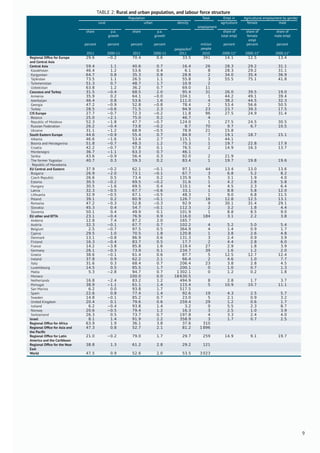
  • 41.
    THEMATIC DATA ANDTRENDS MAP 11: Oil-bearing crop area, share of total agricultural area (percent, 2011) No data available 0 ~ < 0.16 0.16 ~ < 0.61 0.61 ~ < 1.6 1.6 ~ < 4.4 4.4 ~ 8.701 Source: FAO, Statistics Division (FAOSTAT). MAP 12: Oil-bearing crop production (thousand tonnes, 2011) No data available 0 ~ < 7.6 7.6 ~ < 46 46 ~ < 190 190 ~ < 790 790 ~ 4 901 Source: FAO, Statistics Division (FAOSTAT). 25
  • 42.
    TABLE 5: Cerealsand wheat Total cereals Wheat area production area production p.a. growth p.a. growth p.a. growth p.a. growth thousand ha percent thousand tonnes percent thousand ha percent thousand tonnes percent 2011 2000-11 2011 2000-11 2011 2000-11 2011 2000-11 Regional Office for Europe and Central Asia 151 393 0.0 544 138 2.4 84 860 0.9 281 873 2.7 Central Asia 19 046 1.9 37 871 6.7 16 364 2.3 32 085 7.3 Kazakhstan 15 796 2.3 26 659 7.9 13 694 2.9 22 732 8.7 Kyrgyzstan 578 −0.0 1 505 −0.3 373 −1.6 800 −2.4 Tajikistan 411 −0.1 1 035 6.0 311 −0.9 727 5.4 Turkmenistan 770 −0.6 1 559 −1.1 650 −0.7 1 300 −2.4 Uzbekistan 1 491 −0.7 7 114 5.6 1 336 −0.1 6 527 5.7 Caucasus and Turkey 13 197 −1.1 38 406 1.1 8 875 −1.1 23 715 0.5 Armenia 159 0.1 435 6.4 78 −2.8 224 1.9 Azerbaijan 954 3.7 2 371 4.3 654 2.6 1 594 3.0 Georgia 184 −4.5 405 −0.3 47 −5.4 97 0.7 Turkey 11 900 −1.4 35 195 0.8 8 096 −1.3 21 800 0.3 CIS Europe 58 905 0.4 158 495 5.1 32 439 1.6 81 491 5.4 Belarus 2 457 0.4 7 981 5.2 644 3.3 2 132 7.5 Republic of Moldova 861 −0.8 2 466 2.4 301 −1.9 795 0.8 Russian Federation 40 602 −0.1 91 792 3.3 24 836 1.4 56 240 4.6 Ukraine 14 985 1.9 56 256 8.1 6 657 2.3 22 324 7.4 South Eastern Europe 3 062 −2.1 14 299 0.7 848 −4.3 3 620 −2.3 Albania 148 −1.7 701 2.0 69 −4.3 293 −1.4 Bosnia and Herzegovina 300 −1.8 1 118 1.7 58 −5.1 210 −4.2 Croatia 541 −2.2 2 829 0.2 150 −4.0 782 −2.5 Montenegro 5 18 1 2 Serbia 1 910 9 077 493 2 076 The former Yugoslav Republic of Macedonia 158 −2.9 555 −0.1 77 −4.1 256 −1.4 EU Central and Eastern 21 574 −0.7 85 884 3.4 8 563 0.2 34 909 2.6 Bulgaria 1 768 −0.1 7 521 5.0 1 138 1.4 4 458 4.4 Czech Republic 1 470 −1.1 7 973 1.9 863 −1.1 4 913 1.7 Estonia 297 −0.9 771 0.9 129 5.8 360 8.5 Hungary 2 683 −0.3 13 692 2.9 978 −0.4 4 107 1.0 Latvia 518 2.2 1 422 4.0 308 6.2 937 7.4 Lithuania 1 065 0.8 3 226 1.8 551 3.7 1 869 3.8 Poland 7 719 −1.2 26 173 1.4 2 259 −1.4 9 339 0.9 Romania 5 220 −0.7 20 842 6.4 1 946 0.1 7 132 4.4 Slovakia 740 −0.9 3 655 4.7 363 −1.0 1 639 2.5 Slovenia 96 −0.7 611 1.9 30 −2.3 154 −0.5 EU other and EFTA 35 534 −0.6 208 929 −0.4 17 711 −0.0 105 930 0.0 Andorra Austria 807 −0.5 5 705 1.7 304 0.3 1 782 2.8 Belgium 326 0.4 2 939 1.4 201 −0.5 1 688 0.0 Cyprus 38 −2.8 74 4.0 11 5.5 25 8.6 Denmark 1 484 −0.2 8 767 −0.6 747 1.6 4 831 0.3 Finland 1 058 −0.9 3 739 −0.8 255 5.0 981 5.6 France 9 660 0.6 65 981 0.0 5 825 1.0 38 021 0.2 Germany 6 491 −0.7 41 938 −0.7 3 248 0.8 22 800 0.5 Greece 961 −2.5 4 664 −0.6 544 −4.1 1 702 −2.8 Ireland 298 0.6 2 512 1.3 94 1.7 929 2.1 Italy 3 433 −1.7 19 503 −0.5 1 726 −2.7 6 622 −1.1 Luxembourg 29 0.0 150 −0.2 14 2.2 77 2.1 Malta 3 0.6 17 3.2 3 1.3 15 4.3 Monaco Netherlands 206 −0.5 1 610 −0.7 151 0.9 1 175 0.3 Portugal 288 −6.1 1 158 −2.9 43 −14.0 59 −15.1 San Marino Spain 5 944 −1.2 22 040 −1.0 1 995 −1.5 6 877 −0.5 Sweden 986 −2.0 4 651 −1.7 419 0.4 2 253 −0.5 United Kingdom 3 076 −0.8 21 485 −1.0 1 969 −0.5 15 257 −0.8 Iceland Norway 299 −0.9 1 023 −2.1 74 0.7 284 −0.9 Switzerland 145 −2.1 973 −1.9 88 −0.8 553 −0.5 Israel 76 0.1 254 3.0 61 −0.5 122 2.4 Regional Office for Africa 98 311 2.8 126 825 4.2 Regional Office for Asia and the Pacific 375 106 0.5 1 365 850 2.5 Regional Office for Latin America and the Caribbean 50 742 0.7 193 029 3.5 Regional Office for the Near East 38 552 2.3 74 896 5.4 17 555 2.2 40 795 6.6 World 707 328 0.6 2 589 143 2.4 26
  • 43.
    TABLE 6: Coarsegrain and oil-bearing crops Coarse grains Oil-bearing crops area production area production p.a. growth p.a. growth p.a. growth p.a. growth thousand ha percent thousand tonnes percent thousand ha percent thousand tonnes percent 2011 2000-11 2011 2000-11 2011 2000-11 2011 2000-11 Regional Office for Europe and Central Asia 65 513 −0.9 256 285 2.3 41 165 4.2 26 581 6.8 Central Asia 2 485 0.2 5 079 5.0 3 861 4.1 872 6.8 Kazakhstan 2 009 −0.5 3 580 4.3 1 633 10.8 405 14.5 Kyrgyzstan 199 3.9 685 3.1 91 −0.4 32 0.8 Tajikistan 86 4.9 231 13.6 214 −1.1 41 2.6 Turkmenistan 64 1.5 115 11.8 550 −0.4 62 −5.0 Uzbekistan 127 0.6 467 6.8 1 373 −0.8 330 0.5 Caucasus and Turkey 4 221 −1.1 13 787 1.8 2 238 0.9 1 314 2.6 Armenia 81 4.5 211 16.5 0 0 Azerbaijan 298 7.1 773 8.2 65 −4.8 21 4.1 Georgia 137 −4.2 308 −0.6 16 1.5 2 −1.0 Turkey 3 705 −1.7 12 495 1.3 2 157 1.1 1 291 2.6 CIS Europe 26 229 −0.8 75 779 5.0 17 393 6.6 9 810 10.2 Belarus 1 813 −0.4 5 848 4.5 359 5.4 158 12.9 Republic of Moldova 559 −0.1 1 672 3.2 372 4.1 209 5.8 Russian Federation 15 559 −2.1 34 497 1.5 9 881 6.2 4 901 9.8 Ukraine 8 298 1.5 33 762 8.7 6 781 7.4 4 541 10.7 South Eastern Europe 2 210 −0.9 10 652 2.5 549 1.9 389 5.1 Albania 78 1.5 408 5.6 45 2.0 16 4.9 Bosnia and Herzegovina 242 −0.7 908 3.9 5 −0.0 2 2.3 Croatia 391 −1.4 2 047 1.5 127 2.1 88 5.5 Montenegro 4 15 2 0 Serbia 1 417 7 001 356 274 The former Yugoslav Republic of Macedonia 77 −1.8 272 0.9 14 0.6 9 1.3 EU Central and Eastern 12 984 −1.1 50 842 4.1 5 405 5.5 4 340 10.1 Bulgaria 618 −2.3 3 002 6.0 1 004 5.5 793 14.0 Czech Republic 607 −1.1 3 060 2.3 464 1.0 450 2.0 Estonia 168 −3.9 410 −2.6 89 10.8 55 12.7 Hungary 1 703 −0.2 9 576 3.8 882 6.1 788 9.8 Latvia 210 −1.5 485 −0.2 125 26.7 84 31.3 Lithuania 514 −1.5 1 357 −0.4 258 13.3 186 17.3 Poland 5 460 −1.1 16 833 1.8 851 5.9 716 6.2 Romania 3 261 −1.2 13 645 7.7 1 469 2.9 1 045 10.8 Slovakia 377 −0.7 2 015 7.1 257 3.6 217 7.2 Slovenia 66 0.1 457 2.9 6 20.9 6 27.8 EU other and EFTA 17 369 −1.2 100 015 −0.8 11 682 0.9 9 829 2.7 Andorra Austria 503 −0.9 3 923 1.3 148 3.0 125 4.0 Belgium 126 2.1 1 251 3.9 21 1.2 22 6.8 Cyprus 27 −4.7 49 2.3 11 3.8 3 −3.3 Denmark 737 −1.7 3 936 −1.6 151 3.4 193 5.0 Finland 804 −2.2 2 759 −2.3 91 5.1 44 4.5 France 3 812 0.0 27 832 −0.1 2 462 1.5 2 871 2.7 Germany 3 243 −2.0 19 138 −1.9 1 374 1.1 1 500 0.5 Greece 385 −0.3 2 707 0.7 1 218 −0.0 554 −1.9 Ireland 203 0.2 1 583 0.9 12 14.9 21 18.6 Italy 1 460 −0.8 11 391 −0.4 1 450 −1.3 951 −0.6 Luxembourg 15 −1.6 73 −2.1 5 4.1 6 5.8 Malta 0 −3.2 1 −3.3 0 13.4 0 9.3 Monaco Netherlands 55 −3.6 434 −2.7 5 −2.0 3 1.1 Portugal 214 −3.8 917 −1.7 366 −1.3 107 3.5 San Marino Spain 3 827 −1.1 14 236 −1.3 3 480 0.5 2 210 3.5 Sweden 567 −3.4 2 398 −2.7 114 6.2 109 7.6 United Kingdom 1 107 −1.2 6 228 −1.4 741 4.1 1 073 8.1 Iceland Norway 225 −1.4 739 −2.6 5 −0.9 3 −0.4 Switzerland 58 −3.7 420 −3.5 27 3.9 33 4.5 Israel 15 3.1 132 3.6 38 −2.0 28 −1.0 Regional Office for Africa 85 192 2.7 100 196 3.9 30 823 2.7 9 448 4.5 Regional Office for Asia and the Pacific 103 968 0.5 349 338 4.4 114 836 1.8 93 018 5.5 Regional Office for Latin America and the Caribbean 35 960 1.1 135 733 4.1 55 341 5.3 31 405 6.7 Regional Office for the Near East 19 837 2.7 25 687 5.4 8 721 1.0 2 153 3.9 World 323 286 0.9 1 165 188 3.1 278 925 2.5 179 676 5.2 27
  • 44.
    Crop production -Sugar Beet Sugar beet production overtook roots and tubers in 2010- 2011 to become Europe and Central Asia’s second most im- portant crop in terms of quantity. The region’s 2011 sugar beet crop of 214 million tonnes represented nearly 80 per- cent of world production (273.5 million tonnes). Sugar beet in turn accounts for some 20 percent of global sugar production, the rest being supplied by sugar cane. The region thus provides 16 percent of global sugar output. By far the biggest producer in Europe and Central Asia is theEU other and EFTA group, which includes all the ini- tial members of the European Union. This group produced nearly half of the 2011 crop, with 102 million tonnes. Currently the leading beet producer in the region is the Russian Federation, which in 2011 edged France from the first place it had occupied almost uninterruptedly since the 1980s. The Russian Federation produced 48 million tonnes from 1.2 million hectares, not much less than the area under sugar beet in allEU other and EFTA countries combined. The Russian Federation has made a determined push into the sugar market. Production there has more than tripled in the last decade when it grew by almost 12 percent a year. France on the other hand, is bound by European Union quo- tas on members’ sugar beet production, and its output has hovered around 30 million tonnes for the past 10 years. However, the EU quota system is expected to be dismantled in 2017, leaving the sector open to competition in which the most efficient producers will most likely be rewarded. Germany currently ranks third among the region’s sugar beet producing countries, but Ukraine has also emerged as a strong player after its production of this commodity has been growing at 3.2 percent a year for the last decade. With its 19 million tonnes in 2011, the country accounted for 7 percent of world sugar beet production. CHART 23: Area and production of sugar beet, share of world total (2011) 0 10 20 30 EU Other EU CE SE Europe CIS Europe Cauc & Turk C Asia percent Sugar harvested area Sugar production Source: FAO, Statistics Division (FAOSTAT). 28
  • 45.
    THEMATIC DATA ANDTRENDS MAP 13: Sugar beet area, share of total agricultural area (percent, 2011) No data available 0 ~ < 0.0058 0.0058 ~ < 0.16 0.16 ~ < 0.73 0.73 ~ < 1.3 1.3 ~ 4.652 Source: FAO, Statistics Division (FAOSTAT). MAP 14: Sugar production (thousand tonnes, 2011) No data available 0 ~ < 8 8 ~ < 430 430 ~ < 2 230 2 230 ~ < 5 220 5 220 ~ 47 643 Source: FAO, Statistics Division (FAOSTAT). 29
  • 46.
    Crop production -Roots and tubers Europe and Central Asia produced 144 million tonnes of roots and tubers – mostly potatoes –in 2011, accounting for 18 percent of world output. Production dropped by 0.2 percent per annum in 2000-2011 in the region as a whole, but the figure conceals sharp dif- ferences between the EU countries, where production has fallen often heavily over the past decade, and the rest of the region which has seen moderate to strong growth. With richer consumers eating fewer carbohydrates, produc- tion has plummeted in almost all countries of the European Union and inSouth Eastern Europe. TheEU Central and Eastern group registered a 5.7 percent annual decrease in production over the period 2000-2011, with Poland, the largest local producer, reducing its harvests by 9.4 percent per annum. All other countries in the group also cut production, with the single exception of Romania, the second-biggest supplier in this group, which expanded by 1.5 percent. In the largerEU other and EFTA group, production fell 0.4 percent per annum over the decade, including in countries with historic traditions of potato farming like Ireland (-2.2 percent p.a.) and Germany (-1.3 percent p.a.). The Nether- lands, another major producer, cut output by 1 percent a year, Italy by 2.5 percent and Spain by 2.2 percent. In both Portugal and Malta output fell 5.4 percent per annum. However France and Belgium both increased their produc- tion, by respectively 1.3 and 3.2 percent per annum, as did Austria (1.5 percent). Israel grew at 4.4 percent. In contrastCentral Asia had a 6.5 percent per annum produc- tion increase over the decade. That included 10.7 percent per annum in Turkmenistan and 10 percent in Tajikistan. CIS Europe is the biggest producer in the region with 64 mil- lion tonnes in 2000-2001, and 0.3 percent annual growth over 2000-2011. Of that total, more than half – 33 mil- lion tonnes – was supplied by the Russian Federation where, however, output dropped by 0.4 percent per annum over the period. The drop was offset, however, by 1.8 percent annual growth in Ukraine,CIS Europe’s second-largest producer. Caucasus and Turkey had the smallest production of any of this region’s groups, but grew at 0.5 percent a year. A 1.4 percent annual fall in Turkey, the group’s main producer, was offset by 6.1 percent growth in Armenia and 6.5 percent in Azerbaijan. CHART 24: Area and production of roots and tubers, share of world total (2011) 0 2 4 6 EU Other EU CE SE Europe CIS Europe Cauc & Turk C Asia percent Root and tuber harvested area Root and tuber crops production Source: FAO, Statistics Division (FAOSTAT). 30
  • 47.
    THEMATIC DATA ANDTRENDS MAP 15: Root and tuber area, share of total agricultural area (percent, 2011) No data available 0.03243 ~ < 0.44 0.44 ~ < 0.8 0.8 ~ < 1.2 1.2 ~ < 1.7 1.7 ~ 8.404 Source: FAO, Statistics Division (FAOSTAT). MAP 16: Root and tuber production (thousand tonnes, 2011) No data available 7.222 ~ < 230 230 ~ < 510 510 ~ < 870 870 ~ < 4 090 4 090 ~ 32 681 Source: FAO, Statistics Division (FAOSTAT). 31
  • 48.
    Crop production -Vegetables Europe and Central Asia produced 13.6 percent of the world’s vegetables in 2011 – just slightly less than the 14 percent harvested in 2010. Across the region, 2000-2011 increases, some of which were spectacular, as in the groups of Central Asia, Caucasus and Turkey, South Eastern Europe andCIS Eu- rope, have been offset by a stagnation or negative growth in the European Union countries. Central Asia registered the fastest growth over the period, with 8.4 percent per annum. This group’s biggest producer, Uzbekistan, expanded production at the annual rate of 9.4 percent. The number two producer, Kazakhstan, grew at 7 percent and third-placed Tajikistan at almost 13 percent, but from a significantly smaller production base. Growth was more contained in theCaucasus and Turkey- group, at 1.3 percent per annum, but this group produced almost twice as much asCentral Asia. Turkey, the biggest pro- ducer in the region as a whole, harvested 27 million tonnes of vegetables in 2011 and grew at one percent over the decade. In CIS Europe, Ukraine surged ahead at 5.6 percent per an- num, while the Russian Federation grew at 2.5 percent. The group itself registered 3.6 percent annual growth. South Eastern Europe, the smallest vegetable producer in the re- gion, grew at a sound 2.8 percent. EU Central and Eastern showed zero production growth over the decade and reduced its vegetable planting area by 2.4 percent per annum. Production slowed by 0.3 percent in Poland, this group’s biggest producer, but expanded at the annual rate of 1.3 percent in Romania. EU other and EFTA produces more vegetables than any of the other groups – 54 million tonnes in 2011. But produc- tion dipped at 0.3 percent per annum over the decade and planted area shrank by 0.8 percent per annum. Italy and Spain, the biggest producers in the group, saw their output cut over the decade, by 1.3 percent and 0.3 percent per annum respectively. Planted area also receded. However, in the region as a whole, average production be- tween 2001 and 2010 was 54 percent higher than in 1991- 2000. Decade-on-decade growth was highest in Central Asia (72 percent), followed by South Eastern Europe (63 percent), CIS Europe (31 percent) and Caucasus and Turkey(25 per- cent). Growth was moderate in EU other and EFTA while, alone among the groups, it fell in EU Central and Eastern. CHART 25: Area and production of vegetables, share of world total (2011) 0 1 2 3 EU Other EU CE SE Europe CIS Europe Cauc & Turk C Asia percent Vegetable harvested area Vegetable production Source: FAO, Statistics Division (FAOSTAT). 32
  • 49.
    THEMATIC DATA ANDTRENDS MAP 17: Vegetable area, share of total agricultural area (percent, 2011) No data available 0.004463 ~ < 0.48 0.48 ~ < 0.81 0.81 ~ < 1.3 1.3 ~ < 2.5 2.5 ~ 51.73 Source: FAO, Statistics Division (FAOSTAT). MAP 18: Vegetable production (thousand tonnes, 2011) No data available 0.979 ~ < 220 220 ~ < 460 460 ~ < 1 550 1 550 ~ < 4 140 4 140 ~ 27 407 Source: FAO, Statistics Division (FAOSTAT). 33
  • 50.
    Crop production –Fruit (excluding grapes) Europe and Central Asia produced around 11 percent of the world’s fruit in 2011, but, despite growing global demand, European production has been very modest over the past decade (at 0.9 percent per annum) while Asian output has increased rapidly. Asia and the Pacific is now the world’s top fruit-growing re- gion, with more than half of world output. But Europe and Central Asia still has three countries – Turkey, Italy and Spain – among the world’s top ten fruit-growing nations. Together, those three countries produced more than half of Europe and Central Asia’s fruit crop of 69.5 million tonnes in 2011. The top fruit-growing nation in the region was Turkey, with 14.4 million tonnes, followed by Italy with 12.7 million tonnes and Spain with 12.3 million tonnes. The three southern European countries were followed by France and Uzbekistan, both with 3 million tonnes. Uzbek- istan’s output represented 70 percent of Central Asia’s entire production. South Eastern Europe registered the fastest growth, at 6.4 percent, with Bosnia and Herzegovina surging at a record 14 percent. But the quantities involved were small, with the en- tire crop of this group amounting to less than that of France. In Central Asia, annual growth was 6.0 percent, with Uzbek- istan racing at 7.2 percent and Turkmenistan at 6.1 percent, but from a very small base. Caucasus and Turkey, the region’s second-biggest producer afterEU other and EFTA, grew at a robust 2.7 percent, largely determined by 2.6 percent annual growth in Turkey. All the other groups were characterized by negative growth, including EU Central and Eastern, -0.7 percent in EU other and EFTA and 0.6 percent in CIS Europe. France’s fruit crop fell by 5.5 percent per annum over the decade and Italy’s by 0.1. The Russian Federation’s output also fell, by 3 percent per annum, but Ukraine, the second-biggest producer in CIS Europe, recorded 1.6 percent annual growth. CHART 26: Area and production of fruits, share of world total (2011) 0 2 4 6 8 EU Other EU CE SE Europe CIS Europe Cauc & Turk C Asia percent Fruit excl. grapes harvested area Fruit production excl. grapes Source: FAO, Statistics Division (FAOSTAT). 34
  • 51.
    THEMATIC DATA ANDTRENDS MAP 19: Fruit harvested area, share of agricultural area (percent, 2011) No data available 0.02035 ~ < 0.5 0.5 ~ < 1.1 1.1 ~ < 1.8 1.8 ~ < 2.8 2.8 ~ 10.41 Source: FAO, Statistics Division (FAOSTAT). MAP 20: Fruit production (thousand tonnes, 2011) No data available 5.834 ~ < 190 190 ~ < 370 370 ~ < 710 710 ~ < 1 910 1 910 ~ 14 359 Source: FAO, Statistics Division (FAOSTAT). 35
  • 52.
    TABLE 7: Sugarbeet and roots and tubers Sugar beet Roots and tubers area production area production p.a. growth p.a. growth p.a. growth p.a. growth thousand ha percent thousand tonnes percent thousand ha percent thousand tonnes percent 2011 2000-11 2011 2000-11 2011 2000-11 2011 2000-11 Regional Office for Europe and Central Asia 3 596 194 626 6 845 −2.6 143 773 −0.2 Central Asia 40 594 422 2.9 7 416 6.5 Kazakhstan 11 −4.6 200 −2.8 184 1.3 3 076 5.6 Kyrgyzstan 8 −9.3 159 −9.0 85 1.9 1 379 2.5 Tajikistan 37 3.4 863 10.0 Turkmenistan 22 −0.2 235 0.2 44 10.2 274 10.7 Uzbekistan 0 0 73 3.1 1 824 8.7 Caucasus and Turkey 308 16 436 258 −1.8 6 384 0.5 Armenia 4 47.5 56 47.3 29 −1.6 557 6.1 Azerbaijan 7 11.4 253 16.6 65 2.0 939 6.5 Georgia 0 0 20 −4.6 274 −0.9 Turkey 297 −2.9 16 126 −1.4 144 −3.2 4 614 −1.4 CIS Europe 1 856 71 459 4 016 −2.8 64 428 0.3 Belarus 99 6.0 4 487 10.7 341 −5.8 7 148 −1.8 Republic of Moldova 25 −8.1 589 −4.2 29 −7.0 351 0.6 Russian Federation 1 216 4.5 47 643 11.7 2 203 −3.4 32 681 −0.4 Ukraine 516 −3.3 18 740 3.2 1 443 −1.1 24 248 1.8 South Eastern Europe 80 4 038 160 −3.3 2 076 0.7 Albania 2 3.3 40 −0.4 10 −1.6 230 3.3 Bosnia and Herzegovina 0 0 37 −1.5 413 3.4 Croatia 22 0.3 1 168 8.4 11 −15.0 168 −10.3 Montenegro 11 180 Serbia 56 2 822 78 892 The former Yugoslav Republic of Macedonia 0 −15.9 8 −16.3 14 0.2 194 1.5 EU Central and Eastern 804 −6.8 15 488 −5.7 Bulgaria 0 0 16 −10.2 232 −4.8 Czech Republic 58 −0.4 3 899 3.0 26 −8.4 805 −5.4 Estonia 9 −10.4 165 −9.1 Hungary 15 −11.5 856 −7.3 21 −7.0 600 −3.3 Latvia 0 0 30 −4.8 499 −3.6 Lithuania 18 −4.0 878 −0.0 38 −9.2 588 −9.6 Poland 204 −4.4 11 674 −1.1 400 −9.8 8 197 −9.4 Romania 19 −8.2 660 −0.1 248 −1.2 4 077 1.5 Slovakia 18 −5.0 1 161 1.7 10 −8.3 217 −5.8 Slovenia 0 0 4 −6.5 108 −4.8 EU other and EFTA 1 312 102 099 1 164 −1.3 47 341 −0.4 Andorra Austria 47 0.7 3 456 2.8 23 −0.3 816 1.5 Belgium 62 −3.4 5 409 −1.2 82 2.1 4 129 3.2 Cyprus 5 −3.4 112 −0.6 Denmark 40 −3.5 2 700 −1.9 42 0.7 1 620 −0.1 Finland 14 −7.2 676 −3.9 24 −2.5 673 −1.4 France 393 −0.4 38 106 1.9 159 −0.2 7 440 1.3 Germany 398 −1.1 25 000 −1.0 259 −1.5 11 800 −1.3 Greece 6 −17.9 324 −18.4 29 −4.7 762 −2.6 Ireland 0 0 10 −2.3 356 −2.2 Italy 62 −12.4 3 548 −10.7 63 −2.6 1 557 −2.5 Luxembourg 1 −2.4 20 −1.6 Malta 1 −8.1 19 −5.4 Monaco Netherlands 73 −3.7 5 858 −1.3 159 −1.1 7 333 −1.0 Portugal 0 −25.3 8 −30.9 29 −6.3 410 −5.4 San Marino Spain 45 −8.9 4 189 −5.6 81 −3.5 2 482 −2.0 Sweden 40 −3.0 2 493 −0.4 28 −1.6 878 −1.0 United Kingdom 113 −3.8 8 504 −0.6 146 −1.2 6 115 −0.7 Iceland 1 −2.5 7 −2.8 Norway 13 −1.5 296 −0.6 Switzerland 19 0.8 1 828 2.4 11 −2.1 515 −1.4 Israel 0 0 21 5.5 641 4.4 Regional Office for Africa 25 251 2.1 247 366 4.1 Regional Office for Asia and the Pacific 19 841 −0.2 361 494 1.7 Regional Office for Latin America and the Caribbean 4 247 0.6 56 775 1.4 Regional Office for the Near East 808 3.0 18 846 5.7 World 54 933 0.8 810 845 2.1 36
  • 53.
    TABLE 8: Vegetablesand fruit Vegetables Fruit area production area production p.a. growth p.a. growth p.a. growth p.a. growth thousand ha percent thousand tonnes percent thousand ha percent thousand tonnes percent 2011 2000-11 2011 2000-11 2011 2000-11 2011 2000-11 Regional Office for Europe and Central Asia 6 184 −0.1 148 046 1.9 4 326 0.5 69 536 0.9 Central Asia 579 2.6 16 014 8.4 370 1.4 4 189 6.0 Kazakhstan 194 2.2 4 126 7.0 43 −4.2 214 −0.9 Kyrgyzstan 53 −0.3 973 1.6 46 0.6 220 1.6 Tajikistan 62 4.2 1 665 12.9 77 1.0 418 3.8 Turkmenistan 49 4.2 961 4.6 13 2.7 396 6.1 Uzbekistan 221 2.9 8 289 9.4 191 3.0 2 940 7.2 Caucasus and Turkey 1 252 0.7 30 300 1.3 797 2.2 15 922 2.7 Armenia 31 2.9 968 7.7 31 3.3 415 5.1 Azerbaijan 113 0.8 1 697 4.5 113 3.6 896 4.6 Georgia 24 −6.4 229 −5.7 46 −3.8 253 −4.1 Turkey 1 084 0.7 27 407 1.0 606 2.3 14 359 2.6 CIS Europe 1 539 −0.2 29 152 3.6 804 −4.9 5 453 −0.6 Belarus 70 −3.6 1 823 2.5 89 261 −1.0 Republic of Moldova 43 −4.9 446 1.1 89 −3.1 834 −0.1 Russian Federation 838 −0.4 16 275 2.5 416 −5.3 2 220 −3.0 Ukraine 588 0.8 10 608 5.6 210 −4.9 2 137 1.6 South Eastern Europe 383 0.1 4 075 2.8 539 8.9 2 950 6.4 Albania 40 3.0 937 3.8 32 4.0 380 9.9 Bosnia and Herzegovina 127 1.0 740 3.7 123 14.0 328 14.3 Croatia 13 −12.9 225 −4.9 26 −4.0 395 1.1 Montenegro 7 144 10 61 Serbia 151 1 288 323 1 418 The former Yugoslav Republic of Macedonia 46 −1.1 741 2.9 26 3.3 370 1.6 EU Central and Eastern 617 −2.4 13 058 −0.0 3 673 Bulgaria 29 −12.9 473 −9.6 62 −0.9 297 −5.5 Czech Republic 10 −8.6 219 −6.5 23 −4.1 186 −8.7 Estonia 3 −4.5 88 3.6 6 Hungary 76 −3.0 1 475 −0.2 79 −1.8 807 −4.2 Latvia 9 −4.6 169 4.3 9 Lithuania 14 −3.7 353 0.5 56 −5.9 Poland 184 −2.9 5 778 −0.3 Romania 263 −0.4 4 177 1.9 148 −2.7 1 967 −0.4 Slovakia 24 −2.3 247 −4.7 16 −4.3 107 −5.8 Slovenia 4 1.2 78 −0.2 7 −1.0 236 −0.7 EU other and EFTA 1 754 −0.8 53 782 −0.3 1 762 −0.6 36 159 −0.7 Andorra Austria 16 1.6 706 3.0 32 2.0 1 076 2.1 Belgium 58 0.3 1 946 1.9 20 1.0 559 −2.9 Cyprus 3 −4.5 99 −2.9 7 −4.0 168 −2.7 Denmark 11 2.1 304 2.7 Finland 9 0.0 277 1.2 France 252 −1.2 5 776 −1.0 121 −3.1 2 978 −5.5 Germany 108 1.0 3 594 −0.7 79 −2.5 1 658 −2.0 Greece 103 −2.8 3 448 −2.0 150 −1.3 2 857 −2.5 Ireland 5 −1.2 226 0.5 Italy 509 −1.4 13 788 −1.6 491 −0.1 12 679 0.1 Luxembourg 0 −9.6 1 −1.6 0 −16.3 7 −9.4 Malta 5 0.1 82 −0.1 1 −1.2 8 7.3 Monaco Netherlands 87 2.6 5 050 3.0 21 −1.1 Portugal 89 −1.1 2 531 0.8 170 0.0 1 017 −1.0 San Marino Spain 338 −1.3 12 476 0.2 633 −0.4 12 266 0.2 Sweden 21 0.9 332 1.4 United Kingdom 116 −0.1 2 569 −1.9 29 1.3 422 2.9 Iceland 0 0.9 5 4.4 Norway 6 −1.1 148 0.4 Switzerland 16 5.8 425 2.9 8 −1.5 464 −2.0 Israel 61 1.9 1 665 0.3 54 −1.5 1 189 −0.5 Regional Office for Africa 5 388 2.6 36 846 3.4 Regional Office for Asia and the Pacific 40 228 2.3 802 500 4.0 Regional Office for Latin America and the Caribbean 2 644 1.4 43 248 2.3 Regional Office for the Near East 3 319 2.7 74 755 4.5 3 060 1.5 World 56 734 2.0 1 090 425 3.4 37
  • 54.
    Wine production The worldwine market is dominated by just three countries, France, Italy and Spain, which between them account for roughly half of total world production. But there are several other substantial wine growers in the Europe and Central Asia region, which supplied some 66 percent of the world market in recent years. Production volumes can vary greatly between from one har- vest to the next depending on policies and weather, but the top producer each year is invariably either Italy or France. In 2011 first place went to France, with 6.5 million tonnes (and 5.3 million tonnes in 2012), while Italy returned 4.7 million tonnes (and 4.1 million tonnes in 2012) and Spain 3.3 mil- lion tonnes (and 3.2 million tonnes in 2012). After the big three producers, the next most important wine growing countries in the region are Portugal, who produced 0.6 million tonnes in 2012, followed by Germany with 0.5 million tonnes (substantially down from 0.9 million tonnes in 2011), and the Russian Federation with 0.7 million tonnes. Europe and Central Asia has four countries among the world’s top ten wine growers, but 12 countries in the world’s top 20, including Romania, Greece, Austria, Serbia, Hungary and Ukraine. But over the past two decades wine production has de- creased by almost 20 percent in the region, partly because of EU policies encouraging quality rather than quantity, and partly due to much increased competition on the world mar- ket. Current production by the big three is over 30 percent down on the level 30 years ago. But in the last three decades pro- duction tripled in Australia, doubled in Chile and increased by more than 50 percent in the United States. However the fastest growth over the period has taken place in China, where production rose from 80 000 tonnes in 1980 to 1.6 million tonnes in 2011, a 2000 percent increase which has made China the world’s fifth largest producer after the United States. Within the Europe and Central Asia region, the leading group is EU other and EFTA, which is home to all leading growers, followed by CIS Europe. CHART 27: Area of vineyards and production of wine, share of world total (2011) 0 20 40 EU Other EU CE SE Europe CIS Europe Cauc & Turk C Asia percent Wine production Vineyards area Source: FAO, Statistics Division (FAOSTAT). 38
  • 55.
    THEMATIC DATA ANDTRENDS MAP 21: Area of vineyards, share of total agricultural area (percent, 2011) No data available 0.0007479 ~ < 0.15 0.15 ~ < 0.75 0.75 ~ < 1.3 1.3 ~ < 2.5 2.5 ~ 15.53 Source: FAO, Statistics Division (FAOSTAT). MAP 22: Wine production (thousand tonnes, 2011) No data available 0 ~ < 5.2 5.2 ~ < 18 18 ~ < 59 59 ~ < 270 270 ~ 6 534 Source: FAO, Statistics Division (FAOSTAT). 39
  • 56.
    Processed crops Besides wine(covered in the previous section), processed crops include products such as flour, beer, sunflower and olive oil, sugar, cotton seed and cotton lint. Europe and Central Asia is the world’s second largest beer brewer after Asia and the Pacific, which produced 72 mil- lion tonnes of processed barley in 2011. Europe and Central Asia’s production was 56 million tonnes and third-ranking North America supplied 24 million tonnes. The region’s top producer is the Russian Federation, which produced 9.9 million tonnes of beer from barley in 2011, while another important producer in the CIS Europe group is Poland, with 3.8 million tonnes. However, for beer the leading group is EU other and EFTA with more than half of the regional total. Germany is the biggest brewer in this group (and the fifth-biggest in the world) with a production of 9 million tonnes of beer in 2011, followed by the United Kingdom (4. 6 million tonnes), Spain (3. 4 million tonnes) and the Netherlands (2.5 million tonnes). And while wine production has fallen in the region, beer has seen a significant growth, particularly in traditionally wine drinking countries of this region. Beer production has in- creased more than 20 percent in the last 30 years. In five out of the six groups that comprise this region, more wheat is processed (mostly into flour) than any other crop, with the sole exception of South Eastern Europe, where maize is in first position. Second in order of importance is sugar beet. Cotton seed and cotton lint production is important in Cen- tral Asia, where 4.4 million tonnes of seed and lint – more than 80 percent of the regional total – were processed in 2011. The region also accounts for some 20 percent of total pro- duction of oil from crops such as sunflower seeds, maize and rape. It is also the world’s leading producer of virgin olive oil. The 2.2 million tons of olive oil produced in 2011 represent more than 70 percent of total world production. The region’s leading olive oil producers are the Mediter- ranean EU countries plus Turkey. Spain was the leading pro- ducer with 1.25 million tonnes – more than half the regional total. Second was Italy with 0.5 million tonnes and third Greece with 0.3 million tonnes. Turkey was fourth with 0.2 million tonnes. CHART 28: Production quantity of the most important processed crops in Central Asia (2010 and 2011) Rapeseed oil Molasses Wine Margrine Short Sugar Raw Centrifugal Sunflower oil Cottonseed oil Beer of Barley Cotton lint Cottonseed 0 1 2 milliontonnes 2010 2011 Source: FAO, Statistics Division (FAOSTAT). CHART 29: Production quantity of the most important processed crops in Caucasus & Turkey (2010 and 2011) Olive oil, virgin Soybean oil Cottonseed oil Molasses Margrine Short Sunflower oil Cotton lint Beer of Barley Cottonseed Sugar Raw Centrifugal 0.5 1.0 1.5 2.0 2.5 milliontonnes 2010 2011 Source: FAO, Statistics Division (FAOSTAT). 40
  • 57.
    THEMATIC DATA ANDTRENDS CHART 30: Production quantity of the most important processed crops in South Eastern Europe (2010 and 2011) Olive oil, virgin Maize oil Rapeseed oil Margrine Short Soybean oil Sunflower oil Molasses Wine Sugar Raw Centrifugal Beer of Barley 0.0 0.3 0.6 0.9 milliontonnes 2010 2011 Source: FAO, Statistics Division (FAOSTAT). CHART 31: Production quantity of the most important processed crops in CIS Europe (2010 and 2011) Linseed oil Maize oil Rapeseed oil Soybean oil Margrine Short Wine Molasses Sunflower oil Sugar Raw Centrifugal Beer of Barley 0 5 10 milliontonnes 2010 2011 Source: FAO, Statistics Division (FAOSTAT). CHART 32: Production quantity of the most important processed crops in EU Central & Eastern (2010 and 2011) Groundnut oil Soybean oil Maize oil Molasses Margrine Short Wine Sunflower oil Rapeseed oil Sugar Raw Centrifugal Beer of Barley 0.0 2.5 5.0 7.5 10.0 milliontonnes 2010 2011 Source: FAO, Statistics Division (FAOSTAT). CHART 33: Production quantity of the most important processed crops in EU Other & EFTA (2010 and 2011) Cottonseed Sunflower oil Olive oil, virgin Soybean oil Margrine Short Molasses Rapeseed oil Sugar Raw Centrifugal Wine Beer of Barley 0 10 20 30 milliontonnes 2010 2011 Source: FAO, Statistics Division (FAOSTAT). 41
  • 58.
    TABLE 9: Processedcrops Production beer of barley wine sunflower oil rapeseed oil Processed crops thousand tonnes thousand tonnes thousand tonnes thousand tonnes thousand tonnes thousand tonnes thousand tonnes thousand tonnes 2010 2011 2010 2011 2010 2011 2010 2011 Regional Office for Europe and Central Asia 54 769 55 729 18 607 19 277 8 470 8 851 9 489 9 093 Central Asia 763 715 57 58 172 176 22 24 Kazakhstan 495 426 17 19 162 167 22 23 Kyrgyzstan 18 21 2 1 8 7 0 0 Tajikistan 0 0 0 0 1 2 Turkmenistan 17 17 Uzbekistan 250 268 21 21 1 0 Caucasus and Turkey 1 465 1 487 147 153 725 820 140 67 Armenia 15 15 6 6 1 1 Azerbaijan 377 390 9 7 7 9 Georgia 48 44 103 111 7 4 Turkey 1 024 1 038 28 29 710 806 140 67 CIS Europe 13 416 13 561 1 209 1 016 5 593 5 806 370 341 Belarus 399 472 25 27 1 1 160 131 Republic of Moldova 87 98 127 125 73 82 1 1 Russian Federation 9 834 9 936 761 696 2 529 2 545 181 171 Ukraine 3 096 3 056 296 168 2 990 3 177 28 38 South Eastern Europe 1 075 1 130 402 376 233 197 24 31 Albania 45 58 18 18 1 1 Bosnia and Herzegovina 91 87 5 3 22 17 8 1 Croatia 344 374 46 49 34 29 12 13 Montenegro 4 4 18 15 Serbia 529 546 238 224 173 147 3 17 The former Yugoslav Republic of Macedonia 62 61 77 67 3 3 0 EU Central and Eastern 9 229 9 612 766 802 1 408 1 461 Bulgaria 492 496 150 123 169 165 4 5 Czech Republic 1 710 1 819 46 45 13 20 314 343 Estonia 129 136 0 0 19 16 Hungary 616 645 181 165 306 328 28 49 Latvia 148 163 2 2 1 1 51 48 Lithuania 292 305 7 6 1 2 12 41 Poland 3 680 3 807 13 15 818 791 Romania 1 666 1 724 329 406 328 360 86 120 Slovakia 311 320 28 31 40 34 74 47 Slovenia 185 197 23 24 1 1 EU other and EFTA 28 722 29 121 16 021 16 867 1 742 1 847 7 499 7 146 Andorra Austria 875 896 174 281 39 51 156 160 Belgium 1 759 1 839 3 5 13 14 522 547 Cyprus 34 32 11 12 Denmark 634 630 0 193 176 Finland 403 422 3 5 117 96 France 1 449 1 585 5 804 6 534 522 517 1 898 1 789 Germany 8 898 8 945 691 913 342 357 2 889 2 688 Greece 405 400 336 295 39 33 15 6 Ireland 825 810 9 12 Italy 1 237 1 251 4 580 4 673 146 171 58 32 Luxembourg 30 30 11 13 0 0 1 1 Malta 11 11 2 2 Monaco Netherlands 2 449 2 459 211 222 522 538 Portugal 831 825 695 695 52 84 102 89 San Marino Spain 3 338 3 360 3 610 3 340 359 377 45 34 Sweden 432 449 6 5 124 119 United Kingdom 4 500 4 570 1 1 0 0 814 820 Iceland 16 17 Norway 244 235 4 4 7 9 Switzerland 354 355 103 102 7 7 30 30 Israel 98 102 5 5 5 5 27 23 Regional Office for Africa 9 326 10 226 Regional Office for Asia and the Pacific 67 760 72 158 Regional Office for Latin America and the Caribbean 30 925 31 933 Regional Office for the Near East World 178 287 42
  • 59.
    TABLE 10: Processedcrops (continued) Production soybean oil olive oil, virgin cottonseed oil maize oil thousand tonnes thousand tonnes thousand tonnes thousand tonnes thousand tonnes thousand tonnes thousand tonnes thousand tonnes 2010 2011 2010 2011 2010 2011 2010 2011 Regional Office for Europe and Central Asia 3 244 3 064 Central Asia 8 5 Kazakhstan 4 4 29 21 0 0 Kyrgyzstan 10 8 Tajikistan 14 15 Turkmenistan 79 89 Uzbekistan 4 1 278 280 5 5 Caucasus and Turkey 312 237 Armenia Azerbaijan 0 0 1 2 4 4 Georgia Turkey 312 237 163 184 217 261 43 58 CIS Europe 340 355 Belarus Republic of Moldova 7 7 7 7 Russian Federation 264 288 10 13 Ukraine 69 60 8 11 South Eastern Europe 79 81 Albania 0 0 1 1 0 0 Bosnia and Herzegovina 6 8 Croatia 18 17 2 1 8 8 Montenegro 0 0 Serbia 54 56 0 The former Yugoslav Republic of Macedonia 2 2 EU Central and Eastern Bulgaria 0 0 0 0 7 7 Czech Republic 4 7 Estonia 0 0 Hungary 10 11 0 0 18 36 Latvia 2 2 Lithuania Poland 2 4 0 Romania 3 9 1 1 Slovakia 3 7 Slovenia 1 1 EU other and EFTA 2 438 2 317 Andorra Austria 3 5 Belgium 14 5 60 60 Cyprus 2 2 Denmark 12 11 Finland 2 1 France 91 117 6 5 0 0 51 52 Germany 595 563 16 16 Greece 50 48 353 352 16 14 4 4 Ireland 1 1 Italy 307 259 527 542 24 22 63 64 Luxembourg 0 0 Malta 0 0 Monaco Netherlands 462 435 10 10 Portugal 135 100 69 83 1 0 4 4 San Marino Spain 563 562 1 200 1 250 14 10 20 19 Sweden 4 3 United Kingdom 121 129 22 22 Iceland Norway 73 72 Switzerland 5 4 1 1 Israel 66 70 6 12 2 2 1 1 Regional Office for Africa Regional Office for Asia and the Pacific Regional Office for Latin America and the Caribbean Regional Office for the Near East World 43
  • 60.
    Livestock - Cattle Mostof the growth in the livestock sector is currently taking place in developing and emerging economies, while devel- oped countries, with ageing populations and already high rates of per capita meat consumption, are not projected to increase animal protein intake in the next decade. With consumption of livestock products stagnating in the richer countries, the cattle sector shrank in all the groups of the Europe and Central Asia region in 2000-2011, with the exception of Central Asia. For the region as a whole livestock numbers fell 0.5 per- cent per annum, with the sharpest fall of 3.4 percent taking place in CIS Europe - the group with the largest cattle popu- lation after EU other and EFTA. The Russian Federation, the biggest breeder in the CIS Europe group, cattle numbers fell 3 percent per annum, while Ukraine plunged at 7.5 percent. EU other and EFTA, home to half of the cattle in the region, registered a 0.9 percent per annum decline. Within the re- gion, the biggest cattle breeder, France, cut annual produc- tion by 0.6 percent. Germany, which has the third biggest herd, fell 1.4 percent. Herds in EU Central and Eastern diminished by 1.4 per an- num, in South Eastern Europe by one percent and in Cauca- sus and Turkey by 0.6 percent. In contrast, cattle herds grew by a robust 4.6 percent in Central Asia over the period. This group had 21 million head of cattle in 2011 for a human population of 62 million, the highest ratio in the region. The global average density of cattle in 2011 was 0.32 cat- tle per hectare of agricultural land. In this region, there are countries with exceptionally high cattle densities, the high- est being the Netherlands with 2.05 cattle per hectare, fol- lowed by Belgium with 1.90 and Ireland with 1.40. CHART 34: Stock of cattle, share of world total (2011) 0 1 2 3 4 EU Other EU CE SE Europe CIS Europe Cauc & Turk C Asia percent 44
  • 61.
    THEMATIC DATA ANDTRENDS MAP 23: Cattle breeding (thousand heads, 2011) No data available 15.07 ~ < 440 440 ~ < 820 820 ~ < 1 710 1 710 ~ < 5 790 5 790 ~ 19 977 Source: FAO, Statistics Division (FAOSTAT). MAP 24: Number of cattle per hectare of agricultural area (heads, 2011) No data available 0.02958 ~ < 0.14 0.14 ~ < 0.29 0.29 ~ < 0.42 0.42 ~ < 0.71 0.71 ~ 2.051 Source: FAO, Statistics Division (FAOSTAT). 45
  • 62.
    Livestock - Pigs Atglobal level, pig meat production is projected to decline from an annual growth rate of 1.8 percent per annum in 2003-2012 to 1.4 percent per annum in 2013-2022, with ob- vious implications for the size of stocks. Between 2010 and 2011, pig stocks in Europe and Central Asia in fact dropped by more than one million heads after a decade of growth an annual 1.2 percent, when the global growth rate was 2.6 percent. Pig population in the region was just below 190 million in 2011. During the decade as a whole, strong growth in some parts and countries of the region was offset by stagnation or cut- backs in numbers in some of the leading pig livestock na- tions. EU other and EFTA is the region’s main pig production area, with two thirds of the animals in Europe and Central Asia. Production in this group grew by 1.2 percent per annum dur- ing 2000-2011; and Germany, the top pig farming country, increased its stocks by 3.2 percent per annum. Spain, in second place, also increased its numbers, albeit more slowly, at the annual rate of 1.6 percent, as did Den- mark at 0.5 percent. But France cuts its production back by 0.4 percent annually and the United Kingdom by 1 percent. In the other part of the European Union, EU Central and East- ern, production fell by 0.1 percent annually in Poland, the group’s leading producer and by 3.1 percent in Hungary. For this entire group production fell at 1.1 percent per annum over the decade. By contrast, pig numbers grew fast, at 4 percent per annum, in Central Asia, though the total number of heads there re- mained relatively small. In CIS Europe, the top producer, the Russian Federation, increased its stocks by four percent annually. Southeastern Europe also grew rapidly, at 5.8 per- cent annually, but from a small base. In Caucasus and Turkey, herds decreased by 5.3 percent annually, for cultural among other reasons. Again, the numbers involved were small. Pig population density, pointing to intensive farming sys- tems, was highest in the original European Union countries, with 0.8 heads per hectare of agricultural land in 2011. Den- sity was highest in the Netherlands at 6.6 pigs per hectare, followed by Denmark at 4.8 and Belgium at 4.75. CHART 35: Stock of pigs, share of world total (2011) 0.0 2.5 5.0 7.5 EU Other EU CE SE Europe CIS Europe Cauc & Turk C Asia percent Source: FAO, Statistics Division (FAOSTAT). 46
  • 63.
    THEMATIC DATA ANDTRENDS MAP 25: Pig breeding (thousand heads, 2011) No data available 0.525 ~ < 110 110 ~ < 540 540 ~ < 1 510 1 510 ~ < 5 650 5 650 ~ 26 758 Source: FAO, Statistics Division (FAOSTAT). MAP 26: Number of pigs per hectare of agricultural area (heads, 2011) No data available 0.00004074 ~ < 0.063 0.063 ~ < 0.26 0.26 ~ < 0.48 0.48 ~ < 0.92 0.92 ~ 6.56 Source: FAO, Statistics Division (FAOSTAT). 47
  • 64.
    Livestock – Sheepand goats Sheep and goats can provide income from wool, meat and milk and are relatively cheap to maintain. Goats in particular are considered an attractive investment by poor farmers in many developing countries. Thus, while the number of sheep in the world has remained almost unvaried at around one billion in the last 30 years, the global goat population doubled from 464 million in 1980 to 924 million in 2011. Combined sheep and goat pop- ulation is just over 2 billion. With over 244 million animals, Europe and Central Asia had a 12 percent share of the world ovine population in 2011 after registering 1.2 percent annual growth between 2000 and 2011. Some 40 percent of the animals are kept in the EU other and EFTA group, which grew at 1.1 percent overall , but with negative growth in some major rearing countries like Spain (-5.6 percent), Italy (-2.9 percent) and France (-1 percent). The United Kingdom, which has the largest ovine population in the group at 38 million heads, increased its herds by 0.8 percent. Greece, which ranked number three in the region with 14 million heads, also increased its stocks. Central Asia, with its vast resources of pasture land, grew at 5.4 percent per annum and has the second largest number of sheep and goats in the region. In per capita terms, however, it has the highest human-to-ovine ratio at 1-1 as compared to 4-1 in EU other and EFTA. In Caucasus and Turkey, the largest herds of sheep and goats are to be found in Turkey, but where numbers fell by 1.7 per- cent in 2000-2011. With 29 million heads, Turkey has the second largest herds at regional level, after the United King- dom. In CIS Europe, the Russian Federation increased its stocks by 3.5 percent per annum to 22 million heads. The country ranks third at the regional level. At one billion, the Asia and Pacific region has the highest number of sheep and goats of any region – half of the world total. Africa follows with 545 million. CHART 36: Stock of sheep and goats, share of world total (2011) 0 1 2 3 4 EU Other EU CE SE Europe CIS Europe Cauc & Turk C Asia percent Source: FAO, Statistics Division (FAOSTAT). 48
  • 65.
    THEMATIC DATA ANDTRENDS MAP 27: Sheep and goat breeding (thousand heads, 2011) No data available 14.77 ~ < 200 200 ~ < 640 640 ~ < 1 730 1 730 ~ < 8 910 8 910 ~ 31 719 Source: FAO, Statistics Division (FAOSTAT). MAP 28: Number of sheep and goats per hectare of agricultural area (heads, 2011) No data available 0.01398 ~ < 0.099 0.099 ~ < 0.31 0.31 ~ < 0.5 0.5 ~ < 0.8 0.8 ~ 5.454 Source: FAO, Statistics Division (FAOSTAT). 49
  • 66.
    Livestock – Poultry Thereare 23 billion poultry birds in the world today – three times as many as there are humans. That huge number is the result of the very rapid growth of the poultry sector over the past three decades, with poultry populations virtually tripling between 1980 and 1991. Of the global poultry stock, more than half resides in the Asia and Pacific region, where the fastest growth continues. Europe and Central Asia’s share of the world poultry popula- tion amounts to some 12 percent – 2.7 billion birds in 2011. Growth in the region in 2000-2011 averaged 5.1 percent per annum compared to 5.5 percent in Asia and the Pacific and 4.8 percent in Africa. Poultry, which are highly efficient at converting feed into meat, have become a cheap and readily available source of animal protein for millions the world over. Their status as the fastest-growing meat sector was achieved through high productivity gains arising from increased technical efficiency and economies of scale. But such gains could become increasingly difficult to obtain in coming years and a slowdown is projected over the next 20 years, when most remaining growth will take place in developing countries. Some of this trend is already apparent. Over the last decade, poultry sector growth has been much faster in the less af- fluent parts of Europe and Central Asia than in the richer European Union countries. Fastest growth took place in South Eastern Europe at 13.5 percent per annum, followed by CIS Europe at 13.4. The Rus- sian Federation, which keeps more poultry than any other country in the region – nearly 500 million – grew at 12.8 percent. Central Asia, where stocks were much smaller, expanded at 10.6 percent per annum, including a 36.2 percent surge in Tajikistan. Caucasus and Turkey was close behind at 10 per- cent. But growth was more contained in the EU regions. EU Central and Eastern grew at 3.3 percent over the last decade, but with a 3 percent decrease in the Czech Republic and a 1.6 percent cut in Hungary. EU other and EFTA, which has 40 percent of the poultry in the region, grew at only one percent. However, this included a 2.4 percent fall in France, which at 204 million heads, has more poultry than any other country in this group. Italy, the second biggest poultry rearer, registered a 0.7 percent annual growth. CHART 37: Stock of poultry, share of world total (2011) 0 1 2 3 EU Other EU CE SE Europe CIS Europe Cauc & Turk C Asia percent Source: FAO, Statistics Division (FAOSTAT). 50
  • 67.
    THEMATIC DATA ANDTRENDS MAP 29: Poultry (million heads, 2011) No data available 0.102 ~ < 4.6 4.6 ~ < 12 12 ~ < 33 33 ~ < 92 92 ~ 449.3 Source: FAO, Statistics Division (FAOSTAT). MAP 30: Number of poultry per hectare of agricultural area (heads, 2011) No data available 0.1568 ~ < 2.1 2.1 ~ < 4 4 ~ < 6 6 ~ < 9.3 9.3 ~ 90.78 Source: FAO, Statistics Division (FAOSTAT). 51
  • 68.
    Meat production Meat productionin Europe and Central Asia increased by 2.6 million tonnes, or 4 percent, between 2010 and 2011. But except for poultry, growth was concentrated outside the EU countries. The year-on-year result confirms a decade-old trend that has seen meat production growing in developing countries with rising incomes, and stagnating or falling production in rich countries where consumption has reached a plateau. Europe and Central Asia production figures also confirm the finding that, at the global level, the fastest growth is taking place in the more affordable meat sectors – pig meat and poultry. In 2011, the Europe and Central Asia region delivered 64 million tonnes of meat, or just over 20 percent of world out- put. Of the regional total, the largest share, 44 percent, was taken by pig meat, followed by poultry (30 percent), beef (21 percent) and sheep and goat meat (3 percent). The EU other and EFTA group produced over half of the re- gional total – 39 million tonnes – with second place held by CIS Europe,whose 11 million tonnes was mostly supplied by the Russian Federation, the largest meat producer in the region after Germany. In 2000-2011, beef production fell in much of the region as compared with the previous decade, but especially in the two EU groups. The slowdown affected all of the major pro- ducers except France, which grew marginally at 0.2 percent per annum, and the United Kingdom, whose annual growth rate was 2.6 percent. Growth for the region as a whole was 0.5 percent per annum. There was also extensive slowing in the other meat sectors except for poultry, which showed robust growth (5.3 percent p.a. at regional level), especially in the non-EU countries (13.6 percent in CIS Europe and 9.9 percent in Central Asia). For pig meat, despite a widespread downturn, some major players like Germany, Spain, Denmark, Belgium and Italy dis- played continued growth, and the region grew at 1.2 percent per annum over the decade. With sheep meat, slow growth at the regional level (0.6 per- cent) masked continuing strong expansion in Central Asia and, to a lesser extent, in CIS Europe. CHART 38: Meat production (2011) 0 10 20 30 40 EU Other EU CE SE Europe CIS Europe Cauc & Turk C Asia milliontonnes Source: FAO, Statistics Division (FAOSTAT). 52
  • 69.
    THEMATIC DATA ANDTRENDS CHART 39: Beef and buffalo meat production (2011) 0 2 4 6 EU Other EU CE SE Europe CIS Europe Cauc & Turk C Asia milliontonnes Source: FAO, Statistics Division (FAOSTAT). CHART 40: Pig meat production (2011) 0 5 10 15 20 EU Other EU CE SE Europe CIS Europe Cauc & Turk C Asia milliontonnes Source: FAO, Statistics Division (FAOSTAT). CHART 41: Sheep meat production (2011) 0.00 0.25 0.50 0.75 EU Other EU CE SE Europe CIS Europe Cauc & Turk C Asia milliontonnes Source: FAO, Statistics Division (FAOSTAT). CHART 42: Poultry meat production (2011) 0.0 2.5 5.0 7.5 10.0 EU Other EU CE SE Europe CIS Europe Cauc & Turk C Asia milliontonnes Source: FAO, Statistics Division (FAOSTAT). 53
  • 70.
    TABLE 11: Livestock CattlePigs Sheep and goats Poultry stock p.a. growth stock p.a. growth stock p.a. growth stock p.a. growth thousand heads percent thousand heads percent thousand heads percent thousand heads percent 2011 2000-11 2011 2000-11 2011 2000-11 2011 2000-11 Regional Office for Europe and Central Asia 158 639 −0.5 189 958 1.2 244 519 1.2 2 681 632 5.1 Central Asia 20 729 4.6 1 528 4.0 59 411 5.4 95 975 10.6 Kazakhstan 6 185 4.0 1 344 4.4 17 988 4.5 32 780 11.7 Kyrgyzstan 1 339 3.3 59 −3.4 5 288 3.0 4 810 2.3 Tajikistan 1 912 5.6 1 10.9 4 394 12.4 4 655 36.2 Turkmenistan 2 200 4.2 30 −4.5 16 400 6.3 16 000 9.6 Uzbekistan 9 094 5.1 94 4.7 15 340 4.4 37 730 7.3 Caucasus and Turkey 15 775 0.6 233 −5.3 39 129 0.1 273 031 10.0 Armenia 572 1.6 115 0.3 533 2.1 3 463 4.7 Azerbaijan 2 682 2.9 6 −3.1 8 559 7.3 24 074 14.1 Georgia 1 067 −0.7 110 −10.0 654 −6.7 6 521 −0.7 Turkey 11 455 0.2 2 −33.7 29 383 −1.7 238 973 9.9 CIS Europe 28 838 −3.4 29 543 3.2 24 581 3.3 723 443 13.4 Belarus 4 151 −0.4 3 887 3.0 124 −7.4 37 500 13.4 Republic of Moldova 216 −5.9 479 2.3 905 −1.9 34 120 7.7 Russian Federation 19 977 −3.0 17 218 4.0 21 820 3.5 449 296 12.8 Ukraine 4 494 −7.5 7 960 0.4 1 732 2.4 202 527 15.3 South Eastern Europe 2 683 −1.0 5 478 5.8 6 966 1.4 106 216 13.5 Albania 492 −3.5 163 4.8 2 533 1.2 9 658 15.6 Bosnia and Herzegovina 455 −0.1 577 9.2 1 086 7.2 18 700 23.5 Croatia 446 0.4 1 233 5.9 709 −0.3 5 042 0.2 Montenegro 87 21 209 470 Serbia 937 3 287 1 590 70 402 The former Yugoslav Republic of Macedonia 266 −0.2 197 −1.0 839 0.8 1 944 −10.1 EU Central and Eastern 12 643 −1.4 27 293 −1.1 14 067 0.4 345 428 3.3 Bulgaria 554 −2.0 664 −10.4 1 724 −11.1 15 905 −1.4 Czech Republic 1 344 −1.4 1 749 −3.7 232 7.5 21 249 −3.1 Estonia 236 −1.1 372 4.7 83 8.8 2 047 6.7 Hungary 682 −2.1 3 169 −3.1 1 256 −8.4 42 213 −1.6 Latvia 380 0.0 390 1.6 90 6.4 4 949 9.9 Lithuania 748 −1.6 929 −1.1 74 −3.2 9 466 10.4 Poland 5 762 −0.5 13 509 0.1 363 −1.7 143 303 6.2 Romania 2 001 −3.8 5 428 −0.9 9 658 3.0 90 695 1.4 Slovakia 467 −3.1 687 −7.4 429 −5.5 12 991 0.8 Slovenia 470 −0.0 396 −3.8 156 3.0 2 610 −0.1 EU other and EFTA 77 537 −0.9 125 659 1.2 99 773 −1.1 1 091 886 1.0 Andorra Austria 2 013 −0.7 3 134 0.7 430 −0.9 16 706 1.9 Belgium 2 535 −1.6 6 521 0.6 150 −7.4 35 836 2.1 Cyprus 57 0.5 439 0.5 646 −7.7 4 128 −2.2 Denmark 1 568 −1.6 12 932 0.5 144 0.3 14 774 −1.2 Finland 914 −1.3 1 335 1.4 134 3.6 5 729 1.8 France 19 086 −0.6 13 985 −0.4 8 999 −1.0 203 725 −2.4 Germany 12 567 −1.4 26 758 3.2 2 248 −1.4 133 038 5.3 Greece 629 0.4 1 109 −3.0 13 747 1.7 34 230 0.2 Ireland 6 493 −0.7 1 549 0.2 4 706 −4.7 16 060 −0.3 Italy 6 198 −1.5 9 321 0.7 8 883 −2.9 162 500 0.7 Luxembourg 193 −0.6 89 −2.0 15 8.6 102 5.3 Malta 15 −2.2 46 −1.9 17 1.2 935 −3.9 Monaco Netherlands 3 885 −0.4 12 429 −1.7 1 469 −2.9 98 925 1.7 Portugal 1 503 0.5 1 985 1.4 2 583 −2.1 46 400 −0.1 San Marino Spain 5 923 −0.4 25 635 1.6 19 907 −5.6 138 856 1.8 Sweden 1 512 −1.0 1 483 −0.7 623 2.8 8 338 1.6 United Kingdom 9 933 −1.0 4 441 −1.0 31 719 0.8 157 305 −0.0 Iceland 73 0.1 34 2.2 476 1.1 370 6.7 Norway 864 −1.2 854 2.2 2 368 −0.4 4 473 6.6 Switzerland 1 577 −0.1 1 579 0.9 510 −0.6 9 456 3.9 Israel 432 0.8 224 2.4 593 6.2 45 652 2.5 Regional Office for Africa 265 850 2.2 32 106 5.8 545 148 2.6 1 226 944 4.8 Regional Office for Asia and the Pacific 698 953 1.1 591 294 3.4 1 002 430 2.3 12 721 354 5.5 Regional Office for Latin America and the Caribbean 407 895 1.5 86 374 2.9 118 940 1.1 3 130 851 5.6 Regional Office for the Near East 60 326 −0.4 306 988 0.7 1 937 671 4.8 World 1 621 787 1.1 967 165 2.6 2 017 713 2.1 22 913 270 4.3 54
  • 71.
    TABLE 12: Meatproducts Meat Beef and buffalo meat Pig meat Sheep and goat meat Poultry meat production production p.a. growth production p.a. growth production p.a. growth production p.a. growth thousand tonnes thousand tonnes percent thousand tonnes percent thousand tonnes percent thousand tonnes percent 2011 2011 2000-11 2011 2000-11 2011 2000-11 2011 2000-11 Regional Office for Europe and Central Asia 63 923 13 144 0.5 27 858 1.2 2 201 0.6 19 330 5.3 Central Asia 2 457 1 424 4.7 257 4.0 506 5.1 161 9.9 Kazakhstan 939 393 2.3 214 4.4 150 4.2 102 10.7 Kyrgyzstan 199 99 −0.2 16 −3.4 59 2.9 6 2.5 Tajikistan 78 29 6.4 2 10.9 42 11.4 2 32.4 Turkmenistan 302 140 6.2 0 −4.5 140 6.4 20 11.6 Uzbekistan 938 763 6.3 24 4.7 115 3.4 31 6.1 Caucasus and Turkey 2 954 833 5.3 22 −5.3 381 −0.3 1 715 8.7 Armenia 72 48 4.1 9 0.3 8 0.3 6 15.2 Azerbaijan 264 117 7.0 1 −3.1 74 7.1 72 13.9 Georgia 49 21 −7.2 12 −10.0 4 −7.4 12 −1.2 Turkey 2 570 647 5.5 0 −33.7 295 −2.1 1 626 8.5 CIS Europe 10 848 2 332 −1.6 3 615 3.2 212 2.5 4 278 13.6 Belarus 1 020 298 3.1 419 3.0 1 −6.1 299 13.2 Republic of Moldova 118 10 −5.5 64 2.3 2 −3.6 42 8.9 Russian Federation 7 566 1 625 −1.4 2 428 4.0 189 2.8 2 942 12.9 Ukraine 2 144 399 −5.6 704 0.4 20 1.2 995 16.1 South Eastern Europe 889 190 1.9 433 5.8 57 1.6 206 11.5 Albania 93 41 1.3 13 4.8 22 1.0 17 14.1 Bosnia and Herzegovina 88 22 2.9 17 9.2 2 4.3 46 19.5 Croatia 196 36 2.4 120 5.9 2 −0.4 35 0.5 Montenegro 13 4 4 1 4 Serbia 478 81 271 24 103 The former Yugoslav Republic of Macedonia 22 5 −1.6 8 −1.0 6 3.2 2 −9.5 EU Central and Eastern 6 957 774 −1.2 3 445 −1.1 95 0.1 2 536 4.1 Bulgaria 220 21 −9.2 73 −10.4 16 −11.2 104 −0.9 Czech Republic 564 72 −3.6 275 −3.7 2 7.2 176 −2.0 Estonia 81 12 −2.1 50 4.7 1 7.0 18 8.3 Hungary 878 26 −8.1 435 −3.1 1 −10.2 402 −1.4 Latvia 80 18 −1.9 38 1.6 1 5.1 23 11.1 Lithuania 199 42 −5.2 75 −1.1 1 −4.2 80 11.1 Poland 3 641 391 1.1 1 936 0.1 1 −1.5 1 285 7.3 Romania 1 007 142 −1.2 454 −0.9 70 2.5 327 2.1 Slovakia 153 13 −11.1 71 −7.4 1 −3.7 64 0.2 Slovenia 135 36 −1.8 39 −3.8 2 4.8 58 0.6 EU other and EFTA 39 092 7 475 −0.1 20 067 1.2 936 −2.1 9 859 1.3 Andorra Austria 917 222 0.8 544 0.7 7 −1.1 137 1.9 Belgium 1 896 272 −0.1 1 108 0.6 2 −5.5 510 2.1 Cyprus 95 5 0.7 55 0.5 5 −6.7 29 −1.6 Denmark 2 051 134 −1.2 1 720 0.5 2 1.1 191 −0.5 Finland 391 84 −0.8 202 1.4 1 2.2 102 3.4 France 5 832 1 566 0.2 2 218 −0.4 127 −0.9 1 740 −2.2 Germany 8 359 1 170 −1.0 5 616 3.2 40 −1.6 1 423 5.5 Greece 448 74 1.4 101 −3.0 144 1.3 118 0.4 Ireland 951 546 −0.5 235 0.2 48 −4.8 119 −0.3 Italy 4 178 1 011 −1.2 1 602 0.7 49 −3.0 1 216 1.0 Luxembourg 19 9 1.0 10 −2.0 0 8.3 0 4.8 Malta 15 1 −3.2 7 −1.9 0 0.2 4 −3.1 Monaco Netherlands 2 661 382 −1.9 1 347 −1.7 15 −2.1 915 1.6 Portugal 786 96 −0.4 384 1.4 20 −2.6 282 0.5 San Marino Spain 5 532 604 −0.7 3 469 1.6 142 −5.0 1 233 2.0 Sweden 529 133 −1.0 256 −0.7 5 2.4 115 2.0 United Kingdom 3 599 936 2.6 806 −1.0 289 −2.5 1 560 0.3 Iceland 30 4 0.6 6 2.2 10 −0.1 7 8.2 Norway 327 82 −1.0 131 2.2 24 −0.0 85 5.9 Switzerland 476 144 1.1 249 0.9 6 −0.3 73 3.6 Israel 726 117 5.6 19 2.4 14 5.5 576 3.1 Regional Office for Africa 12 271 4 532 2.8 1 267 5.8 2 089 2.8 2 804 5.3 Regional Office for Asia and the Pacific 129 303 19 608 2.0 63 596 3.4 7 754 2.2 35 422 5.3 Regional Office for Latin America and the Caribbean 47 166 17 021 2.1 6 885 2.9 446 0.9 22 242 5.5 Regional Office for the Near East 9 809 2 239 2.7 1 823 0.8 5 269 4.9 World 298 871 66 334 1.4 110 270 2.6 13 407 2.0 102 249 4.3 55
  • 72.
    Dairy, eggs andwool The same trend as observed in the meat sector – slower growth, concentrated in developing countries – will also characterize dairy products over the next decade, according to joint FAO-OECD projections. In 2013-2022, global consumption of dairy products in milk equivalent in developing countries is expected to slow from 2.3 to 1.8 percent per annum – reflecting growing shortages of water and suitable land. Nonetheless, developing coun- tries will account for 74 percent of new demand and will grow at an estimated annual rate of 2 percent. With 250 million tons of milk, the Europe and Central Asia region accounted for over one third of total world production in 2011. Growth during 2000-2011 averaged 0.6 percent and was highest in Central Asia (4.9 percent) and Caucasus and Turkey (3.8 percent). EU other and EFTA, which produces more than half of the milk in the region, showed zero growth, while EU Central and Eastern grew at only 0.1 percent yearly. Cheese production grew faster than milk in the entire region, at 1.9 percent per annum. Central Asia and CIS Europe were the top performers, with 6 percent per annum each. Butter production also surged over the decade in Central Asia (8.2 percent) and Caucasus and Turkey (3.8 percent), but dropped by 0.2 percent per annum in the region as a whole. The lead- ing producer for both commodities was again EU other and EFTA, which registered 1.2 percent annual growth for cheese while butter slipped 0.6 percent. Central Asia ranked first for growth in egg production, with 8.8 percent annual increase, albeit from a small base, as with its other produce. There was also growth in CIS Europe, but output fell in the two top producers at regional level, France and Germany, which showed a -1.9 and -1.3 percentage de- cline respectively. Wool production grew at five percent between 2010 and 2011 with most of the increase taking place in Caucasus and Turkey, which rose 35 percent from 49 million tonnes to 66 million tonnes. Growth was much more contained in EU other and EFTA and Central Asia, the two top groups. Among countries, the biggest wool producer was the United Kingdom, followed by the Russian Federation. CHART 43: Milk production (2011) 0 50 100 EU Other EU CE SE Europe CIS Europe Cauc & Turk C Asia milliontonnes Source: FAO, Statistics Division (FAOSTAT). 56
  • 73.
    THEMATIC DATA ANDTRENDS CHART 44: Cheese production (2011) 0 2 4 6 8 EU Other EU CE SE Europe CIS Europe Cauc & Turk C Asia milliontonnes Source: FAO, Statistics Division (FAOSTAT). CHART 45: Production of eggs in shell (2011) 0 2 4 EU Other EU CE SE Europe CIS Europe Cauc & Turk C Asia milliontonnes Source: FAO, Statistics Division (FAOSTAT). CHART 46: Butter production (2011) 0.0 0.5 1.0 1.5 EU Other EU CE SE Europe CIS Europe Cauc & Turk C Asia milliontonnes Source: FAO, Statistics Division (FAOSTAT). CHART 47: Wool production (2011) 0.00 0.05 0.10 0.15 EU Other EU CE SE Europe CIS Europe Cauc & Turk C Asia milliontonnes Source: FAO, Statistics Division (FAOSTAT). 57
  • 74.
    TABLE 13: Dairyproducts Milk Cheese Butter production p.a. growth production p.a. growth production p.a. growth thousand tonnes percent thousand tonnes percent thousand tonnes percent 2011 2000-11 2011 2000-11 2011 2000-11 Regional Office for Europe and Central Asia 250 495 0.6 10 650 1.9 2 606 −0.2 Central Asia 16 206 4.9 60 6.0 25 8.2 Kazakhstan 5 232 3.1 20 5.7 15 11.5 Kyrgyzstan 1 362 1.9 5 9.4 2 3.6 Tajikistan 696 7.6 18 9.4 0 −4.4 Turkmenistan 2 150 7.3 2 0.8 4 0.2 Uzbekistan 6 766 5.9 16 2.0 5 6.7 Caucasus and Turkey 17 892 3.8 237 3.2 193 3.8 Armenia 602 2.6 18 12.7 1 59.5 Azerbaijan 1 622 4.2 54 3.0 21 4.6 Georgia 612 −0.1 0 −4.0 0 −6.2 Turkey 15 056 4.0 165 2.3 171 3.4 CIS Europe 49 786 0.1 973 6.0 405 −0.7 Belarus 6 500 3.4 160 10.6 104 4.4 Republic of Moldova 560 −0.2 8 4.9 4 3.9 Russian Federation 31 640 −0.2 602 4.0 220 −1.7 Ukraine 11 086 −1.2 204 8.5 77 −5.0 South Eastern Europe 4 705 2.2 91 4.3 18 4.5 Albania 1 101 1.4 17 4.3 3 13.4 Bosnia and Herzegovina 707 2.1 4 −7.7 1 9.8 Croatia 801 2.4 31 3.1 4 5.2 Montenegro 206 6 1 Serbia 1 473 24 1 The former Yugoslav Republic of Macedonia 417 4.4 9 14.1 8 0.3 EU Central and Eastern 28 219 0.1 1 245 2.6 263 −0.6 Bulgaria 1 286 −2.5 77 0.1 1 −1.2 Czech Republic 2 747 −0.2 128 −1.0 40 −4.1 Estonia 693 0.9 41 8.8 6 −2.6 Hungary 1 718 −2.0 84 −1.1 4 −9.6 Latvia 845 0.2 30 9.4 4 −4.4 Lithuania 1 786 0.3 82 4.9 9 −7.0 Poland 12 434 0.4 650 2.9 178 0.9 Romania 5 159 1.0 84 6.7 8 2.7 Slovakia 945 −1.3 51 −0.5 6 −6.6 Slovenia 606 −0.7 19 −1.5 6 4.4 EU other and EFTA 132 291 −0.0 7 917 1.2 1 697 −0.6 Andorra Austria 3 337 −0.1 192 2.5 34 −0.8 Belgium 3 110 −1.5 0 59 −6.6 Cyprus 199 0.2 5 −0.6 Denmark 4 880 0.3 275 −1.0 37 −1.9 Finland 2 301 −0.6 100 0.7 51 −1.8 France 25 290 −0.2 1 931 1.1 424 −0.5 Germany 30 336 0.6 2 046 1.9 425 −0.0 Greece 1 962 −0.2 223 −0.4 2 −4.7 Ireland 5 537 0.6 184 5.5 146 0.1 Italy 11 113 −1.6 1 133 0.5 102 −2.4 Luxembourg 294 1.0 0 −10.9 Malta 44 −1.3 0 −0.0 Monaco Netherlands 11 818 0.5 746 1.0 125 −0.0 Portugal 2 007 −0.6 72 −0.5 28 1.1 San Marino Spain 7 509 0.7 223 1.1 42 0.8 Sweden 2 890 −1.3 107 −1.9 25 −6.0 United Kingdom 13 849 −0.4 390 1.3 130 −0.1 Iceland 123 1.5 9 7.2 2 1.6 Norway 1 548 −1.1 82 −0.1 15 −0.1 Switzerland 4 144 0.5 198 1.2 49 2.6 Israel 1 395 1.2 127 2.2 6 −1.9 Regional Office for Africa 29 189 5.0 Regional Office for Asia and the Pacific 304 667 4.4 Regional Office for Latin America and the Caribbean 81 784 3.4 Regional Office for the Near East 30 429 2.8 1 387 2.5 411 2.4 World 739 363 2.8 58
  • 75.
    TABLE 14: Productionof eggs and wool Eggs Wool production p.a. growth production thousand tonnes thousand tonnes percent thousand tonnes thousand tonnes 2010 2011 2000-11 2010 2011 Regional Office for Europe and Central Asia 12 029 12 251 1.6 444 449 Central Asia 468 492 8.8 119 122 Kazakhstan 209 208 7.4 38 38 Kyrgyzstan 21 22 6.0 11 11 Tajikistan 13 14 22.6 6 6 Turkmenistan 50 50 8.1 38 38 Uzbekistan 175 197 9.8 27 29 Caucasus and Turkey 875 933 0.7 61 66 Armenia 39 35 4.5 1 1 Azerbaijan 71 61 6.5 16 16 Georgia 25 27 2.7 2 2 Turkey 740 810 0.0 43 47 CIS Europe 3 533 3 641 3.4 60 59 Belarus 200 207 1.0 0 0 Republic of Moldova 40 39 1.9 2 2 Russian Federation 2 274 2 305 1.8 54 53 Ukraine 1 018 1 090 7.2 4 4 South Eastern Europe 186 182 0.2 9 9 Albania 31 32 3.8 3 3 Bosnia and Herzegovina 21 18 0.0 1 1 Croatia 43 42 −1.0 1 1 Montenegro 3 4 0 0 Serbia 69 69 2 2 The former Yugoslav Republic of Macedonia 19 17 −3.8 1 1 EU Central and Eastern 1 505 1 434 1.0 31 31 Bulgaria 90 74 −1.1 7 7 Czech Republic 122 125 −3.7 0 0 Estonia 11 11 −2.9 0 0 Hungary 156 140 −2.2 4 4 Latvia 45 42 5.0 0 0 Lithuania 51 48 1.2 0 0 Poland 618 577 2.8 1 1 Romania 310 316 0.9 18 18 Slovakia 80 80 2.2 1 1 Slovenia 22 21 −0.5 0 0 EU other and EFTA 5 360 5 447 0.2 163 162 Andorra Austria 95 103 1.6 0 0 Belgium 158 161 −1.7 0 0 Cyprus 9 8 −2.2 0 0 Denmark 76 79 0.5 0 0 Finland 62 63 0.6 0 0 France 906 840 −1.9 14 14 Germany 662 777 −1.3 13 13 Greece 100 100 −1.4 8 8 Ireland 45 45 3.0 14 14 Italy 737 737 0.7 9 9 Luxembourg 1 2 4.0 0 0 Malta 5 4 −1.7 0 0 Monaco Netherlands 670 692 0.3 3 3 Portugal 132 123 0.4 6 6 San Marino Spain 814 821 2.0 23 22 Sweden 111 116 1.2 0 0 United Kingdom 671 669 1.2 67 67 Iceland 3 3 2.5 1 1 Norway 60 60 2.2 4 4 Switzerland 45 46 2.1 0 0 Israel 102 121 2.9 1 1 Regional Office for Africa 1 783 1 844 4.4 Regional Office for Asia and the Pacific 43 141 43 830 2.7 Regional Office for Latin America and the Caribbean 7 296 7 495 3.6 Regional Office for the Near East 2 327 2 384 3.2 288 290 World 69 436 70 616 2.5 59
  • 76.
    Fishery and aquaculture Thefisheries industry in the Europe and Central Asia region is characterized by generally falling capture fishery numbers alongside a booming aquaculture sector. Capture fisheries fell 3 percent between 2010 and 2011 to 13.7 million tonnes, representing 14 percent of global pro- duction, while in the period between 2000 and 2011, the sector receded on average by 1.3 percent per annum. Aquaculture on the other hand grew 6 percent in 2010-2011 after a decade of growth averaging 4 percent per annum. However the region’s 2.8 million tonne production in 2011 amounted to only 3 percent of global output. In the next 10 years the latter is expected to increase by 35 percent over the 2010-2012 average. With almost 60 percent of regional capture output, the EU other and EFTA group produced 8 million tonnes of fish in 2011, which was 9 percent less than in 2000. Production has been falling at some 2.6 percent per annum in this group since 2000. The leading fishing nations in this group are Norway, which alone supplies over a quarter of EU other and EFTA’s catch, and Iceland, whose share is 14 percent. With many fish stocks fully exploited, and some even overexploited, produc- tion in Norway has been falling by 1.6 percent per annum, and by almost 5 percent per annum in Iceland. The top fishing nation in the region is the Russian Feder- ation, with almost one third of regional production. Rus- sian catches grew almost five percent in 2010-2011, an im- provement over the 0.5 percent average annual growth in the 2000-2011 period. Other important fishing fleets at regional level are Spain (1 million tonnes in 2011), Denmark (0.7 million tonnes), the United Kingdom (0.6 million tonnes) and Turkey (0.5 million tonnes). In aquaculture production, although Europe and Central Asia ranks second among FAO’s regions, it is dwarfed by the Asia and Pacific region whose farmed fish catch is 30 times big- ger. More than 80 percent of Europe and Central Asia’s aquacul- ture catch is from EU other and EFTA with Norway, the top producer, accounting for almost half. Other significant aqua- culture producers at the regional level are Spain (0.27 mil- lion tonnes), France (0.22 million tonnes) and Turkey (0.18 million tonnes). Fish farming is almost exclusively marine in EU other and EFTA but predominantly inland in all the other groups. CHART 48: Fish production, share of world total (2010) 0.0 2.5 5.0 7.5 10.0 EU Other EU CE SE Europe CIS Europe Cauc & Turk C Asia percent Capture production Aquaculture production Source: Fisheries and Aquaculture Department (Fishery and Aqua- culture statistics). 60
  • 77.
    THEMATIC DATA ANDTRENDS MAP 31: Capture fish production (thousand tonnes, 2010) No data available 0 ~ < 1 1 ~ < 4.2 4.2 ~ < 91 91 ~ < 290 290 ~ 4 076 Source: Fisheries and Aquaculture Department (Fishery and Aquaculture statistics). MAP 32: Aquaculture production (thousand tonnes, 2010) No data available 0.017 ~ < 0.77 0.77 ~ < 5 5 ~ < 13 13 ~ < 51 51 ~ 1 008 Source: Fisheries and Aquaculture Department (Fishery and Aquaculture statistics). 61
  • 78.
    Forestry With just over1 billion hectares of forest in 2011, Europe and Central Asia was the second most forested of FAO’s global regions in 2011, after Asia and the Pacific (1.6 billion ha). Between 2009 and 2011, forest land in Europe and Central Asia increased slightly from 1.032 billion hectares to 1.036 billion hectares. The region accounted for about a quarter of all the world’s forests. Among reporting countries, all increased their forest land between 1990 and 2011 except for Albania. Spain, with a massive afforestation programme begun more than half a century ago, added 4.5 million hectares during the past decade. Italy added 1.6 million, and France 1.5 mil- lion. Other top performers include Norway (1 million hectares), Sweden (0.9 million hectares) and Greece (0.6 mil- lion hectares). The country with the most forest land in the region is the Russian Federation, with its huge forests reserve stretching over 11 time zones. It had 0.8 billion hectares under forest cover in 2011, about 80 percent of all the forests in the re- gion, and around 20 percent of all the forests in the world. Second, but a long way behind, is Sweden, with 28 million hectares and third, another Nordic country, Finland, with 22 million hectares. The Russian Federation also supplied some 30 percent of the region’s roundwood production. But at the group level (as the region is divided in this publication), the leading pro- ducer in 2011 was the EU other and EFTA group with 325 million m3. CIS Europe followed with 248 million m3. After the Russian Federation, the next-largest logging nation was Germany, which produced 56 million m3 of roundwood from 11 million hectares of forest. France followed, with 55 million m3 from 15 million hectares, and Finland, with 51 million m3 from 22 million hectares. The most wooded country in the region – therefore the country with the highest share of forest land in total land area – is Finland with 73 percent, followed by Sweden with 69 percent. The Russian Federation, because of its enormous land size, had a smaller share of 50 percent. CHART 49: Forest chatacteristics (2010) 0 25 50 75 100 EU Other EU CE SE Europe CIS Europe Cauc & Turk C Asia percent Primary forest Planted forest Other naturally regenerated forest Source: Global Forest Resources Assessment. 62
  • 79.
    THEMATIC DATA ANDTRENDS MAP 33: Forest area, share of total land area (percent, 2011) No data available 0 ~ < 11 11 ~ < 25 25 ~ < 33 33 ~ < 40 40 ~ 72.91 Source: FAO, Statistics Division (FAOSTAT). MAP 34: Production of roundwood (million m3 , 2011) No data available 0 ~ < 0.04 0.04 ~ < 1.8 1.8 ~ < 7.6 7.6 ~ < 15 15 ~ 220.2 Source: FAO, Statistics Division (FAOSTAT). 63
  • 80.
    TABLE 15: Fishproduction Fish production capture aquaculture total inland marine p.a. growth total inland marine p.a. growth thousand tonnes thousand tonnes thousand tonnes thousand tonnes percent thousand tonnes thousand tonnes thousand tonnes thousand tonnes percent 2010 2011 2011 2011 2000-11 2010 2011 2011 2011 2000-11 Regional Office for Europe and Central Asia 14 235 13 729 473 −1.3 2 666 2 825 579 4.0 Central Asia 62 62 62 1.6 8 8 8 3.2 Kazakhstan 43 43 43 1.5 0 0 0 −10.2 Kyrgyzstan 0 0 0 −5.8 0 0 0 19.0 Tajikistan 0 0 0 6.7 1 1 1 18.1 Turkmenistan 15 15 15 1.9 0 0 0 −11.8 Uzbekistan 4 4 4 1.7 7 7 7 1.6 Caucasus and Turkey 535 543 39 1.5 174 196 108 8.7 Armenia 1 1 1 −3.2 5 6 6 19.4 Azerbaijan 1 1 1 −23.0 1 1 1 12.6 Georgia 46 26 0 27.8 0 1 1 20.2 Turkey 487 515 37 478 0.2 168 189 100 88 8.2 CIS Europe 4 263 4 443 255 0.2 169 179 168 4.8 Belarus 1 1 1 6.6 16 16 16 8.4 Republic of Moldova 0 0 0 6.5 9 9 9 16.6 Russian Federation 4 076 4 262 249 0.5 121 130 119 4.8 Ukraine 186 180 5 175 −6.8 23 24 23 0 −2.4 South Eastern Europe 12 12 9 4.3 11 10 8 18.7 Albania 6 5 2 3 4.3 3 2 0 2 18.7 Bosnia and Herzegovina 0.0 Croatia 11.7 5.8 Montenegro 1 2 1 1 1 1 0 Serbia 5 5 5 8 8 8 The former Yugoslav Republic of Macedonia 2.3 1.1 EU Central and Eastern 625 593 41 0.7 87 85 84 0.2 Bulgaria 11 10 1 8 1.0 8 6 5 1 3.8 Czech Republic 4 4 4 −1.7 20 21 21 0.7 Estonia 96 81 3 −3.0 1 0 0 5.1 Hungary 6 7 7 −0.1 14 16 16 1.7 Latvia 165 155 0 1.2 1 1 1 4.8 Lithuania 150 139 1 5.2 3 3 3 4.6 Poland 190 192 19 173 −1.1 31 29 29 −1.9 Romania 3 3 3 1 −7.2 9 8 8 −1.4 Slovakia 2 2 2 3.2 1 1 1 −0.8 Slovenia −6.3 1.5 EU other and EFTA 8 734 8 073 67 −2.6 2 197 2 327 184 3.6 Andorra 0 0 0 Austria 0 0 0 −2.0 2 2 2 −2.5 Belgium 22 22 0 22 −2.5 1 0 0 −28.2 Cyprus 1 1 0 1 −30.8 4 5 0 5 8.8 Denmark 828 716 0 716 −6.7 35 35 23 12 −2.0 Finland 156 154 29 125 −0.2 12 11 2 9 −2.8 France 450 454 2 452 −3.8 225 226 42 184 −1.5 Germany 243 234 16 218 1.2 41 39 18 21 −4.6 Greece 71 71 1 71 −3.0 121 142 3 139 3.7 Ireland 348 243 0 243 −2.2 46 44 1 44 −1.3 Italy 236 218 4 214 −3.0 153 160 45 115 −2.7 Luxembourg 0 0 0 Malta 2 2 0 2 5.4 3 2 2 1.9 Monaco 0 0 0 −9.5 Netherlands 434 370 2 368 −2.6 67 43 6 36 −5.1 Portugal 223 216 0 216 1.1 8 9 5 4 1.8 San Marino 0 0 0 Spain 972 994 6 988 −0.7 252 272 18 254 −1.2 Sweden 212 181 1 180 −5.5 11 13 9 5 9.7 United Kingdom 613 605 2 603 −2.0 201 177 4 174 1.4 Iceland 1 082 1 154 0 1 154 −4.9 5 5 3 2 3.5 Norway 2 839 2 434 1 2 433 −1.6 1 008 1 139 0 1 139 7.9 Switzerland 2 2 2 −0.0 1 1 1 1.3 Israel 3 3 0 2 −6.9 20 20 19 1 0.0 Regional Office for Africa 5 901 6 011 2 441 3 570 2.3 497 541 397 22.8 Regional Office for Asia and the Pacific 52 193 52 427 7 584 40 831 1.6 71 079 76 070 40 620 7.9 Regional Office for Latin America and the Caribbean 12 196 16 669 508 16 161 −1.1 1 933 2 397 1 009 10.9 Regional Office for the Near East 3 096 3 029 453 2 576 2.2 1 208 1 306 1 296 11.9 World 89 957 94 497 11 054 79 034 0.6 78 067 83 705 43 995 64
  • 81.
    TABLE 16: Forestarea and forestry production Forest area Production of selected forest products total % total land industrial roundwood woodfuel roundwood total total total thousand ha thousand ha percent percent thousand m3 thousand m3 thousand m3 1990 2011 1990 2011 2011 2011 2011 Regional Office for Europe and Central Asia 1 033 556 38.3 562 680 160 783 723 463 Central Asia 12 083 3.1 90 431 521 Kazakhstan 3 303 1.2 73 272 345 Kyrgyzstan 971 5.1 9 37 46 Tajikistan 410 2.9 0 90 90 Turkmenistan 4 127 8.8 0 10 10 Uzbekistan 3 272 7.7 8 22 30 Caucasus and Turkey 15 386 16.2 16 532 7 426 23 959 Armenia 258 9.1 1 2 074 2 075 Azerbaijan 936 11.3 3 3 6 Georgia 2 740 39.4 105 733 838 Turkey 9 680 11 453 12.6 14.9 16 423 4 616 21 039 CIS Europe 827 940 48.2 197 405 51 045 248 450 Belarus 8 669 42.7 8 073 2 292 10 364 Republic of Moldova 391 11.9 43 309 352 Russian Federation 809 150 49.4 181 300 38 924 220 224 Ukraine 9 731 16.8 7 989 9 521 17 510 South Eastern Europe 9 190 35.3 1 649 8 152 9 801 Albania 789 775 28.8 28.3 80 1 100 1 180 Bosnia and Herzegovina 2 185 42.8 Croatia 1 923 34.4 Montenegro 543 40.4 208 707 915 Serbia 2 760 31.6 1 361 6 345 7 706 The former Yugoslav Republic of Macedonia 1 003 39.8 EU Central and Eastern 35 585 34.0 93 187 22 330 115 517 Bulgaria 3 327 3 982 30.1 36.7 3 364 2 841 6 205 Czech Republic 2 659 34.4 13 467 1 914 15 381 Estonia 2 210 52.1 5 229 1 881 7 110 Hungary 1 801 2 038 20.0 22.5 3 018 3 215 6 232 Latvia 3 365 54.1 11 649 1 184 12 833 Lithuania 2 168 34.6 5 346 1 658 7 004 Poland 8 881 9 364 29.2 30.8 32 200 4 980 37 180 Romania 6 371 6 609 27.8 28.7 10 344 4 014 14 359 Slovakia 1 933 40.2 8 570 643 9 213 Slovenia 1 255 62.3 EU other and EFTA 133 218 37.2 253 791 71 397 325 188 Andorra 16 16 34.0 34.0 0 0 0 Austria 3 776 3 892 45.8 47.2 13 631 5 065 18 696 Belgium 679 22.4 4 235 893 5 128 Cyprus 161 173 17.4 18.8 5 4 8 Denmark 445 546 10.5 12.9 1 468 1 115 2 583 Finland 21 889 22 157 71.9 72.9 45 526 5 241 50 767 France 14 537 16 002 26.5 29.2 28 387 26 653 55 041 Germany 10 741 11 076 30.8 31.8 45 358 10 783 56 142 Greece 3 299 3 933 25.6 30.5 948 795 1 743 Ireland 465 748 6.7 10.9 2 441 195 2 635 Italy 7 590 9 227 25.8 31.4 2 356 5 388 7 744 Luxembourg 87 33.5 244 18 261 Malta 0 0 0.9 0.9 0 0 0 Monaco 0 0 0 Netherlands 345 365 10.2 10.8 688 290 978 Portugal 3 327 3 460 36.4 37.8 10 361 600 10 961 San Marino 0 0 0.0 0.0 0 0 0 Spain 13 818 18 349 27.7 36.8 11 528 3 900 15 428 Sweden 27 281 28 203 66.5 68.7 66 000 5 900 71 900 United Kingdom 2 611 2 888 10.8 11.9 8 787 1 234 10 020 Iceland 9 31 0.1 0.3 0 0 0 Norway 9 130 10 141 30.0 33.3 8 506 1 785 10 291 Switzerland 1 151 1 245 28.8 31.1 3 322 1 539 4 861 Israel 132 154 6.1 7.1 25 2 27 Regional Office for Africa 724 070 592 369 32.1 27.9 69 067 580 182 649 249 Regional Office for Asia and the Pacific 744 278 1 567 564 24.3 31.3 499 482 798 938 1 298 420 Regional Office for Latin America and the Caribbean 1 039 686 942 806 51.6 46.8 221 276 287 718 508 994 Regional Office for the Near East 98 673 22 656 6.8 1.9 4 059 53 494 57 553 World 4 168 399 3 957 571 32.0 31.0 1 620 590 1 882 248 3 502 838 65
  • 82.
    Food prices andfood price volatility With the exception of the Caucasus and Turkey group and some individual countries, food price volatility in Europe and Central Asia has eased off considerably since 2010. But the region is characterized by specific factors that make it fragile in terms of food vulnerability. They include differ- ent levels of yields and production between countries and groups, volatile production often due to climatic conditions, extensive state intervention in some cases, and poverty. A number of countries in the region, mainly low and lower- income countries such as Armenia, Georgia, Kyrgyzstan and Tajikistan are highly vulnerable to international price move- ments. But the richer, more industrialized countries are much less at risk given the small share of food in their over- all household expenditures. High food-price inflation is more typical of the eastern part of this region. Figures from the Turkish Statistical Institute in December 2013 indicate a higher annual food inflation rate of 9.67 percent, while the overall Turkish Consumer Price Index in December 2013 stood at 7.4 percent. In Ukraine cereal prices increased 38 percent between 2011 and 2012, while in Armenia the price of flour went up 20 percent. The countries most affected by food price volatility are Tajik- istan, Ukraine and Serbia, where producers’ cereal prices leapt between 52 and 136 percent in the 2009-2010 period. The main concern in this situation is how price increases af- fect poor and vulnerable populations. If no adequate gov- ernment social assistance programmes are available, vul- nerable populations may be pushed into poverty by price surges. FAO and OECD forecast that the short-term price spikes that have been a feature of recent years could occur again in the event of any substantial production shortfalls or other re- strictions on commodity flows. But food price increases are an opportunity as well as a chal- lenge. Higher commodity prices for producers should lead to higher production and improved farm incomes in the future, but only if the right policy measures are in place. New chal- lenges lie ahead in providing sustainable social safety nets for vulnerable populations while implementing long-term policies to support increased production. CHART 50: Cereal Producer Price Index (2010) Luxembourg Turkey Lithuania Ireland Belgium Netherlands Sweden France Hungary Latvia United Kingdom Turkmenistan Kazakhstan Serbia Belarus Austria Republic of Moldova Azerbaijan Ukraine Tajikistan 150 200 250 index Source: FAO, Statistics Division (FAOSTAT). CHART 51: Olicrop Producer Price Idex (2010) United Kingdom Belgium Luxembourg Lithuania Latvia Netherlands Kazakhstan The former Yugoslav Republic of Macedonia Hungary Romania France Sweden Albania Austria Russian Federation Republic of Moldova Belarus Tajikistan Serbia Ukraine 150 175 200 225 250 275 index Source: FAO, Statistics Division (FAOSTAT). 66
  • 83.
    THEMATIC DATA ANDTRENDS CHART 52: Domestic food price volatility (1995-2012) 0 50 100 150 1995 2000 2005 2010 index EU Other EU CE SE Europe CIS Europe Cauc & Turk C Asia Source: FAO, Statistics Division. CHART 53: Per capita food production variability (1990-2012) 10 20 30 40 50 1990 1995 2000 2005 2010 index EU Other EU CE SE Europe CIS Europe Cauc & Turk C Asia Source: FAO, Statistics Division. 67
  • 84.
    TABLE 17: Producerprice index 2004-2006 = 100 cereals oilcrops sugar beet index index index index index index index index index 2008 2009 2010 2008 2009 2010 2008 2009 2010 Regional Office for Europe and Central Asia Central Asia Kazakhstan 196.4 191.5 163.1 147.0 158.1 161.8 192.3 205.8 242.0 Kyrgyzstan 232.0 160.7 131.0 128.4 131.1 140.1 123.0 381.6 195.0 Tajikistan 152.4 149.8 285.1 163.5 177.8 212.6 Turkmenistan 131.4 153.6 162.1 116.5 136.1 143.6 131.4 153.6 162.1 Uzbekistan Caucasus and Turkey Armenia 120.2 98.9 125.6 107.0 102.7 113.5 Azerbaijan 185.6 175.2 182.2 121.7 123.6 127.4 179.2 205.6 205.6 Georgia 84.7 103.9 106.4 65.8 81.7 89.2 111.8 114.1 124.7 Turkey 156.2 140.3 143.2 138.2 134.8 149.3 100.5 110.6 115.6 CIS Europe Belarus 180.5 162.4 173.2 185.1 170.3 210.3 102.5 103.3 133.6 Republic of Moldova 137.7 116.3 182.1 116.4 108.6 205.8 112.8 124.2 153.0 Russian Federation 174.4 147.2 135.4 174.5 151.0 189.3 117.2 125.1 164.9 Ukraine 170.2 170.0 236.3 136.1 184.0 276.1 131.7 246.5 288.0 South Eastern Europe Albania 134.4 104.8 115.8 185.5 184.2 181.5 97.8 100.1 103.6 Bosnia and Herzegovina 159.9 95.6 112.3 154.4 109.2 131.0 107.3 105.2 104.2 Croatia 122.1 92.8 134.9 153.2 119.0 143.1 92.8 100.3 84.6 Montenegro Serbia 143.1 115.7 168.4 155.1 122.1 217.0 111.0 108.5 104.7 The former Yugoslav Republic of Macedonia 134.9 103.2 110.6 145.8 91.6 164.2 104.1 105.6 108.7 EU Central and Eastern Bulgaria 167.1 114.0 133.7 152.1 109.9 149.9 129.9 129.9 129.9 Czech Republic 152.1 90.0 96.9 160.9 105.6 112.1 70.1 67.1 61.8 Estonia 84.0 84.9 156.6 137.4 119.4 161.7 132.8 103.0 124.6 Hungary 143.4 122.9 157.2 160.6 116.9 165.8 68.9 62.4 54.8 Latvia 150.3 106.3 157.9 173.5 120.4 157.8 79.3 72.4 106.9 Lithuania 163.3 99.3 143.3 178.8 118.6 156.0 109.4 88.7 79.2 Poland 145.4 104.3 131.4 147.6 125.9 148.7 63.5 70.9 69.0 Romania 166.2 115.9 129.1 154.6 121.7 166.3 134.9 159.4 147.2 Slovakia 137.2 88.9 110.7 138.1 88.8 130.4 69.2 77.1 66.9 Slovenia 129.3 98.9 135.5 166.2 111.5 126.2 99.1 84.6 85.2 EU other and EFTA Andorra Austria 123.2 94.7 178.3 140.0 120.4 183.1 66.1 61.4 61.4 Belgium 149.8 100.5 145.4 98.3 97.4 155.2 86.0 84.6 81.2 Cyprus 163.7 97.0 98.4 148.4 126.1 139.1 Denmark 180.4 109.6 120.3 172.5 135.7 136.9 88.8 96.5 96.5 Finland 156.5 97.3 118.0 164.6 121.1 150.2 70.1 70.1 62.6 France 135.5 105.1 155.4 152.1 119.1 175.2 78.0 78.5 74.6 Germany 152.2 95.7 126.5 170.7 113.4 116.1 81.8 70.9 65.2 Greece 116.6 127.3 125.5 68.8 68.8 68.8 Ireland 124.6 86.4 143.6 128.1 123.6 120.5 100.6 97.0 94.5 Italy 165.7 115.1 124.0 116.4 122.9 129.6 100.9 97.6 99.0 Luxembourg 122.4 86.1 137.6 152.7 107.7 155.3 Malta 106.5 108.7 110.3 111.1 87.1 80.6 Monaco Netherlands 144.2 97.0 145.7 167.8 116.9 159.1 74.8 69.3 91.5 Portugal 141.1 112.8 133.6 82.3 67.7 60.0 104.3 104.3 151.9 San Marino Spain 140.5 105.7 121.3 95.8 81.8 88.0 69.7 69.7 67.3 Sweden 165.2 106.4 154.6 152.8 124.3 181.3 70.4 71.5 63.7 United Kingdom 185.7 138.9 160.2 204.5 160.2 154.1 93.5 93.5 91.9 Iceland Norway 110.9 119.3 117.6 106.3 112.1 110.0 Switzerland 101.4 87.1 87.1 140.0 101.1 101.6 84.3 64.4 60.7 Israel 109.5 136.6 110.2 101.1 108.7 107.0 Regional Office for Africa Regional Office for Asia and the Pacific Regional Office for Latin America and the Caribbean Regional Office for the Near East World 68
  • 85.
    TABLE 18: Producerprice index (continued) 2004-2006 = 100 meat milk index index index index index index 2008 2009 2010 2008 2009 2010 Regional Office for Europe and Central Asia Central Asia Kazakhstan 150.0 174.5 185.4 167.9 173.8 193.4 Kyrgyzstan 150.8 159.4 169.1 187.1 196.9 185.0 Tajikistan 59.6 80.0 76.8 155.3 238.4 172.7 Turkmenistan 143.5 167.7 176.9 135.9 158.9 167.6 Uzbekistan Caucasus and Turkey Armenia 121.9 120.2 157.6 112.0 102.3 110.8 Azerbaijan 138.3 153.1 158.1 159.7 175.2 207.6 Georgia 119.6 135.0 117.6 71.7 89.4 74.6 Turkey 126.2 152.1 194.6 124.2 125.0 143.7 CIS Europe Belarus 147.4 168.5 216.7 194.7 187.6 250.7 Republic of Moldova 160.0 148.7 147.6 146.9 126.3 142.1 Russian Federation 133.6 149.5 156.1 167.7 158.4 188.3 Ukraine 164.9 166.7 167.8 203.6 186.3 289.8 South Eastern Europe Albania 97.3 119.7 120.3 92.2 99.9 114.5 Bosnia and Herzegovina 86.8 86.9 84.2 131.0 111.9 104.2 Croatia 100.7 105.5 93.3 121.4 105.0 106.8 Montenegro Serbia 129.1 139.8 125.7 155.8 136.4 153.1 The former Yugoslav Republic of Macedonia 131.4 147.1 156.1 129.9 91.9 96.5 EU Central and Eastern Bulgaria 129.3 128.8 124.0 139.4 113.2 120.4 Czech Republic 94.3 90.8 85.7 109.1 77.3 91.6 Estonia 120.1 112.5 104.5 120.8 85.5 112.9 Hungary 118.8 118.6 115.7 129.5 96.2 112.8 Latvia 138.3 126.0 119.0 128.2 86.3 118.8 Lithuania 120.0 106.2 102.9 131.1 94.1 131.6 Poland 104.9 116.7 105.1 112.3 98.4 117.1 Romania 108.3 123.9 121.3 136.9 163.1 166.8 Slovakia 94.7 89.7 86.0 108.7 65.0 72.1 Slovenia 113.4 109.7 110.1 123.7 98.0 100.1 EU other and EFTA Andorra Austria 109.3 103.5 103.7 131.2 98.1 107.2 Belgium 100.6 98.3 98.0 113.2 83.0 106.9 Cyprus 110.6 112.5 114.3 119.0 120.0 120.9 Denmark 108.3 104.5 106.5 123.2 94.3 110.6 Finland 116.4 115.3 112.1 123.6 110.5 111.9 France 110.0 103.6 104.1 120.9 100.7 108.7 Germany 113.1 113.6 114.2 122.3 87.2 111.4 Greece 103.2 103.1 107.8 106.8 103.4 104.1 Ireland 105.3 97.5 102.4 122.9 84.0 108.6 Italy 124.2 127.4 126.2 112.4 100.5 101.5 Luxembourg 108.9 105.5 105.0 121.1 83.9 95.9 Malta 103.6 109.5 109.8 129.1 122.0 112.4 Monaco Netherlands 101.9 97.0 98.0 115.5 88.3 103.7 Portugal 97.8 98.1 93.8 114.7 96.2 95.3 San Marino Spain 92.1 94.2 92.9 122.8 98.9 98.2 Sweden 111.3 113.4 108.9 125.6 104.9 121.0 United Kingdom 132.1 144.8 155.3 140.8 128.5 133.5 Iceland 128.1 234.6 244.6 121.5 110.8 115.5 Norway 117.1 121.1 123.7 109.9 119.9 126.3 Switzerland 108.2 98.2 93.2 106.4 88.8 84.8 Israel 124.4 126.1 130.9 127.3 117.6 112.0 Regional Office for Africa Regional Office for Asia and the Pacific Regional Office for Latin America and the Caribbean Regional Office for the Near East World 69
  • 86.
    Trade in agriculturalcommodities and food products Most countries in Europe and Central Asia have experienced a modest economic recovery since 2010, though at varying rates in different areas. Growth slowed down, or turned neg- ative, in the economies of the EU Central and Eastern and South Eastern Europe groups in 2012. By contrast, recovery has been more robust in the CIS economies, largely thanks to high commodity prices, although growth remains below pre-crisis levels. CIS Europe countries and Turkey have outperformed their counterparts in Central and South Eastern Europe system- atically since 2010, and they were expected to do so again in 2013. While economies in EU Central and Eastern and South Eastern Europe groups were expected to grow by only 1.2 percent on average in 2013, growth for Turkey and CIS economies was projected at 3.5 percent. The recession and the uncertain environment in the Euro area have had a neg- ative impact on trade, among other sectors. In 2011, the groups of Caucasus and Turkey and EU Cen- tral and Eastern were net food exporters, while many other countries in the region had negative food trade balances. The EU other and EFTA group had the largest deficit. Some countries such as Turkey, Ukraine, Poland, the Nether- lands and Spain increased their food trade surpluses while the Russian Federation, Romania, the United Kingdom and most of Central Asia saw their deficits rising. Import depen- dency was highest in Belgium and lowest in Serbia in 2010. The region is a large net wheat exporter. In 2011 it sold US$23 billion worth of wheat abroad and imported US$15 billion for a US$8 billion surplus. All of the groups except Southeastern Europe – which is heavily reliant on imports – had sizeable export surpluses that year. CHART 54: Cereal net trade (2000-2011) 0 5 10 2000 2002 2004 2006 2008 2010 billionconstant2005US$ EU Other EU CE SE Europe CIS Europe Cauc & Turk C Asia Regional Office for Europe and Central Asia Source: FAO, Statistics Division (FAOSTAT) and World Bank. CHART 55: Cereal net trade (2011) -2.5 0.0 2.5 5.0 7.5 EU Other EU CE SE Europe CIS Europe Cauc & Turk C Asia billionconstant2005US$ Source: FAO, Statistics Division (FAOSTAT) and World Bank. 70
  • 87.
    THEMATIC DATA ANDTRENDS MAP 35: Cereal net trade (billion constant 2005 US$, 2011) No data available −2.264 ~ < −0.28 −0.28 ~ < −0.085 −0.085 ~ < −0.002 −0.002 ~ < 0.43 0.43 ~ 9.236 Source: FAO, Statistics Division (FAOSTAT) and World Bank. CHART 56: Europe and Central Asia net trade, selected food components (2000-2011) -20 -10 0 10 20 2000 2002 2004 2006 2008 2010 billionconstant2005US$ Cereals and prep. Meat and meat prep. Fish imports Fruit and vegetables Dairy products (milk equivalent) Animal fats, oilseeds and veg. oils Sugar and honey Coffe, tea, cocoa, and spices Beverages Source: FAO, Statistics Division (FAOSTAT) and World Bank and Fisheries and Aquaculture Department (Fishery and Aquaculture statistics). 71
  • 88.
    Among the groups,CIS Europe had the biggest wheat trade surplus at US$5 billion, thanks to the Russian Federation’s US$3.9 billion worth of exports. The EU Central and Eastern and EU other and EFTA groups each had surpluses of some US$2 billion, though the latter group traded much larger quantities. Central Asia was in surplus thanks to Kazakhstan’s US$1.2 billion of wheat exports in 2011, but all the other countries in the group ran deficits. The top wheat exporter in the region was France, with for- eign sales of US$7 billion. The Russian Federation ranked second, and Germany was third with US$2.3 billion. Between 2000 and 2011, the EU countries increased the vol- ume of their wheat exports from 32 million tonnes to 43 mil- lion tonnes, while imports grew from 22 million tonnes to 31 million tonnes. Exports rose in value from US$3.8 billion to US$13.8 billion over the period, while imports climbed from US$3 billion to US$10 billion. On maize trade, the region ran a narrow surplus, exporting US$9 billion and importing US$8.4 billion in 2011. Four out of six groups had surpluses: Central Asia, CIS Europe, South Eastern Europe and EU Central and Eastern. Caucasus and Turkey was a small net importer, and EU other and EFTA showed a large deficit, exporting US$3.5 billion of maize and importing almost twice as much – US$6.7 billion. Within EU other and EFTA, France ran a surplus of US$2 bil- lion as the region’s leading maize exporter. However, all the countries in this group were net importers; some of them heavily so like Spain, with a deficit of US$1.5 billion in 2011, and the Netherlands, with a US$1 billion deficit. The second largest exporter at the regional level was Ukraine, with US$2 billion, followed by Hungary with US$1.2 billion. Romania was third with 0.8 billion, while Serbia was fourth with US$0.5 billion. CHART 57: Fruit and vegetables net trade (2000-2011) -20 -10 0 2000 2002 2004 2006 2008 2010 billionconstant2005US$ EU Other EU CE SE Europe CIS Europe Cauc & Turk C Asia Regional Office for Europe and Central Asia Source: FAO, Statistics Division (FAOSTAT) and World Bank. CHART 58: Fruit and vegetables net trade (2011) -15 -10 -5 0 5 10 EU Other EU CE SE Europe CIS Europe Cauc & Turk C Asia billionconstant2005US$ Source: FAO, Statistics Division (FAOSTAT) and World Bank. 72
  • 89.
    THEMATIC DATA ANDTRENDS CHART 59: Major export flows of cheese of whole cow milk from Europe and Central Asia countries (US$, 2011) Austria Belarus Belgium Czech Republic Denmark Finland France Germany Greece Hungary Ireland Italy Japan Lithuania Luxembourg Netherlands Poland Portugal Romania Russian Federation Spain Sweden Switzerland Ukraine United Kingdom United States of America Ten largest export flows of cheese of whole cow milk Exporting country Importing country Million US$ Netherlands Germany 1373.27 Germany Italy 1137.02 France Germany 933.18 Belarus Russian Federation 549.01 Italy France 480.72 Germany Netherlands 468.45 Ireland United Kingdom 463.98 France Belgium 449.44 Italy Germany 418.52 Netherlands Belgium 395.38 Source: FAO, Statistics Division (FAOSTAT). The flows cover seventy-five percent of the exports of cheese of whole cow milk from Europe and Central Asia countries. 73
  • 90.
    The Europe andCentral Asia region is roughly in balance in its cattle and pig trade, although it registered a very small export deficit on cattle. This region exported nearly 5 million cattle in 2011 and im- ported 4.6 million heads for respectively US$4.55 billion and US$4.6 billion. In pig trade, its exports were worth US$3.3 billion and its imports US$3.2 billion. The EU countries had surpluses in cattle trade – EU Cen- tral and Eastern with a surplus of US$0.8 billion, and EU other and EFTA with US$0.7 billion, but on a volume of trade three times larger. France was the biggest exporter in the re- gion with US$2 billion, and Italy the biggest importer with US$1.6 billion. Other major exporters include Germany (US$0.4 billion), Hungary (US$0.27 billion), the Netherlands (US$0.26 billion) and Ireland (US$0.18 billion). After Italy, the biggest im- porter was Turkey, with US$0.9 billion. For pigs, neither Central Asia nor Caucasus and Turkey groups were significant actors. CIS Europe was a net im- porter due to the Russian Federation’s purchase of 660 000 heads in 2011. EU Central and Eastern had a moderate deficit, while EU other and EFTA a comfortable surplus of US$0.5 billion. The biggest exporter in the region was the Netherlands, which shipped nearly 10 million heads of pigs for more than US$1 billion. Second was Denmark with US$0.75 billion, fol- lowed by Germany and Spain. Germany was the biggest im- porter, with US$1.5 billion, and Poland behind with US$0.25 billion. The most profitable agricultural trade sector for the region was dairy products, which showed a surplus of almost US$11 billion in 2011 on exports of US$53.7 billion and imports of US$43 billion. The market was dominated by the EU and EFTA countries, which, between them, accounted for 93 percent of dairy exports and 85 percent of the imports. The leading ex- porters were Germany, with US$10.4 billion, France with US$8 billion and the Netherlands with US$7.8 billion. They were followed at some distance by Belgium (US$3.9 billion), Italy (US$2.9 billion), Ireland (US$2.8 billion) and Denmark (US$2.7 billion). Outside of the EU countries, the only major dairy country was Belarus with US$1.7 of exports. The biggest importers were Germany and Italy. CHART 60: Animal fats, oilseeds and veg. oils net trade (2000-2011) 0 5 10 15 20 2000 2002 2004 2006 2008 2010 billionconstant2005US$ EU Other EU CE SE Europe CIS Europe Cauc & Turk C Asia Regional Office for Europe and Central Asia Source: FAO, Statistics Division (FAOSTAT) and World Bank. CHART 61: Animal fats, oilseeds and veg. oils net trade (2011) 0 5 10 EU Other EU CE SE Europe CIS Europe Cauc & Turk C Asia billionconstant2005US$ Source: FAO, Statistics Division (FAOSTAT) and World Bank. 74
  • 91.
    THEMATIC DATA ANDTRENDS CHART 62: Major export flows of wine from Europe and Central Asia countries (US$, 2011) Angola Australia Austria Belgium Canada China China, Hong Kong SAR Denmark France Germany Italy Japan Latvia Lithuania Netherlands Norway Portugal Russian Federation Singapore Spain Sweden Switzerland United Kingdom United States of America Ten largest export flows of wine Exporting country Importing country Million US$ France United Kingdom 1680.21 Italy United States of America 1300.25 Italy Germany 1273.19 France United States of America 1223.42 France Germany 975.03 France China 768.15 France Belgium 718.5 Italy United Kingdom 705.75 France China, Hong Kong SAR 594.58 France Japan 531.41 Source: FAO, Statistics Division (FAOSTAT). The flows cover seventy-five percent of the exports of wine from Europe and Central Asia countries. 75
  • 92.
    The region’s dairyproduction fetched twice as much export revenue as wine, but wine was in turn ahead of wheat and flour as a revenue earner. The region’s total wine exports totaled US$24 billion in 2011 against imports of US$18.5 billion. The region’s leading wine exporters were the same as its top wine producers: France, with almost US$10 billion; Italy with US$6 billion; and then Spain, Germany and Portugal. The United Kingdom, a sizeable exporter with US$0.86 bil- lion, was the leading importer, with a national wine bill of US$4.8 billion. France’s wine exports were worth 40 percent more than Italy’s, although the French shipped almost 40 percent less than the Italians. Major wine-importing countries after the United Kingdom were Germany (US$3 billion), Belgium (US$1.3 billion) and the Russian Federation (US$1 billion). Central Asia was the major exporter of cotton lint among the groups, with some US$1 billion in 2011, or more than half of the regional total. With all the other groups showing deficits on the commodity, the region ran a US$1.2 billion deficit on US$1.7 billion of exports and US$2.9 billion of imports. One country, Turkey, accounted for more than half of the re- gion’s entire cotton lint imports. Turkey bought $US1.8 bil- lion of raw cotton fibre compared with total regional imports of US$2.9 billion. EU other and EFTA accounted for two thirds of the re- gion’s potato exports. The leading exporting nation was the Netherlands, with just over US$1 billion, followed by France (US$0.7 billion) and Germany (US$0.4 billion). The top im- porter was the Russian Federation with US$0.7 billion fol- lowed at some distance by Belgium with US$0.36 billion. All the other groups, except for Caucasus and Turkey, ran deficits on potato trade. Caucasus and Turkey’s small sur- plus was largely due to Azerbaijan’s nearly US$30 million of potato exports. CHART 63: Sugar and honey net trade (2000-2011) -5 -4 -3 -2 -1 0 2000 2002 2004 2006 2008 2010 billionconstant2005US$ EU Other EU CE SE Europe CIS Europe Cauc & Turk C Asia Regional Office for Europe and Central Asia Source: FAO, Statistics Division (FAOSTAT) and World Bank. CHART 64: Sugar and honey net trade (2011) -2 -1 0 EU Other EU CE SE Europe CIS Europe Cauc & Turk C Asia billionconstant2005US$ Source: FAO, Statistics Division (FAOSTAT) and World Bank. 76
  • 93.
    THEMATIC DATA ANDTRENDS CHART 65: Major export flows of alcoholic distilled beverages from Europe and Central Asia countries (US$, 2011) Armenia Australia Belgium Brazil Canada China China, Hong Kong SAR Estonia France Germany Greece Ireland Italy Japan Latvia Mexico Netherlands Poland Republic of Korea Russian Federation Singapore South Africa Spain Sweden United Arab Emirates United Kingdom United States of America Venezuela (Bolivarian Republic of) Ten largest export flows of alcoholic distilled beverages Exporting country Importing country Million US$ United Kingdom United States of America 1631.22 France United States of America 1189.35 United Kingdom France 919.8 France Singapore 633.4 United Kingdom Spain 603.89 France China 555.91 United Kingdom Singapore 524.02 United Kingdom China 359.87 United Kingdom Germany 347.97 Sweden United States of America 343.36 Source: FAO, Statistics Division (FAOSTAT). The flows cover sixty percent of the exports of alcoholic distilled beverages from Europe and Central Asia countries. 77
  • 94.
    Exporting a widerange of products leads to greater trade balance stability and income security. In this sense the “trade basket” of the EU other and EFTA group is well-balanced be- cause its exports are made up of meat, cereals, dairy produce and beverages. By contrast, the CIS Europe and EU Central and Eastern groups, which mainly export cereals, and the Caucasus and Turkey group, which exports high volumes of fruit, are more dependent on seasonal weather patterns for their food and agricultural exports. In cereals, the region tripled its net surplus from less than US$5 billion in 2000 to almost US$15 billion in 2011. CIS Europe had the largest annual surplus, followed by the two EU subregions. In fruit and vegetables, EU other and EFTA ran a US$15 bil- lion deficit, while Caucasus and Turkey, the leading export- ing group, had a net surplus of some US$5 billion. In the dairy sector, the major trade flows were all intra- regional, with exports from the Netherlands to Germany in first place, followed by shipments from Germany to Italy and from France to Germany. Wine trade flows had greater global reach, however. France’s wine exports to the United Kingdom ranked first in the re- gion in 2011 with US$1.7 billion, followed by Italian exports to the United States, worth US$1.3 billion. Italian shipments to Germany were third. China was France’s fourth largest client with US$0.8 billion worth of imports. Poland and Turkey were the only non-EU and EFTA countries figuring in the list of top ten agricultural exporters. The top agricultural commodity importers were Germany, the United Kingdom and France. CHART 66: Coffee, tea, cocoa and spices net trade (2000-2011) -15 -10 -5 0 2000 2002 2004 2006 2008 2010 billionconstant2005US$ EU Other EU CE SE Europe CIS Europe Cauc & Turk C Asia Regional Office for Europe and Central Asia Source: FAO, Statistics Division (FAOSTAT) and World Bank. CHART 67: Meat and meat prep. net trade (2011) -5.0 -2.5 0.0 2.5 EU Other EU CE SE Europe CIS Europe Cauc & Turk C Asia billionconstant2005US$ Source: FAO, Statistics Division (FAOSTAT) and World Bank. 78
  • 95.
    THEMATIC DATA ANDTRENDS CHART 68: Beverages net trade (2000-2011) 0 5 10 15 20 2000 2002 2004 2006 2008 2010 billionconstant2005US$ EU Other EU CE SE Europe CIS Europe Cauc & Turk C Asia Regional Office for Europe and Central Asia Source: FAO, Statistics Division (FAOSTAT) and World Bank. CHART 69: Fish net trade (2010) -8 -4 0 4 EU Other EU CE SE Europe CIS Europe Cauc & Turk C Asia billionconstant2005US$ Source: Fisheries and Aquaculture Department (Fishery and Aqua- culture statistics) and World Bank. CHART 70: Livestock products and fish net trade (2000-2011) -5.0 -2.5 0.0 2.5 2000 2002 2004 2006 2008 2010 billionconstant2005US$ EU Other EU CE SE Europe CIS Europe Cauc & Turk C Asia Regional Office for Europe and Central Asia Source: FAO, Statistics Division (FAOSTAT) and World Bank and Fish- eries and Aquaculture Department (Fishery and Aquaculture statis- tics). CHART 71: Dairy products (milk equivalent) net trade (2011) 0.0 2.5 5.0 7.5 EU Other EU CE SE Europe CIS Europe Cauc & Turk C Asia billionconstant2005US$ Source: FAO, Statistics Division (FAOSTAT) and World Bank. 79
  • 96.
    TABLE 19: Volumeand value of trade in wheat and maize Wheat and flour Maize volume value volume value Export Import Export Import Export Import Export Import thousand tonnes thousand tonnes thousand US$ thousand US$ thousand tonnes thousand tonnes thousand US$ thousand US$ 2011 2011 2011 2011 2011 2011 2011 2011 Regional Office for Europe and Central Asia 76 839 48 412 22 926 916 15 476 137 27 038 23 129 8 968 026 8 415 622 Central Asia 5 673 3 794 1 197 475 847 154 12 6 4 563 2 006 Kazakhstan 5 533 30 1 160 629 8 478 11 0 4 353 815 Kyrgyzstan 1 480 191 112 652 1 5 210 1 145 Tajikistan 1 1 003 809 195 050 0 0 Turkmenistan 182 61 950 0 0 Uzbekistan 137 2 099 35 846 469 024 0 0 0 46 Caucasus and Turkey 2 890 7 182 942 395 2 241 009 16 530 28 918 177 845 Armenia 0 373 22 95 792 52 11 026 Azerbaijan 0 1 422 2 335 275 72 18 967 Georgia 20 632 6 257 186 785 2 25 995 11 733 Turkey 2 870 4 755 936 114 1 623 157 14 381 27 923 136 119 CIS Europe 20 408 270 5 028 455 78 628 8 659 235 2 180 932 324 677 Belarus 31 31 6 225 9 379 0 74 118 46 957 Republic of Moldova 81 89 20 301 23 984 131 1 38 817 2 235 Russian Federation 16 026 139 3 888 142 38 918 722 114 159 272 108 497 Ukraine 4 270 12 1 113 787 6 347 7 806 46 1 982 725 166 988 South Eastern Europe 641 1 032 200 388 350 721 1 800 320 513 304 123 727 Albania 3 352 749 121 821 0 48 75 18 257 Bosnia and Herzegovina 8 430 3 932 141 237 3 157 2 930 51 486 Croatia 132 21 43 733 9 745 165 35 54 489 19 182 Montenegro 2 101 691 35 334 0 13 32 4 431 Serbia 493 6 150 718 3 165 1 631 4 455 504 11 326 The former Yugoslav Republic of Macedonia 2 121 565 39 419 0 63 274 19 045 EU Central and Eastern 9 533 2 603 2 874 106 847 786 8 052 1 657 2 728 287 730 385 Bulgaria 2 182 36 592 440 13 144 939 88 266 782 45 831 Czech Republic 1 443 76 440 888 31 004 336 21 101 266 40 467 Estonia 98 32 31 713 11 245 0 19 11 6 653 Hungary 1 483 178 449 808 59 311 3 644 102 1 216 156 81 509 Latvia 508 121 156 838 37 938 1 10 427 4 708 Lithuania 824 106 264 417 32 036 19 88 6 475 29 786 Poland 931 907 310 011 283 072 306 478 85 883 177 087 Romania 1 576 758 433 243 237 307 2 311 374 805 072 157 533 Slovakia 450 194 179 838 75 063 321 212 192 683 105 871 Slovenia 38 197 14 910 67 666 176 265 53 532 80 940 EU other and EFTA 37 694 31 944 12 683 801 10 601 545 8 462 19 259 3 496 106 6 710 136 Andorra Austria 757 690 303 253 217 177 361 806 182 817 253 105 Belgium 1 355 3 750 488 520 1 152 141 439 1 242 147 014 415 788 Cyprus 8 115 4 543 41 060 0 187 0 61 879 Denmark 901 485 269 394 179 150 20 47 5 707 55 468 Finland 221 20 72 486 9 771 0 0 0 207 France 21 293 850 7 100 494 320 672 6 247 482 2 539 203 277 687 Germany 7 084 4 593 2 288 673 1 465 443 764 1 902 295 207 851 955 Greece 384 971 147 128 338 679 31 429 12 951 168 165 Ireland 121 362 35 620 140 915 33 316 10 611 101 023 Italy 785 7 352 377 775 2 625 102 133 2 703 76 236 872 535 Luxembourg 68 82 25 178 32 590 3 8 2 532 6 526 Malta 0 38 72 14 532 0 41 0 14 044 Monaco Netherlands 677 4 626 227 060 1 377 050 248 3 483 123 441 1 114 210 Portugal 76 1 327 26 228 447 577 33 1 602 12 908 517 998 San Marino Spain 885 4 458 352 066 1 366 560 115 4 824 72 098 1 567 668 Sweden 436 287 142 340 92 650 0 18 632 10 175 United Kingdom 2 636 1 012 816 139 411 186 35 963 14 137 336 815 Iceland 0 42 43 16 579 0 20 0 7 463 Norway 1 412 344 156 872 0 53 48 18 678 Switzerland 8 472 6 445 195 839 0 133 564 58 747 Israel 0 1 586 296 509 294 38 1 122 15 916 346 846 Regional Office for Africa Regional Office for Asia and the Pacific Regional Office for Latin America and the Caribbean Regional Office for the Near East World 80
  • 97.
    TABLE 20: Volumeand value of trade in cotton lint and potatoes Cotton lint Potatoes volume value volume value Export Import Export Import Export Import Export Import thousand tonnes thousand tonnes thousand US$ thousand US$ thousand tonnes thousand tonnes thousand US$ thousand US$ 2011 2011 2011 2011 2011 2011 2011 2011 Regional Office for Europe and Central Asia 649 946 1 717 561 2 916 632 8 607 9 136 3 217 212 3 484 695 Central Asia 375 2 986 987 4 497 92 252 19 101 81 292 Kazakhstan 29 2 69 665 4 033 1 166 557 38 350 Kyrgyzstan 21 0 31 015 249 90 1 18 529 231 Tajikistan 40 112 771 0 13 0 4 900 Turkmenistan 44 127 346 0 64 0 31 500 Uzbekistan 240 0 646 190 215 0 10 15 6 311 Caucasus and Turkey 55 604 151 142 1 850 604 194 155 47 686 45 852 Armenia 0 622 0 9 250 5 078 Azerbaijan 3 0 4 878 6 92 67 29 746 5 259 Georgia 0 0 0 3 1 51 315 13 855 Turkey 53 604 146 264 1 849 973 100 27 17 375 21 660 CIS Europe 2 108 4 943 277 069 126 1 565 30 248 773 818 Belarus 0 14 0 51 639 48 59 13 902 23 794 Republic of Moldova 0 0 841 880 25 17 5 180 5 478 Russian Federation 2 90 4 023 214 343 42 1 466 7 715 728 890 Ukraine 0 3 79 10 207 12 24 3 451 15 656 South Eastern Europe 0 5 528 13 913 27 74 10 530 42 765 Albania 0 0 0 25 1 9 123 5 431 Bosnia and Herzegovina 0 3 441 8 083 5 17 2 510 9 112 Croatia 0 0 0 1 104 6 23 2 183 15 474 Montenegro 0 0 0 0 0 9 7 2 539 Serbia 0 1 87 2 840 9 11 3 230 7 193 The former Yugoslav Republic of Macedonia 0 1 0 1 861 5 5 2 477 3 016 EU Central and Eastern 2 17 7 689 63 524 206 695 87 240 313 669 Bulgaria 0 2 90 6 353 0 16 198 6 863 Czech Republic 0 6 222 25 064 38 149 20 393 63 759 Estonia 0 0 41 22 7 5 2 846 2 532 Hungary 0 2 2 463 6 162 5 38 2 476 19 154 Latvia 0 0 617 219 11 18 5 809 8 089 Lithuania 0 0 14 3 28 24 15 609 13 584 Poland 0 4 129 14 584 74 247 22 886 103 702 Romania 0 1 1 871 12 90 3 243 32 682 Slovakia 1 1 4 006 4 859 8 71 3 434 41 711 Slovenia 0 1 106 5 387 22 38 10 346 21 593 EU other and EFTA 205 210 531 650 707 023 7 703 6 379 2 916 701 2 205 130 Andorra Austria 1 7 4 045 23 500 77 109 30 130 38 373 Belgium 9 16 29 010 51 907 897 1 403 183 059 364 821 Cyprus 0 0 0 0 111 8 73 903 5 727 Denmark 0 0 90 565 186 102 87 870 44 471 Finland 0 0 0 16 38 21 18 740 12 209 France 5 22 14 933 66 154 1 988 407 684 868 107 799 Germany 7 56 26 670 177 345 1 596 662 402 628 282 921 Greece 135 5 326 648 16 460 23 174 10 757 107 057 Ireland 0 0 0 1 386 22 61 8 033 38 055 Italy 5 60 15 422 214 641 145 606 87 034 249 473 Luxembourg 0 0 2 18 2 11 4 800 8 586 Malta 0 0 0 20 6 5 4 285 2 631 Monaco Netherlands 0 5 753 19 276 1 942 1 460 1 007 472 330 262 Portugal 0 28 1 725 92 391 34 281 17 780 119 856 San Marino Spain 42 5 109 697 18 987 242 662 98 798 261 228 Sweden 0 0 22 667 7 69 4 170 30 845 United Kingdom 0 1 2 267 5 111 385 267 191 871 146 628 Iceland 0 0 0 2 8 1 567 Norway 0 0 0 79 0 41 51 32 136 Switzerland 0 4 366 18 500 1 25 444 20 485 Israel 10 0 34 622 2 260 16 105 706 22 169 Regional Office for Africa Regional Office for Asia and the Pacific Regional Office for Latin America and the Caribbean Regional Office for the Near East World 81
  • 98.
    TABLE 21: Volumeand value of trade in wine and dairy products Wine Diary volume value volume value Export Import Export Import Export Import Export Import thousand tonnes thousand tonnes thousand US$ thousand US$ thousand tonnes thousand tonnes thousand US$ thousand US$ 2011 2011 2011 2011 2011 2011 2011 2011 Regional Office for Europe and Central Asia 7 752 7 173 24 200 950 18 484 822 70 975 54 879 53 754 476 42 942 338 Central Asia 6 18 3 422 43 890 52 541 31 191 409 258 Kazakhstan 0 16 41 38 922 6 476 4 033 357 590 Kyrgyzstan 0 1 154 2 502 46 15 27 115 13 473 Tajikistan 0 0 0 1 421 0 7 0 4 472 Turkmenistan 0 0 10 306 0 6 0 6 739 Uzbekistan 6 0 3 217 739 0 36 43 26 984 Caucasus and Turkey 34 3 71 275 10 540 336 363 199 036 217 216 Armenia 1 1 2 495 1 935 2 53 1 997 32 410 Azerbaijan 5 0 5 920 799 0 132 13 52 479 Georgia 24 0 54 103 727 3 53 1 981 34 365 Turkey 4 2 8 757 7 079 331 125 195 045 97 962 CIS Europe 161 791 175 800 1 159 032 3 407 2 469 2 517 951 2 217 886 Belarus 0 47 1 094 54 191 2 418 40 1 708 364 31 315 Republic of Moldova 120 3 131 624 2 435 6 36 6 441 29 698 Russian Federation 1 678 2 304 996 589 165 2 254 159 320 2 023 514 Ukraine 40 63 40 778 105 817 818 139 643 826 133 359 South Eastern Europe 126 52 121 966 88 664 237 567 202 398 450 356 Albania 0 3 29 7 174 0 30 205 24 122 Bosnia and Herzegovina 3 7 3 901 18 641 70 133 52 022 117 412 Croatia 4 15 14 219 21 977 66 188 67 600 152 212 Montenegro 7 2 25 616 4 762 0 60 79 55 803 Serbia 15 24 16 920 35 681 91 94 75 217 54 250 The former Yugoslav Republic of Macedonia 97 0 61 281 429 9 60 7 275 46 557 EU Central and Eastern 273 655 531 278 1 079 686 7 715 4 270 4 778 595 3 206 566 Bulgaria 53 7 66 202 14 706 135 421 111 877 203 407 Czech Republic 26 173 40 149 230 194 1 392 664 858 749 622 514 Estonia 5 22 21 344 73 441 345 71 218 514 58 768 Hungary 61 52 88 183 37 950 493 541 284 102 412 566 Latvia 38 43 126 739 134 013 424 158 236 349 140 640 Lithuania 59 86 119 556 170 912 933 426 647 719 236 844 Poland 4 95 10 228 232 602 3 200 948 1 847 540 690 078 Romania 10 91 20 051 69 205 79 424 61 156 301 727 Slovakia 12 76 25 504 104 721 420 429 335 458 363 378 Slovenia 5 10 13 322 11 942 294 188 177 131 176 644 EU other and EFTA 7 148 5 647 23 272 742 16 076 988 59 214 46 569 46 008 789 36 361 715 Andorra Austria 50 88 177 252 250 644 1 775 884 1 359 926 831 669 Belgium 25 316 162 886 1 290 531 5 231 5 182 3 890 421 3 952 351 Cyprus 2 6 2 948 23 400 45 65 81 037 84 600 Denmark 25 194 117 251 725 122 2 923 1 023 2 649 164 747 040 Finland 2 68 11 975 244 499 860 357 626 646 424 005 France 1 533 684 9 941 495 849 998 11 206 4 843 8 067 537 3 874 764 Germany 413 1 599 1 352 461 3 252 589 15 245 8 913 10 424 281 7 364 574 Greece 34 20 85 275 34 958 291 1 379 424 475 1 064 834 Ireland 1 71 10 497 314 353 3 709 926 2 804 003 588 830 Italy 2 386 232 6 075 404 401 854 2 126 6 647 2 932 407 5 243 688 Luxembourg 2 15 37 392 125 362 446 313 407 361 419 851 Malta 0 6 1 136 15 469 1 42 555 55 141 Monaco Netherlands 29 383 260 282 1 150 495 9 173 7 448 7 833 713 3 387 984 Portugal 294 134 907 464 109 954 649 656 361 816 663 698 San Marino Spain 2 275 49 3 029 481 187 181 1 330 2 884 1 107 129 2 401 949 Sweden 4 190 19 006 707 301 582 852 389 297 978 144 United Kingdom 68 1 321 855 714 4 781 924 2 616 3 774 1 780 979 3 650 241 Iceland 0 4 270 17 464 9 0 6 206 1 939 Norway 1 81 7 999 401 732 75 71 105 619 128 242 Switzerland 2 188 216 554 1 192 158 921 310 756 217 498 171 Israel 4 7 24 467 26 022 13 100 16 516 79 341 Regional Office for Africa Regional Office for Asia and the Pacific Regional Office for Latin America and the Caribbean Regional Office for the Near East World 82
  • 99.
    TABLE 22: Volumeand value of trade in cattle and pigs Cattle Pigs volume value volume value Export Import Export Import Export Import Export Import thousand heads thousand heads thousand US$ thousand US$ thousand heads thousand heads thousand US$ thousand US$ 2011 2011 2011 2011 2011 2011 2011 2011 Regional Office for Europe and Central Asia 4 909 4 635 4 546 893 4 594 837 27 402 26 456 3 325 326 3 192 998 Central Asia 7 23 6 103 82 789 0 0 0 480 Kazakhstan 0 15 1 972 63 672 0 0 0 480 Kyrgyzstan 7 0 4 131 0 0 0 0 0 Tajikistan Turkmenistan 0 0 Uzbekistan 8 19 117 Caucasus and Turkey 98 482 28 213 860 046 0 4 0 1 033 Armenia 1 1 458 0 0 0 171 Azerbaijan 0 11 0 9 593 0 0 0 0 Georgia 98 0 28 213 259 0 4 0 862 Turkey 0 471 0 848 736 0 0 CIS Europe 20 107 17 722 345 605 114 813 29 697 174 883 Belarus 1 1 2 540 4 558 113 5 29 349 4 990 Republic of Moldova 10 0 6 466 899 0 36 0 2 712 Russian Federation 5 102 1 726 333 001 0 660 38 152 466 Ukraine 4 3 6 990 7 147 1 112 310 14 715 South Eastern Europe 83 265 108 159 211 614 70 814 13 326 69 522 Albania 0 33 0 12 908 81 12 126 Bosnia and Herzegovina 2 40 1 970 49 486 0 70 0 10 759 Croatia 29 152 38 677 113 567 49 611 9 691 39 930 Montenegro 37 29 582 34 2 853 Serbia 45 2 65 198 5 215 14 17 2 981 3 729 The former Yugoslav Republic of Macedonia 8 1 2 314 856 7 0 654 125 EU Central and Eastern 1 330 160 943 674 189 941 1 809 4 865 366 436 489 859 Bulgaria 28 2 10 587 3 712 0 13 1 1 082 Czech Republic 171 1 163 410 2 436 170 540 43 194 60 222 Estonia 39 0 19 803 810 212 0 40 508 190 Hungary 196 68 269 773 86 911 536 639 80 239 75 091 Latvia 55 2 25 154 3 311 250 38 37 834 6 680 Lithuania 130 23 55 248 21 360 261 30 36 346 5 520 Poland 349 23 138 605 26 620 110 2 633 29 444 225 073 Romania 255 12 140 166 15 925 1 688 364 67 236 Slovakia 71 9 69 841 12 876 232 223 91 259 42 720 Slovenia 36 19 51 087 15 980 37 62 7 247 6 045 EU other and EFTA 3 370 3 430 3 443 022 2 796 831 25 409 19 959 2 915 867 2 457 220 Andorra Austria 157 103 202 839 144 848 117 619 12 038 111 584 Belgium 163 168 148 220 144 803 992 1 280 179 239 143 582 Cyprus 0 0 0 0 1 0 34 438 Denmark 28 0 24 733 0 9 051 0 749 309 61 Finland 1 0 3 976 0 0 0 263 174 France 1 564 96 1 983 630 78 635 638 257 142 263 26 506 Germany 663 109 414 555 120 661 2 748 12 902 315 241 1 488 032 Greece 13 37 12 566 54 531 57 5 8 047 1 365 Ireland 185 1 180 423 1 259 86 0 17 405 27 Italy 44 1 341 15 683 1 624 134 13 1 131 2 194 128 400 Luxembourg 28 5 43 980 5 253 93 98 18 453 9 784 Malta 0 0 0 363 0 0 0 0 Monaco Netherlands 375 933 262 842 268 428 9 832 1 137 1 127 764 168 198 Portugal 23 4 19 493 8 751 74 1 283 31 102 220 552 San Marino Spain 124 594 126 875 283 349 1 679 548 298 262 46 401 Sweden 0 0 1 280 0 16 0 4 078 221 United Kingdom 1 35 801 52 826 12 696 9 472 111 264 Iceland 0 0 0 Norway 0 0 34 4 0 0 646 4 Switzerland 0 4 1 092 8 986 0 1 57 627 Israel 0 168 0 108 011 0 1 Regional Office for Africa Regional Office for Asia and the Pacific Regional Office for Latin America and the Caribbean Regional Office for the Near East World 83
  • 100.
    Water The northern partsof Europe and Central Asia are generally well-endowed with freshwater resources. Iceland held the world record for per capita availability with more than half a million cubic metres per person per year in 2010. But the picture can vary widely from country to country as availability diminishes considerably in the southern parts of the continent. The Russian Federation has very abundant resources of water, at 31 534 m3 per capita per year, as does Norway with 78 000 m3, and Finland with 20 503 m3. However Denmark has a mere 1 081 m3 per capita, and the United Kingdom has 2 361 m3 – hardly more than Spain (2 420 m3). Water availability fell moderately in almost all of the EU countries between 1990 and 2010 – mostly as a result of population pressure and economic development – with the exception of Bulgaria, Czech Republic, Hungary, Latvia, Lithuania and Romania. But CIS Europe countries all in- creased their available resources. Agriculture was the prin- cipal user of water in Central Asia and Caucasus and Turkey, while industry, and to a lesser extent, household consump- tion, tended to take the biggest share in the EU coun- tries with the exception of four southern countries, Cyprus, Greece, Portugal and Spain. Pressure on available resources also varied considerably, with the heaviest relative users, Turkmenistan and Uzbek- istan, each withdrawing over 100 percent of their renew- able freshwater resources annually. Withdrawals can exceed 100 percent of total renewable resources where extraction from nonrenewable aquifers or desalination plants is con- siderable or where there is significant water reuse. Elsewhere in the region, only Israel reached these levels, with 102 percent. Malta was stretched at 71.3 percent, fol- lowed a long way behind by Armenia (36.4 percent), Azerbai- jan (34.8 percent) and, surprisingly, Belgium (34.0 percent). Turkey was the most heavily irrigated country in the region, with more than 4.5 million hectares under irrigation . Uzbek- istan was next with 3.8 million hectares, followed by the Russian Federation with 3.4 million hectares. Although Ro- mania had 3.2 million ha equipped for irrigation, it only irri- gated 28 percent of that land. CHART 72: Irrigation potential (2012) Malta Cyprus Lithuania Armenia Georgia Tajikistan Republic of Moldova Kyrgyzstan Turkmenistan Azerbaijan Kazakhstan Uzbekistan Ukraine Romania Turkey Russian Federation 0 10 20 30 million ha Source: Land and Water Division (AQUASTAT). CHART 73: Freshwater withdrawal by agricultural sector, shares of total (2000-2010*) Monaco Slovenia Croatia Serbia Poland Bulgaria Romania Denmark Cyprus 0 25 50 75 percent Source: Land and Water Division (AQUASTAT). 84
  • 101.
    THEMATIC DATA ANDTRENDS MAP 36: Freshwater resources withdrawn by agriculture (percent, 2000-2010*) No data available 0 ~ < 0.1 0.1 ~ < 0.3 0.3 ~ < 3.4 3.4 ~ < 19 19 ~ 107.9 Source: Land and Water Division (AQUASTAT). MAP 37: Share of equipped area actually irrigated (percent, 2000-2012*) No data available 14 ~ < 37 37 ~ < 58 58 ~ < 69 69 ~ < 87 87 ~ 100 Source: Land and Water Division (AQUASTAT). 85
  • 102.
    TABLE 23: Waterresources per capita and irrigation Water resources Irrigation per capita potential total area equipped equipped area actually irrigated year share m3 /yr/cap m3 /yr/cap m3 /yr/cap thousand ha thousand ha year percent 1990 2000 2010 2012 2009 1987-2012 1987-2012* Regional Office for Europe and Central Asia Central Asia Kazakhstan 6 546 7 328 6 839 3 768 3 556 2 010 61 Kyrgyzstan 11 138 9 879 9 177 2 247 1 018 2 005 100 Tajikistan 3 013 2 589 2 323 755 719 2 009 91 Turkmenistan 6 739 5 492 4 903 2 353 1 800 2 006 100 Uzbekistan 2 457 2 035 1 837 4 915 4 223 2 005 88 Caucasus and Turkey Armenia 2 192 2 526 2 513 666 274 2 006 64 Azerbaijan 4 276 3 774 3 200 1 433 Georgia 11 599 13 344 14 552 725 433 Turkey 3 946 3 357 2 936 8 500 5 215 2 006 87 CIS Europe Belarus 5 653 5 767 6 045 131 2 003 27 Republic of Moldova 2 670 2 837 3 261 1 500 228 2 011 14 Russian Federation 30 399 30 717 31 534 29 000 4 300 2 008 79 Ukraine 2 690 2 855 3 072 5 500 2 175 South Eastern Europe Albania 12 679 13 574 13 015 365 Bosnia and Herzegovina 10 152 9 973 3 Croatia 23 413 23 961 31 Montenegro 2 2 010 100 Serbia 16 457 89 The former Yugoslav Republic of Macedonia 3 353 3 186 3 105 128 EU Central and Eastern Bulgaria 2 415 2 661 2 842 102 2 007 69 Czech Republic 1 284 1 253 21 2 007 52 Estonia 8 154 9 344 1 081 435 2 007 58 Hungary 10 023 10 185 10 417 140 2 007 62 Latvia 13 272 14 864 15 742 1 2 007 75 Lithuania 6 690 7 114 7 491 200 1 2 007 75 Poland 1 619 1 608 1 609 116 2 007 62 Romania 9 131 9 548 9 862 5 500 3 157 2 007 28 Slovakia 9 269 9 172 135 2 007 23 Slovenia 16 616 16 055 15 700 10 2 010 46 EU other and EFTA Andorra 5 955 4 855 3 713 Austria 10 129 9 706 9 257 117 2 007 37 Belgium 1 842 1 798 1 708 23 2 007 24 Cyprus 1 017 827 707 37 46 2 007 68 Denmark 1 167 1 124 1 081 435 2 007 58 Finland 22 062 21 264 20 503 77 2 010 22 France 3 721 3 573 3 361 2 600 2 007 57 Germany 1 947 1 870 1 871 485 2 006 45 Greece 7 307 6 758 6 537 1 555 2 007 82 Ireland 14 727 13 670 11 633 1 998 100 Italy 3 366 3 357 3 159 3 950 2 007 67 Luxembourg 8 117 7 126 6 114 Malta 137 127 121 2 3 2 007 88 Monaco Netherlands 6 111 5 737 5 478 460 2 007 44 Portugal 6 922 6 647 6 435 584 2 007 72 San Marino Spain 2 867 2 768 2 420 3 818 Sweden 20 329 19 639 18 550 160 2 007 34 United Kingdom 2 560 2 487 2 361 213 2 007 91 Iceland 666 667 604 982 531 250 Norway 90 073 85 059 78 231 104 2 007 48 Switzerland 8 016 7 464 6 981 25 Israel 396 296 240 225 Regional Office for Africa Regional Office for Asia and the Pacific Regional Office for Latin America and the Caribbean Regional Office for the Near East World 86
  • 103.
    TABLE 24: Waterwithdrawal and pressure on renewable water resources Years Water withdrawal by sector Water withdrawal % of renewable freshwater resources % of total total per capita withdrawn agricultural industrial municipal total by agriculture years % % % million m3 /yr m3 /yr/cap % % 1999-2010 2010* 2010* 2010* 2010* 2010* 2010* 2010* Regional Office for Europe and Central Asia Central Asia Kazakhstan 2 000 86.6 12.1 1.2 33 047 2 218 28.9 26.1 Kyrgyzstan 2 000 93.8 3.1 3.2 10 080 2 015 20.6 19.3 Tajikistan 2 000 91.6 4.7 3.7 11 960 1 903 74.8 68.6 Turkmenistan 2 000 96.5 1.1 2.4 24 907 5 415 100.8 97.3 Uzbekistan 2 000 91.2 2.7 6.1 59 610 2 358 118.3 107.9 Caucasus and Turkey Armenia 2 006 65.8 4.4 29.8 2 827 920 36.4 23.9 Azerbaijan 2 005 76.4 19.3 4.3 12 211 1 384 34.8 26.9 Georgia 2 005 58.2 22.1 19.7 1 813 411 2.9 1.7 Turkey 2 003 73.8 10.7 15.5 40 100 573 18.3 13.9 CIS Europe Belarus 2 000 19.4 53.8 26.9 4 338 435 7.5 1.4 Republic of Moldova 2 000 39.7 51.8 8.6 1 915 483 16.4 6.5 Russian Federation 2 001 19.9 59.8 20.2 66 200 455 1.5 0.3 Ukraine 2 000 51.2 36.4 12.5 38 483 801 27.6 14.1 South Eastern Europe Albania 2 000 57.7 12.4 29.9 1 838 595 4.4 2.5 Bosnia and Herzegovina 2 008 0.0 12.7 87.3 384 90 0.9 Croatia 2 009 1.7 13.6 84.6 631 143 0.6 0.0 Montenegro 2 008 1.1 39.0 59.9 161 255 Serbia 2 009 1.9 81.6 16.6 4 121 418 2.5 0.0 The former Yugoslav Republic of Macedonia 2 007 12.3 66.6 21.1 1 028 502 16.1 2.0 EU Central and Eastern Bulgaria 2 009 16.3 67.7 16.0 6 119 817 28.7 4.7 Czech Republic 2 007 1.8 56.5 41.7 1 699 165 12.9 0.2 Estonia 2 007 0.4 96.5 3 1 796 1 337 14 0.1 Hungary 2 005 5.6 82.5 11.9 5 590 557 5.4 0.3 Latvia 2 000 11.6 49.6 38.7 413 176 1.2 0.1 Lithuania 2 007 3.4 90.0 6.6 2 378 704 9.6 0.3 Poland 2 009 9.7 59.6 30.7 11 959 313 19.4 1.9 Romania 2 009 17.0 61.1 21.9 6 876 320 3.2 0.6 Slovakia 2 007 3.2 50.3 46.5 688 127 1.4 0.0 Slovenia 2 009 0.2 82.3 17.5 942 464 3.0 0.0 EU other and EFTA Andorra Austria 2 000 2.7 79.0 18.3 3 657 452 4.7 0.1 Belgium 2 007 0.6 87.7 11.7 6 216 590 34.0 0.2 Cyprus 2 009 86.4 3.3 10.3 184 167 18.4 20.4 Denmark 2 009 36.1 5.5 58.5 660 119 10.8 4.0 Finland 2 005 3.1 72.2 24.7 1 634 309 1.5 0.0 France 2 007 12.4 69.3 18.3 31 618 512 15.0 1.9 Germany 2 007 0.3 83.9 15.9 32 299 391 21.0 0.1 Greece 2 007 89.3 1.8 8.9 9 471 841 12.7 11.4 Ireland 2 000 0.0 0.0 100.0 580 0.0 Italy 2 000 44.1 35.9 20.1 45 411 790 23.7 10.5 Luxembourg 1 999 0.3 36.5 63.1 60 136 1.9 0.0 Malta 2 000 35.3 0.9 63.8 54 134 71.3 37.6 Monaco 2 009 0.0 0.0 100.0 5 143 Netherlands 2 008 0.7 87.5 11.8 10 606 639 11.7 0.1 Portugal 2 002 73.0 19.4 7.6 8 463 812 12.3 9.0 San Marino Spain 2 008 60.5 21.7 17.8 32 461 705 29.0 17.6 Sweden 2 007 4.1 58.7 37.2 2 616 286 1.5 0.1 United Kingdom 2 003 9.9 33.0 57.1 12 990 213 8.8 0.9 Iceland 2 005 42.4 8.5 49.1 165 539 0.1 0.0 Norway 2 006 28.8 42.9 28.3 2 939 622 0.8 0.2 Switzerland 2 000 1.9 57.5 40.6 2 614 360 4.9 0.1 Israel 2 004 57.8 5.8 36.4 1 954 282 101.9 63.4 Regional Office for Africa Regional Office for Asia and the Pacific Regional Office for Latin America and the Caribbean Regional Office for the Near East World 87
  • 104.
    Inputs Judicious use ofinputs such as fertilizers and pesticides helps increase yields, safeguard produce and secure ade- quate income for farmers. But excessive use is damaging to human health and the environment. Over-use of heavy machinery can compact soil and make it less productive. With fertilizers, quite different trajectories can be observed for the lower- and higher-income countries in the region. For example, between 2002 and 2010, Central Asia increased its nitrogen and phosphate fertilizer use nearly 30 times, from 1 kg to 29 kg per ha. The EU countries, on the other hand, cut their fertilizer usage from 116 to 109 kg per ha. The heaviest fertilizer user in the region was Ireland, which applied 393 kg per hectare of nitrogen and phosphate in 2009. Second was Luxembourg, and third the Netherlands. Other heavy usage of fertilizers was observed in Croatia with 220 kg of nitrogen/phosphate per hectare, and Uzbekistan with 171 kg per hectare. Although fast-growing in fertilizer use, Central Asia was still the group that applied fewest soil nutrients in 2009, with 30.5 kg of nitrogen/phosphate per hectare. EU other and EFTA used the most, with 108 kg per hectare. Statistics regarding pesticide use are often lacking or incom- plete. However it appears that over the last decade a num- ber of Western European countries have been reducing pes- ticide use, while countries such as Hungary, Lithuania, Slo- vakia and Finland – where usage was previously low – are increasing use. The heaviest user of pesticides in the region is Israel, at 16 kg per hectare. Next comes Malta, whose 13 kg per hectare, however, represents a substantial reduction from 20 kg in 2000. France reduced pesticide use from 5 kg per hectare in 2000 to 3.3 kg in 2010. Similarly the United Kingdom dropped from 3.5 kg to 2.8 kg over the same period. CHART 74: Europe and Central Asia fertilizer consumption in nutrients per ha of arable land and permanent crops (2002-2011) 0 20 40 60 2002 2011 kg/ha Nitrogen Phosphate Potash Source: FAO, Statistics Division (FAOSTAT). CHART 75: Fertilizer consumption in nutrients per ha of arable land and permanent crops (2011) 0 50 100 EU Other EU CE SE Europe CIS Europe Cauc & Turk C Asia kg/ha Nitrogen Phosphate Potash Source: FAO, Statistics Division (FAOSTAT). 88
  • 105.
    THEMATIC DATA ANDTRENDS MAP 38: Nitrogen and phosphate fertilizers consumption per ha of arable land and permanent crops (kg/ha, 2009-2012*) No data available 1.688 ~ < 37 37 ~ < 71 71 ~ < 88 88 ~ < 150 150 ~ 410.1 Source: FAO, Statistics Division (FAOSTAT). MAP 39: Pesticide use, kilograms per hectare of arable and permanent crops (kg/ha, 2009-2012*) No data available 0.0222 ~ < 0.61 0.61 ~ < 0.94 0.94 ~ < 1.9 1.9 ~ < 3.6 3.6 ~ 16.54 Source: FAO FAO, Statistics Division and FAO, Statistics Division (FAOSTAT). 89
  • 106.
    Greenhouse gas emissions TheEurope and Central Asia region contributed 14 percent of global-warming greenhouse gas emissions from agricul- ture in 2010. In comparison, Asia and the Pacific accounted for just over 50 percent. World agriculture, including crop and livestock production, forestry and associated land use changes, is responsible for a significant portion of global GHG emissions caused by hu- man activities. In Europe and Central Asia, the leading source of GHG emis- sions was enteric fermentation from the digestive system of ruminants, followed, in order of importance, by synthetic fer- tilizers and by manure management. The group with the highest volume of agricultural GHG emis- sions was EU other and EFTA, with 329 million tonnes of CO2 equivalent in 2010, of which 140 million tonnes from enteric fermentation, 51 million tonnes from synthetic fer- tilizers and 58 million tonnes from manure management. Second among groups was CIS Europe, where the Russian Federation alone emitted 77 million tonnes of CO2 equiva- lent in 2010 – more than any other country. Among coun- tries, the second largest volume of emissions was from France, with nearly 70 million tonnes. Third was Germany with 56 million tonnes. Other large-scale emitters are, in order of importance, the United Kingdom, Turkey, Spain, Italy, Uzbekistan and Ireland. Countries with large agricultural land areas and large num- bers of livestock tend to contribute the highest emissions of agricultural methane and nitrous oxide from fertilizers. Other sources of agricultural GHG emissions include rice cul- tivation, manure applied to soils, manure left on pasture- land, crop residues, cultivated organic soils and burning crop residues. One of the great challenges of the 21st century is how to in- crease food production without also increasing the negative impacts that agriculture can have on the environment. CHART 76: Europe and Central Asia total agricultural GHG emissions (1995 and 2010) 0 100 200 300 400 EU Other EU CE SE Europe CIS Europe Cauc & Turk C Asia thousandgigagramsCO2eq 1995 2010 Source: FAO, Statistics Division (FAOSTAT). • Ireland, a country with a high proportion of agricultural land and large numbers of livestock, has significantly high rates of agricultural methane and nitrous oxide emissions. 90
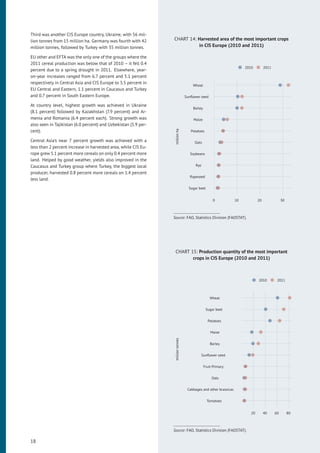
  • 107.
    THEMATIC DATA ANDTRENDS MAP 40: Total agricultural greenhouse gas emissions (gigagrams CO2eq, 2010) No data available 0 ~ < 1 370 1 370 ~ < 4 740 4 740 ~ < 6 780 6 780 ~ < 22 500 22 500 ~ 82 820 Source: FAO, Statistics Division (FAOSTAT). CHART 77: Europe and Central Asia agricultural greenhouse gas emissions by sector (2010) 0 100 200 thousandgigagramsCO2eq Enteric fermentation Manure management Rice cultivation Synthetic fertilizers Manure applied to soils Manure left on pasture Crop residues Cultivated organic soils Burning crop residues Source: FAO, Statistics Division (FAOSTAT). 91
  • 108.
    Organic agriculture Globally, organicfarming has grown more than six-fold in the last few years, from 5.4 million hectares, or 0.11 percent of world agricultural land in 2004, to 36 million, or 0.76 per- cent of world farmland in 2009. The EU and Central Asia region accounted for some 26 per- cent of total world organic cropland. In the EU countries, who were by far the biggest organic farmers in the region, the share of agricultural land farmed organically increased from 3.6 percent in 2009 to 5.8 percent in 2012. The country with the highest share of farmland under or- ganic crops in 2012 was Austria, with 18.6 percent, followed by Sweden, with 15.8 percent, and Estonia with 14.9 percent. Also strongly committed to organic farming was the Czech Republic, with 13.1 percent of its agricultural land organi- cally farmed, and Latvia, with a 10.6 percent share. The countries with the largest organic agricultural areas were Spain (1.6 million hectares), Italy (1.1 million hectares) and Germany (1 million hectares). In the Caucasus and Turkey group, Turkey had 1.3 percent of its farmland under organic crops in 2009, up from 0.5 percent in 2004. Azerbaijan’s share, 0.43 percent, was un- changed from 2004-2009. In CIS Europe the share of organic farmland in the Republic of Moldova grew from 0.40 to 1.30 in the same period. As of the end of 2011, 10.6 million hectares of agricultural land in Europe were managed organically on almost 290 000 farms. In the European Union 5.8 percent of the agricultural area is organic. Organic farmland there increased by 0.6 mil- lion hectares, from 2010 to 2011. Retail sales of organic products were approximately 21.5 bil- lion Euros in 2011, an increase of 9 percent over 2010. The largest market for organic products in 2011 was Germany, with a turnover of 6.6 billion Euros, followed by France (3.8 billion Euros) and the UK (1.9 billion Euros). CHART 78: Organic agriculture area, share of total agricultural area (2011) 0 5 10 15 EU Other EU CE SE Europe CIS Europe Cauc & Turk C Asia percent Source: FAO, Statistics Division (FAOSTAT). 92
  • 109.
    THEMATIC DATA ANDTRENDS MAP 41: Organic agriculture area (thousand ha, 2011) No data available 0.03 ~ < 6.4 6.4 ~ < 38 38 ~ < 160 160 ~ < 450 450 ~ 1 625 Source: FAO, Statistics Division (FAOSTAT). MAP 42: Organic agriculture area, share of total agricultural area (percent, 2011) No data available 0.0007877 ~ < 0.33 0.33 ~ < 1.6 1.6 ~ < 3.8 3.8 ~ < 6.8 6.8 ~ 18.91 Source: FAO, Statistics Division (FAOSTAT). 93
  • 110.
    TABLE 25: Inputs Agricul- tural tractors Pesticides use Fertilizersconsumption total per ha of arable land and permanent crops per ha of arable land and permanent crops nitrogen phosphate potash nitrogen and phosphate tractors kg/ha kg/ha kg/ha kg/ha kg/ha 2000-09* 2005-09* 2009 2009 2009 2009 Regional Office for Europe and Central Asia 11 517 691 42.4 11.2 10.1 53.6 Central Asia 101 915 23.4 7.1 1.2 30.5 Kazakhstan 52 084 0.6 1.3 1.1 0.0 2.4 Kyrgyzstan 25 512 0.2 18.4 1.7 0.0 20.1 Tajikistan 24 319 0.3 55.1 0.0 0.0 55.1 Turkmenistan Uzbekistan 130.7 40.2 7.9 170.9 Caucasus and Turkey 999 208 53.3 21.3 2.5 74.6 Armenia 13 122 0.4 26.5 0.4 0.0 26.9 Azerbaijan 27 052 0.1 9.2 1.3 1.5 10.4 Georgia 17 199 32.6 0.4 0.2 32.9 Turkey 941 835 1.4 58.2 23.9 2.7 82.1 CIS Europe 1 180 656 14.8 4.6 7.1 19.4 Belarus 48 100 97.7 40.9 136.5 138.6 Republic of Moldova 35 984 1.1 6.9 0.8 0.4 7.7 Russian Federation 329 980 10.0 3.2 2.2 13.2 Ukraine 333 529 1.1 19.0 4.0 3.5 23.0 South Eastern Europe 461 311 82.6 22.0 9.2 104.6 Albania 7 438 48.1 29.6 0.5 77.7 Bosnia and Herzegovina 20.6 4.3 4.3 24.9 Croatia 4 242 183.5 36.4 6.5 219.9 Montenegro 0.0 5.8 2.5 2.1 8.2 Serbia 5 844 91.0 24.9 13.7 115.9 The former Yugoslav Republic of Macedonia 53 606 0.2 38.3 7.6 6.6 45.9 EU Central and Eastern 2 057 590 60.1 16.9 13.7 76.9 Bulgaria 53 100 84.1 14.2 1.2 98.2 Czech Republic 83 813 1.2 69.4 10.8 6.3 80.2 Estonia 33 744 0.6 45.2 9.4 13.9 54.6 Hungary 120 477 1.9 56.4 7.9 8.4 64.4 Latvia 59 562 0.6 45.6 9.5 9.5 55.1 Lithuania 117 580 1.1 23.8 22.6 4.7 46.4 Poland 1 577 290 1.3 79.4 27.3 30.7 106.7 Romania 176 841 0.7 32.0 10.9 3.2 42.9 Slovakia 21 372 1.1 61.8 9.4 5.8 71.1 Slovenia 103 756 5.7 139.4 35.7 35.5 175.1 EU other and EFTA 6 693 511 88.9 19.0 20.1 107.9 Andorra 353 Austria 331 528 2.4 55.4 12.5 11.3 68.0 Belgium 95 010 10.3 Cyprus 14 309 8.5 55.8 41.7 29.2 97.5 Denmark 113 402 1.0 76.7 8.4 17.8 85.1 Finland 175 232 0.7 76.4 27.7 3.7 104.1 France 1 176 425 2.9 98.3 20.6 21.3 118.9 Germany 989 488 2.3 129.2 19.4 29.9 148.6 Greece 259 613 2.5 35.7 12.6 8.0 48.3 Ireland 174 800 2.0 331.9 61.6 82.6 393.4 Italy 1 754 401 7.4 51.2 17.4 16.0 68.6 Luxembourg 6 446 211.3 15.6 11.6 227.0 Malta 1 092 13.0 41.9 10.6 12.6 52.6 Monaco Netherlands 144 600 8.8 205.6 9.1 15.7 214.7 Portugal 176 394 6.4 51.6 18.4 13.7 69.9 San Marino Spain 1 038 726 1.9 45.4 15.3 9.6 60.7 Sweden 159 590 0.7 53.9 7.0 8.2 60.9 United Kingdom 3.0 166.8 30.2 41.2 197.0 Iceland 11 432 0.0 96.8 30.6 23.4 127.4 Norway 132 673 0.6 109.1 22.4 46.0 131.5 Switzerland 106 200 4.9 118.7 27.2 34.3 145.9 Israel 23 500 16.4 94.4 16.2 48.9 110.6 Regional Office for Africa 5.7 3.2 1.5 8.9 Regional Office for Asia and the Pacific 116.6 39.1 17.1 155.7 Regional Office for Latin America and the Caribbean 34.2 22.3 18.0 56.5 Regional Office for the Near East 651 197 37.9 11.9 3.5 49.8 World 74.4 25.4 14.5 99.9 94
  • 111.
    TABLE 26: Agriculturalemissions Enteric fermentation Manure management Rice cultivation Synthetic fertilizers Manure applied to soils Manure left on pasture Crop residues Cultivated organic soils Burning crop residues gigagrams CO2eq gigagrams CO2eq gigagrams CO2eq gigagrams CO2eq gigagrams CO2eq gigagrams CO2eq gigagrams CO2eq gigagrams CO2eq gigagrams CO2eq 2010 2010 2010 2010 2010 2010 2010 2010 2010 Regional Office for Europe and Central Asia 274 636 99 766 7 909 100 642 48 603 50 001 27 940 30 344 3 221 Central Asia 31 150 5 566 973 5 374 4 041 8 125 1 975 0 478 Kazakhstan 9 625 1 678 434 145 1 261 2 540 1 079 0 380 Kyrgyzstan 2 264 360 29 163 277 592 109 0 15 Tajikistan 2 837 483 69 294 355 718 84 0 11 Turkmenistan 4 798 798 275 0 631 1 379 221 0 27 Uzbekistan 11 626 2 246 166 4 772 1 517 2 895 482 0 44 Caucasus and Turkey 21 827 4 077 592 8 906 3 265 6 344 2 270 0 299 Armenia 749 149 0 67 116 167 26 0 3 Azerbaijan 4 153 705 10 83 560 1 111 142 0 20 Georgia 1 366 266 0 83 208 270 17 0 8 Turkey 15 560 2 957 582 8 673 2 381 4 796 2 084 0 268 CIS Europe 53 143 19 717 1 354 16 055 8 733 5 491 7 672 14 195 1 086 Belarus 6 490 1 976 0 3 420 897 577 384 5 252 24 Republic of Moldova 595 239 0 106 152 83 144 29 35 Russian Federation 37 147 12 700 1 181 7 698 5 924 3 989 4 490 6 306 682 Ukraine 8 911 4 801 172 4 830 1 760 841 2 654 2 607 344 South Eastern Europe 3 562 1 289 0 1 224 525 485 517 23 96 Albania 1 374 341 0 199 151 225 39 17 5 Bosnia and Herzegovina Croatia Montenegro 210 49 0 9 19 23 2 7 0 Serbia 1 978 899 0 1 016 355 237 476 0 90 The former Yugoslav Republic of Macedonia EU Central and Eastern 24 213 10 742 153 17 485 4 529 2 668 4 001 8 058 516 Bulgaria 1 294 470 69 1 859 206 179 410 161 63 Czech Republic 2 054 799 0 1 649 376 197 403 40 30 Estonia 396 122 0 185 55 38 44 1 220 3 Hungary 1 462 940 12 1 814 429 184 610 893 95 Latvia 634 214 0 379 96 58 94 1 102 9 Lithuania 1 294 430 0 689 181 113 166 1 349 15 Poland 9 799 4 612 0 8 354 1 933 908 1 183 3 160 87 Romania 6 468 2 768 73 1 974 1 093 903 942 123 193 Slovakia 810 387 0 585 160 88 150 9 21 Slovenia EU other and EFTA 140 352 58 279 4 838 51 403 27 419 26 340 11 489 8 068 745 Andorra 0 0 0 0 0 0 0 0 0 Austria 3 298 1 325 0 556 627 472 253 26 20 Belgium 3 974 2 024 0 0 921 569 184 33 10 Cyprus 143 66 0 55 61 69 5 0 0 Denmark 3 061 2 673 0 1 153 1 019 403 512 361 22 Finland 1 566 632 0 1 362 282 212 178 1 195 6 France 30 290 10 424 252 13 232 5 436 4 935 3 591 776 252 Germany 21 993 9 723 0 11 531 4 617 3 024 2 412 2 532 122 Greece 3 484 959 360 941 453 1 548 238 159 27 Ireland 10 115 2 325 0 2 405 1 391 1 749 116 100 2 Italy 11 986 6 307 2 622 3 218 2 714 2 182 1 013 96 119 Luxembourg 297 77 0 136 42 42 8 1 0 Malta 32 40 0 2 11 5 1 0 0 Monaco 0 0 0 0 0 0 0 0 0 Netherlands 7 406 4 434 0 1 407 1 906 1 057 143 743 5 Portugal 2 581 1 329 308 817 621 559 59 45 9 San Marino 0 0 0 0 0 0 0 0 0 Spain 12 871 8 047 1 297 6 074 3 013 3 367 1 126 44 78 Sweden 2 457 891 0 1 084 406 372 248 882 11 United Kingdom 19 959 5 474 0 6 642 3 137 4 916 1 281 571 55 Iceland 232 46 0 50 24 59 0 0 0 Norway 1 795 557 0 409 267 403 68 454 2 Switzerland 2 812 927 0 328 471 395 52 51 4 Israel 389 96 0 195 91 549 17 0 2 Regional Office for Africa 228 466 14 842 23 645 8 309 6 520 157 705 7 777 5 177 2 288 Regional Office for Asia and the Pacific 809 434 169 122 457 990 435 707 127 041 264 047 74 036 56 496 9 150 Regional Office for Latin America and the Caribbean 526 629 22 670 17 027 47 721 23 512 208 745 19 177 1 605 2 757 Regional Office for the Near East 57 726 6 346 5 781 17 311 4 986 37 525 4 417 0 635 World 1 960 484 348 079 519 531 682 636 220 255 741 025 152 903 99 048 19 702 95
  • 112.
  • 113.
  • 114.
    TABLE 27: Countrygroups REU geographical aggregates12 Central Asia3 Caucasus & Turkey 4 CIS Europe5 South Eastern Europe6 EU Central & Eastern7 EU other & EFTA8 Kazakhstan Armenia Belarus Albania Bulgaria Austria Kyrgyzstan Azerbaijan Republic of Moldova Bosnia and Herzegovina Czech Republic Belgium Tajikistan Georgia Russian Federation Croatia Estonia Cyprus Turkmenistan Turkey Ukraine Montenegro Hungary Denmark Uzbekistan Serbia9 Latvia Finland TFYR Macedonia Lithuania France Poland Germany Romania Greece Slovakia Ireland Slovenia Italy Luxembourg Malta Netherlands Portugal Spain Sweden United Kingdom Iceland Norway Switzerland 1 For purposes of comparison, based mainly on geographical criteria, while also taking into consideration, as much as possible, economic and population aspects, we have sub-divided the region of Europe and Central Asia into six sub-groups, which will be referred to in the book as “sub-regions”. 2 Israel is represented in the maps and in the data tables. However, due to its geographical distance from the other countries in the region, and to its non-EU and EFTA membership, it has not been included in the following six sub-regions. 3 Group abbreviated as ’C Asia’ in charts. 4 Group abbreviated as ’Cauc & Turk’ in charts. 5 Group abbreviated as ’CIS Europe’ in charts. 6 Group abbreviated as ’SE Europe’ in charts. 7 Group abbreviated as ’EU CE’ in charts. 8 Group abbreviated as ’EU Other’ in charts. 9 Kosovo is not considered to be a part of Serbia in World Bank sourced data. 98
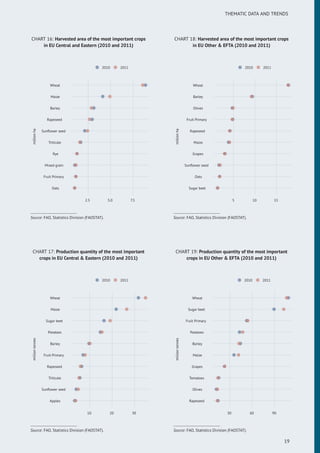
  • 115.
    METADATA Metadata Aggregation Two types ofaggregation are used in the book, namely sum and weighted mean. Two restrictions are imposed when computing the aggregation. Sufficiency condition: the aggregation is com- puted only when sufficient countries has reported data. The current threshold is set at 50% of the variable and the weighting variable if present. Comparability condition: Since aggregation are usually computed over years, this condition is designed to ensure that the number of reporting entites are comparable over the years. The cur- rent restriction is that the number of reporting entities does not vary above 15 countries in order to account for transition in countries. Agricultural area (ha) Agricultural area, this category is the sum of areas under a) arable land - land under temporary agricultural crops (multiple-cropped areas are counted only once), temporary meadows for mowing or pasture, land under market and kitchen gardens and land temporar- ily fallow (less than five years). The abandoned land resulting from shifting cultivation is not included in this category. Data for "Arable land" are not meant to indicate the amount of land that is poten- tially cultivable; (b) permanent crops - land cultivated with long- term crops which do not have to be replanted for several years (such as cocoa and coffee); land under trees and shrubs producing flow- ers, such as roses and jasmine; and nurseries (except those for forest trees, which should be classified under "forest"); and (c) permanent meadows and pastures - land used permanently (five years or more) to grow herbaceous forage crops, either cultivated or growing wild (wild prairie or grazing land). Data are expressed in 1000 hectares. Source: FAO, Statistics Division (FAOSTAT) Owner: FAO Agricultural area organic (ha) Sum of areas under "Agricultural area certified organic" and "Agri- cultural area in conversion to organic". Agricultural area certified organic is the land area exclusively dedicated to organic agriculture and managed by applying organic agriculture methods. It refers to the land area fully converted to organic agriculture. It is the por- tion of land area (including arable lands, pastures or wild areas) managed (cultivated) or wild harvested in accordance with specific organic standards or technical regulations and that has been in- spected and approved by a certification body. Agricultural area in conversion to organic is the land area which is going through the organic conversion process, usually two years period of conversion to organic land. Source: FAO, Statistics Division (FAOSTAT) Owner: FAO Agricultural population, total Agricultural population is defined as all persons depending for their livelihood on agriculture, hunting, fishing and forestry. It comprises all persons economically active in agriculture as well as their non- working dependents. It is not necessary that this referred population exclusively come from rural population. Source: FAO, Statistics Division (FAOSTAT) Owner: FAO Agricultural production indices The FAO indices of agricultural production show the relative level of the aggregate volume of agricultural production for each year in comparison with the base period 1999-2001. They are based on the sum of price-weighted quantities of different agricultural com- modities produced after deductions of quantities used as seed and feed weighted in a similar manner. The resulting aggregate repre- sents, therefore, disposable production for any use except as seed and feed. All the indices at the country, regional and world levels are calculated by the Laspeyres formula. Production quantities of each commodity are weighted by 1999-2001 average international com- modity prices and summed for each year. To obtain the index, the aggregate for a given year is divided by the average aggregate for the base period 1999-2001. Since the FAO indices are based on the concept of agriculture as a single enterprise, amounts of seed and feed are subtracted from the production data to avoid double count- ing , once in the production data and once with the crops or livestock produced from them. Deductions for seed (in the case of eggs, for hatching) and for livestock and poultry feed apply to both domesti- cally produced and imported commodities. They cover only primary agricultural products destined to animal feed (e.g. maize, potatoes, milk, etc.). Processed and semi-processed feed items such as bran, oilcakes, meals and molasses have been completely excluded from the calculations at all stages. It should be noted that when calcu- lating indices of agricultural, food and nonfood production, all in- termediate primary inputs of agricultural origin are deducted. How- ever, for indices of any other commodity group, only inputs origi- nating from within the same group are deducted; thus, only seed is removed from the group "crops" and from all crop subgroups, such as cereals, oil crops, etc.; and both feed and seed originating from within the livestock sector (e.g. milk feed, hatching eggs) are re- moved from the group "livestock products". For the main two live- stock subgroups, namely, meat and milk, only feed originating from the respective subgroup is removed. Indices which take into ac- count deductions for feed and seed are referred to as ”net”. Indices calculated without any deductions for feed and seed are referred to as ”gross”.The"international commodity prices" are used in order to avoid the use of exchange rates for obtaining continental and world aggregates, and also to improve and facilitate international comparative analysis of productivity at the national level. These" international prices", expressed in so-called"international dollars", are derived using a Geary-Khamis formula for the agricultural sec- tor. This method assigns a single "price" to each commodity. For example, one metric ton of wheat has the same price regardless of the country where it was produced. The currency unit in which the prices are expressed has no influence on the indices published. The commodities covered in the computation of indices of agricul- tural production are all crops and livestock products originating in each country. Practically all products are covered, with the main ex- ception of fodder crops. The category of food production includes commodities that are considered edible and that contain nutrients. Accordingly, coffee and tea are excluded along with inedible com- modities because, although edible, they have practically no nutri- tive value. Prices applied to meat in reality represent the prices of animals for slaughtering in terms of live weight. For example, if the price of one metric ton (1000 kg) of pigs alive is 825 dollars and the ratio meat to live weight is 75 to 100, the price applicable to 750 kg of pig meat will be 825 dollars, corresponding to 1100 dollars per metric tons. The indices are calculated from production data pre- sented on a calendar year basis. The FAO indices may differ from those produced by the countries themselves because of differences in concepts of production, coverage, weights, time reference of data and methods of calculation. Agricultural tractors, total (tractors) Agricultural tractors generally refer to wheel and crawler or track- laying type tractors (excluding garden tractors) used in agriculture. Data are expressed in numbers in use in the agricultural sector. Source: FAO, Statistics Division (FAOSTAT) Owner: FAO Agricultural water withdrawal, share of total water withdrawal (per- cent) Agricultural water withdrawal as percentage of total water with- drawal. Source: Land and Water Division (AQUASTAT) Owner: FAO All GHG agricultural sectors, total emissions in CO2eq (gigagrams) Agriculture Total contains all the emissions produced in the differ- ent agricultural emissions sub-domains, providing a picture of the contribution to the total amount of GHG emissions from agriculture. GHG Emissions from agriculture consist of non-CO2 gases, namely methane (CH4) and nitrous oxide (N2O), produced by crop and live- stock production and management activities. Source: FAO, Statistics Division (FAOSTAT) Owner: FAO 99
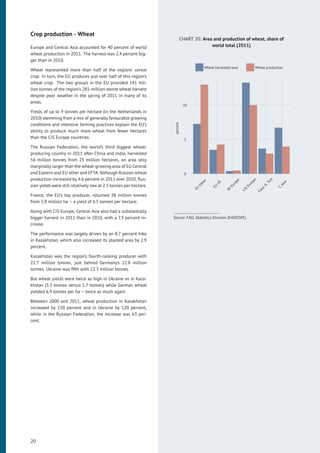
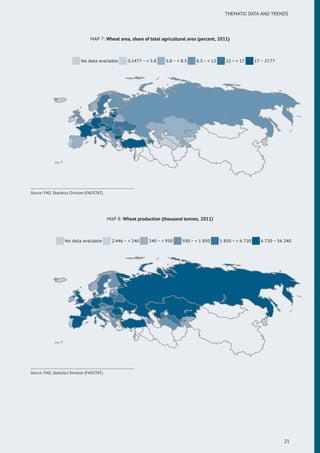
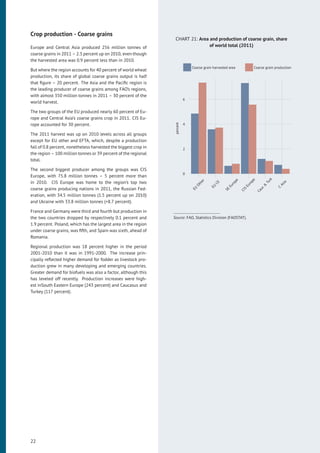
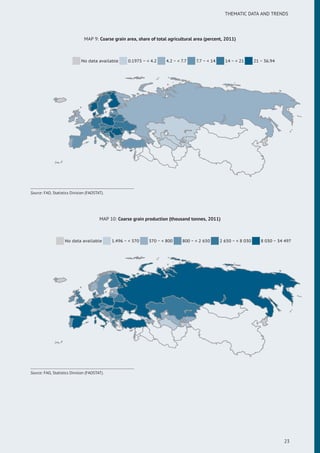
  • 116.
    Aquaculture fish production(tonnes) Aquaculture is defined as the farming of aquatic organisms. Farm- ing implies some form of intervention in the rearing process to en- hance production, such as regular stocking, feeding, protection from predators, etc. Farming also implies individual or corporate owner- ship of the stock being cultivated. For statistical purposes, aquatic organisms which are harvested by an individual or corporate body which has owned them throughout their rearing period contribute to aquaculture, while aquatic organisms which are exploitable by the public as a common property resource, with or without appropriate licenses, are the harvest of fisheries. In the case of capture-based aquaculture, only the incremental growth (or weight gain) in captiv- ity, could and should be reported as the production from aquacul- ture. Data included here covers an aquaculture production of fish, molluscs, crustaceans and miscellaneous aquatic animals but ex- cluding production for marine mammals, crocodiles, corals, pearls, sponges and aquatic plants. Source: Fisheries and Aquaculture Department (Fishery and Aqua- culture statistics) Owner: FAO Aquaculture fish production inland (tonnes) Aquaculture production from inland areas. Source: Fisheries and Aquaculture Department (Fishery and Aqua- culture statistics) Owner: FAO Aquaculture fish production marine (tonnes) Aquaculture production from marine areas. Source: Fisheries and Aquaculture Department (Fishery and Aqua- culture statistics) Owner: FAO Arable land (ha) Arable land is the land under temporary agricultural crops (multiple- cropped areas are counted only once), temporary meadows for mow- ing or pasture, land under market and kitchen gardens and land tem- porarily fallow (less than five years). The abandoned land resulting from shifting cultivation is not included in this category. Data for ’Arable land’ are not meant to indicate the amount of land that is potentially cultivable. Source: FAO, Statistics Division (FAOSTAT) Owner: FAO Arable land and permanent crops (ha) Arable land and Permanent crops, this category is the sum of areas under ’Arable land’ and ’Permanent crops’. Source: FAO, Statistics Division (FAOSTAT) Owner: FAO Artificial sweeteners High-intensity or low-caloric sweetening agents that are produced chemically. Beef and buffalo meat (tonnes) See ’Buffalos’, ’Meat, total’, and ’Production’. Source: FAO, Statistics Division (FAOSTAT) Owner: FAO Beer of barley (tonnes) See ’Beer of barley’ and ’Crop production’. Source: FAO, Statistics Division (FAOSTAT) Owner: FAO Buffaloes Indian, Asiatic, pigmy, water buffalo (Bubalus bubalus; B. arnee; B. depressicornis); African buffalo (genus Syncerus); American bison (Bison bison); European bison (Bison bonasus); beeffalo (cross be- tween a bison and a domesticated beef animal). See 866. Excludes wild bisons and buffaloes. Burning crop residues, total emissions in CO2eq (gigagrams) Greenhouse Gas (GHG) emissions from burning crop residues consist of methane and nitrous oxide gases produced by the combustion of a percentage of the crop residues burnt on-site. Source: FAO, Statistics Division (FAOSTAT) Owner: FAO Butter and ghee production (tonnes) See ’Butter, ghee’ and ’Production’. Source: FAO, Statistics Division (FAOSTAT) Owner: FAO Butter, Ghee Default composition: 886 Butter, cow milk, 887 Ghee, butteroil of cow milk, 952 Butter, buffalo milk, 953 Ghee, of buffalo milk, 983 Butter and ghee, sheep milk, 1022 Butter of goat mlk Capture fish production (tonnes) Capture fishery is defined as the hunting, collecting and gathering activities directed at removing or collecting live wild aquatic organ- isms. The capture production statistics here indicates the nominal catches of aquatic organisms, killed, caught, trapped or collected for all commercial, industrial, recreational and subsistence purposes in live weight equivalent. Data included here covers capture produc- tion of fish, molluscs, crustaceans and miscellaneous aquatic an- imals but excluding production for marine mammals, crocodiles, corals, pearls, sponges and aquatic plants. Source: Fisheries and Aquaculture Department (Fishery and Aqua- culture statistics) Owner: FAO Capture fish production inland (tonnes) Capture fishery production from inland areas. Source: Fisheries and Aquaculture Department (Fishery and Aqua- culture statistics) Owner: FAO Capture fish production marine (tonnes) Capture fishery production from marine areas. Source: Fisheries and Aquaculture Department (Fishery and Aqua- culture statistics) Owner: FAO Cassava Manioc, mandioca, yuca (Manihot esculenta, syn. M. utilissima); yuca dulce (M. palmata, syn. M. dulcis). A semi-permanent crop grown in tropical and subtropical regions. Sometimes bitter and sweet cassavas are referred to as separate species, the former being M. esculenta and the latter M. palmata, but this is incorrect since the toxicity varies according to location. Cassava is the staple food in many tropical countries. It is not traded internationally in its fresh state because tubers deteriorate very rapidly. Cattle Common ox (Bos taurus); zebu, humped ox (Bos indicus); Asiatic ox (subgenus Bibos); Tibetan yak (Poephagus grunniens). Animals of the genus listed, regardless of age, sex, or purpose raised. Data are expressed in number of heads. Cattle and buffaloes (heads) See ’Cattle’ and ’Buffaloes’. Source: FAO, Statistics Division (FAOSTAT) Owner: FAO Cereals Cereals include Wheat, Rice Paddy, Barley, Maize, Popcorn, Rye, Oats, Millets, Sorghum, Buckwheat, Quinoa, Fonio, Triticale, Canary Seed, Mixed Grain and Cereals Nes. 100
  • 117.
    METADATA Cereals excluding beerin primary equivalent (kcal/cap/day) Cereals include Wheat, Rice Paddy, Barley, Maize, Popcorn, Rye, Oats, Millets, Sorghum, Buckwheat, Quinoa, Fonio, Triticale, Canary Seed, Mixed Grain and Cereals Nes. Source: FAO, Statistics Division (FAOSTAT) Owner: FAO Cereals harvested area (ha) See ’Cereals’ and ’Crop area’. Source: FAO, Statistics Division (FAOSTAT) Owner: FAO Cereals production (tonnes) See ’Cereals’ and ’Crop production’. Source: FAO, Statistics Division (FAOSTAT) Owner: FAO Cereals, producer price index 2004-2006=100 (index) Cereals producer price index, 2004-2006=100. Source: FAO, Statistics Division (FAOSTAT) Owner: FAO Cheese (all kinds) production (tonnes) All kinds of cheese. See also ’Production’. Source: FAO, Statistics Division (FAOSTAT) Owner: FAO Chickens Fowl (Gallus domesticus); Guinea fowl (Numida meleagris. Domes- ticated birds only. Data are expressed in thousands. Citrus Including inter alia: bergamot (Citrus bergamia); citron (C. medica var. cedrata); chinotto (C. myrtifolia); kumquat (Fortunella japonica). Some minor varieties of citrus are used primarily in the preparation of perfumes and soft drinks. Coarse grain Coarse grains include Barley, Maize, Popcorn, Rye, Oats, Millet, Sorghum, Buckwheat, Quinoa, Fonio, Triticale, Canary seed, Mixed grain and Cereals, nes. Coarse grain harvested area (ha) See ’Coarse grain’ and ’Crop area’. Source: FAO, Statistics Division (FAOSTAT) Owner: FAO Coarse grain production (tonnes) See ’Coarse grain’ and ’Crop production’. Source: FAO, Statistics Division (FAOSTAT) Owner: FAO Cocoa, beans Theobroma cacao. The seeds contained in the fruit of the cacao- tree, including whole or broken, raw or roasted. Cocoa, paste Obtained by grinding roasted cocoa beans. Also called liquor. Not defatted. Coconut Oil Default composition: Oil, coconut (copra) Coconuts Cocos nucifera Husked coconut. In shell, covered by the endocarp, while exocarp (the smooth outer skin) and mesocarp (the fibrous covering) are removed. Immature nuts contain a milky juice that is consumed as a refreshing drink. Mature nuts are consumed as such, or processed for copra or desiccated coconut. The flesh, from which copra/oil is extracted, constitutes 40-70% of the weight of the husked coconut. The oil content is about 36% of the flesh. Cotton lint Gossypium spp. Fibres from ginning seed cotton that have not been carded or combed. Trade data also include fibres that have been cleaned, bleached, dyed or rendered absorbent. Cottonseed Oil Default composition: Oil, cottonseed Cottonseed oil (tonnes) Default composition: Oil, cottonseed Source: FAO, Statistics Division (FAOSTAT) Owner: FAO Crop area Crop area is a surface of land on which a crop is grown. In general, the area measured for cadastral purposes includes, in addition to the area cultivated, headlands, ditches and other non-cultivated areas. Such an area can be called gross area as against the net area which includes only the portion of the gross area actually cultivated. For various reasons, e.g. natural calamities or economic considerations, certain areas planted or sown with a given crop are not harvested or are harvested before the crop reaches maturity. Hence the need for the concept of area to be sub-divided into sown or planted area and harvested area. Sown area data are necessary to estimate quantities used for seeding purposes; harvested area, to provide reliable and accurate yield and production data. A peculiarity of permanent crops is that number of trees or plants is reported in addition to or, instead of, the area planted. This is particularly so as regards plants growing outside of compact plantations, which are either interplanted with other crops or are scattered. Both area and number of trees are also divided into productive or bearing and non-productive or non- bearing areas or trees. In most cases, non-bearing refers to young plants that are not yet bearing. Crop production Crop production data refer to the actual harvested production from the field or orchard and gardens, excluding harvesting and thresh- ing losses and that part of crop not harvested for any reason. Pro- duction therefore includes the quantities of the commodity sold in the market (marketed production) and the quantities consumed or used by the producers (auto-consumption). When the production data available refers to a production period falling into two succes- sive calendar years and it is not possible to allocate the relative production to each of them, it is usual to refer production data to that year into which the bulk of the production falls. Crop produc- tion data are recorded in tonnes (t). In many countries, crop pro- duction data are obtained as a function of the estimated yield and the total area. If such a compilation method of production statistics is enforced by the country, it must be ensured that the total area does not refer to sown or planted area, which would give then the <U+393C><U+3E31>biological production’, but to the actually har- vested area during the year. Crop residues, total emissions in CO2eq (gigagrams) Greenhouse Gas (GHG) emissions from crop residues consist of ni- trous oxide gas from decomposition of nitrogen in crop residues left on managed soils. Source: FAO, Statistics Division (FAOSTAT) Owner: FAO 101
  • 118.
    Crop yield Harvested productionper unit of harvested area for crop products. In most of the cases yield data are not recorded but obtained by di- viding the production data by the data on area harvested. Data on yields of permanent crops are not as reliable as those for temporary crops either because most of the area information may correspond to planted area, as for grapes, or because of the scarcity and unreli- ability of the area figures reported by the countries, as for example for cocoa and coffee. Crops net per capita production index number (2004-2006 = 100) See ’Agricultural production indices’. Source: FAO, Statistics Division (FAOSTAT) Owner: FAO Cultivated organic soils, total emissions in CO2eq (gigagrams) Greenhouse gas (GHG) emissions data from cultivated organic soils are those associated with nitrous oxide gas from drained organic soils. Computed at Tier 1 and complemented by geo-spatial data, following the 2006 IPCC Guidelines for National GHG Inventories (IPCC, 2006). Available by country, with global coverage and relative to the period 1990-2010 with annual updates. Source: FAO, Statistics Division (FAOSTAT) Owner: FAO Domestic food price volatility (index) The Domestic Food Price Volatility is a measure of variation of the Domestic Food Price Level Index. It has been computed as the Stan- dard Deviation (SD) of the deviations from the trend over the previ- ous five years. Source: FAO, Statistics Division Owner: ILO and World Bank ICP (International Comparison Project) Egg production Covers all domestic birds which have contributed to egg produc- tion during the year, wherever they lay and the corresponding total production, including eggs intended to be used for hatching but ex- cluding waste on farms. Eggs Default composition: 1062 Eggs, hen, in shell, 1063 Eggs, liquid, 1064 Eggs, dried, 1091 Eggs, other bird, in shell; nutrient data only: 916 Egg albumine Eggs primary production (tonnes) See ’Eggs’ and ’Egg production’. Source: FAO, Statistics Division (FAOSTAT) Owner: FAO Emissions The release of greenhouse gases and/or their precursors into the atmosphere over a specified area and period of time. Employees, agriculture, female (share of female employment) Employees are people who work for a public or private employer and receive remuneration in wages, salary, commission, tips, piece rates, or pay in kind. Source: World Bank (WDI) Owner: International Labour Organization, Key Indicators of the Labour Market database. Employees, agriculture, male (share of male employment) Employees are people who work for a public or private employer and receive remuneration in wages, salary, commission, tips, piece rates, or pay in kind. Source: World Bank (WDI) Owner: International Labour Organization, Key Indicators of the Labour Market database. Employment in agriculture (share of total employment) Employees are people who work for a public or private employer and receive remuneration in wages, salary, commission, tips, piece rates, or pay in kind. Source: World Bank (WDI) Owner: International Labour Organization, Key Indicators of the Labour Market database. Employment, total Employees are people who work for a public or private employer and receive remuneration in wages, salary, commission, tips, piece rates, or pay in kind. Source: World Bank Owner: International Labour Organization, Key Indicators of the Labour Market database. Enteric fermentation, total emissions in CO2eq (gigagrams) Greenhouse gas (GHG) emissions from enteric fermentation consist of methane gas produced in digestive systems of ruminants and to a lesser extent of non-ruminants. Source: FAO, Statistics Division (FAOSTAT) Owner: FAO Exports of animal fats (US$) Value of exports of animal fats in current US$. Source: FAO, Statistics Division (FAOSTAT) Owner: FAO Exports of beverages (US$) Value of exports of beverages in current US$. Source: FAO, Statistics Division (FAOSTAT) Owner: FAO Exports of cereals and prep. (US$) Value of exports of cereals and prep. in current US$. Source: FAO, Statistics Division (FAOSTAT) Owner: FAO Exports of coffe, tea, cocoa, and spices (US$) Value of exports of coffe, tea, cocoa, and spices in current US$. Source: FAO, Statistics Division (FAOSTAT) Owner: FAO Exports of dairy products (milk equivalent) (US$) Value of exports of milk equivalent in current US$. Source: FAO, Statistics Division (FAOSTAT) Owner: FAO Exports of fruit and vegetables (US$) Value of exports of fruit and vegetables in current US$. Source: FAO, Statistics Division (FAOSTAT) Owner: FAO Exports of meat and meat prep. (US$) Value of exports of meat and meat prep. in current US$. Source: FAO, Statistics Division (FAOSTAT) Owner: FAO Exports of oilseeds (US$) Value of exports of oilseeds in current US$. Source: FAO, Statistics Division (FAOSTAT) Owner: FAO Exports of sugar and honey (US$) Value of exports of sugar and honey in current US$. Source: FAO, Statistics Division (FAOSTAT) Owner: FAO 102
  • 119.
    METADATA Exports of veg.oils (US$) Value of exports of veg. oils in current US$. Source: FAO, Statistics Division (FAOSTAT) Owner: FAO Fats, Animals, Raw Default composition: 869 Fat, cattle, 871 Fat, cattle butcher, 949 Fat, buffaloes, 979 Fat, sheep, 994 Grease incl. lanolin wool, 1019 Fat, goats, 1037 Fat, pigs, 1040 Fat, pig butcher, 1043 Lard, 1065 Fat, poultry, 1066 Fat, poultry, rendered, 1129 Fat, camels, 1160 Fat, other camelids, 1168 Oils, fats of animal nes, 1221 Lard stearine oil, 1222 Degras, 1225 Tallow, 1243 Fat, nes, prepared Female employment, total Employees are people who work for a public or private employer and receive remuneration in wages, salary, commission, tips, piece rates, or pay in kind. Source: World Bank Owner: International Labour Organization, Key Indicators of the Labour Market database. Fertilizers consumption Mineral fertilizers made their appearance with the Industrial revolu- tion and had an important role in sustaining the growing population of earth: half the population of earth are now estimated to be fed with crops grown using synthetic fertilizers (Erisman et al. 2008). Fertilizers can have a negative impact on the environment, leading to eutrophication and poisoning of water, and pollution of soil (e.g. heavy metals, soil acidification, POP-Persistent Organic Pollutants). Also, the production of fertilizers is energy intensive and mineable phosphorus reserves are finite. Fertilizers Manufactured, nes Mineral or chemical fertilizers not elsewhere specified. Fertilizers, Organic Animal or vegetable fertilizers, whether or not mixed together or chemically treated; fertilizers produced by the mixing or chemical treatment of animal or vegetable products. Fibre crops Natural fibre crops include Agave Fibres Nes, Cotton lint, Fibre Crops Nes, Flax fibre and tow, Hemp Tow Waste, Jute, Manila Fibre (Abaca), Other Bastfibres, Ramie, Seed cotton and Sisal. Food Data refer to the total amount of the commodity available as hu- man food during the reference period. Data include the commodity in question, as well as any commodity derived therefrom as a result of further processing. Food from maize, for example, comprises the amount of maize, maize meal and any other products derived there- from available for human consumption. Food from milk relates to the amounts of milk as such, as well as the fresh milk equivalent of dairy products. Food net per capita production index number (2004-2006 = 100) See ’Agricultural production indices’. Source: FAO, Statistics Division (FAOSTAT) Owner: FAO Food net production value (constant 2004-2006 I$) See ’Agricultural production indices’. Source: FAO, Statistics Division (FAOSTAT) Owner: FAO Food production For primary commodities, production relates to the total domestic production whether inside or outside the agricultural sector, i.e. in- cluding non-commercial production and production in kitchen gar- dens. Unless otherwise indicated, production is reported at the farm level for primary crops (i.e. excluding harvesting losses for crops) and livestock items and in terms of live weight (i.e. the actual ex- water weight of the catch at the time of capture) for primary fish items. Production of processed commodities relates to the total out- put of the commodity at the manufacture level (i.e. it comprises out- put from domestic and imported raw materials of originating prod- ucts). Reporting units are chosen accordingly, e.g. cereals are re- ported in terms of grains and paddy rice. As a general rule, all data on meat are expressed in terms of carcass weight. Usually the data on production relate to that which takes place during the reference period. However, production of certain crops may relate to the har- vest of the year preceding the utilization period if harvesting takes place late in the year. In such instances, the production of a given year largely moves into consumption in the subsequent year. In the Food Balance Sheets a distinction is made between "output" and "input". The production of primary as well as of derived products is reported under "output". For derived commodities, the amounts of the originating commodity that are required for obtaining the out- put of the derived product are indicated under "input", and are ex- pressed in terms of the originating commodity. The various factors used, i.e. milling rates, extraction rates, conversion or processing factors, carcass weights, milk yield, egg weights etc., should indi- cate the average national rate at which these commodities are gen- erally converted. Forest area (ha) Forest area is the land spanning more than 0.5 hectares with trees higher than 5 metres and a canopy cover of more than 10 percent, or trees able to reach these thresholds in situ. It does not include land that is predominantly under agricultural or urban land use. For- est is determined both by the presence of trees and the absence of other predominant land uses. The trees should be able to reach a minimum height of 5 metres (m) in situ. Areas under reforestation that have not yet reached but are expected to reach a canopy cover of 10 percent and a tree height of 5 m are included, as are tem- porarily unstocked areas, resulting from human intervention or nat- ural causes, which are expected to regenerate. Includes: areas with bamboo and palms provided that height and canopy cover criteria are met; forest roads, firebreaks and other small open areas; forest in national parks, nature reserves and other protected areas such as those of specific scientific, historical, cultural or spiritual inter- est; windbreaks, shelterbelts and corridors of trees with an area of more than 0.5 ha and width of more than 20 m; plantations primar- ily used for forestry or protective purposes, such as: rubber-wood plantations and cork, oak stands. Excludes: tree stands in agricul- tural production systems, for example in fruit plantations and agro- forestry systems. The term also excludes trees in urban parks and gardens. Source: FAO, Statistics Division (FAOSTAT) Owner: FAO Freshwater Fish Default composition: 1501 Frwtr Diad F, 1502 Frwtr Fz Whl, 1503 Frwtr Fillet, 1504 Frwtr Fz Flt, 1505 Frwtr Cured, 1506 Frwtr Canned, 1507 Frwtr Pr nes, 1508 Frwtr Meals Fruit, citrus nes Including inter alia: bergamot (Citrus bergamia); citron (C. medica var. cedrata); chinotto (C. myrtifolia); kumquat (Fortunella japonica). Some minor varieties of citrus are used primarily in the preparation of perfumes and soft drinks. Fruit, excluding melons Fruit Crops consist of fruits and berries that, with few exceptions, are characterized by their sweet taste. Nearly all are permanent crops, mainly from trees, bushes and shrubs, as well as vines and palms. Fruits and berries grow on branches, stalks or the trunks of plants, usually singly, but sometimes grouped in bunches or clusters 103
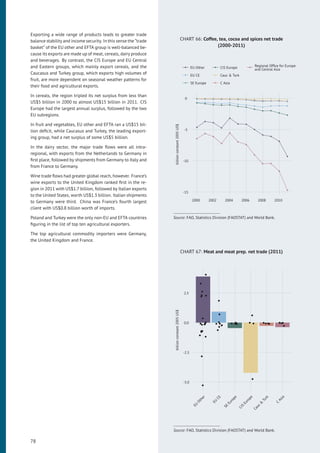
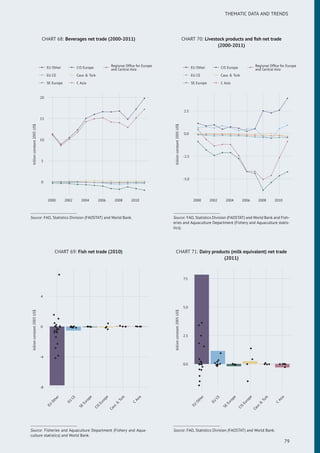
  • 120.
    (e.g. bananas andgrapes). Commercial crops are cultivated in plan- tations, but significant quantities of fruits are also collected from scattered plants that may or may not be cultivated. Fruit, fresh nes Including inter alia: azarole (Crataegus azarolus); babaco (Car- ica pentagona); elderberry (Sambucus nigra); jujube (Zizyphus ju- juba); litchi (nephelium litchi); loquat (Eriobotrya japonica); med- lar (Mespilus germanica); pawpaw (Asimina triloba); pomegranate (Punica granatum); prickly pear (Opuntia ficus-indica); rose hips (Rosa spp.); rowanberry (Sorbus aucuparia); service-apple (Sorbus domestica); tamarind (Tamarindus indica); tree-strawberry (Arbutus unedo). Other fresh fruit that are not identified separately because of their minor relevance at the international level. Because of their limited local importance, some countries report fresh fruit under this heading that are classified separately by FAO. Goats Includes Hircus, Ibex, Nubiana, Pyrenaica, Tibetana, Kashmir and Angora. Government expenditure Data presented on government expenditure refers to Core Areas of Government Functions Relevant to the Agriculture Sector based on the Classification of Functions of Government (COFOG) as outlined in the IMF’s Government Finance Statistics Manual, 2001 (GFSM 2001). COFOG is essential for making international comparisons of the extent to which governments are involved in economic and social functions because it avoids problems associated with organi- zational changes in a single government, and problems of organi- zational differences among countries. Statistics on expenditures in agriculture, forestry and fisheries and on environmental protection can be used to study the effectiveness of government programs that support an enabling environment for essential public goods with high economic and social returns. COFOG provides key aggregates that could be used as indicators or measures of results / outcomes. Government expenditure allocated to agricultural and rural devel- opment Data on government expenditure on agriculture refers to all non- repayable payments, whether capital or current, requited or not by government for the agricultural and rural development sector. Grain, mixed A mixture of cereal species that are sown and harvested together. The mixture wheat/rye is known as meslin, but in trade is usually classified with wheat. Grapes Default composition: 560 Grapes, 561 Raisins, 562 Juice, grape, 563 Grapes, must Groundnut Oil Default composition: 244 Oil, groundnut Honey, natural Honey produced by bees (Apis mellifera) or by other insects. Industrial roundwood The wood removed (volume of roundwood under bark) for produc- tion of goods and services other than energy production (wood- fuel). It represents the sum of: sawlogs and veneer logs; pulp- wood, round and split; and other industrial roundwood. See http://www.fao.org/forestry/62283/en/ for further information. Industrial roundwood production (m3 ) See ’Industrial roundwood’ and ’Production’. Source: FAO, Statistics Division (FAOSTAT) Owner: FAO Industrial water withdrawal, share of total water withdrawal (per- cent) Industrial water withdrawal as percentage of total water with- drawal. Source: Land and Water Division (AQUASTAT) Owner: FAO Irrigation potential (ha) Area of land which is potentially irrigable. Country/regional stud- ies assess this value according to different methods. For example, some consider only land resources, others consider land resources plus water availability, others include economical aspects in their assessments (such as distance and/or difference in elevation be- tween the suitable land and the available water) or environmental aspects, etc. If available, this information is given in the individual country profiles. The figure includes the area already under agricul- tural water management . Source: Land and Water Division (AQUASTAT) Owner: FAO Jute and jute-like White jute (Corchorus capsularis); red jute, tossa (C. olitorius). Trade data cover raw or processed jute (but not spun), tow and waste, yarn waste and garnetted stock and may include jute-like fibres. Land area (sq. km) Land area is a country’s total area, excluding area under inland water bodies, national claims to continental shelf, and exclusive economic zones. In most cases the definition of inland water bodies includes major rivers and lakes. Source: World Bank (WDI) Owner: Food and Agriculture Organization, electronic files and web site. Livestock Animals such as cattle and sheep which are kept on the holding or otherwise for agricultural production. Livestock net per capita production index number (2004-2006 = 100) See ’Agricultural production indices’. Source: FAO, Statistics Division (FAOSTAT) Owner: FAO Maize Zea mays Corn, Indian corn, mealies. A grain with a high germ con- tent. At the national level, hybrid and ordinary maize should be reported separately owing to widely different yields and uses. Used largely for animal feed and commercial starch production. Maize oil (tonnes) See ’Oil, maize’ and ’Crop production’. Source: FAO, Statistics Division (FAOSTAT) Owner: FAO Male employment, total Employees are people who work for a public or private employer and receive remuneration in wages, salary, commission, tips, piece rates, or pay in kind. Source: World Bank Owner: International Labour Organization, Key Indicators of the Labour Market database. 104
  • 121.
    METADATA Manufactures Unit Value(MUV) (index) The MUV is a composite index of prices for manufactured exports from the fifteen major developed and emerging economies to low- and middle-income economies, valued in U.S. dollars. For the MUV (15) index, unit value indexes in local currency for each country are converted to U.S. dollars using market exchange rates and are combined using weights determined by the share of each coun- try’s exports in G15 exports to low- and middle-income countries. The shares are calculated using SITC revision 3 Manufactures ex- ports data from UN COMTRADE in 2005, the base year. The pri- mary manufacturing prices index source is OECD’s Domestic Pro- ducer Price Index (PPI) for manufacturing. Whenever PPI is not available, export price indexes or the export unit values are used as proxies. The countries and relative weights (in parentheses) are: Brazil (2.95%), Canada (0.93%), China (11.79%), France (5.87%), Germany (13.29%), India (1.77%), Italy (6.07%), Japan (16.70%), Mexico (0.93%), South Africa (0.75%), South Korea (10.95%), Spain (2.30%), Thailand (2.51%), United Kingdom (3.50%), and United States (19.68%). Source: World Bank Owner: World Bank, Development Prospects Group; Historical US GDP deflator: US Department of Commerce. Manure applied to soils, total emissions in CO2eq (gigagrams) Greenhouse gas (GHG) emissions from manure applied to soils con- sist of nitrous oxide gas from nitrogen additions to managed soils from treated manure. Source: FAO, Statistics Division (FAOSTAT) Owner: FAO Manure left on pasture, total emissions in CO2eq (gigagrams) Greenhouse Gases (GHG) emissions data from manure left on pas- ture consist of nitrous oxide gas from nitrogen additions to managed soils from grazing livestock. Source: FAO, Statistics Division (FAOSTAT) Owner: FAO Manure management, total emissions in CO2eq (gigagrams) Greenhouse gas (GHG) emissions from manure management con- sist of methane and nitrous oxide gases from aerobic and anaerobic decomposition processes. Source: FAO, Statistics Division (FAOSTAT) Owner: FAO Meat in primary equivalent (kcal/cap/day) See ’Meat’. Source: FAO, Statistics Division (FAOSTAT) Owner: FAO Meat, ass Including frog legs, marine mammals, etc. Some countries include- under this heading meats that are listed above, but which are notre- ported separately. Fresh, chilled or frozen. Meat, beef, preparations Meat and offal (o/t liver) that are boiled, steamed, grilled, fried,roasted or otherwise cooked. Includes prepared meals that contain morethan 20% of meat and offal by weight. Meat, producer price index 2004-2006=100 (index) Meat producer price index, 2004-2006=100. Source: FAO, Statistics Division (FAOSTAT) Owner: FAO Meat, total Meat from animals, fresh, chilled or frozen, with bone in. All data shown relate to total meat production from both commercial and farm slaughter. Data are given in terms of dressed carcass weight, i.e. excluding offals and slaughter fats. Meat, total (tonnes) See ’Meat, total’ and ’Production’. Source: FAO, Statistics Division (FAOSTAT) Owner: FAO Milk Whole fresh milk production from Buffalos, Camels, Cows, Goats and Sheep. Milk excluding butter Default composition: 882 Milk, whole fresh cow, 888 Milk, skimmed cow, 889 Milk, whole condensed, 890 Whey, condensed, 891 Yo- ghurt, 892 Yoghurt, concentrated or not, 893 Buttermilk, curdled, acidified milk, 894 Milk, whole evaporated, 895 Milk, skimmed evaporated, 896 Milk, skimmed condensed, 897 Milk, whole dried, 898 Milk, skimmed dried, 899 Milk, dry buttermilk, 900 Whey, dry, 901 Cheese, whole cow milk, 904 Cheese, skimmed cow milk, 905 Whey, cheese, 907 Cheese, processed, 908 Milk, reconstituted, 917 Casein, 951 Milk, whole fresh buffalo, 954 Milk, skimmed buffalo, 955 Cheese, buffalo milk, 982 Milk, whole fresh sheep, 984 Cheese, sheep milk, 985 Milk, skimmed sheep, 1020 Milk, whole fresh goat, 1021 Cheese of goat mlk, 1023 Milk, skimmed goat, 1130 Milk, whole fresh camel; nutrient data only: 903 Whey, fresh, 909 Milk, products of natural constituents nes, 910 Ice cream and edible ice Milk excluding butter in primary equivalent (kcal/cap/day) See ’Milk excluding butter’. Source: FAO, Statistics Division (FAOSTAT) Owner: FAO Milk production (tonnes) Production data of milk indicates the quantity of milk produced dur- ing the year from the animals of the species to which the Supply Utilization Accounts refer. Milk production data is reported accord- ing to the concept of net milk production: total production of whole fresh milk, excluding the milk sucked by young animals but includ- ing amounts fed to livestock. Source: FAO, Statistics Division (FAOSTAT) Owner: FAO Milk, producer price index 2004-2006=100 (index) Milk producer price index, 2004-2006=100. Source: FAO, Statistics Division (FAOSTAT) Owner: FAO Municipal water withdrawal, share of total water withdrawal (per- cent) Municipal water withdrawal as percentage of total water with- drawal. Source: Land and Water Division (AQUASTAT) Owner: FAO Natural Phosphates Products obtained by grinding soft mineral phosphates and contain- ing tricalcium phosphate and calcium carbonate as essential ingre- dients. The minimum content of nutrients is 25% P2O5 (Phosphorus expressed as P2O5 soluble in mineral acids, at least 55% of the de- clared content of P2O5 being soluble in 2% formic acid). Natural Sodium Nitrate Chemically obtained product containing sodium nitrate as its essen- tial ingredient. The minimum content of nutrients is 15% N (Nitro- gen expressed as nitric nitrogen). Nitrogen and phosphate fertilizers consumption (tonnes of K20 to- tal nutrients) Nitrogen and phosphate fertilizers consumption. Source: FAO, Statistics Division Owner: FAO 105
  • 122.
    Nitrogen fertilizers consumption(tonnes of N total nutrients) Nitrogen fertilizers consumption. Source: FAO, Statistics Division (FAOSTAT) Owner: FAO Non food net per capita production index number (2004-2006 = 100) See ’Agricultural production indices’. Source: FAO, Statistics Division (FAOSTAT) Owner: FAO Official Development Assistance The concessional (Official Development Assistance, ODA) and non- Concessional commitments made by bilateral and multilateral donors to developing countries is referred to as ’External Assistance to Agriculture’. The term ’Agriculture’ is generally used in the broad sense to cover agriculture, forestry, fisheries, land and water, agro- industries, environment, manufacturing of agricultural inputs and machinery, regional and river development, and rural development. The narrow concept of agriculture has also been defined to look at the contribution made to develop agriculture in a strict sense. This includes assistance provided for the development of agricul- ture (crop and animal husbandry), forestry, fisheries (including train- ing, extension and research) and development of land and water resources. Oil-bearing crops Oil-bearing crops or oil crops include both annual (usually called oilseeds) and perennial plants whose seeds, fruits or mesocarp and nuts are valued mainly for the edible or industrial oils that are ex- tracted from them. They include: Castor oil seed, Coconuts, Cot- tonseed, Groundnuts, with shell, Hempseed, Jojoba Seeds, Karite Nuts (Sheanuts), Linseed, Melonseed, Mustard seed, Oil palm fruit, Oilseeds, Nes, Olives, Palm kernels, Palm oil, Poppy seed, Rape- seed, Safflower seed, Seed cotton, Sesame seed, Soybeans, Sun- flower seed and Tung Nuts. Oil-bearing crops harvested area, share of world total See ’Oil-bearing crops’ and ’Crop area’. Source: FAO, Statistics Division (FAOSTAT) Owner: FAO Oil-bearing crops production (tonnes) See ’Oil-bearing crops’ and ’Crop production’. Source: FAO, Statistics Division (FAOSTAT) Owner: FAO Oil, maize Extracted from germ by pressure or by solvents. Oil, palm Obtained from the mesocarp of the fruit of the oil palm by pressure, and also by solvent from the residues of the pressure extraction. Oilcrops Oil, Other Default composition: 263 Karite nuts (sheanuts), 265 Castor oil seed, 275 Tung nuts, 277 Jojoba seed, 280 Safflower seed, 296 Poppy seed, 299 Melonseed, 305 Tallowtree seed, 310 Kapok fruit, 311 Kapokseed in shell, 312 Kapokseed shelled, 333 Linseed, 336 Hempseed, 339 Oilseeds nes, 343 Flour, oilseeds Oilcrops primary, producer price index 2004-2006=100 (index) Oilcrops primary producer price index, 2004-2006=100. Source: FAO, Statistics Division (FAOSTAT) Owner: FAO Oilseeds nes Includes inter alia: beech nut (Fagus sylvatica);(Aleurites moluccana);(Carapa guineensis);(Croton tiglium);(Bassia latifolia);(Guizotia abyssinica);(Licania rigida);(Perilla frutescens);(Jatropha curcas);(Shorea robusta);(Pongamia glabra);(Astrocaryum spp.). Other oilseeds, oleaginous fruits and nuts that are not identified separately because of their minor relevance at the international level. Because of their limited local importance, some countries report commodities under this heading that are classified individually by FAO. Also included under this code are tea seeds, grape pips and tomato seeds from which oil is extracted. Olive Oil Default composition: 261 Oil, olive, virgin, 274 Oil, olive residues Olive oil, virgin (tonnes) See ’Olive oil, virgin’ and ’Crop production’. Source: FAO, Statistics Division (FAOSTAT) Owner: FAO Other land (ha) Other land is the land not classified as Agricultural land and For- est area. It includes built-up and related land, barren land, other wooded land, etc. Source: FAO, Statistics Division (FAOSTAT) Owner: FAO Other naturally regenerated forest (ha) Naturally regenerated forest is forest predominantly composed of trees established through natural regeneration. Other naturally re- generated forest is forest where there are clearly visible indications of human activities. Source: Global Forest Resources Assessment Owner: FAO Palmkernel Oil Default composition: 258 Oil, palm kernel Paper and paperboard The sum of Paper and Paperboard, Newsprint, Paper and Paperboard other than Newsprint, Printing and Writing Paper, Other Paper and Paperboard, Household and Sanitary Paper, Wrapping and Packag- ing Paper and Paperboard and Other Paper and Paperboard Not Else- where Specified. See http://www.fao.org/forestry/62283/en/ for fur- ther information. Part of equipped area actually irrigated (percent) Percent of area equipped for irrigation that is actually irrigated in any given year, expressed in percentage. Irrigated land that is cul- tivated more than once a year is counted only once. Source: Land and Water Division (AQUASTAT) Owner: FAO Pastry All baked products excluding those listed under bread. Pastry prod- ucts may contain ingredients other than wheat flour, such as milk, eggs, sugar, honey, starch, fats, fruit, seeds, etc. Per Capita food production variability (index) Per capita food production variability corresponds to the variability of the net food production value in constant 2004-2006 1000 Inter- national $ (Net Food PIN) divided by the population number as from UN 2010 estimates. Variability is based on the trend of the Net Food PIN per capita over the period 1985 to 2010 and corresponds to the standard deviation of the deviation from the trend over a period of 5 years. Missing values for Eritrea/Ethiopia, former Yugoslavia and Caucasus countries for 1985 to 1992 are estimated backward using the share of the value of food production of each country in the total value of the region it belonged to prior to 1992. Source: FAO, Statistics Division Owner: FAO 106
  • 123.
    METADATA Per capita supply Estimatesof per capita food supplies available for human consump- tion during the reference period in terms of quantity, caloric value, protein and fat content. Calorie supplies are reported in kilocalories (1 calorie = 4.19 kilojoules). Per capita supplies in terms of product weight are derived from the total supplies available for human con- sumption (i.e. Food) by dividing the quantities of Food by the total population actually partaking of the food supplies during the ref- erence period, i.e. the present in-area (de facto) population within the present geographical boundaries of the country. In other words, nationals living abroad during the reference period are excluded, but foreigners living in the country are included. Adjustments are made wherever possible for part-time presence or absence, such as temporary migrants, tourists and refugees supported by special schemes (if it has not been possible to allow for the amounts pro- vided by such schemes under imports). In almost all cases, the population figures used are the mid-year estimates published by the United Nations Population Division. Per capita supply figures shown in the commodity balances therefore represent only the av- erage supply available for the population as a whole and do not necessarily indicate what is actually consumed by individuals. Even if they are taken as approximation to per capita consumption, it is important to note that the amount of food actually consumed may be lower than the quantity shown here, depending on the degree of losses of edible food and nutrients in the household, e.g. dur- ing storage, in preparation and cooking etc. In many cases com- modities are not consumed in the primary form in which they are presented in the commodity balance, e.g. cereals enter the house- hold mainly in processed form like flour, meal, husked or milled rice. To take this fact into account, the caloric value, the protein and fat content shown against primary commodities in the commodity balances have been derived by applying the appropriate food com- position factors to the quantities of the processed commodities and not by multiplying the quantities shown in the commodity balance with the food composition factors relating to primary commodities. Permanent crops (ha) Permanent crops is the land cultivated with long-term crops which do not have to be replanted for several years (such as cocoa and cof- fee); land under trees and shrubs producing flowers, such as roses and jasmine; and nurseries (except those for forest trees, which should be classified under "forest"). Permanent meadows and pas- tures are excluded from land under permanent crops. Source: FAO, Statistics Division (FAOSTAT) Owner: FAO Permanent meadows and pastures (ha) Permanent meadows and pastures is the land used permanently (five years or more) to grow herbaceous forage crops, either cul- tivated or growing wild (wild prairie or grazing land). Data are ex- pressed in 1000 hectares. Source: FAO, Statistics Division (FAOSTAT) Owner: FAO Pesticide consumption Data refer to quantities of pesticides applied to crops and seeds in the agriculture sector. Figures are generally expressed in terms of active ingredients. Data are expressed in tonnes (t). However, due to some country reporting practices, the data may be reported by: con- sumption in formulated product (including diluents and adjuvants); sales; distribution or imports for use in the agricultural sector. In these cases it is specified in the country notes. Pesticides Pesticides refer to insecticides, fungicides, herbicides, disinfectants and any substance or mixture of substances intended for prevent- ing, destroying or controlling any pest, including vectors of human or animal disease, unwanted species of plants or animals causing harm during or otherwise interfering with the production, process- ing, storage, transport or marketing of food, agricultural commodi- ties, wood and wood products or animal feedstuffs, or substances which may be administered to animals for the control of insects, arachnids or other pests in or on their bodies. The term includes substances intended for use as a plant growth regulator, defoliant, desiccant or agent for thinning fruit or preventing the premature fall of fruit, and substances applied to crops either before or after harvest to protect the commodity from deterioration during storage and transport. Phosphate fertilizers consumption (tonnes of P205 total nutrients) Phosphate fertilizers consumption. Source: FAO, Statistics Division (FAOSTAT) Owner: FAO Pig meat Meat, with the bone in, of domestic or wild pigs (e.g. wild boars),whether fresh, chilled or frozen. Pig meat per capita (tonne/cap) See ’Pig meat’ and ’Production’. Source: FAO, Statistics Division (FAOSTAT) Owner: FAO Pigs Domestic pig (Sus domestica); wild boar (Sus scrofa). See 866. Ex- cludes non-domesticated wild boars. Pigs (heads) Domestic pig (Sus domestica); wild boar (Sus scrofa). See 866. Ex- cludes non-domesticated wild boars. Source: FAO, Statistics Division (FAOSTAT) Owner: FAO Planted forest (ha) Planted forest is forest predominantly composed of trees estab- lished through planting and/or deliberate seeding. Source: Global Forest Resources Assessment Owner: FAO Population ages 0-14, total Population with age between 0 and 14 years. Source: United Nations Population Division Owner: United Nations Population Division, World Population Prospects. Population ages 15-64, total Population with age between 15 and 64 years. Source: United Nations Population Division Owner: United Nations Population Division, World Population Prospects. Population ages 65 and above, total Population with age above 65. Source: United Nations Population Division Owner: United Nations Population Division, World Population Prospects. Population density (people per sq. km of land area) Population density is midyear population divided by land area in square kilometers. Population is based on the de facto definition of population, which counts all residents regardless of legal status or citizenship–except for refugees not permanently settled in the country of asylum, who are generally considered part of the popu- lation of their country of origin. Land area is a country’s total area, excluding area under inland water bodies, national claims to conti- nental shelf, and exclusive economic zones. In most cases the defi- nition of inland water bodies includes major rivers and lakes. Source: World Bank (WDI) Owner: Food and Agriculture Organization and World Bank popula- tion estimates. 107
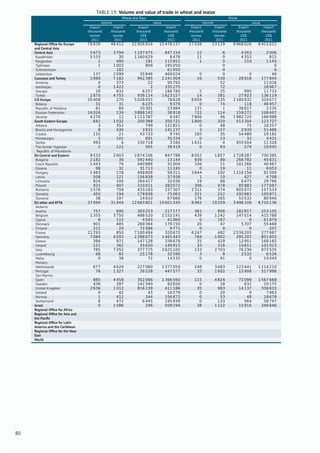
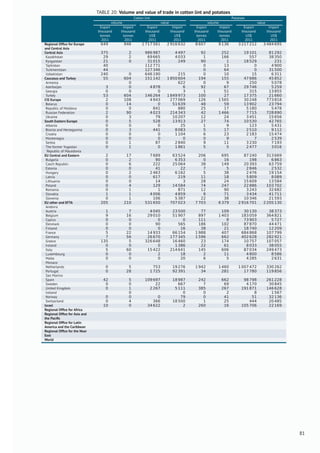
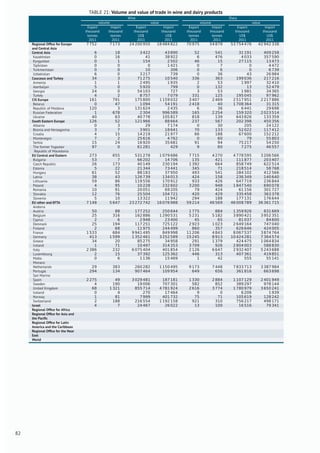
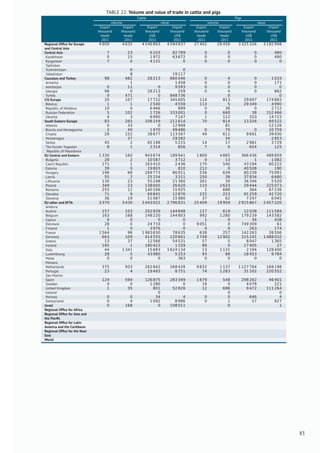
  • 124.
    Population, total Total populationis based on the de facto definition of population, which counts all residents regardless of legal status or citizenship– except for refugees not permanently settled in the country of asy- lum, who are generally considered part of the population of their country of origin. The values shown are midyear estimates. Source: United Nations Population Division Owner: United Nations Population Division, World Population Prospects. Potash fertilizers consumption (tonnes of K20 total nutrients) Potash fertilizers consumption. Source: FAO, Statistics Division (FAOSTAT) Owner: FAO Potassium Sulphate Is a white crystalline salt and contains 48 to 52 per cent potash (K20). Potassium sulfate can be extracted from naturally occurring brines or by the decomposition of potassium chloride with sulfuric acid. Poultry birds (heads) Domesticated birds for commercial use. Source: FAO, Statistics Division (FAOSTAT) Owner: FAO Poultry meat Poultry birds, fresh, chilled or frozen, with bone in. All data shown relate to total meat production from both commercial and farm slaughter. Data are given in terms of dressed carcass weight, i.e. ex- cluding offals and slaughter fats. Poultry meat includes Bird meat, nes, Chicken meat, Duck meat, Goose and guinea fowl meat and Turkey meat. Poultry meat (tonnes) See ’Poultry meat’ and ’Production’. Source: FAO, Statistics Division (FAOSTAT) Owner: FAO Primary forest (ha) Primary forest is naturally regenerated forest of native species, where there are no clearly visible indications of human activities and the ecological processes are not significantly disturbed. Source: Global Forest Resources Assessment Owner: FAO Production Figures relate to the total domestic production whether inside or outside the agricultural sector, i.e. it includes non-commercial pro- duction and production from kitchen gardens. Unless otherwise in- dicated, production is reported at the farm level for crop and live- stock products (i.e. in the case of crops, excluding harvesting losses) and in terms of live weight for fish items (i.e. the actual ex-water weight at the time of the catch). All data shown relate to total meat production from both commercial and farm slaughter. Data are expressed in terms of dressed carcass weight, excluding offal and slaughter fats. Production of beef and buffalo meat includes veal; mutton and goat meat includes meat from lambs and kids; pig meat includes bacon and ham in fresh equivalent. Poultry meat in- cludes meat from all domestic birds and refers, wherever possible, to ready-to-cook weight. Production - Livestock primary Livestock primary products include products from live and slaugh- tered animals. Products from slaughtered animals include meat, of- fals, raw fats, fresh hides and skins. Products from live animals in- clude milk, eggs, honey, beeswax and fibres of animal origin. All data shown relate to total meat production from both commer- cial and farm slaughter. Data are given in terms of dressed car- cass weight, i.e. excluding offals and slaughter fats. Production of beef and buffalo meat includes veal; mutton and goat meat in- cludes meat from lambs and kids, respectively; pig meat includes bacon and ham in fresh equivalent. Poultry meat includes meat from all domestic birds and refers, wherever possible, to ready-to- cook weight. Cow milk production relates to total production of whole fresh milk, excluding the milk sucked by young animals but including amounts fed to livestock. The concept of production of buffalo, sheep and goat milk is the same as for cow milk; however, the coverage is probably less adequate. Egg production covers all domestic birds which have contributed to egg production during the year, wherever they lay and the corresponding total production, in- cluding eggs intended to be used for hatching but excluding waste on farms. Pulses Pulses are annual leguminous crops yielding from one to 12 grains or seeds of variable size, shape and colour within a pod. They are used for both food and feed. The term "pulses" is limited to crops harvested solely for dry grain, thereby excluding crops harvested green for food (green peas, green beans, etc.) which are classified as vegetable crops. Also excluded are those crops used mainly for oil extraction (e.g. soybean and groundnuts) and leguminous crops (e.g. seeds of clover and alfalfa) that are used exclusively for sowing purposes. They include Bambara beans, Beans, dry, Broad beans, horse beans, dry, Chick peas, Cow peas, dry, Lentils, Lupins, Peas, dry, Pigeon peas, Pulses, nes, and Vetches. Rape and Mustard Oil Default composition: Oil, rapeseed, mustard Rapeseed oil (tonnes) See ’Rape and Mustard oil’. Source: FAO, Statistics Division (FAOSTAT) Owner: FAO Recovered paper Waste and scraps of paper or paperboard that have been collected for re-use as a raw material for the manufacture of paper and pa- perboard. It includes: paper and paperboard that has been used for its original purpose and residues from paper and paperboard production. See http://www.fao.org/forestry/62283/en/ for further information. Rice (paddy) Oryza spp., mainly oryza sativa. Rice grain after threshing and win- nowing. Also known as rice in the husk and rough rice. Used mainly for human food. Rice cultivation, total emissions in CO2eq (gigagrams) Greenhouse gas (GHG) emissions from rice cultivation consist of methane gas from the anaerobic decomposition of organic matter in paddy fields. Source: FAO, Statistics Division (FAOSTAT) Owner: FAO Root and tuber crops Roots and tubers are plants yielding starchy roots, tubers, rhizomes, corms and stems. They include Potatoes, Sweet Potatoes, Cassava, Yautia (Cocoyam), Taro (Cocoyam), Yams, Roots And Tubers Nes. Root and tuber crops production (tonnes) See ’Root and tuber crops’ and ’Crop production’. Source: FAO, Statistics Division (FAOSTAT) Owner: FAO Roots and tubers harvested area (ha) See ’Root and tuber crops’ and ’Crop area’. Source: FAO, Statistics Division (FAOSTAT) Owner: FAO 108
  • 125.
    METADATA Roots and tubers,nes Including inter alia: arracacha (Arracacoa xanthorrhiza); arrow- root (Maranta arundinacea); chufa (Cyperus esculentus); sago palm (Metroxylon spp.); oca and ullucu (Oxalis tuberosa and Ullucus tuberosus); yam bean, jicama (Pachyrxhizus erosus, P. angulatus); mashua (Tropaeolum tuberosum); Jerusalem artichoke, topinambur (Helianthus tuberosus). Other tubers, roots or rhizomes, fresh, that are not identified separately because of their minor relevance at the international level. Because of their limited local importance, some countries report roots and tubers under this commodity head- ing that are classified individually by FAO. Roundwood All roundwood felled or otherwise harvested and removed. It com- prises all wood obtained from removals, i.e. the quantities removed from forests and from trees outside the forest, including wood re- covered from natural, felling and logging losses during the period, calendar year or forest year. It includes: all wood removed with or without bark, including wood removed in its round form, or split, roughly squared or in other form (e.g. branches, roots, stumps and burls (where these are harvested) and wood that is roughly shaped or pointed. In the production statistics, it represents the sum of: wood fuel, including wood for charcoal; sawlogs and veneer logs; pulpwood, round and split; and other industrial roundwood. See http://www.fao.org/forestry/62283/en/ for further information. Roundwood production (m3 ) See ’Roundwood’ and ’Production’. Source: FAO, Statistics Division (FAOSTAT) Owner: FAO Rural population, total Rural population refers to people living in rural areas as defined by national statistical offices. Source: United Nations Population Division Owner: United Nations Population Division, World Urbanization Prospects. Safflower seed Carthamus tinctorius. Valued mainly for its oil. Minor uses include as a human food and as poultry feed. Safflower seed Glycine soja. The most important oil crop. Also widely consumed as a bean and in the form of various derived products because of its high protein content, e.g. soya milk, meat, etc. Sawnwood Wood that has been produced from both domestic and imported roundwood, either by sawing lengthways or by a profile-chipping process and that, with a few exceptions, exceeds 5 mm in thick- ness. It includes: planks, beams, joists, boards, rafters, scantlings, laths, boxboards, sleepers and "lumber", etc., in the following forms: unplaned, planed, grooved, tongued, fingerjointed, chamfered, rab- beted, V-jointed, beaded, etc. It excludes: wooden flooring. See http://www.fao.org/forestry/62283/en/ for further information. Sesameseed Oil Default composition: Oil, sesame Share of freshwater resources withdrawn by agriculture (percent) Water withdrawn for irrigation in a given year, expressed in percent of the total actual renewable water resources (TRWR_actual). This parameter is an indication of the pressure on the renewable water resources caused by irrigation. Source: Land and Water Division (AQUASTAT) Owner: FAO Sheep Ovis spp.. See ’Cattle’. Includes Uriel, Argali, Bighorn, Karakul and Astrakhan. Sheep and goat meat (tonnes) See ’Sheep’, ’Goats’, ’Meat, total’, and ’Production’. Source: FAO, Statistics Division (FAOSTAT) Owner: FAO Sheep and goats (heads) See ’Sheep’ and ’Goats’. Source: FAO, Statistics Division (FAOSTAT) Owner: FAO Soyabean Oil Default composition: Oil, soybean Soybean oil (tonnes) See ’Soybean oil’ and ’Crop production’. Source: FAO, Statistics Division (FAOSTAT) Owner: FAO Sugar Beta vulgaris var. altissima. In some producing countries, marginal quantities are consumed, either directly as food or in the preparation of jams. Sugar (Raw Equivalent) Default composition: 158 Sugar, cane, raw, centrifugal, 159 Sugar, beet, raw, centrifugal, 162 Sugar Raw Centrifugal, 164 Sugar refined, 168 Sugar confectionery, 171 Sugar flavoured Sugar and sweeteners in primary equivalent (kcal/cap/day) See ’Sugar’ and ’Sweetners’. Source: FAO, Statistics Division (FAOSTAT) Owner: FAO Sugar beet Beta vulgaris var. altissima. In some producing countries, marginal quantities are consumed, either directly as food or in the preparation of jams. Sugar beet, producer price index 2004-2006=100 (index) Sugar beet producer price index, 2004-2006=100. Source: FAO, Statistics Division (FAOSTAT) Owner: FAO Sugar cane Saccharum officinarum. In some producing countries, marginal quantities of sugar cane are consumed, either directly as food or in the form of juice. Sugar harvested area (ha) See ’Sugar’ and ’Crop area’. Source: FAO, Statistics Division (FAOSTAT) Owner: FAO Sugar production (tonnes) See ’Sugar’ and ’Crop production’. Source: FAO, Statistics Division (FAOSTAT) Owner: FAO Sunflower oil (tonnes) See ’Sunflowerseed oil’ and ’Crop production’. Source: FAO, Statistics Division (FAOSTAT) Owner: FAO Sunflower seed Helianthus annuus. Valued mainly for its oil. Minor uses include as a human food and as feed for birds. 109
  • 126.
    Sunflowerseed Oil Default composition:Oil, sunflower Synthetic fertilizers, total emissions in CO2eq (gigagrams) Greenhouse gas (GHG) emissions from synthetic fertilizers consist of nitrous oxide gas from synthetic nitrogen additions to managed soils. Source: FAO, Statistics Division (FAOSTAT) Owner: FAO Total area equipped for irrigation (ha) Area equipped to provide water (via irrigation) to crops. It includes areas equipped for full/partial control irrigation, equipped lowland areas, and areas equipped for spate irrigation. Source: Land and Water Division (AQUASTAT) Owner: FAO Total forest (ha) Sum of ’Other naturally regenerated forest (ha)’, ’Primary forest (ha)’, and ’Planted forest (ha)’. Source: Global Forest Resources Assessment Owner: FAO Total land area (ha) Land area is the total area of the country excluding area under in- land water bodies. Possible variations in the data may be due to updating and revisions of the country data and not necessarily to any change of area. Data are expressed in 1 000 hectares. Source: FAO, Statistics Division (FAOSTAT) Owner: FAO Total pesticides use (tonnes) Pesticides refer to insecticides, fungicides, herbicides, disinfectants and any substance or mixture of substances intended for prevent- ing, destroying or controlling any pest, including vectors of human or animal disease, unwanted species of plants or animals causing harm during or otherwise interfering with the production, process- ing, storage, transport or marketing of food, agricultural commodi- ties, wood and wood products or animal feedstuffs, or substances which may be administered to animals for the control of insects, arachnids or other pests in or on their bodies. The term includes substances intended for use as a plant growth regulator, defoliant, desiccant or agent for thinning fruit or preventing the premature fall of fruit, and substances applied to crops either before or after harvest to protect the commodity from deterioration during stor- age and transport. Pesticides use data refers to quantities of pesti- cides applied to crops and seeds in the agriculture sector. Figures are expressed in metric tons of active ingredients. However, due to some country reporting practices, the data may be reported by: use in formulated product; sales; distribution or imports for use in the agricultural sector. In these cases it is specified in the country notes. Source: FAO FAO, Statistics Division Owner: FAO Total share of freshwater resources withdrawn (percent) Total freshwater withdrawn in a given year, expressed in percentage of the actual total renewable water resources (TRWR_actual). This parameter is an indication of the pressure on the renewable water resources. Source: Land and Water Division (AQUASTAT) Owner: FAO Total water withdrawal (m3 /yr) Annual quantity of water withdrawn for agricultural, industrial and municipal purposes. It includes renewable freshwater resources as well as potential over-abstraction of renewable groundwater or withdrawal of fossil groundwater and potential use of desalinated water or treated wastewater. It does not include in stream uses, which are characterized by a very low net consumption rate, such as recreation, navigation, hydropower, inland capture fisheries, etc. Source: Land and Water Division (AQUASTAT) Owner: FAO Total water withdrawal per capita (m3 /yr/person) Total annual amount of water withdrawn per capita. Source: Land and Water Division (AQUASTAT) Owner: FAO Urban population, total Urban population refers to people living in urban areas as defined by national statistical offices. Source: United Nations Population Division Owner: United Nations Population Division, World Urbanization Prospects. Value of agricultural exports Value of agricultural exports should be reported in national cur- rency, US dollars or other currency. Export values are mostly re- ported as FOB. In the FAOSTAT database export values are ex- pressed in thousand US dollars. Value of agricultural imports Value of agricultural imports should be reported in national cur- rency, US dollars or other currency. Import values are mostly re- ported as CIF. In the FAOSTAT database import values are expressed in thousand US dollars. Vegetable oils in primary equivalent (kcal/cap/day) See ’Oilcrops’. Source: FAO, Statistics Division (FAOSTAT) Owner: FAO Vegetable production (tonnes) See ’Vegetable, including melons’ and ’Crop production’. Source: FAO, Statistics Division (FAOSTAT) Owner: FAO Vegetable, including melons Vegetables, as classified in this group, are mainly annual plants cul- tivated as field and garden crops in the open and under glass, and used almost exclusively for food. Vegetables grown principally for animal feed or seed should be excluded. Certain plants, normally classified as cereals and pulses, belong to this group when har- vested green, such as green maize, green peas, etc. This grouping differs from international trade classifications for vegetables in that it includes melons and watermelons, which are normally considered to be fruit crops. But, whereas fruit crops are virtually all perma- nent crops, melons and watermelons are similar to vegetables in that they are temporary crops. Chillies and green peppers are in- cluded in this grouping when they are harvested for consumption as vegetables and not processed into spices. FAO production data for green peas and green beans refer to the total weight includ- ing pods, although some countries report on a shelled weight basis. The weight of the pods ranges from 40 to 50 percent for peas to up to 70 percent for broad beans. Area data on small vegetable gar- dens are often omitted in agricultural surveys, although production estimates may be reported. Trade data for fresh vegetables also in- clude chilled vegetables, meaning the temperature of the products has been reduced to around 0C without the products being frozen. Vegetables harvested area (ha) See ’Vegetable, including melons’ and ’Crop area’. Source: FAO, Statistics Division (FAOSTAT) Owner: FAO Vegetables, fresh nes Including inter alia: bamboo shoots (Bambusa spp.); beets, chards (Beta vulgaris); capers (Capparis spinosa); cardoons (Cynara cardun- culus); celery (Apium graveolens); chervil (Anthriscus cerefolium); cress (Lepidium sativum); fennel (Foeniculum vulgare); horseradish (Cochlearia armoracia); marjoram, sweet (Majorana hortensis); oys- ter plant (Tragopogon porrifolius); parsley (Petroselinum crispum); parsnips (Pastinaca sativa); radish (Raphanus sativus); rhubarb 110
  • 127.
    METADATA (Rheum spp.); rutabagas,swedes (Brassica napus); savory (Satureja hortensis); scorzonera (Scorzonera hispanica); sorrel (Rumex ace- tosa); soybean sprouts tarragon (Artemisia dracunculus); watercress (Nasturtium officinale). Other vegetables that are not identified sep- arately because of their minor relevance at the international level. Because of their limited local importance, some countries report vegetables under this heading that are classified individually by FAO. Vineyards harvested area (ha) See ’Grapes’ and ’Crop area’. Source: FAO, Statistics Division (FAOSTAT) Owner: FAO Waste Amount of the commodity in question lost through wastage (waste) during the year at all stages between the level at which produc- tion is recorded and the household, i.e. storage and transportation. Losses occurring before and during harvest are excluded. Waste from both edible and inedible parts of the commodity occurring in the household is also excluded. Quantities lost during the transfor- mation of primary commodities into processed products are taken into account in the assessment of respective extraction/conversion rates. Distribution wastes tend to be considerable in countries with hot humid climate, difficult transportation and inadequate storage or processing facilities. This applies to the more perishable food- stuffs, and especially to those which have to be transported or stored for a long time in a tropical climate. Waste is often esti- mated as a fixed percentage of availability, the latter being defined as production plus imports plus stock withdrawals. Water resources per capita (m3 /yr/person) Total annual internal renewable water resources per inhabitant. Source: Land and Water Division (AQUASTAT) Owner: FAO Wheat Triticum spp.: common (T. aestivum) durum (T. durum) spelt (T. spelta). Common and durum wheat are the main types. Among com- mon wheat, the main varieties are spring and winter, hard and soft, and red and white. At the national level, different varieties should be reported separately, reflecting their different uses. Used mainly for human food. Wheat harvested area (ha) See ’Wheat’ and ’Crop area’. Source: FAO, Statistics Division (FAOSTAT) Owner: FAO Wheat production (tonnes) See ’Wheat’ and ’Crop production. Source: FAO, Statistics Division (FAOSTAT) Owner: FAO Wine production (tonnes) See ’Wine’ and ’Crop production’. Source: FAO, Statistics Division (FAOSTAT) Owner: FAO Wood-based panels The wood-based panels category is an aggregate category. In the production and trade statistics, it represents the sum of: veneer sheets, plywood, particle board, and fibreboard. See http://www.fao.org/forestry/62283/en/ for further information. Wood pulp Wood pulp is a fibrous material prepared from pulpwood, wood chips, particles, residues or recovered paper by mechanical and/or chemical process for further manufacture into paper, paperboard, fibreboard or other cellulose products. In the production and trade statistics, it represents the sum of: mechanical wood pulp; semi- chemical wood pulp; chemical wood pulp; and dissolving wood pulp. See http://www.fao.org/forestry/62283/en/ for further infor- mation. Woodfuel Roundwood that will be used as fuel for purposes such as cook- ing, heating or power production. It includes: wood harvested from main stems, branches and other parts of trees (where these are har- vested for fuel) and wood that will be used for charcoal produc- tion (e.g. in pit kilns and portable ovens). The volume of round- wood used in charcoal production, is estimated by using a fac- tor of 6.0 to convert from the weight (MT) of charcoal produced to the solid volume (CUM) of roundwood used in production. It is reported in cubic metres underbark (i.e. excluding bark). See http://www.fao.org/forestry/62283/en/ for further information. Woodfuel production (m3 ) See ’Woodfuel’ and ’Production’. Source: FAO, Statistics Division (FAOSTAT) Owner: FAO Wool production (tonnes) See ’Fats, Animals and Raw’. Source: FAO, Statistics Division (FAOSTAT) Owner: FAO 111
  • 128.
    Bibliography African Development Bank2012. The African Economic Outlook: Promoting Youth Employment, OECD publishing. 2013. The African Economic Outlook: Structural Trasformation and Natural Resources, OECD publishing. FAO 2010. Global Forest Resources Assessment 2010 - Main Report, FAO, Rome. 2011a. Climate Change, Water and Food Security, FAO, Rome. 2011b. The State of Food and Agriculture 2010-11 - Women in Agriculture: Closing the Gender Gap for Development, FAO, Rome. 2011c. The State of Food Insecurity in the World 2011 - How Does International Price Volatility Affect Domestic Economies and Food Security?, FAO, Rome. 2011d. The State of the World’s Land and Water Resources for Food and Agriculture - Managing Systems at Risk, FAO, Rome. 2012a. State of the World’s Forests 2012 - The Role of Forests in Human History, FAO, Rome. 2012b. The State of Food and Agriculture 2012 - Investing in Agriculture for a Better Future, FAO, Rome. 2012c. The State of Food Insecurity in the World 2012 - Economic growth is necessary but not suffcient to accelerate reduction of hunger and malnutrition, FAO, Rome. 2012d. The State of World Fisheries and Aquaculture 2012, FAO, Rome. 2012e. World Agriculture: Towards 2030/2050 - The 2012 Revision, FAO, Rome. 2013. The State of Food Insecurity in the World 2013 - The Multiple Dimensions of Food Security, FAO, Rome. IEA 2009. World Energy Outlook 2009 Fact Sheet: Why Is Our Current Pathway Unsustainable?, International Energy Agency (IEA), Paris. 2010. World Energy Outlook 2010, IEA, Paris. 2013. World Energy Outlook 2013, IEA, Paris. Various years a. Energy Balances of Non-OECD Countries, IEA, Paris. Various years b. Energy Balances of OECD Countries, IEA, Paris. Various years c. Energy Statistics of Non-OECD Countries, IEA, Paris. Various years d. Energy Statistics of OECD Countries, IEA, Paris. IFAD 2011. Rural Poverty Report 2011 - New Realities, New Challenges: New Opportunities for Tomorrow’s Generation, International Fund for Agricultural Development (IFAD), Rome. ILO 2009. Guide to the New Millennium Development Goals Employment Indicators, International Labour Organization (ILO), Geneva. 2012. Global Employment Trends 2012. Preventing a deeper job crisis, ILO, Geneva. 2013. Global Employment Trends 2013 - Recovering from a second jobs dip, ILO, Geneva. Various years a. Key Indicators of the Labour Market (KILM), ILO, Geneva. Various years b. Yearbook of Labour Statistics, ILO, Geneva. IMF Various years . International Financial Statistics Yearbook, International Monetary Fund (IMF), Washington, D.C. OECD Various years a. Development Co-operation Report, Organization for Economic Co-operation and Development (OECD), Paris. Various years b. Geographical Distribution of Financial Flows to Developing Economies, OECD, Paris. Partnership on Measuring ICT for Development 2008. The Global Information Society: A Statistical View, United Nations, Santiago. R Core Team 2012.R: A Language and Environment for Statistical Computing, R Foundation for Statistical Computing, Vienna, Austria. ISBN 3-900051-07-0. Schmidhuber, J., Bruinsma, J. & Boedeker, G. 2011. Capital Requirements for Agriculture in Dveloping Countries to 2050, in Looking Ahead in World Food and Agriculture: Perspectives to 2050, ed. by Conforti, P. Food and Agriculture Organization. 112
  • 129.
    BIBLIOGRAPHY UN 2008a. InternationalStandard Industrial Classification of All Economic Activities, 4th Revision. Statistical Papers Series M, No. 4, Rev. 4, United Nations (UN), New York. 2008b. Kyoto Protocol to the United Nations Framework Convention on Climate Change, United Nations Framework Convention on Climate Change, New York. 2009a. Copenhagen Accord, United Nations Framework Convention on Climate Change, Copenhagen. 2009b. Fact Sheet: Stepping Up International Action on Climate Change: The Road to Copenhagen, United Nations Framework Convention on Climate Change, New York. UNDP 2010. Human Development Report - The Real Wealth of Nations: Pathways to Human Development, United Nations Development Programme (UNDP), New York. 2011. Human Development Report - Sustainability and Equity: A Better Future for All, UNDP, New York. UNESCO 2009. World Water Development Report 3: Water in a Changing World, UNESCO, Paris. 2010. UNESCO Science Report 2010, UNESCO, Paris. 2011. International Standard Classification of Education, 2011 revision, United Nations Educational, Scientific, and Cultural Organization (UN- ESCO), Paris. Various years a. EFA Global Monitoring Report, UNESCO, Paris. Various years b. Global Education Digest, UNESCO, Paris. UNPD 2011. World Population Prospects: The 2010 Revision, UNPD, United Nations, Department of Economic and Social Affairs, New York. 2013. Trends in Total Migrant Stock: 2013 Revision, United Nations Population Division (UNPD), United Nations, Department of Economic and Social Affairs, New York. Various years. World Urbanization Prospects, UNPD, United Nations, Department of Economic and Social Affairs, New York. WHO and UNICEF 2012. Progress on Drinking Water and Sanitation, World Health Organization (WHO) and United Nations Children’s Fund (UNICEF), New York. World Bank 2013. World Development Report 2013: Jobs. Oxford University Press, New York. Various years . World Development Indicators - Various issues, WB, Washington, D.C. World Bank and IMF 2012. Global Monitoring Report: Food Prices, Nutrition, and the Millennium Development Goals, World Bank and International Monetary Fund (IMF), Washington, D.C. 113