Presenter:
Dr Warda Shaukat
Resident Medicine
PAF Hospital Mushaf
Supervisor:
W.Cdr. Ayaz Ahmad
Supervisor FCPS (Med)
HOD Medicine Department
PAF Hospital Mushaf
TABLE OF CONTENTS
2. CASE PRESENTATION
3. CASE DISCUSSION
4. LITERATURE REVIEW
1. OBJECTIVE
OBJECTIVE
"To discuss the differential diagnosis and management of a
patient presenting with fever , headache and altered
sensorium”
CASE PRESENTATION
BIODATA
• 66yr
• Male
• Resident of Sargodha
• Presented to PAF hospital Mushaf on 14/08/24
PRESENTING
COMPLAINTS
• Headache 6 weeks
• Fever 4 weeks
• Fits followed by altered sensorium 2 days
HISTORY OF PRESENT
ILLNESS
Headache
●10 days
●Localized to forehead
●Moderate in intensity
● Affecting his day to day work
Fever
● 4 Weeks
● High grade associated with chills
● Night sweats
HISTORY OF PRESENT
ILLNESS
Fits:-
● Abnormal body movements
● Involving whole four limbs
● Tightening with uprolling of eyes
● Urinary incontinence
● Loss of consciousness for 20
min
Weight loss
● 10 kg weight
● Gradual
● Undocumented
● appetite
Negative history
• No history of rash
• sore throat
• loose stools
• Trauma
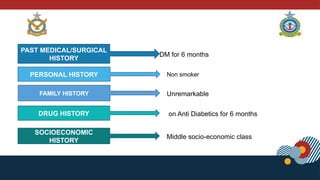
PAST MEDICAL/SURGICAL
HISTORY
PERSONAL HISTORY
FAMILY HISTORY
DRUG HISTORY
SOCIOECONOMIC
HISTORY
DM for 6 months
Non smoker
Unremarkable
on Anti Diabetics for 6 months
Middle socio-economic class
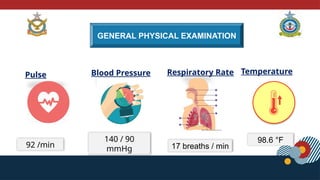
GENERAL PHYSICAL EXAMINATION
Pulse Blood Pressure Respiratory Rate Temperature
92 /min
140 / 90
mmHg 17 breaths / min
98.6 °F
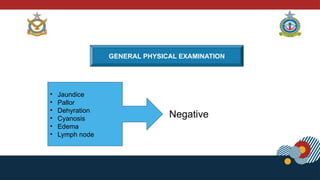
GENERAL PHYSICAL EXAMINATION
• Jaundice
• Pallor
• Dehyration
• Cyanosis
• Edema
• Lymph node
Negative
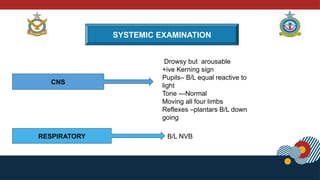
SYSTEMIC EXAMINATION
RESPIRATORY
CNS
Drowsy but arousable
+ive Kerning sign
Pupils– B/L equal reactive to
light
Tone ---Normal
Moving all four limbs
Reflexes –plantars B/L down
going
B/L NVB
SYSTEMIC EXAMINATION
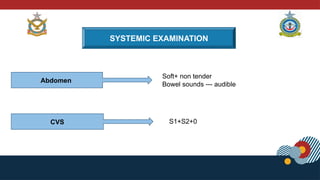
CVS
Abdomen
S1+S2+0
Soft+ non tender
Bowel sounds --- audible
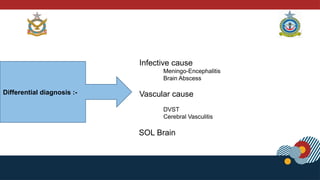
Differential diagnosis :-
Infective cause
Meningo-Encephalitis
Brain Abscess
Vascular cause
DVST
Cerebral Vasculitis
SOL Brain
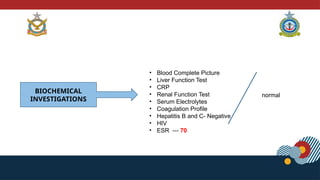
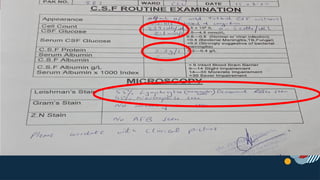
BIOCHEMICAL
INVESTIGATIONS
• Blood Complete Picture
• Liver Function Test
• CRP
• Renal Function Test
• Serum Electrolytes
• Coagulation Profile
• Hepatitis B and C- Negative
• HIV
• ESR --- 70
normal
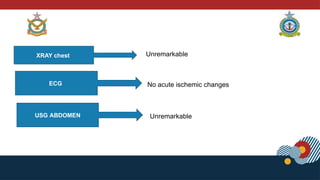
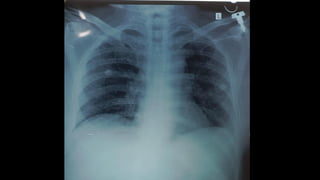
XRAY chest
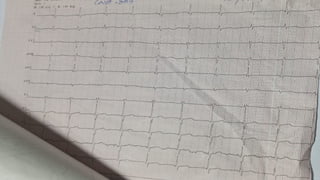
ECG No acute ischemic changes
USG ABDOMEN
Unremarkable
Unremarkable
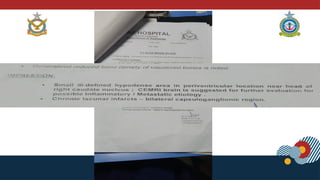
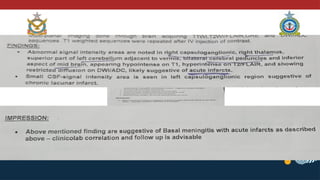
Ct brain
CASE PRESENTATION
SPECIFIC
INVESTIGATIONS
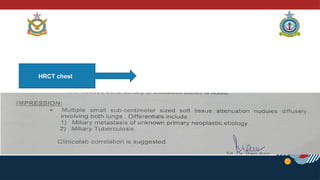
HRCT chest
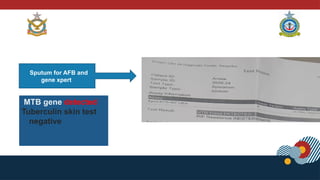
Sputum for AFB and
gene xpert
MTB gene detected
Tuberculin skin test
negative
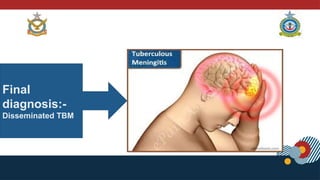
Final
diagnosis:-
Disseminated TBM
Treatment
General Measures
Inj Clafron 2 g
Inj Vancomycin 1g
Inj Insulin R
Inj Dexa 4mg
After lab reports 4 Tab Myrin P forte
Tab vita 6
Inj Dexa
Follow up
• GCS improved on 7th
day of ATT
• Discharged
• On regular follow up
• Compliant to treatment
• Marked improvement
• Now can walk and eat with support
CASE DISCUSSION
Tuberculous meningitis :-
●Most common form of CNS tuberculosis
● If un-treated,high frequency of neurological sequale and
mortality
● Important demographic groups include children, young adults,
and immunocompromised patients.
.● CNS TB constituted 13.9 percent of all cases of meningitis and
4.5 percent of all TB cases
Epidemiology :-
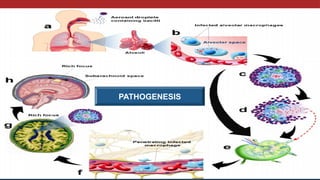
Pathogenesis
PATHOGENESIS
Clinical manifestations
Symptoms :-
●Headache
●Vomitting
●Seizures
●Low grade fever
● Confusion
●Behaviour changes
Signs:-
●Meningism
●Papilloedema
●Focal hemisphere signs
●Depression
● Cranial nerve palsies
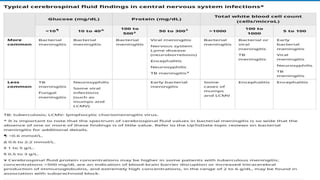
Investigations
●Suspicion:- A high index of clinical suspicion is important where TB contact is positive
Tuberculin test is negative in 50% of patients
● Blood :- ESR high, lmphyocytosis
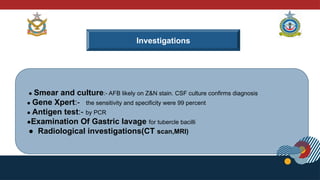
● Smear and culture:- AFB likely on Z&N stain. CSF culture confirms diagnosis
● Gene Xpert:- the sensitivity and specificity were 99 percent
● Antigen test:- by PCR
●Examination Of Gastric lavage for tubercle bacilli
● Radiological investigations(CT scan,MRI)
Investigations
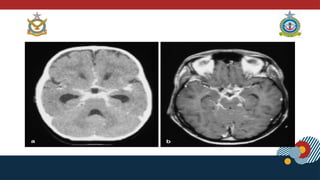
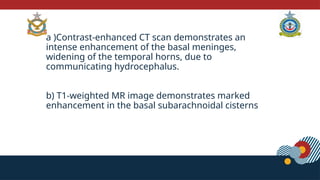
a )Contrast-enhanced CT scan demonstrates an
intense enhancement of the basal meninges,
widening of the temporal horns, due to
communicating hydrocephalus.
b) T1-weighted MR image demonstrates marked
enhancement in the basal subarachnoidal cisterns
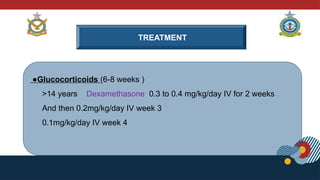
TREATMENT
●Glucocorticoids (6-8 weeks )
>14 years Dexamethasone 0.3 to 0.4 mg/kg/day IV for 2 weeks
And then 0.2mg/kg/day IV week 3
0.1mg/kg/day IV week 4
Anti tuberculosis therapy
● Intensive phase :- ( for 2 months )
Four drugs regimen :-
Isoniazid,Rifampin,pyrizinamide
And 4 agent Ethambutol
 Other options include (levofloxacin,streptomycin,ethionamide )
HRZE dosage
● H :- 5mg/kg (max 300 mg)
● R :- 10mg/kg (max 600 mg)
● Z:- 20 to 26.8mg/kg (max 1500 mg)
● E:- 16 to 21mg/kg (max 1200 mg)
Anti tuberculosis therapy
●Continuation phase :- ( for 10 months )
Two drugs regimen :-
Isoniazid ,Rifampin
(daily basis )
Treatment
Pyridoxine :-
● VitaminB6 (25 to 50 mg/day )is given with isoniazid for
prevention of neuropathy.
● Peripheral neuropathy increase dose to 100 mg/day
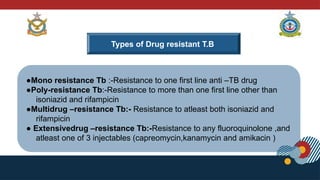
Types of Drug resistant T.B
●Mono resistance Tb :-Resistance to one first line anti –TB drug
●Poly-resistance Tb:-Resistance to more than one first line other than
isoniazid and rifampicin
●Multidrug –resistance Tb:- Resistance to atleast both isoniazid and
rifampicin
● Extensivedrug –resistance Tb:-Resistance to any fluoroquinolone ,and
atleast one of 3 injectables (capreomycin,kanamycin and amikacin )
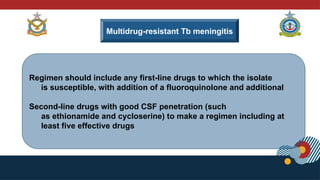
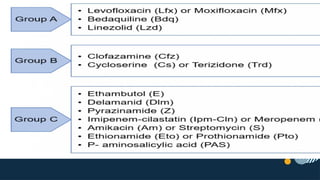
Multidrug-resistant Tb meningitis
Regimen should include any first-line drugs to which the isolate
is susceptible, with addition of a fluoroquinolone and additional
Second-line drugs with good CSF penetration (such
as ethionamide and cycloserine) to make a regimen including at
least five effective drugs
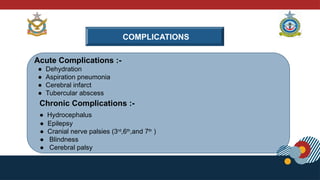
COMPLICATIONS
Acute Complications :-
● Dehydration
● Aspiration pneumonia
● Cerebral infarct
● Tubercular abscess
Chronic Complications :-
● Hydrocephalus
● Epilepsy
● Cranial nerve palsies (3rd
,6th
,and 7th
)
● Blindness
● Cerebral palsy
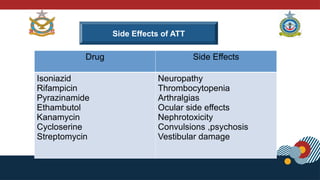
Drug Side Effects
Isoniazid
Rifampicin
Pyrazinamide
Ethambutol
Kanamycin
Cycloserine
Streptomycin
Neuropathy
Thrombocytopenia
Arthralgias
Ocular side effects
Nephrotoxicity
Convulsions ,psychosis
Vestibular damage
Side Effects of ATT
LITERATURE REVIEW
PAF MUSHAF data in one year
Within one year ,five cases of TBM reported to Mushaf
hospital
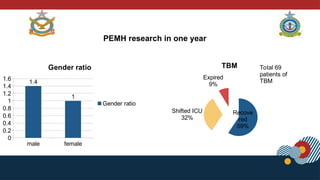
Recove
red
59%
Shifted ICU
32%
Expired
9%
TBM Total 69
patients of
TBM
PEMH research in one year
male female
0
0.2
0.4
0.6
0.8
1
1.2
1.4
1.6
1.4
1
Gender ratio
Gender ratio
References :-
1-WHO Consolidated Guidelines on Tuberculosis, Module 4: Treatment - Drug-Susceptible
Tuberculosis Treatment. World Health Organization. Available at: https://www.who.int/publications/
i/item/9789240048126 (Accessed on June 26, 2022).
2-. https://www.pafmj.org/PAFMJ/article/3126/3374/50557
3-World Health Organization. Rap https://www.pafmj.org/PAFMJ/article/download/
3126/3374/50557 id communication on updated guidance on the management of tuberculosis in
children and adolescents. https://www.who.int/publications-detail-redirect/9789240033450
(Accessed on September 27, 2021).
4-World Health Organization. Treatment of tuberculosis: guidelines. 2nd ed, 2010. https://
www.tbonline.info/media/uploads/documents/treatment_of_tuberculosis-
_guidelines_for_national_programmes_%282010%29.pdf (Accessed on January 22, 2024)
A Headache Unveiled : The Clue That Changed Everything

A Headache Unveiled : The Clue That Changed Everything

  • 2.
    Presenter: Dr Warda Shaukat ResidentMedicine PAF Hospital Mushaf Supervisor: W.Cdr. Ayaz Ahmad Supervisor FCPS (Med) HOD Medicine Department PAF Hospital Mushaf
  • 3.
    TABLE OF CONTENTS 2.CASE PRESENTATION 3. CASE DISCUSSION 4. LITERATURE REVIEW 1. OBJECTIVE
  • 4.
    OBJECTIVE "To discuss thedifferential diagnosis and management of a patient presenting with fever , headache and altered sensorium”
  • 5.
  • 6.
    BIODATA • 66yr • Male •Resident of Sargodha • Presented to PAF hospital Mushaf on 14/08/24 PRESENTING COMPLAINTS • Headache 6 weeks • Fever 4 weeks • Fits followed by altered sensorium 2 days
  • 7.
    HISTORY OF PRESENT ILLNESS Headache ●10days ●Localized to forehead ●Moderate in intensity ● Affecting his day to day work Fever ● 4 Weeks ● High grade associated with chills ● Night sweats
  • 8.
    HISTORY OF PRESENT ILLNESS Fits:- ●Abnormal body movements ● Involving whole four limbs ● Tightening with uprolling of eyes ● Urinary incontinence ● Loss of consciousness for 20 min Weight loss ● 10 kg weight ● Gradual ● Undocumented ● appetite
  • 9.
    Negative history • Nohistory of rash • sore throat • loose stools • Trauma
  • 10.
    PAST MEDICAL/SURGICAL HISTORY PERSONAL HISTORY FAMILYHISTORY DRUG HISTORY SOCIOECONOMIC HISTORY DM for 6 months Non smoker Unremarkable on Anti Diabetics for 6 months Middle socio-economic class
  • 11.
    GENERAL PHYSICAL EXAMINATION PulseBlood Pressure Respiratory Rate Temperature 92 /min 140 / 90 mmHg 17 breaths / min 98.6 °F
  • 12.
    GENERAL PHYSICAL EXAMINATION •Jaundice • Pallor • Dehyration • Cyanosis • Edema • Lymph node Negative
  • 13.
    SYSTEMIC EXAMINATION RESPIRATORY CNS Drowsy butarousable +ive Kerning sign Pupils– B/L equal reactive to light Tone ---Normal Moving all four limbs Reflexes –plantars B/L down going B/L NVB
  • 14.
  • 15.
    Differential diagnosis :- Infectivecause Meningo-Encephalitis Brain Abscess Vascular cause DVST Cerebral Vasculitis SOL Brain
  • 16.
    BIOCHEMICAL INVESTIGATIONS • Blood CompletePicture • Liver Function Test • CRP • Renal Function Test • Serum Electrolytes • Coagulation Profile • Hepatitis B and C- Negative • HIV • ESR --- 70 normal
  • 17.
    XRAY chest ECG Noacute ischemic changes USG ABDOMEN Unremarkable Unremarkable
  • 20.
  • 21.
  • 23.
  • 24.
    Sputum for AFBand gene xpert MTB gene detected Tuberculin skin test negative
  • 25.
  • 26.
    Treatment General Measures Inj Clafron2 g Inj Vancomycin 1g Inj Insulin R Inj Dexa 4mg After lab reports 4 Tab Myrin P forte Tab vita 6 Inj Dexa
  • 27.
    Follow up • GCSimproved on 7th day of ATT • Discharged • On regular follow up • Compliant to treatment • Marked improvement • Now can walk and eat with support
  • 28.
  • 29.
    Tuberculous meningitis :- ●Mostcommon form of CNS tuberculosis ● If un-treated,high frequency of neurological sequale and mortality ● Important demographic groups include children, young adults, and immunocompromised patients.
  • 30.
    .● CNS TBconstituted 13.9 percent of all cases of meningitis and 4.5 percent of all TB cases Epidemiology :-
  • 31.
  • 32.
    Clinical manifestations Symptoms :- ●Headache ●Vomitting ●Seizures ●Lowgrade fever ● Confusion ●Behaviour changes Signs:- ●Meningism ●Papilloedema ●Focal hemisphere signs ●Depression ● Cranial nerve palsies
  • 33.
    Investigations ●Suspicion:- A highindex of clinical suspicion is important where TB contact is positive Tuberculin test is negative in 50% of patients ● Blood :- ESR high, lmphyocytosis
  • 35.
    ● Smear andculture:- AFB likely on Z&N stain. CSF culture confirms diagnosis ● Gene Xpert:- the sensitivity and specificity were 99 percent ● Antigen test:- by PCR ●Examination Of Gastric lavage for tubercle bacilli ● Radiological investigations(CT scan,MRI) Investigations
  • 37.
    a )Contrast-enhanced CTscan demonstrates an intense enhancement of the basal meninges, widening of the temporal horns, due to communicating hydrocephalus. b) T1-weighted MR image demonstrates marked enhancement in the basal subarachnoidal cisterns
  • 38.
    TREATMENT ●Glucocorticoids (6-8 weeks) >14 years Dexamethasone 0.3 to 0.4 mg/kg/day IV for 2 weeks And then 0.2mg/kg/day IV week 3 0.1mg/kg/day IV week 4
  • 39.
    Anti tuberculosis therapy ●Intensive phase :- ( for 2 months ) Four drugs regimen :- Isoniazid,Rifampin,pyrizinamide And 4 agent Ethambutol  Other options include (levofloxacin,streptomycin,ethionamide )
  • 40.
    HRZE dosage ● H:- 5mg/kg (max 300 mg) ● R :- 10mg/kg (max 600 mg) ● Z:- 20 to 26.8mg/kg (max 1500 mg) ● E:- 16 to 21mg/kg (max 1200 mg)
  • 41.
    Anti tuberculosis therapy ●Continuationphase :- ( for 10 months ) Two drugs regimen :- Isoniazid ,Rifampin (daily basis )
  • 42.
    Treatment Pyridoxine :- ● VitaminB6(25 to 50 mg/day )is given with isoniazid for prevention of neuropathy. ● Peripheral neuropathy increase dose to 100 mg/day
  • 43.
    Types of Drugresistant T.B ●Mono resistance Tb :-Resistance to one first line anti –TB drug ●Poly-resistance Tb:-Resistance to more than one first line other than isoniazid and rifampicin ●Multidrug –resistance Tb:- Resistance to atleast both isoniazid and rifampicin ● Extensivedrug –resistance Tb:-Resistance to any fluoroquinolone ,and atleast one of 3 injectables (capreomycin,kanamycin and amikacin )
  • 44.
    Multidrug-resistant Tb meningitis Regimenshould include any first-line drugs to which the isolate is susceptible, with addition of a fluoroquinolone and additional Second-line drugs with good CSF penetration (such as ethionamide and cycloserine) to make a regimen including at least five effective drugs
  • 46.
    COMPLICATIONS Acute Complications :- ●Dehydration ● Aspiration pneumonia ● Cerebral infarct ● Tubercular abscess Chronic Complications :- ● Hydrocephalus ● Epilepsy ● Cranial nerve palsies (3rd ,6th ,and 7th ) ● Blindness ● Cerebral palsy
  • 47.
  • 48.
  • 49.
    PAF MUSHAF datain one year Within one year ,five cases of TBM reported to Mushaf hospital
  • 50.
    Recove red 59% Shifted ICU 32% Expired 9% TBM Total69 patients of TBM PEMH research in one year male female 0 0.2 0.4 0.6 0.8 1 1.2 1.4 1.6 1.4 1 Gender ratio Gender ratio
  • 51.
    References :- 1-WHO ConsolidatedGuidelines on Tuberculosis, Module 4: Treatment - Drug-Susceptible Tuberculosis Treatment. World Health Organization. Available at: https://www.who.int/publications/ i/item/9789240048126 (Accessed on June 26, 2022). 2-. https://www.pafmj.org/PAFMJ/article/3126/3374/50557 3-World Health Organization. Rap https://www.pafmj.org/PAFMJ/article/download/ 3126/3374/50557 id communication on updated guidance on the management of tuberculosis in children and adolescents. https://www.who.int/publications-detail-redirect/9789240033450 (Accessed on September 27, 2021). 4-World Health Organization. Treatment of tuberculosis: guidelines. 2nd ed, 2010. https:// www.tbonline.info/media/uploads/documents/treatment_of_tuberculosis- _guidelines_for_national_programmes_%282010%29.pdf (Accessed on January 22, 2024)

Editor's Notes

  • #7 Patient was in a usual state of health 6 weeks back when he suddenly developed a headache lasting for about 10 days, localized to forehead ,moderate in intensity affecting his day to day work not associated with vomitting, photophobia or any aura . patient attendant noticed fever for 10-15 days 4 weeks back acute in onset ,undocumented high grade associated with chills more at night with night sweats got relieved momentarily with medications . Fever and headache was associated with increasing irritability with each passing day
  • #8  patient attendant complains of abnormal body movements 2 days back after headache involving whole four limbs tightening with uprolling of eyes and urinary incontinence with loss of consciousness for 20 mins for which he was taken to private hospital and got treated and was sent home
  • #9 . No history of rash Cough and sore throat.trauma,pallor ,sweating palpitation Chronic diarrhoea ,No history of dropping of eyelids Vaccine ,drugs,reduced urinary output