Introduction                                 Sequences                              Summary and conclusions


                          A formal ontology of sequences

                   Robert Hoehndorf1,2 , Janet Kelso2 , Heinrich Herre1

                                          1 Institute
                                                 for Informatics
                                                 and
                Research Group Ontologies in Medicine, Institute for Medical Informatics,
                           Statistics and Epidemiology, University of Leipzig
               2 Department   of Evolutionary Genetics, Max-Planck-Institute for Evolutionary
                                                Anthropology
Introduction                         Sequences                     Summary and conclusions


Ontology


               ontology (philosophy) studies the nature of existence and
               categories of being
               an ontology (computer science) is the “explicit specification of
               a conceptualization of a domain” [Gruber, 1993]
               specifies the meaning of terms in a vocabulary
Introduction                           Sequences                         Summary and conclusions


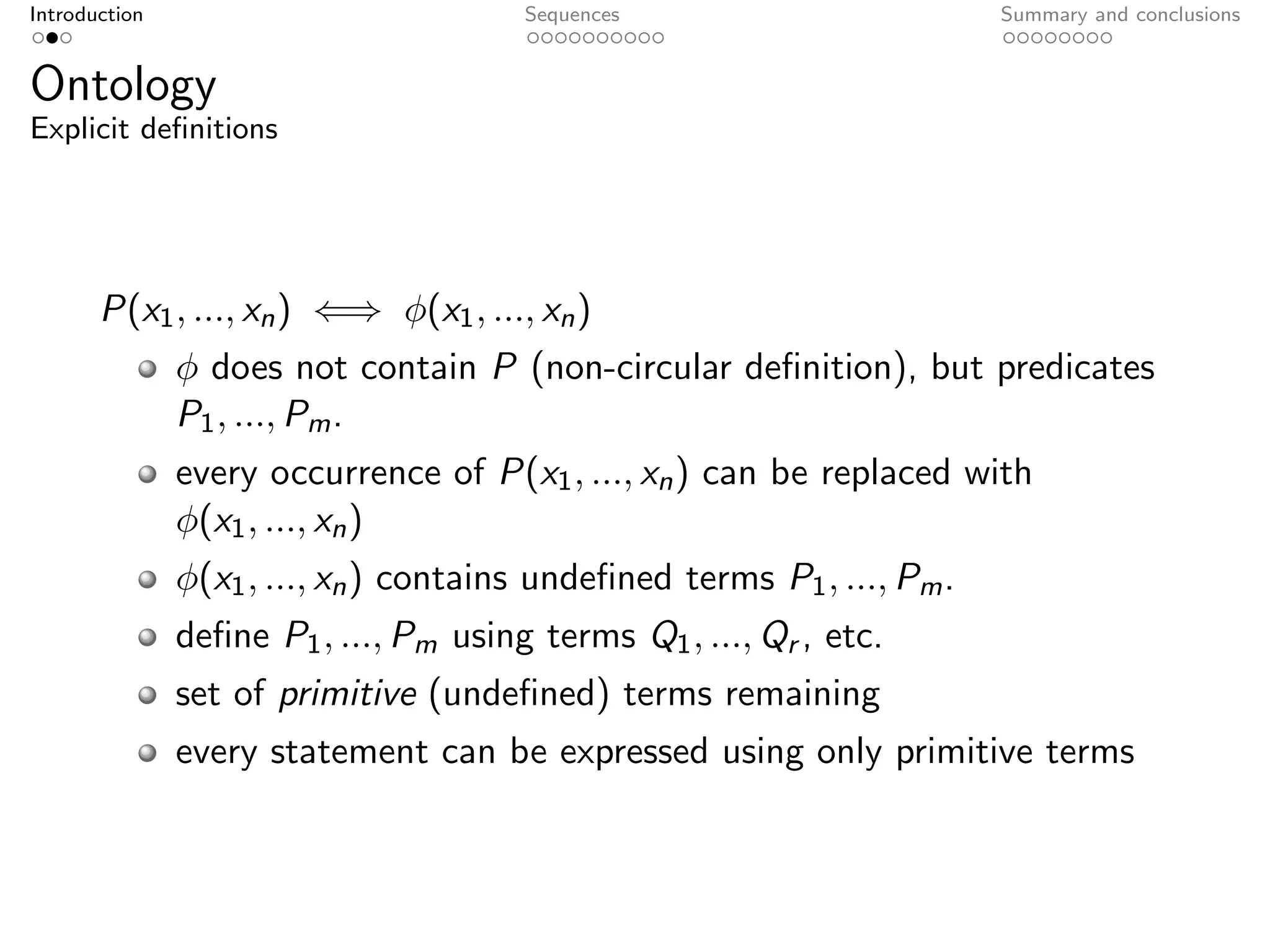
Ontology
Explicit definitions


       P(x1 , ..., xn ) ⇐⇒ φ(x1 , ..., xn )
               φ does not contain P (non-circular definition), but predicates
               P1 , ..., Pm .
               every occurrence of P(x1 , ..., xn ) can be replaced with
               φ(x1 , ..., xn )
               φ(x1 , ..., xn ) contains undefined terms P1 , ..., Pm .
               define P1 , ..., Pm using terms Q1 , ..., Qr , etc.
               set of primitive (undefined) terms remaining
               every statement can be expressed using only primitive terms
Introduction                        Sequences                       Summary and conclusions


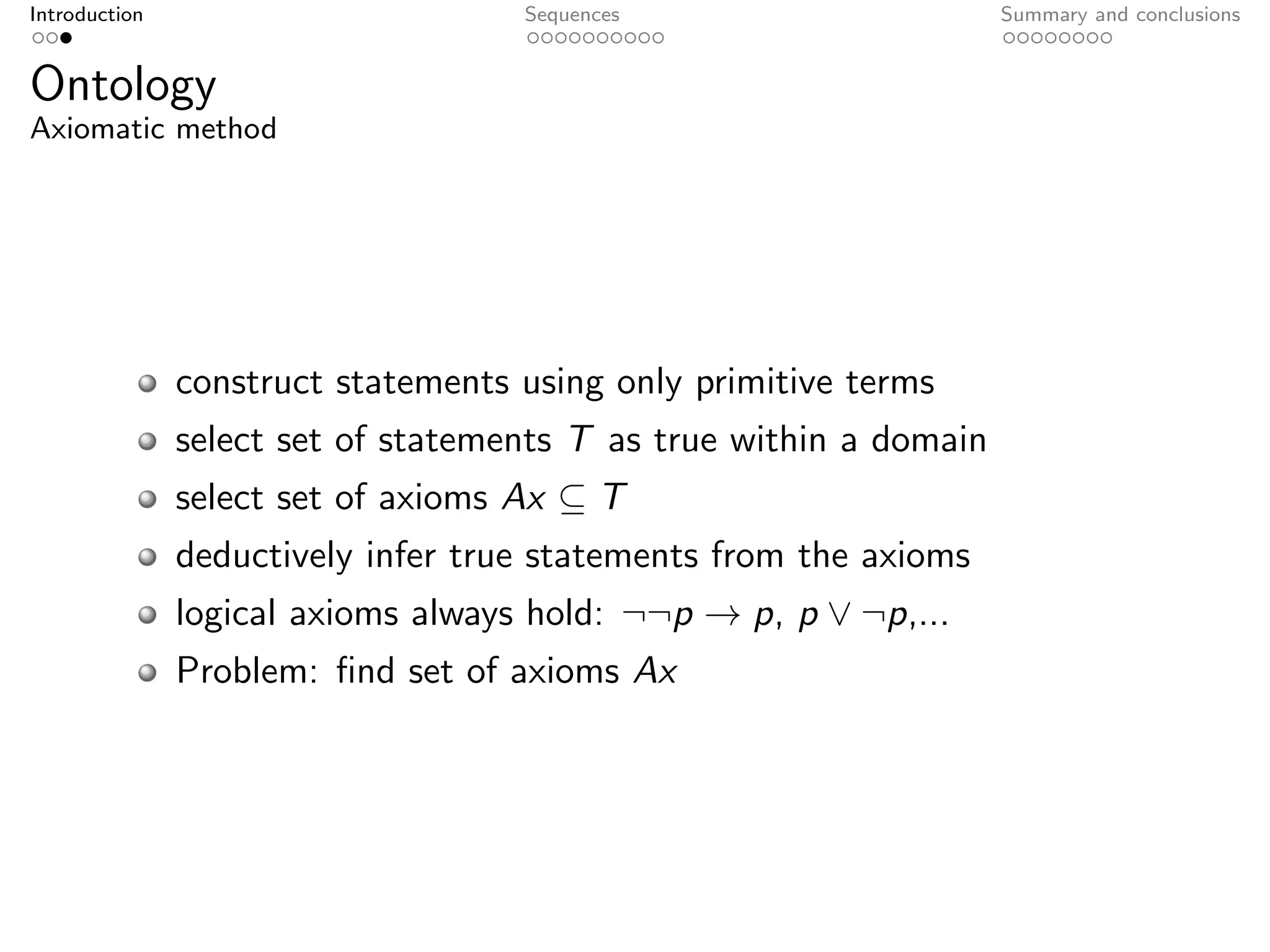
Ontology
Axiomatic method


               construct statements using only primitive terms
               select set of statements T as true within a domain
               select set of axioms Ax ⊆ T
               deductively infer true statements from the axioms
               logical axioms always hold: ¬¬p → p, p ∨ ¬p,...
               Problem: find set of axioms Ax
Introduction                            Sequences                         Summary and conclusions


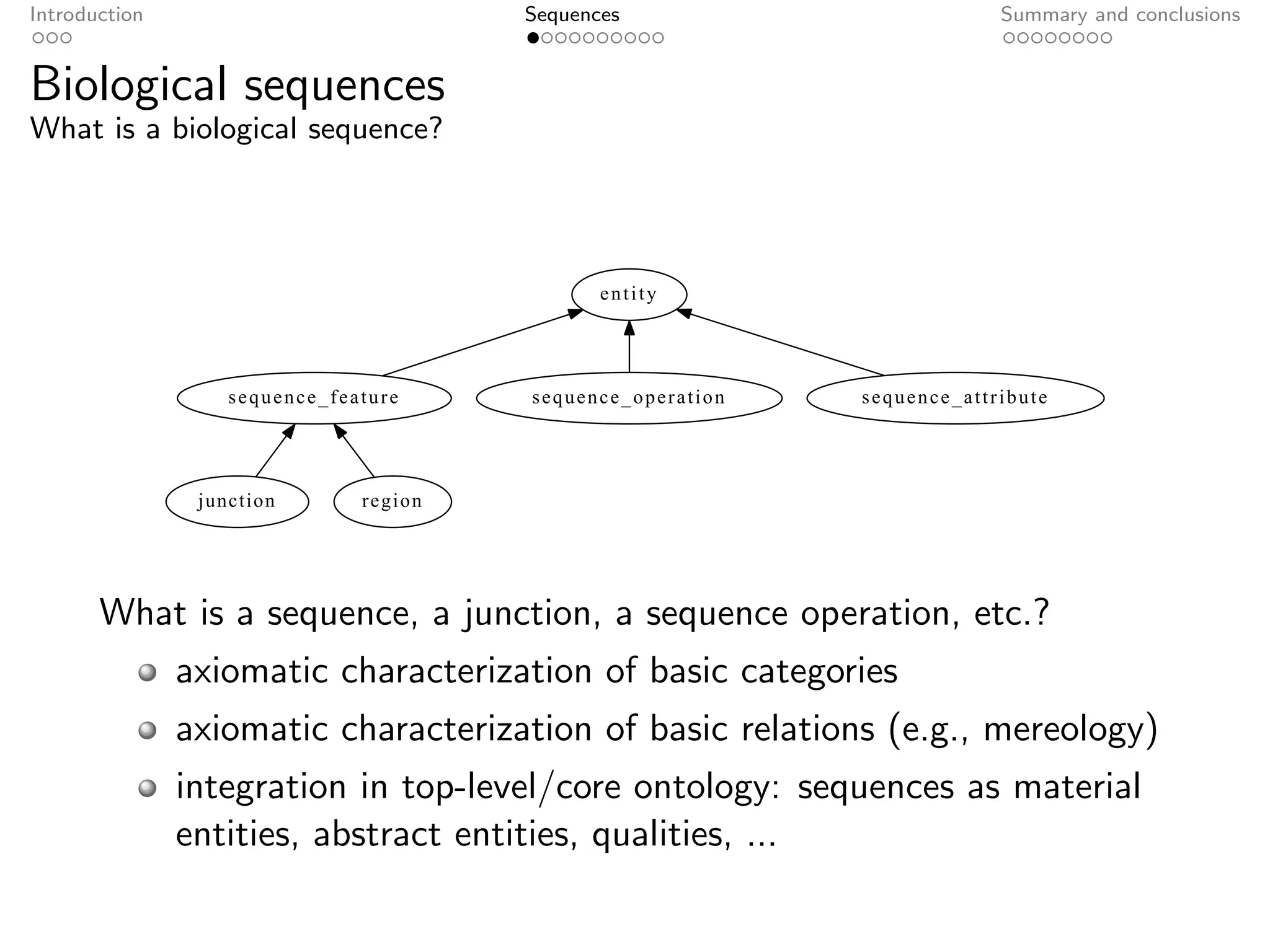
Biological sequences
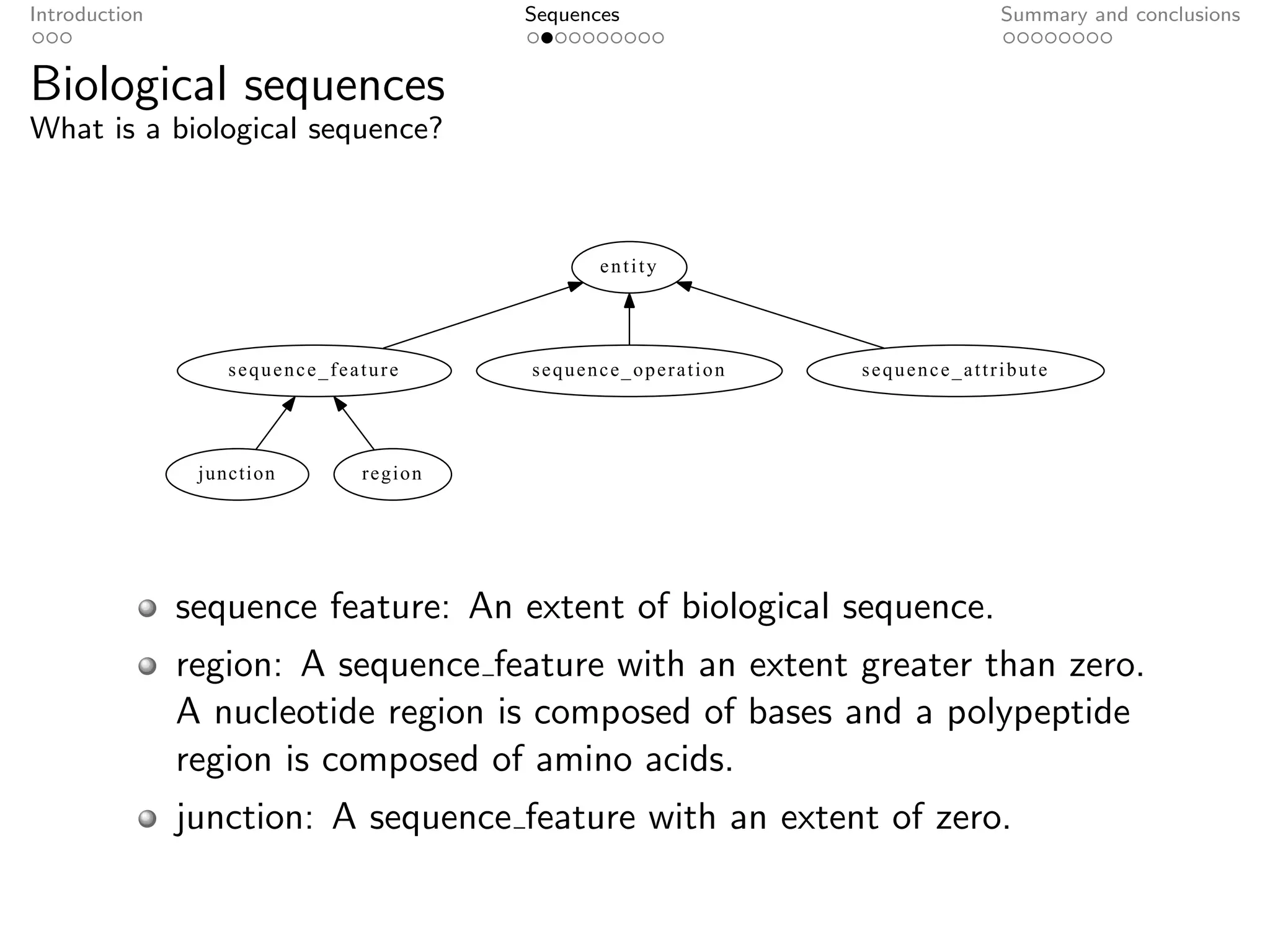
What is a biological sequence?


                                               entity


                   sequence_feature     sequence_operation   sequence_attribute


                junction       region


       What is a sequence, a junction, a sequence operation, etc.?
               axiomatic characterization of basic categories
               axiomatic characterization of basic relations (e.g., mereology)
               integration in top-level/core ontology: sequences as material
               entities, abstract entities, qualities, ...
Introduction                            Sequences                         Summary and conclusions


Biological sequences
What is a biological sequence?


                                               entity


                   sequence_feature     sequence_operation   sequence_attribute


                junction       region


               sequence feature: An extent of biological sequence.
               region: A sequence feature with an extent greater than zero.
               A nucleotide region is composed of bases and a polypeptide
               region is composed of amino acids.
               junction: A sequence feature with an extent of zero.
Introduction                            Sequences                         Summary and conclusions


Biological sequences
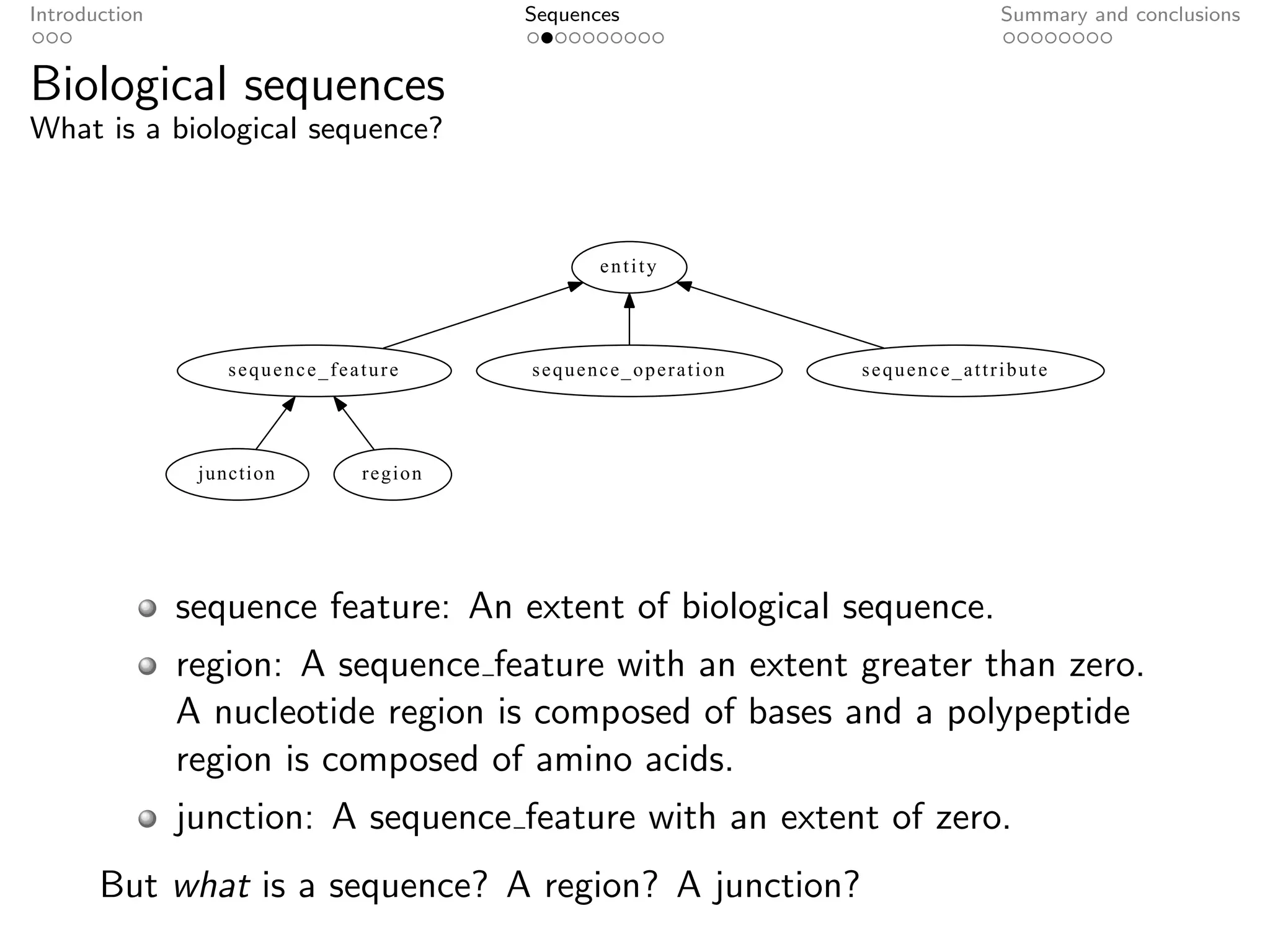
What is a biological sequence?


                                               entity


                   sequence_feature     sequence_operation   sequence_attribute


                junction       region


               sequence feature: An extent of biological sequence.
               region: A sequence feature with an extent greater than zero.
               A nucleotide region is composed of bases and a polypeptide
               region is composed of amino acids.
               junction: A sequence feature with an extent of zero.
       But what is a sequence? A region? A junction?
Introduction                        Sequences                     Summary and conclusions


Biological sequences
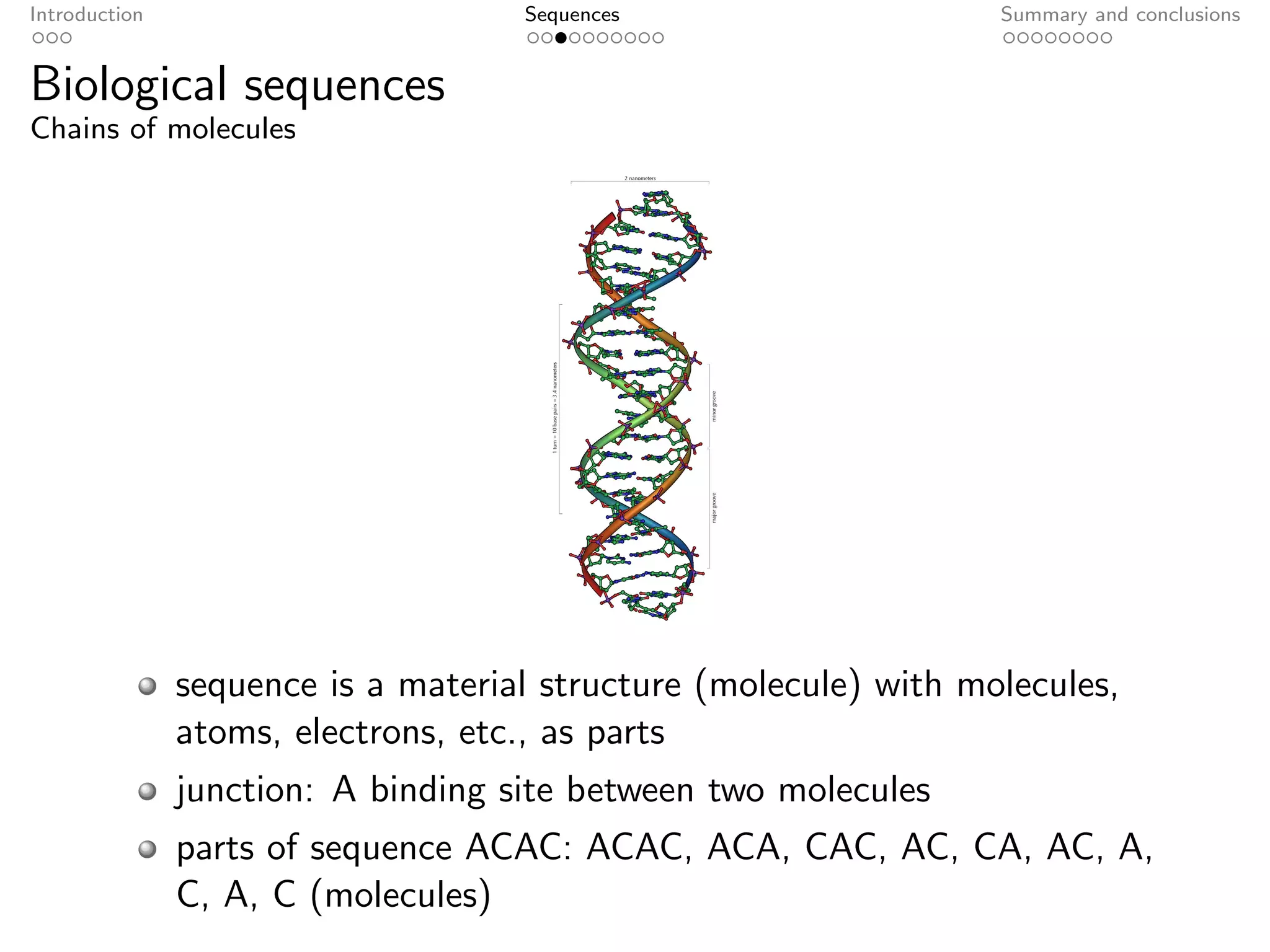
Chains of molecules


               sequence is a material structure (molecule) with molecules,
               atoms, electrons, etc., as parts
               junction: A binding site between two molecules
               parts of sequence ACAC: ACAC, ACA, CAC, AC, CA, AC, A,
               C, A, C (molecules)
Introduction                         Sequences                      Summary and conclusions


Biological sequences
Syntactic entities specifying chains of molecules


       AGTACGTAGTAGCTGCTGCTACGTGCGCTAGCTAGTACGTCA
       CGACGTAGATGCTAGCTGACTCGATGC
       CGATCGATCGTACGTCGACTGATCGTAGCTACGTCGTACGTAG
       CATCGTCAGTTACTGCATGCTCG
               sequence is a material structure, e.g., patterns of ink, on a
               physical storage medium, in a database
               junction: adjacency between symbols
               parts of sequence ACAC: ACAC, ACA, CAC, AC, CA, AC, A,
               C, A, C
               not all sequences are sequences of molecules
Introduction                        Sequences                      Summary and conclusions


Biological sequences
Abstract information-bearing entities


               sequence is an abstract entity, independent of space and time
               only one sequence ACAC, AC, A, C, etc.
               parts of sequence ACAC: ACAC, ACA, CAC, AC, CA, A, C
               AC and AC (tokens) represent the same sequence
               “sequence motif”
               derived from equivalence class of sequence tokens
Introduction           Sequences   Summary and conclusions


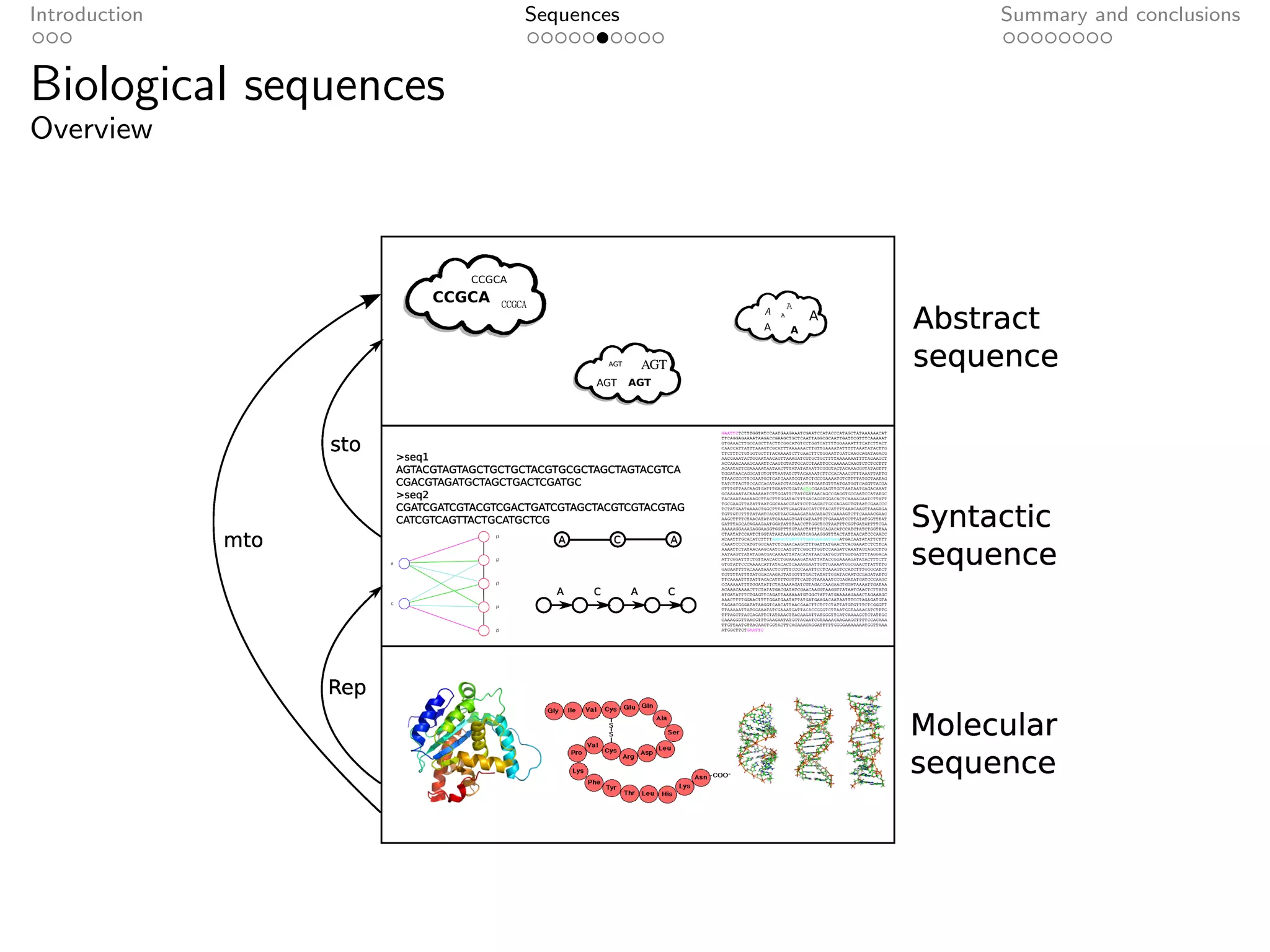
Biological sequences
Overview
Introduction                     Sequences               Summary and conclusions


Biological sequences
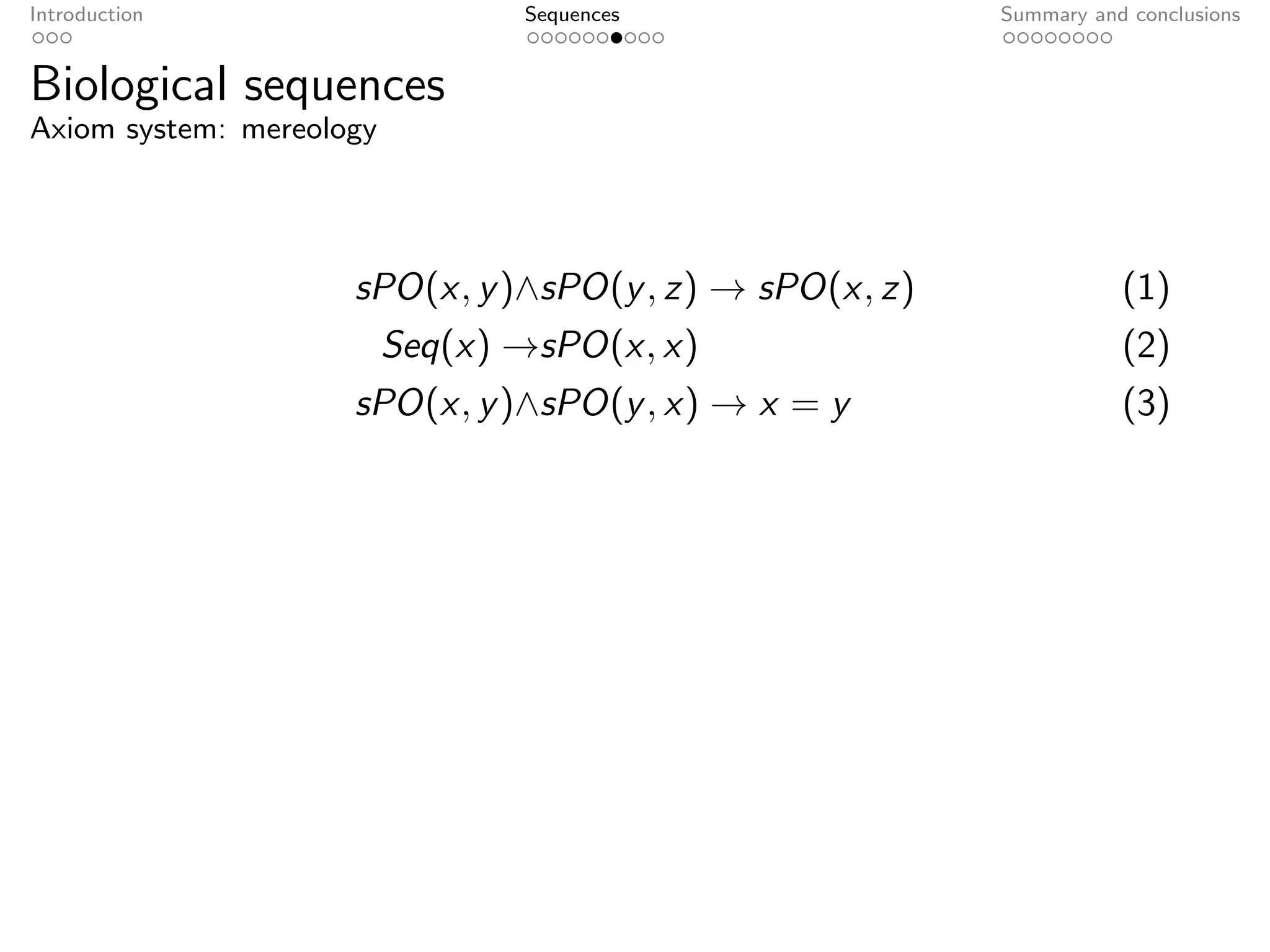
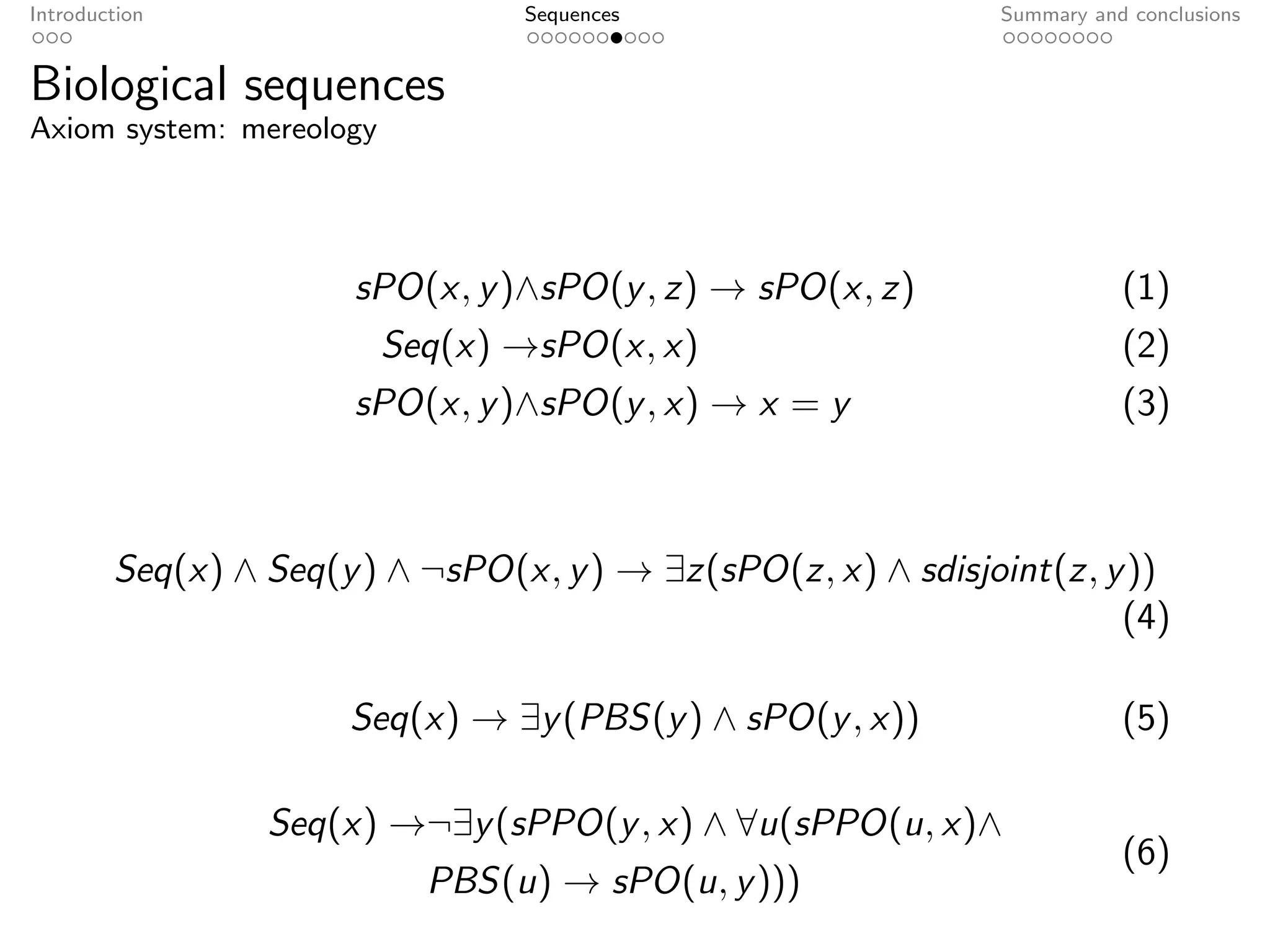
Axiom system: mereology


                     sPO(x, y )∧sPO(y , z) → sPO(x, z)              (1)
                          Seq(x) →sPO(x, x)                         (2)
                     sPO(x, y )∧sPO(y , x) → x = y                  (3)
Introduction                     Sequences                    Summary and conclusions


Biological sequences
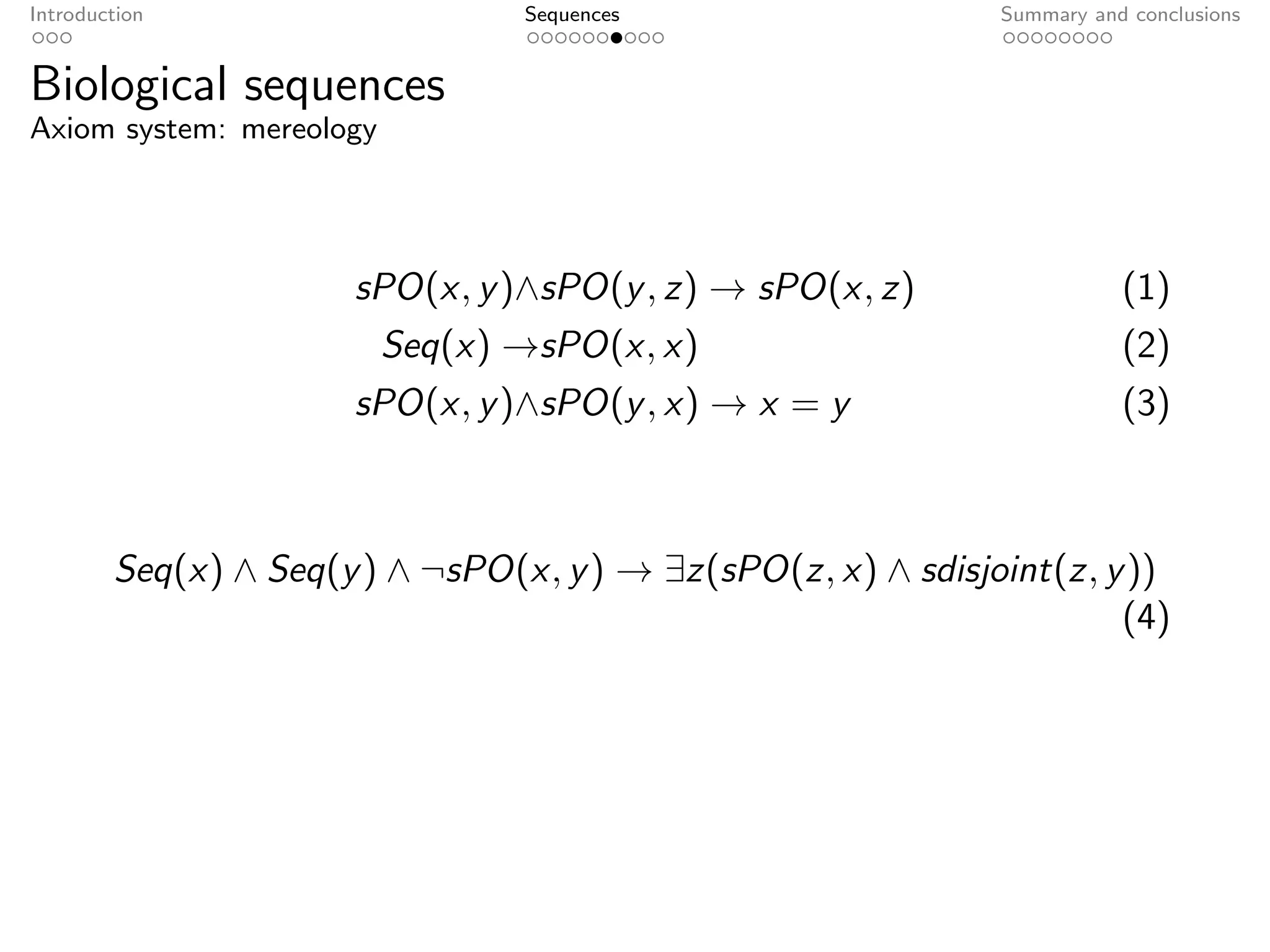
Axiom system: mereology


                      sPO(x, y )∧sPO(y , z) → sPO(x, z)                  (1)
                          Seq(x) →sPO(x, x)                              (2)
                      sPO(x, y )∧sPO(y , x) → x = y                      (3)


        Seq(x) ∧ Seq(y ) ∧ ¬sPO(x, y ) → ∃z(sPO(z, x) ∧ sdisjoint(z, y ))
                                                                      (4)
Introduction                     Sequences                    Summary and conclusions


Biological sequences
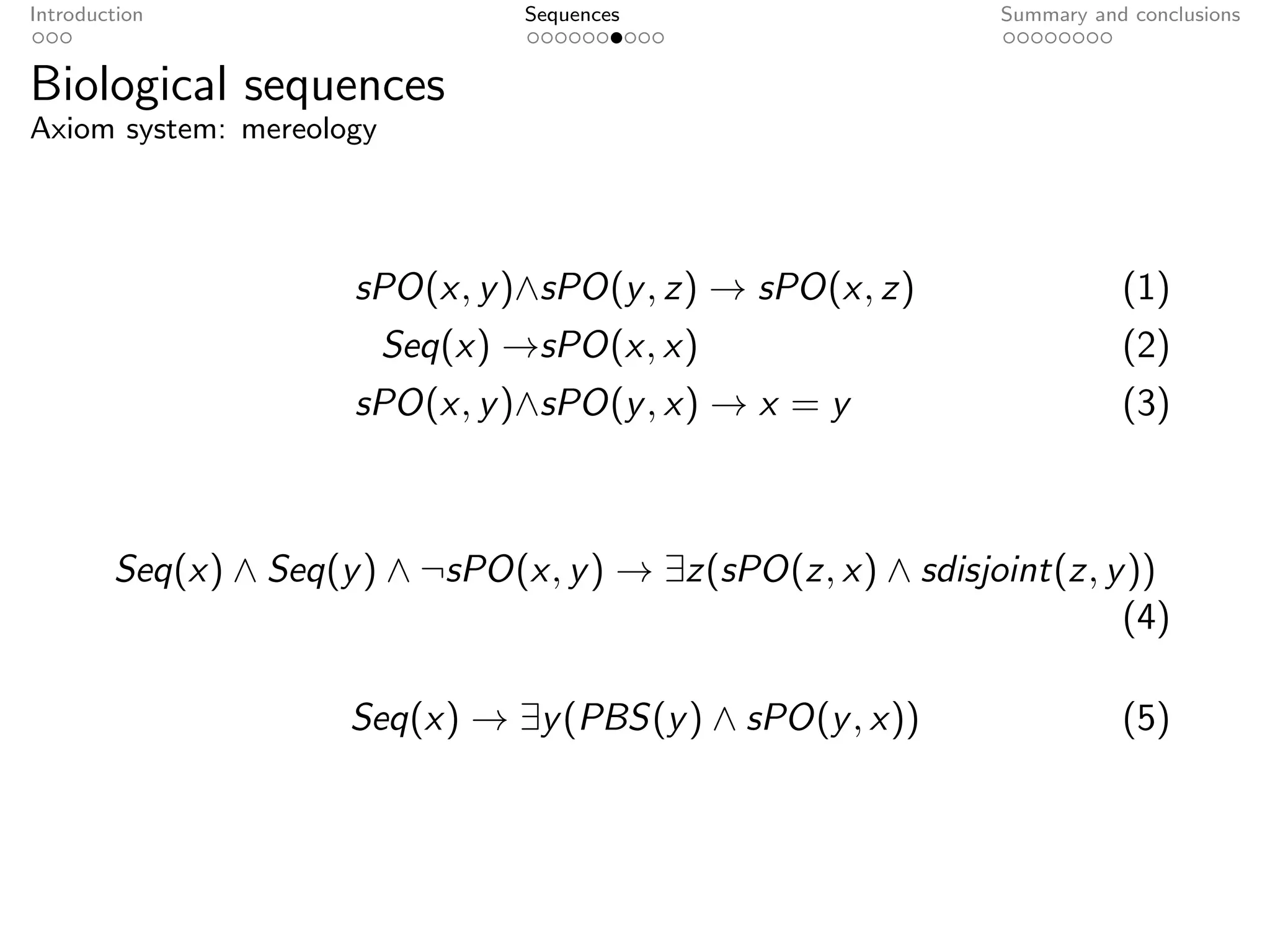
Axiom system: mereology


                      sPO(x, y )∧sPO(y , z) → sPO(x, z)                  (1)
                          Seq(x) →sPO(x, x)                              (2)
                      sPO(x, y )∧sPO(y , x) → x = y                      (3)


        Seq(x) ∧ Seq(y ) ∧ ¬sPO(x, y ) → ∃z(sPO(z, x) ∧ sdisjoint(z, y ))
                                                                      (4)

                      Seq(x) → ∃y (PBS(y ) ∧ sPO(y , x))                 (5)
Introduction                     Sequences                    Summary and conclusions


Biological sequences
Axiom system: mereology


                      sPO(x, y )∧sPO(y , z) → sPO(x, z)                  (1)
                          Seq(x) →sPO(x, x)                              (2)
                      sPO(x, y )∧sPO(y , x) → x = y                      (3)


        Seq(x) ∧ Seq(y ) ∧ ¬sPO(x, y ) → ∃z(sPO(z, x) ∧ sdisjoint(z, y ))
                                                                      (4)

                      Seq(x) → ∃y (PBS(y ) ∧ sPO(y , x))                 (5)

                 Seq(x) →¬∃y (sPPO(y , x) ∧ ∀u(sPPO(u, x)∧
                                                                         (6)
                            PBS(u) → sPO(u, y )))
Introduction                        Sequences   Summary and conclusions


Biological sequences
Axiom system: mereology


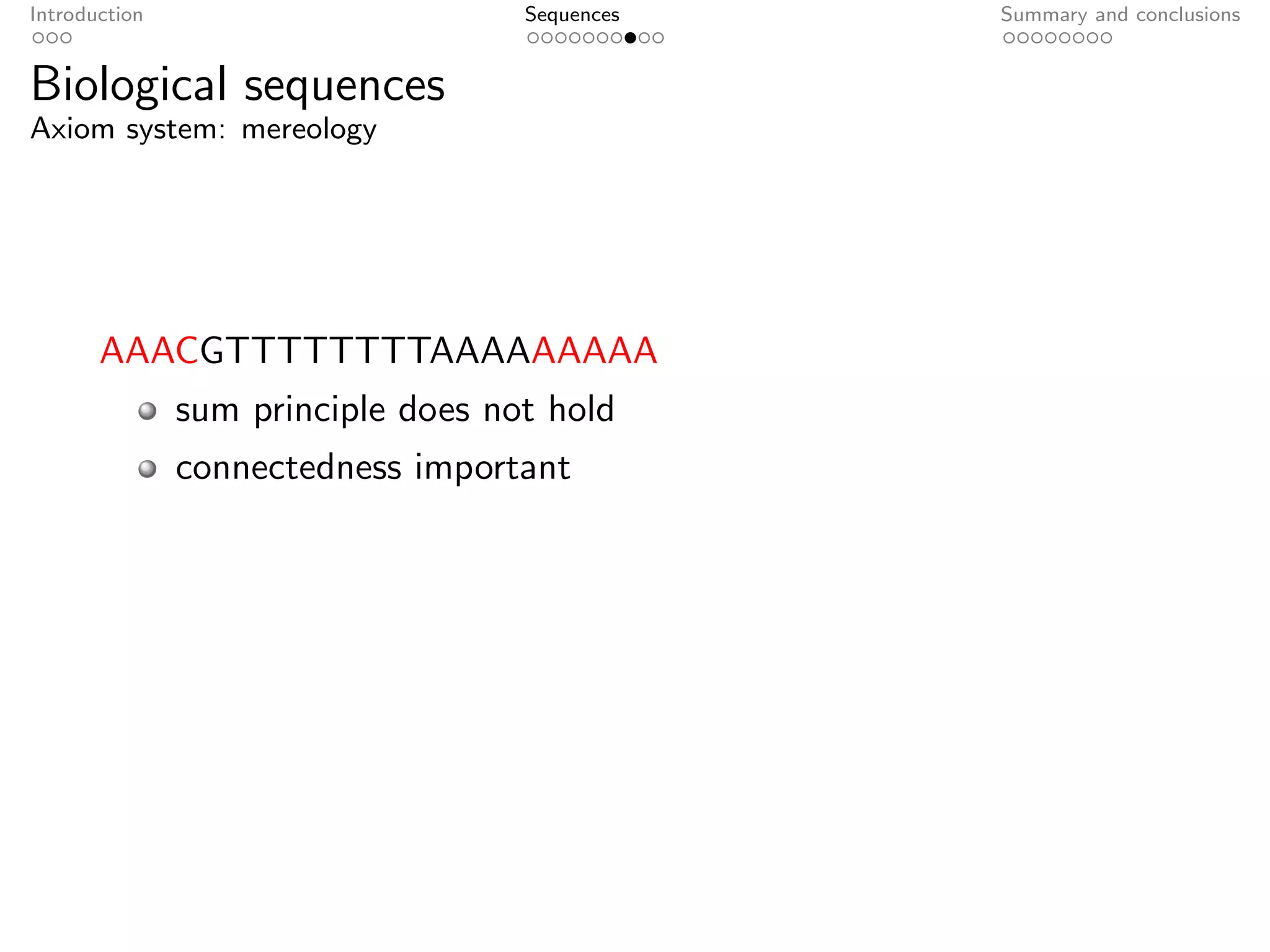
       AAACGTTTTTTTTAAAAAAAAA
               sum principle does not hold
               connectedness important
Introduction                         Sequences                    Summary and conclusions


Biological sequences
Axiom system: mereology


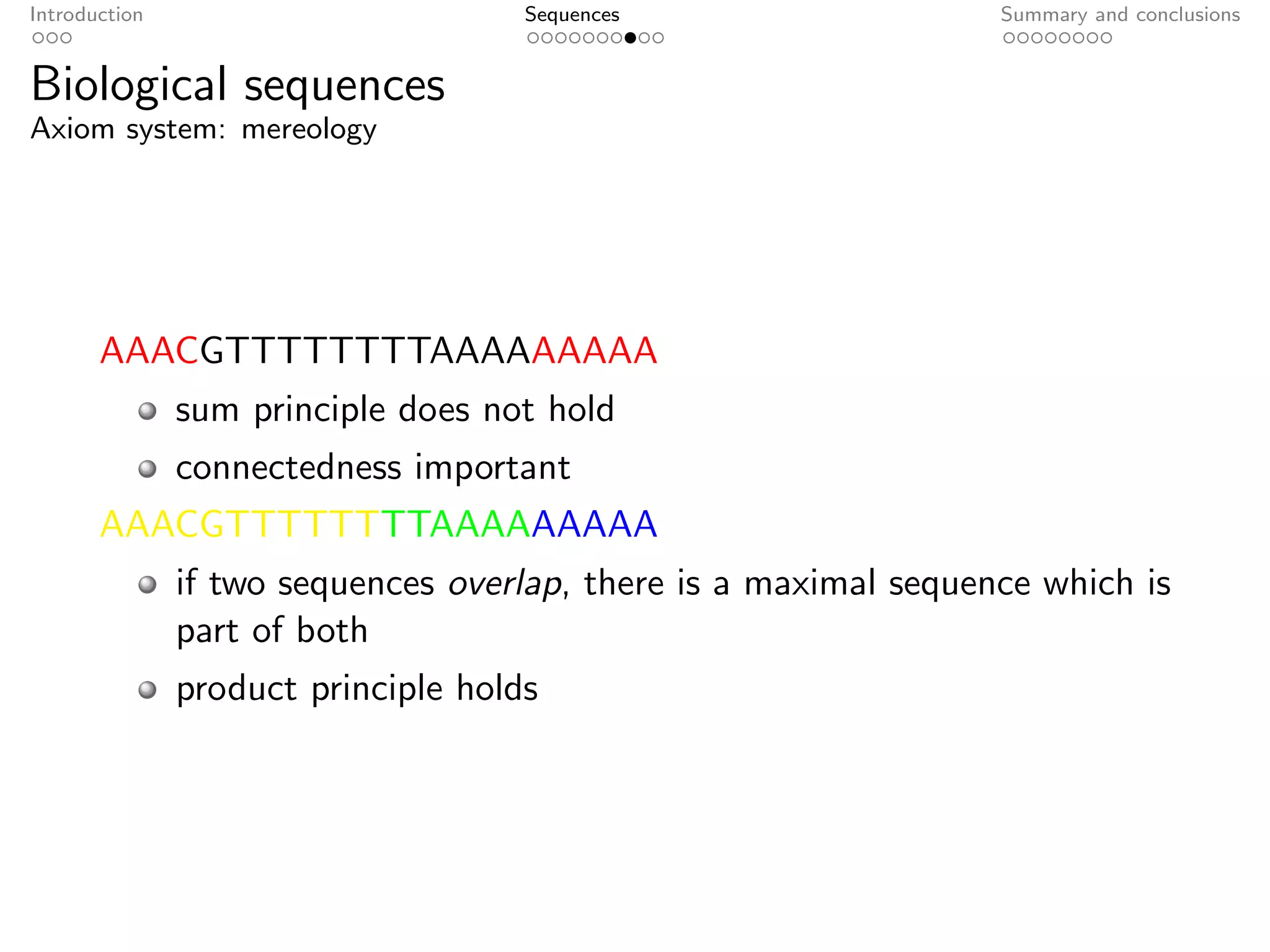
       AAACGTTTTTTTTAAAAAAAAA
               sum principle does not hold
               connectedness important
       AAACGTTTTTTTTAAAAAAAAA
               if two sequences overlap, there is a maximal sequence which is
               part of both
               product principle holds
Introduction                          Sequences                      Summary and conclusions


Biological sequences
Axiom system: mereology


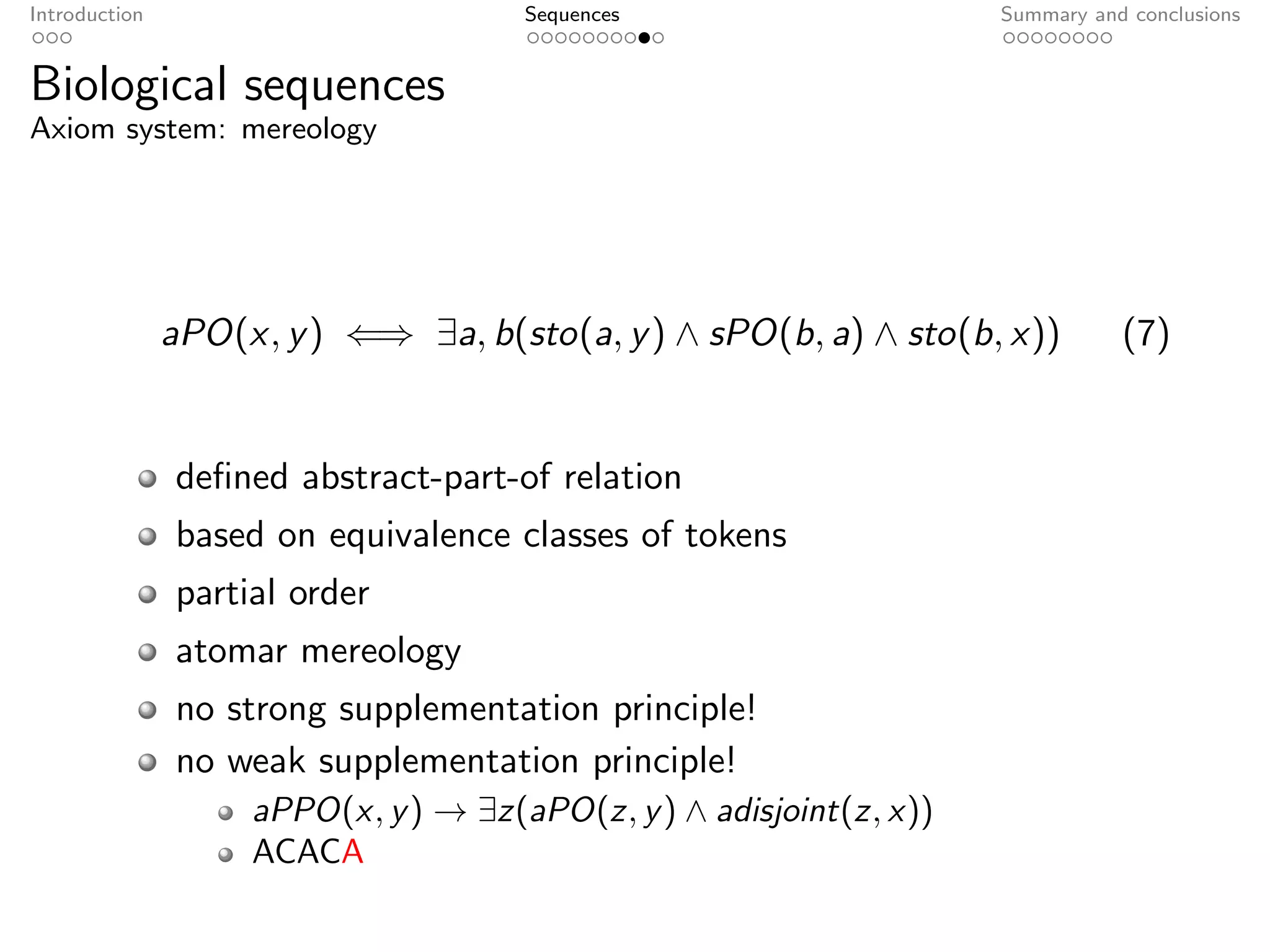
               aPO(x, y ) ⇐⇒ ∃a, b(sto(a, y ) ∧ sPO(b, a) ∧ sto(b, x))          (7)


               defined abstract-part-of relation
               based on equivalence classes of tokens
               partial order
               atomar mereology
               no strong supplementation principle!
               no weak supplementation principle!
                    aPPO(x, y ) → ∃z(aPO(z, y ) ∧ adisjoint(z, x))
                    ACACA
Introduction                         Sequences                     Summary and conclusions


Biological sequences
Axiom system


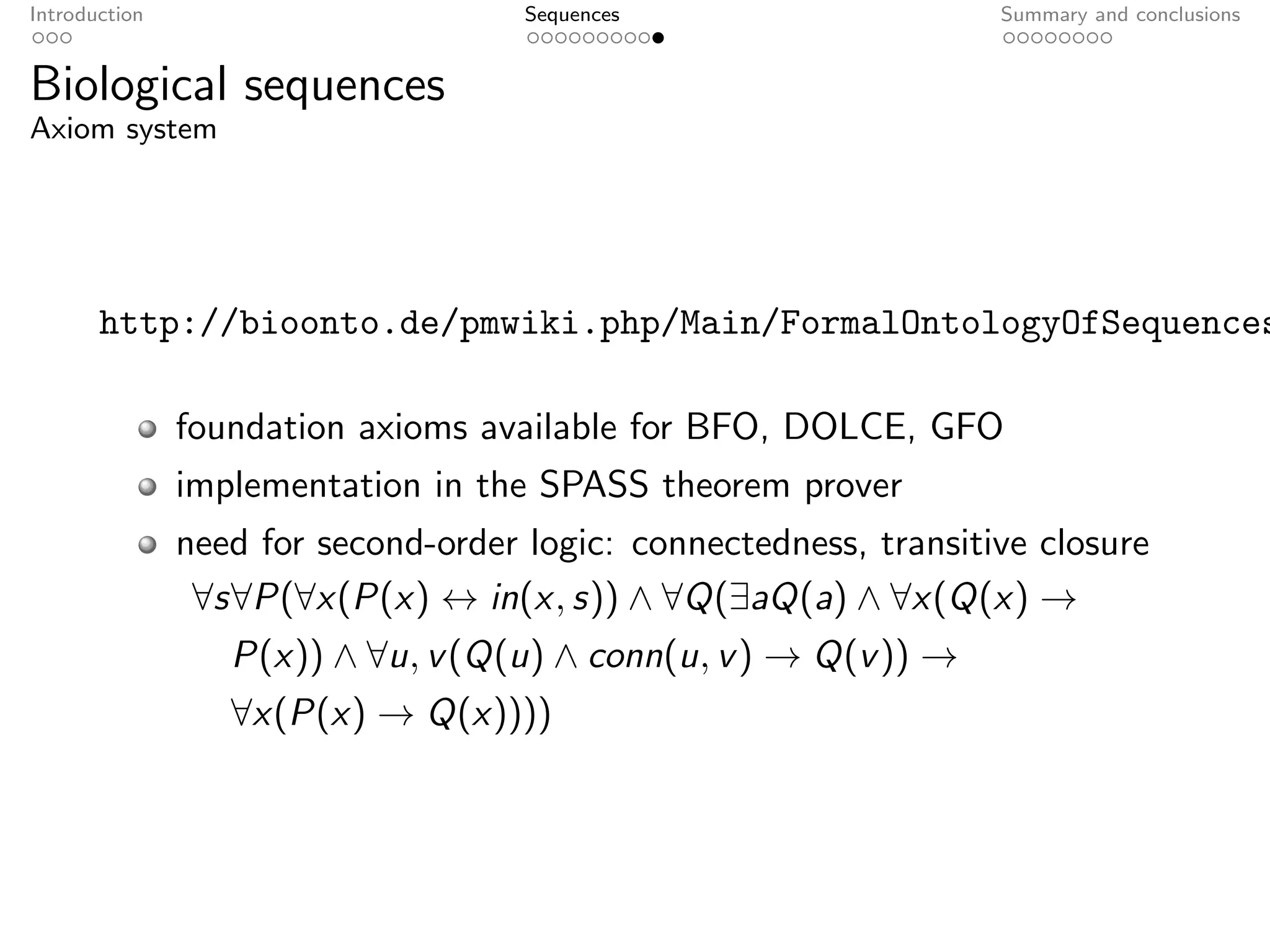
       http://bioonto.de/pmwiki.php/Main/FormalOntologyOfSequences

               foundation axioms available for BFO, DOLCE, GFO
               implementation in the SPASS theorem prover
               need for second-order logic: connectedness, transitive closure
                ∀s∀P(∀x(P(x) ↔ in(x, s)) ∧ ∀Q(∃aQ(a) ∧ ∀x(Q(x) →
                  P(x)) ∧ ∀u, v (Q(u) ∧ conn(u, v ) → Q(v )) →
                  ∀x(P(x) → Q(x))))
Introduction                          Sequences                         Summary and conclusions


Summary and conclusions
Sequence Ontology


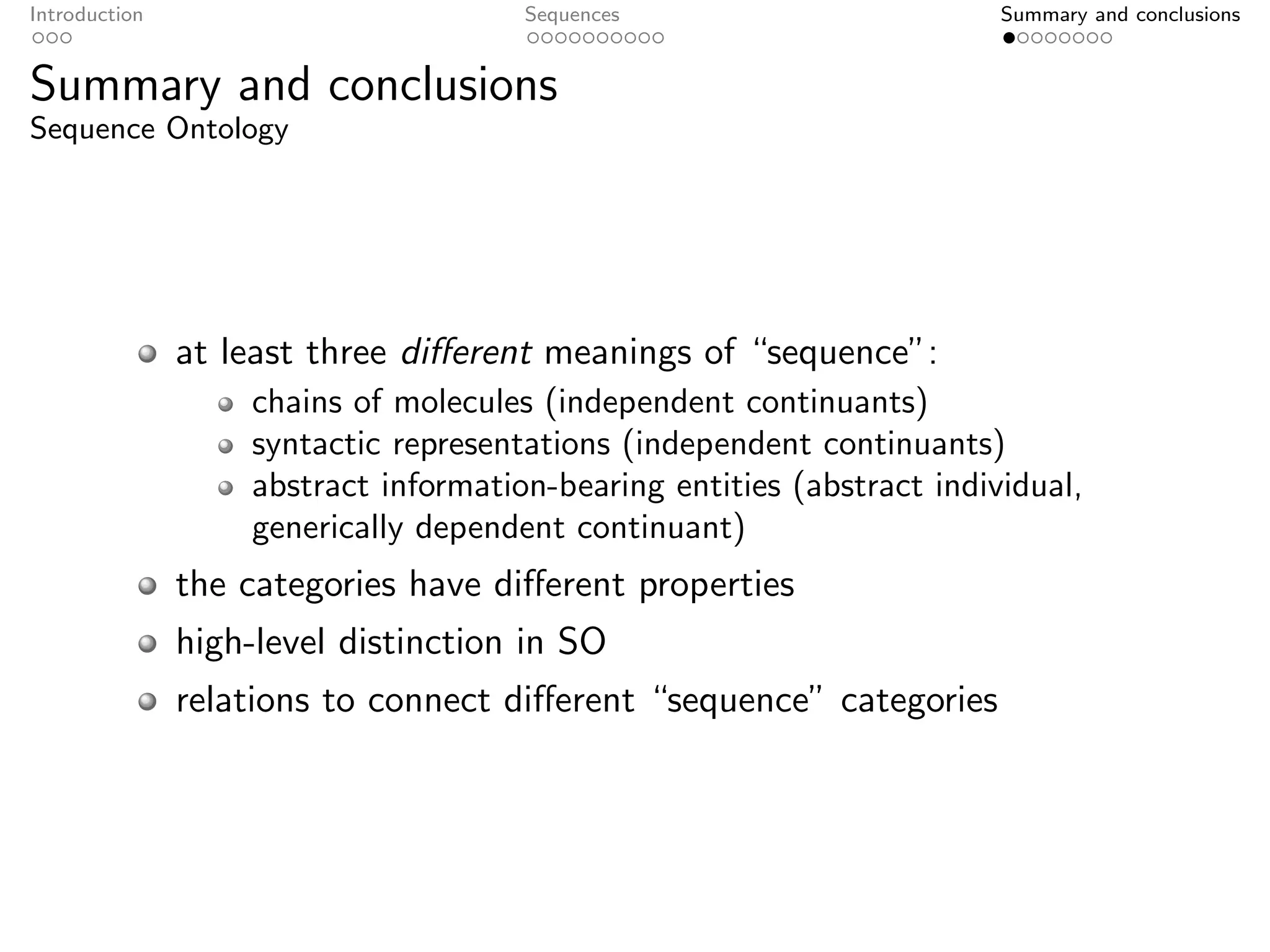
               at least three different meanings of “sequence”:
                   chains of molecules (independent continuants)
                   syntactic representations (independent continuants)
                   abstract information-bearing entities (abstract individual,
                   generically dependent continuant)
               the categories have different properties
               high-level distinction in SO
               relations to connect different “sequence” categories
Introduction                         Sequences                     Summary and conclusions


Summary and conclusions
Axioms for relations


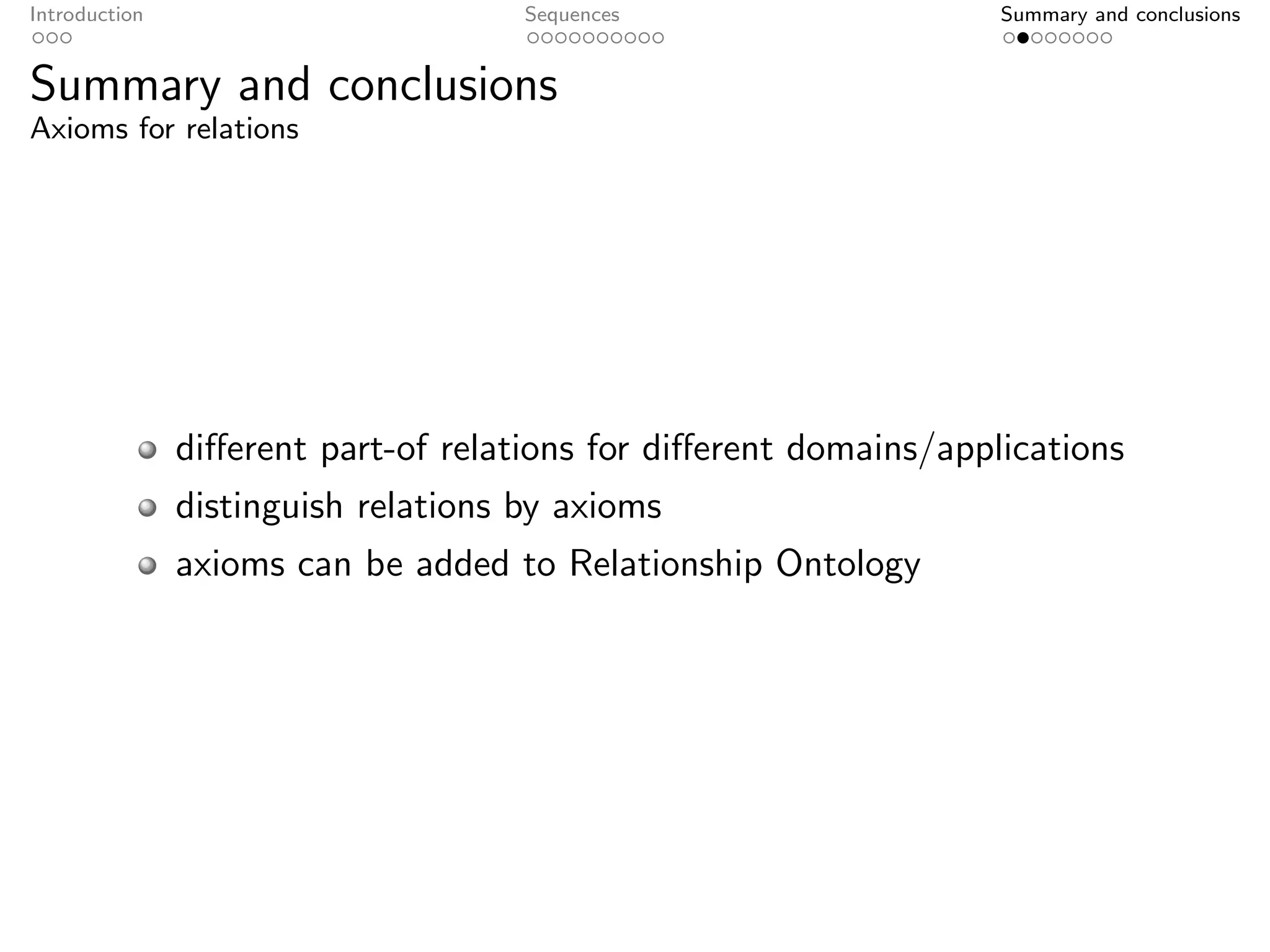
               different part-of relations for different domains/applications
               distinguish relations by axioms
               axioms can be added to Relationship Ontology
Introduction                        Sequences                        Summary and conclusions


Summary and conclusions
Strong axiom systems


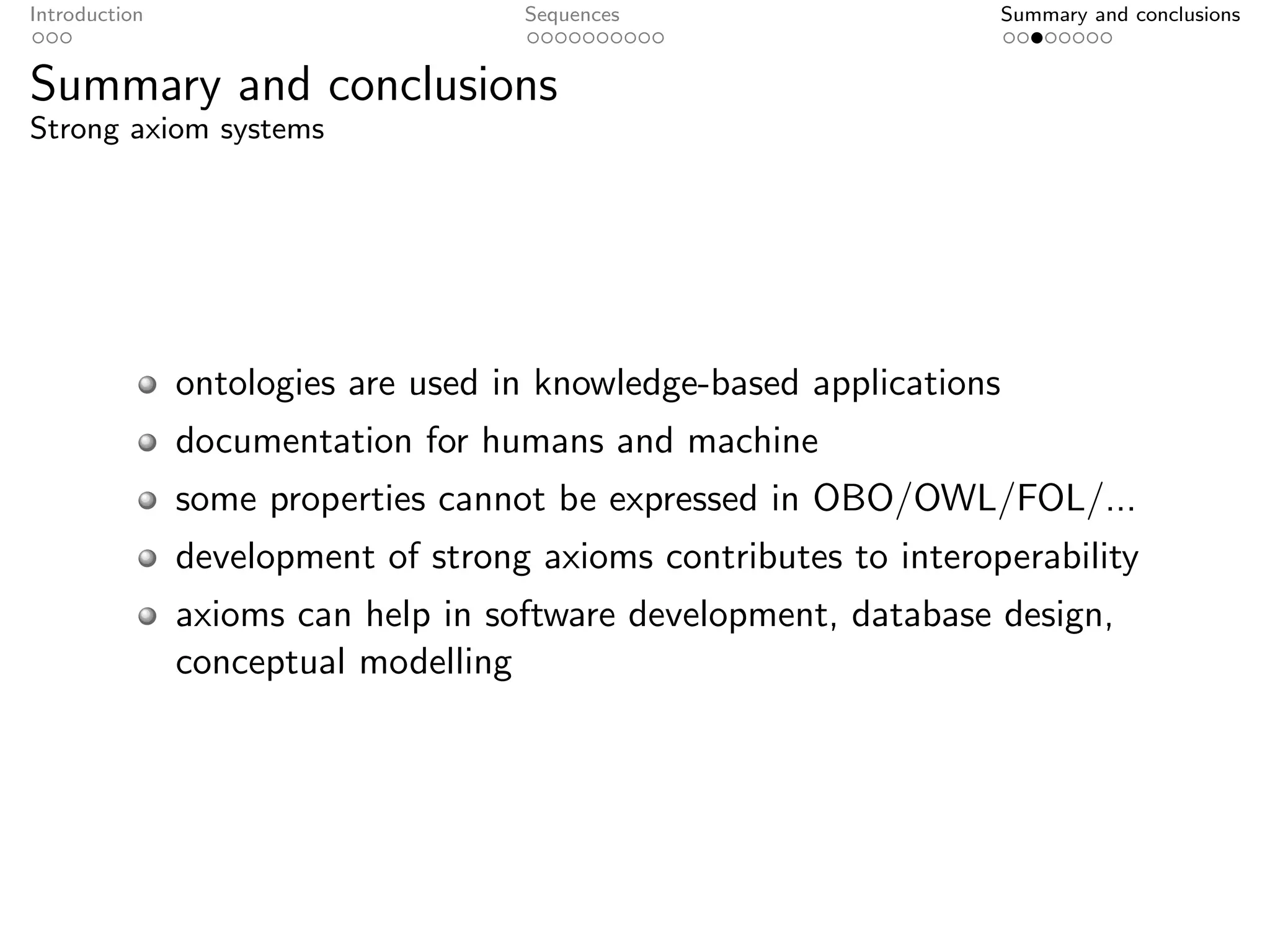
               ontologies are used in knowledge-based applications
               documentation for humans and machine
               some properties cannot be expressed in OBO/OWL/FOL/...
               development of strong axioms contributes to interoperability
               axioms can help in software development, database design,
               conceptual modelling
Introduction                     Sequences   Summary and conclusions


Acknowledgements


               Heinrich Herre
               Janet Kelso
               three reviewers
Introduction     Sequences   Summary and conclusions


               Thank you!
Introduction                          Sequences         Summary and conclusions


Implementation
Overview


               second-order logics
               quantification over predicates
               formalize minimality and closures
               satisfiability is undecidable
               no sound and complete deductive system
Introduction                Sequences              Summary and conclusions


Implementation
FOL fragment in SPASS


       predicates[(Seq,1),(Mol,1),(ASeq,1),(sPO,2),(PO,2),(aPO,2),
       (binds,2),(Rep,2),(sto,2),(mto,2),
       (sPPO,2),(PBS,1),(soverlap,2),(sdisjoint,2),
       (between,4),(end,3),(in,2),(Jun,1),(conn,2),(conn2,2),
       (PPO,2),(At,1),(overlap,2),(disjoint,2),
       (CSeq,1),(LSeq,1),(DSeq,1),(DMol,1),(equivalent,2),
       (first,3),(last,3)].
Introduction                Sequences              Summary and conclusions


Implementation
FOL fragment in SPASS


       formula(forall([X],implies(Seq(X),sPO(X,X)))).
       formula(forall([X,Y],implies(and(sPO(X,Y),sPO(Y,X)),
       equal(X,Y)))).
       formula(forall([X,Y,Z],implies(and(sPO(X,Y),
       sPO(Y,Z)),sPO(X,Z)))).
       formula(forall([X],implies(Seq(X),exists([Y],
       and(PBS(Y),sPO(Y,X)))))).

A formal ontology of sequences

  • 1.
    Introduction Sequences Summary and conclusions A formal ontology of sequences Robert Hoehndorf1,2 , Janet Kelso2 , Heinrich Herre1 1 Institute for Informatics and Research Group Ontologies in Medicine, Institute for Medical Informatics, Statistics and Epidemiology, University of Leipzig 2 Department of Evolutionary Genetics, Max-Planck-Institute for Evolutionary Anthropology
  • 2.
    Introduction Sequences Summary and conclusions Ontology ontology (philosophy) studies the nature of existence and categories of being an ontology (computer science) is the “explicit specification of a conceptualization of a domain” [Gruber, 1993] specifies the meaning of terms in a vocabulary
  • 3.
    Introduction Sequences Summary and conclusions Ontology Explicit definitions P(x1 , ..., xn ) ⇐⇒ φ(x1 , ..., xn ) φ does not contain P (non-circular definition), but predicates P1 , ..., Pm . every occurrence of P(x1 , ..., xn ) can be replaced with φ(x1 , ..., xn ) φ(x1 , ..., xn ) contains undefined terms P1 , ..., Pm . define P1 , ..., Pm using terms Q1 , ..., Qr , etc. set of primitive (undefined) terms remaining every statement can be expressed using only primitive terms
  • 4.
    Introduction Sequences Summary and conclusions Ontology Axiomatic method construct statements using only primitive terms select set of statements T as true within a domain select set of axioms Ax ⊆ T deductively infer true statements from the axioms logical axioms always hold: ¬¬p → p, p ∨ ¬p,... Problem: find set of axioms Ax
  • 5.
    Introduction Sequences Summary and conclusions Biological sequences What is a biological sequence? entity sequence_feature sequence_operation sequence_attribute junction region What is a sequence, a junction, a sequence operation, etc.? axiomatic characterization of basic categories axiomatic characterization of basic relations (e.g., mereology) integration in top-level/core ontology: sequences as material entities, abstract entities, qualities, ...
  • 6.
    Introduction Sequences Summary and conclusions Biological sequences What is a biological sequence? entity sequence_feature sequence_operation sequence_attribute junction region sequence feature: An extent of biological sequence. region: A sequence feature with an extent greater than zero. A nucleotide region is composed of bases and a polypeptide region is composed of amino acids. junction: A sequence feature with an extent of zero.
  • 7.
    Introduction Sequences Summary and conclusions Biological sequences What is a biological sequence? entity sequence_feature sequence_operation sequence_attribute junction region sequence feature: An extent of biological sequence. region: A sequence feature with an extent greater than zero. A nucleotide region is composed of bases and a polypeptide region is composed of amino acids. junction: A sequence feature with an extent of zero. But what is a sequence? A region? A junction?
  • 8.
    Introduction Sequences Summary and conclusions Biological sequences Chains of molecules sequence is a material structure (molecule) with molecules, atoms, electrons, etc., as parts junction: A binding site between two molecules parts of sequence ACAC: ACAC, ACA, CAC, AC, CA, AC, A, C, A, C (molecules)
  • 9.
    Introduction Sequences Summary and conclusions Biological sequences Syntactic entities specifying chains of molecules AGTACGTAGTAGCTGCTGCTACGTGCGCTAGCTAGTACGTCA CGACGTAGATGCTAGCTGACTCGATGC CGATCGATCGTACGTCGACTGATCGTAGCTACGTCGTACGTAG CATCGTCAGTTACTGCATGCTCG sequence is a material structure, e.g., patterns of ink, on a physical storage medium, in a database junction: adjacency between symbols parts of sequence ACAC: ACAC, ACA, CAC, AC, CA, AC, A, C, A, C not all sequences are sequences of molecules
  • 10.
    Introduction Sequences Summary and conclusions Biological sequences Abstract information-bearing entities sequence is an abstract entity, independent of space and time only one sequence ACAC, AC, A, C, etc. parts of sequence ACAC: ACAC, ACA, CAC, AC, CA, A, C AC and AC (tokens) represent the same sequence “sequence motif” derived from equivalence class of sequence tokens
  • 11.
    Introduction Sequences Summary and conclusions Biological sequences Overview
  • 12.
    Introduction Sequences Summary and conclusions Biological sequences Axiom system: mereology sPO(x, y )∧sPO(y , z) → sPO(x, z) (1) Seq(x) →sPO(x, x) (2) sPO(x, y )∧sPO(y , x) → x = y (3)
  • 13.
    Introduction Sequences Summary and conclusions Biological sequences Axiom system: mereology sPO(x, y )∧sPO(y , z) → sPO(x, z) (1) Seq(x) →sPO(x, x) (2) sPO(x, y )∧sPO(y , x) → x = y (3) Seq(x) ∧ Seq(y ) ∧ ¬sPO(x, y ) → ∃z(sPO(z, x) ∧ sdisjoint(z, y )) (4)
  • 14.
    Introduction Sequences Summary and conclusions Biological sequences Axiom system: mereology sPO(x, y )∧sPO(y , z) → sPO(x, z) (1) Seq(x) →sPO(x, x) (2) sPO(x, y )∧sPO(y , x) → x = y (3) Seq(x) ∧ Seq(y ) ∧ ¬sPO(x, y ) → ∃z(sPO(z, x) ∧ sdisjoint(z, y )) (4) Seq(x) → ∃y (PBS(y ) ∧ sPO(y , x)) (5)
  • 15.
    Introduction Sequences Summary and conclusions Biological sequences Axiom system: mereology sPO(x, y )∧sPO(y , z) → sPO(x, z) (1) Seq(x) →sPO(x, x) (2) sPO(x, y )∧sPO(y , x) → x = y (3) Seq(x) ∧ Seq(y ) ∧ ¬sPO(x, y ) → ∃z(sPO(z, x) ∧ sdisjoint(z, y )) (4) Seq(x) → ∃y (PBS(y ) ∧ sPO(y , x)) (5) Seq(x) →¬∃y (sPPO(y , x) ∧ ∀u(sPPO(u, x)∧ (6) PBS(u) → sPO(u, y )))
  • 16.
    Introduction Sequences Summary and conclusions Biological sequences Axiom system: mereology AAACGTTTTTTTTAAAAAAAAA sum principle does not hold connectedness important
  • 17.
    Introduction Sequences Summary and conclusions Biological sequences Axiom system: mereology AAACGTTTTTTTTAAAAAAAAA sum principle does not hold connectedness important AAACGTTTTTTTTAAAAAAAAA if two sequences overlap, there is a maximal sequence which is part of both product principle holds
  • 18.
    Introduction Sequences Summary and conclusions Biological sequences Axiom system: mereology aPO(x, y ) ⇐⇒ ∃a, b(sto(a, y ) ∧ sPO(b, a) ∧ sto(b, x)) (7) defined abstract-part-of relation based on equivalence classes of tokens partial order atomar mereology no strong supplementation principle! no weak supplementation principle! aPPO(x, y ) → ∃z(aPO(z, y ) ∧ adisjoint(z, x)) ACACA
  • 19.
    Introduction Sequences Summary and conclusions Biological sequences Axiom system http://bioonto.de/pmwiki.php/Main/FormalOntologyOfSequences foundation axioms available for BFO, DOLCE, GFO implementation in the SPASS theorem prover need for second-order logic: connectedness, transitive closure ∀s∀P(∀x(P(x) ↔ in(x, s)) ∧ ∀Q(∃aQ(a) ∧ ∀x(Q(x) → P(x)) ∧ ∀u, v (Q(u) ∧ conn(u, v ) → Q(v )) → ∀x(P(x) → Q(x))))
  • 20.
    Introduction Sequences Summary and conclusions Summary and conclusions Sequence Ontology at least three different meanings of “sequence”: chains of molecules (independent continuants) syntactic representations (independent continuants) abstract information-bearing entities (abstract individual, generically dependent continuant) the categories have different properties high-level distinction in SO relations to connect different “sequence” categories
  • 21.
    Introduction Sequences Summary and conclusions Summary and conclusions Axioms for relations different part-of relations for different domains/applications distinguish relations by axioms axioms can be added to Relationship Ontology
  • 22.
    Introduction Sequences Summary and conclusions Summary and conclusions Strong axiom systems ontologies are used in knowledge-based applications documentation for humans and machine some properties cannot be expressed in OBO/OWL/FOL/... development of strong axioms contributes to interoperability axioms can help in software development, database design, conceptual modelling
  • 23.
    Introduction Sequences Summary and conclusions Acknowledgements Heinrich Herre Janet Kelso three reviewers
  • 24.
    Introduction Sequences Summary and conclusions Thank you!
  • 25.
    Introduction Sequences Summary and conclusions Implementation Overview second-order logics quantification over predicates formalize minimality and closures satisfiability is undecidable no sound and complete deductive system
  • 26.
    Introduction Sequences Summary and conclusions Implementation FOL fragment in SPASS predicates[(Seq,1),(Mol,1),(ASeq,1),(sPO,2),(PO,2),(aPO,2), (binds,2),(Rep,2),(sto,2),(mto,2), (sPPO,2),(PBS,1),(soverlap,2),(sdisjoint,2), (between,4),(end,3),(in,2),(Jun,1),(conn,2),(conn2,2), (PPO,2),(At,1),(overlap,2),(disjoint,2), (CSeq,1),(LSeq,1),(DSeq,1),(DMol,1),(equivalent,2), (first,3),(last,3)].
  • 27.
    Introduction Sequences Summary and conclusions Implementation FOL fragment in SPASS formula(forall([X],implies(Seq(X),sPO(X,X)))). formula(forall([X,Y],implies(and(sPO(X,Y),sPO(Y,X)), equal(X,Y)))). formula(forall([X,Y,Z],implies(and(sPO(X,Y), sPO(Y,Z)),sPO(X,Z)))). formula(forall([X],implies(Seq(X),exists([Y], and(PBS(Y),sPO(Y,X)))))).