A Formal Model for Enabling RFIDin Pharmaceutical Supply Chains44th Hawai’i Int’l Conference on System Sciences4-7 Jan, 2011 – Koloa, Kauai, HawaiiMatthieu-P. SchapranowHasso Plattner Institute
AgendaKey Facts about the Hasso Plattner InstituteEuropean Pharmaceutical Supply ChainFormal ModelQuantitative Analysis of Service ProviderContributionsHICSS11, Enabling RFID in Pharmaceutical Supply Chains, Schapranow, Jan 6, 20112
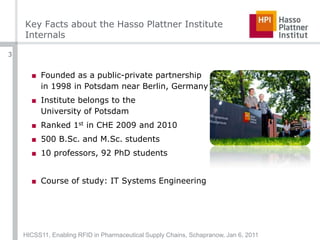
Key Facts about the Hasso Plattner InstituteInternalsFounded as a public-private partnershipin 1998 in Potsdam near Berlin, GermanyInstitute belongs to theUniversity of PotsdamRanked 1st in CHE 2009 and 2010500 B.Sc. and M.Sc. students10 professors, 92 PhD studentsCourse of study: IT Systems Engineering HICSS11, Enabling RFID in Pharmaceutical Supply Chains, Schapranow, Jan 6, 20113
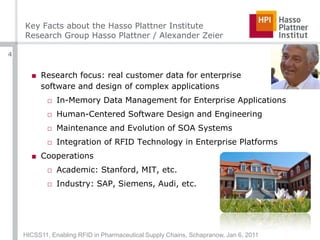
Key Facts about the Hasso Plattner Institute Research Group Hasso Plattner / Alexander ZeierResearch focus: real customer data for enterprisesoftware and design of complex applicationsIn-Memory Data Management for Enterprise Applications  Human-Centered Software Design and Engineering Maintenance and Evolution of SOA Systems Integration of RFID Technology in Enterprise Platforms  CooperationsAcademic: Stanford, MIT, etc.Industry: SAP, Siemens, Audi, etc.HICSS11, Enabling RFID in Pharmaceutical Supply Chains, Schapranow, Jan 6, 20114
Key Facts about the Hasso Plattner InstituteWhat can we do for you?Network between industry and academia,e.g. European section of the CurriculumRFID seminars for graduate / undergraduate studentsTrends & concepts lecture (Prof. Hasso Plattner)Enterprise Application Architecture LaboratoryEnterprise software, e.g. SAP, Microsoft, etc.Equipped RFID Lab, e.g. deister electronic, noFilis, etc.Concrete sizing and simulation of customer supply chainsHICSS11, Enabling RFID in Pharmaceutical Supply Chains, Schapranow, Jan 6, 20115
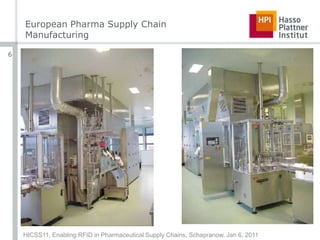
European Pharma Supply ChainManufacturingHICSS11, Enabling RFID in Pharmaceutical Supply Chains, Schapranow, Jan 6, 20116
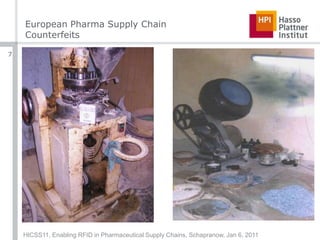
European Pharma Supply ChainCounterfeitsHICSS11, Enabling RFID in Pharmaceutical Supply Chains, Schapranow, Jan 6, 20117
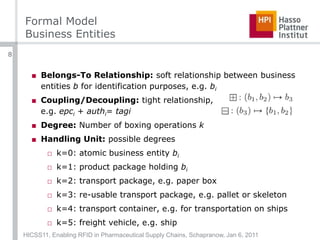
Formal ModelBusiness EntitiesBelongs-To Relationship: soft relationship between business entities b for identification purposes, e.g. biCoupling/Decoupling: tight relationship,e.g. epci +authi= tagiDegree: Number of boxing operations kHandling Unit: possible degreesk=0: atomic business entity bik=1: product package holding bik=2: transport package, e.g. paper boxk=3: re-usable transport package, e.g. pallet or skeletonk=4: transport container, e.g. for transportation on shipsk=5: freight vehicle, e.g. shipHICSS11, Enabling RFID in Pharmaceutical Supply Chains, Schapranow, Jan 6, 20118
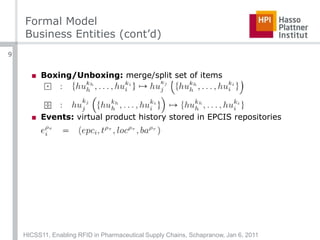
Formal ModelBusiness Entities (cont’d)Boxing/Unboxing: merge/splitset of itemsEvents: virtual product history stored in EPCIS repositoriesHICSS11, Enabling RFID in Pharmaceutical Supply Chains, Schapranow, Jan 6, 20119
Formal ModelRoles (Europe)Main Roles [1]A: Manufacturer: ~2.2kB: Center of Distribution: ~50kE: Licensed Dealer: ~140kD: Service Provider forAnti-CounterfeitingOther RolesC: Logistics ProviderF: End ConsumerHICSS11, Enabling RFID in Pharmaceutical Supply Chains, Schapranow, Jan 6, 201110
Formal ModelRoles (Europe)Main Roles [1]A: Manufacturer: ~2.2kB: Center of Distribution: ~50kE: Licensed Dealer: ~140kD: Service Provider forAnti-CounterfeitingOther RolesC: Logistics ProviderF: End ConsumerHICSS11, Enabling RFID in Pharmaceutical Supply Chains, Schapranow, Jan 6, 201111
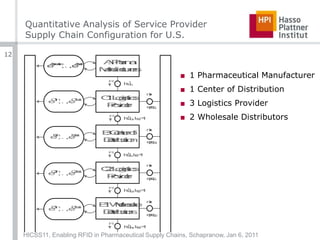
Quantitative Analysis of Service ProviderSupply Chain Configuration for U.S.1 Pharmaceutical Manufacturer1 Center of Distribution3 Logistics Provider2 Wholesale DistributorsHICSS11, Enabling RFID in Pharmaceutical Supply Chains, Schapranow, Jan 6, 201112
Quantitative Analysis of Service ProviderData Flow for U.S. Pharma Supply ChainRetailer sends product check request to service provider(12 Byte EPC)Service provider contacts involved EPCIS repositories(12 Byte EPC)EPCIS repositories return event sets to service provider(728 Byte / 4 events in avg., i.e. 1x in, 2x observe, 1x out)Service provider(12 Byte EPC + 4 Byte authentication details)Protocol overheadIP: 20 ByteUDP: 8 ByteHICSS11, Enabling RFID in Pharmaceutical Supply Chains, Schapranow, Jan 6, 201113
Quantitative Analysis of Service ProviderNetwork TrafficNetwork traffic c, p pharmaceutical goods, supply chain length lFor p=15 billion and l=7: c=234.92TB / 32,475USD per year[2]Costs are adequate and can be handled by supply chain roles [3]HICSS11, Enabling RFID in Pharmaceutical Supply Chains, Schapranow, Jan 6, 201114
Quantitative Analysis of Service ProviderSecurity EvaluationManufacturer: prevent unrecognized EPC reading, e.g. by mutual authentication schemes [4]Center of distribution: on-tag security implementations, e.g. physically unclonable functions [5] or predefined passwords [6]Logistics provider: kill command [7], service providers for anti-counterfeitingWholesale Distributors: tracking and tracing via reader gatesEnd consumers: digital advice letter, service provider [8]HICSS11, Enabling RFID in Pharmaceutical Supply Chains, Schapranow, Jan 6, 201115
Our ContributionsDeveloped a formal model for RFID-aided supply chainsValidated in context of the pharmaceutical supply chain rolesIntroduced separate role “service provider for anti-counterfeiting”Performed a quantitative analysis for the service providerMonetary impact for concrete supply chain sizing evaluatedSecurity evaluation per supply chain roleHICSS11, Enabling RFID in Pharmaceutical Supply Chains, Schapranow, Jan 6, 201116
References[1] J. Müller, C. Pöpke, M. Urbat, A. Zeier, and H. Plattner, “A Simulation of the Pharmaceutical Supply Chain to Provide Realistic Test Data,” in Proceedings of the International Conference on Advances in System Simulation, 2009[2] Assuming Amazon EC2 mean network traffic costs per GB approx. 0.135 USD[3] M.-P. Schapranow, M. Nagora, and A. Zeier, “CoMoSeR: Cost Model for Security-Enhanced RFID-Aided Supply Chains,” in Proceedings of the 18th International Conference on Software, Telecommunication and Computer Networks, 2010[4] M.-P. Schapranow, A. Zeier, and H. Plattner, “A Dynamic Mutual RFID Authentication Model Preventing Unauthorized Third Party Access,” in Proceedings of the 4th International Conference on Network and System Security, 2010.[5] P. Tuyls and L. Batina, “RFID-Tags for Anti-Counterfeiting,” in Proceedings of the RSA Conference, 2006, pp. 115–131.[6] M.-P. Schapranow, J. Müller, S. Enderlein, M. Helmich, and A. Zeier, “Low-Cost Mutual RFID Authentication Model Using Predefined Password Lists,” in Proceedings of the 16th International Conference on Industrial Engineering and Engineering Management, 2009.[7] A. Mitrokotsa, M. R. Rieback, and A. S. Tanenbaum, “Classifi- cation of RFID Attacks,” in Proceedings of the 2nd International Workshop on RFID Technology, 2008, pp. 73–86.[8] M.-P. Schapranow, J. Müller, A. Zeier, and H. Plattner, “RFID Event Data Processing – An Architecture for Storing and Searching,” in Proceedings of the 4th International Workshop on RFID Technology - Concepts, Applications, Challenges, 2010.HICSS11, Enabling RFID in Pharmaceutical Supply Chains, Schapranow, Jan 6, 201117
Thank you for your interest!Keep in contact with us.Responsible: Deputy Prof. of Prof. Hasso PlattnerDr. Alexander Zeierzeier@hpi.uni-potsdam.deMatthieu-P. Schapranow, M.Sc.matthieu.schapranow@hpi.uni-potsdam.deHasso Plattner InstituteEnterprise Platform & Integration ConceptsMatthieu-P. SchapranowAugust-Bebel-Str. 8814482 Potsdam, GermanyHICSS11, Enabling RFID in Pharmaceutical Supply Chains, Schapranow, Jan 6, 201118

A Formal Model for Enabling RFID in Pharmaceutical Supply Chains

  • 1.
    A Formal Modelfor Enabling RFIDin Pharmaceutical Supply Chains44th Hawai’i Int’l Conference on System Sciences4-7 Jan, 2011 – Koloa, Kauai, HawaiiMatthieu-P. SchapranowHasso Plattner Institute
  • 2.
    AgendaKey Facts aboutthe Hasso Plattner InstituteEuropean Pharmaceutical Supply ChainFormal ModelQuantitative Analysis of Service ProviderContributionsHICSS11, Enabling RFID in Pharmaceutical Supply Chains, Schapranow, Jan 6, 20112
  • 3.
    Key Facts aboutthe Hasso Plattner InstituteInternalsFounded as a public-private partnershipin 1998 in Potsdam near Berlin, GermanyInstitute belongs to theUniversity of PotsdamRanked 1st in CHE 2009 and 2010500 B.Sc. and M.Sc. students10 professors, 92 PhD studentsCourse of study: IT Systems Engineering HICSS11, Enabling RFID in Pharmaceutical Supply Chains, Schapranow, Jan 6, 20113
  • 4.
    Key Facts aboutthe Hasso Plattner Institute Research Group Hasso Plattner / Alexander ZeierResearch focus: real customer data for enterprisesoftware and design of complex applicationsIn-Memory Data Management for Enterprise Applications Human-Centered Software Design and Engineering Maintenance and Evolution of SOA Systems Integration of RFID Technology in Enterprise Platforms CooperationsAcademic: Stanford, MIT, etc.Industry: SAP, Siemens, Audi, etc.HICSS11, Enabling RFID in Pharmaceutical Supply Chains, Schapranow, Jan 6, 20114
  • 5.
    Key Facts aboutthe Hasso Plattner InstituteWhat can we do for you?Network between industry and academia,e.g. European section of the CurriculumRFID seminars for graduate / undergraduate studentsTrends & concepts lecture (Prof. Hasso Plattner)Enterprise Application Architecture LaboratoryEnterprise software, e.g. SAP, Microsoft, etc.Equipped RFID Lab, e.g. deister electronic, noFilis, etc.Concrete sizing and simulation of customer supply chainsHICSS11, Enabling RFID in Pharmaceutical Supply Chains, Schapranow, Jan 6, 20115
  • 6.
    European Pharma SupplyChainManufacturingHICSS11, Enabling RFID in Pharmaceutical Supply Chains, Schapranow, Jan 6, 20116
  • 7.
    European Pharma SupplyChainCounterfeitsHICSS11, Enabling RFID in Pharmaceutical Supply Chains, Schapranow, Jan 6, 20117
  • 8.
    Formal ModelBusiness EntitiesBelongs-ToRelationship: soft relationship between business entities b for identification purposes, e.g. biCoupling/Decoupling: tight relationship,e.g. epci +authi= tagiDegree: Number of boxing operations kHandling Unit: possible degreesk=0: atomic business entity bik=1: product package holding bik=2: transport package, e.g. paper boxk=3: re-usable transport package, e.g. pallet or skeletonk=4: transport container, e.g. for transportation on shipsk=5: freight vehicle, e.g. shipHICSS11, Enabling RFID in Pharmaceutical Supply Chains, Schapranow, Jan 6, 20118
  • 9.
    Formal ModelBusiness Entities(cont’d)Boxing/Unboxing: merge/splitset of itemsEvents: virtual product history stored in EPCIS repositoriesHICSS11, Enabling RFID in Pharmaceutical Supply Chains, Schapranow, Jan 6, 20119
  • 10.
    Formal ModelRoles (Europe)MainRoles [1]A: Manufacturer: ~2.2kB: Center of Distribution: ~50kE: Licensed Dealer: ~140kD: Service Provider forAnti-CounterfeitingOther RolesC: Logistics ProviderF: End ConsumerHICSS11, Enabling RFID in Pharmaceutical Supply Chains, Schapranow, Jan 6, 201110
  • 11.
    Formal ModelRoles (Europe)MainRoles [1]A: Manufacturer: ~2.2kB: Center of Distribution: ~50kE: Licensed Dealer: ~140kD: Service Provider forAnti-CounterfeitingOther RolesC: Logistics ProviderF: End ConsumerHICSS11, Enabling RFID in Pharmaceutical Supply Chains, Schapranow, Jan 6, 201111
  • 12.
    Quantitative Analysis ofService ProviderSupply Chain Configuration for U.S.1 Pharmaceutical Manufacturer1 Center of Distribution3 Logistics Provider2 Wholesale DistributorsHICSS11, Enabling RFID in Pharmaceutical Supply Chains, Schapranow, Jan 6, 201112
  • 13.
    Quantitative Analysis ofService ProviderData Flow for U.S. Pharma Supply ChainRetailer sends product check request to service provider(12 Byte EPC)Service provider contacts involved EPCIS repositories(12 Byte EPC)EPCIS repositories return event sets to service provider(728 Byte / 4 events in avg., i.e. 1x in, 2x observe, 1x out)Service provider(12 Byte EPC + 4 Byte authentication details)Protocol overheadIP: 20 ByteUDP: 8 ByteHICSS11, Enabling RFID in Pharmaceutical Supply Chains, Schapranow, Jan 6, 201113
  • 14.
    Quantitative Analysis ofService ProviderNetwork TrafficNetwork traffic c, p pharmaceutical goods, supply chain length lFor p=15 billion and l=7: c=234.92TB / 32,475USD per year[2]Costs are adequate and can be handled by supply chain roles [3]HICSS11, Enabling RFID in Pharmaceutical Supply Chains, Schapranow, Jan 6, 201114
  • 15.
    Quantitative Analysis ofService ProviderSecurity EvaluationManufacturer: prevent unrecognized EPC reading, e.g. by mutual authentication schemes [4]Center of distribution: on-tag security implementations, e.g. physically unclonable functions [5] or predefined passwords [6]Logistics provider: kill command [7], service providers for anti-counterfeitingWholesale Distributors: tracking and tracing via reader gatesEnd consumers: digital advice letter, service provider [8]HICSS11, Enabling RFID in Pharmaceutical Supply Chains, Schapranow, Jan 6, 201115
  • 16.
    Our ContributionsDeveloped aformal model for RFID-aided supply chainsValidated in context of the pharmaceutical supply chain rolesIntroduced separate role “service provider for anti-counterfeiting”Performed a quantitative analysis for the service providerMonetary impact for concrete supply chain sizing evaluatedSecurity evaluation per supply chain roleHICSS11, Enabling RFID in Pharmaceutical Supply Chains, Schapranow, Jan 6, 201116
  • 17.
    References[1] J. Müller,C. Pöpke, M. Urbat, A. Zeier, and H. Plattner, “A Simulation of the Pharmaceutical Supply Chain to Provide Realistic Test Data,” in Proceedings of the International Conference on Advances in System Simulation, 2009[2] Assuming Amazon EC2 mean network traffic costs per GB approx. 0.135 USD[3] M.-P. Schapranow, M. Nagora, and A. Zeier, “CoMoSeR: Cost Model for Security-Enhanced RFID-Aided Supply Chains,” in Proceedings of the 18th International Conference on Software, Telecommunication and Computer Networks, 2010[4] M.-P. Schapranow, A. Zeier, and H. Plattner, “A Dynamic Mutual RFID Authentication Model Preventing Unauthorized Third Party Access,” in Proceedings of the 4th International Conference on Network and System Security, 2010.[5] P. Tuyls and L. Batina, “RFID-Tags for Anti-Counterfeiting,” in Proceedings of the RSA Conference, 2006, pp. 115–131.[6] M.-P. Schapranow, J. Müller, S. Enderlein, M. Helmich, and A. Zeier, “Low-Cost Mutual RFID Authentication Model Using Predefined Password Lists,” in Proceedings of the 16th International Conference on Industrial Engineering and Engineering Management, 2009.[7] A. Mitrokotsa, M. R. Rieback, and A. S. Tanenbaum, “Classifi- cation of RFID Attacks,” in Proceedings of the 2nd International Workshop on RFID Technology, 2008, pp. 73–86.[8] M.-P. Schapranow, J. Müller, A. Zeier, and H. Plattner, “RFID Event Data Processing – An Architecture for Storing and Searching,” in Proceedings of the 4th International Workshop on RFID Technology - Concepts, Applications, Challenges, 2010.HICSS11, Enabling RFID in Pharmaceutical Supply Chains, Schapranow, Jan 6, 201117
  • 18.
    Thank you foryour interest!Keep in contact with us.Responsible: Deputy Prof. of Prof. Hasso PlattnerDr. Alexander Zeierzeier@hpi.uni-potsdam.deMatthieu-P. Schapranow, M.Sc.matthieu.schapranow@hpi.uni-potsdam.deHasso Plattner InstituteEnterprise Platform & Integration ConceptsMatthieu-P. SchapranowAugust-Bebel-Str. 8814482 Potsdam, GermanyHICSS11, Enabling RFID in Pharmaceutical Supply Chains, Schapranow, Jan 6, 201118