@rt_wood
1. Play is for plays sake
 Twentieth century psychologists aside, play is understood to be an activity that is undertaken not for
 some higher meaning or end goal. It is played for plays sake. Huizinga (1958) and Caillois (1962)
 among others, were adamant that no material benefit can be derived from play. It is my opinion that
 material benefit can be derived from play if it is a ‘byproduct’ or ‘happy coincidence’ of play, meaning
 that if the outcome is not the primary reason for the play-activity, then the activity is still play. There is
 no deeper meaning. There is no ‘end goal’.


@rt_wood
2. Play is free
 Play is a voluntary undertaking for the players involved. A player cannot be forced into a play-state,
 coerced perhaps, but not forced. Else this ceases to exist as play. Here, along with the rule based
 structure is the greatest difference between play and game. A player can be forced into gaming, yet
 play remains voluntary. The player(s) is free to chose whether or not they play. Play is voluntary.


@rt_wood
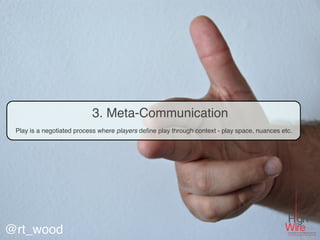
3. Meta-Communication
 Play is a negotiated process where players define play through context - play space, nuances etc.


@rt_wood
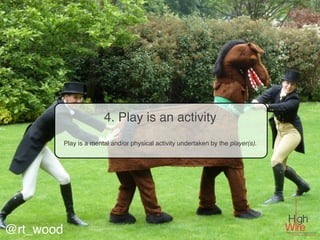
4. Play is an activity
           Play is a mental and/or physical activity undertaken by the player(s).


@rt_wood
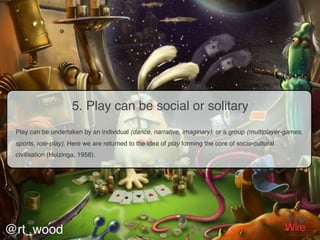
5. Play can be social or solitary
 Play can be undertaken by an individual (dance, narrative, imaginary), or a group (multiplayer-games,
 sports, role-play). Here we are returned to the idea of play forming the core of socio-cultural
 civilisation (Huizinga, 1958).


@rt_wood
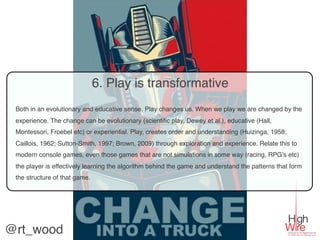
6. Play is transformative
 Both in an evolutionary and educative sense. Play changes us. When we play we are changed by the
 experience. The change can be evolutionary (scientific play, Dewey et al.), educative (Hall,
 Montessori, Froebel etc) or experiential. Play, creates order and understanding (Huizinga, 1958;
 Caillois, 1962; Sutton-Smith, 1997; Brown, 2009) through exploration and experience. Relate this to
 modern console games, even those games that are not simulations in some way (racing, RPG’s etc)
 the player is effectively learning the algorithm behind the game and understand the patterns that form
 the structure of that game.


@rt_wood
7. Play is fun
 Arguably the most important of all. If play was not fun it would not exist as play. Players have to enjoy
 the process of playing.


@rt_wood
8. Play is immersive
       Players become immersed in the activity of play. Either wholly or partially.


@rt_wood
Plays is a voluntary activity, either physical or mental in
 nature that is undertaken by one or more players without a
 set outcome as the primary focus of the play, and for the
 amusement of those that are playing. It is an immersive,
 transformative process that is recognised through context
 and agreed upon by those players involved.


@rt_wood

A definition of play

  • 1.
  • 2.
    1. Play isfor plays sake Twentieth century psychologists aside, play is understood to be an activity that is undertaken not for some higher meaning or end goal. It is played for plays sake. Huizinga (1958) and Caillois (1962) among others, were adamant that no material benefit can be derived from play. It is my opinion that material benefit can be derived from play if it is a ‘byproduct’ or ‘happy coincidence’ of play, meaning that if the outcome is not the primary reason for the play-activity, then the activity is still play. There is no deeper meaning. There is no ‘end goal’. @rt_wood
  • 3.
    2. Play isfree Play is a voluntary undertaking for the players involved. A player cannot be forced into a play-state, coerced perhaps, but not forced. Else this ceases to exist as play. Here, along with the rule based structure is the greatest difference between play and game. A player can be forced into gaming, yet play remains voluntary. The player(s) is free to chose whether or not they play. Play is voluntary. @rt_wood
  • 4.
    3. Meta-Communication Playis a negotiated process where players define play through context - play space, nuances etc. @rt_wood
  • 5.
    4. Play isan activity Play is a mental and/or physical activity undertaken by the player(s). @rt_wood
  • 6.
    5. Play canbe social or solitary Play can be undertaken by an individual (dance, narrative, imaginary), or a group (multiplayer-games, sports, role-play). Here we are returned to the idea of play forming the core of socio-cultural civilisation (Huizinga, 1958). @rt_wood
  • 7.
    6. Play istransformative Both in an evolutionary and educative sense. Play changes us. When we play we are changed by the experience. The change can be evolutionary (scientific play, Dewey et al.), educative (Hall, Montessori, Froebel etc) or experiential. Play, creates order and understanding (Huizinga, 1958; Caillois, 1962; Sutton-Smith, 1997; Brown, 2009) through exploration and experience. Relate this to modern console games, even those games that are not simulations in some way (racing, RPG’s etc) the player is effectively learning the algorithm behind the game and understand the patterns that form the structure of that game. @rt_wood
  • 8.
    7. Play isfun Arguably the most important of all. If play was not fun it would not exist as play. Players have to enjoy the process of playing. @rt_wood
  • 9.
    8. Play isimmersive Players become immersed in the activity of play. Either wholly or partially. @rt_wood
  • 10.
    Plays is avoluntary activity, either physical or mental in nature that is undertaken by one or more players without a set outcome as the primary focus of the play, and for the amusement of those that are playing. It is an immersive, transformative process that is recognised through context and agreed upon by those players involved. @rt_wood