A First Stab at the
Content Model (for HIE)

    Koray Atalag, MD, PhD
     k.atalag@nihi.auckland.ac.nz
 koray.atalag@openehrfoundation.org
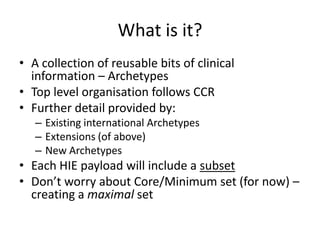
What is it?
• A collection of reusable bits of clinical
  information – Archetypes
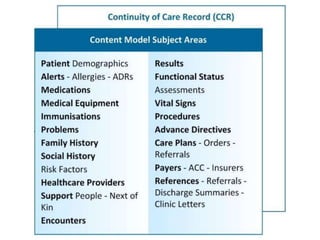
• Top level organisation follows CCR
• Further detail provided by:
   – Existing international Archetypes
   – Extensions (of above)
   – New Archetypes
• Each HIE payload will include a subset
• Don’t worry about Core/Minimum set (for now) –
  creating a maximal set
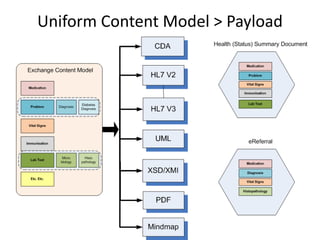
Uniform Content Model > Payload
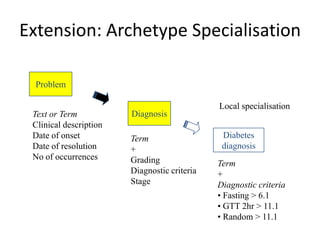
Extension: Archetype Specialisation

  Problem

                                              Local specialisation
 Text or Term           Diagnosis
 Clinical description
 Date of onset          Term                   Diabetes
 Date of resolution     +                      diagnosis
 No of occurrences      Grading               Term
                        Diagnostic criteria   +
                        Stage                 Diagnostic criteria
                                              • Fasting > 6.1
                                              • GTT 2hr > 11.1
                                              • Random > 11.1
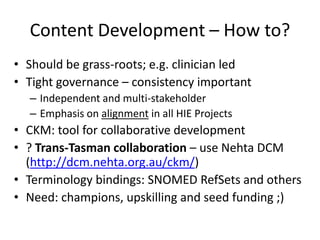
Creating Payload
          ?
Content Development – How to?
• Should be grass-roots; e.g. clinician led
• Tight governance – consistency important
  – Independent and multi-stakeholder
  – Emphasis on alignment in all HIE Projects
• CKM: tool for collaborative development
• ? Trans-Tasman collaboration – use Nehta DCM
  (http://dcm.nehta.org.au/ckm/)
• Terminology bindings: SNOMED RefSets and others
• Need: champions, upskilling and seed funding ;)
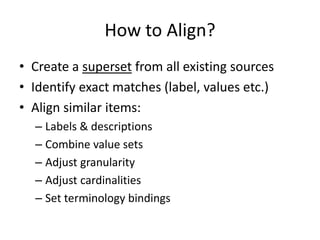
How to Align?
• Create a superset from all existing sources
• Identify exact matches (label, values etc.)
• Align similar items:
  – Labels & descriptions
  – Combine value sets
  – Adjust granularity
  – Adjust cardinalities
  – Set terminology bindings
Content Localisation
• Localisation:
  – Translation (Maori, Chinese, Korean, Indian etc.)
  – Adaptation (extensions to NZ needs)
• Content independent of language – as many
  languages can be fitted, good tooling
• openEHR Localisation Program (led by myself)
  – Local Chapters in each jurisdiction
  – Program Committee, Qualified Members, Local
    Members
  – NZ openEHR Chapter intended to work under HL7NZ
DEMONSTRATION
• eReferral (RSD revision) 5’
   – HL7 v2.4 message – look at content
   – openEHR eReferrals model – mapping & extension
• Community ePrescribing 3’
   – Message content & Nehta ePrescribing
• PREDICT ‘15
   – Dataset items and feeder data sources
   – International Archetypes+Kiwi extensions+New
   – Future-proofing: backwards data compatibility & AQL
     querying
• Exchange Content Model – a first stab! 1’

A Content Model for Health Information Exchange

  • 1.
    A First Stabat the Content Model (for HIE) Koray Atalag, MD, PhD k.atalag@nihi.auckland.ac.nz koray.atalag@openehrfoundation.org
  • 4.
    What is it? •A collection of reusable bits of clinical information – Archetypes • Top level organisation follows CCR • Further detail provided by: – Existing international Archetypes – Extensions (of above) – New Archetypes • Each HIE payload will include a subset • Don’t worry about Core/Minimum set (for now) – creating a maximal set
  • 6.
  • 7.
    Extension: Archetype Specialisation Problem Local specialisation Text or Term Diagnosis Clinical description Date of onset Term Diabetes Date of resolution + diagnosis No of occurrences Grading Term Diagnostic criteria + Stage Diagnostic criteria • Fasting > 6.1 • GTT 2hr > 11.1 • Random > 11.1
  • 8.
  • 9.
    Content Development –How to? • Should be grass-roots; e.g. clinician led • Tight governance – consistency important – Independent and multi-stakeholder – Emphasis on alignment in all HIE Projects • CKM: tool for collaborative development • ? Trans-Tasman collaboration – use Nehta DCM (http://dcm.nehta.org.au/ckm/) • Terminology bindings: SNOMED RefSets and others • Need: champions, upskilling and seed funding ;)
  • 10.
    How to Align? •Create a superset from all existing sources • Identify exact matches (label, values etc.) • Align similar items: – Labels & descriptions – Combine value sets – Adjust granularity – Adjust cardinalities – Set terminology bindings
  • 11.
    Content Localisation • Localisation: – Translation (Maori, Chinese, Korean, Indian etc.) – Adaptation (extensions to NZ needs) • Content independent of language – as many languages can be fitted, good tooling • openEHR Localisation Program (led by myself) – Local Chapters in each jurisdiction – Program Committee, Qualified Members, Local Members – NZ openEHR Chapter intended to work under HL7NZ
  • 13.
    DEMONSTRATION • eReferral (RSDrevision) 5’ – HL7 v2.4 message – look at content – openEHR eReferrals model – mapping & extension • Community ePrescribing 3’ – Message content & Nehta ePrescribing • PREDICT ‘15 – Dataset items and feeder data sources – International Archetypes+Kiwi extensions+New – Future-proofing: backwards data compatibility & AQL querying • Exchange Content Model – a first stab! 1’

Editor's Notes

  • #2 Hi everyone, my name is KA and I work for NIHI. Trained as MD, not practised much, did PhD in ISI sit in HINZ Exec and also board member of HL7NZ and Localisation Program Leader in openEHR (stds kill innovation!)Thanks Ed, all 3 organisations and ALL!After the excellent introduction from my colleagues, Alastair, David and Hugh, today I’ll walk you through some examples I created to develop a uniform content model for NZ. HISO etc.
  • #3 Published by HISO (2012); Part of the Reference Architecture for Interoperability“To create a uniform model of health information to be reused by different eHealth Projects involving HIE”Consistent, Extensible, Interoperable and Future-Proof Data
  • #14 Objective of this demo is to show the bottom-up content development approach.Certain Archetypes shared by key HIE (eRef, ePrescribing, PREDICT) undergo an iterative localisation processInternational > Multiple Local projects (added & extended) > Added to ECM