Abolfazl Golshan, Mostafa Rezazadeh Shirdar & S.Izman
International Journal of Experimental Algorithms (IJEA), Volume (2) : Issue (2) : 2011 62
A Comparison of Optimization Methods in Cutting Parameters
Using Non-dominated Sorting Genetic Algorithm (NSGA-II) and
Micro Genetic Algorithm (MGA)
Abolfazl Golshan gabolfazl@gmail.com
Mechanical engineering/Mechanical engineering/Student
Isfahan University of Technology
Isfahan, 83111-84156, Iran
Mostafa Rezazadeh Shirdar mosico63@gmail.com
Advanced manufacturing/Mechanical engineering/Student
Universiti Teknologi Malaysia
Skudai, 81310, Malaysia
S.Izman izman@fkm.utm.my
Advanced manufacturing/Mechanical engineering/Assoc.prof
Universiti Teknologi Malaysia
Skudai, 81310, Malaysia
Abstract
Since cutting conditions have an influence on reducing the production cost and time and deciding the
quality of a final product the determination of optimal cutting parameters such as cutting speed, feed
rate, depth of cut and tool geometry is one of vital modules in process planning of metal parts. With
use of experimental results and subsequently, with exploitation of main effects plot, importance of
each parameter is studied. In this investigation these parameters was considered as input in order to
optimized the surface finish and tool life criteria, two conflicting objectives, as the process
performance simultaneously. In this study, micro genetic algorithm (MGA) and Non-dominated Sorting
Genetic Algorithm (NSGA-II) were compared with each other proving the superiority of Non-
dominated Sorting Genetic Algorithm over micro genetic since Non-dominated Sorting Genetic
Algorithm results were more satisfactory than micro genetic algorithm in terms of optimizing
machining parameters.
Keywords: Cutting Parameters, Surface Roughness, Tool life Criteria, Optimizing, NSGA-II, MGA,
1. INTRODUCTION
Proper selection of machining parameters such as depth of cut, feed rate, cutting speed and rake
angle for the best process performance is still challenging matter. In workshop practice cutting
parameters are selected from database or specialized hand book which is not necessarily optimum
value [1]. Optimization of cutting parameters is usually a difficult job because it requires both
machining operation experience and knowledge of mathematical algorithms simultaneously. The
traditional methods for optimization problems include calculus-based searches, dynamic
programming, random searches, and gradient methods whereas modern heuristic methods include
artificial neural networks [2], Lagrangian relaxation approaches [3], and simulated annealing [3].
Some of these methods are successful in locating the optimal solution, but they are usually slow in
convergence and require much computing time. Other methods may risk being trapped at a local
optimum which fails to give the best solution. In multiple performance optimizations, there is more
than one objective function, each of which may have a different optimal solution. Most of the time
these objectives conflict with one to another. [4,5]. Rozenek and his associations used a piecework
made of composite material with metal matrix composite and investigated the variation in feed rate
and surface roughness led by changing the corresponding parameters [6]. Tosun and his associations
used a statistical model for determining optimal parameters in order to minimize the holes led on the
wire during the process [7]. Tosun and Cogun conducted a research regarding the effect of machining
parameters on the rate of wire corrosion considering lessened weight from wire while being machined
[8]. Wang and his associations optimized process parameters in order to achieve optimal
performance using genetic algorithm (GA) with artificial neutral network (ANN). ANN is an approach
Abolfazl Golshan, Mostafa Rezazadeh Shirdar & S.Izman
International Journal of Experimental Algorithms (IJEA), Volume (2) : Issue (2) : 2011 63
used for modeling the process, where weight are updated by GA. Gen-Hunter software is used in
order to find out solutions for multi-objective problems concerning optimization phase. MRR and
surface roughness which are 2 output parameters are aimed here to be optimized as a process
performance [9]. Su and his associations have optimized the EDM parameters, from stage of the
rough cutting to the finish cutting. The relationship between the process parameters and machining
performance was established using a trained neutral network. Subsequently, GA with properly defined
objective functions was changed to the neutral network to find out the optimal process parameters.
For transformation of MRR, surface roughness and machine tool wear into a single objective, a simple
weighted method was used [10]. The generic algorithm (GA) is an evolutionary algorithm based on
the mechanic of natural selection and it combines the characteristic of direct search and probabilistic
selection method. It is a powerful tool for obtaining global values for multi-model and combinatorial
problems [11]. The GA operates on a population of potential solutions applying the principle of
survival of the fittest to produce better and better approximations to a solution. In this study, after
designing and obtaining the experimental data with a use of statistical model and main effect plots,
the most important parameters effective on average surface roughness (Ra) and also tool life criteria
(A) will be specified. Following the models obtained the comparison between two methods of non-
dominated sorting genetic algorithm (NSGA-II) and micro genetic algorithm (MGA) both will be
investigated.
2. EXPERIMENTAL WORK
The work material used for the present investigation is ST-37 steel with the diameter of 45 mm and
length of 400 mm. For machining operation a Russian lath machine was used and the tool material
was HSS with clearance angle of 6°, back rake angle of 0°, side cutting edge angle of 90° and rake
angle which was variable during machining process.
For simultaneous investigation of variable affection such as cutting speed, feed rate, depth of cut and
rake angle the Taguchi method design of experiments with the use of MINITAB software was carried
out. The machining parameters used and their levels were presented in Table1. The values of the
levels were selected so that the standard values of parameters were included.
Cutting
parameters
unit symbol Levels
1 2 3
Cutting speed (m/min) v 17 25 33
Feed rate (mm/rev) ƒ 0.09 0.13 0.17
Depth of cut (mm) d 0.2 0.4 0.6
Rake angle (degree) z 0 14 -
TABLE 1: Machining parameters and their levels
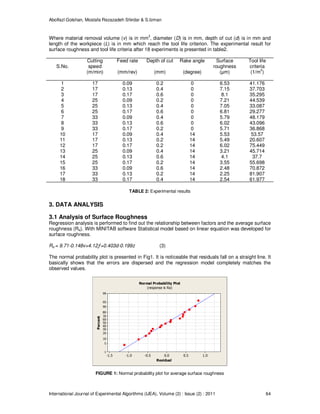
Velocity of rotation for different diameters of workpiece and based on selected cutting speeds was
calculated from equation1.
N = (1)
Where diameter (D) is in mm, cutting speed (V) is in min/m and velocity of rotation (N) is in rev/min.
In this study tool life is defined by the volume of the material removed so that surface finish becomes
1.5 times higher than the initial surface roughness value at the beginning of machining operation.
1/v = (2)
Abolfazl Golshan, Mostafa Rezazadeh Shirdar & S.Izman
International Journal of Experimental Algorithms (IJEA), Volume (2) : Issue (2) : 2011 64
Where material removal volume (v) is in mm
3
, diameter (D) is in mm, depth of cut (d) is in mm and
length of the workpiece (L) is in mm which reach the tool life criterion. The experimental result for
surface roughness and tool life criteria after 18 experiments is presented in table2.
S.No.
Cutting
speed
(m/min)
Feed rate
(mm/rev)
Depth of cut
(mm)
Rake angle
(degree)
Surface
roughness
(µm)
Tool life
criteria
(1/m
3
)
1 17 0.09 0.2 0 6.53 41.176
2 17 0.13 0.4 0 7.15 37.703
3 17 0.17 0.6 0 8.1 35.295
4 25 0.09 0.2 0 7.21 44.539
5 25 0.13 0.4 0 7.05 33.087
6 25 0.17 0.6 0 6.81 29.277
7 33 0.09 0.4 0 5.79 48.179
8 33 0.13 0.6 0 6.02 43.096
9 33 0.17 0.2 0 5.71 36.868
10 17 0.09 0.4 14 5.53 53.57
11 17 0.13 0.2 14 5.49 20.607
12 17 0.17 0.2 14 6.02 75.449
13 25 0.09 0.4 14 3.21 45.714
14 25 0.13 0.6 14 4.1 37.7
15 25 0.17 0.2 14 3.55 55.698
16 33 0.09 0.6 14 2.48 70.872
17 33 0.13 0.2 14 2.25 81.907
18 33 0.17 0.4 14 2.54 61.977
TABLE 2: Experimental results
3. DATA ANALYSIS
3.1 Analysis of Surface Roughness
Regression analysis is performed to find out the relationship between factors and the average surface
roughness (Ra). With MINITAB software Statistical model based on linear equation was developed for
surface roughness.
Ra = 9.71-0.148v+4.12ƒ+0.403d-0.199z (3)
The normal probability plot is presented in Fig1. It is noticeable that residuals fall on a straight line. It
basically shows that the errors are dispersed and the regression model completely matches the
observed values.
1.00.50.0-0.5-1.0-1.5
99
95
90
80
70
60
50
40
30
20
10
5
1
Residual
Percent
Normal Probability Plot
(response is Ra)
FIGURE 1: Normal probability plot for average surface roughness
Abolfazl Golshan, Mostafa Rezazadeh Shirdar & S.Izman
International Journal of Experimental Algorithms (IJEA), Volume (2) : Issue (2) : 2011 65
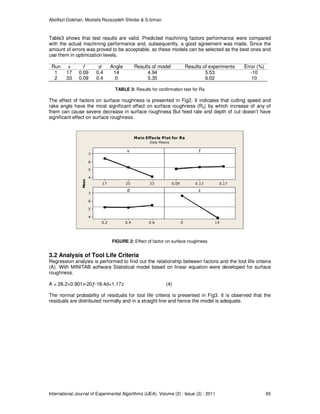
Table3 shows that test results are valid. Predicted machining factors performance were compared
with the actual machining performance and, subsequently, a good agreement was made. Since the
amount of errors was proved to be acceptable, so these models can be selected as the best ones and
use them in optimization levels.
Run v f d Angle Results of model Results of experiments Error (%)
1 17 0.09 0.4 14 4.94 5.53 -10
2 33 0.09 0.4 0 5.35 6.02 10
TABLE 3: Results for confirmation test for Ra
The effect of factors on surface roughness is presented in Fig2. It indicates that cutting speed and
rake angle have the most significant effect on surface roughness (Ra) by which increase of any of
them can cause severe decrease in surface roughness But feed rate and depth of cut doesn’t have
significant effect on surface roughness.
332517
7
6
5
4
0.170.130.09
0.60.40.2
7
6
5
4
140
v
Mean
f
d z
Main Effects Plot for Ra
Data Means
FIGURE 2: Effect of factor on surface roughness
3.2 Analysis of Tool Life Criteria
Regression analysis is performed to find out the relationship between factors and the tool life criteria
(A). With MINITAB software Statistical model based on linear equation were developed for surface
roughness.
A = 26.2+0.901v-20ƒ-18.4d+1.17z (4)
The normal probability of residuals for tool life criteria is presented in Fig3. It is observed that the
residuals are distributed normally and in a straight line and hence the model is adequate.
Abolfazl Golshan, Mostafa Rezazadeh Shirdar & S.Izman
International Journal of Experimental Algorithms (IJEA), Volume (2) : Issue (2) : 2011 66
3020100-10-20-30
99
95
90
80
70
60
50
40
30
20
10
5
1
Residual
Percent
Normal Probability Plot
(response is A)
FIGURE 3: Normal probability plot for tool life criteria
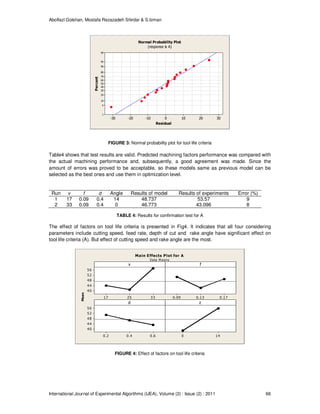
Table4 shows that test results are valid. Predicted machining factors performance was compared with
the actual machining performance and, subsequently, a good agreement was made. Since the
amount of errors was proved to be acceptable, so these models same as previous model can be
selected as the best ones and use them in optimization level.
Run v f d Angle Results of model Results of experiments Error (%)
1 17 0.09 0.4 14 48.737 53.57 9
2 33 0.09 0.4 0 46.773 43.096 8
TABLE 4: Results for confirmation test for A
The effect of factors on tool life criteria is presented in Fig4. It indicates that all four considering
parameters include cutting speed, feed rate, depth of cut and rake angle have significant effect on
tool life criteria (A). But effect of cutting speed and rake angle are the most.
332517
56
52
48
44
40
0.170.130.09
0.60.40.2
56
52
48
44
40
140
v
Mean
f
d z
Main Effects Plot for A
Data M eans
FIGURE 4: Effect of factors on tool life criteria
Abolfazl Golshan, Mostafa Rezazadeh Shirdar & S.Izman
International Journal of Experimental Algorithms (IJEA), Volume (2) : Issue (2) : 2011 67
4. OPTIMIZATION
To optimize cutting parameters in the machining of St-38 steel two methods of optimization includes
Non-dominated Sorting Genetic Algorithm (NSGA-II) and micro genetic algorithm (MGA) was used.
The objectives set for both methods in the present study were as follows:
1. Minimization of tool life criteria (A)
2. Minimization of average surface roughness (Ra)
5. NSGA-II ALGORITHM
The non-dominate sorting Genetic Algorithm (NSGA-II) which was introduced by Deb [12]. It is a
powerful general purpose optimization tool to solve optimizing problems in mathematics and
engineering. NSGA-II deals with a possible solution regarding a population and therefore, it can have
some applications in problems of multi-objective optimizations. It leads to have a number of
simultaneous solutions. Despite, this algorithm is fast, but it has been as a controversial method and
has been opposed due to have some difficulty and complexity when it comes to computational
approach. The elitism is also disregarded in this method. The selection operator differs from simple
genetic algorithm (SGA). Crowded comparison is the operator in which selections can be achieved
considering ranking and crowding distance. The solution of initially parent population is checked with
other solutions and eventually, solution is put into consideration to make aware of its validation using
rules given below [7]:
][1.][1. jObjiObj f and ][2.][[2. jObjiObj ≥ , (5)
Or
][1.][1. jObjiObj ≥ and jijObjiObj ≠],[2.][2. f (6)
Where, chromosome numbers can be shown as i and j, respectively. Subsequently, it can be
noticeable that the selected solution is validated by rules introduce. It makes it be marked as
dominated. If the rule doesn’t satisfy, it will be marked as non-dominated. In order to the solutions, the
corresponding process must continues until all solution selected are ranked. Fitness which is as equal
as its non-dominated level assigns to each solution. There is no result to demonstrate none of the
solutions is better compared with other solutions. Solutions are considered as part of a special rank or
non-dominated level. The crowding distance is considered to be as an average distance between two
points on both sides of selected solution point along each objectives function. Each objective
function’s boundary solution with largest and smallest values is assigned an infinity value. The
algorithm flowchart is illustrated in Fig5. For solving optimization problem using GA, fitness value is
required. it connects the objective with decision variable. In the present investigation objective are
minimization of average surface roughness (Ra) and minimization of tool life criteria which are function
of decision variables namely, cutting speed, feed rate, depth of cut and rake angle.
Abolfazl Golshan, Mostafa Rezazadeh Shirdar & S.Izman
International Journal of Experimental Algorithms (IJEA), Volume (2) : Issue (2) : 2011 68
FIGURE 5: Flow chart for the NSGA-II algorithm [7]
6. MICRO GENETIC ALGORITHM (MGA)
MGA operates on a population, of designs similar to the simple genetic algorithm (SGA). However,
unlike the SGA, the mechanics of the MGA allow for a very small population size, npop. The MGA can
be outlined in the following way:
1. A micro-population of five designs is generated randomly.
2. The fitness of each design is determined and the fittest individual is carried to the next generation
(elitist strategy).
3. The parents of the remaining four individuals are determined using a tournament selection strategy.
In this strategy, designs are paired randomly and adjacent pairs compete to become parents of the
remaining four individuals in the following generation [13]
4. Convergence of the µ-population is checked. If the population is converged, go to step 1, keeping
the best individual and generating the other four randomly. If the population has not converged, go to
step 2.
Note that mutations are not applied in the MGA since enough diversity is introduced after
convergence of a micro-population. In addition, [13] and [14] have shown that MGAs reach the
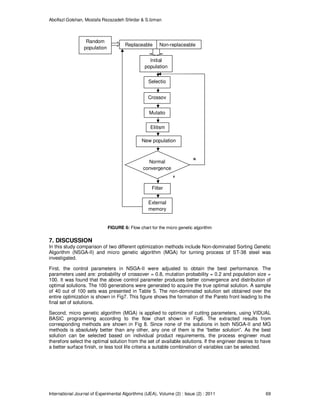
optimum in fewer function evaluations compared to an SGA for their test functions. The flow chart of
the above algorithm is shown in Fig6.
Initialize
population P of
Generation = 1
Calculate fitness value
Sorting based on crowded-
comparison Operator
Selection, Crossover and mutation to
create offspring population Q of size N
Combine population R=P+Q, of size 2N
Chose population P of size N
based on crowed-comparison
operator
If generation
>Max. Gen
Stop
Abolfazl Golshan, Mostafa Rezazadeh Shirdar & S.Izman
International Journal of Experimental Algorithms (IJEA), Volume (2) : Issue (2) : 2011 69
N
Y
FIGURE 6: Flow chart for the micro genetic algorithm
7. DISCUSSION
In this study comparison of two different optimization methods include Non-dominated Sorting Genetic
Algorithm (NSGA-II) and micro genetic algorithm (MGA) for turning process of ST-38 steel was
investigated.
First, the control parameters in NSGA-II were adjusted to obtain the best performance. The
parameters used are: probability of crossover = 0.8, mutation probability = 0.2 and population size =
100. It was found that the above control parameter produces better convergence and distribution of
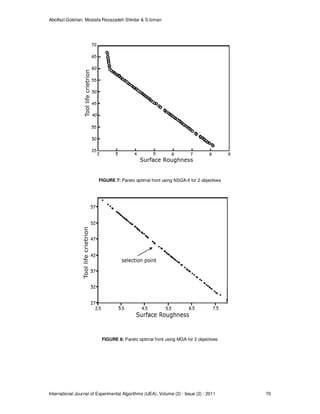
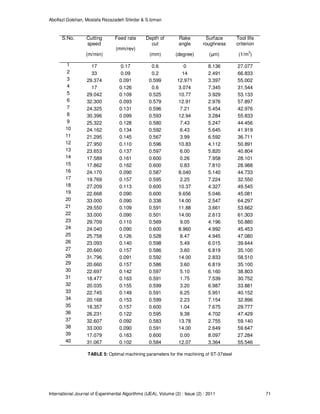
optimal solutions. The 100 generations were generated to acquire the true optimal solution. A sample
of 40 out of 100 sets was presented in Table 5. The non-dominated solution set obtained over the
entire optimization is shown in Fig7. This figure shows the formation of the Pareto front leading to the
final set of solutions.
Second, micro genetic algorithm (MGA) is applied to optimize of cutting parameters, using VIDUAL
BASIC programming according to the flow chart shown in Fig6. The extracted results from
corresponding methods are shown in Fig 8. Since none of the solutions in both NSGA-II and MG
methods is absolutely better than any other, any one of them is the “better solution”. As the best
solution can be selected based on individual product requirements, the process engineer must
therefore select the optimal solution from the set of available solutions. If the engineer desires to have
a better surface finish, or less tool life criteria a suitable combination of variables can be selected.
Random
population
Replaceable Non-replaceable
Initial
population
Selectio
n
Crossov
er
Mutatio
Elitism
New population
Filter
External
memory
Normal
convergence
Abolfazl Golshan, Mostafa Rezazadeh Shirdar & S.Izman
International Journal of Experimental Algorithms (IJEA), Volume (2) : Issue (2) : 2011 70
FIGURE 7: Pareto optimal front using NSGA-II for 2 objectives
FIGURE 8: Pareto optimal front using MGA for 2 objectives
Abolfazl Golshan, Mostafa Rezazadeh Shirdar & S.Izman
International Journal of Experimental Algorithms (IJEA), Volume (2) : Issue (2) : 2011 71
S.No. Cutting
speed
(m/min)
Feed rate
(mm/rev)
Depth of
cut
(mm)
Rake
angle
(degree)
Surface
roughness
(µm)
Tool life
criterion
(1/m
3
)
1 17 0.17 0.6 0 8.136 27.077
2 33 0.09 0.2 14 2.491 66.833
3 29.374 0.091 0.599 12.971 3.397 55.002
4 17 0.126 0.6 3.074 7.345 31.544
5 29.042 0.109 0.525 10.77 3.929 53.133
6 32.300 0.093 0.579 12.91 2.976 57.897
7 24.325 0.131 0.596 7.21 5.454 42.976
8 30.396 0.099 0.593 12.94 3.284 55.833
9 25.322 0.128 0.580 7.43 5.247 44.456
10 24.162 0.134 0.592 6.43 5.645 41.919
11 21.295 0.145 0.567 3.99 6.592 36.711
12 27.950 0.110 0.596 10.83 4.112 50.891
13 23.653 0.137 0.597 6.00 5.820 40.804
14 17.589 0.161 0.600 0.26 7.958 28.101
15 17.862 0.162 0.600 0.83 7.810 28.988
16 24.170 0.090 0.587 8.040 5.140 44.733
17 19.769 0.157 0.595 2.25 7.224 32.550
18 27.209 0.113 0.600 10.37 4.327 49.545
19 22.668 0.090 0.600 9.656 5.046 45.081
20 33.000 0.090 0.338 14.00 2.547 64.297
21 29.550 0.109 0.591 11.88 3.661 53.662
22 33.000 0.090 0.501 14.00 2.613 61.303
23 29.709 0.110 0.569 9.05 4.196 50.880
24 24.040 0.090 0.600 8.960 4.992 45.453
25 25.758 0.126 0.528 8.47 4.945 47.080
26 23.093 0.140 0.598 5.49 6.015 39.644
27 20.660 0.157 0.586 3.60 6.819 35.100
28 31.796 0.091 0.592 14.00 2.833 58.510
29 20.660 0.157 0.586 3.60 6.819 35.100
30 22.697 0.142 0.597 5.10 6.160 38.803
31 18.477 0.163 0.591 1.75 7.539 30.752
32 20.035 0.155 0.599 3.20 6.987 33.881
33 22.745 0.149 0.591 6.25 5.951 40.152
34 20.168 0.153 0.599 2.23 7.154 32.896
35 18.357 0.157 0.600 1.04 7.675 29.777
36 26.231 0.122 0.595 9.38 4.702 47.429
37 32.607 0.092 0.583 13.78 2.755 59.140
38 33.000 0.090 0.591 14.00 2.649 59.647
39 17.079 0.163 0.600 0.00 8.097 27.284
40 31.067 0.102 0.584 12.07 3.364 55.546
TABLE 5: Optimal machining parameters for the machining of ST-37steel
Abolfazl Golshan, Mostafa Rezazadeh Shirdar & S.Izman
International Journal of Experimental Algorithms (IJEA), Volume (2) : Issue (2) : 2011 72
For comparison of the two optimization methods, the experimental results for 2 points are shown in
the table 6. Considering the experimental results shown in the Table 2, the parameters of trial number
10 resulted to surface roughness of 5.53 (µm) and tool life criteria of 53.57 (1/m3). After optimizing
machining parameters through NSGA-II and micro genetic algorithm, considering NSGAII the value of
surface roughness and tool life criteria decrease to 5.102 (µm) and 44.600 (1/m3 ) respectively.
However, regarding to micro genetic algorithm these mentioned values decrease to 5.102 (µm) and
44.723 (1/m3), respectively. Thus, considering the data given, as feed rate is kept constant, by
changing cutting speed, depth of cut and rake angle, it can be observed that lower surface roughness
and tool life criteria can be achieved which both are more desirable. It is noticed that results in two
mentioned algorithms better results were achieved with use of NSGA-II. The reason why use of
NSGA-II is better is that despite both algorithms lead in same values for surface roughness, but for
tool life criteria values of 44.60 and 44.723 (1/m3) were attributed to NSGA-II and micro genetic
algorithm, respectively, demonstrating superiority of NSGA-II over micro genetic algorithm.
Cutting
speed
(m/min)
Feed rate
(mm/rev)
Depth of
cut
(mm)
Rake angle
(degree)
Surface
roughness
(µm)
Tool life
criteria
1/m3
Experimental
result(Table 2,
trial no.10)
17 0.09 0.40 14 5.53 53.57
NSGA-II 17.40 0.09 0.60 13.30 5.102 44.600
MGA 17.62 0.09 0.60 13.12 5.102 44.723
TABLE 6: Example of optimized values derived from NSGA-II and MGA
8. CONCLUSION
The experiments were conducted on a lathe machine for the machining of ST-37 steel. The tool used
for the machining operation is a HSS tool. The responses studied average surface roughness and tool
life criteria. The first-order polynomial models were developed for tool life criteria and average surface
roughness, and were used for optimization. In this study two multi-objective evolutionary algorithms
based on efficient methodology, NSGA-II and MGA was utilized to optimize machining parameters in
the machining of ST-37steel. The emphasis must be put on providing a preferred solution for the
process engineer in the short period of the time. The choice of one solution over other ones is
dependent on the requirements of process engineer [15]. In conclusion, by comparison of micro
genetic algorithm and NSGA-II it was noticed that in spite of the fact, both algorithms have good
results in optimization issues, but it was shown that NSGA-II had slightly superiority over micro
genetic algorithm whereas NAGA-II results were more satisfactory than micro genetic algorithm in
terms of optimizing machining.
9. REFERENCE
[1] Dereli, D., Filiz, I.H., Bayakosoglu, A., Optimizing cutting parameters in process planning of
prismatic parts by using genetic algorithms. International Journal of Production Research 39
(15), 3303–3328, 2001
[2] Pandey PPC, Pal S. In: Proceedings of the Third International Conference in Computer
Integrated Machining Singapore, vol. 1, pp. 812–9, 1995
[3] Hsu VN, Daskin M, Jones PC, Lowe TJ. Tool selection for optimal part production: a Lagrangian
relaxation approach. IIE Trans; 27:417–26, 1995.
[4] N. Srinivas and D. Kalyanmoy, Jl. Evol. Comput. 2, 221, 1994.
Abolfazl Golshan, Mostafa Rezazadeh Shirdar & S.Izman
International Journal of Experimental Algorithms (IJEA), Volume (2) : Issue (2) : 2011 73
[5] D. Kanagarajan, R. Karthikeyan, K. Palanikumar, J. P. Davim, Int. J. Adv. Manuf Tech. 36, 1124,
2008.
[6] M.Rozenek.M,J.Kozak,L.Dabrovwki,K.Lubkovwki, Electrical discharge machining characteristics
of metal matrix composites,J.Mater.Process.Technol.109, pp.367-370, 2001.
[7] N.Tosun, C.Cogun , H.Pihtili , "The effect of cutting parameters on wire crater sizes in WEDM",
int. J . Adv. Manuf. Techonl., Vol. 21, pp. 857-865, 2003.
[8] N.Tosun,C.Cogun, An investigation on wire wear in WEDM, j.Mater.Process.Technol.1349 (3) ,
pp. 273-278, 2003.
[9] Wang K., Gelgele H.L., Wang Y., Yuan Q., Fang M., "A hybrid intelligent method for modelling the
EDM process", Int. J. Machine Tools Manuf. Vol.43,pp.995–999,2003
[10] Su J.C. , Kao J.Y., Tarng Y.S. , "Optimization of the electrical discharge machining process
using a GA-based neural network", Int. J. Adv. Manuf. Technol. Vol.24,pp.81–90,2004
[11] M. Sivakumar and S. M. Kannan, Int. J. Adv. Manuf Tech. 32, 591, 2007.
[12] Debabrata Mandal., Modeling of electrical discharge machining process using back propagation
neural network and multi-objective optimization using non-dominating sorting genetic algorithm-
II, Journal of Materials Processing Technology 186, pp.154–162, 2007.
[13] Krishnakumar, K., “Micro-Genetic Algorithms for Stationary and Non-Stationary Function
Optimization,” SPIE 1196, Intelligent Control and Adaptive Systems, 1989.
[14] Senecal P. K., “Development of a Methodology for Internal Combustion Engine Design Using
Multi-Dimensional Modeling with Validation Through Experiments,” Ph.D. Dissertation,
University of Wisconsin-Madison, 2000.
[15] K. Palanikumar, B. Latha , V.S.Senthilkumar ,R.Karthikeyan, Multiple Performance Optimization
in Machining of GFRP Composites by a PCD Tool using Non-dominated Sorting Genetic
Algorithm (NSGA-II),Met. Mater. Int.,Vol.15, No. 2, pp. 249-258, 2009.

A Comparison of Optimization Methods in Cutting Parameters Using Non-dominated Sorting Genetic Algorithm (NSGA-II) and Micro Genetic Algorithm (MGA)

  • 1.
    Abolfazl Golshan, MostafaRezazadeh Shirdar & S.Izman International Journal of Experimental Algorithms (IJEA), Volume (2) : Issue (2) : 2011 62 A Comparison of Optimization Methods in Cutting Parameters Using Non-dominated Sorting Genetic Algorithm (NSGA-II) and Micro Genetic Algorithm (MGA) Abolfazl Golshan gabolfazl@gmail.com Mechanical engineering/Mechanical engineering/Student Isfahan University of Technology Isfahan, 83111-84156, Iran Mostafa Rezazadeh Shirdar mosico63@gmail.com Advanced manufacturing/Mechanical engineering/Student Universiti Teknologi Malaysia Skudai, 81310, Malaysia S.Izman izman@fkm.utm.my Advanced manufacturing/Mechanical engineering/Assoc.prof Universiti Teknologi Malaysia Skudai, 81310, Malaysia Abstract Since cutting conditions have an influence on reducing the production cost and time and deciding the quality of a final product the determination of optimal cutting parameters such as cutting speed, feed rate, depth of cut and tool geometry is one of vital modules in process planning of metal parts. With use of experimental results and subsequently, with exploitation of main effects plot, importance of each parameter is studied. In this investigation these parameters was considered as input in order to optimized the surface finish and tool life criteria, two conflicting objectives, as the process performance simultaneously. In this study, micro genetic algorithm (MGA) and Non-dominated Sorting Genetic Algorithm (NSGA-II) were compared with each other proving the superiority of Non- dominated Sorting Genetic Algorithm over micro genetic since Non-dominated Sorting Genetic Algorithm results were more satisfactory than micro genetic algorithm in terms of optimizing machining parameters. Keywords: Cutting Parameters, Surface Roughness, Tool life Criteria, Optimizing, NSGA-II, MGA, 1. INTRODUCTION Proper selection of machining parameters such as depth of cut, feed rate, cutting speed and rake angle for the best process performance is still challenging matter. In workshop practice cutting parameters are selected from database or specialized hand book which is not necessarily optimum value [1]. Optimization of cutting parameters is usually a difficult job because it requires both machining operation experience and knowledge of mathematical algorithms simultaneously. The traditional methods for optimization problems include calculus-based searches, dynamic programming, random searches, and gradient methods whereas modern heuristic methods include artificial neural networks [2], Lagrangian relaxation approaches [3], and simulated annealing [3]. Some of these methods are successful in locating the optimal solution, but they are usually slow in convergence and require much computing time. Other methods may risk being trapped at a local optimum which fails to give the best solution. In multiple performance optimizations, there is more than one objective function, each of which may have a different optimal solution. Most of the time these objectives conflict with one to another. [4,5]. Rozenek and his associations used a piecework made of composite material with metal matrix composite and investigated the variation in feed rate and surface roughness led by changing the corresponding parameters [6]. Tosun and his associations used a statistical model for determining optimal parameters in order to minimize the holes led on the wire during the process [7]. Tosun and Cogun conducted a research regarding the effect of machining parameters on the rate of wire corrosion considering lessened weight from wire while being machined [8]. Wang and his associations optimized process parameters in order to achieve optimal performance using genetic algorithm (GA) with artificial neutral network (ANN). ANN is an approach
  • 2.
    Abolfazl Golshan, MostafaRezazadeh Shirdar & S.Izman International Journal of Experimental Algorithms (IJEA), Volume (2) : Issue (2) : 2011 63 used for modeling the process, where weight are updated by GA. Gen-Hunter software is used in order to find out solutions for multi-objective problems concerning optimization phase. MRR and surface roughness which are 2 output parameters are aimed here to be optimized as a process performance [9]. Su and his associations have optimized the EDM parameters, from stage of the rough cutting to the finish cutting. The relationship between the process parameters and machining performance was established using a trained neutral network. Subsequently, GA with properly defined objective functions was changed to the neutral network to find out the optimal process parameters. For transformation of MRR, surface roughness and machine tool wear into a single objective, a simple weighted method was used [10]. The generic algorithm (GA) is an evolutionary algorithm based on the mechanic of natural selection and it combines the characteristic of direct search and probabilistic selection method. It is a powerful tool for obtaining global values for multi-model and combinatorial problems [11]. The GA operates on a population of potential solutions applying the principle of survival of the fittest to produce better and better approximations to a solution. In this study, after designing and obtaining the experimental data with a use of statistical model and main effect plots, the most important parameters effective on average surface roughness (Ra) and also tool life criteria (A) will be specified. Following the models obtained the comparison between two methods of non- dominated sorting genetic algorithm (NSGA-II) and micro genetic algorithm (MGA) both will be investigated. 2. EXPERIMENTAL WORK The work material used for the present investigation is ST-37 steel with the diameter of 45 mm and length of 400 mm. For machining operation a Russian lath machine was used and the tool material was HSS with clearance angle of 6°, back rake angle of 0°, side cutting edge angle of 90° and rake angle which was variable during machining process. For simultaneous investigation of variable affection such as cutting speed, feed rate, depth of cut and rake angle the Taguchi method design of experiments with the use of MINITAB software was carried out. The machining parameters used and their levels were presented in Table1. The values of the levels were selected so that the standard values of parameters were included. Cutting parameters unit symbol Levels 1 2 3 Cutting speed (m/min) v 17 25 33 Feed rate (mm/rev) ƒ 0.09 0.13 0.17 Depth of cut (mm) d 0.2 0.4 0.6 Rake angle (degree) z 0 14 - TABLE 1: Machining parameters and their levels Velocity of rotation for different diameters of workpiece and based on selected cutting speeds was calculated from equation1. N = (1) Where diameter (D) is in mm, cutting speed (V) is in min/m and velocity of rotation (N) is in rev/min. In this study tool life is defined by the volume of the material removed so that surface finish becomes 1.5 times higher than the initial surface roughness value at the beginning of machining operation. 1/v = (2)
  • 3.
    Abolfazl Golshan, MostafaRezazadeh Shirdar & S.Izman International Journal of Experimental Algorithms (IJEA), Volume (2) : Issue (2) : 2011 64 Where material removal volume (v) is in mm 3 , diameter (D) is in mm, depth of cut (d) is in mm and length of the workpiece (L) is in mm which reach the tool life criterion. The experimental result for surface roughness and tool life criteria after 18 experiments is presented in table2. S.No. Cutting speed (m/min) Feed rate (mm/rev) Depth of cut (mm) Rake angle (degree) Surface roughness (µm) Tool life criteria (1/m 3 ) 1 17 0.09 0.2 0 6.53 41.176 2 17 0.13 0.4 0 7.15 37.703 3 17 0.17 0.6 0 8.1 35.295 4 25 0.09 0.2 0 7.21 44.539 5 25 0.13 0.4 0 7.05 33.087 6 25 0.17 0.6 0 6.81 29.277 7 33 0.09 0.4 0 5.79 48.179 8 33 0.13 0.6 0 6.02 43.096 9 33 0.17 0.2 0 5.71 36.868 10 17 0.09 0.4 14 5.53 53.57 11 17 0.13 0.2 14 5.49 20.607 12 17 0.17 0.2 14 6.02 75.449 13 25 0.09 0.4 14 3.21 45.714 14 25 0.13 0.6 14 4.1 37.7 15 25 0.17 0.2 14 3.55 55.698 16 33 0.09 0.6 14 2.48 70.872 17 33 0.13 0.2 14 2.25 81.907 18 33 0.17 0.4 14 2.54 61.977 TABLE 2: Experimental results 3. DATA ANALYSIS 3.1 Analysis of Surface Roughness Regression analysis is performed to find out the relationship between factors and the average surface roughness (Ra). With MINITAB software Statistical model based on linear equation was developed for surface roughness. Ra = 9.71-0.148v+4.12ƒ+0.403d-0.199z (3) The normal probability plot is presented in Fig1. It is noticeable that residuals fall on a straight line. It basically shows that the errors are dispersed and the regression model completely matches the observed values. 1.00.50.0-0.5-1.0-1.5 99 95 90 80 70 60 50 40 30 20 10 5 1 Residual Percent Normal Probability Plot (response is Ra) FIGURE 1: Normal probability plot for average surface roughness
  • 4.
    Abolfazl Golshan, MostafaRezazadeh Shirdar & S.Izman International Journal of Experimental Algorithms (IJEA), Volume (2) : Issue (2) : 2011 65 Table3 shows that test results are valid. Predicted machining factors performance were compared with the actual machining performance and, subsequently, a good agreement was made. Since the amount of errors was proved to be acceptable, so these models can be selected as the best ones and use them in optimization levels. Run v f d Angle Results of model Results of experiments Error (%) 1 17 0.09 0.4 14 4.94 5.53 -10 2 33 0.09 0.4 0 5.35 6.02 10 TABLE 3: Results for confirmation test for Ra The effect of factors on surface roughness is presented in Fig2. It indicates that cutting speed and rake angle have the most significant effect on surface roughness (Ra) by which increase of any of them can cause severe decrease in surface roughness But feed rate and depth of cut doesn’t have significant effect on surface roughness. 332517 7 6 5 4 0.170.130.09 0.60.40.2 7 6 5 4 140 v Mean f d z Main Effects Plot for Ra Data Means FIGURE 2: Effect of factor on surface roughness 3.2 Analysis of Tool Life Criteria Regression analysis is performed to find out the relationship between factors and the tool life criteria (A). With MINITAB software Statistical model based on linear equation were developed for surface roughness. A = 26.2+0.901v-20ƒ-18.4d+1.17z (4) The normal probability of residuals for tool life criteria is presented in Fig3. It is observed that the residuals are distributed normally and in a straight line and hence the model is adequate.
  • 5.
    Abolfazl Golshan, MostafaRezazadeh Shirdar & S.Izman International Journal of Experimental Algorithms (IJEA), Volume (2) : Issue (2) : 2011 66 3020100-10-20-30 99 95 90 80 70 60 50 40 30 20 10 5 1 Residual Percent Normal Probability Plot (response is A) FIGURE 3: Normal probability plot for tool life criteria Table4 shows that test results are valid. Predicted machining factors performance was compared with the actual machining performance and, subsequently, a good agreement was made. Since the amount of errors was proved to be acceptable, so these models same as previous model can be selected as the best ones and use them in optimization level. Run v f d Angle Results of model Results of experiments Error (%) 1 17 0.09 0.4 14 48.737 53.57 9 2 33 0.09 0.4 0 46.773 43.096 8 TABLE 4: Results for confirmation test for A The effect of factors on tool life criteria is presented in Fig4. It indicates that all four considering parameters include cutting speed, feed rate, depth of cut and rake angle have significant effect on tool life criteria (A). But effect of cutting speed and rake angle are the most. 332517 56 52 48 44 40 0.170.130.09 0.60.40.2 56 52 48 44 40 140 v Mean f d z Main Effects Plot for A Data M eans FIGURE 4: Effect of factors on tool life criteria
  • 6.
    Abolfazl Golshan, MostafaRezazadeh Shirdar & S.Izman International Journal of Experimental Algorithms (IJEA), Volume (2) : Issue (2) : 2011 67 4. OPTIMIZATION To optimize cutting parameters in the machining of St-38 steel two methods of optimization includes Non-dominated Sorting Genetic Algorithm (NSGA-II) and micro genetic algorithm (MGA) was used. The objectives set for both methods in the present study were as follows: 1. Minimization of tool life criteria (A) 2. Minimization of average surface roughness (Ra) 5. NSGA-II ALGORITHM The non-dominate sorting Genetic Algorithm (NSGA-II) which was introduced by Deb [12]. It is a powerful general purpose optimization tool to solve optimizing problems in mathematics and engineering. NSGA-II deals with a possible solution regarding a population and therefore, it can have some applications in problems of multi-objective optimizations. It leads to have a number of simultaneous solutions. Despite, this algorithm is fast, but it has been as a controversial method and has been opposed due to have some difficulty and complexity when it comes to computational approach. The elitism is also disregarded in this method. The selection operator differs from simple genetic algorithm (SGA). Crowded comparison is the operator in which selections can be achieved considering ranking and crowding distance. The solution of initially parent population is checked with other solutions and eventually, solution is put into consideration to make aware of its validation using rules given below [7]: ][1.][1. jObjiObj f and ][2.][[2. jObjiObj ≥ , (5) Or ][1.][1. jObjiObj ≥ and jijObjiObj ≠],[2.][2. f (6) Where, chromosome numbers can be shown as i and j, respectively. Subsequently, it can be noticeable that the selected solution is validated by rules introduce. It makes it be marked as dominated. If the rule doesn’t satisfy, it will be marked as non-dominated. In order to the solutions, the corresponding process must continues until all solution selected are ranked. Fitness which is as equal as its non-dominated level assigns to each solution. There is no result to demonstrate none of the solutions is better compared with other solutions. Solutions are considered as part of a special rank or non-dominated level. The crowding distance is considered to be as an average distance between two points on both sides of selected solution point along each objectives function. Each objective function’s boundary solution with largest and smallest values is assigned an infinity value. The algorithm flowchart is illustrated in Fig5. For solving optimization problem using GA, fitness value is required. it connects the objective with decision variable. In the present investigation objective are minimization of average surface roughness (Ra) and minimization of tool life criteria which are function of decision variables namely, cutting speed, feed rate, depth of cut and rake angle.
  • 7.
    Abolfazl Golshan, MostafaRezazadeh Shirdar & S.Izman International Journal of Experimental Algorithms (IJEA), Volume (2) : Issue (2) : 2011 68 FIGURE 5: Flow chart for the NSGA-II algorithm [7] 6. MICRO GENETIC ALGORITHM (MGA) MGA operates on a population, of designs similar to the simple genetic algorithm (SGA). However, unlike the SGA, the mechanics of the MGA allow for a very small population size, npop. The MGA can be outlined in the following way: 1. A micro-population of five designs is generated randomly. 2. The fitness of each design is determined and the fittest individual is carried to the next generation (elitist strategy). 3. The parents of the remaining four individuals are determined using a tournament selection strategy. In this strategy, designs are paired randomly and adjacent pairs compete to become parents of the remaining four individuals in the following generation [13] 4. Convergence of the µ-population is checked. If the population is converged, go to step 1, keeping the best individual and generating the other four randomly. If the population has not converged, go to step 2. Note that mutations are not applied in the MGA since enough diversity is introduced after convergence of a micro-population. In addition, [13] and [14] have shown that MGAs reach the optimum in fewer function evaluations compared to an SGA for their test functions. The flow chart of the above algorithm is shown in Fig6. Initialize population P of Generation = 1 Calculate fitness value Sorting based on crowded- comparison Operator Selection, Crossover and mutation to create offspring population Q of size N Combine population R=P+Q, of size 2N Chose population P of size N based on crowed-comparison operator If generation >Max. Gen Stop
  • 8.
    Abolfazl Golshan, MostafaRezazadeh Shirdar & S.Izman International Journal of Experimental Algorithms (IJEA), Volume (2) : Issue (2) : 2011 69 N Y FIGURE 6: Flow chart for the micro genetic algorithm 7. DISCUSSION In this study comparison of two different optimization methods include Non-dominated Sorting Genetic Algorithm (NSGA-II) and micro genetic algorithm (MGA) for turning process of ST-38 steel was investigated. First, the control parameters in NSGA-II were adjusted to obtain the best performance. The parameters used are: probability of crossover = 0.8, mutation probability = 0.2 and population size = 100. It was found that the above control parameter produces better convergence and distribution of optimal solutions. The 100 generations were generated to acquire the true optimal solution. A sample of 40 out of 100 sets was presented in Table 5. The non-dominated solution set obtained over the entire optimization is shown in Fig7. This figure shows the formation of the Pareto front leading to the final set of solutions. Second, micro genetic algorithm (MGA) is applied to optimize of cutting parameters, using VIDUAL BASIC programming according to the flow chart shown in Fig6. The extracted results from corresponding methods are shown in Fig 8. Since none of the solutions in both NSGA-II and MG methods is absolutely better than any other, any one of them is the “better solution”. As the best solution can be selected based on individual product requirements, the process engineer must therefore select the optimal solution from the set of available solutions. If the engineer desires to have a better surface finish, or less tool life criteria a suitable combination of variables can be selected. Random population Replaceable Non-replaceable Initial population Selectio n Crossov er Mutatio Elitism New population Filter External memory Normal convergence
  • 9.
    Abolfazl Golshan, MostafaRezazadeh Shirdar & S.Izman International Journal of Experimental Algorithms (IJEA), Volume (2) : Issue (2) : 2011 70 FIGURE 7: Pareto optimal front using NSGA-II for 2 objectives FIGURE 8: Pareto optimal front using MGA for 2 objectives
  • 10.
    Abolfazl Golshan, MostafaRezazadeh Shirdar & S.Izman International Journal of Experimental Algorithms (IJEA), Volume (2) : Issue (2) : 2011 71 S.No. Cutting speed (m/min) Feed rate (mm/rev) Depth of cut (mm) Rake angle (degree) Surface roughness (µm) Tool life criterion (1/m 3 ) 1 17 0.17 0.6 0 8.136 27.077 2 33 0.09 0.2 14 2.491 66.833 3 29.374 0.091 0.599 12.971 3.397 55.002 4 17 0.126 0.6 3.074 7.345 31.544 5 29.042 0.109 0.525 10.77 3.929 53.133 6 32.300 0.093 0.579 12.91 2.976 57.897 7 24.325 0.131 0.596 7.21 5.454 42.976 8 30.396 0.099 0.593 12.94 3.284 55.833 9 25.322 0.128 0.580 7.43 5.247 44.456 10 24.162 0.134 0.592 6.43 5.645 41.919 11 21.295 0.145 0.567 3.99 6.592 36.711 12 27.950 0.110 0.596 10.83 4.112 50.891 13 23.653 0.137 0.597 6.00 5.820 40.804 14 17.589 0.161 0.600 0.26 7.958 28.101 15 17.862 0.162 0.600 0.83 7.810 28.988 16 24.170 0.090 0.587 8.040 5.140 44.733 17 19.769 0.157 0.595 2.25 7.224 32.550 18 27.209 0.113 0.600 10.37 4.327 49.545 19 22.668 0.090 0.600 9.656 5.046 45.081 20 33.000 0.090 0.338 14.00 2.547 64.297 21 29.550 0.109 0.591 11.88 3.661 53.662 22 33.000 0.090 0.501 14.00 2.613 61.303 23 29.709 0.110 0.569 9.05 4.196 50.880 24 24.040 0.090 0.600 8.960 4.992 45.453 25 25.758 0.126 0.528 8.47 4.945 47.080 26 23.093 0.140 0.598 5.49 6.015 39.644 27 20.660 0.157 0.586 3.60 6.819 35.100 28 31.796 0.091 0.592 14.00 2.833 58.510 29 20.660 0.157 0.586 3.60 6.819 35.100 30 22.697 0.142 0.597 5.10 6.160 38.803 31 18.477 0.163 0.591 1.75 7.539 30.752 32 20.035 0.155 0.599 3.20 6.987 33.881 33 22.745 0.149 0.591 6.25 5.951 40.152 34 20.168 0.153 0.599 2.23 7.154 32.896 35 18.357 0.157 0.600 1.04 7.675 29.777 36 26.231 0.122 0.595 9.38 4.702 47.429 37 32.607 0.092 0.583 13.78 2.755 59.140 38 33.000 0.090 0.591 14.00 2.649 59.647 39 17.079 0.163 0.600 0.00 8.097 27.284 40 31.067 0.102 0.584 12.07 3.364 55.546 TABLE 5: Optimal machining parameters for the machining of ST-37steel
  • 11.
    Abolfazl Golshan, MostafaRezazadeh Shirdar & S.Izman International Journal of Experimental Algorithms (IJEA), Volume (2) : Issue (2) : 2011 72 For comparison of the two optimization methods, the experimental results for 2 points are shown in the table 6. Considering the experimental results shown in the Table 2, the parameters of trial number 10 resulted to surface roughness of 5.53 (µm) and tool life criteria of 53.57 (1/m3). After optimizing machining parameters through NSGA-II and micro genetic algorithm, considering NSGAII the value of surface roughness and tool life criteria decrease to 5.102 (µm) and 44.600 (1/m3 ) respectively. However, regarding to micro genetic algorithm these mentioned values decrease to 5.102 (µm) and 44.723 (1/m3), respectively. Thus, considering the data given, as feed rate is kept constant, by changing cutting speed, depth of cut and rake angle, it can be observed that lower surface roughness and tool life criteria can be achieved which both are more desirable. It is noticed that results in two mentioned algorithms better results were achieved with use of NSGA-II. The reason why use of NSGA-II is better is that despite both algorithms lead in same values for surface roughness, but for tool life criteria values of 44.60 and 44.723 (1/m3) were attributed to NSGA-II and micro genetic algorithm, respectively, demonstrating superiority of NSGA-II over micro genetic algorithm. Cutting speed (m/min) Feed rate (mm/rev) Depth of cut (mm) Rake angle (degree) Surface roughness (µm) Tool life criteria 1/m3 Experimental result(Table 2, trial no.10) 17 0.09 0.40 14 5.53 53.57 NSGA-II 17.40 0.09 0.60 13.30 5.102 44.600 MGA 17.62 0.09 0.60 13.12 5.102 44.723 TABLE 6: Example of optimized values derived from NSGA-II and MGA 8. CONCLUSION The experiments were conducted on a lathe machine for the machining of ST-37 steel. The tool used for the machining operation is a HSS tool. The responses studied average surface roughness and tool life criteria. The first-order polynomial models were developed for tool life criteria and average surface roughness, and were used for optimization. In this study two multi-objective evolutionary algorithms based on efficient methodology, NSGA-II and MGA was utilized to optimize machining parameters in the machining of ST-37steel. The emphasis must be put on providing a preferred solution for the process engineer in the short period of the time. The choice of one solution over other ones is dependent on the requirements of process engineer [15]. In conclusion, by comparison of micro genetic algorithm and NSGA-II it was noticed that in spite of the fact, both algorithms have good results in optimization issues, but it was shown that NSGA-II had slightly superiority over micro genetic algorithm whereas NAGA-II results were more satisfactory than micro genetic algorithm in terms of optimizing machining. 9. REFERENCE [1] Dereli, D., Filiz, I.H., Bayakosoglu, A., Optimizing cutting parameters in process planning of prismatic parts by using genetic algorithms. International Journal of Production Research 39 (15), 3303–3328, 2001 [2] Pandey PPC, Pal S. In: Proceedings of the Third International Conference in Computer Integrated Machining Singapore, vol. 1, pp. 812–9, 1995 [3] Hsu VN, Daskin M, Jones PC, Lowe TJ. Tool selection for optimal part production: a Lagrangian relaxation approach. IIE Trans; 27:417–26, 1995. [4] N. Srinivas and D. Kalyanmoy, Jl. Evol. Comput. 2, 221, 1994.
  • 12.
    Abolfazl Golshan, MostafaRezazadeh Shirdar & S.Izman International Journal of Experimental Algorithms (IJEA), Volume (2) : Issue (2) : 2011 73 [5] D. Kanagarajan, R. Karthikeyan, K. Palanikumar, J. P. Davim, Int. J. Adv. Manuf Tech. 36, 1124, 2008. [6] M.Rozenek.M,J.Kozak,L.Dabrovwki,K.Lubkovwki, Electrical discharge machining characteristics of metal matrix composites,J.Mater.Process.Technol.109, pp.367-370, 2001. [7] N.Tosun, C.Cogun , H.Pihtili , "The effect of cutting parameters on wire crater sizes in WEDM", int. J . Adv. Manuf. Techonl., Vol. 21, pp. 857-865, 2003. [8] N.Tosun,C.Cogun, An investigation on wire wear in WEDM, j.Mater.Process.Technol.1349 (3) , pp. 273-278, 2003. [9] Wang K., Gelgele H.L., Wang Y., Yuan Q., Fang M., "A hybrid intelligent method for modelling the EDM process", Int. J. Machine Tools Manuf. Vol.43,pp.995–999,2003 [10] Su J.C. , Kao J.Y., Tarng Y.S. , "Optimization of the electrical discharge machining process using a GA-based neural network", Int. J. Adv. Manuf. Technol. Vol.24,pp.81–90,2004 [11] M. Sivakumar and S. M. Kannan, Int. J. Adv. Manuf Tech. 32, 591, 2007. [12] Debabrata Mandal., Modeling of electrical discharge machining process using back propagation neural network and multi-objective optimization using non-dominating sorting genetic algorithm- II, Journal of Materials Processing Technology 186, pp.154–162, 2007. [13] Krishnakumar, K., “Micro-Genetic Algorithms for Stationary and Non-Stationary Function Optimization,” SPIE 1196, Intelligent Control and Adaptive Systems, 1989. [14] Senecal P. K., “Development of a Methodology for Internal Combustion Engine Design Using Multi-Dimensional Modeling with Validation Through Experiments,” Ph.D. Dissertation, University of Wisconsin-Madison, 2000. [15] K. Palanikumar, B. Latha , V.S.Senthilkumar ,R.Karthikeyan, Multiple Performance Optimization in Machining of GFRP Composites by a PCD Tool using Non-dominated Sorting Genetic Algorithm (NSGA-II),Met. Mater. Int.,Vol.15, No. 2, pp. 249-258, 2009.