Download to read offline
![This paper was presented on International Conference on Mobile Learning, E-Society and E-Learning
Technology ( I CMLEET ) – Singapore on November 6 – 7, 2013
Proceedings are available @ IISRC - International Journal of Information Technology & Computer Science ( IJITCS ) ( http://www.ijitcs.com
) (ISSN : 2091-1610 ) , Volume No : 12 Issue No : 3 ……. …………………………….Page … 67……
A Comparison of E-Learning and Traditional Learning: Experimental Approach
Asst.Prof., Dr. Wanwipa Titthasiri,
: Department of Computer Science
: Faculty of Information Technology, Rangsit University
: PathumThani, Thailand
: wanwipat@gmail.com
Abstract :
This research aims to compare the students’ achievement of E-Learning and traditional learning using
the experimental approach. A pair of student groups ( in E-Learning and traditional class ) was learned in a
semester as an experiment. Two experiments with two pairs of student groups were conducted in two semesters. T-
test comparison analysis was performed in order to examine the differences of mean scores between two treatments.
Results showed that there are no statically significant differences in all measurements. Moreover, both of student
groups were interviewed at the end of each semester about students’ satisfaction. The findings highlight the
importance of identifying the blended learning-mixed of E-Learning and traditional learning. It is expected that
the blended learning would be an improvement of students’ achievement.
Keywords-E-Learning;traditional learning; experimental approach;blended learning.
I. INTRODUCTION
Today, there are the extreme shift in the structure of the workforce and the education, establishing the use of
new technologies as on necessary and important tool for successful life. It is now a knowledge-based society,
exhibiting an everincreasing demand for innovative ways of delivering education. Therefore, most of people desire
to use these new technologies in order to expand their knowledge and require new skills. These have led to change
in the way of learning. It is found that the advancement of computer and network technologies have contributed to
make the way to educate people very difference from how it was previously done [9].
Education facilities at a distance have recently been recognized as a mean of providing access to knowledge.
The widespread use of information technology (IT) and the mass popularization of the Internet/World Wide Web
(WWW) have meant that opportunities have been identified for developing distance learning activity into a more
advanced online environment[7]. Zhang pointed that these radical changes in learning needs and technology are
fueling a transition in modern learning in the era of the Internet, commonly referred to as E-Learning [5]. Therefore,
this research aims to compare between E-Learning and traditional learning, by experimental approach.
This research addresses two research questions: 1. Are there the differences of the students’ achievement between
E-Learning and traditional learning?
2. What practices are associated with more effective learning ?](https://image.slidesharecdn.com/acomparisonofe-learningandtraditionallearningexperimentalapproach-230806151931-15e15cb7/85/A-Comparison-Of-E-Learning-And-Traditional-Learning-Experimental-Approach-1-320.jpg)
![This paper was presented on International Conference on Mobile Learning, E-Society and E-Learning
Technology ( I CMLEET ) – Singapore on November 6 – 7, 2013
Proceedings are available @ IISRC - International Journal of Information Technology & Computer Science ( IJITCS ) ( http://www.ijitcs.com
) (ISSN : 2091-1610 ) , Volume No : 12 Issue No : 3 ……. …………………………….Page … 67……
A Comparison of E-Learning and Traditional Learning: Experimental Approach
Asst.Prof., Dr. Wanwipa Titthasiri,
: Department of Computer Science
: Faculty of Information Technology, Rangsit University
: PathumThani, Thailand
: wanwipat@gmail.com
Abstract :
This research aims to compare the students’ achievement of E-Learning and traditional learning using
the experimental approach. A pair of student groups ( in E-Learning and traditional class ) was learned in a
semester as an experiment. Two experiments with two pairs of student groups were conducted in two semesters. T-
test comparison analysis was performed in order to examine the differences of mean scores between two treatments.
Results showed that there are no statically significant differences in all measurements. Moreover, both of student
groups were interviewed at the end of each semester about students’ satisfaction. The findings highlight the
importance of identifying the blended learning-mixed of E-Learning and traditional learning. It is expected that
the blended learning would be an improvement of students’ achievement.
Keywords-E-Learning;traditional learning; experimental approach;blended learning.
I. INTRODUCTION
Today, there are the extreme shift in the structure of the workforce and the education, establishing the use of
new technologies as on necessary and important tool for successful life. It is now a knowledge-based society,
exhibiting an everincreasing demand for innovative ways of delivering education. Therefore, most of people desire
to use these new technologies in order to expand their knowledge and require new skills. These have led to change
in the way of learning. It is found that the advancement of computer and network technologies have contributed to
make the way to educate people very difference from how it was previously done [9].
Education facilities at a distance have recently been recognized as a mean of providing access to knowledge.
The widespread use of information technology (IT) and the mass popularization of the Internet/World Wide Web
(WWW) have meant that opportunities have been identified for developing distance learning activity into a more
advanced online environment[7]. Zhang pointed that these radical changes in learning needs and technology are
fueling a transition in modern learning in the era of the Internet, commonly referred to as E-Learning [5]. Therefore,
this research aims to compare between E-Learning and traditional learning, by experimental approach.
This research addresses two research questions: 1. Are there the differences of the students’ achievement between
E-Learning and traditional learning?
2. What practices are associated with more effective learning ?](https://image.slidesharecdn.com/acomparisonofe-learningandtraditionallearningexperimentalapproach-230806151931-15e15cb7/75/A-Comparison-Of-E-Learning-And-Traditional-Learning-Experimental-Approach-1-2048.jpg)
![This paper was presented on International Conference on Mobile Learning, E-Society and E-Learning
Technology ( I CMLEET ) – Singapore on November 6 – 7, 2013
Proceedings are available @ IISRC - International Journal of Information Technology & Computer Science ( IJITCS ) ( http://www.ijitcs.com
) (ISSN : 2091-1610 ) , Volume No : 12 Issue No : 3 ……. …………………………….Page … 68……
II. REVIEW LITERATURES
A. Rangsit University
In educational realm, university have adapted to the demand of the Internet economy to stay ahead in a high
competitive world marketplace. The impact of technology in improving the learning process can not be ignored; at
most every university now offers a form of online degree or certificate to students who can not be physically available
to attend classes [6]. The most of educational institutions must offer innovative programs. Rangsit University (RSU)
is a private university in Thailand, rushing to fill this need. Many of online courses, including degree and certificate
programs are now offered by RSU. RSU announced its policy to establish a Rangsit cyber university (www.rsu-
cyberu.com).
To start, there are one baccalaureate and two graduate degree programs, as follow:
• Bachelor of Law.
• Master of Arts program in Leadership in Society, Business and Politics.
• Master of Science program in Information Technology Management (MSITM)
It is found that enrollments in these programs at RSU increase in every year. They are the Internet-based distance
programs, undertaken by a LMS (Learning Management System). LMS is software, responsible for:
• Public relations.
• Teaching-learning (electronic courseware, learning activity, and monitoring and evaluating students)
• Role of students (time scheduling, chat, web board, etc.)
• Role of instructors (course planning, monitoring and evaluating, chat, web board, etc.)
As above, it is realized that the Internet becomes the dominant means of teaching-learning process - delivering
information and knowledge.
According to the MSITM, RSU presents opportunity for students in both online and offline programs. Therefore,
they were chosen for the experiment in this research.
B. E-Learning
E-Learning is Internet-enabled learning [7]. To provide a comprehensive understanding, E-Learning is defined
as a new education concept by using the Internet technology [3]. It is defined as interactive learning in which students
learn through the usage of computers as an educational medium [9]. Moreover, Hassenberg pointed that “E-Learning
covers a wide set of applications and processes, including multimedia online activities such as the web, Internet video
CD-ROM, TV and radio. Students can use these materials to teach themselves” [1].](https://image.slidesharecdn.com/acomparisonofe-learningandtraditionallearningexperimentalapproach-230806151931-15e15cb7/85/A-Comparison-Of-E-Learning-And-Traditional-Learning-Experimental-Approach-2-320.jpg)
![This paper was presented on International Conference on Mobile Learning, E-Society and E-Learning
Technology ( I CMLEET ) – Singapore on November 6 – 7, 2013
Proceedings are available @ IISRC - International Journal of Information Technology & Computer Science ( IJITCS ) ( http://www.ijitcs.com
) (ISSN : 2091-1610 ) , Volume No : 12 Issue No : 3 ……. …………………………….Page … 69……
The components of E-Learning include content delivery in multiple formats, management of the learning
experience, a networked community of learners, and content developers and experts. E-Learning is personalized,
focusing on the individual learner. Its environment includes self paced training, many virtual events, mentoring,
simulation, collaboration, assessment, competency road map, authoring tools, e-store, and learning management
system [7].
E-Learning uses the power of networks, not only the Internet but also satellite, and digital content to enable
learning. The researcher suggests that instructors, learners as well as university should adapt to the changing
environment, otherwise E-Learning would fail. According to Papanis [7], “E-Learning provides faster learning at
reduced cost, increased access to learning, and clear accountability for all participants in the learning process.”
However, Del, Low and Wilker argued that these benefits do not guarantee positive gains in instructional objectives
due to minimal social interaction and minimal student and teacher expertise with the technology [2].
C. Traditional Learning
Traditional learning is the learning under the scope of classroom, viewed as teacher-center and static. The learning
is conducted with the whole class participating, taking place with in classroom and the school. The instructor conducts
the lesson according to the study program and curriculum. Moreover, the instructor dictates the structure of the lesson
and the division of time [4].
The components of traditional learning include blackboard, books, instructor and students in a classroom. The
instructor usually talks more than the students and the students learn “What” but not “How”. The instructor is
responsible to set all of tasks for students. When comparing E-Learning to the traditional learning, some of researcher
rated E-Learning as more effective than traditional learning. However, there are some, rejected it with the reason of
less social interaction, high cost investment, and technical problems in communication and computing technology.
Nafukho [3] says “E-Learning has a potential to improve students’ performance, but to boost success in the digital
economy, individuals and institutions of higher learning must use research to guide the adaptation and integration of
new technology into the learning process.” Although some researchers are in favor of E-Learning and others are
against it, no conclusion has been found.
Based on the above literature, when E-Learning was shown by some researchers to effective, it would be meant
that there are some differences of the effective uses between E-Learning and traditional learning.
The purpose of this research is to compare the students’ achievement of E-Learning and traditional learning in term
of student outcomes (total scores) and to examine the overall student satisfaction in teaching-learning process. The
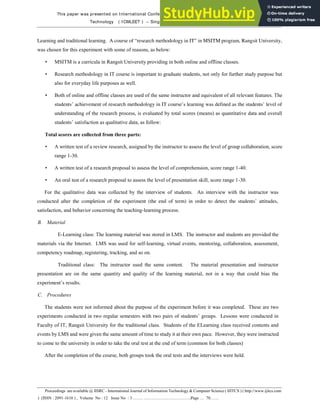
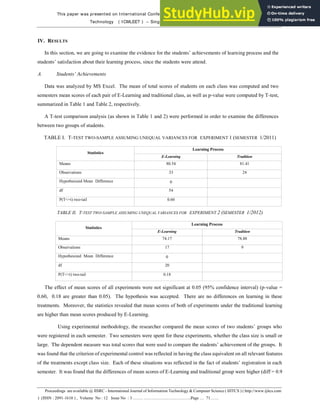
experimental hypothesis states that there is no statistically significant difference between the mean scores of students
in E-Learning class and the mean scores of students in the traditional learning class, as measured by T-test.
III. RESEARCH METHODOLOGY
A. Design
This experiment was designed for a comparison of E-](https://image.slidesharecdn.com/acomparisonofe-learningandtraditionallearningexperimentalapproach-230806151931-15e15cb7/85/A-Comparison-Of-E-Learning-And-Traditional-Learning-Experimental-Approach-3-320.jpg)
![This paper was presented on International Conference on Mobile Learning, E-Society and E-Learning
Technology ( I CMLEET ) – Singapore on November 6 – 7, 2013
Proceedings are available @ IISRC - International Journal of Information Technology & Computer Science ( IJITCS ) ( http://www.ijitcs.com
) (ISSN : 2091-1610 ) , Volume No : 12 Issue No : 3 ……. …………………………….Page … 72……
and 4.7) when class sizes were smaller (size = 24, 33 and 9, 17) among two experiments. B. Students’ Satisfaction
: In this section, we are going to analyze the students’ satisfaction in order to answer the questions: what’s and how’s
students prefer? Verdu, Requeras, Verdu, Custro, and Perez suggested that Students’ satisfaction is an important factor
in order to measure the achievement of students of the learning process. Moreover, students’ satisfaction is associated
with students’ achievement and it is also a key indicator of educational quality [8].
The interviews were used to assess the learning efficiency and satisfaction. The results have been
summarized and compared as shown in table 3.
TABLE III. A COMPARISON OF E-LEARNING AND TRADITIONAL SATISFACTION
Traditional Class E-Learning Class
Students have stay in class all day long (weekend program) (-) Students get more time to spend with family and friends (+)
Students have opportunity directly discuss with the instructor (+) Student have to wait for instructor’s respond by email (-)
Group dixcussion and work is not problem (+) Group discussion and work is difficult to do (-)
The Internet technology is not necessary (+) The Internet Technology is needed (-)
Students have no holidays during studying in the program (-) Students have opportunity to look for more money and improve their
living standard (+)
Classroom learning requires students personally to attend (-) Students set his own learning schedule (+)
Students need travel cost (-) Students do not need travel cost (+)
Students criticize that some students in a classroom may be too shy to
get a chance to participate in front of peers (-)
Students have a greater opportunity to communicate by email or chat,
far from a physical classroom (+)
Students get more friends (+) Students seem to be alone (-)
Students need the extra of instructor’s office hours for advices (-) LMS is efficient (+) but Internet communication line seems to be not.
And advices could be all day all time- 24/7 (-)
Students prefer a small class (-) Class size is ignored (+)
Class room is convenient and comfortable (+) Chat room is fine but typing is slower and more difficult than speaking
(-)
Students propose to have a blended of E-Learning facilities (-) Students propose to have a once or twice a term meeting at the
university (-)
Students need a review session before the final examination (-) Students need a review session before the final examination (-)
Students do not have questions in the classroom because of the
difficulty comprehending the lecture. They could not have a
lecture to review again. (-)
Students have the freedom to fix these class dependent on the events
of the day (+)
Students do not need Computer training. (+) Students need computer training, including how to use LMS (-)
It is quite high tuition fee cost (-) It is very high tuition fee cost and need scholarship (-)
V. DISCUSSION AND CONCLUSION
The results of these studies were shown that there are no differences on learning in these treatments but the mean
scores of students under traditional learning seems to be higher comparing to the E-Learning. A further class size
comparison in each semester was suggested that smaller size would reflect higher difference of mean scores of students](https://image.slidesharecdn.com/acomparisonofe-learningandtraditionallearningexperimentalapproach-230806151931-15e15cb7/85/A-Comparison-Of-E-Learning-And-Traditional-Learning-Experimental-Approach-6-320.jpg)
![This paper was presented on International Conference on Mobile Learning, E-Society and E-Learning
Technology ( I CMLEET ) – Singapore on November 6 – 7, 2013
Proceedings are available @ IISRC - International Journal of Information Technology & Computer Science ( IJITCS ) ( http://www.ijitcs.com
) (ISSN : 2091-1610 ) , Volume No : 12 Issue No : 3 ……. …………………………….Page … 73……
between ELearning and traditional learning. Both of online and offline programs have a lot in common but they have
different aspects as well. A student may personally think E-Learning is better choice because of the flexibility in
schedule and the comfort and convenience of learning from home. It provides 24/7 accessibility for students who
have time management problems. This means that students need to take more responsibility for their own learning.
However, E-Learning has not been all positive. E-Learning methodology has a lack of social-interaction, and it
depends on the Internet communication with high cost. Nafukho [6] said “Technology is only a facilitator; it can not
replace the teacher.” There is still a need to investigate how E-Learning can be better designed for successful delivery
and what kind of students are well suited for this E-Learning methodology.
Findings of research conducted in two experiments shown that traditional learning gave higher mean scores (as the
outcome of study) when compared to mean scores of ELearning, even in many benefits of E-Learning. Furthermore,
the findings from interviews suggested that E-Learning would fail for the following factors: the high cost, Internet
connectivity problems, students’ computing ability, and maturity of students. And students in traditional class
proposed to have a slight improvement in the students’ achievement by using a blended of E-Learning facility, such
as blog, chat room, E-mail and E-store (contents and assignments). In addition, Students suggested having a small
class size.
In conclusion, this research aims to compare E-Learning and traditional methodology. It was found that there is
no difference on learning in these treatments. They have different advantages. Thus, a learning methodology should
be suitable for an individual student. The practices that are associated with more effective learning include: E-Learning
should provide a once or twice meeting a semester and traditional learning should be added some of E-Learning facility
such as chat room, blog and E-store and have a small class size.
Finally, the researcher suggests that the blended learningmixed of E-Learning and traditional learning-would be an
improvement of students’ achievement. Further small class size in traditional learning is also another factor of its
success.
REFERENCES
[1] A.H. Hassenburg, “Distance Education versus the Traditional Classroom,” Berkeley Scientific Journal, vol. 13, pp.
18-25, 2009.
[2] C.A. Dell, C.Low and J.F.Wilker, “Comparing Student Achievement in Online and Face-to-Face class formats,” Journal of
Online Learning and Teaching, vol. 6., pp.30-42, 2010.
[3] ChengZhi, “Introduction to E-Learnikng”[online]: Available at “http://www.chengzhi.net/english/”
[4] D.R. Rashty, “Traditional Learning vs. Elearning,” [online]: Available at “http://www.researchtrail.com/articles/”
[5] D.Zhang, “Virtual Mentor and Media Structuralization Theory”, PH.D. Dissertation, The University of Arizona, Tucson,
Arisona, 2002.
[6] Education &Human Development at Texas A&M University, “ELearning better at improving performance than traditional
instruction”[online]:Available at “http://www.education.tamu.edu/news-archive”
[7] E.Papanis,”Traditional Teaching versus e-learnning”[online] :. Available at “http://www.academic.edu/958026/”](https://image.slidesharecdn.com/acomparisonofe-learningandtraditionallearningexperimentalapproach-230806151931-15e15cb7/85/A-Comparison-Of-E-Learning-And-Traditional-Learning-Experimental-Approach-7-320.jpg)
![This paper was presented on International Conference on Mobile Learning, E-Society and E-Learning
Technology ( I CMLEET ) – Singapore on November 6 – 7, 2013
Proceedings are available @ IISRC - International Journal of Information Technology & Computer Science ( IJITCS ) ( http://www.ijitcs.com
) (ISSN : 2091-1610 ) , Volume No : 12 Issue No : 3 ……. …………………………….Page … 74……
[8] E.Verdu, L.M.Regueras, M.J. Verdu, J.P.D. Custro, and M.A.Perez, “An Analysis of the Research on Adaptive Learning:
The Next Generation of E-learning”, WSEAS Transaction on Information Science & Applications, Vol 5:p.859-868.
[9] Y.H.Tamsamani, “Elearning versus Traditional Classroom”[online]: Available at “http://www.morocco
worldnews.com/2012”.](https://image.slidesharecdn.com/acomparisonofe-learningandtraditionallearningexperimentalapproach-230806151931-15e15cb7/85/A-Comparison-Of-E-Learning-And-Traditional-Learning-Experimental-Approach-8-320.jpg)

This document summarizes a study that compared student achievement and satisfaction between e-learning and traditional learning approaches. Two experiments with student groups were conducted over two semesters. Statistical analysis found no significant differences in mean test scores between the e-learning and traditional groups. Student interviews revealed both benefits and drawbacks to each approach. While e-learning offered flexibility, traditional learning allowed for more direct interaction and discussion with instructors and peers. Overall, the findings suggest blended learning that combines e-learning and traditional methods may improve student outcomes.


