








































A Biblical Look at Work
                    Dr. Ken Boa and Bill Ibsen


         © Dr. Kenneth Boa & Bill Ibsen 2006.  All Rights Reserved.
2
The Problem
2
The Problem
 Most of my waking life is spent at work
2
The Problem
 Most of my waking life is spent at work
 “Ministry is sacred, but work is secular”
2
The Problem
 Most of my waking life is spent at work
 “Ministry is sacred, but work is secular”
  “People in full-time ministry work for what God values”
2
The Problem
 Most of my waking life is spent at work
 “Ministry is sacred, but work is secular”
  “People in full-time ministry work for what God values”
  “People in the marketplace work for money (‘filthy lucre’)”
2
The Problem
 Most of my waking life is spent at work
 “Ministry is sacred, but work is secular”
  “People in full-time ministry work for what God values”
  “People in the marketplace work for money (‘filthy lucre’)”
    “Most of my life doesn’t count in God’s economy”
2
The Problem
 Most of my waking life is spent at work
 “Ministry is sacred, but work is secular”
  “People in full-time ministry work for what God values”
  “People in the marketplace work for money (‘filthy lucre’)”
    “Most of my life doesn’t count in God’s economy”
    “Business people are second-class citizen’s in God’s economy - they
    have a lesser calling than full-time Christian workers”
3
The Presupposition
3
The Presupposition

               “If you’re really sold-out to Jesus,
  you’ll leave your secular job and go into full-time ministry”
3
The Presupposition

               “If you’re really sold-out to Jesus,
  you’ll leave your secular job and go into full-time ministry”


                                                      Is this true?
3
The Presupposition

               “If you’re really sold-out to Jesus,
  you’ll leave your secular job and go into full-time ministry”


                                                       Is this true?
                                                   Is this biblical?
3
The Presupposition

               “If you’re really sold-out to Jesus,
  you’ll leave your secular job and go into full-time ministry”


                                                    Is this true?
                                                Is this biblical?
                    Does my “secular” job matter at all to God?
4
A Biblical Look At Work
4
A Biblical Look At Work
 Part I: Ten Basic Principles
4
A Biblical Look At Work
 Part I: Ten Basic Principles
 Part II: Five Advanced Principles
Part I:
Ten Basic Principles
6
Principle 1
6
 Principle 1


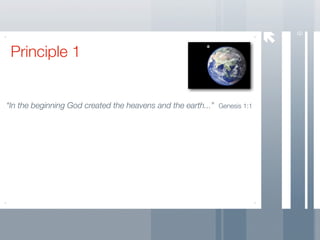
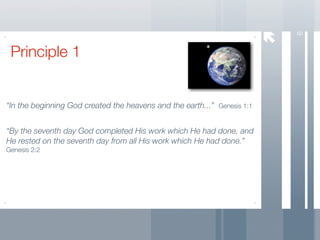
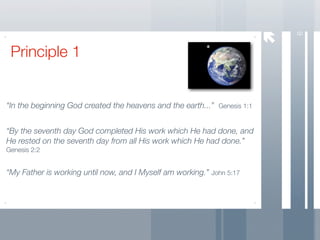
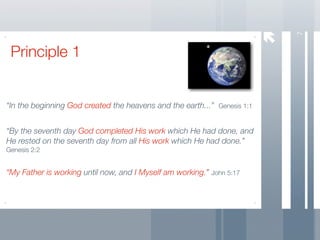
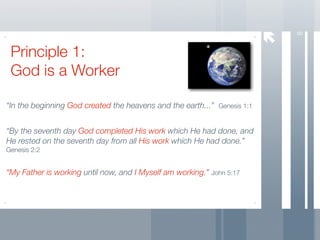
“In the beginning God created the heavens and the earth...” Genesis 1:1
6
 Principle 1


“In the beginning God created the heavens and the earth...” Genesis 1:1


“By the seventh day God completed His work which He had done, and
He rested on the seventh day from all His work which He had done.”
Genesis 2:2
6
 Principle 1


“In the beginning God created the heavens and the earth...” Genesis 1:1


“By the seventh day God completed His work which He had done, and
He rested on the seventh day from all His work which He had done.”
Genesis 2:2


“My Father is working until now, and I Myself am working.” John 5:17
7
 Principle 1


“In the beginning God created the heavens and the earth...” Genesis 1:1


“By the seventh day God completed His work which He had done, and
He rested on the seventh day from all His work which He had done.”
Genesis 2:2


“My Father is working until now, and I Myself am working.” John 5:17
8
 Principle 1:
 God is a Worker

“In the beginning God created the heavens and the earth...” Genesis 1:1


“By the seventh day God completed His work which He had done, and
He rested on the seventh day from all His work which He had done.”
Genesis 2:2


“My Father is working until now, and I Myself am working.” John 5:17
9
9


    “I go on working for the same reason a hen goes on laying eggs”
                              H.L. Mencken
9


    “I go on working for the same reason a hen goes on laying eggs”
                              H.L. Mencken


                                       Work is intrinsic to our nature:
9


    “I go on working for the same reason a hen goes on laying eggs”
                              H.L. Mencken


                                       Work is intrinsic to our nature:
                                         As Image bearers
9


    “I go on working for the same reason a hen goes on laying eggs”
                              H.L. Mencken


                                       Work is intrinsic to our nature:
                                         As Image bearers
                                         Because God is a Worker
10
10

              In creative activity,
         we externalize our identities
     as people made in the image of God
11
 #1 So What?


God is a Worker
11
 #1 So What?

     Work is God-designed


God is a Worker
11
 #1 So What?

     Work is God-designed
      A product of His mind


God is a Worker
11
 #1 So What?

     Work is God-designed
      A product of His mind
      An aspect to His character


God is a Worker
11
 #1 So What?

     Work is God-designed
      A product of His mind
      An aspect to His character
     Work can be a holy endeavor


God is a Worker
12
Principle 2
12
 Principle 2

“Then God said, “Let Us make man in Our image, according to Our
likeness; and let them rule over the fish of the sea and over the birds of
the sky and over the cattle and over all the earth, and over every
creeping thing that creeps on the earth.” Genesis 1:25
12
 Principle 2

“Then God said, “Let Us make man in Our image, according to Our
likeness; and let them rule over the fish of the sea and over the birds of
the sky and over the cattle and over all the earth, and over every
creeping thing that creeps on the earth.” Genesis 1:25

“God said to them, “Be fruitful and multiply, and fill the earth, and
subdue it; and rule over the fish of the sea and over the birds of the
sky and over every living thing that moves on the earth.” Genesis 1:28
12
 Principle 2

“Then God said, “Let Us make man in Our image, according to Our
likeness; and let them rule over the fish of the sea and over the birds of
the sky and over the cattle and over all the earth, and over every
creeping thing that creeps on the earth.” Genesis 1:25

“God said to them, “Be fruitful and multiply, and fill the earth, and
subdue it; and rule over the fish of the sea and over the birds of the
sky and over every living thing that moves on the earth.” Genesis 1:28

“Then the LORD God took the man and put him into the garden of
Eden to cultivate it and keep it.” Genesis 2:15
13
 Principle 2

“Then God said, “Let Us make man in Our image, according to Our
likeness; and let them rule over the fish of the sea and over the birds of
the sky and over the cattle and over all the earth, and over every
creeping thing that creeps on the earth.” Genesis 1:25

“God said to them, “Be fruitful and multiply, and fill the earth, and
subdue it; and rule over the fish of the sea and over the birds of the
sky and over every living thing that moves on the earth.” Genesis 1:28

“Then the LORD God took the man and put him into the garden of
Eden to cultivate it and keep it.” Genesis 2:15
14
 Principle 2:
 God Created Man to be a Worker
“Then God said, “Let Us make man in Our image, according to Our
likeness; and let them rule over the fish of the sea and over the birds of
the sky and over the cattle and over all the earth, and over every
creeping thing that creeps on the earth.” Genesis 1:25

“God said to them, “Be fruitful and multiply, and fill the earth, and
subdue it; and rule over the fish of the sea and over the birds of the
sky and over every living thing that moves on the earth.” Genesis 1:28

“Then the LORD God took the man and put him into the garden of
Eden to cultivate it and keep it.” Genesis 2:15
15
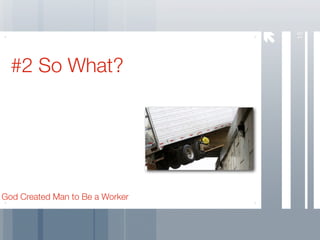
  #2 So What?


God Created Man to Be a Worker
15
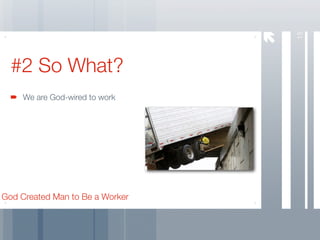
  #2 So What?
     We are God-wired to work


God Created Man to Be a Worker
15
  #2 So What?
     We are God-wired to work
     Work is in our best interest


God Created Man to Be a Worker
15
  #2 So What?
     We are God-wired to work
     Work is in our best interest
     Like God, we are designed
     to build, create,
     communicate, and take on
     challenges in our work


God Created Man to Be a Worker
15
  #2 So What?
     We are God-wired to work
     Work is in our best interest
     Like God, we are designed
     to build, create,
     communicate, and take on
     challenges in our work
      Thus, work can engage us at
      a deep level of our being

God Created Man to Be a Worker
16
Principle 3
16
Principle 3


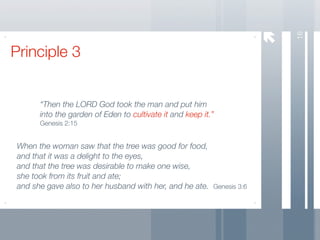
    “Then the LORD God took the man and put him
    into the garden of Eden to cultivate it and keep it.”
    Genesis 2:15
16
Principle 3


      “Then the LORD God took the man and put him
      into the garden of Eden to cultivate it and keep it.”
      Genesis 2:15


When the woman saw that the tree was good for food,
and that it was a delight to the eyes,
and that the tree was desirable to make one wise,
she took from its fruit and ate;
and she gave also to her husband with her, and he ate. Genesis 3:6
17
Principle 3:


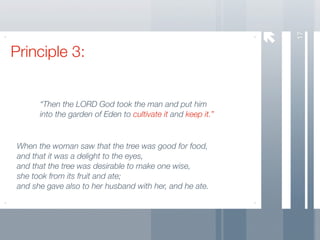
       “Then the LORD God took the man and put him
       into the garden of Eden to cultivate it and keep it.”


 When the woman saw that the tree was good for food,
 and that it was a delight to the eyes,
 and that the tree was desirable to make one wise,
 she took from its fruit and ate;
 and she gave also to her husband with her, and he ate.
17
Principle 3:


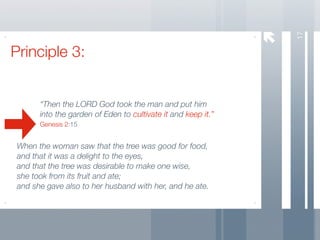
       “Then the LORD God took the man and put him
       into the garden of Eden to cultivate it and keep it.”
       Genesis 2:15


 When the woman saw that the tree was good for food,
 and that it was a delight to the eyes,
 and that the tree was desirable to make one wise,
 she took from its fruit and ate;
 and she gave also to her husband with her, and he ate.
17
Principle 3:


       “Then the LORD God took the man and put him
       into the garden of Eden to cultivate it and keep it.”
       Genesis 2:15


 When the woman saw that the tree was good for food,
 and that it was a delight to the eyes,
 and that the tree was desirable to make one wise,
 she took from its fruit and ate;
 and she gave also to her husband with her, and he ate. Genesis 3:6
17
Principle 3:
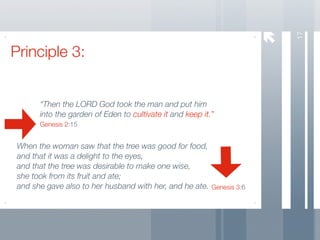
God Created Work Pre-Fall

      “Then the LORD God took the man and put him
      into the garden of Eden to cultivate it and keep it.”
      Genesis 2:15


When the woman saw that the tree was good for food,
and that it was a delight to the eyes,
and that the tree was desirable to make one wise,
she took from its fruit and ate;
and she gave also to her husband with her, and he ate. Genesis 3:6
18
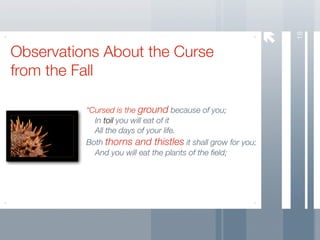
Observations About the Curse
from the Fall
18
Observations About the Curse
from the Fall

          “Cursed is the ground because of you;
          	 In toil you will eat of it
          	 All the days of your life.
18
Observations About the Curse
from the Fall

          “Cursed is the ground because of you;
          	 In toil you will eat of it
          	 All the days of your life.
          Both thorns and thistles it shall grow for you;
          	 And you will eat the plants of the field;
18
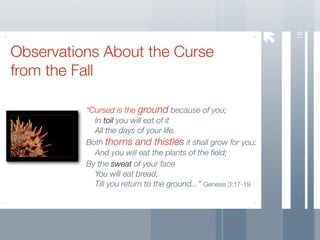
Observations About the Curse
from the Fall

          “Cursed is the ground because of you;
          	 In toil you will eat of it
          	 All the days of your life.
          Both thorns and thistles it shall grow for you;
          	 And you will eat the plants of the field;
          By the sweat of your face
          	 You will eat bread,
          
 Till you return to the ground...” Genesis 3:17-19
19
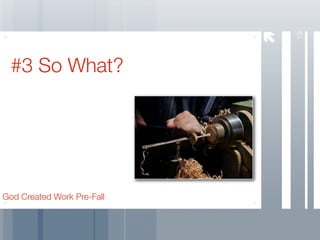
 #3 So What?


God Created Work Pre-Fall
19
 #3 So What?

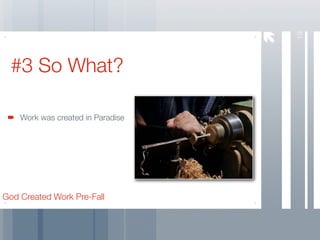
    Work was created in Paradise


God Created Work Pre-Fall
19
 #3 So What?

    Work was created in Paradise
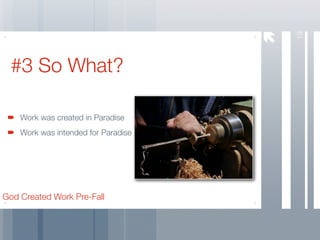
    Work was intended for Paradise


God Created Work Pre-Fall
19
 #3 So What?

    Work was created in Paradise
    Work was intended for Paradise
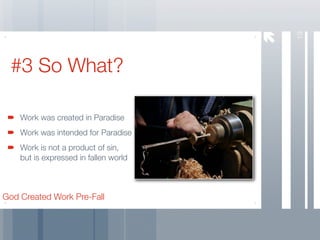
    Work is not a product of sin,
    but is expressed in fallen world


God Created Work Pre-Fall
20
Principle 4:
God Calls Work “Very Good”
20
Principle 4:
God Calls Work “Very Good”
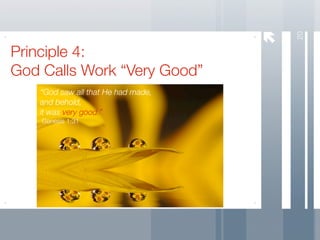
   “God saw all that He had made,
   and behold,
   it was very good.”
    Genesis 1:31
21
Principle 4:
God Calls Work “Very Good”


     “God saw all that He had made,
               and behold,
           it was very good.”
               Genesis 1:31
21
Principle 4:
God Calls Work “Very Good”
                                            rts
                                      ts pa
                                 an di
                         h ole
                    h ew
                  =T
     “God saw all that He had made,
               and behold,
           it was very good.”
               Genesis 1:31
21
Principle 4:
God Calls Work “Very Good”
                                               g
                                      r ts rkin
                                   pa n wo
                                its ma
                             and ing:
                          ole lud
                      e wh inc
                  = Th arts
                      =P
     “God saw all that He had made,
               and behold,
           it was very good.”
               Genesis 1:31
22
  #4 So What?


God Calls Work “Very Good”
22
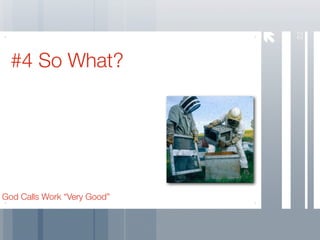
  #4 So What?
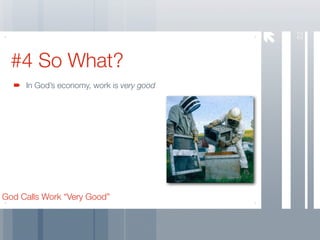
     In God’s economy, work is very good


God Calls Work “Very Good”
22
  #4 So What?
     In God’s economy, work is very good
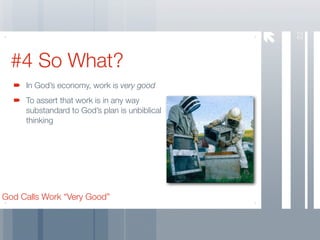
     To assert that work is in any way
     substandard to God’s plan is unbiblical
     thinking


God Calls Work “Very Good”
22
  #4 So What?
     In God’s economy, work is very good
     To assert that work is in any way
     substandard to God’s plan is unbiblical
     thinking
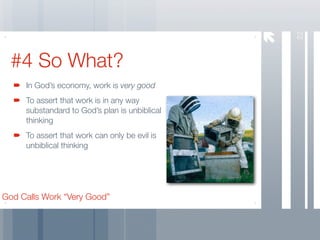
     To assert that work can only be evil is
     unbiblical thinking


God Calls Work “Very Good”
22
  #4 So What?
     In God’s economy, work is very good
     To assert that work is in any way
     substandard to God’s plan is unbiblical
     thinking
     To assert that work can only be evil is
     unbiblical thinking
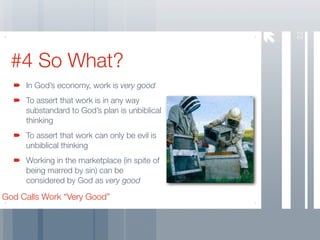
     Working in the marketplace (in spite of
     being marred by sin) can be
     considered by God as very good

God Calls Work “Very Good”
23
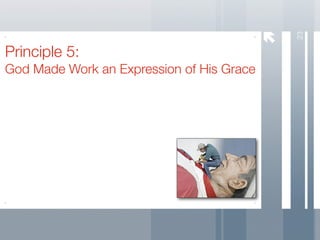
Principle 5:
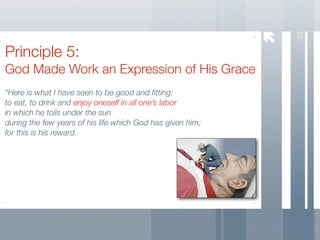
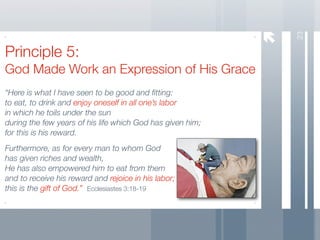
God Made Work an Expression of His Grace
23
Principle 5:
God Made Work an Expression of His Grace
“Here is what I have seen to be good and fitting:
to eat, to drink and enjoy oneself in all one’s labor
in which he toils under the sun
during the few years of his life which God has given him;
for this is his reward.
23
Principle 5:
God Made Work an Expression of His Grace
“Here is what I have seen to be good and fitting:
to eat, to drink and enjoy oneself in all one’s labor
in which he toils under the sun
during the few years of his life which God has given him;
for this is his reward.
Furthermore, as for every man to whom God
has given riches and wealth,
He has also empowered him to eat from them
and to receive his reward and rejoice in his labor;
this is the gift of God.” Ecclesiastes 3:18-19
24
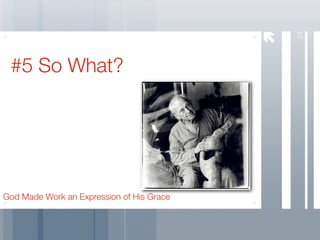
 #5 So What?


God Made Work an Expression of His Grace
24
 #5 So What?
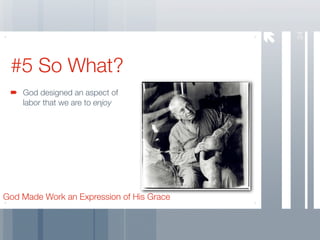
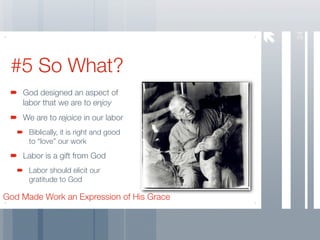
    God designed an aspect of
    labor that we are to enjoy


God Made Work an Expression of His Grace
24
 #5 So What?
    God designed an aspect of
    labor that we are to enjoy
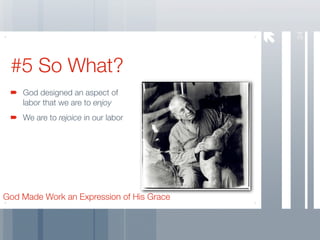
    We are to rejoice in our labor


God Made Work an Expression of His Grace
24
 #5 So What?
    God designed an aspect of
    labor that we are to enjoy
    We are to rejoice in our labor
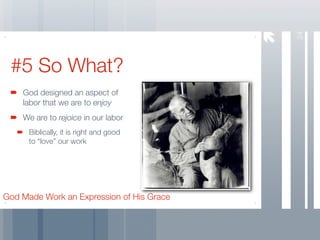
      Biblically, it is right and good
      to “love” our work


God Made Work an Expression of His Grace
24
 #5 So What?
    God designed an aspect of
    labor that we are to enjoy
    We are to rejoice in our labor
      Biblically, it is right and good
      to “love” our work
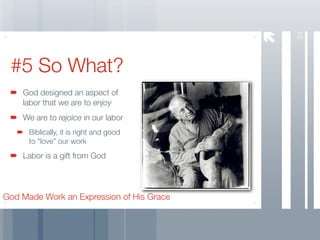
    Labor is a gift from God


God Made Work an Expression of His Grace
24
 #5 So What?
    God designed an aspect of
    labor that we are to enjoy
    We are to rejoice in our labor
      Biblically, it is right and good
      to “love” our work
    Labor is a gift from God
      Labor should elicit our
      gratitude to God

God Made Work an Expression of His Grace
25
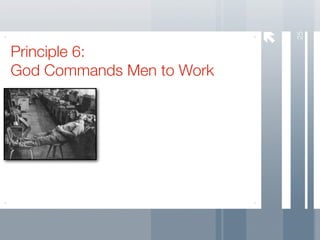
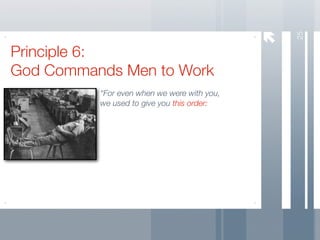
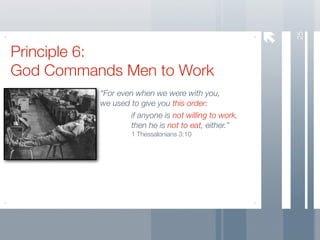
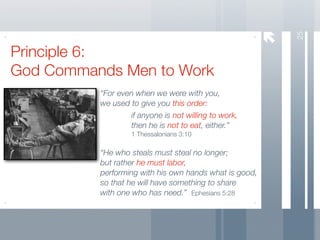
Principle 6:
God Commands Men to Work
25
Principle 6:
God Commands Men to Work
          “For even when we were with you,
          we used to give you this order:
25
Principle 6:
God Commands Men to Work
          “For even when we were with you,
          we used to give you this order:
                  if anyone is not willing to work,
                  then he is not to eat, either.”
                   1 Thessalonians 3:10
25
Principle 6:
God Commands Men to Work
          “For even when we were with you,
          we used to give you this order:
                  if anyone is not willing to work,
                  then he is not to eat, either.”
                   1 Thessalonians 3:10

          “He who steals must steal no longer;
          but rather he must labor,
          performing with his own hands what is good,
          so that he will have something to share
          with one who has need.” Ephesians 5:28
26
Example of Principle 6:
God’s People Working Diligently
26
Example of Principle 6:
God’s People Working Diligently
“nor did we eat anyone’s bread without paying for it,
but with labor and hardship we kept working night and day
so that we would not be a burden to any of you” 2 Thessalonians 3:8
26
Example of Principle 6:
God’s People Working Diligently
“nor did we eat anyone’s bread without paying for it,
but with labor and hardship we kept working night and day
so that we would not be a burden to any of you” 2 Thessalonians 3:8


“and we toil, working with our own hands...” 1 Corinthians 4:12
27
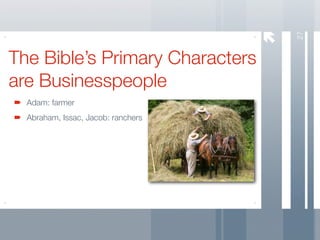
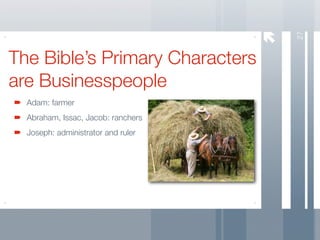
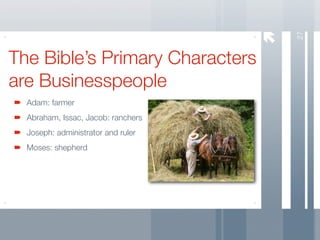
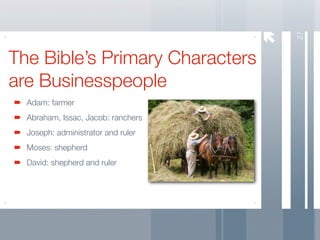
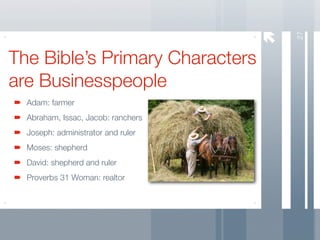
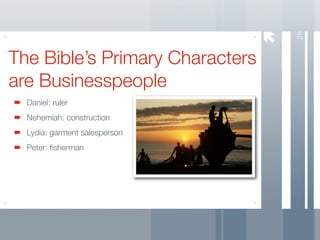
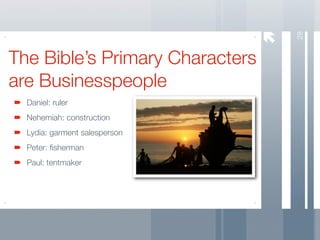
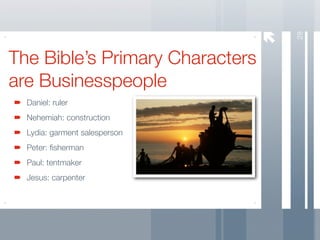
The Bible’s Primary Characters
are Businesspeople
27
The Bible’s Primary Characters
are Businesspeople
  Adam: farmer
27
The Bible’s Primary Characters
are Businesspeople
  Adam: farmer
  Abraham, Issac, Jacob: ranchers
27
The Bible’s Primary Characters
are Businesspeople
  Adam: farmer
  Abraham, Issac, Jacob: ranchers
  Joseph: administrator and ruler
27
The Bible’s Primary Characters
are Businesspeople
  Adam: farmer
  Abraham, Issac, Jacob: ranchers
  Joseph: administrator and ruler
  Moses: shepherd
27
The Bible’s Primary Characters
are Businesspeople
  Adam: farmer
  Abraham, Issac, Jacob: ranchers
  Joseph: administrator and ruler
  Moses: shepherd
  David: shepherd and ruler
27
The Bible’s Primary Characters
are Businesspeople
  Adam: farmer
  Abraham, Issac, Jacob: ranchers
  Joseph: administrator and ruler
  Moses: shepherd
  David: shepherd and ruler
  Proverbs 31 Woman: realtor
28
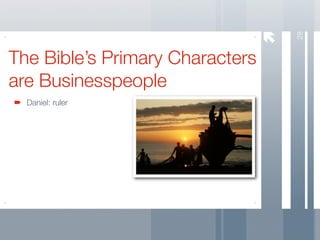
The Bible’s Primary Characters
are Businesspeople
28
The Bible’s Primary Characters
are Businesspeople
  Daniel: ruler
28
The Bible’s Primary Characters
are Businesspeople
  Daniel: ruler
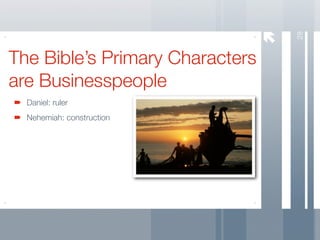
  Nehemiah: construction
28
The Bible’s Primary Characters
are Businesspeople
  Daniel: ruler
  Nehemiah: construction
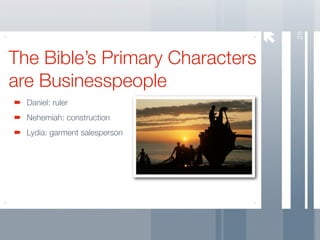
  Lydia: garment salesperson
28
The Bible’s Primary Characters
are Businesspeople
  Daniel: ruler
  Nehemiah: construction
  Lydia: garment salesperson
  Peter: fisherman
28
The Bible’s Primary Characters
are Businesspeople
  Daniel: ruler
  Nehemiah: construction
  Lydia: garment salesperson
  Peter: fisherman
  Paul: tentmaker
28
The Bible’s Primary Characters
are Businesspeople
  Daniel: ruler
  Nehemiah: construction
  Lydia: garment salesperson
  Peter: fisherman
  Paul: tentmaker
  Jesus: carpenter
29
Businesspeople in the Bible
29
Businesspeople in the Bible
 Goods Producers: cattle farmers, vineyard tenders, iron
 workers, carpenters, tentmakers, textile producers
29
Businesspeople in the Bible
 Goods Producers: cattle farmers, vineyard tenders, iron
 workers, carpenters, tentmakers, textile producers
 Managers: of grain suppliers, of employees, building projects,
 armies, finances
29
Businesspeople in the Bible
 Goods Producers: cattle farmers, vineyard tenders, iron
 workers, carpenters, tentmakers, textile producers
 Managers: of grain suppliers, of employees, building projects,
 armies, finances
 Public Servants: in medicine, courts, community, civil rights,
 public finance
29
Businesspeople in the Bible
 Goods Producers: cattle farmers, vineyard tenders, iron
 workers, carpenters, tentmakers, textile producers
 Managers: of grain suppliers, of employees, building projects,
 armies, finances
 Public Servants: in medicine, courts, community, civil rights,
 public finance
 Artists: musicians, sculptors, seamstresses, dancers, worship
 leaders, writers
30
 #6 So What?


God Commands Men to Work
30
 #6 So What?
   A failure to work represents a breach of God’s commandment


God Commands Men to Work
30
 #6 So What?
   A failure to work represents a breach of God’s commandment
   Some of the holiest people in the Bible lived out their faith in the
   marketplace - including Jesus


God Commands Men to Work
30
 #6 So What?
   A failure to work represents a breach of God’s commandment
   Some of the holiest people in the Bible lived out their faith in the
   marketplace - including Jesus
   God can be served as well in the marketplace as at His temple


God Commands Men to Work
30
 #6 So What?
   A failure to work represents a breach of God’s commandment
   Some of the holiest people in the Bible lived out their faith in the
   marketplace - including Jesus
   God can be served as well in the marketplace as at His temple
    Thinking/teaching to the contrary is unbiblical


God Commands Men to Work
30
 #6 So What?
   A failure to work represents a breach of God’s commandment
   Some of the holiest people in the Bible lived out their faith in the
   marketplace - including Jesus
   God can be served as well in the marketplace as at His temple
    Thinking/teaching to the contrary is unbiblical
  The command to work does not sanction either underwork or
  overwork

God Commands Men to Work
31
Principle 7:
God Commands Men to Work for Him
31
Principle 7:
God Commands Men to Work for Him
 “Whatever you do,
 do your work heartily,
 as for the Lord rather than for men,
 knowing that from the Lord
 you will receive the reward of the inheritance.
 It is the Lord Christ whom you serve.” Colossians 3:23-24
31
Principle 7:
God Commands Men to Work for Him
 “Whatever you do,
 do your work heartily,
 as for the Lord rather than for men,
 knowing that from the Lord
 you will receive the reward of the inheritance.
 It is the Lord Christ whom you serve.” Colossians 3:23-24

 “With good will render service, as to the Lord, and not to men,
 knowing that whatever good thing each one does,
 this he will receive back from the Lord, whether slave or free.”
 Ephesians 6:7-8
32
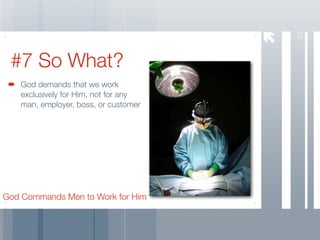
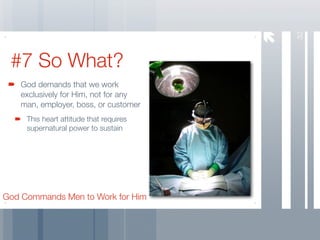
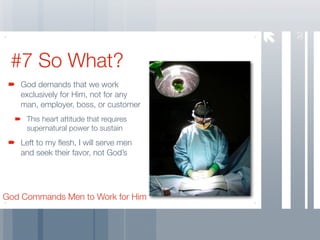
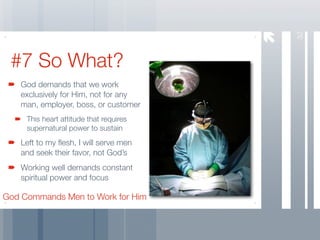
 #7 So What?


God Commands Men to Work for Him
32
 #7 So What?
   God demands that we work
   exclusively for Him, not for any
   man, employer, boss, or customer


God Commands Men to Work for Him
32
 #7 So What?
   God demands that we work
   exclusively for Him, not for any
   man, employer, boss, or customer
     This heart attitude that requires
     supernatural power to sustain


God Commands Men to Work for Him
32
 #7 So What?
   God demands that we work
   exclusively for Him, not for any
   man, employer, boss, or customer
     This heart attitude that requires
     supernatural power to sustain
   Left to my flesh, I will serve men
   and seek their favor, not God’s


God Commands Men to Work for Him
32
 #7 So What?
   God demands that we work
   exclusively for Him, not for any
   man, employer, boss, or customer
     This heart attitude that requires
     supernatural power to sustain
   Left to my flesh, I will serve men
   and seek their favor, not God’s
   Working well demands constant
   spiritual power and focus

God Commands Men to Work for Him
33
Principle 8:
God Promotes and Demotes
33
Principle 8:
God Promotes and Demotes
        “For not from the east, nor from the west,
        	 Nor from the desert comes exaltation;
        But God is the Judge;
        
 He puts down one and exalts another.”
                      Psalm 75:6-7
34
 #8 So What?


God Promotes and Demotes
34
 #8 So What?
    My efforts to impress or to
    manipulate my superiors to
    promote me are futile


God Promotes and Demotes
34
 #8 So What?
    My efforts to impress or to
    manipulate my superiors to
    promote me are futile
     Wrong audience


God Promotes and Demotes
34
 #8 So What?
    My efforts to impress or to
    manipulate my superiors to
    promote me are futile
     Wrong audience
    View promotion, demotion,
    layoff, and dismissal as from
    God, not man

God Promotes and Demotes
35
Principle 9:
God Gives Us our Abilities, Intelligence,
and Wealth
35
Principle 9:
God Gives Us our Abilities, Intelligence,
and Wealth
“Since we have gifts that differ according to the grace given to us,
each of us is to exercise them accordingly...” Romans 12:6
35
Principle 9:
God Gives Us our Abilities, Intelligence,
and Wealth
“Since we have gifts that differ according to the grace given to us,
each of us is to exercise them accordingly...” Romans 12:6

“It is He who changes the times and the epochs;
	     He removes kings and establishes kings;
	     He gives wisdom to wise men
	     And knowledge to men of understanding. Daniel 2:21
35
Principle 9:
God Gives Us our Abilities, Intelligence,
and Wealth
“Since we have gifts that differ according to the grace given to us,
each of us is to exercise them accordingly...” Romans 12:6

“It is He who changes the times and the epochs;
	     He removes kings and establishes kings;
	     He gives wisdom to wise men
	     And knowledge to men of understanding. Daniel 2:21
“But you shall remember the LORD your God,
for it is He who is giving you power to make wealth...” Deuteronomy 8:18
36
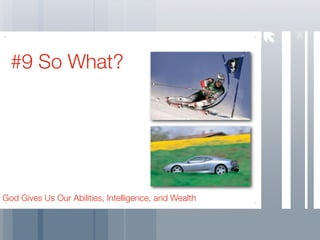
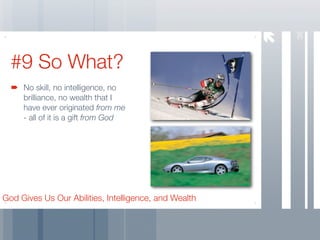
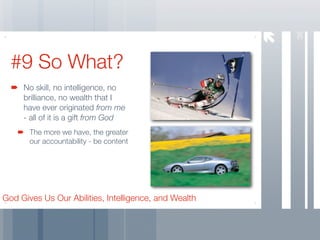
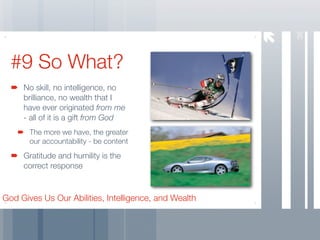
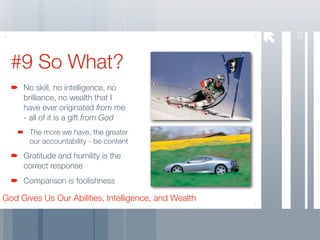
  #9 So What?


God Gives Us Our Abilities, Intelligence, and Wealth
36
  #9 So What?
     No skill, no intelligence, no
     brilliance, no wealth that I
     have ever originated from me
     - all of it is a gift from God


God Gives Us Our Abilities, Intelligence, and Wealth
36
  #9 So What?
     No skill, no intelligence, no
     brilliance, no wealth that I
     have ever originated from me
     - all of it is a gift from God
       The more we have, the greater
       our accountability - be content


God Gives Us Our Abilities, Intelligence, and Wealth
36
  #9 So What?
     No skill, no intelligence, no
     brilliance, no wealth that I
     have ever originated from me
     - all of it is a gift from God
       The more we have, the greater
       our accountability - be content
     Gratitude and humility is the
     correct response


God Gives Us Our Abilities, Intelligence, and Wealth
36
  #9 So What?
     No skill, no intelligence, no
     brilliance, no wealth that I
     have ever originated from me
     - all of it is a gift from God
       The more we have, the greater
       our accountability - be content
     Gratitude and humility is the
     correct response
     Comparison is foolishness

God Gives Us Our Abilities, Intelligence, and Wealth
37
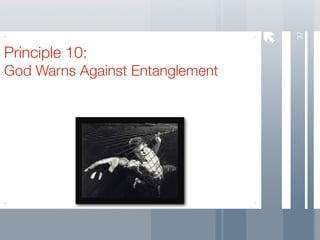
Principle 10:
God Warns Against Entanglement
37
Principle 10:
God Warns Against Entanglement
“No soldier in active service entangles himself in the affairs of
everyday life, so that he may please
the one who enlisted him as a soldier.”
2 Timothy 2:4
38
 #10 So What?


God Warns Against Entanglement
38
 #10 So What?
    If I’m entangled in my work, I am
    not pleasing my Commanding
    Officer


God Warns Against Entanglement
38
 #10 So What?
    If I’m entangled in my work, I am
    not pleasing my Commanding
    Officer
     Am I entangled (imbalanced/
     addicted) to my work?


God Warns Against Entanglement
38
 #10 So What?
    If I’m entangled in my work, I am
    not pleasing my Commanding
    Officer
     Am I entangled (imbalanced/
     addicted) to my work?
    Do I allow work to interfere with
    the depth and quality of important
    relationships?


God Warns Against Entanglement
38
 #10 So What?
    If I’m entangled in my work, I am
    not pleasing my Commanding
    Officer
     Am I entangled (imbalanced/
     addicted) to my work?
    Do I allow work to interfere with
    the depth and quality of important
    relationships?
    What, if anything, must change in
    my work life to allow me to be a
    better soldier?
God Warns Against Entanglement
39
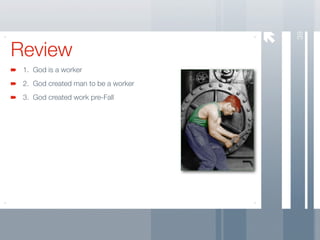
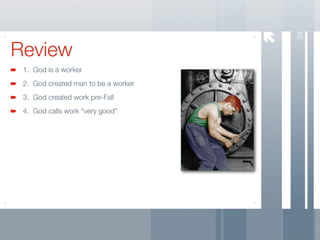
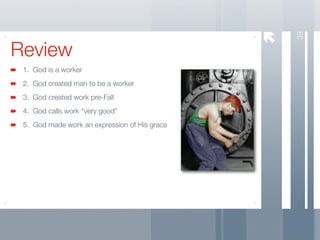
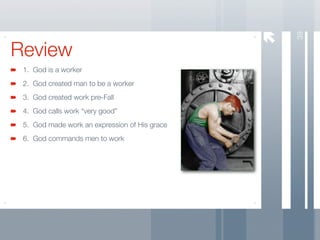
Review
39
Review
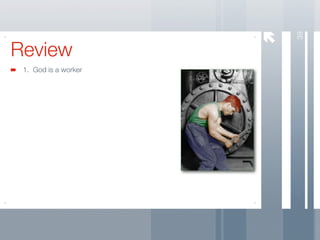
 1. God is a worker
39
Review
 1. God is a worker
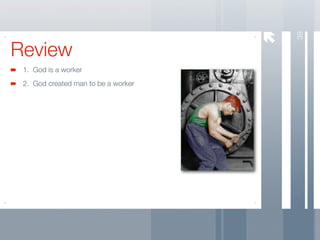
 2. God created man to be a worker
39
Review
 1. God is a worker
 2. God created man to be a worker
 3. God created work pre-Fall
39
Review
 1. God is a worker
 2. God created man to be a worker
 3. God created work pre-Fall
 4. God calls work “very good”
39
Review
 1. God is a worker
 2. God created man to be a worker
 3. God created work pre-Fall
 4. God calls work “very good”
 5. God made work an expression of His grace
39
Review
 1. God is a worker
 2. God created man to be a worker
 3. God created work pre-Fall
 4. God calls work “very good”
 5. God made work an expression of His grace
 6. God commands men to work
39
Review
 1. God is a worker
 2. God created man to be a worker
 3. God created work pre-Fall
 4. God calls work “very good”
 5. God made work an expression of His grace
 6. God commands men to work
 7. God commands men to work for Him
39
Review
 1. God is a worker
 2. God created man to be a worker
 3. God created work pre-Fall
 4. God calls work “very good”
 5. God made work an expression of His grace
 6. God commands men to work
 7. God commands men to work for Him
 8. God promotes and demotes
39
Review
 1. God is a worker
 2. God created man to be a worker
 3. God created work pre-Fall
 4. God calls work “very good”
 5. God made work an expression of His grace
 6. God commands men to work
 7. God commands men to work for Him
 8. God promotes and demotes
 9. God gives us our abilities, intelligence, and wealth
39
Review
 1. God is a worker
 2. God created man to be a worker
 3. God created work pre-Fall
 4. God calls work “very good”
 5. God made work an expression of His grace
 6. God commands men to work
 7. God commands men to work for Him
 8. God promotes and demotes
 9. God gives us our abilities, intelligence, and wealth
 10. God warns against entanglement
Part II
Five Advanced Principles
41
1. I Don’t Work to Earn a Living
41
1. I Don’t Work to Earn a Living
“And my God will supply all your needs according to His riches in
glory in Christ Jesus.” Philippians 4:19
41
1. I Don’t Work to Earn a Living
“And my God will supply all your needs according to His riches in
glory in Christ Jesus.” Philippians 4:19

“What do you have that you did not receive? And if you did receive
it, why do you boast as if you had not received it? ” 1 Corinthians 4:7b
41
1. I Don’t Work to Earn a Living
“And my God will supply all your needs according to His riches in
glory in Christ Jesus.” Philippians 4:19

“What do you have that you did not receive? And if you did receive
it, why do you boast as if you had not received it? ” 1 Corinthians 4:7b


     I must look to God alone for the meeting of my needs
41
1. I Don’t Work to Earn a Living
“And my God will supply all your needs according to His riches in
glory in Christ Jesus.” Philippians 4:19

“What do you have that you did not receive? And if you did receive
it, why do you boast as if you had not received it? ” 1 Corinthians 4:7b


     I must look to God alone for the meeting of my needs
     Work may be the vehicle of provision, but not the source
42
Common Objections to
Principle #1
42
Common Objections to
Principle #1


  The unwilling to work should not eat
42
Common Objections to
Principle #1


  The unwilling to work should not eat
  Doesn’t mean that he works in order to eat
42
Common Objections to
Principle #1


  The unwilling to work should not eat
  Doesn’t mean that he works in order to eat
   One-way street, i.e. (1Cor. 6:9,10)
42
Common Objections to
Principle #1
“For even when we were with you,
we used to give you this order:


   The unwilling to work should not eat
   Doesn’t mean that he works in order to eat
    One-way street, i.e. (1Cor. 6:9,10)
42
Common Objections to
Principle #1
“For even when we were with you,
we used to give you this order:
        if anyone is not willing to work,
        then he is not to eat, either.”
         1 Thessalonians 3:10


   The unwilling to work should not eat
   Doesn’t mean that he works in order to eat
     One-way street, i.e. (1Cor. 6:9,10)
43
Common Objections to
Principle #1
43
Common Objections to
Principle #1


  Implicit vs. explicit verses on provision
43
Common Objections to
Principle #1


  Implicit vs. explicit verses on provision
  My responsibility to work and give provision to my family does
  not mean that I am the source of my provision
43
Common Objections to
Principle #1
 “But if anyone does not provide for his own, and
 especially for those of his household,
 he has denied the faith and is worse than an unbeliever.”
 1Timothy 5:8


  Implicit vs. explicit verses on provision
  My responsibility to work and give provision to my family does
  not mean that I am the source of my provision
44
Failure to Apply Principle #1
44
Failure to Apply Principle #1
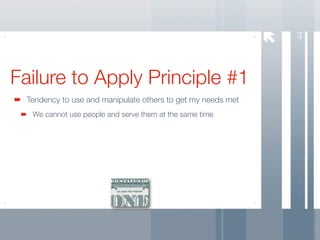
 Tendency to use and manipulate others to get my needs met
44
Failure to Apply Principle #1
 Tendency to use and manipulate others to get my needs met
  We cannot use people and serve them at the same time
44
Failure to Apply Principle #1
 Tendency to use and manipulate others to get my needs met
  We cannot use people and serve them at the same time
  Chasing the dollar to establish my standard of living
44
Failure to Apply Principle #1
 Tendency to use and manipulate others to get my needs met
  We cannot use people and serve them at the same time
  Chasing the dollar to establish my standard of living
 Tendency to compete with co-workers
44
Failure to Apply Principle #1
 Tendency to use and manipulate others to get my needs met
  We cannot use people and serve them at the same time
  Chasing the dollar to establish my standard of living
 Tendency to compete with co-workers
 Tendency to compartmentalize “God’s time” versus “my time”
44
Failure to Apply Principle #1
 Tendency to use and manipulate others to get my needs met
  We cannot use people and serve them at the same time
  Chasing the dollar to establish my standard of living
 Tendency to compete with co-workers
 Tendency to compartmentalize “God’s time” versus “my time”
 Tendency to compromise my values to get my needs met
45
2. There Is No Necessary Correlation
Between How Hard I Work and How
Much I Make

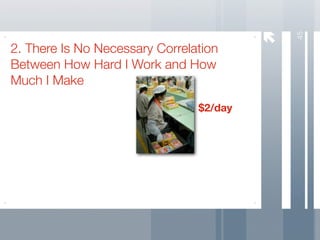
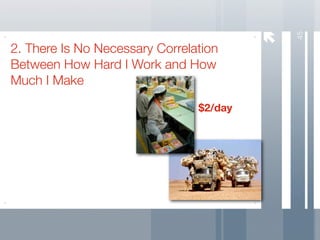
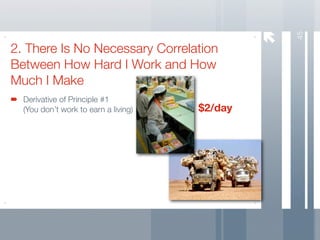
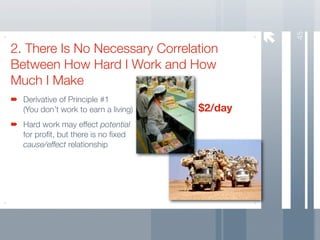
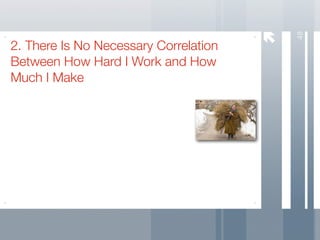
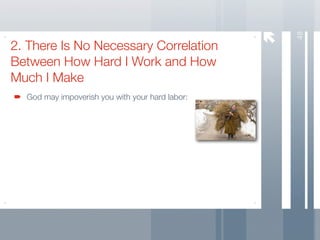
                                $2/day
45
2. There Is No Necessary Correlation
Between How Hard I Work and How
Much I Make

                                $2/day
45
2. There Is No Necessary Correlation
Between How Hard I Work and How
Much I Make
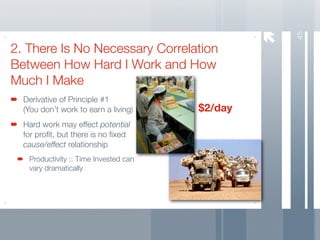
  Derivative of Principle #1
  (You don’t work to earn a living)   $2/day
45
2. There Is No Necessary Correlation
Between How Hard I Work and How
Much I Make
  Derivative of Principle #1
  (You don’t work to earn a living)   $2/day
  Hard work may effect potential
  for profit, but there is no fixed
  cause/effect relationship
45
2. There Is No Necessary Correlation
Between How Hard I Work and How
Much I Make
  Derivative of Principle #1
  (You don’t work to earn a living)    $2/day
  Hard work may effect potential
  for profit, but there is no fixed
  cause/effect relationship
   Productivity :: Time Invested can
   vary dramatically
46
2. There Is No Necessary Correlation
Between How Hard I Work and How
Much I Make
46
2. There Is No Necessary Correlation
Between How Hard I Work and How
Much I Make
  God may prosper you without your labor:
46
2. There Is No Necessary Correlation
Between How Hard I Work and How
Much I Make
    God may prosper you without your labor:
“Then it shall come about when the LORD your God brings you into
the land which He swore to your fathers, Abraham, Isaac and Jacob,
to give you,
great and splendid cities which you did not build,
and houses full of all good things which you did not fill,
and hewn cisterns which you did not dig,
vineyards and olive trees which you did not plant,
and you eat and are satisfied” Deuteronomy 6:10-11
47
2. There Is No Necessary Correlation
Between How Hard I Work and How
Much I Make
  God may prosper you without your labor:
47
2. There Is No Necessary Correlation
Between How Hard I Work and How
Much I Make
    God may prosper you without your labor:

“It is vain for you to rise up early,
	 To retire late,
	 To eat the bread of painful labors;

 For He gives to His beloved even in his sleep.”
Psalm 127:2
48
2. There Is No Necessary Correlation
Between How Hard I Work and How
Much I Make
48
2. There Is No Necessary Correlation
Between How Hard I Work and How
Much I Make
  God may impoverish you with your hard labor:
48
2. There Is No Necessary Correlation
Between How Hard I Work and How
Much I Make
    God may impoverish you with your hard labor:
“You have sown much, but harvest little;
you eat, but there is not enough to be satisfied;
you drink, but there is not enough to become drunk;
you put on clothing, but no one is warm enough;
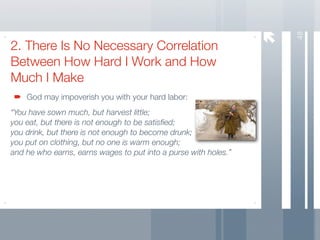
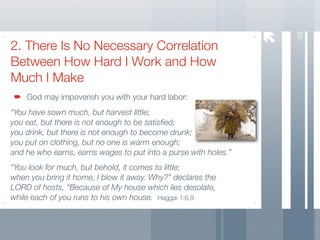
and he who earns, earns wages to put into a purse with holes.”
48
2. There Is No Necessary Correlation
Between How Hard I Work and How
Much I Make
    God may impoverish you with your hard labor:
“You have sown much, but harvest little;
you eat, but there is not enough to be satisfied;
you drink, but there is not enough to become drunk;
you put on clothing, but no one is warm enough;
and he who earns, earns wages to put into a purse with holes.”
“You look for much, but behold, it comes to little;
when you bring it home, I blow it away. Why?” declares the
LORD of hosts, “Because of My house which lies desolate,
while each of you runs to his own house. Haggai 1:6,9
49
Failure to Apply Principle #2
49
Failure to Apply Principle #2
 Inclination to sacrifice priorities when my income is down
49
Failure to Apply Principle #2
 Inclination to sacrifice priorities when my income is down
 Inclination to allow the marketplace to dictate the level of my
 commitment to Christ
49
Failure to Apply Principle #2
 Inclination to sacrifice priorities when my income is down
 Inclination to allow the marketplace to dictate the level of my
 commitment to Christ
 Inclination to integrate my faith into the marketplace only when
 the environment is friendly
49
Failure to Apply Principle #2
 Inclination to sacrifice priorities when my income is down
 Inclination to allow the marketplace to dictate the level of my
 commitment to Christ
 Inclination to integrate my faith into the marketplace only when
 the environment is friendly
 Inclination to attempt to out-earn my needs
50
Summary of Principles #1 & 2
50
Summary of Principles #1 & 2
  My labors are not the source of my provision or my prosperity
50
Summary of Principles #1 & 2
  My labors are not the source of my provision or my prosperity
  God is my Provider; I need not fear
51
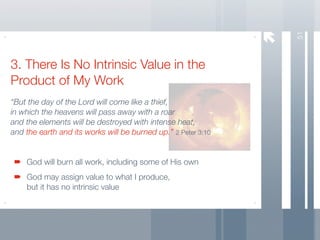
3. There Is No Intrinsic Value in the
Product of My Work
51
3. There Is No Intrinsic Value in the
Product of My Work
“But the day of the Lord will come like a thief,
in which the heavens will pass away with a roar
and the elements will be destroyed with intense heat,
and the earth and its works will be burned up.” 2 Peter 3:10
51
3. There Is No Intrinsic Value in the
Product of My Work
“But the day of the Lord will come like a thief,
in which the heavens will pass away with a roar
and the elements will be destroyed with intense heat,
and the earth and its works will be burned up.” 2 Peter 3:10


    God will burn all work, including some of His own
51
3. There Is No Intrinsic Value in the
Product of My Work
“But the day of the Lord will come like a thief,
in which the heavens will pass away with a roar
and the elements will be destroyed with intense heat,
and the earth and its works will be burned up.” 2 Peter 3:10


    God will burn all work, including some of His own
    God may assign value to what I produce,
    but it has no intrinsic value
52
52
53
3. There Is No Intrinsic Value in the
Product of My Work
53
3. There Is No Intrinsic Value in the
Product of My Work
  The product of work may have utilitarian value, but no intrinsic
  value
53
3. There Is No Intrinsic Value in the
Product of My Work
  The product of work may have utilitarian value, but no intrinsic
  value
  The process of work has value because God uses it to
  determine reward in heaven (1 Corinthians 3:14-15)
53
3. There Is No Intrinsic Value in the
Product of My Work
  The product of work may have utilitarian value, but no intrinsic
  value
  The process of work has value because God uses it to
  determine reward in heaven (1 Corinthians 3:14-15)
  Its not the fruit of our labor, but the focus of our heart that
  gives value to work
53
3. There Is No Intrinsic Value in the
Product of My Work
  The product of work may have utilitarian value, but no intrinsic
  value
  The process of work has value because God uses it to
  determine reward in heaven (1 Corinthians 3:14-15)
  Its not the fruit of our labor, but the focus of our heart that
  gives value to work
   “Secular” work becomes spiritual when it is done to please God
53
3. There Is No Intrinsic Value in the
Product of My Work
  The product of work may have utilitarian value, but no intrinsic
  value
  The process of work has value because God uses it to
  determine reward in heaven (1 Corinthians 3:14-15)
  Its not the fruit of our labor, but the focus of our heart that
  gives value to work
   “Secular” work becomes spiritual when it is done to please God
   “Religious” work becomes secular when it is done to please and
   impress people
53
3. There Is No Intrinsic Value in the
Product of My Work
  The product of work may have utilitarian value, but no intrinsic
  value
  The process of work has value because God uses it to
  determine reward in heaven (1 Corinthians 3:14-15)
  Its not the fruit of our labor, but the focus of our heart that
  gives value to work
   “Secular” work becomes spiritual when it is done to please God
   “Religious” work becomes secular when it is done to please and
   impress people
54
Failure to Apply Principle #3
54
Failure to Apply Principle #3
 Tendency to take my work too seriously, sacrificing important
 relationships for the sake of work
54
Failure to Apply Principle #3
 Tendency to take my work too seriously, sacrificing important
 relationships for the sake of work
 Tendency to labor for the temporal, rather than the eternal
54
Failure to Apply Principle #3
 Tendency to take my work too seriously, sacrificing important
 relationships for the sake of work
 Tendency to labor for the temporal, rather than the eternal
  Suffering loss of reward in heaven (1 Corinthians 3:10-15)
54
Failure to Apply Principle #3
 Tendency to take my work too seriously, sacrificing important
 relationships for the sake of work
 Tendency to labor for the temporal, rather than the eternal
  Suffering loss of reward in heaven (1 Corinthians 3:10-15)
 Tendency to perceive greatness primarily in terms of my
 achievements or accomplishments
55
4. Significance Is Not Found
in the Kind of Work I Do
55
4. Significance Is Not Found
in the Kind of Work I Do
 Significance and self-esteem are only found in a relationship
 with God
55
4. Significance Is Not Found
in the Kind of Work I Do
     Significance and self-esteem are only found in a relationship
     with God

“Thus says the LORD, “Let not a wise man boast of his wisdom, and
let not the mighty man boast of his might, let not a rich man boast of
his riches; but let him who boasts boast of this, that he understands
and knows Me, that I am the LORD who exercises lovingkindness,
justice and righteousness on earth; for I delight in these things,”
declares the LORD.” Jeremiah 9:23-24
56
4. Significance Is Not Found
in the Kind of Work I Do
56
4. Significance Is Not Found
in the Kind of Work I Do
 Deriving significance from my giftedness, education,
 profession, wealth, or power are credentials Paul calls
 “rubbish” or “dung”
56
4. Significance Is Not Found
in the Kind of Work I Do
   Deriving significance from my giftedness, education,
   profession, wealth, or power are credentials Paul calls
   “rubbish” or “dung”

“I count all things to be loss
in view of the surpassing value of knowing Christ Jesus my Lord,
for whom I have suffered the loss of all things,
and count them but rubbish so that I may gain Christ...”
Philippians 3:8
57
58
4. Significance Is Not Found
in the Kind of Work I Do
58
4. Significance Is Not Found
in the Kind of Work I Do
 God’s children are significant solely
 because:
58
4. Significance Is Not Found
in the Kind of Work I Do
 God’s children are significant solely
 because:
  They are created in His image
58
4. Significance Is Not Found
in the Kind of Work I Do
 God’s children are significant solely
 because:
  They are created in His image
  He declares them to be of eternal worth
58
4. Significance Is Not Found
in the Kind of Work I Do
 God’s children are significant solely
 because:
  They are created in His image
  He declares them to be of eternal worth
  There are no other biblical grounds for
  self-esteem
59
Failure to Apply Principle #4
59
Failure to Apply Principle #4
 I will confuse my identity in Christ with my vocation
59
Failure to Apply Principle #4
 I will confuse my identity in Christ with my vocation
  Job loss or demotion will send me into bitterness/anger/depression
59
Failure to Apply Principle #4
 I will confuse my identity in Christ with my vocation
  Job loss or demotion will send me into bitterness/anger/depression
 The focus of my work will tend to be selfish ambition to bolster
 my sense of significance
59
Failure to Apply Principle #4
 I will confuse my identity in Christ with my vocation
  Job loss or demotion will send me into bitterness/anger/depression
 The focus of my work will tend to be selfish ambition to bolster
 my sense of significance
  I will swing to the opposite extreme and become consumed by my
  work
59
Failure to Apply Principle #4
 I will confuse my identity in Christ with my vocation
  Job loss or demotion will send me into bitterness/anger/depression
 The focus of my work will tend to be selfish ambition to bolster
 my sense of significance
  I will swing to the opposite extreme and become consumed by my
  work
 Seeking significance anywhere other than in God’s declaration
 is an affront to God
60
5. I Can Contribute Nothing
to the Work of God
60
5. I Can Contribute Nothing
to the Work of God
 God’s work was finished before the foundations of the earth:
60
 5. I Can Contribute Nothing
 to the Work of God
     God’s work was finished before the foundations of the earth:


“... although His works were finished from the foundation of the world.”
                             Hebrews 4:3b
61
5. I Can Contribute Nothing
to the Work of God
61
5. I Can Contribute Nothing
to the Work of God
61
5. I Can Contribute Nothing
to the Work of God
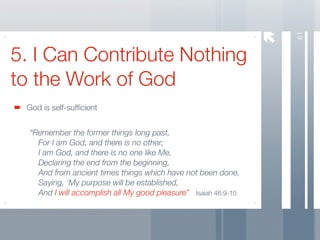
 God is self-sufficient
61
5. I Can Contribute Nothing
to the Work of God
 God is self-sufficient


  “Remember the former things long past,
  	 For I am God, and there is no other;
  	 I am God, and there is no one like Me,
  	 Declaring the end from the beginning,
  	 And from ancient times things which have not been done,
  
 Saying, ‘My purpose will be established,
  
 And I will accomplish all My good pleasure” Isaiah 46:9-10
62
62

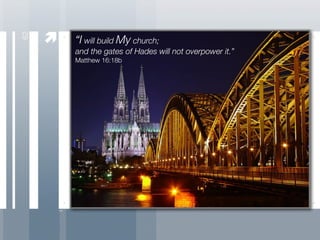
     “I will build My church;
     and the gates of Hades will not overpower it.”
     Matthew 16:18b
63
5. I Can Contribute Nothing
to the Work of God
63
5. I Can Contribute Nothing
to the Work of God
 I can participate in the work of God, but I can contribute
 nothing
63
5. I Can Contribute Nothing
to the Work of God
 I can participate in the work of God, but I can contribute
 nothing
 “Contribute:” to give, furnish, supply something of worth
63
5. I Can Contribute Nothing
to the Work of God
 I can participate in the work of God, but I can contribute
 nothing
 “Contribute:” to give, furnish, supply something of worth
 “Participate:” to take a part or a share of something
63
5. I Can Contribute Nothing
to the Work of God
 I can participate in the work of God, but I can contribute
 nothing
 “Contribute:” to give, furnish, supply something of worth
 “Participate:” to take a part or a share of something
  Connotation of privilege
64
Participation in the Work of God
64
Participation in the Work of God
And who knows whether you have not attained royalty
for such a time as this?” Esther 4:14b
64
Participation in the Work of God
And who knows whether you have not attained royalty
for such a time as this?” Esther 4:14b


I planted, Apollos watered, but God was causing the growth.
According to the grace of God which was given to me, like a wise
master builder I laid a foundation, and another is building on it. But
each man must be careful how he builds on it.” 1 Corinthians 3:6,10
65
Failure to Apply Principle #5
65
Failure to Apply Principle #5
  Inclination to use people to build my organization “for God”
65
Failure to Apply Principle #5
  Inclination to use people to build my organization “for God”
   Tendency to run over people
65
Failure to Apply Principle #5
  Inclination to use people to build my organization “for God”
   Tendency to run over people
   Tendency to compete for the limited resources of men and money
65
Failure to Apply Principle #5
  Inclination to use people to build my organization “for God”
   Tendency to run over people
   Tendency to compete for the limited resources of men and money
  Inclination to compromise God’s commandments to
  accomplish my goals to “build God’s kingdom”
66
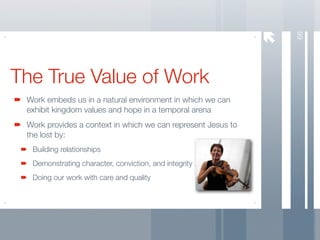
The True Value of Work
66
The True Value of Work
 Work embeds us in a natural environment in which we can
 exhibit kingdom values and hope in a temporal arena
66
The True Value of Work
 Work embeds us in a natural environment in which we can
 exhibit kingdom values and hope in a temporal arena
 Work provides a context in which we can represent Jesus to
 the lost by:
66
The True Value of Work
 Work embeds us in a natural environment in which we can
 exhibit kingdom values and hope in a temporal arena
 Work provides a context in which we can represent Jesus to
 the lost by:
  Building relationships
66
The True Value of Work
 Work embeds us in a natural environment in which we can
 exhibit kingdom values and hope in a temporal arena
 Work provides a context in which we can represent Jesus to
 the lost by:
  Building relationships
  Demonstrating character, conviction, and integrity
66
The True Value of Work
 Work embeds us in a natural environment in which we can
 exhibit kingdom values and hope in a temporal arena
 Work provides a context in which we can represent Jesus to
 the lost by:
  Building relationships
  Demonstrating character, conviction, and integrity
  Doing our work with care and quality
67
Review
67
Review
 I don’t work to earn a living
67
Review
 I don’t work to earn a living
 There is no necessary correlation between how hard I work
 and how much I make
67
Review
 I don’t work to earn a living
 There is no necessary correlation between how hard I work
 and how much I make
 There is no intrinsic value in the product of my work
67
Review
 I don’t work to earn a living
 There is no necessary correlation between how hard I work
 and how much I make
 There is no intrinsic value in the product of my work
 Significance is not found in the kind of work I do
67
Review
 I don’t work to earn a living
 There is no necessary correlation between how hard I work
 and how much I make
 There is no intrinsic value in the product of my work
 Significance is not found in the kind of work I do
 I can contribute nothing to the work of God
67
Review
 I don’t work to earn a living
 There is no necessary correlation between how hard I work
 and how much I make
 There is no intrinsic value in the product of my work
 Significance is not found in the kind of work I do
 I can contribute nothing to the work of God
 The marketplace is the arena where I demonstrate my eternal
 hope to a lost and dying world
68


     The End
KENBOA.ORG


 KenBoa.org

 ken_boa

     Kenneth Boa

A Biblical Look at Work

  • 1.
    A Biblical Lookat Work Dr. Ken Boa and Bill Ibsen © Dr. Kenneth Boa & Bill Ibsen 2006.  All Rights Reserved.
  • 2.
  • 3.
    2 The Problem Mostof my waking life is spent at work
  • 4.
    2 The Problem Mostof my waking life is spent at work “Ministry is sacred, but work is secular”
  • 5.
    2 The Problem Mostof my waking life is spent at work “Ministry is sacred, but work is secular” “People in full-time ministry work for what God values”
  • 6.
    2 The Problem Mostof my waking life is spent at work “Ministry is sacred, but work is secular” “People in full-time ministry work for what God values” “People in the marketplace work for money (‘filthy lucre’)”
  • 7.
    2 The Problem Mostof my waking life is spent at work “Ministry is sacred, but work is secular” “People in full-time ministry work for what God values” “People in the marketplace work for money (‘filthy lucre’)” “Most of my life doesn’t count in God’s economy”
  • 8.
    2 The Problem Mostof my waking life is spent at work “Ministry is sacred, but work is secular” “People in full-time ministry work for what God values” “People in the marketplace work for money (‘filthy lucre’)” “Most of my life doesn’t count in God’s economy” “Business people are second-class citizen’s in God’s economy - they have a lesser calling than full-time Christian workers”
  • 9.
  • 10.
    3 The Presupposition “If you’re really sold-out to Jesus, you’ll leave your secular job and go into full-time ministry”
  • 11.
    3 The Presupposition “If you’re really sold-out to Jesus, you’ll leave your secular job and go into full-time ministry” Is this true?
  • 12.
    3 The Presupposition “If you’re really sold-out to Jesus, you’ll leave your secular job and go into full-time ministry” Is this true? Is this biblical?
  • 13.
    3 The Presupposition “If you’re really sold-out to Jesus, you’ll leave your secular job and go into full-time ministry” Is this true? Is this biblical? Does my “secular” job matter at all to God?
  • 14.
  • 15.
    4 A Biblical LookAt Work Part I: Ten Basic Principles
  • 16.
    4 A Biblical LookAt Work Part I: Ten Basic Principles Part II: Five Advanced Principles
  • 17.
  • 18.
  • 19.
    6 Principle 1 “Inthe beginning God created the heavens and the earth...” Genesis 1:1
  • 20.
    6 Principle 1 “Inthe beginning God created the heavens and the earth...” Genesis 1:1 “By the seventh day God completed His work which He had done, and He rested on the seventh day from all His work which He had done.” Genesis 2:2
  • 21.
    6 Principle 1 “Inthe beginning God created the heavens and the earth...” Genesis 1:1 “By the seventh day God completed His work which He had done, and He rested on the seventh day from all His work which He had done.” Genesis 2:2 “My Father is working until now, and I Myself am working.” John 5:17
  • 22.
    7 Principle 1 “Inthe beginning God created the heavens and the earth...” Genesis 1:1 “By the seventh day God completed His work which He had done, and He rested on the seventh day from all His work which He had done.” Genesis 2:2 “My Father is working until now, and I Myself am working.” John 5:17
  • 23.
    8 Principle 1: God is a Worker “In the beginning God created the heavens and the earth...” Genesis 1:1 “By the seventh day God completed His work which He had done, and He rested on the seventh day from all His work which He had done.” Genesis 2:2 “My Father is working until now, and I Myself am working.” John 5:17
  • 24.
  • 25.
    9 “I go on working for the same reason a hen goes on laying eggs” H.L. Mencken
  • 26.
    9 “I go on working for the same reason a hen goes on laying eggs” H.L. Mencken Work is intrinsic to our nature:
  • 27.
    9 “I go on working for the same reason a hen goes on laying eggs” H.L. Mencken Work is intrinsic to our nature: As Image bearers
  • 28.
    9 “I go on working for the same reason a hen goes on laying eggs” H.L. Mencken Work is intrinsic to our nature: As Image bearers Because God is a Worker
  • 29.
  • 30.
    10 In creative activity, we externalize our identities as people made in the image of God
  • 31.
    11 #1 SoWhat? God is a Worker
  • 32.
    11 #1 SoWhat? Work is God-designed God is a Worker
  • 33.
    11 #1 SoWhat? Work is God-designed A product of His mind God is a Worker
  • 34.
    11 #1 SoWhat? Work is God-designed A product of His mind An aspect to His character God is a Worker
  • 35.
    11 #1 SoWhat? Work is God-designed A product of His mind An aspect to His character Work can be a holy endeavor God is a Worker
  • 36.
  • 37.
    12 Principle 2 “ThenGod said, “Let Us make man in Our image, according to Our likeness; and let them rule over the fish of the sea and over the birds of the sky and over the cattle and over all the earth, and over every creeping thing that creeps on the earth.” Genesis 1:25
  • 38.
    12 Principle 2 “ThenGod said, “Let Us make man in Our image, according to Our likeness; and let them rule over the fish of the sea and over the birds of the sky and over the cattle and over all the earth, and over every creeping thing that creeps on the earth.” Genesis 1:25 “God said to them, “Be fruitful and multiply, and fill the earth, and subdue it; and rule over the fish of the sea and over the birds of the sky and over every living thing that moves on the earth.” Genesis 1:28
  • 39.
    12 Principle 2 “ThenGod said, “Let Us make man in Our image, according to Our likeness; and let them rule over the fish of the sea and over the birds of the sky and over the cattle and over all the earth, and over every creeping thing that creeps on the earth.” Genesis 1:25 “God said to them, “Be fruitful and multiply, and fill the earth, and subdue it; and rule over the fish of the sea and over the birds of the sky and over every living thing that moves on the earth.” Genesis 1:28 “Then the LORD God took the man and put him into the garden of Eden to cultivate it and keep it.” Genesis 2:15
  • 40.
    13 Principle 2 “ThenGod said, “Let Us make man in Our image, according to Our likeness; and let them rule over the fish of the sea and over the birds of the sky and over the cattle and over all the earth, and over every creeping thing that creeps on the earth.” Genesis 1:25 “God said to them, “Be fruitful and multiply, and fill the earth, and subdue it; and rule over the fish of the sea and over the birds of the sky and over every living thing that moves on the earth.” Genesis 1:28 “Then the LORD God took the man and put him into the garden of Eden to cultivate it and keep it.” Genesis 2:15
  • 41.
    14 Principle 2: God Created Man to be a Worker “Then God said, “Let Us make man in Our image, according to Our likeness; and let them rule over the fish of the sea and over the birds of the sky and over the cattle and over all the earth, and over every creeping thing that creeps on the earth.” Genesis 1:25 “God said to them, “Be fruitful and multiply, and fill the earth, and subdue it; and rule over the fish of the sea and over the birds of the sky and over every living thing that moves on the earth.” Genesis 1:28 “Then the LORD God took the man and put him into the garden of Eden to cultivate it and keep it.” Genesis 2:15
  • 42.
    15 #2So What? God Created Man to Be a Worker
  • 43.
    15 #2So What? We are God-wired to work God Created Man to Be a Worker
  • 44.
    15 #2So What? We are God-wired to work Work is in our best interest God Created Man to Be a Worker
  • 45.
    15 #2So What? We are God-wired to work Work is in our best interest Like God, we are designed to build, create, communicate, and take on challenges in our work God Created Man to Be a Worker
  • 46.
    15 #2So What? We are God-wired to work Work is in our best interest Like God, we are designed to build, create, communicate, and take on challenges in our work Thus, work can engage us at a deep level of our being God Created Man to Be a Worker
  • 47.
  • 48.
    16 Principle 3 “Then the LORD God took the man and put him into the garden of Eden to cultivate it and keep it.” Genesis 2:15
  • 49.
    16 Principle 3 “Then the LORD God took the man and put him into the garden of Eden to cultivate it and keep it.” Genesis 2:15 When the woman saw that the tree was good for food, and that it was a delight to the eyes, and that the tree was desirable to make one wise, she took from its fruit and ate; and she gave also to her husband with her, and he ate. Genesis 3:6
  • 50.
    17 Principle 3: “Then the LORD God took the man and put him into the garden of Eden to cultivate it and keep it.” When the woman saw that the tree was good for food, and that it was a delight to the eyes, and that the tree was desirable to make one wise, she took from its fruit and ate; and she gave also to her husband with her, and he ate.
  • 51.
    17 Principle 3: “Then the LORD God took the man and put him into the garden of Eden to cultivate it and keep it.” Genesis 2:15 When the woman saw that the tree was good for food, and that it was a delight to the eyes, and that the tree was desirable to make one wise, she took from its fruit and ate; and she gave also to her husband with her, and he ate.
  • 52.
    17 Principle 3: “Then the LORD God took the man and put him into the garden of Eden to cultivate it and keep it.” Genesis 2:15 When the woman saw that the tree was good for food, and that it was a delight to the eyes, and that the tree was desirable to make one wise, she took from its fruit and ate; and she gave also to her husband with her, and he ate. Genesis 3:6
  • 53.
    17 Principle 3: God CreatedWork Pre-Fall “Then the LORD God took the man and put him into the garden of Eden to cultivate it and keep it.” Genesis 2:15 When the woman saw that the tree was good for food, and that it was a delight to the eyes, and that the tree was desirable to make one wise, she took from its fruit and ate; and she gave also to her husband with her, and he ate. Genesis 3:6
  • 54.
    18 Observations About theCurse from the Fall
  • 55.
    18 Observations About theCurse from the Fall “Cursed is the ground because of you; In toil you will eat of it All the days of your life.
  • 56.
    18 Observations About theCurse from the Fall “Cursed is the ground because of you; In toil you will eat of it All the days of your life. Both thorns and thistles it shall grow for you; And you will eat the plants of the field;
  • 57.
    18 Observations About theCurse from the Fall “Cursed is the ground because of you; In toil you will eat of it All the days of your life. Both thorns and thistles it shall grow for you; And you will eat the plants of the field; By the sweat of your face You will eat bread, Till you return to the ground...” Genesis 3:17-19
  • 58.
    19 #3 SoWhat? God Created Work Pre-Fall
  • 59.
    19 #3 SoWhat? Work was created in Paradise God Created Work Pre-Fall
  • 60.
    19 #3 SoWhat? Work was created in Paradise Work was intended for Paradise God Created Work Pre-Fall
  • 61.
    19 #3 SoWhat? Work was created in Paradise Work was intended for Paradise Work is not a product of sin, but is expressed in fallen world God Created Work Pre-Fall
  • 62.
    20 Principle 4: God CallsWork “Very Good”
  • 63.
    20 Principle 4: God CallsWork “Very Good” “God saw all that He had made, and behold, it was very good.” Genesis 1:31
  • 64.
    21 Principle 4: God CallsWork “Very Good” “God saw all that He had made, and behold, it was very good.” Genesis 1:31
  • 65.
    21 Principle 4: God CallsWork “Very Good” rts ts pa an di h ole h ew =T “God saw all that He had made, and behold, it was very good.” Genesis 1:31
  • 66.
    21 Principle 4: God CallsWork “Very Good” g r ts rkin pa n wo its ma and ing: ole lud e wh inc = Th arts =P “God saw all that He had made, and behold, it was very good.” Genesis 1:31
  • 67.
    22 #4So What? God Calls Work “Very Good”
  • 68.
    22 #4So What? In God’s economy, work is very good God Calls Work “Very Good”
  • 69.
    22 #4So What? In God’s economy, work is very good To assert that work is in any way substandard to God’s plan is unbiblical thinking God Calls Work “Very Good”
  • 70.
    22 #4So What? In God’s economy, work is very good To assert that work is in any way substandard to God’s plan is unbiblical thinking To assert that work can only be evil is unbiblical thinking God Calls Work “Very Good”
  • 71.
    22 #4So What? In God’s economy, work is very good To assert that work is in any way substandard to God’s plan is unbiblical thinking To assert that work can only be evil is unbiblical thinking Working in the marketplace (in spite of being marred by sin) can be considered by God as very good God Calls Work “Very Good”
  • 72.
    23 Principle 5: God MadeWork an Expression of His Grace
  • 73.
    23 Principle 5: God MadeWork an Expression of His Grace “Here is what I have seen to be good and fitting: to eat, to drink and enjoy oneself in all one’s labor in which he toils under the sun during the few years of his life which God has given him; for this is his reward.
  • 74.
    23 Principle 5: God MadeWork an Expression of His Grace “Here is what I have seen to be good and fitting: to eat, to drink and enjoy oneself in all one’s labor in which he toils under the sun during the few years of his life which God has given him; for this is his reward. Furthermore, as for every man to whom God has given riches and wealth, He has also empowered him to eat from them and to receive his reward and rejoice in his labor; this is the gift of God.” Ecclesiastes 3:18-19
  • 75.
    24 #5 SoWhat? God Made Work an Expression of His Grace
  • 76.
    24 #5 SoWhat? God designed an aspect of labor that we are to enjoy God Made Work an Expression of His Grace
  • 77.
    24 #5 SoWhat? God designed an aspect of labor that we are to enjoy We are to rejoice in our labor God Made Work an Expression of His Grace
  • 78.
    24 #5 SoWhat? God designed an aspect of labor that we are to enjoy We are to rejoice in our labor Biblically, it is right and good to “love” our work God Made Work an Expression of His Grace
  • 79.
    24 #5 SoWhat? God designed an aspect of labor that we are to enjoy We are to rejoice in our labor Biblically, it is right and good to “love” our work Labor is a gift from God God Made Work an Expression of His Grace
  • 80.
    24 #5 SoWhat? God designed an aspect of labor that we are to enjoy We are to rejoice in our labor Biblically, it is right and good to “love” our work Labor is a gift from God Labor should elicit our gratitude to God God Made Work an Expression of His Grace
  • 81.
  • 82.
    25 Principle 6: God CommandsMen to Work “For even when we were with you, we used to give you this order:
  • 83.
    25 Principle 6: God CommandsMen to Work “For even when we were with you, we used to give you this order: if anyone is not willing to work, then he is not to eat, either.” 1 Thessalonians 3:10
  • 84.
    25 Principle 6: God CommandsMen to Work “For even when we were with you, we used to give you this order: if anyone is not willing to work, then he is not to eat, either.” 1 Thessalonians 3:10 “He who steals must steal no longer; but rather he must labor, performing with his own hands what is good, so that he will have something to share with one who has need.” Ephesians 5:28
  • 85.
    26 Example of Principle6: God’s People Working Diligently
  • 86.
    26 Example of Principle6: God’s People Working Diligently “nor did we eat anyone’s bread without paying for it, but with labor and hardship we kept working night and day so that we would not be a burden to any of you” 2 Thessalonians 3:8
  • 87.
    26 Example of Principle6: God’s People Working Diligently “nor did we eat anyone’s bread without paying for it, but with labor and hardship we kept working night and day so that we would not be a burden to any of you” 2 Thessalonians 3:8 “and we toil, working with our own hands...” 1 Corinthians 4:12
  • 88.
    27 The Bible’s PrimaryCharacters are Businesspeople
  • 89.
    27 The Bible’s PrimaryCharacters are Businesspeople Adam: farmer
  • 90.
    27 The Bible’s PrimaryCharacters are Businesspeople Adam: farmer Abraham, Issac, Jacob: ranchers
  • 91.
    27 The Bible’s PrimaryCharacters are Businesspeople Adam: farmer Abraham, Issac, Jacob: ranchers Joseph: administrator and ruler
  • 92.
    27 The Bible’s PrimaryCharacters are Businesspeople Adam: farmer Abraham, Issac, Jacob: ranchers Joseph: administrator and ruler Moses: shepherd
  • 93.
    27 The Bible’s PrimaryCharacters are Businesspeople Adam: farmer Abraham, Issac, Jacob: ranchers Joseph: administrator and ruler Moses: shepherd David: shepherd and ruler
  • 94.
    27 The Bible’s PrimaryCharacters are Businesspeople Adam: farmer Abraham, Issac, Jacob: ranchers Joseph: administrator and ruler Moses: shepherd David: shepherd and ruler Proverbs 31 Woman: realtor
  • 95.
    28 The Bible’s PrimaryCharacters are Businesspeople
  • 96.
    28 The Bible’s PrimaryCharacters are Businesspeople Daniel: ruler
  • 97.
    28 The Bible’s PrimaryCharacters are Businesspeople Daniel: ruler Nehemiah: construction
  • 98.
    28 The Bible’s PrimaryCharacters are Businesspeople Daniel: ruler Nehemiah: construction Lydia: garment salesperson
  • 99.
    28 The Bible’s PrimaryCharacters are Businesspeople Daniel: ruler Nehemiah: construction Lydia: garment salesperson Peter: fisherman
  • 100.
    28 The Bible’s PrimaryCharacters are Businesspeople Daniel: ruler Nehemiah: construction Lydia: garment salesperson Peter: fisherman Paul: tentmaker
  • 101.
    28 The Bible’s PrimaryCharacters are Businesspeople Daniel: ruler Nehemiah: construction Lydia: garment salesperson Peter: fisherman Paul: tentmaker Jesus: carpenter
  • 102.
  • 103.
    29 Businesspeople in theBible Goods Producers: cattle farmers, vineyard tenders, iron workers, carpenters, tentmakers, textile producers
  • 104.
    29 Businesspeople in theBible Goods Producers: cattle farmers, vineyard tenders, iron workers, carpenters, tentmakers, textile producers Managers: of grain suppliers, of employees, building projects, armies, finances
  • 105.
    29 Businesspeople in theBible Goods Producers: cattle farmers, vineyard tenders, iron workers, carpenters, tentmakers, textile producers Managers: of grain suppliers, of employees, building projects, armies, finances Public Servants: in medicine, courts, community, civil rights, public finance
  • 106.
    29 Businesspeople in theBible Goods Producers: cattle farmers, vineyard tenders, iron workers, carpenters, tentmakers, textile producers Managers: of grain suppliers, of employees, building projects, armies, finances Public Servants: in medicine, courts, community, civil rights, public finance Artists: musicians, sculptors, seamstresses, dancers, worship leaders, writers
  • 107.
    30 #6 SoWhat? God Commands Men to Work
  • 108.
    30 #6 SoWhat? A failure to work represents a breach of God’s commandment God Commands Men to Work
  • 109.
    30 #6 SoWhat? A failure to work represents a breach of God’s commandment Some of the holiest people in the Bible lived out their faith in the marketplace - including Jesus God Commands Men to Work
  • 110.
    30 #6 SoWhat? A failure to work represents a breach of God’s commandment Some of the holiest people in the Bible lived out their faith in the marketplace - including Jesus God can be served as well in the marketplace as at His temple God Commands Men to Work
  • 111.
    30 #6 SoWhat? A failure to work represents a breach of God’s commandment Some of the holiest people in the Bible lived out their faith in the marketplace - including Jesus God can be served as well in the marketplace as at His temple Thinking/teaching to the contrary is unbiblical God Commands Men to Work
  • 112.
    30 #6 SoWhat? A failure to work represents a breach of God’s commandment Some of the holiest people in the Bible lived out their faith in the marketplace - including Jesus God can be served as well in the marketplace as at His temple Thinking/teaching to the contrary is unbiblical The command to work does not sanction either underwork or overwork God Commands Men to Work
  • 113.
    31 Principle 7: God CommandsMen to Work for Him
  • 114.
    31 Principle 7: God CommandsMen to Work for Him “Whatever you do, do your work heartily, as for the Lord rather than for men, knowing that from the Lord you will receive the reward of the inheritance. It is the Lord Christ whom you serve.” Colossians 3:23-24
  • 115.
    31 Principle 7: God CommandsMen to Work for Him “Whatever you do, do your work heartily, as for the Lord rather than for men, knowing that from the Lord you will receive the reward of the inheritance. It is the Lord Christ whom you serve.” Colossians 3:23-24 “With good will render service, as to the Lord, and not to men, knowing that whatever good thing each one does, this he will receive back from the Lord, whether slave or free.” Ephesians 6:7-8
  • 116.
    32 #7 SoWhat? God Commands Men to Work for Him
  • 117.
    32 #7 SoWhat? God demands that we work exclusively for Him, not for any man, employer, boss, or customer God Commands Men to Work for Him
  • 118.
    32 #7 SoWhat? God demands that we work exclusively for Him, not for any man, employer, boss, or customer This heart attitude that requires supernatural power to sustain God Commands Men to Work for Him
  • 119.
    32 #7 SoWhat? God demands that we work exclusively for Him, not for any man, employer, boss, or customer This heart attitude that requires supernatural power to sustain Left to my flesh, I will serve men and seek their favor, not God’s God Commands Men to Work for Him
  • 120.
    32 #7 SoWhat? God demands that we work exclusively for Him, not for any man, employer, boss, or customer This heart attitude that requires supernatural power to sustain Left to my flesh, I will serve men and seek their favor, not God’s Working well demands constant spiritual power and focus God Commands Men to Work for Him
  • 121.
  • 122.
    33 Principle 8: God Promotesand Demotes “For not from the east, nor from the west, Nor from the desert comes exaltation; But God is the Judge; He puts down one and exalts another.” Psalm 75:6-7
  • 123.
    34 #8 SoWhat? God Promotes and Demotes
  • 124.
    34 #8 SoWhat? My efforts to impress or to manipulate my superiors to promote me are futile God Promotes and Demotes
  • 125.
    34 #8 SoWhat? My efforts to impress or to manipulate my superiors to promote me are futile Wrong audience God Promotes and Demotes
  • 126.
    34 #8 SoWhat? My efforts to impress or to manipulate my superiors to promote me are futile Wrong audience View promotion, demotion, layoff, and dismissal as from God, not man God Promotes and Demotes
  • 127.
    35 Principle 9: God GivesUs our Abilities, Intelligence, and Wealth
  • 128.
    35 Principle 9: God GivesUs our Abilities, Intelligence, and Wealth “Since we have gifts that differ according to the grace given to us, each of us is to exercise them accordingly...” Romans 12:6
  • 129.
    35 Principle 9: God GivesUs our Abilities, Intelligence, and Wealth “Since we have gifts that differ according to the grace given to us, each of us is to exercise them accordingly...” Romans 12:6 “It is He who changes the times and the epochs; He removes kings and establishes kings; He gives wisdom to wise men And knowledge to men of understanding. Daniel 2:21
  • 130.
    35 Principle 9: God GivesUs our Abilities, Intelligence, and Wealth “Since we have gifts that differ according to the grace given to us, each of us is to exercise them accordingly...” Romans 12:6 “It is He who changes the times and the epochs; He removes kings and establishes kings; He gives wisdom to wise men And knowledge to men of understanding. Daniel 2:21 “But you shall remember the LORD your God, for it is He who is giving you power to make wealth...” Deuteronomy 8:18
  • 131.
    36 #9So What? God Gives Us Our Abilities, Intelligence, and Wealth
  • 132.
    36 #9So What? No skill, no intelligence, no brilliance, no wealth that I have ever originated from me - all of it is a gift from God God Gives Us Our Abilities, Intelligence, and Wealth
  • 133.
    36 #9So What? No skill, no intelligence, no brilliance, no wealth that I have ever originated from me - all of it is a gift from God The more we have, the greater our accountability - be content God Gives Us Our Abilities, Intelligence, and Wealth
  • 134.
    36 #9So What? No skill, no intelligence, no brilliance, no wealth that I have ever originated from me - all of it is a gift from God The more we have, the greater our accountability - be content Gratitude and humility is the correct response God Gives Us Our Abilities, Intelligence, and Wealth
  • 135.
    36 #9So What? No skill, no intelligence, no brilliance, no wealth that I have ever originated from me - all of it is a gift from God The more we have, the greater our accountability - be content Gratitude and humility is the correct response Comparison is foolishness God Gives Us Our Abilities, Intelligence, and Wealth
  • 136.
    37 Principle 10: God WarnsAgainst Entanglement
  • 137.
    37 Principle 10: God WarnsAgainst Entanglement “No soldier in active service entangles himself in the affairs of everyday life, so that he may please the one who enlisted him as a soldier.” 2 Timothy 2:4
  • 138.
    38 #10 SoWhat? God Warns Against Entanglement
  • 139.
    38 #10 SoWhat? If I’m entangled in my work, I am not pleasing my Commanding Officer God Warns Against Entanglement
  • 140.
    38 #10 SoWhat? If I’m entangled in my work, I am not pleasing my Commanding Officer Am I entangled (imbalanced/ addicted) to my work? God Warns Against Entanglement
  • 141.
    38 #10 SoWhat? If I’m entangled in my work, I am not pleasing my Commanding Officer Am I entangled (imbalanced/ addicted) to my work? Do I allow work to interfere with the depth and quality of important relationships? God Warns Against Entanglement
  • 142.
    38 #10 SoWhat? If I’m entangled in my work, I am not pleasing my Commanding Officer Am I entangled (imbalanced/ addicted) to my work? Do I allow work to interfere with the depth and quality of important relationships? What, if anything, must change in my work life to allow me to be a better soldier? God Warns Against Entanglement
  • 143.
  • 144.
    39 Review 1. Godis a worker
  • 145.
    39 Review 1. Godis a worker 2. God created man to be a worker
  • 146.
    39 Review 1. Godis a worker 2. God created man to be a worker 3. God created work pre-Fall
  • 147.
    39 Review 1. Godis a worker 2. God created man to be a worker 3. God created work pre-Fall 4. God calls work “very good”
  • 148.
    39 Review 1. Godis a worker 2. God created man to be a worker 3. God created work pre-Fall 4. God calls work “very good” 5. God made work an expression of His grace
  • 149.
    39 Review 1. Godis a worker 2. God created man to be a worker 3. God created work pre-Fall 4. God calls work “very good” 5. God made work an expression of His grace 6. God commands men to work
  • 150.
    39 Review 1. Godis a worker 2. God created man to be a worker 3. God created work pre-Fall 4. God calls work “very good” 5. God made work an expression of His grace 6. God commands men to work 7. God commands men to work for Him
  • 151.
    39 Review 1. Godis a worker 2. God created man to be a worker 3. God created work pre-Fall 4. God calls work “very good” 5. God made work an expression of His grace 6. God commands men to work 7. God commands men to work for Him 8. God promotes and demotes
  • 152.
    39 Review 1. Godis a worker 2. God created man to be a worker 3. God created work pre-Fall 4. God calls work “very good” 5. God made work an expression of His grace 6. God commands men to work 7. God commands men to work for Him 8. God promotes and demotes 9. God gives us our abilities, intelligence, and wealth
  • 153.
    39 Review 1. Godis a worker 2. God created man to be a worker 3. God created work pre-Fall 4. God calls work “very good” 5. God made work an expression of His grace 6. God commands men to work 7. God commands men to work for Him 8. God promotes and demotes 9. God gives us our abilities, intelligence, and wealth 10. God warns against entanglement
  • 154.
  • 155.
    41 1. I Don’tWork to Earn a Living
  • 156.
    41 1. I Don’tWork to Earn a Living “And my God will supply all your needs according to His riches in glory in Christ Jesus.” Philippians 4:19
  • 157.
    41 1. I Don’tWork to Earn a Living “And my God will supply all your needs according to His riches in glory in Christ Jesus.” Philippians 4:19 “What do you have that you did not receive? And if you did receive it, why do you boast as if you had not received it? ” 1 Corinthians 4:7b
  • 158.
    41 1. I Don’tWork to Earn a Living “And my God will supply all your needs according to His riches in glory in Christ Jesus.” Philippians 4:19 “What do you have that you did not receive? And if you did receive it, why do you boast as if you had not received it? ” 1 Corinthians 4:7b I must look to God alone for the meeting of my needs
  • 159.
    41 1. I Don’tWork to Earn a Living “And my God will supply all your needs according to His riches in glory in Christ Jesus.” Philippians 4:19 “What do you have that you did not receive? And if you did receive it, why do you boast as if you had not received it? ” 1 Corinthians 4:7b I must look to God alone for the meeting of my needs Work may be the vehicle of provision, but not the source
  • 160.
  • 161.
    42 Common Objections to Principle#1 The unwilling to work should not eat
  • 162.
    42 Common Objections to Principle#1 The unwilling to work should not eat Doesn’t mean that he works in order to eat
  • 163.
    42 Common Objections to Principle#1 The unwilling to work should not eat Doesn’t mean that he works in order to eat One-way street, i.e. (1Cor. 6:9,10)
  • 164.
    42 Common Objections to Principle#1 “For even when we were with you, we used to give you this order: The unwilling to work should not eat Doesn’t mean that he works in order to eat One-way street, i.e. (1Cor. 6:9,10)
  • 165.
    42 Common Objections to Principle#1 “For even when we were with you, we used to give you this order: if anyone is not willing to work, then he is not to eat, either.” 1 Thessalonians 3:10 The unwilling to work should not eat Doesn’t mean that he works in order to eat One-way street, i.e. (1Cor. 6:9,10)
  • 166.
  • 167.
    43 Common Objections to Principle#1 Implicit vs. explicit verses on provision
  • 168.
    43 Common Objections to Principle#1 Implicit vs. explicit verses on provision My responsibility to work and give provision to my family does not mean that I am the source of my provision
  • 169.
    43 Common Objections to Principle#1 “But if anyone does not provide for his own, and especially for those of his household, he has denied the faith and is worse than an unbeliever.” 1Timothy 5:8 Implicit vs. explicit verses on provision My responsibility to work and give provision to my family does not mean that I am the source of my provision
  • 170.
    44 Failure to ApplyPrinciple #1
  • 171.
    44 Failure to ApplyPrinciple #1 Tendency to use and manipulate others to get my needs met
  • 172.
    44 Failure to ApplyPrinciple #1 Tendency to use and manipulate others to get my needs met We cannot use people and serve them at the same time
  • 173.
    44 Failure to ApplyPrinciple #1 Tendency to use and manipulate others to get my needs met We cannot use people and serve them at the same time Chasing the dollar to establish my standard of living
  • 174.
    44 Failure to ApplyPrinciple #1 Tendency to use and manipulate others to get my needs met We cannot use people and serve them at the same time Chasing the dollar to establish my standard of living Tendency to compete with co-workers
  • 175.
    44 Failure to ApplyPrinciple #1 Tendency to use and manipulate others to get my needs met We cannot use people and serve them at the same time Chasing the dollar to establish my standard of living Tendency to compete with co-workers Tendency to compartmentalize “God’s time” versus “my time”
  • 176.
    44 Failure to ApplyPrinciple #1 Tendency to use and manipulate others to get my needs met We cannot use people and serve them at the same time Chasing the dollar to establish my standard of living Tendency to compete with co-workers Tendency to compartmentalize “God’s time” versus “my time” Tendency to compromise my values to get my needs met
  • 177.
    45 2. There IsNo Necessary Correlation Between How Hard I Work and How Much I Make $2/day
  • 178.
    45 2. There IsNo Necessary Correlation Between How Hard I Work and How Much I Make $2/day
  • 179.
    45 2. There IsNo Necessary Correlation Between How Hard I Work and How Much I Make Derivative of Principle #1 (You don’t work to earn a living) $2/day
  • 180.
    45 2. There IsNo Necessary Correlation Between How Hard I Work and How Much I Make Derivative of Principle #1 (You don’t work to earn a living) $2/day Hard work may effect potential for profit, but there is no fixed cause/effect relationship
  • 181.
    45 2. There IsNo Necessary Correlation Between How Hard I Work and How Much I Make Derivative of Principle #1 (You don’t work to earn a living) $2/day Hard work may effect potential for profit, but there is no fixed cause/effect relationship Productivity :: Time Invested can vary dramatically
  • 182.
    46 2. There IsNo Necessary Correlation Between How Hard I Work and How Much I Make
  • 183.
    46 2. There IsNo Necessary Correlation Between How Hard I Work and How Much I Make God may prosper you without your labor:
  • 184.
    46 2. There IsNo Necessary Correlation Between How Hard I Work and How Much I Make God may prosper you without your labor: “Then it shall come about when the LORD your God brings you into the land which He swore to your fathers, Abraham, Isaac and Jacob, to give you, great and splendid cities which you did not build, and houses full of all good things which you did not fill, and hewn cisterns which you did not dig, vineyards and olive trees which you did not plant, and you eat and are satisfied” Deuteronomy 6:10-11
  • 185.
    47 2. There IsNo Necessary Correlation Between How Hard I Work and How Much I Make God may prosper you without your labor:
  • 186.
    47 2. There IsNo Necessary Correlation Between How Hard I Work and How Much I Make God may prosper you without your labor: “It is vain for you to rise up early, To retire late, To eat the bread of painful labors; For He gives to His beloved even in his sleep.” Psalm 127:2
  • 187.
    48 2. There IsNo Necessary Correlation Between How Hard I Work and How Much I Make
  • 188.
    48 2. There IsNo Necessary Correlation Between How Hard I Work and How Much I Make God may impoverish you with your hard labor:
  • 189.
    48 2. There IsNo Necessary Correlation Between How Hard I Work and How Much I Make God may impoverish you with your hard labor: “You have sown much, but harvest little; you eat, but there is not enough to be satisfied; you drink, but there is not enough to become drunk; you put on clothing, but no one is warm enough; and he who earns, earns wages to put into a purse with holes.”
  • 190.
    48 2. There IsNo Necessary Correlation Between How Hard I Work and How Much I Make God may impoverish you with your hard labor: “You have sown much, but harvest little; you eat, but there is not enough to be satisfied; you drink, but there is not enough to become drunk; you put on clothing, but no one is warm enough; and he who earns, earns wages to put into a purse with holes.” “You look for much, but behold, it comes to little; when you bring it home, I blow it away. Why?” declares the LORD of hosts, “Because of My house which lies desolate, while each of you runs to his own house. Haggai 1:6,9
  • 191.
    49 Failure to ApplyPrinciple #2
  • 192.
    49 Failure to ApplyPrinciple #2 Inclination to sacrifice priorities when my income is down
  • 193.
    49 Failure to ApplyPrinciple #2 Inclination to sacrifice priorities when my income is down Inclination to allow the marketplace to dictate the level of my commitment to Christ
  • 194.
    49 Failure to ApplyPrinciple #2 Inclination to sacrifice priorities when my income is down Inclination to allow the marketplace to dictate the level of my commitment to Christ Inclination to integrate my faith into the marketplace only when the environment is friendly
  • 195.
    49 Failure to ApplyPrinciple #2 Inclination to sacrifice priorities when my income is down Inclination to allow the marketplace to dictate the level of my commitment to Christ Inclination to integrate my faith into the marketplace only when the environment is friendly Inclination to attempt to out-earn my needs
  • 196.
  • 197.
    50 Summary of Principles#1 & 2 My labors are not the source of my provision or my prosperity
  • 198.
    50 Summary of Principles#1 & 2 My labors are not the source of my provision or my prosperity God is my Provider; I need not fear
  • 199.
    51 3. There IsNo Intrinsic Value in the Product of My Work
  • 200.
    51 3. There IsNo Intrinsic Value in the Product of My Work “But the day of the Lord will come like a thief, in which the heavens will pass away with a roar and the elements will be destroyed with intense heat, and the earth and its works will be burned up.” 2 Peter 3:10
  • 201.
    51 3. There IsNo Intrinsic Value in the Product of My Work “But the day of the Lord will come like a thief, in which the heavens will pass away with a roar and the elements will be destroyed with intense heat, and the earth and its works will be burned up.” 2 Peter 3:10 God will burn all work, including some of His own
  • 202.
    51 3. There IsNo Intrinsic Value in the Product of My Work “But the day of the Lord will come like a thief, in which the heavens will pass away with a roar and the elements will be destroyed with intense heat, and the earth and its works will be burned up.” 2 Peter 3:10 God will burn all work, including some of His own God may assign value to what I produce, but it has no intrinsic value
  • 203.
  • 204.
  • 205.
    53 3. There IsNo Intrinsic Value in the Product of My Work
  • 206.
    53 3. There IsNo Intrinsic Value in the Product of My Work The product of work may have utilitarian value, but no intrinsic value
  • 207.
    53 3. There IsNo Intrinsic Value in the Product of My Work The product of work may have utilitarian value, but no intrinsic value The process of work has value because God uses it to determine reward in heaven (1 Corinthians 3:14-15)
  • 208.
    53 3. There IsNo Intrinsic Value in the Product of My Work The product of work may have utilitarian value, but no intrinsic value The process of work has value because God uses it to determine reward in heaven (1 Corinthians 3:14-15) Its not the fruit of our labor, but the focus of our heart that gives value to work
  • 209.
    53 3. There IsNo Intrinsic Value in the Product of My Work The product of work may have utilitarian value, but no intrinsic value The process of work has value because God uses it to determine reward in heaven (1 Corinthians 3:14-15) Its not the fruit of our labor, but the focus of our heart that gives value to work “Secular” work becomes spiritual when it is done to please God
  • 210.
    53 3. There IsNo Intrinsic Value in the Product of My Work The product of work may have utilitarian value, but no intrinsic value The process of work has value because God uses it to determine reward in heaven (1 Corinthians 3:14-15) Its not the fruit of our labor, but the focus of our heart that gives value to work “Secular” work becomes spiritual when it is done to please God “Religious” work becomes secular when it is done to please and impress people
  • 211.
    53 3. There IsNo Intrinsic Value in the Product of My Work The product of work may have utilitarian value, but no intrinsic value The process of work has value because God uses it to determine reward in heaven (1 Corinthians 3:14-15) Its not the fruit of our labor, but the focus of our heart that gives value to work “Secular” work becomes spiritual when it is done to please God “Religious” work becomes secular when it is done to please and impress people
  • 212.
    54 Failure to ApplyPrinciple #3
  • 213.
    54 Failure to ApplyPrinciple #3 Tendency to take my work too seriously, sacrificing important relationships for the sake of work
  • 214.
    54 Failure to ApplyPrinciple #3 Tendency to take my work too seriously, sacrificing important relationships for the sake of work Tendency to labor for the temporal, rather than the eternal
  • 215.
    54 Failure to ApplyPrinciple #3 Tendency to take my work too seriously, sacrificing important relationships for the sake of work Tendency to labor for the temporal, rather than the eternal Suffering loss of reward in heaven (1 Corinthians 3:10-15)
  • 216.
    54 Failure to ApplyPrinciple #3 Tendency to take my work too seriously, sacrificing important relationships for the sake of work Tendency to labor for the temporal, rather than the eternal Suffering loss of reward in heaven (1 Corinthians 3:10-15) Tendency to perceive greatness primarily in terms of my achievements or accomplishments
  • 217.
    55 4. Significance IsNot Found in the Kind of Work I Do
  • 218.
    55 4. Significance IsNot Found in the Kind of Work I Do Significance and self-esteem are only found in a relationship with God
  • 219.
    55 4. Significance IsNot Found in the Kind of Work I Do Significance and self-esteem are only found in a relationship with God “Thus says the LORD, “Let not a wise man boast of his wisdom, and let not the mighty man boast of his might, let not a rich man boast of his riches; but let him who boasts boast of this, that he understands and knows Me, that I am the LORD who exercises lovingkindness, justice and righteousness on earth; for I delight in these things,” declares the LORD.” Jeremiah 9:23-24
  • 220.
    56 4. Significance IsNot Found in the Kind of Work I Do
  • 221.
    56 4. Significance IsNot Found in the Kind of Work I Do Deriving significance from my giftedness, education, profession, wealth, or power are credentials Paul calls “rubbish” or “dung”
  • 222.
    56 4. Significance IsNot Found in the Kind of Work I Do Deriving significance from my giftedness, education, profession, wealth, or power are credentials Paul calls “rubbish” or “dung” “I count all things to be loss in view of the surpassing value of knowing Christ Jesus my Lord, for whom I have suffered the loss of all things, and count them but rubbish so that I may gain Christ...” Philippians 3:8
  • 223.
  • 224.
    58 4. Significance IsNot Found in the Kind of Work I Do
  • 225.
    58 4. Significance IsNot Found in the Kind of Work I Do God’s children are significant solely because:
  • 226.
    58 4. Significance IsNot Found in the Kind of Work I Do God’s children are significant solely because: They are created in His image
  • 227.
    58 4. Significance IsNot Found in the Kind of Work I Do God’s children are significant solely because: They are created in His image He declares them to be of eternal worth
  • 228.
    58 4. Significance IsNot Found in the Kind of Work I Do God’s children are significant solely because: They are created in His image He declares them to be of eternal worth There are no other biblical grounds for self-esteem
  • 229.
    59 Failure to ApplyPrinciple #4
  • 230.
    59 Failure to ApplyPrinciple #4 I will confuse my identity in Christ with my vocation
  • 231.
    59 Failure to ApplyPrinciple #4 I will confuse my identity in Christ with my vocation Job loss or demotion will send me into bitterness/anger/depression
  • 232.
    59 Failure to ApplyPrinciple #4 I will confuse my identity in Christ with my vocation Job loss or demotion will send me into bitterness/anger/depression The focus of my work will tend to be selfish ambition to bolster my sense of significance
  • 233.
    59 Failure to ApplyPrinciple #4 I will confuse my identity in Christ with my vocation Job loss or demotion will send me into bitterness/anger/depression The focus of my work will tend to be selfish ambition to bolster my sense of significance I will swing to the opposite extreme and become consumed by my work
  • 234.
    59 Failure to ApplyPrinciple #4 I will confuse my identity in Christ with my vocation Job loss or demotion will send me into bitterness/anger/depression The focus of my work will tend to be selfish ambition to bolster my sense of significance I will swing to the opposite extreme and become consumed by my work Seeking significance anywhere other than in God’s declaration is an affront to God
  • 235.
    60 5. I CanContribute Nothing to the Work of God
  • 236.
    60 5. I CanContribute Nothing to the Work of God God’s work was finished before the foundations of the earth:
  • 237.
    60 5. ICan Contribute Nothing to the Work of God God’s work was finished before the foundations of the earth: “... although His works were finished from the foundation of the world.” Hebrews 4:3b
  • 238.
    61 5. I CanContribute Nothing to the Work of God
  • 239.
    61 5. I CanContribute Nothing to the Work of God
  • 240.
    61 5. I CanContribute Nothing to the Work of God God is self-sufficient
  • 241.
    61 5. I CanContribute Nothing to the Work of God God is self-sufficient “Remember the former things long past, For I am God, and there is no other; I am God, and there is no one like Me, Declaring the end from the beginning, And from ancient times things which have not been done, Saying, ‘My purpose will be established, And I will accomplish all My good pleasure” Isaiah 46:9-10
  • 242.
  • 243.
    62 “I will build My church; and the gates of Hades will not overpower it.” Matthew 16:18b
  • 244.
    63 5. I CanContribute Nothing to the Work of God
  • 245.
    63 5. I CanContribute Nothing to the Work of God I can participate in the work of God, but I can contribute nothing
  • 246.
    63 5. I CanContribute Nothing to the Work of God I can participate in the work of God, but I can contribute nothing “Contribute:” to give, furnish, supply something of worth
  • 247.
    63 5. I CanContribute Nothing to the Work of God I can participate in the work of God, but I can contribute nothing “Contribute:” to give, furnish, supply something of worth “Participate:” to take a part or a share of something
  • 248.
    63 5. I CanContribute Nothing to the Work of God I can participate in the work of God, but I can contribute nothing “Contribute:” to give, furnish, supply something of worth “Participate:” to take a part or a share of something Connotation of privilege
  • 249.
  • 250.
    64 Participation in theWork of God And who knows whether you have not attained royalty for such a time as this?” Esther 4:14b
  • 251.
    64 Participation in theWork of God And who knows whether you have not attained royalty for such a time as this?” Esther 4:14b I planted, Apollos watered, but God was causing the growth. According to the grace of God which was given to me, like a wise master builder I laid a foundation, and another is building on it. But each man must be careful how he builds on it.” 1 Corinthians 3:6,10
  • 252.
    65 Failure to ApplyPrinciple #5
  • 253.
    65 Failure to ApplyPrinciple #5 Inclination to use people to build my organization “for God”
  • 254.
    65 Failure to ApplyPrinciple #5 Inclination to use people to build my organization “for God” Tendency to run over people
  • 255.
    65 Failure to ApplyPrinciple #5 Inclination to use people to build my organization “for God” Tendency to run over people Tendency to compete for the limited resources of men and money
  • 256.
    65 Failure to ApplyPrinciple #5 Inclination to use people to build my organization “for God” Tendency to run over people Tendency to compete for the limited resources of men and money Inclination to compromise God’s commandments to accomplish my goals to “build God’s kingdom”
  • 257.
  • 258.
    66 The True Valueof Work Work embeds us in a natural environment in which we can exhibit kingdom values and hope in a temporal arena
  • 259.
    66 The True Valueof Work Work embeds us in a natural environment in which we can exhibit kingdom values and hope in a temporal arena Work provides a context in which we can represent Jesus to the lost by:
  • 260.
    66 The True Valueof Work Work embeds us in a natural environment in which we can exhibit kingdom values and hope in a temporal arena Work provides a context in which we can represent Jesus to the lost by: Building relationships
  • 261.
    66 The True Valueof Work Work embeds us in a natural environment in which we can exhibit kingdom values and hope in a temporal arena Work provides a context in which we can represent Jesus to the lost by: Building relationships Demonstrating character, conviction, and integrity
  • 262.
    66 The True Valueof Work Work embeds us in a natural environment in which we can exhibit kingdom values and hope in a temporal arena Work provides a context in which we can represent Jesus to the lost by: Building relationships Demonstrating character, conviction, and integrity Doing our work with care and quality
  • 263.
  • 264.
    67 Review I don’twork to earn a living
  • 265.
    67 Review I don’twork to earn a living There is no necessary correlation between how hard I work and how much I make
  • 266.
    67 Review I don’twork to earn a living There is no necessary correlation between how hard I work and how much I make There is no intrinsic value in the product of my work
  • 267.
    67 Review I don’twork to earn a living There is no necessary correlation between how hard I work and how much I make There is no intrinsic value in the product of my work Significance is not found in the kind of work I do
  • 268.
    67 Review I don’twork to earn a living There is no necessary correlation between how hard I work and how much I make There is no intrinsic value in the product of my work Significance is not found in the kind of work I do I can contribute nothing to the work of God
  • 269.
    67 Review I don’twork to earn a living There is no necessary correlation between how hard I work and how much I make There is no intrinsic value in the product of my work Significance is not found in the kind of work I do I can contribute nothing to the work of God The marketplace is the arena where I demonstrate my eternal hope to a lost and dying world
  • 270.
    68 The End
  • 271.

Editor's Notes

  • #2 A practical “Theology of Work” for more of a workshop setting\n
  • #3 \n
  • #4 \n
  • #5 \n
  • #6 \n
  • #7 \n
  • #8 \n
  • #9 \n
  • #10 \n
  • #11 \n
  • #12 \n
  • #13 \n
  • #14 \n
  • #15 \n
  • #16 \n
  • #17 \n
  • #18 \n
  • #19 \n
  • #20 \n
  • #21 \n
  • #22 \n
  • #23 \n
  • #24 \n
  • #25 \n
  • #26 \n
  • #27 \n
  • #28 \n
  • #29 \n
  • #30 \n
  • #31 \n
  • #32 \n
  • #33 \n
  • #34 \n
  • #35 \n
  • #36 \n
  • #37 \n
  • #38 \n
  • #39 God gave man work to do in this perfect paradise. \nBy implication, we extend the whole to the parts( it was very good as a whole applies to work, too)\nIn the new heaven and the new earth, men will continue to work as rulers.\n\n
  • #40 God gave man work to do in this perfect paradise. \nBy implication, we extend the whole to the parts( it was very good as a whole applies to work, too)\nIn the new heaven and the new earth, men will continue to work as rulers.\n\n
  • #41 God gave man work to do in this perfect paradise. \nBy implication, we extend the whole to the parts( it was very good as a whole applies to work, too)\nIn the new heaven and the new earth, men will continue to work as rulers.\n\n
  • #42 God gave man work to do in this perfect paradise. \nBy implication, we extend the whole to the parts( it was very good as a whole applies to work, too)\nIn the new heaven and the new earth, men will continue to work as rulers.\n\n
  • #43 God gave man work to do in this perfect paradise. \nBy implication, we extend the whole to the parts( it was very good as a whole applies to work, too)\nIn the new heaven and the new earth, men will continue to work as rulers.\n\n
  • #44 The ground, not the work is cursed by the Lord.\n\nThe curse causes opposition and deterioration (i.e., rust, wear, weeds, aging)\n\nNote that man’s hunger for autonomy wasn’t the product of the Fall, but rather the cause of the Fall. God’s antidote to this is PAIN. Thus, man’s labor is now opposed. \n\nWe’ve learned by experience not to be too optimistic about the ease with which our work will be completed. The toil in our labor reminds us that this is not our home! Heaven will be “unlimited creativity without frustration.”\n
  • #45 The ground, not the work is cursed by the Lord.\n\nThe curse causes opposition and deterioration (i.e., rust, wear, weeds, aging)\n\nNote that man’s hunger for autonomy wasn’t the product of the Fall, but rather the cause of the Fall. God’s antidote to this is PAIN. Thus, man’s labor is now opposed. \n\nWe’ve learned by experience not to be too optimistic about the ease with which our work will be completed. The toil in our labor reminds us that this is not our home! Heaven will be “unlimited creativity without frustration.”\n
  • #46 The ground, not the work is cursed by the Lord.\n\nThe curse causes opposition and deterioration (i.e., rust, wear, weeds, aging)\n\nNote that man’s hunger for autonomy wasn’t the product of the Fall, but rather the cause of the Fall. God’s antidote to this is PAIN. Thus, man’s labor is now opposed. \n\nWe’ve learned by experience not to be too optimistic about the ease with which our work will be completed. The toil in our labor reminds us that this is not our home! Heaven will be “unlimited creativity without frustration.”\n
  • #47 \n
  • #48 \n
  • #49 \n
  • #50 God gave man work to do in this perfect paradise. \nBy implication, we extend the whole to the parts( it was very good as a whole applies to work, too)\nIn the new heaven and the new earth, men will continue to work as rulers.\n\n
  • #51 God gave man work to do in this perfect paradise. \nBy implication, we extend the whole to the parts( it was very good as a whole applies to work, too)\nIn the new heaven and the new earth, men will continue to work as rulers.\n\n
  • #52 God gave man work to do in this perfect paradise. \nBy implication, we extend the whole to the parts( it was very good as a whole applies to work, too)\nIn the new heaven and the new earth, men will continue to work as rulers.\n\n
  • #53 \n
  • #54 \n
  • #55 \n
  • #56 \n
  • #57 Death after retirement: Shell Oil Study of , Aug. 2005 Mortality was higher in employees who retired at 55 than in those who continued working.\nSource: http://www.pubmedcentral.nih.gov/articlerender.fcgi?artid=1273451\n\n
  • #58 Death after retirement: Shell Oil Study of , Aug. 2005 Mortality was higher in employees who retired at 55 than in those who continued working.\nSource: http://www.pubmedcentral.nih.gov/articlerender.fcgi?artid=1273451\n\n
  • #59 \n
  • #60 \n
  • #61 \n
  • #62 \n
  • #63 \n
  • #64 No worky, no eaty. The Christian community is not a welfare state. The lazy go hungry; the poor receive charity.\n\n
  • #65 No worky, no eaty. The Christian community is not a welfare state. The lazy go hungry; the poor receive charity.\n\n
  • #66 No worky, no eaty. The Christian community is not a welfare state. The lazy go hungry; the poor receive charity.\n\n
  • #67 \n
  • #68 \n
  • #69 \n
  • #70 \n
  • #71 \n
  • #72 \n
  • #73 \n
  • #74 \n
  • #75 Jesus was, no doubt, the most skillful, faithful, and diligent employee the world has ever known. \nHe must have produced some magnificent pieces of woodworking!\n\n
  • #76 Jesus was, no doubt, the most skillful, faithful, and diligent employee the world has ever known. \nHe must have produced some magnificent pieces of woodworking!\n\n
  • #77 Jesus was, no doubt, the most skillful, faithful, and diligent employee the world has ever known. \nHe must have produced some magnificent pieces of woodworking!\n\n
  • #78 Jesus was, no doubt, the most skillful, faithful, and diligent employee the world has ever known. \nHe must have produced some magnificent pieces of woodworking!\n\n
  • #79 Jesus was, no doubt, the most skillful, faithful, and diligent employee the world has ever known. \nHe must have produced some magnificent pieces of woodworking!\n\n
  • #80 Jesus was, no doubt, the most skillful, faithful, and diligent employee the world has ever known. \nHe must have produced some magnificent pieces of woodworking!\n\n
  • #81 \n
  • #82 \n
  • #83 \n
  • #84 \n
  • #85 \n
  • #86 \n
  • #87 \n
  • #88 \n
  • #89 \n
  • #90 We are to work a.) heartily and b.) to the Audience of One. My boss isn’t my true boss - the Lord is my actual Employer.\n We are called to do our work as unto the Lord instead of seeking to impress and please people\nSo, take instruction from superiors as you would take instruction from Jesus.\n\nGod intends that work have a strong spiritual component. He demands that it be focused on Him as the recipient of my work, not men.\nThus, I don’t serve customers, I don’t serve coworkers; I serve the living God in my workplace.\n\n\n\n
  • #91 We are to work a.) heartily and b.) to the Audience of One. My boss isn’t my true boss - the Lord is my actual Employer.\n We are called to do our work as unto the Lord instead of seeking to impress and please people\nSo, take instruction from superiors as you would take instruction from Jesus.\n\nGod intends that work have a strong spiritual component. He demands that it be focused on Him as the recipient of my work, not men.\nThus, I don’t serve customers, I don’t serve coworkers; I serve the living God in my workplace.\n\n\n\n
  • #92 \n
  • #93 \n
  • #94 \n
  • #95 \n
  • #96 \n\n\n\n
  • #97 \n
  • #98 \n
  • #99 \n
  • #100 \n\n\n\n
  • #101 \n\n\n\n
  • #102 \n\n\n\n
  • #103 \n
  • #104 \n
  • #105 \n
  • #106 \n
  • #107 In this, Paul’s final recorded communication to his disciple, Timothy, Paul gives Timothy various advice about life and ministry, one piece of which is the warning against entanglement. As a soldier of Christ, Timothy essentially is to be careful not to become entangled in everyday affairs (like work) lest he displease his Commanding Officer.\nFor most men, work is the entangling net that prevents them from effective service to the Lord and to their families.\n\n\n\n
  • #108 1. How would my spouse, children, and close friends answer this question of me? \n
  • #109 1. How would my spouse, children, and close friends answer this question of me? \n
  • #110 1. How would my spouse, children, and close friends answer this question of me? \n
  • #111 1. How would my spouse, children, and close friends answer this question of me? \n
  • #112 \n
  • #113 \n
  • #114 \n
  • #115 \n
  • #116 \n
  • #117 \n
  • #118 \n
  • #119 \n
  • #120 \n
  • #121 \n
  • #122 \n
  • #123 Biblically, I work for 3 reasons:\n1. God commands it\n2. It’s the environment to demonstrate an eternal hope to a lost world\n3. Glorify God\n\nNote that a vehicle is not the same as a source any more than a conveyor belt is the same as the item it transports.\n\n2Th.3:10 “…if any would not work, neither should he eat.” Paul is not arguing that we work to eat, otherwise he would contradict himself and Jesus’ words. He is saying that God gave labor to man, and if he refuses to work, provision should not be made for him. Though God may use my job to provide for me, I must not look to my job as the source of my provision.\n
  • #124 Biblically, I work for 3 reasons:\n1. God commands it\n2. It’s the environment to demonstrate an eternal hope to a lost world\n3. Glorify God\n\nNote that a vehicle is not the same as a source any more than a conveyor belt is the same as the item it transports.\n\n2Th.3:10 “…if any would not work, neither should he eat.” Paul is not arguing that we work to eat, otherwise he would contradict himself and Jesus’ words. He is saying that God gave labor to man, and if he refuses to work, provision should not be made for him. Though God may use my job to provide for me, I must not look to my job as the source of my provision.\n
  • #125 Biblically, I work for 3 reasons:\n1. God commands it\n2. It’s the environment to demonstrate an eternal hope to a lost world\n3. Glorify God\n\nNote that a vehicle is not the same as a source any more than a conveyor belt is the same as the item it transports.\n\n2Th.3:10 “…if any would not work, neither should he eat.” Paul is not arguing that we work to eat, otherwise he would contradict himself and Jesus’ words. He is saying that God gave labor to man, and if he refuses to work, provision should not be made for him. Though God may use my job to provide for me, I must not look to my job as the source of my provision.\n
  • #126 Biblically, I work for 3 reasons:\n1. God commands it\n2. It’s the environment to demonstrate an eternal hope to a lost world\n3. Glorify God\n\nNote that a vehicle is not the same as a source any more than a conveyor belt is the same as the item it transports.\n\n2Th.3:10 “…if any would not work, neither should he eat.” Paul is not arguing that we work to eat, otherwise he would contradict himself and Jesus’ words. He is saying that God gave labor to man, and if he refuses to work, provision should not be made for him. Though God may use my job to provide for me, I must not look to my job as the source of my provision.\n
  • #127  Drunkards inheriting kingdom of God: they won’t, but that doesn’t mean that if they don’t drink, that they will inherit the kingdom of God. It’s a one-way street.\n
  • #128  Drunkards inheriting kingdom of God: they won’t, but that doesn’t mean that if they don’t drink, that they will inherit the kingdom of God. It’s a one-way street.\n
  • #129  Drunkards inheriting kingdom of God: they won’t, but that doesn’t mean that if they don’t drink, that they will inherit the kingdom of God. It’s a one-way street.\n
  • #130  Drunkards inheriting kingdom of God: they won’t, but that doesn’t mean that if they don’t drink, that they will inherit the kingdom of God. It’s a one-way street.\n
  • #131  Drunkards inheriting kingdom of God: they won’t, but that doesn’t mean that if they don’t drink, that they will inherit the kingdom of God. It’s a one-way street.\n
  • #132  While this verse may imply that I am the Provider, other verses explicitly state that God alone is the provider. It is in Him alone that I live, move, and have my being. Interpretation of this verse hinges on allowing the explicit to interpret the implicit.\n Don’t confuse the vehicle or means of provision with the Source of provision. This verse addresses my responsibility not to withhold provision from my family, and implicitly, my responsibility to work so that a measure of provision can occur.\n Out of what He has provided, He holds me accountable to distribute this provision to my family, else He hold me accountable.\n We take on too much of this responsibility...“I work so hard to provide my family...” It consumes me, then is used as an excuse. Then we mislead our family into thinking that WE are the provider, rather than the Lord.\n
  • #133  While this verse may imply that I am the Provider, other verses explicitly state that God alone is the provider. It is in Him alone that I live, move, and have my being. Interpretation of this verse hinges on allowing the explicit to interpret the implicit.\n Don’t confuse the vehicle or means of provision with the Source of provision. This verse addresses my responsibility not to withhold provision from my family, and implicitly, my responsibility to work so that a measure of provision can occur.\n Out of what He has provided, He holds me accountable to distribute this provision to my family, else He hold me accountable.\n We take on too much of this responsibility...“I work so hard to provide my family...” It consumes me, then is used as an excuse. Then we mislead our family into thinking that WE are the provider, rather than the Lord.\n
  • #134  While this verse may imply that I am the Provider, other verses explicitly state that God alone is the provider. It is in Him alone that I live, move, and have my being. Interpretation of this verse hinges on allowing the explicit to interpret the implicit.\n Don’t confuse the vehicle or means of provision with the Source of provision. This verse addresses my responsibility not to withhold provision from my family, and implicitly, my responsibility to work so that a measure of provision can occur.\n Out of what He has provided, He holds me accountable to distribute this provision to my family, else He hold me accountable.\n We take on too much of this responsibility...“I work so hard to provide my family...” It consumes me, then is used as an excuse. Then we mislead our family into thinking that WE are the provider, rather than the Lord.\n
  • #135 This principle addresses invisible, and often very subtle motives and understanding the tension between divine/human activity and results. But the manifestation of this motivation creates radically different results.\n\nIf I conclude that the meeting of my needs is solely my responsibility, then my attitude in the marketplace will be to use and manipulate people in order to get my needs met.\n\nIllustration of the Pastor who works to earn a living. He working hard solely for the purpose of getting a raise, or taking speaking engagements solely for the highest honorarium. He is in the wrong vocation, preaching the Gospel for “filthy lucre” (1 Peter 5:2). All beleivers are in full time Christian work. The only difference between the pastor and the laity is how the ministry is funded. If it is wrong for a pastor to view his pulpit as the means to earn a living (and it is), so also for all of God’s people irrespective of their vocation.\n\nDon’t confuse the means with the source. God may use my job or company as the vehicle of His provision, but it is not the source of His provision. \n\nFurther, 8-5, M-F becomes “my time” whereas Sunday is “God’s time.” My Christianity will have no significant role in my work life, just in my church life. I will justify compromising my character and integrity in face of financial or emotional setbacks.\n\nThis principle is really tested in times of overwork and being fired.\n\n\n
  • #136 This principle addresses invisible, and often very subtle motives and understanding the tension between divine/human activity and results. But the manifestation of this motivation creates radically different results.\n\nIf I conclude that the meeting of my needs is solely my responsibility, then my attitude in the marketplace will be to use and manipulate people in order to get my needs met.\n\nIllustration of the Pastor who works to earn a living. He working hard solely for the purpose of getting a raise, or taking speaking engagements solely for the highest honorarium. He is in the wrong vocation, preaching the Gospel for “filthy lucre” (1 Peter 5:2). All beleivers are in full time Christian work. The only difference between the pastor and the laity is how the ministry is funded. If it is wrong for a pastor to view his pulpit as the means to earn a living (and it is), so also for all of God’s people irrespective of their vocation.\n\nDon’t confuse the means with the source. God may use my job or company as the vehicle of His provision, but it is not the source of His provision. \n\nFurther, 8-5, M-F becomes “my time” whereas Sunday is “God’s time.” My Christianity will have no significant role in my work life, just in my church life. I will justify compromising my character and integrity in face of financial or emotional setbacks.\n\nThis principle is really tested in times of overwork and being fired.\n\n\n
  • #137 This principle addresses invisible, and often very subtle motives and understanding the tension between divine/human activity and results. But the manifestation of this motivation creates radically different results.\n\nIf I conclude that the meeting of my needs is solely my responsibility, then my attitude in the marketplace will be to use and manipulate people in order to get my needs met.\n\nIllustration of the Pastor who works to earn a living. He working hard solely for the purpose of getting a raise, or taking speaking engagements solely for the highest honorarium. He is in the wrong vocation, preaching the Gospel for “filthy lucre” (1 Peter 5:2). All beleivers are in full time Christian work. The only difference between the pastor and the laity is how the ministry is funded. If it is wrong for a pastor to view his pulpit as the means to earn a living (and it is), so also for all of God’s people irrespective of their vocation.\n\nDon’t confuse the means with the source. God may use my job or company as the vehicle of His provision, but it is not the source of His provision. \n\nFurther, 8-5, M-F becomes “my time” whereas Sunday is “God’s time.” My Christianity will have no significant role in my work life, just in my church life. I will justify compromising my character and integrity in face of financial or emotional setbacks.\n\nThis principle is really tested in times of overwork and being fired.\n\n\n
  • #138 This principle addresses invisible, and often very subtle motives and understanding the tension between divine/human activity and results. But the manifestation of this motivation creates radically different results.\n\nIf I conclude that the meeting of my needs is solely my responsibility, then my attitude in the marketplace will be to use and manipulate people in order to get my needs met.\n\nIllustration of the Pastor who works to earn a living. He working hard solely for the purpose of getting a raise, or taking speaking engagements solely for the highest honorarium. He is in the wrong vocation, preaching the Gospel for “filthy lucre” (1 Peter 5:2). All beleivers are in full time Christian work. The only difference between the pastor and the laity is how the ministry is funded. If it is wrong for a pastor to view his pulpit as the means to earn a living (and it is), so also for all of God’s people irrespective of their vocation.\n\nDon’t confuse the means with the source. God may use my job or company as the vehicle of His provision, but it is not the source of His provision. \n\nFurther, 8-5, M-F becomes “my time” whereas Sunday is “God’s time.” My Christianity will have no significant role in my work life, just in my church life. I will justify compromising my character and integrity in face of financial or emotional setbacks.\n\nThis principle is really tested in times of overwork and being fired.\n\n\n
  • #139 This principle addresses invisible, and often very subtle motives and understanding the tension between divine/human activity and results. But the manifestation of this motivation creates radically different results.\n\nIf I conclude that the meeting of my needs is solely my responsibility, then my attitude in the marketplace will be to use and manipulate people in order to get my needs met.\n\nIllustration of the Pastor who works to earn a living. He working hard solely for the purpose of getting a raise, or taking speaking engagements solely for the highest honorarium. He is in the wrong vocation, preaching the Gospel for “filthy lucre” (1 Peter 5:2). All beleivers are in full time Christian work. The only difference between the pastor and the laity is how the ministry is funded. If it is wrong for a pastor to view his pulpit as the means to earn a living (and it is), so also for all of God’s people irrespective of their vocation.\n\nDon’t confuse the means with the source. God may use my job or company as the vehicle of His provision, but it is not the source of His provision. \n\nFurther, 8-5, M-F becomes “my time” whereas Sunday is “God’s time.” My Christianity will have no significant role in my work life, just in my church life. I will justify compromising my character and integrity in face of financial or emotional setbacks.\n\nThis principle is really tested in times of overwork and being fired.\n\n\n
  • #140 This principle addresses invisible, and often very subtle motives and understanding the tension between divine/human activity and results. But the manifestation of this motivation creates radically different results.\n\nIf I conclude that the meeting of my needs is solely my responsibility, then my attitude in the marketplace will be to use and manipulate people in order to get my needs met.\n\nIllustration of the Pastor who works to earn a living. He working hard solely for the purpose of getting a raise, or taking speaking engagements solely for the highest honorarium. He is in the wrong vocation, preaching the Gospel for “filthy lucre” (1 Peter 5:2). All beleivers are in full time Christian work. The only difference between the pastor and the laity is how the ministry is funded. If it is wrong for a pastor to view his pulpit as the means to earn a living (and it is), so also for all of God’s people irrespective of their vocation.\n\nDon’t confuse the means with the source. God may use my job or company as the vehicle of His provision, but it is not the source of His provision. \n\nFurther, 8-5, M-F becomes “my time” whereas Sunday is “God’s time.” My Christianity will have no significant role in my work life, just in my church life. I will justify compromising my character and integrity in face of financial or emotional setbacks.\n\nThis principle is really tested in times of overwork and being fired.\n\n\n
  • #141 To believe there is a cause/effect relationship is to leave no room for Providence.\nIllustration:\n1. Wheat Farmer: drought, heat, wind, hail, tornado, earthquake, disease, insects can thwart his work\n2. CEO tripling his net work from a Stock market increase vs. the Guatemalan farmer\n
  • #142 To believe there is a cause/effect relationship is to leave no room for Providence.\nIllustration:\n1. Wheat Farmer: drought, heat, wind, hail, tornado, earthquake, disease, insects can thwart his work\n2. CEO tripling his net work from a Stock market increase vs. the Guatemalan farmer\n
  • #143 To believe there is a cause/effect relationship is to leave no room for Providence.\nIllustration:\n1. Wheat Farmer: drought, heat, wind, hail, tornado, earthquake, disease, insects can thwart his work\n2. CEO tripling his net work from a Stock market increase vs. the Guatemalan farmer\n
  • #144 To believe there is a cause/effect relationship is to leave no room for Providence.\nIllustration:\n1. Wheat Farmer: drought, heat, wind, hail, tornado, earthquake, disease, insects can thwart his work\n2. CEO tripling his net work from a Stock market increase vs. the Guatemalan farmer\n
  • #145 Ps. 147:8-9 “ [The Lord] provides rain for the earth…makes grass to grow on the mountains…gives to the beast its food.”\nGe.2:7-9 “Out of the ground the Lord God caused to grow every tree that is…good for food”\n
  • #146 Ps. 147:8-9 “ [The Lord] provides rain for the earth…makes grass to grow on the mountains…gives to the beast its food.”\nGe.2:7-9 “Out of the ground the Lord God caused to grow every tree that is…good for food”\n
  • #147 Ps. 147:8-9 “ [The Lord] provides rain for the earth…makes grass to grow on the mountains…gives to the beast its food.”\nGe.2:7-9 “Out of the ground the Lord God caused to grow every tree that is…good for food”\n
  • #148 God may block my labor due to my sin or because of His perfect plan for my life.\n\n
  • #149 God may block my labor due to my sin or because of His perfect plan for my life.\n\n
  • #150 God may block my labor due to my sin or because of His perfect plan for my life.\n\n
  • #151 \n
  • #152 \n
  • #153 \n
  • #154 \n
  • #155 \n
  • #156 \n
  • #157 \n
  • #158 \n
  • #159 \n
  • #160 God may assign value to what I produce because of His love relationship with me, but that does not mean that there is any intrinsic value in the product I produce, because, ultimately, He’ll burn it.\nIllustration: Child’s refrigerator art\n\n
  • #161 A car has utilitarian value, but no intrinsic value-it will rust and become worthless in time.\n\nIn the process of work, I can magnify, exemplify, and glorify God in the environment of the lost.\n\nProductivity in our work doesn’t interest God, but rather the focus of our work. Thus, the man in the prison for his faith is as productive for God as the great evangelist. Great equalizers of the human race.\n\nTwo people can be doing the exact same labor, with one participating in the program of God, and the other not. The fruit of the labor is the same, but the focus is different.\n
  • #162 A car has utilitarian value, but no intrinsic value-it will rust and become worthless in time.\n\nIn the process of work, I can magnify, exemplify, and glorify God in the environment of the lost.\n\nProductivity in our work doesn’t interest God, but rather the focus of our work. Thus, the man in the prison for his faith is as productive for God as the great evangelist. Great equalizers of the human race.\n\nTwo people can be doing the exact same labor, with one participating in the program of God, and the other not. The fruit of the labor is the same, but the focus is different.\n
  • #163 A car has utilitarian value, but no intrinsic value-it will rust and become worthless in time.\n\nIn the process of work, I can magnify, exemplify, and glorify God in the environment of the lost.\n\nProductivity in our work doesn’t interest God, but rather the focus of our work. Thus, the man in the prison for his faith is as productive for God as the great evangelist. Great equalizers of the human race.\n\nTwo people can be doing the exact same labor, with one participating in the program of God, and the other not. The fruit of the labor is the same, but the focus is different.\n
  • #164 A car has utilitarian value, but no intrinsic value-it will rust and become worthless in time.\n\nIn the process of work, I can magnify, exemplify, and glorify God in the environment of the lost.\n\nProductivity in our work doesn’t interest God, but rather the focus of our work. Thus, the man in the prison for his faith is as productive for God as the great evangelist. Great equalizers of the human race.\n\nTwo people can be doing the exact same labor, with one participating in the program of God, and the other not. The fruit of the labor is the same, but the focus is different.\n
  • #165 A car has utilitarian value, but no intrinsic value-it will rust and become worthless in time.\n\nIn the process of work, I can magnify, exemplify, and glorify God in the environment of the lost.\n\nProductivity in our work doesn’t interest God, but rather the focus of our work. Thus, the man in the prison for his faith is as productive for God as the great evangelist. Great equalizers of the human race.\n\nTwo people can be doing the exact same labor, with one participating in the program of God, and the other not. The fruit of the labor is the same, but the focus is different.\n
  • #166 A car has utilitarian value, but no intrinsic value-it will rust and become worthless in time.\n\nIn the process of work, I can magnify, exemplify, and glorify God in the environment of the lost.\n\nProductivity in our work doesn’t interest God, but rather the focus of our work. Thus, the man in the prison for his faith is as productive for God as the great evangelist. Great equalizers of the human race.\n\nTwo people can be doing the exact same labor, with one participating in the program of God, and the other not. The fruit of the labor is the same, but the focus is different.\n
  • #167 1Cor. 3:10 ¶ According to the grace of God which was given to me, like a wise master builder I laid a foundation, and another is building on it. But each man must be careful how he builds on it. \n1Cor. 3:11 For no man can lay a foundation other than the one which is laid, which is Jesus Christ. \n1Cor. 3:12 Now if any man builds on the foundation with gold, silver, precious stones, wood, hay, straw, \n1Cor. 3:13 each man’s work will become evident; for the day will show it because it is to be revealed with fire, and the fire itself will test the quality of each man’s work. \n1Cor. 3:14 If any man’s work which he has built on it remains, he will receive a reward. \n1Cor. 3:15 If any man’s work is burned up, he will suffer loss; but he himself will be saved, yet so as through fire. \n
  • #168 1Cor. 3:10 ¶ According to the grace of God which was given to me, like a wise master builder I laid a foundation, and another is building on it. But each man must be careful how he builds on it. \n1Cor. 3:11 For no man can lay a foundation other than the one which is laid, which is Jesus Christ. \n1Cor. 3:12 Now if any man builds on the foundation with gold, silver, precious stones, wood, hay, straw, \n1Cor. 3:13 each man’s work will become evident; for the day will show it because it is to be revealed with fire, and the fire itself will test the quality of each man’s work. \n1Cor. 3:14 If any man’s work which he has built on it remains, he will receive a reward. \n1Cor. 3:15 If any man’s work is burned up, he will suffer loss; but he himself will be saved, yet so as through fire. \n
  • #169 1Cor. 3:10 ¶ According to the grace of God which was given to me, like a wise master builder I laid a foundation, and another is building on it. But each man must be careful how he builds on it. \n1Cor. 3:11 For no man can lay a foundation other than the one which is laid, which is Jesus Christ. \n1Cor. 3:12 Now if any man builds on the foundation with gold, silver, precious stones, wood, hay, straw, \n1Cor. 3:13 each man’s work will become evident; for the day will show it because it is to be revealed with fire, and the fire itself will test the quality of each man’s work. \n1Cor. 3:14 If any man’s work which he has built on it remains, he will receive a reward. \n1Cor. 3:15 If any man’s work is burned up, he will suffer loss; but he himself will be saved, yet so as through fire. \n
  • #170 1Cor. 3:10 ¶ According to the grace of God which was given to me, like a wise master builder I laid a foundation, and another is building on it. But each man must be careful how he builds on it. \n1Cor. 3:11 For no man can lay a foundation other than the one which is laid, which is Jesus Christ. \n1Cor. 3:12 Now if any man builds on the foundation with gold, silver, precious stones, wood, hay, straw, \n1Cor. 3:13 each man’s work will become evident; for the day will show it because it is to be revealed with fire, and the fire itself will test the quality of each man’s work. \n1Cor. 3:14 If any man’s work which he has built on it remains, he will receive a reward. \n1Cor. 3:15 If any man’s work is burned up, he will suffer loss; but he himself will be saved, yet so as through fire. \n
  • #171 Must derive our identity from our relationship with the Lord, not work\nIf we do not derive our identity from our relationship with the Lord, our work will tend to shape and define us. \n True importance is not found in position or prestige, but in:\n How our work is done \n Audience for whom we do it\nWe tend to value “mental labor” more than we value “manual labor” jobs, but both are valuable in God’s sight. All honest professions are honorable. It is always a mistake to compare ourselves with others.\n\n\n
  • #172 Must derive our identity from our relationship with the Lord, not work\nIf we do not derive our identity from our relationship with the Lord, our work will tend to shape and define us. \n True importance is not found in position or prestige, but in:\n How our work is done \n Audience for whom we do it\nWe tend to value “mental labor” more than we value “manual labor” jobs, but both are valuable in God’s sight. All honest professions are honorable. It is always a mistake to compare ourselves with others.\n\n\n
  • #173  If anyone else has a mind to put confidence in the flesh, I far more: \nPhil. 3:5 circumcised the eighth day, of the nation of Israel, of the tribe of Benjamin, a Hebrew of Hebrews; as to the Law, a Pharisee; \nPhil. 3:6 as to zeal, a persecutor of the church; as to the righteousness which is in the Law, found blameless. \nPhil. 3:7 ¶ But whatever things were gain to me, those things I have counted as loss for the sake of Christ. \nPhil. 3:8 More than that, I count all things to be loss in view of the surpassing value of knowing Christ Jesus my Lord, for whom I have suffered the loss of all things, and count them but rubbish so that I may gain Christ, \n
  • #174  If anyone else has a mind to put confidence in the flesh, I far more: \nPhil. 3:5 circumcised the eighth day, of the nation of Israel, of the tribe of Benjamin, a Hebrew of Hebrews; as to the Law, a Pharisee; \nPhil. 3:6 as to zeal, a persecutor of the church; as to the righteousness which is in the Law, found blameless. \nPhil. 3:7 ¶ But whatever things were gain to me, those things I have counted as loss for the sake of Christ. \nPhil. 3:8 More than that, I count all things to be loss in view of the surpassing value of knowing Christ Jesus my Lord, for whom I have suffered the loss of all things, and count them but rubbish so that I may gain Christ, \n
  • #175 Joseph was as significant in God’s economy when in prison as when Prime Minister of Egypt.\n\nMoses was as significant during the second 40 yrs. Of his life in the desert region of Midian as in his last 40 yrs. As God’s deliverer. Significance is only found in being part of the family of God.\n
  • #176 He has made us “heirs of God and joint heirs with Christ” (Ro.8:17)\n\nThere are no other biblical grounds for significance. I am significant only because God declares me so. It’s not my beauty, my intelligence, my wealth, my fame, my big church, my big company, my big political position. These are all gifts and opportunities from God, which He gives and distributes unequally. Period.\n
  • #177 He has made us “heirs of God and joint heirs with Christ” (Ro.8:17)\n\nThere are no other biblical grounds for significance. I am significant only because God declares me so. It’s not my beauty, my intelligence, my wealth, my fame, my big church, my big company, my big political position. These are all gifts and opportunities from God, which He gives and distributes unequally. Period.\n
  • #178 He has made us “heirs of God and joint heirs with Christ” (Ro.8:17)\n\nThere are no other biblical grounds for significance. I am significant only because God declares me so. It’s not my beauty, my intelligence, my wealth, my fame, my big church, my big company, my big political position. These are all gifts and opportunities from God, which He gives and distributes unequally. Period.\n
  • #179 He has made us “heirs of God and joint heirs with Christ” (Ro.8:17)\n\nThere are no other biblical grounds for significance. I am significant only because God declares me so. It’s not my beauty, my intelligence, my wealth, my fame, my big church, my big company, my big political position. These are all gifts and opportunities from God, which He gives and distributes unequally. Period.\n
  • #180 All that I am and have are gifts from Him, and having nothing to do with my value. I’m valuable because he declares me eternally valuable.\n\n
  • #181 All that I am and have are gifts from Him, and having nothing to do with my value. I’m valuable because he declares me eternally valuable.\n\n
  • #182 All that I am and have are gifts from Him, and having nothing to do with my value. I’m valuable because he declares me eternally valuable.\n\n
  • #183 All that I am and have are gifts from Him, and having nothing to do with my value. I’m valuable because he declares me eternally valuable.\n\n
  • #184 All that I am and have are gifts from Him, and having nothing to do with my value. I’m valuable because he declares me eternally valuable.\n\n
  • #185 "His pleasure is not in the strength of the horse, nor His delight in the legs of a man; the Lord delights in those who fear Him, who put their hope in His unfailing love." Psalm 147:10-11 To believe that He needs our skills to accomplish His mission on earth would be to lower our understanding of an all-encompassing and all-powerful God. \nSometimes we forget Who we’re serving:\nGod is Self-sufficient -He needs nothing from me; I add nothing to Him or to His work.\nEx 3:14 And God said unto Moses, I AM THAT I AM: and he said, Thus shalt thou say unto the children of Israel, I AM hath sent me unto you.\nActs 17:24-25 God that made the world and all things therein, seeing that he is Lord of heaven and earth, dwelleth not in temples made with hands; Neither is worshipped with men's hands, as though he needed any thing, seeing he giveth to all life, and breath, and all things;\nRomans 11:35-36 Or who hath first given to him, and it shall be recompensed unto him again? For of him, and through him, and to him, are all things: to whom be glory for ever. Amen.\n\n
  • #186 "His pleasure is not in the strength of the horse, nor His delight in the legs of a man; the Lord delights in those who fear Him, who put their hope in His unfailing love." Psalm 147:10-11 To believe that He needs our skills to accomplish His mission on earth would be to lower our understanding of an all-encompassing and all-powerful God. \nSometimes we forget Who we’re serving:\nGod is Self-sufficient -He needs nothing from me; I add nothing to Him or to His work.\nEx 3:14 And God said unto Moses, I AM THAT I AM: and he said, Thus shalt thou say unto the children of Israel, I AM hath sent me unto you.\nActs 17:24-25 God that made the world and all things therein, seeing that he is Lord of heaven and earth, dwelleth not in temples made with hands; Neither is worshipped with men's hands, as though he needed any thing, seeing he giveth to all life, and breath, and all things;\nRomans 11:35-36 Or who hath first given to him, and it shall be recompensed unto him again? For of him, and through him, and to him, are all things: to whom be glory for ever. Amen.\n\n
  • #187 "His pleasure is not in the strength of the horse, nor His delight in the legs of a man; the Lord delights in those who fear Him, who put their hope in His unfailing love." Psalm 147:10-11 To believe that He needs our skills to accomplish His mission on earth would be to lower our understanding of an all-encompassing and all-powerful God. \nSometimes we forget Who we’re serving:\nGod is Self-sufficient -He needs nothing from me; I add nothing to Him or to His work.\nEx 3:14 And God said unto Moses, I AM THAT I AM: and he said, Thus shalt thou say unto the children of Israel, I AM hath sent me unto you.\nActs 17:24-25 God that made the world and all things therein, seeing that he is Lord of heaven and earth, dwelleth not in temples made with hands; Neither is worshipped with men's hands, as though he needed any thing, seeing he giveth to all life, and breath, and all things;\nRomans 11:35-36 Or who hath first given to him, and it shall be recompensed unto him again? For of him, and through him, and to him, are all things: to whom be glory for ever. Amen.\n\n
  • #188 "His pleasure is not in the strength of the horse, nor His delight in the legs of a man; the Lord delights in those who fear Him, who put their hope in His unfailing love." Psalm 147:10-11 To believe that He needs our skills to accomplish His mission on earth would be to lower our understanding of an all-encompassing and all-powerful God. \nSometimes we forget Who we’re serving:\nGod is Self-sufficient -He needs nothing from me; I add nothing to Him or to His work.\nEx 3:14 And God said unto Moses, I AM THAT I AM: and he said, Thus shalt thou say unto the children of Israel, I AM hath sent me unto you.\nActs 17:24-25 God that made the world and all things therein, seeing that he is Lord of heaven and earth, dwelleth not in temples made with hands; Neither is worshipped with men's hands, as though he needed any thing, seeing he giveth to all life, and breath, and all things;\nRomans 11:35-36 Or who hath first given to him, and it shall be recompensed unto him again? For of him, and through him, and to him, are all things: to whom be glory for ever. Amen.\n\n
  • #189 "His pleasure is not in the strength of the horse, nor His delight in the legs of a man; the Lord delights in those who fear Him, who put their hope in His unfailing love." Psalm 147:10-11 To believe that He needs our skills to accomplish His mission on earth would be to lower our understanding of an all-encompassing and all-powerful God. \nSometimes we forget Who we’re serving:\nGod is Self-sufficient -He needs nothing from me; I add nothing to Him or to His work.\nEx 3:14 And God said unto Moses, I AM THAT I AM: and he said, Thus shalt thou say unto the children of Israel, I AM hath sent me unto you.\nActs 17:24-25 God that made the world and all things therein, seeing that he is Lord of heaven and earth, dwelleth not in temples made with hands; Neither is worshipped with men's hands, as though he needed any thing, seeing he giveth to all life, and breath, and all things;\nRomans 11:35-36 Or who hath first given to him, and it shall be recompensed unto him again? For of him, and through him, and to him, are all things: to whom be glory for ever. Amen.\n\n
  • #190 \n
  • #191 Can’t Contribute: \n2Cor. 3:5 Not that we are adequate in ourselves to consider anything as coming from ourselves, but our adequacy is from God, \nPsa. 115:3 But our God is in the heavens; He does whatever He pleases. \nEccl. 3:14 I know that everything God does will remain forever; there is nothing to add to it and there is nothing to take from it, for God has so worked that men should fear Him. \nPsa. 127:1 ¶ Unless the LORD builds the house,\nThey labor in vain who build it;\nUnless the LORD guards the city,\nThe watchman keeps awake in vain. \nPsa. 127:2 It is vain for you to rise up early,\nTo retire late,\nTo eat the bread of painful labors;\nFor He gives to His beloved even in his sleep. \n
  • #192 Can’t Contribute: \n2Cor. 3:5 Not that we are adequate in ourselves to consider anything as coming from ourselves, but our adequacy is from God, \nPsa. 115:3 But our God is in the heavens; He does whatever He pleases. \nEccl. 3:14 I know that everything God does will remain forever; there is nothing to add to it and there is nothing to take from it, for God has so worked that men should fear Him. \nPsa. 127:1 ¶ Unless the LORD builds the house,\nThey labor in vain who build it;\nUnless the LORD guards the city,\nThe watchman keeps awake in vain. \nPsa. 127:2 It is vain for you to rise up early,\nTo retire late,\nTo eat the bread of painful labors;\nFor He gives to His beloved even in his sleep. \n
  • #193 Can’t Contribute: \n2Cor. 3:5 Not that we are adequate in ourselves to consider anything as coming from ourselves, but our adequacy is from God, \nPsa. 115:3 But our God is in the heavens; He does whatever He pleases. \nEccl. 3:14 I know that everything God does will remain forever; there is nothing to add to it and there is nothing to take from it, for God has so worked that men should fear Him. \nPsa. 127:1 ¶ Unless the LORD builds the house,\nThey labor in vain who build it;\nUnless the LORD guards the city,\nThe watchman keeps awake in vain. \nPsa. 127:2 It is vain for you to rise up early,\nTo retire late,\nTo eat the bread of painful labors;\nFor He gives to His beloved even in his sleep. \n
  • #194 Can’t Contribute: \n2Cor. 3:5 Not that we are adequate in ourselves to consider anything as coming from ourselves, but our adequacy is from God, \nPsa. 115:3 But our God is in the heavens; He does whatever He pleases. \nEccl. 3:14 I know that everything God does will remain forever; there is nothing to add to it and there is nothing to take from it, for God has so worked that men should fear Him. \nPsa. 127:1 ¶ Unless the LORD builds the house,\nThey labor in vain who build it;\nUnless the LORD guards the city,\nThe watchman keeps awake in vain. \nPsa. 127:2 It is vain for you to rise up early,\nTo retire late,\nTo eat the bread of painful labors;\nFor He gives to His beloved even in his sleep. \n
  • #195 Can contribute.\n“Jesus said to them, “My food is to do the will of Him who sent Me and to accomplish His work.” John 4:34\nIn the conversation between Esther and Mordecai about Haman’s plot to exterminate the Jews, Mordecai suggested that Esther could participate in God’s solution, but if she elected not to, God would bring deliverance from another quarter.\n\n
  • #196 Can contribute.\n“Jesus said to them, “My food is to do the will of Him who sent Me and to accomplish His work.” John 4:34\nIn the conversation between Esther and Mordecai about Haman’s plot to exterminate the Jews, Mordecai suggested that Esther could participate in God’s solution, but if she elected not to, God would bring deliverance from another quarter.\n\n
  • #197 Work becomes so inflated in importance that it can overwhelm relational commitments.\nWe take ourselves too seriously when we think God needs what we have to offer.\nWhen leaders attempt to build ministry empires by using people to serve their visions, they make the mistakes of trying to measure the ministry and of basing their significance upon their accomplishments.\n
  • #198 Work becomes so inflated in importance that it can overwhelm relational commitments.\nWe take ourselves too seriously when we think God needs what we have to offer.\nWhen leaders attempt to build ministry empires by using people to serve their visions, they make the mistakes of trying to measure the ministry and of basing their significance upon their accomplishments.\n
  • #199 Work becomes so inflated in importance that it can overwhelm relational commitments.\nWe take ourselves too seriously when we think God needs what we have to offer.\nWhen leaders attempt to build ministry empires by using people to serve their visions, they make the mistakes of trying to measure the ministry and of basing their significance upon their accomplishments.\n
  • #200 Work becomes so inflated in importance that it can overwhelm relational commitments.\nWe take ourselves too seriously when we think God needs what we have to offer.\nWhen leaders attempt to build ministry empires by using people to serve their visions, they make the mistakes of trying to measure the ministry and of basing their significance upon their accomplishments.\n
  • #201 \n
  • #202 \n
  • #203 \n
  • #204 \n
  • #205 \n
  • #206 \n
  • #207 \n
  • #208 \n
  • #209 \n
  • #210 \n
  • #211 \n
  • #212 \n
  • #213 \n