Procurement Strategy
By : Budiman
08 Aug’2024
Learning objectives
Understanding the meaning Strategy
Understanding Procurement Strategy
Understanding problem/issues of Procurement Strategy
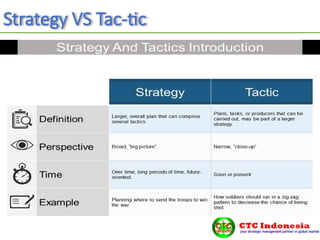
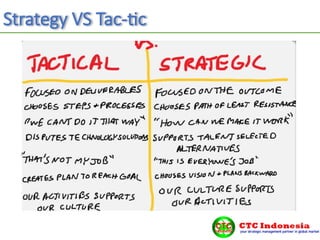
Strategy VS Tac-tic
Strategy VS Tac-tic
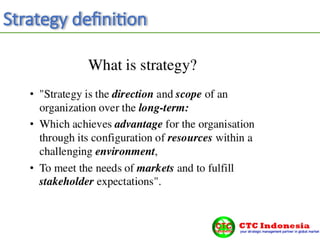
Strategy definition
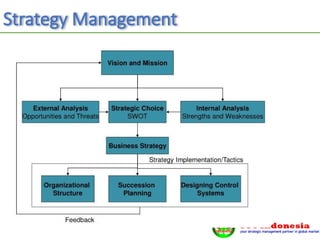
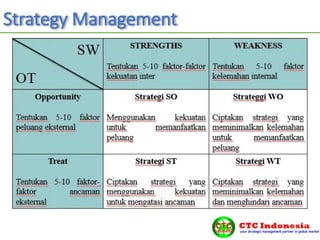
Strategy Management
Strategy Management
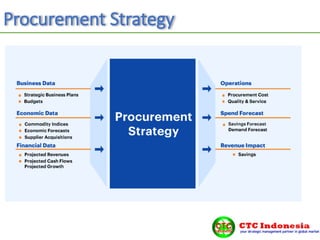
Procurement Strategy
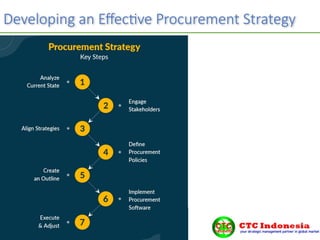
Developing an Effective Procurement Strategy
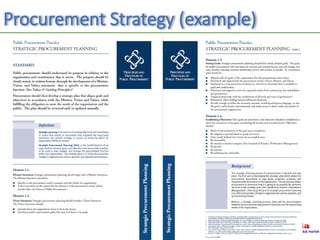
Procurement Strategy (example)
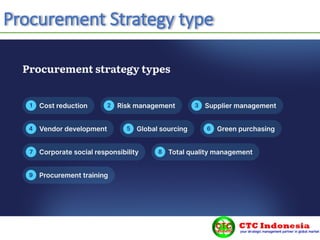
Procurement Strategy type
Developing an Effective Procurement Strategy
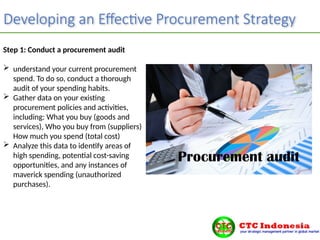
Step 1: Conduct a procurement audit
 understand your current procurement
spend. To do so, conduct a thorough
audit of your spending habits.
 Gather data on your existing
procurement policies and activities,
including: What you buy (goods and
services), Who you buy from (suppliers)
How much you spend (total cost)
 Analyze this data to identify areas of
high spending, potential cost-saving
opportunities, and any instances of
maverick spending (unauthorized
purchases).
Developing an Effective Procurement Strategy
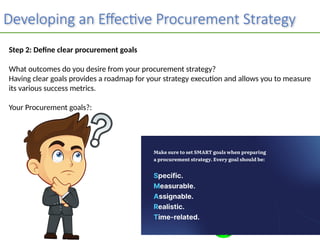
Step 2: Define clear procurement goals
What outcomes do you desire from your procurement strategy?
Having clear goals provides a roadmap for your strategy execution and allows you to measure
its various success metrics.
Your Procurement goals?:
Developing an Effective Procurement Strategy
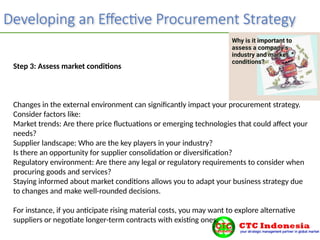
Step 3: Assess market conditions
Changes in the external environment can significantly impact your procurement strategy.
Consider factors like:
Market trends: Are there price fluctuations or emerging technologies that could affect your
needs?
Supplier landscape: Who are the key players in your industry?
Is there an opportunity for supplier consolidation or diversification?
Regulatory environment: Are there any legal or regulatory requirements to consider when
procuring goods and services?
Staying informed about market conditions allows you to adapt your business strategy due
to changes and make well-rounded decisions.
For instance, if you anticipate rising material costs, you may want to explore alternative
suppliers or negotiate longer-term contracts with existing ones.
Developing an Effective Procurement Strategy
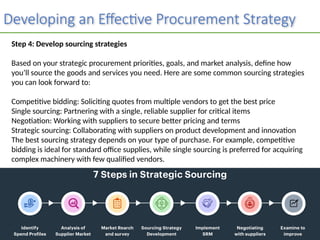
Step 4: Develop sourcing strategies
Based on your strategic procurement priorities, goals, and market analysis, define how
you’ll source the goods and services you need. Here are some common sourcing strategies
you can look forward to:
Competitive bidding: Soliciting quotes from multiple vendors to get the best price
Single sourcing: Partnering with a single, reliable supplier for critical items
Negotiation: Working with suppliers to secure better pricing and terms
Strategic sourcing: Collaborating with suppliers on product development and innovation
The best sourcing strategy depends on your type of purchase. For example, competitive
bidding is ideal for standard office supplies, while single sourcing is preferred for acquiring
complex machinery with few qualified vendors.
Developing an Effective Procurement Strategy
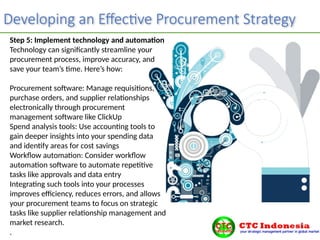
Step 5: Implement technology and automation
Technology can significantly streamline your
procurement process, improve accuracy, and
save your team’s time. Here’s how:
Procurement software: Manage requisitions,
purchase orders, and supplier relationships
electronically through procurement
management software like ClickUp
Spend analysis tools: Use accounting tools to
gain deeper insights into your spending data
and identify areas for cost savings
Workflow automation: Consider workflow
automation software to automate repetitive
tasks like approvals and data entry
Integrating such tools into your processes
improves efficiency, reduces errors, and allows
your procurement teams to focus on strategic
tasks like supplier relationship management and
market research.
.
Developing an Effective Procurement Strategy
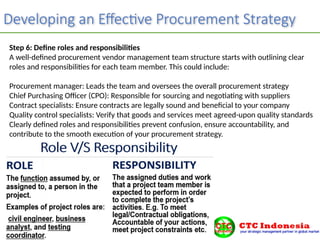
Step 6: Define roles and responsibilities
A well-defined procurement vendor management team structure starts with outlining clear
roles and responsibilities for each team member. This could include:
Procurement manager: Leads the team and oversees the overall procurement strategy
Chief Purchasing Officer (CPO): Responsible for sourcing and negotiating with suppliers
Contract specialists: Ensure contracts are legally sound and beneficial to your company
Quality control specialists: Verify that goods and services meet agreed-upon quality standards
Clearly defined roles and responsibilities prevent confusion, ensure accountability, and
contribute to the smooth execution of your procurement strategy.
Developing an Effective Procurement Strategy
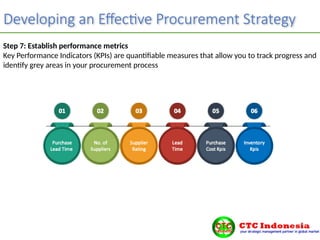
Step 7: Establish performance metrics
Key Performance Indicators (KPIs) are quantifiable measures that allow you to track progress and
identify grey areas in your procurement process
Developing an Effective Procurement Strategy
Step 8: Implement continuous improvement
A winning procurement strategy is a living document. It needs to iterate and adapt to changing
circumstances. Therefore, developing a culture of continuous improvement within your
procurement team.
Use this checklist to ensure your procurement strategy is flexible and adjustable to changes:
Stay informed about industry trends and best practices
Regularly analyse procurement data to identify potential cost-saving opportunities
Seek feedback from internal stakeholders and suppliers on how to improve the procurement
process
Be open to new technologies and automation solutions that can further streamline operations
By fostering a culture of continuous improvement, you build a procurement strategy that
delivers long-term value for your business.
Developing an Effective Procurement Strategy
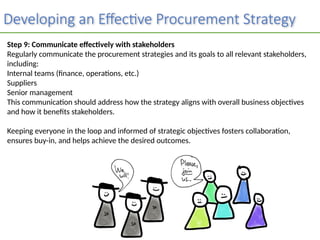
Step 9: Communicate effectively with stakeholders
Regularly communicate the procurement strategies and its goals to all relevant stakeholders,
including:
Internal teams (finance, operations, etc.)
Suppliers
Senior management
This communication should address how the strategy aligns with overall business objectives
and how it benefits stakeholders.
Keeping everyone in the loop and informed of strategic objectives fosters collaboration,
ensures buy-in, and helps achieve the desired outcomes.
Q&A

Procurement strategy in business and process

  • 1.
    Procurement Strategy By :Budiman 08 Aug’2024
  • 2.
    Learning objectives Understanding themeaning Strategy Understanding Procurement Strategy Understanding problem/issues of Procurement Strategy
  • 3.
  • 4.
  • 5.
  • 6.
  • 7.
  • 8.
  • 9.
    Developing an EffectiveProcurement Strategy
  • 10.
  • 11.
  • 12.
    Developing an EffectiveProcurement Strategy Step 1: Conduct a procurement audit  understand your current procurement spend. To do so, conduct a thorough audit of your spending habits.  Gather data on your existing procurement policies and activities, including: What you buy (goods and services), Who you buy from (suppliers) How much you spend (total cost)  Analyze this data to identify areas of high spending, potential cost-saving opportunities, and any instances of maverick spending (unauthorized purchases).
  • 13.
    Developing an EffectiveProcurement Strategy Step 2: Define clear procurement goals What outcomes do you desire from your procurement strategy? Having clear goals provides a roadmap for your strategy execution and allows you to measure its various success metrics. Your Procurement goals?:
  • 14.
    Developing an EffectiveProcurement Strategy Step 3: Assess market conditions Changes in the external environment can significantly impact your procurement strategy. Consider factors like: Market trends: Are there price fluctuations or emerging technologies that could affect your needs? Supplier landscape: Who are the key players in your industry? Is there an opportunity for supplier consolidation or diversification? Regulatory environment: Are there any legal or regulatory requirements to consider when procuring goods and services? Staying informed about market conditions allows you to adapt your business strategy due to changes and make well-rounded decisions. For instance, if you anticipate rising material costs, you may want to explore alternative suppliers or negotiate longer-term contracts with existing ones.
  • 15.
    Developing an EffectiveProcurement Strategy Step 4: Develop sourcing strategies Based on your strategic procurement priorities, goals, and market analysis, define how you’ll source the goods and services you need. Here are some common sourcing strategies you can look forward to: Competitive bidding: Soliciting quotes from multiple vendors to get the best price Single sourcing: Partnering with a single, reliable supplier for critical items Negotiation: Working with suppliers to secure better pricing and terms Strategic sourcing: Collaborating with suppliers on product development and innovation The best sourcing strategy depends on your type of purchase. For example, competitive bidding is ideal for standard office supplies, while single sourcing is preferred for acquiring complex machinery with few qualified vendors.
  • 16.
    Developing an EffectiveProcurement Strategy Step 5: Implement technology and automation Technology can significantly streamline your procurement process, improve accuracy, and save your team’s time. Here’s how: Procurement software: Manage requisitions, purchase orders, and supplier relationships electronically through procurement management software like ClickUp Spend analysis tools: Use accounting tools to gain deeper insights into your spending data and identify areas for cost savings Workflow automation: Consider workflow automation software to automate repetitive tasks like approvals and data entry Integrating such tools into your processes improves efficiency, reduces errors, and allows your procurement teams to focus on strategic tasks like supplier relationship management and market research. .
  • 17.
    Developing an EffectiveProcurement Strategy Step 6: Define roles and responsibilities A well-defined procurement vendor management team structure starts with outlining clear roles and responsibilities for each team member. This could include: Procurement manager: Leads the team and oversees the overall procurement strategy Chief Purchasing Officer (CPO): Responsible for sourcing and negotiating with suppliers Contract specialists: Ensure contracts are legally sound and beneficial to your company Quality control specialists: Verify that goods and services meet agreed-upon quality standards Clearly defined roles and responsibilities prevent confusion, ensure accountability, and contribute to the smooth execution of your procurement strategy.
  • 18.
    Developing an EffectiveProcurement Strategy Step 7: Establish performance metrics Key Performance Indicators (KPIs) are quantifiable measures that allow you to track progress and identify grey areas in your procurement process
  • 19.
    Developing an EffectiveProcurement Strategy Step 8: Implement continuous improvement A winning procurement strategy is a living document. It needs to iterate and adapt to changing circumstances. Therefore, developing a culture of continuous improvement within your procurement team. Use this checklist to ensure your procurement strategy is flexible and adjustable to changes: Stay informed about industry trends and best practices Regularly analyse procurement data to identify potential cost-saving opportunities Seek feedback from internal stakeholders and suppliers on how to improve the procurement process Be open to new technologies and automation solutions that can further streamline operations By fostering a culture of continuous improvement, you build a procurement strategy that delivers long-term value for your business.
  • 20.
    Developing an EffectiveProcurement Strategy Step 9: Communicate effectively with stakeholders Regularly communicate the procurement strategies and its goals to all relevant stakeholders, including: Internal teams (finance, operations, etc.) Suppliers Senior management This communication should address how the strategy aligns with overall business objectives and how it benefits stakeholders. Keeping everyone in the loop and informed of strategic objectives fosters collaboration, ensures buy-in, and helps achieve the desired outcomes.
  • 21.