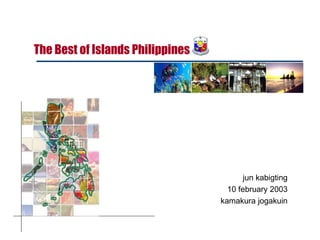
jun kabigting 10 february 2003 kamakura jogakuin The Best of Islands Philippines
The Philippines At a Glance Official Name:  Republic of the Philippines (RP) Form of Government:  Democratic Republic, Presidential System Capital:  Manila Location:  Lat. 4023'N & 21025'N; Long. 1160E & 1270E   No. of Islands:  7,100+ (Luzon, Visayas, & Mindanao as major island groups) Total Area:  300k sq.km. (half as that of Japan) Spread & breadth:  1,850 km & 965 km, respectively Distance from Japan:  4.25 hours by plane Time zone:  GMT + 8 hrs. (or 1 hr. late than Japan)  Population:  84.5 million (a.o. July 2002 census) Major Industry:  Agriculture
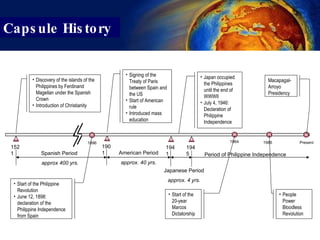
Capsule History 1521 Discovery of the islands of the Philippines by Ferdinand Magellan under the Spanish Crown Introduction of Christianity 1901 1941 1945 1986 Spanish Period  approx 400 yrs. American Period approx. 40 yrs . Japanese Period approx. 4 yrs. Period of Philippine Independence 1964 Present 1896 Start of the Philippine Revolution June 12, 1898: declaration of the Philippine Independence from Spain Signing of the Treaty of Paris between Spain and the US Start of American rule Introduced mass education Japan occupied the Philippines until the end of WWWII July 4, 1946: Declaration of Philippine Independence Start of the 20-year Marcos Dictatorship People Power Bloodless Revolution Macapagal-Arroyo Presidency
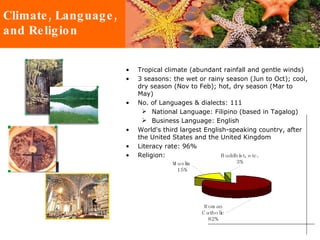
Tropical climate (abundant rainfall and gentle winds) 3 seasons: the wet or rainy season (Jun to Oct); cool, dry season (Nov to Feb); hot, dry season (Mar to May) No. of Languages & dialects: 111 National Language: Filipino (based in Tagalog) Business Language: English World's third largest English-speaking country, after the United States and the United Kingdom Literacy rate: 96% Religion: Climate, Language, and Religion
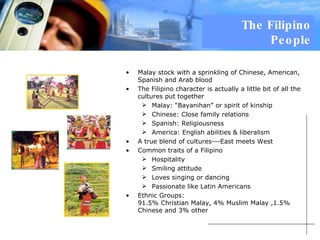
Malay stock with a sprinkling of Chinese, American, Spanish and Arab blood The Filipino character is actually a little bit of all the cultures put together Malay: “Bayanihan” or spirit of kinship  Chinese: Close family relations  Spanish: Religiousness  America: English abilities & liberalism A true blend of cultures---East meets West Common traits of a Filipino Hospitality Smiling attitude Loves singing or dancing Passionate like Latin Americans Ethnic Groups: 91.5% Christian Malay, 4% Muslim Malay ,1.5% Chinese and 3% other The Filipino People
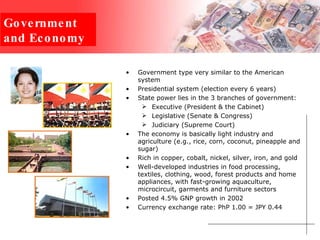
Government type very similar to the American system Presidential system (election every 6 years) State power lies in the 3 branches of government:  Executive (President & the Cabinet) Legislative (Senate & Congress) Judiciary (Supreme Court) The economy is basically light industry and agriculture (e.g., rice, corn, coconut, pineapple and sugar) Rich in copper, cobalt, nickel, silver, iron, and gold Well-developed industries in food processing, textiles, clothing, wood, forest products and home appliances, with fast-growing aquaculture, microcircuit, garments and furniture sectors Posted 4.5% GNP growth in 2002 Currency exchange rate: PhP 1.00 = JPY 0.44   Government and Economy
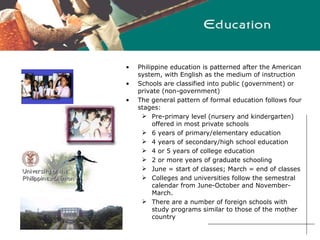
Philippine education is patterned after the American system, with English as the medium of instruction Schools are classified into public (government) or private (non-government) The general pattern of formal education follows four stages:  Pre-primary level (nursery and kindergarten) offered in most private schools 6 years of primary/elementary education 4 years of secondary/high school education 4 or 5 years of college education 2 or more years of graduate schooling June = start of classes; March = end of classes Colleges and universities follow the semestral calendar from June-October and November-March.  There are a number of foreign schools with study programs similar to those of the mother country
8 Tourist Anchor Destinations Manila Cebu Davao Baguio Travel time from Japan to Philippines:  4.25 hrs. Visa-free entry for Japanese Jeepney: Philippines’ most popular mass transport Accommodation: Wide selection of de luxe, standard, economy and pension-type accommodations  Dining out: Filipino food is an exotic, tasteful blend of Oriental, European, and American culinary influences. There is a wide variety of fresh seafood and delectable fruits. First class restaurants offer gourmet specialties as well as Filipino cuisine.  Tipping is expected for many services  All major credit cards accepted nationwide Visit  www. wowphilippines .com.ph  for more details Boracay Palawan Bohol Laoag/Vigan
“ Mabuhay!”

Philippine Presentation Slides

  • 1.
    jun kabigting 10february 2003 kamakura jogakuin The Best of Islands Philippines
  • 2.
    The Philippines Ata Glance Official Name: Republic of the Philippines (RP) Form of Government: Democratic Republic, Presidential System Capital: Manila Location: Lat. 4023'N & 21025'N; Long. 1160E & 1270E No. of Islands: 7,100+ (Luzon, Visayas, & Mindanao as major island groups) Total Area: 300k sq.km. (half as that of Japan) Spread & breadth: 1,850 km & 965 km, respectively Distance from Japan: 4.25 hours by plane Time zone: GMT + 8 hrs. (or 1 hr. late than Japan) Population: 84.5 million (a.o. July 2002 census) Major Industry: Agriculture
  • 3.
    Capsule History 1521Discovery of the islands of the Philippines by Ferdinand Magellan under the Spanish Crown Introduction of Christianity 1901 1941 1945 1986 Spanish Period approx 400 yrs. American Period approx. 40 yrs . Japanese Period approx. 4 yrs. Period of Philippine Independence 1964 Present 1896 Start of the Philippine Revolution June 12, 1898: declaration of the Philippine Independence from Spain Signing of the Treaty of Paris between Spain and the US Start of American rule Introduced mass education Japan occupied the Philippines until the end of WWWII July 4, 1946: Declaration of Philippine Independence Start of the 20-year Marcos Dictatorship People Power Bloodless Revolution Macapagal-Arroyo Presidency
  • 4.
    Tropical climate (abundantrainfall and gentle winds) 3 seasons: the wet or rainy season (Jun to Oct); cool, dry season (Nov to Feb); hot, dry season (Mar to May) No. of Languages & dialects: 111 National Language: Filipino (based in Tagalog) Business Language: English World's third largest English-speaking country, after the United States and the United Kingdom Literacy rate: 96% Religion: Climate, Language, and Religion
  • 5.
    Malay stock witha sprinkling of Chinese, American, Spanish and Arab blood The Filipino character is actually a little bit of all the cultures put together Malay: “Bayanihan” or spirit of kinship Chinese: Close family relations Spanish: Religiousness America: English abilities & liberalism A true blend of cultures---East meets West Common traits of a Filipino Hospitality Smiling attitude Loves singing or dancing Passionate like Latin Americans Ethnic Groups: 91.5% Christian Malay, 4% Muslim Malay ,1.5% Chinese and 3% other The Filipino People
  • 6.
    Government type verysimilar to the American system Presidential system (election every 6 years) State power lies in the 3 branches of government: Executive (President & the Cabinet) Legislative (Senate & Congress) Judiciary (Supreme Court) The economy is basically light industry and agriculture (e.g., rice, corn, coconut, pineapple and sugar) Rich in copper, cobalt, nickel, silver, iron, and gold Well-developed industries in food processing, textiles, clothing, wood, forest products and home appliances, with fast-growing aquaculture, microcircuit, garments and furniture sectors Posted 4.5% GNP growth in 2002 Currency exchange rate: PhP 1.00 = JPY 0.44 Government and Economy
  • 7.
    Philippine education ispatterned after the American system, with English as the medium of instruction Schools are classified into public (government) or private (non-government) The general pattern of formal education follows four stages: Pre-primary level (nursery and kindergarten) offered in most private schools 6 years of primary/elementary education 4 years of secondary/high school education 4 or 5 years of college education 2 or more years of graduate schooling June = start of classes; March = end of classes Colleges and universities follow the semestral calendar from June-October and November-March. There are a number of foreign schools with study programs similar to those of the mother country
  • 8.
    8 Tourist AnchorDestinations Manila Cebu Davao Baguio Travel time from Japan to Philippines: 4.25 hrs. Visa-free entry for Japanese Jeepney: Philippines’ most popular mass transport Accommodation: Wide selection of de luxe, standard, economy and pension-type accommodations Dining out: Filipino food is an exotic, tasteful blend of Oriental, European, and American culinary influences. There is a wide variety of fresh seafood and delectable fruits. First class restaurants offer gourmet specialties as well as Filipino cuisine. Tipping is expected for many services All major credit cards accepted nationwide Visit www. wowphilippines .com.ph for more details Boracay Palawan Bohol Laoag/Vigan
  • 9.