Financial Management Association of New Hampshire Safeguarding Cash & Investments in a Turbulent Economy November 10, 2008
Financial Management Association of New Hampshire  Today’s Meeting Sponsor:
Financial Management Association of New Hampshire  Our Annual Sponsors:
Our Panel Participants Today Matthew Finn, Vice President Finance & Operations, Bradford Networks, Inc. Paul Miller, Principal, Portfolio Management Director, Axial Financial Group Albert Romero, Senior Vice President, Business Banking, Bank of America Moderated by: Travis M. Drouin, CPA, Partner,  Moody, Famiglietti & Andronico, LLP
Safeguarding Cash & Investments in a  Turbulent Economy The current financial crisis: The current crisis’ seeds were sown over the past couple of decades, as more and more increasingly complex structures of securitized assets, derivative products and other financial instruments arrived on the scene.  Our industry believed these products would forever improve our ability to balance the global economy's need to fund growth with its need to manage risk.  The housing crisis in the U.S. and other developed countries, and the turbulence in the global capital markets that followed, however, has revealed vulnerabilities in the financial systems. The events that have transpired since the bankruptcy of Lehman Brothers on September 13 of this year have truly laid bare the implications of these vulnerabilities. In the space of that single weekend, and over the days following, the landscape of Wall Street was completely altered. Storied financial service brands disappeared, and others were merged with stronger competitors. Still others have changed to become bank holding companies, giving up the distinguishing factors that have existed for 80-plus years. No one believes we’ll be going back to where we were as recently as last month. Financial  services firms around the world are re-evaluating their business models; investors are re-calibrating their investment strategies; regulators are taking a fresh look at the rules that govern our industry; and consumers and businesses are adjusting to a contraction of available credit and funding mechanisms
Safeguarding Cash & Investments in a  Turbulent Economy The current financial crisis: The questions on top of everyone’s mind have to do with the immediate future: Who will survive? Who won’t? Have we hit a bottom – and if not, when will we? And, of course, everyone’s favorite: When will things start to get better? What is the difference this time around? To begin, the crisis is being felt first by the intermediaries in finance. The lock up in the capital markets has made the crisis show up on Wall Street first -- before Main Street. Wall Street through its securitization process got stuck with a lot of mortgage credit and commercial credit in its inventory that they can’t sell. And it has cost billions of dollars The Wall Street valuations reflect the market’s view of what will happen over the next several years as the entirety of the over-extension of credit runs through the system. These assets are illiquid and the residuals of them are clogging up the balance sheets of banks – keeping them from starting up the engine again. Every asset class has been affected, and most recently, the impact reached areas it had not previously. And that is what makes this crisis different.  The illiquidity issues have profoundly impacted the confidence in money market funds and commercial paper markets.
Safeguarding Cash & Investments in a  Turbulent Economy The current financial crisis: The disruptions in all markets have caused the cost of debt to stay relatively the same, despite the lowering of interest rates by the Federal Reserve.  Neither consumers through stubborn mortgage rates, nor businesses through widening spreads and higher LIBOR fixes, have received the benefits of the falling rates. In some instances, debt capital may not be attainable at any cost. This is what led to the Troubled Asset Relief Program (TARP) and other related programs.  Freeing banks to use capital to lend anew, rather than using it to storehouse old will keep your neighbor who is in financial stress to keep their job and their house. It will help us continue to fund your business.
Safeguarding Cash & Investments in a  Turbulent Economy The current economic outlook:   Three of the worlds major central banks reduced rates last week, the ECB, the BoE and the SNB. All three indicated that they will likely ease monetary policy substantially further. The Fed and the BoJ, who are at much lower rates than their European counterparts, also look set to add to make their policy stance even more stimulative by December. However, the still dysfunctional financial markets for the short-term funding of banks in general and in the US mortgage and credit sphere are clogging the transmission of the aggressive monetary policies. Unclogging those monetary channels is a pre-requisite to economic rebound. We expect more actions by the US Treasury and global finance ministers to further loosen financial markets.  In addition, further fiscal stimulus designed to bridge the gap until monetary policy becomes fully effective can be expected. Japan just enacted a second stimulus package. In the US, a new fiscal package tops President-elect Obama's economic agenda. Congress is expected to convene shortly to debate a package, and at least a portion of it will be enacted before year-end, the rest in early 2009. We expect a minimum $300 billion package to include low- and middle-income tax cuts, subsidies for distressed homeowners, job creation programs, block grants to states, liberalization of unemployment insurance and tax credits for home purchases
Safeguarding Cash & Investments in a  Turbulent Economy The condition of the industry: It is undeniable that there is always a temptation in financial services to carry the theory of the positive economic effects of credit too far. That it is every institution’s great challenge, in good times, to exercise restraint and good judgment. And that as economic bubbles build, all lenders make some mistakes, but some lenders make fewer than others. Credit is critical to growth; it is what we do in the banking industry. However, we must acknowledge the dangers of credit overextension and work together within the industry and with our regulators to exercise appropriate restraint. Overextension of credit and over-borrowing by customers underpins our current situation. The tremendous value that our modern financial markets contribute to economic growth is clear, and credit is at the center of it. That won’t change. And that then is the paradox, balancing credit so it is wisely granted and wisely used.
Safeguarding Cash & Investments in a  Turbulent Economy The condition of the industry: Even in the face of the recent economic carnage - rumors of the impending demise of the banking industry have been somewhat exaggerated. A bubble has burst, and we are all watching as the ensuing market turbulence takes down its share of banks and other financial firms. But, so far this year, we’ve had only a dozen or so banks in the U.S. go out of business. Between 1986 and 1991 we had 2,121 bank failures. Thanks to years of consolidation and better (but obviously not perfect) risk management,  we are not likely going to see that rate of failure this time around.  We will see less failure, and more of the walking wounded. That poses its own challenges, but there’s no question it’s the lesser evil. More institutions are muddling through, attracting new capital or merging to survive, and fewer will fall into the lap of the taxpayers. The survivors will be stronger, more diversified, and better prepared to thrive in cycles to come.
Safeguarding Cash & Investments in a  Turbulent Economy Three key thoughts on long-term future of our industry: First: Capital is King - There’s no question that this is a particularly good time to be a well-capitalized, deposit-funded, highly liquid institution. Banks that are not reliant on institutional markets for funding and that have money to lend are finding no shortage of demand among small, middle-market and large companies in the many industrial and service sectors that are maintaining strength through the cycle.  Second: Asset securitization and other forms of risk distribution will continue; it will reform in necessary and appropriate ways and will evolve and grow in new ways to help stimulate growth and promote stability across the global economy. When the securitization market comes back, it will be a much simpler place than it’s been the past few years. The one big problem with the market we had was that the securities structures got so complex and opaque that neither the ratings agencies nor the purchasers could accurately assess the risks and value the products. We may very well see regulatory bodies try to step in here and do something to ensure more transparency and disclosure. But frankly, the market will force this issue regardless, without any government help, before investors will come off the sidelines.
Safeguarding Cash & Investments in a  Turbulent Economy Three key thoughts on long-term future of our industry: Third: The universal bank model will continue to gain strength.  There is a caveat here: the virtue of being a universal bank does not guarantee results. Management still has to think long and hard about the proper business and geographic mix, given the mission of the institution and market conditions. And we know that isolated bad bets, if they’re big enough, can take anybody down. There are universal banks in the U.S. and in Europe that have not done well at all over the past year. While Bank of America is still in a position of great strength, we’ve certainly taken our share of hits. But that’s the point – we have taken our share of hits, and remain strong; we have earned money every quarter.  All things being equal, a well-thought-out universal bank strategy is inherently stronger than a monoline approach because the diversity of revenue streams will always help cushion a downturn in one business or market, and the ability to offer customers and clients stability and full relationship banking through all stages of the cycle will produce a “flight to quality” when conditions go south.
Safeguarding Cash & Investments in a  Turbulent Economy Three key thoughts on long-term future of our industry: Therefore, what we may see, once the market starts to stabilize, is accelerating consolidation in financial services both within and across industry sectors. The industry as a whole will shrink but the survivors will grow. And what we’ll be left with is a stronger, more stable, more flexible and responsive financial services industry to help drive global economic growth It can be both a frustration and a source of comfort to know that bankers, investors, borrowers, speculators and regulators have endured any number of financial crises before. It makes one wonder why the lessons of the business cycle are so quickly forgotten. And it reminds us that, as painful as a downturn can be, there is always a recovery in the future.
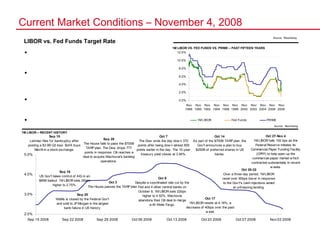
Current Market Conditions – November 4, 2008 1M LIBOR – RECENT HISTORY 1M LIBOR VS. FED FUNDS VS. PRIME – PAST FIFTEEN YEARS Source:  Bloomberg Source:  Bloomberg The chart on the right illustrates the historic relationship between the Fed Funds Target Rate (Fed Funds) and 1M LIBOR. Over the last 20 years, 1M LIBOR has averaged 18bps above Fed Funds. Due to dislocations in the short term funding market, 1M LIBOR rose from 2.46% in early August to a high of 4.58% in mid-October; it has recently come down to 2.18%. The chart below illustrates the movement in LIBOR and the factors that have contributed to it. In response to decreased market liquidity and sub prime contagion, the Federal Reserve has lowered the Fed Funds rate 425 bps since September 2007 to 1.00%. The spread between 1M LIBOR and the Fed Funds is currently 118bps. LIBOR vs. Fed Funds Target Rate
Safeguarding Cash & Investments in a  Turbulent Economy Automated Investment Service Options: Choices for investing daily operating, core or strategic funds span a wide range of investment alternatives, including automated overnight investments into: Repurchase Agreements- fully collateralized repo securities that are generally direct obligations of Government Sponsored Enterprises or direct obligations guaranteed by the U.S. government, or an agency thereof. Money Market Mutual Funds- Columbia Money Market Reserves, Columbia Treasury Reserves, Columbia Government Reserves, and Columbia Municipal Reserves Eurodollar Time Deposits
Policy Guidelines I.  Establish a Written Investment Policy for Cash ●  Your bank or investment firm can help draft one ●  Copy or adopt one from another company II. Example of a Publicly traded technology company: Strict adherence to investment policy  Primary objective is preservation of capital and liquidity Average maturity no more than 90 days No individual maturity greater than 180 days Highest credit rating on all securities Q: What has changed in the company’s cash management needs in the last year ? A: “Abandon any hope of getting decent yields, in favor of safety”   ◊  Use more than one investment firm/bank to mitigate firm risk ◊  Chose to move to treasury money markets and individual securities “ Money market and other capital preservation funds are neither insured nor guaranteed by the U.S. Government or the FDIC,   and there is no assurance that a $1.00 share price or book value will be maintained.  Be sure to read each fund's prospectus   or offering statement before making any investment decisions.”
Policy Guidelines (continued) III. Example of a Private Broker Dealer – Financial Services Investment policy divides cash objectives into three basic time horizons: Short Term – 3 months or less Medium Term – 1 year Long Term – 5 years + ◊  Short Term  Rotation from bank money markets to publicly traded money markets to maximize yield & rotation between taxable and tax exempt money markets to maximize after  tax yield ◊  Medium Term Rolling 3 - 6 month CDs to maximize yield by +0.25 – 0.30 bps ◊  Long Term Balanced  global  portfolio of equities and bonds, 60/40 allocation
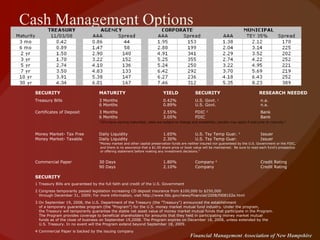
Cash Management Options SECURITY MATURITY YIELD SECURITY RESEARCH NEEDED Treasury Bills   3 Months 0.42% U.S. Govt.  1  n.a. 6 Months 0.89% U.S. Govt.  n.a. Certificates of Deposit 3 Months 2.55% FDIC  2  Bank 6 Months 3.05% FDIC  Bank “ CD’s have varying maturities, rates are subject to change and availability; penalty may apply if sold prior to maturity.”   Money Market- Tax Free Daily Liquidity 1.65% U.S. Tsy Temp Guar.  3  Issuer Money Market- Taxable Daily Liquidity 2.30% U.S. Tsy Temp Guar.   Issuer “ Money market and other capital preservation funds are neither insured nor guaranteed by the U.S. Government or the FDIC,   and there is no assurance that a $1.00 share price or book value will be maintained.  Be sure to read each fund's prospectus   or offering statement before making any investment decisions.” Commercial Paper 30 Days 1.80% Company  4  Credit Rating 90 Days 2.10% Company  Credit Rating SECURITY 1 Treasury Bills are guaranteed by the full faith and credit of the U.S. Government 2 Congress temporarily passed legislation increasing CD deposit insurance from $100,000 to $250,000   through December 31, 2009; For more information, visit http://www.fdic.gov/news/financial/2008/fil08102a.html 3 On September 19, 2008, the U.S. Department of the Treasury (the "Treasury") announced the establishment    of a temporary guarantee program (the "Program") for the U.S. money market mutual fund industry. Under the program,   the Treasury will temporarily guarantee the stable net asset value of money market mutual funds that participate in the Program.   The Program provides coverage to beneficial shareholders for amounts that they held in participating money market mutual    funds as of the close of business on September 19,2008. The Program expires on December 18, 2008, unless extended by the    U.S. Treasury. In no event will the Program extend beyond September 18, 2009. 4 Commercial Paper is backed by the issuing company
Questions??
Thank you for coming!! A special thank you again to our sponsors this evening: Newbury Piret & Company, Inc. www.newburypiret.com CresaPartners www.cresapartners.com KBW Financial Staffing and Recruiting www.kbwfinancial.com MFA – Moody, Famiglietti & Andronico, LLP www.mfa-cpa.com Tatum, LLC www.tatumllc.com Telos Communications www.thinktelos.com
Financial Management Association of New Hampshire For more information and a schedule of future events, please visit our website at: http://www.fmanh.com

FMA of NH: Safeguarding Cash

  • 1.
    Financial Management Associationof New Hampshire Safeguarding Cash & Investments in a Turbulent Economy November 10, 2008
  • 2.
    Financial Management Associationof New Hampshire Today’s Meeting Sponsor:
  • 3.
    Financial Management Associationof New Hampshire Our Annual Sponsors:
  • 4.
    Our Panel ParticipantsToday Matthew Finn, Vice President Finance & Operations, Bradford Networks, Inc. Paul Miller, Principal, Portfolio Management Director, Axial Financial Group Albert Romero, Senior Vice President, Business Banking, Bank of America Moderated by: Travis M. Drouin, CPA, Partner, Moody, Famiglietti & Andronico, LLP
  • 5.
    Safeguarding Cash &Investments in a Turbulent Economy The current financial crisis: The current crisis’ seeds were sown over the past couple of decades, as more and more increasingly complex structures of securitized assets, derivative products and other financial instruments arrived on the scene. Our industry believed these products would forever improve our ability to balance the global economy's need to fund growth with its need to manage risk. The housing crisis in the U.S. and other developed countries, and the turbulence in the global capital markets that followed, however, has revealed vulnerabilities in the financial systems. The events that have transpired since the bankruptcy of Lehman Brothers on September 13 of this year have truly laid bare the implications of these vulnerabilities. In the space of that single weekend, and over the days following, the landscape of Wall Street was completely altered. Storied financial service brands disappeared, and others were merged with stronger competitors. Still others have changed to become bank holding companies, giving up the distinguishing factors that have existed for 80-plus years. No one believes we’ll be going back to where we were as recently as last month. Financial services firms around the world are re-evaluating their business models; investors are re-calibrating their investment strategies; regulators are taking a fresh look at the rules that govern our industry; and consumers and businesses are adjusting to a contraction of available credit and funding mechanisms
  • 6.
    Safeguarding Cash &Investments in a Turbulent Economy The current financial crisis: The questions on top of everyone’s mind have to do with the immediate future: Who will survive? Who won’t? Have we hit a bottom – and if not, when will we? And, of course, everyone’s favorite: When will things start to get better? What is the difference this time around? To begin, the crisis is being felt first by the intermediaries in finance. The lock up in the capital markets has made the crisis show up on Wall Street first -- before Main Street. Wall Street through its securitization process got stuck with a lot of mortgage credit and commercial credit in its inventory that they can’t sell. And it has cost billions of dollars The Wall Street valuations reflect the market’s view of what will happen over the next several years as the entirety of the over-extension of credit runs through the system. These assets are illiquid and the residuals of them are clogging up the balance sheets of banks – keeping them from starting up the engine again. Every asset class has been affected, and most recently, the impact reached areas it had not previously. And that is what makes this crisis different. The illiquidity issues have profoundly impacted the confidence in money market funds and commercial paper markets.
  • 7.
    Safeguarding Cash &Investments in a Turbulent Economy The current financial crisis: The disruptions in all markets have caused the cost of debt to stay relatively the same, despite the lowering of interest rates by the Federal Reserve. Neither consumers through stubborn mortgage rates, nor businesses through widening spreads and higher LIBOR fixes, have received the benefits of the falling rates. In some instances, debt capital may not be attainable at any cost. This is what led to the Troubled Asset Relief Program (TARP) and other related programs. Freeing banks to use capital to lend anew, rather than using it to storehouse old will keep your neighbor who is in financial stress to keep their job and their house. It will help us continue to fund your business.
  • 8.
    Safeguarding Cash &Investments in a Turbulent Economy The current economic outlook: Three of the worlds major central banks reduced rates last week, the ECB, the BoE and the SNB. All three indicated that they will likely ease monetary policy substantially further. The Fed and the BoJ, who are at much lower rates than their European counterparts, also look set to add to make their policy stance even more stimulative by December. However, the still dysfunctional financial markets for the short-term funding of banks in general and in the US mortgage and credit sphere are clogging the transmission of the aggressive monetary policies. Unclogging those monetary channels is a pre-requisite to economic rebound. We expect more actions by the US Treasury and global finance ministers to further loosen financial markets. In addition, further fiscal stimulus designed to bridge the gap until monetary policy becomes fully effective can be expected. Japan just enacted a second stimulus package. In the US, a new fiscal package tops President-elect Obama's economic agenda. Congress is expected to convene shortly to debate a package, and at least a portion of it will be enacted before year-end, the rest in early 2009. We expect a minimum $300 billion package to include low- and middle-income tax cuts, subsidies for distressed homeowners, job creation programs, block grants to states, liberalization of unemployment insurance and tax credits for home purchases
  • 9.
    Safeguarding Cash &Investments in a Turbulent Economy The condition of the industry: It is undeniable that there is always a temptation in financial services to carry the theory of the positive economic effects of credit too far. That it is every institution’s great challenge, in good times, to exercise restraint and good judgment. And that as economic bubbles build, all lenders make some mistakes, but some lenders make fewer than others. Credit is critical to growth; it is what we do in the banking industry. However, we must acknowledge the dangers of credit overextension and work together within the industry and with our regulators to exercise appropriate restraint. Overextension of credit and over-borrowing by customers underpins our current situation. The tremendous value that our modern financial markets contribute to economic growth is clear, and credit is at the center of it. That won’t change. And that then is the paradox, balancing credit so it is wisely granted and wisely used.
  • 10.
    Safeguarding Cash &Investments in a Turbulent Economy The condition of the industry: Even in the face of the recent economic carnage - rumors of the impending demise of the banking industry have been somewhat exaggerated. A bubble has burst, and we are all watching as the ensuing market turbulence takes down its share of banks and other financial firms. But, so far this year, we’ve had only a dozen or so banks in the U.S. go out of business. Between 1986 and 1991 we had 2,121 bank failures. Thanks to years of consolidation and better (but obviously not perfect) risk management, we are not likely going to see that rate of failure this time around. We will see less failure, and more of the walking wounded. That poses its own challenges, but there’s no question it’s the lesser evil. More institutions are muddling through, attracting new capital or merging to survive, and fewer will fall into the lap of the taxpayers. The survivors will be stronger, more diversified, and better prepared to thrive in cycles to come.
  • 11.
    Safeguarding Cash &Investments in a Turbulent Economy Three key thoughts on long-term future of our industry: First: Capital is King - There’s no question that this is a particularly good time to be a well-capitalized, deposit-funded, highly liquid institution. Banks that are not reliant on institutional markets for funding and that have money to lend are finding no shortage of demand among small, middle-market and large companies in the many industrial and service sectors that are maintaining strength through the cycle. Second: Asset securitization and other forms of risk distribution will continue; it will reform in necessary and appropriate ways and will evolve and grow in new ways to help stimulate growth and promote stability across the global economy. When the securitization market comes back, it will be a much simpler place than it’s been the past few years. The one big problem with the market we had was that the securities structures got so complex and opaque that neither the ratings agencies nor the purchasers could accurately assess the risks and value the products. We may very well see regulatory bodies try to step in here and do something to ensure more transparency and disclosure. But frankly, the market will force this issue regardless, without any government help, before investors will come off the sidelines.
  • 12.
    Safeguarding Cash &Investments in a Turbulent Economy Three key thoughts on long-term future of our industry: Third: The universal bank model will continue to gain strength. There is a caveat here: the virtue of being a universal bank does not guarantee results. Management still has to think long and hard about the proper business and geographic mix, given the mission of the institution and market conditions. And we know that isolated bad bets, if they’re big enough, can take anybody down. There are universal banks in the U.S. and in Europe that have not done well at all over the past year. While Bank of America is still in a position of great strength, we’ve certainly taken our share of hits. But that’s the point – we have taken our share of hits, and remain strong; we have earned money every quarter. All things being equal, a well-thought-out universal bank strategy is inherently stronger than a monoline approach because the diversity of revenue streams will always help cushion a downturn in one business or market, and the ability to offer customers and clients stability and full relationship banking through all stages of the cycle will produce a “flight to quality” when conditions go south.
  • 13.
    Safeguarding Cash &Investments in a Turbulent Economy Three key thoughts on long-term future of our industry: Therefore, what we may see, once the market starts to stabilize, is accelerating consolidation in financial services both within and across industry sectors. The industry as a whole will shrink but the survivors will grow. And what we’ll be left with is a stronger, more stable, more flexible and responsive financial services industry to help drive global economic growth It can be both a frustration and a source of comfort to know that bankers, investors, borrowers, speculators and regulators have endured any number of financial crises before. It makes one wonder why the lessons of the business cycle are so quickly forgotten. And it reminds us that, as painful as a downturn can be, there is always a recovery in the future.
  • 14.
    Current Market Conditions– November 4, 2008 1M LIBOR – RECENT HISTORY 1M LIBOR VS. FED FUNDS VS. PRIME – PAST FIFTEEN YEARS Source: Bloomberg Source: Bloomberg The chart on the right illustrates the historic relationship between the Fed Funds Target Rate (Fed Funds) and 1M LIBOR. Over the last 20 years, 1M LIBOR has averaged 18bps above Fed Funds. Due to dislocations in the short term funding market, 1M LIBOR rose from 2.46% in early August to a high of 4.58% in mid-October; it has recently come down to 2.18%. The chart below illustrates the movement in LIBOR and the factors that have contributed to it. In response to decreased market liquidity and sub prime contagion, the Federal Reserve has lowered the Fed Funds rate 425 bps since September 2007 to 1.00%. The spread between 1M LIBOR and the Fed Funds is currently 118bps. LIBOR vs. Fed Funds Target Rate
  • 15.
    Safeguarding Cash &Investments in a Turbulent Economy Automated Investment Service Options: Choices for investing daily operating, core or strategic funds span a wide range of investment alternatives, including automated overnight investments into: Repurchase Agreements- fully collateralized repo securities that are generally direct obligations of Government Sponsored Enterprises or direct obligations guaranteed by the U.S. government, or an agency thereof. Money Market Mutual Funds- Columbia Money Market Reserves, Columbia Treasury Reserves, Columbia Government Reserves, and Columbia Municipal Reserves Eurodollar Time Deposits
  • 16.
    Policy Guidelines I. Establish a Written Investment Policy for Cash ● Your bank or investment firm can help draft one ● Copy or adopt one from another company II. Example of a Publicly traded technology company: Strict adherence to investment policy Primary objective is preservation of capital and liquidity Average maturity no more than 90 days No individual maturity greater than 180 days Highest credit rating on all securities Q: What has changed in the company’s cash management needs in the last year ? A: “Abandon any hope of getting decent yields, in favor of safety” ◊ Use more than one investment firm/bank to mitigate firm risk ◊ Chose to move to treasury money markets and individual securities “ Money market and other capital preservation funds are neither insured nor guaranteed by the U.S. Government or the FDIC, and there is no assurance that a $1.00 share price or book value will be maintained. Be sure to read each fund's prospectus or offering statement before making any investment decisions.”
  • 17.
    Policy Guidelines (continued)III. Example of a Private Broker Dealer – Financial Services Investment policy divides cash objectives into three basic time horizons: Short Term – 3 months or less Medium Term – 1 year Long Term – 5 years + ◊ Short Term Rotation from bank money markets to publicly traded money markets to maximize yield & rotation between taxable and tax exempt money markets to maximize after tax yield ◊ Medium Term Rolling 3 - 6 month CDs to maximize yield by +0.25 – 0.30 bps ◊ Long Term Balanced global portfolio of equities and bonds, 60/40 allocation
  • 18.
    Cash Management OptionsSECURITY MATURITY YIELD SECURITY RESEARCH NEEDED Treasury Bills 3 Months 0.42% U.S. Govt. 1 n.a. 6 Months 0.89% U.S. Govt. n.a. Certificates of Deposit 3 Months 2.55% FDIC 2 Bank 6 Months 3.05% FDIC Bank “ CD’s have varying maturities, rates are subject to change and availability; penalty may apply if sold prior to maturity.” Money Market- Tax Free Daily Liquidity 1.65% U.S. Tsy Temp Guar. 3 Issuer Money Market- Taxable Daily Liquidity 2.30% U.S. Tsy Temp Guar. Issuer “ Money market and other capital preservation funds are neither insured nor guaranteed by the U.S. Government or the FDIC, and there is no assurance that a $1.00 share price or book value will be maintained. Be sure to read each fund's prospectus or offering statement before making any investment decisions.” Commercial Paper 30 Days 1.80% Company 4 Credit Rating 90 Days 2.10% Company Credit Rating SECURITY 1 Treasury Bills are guaranteed by the full faith and credit of the U.S. Government 2 Congress temporarily passed legislation increasing CD deposit insurance from $100,000 to $250,000 through December 31, 2009; For more information, visit http://www.fdic.gov/news/financial/2008/fil08102a.html 3 On September 19, 2008, the U.S. Department of the Treasury (the "Treasury") announced the establishment of a temporary guarantee program (the "Program") for the U.S. money market mutual fund industry. Under the program, the Treasury will temporarily guarantee the stable net asset value of money market mutual funds that participate in the Program. The Program provides coverage to beneficial shareholders for amounts that they held in participating money market mutual funds as of the close of business on September 19,2008. The Program expires on December 18, 2008, unless extended by the U.S. Treasury. In no event will the Program extend beyond September 18, 2009. 4 Commercial Paper is backed by the issuing company
  • 19.
  • 20.
    Thank you forcoming!! A special thank you again to our sponsors this evening: Newbury Piret & Company, Inc. www.newburypiret.com CresaPartners www.cresapartners.com KBW Financial Staffing and Recruiting www.kbwfinancial.com MFA – Moody, Famiglietti & Andronico, LLP www.mfa-cpa.com Tatum, LLC www.tatumllc.com Telos Communications www.thinktelos.com
  • 21.
    Financial Management Associationof New Hampshire For more information and a schedule of future events, please visit our website at: http://www.fmanh.com