Red Hot Testing in a Green World 12 th  November 2008 The Hague, Netherlands. John Brennan Principal Consultant, AppLabs [email_address] +44 7967 246 432
Agenda The Future of Software Testing Testing Realities Environmental Impact Real World Example Testing Approaches to Reduce Impact Evolving Roles and Responsibilities Reasons to Go Green for Red Hot Testing
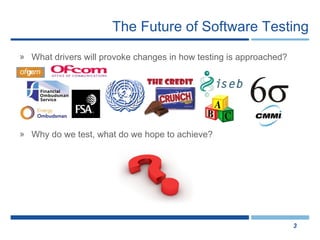
What drivers will provoke changes in how testing is approached? Why do we test, what do we hope to achieve? The Future of Software Testing
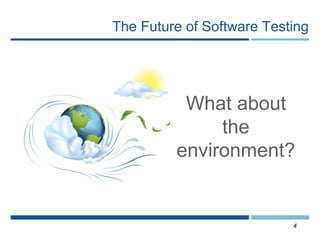
The Future of Software Testing What about the environment?
Testing Realities Timelines Fixed – Testing Squeezed Functional Risks Security, business process failure, component or functional failure Non-Functional Risks Performance, load, stress, usability, maintainability, reliability, interoperability and portability Timelines move – painfully Failure achieving time-to-market readiness, lost competitive advantage Testing projects stack up – test planning and control confusing Parallel testing, whilst some phases delivered to the live environment Resulting in parallel environment testing Additional test environments required to support stacked up projects Ineffective/Inefficient Testing = Resource Wastage/Global Impact
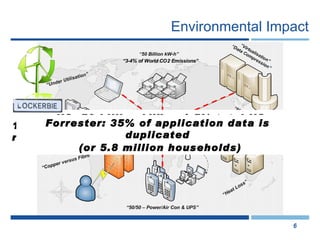
Environmental Impact 1,000 PC's at 24/7 equates to £70,000 wasted revenue Gartner: 40% of Global IT Device Emissions $4 billion powering devices not used UK: Data Centre Energy = 1.15 billion kWh US: Data Centre Energy > 50 billion kWh US: 50 billion kWh = 1.5% total US consumption (or 5.8 million households) Forrester: 35% of application data is duplicated
Real World Example Poorly defined roles and responsibilities – diluted lines of accountability  Development lifecycle chaotic – testing chaos Defect/Bug Management needs structure No supporting configuration management processes 100+ Unix environments – under utilised; little appreciation for wastage; new environments built; support over-stretched Replicating overnight process utilises huge CPU resource Leads to energy wastage, delays, resource misuse and environmental impact Estimated financial impact – millions in lost revenue
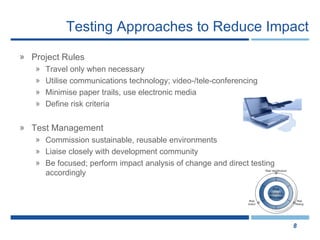
Testing Approaches to Reduce Impact Project Rules Travel only when necessary Utilise communications technology; video-/tele-conferencing Minimise paper trails, use electronic media Define risk criteria Test Management Commission sustainable, reusable environments Liaise closely with development community Be focused; perform impact analysis of change and direct testing accordingly
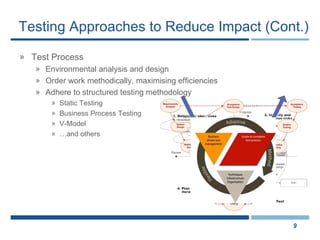
Testing Approaches to Reduce Impact (Cont.) Test Process Environmental analysis and design Order work methodically, maximising efficiencies Adhere to structured testing methodology Static Testing Business Process Testing V-Model … and others
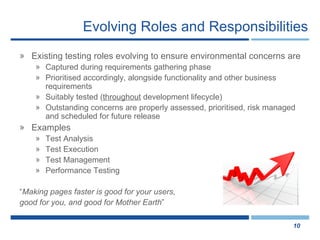
Evolving Roles and Responsibilities Existing testing roles evolving to ensure environmental concerns are Captured during requirements gathering phase Prioritised accordingly, alongside functionality and other business requirements Suitably tested ( throughout  development lifecycle) Outstanding concerns are properly assessed, prioritised, risk managed and scheduled for future release Examples Test Analysis Test Execution Test Management Performance Testing “ Making pages faster is good for your users,  good for you, and good for Mother Earth ”
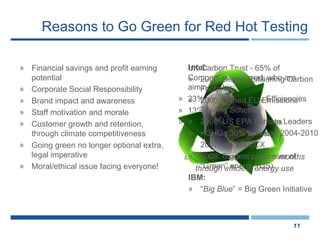
Reasons to Go Green for Red Hot Testing Financial savings and profit earning potential Corporate Social Responsibility Brand impact and awareness Staff motivation and morale Customer growth and retention, through climate competitiveness Going green no longer optional extra, legal imperative Moral/ethical issue facing everyone! UK Carbon Trust - 65% of Companies surveyed, who are aiming to trim costs: 23% focus on Energy Efficiencies 13% Redundancies 17% Low Salary Increases 19% Recruitment Freeze £2.5 billion saving over 12 months through efficient energy use Intel: 2000: Began Publishing Carbon Footprint 2005: Joined EU Emissions Trading Scheme 2006: US EPA Climate Leaders < GHGs 30% between 2004-2010 2007: Joined CCX 2008: Biggest purchaser of “Green”  energy (US) IBM: “ Big Blue ” = Big Green Initiative
The Future of Software Testing What about the environment?

Red Hot Testing In A Green World

  • 1.
    Red Hot Testingin a Green World 12 th November 2008 The Hague, Netherlands. John Brennan Principal Consultant, AppLabs [email_address] +44 7967 246 432
  • 2.
    Agenda The Futureof Software Testing Testing Realities Environmental Impact Real World Example Testing Approaches to Reduce Impact Evolving Roles and Responsibilities Reasons to Go Green for Red Hot Testing
  • 3.
    What drivers willprovoke changes in how testing is approached? Why do we test, what do we hope to achieve? The Future of Software Testing
  • 4.
    The Future ofSoftware Testing What about the environment?
  • 5.
    Testing Realities TimelinesFixed – Testing Squeezed Functional Risks Security, business process failure, component or functional failure Non-Functional Risks Performance, load, stress, usability, maintainability, reliability, interoperability and portability Timelines move – painfully Failure achieving time-to-market readiness, lost competitive advantage Testing projects stack up – test planning and control confusing Parallel testing, whilst some phases delivered to the live environment Resulting in parallel environment testing Additional test environments required to support stacked up projects Ineffective/Inefficient Testing = Resource Wastage/Global Impact
  • 6.
    Environmental Impact 1,000PC's at 24/7 equates to £70,000 wasted revenue Gartner: 40% of Global IT Device Emissions $4 billion powering devices not used UK: Data Centre Energy = 1.15 billion kWh US: Data Centre Energy > 50 billion kWh US: 50 billion kWh = 1.5% total US consumption (or 5.8 million households) Forrester: 35% of application data is duplicated
  • 7.
    Real World ExamplePoorly defined roles and responsibilities – diluted lines of accountability Development lifecycle chaotic – testing chaos Defect/Bug Management needs structure No supporting configuration management processes 100+ Unix environments – under utilised; little appreciation for wastage; new environments built; support over-stretched Replicating overnight process utilises huge CPU resource Leads to energy wastage, delays, resource misuse and environmental impact Estimated financial impact – millions in lost revenue
  • 8.
    Testing Approaches toReduce Impact Project Rules Travel only when necessary Utilise communications technology; video-/tele-conferencing Minimise paper trails, use electronic media Define risk criteria Test Management Commission sustainable, reusable environments Liaise closely with development community Be focused; perform impact analysis of change and direct testing accordingly
  • 9.
    Testing Approaches toReduce Impact (Cont.) Test Process Environmental analysis and design Order work methodically, maximising efficiencies Adhere to structured testing methodology Static Testing Business Process Testing V-Model … and others
  • 10.
    Evolving Roles andResponsibilities Existing testing roles evolving to ensure environmental concerns are Captured during requirements gathering phase Prioritised accordingly, alongside functionality and other business requirements Suitably tested ( throughout development lifecycle) Outstanding concerns are properly assessed, prioritised, risk managed and scheduled for future release Examples Test Analysis Test Execution Test Management Performance Testing “ Making pages faster is good for your users, good for you, and good for Mother Earth ”
  • 11.
    Reasons to GoGreen for Red Hot Testing Financial savings and profit earning potential Corporate Social Responsibility Brand impact and awareness Staff motivation and morale Customer growth and retention, through climate competitiveness Going green no longer optional extra, legal imperative Moral/ethical issue facing everyone! UK Carbon Trust - 65% of Companies surveyed, who are aiming to trim costs: 23% focus on Energy Efficiencies 13% Redundancies 17% Low Salary Increases 19% Recruitment Freeze £2.5 billion saving over 12 months through efficient energy use Intel: 2000: Began Publishing Carbon Footprint 2005: Joined EU Emissions Trading Scheme 2006: US EPA Climate Leaders < GHGs 30% between 2004-2010 2007: Joined CCX 2008: Biggest purchaser of “Green” energy (US) IBM: “ Big Blue ” = Big Green Initiative
  • 12.
    The Future ofSoftware Testing What about the environment?