9 Mortgage Markets
CHAPTER OBJECTIVES
The specific objectives of this chapter are to:
· ▪ provide a background on mortgages,
· ▪ describe the common types of residential mortgages,
· ▪ explain the valuation and risk of mortgages,
· ▪ explain mortgage-backend securities, and
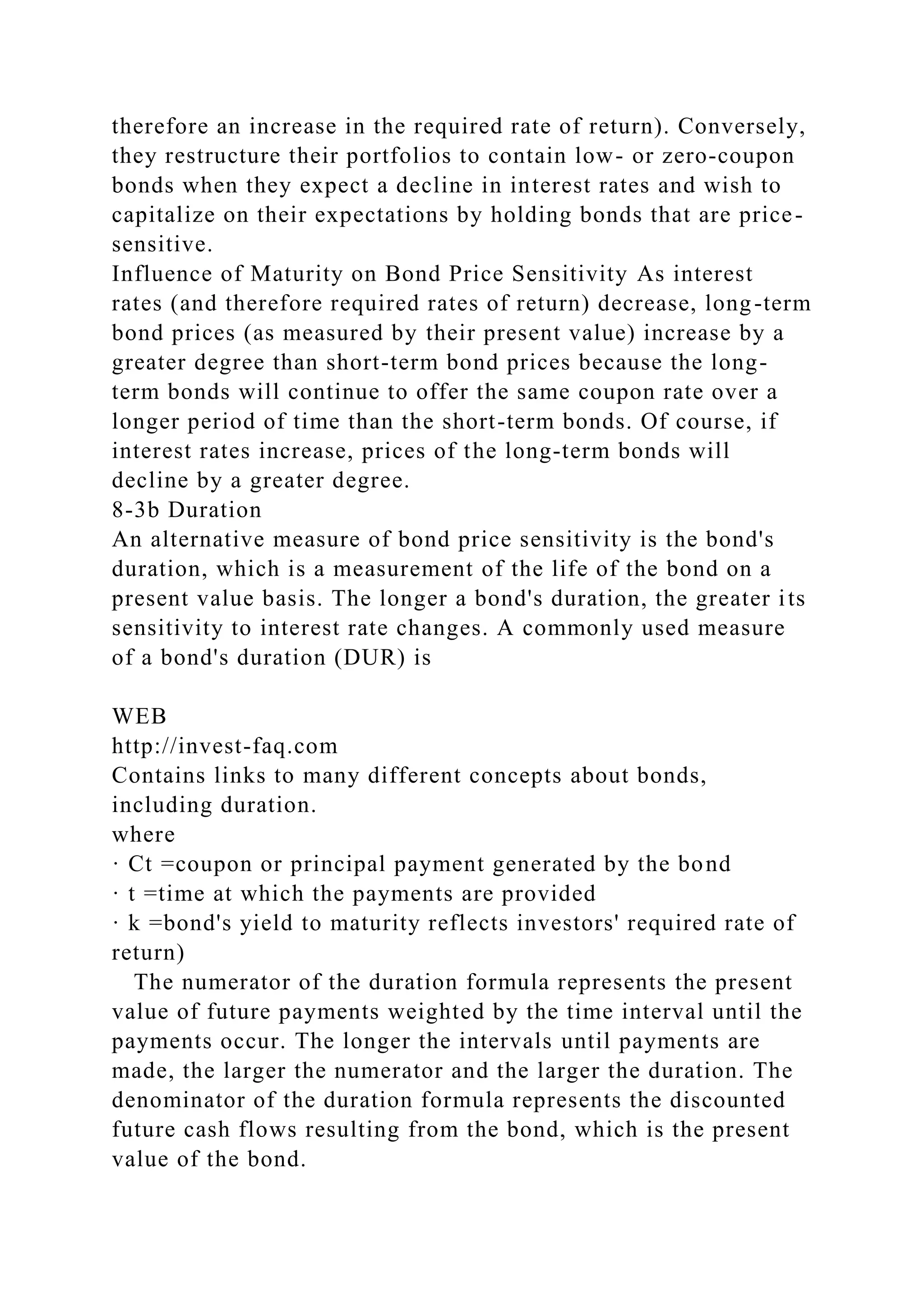
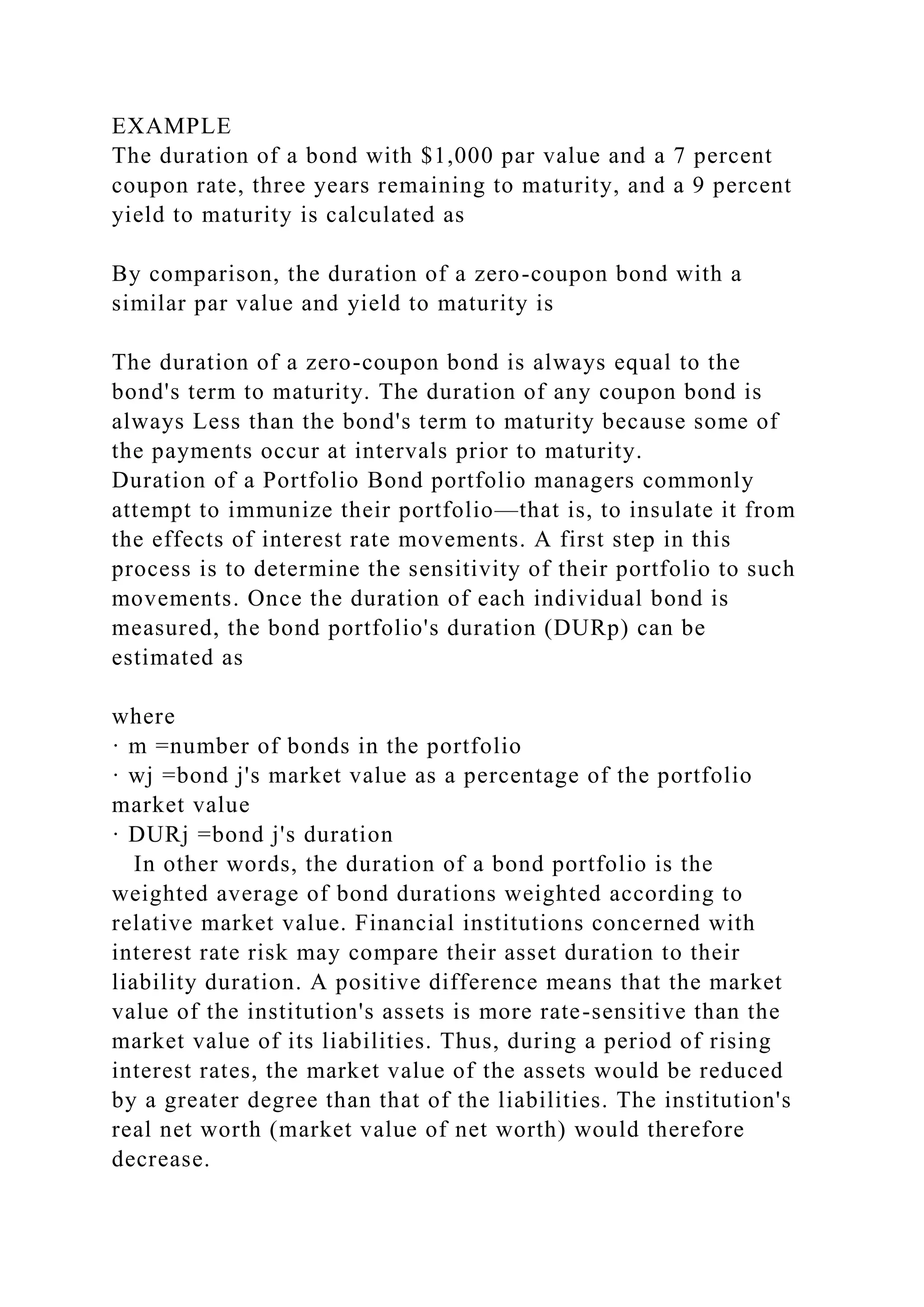
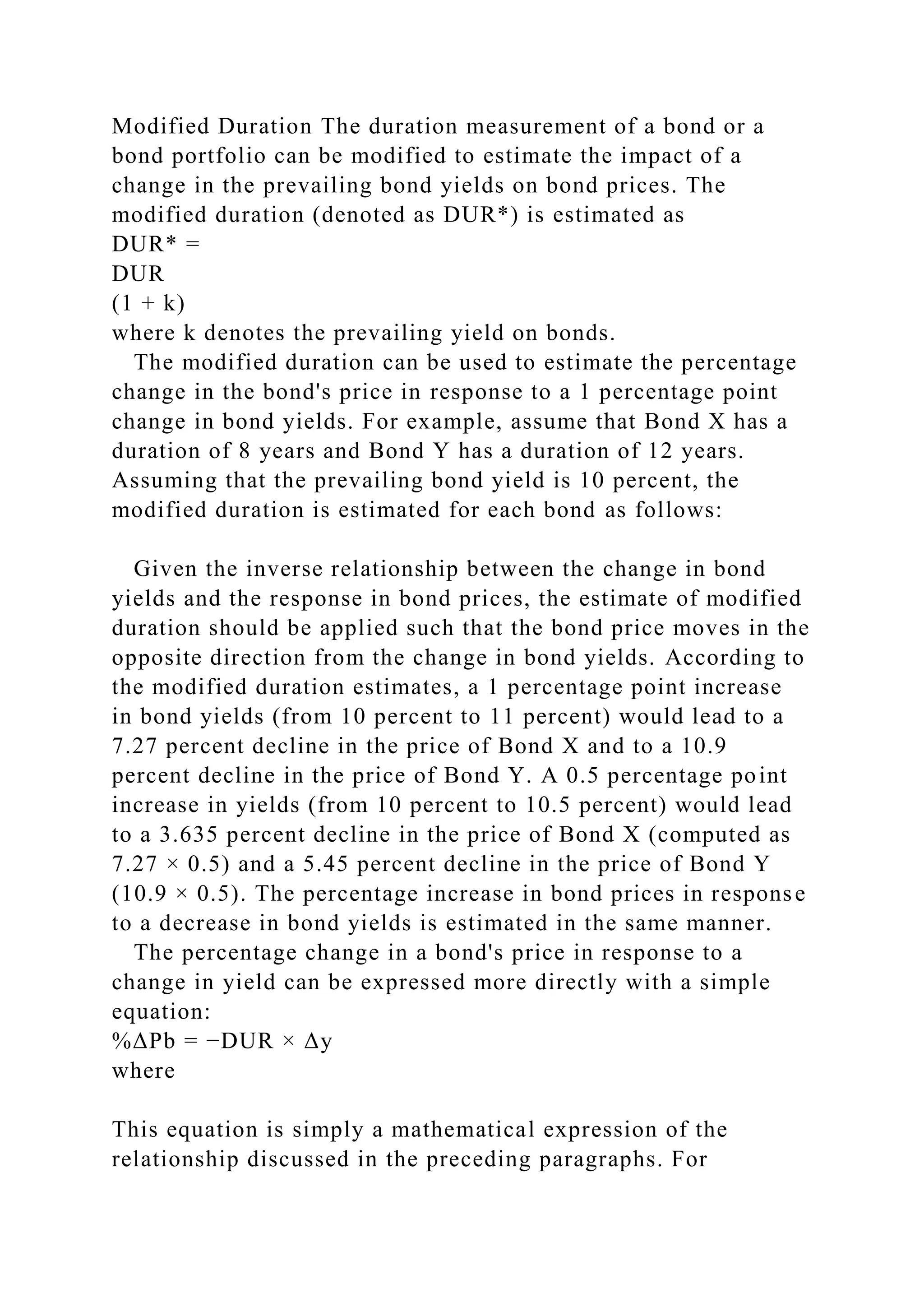
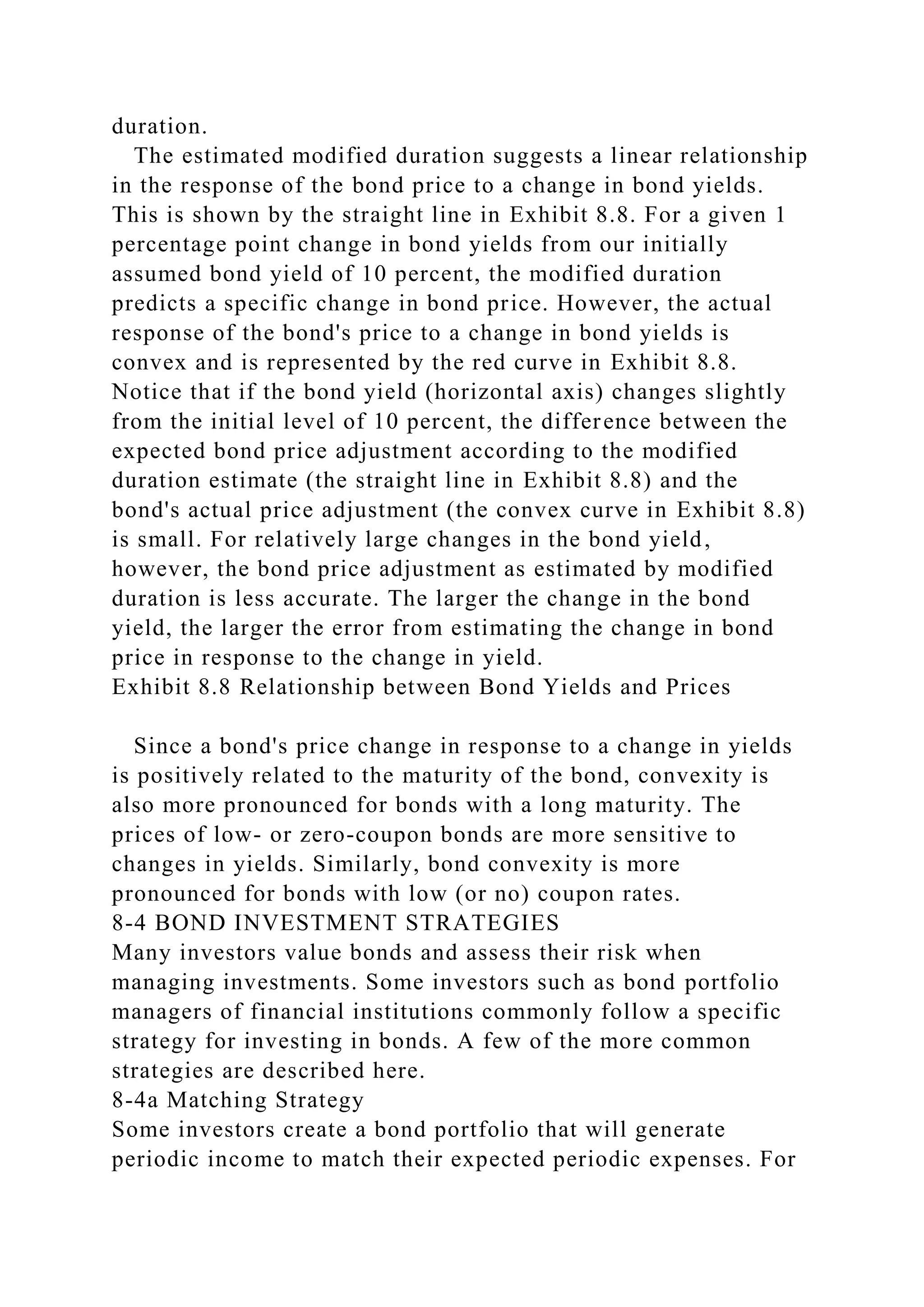
· ▪ explain how mortgage problems led to the 2008- 2009 credit
crisis.
9-1 BACKGROUND ON MORTGAGES
A mortgage is a form of debt created to finance investment in
real estate. The debt is secured by the property, so if the
property owner does not meet the payment obligations, the
creditor can seize the property. Financial institutions such as
savings institutions and mortgage companies serve as
intermediaries by originating mortgages. They consider
mortgage applications and assess the creditworthiness of the
applicants.
The mortgage represents the difference between the down
payment and the value to be paid for the property. The mortgage
contract specifies the mortgage rate, the maturity, and the
collateral that is backing the loan. The originator charges an
origination fee when providing a mortgage. In addition, if it
uses its own funds to finance the property, it will earn profit
from the difference between the mortgage rate that it charges
and the rate that it paid to obtain the funds. Most mortgages
have a maturity of 30 years, but 15-year maturities are also
available.
9-1a How Mortgage Markets Facilitate the Flow of Funds
WEB
www.mbaa.org
News regarding the mortgage markets.
The means by which mortgage markets facilitate the flow of
funds are illustrated in Exhibit 9.1. Financial intermediaries
originate mortgages and finance purchases of homes. The
financial intermediaries that originate mortgages obtain their
funding from household deposits. They also obtain funds by
selling some of the mortgages that they originate directly to
institutional investors in the secondary market. These funds are
then used to finance more purchases of homes, condominiums,
and commercial property. Overall, mortgage markets allow
households and corporations to increase their purchases of
homes, condominiums, and commercial property and thereby
finance economic growth.
Institutional Use of Mortgage Markets Mortgage companies,
savings institutions, and commercial banks originate mortgages.
Mortgage companies tend to sell their mortgages in the
secondary market, although they may continue to process
payments for the mortgages that they originated. Thus their
income is generated from origination and processing fees, and
not from financing the mortgages over a long-term period.
Savings institutions and commercial banks commonly originate
residential mortgages. Commercial banks also originate
mortgages for corporations that purchase commercial property.
Savings institutions and commercial banks typically use funds
received from household deposits to provide mortgage
financing. However, they also sell some of their mortgages in
the secondary market.
Exhibit 9.1 How Mortgage Markets Facilitate the Flow of Funds
The common purchasers of mortgages in the secondary market
are savings institutions, commercial banks, insurance
companies, pension funds, and some types of mutual funds. The
participation by financial institutions in the mortgage market is
summarized in Exhibit 9.2.
Exhibit 9.2 Institutional Use of Mortgage Markets
TYPE OF FINANCIAL INSTITUTION
INSTITUTION PARTICIPATION IN MORTGAGE MARKETS
Commercial banks and savings institutions
· • Originate and service commercial and residential mortgages
and maintain mortgages within their investment portfolios.
· • Bundle packages of mortgages and sell mortgage-backed
securities representing the packages of mortgages.
· • Purchase mortgage-based securities.
Credit unions and finance companies
· • Originate mortgages and maintain mortgages within their
investment portfolios.
Mortgage companies
· • Originate mortgages and sell them in the secondary market.
Mutual funds
· • May sell shares and use the proceeds to construct portfolios
of mortgage-backed securities.
Securities firms
· • Bundle packages of mortgages and sell mortgage-backed
securities representing the packages of mortgages.
· • Offer instruments to help institutional investors in mortgages
hedge against interest rate risk.
Insurance companies
· • Commonly purchase mortgages or mortgage-backed
securities in the secondary market.
9-1b Criteria Used to Measure Creditworthiness
When financial institutions consider mortgage applications, they
review information that reflects the prospective borrower's
ability to repay the loan. The following are three important
criteria that are used to measure a borrower's repayment ability:
· ▪ Level of equity invested by the borrower. The down payment
represents the equity invested by the borrower. The lower the
level of equity invested, the higher the probability that the
borrower will default. One proxy for this factor is the loan-to-
value ratio, which indicates the proportion of the property's
value that is financed with debt. When borrowers make
relatively small down payments, the loan-to-value ratio is
higher and borrowers have less to lose in the event that they
stop making their mortgage payments.
· ▪ Borrower's income level. Borrowers who have a lower level
of income relative to the periodic loan payments are more likely
to default on their mortgages. Income determines the amount of
funds that borrowers have available per month to make
mortgage payments. Income levels change over time, however,
so it is difficult for mortgage lenders to anticipate whether
prospective borrowers will continue to earn their monthly
income over the life of the mortgage, especially given the high
frequency of layoffs.
· ▪ Borrower's credit history. Other conditions being similar,
borrowers with a history of credit problems are more likely to
default on their loans than those without credit problems.
9-1c Classifications of Mortgages
Mortgages can be classified in various ways, but two important
classifications are prime versus subprime mortgages and insured
versus conventional mortgages.
Prime versus Subprime Mortgages Mortgages can be classified
according to whether the borrower meets the traditional lending
standards. Borrowers who obtain “prime” mortgages satisfy the
traditional lending standards. “Subprime” mortgages are offered
to borrowers who do not qualify for prime loans because they
have relatively lower income or high existing debt, or can make
only a small down payment. In recent years, especially between
2003 and 2005, many financial institutions such as mortgage
companies increased their offerings of subprime loans as a way
of expanding their business. In addition, they could charge
higher fees (such as appraisal fees) and higher interest rates on
the mortgages to compensate for the risk of default. Subprime
mortgage rates were commonly 1.5 to 2.5 percentage points
above the rates of prime mortgages. Although subprime
mortgages enabled some people to purchase homes who
otherwise could not have, these mortgages were very
susceptible to default. The large number of defaults of subprime
mortgages led to the credit crisis that began in 2008, as
explained later in this chapter.
Mortgages referred to as Alt-A typically satisfy some but not
all of the criteria for prime mortgages. Thus Alt-A mortgages
are generally perceived to have more risk of default than prime
loans but less risk of default than subprime loans.
Insured versus Conventional Mortgages Mortgages are also
often classified as federally insured or conventional. Federally
insured mortgages guarantee loan repayment to the lending
financial institution, thereby protecting it against the possibility
of default by the borrower. An insurance fee of 0.5 percent of
the loan amount is applied to cover the cost of insuring the
mortgage. The guarantor can be either the Federal
Housing Administration (FHA) or the Veterans Administration
(VA). To qualify for FHA and VA mortgage loans from a
financial institution, borrowers must meet various requirements
specified by those government agencies. In addition, the
maximum mortgage amount is limited by law (although the limit
varies among states to account for differences in the cost of
housing). The volume of FHA loans has consistently exceeded
that of VA loans since 1960. Both types of mortgages have
become increasingly popular over the past 30 years.
Financial institutions also provide conventional mortgages.
Although not federally insured, they can be privately insured so
that the lending financial institutions can still avoid exposure to
credit risk. The insurance premium paid for such private
insurance will likely be passed on to the borrowers. Lenders can
choose to incur the credit risk themselves and avoid the
insurance fee. Some participants in the secondary mortgage
market purchase only those conventional mortgages that are
privately insured (unless the mortgage's loan-to-value ratio is
less than 80 percent).
9-2 TYPES OF RESIDENTIAL MORTGAGES
WEB
www.bloomberg.com/markets/rates/keyrates.html
Provides quotes on mortgage rates.
Various types of residential mortgages are available to
homeowners, including the following:
· ▪ Fixed-rate mortgages
· ▪ Adjustable-rate mortgages
· ▪ Graduated-payment mortgages
· ▪ Growing-equity mortgages
· ▪ Second mortgages
· ▪ Shared-appreciation mortgages
· ▪ Balloon-payment mortgages
9-2a Fixed-Rate Mortgages
WEB
www.bloomberg.com/invest/calculators/index.html
Calculates monthly mortgage payments based on the type of
mortgage, the Loan amount, the maturity, and the interest rate.
One of the most important provisions in the mortgage contract
is the interest rate. It can be specified as a fixed rate or can
allow for periodic rate adjustments over time. A fixed-rate
mortgage locks in the borrower's interest rate over the life of
the mortgage. Thus the periodic interest payment received by
the lending financial institution is constant, regardless of how
market interest rates change over time. A financial institution
that holds fixed-rate mortgages in its asset portfolio is exposed
to interest rate risk because it commonly uses funds obtained
from short-term customer deposits to make long-term mortgage
loans. If interest rates increase over time, the financial
institution's cost of obtaining funds (from deposits) will
increase. The return on its fixed-rate mortgage loans will be
unaffected, however, causing its profit margin to decrease.
Borrowers with fixed-rate mortgages do not suffer from the
effects of rising interest rates, but they also fail to benefit from
declining rates. Although they can attempt to refinance (obtain
a new mortgage to replace the existing mortgage) at the lower
prevailing market interest rate, they will incur transaction costs
such as closing costs and an origination fee.
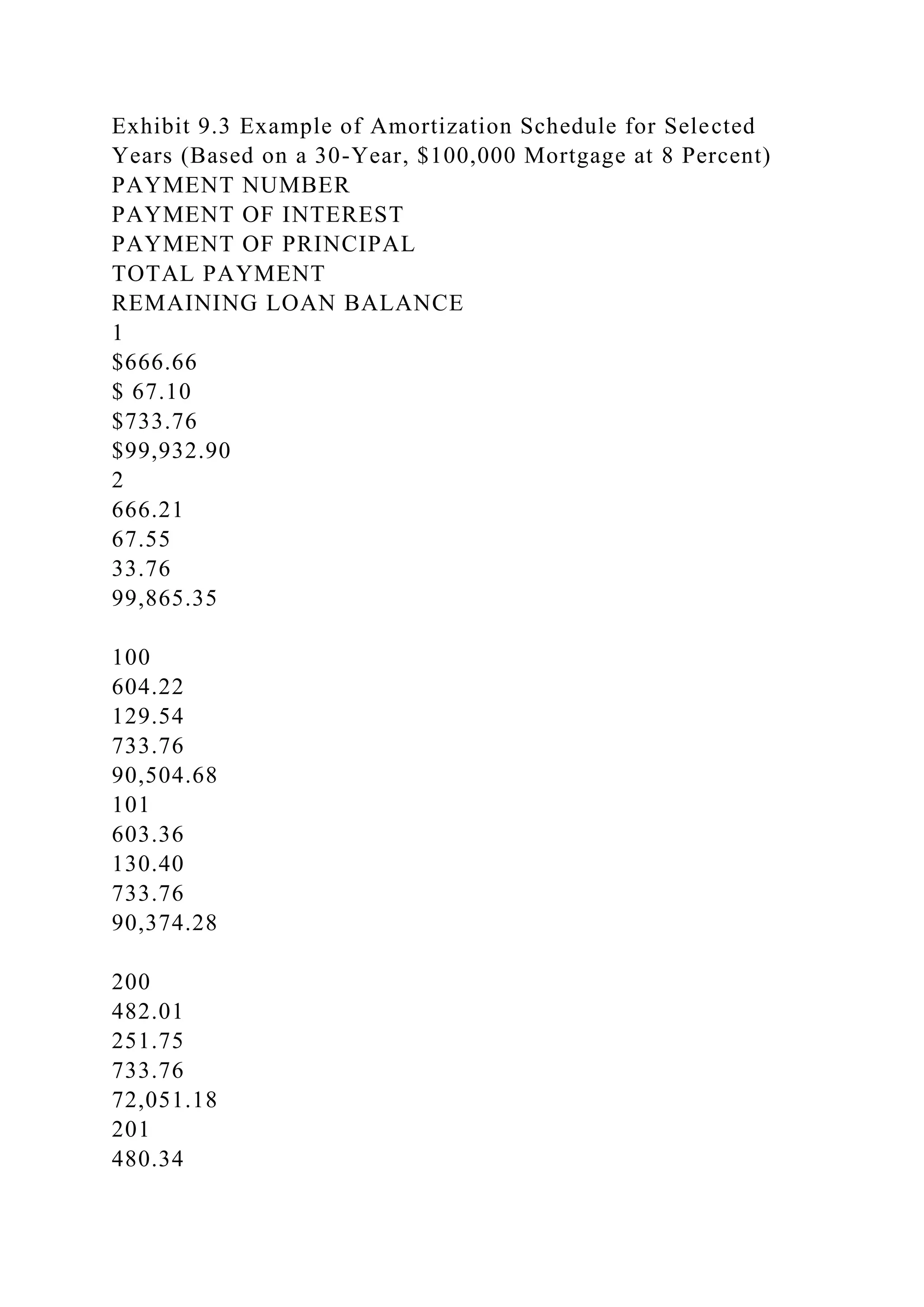
Amortizing Fixed-Rate Mortgages Given the maturity and
interest rate on a fixed-rate mortgage, an amortization
schedule can be developed to show the monthly payments
broken down into principal and interest. During the early years
of a mortgage, most of the payment reflects interest. Over time,
as some of the principal is paid off, the interest proportion
decreases.
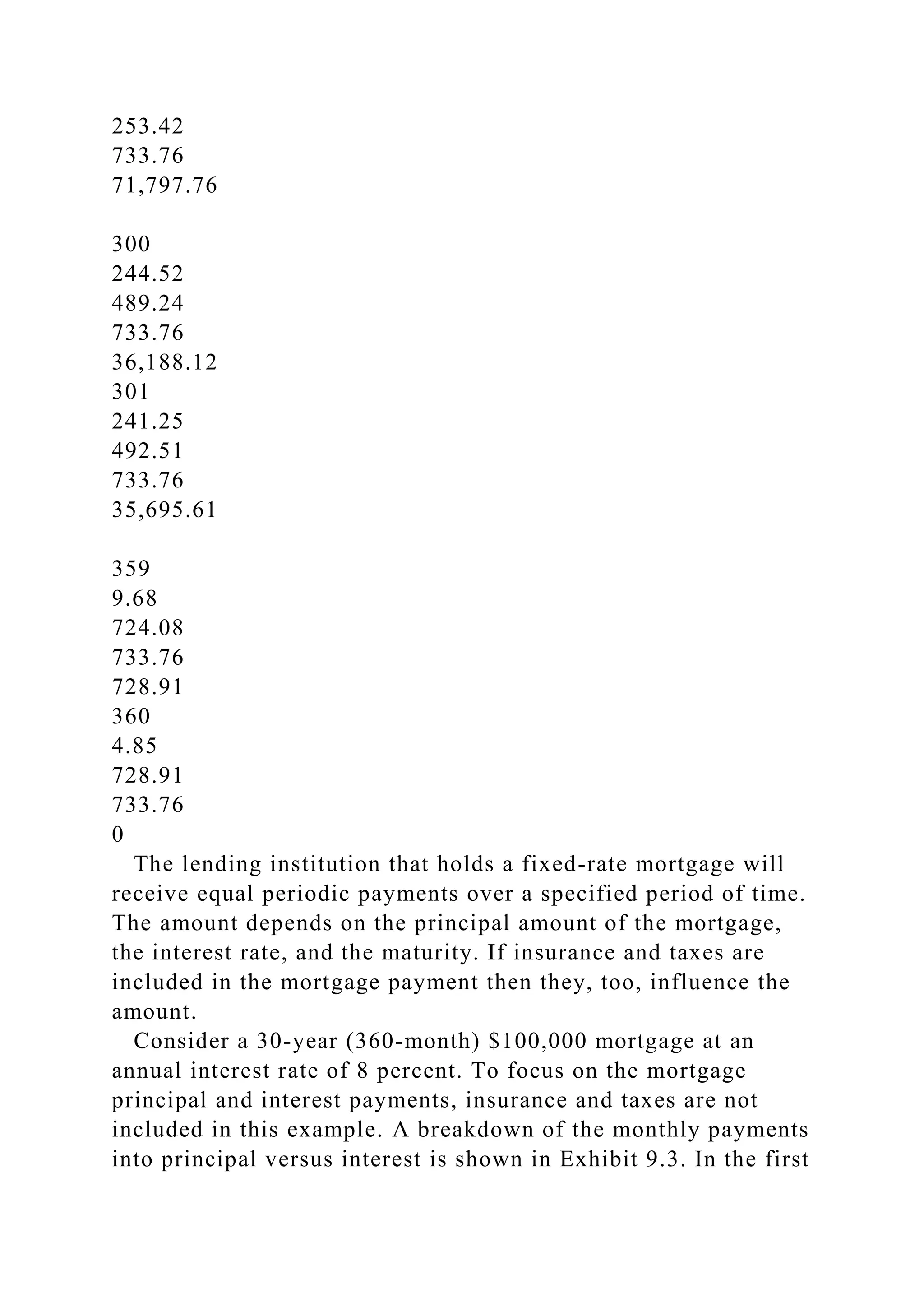
Exhibit 9.3 Example of Amortization Schedule for Selected
Years (Based on a 30-Year, $100,000 Mortgage at 8 Percent)
PAYMENT NUMBER
PAYMENT OF INTEREST
PAYMENT OF PRINCIPAL
TOTAL PAYMENT
REMAINING LOAN BALANCE
1
$666.66
$ 67.10
$733.76
$99,932.90
2
666.21
67.55
33.76
99,865.35
100
604.22
129.54
733.76
90,504.68
101
603.36
130.40
733.76
90,374.28
200
482.01
251.75
733.76
72,051.18
201
480.34
253.42
733.76
71,797.76
300
244.52
489.24
733.76
36,188.12
301
241.25
492.51
733.76
35,695.61
359
9.68
724.08
733.76
728.91
360
4.85
728.91
733.76
0
The lending institution that holds a fixed-rate mortgage will
receive equal periodic payments over a specified period of time.
The amount depends on the principal amount of the mortgage,
the interest rate, and the maturity. If insurance and taxes are
included in the mortgage payment then they, too, influence the
amount.
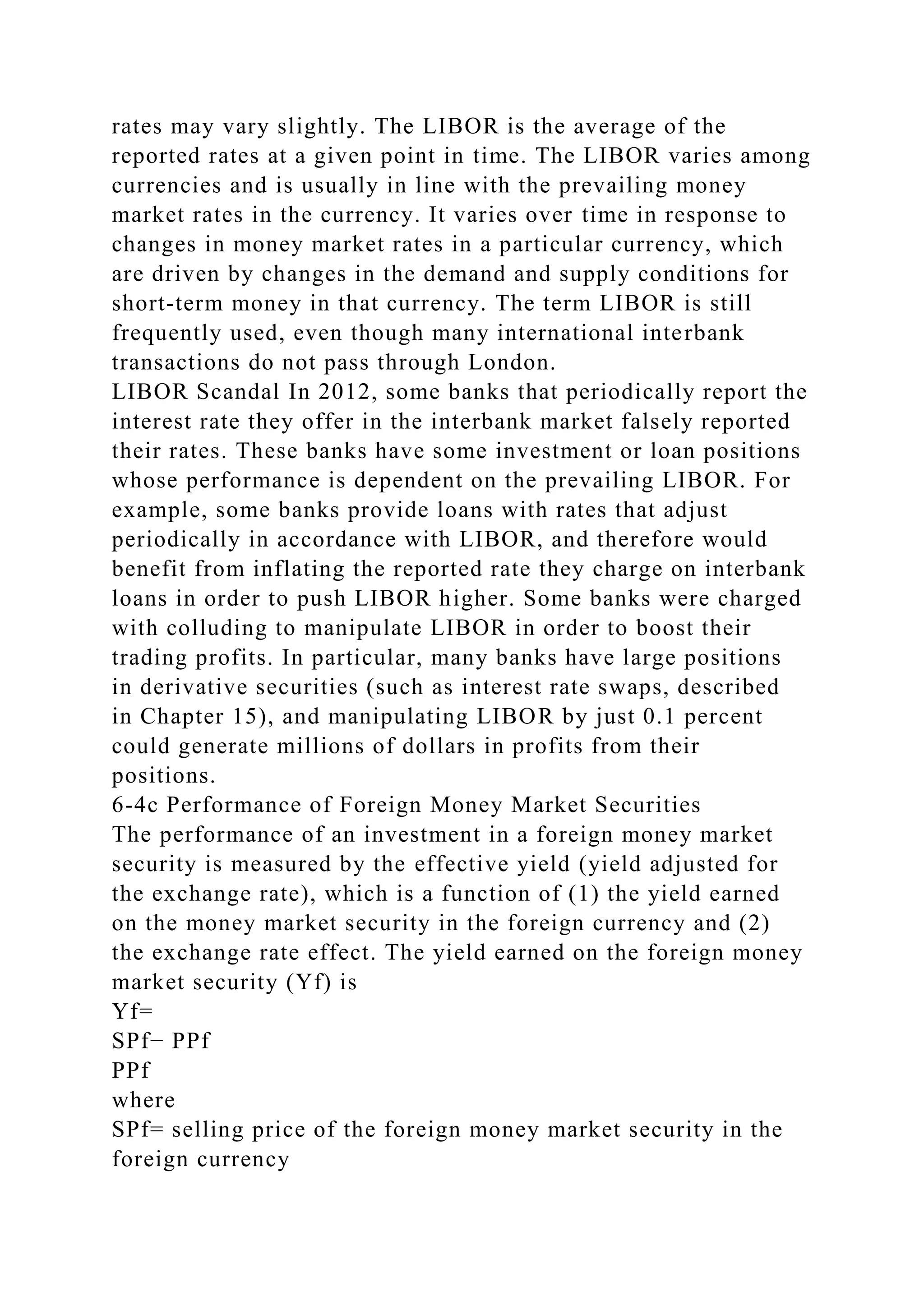
Consider a 30-year (360-month) $100,000 mortgage at an
annual interest rate of 8 percent. To focus on the mortgage
principal and interest payments, insurance and taxes are not
included in this example. A breakdown of the monthly payments
into principal versus interest is shown in Exhibit 9.3. In the first
month, the interest payment is $666.66 while the principal
payment is only $67.10. Observe that a larger proportion of
interest is paid in the earlier years and a larger portion of
principal in the later years. Website calculators are widely
available to determine the amortization schedule for any type of
mortgage.
An amortization schedule can also be used to compare
monthly payments required on a 30-year mortgage versus a 15-
year mortgage.
EXAMPLE
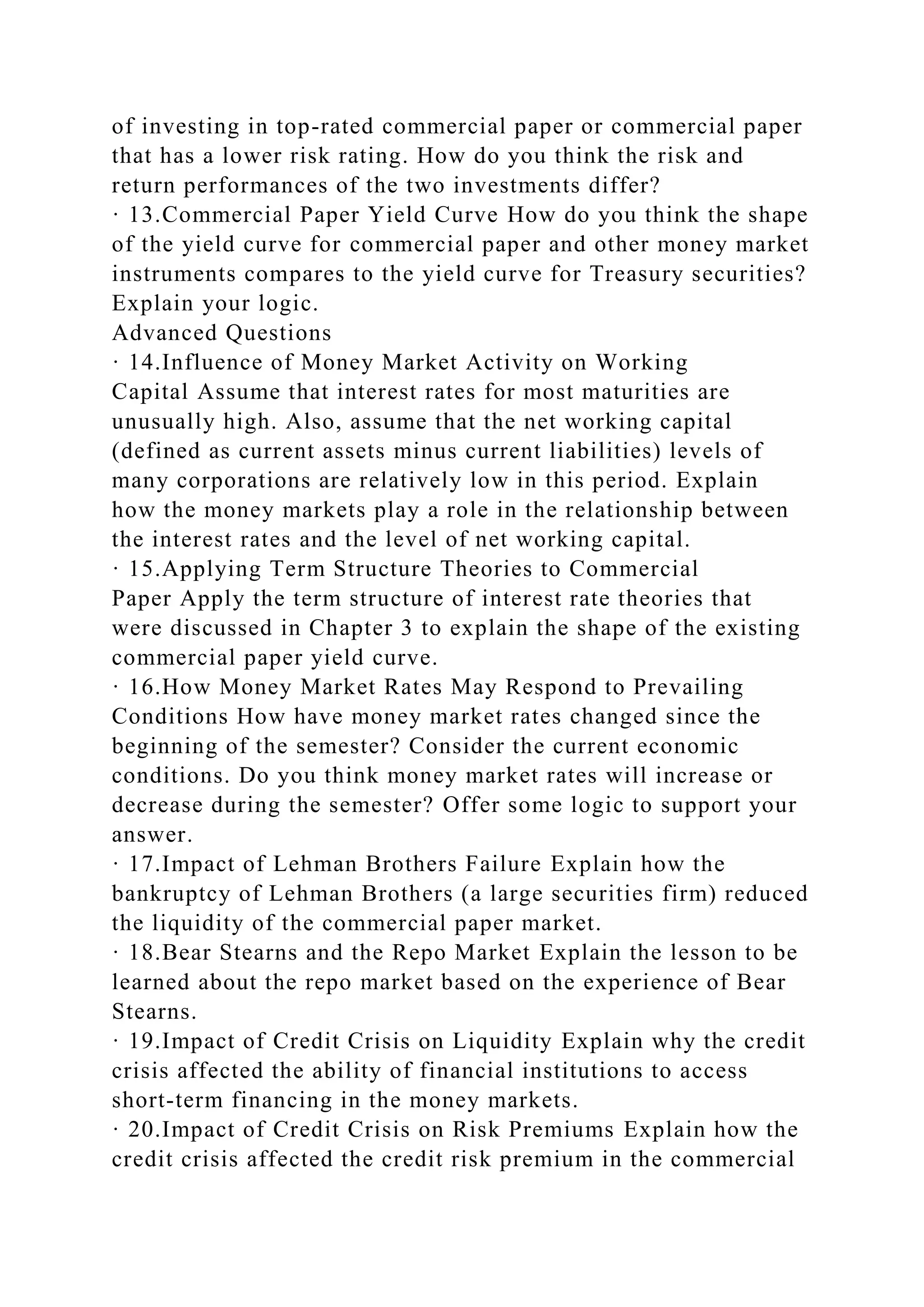
A 30-year, $100,000 mortgage at 8 percent requires monthly
payments (excluding taxes and insurance) of approximately
$734. The same mortgage for 15 years would require monthly
payments of $956. Total payments for the 30-year loan would
be $264,155, versus $172,017 for the 15-year mortgage. Total
payments are lower on mortgages with shorter lives because of
the more rapid amortization and lower cumulative interest.
For the financial institutions that provide mortgages, 15-year
mortgages are subject to less interest rate risk than 30-year
mortgages because of the shorter term to maturity.
9-2b Adjustable-Rate Mortgages
An adjustable-rate mortgage (ARM) allows the mortgage
interest rate to adjust to market conditions. Its contract will
specify a precise formula for this adjustment. The formula and
the frequency of adjustment can vary among mortgage
contracts. A common ARM uses a one-year adjustment with the
interest rate tied to the average Treasury bill rate over the
previous year (for example, the average T-bill rate plus 2
percent may be specified).
Some ARMs now contain an option clause that allows
mortgage holders to switch to a fixed rate within a specified
period, such as one to five years after the mortgage is originated
(the specific provisions vary).
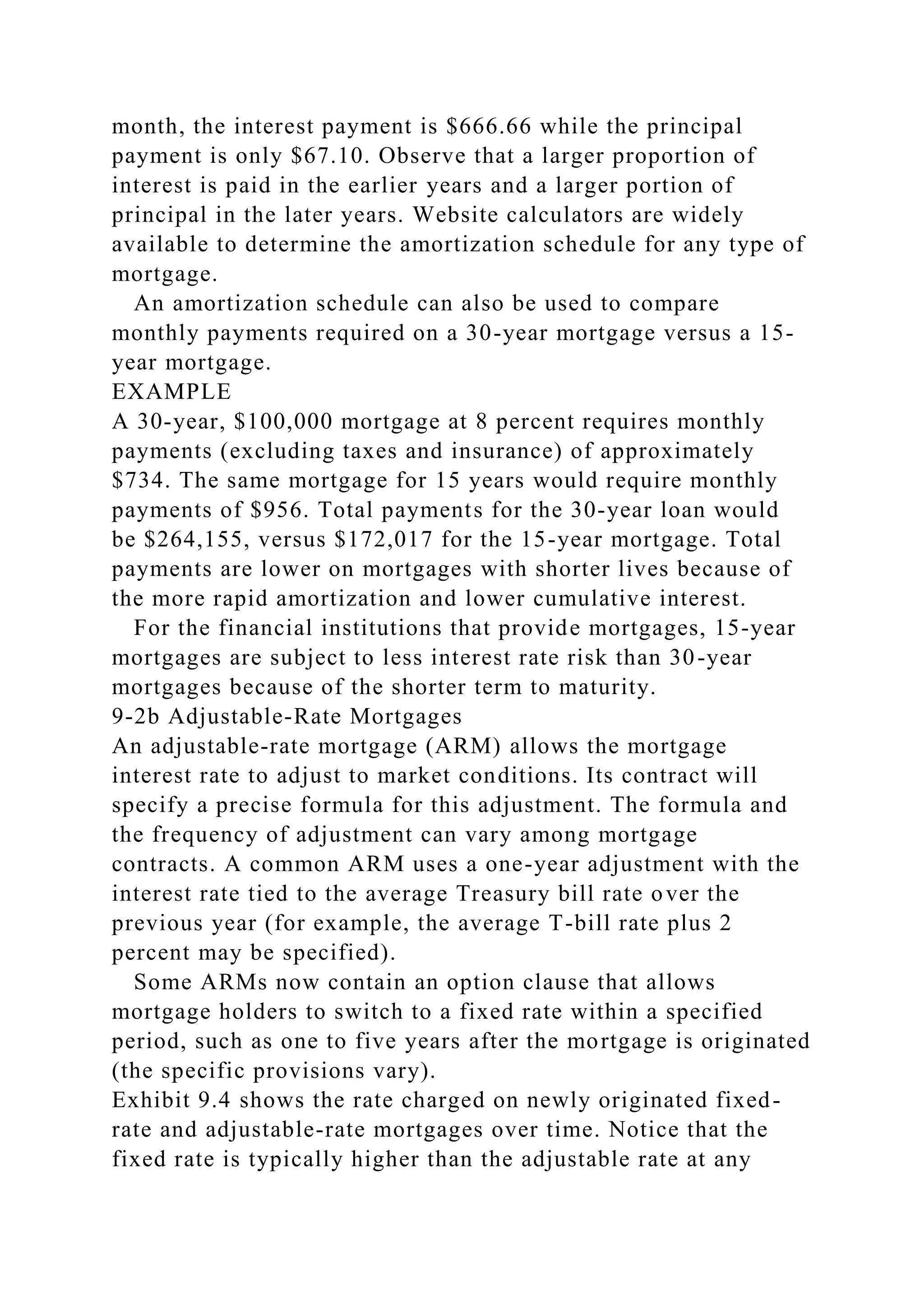
Exhibit 9.4 shows the rate charged on newly originated fixed-
rate and adjustable-rate mortgages over time. Notice that the
fixed rate is typically higher than the adjustable rate at any
given time when a mortgage is originated. Home buyers attempt
to assess future interest rate movements at the time a mortgage
is originated. If they expect that interest rates will remain
somewhat stable or decline during the period they will own the
property, they will choose an ARM. Conversely, if they expect
that interest rates will increase substantially over time, they will
prefer a fixed-rate mortgage.
ARMs from the Financial Institution's Perspective Because the
interest rate of an ARM moves with prevailing interest rates,
financial institutions can stabilize their profit margin. If their
cost of funds rises, so does their return on mortgage loans. For
this reason, ARMs have become very popular over time.
Most ARMs specify a maximum allowable fluctuation in the
mortgage rate per year and over the mortgage life, regardless of
what happens to market interest rates. These caps are commonly
2 percent per year and 5 percent for the mortgage's lifetime. To
the extent that market interest rates move outside these
boundaries, the financial institution's profit margin on ARMs
could be affected by interest rate fluctuations. Nevertheless,
this interest rate risk is significantly less than that of fixed-rate
mortgages.
Exhibit 9.4 Comparison of Rates on Newly Originated Fixed-
Rate and Adjustable-Rate Mortgages over Time
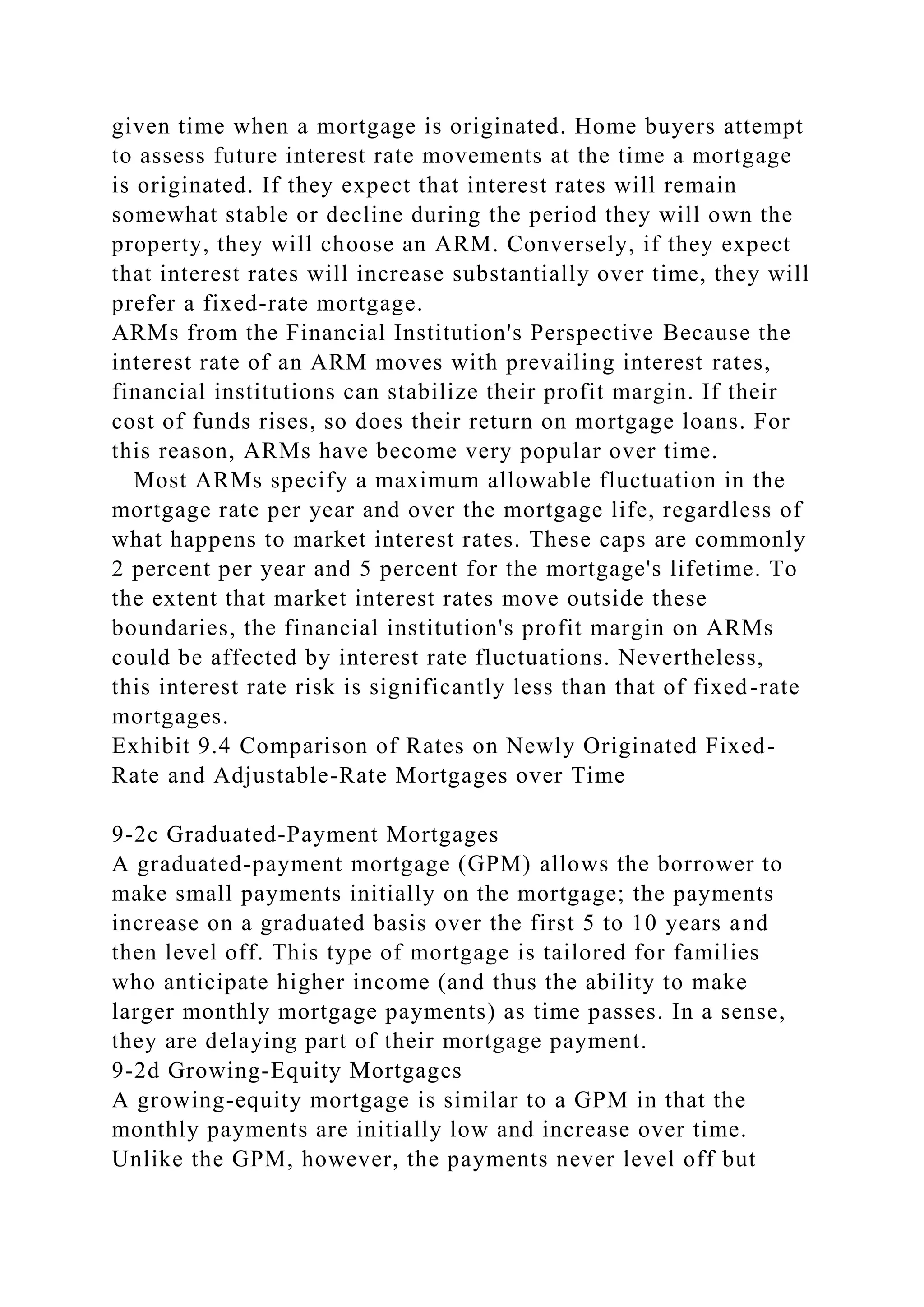
9-2c Graduated-Payment Mortgages
A graduated-payment mortgage (GPM) allows the borrower to
make small payments initially on the mortgage; the payments
increase on a graduated basis over the first 5 to 10 years and
then level off. This type of mortgage is tailored for families
who anticipate higher income (and thus the ability to make
larger monthly mortgage payments) as time passes. In a sense,
they are delaying part of their mortgage payment.
9-2d Growing-Equity Mortgages
A growing-equity mortgage is similar to a GPM in that the
monthly payments are initially low and increase over time.
Unlike the GPM, however, the payments never level off but
continue to increase (typically by about 4 percent per year)
throughout the life of the loan. With such an accelerated
payment schedule, the entire mortgage may be paid off in 15
years or less.
9-2e Second Mortgages
WEB
www.hsh.com
Detailed information about mortgage financing.
A second mortgage can be used in conjunction with the primary
or first mortgage. Some financial institutions may limit the
amount of the first mortgage based on the borrower's income.
Other financial institutions may then offer a second mortgage
with a maturity shorter than that of the first mortgage. In
addition, the interest rate on the second mortgage is higher
because its priority claim against the property (in the event of
default) is behind that of the first mortgage. The higher interest
rate reflects greater compensation as a result of the higher risk
incurred by the provider of the second mortgage.
Sellers of homes sometimes offer buyers a second mortgage.
This practice is especially common when the old mortgage is
assumable and the selling price of the home is much higher than
the remaining balance on the first mortgage. By offering a
second mortgage, the seller can make the house more affordable
and therefore more marketable. The seller and the buyer
negotiate specific interest rate and maturity terms.
9-2f Shared-Appreciation Mortgages
A shared-appreciation mortgage allows a home purchaser to
obtain a mortgage at a below-market interest rate. In return, the
lender providing the attractive loan rate will share in the price
appreciation of the home. The precise percentage of
appreciation allocated to the lender is negotiated at the
origination of the mortgage.
9-2g Balloon-Payment Mortgages
A balloon-payment mortgage requires only interest payments
for a three-to five-year period. At the end of this period, the
borrower must pay the full amount of the principal (the balloon
payment). Because no principal payments are made until
maturity, the monthly payments are lower. Realistically, though,
most borrowers have not saved enough funds to pay off the
mortgage in three to five years, so the balloon payment in effect
forces them to request a new mortgage. Therefore, they are
subject to the risk that mortgage rates will be higher at the time
they refinance the mortgage.
9-3 VALUATION AND RISK OF MORTGAGES
Since mortgages are commonly sold in the secondary market,
they are continually valued by institutional investors. The
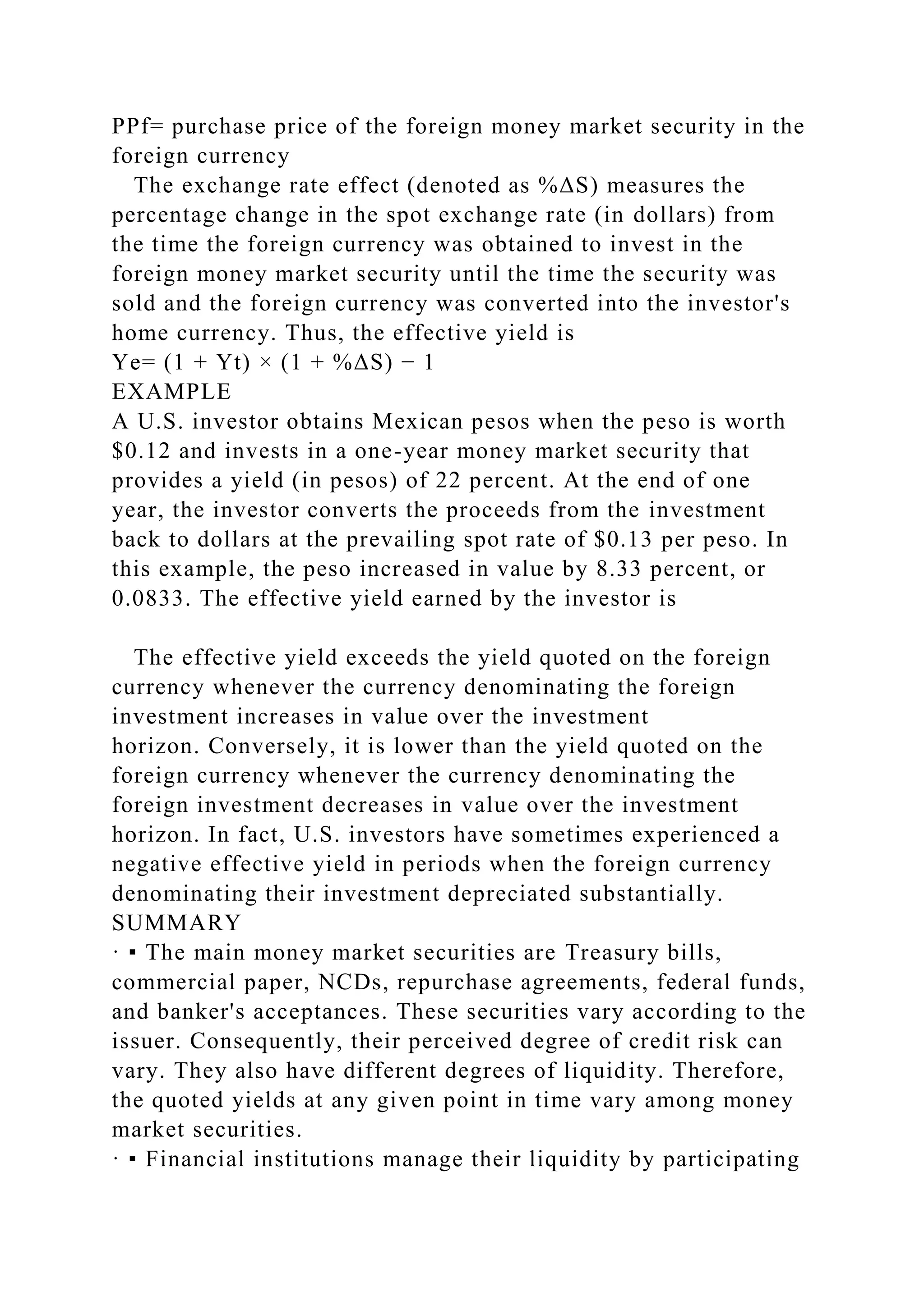
market price (PM) of a mortgage should equal the present value
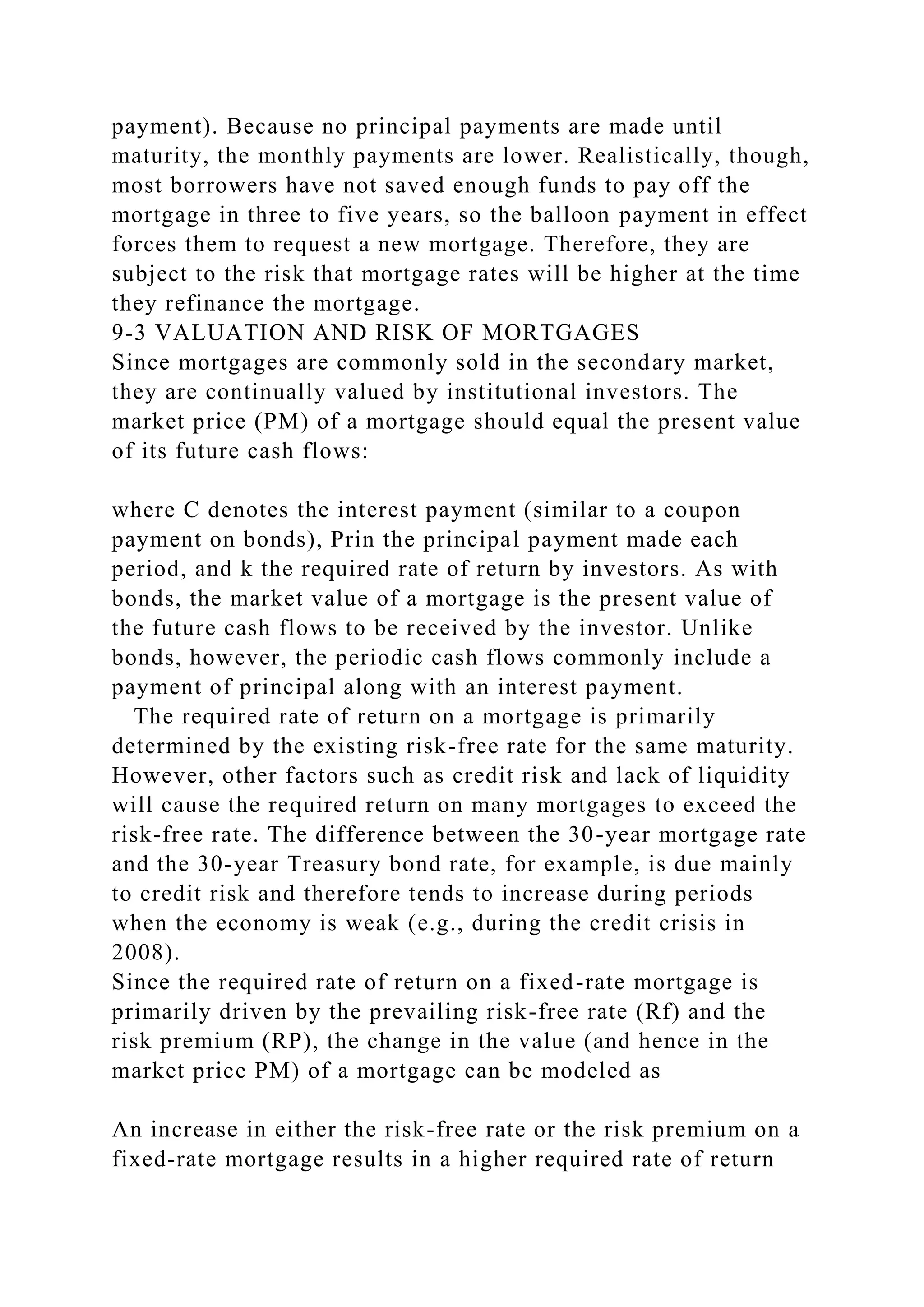
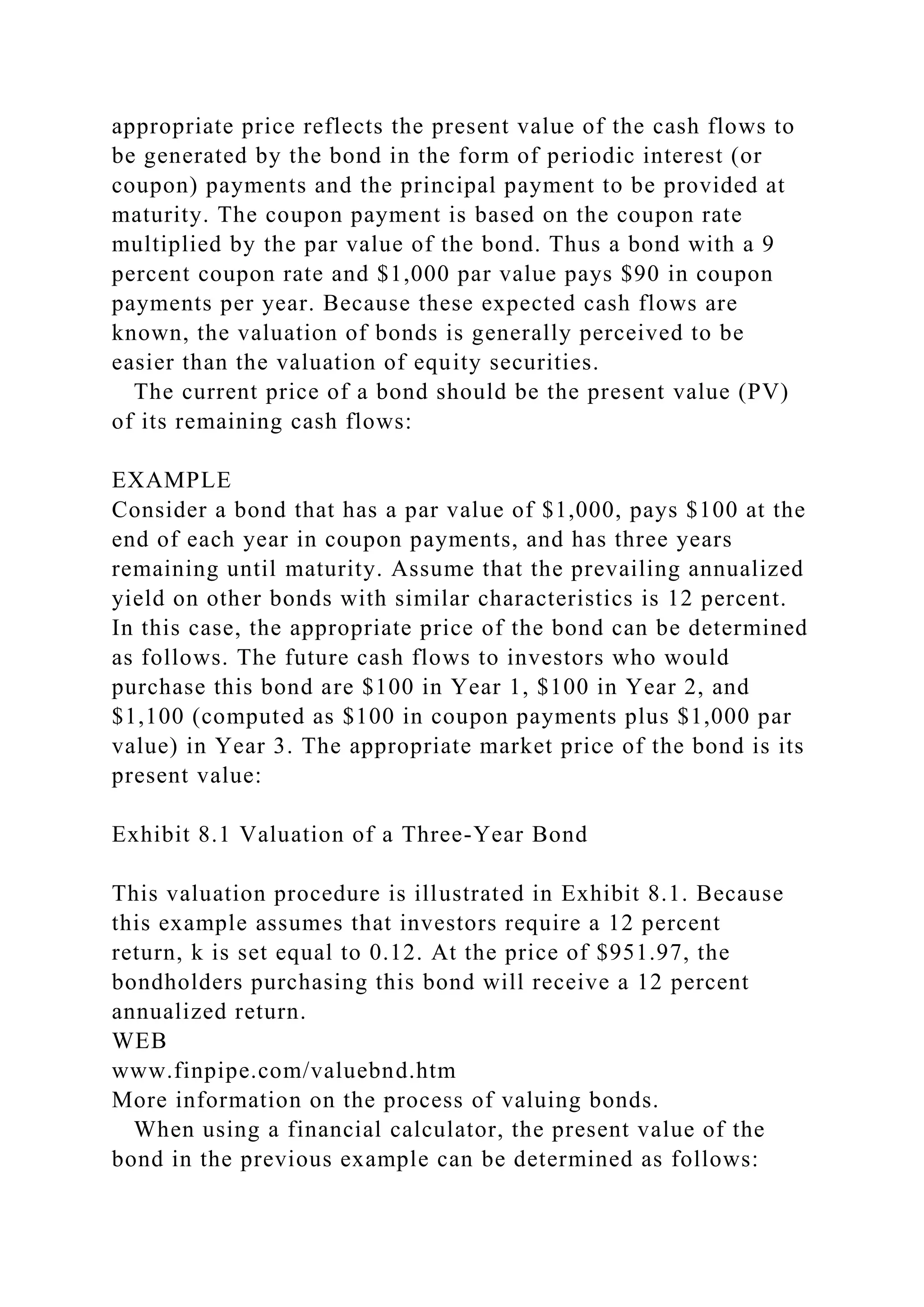
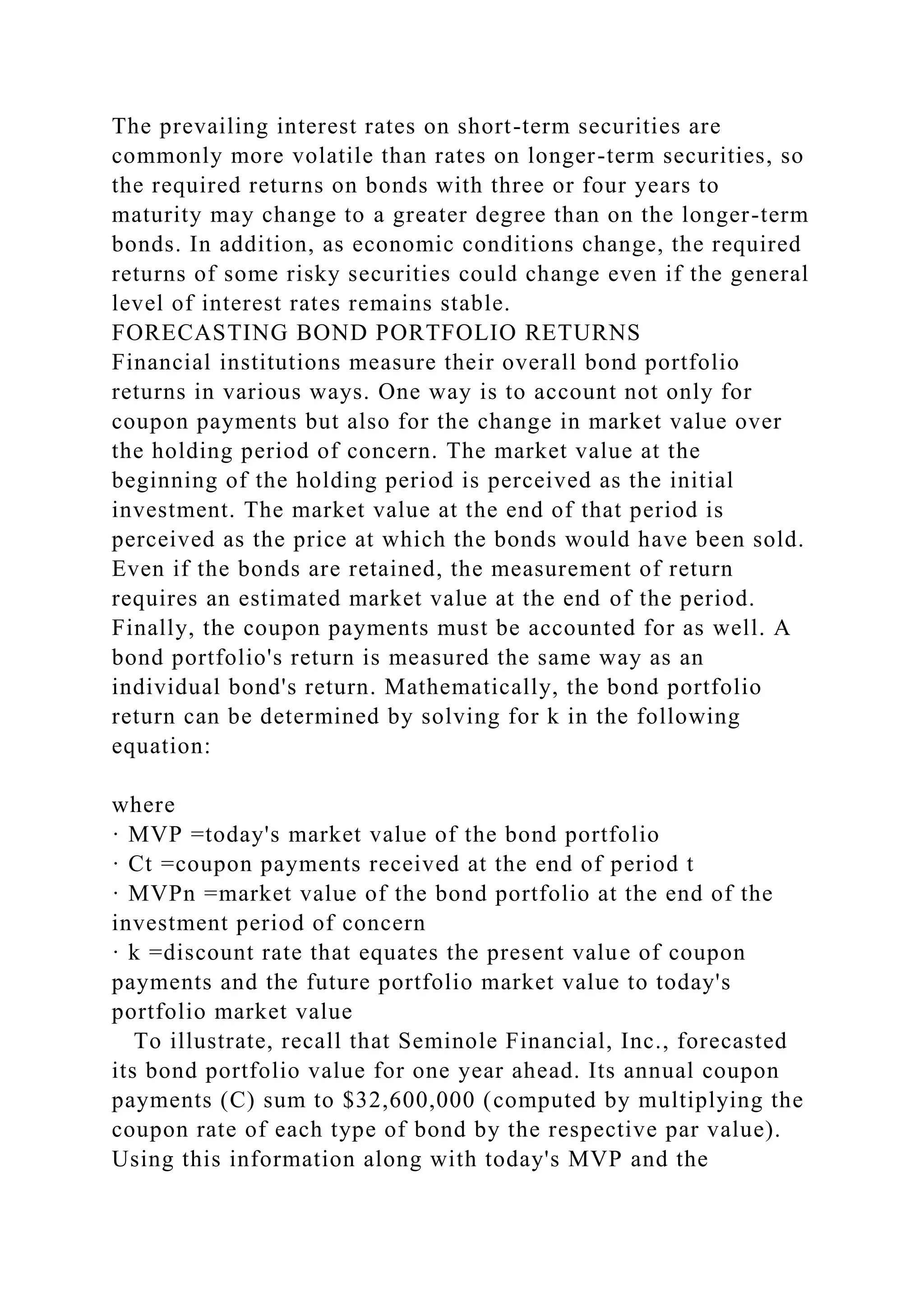
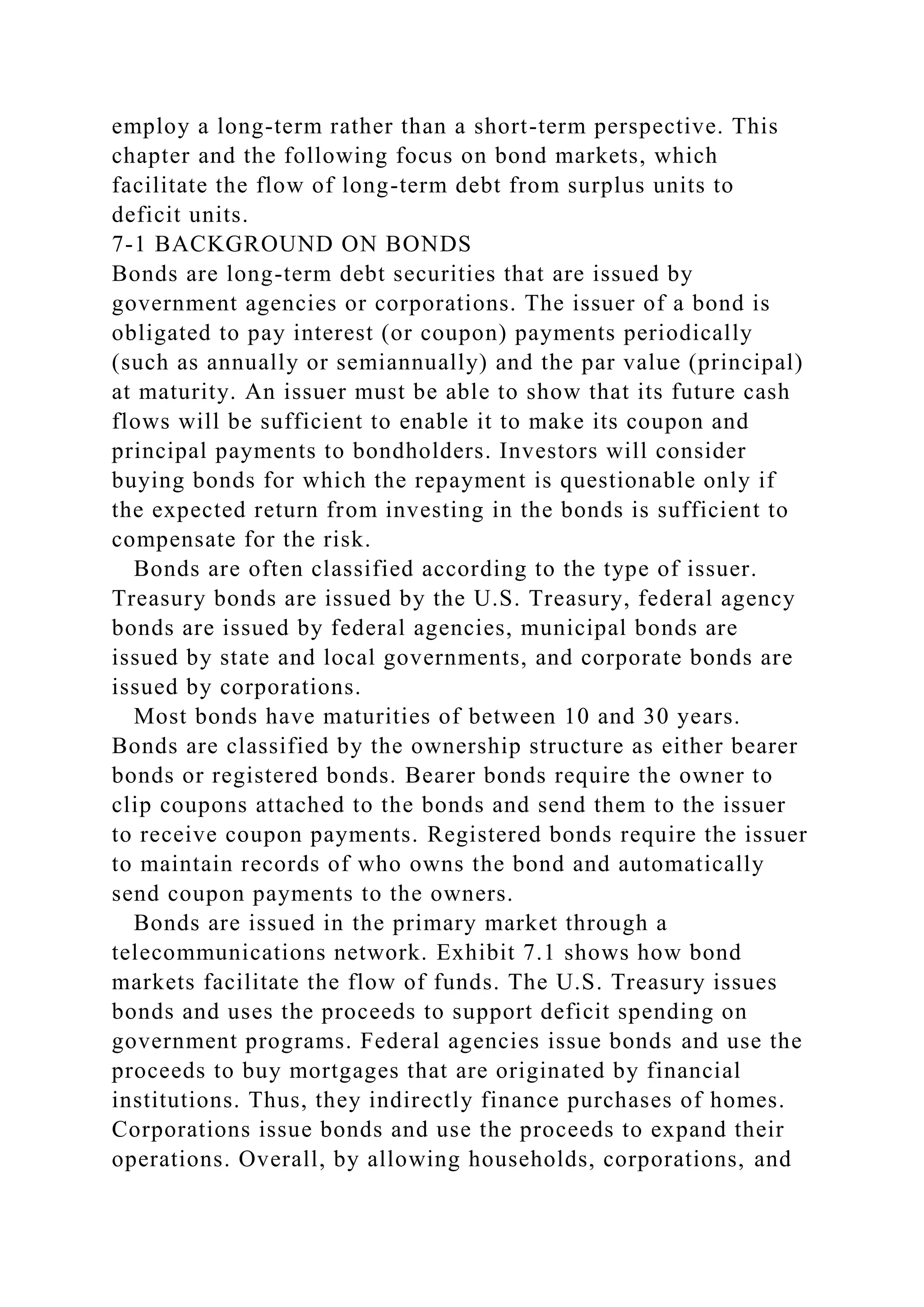
of its future cash flows:
where C denotes the interest payment (similar to a coupon
payment on bonds), Prin the principal payment made each
period, and k the required rate of return by investors. As with
bonds, the market value of a mortgage is the present value of
the future cash flows to be received by the investor. Unlike
bonds, however, the periodic cash flows commonly include a
payment of principal along with an interest payment.
The required rate of return on a mortgage is primarily
determined by the existing risk-free rate for the same maturity.
However, other factors such as credit risk and lack of liquidity
will cause the required return on many mortgages to exceed the
risk-free rate. The difference between the 30-year mortgage rate
and the 30-year Treasury bond rate, for example, is due mainly
to credit risk and therefore tends to increase during periods
when the economy is weak (e.g., during the credit crisis in
2008).
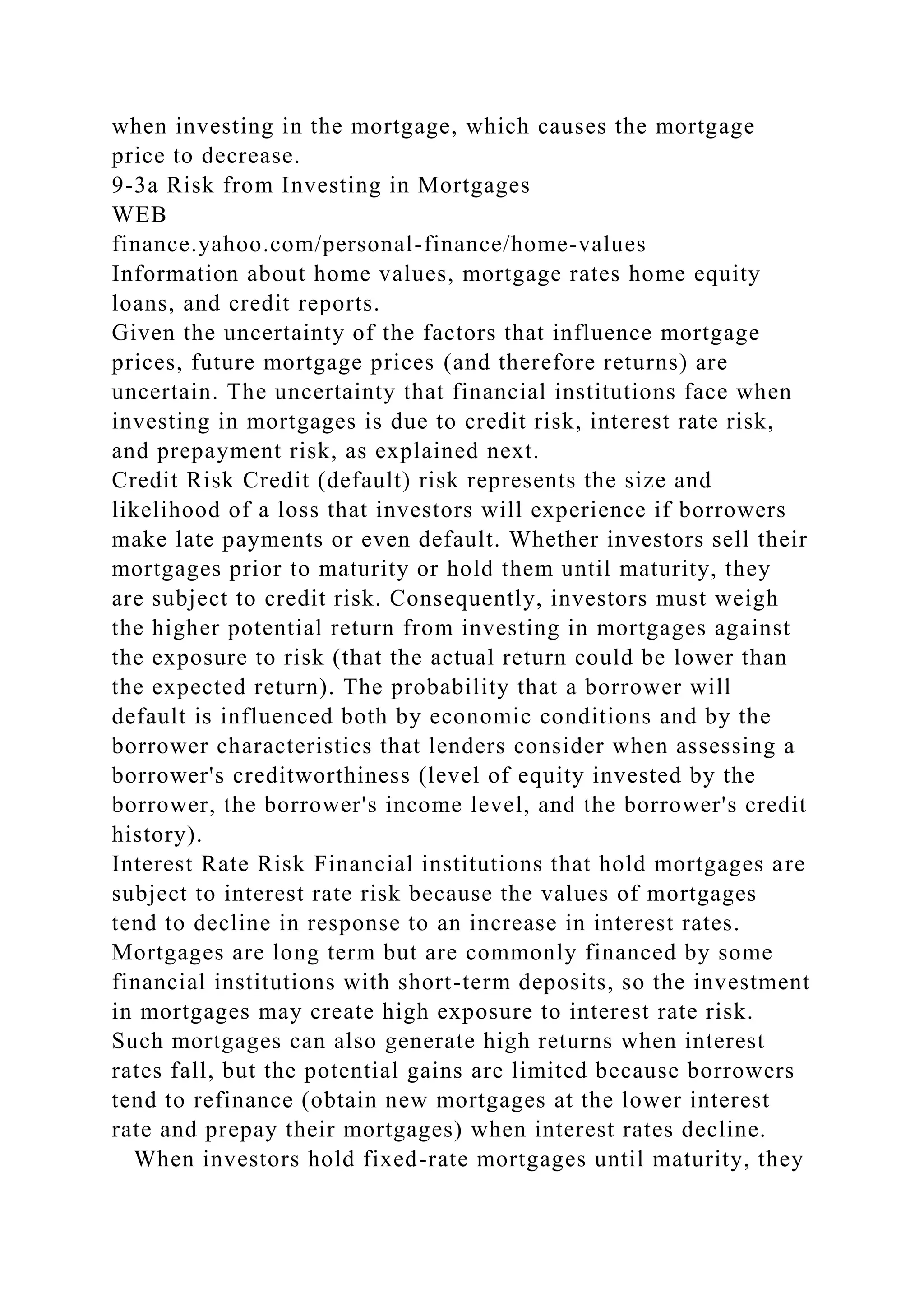
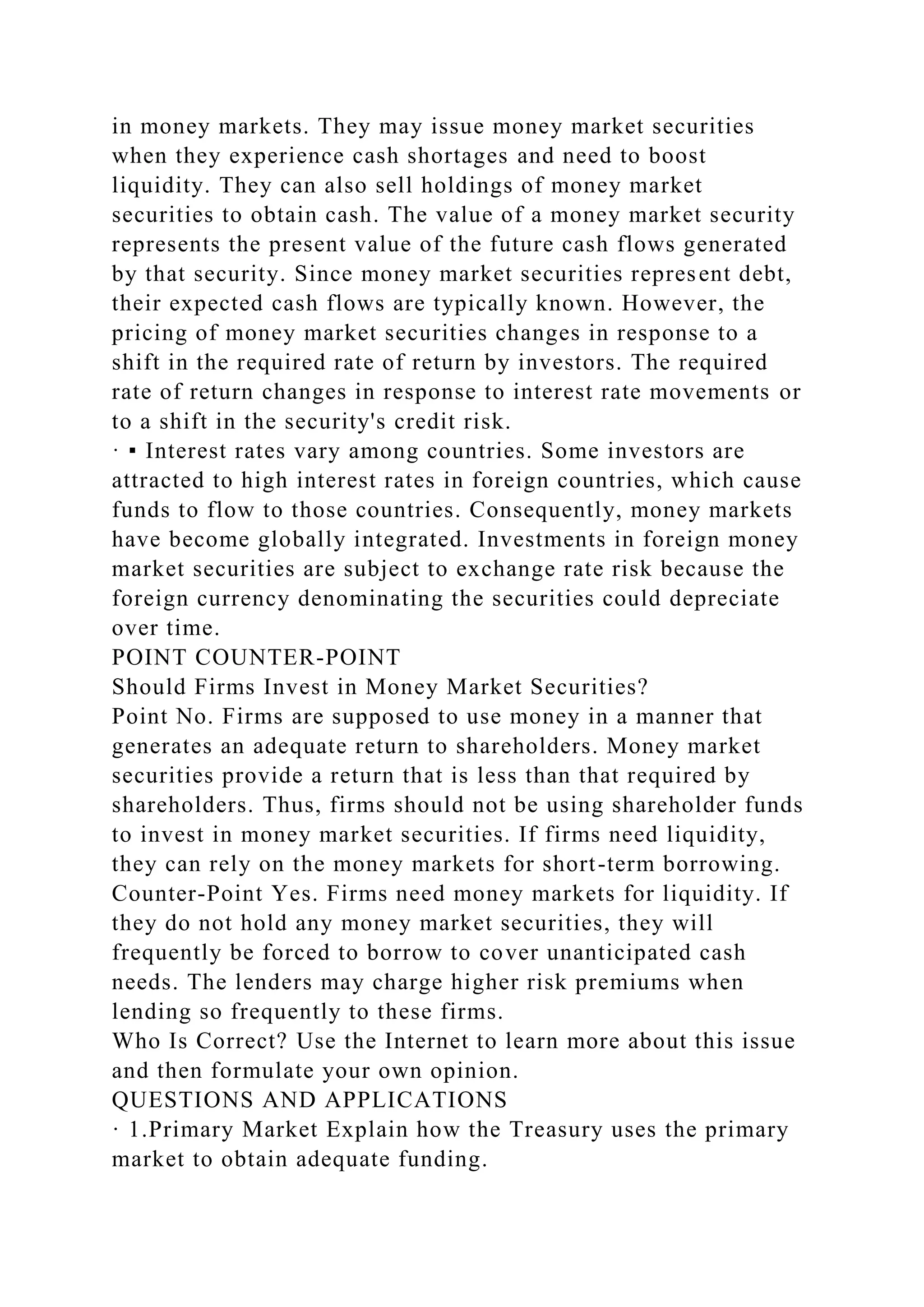
Since the required rate of return on a fixed-rate mortgage is
primarily driven by the prevailing risk-free rate (Rf) and the
risk premium (RP), the change in the value (and hence in the
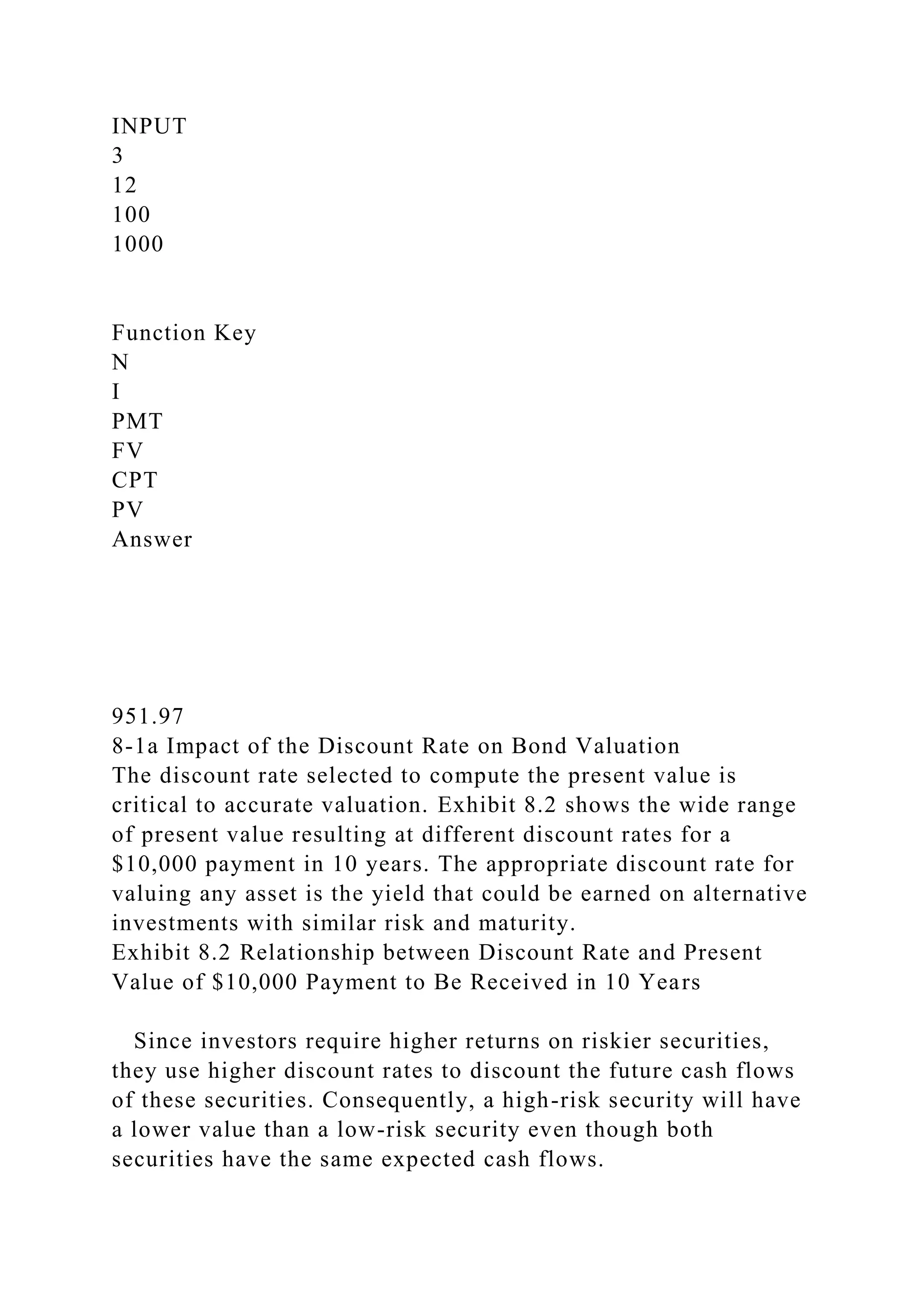
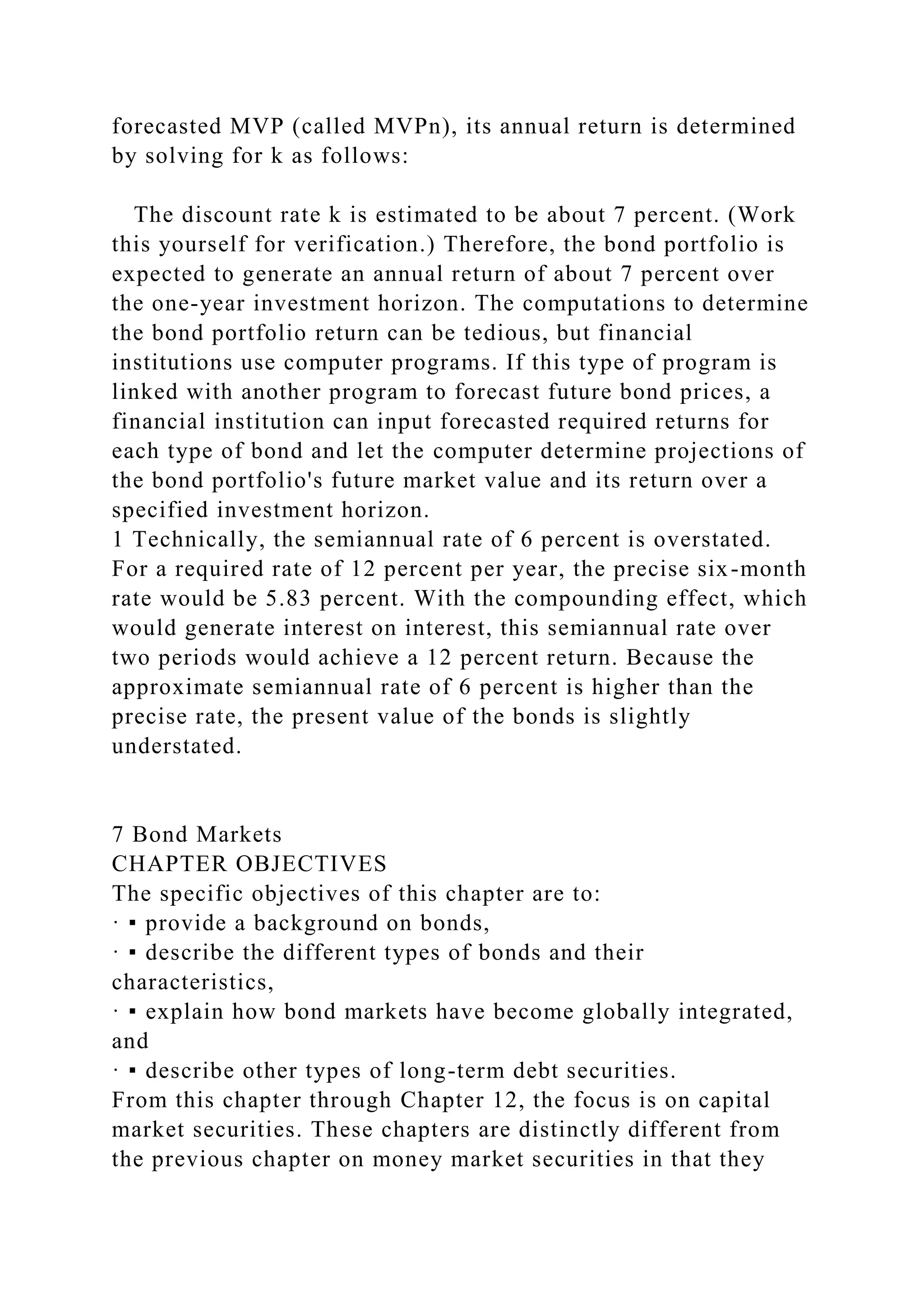
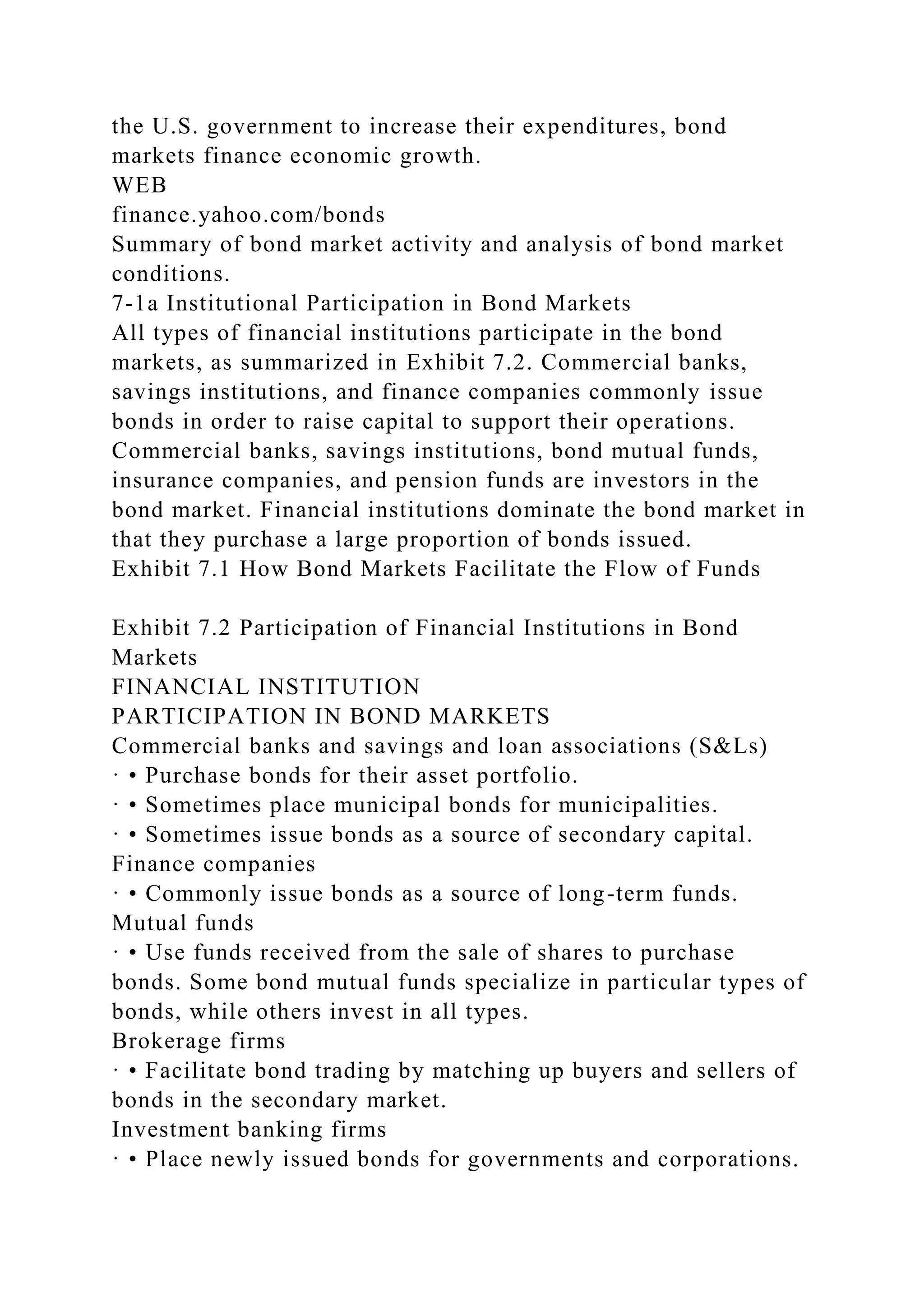
market price PM) of a mortgage can be modeled as
An increase in either the risk-free rate or the risk premium on a
fixed-rate mortgage results in a higher required rate of return
when investing in the mortgage, which causes the mortgage
price to decrease.
9-3a Risk from Investing in Mortgages
WEB
finance.yahoo.com/personal-finance/home-values
Information about home values, mortgage rates home equity
loans, and credit reports.
Given the uncertainty of the factors that influence mortgage
prices, future mortgage prices (and therefore returns) are
uncertain. The uncertainty that financial institutions face when
investing in mortgages is due to credit risk, interest rate risk,
and prepayment risk, as explained next.
Credit Risk Credit (default) risk represents the size and
likelihood of a loss that investors will experience if borrowers
make late payments or even default. Whether investors sell their
mortgages prior to maturity or hold them until maturity, they
are subject to credit risk. Consequently, investors must weigh
the higher potential return from investing in mortgages against
the exposure to risk (that the actual return could be lower than
the expected return). The probability that a borrower will
default is influenced both by economic conditions and by the
borrower characteristics that lenders consider when assessing a
borrower's creditworthiness (level of equity invested by the
borrower, the borrower's income level, and the borrower's credit
history).
Interest Rate Risk Financial institutions that hold mortgages are
subject to interest rate risk because the values of mortgages
tend to decline in response to an increase in interest rates.
Mortgages are long term but are commonly financed by some
financial institutions with short-term deposits, so the investment
in mortgages may create high exposure to interest rate risk.
Such mortgages can also generate high returns when interest
rates fall, but the potential gains are limited because borrowers
tend to refinance (obtain new mortgages at the lower interest
rate and prepay their mortgages) when interest rates decline.
When investors hold fixed-rate mortgages until maturity, they
do not experience a loss due to a change in interest rates.
However, holding fixed-rate mortgages to maturity can create a
so-called opportunity cost of what the investors might have
earned if they had invested in other securities. For example, if
interest rates rise consistently from the time fixed-rate
mortgages are purchased until they mature, investors who hold
the mortgages to maturity gave up the potential higher return
that they would have earned if they had simply invested in
money market securities over the same period.
Financial institutions can limit their exposure to interest rate
risk by selling mortgages shortly after originating them.
However, even institutions that use this strategy are partially
exposed to interest rate risk. As a financial institution originates
a pool of mortgages, it may commit to a specific fixed rate on
some of the mortgages. The mortgages are stored in what is
referred to as a mortgage pipeline until there is a sufficient pool
of mortgages to sell. By the time the complete pool of
mortgages is originated and sold, interest rates may have risen.
In this case, the value of the mortgages in the pool may have
declined by the time the pool is sold.
Another way financial institutions can limit interest rate risk
is by offering adjustable rate residential mortgages.
Alternatively, they could invest in fixed-rate mortgages that
have a short time remaining until maturity. However, this
conservative strategy may reduce the potential gains that could
have been earned.
Prepayment RiskPrepayment risk is the risk that a borrower may
prepay the mortgage in response to a decline in interest rates.
This type of risk is distinguished from interest rate risk to
emphasize that even if investors in mortgages do not need to
liquidate the mortgages, they are still susceptible to the risk that
the mortgages they hold will be paid off. In this case, the
investor receives a payment to retire the mortgage and must
then reinvest at the prevailing (lower) interest rates. Thus the
interest rate on the new investment will be lower than the rate
that would have been received on the retired mortgages.
Because of prepayments, financial institutions that invest in
fixed-rate mortgages may experience only limited benefits in
periods when interest rates decline. Although these mortgages
offer attractive yields compared to the prevailing low interest
rates, they are commonly retired as a result of refinancing.
Financial institutions can insulate against prepayment risk in
the same manner that they limit exposure to interest rate risk:
they can sell loans shortly after originating them or invest in
adjustable-rate mortgages.
9-4 MORTGAGE-BACKED SECURITIES
As an alternative to selling their mortgages outright, financial
institutions can engage in securitization, or the pooling and
repackaging of loans into securities called mortgagebacked
securities (MBS) or pass-through securities. These securities are
then sold to investors, who become the owners of the loans
represented by those securities.
9-4a The Securitization Process
When mortgages are securitized, a financial institution such as a
securities firm or commercial bank combine individual
mortgages together into packages. Securitization allows the
institution to sell mortgage loans in large batches. When several
small mortgage loans are packaged together, they become more
attractive to the large institutional investors (such as
commercial banks, savings institutions, and insurance
companies) that focus on large transactions. The issuer of the
MBS assigns a trustee to hold the mortgages as collateral for the
investors who purchase the securities. After the securities are
sold, the financial institution that issued the MBS receives
interest and principal payments on the mortgages and then
transfers (passes through) the payments to investors that
purchased the securities. The financial institution deducts a fee
for servicing these mortgages.
9-4b Types of Mortgage-Backed Securities
Five of the more common types of mortgage-backed securities
are the following:
· ▪ GNMA (Ginnie Mae) mortgage-backed securities
· ▪ Private-label pass-through securities
· ▪ FNMA (Fannie Mae) mortgage-backed securities
· ▪ FHLMC participation certificates
· ▪ Collateralized mortgage obligations (CMOs)
Each type is described in turn.
GNMA Mortgage-Backed Securities The Government National
Mortgage Association (called GNMA, or Ginnie Mae) was
created in 1968 as a corporation that is wholly owned by the
federal government. When mortgages are backed by FHA and
VA mortgages, Ginnie Mae guarantees timely payment of
principal and interest to investors who purchase these
securities. The mortgages must satisfy specific guidelines. They
are restricted to a maximum dollar amount (that changes over
time), since they are intended to serve low- and moderate-
income homeowners. The financial institutions that originate
mortgages with the Ginnie Mae guarantee can more easily sell
the mortgages in the secondary market, because the institutional
investors do not have to worry about credit risk. Thus
institutional investors are more willing to invest in MBS that
incorporate Ginnie Mae's guarantee, which results in a more
active secondary market for mortgages.
Private Label Pass-Through Securities Private label pass-
through securities are similar to Ginnie Mae mortgage-backed
securities except that they are backed by conventional rather
than FHA or VA mortgages. The mortgages backing the
securities are insured through private insurance companies.
WEB
http://mtgprofessor.com/secondary_markets.htm
Detailed information on the secondary mortgage markets.
FNMA Mortgage-Backed Securities The Federal National
Mortgage Association (called FNMA, or Fannie Mae) was
created by the government in 1938 to develop a more liquid
secondary market for mortgages. It issues long-term debt
securities to institutional investors and uses the funds to
purchase mortgages in the secondary market. In essence, Fannie
Mae channels funds from institutional investors to financial
institutions that desire to sell their mortgages. These financial
institutions may continue to service the mortgages and earn a
fee for this service. The mortgage payments on mortgages
backing these securities are sent to the financial institutions that
service the mortgages. The payments are channeled through to
the purchasers of MBS, which may be collateralized by
conventional or federally insured mortgages.
FHLMA Participation Certificates The Federal Home Loan
Mortgage Association (called FHLMA or Freddie Mac) was
chartered as a corporation by the federal government in 1970 to
ensure that sufficient funds flow into the mortgage market. It
went public in 1989. It sells participation certificates (PCs) and
uses the proceeds to finance the origination of conventional
mortgages from financial institutions. This provides another
outlet for financial institutions that desire to sell their
conventional mortgages in the secondary market.
Fannie Mae and Freddie Mac enhance liquidity in the
mortgage market, as illustrated in Exhibit 9.5. The proceeds
received from selling securities are channeled to purchase
mortgages in the secondary market from mortgage originators.
As a result of Fannie Mae and Freddie Mac, the secondary
mortgage market is more liquid than it otherwise would be. In
addition, originators of the mortgages can originate more
mortgages because they are not forced to finance the mortgages
on their own. Because the mortgage market is more liquid,
mortgage rates are more competitive and housing is more
affordable for some homeowners.
Collateralized Mortgage ObligationsCollateralized mortgage
obligations (CMOs) represent a type of MBS in which the
underlying mortgages are segmented into tranches (classes),
according to their maturity, and the cash flows provided by each
tranche are typically structured in a sequential manner. In this
way, the timing of the cash flows generated by a particular
tranche are more predictable. The first tranche has the quickest
payback. Any repaid principal is initially sent to owners of the
first-tranche CMOs until the total principal amount representing
that tranche is fully repaid. Then any further principal payments
are sent to owners of the second-tranche CMOs until the total
principal amount representing that tranche is fully repaid. This
process continues until principal payments are made to owners
of the last-tranche CMOs. Issues of CMOs typically have from
three to ten tranches.
Exhibit 9.5 How Fannie Mae and Freddie Mac Enhance
Liquidity in the Mortgage Market
The CMOs are sometimes segmented into interest-only (IO)
and principal-only (PO) tranches. Investors in interest-only
CMOs receive only interest payments that are paid on the
underlying mortgages. When mortgages are prepaid, the interest
payments on the underlying mortgages are terminated, and so
are payments to investors in interest-only CMOs. For example,
mortgage prepayments may cut off the interest rate payments on
the CMO after a few years, even though these payments were
initially expected to last five years or more. Consequently,
investors in these CMOs could lose 50 percent or more of their
initial investment. The relatively high yields offered on
interest-only CMOs are attributable to their high degree of risk.
Because investors in the principal-only CMO receive
principal payments only, they generally receive payments
further into the future. Even though the payments to these
investors represent principal, the maturity is uncertain owing to
possible prepayment of the underlying mortgages.
Some mortgages are also sold through a collateralized debt
obligation (CDO), which is a package of debt securities backed
by collateral that is sold to investors. A CDO differs from a
CMO in that it also contains some other, nonmortgage types of
debt securities (e.g., automobile loans and credit card loans).
Collateralized debt obligations became popular in the late 1990s
and, by 2007, the value of CDOs issued was about $500 billion.
Like CMOs, CDOs can be separated into tranches based on
risk. On average, MBS represent about 45 percent of a CDO, but
the percentage may be as low as zero or as high as about 90
percent. The mortgages that are included in CDOs are
commonly subprime mortgages. When economic conditions
weaken, there are more mortgage defaults and so the riskiest
tranches of a CDO may suffer major losses. Even highly rated
tranches are subject to losses in such periods. Tranches assigned
a AAA rating by rating agencies had a risk premium (above the
risk-free Treasury bond rate) of close to zero in 2005 as
compared with a risk premium of 5 percent in 2008. This
significant increase in the premium reflected the additional
compensation that investors required when the housing market
collapsed in 2008.
When CMO and CDO values deteriorate, financial institutions
have more difficulty selling mortgages that they originate. Thus
the activity in the CMO and CDO market influences the volume
of funds available to finance new mortgages.
9-4c Valuation of Mortgage-Backed Securities
The valuation of MBS is difficult because of the limited
transparency. Although there is a secondary market for
mortgage-backed securities, it is not very active in some
periods. There is no centralized reporting system that reports
the trading of MBS in the secondary market, as there is for
other securities such as stocks and Treasury bonds. The only
participants who know the price of the securities that were
traded are the buyer and the seller. Given the lack of a
centralized reporting system, it is quite possible that a financial
institution may overpay when buying MBS.
Reliance on Ratings to Assess Value When deciding whether to
purchase MBS, institutional investors may rely on rating
agencies (Moody's, Standard & Poor's, or Fitch) rather than
attempt to conduct their own valuation. An agency is hired by
the issuer of the securities to assign ratings to the MBS that it
plans to sell. The financial institutions that create MBS pay a
fee to rating agencies to assign a rating to their MBS. Many
institutional investors will not purchase MBS unless they are
rated high. However, many of the MBS that were highly rated
still suffered major losses during the credit crisis.
Fair Value of Mortgage-Backed Securities When financial
institutions believe that they will incur a loss on MBS (or any
other long-term assets), they are expected to “write down” the
value to reflect its true market value (also called its “fair
value”). In doing so, they may attempt to rely on prices of MBS
that are traded in the secondary market in order to determine the
market value of the MBS they are holding. However, MBS can
vary substantially in terms of risk, so that mortgage-backed
securities at a particular financial institution may warrant a
much higher (or lower) valuation than those recently traded in
the secondary market. Furthermore, when the secondary market
for MBS is not active (such as during the credit crisis, when
investors were no longer willing to buy them), there is
insufficient market information to derive a market value.
9-5 MORTGAGE CREDIT CRISIS
In the 2003–2006 period, low interest rates and favorable
economic conditions stimulated the demand for new homes. The
market values of homes increased substantially, and many
institutional investors used funds to invest in mortgages or
mortgage-backed securities. Home builders responded to the
favorable housing conditions by building more homes.
Furthermore, many lenders were so confident that home prices
would continue to rise that they reduced the down payment
(equity investment) that they required from home buyers. The
lenders assumed that, even if the home buyers defaulted on the
loan, the home's value would serve as sufficient collateral.
In 2006, however, some prospective buyers were less willing
to purchase homes because of the abrupt increase in home prices
during 2005. Suddenly, the demand for new homes was less than
the supply of new and existing homes for sale, and housing
prices declined. Along with these conditions, interest rates
increased in 2006, which made it more difficult for existing
homeowners with adjustable-rate mortgages to make their
mortgage payments. In addition, mortgage companies had
previously offered mortgages with low initial rates for the first
few years. Now these “teaser rates” were expiring on homes that
were recently purchased, and these homeowners also faced
higher mortgage payments. Consequently, mortgage defaults
increased. Because the market values of homes had declined
substantially in some areas, in many cases the collateral backing
the mortgage was not sufficient to recapture the entire mortgage
amount. Even some mortgages that were insured against default
by private insurers defaulted because some insurance companies
that insured mortgages did not have adequate funds to cover
their obligations.
As economic conditions weakened further, mortgage defaults
continued to increase. By June 2008, 9 percent of all American
homeowners were either behind on their mortgage payments or
were in foreclosure. The defaults were much higher on subprime
mortgages than on prime mortgages. In 2008, about 25 percent
of all outstanding subprime mortgages had late payments of at
least 30 days, versus fewer than 5 percent for prime mortgages.
In addition, about 10 percent of outstanding subprime
mortgages were subject to foreclosure in 2008, versus fewer
than 3 percent for prime mortgages. Some mortgages that were
supposed to be backed by insurance were not. Furthermore,
while many mortgages were backed by insurance, some private
insurers went bankrupt—exposing the institutional investors
holding the mortgages to major losses.
9-5a Impact of the Credit Crisis on Fannie Mae and Freddie
Mac
As of 2007, Fannie Mae held about $47 billion in subprime
mortgages and/or securities backed by these mortgages, while
Freddie Mac held about $124 billion in such securities.
Although these companies were chartered by the federal
government to provide liquidity to the mortgage market, the
compensation of their executives was tied to the companies'
performance, which led to risk taking. They had reduced their
standards in order to attempt to maintain their market share
when investing in mortgages. This is an example of a moral
hazard problem, which occurs when a person or institution does
not have to bear the full consequences of its behavior and
therefore assumes more risk than it otherwise would. In this
case, the executives could take risks knowing that they would
benefit if their gambles paid off and that the government would
likely bail them out if the gambles failed.
Fannie Mae and Freddie Mac invested heavily in subprime
mortgages that required homeowners to pay higher rates of
interest. By 2008, many subprime mortgages defaulted, so
Fannie Mae and Freddie Mac were left with properties (the
collateral) that had a market value substantially below the
amount owed on the mortgages that they held. Fannie Mae and
Freddie Mac attempted “workouts” in some cases, whereby they
renegotiated the terms of mortgage contracts or arranged
additional financing for homeowners in order to help them
avoid foreclosures. Some of the mortgages that Fannie Mae and
Freddie Mac purchased from commercial banks and other
mortgage originators misrepresented the qualifications of the
homeowners.
By the summer of 2008, Fannie Mae and Freddie Mac owned
or guaranteed more than $5 trillion of U.S. home mortgages, or
about half the value of all outstanding mortgages in the United
States. In August 2008, Fannie Mae and Freddie Mac reported
losses of more than $14 billion over the previous year. At that
time, they held about $84 billion in capital, which represented
less than 2 percent of all the mortgages that they held. This was
a very small cushion to cover possible losses on their
mortgages.
Funding Problems Because of their poor financial performance,
Fannie Mae and Freddie Mac were incapable of raising capital
to improve their financial position or to continue their role of
supporting the housing market. Their stock values had declined
by more than 90 percent from the previous year, so issuing new
equity to obtain funds was not a feasible solution. The yield
offered on Fannie Mae and Freddie Mac debt securities was 2.5
percent higher than that of Treasury securities with a similar
maturity, which reflected the large risk premium that investors
were requiring in order to invest in these securities. Thus the
cost of debt to Fannie Mae and Freddie Mac was extremely high
because investors feared that these agencies might not be able
to repay their debt. Their cost of debt would have been even
higher if investors had not presumed that the government would
bail out the two companies if necessary.
Rescue of Fannie Mae and Freddie Mac In September 2008, the
U.S. government took over the management of Fannie Mae and
Freddie Mac. Their regulator, the Federal Housing Finance
Agency, became responsible for managing them until they are
determined to be financially healthy. The CEOs of both
companies were removed from their positions, but they left with
compensation packages that many critics would say were very
forgiving. In the previous year, Fannie Mae's CEO received
income of $11.6 million and Freddie Mac's CEO received $19.8
million.
The Treasury agreed to provide whatever funding would be
necessary to cushion losses from the mortgage defaults. In
return, the Treasury received $1 billion of preferred stock in
each of the two companies. This arrangement gave Congress
time to determine whether and how these companies should be
structured in the future. Congress could also establish
guidelines that would restrict them from investing in risky
mortgages that do not meet specific standards.
The U.S. government rescue of Fannie Mae and Freddie Mac
removed the risk of their debt securities defaulting and
therefore increased the values of these debt securities. It
allowed Fannie Mae and Freddie Mac to obtain funds by issuing
debt securities so that they could resume purchasing mortgages
and thereby ensure a more liquid secondary market for them.
9-5b Systemic Risk Due to the Credit Crisis
The impact of the credit crisis extends far beyond the
homeowners who lost their homes and the financial institutions
that lost money on their mortgage investments. Mortgage
insurers that provided insurance to homeowners incurred large
expenses from many foreclosures because the property
collateral was worth less than the amount owed on the
mortgage. In this way, the problems of the mortgage sector
affected the insurance industry. In addition, some insurance
companies that sold credit default swaps on mortgages suffered
heavy losses.
As mortgages defaulted, the valuations of mortgage-backed
securities (MBS) weakened. Consequently, financial institutions
were no longer able to use MBS as collateral when borrowing
funds from lenders. The lenders could not trust that the MBS
would constitute adequate collateral if the financial institutions
that borrowed funds were unable to repay their loans. As a
result, some financial institutions (such as Bear Stearns) with
large investments in MBS were no longer able to access
sufficient funds to support their operations during the credit
crisis. Moreover, they could not sell their MBS in the secondary
market to obtain cash because by this time there were few
investors willing to purchase MBS in the secondary market.
Individual investors whose investments were pooled (by
mutual funds, hedge funds, and pension funds) and then used to
purchase MBS experienced losses, as did investors who
purchased stocks of financial institutions. Several financial
institutions went bankrupt, and many employees of financial
institutions lost their jobs. Home builders also went bankrupt,
and many employees in the home building industry lost their
jobs, too. The losses on investments and layoffs contributed to a
weaker economy, which made the crisis worse.
The concerns about MBS also spread to other types of debt
securities, including corporate bonds. When investors fully
recognized the risk associated with MBS during 2008, they no
longer considered MBS as adequate collateral to back
commercial paper. Consequently, some financial institutions
were no longer able to issue commercial paper unless they had
better forms of collateral. This paralyzed the commercial paper
market, and forced financial institutions to seek alternative
markets to obtain short-term funding.
International Systemic Risk Although much of the credit crisis
was focused on the United States, the problems were contagious
to international financial markets as well. Financial institutions
in other countries (e.g., the United Kingdom) had offered
subprime loans, and they also experienced high delinquency and
default rates. In addition, some financial institutions based in
foreign countries were common purchasers of subprime
mortgages that originated in the United States. Many
institutional investors in Asia and Europe had purchased MBS
and CDOs that contained subprime mortgages originated in the
United States. For example, UBS (a large Swiss bank) incurred
a loss of $35 billion from its positions in MBS. Such problems
contributed to weaker economies around the world.
9-5c Who Is to Blame?
The credit crisis illustrated some important problems in the
mortgage markets. Various participants in the process of
mortgage financing were subjected to criticism, as explained
next.
Mortgage Originators The mortgage companies and other
financial institutions that originate mortgages are supposed to
assess the creditworthiness of prospective homeowners. During
the housing boom in the 2003–2005 period, however, some
mortgage originators were aggressively seeking new business
without exercising adequate control over quality. In some cases,
they approved loans without even verifying the prospective
buyer's income. As described earlier, they also reduced the
required down payment because they incorrectly presumed that
home prices would not decrease and that the property would
therefore be sufficient collateral in the event of default.
Credit Rating Agencies As described earlier, the mortgage-
backed securities that are issued by securities firms and
financial institutions are assigned credit ratings by credit rating
agencies. The rating agencies, which are paid by the issuers that
want their MBS rated, were criticized for being too lenient in
their ratings shortly before the credit crisis. Mortgage-backed
securities were commonly rated AAA even though they
represented risky mortgages. Some mortgage-backed securities
were rated based on an assessment of the mean (average) of the
underlying mortgages, which ignores information about
the distribution of mortgages. Thus an MBS could be rated high
as long as some of its constituent mortgages were rated high
enough to offset those that were rated low. A large proportion
of the mortgage-backed securities that were issued in 2006 and
backed by subprime mortgages were either in default or rated at
the lowest level by 2010.
According to the Securities and Exchange Commission, many
MBS and CDO tranches were overrated for the following
reasons. First, credit rating agencies were understaffed and did
not perform thorough analyses. Second, credit rating agencies
did not monitor the performance of the tranches over time and
so did not detect deterioration in existing tranches. Third, some
analysts at rating agencies were motivated to assign a high
rating because the issuing firms could more easily sell highly
rated tranches and would therefore be more likely to hire the
same agencies to rate future tranches. A credit rating agency
typically receives a fee of between $300,000 and $500,000 from
the issuer for rating a package of mortgages. By assigning high
ratings to mortgage-backed securities, a credit rating agency
attracts future business from financial institutions that want to
issue MBS and need to have the securities certified with a high
rating.
Publicized results of investigations of credit rating agencies
documented that some analysts at credit rating agencies
apparently understood that there were problems with their
ratings. For example, a manager at one agency sent an e-mail to
his co-workers saying that assigning high ratings to tranches of
MBS was like building a house of cards that would inevitably
fall. As another example, an e-mail message from a rating
agency's analyst stated that the rating model used by the agency
to assess risk did not capture even half of the risk involved.
The credit ratings come with a disclaimer in small print that
says investors should not rely on the credit rating to make
investment decisions. Nevertheless, investors who suffered
major losses on their MBS investments might well ask why
credit rating agencies are hired to assign ratings if it is not to
determine the risk of the MBS.
Financial Institutions That Packaged the MBS Securities firms,
commercial banks, and other financial institutions that packaged
the mortgage-backed securities could have verified the credit
ratings assigned by the credit rating agencies by making their
own assessment of the risks involved. After all, such financial
institutions have considerable experience in assessing credit
quality. Yet they relied on the high ratings assigned by the
rating agencies, or presumed that households would continue to
make their mortgage payments, or simply assumed that the real
estate would serve as adequate collateral if households could
not make payments.
Institutional Investors That Purchased MBS Many financial
institutions pooled money that they received from individual
investors and used the proceeds to invest in MBS. These
institutions could have conducted their own assessment of the
credit quality of the MBS, since they also have experience in
assessing credit quality. Once again, however, it appears that
they relied heavily on the ratings assigned to MBS by credit
rating agencies without the due diligence of performing their
own independent assessment.
Financial Institutions That Insured MBS Insurance companies
also insured mortgages that backed securities sold in
securitizations. MBS that contained insured mortgages provided
a slightly lower return to investors (to reflect the fee paid to
insurers) but would be viewed as safe and would be easier to
sell to investors. Yet, as many MBS defaults occurred, some
insurance companies found that the mortgages they insured were
fraudulent because of inaccurate information that hid the
potential default risk. Thus the financial institution that
originated the mortgage was at fault because the mortgage
contracts were fraudulent.
Speculators of Credit Default Swaps A credit default swap
(CDS) is a privately negotiated contract that protects investors
against the risk of default on particular debt securities such as
MBS. The buyer of the CDS provides periodic (usually
quarterly) payments to the other party, and the seller of the CDS
is obligated to provide a payment in the case of default of the
securities specified in the swap agreement.
Although the CDS contracts could be purchased by financial
institutions to protect (or hedge) against a possible decline in
valuations of mortgages held, they were commonly purchased in
2006 by institutions that were betting on the potential demise of
specific mortgages. For example, some financial institutions
believed that the MBS containing subprime mortgages were
much riskier than perceived by credit rating agencies and other
institutional investors. They were able to purchase CDS
contracts from other financial institutions (sellers of CDS
contracts) at a low price because those sellers presumed,
incorrectly, that the MBS would not default. Thus, many of the
buyers of CDS contracts on MBS were not holding any
mortgages of MBS that they needed to hedge and instead were
simply betting that subprime mortgages within the MBS would
default. By purchasing CDS contracts, they were “insured”
against the defaults on specific pools of mortgages even though
they did hold the mortgages that defaulted.
Speculators of credit default swaps were criticized for
capitalizing on the collapse of the mortgage market. Yet those
speculators may counter that if the sellers of CDS contracts
were not so greedy to do business in this market and more
properly assessed the risk that they assumed when selling the
contracts, the speculators would not have been so willing to
take the other side of the CDS contracts.
Conclusion about Blame The question of who is to blame is still
being argued in courtrooms. Participants in the MBS market
have filed hundreds of lawsuits claiming that there was a lack of
disclosure about the risk of the MBS. Some mortgage companies
that originated the mortgages are being sued by securities firms
that packaged the mortgages because the mortgages did not
fully disclose information to reflect the risk of the home buyers.
Mortgage insurers sued mortgage originators for the same
reason. In particular, there was a large court battle between
MBIA (a large mortgage insurance company) and Countrywide
Financial (a large mortgage company) in 2012. The securities
firms that sold MBS are being sued by the financial institutions
that purchased the MBS. Finally, the individuals whose money
was used to purchase the MBS are suing the financial
institutions that made investments in the MBS because the
investments were not suitable because of their excessive risk.
9-5d Government Programs Implemented in Response to the
Crisis
In an effort to stimulate the market for homes and mortgages
and reduce the number of foreclosures, the U.S. government
implemented various programs. The Housing and Economic
Recovery Act of 2008 was passed in July 2008. The act enabled
some homeowners to keep their existing homes and therefore
reduced the excess supply of homes for sale in the market. The
financial institutions must be willing to create a new mortgage
that is no more than 90 percent of the present appraised home
value. Since the mortgage value exceeds the home value for
many of the qualified homeowners, financial institutions that
volunteer for the program essentially forgive a portion of the
previous mortgage loan when creating a new mortgage.
Other programs promoted “short sale” transactions in which
the lender allows homeowners to sell the home for less than
what is owed on the existing mortgage. The lender appraises the
home and informs the homeowner of the price it is willing to
accept on the home. Lenders involved in this program do not
recover the full amount owed on the mortgage. However, they
may minimize their losses because they do not have to go
through the foreclosure process, and the homeowners reduce the
potential damage to their credit report.
9-5e Government Bailout of Financial Institutions
As the credit crisis intensified, many investors were unwilling
to invest in mortgagebacked securities because of the risk of
continued defaults. Thus financial institutions that had large
holdings of MBS could not easily sell them in the secondary
market. On October 3, 2008, the Emergency Economic
Stabilization Act of 2008 (also referred to as the bailout act)
enabled the Treasury to inject $700 billion into the financial
system and improve the liquidity of these financial institutions.
A key part of the act was the Troubled Asset Relief Program
(TARP), which allows the Treasury to purchase MBS from
financial institutions and thereby provide them with more cash.
A key challenge of this activity has been to determine the
proper price at which the securities should be purchased, since
the secondary market for the securities is not sufficiently active
to determine appropriate market prices. The act also allowed the
Treasury to invest in the large commercial banks as a means of
providing the banks with capital to cushion their losses.
The original proposal for the act was contained in three pages,
but by the time the act was passed, it was 451 pages long.
Although the initial intent was to resolve the credit crisis, the
final act contained many other provisions unrelated to the
crisis: tax breaks for producers of rum in the Virgin Islands,
racetrack owners, film producers, and alternative energy
producers. These additional provisions were included to satisfy
special interests of various House and Senate members and win
their approval for the act.
9-5f Financial Reform Act
In July 2010 the Dodd-Frank Wall Street Reform and Consumer
Protection Act (also called Financial Reform Act) was
implemented; one of its main goals was to ensure stability in the
financial system. This act mandated that financial institutions
granting mortgages verify the income, job status, and credit
history of mortgage applicants before approving mortgage
applications. The goal was to prevent the looser standards that
were instrumental in the credit crisis of 2008.
The Financial Reform Act called for the creation of the
Financial Stability Oversight Council to identify risks of the
financial system and to make regulatory recommendations that
could reduce those risks. The council consists of 10 members
representing the heads of agencies that regulate key components
of the financial system, including the housing industry,
securities trading, depository institutions, mutual funds, and
insurance companies.
The act also required that financial institutions that sell
mortgage-backed securities retain 5 percent of the portfolio
unless the portfolio meets specific standards that reflect low
risk. This provision forces financial institutions to maintain a
stake in the mortgage portfolios that they sell. The act requires
more disclosure regarding the quality of the underlying assets
when mortgage-backed securities are sold.
It also requires new rules intended to ensure that credit rating
agencies provide unbiased assessments when rating mortgage-
backed securities. Specifically, the credit rating agencies are
required to publicly disclose data on assumptions used to derive
each credit rating. The agencies are also required to provide an
annual report about their internal controls used to ensure an
unbiased process of rating securities. The act also prevents the
SEC from relying on ratings within its regulations, so that it has
to use its own assessment of risk.
SUMMARY
· ▪ Residential mortgages can be characterized by whether they
are prime or subprime, whether they are federally insured, the
type of interest rate used (fixed or floating), and the maturity.
Quoted interest rates on mortgages vary at a given point in time,
depending on these characteristics.
· ▪ Various types of residential mortgages are available,
including fixed-rate mortgages, adjustable-rate mortgages,
graduated-payment mortgages, growing-equity mortgages,
second mortgages, and shared-appreciation mortgages.
· ▪ The valuation of a mortgage is the present value of its
expected future cash flows, discounted at a discount rate that
reflects the uncertainty surrounding the cash flows. A mortgage
is subject to credit risk, interest rate risk, and prepayment risk.
· ▪ Mortgage-backed securities (MBS) represent packages of
mortgages; the payments on those mortgages are passed through
to investors. Ginnie Mae provides a guarantee of payments on
mortgages that meet specific criteria, and these mortgages can
be easily packaged and sold. Fannie Mae and Freddie Mac issue
debt securities and purchase mortgages in the secondary market.
· ▪ Mortgages were provided without adequate qualification
standards (including allowing very low down payments) in the
2003–2006 period. Then a glut in the housing market caused a
drastic decline in home prices, with the result that the market
values of many homes were lower than the mortgages. Many
homeowners defaulted on their mortgages, which led to a credit
crisis in the 2008–2009 period. The U.S. government used
various strategies to revive the U.S. mortgage market, including
an emergency housing recovery act, the rescue of Fannie Mae
and Freddie Mac, and a bailout of financial institutions that had
heavy investments in mortgages and mortgage-backed
securities.
POINT COUNTER-POINT
Is the Trading of Mortgages Similar to the Trading of Corporate
Bonds?
Point Yes. In both cases, the issuer's ability to repay the debt is
based on income. Both types of debt securities are highly
influenced by interest rate movements.
Counter-Point No. The assessment of corporate bonds requires
an analysis of the financial statements of the firms that issued
the bonds. The assessment of mortgages requires an
understanding of the structure of the mortgage market (MBS,
CMOs, etc.).
Who Is Correct Use the Internet to learn more about this issue
and then formulate your own opinion.
QUESTIONS AND APPLICATIONS
· 1.FHA Mortgages Distinguish between FHA and conventional
mortgages.
· 2.Mortgage Rates and Risk What is the general relationship
between mortgage rates and long-term government security
rates? Explain how mortgage lenders can be affected by interest
rate movements. Also explain how they can insulate against
interest rate movements.
· 3.ARMs How does the initial rate on adjustable-rate mortgages
(ARMs) differ from the rate on fixed-rate mortgages? Why?
Explain how caps on ARMs can affect a financial institution's
exposure to interest rate risk.
· 4.Mortgage Maturities Why is the 15-year mortgage attractive
to homeowners? Is the interest rate risk to the financial
institution higher for a 15-year or a 30- year mortgage? Why?
· 5.Balloon-Payment Mortgage Explain the use of a balloon-
payment mortgage. Why might a financial institution prefer to
offer this type of mortgage?
· 6.Graduated-Payment Mortgage Describe the graduated-
payment mortgage. What type of homeowners would prefer this
type of mortgage?
· 7.Growing-Equity Mortgage Describe the growing-equity
mortgage. How does it differ from a graduated-payment
mortgage?
· 8.Second Mortgages Why are second mortgages offered by
some home sellers?
· 9.Shared-Appreciation Mortgage Describe the shared-
appreciation mortgage.
· 10.Exposure to Interest Rate Movements Mortgage lenders
with fixed-rate mortgages should benefit when interest rates
decline, yet research has shown that this favorable impact is
dampened. By what?
· 11.Mortgage Valuation Describe the factors that affect
mortgage prices.
· 12.Selling Mortgages Explain why some financial institutions
prefer to sell the mortgages they originate.
· 13.Secondary Market Compare the secondary market activity
for mortgages to the activity for other capital market
instruments (such as stocks and bonds). Provide a general
explanation for the difference in the activity level.
· 14.Financing Mortgages What types of financial institution
finance residential mortgages? What type of financial institution
finances the majority of commercial mortgages?
· 15.Mortgage Companies Explain how a mortgage company's
degree of exposure to interest rate risk differs from that of other
financial institutions.
Advanced Questions
· 16.Mortgage-Backed Securities Describe how mortgage-
backed securities (MBS) are used.
· 17.CMOs Describe how collateralized mortgage obligations
(CMOs) are used and why they have been popular.
· 18.Maturities of MBS Explain how the maturity on mortgage-
backed securities can be affected by interest rate movements.
· 19.How Secondary Mortgage Prices May Respond to
Prevailing Conditions Consider current conditions that could
affect interest rates, including inflation (including oil prices),
the economy, the budget deficit, and the Fed's monetary policy.
Based on prevailing conditions, do you think the values of
mortgages that are sold in the secondary market will increase or
decrease during this semester? Offer some logic to support your
answer. Which factor do you think will have the biggest impact
on the values of existing mortgages?
· 20.CDOs Explain collateralized debt obligations (CDOs).
· 21.Motives for Offering Subprime Mortgages Explain
subprime mortgages. Why were mortgage companies
aggressively offering subprime mortgages?
· 22.Subprime versus Prime Mortgages How did the repayment
of subprime mortgages compare to that of prime mortgages
during the credit crisis?
· 23.MBS Transparency Explain the problems in valuing
mortgage-backed securities.
· 24.Contagion Effects of Credit Crisis Explain how the credit
crisis adversely affected many other people beyond homeowners
and mortgage companies.
· 25.Blame for Credit Crisis Many investors that purchased
mortgage-backed securities just before the credit crisis believed
that they were misled because these securities were riskier than
they thought. Who is at fault?
· 26.Avoiding Another Credit Crisis Do you think that the U.S.
financial system will be able to avoid another credit crisis like
this in the future?
· 27.Role of Credit Ratings in Mortgage Market Explain the role
of credit rating agencies in facilitating the flow of funds from
investors to the mortgage market (through mortgage-backed
securities).
· 28.Fannie and Freddie Problems Explain why Fannie Mae and
Freddie Mac experienced mortgage problems.
· 29.Rescue of Fannie and Freddie Explain why the rescue of
Fannie Mae and Freddie Mac improves the ability of mortgage
companies to originate mortgages.
· 30.U.S. Treasury Bailout Plan The U.S. Treasury attempted to
resolve the credit crisis by establishing a plan to buy mortgage-
backed securities held by financial institutions. Explain how the
plan could improve the situation for MBS.
· 31.Assessing the Risk of MBS Why do you think it is difficult
for investors to assess the financial condition of a financial
institution that has purchased a large amount of mortgage-
backed securities?
· 32.Mortgage Information during the Credit Crisis Explain why
mortgage originators have been criticized for their behavior
during the credit crisis. Should other participants in the
mortgage securitization process have recognized that lack of
complete disclosure in mortgages?
· 33.Short Sales Explain short sales in the mortgage markets.
Are short sales fair to homeowners? Are they fair to mortgage
lenders?
· 34.Government Intervention in Mortgage Markets The
government intervened in order to resolve problems in the
mortgage markets during the credit crisis. Summarize the
advantages and disadvantages of the government intervention
during the credit crisis. Should the government intervene when
mortgage market conditions are very weak?
· 35.Dodd-Frank Act and Credit of MBS Explain how the Dodd-
Frank Act of 2010 attempted to prevent biased ratings of
mortgage-backed securities by credit rating agencies.
Interpreting Financial News
Interpret the following comments made by Wall Street analysts
and portfolio managers.
· a. “If interest rates continue to decline, the interest-only
CMOs will take a hit.”
· b. “Estimating the proper value of CMOs is like estimating the
proper value of a baseball player; the proper value is much
easier to assess five years later.”
· c. “When purchasing principal-only CMOs, be ready for a
bumpy ride.”
Managing in Financial Markets
CMO Investment Dilemma As a manager of a savings
institution, you must decide whether to invest in collateralized
mortgage obligations (CMOs). You can purchase interest-only
(IO) or principal-only (PO) classes. You anticipate that
economic conditions will weaken in the future and that
government spending (and therefore government demand for
funds) will decrease.
· a. Given your expectations, would IOs or POs be a better
investment?
· b. Given the situation, is there any reason why you might not
purchase the class of CMOs that you selected in the previous
question?
· c. Your boss suggests that the value of CMOs at any point in
time should be the present value of their future payments. He
says that since a CMO represents mortgages, its valuation
should be simple. Why is your boss wrong?
PROBLEM
Amortization Use an amortization table (such
as www.bloomberg.com/invest/calculators/index.html) that
determines the monthly mortgage payment based on a specific
interest rate and principal with a 15-year maturity and then for a
30-year maturity. Is the monthly payment for the 15-year
maturity twice the amount for the 30-year maturity or less than
twice the amount? Explain.
FLOW OF FUNDS EXERCISE
Mortgage Financing
Carson Company currently has a mortgage on its office building
through a savings institution. It is attempting to determine
whether it should convert its mortgage from a floating rate to a
fixed rate. Recall that the yield curve is currently upward
sloping. Also recall that Carson is concerned about a possible
slowing of the economy because of potential Fed actions to
reduce inflation. The fixed rate that it would pay if it refinances
is higher than the prevailing short-term rate but lower than the
rate it would pay from issuing bonds.
· a. What macroeconomic factors could affect interest rates and
therefore affect the mortgage refinancing decision?
· b. If Carson refinances its mortgage, it also must decide on the
size of a down payment. If it uses more funds for a larger down
payment, it will need to borrow more funds to finance its
expansion. Should Carson make a minimum down payment or a
larger down payment if it refinances the mortgage? Why?
· c. Who is indirectly providing the money that is used by
companies such as Carson to purchase office buildings? That is,
where does the money that the savings institutions channel into
mortgages come from?
INTERNET/EXCEL EXERCISE
Assess a mortgage payment schedule such
as http://realestate.yahoo.com/calculators/amortization.html.
Assume a loan amount of $120,000, an interest rate of 7.4
percent, and a 30-year maturity. Given this information, what is
the monthly payment? In the first month, how much of the
monthly payment is interest and how much is principal? What is
the outstanding balance after the first year? In the last month of
payment, how much of the monthly payment is interest and how
much is principal? Why is there such a difference in the
composition of the principal versus interest payment over time?
WSJ EXERCISE
Explaining Mortgage Rate Premiums
Review the “Corporate Borrowing Rates and Yields” table in a
recent issue of the Wall Street Journal to determine the
Treasury bond yield. How do these rates compare to the Fannie
Mae yield quoted in the Journal's “Borrowing Benchmarks”
section? Why do you think there is a difference between the
Fannie Mae rate and Treasury bond yields?
ONLINE ARTICLES WITH REAL-WORLD EXAMPLES
Find a recent practical article available online that describes a
real-world example regarding a specific financial institution or
financial market that reinforces one or more concepts covered in
this chapter.
If your class has an online component, your professor may ask
you to post your summary of the article there and provide a link
to the article so that other students can access it. If your class is
live, your professor may ask you to summarize your application
of the article in class. Your professor may assign specific
students to complete this assignment or may allow any students
to do the assignment on a volunteer basis.
For recent online articles and real-world examples related to
this chapter, consider using the following search terms (be sure
to include the prevailing year as a search term to ensure that the
online articles are recent):
· 1. subprime mortgages AND risk
· 2. adjustable-rate mortgage AND risk
· 3. balloon-payment mortgage AND risk
· 4. mortgage AND credit risk
· 5. mortgage AND prepayment risk
· 6. [name of a specific financial institution] AND mortgage
· 7. credit crisis AND mortgage
· 8. mortgage-backed securities AND default
· 9. credit crisis AND Fannie Mae
· 10. credit crisis AND Freddie Mac
PART 3 INTEGRATIVE PROBLEM: Asset Allocation
This problem requires an understanding of how economic
conditions influence interest rates and security prices (Chapters
6, 7, 8, and 9).
As a personal financial planner, one of your tasks is to prescribe
the allocation of available funds across money market
securities, bonds, and mortgages. Your philosophy is to take
positions in securities that will benefit most from your
forecasted changes in economic conditions. As a result of a
recent event in Singapore, you expect that in the next month
investors in Singapore will reduce their investment in U.S.
Treasury securities and shift most of their funds into Singapore
securities. You expect that this shift in funds will persist for at
least a few years. You believe this single event will have a
major effect on economic factors in the United States, such as
interest rates, exchange rates, and economic growth in the next
month. Because the prices of securities in the United States are
affected by these economic factors, you must determine how to
revise your prescribed allocation of funds across securities.
Questions
· 1. How will U.S. interest rates be directly affected by the
event (holding other factors equal)?
· 2. How will economic growth in the United States be affected
by the event? How might this influence the values of securities?
· 3. Assume that day-to-day exchange rate movements are
dictated primarily by the flow of funds between countries,
especially international bond and money market transactions.
How will exchange rates be affected by possible changes in the
international flow of funds that are caused by the event?
· 4. Using your answer to (1) only, explain how prices of U.S.
money market securities, bonds, and mortgages will be affected.
· 5. Now use your answer to (2) along with your answer to (1)
to assess the impact on security prices. Would prices of risky
securities be affected more or less than those of risk-free
securities with a similar maturity? Why?
· 6. Assume that, for diversification purposes, you prescribe
that at least 20 percent of an investor's funds should be
allocated to money market securities, to bonds, and to
mortgages. This allows you to allocate freely the remaining 40
percent across those same securities. Based on all the
information you have about the event, prescribe the proper
allocation of funds across the three types of U.S. securities.
(Assume that the entire investment will be concentrated in U.S.
securities.) Defend your prescription.
· 7. Would you recommend high-risk or low-risk money market
securities? Would you recommend high-risk or low-risk bonds?
Why?
· 8. Assume that you would consider recommending that as
much as 20 percent of the funds be invested in foreign debt
securities. Revise your prescription to include foreign securities
if you desire (identify the type of security and the country).
· 9. Suppose that, instead of reducing the supply of loanable
funds in the United States, the event increased demand for
them. Would the assessment of future interest rates be
different? What about the general assessment of economic
conditions? What about the general assessment of bond prices?
8 Bond Valuation and Risk
CHAPTER OBJECTIVES
The specific objectives of this chapter are to:
· ▪ explain how bonds are priced,
· ▪ identify the factors that affect bond prices,
· ▪ explain how the sensitivity of bond prices to interest rates
depends on particular bond characteristics,
· ▪ describe common strategies used to invest in bonds, and
· ▪ explain the valuation and risk of international bonds.
The values of bonds can change substantially over time. Hence,
financial institutions that consider buying or selling bonds
closely monitor their values.
8-1 BOND VALUATION PROCESS
Bonds are debt obligations with long-term maturities that are
commonly issued by governments or corporations to obtain
long-term funds. They are also purchased by financial
institutions that wish to invest funds for long-term periods.
Bond valuation is conceptually similar to the valuation of
capital budgeting projects, businesses, or even real estate. The
appropriate price reflects the present value of the cash flows to
be generated by the bond in the form of periodic interest (or
coupon) payments and the principal payment to be provided at
maturity. The coupon payment is based on the coupon rate
multiplied by the par value of the bond. Thus a bond with a 9
percent coupon rate and $1,000 par value pays $90 in coupon
payments per year. Because these expected cash flows are
known, the valuation of bonds is generally perceived to be
easier than the valuation of equity securities.
The current price of a bond should be the present value (PV)
of its remaining cash flows:
EXAMPLE
Consider a bond that has a par value of $1,000, pays $100 at the
end of each year in coupon payments, and has three years
remaining until maturity. Assume that the prevailing annualized
yield on other bonds with similar characteristics is 12 percent.
In this case, the appropriate price of the bond can be determined
as follows. The future cash flows to investors who would
purchase this bond are $100 in Year 1, $100 in Year 2, and
$1,100 (computed as $100 in coupon payments plus $1,000 par
value) in Year 3. The appropriate market price of the bond is its
present value:
Exhibit 8.1 Valuation of a Three-Year Bond
This valuation procedure is illustrated in Exhibit 8.1. Because
this example assumes that investors require a 12 percent
return, k is set equal to 0.12. At the price of $951.97, the
bondholders purchasing this bond will receive a 12 percent
annualized return.
WEB
www.finpipe.com/valuebnd.htm
More information on the process of valuing bonds.
When using a financial calculator, the present value of the
bond in the previous example can be determined as follows:
INPUT
3
12
100
1000
Function Key
N
I
PMT
FV
CPT
PV
Answer
951.97
8-1a Impact of the Discount Rate on Bond Valuation
The discount rate selected to compute the present value is
critical to accurate valuation. Exhibit 8.2 shows the wide range
of present value resulting at different discount rates for a
$10,000 payment in 10 years. The appropriate discount rate for
valuing any asset is the yield that could be earned on alternative
investments with similar risk and maturity.
Exhibit 8.2 Relationship between Discount Rate and Present
Value of $10,000 Payment to Be Received in 10 Years
Since investors require higher returns on riskier securities,
they use higher discount rates to discount the future cash flows
of these securities. Consequently, a high-risk security will have
a lower value than a low-risk security even though both
securities have the same expected cash flows.
8-1b Impact of the Timing of Payments on Bond Valuation
The market price of a bond is also affected by the timing of the
payments made to bondholders. Funds received sooner can be
reinvested to earn additional returns. Thus, a dollar to be
received soon has a higher present value than one to be received
later. The impact of maturity on the present value of a $10,000
payment is shown in Exhibit 8.3 (assuming that a return of 10
percent could be earned on available funds). The $10,000
payment has a present value of $8,264 if it is to be paid in two
years. This implies that if $8,264 were invested today and
earned 10 percent annually, it would be worth $10,000 in two
years. Exhibit 8.3 also shows that a $10,000 payment made 20
years from now has a present value of only $1,486 and that a
$10,000 payment made 50 years from now has a present value
of only $85 (based on the 10 percent discount rate).
8-1c Valuation of Bonds with Semiannual Payments
In reality, most bonds have semiannual payments. The present
value of such bonds can be computed as follows. First, the
annualized coupon should be split in half because two payments
are made per year. Second, the annual discount rate should be
divided by 2 to reflect two six-month periods per year. Third,
the number of periods should be doubled to reflect 2 times the
number of annual periods. After these adjustments are
incorporated, the present value is determined as follows:
Here C/2 is the semiannual coupon payment (half of what the
annual coupon payment would have been), and k/2 is the
periodic discount rate used to discount the bond. The last part
of the equation has 2n in the denominator's exponent to reflect
the doubling of periods.
Exhibit 8.3 Relationship between Time of Payment and Present
Value of Payment
EXAMPLE
As an example of the valuation of a bond with semiannual
payments, consider a bond with $1,000 par value, a 10 percent
coupon rate paid semiannually, and three years to maturity.
Assuming a 12 percent required return, the present value is
computed as follows:
When using a financial calculator, the present value of the
bond in the previous example can be determined as follows:1
INPUT
6
6
50
1000
Function Key
N
I
PMT
FV
CPT
PV
Answer
950.82
The remaining examples assume annual coupon payments so
that we can focus on the concepts presented without concern
about adjusting annual payments.
8-1d Relationships between Coupon Rate, Required Return, and
Bond Price
Bonds that sell at a price below their par value are
called discount bonds. The larger the investor's required rate of
return relative to the coupon rate, the larger the discount of a
bond with a particular par value.
EXAMPLE
Consider a zero-coupon bond (which has no coupon payments)
with three years remaining to maturity and $1,000 par value.
Assume the investor's required rate of return on the bond is 13
percent. The appropriate price of this bond can be determined
by the present value of its future cash flows:
The very low price of this bond is necessary to generate a 13
percent annualized return to investors. If the bond offered
coupon payments, the price would have been higher because
those coupon payments would provide part of the return
required by investors.
Now consider another bond with a similar par value and
maturity that offers a 13 percent coupon rate. The appropriate
price of this bond would be
Observe that the price of this bond is exactly equal to its par
value. This is because the entire compensation required by
investors is provided by the coupon payments.
Exhibit 8.4 Relationship between Required Return and Present
Value for a 10 Percent Coupon Bond with Various Maturities
Finally, consider a bond with a similar par value and term to
maturity and coupon rate that offers a coupon rate of 15
percent, which is above the investor's required rate of return.
The appropriate price of this bond, as determined by its present
value, is
The price of this bond exceeds its par value because the coupon
payments are large enough to offset the high price paid for the
bond and still provide a 13 percent annualized return.
WEB
finance.yahoo.com/bonds
Calculates bond returns and yields.
From the examples provided, the following relationships
should now be clear. First, if the coupon rate of a bond is below
the investor's required rate of return, the present value of the
bond (and therefore the price of the bond) should be below the
par value. Second, if the coupon rate equals the investor's
required rate of return, the price of the bond should be the same
as the par value. Finally, if the coupon rate of a bond is above
the investor's required rate of return, the price of the bond
should be above the par value. These relationships are shown in
Exhibit 8.4 for a bond with a 10 percent coupon and a par value
of $1,000. If investors require a return of 5 percent and desire a
10-year maturity, they will be willing to pay $1,390 for this
bond. If they require a return of 10 percent on this same bond,
they will be willing to pay $1,000. If they require a 15 percent
return, they will be willing to pay only $745. The relationships
described here hold for any bond, regardless of its maturity.
8-2 EXPLAINING BOND PRICE MOVEMENTS
As explained earlier, the price of a bond should reflect the
present value of future cash flows (coupon payments and the par
value), based on a required rate of return (k), so that
Δ Pb = f(Δk)
Since the required rate of return on a bond is primarily
determined by the prevailing risk-free rate (Rf), which is the
yield on a Treasury bond with the same maturity, and the credit
risk premium (RP) on the bond, it follows that the general price
movements of bonds can be modeled as
ΔPb = f(ΔRf, ΔRP)
Notice how the bond price is affected by a change in either
the risk-free rate or the risk premium. An increase in the risk-
free rate on bonds results in a higher required rate of return on
bonds and therefore causes bond prices to decrease. Thus bond
prices are exposed to interest rate risk, or the risk that their
market value will decline in response to a rise in interest rates.
Bonds are also exposed to credit risk: an increase in the credit
(default) risk premium also causes investors to require a higher
rate of return on bonds and therefore causes bond prices to
decrease.
The factors that affect the risk-free rate or default risk
premiums, and therefore affect bond prices, are identified next.
WEB
http://research.stlouisfed.org/fred2
Assesses economic conditions that affect bond prices.
8-2a Factors That Affect the Risk-Free Rate
The long-term risk-free rate is driven by inflationary
expectations (INF), economic growth (ECON), the money
supply (MS), and the budget deficit (DEF):
The general relationships are summarized next.
Impact of Inflationary Expectations If the level of inflation is
expected to increase, there will be upward pressure on interest
rates (as explained in Chapter 2) and hence on the required rate
of return on bonds. Conversely, a reduction in the expected
level of inflation results in downward pressure on interest rates
and thus on the required rate of return on bonds. Bond market
participants closely monitor indicators of inflation, such as the
consumer price index and the producer price index.
Inflationary expectations are partially dependent on oil prices,
which affect the cost of energy and transportation. This is why
bond portfolio managers must forecast oil prices and their
potential impact on inflation in order to forecast interest rates.
A forecast of lower oil prices results in expectations of lower
interest rates, causing bond portfolio managers to purchase
more bonds. A forecast of higher oil prices results in
expectations of higher interest rates, causing bond portfolio
managers to sell some of their holdings. The actions of bond
portfolio managers change the supply of bonds for sale as well
as the demand for bonds in the secondary market, which results
in a new equilibrium price for the bonds.
Inflationary expectations are also partially dependent on
exchange rate movements. Holding other things equal,
inflationary expectations are likely to rise when a weaker dollar
is expected because it will increase the prices of imported
supplies. A weaker dollar also prices foreign competitors out of
the market, allowing U.S. firms to increase their prices. Thus,
U.S. interest rates are expected to rise and bond prices are
expected to decrease when the dollar is expected to weaken.
Foreign investors anticipating dollar depreciation are less
willing to hold U.S. bonds because in that case the coupon
payments will convert to less of their home currency. This could
cause an immediate net sale of bonds, placing further downward
pressure on bond prices.
Expectations of a strong dollar should have the opposite
results. A stronger dollar reduces the prices paid for foreign
supplies, thus lowering retail prices. In addition, because a
stronger dollar makes the prices of foreign products more
attractive, domestic firms must maintain low prices in order to
compete. Consequently, expectations of a stronger dollar may
encourage bond portfolio managers to purchase more bonds,
which places upward pressure on bond prices.
Impact of Economic Growth Strong economic growth tends to
generate upward pressure on interest rates (as explained
in Chapter 2), while weak economic conditions put downward
pressure on rates. Any signals about future economic conditions
will affect expectations about future interest rate movements
and cause bond markets to react immediately. For example, any
economic announcements (such as measurements of economic
growth or unemployment) that signal stronger than expected
economic growth tend to reduce bond prices. Investors
anticipate that interest rates will rise, causing a decline in bond
prices. Therefore, they sell bonds, which places immediate
downward pressure on bond prices.
Conversely, any economic announcements that signal a
weaker than expected economy tend to increase bond prices
because investors anticipate that interest rates will decrease and
thereby cause bond prices to rise. Hence investors buy bonds,
which places immediate upward pressure on bond prices. This
explains why sudden news of a possible economic recession can
cause the bond market to rally. When the credit crisis began in
2008, long-term interest rates declined, which resulted in higher
Treasury bond prices.
WEB
biz.yahoo.com/c/e.html
Calendar of upcoming announcements of economic conditions
that may affect bond prices.
Bond market participants closely monitor economic indicators
that may signal future changes in the strength of the economy,
which signal changes in the risk-free interest rate and in the
required return from investing in bonds. Some of the more
closely monitored indicators of economic growth include
employment, gross domestic product, retail sales, industrial
production, and consumer confidence.
Impact of Money Supply Growth When the Federal Reserve
increases money supply growth, two reactions are possible (as
explained in Chapter 5). First, the increased money supply may
result in an increased supply of loanable funds. If the demand
schedule (demand curve) for loanable funds is not affected, the
increased money supply should place downward pressure on
interest rates, causing bond portfolio managers to expect an
increase in bond prices and thus to purchase bonds based on
such expectations.
In a high-inflation environment, however, bond portfolio
managers may expect that the inflationary expectations will
cause individuals and firms to borrow more now and spend more
now before inflation occurs. In this case, the change in
borrowing behavior can increase the demand for loanable funds
(as a result of inflationary expectations), which would cause an
increase in interest rates and lower bond prices. Such forecasts
would encourage immediate sales of long-term bonds.
In response to the credit crisis, the Fed repeatedly increased
money supply growth in order to reduce interest rates. At this
time, economic growth was weak and inflation was low, and
therefore did not counteract the Fed's actions. The Fed's goal
was to reduce the cost of borrowing, and therefore encourage
individuals and corporations to borrow and spend money. This
resulted in a risk-free rate that was close to zero in 2012.
Impact of Budget Deficit As the annual budget deficit changes,
so does the federal government's demand for loanable funds (as
explained in Chapter 2). Increased borrowing by the Treasury
can result in a higher required return on Treasury bonds. That
is, the long-term risk-free rate rises, which results in lower
prices on existing bonds with long terms remaining until
maturity.
The higher budget deficit leads to the same expected outcome
(when other factors are held constant) as higher inflationary
expectations. In both cases, there is an increase in the amount of
funds borrowed, which leads to higher interest rates. However,
inflationary expectations result in more borrowing by
individuals and firms, whereas an increased budget deficit
results in more borrowing by the federal government.
8-2b Factors That Affect the Credit (Default) Risk Premium
The general level of credit risk on corporate or municipal bonds
can change in response to a change in economic growth
(ECON):
ΔRP = f(ΔECON)
Strong economic growth tends to improve a firm's cash flows
and reduce the probability that the firm will default on its debt
payments. Conversely, weak economic conditions tend to reduce
a firm's cash flows and increase the probability that it will
default on its bonds. The credit risk premium is relatively low
when economic growth is strong. When the economy is weak,
however, the credit risk premium is higher: investors will
provide credit in such periods only if they are compensated for
the high degree of credit risk.
EXAMPLE
After the credit crisis began in 2008, the U.S. economy
weakened and numerous U.S. companies defaulted on their
bonds. In the most notable case, Lehman Brothers (a large
securities firm) filed for bankruptcy and subsequently defaulted
on bonds and other debt securities. As a result of the defaults of
Lehman Brothers and other firms, investors became more
concerned about the credit risk of bonds that corporations
issued. Many investors shifted their investments from corporate
bonds to Treasury bonds because they wanted to avoid credit
risk. Consequently, corporations that needed to borrow long-
term funds at this time could issue new bonds only if they were
willing to offer a relatively high credit risk premium to
compensate investors.
Changes in the Credit Risk Premium over Time As economic
conditions change over time, the probability of default on bonds
changes, along with credit (default) risk premiums. Exhibit 8.5
compares yields on Baa-rated corporate bonds and Treasury
bonds over time. The yields among securities are highly
correlated. Notice that the difference between the corporate and
Treasury bond yields (which can be used to measure the credit
risk premium) widened during periods when the economy was
weak, such as during the 2008–2009 credit crisis when investors
required a higher credit risk premium. When the credit crisis
intensified, the Federal Reserve used a stimulative monetary
policy to reduce the risk-free interest rate across maturities.
Thus the Treasury bond yield declined. However, the Baa-rated
corporate bond yield increased during the crisis, because the
increase in the risk premium on the prices of Baa-rated
corporate bonds more than offset the impact of the reduction in
the risk-free rate.
Impact of Debt Maturity on the Credit Risk Premium The credit
risk premium tends to be larger for bonds that have longer terms
to maturity. Consider an extreme example in which an existing
bond issued by a corporation has only one month until maturity.
If this corporation is in decent financial condition, it should be
capable of completely repaying this debt, because conditions
should not change drastically over the next month. However,
other bonds issued by this same corporation with 15 years until
maturity have a higher risk of default, because the corporation's
ability to repay this debt is dependent on its performance over
the next 15 years. Because economic conditions over the next
15 years are very uncertain, so is the corporation's performance
and its ability to repay long-term debt.
Exhibit 8.5 Bond Risk Premium over Time
Impact of Issuer Characteristics on the Credit Risk Premium A
bond's price can also be affected by factors specific to the
issuer of the bond, such as a change in its capital structure. If a
firm that issues bonds subsequently obtains additional loans, it
may be less capable of making its coupon payments, thus its
credit risk increases. Consequently, investors would now
require a higher rate of return if they were to purchase those
bonds in the secondary market, which would cause the market
value (price) of the bonds to decrease.
8-2c Summary of Factors Affecting Bond Prices
When considering the factors that affect the risk-free rate and
the risk premium, the general price movements in bonds can be
modeled as follows:
WEB
www.treasurydirect.gov
Treasury note and bond auction results.
The relationships suggested here assume that other factors are
held constant. Yet other factors are actually changing, too,
which makes it difficult to disentangle the precise impact of
each factor on bond prices. The effect of economic growth is
uncertain: a high level of economic growth can adversely affect
bond prices by raising the risk-free rate, but it can favorably
affect bond prices by lowering the default risk premium. To the
extent that international conditions affect each of the factors,
they also influence bond prices.
Exhibit 8.6 summarizes the underlying forces that can affect the
long-term, risk-free interest rate and the default risk premium
and thereby cause the general level of bond prices to change
over time. When pricing Treasury bonds, investors focus on the
factors that affect the long-term, risk-free interest rate because
the credit risk premium is not applicable. Thus, for a given
maturity, the primary difference in the required return of a risky
bond (such as a corporate bond) and a Treasury bond is the
credit risk premium, which is influenced by economic and
industry conditions.
Exhibit 8.6 Framework for Explaining Changes in Bond Prices
over Time
If the bond market is efficient, then bond prices should fully
reflect all available public information. Thus any new
information about a firm that changes its perceived ability to
repay its bonds could have an immediate effect on the price of
the bonds.
8-2d Implications for Financial Institutions
Many financial institutions such as insurance companies,
pension funds, and bond mutual funds maintain large holdings
of bonds. The values of their bond portfolios are susceptible to
changes in the factors, described in this section, that affect bond
prices. Any factors that lead to higher interest rates tend to
reduce the market values of financial institution assets and
therefore reduce their valuations. Conversely, any factors that
lead to lower interest rates tend to increase the market values of
financial institution assets and therefore increase their
valuations. Many financial institutions attempt to adjust the size
of their bond portfolio according to their expectations about
future interest rates. When they expect interest rates to rise,
they sell bonds and use the proceeds to purchase short-term
securities that are less sensitive to interest rate movements. If
they anticipate that the risk premiums of risky bonds will
increase, they shift toward relatively safe bonds that exhibit less
credit risk.
Systemic Risk Financial institutions that participate in bond
markets could be exposed to systemic risk, which refers to the
potential collapse of the entire market or financial system
(systemic risk should not be confused with “systematic risk,”
discussed in Chapter 11). When specific conditions cause a
higher risk-free rate and a very high risk premium, they
adversely affect the prices of most bonds. Thus all financial
institutions that heavily invest in bonds will experience poor
performance under these conditions. Many financial institutions
rely heavily on debt to fund their operations, and they are
interconnected by virtue of financing each other's debt
positions. If a financial institution cannot repay its debt, then
this may create cash flow problems for the financial institutions
from which it borrowed funds.
Some financial institutions use their investments in debt
securities as collateral when borrowing funds (such as when
using repurchase agreements, discussed in Chapter 6). But this
collateral may no longer be acceptable during a credit crisis,
because potential lenders may question whether the collateral is
subject to default. Thus financial institutions that need new
financing to repay other financial institutions may no longer be
able to obtain new debt financing because the perceived value
of their collateral has deteriorated.
There are various derivative securities (such as credit default
swaps, described in Chapter 15) that can insure a creditor
against the default of debt securities that they are holding.
However, the counterparty in each of those positions serves as
the insurer and may itself incur large losses (and potential
bankruptcy) if the debt securities that it insures default. Thus,
although these securities could protect some participants during
a credit crisis, they can result in major losses for the
counterparties. This may prevent those counterparty financial
institutions from making timely debt payments to other
financial institutions from whom they borrowed funds in the
past.
In general, most financial institutions are connected by the
relationships just described, and the credit crisis illustrated how
adverse effects can spread among them. The Financial Reform
Act of 2010 was intended to recognize and protect against
systemic risk. It resulted in the creation of the Financial
Stability Oversight Council, which consists of heads of agencies
that oversee key participants in the debt markets and in the debt
derivatives (insuring against debt default), including the
housing industry, securities trading, depository institutions,
mutual funds, and insurance companies. This council is
responsible for identifying risks in the U.S. financial system
and for making regulatory recommendations that could reduce
such risks.
8-3 SENSITIVITY OF BOND PRICES TO INTEREST RATE
MOVEMENTS
The sensitivity of a bond's price to interest rate movements is a
function of the bond's characteristics. Investors can measure the
sensitivity of their bonds' prices to interest rate movements,
which will indicate the potential damage to their bond holdings
in response to an increase in interest rates (and therefore in the
required rate of return on bonds). Two common methods for
assessing the sensitivity of bonds to a change in the required
rate of return on bonds are (1) bond price elasticity and (2)
duration. Each method is described in turn.
8-3a Bond Price Elasticity
The sensitivity of bond prices (Pb) to changes in the required
rate of return (k) is commonly measured by the bond price
elasticity (), which is estimated as
Exhibit 8.7 Sensitivity of 10-Year Bonds with Different Coupon
Rates to Interest Rate Changes
Exhibit 8.7 compares the price sensitivity of 10-year bonds with
$1,000 par value and four different coupon rates: 0 percent, 5
percent, 10 percent, and 15 percent. Initially, the required rate
of return (k) on the bonds is assumed to be 10 percent. The
price of each bond is therefore the present value of its future
cash flows, discounted at 10 percent. The initial price of each
bond is shown in Column 2. The top panel shows the effect of a
decline in interest rates that reduces the investor's required
return to 8 percent. The prices of the bonds based on an 8
percent required return are shown in Column 3. The percentage
change in the price of each bond resulting from the interest rate
movements is shown in Column 4. The bottom panel shows the
effect of an increase in interest rates that increases the
investor's required return to 12 percent.
The price elasticity for each bond is estimated in Exhibit
8.7 according to the assumed change in the required rate of
return. Notice in the exhibit that the price sensitivity of any
particular bond is greater for declining interest rates than for
rising interest rates. The bond price elasticity is negative in all
cases, reflecting the inverse relationship between interest rate
movements and bond price movements.
Influence of Coupon Rate on Bond Price Sensitivity A zero-
coupon bond, which pays all of its proceeds to the investor at
maturity, is most sensitive to changes in the required rate of
return because the adjusted discount rate is applied to one lump
sum in the distant future. Conversely, the price of a bond that
pays all its yield in the form of coupon payments is less
sensitive to changes in the required rate of return because the
adjusted discount rate is applied to some payments that occur in
the near future. The adjustment in the present value of such
payments in the near future due to a change in the required rate
of return is not as pronounced as an adjustment in the present
value of payments in the distant future.
Exhibit 8.7 confirms that the prices of zero- or low-coupon
bonds are more sensitive to changes in the required rate of
return than prices of bonds with relatively high coupon rates.
The exhibit shows that, when the required rate of return
declines from 10 percent to 8 percent, the price of the zero-
coupon bonds rises from $386 to $463. Thus the bond price
elasticity is
This implies that, for each 1 percent change in interest rates,
zero-coupon bonds change by 0.995 percent in the opposite
direction. Column 6 in Exhibit 8.7 shows that the price
elasticities of the higher-coupon bonds are considerably lower
than the price elasticity of the zero-coupon bond.
Financial institutions commonly restructure their bond
portfolios to contain higher-coupon bonds when they are more
concerned about a possible increase in interest rates (and
therefore an increase in the required rate of return). Conversely,
they restructure their portfolios to contain low- or zero-coupon
bonds when they expect a decline in interest rates and wish to
capitalize on their expectations by holding bonds that are price-
sensitive.
Influence of Maturity on Bond Price Sensitivity As interest
rates (and therefore required rates of return) decrease, long-term
bond prices (as measured by their present value) increase by a
greater degree than short-term bond prices because the long-
term bonds will continue to offer the same coupon rate over a
longer period of time than the short-term bonds. Of course, if
interest rates increase, prices of the long-term bonds will
decline by a greater degree.
8-3b Duration
An alternative measure of bond price sensitivity is the bond's
duration, which is a measurement of the life of the bond on a
present value basis. The longer a bond's duration, the greater its
sensitivity to interest rate changes. A commonly used measure
of a bond's duration (DUR) is
WEB
http://invest-faq.com
Contains links to many different concepts about bonds,
including duration.
where
· Ct =coupon or principal payment generated by the bond
· t =time at which the payments are provided
· k =bond's yield to maturity reflects investors' required rate of
return)
The numerator of the duration formula represents the present
value of future payments weighted by the time interval until the
payments occur. The longer the intervals until payments are
made, the larger the numerator and the larger the duration. The
denominator of the duration formula represents the discounted
future cash flows resulting from the bond, which is the present
value of the bond.
EXAMPLE
The duration of a bond with $1,000 par value and a 7 percent
coupon rate, three years remaining to maturity, and a 9 percent
yield to maturity is calculated as
By comparison, the duration of a zero-coupon bond with a
similar par value and yield to maturity is
The duration of a zero-coupon bond is always equal to the
bond's term to maturity. The duration of any coupon bond is
always Less than the bond's term to maturity because some of
the payments occur at intervals prior to maturity.
Duration of a Portfolio Bond portfolio managers commonly
attempt to immunize their portfolio—that is, to insulate it from
the effects of interest rate movements. A first step in this
process is to determine the sensitivity of their portfolio to such
movements. Once the duration of each individual bond is
measured, the bond portfolio's duration (DURp) can be
estimated as
where
· m =number of bonds in the portfolio
· wj =bond j's market value as a percentage of the portfolio
market value
· DURj =bond j's duration
In other words, the duration of a bond portfolio is the
weighted average of bond durations weighted according to
relative market value. Financial institutions concerned with
interest rate risk may compare their asset duration to their
liability duration. A positive difference means that the market
value of the institution's assets is more rate-sensitive than the
market value of its liabilities. Thus, during a period of rising
interest rates, the market value of the assets would be reduced
by a greater degree than that of the liabilities. The institution's
real net worth (market value of net worth) would therefore
decrease.
Modified Duration The duration measurement of a bond or a
bond portfolio can be modified to estimate the impact of a
change in the prevailing bond yields on bond prices. The
modified duration (denoted as DUR*) is estimated as
DUR* =
DUR
(1 + k)
where k denotes the prevailing yield on bonds.
The modified duration can be used to estimate the percentage
change in the bond's price in response to a 1 percentage point
change in bond yields. For example, assume that Bond X has a
duration of 8 years and Bond Y has a duration of 12 years.
Assuming that the prevailing bond yield is 10 percent, the
modified duration is estimated for each bond as follows:
Given the inverse relationship between the change in bond
yields and the response in bond prices, the estimate of modified
duration should be applied such that the bond price moves in the
opposite direction from the change in bond yields. According to
the modified duration estimates, a 1 percentage point increase
in bond yields (from 10 percent to 11 percent) would lead to a
7.27 percent decline in the price of Bond X and to a 10.9
percent decline in the price of Bond Y. A 0.5 percentage point
increase in yields (from 10 percent to 10.5 percent) would lead
to a 3.635 percent decline in the price of Bond X (computed as
7.27 × 0.5) and a 5.45 percent decline in the price of Bond Y
(10.9 × 0.5). The percentage increase in bond prices in response
to a decrease in bond yields is estimated in the same manner.
The percentage change in a bond's price in response to a
change in yield can be expressed more directly with a simple
equation:
%ΔPb = −DUR × Δy
where
This equation is simply a mathematical expression of the
relationship discussed in the preceding paragraphs. For
example, the percentage change in price for Bond X for an
increase in yield of 0.2 percentage point would be
Thus, according to the modified duration estimate, if interest
rates rise by 0.2 percentage point then the price of Bond X will
drop 1.45 percent. Similarly, if interest rates decrease by 0.2
percentage point, the price of Bond X will increase by 1.45
percent.
Estimation Errors from Using Modified Duration If investors
rely strictly on modified duration to estimate the percentage
change in the price of a bond, they will tend to overestimate the
price decline associated with an increase in rates and to
underestimate the price increase associated with a decrease in
rates.
EXAMPLE
Consider a bond with a 10 percent coupon that pays interest
annually and has 20 years to maturity. If the required rate of
return is 10 percent (the same as the coupon rate), the value of
the bond is $1,000. Based on the formula provided earlier, this
bond's modified duration is 8.514 years. If investors anticipate
that bond yields will increase by 1 percentage point (to 11
percent), then they can estimate the percentage change in the
bond's price to be
If bond yields rise by 1 percentage point as expected, the
price (present value) of the bond would now be $920.37. (Verify
this new price by using the time value function on your
financial calculator.) The new price reflects a decline of 7.96
percent [calculated as ($920.37 − $1,000) ÷ $1,000]. The
decline in price is Less pronounced than was estimated in the
previous equation. The difference between the estimated
percentage change in price (8.514 percent) and the actual
percentage change in price (7.96 percent) is due to convexity.
Bond Convexity A more complete formula to estimate the
percentage change in price in response to a change in yield will
incorporate the property of convexity as well as modified
duration.
The estimated modified duration suggests a linear relationship
in the response of the bond price to a change in bond yields.
This is shown by the straight line in Exhibit 8.8. For a given 1
percentage point change in bond yields from our initially
assumed bond yield of 10 percent, the modified duration
predicts a specific change in bond price. However, the actual
response of the bond's price to a change in bond yields is
convex and is represented by the red curve in Exhibit 8.8.
Notice that if the bond yield (horizontal axis) changes slightly
from the initial level of 10 percent, the difference between the
expected bond price adjustment according to the modified
duration estimate (the straight line in Exhibit 8.8) and the
bond's actual price adjustment (the convex curve in Exhibit 8.8)
is small. For relatively large changes in the bond yield,
however, the bond price adjustment as estimated by modified
duration is less accurate. The larger the change in the bond
yield, the larger the error from estimating the change in bond
price in response to the change in yield.
Exhibit 8.8 Relationship between Bond Yields and Prices
Since a bond's price change in response to a change in yields
is positively related to the maturity of the bond, convexity is
also more pronounced for bonds with a long maturity. The
prices of low- or zero-coupon bonds are more sensitive to
changes in yields. Similarly, bond convexity is more
pronounced for bonds with low (or no) coupon rates.
8-4 BOND INVESTMENT STRATEGIES
Many investors value bonds and assess their risk when
managing investments. Some investors such as bond portfolio
managers of financial institutions commonly follow a specific
strategy for investing in bonds. A few of the more common
strategies are described here.
8-4a Matching Strategy
Some investors create a bond portfolio that will generate
periodic income to match their expected periodic expenses. For
example, an individual investor may invest in a bond portfolio
that will provide sufficient income to cover periodic expenses
after retirement. Alternatively, a pension fund may invest in a
bond portfolio that will provide employees with a fixed periodic
income after retirement. The matching strategy involves
estimating future cash outflows and then developing a bond
portfolio that can generate sufficient coupon or principal
payments to cover those outflows.
8-4b Laddered Strategy
With a laddered strategy, funds are evenly allocated to bonds in
each of several different maturity classes. For example, an
institutional investor might create a bond portfolio with one-
fourth of the funds invested in bonds with five years until
maturity, one-fourth invested in 10-year bonds, one-fourth in
15-year bonds, and one-fourth in 20-year bonds. In five years,
when the bonds that had five years until maturity are redeemed,
the proceeds can be used to buy 20-year bonds. Since all the
other bonds in the portfolio will have five years less until
maturity than they had when the portfolio was created, a new
investment in 20-year bonds achieves the same maturity
structure that existed when the portfolio was created.
WEB
http://research.stlouisfed.org
Assess the yield of 30-year Treasury bonds over the last 24
months.
The laddered strategy has many variations, but in general this
strategy achieves diversified maturities and therefore different
sensitivities to interest rate risk. Nevertheless, because most
bonds are adversely affected by rising interest rates,
diversification of maturities in the bond portfolio does not
eliminate interest rate risk.
8-4c Barbell Strategy
With the barbell strategy, funds are allocated to bonds with a
short term to maturity as well as to bonds with a long term to
maturity. The bonds with the short term to maturity provide
liquidity if the investor needs to sell bonds in order to obtain
cash. The bonds with the long term to maturity tend to have a
higher yield to maturity than the bonds with shorter terms to
maturity. Thus this strategy allocates some funds to achieving a
relatively high return and other funds to covering liquidity
needs.
8-4d Interest Rate Strategy
With the interest rate strategy, funds are allocated in a manner
that capitalizes on interest rate forecasts. This strategy requires
frequent adjustments in the bond portfolio to reflect the
prevailing interest rate forecast.
EXAMPLE
Consider a bond portfolio with funds initially allocated equally
across various bond maturities. If recent economic events result
in an expectation of higher interest rates, the bond portfolio will
be revised to concentrate on bonds with short terms to maturity.
Because these bonds are the least sensitive to interest rate
movements, they will limit the potential adverse effects on the
bond portfolio's value. The sales of all the intermediate-term
and long-term bonds will result in significant commissions paid
to brokers.
Now assume that after a few weeks, new economic conditions
result in an expectation that interest rates will decline in the
future. Again the bond portfolio will be restructured, but now it
will concentrate on long-term bonds. If interest rates decline as
expected, this type of bond portfolio will be most sensitive to
that interest rate movement and will experience the largest
increase in value.
Although this type of strategy is rational for investors who
believe that they can accurately forecast interest rate
movements, it is difficult for even the most sophisticated
investors to consistently forecast future interest rate
movements. If investors guess wrong, their portfolio will likely
perform worse than if they had used a passive strategy of
investing in bonds with a wide variety of maturities.
8-5 VALUATION AND RISK OF INTERNATIONAL BONDS
The value of an international bond represents the present value
of future cash flows to be received by the bond's local
investors. Exhibit 8.9 shows the yields offered on newly issued
bonds by various governments. Notice that yields vary among
countries, since each yield represents the long-term, risk-free
rate for the local country (assuming that the government is
perceived to be free from default risk). Although the yields on
newly issued government bonds vary among countries, the
exhibit shows that they tend to move in the same direction.
During the 2007–2012 period, interest rates declined in most
countries and thus the yields offered on newly issued
government bonds declined as well. The decline in yields was
especially pronounced in response to the financial crisis in
2008, which prompted most central banks to lower their interest
rates. As a result, the yields of newly issued bonds declined as
well.
Exhibit 8.9 Government Bond Yields over Time
The value of government bonds changes over time in response
to changes in the risk-free interest rate of the currency
denominating the bond and in response to changes in the
perceived credit risk of the bond. Since these two factors affect
the market price of the bond, they also affect the return on the
bond to investors over a particular holding period. An
additional factor that affects the return to investors from
another country is exchange rate risk. The influence of each of
these factors is described next.
8-5a Influence of Foreign Interest Rate Movements
As the risk-free interest rate of a currency changes, the required
rate of return by investors in that country changes as well. Thus
the present value of a bond denominated in that currency
changes. A reduction in the risk-free interest rate of the foreign
currency will result in a lower required rate of return by
investors who use that currency to invest, which results in a
higher value for bonds denominated in that currency.
Conversely, an increase in the risk-free rate of that currency
results in a lower value for bonds denominated in that currency.
In general, the return on a bond denominated in a specific
currency over a particular holding period is enhanced if the
corresponding interest rate declines over that period; the return
is reduced if the corresponding interest rate increases over that
period. U.S. bond prices may be rising (owing to a reduction in
U.S. interest rates) while the prices of bonds denominated in
other currencies are decreasing (owing to an increase in the
interest rates of these currencies).
WEB
www.bloomberg.com/markets
Yields of government securities from major countries.
8-5b Influence of Credit Risk
As the perceived credit (default) risk of an international bond
changes, the risk premium within the required rate of return by
investors is affected. Consequently, the present value of the
bond changes. An increase in risk causes a higher required rate
of return on the bond and therefore lowers its present value,
whereas a reduction in risk causes a lower required rate of
return on the bond and increases its present value. Thus
investors who are concerned about a possible increase in the
credit risk of an international bond will monitor economic and
political conditions in the relevant country that could affect that
risk.
8-5c Influence of Exchange Rate Fluctuations
Changes in the value of the foreign currency denominating a
bond affect the U.S. dollar cash flows generated from the bond
and thereby affect the return to U.S. investors who invested in
it. Consider a U.S. financial institution's purchase of bonds with
a par value of £2 million, a 10 percent coupon rate (payable at
the end of each year), currently priced at par value, and with six
years remaining until maturity. Exhibit 8.10 shows how the
dollar cash flows to be generated from this investment will
differ under three scenarios. The cash flows in the last year also
account for the principal payment. The sensitivity of dollar cash
flows to the pound's value is obvious.
From the perspective of the investing institution, the most
attractive foreign bonds offer a high coupon rate and are
denominated in a currency that strengthens over the investment
horizon. Although the coupon rates of some bonds are fixed, the
future value of any foreign currency is uncertain. Thus there is
a risk that the currency will depreciate and more than offset any
coupon rate advantage.
Exhibit 8.10 Dollar Cash Flows Generated from a Foreign Bond
under Three Scenarios
SCENARIO I (STABLE POUND)
YEAR 1
YEAR 2
YEAR 3
YEAR 4
YEAR 5
YEAR 6
Forecasted value of pound
$1.50
$1.50
$1.50
$1.50
$1.50
$1.50
Forecasted dollar cash flows
$300,000
$300,000
$300,000
$300,000
$300,000
$3,300,000
SCENARIO II (WEAK POUND)
Forecasted value of pound
$1.48
$1.46
$1.44
$1.40
$1.36
$1.30
Forecasted dollar cash flows
$296,000
$292,000
$288,000
$280,000
$272,000
$2,860,000
SCENARIO III (STRONG POUND)
Forecasted value of pound
$1.53
$1.56
$1.60
$1.63
$1.66
$1.70
Forecasted dollar cash flows
$306,000
$312,000
$320,000
$326,000
$332,000
$3,740,000
8-5d International Bond Diversification
When investors attempt to capitalize on investments in foreign
bonds that have higher interest rates than they can obtain
locally, they may diversify their foreign bond holdings among
countries to reduce their exposure to different types of risk, as
explained next.
Reduction of Interest Rate Risk Institutional investors diversify
their bond portfolios internationally to reduce exposure to
interest rate risk. If all bonds in a portfolio are from a single
country, their values will all be systematically affected by
interest rate movements in that country. International
diversification of bonds reduces the sensitivity of the overall
bond portfolio to any single country's interest rate movements.
Reduction of Credit Risk Another key reason for international
diversification is the reduction of credit (default) risk.
Investment in bonds issued by corporations from a single
country can expose investors to a relatively high degree of
credit risk. The credit risk of corporations is strongly affected
by economic conditions. Shifts in credit risk will likely be
systematically related to the country's economic conditions.
Because economic cycles differ across countries, there is less
chance of a systematic increase in the credit risk of
internationally diversified bonds. During the credit crisis of
2008–2009, however, there was a perception of higher credit
risk (and therefore lower value) for most corporate bonds
regardless of the issuer's country.
Reduction of Exchange Rate Risk Financial institutions may
attempt to reduce their exchange rate risk by diversifying
among foreign securities denominated in various foreign
currencies. In this way, a smaller proportion of their foreign
security holdings will be exposed to the depreciation of any
particular foreign currency. Because the movements of many
foreign currency values within one continent are highly
correlated, a U.S. investor would reduce exchange rate risk only
slightly when diversifying among securities. For this reason,
U.S. financial institutions commonly attempt to purchase
securities across continents rather than within a single
continent. This fact is evident from a review of the foreign
securities purchased by pension funds, life insurance
companies, or most international mutual funds.
The conversion of many European countries to a single
currency (the euro) in recent years has resulted in more bond
offerings in Europe by European-based firms. Before the
introduction of the euro, a European firm needed a different
currency for every European country in which it conducted
business and therefore borrowed currency from local banks in
each country. Now, a firm can use the euro to finance its
operations across several European countries and may be able to
obtain all the financing it needs with a single, euro-denominated
bond offering. The firm can then use a portion of the revenue
(in euros) for making coupon payments to bondholders who
have purchased the bonds. In addition, European investors based
in countries where the euro serves as the local currency can now
invest in euro-denominated bonds in other European countries
without being exposed to exchange rate risk.
International Integration of Credit Risk The general credit risk
levels of loans among countries is correlated, because country
economies are correlated. When one country experiences weak
economic conditions, its consumers tend to reduce their demand
not only for local products but foreign products as well. The
credit risk of the local firms increases, because the weak
economy reduces their revenue and their earnings, and could
make it difficult for them to repay their loans. Furthermore, as
the country's consumers reduce their demand for foreign
products, the producers of those products in foreign countries
experience lower revenue and earnings, and may not be able to
repay their loans to creditors within their own country. Thus,
the higher credit risk in one country is transmitted to another
country. This process is sometimes referred to as credit
contagion, meaning that higher credit risk in one country
becomes contagious to other countries whose economies are
integrated with it.
8-5e European Debt Crisis
In the 2010–2012 period, the governments of Greece, Portugal,
and Spain experienced debt crises because of large budget
deficits and their inability to cover their debt payments. As
their credit ratings declined, some investors were no longer
willing to invest in their bonds, and the prices of outstanding
bonds declined. Because these countries commonly obtained
debt financing from financial institutions in other European
countries, their financial problems have spread to these other
countries, resulting in a European debt crisis. As the financial
institutions that provided loans to the governments experience
loan defaults, their own credit risk increases.
European countries that rely on the euro as their currency
cannot use monetary policy to stimulate their economies,
because they do not have control of their own money supply.
They are part of the eurozone, and therefore subject to the
monetary policy conducted by the European Central Bank that is
applied to all countries that participate in the euro. Thus, they
may want to use their fiscal policy to stimulate their economy.
The typical fiscal policy that stimulates the economy is
substantial government spending and lower taxes, but these
actions would result in a larger budget deficit. This is not a
desirable solution for countries that are presently unable to
cover their existing debt. They cannot easily issue more bonds
to cover a larger deficit when they are unable to repay their
existing debt. Bondholders recognize the credit risk, and are
only willing to provide credit if they are compensated for
accepting the risk that the bonds might default.
The European Central Bank has been willing to provide credit
to countries that are unable to cover their debt payments.
However, when it provides credit, it commonly imposes
austerity conditions that may enable the government to correct
its budget deficit over time. These conditions are not
necessarily desired by the government, because they might
require the government to reduce its spending and increase
taxes. The conditions can reduce budget deficits, but do not
provide a quick cure to the weak economic conditions in
Europe.
Some critics have argued that a country's government should
abandon the euro rather than accept funding from the ECB,
because the austerity conditions are too harsh. If a country
abandons the eurozone, there are possible political implications.
The country might be removed from the European Union, and
its international trade with some European countries could be
reduced. Also, if the country decides to default on its debt,
other restrictions might be imposed by the governments of
countries where the major creditors are based, such as
restrictions on any new credit provided to the government that
defaulted. At the very least, some creditors would cut off future
funding to the government that defaulted on its debt.
The European debt crisis also raised concerns about credit
risk in the United States and Asia. News of European debt
repayment problems signaled potential economic weakness in
Europe, which caused stock prices in Europe to decline.
Moreover, the negative signal spread to other continents, due to
the economic integration between continents through
international trade. During the 2011–2012 period, the investor
sentiment as the U.S. stock market opened each morning was
often dependent on the latest news about government debt
repayment issues in Europe.
SUMMARY
· ▪ The value of a debt security (such as bonds) is the present
value of future cash flows generated by that security, using a
discount rate that reflects the investor's required rate of return.
As market interest rates rise, the investor's required rate of
return increases. The discounted value of bond payments
declines when the higher discount rate is applied. Thus the
present value of a bond declines, which forces the bond price to
decline.
· ▪ Bond prices are affected by the factors that influence interest
rate movements, including economic growth, the money supply,
oil prices, and the dollar. Bond prices are also affected by a
change in credit risk.
· ▪ Investors commonly measure the sensitivity of their bond
holdings to potential changes in the required rate of return. Two
methods used for this purpose are bond price elasticity and
duration. Other things being equal, the longer a bond's time to
maturity, the more sensitive its price is to interest rate
movements. Prices of bonds with relatively low coupon
payments are also more sensitive to interest rate movements.
· ▪ Common investment strategies used to invest in bonds are
the matching strategy, laddered strategy, barbell strategy, and
interest rate strategy. The matching strategy focuses on
generating income from the bond portfolio that can cover
anticipated expenses. The laddered strategy and barbell strategy
are designed to cover liquidity needs while also trying to
achieve decent returns. The interest rate strategy is useful for
investors who believe that they can predict interest rate
movements and therefore shift into long-term bonds when they
believe interest rates will decline.
· ▪ Foreign bonds may offer higher returns, but they are exposed
to exchange rate risk and may also be subject to credit risk.
International financial markets are highly integrated, so adverse
conditions that cause high credit risk in one country may be
contagious to other countries.
POINT COUNTER-POINT
Does Governance of Firms Affect the Prices of Their Bonds?
Point No. Bond prices are primarily determined by interest rate
movements and therefore are not affected by the governance of
firms that issued the bonds.
Counter-Point Yes. Bond prices reflect the risk of default. Firms
with more effective governance may be able to reduce their
default risk and thereby increase the price of their bonds.
Who Is Correct? Use the Internet to learn more about this issue
and then formulate your own opinion.
QUESTIONS AND APPLICATIONS
· 1.Bond Investment Decision Based on your forecast of interest
rates, would you recommend that investors purchase bonds
today? Explain.
· 2.How Interest Rates Affect Bond Prices Explain the impact of
a decline in interest rates on:
· a. An investor's required rate of return.
· b. The present value of existing bonds.
· c. The prices of existing bonds.
· 3.Relevance of Bond Price Movements Why is the relationship
between interest rates and bond prices important to financial
institutions?
· 4.Source of Bond Price Movements Determine the direction of
bond prices over the last year and explain the reason for it.
· 5.Exposure to Bond Price Movements How would a financial
institution with a large bond portfolio be affected by falling
interest rates? Would it be affected more than a financial
institution with a greater concentration of bonds (and fewer
short-term securities)? Explain.
· 6.Comparison of Bonds to Mortgages Since fixed-rate
mortgages and bonds have similar payment flows, how is a
financial institution with a large portfolio of fixed-rate
mortgages affected by rising interest rates? Explain.
· 7.Coupon Rates If a bond's coupon rate were above its
required rate of return, would its price be above or below its par
value? Explain.
· 8.Bond Price Sensitivity Is the price of a longterm bond more
or less sensitive to a change in interest rates than to the price of
a short-term security? Why?
· 9.Required Return on Bonds Why does the required rate of
return for a particular bond change over time?
· 10.Inflation Effects Assume that inflation is expected to
decline in the near future. How could this affect future bond
prices? Would you recommend that financial institutions
increase or decrease their concentration in long-term bonds
based on this expectation? Explain.
· 11.Bond Price Elasticity Explain the concept of bond price
elasticity. Would bond price elasticity suggest a higher price
sensitivity for zero-coupon bonds or high-coupon bonds that are
offering the same yield to maturity? Why? What does this
suggest about the market value volatility of mutual funds
containing zero-coupon Treasury bonds versus high-coupon
Treasury bonds?
· 12.Economic Effects on Bond Prices An analyst recently
suggested that there will be a major economic expansion that
will favorably affect the prices of high-rated, fixed-rate bonds
because the credit risk of bonds will decline as corporations
improve their performance. Assuming that the economic
expansion occurs, do you agree with the analyst's conclusion?
Explain.
· 13.Impact of War When tensions rise or a war erupts in the
Middle East, bond prices in many countries tend to decline.
What is the link between problems in the Middle East and bond
prices? Would you expect bond prices to decline more in Japan
or in the United Kingdom as a result of the crisis? (The answer
is tied to how interest rates may change in those countries.)
Explain.
· 14.Bond Price Sensitivity Explain how bond prices may be
affected by money supply growth, oil prices, and economic
growth.
· 15.Impact of Oil Prices Assume that oil-producing countries
have agreed to reduce their oil production by 30 percent. How
would bond prices be affected by this announcement? Explain.
· 16.Impact of Economic Conditions Assume that breaking news
causes bond portfolio managers to suddenly expect much higher
economic growth. How might bond prices be affected by this
expectation? Explain. Now assume that breaking news causes
bond portfolio managers to suddenly anticipate a recession.
How might bond prices be affected? Explain.
Advanced Questions
· 17.Impact of the Fed Assume that bond market participants
suddenly expect the Fed to substantially increase the money
supply.
· a. Assuming no threat of inflation, how would bond prices be
affected by this expectation?
· b. Assuming that inflation may result, how would bond prices
be affected?
· c. Given your answers to (a) and (b), explain why expectations
of the Fed's increase in the money supply may sometimes cause
bond market participants to disagree about how bond prices will
be affected.
· 18.Impact of the Trade Deficit Bond portfolio managers
closely monitor the trade deficit figures, because the trade
deficit can affect exchange rates, which can affect inflationary
expectations and therefore interest rates.
· a. When the trade deficit figure is higher than anticipated,
bond prices typically decline. Explain why this reaction may
occur.
· b. On some occasions, the trade deficit figure has been very
large but the bond markets did not respond to the
announcement. Assuming that no other information offsets the
impact, explain why the bond markets may not have responded
to the announcement.
· 19.International Bonds A U.S. insurance company purchased
British 20-year Treasury bonds instead of U.S. 20-year Treasury
bonds because the coupon rate was 2 percent higher on the
British bonds. Assume that the insurance company sold the
bonds after five years. Its yield over the five-year period was
substantially less than the yield it would have received on the
U.S. bonds over the same five-year period. Assume that the U.S.
insurance company had hedged its exchange rate exposure.
Given that the lower yield was not because of default risk or
exchange rate risk, explain how the British bonds could have
generated a lower yield than the U.S. bonds. (Assume that either
type of bond could have been purchased at the par value.)
· 20.International Bonds The pension fund manager of
Utterback (a U.S. firm) purchased German 20-year Treasury
bonds instead of U.S. 20-year Treasury bonds. The coupon rate
was 2 percent lower on the German bonds. Assume that the
manager sold the bonds after five years. The yield over the five-
year period was substantially more than the yield the manager
would have received on the U.S. bonds over the same five-year
period. Explain how the German bonds could have generated a
higher yield than the U.S. bonds for the manager, even if the
exchange rate was stable over this five-year period. (Assume
that the price of either bond was initially equal to its respective
par value.) Be specific.
· 21.Implications of a Shift in the Yield Curve Assume that
there is a sudden shift in the yield curve such that the new yield
curve is higher and more steeply sloped today than it was
yesterday. If a firm issues new bonds today, would its bonds
sell for higher or lower prices than if it had issued the bonds
yesterday? Explain.
· 22.How Bond Prices May Respond to Prevailing
Conditions Consider the prevailing conditions for inflation
(including oil prices), the economy, the budget deficit, and the
Fed's monetary policy that could affect interest rates. Based on
prevailing conditions, do you think bond prices will increase or
decrease during this semester? Offer some logic to support your
answer. Which factor do you think will have the biggest impact
on bond prices?
· 23.Interaction between Bond and Money Markets Assume that
you maintain bonds and money market securities in your
portfolio, and you suddenly believe that long-term interest rates
will rise substantially tomorrow (even though the market does
not share your view) while short-term interest rates will remain
the same.
· a. How would you rebalance your portfolio between bonds and
money market securities?
· b. If other market participants suddenly recognize that long-
term interest rates will rise tomorrow and they respond in the
same manner as you do, explain how the demand for these
securities (bonds and money market securities), supply of these
securities for sale, and prices and yields of these securities will
be affected.
· c. Assume that the yield curve is flat today. Explain how the
slope of the yield curve will change tomorrow in response to the
market activity.
· 24.Impact of the Credit Crisis on Risk Premiums Explain how
the prices of bonds were affected by a change in the risk-free
rate during the credit crisis. Explain how bond prices were
affected by a change in the credit risk premium during this
period.
· 25.Systemic Risk Explain why there are concerns about
systemic risk in the bond and other debt markets. Also explain
how the Financial Reform Act of 2010 was intended to reduce
systemic risk.
· 26.Link Between Market Uncertainty and Bond Yields When
stock market volatility is high, corporate bond yields tend to
increase. What market forces cause the increase in corporate
bond yields under these conditions?
· 27.Fed's Impact on Credit Risk This chapter explains how the
Fed can change money supply, which can affect the risk-free
rate offered on bonds. Why might the Fed's policy also affect
the risk premium on corporate bonds?
· 28.Spread of European Debt Crisis Explain why debt crises in
some European countries can cause financial problems in other
European countries.
· 29.European Debt Repayment and Monetary Policy Explain
why monetary policy is not normally effective in stimulating the
economy of a European country that is experiencing debt
repayment problems.
· 30.European Debt Repayment and Fiscal Policy Explain why
fiscal policy is not normally effective in stimulating the
economy of a European country that is experiencing debt
repayment problems.
· 31.Conditions Imposed on ECB Loans to Governments with
Debt Problems Describe the conditions imposed by the
European Central Bank (ECB) when it provides credit to
European country governments with debt repayment problems.
Interpreting Financial News
Interpret the following statements made by Wall Street analysts
and portfolio managers.
· a. “Given the recent uncertainty about future interest rates,
investors are fleeing from zero-coupon bonds.”
· b. “Catrell Insurance Company invests heavily in bonds, and
its stock price increased substantially today in response to the
Fed's signal that it plans to reduce interest rates.”
· c. “Bond markets declined when the Treasury flooded the
market with its new bond offering.”
Managing in Financial Markets
Bond Investment Dilemma As an investor, you plan to invest
your funds in long-term bonds. You have $100,000 to invest.
You may purchase highly rated municipal bonds at par with a
coupon rate of 6 percent; you have a choice of a maturity of 10
years or 20 years. Alternatively, you could purchase highly
rated corporate bonds at par with a coupon rate of 8 percent;
these bonds also are offered with maturities of 10 years or 20
years. You do not expect to need the funds for five years. At the
end of the fifth year, you will definitely sell the bonds because
you will need to make a large purchase at that time.
· a. What is the annual interest you would earn (before taxes) on
the municipal bond? On the corporate bond?
· b. Assume that you are in the 20 percent tax bracket. If the
level of credit risk and the liquidity for the municipal and
corporate bonds are the same, would you invest in the municipal
bonds or the corporate bonds? Why?
· c. Assume that you expect all yields paid on newly issued
notes and bonds (regardless of maturity) to decrease by a total
of 4 percentage points over the next two years and to increase
by a total of 2 percentage points over the following three years.
Would you select the 10-year maturity or the 20-year maturity
for the type of bond you plan to purchase? Why?
PROBLEMS
· 1.Bond Valuation Assume the following information for an
existing bond that provides annual coupon payments:
Par value = $1,000
Coupon rate = 11%
Maturity = 4 years
Required rate of return by investors = 11%
· a. What is the present value of the bond?
· b. If the required rate of return by investors were 14 percent
instead of 11 percent, what would be the present value of the
bond?
· c. If the required rate of return by investors were 9 percent,
what would be the present value of the bond?
· 2.Valuing a Zero-Coupon Bond Assume the following
information for existing zero-coupon bonds:
Par value = $100,000
Maturity = 3 years
Required rate of return by investors = 12%
How much should investors be willing to pay for these bonds?
· 3.Valuing a Zero-Coupon Bond Assume that you require a 14
percent return on a zero-coupon bond with a par value of $1,000
and six years to maturity. What is the price you should be
willing to pay for this bond?
· 4.Bond Value Sensitivity to Exchange Rates and Interest
Rates Cardinal Company, a U.S.-based insurance company,
considers purchasing bonds denominated in Canadian dollars,
with a maturity of six years, a par value of C$50 million, and a
coupon rate of 12 percent. Cardinal can purchase the bonds at
par. The current exchange rate of the Canadian dollar is $0.80.
Cardinal expects that the required return by Canadian investors
on these bonds four years from now will be 9 percent. If
Cardinal purchases the bonds, it will sell them in the Canadian
secondary market four years from now. It forecasts the
exchange rates as follows:
YEAR
EXCHANGE RATE OF C$
YEAR
EXCHANGE RATE OF C$
1
$0.80
4
$0.72
2
0.77
5
0.68
3
0.74
6
0.66
· a. Refer to earlier examples in this chapter to determine the
expected U.S. dollar cash flows to Cardinal over the next four
years. Determine the present value of a bond.
· b. Does Cardinal expect to be favorably or adversely affected
by the interest rate risk? Explain.
· c. Does Cardinal expect to be favorably or adversely affected
by exchange rate risk? Explain.
· 5.Predicting Bond Values (Use the chapter appendix to answer
this problem.) Bulldog Bank has just purchased bonds for $106
million that have a par value of $100 million, three years
remaining to maturity, and an annual coupon rate of 14 percent.
It expects the required rate of return on these bonds to be 12
percent one year from now.
· a. At what price could Bulldog Bank sell these bonds one year
from now?
· b. What is the expected annualized yield on the bonds over the
next year, assuming they are to be sold in one year?
· 6.Predicting Bond Values (Use the chapter appendix to answer
this problem.) Sun Devil Savings has just purchased bonds for
$38 million that have a par value of $40 million, five years
remaining to maturity, and a coupon rate of 12 percent. It
expects the required rate of return on these bonds to be 10
percent two years from now.
· a. At what price could Sun Devil Savings sell these bonds two
years from now?
· b. What is the expected annualized yield on the bonds over the
next two years, assuming they are to be sold in two years?
· c. If the anticipated required rate of return of 10 percent in
two years is overestimated, how would the actual selling price
differ from the forecasted price? How would the actual
annualized yield over the next two years differ from the
forecasted yield?
· 7.Predicting Bond Values (Use the chapter appendix to answer
this problem.) Spartan Insurance Company plans to purchase
bonds today that have four years remaining to maturity, a par
value of $60 million, and a coupon rate of 10 percent. Spartan
expects that in three years, the required rate of return on these
bonds by investors in the market will be 9 percent. It plans to
sell the bonds at that time. What is the expected price it will
sell the bonds for in three years?
· 8.Bond Yields (Use the chapter appendix to answer this
problem.) Hankla Company plans to purchase either (1) zero-
coupon bonds that have 10 years to maturity, a par value of
$100 million, and a purchase price of $40 million; or (2) bonds
with similar default risk that have five years to maturity, a 9
percent coupon rate, a par value of $40 million, and a purchase
price of $40 million.
Hankla can invest $40 million for five years. Assume that the
market's required return in five years is forecasted to be 11
percent. Which alternative would offer Hankla a higher
expected return (or yield) over the five-year investment
horizon?
· 9.Predicting Bond Values (Use the chapter appendix to answer
this problem.) The portfolio manager of Ludwig Company has
excess cash that is to be invested for four years. He can
purchase four-year Treasury notes that offer a 9 percent yield.
Alternatively, he can purchase new 20-year Treasury bonds for
$2.9 million that offer a par value of $3 million and an 11
percent coupon rate with annual payments. The manager expects
that the required return on these same 20-year bonds will be 12
percent four years from now.
· a. What is the forecasted market value of the 20-year bonds in
four years?
· b. Which investment is expected to provide a higher yield over
the four-year period?
· 10.Predicting Bond Portfolio Value (Use the chapter appendix
to answer this problem.) Ash Investment Company manages a
broad portfolio with this composition:
PAR VALUE
PRESENT MARKET VALUE
YEARS REMAINING TO MATURITY
Zero-coupon bonds
$200,000,000
$ 63,720,000
12
8% Treasury bonds
300,000,000
290,000,000
8
11% corporate bonds
400,000,000
380,000,000
10
$733,720,000
· Ash expects that in four years, investors in the market will
require an 8 percent return on the zero-coupon bonds, a 7
percent return on the Treasury bonds, and a 9 percent return on
corporate bonds. Estimate the market value of the bond
portfolio four years from now.
· 11.Valuing a Zero-Coupon Bond
· a. A zero-coupon bond with a par value of $1,000 matures in
10 years. At what price would this bond provide a yield to
maturity that matches the current market rate of 8 percent?
· b. What happens to the price of this bond if interest rates fall
to 6 percent?
· c. Given the above changes in the price of the bond and the
interest rate, calculate the bond price elasticity.
· 12.Bond Valuation You are interested in buying a $1,000 par
value bond with 10 years to maturity and an 8 percent coupon
rate that is paid semiannually. How much should you be willing
to pay for the bond if the investor's required rate of return is 10
percent?
· 13.Predicting Bond Values A bond you are interested in pays
an annual coupon of 4 percent, has a yield to maturity of 6
percent, and has 13 years to maturity. If interest rates remain
unchanged, at what price would you expect this bond to be
selling eight years from now? Ten years from now?
· 14.Sensitivity of Bond Values
· a. How would the present value (and therefore the market
value) of a bond be affected if the coupon payments are smaller
and other factors remain constant?
· b. How would the present value (and therefore the market
value) of a bond be affected if the required rate of return is
smaller and other factors remain constant?
· 15.Bond Elasticity Determine how the bond elasticity would
be affected if the bond price changed by a larger amount,
holding the change in the required rate of return constant.
· 16.Bond Duration Determine how the duration of a bond
would be affected if the coupons were extended over additional
time periods.
· 17.Bond Duration A bond has a duration of five years and a
yield to maturity of 9 percent. If the yield to maturity changes
to 10 percent, what should be the percentage price change of the
bond?
· 18.Bond Convexity Describe how bond convexity affects the
theoretical linear price-yield relationship of bonds. What are the
implications of bond convexity for estimating changes in bond
prices?
FLOW OF FUNDS EXERCISE
Interest Rate Expectations, Economic Growth, and Bond
Financing
Recall that if the economy continues to be strong, Carson
Company may need to increase its production capacity by about
50 percent over the next few years to satisfy demand. It would
need financing to expand and accommodate the increase in
production. Recall that the yield curve is currently upward
sloping. Also recall that Carson is concerned about a possible
slowing of the economy because of potential Fed actions to
reduce inflation. It needs funding to cover payments for
supplies. It is also considering issuing stock or bonds to raise
funds in the next year.
· a. At a recent meeting, the chief executive officer (CEO)
stated his view that the economy will remain strong, as the
Fed's monetary policy is not likely to have a major impact on
interest rates. So he wants to expand the business to benefit
from the expected increase in demand for Carson's products.
The next step would be to determine how to finance the
expansion. The chief financial officer (CFO) stated that if
Carson Company needs to obtain long-term funds, the issuance
of fixed-rate bonds would be ideal at this point in time because
she expects that the Fed's monetary policy to reduce inflation
will cause long-term interest rates to rise. If the CFO is correct
about future interest rates, what does this suggest about future
economic growth, the future demand for Carson's products, and
the need to issue bonds?
· b. If you were involved in the meeting described here, what do
you think needs to be resolved before deciding to expand the
business?
· c. At the meeting described here, the CEO stated: “The
decision to expand should not be dictated by whether interest
rates are going to increase or not. Bonds should be issued only
if the potential increase in interest rates is attributed to a strong
demand for loanable funds rather than the Fed's reduction in the
supply of loanable funds.” What does this statement mean?
INTERNET/EXCEL EXERCISES
Go to www.giddy.org/db/corpspreads.htm. The spreads are
listed in the form of basis points (100 basis points= 1 percent)
above the Treasury security with the same maturity.
· 1. First determine the difference between the AAA and CCC
spreads. This indicates how much more of a yield is required on
CCC-rated bonds versus AAA-rated bonds. Next, determine the
difference between AAA and BBB spreads. Then determine the
difference between BBB and CCC spreads. Is the difference
larger between the AAA and BBB or the BBB and CCC spreads?
What does this tell you about the perceived risk of the bonds in
these rating categories?
· 2. Compare the AAA spread for a short-term maturity (such as
two years) versus a long-term maturity (such as 10 years). Is the
spread larger for the short-term or the long-term maturity? Offer
an explanation for this.
· 3. Next, compare the CCC spread for a short-term maturity
(such as two years) versus a long-term maturity (such as 10
years). Is the spread larger for the short-term or the long-term
maturity? Offer an explanation for this. Notice that the
difference in spreads for a given rating level among maturities
varies with the rating level that you assess. Offer an explanation
for this.
ONLINE ARTICLES WITH REAL-WORLD EXAMPLES
Find a recent practical article available online that describes a
real-world example regarding a specific financial institution or
financial market that reinforces one or more concepts covered in
this chapter.
If your class has an online component, your professor may ask
you to post your summary of the article there and provide a link
to the article so that other students can access it. If your class is
live, your professor may ask you to summarize your application
of the article in class. Your professor may assign specific
students to complete this assignment or may allow any students
to do the assignment on a volunteer basis.
For recent online articles and real-world examples related to
this chapter, consider using the following search terms (be sure
to include the prevailing year as a search term to ensure that the
online articles are recent):
· 1. bond AND valuation
· 2. bond prices AND economic growth
· 3. bond prices AND inflation
· 4. bond prices AND money supply
· 5. bond prices AND budget deficit
· 6. bond AND duration
· 7. bond AND performance
· 8. bond AND strategy
· 9. international bonds AND exchange rate
· 10. international bonds AND credit risk
APPENDIX 8 Forecasting Bond Prices and Yields
FORECASTING BOND PRICES
To illustrate how a financial institution can assess the potential
impact of interest rate movements on its bond holdings, assume
that Longhorn Savings and Loan recently purchased Treasury
bonds in the secondary market with a total par value of $40
million. The bonds will mature in five years and have an annual
coupon rate of 10 percent. Longhorn is attempting to forecast
the market value of these bonds two years from now because it
may sell the bonds at that time. Therefore, it must forecast the
investor's required rate of return and use that as the discount
rate to determine the present value of the bonds' cash flows over
the final three years of their life. The computed present value
will represent the forecasted price two years from now.
To continue with our example, assume the investor's required
rate of return two years from now is expected to be 12 percent.
This rate will be used to discount the periodic cash flows over
the remaining three years. Given coupon payments of $4 million
per year (10% × $40 million) and a par value of $40 million, the
predicted present value is determined as follows:
An illustration of this exercise is provided in Exhibit 8A.1,
using a time line. The market value of the bonds two years
ahead is forecasted to be slightly more than $38 million. This is
the amount Longhorn expects to receive if it sells the bonds
then.
As a second example, assume that Aggie Insurance Company
recently purchased corporate bonds in the secondary market
with a par value of $20 million, a coupon rate of 14 percent
(with annual coupon payments), and three years until maturity.
The firm desires to forecast the market value of these bonds in
one year because it may sell the bonds at that time. It expects
the investor's required rate of return on similar investments to
be 11 percent in one year. Using this information, it discounts
the bonds' cash flows ($2.8 million in annual coupon payments
and a par value of $20 million) over the final two years at 11
percent to determine their present value (and therefore market
value) one year from now:
Exhibit 8A.1 Forecasting the Market Value of Bonds
Thus the market value of the bonds is expected to be slightly
more than $21 million one year from now.
FORECASTING BOND YIELDS
The yield to maturity can be determined by solving for the
discount rate at which the present value of future payments
(coupon payments and par value) to the bondholder would equal
the bond's current price. The trial-and-error method can be used
by applying a discount rate and computing the present value of
the payments stream. If the computed present value is higher
than the current bond price, the computation should be repeated
using a higher discount rate. Conversely, if the computed
present value is lower than the current bond price, try a lower
discount rate. Calculators and bond tables are also available to
determine the yield to maturity.
If bonds are held to maturity, the yield is known. However, if
they are sold prior to maturity, the yield is not known until the
time of sale. Investors can, however, attempt to forecast the
yield with the methods just demonstrated, in which the
forecasted required rate of return is used to forecast the market
value (and therefore selling price) of the bonds. This selling
price can then be incorporated into the cash flow estimates to
determine the discount rate at which the present value of cash
flows equals the investor's initial purchase price. Suppose that
Wildcat Bank purchases bonds with the following
characteristics:
· ▪ Par value = $30 million
· ▪ Coupon rate = 15 percent (annual payments)
· ▪ Remaining time to maturity = 5 years
· ▪ Purchase price of bonds = $29 million
The bank plans to sell the bonds in four years. The investor's
required rate of return on similar securities is expected to be 13
percent at that time. Given this information, Wildcat forecasts
its annualized bond yield over the four-year period in the
following manner.
The first step is to forecast the present value (or market price)
of the bonds four years from now. To do this, the remaining
cash flows (one final coupon payment of $4.5 million plus the
par value of $30 million) over the fifth and final year should be
discounted (at the forecasted required rate of return of 13
percent) back to the fourth year when the bonds are to be sold:
This predicted present value as of four years from now serves
as the predicted selling price in four years.
The next step is to incorporate the forecasted selling price at
the end of the bond portfolio's cash flow stream. Then the
discount rate that equates the present value of the cash flow
stream to the price at which the bonds were purchased will
represent the annualized yield. In our example, Wildcat Bank's
cash flows are coupon payments of $4.5 million over each of the
four years it holds the bonds; the fourth year's cash flows
should also include the forecasted selling price of $30,530,973
and therefore sum to $35,030,973. Recall that Wildcat Bank
purchased the bonds for $29 million. Given this information, the
equation to solve for the discount rate (k) is
The trial-and-error method can be used to determine the
discount rate if a calculator is not available. With a discount
rate of 17 percent, the present value would be
This present value is slightly less than the initial purchase
price. Thus the discount rate at which the present value of
expected cash flows equals the purchase price is just slightly
less than 17 percent. Consequently, Wildcat Bank's expected
return on the bonds is just short of 17 percent.
It should be recognized that the process for determining the
yield to maturity assumes that any payments received prior to
the end of the holding period can be reinvested at the yield to
maturity. If, for example, the payments could be reinvested only
at a lower rate, the yield to maturity would overstate the actual
return to the investor over the entire holding period.
With a computer program, the financial institution could
easily create a distribution of forecasted yields based on various
forecasts for the required rate of return four years from now.
Without a computer, the process illustrated here must be
completed for each forecast of the required rate of return. The
computer actually follows the same steps but is much faster.
Financial institutions that forecast bond yields must first
forecast interest rates for the point in time when they plan to
sell their bonds. These forecasted rates can be used along with
information about the securities to predict the required rate of
return that will exist for the securities of concern. The predicted
required rate of return is applied to cash flows beyond the time
of sale to forecast the present value (or selling price) of the
bonds at the time of sale. The forecasted selling price is then
incorporated when estimating cash flows over the investment
horizon. Finally, the yield to maturity on the bonds is
determined by solving for the discount rate that equates these
cash flows to the initial purchase price. The accuracy of the
forecasted yield depends on the accuracy of the forecasted
selling price of the bonds, which in turn depends on the
accuracy of the forecasted required rate of return for the time of
the sale.
FORECASTING BOND PORTFOLIO VALUES
Financial institutions can quantitatively measure the impact of
possible interest rate movements on the market value of their
bond portfolio by separately assessing the impact on each type
of bond and then consolidating the individual impacts. Assume
that Seminole Financial, Inc., has a portfolio of bonds with the
required return (k) on each type of bond as shown in the upper
portion of Exhibit 8A.2. Interest rates are expected to increase,
causing an anticipated increase of 1 percent in the required
return of each type of bond. Assuming no adjustment in the
portfolio, Seminole's anticipated bond portfolio position is
displayed in the lower portion of Exhibit 8A.2.
The anticipated market value of each type of bond in the
exhibit was determined by discounting the remaining year's cash
flows beyond one year by the anticipated required return. The
market value of the portfolio is expected to decline by more
than $12 million as a result of the anticipated increase in
interest rates.
This simplified example assumed a portfolio of only three
types of bonds. In reality, a financial institution may have
several types of bonds, with several maturities for each type.
Computer programs are widely available for assessing the
market value of portfolios. The financial institution inputs the
cash flow trends of all bond holdings and the anticipated
required rates of return for each bond at the future time of
concern. The computer uses the anticipated rates to estimate the
present value of cash flows at that future time. These present
values are then consolidated to determine the forecasted value
of the bond portfolio.
Exhibit 8A.2 Forecasts of Bond Portfolio Market Value
PRESENT BOND PORTFOLIO POSITION OF SEMINOLE
FINANCIAL, INC.
TYPE OF BONDS
PRESENT k
PAR VALUE
YEARS TO MATURITY
PRESENT MARKET VALUE OF BONDS
9% coupon Treasury bonds
9%
$ 40,000,000
4
$ 40,000,000
14% coupon corporate bonds
12%
100,000,000
5
107,209,552
10% coupon gov't agency bonds
10%
150,000,000
8
150,000,000
$290,000,000
$297,207,200
FORECASTED BOND PORTFOLIO POSITION OF SEMINOLE
FINANCIAL, INC.
TYPE OF BONDS
FORECASTED k
PAR VALUE
YEARS TO MATURITY AS OF ONE YEAR FROM NOW
FORECASTED MARKET VALUE OF BONDS IN ONE YEAR
9% coupon Treasury bonds
10%
$ 40,000,000
3
$ 39,005,259
14% coupon corporate bonds
13%
100,000,000
4
102,974,471
10% coupon gov't agency bonds
11%
150,000,000
7
142,931,706
$290,000,000
$284,915,840
The key variable in forecasting the bond portfolio's market
value is the anticipated required return for each type of bond.
The prevailing interest rates on short-term securities are
commonly more volatile than rates on longer-term securities, so
the required returns on bonds with three or four years to
maturity may change to a greater degree than on the longer-term
bonds. In addition, as economic conditions change, the required
returns of some risky securities could change even if the general
level of interest rates remains stable.
FORECASTING BOND PORTFOLIO RETURNS
Financial institutions measure their overall bond portfolio
returns in various ways. One way is to account not only for
coupon payments but also for the change in market value over
the holding period of concern. The market value at the
beginning of the holding period is perceived as the initial
investment. The market value at the end of that period is
perceived as the price at which the bonds would have been sold.
Even if the bonds are retained, the measurement of return
requires an estimated market value at the end of the period.
Finally, the coupon payments must be accounted for as well. A
bond portfolio's return is measured the same way as an
individual bond's return. Mathematically, the bond portfolio
return can be determined by solving for k in the following
equation:
where
· MVP =today's market value of the bond portfolio
· Ct =coupon payments received at the end of period t
· MVPn =market value of the bond portfolio at the end of the
investment period of concern
· k =discount rate that equates the present value of coupon
payments and the future portfolio market value to today's
portfolio market value
To illustrate, recall that Seminole Financial, Inc., forecasted
its bond portfolio value for one year ahead. Its annual coupon
payments (C) sum to $32,600,000 (computed by multiplying the
coupon rate of each type of bond by the respective par value).
Using this information along with today's MVP and the
forecasted MVP (called MVPn), its annual return is determined
by solving for k as follows:
The discount rate k is estimated to be about 7 percent. (Work
this yourself for verification.) Therefore, the bond portfolio is
expected to generate an annual return of about 7 percent over
the one-year investment horizon. The computations to determine
the bond portfolio return can be tedious, but financial
institutions use computer programs. If this type of program is
linked with another program to forecast future bond prices, a
financial institution can input forecasted required returns for
each type of bond and let the computer determine projections of
the bond portfolio's future market value and its return over a
specified investment horizon.
1 Technically, the semiannual rate of 6 percent is overstated.
For a required rate of 12 percent per year, the precise six-month
rate would be 5.83 percent. With the compounding effect, which
would generate interest on interest, this semiannual rate over
two periods would achieve a 12 percent return. Because the
approximate semiannual rate of 6 percent is higher than the
precise rate, the present value of the bonds is slightly
understated.
7 Bond Markets
CHAPTER OBJECTIVES
The specific objectives of this chapter are to:
· ▪ provide a background on bonds,
· ▪ describe the different types of bonds and their
characteristics,
· ▪ explain how bond markets have become globally integrated,
and
· ▪ describe other types of long-term debt securities.
From this chapter through Chapter 12, the focus is on capital
market securities. These chapters are distinctly different from
the previous chapter on money market securities in that they
employ a long-term rather than a short-term perspective. This
chapter and the following focus on bond markets, which
facilitate the flow of long-term debt from surplus units to
deficit units.
7-1 BACKGROUND ON BONDS
Bonds are long-term debt securities that are issued by
government agencies or corporations. The issuer of a bond is
obligated to pay interest (or coupon) payments periodically
(such as annually or semiannually) and the par value (principal)
at maturity. An issuer must be able to show that its future cash
flows will be sufficient to enable it to make its coupon and
principal payments to bondholders. Investors will consider
buying bonds for which the repayment is questionable only if
the expected return from investing in the bonds is sufficient to
compensate for the risk.
Bonds are often classified according to the type of issuer.
Treasury bonds are issued by the U.S. Treasury, federal agency
bonds are issued by federal agencies, municipal bonds are
issued by state and local governments, and corporate bonds are
issued by corporations.
Most bonds have maturities of between 10 and 30 years.
Bonds are classified by the ownership structure as either bearer
bonds or registered bonds. Bearer bonds require the owner to
clip coupons attached to the bonds and send them to the issuer
to receive coupon payments. Registered bonds require the issuer
to maintain records of who owns the bond and automatically
send coupon payments to the owners.
Bonds are issued in the primary market through a
telecommunications network. Exhibit 7.1 shows how bond
markets facilitate the flow of funds. The U.S. Treasury issues
bonds and uses the proceeds to support deficit spending on
government programs. Federal agencies issue bonds and use the
proceeds to buy mortgages that are originated by financial
institutions. Thus, they indirectly finance purchases of homes.
Corporations issue bonds and use the proceeds to expand their
operations. Overall, by allowing households, corporations, and
the U.S. government to increase their expenditures, bond
markets finance economic growth.
WEB
finance.yahoo.com/bonds
Summary of bond market activity and analysis of bond market
conditions.
7-1a Institutional Participation in Bond Markets
All types of financial institutions participate in the bond
markets, as summarized in Exhibit 7.2. Commercial banks,
savings institutions, and finance companies commonly issue
bonds in order to raise capital to support their operations.
Commercial banks, savings institutions, bond mutual funds,
insurance companies, and pension funds are investors in the
bond market. Financial institutions dominate the bond market in
that they purchase a large proportion of bonds issued.
Exhibit 7.1 How Bond Markets Facilitate the Flow of Funds
Exhibit 7.2 Participation of Financial Institutions in Bond
Markets
FINANCIAL INSTITUTION
PARTICIPATION IN BOND MARKETS
Commercial banks and savings and loan associations (S&Ls)
· • Purchase bonds for their asset portfolio.
· • Sometimes place municipal bonds for municipalities.
· • Sometimes issue bonds as a source of secondary capital.
Finance companies
· • Commonly issue bonds as a source of long-term funds.
Mutual funds
· • Use funds received from the sale of shares to purchase
bonds. Some bond mutual funds specialize in particular types of
bonds, while others invest in all types.
Brokerage firms
· • Facilitate bond trading by matching up buyers and sellers of
bonds in the secondary market.
Investment banking firms
· • Place newly issued bonds for governments and corporations.
They may place the bonds and assume the risk of market price
uncertainty or place the bonds on a best-efforts basis in which
they do not guarantee a price for the issuer.
Insurance companies
· • Purchase bonds for their asset portfolio.
Pension funds
· • Purchase bonds for their asset portfolio.
7-1b Bond Yields
The yield on a bond depends on whether it is viewed from the
perspective of the issuer of the bond, who is obligated to make
payments on the bond until maturity, or from the perspective of
the investors who purchase the bond.
Yield from the Issuer's Perspective The issuer's cost of
financing with bonds is commonly measured by the yield to
maturity, which reflects the annualized yield that is paid by the
issuer over the life of the bond. The yield to maturity is the
annualized discount rate that equates the future coupon and
principal payments to the initial proceeds received from the
bond offering. It is based on the assumption that coupon
payments received can be reinvested at the same yield.
EXAMPLE
Consider an investor who can purchase bonds with 10 years
until maturity, a par value of $1,000, and an 8 percent
annualized coupon rate for $936. The yield to maturity on these
bonds can be determined by using a financial calculator as
follows:
INPUT
10
936
80
1000
Function Key
N
PV
PMT
FV
CPT
I
Answer
9%
Notice that the yield paid to investors consists of two
components: (1) a set of coupon payments and (2) the difference
between the par value that the issuer must pay to investors at
maturity and the price it received when selling the bonds. In
this example and in most cases, the biggest component of the
yield to maturity is the set of coupon payments. The yield to
maturity does not include the transaction costs associated with
issuing the bonds. When those transaction costs are considered,
the issuer's actual cost of borrowing is slightly higher than the
yield to maturity.
WEB
money.cnn.com/markets/bondcenter
Yields and information on all types of bonds for various
maturities.
Yield from the Investor's Perspective An investor who invests in
a bond when it is issued and holds it until maturity will earn the
yield to maturity. Yet many investors do not hold a bond to
maturity and therefore focus on their holding period return, or
the return from their investment over a particular holding
period. If they hold the bond for a very short time period (such
as less than one year), they may estimate their holding period
return as the sum of the coupon payments plus the difference
between the selling price and the purchase price of the bond, as
a percentage of the purchase price. For relatively long holding
periods, a better approximation of the holding period yield is
the annualized discount rate that equates the payments received
to the initial investment.
Since the selling price to be received by investors is uncertain
if they do not hold the bond to maturity, their holding period
yield is uncertain at the time they purchase the bond.
Consequently, an investment in bonds is subject to the risk that
the holding period return will be less than expected. The
valuation and return of bonds from the investor's perspective
are discussed more thoroughly in the following chapter.
7-2 TREASURY AND FEDERAL AGENCY BONDS
The U.S. government, like many country governments,
commonly wants to use a fiscal policy of spending more money
than it receives from taxes. Under these conditions, it needs to
borrow funds to cover the difference between what it wants to
spend versus what it receives. To facilitate its fiscal policy, the
U.S. Treasury issues Treasury notes and Treasury bonds to
finance federal government expenditures. The Treasury pays a
yield to investors that reflects the risk-free rate, as it is
presumed that the Treasury will not default on its payments.
Because the Treasury notes and bonds are free from credit
(default) risk, they enable the Treasury to borrow funds at a
relatively low cost. However, there might be a limit at which
any additional borrowing by the U.S. government could cause
investors to worry about the Treasury's ability to cover its debt
payments. Some other countries (such as Greece, Spain, and
Portugal) have already reached that point, and the governments
of those countries have to offer a higher yield on their bonds to
compensate investors for the credit risk.
The minimum denomination for Treasury notes and bonds is
now $100. The key difference between a note and a bond is that
note maturities are less than 10 years whereas bond maturities
are 10 years or more. Since 2006, the Treasury has commonly
issued 10- year Treasury bonds and 30-year Treasury bonds to
finance the U.S. budget deficit. An active over-the-counter
secondary market allows investors to sell Treasury notes or
bonds prior to maturity.
WEB
www.treasurydirect.gov
Details about Treasury bonds.
Investors in Treasury notes and bonds receive semiannual
interest payments from the Treasury. Although the interest is
taxed by the federal government as ordinary income, it is
exempt from any state and local taxes. Domestic and foreign
firms and individuals are common investors in Treasury notes
and bonds.
7-2a Treasury Bond Auctions
The Treasury obtains long-term funding through Treasury bond
offerings, which are conducted through periodic auctions.
Treasury bond auctions are normally held in the middle of each
quarter. The Treasury announces its plans for an auction,
including the date, the amount of funding that it needs, and the
maturity of the bonds to be issued. At the time of the auction,
financial institutions submit bids for their own accounts or for
their clients.
As discussed in Chapter 6, bids can be submitted on a
competitive or a noncompetitive basis. Competitive bids specify
a price that the bidder is willing to pay and a dollar amount of
securities to be purchased. Noncompetitive bids specify only a
dollar amount of securities to be purchased (subject to a
maximum limit). The Treasury ranks the competitive bids in
descending order according to the price bid per $100 of par
value. All competitive bids are accepted until the point at which
the desired amount of funding is achieved. The Treasury uses
the lowest accepted bid price as the price applied to all accepted
competitive bids and all noncompetitive bids. Competitive bids
are commonly used because many bidders want to purchase
more Treasury bonds than the maximum that can be purchased
on a noncompetitive basis.
7-2b Trading Treasury Bonds
Bond dealers serve as intermediaries in the secondary market by
matching up buyers and sellers of Treasury bonds, and they also
take positions in these bonds. About 2,000 brokers and dealers
are registered to trade Treasury securities, but about 20 so-
called primary dealers dominate the trading. These dealers make
the secondary market for the Treasury bonds. They quote a bid
price for customers who want to sell existing Treasury bonds to
the dealers and an ask price for customers who want to buy
existing Treasury bonds from them. The dealers profit from the
spread between the bid and ask prices. Because of the large
volume of secondary market transactions and intense
competition among bond dealers, the spread is extremely
narrow. When the Federal Reserve engages in open market
operations, it normally conducts trading with the primary
dealers of government securities. The primary dealers also trade
Treasury bonds among themselves.
Treasury bonds are registered at the New York Stock
Exchange, but the secondary market trading occurs over the
counter (through a telecommunications network). The typical
daily transaction volume in government securities (including
money market securities) for the primary dealers is about $570
billion. Most of this trading volume occurs in the United States,
but Treasury bonds are traded worldwide. They are traded in
Tokyo from 7:30 P.M. to 3:00 A.M. New York time. The Tokyo
and London markets overlap for part of the time, and the
London market remains open until 7:30 A.M., when trading
begins in New York.
Investors can contact their broker to buy or sell Treasury
bonds. The brokerage firms serve as an intermediary between
the investors and the bond dealers. Discount brokers usually
charge a fee of between $40 and $70 for Treasury bond
transactions valued at $10,000. Institutional investors tend to
contact the bond dealers directly.
Online Trading Investors can also buy bonds through the
Treasury Direct program (www.treasurydirect.gov). They can
have the Treasury deduct their purchase from their bank
account. They can also reinvest proceeds received when
Treasury bonds mature into newly issued Treasury bonds.
Online Quotations Treasury bond prices are accessible online
at www.investinginbonds.com. This website provides the spread
between the bid and the ask (offer) prices for various maturities.
Treasury bond yields are accessible online
at www.federalreserve.gov/releases/H15/. The yields are
updated daily and are given for several different maturities.
7-2c Stripped Treasury Bonds
The cash flows of Treasury bonds are commonly transformed
(stripped) by securities firms into separate securities. A
Treasury bond that makes semiannual interest payments can be
stripped into several individual securities. One security would
represent the payment of principal upon maturity. Each of the
other securities would represent payment of interest at the end
of a specified period. Consequently, investors could purchase
stripped securities that fit their desired investment horizon.
For example, consider a 10-year Treasury bond that pays an
interest payment semiannually, for a total of 20 separate interest
payments over the life of the bond. If this Treasury bond was
stripped, its principal payment would be separated from the
interest payments, and therefore would represent a new security
that pays only the principal at the end of 10 years. In addition,
all 20 interest rate payment portions of the Treasury bond would
be separated into individual securities, so that one security
would represent payment upon its maturity of 6 months, a
second security would represent payment upon its maturity of
12 months, a third security would represent payment upon its
maturity of 18 months, and so on. All newly formed securities
are zero-coupon securities, because each security has only one
payment that occurs upon its maturity.
Stripped Treasury securities are commonly called STRIPS
(Separate Trading of Registered Interest and Principal of
Securities). STRIPS are not issued by the Treasury but instead
are created and sold by various financial institutions. They can
be created for any Treasury security. Because they are
components of Treasury securities, they are backed by the U.S.
government. They do not have to be held until maturity, since
there is an active secondary market. STRIPS have become quite
popular over time.
7-2d Inflation-Indexed Treasury Bonds
The Treasury periodically issues inflation-indexed bonds that
provide returns tied to the inflation rate. These bonds,
commonly referred to as TIPS (Treasury Inflation-Protected
Securities), are intended for investors who wish to ensure that
the returns on their investments keep up with the increase in
prices over time. The coupon rate offered on TIPS is lower than
the rate on typical Treasury bonds, but the principal value is
increased by the amount of the U.S. inflation rate (as measured
by the percentage increase in the consumer price index) every
six months.
EXAMPLE
Consider a 10-year, inflation-indexed bond that has a par value
of $10,000 and a coupon rate of 4 percent. Assume that, during
the first six months since the bond was issued, the inflation rate
(as measured by the consumer price index) was 1 percent, in
which case the principal of the bond is increased by $100 (0.01
× $10,000). Thus the coupon payment after six months will be 2
percent (half of the yearly coupon rate) of the new par value, or
0.02 × $10,100 = $202. Assume that the inflation rate over the
next six months is 3 percent. Then the principal of the bond is
increased by $303 (0.03 × $10, 100), which results in a new par
value of $10,403. The coupon payment at the end of the year is
based on the coupon rate and the new par value, or 0.02 ×
$10,403 = $208.06. This process is applied every six months
over the life of the bond. If prices double over the 10-year
period in which the bond exists, the par value of the bond will
also double and thus will be equal to $20,000 at maturity.
Inflation-indexed government bonds have become popular in
many countries, including Australia and the United Kingdom.
They are especially desirable in countries where inflation tends
to be high, such as Brazil and Turkey. Inflation-indexed bonds
are also popular in the United States. The Treasury historically
focused on TIPS with 10-year maturities but is now offering
TIPS with 5-year and 20-year maturities as well.
7-2e Savings Bonds
Savings bonds are issued by the Treasury, but they can be
purchased from many financial institutions. They are attractive
to small investors because they can be purchased with as little
as $25. Larger denominations are also available. The Series EE
savings bond provides a market-based rate of interest, and the
Series I savings bond provides a rate of interest that is tied to
inflation. The interest accumulates monthly and adds value to
the amount received at the time of redemption.
Savings bonds have a 30-year maturity and do not have a
secondary market. The Treasury does allow savings bonds
issued after February 2003 to be redeemed any time after a 12-
month period, but there is a penalty equal to the last three
months of interest.
Like other Treasury securities, the interest income on savings
bonds is not subject to state and local taxes but is subject to
federal taxes. For federal tax purposes, investors holding
savings bonds can report the accumulated interest either on an
annual basis or not until bond redemption or maturity.
7-2f Federal Agency Bonds
Federal agency bonds are issued by federal agencies.
The Federal National Mortgage Association (Fannie Mae) and
the Federal Home Loan Mortgage Association (Freddie
Mac) issue bonds and use the proceeds to purchase mortgages in
the secondary market. Thus they channel funds into the
mortgage market, thereby ensuring that there is sufficient
financing for homeowners who wish to obtain mortgages. Prior
to September 2008, these bonds were not backed by the federal
government. During the credit crisis in 2008, however, Fannie
Mae and Freddie Mac experienced financial problems because
they had purchased risky subprime mortgages that had a high
frequency of defaults. Consequently, the agencies were unable
to issue bonds because investors feared that they might default.
In September 2008, the federal government rescued Fannie Mae
and Freddie Mac so that they could resume issuing bonds and
continue to channel funds into the mortgage market.
7-3 MUNICIPAL BONDS
Like the federal government, state and local governments
frequently spend more than the revenues they receive. To
finance the difference, they issue municipal bonds, most of
which can be classified as either general obligation
bonds or revenue bonds. Payments on general obligation bonds
are supported by the municipal government's ability to tax,
whereas payments on revenue bonds must be generated by
revenues of the project (toll way, toll bridge, state college
dormitory, etc.) for which the bonds were issued. Revenue
bonds are more common than general obligation bonds. There
are more than 44,000 state and local government agencies that
issue municipal bonds in order to finance their spending on
government projects. The market value of these bonds is almost
$4 trillion.
Revenue bonds and general obligation bonds typically
promise semiannual interest payments. Common purchasers of
these bonds include financial and nonfinancial institutions as
well as individuals. The minimum denomination of municipal
bonds is usually $5,000. A secondary market exists for them,
although it is less active than the one for Treasury bonds.
Most municipal bonds contain a call provision, which allows
the issuer to repurchase the bonds at a specified price before the
bonds mature. A municipality may exercise its option to
repurchase the bonds if interest rates decline substantially
because it can then reissue bonds at the lower interest rate and
thus reduce its cost of financing.
7-3a Credit Risk of Municipal Bonds
Both types of municipal bonds are subject to some degree of
credit (default) risk. If a municipality is unable to increase
taxes, it could default on general obligation bonds. If it issues
revenue bonds and does not generate sufficient revenue, it could
default on these bonds.
Municipal bonds have rarely defaulted, and some investors
consider them to be safe because they presume that any
government agency in the U.S. can obtain funds to repay its
loans. However, some government agencies have serious budget
deficits because of excessive spending, and may not be able to
repay their loans. Recent economic conditions have reduced the
amount of tax revenue that many government agencies have
received, and have caused larger deficits for the agencies that
have not reduced their spending.
During weak economic conditions, some state and local
governments avoid tough decisions about reducing employment
or pension obligations. But this results in a larger budget
deficit, which requires additional municipal bond offerings to
cover the deficits. Consequently, there is a concern that a
municipal bond credit crisis could occur if municipalities do not
attempt to correct their large budget deficits. As investors
recognize the increased credit risk of municipal bonds, they
require higher risk premiums as compensation.
Some investors are concerned that municipalities will file for
bankruptcy not as a last resort, but as a convenient way to avoid
their obligations. That is, they might consider placing the
burden on the bondholders rather than correcting the budget
deficit with higher taxes or less government spending.
There is very limited disclosure about the financial condition
of the state and local governments that issue these bonds. The
issuance of municipal securities is regulated by the respective
state government, but critics argue that an unbiased regulator
would be more appropriate. Better disclosure of financial
information by state and local governments could help investors
assess the potential default risk of some municipal bonds before
they purchase them.
Ratings of Municipal Bonds Because there is some concern
about the risk of default, investors commonly monitor the
ratings of municipal bonds. Moody's, Standard & Poor's, and
Fitch Investors Service assign ratings to municipal bonds based
on the ability of the issuer to repay the debt. The ratings are
important to the issuer because a better rating means investors
will require a smaller risk premium, in which case the municipal
bonds can be issued at a higher price (lower yield). Some critics
suggest that the ratings of municipal bonds have not been
sufficiently downgraded to reflect the financial condition of
municipalities in recent years.
Insurance against Credit Risk of Municipal Bonds Some
municipal bonds are insured to protect against default. The
issuer pays for this protection so that it can issue the bond at a
higher price, which translates into a higher price paid by the
investor. Thus investors indirectly bear the cost of the
insurance. Also, there still is the possibility that the insurer will
default on its obligation of insuring the bonds. Thus if both the
municipal bond and the bond insurer default, the investor will
incur the loss. For this reason, investors should know what
company is insuring the bonds and should assess its financial
condition. During the credit crisis, MBIA (the largest insurer of
bonds) experienced major losses because it insured many bonds
that ultimately defaulted. Although MBIA issued new bonds to
boost its capital level, its credit rating was downgraded by
rating agencies.
Whereas about 50 percent of newly issued municipal bonds in
2006 were insured, fewer than 10 percent of newly issued
municipal bonds in 2010 were insured. This reduction may be
due to fewer insurance companies that are willing to insure
bonds as a result of the credit crisis. It may also be attributed to
investors recognizing that insured bonds still exhibit the risk
that the insurer is unable to meet its obligations if many of the
bonds it is insuring default at the same time.
7-3b Variable-Rate Municipal Bonds
Variable-rate municipal bonds have a floating interest rate that
is based on a benchmark interest rate: the coupon payment
adjusts to movements in the benchmark. Some variable-rate
municipal bonds are convertible to a fixed rate until maturity
under specified conditions. In general, variable-rate municipal
bonds are desirable to investors who expect that interest rates
will rise. However, there is the risk that interest rates may
decline over time, which would cause the coupon payments to
decline as well.
7-3c Tax Advantages of Municipal Bonds
One of the most attractive features of municipal bonds is that
the interest income is normally exempt from federal taxes.
Second, the interest income earned on bonds that are issued by a
municipality within a particular state is normally exempt from
the income taxes (if any) of that state. Thus, investors who
reside in states that impose income taxes can reduce their taxes
further.
7-3d Trading and Quotations of Municipal Bonds
There are hundreds of bond dealers that can accommodate
investor requests to buy or sell municipal bonds in the
secondary market, although five dealers account for more than
half of all the trading volume. Bond dealers can also take
positions in municipal bonds.
Investors who expect that they will not hold a municipal bond
until maturity should consider only bonds that feature active
secondary market trading. Many municipal bonds have an
inactive secondary market, so it is difficult to know the
prevailing market values of these bonds. Although investors do
not pay a direct commission on trades, they incur transaction
costs in the form of a bid-ask spread on the bonds. This spread
can be large, especially for municipal bonds that are rarely
traded in the secondary market.
Electronic trading of municipal bonds has become very
popular, in part because it enables investors to circumvent the
more expensive route of calling brokers. A popular bond
website is www.ebondtrade.com. Such websites provide access
to information on municipal bonds and allow online buying and
selling of municipal bonds.
7-3e Yields Offered on Municipal Bonds
The yield offered by a municipal bond differs from the yield on
a Treasury bond with the same maturity for three reasons. First,
the municipal bond must pay a risk premium to compensate for
the possibility of default risk. Second, the municipal bond must
pay a slight premium to compensate for being less liquid than
Treasury bonds with the same maturity. Third, as mentioned
previously, the income earned from a municipal bond is exempt
from federal taxes. This tax advantage of municipal bonds more
than offsets their two disadvantages and allows municipal bonds
to offer a lower yield than Treasury bonds. The yield on
municipal securities is commonly 20 to 30 percent less than the
yield offered on Treasury securities with similar maturities.
Movements in the yield offered on newly issued municipal
bonds are highly correlated with movements in the yield offered
on newly issued Treasury securities with similar maturities.
Notice in Exhibit 7.3 that there has been a general decline in
yields offered by municipal bonds since the financial crisis of
2008, which is attributed to the Fed's monetary policy that
reduced long-term interest rates (and therefore yields offered on
long-term debt). The temporary reversal of municipal bond rates
in 2011 was due to an increase in credit risk, as investors
became more aware that some municipalities had large budget
deficits and might not be capable of repaying their debt.
Exhibit 7.3 Yield Offered on General Obligation Municipal
Bonds over Time
7-4 CORPORATE BONDS
Corporate bonds are long-term debt securities issued by
corporations that promise the owner coupon payments (interest)
on a semiannual basis. The minimum denomination is $1,000,
and their maturity is typically between 10 and 30 years.
However, Boeing, Chevron, and other corporations have issued
50-year bonds, and Disney, AT&T, and the Coca-Cola Company
have even issued 100-year bonds.
The interest paid by the corporation to investors is tax
deductible to the corporation, which reduces the cost of
financing with bonds. Equity financing does not offer the same
tax advantage because it does not involve interest payments.
This is a major reason why many corporations rely heavily on
bonds to finance their operations. Nevertheless, the amount of
funds a corporation can obtain by issuing bonds is limited by its
ability to make the coupon payments.
The interest income earned on corporate bonds represents
ordinary income to the bondholders and is therefore subject to
federal taxes and to state taxes, if any. For this reason,
corporate bonds do not provide the same tax benefits to
bondholders as do municipal bonds.
7-4a Corporate Bond Offerings
Corporate bonds can be placed with investors through a public
offering or a private placement.
Public Offering Corporations commonly issue bonds through a
public offering. A corporation that plans to issue bonds hires a
securities firm to underwrite the bonds. The underwriter
assesses market conditions and attempts to determine the price
at which the corporation's bonds can be sold and the appropriate
size (dollar amount) of the offering. The goal is to price the
bonds high enough to satisfy the issuer but also low enough so
that the entire bond offering can be placed. If the offering is too
large or the price is too high, there may not be enough investors
who are willing to purchase the bonds. In this case, the
underwriter will have to lower the price in order to sell all the
bonds. The issuer registers with the Securities and Exchange
Commission (SEC) and submits a prospectus that explains the
planned size of the offering, its updated financial condition
(supported by financial statements), and its planned use of the
funds. Meanwhile, the underwriter distributes the prospectus to
other securities firms that it invites to join a syndicate that will
help place the bonds in the market. Once the SEC approves the
issue, the underwriting syndicate attempts to place the bonds. A
portion of the bonds that are registered can be shelved for up to
two years if the issuer wants to defer placing the entire offering
at once.
Underwriters typically try to place newly issued corporate
bonds with institutional investors (e.g., pension funds, bond
mutual funds, and insurance companies) because these investors
are more likely to purchase large pieces of the offering. Many
institutional investors may plan to hold the bonds for a long-
term period, but they can be sold to other investors should their
plans change.
For some bond offerings, the arrangement between the
underwriter and the issuer is a firm commitment, whereby the
underwriter guarantees the issuer that all bonds will be sold at a
specified price. Thus the issuer knows the amount of proceeds
that it will receive. The underwriter is exposed to the risk if it
cannot sell the bonds. Normally, the underwriter will only agree
to a firm commitment if it has already received
strong indications of interest from institutional investors.
Alternatively, the underwriter may agree to a best
efforts arrangement, in which it attempts to sell the bonds at a
specified price, but makes no guarantee to the issuer.
USING THE WALL STREET JOURNAL: Bond Yield
Quotations
The Wall Street Journal provides bond yield quotations for
various types of bonds classified by type of bond, rating of
issuer, or maturity, as shown here. The yields are quoted under
the column “Latest.” The range of yields that were offered over
the previous 52 weeks for a given type of bond is also
disclosed. Investors closely monitor the yields offered on
bonds.
Source: Reprinted with permission of the Wall Street Journal,
Copyright © 2013 Dow Jones & Company, Inc. All Rights
Reserved Worldwide.
Private Placement Some corporate bonds are privately placed
rather than sold in a public offering. A private placement does
not have to be registered with the SEC. Small firms that borrow
relatively small amounts of funds (such as $30 million) may
consider private placements rather than public offerings, since
they may be able to find an institutional investor that will
purchase the entire offering. Although the issuer does not need
to register with the SEC, it must still disclose financial data in
order to convince any prospective purchasers that the bonds will
be repaid in a timely manner. The issuer may hire a securities
firm to place the bonds because such firms are normally better
able to identify institutional investors interested in purchasing
privately placed debt.
The institutional investors that commonly purchase a private
placement include insurance companies, pension funds, and
bond mutual funds. Because privately placed bonds do not have
an active secondary market, they tend to be purchased by
institutional investors that are willing to invest for long periods
of time. The SEC's Rule 144A creates liquidity for privately
placed securities by allowing large institutional investors to
trade privately placed bonds (and some other securities) with
each other even when the securities need not be registered with
the SEC.
Credit Risk of Corporate Bonds Corporate bonds are subject to
the risk of default, and the yield paid by corporations that issue
bonds contains a risk premium to reflect the credit risk. The
general level of defaults on corporate bonds is a function of
economic conditions. When the economy is strong, firms
generate higher revenue and are better able to meet their debt
payments. When the economy is weak, some firms may not
generate sufficient revenue to cover their operating and debt
expenses and hence default on their bonds. In the late 1990s,
when U.S. economic conditions were strong, the default rate
was less than 1 percent. However, this rate exceeded 3 percent
in 2002 and during the credit crisis of 2008–2009, when
economic conditions were weak. In 2008 when the credit crisis
began, the value of bonds that defaulted exceeded $100 billion,
versus only $3.5 billion in 2007.
Bond Ratings as a Measure of Credit Risk When corporations
issue bonds, they hire rating agencies to have their bonds rated.
Corporate bonds that receive higher ratings can be placed at
higher prices (lower yields) because they are perceived to have
lower credit risk. For example, Coca-Cola and IBM issued
bonds in 2012 at a yield of less than 2 percent. Their cost of
borrowing funds was almost as low as that of the U.S. Treasury.
Some corporations obtain bond ratings in order to verify that
their bonds qualify for at least investment-grade status (i.e., a
rating of medium quality or above). Commercial banks will only
consider investing in bonds that have been given an investment-
grade rating.
A corporate bond's rating may change over time if the issuer's
ability to repay the debt changes. Many investors rely on the
rating agencies to detect potential repayment problems on debt.
During the credit crisis, however, the rating agencies were slow
to downgrade their ratings on some debt securities that
ultimately defaulted.
As a result of the Financial Reform Act of 2010, credit rating
agencies are subject to oversight by a newly established Office
of Credit Ratings, which is housed within the Securities and
Exchange Commission. The credit rating agencies are subject to
new reporting requirements that mandate disclosure of their
methodology for determining ratings. When assigning a rating
to an issuer of debt, the agencies must consider credible
information from sources other than the issuer. They must also
establish new internal controls over their operations. Rating
agencies must disclose the performance of their ratings over
time and are to be held accountable for poor performance. Their
ratings analysts are required to take qualifying exams, and the
rating systems should become more transparent overall. Finally,
agencies can be sued for issuing credit ratings that they should
have known were inaccurate.
However, the act did not change the fee structure, whereby
debt issuers pay fees to credit rating agencies in order to have
their debt rated. Some critics argue that, as long as the agencies
are paid by the issuers whose debt they are rating, the potential
exists for agencies to inflate those ratings.
Junk Bonds Corporate bonds that are perceived to have very
high risk are referred to as junk bonds. The primary investors in
junk bonds are mutual funds, life insurance companies, and
pension funds. Some bond mutual funds invest only in bonds
with high ratings, but there are more than a hundred high-
yield mutual funds that commonly invest in junk bonds. High-
yield mutual funds allow individual investors to invest in a
diversified portfolio of junk bonds with a small investment.
Junk bonds offer high yields that contain a risk premium
(spread) to compensate investors for the high risk. Typically,
the premium is between 3 and 7 percentage points above
Treasury bonds with the same maturity.
Although investors always require a higher yield on junk
bonds than on other bonds, they also require a
higher premium when the economy is weak because there is a
greater likelihood that the issuer will not generate sufficient
cash to cover the debt payments. Exhibit 7.4 shows the spread
between junk bond yields and Treasury yields over time. During
the credit crisis of 2008–2009, risk premiums on newly issued
junk bonds exceeded 10 percent. The high premium was
required because junk bonds valued at more than $25 billion
defaulted during the credit crisis.
Nevertheless, the junk bond market remains popular. Some
corporations issued junk bonds in 2012 as a means of financing
because interest rates were so low, although they still paid a
high risk premium. Many of the firms that issued junk bonds
recently did so to refinance their operations, by replacing their
existing debt that had higher interest rates. Investors may be
more willing to purchase junk bonds when it is used for this
type of purpose than when it is used to support acquisitions or
other types of corporate expansion. In addition, many
institutional investors (such as bond mutual funds) have been
more willing to invest in junk bonds since the yields on more
highly rated bonds are so low.
Exhibit 7.4 Risk Premiums of Junk Bonds versus Other
Corporate Bonds over Time
7-4b Secondary Market for Corporate Bonds
Corporate bonds have a secondary market, so investors who
purchase them can sell them to other investors if they prefer not
to hold them until maturity. The value of all corporate bonds in
the secondary market exceeds $5 trillion. Corporate bonds are
listed on an over-the-counter market or on an exchange such as
the American Stock Exchange (now part of NYSE Euronext).
More than a thousand bonds are listed on the New York Stock
Exchange (NYSE). Corporations whose stocks are listed on the
exchange can list their bonds for free.
Dealer Role in Secondary Market The secondary market is
served by bond dealers, who can play a broker role by matching
up buyers and sellers. Bond dealers also have an inventory of
bonds, so they can serve as the counterparty in a bond
transaction desired by an investor. For example, if an investor
wants to sell bonds that were previously issued by the Coca-
Cola Company, bond dealers may execute the deal either by
matching the sellers with investors who want to buy the bonds
or by purchasing the bonds for their own inventories. Dealers
commonly handle large transactions, such as those valued at
more than $1 million. Information about the trades in the over-
the-counter market is provided by the National Association of
Securities Dealers' Trade Reporting and Compliance Engine,
which is referred to as TRACE.
Liquidity in Secondary Market Bonds issued by large, well-
known corporations in large volume are liquid because they
attract a large number of buyers and sellers in the secondary
market. Bonds issued by small corporations in small volume are
less liquid because there may be few buyers (or no buyers) for
those bonds in some periods. Thus investors who wish to sell
these bonds in the secondary market may have to accept a
discounted price in order to attract buyers. About 95 percent of
the trading volume of corporate bonds in the secondary market
is attributed to institutional investors.
Often, a particular company issues many different bonds with
variations in maturity, price, and credit rating. Having many
different bonds allows investors to find a bond issued by a
particular company that fits their desired maturity and other
preferences. However, such specialized bonds may exhibit
reduced liquidity because they may appeal to only a small group
of investors. The trading of these bonds will require higher
transaction costs, because brokers require more time to execute
transactions for investors.
Electronic Bond Networks Electronic bond networks have
recently been established that can match institutional investors
that wish to sell some bond holdings or purchase additional
bonds in the over-the-counter bond market at a lower
transaction cost. Trading platforms have been created by
financial institutions such as J.P. Morgan and Goldman Sachs so
that institutional investors can execute bond trades in the
secondary market. The institutional investors that wish to
purchase bonds can use the platforms to identify bond holdings
that are for sale by other institutional investors in the secondary
market, and can purchase the bonds electronically, without
relying on bond dealers. They pay a small fee (percentage of
their transactions) for the use of the trading platforms.
However, the participation by investors in electronic bond
networks is limited, so that institutional investors interested in
purchasing bonds cannot always find the bonds that they wish to
purchase.
The NYSE developed an electronic bond trading platform for
the bonds sold on its exchange as part of its strategy to increase
its presence in the corporate bond market. It allows greater
transparency, as investors have access to real-time data and can
more easily monitor the prices and trading volume of corporate
bonds.
Types of Orders through Brokers Individual investors buy or
sell corporate bonds through brokers, who communicate the
orders to bond dealers. Investors who wish to buy or sell bonds
can normally place a market order; in this case, the desired
transaction will occur at the prevailing market price.
Alternatively, they can place a limit order; in this case, the
transaction will occur only if the price reaches the specified
limit. When purchasing bonds, investors use a limit order to
specify the maximum limit price they are willing to pay for a
bond. When selling bonds, investors use a limit order to specify
a minimum limit price at which they are willing to sell their
bonds.
Trading Online Orders to buy and sell corporate bonds are
increasingly being placed online. For example, popular online
bond brokerage websites
are www.schwab.com and http://us.etrade.com. The pricing of
bonds is more transparent online because investors can easily
compare the bid and ask spreads among brokers. This
transparency has encouraged some brokers to narrow their
spreads so that they do not lose business to competitors.
WEB
http://averages.dowjones.com
Links to corporate bond indexes so that you can monitor the
general performance of corporate bonds.
Some online bond brokerage services, such as Fidelity and
Vanguard, now charge a commission instead of posting a bid
and ask spread, which ensures that investors can easily
understand the fee structure. There is also a standard fee for
every trade, whereas bid and ask spreads may vary among
bonds. For example, the fee may be $2 per bond with a $25
minimum. Thus an investor who purchases 30 bonds would pay
a total fee of $60 (computed as 30 × $2). Online bond brokerage
services can execute transactions in Treasury and municipal
bonds as well. Their fees are generally lower for Treasury bond
than for corporate bond transactions but higher for municipal
bond transactions.
7-4c Characteristics of Corporate Bonds
Corporate bonds can be described in terms of several
characteristics. The bond indenture is a legal document
specifying the rights and obligations of both the issuing firm
and the bondholders. It is comprehensive (normally several
hundred pages) and is designed to address all matters related to
the bond issue (collateral, payment dates, default provisions,
call provisions, etc.).
Federal law requires that, for each bond issue of significant
size, a trustee be appointed to represent the bondholders in all
matters concerning the bond issue. The trustee's duties include
monitoring the issuing firm's activities to ensure compliance
with the terms of the indenture. If the terms are violated, the
trustee initiates legal action against the issuing firm and
represents the bondholders in that action. Bank trust
departments are frequently hired to perform the duties of
trustee.
Bonds are not as standardized as stocks. A single corporation
may issue more than 50 different bonds with different maturities
and payment terms. Some of the characteristics that
differentiate one bond from another are identified here.
Sinking-Fund Provision Bond indentures frequently include
a sinking-fund provision, a requirement that the firm retire a
certain amount of the bond issue each year. This provision is
considered to be an advantage to the remaining bondholders
because it reduces the payments necessary at maturity.
Specific sinking-fund provisions can vary significantly among
bond issues. For example, a bond with 20 years until maturity
could have a provision to retire 5 percent of the bond issue each
year. Or it could have a requirement to retire 5 percent each
year beginning in the fifth year, with the remaining amount to
be retired at maturity. The actual mechanics of bond retirement
are carried out by the trustee.
WEB
www.investinginbonds.com
This website contains much data and other useful information
about corporate bonds.
Protective Covenants Bond indentures normally place
restrictions on the issuing firm that are designed to protect
bondholders from being exposed to increasing risk during the
investment period. These so-called protective covenants
frequently limit the amount of dividends and corporate officers'
salaries the firm can pay and also restrict the amount of
additional debt the firm can issue. Other financial policies may
be restricted as well.
Protective covenants are needed because shareholders and
bondholders have different expectations of a firm's
management. Shareholders may prefer that managers use a
relatively large amount of debt because they can benefit directly
from risky managerial decisions that will generate higher
returns on investment. In contrast, bondholders simply hope to
receive their principal back, with interest. Since they do not
share in the excess returns generated by a firm, they would
prefer that managerial decisions be conservative. Protective
covenants can prevent managers from taking excessive risk and
therefore cater to the preferences of bondholders. If managers
are unwilling to accept some protective covenants, they may not
be able to obtain debt financing.
Call Provisions Most corporate bonds include a provision
allowing the firm to call the bonds. A call provision normally
requires the firm to pay a price above par value when it calls its
bonds. The difference between the bond's call price and par
value is the call premium. Call provisions have two principal
uses. First, if market interest rates decline after a bond issue has
been sold, the firm might end up paying a higher rate of interest
than the prevailing rate for a long period of time. Under these
circumstances, the firm may consider selling a new issue of
bonds with a lower interest rate and using the proceeds to retire
the previous issue by calling the old bonds.
EXAMPLE
Four years ago, Mirossa Company issued 1 0-year bonds that
offered a yield of 11 percent. Since then, interest rates have
declined, and Mirossa's credit rating has improved. It could
issue 10-year bonds today for a yield of 7 percent. The company
is sure that it will need funding for the next 10 years. Therefore,
it issues new 10-year bonds at a yield of 7 percent and uses
some of the proceeds to call (buy back) the bonds issued four
years ago. It reduces its cost of financing as a result of calling
these bonds. Ten years from today, Mirossa Company will repay
the principal on the newly issued bonds.
Second, a call provision may be used to retire bonds as
required by a sinking-fund provision. Many bonds have two
different call prices: a lower price for calling the bonds to meet
sinking-fund requirements and a higher price if the bonds are
called for any other reason.
Bondholders normally view a call provision as a disadvantage
because it can disrupt their investment plans and reduce their
investment returns. As a result, firms must pay slightly higher
rates of interest on bonds that are callable, other things being
equal.
Bond Collateral Bonds can be classified according to whether
they are secured by collateral and by the nature of that
collateral. Usually, the collateral is a mortgage on real property
(land and buildings). A first mortgage bond has first claim on
the specified assets. A chattel mortgage bond is secured by
personal property.
Bonds unsecured by specific property are
called debentures (backed only by the general credit of the
issuing firm). These bonds are normally issued by large,
financially sound firms whose ability to service the debt is not
in question. Subordinated debentures have claims against the
firm's assets that are junior to the claims of both mortgage
bonds and regular debentures. Owners of subordinated
debentures receive nothing until the claims of mortgage
bondholders, regular debenture owners, and secured short-term
creditors have been satisfied. The main purchasers of
subordinated debt are pension funds and insurance companies.
Low- and Zero-Coupon BondsLow-coupon bonds and zero-
coupon bonds are long-term debt securities that are issued at a
deep discount from par value. Investors are taxed annually on
the amount of interest earned, even though much or all of the
interest will not be received until maturity. The amount of
interest taxed is the amortized discount. (The gain at maturity is
prorated over the life of the bond.) Low- and zero-coupon
corporate bonds are purchased mainly for tax-exempt
investment accounts (such as pension funds and individual
retirement accounts).
To the issuing firm, these bonds have the advantage of
requiring low or no cash outflow during their life. Additionally,
the firm is permitted to deduct the amortized discount as
interest expense for federal income tax purposes, even though it
does not pay interest.
Variable-Rate BondsVariable-rate bonds (also called floating-
rate bonds) are long-term debt securities with a coupon rate that
is periodically adjusted. Most of these bonds tie their coupon
rate to the London Interbank Offer Rate (LIBOR), the rate at
which banks lend funds to each other on an international basis.
The rate is typically adjusted every three months.
WEB
finance.yahoo.com/bonds/composite_bond_rates
Yields on all types of bonds for various maturities.
Variable-rate bonds became very popular in 2004, when
interest rates were at low levels. Because most investors
presumed that interest rates were likely to rise, they were more
willing to purchase variable-rate than fixed-rate bonds. In fact,
the volume of variable-rate bonds exceeded that of fixed-rate
bonds during this time.
Convertibility A convertible bond allows investors to exchange
the bond for a stated number of shares of the firm's common
stock. This conversion feature offers investors the potential for
high returns if the price of the firm's common stock rises.
Investors are therefore willing to accept a lower rate of interest
on these bonds, which allows the firm to obtain financing at a
lower cost.
7-4d How Corporate Bonds Finance Restructuring
Firms can issue corporate bonds to finance the restructuring of
their assets and to revise their capital structure. Such
restructuring can have a major impact on the firm's degree of
financial leverage, the potential return to shareholders, the risk
to shareholders, and the risk to bondholders.
Using Bonds to Finance a Leveraged Buyout A leveraged
buyout (LBO) involves the use of debt to purchase shares and
take a company private. The proceeds from debt are used to buy
the outstanding shares of stock, so that the firm is owned by a
small number of owners. In order to be able to cover the large
debt payments, the owners might sell some of the assets of the
firm for cash.
Many firms that engaged in an LBO go public once they have
improved their operating performance. They typically use some
of the proceeds from the stock issuance to retire a portion of
their outstanding debt, thus reducing periodic interest payments
on the debt. This process is more feasible for firms that can
issue shares of stock for high prices because the proceeds will
retire a larger amount of outstanding debt. Firms commonly go
public during a period when stock prices are generally high
because, under these conditions, they will be able to sell their
stock at a higher price.
Using Bonds to Revise the Capital Structure Corporations
commonly issue bonds in order to revise their capital structure.
If they believe that they will have sufficient cash flows to cover
their debt payments, they may consider using more debt and less
equity, which implies a higher degree of financial leverage.
Debt is normally perceived to be a cheaper source of capital
than equity as long as the corporation can meet its debt
payments. Furthermore, a high degree of financial leverage
allows the firm's earnings to be distributed to a smaller group of
shareholders. In some cases, corporations issue bonds and then
use the proceeds to repurchase some of their existing stock.
This strategy is referred to as a debt-for-equity swap.
When corporations use an excessive amount of debt, they may
be unable to make their debt payments. Hence they may seek to
revise their capital structure by reducing their level of debt. In
an equity-for-debt swap, corporations issue stock and use the
proceeds to retire existing debt.
7-5 GLOBALIZATION OF BOND MARKETS
In recent years, financial institutions such as pension funds,
insurance companies, and commercial banks have often
purchased foreign bonds. For example, the pension funds of
General Electric, United Technologies Corporation, and IBM
frequently invest in foreign bonds with the intention of
achieving higher returns for their employees. Many public
pension funds also invest in foreign bonds for the same reason.
Because of the frequent cross-border investments in bonds,
bond markets have become increasingly integrated among
countries. In addition, mutual funds containing U.S. securities
are accessible to foreign investors.
7-5a Global Government Debt Markets
One of the most important global markets is the market for
government debt. In general, bonds issued by foreign
governments (referred to as sovereign bonds) are attractive to
investors because of the government's ability to meet debt
obligations. Even so, some country governments have defaulted
on their bonds. These countries include Argentina (1982, 1989,
1990, 2001), Brazil (1986, 1989, 1991), Costa Rica (1989),
Russia and other former Soviet republics (1993, 1998), and the
former Yugoslavia (1992). Given that sovereign bonds are
exposed to credit risk, credit ratings are assigned to them by
Moody's and Standard & Poor's.
Greek Debt Crisis In the spring of 2010, Greece experienced a
credit crisis brought on by weak economic conditions and a
large government budget deficit. As Greece's deficit grew and
its economy weakened, investors were concerned that the Greek
government would not be able to repay its debt. Moreover,
credit rating agencies reduced the ratings on the Greek debt
several times. The concern about Greece also spread to Spain
and Portugal. Exhibit 7.5 shows the risk premiums for various
governments in the eurozone relative to the German bond yield.
The risk premium offered by Greece was similar to that offered
by the other countries shown in Exhibit 7.5 during 2009. In
2010, however, the risk premium on Greek government debt
reached 7 percentage points while risk premiums for the other
countries ranged between only 1 and 3 percent above the yield
offered on German government debt.
Exhibit 7.5 Risk Premiums on Debt Issued by Governments of
Eurozone Countries
In May 2010, the eurozone countries and the International
Monetary Fund (IMF) agreed to provide loans to the Greek
government totaling $110 billion euros over a three-year period.
The agreement called for the eurozone countries to extend loans
of $80 billion and for the IMF to extend loans of $30 billion. As
a condition of receiving the loans, the government of Greece
was required to reduce its budget deficit over time. The
government plans to reduce its spending and to increase taxes in
order to reduce its budget deficit.
WEB
www.bloomberg.com
Yield curves of major countries' government securities.
The weak economy in Greece caused a decline in the Greek
demand for products in other European countries, which
weakened some European economies. It also caused financial
losses for banks in Greece and other European countries. In
2011 and 2012, the governments of Portugal and Spain also
experienced debt repayment problems. Consequently, these
governments had only limited access to debt in bond markets.
7-5b Eurobond Market
Non-U.S. investors who desire dollar-denominated bonds may
use the Eurobond market if they prefer bearer bonds to the
registered corporate bonds issued in the United States. They
may also use the Eurobond market simply because they are more
familiar with bond placements within their own country.
An underwriting syndicate of securities firms participates in
the Eurobond market by placing the bonds issued. It normally
underwrites the bonds, guaranteeing a particular value to be
received by the issuer. Thus, the syndicate is exposed to
underwriting risk: the risk that it will be unable to sell the
bonds above the price that it guaranteed the issuer.
The issuer of Eurobonds can choose the currency in which the
bonds are denominated. The financing cost of issuing bonds
depends on the currency chosen. In some cases, a firm may
denominate the bonds in a currency with a low interest rate and
use earnings generated by one of its subsidiaries to cover the
payments. For example, if the coupon rate on a Eurobond
denominated in Swiss francs is 5 percentage points lower than
the rate on a dollar-denominated bond, a U.S. firm may consider
issuing Swiss franc-denominated bonds and converting the
francs to dollars for use in the United States. Then it could
instruct a subsidiary in Switzerland to cover the periodic
coupon payments with earnings that the subsidiary generates. In
this way, a lower financing rate would be achieved without
exposure to exchange rate risk.
7-6 OTHER TYPES OF LONG-TERM DEBT SECURITIES
In recent years, other types of long-term debt securities have
been created. Some of the more popular types are discussed
here.
7-6a Structured Notes
Firms may borrow funds by issuing structured notes. For these
notes, the amount of interest and principal to be paid is based
on specified market conditions. The amount of the repayment
may be tied to a Treasury bond price index or even to a stock
index or a particular currency. Sometimes issuers use structured
notes to reduce their risk. For example, a structured product
may specify that the principal payment will decline if bond
prices decline. A bond portfolio manager that needs to borrow
funds could partially insulate the portfolio risk by using
structured notes, because the required repayments on the notes
would decline if the bond market (and therefore the manager's
bond portfolio) performed poorly.
Structured notes became popular in the 1990s, when many
participants took positions in the notes in their quest for a high
return. One of the reasons for the popularity of structured notes
is that some investors may be able to use them to bet indirectly
on (or against) a specific market that some restrictions prevent
them from betting on directly.
EXAMPLE
The pension fund manager at Cicero Company wants to invest in
Brazilian bonds, but the fund has specific restrictions against
investing in emerging markets. The restrictions are intended to
prevent the manager from taking excessive risk, because she is
investing the money that will provide pensions for Cicero's
employees when they retire. However, the manager's annual
bonus is directly tied to how well the portfolio performs, so she
wants to pursue strategies that might generate large returns. She
can invest in a structured note issued by a highly rated
securities firm that provides large payments when Brazilian
bonds perform well. The pension fund's investment holdings
will show that it owns a structured product issued by a highly
rated securities firm. In this way, the manager circumvents the
restrictions and her portfolio has a chance to generate a higher
return, but it is also exposed to substantial risk.
Risk of Structured Notes In the early 1990s, the portfolio
manager responsible for managing more than $7 billion on
behalf of Orange County, California, invested in structured
notes that would earn high returns if interest rates declined. The
portfolio manager guessed wrong and interest rates increased,
which caused the values of the notes to decline substantially.
The portfolio manager attempted to make up for the losses by
borrowing funds and investing more money in structured notes,
but these investments also performed poorly. In 1994, Orange
County filed for bankruptcy.
Many other state and local governments also suffered losses
because their portfolio managers had invested in structured
notes. The portfolio managers took excessive risks with the
state and local government money. These managers benefited
directly by receiving substantial bonuses or raises when their
investments generated high returns. Their investments were
questioned only after they suffered losses.
Given the difficulty in assessing the risk of structured notes,
some investors rely on credit ratings for such risk assessment.
However, credit ratings of structured notes have not always
served as accurate indicators of risk. The structured notes
purchased by Orange County were, in fact, rated AAA.
Apparently, neither the portfolio manager nor the rating
agencies understood the risk of those structured notes. The
credit ratings of structured notes have been revised frequently
over time, and most of the revisions have been downward.
7-6b Exchange-Traded Notes
Exchange-traded notes (ETNs) are debt instruments in which the
issuer promises to pay a return based on the performance of a
specific debt index after deducting specified fees. The debt
typically has a maturity of 10 to 30 years and is not secured by
assets, which means that investors are subject to default risk.
Common issuers of ETNs are securities firms such as Goldman
Sachs and Morgan Stanley. Exchange-traded notes can contain
commodities and foreign currencies. They are not legally
defined as mutual funds and so are not subject to mutual fund
regulations. Therefore, ETNs have more flexibility to use
leverage, which means that the funding for the portfolio of debt
instruments is enhanced by borrowed funds. The leverage
creates higher potential return for investors in ETNs, but it also
results in higher risk. Leverage magnifies any gain that
investors receive but it magnifies any loss.
7-6c Auction-Rate Securities
Auction-rate securities have been used since the 1980s as a way
for specific borrowers (e.g., municipalities and student loan
organizations) to borrow for long-term periods while relying on
a series of short-term investments by investors. Every 7 to 35
days, the securities can be auctioned off to other investors, and
the issuer pays interest based on the new reset rate to the
winning bidders. The market for auction-rate securities reached
$330 billion in 2008. Corporations and individuals with
available cash are typical investors in auction-rate securities.
Investors can invest for a long-term period or can liquidate their
securities to fit their preferred investment horizon. When
investors want to sell, the financial institutions that served as
intermediaries either repurchase the securities or find other
willing buyers.
The auction-rate market suffered in 2008 because some
financial institutions were unable to find other buyers and no
longer wanted to repurchase the securities. Consequently, when
investors wanted to sell their securities at an auction, the
financial institutions told them that their investments were
frozen and could not be sold for lack of sufficient demand. The
values of some of these securities declined substantially, and
investors claimed that they had not been informed of the limited
liquidity and the risks involved. In response to pressure from
the SEC and state regulators, some financial institutions agreed
to buy back the securities at face value from individuals who
had previously purchased them. These problems occurred after
the credit crisis began, when many financial institutions already
were holding other types of securities (such as securities backed
by subprime mortgages) whose values and liquidity had
declined substantially.
SUMMARY
· ▪ Bonds are issued to finance government expenditures,
housing, and corporate expenditures. Many financial
institutions, such as commercial banks, issue bonds to finance
their operations. In addition, most types of financial institutions
are major investors in bonds. bonds, municipal bonds, and
corporate bonds. The issuers are perceived to have different
levels of credit risk. In addition, the bonds have different
degrees of liquidity and different provisions. Thus, quoted
yields at a given point in time vary across bonds.
· ▪ Bonds can be classified in four categories according to the
type of issuer: Treasury bonds, federal agency
· ▪ Bond yields vary among countries. Investors are attracted to
high bond yields in foreign countries, causing funds to flow to
those countries. Consequently, bond markets have become
globally integrated.
· ▪ Structured notes are long-term debt instruments that allow
investors to bet indirectly on or against a specific market that
they cannot bet on directly because of restrictions. Exchange-
traded notes (ETNs) are debt instruments in which the issuer
promises to pay a return based on the performance of a specific
debt index after deducting specified fees. They are not legally
defined as mutual funds and therefore are not subject to mutual
fund regulations. They also have more flexibility to use
leverage, which can achieve higher returns for investors but
also results in higher risk.
POINT COUNTER-POINT
Should Financial Institutions Invest in Junk Bonds?
Point Yes. Financial institutions have managers who are capable
of weighing the risk against the potential return. They can earn
a significantly higher return when investing in junk bonds than
the return on Treasury bonds. Their shareholders benefit when
they increase the return on the portfolio.
Counter-Point No. The financial system is based on trust in
financial institutions and confidence that the financial
institutions will survive. If financial institutions take excessive
risk, the entire financial system is at risk.
Who Is Correct? Use the Internet to learn more about this issue
and then formulate your own opinion.
QUESTIONS AND APPLICATIONS
· 1.Bond Indenture What is a bond indenture? What is the
function of a trustee with respect to the bond indenture?
· 2.Sinking-Fund Provision Explain the use of a sinking-fund
provision. How can it reduce the investor's risk?
· 3.Protective Covenants What are protective covenants? Why
are they needed?
· 4.Call Provisions Explain the use of call provisions on bonds.
How can a call provision affect the price of a bond?
· 5.Bond Collateral Explain the use of bond collateral, and
identify the common types of collateral for bonds.
· 6.Debentures What are debentures? How do they differ from
subordinated debentures?
· 7.Zero-Coupon Bonds What are the advantages and
disadvantages to a firm that issues low- or zero-coupon bonds?
· 8.Variable-Rate Bonds Are variable-rate bonds attractive to
investors who expect interest rates to decrease? Explain. Would
a firm that needs to borrow that the financial institutions will
survive. If financial institutions take excessive risk, the entire
financial system is at risk. Who Is Correct? Use the Internet to
learn more about this issue and then formulate your own
opinion. funds consider issuing variable-rate bonds if it expects
that interest rates will decrease? Explain.
· 9.Convertible Bonds Why can convertible bonds be issued by
firms at a higher price than other bonds?
· 10.Global Interaction of Bond Yields If bond yields in Japan
rise, how might U.S. bond yields be affected? Why?
· 11.Impact of Credit Crisis on Junk Bonds Explain how the
credit crisis affected the default rates of junk bonds and the risk
premiums offered on newly issued junk bonds.
· 12.New Guidelines for Credit Rating Agencies Explain the
new guidelines for credit rating agencies resulting from the
Financial Reform Act of 2010.
· 13.Impact of Greek Debt Crisis Explain the conditions that led
to the debt crisis in Greece.
· 14.Bond Downgrade Explain how the downgrading of bonds
for a particular corporation affects the prices of those bonds,
the return to investors that currently hold these bonds, and the
potential return to other investors who may invest in the bonds
in the near future.
Advanced Questions
· 15.Junk Bonds Merrito, Inc., is a large U.S. firm that issued
bonds several years ago. Its bond ratings declined over time
and, about a year ago, the bonds were rated in the junk bond
classification. Nevertheless, investors were buying the bonds in
the secondary market because of the attractive yield they
offered. Last week, Merrito defaulted on its bonds, and the
prices of most other junk bonds declined abruptly on the same
day. Explain why news of Merrito's financial problems could
cause the prices of junk bonds issued by other firms to decrease,
even when those firms had no business relationships with
Merrito. Explain why the prices of those junk bonds with less
liquidity declined more than those with a high degree of
liquidity.
· 16.Event Risk An insurance company purchased bonds issued
by Hartnett Company two years ago. Today, Hartnett Company
has begun to issue junk bonds and is using the funds to
repurchase most of its existing stock. Why might the market
value of those bonds held by the insurance company be affected
by this action?
· 17.Exchange-Traded Notes Explain what exchange-traded
notes are and how they are used. Why are they risky?
· 18.Auction-Rate Securities Explain why the market for
auction-rate securities suffered in 2008.
· 19.Role of Bond Market Explain how the bond market
facilitates a government's fiscal policy. How do you think the
bond market could discipline a government and discourage the
government from borrowing (and spending) excessively?
Interpreting Financial News
Interpret the following statements made by Wall Street analysts
and portfolio managers.
· a. “The values of some stocks are dependent on the bond
market. When investors are not interested in junk bonds, the
values of stocks ripe for leveraged buyouts decline.”
· b. “The recent trend in which many firms are using debt to
repurchase some of their stock is a good strategy as long as they
can withstand the stagnant economy.”
· c. “Although yields among bonds are related, today's rumors
of a tax cut caused an increase in the yield on municipal bonds,
while the yield on corporate bonds declined.”
Managing in Financial Markets
Forecasting Bond Returns As a portfolio manager for an
insurance company, you are about to invest funds in one of
three possible investments: (1) 10-year coupon bonds issued by
the U.S. Treasury, (2) 20-year zero-coupon bonds issued by the
Treasury, or (3) one-year Treasury securities. Each possible
investment is perceived to have no risk of default. You plan to
maintain this investment for a one-year period. The return of
each investment over a one-year horizon will be about the same
if interest rates do not change over the next year. However, you
anticipate that the U.S. inflation rate will decline substantially
over the next year, while most of the other portfolio managers
in the United States expect inflation to increase slightly.
· a. If your expectations are correct, how will the return of each
investment be affected over the one-year horizon?
· b. If your expectations are correct, which of the three
investments should have the highest return over the one-year
horizon? Why?
· c. Offer one reason why you might not select the investment
that would have the highest expected return over the one-year
investment horizon.
PROBLEMS
· 1.Inflation-Indexed Treasury Bond An inflation-indexed
Treasury bond has a par value of $1,000 and a coupon rate of 6
percent. An investor purchases this bond and holds it for one
year. During the year, the consumer price index increases by 1
percent every six months. What are the total interest payments
the investor will receive during the year?
· 2.Inflation-Indexed Treasury Bond Assume that the U.S.
economy experienced deflation during the year and that the
consumer price index decreased by 1 percent in the first six
months of the year and by 2 percent during the second six
months of the year. If an investor had purchased inflation-
indexed Treasury bonds with a par value of $10,000 and a
coupon rate of 5 percent, how much would she have received in
interest during the year?
FLOW OF FUNDS EXERCISE
Financing in the Bond Markets
If the economy continues to be strong, Carson Company may
need to increase its production capacity by about 50 percent
over the next few years to satisfy demand. It would need
financing to expand and accommodate the increase in
production. Recall that the yield curve is currently upward
sloping. Also recall that Carson is concerned about a possible
slowing of the economy because of potential Fed actions to
reduce inflation. It needs funding to cover payments for
supplies. It is also considering issuing stock or bonds to raise
funds in the next year.
· a. Assume that Carson has two choices to satisfy the increased
demand for its products. It could increase production by 10
percent with its existing facilities by obtaining short-term
financing to cover the extra production expense and then using
a portion of the revenue received to finance this level of
production in the future. Alternatively, it could issue bonds and
use the proceeds to buy a larger facility that would allow for 50
percent more capacity. Which alternative should Carson select?
· b. Carson currently has a large amount of debt, and its assets
have already been pledged to back up its existing debt. It does
not have additional collateral. At this time, the credit risk
premium it would pay is similar in the short-term and long-term
debt markets. Does this imply that the cost of financing is the
same in both markets?
· c. Should Carson consider using a call provision if it issues
bonds? Why? Why might Carson decide not to include a call
provision on the bonds?
· d. If Carson issues bonds, it would be a relatively small bond
offering. Should Carson consider a private placement of bonds?
What type of investor might be interested in participating in a
private placement? Do you think Carson could offer the same
yield on a private placement as it could on a public placement?
Explain.
· e. Financial institutions such as insurance companies and
pension funds commonly purchase bonds. Explain the flow of
funds that runs through these financial institutions and
ultimately reaches corporations that issue bonds such as Carson
Company.
INTERNET/EXCEL EXERCISE
Go to finance.yahoo.com/bondsand click on“Composite Bond
Rates.” Compare the rate of a 10-year Treasury bond to a 10-
year municipal bond. Which type of bond would offer you a
higher annual yield based on your tax bracket, given that the
municipal bond is not subject to federal income taxes?
Determine the premium contained in the yield of a 10-year
corporate A-rated bond as compared with the 10-year Treasury
bonds. Compare that premium to the premium that existed one
month ago. Did the premium increase or decrease? Offer an
explanation for the change. Is the change attributed to economic
conditions?
WSJ EXERCISE
Impact of Treasury Financing on Bond Prices
The Treasury periodically issues new bonds to finance the
deficit. Review recent issues of the Wall Street Journal or check
related online news to find a recent article on such financing.
Does the article suggest that financial markets are expecting
upward pressure on interest rates as a result of the Treasury
financing? What happened to prices of existing bonds when the
Treasury announced its intentions to issue new bonds?
ONLINE ARTICLES WITH REAL-WORLD EXAMPLES
Find a recent practical article available online that describes a
real-world example regarding a specific financial institution or
financial market that reinforces one or more concepts covered in
this chapter.
If your class has an online component, your professor may ask
you to post your summary of the article there and provide a link
to the article so that other students can access it. If your class is
live, your professor may ask you to summarize your application
of the article in class. Your professor may assign specific
students to complete this assignment or may allow any students
to do the assignment on a volunteer basis.
For recent online articles and real-world examples related to
this chapter, consider using the following search terms (be sure
to include the prevailing year as a search term to ensure that the
online articles are recent):
· 1. Treasury bond AND yield
· 2. Treasury bond AND return
· 3. bond AND federal agency
· 4. stripped Treasury bond
· 5. inflation-indexed Treasury bond
· 6. municipal bond AND risk
· 7. [name of a specific financial institution] AND bond
· 8. bond AND private placement
· 9. junk bond AND financing
· 10. structured notes
6 Money Markets
CHAPTER OBJECTIVES
The specific objectives of this chapter are to:
· ▪ describe the features of the most popular money market
securities,
· ▪ explain how money markets are used by institutional
investors,
· ▪ explain the valuation and risk of money market securities,
and
· ▪ explain how money markets have become globally
integrated.
Money markets are used to facilitate the transfer of short-term
funds from individuals, corporations, or governments with
excess funds to those with deficient funds. Even investors who
focus on long-term securities tend to hold some money market
securities. Money markets enable financial market participants
to maintain liquidity.
6-1 MONEY MARKET SECURITIES
Money market securities are debt securities with a maturity of
one year or less. They are issued in the primary market through
a telecommunications network by the Treasury, corporations,
and financial intermediaries that wish to obtain short-term
financing. The means by which money markets facilitate the
flow of funds are illustrated in Exhibit 6.1. The U.S. Treasury
issues money market securities (Treasury bills) and uses the
proceeds to finance the budget deficit. Corporations issue
money market securities and use the proceeds to support their
existing operations or to expand their operations. Financial
institutions issue money market securities and bundle the
proceeds to make loans to households or corporations. Thus, the
funds are channeled to support household purchases, such as
cars and homes, and to support corporate investment in
buildings and machinery. The Treasury and some corporations
commonly pay off their debt from maturing money market
securities with the proceeds from issuing new money market
securities. In this way, they are able to finance expenditures for
long periods of time even though money market securities have
short-term maturities. Overall, money markets allow
households, corporations, and the U.S. government to increase
their expenditures; thus the markets finance economic growth.
Money market securities are commonly purchased by
households, corporations (including financial institutions), and
government agencies that have funds available for a short-term
period. Because money market securities have a short-term
maturity and can typically be sold in the secondary market, they
provide liquidity to investors. Most firms and financial
institutions maintain some holdings of money market securities
for this reason.
The more popular money market securities are:
· ▪ Treasury bills (T-bills)
· ▪ Commercial paper
· ▪ Negotiable certificates of deposit
· ▪ Repurchase agreements
· ▪ Federal funds
· ▪ Banker's acceptances
Each of these instruments is described in turn.
Exhibit 6-1 How Money Markets Facilitate the Flow of Funds
6-1a Treasury Bills
When the U.S. government needs to borrow funds, the U.S.
Treasury frequently issues short-term securities known as
Treasury bills. The Treasury issues T-bills with 4-week, 13-
week, and 26-week maturities on a weekly basis. It periodically
issues T-bills with terms shorter than four weeks, which are
called cash management bills. It also issues T-bills with a one-
year maturity on a monthly basis. Treasury bills were formerly
issued in paper form but are now maintained electronically.
Investors in Treasury Bills Depository institutions commonly
invest in T-bills so that they can retain a portion of their funds
in assets that can easily be liquidated if they suddenly need to
accommodate deposit withdrawals. Other financial institutions
also invest in T-bills in the event that they need cash because
cash outflows exceed cash inflows. Individuals with substantial
savings invest in T-bills for liquidity purposes. Many
individuals invest in T-bills indirectly by investing in money
market funds, which in turn purchase large amounts of T-bills.
Corporations invest in T-bills so that they have easy access to
funding if they suddenly incur unanticipated expenses.
Credit Risk Treasury bills are attractive to investors because
they are backed by the federal government and are therefore
virtually free of credit (default) risk. This is a very desirable
feature, because investors do not have to use their time to assess
the risk of the issuer, as they do with other issuers of debt
securities.
Liquidity Another attractive feature of T-bills is their liquidity,
which is due to their short maturity and strong secondary
market. At any given time, many institutional investors are
participating in the secondary market by purchasing or selling
existing T-bills. Thus, investors can easily obtain cash by
selling their T-bills in the secondary market. Government
securities dealers serve as intermediaries in the secondary
market by buying existing T-bills from investors who want to
sell them, or selling them to investors who want to buy them.
These dealers profit by purchasing the bills at a slightly lower
price than the price at which they sell them.
Pricing Treasury Bills The par value (amount received by
investors at maturity) of T-bills is $1,000 and multiples of
$1,000. Since T-bills do not pay interest, they are sold at a
discount from par value, and the gain to the investor holding a
T-bill until maturity is the difference between par value and the
price paid.
The price that an investor will pay for a T-bill with a
particular maturity depends on the investor's required rate of
return on that T-bill. That price is determined as the present
value of the future cash flows to be received. The value of a T-
bill is the present value of the par value. Thus, investors are
willing to pay a price for a one-year T-bill that ensures that the
amount they receive a year later will generate their desired
return.
EXAMPLE
If investors require a 4 percent annualized return on a one-year
T-bill with a $10,000 par value, the price that they are willing
to pay is
P = $10,000/1.04
= $9.615.38
if the investors require a higher return, they will discount the
$10,000 at that higher rate of return, which will result in a
lower price that they are willing to pay today. You can verify
this by estimating the price based on a required return of 5
percent and then on a required return of 6 percent.
To price a T-bill with a maturity shorter than one year, the
annualized return can be reduced by the fraction of the year in
which funds will be invested.
EXAMPLE
If investors require a 4 percent annualized return on a six-month
T-bill, this reflects a 2 percent unannualized return over six
months. The price that they will be willing to pay for a T-bill
with a par value of $10,000 is therefore
P = $10,000 1.02
= $9,803.92
Estimating the Yield Because T-bills do not offer coupon
payments and are sold at a discount from par value, their yield
is influenced by the difference between the selling price and the
purchase price. If an investor purchases a newly issued T-bill
and hold-sit until maturity, the return is based on the difference
between the par value and the purchase price. If the T-bill is
sold prior to maturity, the return is based on the difference
between the price for which the bill was sold in the secondary
market and the purchase price. The annualized yield from
investing in a T-bill (YT) can be determined as
where
YT =
SP − PP
PP
×
365
n
SP =
selling price
PP =
purchase price
n =
number of days of the investment (holding period)
EXAMPLE
An investor purchases a T-bill with a six-month (182-day)
maturity and $10,000 par value for $9,800. If this T-bill is held
until maturity, its yield is:
WEB
www.federalreserve.gov/econresdata
Go to the section on interest rates to review Treasury bill rates
over time.
Suppose the investor plans to sell the T-bill after 120 days
and forecasts a selling price of $9,900 at that time. The
expected annualized yield based on this forecast is
The higher the forecasted selling price, the higher the expected
annualized yield.
Estimating the Treasury Bill Discount Some business
periodicals quote the T-bill discount along with the T-bill yield.
The T-bill discount represents the percentage discount of the
purchase price from par value (Par) for newly issued T-bills,
and is computed as follows:
T-bill discount =
Par −PP
Par
×
360
n
EXAMPLE
If a newly issued 6-month (182-day) T-bill with a par value of
$10,000 is purchased for $9,800, the T-bill discount is
For a newly issued T-bill that is held to maturity, the T-bill
yield will always be higher than the discount. The difference
occurs because the purchase price is the denominator of the
yield equation whereas the par value is the denominator of the
T-bill discount equation, and the par value will always exceed
the purchase price of a newly issued T-bill. In addition, the
yield formula uses a 365-day year versus the 360-day year used
for the discount computation.
6-1b Treasury Bill Auction
The primary T-bill market is an auction. Individual investors
can submit bids online for newly issued T-bills
at www.treasurydirect.gov.
Financial institutions can submit their bids for T-bills (and
other Treasury securities) online using the Treasury Automated
Auction Processing System (TAAPS). Individuals and financial
institutions can set up an account with the Treasury. Then they
can select the specific maturity and face value that they desire
and submit their bids electronically. Payments to the Treasury
are withdrawn electronically from the account, and payments
received from the Treasury when the securities mature are
deposited electronically into the account.
At the auctions, investors have the option of bidding
competitively or noncompetitively. The Treasury has a specified
amount of funds that it plans to borrow, which dictates the
amount of T-bill bids that it will accept for that maturity.
Investors who wish to ensure that their bids will be accepted
can use noncompetitive bids. Noncompetitive bidders are
limited to purchasing T-bills with a maximum par value of $5
million per auction, however. Consequently, large corporations
typically make competitive bids so that they can purchase larger
amounts.
After accounting for noncompetitive bids, the Treasury
accepts the highest competitive bids first and then works its
way down until it has generated the amount of funds from
competitive bids that it needs. Any bids below that cutoff point
are not accepted. The Treasury applies the lowest accepted bid
price to all competitive bids that are accepted and to all
noncompetitive bids. Thus, the price paid by competitive and
noncompetitive bidders reflects the lowest price of the
competitive bids. Competitive bids are still submitted because,
as noted before, many bidders want to purchase more T-bills
than the maximum that can be purchased on a noncompetitive
basis.
At each auction, the prices paid for six-month T-bills are
significantly lower than the prices paid for three-month T-bills,
because the investment term is longer. The lower price results
in a higher unannualized yield that compensates investors for
their longer-term investment.
WEB
www.treasurydirect.gov
Results of recent Treasury bill auctions.
The results of the weekly auction of 13-week and 26-week T-
bills are summarized in the financial media each Tuesday and
are also provided online at the Treasury Direct website. Some of
the more commonly reported statistics are the dollar amount of
applications and Treasury securities sold, the average price of
the accepted competitive bids, and the coupon equivalent
(annualized yield) for investors who paid the average price.
6-1c Commercial Paper
Commercial paper is a short-term debt instrument issued only
by well-known, creditworthy firms that is typically unsecured.
It is normally issued to provide liquidity or to finance a firm's
investment in inventory and accounts receivable. The issuance
of commercial paper is an alternative to short-term bank loans.
Some large firms prefer to issue commercial paper rather than
borrow from a bank because it is usually a cheaper source of
funds. Nevertheless, even the large creditworthy firms that are
able to issue commercial paper normally obtain some short-term
loans from commercial banks in order to maintain a business
relationship with them. Financial institutions such as finance
companies and bank holding companies are major issuers of
commercial paper.
Denomination The minimum denomination of commercial paper
is usually $100,000, and typical denominations are in multiples
of $1 million. Maturities are normally between 20 and 45 days
but can be as short as 1 day or as long as 270 days. The 270-day
maximum is due to a Securities and Exchange Commission
ruling that paper with a maturity exceeding 270 days must be
registered.
Because of the high minimum denomination, individual
investors rarely purchase commercial paper directly, although
they may invest in it indirectly by investing in money market
funds that have pooled the funds of many individuals. Money
market funds are major investors in commercial paper. Although
the secondary market for commercial paper is very limited, it is
sometimes possible to sell the paper back to the dealer who
initially helped to place it. However, in most cases, investors
hold commercial paper until maturity.
Credit Risk Because commercial paper is issued by corporations
that are susceptible to business failure, commercial paper is
subject to credit risk. The risk of default is affected by the
issuer's financial condition and cash flow. Investors can attempt
to assess the probability that commercial paper will default by
monitoring the issuer's financial condition. The focus is on the
issuer's ability to repay its debt over the short term because the
payments must be completed within a short-term period.
Although issuers of commercial paper are subject to possible
default, historically the percentage of issues that have defaulted
is very low, as most issuers of commercial paper are very strong
financially. In addition, the short time period of the credit
reduces the chance that an issuer will suffer financial problems
before repaying the funds borrowed. However, during the credit
crisis in 2008, Lehman Brothers (a large securities firm) failed.
This made investors more cautious before purchasing securities,
as discussed later in the chapter.
Exhibit 6.2 Possible Ratings Assigned to Commercial Paper
MOODY'S
STANDARD & POOR'S
FITCH
Highest
P1
A1
F1
High
P2
A2
F2
Medium
P3
A3
F3
Low
NP
B or C
F4
Default
NP
D
F5
Credit Risk Ratings Commercial paper is commonly rated by
rating agencies such as Moody's Investors Service, Standard &
Poor's Corporation, and Fitch Investor Service. The possible
ratings assigned to commercial paper are shown in Exhibit 6.2.
The rating serves as an indicator of the potential risk of default.
Some investors rely heavily on the rating to assess credit risk,
rather than assess the risk of the issuer themselves.
WEB
www.federalreserve.gov/releases/cp/about.htm
Provides valuable information about commercial paper.
A money market fund can invest only in commercial paper
that has a top-tier or second-tier rating, and second-tier paper
cannot represent more than 5 percent of the fund's assets. Thus,
corporations can more easily place commercial paper that is
assigned a top-tier rating. Some commercial paper (called junk
commercial paper) is rated low or not rated at all.
Placement Some firms place commercial paper directly with
investors. Other firms rely on commercial paper dealers to sell
their commercial paper at a transaction cost of about one-eighth
of 1 percent of the face value. This transaction cost is generally
less than it would cost to establish a department within the firm
to place commercial paper directly. However, companies that
frequently issue commercial paper may reduce expenses by
creating such an in-house department. Most nonfinancial
companies use commercial paper dealers rather than in-house
resources to place their commercial paper. Their liquidity
needs, and therefore their commercial paper issues, are cyclical,
so they would use an in-house, direct placement department
only a few times during the year. Finance companies typically
maintain an in-house department because they frequently
borrow in this manner.
Backing Commercial Paper Some commercial paper is backed
by assets of the issuer. Commercial paper that is backed by
assets should offer a lower yield than if it were not secured by
assets. However, the issuers of asset-backed commercial paper
tend to have more risk of default than the well-known firms that
can successfully issue unsecured commercial paper, and the
value of assets used as collateral may be questionable. Thus
yields offered on asset-backed commercial paper are often
higher than the yields offered on unsecured commercial paper.
Some issuers of asset-backed commercial paper obtain credit
guarantees from a sponsoring institution in the event that they
cannot cover their payments on commercial paper. This allows
them to more easily sell their commercial paper to investors.
Issuers of commercial paper typically maintain backup lines
of credit in case they cannot roll over (reissue) commercial
paper at a reasonable rate because, for example, their assigned
rating has been lowered. A backup line of credit provided by a
commercial bank gives the company the right (but not the
obligation) to borrow a specified maximum amount of funds
over a specified period of time. The fee for the credit line can
either be a direct percentage (e.g., 0.5 percent) of the total
accessible credit or be in the form of required compensating
balances (e.g., 10 percent of the credit line).
Estimating the Yield Like T-bills, commercial paper does not
pay interest and is priced at a discount from par value. At a
given point in time, the yield on commercial paper is slightly
higher than the yield on a T-bill with the same maturity because
commercial paper carries some credit risk and is less liquid. The
nominal return to investors who retain the paper until maturity
is the difference between the price paid for the paper and the
par value. Thus the yield received by a commercial paper
investor can be determined in a manner similar to the T-bill
yield, although a 360-day year is usually used.
EXAMPLE
If an investor purchases 30-day commercial paper with a par
value of $1,000,000 for a price of $995,000, and holds the
commercial paper until maturity, the yield (Yep) is
WEB
www.federalreserve.gov/releases/cp
Provides information on current commercial paper rates as well
as a database of commercial paper rates over time.
When a firm plans to issue commercial paper, the price (and
hence the yield) to investors is uncertain. Thus the cost of
borrowing funds is uncertain until the paper is issued.
When firms sell their commercial paper at a lower (higher)
price than projected, their cost of raising funds will be higher
(lower) than they initially anticipated.
Ignoring transaction costs, the cost of borrowing with
commercial paper is equal to the yield earned by investors
holding the paper until maturity. The cost of borrowing can be
adjusted for transaction costs (charged by the commercial paper
dealers) by subtracting the nominal transaction fees from the
price received.
Commercial Paper Yield Curve The commercial paper yield
curve represents the yield offered on commercial paper at
various maturities, based on the assumption that the paper is
held to maturity. The curve is typically established for a
maturity range from 0 to 90 days because most commercial
paper has a maturity within that range. This yield curve is
important because it may influence the maturity that is used by
firms that issue commercial paper and by the institutional
investors that purchase commercial paper. The shape of this
yield curve could be roughly drawn from the short-term range of
the traditional Treasury yield curve. However, that curve is
graphed over a long time period, so it is difficult to derive the
precise shape of a yield curve over a three-month range from
that graph.
The same factors that affect the Treasury yield curve affect
the commercial paper yield curve, but they are applied to very
short-term horizons. In particular, expectations regarding the
interest rate over the next few months can influence the
commercial paper yield curve.
Commercial Paper Rate over Time Therate (or yield) offered on
newly issued commercial paper over time is provided in Exhibit
6.3. The movements in the commercial paper rate are highly
correlated with the T-bill rate with the same maturity. The
annualized commercial paper rate commonly contains a very
small premium (such as 0.3 percent or smaller) above the T-bill
rate to reflect a slight degree of default risk.
Exhibit 6.3 Commercial Paper Rate over Time
6-1d Negotiable Certificates of Deposit
Negotiable certificates of deposit (NCDs) are certificates issued
by large commercial banks and other depository institutions as a
short-term source of funds. The minimum denomination is
$100,000, although a $1 million denomination is more common.
Nonfinancial corporations often purchase NCDs. Although NCD
denominations are typically too large for individual investors,
they are sometimes purchased by money market funds that have
pooled individual investors' funds. Thus, money market funds
allow individuals to be indirect investors in NCDs, creating a
more active NCD market.
Maturities on NCDs normally range from two weeks to one
year. A secondary market for NCDs exists, providing investors
with some liquidity. However, institutions prefer not to have
their newly issued NCDs compete with their previously issued
NCDs being resold in the secondary market. An oversupply of
NCDs for sale could force institutions to sell their newly issued
NCDs at a lower price.
Placement Some issuers place their NCDs directly; others use a
correspondent institution that specializes in placing NCDs.
Another alternative is to sell NCDs to securities dealers who in
turn resell them. A portion of unusually large issues is
commonly sold to NCD dealers. Normally, however, NCDs can
be sold to investors directly at a higher price.
Yield Negotiable certificates of deposit provide a return in the
form of interest along with the difference between the price at
which the NCD is redeemed (or sold in the secondary market)
and the purchase price. Given that an institution issues an NCD
at par value, the annualized yield that it will pay is the
annualized interest rate on the NCD. If investors purchase this
NCD and hold it until maturity, their annualized yield is the
interest rate. However, the annualized yield can differ from the
annualized interest rate for investors who either purchase or sell
the NCD in the secondary market instead of holding it from
inception until maturity.
Negotiable certificates of deposit must offer a slightly higher
yield above the T-bill yield with the same maturity in order to
compensate for less liquidity and safety. The premiums are
generally higher during recessionary periods, and they reflect
the market's perception of the financial system's safety.
EXAMPLE
An investor purchased an NCO a year ago in the secondary
market for $990,000. He redeems it today upon maturity and
receives $1,000,000. He also receives interest of $40,000. His
annualized yield (YNCD) on this investment is
6-1e Repurchase Agreements
With a repurchase agreement (or repo), one party sells
securities to another with an agreement to repurchase the
securities at a specified date and price. In essence, the repo
transaction represents a loan backed by the securities. If the
borrower defaults on the loan, the lender has claim to the
securities. Most repo transactions use government securities,
although some involve other securities such as commercial
paper or NCDs. A reverse repo refers to the purchase of
securities by one party from another with an agreement to sell
them. Thus, a repo and a reverse repo refer to the same
transaction but from different perspectives. These two terms are
sometimes used interchangeably, so a transaction described as a
repo may actually be a reverse repo.
Financial institutions such as banks, savings and loan
associations, and money market funds often participate in
repurchase agreements. Many nonfinancial institutions are also
active participants. The size of the repo market is about $4.5
trillion, and transaction amounts are usually for $10 million or
more. The most common maturities are from 1 to 15 days and
for one, three, and six months. A secondary market for repos
does not exist. Some firms in need of funds will set the maturity
on a repo to be the minimum time period for which they need
temporary financing. If they still need funds when the repo is
about to mature, they will borrow additional funds through new
repos and use these funds to fulfill their obligation on maturing
repos.
Placement Repo transactions are negotiated through a
telecommunications network. Dealers and repo brokers act as
financial intermediaries to create repos for firms with deficient
or excess funds, receiving a commission for their services.
When the borrowing firm can find a counterparty to the repo
transaction, it avoids the transaction fee involved in having a
government securities dealer find the counterparty. Some
companies that commonly engage in repo transactions have an
in-house department for finding counterparties and executing
the transactions. A company that borrows through repos may,
from time to time, serve as the lender. That is, it may purchase
the government securities and agree to sell them back in the
near future. Because the cash flow of any large company
changes on a daily basis, it is not unusual for a firm to act as an
investor one day (when it has excess funds) and a borrower the
next (when it has a cash shortage).
Impact of the Credit Crisis During the credit crisis in 2008, the
values of mortgage securities declined and so financial
institutions participating in the housing market were exposed to
more risk. Consequently, many financial institutions that relied
on the repo market for funding were not able to obtain funds.
Investors became more concerned about the securities that were
posted as collateral. Bear Stearns, a large securities firm, relied
heavily on repos for funding and used mortgage securities as
collateral. But the valuation of these types of securities was
subject to much uncertainty because of the credit crisis.
Consequently, investors were unwilling to provide funding, and
Bear Stearns could not obtain sufficient financing. It avoided
bankruptcy only with the aid of the federal government. The
lesson of this example is that repo market funding requires
collateral that is trusted by investors. When economic
conditions are weak, some securities may not serve as adequate
collateral to obtain funding.
USING THE WALL STREET JOURNAL: Key Interest Rates
The Wall Street Journal discloses quoted interest rates for
commercial paper, CDs, Treasury bills, and other securities, as
shown here. Notice that the rate quoted for commercial paper or
CDs is slightly higher than the rate quoted for Treasury
securities with the same maturity. Issuers of these securities and
investors in these securities closely monitor the prevailing
rates.
Source: Republished with permission of Dow Jones & Company,
Inc., from the Wall Street Journal, January 25, 2011, p. C11.
Estimating the Yield The repo rate is determined as the
difference between the initial selling price of the securities and
the agreed-on repurchase price, annualized to a 360-day year.
EXAMPLE
An investor initially purchased securities at a price (PP) of
$992,000 while agreeing to sell them back at a price (SP) of
$1,000,000 at the end of a 60-day period. The yield (or repo
rate) on this repurchase agreement is
6-1f Federal Funds
The federal funds market enables depository institutions to lend
or borrow short-term funds from each other at the so-
called federal funds rate. This rate is charged on federal funds
transactions, and it is influenced by the supply of and demand
for funds in the federal funds market. The Federal Reserve
adjusts the amount of funds in depository institutions in order to
influence the federal funds rate (as explained in Chapter 4) and
several other short-term interest rates. All types of firms closely
monitor the federal funds rate because the Federal Reserve
manipulates it to affect general economic conditions. For this
reason, many market participants view changes in the federal
funds rate as an indicator of potential changes in other money
market rates.
The federal funds rate is normally slightly higher than the T-
bill rate at any given time. A lender in the federal funds market
is subject to credit risk, since it is possible that the financial
institution borrowing the funds could default on the loan. Once
a loan transaction is agreed upon, the lending institution can
instruct its Federal Reserve district bank to debit its reserve
account and to credit the borrowing institution's reserve account
by the amount of the loan. If the loan is for just one day, it will
likely be based on an oral agreement between the parties,
especially if the institutions commonly do business with each
other.
Commercial banks are the most active participants in the
federal funds market. Federal funds brokers serve as financial
intermediaries in the market, matching up institutions that wish
to sell (lend) funds with those that wish to purchase (borrow)
them. The brokers receive a commission for their service. The
transactions are negotiated through a telecommunications
network that links federal funds brokers with participating
institutions. Most loan transactions are for $5 million or more
and usually have a maturity of one to seven days (although the
loans may often be extended by the lender if the borrower
requests more time).
The volume of interbank loans on commercial bank balance
sheets over time is an indication of the importance of lending
between depository institutions. The interbank loan volume
outstanding now exceeds $200 billion.
6-1g Banker's Acceptances
WEB
www.federalreserve.gov/fomc/fundsrate.htm
Provides an excellent summary of the Fed's adjustment in the
federal funds rate over time.
A banker's acceptance indicates that a bank accepts
responsibility for a future payment. Banker's acceptances are
commonly used for international trade transactions. An exporter
that is sending goods to an importer whose credit rating is not
known will often prefer that a bank act as a guarantor. The bank
therefore facilitates the transaction by stamping ACCEPTED on
a draft, which obligates payment at a specified point in time. In
turn, the importer will pay the bank what is owed to the
exporter along with a fee to the bank for guaranteeing the
payment.
Exporters can hold a banker's acceptance until the date at
which payment is to be made, but they frequently sell the
acceptance before then at a discount to obtain cash immediately.
The investor who purchases the acceptance then receives the
payment guaranteed by the bank in the future. The investor's
return on a banker's acceptance, like that on commercial paper,
is derived from the difference between the discounted price paid
for the acceptance and the amount to be received in the future.
Maturities on banker's acceptances typically range from 30 to
270 days. Because there is a possibility that a bank will default
on payment, investors are exposed to a slight degree of credit
risk. Thus, they deserve a return above the T-bill yield in
compensation.
Because acceptances are often discounted and sold by the
exporting firm prior to maturity, an active secondary market
exists. Dealers match up companies that wish to sell
acceptances with other companies that wish to purchase them. A
dealer's bid price is less than its ask price, and this creates the
spread (or the dealer's reward for doing business). The spread is
normally between one-eighth and seven-eighths of 1 percent.
Steps Involved in Banker's Acceptances The sequence of steps
involved in a banker's acceptance is illustrated in Exhibit 6.4.
To understand these steps, consider the example of a U.S.
importer of Japanese goods. First, the importer places a
purchase order for the goods (Step 1). If the Japanese exporter
is unfamiliar with the U.S. importer, it may demand payment
before delivery of goods, which the U.S. importer may be
unwilling to make. A compromise can be reached by creating a
banker's acceptance. The importer asks its bank to issue a letter
of credit (L/C) on its behalf (Step 2). The L/C represents a
commitment by that bank to back the payment owed to the
Japanese exporter. Then the L/C is presented to the exporter's
bank (Step 3), which informs the exporter that the L/C has been
received (Step 4). The exporter then sends the goods to the
importer (Step 5) and sends the shipping documents to its bank
(Step 6), which passes them along to the importer's bank (Step
7). At this point, the banker's acceptance (B/A) is created,
which obligates the importer's bank to make payment to the
holder of the banker's acceptance at a specified future date. The
banker's acceptance may be sold to a money market investor at a
discount. Potential purchasers of acceptances are short-term
investors. When the acceptance matures, the importer pays its
bank, which in turn pays the money market investor who
presents the acceptance.
The creation of a banker's acceptance allows the importer to
receive goods from an exporter without sending immediate
payment. The selling of the acceptance creates financing for the
exporter. Even though banker's acceptances are often created to
facilitate international transactions, they are not limited to
money market investors with international experience. Investors
who purchase acceptances are more concerned with the credit of
the bank that guarantees payment than with the credit of the
exporter or importer. For this reason, the credit risk on a
banker's acceptance is somewhat similar to that of NCDs issued
by commercial banks. Yet because it has the backing not only of
the bank but also of the importing firm, a banker's acceptance
may be perceived as having slightly less credit risk than an
NCD.
Exhibit 6.4 Sequence of Steps in the Creation of a Banker's
Acceptance
The types of money market securities are summarized
in Exhibit 6.5. When money market securities are issued to
obtain funds, the type of securities issued depends on whether
the issuer is the Treasury, a depository institution, or a
corporation. When investors decide which type of money market
securities to invest in, their choice depends on the desired
return and liquidity characteristics.
6-2 INSTITUTIONAL USE OF MONEY MARKETS
The institutional use of money market securities is summarized
in Exhibit 6.6. Financial institutions purchase money market
securities in order to earn a return while maintaining adequate
liquidity. They issue money market securities when
experiencing a temporary shortage of cash. Because money
markets serve businesses, the average transaction is very large
and is typically executed through a telecommunications
network.
Money market securities can be used to enhance liquidity in
two ways. First, newly issued securities generate cash. The
institutions that issue new securities have created a short-term
liability in order to boost their cash balance. Second,
institutions that previously purchased money market securities
will generate cash upon liquidation of the securities. In this
case, one type of asset (the security) is replaced by another
(cash).
Most financial institutions maintain sufficient liquidity by
holding either securities that have very active secondary
markets or securities with short-term maturities. T-bills are the
most popular money market instrument because of their
marketability, safety, and short-term maturity. Although T-bills
are purchased through an auction, other money market
instruments are commonly purchased through dealers or
specialized brokers. For example, commercial paper is
purchased through commercial paper dealers or directly from
the issuer, NCDs are usually purchased through brokers
specializing in NCDs, federal funds are purchased (borrowed)
through federal funds brokers, and repurchase agreements are
purchased through repo dealers.
Exhibit 6.5 Summary of Commonly Issued Money Market
Securities
SECURITIES
ISSUED BY
COMMON INVESTORS
COMMON MATURITIES
SECONDARY MARKET ACTIVITY
Treasury bills
Federal government
Households, firms, and financial institutions
13 weeks, 26 weeks, 1 year
High
Negotiable certificates of deposit (NCDs)
Large banks and savings institutions
Firms
2 weeks to 1 year
Moderate
Commercial paper
Bank holding companies, finance companies, and other
companies
Firms
1 day to 270 days
Low
Banker's acceptances
Banks (exporting firms can sell the acceptances at a discount to
obtain funds)
Firms
30 days to 270 days
High
Federal funds
Depository institutions
1 day to 7 days
Nonexistent
Repurchase agreements
Firms and financial institutions
1 day to 15 days
Nonexistent
Exhibit 6.6 Institutional Use of Money Markets
TYPE OF FINANCIAL INSTITUTION
PARTICIPATION IN THE MONEY MARKETS
Commercial banks and savings institutions
· • Bank holding companies issue commercial paper.
· • Some banks and savings institutions issue NCDs, borrow or
lend funds in the federal funds market, engage in repurchase
agreements, and purchase T-bills.
· • Commercial banks create banker's acceptances.
· • Commercial banks provide backup lines of credit to
corporations that issue commercial paper.
Finance companies
· • Issue large amounts of commercial paper.
Money market mutual funds
· • Use proceeds from shares sold to invest in T-bills,
commercial paper, NCDs, repurchase agreements, and banker's
acceptances.
Insurance companies
· • May maintain a portion of their investment portfolio as
money market securities for liquidity.
Pension funds
· • May maintain a portion of their investment portfolio as
money market securities that may be liquidated when portfolio
managers desire to increase their investment in bonds or stocks.
Financial institutions whose future cash inflows and outflows
are more uncertain will generally maintain additional money
market instruments for liquidity. For this reason, depository
institutions such as commercial banks allocate a greater portion
of their asset portfolio to money market instruments than
pension funds usually do.
Financial institutions that purchase money market securities
are acting as creditors to the initial issuer of the securities. For
example, when they hold T-bills, they are creditors to the
Treasury. The T-bill transactions in the secondary market
commonly reflect a flow of funds between two nongovernment
institutions. Treasury bills represent a source of funds for those
financial institutions that liquidate some of their T-bill
holdings. In fact, this is the main reason that financial
institutions hold T-bills. Liquidity is also the reason financial
institutions purchase other money market instruments, including
federal funds (purchased by depository institutions) and
repurchase agreements (purchased by depository institutions and
money market funds) as well as banker's acceptances and NCDs
(purchased by money market funds).
Some financial institutions issue their own money market
instruments to obtain cash. For example, depository institutions
issue NCDs, and bank holding companies and finance
companies issue commercial paper. Depository institutions also
obtain funds through the use of repurchase agreements or in the
federal funds market.
Many money market transactions involve two financial
institutions. For example, a federal funds transaction involves
two depository institutions. Money market funds commonly
purchase NCDs from banks and savings institutions. Repurchase
agreements are frequently negotiated between two commercial
banks.
6-3 VALUATION OF MONEY MARKET SECURITIES
The market price of money market securities (Pm) should equal
the present value of their future cash flows. Since money market
securities normally do not make periodic interest payments,
their cash flows are in the form of one lump-sum payment of
principal. Therefore, the market price of a money market
security can be determined as
Pm =
Par
(1 + k)n
where
Par =
par value or principal amount to be provided at maturity
k =
required rate of return by investors
n =
time to maturity
Since money market securities have maturities of one year or
less, n is measured as a fraction of one year.
A change in Pm can be modeled as
ΔPm = f(Δk) and (Δk) = f (ΔRf, ΔRP)
where
Rf =
risk-free interest rate
RP =
risk premium
Therefore,
ΔPm=f (ΔRf, ΔRP)
This illustrates how the prices of money market securities
would change in response to a change in the required rate of
return, which itself is influenced by the risk-free interest rate
and the perceived credit risk over time. Exhibit 6.7 identifies
the underlying forces that can affect the short-term risk-free
interest rate (the T-bill rate) and the risk premium and therefore
affect the required return and prices of money market securities
over time.
Exhibit 6.7 Framework for Pricing Money Market Securities
In general, the money markets are widely perceived to be
efficient in that the prices reflect all available public
information. Investors closely monitor economic indicators that
may signal future changes in the strength of the economy, which
can affect short-term interest rates and hence the required return
from investing in money market securities. Some of the more
closely monitored indicators of economic growth include
employment, gross domestic product, retail sales, industrial
production, and consumer confidence. A favorable movement in
these indicators tends to create expectations of increased
economic growth, which could place upward pressure on market
interest rates (including the risk-free rate for short-term
maturities) and downward pressure on prices of money market
securities.
Investors also closely monitor indicators of inflation, such as
the consumer price index and the producer price index. An
increase in these indexes may create expectations of higher
interest rates and places downward pressure on money market
prices.
In addition to the indicators, investors also assess the
financial condition of the firms that are issuing commercial
paper. Their intent is to ensure that the issuing firm is
financially healthy and therefore capable of paying off the debt
at maturity.
6-3a Impact of Changes in Credit Risk
If investors want to avoid credit risk, they can purchase T-bills.
When investing in other money market securities, they must
weigh the higher potential return against the exposure to credit
risk. Investors commonly invest in money market securities
such as commercial paper and NCDs that offer a slightly higher
yield than T-bills and are very unlikely to default. The
perception of credit risk can change over time, which affects the
required return and therefore the price of money market
securities.
Credit Risk Following Lehman's Default The credit crisis of
2008 had a major impact on the perceived risk of money market
securities. Lehman Brothers relied on commercial paper as a
permanent source of financing. As its outstanding issues of
commercial paper came due, it would issue more and use the
proceeds to pay off the paper that was due. It was heavily
invested in mortgage-backed securities, and used these
securities as collateral when issuing commercial paper to
borrow funds. However, as the value of mortgage-backed
securities declined, institutional investors were no longer
willing to purchase Lehman's commercial paper because they
questioned the value of the collateral. Since it could not obtain
new funding, it was unable to pay off its existing debt. As
Lehman Brothers filed for bankruptcy in September 2008, it
defaulted on hundreds of millions of dollars of commercial
paper that it had issued. This shocked the commercial paper
market. As a result of the Lehman Brothers failure, investors
became more concerned that commercial paper issued by other
financial institutions might also be backed by assets with
questionable quality.
Some issuers of asset-backed commercial paper obtained
credit guarantees from a sponsoring institution in the event that
they could not cover their payments on commercial paper.
Normally, the credit guarantees might calm investors. Yet,
during the credit crisis, the financial institutions providing
credit guarantees for issuers of commercial paper were highly
exposed to mortgages and other risky assets. The credit
guarantee is only as good as the credit of the guarantor.
Suddenly, institutional investors began to realize their exposure
to default risk when investing in asset-backed commercial
paper. As these investors cut back on their investments in
commercial paper in order to avoid risk, the financial
institutions that relied on commercial paper for their financing
could no longer obtain the funds that they needed.
In the two months following the bankruptcy of Lehman
Brothers, the volume of commercial paper declined by about
$370 billion. Those firms that were still able to sell commercial
paper had to pay higher risk premiums to compensate for the
higher credit risk perceived by investors.
The credit crisis illustrates how problems in one debt security
market (e.g., mortgage-backed securities) can be contagious to
other debt markets (the commercial paper market). This is one
reason why the federal government was concerned about
systemic risk, whereby the adverse effects triggered in the
market for mortgage-backed securities might spread to affect all
types of financial markets and financial institutions.
Furthermore, many financial institutions were heavily invested
in mortgages and therefore exposed to the same type of risk.
The failures of some financial institutions could expose others
that provided credit guarantees on commercial paper.
Due to concerns about systemic risk, the U.S. government
took action to stabilize the money markets. On October 3, 2008,
the Emergency Economic Stabilization Act of 2008 (also
referred to as the bailout act) was enacted, whereby the
Treasury injected $700 billion into the financial system. This
allowed the Treasury to invest in the large commercial banks as
a means of providing the banks with capital to cushion their
losses and therefore reduce their risk. Since financial
institutions are major participants in the money markets, the
liquidity of the money markets increased after the Treasury took
action.
In November 2008, the Federal Reserve began to purchase
commercial paper issued by highly rated firms. The Fed
normally does not participate as an investor in the commercial
paper market, but this new form of participation was intended to
restore activity and therefore increase liquidity in the
commercial paper market.
Exhibit 6.8 Value of Commercial Paper Outstanding over Time
However, the commercial paper market has not completely
recovered. Exhibit 6.8 shows how the amount of commercial
paper outstanding reached a high of about $2.2 trillion in 2007,
but has declined to about $1 trillion. Furthermore, investors are
requiring that the asset-backed commercial paper be secured
with safer securities (such as Treasury securities) rather than
mortgage-backed securities.
Risk Premiums Following Lehman's Default During periods of
heightened uncertainty about the economy, investors tend to
shift from risky money market securities to Treasury securities.
This so-called flight to quality creates a greater differential
between yields, since risky money market securities must
provide a larger risk premium to attract investors. During the
credit crisis in 2008, the failure of Lehman Brothers increased
the risk premium that some financial institutions had to pay
when issuing commercial paper or NCDs, as shown in Exhibit
6.9. In the period shortly after Lehman's collapse, institutional
investors were willing to purchase these money market
securities only if the yield was sufficiently high to compensate
for possible default risk. Months later, the rates on most money
market securities declined as the credit risk declined, resulting
in a reduction in the credit risk premium. In addition, as the Fed
implemented a stimulative monetary policy in 2009 by pumping
more money into the banking system, the rates on T-bills
declined, and rates on other money market securities declined as
well.
Exhibit 6.9 Money Market Yields over Time (Annualized
Yields, One-Month Maturity)
6-3b Interest Rate Risk
If short-term interest rates increase, the required rate of return
on money market securities will increase and the prices of
money market securities will decrease. Although money market
security values are sensitive to interest rate movements in the
same direction as bonds, they are not as sensitive as bond
values to interest rate movements. This lower degree of
sensitivity is due primarily to the shorter term to maturity. With
money market securities, the principal payment will occur in the
next year, whereas the principal payment on bonds may be 10 or
20 years away. In other words, an increase in interest rates is
not as harmful to a money market security because it will
mature soon anyway, and the investor can reinvest the proceeds
at the prevailing rate at that time.
Measuring Interest Rate Risk Participants in the money markets
can use sensitivity analysis to determine how the value of
money market securities may change in response to a change in
interest rates.
EXAMPLE
Assume that Long Island Bank has money market securities
with a par value of $100 million that will mature in nine
months. Since the bank will need a substantial amount of funds
in three months, it wants to know how much cash it will receive
from selling these securities three months from now. Assume
that it expects the unannualized required rate of return on those
securities for the remaining six months to be 3 percent, 3.5
percent, or 3.8 percent, with a 33.3 percent (i.e., equal) chance
for each of these three scenarios.
Exhibit 6.10 shows the probability distribution of the proceeds
that Long Island Bank will receive from selling the money
market securities three months later in terms of the possible
scenarios for the required rate of return at that time. As this
exhibit shows, the bank expects that it will receive at least
$96,339,113, but it could receive more if interest rates (and
therefore the required rate of return) are relatively low in three
months. By deriving a probability distribution of outcomes, the
bank can anticipate whether the proceeds to be received will be
sufficient to cover the amount of funds that it will need in three
months.
Exhibit 6.10 Probability Distribution of Proceeds from Selling
Money Market Securities
6-4 GLOBALIZATION OF MONEY MARKETS
As international trade and financing have grown, money
markets have developed in Europe, Asia, and South America.
Corporations commonly accept foreign currencies as revenue if
they will need those currencies to pay for imports in the future.
Since a corporation may not need to use funds at the time it
receives them, it deposits the funds to earn interest until they
are needed. Meanwhile, other corporations may need funds
denominated in foreign currencies and therefore may wish to
borrow those funds from a bank. International banks facilitate
the international money markets by accepting deposits and
providing loans in a wide variety of currencies.
The flow of funds between countries has increased as a result
of tax differences among countries, speculation on exchange
rate movements, and a reduction in government barriers that
were previously imposed on foreign investment in securities.
Consequently, international markets are integrated.
The money market interest rates in each country are
influenced by the demand for short-term funds by borrowers,
relative to the supply of available short-term funds that are
provided by savers. If the demand for short-term funds
denominated in a particular currency is high relative to the
short-term funds that are available in that currency, the money
market interest rates will be relatively high in that country.
Conversely, if the demand for short-term funds in that currency
is low relative to the supply of short-term funds available, the
money market interest rates in that country will be relatively
low.
The money market interest rate paid by corporations who
borrow short-term funds in a particular country is slightly
higher than the rate paid by the federal government in the same
country, which reflects the premium to compensate for credit
risk of corporate borrowers. There may also be an additional
premium to compensate for less liquidity of short-term
securities issued by corporations.
Market interest rates vary among countries, as shown
in Exhibit 6.11. Notice in the exhibit how money market rates
are correlated among countries. Money market rates among
several countries increased during the 2005–2006 period, when
many economies were growing. However, money market rates
declined during the 2008–2013 period, when most countries
experienced weak economies. The interest rates of several
European countries are the same as a result of the conversion of
their currencies to the euro.
Exhibit 6.11 International Money Market Rates over Time
6-4a Eurodollar Securities
As corporations outside the United States (especially in Europe)
increasingly engaged in international trade transactions in U.S.
dollars, U.S. dollar deposits in non-U.S. banks grew.
Furthermore, because interest rate ceilings were historically
imposed on dollar deposits in U.S. banks, corporations with
large dollar balances often deposited their funds in Europe to
receive a higher yield. These dollar deposits in Europe were
referred to as Eurodollars. Several types of money market
securities utilize Eurodollars.
Eurodollar CDsEurodollar certificates of deposit are large,
dollar-denominated deposits (such as $1 million) accepted by
banks in Europe. Eurodollar CD volume has grown substantially
over time, since the U.S. dollar is used as a medium of
exchange in a significant portion of international trade and
investment transactions. Some firms overseas receive U.S.
dollars as payment for exports and invest in Eurodollar CDs.
Because these firms may need dollars to pay for future imports,
they retain dollar-denominated deposits rather than convert
dollars to their home currency.
In the so-called Eurodollar market, banks channel the
deposited funds to other firms that need to borrow them in the
form of Eurodollar loans. The deposit and loan transactions in
Eurodollars are typically $1 million or more per transaction, so
only governments and large corporations participate in this
market. Because transaction amounts are large, investors in the
market avoid some costs associated with the continuous small
transactions that occur in retail-oriented markets. In addition,
Eurodollar CDs are not subject to reserve requirements, which
means that banks can lend out 100 percent of the deposits that
arrive. For these reasons, the spread between the rate banks pay
on large Eurodollar deposits and what they charge on Eurodollar
loans is relatively small. Consequently, interest rates in the
Eurodollar market are attractive for both depositors and
borrowers. The rates offered on Eurodollar deposits are slightly
higher than the rates offered on NCDs.
A secondary market for Eurodollar CDs exists, allowing the
initial investors to liquidate their investment if necessary. The
growth in Eurodollar volume has made the secondary market
more active.
Investors in fixed-rate Eurodollar CDs are adversely affected
by rising market interest rates, whereas issuers of these CDs are
adversely affected by declining rates. To deal with this interest
rate risk, Eurodollar floating-rate CDs (called FRCDs) have
been used in recent years. The rate adjusts periodically to the
London Interbank Offer Rate (LIBOR), which is the interest rate
charged on international interbank loans. As with other floating-
rate instruments, the rate on FRCDs ensures that the borrower's
cost and the investor's return reflect prevailing market interest
rates.
Euronotes Short-term Euronotes are short-term securities issued
in bearer form with common maturities of one, three, and six
months. Typical investors in Euronotes often include the
Eurobanks (banks that accept large deposits and make large
loans in foreign currencies) that are hired to place the paper.
These Euronotes are sometimes underwritten in a manner that
guarantees the issuer a specific price.
Euro-Commercial PaperEuro-commercial paper (Euro-CP) is
issued without the backing of a banking syndicate. Maturities
can be tailored to satisfy investors. Dealers that place
commercial paper have created a secondary market by being
willing to purchase existing Euro-CP before maturity.
The Euro-CP rate is typically between 50 and 100 basis points
above LIBOR. Euro-CP is sold by dealers at a transaction cost
ranging from 5 to 10 basis points of the face value. This market
is tiny compared to the U.S. commercial paper market.
Nevertheless, some European companies that want short-term
funding in dollars can more easily place their paper here, where
they have a household name.
6-4b International Interbank Market
Some international banks periodically have an excess of funds
beyond the amount that other corporations want to borrow.
Other international banks may be short of funds because their
client corporations want to borrow more funds than the banks
have available. An international interbank market facilitates the
transfer of funds from banks with excess funds to those with
deficient funds. This market is similar to the federal funds
market in the United States, but it is worldwide and conducts
transactions in a wide variety of currencies. Some of the
transactions are direct from one bank to another, while others
are channeled through large banks that serve as intermediaries
between the lending bank and the borrowing bank. Historically,
international banks in London carried out many of these
transactions.
The rate charged for a loan from one bank to another in the
international interbank market is the LIBOR, which is similar to
the federal funds rate in the United States. Several banks report
the interest rate that they offer in the interbank market and their
rates may vary slightly. The LIBOR is the average of the
reported rates at a given point in time. The LIBOR varies among
currencies and is usually in line with the prevailing money
market rates in the currency. It varies over time in response to
changes in money market rates in a particular currency, which
are driven by changes in the demand and supply conditions for
short-term money in that currency. The term LIBOR is still
frequently used, even though many international interbank
transactions do not pass through London.
LIBOR Scandal In 2012, some banks that periodically report the
interest rate they offer in the interbank market falsely reported
their rates. These banks have some investment or loan positions
whose performance is dependent on the prevailing LIBOR. For
example, some banks provide loans with rates that adjust
periodically in accordance with LIBOR, and therefore would
benefit from inflating the reported rate they charge on interbank
loans in order to push LIBOR higher. Some banks were charged
with colluding to manipulate LIBOR in order to boost their
trading profits. In particular, many banks have large positions
in derivative securities (such as interest rate swaps, described
in Chapter 15), and manipulating LIBOR by just 0.1 percent
could generate millions of dollars in profits from their
positions.
6-4c Performance of Foreign Money Market Securities
The performance of an investment in a foreign money market
security is measured by the effective yield (yield adjusted for
the exchange rate), which is a function of (1) the yield earned
on the money market security in the foreign currency and (2)
the exchange rate effect. The yield earned on the foreign money
market security (Yf) is
Yf=
SPf− PPf
PPf
where
SPf= selling price of the foreign money market security in the
foreign currency
PPf= purchase price of the foreign money market security in the
foreign currency
The exchange rate effect (denoted as %ΔS) measures the
percentage change in the spot exchange rate (in dollars) from
the time the foreign currency was obtained to invest in the
foreign money market security until the time the security was
sold and the foreign currency was converted into the investor's
home currency. Thus, the effective yield is
Ye= (1 + Yt) × (1 + %ΔS) − 1
EXAMPLE
A U.S. investor obtains Mexican pesos when the peso is worth
$0.12 and invests in a one-year money market security that
provides a yield (in pesos) of 22 percent. At the end of one
year, the investor converts the proceeds from the investment
back to dollars at the prevailing spot rate of $0.13 per peso. In
this example, the peso increased in value by 8.33 percent, or
0.0833. The effective yield earned by the investor is
The effective yield exceeds the yield quoted on the foreign
currency whenever the currency denominating the foreign
investment increases in value over the investment
horizon. Conversely, it is lower than the yield quoted on the
foreign currency whenever the currency denominating the
foreign investment decreases in value over the investment
horizon. In fact, U.S. investors have sometimes experienced a
negative effective yield in periods when the foreign currency
denominating their investment depreciated substantially.
SUMMARY
· ▪ The main money market securities are Treasury bills,
commercial paper, NCDs, repurchase agreements, federal funds,
and banker's acceptances. These securities vary according to the
issuer. Consequently, their perceived degree of credit risk can
vary. They also have different degrees of liquidity. Therefore,
the quoted yields at any given point in time vary among money
market securities.
· ▪ Financial institutions manage their liquidity by participating
in money markets. They may issue money market securities
when they experience cash shortages and need to boost
liquidity. They can also sell holdings of money market
securities to obtain cash. The value of a money market security
represents the present value of the future cash flows generated
by that security. Since money market securities represent debt,
their expected cash flows are typically known. However, the
pricing of money market securities changes in response to a
shift in the required rate of return by investors. The required
rate of return changes in response to interest rate movements or
to a shift in the security's credit risk.
· ▪ Interest rates vary among countries. Some investors are
attracted to high interest rates in foreign countries, which cause
funds to flow to those countries. Consequently, money markets
have become globally integrated. Investments in foreign money
market securities are subject to exchange rate risk because the
foreign currency denominating the securities could depreciate
over time.
POINT COUNTER-POINT
Should Firms Invest in Money Market Securities?
Point No. Firms are supposed to use money in a manner that
generates an adequate return to shareholders. Money market
securities provide a return that is less than that required by
shareholders. Thus, firms should not be using shareholder funds
to invest in money market securities. If firms need liquidity,
they can rely on the money markets for short-term borrowing.
Counter-Point Yes. Firms need money markets for liquidity. If
they do not hold any money market securities, they will
frequently be forced to borrow to cover unanticipated cash
needs. The lenders may charge higher risk premiums when
lending so frequently to these firms.
Who Is Correct? Use the Internet to learn more about this issue
and then formulate your own opinion.
QUESTIONS AND APPLICATIONS
· 1.Primary Market Explain how the Treasury uses the primary
market to obtain adequate funding.
· 2.T-Bill Auction How can investors using the primary T-bill
market be assured that their bid will be accepted? Why do large
corporations typically make competitive bids rather than
noncompetitive bids for T-bills?
· 3.Secondary Market for T-Bills Describe the activity in the
secondary T-bill market. How can this degree of activity benefit
investors in T-bills? Why might a financial institution
sometimes consider T-bills as a potential source of funds?
· 4.Commercial Paper Who issues commercial paper? What
types of financial institutions issue commercial paper? Why do
some firms create a department that can directly place
commercial paper? What criteria affect the decision to create
such a department?
· 5.Commercial Paper Ratings Why do ratings agencies assign
ratings to commercial paper?
· 6.Commercial Paper Rates Explain how investors' preferences
for commercial paper change during a recession. How should
this reaction affect the difference between commercial paper
rates and T-bill rates during recessionary periods?
· 7.Negotiable CDs How can small investors participate in
investments in negotiable certificates of deposits (NCDs)?
· 8.Repurchase Agreements Based on what you know about
repurchase agreements, would you expect them to have a lower
or higher annualized yield than commercial paper? Why?
· 9.Banker's Acceptances Explain how each of the following
would use banker's acceptances: (a) exporting firms, (b)
importing firms, (c) commercial banks, and (d) investors.
· 10.Foreign Money Market Yield Explain how the yield on a
foreign money market security would be affected if the foreign
currency denominating that security declined to a greater
degree.
· 11.Motive to Issue Commercial Paper The maximum maturity
of commercial paper is 270 days. Why would a firm issue
commercial paper instead of longerterm securities, even if it
needs funds for a long period of time?
· 12.Risk and Return of Commercial Paper You have the choice
of investing in top-rated commercial paper or commercial paper
that has a lower risk rating. How do you think the risk and
return performances of the two investments differ?
· 13.Commercial Paper Yield Curve How do you think the shape
of the yield curve for commercial paper and other money market
instruments compares to the yield curve for Treasury securities?
Explain your logic.
Advanced Questions
· 14.Influence of Money Market Activity on Working
Capital Assume that interest rates for most maturities are
unusually high. Also, assume that the net working capital
(defined as current assets minus current liabilities) levels of
many corporations are relatively low in this period. Explain
how the money markets play a role in the relationship between
the interest rates and the level of net working capital.
· 15.Applying Term Structure Theories to Commercial
Paper Apply the term structure of interest rate theories that
were discussed in Chapter 3 to explain the shape of the existing
commercial paper yield curve.
· 16.How Money Market Rates May Respond to Prevailing
Conditions How have money market rates changed since the
beginning of the semester? Consider the current economic
conditions. Do you think money market rates will increase or
decrease during the semester? Offer some logic to support your
answer.
· 17.Impact of Lehman Brothers Failure Explain how the
bankruptcy of Lehman Brothers (a large securities firm) reduced
the liquidity of the commercial paper market.
· 18.Bear Stearns and the Repo Market Explain the lesson to be
learned about the repo market based on the experience of Bear
Stearns.
· 19.Impact of Credit Crisis on Liquidity Explain why the credit
crisis affected the ability of financial institutions to access
short-term financing in the money markets.
· 20.Impact of Credit Crisis on Risk Premiums Explain how the
credit crisis affected the credit risk premium in the commercial
paper market.
· 21.Systematic Risk Explain how systemic risk is related to the
commercial paper market. That is, why did problems in the
market for mortgage-backed securities affect the commercial
paper market?
· 22.Commercial Paper Credit Guarantees Explain why investors
that provided guarantees on commercial paper were exposed to
much risk during the credit crisis.
Interpreting Financial News
Interpret the following statements made by Wall Street analysts
and portfolio managers.
· a. “Money markets are not used to get rich, but to avoid being
poor.”
· b. “Until conditions are more favorable, investors are staying
on the sidelines.”
· c. “My portfolio is overinvested in stocks because of the low
money market rates.”
Managing in Financial Markets
Money Market Portfolio Dillema As the treasurer of a
corporation, one of your jobs is to maintain investments in
liquid securities such as Treasury securities and commercial
paper. Your goal is to earn as high a return as possible but
without taking much of a risk.
· a. The yield curve is currently upward sloping, such that 10-
year Treasury bonds have an annualized yield 3 percentage
points above the annualized yield of three-month T-bills.
Should you consider using some of your funds to invest in 10-
year Treasury securities?
· b. Assume that you have substantially more cash than you
would possibly need for any liquidity problems. Your boss
suggests that you consider investing the excess funds in some
money market securities that have a higher return than short-
term Treasury securities, such as negotiable certificates of
deposit (NCDs). Even though NCDs are less liquid, this would
not cause a problem if you have more funds than you need.
Given the situation, what use of the excess funds would benefit
the firm the most?
· c. Assume that commercial paper is currently offering an
annualized yield of 7.5 percent, while Treasury securities are
offering an annualized yield of 7 percent. Economic conditions
have been stable, and you expect conditions to be very
favorable over the next six months. Given this situation, would
you prefer to hold T-bills or a diversified portfolio of
commercial paper issued by various corporations?
· d. Assume that commercial paper typically offers a premium
of 0.5 percent above the T-bill rate. Given that your firm
typically maintains about $10 million in liquid funds, how much
extra will you generate per year by investing in commercial
paper versus T-bills? Is this extra return worth the risk that the
commercial paper could default?
PROBLEMS
· 1.T-Bill Yield Assume an investor purchased a six-month T-
bill with a $10,000 par value for $9,000 and sold it 90 days
later for $9,100. What is the yield?
· 2.T-Bill Discount Newly issued three-month T-bills with a par
value of $10,000 sold for $9,700. Compute the T-bill discount.
· 3.Commercial Paper Yield Assume an investor purchased six-
month commercial paper with a face value of $1 million for
$940,000. What is the yield?
· 4.Repurchase Agreement Stanford Corporation arranged a
repurchase agreement in which it purchased securities for $4.9
million and will sell the securities back for $5 million in 40
days. What is the yield (or repo rate) to Stanford Corporation?
· 5.T-Bill Yield You paid $98,000 for a $100,000 T-bill
maturing in 120 days. If you hold it until maturity, what is the
T-bill yield? What is the T-bill discount?
· 6.T-Bill Yield The Treasury is selling 91-day T-bills with a
face value of $10,000 for $9,900. If the investor holds them
until maturity, calculate the yield.
· 7.Required Rate of Return A money market security that has a
par value of $10,000 sells for $8,816.60. Given that the security
has a maturity of two years, what is the investor's required rate
of return?
· 8.Effective Yield A U.S. investor obtains British pounds when
the pound is worth $1.50 and invests in a one-year money
market security that provides a yield of 5 percent (in pounds).
At the end of one year, the investor converts the proceeds from
the investment back to dollars at the prevailing spot rate of
$1.52 per pound. Calculate the effective yield.
· 9.T-Bill Yield
· a. Determine how the annualized yield of a T-bill would be
affected if the purchase price were lower. Explain the logic of
this relationship.
· b. Determine how the annualized yield of a T-bill would be
affected if the selling price were lower. Explain the logic of this
relationship.
· c. Determine how the annualized yield of a T-bill would be
affected if the number of days were reduced, holding the
purchase price and selling price constant. Explain the logic of
this relationship.
· 10.Return on NCDs Phil purchased an NCD a year ago in the
secondary market for $980,000. The NCD matures today at a
price of $1million, and Phil received $45,000 in interest. What
is Phil's return on the NCD?
· 11.Return on T-Bills Current T-bill yields are approximately 2
percent. Assume an investor considering the purchase of a
newly issued three-month T-bill expects interest rates to
increase within the next three months and has a required rate of
return of 2.5 percent. Based on this information, how much is
this investor willing to pay for a three-month T-bill?
FLOW OF FUNDS EXERCISE
Financing in the Money Markets
Recall that Carson Company has obtained substantial loans from
finance companies and commercial banks. The interest rate on
the loans is tied to market interest rates and is adjusted every
six months. Carson has a credit line with a bank in case it
suddenly needs to obtain funds for a temporary period. It
previously purchased Treasury securities that it could sell if it
experiences any liquidity problems. If the economy continues to
be strong, Carson may need to increase its production capacity
by about 50 percent over the next few years to satisfy demand.
It is concerned about a possible slowing of the economy because
of potential Fed actions to reduce inflation. It needs funding to
cover payments for supplies. It is also considering issuing stock
or bonds to raise funds in the next year.
· a. The prevailing commercial paper rate on paper issued by
large publicly traded firms is lower than the rate Carson would
pay when using a line of credit. Do you think that Carson could
issue commercial paper at this prevailing market rate?
· b. Should Carson obtain funds to cover payments for supplies
by selling its holdings of Treasury securities or by using its
credit line? Which alternative has a lower cost? Explain.
INTERNET/EXCEL EXERCISES
· 1. Go to http://research.stlouisfed.org/fred2. Under
“Categories,” select “Interest rates.” Compare the yield offered
on a T-bill with the yield offered by another money market
security with a similar maturity. What is the difference in
yields? Why do you think the yields differ?
· 2. How has the risk premium on a specific risky money market
security (versus the T-bill) changed since one year ago? Is the
change due to a change in economic conditions? Explain.
· 3. Using the same website, retrieve interest rate data at the
beginning of the last 20 quarters for the three-month T-bill and
another money market security and place the data in two
columns of an Excel spreadsheet. Derive the change in interest
rates for both money market securities on a quarterly basis.
Apply regression analysis in which the quarterly change in the
interest rate of the risky money market security is the dependent
variable and the quarterly change in the T-bill rate is the
independent variable (see Appendix B for more information
about using regression analysis). Is there a positive and
significant relationship between the interest rate movements?
Explain.
WSJ EXERCISE
Assessing Yield Differentials of Money Market Securities
Use the “Money Rates” section of the Wall Street Journal to
determine the 30-day yield (annualized) of commercial paper,
certificates of deposit, banker's acceptances, and T-bills. Which
of these securities has the highest yield? Why? Which of these
securities has the lowest yield? Why?
ONLINE ARTICLES WITH REAL-WORLD EXAMPLES
Find a recent practical article available online that describes a
real-world example regarding a specific financial institution or
financial market that reinforces one or more concepts covered in
this chapter. If your class has an online component, your
professor may ask you to post your summary of the article there
and provide a link to the article so that other students can
access it. If your class is live, your professor may ask you to
summarize your application of the article in class. Your
professor may assign specific students to complete this
assignment or may allow any students to do the assignment on a
volunteer basis.
For recent online articles and real-world examples related to
this chapter, consider using the following search terms (be sure
to include the prevailing year as a search term to ensure that the
online articles are recent):
· 1. Treasury bill auction
· 2. commercial paper AND offering
· 3. commercial paper AND rating
· 4. repurchase agreement AND financing
· 5. money market AND yield
· 6. commercial paper AND risk
· 7. institutional investors AND money market
· 8. banker's acceptance AND yield
· 9. [name of a specific financial institution] AND repurchase
agreement
· 10. [name of a specific financial institution] AND commercial
paper
Assignment Content
1.
Top of Form
Complete the following textbook problems:
· Ch. 6, p.32, # 1
· Ch. 6, p.32, # 4
· Ch. 6, p.32, # 8
· Ch. 6, p.32, # 9
· Ch. 7, p.28, #10
· Ch. 7, p.28, #11
· Ch. 8, p.28, #1
· Ch. 8, p.28, #4
· Ch. 9, p.23, #2
· Ch. 9, p.23, #4
Submit your assignment as a Microsoft® Word document.
Bottom of Form

9 Mortgage MarketsCHAPTER OBJECTIVESThe specific objectives of.docx

  • 1.
    9 Mortgage Markets CHAPTEROBJECTIVES The specific objectives of this chapter are to: · ▪ provide a background on mortgages, · ▪ describe the common types of residential mortgages, · ▪ explain the valuation and risk of mortgages, · ▪ explain mortgage-backend securities, and · ▪ explain how mortgage problems led to the 2008- 2009 credit crisis. 9-1 BACKGROUND ON MORTGAGES A mortgage is a form of debt created to finance investment in real estate. The debt is secured by the property, so if the property owner does not meet the payment obligations, the creditor can seize the property. Financial institutions such as savings institutions and mortgage companies serve as intermediaries by originating mortgages. They consider mortgage applications and assess the creditworthiness of the applicants. The mortgage represents the difference between the down payment and the value to be paid for the property. The mortgage contract specifies the mortgage rate, the maturity, and the collateral that is backing the loan. The originator charges an origination fee when providing a mortgage. In addition, if it uses its own funds to finance the property, it will earn profit from the difference between the mortgage rate that it charges and the rate that it paid to obtain the funds. Most mortgages have a maturity of 30 years, but 15-year maturities are also available. 9-1a How Mortgage Markets Facilitate the Flow of Funds WEB www.mbaa.org News regarding the mortgage markets. The means by which mortgage markets facilitate the flow of funds are illustrated in Exhibit 9.1. Financial intermediaries
  • 2.
    originate mortgages andfinance purchases of homes. The financial intermediaries that originate mortgages obtain their funding from household deposits. They also obtain funds by selling some of the mortgages that they originate directly to institutional investors in the secondary market. These funds are then used to finance more purchases of homes, condominiums, and commercial property. Overall, mortgage markets allow households and corporations to increase their purchases of homes, condominiums, and commercial property and thereby finance economic growth. Institutional Use of Mortgage Markets Mortgage companies, savings institutions, and commercial banks originate mortgages. Mortgage companies tend to sell their mortgages in the secondary market, although they may continue to process payments for the mortgages that they originated. Thus their income is generated from origination and processing fees, and not from financing the mortgages over a long-term period. Savings institutions and commercial banks commonly originate residential mortgages. Commercial banks also originate mortgages for corporations that purchase commercial property. Savings institutions and commercial banks typically use funds received from household deposits to provide mortgage financing. However, they also sell some of their mortgages in the secondary market. Exhibit 9.1 How Mortgage Markets Facilitate the Flow of Funds The common purchasers of mortgages in the secondary market are savings institutions, commercial banks, insurance companies, pension funds, and some types of mutual funds. The participation by financial institutions in the mortgage market is summarized in Exhibit 9.2. Exhibit 9.2 Institutional Use of Mortgage Markets TYPE OF FINANCIAL INSTITUTION INSTITUTION PARTICIPATION IN MORTGAGE MARKETS Commercial banks and savings institutions · • Originate and service commercial and residential mortgages
  • 3.
    and maintain mortgageswithin their investment portfolios. · • Bundle packages of mortgages and sell mortgage-backed securities representing the packages of mortgages. · • Purchase mortgage-based securities. Credit unions and finance companies · • Originate mortgages and maintain mortgages within their investment portfolios. Mortgage companies · • Originate mortgages and sell them in the secondary market. Mutual funds · • May sell shares and use the proceeds to construct portfolios of mortgage-backed securities. Securities firms · • Bundle packages of mortgages and sell mortgage-backed securities representing the packages of mortgages. · • Offer instruments to help institutional investors in mortgages hedge against interest rate risk. Insurance companies · • Commonly purchase mortgages or mortgage-backed securities in the secondary market. 9-1b Criteria Used to Measure Creditworthiness When financial institutions consider mortgage applications, they review information that reflects the prospective borrower's ability to repay the loan. The following are three important criteria that are used to measure a borrower's repayment ability: · ▪ Level of equity invested by the borrower. The down payment represents the equity invested by the borrower. The lower the level of equity invested, the higher the probability that the borrower will default. One proxy for this factor is the loan-to- value ratio, which indicates the proportion of the property's value that is financed with debt. When borrowers make relatively small down payments, the loan-to-value ratio is higher and borrowers have less to lose in the event that they stop making their mortgage payments. · ▪ Borrower's income level. Borrowers who have a lower level of income relative to the periodic loan payments are more likely
  • 4.
    to default ontheir mortgages. Income determines the amount of funds that borrowers have available per month to make mortgage payments. Income levels change over time, however, so it is difficult for mortgage lenders to anticipate whether prospective borrowers will continue to earn their monthly income over the life of the mortgage, especially given the high frequency of layoffs. · ▪ Borrower's credit history. Other conditions being similar, borrowers with a history of credit problems are more likely to default on their loans than those without credit problems. 9-1c Classifications of Mortgages Mortgages can be classified in various ways, but two important classifications are prime versus subprime mortgages and insured versus conventional mortgages. Prime versus Subprime Mortgages Mortgages can be classified according to whether the borrower meets the traditional lending standards. Borrowers who obtain “prime” mortgages satisfy the traditional lending standards. “Subprime” mortgages are offered to borrowers who do not qualify for prime loans because they have relatively lower income or high existing debt, or can make only a small down payment. In recent years, especially between 2003 and 2005, many financial institutions such as mortgage companies increased their offerings of subprime loans as a way of expanding their business. In addition, they could charge higher fees (such as appraisal fees) and higher interest rates on the mortgages to compensate for the risk of default. Subprime mortgage rates were commonly 1.5 to 2.5 percentage points above the rates of prime mortgages. Although subprime mortgages enabled some people to purchase homes who otherwise could not have, these mortgages were very susceptible to default. The large number of defaults of subprime mortgages led to the credit crisis that began in 2008, as explained later in this chapter. Mortgages referred to as Alt-A typically satisfy some but not all of the criteria for prime mortgages. Thus Alt-A mortgages are generally perceived to have more risk of default than prime
  • 5.
    loans but lessrisk of default than subprime loans. Insured versus Conventional Mortgages Mortgages are also often classified as federally insured or conventional. Federally insured mortgages guarantee loan repayment to the lending financial institution, thereby protecting it against the possibility of default by the borrower. An insurance fee of 0.5 percent of the loan amount is applied to cover the cost of insuring the mortgage. The guarantor can be either the Federal Housing Administration (FHA) or the Veterans Administration (VA). To qualify for FHA and VA mortgage loans from a financial institution, borrowers must meet various requirements specified by those government agencies. In addition, the maximum mortgage amount is limited by law (although the limit varies among states to account for differences in the cost of housing). The volume of FHA loans has consistently exceeded that of VA loans since 1960. Both types of mortgages have become increasingly popular over the past 30 years. Financial institutions also provide conventional mortgages. Although not federally insured, they can be privately insured so that the lending financial institutions can still avoid exposure to credit risk. The insurance premium paid for such private insurance will likely be passed on to the borrowers. Lenders can choose to incur the credit risk themselves and avoid the insurance fee. Some participants in the secondary mortgage market purchase only those conventional mortgages that are privately insured (unless the mortgage's loan-to-value ratio is less than 80 percent). 9-2 TYPES OF RESIDENTIAL MORTGAGES WEB www.bloomberg.com/markets/rates/keyrates.html Provides quotes on mortgage rates. Various types of residential mortgages are available to homeowners, including the following: · ▪ Fixed-rate mortgages · ▪ Adjustable-rate mortgages · ▪ Graduated-payment mortgages
  • 6.
    · ▪ Growing-equitymortgages · ▪ Second mortgages · ▪ Shared-appreciation mortgages · ▪ Balloon-payment mortgages 9-2a Fixed-Rate Mortgages WEB www.bloomberg.com/invest/calculators/index.html Calculates monthly mortgage payments based on the type of mortgage, the Loan amount, the maturity, and the interest rate. One of the most important provisions in the mortgage contract is the interest rate. It can be specified as a fixed rate or can allow for periodic rate adjustments over time. A fixed-rate mortgage locks in the borrower's interest rate over the life of the mortgage. Thus the periodic interest payment received by the lending financial institution is constant, regardless of how market interest rates change over time. A financial institution that holds fixed-rate mortgages in its asset portfolio is exposed to interest rate risk because it commonly uses funds obtained from short-term customer deposits to make long-term mortgage loans. If interest rates increase over time, the financial institution's cost of obtaining funds (from deposits) will increase. The return on its fixed-rate mortgage loans will be unaffected, however, causing its profit margin to decrease. Borrowers with fixed-rate mortgages do not suffer from the effects of rising interest rates, but they also fail to benefit from declining rates. Although they can attempt to refinance (obtain a new mortgage to replace the existing mortgage) at the lower prevailing market interest rate, they will incur transaction costs such as closing costs and an origination fee. Amortizing Fixed-Rate Mortgages Given the maturity and interest rate on a fixed-rate mortgage, an amortization schedule can be developed to show the monthly payments broken down into principal and interest. During the early years of a mortgage, most of the payment reflects interest. Over time, as some of the principal is paid off, the interest proportion decreases.
  • 7.
    Exhibit 9.3 Exampleof Amortization Schedule for Selected Years (Based on a 30-Year, $100,000 Mortgage at 8 Percent) PAYMENT NUMBER PAYMENT OF INTEREST PAYMENT OF PRINCIPAL TOTAL PAYMENT REMAINING LOAN BALANCE 1 $666.66 $ 67.10 $733.76 $99,932.90 2 666.21 67.55 33.76 99,865.35 100 604.22 129.54 733.76 90,504.68 101 603.36 130.40 733.76 90,374.28 200 482.01 251.75 733.76 72,051.18 201 480.34
  • 8.
    253.42 733.76 71,797.76 300 244.52 489.24 733.76 36,188.12 301 241.25 492.51 733.76 35,695.61 359 9.68 724.08 733.76 728.91 360 4.85 728.91 733.76 0 The lending institutionthat holds a fixed-rate mortgage will receive equal periodic payments over a specified period of time. The amount depends on the principal amount of the mortgage, the interest rate, and the maturity. If insurance and taxes are included in the mortgage payment then they, too, influence the amount. Consider a 30-year (360-month) $100,000 mortgage at an annual interest rate of 8 percent. To focus on the mortgage principal and interest payments, insurance and taxes are not included in this example. A breakdown of the monthly payments into principal versus interest is shown in Exhibit 9.3. In the first
  • 9.
    month, the interestpayment is $666.66 while the principal payment is only $67.10. Observe that a larger proportion of interest is paid in the earlier years and a larger portion of principal in the later years. Website calculators are widely available to determine the amortization schedule for any type of mortgage. An amortization schedule can also be used to compare monthly payments required on a 30-year mortgage versus a 15- year mortgage. EXAMPLE A 30-year, $100,000 mortgage at 8 percent requires monthly payments (excluding taxes and insurance) of approximately $734. The same mortgage for 15 years would require monthly payments of $956. Total payments for the 30-year loan would be $264,155, versus $172,017 for the 15-year mortgage. Total payments are lower on mortgages with shorter lives because of the more rapid amortization and lower cumulative interest. For the financial institutions that provide mortgages, 15-year mortgages are subject to less interest rate risk than 30-year mortgages because of the shorter term to maturity. 9-2b Adjustable-Rate Mortgages An adjustable-rate mortgage (ARM) allows the mortgage interest rate to adjust to market conditions. Its contract will specify a precise formula for this adjustment. The formula and the frequency of adjustment can vary among mortgage contracts. A common ARM uses a one-year adjustment with the interest rate tied to the average Treasury bill rate over the previous year (for example, the average T-bill rate plus 2 percent may be specified). Some ARMs now contain an option clause that allows mortgage holders to switch to a fixed rate within a specified period, such as one to five years after the mortgage is originated (the specific provisions vary). Exhibit 9.4 shows the rate charged on newly originated fixed- rate and adjustable-rate mortgages over time. Notice that the fixed rate is typically higher than the adjustable rate at any
  • 10.
    given time whena mortgage is originated. Home buyers attempt to assess future interest rate movements at the time a mortgage is originated. If they expect that interest rates will remain somewhat stable or decline during the period they will own the property, they will choose an ARM. Conversely, if they expect that interest rates will increase substantially over time, they will prefer a fixed-rate mortgage. ARMs from the Financial Institution's Perspective Because the interest rate of an ARM moves with prevailing interest rates, financial institutions can stabilize their profit margin. If their cost of funds rises, so does their return on mortgage loans. For this reason, ARMs have become very popular over time. Most ARMs specify a maximum allowable fluctuation in the mortgage rate per year and over the mortgage life, regardless of what happens to market interest rates. These caps are commonly 2 percent per year and 5 percent for the mortgage's lifetime. To the extent that market interest rates move outside these boundaries, the financial institution's profit margin on ARMs could be affected by interest rate fluctuations. Nevertheless, this interest rate risk is significantly less than that of fixed-rate mortgages. Exhibit 9.4 Comparison of Rates on Newly Originated Fixed- Rate and Adjustable-Rate Mortgages over Time 9-2c Graduated-Payment Mortgages A graduated-payment mortgage (GPM) allows the borrower to make small payments initially on the mortgage; the payments increase on a graduated basis over the first 5 to 10 years and then level off. This type of mortgage is tailored for families who anticipate higher income (and thus the ability to make larger monthly mortgage payments) as time passes. In a sense, they are delaying part of their mortgage payment. 9-2d Growing-Equity Mortgages A growing-equity mortgage is similar to a GPM in that the monthly payments are initially low and increase over time. Unlike the GPM, however, the payments never level off but
  • 11.
    continue to increase(typically by about 4 percent per year) throughout the life of the loan. With such an accelerated payment schedule, the entire mortgage may be paid off in 15 years or less. 9-2e Second Mortgages WEB www.hsh.com Detailed information about mortgage financing. A second mortgage can be used in conjunction with the primary or first mortgage. Some financial institutions may limit the amount of the first mortgage based on the borrower's income. Other financial institutions may then offer a second mortgage with a maturity shorter than that of the first mortgage. In addition, the interest rate on the second mortgage is higher because its priority claim against the property (in the event of default) is behind that of the first mortgage. The higher interest rate reflects greater compensation as a result of the higher risk incurred by the provider of the second mortgage. Sellers of homes sometimes offer buyers a second mortgage. This practice is especially common when the old mortgage is assumable and the selling price of the home is much higher than the remaining balance on the first mortgage. By offering a second mortgage, the seller can make the house more affordable and therefore more marketable. The seller and the buyer negotiate specific interest rate and maturity terms. 9-2f Shared-Appreciation Mortgages A shared-appreciation mortgage allows a home purchaser to obtain a mortgage at a below-market interest rate. In return, the lender providing the attractive loan rate will share in the price appreciation of the home. The precise percentage of appreciation allocated to the lender is negotiated at the origination of the mortgage. 9-2g Balloon-Payment Mortgages A balloon-payment mortgage requires only interest payments for a three-to five-year period. At the end of this period, the borrower must pay the full amount of the principal (the balloon
  • 12.
    payment). Because noprincipal payments are made until maturity, the monthly payments are lower. Realistically, though, most borrowers have not saved enough funds to pay off the mortgage in three to five years, so the balloon payment in effect forces them to request a new mortgage. Therefore, they are subject to the risk that mortgage rates will be higher at the time they refinance the mortgage. 9-3 VALUATION AND RISK OF MORTGAGES Since mortgages are commonly sold in the secondary market, they are continually valued by institutional investors. The market price (PM) of a mortgage should equal the present value of its future cash flows: where C denotes the interest payment (similar to a coupon payment on bonds), Prin the principal payment made each period, and k the required rate of return by investors. As with bonds, the market value of a mortgage is the present value of the future cash flows to be received by the investor. Unlike bonds, however, the periodic cash flows commonly include a payment of principal along with an interest payment. The required rate of return on a mortgage is primarily determined by the existing risk-free rate for the same maturity. However, other factors such as credit risk and lack of liquidity will cause the required return on many mortgages to exceed the risk-free rate. The difference between the 30-year mortgage rate and the 30-year Treasury bond rate, for example, is due mainly to credit risk and therefore tends to increase during periods when the economy is weak (e.g., during the credit crisis in 2008). Since the required rate of return on a fixed-rate mortgage is primarily driven by the prevailing risk-free rate (Rf) and the risk premium (RP), the change in the value (and hence in the market price PM) of a mortgage can be modeled as An increase in either the risk-free rate or the risk premium on a fixed-rate mortgage results in a higher required rate of return
  • 13.
    when investing inthe mortgage, which causes the mortgage price to decrease. 9-3a Risk from Investing in Mortgages WEB finance.yahoo.com/personal-finance/home-values Information about home values, mortgage rates home equity loans, and credit reports. Given the uncertainty of the factors that influence mortgage prices, future mortgage prices (and therefore returns) are uncertain. The uncertainty that financial institutions face when investing in mortgages is due to credit risk, interest rate risk, and prepayment risk, as explained next. Credit Risk Credit (default) risk represents the size and likelihood of a loss that investors will experience if borrowers make late payments or even default. Whether investors sell their mortgages prior to maturity or hold them until maturity, they are subject to credit risk. Consequently, investors must weigh the higher potential return from investing in mortgages against the exposure to risk (that the actual return could be lower than the expected return). The probability that a borrower will default is influenced both by economic conditions and by the borrower characteristics that lenders consider when assessing a borrower's creditworthiness (level of equity invested by the borrower, the borrower's income level, and the borrower's credit history). Interest Rate Risk Financial institutions that hold mortgages are subject to interest rate risk because the values of mortgages tend to decline in response to an increase in interest rates. Mortgages are long term but are commonly financed by some financial institutions with short-term deposits, so the investment in mortgages may create high exposure to interest rate risk. Such mortgages can also generate high returns when interest rates fall, but the potential gains are limited because borrowers tend to refinance (obtain new mortgages at the lower interest rate and prepay their mortgages) when interest rates decline. When investors hold fixed-rate mortgages until maturity, they
  • 14.
    do not experiencea loss due to a change in interest rates. However, holding fixed-rate mortgages to maturity can create a so-called opportunity cost of what the investors might have earned if they had invested in other securities. For example, if interest rates rise consistently from the time fixed-rate mortgages are purchased until they mature, investors who hold the mortgages to maturity gave up the potential higher return that they would have earned if they had simply invested in money market securities over the same period. Financial institutions can limit their exposure to interest rate risk by selling mortgages shortly after originating them. However, even institutions that use this strategy are partially exposed to interest rate risk. As a financial institution originates a pool of mortgages, it may commit to a specific fixed rate on some of the mortgages. The mortgages are stored in what is referred to as a mortgage pipeline until there is a sufficient pool of mortgages to sell. By the time the complete pool of mortgages is originated and sold, interest rates may have risen. In this case, the value of the mortgages in the pool may have declined by the time the pool is sold. Another way financial institutions can limit interest rate risk is by offering adjustable rate residential mortgages. Alternatively, they could invest in fixed-rate mortgages that have a short time remaining until maturity. However, this conservative strategy may reduce the potential gains that could have been earned. Prepayment RiskPrepayment risk is the risk that a borrower may prepay the mortgage in response to a decline in interest rates. This type of risk is distinguished from interest rate risk to emphasize that even if investors in mortgages do not need to liquidate the mortgages, they are still susceptible to the risk that the mortgages they hold will be paid off. In this case, the investor receives a payment to retire the mortgage and must then reinvest at the prevailing (lower) interest rates. Thus the interest rate on the new investment will be lower than the rate that would have been received on the retired mortgages.
  • 15.
    Because of prepayments,financial institutions that invest in fixed-rate mortgages may experience only limited benefits in periods when interest rates decline. Although these mortgages offer attractive yields compared to the prevailing low interest rates, they are commonly retired as a result of refinancing. Financial institutions can insulate against prepayment risk in the same manner that they limit exposure to interest rate risk: they can sell loans shortly after originating them or invest in adjustable-rate mortgages. 9-4 MORTGAGE-BACKED SECURITIES As an alternative to selling their mortgages outright, financial institutions can engage in securitization, or the pooling and repackaging of loans into securities called mortgagebacked securities (MBS) or pass-through securities. These securities are then sold to investors, who become the owners of the loans represented by those securities. 9-4a The Securitization Process When mortgages are securitized, a financial institution such as a securities firm or commercial bank combine individual mortgages together into packages. Securitization allows the institution to sell mortgage loans in large batches. When several small mortgage loans are packaged together, they become more attractive to the large institutional investors (such as commercial banks, savings institutions, and insurance companies) that focus on large transactions. The issuer of the MBS assigns a trustee to hold the mortgages as collateral for the investors who purchase the securities. After the securities are sold, the financial institution that issued the MBS receives interest and principal payments on the mortgages and then transfers (passes through) the payments to investors that purchased the securities. The financial institution deducts a fee for servicing these mortgages. 9-4b Types of Mortgage-Backed Securities Five of the more common types of mortgage-backed securities are the following: · ▪ GNMA (Ginnie Mae) mortgage-backed securities
  • 16.
    · ▪ Private-labelpass-through securities · ▪ FNMA (Fannie Mae) mortgage-backed securities · ▪ FHLMC participation certificates · ▪ Collateralized mortgage obligations (CMOs) Each type is described in turn. GNMA Mortgage-Backed Securities The Government National Mortgage Association (called GNMA, or Ginnie Mae) was created in 1968 as a corporation that is wholly owned by the federal government. When mortgages are backed by FHA and VA mortgages, Ginnie Mae guarantees timely payment of principal and interest to investors who purchase these securities. The mortgages must satisfy specific guidelines. They are restricted to a maximum dollar amount (that changes over time), since they are intended to serve low- and moderate- income homeowners. The financial institutions that originate mortgages with the Ginnie Mae guarantee can more easily sell the mortgages in the secondary market, because the institutional investors do not have to worry about credit risk. Thus institutional investors are more willing to invest in MBS that incorporate Ginnie Mae's guarantee, which results in a more active secondary market for mortgages. Private Label Pass-Through Securities Private label pass- through securities are similar to Ginnie Mae mortgage-backed securities except that they are backed by conventional rather than FHA or VA mortgages. The mortgages backing the securities are insured through private insurance companies. WEB http://mtgprofessor.com/secondary_markets.htm Detailed information on the secondary mortgage markets. FNMA Mortgage-Backed Securities The Federal National Mortgage Association (called FNMA, or Fannie Mae) was created by the government in 1938 to develop a more liquid secondary market for mortgages. It issues long-term debt securities to institutional investors and uses the funds to purchase mortgages in the secondary market. In essence, Fannie Mae channels funds from institutional investors to financial
  • 17.
    institutions that desireto sell their mortgages. These financial institutions may continue to service the mortgages and earn a fee for this service. The mortgage payments on mortgages backing these securities are sent to the financial institutions that service the mortgages. The payments are channeled through to the purchasers of MBS, which may be collateralized by conventional or federally insured mortgages. FHLMA Participation Certificates The Federal Home Loan Mortgage Association (called FHLMA or Freddie Mac) was chartered as a corporation by the federal government in 1970 to ensure that sufficient funds flow into the mortgage market. It went public in 1989. It sells participation certificates (PCs) and uses the proceeds to finance the origination of conventional mortgages from financial institutions. This provides another outlet for financial institutions that desire to sell their conventional mortgages in the secondary market. Fannie Mae and Freddie Mac enhance liquidity in the mortgage market, as illustrated in Exhibit 9.5. The proceeds received from selling securities are channeled to purchase mortgages in the secondary market from mortgage originators. As a result of Fannie Mae and Freddie Mac, the secondary mortgage market is more liquid than it otherwise would be. In addition, originators of the mortgages can originate more mortgages because they are not forced to finance the mortgages on their own. Because the mortgage market is more liquid, mortgage rates are more competitive and housing is more affordable for some homeowners. Collateralized Mortgage ObligationsCollateralized mortgage obligations (CMOs) represent a type of MBS in which the underlying mortgages are segmented into tranches (classes), according to their maturity, and the cash flows provided by each tranche are typically structured in a sequential manner. In this way, the timing of the cash flows generated by a particular tranche are more predictable. The first tranche has the quickest payback. Any repaid principal is initially sent to owners of the first-tranche CMOs until the total principal amount representing
  • 18.
    that tranche isfully repaid. Then any further principal payments are sent to owners of the second-tranche CMOs until the total principal amount representing that tranche is fully repaid. This process continues until principal payments are made to owners of the last-tranche CMOs. Issues of CMOs typically have from three to ten tranches. Exhibit 9.5 How Fannie Mae and Freddie Mac Enhance Liquidity in the Mortgage Market The CMOs are sometimes segmented into interest-only (IO) and principal-only (PO) tranches. Investors in interest-only CMOs receive only interest payments that are paid on the underlying mortgages. When mortgages are prepaid, the interest payments on the underlying mortgages are terminated, and so are payments to investors in interest-only CMOs. For example, mortgage prepayments may cut off the interest rate payments on the CMO after a few years, even though these payments were initially expected to last five years or more. Consequently, investors in these CMOs could lose 50 percent or more of their initial investment. The relatively high yields offered on interest-only CMOs are attributable to their high degree of risk. Because investors in the principal-only CMO receive principal payments only, they generally receive payments further into the future. Even though the payments to these investors represent principal, the maturity is uncertain owing to possible prepayment of the underlying mortgages. Some mortgages are also sold through a collateralized debt obligation (CDO), which is a package of debt securities backed by collateral that is sold to investors. A CDO differs from a CMO in that it also contains some other, nonmortgage types of debt securities (e.g., automobile loans and credit card loans). Collateralized debt obligations became popular in the late 1990s and, by 2007, the value of CDOs issued was about $500 billion. Like CMOs, CDOs can be separated into tranches based on risk. On average, MBS represent about 45 percent of a CDO, but the percentage may be as low as zero or as high as about 90
  • 19.
    percent. The mortgagesthat are included in CDOs are commonly subprime mortgages. When economic conditions weaken, there are more mortgage defaults and so the riskiest tranches of a CDO may suffer major losses. Even highly rated tranches are subject to losses in such periods. Tranches assigned a AAA rating by rating agencies had a risk premium (above the risk-free Treasury bond rate) of close to zero in 2005 as compared with a risk premium of 5 percent in 2008. This significant increase in the premium reflected the additional compensation that investors required when the housing market collapsed in 2008. When CMO and CDO values deteriorate, financial institutions have more difficulty selling mortgages that they originate. Thus the activity in the CMO and CDO market influences the volume of funds available to finance new mortgages. 9-4c Valuation of Mortgage-Backed Securities The valuation of MBS is difficult because of the limited transparency. Although there is a secondary market for mortgage-backed securities, it is not very active in some periods. There is no centralized reporting system that reports the trading of MBS in the secondary market, as there is for other securities such as stocks and Treasury bonds. The only participants who know the price of the securities that were traded are the buyer and the seller. Given the lack of a centralized reporting system, it is quite possible that a financial institution may overpay when buying MBS. Reliance on Ratings to Assess Value When deciding whether to purchase MBS, institutional investors may rely on rating agencies (Moody's, Standard & Poor's, or Fitch) rather than attempt to conduct their own valuation. An agency is hired by the issuer of the securities to assign ratings to the MBS that it plans to sell. The financial institutions that create MBS pay a fee to rating agencies to assign a rating to their MBS. Many institutional investors will not purchase MBS unless they are rated high. However, many of the MBS that were highly rated still suffered major losses during the credit crisis.
  • 20.
    Fair Value ofMortgage-Backed Securities When financial institutions believe that they will incur a loss on MBS (or any other long-term assets), they are expected to “write down” the value to reflect its true market value (also called its “fair value”). In doing so, they may attempt to rely on prices of MBS that are traded in the secondary market in order to determine the market value of the MBS they are holding. However, MBS can vary substantially in terms of risk, so that mortgage-backed securities at a particular financial institution may warrant a much higher (or lower) valuation than those recently traded in the secondary market. Furthermore, when the secondary market for MBS is not active (such as during the credit crisis, when investors were no longer willing to buy them), there is insufficient market information to derive a market value. 9-5 MORTGAGE CREDIT CRISIS In the 2003–2006 period, low interest rates and favorable economic conditions stimulated the demand for new homes. The market values of homes increased substantially, and many institutional investors used funds to invest in mortgages or mortgage-backed securities. Home builders responded to the favorable housing conditions by building more homes. Furthermore, many lenders were so confident that home prices would continue to rise that they reduced the down payment (equity investment) that they required from home buyers. The lenders assumed that, even if the home buyers defaulted on the loan, the home's value would serve as sufficient collateral. In 2006, however, some prospective buyers were less willing to purchase homes because of the abrupt increase in home prices during 2005. Suddenly, the demand for new homes was less than the supply of new and existing homes for sale, and housing prices declined. Along with these conditions, interest rates increased in 2006, which made it more difficult for existing homeowners with adjustable-rate mortgages to make their mortgage payments. In addition, mortgage companies had previously offered mortgages with low initial rates for the first few years. Now these “teaser rates” were expiring on homes that
  • 21.
    were recently purchased,and these homeowners also faced higher mortgage payments. Consequently, mortgage defaults increased. Because the market values of homes had declined substantially in some areas, in many cases the collateral backing the mortgage was not sufficient to recapture the entire mortgage amount. Even some mortgages that were insured against default by private insurers defaulted because some insurance companies that insured mortgages did not have adequate funds to cover their obligations. As economic conditions weakened further, mortgage defaults continued to increase. By June 2008, 9 percent of all American homeowners were either behind on their mortgage payments or were in foreclosure. The defaults were much higher on subprime mortgages than on prime mortgages. In 2008, about 25 percent of all outstanding subprime mortgages had late payments of at least 30 days, versus fewer than 5 percent for prime mortgages. In addition, about 10 percent of outstanding subprime mortgages were subject to foreclosure in 2008, versus fewer than 3 percent for prime mortgages. Some mortgages that were supposed to be backed by insurance were not. Furthermore, while many mortgages were backed by insurance, some private insurers went bankrupt—exposing the institutional investors holding the mortgages to major losses. 9-5a Impact of the Credit Crisis on Fannie Mae and Freddie Mac As of 2007, Fannie Mae held about $47 billion in subprime mortgages and/or securities backed by these mortgages, while Freddie Mac held about $124 billion in such securities. Although these companies were chartered by the federal government to provide liquidity to the mortgage market, the compensation of their executives was tied to the companies' performance, which led to risk taking. They had reduced their standards in order to attempt to maintain their market share when investing in mortgages. This is an example of a moral hazard problem, which occurs when a person or institution does not have to bear the full consequences of its behavior and
  • 22.
    therefore assumes morerisk than it otherwise would. In this case, the executives could take risks knowing that they would benefit if their gambles paid off and that the government would likely bail them out if the gambles failed. Fannie Mae and Freddie Mac invested heavily in subprime mortgages that required homeowners to pay higher rates of interest. By 2008, many subprime mortgages defaulted, so Fannie Mae and Freddie Mac were left with properties (the collateral) that had a market value substantially below the amount owed on the mortgages that they held. Fannie Mae and Freddie Mac attempted “workouts” in some cases, whereby they renegotiated the terms of mortgage contracts or arranged additional financing for homeowners in order to help them avoid foreclosures. Some of the mortgages that Fannie Mae and Freddie Mac purchased from commercial banks and other mortgage originators misrepresented the qualifications of the homeowners. By the summer of 2008, Fannie Mae and Freddie Mac owned or guaranteed more than $5 trillion of U.S. home mortgages, or about half the value of all outstanding mortgages in the United States. In August 2008, Fannie Mae and Freddie Mac reported losses of more than $14 billion over the previous year. At that time, they held about $84 billion in capital, which represented less than 2 percent of all the mortgages that they held. This was a very small cushion to cover possible losses on their mortgages. Funding Problems Because of their poor financial performance, Fannie Mae and Freddie Mac were incapable of raising capital to improve their financial position or to continue their role of supporting the housing market. Their stock values had declined by more than 90 percent from the previous year, so issuing new equity to obtain funds was not a feasible solution. The yield offered on Fannie Mae and Freddie Mac debt securities was 2.5 percent higher than that of Treasury securities with a similar maturity, which reflected the large risk premium that investors were requiring in order to invest in these securities. Thus the
  • 23.
    cost of debtto Fannie Mae and Freddie Mac was extremely high because investors feared that these agencies might not be able to repay their debt. Their cost of debt would have been even higher if investors had not presumed that the government would bail out the two companies if necessary. Rescue of Fannie Mae and Freddie Mac In September 2008, the U.S. government took over the management of Fannie Mae and Freddie Mac. Their regulator, the Federal Housing Finance Agency, became responsible for managing them until they are determined to be financially healthy. The CEOs of both companies were removed from their positions, but they left with compensation packages that many critics would say were very forgiving. In the previous year, Fannie Mae's CEO received income of $11.6 million and Freddie Mac's CEO received $19.8 million. The Treasury agreed to provide whatever funding would be necessary to cushion losses from the mortgage defaults. In return, the Treasury received $1 billion of preferred stock in each of the two companies. This arrangement gave Congress time to determine whether and how these companies should be structured in the future. Congress could also establish guidelines that would restrict them from investing in risky mortgages that do not meet specific standards. The U.S. government rescue of Fannie Mae and Freddie Mac removed the risk of their debt securities defaulting and therefore increased the values of these debt securities. It allowed Fannie Mae and Freddie Mac to obtain funds by issuing debt securities so that they could resume purchasing mortgages and thereby ensure a more liquid secondary market for them. 9-5b Systemic Risk Due to the Credit Crisis The impact of the credit crisis extends far beyond the homeowners who lost their homes and the financial institutions that lost money on their mortgage investments. Mortgage insurers that provided insurance to homeowners incurred large expenses from many foreclosures because the property collateral was worth less than the amount owed on the
  • 24.
    mortgage. In thisway, the problems of the mortgage sector affected the insurance industry. In addition, some insurance companies that sold credit default swaps on mortgages suffered heavy losses. As mortgages defaulted, the valuations of mortgage-backed securities (MBS) weakened. Consequently, financial institutions were no longer able to use MBS as collateral when borrowing funds from lenders. The lenders could not trust that the MBS would constitute adequate collateral if the financial institutions that borrowed funds were unable to repay their loans. As a result, some financial institutions (such as Bear Stearns) with large investments in MBS were no longer able to access sufficient funds to support their operations during the credit crisis. Moreover, they could not sell their MBS in the secondary market to obtain cash because by this time there were few investors willing to purchase MBS in the secondary market. Individual investors whose investments were pooled (by mutual funds, hedge funds, and pension funds) and then used to purchase MBS experienced losses, as did investors who purchased stocks of financial institutions. Several financial institutions went bankrupt, and many employees of financial institutions lost their jobs. Home builders also went bankrupt, and many employees in the home building industry lost their jobs, too. The losses on investments and layoffs contributed to a weaker economy, which made the crisis worse. The concerns about MBS also spread to other types of debt securities, including corporate bonds. When investors fully recognized the risk associated with MBS during 2008, they no longer considered MBS as adequate collateral to back commercial paper. Consequently, some financial institutions were no longer able to issue commercial paper unless they had better forms of collateral. This paralyzed the commercial paper market, and forced financial institutions to seek alternative markets to obtain short-term funding. International Systemic Risk Although much of the credit crisis
  • 25.
    was focused onthe United States, the problems were contagious to international financial markets as well. Financial institutions in other countries (e.g., the United Kingdom) had offered subprime loans, and they also experienced high delinquency and default rates. In addition, some financial institutions based in foreign countries were common purchasers of subprime mortgages that originated in the United States. Many institutional investors in Asia and Europe had purchased MBS and CDOs that contained subprime mortgages originated in the United States. For example, UBS (a large Swiss bank) incurred a loss of $35 billion from its positions in MBS. Such problems contributed to weaker economies around the world. 9-5c Who Is to Blame? The credit crisis illustrated some important problems in the mortgage markets. Various participants in the process of mortgage financing were subjected to criticism, as explained next. Mortgage Originators The mortgage companies and other financial institutions that originate mortgages are supposed to assess the creditworthiness of prospective homeowners. During the housing boom in the 2003–2005 period, however, some mortgage originators were aggressively seeking new business without exercising adequate control over quality. In some cases, they approved loans without even verifying the prospective buyer's income. As described earlier, they also reduced the required down payment because they incorrectly presumed that home prices would not decrease and that the property would therefore be sufficient collateral in the event of default. Credit Rating Agencies As described earlier, the mortgage- backed securities that are issued by securities firms and financial institutions are assigned credit ratings by credit rating agencies. The rating agencies, which are paid by the issuers that want their MBS rated, were criticized for being too lenient in their ratings shortly before the credit crisis. Mortgage-backed securities were commonly rated AAA even though they represented risky mortgages. Some mortgage-backed securities
  • 26.
    were rated basedon an assessment of the mean (average) of the underlying mortgages, which ignores information about the distribution of mortgages. Thus an MBS could be rated high as long as some of its constituent mortgages were rated high enough to offset those that were rated low. A large proportion of the mortgage-backed securities that were issued in 2006 and backed by subprime mortgages were either in default or rated at the lowest level by 2010. According to the Securities and Exchange Commission, many MBS and CDO tranches were overrated for the following reasons. First, credit rating agencies were understaffed and did not perform thorough analyses. Second, credit rating agencies did not monitor the performance of the tranches over time and so did not detect deterioration in existing tranches. Third, some analysts at rating agencies were motivated to assign a high rating because the issuing firms could more easily sell highly rated tranches and would therefore be more likely to hire the same agencies to rate future tranches. A credit rating agency typically receives a fee of between $300,000 and $500,000 from the issuer for rating a package of mortgages. By assigning high ratings to mortgage-backed securities, a credit rating agency attracts future business from financial institutions that want to issue MBS and need to have the securities certified with a high rating. Publicized results of investigations of credit rating agencies documented that some analysts at credit rating agencies apparently understood that there were problems with their ratings. For example, a manager at one agency sent an e-mail to his co-workers saying that assigning high ratings to tranches of MBS was like building a house of cards that would inevitably fall. As another example, an e-mail message from a rating agency's analyst stated that the rating model used by the agency to assess risk did not capture even half of the risk involved. The credit ratings come with a disclaimer in small print that says investors should not rely on the credit rating to make investment decisions. Nevertheless, investors who suffered
  • 27.
    major losses ontheir MBS investments might well ask why credit rating agencies are hired to assign ratings if it is not to determine the risk of the MBS. Financial Institutions That Packaged the MBS Securities firms, commercial banks, and other financial institutions that packaged the mortgage-backed securities could have verified the credit ratings assigned by the credit rating agencies by making their own assessment of the risks involved. After all, such financial institutions have considerable experience in assessing credit quality. Yet they relied on the high ratings assigned by the rating agencies, or presumed that households would continue to make their mortgage payments, or simply assumed that the real estate would serve as adequate collateral if households could not make payments. Institutional Investors That Purchased MBS Many financial institutions pooled money that they received from individual investors and used the proceeds to invest in MBS. These institutions could have conducted their own assessment of the credit quality of the MBS, since they also have experience in assessing credit quality. Once again, however, it appears that they relied heavily on the ratings assigned to MBS by credit rating agencies without the due diligence of performing their own independent assessment. Financial Institutions That Insured MBS Insurance companies also insured mortgages that backed securities sold in securitizations. MBS that contained insured mortgages provided a slightly lower return to investors (to reflect the fee paid to insurers) but would be viewed as safe and would be easier to sell to investors. Yet, as many MBS defaults occurred, some insurance companies found that the mortgages they insured were fraudulent because of inaccurate information that hid the potential default risk. Thus the financial institution that originated the mortgage was at fault because the mortgage contracts were fraudulent. Speculators of Credit Default Swaps A credit default swap (CDS) is a privately negotiated contract that protects investors
  • 28.
    against the riskof default on particular debt securities such as MBS. The buyer of the CDS provides periodic (usually quarterly) payments to the other party, and the seller of the CDS is obligated to provide a payment in the case of default of the securities specified in the swap agreement. Although the CDS contracts could be purchased by financial institutions to protect (or hedge) against a possible decline in valuations of mortgages held, they were commonly purchased in 2006 by institutions that were betting on the potential demise of specific mortgages. For example, some financial institutions believed that the MBS containing subprime mortgages were much riskier than perceived by credit rating agencies and other institutional investors. They were able to purchase CDS contracts from other financial institutions (sellers of CDS contracts) at a low price because those sellers presumed, incorrectly, that the MBS would not default. Thus, many of the buyers of CDS contracts on MBS were not holding any mortgages of MBS that they needed to hedge and instead were simply betting that subprime mortgages within the MBS would default. By purchasing CDS contracts, they were “insured” against the defaults on specific pools of mortgages even though they did hold the mortgages that defaulted. Speculators of credit default swaps were criticized for capitalizing on the collapse of the mortgage market. Yet those speculators may counter that if the sellers of CDS contracts were not so greedy to do business in this market and more properly assessed the risk that they assumed when selling the contracts, the speculators would not have been so willing to take the other side of the CDS contracts. Conclusion about Blame The question of who is to blame is still being argued in courtrooms. Participants in the MBS market have filed hundreds of lawsuits claiming that there was a lack of disclosure about the risk of the MBS. Some mortgage companies that originated the mortgages are being sued by securities firms that packaged the mortgages because the mortgages did not fully disclose information to reflect the risk of the home buyers.
  • 29.
    Mortgage insurers suedmortgage originators for the same reason. In particular, there was a large court battle between MBIA (a large mortgage insurance company) and Countrywide Financial (a large mortgage company) in 2012. The securities firms that sold MBS are being sued by the financial institutions that purchased the MBS. Finally, the individuals whose money was used to purchase the MBS are suing the financial institutions that made investments in the MBS because the investments were not suitable because of their excessive risk. 9-5d Government Programs Implemented in Response to the Crisis In an effort to stimulate the market for homes and mortgages and reduce the number of foreclosures, the U.S. government implemented various programs. The Housing and Economic Recovery Act of 2008 was passed in July 2008. The act enabled some homeowners to keep their existing homes and therefore reduced the excess supply of homes for sale in the market. The financial institutions must be willing to create a new mortgage that is no more than 90 percent of the present appraised home value. Since the mortgage value exceeds the home value for many of the qualified homeowners, financial institutions that volunteer for the program essentially forgive a portion of the previous mortgage loan when creating a new mortgage. Other programs promoted “short sale” transactions in which the lender allows homeowners to sell the home for less than what is owed on the existing mortgage. The lender appraises the home and informs the homeowner of the price it is willing to accept on the home. Lenders involved in this program do not recover the full amount owed on the mortgage. However, they may minimize their losses because they do not have to go through the foreclosure process, and the homeowners reduce the potential damage to their credit report. 9-5e Government Bailout of Financial Institutions As the credit crisis intensified, many investors were unwilling to invest in mortgagebacked securities because of the risk of continued defaults. Thus financial institutions that had large
  • 30.
    holdings of MBScould not easily sell them in the secondary market. On October 3, 2008, the Emergency Economic Stabilization Act of 2008 (also referred to as the bailout act) enabled the Treasury to inject $700 billion into the financial system and improve the liquidity of these financial institutions. A key part of the act was the Troubled Asset Relief Program (TARP), which allows the Treasury to purchase MBS from financial institutions and thereby provide them with more cash. A key challenge of this activity has been to determine the proper price at which the securities should be purchased, since the secondary market for the securities is not sufficiently active to determine appropriate market prices. The act also allowed the Treasury to invest in the large commercial banks as a means of providing the banks with capital to cushion their losses. The original proposal for the act was contained in three pages, but by the time the act was passed, it was 451 pages long. Although the initial intent was to resolve the credit crisis, the final act contained many other provisions unrelated to the crisis: tax breaks for producers of rum in the Virgin Islands, racetrack owners, film producers, and alternative energy producers. These additional provisions were included to satisfy special interests of various House and Senate members and win their approval for the act. 9-5f Financial Reform Act In July 2010 the Dodd-Frank Wall Street Reform and Consumer Protection Act (also called Financial Reform Act) was implemented; one of its main goals was to ensure stability in the financial system. This act mandated that financial institutions granting mortgages verify the income, job status, and credit history of mortgage applicants before approving mortgage applications. The goal was to prevent the looser standards that were instrumental in the credit crisis of 2008. The Financial Reform Act called for the creation of the Financial Stability Oversight Council to identify risks of the financial system and to make regulatory recommendations that
  • 31.
    could reduce thoserisks. The council consists of 10 members representing the heads of agencies that regulate key components of the financial system, including the housing industry, securities trading, depository institutions, mutual funds, and insurance companies. The act also required that financial institutions that sell mortgage-backed securities retain 5 percent of the portfolio unless the portfolio meets specific standards that reflect low risk. This provision forces financial institutions to maintain a stake in the mortgage portfolios that they sell. The act requires more disclosure regarding the quality of the underlying assets when mortgage-backed securities are sold. It also requires new rules intended to ensure that credit rating agencies provide unbiased assessments when rating mortgage- backed securities. Specifically, the credit rating agencies are required to publicly disclose data on assumptions used to derive each credit rating. The agencies are also required to provide an annual report about their internal controls used to ensure an unbiased process of rating securities. The act also prevents the SEC from relying on ratings within its regulations, so that it has to use its own assessment of risk. SUMMARY · ▪ Residential mortgages can be characterized by whether they are prime or subprime, whether they are federally insured, the type of interest rate used (fixed or floating), and the maturity. Quoted interest rates on mortgages vary at a given point in time, depending on these characteristics. · ▪ Various types of residential mortgages are available, including fixed-rate mortgages, adjustable-rate mortgages, graduated-payment mortgages, growing-equity mortgages, second mortgages, and shared-appreciation mortgages. · ▪ The valuation of a mortgage is the present value of its expected future cash flows, discounted at a discount rate that reflects the uncertainty surrounding the cash flows. A mortgage is subject to credit risk, interest rate risk, and prepayment risk. · ▪ Mortgage-backed securities (MBS) represent packages of
  • 32.
    mortgages; the paymentson those mortgages are passed through to investors. Ginnie Mae provides a guarantee of payments on mortgages that meet specific criteria, and these mortgages can be easily packaged and sold. Fannie Mae and Freddie Mac issue debt securities and purchase mortgages in the secondary market. · ▪ Mortgages were provided without adequate qualification standards (including allowing very low down payments) in the 2003–2006 period. Then a glut in the housing market caused a drastic decline in home prices, with the result that the market values of many homes were lower than the mortgages. Many homeowners defaulted on their mortgages, which led to a credit crisis in the 2008–2009 period. The U.S. government used various strategies to revive the U.S. mortgage market, including an emergency housing recovery act, the rescue of Fannie Mae and Freddie Mac, and a bailout of financial institutions that had heavy investments in mortgages and mortgage-backed securities. POINT COUNTER-POINT Is the Trading of Mortgages Similar to the Trading of Corporate Bonds? Point Yes. In both cases, the issuer's ability to repay the debt is based on income. Both types of debt securities are highly influenced by interest rate movements. Counter-Point No. The assessment of corporate bonds requires an analysis of the financial statements of the firms that issued the bonds. The assessment of mortgages requires an understanding of the structure of the mortgage market (MBS, CMOs, etc.). Who Is Correct Use the Internet to learn more about this issue and then formulate your own opinion. QUESTIONS AND APPLICATIONS · 1.FHA Mortgages Distinguish between FHA and conventional mortgages. · 2.Mortgage Rates and Risk What is the general relationship between mortgage rates and long-term government security rates? Explain how mortgage lenders can be affected by interest
  • 33.
    rate movements. Alsoexplain how they can insulate against interest rate movements. · 3.ARMs How does the initial rate on adjustable-rate mortgages (ARMs) differ from the rate on fixed-rate mortgages? Why? Explain how caps on ARMs can affect a financial institution's exposure to interest rate risk. · 4.Mortgage Maturities Why is the 15-year mortgage attractive to homeowners? Is the interest rate risk to the financial institution higher for a 15-year or a 30- year mortgage? Why? · 5.Balloon-Payment Mortgage Explain the use of a balloon- payment mortgage. Why might a financial institution prefer to offer this type of mortgage? · 6.Graduated-Payment Mortgage Describe the graduated- payment mortgage. What type of homeowners would prefer this type of mortgage? · 7.Growing-Equity Mortgage Describe the growing-equity mortgage. How does it differ from a graduated-payment mortgage? · 8.Second Mortgages Why are second mortgages offered by some home sellers? · 9.Shared-Appreciation Mortgage Describe the shared- appreciation mortgage. · 10.Exposure to Interest Rate Movements Mortgage lenders with fixed-rate mortgages should benefit when interest rates decline, yet research has shown that this favorable impact is dampened. By what? · 11.Mortgage Valuation Describe the factors that affect mortgage prices. · 12.Selling Mortgages Explain why some financial institutions prefer to sell the mortgages they originate. · 13.Secondary Market Compare the secondary market activity for mortgages to the activity for other capital market instruments (such as stocks and bonds). Provide a general explanation for the difference in the activity level. · 14.Financing Mortgages What types of financial institution finance residential mortgages? What type of financial institution
  • 34.
    finances the majorityof commercial mortgages? · 15.Mortgage Companies Explain how a mortgage company's degree of exposure to interest rate risk differs from that of other financial institutions. Advanced Questions · 16.Mortgage-Backed Securities Describe how mortgage- backed securities (MBS) are used. · 17.CMOs Describe how collateralized mortgage obligations (CMOs) are used and why they have been popular. · 18.Maturities of MBS Explain how the maturity on mortgage- backed securities can be affected by interest rate movements. · 19.How Secondary Mortgage Prices May Respond to Prevailing Conditions Consider current conditions that could affect interest rates, including inflation (including oil prices), the economy, the budget deficit, and the Fed's monetary policy. Based on prevailing conditions, do you think the values of mortgages that are sold in the secondary market will increase or decrease during this semester? Offer some logic to support your answer. Which factor do you think will have the biggest impact on the values of existing mortgages? · 20.CDOs Explain collateralized debt obligations (CDOs). · 21.Motives for Offering Subprime Mortgages Explain subprime mortgages. Why were mortgage companies aggressively offering subprime mortgages? · 22.Subprime versus Prime Mortgages How did the repayment of subprime mortgages compare to that of prime mortgages during the credit crisis? · 23.MBS Transparency Explain the problems in valuing mortgage-backed securities. · 24.Contagion Effects of Credit Crisis Explain how the credit crisis adversely affected many other people beyond homeowners and mortgage companies. · 25.Blame for Credit Crisis Many investors that purchased mortgage-backed securities just before the credit crisis believed that they were misled because these securities were riskier than they thought. Who is at fault?
  • 35.
    · 26.Avoiding AnotherCredit Crisis Do you think that the U.S. financial system will be able to avoid another credit crisis like this in the future? · 27.Role of Credit Ratings in Mortgage Market Explain the role of credit rating agencies in facilitating the flow of funds from investors to the mortgage market (through mortgage-backed securities). · 28.Fannie and Freddie Problems Explain why Fannie Mae and Freddie Mac experienced mortgage problems. · 29.Rescue of Fannie and Freddie Explain why the rescue of Fannie Mae and Freddie Mac improves the ability of mortgage companies to originate mortgages. · 30.U.S. Treasury Bailout Plan The U.S. Treasury attempted to resolve the credit crisis by establishing a plan to buy mortgage- backed securities held by financial institutions. Explain how the plan could improve the situation for MBS. · 31.Assessing the Risk of MBS Why do you think it is difficult for investors to assess the financial condition of a financial institution that has purchased a large amount of mortgage- backed securities? · 32.Mortgage Information during the Credit Crisis Explain why mortgage originators have been criticized for their behavior during the credit crisis. Should other participants in the mortgage securitization process have recognized that lack of complete disclosure in mortgages? · 33.Short Sales Explain short sales in the mortgage markets. Are short sales fair to homeowners? Are they fair to mortgage lenders? · 34.Government Intervention in Mortgage Markets The government intervened in order to resolve problems in the mortgage markets during the credit crisis. Summarize the advantages and disadvantages of the government intervention during the credit crisis. Should the government intervene when mortgage market conditions are very weak? · 35.Dodd-Frank Act and Credit of MBS Explain how the Dodd- Frank Act of 2010 attempted to prevent biased ratings of
  • 36.
    mortgage-backed securities bycredit rating agencies. Interpreting Financial News Interpret the following comments made by Wall Street analysts and portfolio managers. · a. “If interest rates continue to decline, the interest-only CMOs will take a hit.” · b. “Estimating the proper value of CMOs is like estimating the proper value of a baseball player; the proper value is much easier to assess five years later.” · c. “When purchasing principal-only CMOs, be ready for a bumpy ride.” Managing in Financial Markets CMO Investment Dilemma As a manager of a savings institution, you must decide whether to invest in collateralized mortgage obligations (CMOs). You can purchase interest-only (IO) or principal-only (PO) classes. You anticipate that economic conditions will weaken in the future and that government spending (and therefore government demand for funds) will decrease. · a. Given your expectations, would IOs or POs be a better investment? · b. Given the situation, is there any reason why you might not purchase the class of CMOs that you selected in the previous question? · c. Your boss suggests that the value of CMOs at any point in time should be the present value of their future payments. He says that since a CMO represents mortgages, its valuation should be simple. Why is your boss wrong? PROBLEM Amortization Use an amortization table (such as www.bloomberg.com/invest/calculators/index.html) that determines the monthly mortgage payment based on a specific interest rate and principal with a 15-year maturity and then for a 30-year maturity. Is the monthly payment for the 15-year maturity twice the amount for the 30-year maturity or less than twice the amount? Explain.
  • 37.
    FLOW OF FUNDSEXERCISE Mortgage Financing Carson Company currently has a mortgage on its office building through a savings institution. It is attempting to determine whether it should convert its mortgage from a floating rate to a fixed rate. Recall that the yield curve is currently upward sloping. Also recall that Carson is concerned about a possible slowing of the economy because of potential Fed actions to reduce inflation. The fixed rate that it would pay if it refinances is higher than the prevailing short-term rate but lower than the rate it would pay from issuing bonds. · a. What macroeconomic factors could affect interest rates and therefore affect the mortgage refinancing decision? · b. If Carson refinances its mortgage, it also must decide on the size of a down payment. If it uses more funds for a larger down payment, it will need to borrow more funds to finance its expansion. Should Carson make a minimum down payment or a larger down payment if it refinances the mortgage? Why? · c. Who is indirectly providing the money that is used by companies such as Carson to purchase office buildings? That is, where does the money that the savings institutions channel into mortgages come from? INTERNET/EXCEL EXERCISE Assess a mortgage payment schedule such as http://realestate.yahoo.com/calculators/amortization.html. Assume a loan amount of $120,000, an interest rate of 7.4 percent, and a 30-year maturity. Given this information, what is the monthly payment? In the first month, how much of the monthly payment is interest and how much is principal? What is the outstanding balance after the first year? In the last month of payment, how much of the monthly payment is interest and how much is principal? Why is there such a difference in the composition of the principal versus interest payment over time? WSJ EXERCISE Explaining Mortgage Rate Premiums Review the “Corporate Borrowing Rates and Yields” table in a
  • 38.
    recent issue ofthe Wall Street Journal to determine the Treasury bond yield. How do these rates compare to the Fannie Mae yield quoted in the Journal's “Borrowing Benchmarks” section? Why do you think there is a difference between the Fannie Mae rate and Treasury bond yields? ONLINE ARTICLES WITH REAL-WORLD EXAMPLES Find a recent practical article available online that describes a real-world example regarding a specific financial institution or financial market that reinforces one or more concepts covered in this chapter. If your class has an online component, your professor may ask you to post your summary of the article there and provide a link to the article so that other students can access it. If your class is live, your professor may ask you to summarize your application of the article in class. Your professor may assign specific students to complete this assignment or may allow any students to do the assignment on a volunteer basis. For recent online articles and real-world examples related to this chapter, consider using the following search terms (be sure to include the prevailing year as a search term to ensure that the online articles are recent): · 1. subprime mortgages AND risk · 2. adjustable-rate mortgage AND risk · 3. balloon-payment mortgage AND risk · 4. mortgage AND credit risk · 5. mortgage AND prepayment risk · 6. [name of a specific financial institution] AND mortgage · 7. credit crisis AND mortgage · 8. mortgage-backed securities AND default · 9. credit crisis AND Fannie Mae · 10. credit crisis AND Freddie Mac PART 3 INTEGRATIVE PROBLEM: Asset Allocation This problem requires an understanding of how economic conditions influence interest rates and security prices (Chapters 6, 7, 8, and 9). As a personal financial planner, one of your tasks is to prescribe
  • 39.
    the allocation ofavailable funds across money market securities, bonds, and mortgages. Your philosophy is to take positions in securities that will benefit most from your forecasted changes in economic conditions. As a result of a recent event in Singapore, you expect that in the next month investors in Singapore will reduce their investment in U.S. Treasury securities and shift most of their funds into Singapore securities. You expect that this shift in funds will persist for at least a few years. You believe this single event will have a major effect on economic factors in the United States, such as interest rates, exchange rates, and economic growth in the next month. Because the prices of securities in the United States are affected by these economic factors, you must determine how to revise your prescribed allocation of funds across securities. Questions · 1. How will U.S. interest rates be directly affected by the event (holding other factors equal)? · 2. How will economic growth in the United States be affected by the event? How might this influence the values of securities? · 3. Assume that day-to-day exchange rate movements are dictated primarily by the flow of funds between countries, especially international bond and money market transactions. How will exchange rates be affected by possible changes in the international flow of funds that are caused by the event? · 4. Using your answer to (1) only, explain how prices of U.S. money market securities, bonds, and mortgages will be affected. · 5. Now use your answer to (2) along with your answer to (1) to assess the impact on security prices. Would prices of risky securities be affected more or less than those of risk-free securities with a similar maturity? Why? · 6. Assume that, for diversification purposes, you prescribe that at least 20 percent of an investor's funds should be allocated to money market securities, to bonds, and to mortgages. This allows you to allocate freely the remaining 40 percent across those same securities. Based on all the information you have about the event, prescribe the proper
  • 40.
    allocation of fundsacross the three types of U.S. securities. (Assume that the entire investment will be concentrated in U.S. securities.) Defend your prescription. · 7. Would you recommend high-risk or low-risk money market securities? Would you recommend high-risk or low-risk bonds? Why? · 8. Assume that you would consider recommending that as much as 20 percent of the funds be invested in foreign debt securities. Revise your prescription to include foreign securities if you desire (identify the type of security and the country). · 9. Suppose that, instead of reducing the supply of loanable funds in the United States, the event increased demand for them. Would the assessment of future interest rates be different? What about the general assessment of economic conditions? What about the general assessment of bond prices? 8 Bond Valuation and Risk CHAPTER OBJECTIVES The specific objectives of this chapter are to: · ▪ explain how bonds are priced, · ▪ identify the factors that affect bond prices, · ▪ explain how the sensitivity of bond prices to interest rates depends on particular bond characteristics, · ▪ describe common strategies used to invest in bonds, and · ▪ explain the valuation and risk of international bonds. The values of bonds can change substantially over time. Hence, financial institutions that consider buying or selling bonds closely monitor their values. 8-1 BOND VALUATION PROCESS Bonds are debt obligations with long-term maturities that are commonly issued by governments or corporations to obtain long-term funds. They are also purchased by financial institutions that wish to invest funds for long-term periods. Bond valuation is conceptually similar to the valuation of capital budgeting projects, businesses, or even real estate. The
  • 41.
    appropriate price reflectsthe present value of the cash flows to be generated by the bond in the form of periodic interest (or coupon) payments and the principal payment to be provided at maturity. The coupon payment is based on the coupon rate multiplied by the par value of the bond. Thus a bond with a 9 percent coupon rate and $1,000 par value pays $90 in coupon payments per year. Because these expected cash flows are known, the valuation of bonds is generally perceived to be easier than the valuation of equity securities. The current price of a bond should be the present value (PV) of its remaining cash flows: EXAMPLE Consider a bond that has a par value of $1,000, pays $100 at the end of each year in coupon payments, and has three years remaining until maturity. Assume that the prevailing annualized yield on other bonds with similar characteristics is 12 percent. In this case, the appropriate price of the bond can be determined as follows. The future cash flows to investors who would purchase this bond are $100 in Year 1, $100 in Year 2, and $1,100 (computed as $100 in coupon payments plus $1,000 par value) in Year 3. The appropriate market price of the bond is its present value: Exhibit 8.1 Valuation of a Three-Year Bond This valuation procedure is illustrated in Exhibit 8.1. Because this example assumes that investors require a 12 percent return, k is set equal to 0.12. At the price of $951.97, the bondholders purchasing this bond will receive a 12 percent annualized return. WEB www.finpipe.com/valuebnd.htm More information on the process of valuing bonds. When using a financial calculator, the present value of the bond in the previous example can be determined as follows:
  • 42.
    INPUT 3 12 100 1000 Function Key N I PMT FV CPT PV Answer 951.97 8-1a Impactof the Discount Rate on Bond Valuation The discount rate selected to compute the present value is critical to accurate valuation. Exhibit 8.2 shows the wide range of present value resulting at different discount rates for a $10,000 payment in 10 years. The appropriate discount rate for valuing any asset is the yield that could be earned on alternative investments with similar risk and maturity. Exhibit 8.2 Relationship between Discount Rate and Present Value of $10,000 Payment to Be Received in 10 Years Since investors require higher returns on riskier securities, they use higher discount rates to discount the future cash flows of these securities. Consequently, a high-risk security will have a lower value than a low-risk security even though both securities have the same expected cash flows.
  • 43.
    8-1b Impact ofthe Timing of Payments on Bond Valuation The market price of a bond is also affected by the timing of the payments made to bondholders. Funds received sooner can be reinvested to earn additional returns. Thus, a dollar to be received soon has a higher present value than one to be received later. The impact of maturity on the present value of a $10,000 payment is shown in Exhibit 8.3 (assuming that a return of 10 percent could be earned on available funds). The $10,000 payment has a present value of $8,264 if it is to be paid in two years. This implies that if $8,264 were invested today and earned 10 percent annually, it would be worth $10,000 in two years. Exhibit 8.3 also shows that a $10,000 payment made 20 years from now has a present value of only $1,486 and that a $10,000 payment made 50 years from now has a present value of only $85 (based on the 10 percent discount rate). 8-1c Valuation of Bonds with Semiannual Payments In reality, most bonds have semiannual payments. The present value of such bonds can be computed as follows. First, the annualized coupon should be split in half because two payments are made per year. Second, the annual discount rate should be divided by 2 to reflect two six-month periods per year. Third, the number of periods should be doubled to reflect 2 times the number of annual periods. After these adjustments are incorporated, the present value is determined as follows: Here C/2 is the semiannual coupon payment (half of what the annual coupon payment would have been), and k/2 is the periodic discount rate used to discount the bond. The last part of the equation has 2n in the denominator's exponent to reflect the doubling of periods. Exhibit 8.3 Relationship between Time of Payment and Present Value of Payment EXAMPLE As an example of the valuation of a bond with semiannual payments, consider a bond with $1,000 par value, a 10 percent
  • 44.
    coupon rate paidsemiannually, and three years to maturity. Assuming a 12 percent required return, the present value is computed as follows: When using a financial calculator, the present value of the bond in the previous example can be determined as follows:1 INPUT 6 6 50 1000 Function Key N I PMT FV CPT PV Answer 950.82 The remaining examples assume annual coupon payments so that we can focus on the concepts presented without concern about adjusting annual payments. 8-1d Relationships between Coupon Rate, Required Return, and Bond Price Bonds that sell at a price below their par value are called discount bonds. The larger the investor's required rate of return relative to the coupon rate, the larger the discount of a bond with a particular par value.
  • 45.
    EXAMPLE Consider a zero-couponbond (which has no coupon payments) with three years remaining to maturity and $1,000 par value. Assume the investor's required rate of return on the bond is 13 percent. The appropriate price of this bond can be determined by the present value of its future cash flows: The very low price of this bond is necessary to generate a 13 percent annualized return to investors. If the bond offered coupon payments, the price would have been higher because those coupon payments would provide part of the return required by investors. Now consider another bond with a similar par value and maturity that offers a 13 percent coupon rate. The appropriate price of this bond would be Observe that the price of this bond is exactly equal to its par value. This is because the entire compensation required by investors is provided by the coupon payments. Exhibit 8.4 Relationship between Required Return and Present Value for a 10 Percent Coupon Bond with Various Maturities Finally, consider a bond with a similar par value and term to maturity and coupon rate that offers a coupon rate of 15 percent, which is above the investor's required rate of return. The appropriate price of this bond, as determined by its present value, is The price of this bond exceeds its par value because the coupon payments are large enough to offset the high price paid for the bond and still provide a 13 percent annualized return. WEB finance.yahoo.com/bonds Calculates bond returns and yields. From the examples provided, the following relationships should now be clear. First, if the coupon rate of a bond is below
  • 46.
    the investor's requiredrate of return, the present value of the bond (and therefore the price of the bond) should be below the par value. Second, if the coupon rate equals the investor's required rate of return, the price of the bond should be the same as the par value. Finally, if the coupon rate of a bond is above the investor's required rate of return, the price of the bond should be above the par value. These relationships are shown in Exhibit 8.4 for a bond with a 10 percent coupon and a par value of $1,000. If investors require a return of 5 percent and desire a 10-year maturity, they will be willing to pay $1,390 for this bond. If they require a return of 10 percent on this same bond, they will be willing to pay $1,000. If they require a 15 percent return, they will be willing to pay only $745. The relationships described here hold for any bond, regardless of its maturity. 8-2 EXPLAINING BOND PRICE MOVEMENTS As explained earlier, the price of a bond should reflect the present value of future cash flows (coupon payments and the par value), based on a required rate of return (k), so that Δ Pb = f(Δk) Since the required rate of return on a bond is primarily determined by the prevailing risk-free rate (Rf), which is the yield on a Treasury bond with the same maturity, and the credit risk premium (RP) on the bond, it follows that the general price movements of bonds can be modeled as ΔPb = f(ΔRf, ΔRP) Notice how the bond price is affected by a change in either the risk-free rate or the risk premium. An increase in the risk- free rate on bonds results in a higher required rate of return on bonds and therefore causes bond prices to decrease. Thus bond prices are exposed to interest rate risk, or the risk that their market value will decline in response to a rise in interest rates. Bonds are also exposed to credit risk: an increase in the credit (default) risk premium also causes investors to require a higher rate of return on bonds and therefore causes bond prices to decrease. The factors that affect the risk-free rate or default risk
  • 47.
    premiums, and thereforeaffect bond prices, are identified next. WEB http://research.stlouisfed.org/fred2 Assesses economic conditions that affect bond prices. 8-2a Factors That Affect the Risk-Free Rate The long-term risk-free rate is driven by inflationary expectations (INF), economic growth (ECON), the money supply (MS), and the budget deficit (DEF): The general relationships are summarized next. Impact of Inflationary Expectations If the level of inflation is expected to increase, there will be upward pressure on interest rates (as explained in Chapter 2) and hence on the required rate of return on bonds. Conversely, a reduction in the expected level of inflation results in downward pressure on interest rates and thus on the required rate of return on bonds. Bond market participants closely monitor indicators of inflation, such as the consumer price index and the producer price index. Inflationary expectations are partially dependent on oil prices, which affect the cost of energy and transportation. This is why bond portfolio managers must forecast oil prices and their potential impact on inflation in order to forecast interest rates. A forecast of lower oil prices results in expectations of lower interest rates, causing bond portfolio managers to purchase more bonds. A forecast of higher oil prices results in expectations of higher interest rates, causing bond portfolio managers to sell some of their holdings. The actions of bond portfolio managers change the supply of bonds for sale as well as the demand for bonds in the secondary market, which results in a new equilibrium price for the bonds. Inflationary expectations are also partially dependent on exchange rate movements. Holding other things equal, inflationary expectations are likely to rise when a weaker dollar is expected because it will increase the prices of imported supplies. A weaker dollar also prices foreign competitors out of the market, allowing U.S. firms to increase their prices. Thus,
  • 48.
    U.S. interest ratesare expected to rise and bond prices are expected to decrease when the dollar is expected to weaken. Foreign investors anticipating dollar depreciation are less willing to hold U.S. bonds because in that case the coupon payments will convert to less of their home currency. This could cause an immediate net sale of bonds, placing further downward pressure on bond prices. Expectations of a strong dollar should have the opposite results. A stronger dollar reduces the prices paid for foreign supplies, thus lowering retail prices. In addition, because a stronger dollar makes the prices of foreign products more attractive, domestic firms must maintain low prices in order to compete. Consequently, expectations of a stronger dollar may encourage bond portfolio managers to purchase more bonds, which places upward pressure on bond prices. Impact of Economic Growth Strong economic growth tends to generate upward pressure on interest rates (as explained in Chapter 2), while weak economic conditions put downward pressure on rates. Any signals about future economic conditions will affect expectations about future interest rate movements and cause bond markets to react immediately. For example, any economic announcements (such as measurements of economic growth or unemployment) that signal stronger than expected economic growth tend to reduce bond prices. Investors anticipate that interest rates will rise, causing a decline in bond prices. Therefore, they sell bonds, which places immediate downward pressure on bond prices. Conversely, any economic announcements that signal a weaker than expected economy tend to increase bond prices because investors anticipate that interest rates will decrease and thereby cause bond prices to rise. Hence investors buy bonds, which places immediate upward pressure on bond prices. This explains why sudden news of a possible economic recession can cause the bond market to rally. When the credit crisis began in 2008, long-term interest rates declined, which resulted in higher Treasury bond prices.
  • 49.
    WEB biz.yahoo.com/c/e.html Calendar of upcomingannouncements of economic conditions that may affect bond prices. Bond market participants closely monitor economic indicators that may signal future changes in the strength of the economy, which signal changes in the risk-free interest rate and in the required return from investing in bonds. Some of the more closely monitored indicators of economic growth include employment, gross domestic product, retail sales, industrial production, and consumer confidence. Impact of Money Supply Growth When the Federal Reserve increases money supply growth, two reactions are possible (as explained in Chapter 5). First, the increased money supply may result in an increased supply of loanable funds. If the demand schedule (demand curve) for loanable funds is not affected, the increased money supply should place downward pressure on interest rates, causing bond portfolio managers to expect an increase in bond prices and thus to purchase bonds based on such expectations. In a high-inflation environment, however, bond portfolio managers may expect that the inflationary expectations will cause individuals and firms to borrow more now and spend more now before inflation occurs. In this case, the change in borrowing behavior can increase the demand for loanable funds (as a result of inflationary expectations), which would cause an increase in interest rates and lower bond prices. Such forecasts would encourage immediate sales of long-term bonds. In response to the credit crisis, the Fed repeatedly increased money supply growth in order to reduce interest rates. At this time, economic growth was weak and inflation was low, and therefore did not counteract the Fed's actions. The Fed's goal was to reduce the cost of borrowing, and therefore encourage individuals and corporations to borrow and spend money. This resulted in a risk-free rate that was close to zero in 2012. Impact of Budget Deficit As the annual budget deficit changes,
  • 50.
    so does thefederal government's demand for loanable funds (as explained in Chapter 2). Increased borrowing by the Treasury can result in a higher required return on Treasury bonds. That is, the long-term risk-free rate rises, which results in lower prices on existing bonds with long terms remaining until maturity. The higher budget deficit leads to the same expected outcome (when other factors are held constant) as higher inflationary expectations. In both cases, there is an increase in the amount of funds borrowed, which leads to higher interest rates. However, inflationary expectations result in more borrowing by individuals and firms, whereas an increased budget deficit results in more borrowing by the federal government. 8-2b Factors That Affect the Credit (Default) Risk Premium The general level of credit risk on corporate or municipal bonds can change in response to a change in economic growth (ECON): ΔRP = f(ΔECON) Strong economic growth tends to improve a firm's cash flows and reduce the probability that the firm will default on its debt payments. Conversely, weak economic conditions tend to reduce a firm's cash flows and increase the probability that it will default on its bonds. The credit risk premium is relatively low when economic growth is strong. When the economy is weak, however, the credit risk premium is higher: investors will provide credit in such periods only if they are compensated for the high degree of credit risk. EXAMPLE After the credit crisis began in 2008, the U.S. economy weakened and numerous U.S. companies defaulted on their bonds. In the most notable case, Lehman Brothers (a large securities firm) filed for bankruptcy and subsequently defaulted on bonds and other debt securities. As a result of the defaults of Lehman Brothers and other firms, investors became more concerned about the credit risk of bonds that corporations issued. Many investors shifted their investments from corporate
  • 51.
    bonds to Treasurybonds because they wanted to avoid credit risk. Consequently, corporations that needed to borrow long- term funds at this time could issue new bonds only if they were willing to offer a relatively high credit risk premium to compensate investors. Changes in the Credit Risk Premium over Time As economic conditions change over time, the probability of default on bonds changes, along with credit (default) risk premiums. Exhibit 8.5 compares yields on Baa-rated corporate bonds and Treasury bonds over time. The yields among securities are highly correlated. Notice that the difference between the corporate and Treasury bond yields (which can be used to measure the credit risk premium) widened during periods when the economy was weak, such as during the 2008–2009 credit crisis when investors required a higher credit risk premium. When the credit crisis intensified, the Federal Reserve used a stimulative monetary policy to reduce the risk-free interest rate across maturities. Thus the Treasury bond yield declined. However, the Baa-rated corporate bond yield increased during the crisis, because the increase in the risk premium on the prices of Baa-rated corporate bonds more than offset the impact of the reduction in the risk-free rate. Impact of Debt Maturity on the Credit Risk Premium The credit risk premium tends to be larger for bonds that have longer terms to maturity. Consider an extreme example in which an existing bond issued by a corporation has only one month until maturity. If this corporation is in decent financial condition, it should be capable of completely repaying this debt, because conditions should not change drastically over the next month. However, other bonds issued by this same corporation with 15 years until maturity have a higher risk of default, because the corporation's ability to repay this debt is dependent on its performance over the next 15 years. Because economic conditions over the next 15 years are very uncertain, so is the corporation's performance and its ability to repay long-term debt. Exhibit 8.5 Bond Risk Premium over Time
  • 52.
    Impact of IssuerCharacteristics on the Credit Risk Premium A bond's price can also be affected by factors specific to the issuer of the bond, such as a change in its capital structure. If a firm that issues bonds subsequently obtains additional loans, it may be less capable of making its coupon payments, thus its credit risk increases. Consequently, investors would now require a higher rate of return if they were to purchase those bonds in the secondary market, which would cause the market value (price) of the bonds to decrease. 8-2c Summary of Factors Affecting Bond Prices When considering the factors that affect the risk-free rate and the risk premium, the general price movements in bonds can be modeled as follows: WEB www.treasurydirect.gov Treasury note and bond auction results. The relationships suggested here assume that other factors are held constant. Yet other factors are actually changing, too, which makes it difficult to disentangle the precise impact of each factor on bond prices. The effect of economic growth is uncertain: a high level of economic growth can adversely affect bond prices by raising the risk-free rate, but it can favorably affect bond prices by lowering the default risk premium. To the extent that international conditions affect each of the factors, they also influence bond prices. Exhibit 8.6 summarizes the underlying forces that can affect the long-term, risk-free interest rate and the default risk premium and thereby cause the general level of bond prices to change over time. When pricing Treasury bonds, investors focus on the factors that affect the long-term, risk-free interest rate because the credit risk premium is not applicable. Thus, for a given maturity, the primary difference in the required return of a risky bond (such as a corporate bond) and a Treasury bond is the credit risk premium, which is influenced by economic and
  • 53.
    industry conditions. Exhibit 8.6Framework for Explaining Changes in Bond Prices over Time If the bond market is efficient, then bond prices should fully reflect all available public information. Thus any new information about a firm that changes its perceived ability to repay its bonds could have an immediate effect on the price of the bonds. 8-2d Implications for Financial Institutions Many financial institutions such as insurance companies, pension funds, and bond mutual funds maintain large holdings of bonds. The values of their bond portfolios are susceptible to changes in the factors, described in this section, that affect bond prices. Any factors that lead to higher interest rates tend to reduce the market values of financial institution assets and therefore reduce their valuations. Conversely, any factors that lead to lower interest rates tend to increase the market values of financial institution assets and therefore increase their valuations. Many financial institutions attempt to adjust the size of their bond portfolio according to their expectations about future interest rates. When they expect interest rates to rise, they sell bonds and use the proceeds to purchase short-term securities that are less sensitive to interest rate movements. If they anticipate that the risk premiums of risky bonds will increase, they shift toward relatively safe bonds that exhibit less credit risk. Systemic Risk Financial institutions that participate in bond markets could be exposed to systemic risk, which refers to the potential collapse of the entire market or financial system (systemic risk should not be confused with “systematic risk,” discussed in Chapter 11). When specific conditions cause a higher risk-free rate and a very high risk premium, they adversely affect the prices of most bonds. Thus all financial institutions that heavily invest in bonds will experience poor performance under these conditions. Many financial institutions
  • 54.
    rely heavily ondebt to fund their operations, and they are interconnected by virtue of financing each other's debt positions. If a financial institution cannot repay its debt, then this may create cash flow problems for the financial institutions from which it borrowed funds. Some financial institutions use their investments in debt securities as collateral when borrowing funds (such as when using repurchase agreements, discussed in Chapter 6). But this collateral may no longer be acceptable during a credit crisis, because potential lenders may question whether the collateral is subject to default. Thus financial institutions that need new financing to repay other financial institutions may no longer be able to obtain new debt financing because the perceived value of their collateral has deteriorated. There are various derivative securities (such as credit default swaps, described in Chapter 15) that can insure a creditor against the default of debt securities that they are holding. However, the counterparty in each of those positions serves as the insurer and may itself incur large losses (and potential bankruptcy) if the debt securities that it insures default. Thus, although these securities could protect some participants during a credit crisis, they can result in major losses for the counterparties. This may prevent those counterparty financial institutions from making timely debt payments to other financial institutions from whom they borrowed funds in the past. In general, most financial institutions are connected by the relationships just described, and the credit crisis illustrated how adverse effects can spread among them. The Financial Reform Act of 2010 was intended to recognize and protect against systemic risk. It resulted in the creation of the Financial Stability Oversight Council, which consists of heads of agencies that oversee key participants in the debt markets and in the debt derivatives (insuring against debt default), including the housing industry, securities trading, depository institutions, mutual funds, and insurance companies. This council is
  • 55.
    responsible for identifyingrisks in the U.S. financial system and for making regulatory recommendations that could reduce such risks. 8-3 SENSITIVITY OF BOND PRICES TO INTEREST RATE MOVEMENTS The sensitivity of a bond's price to interest rate movements is a function of the bond's characteristics. Investors can measure the sensitivity of their bonds' prices to interest rate movements, which will indicate the potential damage to their bond holdings in response to an increase in interest rates (and therefore in the required rate of return on bonds). Two common methods for assessing the sensitivity of bonds to a change in the required rate of return on bonds are (1) bond price elasticity and (2) duration. Each method is described in turn. 8-3a Bond Price Elasticity The sensitivity of bond prices (Pb) to changes in the required rate of return (k) is commonly measured by the bond price elasticity (), which is estimated as Exhibit 8.7 Sensitivity of 10-Year Bonds with Different Coupon Rates to Interest Rate Changes Exhibit 8.7 compares the price sensitivity of 10-year bonds with $1,000 par value and four different coupon rates: 0 percent, 5 percent, 10 percent, and 15 percent. Initially, the required rate of return (k) on the bonds is assumed to be 10 percent. The price of each bond is therefore the present value of its future cash flows, discounted at 10 percent. The initial price of each bond is shown in Column 2. The top panel shows the effect of a decline in interest rates that reduces the investor's required return to 8 percent. The prices of the bonds based on an 8 percent required return are shown in Column 3. The percentage change in the price of each bond resulting from the interest rate movements is shown in Column 4. The bottom panel shows the effect of an increase in interest rates that increases the
  • 56.
    investor's required returnto 12 percent. The price elasticity for each bond is estimated in Exhibit 8.7 according to the assumed change in the required rate of return. Notice in the exhibit that the price sensitivity of any particular bond is greater for declining interest rates than for rising interest rates. The bond price elasticity is negative in all cases, reflecting the inverse relationship between interest rate movements and bond price movements. Influence of Coupon Rate on Bond Price Sensitivity A zero- coupon bond, which pays all of its proceeds to the investor at maturity, is most sensitive to changes in the required rate of return because the adjusted discount rate is applied to one lump sum in the distant future. Conversely, the price of a bond that pays all its yield in the form of coupon payments is less sensitive to changes in the required rate of return because the adjusted discount rate is applied to some payments that occur in the near future. The adjustment in the present value of such payments in the near future due to a change in the required rate of return is not as pronounced as an adjustment in the present value of payments in the distant future. Exhibit 8.7 confirms that the prices of zero- or low-coupon bonds are more sensitive to changes in the required rate of return than prices of bonds with relatively high coupon rates. The exhibit shows that, when the required rate of return declines from 10 percent to 8 percent, the price of the zero- coupon bonds rises from $386 to $463. Thus the bond price elasticity is This implies that, for each 1 percent change in interest rates, zero-coupon bonds change by 0.995 percent in the opposite direction. Column 6 in Exhibit 8.7 shows that the price elasticities of the higher-coupon bonds are considerably lower than the price elasticity of the zero-coupon bond. Financial institutions commonly restructure their bond portfolios to contain higher-coupon bonds when they are more concerned about a possible increase in interest rates (and
  • 57.
    therefore an increasein the required rate of return). Conversely, they restructure their portfolios to contain low- or zero-coupon bonds when they expect a decline in interest rates and wish to capitalize on their expectations by holding bonds that are price- sensitive. Influence of Maturity on Bond Price Sensitivity As interest rates (and therefore required rates of return) decrease, long-term bond prices (as measured by their present value) increase by a greater degree than short-term bond prices because the long- term bonds will continue to offer the same coupon rate over a longer period of time than the short-term bonds. Of course, if interest rates increase, prices of the long-term bonds will decline by a greater degree. 8-3b Duration An alternative measure of bond price sensitivity is the bond's duration, which is a measurement of the life of the bond on a present value basis. The longer a bond's duration, the greater its sensitivity to interest rate changes. A commonly used measure of a bond's duration (DUR) is WEB http://invest-faq.com Contains links to many different concepts about bonds, including duration. where · Ct =coupon or principal payment generated by the bond · t =time at which the payments are provided · k =bond's yield to maturity reflects investors' required rate of return) The numerator of the duration formula represents the present value of future payments weighted by the time interval until the payments occur. The longer the intervals until payments are made, the larger the numerator and the larger the duration. The denominator of the duration formula represents the discounted future cash flows resulting from the bond, which is the present value of the bond.
  • 58.
    EXAMPLE The duration ofa bond with $1,000 par value and a 7 percent coupon rate, three years remaining to maturity, and a 9 percent yield to maturity is calculated as By comparison, the duration of a zero-coupon bond with a similar par value and yield to maturity is The duration of a zero-coupon bond is always equal to the bond's term to maturity. The duration of any coupon bond is always Less than the bond's term to maturity because some of the payments occur at intervals prior to maturity. Duration of a Portfolio Bond portfolio managers commonly attempt to immunize their portfolio—that is, to insulate it from the effects of interest rate movements. A first step in this process is to determine the sensitivity of their portfolio to such movements. Once the duration of each individual bond is measured, the bond portfolio's duration (DURp) can be estimated as where · m =number of bonds in the portfolio · wj =bond j's market value as a percentage of the portfolio market value · DURj =bond j's duration In other words, the duration of a bond portfolio is the weighted average of bond durations weighted according to relative market value. Financial institutions concerned with interest rate risk may compare their asset duration to their liability duration. A positive difference means that the market value of the institution's assets is more rate-sensitive than the market value of its liabilities. Thus, during a period of rising interest rates, the market value of the assets would be reduced by a greater degree than that of the liabilities. The institution's real net worth (market value of net worth) would therefore decrease.
  • 59.
    Modified Duration Theduration measurement of a bond or a bond portfolio can be modified to estimate the impact of a change in the prevailing bond yields on bond prices. The modified duration (denoted as DUR*) is estimated as DUR* = DUR (1 + k) where k denotes the prevailing yield on bonds. The modified duration can be used to estimate the percentage change in the bond's price in response to a 1 percentage point change in bond yields. For example, assume that Bond X has a duration of 8 years and Bond Y has a duration of 12 years. Assuming that the prevailing bond yield is 10 percent, the modified duration is estimated for each bond as follows: Given the inverse relationship between the change in bond yields and the response in bond prices, the estimate of modified duration should be applied such that the bond price moves in the opposite direction from the change in bond yields. According to the modified duration estimates, a 1 percentage point increase in bond yields (from 10 percent to 11 percent) would lead to a 7.27 percent decline in the price of Bond X and to a 10.9 percent decline in the price of Bond Y. A 0.5 percentage point increase in yields (from 10 percent to 10.5 percent) would lead to a 3.635 percent decline in the price of Bond X (computed as 7.27 × 0.5) and a 5.45 percent decline in the price of Bond Y (10.9 × 0.5). The percentage increase in bond prices in response to a decrease in bond yields is estimated in the same manner. The percentage change in a bond's price in response to a change in yield can be expressed more directly with a simple equation: %ΔPb = −DUR × Δy where This equation is simply a mathematical expression of the relationship discussed in the preceding paragraphs. For
  • 60.
    example, the percentagechange in price for Bond X for an increase in yield of 0.2 percentage point would be Thus, according to the modified duration estimate, if interest rates rise by 0.2 percentage point then the price of Bond X will drop 1.45 percent. Similarly, if interest rates decrease by 0.2 percentage point, the price of Bond X will increase by 1.45 percent. Estimation Errors from Using Modified Duration If investors rely strictly on modified duration to estimate the percentage change in the price of a bond, they will tend to overestimate the price decline associated with an increase in rates and to underestimate the price increase associated with a decrease in rates. EXAMPLE Consider a bond with a 10 percent coupon that pays interest annually and has 20 years to maturity. If the required rate of return is 10 percent (the same as the coupon rate), the value of the bond is $1,000. Based on the formula provided earlier, this bond's modified duration is 8.514 years. If investors anticipate that bond yields will increase by 1 percentage point (to 11 percent), then they can estimate the percentage change in the bond's price to be If bond yields rise by 1 percentage point as expected, the price (present value) of the bond would now be $920.37. (Verify this new price by using the time value function on your financial calculator.) The new price reflects a decline of 7.96 percent [calculated as ($920.37 − $1,000) ÷ $1,000]. The decline in price is Less pronounced than was estimated in the previous equation. The difference between the estimated percentage change in price (8.514 percent) and the actual percentage change in price (7.96 percent) is due to convexity. Bond Convexity A more complete formula to estimate the percentage change in price in response to a change in yield will incorporate the property of convexity as well as modified
  • 61.
    duration. The estimated modifiedduration suggests a linear relationship in the response of the bond price to a change in bond yields. This is shown by the straight line in Exhibit 8.8. For a given 1 percentage point change in bond yields from our initially assumed bond yield of 10 percent, the modified duration predicts a specific change in bond price. However, the actual response of the bond's price to a change in bond yields is convex and is represented by the red curve in Exhibit 8.8. Notice that if the bond yield (horizontal axis) changes slightly from the initial level of 10 percent, the difference between the expected bond price adjustment according to the modified duration estimate (the straight line in Exhibit 8.8) and the bond's actual price adjustment (the convex curve in Exhibit 8.8) is small. For relatively large changes in the bond yield, however, the bond price adjustment as estimated by modified duration is less accurate. The larger the change in the bond yield, the larger the error from estimating the change in bond price in response to the change in yield. Exhibit 8.8 Relationship between Bond Yields and Prices Since a bond's price change in response to a change in yields is positively related to the maturity of the bond, convexity is also more pronounced for bonds with a long maturity. The prices of low- or zero-coupon bonds are more sensitive to changes in yields. Similarly, bond convexity is more pronounced for bonds with low (or no) coupon rates. 8-4 BOND INVESTMENT STRATEGIES Many investors value bonds and assess their risk when managing investments. Some investors such as bond portfolio managers of financial institutions commonly follow a specific strategy for investing in bonds. A few of the more common strategies are described here. 8-4a Matching Strategy Some investors create a bond portfolio that will generate periodic income to match their expected periodic expenses. For
  • 62.
    example, an individualinvestor may invest in a bond portfolio that will provide sufficient income to cover periodic expenses after retirement. Alternatively, a pension fund may invest in a bond portfolio that will provide employees with a fixed periodic income after retirement. The matching strategy involves estimating future cash outflows and then developing a bond portfolio that can generate sufficient coupon or principal payments to cover those outflows. 8-4b Laddered Strategy With a laddered strategy, funds are evenly allocated to bonds in each of several different maturity classes. For example, an institutional investor might create a bond portfolio with one- fourth of the funds invested in bonds with five years until maturity, one-fourth invested in 10-year bonds, one-fourth in 15-year bonds, and one-fourth in 20-year bonds. In five years, when the bonds that had five years until maturity are redeemed, the proceeds can be used to buy 20-year bonds. Since all the other bonds in the portfolio will have five years less until maturity than they had when the portfolio was created, a new investment in 20-year bonds achieves the same maturity structure that existed when the portfolio was created. WEB http://research.stlouisfed.org Assess the yield of 30-year Treasury bonds over the last 24 months. The laddered strategy has many variations, but in general this strategy achieves diversified maturities and therefore different sensitivities to interest rate risk. Nevertheless, because most bonds are adversely affected by rising interest rates, diversification of maturities in the bond portfolio does not eliminate interest rate risk. 8-4c Barbell Strategy With the barbell strategy, funds are allocated to bonds with a short term to maturity as well as to bonds with a long term to maturity. The bonds with the short term to maturity provide liquidity if the investor needs to sell bonds in order to obtain
  • 63.
    cash. The bondswith the long term to maturity tend to have a higher yield to maturity than the bonds with shorter terms to maturity. Thus this strategy allocates some funds to achieving a relatively high return and other funds to covering liquidity needs. 8-4d Interest Rate Strategy With the interest rate strategy, funds are allocated in a manner that capitalizes on interest rate forecasts. This strategy requires frequent adjustments in the bond portfolio to reflect the prevailing interest rate forecast. EXAMPLE Consider a bond portfolio with funds initially allocated equally across various bond maturities. If recent economic events result in an expectation of higher interest rates, the bond portfolio will be revised to concentrate on bonds with short terms to maturity. Because these bonds are the least sensitive to interest rate movements, they will limit the potential adverse effects on the bond portfolio's value. The sales of all the intermediate-term and long-term bonds will result in significant commissions paid to brokers. Now assume that after a few weeks, new economic conditions result in an expectation that interest rates will decline in the future. Again the bond portfolio will be restructured, but now it will concentrate on long-term bonds. If interest rates decline as expected, this type of bond portfolio will be most sensitive to that interest rate movement and will experience the largest increase in value. Although this type of strategy is rational for investors who believe that they can accurately forecast interest rate movements, it is difficult for even the most sophisticated investors to consistently forecast future interest rate movements. If investors guess wrong, their portfolio will likely perform worse than if they had used a passive strategy of investing in bonds with a wide variety of maturities. 8-5 VALUATION AND RISK OF INTERNATIONAL BONDS The value of an international bond represents the present value
  • 64.
    of future cashflows to be received by the bond's local investors. Exhibit 8.9 shows the yields offered on newly issued bonds by various governments. Notice that yields vary among countries, since each yield represents the long-term, risk-free rate for the local country (assuming that the government is perceived to be free from default risk). Although the yields on newly issued government bonds vary among countries, the exhibit shows that they tend to move in the same direction. During the 2007–2012 period, interest rates declined in most countries and thus the yields offered on newly issued government bonds declined as well. The decline in yields was especially pronounced in response to the financial crisis in 2008, which prompted most central banks to lower their interest rates. As a result, the yields of newly issued bonds declined as well. Exhibit 8.9 Government Bond Yields over Time The value of government bonds changes over time in response to changes in the risk-free interest rate of the currency denominating the bond and in response to changes in the perceived credit risk of the bond. Since these two factors affect the market price of the bond, they also affect the return on the bond to investors over a particular holding period. An additional factor that affects the return to investors from another country is exchange rate risk. The influence of each of these factors is described next. 8-5a Influence of Foreign Interest Rate Movements As the risk-free interest rate of a currency changes, the required rate of return by investors in that country changes as well. Thus the present value of a bond denominated in that currency changes. A reduction in the risk-free interest rate of the foreign currency will result in a lower required rate of return by investors who use that currency to invest, which results in a higher value for bonds denominated in that currency. Conversely, an increase in the risk-free rate of that currency
  • 65.
    results in alower value for bonds denominated in that currency. In general, the return on a bond denominated in a specific currency over a particular holding period is enhanced if the corresponding interest rate declines over that period; the return is reduced if the corresponding interest rate increases over that period. U.S. bond prices may be rising (owing to a reduction in U.S. interest rates) while the prices of bonds denominated in other currencies are decreasing (owing to an increase in the interest rates of these currencies). WEB www.bloomberg.com/markets Yields of government securities from major countries. 8-5b Influence of Credit Risk As the perceived credit (default) risk of an international bond changes, the risk premium within the required rate of return by investors is affected. Consequently, the present value of the bond changes. An increase in risk causes a higher required rate of return on the bond and therefore lowers its present value, whereas a reduction in risk causes a lower required rate of return on the bond and increases its present value. Thus investors who are concerned about a possible increase in the credit risk of an international bond will monitor economic and political conditions in the relevant country that could affect that risk. 8-5c Influence of Exchange Rate Fluctuations Changes in the value of the foreign currency denominating a bond affect the U.S. dollar cash flows generated from the bond and thereby affect the return to U.S. investors who invested in it. Consider a U.S. financial institution's purchase of bonds with a par value of £2 million, a 10 percent coupon rate (payable at the end of each year), currently priced at par value, and with six years remaining until maturity. Exhibit 8.10 shows how the dollar cash flows to be generated from this investment will differ under three scenarios. The cash flows in the last year also account for the principal payment. The sensitivity of dollar cash flows to the pound's value is obvious.
  • 66.
    From the perspectiveof the investing institution, the most attractive foreign bonds offer a high coupon rate and are denominated in a currency that strengthens over the investment horizon. Although the coupon rates of some bonds are fixed, the future value of any foreign currency is uncertain. Thus there is a risk that the currency will depreciate and more than offset any coupon rate advantage. Exhibit 8.10 Dollar Cash Flows Generated from a Foreign Bond under Three Scenarios SCENARIO I (STABLE POUND) YEAR 1 YEAR 2 YEAR 3 YEAR 4 YEAR 5 YEAR 6 Forecasted value of pound $1.50 $1.50 $1.50 $1.50 $1.50 $1.50 Forecasted dollar cash flows $300,000 $300,000 $300,000 $300,000 $300,000 $3,300,000 SCENARIO II (WEAK POUND) Forecasted value of pound $1.48 $1.46 $1.44 $1.40
  • 67.
    $1.36 $1.30 Forecasted dollar cashflows $296,000 $292,000 $288,000 $280,000 $272,000 $2,860,000 SCENARIO III (STRONG POUND) Forecasted value of pound $1.53 $1.56 $1.60 $1.63 $1.66 $1.70 Forecasted dollar cash flows $306,000 $312,000 $320,000 $326,000 $332,000 $3,740,000 8-5d International Bond Diversification When investors attempt to capitalize on investments in foreign bonds that have higher interest rates than they can obtain locally, they may diversify their foreign bond holdings among countries to reduce their exposure to different types of risk, as explained next. Reduction of Interest Rate Risk Institutional investors diversify their bond portfolios internationally to reduce exposure to interest rate risk. If all bonds in a portfolio are from a single country, their values will all be systematically affected by interest rate movements in that country. International diversification of bonds reduces the sensitivity of the overall
  • 68.
    bond portfolio toany single country's interest rate movements. Reduction of Credit Risk Another key reason for international diversification is the reduction of credit (default) risk. Investment in bonds issued by corporations from a single country can expose investors to a relatively high degree of credit risk. The credit risk of corporations is strongly affected by economic conditions. Shifts in credit risk will likely be systematically related to the country's economic conditions. Because economic cycles differ across countries, there is less chance of a systematic increase in the credit risk of internationally diversified bonds. During the credit crisis of 2008–2009, however, there was a perception of higher credit risk (and therefore lower value) for most corporate bonds regardless of the issuer's country. Reduction of Exchange Rate Risk Financial institutions may attempt to reduce their exchange rate risk by diversifying among foreign securities denominated in various foreign currencies. In this way, a smaller proportion of their foreign security holdings will be exposed to the depreciation of any particular foreign currency. Because the movements of many foreign currency values within one continent are highly correlated, a U.S. investor would reduce exchange rate risk only slightly when diversifying among securities. For this reason, U.S. financial institutions commonly attempt to purchase securities across continents rather than within a single continent. This fact is evident from a review of the foreign securities purchased by pension funds, life insurance companies, or most international mutual funds. The conversion of many European countries to a single currency (the euro) in recent years has resulted in more bond offerings in Europe by European-based firms. Before the introduction of the euro, a European firm needed a different currency for every European country in which it conducted business and therefore borrowed currency from local banks in each country. Now, a firm can use the euro to finance its operations across several European countries and may be able to
  • 69.
    obtain all thefinancing it needs with a single, euro-denominated bond offering. The firm can then use a portion of the revenue (in euros) for making coupon payments to bondholders who have purchased the bonds. In addition, European investors based in countries where the euro serves as the local currency can now invest in euro-denominated bonds in other European countries without being exposed to exchange rate risk. International Integration of Credit Risk The general credit risk levels of loans among countries is correlated, because country economies are correlated. When one country experiences weak economic conditions, its consumers tend to reduce their demand not only for local products but foreign products as well. The credit risk of the local firms increases, because the weak economy reduces their revenue and their earnings, and could make it difficult for them to repay their loans. Furthermore, as the country's consumers reduce their demand for foreign products, the producers of those products in foreign countries experience lower revenue and earnings, and may not be able to repay their loans to creditors within their own country. Thus, the higher credit risk in one country is transmitted to another country. This process is sometimes referred to as credit contagion, meaning that higher credit risk in one country becomes contagious to other countries whose economies are integrated with it. 8-5e European Debt Crisis In the 2010–2012 period, the governments of Greece, Portugal, and Spain experienced debt crises because of large budget deficits and their inability to cover their debt payments. As their credit ratings declined, some investors were no longer willing to invest in their bonds, and the prices of outstanding bonds declined. Because these countries commonly obtained debt financing from financial institutions in other European countries, their financial problems have spread to these other countries, resulting in a European debt crisis. As the financial institutions that provided loans to the governments experience loan defaults, their own credit risk increases.
  • 70.
    European countries thatrely on the euro as their currency cannot use monetary policy to stimulate their economies, because they do not have control of their own money supply. They are part of the eurozone, and therefore subject to the monetary policy conducted by the European Central Bank that is applied to all countries that participate in the euro. Thus, they may want to use their fiscal policy to stimulate their economy. The typical fiscal policy that stimulates the economy is substantial government spending and lower taxes, but these actions would result in a larger budget deficit. This is not a desirable solution for countries that are presently unable to cover their existing debt. They cannot easily issue more bonds to cover a larger deficit when they are unable to repay their existing debt. Bondholders recognize the credit risk, and are only willing to provide credit if they are compensated for accepting the risk that the bonds might default. The European Central Bank has been willing to provide credit to countries that are unable to cover their debt payments. However, when it provides credit, it commonly imposes austerity conditions that may enable the government to correct its budget deficit over time. These conditions are not necessarily desired by the government, because they might require the government to reduce its spending and increase taxes. The conditions can reduce budget deficits, but do not provide a quick cure to the weak economic conditions in Europe. Some critics have argued that a country's government should abandon the euro rather than accept funding from the ECB, because the austerity conditions are too harsh. If a country abandons the eurozone, there are possible political implications. The country might be removed from the European Union, and its international trade with some European countries could be reduced. Also, if the country decides to default on its debt, other restrictions might be imposed by the governments of countries where the major creditors are based, such as restrictions on any new credit provided to the government that
  • 71.
    defaulted. At thevery least, some creditors would cut off future funding to the government that defaulted on its debt. The European debt crisis also raised concerns about credit risk in the United States and Asia. News of European debt repayment problems signaled potential economic weakness in Europe, which caused stock prices in Europe to decline. Moreover, the negative signal spread to other continents, due to the economic integration between continents through international trade. During the 2011–2012 period, the investor sentiment as the U.S. stock market opened each morning was often dependent on the latest news about government debt repayment issues in Europe. SUMMARY · ▪ The value of a debt security (such as bonds) is the present value of future cash flows generated by that security, using a discount rate that reflects the investor's required rate of return. As market interest rates rise, the investor's required rate of return increases. The discounted value of bond payments declines when the higher discount rate is applied. Thus the present value of a bond declines, which forces the bond price to decline. · ▪ Bond prices are affected by the factors that influence interest rate movements, including economic growth, the money supply, oil prices, and the dollar. Bond prices are also affected by a change in credit risk. · ▪ Investors commonly measure the sensitivity of their bond holdings to potential changes in the required rate of return. Two methods used for this purpose are bond price elasticity and duration. Other things being equal, the longer a bond's time to maturity, the more sensitive its price is to interest rate movements. Prices of bonds with relatively low coupon payments are also more sensitive to interest rate movements. · ▪ Common investment strategies used to invest in bonds are the matching strategy, laddered strategy, barbell strategy, and interest rate strategy. The matching strategy focuses on generating income from the bond portfolio that can cover
  • 72.
    anticipated expenses. Theladdered strategy and barbell strategy are designed to cover liquidity needs while also trying to achieve decent returns. The interest rate strategy is useful for investors who believe that they can predict interest rate movements and therefore shift into long-term bonds when they believe interest rates will decline. · ▪ Foreign bonds may offer higher returns, but they are exposed to exchange rate risk and may also be subject to credit risk. International financial markets are highly integrated, so adverse conditions that cause high credit risk in one country may be contagious to other countries. POINT COUNTER-POINT Does Governance of Firms Affect the Prices of Their Bonds? Point No. Bond prices are primarily determined by interest rate movements and therefore are not affected by the governance of firms that issued the bonds. Counter-Point Yes. Bond prices reflect the risk of default. Firms with more effective governance may be able to reduce their default risk and thereby increase the price of their bonds. Who Is Correct? Use the Internet to learn more about this issue and then formulate your own opinion. QUESTIONS AND APPLICATIONS · 1.Bond Investment Decision Based on your forecast of interest rates, would you recommend that investors purchase bonds today? Explain. · 2.How Interest Rates Affect Bond Prices Explain the impact of a decline in interest rates on: · a. An investor's required rate of return. · b. The present value of existing bonds. · c. The prices of existing bonds. · 3.Relevance of Bond Price Movements Why is the relationship between interest rates and bond prices important to financial institutions? · 4.Source of Bond Price Movements Determine the direction of bond prices over the last year and explain the reason for it. · 5.Exposure to Bond Price Movements How would a financial
  • 73.
    institution with alarge bond portfolio be affected by falling interest rates? Would it be affected more than a financial institution with a greater concentration of bonds (and fewer short-term securities)? Explain. · 6.Comparison of Bonds to Mortgages Since fixed-rate mortgages and bonds have similar payment flows, how is a financial institution with a large portfolio of fixed-rate mortgages affected by rising interest rates? Explain. · 7.Coupon Rates If a bond's coupon rate were above its required rate of return, would its price be above or below its par value? Explain. · 8.Bond Price Sensitivity Is the price of a longterm bond more or less sensitive to a change in interest rates than to the price of a short-term security? Why? · 9.Required Return on Bonds Why does the required rate of return for a particular bond change over time? · 10.Inflation Effects Assume that inflation is expected to decline in the near future. How could this affect future bond prices? Would you recommend that financial institutions increase or decrease their concentration in long-term bonds based on this expectation? Explain. · 11.Bond Price Elasticity Explain the concept of bond price elasticity. Would bond price elasticity suggest a higher price sensitivity for zero-coupon bonds or high-coupon bonds that are offering the same yield to maturity? Why? What does this suggest about the market value volatility of mutual funds containing zero-coupon Treasury bonds versus high-coupon Treasury bonds? · 12.Economic Effects on Bond Prices An analyst recently suggested that there will be a major economic expansion that will favorably affect the prices of high-rated, fixed-rate bonds because the credit risk of bonds will decline as corporations improve their performance. Assuming that the economic expansion occurs, do you agree with the analyst's conclusion? Explain. · 13.Impact of War When tensions rise or a war erupts in the
  • 74.
    Middle East, bondprices in many countries tend to decline. What is the link between problems in the Middle East and bond prices? Would you expect bond prices to decline more in Japan or in the United Kingdom as a result of the crisis? (The answer is tied to how interest rates may change in those countries.) Explain. · 14.Bond Price Sensitivity Explain how bond prices may be affected by money supply growth, oil prices, and economic growth. · 15.Impact of Oil Prices Assume that oil-producing countries have agreed to reduce their oil production by 30 percent. How would bond prices be affected by this announcement? Explain. · 16.Impact of Economic Conditions Assume that breaking news causes bond portfolio managers to suddenly expect much higher economic growth. How might bond prices be affected by this expectation? Explain. Now assume that breaking news causes bond portfolio managers to suddenly anticipate a recession. How might bond prices be affected? Explain. Advanced Questions · 17.Impact of the Fed Assume that bond market participants suddenly expect the Fed to substantially increase the money supply. · a. Assuming no threat of inflation, how would bond prices be affected by this expectation? · b. Assuming that inflation may result, how would bond prices be affected? · c. Given your answers to (a) and (b), explain why expectations of the Fed's increase in the money supply may sometimes cause bond market participants to disagree about how bond prices will be affected. · 18.Impact of the Trade Deficit Bond portfolio managers closely monitor the trade deficit figures, because the trade deficit can affect exchange rates, which can affect inflationary expectations and therefore interest rates. · a. When the trade deficit figure is higher than anticipated, bond prices typically decline. Explain why this reaction may
  • 75.
    occur. · b. Onsome occasions, the trade deficit figure has been very large but the bond markets did not respond to the announcement. Assuming that no other information offsets the impact, explain why the bond markets may not have responded to the announcement. · 19.International Bonds A U.S. insurance company purchased British 20-year Treasury bonds instead of U.S. 20-year Treasury bonds because the coupon rate was 2 percent higher on the British bonds. Assume that the insurance company sold the bonds after five years. Its yield over the five-year period was substantially less than the yield it would have received on the U.S. bonds over the same five-year period. Assume that the U.S. insurance company had hedged its exchange rate exposure. Given that the lower yield was not because of default risk or exchange rate risk, explain how the British bonds could have generated a lower yield than the U.S. bonds. (Assume that either type of bond could have been purchased at the par value.) · 20.International Bonds The pension fund manager of Utterback (a U.S. firm) purchased German 20-year Treasury bonds instead of U.S. 20-year Treasury bonds. The coupon rate was 2 percent lower on the German bonds. Assume that the manager sold the bonds after five years. The yield over the five- year period was substantially more than the yield the manager would have received on the U.S. bonds over the same five-year period. Explain how the German bonds could have generated a higher yield than the U.S. bonds for the manager, even if the exchange rate was stable over this five-year period. (Assume that the price of either bond was initially equal to its respective par value.) Be specific. · 21.Implications of a Shift in the Yield Curve Assume that there is a sudden shift in the yield curve such that the new yield curve is higher and more steeply sloped today than it was yesterday. If a firm issues new bonds today, would its bonds sell for higher or lower prices than if it had issued the bonds yesterday? Explain.
  • 76.
    · 22.How BondPrices May Respond to Prevailing Conditions Consider the prevailing conditions for inflation (including oil prices), the economy, the budget deficit, and the Fed's monetary policy that could affect interest rates. Based on prevailing conditions, do you think bond prices will increase or decrease during this semester? Offer some logic to support your answer. Which factor do you think will have the biggest impact on bond prices? · 23.Interaction between Bond and Money Markets Assume that you maintain bonds and money market securities in your portfolio, and you suddenly believe that long-term interest rates will rise substantially tomorrow (even though the market does not share your view) while short-term interest rates will remain the same. · a. How would you rebalance your portfolio between bonds and money market securities? · b. If other market participants suddenly recognize that long- term interest rates will rise tomorrow and they respond in the same manner as you do, explain how the demand for these securities (bonds and money market securities), supply of these securities for sale, and prices and yields of these securities will be affected. · c. Assume that the yield curve is flat today. Explain how the slope of the yield curve will change tomorrow in response to the market activity. · 24.Impact of the Credit Crisis on Risk Premiums Explain how the prices of bonds were affected by a change in the risk-free rate during the credit crisis. Explain how bond prices were affected by a change in the credit risk premium during this period. · 25.Systemic Risk Explain why there are concerns about systemic risk in the bond and other debt markets. Also explain how the Financial Reform Act of 2010 was intended to reduce systemic risk. · 26.Link Between Market Uncertainty and Bond Yields When stock market volatility is high, corporate bond yields tend to
  • 77.
    increase. What marketforces cause the increase in corporate bond yields under these conditions? · 27.Fed's Impact on Credit Risk This chapter explains how the Fed can change money supply, which can affect the risk-free rate offered on bonds. Why might the Fed's policy also affect the risk premium on corporate bonds? · 28.Spread of European Debt Crisis Explain why debt crises in some European countries can cause financial problems in other European countries. · 29.European Debt Repayment and Monetary Policy Explain why monetary policy is not normally effective in stimulating the economy of a European country that is experiencing debt repayment problems. · 30.European Debt Repayment and Fiscal Policy Explain why fiscal policy is not normally effective in stimulating the economy of a European country that is experiencing debt repayment problems. · 31.Conditions Imposed on ECB Loans to Governments with Debt Problems Describe the conditions imposed by the European Central Bank (ECB) when it provides credit to European country governments with debt repayment problems. Interpreting Financial News Interpret the following statements made by Wall Street analysts and portfolio managers. · a. “Given the recent uncertainty about future interest rates, investors are fleeing from zero-coupon bonds.” · b. “Catrell Insurance Company invests heavily in bonds, and its stock price increased substantially today in response to the Fed's signal that it plans to reduce interest rates.” · c. “Bond markets declined when the Treasury flooded the market with its new bond offering.” Managing in Financial Markets Bond Investment Dilemma As an investor, you plan to invest your funds in long-term bonds. You have $100,000 to invest. You may purchase highly rated municipal bonds at par with a coupon rate of 6 percent; you have a choice of a maturity of 10
  • 78.
    years or 20years. Alternatively, you could purchase highly rated corporate bonds at par with a coupon rate of 8 percent; these bonds also are offered with maturities of 10 years or 20 years. You do not expect to need the funds for five years. At the end of the fifth year, you will definitely sell the bonds because you will need to make a large purchase at that time. · a. What is the annual interest you would earn (before taxes) on the municipal bond? On the corporate bond? · b. Assume that you are in the 20 percent tax bracket. If the level of credit risk and the liquidity for the municipal and corporate bonds are the same, would you invest in the municipal bonds or the corporate bonds? Why? · c. Assume that you expect all yields paid on newly issued notes and bonds (regardless of maturity) to decrease by a total of 4 percentage points over the next two years and to increase by a total of 2 percentage points over the following three years. Would you select the 10-year maturity or the 20-year maturity for the type of bond you plan to purchase? Why? PROBLEMS · 1.Bond Valuation Assume the following information for an existing bond that provides annual coupon payments: Par value = $1,000 Coupon rate = 11% Maturity = 4 years Required rate of return by investors = 11% · a. What is the present value of the bond? · b. If the required rate of return by investors were 14 percent instead of 11 percent, what would be the present value of the bond? · c. If the required rate of return by investors were 9 percent, what would be the present value of the bond? · 2.Valuing a Zero-Coupon Bond Assume the following information for existing zero-coupon bonds: Par value = $100,000 Maturity = 3 years Required rate of return by investors = 12%
  • 79.
    How much shouldinvestors be willing to pay for these bonds? · 3.Valuing a Zero-Coupon Bond Assume that you require a 14 percent return on a zero-coupon bond with a par value of $1,000 and six years to maturity. What is the price you should be willing to pay for this bond? · 4.Bond Value Sensitivity to Exchange Rates and Interest Rates Cardinal Company, a U.S.-based insurance company, considers purchasing bonds denominated in Canadian dollars, with a maturity of six years, a par value of C$50 million, and a coupon rate of 12 percent. Cardinal can purchase the bonds at par. The current exchange rate of the Canadian dollar is $0.80. Cardinal expects that the required return by Canadian investors on these bonds four years from now will be 9 percent. If Cardinal purchases the bonds, it will sell them in the Canadian secondary market four years from now. It forecasts the exchange rates as follows: YEAR EXCHANGE RATE OF C$ YEAR EXCHANGE RATE OF C$ 1 $0.80 4 $0.72 2 0.77 5 0.68 3 0.74 6 0.66 · a. Refer to earlier examples in this chapter to determine the expected U.S. dollar cash flows to Cardinal over the next four years. Determine the present value of a bond. · b. Does Cardinal expect to be favorably or adversely affected
  • 80.
    by the interestrate risk? Explain. · c. Does Cardinal expect to be favorably or adversely affected by exchange rate risk? Explain. · 5.Predicting Bond Values (Use the chapter appendix to answer this problem.) Bulldog Bank has just purchased bonds for $106 million that have a par value of $100 million, three years remaining to maturity, and an annual coupon rate of 14 percent. It expects the required rate of return on these bonds to be 12 percent one year from now. · a. At what price could Bulldog Bank sell these bonds one year from now? · b. What is the expected annualized yield on the bonds over the next year, assuming they are to be sold in one year? · 6.Predicting Bond Values (Use the chapter appendix to answer this problem.) Sun Devil Savings has just purchased bonds for $38 million that have a par value of $40 million, five years remaining to maturity, and a coupon rate of 12 percent. It expects the required rate of return on these bonds to be 10 percent two years from now. · a. At what price could Sun Devil Savings sell these bonds two years from now? · b. What is the expected annualized yield on the bonds over the next two years, assuming they are to be sold in two years? · c. If the anticipated required rate of return of 10 percent in two years is overestimated, how would the actual selling price differ from the forecasted price? How would the actual annualized yield over the next two years differ from the forecasted yield? · 7.Predicting Bond Values (Use the chapter appendix to answer this problem.) Spartan Insurance Company plans to purchase bonds today that have four years remaining to maturity, a par value of $60 million, and a coupon rate of 10 percent. Spartan expects that in three years, the required rate of return on these bonds by investors in the market will be 9 percent. It plans to sell the bonds at that time. What is the expected price it will sell the bonds for in three years?
  • 81.
    · 8.Bond Yields(Use the chapter appendix to answer this problem.) Hankla Company plans to purchase either (1) zero- coupon bonds that have 10 years to maturity, a par value of $100 million, and a purchase price of $40 million; or (2) bonds with similar default risk that have five years to maturity, a 9 percent coupon rate, a par value of $40 million, and a purchase price of $40 million. Hankla can invest $40 million for five years. Assume that the market's required return in five years is forecasted to be 11 percent. Which alternative would offer Hankla a higher expected return (or yield) over the five-year investment horizon? · 9.Predicting Bond Values (Use the chapter appendix to answer this problem.) The portfolio manager of Ludwig Company has excess cash that is to be invested for four years. He can purchase four-year Treasury notes that offer a 9 percent yield. Alternatively, he can purchase new 20-year Treasury bonds for $2.9 million that offer a par value of $3 million and an 11 percent coupon rate with annual payments. The manager expects that the required return on these same 20-year bonds will be 12 percent four years from now. · a. What is the forecasted market value of the 20-year bonds in four years? · b. Which investment is expected to provide a higher yield over the four-year period? · 10.Predicting Bond Portfolio Value (Use the chapter appendix to answer this problem.) Ash Investment Company manages a broad portfolio with this composition: PAR VALUE PRESENT MARKET VALUE YEARS REMAINING TO MATURITY Zero-coupon bonds $200,000,000 $ 63,720,000 12
  • 82.
    8% Treasury bonds 300,000,000 290,000,000 8 11%corporate bonds 400,000,000 380,000,000 10 $733,720,000 · Ash expects that in four years, investors in the market will require an 8 percent return on the zero-coupon bonds, a 7 percent return on the Treasury bonds, and a 9 percent return on corporate bonds. Estimate the market value of the bond portfolio four years from now. · 11.Valuing a Zero-Coupon Bond · a. A zero-coupon bond with a par value of $1,000 matures in 10 years. At what price would this bond provide a yield to maturity that matches the current market rate of 8 percent? · b. What happens to the price of this bond if interest rates fall to 6 percent? · c. Given the above changes in the price of the bond and the interest rate, calculate the bond price elasticity. · 12.Bond Valuation You are interested in buying a $1,000 par value bond with 10 years to maturity and an 8 percent coupon rate that is paid semiannually. How much should you be willing to pay for the bond if the investor's required rate of return is 10 percent? · 13.Predicting Bond Values A bond you are interested in pays an annual coupon of 4 percent, has a yield to maturity of 6 percent, and has 13 years to maturity. If interest rates remain unchanged, at what price would you expect this bond to be selling eight years from now? Ten years from now? · 14.Sensitivity of Bond Values
  • 83.
    · a. Howwould the present value (and therefore the market value) of a bond be affected if the coupon payments are smaller and other factors remain constant? · b. How would the present value (and therefore the market value) of a bond be affected if the required rate of return is smaller and other factors remain constant? · 15.Bond Elasticity Determine how the bond elasticity would be affected if the bond price changed by a larger amount, holding the change in the required rate of return constant. · 16.Bond Duration Determine how the duration of a bond would be affected if the coupons were extended over additional time periods. · 17.Bond Duration A bond has a duration of five years and a yield to maturity of 9 percent. If the yield to maturity changes to 10 percent, what should be the percentage price change of the bond? · 18.Bond Convexity Describe how bond convexity affects the theoretical linear price-yield relationship of bonds. What are the implications of bond convexity for estimating changes in bond prices? FLOW OF FUNDS EXERCISE Interest Rate Expectations, Economic Growth, and Bond Financing Recall that if the economy continues to be strong, Carson Company may need to increase its production capacity by about 50 percent over the next few years to satisfy demand. It would need financing to expand and accommodate the increase in production. Recall that the yield curve is currently upward sloping. Also recall that Carson is concerned about a possible slowing of the economy because of potential Fed actions to reduce inflation. It needs funding to cover payments for supplies. It is also considering issuing stock or bonds to raise funds in the next year. · a. At a recent meeting, the chief executive officer (CEO) stated his view that the economy will remain strong, as the Fed's monetary policy is not likely to have a major impact on
  • 84.
    interest rates. Sohe wants to expand the business to benefit from the expected increase in demand for Carson's products. The next step would be to determine how to finance the expansion. The chief financial officer (CFO) stated that if Carson Company needs to obtain long-term funds, the issuance of fixed-rate bonds would be ideal at this point in time because she expects that the Fed's monetary policy to reduce inflation will cause long-term interest rates to rise. If the CFO is correct about future interest rates, what does this suggest about future economic growth, the future demand for Carson's products, and the need to issue bonds? · b. If you were involved in the meeting described here, what do you think needs to be resolved before deciding to expand the business? · c. At the meeting described here, the CEO stated: “The decision to expand should not be dictated by whether interest rates are going to increase or not. Bonds should be issued only if the potential increase in interest rates is attributed to a strong demand for loanable funds rather than the Fed's reduction in the supply of loanable funds.” What does this statement mean? INTERNET/EXCEL EXERCISES Go to www.giddy.org/db/corpspreads.htm. The spreads are listed in the form of basis points (100 basis points= 1 percent) above the Treasury security with the same maturity. · 1. First determine the difference between the AAA and CCC spreads. This indicates how much more of a yield is required on CCC-rated bonds versus AAA-rated bonds. Next, determine the difference between AAA and BBB spreads. Then determine the difference between BBB and CCC spreads. Is the difference larger between the AAA and BBB or the BBB and CCC spreads? What does this tell you about the perceived risk of the bonds in these rating categories? · 2. Compare the AAA spread for a short-term maturity (such as two years) versus a long-term maturity (such as 10 years). Is the spread larger for the short-term or the long-term maturity? Offer an explanation for this.
  • 85.
    · 3. Next,compare the CCC spread for a short-term maturity (such as two years) versus a long-term maturity (such as 10 years). Is the spread larger for the short-term or the long-term maturity? Offer an explanation for this. Notice that the difference in spreads for a given rating level among maturities varies with the rating level that you assess. Offer an explanation for this. ONLINE ARTICLES WITH REAL-WORLD EXAMPLES Find a recent practical article available online that describes a real-world example regarding a specific financial institution or financial market that reinforces one or more concepts covered in this chapter. If your class has an online component, your professor may ask you to post your summary of the article there and provide a link to the article so that other students can access it. If your class is live, your professor may ask you to summarize your application of the article in class. Your professor may assign specific students to complete this assignment or may allow any students to do the assignment on a volunteer basis. For recent online articles and real-world examples related to this chapter, consider using the following search terms (be sure to include the prevailing year as a search term to ensure that the online articles are recent): · 1. bond AND valuation · 2. bond prices AND economic growth · 3. bond prices AND inflation · 4. bond prices AND money supply · 5. bond prices AND budget deficit · 6. bond AND duration · 7. bond AND performance · 8. bond AND strategy · 9. international bonds AND exchange rate · 10. international bonds AND credit risk APPENDIX 8 Forecasting Bond Prices and Yields FORECASTING BOND PRICES To illustrate how a financial institution can assess the potential
  • 86.
    impact of interestrate movements on its bond holdings, assume that Longhorn Savings and Loan recently purchased Treasury bonds in the secondary market with a total par value of $40 million. The bonds will mature in five years and have an annual coupon rate of 10 percent. Longhorn is attempting to forecast the market value of these bonds two years from now because it may sell the bonds at that time. Therefore, it must forecast the investor's required rate of return and use that as the discount rate to determine the present value of the bonds' cash flows over the final three years of their life. The computed present value will represent the forecasted price two years from now. To continue with our example, assume the investor's required rate of return two years from now is expected to be 12 percent. This rate will be used to discount the periodic cash flows over the remaining three years. Given coupon payments of $4 million per year (10% × $40 million) and a par value of $40 million, the predicted present value is determined as follows: An illustration of this exercise is provided in Exhibit 8A.1, using a time line. The market value of the bonds two years ahead is forecasted to be slightly more than $38 million. This is the amount Longhorn expects to receive if it sells the bonds then. As a second example, assume that Aggie Insurance Company recently purchased corporate bonds in the secondary market with a par value of $20 million, a coupon rate of 14 percent (with annual coupon payments), and three years until maturity. The firm desires to forecast the market value of these bonds in one year because it may sell the bonds at that time. It expects the investor's required rate of return on similar investments to be 11 percent in one year. Using this information, it discounts the bonds' cash flows ($2.8 million in annual coupon payments and a par value of $20 million) over the final two years at 11 percent to determine their present value (and therefore market value) one year from now: Exhibit 8A.1 Forecasting the Market Value of Bonds
  • 87.
    Thus the marketvalue of the bonds is expected to be slightly more than $21 million one year from now. FORECASTING BOND YIELDS The yield to maturity can be determined by solving for the discount rate at which the present value of future payments (coupon payments and par value) to the bondholder would equal the bond's current price. The trial-and-error method can be used by applying a discount rate and computing the present value of the payments stream. If the computed present value is higher than the current bond price, the computation should be repeated using a higher discount rate. Conversely, if the computed present value is lower than the current bond price, try a lower discount rate. Calculators and bond tables are also available to determine the yield to maturity. If bonds are held to maturity, the yield is known. However, if they are sold prior to maturity, the yield is not known until the time of sale. Investors can, however, attempt to forecast the yield with the methods just demonstrated, in which the forecasted required rate of return is used to forecast the market value (and therefore selling price) of the bonds. This selling price can then be incorporated into the cash flow estimates to determine the discount rate at which the present value of cash flows equals the investor's initial purchase price. Suppose that Wildcat Bank purchases bonds with the following characteristics: · ▪ Par value = $30 million · ▪ Coupon rate = 15 percent (annual payments) · ▪ Remaining time to maturity = 5 years · ▪ Purchase price of bonds = $29 million The bank plans to sell the bonds in four years. The investor's required rate of return on similar securities is expected to be 13 percent at that time. Given this information, Wildcat forecasts its annualized bond yield over the four-year period in the following manner.
  • 88.
    The first stepis to forecast the present value (or market price) of the bonds four years from now. To do this, the remaining cash flows (one final coupon payment of $4.5 million plus the par value of $30 million) over the fifth and final year should be discounted (at the forecasted required rate of return of 13 percent) back to the fourth year when the bonds are to be sold: This predicted present value as of four years from now serves as the predicted selling price in four years. The next step is to incorporate the forecasted selling price at the end of the bond portfolio's cash flow stream. Then the discount rate that equates the present value of the cash flow stream to the price at which the bonds were purchased will represent the annualized yield. In our example, Wildcat Bank's cash flows are coupon payments of $4.5 million over each of the four years it holds the bonds; the fourth year's cash flows should also include the forecasted selling price of $30,530,973 and therefore sum to $35,030,973. Recall that Wildcat Bank purchased the bonds for $29 million. Given this information, the equation to solve for the discount rate (k) is The trial-and-error method can be used to determine the discount rate if a calculator is not available. With a discount rate of 17 percent, the present value would be This present value is slightly less than the initial purchase price. Thus the discount rate at which the present value of expected cash flows equals the purchase price is just slightly less than 17 percent. Consequently, Wildcat Bank's expected return on the bonds is just short of 17 percent. It should be recognized that the process for determining the yield to maturity assumes that any payments received prior to the end of the holding period can be reinvested at the yield to maturity. If, for example, the payments could be reinvested only at a lower rate, the yield to maturity would overstate the actual return to the investor over the entire holding period.
  • 89.
    With a computerprogram, the financial institution could easily create a distribution of forecasted yields based on various forecasts for the required rate of return four years from now. Without a computer, the process illustrated here must be completed for each forecast of the required rate of return. The computer actually follows the same steps but is much faster. Financial institutions that forecast bond yields must first forecast interest rates for the point in time when they plan to sell their bonds. These forecasted rates can be used along with information about the securities to predict the required rate of return that will exist for the securities of concern. The predicted required rate of return is applied to cash flows beyond the time of sale to forecast the present value (or selling price) of the bonds at the time of sale. The forecasted selling price is then incorporated when estimating cash flows over the investment horizon. Finally, the yield to maturity on the bonds is determined by solving for the discount rate that equates these cash flows to the initial purchase price. The accuracy of the forecasted yield depends on the accuracy of the forecasted selling price of the bonds, which in turn depends on the accuracy of the forecasted required rate of return for the time of the sale. FORECASTING BOND PORTFOLIO VALUES Financial institutions can quantitatively measure the impact of possible interest rate movements on the market value of their bond portfolio by separately assessing the impact on each type of bond and then consolidating the individual impacts. Assume that Seminole Financial, Inc., has a portfolio of bonds with the required return (k) on each type of bond as shown in the upper portion of Exhibit 8A.2. Interest rates are expected to increase, causing an anticipated increase of 1 percent in the required return of each type of bond. Assuming no adjustment in the portfolio, Seminole's anticipated bond portfolio position is displayed in the lower portion of Exhibit 8A.2. The anticipated market value of each type of bond in the exhibit was determined by discounting the remaining year's cash
  • 90.
    flows beyond oneyear by the anticipated required return. The market value of the portfolio is expected to decline by more than $12 million as a result of the anticipated increase in interest rates. This simplified example assumed a portfolio of only three types of bonds. In reality, a financial institution may have several types of bonds, with several maturities for each type. Computer programs are widely available for assessing the market value of portfolios. The financial institution inputs the cash flow trends of all bond holdings and the anticipated required rates of return for each bond at the future time of concern. The computer uses the anticipated rates to estimate the present value of cash flows at that future time. These present values are then consolidated to determine the forecasted value of the bond portfolio. Exhibit 8A.2 Forecasts of Bond Portfolio Market Value PRESENT BOND PORTFOLIO POSITION OF SEMINOLE FINANCIAL, INC. TYPE OF BONDS PRESENT k PAR VALUE YEARS TO MATURITY PRESENT MARKET VALUE OF BONDS 9% coupon Treasury bonds 9% $ 40,000,000 4 $ 40,000,000 14% coupon corporate bonds 12% 100,000,000 5 107,209,552 10% coupon gov't agency bonds 10% 150,000,000
  • 91.
    8 150,000,000 $290,000,000 $297,207,200 FORECASTED BOND PORTFOLIOPOSITION OF SEMINOLE FINANCIAL, INC. TYPE OF BONDS FORECASTED k PAR VALUE YEARS TO MATURITY AS OF ONE YEAR FROM NOW FORECASTED MARKET VALUE OF BONDS IN ONE YEAR 9% coupon Treasury bonds 10% $ 40,000,000 3 $ 39,005,259 14% coupon corporate bonds 13% 100,000,000 4 102,974,471 10% coupon gov't agency bonds 11% 150,000,000 7 142,931,706 $290,000,000 $284,915,840 The key variable in forecasting the bond portfolio's market value is the anticipated required return for each type of bond.
  • 92.
    The prevailing interestrates on short-term securities are commonly more volatile than rates on longer-term securities, so the required returns on bonds with three or four years to maturity may change to a greater degree than on the longer-term bonds. In addition, as economic conditions change, the required returns of some risky securities could change even if the general level of interest rates remains stable. FORECASTING BOND PORTFOLIO RETURNS Financial institutions measure their overall bond portfolio returns in various ways. One way is to account not only for coupon payments but also for the change in market value over the holding period of concern. The market value at the beginning of the holding period is perceived as the initial investment. The market value at the end of that period is perceived as the price at which the bonds would have been sold. Even if the bonds are retained, the measurement of return requires an estimated market value at the end of the period. Finally, the coupon payments must be accounted for as well. A bond portfolio's return is measured the same way as an individual bond's return. Mathematically, the bond portfolio return can be determined by solving for k in the following equation: where · MVP =today's market value of the bond portfolio · Ct =coupon payments received at the end of period t · MVPn =market value of the bond portfolio at the end of the investment period of concern · k =discount rate that equates the present value of coupon payments and the future portfolio market value to today's portfolio market value To illustrate, recall that Seminole Financial, Inc., forecasted its bond portfolio value for one year ahead. Its annual coupon payments (C) sum to $32,600,000 (computed by multiplying the coupon rate of each type of bond by the respective par value). Using this information along with today's MVP and the
  • 93.
    forecasted MVP (calledMVPn), its annual return is determined by solving for k as follows: The discount rate k is estimated to be about 7 percent. (Work this yourself for verification.) Therefore, the bond portfolio is expected to generate an annual return of about 7 percent over the one-year investment horizon. The computations to determine the bond portfolio return can be tedious, but financial institutions use computer programs. If this type of program is linked with another program to forecast future bond prices, a financial institution can input forecasted required returns for each type of bond and let the computer determine projections of the bond portfolio's future market value and its return over a specified investment horizon. 1 Technically, the semiannual rate of 6 percent is overstated. For a required rate of 12 percent per year, the precise six-month rate would be 5.83 percent. With the compounding effect, which would generate interest on interest, this semiannual rate over two periods would achieve a 12 percent return. Because the approximate semiannual rate of 6 percent is higher than the precise rate, the present value of the bonds is slightly understated. 7 Bond Markets CHAPTER OBJECTIVES The specific objectives of this chapter are to: · ▪ provide a background on bonds, · ▪ describe the different types of bonds and their characteristics, · ▪ explain how bond markets have become globally integrated, and · ▪ describe other types of long-term debt securities. From this chapter through Chapter 12, the focus is on capital market securities. These chapters are distinctly different from the previous chapter on money market securities in that they
  • 94.
    employ a long-termrather than a short-term perspective. This chapter and the following focus on bond markets, which facilitate the flow of long-term debt from surplus units to deficit units. 7-1 BACKGROUND ON BONDS Bonds are long-term debt securities that are issued by government agencies or corporations. The issuer of a bond is obligated to pay interest (or coupon) payments periodically (such as annually or semiannually) and the par value (principal) at maturity. An issuer must be able to show that its future cash flows will be sufficient to enable it to make its coupon and principal payments to bondholders. Investors will consider buying bonds for which the repayment is questionable only if the expected return from investing in the bonds is sufficient to compensate for the risk. Bonds are often classified according to the type of issuer. Treasury bonds are issued by the U.S. Treasury, federal agency bonds are issued by federal agencies, municipal bonds are issued by state and local governments, and corporate bonds are issued by corporations. Most bonds have maturities of between 10 and 30 years. Bonds are classified by the ownership structure as either bearer bonds or registered bonds. Bearer bonds require the owner to clip coupons attached to the bonds and send them to the issuer to receive coupon payments. Registered bonds require the issuer to maintain records of who owns the bond and automatically send coupon payments to the owners. Bonds are issued in the primary market through a telecommunications network. Exhibit 7.1 shows how bond markets facilitate the flow of funds. The U.S. Treasury issues bonds and uses the proceeds to support deficit spending on government programs. Federal agencies issue bonds and use the proceeds to buy mortgages that are originated by financial institutions. Thus, they indirectly finance purchases of homes. Corporations issue bonds and use the proceeds to expand their operations. Overall, by allowing households, corporations, and
  • 95.
    the U.S. governmentto increase their expenditures, bond markets finance economic growth. WEB finance.yahoo.com/bonds Summary of bond market activity and analysis of bond market conditions. 7-1a Institutional Participation in Bond Markets All types of financial institutions participate in the bond markets, as summarized in Exhibit 7.2. Commercial banks, savings institutions, and finance companies commonly issue bonds in order to raise capital to support their operations. Commercial banks, savings institutions, bond mutual funds, insurance companies, and pension funds are investors in the bond market. Financial institutions dominate the bond market in that they purchase a large proportion of bonds issued. Exhibit 7.1 How Bond Markets Facilitate the Flow of Funds Exhibit 7.2 Participation of Financial Institutions in Bond Markets FINANCIAL INSTITUTION PARTICIPATION IN BOND MARKETS Commercial banks and savings and loan associations (S&Ls) · • Purchase bonds for their asset portfolio. · • Sometimes place municipal bonds for municipalities. · • Sometimes issue bonds as a source of secondary capital. Finance companies · • Commonly issue bonds as a source of long-term funds. Mutual funds · • Use funds received from the sale of shares to purchase bonds. Some bond mutual funds specialize in particular types of bonds, while others invest in all types. Brokerage firms · • Facilitate bond trading by matching up buyers and sellers of bonds in the secondary market. Investment banking firms · • Place newly issued bonds for governments and corporations.
  • 96.
    They may placethe bonds and assume the risk of market price uncertainty or place the bonds on a best-efforts basis in which they do not guarantee a price for the issuer. Insurance companies · • Purchase bonds for their asset portfolio. Pension funds · • Purchase bonds for their asset portfolio. 7-1b Bond Yields The yield on a bond depends on whether it is viewed from the perspective of the issuer of the bond, who is obligated to make payments on the bond until maturity, or from the perspective of the investors who purchase the bond. Yield from the Issuer's Perspective The issuer's cost of financing with bonds is commonly measured by the yield to maturity, which reflects the annualized yield that is paid by the issuer over the life of the bond. The yield to maturity is the annualized discount rate that equates the future coupon and principal payments to the initial proceeds received from the bond offering. It is based on the assumption that coupon payments received can be reinvested at the same yield. EXAMPLE Consider an investor who can purchase bonds with 10 years until maturity, a par value of $1,000, and an 8 percent annualized coupon rate for $936. The yield to maturity on these bonds can be determined by using a financial calculator as follows: INPUT 10 936 80 1000 Function Key N PV
  • 97.
    PMT FV CPT I Answer 9% Notice that theyield paid to investors consists of two components: (1) a set of coupon payments and (2) the difference between the par value that the issuer must pay to investors at maturity and the price it received when selling the bonds. In this example and in most cases, the biggest component of the yield to maturity is the set of coupon payments. The yield to maturity does not include the transaction costs associated with issuing the bonds. When those transaction costs are considered, the issuer's actual cost of borrowing is slightly higher than the yield to maturity. WEB money.cnn.com/markets/bondcenter Yields and information on all types of bonds for various maturities. Yield from the Investor's Perspective An investor who invests in a bond when it is issued and holds it until maturity will earn the yield to maturity. Yet many investors do not hold a bond to maturity and therefore focus on their holding period return, or the return from their investment over a particular holding period. If they hold the bond for a very short time period (such as less than one year), they may estimate their holding period return as the sum of the coupon payments plus the difference between the selling price and the purchase price of the bond, as a percentage of the purchase price. For relatively long holding periods, a better approximation of the holding period yield is
  • 98.
    the annualized discountrate that equates the payments received to the initial investment. Since the selling price to be received by investors is uncertain if they do not hold the bond to maturity, their holding period yield is uncertain at the time they purchase the bond. Consequently, an investment in bonds is subject to the risk that the holding period return will be less than expected. The valuation and return of bonds from the investor's perspective are discussed more thoroughly in the following chapter. 7-2 TREASURY AND FEDERAL AGENCY BONDS The U.S. government, like many country governments, commonly wants to use a fiscal policy of spending more money than it receives from taxes. Under these conditions, it needs to borrow funds to cover the difference between what it wants to spend versus what it receives. To facilitate its fiscal policy, the U.S. Treasury issues Treasury notes and Treasury bonds to finance federal government expenditures. The Treasury pays a yield to investors that reflects the risk-free rate, as it is presumed that the Treasury will not default on its payments. Because the Treasury notes and bonds are free from credit (default) risk, they enable the Treasury to borrow funds at a relatively low cost. However, there might be a limit at which any additional borrowing by the U.S. government could cause investors to worry about the Treasury's ability to cover its debt payments. Some other countries (such as Greece, Spain, and Portugal) have already reached that point, and the governments of those countries have to offer a higher yield on their bonds to compensate investors for the credit risk. The minimum denomination for Treasury notes and bonds is now $100. The key difference between a note and a bond is that note maturities are less than 10 years whereas bond maturities are 10 years or more. Since 2006, the Treasury has commonly issued 10- year Treasury bonds and 30-year Treasury bonds to finance the U.S. budget deficit. An active over-the-counter secondary market allows investors to sell Treasury notes or bonds prior to maturity.
  • 99.
    WEB www.treasurydirect.gov Details about Treasurybonds. Investors in Treasury notes and bonds receive semiannual interest payments from the Treasury. Although the interest is taxed by the federal government as ordinary income, it is exempt from any state and local taxes. Domestic and foreign firms and individuals are common investors in Treasury notes and bonds. 7-2a Treasury Bond Auctions The Treasury obtains long-term funding through Treasury bond offerings, which are conducted through periodic auctions. Treasury bond auctions are normally held in the middle of each quarter. The Treasury announces its plans for an auction, including the date, the amount of funding that it needs, and the maturity of the bonds to be issued. At the time of the auction, financial institutions submit bids for their own accounts or for their clients. As discussed in Chapter 6, bids can be submitted on a competitive or a noncompetitive basis. Competitive bids specify a price that the bidder is willing to pay and a dollar amount of securities to be purchased. Noncompetitive bids specify only a dollar amount of securities to be purchased (subject to a maximum limit). The Treasury ranks the competitive bids in descending order according to the price bid per $100 of par value. All competitive bids are accepted until the point at which the desired amount of funding is achieved. The Treasury uses the lowest accepted bid price as the price applied to all accepted competitive bids and all noncompetitive bids. Competitive bids are commonly used because many bidders want to purchase more Treasury bonds than the maximum that can be purchased on a noncompetitive basis. 7-2b Trading Treasury Bonds Bond dealers serve as intermediaries in the secondary market by matching up buyers and sellers of Treasury bonds, and they also take positions in these bonds. About 2,000 brokers and dealers
  • 100.
    are registered totrade Treasury securities, but about 20 so- called primary dealers dominate the trading. These dealers make the secondary market for the Treasury bonds. They quote a bid price for customers who want to sell existing Treasury bonds to the dealers and an ask price for customers who want to buy existing Treasury bonds from them. The dealers profit from the spread between the bid and ask prices. Because of the large volume of secondary market transactions and intense competition among bond dealers, the spread is extremely narrow. When the Federal Reserve engages in open market operations, it normally conducts trading with the primary dealers of government securities. The primary dealers also trade Treasury bonds among themselves. Treasury bonds are registered at the New York Stock Exchange, but the secondary market trading occurs over the counter (through a telecommunications network). The typical daily transaction volume in government securities (including money market securities) for the primary dealers is about $570 billion. Most of this trading volume occurs in the United States, but Treasury bonds are traded worldwide. They are traded in Tokyo from 7:30 P.M. to 3:00 A.M. New York time. The Tokyo and London markets overlap for part of the time, and the London market remains open until 7:30 A.M., when trading begins in New York. Investors can contact their broker to buy or sell Treasury bonds. The brokerage firms serve as an intermediary between the investors and the bond dealers. Discount brokers usually charge a fee of between $40 and $70 for Treasury bond transactions valued at $10,000. Institutional investors tend to contact the bond dealers directly. Online Trading Investors can also buy bonds through the Treasury Direct program (www.treasurydirect.gov). They can have the Treasury deduct their purchase from their bank account. They can also reinvest proceeds received when Treasury bonds mature into newly issued Treasury bonds. Online Quotations Treasury bond prices are accessible online
  • 101.
    at www.investinginbonds.com. Thiswebsite provides the spread between the bid and the ask (offer) prices for various maturities. Treasury bond yields are accessible online at www.federalreserve.gov/releases/H15/. The yields are updated daily and are given for several different maturities. 7-2c Stripped Treasury Bonds The cash flows of Treasury bonds are commonly transformed (stripped) by securities firms into separate securities. A Treasury bond that makes semiannual interest payments can be stripped into several individual securities. One security would represent the payment of principal upon maturity. Each of the other securities would represent payment of interest at the end of a specified period. Consequently, investors could purchase stripped securities that fit their desired investment horizon. For example, consider a 10-year Treasury bond that pays an interest payment semiannually, for a total of 20 separate interest payments over the life of the bond. If this Treasury bond was stripped, its principal payment would be separated from the interest payments, and therefore would represent a new security that pays only the principal at the end of 10 years. In addition, all 20 interest rate payment portions of the Treasury bond would be separated into individual securities, so that one security would represent payment upon its maturity of 6 months, a second security would represent payment upon its maturity of 12 months, a third security would represent payment upon its maturity of 18 months, and so on. All newly formed securities are zero-coupon securities, because each security has only one payment that occurs upon its maturity. Stripped Treasury securities are commonly called STRIPS (Separate Trading of Registered Interest and Principal of Securities). STRIPS are not issued by the Treasury but instead are created and sold by various financial institutions. They can be created for any Treasury security. Because they are components of Treasury securities, they are backed by the U.S. government. They do not have to be held until maturity, since there is an active secondary market. STRIPS have become quite
  • 102.
    popular over time. 7-2dInflation-Indexed Treasury Bonds The Treasury periodically issues inflation-indexed bonds that provide returns tied to the inflation rate. These bonds, commonly referred to as TIPS (Treasury Inflation-Protected Securities), are intended for investors who wish to ensure that the returns on their investments keep up with the increase in prices over time. The coupon rate offered on TIPS is lower than the rate on typical Treasury bonds, but the principal value is increased by the amount of the U.S. inflation rate (as measured by the percentage increase in the consumer price index) every six months. EXAMPLE Consider a 10-year, inflation-indexed bond that has a par value of $10,000 and a coupon rate of 4 percent. Assume that, during the first six months since the bond was issued, the inflation rate (as measured by the consumer price index) was 1 percent, in which case the principal of the bond is increased by $100 (0.01 × $10,000). Thus the coupon payment after six months will be 2 percent (half of the yearly coupon rate) of the new par value, or 0.02 × $10,100 = $202. Assume that the inflation rate over the next six months is 3 percent. Then the principal of the bond is increased by $303 (0.03 × $10, 100), which results in a new par value of $10,403. The coupon payment at the end of the year is based on the coupon rate and the new par value, or 0.02 × $10,403 = $208.06. This process is applied every six months over the life of the bond. If prices double over the 10-year period in which the bond exists, the par value of the bond will also double and thus will be equal to $20,000 at maturity. Inflation-indexed government bonds have become popular in many countries, including Australia and the United Kingdom. They are especially desirable in countries where inflation tends to be high, such as Brazil and Turkey. Inflation-indexed bonds are also popular in the United States. The Treasury historically focused on TIPS with 10-year maturities but is now offering TIPS with 5-year and 20-year maturities as well.
  • 103.
    7-2e Savings Bonds Savingsbonds are issued by the Treasury, but they can be purchased from many financial institutions. They are attractive to small investors because they can be purchased with as little as $25. Larger denominations are also available. The Series EE savings bond provides a market-based rate of interest, and the Series I savings bond provides a rate of interest that is tied to inflation. The interest accumulates monthly and adds value to the amount received at the time of redemption. Savings bonds have a 30-year maturity and do not have a secondary market. The Treasury does allow savings bonds issued after February 2003 to be redeemed any time after a 12- month period, but there is a penalty equal to the last three months of interest. Like other Treasury securities, the interest income on savings bonds is not subject to state and local taxes but is subject to federal taxes. For federal tax purposes, investors holding savings bonds can report the accumulated interest either on an annual basis or not until bond redemption or maturity. 7-2f Federal Agency Bonds Federal agency bonds are issued by federal agencies. The Federal National Mortgage Association (Fannie Mae) and the Federal Home Loan Mortgage Association (Freddie Mac) issue bonds and use the proceeds to purchase mortgages in the secondary market. Thus they channel funds into the mortgage market, thereby ensuring that there is sufficient financing for homeowners who wish to obtain mortgages. Prior to September 2008, these bonds were not backed by the federal government. During the credit crisis in 2008, however, Fannie Mae and Freddie Mac experienced financial problems because they had purchased risky subprime mortgages that had a high frequency of defaults. Consequently, the agencies were unable to issue bonds because investors feared that they might default. In September 2008, the federal government rescued Fannie Mae and Freddie Mac so that they could resume issuing bonds and continue to channel funds into the mortgage market.
  • 104.
    7-3 MUNICIPAL BONDS Likethe federal government, state and local governments frequently spend more than the revenues they receive. To finance the difference, they issue municipal bonds, most of which can be classified as either general obligation bonds or revenue bonds. Payments on general obligation bonds are supported by the municipal government's ability to tax, whereas payments on revenue bonds must be generated by revenues of the project (toll way, toll bridge, state college dormitory, etc.) for which the bonds were issued. Revenue bonds are more common than general obligation bonds. There are more than 44,000 state and local government agencies that issue municipal bonds in order to finance their spending on government projects. The market value of these bonds is almost $4 trillion. Revenue bonds and general obligation bonds typically promise semiannual interest payments. Common purchasers of these bonds include financial and nonfinancial institutions as well as individuals. The minimum denomination of municipal bonds is usually $5,000. A secondary market exists for them, although it is less active than the one for Treasury bonds. Most municipal bonds contain a call provision, which allows the issuer to repurchase the bonds at a specified price before the bonds mature. A municipality may exercise its option to repurchase the bonds if interest rates decline substantially because it can then reissue bonds at the lower interest rate and thus reduce its cost of financing. 7-3a Credit Risk of Municipal Bonds Both types of municipal bonds are subject to some degree of credit (default) risk. If a municipality is unable to increase taxes, it could default on general obligation bonds. If it issues revenue bonds and does not generate sufficient revenue, it could default on these bonds. Municipal bonds have rarely defaulted, and some investors consider them to be safe because they presume that any government agency in the U.S. can obtain funds to repay its
  • 105.
    loans. However, somegovernment agencies have serious budget deficits because of excessive spending, and may not be able to repay their loans. Recent economic conditions have reduced the amount of tax revenue that many government agencies have received, and have caused larger deficits for the agencies that have not reduced their spending. During weak economic conditions, some state and local governments avoid tough decisions about reducing employment or pension obligations. But this results in a larger budget deficit, which requires additional municipal bond offerings to cover the deficits. Consequently, there is a concern that a municipal bond credit crisis could occur if municipalities do not attempt to correct their large budget deficits. As investors recognize the increased credit risk of municipal bonds, they require higher risk premiums as compensation. Some investors are concerned that municipalities will file for bankruptcy not as a last resort, but as a convenient way to avoid their obligations. That is, they might consider placing the burden on the bondholders rather than correcting the budget deficit with higher taxes or less government spending. There is very limited disclosure about the financial condition of the state and local governments that issue these bonds. The issuance of municipal securities is regulated by the respective state government, but critics argue that an unbiased regulator would be more appropriate. Better disclosure of financial information by state and local governments could help investors assess the potential default risk of some municipal bonds before they purchase them. Ratings of Municipal Bonds Because there is some concern about the risk of default, investors commonly monitor the ratings of municipal bonds. Moody's, Standard & Poor's, and Fitch Investors Service assign ratings to municipal bonds based on the ability of the issuer to repay the debt. The ratings are important to the issuer because a better rating means investors will require a smaller risk premium, in which case the municipal bonds can be issued at a higher price (lower yield). Some critics
  • 106.
    suggest that theratings of municipal bonds have not been sufficiently downgraded to reflect the financial condition of municipalities in recent years. Insurance against Credit Risk of Municipal Bonds Some municipal bonds are insured to protect against default. The issuer pays for this protection so that it can issue the bond at a higher price, which translates into a higher price paid by the investor. Thus investors indirectly bear the cost of the insurance. Also, there still is the possibility that the insurer will default on its obligation of insuring the bonds. Thus if both the municipal bond and the bond insurer default, the investor will incur the loss. For this reason, investors should know what company is insuring the bonds and should assess its financial condition. During the credit crisis, MBIA (the largest insurer of bonds) experienced major losses because it insured many bonds that ultimately defaulted. Although MBIA issued new bonds to boost its capital level, its credit rating was downgraded by rating agencies. Whereas about 50 percent of newly issued municipal bonds in 2006 were insured, fewer than 10 percent of newly issued municipal bonds in 2010 were insured. This reduction may be due to fewer insurance companies that are willing to insure bonds as a result of the credit crisis. It may also be attributed to investors recognizing that insured bonds still exhibit the risk that the insurer is unable to meet its obligations if many of the bonds it is insuring default at the same time. 7-3b Variable-Rate Municipal Bonds Variable-rate municipal bonds have a floating interest rate that is based on a benchmark interest rate: the coupon payment adjusts to movements in the benchmark. Some variable-rate municipal bonds are convertible to a fixed rate until maturity under specified conditions. In general, variable-rate municipal bonds are desirable to investors who expect that interest rates will rise. However, there is the risk that interest rates may decline over time, which would cause the coupon payments to decline as well.
  • 107.
    7-3c Tax Advantagesof Municipal Bonds One of the most attractive features of municipal bonds is that the interest income is normally exempt from federal taxes. Second, the interest income earned on bonds that are issued by a municipality within a particular state is normally exempt from the income taxes (if any) of that state. Thus, investors who reside in states that impose income taxes can reduce their taxes further. 7-3d Trading and Quotations of Municipal Bonds There are hundreds of bond dealers that can accommodate investor requests to buy or sell municipal bonds in the secondary market, although five dealers account for more than half of all the trading volume. Bond dealers can also take positions in municipal bonds. Investors who expect that they will not hold a municipal bond until maturity should consider only bonds that feature active secondary market trading. Many municipal bonds have an inactive secondary market, so it is difficult to know the prevailing market values of these bonds. Although investors do not pay a direct commission on trades, they incur transaction costs in the form of a bid-ask spread on the bonds. This spread can be large, especially for municipal bonds that are rarely traded in the secondary market. Electronic trading of municipal bonds has become very popular, in part because it enables investors to circumvent the more expensive route of calling brokers. A popular bond website is www.ebondtrade.com. Such websites provide access to information on municipal bonds and allow online buying and selling of municipal bonds. 7-3e Yields Offered on Municipal Bonds The yield offered by a municipal bond differs from the yield on a Treasury bond with the same maturity for three reasons. First, the municipal bond must pay a risk premium to compensate for the possibility of default risk. Second, the municipal bond must pay a slight premium to compensate for being less liquid than Treasury bonds with the same maturity. Third, as mentioned
  • 108.
    previously, the incomeearned from a municipal bond is exempt from federal taxes. This tax advantage of municipal bonds more than offsets their two disadvantages and allows municipal bonds to offer a lower yield than Treasury bonds. The yield on municipal securities is commonly 20 to 30 percent less than the yield offered on Treasury securities with similar maturities. Movements in the yield offered on newly issued municipal bonds are highly correlated with movements in the yield offered on newly issued Treasury securities with similar maturities. Notice in Exhibit 7.3 that there has been a general decline in yields offered by municipal bonds since the financial crisis of 2008, which is attributed to the Fed's monetary policy that reduced long-term interest rates (and therefore yields offered on long-term debt). The temporary reversal of municipal bond rates in 2011 was due to an increase in credit risk, as investors became more aware that some municipalities had large budget deficits and might not be capable of repaying their debt. Exhibit 7.3 Yield Offered on General Obligation Municipal Bonds over Time 7-4 CORPORATE BONDS Corporate bonds are long-term debt securities issued by corporations that promise the owner coupon payments (interest) on a semiannual basis. The minimum denomination is $1,000, and their maturity is typically between 10 and 30 years. However, Boeing, Chevron, and other corporations have issued 50-year bonds, and Disney, AT&T, and the Coca-Cola Company have even issued 100-year bonds. The interest paid by the corporation to investors is tax deductible to the corporation, which reduces the cost of financing with bonds. Equity financing does not offer the same tax advantage because it does not involve interest payments. This is a major reason why many corporations rely heavily on bonds to finance their operations. Nevertheless, the amount of funds a corporation can obtain by issuing bonds is limited by its ability to make the coupon payments.
  • 109.
    The interest incomeearned on corporate bonds represents ordinary income to the bondholders and is therefore subject to federal taxes and to state taxes, if any. For this reason, corporate bonds do not provide the same tax benefits to bondholders as do municipal bonds. 7-4a Corporate Bond Offerings Corporate bonds can be placed with investors through a public offering or a private placement. Public Offering Corporations commonly issue bonds through a public offering. A corporation that plans to issue bonds hires a securities firm to underwrite the bonds. The underwriter assesses market conditions and attempts to determine the price at which the corporation's bonds can be sold and the appropriate size (dollar amount) of the offering. The goal is to price the bonds high enough to satisfy the issuer but also low enough so that the entire bond offering can be placed. If the offering is too large or the price is too high, there may not be enough investors who are willing to purchase the bonds. In this case, the underwriter will have to lower the price in order to sell all the bonds. The issuer registers with the Securities and Exchange Commission (SEC) and submits a prospectus that explains the planned size of the offering, its updated financial condition (supported by financial statements), and its planned use of the funds. Meanwhile, the underwriter distributes the prospectus to other securities firms that it invites to join a syndicate that will help place the bonds in the market. Once the SEC approves the issue, the underwriting syndicate attempts to place the bonds. A portion of the bonds that are registered can be shelved for up to two years if the issuer wants to defer placing the entire offering at once. Underwriters typically try to place newly issued corporate bonds with institutional investors (e.g., pension funds, bond mutual funds, and insurance companies) because these investors are more likely to purchase large pieces of the offering. Many institutional investors may plan to hold the bonds for a long- term period, but they can be sold to other investors should their
  • 110.
    plans change. For somebond offerings, the arrangement between the underwriter and the issuer is a firm commitment, whereby the underwriter guarantees the issuer that all bonds will be sold at a specified price. Thus the issuer knows the amount of proceeds that it will receive. The underwriter is exposed to the risk if it cannot sell the bonds. Normally, the underwriter will only agree to a firm commitment if it has already received strong indications of interest from institutional investors. Alternatively, the underwriter may agree to a best efforts arrangement, in which it attempts to sell the bonds at a specified price, but makes no guarantee to the issuer. USING THE WALL STREET JOURNAL: Bond Yield Quotations The Wall Street Journal provides bond yield quotations for various types of bonds classified by type of bond, rating of issuer, or maturity, as shown here. The yields are quoted under the column “Latest.” The range of yields that were offered over the previous 52 weeks for a given type of bond is also disclosed. Investors closely monitor the yields offered on bonds. Source: Reprinted with permission of the Wall Street Journal, Copyright © 2013 Dow Jones & Company, Inc. All Rights Reserved Worldwide. Private Placement Some corporate bonds are privately placed rather than sold in a public offering. A private placement does not have to be registered with the SEC. Small firms that borrow relatively small amounts of funds (such as $30 million) may consider private placements rather than public offerings, since they may be able to find an institutional investor that will purchase the entire offering. Although the issuer does not need to register with the SEC, it must still disclose financial data in order to convince any prospective purchasers that the bonds will be repaid in a timely manner. The issuer may hire a securities firm to place the bonds because such firms are normally better
  • 111.
    able to identifyinstitutional investors interested in purchasing privately placed debt. The institutional investors that commonly purchase a private placement include insurance companies, pension funds, and bond mutual funds. Because privately placed bonds do not have an active secondary market, they tend to be purchased by institutional investors that are willing to invest for long periods of time. The SEC's Rule 144A creates liquidity for privately placed securities by allowing large institutional investors to trade privately placed bonds (and some other securities) with each other even when the securities need not be registered with the SEC. Credit Risk of Corporate Bonds Corporate bonds are subject to the risk of default, and the yield paid by corporations that issue bonds contains a risk premium to reflect the credit risk. The general level of defaults on corporate bonds is a function of economic conditions. When the economy is strong, firms generate higher revenue and are better able to meet their debt payments. When the economy is weak, some firms may not generate sufficient revenue to cover their operating and debt expenses and hence default on their bonds. In the late 1990s, when U.S. economic conditions were strong, the default rate was less than 1 percent. However, this rate exceeded 3 percent in 2002 and during the credit crisis of 2008–2009, when economic conditions were weak. In 2008 when the credit crisis began, the value of bonds that defaulted exceeded $100 billion, versus only $3.5 billion in 2007. Bond Ratings as a Measure of Credit Risk When corporations issue bonds, they hire rating agencies to have their bonds rated. Corporate bonds that receive higher ratings can be placed at higher prices (lower yields) because they are perceived to have lower credit risk. For example, Coca-Cola and IBM issued bonds in 2012 at a yield of less than 2 percent. Their cost of borrowing funds was almost as low as that of the U.S. Treasury. Some corporations obtain bond ratings in order to verify that their bonds qualify for at least investment-grade status (i.e., a
  • 112.
    rating of mediumquality or above). Commercial banks will only consider investing in bonds that have been given an investment- grade rating. A corporate bond's rating may change over time if the issuer's ability to repay the debt changes. Many investors rely on the rating agencies to detect potential repayment problems on debt. During the credit crisis, however, the rating agencies were slow to downgrade their ratings on some debt securities that ultimately defaulted. As a result of the Financial Reform Act of 2010, credit rating agencies are subject to oversight by a newly established Office of Credit Ratings, which is housed within the Securities and Exchange Commission. The credit rating agencies are subject to new reporting requirements that mandate disclosure of their methodology for determining ratings. When assigning a rating to an issuer of debt, the agencies must consider credible information from sources other than the issuer. They must also establish new internal controls over their operations. Rating agencies must disclose the performance of their ratings over time and are to be held accountable for poor performance. Their ratings analysts are required to take qualifying exams, and the rating systems should become more transparent overall. Finally, agencies can be sued for issuing credit ratings that they should have known were inaccurate. However, the act did not change the fee structure, whereby debt issuers pay fees to credit rating agencies in order to have their debt rated. Some critics argue that, as long as the agencies are paid by the issuers whose debt they are rating, the potential exists for agencies to inflate those ratings. Junk Bonds Corporate bonds that are perceived to have very high risk are referred to as junk bonds. The primary investors in junk bonds are mutual funds, life insurance companies, and pension funds. Some bond mutual funds invest only in bonds with high ratings, but there are more than a hundred high- yield mutual funds that commonly invest in junk bonds. High-
  • 113.
    yield mutual fundsallow individual investors to invest in a diversified portfolio of junk bonds with a small investment. Junk bonds offer high yields that contain a risk premium (spread) to compensate investors for the high risk. Typically, the premium is between 3 and 7 percentage points above Treasury bonds with the same maturity. Although investors always require a higher yield on junk bonds than on other bonds, they also require a higher premium when the economy is weak because there is a greater likelihood that the issuer will not generate sufficient cash to cover the debt payments. Exhibit 7.4 shows the spread between junk bond yields and Treasury yields over time. During the credit crisis of 2008–2009, risk premiums on newly issued junk bonds exceeded 10 percent. The high premium was required because junk bonds valued at more than $25 billion defaulted during the credit crisis. Nevertheless, the junk bond market remains popular. Some corporations issued junk bonds in 2012 as a means of financing because interest rates were so low, although they still paid a high risk premium. Many of the firms that issued junk bonds recently did so to refinance their operations, by replacing their existing debt that had higher interest rates. Investors may be more willing to purchase junk bonds when it is used for this type of purpose than when it is used to support acquisitions or other types of corporate expansion. In addition, many institutional investors (such as bond mutual funds) have been more willing to invest in junk bonds since the yields on more highly rated bonds are so low. Exhibit 7.4 Risk Premiums of Junk Bonds versus Other Corporate Bonds over Time 7-4b Secondary Market for Corporate Bonds Corporate bonds have a secondary market, so investors who purchase them can sell them to other investors if they prefer not to hold them until maturity. The value of all corporate bonds in the secondary market exceeds $5 trillion. Corporate bonds are
  • 114.
    listed on anover-the-counter market or on an exchange such as the American Stock Exchange (now part of NYSE Euronext). More than a thousand bonds are listed on the New York Stock Exchange (NYSE). Corporations whose stocks are listed on the exchange can list their bonds for free. Dealer Role in Secondary Market The secondary market is served by bond dealers, who can play a broker role by matching up buyers and sellers. Bond dealers also have an inventory of bonds, so they can serve as the counterparty in a bond transaction desired by an investor. For example, if an investor wants to sell bonds that were previously issued by the Coca- Cola Company, bond dealers may execute the deal either by matching the sellers with investors who want to buy the bonds or by purchasing the bonds for their own inventories. Dealers commonly handle large transactions, such as those valued at more than $1 million. Information about the trades in the over- the-counter market is provided by the National Association of Securities Dealers' Trade Reporting and Compliance Engine, which is referred to as TRACE. Liquidity in Secondary Market Bonds issued by large, well- known corporations in large volume are liquid because they attract a large number of buyers and sellers in the secondary market. Bonds issued by small corporations in small volume are less liquid because there may be few buyers (or no buyers) for those bonds in some periods. Thus investors who wish to sell these bonds in the secondary market may have to accept a discounted price in order to attract buyers. About 95 percent of the trading volume of corporate bonds in the secondary market is attributed to institutional investors. Often, a particular company issues many different bonds with variations in maturity, price, and credit rating. Having many different bonds allows investors to find a bond issued by a particular company that fits their desired maturity and other preferences. However, such specialized bonds may exhibit reduced liquidity because they may appeal to only a small group of investors. The trading of these bonds will require higher
  • 115.
    transaction costs, becausebrokers require more time to execute transactions for investors. Electronic Bond Networks Electronic bond networks have recently been established that can match institutional investors that wish to sell some bond holdings or purchase additional bonds in the over-the-counter bond market at a lower transaction cost. Trading platforms have been created by financial institutions such as J.P. Morgan and Goldman Sachs so that institutional investors can execute bond trades in the secondary market. The institutional investors that wish to purchase bonds can use the platforms to identify bond holdings that are for sale by other institutional investors in the secondary market, and can purchase the bonds electronically, without relying on bond dealers. They pay a small fee (percentage of their transactions) for the use of the trading platforms. However, the participation by investors in electronic bond networks is limited, so that institutional investors interested in purchasing bonds cannot always find the bonds that they wish to purchase. The NYSE developed an electronic bond trading platform for the bonds sold on its exchange as part of its strategy to increase its presence in the corporate bond market. It allows greater transparency, as investors have access to real-time data and can more easily monitor the prices and trading volume of corporate bonds. Types of Orders through Brokers Individual investors buy or sell corporate bonds through brokers, who communicate the orders to bond dealers. Investors who wish to buy or sell bonds can normally place a market order; in this case, the desired transaction will occur at the prevailing market price. Alternatively, they can place a limit order; in this case, the transaction will occur only if the price reaches the specified limit. When purchasing bonds, investors use a limit order to specify the maximum limit price they are willing to pay for a bond. When selling bonds, investors use a limit order to specify a minimum limit price at which they are willing to sell their
  • 116.
    bonds. Trading Online Ordersto buy and sell corporate bonds are increasingly being placed online. For example, popular online bond brokerage websites are www.schwab.com and http://us.etrade.com. The pricing of bonds is more transparent online because investors can easily compare the bid and ask spreads among brokers. This transparency has encouraged some brokers to narrow their spreads so that they do not lose business to competitors. WEB http://averages.dowjones.com Links to corporate bond indexes so that you can monitor the general performance of corporate bonds. Some online bond brokerage services, such as Fidelity and Vanguard, now charge a commission instead of posting a bid and ask spread, which ensures that investors can easily understand the fee structure. There is also a standard fee for every trade, whereas bid and ask spreads may vary among bonds. For example, the fee may be $2 per bond with a $25 minimum. Thus an investor who purchases 30 bonds would pay a total fee of $60 (computed as 30 × $2). Online bond brokerage services can execute transactions in Treasury and municipal bonds as well. Their fees are generally lower for Treasury bond than for corporate bond transactions but higher for municipal bond transactions. 7-4c Characteristics of Corporate Bonds Corporate bonds can be described in terms of several characteristics. The bond indenture is a legal document specifying the rights and obligations of both the issuing firm and the bondholders. It is comprehensive (normally several hundred pages) and is designed to address all matters related to the bond issue (collateral, payment dates, default provisions, call provisions, etc.). Federal law requires that, for each bond issue of significant size, a trustee be appointed to represent the bondholders in all matters concerning the bond issue. The trustee's duties include
  • 117.
    monitoring the issuingfirm's activities to ensure compliance with the terms of the indenture. If the terms are violated, the trustee initiates legal action against the issuing firm and represents the bondholders in that action. Bank trust departments are frequently hired to perform the duties of trustee. Bonds are not as standardized as stocks. A single corporation may issue more than 50 different bonds with different maturities and payment terms. Some of the characteristics that differentiate one bond from another are identified here. Sinking-Fund Provision Bond indentures frequently include a sinking-fund provision, a requirement that the firm retire a certain amount of the bond issue each year. This provision is considered to be an advantage to the remaining bondholders because it reduces the payments necessary at maturity. Specific sinking-fund provisions can vary significantly among bond issues. For example, a bond with 20 years until maturity could have a provision to retire 5 percent of the bond issue each year. Or it could have a requirement to retire 5 percent each year beginning in the fifth year, with the remaining amount to be retired at maturity. The actual mechanics of bond retirement are carried out by the trustee. WEB www.investinginbonds.com This website contains much data and other useful information about corporate bonds. Protective Covenants Bond indentures normally place restrictions on the issuing firm that are designed to protect bondholders from being exposed to increasing risk during the investment period. These so-called protective covenants frequently limit the amount of dividends and corporate officers' salaries the firm can pay and also restrict the amount of additional debt the firm can issue. Other financial policies may be restricted as well. Protective covenants are needed because shareholders and bondholders have different expectations of a firm's
  • 118.
    management. Shareholders mayprefer that managers use a relatively large amount of debt because they can benefit directly from risky managerial decisions that will generate higher returns on investment. In contrast, bondholders simply hope to receive their principal back, with interest. Since they do not share in the excess returns generated by a firm, they would prefer that managerial decisions be conservative. Protective covenants can prevent managers from taking excessive risk and therefore cater to the preferences of bondholders. If managers are unwilling to accept some protective covenants, they may not be able to obtain debt financing. Call Provisions Most corporate bonds include a provision allowing the firm to call the bonds. A call provision normally requires the firm to pay a price above par value when it calls its bonds. The difference between the bond's call price and par value is the call premium. Call provisions have two principal uses. First, if market interest rates decline after a bond issue has been sold, the firm might end up paying a higher rate of interest than the prevailing rate for a long period of time. Under these circumstances, the firm may consider selling a new issue of bonds with a lower interest rate and using the proceeds to retire the previous issue by calling the old bonds. EXAMPLE Four years ago, Mirossa Company issued 1 0-year bonds that offered a yield of 11 percent. Since then, interest rates have declined, and Mirossa's credit rating has improved. It could issue 10-year bonds today for a yield of 7 percent. The company is sure that it will need funding for the next 10 years. Therefore, it issues new 10-year bonds at a yield of 7 percent and uses some of the proceeds to call (buy back) the bonds issued four years ago. It reduces its cost of financing as a result of calling these bonds. Ten years from today, Mirossa Company will repay the principal on the newly issued bonds. Second, a call provision may be used to retire bonds as required by a sinking-fund provision. Many bonds have two different call prices: a lower price for calling the bonds to meet
  • 119.
    sinking-fund requirements anda higher price if the bonds are called for any other reason. Bondholders normally view a call provision as a disadvantage because it can disrupt their investment plans and reduce their investment returns. As a result, firms must pay slightly higher rates of interest on bonds that are callable, other things being equal. Bond Collateral Bonds can be classified according to whether they are secured by collateral and by the nature of that collateral. Usually, the collateral is a mortgage on real property (land and buildings). A first mortgage bond has first claim on the specified assets. A chattel mortgage bond is secured by personal property. Bonds unsecured by specific property are called debentures (backed only by the general credit of the issuing firm). These bonds are normally issued by large, financially sound firms whose ability to service the debt is not in question. Subordinated debentures have claims against the firm's assets that are junior to the claims of both mortgage bonds and regular debentures. Owners of subordinated debentures receive nothing until the claims of mortgage bondholders, regular debenture owners, and secured short-term creditors have been satisfied. The main purchasers of subordinated debt are pension funds and insurance companies. Low- and Zero-Coupon BondsLow-coupon bonds and zero- coupon bonds are long-term debt securities that are issued at a deep discount from par value. Investors are taxed annually on the amount of interest earned, even though much or all of the interest will not be received until maturity. The amount of interest taxed is the amortized discount. (The gain at maturity is prorated over the life of the bond.) Low- and zero-coupon corporate bonds are purchased mainly for tax-exempt investment accounts (such as pension funds and individual retirement accounts). To the issuing firm, these bonds have the advantage of requiring low or no cash outflow during their life. Additionally,
  • 120.
    the firm ispermitted to deduct the amortized discount as interest expense for federal income tax purposes, even though it does not pay interest. Variable-Rate BondsVariable-rate bonds (also called floating- rate bonds) are long-term debt securities with a coupon rate that is periodically adjusted. Most of these bonds tie their coupon rate to the London Interbank Offer Rate (LIBOR), the rate at which banks lend funds to each other on an international basis. The rate is typically adjusted every three months. WEB finance.yahoo.com/bonds/composite_bond_rates Yields on all types of bonds for various maturities. Variable-rate bonds became very popular in 2004, when interest rates were at low levels. Because most investors presumed that interest rates were likely to rise, they were more willing to purchase variable-rate than fixed-rate bonds. In fact, the volume of variable-rate bonds exceeded that of fixed-rate bonds during this time. Convertibility A convertible bond allows investors to exchange the bond for a stated number of shares of the firm's common stock. This conversion feature offers investors the potential for high returns if the price of the firm's common stock rises. Investors are therefore willing to accept a lower rate of interest on these bonds, which allows the firm to obtain financing at a lower cost. 7-4d How Corporate Bonds Finance Restructuring Firms can issue corporate bonds to finance the restructuring of their assets and to revise their capital structure. Such restructuring can have a major impact on the firm's degree of financial leverage, the potential return to shareholders, the risk to shareholders, and the risk to bondholders. Using Bonds to Finance a Leveraged Buyout A leveraged buyout (LBO) involves the use of debt to purchase shares and take a company private. The proceeds from debt are used to buy the outstanding shares of stock, so that the firm is owned by a small number of owners. In order to be able to cover the large
  • 121.
    debt payments, theowners might sell some of the assets of the firm for cash. Many firms that engaged in an LBO go public once they have improved their operating performance. They typically use some of the proceeds from the stock issuance to retire a portion of their outstanding debt, thus reducing periodic interest payments on the debt. This process is more feasible for firms that can issue shares of stock for high prices because the proceeds will retire a larger amount of outstanding debt. Firms commonly go public during a period when stock prices are generally high because, under these conditions, they will be able to sell their stock at a higher price. Using Bonds to Revise the Capital Structure Corporations commonly issue bonds in order to revise their capital structure. If they believe that they will have sufficient cash flows to cover their debt payments, they may consider using more debt and less equity, which implies a higher degree of financial leverage. Debt is normally perceived to be a cheaper source of capital than equity as long as the corporation can meet its debt payments. Furthermore, a high degree of financial leverage allows the firm's earnings to be distributed to a smaller group of shareholders. In some cases, corporations issue bonds and then use the proceeds to repurchase some of their existing stock. This strategy is referred to as a debt-for-equity swap. When corporations use an excessive amount of debt, they may be unable to make their debt payments. Hence they may seek to revise their capital structure by reducing their level of debt. In an equity-for-debt swap, corporations issue stock and use the proceeds to retire existing debt. 7-5 GLOBALIZATION OF BOND MARKETS In recent years, financial institutions such as pension funds, insurance companies, and commercial banks have often purchased foreign bonds. For example, the pension funds of General Electric, United Technologies Corporation, and IBM frequently invest in foreign bonds with the intention of
  • 122.
    achieving higher returnsfor their employees. Many public pension funds also invest in foreign bonds for the same reason. Because of the frequent cross-border investments in bonds, bond markets have become increasingly integrated among countries. In addition, mutual funds containing U.S. securities are accessible to foreign investors. 7-5a Global Government Debt Markets One of the most important global markets is the market for government debt. In general, bonds issued by foreign governments (referred to as sovereign bonds) are attractive to investors because of the government's ability to meet debt obligations. Even so, some country governments have defaulted on their bonds. These countries include Argentina (1982, 1989, 1990, 2001), Brazil (1986, 1989, 1991), Costa Rica (1989), Russia and other former Soviet republics (1993, 1998), and the former Yugoslavia (1992). Given that sovereign bonds are exposed to credit risk, credit ratings are assigned to them by Moody's and Standard & Poor's. Greek Debt Crisis In the spring of 2010, Greece experienced a credit crisis brought on by weak economic conditions and a large government budget deficit. As Greece's deficit grew and its economy weakened, investors were concerned that the Greek government would not be able to repay its debt. Moreover, credit rating agencies reduced the ratings on the Greek debt several times. The concern about Greece also spread to Spain and Portugal. Exhibit 7.5 shows the risk premiums for various governments in the eurozone relative to the German bond yield. The risk premium offered by Greece was similar to that offered by the other countries shown in Exhibit 7.5 during 2009. In 2010, however, the risk premium on Greek government debt reached 7 percentage points while risk premiums for the other countries ranged between only 1 and 3 percent above the yield offered on German government debt. Exhibit 7.5 Risk Premiums on Debt Issued by Governments of Eurozone Countries
  • 123.
    In May 2010,the eurozone countries and the International Monetary Fund (IMF) agreed to provide loans to the Greek government totaling $110 billion euros over a three-year period. The agreement called for the eurozone countries to extend loans of $80 billion and for the IMF to extend loans of $30 billion. As a condition of receiving the loans, the government of Greece was required to reduce its budget deficit over time. The government plans to reduce its spending and to increase taxes in order to reduce its budget deficit. WEB www.bloomberg.com Yield curves of major countries' government securities. The weak economy in Greece caused a decline in the Greek demand for products in other European countries, which weakened some European economies. It also caused financial losses for banks in Greece and other European countries. In 2011 and 2012, the governments of Portugal and Spain also experienced debt repayment problems. Consequently, these governments had only limited access to debt in bond markets. 7-5b Eurobond Market Non-U.S. investors who desire dollar-denominated bonds may use the Eurobond market if they prefer bearer bonds to the registered corporate bonds issued in the United States. They may also use the Eurobond market simply because they are more familiar with bond placements within their own country. An underwriting syndicate of securities firms participates in the Eurobond market by placing the bonds issued. It normally underwrites the bonds, guaranteeing a particular value to be received by the issuer. Thus, the syndicate is exposed to underwriting risk: the risk that it will be unable to sell the bonds above the price that it guaranteed the issuer. The issuer of Eurobonds can choose the currency in which the bonds are denominated. The financing cost of issuing bonds depends on the currency chosen. In some cases, a firm may denominate the bonds in a currency with a low interest rate and use earnings generated by one of its subsidiaries to cover the
  • 124.
    payments. For example,if the coupon rate on a Eurobond denominated in Swiss francs is 5 percentage points lower than the rate on a dollar-denominated bond, a U.S. firm may consider issuing Swiss franc-denominated bonds and converting the francs to dollars for use in the United States. Then it could instruct a subsidiary in Switzerland to cover the periodic coupon payments with earnings that the subsidiary generates. In this way, a lower financing rate would be achieved without exposure to exchange rate risk. 7-6 OTHER TYPES OF LONG-TERM DEBT SECURITIES In recent years, other types of long-term debt securities have been created. Some of the more popular types are discussed here. 7-6a Structured Notes Firms may borrow funds by issuing structured notes. For these notes, the amount of interest and principal to be paid is based on specified market conditions. The amount of the repayment may be tied to a Treasury bond price index or even to a stock index or a particular currency. Sometimes issuers use structured notes to reduce their risk. For example, a structured product may specify that the principal payment will decline if bond prices decline. A bond portfolio manager that needs to borrow funds could partially insulate the portfolio risk by using structured notes, because the required repayments on the notes would decline if the bond market (and therefore the manager's bond portfolio) performed poorly. Structured notes became popular in the 1990s, when many participants took positions in the notes in their quest for a high return. One of the reasons for the popularity of structured notes is that some investors may be able to use them to bet indirectly on (or against) a specific market that some restrictions prevent them from betting on directly. EXAMPLE The pension fund manager at Cicero Company wants to invest in Brazilian bonds, but the fund has specific restrictions against investing in emerging markets. The restrictions are intended to
  • 125.
    prevent the managerfrom taking excessive risk, because she is investing the money that will provide pensions for Cicero's employees when they retire. However, the manager's annual bonus is directly tied to how well the portfolio performs, so she wants to pursue strategies that might generate large returns. She can invest in a structured note issued by a highly rated securities firm that provides large payments when Brazilian bonds perform well. The pension fund's investment holdings will show that it owns a structured product issued by a highly rated securities firm. In this way, the manager circumvents the restrictions and her portfolio has a chance to generate a higher return, but it is also exposed to substantial risk. Risk of Structured Notes In the early 1990s, the portfolio manager responsible for managing more than $7 billion on behalf of Orange County, California, invested in structured notes that would earn high returns if interest rates declined. The portfolio manager guessed wrong and interest rates increased, which caused the values of the notes to decline substantially. The portfolio manager attempted to make up for the losses by borrowing funds and investing more money in structured notes, but these investments also performed poorly. In 1994, Orange County filed for bankruptcy. Many other state and local governments also suffered losses because their portfolio managers had invested in structured notes. The portfolio managers took excessive risks with the state and local government money. These managers benefited directly by receiving substantial bonuses or raises when their investments generated high returns. Their investments were questioned only after they suffered losses. Given the difficulty in assessing the risk of structured notes, some investors rely on credit ratings for such risk assessment. However, credit ratings of structured notes have not always served as accurate indicators of risk. The structured notes purchased by Orange County were, in fact, rated AAA. Apparently, neither the portfolio manager nor the rating agencies understood the risk of those structured notes. The
  • 126.
    credit ratings ofstructured notes have been revised frequently over time, and most of the revisions have been downward. 7-6b Exchange-Traded Notes Exchange-traded notes (ETNs) are debt instruments in which the issuer promises to pay a return based on the performance of a specific debt index after deducting specified fees. The debt typically has a maturity of 10 to 30 years and is not secured by assets, which means that investors are subject to default risk. Common issuers of ETNs are securities firms such as Goldman Sachs and Morgan Stanley. Exchange-traded notes can contain commodities and foreign currencies. They are not legally defined as mutual funds and so are not subject to mutual fund regulations. Therefore, ETNs have more flexibility to use leverage, which means that the funding for the portfolio of debt instruments is enhanced by borrowed funds. The leverage creates higher potential return for investors in ETNs, but it also results in higher risk. Leverage magnifies any gain that investors receive but it magnifies any loss. 7-6c Auction-Rate Securities Auction-rate securities have been used since the 1980s as a way for specific borrowers (e.g., municipalities and student loan organizations) to borrow for long-term periods while relying on a series of short-term investments by investors. Every 7 to 35 days, the securities can be auctioned off to other investors, and the issuer pays interest based on the new reset rate to the winning bidders. The market for auction-rate securities reached $330 billion in 2008. Corporations and individuals with available cash are typical investors in auction-rate securities. Investors can invest for a long-term period or can liquidate their securities to fit their preferred investment horizon. When investors want to sell, the financial institutions that served as intermediaries either repurchase the securities or find other willing buyers. The auction-rate market suffered in 2008 because some financial institutions were unable to find other buyers and no longer wanted to repurchase the securities. Consequently, when
  • 127.
    investors wanted tosell their securities at an auction, the financial institutions told them that their investments were frozen and could not be sold for lack of sufficient demand. The values of some of these securities declined substantially, and investors claimed that they had not been informed of the limited liquidity and the risks involved. In response to pressure from the SEC and state regulators, some financial institutions agreed to buy back the securities at face value from individuals who had previously purchased them. These problems occurred after the credit crisis began, when many financial institutions already were holding other types of securities (such as securities backed by subprime mortgages) whose values and liquidity had declined substantially. SUMMARY · ▪ Bonds are issued to finance government expenditures, housing, and corporate expenditures. Many financial institutions, such as commercial banks, issue bonds to finance their operations. In addition, most types of financial institutions are major investors in bonds. bonds, municipal bonds, and corporate bonds. The issuers are perceived to have different levels of credit risk. In addition, the bonds have different degrees of liquidity and different provisions. Thus, quoted yields at a given point in time vary across bonds. · ▪ Bonds can be classified in four categories according to the type of issuer: Treasury bonds, federal agency · ▪ Bond yields vary among countries. Investors are attracted to high bond yields in foreign countries, causing funds to flow to those countries. Consequently, bond markets have become globally integrated. · ▪ Structured notes are long-term debt instruments that allow investors to bet indirectly on or against a specific market that they cannot bet on directly because of restrictions. Exchange- traded notes (ETNs) are debt instruments in which the issuer promises to pay a return based on the performance of a specific debt index after deducting specified fees. They are not legally defined as mutual funds and therefore are not subject to mutual
  • 128.
    fund regulations. Theyalso have more flexibility to use leverage, which can achieve higher returns for investors but also results in higher risk. POINT COUNTER-POINT Should Financial Institutions Invest in Junk Bonds? Point Yes. Financial institutions have managers who are capable of weighing the risk against the potential return. They can earn a significantly higher return when investing in junk bonds than the return on Treasury bonds. Their shareholders benefit when they increase the return on the portfolio. Counter-Point No. The financial system is based on trust in financial institutions and confidence that the financial institutions will survive. If financial institutions take excessive risk, the entire financial system is at risk. Who Is Correct? Use the Internet to learn more about this issue and then formulate your own opinion. QUESTIONS AND APPLICATIONS · 1.Bond Indenture What is a bond indenture? What is the function of a trustee with respect to the bond indenture? · 2.Sinking-Fund Provision Explain the use of a sinking-fund provision. How can it reduce the investor's risk? · 3.Protective Covenants What are protective covenants? Why are they needed? · 4.Call Provisions Explain the use of call provisions on bonds. How can a call provision affect the price of a bond? · 5.Bond Collateral Explain the use of bond collateral, and identify the common types of collateral for bonds. · 6.Debentures What are debentures? How do they differ from subordinated debentures? · 7.Zero-Coupon Bonds What are the advantages and disadvantages to a firm that issues low- or zero-coupon bonds? · 8.Variable-Rate Bonds Are variable-rate bonds attractive to investors who expect interest rates to decrease? Explain. Would a firm that needs to borrow that the financial institutions will survive. If financial institutions take excessive risk, the entire financial system is at risk. Who Is Correct? Use the Internet to
  • 129.
    learn more aboutthis issue and then formulate your own opinion. funds consider issuing variable-rate bonds if it expects that interest rates will decrease? Explain. · 9.Convertible Bonds Why can convertible bonds be issued by firms at a higher price than other bonds? · 10.Global Interaction of Bond Yields If bond yields in Japan rise, how might U.S. bond yields be affected? Why? · 11.Impact of Credit Crisis on Junk Bonds Explain how the credit crisis affected the default rates of junk bonds and the risk premiums offered on newly issued junk bonds. · 12.New Guidelines for Credit Rating Agencies Explain the new guidelines for credit rating agencies resulting from the Financial Reform Act of 2010. · 13.Impact of Greek Debt Crisis Explain the conditions that led to the debt crisis in Greece. · 14.Bond Downgrade Explain how the downgrading of bonds for a particular corporation affects the prices of those bonds, the return to investors that currently hold these bonds, and the potential return to other investors who may invest in the bonds in the near future. Advanced Questions · 15.Junk Bonds Merrito, Inc., is a large U.S. firm that issued bonds several years ago. Its bond ratings declined over time and, about a year ago, the bonds were rated in the junk bond classification. Nevertheless, investors were buying the bonds in the secondary market because of the attractive yield they offered. Last week, Merrito defaulted on its bonds, and the prices of most other junk bonds declined abruptly on the same day. Explain why news of Merrito's financial problems could cause the prices of junk bonds issued by other firms to decrease, even when those firms had no business relationships with Merrito. Explain why the prices of those junk bonds with less liquidity declined more than those with a high degree of liquidity. · 16.Event Risk An insurance company purchased bonds issued by Hartnett Company two years ago. Today, Hartnett Company
  • 130.
    has begun toissue junk bonds and is using the funds to repurchase most of its existing stock. Why might the market value of those bonds held by the insurance company be affected by this action? · 17.Exchange-Traded Notes Explain what exchange-traded notes are and how they are used. Why are they risky? · 18.Auction-Rate Securities Explain why the market for auction-rate securities suffered in 2008. · 19.Role of Bond Market Explain how the bond market facilitates a government's fiscal policy. How do you think the bond market could discipline a government and discourage the government from borrowing (and spending) excessively? Interpreting Financial News Interpret the following statements made by Wall Street analysts and portfolio managers. · a. “The values of some stocks are dependent on the bond market. When investors are not interested in junk bonds, the values of stocks ripe for leveraged buyouts decline.” · b. “The recent trend in which many firms are using debt to repurchase some of their stock is a good strategy as long as they can withstand the stagnant economy.” · c. “Although yields among bonds are related, today's rumors of a tax cut caused an increase in the yield on municipal bonds, while the yield on corporate bonds declined.” Managing in Financial Markets Forecasting Bond Returns As a portfolio manager for an insurance company, you are about to invest funds in one of three possible investments: (1) 10-year coupon bonds issued by the U.S. Treasury, (2) 20-year zero-coupon bonds issued by the Treasury, or (3) one-year Treasury securities. Each possible investment is perceived to have no risk of default. You plan to maintain this investment for a one-year period. The return of each investment over a one-year horizon will be about the same if interest rates do not change over the next year. However, you anticipate that the U.S. inflation rate will decline substantially over the next year, while most of the other portfolio managers
  • 131.
    in the UnitedStates expect inflation to increase slightly. · a. If your expectations are correct, how will the return of each investment be affected over the one-year horizon? · b. If your expectations are correct, which of the three investments should have the highest return over the one-year horizon? Why? · c. Offer one reason why you might not select the investment that would have the highest expected return over the one-year investment horizon. PROBLEMS · 1.Inflation-Indexed Treasury Bond An inflation-indexed Treasury bond has a par value of $1,000 and a coupon rate of 6 percent. An investor purchases this bond and holds it for one year. During the year, the consumer price index increases by 1 percent every six months. What are the total interest payments the investor will receive during the year? · 2.Inflation-Indexed Treasury Bond Assume that the U.S. economy experienced deflation during the year and that the consumer price index decreased by 1 percent in the first six months of the year and by 2 percent during the second six months of the year. If an investor had purchased inflation- indexed Treasury bonds with a par value of $10,000 and a coupon rate of 5 percent, how much would she have received in interest during the year? FLOW OF FUNDS EXERCISE Financing in the Bond Markets If the economy continues to be strong, Carson Company may need to increase its production capacity by about 50 percent over the next few years to satisfy demand. It would need financing to expand and accommodate the increase in production. Recall that the yield curve is currently upward sloping. Also recall that Carson is concerned about a possible slowing of the economy because of potential Fed actions to reduce inflation. It needs funding to cover payments for supplies. It is also considering issuing stock or bonds to raise funds in the next year.
  • 132.
    · a. Assumethat Carson has two choices to satisfy the increased demand for its products. It could increase production by 10 percent with its existing facilities by obtaining short-term financing to cover the extra production expense and then using a portion of the revenue received to finance this level of production in the future. Alternatively, it could issue bonds and use the proceeds to buy a larger facility that would allow for 50 percent more capacity. Which alternative should Carson select? · b. Carson currently has a large amount of debt, and its assets have already been pledged to back up its existing debt. It does not have additional collateral. At this time, the credit risk premium it would pay is similar in the short-term and long-term debt markets. Does this imply that the cost of financing is the same in both markets? · c. Should Carson consider using a call provision if it issues bonds? Why? Why might Carson decide not to include a call provision on the bonds? · d. If Carson issues bonds, it would be a relatively small bond offering. Should Carson consider a private placement of bonds? What type of investor might be interested in participating in a private placement? Do you think Carson could offer the same yield on a private placement as it could on a public placement? Explain. · e. Financial institutions such as insurance companies and pension funds commonly purchase bonds. Explain the flow of funds that runs through these financial institutions and ultimately reaches corporations that issue bonds such as Carson Company. INTERNET/EXCEL EXERCISE Go to finance.yahoo.com/bondsand click on“Composite Bond Rates.” Compare the rate of a 10-year Treasury bond to a 10- year municipal bond. Which type of bond would offer you a higher annual yield based on your tax bracket, given that the municipal bond is not subject to federal income taxes? Determine the premium contained in the yield of a 10-year corporate A-rated bond as compared with the 10-year Treasury
  • 133.
    bonds. Compare thatpremium to the premium that existed one month ago. Did the premium increase or decrease? Offer an explanation for the change. Is the change attributed to economic conditions? WSJ EXERCISE Impact of Treasury Financing on Bond Prices The Treasury periodically issues new bonds to finance the deficit. Review recent issues of the Wall Street Journal or check related online news to find a recent article on such financing. Does the article suggest that financial markets are expecting upward pressure on interest rates as a result of the Treasury financing? What happened to prices of existing bonds when the Treasury announced its intentions to issue new bonds? ONLINE ARTICLES WITH REAL-WORLD EXAMPLES Find a recent practical article available online that describes a real-world example regarding a specific financial institution or financial market that reinforces one or more concepts covered in this chapter. If your class has an online component, your professor may ask you to post your summary of the article there and provide a link to the article so that other students can access it. If your class is live, your professor may ask you to summarize your application of the article in class. Your professor may assign specific students to complete this assignment or may allow any students to do the assignment on a volunteer basis. For recent online articles and real-world examples related to this chapter, consider using the following search terms (be sure to include the prevailing year as a search term to ensure that the online articles are recent): · 1. Treasury bond AND yield · 2. Treasury bond AND return · 3. bond AND federal agency · 4. stripped Treasury bond · 5. inflation-indexed Treasury bond · 6. municipal bond AND risk · 7. [name of a specific financial institution] AND bond
  • 134.
    · 8. bondAND private placement · 9. junk bond AND financing · 10. structured notes 6 Money Markets CHAPTER OBJECTIVES The specific objectives of this chapter are to: · ▪ describe the features of the most popular money market securities, · ▪ explain how money markets are used by institutional investors, · ▪ explain the valuation and risk of money market securities, and · ▪ explain how money markets have become globally integrated. Money markets are used to facilitate the transfer of short-term funds from individuals, corporations, or governments with excess funds to those with deficient funds. Even investors who focus on long-term securities tend to hold some money market securities. Money markets enable financial market participants to maintain liquidity. 6-1 MONEY MARKET SECURITIES Money market securities are debt securities with a maturity of one year or less. They are issued in the primary market through a telecommunications network by the Treasury, corporations, and financial intermediaries that wish to obtain short-term financing. The means by which money markets facilitate the flow of funds are illustrated in Exhibit 6.1. The U.S. Treasury issues money market securities (Treasury bills) and uses the proceeds to finance the budget deficit. Corporations issue money market securities and use the proceeds to support their existing operations or to expand their operations. Financial institutions issue money market securities and bundle the proceeds to make loans to households or corporations. Thus, the funds are channeled to support household purchases, such as
  • 135.
    cars and homes,and to support corporate investment in buildings and machinery. The Treasury and some corporations commonly pay off their debt from maturing money market securities with the proceeds from issuing new money market securities. In this way, they are able to finance expenditures for long periods of time even though money market securities have short-term maturities. Overall, money markets allow households, corporations, and the U.S. government to increase their expenditures; thus the markets finance economic growth. Money market securities are commonly purchased by households, corporations (including financial institutions), and government agencies that have funds available for a short-term period. Because money market securities have a short-term maturity and can typically be sold in the secondary market, they provide liquidity to investors. Most firms and financial institutions maintain some holdings of money market securities for this reason. The more popular money market securities are: · ▪ Treasury bills (T-bills) · ▪ Commercial paper · ▪ Negotiable certificates of deposit · ▪ Repurchase agreements · ▪ Federal funds · ▪ Banker's acceptances Each of these instruments is described in turn. Exhibit 6-1 How Money Markets Facilitate the Flow of Funds 6-1a Treasury Bills When the U.S. government needs to borrow funds, the U.S. Treasury frequently issues short-term securities known as Treasury bills. The Treasury issues T-bills with 4-week, 13- week, and 26-week maturities on a weekly basis. It periodically issues T-bills with terms shorter than four weeks, which are called cash management bills. It also issues T-bills with a one- year maturity on a monthly basis. Treasury bills were formerly issued in paper form but are now maintained electronically.
  • 136.
    Investors in TreasuryBills Depository institutions commonly invest in T-bills so that they can retain a portion of their funds in assets that can easily be liquidated if they suddenly need to accommodate deposit withdrawals. Other financial institutions also invest in T-bills in the event that they need cash because cash outflows exceed cash inflows. Individuals with substantial savings invest in T-bills for liquidity purposes. Many individuals invest in T-bills indirectly by investing in money market funds, which in turn purchase large amounts of T-bills. Corporations invest in T-bills so that they have easy access to funding if they suddenly incur unanticipated expenses. Credit Risk Treasury bills are attractive to investors because they are backed by the federal government and are therefore virtually free of credit (default) risk. This is a very desirable feature, because investors do not have to use their time to assess the risk of the issuer, as they do with other issuers of debt securities. Liquidity Another attractive feature of T-bills is their liquidity, which is due to their short maturity and strong secondary market. At any given time, many institutional investors are participating in the secondary market by purchasing or selling existing T-bills. Thus, investors can easily obtain cash by selling their T-bills in the secondary market. Government securities dealers serve as intermediaries in the secondary market by buying existing T-bills from investors who want to sell them, or selling them to investors who want to buy them. These dealers profit by purchasing the bills at a slightly lower price than the price at which they sell them. Pricing Treasury Bills The par value (amount received by investors at maturity) of T-bills is $1,000 and multiples of $1,000. Since T-bills do not pay interest, they are sold at a discount from par value, and the gain to the investor holding a T-bill until maturity is the difference between par value and the price paid. The price that an investor will pay for a T-bill with a particular maturity depends on the investor's required rate of
  • 137.
    return on thatT-bill. That price is determined as the present value of the future cash flows to be received. The value of a T- bill is the present value of the par value. Thus, investors are willing to pay a price for a one-year T-bill that ensures that the amount they receive a year later will generate their desired return. EXAMPLE If investors require a 4 percent annualized return on a one-year T-bill with a $10,000 par value, the price that they are willing to pay is P = $10,000/1.04 = $9.615.38 if the investors require a higher return, they will discount the $10,000 at that higher rate of return, which will result in a lower price that they are willing to pay today. You can verify this by estimating the price based on a required return of 5 percent and then on a required return of 6 percent. To price a T-bill with a maturity shorter than one year, the annualized return can be reduced by the fraction of the year in which funds will be invested. EXAMPLE If investors require a 4 percent annualized return on a six-month T-bill, this reflects a 2 percent unannualized return over six months. The price that they will be willing to pay for a T-bill with a par value of $10,000 is therefore P = $10,000 1.02 = $9,803.92 Estimating the Yield Because T-bills do not offer coupon payments and are sold at a discount from par value, their yield is influenced by the difference between the selling price and the purchase price. If an investor purchases a newly issued T-bill and hold-sit until maturity, the return is based on the difference between the par value and the purchase price. If the T-bill is sold prior to maturity, the return is based on the difference between the price for which the bill was sold in the secondary market and the purchase price. The annualized yield from
  • 138.
    investing in aT-bill (YT) can be determined as where YT = SP − PP PP × 365 n SP = selling price PP = purchase price n = number of days of the investment (holding period) EXAMPLE An investor purchases a T-bill with a six-month (182-day) maturity and $10,000 par value for $9,800. If this T-bill is held until maturity, its yield is: WEB www.federalreserve.gov/econresdata Go to the section on interest rates to review Treasury bill rates over time. Suppose the investor plans to sell the T-bill after 120 days and forecasts a selling price of $9,900 at that time. The expected annualized yield based on this forecast is The higher the forecasted selling price, the higher the expected annualized yield. Estimating the Treasury Bill Discount Some business periodicals quote the T-bill discount along with the T-bill yield. The T-bill discount represents the percentage discount of the purchase price from par value (Par) for newly issued T-bills, and is computed as follows: T-bill discount = Par −PP
  • 139.
    Par × 360 n EXAMPLE If a newlyissued 6-month (182-day) T-bill with a par value of $10,000 is purchased for $9,800, the T-bill discount is For a newly issued T-bill that is held to maturity, the T-bill yield will always be higher than the discount. The difference occurs because the purchase price is the denominator of the yield equation whereas the par value is the denominator of the T-bill discount equation, and the par value will always exceed the purchase price of a newly issued T-bill. In addition, the yield formula uses a 365-day year versus the 360-day year used for the discount computation. 6-1b Treasury Bill Auction The primary T-bill market is an auction. Individual investors can submit bids online for newly issued T-bills at www.treasurydirect.gov. Financial institutions can submit their bids for T-bills (and other Treasury securities) online using the Treasury Automated Auction Processing System (TAAPS). Individuals and financial institutions can set up an account with the Treasury. Then they can select the specific maturity and face value that they desire and submit their bids electronically. Payments to the Treasury are withdrawn electronically from the account, and payments received from the Treasury when the securities mature are deposited electronically into the account. At the auctions, investors have the option of bidding competitively or noncompetitively. The Treasury has a specified amount of funds that it plans to borrow, which dictates the amount of T-bill bids that it will accept for that maturity. Investors who wish to ensure that their bids will be accepted can use noncompetitive bids. Noncompetitive bidders are limited to purchasing T-bills with a maximum par value of $5
  • 140.
    million per auction,however. Consequently, large corporations typically make competitive bids so that they can purchase larger amounts. After accounting for noncompetitive bids, the Treasury accepts the highest competitive bids first and then works its way down until it has generated the amount of funds from competitive bids that it needs. Any bids below that cutoff point are not accepted. The Treasury applies the lowest accepted bid price to all competitive bids that are accepted and to all noncompetitive bids. Thus, the price paid by competitive and noncompetitive bidders reflects the lowest price of the competitive bids. Competitive bids are still submitted because, as noted before, many bidders want to purchase more T-bills than the maximum that can be purchased on a noncompetitive basis. At each auction, the prices paid for six-month T-bills are significantly lower than the prices paid for three-month T-bills, because the investment term is longer. The lower price results in a higher unannualized yield that compensates investors for their longer-term investment. WEB www.treasurydirect.gov Results of recent Treasury bill auctions. The results of the weekly auction of 13-week and 26-week T- bills are summarized in the financial media each Tuesday and are also provided online at the Treasury Direct website. Some of the more commonly reported statistics are the dollar amount of applications and Treasury securities sold, the average price of the accepted competitive bids, and the coupon equivalent (annualized yield) for investors who paid the average price. 6-1c Commercial Paper Commercial paper is a short-term debt instrument issued only by well-known, creditworthy firms that is typically unsecured. It is normally issued to provide liquidity or to finance a firm's investment in inventory and accounts receivable. The issuance of commercial paper is an alternative to short-term bank loans.
  • 141.
    Some large firmsprefer to issue commercial paper rather than borrow from a bank because it is usually a cheaper source of funds. Nevertheless, even the large creditworthy firms that are able to issue commercial paper normally obtain some short-term loans from commercial banks in order to maintain a business relationship with them. Financial institutions such as finance companies and bank holding companies are major issuers of commercial paper. Denomination The minimum denomination of commercial paper is usually $100,000, and typical denominations are in multiples of $1 million. Maturities are normally between 20 and 45 days but can be as short as 1 day or as long as 270 days. The 270-day maximum is due to a Securities and Exchange Commission ruling that paper with a maturity exceeding 270 days must be registered. Because of the high minimum denomination, individual investors rarely purchase commercial paper directly, although they may invest in it indirectly by investing in money market funds that have pooled the funds of many individuals. Money market funds are major investors in commercial paper. Although the secondary market for commercial paper is very limited, it is sometimes possible to sell the paper back to the dealer who initially helped to place it. However, in most cases, investors hold commercial paper until maturity. Credit Risk Because commercial paper is issued by corporations that are susceptible to business failure, commercial paper is subject to credit risk. The risk of default is affected by the issuer's financial condition and cash flow. Investors can attempt to assess the probability that commercial paper will default by monitoring the issuer's financial condition. The focus is on the issuer's ability to repay its debt over the short term because the payments must be completed within a short-term period. Although issuers of commercial paper are subject to possible default, historically the percentage of issues that have defaulted is very low, as most issuers of commercial paper are very strong financially. In addition, the short time period of the credit
  • 142.
    reduces the chancethat an issuer will suffer financial problems before repaying the funds borrowed. However, during the credit crisis in 2008, Lehman Brothers (a large securities firm) failed. This made investors more cautious before purchasing securities, as discussed later in the chapter. Exhibit 6.2 Possible Ratings Assigned to Commercial Paper MOODY'S STANDARD & POOR'S FITCH Highest P1 A1 F1 High P2 A2 F2 Medium P3 A3 F3 Low NP B or C F4 Default NP D F5 Credit Risk Ratings Commercial paper is commonly rated by rating agencies such as Moody's Investors Service, Standard & Poor's Corporation, and Fitch Investor Service. The possible ratings assigned to commercial paper are shown in Exhibit 6.2. The rating serves as an indicator of the potential risk of default. Some investors rely heavily on the rating to assess credit risk,
  • 143.
    rather than assessthe risk of the issuer themselves. WEB www.federalreserve.gov/releases/cp/about.htm Provides valuable information about commercial paper. A money market fund can invest only in commercial paper that has a top-tier or second-tier rating, and second-tier paper cannot represent more than 5 percent of the fund's assets. Thus, corporations can more easily place commercial paper that is assigned a top-tier rating. Some commercial paper (called junk commercial paper) is rated low or not rated at all. Placement Some firms place commercial paper directly with investors. Other firms rely on commercial paper dealers to sell their commercial paper at a transaction cost of about one-eighth of 1 percent of the face value. This transaction cost is generally less than it would cost to establish a department within the firm to place commercial paper directly. However, companies that frequently issue commercial paper may reduce expenses by creating such an in-house department. Most nonfinancial companies use commercial paper dealers rather than in-house resources to place their commercial paper. Their liquidity needs, and therefore their commercial paper issues, are cyclical, so they would use an in-house, direct placement department only a few times during the year. Finance companies typically maintain an in-house department because they frequently borrow in this manner. Backing Commercial Paper Some commercial paper is backed by assets of the issuer. Commercial paper that is backed by assets should offer a lower yield than if it were not secured by assets. However, the issuers of asset-backed commercial paper tend to have more risk of default than the well-known firms that can successfully issue unsecured commercial paper, and the value of assets used as collateral may be questionable. Thus yields offered on asset-backed commercial paper are often higher than the yields offered on unsecured commercial paper. Some issuers of asset-backed commercial paper obtain credit guarantees from a sponsoring institution in the event that they
  • 144.
    cannot cover theirpayments on commercial paper. This allows them to more easily sell their commercial paper to investors. Issuers of commercial paper typically maintain backup lines of credit in case they cannot roll over (reissue) commercial paper at a reasonable rate because, for example, their assigned rating has been lowered. A backup line of credit provided by a commercial bank gives the company the right (but not the obligation) to borrow a specified maximum amount of funds over a specified period of time. The fee for the credit line can either be a direct percentage (e.g., 0.5 percent) of the total accessible credit or be in the form of required compensating balances (e.g., 10 percent of the credit line). Estimating the Yield Like T-bills, commercial paper does not pay interest and is priced at a discount from par value. At a given point in time, the yield on commercial paper is slightly higher than the yield on a T-bill with the same maturity because commercial paper carries some credit risk and is less liquid. The nominal return to investors who retain the paper until maturity is the difference between the price paid for the paper and the par value. Thus the yield received by a commercial paper investor can be determined in a manner similar to the T-bill yield, although a 360-day year is usually used. EXAMPLE If an investor purchases 30-day commercial paper with a par value of $1,000,000 for a price of $995,000, and holds the commercial paper until maturity, the yield (Yep) is WEB www.federalreserve.gov/releases/cp Provides information on current commercial paper rates as well as a database of commercial paper rates over time. When a firm plans to issue commercial paper, the price (and hence the yield) to investors is uncertain. Thus the cost of borrowing funds is uncertain until the paper is issued. When firms sell their commercial paper at a lower (higher) price than projected, their cost of raising funds will be higher
  • 145.
    (lower) than theyinitially anticipated. Ignoring transaction costs, the cost of borrowing with commercial paper is equal to the yield earned by investors holding the paper until maturity. The cost of borrowing can be adjusted for transaction costs (charged by the commercial paper dealers) by subtracting the nominal transaction fees from the price received. Commercial Paper Yield Curve The commercial paper yield curve represents the yield offered on commercial paper at various maturities, based on the assumption that the paper is held to maturity. The curve is typically established for a maturity range from 0 to 90 days because most commercial paper has a maturity within that range. This yield curve is important because it may influence the maturity that is used by firms that issue commercial paper and by the institutional investors that purchase commercial paper. The shape of this yield curve could be roughly drawn from the short-term range of the traditional Treasury yield curve. However, that curve is graphed over a long time period, so it is difficult to derive the precise shape of a yield curve over a three-month range from that graph. The same factors that affect the Treasury yield curve affect the commercial paper yield curve, but they are applied to very short-term horizons. In particular, expectations regarding the interest rate over the next few months can influence the commercial paper yield curve. Commercial Paper Rate over Time Therate (or yield) offered on newly issued commercial paper over time is provided in Exhibit 6.3. The movements in the commercial paper rate are highly correlated with the T-bill rate with the same maturity. The annualized commercial paper rate commonly contains a very small premium (such as 0.3 percent or smaller) above the T-bill rate to reflect a slight degree of default risk. Exhibit 6.3 Commercial Paper Rate over Time 6-1d Negotiable Certificates of Deposit
  • 146.
    Negotiable certificates ofdeposit (NCDs) are certificates issued by large commercial banks and other depository institutions as a short-term source of funds. The minimum denomination is $100,000, although a $1 million denomination is more common. Nonfinancial corporations often purchase NCDs. Although NCD denominations are typically too large for individual investors, they are sometimes purchased by money market funds that have pooled individual investors' funds. Thus, money market funds allow individuals to be indirect investors in NCDs, creating a more active NCD market. Maturities on NCDs normally range from two weeks to one year. A secondary market for NCDs exists, providing investors with some liquidity. However, institutions prefer not to have their newly issued NCDs compete with their previously issued NCDs being resold in the secondary market. An oversupply of NCDs for sale could force institutions to sell their newly issued NCDs at a lower price. Placement Some issuers place their NCDs directly; others use a correspondent institution that specializes in placing NCDs. Another alternative is to sell NCDs to securities dealers who in turn resell them. A portion of unusually large issues is commonly sold to NCD dealers. Normally, however, NCDs can be sold to investors directly at a higher price. Yield Negotiable certificates of deposit provide a return in the form of interest along with the difference between the price at which the NCD is redeemed (or sold in the secondary market) and the purchase price. Given that an institution issues an NCD at par value, the annualized yield that it will pay is the annualized interest rate on the NCD. If investors purchase this NCD and hold it until maturity, their annualized yield is the interest rate. However, the annualized yield can differ from the annualized interest rate for investors who either purchase or sell the NCD in the secondary market instead of holding it from inception until maturity. Negotiable certificates of deposit must offer a slightly higher yield above the T-bill yield with the same maturity in order to
  • 147.
    compensate for lessliquidity and safety. The premiums are generally higher during recessionary periods, and they reflect the market's perception of the financial system's safety. EXAMPLE An investor purchased an NCO a year ago in the secondary market for $990,000. He redeems it today upon maturity and receives $1,000,000. He also receives interest of $40,000. His annualized yield (YNCD) on this investment is 6-1e Repurchase Agreements With a repurchase agreement (or repo), one party sells securities to another with an agreement to repurchase the securities at a specified date and price. In essence, the repo transaction represents a loan backed by the securities. If the borrower defaults on the loan, the lender has claim to the securities. Most repo transactions use government securities, although some involve other securities such as commercial paper or NCDs. A reverse repo refers to the purchase of securities by one party from another with an agreement to sell them. Thus, a repo and a reverse repo refer to the same transaction but from different perspectives. These two terms are sometimes used interchangeably, so a transaction described as a repo may actually be a reverse repo. Financial institutions such as banks, savings and loan associations, and money market funds often participate in repurchase agreements. Many nonfinancial institutions are also active participants. The size of the repo market is about $4.5 trillion, and transaction amounts are usually for $10 million or more. The most common maturities are from 1 to 15 days and for one, three, and six months. A secondary market for repos does not exist. Some firms in need of funds will set the maturity on a repo to be the minimum time period for which they need temporary financing. If they still need funds when the repo is about to mature, they will borrow additional funds through new repos and use these funds to fulfill their obligation on maturing repos.
  • 148.
    Placement Repo transactionsare negotiated through a telecommunications network. Dealers and repo brokers act as financial intermediaries to create repos for firms with deficient or excess funds, receiving a commission for their services. When the borrowing firm can find a counterparty to the repo transaction, it avoids the transaction fee involved in having a government securities dealer find the counterparty. Some companies that commonly engage in repo transactions have an in-house department for finding counterparties and executing the transactions. A company that borrows through repos may, from time to time, serve as the lender. That is, it may purchase the government securities and agree to sell them back in the near future. Because the cash flow of any large company changes on a daily basis, it is not unusual for a firm to act as an investor one day (when it has excess funds) and a borrower the next (when it has a cash shortage). Impact of the Credit Crisis During the credit crisis in 2008, the values of mortgage securities declined and so financial institutions participating in the housing market were exposed to more risk. Consequently, many financial institutions that relied on the repo market for funding were not able to obtain funds. Investors became more concerned about the securities that were posted as collateral. Bear Stearns, a large securities firm, relied heavily on repos for funding and used mortgage securities as collateral. But the valuation of these types of securities was subject to much uncertainty because of the credit crisis. Consequently, investors were unwilling to provide funding, and Bear Stearns could not obtain sufficient financing. It avoided bankruptcy only with the aid of the federal government. The lesson of this example is that repo market funding requires collateral that is trusted by investors. When economic conditions are weak, some securities may not serve as adequate collateral to obtain funding. USING THE WALL STREET JOURNAL: Key Interest Rates The Wall Street Journal discloses quoted interest rates for commercial paper, CDs, Treasury bills, and other securities, as
  • 149.
    shown here. Noticethat the rate quoted for commercial paper or CDs is slightly higher than the rate quoted for Treasury securities with the same maturity. Issuers of these securities and investors in these securities closely monitor the prevailing rates. Source: Republished with permission of Dow Jones & Company, Inc., from the Wall Street Journal, January 25, 2011, p. C11. Estimating the Yield The repo rate is determined as the difference between the initial selling price of the securities and the agreed-on repurchase price, annualized to a 360-day year. EXAMPLE An investor initially purchased securities at a price (PP) of $992,000 while agreeing to sell them back at a price (SP) of $1,000,000 at the end of a 60-day period. The yield (or repo rate) on this repurchase agreement is 6-1f Federal Funds The federal funds market enables depository institutions to lend or borrow short-term funds from each other at the so- called federal funds rate. This rate is charged on federal funds transactions, and it is influenced by the supply of and demand for funds in the federal funds market. The Federal Reserve adjusts the amount of funds in depository institutions in order to influence the federal funds rate (as explained in Chapter 4) and several other short-term interest rates. All types of firms closely monitor the federal funds rate because the Federal Reserve manipulates it to affect general economic conditions. For this reason, many market participants view changes in the federal funds rate as an indicator of potential changes in other money market rates. The federal funds rate is normally slightly higher than the T- bill rate at any given time. A lender in the federal funds market is subject to credit risk, since it is possible that the financial institution borrowing the funds could default on the loan. Once a loan transaction is agreed upon, the lending institution can
  • 150.
    instruct its FederalReserve district bank to debit its reserve account and to credit the borrowing institution's reserve account by the amount of the loan. If the loan is for just one day, it will likely be based on an oral agreement between the parties, especially if the institutions commonly do business with each other. Commercial banks are the most active participants in the federal funds market. Federal funds brokers serve as financial intermediaries in the market, matching up institutions that wish to sell (lend) funds with those that wish to purchase (borrow) them. The brokers receive a commission for their service. The transactions are negotiated through a telecommunications network that links federal funds brokers with participating institutions. Most loan transactions are for $5 million or more and usually have a maturity of one to seven days (although the loans may often be extended by the lender if the borrower requests more time). The volume of interbank loans on commercial bank balance sheets over time is an indication of the importance of lending between depository institutions. The interbank loan volume outstanding now exceeds $200 billion. 6-1g Banker's Acceptances WEB www.federalreserve.gov/fomc/fundsrate.htm Provides an excellent summary of the Fed's adjustment in the federal funds rate over time. A banker's acceptance indicates that a bank accepts responsibility for a future payment. Banker's acceptances are commonly used for international trade transactions. An exporter that is sending goods to an importer whose credit rating is not known will often prefer that a bank act as a guarantor. The bank therefore facilitates the transaction by stamping ACCEPTED on a draft, which obligates payment at a specified point in time. In turn, the importer will pay the bank what is owed to the exporter along with a fee to the bank for guaranteeing the payment.
  • 151.
    Exporters can holda banker's acceptance until the date at which payment is to be made, but they frequently sell the acceptance before then at a discount to obtain cash immediately. The investor who purchases the acceptance then receives the payment guaranteed by the bank in the future. The investor's return on a banker's acceptance, like that on commercial paper, is derived from the difference between the discounted price paid for the acceptance and the amount to be received in the future. Maturities on banker's acceptances typically range from 30 to 270 days. Because there is a possibility that a bank will default on payment, investors are exposed to a slight degree of credit risk. Thus, they deserve a return above the T-bill yield in compensation. Because acceptances are often discounted and sold by the exporting firm prior to maturity, an active secondary market exists. Dealers match up companies that wish to sell acceptances with other companies that wish to purchase them. A dealer's bid price is less than its ask price, and this creates the spread (or the dealer's reward for doing business). The spread is normally between one-eighth and seven-eighths of 1 percent. Steps Involved in Banker's Acceptances The sequence of steps involved in a banker's acceptance is illustrated in Exhibit 6.4. To understand these steps, consider the example of a U.S. importer of Japanese goods. First, the importer places a purchase order for the goods (Step 1). If the Japanese exporter is unfamiliar with the U.S. importer, it may demand payment before delivery of goods, which the U.S. importer may be unwilling to make. A compromise can be reached by creating a banker's acceptance. The importer asks its bank to issue a letter of credit (L/C) on its behalf (Step 2). The L/C represents a commitment by that bank to back the payment owed to the Japanese exporter. Then the L/C is presented to the exporter's bank (Step 3), which informs the exporter that the L/C has been received (Step 4). The exporter then sends the goods to the importer (Step 5) and sends the shipping documents to its bank (Step 6), which passes them along to the importer's bank (Step
  • 152.
    7). At thispoint, the banker's acceptance (B/A) is created, which obligates the importer's bank to make payment to the holder of the banker's acceptance at a specified future date. The banker's acceptance may be sold to a money market investor at a discount. Potential purchasers of acceptances are short-term investors. When the acceptance matures, the importer pays its bank, which in turn pays the money market investor who presents the acceptance. The creation of a banker's acceptance allows the importer to receive goods from an exporter without sending immediate payment. The selling of the acceptance creates financing for the exporter. Even though banker's acceptances are often created to facilitate international transactions, they are not limited to money market investors with international experience. Investors who purchase acceptances are more concerned with the credit of the bank that guarantees payment than with the credit of the exporter or importer. For this reason, the credit risk on a banker's acceptance is somewhat similar to that of NCDs issued by commercial banks. Yet because it has the backing not only of the bank but also of the importing firm, a banker's acceptance may be perceived as having slightly less credit risk than an NCD. Exhibit 6.4 Sequence of Steps in the Creation of a Banker's Acceptance The types of money market securities are summarized in Exhibit 6.5. When money market securities are issued to obtain funds, the type of securities issued depends on whether the issuer is the Treasury, a depository institution, or a corporation. When investors decide which type of money market securities to invest in, their choice depends on the desired return and liquidity characteristics. 6-2 INSTITUTIONAL USE OF MONEY MARKETS The institutional use of money market securities is summarized in Exhibit 6.6. Financial institutions purchase money market securities in order to earn a return while maintaining adequate
  • 153.
    liquidity. They issuemoney market securities when experiencing a temporary shortage of cash. Because money markets serve businesses, the average transaction is very large and is typically executed through a telecommunications network. Money market securities can be used to enhance liquidity in two ways. First, newly issued securities generate cash. The institutions that issue new securities have created a short-term liability in order to boost their cash balance. Second, institutions that previously purchased money market securities will generate cash upon liquidation of the securities. In this case, one type of asset (the security) is replaced by another (cash). Most financial institutions maintain sufficient liquidity by holding either securities that have very active secondary markets or securities with short-term maturities. T-bills are the most popular money market instrument because of their marketability, safety, and short-term maturity. Although T-bills are purchased through an auction, other money market instruments are commonly purchased through dealers or specialized brokers. For example, commercial paper is purchased through commercial paper dealers or directly from the issuer, NCDs are usually purchased through brokers specializing in NCDs, federal funds are purchased (borrowed) through federal funds brokers, and repurchase agreements are purchased through repo dealers. Exhibit 6.5 Summary of Commonly Issued Money Market Securities SECURITIES ISSUED BY COMMON INVESTORS COMMON MATURITIES SECONDARY MARKET ACTIVITY Treasury bills Federal government Households, firms, and financial institutions
  • 154.
    13 weeks, 26weeks, 1 year High Negotiable certificates of deposit (NCDs) Large banks and savings institutions Firms 2 weeks to 1 year Moderate Commercial paper Bank holding companies, finance companies, and other companies Firms 1 day to 270 days Low Banker's acceptances Banks (exporting firms can sell the acceptances at a discount to obtain funds) Firms 30 days to 270 days High Federal funds Depository institutions Depository institutions 1 day to 7 days Nonexistent Repurchase agreements Firms and financial institutions Firms and financial institutions 1 day to 15 days Nonexistent Exhibit 6.6 Institutional Use of Money Markets TYPE OF FINANCIAL INSTITUTION PARTICIPATION IN THE MONEY MARKETS Commercial banks and savings institutions · • Bank holding companies issue commercial paper. · • Some banks and savings institutions issue NCDs, borrow or lend funds in the federal funds market, engage in repurchase
  • 155.
    agreements, and purchaseT-bills. · • Commercial banks create banker's acceptances. · • Commercial banks provide backup lines of credit to corporations that issue commercial paper. Finance companies · • Issue large amounts of commercial paper. Money market mutual funds · • Use proceeds from shares sold to invest in T-bills, commercial paper, NCDs, repurchase agreements, and banker's acceptances. Insurance companies · • May maintain a portion of their investment portfolio as money market securities for liquidity. Pension funds · • May maintain a portion of their investment portfolio as money market securities that may be liquidated when portfolio managers desire to increase their investment in bonds or stocks. Financial institutions whose future cash inflows and outflows are more uncertain will generally maintain additional money market instruments for liquidity. For this reason, depository institutions such as commercial banks allocate a greater portion of their asset portfolio to money market instruments than pension funds usually do. Financial institutions that purchase money market securities are acting as creditors to the initial issuer of the securities. For example, when they hold T-bills, they are creditors to the Treasury. The T-bill transactions in the secondary market commonly reflect a flow of funds between two nongovernment institutions. Treasury bills represent a source of funds for those financial institutions that liquidate some of their T-bill holdings. In fact, this is the main reason that financial institutions hold T-bills. Liquidity is also the reason financial institutions purchase other money market instruments, including federal funds (purchased by depository institutions) and repurchase agreements (purchased by depository institutions and money market funds) as well as banker's acceptances and NCDs
  • 156.
    (purchased by moneymarket funds). Some financial institutions issue their own money market instruments to obtain cash. For example, depository institutions issue NCDs, and bank holding companies and finance companies issue commercial paper. Depository institutions also obtain funds through the use of repurchase agreements or in the federal funds market. Many money market transactions involve two financial institutions. For example, a federal funds transaction involves two depository institutions. Money market funds commonly purchase NCDs from banks and savings institutions. Repurchase agreements are frequently negotiated between two commercial banks. 6-3 VALUATION OF MONEY MARKET SECURITIES The market price of money market securities (Pm) should equal the present value of their future cash flows. Since money market securities normally do not make periodic interest payments, their cash flows are in the form of one lump-sum payment of principal. Therefore, the market price of a money market security can be determined as Pm = Par (1 + k)n where Par = par value or principal amount to be provided at maturity k = required rate of return by investors n = time to maturity Since money market securities have maturities of one year or less, n is measured as a fraction of one year. A change in Pm can be modeled as ΔPm = f(Δk) and (Δk) = f (ΔRf, ΔRP) where Rf =
  • 157.
    risk-free interest rate RP= risk premium Therefore, ΔPm=f (ΔRf, ΔRP) This illustrates how the prices of money market securities would change in response to a change in the required rate of return, which itself is influenced by the risk-free interest rate and the perceived credit risk over time. Exhibit 6.7 identifies the underlying forces that can affect the short-term risk-free interest rate (the T-bill rate) and the risk premium and therefore affect the required return and prices of money market securities over time. Exhibit 6.7 Framework for Pricing Money Market Securities In general, the money markets are widely perceived to be efficient in that the prices reflect all available public information. Investors closely monitor economic indicators that may signal future changes in the strength of the economy, which can affect short-term interest rates and hence the required return from investing in money market securities. Some of the more closely monitored indicators of economic growth include employment, gross domestic product, retail sales, industrial production, and consumer confidence. A favorable movement in these indicators tends to create expectations of increased economic growth, which could place upward pressure on market interest rates (including the risk-free rate for short-term maturities) and downward pressure on prices of money market securities. Investors also closely monitor indicators of inflation, such as the consumer price index and the producer price index. An increase in these indexes may create expectations of higher interest rates and places downward pressure on money market prices. In addition to the indicators, investors also assess the financial condition of the firms that are issuing commercial
  • 158.
    paper. Their intentis to ensure that the issuing firm is financially healthy and therefore capable of paying off the debt at maturity. 6-3a Impact of Changes in Credit Risk If investors want to avoid credit risk, they can purchase T-bills. When investing in other money market securities, they must weigh the higher potential return against the exposure to credit risk. Investors commonly invest in money market securities such as commercial paper and NCDs that offer a slightly higher yield than T-bills and are very unlikely to default. The perception of credit risk can change over time, which affects the required return and therefore the price of money market securities. Credit Risk Following Lehman's Default The credit crisis of 2008 had a major impact on the perceived risk of money market securities. Lehman Brothers relied on commercial paper as a permanent source of financing. As its outstanding issues of commercial paper came due, it would issue more and use the proceeds to pay off the paper that was due. It was heavily invested in mortgage-backed securities, and used these securities as collateral when issuing commercial paper to borrow funds. However, as the value of mortgage-backed securities declined, institutional investors were no longer willing to purchase Lehman's commercial paper because they questioned the value of the collateral. Since it could not obtain new funding, it was unable to pay off its existing debt. As Lehman Brothers filed for bankruptcy in September 2008, it defaulted on hundreds of millions of dollars of commercial paper that it had issued. This shocked the commercial paper market. As a result of the Lehman Brothers failure, investors became more concerned that commercial paper issued by other financial institutions might also be backed by assets with questionable quality. Some issuers of asset-backed commercial paper obtained credit guarantees from a sponsoring institution in the event that they could not cover their payments on commercial paper.
  • 159.
    Normally, the creditguarantees might calm investors. Yet, during the credit crisis, the financial institutions providing credit guarantees for issuers of commercial paper were highly exposed to mortgages and other risky assets. The credit guarantee is only as good as the credit of the guarantor. Suddenly, institutional investors began to realize their exposure to default risk when investing in asset-backed commercial paper. As these investors cut back on their investments in commercial paper in order to avoid risk, the financial institutions that relied on commercial paper for their financing could no longer obtain the funds that they needed. In the two months following the bankruptcy of Lehman Brothers, the volume of commercial paper declined by about $370 billion. Those firms that were still able to sell commercial paper had to pay higher risk premiums to compensate for the higher credit risk perceived by investors. The credit crisis illustrates how problems in one debt security market (e.g., mortgage-backed securities) can be contagious to other debt markets (the commercial paper market). This is one reason why the federal government was concerned about systemic risk, whereby the adverse effects triggered in the market for mortgage-backed securities might spread to affect all types of financial markets and financial institutions. Furthermore, many financial institutions were heavily invested in mortgages and therefore exposed to the same type of risk. The failures of some financial institutions could expose others that provided credit guarantees on commercial paper. Due to concerns about systemic risk, the U.S. government took action to stabilize the money markets. On October 3, 2008, the Emergency Economic Stabilization Act of 2008 (also referred to as the bailout act) was enacted, whereby the Treasury injected $700 billion into the financial system. This allowed the Treasury to invest in the large commercial banks as a means of providing the banks with capital to cushion their losses and therefore reduce their risk. Since financial institutions are major participants in the money markets, the
  • 160.
    liquidity of themoney markets increased after the Treasury took action. In November 2008, the Federal Reserve began to purchase commercial paper issued by highly rated firms. The Fed normally does not participate as an investor in the commercial paper market, but this new form of participation was intended to restore activity and therefore increase liquidity in the commercial paper market. Exhibit 6.8 Value of Commercial Paper Outstanding over Time However, the commercial paper market has not completely recovered. Exhibit 6.8 shows how the amount of commercial paper outstanding reached a high of about $2.2 trillion in 2007, but has declined to about $1 trillion. Furthermore, investors are requiring that the asset-backed commercial paper be secured with safer securities (such as Treasury securities) rather than mortgage-backed securities. Risk Premiums Following Lehman's Default During periods of heightened uncertainty about the economy, investors tend to shift from risky money market securities to Treasury securities. This so-called flight to quality creates a greater differential between yields, since risky money market securities must provide a larger risk premium to attract investors. During the credit crisis in 2008, the failure of Lehman Brothers increased the risk premium that some financial institutions had to pay when issuing commercial paper or NCDs, as shown in Exhibit 6.9. In the period shortly after Lehman's collapse, institutional investors were willing to purchase these money market securities only if the yield was sufficiently high to compensate for possible default risk. Months later, the rates on most money market securities declined as the credit risk declined, resulting in a reduction in the credit risk premium. In addition, as the Fed implemented a stimulative monetary policy in 2009 by pumping more money into the banking system, the rates on T-bills declined, and rates on other money market securities declined as well.
  • 161.
    Exhibit 6.9 MoneyMarket Yields over Time (Annualized Yields, One-Month Maturity) 6-3b Interest Rate Risk If short-term interest rates increase, the required rate of return on money market securities will increase and the prices of money market securities will decrease. Although money market security values are sensitive to interest rate movements in the same direction as bonds, they are not as sensitive as bond values to interest rate movements. This lower degree of sensitivity is due primarily to the shorter term to maturity. With money market securities, the principal payment will occur in the next year, whereas the principal payment on bonds may be 10 or 20 years away. In other words, an increase in interest rates is not as harmful to a money market security because it will mature soon anyway, and the investor can reinvest the proceeds at the prevailing rate at that time. Measuring Interest Rate Risk Participants in the money markets can use sensitivity analysis to determine how the value of money market securities may change in response to a change in interest rates. EXAMPLE Assume that Long Island Bank has money market securities with a par value of $100 million that will mature in nine months. Since the bank will need a substantial amount of funds in three months, it wants to know how much cash it will receive from selling these securities three months from now. Assume that it expects the unannualized required rate of return on those securities for the remaining six months to be 3 percent, 3.5 percent, or 3.8 percent, with a 33.3 percent (i.e., equal) chance for each of these three scenarios. Exhibit 6.10 shows the probability distribution of the proceeds that Long Island Bank will receive from selling the money market securities three months later in terms of the possible scenarios for the required rate of return at that time. As this exhibit shows, the bank expects that it will receive at least
  • 162.
    $96,339,113, but itcould receive more if interest rates (and therefore the required rate of return) are relatively low in three months. By deriving a probability distribution of outcomes, the bank can anticipate whether the proceeds to be received will be sufficient to cover the amount of funds that it will need in three months. Exhibit 6.10 Probability Distribution of Proceeds from Selling Money Market Securities 6-4 GLOBALIZATION OF MONEY MARKETS As international trade and financing have grown, money markets have developed in Europe, Asia, and South America. Corporations commonly accept foreign currencies as revenue if they will need those currencies to pay for imports in the future. Since a corporation may not need to use funds at the time it receives them, it deposits the funds to earn interest until they are needed. Meanwhile, other corporations may need funds denominated in foreign currencies and therefore may wish to borrow those funds from a bank. International banks facilitate the international money markets by accepting deposits and providing loans in a wide variety of currencies. The flow of funds between countries has increased as a result of tax differences among countries, speculation on exchange rate movements, and a reduction in government barriers that were previously imposed on foreign investment in securities. Consequently, international markets are integrated. The money market interest rates in each country are influenced by the demand for short-term funds by borrowers, relative to the supply of available short-term funds that are provided by savers. If the demand for short-term funds denominated in a particular currency is high relative to the short-term funds that are available in that currency, the money market interest rates will be relatively high in that country. Conversely, if the demand for short-term funds in that currency is low relative to the supply of short-term funds available, the
  • 163.
    money market interestrates in that country will be relatively low. The money market interest rate paid by corporations who borrow short-term funds in a particular country is slightly higher than the rate paid by the federal government in the same country, which reflects the premium to compensate for credit risk of corporate borrowers. There may also be an additional premium to compensate for less liquidity of short-term securities issued by corporations. Market interest rates vary among countries, as shown in Exhibit 6.11. Notice in the exhibit how money market rates are correlated among countries. Money market rates among several countries increased during the 2005–2006 period, when many economies were growing. However, money market rates declined during the 2008–2013 period, when most countries experienced weak economies. The interest rates of several European countries are the same as a result of the conversion of their currencies to the euro. Exhibit 6.11 International Money Market Rates over Time 6-4a Eurodollar Securities As corporations outside the United States (especially in Europe) increasingly engaged in international trade transactions in U.S. dollars, U.S. dollar deposits in non-U.S. banks grew. Furthermore, because interest rate ceilings were historically imposed on dollar deposits in U.S. banks, corporations with large dollar balances often deposited their funds in Europe to receive a higher yield. These dollar deposits in Europe were referred to as Eurodollars. Several types of money market securities utilize Eurodollars. Eurodollar CDsEurodollar certificates of deposit are large, dollar-denominated deposits (such as $1 million) accepted by banks in Europe. Eurodollar CD volume has grown substantially over time, since the U.S. dollar is used as a medium of exchange in a significant portion of international trade and investment transactions. Some firms overseas receive U.S.
  • 164.
    dollars as paymentfor exports and invest in Eurodollar CDs. Because these firms may need dollars to pay for future imports, they retain dollar-denominated deposits rather than convert dollars to their home currency. In the so-called Eurodollar market, banks channel the deposited funds to other firms that need to borrow them in the form of Eurodollar loans. The deposit and loan transactions in Eurodollars are typically $1 million or more per transaction, so only governments and large corporations participate in this market. Because transaction amounts are large, investors in the market avoid some costs associated with the continuous small transactions that occur in retail-oriented markets. In addition, Eurodollar CDs are not subject to reserve requirements, which means that banks can lend out 100 percent of the deposits that arrive. For these reasons, the spread between the rate banks pay on large Eurodollar deposits and what they charge on Eurodollar loans is relatively small. Consequently, interest rates in the Eurodollar market are attractive for both depositors and borrowers. The rates offered on Eurodollar deposits are slightly higher than the rates offered on NCDs. A secondary market for Eurodollar CDs exists, allowing the initial investors to liquidate their investment if necessary. The growth in Eurodollar volume has made the secondary market more active. Investors in fixed-rate Eurodollar CDs are adversely affected by rising market interest rates, whereas issuers of these CDs are adversely affected by declining rates. To deal with this interest rate risk, Eurodollar floating-rate CDs (called FRCDs) have been used in recent years. The rate adjusts periodically to the London Interbank Offer Rate (LIBOR), which is the interest rate charged on international interbank loans. As with other floating- rate instruments, the rate on FRCDs ensures that the borrower's cost and the investor's return reflect prevailing market interest rates. Euronotes Short-term Euronotes are short-term securities issued in bearer form with common maturities of one, three, and six
  • 165.
    months. Typical investorsin Euronotes often include the Eurobanks (banks that accept large deposits and make large loans in foreign currencies) that are hired to place the paper. These Euronotes are sometimes underwritten in a manner that guarantees the issuer a specific price. Euro-Commercial PaperEuro-commercial paper (Euro-CP) is issued without the backing of a banking syndicate. Maturities can be tailored to satisfy investors. Dealers that place commercial paper have created a secondary market by being willing to purchase existing Euro-CP before maturity. The Euro-CP rate is typically between 50 and 100 basis points above LIBOR. Euro-CP is sold by dealers at a transaction cost ranging from 5 to 10 basis points of the face value. This market is tiny compared to the U.S. commercial paper market. Nevertheless, some European companies that want short-term funding in dollars can more easily place their paper here, where they have a household name. 6-4b International Interbank Market Some international banks periodically have an excess of funds beyond the amount that other corporations want to borrow. Other international banks may be short of funds because their client corporations want to borrow more funds than the banks have available. An international interbank market facilitates the transfer of funds from banks with excess funds to those with deficient funds. This market is similar to the federal funds market in the United States, but it is worldwide and conducts transactions in a wide variety of currencies. Some of the transactions are direct from one bank to another, while others are channeled through large banks that serve as intermediaries between the lending bank and the borrowing bank. Historically, international banks in London carried out many of these transactions. The rate charged for a loan from one bank to another in the international interbank market is the LIBOR, which is similar to the federal funds rate in the United States. Several banks report the interest rate that they offer in the interbank market and their
  • 166.
    rates may varyslightly. The LIBOR is the average of the reported rates at a given point in time. The LIBOR varies among currencies and is usually in line with the prevailing money market rates in the currency. It varies over time in response to changes in money market rates in a particular currency, which are driven by changes in the demand and supply conditions for short-term money in that currency. The term LIBOR is still frequently used, even though many international interbank transactions do not pass through London. LIBOR Scandal In 2012, some banks that periodically report the interest rate they offer in the interbank market falsely reported their rates. These banks have some investment or loan positions whose performance is dependent on the prevailing LIBOR. For example, some banks provide loans with rates that adjust periodically in accordance with LIBOR, and therefore would benefit from inflating the reported rate they charge on interbank loans in order to push LIBOR higher. Some banks were charged with colluding to manipulate LIBOR in order to boost their trading profits. In particular, many banks have large positions in derivative securities (such as interest rate swaps, described in Chapter 15), and manipulating LIBOR by just 0.1 percent could generate millions of dollars in profits from their positions. 6-4c Performance of Foreign Money Market Securities The performance of an investment in a foreign money market security is measured by the effective yield (yield adjusted for the exchange rate), which is a function of (1) the yield earned on the money market security in the foreign currency and (2) the exchange rate effect. The yield earned on the foreign money market security (Yf) is Yf= SPf− PPf PPf where SPf= selling price of the foreign money market security in the foreign currency
  • 167.
    PPf= purchase priceof the foreign money market security in the foreign currency The exchange rate effect (denoted as %ΔS) measures the percentage change in the spot exchange rate (in dollars) from the time the foreign currency was obtained to invest in the foreign money market security until the time the security was sold and the foreign currency was converted into the investor's home currency. Thus, the effective yield is Ye= (1 + Yt) × (1 + %ΔS) − 1 EXAMPLE A U.S. investor obtains Mexican pesos when the peso is worth $0.12 and invests in a one-year money market security that provides a yield (in pesos) of 22 percent. At the end of one year, the investor converts the proceeds from the investment back to dollars at the prevailing spot rate of $0.13 per peso. In this example, the peso increased in value by 8.33 percent, or 0.0833. The effective yield earned by the investor is The effective yield exceeds the yield quoted on the foreign currency whenever the currency denominating the foreign investment increases in value over the investment horizon. Conversely, it is lower than the yield quoted on the foreign currency whenever the currency denominating the foreign investment decreases in value over the investment horizon. In fact, U.S. investors have sometimes experienced a negative effective yield in periods when the foreign currency denominating their investment depreciated substantially. SUMMARY · ▪ The main money market securities are Treasury bills, commercial paper, NCDs, repurchase agreements, federal funds, and banker's acceptances. These securities vary according to the issuer. Consequently, their perceived degree of credit risk can vary. They also have different degrees of liquidity. Therefore, the quoted yields at any given point in time vary among money market securities. · ▪ Financial institutions manage their liquidity by participating
  • 168.
    in money markets.They may issue money market securities when they experience cash shortages and need to boost liquidity. They can also sell holdings of money market securities to obtain cash. The value of a money market security represents the present value of the future cash flows generated by that security. Since money market securities represent debt, their expected cash flows are typically known. However, the pricing of money market securities changes in response to a shift in the required rate of return by investors. The required rate of return changes in response to interest rate movements or to a shift in the security's credit risk. · ▪ Interest rates vary among countries. Some investors are attracted to high interest rates in foreign countries, which cause funds to flow to those countries. Consequently, money markets have become globally integrated. Investments in foreign money market securities are subject to exchange rate risk because the foreign currency denominating the securities could depreciate over time. POINT COUNTER-POINT Should Firms Invest in Money Market Securities? Point No. Firms are supposed to use money in a manner that generates an adequate return to shareholders. Money market securities provide a return that is less than that required by shareholders. Thus, firms should not be using shareholder funds to invest in money market securities. If firms need liquidity, they can rely on the money markets for short-term borrowing. Counter-Point Yes. Firms need money markets for liquidity. If they do not hold any money market securities, they will frequently be forced to borrow to cover unanticipated cash needs. The lenders may charge higher risk premiums when lending so frequently to these firms. Who Is Correct? Use the Internet to learn more about this issue and then formulate your own opinion. QUESTIONS AND APPLICATIONS · 1.Primary Market Explain how the Treasury uses the primary market to obtain adequate funding.
  • 169.
    · 2.T-Bill AuctionHow can investors using the primary T-bill market be assured that their bid will be accepted? Why do large corporations typically make competitive bids rather than noncompetitive bids for T-bills? · 3.Secondary Market for T-Bills Describe the activity in the secondary T-bill market. How can this degree of activity benefit investors in T-bills? Why might a financial institution sometimes consider T-bills as a potential source of funds? · 4.Commercial Paper Who issues commercial paper? What types of financial institutions issue commercial paper? Why do some firms create a department that can directly place commercial paper? What criteria affect the decision to create such a department? · 5.Commercial Paper Ratings Why do ratings agencies assign ratings to commercial paper? · 6.Commercial Paper Rates Explain how investors' preferences for commercial paper change during a recession. How should this reaction affect the difference between commercial paper rates and T-bill rates during recessionary periods? · 7.Negotiable CDs How can small investors participate in investments in negotiable certificates of deposits (NCDs)? · 8.Repurchase Agreements Based on what you know about repurchase agreements, would you expect them to have a lower or higher annualized yield than commercial paper? Why? · 9.Banker's Acceptances Explain how each of the following would use banker's acceptances: (a) exporting firms, (b) importing firms, (c) commercial banks, and (d) investors. · 10.Foreign Money Market Yield Explain how the yield on a foreign money market security would be affected if the foreign currency denominating that security declined to a greater degree. · 11.Motive to Issue Commercial Paper The maximum maturity of commercial paper is 270 days. Why would a firm issue commercial paper instead of longerterm securities, even if it needs funds for a long period of time? · 12.Risk and Return of Commercial Paper You have the choice
  • 170.
    of investing intop-rated commercial paper or commercial paper that has a lower risk rating. How do you think the risk and return performances of the two investments differ? · 13.Commercial Paper Yield Curve How do you think the shape of the yield curve for commercial paper and other money market instruments compares to the yield curve for Treasury securities? Explain your logic. Advanced Questions · 14.Influence of Money Market Activity on Working Capital Assume that interest rates for most maturities are unusually high. Also, assume that the net working capital (defined as current assets minus current liabilities) levels of many corporations are relatively low in this period. Explain how the money markets play a role in the relationship between the interest rates and the level of net working capital. · 15.Applying Term Structure Theories to Commercial Paper Apply the term structure of interest rate theories that were discussed in Chapter 3 to explain the shape of the existing commercial paper yield curve. · 16.How Money Market Rates May Respond to Prevailing Conditions How have money market rates changed since the beginning of the semester? Consider the current economic conditions. Do you think money market rates will increase or decrease during the semester? Offer some logic to support your answer. · 17.Impact of Lehman Brothers Failure Explain how the bankruptcy of Lehman Brothers (a large securities firm) reduced the liquidity of the commercial paper market. · 18.Bear Stearns and the Repo Market Explain the lesson to be learned about the repo market based on the experience of Bear Stearns. · 19.Impact of Credit Crisis on Liquidity Explain why the credit crisis affected the ability of financial institutions to access short-term financing in the money markets. · 20.Impact of Credit Crisis on Risk Premiums Explain how the credit crisis affected the credit risk premium in the commercial
  • 171.
    paper market. · 21.SystematicRisk Explain how systemic risk is related to the commercial paper market. That is, why did problems in the market for mortgage-backed securities affect the commercial paper market? · 22.Commercial Paper Credit Guarantees Explain why investors that provided guarantees on commercial paper were exposed to much risk during the credit crisis. Interpreting Financial News Interpret the following statements made by Wall Street analysts and portfolio managers. · a. “Money markets are not used to get rich, but to avoid being poor.” · b. “Until conditions are more favorable, investors are staying on the sidelines.” · c. “My portfolio is overinvested in stocks because of the low money market rates.” Managing in Financial Markets Money Market Portfolio Dillema As the treasurer of a corporation, one of your jobs is to maintain investments in liquid securities such as Treasury securities and commercial paper. Your goal is to earn as high a return as possible but without taking much of a risk. · a. The yield curve is currently upward sloping, such that 10- year Treasury bonds have an annualized yield 3 percentage points above the annualized yield of three-month T-bills. Should you consider using some of your funds to invest in 10- year Treasury securities? · b. Assume that you have substantially more cash than you would possibly need for any liquidity problems. Your boss suggests that you consider investing the excess funds in some money market securities that have a higher return than short- term Treasury securities, such as negotiable certificates of deposit (NCDs). Even though NCDs are less liquid, this would not cause a problem if you have more funds than you need. Given the situation, what use of the excess funds would benefit
  • 172.
    the firm themost? · c. Assume that commercial paper is currently offering an annualized yield of 7.5 percent, while Treasury securities are offering an annualized yield of 7 percent. Economic conditions have been stable, and you expect conditions to be very favorable over the next six months. Given this situation, would you prefer to hold T-bills or a diversified portfolio of commercial paper issued by various corporations? · d. Assume that commercial paper typically offers a premium of 0.5 percent above the T-bill rate. Given that your firm typically maintains about $10 million in liquid funds, how much extra will you generate per year by investing in commercial paper versus T-bills? Is this extra return worth the risk that the commercial paper could default? PROBLEMS · 1.T-Bill Yield Assume an investor purchased a six-month T- bill with a $10,000 par value for $9,000 and sold it 90 days later for $9,100. What is the yield? · 2.T-Bill Discount Newly issued three-month T-bills with a par value of $10,000 sold for $9,700. Compute the T-bill discount. · 3.Commercial Paper Yield Assume an investor purchased six- month commercial paper with a face value of $1 million for $940,000. What is the yield? · 4.Repurchase Agreement Stanford Corporation arranged a repurchase agreement in which it purchased securities for $4.9 million and will sell the securities back for $5 million in 40 days. What is the yield (or repo rate) to Stanford Corporation? · 5.T-Bill Yield You paid $98,000 for a $100,000 T-bill maturing in 120 days. If you hold it until maturity, what is the T-bill yield? What is the T-bill discount? · 6.T-Bill Yield The Treasury is selling 91-day T-bills with a face value of $10,000 for $9,900. If the investor holds them until maturity, calculate the yield. · 7.Required Rate of Return A money market security that has a par value of $10,000 sells for $8,816.60. Given that the security has a maturity of two years, what is the investor's required rate
  • 173.
    of return? · 8.EffectiveYield A U.S. investor obtains British pounds when the pound is worth $1.50 and invests in a one-year money market security that provides a yield of 5 percent (in pounds). At the end of one year, the investor converts the proceeds from the investment back to dollars at the prevailing spot rate of $1.52 per pound. Calculate the effective yield. · 9.T-Bill Yield · a. Determine how the annualized yield of a T-bill would be affected if the purchase price were lower. Explain the logic of this relationship. · b. Determine how the annualized yield of a T-bill would be affected if the selling price were lower. Explain the logic of this relationship. · c. Determine how the annualized yield of a T-bill would be affected if the number of days were reduced, holding the purchase price and selling price constant. Explain the logic of this relationship. · 10.Return on NCDs Phil purchased an NCD a year ago in the secondary market for $980,000. The NCD matures today at a price of $1million, and Phil received $45,000 in interest. What is Phil's return on the NCD? · 11.Return on T-Bills Current T-bill yields are approximately 2 percent. Assume an investor considering the purchase of a newly issued three-month T-bill expects interest rates to increase within the next three months and has a required rate of return of 2.5 percent. Based on this information, how much is this investor willing to pay for a three-month T-bill? FLOW OF FUNDS EXERCISE Financing in the Money Markets Recall that Carson Company has obtained substantial loans from finance companies and commercial banks. The interest rate on the loans is tied to market interest rates and is adjusted every six months. Carson has a credit line with a bank in case it suddenly needs to obtain funds for a temporary period. It previously purchased Treasury securities that it could sell if it
  • 174.
    experiences any liquidityproblems. If the economy continues to be strong, Carson may need to increase its production capacity by about 50 percent over the next few years to satisfy demand. It is concerned about a possible slowing of the economy because of potential Fed actions to reduce inflation. It needs funding to cover payments for supplies. It is also considering issuing stock or bonds to raise funds in the next year. · a. The prevailing commercial paper rate on paper issued by large publicly traded firms is lower than the rate Carson would pay when using a line of credit. Do you think that Carson could issue commercial paper at this prevailing market rate? · b. Should Carson obtain funds to cover payments for supplies by selling its holdings of Treasury securities or by using its credit line? Which alternative has a lower cost? Explain. INTERNET/EXCEL EXERCISES · 1. Go to http://research.stlouisfed.org/fred2. Under “Categories,” select “Interest rates.” Compare the yield offered on a T-bill with the yield offered by another money market security with a similar maturity. What is the difference in yields? Why do you think the yields differ? · 2. How has the risk premium on a specific risky money market security (versus the T-bill) changed since one year ago? Is the change due to a change in economic conditions? Explain. · 3. Using the same website, retrieve interest rate data at the beginning of the last 20 quarters for the three-month T-bill and another money market security and place the data in two columns of an Excel spreadsheet. Derive the change in interest rates for both money market securities on a quarterly basis. Apply regression analysis in which the quarterly change in the interest rate of the risky money market security is the dependent variable and the quarterly change in the T-bill rate is the independent variable (see Appendix B for more information about using regression analysis). Is there a positive and significant relationship between the interest rate movements? Explain. WSJ EXERCISE
  • 175.
    Assessing Yield Differentialsof Money Market Securities Use the “Money Rates” section of the Wall Street Journal to determine the 30-day yield (annualized) of commercial paper, certificates of deposit, banker's acceptances, and T-bills. Which of these securities has the highest yield? Why? Which of these securities has the lowest yield? Why? ONLINE ARTICLES WITH REAL-WORLD EXAMPLES Find a recent practical article available online that describes a real-world example regarding a specific financial institution or financial market that reinforces one or more concepts covered in this chapter. If your class has an online component, your professor may ask you to post your summary of the article there and provide a link to the article so that other students can access it. If your class is live, your professor may ask you to summarize your application of the article in class. Your professor may assign specific students to complete this assignment or may allow any students to do the assignment on a volunteer basis. For recent online articles and real-world examples related to this chapter, consider using the following search terms (be sure to include the prevailing year as a search term to ensure that the online articles are recent): · 1. Treasury bill auction · 2. commercial paper AND offering · 3. commercial paper AND rating · 4. repurchase agreement AND financing · 5. money market AND yield · 6. commercial paper AND risk · 7. institutional investors AND money market · 8. banker's acceptance AND yield · 9. [name of a specific financial institution] AND repurchase agreement · 10. [name of a specific financial institution] AND commercial paper
  • 176.
    Assignment Content 1. Top ofForm Complete the following textbook problems: · Ch. 6, p.32, # 1 · Ch. 6, p.32, # 4 · Ch. 6, p.32, # 8 · Ch. 6, p.32, # 9 · Ch. 7, p.28, #10 · Ch. 7, p.28, #11 · Ch. 8, p.28, #1 · Ch. 8, p.28, #4 · Ch. 9, p.23, #2 · Ch. 9, p.23, #4 Submit your assignment as a Microsoft® Word document. Bottom of Form