
Pilot Project Planning and
Preparation
Rod Stickland
2
Objectives of
Pilot Corridor Improvement
Investigating and testing options for
improving non-BRT bus services so as
to:
• Complement BRT and integrate public
transport services
• Reduce dependence on private car usage
• Improve operational efficiency; and
• Provide better service to passengers
3
Recommended Approach
•Keep the non-BRT services in the private
sector, where – given an appropriate
regulatory environment and reasonable
fare levels – improved service levels can be
achieved without recourse to subsidy
•The Consultants believe that this solution
is the most effective and will deliver the
required service levels in the most efficient
and cost-effective manner
4
Implementation Strategy
•Investigate “reform” in cooperation with
existing operators …. and develop a PILOT
PROJECT to assess how best to implement
in local context
•Not practical to introduce all aspects at
one time .. so focus initially on key aspects
.. and subsequently phase in the less
critical aspects
5
Key Elements of Pilot Project
•A package of REFORM measures to address
the key deficiencies and problems
•Four key aspects of Reform:
a. Institutional – legal and contractual issues
b. Operational – scheduling and ticketing
c. Financial – fares, revenues, costs, salaries
d. Physical – traffic management, bus priority,
new vehicles
6
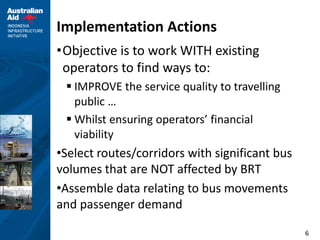
Implementation Actions
•Objective is to work WITH existing
operators to find ways to:
ď‚§ IMPROVE the service quality to travelling
public …
 Whilst ensuring operators’ financial
viability
•Select routes/corridors with significant bus
volumes that are NOT affected by BRT
•Assemble data relating to bus movements
and passenger demand
7
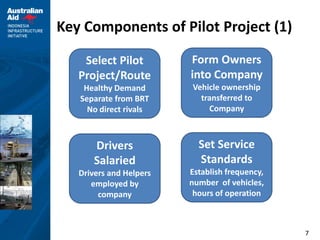
Key Components of Pilot Project (1)
Select Pilot
Project/Route
Healthy Demand
Separate from BRT
No direct rivals
Form Owners
into Company
Vehicle ownership
transferred to
Company
Drivers
Salaried
Drivers and Helpers
employed by
company
Set Service
Standards
Establish frequency,
number of vehicles,
hours of operation
8
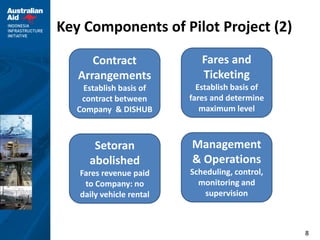
Key Components of Pilot Project (2)
Contract
Arrangements
Establish basis of
contract between
Company & DISHUB
Fares and
Ticketing
Establish basis of
fares and determine
maximum level
Setoran
abolished
Fares revenue paid
to Company: no
daily vehicle rental
Management
& Operations
Scheduling, control,
monitoring and
supervision
9
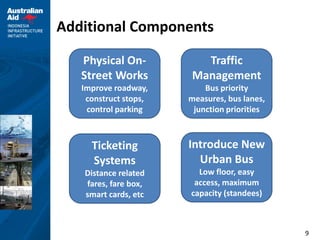
Additional Components
Physical On-
Street Works
Improve roadway,
construct stops,
control parking
Traffic
Management
Bus priority
measures, bus lanes,
junction priorities
Ticketing
Systems
Distance related
fares, fare box,
smart cards, etc
Introduce New
Urban Bus
Low floor, easy
access, maximum
capacity (standees)
10
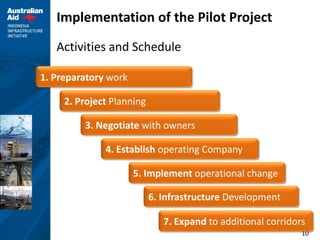
Implementation of the Pilot Project
Activities and Schedule
1. Preparatory work
2. Project Planning
3. Negotiate with owners
5. Implement operational change
7. Expand to additional corridors
4. Establish operating Company
6. Infrastructure Development
11
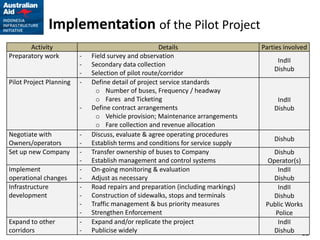
Implementation of the Pilot Project
Activity Details Parties involved
Preparatory work - Field survey and observation
- Secondary data collection
- Selection of pilot route/corridor
IndII
Dishub
Pilot Project Planning - Define detail of project service standards
o Number of buses, Frequency / headway
o Fares and Ticketing
- Define contract arrangements
o Vehicle provision; Maintenance arrangements
o Fare collection and revenue allocation
IndII
Dishub
Negotiate with
Owners/operators
- Discuss, evaluate & agree operating procedures
- Establish terms and conditions for service supply
Dishub
Set up new Company - Transfer ownership of buses to Company
- Establish management and control systems
Dishub
Operator(s)
Implement
operational changes
- On-going monitoring & evaluation
- Adjust as necessary
IndII
Dishub
Infrastructure
development
- Road repairs and preparation (including markings)
- Construction of sidewalks, stops and terminals
- Traffic management & bus priority measures
- Strengthen Enforcement
IndII
Dishub
Public Works
Police
Expand to other
corridors
- Expand and/or replicate the project
- Publicise widely
IndII
Dishub
12
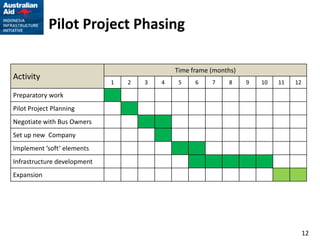
Pilot Project Phasing
Activity
Time frame (months)
1 2 3 4 5 6 7 8 9 10 11 12
Preparatory work
Pilot Project Planning
Negotiate with Bus Owners
Set up new Company
Implement ’soft’ elements
Infrastructure development
Expansion
13
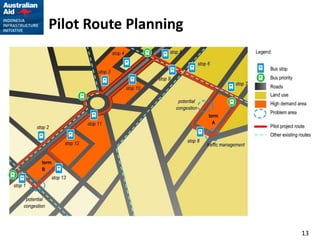
Pilot Route Planning
14
Thank you

9 pilot projects rs final

  • 1.
    Pilot Project Planningand Preparation Rod Stickland
  • 2.
    2 Objectives of Pilot CorridorImprovement Investigating and testing options for improving non-BRT bus services so as to: • Complement BRT and integrate public transport services • Reduce dependence on private car usage • Improve operational efficiency; and • Provide better service to passengers
  • 3.
    3 Recommended Approach •Keep thenon-BRT services in the private sector, where – given an appropriate regulatory environment and reasonable fare levels – improved service levels can be achieved without recourse to subsidy •The Consultants believe that this solution is the most effective and will deliver the required service levels in the most efficient and cost-effective manner
  • 4.
    4 Implementation Strategy •Investigate “reform”in cooperation with existing operators …. and develop a PILOT PROJECT to assess how best to implement in local context •Not practical to introduce all aspects at one time .. so focus initially on key aspects .. and subsequently phase in the less critical aspects
  • 5.
    5 Key Elements ofPilot Project •A package of REFORM measures to address the key deficiencies and problems •Four key aspects of Reform: a. Institutional – legal and contractual issues b. Operational – scheduling and ticketing c. Financial – fares, revenues, costs, salaries d. Physical – traffic management, bus priority, new vehicles
  • 6.
    6 Implementation Actions •Objective isto work WITH existing operators to find ways to:  IMPROVE the service quality to travelling public …  Whilst ensuring operators’ financial viability •Select routes/corridors with significant bus volumes that are NOT affected by BRT •Assemble data relating to bus movements and passenger demand
  • 7.
    7 Key Components ofPilot Project (1) Select Pilot Project/Route Healthy Demand Separate from BRT No direct rivals Form Owners into Company Vehicle ownership transferred to Company Drivers Salaried Drivers and Helpers employed by company Set Service Standards Establish frequency, number of vehicles, hours of operation
  • 8.
    8 Key Components ofPilot Project (2) Contract Arrangements Establish basis of contract between Company & DISHUB Fares and Ticketing Establish basis of fares and determine maximum level Setoran abolished Fares revenue paid to Company: no daily vehicle rental Management & Operations Scheduling, control, monitoring and supervision
  • 9.
    9 Additional Components Physical On- StreetWorks Improve roadway, construct stops, control parking Traffic Management Bus priority measures, bus lanes, junction priorities Ticketing Systems Distance related fares, fare box, smart cards, etc Introduce New Urban Bus Low floor, easy access, maximum capacity (standees)
  • 10.
    10 Implementation of thePilot Project Activities and Schedule 1. Preparatory work 2. Project Planning 3. Negotiate with owners 5. Implement operational change 7. Expand to additional corridors 4. Establish operating Company 6. Infrastructure Development
  • 11.
    11 Implementation of thePilot Project Activity Details Parties involved Preparatory work - Field survey and observation - Secondary data collection - Selection of pilot route/corridor IndII Dishub Pilot Project Planning - Define detail of project service standards o Number of buses, Frequency / headway o Fares and Ticketing - Define contract arrangements o Vehicle provision; Maintenance arrangements o Fare collection and revenue allocation IndII Dishub Negotiate with Owners/operators - Discuss, evaluate & agree operating procedures - Establish terms and conditions for service supply Dishub Set up new Company - Transfer ownership of buses to Company - Establish management and control systems Dishub Operator(s) Implement operational changes - On-going monitoring & evaluation - Adjust as necessary IndII Dishub Infrastructure development - Road repairs and preparation (including markings) - Construction of sidewalks, stops and terminals - Traffic management & bus priority measures - Strengthen Enforcement IndII Dishub Public Works Police Expand to other corridors - Expand and/or replicate the project - Publicise widely IndII Dishub
  • 12.
    12 Pilot Project Phasing Activity Timeframe (months) 1 2 3 4 5 6 7 8 9 10 11 12 Preparatory work Pilot Project Planning Negotiate with Bus Owners Set up new Company Implement ’soft’ elements Infrastructure development Expansion
  • 13.
  • 14.