88
C H A P T E R
7 Creating IT Shared Services1
1 This chapter is based on the authors’ previously published
article, McKeen, J. D., and H. A. Smith. “Creating
IT Shared Services.” Communications of the Association for
Information Systems 29, Article 34 (October 2011):
645–656. Reproduced by permission of the Association for
Information Systems.
A “shared service” is the “provision of a service by one part of
an organization where that service had previously been found in
more than one part of the organization. Thus the funding and
resourcing of the service is shared and the
providing department effectively becomes an internal service
provider” (Wikipedia
2014). The key idea is “sharing” within an organization. It
suggests centralization of
resources, uniformity of service, consistent processes for
service provisioning, econo-
mies of scale, reduced headcount, and enhanced
professionalism. As such it has definite
appeal for IT organizations, and creating them has been
identified as one of the effective
habits of successful CIOs (Andriole 2007).
For the business, an IT shared service is also appealing but for a
different set of
reasons. Although the promise of reducing costs, time, and
complexity through reuse
and the ability to leverage IT skills and knowledge are
attractive, they rank a distant
second to the ability to free up resources by transferring
responsibility for a noncore
activity to another organizational body. Not surprisingly, the
successful creation of a
shared service is by necessity an exercise in goal alignment
(between the business and
IT) coupled with a strategy for goal attainment.
A shared services organization constitutes an alternate business
model. Therefore,
the decision to adopt a shared services model entails a number
of critical questions for
management, such as What are the key attributes of a good
candidate for a shared ser-
vice? How should a shared service be organized, managed, and
governed? What is the
relationship between shared services and the parent
organization? What can be learned
from experience with a shared services model? What theoretical
and practical insight is
offered by published studies of shared services?
This chapter explores these questions. It begins with a review of
the published
literature to provide some definitional clarity concerning the
shared services model
� $IBQUFS��� r� $SFBUJOH�*5�4IBSFE�4FSWJDFT 89
and to differentiate shared services from other closely related
models. The remainder of
the chapter focuses on the key management issues surrounding
the IT shared services
model, including the pros and cons, key organizational factors,
and identifying candi-
date shared services. It concludes with an integrated shared
services conceptual model
and recommendations for moving toward successful shared
services in IT.
IT SHARED SERVICES: AN OVERVIEW
As already noted, the key high-level concepts of a shared
service are that a single group
within the organization manages the service, the service is
offered to any organizational
unit in need of the service, and the shared service is a single-
source provider. Accenture
(2005) similarly defines shared services as “the consolidation of
support functions (such
as human resources, finance, information technology, and
procurement) from several
departments into a standalone organizational entity whose only
mission is to provide
services as efficiently and effectively as possible”. While these
definitions work in
general, they also raise a number of questions. For instance,
how does a shared ser-
vice differ from any other organizational unit that provides
service to the organization
(e.g.,!IT or HR)? How does a shared services organization
relate to the parent organiza-
tion? Does a shared service alter customer relationship in
significant ways? How is a
shared service governed?
Bergeron (2003) offers additional clarity by defining a shared
service as a:
collaborative strategy in which a subset of existing business
functions are
concentrated into a new, semi-autonomous business unit that
has a manage-
ment structure designed to promote efficiency, value generation,
cost savings,
and improved service for the internal customers of the parent
corporation, like
a business competing in the open market.
This definition answers some of the earlier mentioned
questions. For instance,
it interprets shared services as a “collaborative strategy” that
differentiates it from an
organizational structure/design exercise. For example, deciding
that all customer sup-
port functions should report to the COO does not make customer
support a shared
service.
Bergeron further specifies that the shared service should be a
“semiautonomous”
business unit with its own management structure, which
suggests a different and
more “arms-length” relationship with the parent organization—
one that allows suf-
ficient management discretion to enable the shared services
organization to attain its
goals. These goals also differ within this definition with respect
to their breadth and
scope. Value generation, as a goal, takes the shared services
organization well beyond
efficiency and cost considerations; the goal of a shared services
organization is to
“improve the bottom line of the parent corporation, not to create
a more efficient, inter-
nally streamlined shared business unit per se” (Bergeron 2003,
p. 5).
Bergeron’s definition also differentiates a shared service with
respect to its
customer orientation. In a shared services model, internal
customers are treated as if
they were external customers to be won or lost. With this
orientation, the shared service
competes aggressively for business, places customer satisfaction
as a top priority,
90� 4FDUJPO�**� r� *5�(PWFSOBODF
actively manages customer relationships, collaborates
effectively on new business ini-
tiatives, markets its services internally, and communicates its
performance to the busi-
ness on the basis of quality, price, and time. This is not the
lackadaisical approach to
customer service that is typical of organizations that treat their
business partners as a
captive audience.
Treating internal customers like external customers is a
laudable goal but, accord-
ing to one focus group member, a shared services organization
can theoretically go well
beyond this. She explained that significant advantages accrue
exclusively to an internal
provider. For instance, a shared services organization has
existing relationships with
its internal customers with whom they enjoy unfettered access.
Furthermore, they
share!goals, strategies, and culture. They have common
knowledge and are motivated
by the same reward systems. Their loyalty is to the same
organization and they share
financial goals.
External providers, in contrast, lack these advantages but have
the benefit of others.
Most have credibility beyond internal providers simply because
they are competitive in
the marketplace. They may also have economies of scale and
advanced technology that
can be amortized over a broad client base. Moreover, they may
have superior skills
and knowledge. Her argument was that an effective shared
services organization, to
the extent that it develops enhanced customer relationships and
a competitive mar-
ket orientation while both facilitating and benefiting from
internal customer access,
could at least theoretically realize the “best of both worlds”.
More than just the conver-
gence and streamlining of an organization’s functions to ensure
that they deliver to the
organization the services required of them as effectively and
efficiently as possible, the
true shared services organization generates value for the parent
organization as if (and
possibly) competing in the open market.
Shared services are related to, but should not be confused with,
more traditional
models of delivering IT services (McKeen and Smith 2007).
Carefully delineating each
of the following points further aids our understanding of shared
services.
r�
"�TIBSFE�TFSWJDF�JT�NPTU�FBTJMZ�EJGGFSFOUJB
UFE�GSPN�B� decentralized service delivery
model. In the decentralized model, services are provided in
various organizational
units and managed locally. It is common in highly diversified
organizations to
find that each business unit has its own IT organization so that
the provision of IT
services can be tailored to the unique differences existing
within each of the strategic
business units.
r� *O�DPOUSBTU
�B�centralized model for IT services brings all resources
under a single
management structure, adopting virtualization and
standardization strategies to
increase utilization of key resources and to lower operational
costs. There are two
primary differences between a centralized model and the shared
services model.
First, shared services have a customer-centric mind-set (users of
the service are
viewed as customers, and the shared service is dedicated to
providing high- quality,
cost-effective, and timely service) and second, shared services
are run as an inde-
pendent business with their own budget and bottom-line
accountability. The focus
group concluded that a shared service is always centralized but
a centralized ser-
vice is not necessarily a shared service; that is, centralization is
a “necessary but
insufficient” condition for a shared service.
� $IBQUFS��� r� $SFBUJOH�*5�4IBSFE�4FSWJDFT 91
r� 5IF� TIBSFE� TFSWJDFT� NPEFM� BMTP�
EJGGFST� GSPN� outsourcing where an external third
party is paid to provide a service that was previously internal to
the buying orga-
nization. While a shared services model is often viewed as a
stepping-stone to out-
sourcing, the focus group suggested that the decision to create a
shared service
should not be a de facto decision to outsource. The relationship
between outsourcing
and shared services is further explored later.
r�
"�TIBSFE�TFSWJDFT�NPEFM�BMTP�EJGGFST�GSPN�
B�joint venture where two or more organi-
zations create a separate, jointly owned, legal, and commercial
entity that provides
profit to its shareholders/owners. This delivery mechanism is
used frequently in
various industries such as banking and finance as well as oil and
petroleum. As
with the outsourcing model, the service is provided by an
external agency that
owns the profits derived from the provision of the service.
After a lengthy discussion, the focus group reached a
consensual understanding
of a shared services organization. The members suggested that a
true shared service
must adhere to the following four principles:
1. Shared services involves more than just centralization or
consolidation of simi-
lar activities in one location (although this was recognized as an
essential part as
already noted);
2. Shared services must embrace a customer orientation (i.e., as
already mentioned, a
shared service cannot behave as a monopolistic provider);
3. Sufficient management discretion and autonomy must exist
within the shared ser-
vices organization to allow freedom to generate the necessary
efficiencies to create
value for the parent organization; and,
4. Shared services must be run like a business in order to
deliver services to internal
customers with costs, quality, and timeliness that are
competitive with that of exter-
nal providers.
On this last point, one member of the focus group argued that a
shared services
provider will never satisfy internal customers unless and until
the shared services orga-
nization is allowed to offer services to external customers. In
his organization, despite
spending a considerable amount of money on external
consultants to prove that their
IT shared services was competitive with that of external
providers, the business “just
didn’t buy it.” There seems to be a general unease among
business executives about
whether or not they are getting real value from their IT
investments and this carries
over to shared services.
The other major concern for the focus group was the
interpretation of “value” as
created by the shared services organization. Some members felt
that “value” was the
demonstration that the shared services unit could provide cost
savings to their par-
ent organization. Other members felt that cost savings would be
insufficient to justify
the creation of a shared services organization, arguing that
simply centralizing services
would produce similar savings. They felt that a shared services
organization should
be expected to generate additional value beyond efficiency—
offering enhanced quality
and/or differentiated services—such that value could be realized
in terms of revenue
generation. While no resolution emerged, it is clear that the
broader interpretation of
value aligns better with the group’s accepted definition of
shared services.
92� 4FDUJPO�**� r� *5�(PWFSOBODF
IT SHARED SERVICES: PROS AND CONS
A shared services model for IT has the potential to deliver
significant benefits to the
organization (Bergeron 2003). From the parent organization’s
perspective, shared
services promise to:
r� 3FEVDF� DPTUT� EVF� UP� DPOTPMJEBUFE�
PQFSBUJPOT
� BOE� JNQSPWF� TFSWJDF� EVF� UP� UIF�
customer-centric focus)
r� 3FEVDF� EJTUSBDUJPOT� GSPN� DPSF�
DPNQFUFODZ� BDUJWJUJFT� EVF� UP� USBOTGFS�
PG� OPODPSF�
activities to the shared services organization)
r� 1PUFOUJBMMZ� DSFBUF� BO� FYUFSOBMMZ�
GPDVTFE� QSPGJU� DFOUFS� TIPVME� UIF� TIBSFE�
TFSWJDFT�
decide to offer services beyond the parent organization).
From the perspective of the shared business unit, the shared
services model
promises:
r� *ODSFBTFE�FGGJDJFODJFT�
EVF�UP�TUBOEBSEJ[BUJPO�BOE�VOJGPSNJUZ�P
G�TFSWJDFT
r� %FDSFBTFE�QFSTPOOFM�SFRVJSFNFOUT�
EVF�UP�DPOTPMJEBUFE�PQFSBUJPOT
r� *NQSPWFE� FDPOPNJFT� PG� TDBMF� EVF� UP�
UIF� DPODFOUSBUJPO� PG� QVSDIBTJOH
� )3
� BOE�
other specialized functions).
The focus group generally agreed with this list of possible
benefits and suggested
additional items including:
r� 1SPGFTTJPOBMJTN�
EVF�UP�UIF�BEPQUJPO�PG�B�DVTUPNFS�DFOU
SJD�BQQSPBDI�JO�EFBMJOH�XJUI�
clients)
r� 6OJGPSNJUZ�PG�TFSWJDF�
EVF�UP�DPOTJTUFOU�TFSWJDF�QSPWJTJPOJOH�
BDSPTT�UIF�FOUFSQSJTF
r� 1FSTPOOFM� EFWFMPQNFOU� EVF� UP�
GPDVTFE� IJSJOH
� USBJOJOH
� BOE� TLJMMT�LOPXMFEHF�
development, all targeted toward service management)
r� $POUSPM�
EVF�UP�TJOHMF�TPVSDFE�TFSWJDF�NBOBHFNF
OU
�
However, there is also a case to be made against shared services
(Bergeron 2003).
The focus group highlighted the following limitations as being
the most relevant for IT
shared services:
r�
#FDPNJOH�B�EJTSVQUJPO�UP�UIF�TFSWJDF�GMPX
r�
.PWJOH�XPSL�UP�B�DFOUSBM�MPDBUJPO�UIFSFCZ
�DSFBUJOH�XBTUFGVM�IBOEPGGT
�SFXPSL
�BOE�
or duplication
r�
*OTUJMMJOH�BO�iVTu�WFSTVT�iUIFNu�NFOUBMJUZ
�XJUIJO�UIF�QSPWJEFSmDPOTVNFS�SFMBUJPOTIJQ
r� -
FOHUIFOJOH�UIF�UJNF�JU�UBLFT�UP�EFMJWFS�B�
TFSWJDF�
The focus group also added the following:
r�
"EEJUJPOBM�DPTUT�BTTPDJBUFE�XJUI�NBOBHFNFO
U�CVSFBVDSBDZ�BOE�PWFSIFBE
r� -
PTT�PG�DPOUSPM�FYQFSJFODFE�CZ�JOEFQFOEFOU�
CVTJOFTT�VOJUT
r� "O�JODSFBTFE�DPNNVOJDBUJPOT�CVSEFO
r� &YUSBPSEJOBSZ� POF�UJNF� DPTUT� BU�
TUBSU�VQ� UIBU� BSF� SFGMFDUFE� XJUIJO� UIF�
TFSWJDF�
offerings.
Thus, while the list of benefits of shared services is long and
impressive, the
downside risk is equally imposing. The focus group also warned
that the list of benefits
represents “promised” benefits and that realizing actual benefits
is a different matter!
� $IBQUFS��� r� $SFBUJOH�*5�4IBSFE�4FSWJDFT 93
To gain a different perspective of the trade-offs between these
pros and cons,
members of the focus group were asked to share their actual
experiences with IT shared
services, highlighting failures as well as successes. Subsequent
analysis revealed the
following patterns of failure (from greatest to least):
r�
1SPNJTFE�IFBEDPVOU�SFEVDUJPO�EPFTO�U�NBUFSJ
BMJ[F
r�
$VTUPNFS�DFOUSJD�PSJFOUBUJPO�HJWFT�XBZ�UP�
JOEJGGFSFOU�TFSWJDF
r�
&YDFTTJWF�CVSFBVDSBUJ[BUJPO�PG�UIF�TFSWJDF
r�
3FEVDFE�IFBEDPVOU�BDIJFWFE�CVU�TFSWJDF�MF
WFMT�EFUFSJPSBUF
r�
$PTU�FGGJDJFODJFT�BSF�SFBMJ[FE�UISPVHI�iPOF�
TJ[F�GJUT�BMMu�TFSWJDF�PGGFSJOHT
The following patterns of success were identified (from greatest
to least):
r� 4FSWJDF�JNQSPWFT�QSPEVDJOH�RVBMJUZ
�UJNF
�BOE�DPTU�BEWBOUBHFT
r�
4FSWJDF�RVBMJUZ�BOE�UJNF�DPTU�TBWJOHT�BSF
�SFBMJ[FE
r�
4FSWJDF�RVBMJUZ�JNQSPWFT�CVU�XJUIPVU�OPUJD
FBCMF�TBWJOHT
r�
)FBEDPVOUT�BSF�SFEVDFE�CVU�TFSWJDF�MFWFMT
�SFNBJO�VODIBOHFE
The track record of the focus group was equivocal; no
organization was celebrating
the highest level of success and none was publicly admitting to
outright failure.
Explaining these differences in outcomes was the next
challenge.
IT SHARED SERVICES: KEY ORGANIZATIONAL SUCCESS
FACTORS
Interpreting the success of an organizational initiative depends
on understanding the
goals and objectives of those promoting the initiative. To gain
some insight into this
aspect of shared services, the focus group was asked what they
felt was motivating the
current interest in shared services and whether it was being
driven primarily from the
business or from IT. This allowed us not only to examine the
driving factors behind
a shared services model but also to highlight any differences
between the business
and IT perspectives. In the ensuing discussion, a significant gap
emerged between
the views of the business and the IT organizations with respect
to a shared services
model— specifically what problems it solved, the benefits it
produced, and the unique
challenges the adoption of a shared services model presents.
The majority of members felt that the push for shared services
was coming from
IT and that their IT organizations were sufficiently interested in
actively promoting a
shared services model. In contrast, two members of the focus
group declared that the
push within their organizations was definitely coming from the
business. One was a
large organization whose goal was to become a “globally
integrated enterprise” built on
shared business services. IT was no exception. Specialized IT
services, located globally
anywhere that would yield advantage, were offered to all
business units within the
organization as a shared service. The other organization was
undergoing an enterprise-
wide initiative to outsource noncore activities and IT had come
under the microscope.
Here, the focus group member stated that “our management
clearly views shared
services as a prerequisite for outsourcing.”
For organizations where the push for shared services originates
within IT, the
motivation was clearly cost savings and/or control. According
to one manager, “shared
services are seen as one way to reduce IT cost and/or
complexity and drive IT reuse.
This is being driven today out of the IT organization but we
understand that our
94� 4FDUJPO�**� r� *5�(PWFSOBODF
business partners need to be onboard for anything beyond the
simplest of IT shared
services”. Another manager stated that the interest was
primarily being driven by her
IT organization to achieve the following three key goals:
r�
5P�DSFBUF�SFVTBCMF�CVTJOFTT�GVODUJPOT�UP�
FOBCMF�DPTU�SFEVDUJPO
r�
5P�ESJWF�BHJMJUZ�CZ�NFBOT�PG�B�TFU�PG�XFM
M�EFGJOFE�IPSJ[POUBM�TFSWJDFT
r�
5P�VMUJNBUFMZ�DSFBUF�B�SBUJPOBMJ[FE�BOE�TJ
NQMJGJFE�BQQMJDBUJPO�QPSUGPMJP�
When asked what problems a shared services model might
solve, the focus group
cited the following:
r� *ODPOTJTUFOU� JOUFHSBUJPO� QBUUFSOT�
UIBU� MFBE� UP� TUFBEJMZ� JODSFBTJOH� DPTUT�
GPS� TPMVUJPO�
maintenance and enhancement
r�
#VJMEJOH�SFEVOEBOU�BQQMJDBUJPOT�VTJOH�PWF
SMZ�TQFDJGJD�NPEFMT�CFDBVTF�PG�UIF�MBDL�P
G�
a roadmap for sharing functionality
r� -BDL�PG�JOUFHSBUJPO
�XIJDI�IBNQFST�SFVTBCJMJUZ�BOE�FDPOPNJFT�PG
�TDBMF
r�
*ODSFBTJOH�BOE�QFSIBQT�VOOFDFTTBSZ�*5�DPNQ
MFYJUZ�
The significant gap between how the IT organization approaches
shared services
as compared to the business is most apparent in the articulation
of goals, objectives, and
the ultimate justification of a shared services model. This
becomes increasingly signifi-
cant when coupled with the fact that the majority of shared
services initiatives are being
driven by IT.
In organizations where the driving force for shared services
resides within the
IT organization, the focus is commonly on that part of a shared
service model that
addresses IT problems; for example, reducing redundancy,
encouraging integration,
and rationalizing the application portfolio. Solving these
problems, however, only
addresses business problems tangentially through reduced costs
and streamlined pro-
cesses and fails outright to attain the goals of customer
centricity and enhanced service
to the business. The differences between the business vision for
shared services and the
IT vision, unless aligned, is a recipe for disaster. Based on input
from the focus group,
we build a conceptual model that bridges this gap by integrating
the technical aspects
of an IT shared service with the business aspects. But, before
we do this, it is necessary
to first discuss the key factors that constitute the basis for
decision making regarding IT
shared services.
IDENTIFYING CANDIDATE SERVICES
An analysis of the existing shared services within the focus
group revealed very little in
terms of discernible patterns. Some of the shared services were
business-oriented services
(e.g., payment processing or procurement) while others were IT-
oriented (e.g., print
management or network services). Some were comprehensive
(e.g., application develop-
ment, disaster recovery) while others were narrowly focused
(e.g., credit authorization).
Some of the services were deemed “core” while others were
“noncore.” Other than enter-
prisewide need, no obvious logical structure emerged from our
analysis as a potential
decision guideline for nominating shared services.
In general, the focus group felt that the selection criteria of
candidate services for
the shared services model were best understood by contrasting
shared services with
outsourcing. They argued that any service being considered for
outsourcing could also
� $IBQUFS��� r� $SFBUJOH�*5�4IBSFE�4FSWJDFT 95
be a candidate for a shared service subject to three key
differences: knowledge reten-
tion, control of resources, and value generation. That is,
organizations appear to opt for
a shared service in preference to outsourcing in order to retain
critical knowledge and
skills internally, to exercise greater control over these
resources, or to capture additional
value from the specific service rather than allowing it to accrue
to the outsourcing party.
The conclusion reached by the focus group was that the
processes structured as shared
services appear to offer a significant level of either present or
future intrinsic value to
the parent organization, which makes the organization reluctant
to relinquish them to a
third party. Services without incremental intrinsic value beyond
cost savings are simply
outsourced.
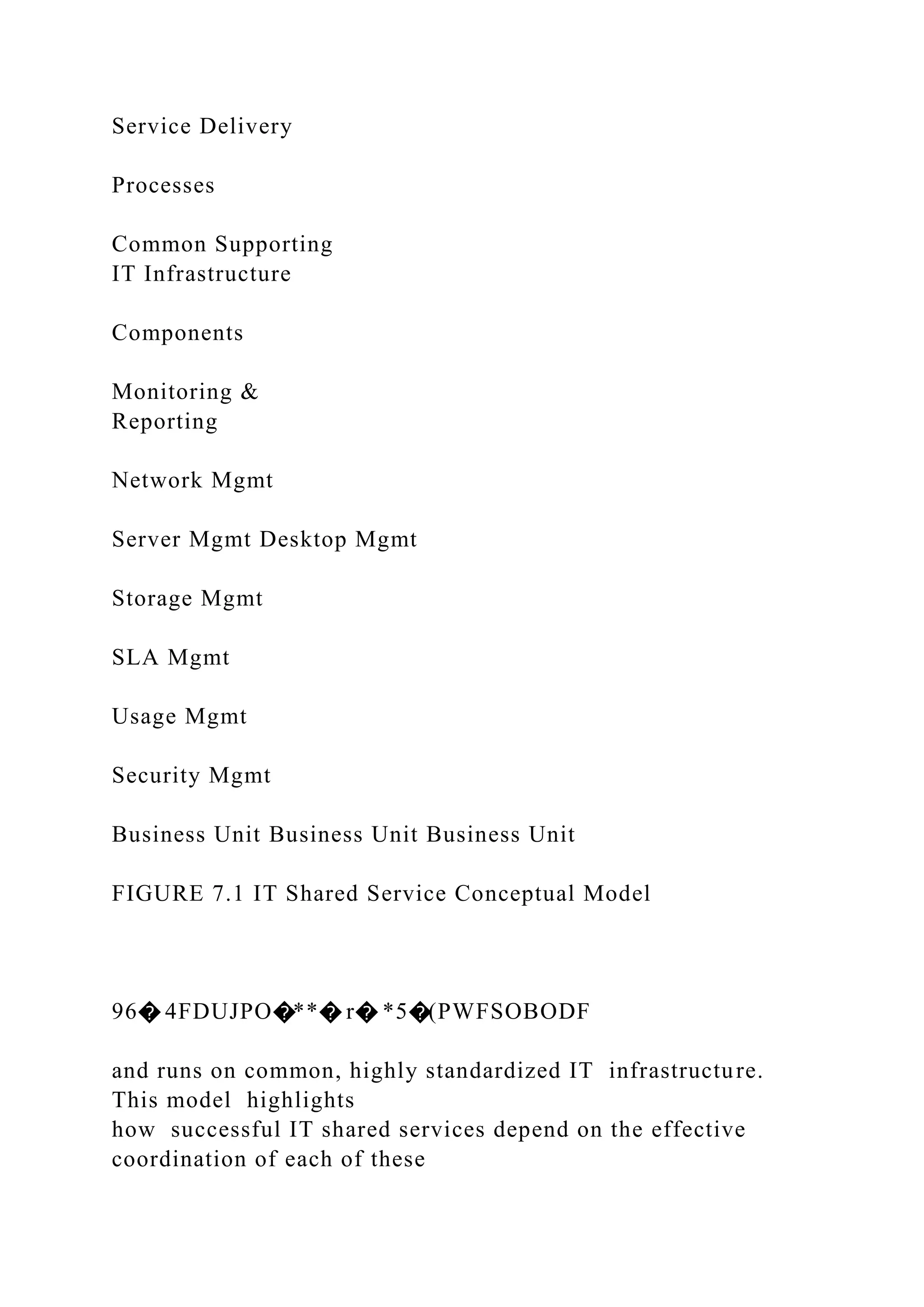
AN INTEGRATED MODEL OF IT SHARED SERVICES
One member of the focus group presented his organization’s
model of a shared service
'JHVSF����
��*O�DPOUSBTU�UP�UIF�-BDJUZ�BOE�'PY� ����
�GSBNFXPSL
�UIJT��DPODFQUVBM�NPEFM�
highlights the functional attributes of the business service, the
management framework
required to monitor and deliver the service, and the common
technical infrastructure ser-
vices that support it. It suggests that IT shared services is best
viewed as inter connected
layers of services; that is, business services are built on top of
operational processes
and common IT infrastructure, each of which deliver “services”
but of a different sort.
For example, a common business function (e.g., e-forms) is
leveraged by multiple busi-
OFTT�FOUJUJFT
�TVQQPSUFE�CZ�DPNNPOMZ�NBOBHFE�CVTJOFTT�
EFMJWFSZ�QSPDFTTFT�BOE�4-"T
�
Multi-Tenant
Business Services
Common Business
Service Delivery
Processes
Common Supporting
IT Infrastructure
Components
Monitoring &
Reporting
Network Mgmt
Server Mgmt Desktop Mgmt
Storage Mgmt
SLA Mgmt
Usage Mgmt
Security Mgmt
Business Unit Business Unit Business Unit
FIGURE 7.1 IT Shared Service Conceptual Model
96� 4FDUJPO�**� r� *5�(PWFSOBODF
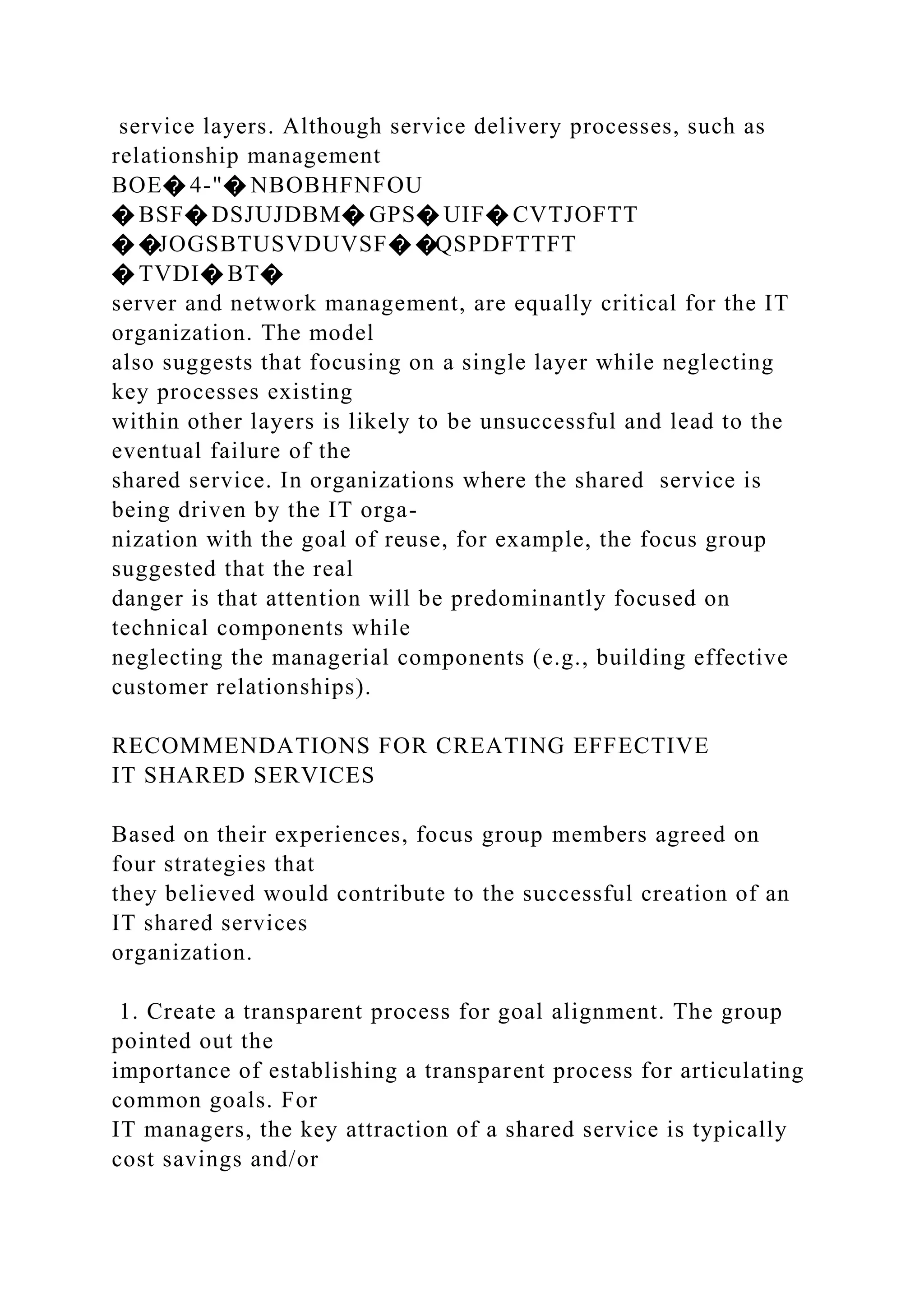
and runs on common, highly standardized IT infrastructure.
This model highlights
how successful IT shared services depend on the effective
coordination of each of these
service layers. Although service delivery processes, such as
relationship management
BOE� 4-"� NBOBHFNFOU
� BSF� DSJUJDBM� GPS� UIF� CVTJOFTT
� �JOGSBTUSVDUVSF� �QSPDFTTFT
� TVDI� BT�
server and network management, are equally critical for the IT
organization. The model
also suggests that focusing on a single layer while neglecting
key processes existing
within other layers is likely to be unsuccessful and lead to the
eventual failure of the
shared service. In organizations where the shared service is
being driven by the IT orga-
nization with the goal of reuse, for example, the focus group
suggested that the real
danger is that attention will be predominantly focused on
technical components while
neglecting the managerial components (e.g., building effective
customer relationships).
RECOMMENDATIONS FOR CREATING EFFECTIVE
IT SHARED SERVICES
Based on their experiences, focus group members agreed on
four strategies that
they believed would contribute to the successful creation of an
IT shared services
organization.
1. Create a transparent process for goal alignment. The group
pointed out the
importance of establishing a transparent process for articulating
common goals. For
IT managers, the key attraction of a shared service is typically
cost savings and/or
reduced complexity. Being able to reduce costs by means of
mobilizing reuseable
assets standardizing platforms and virtualizing services, and
eliminating redun-
dant systems while providing a uniform and consistent level of
service is appeal-
ing. For business managers, however, the promise of cost
savings comes second to
the desire for enhanced customer service through improved
quality, faster response
and delivery, greater financial transparency, and/or improved
relationships with
IT. Without goal clarity, transparency, and alignment, the
shared services organiza-
tion will champion one set of goals over another, creating
animosity between the
parent organization and the shared services provider. One …
CMGT/400 v7
Threats, Attacks, and Vulnerability Assessment Template
CMGT/400 v7
Page 2 of 2Security Standards, Policies, and Procedures Manual
Template
Instructions: Replace the information in brackets [ ] with
information relevant to your project.
Cyber Security Engineers are responsible for safeguarding
computer networks and systems in an organization in order to
protect the sensitive data they store.
Take on the role of Cyber Security Engineer for the
organization you chose in Week 1. Research the following
information for your chosen organization. Develop a Security
Standards, Policies, and Procedures Manual using this template
with recommendations to management of security standards,
polices, and procedures which should be implemented in your
organization.[Organization Name] – (Capital One)
Overview
Explain the importance to your organization of implementing
security policies, plans, and procedures. Discuss how security
policies, plans, and procedures will improve the overall security
of the organization.
[Response]
Data Privacy Policies and Procedures
[Response]
Data Isolation Policies and Procedures
[Response]
Non-Disclosure Agreement (NDA) Policies and Procedures
[Response]
Intellectual Property (IP) Policies and Procedures
[Response]
Password Policies and Procedures
[Response]
Acceptable Use of Organizational Assets and Data Policies and
Procedures
[Response]
Employee Policies and Procedures (Separation of
Duties/Training)
[Response]
Risk Response Policies and Procedures
Define avoidance, transference, mitigation, and acceptance
strategies and criteria.
[Response]
Compliance (Regulatory, Advisory, Informative)
Examples could include: HIPPA, FERPA, ISO, NIST, SEC, and
Sarbanes/Oxley.
[Response]
Incident Response Policies and Procedures
Include: Preparation, Identification, Containment, Eradication,
Recovery, and Lessons Learned
[Response]
Auditing Policies and Procedures
[Response]
Environmental/Physical Policies and Procedures
[Response]
Administrative Policies and Procedures
[Response]
Configuration Policies and Procedures
[Response]
Copyright© 2018 by University of Phoenix. All rights reserved.
Grading Rubric
Importance of a security program 10% -
Excellent - Deliverables are insightful and exceptional in their
understanding and application of concepts and principles of the
importance of security policies, plans, and procedures. 85 -
100%
Satisfactory - Deliverables are clear and complete in their
understanding and application of concepts and principles of the
importance of security policies, plans, and procedures. 75 - 84%
Policies and Procedures 10% -
Excellent - Deliverables are insightful and exceptional in their
understanding and application of concepts and principles of data
classification, NDAs, strong authentication, acceptable use,
separation of duties, training, and managing identified risk. 85 -
100%
Satisfactory - Deliverables are clear and complete in their
understanding and application of concepts and principles of the
importance of data classification, NDAs, strong authentication,
acceptable use, separation of duties, training, and managing
identified risk. 75 -84%
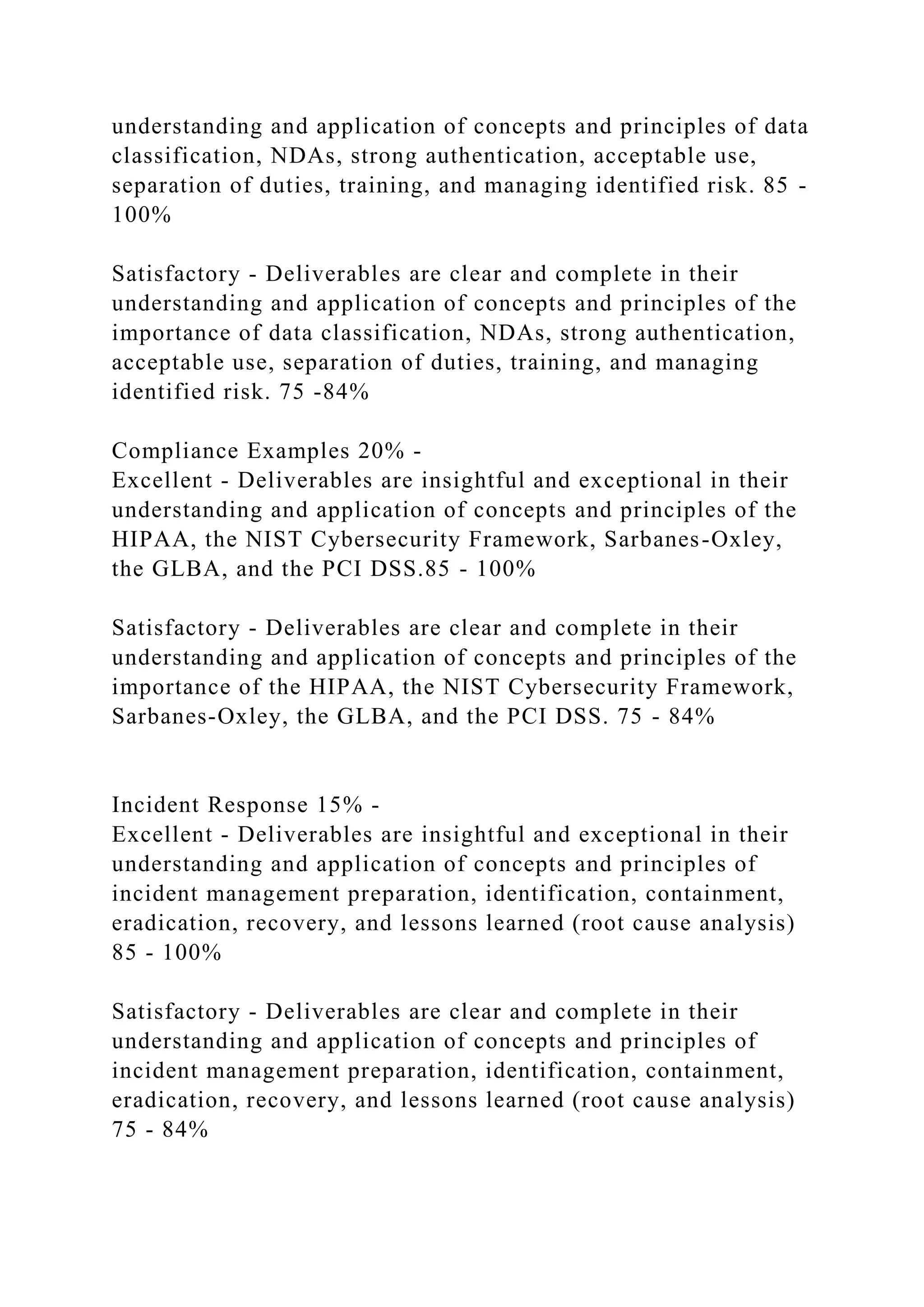
Compliance Examples 20% -
Excellent - Deliverables are insightful and exceptional in their
understanding and application of concepts and principles of the
HIPAA, the NIST Cybersecurity Framework, Sarbanes-Oxley,
the GLBA, and the PCI DSS.85 - 100%
Satisfactory - Deliverables are clear and complete in their
understanding and application of concepts and principles of the
importance of the HIPAA, the NIST Cybersecurity Framework,
Sarbanes-Oxley, the GLBA, and the PCI DSS. 75 - 84%
Incident Response 15% -
Excellent - Deliverables are insightful and exceptional in their
understanding and application of concepts and principles of
incident management preparation, identification, containment,
eradication, recovery, and lessons learned (root cause analysis)
85 - 100%
Satisfactory - Deliverables are clear and complete in their
understanding and application of concepts and principles of
incident management preparation, identification, containment,
eradication, recovery, and lessons learned (root cause analysis)
75 - 84%
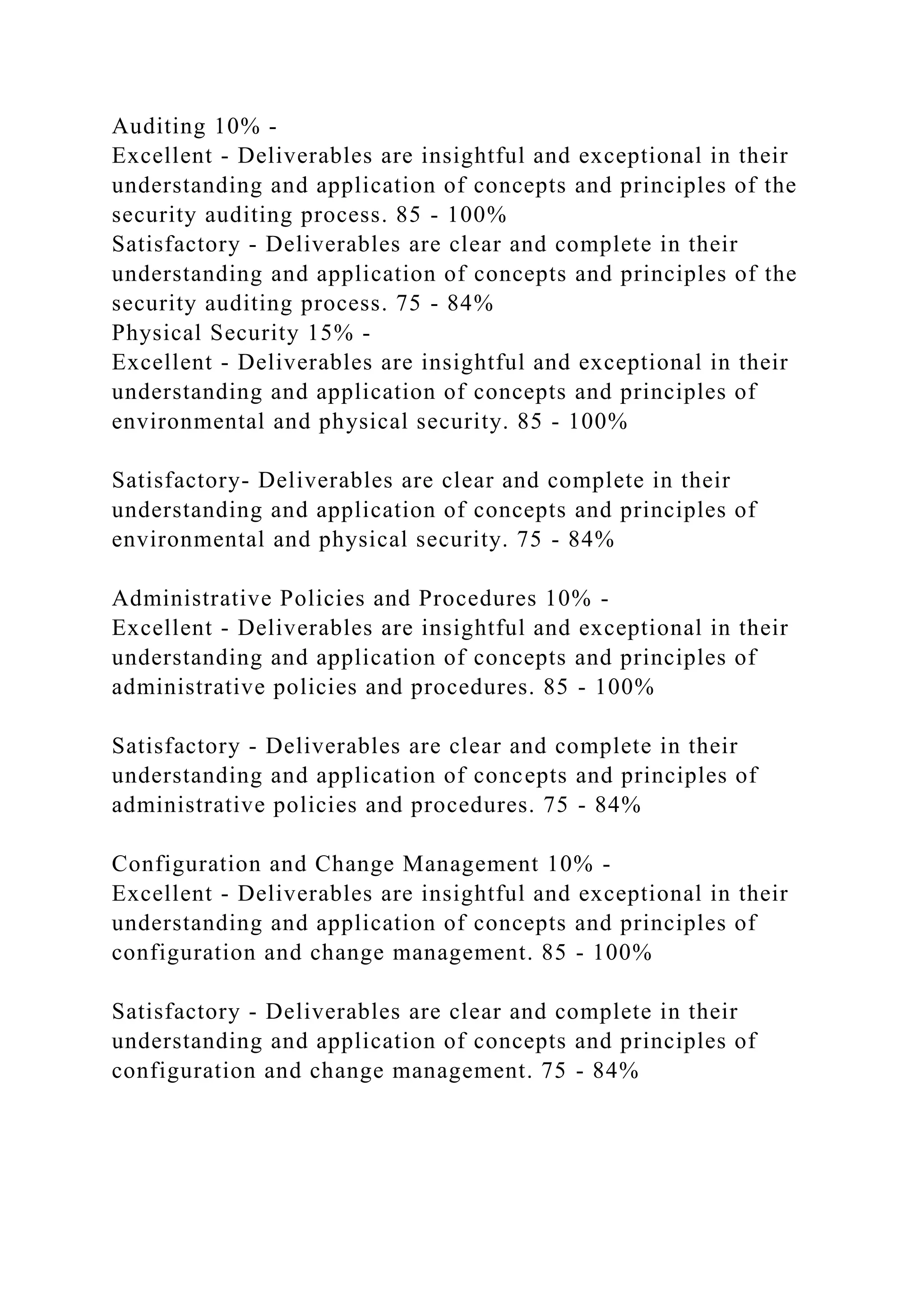
Auditing 10% -
Excellent - Deliverables are insightful and exceptional in their
understanding and application of concepts and principles of the
security auditing process. 85 - 100%
Satisfactory - Deliverables are clear and complete in their
understanding and application of concepts and principles of the
security auditing process. 75 - 84%
Physical Security 15% -
Excellent - Deliverables are insightful and exceptional in their
understanding and application of concepts and principles of
environmental and physical security. 85 - 100%
Satisfactory- Deliverables are clear and complete in their
understanding and application of concepts and principles of
environmental and physical security. 75 - 84%
Administrative Policies and Procedures 10% -
Excellent - Deliverables are insightful and exceptional in their
understanding and application of concepts and principles of
administrative policies and procedures. 85 - 100%
Satisfactory - Deliverables are clear and complete in their
understanding and application of concepts and principles of
administrative policies and procedures. 75 - 84%
Configuration and Change Management 10% -
Excellent - Deliverables are insightful and exceptional in their
understanding and application of concepts and principles of
configuration and change management. 85 - 100%
Satisfactory - Deliverables are clear and complete in their
understanding and application of concepts and principles of
configuration and change management. 75 - 84%
Cyber Security Engineers are responsible for safeguarding
computer networks and systems in an organization in order to
protect the sensitive data they store.
Take on the role of Cyber Security Engineer for Capital One
Bank the organization you chose in Week 1.
Develop a 6- to 7-page manual using the Security Standards,
Policies, and Procedures Template with recommendations to
management of security standards, polices, and procedures
which should be implemented in your chosen organization.
Research and include the following:
· REFER TO ADDITIONAL RESOURCES BELOW and the
grading rubric.
· Explain the importance to your organization of implementing
security policies, plans, and procedures. Discuss how security
policies, plans, and procedures will improve the overall security
of the organization.
· Recommend appropriate policies and procedures for:
· Data classification policies and procedures (data isolation)
· Non-disclosure Agreement policies and procedures
· Strong authentication (password policies and procedures... and
multi factor authentication)
· Acceptable use of organizational assets and data
· Employee policies (separation of duties/training)
· Risk Management
· Avoidance
· Transference
· Mitigation
· Acceptance
· Compliance examples that might affect your organization or
others [Regulatory, Advisory, Informative]
· HIPAA
· NIST Cybersecurity Framework
· Sarbanes/Oxley
· GLBA
· PCI DSS
· Incident response (How should we prepare, and what should
happen in each phase)
· Preparation
· Identification
· Containment
· Eradication
· Recovery
· Lessons learned (root cause analysis and action plan)
· Auditing
· Environmental/Physical
· Administrative
· From the text:
· "Controls are implemented as administrative, logical, and
physical. Administrative controls are also known as
management controls and include policies and procedures.
Logical controls are also known as technical controls and are
implemented through technology. Physical controls use physical
means to protect objects."
· Configuration (change management and system hardening)

88C H A P T E R7 Creating IT Shared Services11 Thi.docx

  • 1.
    88 C H AP T E R 7 Creating IT Shared Services1 1 This chapter is based on the authors’ previously published article, McKeen, J. D., and H. A. Smith. “Creating IT Shared Services.” Communications of the Association for Information Systems 29, Article 34 (October 2011): 645–656. Reproduced by permission of the Association for Information Systems. A “shared service” is the “provision of a service by one part of an organization where that service had previously been found in more than one part of the organization. Thus the funding and resourcing of the service is shared and the providing department effectively becomes an internal service provider” (Wikipedia 2014). The key idea is “sharing” within an organization. It suggests centralization of resources, uniformity of service, consistent processes for service provisioning, econo- mies of scale, reduced headcount, and enhanced professionalism. As such it has definite appeal for IT organizations, and creating them has been identified as one of the effective habits of successful CIOs (Andriole 2007). For the business, an IT shared service is also appealing but for a different set of reasons. Although the promise of reducing costs, time, and
  • 2.
    complexity through reuse andthe ability to leverage IT skills and knowledge are attractive, they rank a distant second to the ability to free up resources by transferring responsibility for a noncore activity to another organizational body. Not surprisingly, the successful creation of a shared service is by necessity an exercise in goal alignment (between the business and IT) coupled with a strategy for goal attainment. A shared services organization constitutes an alternate business model. Therefore, the decision to adopt a shared services model entails a number of critical questions for management, such as What are the key attributes of a good candidate for a shared ser- vice? How should a shared service be organized, managed, and governed? What is the relationship between shared services and the parent organization? What can be learned from experience with a shared services model? What theoretical and practical insight is offered by published studies of shared services? This chapter explores these questions. It begins with a review of the published literature to provide some definitional clarity concerning the shared services model � $IBQUFS��� r� $SFBUJOH�*5�4IBSFE�4FSWJDFT 89 and to differentiate shared services from other closely related models. The remainder of
  • 3.
    the chapter focuseson the key management issues surrounding the IT shared services model, including the pros and cons, key organizational factors, and identifying candi- date shared services. It concludes with an integrated shared services conceptual model and recommendations for moving toward successful shared services in IT. IT SHARED SERVICES: AN OVERVIEW As already noted, the key high-level concepts of a shared service are that a single group within the organization manages the service, the service is offered to any organizational unit in need of the service, and the shared service is a single- source provider. Accenture (2005) similarly defines shared services as “the consolidation of support functions (such as human resources, finance, information technology, and procurement) from several departments into a standalone organizational entity whose only mission is to provide services as efficiently and effectively as possible”. While these definitions work in general, they also raise a number of questions. For instance, how does a shared ser- vice differ from any other organizational unit that provides service to the organization (e.g.,!IT or HR)? How does a shared services organization relate to the parent organiza- tion? Does a shared service alter customer relationship in significant ways? How is a shared service governed? Bergeron (2003) offers additional clarity by defining a shared
  • 4.
    service as a: collaborativestrategy in which a subset of existing business functions are concentrated into a new, semi-autonomous business unit that has a manage- ment structure designed to promote efficiency, value generation, cost savings, and improved service for the internal customers of the parent corporation, like a business competing in the open market. This definition answers some of the earlier mentioned questions. For instance, it interprets shared services as a “collaborative strategy” that differentiates it from an organizational structure/design exercise. For example, deciding that all customer sup- port functions should report to the COO does not make customer support a shared service. Bergeron further specifies that the shared service should be a “semiautonomous” business unit with its own management structure, which suggests a different and more “arms-length” relationship with the parent organization— one that allows suf- ficient management discretion to enable the shared services organization to attain its goals. These goals also differ within this definition with respect to their breadth and scope. Value generation, as a goal, takes the shared services organization well beyond efficiency and cost considerations; the goal of a shared services organization is to
  • 5.
    “improve the bottomline of the parent corporation, not to create a more efficient, inter- nally streamlined shared business unit per se” (Bergeron 2003, p. 5). Bergeron’s definition also differentiates a shared service with respect to its customer orientation. In a shared services model, internal customers are treated as if they were external customers to be won or lost. With this orientation, the shared service competes aggressively for business, places customer satisfaction as a top priority, 90� 4FDUJPO�**� r� *5�(PWFSOBODF actively manages customer relationships, collaborates effectively on new business ini- tiatives, markets its services internally, and communicates its performance to the busi- ness on the basis of quality, price, and time. This is not the lackadaisical approach to customer service that is typical of organizations that treat their business partners as a captive audience. Treating internal customers like external customers is a laudable goal but, accord- ing to one focus group member, a shared services organization can theoretically go well beyond this. She explained that significant advantages accrue exclusively to an internal provider. For instance, a shared services organization has existing relationships with
  • 6.
    its internal customerswith whom they enjoy unfettered access. Furthermore, they share!goals, strategies, and culture. They have common knowledge and are motivated by the same reward systems. Their loyalty is to the same organization and they share financial goals. External providers, in contrast, lack these advantages but have the benefit of others. Most have credibility beyond internal providers simply because they are competitive in the marketplace. They may also have economies of scale and advanced technology that can be amortized over a broad client base. Moreover, they may have superior skills and knowledge. Her argument was that an effective shared services organization, to the extent that it develops enhanced customer relationships and a competitive mar- ket orientation while both facilitating and benefiting from internal customer access, could at least theoretically realize the “best of both worlds”. More than just the conver- gence and streamlining of an organization’s functions to ensure that they deliver to the organization the services required of them as effectively and efficiently as possible, the true shared services organization generates value for the parent organization as if (and possibly) competing in the open market. Shared services are related to, but should not be confused with, more traditional models of delivering IT services (McKeen and Smith 2007). Carefully delineating each
  • 7.
    of the followingpoints further aids our understanding of shared services. r� "�TIBSFE�TFSWJDF�JT�NPTU�FBTJMZ�EJGGFSFOUJB UFE�GSPN�B� decentralized service delivery model. In the decentralized model, services are provided in various organizational units and managed locally. It is common in highly diversified organizations to find that each business unit has its own IT organization so that the provision of IT services can be tailored to the unique differences existing within each of the strategic business units. r� *O�DPOUSBTU �B�centralized model for IT services brings all resources under a single management structure, adopting virtualization and standardization strategies to increase utilization of key resources and to lower operational costs. There are two primary differences between a centralized model and the shared services model. First, shared services have a customer-centric mind-set (users of the service are viewed as customers, and the shared service is dedicated to providing high- quality, cost-effective, and timely service) and second, shared services are run as an inde- pendent business with their own budget and bottom-line accountability. The focus group concluded that a shared service is always centralized but a centralized ser- vice is not necessarily a shared service; that is, centralization is
  • 8.
    a “necessary but insufficient”condition for a shared service. � $IBQUFS��� r� $SFBUJOH�*5�4IBSFE�4FSWJDFT 91 r� 5IF� TIBSFE� TFSWJDFT� NPEFM� BMTP� EJGGFST� GSPN� outsourcing where an external third party is paid to provide a service that was previously internal to the buying orga- nization. While a shared services model is often viewed as a stepping-stone to out- sourcing, the focus group suggested that the decision to create a shared service should not be a de facto decision to outsource. The relationship between outsourcing and shared services is further explored later. r� "�TIBSFE�TFSWJDFT�NPEFM�BMTP�EJGGFST�GSPN� B�joint venture where two or more organi- zations create a separate, jointly owned, legal, and commercial entity that provides profit to its shareholders/owners. This delivery mechanism is used frequently in various industries such as banking and finance as well as oil and petroleum. As with the outsourcing model, the service is provided by an external agency that owns the profits derived from the provision of the service. After a lengthy discussion, the focus group reached a consensual understanding of a shared services organization. The members suggested that a true shared service
  • 9.
    must adhere tothe following four principles: 1. Shared services involves more than just centralization or consolidation of simi- lar activities in one location (although this was recognized as an essential part as already noted); 2. Shared services must embrace a customer orientation (i.e., as already mentioned, a shared service cannot behave as a monopolistic provider); 3. Sufficient management discretion and autonomy must exist within the shared ser- vices organization to allow freedom to generate the necessary efficiencies to create value for the parent organization; and, 4. Shared services must be run like a business in order to deliver services to internal customers with costs, quality, and timeliness that are competitive with that of exter- nal providers. On this last point, one member of the focus group argued that a shared services provider will never satisfy internal customers unless and until the shared services orga- nization is allowed to offer services to external customers. In his organization, despite spending a considerable amount of money on external consultants to prove that their IT shared services was competitive with that of external providers, the business “just didn’t buy it.” There seems to be a general unease among business executives about
  • 10.
    whether or notthey are getting real value from their IT investments and this carries over to shared services. The other major concern for the focus group was the interpretation of “value” as created by the shared services organization. Some members felt that “value” was the demonstration that the shared services unit could provide cost savings to their par- ent organization. Other members felt that cost savings would be insufficient to justify the creation of a shared services organization, arguing that simply centralizing services would produce similar savings. They felt that a shared services organization should be expected to generate additional value beyond efficiency— offering enhanced quality and/or differentiated services—such that value could be realized in terms of revenue generation. While no resolution emerged, it is clear that the broader interpretation of value aligns better with the group’s accepted definition of shared services. 92� 4FDUJPO�**� r� *5�(PWFSOBODF IT SHARED SERVICES: PROS AND CONS A shared services model for IT has the potential to deliver significant benefits to the organization (Bergeron 2003). From the parent organization’s perspective, shared services promise to:
  • 11.
    r� 3FEVDF� DPTUT�EVF� UP� DPOTPMJEBUFE� PQFSBUJPOT � BOE� JNQSPWF� TFSWJDF� EVF� UP� UIF� customer-centric focus) r� 3FEVDF� EJTUSBDUJPOT� GSPN� DPSF� DPNQFUFODZ� BDUJWJUJFT� EVF� UP� USBOTGFS� PG� OPODPSF� activities to the shared services organization) r� 1PUFOUJBMMZ� DSFBUF� BO� FYUFSOBMMZ� GPDVTFE� QSPGJU� DFOUFS� TIPVME� UIF� TIBSFE� TFSWJDFT� decide to offer services beyond the parent organization). From the perspective of the shared business unit, the shared services model promises: r� *ODSFBTFE�FGGJDJFODJFT� EVF�UP�TUBOEBSEJ[BUJPO�BOE�VOJGPSNJUZ�P G�TFSWJDFT r� %FDSFBTFE�QFSTPOOFM�SFRVJSFNFOUT� EVF�UP�DPOTPMJEBUFE�PQFSBUJPOT r� *NQSPWFE� FDPOPNJFT� PG� TDBMF� EVF� UP� UIF� DPODFOUSBUJPO� PG� QVSDIBTJOH � )3 � BOE� other specialized functions). The focus group generally agreed with this list of possible benefits and suggested
  • 12.
    additional items including: r�1SPGFTTJPOBMJTN� EVF�UP�UIF�BEPQUJPO�PG�B�DVTUPNFS�DFOU SJD�BQQSPBDI�JO�EFBMJOH�XJUI� clients) r� 6OJGPSNJUZ�PG�TFSWJDF� EVF�UP�DPOTJTUFOU�TFSWJDF�QSPWJTJPOJOH� BDSPTT�UIF�FOUFSQSJTF r� 1FSTPOOFM� EFWFMPQNFOU� EVF� UP� GPDVTFE� IJSJOH � USBJOJOH � BOE� TLJMMT�LOPXMFEHF� development, all targeted toward service management) r� $POUSPM� EVF�UP�TJOHMF�TPVSDFE�TFSWJDF�NBOBHFNF OU � However, there is also a case to be made against shared services (Bergeron 2003). The focus group highlighted the following limitations as being the most relevant for IT shared services: r� #FDPNJOH�B�EJTSVQUJPO�UP�UIF�TFSWJDF�GMPX r� .PWJOH�XPSL�UP�B�DFOUSBM�MPDBUJPO�UIFSFCZ �DSFBUJOH�XBTUFGVM�IBOEPGGT �SFXPSL �BOE�
  • 13.
    or duplication r� *OTUJMMJOH�BO�iVTu�WFSTVT�iUIFNu�NFOUBMJUZ �XJUIJO�UIF�QSPWJEFSmDPOTVNFS�SFMBUJPOTIJQ r� - FOHUIFOJOH�UIF�UJNF�JU�UBLFT�UP�EFMJWFS�B� TFSWJDF� Thefocus group also added the following: r� "EEJUJPOBM�DPTUT�BTTPDJBUFE�XJUI�NBOBHFNFO U�CVSFBVDSBDZ�BOE�PWFSIFBE r� - PTT�PG�DPOUSPM�FYQFSJFODFE�CZ�JOEFQFOEFOU� CVTJOFTT�VOJUT r� "O�JODSFBTFE�DPNNVOJDBUJPOT�CVSEFO r� &YUSBPSEJOBSZ� POF�UJNF� DPTUT� BU� TUBSU�VQ� UIBU� BSF� SFGMFDUFE� XJUIJO� UIF� TFSWJDF� offerings. Thus, while the list of benefits of shared services is long and impressive, the downside risk is equally imposing. The focus group also warned that the list of benefits represents “promised” benefits and that realizing actual benefits is a different matter! � $IBQUFS��� r� $SFBUJOH�*5�4IBSFE�4FSWJDFT 93 To gain a different perspective of the trade-offs between these pros and cons,
  • 14.
    members of thefocus group were asked to share their actual experiences with IT shared services, highlighting failures as well as successes. Subsequent analysis revealed the following patterns of failure (from greatest to least): r� 1SPNJTFE�IFBEDPVOU�SFEVDUJPO�EPFTO�U�NBUFSJ BMJ[F r� $VTUPNFS�DFOUSJD�PSJFOUBUJPO�HJWFT�XBZ�UP� JOEJGGFSFOU�TFSWJDF r� &YDFTTJWF�CVSFBVDSBUJ[BUJPO�PG�UIF�TFSWJDF r� 3FEVDFE�IFBEDPVOU�BDIJFWFE�CVU�TFSWJDF�MF WFMT�EFUFSJPSBUF r� $PTU�FGGJDJFODJFT�BSF�SFBMJ[FE�UISPVHI�iPOF� TJ[F�GJUT�BMMu�TFSWJDF�PGGFSJOHT The following patterns of success were identified (from greatest to least): r� 4FSWJDF�JNQSPWFT�QSPEVDJOH�RVBMJUZ �UJNF �BOE�DPTU�BEWBOUBHFT r� 4FSWJDF�RVBMJUZ�BOE�UJNF�DPTU�TBWJOHT�BSF �SFBMJ[FE r� 4FSWJDF�RVBMJUZ�JNQSPWFT�CVU�XJUIPVU�OPUJD FBCMF�TBWJOHT r� )FBEDPVOUT�BSF�SFEVDFE�CVU�TFSWJDF�MFWFMT �SFNBJO�VODIBOHFE
  • 15.
    The track recordof the focus group was equivocal; no organization was celebrating the highest level of success and none was publicly admitting to outright failure. Explaining these differences in outcomes was the next challenge. IT SHARED SERVICES: KEY ORGANIZATIONAL SUCCESS FACTORS Interpreting the success of an organizational initiative depends on understanding the goals and objectives of those promoting the initiative. To gain some insight into this aspect of shared services, the focus group was asked what they felt was motivating the current interest in shared services and whether it was being driven primarily from the business or from IT. This allowed us not only to examine the driving factors behind a shared services model but also to highlight any differences between the business and IT perspectives. In the ensuing discussion, a significant gap emerged between the views of the business and the IT organizations with respect to a shared services model— specifically what problems it solved, the benefits it produced, and the unique challenges the adoption of a shared services model presents. The majority of members felt that the push for shared services was coming from IT and that their IT organizations were sufficiently interested in actively promoting a shared services model. In contrast, two members of the focus
  • 16.
    group declared thatthe push within their organizations was definitely coming from the business. One was a large organization whose goal was to become a “globally integrated enterprise” built on shared business services. IT was no exception. Specialized IT services, located globally anywhere that would yield advantage, were offered to all business units within the organization as a shared service. The other organization was undergoing an enterprise- wide initiative to outsource noncore activities and IT had come under the microscope. Here, the focus group member stated that “our management clearly views shared services as a prerequisite for outsourcing.” For organizations where the push for shared services originates within IT, the motivation was clearly cost savings and/or control. According to one manager, “shared services are seen as one way to reduce IT cost and/or complexity and drive IT reuse. This is being driven today out of the IT organization but we understand that our 94� 4FDUJPO�**� r� *5�(PWFSOBODF business partners need to be onboard for anything beyond the simplest of IT shared services”. Another manager stated that the interest was primarily being driven by her IT organization to achieve the following three key goals:
  • 17.
    r� 5P�DSFBUF�SFVTBCMF�CVTJOFTT�GVODUJPOT�UP� FOBCMF�DPTU�SFEVDUJPO r� 5P�ESJWF�BHJMJUZ�CZ�NFBOT�PG�B�TFU�PG�XFM M�EFGJOFE�IPSJ[POUBM�TFSWJDFT r� 5P�VMUJNBUFMZ�DSFBUF�B�SBUJPOBMJ[FE�BOE�TJ NQMJGJFE�BQQMJDBUJPO�QPSUGPMJP� When asked whatproblems a shared services model might solve, the focus group cited the following: r� *ODPOTJTUFOU� JOUFHSBUJPO� QBUUFSOT� UIBU� MFBE� UP� TUFBEJMZ� JODSFBTJOH� DPTUT� GPS� TPMVUJPO� maintenance and enhancement r� #VJMEJOH�SFEVOEBOU�BQQMJDBUJPOT�VTJOH�PWF SMZ�TQFDJGJD�NPEFMT�CFDBVTF�PG�UIF�MBDL�P G� a roadmap for sharing functionality r� -BDL�PG�JOUFHSBUJPO �XIJDI�IBNQFST�SFVTBCJMJUZ�BOE�FDPOPNJFT�PG �TDBMF r� *ODSFBTJOH�BOE�QFSIBQT�VOOFDFTTBSZ�*5�DPNQ MFYJUZ� The significant gap between how the IT organization approaches shared services as compared to the business is most apparent in the articulation of goals, objectives, and
  • 18.
    the ultimate justificationof a shared services model. This becomes increasingly signifi- cant when coupled with the fact that the majority of shared services initiatives are being driven by IT. In organizations where the driving force for shared services resides within the IT organization, the focus is commonly on that part of a shared service model that addresses IT problems; for example, reducing redundancy, encouraging integration, and rationalizing the application portfolio. Solving these problems, however, only addresses business problems tangentially through reduced costs and streamlined pro- cesses and fails outright to attain the goals of customer centricity and enhanced service to the business. The differences between the business vision for shared services and the IT vision, unless aligned, is a recipe for disaster. Based on input from the focus group, we build a conceptual model that bridges this gap by integrating the technical aspects of an IT shared service with the business aspects. But, before we do this, it is necessary to first discuss the key factors that constitute the basis for decision making regarding IT shared services. IDENTIFYING CANDIDATE SERVICES An analysis of the existing shared services within the focus group revealed very little in terms of discernible patterns. Some of the shared services were business-oriented services
  • 19.
    (e.g., payment processingor procurement) while others were IT- oriented (e.g., print management or network services). Some were comprehensive (e.g., application develop- ment, disaster recovery) while others were narrowly focused (e.g., credit authorization). Some of the services were deemed “core” while others were “noncore.” Other than enter- prisewide need, no obvious logical structure emerged from our analysis as a potential decision guideline for nominating shared services. In general, the focus group felt that the selection criteria of candidate services for the shared services model were best understood by contrasting shared services with outsourcing. They argued that any service being considered for outsourcing could also � $IBQUFS��� r� $SFBUJOH�*5�4IBSFE�4FSWJDFT 95 be a candidate for a shared service subject to three key differences: knowledge reten- tion, control of resources, and value generation. That is, organizations appear to opt for a shared service in preference to outsourcing in order to retain critical knowledge and skills internally, to exercise greater control over these resources, or to capture additional value from the specific service rather than allowing it to accrue to the outsourcing party. The conclusion reached by the focus group was that the processes structured as shared services appear to offer a significant level of either present or
  • 20.
    future intrinsic valueto the parent organization, which makes the organization reluctant to relinquish them to a third party. Services without incremental intrinsic value beyond cost savings are simply outsourced. AN INTEGRATED MODEL OF IT SHARED SERVICES One member of the focus group presented his organization’s model of a shared service 'JHVSF���� ��*O�DPOUSBTU�UP�UIF�-BDJUZ�BOE�'PY� ���� �GSBNFXPSL �UIJT��DPODFQUVBM�NPEFM� highlights the functional attributes of the business service, the management framework required to monitor and deliver the service, and the common technical infrastructure ser- vices that support it. It suggests that IT shared services is best viewed as inter connected layers of services; that is, business services are built on top of operational processes and common IT infrastructure, each of which deliver “services” but of a different sort. For example, a common business function (e.g., e-forms) is leveraged by multiple busi- OFTT�FOUJUJFT �TVQQPSUFE�CZ�DPNNPOMZ�NBOBHFE�CVTJOFTT� EFMJWFSZ�QSPDFTTFT�BOE�4-"T � Multi-Tenant Business Services Common Business
  • 21.
    Service Delivery Processes Common Supporting ITInfrastructure Components Monitoring & Reporting Network Mgmt Server Mgmt Desktop Mgmt Storage Mgmt SLA Mgmt Usage Mgmt Security Mgmt Business Unit Business Unit Business Unit FIGURE 7.1 IT Shared Service Conceptual Model 96� 4FDUJPO�**� r� *5�(PWFSOBODF and runs on common, highly standardized IT infrastructure. This model highlights how successful IT shared services depend on the effective coordination of each of these
  • 22.
    service layers. Althoughservice delivery processes, such as relationship management BOE� 4-"� NBOBHFNFOU � BSF� DSJUJDBM� GPS� UIF� CVTJOFTT � �JOGSBTUSVDUVSF� �QSPDFTTFT � TVDI� BT� server and network management, are equally critical for the IT organization. The model also suggests that focusing on a single layer while neglecting key processes existing within other layers is likely to be unsuccessful and lead to the eventual failure of the shared service. In organizations where the shared service is being driven by the IT orga- nization with the goal of reuse, for example, the focus group suggested that the real danger is that attention will be predominantly focused on technical components while neglecting the managerial components (e.g., building effective customer relationships). RECOMMENDATIONS FOR CREATING EFFECTIVE IT SHARED SERVICES Based on their experiences, focus group members agreed on four strategies that they believed would contribute to the successful creation of an IT shared services organization. 1. Create a transparent process for goal alignment. The group pointed out the importance of establishing a transparent process for articulating common goals. For IT managers, the key attraction of a shared service is typically cost savings and/or
  • 23.
    reduced complexity. Beingable to reduce costs by means of mobilizing reuseable assets standardizing platforms and virtualizing services, and eliminating redun- dant systems while providing a uniform and consistent level of service is appeal- ing. For business managers, however, the promise of cost savings comes second to the desire for enhanced customer service through improved quality, faster response and delivery, greater financial transparency, and/or improved relationships with IT. Without goal clarity, transparency, and alignment, the shared services organiza- tion will champion one set of goals over another, creating animosity between the parent organization and the shared services provider. One … CMGT/400 v7 Threats, Attacks, and Vulnerability Assessment Template CMGT/400 v7 Page 2 of 2Security Standards, Policies, and Procedures Manual Template Instructions: Replace the information in brackets [ ] with information relevant to your project. Cyber Security Engineers are responsible for safeguarding computer networks and systems in an organization in order to protect the sensitive data they store. Take on the role of Cyber Security Engineer for the organization you chose in Week 1. Research the following information for your chosen organization. Develop a Security Standards, Policies, and Procedures Manual using this template with recommendations to management of security standards, polices, and procedures which should be implemented in your organization.[Organization Name] – (Capital One)
  • 24.
    Overview Explain the importanceto your organization of implementing security policies, plans, and procedures. Discuss how security policies, plans, and procedures will improve the overall security of the organization. [Response] Data Privacy Policies and Procedures [Response] Data Isolation Policies and Procedures [Response] Non-Disclosure Agreement (NDA) Policies and Procedures [Response] Intellectual Property (IP) Policies and Procedures [Response] Password Policies and Procedures [Response] Acceptable Use of Organizational Assets and Data Policies and Procedures [Response] Employee Policies and Procedures (Separation of Duties/Training) [Response] Risk Response Policies and Procedures Define avoidance, transference, mitigation, and acceptance strategies and criteria. [Response] Compliance (Regulatory, Advisory, Informative)
  • 25.
    Examples could include:HIPPA, FERPA, ISO, NIST, SEC, and Sarbanes/Oxley. [Response] Incident Response Policies and Procedures Include: Preparation, Identification, Containment, Eradication, Recovery, and Lessons Learned [Response] Auditing Policies and Procedures [Response] Environmental/Physical Policies and Procedures [Response] Administrative Policies and Procedures [Response] Configuration Policies and Procedures [Response] Copyright© 2018 by University of Phoenix. All rights reserved. Copyright© 2018 by University of Phoenix. All rights reserved. Grading Rubric Importance of a security program 10% - Excellent - Deliverables are insightful and exceptional in their understanding and application of concepts and principles of the importance of security policies, plans, and procedures. 85 - 100% Satisfactory - Deliverables are clear and complete in their understanding and application of concepts and principles of the importance of security policies, plans, and procedures. 75 - 84% Policies and Procedures 10% - Excellent - Deliverables are insightful and exceptional in their
  • 26.
    understanding and applicationof concepts and principles of data classification, NDAs, strong authentication, acceptable use, separation of duties, training, and managing identified risk. 85 - 100% Satisfactory - Deliverables are clear and complete in their understanding and application of concepts and principles of the importance of data classification, NDAs, strong authentication, acceptable use, separation of duties, training, and managing identified risk. 75 -84% Compliance Examples 20% - Excellent - Deliverables are insightful and exceptional in their understanding and application of concepts and principles of the HIPAA, the NIST Cybersecurity Framework, Sarbanes-Oxley, the GLBA, and the PCI DSS.85 - 100% Satisfactory - Deliverables are clear and complete in their understanding and application of concepts and principles of the importance of the HIPAA, the NIST Cybersecurity Framework, Sarbanes-Oxley, the GLBA, and the PCI DSS. 75 - 84% Incident Response 15% - Excellent - Deliverables are insightful and exceptional in their understanding and application of concepts and principles of incident management preparation, identification, containment, eradication, recovery, and lessons learned (root cause analysis) 85 - 100% Satisfactory - Deliverables are clear and complete in their understanding and application of concepts and principles of incident management preparation, identification, containment, eradication, recovery, and lessons learned (root cause analysis) 75 - 84%
  • 27.
    Auditing 10% - Excellent- Deliverables are insightful and exceptional in their understanding and application of concepts and principles of the security auditing process. 85 - 100% Satisfactory - Deliverables are clear and complete in their understanding and application of concepts and principles of the security auditing process. 75 - 84% Physical Security 15% - Excellent - Deliverables are insightful and exceptional in their understanding and application of concepts and principles of environmental and physical security. 85 - 100% Satisfactory- Deliverables are clear and complete in their understanding and application of concepts and principles of environmental and physical security. 75 - 84% Administrative Policies and Procedures 10% - Excellent - Deliverables are insightful and exceptional in their understanding and application of concepts and principles of administrative policies and procedures. 85 - 100% Satisfactory - Deliverables are clear and complete in their understanding and application of concepts and principles of administrative policies and procedures. 75 - 84% Configuration and Change Management 10% - Excellent - Deliverables are insightful and exceptional in their understanding and application of concepts and principles of configuration and change management. 85 - 100% Satisfactory - Deliverables are clear and complete in their understanding and application of concepts and principles of configuration and change management. 75 - 84%
  • 28.
    Cyber Security Engineersare responsible for safeguarding computer networks and systems in an organization in order to protect the sensitive data they store. Take on the role of Cyber Security Engineer for Capital One Bank the organization you chose in Week 1. Develop a 6- to 7-page manual using the Security Standards, Policies, and Procedures Template with recommendations to management of security standards, polices, and procedures which should be implemented in your chosen organization. Research and include the following: · REFER TO ADDITIONAL RESOURCES BELOW and the grading rubric. · Explain the importance to your organization of implementing security policies, plans, and procedures. Discuss how security policies, plans, and procedures will improve the overall security of the organization. · Recommend appropriate policies and procedures for: · Data classification policies and procedures (data isolation) · Non-disclosure Agreement policies and procedures · Strong authentication (password policies and procedures... and multi factor authentication) · Acceptable use of organizational assets and data · Employee policies (separation of duties/training) · Risk Management · Avoidance · Transference · Mitigation · Acceptance · Compliance examples that might affect your organization or others [Regulatory, Advisory, Informative] · HIPAA
  • 29.
    · NIST CybersecurityFramework · Sarbanes/Oxley · GLBA · PCI DSS · Incident response (How should we prepare, and what should happen in each phase) · Preparation · Identification · Containment · Eradication · Recovery · Lessons learned (root cause analysis and action plan) · Auditing · Environmental/Physical · Administrative · From the text: · "Controls are implemented as administrative, logical, and physical. Administrative controls are also known as management controls and include policies and procedures. Logical controls are also known as technical controls and are implemented through technology. Physical controls use physical means to protect objects." · Configuration (change management and system hardening)