1
Marketing Management (8511)
2
Dedication & Acknowledgements
I dedicate this report to my parents. Because of their prayers and encouragement
I have been able to complete this report. Praise is to Allah, the most Gracious
and Merciful, who blessed me with the knowledge and wisdom and enabled me
to overcome this task. Heartiest gratitude to my parents without their continuous
encouragement and love I could not have accomplished this task.
3
Abstract
You will need to provide information to support the technical superiority of your
product. A large promotional budget is not a requirement during the introduction
phase of the PLC. Marketing communications is usually direct. It is highly
targeted and not formalized. However a well-defined strategy for future activities
needs to be developed. Who is the audience and how are you going to deliver
the message once your product has been introduced.
4
Table of contents
Introduction of topic------------------------------------------------------5
Introduction of organization------------------------------------------14
Vision------------------------------------------------------------------14
SWOT Analysis------------------------------------------------------17
Recommendation--------------------------------------------------23
Conclusion-----------------------------------------------------------24
References------------------------------------------------------------------25
5
Marketing Strategies throughout the
Product Life Cycle
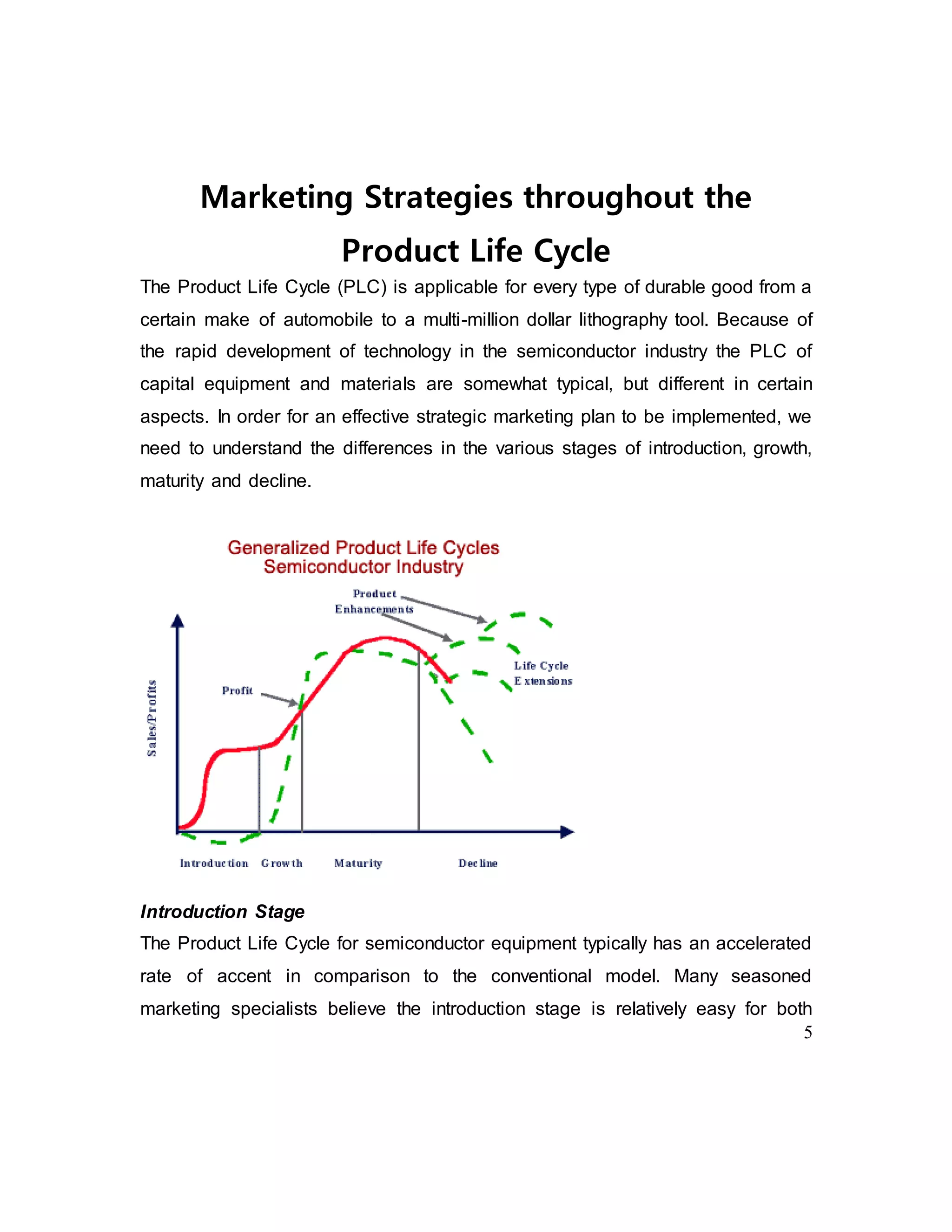
The Product Life Cycle (PLC) is applicable for every type of durable good from a
certain make of automobile to a multi-million dollar lithography tool. Because of
the rapid development of technology in the semiconductor industry the PLC of
capital equipment and materials are somewhat typical, but different in certain
aspects. In order for an effective strategic marketing plan to be implemented, we
need to understand the differences in the various stages of introduction, growth,
maturity and decline.
Introduction Stage
The Product Life Cycle for semiconductor equipment typically has an accelerated
rate of accent in comparison to the conventional model. Many seasoned
marketing specialists believe the introduction stage is relatively easy for both
6
equipment and materials in our industry in that our customers, especially the
early adopters are always interested in the latest technology. It is easy to create
interest. However, a well-developed strategy for a product introduction is
essential for the long-term success of the product. The strategy begins in the
Product Introduction Plan (PIP) with a clear understanding of your customer's
requirements and expectations. This is accomplished by involving the customer
from the beginning of the product development. Give the customer the ability to
input thoughts on how the product is designed, priced, serviced and even
packaged. If the customer is involved in these areas up front, product
introduction and promotion are going to have greater impact imparting
momentum to the early part of the life cycle. Customers who have expressed an
interest in your technology and have helped with the product definition are
excellent candidates for "beta" sites. Customer partnerships are essential during
introduction.
They help minimize the high support costs of getting the product launched and
provide good references and data to support your claims.
Product definition and specifications also need to be included in the PIP. A
realistic summary of the features and benefits of your new product will help in the
introduction stage. Customers need to know why they should consider your
product -- what will it do for them. However, be aware that specifications need to
be broadly defined. You may need to change formulations or product
configurations.
Anticipate your customer's response and be prepared. The customer is going to
tell you what they like and don't like. They will also give you insight into
applications and uses you may not have thought about. The customer is going to
tell you how to use and describe your product. You must move from a technical
7
understanding to being application oriented. This information will help drive the
successful introduction into the next phase of the PLC.
Another factor in introduction stage is anticipating your competitor's response.
This is especially applicable if your product is considered a commodity and is
price sensitive such as a process chemical. Competitors may react to your new
product introduction by lowering their prices. This may delay your customer's
willingness to evaluate your product in the introduction stage. You will need to
provide information to support the technical superiority of your product.
A large promotional budget is not a requirement during the introduction phase of
the PLC. Marketing communications is usually direct. It is highly targeted and not
formalized. However a well-defined strategy for future activities needs to be
developed. Who is the audience and how are you going to deliver the message
once your product has been introduced.
Growth Stage
During the growth cycle, you want to capture as much of the market as you can,
as quickly as you can. The idea is to maximize market share as well as establish
and maintain a competitive advantage. During this time in the PLC you are still
doing continuous improvement on the product as you ramp-up production. The
product should begin to have all of the features identified in the Market
Requirement Statement(MRS). Specifications and formulations should be fairly
well-defined.
Managing the growth stage is essential. Often times in our industry, we are
capacity constrained by production at this stage, both in materials and
equipment. Good forecasting of customer requirements will help establish
production needs. Set realistic delivery schedules and communicate any delays
8
to customers immediately. A serious mistake many companies make during the
growth stage is over committing.
The cost of a missed delivery of equipment to a billion-dollar wafer fabrication
operation is significant. Your company's reputation as a reliable supplier for now
and for the future depends on meeting promised delivery date.
As your product moves through the growth stage you should use the pricing
mechanism to recover your investment. This is the time when the market will be
more accepting of paying a premium. And as one of the early vice presidents of
Intel once said, "price on value but charge what the market will bear".
Marketing communications plays a big role in the growth stage of your product.
Typically your company's heaviest investment in marketing communication is
during this period as you attempt to build market share and support the sales
activity. You have a message to deliver and an urgent need to create positive
customer perceptions.
Maturity Stage
The main focus during the maturity stage is to hold onto market share. Your
product offering has to be reliable and demonstrate the lowest cost of ownership.
Product performance must be proven and clearly defined. The requirements
originally established in the MRS have been met.
For semiconductor equipment, products typically mature in two to three years.
Materials such as photoresist and process chemicals sustain a four to five year
maturity cycle. Pricing during this stage has to be competitive because you are
trying to hold onto market share.
Product support must be maintained in order to keep your existing customer
base satisfied. Very rarely will customers switch to a competitive product during
this phase. The industry philosophy tends to be "if its not broke, don't fix it."
9
Marketing communications efforts are targeted at improving customer
perceptions. Now is the time to handle any adverse perceptions that may have
developed such as reliability issues. Advertising and public relations activities
should reinforce your brand image as a market leader. Applied Materials, the
leading equipment company in the semiconductor industry, has an excellent
campaign which promotes and supports their claims as the provider of total
process solutions.
Declining Stage
At this stage your product offering is very mature. Enhancements could be added
to extend the life. Renaming and reintroducing an improved version is one way
many companies attempt to market a product in its decline. Another strategy may
be to find a new application or technology for the product. Companies have been
successful taking equipment and materials originally developed for
semiconductor manufacturing and offering them to the printed circuit board or
disc drive industry.
Pricing may become an issue especially in the materials sector. Customers
recognize that your company has been making the product for an extended
period of time and that it should be cheaper to manufacture. Substantiating price
increases for products in decline is very difficult. One way to maintain the gross
margin is to minimize product support. However, it is important not to lose
customer loyalty. Your company needs to be remembered as the supplier of
choice for the next technology buy.
In business and engineering, new product development (NPD) is the complete
process of bringing a new product to market. A product is a set of benefits
offered for exchange and can be tangible (that is, something physical you can
touch) or intangible (like a service, experience, or belief). There are two parallel
10
paths involved in the NPD process: one involves the idea generation, product
design and detail engineering; the other involves market research and marketing
analysis. Companies typically see new product development as the first stage in
generating and commercializing new product within the overall strategic process
of product life cycle management used to maintain or grow their market share.
The process
Idea Generation is often called the "fuzzy front end" of the NPD process Ideas
for new products can be obtained from basic research using a SWOT analysis
(Strengths, Weaknesses, and Opportunities & Threats). Market and consumer
trends, company's R&D department, competitors, focus groups, employees,
salespeople, corporate spies, trade shows, or ethnographic discovery methods
(searching for user patterns and habits) may also be used to get an insight into
new product lines or product features. Lots of ideas are being generated about
the new product. Out of these ideas many ideas are being implemented. The
ideas use to generate in many forms and their generating places are also
various. Many reasons are responsible for generation of an idea. Idea
Generation or Brainstorming of new product, service, or store concepts - idea
generation techniques can begin when you have done your OPPORTUNITY
ANALYSIS to support your ideas in the Idea Screening Phase (shown in the
next development step).
Idea Screening
1-The object is to eliminate unsound concepts prior to devoting resources to
them.
11
2-The screeners should ask several questions:
 Will the customer in the target market benefit from the
product?
 What is the size and growth forecasts of the market segment
/ target market?
 What is the current or expected competitive pressure for the
product idea?
 What are the industry sales and market trends the product
idea is based on?
 Is it technically feasible to manufacture the product?
 Will the product be profitable when manufactured and
delivered to the customer at the target price?
Concept Development and Testing
Develop the marketing and engineering details
 Investigate intellectual property issues and search patent
databases
 Who is the target market and who is the decision maker in
the purchasing process?
 What product features must the product incorporate?
 What benefits will the product provide?
 How will consumers react to the product?
 How will the product be produced most cost effectively?
 Prove feasibility through virtual computer aided rendering
and rapid prototyping
12
 What will it cost to produce it?
Testing the Concept by asking a number of prospective customers what they
think of the idea - usually via Choice Modeling.
Business Analysis
Estimate likely selling price based upon competition and customer feedback
Estimate sales volume based upon size of market and such tools as the Fourt-
Woodlock equation Estimate profitability and break-even point
2. Beta Testing and Market Testing
o Produce a physical prototype or mock-up
o Test the product (and its packaging) in typical usage situations
o Conduct focus group customer interviews or introduce at trade
show
o Make adjustments where necessary
o Produce an initial run of the product and sell it in a test market area
to determine customer acceptance
3. Technical Implementation
o New program initiation
o Finalize Quality management system
o Resource estimation
o Requirement publication
o Publish technical communications such as data sheets
o Engineering operations planning
o Department scheduling
o Supplier collaboration
13
o Logistics plan
o Resource plan publication
o Program review and monitoring
o Contingencies - what-if planning
4. Commercialization (often considered post-NPD)
o Launch the product
o Produce and place advertisements and other promotions
o Fill the distribution pipeline with product
o Critical path analysis is most useful at this stage
5. New Product Pricing
o Impact of new product on the entire product portfolio
o Value Analysis (internal & external)
o Competition and alternative competitive technologies
o Differing value segments (price, value and need)
o Product Costs (fixed & variable)
o Forecast of unit volumes, revenue, and profit
14
CASE STUDY
Servis Pvt Ltd
Introduction Of Servis Pvt Limited:
Servis Group is Pakistan's largest footwear manufacturer and exporter. It also
has interests in retailing. Its Group Company, SSC PRIVATE LIMITED, is the
country's largest retailer and wholesaler of footwear. The Group has diversified
interests in rubber products including tyres and in defense industry products.
The Group was set up in 1958 and today has sales of more than PKR 9 billion.
Servis Group employs close to 8000 people in its Group Companies.
Servis Industries Limited:
SIL is a public limited company listed on the stock exchanges of Pakistan. It has
annual revenue of USD 80 million. It is the largest manufacturer of footwear and
tyres & tubes for two-wheelers, and has been the largest exporter of footwear
from Pakistan for the last 10 years. The company employs more than 5,000
people in its facilities located in Gujrat and Muridke. The company's products are
exported primarily to Germany, Italy, France and UK.
Vision Statement:
To be a market leader providing quality footwear, tyres & tubes and allied
products. To strive for excellence and global recognition by continuous
improvement, innovation, dedication and growth.
15
Mission Statement:
To be a result oriented and profitable Company by consistently improving market
share, quality, diversity, availability, presentation, reliability and customer
acceptance. To emerge as a growth oriented concern ensuring optimum return
and value addition to its shareholders to ensure cost consciousness in decision-
making and operations without compromising the commitment to quality. To
create an efficient resource management and conducive business environment.
Evolving an effective leadership by creating a highly professional and motivated
management team fully equipped to meet any challenge. To keep abreast with
modern technology and designs to optimize production and enhance brand
image to attain international recognition for the Company's products. To set up
highly ethical business standards and be a good corporate citizen, contributing
towards the development of the national economy and assisting charitable
causes to adopt appropriate safety rules and environment friendly policies.
ProcessAnalysis
INDUSTRY ANALYSIS
Situation Analysis:
Soul Collection has entered into the ladies footwear. Being in the shoe industry
they had no presence in ladies footwear previously and a big market chunk was
missing.
16
Purchase Tax (With Holding Tax):
Majority of private brands and small industry players don’t pay taxes. The
corporate strategy of Servis Group of industries include paying all the taxes
Government applies 3.5% of the whole purchases as with holding tax. Soul
collections buy on 3.5% higher then the other market in order to maintain the
corporate strategy of their moral duty to pay all the taxes. Other market players
don’t pay this 3.5% tax, which makes them sale, their products less expensive.
However soul collection purchases with tax but they have to maintain their selling
prices in balance with the competitors, which give fewer profit margins.
Target Markets:
Target market is a female of all ages. Females are 51% of the total population of
Pakistan.
TQM and Behavior Factors:
Variety seeking customer
No brand loyalty
Fashion conscious.
Live the motto "fashion over function."
Are always aware of the different fashion trends.
Subscribe to, or at least read, several women's magazines that are fashion
orientated.
17
Market Forecast:
It is a 50 billion market and the focus of the CS management is to capture the
10% of market for its brand.
Market Growth:
The market for women's shoes is a strong, steady growing market. It is generally
not affected by economic downturns. Women seem to consume shoes
regardless of the economic climate. In a popular mini-series, a women's habit of
buying shoes was described as a release when they are feeling bad, a way to
make them feel better, similar to eating chocolate. While this stereotype might
not be entirely accurate, women love their shoes and cannot seem to get
enough.In population its 15% to 20% growth trend and per capita income is
increasing which increases the sales of the product. The market share is to be
gained because private brands capture 80% of the female shoe market, which
still has to be taken by SC.
SWOT Analysis:
The following SWOT analysis captures the key strengths and weaknesses within
the company, and describes the opportunities and threats facing SC.
50 years experience in shoe industry
Experienced management
Strong brand name
18
Weaknesses:
Smaller player, can’t dictate market
Slow market penetration.
Opportunities:
A growing segment of the market that is increasingly
Big gap of market to be captured
The ability to operate on lean overhead relative to competitors.
Threats:
At present law and order situation
Low cost private players
Competition: Soul Collections has three direct competitors in the market.
Product Offering:
Soul sells upscale women's shoes. Soul Collection has a wide range of fancy and
casual shoe collection. The product development strategy focuses firstly on the
collection of bridal shoe. These are all cottage industry products. Apart from
shoes SC are also offer various type of designed handbags. The focus is to
provide superior quality that gives comfort with aesthetics. The experienced
management decides over the design of the shoe to be able to sell in
19
considerable amount at the outlet under this brand. Customers associations with
the brand are different with different brand; one type of product may sell easily
less than one brand and does not sell well under the other brand name.
Keys to Success:
The keys to success are to meet the demand for an upscale women's shoe store
with a wide selection and focused customer attention.
Supply chain is the core competency
Inventory turn is double and we are trying to increase it
Fashionable designs.
Fast customer delivery. (Within 90 seconds we handover the product)
Critical Issues:
We cannot associate SC to SERVIS because of the poor perception for fashion
products of SERVIS in the eyes of customer. We are looking forward to register
this brand of high quality and more variety brand. Major issue is that local
vendors copy the designs. Cannot go for the copyrights because of the quick turn
over of the design. Local vendors who copy the design sell it on low price, which
hurts the brand sales.
Marketing Strategy:
Part of SC marketing strategy is based on location and distribution. SC is located
in a trendy malls and busy female product markets that receives abundant walk-
20
through traffic. This location costs a premium and is not directly linked to the
marketing budget as rent has been categorized under general overhead.The
management believes in smart strategic moves, thus they are utilizing the
network of servis mega stores. It has helped in reducing the distribution cost as
well as the rental cost. Currently there are 15 super market servis stores where
along with other brands soul collection is displayed as a separate brand.They are
focusing on differentiation strategy because the marketing objective is to become
quality leader.
Marketing Objectives:
The aim is to become the quality leader
They want to become smart player and not the largest player
To become better then style and a little lower then Carly’s
Increase repeat customers by 7% per quarter.
To cross the break even point within 3 years
Positioning:
“The soul of Fashion” is the slogan of Soul Collection. They want people to
perceive it as a foreign brand. To some extent it has been achieved. The
feedback of the customer has showed that they have perceived this image to
great extent. It’s a masses brand. In pricing they are keeping it with the market.
The image is maintained through proper branding in advertising and interior. The
interior team had been given a challenge for making the interior good looking,
21
should not be so much high-tech so that that image of extremely high priced
product should be avoided.
Advertising & Promotion:
However this is a masses brand but focused advertising and used to create
awareness. One reason for this is because of being a new entrant and less
number of outlets in selective areas. Instead of playing a proper 30 or 60
seconds TV commercial over national channels its preferred to play the add on
local cables only to target those areas where they have opened the outlets.
Avoiding the national TV channels commercials has saved cost. The planning
shoes that showing TV commercial in the cities where there is no stores
launched can hurt the brand image thus the decision for local cable channels is
better to save the image and to communicate effectively.Secondly Hoardings are
placed in three big cities and larger then life image of the product is projected to
communicate customers. The slogan has been established effectively. Magazine
ads are also printed to capture ladies who read fashion magazine. For promotion
the management takes the following steps Loyalty cards are given to customer to
develop a closer relationship with them and to support and encourage buying.
In-house magazine is in the process.
Promotional material is given to suppliers and distributors (wall clocks).
Branding is maintained through the shop interiors.
Marketing Mix: SC marketing mix is comprised of the following approaches to
pricing, distribution, advertising and promotion, and customer service.
22
Pricing: SC pricing is designed to be competitive to the other fashion shoe
retailers. Location, targeted advertising on the localized cable network,
magazines and Hoardings.
Customer Service:
Exceeding customer's expectation is the company's mission. Target is to
accommodate customer within 90 seconds. The product faults and repairs are
served for a limited period of time as per company policy.
Advertising Research:
Soul is using localize promotion on cable network, out door medium in the form
of steamers and billboards and on different magazine. They are also conducting
the research to improve the efficacy of advertising and analyzing audience levels
of attention, brand linkage, motivation, entertainment, and communication.
Buyer Decision Processes Research:In that research they determine what
factors motivates people to buy and what decision-making process they use. In
there case, customers usually go towards attractive designs and affordable
prices.
Customer Satisfaction Research:
Through quantitative or qualitative studies they yields an understanding of a
customer's of satisfaction with a transaction
Demand Estimation: They estimate and determine the approximate level of
demand for the product. As according to them the lifecycle of casual shoes is
23
about 4 – 6 months and lifecycle of fancy shoes is about 2 - 4 months but
according to the demand of a product they evaluate the production criteria of
particular product.
Marketing Effectiveness: Soul Collection measure sales results to determine
the effectiveness of individual marketing activities.
Sales Comparison: Soul Collection is following the map plan of STYLO, per
day, per month and per years sales of Stylo are the following. This data gives us
a situation plan followed by SC. Different shops are given different sales target in
accordance with the location, footfall and city.
TQM and merchandize policy:
Soul has a policy in place which gives its buyers some guidelines into the buying
process. It gives them guidance in the following areas:
Demographics of current and potential customers
Store’s image
Merchandise quality levels
Price point policy
Suggestion
This policy hence gives them a sense of direction as to what to plan and how to
go about executing it. Soul’s buyers also ensure that what they have planned for
24
a given season is in line with the trends and that the prices are set according to
what their competitors have set.
They also ensure that they are protecting the local cottage industry which
provides employment to thousands of households. Although they do source
some of their collections from abroad but care is taken to ensure the
sustainability of the local industry. This is in fact is the policy adopted by other
competitors namely, Shu 8, Stylo, Metro, Ehsan etc.
Perform qualitative analysis:
GM Soul believes that the buying process is 90% analytical and 10% intuitive.
They gather data about the customer buying patterns and the overall situation of
the market. The recent economic instability has put a halt into their aggressive
buying behavior but nevertheless they still anticipate the market to bounce back.
They perform their analysis by taking into account the following components:
Customer profile analysis: Who are soul’s best customers and what are their
buying behaviors and attitudes?
Conclusion
Soul has a vision to become a leader in its segment. It has a vibrant workforce
that works towards in meeting the organizational goals. They are in their infancy
but have aggressive plans to increase their presence in the market. The team led
by Mr. Salman is very optimistic about what lies ahead and are focused in
meeting the challenges they face from competitors like Shu 8, Stylo, Metro
25
etc.Their pricing strategy is two fold i.e. to stay competitive and to increase sales;
hence increasing their market share.
The products on offer are trendy and at the same time provide good value for
money. Their Visual Merchandising is at par with the competitors and provides a
favorable shopping experience for their customers. Their sales staff is efficient
and is adept at providing a good customer service.
Reference-Marketing Department

8511 doc

  • 1.
  • 2.
    2 Dedication & Acknowledgements Idedicate this report to my parents. Because of their prayers and encouragement I have been able to complete this report. Praise is to Allah, the most Gracious and Merciful, who blessed me with the knowledge and wisdom and enabled me to overcome this task. Heartiest gratitude to my parents without their continuous encouragement and love I could not have accomplished this task.
  • 3.
    3 Abstract You will needto provide information to support the technical superiority of your product. A large promotional budget is not a requirement during the introduction phase of the PLC. Marketing communications is usually direct. It is highly targeted and not formalized. However a well-defined strategy for future activities needs to be developed. Who is the audience and how are you going to deliver the message once your product has been introduced.
  • 4.
    4 Table of contents Introductionof topic------------------------------------------------------5 Introduction of organization------------------------------------------14 Vision------------------------------------------------------------------14 SWOT Analysis------------------------------------------------------17 Recommendation--------------------------------------------------23 Conclusion-----------------------------------------------------------24 References------------------------------------------------------------------25
  • 5.
    5 Marketing Strategies throughoutthe Product Life Cycle The Product Life Cycle (PLC) is applicable for every type of durable good from a certain make of automobile to a multi-million dollar lithography tool. Because of the rapid development of technology in the semiconductor industry the PLC of capital equipment and materials are somewhat typical, but different in certain aspects. In order for an effective strategic marketing plan to be implemented, we need to understand the differences in the various stages of introduction, growth, maturity and decline. Introduction Stage The Product Life Cycle for semiconductor equipment typically has an accelerated rate of accent in comparison to the conventional model. Many seasoned marketing specialists believe the introduction stage is relatively easy for both
  • 6.
    6 equipment and materialsin our industry in that our customers, especially the early adopters are always interested in the latest technology. It is easy to create interest. However, a well-developed strategy for a product introduction is essential for the long-term success of the product. The strategy begins in the Product Introduction Plan (PIP) with a clear understanding of your customer's requirements and expectations. This is accomplished by involving the customer from the beginning of the product development. Give the customer the ability to input thoughts on how the product is designed, priced, serviced and even packaged. If the customer is involved in these areas up front, product introduction and promotion are going to have greater impact imparting momentum to the early part of the life cycle. Customers who have expressed an interest in your technology and have helped with the product definition are excellent candidates for "beta" sites. Customer partnerships are essential during introduction. They help minimize the high support costs of getting the product launched and provide good references and data to support your claims. Product definition and specifications also need to be included in the PIP. A realistic summary of the features and benefits of your new product will help in the introduction stage. Customers need to know why they should consider your product -- what will it do for them. However, be aware that specifications need to be broadly defined. You may need to change formulations or product configurations. Anticipate your customer's response and be prepared. The customer is going to tell you what they like and don't like. They will also give you insight into applications and uses you may not have thought about. The customer is going to tell you how to use and describe your product. You must move from a technical
  • 7.
    7 understanding to beingapplication oriented. This information will help drive the successful introduction into the next phase of the PLC. Another factor in introduction stage is anticipating your competitor's response. This is especially applicable if your product is considered a commodity and is price sensitive such as a process chemical. Competitors may react to your new product introduction by lowering their prices. This may delay your customer's willingness to evaluate your product in the introduction stage. You will need to provide information to support the technical superiority of your product. A large promotional budget is not a requirement during the introduction phase of the PLC. Marketing communications is usually direct. It is highly targeted and not formalized. However a well-defined strategy for future activities needs to be developed. Who is the audience and how are you going to deliver the message once your product has been introduced. Growth Stage During the growth cycle, you want to capture as much of the market as you can, as quickly as you can. The idea is to maximize market share as well as establish and maintain a competitive advantage. During this time in the PLC you are still doing continuous improvement on the product as you ramp-up production. The product should begin to have all of the features identified in the Market Requirement Statement(MRS). Specifications and formulations should be fairly well-defined. Managing the growth stage is essential. Often times in our industry, we are capacity constrained by production at this stage, both in materials and equipment. Good forecasting of customer requirements will help establish production needs. Set realistic delivery schedules and communicate any delays
  • 8.
    8 to customers immediately.A serious mistake many companies make during the growth stage is over committing. The cost of a missed delivery of equipment to a billion-dollar wafer fabrication operation is significant. Your company's reputation as a reliable supplier for now and for the future depends on meeting promised delivery date. As your product moves through the growth stage you should use the pricing mechanism to recover your investment. This is the time when the market will be more accepting of paying a premium. And as one of the early vice presidents of Intel once said, "price on value but charge what the market will bear". Marketing communications plays a big role in the growth stage of your product. Typically your company's heaviest investment in marketing communication is during this period as you attempt to build market share and support the sales activity. You have a message to deliver and an urgent need to create positive customer perceptions. Maturity Stage The main focus during the maturity stage is to hold onto market share. Your product offering has to be reliable and demonstrate the lowest cost of ownership. Product performance must be proven and clearly defined. The requirements originally established in the MRS have been met. For semiconductor equipment, products typically mature in two to three years. Materials such as photoresist and process chemicals sustain a four to five year maturity cycle. Pricing during this stage has to be competitive because you are trying to hold onto market share. Product support must be maintained in order to keep your existing customer base satisfied. Very rarely will customers switch to a competitive product during this phase. The industry philosophy tends to be "if its not broke, don't fix it."
  • 9.
    9 Marketing communications effortsare targeted at improving customer perceptions. Now is the time to handle any adverse perceptions that may have developed such as reliability issues. Advertising and public relations activities should reinforce your brand image as a market leader. Applied Materials, the leading equipment company in the semiconductor industry, has an excellent campaign which promotes and supports their claims as the provider of total process solutions. Declining Stage At this stage your product offering is very mature. Enhancements could be added to extend the life. Renaming and reintroducing an improved version is one way many companies attempt to market a product in its decline. Another strategy may be to find a new application or technology for the product. Companies have been successful taking equipment and materials originally developed for semiconductor manufacturing and offering them to the printed circuit board or disc drive industry. Pricing may become an issue especially in the materials sector. Customers recognize that your company has been making the product for an extended period of time and that it should be cheaper to manufacture. Substantiating price increases for products in decline is very difficult. One way to maintain the gross margin is to minimize product support. However, it is important not to lose customer loyalty. Your company needs to be remembered as the supplier of choice for the next technology buy. In business and engineering, new product development (NPD) is the complete process of bringing a new product to market. A product is a set of benefits offered for exchange and can be tangible (that is, something physical you can touch) or intangible (like a service, experience, or belief). There are two parallel
  • 10.
    10 paths involved inthe NPD process: one involves the idea generation, product design and detail engineering; the other involves market research and marketing analysis. Companies typically see new product development as the first stage in generating and commercializing new product within the overall strategic process of product life cycle management used to maintain or grow their market share. The process Idea Generation is often called the "fuzzy front end" of the NPD process Ideas for new products can be obtained from basic research using a SWOT analysis (Strengths, Weaknesses, and Opportunities & Threats). Market and consumer trends, company's R&D department, competitors, focus groups, employees, salespeople, corporate spies, trade shows, or ethnographic discovery methods (searching for user patterns and habits) may also be used to get an insight into new product lines or product features. Lots of ideas are being generated about the new product. Out of these ideas many ideas are being implemented. The ideas use to generate in many forms and their generating places are also various. Many reasons are responsible for generation of an idea. Idea Generation or Brainstorming of new product, service, or store concepts - idea generation techniques can begin when you have done your OPPORTUNITY ANALYSIS to support your ideas in the Idea Screening Phase (shown in the next development step). Idea Screening 1-The object is to eliminate unsound concepts prior to devoting resources to them.
  • 11.
    11 2-The screeners shouldask several questions:  Will the customer in the target market benefit from the product?  What is the size and growth forecasts of the market segment / target market?  What is the current or expected competitive pressure for the product idea?  What are the industry sales and market trends the product idea is based on?  Is it technically feasible to manufacture the product?  Will the product be profitable when manufactured and delivered to the customer at the target price? Concept Development and Testing Develop the marketing and engineering details  Investigate intellectual property issues and search patent databases  Who is the target market and who is the decision maker in the purchasing process?  What product features must the product incorporate?  What benefits will the product provide?  How will consumers react to the product?  How will the product be produced most cost effectively?  Prove feasibility through virtual computer aided rendering and rapid prototyping
  • 12.
    12  What willit cost to produce it? Testing the Concept by asking a number of prospective customers what they think of the idea - usually via Choice Modeling. Business Analysis Estimate likely selling price based upon competition and customer feedback Estimate sales volume based upon size of market and such tools as the Fourt- Woodlock equation Estimate profitability and break-even point 2. Beta Testing and Market Testing o Produce a physical prototype or mock-up o Test the product (and its packaging) in typical usage situations o Conduct focus group customer interviews or introduce at trade show o Make adjustments where necessary o Produce an initial run of the product and sell it in a test market area to determine customer acceptance 3. Technical Implementation o New program initiation o Finalize Quality management system o Resource estimation o Requirement publication o Publish technical communications such as data sheets o Engineering operations planning o Department scheduling o Supplier collaboration
  • 13.
    13 o Logistics plan oResource plan publication o Program review and monitoring o Contingencies - what-if planning 4. Commercialization (often considered post-NPD) o Launch the product o Produce and place advertisements and other promotions o Fill the distribution pipeline with product o Critical path analysis is most useful at this stage 5. New Product Pricing o Impact of new product on the entire product portfolio o Value Analysis (internal & external) o Competition and alternative competitive technologies o Differing value segments (price, value and need) o Product Costs (fixed & variable) o Forecast of unit volumes, revenue, and profit
  • 14.
    14 CASE STUDY Servis PvtLtd Introduction Of Servis Pvt Limited: Servis Group is Pakistan's largest footwear manufacturer and exporter. It also has interests in retailing. Its Group Company, SSC PRIVATE LIMITED, is the country's largest retailer and wholesaler of footwear. The Group has diversified interests in rubber products including tyres and in defense industry products. The Group was set up in 1958 and today has sales of more than PKR 9 billion. Servis Group employs close to 8000 people in its Group Companies. Servis Industries Limited: SIL is a public limited company listed on the stock exchanges of Pakistan. It has annual revenue of USD 80 million. It is the largest manufacturer of footwear and tyres & tubes for two-wheelers, and has been the largest exporter of footwear from Pakistan for the last 10 years. The company employs more than 5,000 people in its facilities located in Gujrat and Muridke. The company's products are exported primarily to Germany, Italy, France and UK. Vision Statement: To be a market leader providing quality footwear, tyres & tubes and allied products. To strive for excellence and global recognition by continuous improvement, innovation, dedication and growth.
  • 15.
    15 Mission Statement: To bea result oriented and profitable Company by consistently improving market share, quality, diversity, availability, presentation, reliability and customer acceptance. To emerge as a growth oriented concern ensuring optimum return and value addition to its shareholders to ensure cost consciousness in decision- making and operations without compromising the commitment to quality. To create an efficient resource management and conducive business environment. Evolving an effective leadership by creating a highly professional and motivated management team fully equipped to meet any challenge. To keep abreast with modern technology and designs to optimize production and enhance brand image to attain international recognition for the Company's products. To set up highly ethical business standards and be a good corporate citizen, contributing towards the development of the national economy and assisting charitable causes to adopt appropriate safety rules and environment friendly policies. ProcessAnalysis INDUSTRY ANALYSIS Situation Analysis: Soul Collection has entered into the ladies footwear. Being in the shoe industry they had no presence in ladies footwear previously and a big market chunk was missing.
  • 16.
    16 Purchase Tax (WithHolding Tax): Majority of private brands and small industry players don’t pay taxes. The corporate strategy of Servis Group of industries include paying all the taxes Government applies 3.5% of the whole purchases as with holding tax. Soul collections buy on 3.5% higher then the other market in order to maintain the corporate strategy of their moral duty to pay all the taxes. Other market players don’t pay this 3.5% tax, which makes them sale, their products less expensive. However soul collection purchases with tax but they have to maintain their selling prices in balance with the competitors, which give fewer profit margins. Target Markets: Target market is a female of all ages. Females are 51% of the total population of Pakistan. TQM and Behavior Factors: Variety seeking customer No brand loyalty Fashion conscious. Live the motto "fashion over function." Are always aware of the different fashion trends. Subscribe to, or at least read, several women's magazines that are fashion orientated.
  • 17.
    17 Market Forecast: It isa 50 billion market and the focus of the CS management is to capture the 10% of market for its brand. Market Growth: The market for women's shoes is a strong, steady growing market. It is generally not affected by economic downturns. Women seem to consume shoes regardless of the economic climate. In a popular mini-series, a women's habit of buying shoes was described as a release when they are feeling bad, a way to make them feel better, similar to eating chocolate. While this stereotype might not be entirely accurate, women love their shoes and cannot seem to get enough.In population its 15% to 20% growth trend and per capita income is increasing which increases the sales of the product. The market share is to be gained because private brands capture 80% of the female shoe market, which still has to be taken by SC. SWOT Analysis: The following SWOT analysis captures the key strengths and weaknesses within the company, and describes the opportunities and threats facing SC. 50 years experience in shoe industry Experienced management Strong brand name
  • 18.
    18 Weaknesses: Smaller player, can’tdictate market Slow market penetration. Opportunities: A growing segment of the market that is increasingly Big gap of market to be captured The ability to operate on lean overhead relative to competitors. Threats: At present law and order situation Low cost private players Competition: Soul Collections has three direct competitors in the market. Product Offering: Soul sells upscale women's shoes. Soul Collection has a wide range of fancy and casual shoe collection. The product development strategy focuses firstly on the collection of bridal shoe. These are all cottage industry products. Apart from shoes SC are also offer various type of designed handbags. The focus is to provide superior quality that gives comfort with aesthetics. The experienced management decides over the design of the shoe to be able to sell in
  • 19.
    19 considerable amount atthe outlet under this brand. Customers associations with the brand are different with different brand; one type of product may sell easily less than one brand and does not sell well under the other brand name. Keys to Success: The keys to success are to meet the demand for an upscale women's shoe store with a wide selection and focused customer attention. Supply chain is the core competency Inventory turn is double and we are trying to increase it Fashionable designs. Fast customer delivery. (Within 90 seconds we handover the product) Critical Issues: We cannot associate SC to SERVIS because of the poor perception for fashion products of SERVIS in the eyes of customer. We are looking forward to register this brand of high quality and more variety brand. Major issue is that local vendors copy the designs. Cannot go for the copyrights because of the quick turn over of the design. Local vendors who copy the design sell it on low price, which hurts the brand sales. Marketing Strategy: Part of SC marketing strategy is based on location and distribution. SC is located in a trendy malls and busy female product markets that receives abundant walk-
  • 20.
    20 through traffic. Thislocation costs a premium and is not directly linked to the marketing budget as rent has been categorized under general overhead.The management believes in smart strategic moves, thus they are utilizing the network of servis mega stores. It has helped in reducing the distribution cost as well as the rental cost. Currently there are 15 super market servis stores where along with other brands soul collection is displayed as a separate brand.They are focusing on differentiation strategy because the marketing objective is to become quality leader. Marketing Objectives: The aim is to become the quality leader They want to become smart player and not the largest player To become better then style and a little lower then Carly’s Increase repeat customers by 7% per quarter. To cross the break even point within 3 years Positioning: “The soul of Fashion” is the slogan of Soul Collection. They want people to perceive it as a foreign brand. To some extent it has been achieved. The feedback of the customer has showed that they have perceived this image to great extent. It’s a masses brand. In pricing they are keeping it with the market. The image is maintained through proper branding in advertising and interior. The interior team had been given a challenge for making the interior good looking,
  • 21.
    21 should not beso much high-tech so that that image of extremely high priced product should be avoided. Advertising & Promotion: However this is a masses brand but focused advertising and used to create awareness. One reason for this is because of being a new entrant and less number of outlets in selective areas. Instead of playing a proper 30 or 60 seconds TV commercial over national channels its preferred to play the add on local cables only to target those areas where they have opened the outlets. Avoiding the national TV channels commercials has saved cost. The planning shoes that showing TV commercial in the cities where there is no stores launched can hurt the brand image thus the decision for local cable channels is better to save the image and to communicate effectively.Secondly Hoardings are placed in three big cities and larger then life image of the product is projected to communicate customers. The slogan has been established effectively. Magazine ads are also printed to capture ladies who read fashion magazine. For promotion the management takes the following steps Loyalty cards are given to customer to develop a closer relationship with them and to support and encourage buying. In-house magazine is in the process. Promotional material is given to suppliers and distributors (wall clocks). Branding is maintained through the shop interiors. Marketing Mix: SC marketing mix is comprised of the following approaches to pricing, distribution, advertising and promotion, and customer service.
  • 22.
    22 Pricing: SC pricingis designed to be competitive to the other fashion shoe retailers. Location, targeted advertising on the localized cable network, magazines and Hoardings. Customer Service: Exceeding customer's expectation is the company's mission. Target is to accommodate customer within 90 seconds. The product faults and repairs are served for a limited period of time as per company policy. Advertising Research: Soul is using localize promotion on cable network, out door medium in the form of steamers and billboards and on different magazine. They are also conducting the research to improve the efficacy of advertising and analyzing audience levels of attention, brand linkage, motivation, entertainment, and communication. Buyer Decision Processes Research:In that research they determine what factors motivates people to buy and what decision-making process they use. In there case, customers usually go towards attractive designs and affordable prices. Customer Satisfaction Research: Through quantitative or qualitative studies they yields an understanding of a customer's of satisfaction with a transaction Demand Estimation: They estimate and determine the approximate level of demand for the product. As according to them the lifecycle of casual shoes is
  • 23.
    23 about 4 –6 months and lifecycle of fancy shoes is about 2 - 4 months but according to the demand of a product they evaluate the production criteria of particular product. Marketing Effectiveness: Soul Collection measure sales results to determine the effectiveness of individual marketing activities. Sales Comparison: Soul Collection is following the map plan of STYLO, per day, per month and per years sales of Stylo are the following. This data gives us a situation plan followed by SC. Different shops are given different sales target in accordance with the location, footfall and city. TQM and merchandize policy: Soul has a policy in place which gives its buyers some guidelines into the buying process. It gives them guidance in the following areas: Demographics of current and potential customers Store’s image Merchandise quality levels Price point policy Suggestion This policy hence gives them a sense of direction as to what to plan and how to go about executing it. Soul’s buyers also ensure that what they have planned for
  • 24.
    24 a given seasonis in line with the trends and that the prices are set according to what their competitors have set. They also ensure that they are protecting the local cottage industry which provides employment to thousands of households. Although they do source some of their collections from abroad but care is taken to ensure the sustainability of the local industry. This is in fact is the policy adopted by other competitors namely, Shu 8, Stylo, Metro, Ehsan etc. Perform qualitative analysis: GM Soul believes that the buying process is 90% analytical and 10% intuitive. They gather data about the customer buying patterns and the overall situation of the market. The recent economic instability has put a halt into their aggressive buying behavior but nevertheless they still anticipate the market to bounce back. They perform their analysis by taking into account the following components: Customer profile analysis: Who are soul’s best customers and what are their buying behaviors and attitudes? Conclusion Soul has a vision to become a leader in its segment. It has a vibrant workforce that works towards in meeting the organizational goals. They are in their infancy but have aggressive plans to increase their presence in the market. The team led by Mr. Salman is very optimistic about what lies ahead and are focused in meeting the challenges they face from competitors like Shu 8, Stylo, Metro
  • 25.
    25 etc.Their pricing strategyis two fold i.e. to stay competitive and to increase sales; hence increasing their market share. The products on offer are trendy and at the same time provide good value for money. Their Visual Merchandising is at par with the competitors and provides a favorable shopping experience for their customers. Their sales staff is efficient and is adept at providing a good customer service. Reference-Marketing Department