Hatching Egg Sanitation: The
Key Step in Successful Storage
and Production
RALPH A. ERNST, University of California Cooperative Extension Poultry Specialist,
University of California, Davis
PRODUCING CLEAN EGGS
Sanitation is essential in successful hatching egg production, and the most important
step in egg sanitation is producing nest-clean eggs. This requires a carefully planned
management system. The following practices have proven to be useful in producing
clean eggs for hatching and in keeping the eggs clean until they are set in incubators.
• Maintain birds on wire, plastic, or wooden slatted floors whenever possible.
However, some commercial strains of chickens and turkeys do not produce well in
this environment and must have litter floors in part or all of the house.
• To keep floor eggs (eggs laid on the floor) to a minimum, provide 1 nest for every
4 hens. Be sure nests are in place before egg production starts.
• Keep nests filled with clean nesting material such as wood shavings, rice hulls, or
nest pads.
• Collect eggs frequently (at least 4 times a day).
• Exclude hens from nests at night. This prevents hens from becoming broody
(attempting to incubate eggs and remain on the nest) and keeps nests cleaner.
• Maintain dry litter at all times.
• Collect eggs on clean, sanitized plastic flats or in clean egg baskets.
• Separate cracked, stained, heavy, or dirty eggs as you collect them, and don’t incu-
bate them.
• Sanitize clean eggs as soon as possible after collection. Sanitation kills microbes on
the outside of the shell. It does not kill all of the microbes that have penetrated the
shell.
• Always wash hands thoroughly with a disinfectant soap before handling eggs.
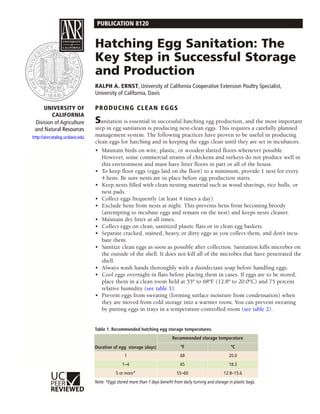
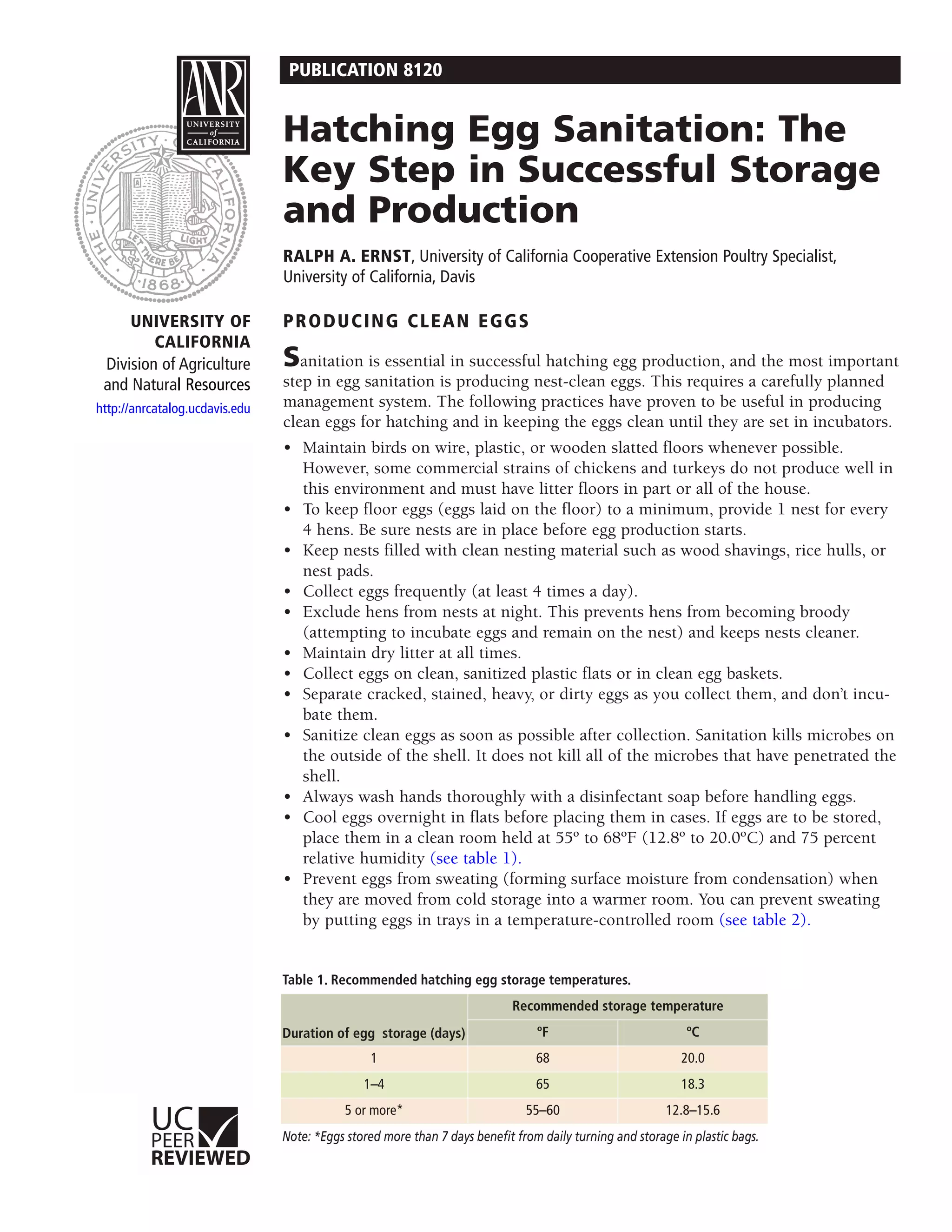
• Cool eggs overnight in flats before placing them in cases. If eggs are to be stored,
place them in a clean room held at 55º to 68ºF (12.8º to 20.0ºC) and 75 percent
relative humidity (see table 1).
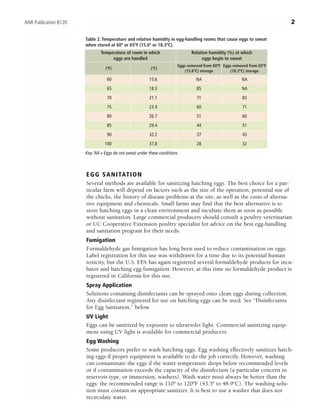
• Prevent eggs from sweating (forming surface moisture from condensation) when
they are moved from cold storage into a warmer room. You can prevent sweating
by putting eggs in trays in a temperature-controlled room (see table 2).
PUBLICATION 8120
UNIVERSITY OF
CALIFORNIA
Division of Agriculture
and Natural Resources
http://anrcatalog.ucdavis.edu
Table 1. Recommended hatching egg storage temperatures.
Duration of egg storage (days)
Recommended storage temperature
ºF ºC
1 68 20.0
1–4 65 18.3
5 or more* 55–60 12.8–15.6
Note: *Eggs stored more than 7 days benefit from daily turning and storage in plastic bags.
EGG SANITATION
Several methods are available for sanitizing hatching eggs. The best choice for a par-
ticular farm will depend on factors such as the size of the operation, potential use of
the chicks, the history of disease problems at the site, as well as the costs of alterna-
tive equipment and chemicals. Small farms may find that the best alternative is to
store hatching eggs in a clean environment and incubate them as soon as possible
without sanitation. Large commercial producers should consult a poultry veterinarian
or UC Cooperative Extension poultry specialist for advice on the best egg-handling
and sanitation program for their needs.
Fumigation
Formaldehyde gas fumigation has long been used to reduce contamination on eggs.
Label registration for this use was withdrawn for a time due to its potential human
toxicity, but the U.S. EPA has again registered several formaldehyde products for incu-
bator and hatching egg fumigation. However, at this time no formaldehyde product is
registered in California for this use.
Spray Application
Solutions containing disinfectants can be sprayed onto clean eggs during collection.
Any disinfectant registered for use on hatching eggs can be used. See “Disinfectants
for Egg Sanitation,” below.
UV Light
Eggs can be sanitized by exposure to ultraviolet light. Commercial sanitizing equip-
ment using UV light is available for commercial producers.
Egg Washing
Some producers prefer to wash hatching eggs. Egg washing effectively sanitizes hatch-
ing eggs if proper equipment is available to do the job correctly. However, washing
can contaminate the eggs if the water temperature drops below recommended levels
or if contamination exceeds the capacity of the disinfectant (a particular concern in
reservoir-type, or immersion, washers). Wash water must always be hotter than the
eggs: the recommended range is 110º to 120ºF (43.3º to 48.9ºC). The washing solu-
tion must contain an appropriate sanitizer. It is best to use a washer that does not
recirculate water.
2ANR Publication 8120
Table 2. Temperature and relative humidity in egg-handling rooms that cause eggs to sweat
when stored at 60º or 65ºF (15.6º or 18.3ºC).
Temperature of room in which
eggs are handled
Relative humidity (%) at which
eggs begin to sweat
(ºF) (ºC)
Eggs removed from 60ºF
(15.6ºC) storage
Eggs removed from 65ºF
(18.3ºC) storage
60 15.6 NA NA
65 18.3 85 NA
70 21.1 71 83
75 23.9 60 71
80 26.7 51 60
85 29.4 44 51
90 32.2 37 43
100 37.8 28 32
Key: NA = Eggs do not sweat under these conditions.
If an immersion washer is used, the water must be changed frequently; do not
wash more than 200 eggs per gallon of solution capacity before changing the washing
solution. Immersion time should not exceed 3 minutes and eggs should be thoroughly
dry before they are put into cases. To be most effective, reservoir-type washers should
be equipped with systems to monitor and control sanitizer levels. This type of washer
should have a final sanitizing rinse with a solution that is not recirculated. Several
commercial egg washing machines are available that effectively sanitize hatching eggs
when used properly. Only good-quality water with less than 2 ppm iron should be
used for egg washing.
DISINFECTANTS FOR EGG SANITATION
Several commercial products are registered for hatching egg sanitation. You can find an
extensive list of disinfectants at the National Biosecurity Resource Center for Animal
Health Emergencies Web site at http://www.biosecuritycenter.org/disinfect.htm.
Chlorine-based disinfectants containing a cleaning agent are widely used to wash table
eggs and have proven to be safe for hatching egg sanitation. Several commercial disin-
fectant formulas are registered for hatching egg washing. University of California
research has shown that quaternary ammonium is an excellent sanitizer for hatching
eggs. The advantages of quaternary ammonium are that it
• is safe for hatching eggs
• leaves residual protection on eggs
• is safe for equipment and personnel
• is reasonable in cost
FOR MORE INFORMATION
You’ll find more information on poultry in the following ANR Communication
Services products:
Hatching Egg Breakout, Video V-86W, 1986.
National 4-H Avian Bowl Manual packet, Publication 4-H 2069.
Visit our online catalog at http://anrcatalog.ucdavis.edu. You can also place orders
by mail, phone, or fax, or request a printed catalog of publications, slide sets, and
videos from
University of California
Agriculture and Natural Resources
Communication Services
6701 San Pablo Avenue, 2nd Floor
Oakland, California 94608-1239
Telephone: (800) 994-8849 or (510) 642-2431; FAX: (510) 643-5470
E-mail inquiries: danrcs@ucdavis.edu
An electronic version of this publication is available on the ANR Communication Services Web site
at http://anrcatalog.ucdavis.edu.
Publication 8120
© 2004 by the Regents of the University of California, Division of Agriculture and Natural
Resources. All rights reserved.
3ANR Publication 8120
The University of California prohibits discrimination against or harassment of any person
employed by or seeking employment with the University on the basis of race, color, national ori-
gin, religion, sex, physical or mental disability, medical condition (cancer-related or genetic char-
acteristics), ancestry, marital status, age, sexual orientation, citizenship, or status as a covered
veteran (special disabled veteran, Vietnam-era veteran or any other veteran who served on active
duty during a war or in a campaign or expedition for which a campaign badge has been autho-
rized). University Policy is intended to be consistent with the provisions of applicable State and
Federal laws.
Inquiries regarding the University’s nondiscrimination policies may be directed to the Affirmative
Action/Staff Personnel Services Director, University of California, Agriculture and Natural
Resources, 300 Lakeside Drive, 6th Floor, Oakland, CA 94612-3550 (510) 987-0096. For a free
catalog of other publications, call (800) 994-8849. For help downloading this publication, call
(530) 754-5112.
pr-01/04-SB/CR
This publication has been anonymously peer reviewed for technical accuracy by University of California
scientists and other qualified professionals. This review process was managed by the ANR Associate
Editor for Animal, Avian, Aquaculture, and Veterinary Sciences.
4ANR Publication 8120
ISBN 978-1-60107-299-3

8120 copy

  • 1.
    Hatching Egg Sanitation:The Key Step in Successful Storage and Production RALPH A. ERNST, University of California Cooperative Extension Poultry Specialist, University of California, Davis PRODUCING CLEAN EGGS Sanitation is essential in successful hatching egg production, and the most important step in egg sanitation is producing nest-clean eggs. This requires a carefully planned management system. The following practices have proven to be useful in producing clean eggs for hatching and in keeping the eggs clean until they are set in incubators. • Maintain birds on wire, plastic, or wooden slatted floors whenever possible. However, some commercial strains of chickens and turkeys do not produce well in this environment and must have litter floors in part or all of the house. • To keep floor eggs (eggs laid on the floor) to a minimum, provide 1 nest for every 4 hens. Be sure nests are in place before egg production starts. • Keep nests filled with clean nesting material such as wood shavings, rice hulls, or nest pads. • Collect eggs frequently (at least 4 times a day). • Exclude hens from nests at night. This prevents hens from becoming broody (attempting to incubate eggs and remain on the nest) and keeps nests cleaner. • Maintain dry litter at all times. • Collect eggs on clean, sanitized plastic flats or in clean egg baskets. • Separate cracked, stained, heavy, or dirty eggs as you collect them, and don’t incu- bate them. • Sanitize clean eggs as soon as possible after collection. Sanitation kills microbes on the outside of the shell. It does not kill all of the microbes that have penetrated the shell. • Always wash hands thoroughly with a disinfectant soap before handling eggs. • Cool eggs overnight in flats before placing them in cases. If eggs are to be stored, place them in a clean room held at 55º to 68ºF (12.8º to 20.0ºC) and 75 percent relative humidity (see table 1). • Prevent eggs from sweating (forming surface moisture from condensation) when they are moved from cold storage into a warmer room. You can prevent sweating by putting eggs in trays in a temperature-controlled room (see table 2). PUBLICATION 8120 UNIVERSITY OF CALIFORNIA Division of Agriculture and Natural Resources http://anrcatalog.ucdavis.edu Table 1. Recommended hatching egg storage temperatures. Duration of egg storage (days) Recommended storage temperature ºF ºC 1 68 20.0 1–4 65 18.3 5 or more* 55–60 12.8–15.6 Note: *Eggs stored more than 7 days benefit from daily turning and storage in plastic bags.
  • 2.
    EGG SANITATION Several methodsare available for sanitizing hatching eggs. The best choice for a par- ticular farm will depend on factors such as the size of the operation, potential use of the chicks, the history of disease problems at the site, as well as the costs of alterna- tive equipment and chemicals. Small farms may find that the best alternative is to store hatching eggs in a clean environment and incubate them as soon as possible without sanitation. Large commercial producers should consult a poultry veterinarian or UC Cooperative Extension poultry specialist for advice on the best egg-handling and sanitation program for their needs. Fumigation Formaldehyde gas fumigation has long been used to reduce contamination on eggs. Label registration for this use was withdrawn for a time due to its potential human toxicity, but the U.S. EPA has again registered several formaldehyde products for incu- bator and hatching egg fumigation. However, at this time no formaldehyde product is registered in California for this use. Spray Application Solutions containing disinfectants can be sprayed onto clean eggs during collection. Any disinfectant registered for use on hatching eggs can be used. See “Disinfectants for Egg Sanitation,” below. UV Light Eggs can be sanitized by exposure to ultraviolet light. Commercial sanitizing equip- ment using UV light is available for commercial producers. Egg Washing Some producers prefer to wash hatching eggs. Egg washing effectively sanitizes hatch- ing eggs if proper equipment is available to do the job correctly. However, washing can contaminate the eggs if the water temperature drops below recommended levels or if contamination exceeds the capacity of the disinfectant (a particular concern in reservoir-type, or immersion, washers). Wash water must always be hotter than the eggs: the recommended range is 110º to 120ºF (43.3º to 48.9ºC). The washing solu- tion must contain an appropriate sanitizer. It is best to use a washer that does not recirculate water. 2ANR Publication 8120 Table 2. Temperature and relative humidity in egg-handling rooms that cause eggs to sweat when stored at 60º or 65ºF (15.6º or 18.3ºC). Temperature of room in which eggs are handled Relative humidity (%) at which eggs begin to sweat (ºF) (ºC) Eggs removed from 60ºF (15.6ºC) storage Eggs removed from 65ºF (18.3ºC) storage 60 15.6 NA NA 65 18.3 85 NA 70 21.1 71 83 75 23.9 60 71 80 26.7 51 60 85 29.4 44 51 90 32.2 37 43 100 37.8 28 32 Key: NA = Eggs do not sweat under these conditions.
  • 3.
    If an immersionwasher is used, the water must be changed frequently; do not wash more than 200 eggs per gallon of solution capacity before changing the washing solution. Immersion time should not exceed 3 minutes and eggs should be thoroughly dry before they are put into cases. To be most effective, reservoir-type washers should be equipped with systems to monitor and control sanitizer levels. This type of washer should have a final sanitizing rinse with a solution that is not recirculated. Several commercial egg washing machines are available that effectively sanitize hatching eggs when used properly. Only good-quality water with less than 2 ppm iron should be used for egg washing. DISINFECTANTS FOR EGG SANITATION Several commercial products are registered for hatching egg sanitation. You can find an extensive list of disinfectants at the National Biosecurity Resource Center for Animal Health Emergencies Web site at http://www.biosecuritycenter.org/disinfect.htm. Chlorine-based disinfectants containing a cleaning agent are widely used to wash table eggs and have proven to be safe for hatching egg sanitation. Several commercial disin- fectant formulas are registered for hatching egg washing. University of California research has shown that quaternary ammonium is an excellent sanitizer for hatching eggs. The advantages of quaternary ammonium are that it • is safe for hatching eggs • leaves residual protection on eggs • is safe for equipment and personnel • is reasonable in cost FOR MORE INFORMATION You’ll find more information on poultry in the following ANR Communication Services products: Hatching Egg Breakout, Video V-86W, 1986. National 4-H Avian Bowl Manual packet, Publication 4-H 2069. Visit our online catalog at http://anrcatalog.ucdavis.edu. You can also place orders by mail, phone, or fax, or request a printed catalog of publications, slide sets, and videos from University of California Agriculture and Natural Resources Communication Services 6701 San Pablo Avenue, 2nd Floor Oakland, California 94608-1239 Telephone: (800) 994-8849 or (510) 642-2431; FAX: (510) 643-5470 E-mail inquiries: danrcs@ucdavis.edu An electronic version of this publication is available on the ANR Communication Services Web site at http://anrcatalog.ucdavis.edu. Publication 8120 © 2004 by the Regents of the University of California, Division of Agriculture and Natural Resources. All rights reserved. 3ANR Publication 8120
  • 4.
    The University ofCalifornia prohibits discrimination against or harassment of any person employed by or seeking employment with the University on the basis of race, color, national ori- gin, religion, sex, physical or mental disability, medical condition (cancer-related or genetic char- acteristics), ancestry, marital status, age, sexual orientation, citizenship, or status as a covered veteran (special disabled veteran, Vietnam-era veteran or any other veteran who served on active duty during a war or in a campaign or expedition for which a campaign badge has been autho- rized). University Policy is intended to be consistent with the provisions of applicable State and Federal laws. Inquiries regarding the University’s nondiscrimination policies may be directed to the Affirmative Action/Staff Personnel Services Director, University of California, Agriculture and Natural Resources, 300 Lakeside Drive, 6th Floor, Oakland, CA 94612-3550 (510) 987-0096. For a free catalog of other publications, call (800) 994-8849. For help downloading this publication, call (530) 754-5112. pr-01/04-SB/CR This publication has been anonymously peer reviewed for technical accuracy by University of California scientists and other qualified professionals. This review process was managed by the ANR Associate Editor for Animal, Avian, Aquaculture, and Veterinary Sciences. 4ANR Publication 8120 ISBN 978-1-60107-299-3