Name . .. . . . . . . . . . . . . . . . . . . . . . . . . . . . ID . . . . . . . . . . . . . . . Section . . . . . . Seat No . . . . . .
Sirindhorn International Institute of Technology
Thammasat University
Final Exam Answers: Semester 1, 2011
Course Title: ITS323 Introduction to Data Communications
Instructor: Steven Gordon
Date/Time: Thursday 13 October 2011; 9:00–12:00
Instructions:
• This examination paper has 21 pages (including this page).
• Conditions of Examination: Closed book; No dictionary; Non-programmable cal-
culator is allowed
• Students are not allowed to be out of the exam room during examination. Going
to the restroom may result in score deduction.
• Students are not allowed to have communication devices (e.g. mobile phone) in
their possession.
• Write your name, student ID, section, and seat number clearly on the front page of
the exam, and on any separate sheets (if they exist).
• Assume bits are ordered from left to right. For example, for the data 00001111, the
first (1st) bit is 0 and the last (8th) bit is 1.
• Assume the speed of transmission is 3 × 10⁸
m/s
• Reference material included at the end of the exam may be used.
Introduction to Data Communications, Semester 1, 2011
Prepared by Steven Gordon on 26 December 2011
ITS323Y11S1E02, Steve/Courses/ITS323/Assessment/Final-Exam.tex, r2062
2.
Sirindhorn International Instituteof Technology ITS323
Question 1 [10 marks]
Consider datagram packet switching being used to send n packets across a single path
with h hops, where n >> h. Each packet has a length of l bits. Each link has a data
rate of b bits per second. Each link has a propagation delay of p seconds. Although there
is processing delay and queuing delay at each node, they are both so small that you can
assume they are both 0.
(a) Write an equation that gives the total time, Tdatagram, it takes from when the source
host initiates the data transfer until the destination host has received all of the data.
[6 marks]
Answer. Tdatagram = n × l
b
+ h × p + (h − 1) × l
b
(b) If all the conditions above are the same except virtual circuit packet switching was
used instead of datagram packet switching, then would the total time, Tvirtualcircuit,
be greater than Tdatagram, less than Tdatagram, equal to Tdatagram or there is insuffi-
cient information to know. Explain your answer. [2 marks]
Answer. Tvirtualcircuit would be greater than Tdatagram because in virtual circuit
packet switching the data is delivered in the same manner as datagram packet switch-
ing, but there is an additional time before the data transfer for the virtual circuit to
be established.
(c) Explain an advantage of virtual circuit packet switching compared to datagram
packet switching. [2 marks]
Answer. Virtual circuit packet switching ensures all packets in a data transfer
will follow the same path. One advantage of this is that the packets will be delivered
in order, hence no need for re-ordering at destination. Another advantage is that
resources can be allocated along the path to improve the performance for the data
transfer.
Introduction to Data Communications 2
3.
Sirindhorn International Instituteof Technology ITS323
Question 2 [7 marks]
(a) Draw a diagram to illustrate the TCP connection setup process between client A and
server B. For each segment you must indicate appropriate flags and sequence/ack
numbers. Assume A chooses an initial sequence number of 399, and B chooses 1034.
[3 marks]
SN=399
Flags=SYN,ACK
SN=1034
AN=400
Flags=SYN
Flags=ACK
AN=1035
A B
Figure 1: TCP Connection Establishment
(b) Assume that after the TCP connection setup between A and B above, that A
sends 1500 bytes of data in a single segment to B. Then B sends 3000 bytes of
data in a single segment to A using piggybacking. Finally A responds with an
acknowledgement. Draw a new diagram showing the data transfer, indicating flags
and numbers for each segment. (You don’t have to draw the connection setup
again) [4 marks]
Introduction to Data Communications 3
4.
Sirindhorn International Instituteof Technology ITS323
A B
SN=400
Flags=[none]
Flags=ACK
SN=1035
AN=1900
Flags=ACK
AN=4035
Figure 2: TCP Data Transfer
Introduction to Data Communications 4
5.
Sirindhorn International Instituteof Technology ITS323
Question 3 [13 marks]
Consider the network in Figure 3.
A S R1 R2 B
IF3 IF5 IF6
IF4
IF1 IF2
Ethernet Ethernet PDH Wireless LAN
Link 4
Link 3
Link 2
Link 1
IP host IP router IP router IP host
switch
Ethernet
Figure 3: An internet
The addresses on each interface, IF, are given in Table 1. All subnet masks are /24.
Table 1: Interface Addresses
Interface MAC Address IP Address
IF1 01:23:45:67:89:AB 10.10.10.1
IF2 AA:BB:CC:DD:EE:FF 10.10.10.2
IF3 22:44:66:88:AA:CC 20.20.20.3
IF4 11:33:55:77:99:BB 20.20.20.4
IF5 FE:DC:BA:98:76:54 30.30.30.5
IF6 00:00:11:11:22:22 30.30.30.6
Host A is running a web browser and a voice-over-IP (VoIP) application, while host
B is running a web server, a web browser and a VoIP application. The user on host A
has clicked on the URL http://www.example.com/courses/index.html. Assume DNS
has already been used and that host A has already established a connection to host B
(host A chose initial sequence number 1234, host B chose 89). Also, host A and B have
already started a voice call using their VoIP applications. The VoIP application sends
UDP packets containing PCM encoded voice.
Assume all HTTP requests are 100 Bytes in length, all HTTP responses are 1,000
Bytes, and all VoIP packets are 50 Bytes. The transport layer protocols can send the
application layer data in a single segment. All requested URLs exist and are accessible
on the server.
Assume you can intercept any packet on any link in the internet and see the entire con-
tents of the packet. For the following packets and locations, complete the corresponding
tables giving the value of the header fields.
Introduction to Data Communications 5
6.
Sirindhorn International Instituteof Technology ITS323
(a) The packet containing the HTTP request sent by A, intercepted on link 1. [6 marks]
Layer Field Value
Data Link Source Address 01:23:45:67:89:AB
Data Link Destination Address AA:BB:CC:DD:EE:FF
Network Protocol 6
Network Total Length 140
Transport Destination Port 80
Transport Sequence Number 1235
(b) The packet containing the HTTP response sent by B, intercepted on link 3. [4
marks]
Layer Field Value
Network Source Address 30.30.30.6
Network Destination Address 10.10.10.1
Network Total Length 1040
Transport Sequence Number 90
(c) A packet containing VoIP data sent by A, intercepted on link 4. [3 marks]
Layer Field Value
Network Source Address 10.10.10.1
Network Destination Address 30.30.30.6
Transport Total Length 58
Introduction to Data Communications 6
7.
Sirindhorn International Instituteof Technology ITS323
Question 4 [14 marks]
Consider a network with two links: A—B—C.
First consider the link from A to B with the following characteristics:
• DATA frame consists of 100 bits of header plus 900 bits of data (total size 1,000
bits)
• ACK frame consists only of 100 bits of header
• Link data rate is 10Mb/s
• Link distance is 240km
The Sliding Window flow control protocol is used on this link. The receiver (B) sends
an ACK frame immediately after receiving a DATA frame (there is no processing delay).
A 4–bit sequence number is used within the header of the DATA frame (and ACK frame).
The maximum window size is 15.
(a) What is the maximum number of DATA frames node A can send before having to
wait for an ACK? [1 mark]
Answer. With a maximum window size of 15 then 15 frames may be sent before
having to wait for an ACK.
(b) Assuming node A always has data ready to send, and it starts transmission of its
1st DATA frame at time 0s, at what time can node A start transmitting the 2nd
DATA frame? [2 marks]
Answer. Immediately after the 1st DATA frame has been transmitted. The trans-
mission time of a DATA frame is:
TDATA = 900+100
10×106 = 100µs
Therefore, 2nd DATA frame can be sent at time 100us.
(c) At what time can node A start transmitting the 16th DATA frame? [4 marks]
Answer. As the maximum window size is 15, the transmitter must wait until at
least the 1st DATA frame is ACKed before sending the 16th DATA frame.
The ACK transmission time and Propagation delay are:
TACK = 100
10×106 = 10µs
PAB = 240×103
3×108 = 800µs
The time at which the ACK for the 1st DATA frame is received is: TDATA + PAB +
TACK + PBA = 1710µs. Note that the first 15 DATA frames are transmitted within
1500us. Therefore the transmitter must wait until time 1710us before sending the
16th frame.
(d) What is the maximum throughput that can be achieved across the link from A to
B? [3 marks]
Introduction to Data Communications 7
8.
Sirindhorn International Instituteof Technology ITS323
Answer. 15 DATA frames sent within 1710us, gives a throughput of:
Throughput = 15×900
1710×106 = 7.89Mb/s
Now consider the link from B to C with the following characteristics:
• DATA frame consists of 100 bits of header plus 900 bits of data (total size 1,000
bits)
• ACK frame consists only of 100 bits of header
• Link distance is 2.1km
The Stop and Wait flow control protocol is used in this link.
(e) What is the minimum data rate necessary for Link B to C such that the throughput
from A to C is the same as calculated in part (d)? [4 marks]
Answer. At B, 15 DATA frames arrive every 1710us. Therefore to achieve the
same throughput from B to C, 15 DATA frames must be delivered to C every 1710us.
Considering Stop and Wait is used from B to C:
PBC = 2100
3×108 = 7µs
Time for sending 15 DATA frames:
15 ×
1000
rate
+ PBC + 100
rate
+ PBC
= 1710 × 10−6
Re-arranging gives:
rate = 1100
1710
15
−2.7
= 11Mb/s
The data rate necessary is 11Mb/s.
Introduction to Data Communications 8
9.
Sirindhorn International Instituteof Technology ITS323
Question 5 [15 marks]
Assuming classless IP addressing is used, answer the following questions by writing your
answers in the table on the next page. Unless otherwise stated, give all IP addresses in
dotted decimal notation.
(a) For a host with IP address 207.89.34.56/8: [3 marks]
i. What is the network address?
ii. What is the directed broadcast address?
(b) For a host with IP address 73.193.16.4 and subnet mask 255.224.0.0: [4.5 marks]
i. What is the network address?
ii. What is the directed broadcast address?
iii. What is the maximum number of IP devices that can attach to this subnet?
(c) A host does not yet have an IP address configured, nor does it know its network
address. [4.5 marks]
i. Give an IP address that the host can send to in order to send to itself.
ii. Give an IP address that the host can send to in order to deliver an IP datagram
to all nodes on its subnet.
iii. For the case of part (ii), give the source address of the IP datagram.
(d) For a router with IP address 01101111010011101110000100000011 and host on a
different subnet to the router with IP address 111.78.25.3: [3 marks]
i. What is the IP address of the router (in dotted decimal notation)?
ii. What is the subnet mask of the router (in slash or dotted decimal notation)
that allows the most hosts to attach to the routers subnet?
Introduction to Data Communications 9
10.
Sirindhorn International Instituteof Technology ITS323
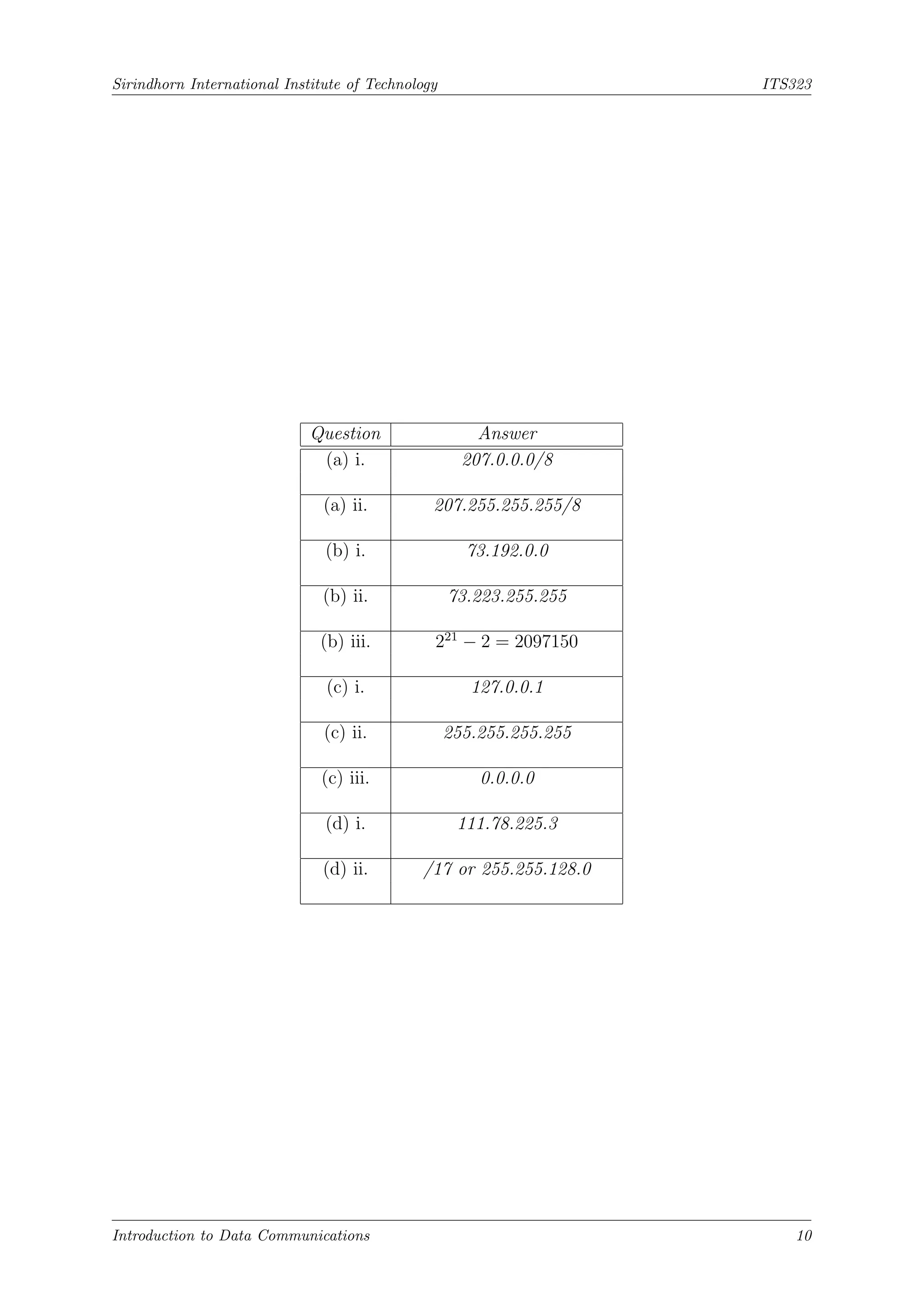
Question Answer
(a) i. 207.0.0.0/8
(a) ii. 207.255.255.255/8
(b) i. 73.192.0.0
(b) ii. 73.223.255.255
(b) iii. 221
− 2 = 2097150
(c) i. 127.0.0.1
(c) ii. 255.255.255.255
(c) iii. 0.0.0.0
(d) i. 111.78.225.3
(d) ii. /17 or 255.255.128.0
Introduction to Data Communications 10
11.
Sirindhorn International Instituteof Technology ITS323
Question 6 [8 marks]
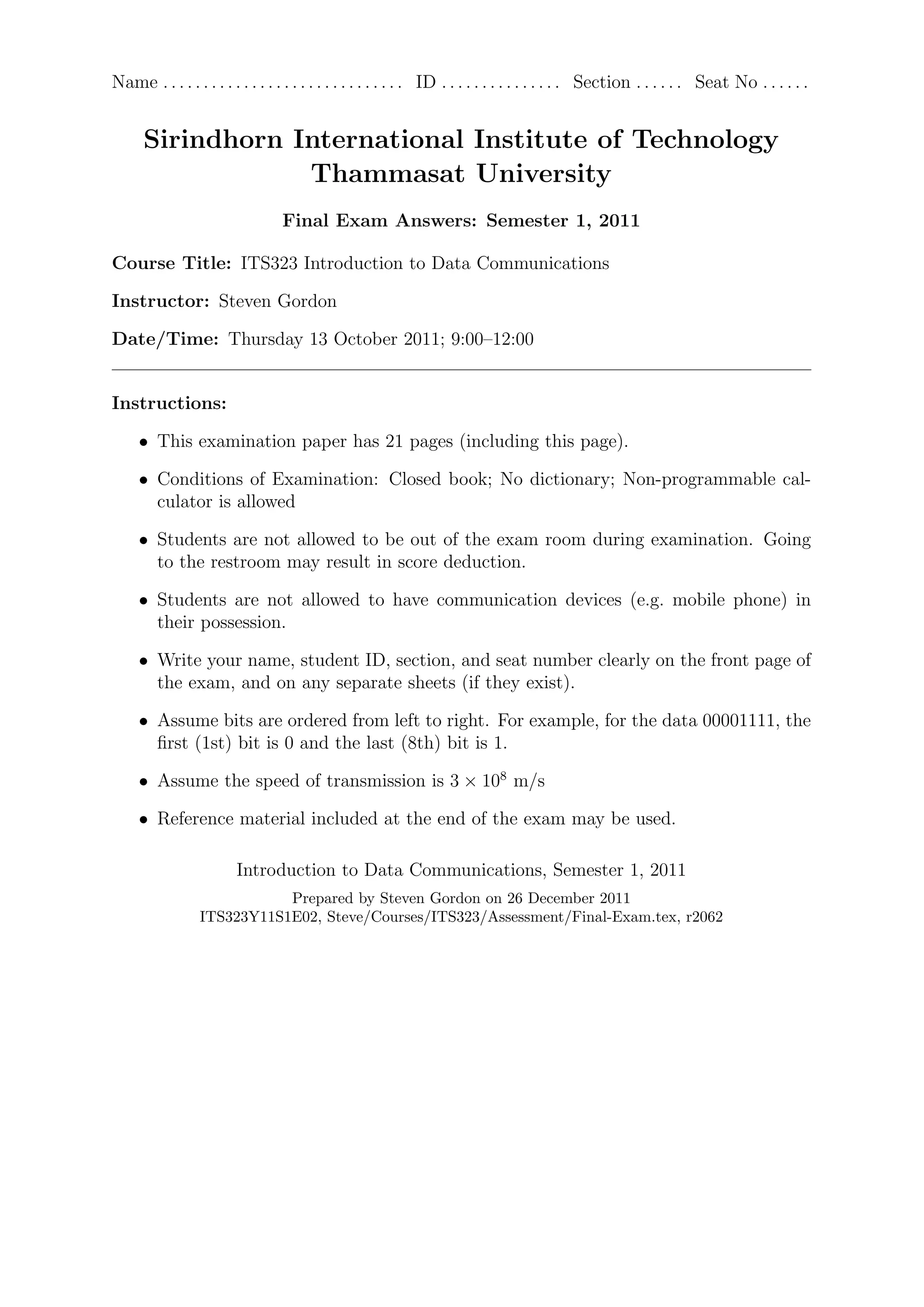
Consider LAN A with 5 computers (stations).
(a) Draw a diagram illustrating LAN A if using a bus topology. [2 marks]
1 2 3 4 5
Figure 4: Bus LAN
(b) Draw a diagram illustrating LAN A if using a ring topology. [2 marks]
1
2
3
4
5
Figure 5: Ring LAN
Consider another three LANs, LAN B, LAN C and LAN D, each with 5 computers.
(That is, there are four LANs, and a total of 20 computers). Each of the four LANs use
a star topology. The four LANs are then connected together by using a mesh topology
amongst the switches.
(c) Draw a diagram illustrating the single larger LAN showing all 20 computers. [4
marks]
Introduction to Data Communications 11
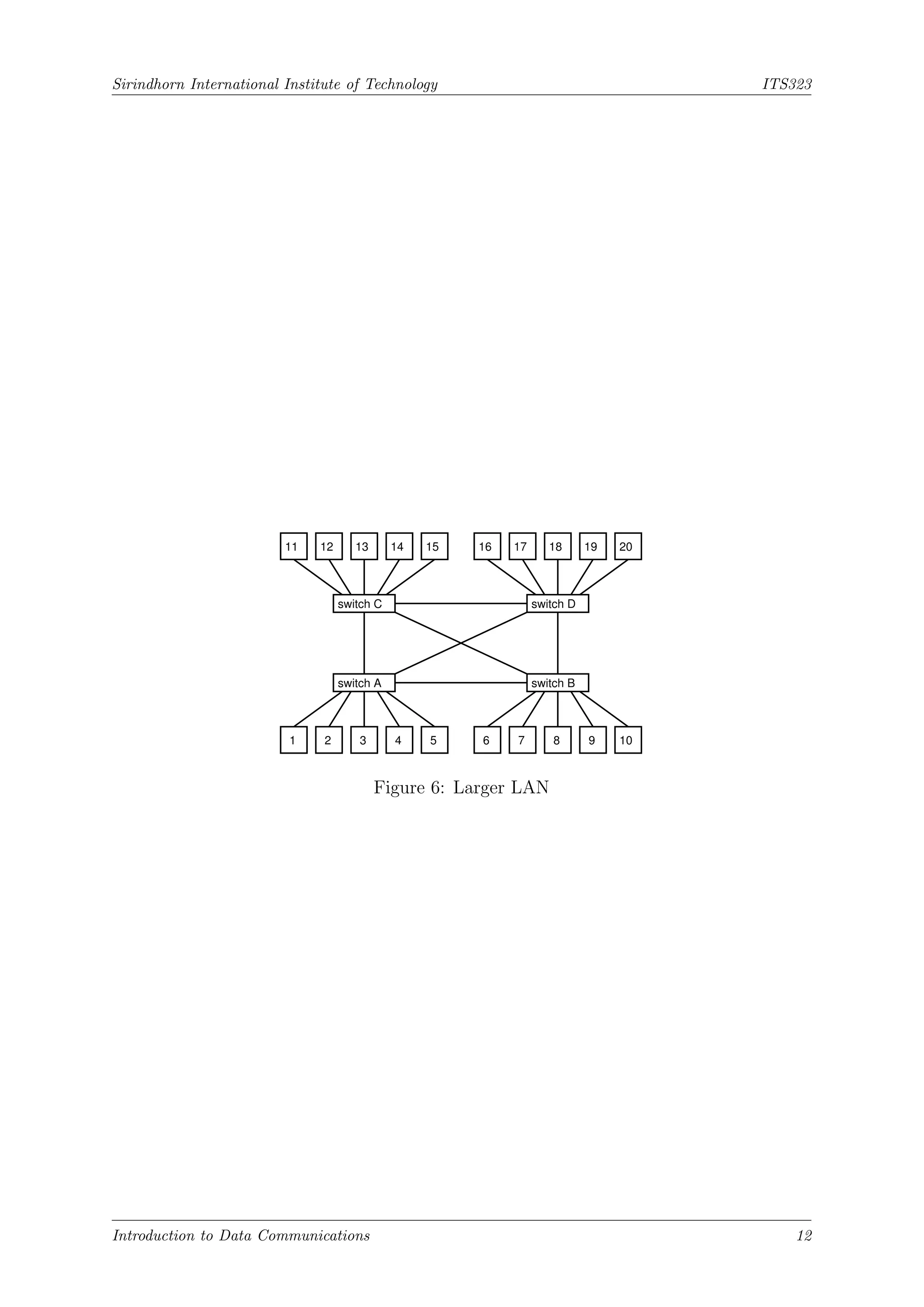
12.
Sirindhorn International Instituteof Technology ITS323
switch A
switch C
switch B
switch D
1 2 3 4 5 6 7 8 9 10
11 12 13 14 15 16 17 18 19 20
Figure 6: Larger LAN
Introduction to Data Communications 12
13.
Sirindhorn International Instituteof Technology ITS323
Question 7 [6 marks]
Consider the network shown in Figure 7. The delay (measured in milliseconds) and data
rate (measured in Mb/s) for each link are shown in the format: (data rate, delay).
A
B
C
G
H
E F
D
(40,7)
(5,20)
(40,30)
(40,5)
(20,7)
(50,13)
(10,10)
(40,2)
(50,4)
(20,2)
(5,25)
Figure 7: Network
Assuming least-cost routing is used to find a path from A to H, indicate the path and
total cost if the cost metric was:
(a) Number of hops [2 marks]
Path: A—B—G—H Cost: 3
(b) Link delay [2 marks]
Path: A—B—D—C—E—F—H Cost: 27
(c) 100Mb/s
Datarate
[2 marks]
Path: A—B—D—F—H Cost: 10
Introduction to Data Communications 13
14.
Sirindhorn International Instituteof Technology ITS323
Question 8 [7 marks]
(a) Draw the Internet protocol stack (or Internet protocol architecture), naming each
of the layers. [3 marks]
Data Link
Physical
Application
Transport
Network
Figure 8: Internet stack
(b) Explain the key difference between an IP host and an IP router. [1 mark]
Answer. An IP router forwards IP datagrams, whereas an IP host does not. An
IP host is either a original source of a datagram or final destination of a datagram.
If it receives an IP datagram a IP host will not send to another device.
(c) Explain a purpose of the TTL field in an IP header. [1 mark]
Answer. Time To Live is decrement by each router. It limits the number of hops
the datagram will traverse. This is useful if there is a routing error the creates a
loop. Without a TTL the datagram will be transmitted for ever; with a TTL it will
eventually be dropped by a router.
(d) IP fragmentation/reassembly allows hosts and routers to perform fragmentation,
but only hosts can reassemble. Explain the advantage of this approach compared
to only allowing hosts to fragment and reassemble (i.e. not allowing routers to
fragment or reassemble). [2 marks]
Answer. If routers cannot fragment then it means the source host must know the
maximum packet sizes across the entire path. Hence there is extra time/complexity
needed in discovering this. With IP the source host (and subsequent routers) only
need to know the maximum packet size for the next hop.
Introduction to Data Communications 14
15.
Sirindhorn International Instituteof Technology ITS323
Question 9 [7 marks]
TCP includes two error control mechanisms: basic retransmit and fast retransmit.
(a) What ARQ scheme is basic retransmit most similar to? [1 mark]
Answer. Selective-reject (or selective-retransmission) ARQ, since a source is al-
lowed to send a window size of frames (hence not stop-and-wait ARQ) and if a
segment is lost only the lost segment needs to be retransmitted—other segments are
buffered (hence not go-back-N ARQ).
(b) Explain how basic retransmit works in TCP. [2 marks]
Answer. When the source sends a segment it starts a timer. If an ACK is received
before the timer expires than the timer is stopped, and the segment successfully
delivered. If the timer expires before an ACK is received then the source retransmits
the segment.
(c) Explain how fast retransmit works in TCP. [2 marks]
Answer. If the source receives four ACKs with the same acknowledgement num-
ber, then it assumes the segment that contains that acknowledgement number is lost
and hence retransmits the segment.
(d) Explain an advantage of fast retransmit (compared to basic retransmit). [2 marks]
Answer. The source potentially retransmits a lost segment earlier than if waiting
for a timeout, and hence spends less time waiting and leads to higher efficiency.
Introduction to Data Communications 15
16.
Sirindhorn International Instituteof Technology ITS323
Question 10 [10 marks]
Consider the network in Figure 9. Each router has multiple numbered interfaces (e.g.
Router A has interface A1 and A2). There are four LANs shown, with each LAN con-
taining multiple hosts. Router H connects, via interface H1, to another router which then
may connect to many more routers and LANs (in other words, assume more LANs can
be reached via router H).
1
1 2 1
2
1
3
1
2
1 2 1
3
3
2
2
2
1
2
(other LANs)
internet
LAN1
LAN2
LAN3
LAN4
A B C
D
H E
G
F
Figure 9: Routed Network
Assuming the destinations may be in any of the four LANs or in any LANs beyond
router H, complete the following routing tables. You may use as many rows as necessary.
Use * to indicate a wild card (any value). Use direct to indicate direct delivery to the
destination. Use the LAN name to refer to a network (e.g. LAN1). Use the router name
and interface to refer to a next router (e.g. A1). Assume rows in the routing table are
processed in order (from top to bottom).
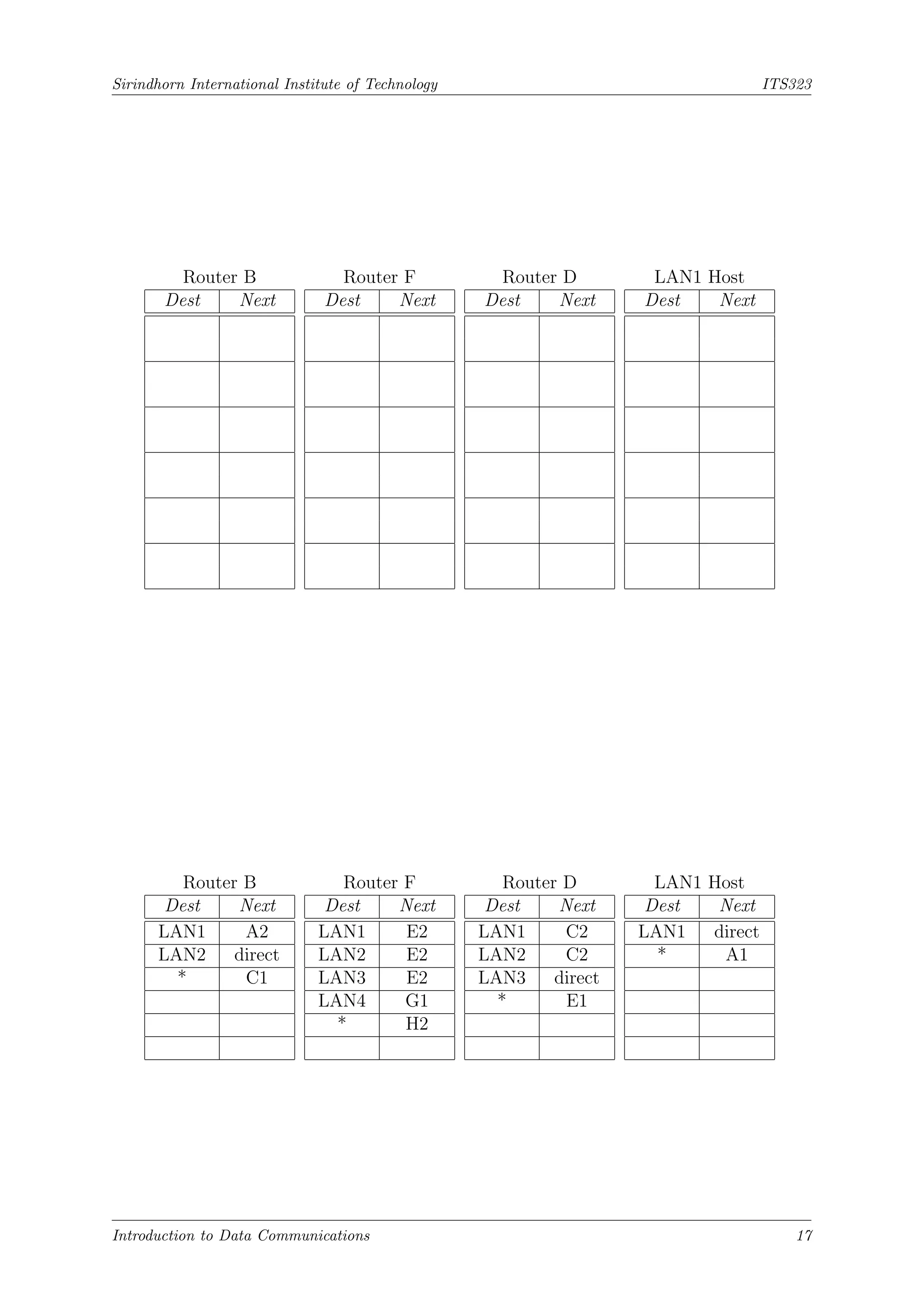
Answer. Variations of the following answer are possible (e.g. not relying on direct).
Introduction to Data Communications 16
17.
Sirindhorn International Instituteof Technology ITS323
Router B
Dest Next
Router F
Dest Next
Router D
Dest Next
LAN1 Host
Dest Next
Router B
Dest Next
LAN1 A2
LAN2 direct
* C1
Router F
Dest Next
LAN1 E2
LAN2 E2
LAN3 E2
LAN4 G1
* H2
Router D
Dest Next
LAN1 C2
LAN2 C2
LAN3 direct
* E1
LAN1 Host
Dest Next
LAN1 direct
* A1
Introduction to Data Communications 17
18.
Sirindhorn International Instituteof Technology ITS323
Question 11 [3 marks]
(a) With respect to point-to-point transmission links, what is multiplexing? [1 mark]
Answer. Multiplexing is combining signals from multiple transmitting sources
into one signal that is transmitted on a single link. At the end of the link the
individual component signals are separated and sent to their intended destinations.
(b) Explain the difference between TDM and FDM. [2 marks]
Answer. Frequency Division Multiplexing allocates different frequencies for the
input user signals. Time Division Multiplexing allocates different time slots for the
input user signals.
Introduction to Data Communications 18
19.
Sirindhorn International Instituteof Technology ITS323
Reference Material
Selected well-known ports:
• FTP 20 and 21
• SSH 22
• Telnet 23
• SMTP 25
• DNS 53
• HTTP 80
• HTTPS 443
20
Bytes
0 4 8 14 16 19 31
Total Length
Fragment Offset
Flags
Identification
Protocol Header Checksum
Source IP Address
Data
Destination IP Address
Time To Live
Version HLength DiffServ ECN
Options + Padding (optional)
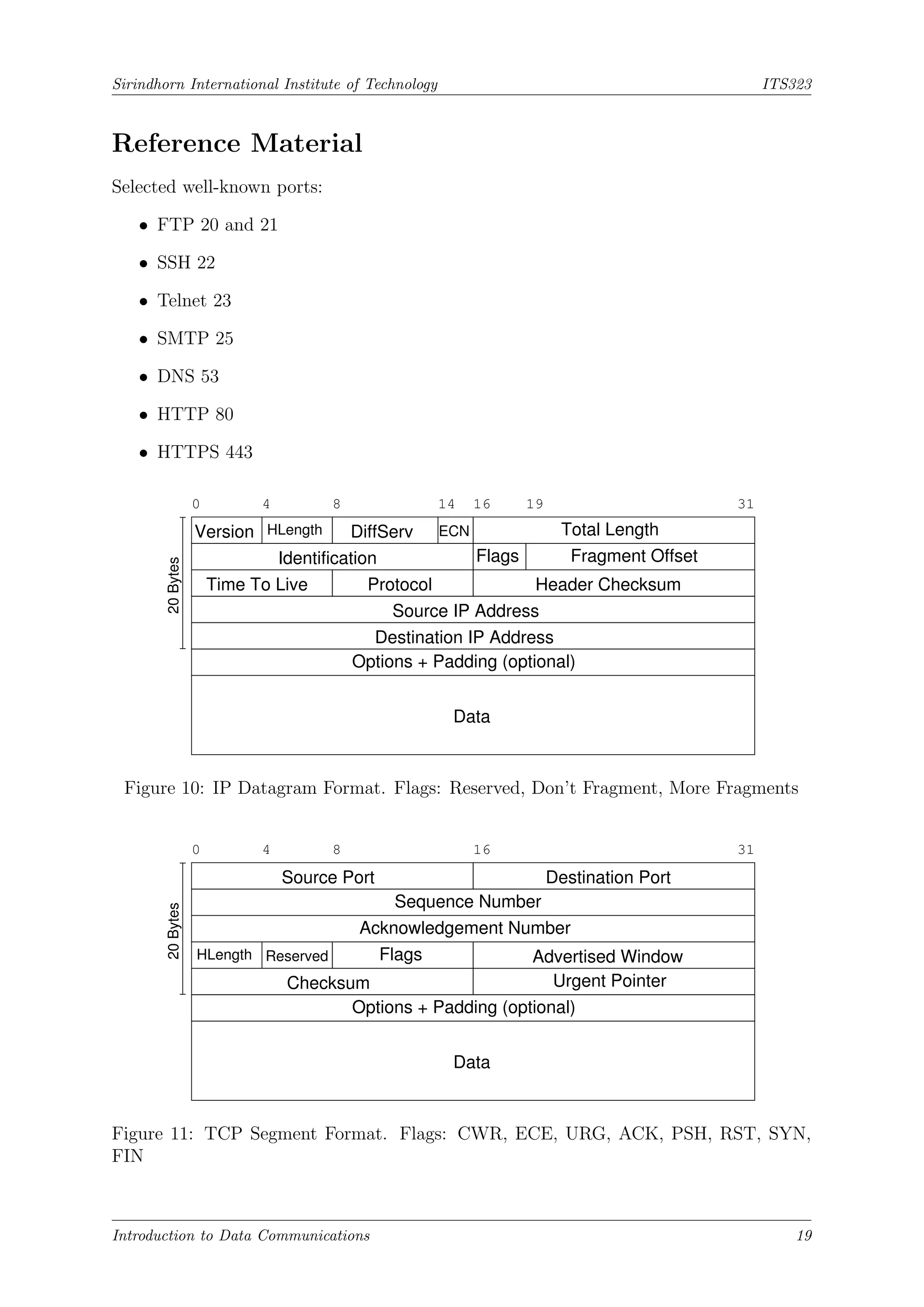
Figure 10: IP Datagram Format. Flags: Reserved, Don’t Fragment, More Fragments
20
Bytes
0 4 8 16 31
Sequence Number
Acknowledgement Number
HLength Flags Advertised Window
Destination Port
Data
Options + Padding (optional)
Urgent Pointer
Checksum
Reserved
Source Port
Figure 11: TCP Segment Format. Flags: CWR, ECE, URG, ACK, PSH, RST, SYN,
FIN
Introduction to Data Communications 19
20.
Sirindhorn International Instituteof Technology ITS323
8
Bytes
0 16 31
Destination Port
Source Port
Total Length Checksum
Data
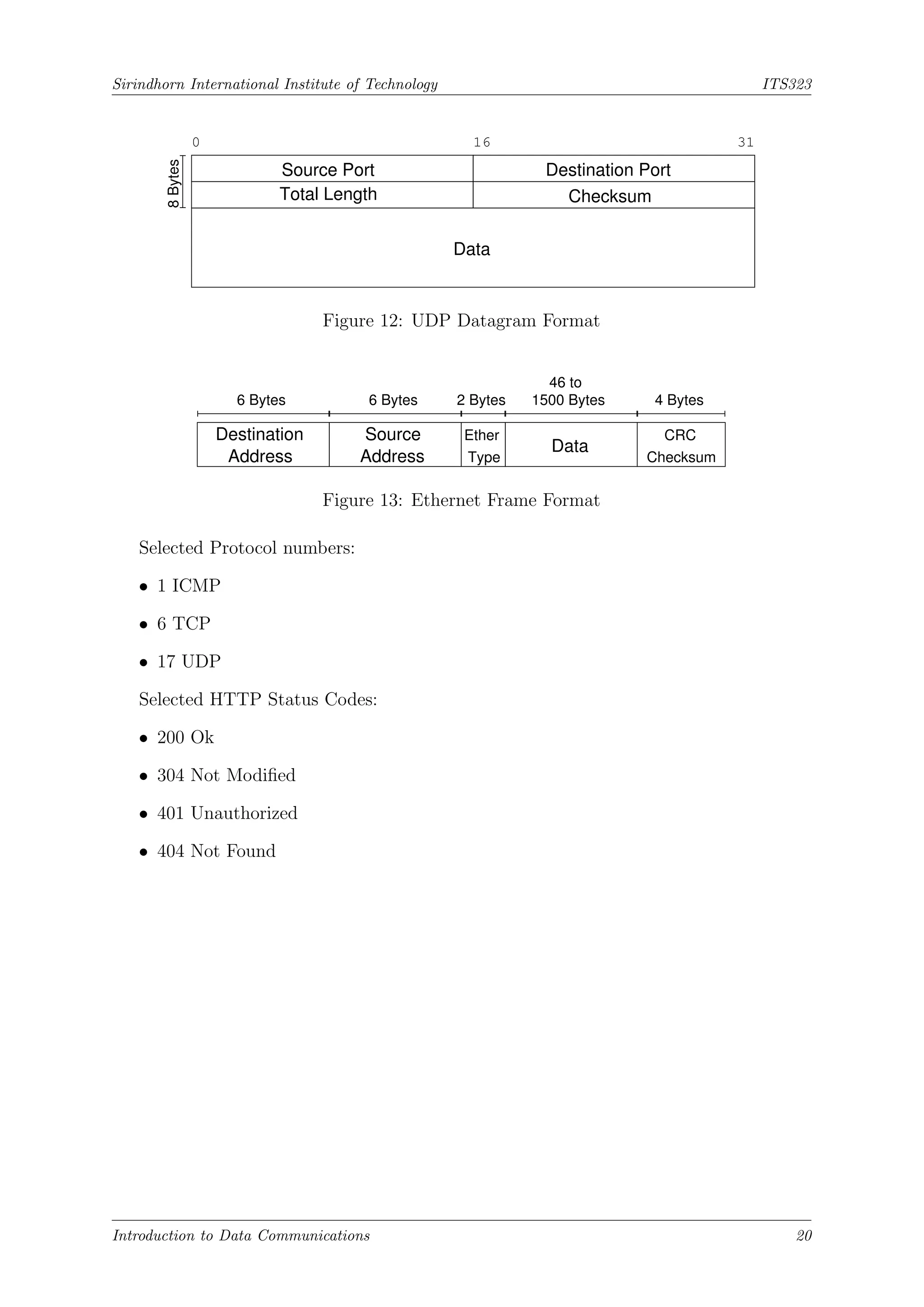
Figure 12: UDP Datagram Format
4 Bytes
2 Bytes
6 Bytes 6 Bytes 1500 Bytes
46 to
Address
Destination
Address
Source
Type
Ether
Data
CRC
Checksum
Figure 13: Ethernet Frame Format
Selected Protocol numbers:
• 1 ICMP
• 6 TCP
• 17 UDP
Selected HTTP Status Codes:
• 200 Ok
• 304 Not Modified
• 401 Unauthorized
• 404 Not Found
Introduction to Data Communications 20
![Sirindhorn International Institute of Technology ITS323
Question 1 [10 marks]
Consider datagram packet switching being used to send n packets across a single path
with h hops, where n >> h. Each packet has a length of l bits. Each link has a data
rate of b bits per second. Each link has a propagation delay of p seconds. Although there
is processing delay and queuing delay at each node, they are both so small that you can
assume they are both 0.
(a) Write an equation that gives the total time, Tdatagram, it takes from when the source
host initiates the data transfer until the destination host has received all of the data.
[6 marks]
Answer. Tdatagram = n × l
b
+ h × p + (h − 1) × l
b
(b) If all the conditions above are the same except virtual circuit packet switching was
used instead of datagram packet switching, then would the total time, Tvirtualcircuit,
be greater than Tdatagram, less than Tdatagram, equal to Tdatagram or there is insuffi-
cient information to know. Explain your answer. [2 marks]
Answer. Tvirtualcircuit would be greater than Tdatagram because in virtual circuit
packet switching the data is delivered in the same manner as datagram packet switch-
ing, but there is an additional time before the data transfer for the virtual circuit to
be established.
(c) Explain an advantage of virtual circuit packet switching compared to datagram
packet switching. [2 marks]
Answer. Virtual circuit packet switching ensures all packets in a data transfer
will follow the same path. One advantage of this is that the packets will be delivered
in order, hence no need for re-ordering at destination. Another advantage is that
resources can be allocated along the path to improve the performance for the data
transfer.
Introduction to Data Communications 2](https://image.slidesharecdn.com/803632569-its323y11s1e02-final-exam-answers-250607170635-a72249a8/75/803632569-ITS323Y11S1E02-Final-Exam-Answers-pdf-2-2048.jpg)
![Sirindhorn International Institute of Technology ITS323
Question 2 [7 marks]
(a) Draw a diagram to illustrate the TCP connection setup process between client A and
server B. For each segment you must indicate appropriate flags and sequence/ack
numbers. Assume A chooses an initial sequence number of 399, and B chooses 1034.
[3 marks]
SN=399
Flags=SYN,ACK
SN=1034
AN=400
Flags=SYN
Flags=ACK
AN=1035
A B
Figure 1: TCP Connection Establishment
(b) Assume that after the TCP connection setup between A and B above, that A
sends 1500 bytes of data in a single segment to B. Then B sends 3000 bytes of
data in a single segment to A using piggybacking. Finally A responds with an
acknowledgement. Draw a new diagram showing the data transfer, indicating flags
and numbers for each segment. (You don’t have to draw the connection setup
again) [4 marks]
Introduction to Data Communications 3](https://image.slidesharecdn.com/803632569-its323y11s1e02-final-exam-answers-250607170635-a72249a8/75/803632569-ITS323Y11S1E02-Final-Exam-Answers-pdf-3-2048.jpg)
![Sirindhorn International Institute of Technology ITS323
A B
SN=400
Flags=[none]
Flags=ACK
SN=1035
AN=1900
Flags=ACK
AN=4035
Figure 2: TCP Data Transfer
Introduction to Data Communications 4](https://image.slidesharecdn.com/803632569-its323y11s1e02-final-exam-answers-250607170635-a72249a8/75/803632569-ITS323Y11S1E02-Final-Exam-Answers-pdf-4-2048.jpg)
![Sirindhorn International Institute of Technology ITS323
Question 3 [13 marks]
Consider the network in Figure 3.
A S R1 R2 B
IF3 IF5 IF6
IF4
IF1 IF2
Ethernet Ethernet PDH Wireless LAN
Link 4
Link 3
Link 2
Link 1
IP host IP router IP router IP host
switch
Ethernet
Figure 3: An internet
The addresses on each interface, IF, are given in Table 1. All subnet masks are /24.
Table 1: Interface Addresses
Interface MAC Address IP Address
IF1 01:23:45:67:89:AB 10.10.10.1
IF2 AA:BB:CC:DD:EE:FF 10.10.10.2
IF3 22:44:66:88:AA:CC 20.20.20.3
IF4 11:33:55:77:99:BB 20.20.20.4
IF5 FE:DC:BA:98:76:54 30.30.30.5
IF6 00:00:11:11:22:22 30.30.30.6
Host A is running a web browser and a voice-over-IP (VoIP) application, while host
B is running a web server, a web browser and a VoIP application. The user on host A
has clicked on the URL http://www.example.com/courses/index.html. Assume DNS
has already been used and that host A has already established a connection to host B
(host A chose initial sequence number 1234, host B chose 89). Also, host A and B have
already started a voice call using their VoIP applications. The VoIP application sends
UDP packets containing PCM encoded voice.
Assume all HTTP requests are 100 Bytes in length, all HTTP responses are 1,000
Bytes, and all VoIP packets are 50 Bytes. The transport layer protocols can send the
application layer data in a single segment. All requested URLs exist and are accessible
on the server.
Assume you can intercept any packet on any link in the internet and see the entire con-
tents of the packet. For the following packets and locations, complete the corresponding
tables giving the value of the header fields.
Introduction to Data Communications 5](https://image.slidesharecdn.com/803632569-its323y11s1e02-final-exam-answers-250607170635-a72249a8/75/803632569-ITS323Y11S1E02-Final-Exam-Answers-pdf-5-2048.jpg)
![Sirindhorn International Institute of Technology ITS323
(a) The packet containing the HTTP request sent by A, intercepted on link 1. [6 marks]
Layer Field Value
Data Link Source Address 01:23:45:67:89:AB
Data Link Destination Address AA:BB:CC:DD:EE:FF
Network Protocol 6
Network Total Length 140
Transport Destination Port 80
Transport Sequence Number 1235
(b) The packet containing the HTTP response sent by B, intercepted on link 3. [4
marks]
Layer Field Value
Network Source Address 30.30.30.6
Network Destination Address 10.10.10.1
Network Total Length 1040
Transport Sequence Number 90
(c) A packet containing VoIP data sent by A, intercepted on link 4. [3 marks]
Layer Field Value
Network Source Address 10.10.10.1
Network Destination Address 30.30.30.6
Transport Total Length 58
Introduction to Data Communications 6](https://image.slidesharecdn.com/803632569-its323y11s1e02-final-exam-answers-250607170635-a72249a8/75/803632569-ITS323Y11S1E02-Final-Exam-Answers-pdf-6-2048.jpg)
![Sirindhorn International Institute of Technology ITS323
Question 4 [14 marks]
Consider a network with two links: A—B—C.
First consider the link from A to B with the following characteristics:
• DATA frame consists of 100 bits of header plus 900 bits of data (total size 1,000
bits)
• ACK frame consists only of 100 bits of header
• Link data rate is 10Mb/s
• Link distance is 240km
The Sliding Window flow control protocol is used on this link. The receiver (B) sends
an ACK frame immediately after receiving a DATA frame (there is no processing delay).
A 4–bit sequence number is used within the header of the DATA frame (and ACK frame).
The maximum window size is 15.
(a) What is the maximum number of DATA frames node A can send before having to
wait for an ACK? [1 mark]
Answer. With a maximum window size of 15 then 15 frames may be sent before
having to wait for an ACK.
(b) Assuming node A always has data ready to send, and it starts transmission of its
1st DATA frame at time 0s, at what time can node A start transmitting the 2nd
DATA frame? [2 marks]
Answer. Immediately after the 1st DATA frame has been transmitted. The trans-
mission time of a DATA frame is:
TDATA = 900+100
10×106 = 100µs
Therefore, 2nd DATA frame can be sent at time 100us.
(c) At what time can node A start transmitting the 16th DATA frame? [4 marks]
Answer. As the maximum window size is 15, the transmitter must wait until at
least the 1st DATA frame is ACKed before sending the 16th DATA frame.
The ACK transmission time and Propagation delay are:
TACK = 100
10×106 = 10µs
PAB = 240×103
3×108 = 800µs
The time at which the ACK for the 1st DATA frame is received is: TDATA + PAB +
TACK + PBA = 1710µs. Note that the first 15 DATA frames are transmitted within
1500us. Therefore the transmitter must wait until time 1710us before sending the
16th frame.
(d) What is the maximum throughput that can be achieved across the link from A to
B? [3 marks]
Introduction to Data Communications 7](https://image.slidesharecdn.com/803632569-its323y11s1e02-final-exam-answers-250607170635-a72249a8/75/803632569-ITS323Y11S1E02-Final-Exam-Answers-pdf-7-2048.jpg)
![Sirindhorn International Institute of Technology ITS323
Answer. 15 DATA frames sent within 1710us, gives a throughput of:
Throughput = 15×900
1710×106 = 7.89Mb/s
Now consider the link from B to C with the following characteristics:
• DATA frame consists of 100 bits of header plus 900 bits of data (total size 1,000
bits)
• ACK frame consists only of 100 bits of header
• Link distance is 2.1km
The Stop and Wait flow control protocol is used in this link.
(e) What is the minimum data rate necessary for Link B to C such that the throughput
from A to C is the same as calculated in part (d)? [4 marks]
Answer. At B, 15 DATA frames arrive every 1710us. Therefore to achieve the
same throughput from B to C, 15 DATA frames must be delivered to C every 1710us.
Considering Stop and Wait is used from B to C:
PBC = 2100
3×108 = 7µs
Time for sending 15 DATA frames:
15 ×
1000
rate
+ PBC + 100
rate
+ PBC
= 1710 × 10−6
Re-arranging gives:
rate = 1100
1710
15
−2.7
= 11Mb/s
The data rate necessary is 11Mb/s.
Introduction to Data Communications 8](https://image.slidesharecdn.com/803632569-its323y11s1e02-final-exam-answers-250607170635-a72249a8/75/803632569-ITS323Y11S1E02-Final-Exam-Answers-pdf-8-2048.jpg)
![Sirindhorn International Institute of Technology ITS323
Question 5 [15 marks]
Assuming classless IP addressing is used, answer the following questions by writing your
answers in the table on the next page. Unless otherwise stated, give all IP addresses in
dotted decimal notation.
(a) For a host with IP address 207.89.34.56/8: [3 marks]
i. What is the network address?
ii. What is the directed broadcast address?
(b) For a host with IP address 73.193.16.4 and subnet mask 255.224.0.0: [4.5 marks]
i. What is the network address?
ii. What is the directed broadcast address?
iii. What is the maximum number of IP devices that can attach to this subnet?
(c) A host does not yet have an IP address configured, nor does it know its network
address. [4.5 marks]
i. Give an IP address that the host can send to in order to send to itself.
ii. Give an IP address that the host can send to in order to deliver an IP datagram
to all nodes on its subnet.
iii. For the case of part (ii), give the source address of the IP datagram.
(d) For a router with IP address 01101111010011101110000100000011 and host on a
different subnet to the router with IP address 111.78.25.3: [3 marks]
i. What is the IP address of the router (in dotted decimal notation)?
ii. What is the subnet mask of the router (in slash or dotted decimal notation)
that allows the most hosts to attach to the routers subnet?
Introduction to Data Communications 9](https://image.slidesharecdn.com/803632569-its323y11s1e02-final-exam-answers-250607170635-a72249a8/75/803632569-ITS323Y11S1E02-Final-Exam-Answers-pdf-9-2048.jpg)
![Sirindhorn International Institute of Technology ITS323
Question 6 [8 marks]
Consider LAN A with 5 computers (stations).
(a) Draw a diagram illustrating LAN A if using a bus topology. [2 marks]
1 2 3 4 5
Figure 4: Bus LAN
(b) Draw a diagram illustrating LAN A if using a ring topology. [2 marks]
1
2
3
4
5
Figure 5: Ring LAN
Consider another three LANs, LAN B, LAN C and LAN D, each with 5 computers.
(That is, there are four LANs, and a total of 20 computers). Each of the four LANs use
a star topology. The four LANs are then connected together by using a mesh topology
amongst the switches.
(c) Draw a diagram illustrating the single larger LAN showing all 20 computers. [4
marks]
Introduction to Data Communications 11](https://image.slidesharecdn.com/803632569-its323y11s1e02-final-exam-answers-250607170635-a72249a8/75/803632569-ITS323Y11S1E02-Final-Exam-Answers-pdf-11-2048.jpg)
![Sirindhorn International Institute of Technology ITS323
Question 7 [6 marks]
Consider the network shown in Figure 7. The delay (measured in milliseconds) and data
rate (measured in Mb/s) for each link are shown in the format: (data rate, delay).
A
B
C
G
H
E F
D
(40,7)
(5,20)
(40,30)
(40,5)
(20,7)
(50,13)
(10,10)
(40,2)
(50,4)
(20,2)
(5,25)
Figure 7: Network
Assuming least-cost routing is used to find a path from A to H, indicate the path and
total cost if the cost metric was:
(a) Number of hops [2 marks]
Path: A—B—G—H Cost: 3
(b) Link delay [2 marks]
Path: A—B—D—C—E—F—H Cost: 27
(c) 100Mb/s
Datarate
[2 marks]
Path: A—B—D—F—H Cost: 10
Introduction to Data Communications 13](https://image.slidesharecdn.com/803632569-its323y11s1e02-final-exam-answers-250607170635-a72249a8/75/803632569-ITS323Y11S1E02-Final-Exam-Answers-pdf-13-2048.jpg)
![Sirindhorn International Institute of Technology ITS323
Question 8 [7 marks]
(a) Draw the Internet protocol stack (or Internet protocol architecture), naming each
of the layers. [3 marks]
Data Link
Physical
Application
Transport
Network
Figure 8: Internet stack
(b) Explain the key difference between an IP host and an IP router. [1 mark]
Answer. An IP router forwards IP datagrams, whereas an IP host does not. An
IP host is either a original source of a datagram or final destination of a datagram.
If it receives an IP datagram a IP host will not send to another device.
(c) Explain a purpose of the TTL field in an IP header. [1 mark]
Answer. Time To Live is decrement by each router. It limits the number of hops
the datagram will traverse. This is useful if there is a routing error the creates a
loop. Without a TTL the datagram will be transmitted for ever; with a TTL it will
eventually be dropped by a router.
(d) IP fragmentation/reassembly allows hosts and routers to perform fragmentation,
but only hosts can reassemble. Explain the advantage of this approach compared
to only allowing hosts to fragment and reassemble (i.e. not allowing routers to
fragment or reassemble). [2 marks]
Answer. If routers cannot fragment then it means the source host must know the
maximum packet sizes across the entire path. Hence there is extra time/complexity
needed in discovering this. With IP the source host (and subsequent routers) only
need to know the maximum packet size for the next hop.
Introduction to Data Communications 14](https://image.slidesharecdn.com/803632569-its323y11s1e02-final-exam-answers-250607170635-a72249a8/75/803632569-ITS323Y11S1E02-Final-Exam-Answers-pdf-14-2048.jpg)
![Sirindhorn International Institute of Technology ITS323
Question 9 [7 marks]
TCP includes two error control mechanisms: basic retransmit and fast retransmit.
(a) What ARQ scheme is basic retransmit most similar to? [1 mark]
Answer. Selective-reject (or selective-retransmission) ARQ, since a source is al-
lowed to send a window size of frames (hence not stop-and-wait ARQ) and if a
segment is lost only the lost segment needs to be retransmitted—other segments are
buffered (hence not go-back-N ARQ).
(b) Explain how basic retransmit works in TCP. [2 marks]
Answer. When the source sends a segment it starts a timer. If an ACK is received
before the timer expires than the timer is stopped, and the segment successfully
delivered. If the timer expires before an ACK is received then the source retransmits
the segment.
(c) Explain how fast retransmit works in TCP. [2 marks]
Answer. If the source receives four ACKs with the same acknowledgement num-
ber, then it assumes the segment that contains that acknowledgement number is lost
and hence retransmits the segment.
(d) Explain an advantage of fast retransmit (compared to basic retransmit). [2 marks]
Answer. The source potentially retransmits a lost segment earlier than if waiting
for a timeout, and hence spends less time waiting and leads to higher efficiency.
Introduction to Data Communications 15](https://image.slidesharecdn.com/803632569-its323y11s1e02-final-exam-answers-250607170635-a72249a8/75/803632569-ITS323Y11S1E02-Final-Exam-Answers-pdf-15-2048.jpg)
![Sirindhorn International Institute of Technology ITS323
Question 10 [10 marks]
Consider the network in Figure 9. Each router has multiple numbered interfaces (e.g.
Router A has interface A1 and A2). There are four LANs shown, with each LAN con-
taining multiple hosts. Router H connects, via interface H1, to another router which then
may connect to many more routers and LANs (in other words, assume more LANs can
be reached via router H).
1
1 2 1
2
1
3
1
2
1 2 1
3
3
2
2
2
1
2
(other LANs)
internet
LAN1
LAN2
LAN3
LAN4
A B C
D
H E
G
F
Figure 9: Routed Network
Assuming the destinations may be in any of the four LANs or in any LANs beyond
router H, complete the following routing tables. You may use as many rows as necessary.
Use * to indicate a wild card (any value). Use direct to indicate direct delivery to the
destination. Use the LAN name to refer to a network (e.g. LAN1). Use the router name
and interface to refer to a next router (e.g. A1). Assume rows in the routing table are
processed in order (from top to bottom).
Answer. Variations of the following answer are possible (e.g. not relying on direct).
Introduction to Data Communications 16](https://image.slidesharecdn.com/803632569-its323y11s1e02-final-exam-answers-250607170635-a72249a8/75/803632569-ITS323Y11S1E02-Final-Exam-Answers-pdf-16-2048.jpg)
![Sirindhorn International Institute of Technology ITS323
Question 11 [3 marks]
(a) With respect to point-to-point transmission links, what is multiplexing? [1 mark]
Answer. Multiplexing is combining signals from multiple transmitting sources
into one signal that is transmitted on a single link. At the end of the link the
individual component signals are separated and sent to their intended destinations.
(b) Explain the difference between TDM and FDM. [2 marks]
Answer. Frequency Division Multiplexing allocates different frequencies for the
input user signals. Time Division Multiplexing allocates different time slots for the
input user signals.
Introduction to Data Communications 18](https://image.slidesharecdn.com/803632569-its323y11s1e02-final-exam-answers-250607170635-a72249a8/75/803632569-ITS323Y11S1E02-Final-Exam-Answers-pdf-18-2048.jpg)


![Filtering Antenna[1] - Read-Only (2).pptx](https://cdn.slidesharecdn.com/ss_thumbnails/filteringantenna1-read-only2-250520164908-7b67a423-thumbnail.jpg?width=640&height=640&fit=bounds)


