SHIRKAH
SHIRKAH
Presented By
:
Dr. Muhammad Wasie Butt
Overview
Overview
o Terminology & Definition of Musharakah
o Types of Musharakah
o Structure of Musharakah
o Basic Rules in Musharakah
o Termination of Musharakah
o Constructive Liquidation of Musharaka
o Security / Collateral in Musharaka
o Musharaka Management and Liability
o Application of Musharaka As a Mode
o Problems and Risk for Banks in Musharaka Financing
MEANING OF SHAIRKAT
MEANING OF SHAIRKAT
The word sharikah is used in the literal sense to mean
mixing or mingling. Sharikah or Partnership implies an
underlying idea of mixing share in such a way that one of
them cannot be distinguished from the other.
In its technical sense, sharikah signifies a particular
relationship that exists between contracting parties to
participate in a property without business intention or in a
business to generate profit.
LEGITIMACY OF SHIRKAT
Allah Subhan-o-Tallah has declared
He will become a partner in a business between two mushariks until they
indulge in cheating or breach of trust (khayanah).
LEGITIMACY OF SHIRKAT
Sharikah business was prevalent in
the Arabian Peninsula at the advent
of Islam. The Holy Prophet
(s.a.w.s.) accorded his tacit
approval to this practice. He
himself carried on business on the
basis of partnership before his
declaration of prophethood.
Types of Shirkah
Types of Shirkah
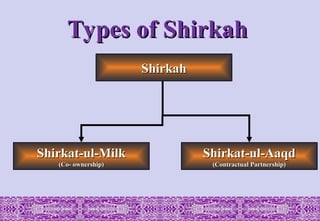
Shirkah
Shirkah
Shirkat-ul-Milk
Shirkat-ul-Milk
(Co- ownership)
(Co- ownership)
Shirkat-ul-Aaqd
Shirkat-ul-Aaqd
(Contractual Partnership)
Shirkat-ul-Milk
Shirkat-ul-Milk (Joint ownership)
(Joint ownership)
Joint ownership of two or more persons
in a particular property/ asset with out
any business intention. This comes into
being as a result of joint purchase, joint
acceptance of gift or a bequest and
inheritance of joint property etc.
Types of Shirkat-ul-Milk
1.
1. Shirkat-ul-Milk Optional
Shirkat-ul-Milk Optional (Ikhtiari)
(Ikhtiari)
This comes into operation through the act of parties e.g.,
purchase of asset with mutual consent.
2.
2. Shirkat-ul-Milk Compulsory
Shirkat-ul-Milk Compulsory (Ghair Ikhtiari)
(Ghair Ikhtiari)
This comes into operation without any action on the part
of parties e.g., ownership of heirs on the inherited
property.
Rules of
Rules of Shirkat-ul-Milk
Shirkat-ul-Milk
1. Each partner is a stranger with respect to the share of the
others.
2. The partners are not allowed to undertake any act of
disposal with respect to the other’s share except with the
latter’s permission.
3. The share of one partner in the possession of another co-
owner is governed by the rules of wadi’ah (deposit). If
one co-owner further deposits such property with a third
party without the permission of his partner, he is liable for
compensation (daman) if the property is destroyed.
4. Profit & loss will be according the ratio of ownership.
5. Every partner has the right to sale/gift/lease to the extent
of his share.
Shirkat-ul-Aqd
Shirkat-ul-Aqd
(Joint venture/partnership).
Sharikah is a contract
between two or more
people for participation in
capital and its profit.
Shirkat-ul-Aqd
Shirkat-ul-Aqd
(Joint venture/partnership).
Definition in Law:
The Pakistan Partnership Act
1932 defines partnership as:
“A relationship between
persons who agree to share the
profit of a business carried on
by all or any of them acting for
all”.
Difference between
Difference between
Shirkat-ul-Aqd and Shirkat-ul-Milk
1. In Shirkat ul Aqd both parties create partnership for
sharing profit earned by Shirkah asset, while in Shirkat
ul milk both partners do not intend to earn profit from
Shirkah asset.
2. In Shirkat ul Aqd, each partner is an agent of others
while in Shirkat ul Milk each partner is stranger with
respect to other’s share.
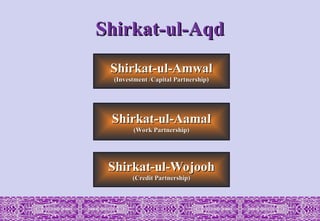
Shirkat-ul-Wojooh
Shirkat-ul-Wojooh
(Credit Partnership)
Shirkat-ul-Aamal
Shirkat-ul-Aamal
(Work Partnership)
(Work Partnership)
Shirkat-ul-Amwal
Shirkat-ul-Amwal
(Investment /Capital Partnership)
Shirkat-ul-Aqd
Shirkat-ul-Aqd
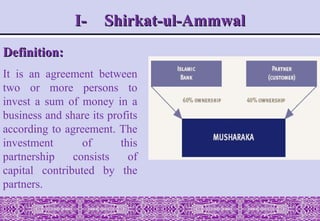
Definition:
Definition:
It is an agreement between
two or more persons to
invest a sum of money in a
business and share its profits
according to agreement. The
investment of this
partnership consists of
capital contributed by the
partners.
I-
I- Shirkat-ul-Ammwal
Shirkat-ul-Ammwal
Types of Shirkat-ul-Aqd
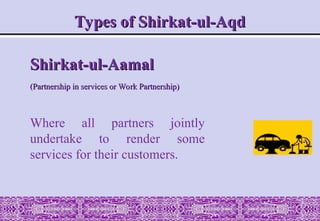
Shirkat-ul-Aamal
Shirkat-ul-Aamal
(Partnership in services or Work Partnership)
Where all partners jointly
undertake to render some
services for their customers.
Shirkat-ul-Wujooh
Shirkat-ul-Wujooh
(Partnership in goodwill or Credit Partnership)
Where the partners have no investment at all,
they purchase commodities on deferred price by
their goodwill and sell them on spot. Their
capital is their credit worthiness and reputation.
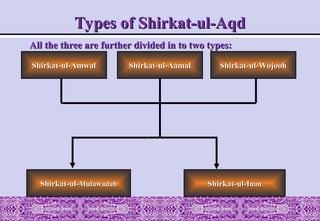
Types Shirkat-ul-Aqd
Shirkat-ul-Amwal
Shirkat-ul-Amwal Shirkat-ul-Wojooh
Shirkat-ul-Wojooh
Shirkat-ul-Aamal
Shirkat-ul-Aamal
Shirkat-ul-
Shirkat-ul-Mufawadah
Mufawadah Shirkat-ul-I
Shirkat-ul-Inan
nan
All the three are further divided in to two types:
Types of Shirkat-ul-Aqd
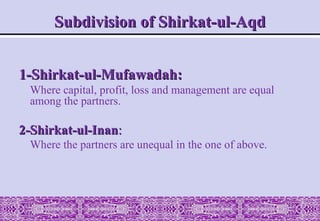
Subdivision of Shirkat-ul-Aqd
1-Shirkat-ul-Mufawadah:
Where capital, profit, loss and management are equal
among the partners.
2-Shirkat-ul-Inan
2-Shirkat-ul-Inan:
:
Where the partners are unequal in the one of above.
The basic rules of Musharakah
• Musharakah or shirkat-ul-amwal is a relationship established by
the parties through a mutual contract.
• Therefore, it goes without saying that all the necessary
ingredients of a valid contract must be present here also.
• For example,
• the parties should be capable of entering into a contract;
• the contract must take place with free consent of the
parties, without any compulsion, fraud or
misrepresentation, etc.
20
1) Capital:
1) Capital:
The capital in a musharakah agreement should be:
A)Quantified (ma’loom):
– meaning how much etc.
B) Specified (muta’aiyan):
– meaning specified currency etc.
C) Not necessarily be merged:
– the mixing of capital is not required.
D) Not necessarily be in liquid form:
– Capital share may be contributed either in cash/liquid or in
the form of commodities.
– In case of a commodity, the market value of the commodity
shall determine the share of the partner in the capital.
21
2) Management of Musharakah
• Every partner has a right to take part in its management
and to work for it.
• However, the partners may agree upon a condition that the
management shall be carried out by one of them, and no
other partner shall work for the musharakah.
– But in this case the sleeping partner shall be entitled to
the profit only to the extent of his investment, and
– the ratio of profit allocated to him should not exceed the
ratio of his investment.
22
3) Distribution of Profit
1. The ratio of profit for each partner must be determined in
proportion to the actual profit accrued to the business and not
in proportion to the capital invested by him.
E.G. If it is agreed between them that ‘A’ will get 1% of his
investment, the contract is not valid.
2. It is not allowed to fix a lump sum amount for anyone of the
partners or any rate of profit tied up with his investment.
Therefore if ‘A’ & ‘B’ enter into a partnership and it is
agreed between them that ‘A’ shall be given Rs.10,000/- per
month as his share in the profit and the rest will go to ‘B’,
the partnership is invalid.
23
3) Distribution of Profit (Contd….)
3. If both partners agree that each will get percentage of profit based
on his capital percentage, whether both work or not, it is allowed.
4. It is also allowed that if an investor is working, his profit share (%)
could be more than his capital base (%) irrespective whether the
other partner is working or not.
 E.g. If ‘A’ & ’B’ have invested Rs.1,000/- each in a business and
it is agreed that only ‘A’ will work and will get 2/3rd of the profit
while ‘B’ will get 1/3rd.
24
3) Distribution of Profit (Contd….)
5. If a partner has put an express condition in the agreement that
he will not work for the musharakah and will remain a
sleeping partner throughout the term of musharakah, then his
share of profit cannot be more than the ratio of his investment.
6. It is allowed that if a partner is not working, his profit share
can be established less than his capital share.
7. If both are working partners, the share of profit can differ from
the ratio of investment.
 Eg. Zaid & bakar both have invested Rs.1,000/- each. However zaid
gets 1/3rd of the total profit and bakar 2/3rd, this is allowed.
– This opinion of Imam Abu Hanifa is based on the fact that
capital is not the only factor for profit but also labour and
work. 25
3) Distribution of Profit (Contd….)
• Different partners may be given different weightings according to
amount and period of their investment.
• Both partners can agree that first 6-month profit e.g. will be
distributed at ratio of 50% : 50% and next 6-month profit will be
distributed at ratio of 30% : 70%.
• Partners can also agree that e.g. if profit is Rs. 1 million, it will be
distributed at ratio of 50% : 50% and excess profit above Rs. 1
million will be distributed at ratio of 70% : 30%.
• It is permissible to distribute provisional profit, subject to final
settlement.
• It is permissible to decide not to distribute a portion of capital
creating various reserves.
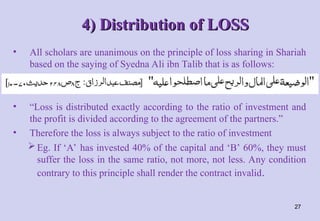
4) Distribution of LOSS
• All scholars are unanimous on the principle of loss sharing in Shariah
based on the saying of Syedna Ali ibn Talib that is as follows:
• “Loss is distributed exactly according to the ratio of investment and
the profit is divided according to the agreement of the partners.”
• Therefore the loss is always subject to the ratio of investment
Eg. If ‘A’ has invested 40% of the capital and ‘B’ 60%, they must
suffer the loss in the same ratio, not more, not less. Any condition
contrary to this principle shall render the contract invalid.
27
5) Powers & Rights of Partners in Musharakah
After entering into a musharakah contract, partners have the
following rights:
a.The right to sell the mutually owned property since all partners are
representing each other in shirkah and all have the right to buy & sell
for business purposes.
b.The right to buy raw material or other stock on cash or credit using
funds belonging to shirkah to put into business.
c.The right to hire people to carry out business if needed.
d.The right to deposit money & goods of the business belonging to
shirkah as depositor trust where and when necessary.
e.The right to use shirkah’s fund or goods in mudarabah.
f.The right of giving shirkah’s funds as hiba (gift) or loan.
28
6) Termination of Musharakah
Musharakah will stand terminated in the following cases:
1.If the purpose of forming the shirkah has been achieved.
– For example, if two partners had formed a shirkah for a certain project
for e.g. buying a specific quantity of cloth in order to sell it and the cloth
is purchased and sold with mutual investment.
2.Every partner has the right to terminate the musharakah at any time ,after
giving his partner a notice
3.In case of
– a death of any one of the partners
– or any partner becoming insane
– or incapable of effecting commercial transaction
29
6) Termination of Musharakah Contd….
4.In case of
– damage to the share capital of one partner
• before mixing the same in the total investment
• and before affecting the purchase,
– the partnership will stand terminated
– and the loss will only be borne by that particular partner.
• However, if the share capital of all partners has been mixed and could
not be identified singly,
– then the loss will be shared by all and the partnership will not be
terminated
30
Termination of Musharakah without closing the business
• If illiquid asset is sold and transferred in liquid form, it is called
“Physical Liquidation”. If market value/book value/breakup
value of illiquid asset is taken, it is called Constructive
Liquidation”.
• If one of the partners wants termination of the musharakah,
while the other partner or partners like to continue with the
business, this purpose can be achieved by mutual agreement.
• The partners who want to run the business may purchase the
share of the partner who wants to terminate his partnership
• In this case, the price of the share of leaving partner must be
determined by mutual consent or market valuation by third
party
31
Termination of Musharakah without closing the business
• While entering into the contract of the Musharakah, the partners can agree
on a condition that
– the liquidation or separation of the business shall not be effected unless all the partners
or the majority of them wants to do so.
• And that a single partner who wants to come out of the partnership shall
have to sell his share to the other partners and shall not force them on
liquidation or separation.
• This condition may be justified, especially in the modern situations, on the
ground that the nature of business, in most cases today, involves huge
capital , intensive planning and requires continuity for its success. and it can
be supported by the famous hadith:
• "All conditions agreed upon by the Muslims are upheld, except a condition
which allows what is prohibited or prohibits what is lawful".
• 32
Musharakah
Musharakah
As a mode of islamic finance
Uses Of Musharakah / Mudarabah
• These modes can be used in the following areas (or can replace
them according to shariah rules).
– Asset side financing
• Short/medium/long - term financing
• Project financing
• Small & medium enterprises setup financing
• Large enterprise financing
• Import financing
• LC with margin (for Musharakah)
• Export financing (Pre-shipment financing)
• Working capital Financing
• Running accounts financing / short term advances
34
Uses Of Musharakah / Mudarabah
• These modes can be used in the following areas (or can replace
them according to shariah rules).
– Liability side financing
• For current/ saving/mahana amdani/ investment accounts (Deposit giving
Profit based on Musharkah/Mudarbah – with predetermined ratio)
• Inter- Bank lending / borrowing
– • Term Finance Certificates & Certificate of Investment
• T-Bill and Federal Investment Bonds / Debenture.
• Securitization for large projects (based on Musharkah)
• Certificate of Investment based on Murabahah (e.g: Meezan Riba Free)
• Islamic Bank Musharakah bonds (based on projects requiring large
amounts - profit based on the return from the project).
35
36
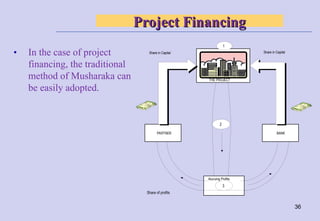
• In the case of project
financing, the traditional
method of Musharaka can
be easily adopted.
Project Financing
Project Financing
THE PROJECT
PARTNER BANK
1
Share in Capital Share in Capital
2
3
Accruing Profits
Share of profits
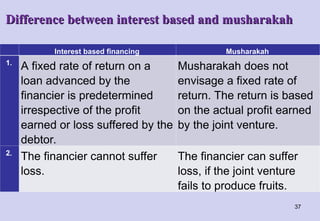
Difference between interest based and musharakah
Interest based financing Musharakah
1.
A fixed rate of return on a
loan advanced by the
financier is predetermined
irrespective of the profit
earned or loss suffered by the
debtor.
Musharakah does not
envisage a fixed rate of
return. The return is based
on the actual profit earned
by the joint venture.
2.
The financier cannot suffer
loss.
The financier can suffer
loss, if the joint venture
fails to produce fruits.
37
Risk in musharakah financing
1. Business Risk
• In Musharakah Financing, the bank is sharing the business risk with the
customer since the return in Musharkah financing is dependent on the
actual performance of the business.
• The bank should make a feasibility study of the business of the customer
and should prudently evaluate all the risks of any business before
making Musharakah financing decisions
2. Risk of improper book keeping
• Lack of transparent book keeping practices adopted by various
companies due to taxation reasons. Due to this lack of transparency, it is
difficult to evaluate the actual performance of any business since it is
not completely portrayed in the disclosed accounts of the company
• Back may chose only audited financial stements holding companies
38
Risk in musharakah financing
3. Customer Mindset
• In Musharkah financing the actual profits and loss of the business are shared
between the partners. Therefore if the business performs higher then the
expectation then it will generate higher profits. But many customers are
hesitant in providing profit that is more than the average market benchmark rate
of financing.

• Expected profit may be taken in advance
4. Operational risk
• Success of Musharakah depends upon better management of the factors of
operational risks, which include:
• Control over management
• Transparency in income
• Commitment by management
3. Islamic Banks can supervise proper management of operational risks by
appointing bank’s representatives in Company’s BOD or Finance/ Internal
audit Departments
39
Risk in musharakah financing
5. Credit risk
• In Musharakah, the Musharik bank is exposed to similar credit
risks if some amount is payable by customs under the Musharkah
Agreement, as other banks, which include: Risk of default and
Party risk.
• Credit risk can be mitigated by:
• Proper evaluation of the customers financial position
• Any Shariah Compliant security can be taken to secure the
bank against any dishonesty or act of negligence by the
customer
• Evaluation of customers credit history
• Past relationship with bank.
40

8.Musharakah.ppt a detailed presentation

  • 2.
  • 3.
    Overview Overview o Terminology &Definition of Musharakah o Types of Musharakah o Structure of Musharakah o Basic Rules in Musharakah o Termination of Musharakah o Constructive Liquidation of Musharaka o Security / Collateral in Musharaka o Musharaka Management and Liability o Application of Musharaka As a Mode o Problems and Risk for Banks in Musharaka Financing
  • 4.
    MEANING OF SHAIRKAT MEANINGOF SHAIRKAT The word sharikah is used in the literal sense to mean mixing or mingling. Sharikah or Partnership implies an underlying idea of mixing share in such a way that one of them cannot be distinguished from the other. In its technical sense, sharikah signifies a particular relationship that exists between contracting parties to participate in a property without business intention or in a business to generate profit.
  • 5.
    LEGITIMACY OF SHIRKAT LEGITIMACYOF SHIRKAT Allah Subhan-o-Tallah has declared He will become a partner in a business between two mushariks until they indulge in cheating or breach of trust (khayanah).
  • 6.
    LEGITIMACY OF SHIRKAT LEGITIMACYOF SHIRKAT Sharikah business was prevalent in the Arabian Peninsula at the advent of Islam. The Holy Prophet (s.a.w.s.) accorded his tacit approval to this practice. He himself carried on business on the basis of partnership before his declaration of prophethood.
  • 7.
    Types of Shirkah Typesof Shirkah Shirkah Shirkah Shirkat-ul-Milk Shirkat-ul-Milk (Co- ownership) (Co- ownership) Shirkat-ul-Aaqd Shirkat-ul-Aaqd (Contractual Partnership) (Contractual Partnership)
  • 8.
    Shirkat-ul-Milk Shirkat-ul-Milk (Joint ownership) (Jointownership) Joint ownership of two or more persons in a particular property/ asset with out any business intention. This comes into being as a result of joint purchase, joint acceptance of gift or a bequest and inheritance of joint property etc.
  • 9.
    Types of Shirkat-ul-Milk Typesof Shirkat-ul-Milk 1. 1. Shirkat-ul-Milk Optional Shirkat-ul-Milk Optional (Ikhtiari) (Ikhtiari) This comes into operation through the act of parties e.g., purchase of asset with mutual consent. 2. 2. Shirkat-ul-Milk Compulsory Shirkat-ul-Milk Compulsory (Ghair Ikhtiari) (Ghair Ikhtiari) This comes into operation without any action on the part of parties e.g., ownership of heirs on the inherited property.
  • 10.
    Rules of Rules ofShirkat-ul-Milk Shirkat-ul-Milk 1. Each partner is a stranger with respect to the share of the others. 2. The partners are not allowed to undertake any act of disposal with respect to the other’s share except with the latter’s permission. 3. The share of one partner in the possession of another co- owner is governed by the rules of wadi’ah (deposit). If one co-owner further deposits such property with a third party without the permission of his partner, he is liable for compensation (daman) if the property is destroyed. 4. Profit & loss will be according the ratio of ownership. 5. Every partner has the right to sale/gift/lease to the extent of his share.
  • 11.
    Shirkat-ul-Aqd Shirkat-ul-Aqd (Joint venture/partnership). Sharikah isa contract between two or more people for participation in capital and its profit.
  • 12.
    Shirkat-ul-Aqd Shirkat-ul-Aqd (Joint venture/partnership). Definition inLaw: The Pakistan Partnership Act 1932 defines partnership as: “A relationship between persons who agree to share the profit of a business carried on by all or any of them acting for all”.
  • 13.
    Difference between Difference between Shirkat-ul-Aqdand Shirkat-ul-Milk Shirkat-ul-Aqd and Shirkat-ul-Milk 1. In Shirkat ul Aqd both parties create partnership for sharing profit earned by Shirkah asset, while in Shirkat ul milk both partners do not intend to earn profit from Shirkah asset. 2. In Shirkat ul Aqd, each partner is an agent of others while in Shirkat ul Milk each partner is stranger with respect to other’s share.
  • 14.
    Shirkat-ul-Wojooh Shirkat-ul-Wojooh (Credit Partnership) (Credit Partnership) Shirkat-ul-Aamal Shirkat-ul-Aamal (WorkPartnership) (Work Partnership) Shirkat-ul-Amwal Shirkat-ul-Amwal (Investment /Capital Partnership) (Investment /Capital Partnership) Shirkat-ul-Aqd Shirkat-ul-Aqd
  • 15.
    Definition: Definition: It is anagreement between two or more persons to invest a sum of money in a business and share its profits according to agreement. The investment of this partnership consists of capital contributed by the partners. I- I- Shirkat-ul-Ammwal Shirkat-ul-Ammwal
  • 16.
    Types of Shirkat-ul-Aqd Typesof Shirkat-ul-Aqd Shirkat-ul-Aamal Shirkat-ul-Aamal (Partnership in services or Work Partnership) (Partnership in services or Work Partnership) Where all partners jointly undertake to render some services for their customers.
  • 17.
    Shirkat-ul-Wujooh Shirkat-ul-Wujooh (Partnership in goodwillor Credit Partnership) Where the partners have no investment at all, they purchase commodities on deferred price by their goodwill and sell them on spot. Their capital is their credit worthiness and reputation. Types Shirkat-ul-Aqd Types Shirkat-ul-Aqd
  • 18.
    Shirkat-ul-Amwal Shirkat-ul-Amwal Shirkat-ul-Wojooh Shirkat-ul-Wojooh Shirkat-ul-Aamal Shirkat-ul-Aamal Shirkat-ul- Shirkat-ul-Mufawadah Mufawadah Shirkat-ul-I Shirkat-ul-Inan nan Allthe three are further divided in to two types: All the three are further divided in to two types: Types of Shirkat-ul-Aqd Types of Shirkat-ul-Aqd
  • 19.
    Subdivision of Shirkat-ul-Aqd Subdivisionof Shirkat-ul-Aqd 1-Shirkat-ul-Mufawadah: 1-Shirkat-ul-Mufawadah: Where capital, profit, loss and management are equal among the partners. 2-Shirkat-ul-Inan 2-Shirkat-ul-Inan: : Where the partners are unequal in the one of above.
  • 20.
    The basic rulesof Musharakah The basic rules of Musharakah • Musharakah or shirkat-ul-amwal is a relationship established by the parties through a mutual contract. • Therefore, it goes without saying that all the necessary ingredients of a valid contract must be present here also. • For example, • the parties should be capable of entering into a contract; • the contract must take place with free consent of the parties, without any compulsion, fraud or misrepresentation, etc. 20
  • 21.
    1) Capital: 1) Capital: Thecapital in a musharakah agreement should be: A)Quantified (ma’loom): – meaning how much etc. B) Specified (muta’aiyan): – meaning specified currency etc. C) Not necessarily be merged: – the mixing of capital is not required. D) Not necessarily be in liquid form: – Capital share may be contributed either in cash/liquid or in the form of commodities. – In case of a commodity, the market value of the commodity shall determine the share of the partner in the capital. 21
  • 22.
    2) Management ofMusharakah 2) Management of Musharakah • Every partner has a right to take part in its management and to work for it. • However, the partners may agree upon a condition that the management shall be carried out by one of them, and no other partner shall work for the musharakah. – But in this case the sleeping partner shall be entitled to the profit only to the extent of his investment, and – the ratio of profit allocated to him should not exceed the ratio of his investment. 22
  • 23.
    3) Distribution ofProfit 3) Distribution of Profit 1. The ratio of profit for each partner must be determined in proportion to the actual profit accrued to the business and not in proportion to the capital invested by him. E.G. If it is agreed between them that ‘A’ will get 1% of his investment, the contract is not valid. 2. It is not allowed to fix a lump sum amount for anyone of the partners or any rate of profit tied up with his investment. Therefore if ‘A’ & ‘B’ enter into a partnership and it is agreed between them that ‘A’ shall be given Rs.10,000/- per month as his share in the profit and the rest will go to ‘B’, the partnership is invalid. 23
  • 24.
    3) Distribution ofProfit (Contd….) 3) Distribution of Profit (Contd….) 3. If both partners agree that each will get percentage of profit based on his capital percentage, whether both work or not, it is allowed. 4. It is also allowed that if an investor is working, his profit share (%) could be more than his capital base (%) irrespective whether the other partner is working or not.  E.g. If ‘A’ & ’B’ have invested Rs.1,000/- each in a business and it is agreed that only ‘A’ will work and will get 2/3rd of the profit while ‘B’ will get 1/3rd. 24
  • 25.
    3) Distribution ofProfit (Contd….) 3) Distribution of Profit (Contd….) 5. If a partner has put an express condition in the agreement that he will not work for the musharakah and will remain a sleeping partner throughout the term of musharakah, then his share of profit cannot be more than the ratio of his investment. 6. It is allowed that if a partner is not working, his profit share can be established less than his capital share. 7. If both are working partners, the share of profit can differ from the ratio of investment.  Eg. Zaid & bakar both have invested Rs.1,000/- each. However zaid gets 1/3rd of the total profit and bakar 2/3rd, this is allowed. – This opinion of Imam Abu Hanifa is based on the fact that capital is not the only factor for profit but also labour and work. 25
  • 26.
    3) Distribution ofProfit (Contd….) 3) Distribution of Profit (Contd….) • Different partners may be given different weightings according to amount and period of their investment. • Both partners can agree that first 6-month profit e.g. will be distributed at ratio of 50% : 50% and next 6-month profit will be distributed at ratio of 30% : 70%. • Partners can also agree that e.g. if profit is Rs. 1 million, it will be distributed at ratio of 50% : 50% and excess profit above Rs. 1 million will be distributed at ratio of 70% : 30%. • It is permissible to distribute provisional profit, subject to final settlement. • It is permissible to decide not to distribute a portion of capital creating various reserves.
  • 27.
    4) Distribution ofLOSS 4) Distribution of LOSS • All scholars are unanimous on the principle of loss sharing in Shariah based on the saying of Syedna Ali ibn Talib that is as follows: • “Loss is distributed exactly according to the ratio of investment and the profit is divided according to the agreement of the partners.” • Therefore the loss is always subject to the ratio of investment Eg. If ‘A’ has invested 40% of the capital and ‘B’ 60%, they must suffer the loss in the same ratio, not more, not less. Any condition contrary to this principle shall render the contract invalid. 27
  • 28.
    5) Powers &Rights of Partners in Musharakah 5) Powers & Rights of Partners in Musharakah After entering into a musharakah contract, partners have the following rights: a.The right to sell the mutually owned property since all partners are representing each other in shirkah and all have the right to buy & sell for business purposes. b.The right to buy raw material or other stock on cash or credit using funds belonging to shirkah to put into business. c.The right to hire people to carry out business if needed. d.The right to deposit money & goods of the business belonging to shirkah as depositor trust where and when necessary. e.The right to use shirkah’s fund or goods in mudarabah. f.The right of giving shirkah’s funds as hiba (gift) or loan. 28
  • 29.
    6) Termination ofMusharakah 6) Termination of Musharakah Musharakah will stand terminated in the following cases: 1.If the purpose of forming the shirkah has been achieved. – For example, if two partners had formed a shirkah for a certain project for e.g. buying a specific quantity of cloth in order to sell it and the cloth is purchased and sold with mutual investment. 2.Every partner has the right to terminate the musharakah at any time ,after giving his partner a notice 3.In case of – a death of any one of the partners – or any partner becoming insane – or incapable of effecting commercial transaction 29
  • 30.
    6) Termination ofMusharakah Contd…. 6) Termination of Musharakah Contd…. 4.In case of – damage to the share capital of one partner • before mixing the same in the total investment • and before affecting the purchase, – the partnership will stand terminated – and the loss will only be borne by that particular partner. • However, if the share capital of all partners has been mixed and could not be identified singly, – then the loss will be shared by all and the partnership will not be terminated 30
  • 31.
    Termination of Musharakahwithout closing the business Termination of Musharakah without closing the business • If illiquid asset is sold and transferred in liquid form, it is called “Physical Liquidation”. If market value/book value/breakup value of illiquid asset is taken, it is called Constructive Liquidation”. • If one of the partners wants termination of the musharakah, while the other partner or partners like to continue with the business, this purpose can be achieved by mutual agreement. • The partners who want to run the business may purchase the share of the partner who wants to terminate his partnership • In this case, the price of the share of leaving partner must be determined by mutual consent or market valuation by third party 31
  • 32.
    Termination of Musharakahwithout closing the business Termination of Musharakah without closing the business • While entering into the contract of the Musharakah, the partners can agree on a condition that – the liquidation or separation of the business shall not be effected unless all the partners or the majority of them wants to do so. • And that a single partner who wants to come out of the partnership shall have to sell his share to the other partners and shall not force them on liquidation or separation. • This condition may be justified, especially in the modern situations, on the ground that the nature of business, in most cases today, involves huge capital , intensive planning and requires continuity for its success. and it can be supported by the famous hadith: • "All conditions agreed upon by the Muslims are upheld, except a condition which allows what is prohibited or prohibits what is lawful". • 32
  • 33.
    Musharakah Musharakah As a modeof islamic finance As a mode of islamic finance
  • 34.
    Uses Of Musharakah/ Mudarabah Uses Of Musharakah / Mudarabah • These modes can be used in the following areas (or can replace them according to shariah rules). – Asset side financing • Short/medium/long - term financing • Project financing • Small & medium enterprises setup financing • Large enterprise financing • Import financing • LC with margin (for Musharakah) • Export financing (Pre-shipment financing) • Working capital Financing • Running accounts financing / short term advances 34
  • 35.
    Uses Of Musharakah/ Mudarabah Uses Of Musharakah / Mudarabah • These modes can be used in the following areas (or can replace them according to shariah rules). – Liability side financing • For current/ saving/mahana amdani/ investment accounts (Deposit giving Profit based on Musharkah/Mudarbah – with predetermined ratio) • Inter- Bank lending / borrowing – • Term Finance Certificates & Certificate of Investment • T-Bill and Federal Investment Bonds / Debenture. • Securitization for large projects (based on Musharkah) • Certificate of Investment based on Murabahah (e.g: Meezan Riba Free) • Islamic Bank Musharakah bonds (based on projects requiring large amounts - profit based on the return from the project). 35
  • 36.
    36 • In thecase of project financing, the traditional method of Musharaka can be easily adopted. Project Financing Project Financing THE PROJECT PARTNER BANK 1 Share in Capital Share in Capital 2 3 Accruing Profits Share of profits
  • 37.
    Difference between interestbased and musharakah Difference between interest based and musharakah Interest based financing Musharakah 1. A fixed rate of return on a loan advanced by the financier is predetermined irrespective of the profit earned or loss suffered by the debtor. Musharakah does not envisage a fixed rate of return. The return is based on the actual profit earned by the joint venture. 2. The financier cannot suffer loss. The financier can suffer loss, if the joint venture fails to produce fruits. 37
  • 38.
    Risk in musharakahfinancing Risk in musharakah financing 1. Business Risk • In Musharakah Financing, the bank is sharing the business risk with the customer since the return in Musharkah financing is dependent on the actual performance of the business. • The bank should make a feasibility study of the business of the customer and should prudently evaluate all the risks of any business before making Musharakah financing decisions 2. Risk of improper book keeping • Lack of transparent book keeping practices adopted by various companies due to taxation reasons. Due to this lack of transparency, it is difficult to evaluate the actual performance of any business since it is not completely portrayed in the disclosed accounts of the company • Back may chose only audited financial stements holding companies 38
  • 39.
    Risk in musharakahfinancing Risk in musharakah financing 3. Customer Mindset • In Musharkah financing the actual profits and loss of the business are shared between the partners. Therefore if the business performs higher then the expectation then it will generate higher profits. But many customers are hesitant in providing profit that is more than the average market benchmark rate of financing. • Expected profit may be taken in advance 4. Operational risk • Success of Musharakah depends upon better management of the factors of operational risks, which include: • Control over management • Transparency in income • Commitment by management 3. Islamic Banks can supervise proper management of operational risks by appointing bank’s representatives in Company’s BOD or Finance/ Internal audit Departments 39
  • 40.
    Risk in musharakahfinancing Risk in musharakah financing 5. Credit risk • In Musharakah, the Musharik bank is exposed to similar credit risks if some amount is payable by customs under the Musharkah Agreement, as other banks, which include: Risk of default and Party risk. • Credit risk can be mitigated by: • Proper evaluation of the customers financial position • Any Shariah Compliant security can be taken to secure the bank against any dishonesty or act of negligence by the customer • Evaluation of customers credit history • Past relationship with bank. 40